Development of a Galileo-based timing
receiver for critical infrastructures
2nd Fundamental Elements Info Day, 14 March 2018
1This presentation can be interpreted only together with the oral comments accompanying it
Valeria Catalano, Market Development
Agenda
2
 CALL BACKGROUND
 OBJECTIVES AND REQUIREMENTS
 MAJOR CLARIFICATION NOTES
 EVALUATION, TIMELINE AND BUDGET
Call background
3
GNSS systems are delivering today a free and highly accurate timing capability
available worldwide, providing a way to obtain the Coordinate Universal Time
(UTC).
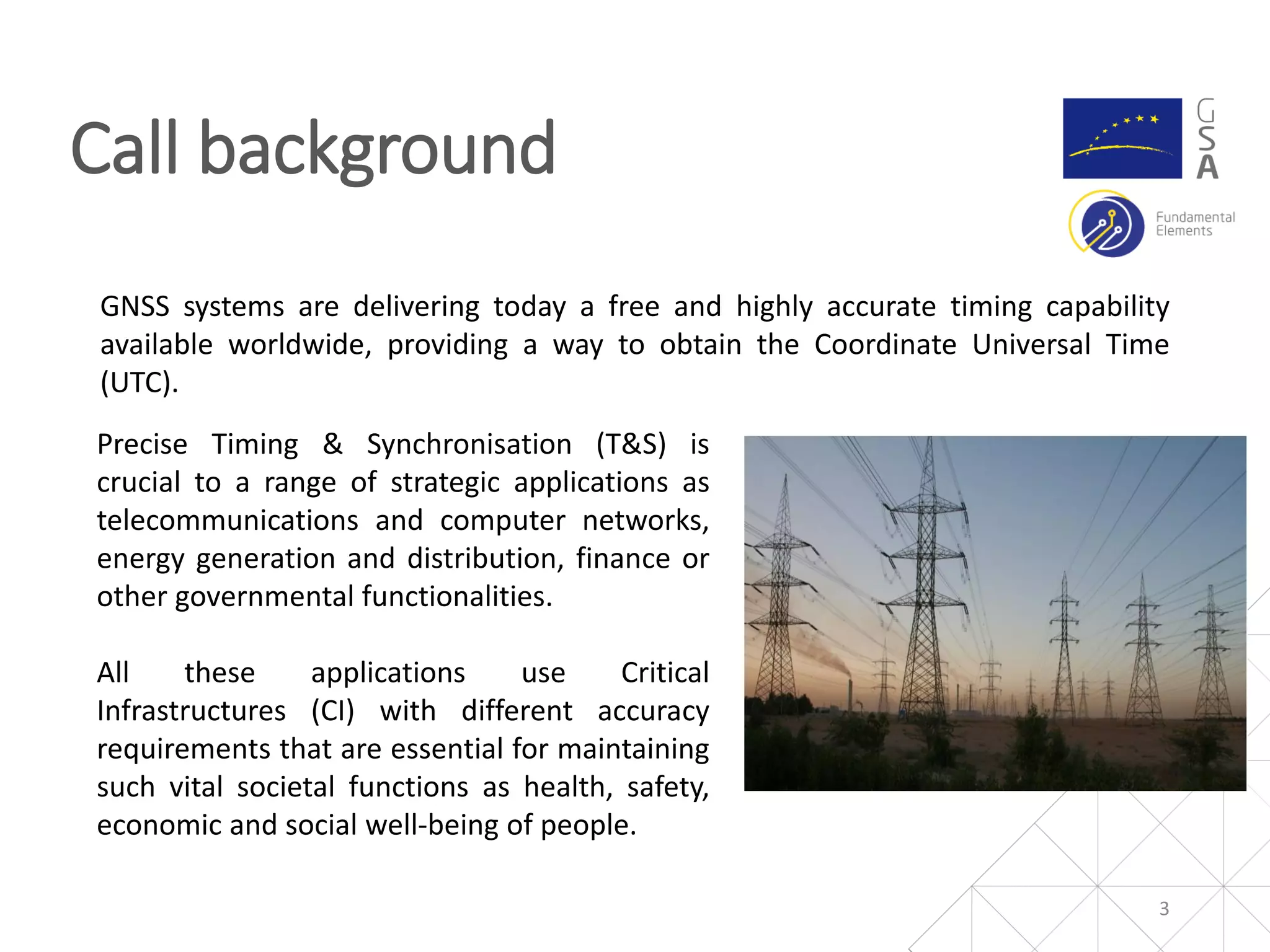
Precise Timing & Synchronisation (T&S) is
crucial to a range of strategic applications as
telecommunications and computer networks,
energy generation and distribution, finance or
other governmental functionalities.
All these applications use Critical
Infrastructures (CI) with different accuracy
requirements that are essential for maintaining
such vital societal functions as health, safety,
economic and social well‐being of people.
Call background
4
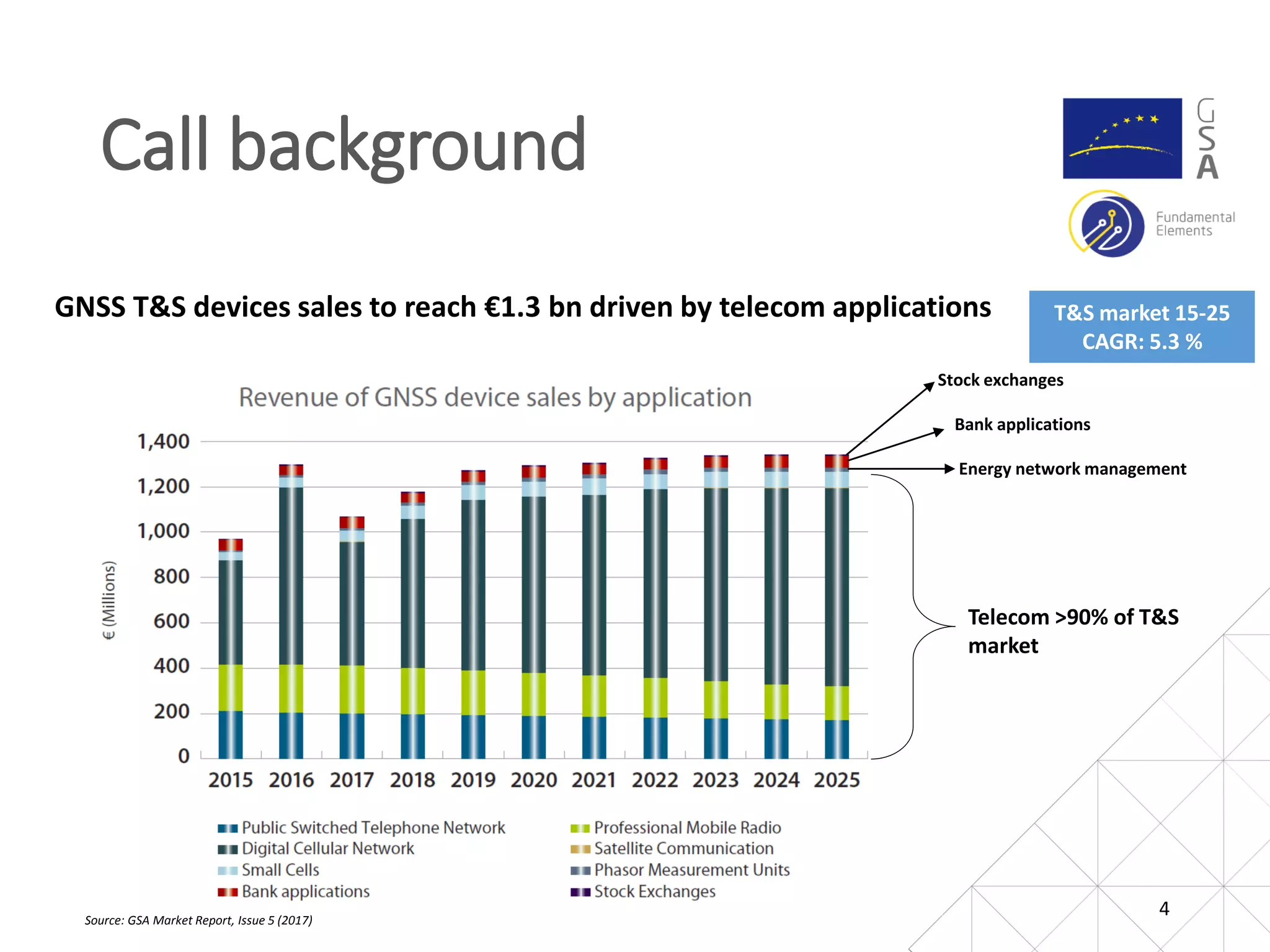
Telecom >90% of T&S
market
T&S market 15-25
CAGR: 5.3 %
Source: GSA Market Report, Issue 5 (2017)
Stock exchanges
Bank applications
Energy network management
GNSS T&S devices sales to reach €1.3 bn driven by telecom applications
The call for proposal aims at developing, testing and assessing a Galileo-based
time receiver prototype for the Critical Infrastructures and providing accurate
and highly robust timing
In particular:
 The prototype receiver shall include as a minimum a mode of operation to
obtain the Galileo System Time and UTC based on Galileo signals only, both
in single frequency as well as in multiple frequency solution
 Robust receiver solutions shall be implemented
 The interfaces that can be implemented are: PTP, NTP, SyncE, PPS, 10 MHz,
and IRIG-B, but applicants may propose alternatives
Objectives of the call
5
Activities shall be divided in six tasks:
Task 1: User’s requirements
Task 2: Timing Receiver’s Requirements
Task 3: Detailed design of the Receiver prototype
Task 4: Prototype development
Task 5: Testing and validation of the receiver prototype
Task 6: Dissemination of the results
Scope and areas of activities of the
Cfp
6
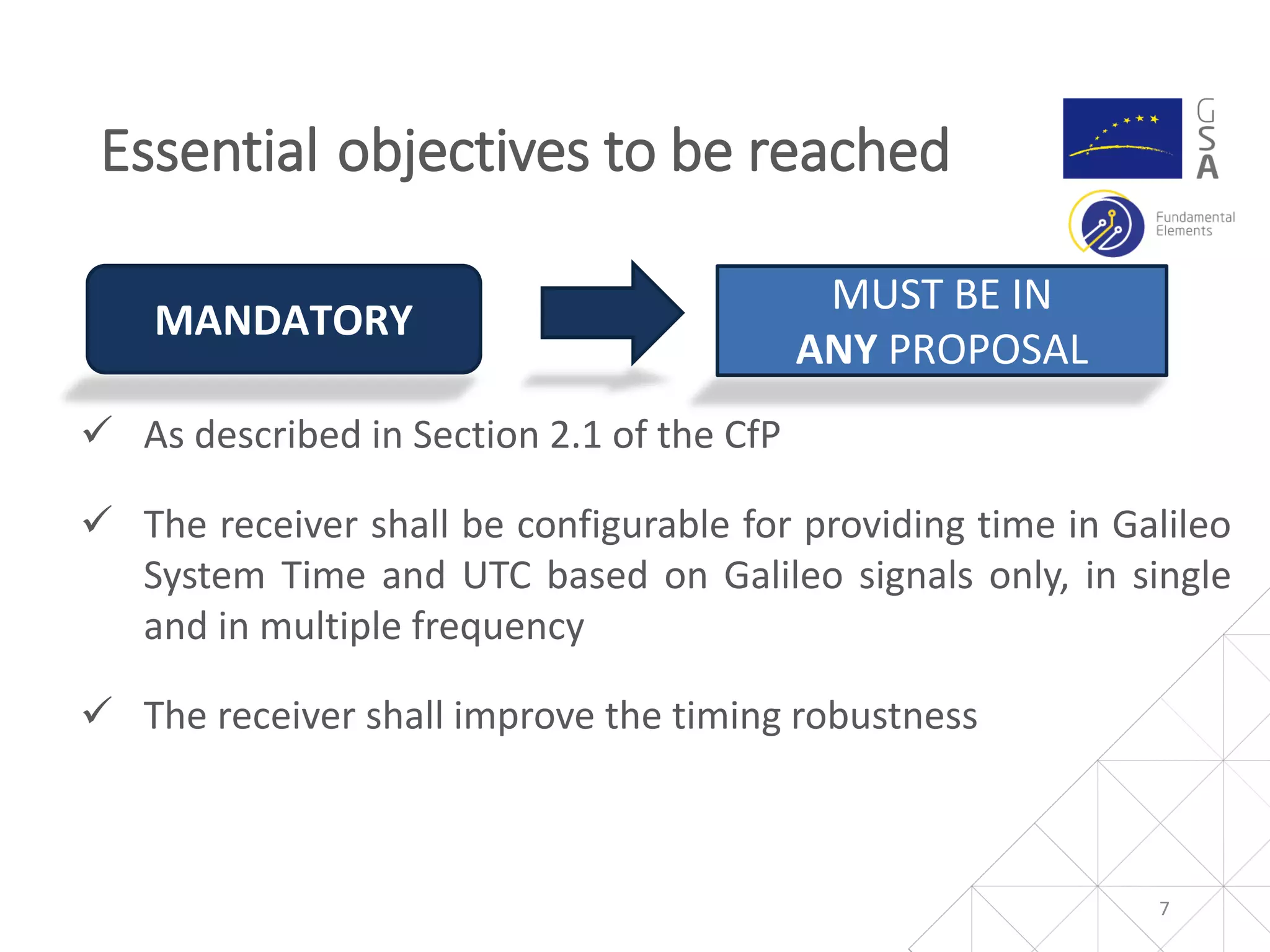
 As described in Section 2.1 of the CfP
 The receiver shall be configurable for providing time in Galileo
System Time and UTC based on Galileo signals only, in single
and in multiple frequency
 The receiver shall improve the timing robustness
Essential objectives to be reached
7
MANDATORY
MUST BE IN
ANY PROPOSAL
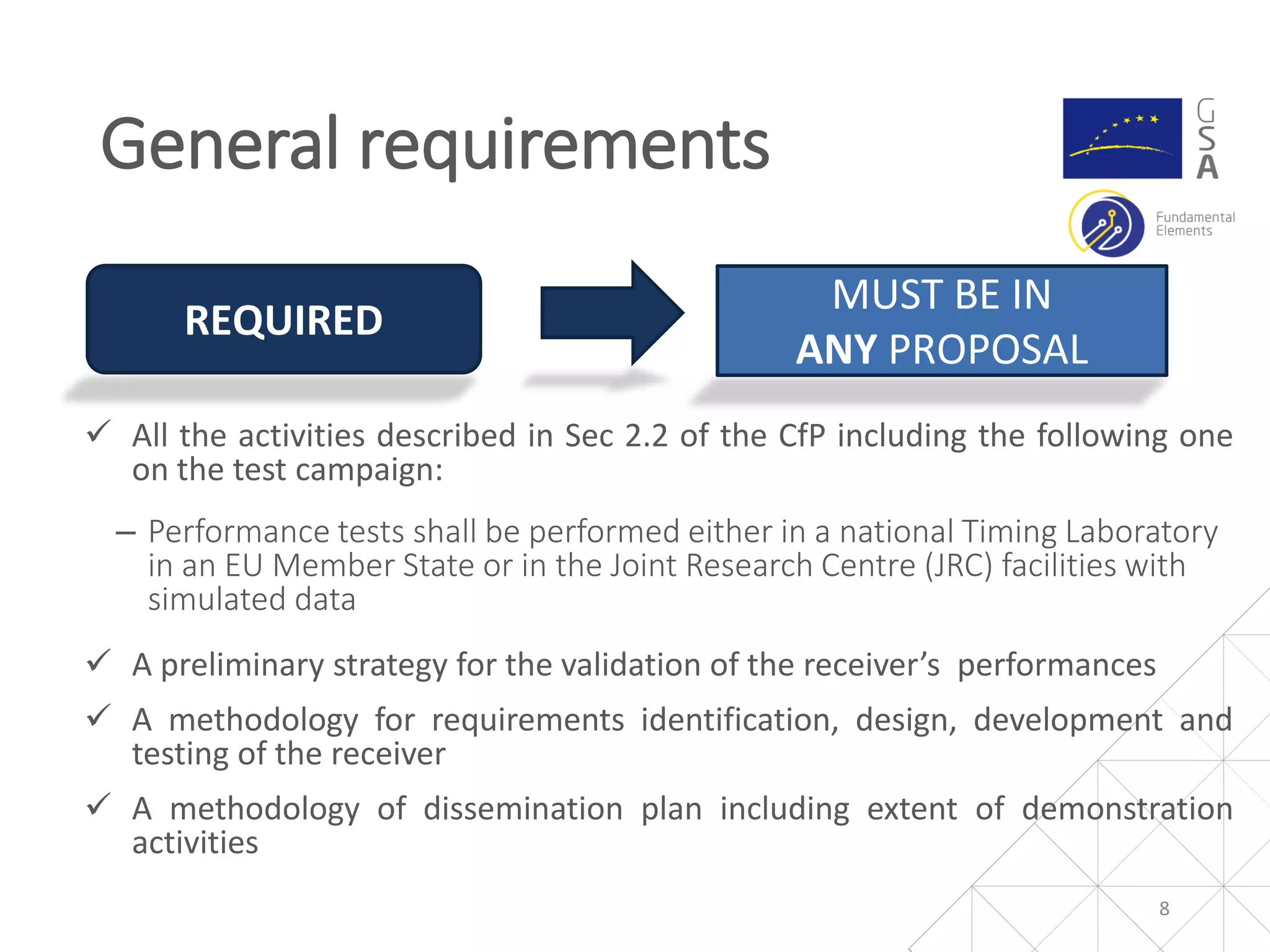
 All the activities described in Sec 2.2 of the CfP including the following one
on the test campaign:
‒ Performance tests shall be performed either in a national Timing Laboratory
in an EU Member State or in the Joint Research Centre (JRC) facilities with
simulated data
 A preliminary strategy for the validation of the receiver’s performances
 A methodology for requirements identification, design, development and
testing of the receiver
 A methodology of dissemination plan including extent of demonstration
activities
8
REQUIRED
MUST BE IN
ANY PROPOSAL
General requirements
9
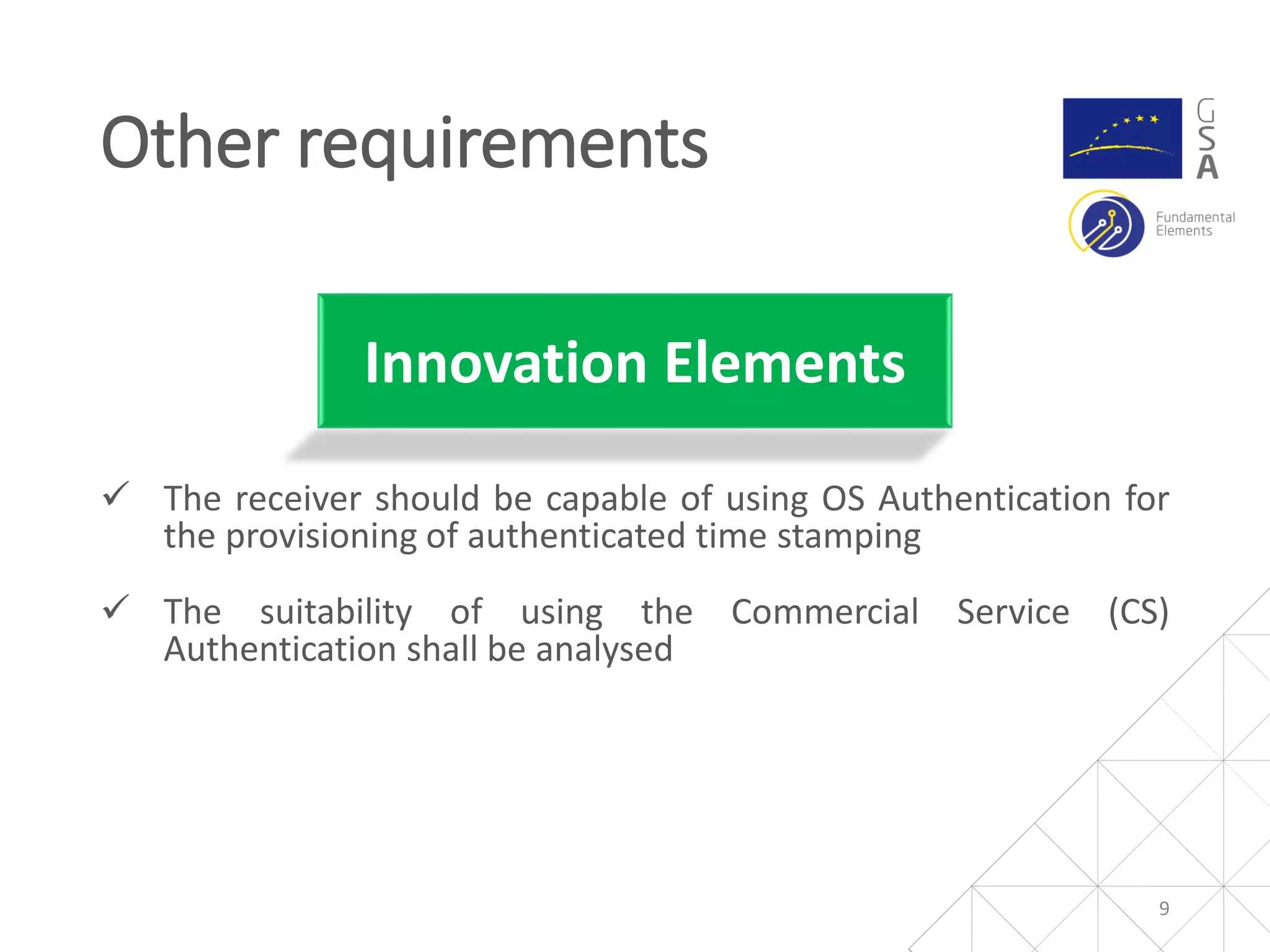
Innovation Elements
 The receiver should be capable of using OS Authentication for
the provisioning of authenticated time stamping
 The suitability of using the Commercial Service (CS)
Authentication shall be analysed
Other requirements
The following activities are considered core to the project:
 Management and coordination,
 Timing Receiver’s Requirements definition
 Development of a receiver prototype
 Testing and validation of the receiver prototype
 Dissemination
10
Core activities
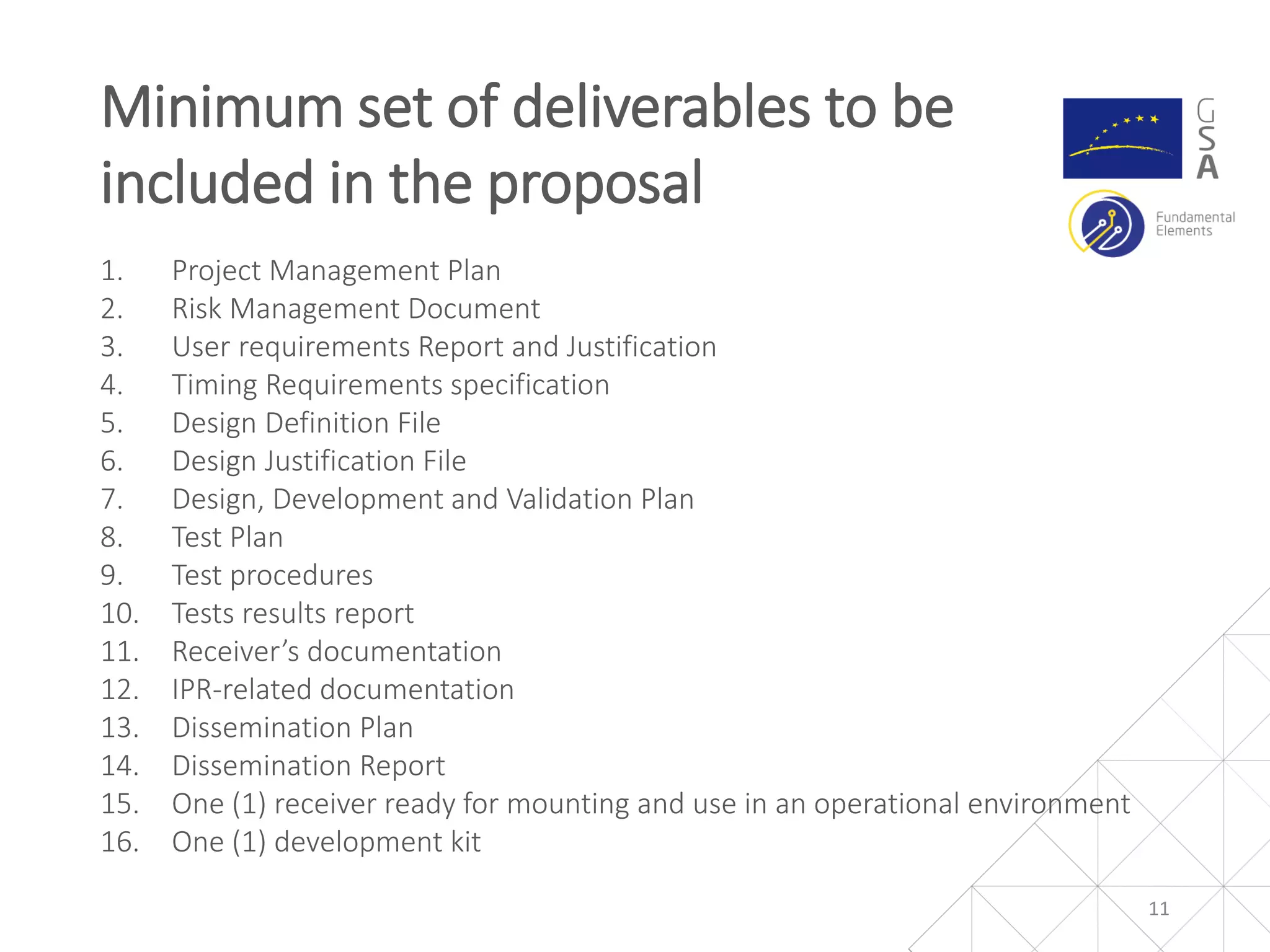
1. Project Management Plan
2. Risk Management Document
3. User requirements Report and Justification
4. Timing Requirements specification
5. Design Definition File
6. Design Justification File
7. Design, Development and Validation Plan
8. Test Plan
9. Test procedures
10. Tests results report
11. Receiver’s documentation
12. IPR-related documentation
13. Dissemination Plan
14. Dissemination Report
15. One (1) receiver ready for mounting and use in an operational environment
16. One (1) development kit
Minimum set of deliverables to be
included in the proposal
11
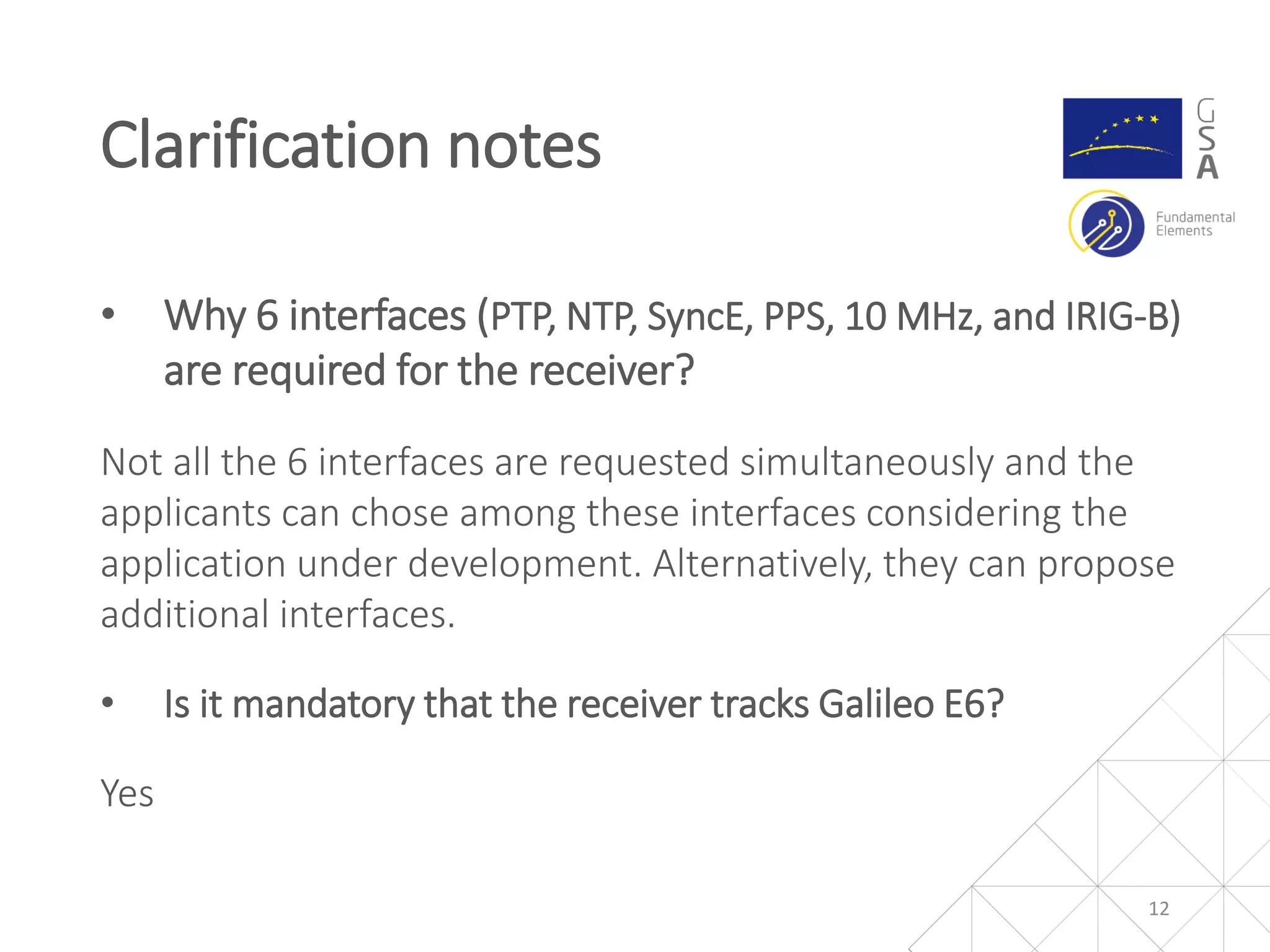
• Why 6 interfaces (PTP, NTP, SyncE, PPS, 10 MHz, and IRIG-B)
are required for the receiver?
Not all the 6 interfaces are requested simultaneously and the
applicants can chose among these interfaces considering the
application under development. Alternatively, they can propose
additional interfaces.
• Is it mandatory that the receiver tracks Galileo E6?
Yes
Clarification notes
12
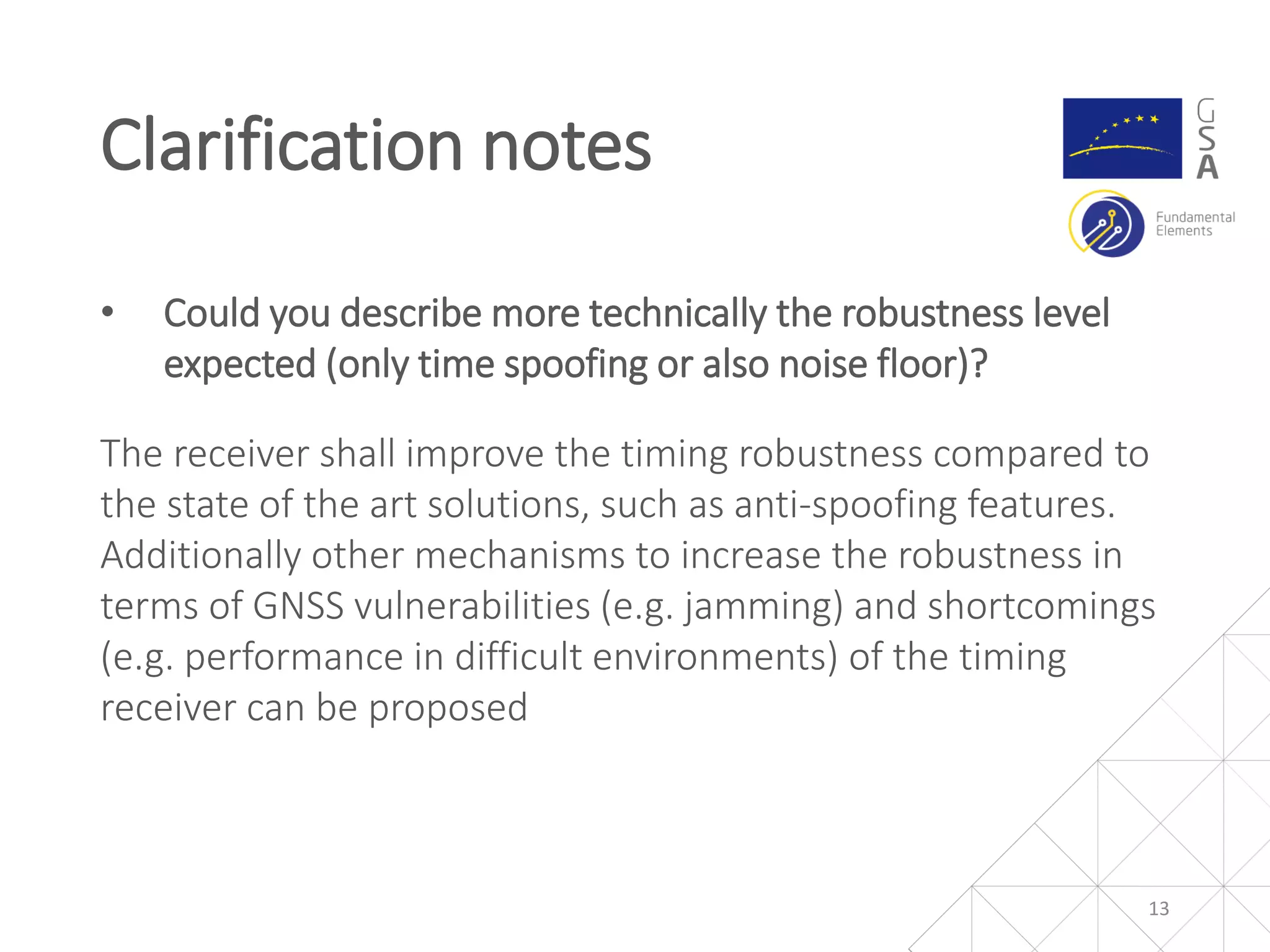
• Could you describe more technically the robustness level
expected (only time spoofing or also noise floor)?
The receiver shall improve the timing robustness compared to
the state of the art solutions, such as anti-spoofing features.
Additionally other mechanisms to increase the robustness in
terms of GNSS vulnerabilities (e.g. jamming) and shortcomings
(e.g. performance in difficult environments) of the timing
receiver can be proposed
Clarification notes
13
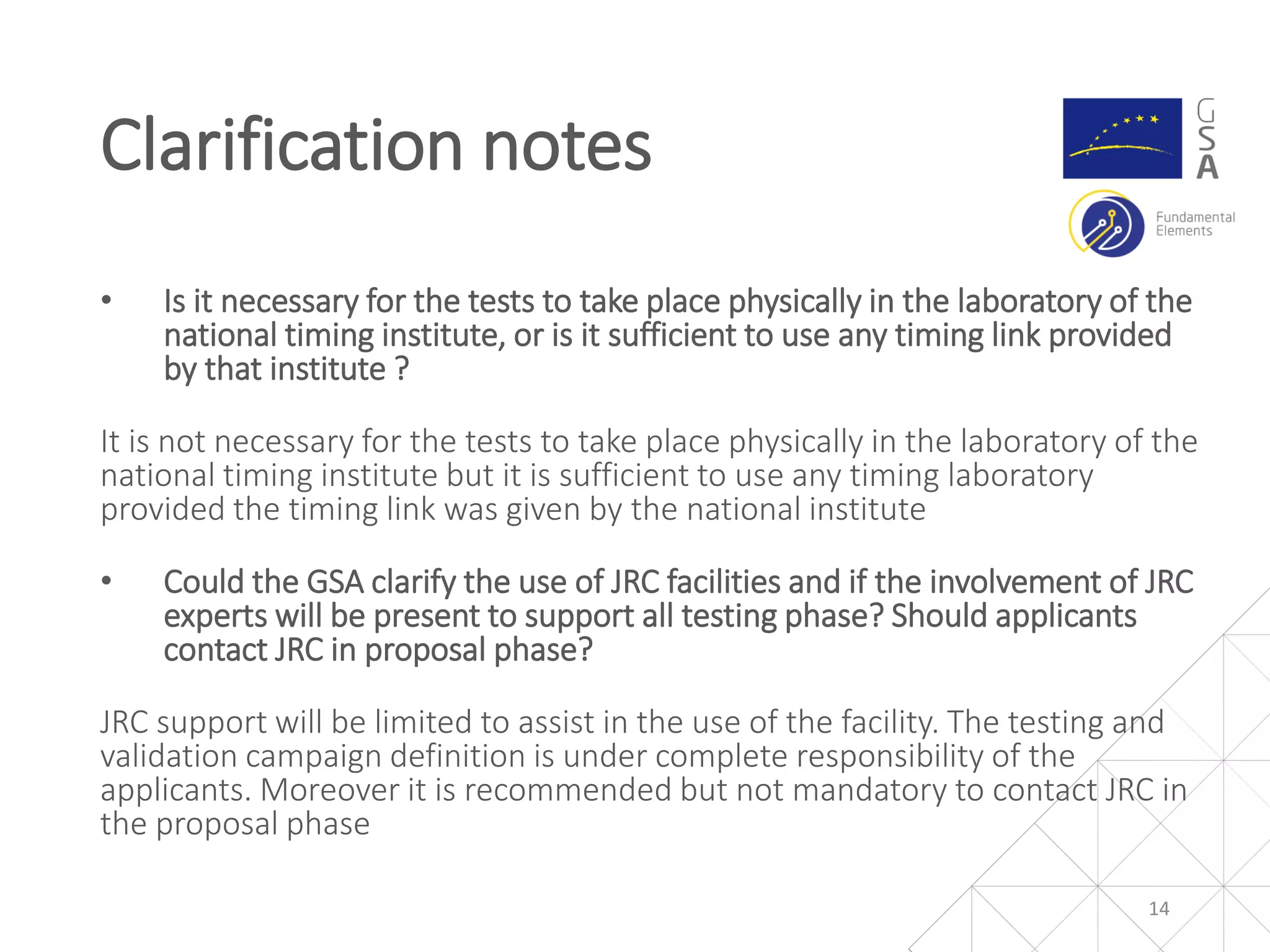
• Is it necessary for the tests to take place physically in the laboratory of the
national timing institute, or is it sufficient to use any timing link provided
by that institute ?
It is not necessary for the tests to take place physically in the laboratory of the
national timing institute but it is sufficient to use any timing laboratory
provided the timing link was given by the national institute
• Could the GSA clarify the use of JRC facilities and if the involvement of JRC
experts will be present to support all testing phase? Should applicants
contact JRC in proposal phase?
JRC support will be limited to assist in the use of the facility. The testing and
validation campaign definition is under complete responsibility of the
applicants. Moreover it is recommended but not mandatory to contact JRC in
the proposal phase
Clarification notes
14
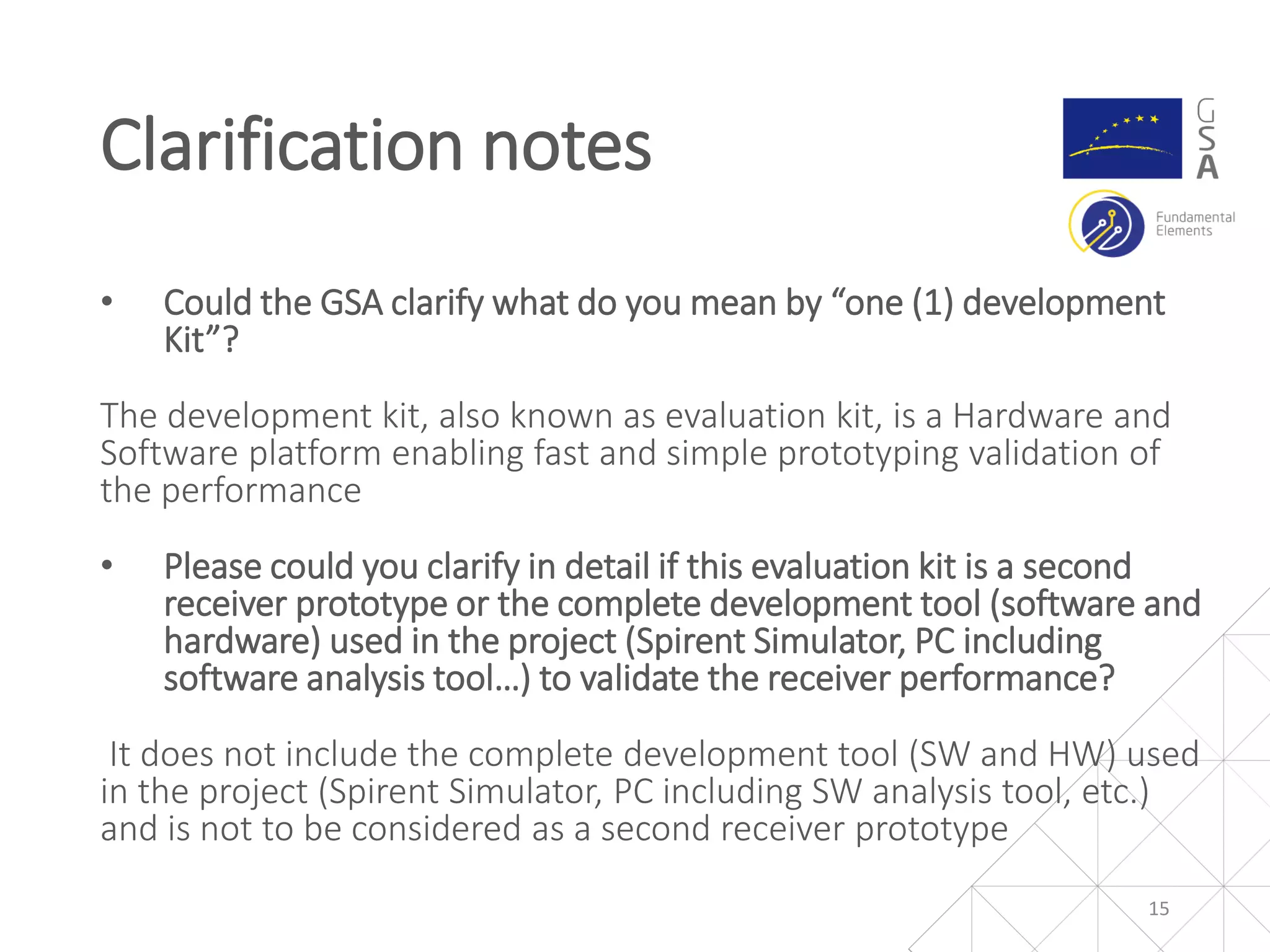
• Could the GSA clarify what do you mean by “one (1) development
Kit”?
The development kit, also known as evaluation kit, is a Hardware and
Software platform enabling fast and simple prototyping validation of
the performance
• Please could you clarify in detail if this evaluation kit is a second
receiver prototype or the complete development tool (software and
hardware) used in the project (Spirent Simulator, PC including
software analysis tool…) to validate the receiver performance?
It does not include the complete development tool (SW and HW) used
in the project (Spirent Simulator, PC including SW analysis tool, etc.)
and is not to be considered as a second receiver prototype
Clarification notes
15
Evaluation: Award criteria
16
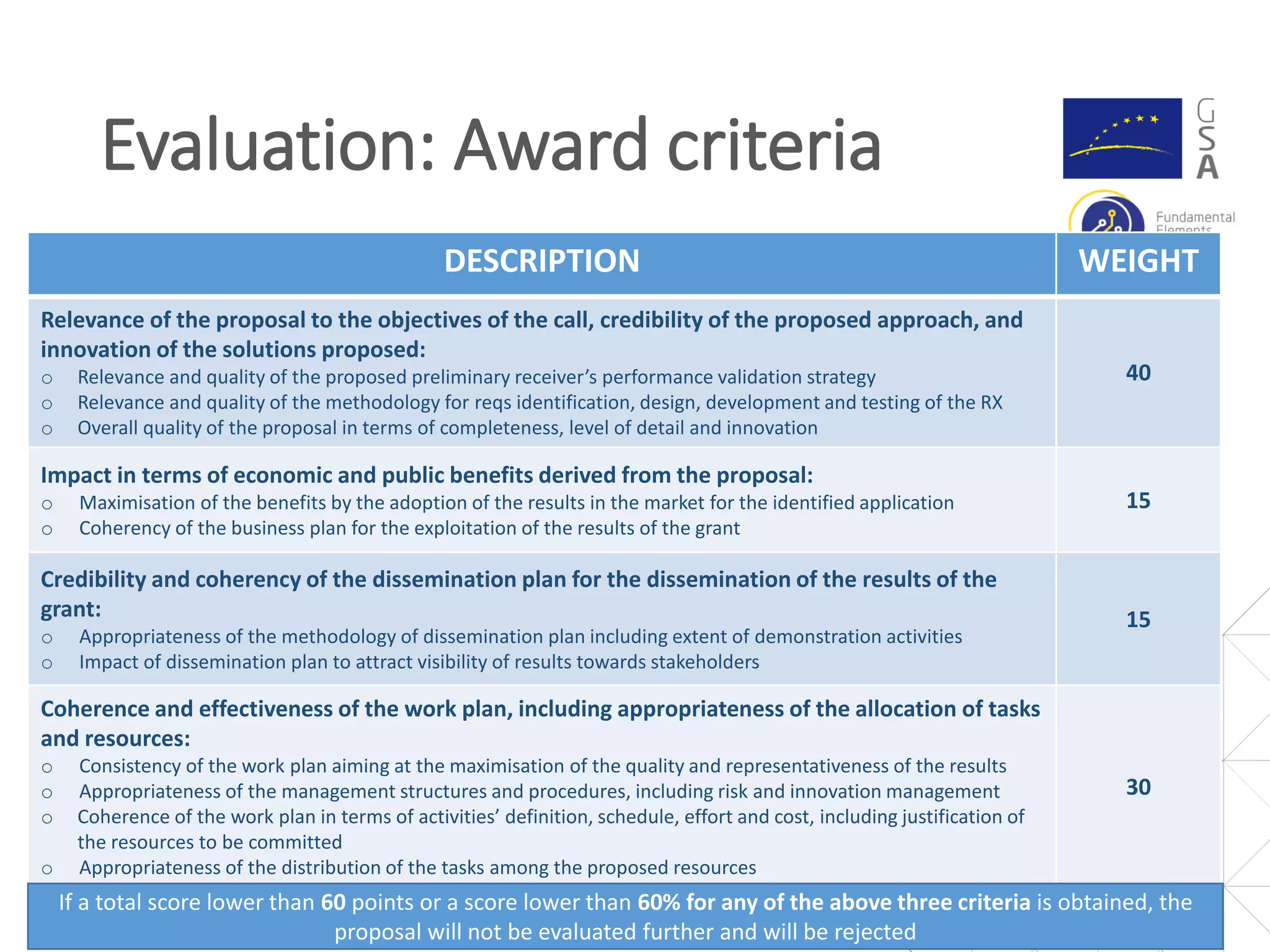
DESCRIPTION WEIGHT
Relevance of the proposal to the objectives of the call, credibility of the proposed approach, and
innovation of the solutions proposed:
o Relevance and quality of the proposed preliminary receiver’s performance validation strategy
o Relevance and quality of the methodology for reqs identification, design, development and testing of the RX
o Overall quality of the proposal in terms of completeness, level of detail and innovation
40
Impact in terms of economic and public benefits derived from the proposal:
o Maximisation of the benefits by the adoption of the results in the market for the identified application
o Coherency of the business plan for the exploitation of the results of the grant
15
Credibility and coherency of the dissemination plan for the dissemination of the results of the
grant:
o Appropriateness of the methodology of dissemination plan including extent of demonstration activities
o Impact of dissemination plan to attract visibility of results towards stakeholders
15
Coherence and effectiveness of the work plan, including appropriateness of the allocation of tasks
and resources:
o Consistency of the work plan aiming at the maximisation of the quality and representativeness of the results
o Appropriateness of the management structures and procedures, including risk and innovation management
o Coherence of the work plan in terms of activities’ definition, schedule, effort and cost, including justification of
the resources to be committed
o Appropriateness of the distribution of the tasks among the proposed resources
30
If a total score lower than 60 points or a score lower than 60% for any of the above three criteria is obtained, the
proposal will not be evaluated further and will be rejected
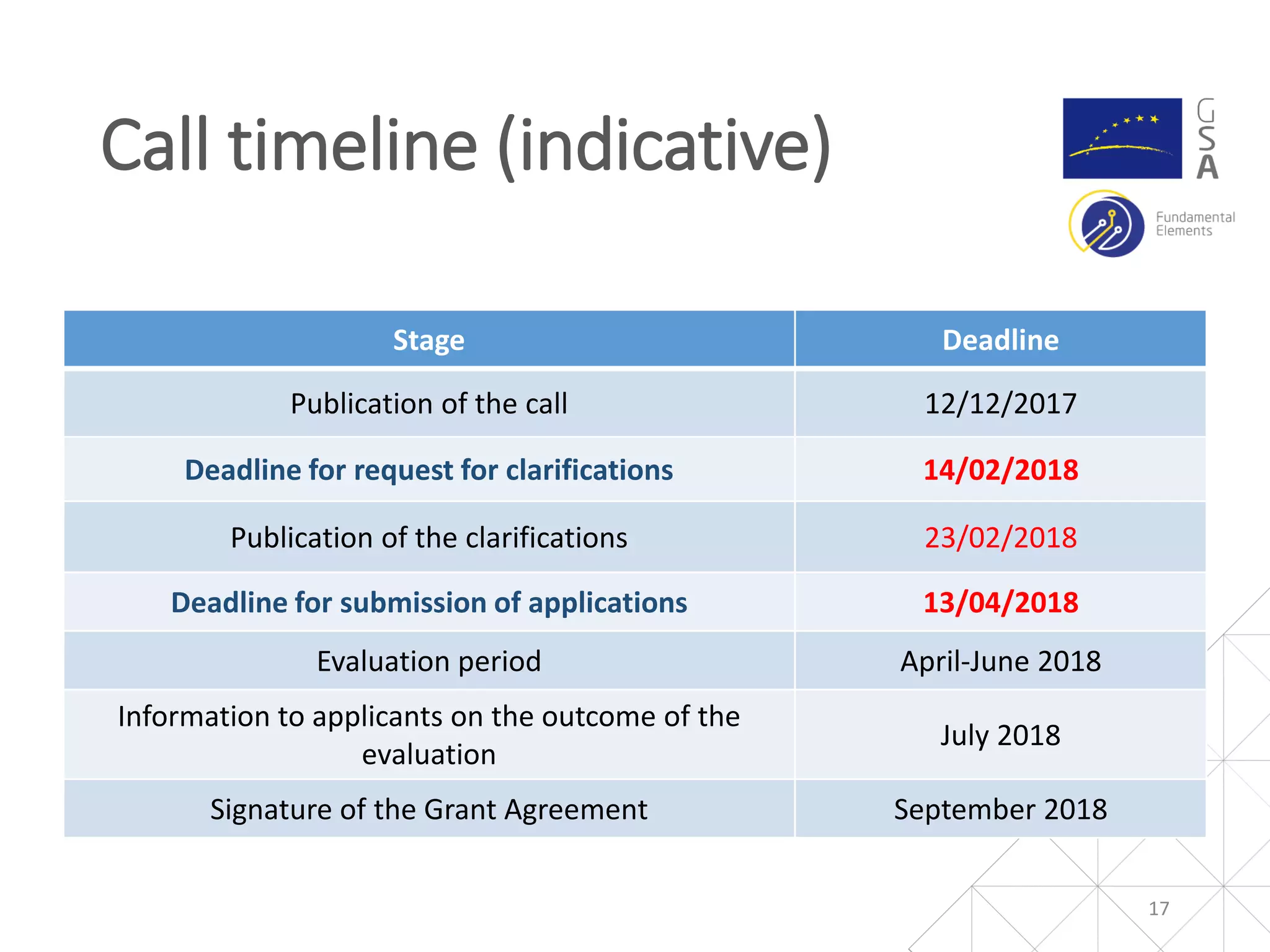
Call timeline (indicative)
17
Stage Deadline
Publication of the call 12/12/2017
Deadline for request for clarifications 14/02/2018
Publication of the clarifications 23/02/2018
Deadline for submission of applications 13/04/2018
Evaluation period April-June 2018
Information to applicants on the outcome of the
evaluation
July 2018
Signature of the Grant Agreement September 2018
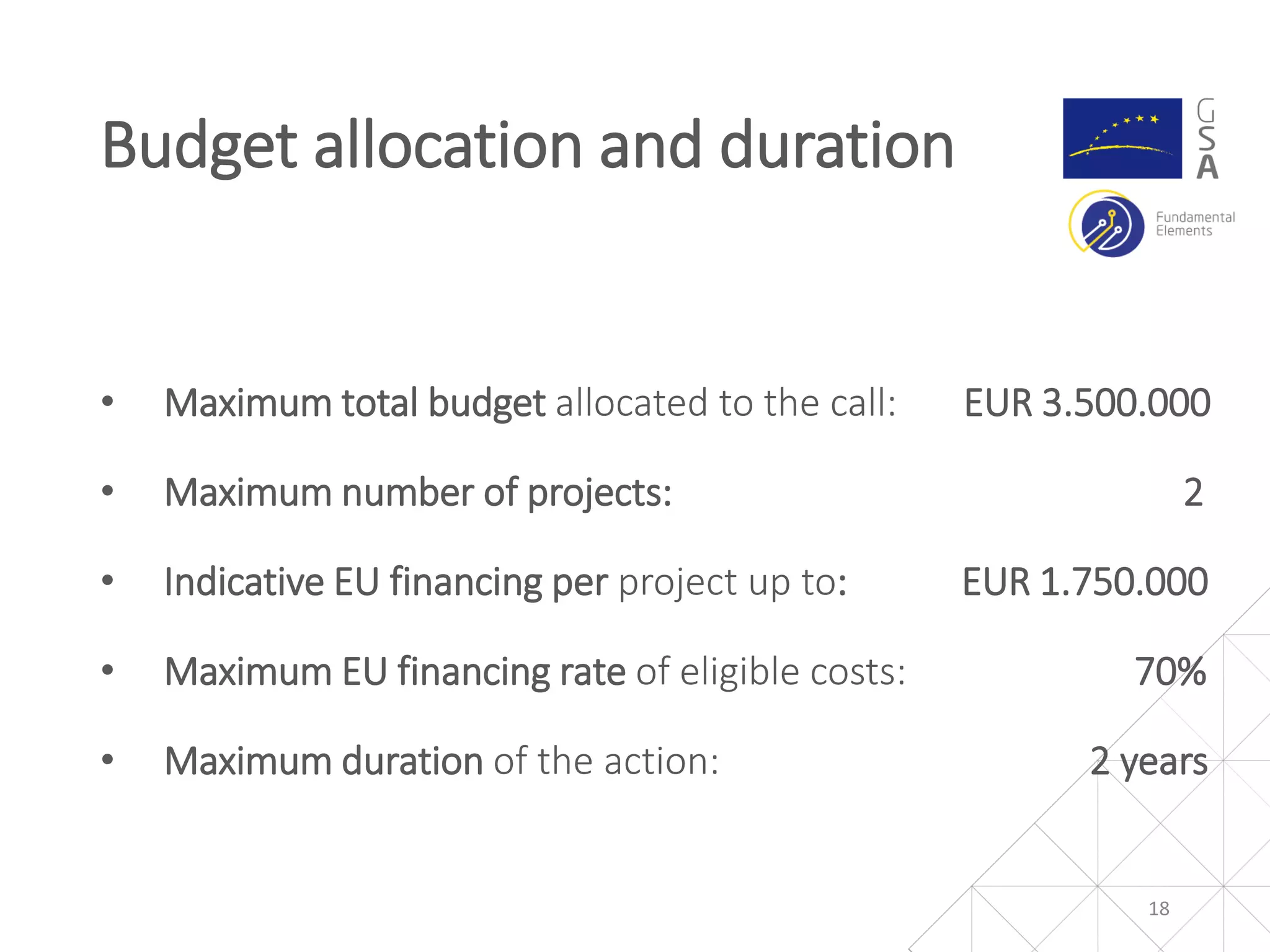
• Maximum total budget allocated to the call: EUR 3.500.000
• Maximum number of projects: 2
• Indicative EU financing per project up to: EUR 1.750.000
• Maximum EU financing rate of eligible costs: 70%
• Maximum duration of the action: 2 years
Budget allocation and duration
18
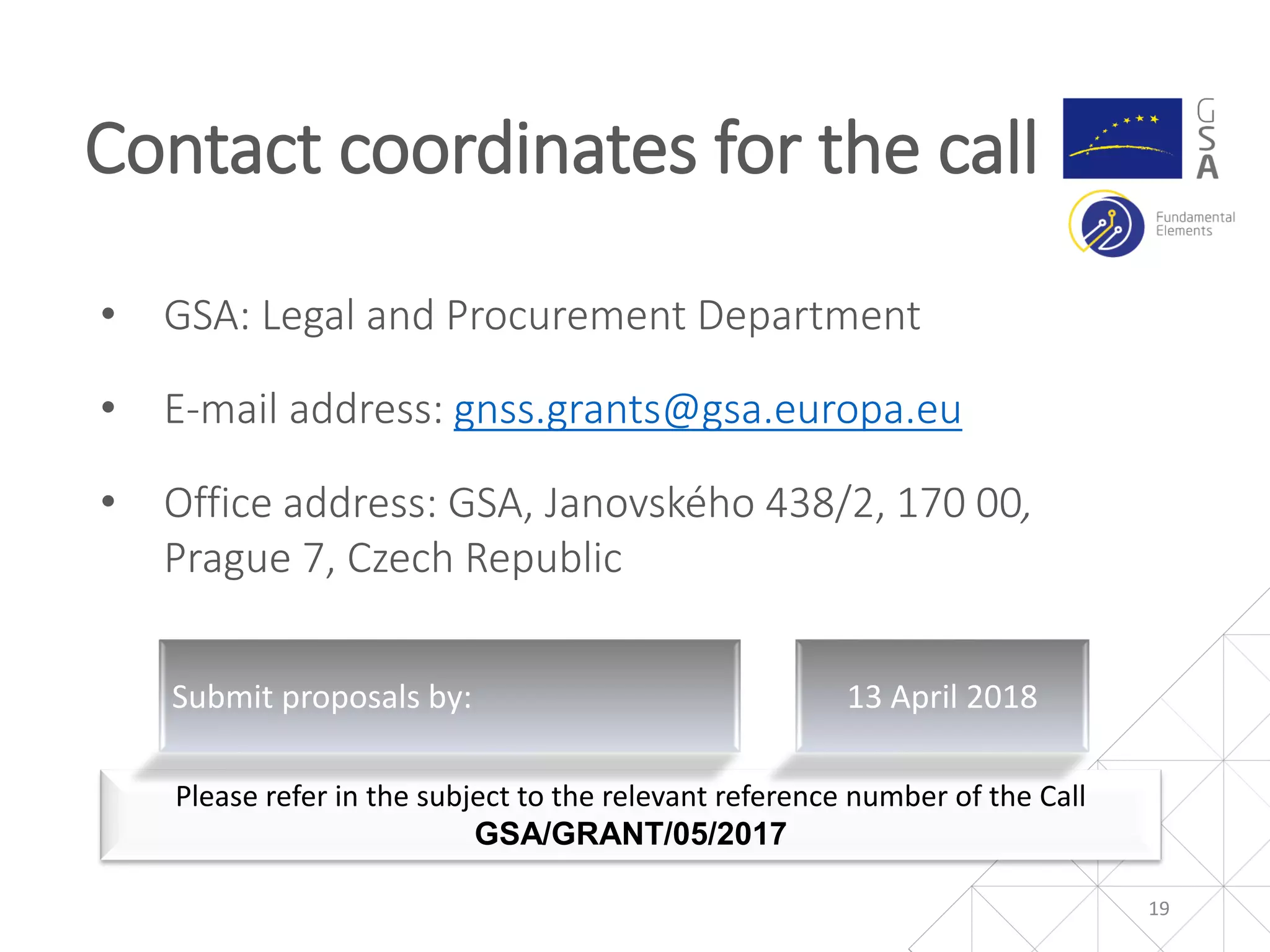
• GSA: Legal and Procurement Department
• E-mail address: gnss.grants@gsa.europa.eu
• Office address: GSA, Janovského 438/2, 170 00,
Prague 7, Czech Republic
Contact coordinates for the call
19
Please refer in the subject to the relevant reference number of the Call
GSA/GRANT/05/2017
Submit proposals by: 13 April 2018
GSA Twitter - @EU_GNSS
EGNOS Twitter - @EGNOSPortal
GNSS Facebook page
GNSS YouTube ChannelGSA Newsletter
GNSS Slideshare Page (presentations)
European GNSS Agency LinkedIn Page
www.GSA.europa.eu
How to get in touch:
Linking space to user needs
GNSS Market, Research & Development
20

05. Development of a Galileo-based timing receiver for critical infrastructures

  • 1.
    Development of aGalileo-based timing receiver for critical infrastructures 2nd Fundamental Elements Info Day, 14 March 2018 1This presentation can be interpreted only together with the oral comments accompanying it Valeria Catalano, Market Development
  • 2.
    Agenda 2  CALL BACKGROUND OBJECTIVES AND REQUIREMENTS  MAJOR CLARIFICATION NOTES  EVALUATION, TIMELINE AND BUDGET
  • 3.
    Call background 3 GNSS systemsare delivering today a free and highly accurate timing capability available worldwide, providing a way to obtain the Coordinate Universal Time (UTC). Precise Timing & Synchronisation (T&S) is crucial to a range of strategic applications as telecommunications and computer networks, energy generation and distribution, finance or other governmental functionalities. All these applications use Critical Infrastructures (CI) with different accuracy requirements that are essential for maintaining such vital societal functions as health, safety, economic and social well‐being of people.
  • 4.
    Call background 4 Telecom >90%of T&S market T&S market 15-25 CAGR: 5.3 % Source: GSA Market Report, Issue 5 (2017) Stock exchanges Bank applications Energy network management GNSS T&S devices sales to reach €1.3 bn driven by telecom applications
  • 5.
    The call forproposal aims at developing, testing and assessing a Galileo-based time receiver prototype for the Critical Infrastructures and providing accurate and highly robust timing In particular:  The prototype receiver shall include as a minimum a mode of operation to obtain the Galileo System Time and UTC based on Galileo signals only, both in single frequency as well as in multiple frequency solution  Robust receiver solutions shall be implemented  The interfaces that can be implemented are: PTP, NTP, SyncE, PPS, 10 MHz, and IRIG-B, but applicants may propose alternatives Objectives of the call 5
  • 6.
    Activities shall bedivided in six tasks: Task 1: User’s requirements Task 2: Timing Receiver’s Requirements Task 3: Detailed design of the Receiver prototype Task 4: Prototype development Task 5: Testing and validation of the receiver prototype Task 6: Dissemination of the results Scope and areas of activities of the Cfp 6
  • 7.
     As describedin Section 2.1 of the CfP  The receiver shall be configurable for providing time in Galileo System Time and UTC based on Galileo signals only, in single and in multiple frequency  The receiver shall improve the timing robustness Essential objectives to be reached 7 MANDATORY MUST BE IN ANY PROPOSAL
  • 8.
     All theactivities described in Sec 2.2 of the CfP including the following one on the test campaign: ‒ Performance tests shall be performed either in a national Timing Laboratory in an EU Member State or in the Joint Research Centre (JRC) facilities with simulated data  A preliminary strategy for the validation of the receiver’s performances  A methodology for requirements identification, design, development and testing of the receiver  A methodology of dissemination plan including extent of demonstration activities 8 REQUIRED MUST BE IN ANY PROPOSAL General requirements
  • 9.
    9 Innovation Elements  Thereceiver should be capable of using OS Authentication for the provisioning of authenticated time stamping  The suitability of using the Commercial Service (CS) Authentication shall be analysed Other requirements
  • 10.
    The following activitiesare considered core to the project:  Management and coordination,  Timing Receiver’s Requirements definition  Development of a receiver prototype  Testing and validation of the receiver prototype  Dissemination 10 Core activities
  • 11.
    1. Project ManagementPlan 2. Risk Management Document 3. User requirements Report and Justification 4. Timing Requirements specification 5. Design Definition File 6. Design Justification File 7. Design, Development and Validation Plan 8. Test Plan 9. Test procedures 10. Tests results report 11. Receiver’s documentation 12. IPR-related documentation 13. Dissemination Plan 14. Dissemination Report 15. One (1) receiver ready for mounting and use in an operational environment 16. One (1) development kit Minimum set of deliverables to be included in the proposal 11
  • 12.
    • Why 6interfaces (PTP, NTP, SyncE, PPS, 10 MHz, and IRIG-B) are required for the receiver? Not all the 6 interfaces are requested simultaneously and the applicants can chose among these interfaces considering the application under development. Alternatively, they can propose additional interfaces. • Is it mandatory that the receiver tracks Galileo E6? Yes Clarification notes 12
  • 13.
    • Could youdescribe more technically the robustness level expected (only time spoofing or also noise floor)? The receiver shall improve the timing robustness compared to the state of the art solutions, such as anti-spoofing features. Additionally other mechanisms to increase the robustness in terms of GNSS vulnerabilities (e.g. jamming) and shortcomings (e.g. performance in difficult environments) of the timing receiver can be proposed Clarification notes 13
  • 14.
    • Is itnecessary for the tests to take place physically in the laboratory of the national timing institute, or is it sufficient to use any timing link provided by that institute ? It is not necessary for the tests to take place physically in the laboratory of the national timing institute but it is sufficient to use any timing laboratory provided the timing link was given by the national institute • Could the GSA clarify the use of JRC facilities and if the involvement of JRC experts will be present to support all testing phase? Should applicants contact JRC in proposal phase? JRC support will be limited to assist in the use of the facility. The testing and validation campaign definition is under complete responsibility of the applicants. Moreover it is recommended but not mandatory to contact JRC in the proposal phase Clarification notes 14
  • 15.
    • Could theGSA clarify what do you mean by “one (1) development Kit”? The development kit, also known as evaluation kit, is a Hardware and Software platform enabling fast and simple prototyping validation of the performance • Please could you clarify in detail if this evaluation kit is a second receiver prototype or the complete development tool (software and hardware) used in the project (Spirent Simulator, PC including software analysis tool…) to validate the receiver performance? It does not include the complete development tool (SW and HW) used in the project (Spirent Simulator, PC including SW analysis tool, etc.) and is not to be considered as a second receiver prototype Clarification notes 15
  • 16.
    Evaluation: Award criteria 16 DESCRIPTIONWEIGHT Relevance of the proposal to the objectives of the call, credibility of the proposed approach, and innovation of the solutions proposed: o Relevance and quality of the proposed preliminary receiver’s performance validation strategy o Relevance and quality of the methodology for reqs identification, design, development and testing of the RX o Overall quality of the proposal in terms of completeness, level of detail and innovation 40 Impact in terms of economic and public benefits derived from the proposal: o Maximisation of the benefits by the adoption of the results in the market for the identified application o Coherency of the business plan for the exploitation of the results of the grant 15 Credibility and coherency of the dissemination plan for the dissemination of the results of the grant: o Appropriateness of the methodology of dissemination plan including extent of demonstration activities o Impact of dissemination plan to attract visibility of results towards stakeholders 15 Coherence and effectiveness of the work plan, including appropriateness of the allocation of tasks and resources: o Consistency of the work plan aiming at the maximisation of the quality and representativeness of the results o Appropriateness of the management structures and procedures, including risk and innovation management o Coherence of the work plan in terms of activities’ definition, schedule, effort and cost, including justification of the resources to be committed o Appropriateness of the distribution of the tasks among the proposed resources 30 If a total score lower than 60 points or a score lower than 60% for any of the above three criteria is obtained, the proposal will not be evaluated further and will be rejected
  • 17.
    Call timeline (indicative) 17 StageDeadline Publication of the call 12/12/2017 Deadline for request for clarifications 14/02/2018 Publication of the clarifications 23/02/2018 Deadline for submission of applications 13/04/2018 Evaluation period April-June 2018 Information to applicants on the outcome of the evaluation July 2018 Signature of the Grant Agreement September 2018
  • 18.
    • Maximum totalbudget allocated to the call: EUR 3.500.000 • Maximum number of projects: 2 • Indicative EU financing per project up to: EUR 1.750.000 • Maximum EU financing rate of eligible costs: 70% • Maximum duration of the action: 2 years Budget allocation and duration 18
  • 19.
    • GSA: Legaland Procurement Department • E-mail address: gnss.grants@gsa.europa.eu • Office address: GSA, Janovského 438/2, 170 00, Prague 7, Czech Republic Contact coordinates for the call 19 Please refer in the subject to the relevant reference number of the Call GSA/GRANT/05/2017 Submit proposals by: 13 April 2018
  • 20.
    GSA Twitter -@EU_GNSS EGNOS Twitter - @EGNOSPortal GNSS Facebook page GNSS YouTube ChannelGSA Newsletter GNSS Slideshare Page (presentations) European GNSS Agency LinkedIn Page www.GSA.europa.eu How to get in touch: Linking space to user needs GNSS Market, Research & Development 20