
Development of SBAS-enabled
Shipborne Receivers
Fundamental Elements Webinar, 29th March 2017
Manuel Lopez, Technology officer – Maritime and SAR applications
Vincenza de Tommaso, Financial Officer
Alina Hriscu, Market Development Officer
1This presentation can be interpreted only together with the oral comments accompanying it
2
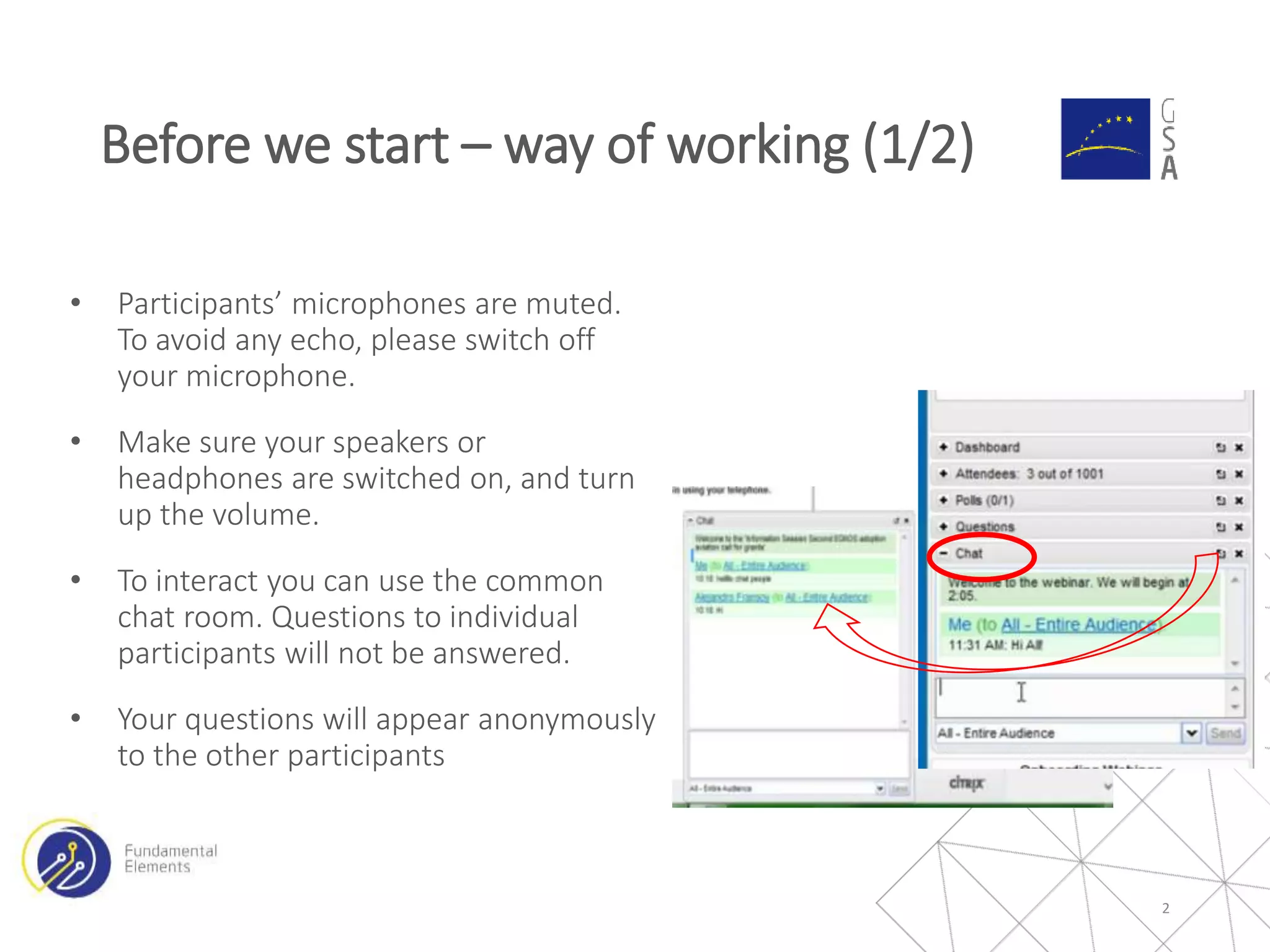
• Participants’ microphones are muted.
To avoid any echo, please switch off
your microphone.
• Make sure your speakers or
headphones are switched on, and turn
up the volume.
• To interact you can use the common
chat room. Questions to individual
participants will not be answered.
• Your questions will appear anonymously
to the other participants
Before we start – way of working (1/2)
• Questions are collected and addressed at the end of the session, if
time allows it.
• All questions and answers will be published on the GSA website in
order to guarantee the equal treatment of tenderers/applicants.
• Slides and clarifications will be available in due course online after
this webinar.
• After the information session, you will receive a short satisfaction
questionnaire, please fill it in.
3
Before we start – way of working (2/2)
 CALL BACKGROUND
 TECHNICAL SCOPE
 ELIGIBLE PARTICIPANTS
 HOW TO PREPARE YOUR PROPOSAL
 GRANT AGREEMENT
 Q&A TIME
Agenda
4
Context
5
• Satellite-based Augmentation Systems are included in the IMO Res. MSC.401 (95) on Performance
Standards for Multi-System Shipborne Radionavigation Receivers
• SBAS is already adopted in shipborne receivers providing increased accuracy.
• However, today there is no maritime Standard or Guidelines for the implementation of SBAS in
shipborne receivers and the majority of these implementations do not take into account the
information related to the system integrity messages that is already broadcasted by SBAS.
• To complement IMO Res. MSC.401(95),
‒ RCTM SC-104 on DGNSS created a SBAS subgroup in 2016 to prepare Guidelines for the
implementation of SBAS in shipborne receivers and draft test specifications for a safety service
compliant with IMO Res. A.1046.
‒ RTCM SC-131 is already drafting the performance requirements and test specifications for
multisystem shipborne radionavigation receiver. Liaison between SC-104 and SC-131 is already
established with respect to SBAS Guidelines.
‒ IEC TC 80 is expected to finalise test specifications for the type approval of multisystem shipborne
radionavigation receivers with the support of RTCM SC-131 by mid-2019.
OBJECTIVES OF THE CALL
6
Objectives of the call
7
(1) Secure the availability of commercial products from European manufacturers of SBAS-
enabled Shipborne Receivers..
(2) Develop and test SBAS-enabled Shipborne Receivers according to the draft Guidelines, for the
implementation of SBAS, submitted to RTCM. This includes:
a. Receiver firmware update (required), taking into account:
i. The minimum set of SBAS Messages to be processed by a maritime receiver in compliance to IMO
Resolution A.1046 operational requirements using SBAS SIS corrections and integrity data
(required).
ii. The recommended processing of messages as well as the system alerts in compliance to the
requirements of IMO Res. A. 1046 (required).
b. Static and Dynamic Test Campaign in the laboratory (required).
c. Dynamic Test Campaign on a vessel (required)
Objectives of the call
8
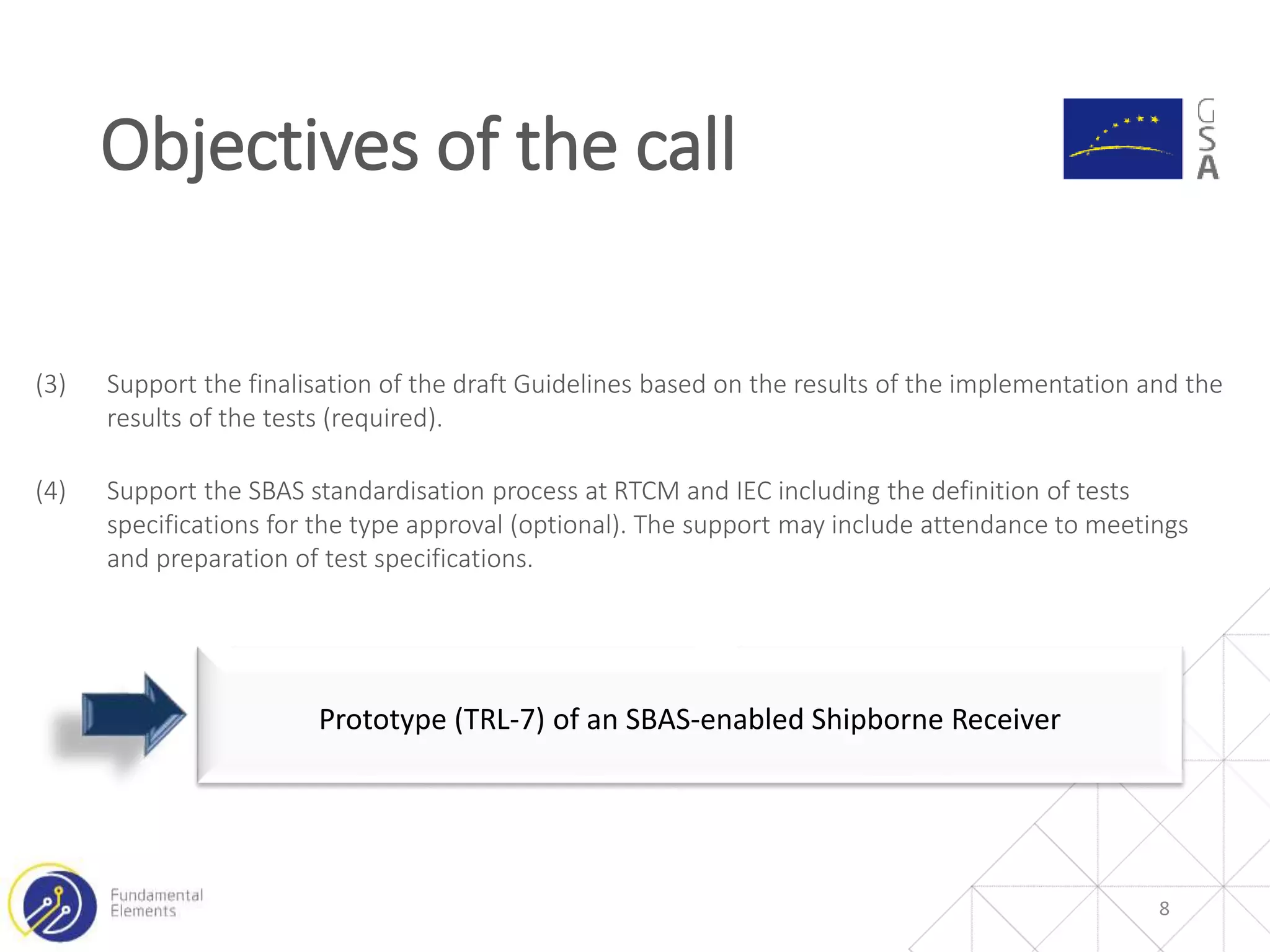
Prototype (TRL-7) of an SBAS-enabled Shipborne Receiver
(3) Support the finalisation of the draft Guidelines based on the results of the implementation and the
results of the tests (required).
(4) Support the SBAS standardisation process at RTCM and IEC including the definition of tests
specifications for the type approval (optional). The support may include attendance to meetings
and preparation of test specifications.
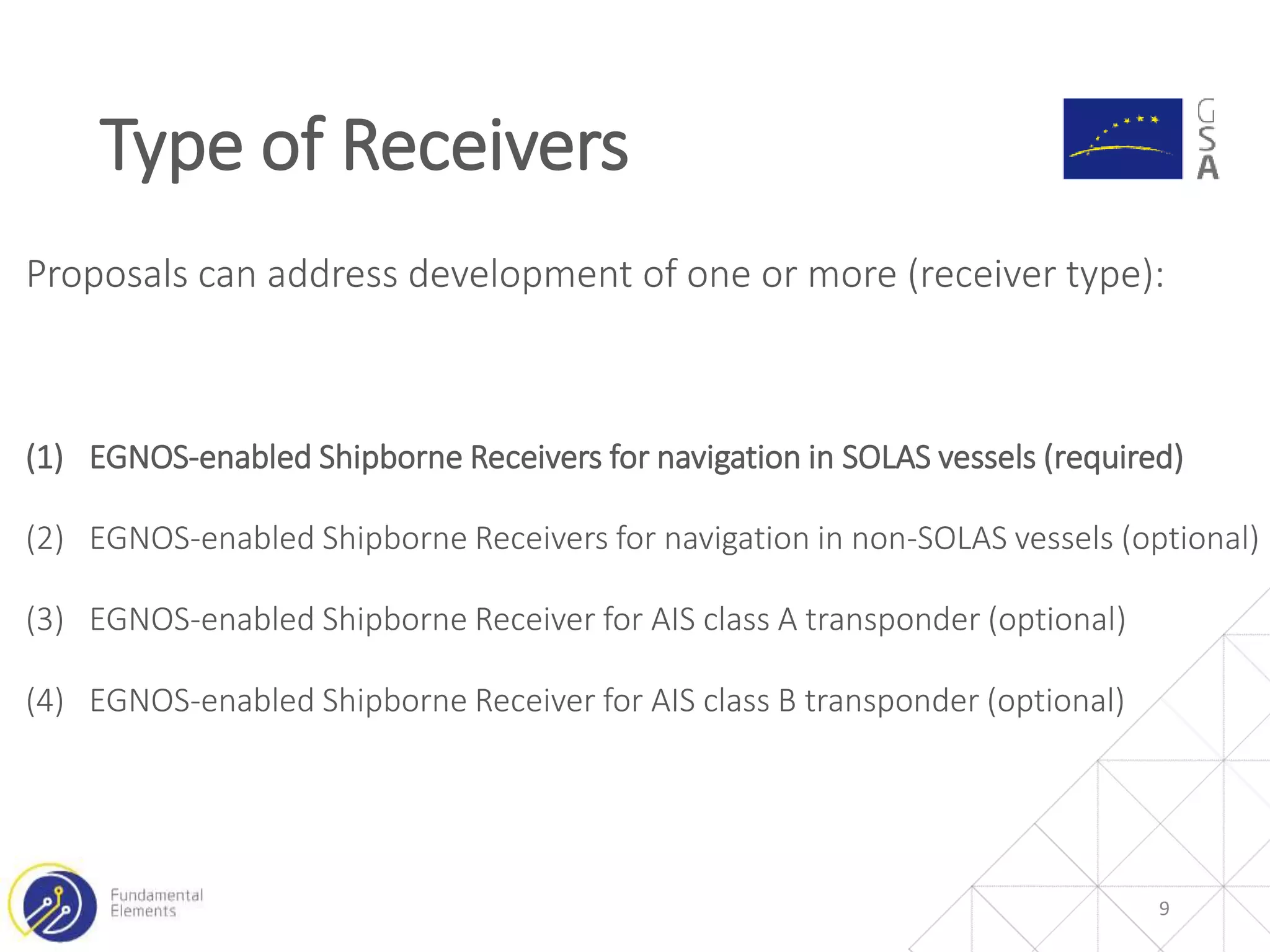
Proposals can address development of one or more (receiver type):
(1) EGNOS-enabled Shipborne Receivers for navigation in SOLAS vessels (required)
(2) EGNOS-enabled Shipborne Receivers for navigation in non-SOLAS vessels (optional)
(3) EGNOS-enabled Shipborne Receiver for AIS class A transponder (optional)
(4) EGNOS-enabled Shipborne Receiver for AIS class B transponder (optional)
Type of Receivers
9
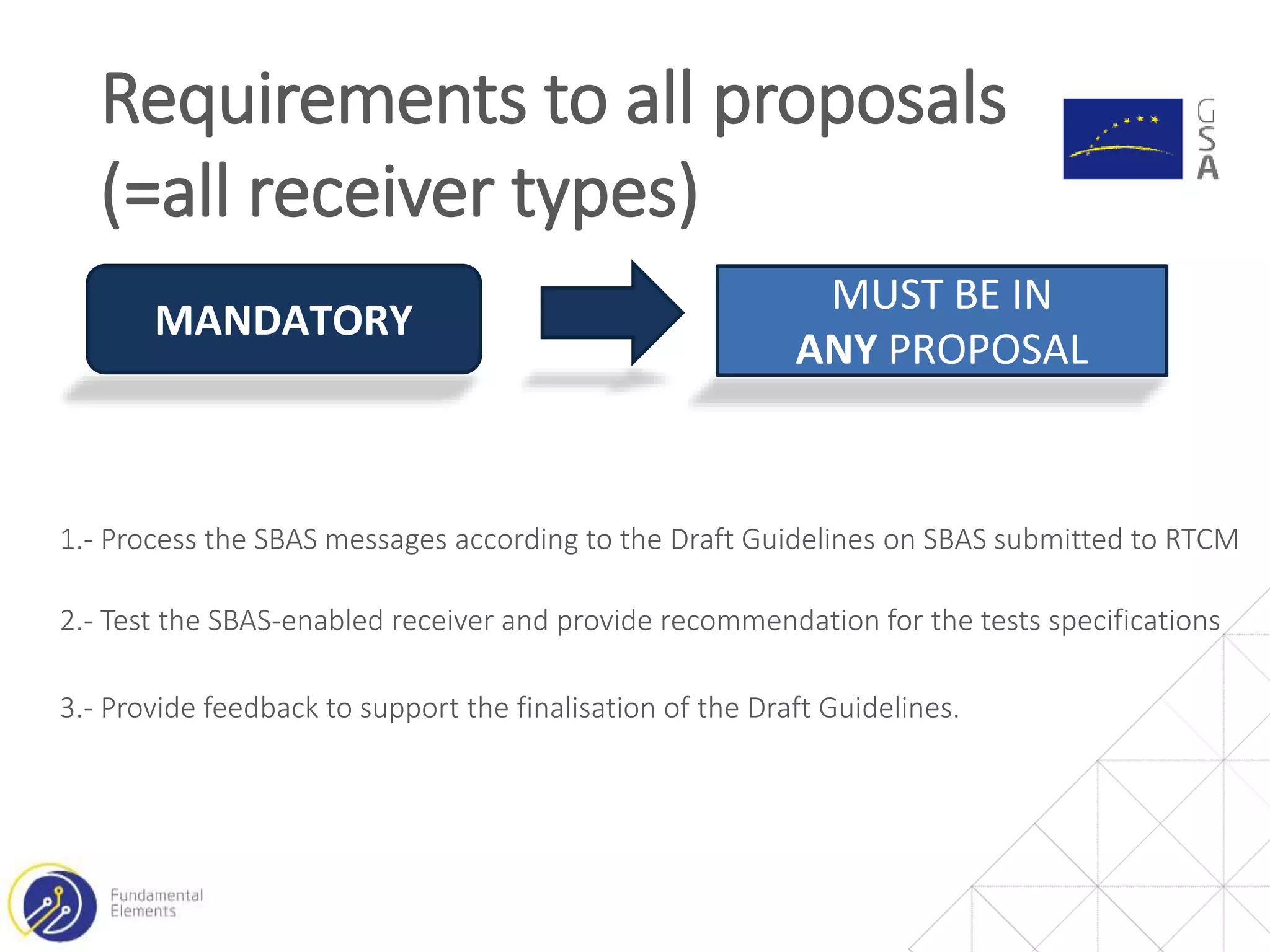
Requirements to all proposals
(=all receiver types)
MANDATORY
MUST BE IN
ANY PROPOSAL
1.- Process the SBAS messages according to the Draft Guidelines on SBAS submitted to RTCM
2.- Test the SBAS-enabled receiver and provide recommendation for the tests specifications
3.- Provide feedback to support the finalisation of the Draft Guidelines.
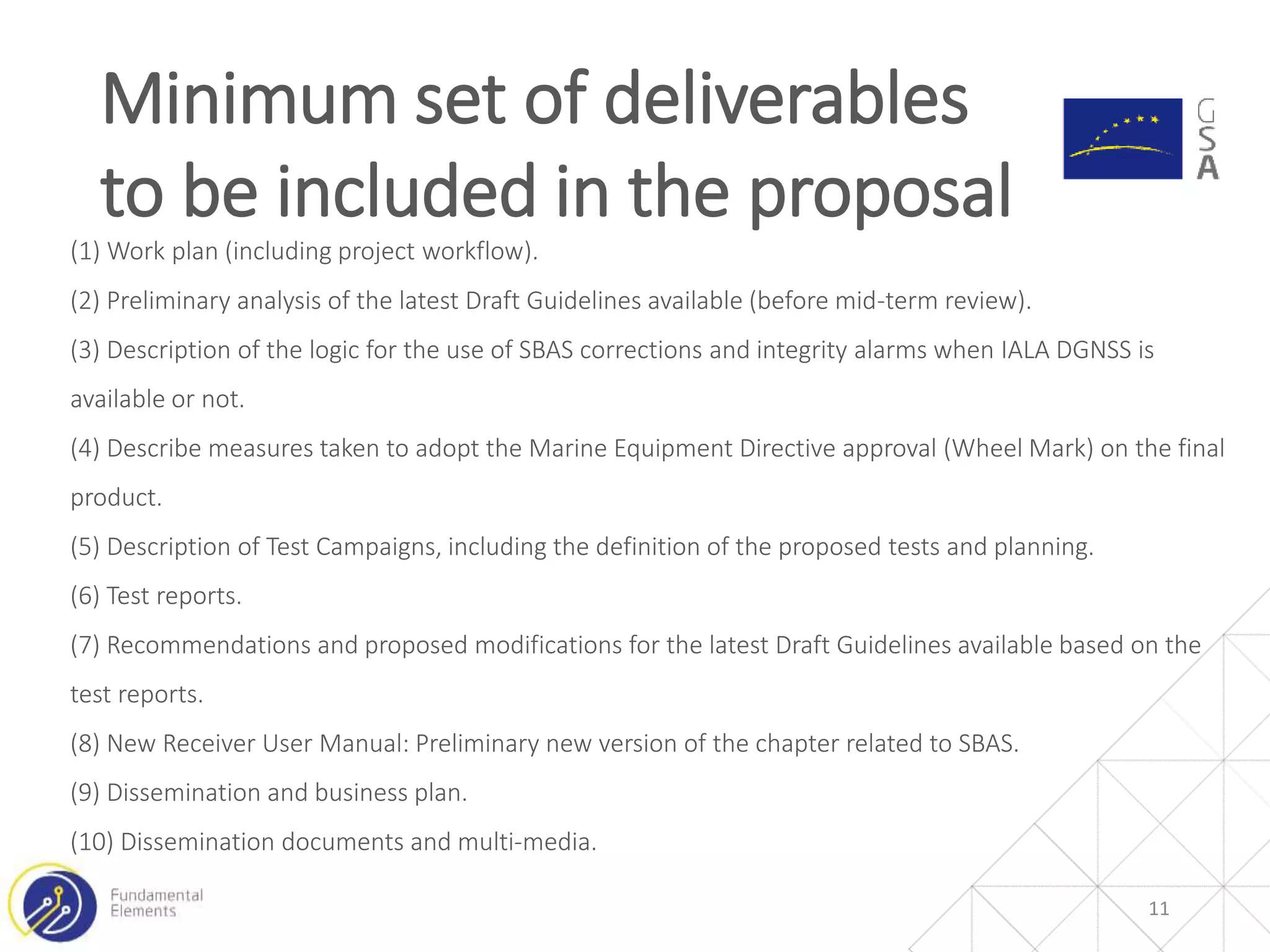
(1) Work plan (including project workflow).
(2) Preliminary analysis of the latest Draft Guidelines available (before mid-term review).
(3) Description of the logic for the use of SBAS corrections and integrity alarms when IALA DGNSS is
available or not.
(4) Describe measures taken to adopt the Marine Equipment Directive approval (Wheel Mark) on the final
product.
(5) Description of Test Campaigns, including the definition of the proposed tests and planning.
(6) Test reports.
(7) Recommendations and proposed modifications for the latest Draft Guidelines available based on the
test reports.
(8) New Receiver User Manual: Preliminary new version of the chapter related to SBAS.
(9) Dissemination and business plan.
(10) Dissemination documents and multi-media.
Minimum set of deliverables
to be included in the proposal
11
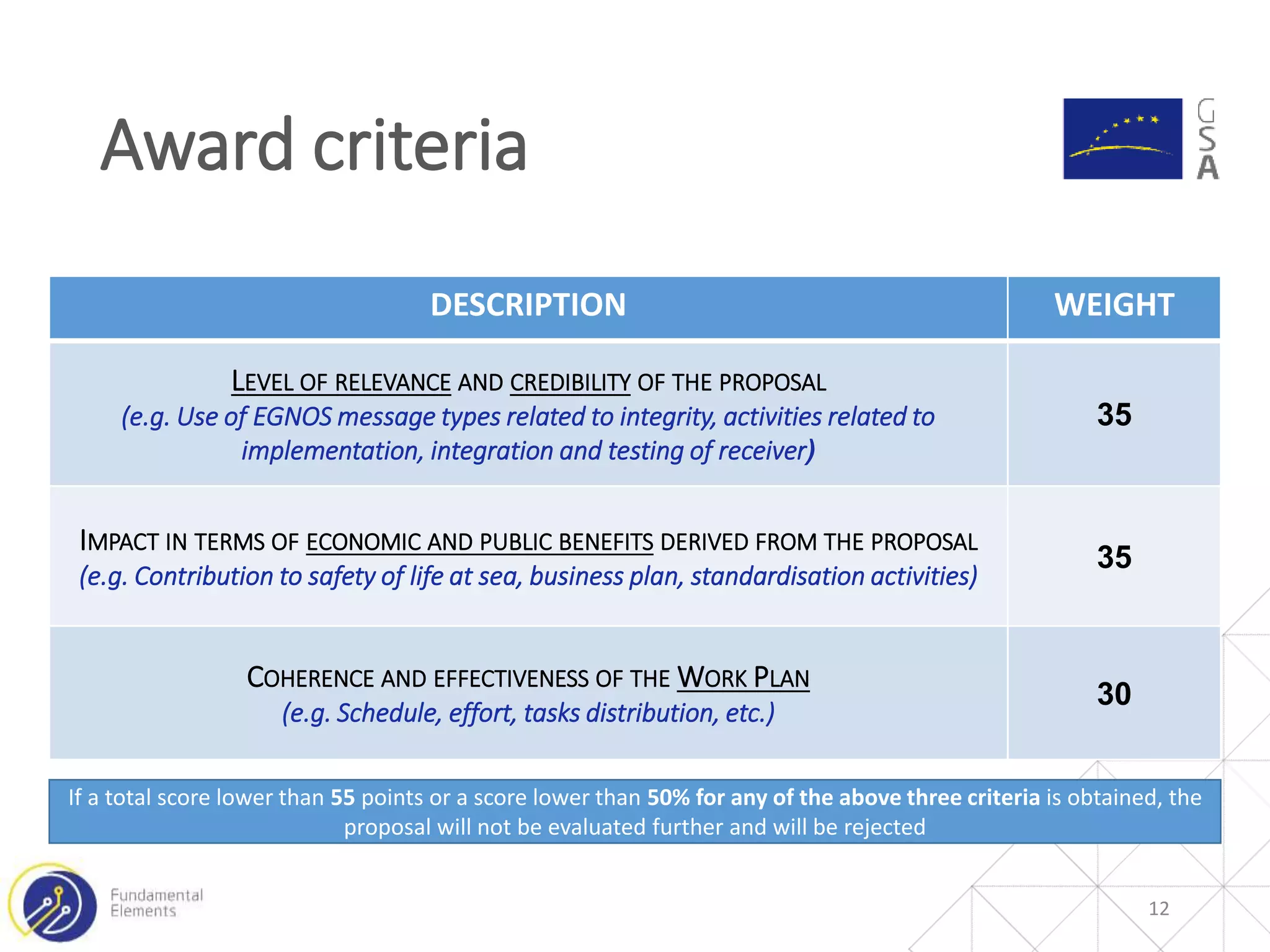
Award criteria
12
DESCRIPTION WEIGHT
LEVEL OF RELEVANCE AND CREDIBILITY OF THE PROPOSAL
(e.g. Use of EGNOS message types related to integrity, activities related to
implementation, integration and testing of receiver)
35
IMPACT IN TERMS OF ECONOMIC AND PUBLIC BENEFITS DERIVED FROM THE PROPOSAL
(e.g. Contribution to safety of life at sea, business plan, standardisation activities)
35
COHERENCE AND EFFECTIVENESS OF THE WORK PLAN
(e.g. Schedule, effort, tasks distribution, etc.)
30
If a total score lower than 55 points or a score lower than 50% for any of the above three criteria is obtained, the
proposal will not be evaluated further and will be rejected
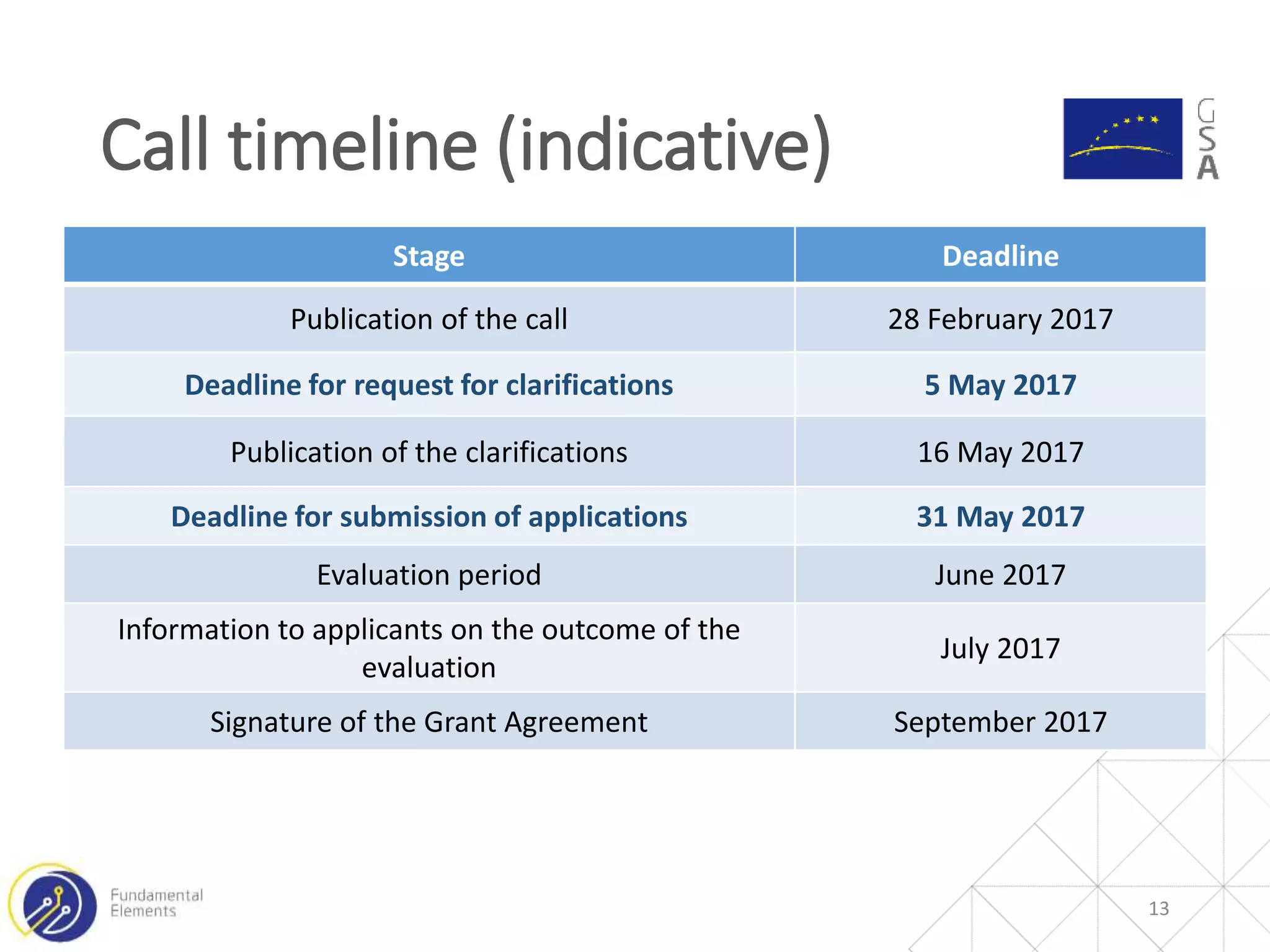
Call timeline (indicative)
13
Stage Deadline
Publication of the call 28 February 2017
Deadline for request for clarifications 5 May 2017
Publication of the clarifications 16 May 2017
Deadline for submission of applications 31 May 2017
Evaluation period June 2017
Information to applicants on the outcome of the
evaluation
July 2017
Signature of the Grant Agreement September 2017
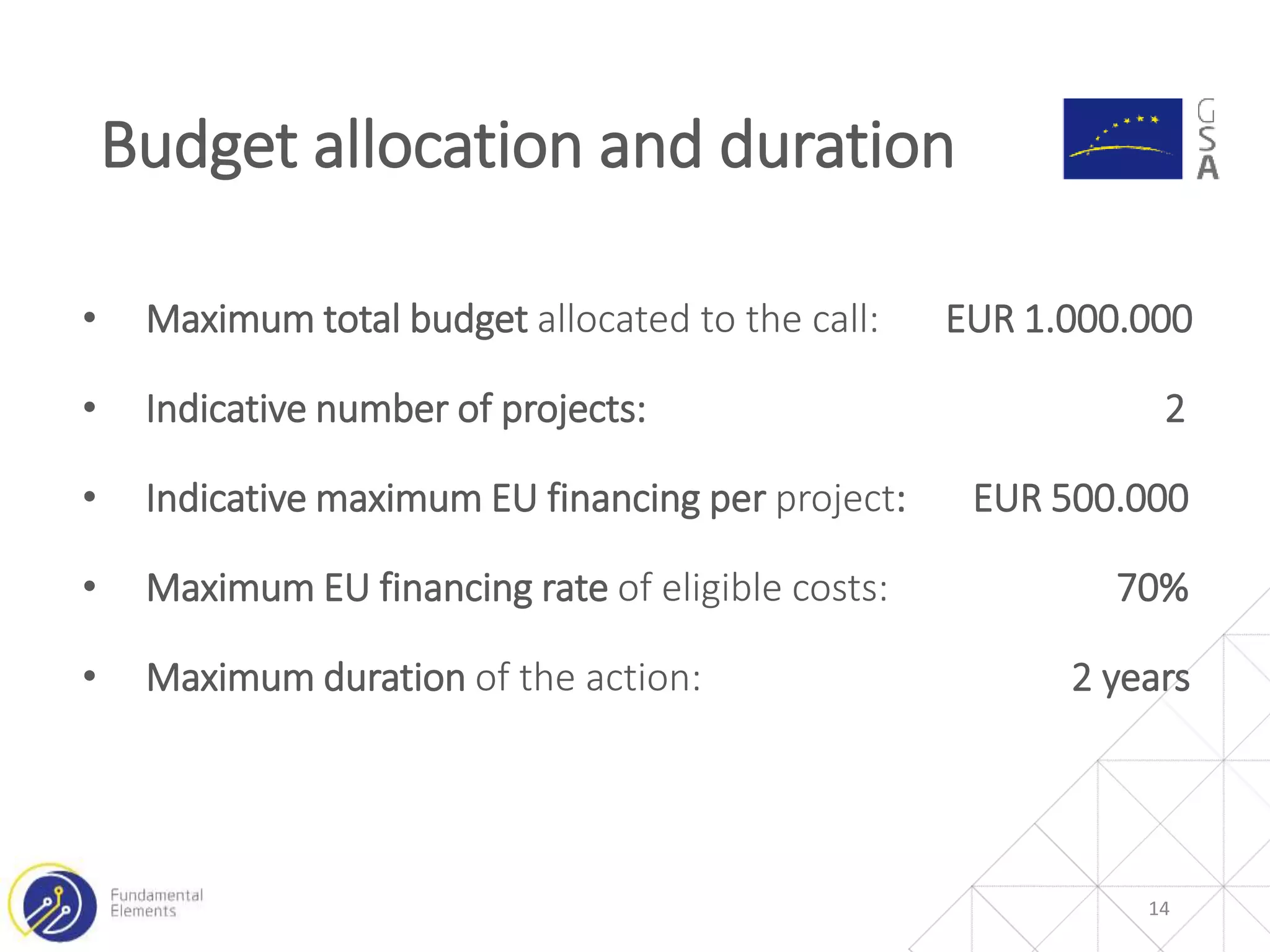
• Maximum total budget allocated to the call: EUR 1.000.000
• Indicative number of projects: 2
• Indicative maximum EU financing per project: EUR 500.000
• Maximum EU financing rate of eligible costs: 70%
• Maximum duration of the action: 2 years
Budget allocation and duration
14
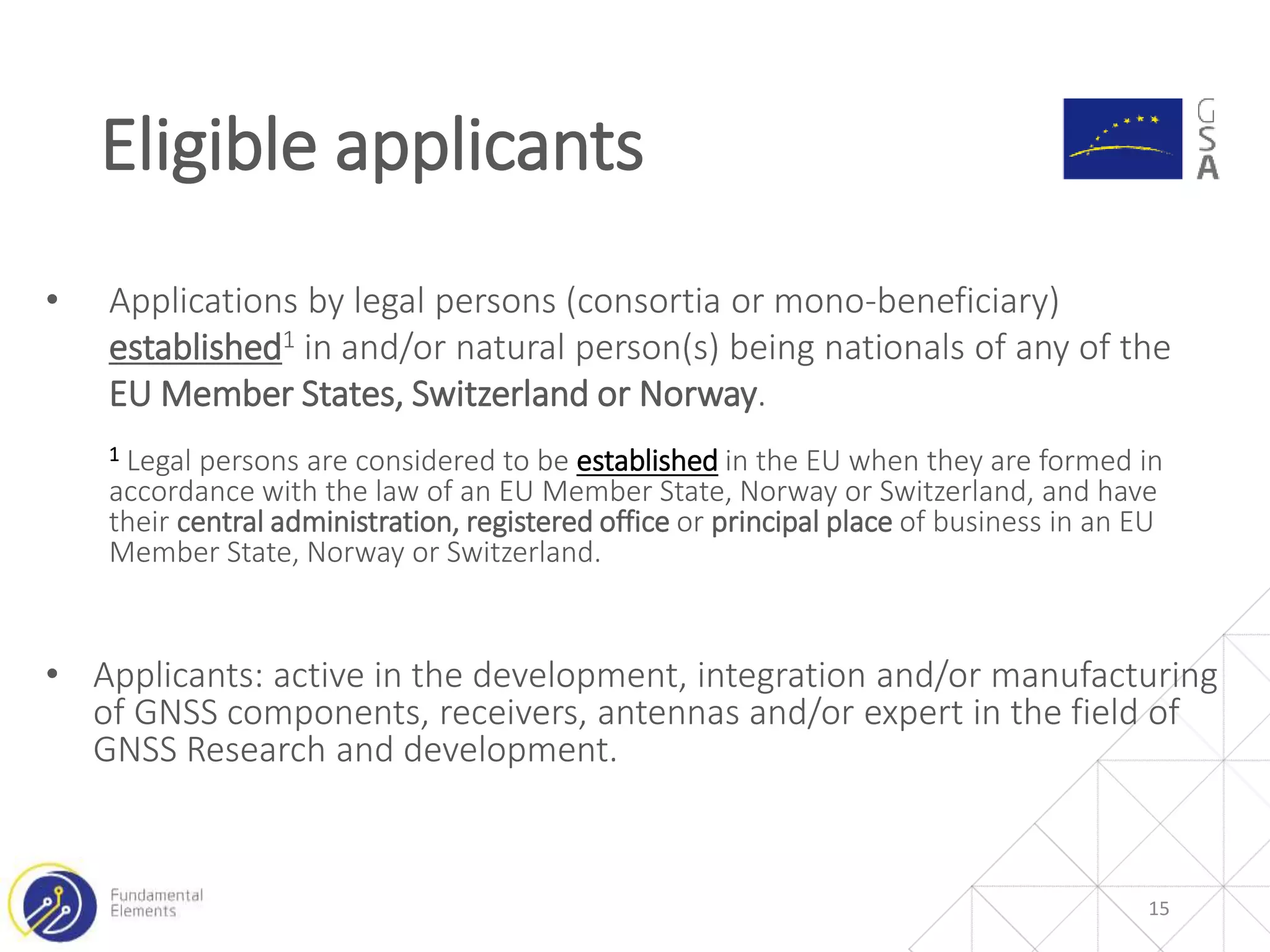
• Applications by legal persons (consortia or mono-beneficiary)
established1 in and/or natural person(s) being nationals of any of the
EU Member States, Switzerland or Norway.
1 Legal persons are considered to be established in the EU when they are formed in
accordance with the law of an EU Member State, Norway or Switzerland, and have
their central administration, registered office or principal place of business in an EU
Member State, Norway or Switzerland.
• Applicants: active in the development, integration and/or manufacturing
of GNSS components, receivers, antennas and/or expert in the field of
GNSS Research and development.
Eligible applicants
15
16
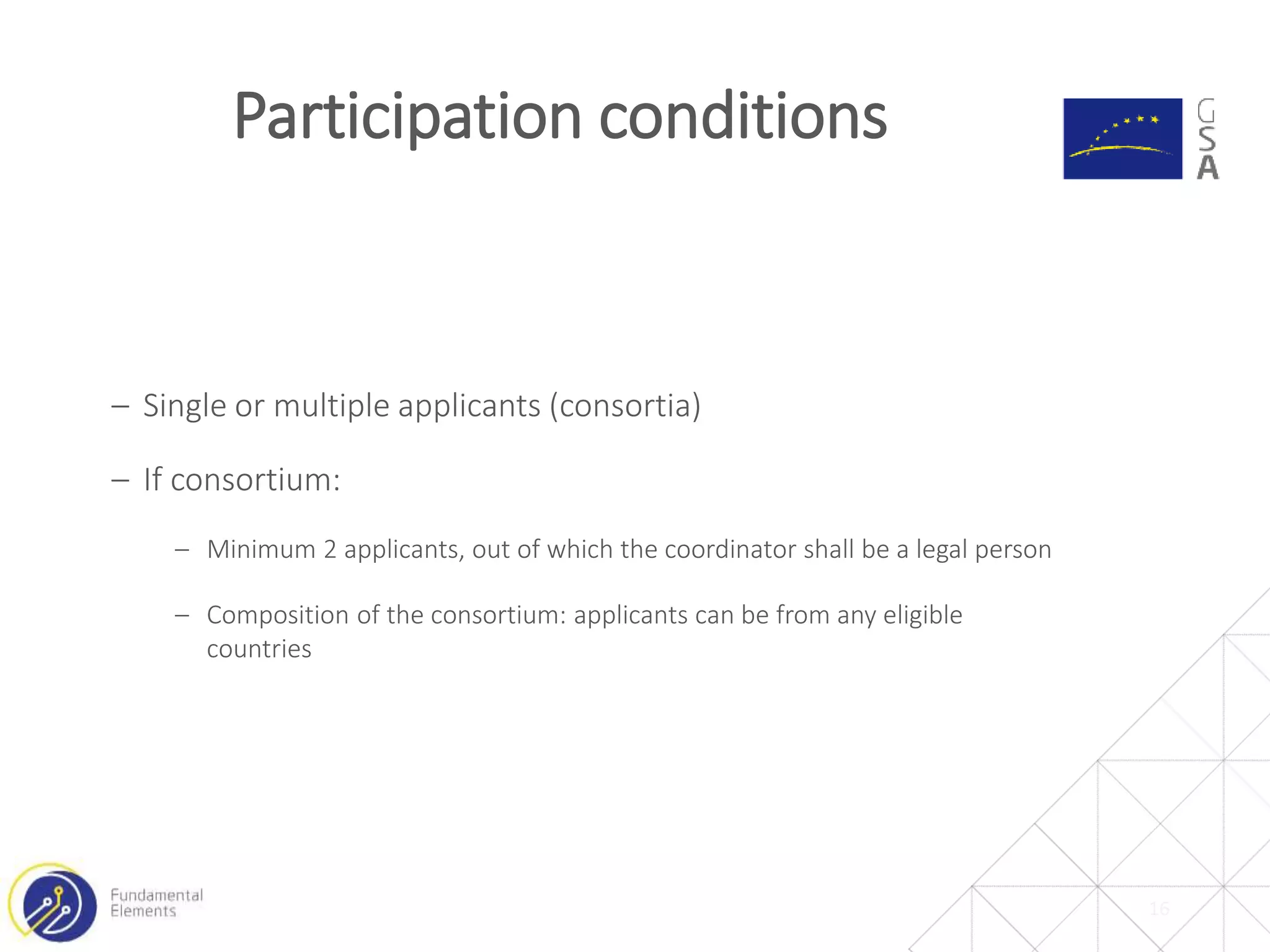
Participation conditions
‒ Single or multiple applicants (consortia)
‒ If consortium:
‒ Minimum 2 applicants, out of which the coordinator shall be a legal person
‒ Composition of the consortium: applicants can be from any eligible
countries
HOW TO PREPARE YOUR PROPOSAL
17
 The Administrative package
 The Technical package
 The Financial package
Summary of the proposals
18
Summary of the proposals
19
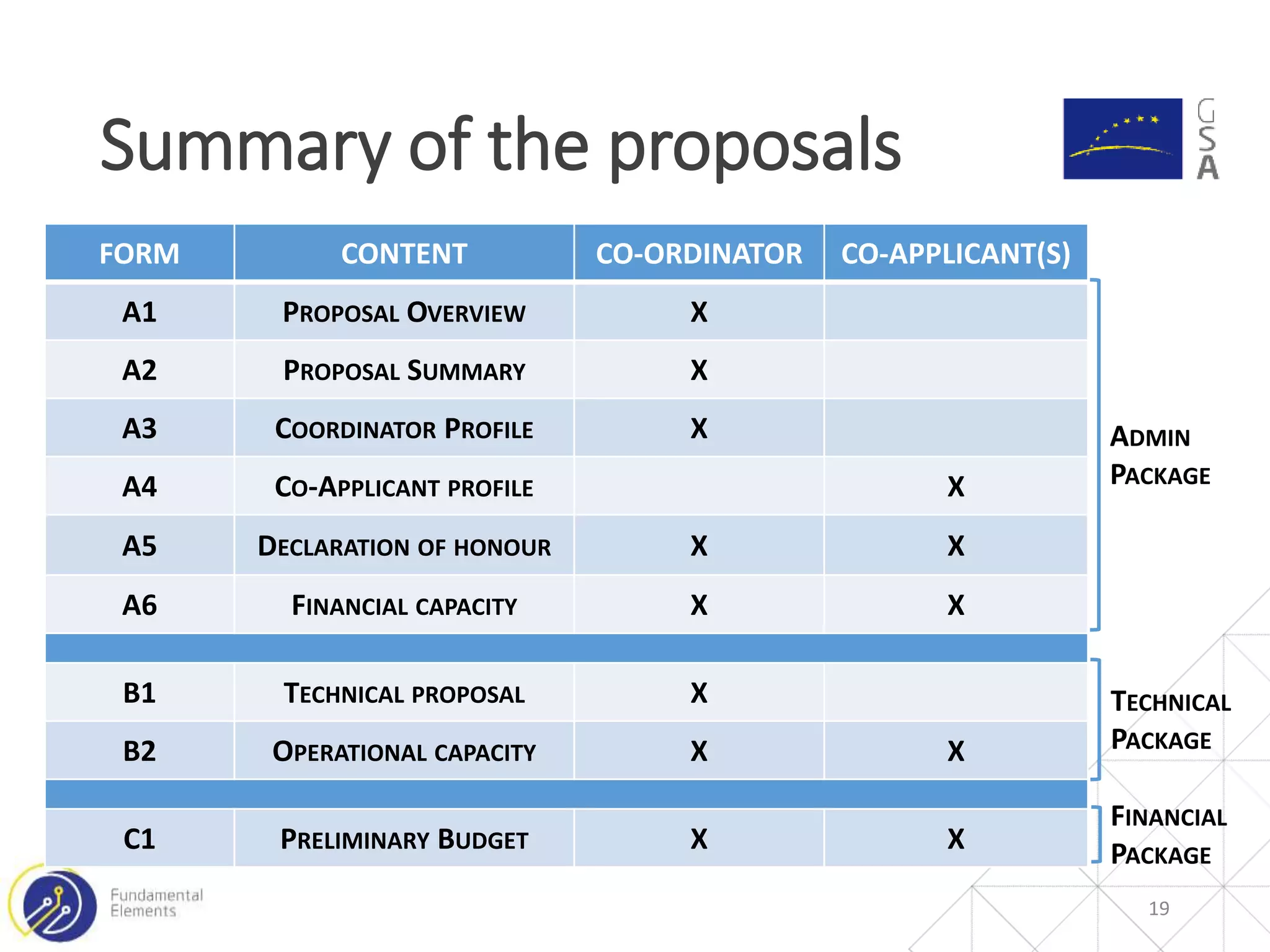
FORM CONTENT CO-ORDINATOR CO-APPLICANT(S)
A1 PROPOSAL OVERVIEW X
A2 PROPOSAL SUMMARY X
A3 COORDINATOR PROFILE X
A4 CO-APPLICANT PROFILE X
A5 DECLARATION OF HONOUR X X
A6 FINANCIAL CAPACITY X X
B1 TECHNICAL PROPOSAL X
B2 OPERATIONAL CAPACITY X X
C1 PRELIMINARY BUDGET X X
ADMIN
PACKAGE
TECHNICAL
PACKAGE
FINANCIAL
PACKAGE
 Admin package:
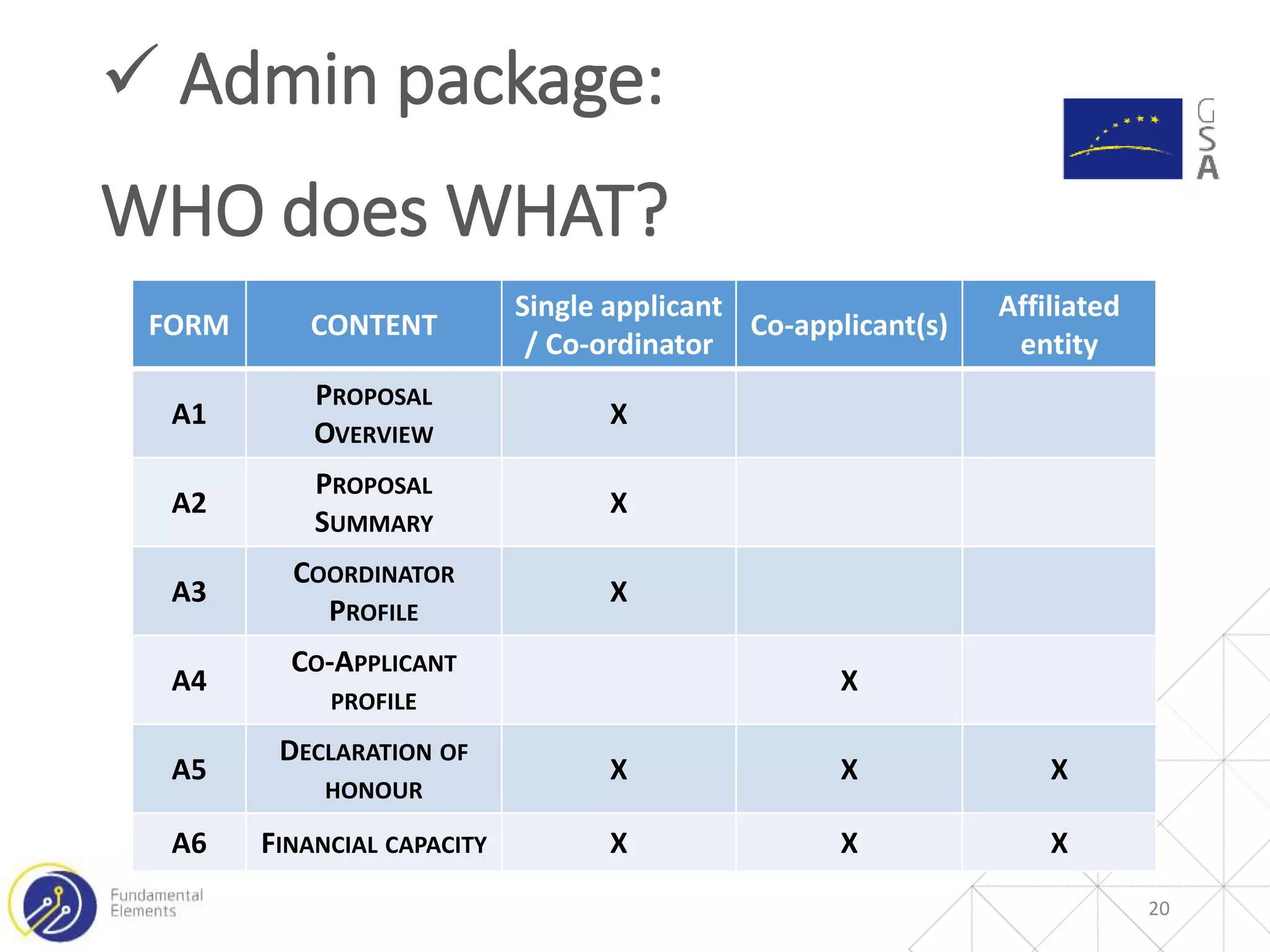
WHO does WHAT?
20
FORM CONTENT
Single applicant
/ Co-ordinator
Co-applicant(s)
Affiliated
entity
A1
PROPOSAL
OVERVIEW
X
A2
PROPOSAL
SUMMARY
X
A3
COORDINATOR
PROFILE
X
A4
CO-APPLICANT
PROFILE
X
A5
DECLARATION OF
HONOUR
X X X
A6 FINANCIAL CAPACITY X X X
21
Admin package – overview of forms
Cover page
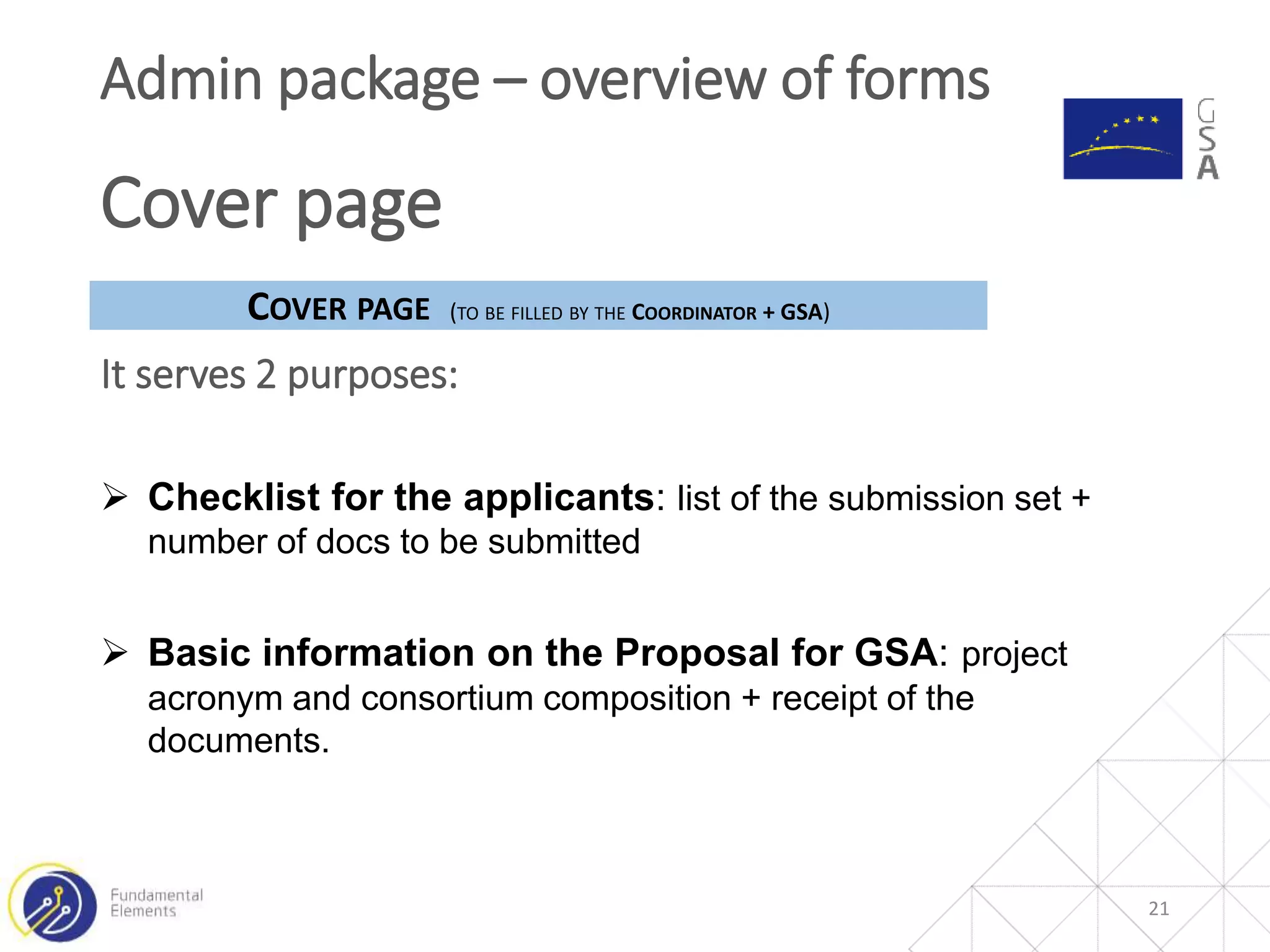
It serves 2 purposes:
COVER PAGE (TO BE FILLED BY THE COORDINATOR + GSA)
 Checklist for the applicants: list of the submission set +
number of docs to be submitted
 Basic information on the Proposal for GSA: project
acronym and consortium composition + receipt of the
documents.
22
Admin package – overview of forms
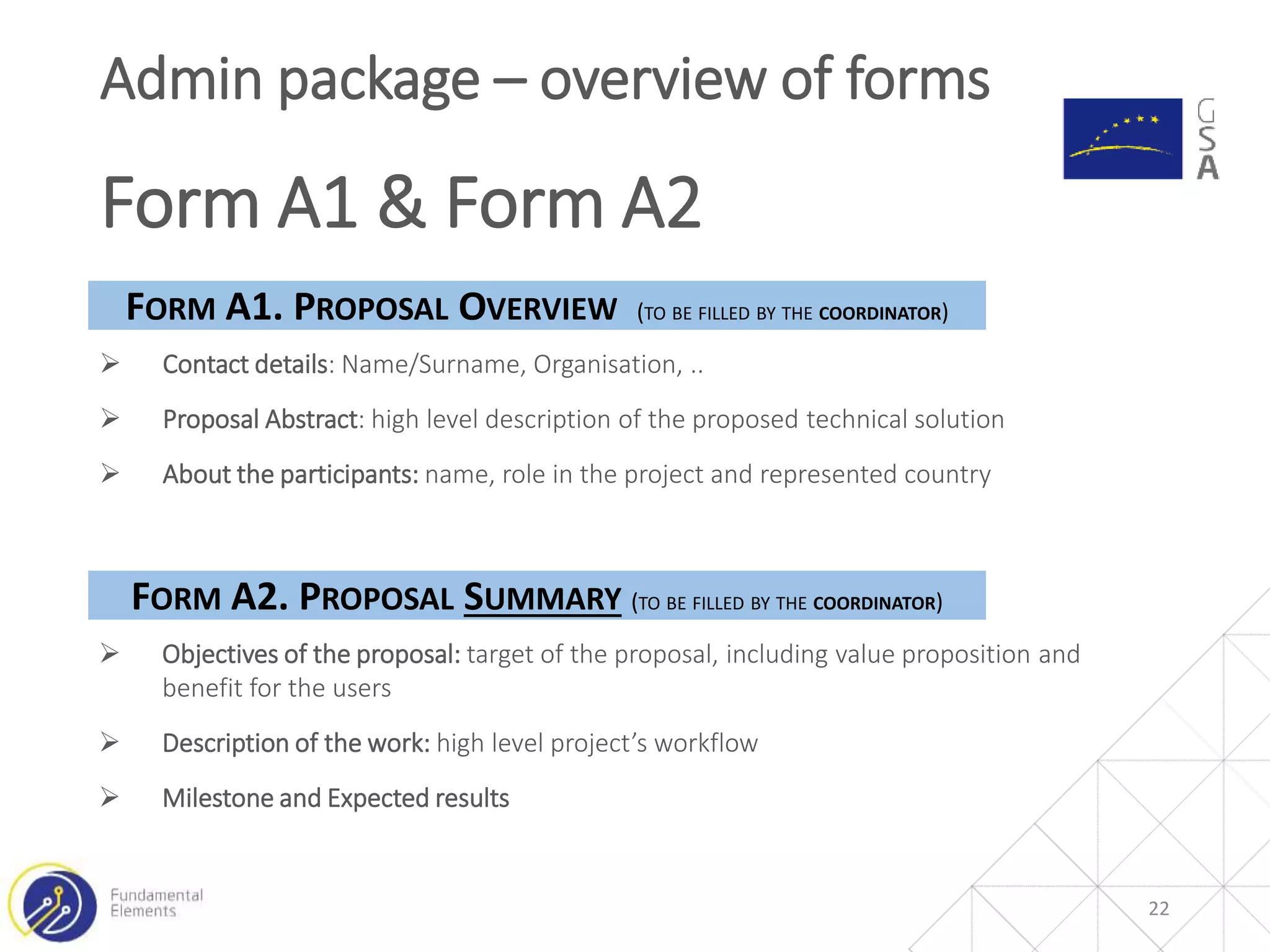
Form A1 & Form A2
 Contact details: Name/Surname, Organisation, ..
 Proposal Abstract: high level description of the proposed technical solution
 About the participants: name, role in the project and represented country
FORM A1. PROPOSAL OVERVIEW (TO BE FILLED BY THE COORDINATOR)
FORM A2. PROPOSAL SUMMARY (TO BE FILLED BY THE COORDINATOR)
 Objectives of the proposal: target of the proposal, including value proposition and
benefit for the users
 Description of the work: high level project’s workflow
 Milestone and Expected results
23
Admin package – overview of forms
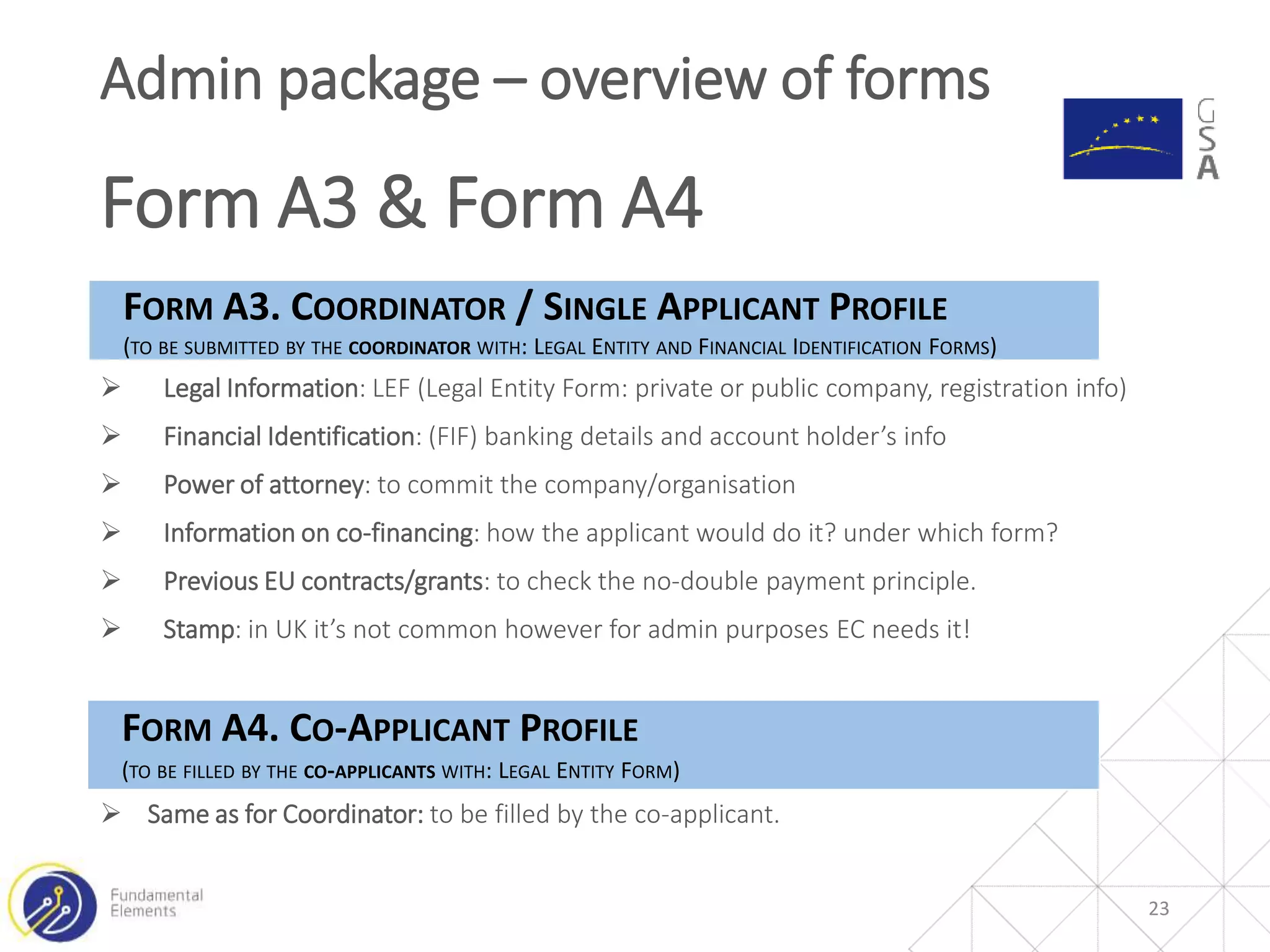
Form A3 & Form A4
FORM A3. COORDINATOR / SINGLE APPLICANT PROFILE
(TO BE SUBMITTED BY THE COORDINATOR WITH: LEGAL ENTITY AND FINANCIAL IDENTIFICATION FORMS)
 Legal Information: LEF (Legal Entity Form: private or public company, registration info)
 Financial Identification: (FIF) banking details and account holder’s info
 Power of attorney: to commit the company/organisation
 Information on co-financing: how the applicant would do it? under which form?
 Previous EU contracts/grants: to check the no-double payment principle.
 Stamp: in UK it’s not common however for admin purposes EC needs it!
FORM A4. CO-APPLICANT PROFILE
(TO BE FILLED BY THE CO-APPLICANTS WITH: LEGAL ENTITY FORM)
 Same as for Coordinator: to be filled by the co-applicant.
24
Admin package – overview of forms
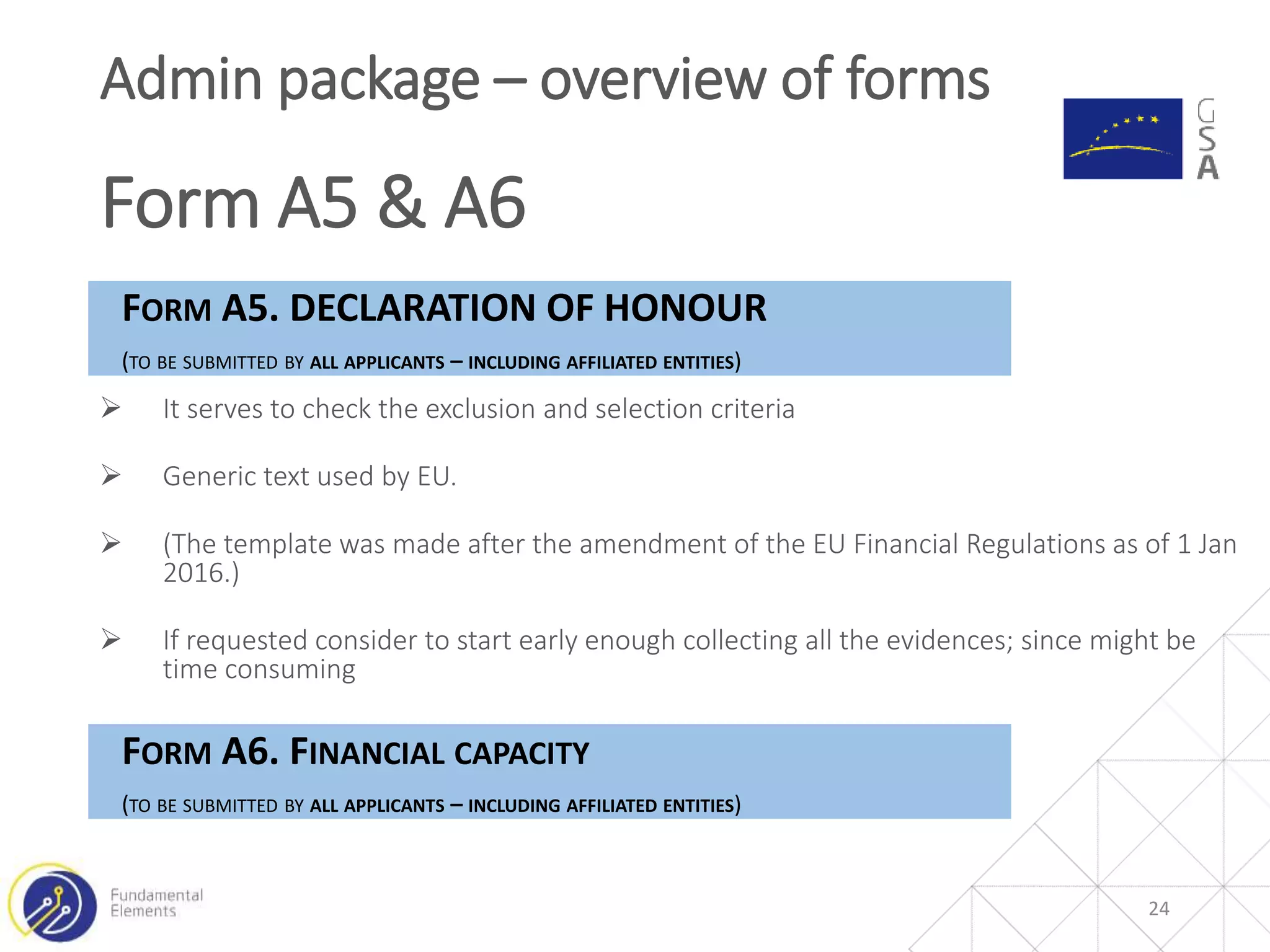
Form A5 & A6
FORM A5. DECLARATION OF HONOUR
(TO BE SUBMITTED BY ALL APPLICANTS – INCLUDING AFFILIATED ENTITIES)
 It serves to check the exclusion and selection criteria
 Generic text used by EU.
 (The template was made after the amendment of the EU Financial Regulations as of 1 Jan
2016.)
 If requested consider to start early enough collecting all the evidences; since might be
time consuming
FORM A6. FINANCIAL CAPACITY
(TO BE SUBMITTED BY ALL APPLICANTS – INCLUDING AFFILIATED ENTITIES)
 Technical package:
WHO does WHAT?
25
FORM CONTENT
Single applicant /
Co-ordinator
Co-applicant(s)
Affiliated
entity
B1
TECHNICAL
PROPOSAL
X
B2
OPERATIONAL
CAPACITY
X X X
26
Technical package
• Every proposal shall be assessed against the criteria
set out in the relevant Call for Proposal.
• In particular, for the technical package:
The Technical proposal (B1 Form) shall be assessed against
the AWARD criteria (CfP sect. 9)
The Operational capacity (B2 Form) shall be assessed against
the SELECTION criteria (CfP sect. 8.2)
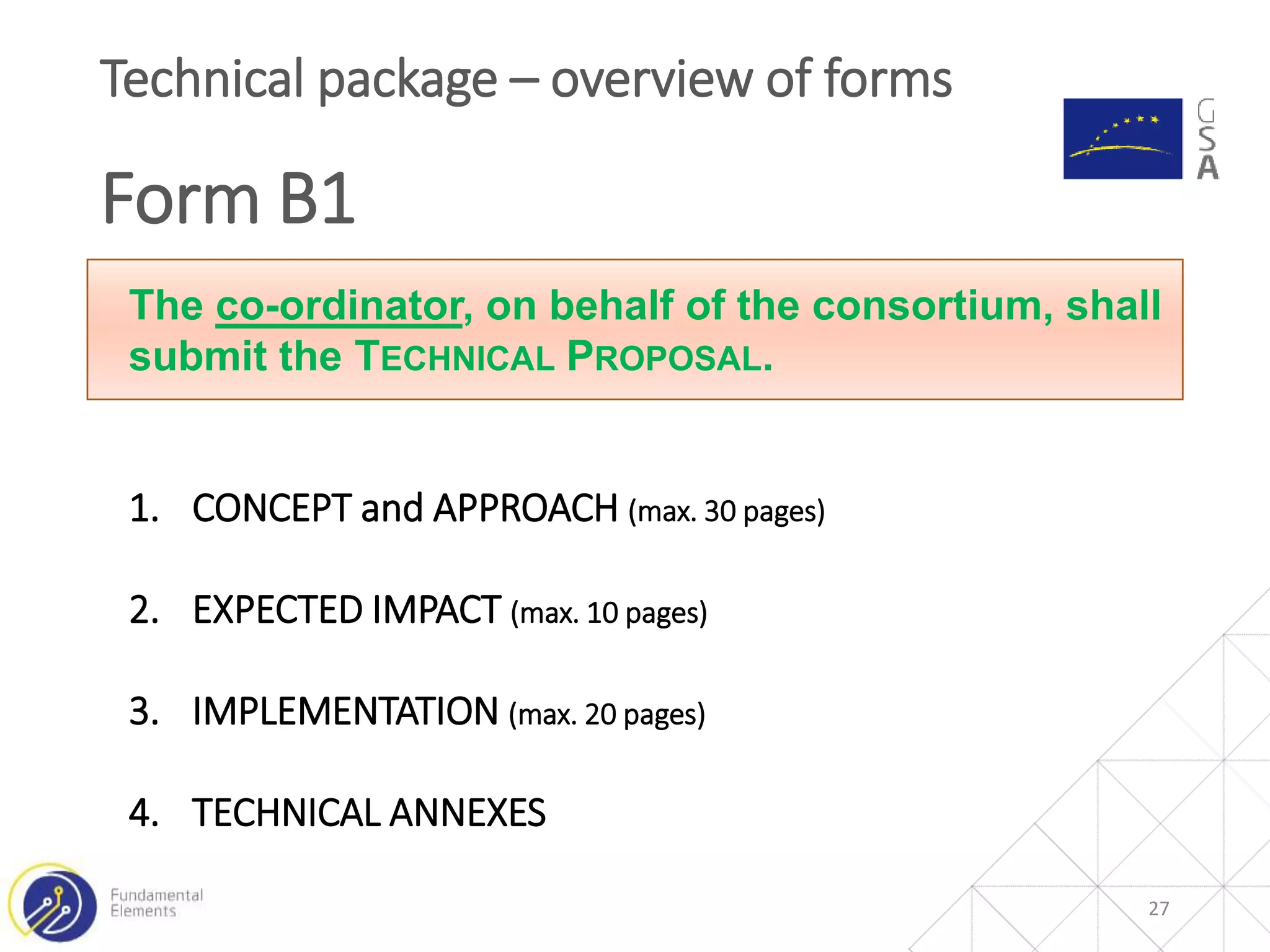
27
Technical package – overview of forms
Form B1
The co-ordinator, on behalf of the consortium, shall
submit the TECHNICAL PROPOSAL.
1. CONCEPT and APPROACH (max. 30 pages)
2. EXPECTED IMPACT (max. 10 pages)
3. IMPLEMENTATION (max. 20 pages)
4. TECHNICAL ANNEXES
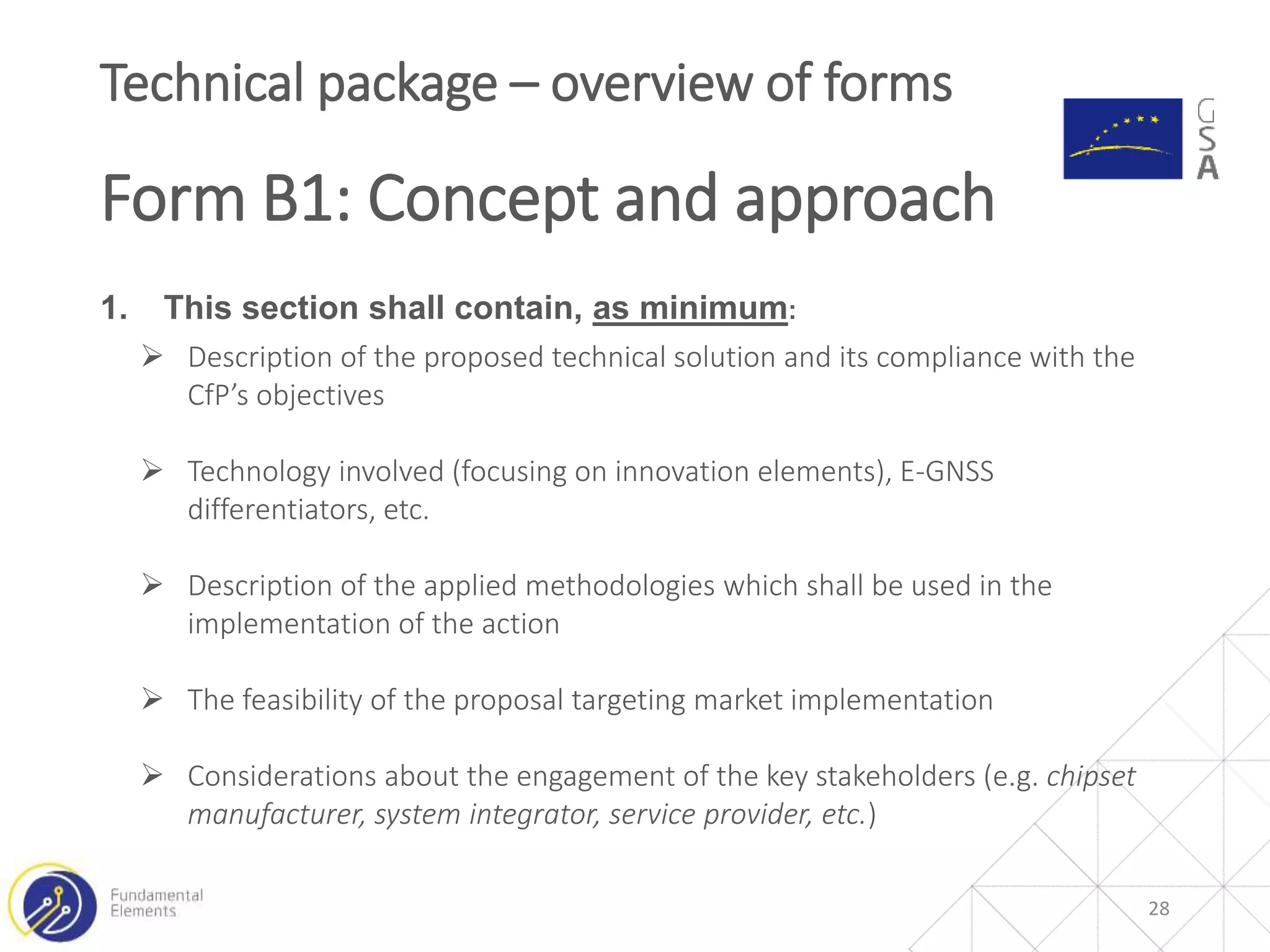
1. This section shall contain, as minimum:
 Description of the proposed technical solution and its compliance with the
CfP’s objectives
 Technology involved (focusing on innovation elements), E-GNSS
differentiators, etc.
 Description of the applied methodologies which shall be used in the
implementation of the action
 The feasibility of the proposal targeting market implementation
 Considerations about the engagement of the key stakeholders (e.g. chipset
manufacturer, system integrator, service provider, etc.)
28
Technical package – overview of forms
Form B1: Concept and approach
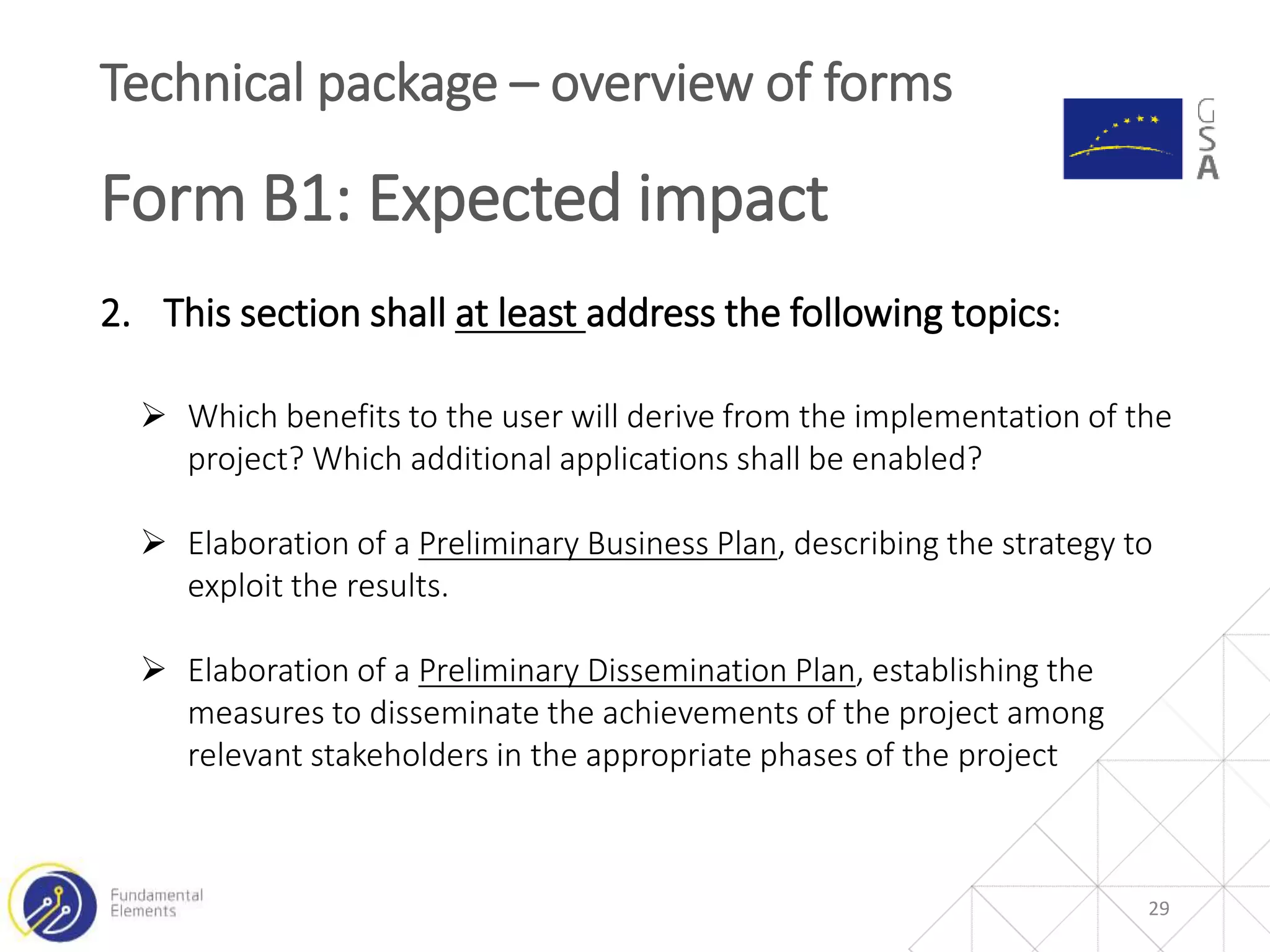
29
Technical package – overview of forms
Form B1: Expected impact
2. This section shall at least address the following topics:
 Which benefits to the user will derive from the implementation of the
project? Which additional applications shall be enabled?
 Elaboration of a Preliminary Business Plan, describing the strategy to
exploit the results.
 Elaboration of a Preliminary Dissemination Plan, establishing the
measures to disseminate the achievements of the project among
relevant stakeholders in the appropriate phases of the project
30
Technical package – overview of forms
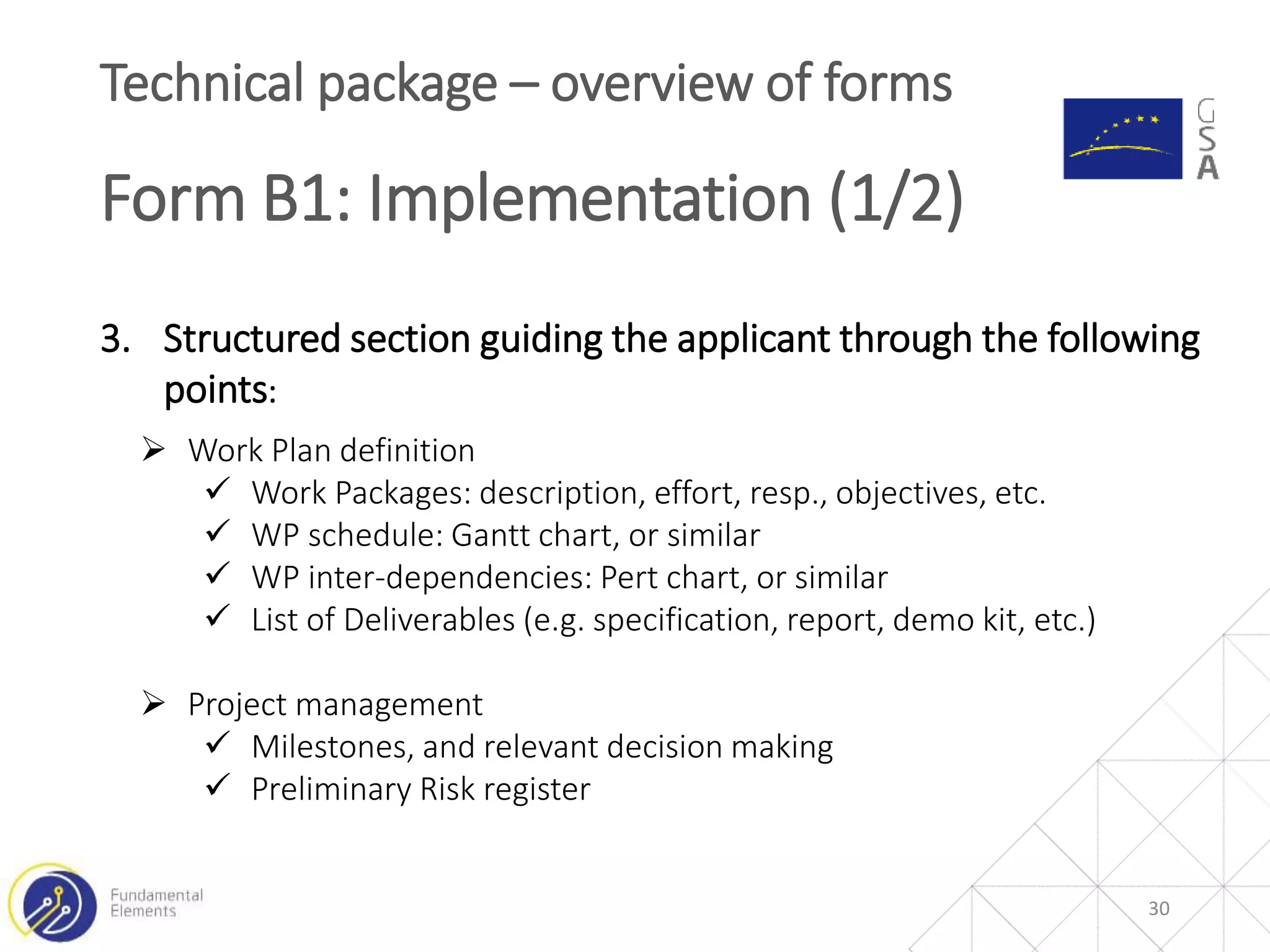
Form B1: Implementation (1/2)
3. Structured section guiding the applicant through the following
points:
 Work Plan definition
 Work Packages: description, effort, resp., objectives, etc.
 WP schedule: Gantt chart, or similar
 WP inter-dependencies: Pert chart, or similar
 List of Deliverables (e.g. specification, report, demo kit, etc.)
 Project management
 Milestones, and relevant decision making
 Preliminary Risk register
31
Technical package – overview of forms
Form B1: Implementation (2/2)
3. Structured section guiding the applicant through the following
points:
 Consortium as a whole:
 Partners complementarity
 Tasks allocation
 Effectiveness in the project execution and to target
commercialisation
 Project’s Resources:
 Planned staff effort
 Other Direct Costs
 Subcontracting
 Budget overview
32
Technical package – overview of forms
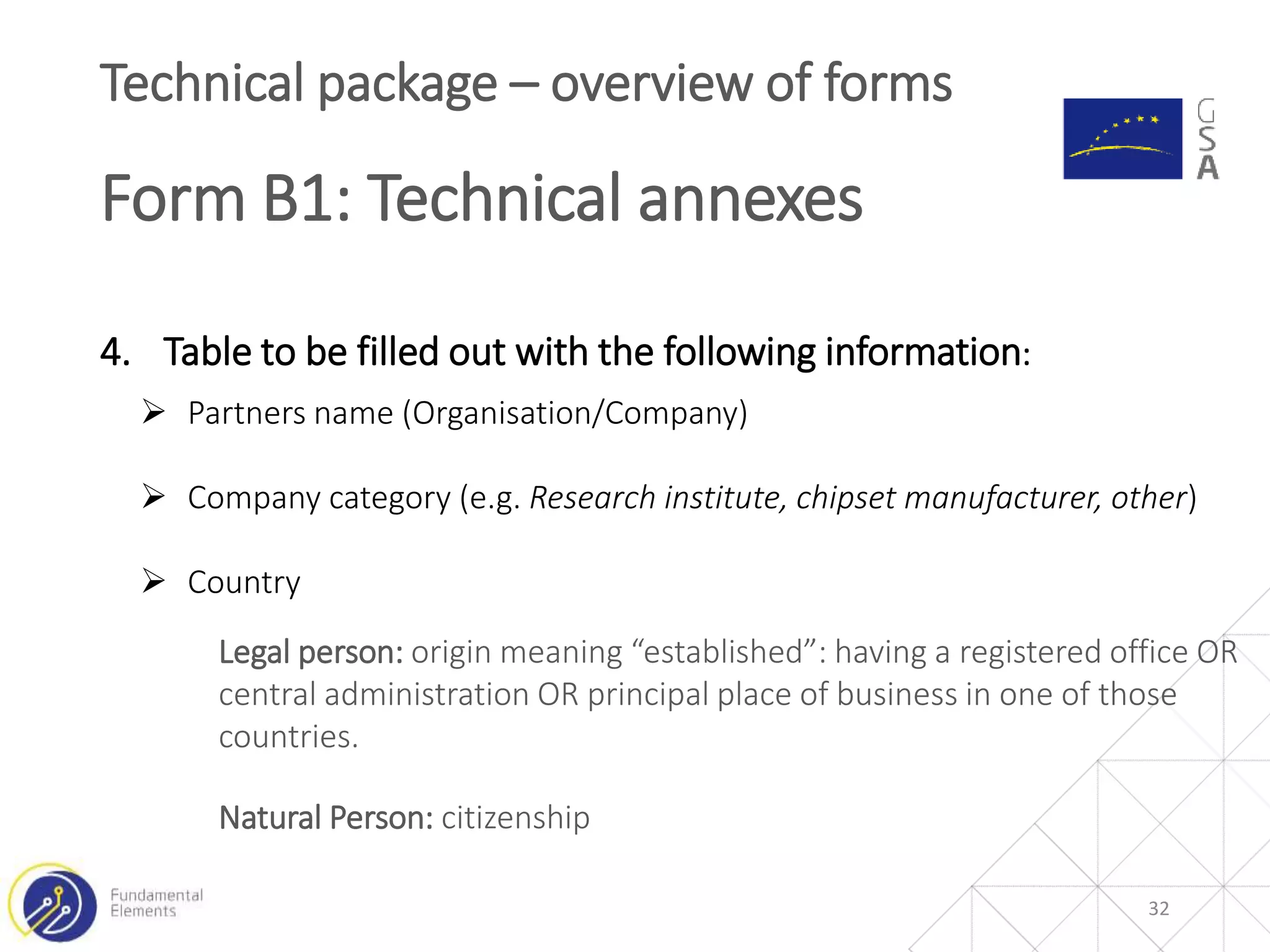
Form B1: Technical annexes
4. Table to be filled out with the following information:
 Partners name (Organisation/Company)
 Company category (e.g. Research institute, chipset manufacturer, other)
 Country
Legal person: origin meaning “established”: having a registered office OR
central administration OR principal place of business in one of those
countries.
Natural Person: citizenship
33
Technical package – overview of forms
Form B1: Operational capacity
Every applicant (coordinator and co-applicants), shall
submit the OPERATIONAL CAPACITY Form.
Objective: to demonstrate compliance with SELECTION criteria set out in the
CfP
Ref. CfP section 8.2 – “Applicants must show they have the operational
(technical and management) capacity to complete the activities to be
supported by this Call for Proposal and must demonstrate their capacity to
manage the activities corresponding to the size of the project for which the
grant is requested.”
34
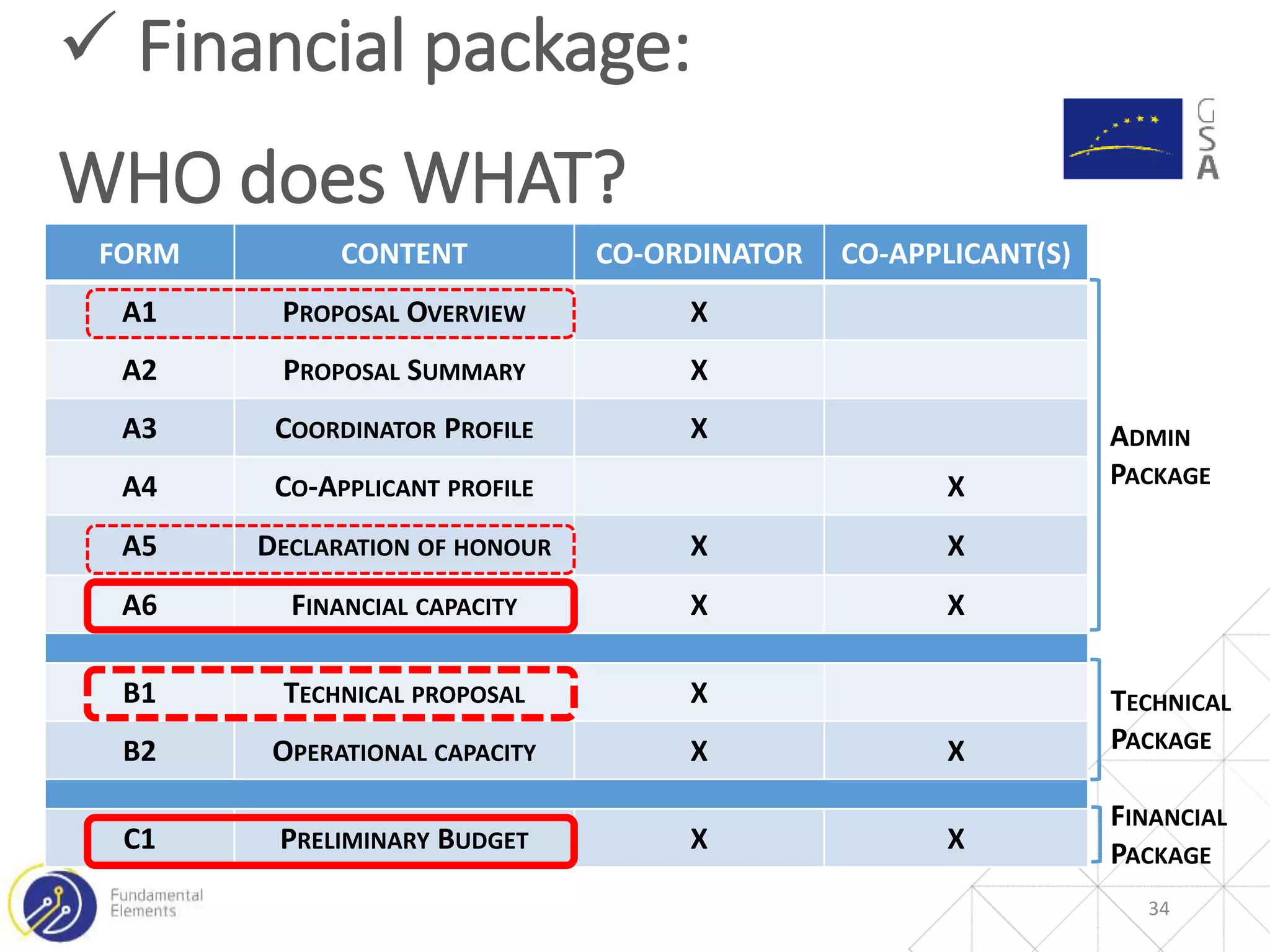
FORM CONTENT CO-ORDINATOR CO-APPLICANT(S)
A1 PROPOSAL OVERVIEW X
A2 PROPOSAL SUMMARY X
A3 COORDINATOR PROFILE X
A4 CO-APPLICANT PROFILE X
A5 DECLARATION OF HONOUR X X
A6 FINANCIAL CAPACITY X X
B1 TECHNICAL PROPOSAL X
B2 OPERATIONAL CAPACITY X X
C1 PRELIMINARY BUDGET X X
ADMIN
PACKAGE
TECHNICAL
PACKAGE
FINANCIAL
PACKAGE
 Financial package:
WHO does WHAT?
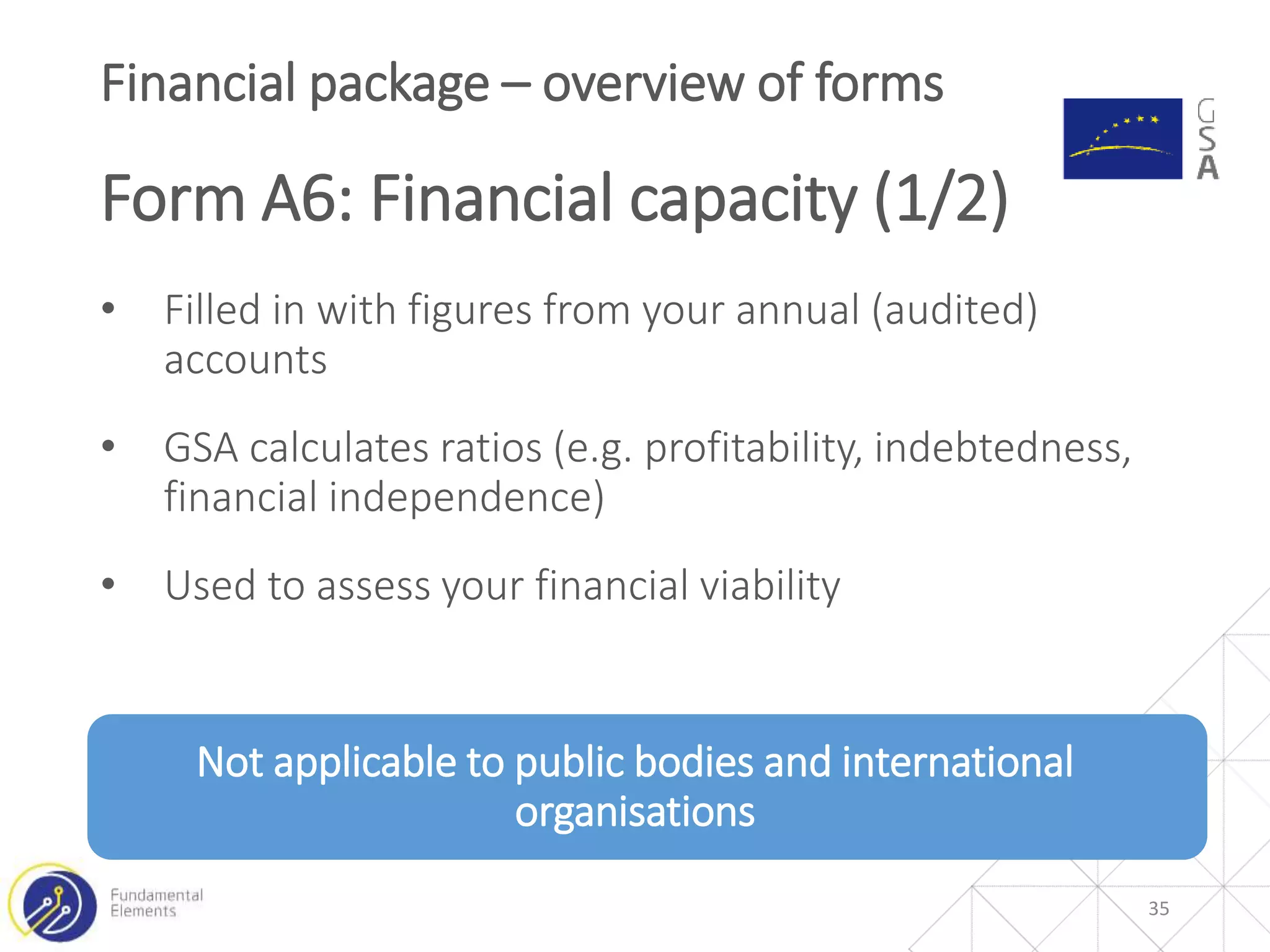
• Filled in with figures from your annual (audited)
accounts
• GSA calculates ratios (e.g. profitability, indebtedness,
financial independence)
• Used to assess your financial viability
Not applicable to public bodies and international
organisations
Financial package – overview of forms
Form A6: Financial capacity (1/2)
35
If outcome of the check is not satisfactory and in any other case GSA can:
• request further information
• propose a grant agreement without pre-financing
• propose a grant agreement with a pre-financing paid in instalments;
• propose a grant agreement with a lower percentage of a pre-financing;
• propose a grant agreement with a pre-financing covered by a bank
guarantee
• reject the application
36
Financial package – overview of forms
Form A6: Financial capacity (2/2)
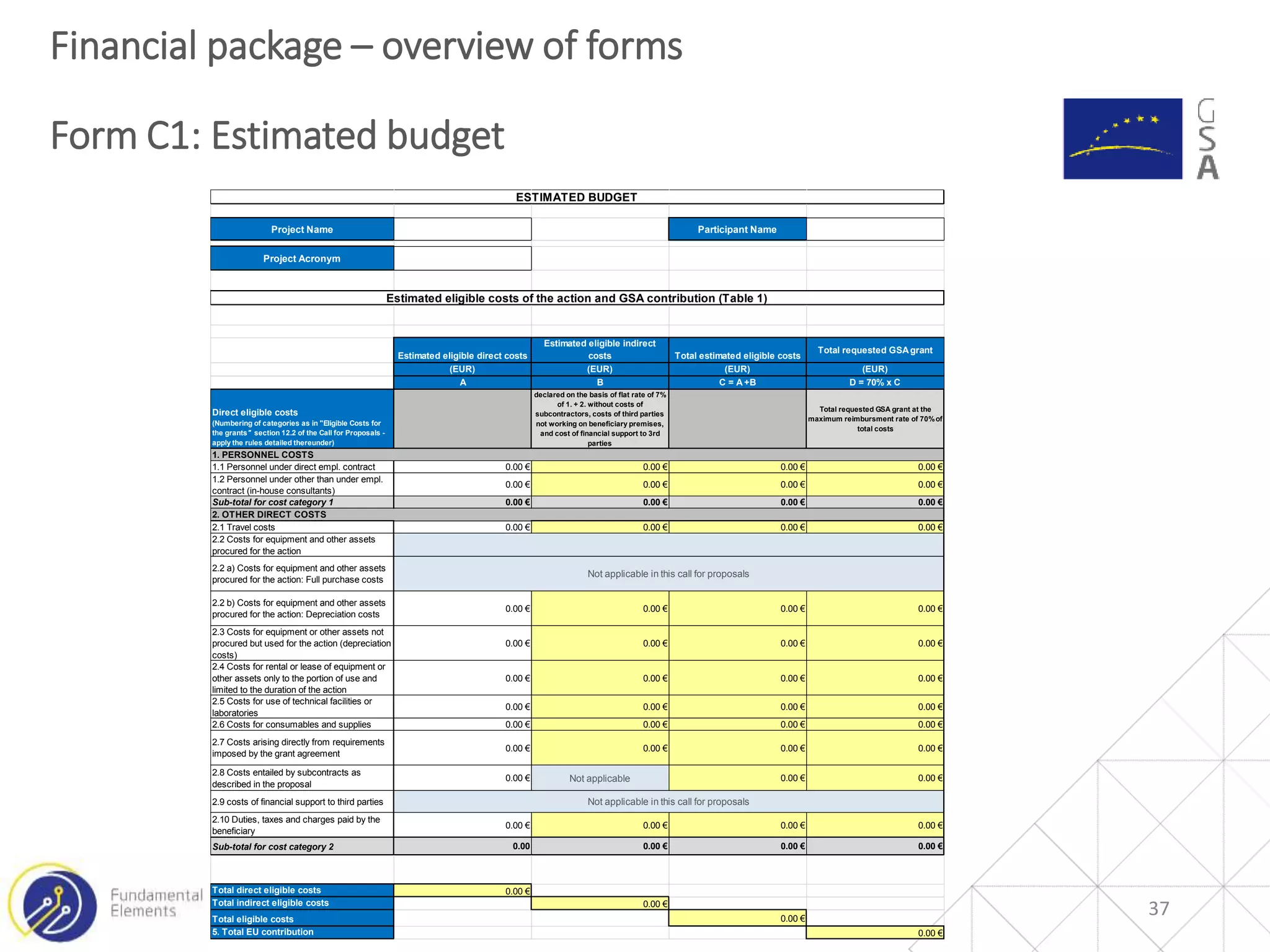
Financial package – overview of forms
Form C1: Estimated budget
37
Project Name Participant Name
Project Acronym
Estimated eligible direct costs
Estimated eligible indirect
costs Total estimated eligible costs
Total requested GSAgrant
(EUR) (EUR) (EUR) (EUR)
A B C = A+B D = 70% x C
Direct eligible costs
(Numbering of categories as in "Eligible Costs for
the grants" section 12.2 of the Call for Proposals -
apply the rules detailed thereunder)
declared on the basis of flat rate of 7%
of 1. + 2. without costs of
subcontractors, costs of third parties
not working on beneficiary premises,
and cost of financial support to 3rd
parties
Total requested GSA grant at the
maximum reimbursment rate of 70%of
total costs
1.1 Personnel under direct empl. contract 0.00 € 0.00 € 0.00 € 0.00 €
1.2 Personnel under other than under empl.
contract (in-house consultants)
0.00 € 0.00 € 0.00 € 0.00 €
Sub-total for cost category 1 0.00 € 0.00 € 0.00 € 0.00 €
2.1 Travel costs 0.00 € 0.00 € 0.00 € 0.00 €
2.2 Costs for equipment and other assets
procured for the action
2.2 a) Costs for equipment and other assets
procured for the action: Full purchase costs
2.2 b) Costs for equipment and other assets
procured for the action: Depreciation costs
0.00 € 0.00 € 0.00 € 0.00 €
2.3 Costs for equipment or other assets not
procured but used for the action (depreciation
costs)
0.00 € 0.00 € 0.00 € 0.00 €
2.4 Costs for rental or lease of equipment or
other assets only to the portion of use and
limited to the duration of the action
0.00 € 0.00 € 0.00 € 0.00 €
2.5 Costs for use of technical facilities or
laboratories
0.00 € 0.00 € 0.00 € 0.00 €
2.6 Costs for consumables and supplies 0.00 € 0.00 € 0.00 € 0.00 €
2.7 Costs arising directly from requirements
imposed by the grant agreement
0.00 € 0.00 € 0.00 € 0.00 €
2.8 Costs entailed by subcontracts as
described in the proposal
0.00 € Not applicable 0.00 € 0.00 €
2.9 costs of financial support to third parties
2.10 Duties, taxes and charges paid by the
beneficiary
0.00 € 0.00 € 0.00 € 0.00 €
Sub-total for cost category 2 0.00 0.00 € 0.00 € 0.00 €
Total direct eligible costs 0.00 €
Total indirect eligible costs 0.00 €
Total eligible costs 0.00 €
5. Total EU contribution 0.00 €
Not applicable in this call for proposals
ESTIMATED BUDGET
Not applicable in this call for proposals
Estimated eligible costs of the action and GSA contribution (Table 1)
1. PERSONNEL COSTS
2. OTHER DIRECT COSTS
• During evaluation it will be checked:
‒ Staff effort – in relation to estimated budget for
personnel
‒ Description of other direct costs
‒ List of subcontracts
‒ Cumulative budget overview
Financial package – overview of forms
Form B1: Technical proposal
38
The amounts
should fit with
amounts in C1
Form
• 3 payments in total:
‒ Pre-financing 30%
‒ Interim payment up to 40%
‒ Final payment (30-70%)
Payment scheme
39
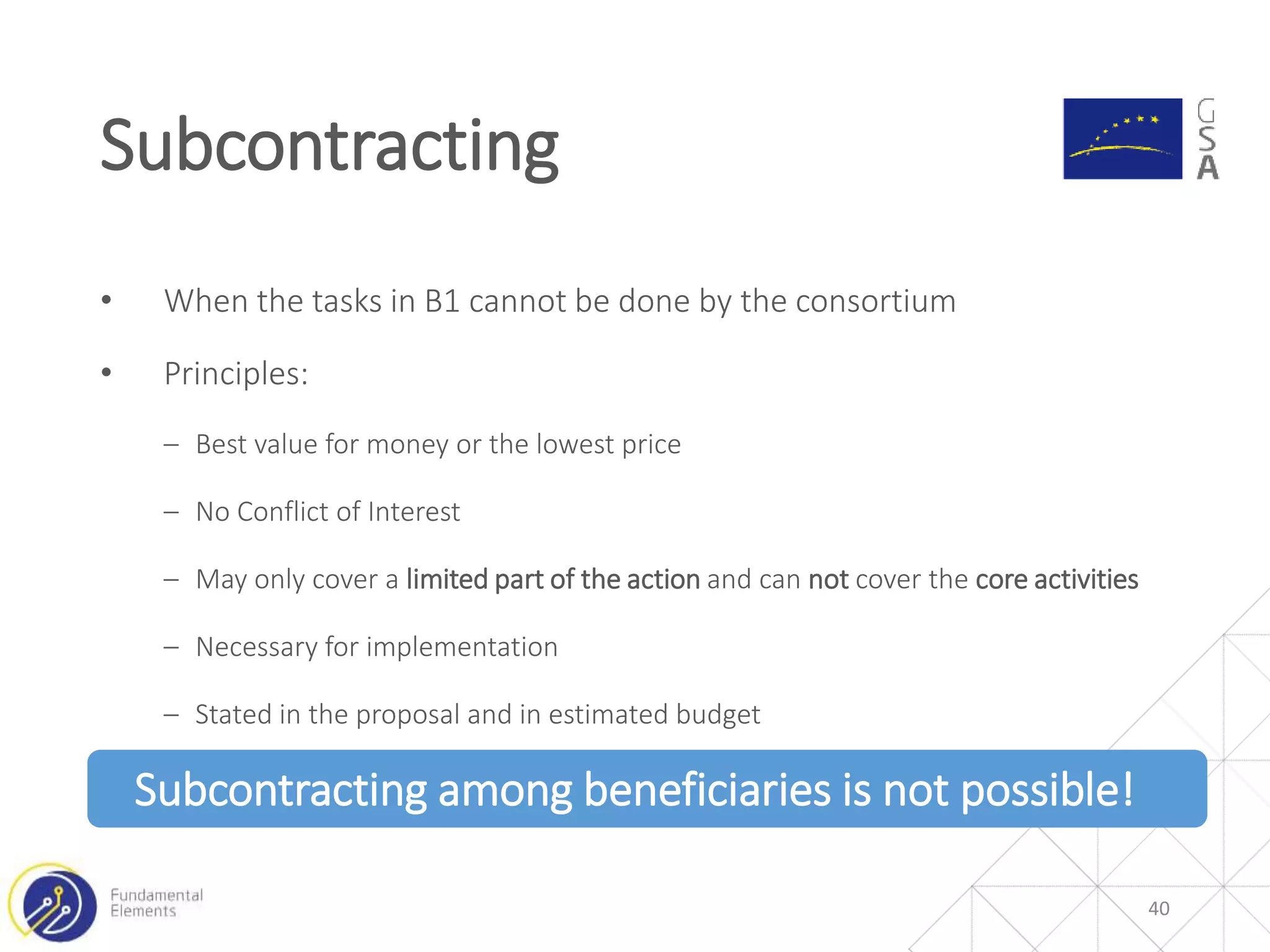
• When the tasks in B1 cannot be done by the consortium
• Principles:
‒ Best value for money or the lowest price
‒ No Conflict of Interest
‒ May only cover a limited part of the action and can not cover the core activities
‒ Necessary for implementation
‒ Stated in the proposal and in estimated budget
Subcontracting among beneficiaries is not possible!
Subcontracting
40
GRANT AGREEMENT
41
Draft Grant Agreement
42
• NOT part of the submitted proposal
• Please read it before submitting a proposal!
• It contains important elements on payments,
reporting, IPR etc.
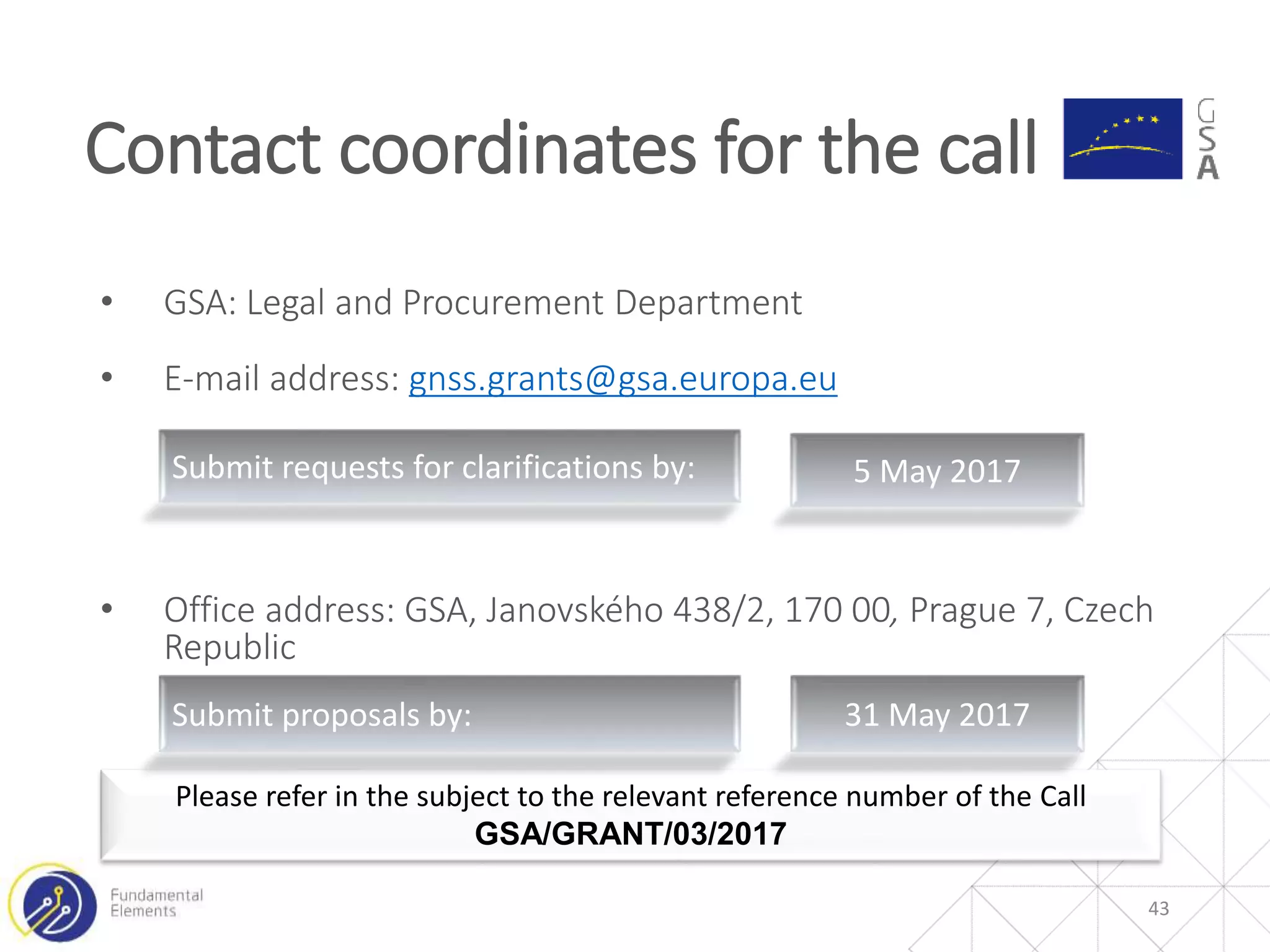
• GSA: Legal and Procurement Department
• E-mail address: gnss.grants@gsa.europa.eu
• Office address: GSA, Janovského 438/2, 170 00, Prague 7, Czech
Republic
Contact coordinates for the call
43
Please refer in the subject to the relevant reference number of the Call
GSA/GRANT/03/2017
Submit requests for clarifications by: 5 May 2017
Submit proposals by: 31 May 2017

Development of SBAS-Enabled Shipborne Receivers

  • 1.
    Development of SBAS-enabled ShipborneReceivers Fundamental Elements Webinar, 29th March 2017 Manuel Lopez, Technology officer – Maritime and SAR applications Vincenza de Tommaso, Financial Officer Alina Hriscu, Market Development Officer 1This presentation can be interpreted only together with the oral comments accompanying it
  • 2.
    2 • Participants’ microphonesare muted. To avoid any echo, please switch off your microphone. • Make sure your speakers or headphones are switched on, and turn up the volume. • To interact you can use the common chat room. Questions to individual participants will not be answered. • Your questions will appear anonymously to the other participants Before we start – way of working (1/2)
  • 3.
    • Questions arecollected and addressed at the end of the session, if time allows it. • All questions and answers will be published on the GSA website in order to guarantee the equal treatment of tenderers/applicants. • Slides and clarifications will be available in due course online after this webinar. • After the information session, you will receive a short satisfaction questionnaire, please fill it in. 3 Before we start – way of working (2/2)
  • 4.
     CALL BACKGROUND TECHNICAL SCOPE  ELIGIBLE PARTICIPANTS  HOW TO PREPARE YOUR PROPOSAL  GRANT AGREEMENT  Q&A TIME Agenda 4
  • 5.
    Context 5 • Satellite-based AugmentationSystems are included in the IMO Res. MSC.401 (95) on Performance Standards for Multi-System Shipborne Radionavigation Receivers • SBAS is already adopted in shipborne receivers providing increased accuracy. • However, today there is no maritime Standard or Guidelines for the implementation of SBAS in shipborne receivers and the majority of these implementations do not take into account the information related to the system integrity messages that is already broadcasted by SBAS. • To complement IMO Res. MSC.401(95), ‒ RCTM SC-104 on DGNSS created a SBAS subgroup in 2016 to prepare Guidelines for the implementation of SBAS in shipborne receivers and draft test specifications for a safety service compliant with IMO Res. A.1046. ‒ RTCM SC-131 is already drafting the performance requirements and test specifications for multisystem shipborne radionavigation receiver. Liaison between SC-104 and SC-131 is already established with respect to SBAS Guidelines. ‒ IEC TC 80 is expected to finalise test specifications for the type approval of multisystem shipborne radionavigation receivers with the support of RTCM SC-131 by mid-2019.
  • 6.
  • 7.
    Objectives of thecall 7 (1) Secure the availability of commercial products from European manufacturers of SBAS- enabled Shipborne Receivers.. (2) Develop and test SBAS-enabled Shipborne Receivers according to the draft Guidelines, for the implementation of SBAS, submitted to RTCM. This includes: a. Receiver firmware update (required), taking into account: i. The minimum set of SBAS Messages to be processed by a maritime receiver in compliance to IMO Resolution A.1046 operational requirements using SBAS SIS corrections and integrity data (required). ii. The recommended processing of messages as well as the system alerts in compliance to the requirements of IMO Res. A. 1046 (required). b. Static and Dynamic Test Campaign in the laboratory (required). c. Dynamic Test Campaign on a vessel (required)
  • 8.
    Objectives of thecall 8 Prototype (TRL-7) of an SBAS-enabled Shipborne Receiver (3) Support the finalisation of the draft Guidelines based on the results of the implementation and the results of the tests (required). (4) Support the SBAS standardisation process at RTCM and IEC including the definition of tests specifications for the type approval (optional). The support may include attendance to meetings and preparation of test specifications.
  • 9.
    Proposals can addressdevelopment of one or more (receiver type): (1) EGNOS-enabled Shipborne Receivers for navigation in SOLAS vessels (required) (2) EGNOS-enabled Shipborne Receivers for navigation in non-SOLAS vessels (optional) (3) EGNOS-enabled Shipborne Receiver for AIS class A transponder (optional) (4) EGNOS-enabled Shipborne Receiver for AIS class B transponder (optional) Type of Receivers 9
  • 10.
    Requirements to allproposals (=all receiver types) MANDATORY MUST BE IN ANY PROPOSAL 1.- Process the SBAS messages according to the Draft Guidelines on SBAS submitted to RTCM 2.- Test the SBAS-enabled receiver and provide recommendation for the tests specifications 3.- Provide feedback to support the finalisation of the Draft Guidelines.
  • 11.
    (1) Work plan(including project workflow). (2) Preliminary analysis of the latest Draft Guidelines available (before mid-term review). (3) Description of the logic for the use of SBAS corrections and integrity alarms when IALA DGNSS is available or not. (4) Describe measures taken to adopt the Marine Equipment Directive approval (Wheel Mark) on the final product. (5) Description of Test Campaigns, including the definition of the proposed tests and planning. (6) Test reports. (7) Recommendations and proposed modifications for the latest Draft Guidelines available based on the test reports. (8) New Receiver User Manual: Preliminary new version of the chapter related to SBAS. (9) Dissemination and business plan. (10) Dissemination documents and multi-media. Minimum set of deliverables to be included in the proposal 11
  • 12.
    Award criteria 12 DESCRIPTION WEIGHT LEVELOF RELEVANCE AND CREDIBILITY OF THE PROPOSAL (e.g. Use of EGNOS message types related to integrity, activities related to implementation, integration and testing of receiver) 35 IMPACT IN TERMS OF ECONOMIC AND PUBLIC BENEFITS DERIVED FROM THE PROPOSAL (e.g. Contribution to safety of life at sea, business plan, standardisation activities) 35 COHERENCE AND EFFECTIVENESS OF THE WORK PLAN (e.g. Schedule, effort, tasks distribution, etc.) 30 If a total score lower than 55 points or a score lower than 50% for any of the above three criteria is obtained, the proposal will not be evaluated further and will be rejected
  • 13.
    Call timeline (indicative) 13 StageDeadline Publication of the call 28 February 2017 Deadline for request for clarifications 5 May 2017 Publication of the clarifications 16 May 2017 Deadline for submission of applications 31 May 2017 Evaluation period June 2017 Information to applicants on the outcome of the evaluation July 2017 Signature of the Grant Agreement September 2017
  • 14.
    • Maximum totalbudget allocated to the call: EUR 1.000.000 • Indicative number of projects: 2 • Indicative maximum EU financing per project: EUR 500.000 • Maximum EU financing rate of eligible costs: 70% • Maximum duration of the action: 2 years Budget allocation and duration 14
  • 15.
    • Applications bylegal persons (consortia or mono-beneficiary) established1 in and/or natural person(s) being nationals of any of the EU Member States, Switzerland or Norway. 1 Legal persons are considered to be established in the EU when they are formed in accordance with the law of an EU Member State, Norway or Switzerland, and have their central administration, registered office or principal place of business in an EU Member State, Norway or Switzerland. • Applicants: active in the development, integration and/or manufacturing of GNSS components, receivers, antennas and/or expert in the field of GNSS Research and development. Eligible applicants 15
  • 16.
    16 Participation conditions ‒ Singleor multiple applicants (consortia) ‒ If consortium: ‒ Minimum 2 applicants, out of which the coordinator shall be a legal person ‒ Composition of the consortium: applicants can be from any eligible countries
  • 17.
    HOW TO PREPAREYOUR PROPOSAL 17
  • 18.
     The Administrativepackage  The Technical package  The Financial package Summary of the proposals 18
  • 19.
    Summary of theproposals 19 FORM CONTENT CO-ORDINATOR CO-APPLICANT(S) A1 PROPOSAL OVERVIEW X A2 PROPOSAL SUMMARY X A3 COORDINATOR PROFILE X A4 CO-APPLICANT PROFILE X A5 DECLARATION OF HONOUR X X A6 FINANCIAL CAPACITY X X B1 TECHNICAL PROPOSAL X B2 OPERATIONAL CAPACITY X X C1 PRELIMINARY BUDGET X X ADMIN PACKAGE TECHNICAL PACKAGE FINANCIAL PACKAGE
  • 20.
     Admin package: WHOdoes WHAT? 20 FORM CONTENT Single applicant / Co-ordinator Co-applicant(s) Affiliated entity A1 PROPOSAL OVERVIEW X A2 PROPOSAL SUMMARY X A3 COORDINATOR PROFILE X A4 CO-APPLICANT PROFILE X A5 DECLARATION OF HONOUR X X X A6 FINANCIAL CAPACITY X X X
  • 21.
    21 Admin package –overview of forms Cover page It serves 2 purposes: COVER PAGE (TO BE FILLED BY THE COORDINATOR + GSA)  Checklist for the applicants: list of the submission set + number of docs to be submitted  Basic information on the Proposal for GSA: project acronym and consortium composition + receipt of the documents.
  • 22.
    22 Admin package –overview of forms Form A1 & Form A2  Contact details: Name/Surname, Organisation, ..  Proposal Abstract: high level description of the proposed technical solution  About the participants: name, role in the project and represented country FORM A1. PROPOSAL OVERVIEW (TO BE FILLED BY THE COORDINATOR) FORM A2. PROPOSAL SUMMARY (TO BE FILLED BY THE COORDINATOR)  Objectives of the proposal: target of the proposal, including value proposition and benefit for the users  Description of the work: high level project’s workflow  Milestone and Expected results
  • 23.
    23 Admin package –overview of forms Form A3 & Form A4 FORM A3. COORDINATOR / SINGLE APPLICANT PROFILE (TO BE SUBMITTED BY THE COORDINATOR WITH: LEGAL ENTITY AND FINANCIAL IDENTIFICATION FORMS)  Legal Information: LEF (Legal Entity Form: private or public company, registration info)  Financial Identification: (FIF) banking details and account holder’s info  Power of attorney: to commit the company/organisation  Information on co-financing: how the applicant would do it? under which form?  Previous EU contracts/grants: to check the no-double payment principle.  Stamp: in UK it’s not common however for admin purposes EC needs it! FORM A4. CO-APPLICANT PROFILE (TO BE FILLED BY THE CO-APPLICANTS WITH: LEGAL ENTITY FORM)  Same as for Coordinator: to be filled by the co-applicant.
  • 24.
    24 Admin package –overview of forms Form A5 & A6 FORM A5. DECLARATION OF HONOUR (TO BE SUBMITTED BY ALL APPLICANTS – INCLUDING AFFILIATED ENTITIES)  It serves to check the exclusion and selection criteria  Generic text used by EU.  (The template was made after the amendment of the EU Financial Regulations as of 1 Jan 2016.)  If requested consider to start early enough collecting all the evidences; since might be time consuming FORM A6. FINANCIAL CAPACITY (TO BE SUBMITTED BY ALL APPLICANTS – INCLUDING AFFILIATED ENTITIES)
  • 25.
     Technical package: WHOdoes WHAT? 25 FORM CONTENT Single applicant / Co-ordinator Co-applicant(s) Affiliated entity B1 TECHNICAL PROPOSAL X B2 OPERATIONAL CAPACITY X X X
  • 26.
    26 Technical package • Everyproposal shall be assessed against the criteria set out in the relevant Call for Proposal. • In particular, for the technical package: The Technical proposal (B1 Form) shall be assessed against the AWARD criteria (CfP sect. 9) The Operational capacity (B2 Form) shall be assessed against the SELECTION criteria (CfP sect. 8.2)
  • 27.
    27 Technical package –overview of forms Form B1 The co-ordinator, on behalf of the consortium, shall submit the TECHNICAL PROPOSAL. 1. CONCEPT and APPROACH (max. 30 pages) 2. EXPECTED IMPACT (max. 10 pages) 3. IMPLEMENTATION (max. 20 pages) 4. TECHNICAL ANNEXES
  • 28.
    1. This sectionshall contain, as minimum:  Description of the proposed technical solution and its compliance with the CfP’s objectives  Technology involved (focusing on innovation elements), E-GNSS differentiators, etc.  Description of the applied methodologies which shall be used in the implementation of the action  The feasibility of the proposal targeting market implementation  Considerations about the engagement of the key stakeholders (e.g. chipset manufacturer, system integrator, service provider, etc.) 28 Technical package – overview of forms Form B1: Concept and approach
  • 29.
    29 Technical package –overview of forms Form B1: Expected impact 2. This section shall at least address the following topics:  Which benefits to the user will derive from the implementation of the project? Which additional applications shall be enabled?  Elaboration of a Preliminary Business Plan, describing the strategy to exploit the results.  Elaboration of a Preliminary Dissemination Plan, establishing the measures to disseminate the achievements of the project among relevant stakeholders in the appropriate phases of the project
  • 30.
    30 Technical package –overview of forms Form B1: Implementation (1/2) 3. Structured section guiding the applicant through the following points:  Work Plan definition  Work Packages: description, effort, resp., objectives, etc.  WP schedule: Gantt chart, or similar  WP inter-dependencies: Pert chart, or similar  List of Deliverables (e.g. specification, report, demo kit, etc.)  Project management  Milestones, and relevant decision making  Preliminary Risk register
  • 31.
    31 Technical package –overview of forms Form B1: Implementation (2/2) 3. Structured section guiding the applicant through the following points:  Consortium as a whole:  Partners complementarity  Tasks allocation  Effectiveness in the project execution and to target commercialisation  Project’s Resources:  Planned staff effort  Other Direct Costs  Subcontracting  Budget overview
  • 32.
    32 Technical package –overview of forms Form B1: Technical annexes 4. Table to be filled out with the following information:  Partners name (Organisation/Company)  Company category (e.g. Research institute, chipset manufacturer, other)  Country Legal person: origin meaning “established”: having a registered office OR central administration OR principal place of business in one of those countries. Natural Person: citizenship
  • 33.
    33 Technical package –overview of forms Form B1: Operational capacity Every applicant (coordinator and co-applicants), shall submit the OPERATIONAL CAPACITY Form. Objective: to demonstrate compliance with SELECTION criteria set out in the CfP Ref. CfP section 8.2 – “Applicants must show they have the operational (technical and management) capacity to complete the activities to be supported by this Call for Proposal and must demonstrate their capacity to manage the activities corresponding to the size of the project for which the grant is requested.”
  • 34.
    34 FORM CONTENT CO-ORDINATORCO-APPLICANT(S) A1 PROPOSAL OVERVIEW X A2 PROPOSAL SUMMARY X A3 COORDINATOR PROFILE X A4 CO-APPLICANT PROFILE X A5 DECLARATION OF HONOUR X X A6 FINANCIAL CAPACITY X X B1 TECHNICAL PROPOSAL X B2 OPERATIONAL CAPACITY X X C1 PRELIMINARY BUDGET X X ADMIN PACKAGE TECHNICAL PACKAGE FINANCIAL PACKAGE  Financial package: WHO does WHAT?
  • 35.
    • Filled inwith figures from your annual (audited) accounts • GSA calculates ratios (e.g. profitability, indebtedness, financial independence) • Used to assess your financial viability Not applicable to public bodies and international organisations Financial package – overview of forms Form A6: Financial capacity (1/2) 35
  • 36.
    If outcome ofthe check is not satisfactory and in any other case GSA can: • request further information • propose a grant agreement without pre-financing • propose a grant agreement with a pre-financing paid in instalments; • propose a grant agreement with a lower percentage of a pre-financing; • propose a grant agreement with a pre-financing covered by a bank guarantee • reject the application 36 Financial package – overview of forms Form A6: Financial capacity (2/2)
  • 37.
    Financial package –overview of forms Form C1: Estimated budget 37 Project Name Participant Name Project Acronym Estimated eligible direct costs Estimated eligible indirect costs Total estimated eligible costs Total requested GSAgrant (EUR) (EUR) (EUR) (EUR) A B C = A+B D = 70% x C Direct eligible costs (Numbering of categories as in "Eligible Costs for the grants" section 12.2 of the Call for Proposals - apply the rules detailed thereunder) declared on the basis of flat rate of 7% of 1. + 2. without costs of subcontractors, costs of third parties not working on beneficiary premises, and cost of financial support to 3rd parties Total requested GSA grant at the maximum reimbursment rate of 70%of total costs 1.1 Personnel under direct empl. contract 0.00 € 0.00 € 0.00 € 0.00 € 1.2 Personnel under other than under empl. contract (in-house consultants) 0.00 € 0.00 € 0.00 € 0.00 € Sub-total for cost category 1 0.00 € 0.00 € 0.00 € 0.00 € 2.1 Travel costs 0.00 € 0.00 € 0.00 € 0.00 € 2.2 Costs for equipment and other assets procured for the action 2.2 a) Costs for equipment and other assets procured for the action: Full purchase costs 2.2 b) Costs for equipment and other assets procured for the action: Depreciation costs 0.00 € 0.00 € 0.00 € 0.00 € 2.3 Costs for equipment or other assets not procured but used for the action (depreciation costs) 0.00 € 0.00 € 0.00 € 0.00 € 2.4 Costs for rental or lease of equipment or other assets only to the portion of use and limited to the duration of the action 0.00 € 0.00 € 0.00 € 0.00 € 2.5 Costs for use of technical facilities or laboratories 0.00 € 0.00 € 0.00 € 0.00 € 2.6 Costs for consumables and supplies 0.00 € 0.00 € 0.00 € 0.00 € 2.7 Costs arising directly from requirements imposed by the grant agreement 0.00 € 0.00 € 0.00 € 0.00 € 2.8 Costs entailed by subcontracts as described in the proposal 0.00 € Not applicable 0.00 € 0.00 € 2.9 costs of financial support to third parties 2.10 Duties, taxes and charges paid by the beneficiary 0.00 € 0.00 € 0.00 € 0.00 € Sub-total for cost category 2 0.00 0.00 € 0.00 € 0.00 € Total direct eligible costs 0.00 € Total indirect eligible costs 0.00 € Total eligible costs 0.00 € 5. Total EU contribution 0.00 € Not applicable in this call for proposals ESTIMATED BUDGET Not applicable in this call for proposals Estimated eligible costs of the action and GSA contribution (Table 1) 1. PERSONNEL COSTS 2. OTHER DIRECT COSTS
  • 38.
    • During evaluationit will be checked: ‒ Staff effort – in relation to estimated budget for personnel ‒ Description of other direct costs ‒ List of subcontracts ‒ Cumulative budget overview Financial package – overview of forms Form B1: Technical proposal 38 The amounts should fit with amounts in C1 Form
  • 39.
    • 3 paymentsin total: ‒ Pre-financing 30% ‒ Interim payment up to 40% ‒ Final payment (30-70%) Payment scheme 39
  • 40.
    • When thetasks in B1 cannot be done by the consortium • Principles: ‒ Best value for money or the lowest price ‒ No Conflict of Interest ‒ May only cover a limited part of the action and can not cover the core activities ‒ Necessary for implementation ‒ Stated in the proposal and in estimated budget Subcontracting among beneficiaries is not possible! Subcontracting 40
  • 41.
  • 42.
    Draft Grant Agreement 42 •NOT part of the submitted proposal • Please read it before submitting a proposal! • It contains important elements on payments, reporting, IPR etc.
  • 43.
    • GSA: Legaland Procurement Department • E-mail address: gnss.grants@gsa.europa.eu • Office address: GSA, Janovského 438/2, 170 00, Prague 7, Czech Republic Contact coordinates for the call 43 Please refer in the subject to the relevant reference number of the Call GSA/GRANT/03/2017 Submit requests for clarifications by: 5 May 2017 Submit proposals by: 31 May 2017

Editor's Notes

  • #20 Purely financial forms: A6 and C1 Some important fin. input needed (staff effort, subcontractors, overview budget, breakdown of other direct costs): B1 Some minor financial input needed: A1 and A5
  • #35 Purely financial forms: A6 and C1 Some important fin. input needed (staff effort, subcontractors, overview budget, breakdown of other direct costs): B1 Some minor financial input needed: A1 and A5
  • #40 Pre-financing: paid automatically once the GA is signed Interim payment: - After the end of 1st period Following a request for interim payment from the Consortium – financial reporting Max. 70% cumulatively for pre-financing and interim payment – i.e. if pre-financing was paid at 30% then maximum 40% of grant will be paid in interim payment Final payment: Payment of the balance – the final amount depending on the amount of total actual eligible costs After the end of the project Following a request for final payment from the consortium – financial reporting
  • #41 Subcontracting: the externalisation of specific tasks or activities which form part of the action as described in the proposal – however, beneficiaries must have operational capacity to perform the tasks in B1 therefore subcontracting has to be justified Stated in the proposal and in estimated budget: if not in the proposal/budget then needs prior approval of GSA. If major change, amendment to the GA will be needed.
  • #43 Pre-financing: paid automatically once the GA is signed Interim payment: - After the end of 1st period Following a request for interim payment from the Consortium – financial reporting Max. 70% cumulatively for pre-financing and interim payment – i.e. if pre-financing was paid at 30% then maximum 40% of grant will be paid in interim payment Final payment: Payment of the balance – the final amount depending on the amount of total actual eligible costs After the end of the project Following a request for final payment from the consortium – financial reporting