Gender and Post-Conflict 
Governance: Understanding 
the Challenges
1 
Gender and Post- 
Conflict Governance: 
Understanding the 
Challenges 
Acknowledgement 
The document was written by 
Ana Lukatela, Programme Spe-cialist, 
UN Women Peace and 
Security, with inputs from Anne 
Marie Goetz, Chief Advisor, UN 
Women Peace and Security. 
The author also thanks the fol-lowing 
for additional informa-tion 
and advice: Nisreen Alami, 
Tonusree Basu, Pablo Castillo- 
Diaz, Skye Christensen, Kath-erine 
Gifford, Begoña Lasaga-baster, 
Diogo Souto Maior, Jago 
Salmon, Sheelagh Stewart and 
Lee Waldorf. 
October 2012 
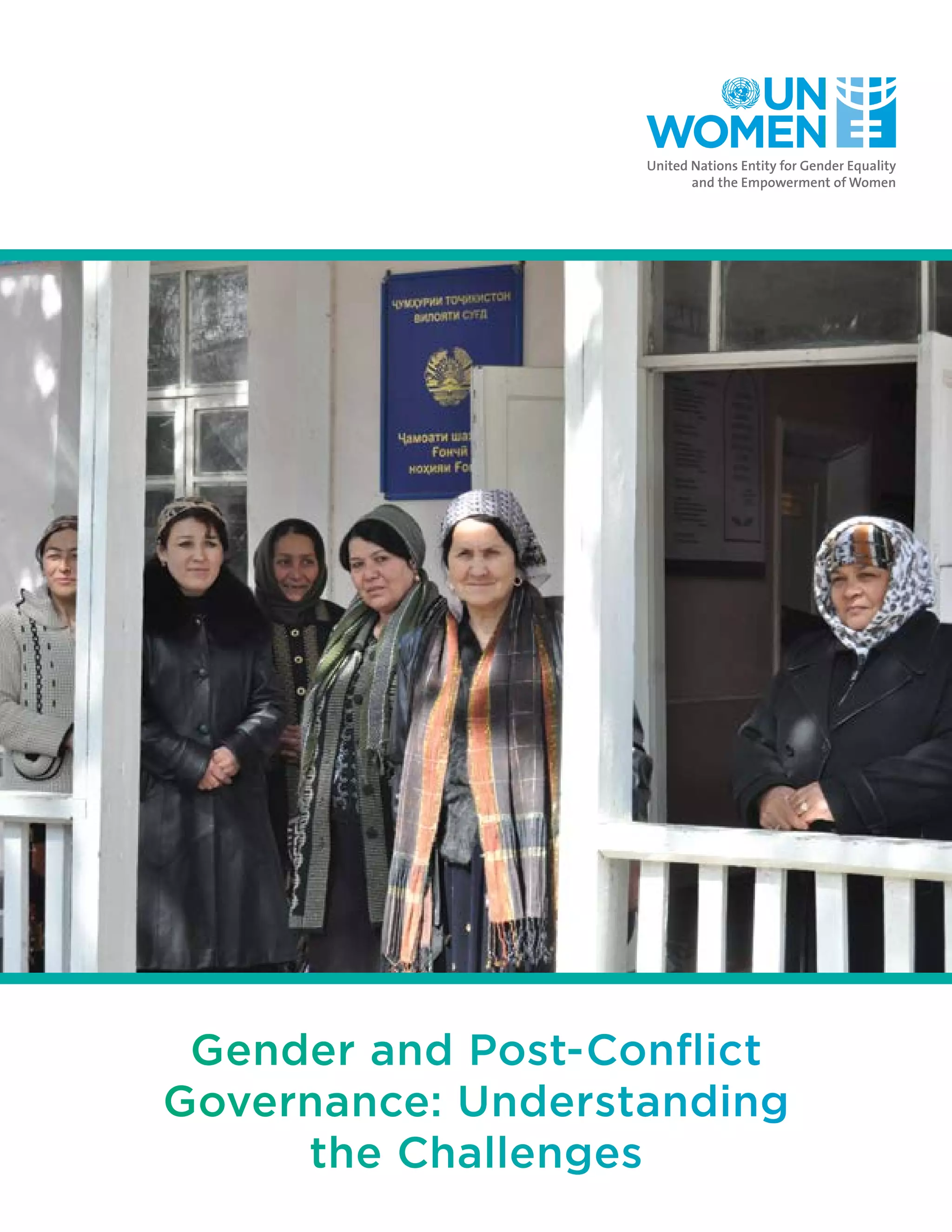
On the cover: Women community leaders of 
the Women’s Watch Group in Ghanchi District, 
Tajikistan, gather for a dialogue with local 
authorities on service delivery. 
Credit: UN Women/Ana Lukatela 
Transition: A period of change from one political regime or 
system to another, often describing the process of emerging 
from conflict to peace, when there is a priority effort to 
create conditions for political stability, security, justice, 
social equality, and economic recovery. 
Governance: The exercise of economic, political and 
administrative authority to manage a country’s affairs 
at all levels. It comprises the mechanisms, processes and 
institutions through which citizens and groups articulate 
their interests, exercise their legal rights, meet their 
obligations and mediate their differences (UNDP, 1997, 
Governance for Sustainable Human Development, New York). 
Gender-responsive governance: The management of public 
affairs in a manner that addresses the social relations 
that undermine women’s capacity to participate in public 
decisions and responds to gender biases and patterns of 
exclusion. Women’s inclusion in oversight processes and 
advancing women’s human rights is a key standard against 
which the performance of officials should be assessed 
(UNIFEM, 2008, Progress of World’s Women: Who Answers 
to Women?, New York, p. 2). 
Gender-responsive governance reforms: Reforms that 
lead to greater accountability to women by ensuring that 
institutions respond more effectively to women’s needs and 
priorities, in particular improving their access to livelihoods 
and citizenship rights, and require and produce more 
participation by both women elites and grassroots. 
Introduction: 
Transitions from conflict, political crisis or humanitarian disaster often present opportunities to 
strengthen women’s leadership, empowerment and rights in governance processes. 
Around the world, as countries undertake transitions towards 
peace, good governance and democracy, women have asserted 
their demands for participation, representation, accountability 
and political freedom. 
As universal as these goals are, they nevertheless remain elusive. 
Progress has been slow in increasing numbers of women in 
elected representative office – they still average just one in five 
parliamentarians globally and are also poorly represented in local 
decision-making bodies, whether as mayors and local council 
members or in appointed positions in institutions such as the 
public administration. 
However, increasing the number of women in public office is 
not sufficient. Beyond numeric representation women also 
need their interests to be substantively represented in order for 
governance processes to advance women’s social, political and 
economic outcomes. Gender-responsive governance reforms are 
intended to connect the numeric and the substantive represen-tation 
of women. Gender-responsive governance ensures that 
institutions respond more effectively to women’s needs and 
priorities; enhance women’s wellbeing, livelihoods and citizen-ship 
rights; and build government institutions that require and 
produce more participation by women, and not only by women 
elites, but also by grassroots women. 
Many types of institutions of governance and public administra-tion, 
such as constitutional committees or electoral commissions, 
lack systems or the capacity to ensure women’s interests are 
articulated and addressed in public policy. In addition, public 
institutions are inconsistent in holding power-holders account-able 
for failures to protect women’s rights or responding to 
women’s needs. 
Improving the status of women in conflict and post-conflict 
contexts can improve the welfare of the household and the 
Key Concepts 
* Any reference to “UNIFEM” in the 
document must be understood to refer to 
“former UNIFEM”, one of the four entities 
merged into the United Nations Entity for 
Gender Equality and the Empowerment 
of Women on 21st July, 2010 by United 
Nations General Assembly Resolution A/ 
RES/64/289. 
* Any reference to United Nations 
“resolution 1325 and subsequent 
resolutions or 5 WPS resolutions” in the 
document must be understood to refer 
to Security Council resolutions on women 
and peace and security 1325 (2000); 1820 
(2008); 1888 (2009); 1889 (2009); and 
1960 (2010). 
As ‘standard operating procedures’ for good governance reform 
and programming, these considerations aim to ensure that women 
participate in all post-crisis governance processes, that their 
rights and needs are substantively represented, and that those in 
power answer to women.
Objectives o f gender-responsive governance 
reforms in post-conflic t contexts 
2 
inequalities and barriers prevent women’s full engagement in 
institutions of governance. Despite the fact that during conflict 
women’s roles in the public arena are expanded and women 
in communities act as effective leaders and mediators, in the 
post-conflict period there is often a resurgence of stereotypical 
attitudes about women’s weak leadership skills and women 
are pushed out of public engagement. In addition, women’s 
disproportionate share of the burden of ensuring the subsistence 
of the household in a post conflict context, including care for 
the elderly, children, orphans, disabled or internally displaced 
relatives, means that women have little time to devote to politics 
or to participating in reform processes. 
In post-conflict contexts 30 – 40 per cent of households are 
female-headed.5 One review of post-conflict countries found 
that “in Angola, Kosovo, Mozambique, and Somalia, due to the 
great number of men who were killed, widows now make up 
more than half of the population of all adult women.6 Female-headed 
households are associated with poverty and substantial 
time-burdens on the female household head, limiting time for 
engagement in public decision-making and governance reforms. 
In addition to the increased care burdens in post conflict situa-tions, 
women often suffer from weak fundamental citizenship 
rights, which can compound their difficulties, especially for 
female-headed households. Women may not, for example, 
be able to (de facto or de jure) access family land or property 
from a husband that is missing or was killed during the conflict, 
which puts women heads of households at a significant 
disadvantage when seeking to rebuild livelihood security in the 
aftermath of conflict. 
A substantive normative framework has been built over the years 
to recognize that women have a critical role to play in terms of 
participation in post-conflict governance reforms. UN Women has 
been engaging in these policy dialogues and their implementa-tion 
in UN inter-agency fora. In addition to the relevant clauses of 
The Convention on the Elimination of All Forms of Discrimination 
against Women (CEDAW) and the Universal Declaration on 
Human Rights and regional agreements such as the African 
Union (AU) Charter on the Rights of Women or the Southern 
African Development Community (SADC) Protocol on Gender and 
Development, the normative framework for women’s participation 
in post-conflict governance also includes the following: 
»» UN Security Council resolution 1325 (2000) affirmed women’s 
right to participate in post conflict political processes, while 
resolution 1889 (2009) encouraged UN missions and member 
states to improve implementation; 
»» The UN system’s Seven-point action plan on gender-respon-sive 
peacebuilding7 lays out concrete commitments for actors 
in the UN system towards increasing women’s political par-ticipation, 
including the provision of technical assistance on 
temporary special measures (TSMs) by UN actors involved in 
electoral assistance in post-conflict contexts; 
»» The UN system-wide Strategic Framework on Women and 
Peace and Security includes concrete commitments, targets 
and timelines for key actors on women’s participation in post 
conflict governance. 
The Secretary General’s 2009 Report on Peacebuilding in the 
Immediate Aftermath of Conflict (A/63/881–S/009/304)7, and 
the International Dialogue on Peacebuilding and Statebuilding: 
1) Public resources are managed in a way that results in 
improvements in women’s lives. 
2) Women are able to access resources and rights that may 
have been denied to them under pre-conflict or conflict 
governance systems. 
3) Women are engaged in national and local public 
consultations on conflict resolution and recovery. 
4) Women’s presence and influence are increased at all 
levels of elected and appointed public office. 
5) Women’s access to public accountability 
mechanisms is improved. 
community.1 Conversely, failing to protect women’s rights and 
employment opportunities can threaten sustainability of gover-nance 
reforms and community stability. For example, countries 
with only 10% of women in the labour force are nearly 30 times 
more likely to experience internal conflict than are states with 
40% of women in the labour force.2 
In view of the considerable contributions that women make to 
building democratic governance and peace, this discussion paper 
outlines a set of considerations for women’s engagement in 
transitional governance and public accountability for women’s 
rights. As ‘standard operating procedures’ for good governance 
reform and programming, these considerations aim to ensure 
that women participate in all post-crisis governance processes, 
that their rights and needs are substantively represented, and 
that those in power answer to women. 
Governance reforms in societies emerging from conflict address 
specific challenges. These include weak state legitimacy and 
authority due to persistent or lingering violence and instability; 
low social cohesion; a high prevalence of vulnerable, marginal-ized 
or displaced populations; and limited financial and human 
resources. There are also challenges in post-conflict situations 
related to increased corruption, destroyed service delivery 
infrastructure, politicization of society, and the domination of 
militarized factions. 
International and national peacebuilding actors have recognized 
that social exclusion can be a major driver of conflict. Evidence 
and research have shown a devastating link between severe 
economic and social horizontal inequalities and violent conflict.3 
Where the underlying or deep-rooted causes of conflict include 
inequality and exclusion the resulting humanitarian, conflict 
resolution and development efforts must be inclusive and 
participatory. Inclusive approaches have the goal of addressing 
inequality and facilitating marginalized populations to realize 
their rights. It also increases the number of stakeholders with 
an investment in the system of governance, which can deepen 
stability. Inclusive post-conflict governance has to address gender 
inequality and the gender specific impacts of conflict faced by 
women. Including women can also have a positive impact on 
addressing social exclusion as a driver of conflict. 
However, in addressing the principle of inclusivity in post-conflict 
contexts, governance reform actors are sometimes torn between 
the need for pragmatism and “conflict sensitivity”, and their 
normative commitments to inclusiveness, transparency and 
human rights. 
“In conflict resolution, women’s 
participation and gender expertise 
provide a firm foundation for 
women’s post conflict participation. 
Both numeric and substantive 
representation are needed. For this, 
special efforts and measures are 
often required.”4 
~Michelle Bachelet, April 2012 
The fundamental inequalities and drivers of conflict and crisis (for 
example regional inequalities, significant marginalized popula-tions, 
skewed distribution of land ownership) must be addressed 
in the transitional governance arrangements, otherwise insta-bility 
will continue and the political settlement will be in danger. 
Each of these drivers of conflict has a gender dimension, and 
even though women have important contributions to make in 
conflict resolution and governance reforms, a gender perspective 
is rarely a priority concern in post-conflict contexts. 
This discussion paper stresses that it is never too early in a transi-tion 
context to prioritize women’s empowerment and gender 
equality. Unfortunately, the trend has been to relegate this to an 
afterthought. In post-conflict and post-crisis political transforma-tions, 
the already-organized political interest groups are most 
successful at seizing power. Women’s groups tend to be under-funded 
and are often poorly positioned to seize opportunities 
to influence governance arrangements. In addition, structural 
The Secretary-General’s Report on Women’s Participation in Peacebuilding (A/65/866-S/2010/466) is a comprehensive 
and robust action plan to take forward the promises of United Nations Security Council Resolution 1325. The Action Plan 
is made up of commitments which ensure that: 
1. Women are fully engaged in, and timely gender expertise 
is provided to, all peace talks; 
2. Post-conflict planning processes, including donor 
conferences, involve women substantively and apply 
methods that result in comprehensive attention to gender 
equality; 
3. Adequate financing – targeted and mainstreamed – is 
provided to address women’s specific needs, advance 
gender equality and promote women’s empowerment. A 
target of 15 per cent was set in the report; 
4. Deployed civilians possess specialized skills, including 
expertise in rebuilding state institutions to make them 
more accessible to women; 
5. Women can participate fully in post-conflict governance, 
as civic actors, elected representatives and decision-makers 
in public institutions, including through 
temporary special measures such as quotas; 
6. Rule of law initiatives encourage women’s participation 
in seeking redress for injustices committed against them 
and in improving the capacity of security actors to prevent 
and respond to violations of women’s rights; and 
7. Economic recovery prioritizes women’s engagement in 
employment-creation schemes, community-development 
programmes and the delivery of frontline services. 
3
Political Governance Processes 
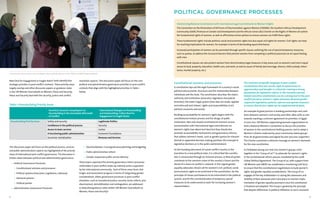
Iraqi women voters stand in line, waiting to enter a polling station. Credit: UN Photo/UNHCR/Roger LeMoyne 
New Deal for Engagement in Fragile States8 both identify five 
strategic priorities in post-conflict contexts. These priority areas 
largely overlap and other discussion papers or guidance notes 
in the UN Women Sourcebook on Women, Peace and Security, 
Peace and Security deal with the security, justice and conflict 
Table 1: Peacebuilding Priority Areas 
resolution aspects. This discussion paper will focus on the core 
political and administrative governance priorities in post-conflict 
contexts that align with the highlighted priorities in Table 1 
below. 
Secretary-General’s 2009 Report on 
Peacebuilding in the Immediate Aftermath 
of Conflict 
International Dialogue on Peacebuilding 
and Statebuilding: A New Deal for 
Engagement in Fragile States 
Peacebuilding Priority Areas Safety and security Legitimate Politics 
Confidence in the political process Security 
Access to basic services Justice 
A functioning public administration Economic Foundations 
Economic revitalization Revenue and Services 
Harmonizing National Constitutions with International Legal Commitments to Women’s Rights 
The Convention on the Elimination of All Forms of Discrimination against Women (CEDAW), the Southern African Development 
Community (SADC) Protocol on Gender and Development and the African Union (AU) Charter on the Rights of Women all outline 
the fundamental rights of women, as well as affirmative action policies to ensure women can fulfill these rights. 
These fundamental rights include political, social and economic rights but also equal civil rights for women. Civil rights can have 
far-reaching implications for women, for example in terms of demanding equal inheritance. 
Increased participation of women can be promoted through specific clauses outlining the use of special temporary measures, 
such as quotas, to address the structural barriers that prevent women from competing in political processes on an equal footing 
with men. 
Constitutional clauses can also protect women from discriminatory legal measures in key areas such as women’s and men’s equal 
access to land, property, education, health care, and work, as well as issues of family law (marriage, divorce, child custody, inheri-tance, 
marital property, etc.) 
Constitutional revisions and processes 
A constitution lays out the legal framework of a country’s social, 
political and economic structures and the relationship between 
individuals and the state. The constitution describes the state’s 
authority and institutions (executive, legislative and judicial 
branches), the state’s legal system (how laws are made, applied 
and enforced) and citizens’ rights and responsibilities (civil, 
political, economic and social). 
Building accountability for women’s rights begins with the 
constitutional revision process and the design of public 
institutions. Not only should constitutional revisions ensure 
harmonization with international legal commitments on 
women’s rights (see above text box) but they should also 
promote accountability mechanisms and governance reforms 
that address women’s needs, such as gender quotas for relevant 
elected or appointed decision-making positions (for example in 
legislative elections or in the public administration). 
As the founding document of a post-conflict country or the 
transition to a new political order, it is critical that the constitu-tion 
is constructed through an inclusive process so that all parties 
contribute to the common vision of the country’s future and the 
threat of a return to conflict is reduced. In this regard gender 
equality advocates should call for women’s civil, political, social 
and economic rights to be enshrined in the constitution; for the 
principles of checks and balances to be entrenched in the political 
system; and for the constitutionality of temporary special 
measures to be underscored as tools for increasing women’s 
representation. 
The inclusion of specific language in post-conflict 
constitutions that sets out the right to equal access to 
opportunities and benefits is critical for creating a strong 
foundation for legislative reform in the transition period. 
Gender-sensitive constitutions can be a strong tool in the post-conflict 
period as women’s rights advocates demand gender-responsive 
legislation, policies, reforms and special measures 
to ensure that de jure rights can be implemented de facto. 
An example of good practice is building partnerships and coali-tions 
between women’s civil society and other allies with an aim 
towards reaching a common agreement on priorities. In Egypt 
in June 2011, UN Women supported grassroots organizations to 
hold a National Women’s Convention to discuss the priorities 
of women in the constitutional drafting process and to adopt a 
Women’s Charter endorsed by 3000 community-based groups 
from all 26 governorates and signed by over 500,000 supporters. 
The Charter contained a coherent message on women’s demands 
for the new constitution. 
In Zimbabwe during 2011 and 2012 women’s groups came 
together in the “Group of 20”10 to advocate for women’s rights 
in the constitutional reform process mandated by the 2008 
Global Political Agreement. The Group of 20, with support from 
UN Women and UNDP, has established a monitoring task force 
to ensure that the constitutional negotiations include women’s 
rights and gender equality considerations. The Group of 20 
engages all the key stakeholders in raising the awareness and 
visibility of their demands and it also plans to monitor imple-mentation 
of gender equality provisions once the constitution 
is finalized and adopted. The Group is guided by the principle 
that despite differences in political affiliation or socio-economic 
This discussion paper will focus on the political process, services 
and public administration aspects (as highlighted) of the priority 
areas of international post conflict governance. The discussion is 
broken down between political and administrative governance: 
»» Political Governance Processes: 
• Constitutional revisions and processes 
• Political systems (Executive, Legislature, Judiciary) 
• Electoral systems 
• Political parties 
»» Administrative Governance Processes: 
• Decentralization / Local governance planning and budgeting 
• Public administration reform 
• Gender-responsive public service delivery 
These topics represent the priority governance reform processes 
undertaken in post conflict states by national actors supported 
by the international community. Each of these areas faces chal-lenges 
and inconsistent progress in terms of integrating gender 
considerations. Other governance processes in post-conflict 
situations, such as transitional justice, security sector reform, and 
disarmament, demobilization and reintegration, are addressed 
in dedicated guidance notes within UN Women Sourcebook on 
Women, Peace and Security9. 
4 5
Women’s Charters: Key Considerations in Constitutional 
Women’s Charters are just one method of aggregating and 
articulating the needs and demands of national women’s 
movements and gender equality advocates in the lead-up 
to post-conflict elections and/or transitional constitutional 
reviews. In cases where women’s political interests do not 
have representation at negotiating tables, a women’s charter 
becomes all the more important in conveying demands to the 
delegates and advocating for women’s priorities and rights. 
A Charter must be agreed upon by consensus through wide-ranging 
national grassroots consultations in order to carry 
legitimacy and authority as the voice of half the population. 
The Charter can also give women’s representatives added 
legitimacy in calling for a seat at the negotiating table and 
the inclusion of the interests outlined in the document into 
all aspects of the transition. 
The process of creating a Women’s Charter involves 
preparing a draft framework through a steering committee 
of key national stakeholders such as gender equality 
academics, experts and women’s grassroots civil society 
status women must stand together to ensure that the consti-tutional 
revision process takes into account their needs and 
priorities and sets the basis for their future public engagement. 
In South Sudan, a well-organized and strong women’s civil 
society movement mobilized during 2011 to provide ongoing 
inputs into the constitutional review and to ensure women are 
part of the constitutional review committ ee formed in 2012. 
In South Africa during the transition in the 1990s, women’s 
groups noted that political party delegations to the constitu-tional 
negotiations were composed of only men and that the 
needs and priorities of women were being marginalized. In 
response women came together across party lines and racial 
divisions to create a non-partisan Women’s National Coalition. 
The Coalition held a General Congress to discuss the adoption of 
a Charter that would set out women’s priorities for the constitu-tion. 
The coalition was not without its tensions and challenges; 
the drafting of the Charter took place against the backdrop 
of an extremely tumultuous period in South Africa. However, 
the Congress was ultimately successful by stressing inclusive 
participation and by including an introductory note that while 
the Charter was the product of the Coalition, individual organiza-tions 
still reserved the right to recuse themselves from particular 
clauses (most often the clause regarding reproductive rights). 
leaders. The draft framework is then widely disseminated 
to grassroots women’s groups for discussion prior to a 
facilitated national consultative workshop or convention 
involving a broad spectrum of national women’s 
representatives. 
Targeted and organized advocacy by women’s NGOs through 
a Women’s Charter has proven to be an effective way to 
demand the attention of constitutional drafters. There 
are several reasons for this. First, if the Charter is created 
through broad national consultations it carries legitimacy 
as the voice of the nation’s women. Second, engaging experts 
and well-known advocates in the consultations helps to build 
credibility. Third, a comprehensive and clear list of demands 
provides a rallying point for women’s rights advocates 
and amplifies the demands being made. Lastly, Women’s 
Charters often base demands on relevant international legal 
commitments and thus invoke the legal responsibilities to 
which a government is already committed. 
Ultimately a coherent Women’s Charter emerged that proved 
to be a strong advocacy tool in the constitutional negotiations. 
South Africa subsequently adopted a constitution that has 
been widely applauded for the strength of its gender-specific 
provisions. 
Annex 1 outlines the process that took place in South Africa in 
1992 and in Afghanistan in 2003 when women mobilized to 
aggregate their demands prior to constitutional negotiations. 
The Annex also provides the substance of the demands. In both 
of these cases the process of developing a Women’s Charter was 
successful because there was cross-partisan mobilization and 
common issues could be identified, regardless of which party 
or faction women belonged to. In a post-conflict context where 
women are divided by ethnic, religious or regional divisions 
and are unable to find common ground a Women’s Charter 
must be preceded by confidence-building and reconciliation 
among women. 
Review Processes: 
1. Gender quotas for constitutional thematic committees 
and constitutional assemblies are critical for ensuring 
women’s participation and that women’s priorities are 
substantively addressed. 
2. In order to ensure substantive input, a separate 
committee for gender equality or a technical gender 
advisor to the steering committee are also valuable ways 
to provide and review language. 
3. In some contexts Women’s Charters can be effective 
advocacy tools if they are adopted through a broad-based 
process and credibly presented as the concerns of half 
the population. 
Political Systems 
4. National and international partners to constitutional 
processes should stress that the principle of inclusive 
constitution-building is critical to sustainable peace 
and development. 
5. Women’s demands in relation to constitutional 
provisions should be based within the regional context 
and should use relevant regional examples from 
both secular as well as non-secular constitutions as 
appropriate. Experience shows that women have had 
success in engaging with all types of constitutional 
traditions in all regional contexts. 
Constitutional review processes include negotiations for deter-mining 
the type of political system and oversight mechanisms. 
Gender equality advocates may not have sufficient information 
on the impact that different political systems can have on 
the achievement of women’s empowerment. When it comes 
to issues such as choosing a political system (presidential vs. 
parliamentary, unicameral vs. bicameral legislature, federal vs. 
unitary state) or designing oversight and accountability mecha-nisms 
(judicial checks and balances), there are many different 
options and the best case for women depends on many factors 
such as the political context or the presence of gender equality 
champions. From the earliest possible moment gender equality 
advocates and women’s civil society groups should be supported 
to increase their capacity and technical knowledge of political 
systems in order to be able to engage substantively and credibly 
with key interlocutors during negotiations. For example, gender 
equality advocates should have training on the implications of 
federalism on their key issues (for example childcare or health 
policy); or trainings on different legislative systems and 
identifying strategic opportunities for engagement, 
appropriately framing key demands and entry points for 
cross-party women’s caucusing. 
While strong presidential systems can have benefits if the 
President also happens to be a strong gender equality cham-pion, 
highly centralized power in an executive in a post-conflict 
context can also discourage political participation that is 
meaningful and democratic, and can lead to a concentration of 
power with weak oversight and institutional accountability. In 
addition, the competitive politics of a highly centralized presiden-tial 
system that lacks adequate checks and balances can lead to 
zero-sum dynamics that exclude women’s voices and can foster 
violence. If a President has constitutional power in a post-conflict 
setting to appoint government officials at all levels of adminis-tration 
and service, this can lead to tension and instability and it 
also often means that women are excluded from the patronage 
networks and bribes that facilitate those appointments. 
The degree of independence of the judiciary is also a critical 
part of the political system. Women’s access to justice in post-conflict 
settings depends on the capacity of the judiciary to 
implement the rule of law and listen to women’s concerns. 
Some constitutions include quotas for women’s representation 
at the highest level of the judiciary or create separate judicial 
organs for oversight of implementation of human rights and 
gender equality provisions. South Africa’s constitution specifies 
a judicial oversight mechanism in the form of a Commission for 
Gender Equality,11 while Sierra Leone’s Human Rights Commission 
includes a gender equality mandate and also requires a minimum 
number of women among the commissioners. 
6 7
Women’s watch groups: 
Supported by UN Women, rural women in Tajikistan came 
together in 2011 to establish Women’s Watch Groups, which 
monitor the situation of the most vulnerable households in 
local communities and identify ways to improve access to 
civic registration documents and social protection services. 
The WWGs liaise with local authorities through district level 
joint action committees through which they provide feedback 
on service delivery and suggestions for improvements. 
The Women’s Watch Groups are increasingly being recognized 
in several districts as important platforms for women’s 
leadership, and have a concrete impact on communities 
and a wider impact through replication. In particular in 
some border districts, which are vulnerable to tensions and 
conflict, the WWGs have begun to monitor the situation 
While the powers of the state (executive, legislative and judicial 
power) are interrelated, in an ideal system they will remain 
distinct and perform as checks and balances against one another. 
Engaging with the legislature is important not only in terms 
of increasing the number of women elected (to be discussed 
below in the section on electoral systems) but also in terms of 
building capacity and raising awareness of the importance of 
gender equality among both men and women parliamentarians. 
Statutory and legislative frameworks can be essential instru-ments 
for promoting gender equality and women’s rights. 
In federal systems it is important that women advocate for 
strong overarching constitutional guarantees on women’s 
rights and access to opportunities that are binding on all federal 
components. In the absence of such guarantees there is the 
potential for variations in policy towards women’s rights and 
gender equality in different regions or on issues of key impor-tance 
to women (healthcare, childcare and basic services). In 
post-conflict contexts where divisions are entrenched women 
of marginalized stateless women who have been unable to 
access registration services and process citizenship claims. 
By working with the local governments who provide services, 
the Women’s Watch Groups today are playing a critical role 
in helping service providers understand the needs of rural 
populations and how the design of social protection services 
should be reformed to better meet these needs. 
A strong and autonomous women’s civil society movement 
is the critical factor in ensuring that governance reforms 
take into account women’s needs and priorities. In particular 
this is true when it comes to creating and upholding gender 
responsive legislation and constitutional provisions on issues 
of family law. 
must develop strategies and identify opportunities to work 
together across ethnic or regional divides and create a united 
national women’s movement that will act as a constituency at 
the national level for gender equality. 
The implications of federalism on revenue and services are also 
of key importance to women. Federalism will divide taxation 
powers and revenue allocation between central and regional 
governments. Women leaders from politics and civil society 
should be able to monitor how revenue is allocated and whether 
it is spent on women’s needs (one aspect of gender responsive 
budgeting). It is also critical for women’s civil society to monitor 
investment and revenue collection patterns to establish whether 
they reinforce existing patterns of exclusion and grievances and 
whether conditional transfers of funds from the central to the 
regional authorities are tied to spending on women’s priorities or 
performance indicators that include women’s needs (gendered 
beneficiary analysis). 
Key Considerations for Politica l Systems 
1. Gender equality advocates should call for a political 
system that balances power. Women’s participation and 
representation is more likely to be successful in situations 
where an autonomous women’s civil society has mobilized 
and has identified strategic partners among the parties 
to conflict and demands inclusion in political institutions 
both as their right but also as key agents of building 
sustainable peace and stability. 
2. Judicial oversight mechanisms are critical to creating 
accountability for the implementation of gender equality 
and women’s empowerment in the post-conflict period and 
should include specification of women’s representation as 
judicial commissioners, and clear sanctions for failing to 
deliver on women’s human rights commitments 
Electoral Systems 
Certain types of electoral systems clearly lead to better outcomes 
for women; for example political parties are more likely to diver-sify 
their lists in proportional representation systems in order to 
attract more voters, while in single member plurality systems 
men with stronger patronage networks and access to financing 
tend to win nominations in the most “winnable” districts 
(districts where the party is already incumbent or there is a 
strong base of support). In addition, a considerable constraint 
that applies in all elections is voter bias against female candi-dates. 
This bias is most pronounced when voters have to express 
a single candidate preference and it explains the low representa-tion 
of women in single member plurality systems. The type of 
electoral system a country chooses also has significant impacts 
on party structure, the nature of representation, the costs of 
campaigning and the issue of security for candidates. 
In post-conflict contexts women’s participation in elections 
encounters the same challenges discussed above; traditional 
gender roles tend to be strengthened in the immediate after-math 
of conflict as well as during times of fragility or transition 
and women’s political participation may be seen as a secondary 
priority, particularly if it is mistakenly perceived as “in tension” 
with security and stability concerns. 
Globally, there have been major advances in women’s political 
participation, including an increase in the number of women 
elected to local and national governments worldwide. Between 
1995 and 2011 the proportion of women in national parliaments 
increased from 11.6 per cent to 20.1 per cent, compared to less 
than a one per cent increase in the two decades prior. Post-conflict 
countries show a wide range of women’s participation 
in parliament. The key factors influencing the outcome in these 
contexts appear to be the use of temporary special measures and 
the type of electoral system. 
Countries use different electoral systems for different levels of 
government from local to national. These systems are tradition-ally 
classified according to three main groups: single member 
plurality, proportional representation and mixed systems. These 
groups can be further classified according to the formula applied 
to determine the winner, the ballot structure used, and the 
magnitude of the electoral districts (how many seats are being 
elected per district). Further information on the specifics of 
electoral systems are outside the scope of this paper and can be 
found in a forthcoming UN Women Guidance Note on Electoral 
Systems and Temporary Special Measures (2012). 
New research has suggested that post-conflict countries 
that have adopted closed list PR systems with quotas for 
Electoral Systems: 
First Past the Post: The simplest form of plurality/majority 
electoral system. The winning candidate is the one who gains 
more votes than anyone else, even if this is not an absolute 
majority. The system uses single member districts and voters 
select a candidate rather than a political party. 
List Proportional Representation (List PR): This system 
requires the use of districts in which more than one candi-date 
is elected. Each party presents a list of candidates, 
voters choose a list, and then parties receive seats in propor-tion 
to their overall share of the vote. In “closed” list systems 
the winning candidates are taken from the list in order. 
However if lists are “open”, voters can influence the order of 
candidates by highlighting their preference. 
Two most Common Types of Electoral Quotas 
List quotas: Binding requirements for political parties to 
include a certain percentage of women on their lists. This 
does not guarantee that women will be elected. 
Reserved seats: A certain number of seats are reserved only 
for women candidates. This ensures a certain number of 
women will be in parliament. 
under-represented groups have experienced more stability.12 A 
recent study comparing Nepal, Bosnia, and Lebanon found that 
embedding quotas into a List PR system has the best outcome in 
terms of increasing peace and stability and minimizing over time 
the primacy of ethnic differences. The same study concluded 
that gender quotas in post-conflict contexts serve to ensure that 
groups that are otherwise excluded are included in parliament 
and found preliminary evidence that inclusive politics has an 
important conflict prevention effect.13 
Post-conflict constitutional and transitional negotiations 
present an important entry point for the introduction of 
electoral gender quotas. It is a moment in time when constitu-tional 
and legislative reforms are ongoing and the political and 
other costs of accepting new measures can be lower as there is 
a weak status quo. For this reason some of the highest numbers 
of women in parliament are in fact in countries where gender 
equality advocates negotiated effective electoral quota legisla-tion 
in the post-conflict settlement, such as Rwanda, which has 
the highest percentage of women in a lower house of parliament 
8 9
in the world (56 per cent) and Burundi, which as the highest 
percentage of women in an upper house of parliament (46 per cent). 
Women’s results tend to be the highest in electoral systems that 
combine closed list proportional representation with an electoral 
gender quota that requires alternation of men’s and women’s 
names on the list (vertical alternation), as well as alternation 
of the gender of the head of the list in systems where parties 
must field multiple lists (horizontal alternation). In theory this 
type of system would result in gender parity in representation. 
However, even in other types of electoral systems it is possible 
to ensure positive outcomes for women in combination with list 
quotas or reserved seats. Each of these options has both positive 
and negative factors depending on the context. For an in-depth 
discussion of electoral systems and corresponding quota types 
and advocacy points please consult UN Women’s forthcoming 
Guidance Note on Electoral Systems and Temporary Special 
Measures (2012). 
UN Women supports governments and civil society groups to 
assess the value of different types of TSMs, hold national consul-tations 
with women’s groups on TSMs and design appropriate 
measures for specific contexts. In 2011, post-conflict countries 
that had elections and that do not have an electoral gender 
quota averaged only seven per cent women in parliament (for 
example Democratic Republic of Congo, Cote d’Ivoire, Haiti, 
Liberia, Central African Republic). Post-conflict countries 
with a quota (for example Rwanda, South Sudan, East Timor) 
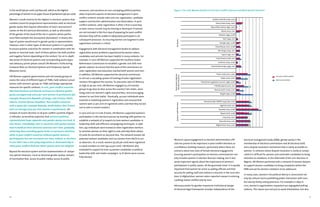
have an average of 30 per cent women in parliament. An 
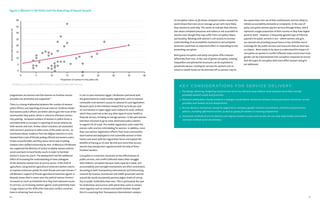
analysis of recent elections in 26 post-conflict countries (Figure 
1) indicates, as would be expected, that women’s political 
representation leaps upwards once gender quotas are used. It 
also shows, remarkably, that in countries with quotas women 
tend to build on their electoral successes over time, gradually 
achieving then exceeding quota levels in successive elections, 
while in post-conflict countries without quotas women’s 
participation has not increased over time. Indeed, in elections 
in 2011 there was a worrying stagnation or downward dip in 
many post-conflict elections where quotas were not adopted. 
Beyond the electoral system and the implementation of tempo-rary 
special measures (such as electoral gender quotas, waivers 
of nomination fees, access to public media, access to public 
resources, and sanctions on non-complying political parties), 
other important aspects of electoral management in post-conflict 
contexts include voter and civic registration, candidate 
support and election administration and observation. In post-conflict 
contexts, voter registration is often a first crucial step 
as basic census records may be missing or destroyed. If women 
are not included in this first step of preparing for post-conflict 
elections they will be unable to adequately participate in all 
subsequent processes. So ensuring women are targeted in voter 
registration outreach is critical. 
Engagement with electoral management bodies to address 
registration access problems experienced by women voters, 
candidates and activists has been helpful in many contexts. For 
example, in 2010 UN Women supported the Southern Sudan 
Referendum Commission to establish a gender unit with nine 
gender advisers to ensure that the work of the commission on 
voter registration and education reached both women and men. 
In addition, UN Women supported the electoral commission 
to roll out a cascading system of training of voter registration 
mentors throughout the country. To overcome rates of illiteracy 
as high as 90 per cent, UN Women engaged 24 civil society 
groups to go door to door across the country’s ten states, sensi-tizing 
voters on women’s rights and priorities, and encouraging 
women to cast their ballot. Eventually, 40,000 individuals were 
involved in mobilizing women’s registration and ensured that 
women were 51 per cent of registered voters and that they turned 
out to vote in record numbers. 
In 2010 and 2011 in Cote d’Ivoire, UN Women supported women’s 
participation in the electoral process by working with partners to 
establish a network of 57 experts to train women candidates in 
leadership skills and effective campaigning techniques. In addi-tion, 
297 individuals were trained as voter registration mentors 
to sensitize women on their right to vote and help them obtain 
ID cards for enrolment on electoral lists. The network trained 128 
potential women candidates and 100 women from NGOs to act 
as observers. As a result, women (50.76 per cent) were registered 
in equal numbers to men (49.24 per cent). UN Women also 
extended its support to train 24 women candidates in political 
leadership skills and media campaigns, 15 of whom were success-fully 
elected. 
Figure 1: Per cent Women Elected in First Post Conflict Election and Most Recent Election14 
No Quota 
Solomon Islands 2006, 2010 
Sierra Leone 2005, 2007 
Papua New Guinea 1997. 2007 
Liberia 2002, 2011 
Lebanon 1999, 2008 
Haiti 1995, 2011 
Georgia 1992, 2008 
Ginea Bissau 2002, 2008 
DR, Congo 2004, 2011 
Cyprus 1991, 2011 
Cote d’Ivoire 2006, 2011 
Comoros 2004, 2009 
Central African Rep 1999, 2011 
New Quota Adopted 
Between Elections 
Timor-Leste 2001, 2007 
Sudan 2000, 2010 
Palestinian Legislative Council 1996, 2006 
FYR Macedonia 2001, 2011 
Bosnia and H. 2000, 2010 
Angola 1992, 2008 
Quota in both Elections 
Kosovo (under UNSCR 1244) 2oo1, 2010 
Uganda 2006, 2011 
Rwanda 2003, 2008 
Nepal 2006, 2008 
Iraq 2005, 2010 
Burundi 2005, 2010 
Afghanistan 2005, 2010 
Women’s equal engagement as election administration offi-cials 
has proven to be important in post-conflict elections as 
a confidence-building measure, particularly where there are 
concerns about low rates of female electoral engagement. 
Ensuring women’s participation as election commissioners not 
only includes women in election decision-making, but it also 
sends important signals about the importance of women’s 
participation in public spaces. At the grassroots level, it is equally 
important that women be active as polling officials and that 
security for polling staff and stations is ensured. In the 2010 elec-tions 
in Afghanistan, women voters reported unease in entering 
a polling station staffed only by men. 
Advocacy points for gender-responsive institutional design 
of electoral legal frameworks includes independence of the 
First post conflict election 
Most recent election 
electoral management body (EMB), gender parity in the 
membership of electoral commissions and all electoral staff, 
and a dispute resolution mechanism that is easily accessible to 
women. In contexts where dispute resolution is costly or compli-cated 
it is difficult for women and vulnerable candidates to bring 
attention to violations. In the aftermath of the 2011 elections in 
Nigeria, UN Women partnered with a network of women lawyers 
to support women candidates to bring complaints before the 
EMB and ask for election violations to be addressed. 
In many cases, women’s full political liberty is constrained not 
only by cultural norms prohibiting public interaction with men, 
but also by family voting pressures. For example in Libya in 
2012, women’s organizations requested sex-segregated polling 
stations. The reason was not just to avoid intimidation, but also 
10 1 1
to counteract pressure to follow family voting patterns. Ensuring 
that national, regional and international election observers 
understand that family voting is illegal and can recognize and 
document it should be a critical part of election observer training. 
Observers should also have checklists to understand possible 
gender gaps in election processes. OSCE has prepared a compre-hensive 
12 
Handbook for Monitoring Women’s Participation in 
elections with a checklist for its election observers.15 The checklist 
can be easily adapted for different contexts. 
Another obstacle to women’s political participation in post-conflict 
contexts that has gained increasing visibility is the 
impact of the outbreak and the aftermath of electoral violence 
that occurs during campaigns, polling and announcement of 
results. The issue of electoral violence against women has 
gained prominence due to several highly publicized occurrences. 
The frequency of electoral violence targeting women is not new; 
however it has been long hidden, with victims facing pressure 
to not make reports in order to avoid stigmas attached to these 
crimes. In 2009 in the Republic of Guinea, women taking part 
in a political rally in the national stadium were targeted by 
security forces. Over 109 women were raped. In addition, many 
women and men were killed during the brutal crackdown by 
security forces on this opposition rally. According to the report 
of the UN Commission of Inquiry established to investigate the 
violence, women victims reported being told by their assail-ants 
– soldiers in the presidential guard - that they were being 
targeted because they opposed the incumbent junta leader. In 
other reports women claimed they were told they were immoral 
for participating in the political rally. One of the key reasons that 
the Commission successfully highlighted the violence suffered 
by women in this chain of events was that UN Women seconded 
a gender expert to the Commission of Inquiry. This gender 
expert supported women witnesses and survivors to testify and 
ensured that the findings of the Commission included recom-mendations 
for addressing impunity for these crimes. 
In Afghanistan in 2010 women comprised less than a quarter 
of all candidates and generally ran more security-conscious 
campaigns than their male counterparts. Yet six of the 11 
campaign workers killed during that campaign season worked 
for women’s campaigns and nine out of 10 threats against 
candidates were against women.16 The government recognized 
the increased security threats to women candidates and created 
a fund to cover their extra security costs. 
Not only candidates and campaigners are at risk. Research 
by the International Foundation for Electoral Systems shows 
that female voters are four times as likely to be targeted for 
intimidation than male voters in transition countries, and 
that they are attacked verbally and physically more often 
during voter registration or other civic activities taking place 
in public spaces.17 In 2012, a female blogger promoting political 
reform was stabbed in a Middle East country. Her fellow political 
activists claimed the political motives for her attack were covered 
up as a crime of honour – an excuse that could not be used if the 
attack were against a male political activist.18 
An example of how to prevent and respond to electoral violence 
was implemented in 2012 when a ‘Women’s Situation Room for 
Peaceful Elections’ was established in Senegal. The ‘Situation 
Room’ aimed to prevent election-related abuses during the first 
and second rounds of the presidential elections. The women 
leaders referred cases of violations to relevant authorities for 
action and also trained and deployed 50 women leaders from 
Senegal and neighboring countries to act as observers at polling 
stations, ensure the active participation of women, and monitor 
the security situation. The ‘Women’s Situation Room’ was spear-headed 
by Femmes Africa Solidarité in partnership with the Angie 
Brooks International Centre of Liberia and with financial and 
technical support from UN Women and UNDP. 
The Department of Peacekeeping Operations (DPKO) and the 
Department of Political Affairs (DPA) have developed a guidance 
The frequency of electoral 
violence targeting women 
is not new; however it has 
been long hidden, with 
victims facing pressure to 
not make reports in order 
to avoid stigmas attached 
to these crimes. 
note on women’s participation in post-conflict elections that 
provides an outline of the necessary steps UN missions can take 
to integrate a gender perspective into their election planning and 
programming.19 The guidelines provide an outline of interventions 
that facilitate women’s participation and action points for UN 
electoral assistance. These include highlighting gender differences 
in election processes, identifying obstacles at different stages of 
election programming, conducting voter education and candidate 
training for women, and advocating for women to hold positions 
at all levels of EMBs, from commissioners to polling station staff. 
The areas covered by these useful guidelines include: 
1. The legal framework 
2. Electoral management bodies 
3. Women’s political participation as candidates 
4. Voter registration 
5. Civic and voter education 
6. The electoral campaign 
7. The challenges and complaints process 
8. Polling, counting and monitoring/observation 
UN Women’s Guidance Note on Gender and Electoral Assistance 
(2012) outlines the normative and institutional framework on 
gender and electoral assistance, programming interventions and 
the electoral cycle approach from a gender perspective. 
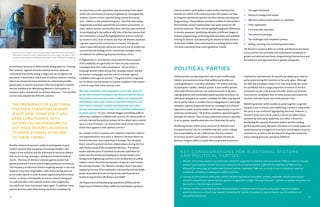
Women in Juba, Sudan, vote in their country’s national elections, the first to 
take place in almost 25 years. Originally set for 11 to 13 April, the date to vote 
has been extended by an additional two days. Credit: UN Photo/Tim McKulka 
Political Parties 
Political parties can play important roles in post-conflict nego-tiations, 
and experience shows that political party elites are 
crucial gatekeepers – and often obstacles – for women aspiring 
to participate in politics. Political parties in post-conflict periods 
often have informal and non-rule-based structures or decision-making 
systems, with personality-based executive structures. An 
individual’s prospects as a party’s candidate for office may depend 
less on performance as a leader than on engagement in patronage 
networks, capacity to generate funds for campaigns and informal 
payments or bribes to party leaders for the opportunity to run for a 
particular constituency.20 All of these conditions represent specific 
obstacles for women. They can also undermine women’s capacities 
to act as gender equality advocates once they enter the party. 
Mobilizing women within party structures to demand more 
transparent party rules for candidate selection, policy-making 
and accountability can be a difficult yet effective method 
to increase women’s participation. For example, the African 
National Congress (ANC) in South Africa responded to women’s 
mobilization and demands for equality by adopting an internal 
party quota during the transition in the early 1990s. Although 
the ANC did not adopt a quota in its executive body, the quota 
for candidates led to a large proportion of women in the first 
parliament (25 per cent) because the ANC (which put forward 
more women candidates than all other parties) dominated the 
elections and won 63 per cent of the popular vote. 
Mobilizing women within parties to speak together on gender 
equality issues is critical, and establishing a women’s wing within 
the party is one method of aggregating demands. However, a 
women’s wing must not be used as a forum to rubber-stamp 
decisions by male party leadership, but rather a forum for 
developing the capacity of women leaders and formulating 
gender equality policy demands. Demands can include quotas for 
leadership/party management structures and delegates to party 
conventions, as well as the development of gender-responsive 
policy-making processes and party platforms. 
Key Considerations for Electoral Systems 
and Politica l Parties: 
1. Women civil society leaders and politicians should be supported to mobilize and advocate for TSMs as a tool to increase 
women’s participation at both local and national levels of representation. Different formulations of TSMs can be 
designed for every type of context and electoral system. Legislated TSMs are currently in use in almost 30 countries 
worldwide, including in many post-conflict countries. 
2. During the formulation of the post-conflict electoral legislative framework, women candidates should advocate for 
mixed or proportional representation systems as opposed to simple “first past the post” systems, as women are proven to 
fare better in the first type of system. 
3. Women members of political parties should mobilize to demand internal quotas and gender responsive bylaws 
and structures as a critical step towards increasing the number of women in representation and the substance of 
the political discourse. 
13
Residents of Forog, North Darfur protest a serious shortage of water. Credit: UN Photo/Albert González Farran 
and a gender-responsive capacity to plan for the early recovery and 
peace-building process and to rebuild essential services. Restoring 
and re-establishing core state functions are the first step in the 
process of regenerating the state’s capacity to mediate citizen-state 
relations and redress grievances. 
Federalism may have implications on women’s representation 
in local political structures. On the one hand, local politics may 
provide more space for women’s political participation as there 
may be more direct opportunities for engagement in areas such 
as health, childcare, education, water, agriculture, urban plan-ning 
and community development. However, in transition 
contexts where traditional values often reassert themselves in 
the immediate aftermath of conflict and local “warlords” may 
have more power than the central authority, there can be a 
pushback against women’s political participation. In addition, 
women face a significant barrier in the form of “time poverty”. 
In most societies, traditional family roles require women generally 
to fulfill all or nearly all household and childcare responsibilities. 
For women who also work outside of the home, there can be little 
time left to be involved in local government activities. 
However the impact of women’s visibility and political participa-tion 
in local governance must not be underestimated. In a survey 
of roughly 8,000 girls and their parents in India in 2007, research 
found that the increased presence and visibility of female politi-cians 
in local government (due to a 33% reserved seat quota) 
raised the academic performance and career aspirations of young 
women. In villages that had never had female political leaders, 
researchers found parents were 45 per cent less likely to expect 
their daughters to continue beyond secondary school. The girls 
themselves were 32 per cent less likely to have those aspirations.21 
This is an excellent example of the ‘role model effect’ of women in 
public spaces. 
In designing the decentralization process, gender equality advo-cates 
should push for a participatory and inclusive framework that 
includes quotas for women’s representation; a structured dialogue 
mechanism between local authorities and women’s groups (see 
text box on Women’s Watch Groups), to ensure that decisions and 
interactions at the local level are gender-responsive; and a citizen 
oversight committee that includes women’s groups and functions 
as a monitoring mechanism of the quality of service delivery or 
other responsibilities under the purview of local authorities. The 
presence of community-based women’s organizations is a critical 
factor in promoting gender responsive local governance. Financing 
the capacity-building of women’s CSOs should be included as a 
priority in decentralization timelines and planning documents. 
In Timor Leste, women’s civil society and international actors 
partnered to advocate for a strong gender equality component to 
be included in the decentralization process. They were successful 
and the 2009 community leadership law mandated that three out 
of seven village leaders must be women and the 2010 ministerial 
directive on local development mandated that women should 
have 50% representation in each sub-district Assembly. The next 
step will be ensuring that this numeric representation is achieved 
and leads to substantive representation of women’s needs and 
priorities in the local planning and financing processes. In Nepal, 
even though a law passed in the post-conflict period mandates 
local-level basic service committees to include women members, 
the women themselves still feel reluctant to speak up unless they 
are discussing issues in women-only meetings.22 
An additional concern in decentralization processes is related to 
service delivery. Transferring responsibility for service provision 
to sub-national actors can be fraught with peril if there is a lack 
of human and financial capacity to deliver. If the local authority 
is unable to deliver, it may choose to privatize service provision, 
which can lead to user fee schemes. This is of concern because 
pricing systems and user fees are likely to reduce access of 
marginalized citizens, including poor women. One way to address 
this concern is to advocate that transfers from central govern-ment 
be linked to service delivery indicators based on poverty 
and gender equity to ensure spending that benefits women and 
other disadvantaged or minority groups. In Sudan, research by the 
International Development Research Center (IDRC) in 2007 found 
that, in practice, decentralization meant that regions had to find 
their own resources for service provision; the effect was that those 
who could not afford user fees simply could not access services. 
Administrative Governance 
Decentralization / Local Governance » 
Planning and Budgeting 
Decentralization’s impact on women’s rights can vary widely 
depending on the context and the extent to which decision-making 
and accountability are devolved to the local level. 
Decentralization refers to the process of transferring administra-tive, 
political, and financial functions from the central level to 
subnational government. With the decentralization of public 
finance mechanisms, in theory more and more decisions about 
how to spend public money should be taken at the local level. 
However, in many post-conflict contexts while functions may be 
increasingly decentralized, decision-making power about how 
resources are spent may remain limited in practice by strong 
actors at the central level. In order to achieve gender-responsive 
local governance it is necessary for women to have the same 
opportunities to express their needs and priorities at this level, 
and that these are ultimately reflected in local plans and budgets. 
While the obstacles facing women’s political representation have 
been raised in the section on electoral systems, it is important 
to recognize that at the local level women as citizen’s also have 
limited voice in making demands and ensuring that their priorities 
are integrated in local plans and budgets. 
Inclusion of women into the decentralization process and in local 
governance structures is crucial for sub-national authorities to be 
able to respond to the recovery and peacebuilding priorities of the 
population in an equal and inclusive manner. The starting point for 
UN engagement in conflict-affected settings is the informed and 
timely support to the restoration of core government functions 
The Gender Equitable Local Development (GELD) programme, a joint initiative between UNCDF, UN Women and UNDP, 
supports local governments in five countries (Mozambique, Rwanda, Senegal, Sierra Leone, and Tanzania) to identify 
strategies and mechanisms for improving women’s access to resources and services at the local level through gender-sensitive 
planning, programming and budgeting. 
The GELD programme utilizes three complimentary strategies to achieve its objectives: (1) capacity development for local 
governments in gender-responsive planning, programming and budgeting; (2) mobilization of women to voice their needs and 
priorities in local level planning and budgeting processes; and (3) investment in Local Development Funds to address women’s 
priorities. The GELD approach is innovative in linking gender-responsive planning and budgeting with catalytic funding to 
support women’s local development priorities, with a particular focus on key services, such as access to potable water. 
14 
Key Considerations for Decentralization 
and Local Governance: 
1. Decentralization and local governance can provide both opportunities as well as costs for women’s rights. Major 
stakeholders working in this area (for example national governments, UNDP, the World Bank) should ensure that they 
incorporate into their programming an understanding of the impact on women and that women’s needs and priorities 
are addressed at all stages. 
2. Gender equality advocates, women’s civil society and women politicians should support the institutionalization of 
gender-responsive/participatory planning and budgeting in regulations and guidelines for local governments. 
3. Build the capacity of local institutions to integrate gender equality into the analysis, design, implementation, 
monitoring, and evaluation of all local development policies, programmes and projects. 15
Public Administration Reform 
Public administration reform is a critical part of the statebuilding process in post-conflict contexts. 
It is also a process that can be fraught with tension if the actors emerging from conflict use posi-tions 
family rather than on the basis of merit. In many post-conflict contexts senior civil servants in the 
executive branch or in informal networks across the public administration hold considerable influ-ence 
16 
have access to the patronage networks and channels through 
which this employment is secured. Even in cases where merit 
drives recruitment policies, the structural inequalities women 
face make it harder for them to be successful; for example 
girls’ unequal access to formal education in sub-Saharan 
Africa makes them less attractive as prospective employees. 
In these cases it is sometimes necessary to adopt temporary 
special measures to increase the proportion of women in the 
public service, to invest in girls’ secondary education to enable 
them to qualify for entry-level positions in the civil service, or 
to reduce entry requirements for young women. The Secretary- 
General’s Seven Point Action Plan mentioned earlier also includes 
a focus on post-conflict public administration reform and calls 
for a full consideration of measures, including quotas and 
fast-tracking promotion schemes to increase the proportion of 
women in state institutions at all levels, and capacity-building to 
improve their effectiveness. 
While many post-conflict states nominally recognize the impor-tance 
of gender equality, few reform programmes up to now 
have included serious efforts to increase the recruitment of 
women in senior positions, either through training for women, 
workplace rules that are ‘family friendly’, or gender sensitization 
of managers to prevent sexual harassment. 
When it comes to retention and promotion of women in the 
public administration, women may have anxiety that civil service 
managers will often retrench women staff first because they are 
not perceived as the major breadwinners and because male civil 
servants may have stronger social ties with their managers, who 
are usually also men.23 On the other hand, if the peacebuilding 
settlement is driven by a spirit of inclusiveness to make up for 
past causes of conflict, group-specific patterns of exclusion 
may be avoided. For instance in South Africa in the 1990s, the 
focus was on inclusive public administration reform during the 
transition. Thus, the new government protected the tenure of 
white public servants from the previous regime but also insti-tuted 
affirmative action policies for new hires.24 Such affirmative 
action measures can be used not just, as in the South African 
case, to redress past race-based inequalities, but also to promote 
new gender-equality-based public administrations. 
In Liberia, UN Women has worked closely with the Liberian 
National Police to make human resources policies increasingly 
gender-responsive. Recruitment, retention and promotion 
policies all take into account the different barriers women may 
face. However, increasing the number of women at entry levels is 
not enough, and they must also have access to the same capacity 
development and networking opportunities as men in public 
administration. UN Women supports national public administra-tion 
reform programmes in Burundi and Iraq to mainstream 
gender in their planning and attempt to ensure that women 
have access to training and learning opportunities. In addition, 
UN Women works in post-conflict countries to promote changes 
to organizational culture in the public administration through 
networks of gender focal points in line ministries and key public 
institutions. In Burundi in 2012, UN Women supported efforts to 
mainstream gender into the public administration reform action 
in the civil service for patronage purposes, such as assigning public sector jobs to friends and 
and decision-making power. 
The public administration fulfills two important functions – first, 
it is the interface between citizens and the state and thus plays a 
key role in fostering state legitimacy, and second, it implements 
the government’s policies and thus shapes people’s experiences 
and perceptions of public authority. As the interface between 
citizens and states, if the policies being implemented are not 
responsive to women’s and girls’ specific needs, their access 
to state services can be negatively affected and women can 
be made to feel like second class citizens. Gender-responsive 
public administration reform must attend to ensuring equal 
recruitment of women to the civil service and also effective 
public policy-making and implementation from a gender 
equality perspective. 
Major concerns in post-conflict public administration reform 
include addressing patterns of excluding certain groups from the 
civil service, which may in the past have generated significant 
tensions and increased instability. Another common public 
administration reform process is ‘downsizing’: in attempts to 
balance payroll budgets in the immediate aftermath of conflict, 
the size of the civil service is cut significantly. The unemploy-ment 
that this creates can however in turn generate tension 
and instability given the significant importance of public sector 
employment in many post-conflict economies. 
When it comes both to redressing patterns of exclusion in civil 
service employment and rationalizing and trimming the size of 
the public administration, gender equality concerns have rarely 
been a priority in the past. However, increasing the number of 
women in the public administration is important for both equity 
and efficiency reasons. In post-conflict contexts women often 
have elevated burdens of care, particularly if they are female 
heads of households, and need the income and security of public 
administration employment as much as men. In addition, as 
the next section shows, the employment of women in the public 
service, particularly in the direct provision of basic essential 
livelihood and human capacity development services, has a 
demonstrable impact on the effective targeting of women and 
girl clients – who are often the most destitute in a post-conflict 
context. 
However, there are significant barriers to women’s employ-ment 
in public administration in the post-conflict period. For 
example in situations where recruitment is not regularized 
or undertaken transparently based on merit, women may not 
Public Administration Reform in Kosovo 
(under UN SC r esolution 1 244) 
In 2004, former UNIFEM (now part of UN Women) entered into a partnership with the Prime Minister’s Advisory Office for 
Good Governance (AOGG) (under the Provisional Institutions of Self Government -PISG) and the Kosovo Institute for Public 
Administration (KIPA) (KIPA is the in-service training institute attached to the Ministry of Public Services that is charged 
with conducting mandatory training for all Kosovo civil servants). The goal of the partnership with AOGG and KIPA was 
to increase the public administration’s capacity to integrate a gender perspective in its planning and delivery, but also to 
increase gender equality within the public administration itself. 
In the first phase of the training the methodology of gender analysis was covered, with a special emphasis on the collection 
and analysis of sex-disaggregated data, models for formulating gender-sensitive public policies, and budgetary planning. 
In 2004 and 2005 more than 200 civil servants from different Ministries and levels of government were trained in four-day 
sessions. 
The second phase was a Training of Trainers programme with the aim of creating a pool of experts to be utilized by KIPA in 
their internal training processes, but also available to other self-government institutions and associations. The participants 
represented a range of government institutions from central and local levels, as well as civil society. The training included 
the methodology of gender training; understanding how to gender mainstream the work of the public administration, 
how to do a gender analysis of social problems and design strategies to address them. With the completion of this training 
17 
Women frontline service providers, in this case a community health worker in Haiti, can improve access for women as well as quality of service. 
Credit: UN Photo/Sophia Paris
of trainers programme, KIPA was equipped with the human and material resources to conduct gender equality trainings for 
civil servants on a sustainable basis. The trainings were institutionalized as part of the standard curricula for training of civil 
servants. 
In the third phase, UNIFEM (now UN Women) and KIPA established a mentoring programme using a smaller pool of trainers. 
UNIFEM (now UN Women) supported two senior co-trainers to mentor and coach the KIPA gender trainers. As a result, the 
KIPA trainers quickly became effective trainers in their own right, requiring minimal assistance from senior gender experts. 
The training gave civil servants across all sectors of government the capacity to conduct a gender analysis of their daily 
work. Advanced trainings were also held for senior management on integrating gender in strategic planning processes. These 
trainings reviewed mechanisms for including a gender perspective in policies, programmes, and strategies at different levels 
and at different stages of policymaking. 
The positive impact of the training and new curricula became clear during the planning process of the new national 
development strategy carried out by civil servants. Provisions of the Kosovo Plan for Gender Equality were integrated into the 
2006-2013 Kosovo Development Strategy and Plan, which was a critical first step toward accountability for gender equality. 
The successful relationship with KIPA was replicated by UNIFEM (now UN Women) through a subsequent agreement with 
the Kosovo Academy for Public Safety, Education and Development (KAPSED) to provide technical assistance in integrating a 
gender perspective into KAPSED’s training curriculum for the Kosovo Police and harmonize KAPSED policies with the Gender 
Equality Law. 
-Information supplied by UN Women Pristina Project Office, May 2012 
18 
In the post-conflict environment women struggle with specific 
barriers to accessing public services, including the threat 
of sexual and gender-based violence in insecure environ-ments, 
difficulties with transport, finances and childcare and 
continued marginalization from decision-making processes. 
Rural women in particular face significant obstacles in 
accessing public services such as water and health care. 
Building accountability to local women in the planning and 
delivery of services in fragile and post–conflict contexts is 
thus clearly a major contribution to women’s improved social, 
political and economic outcomes. Women’s participation and 
voice in the design process and decision-making stages of public 
services can be secured through consulting local women and 
women’s civil society, but also by ensuring the employment of 
women in the service delivery chain. 
Women’s engagement in decision-making in public administration 
is critical for gender-responsive policy design and financial allocation 
to public services that respond to the needs of women and children. 
But as with women in politics, the numbers of women in decision-making 
is only one part of the story of change. Just as important, 
if not more, is the transformation of policy implementation, 
monitoring, performance assessment and accountability systems. 
Without creating feedback and dialogue mechanisms to ensure that 
service delivery institutions respect and respond to the voices of 
women service users, transformative change will not happen. 
The engagement of women in the frontline of service delivery 
has been proven to be another critical factor in ensuring the 
voices of women service-users reach decision makers and 
that quality services reach women. Evidence shows that 
women in the frontline of service delivery whether as polling 
agents, police officers, registration officials, judges, court 
clerks, teachers, medical attendants, or agricultural extension 
agents deliver better quality services to both men and women, 
improve women’s access to services and act as important role 
models for women’s public engagement and the feminiza-tion 
of public spaces. In addition, the equitable distribution 
of employment in public services is critical to improving 
the wellbeing of the large number of households that are 
female-headed and impoverished in post-conflict. The UN has 
committed through the Seven-Point Action Plan to ensure that 
at least 40 per cent of beneficiaries in temporary employment 
plan and supported the government to develop a gender strategy 
for its public administration reform. 
A core function of the public administration is the management 
of public service provision and public finances. UN Women has 
worked with local and national governments and partners in 
GRB trainings to ensure that budgets are produced through 
formal and transparent processes linked to policies and 
priorities on gender equality and women’s empowerment. 
Women’s civil society groups should be supported to access 
information on budgetary decisions and to act as watch dogs 
and monitor whether their priorities are being addressed. 
The national statistics office is a key organ of the public 
administration in terms of playing a data-gathering role 
and producing statistics on issues of concern to women and 
disaggregating all statistics by sex in order to identify and 
understand gender gaps. 
Key Considerations for Post-Conflic t 
Public Administration: 
1. In order to prevent tension and instability post-conflict public administration reform should be inclusive and 
transparent. Promoting women’s recruitment to public administration requires an understanding of the obstacles 
they face to employment (lack of education, cultural norms, etc.) and possible solutions. 
2. The public administration should be supported to introduce gender sensitive recruitment, retention and 
promotion policies, including affirmative action and fast track promotions. 
3. Women should be supported to form networks of public administration officials and create mentorship and 
learning opportunities. 
4. Women should be supported to access capacity development and educational opportunities. 
19 
Gender-Responsive Public 
Service Delivery 
Effective and inclusive service delivery can play a conflict-mitigating role by reducing tension 
and grievances over key basic services between parties to a conflict. Indeed, the resumption and 
improvement of basic public service delivery is considered a crucial peace dividend, signaling 
an inclusive new system of governance and stability. Pressing basic needs in post-conflict and 
humanitarian contexts include security, water and access to food and health services. However, 
education, employment/livelihood and registration services are equally important to building 
sustainable peace.
Figure 2: Women in the Police and the Reporting of Sexual Assault. 
0 
40 
35 
30 
25 
20 
15 
10 
5 
0 
5 
10 
15 
20 
Women reporting sexual assult (%) 
Proportion of women in the police (%) 
UN Women, 2011, Progress of the World’s Women: In Pursuit of Justice, New York, p 59. 
programmes are women and that women as frontline service 
providers are promoted and supported.25 
There is a strong relationship between the number of women 
police officers and reporting of sexual violence. Evidence shows 
that women police officers are better able to gain the trust of the 
communities they patrol, which is critical to effective commu-nity 
policing. Increased numbers of women in police forces is 
correlated with an increase in reporting of sexual violence by 
both women and men. Similar citizen reactions are associated 
with women’s presence in other areas of the public service. As 
mentioned above, evidence from the Afghan elections in 2010 
showed that a lack of female polling officials led women voters 
to feel uncomfortable and they chose not to vote if polling 
stations were staffed exclusively by men. In Morocco UN Women 
has supported the Ministry of Justice to deploy women judicial 
social assistants to local family courts in order to facilitate 
women’s access to courts. The deployment had the additional 
effect of increasing the understanding of male colleagues 
of the obstacles women face to service access. In the field of 
agriculture, using women agricultural extension workers seems 
to improve extension uptake for both female and male farmers.26 
UN Women’s support of female agricultural extension agents in 
Rwanda shows that in some cases the yield of women farmers 
increased as much as threefold once they had improved access 
to services, so increasing women agents could potentially have 
a huge impact on the difficulties that post-conflict countries 
have in achieving food security. 
25 
30 
35 40 
In 2011 in post-revolution Egypt, UN Women partnered with 
the government to create mobile registration units to improve 
vulnerable rural women’s access to national ID card registration. 
Research prior to the initiative showed that up to 80 per cent 
of rural women in Upper Egypt were without ID cards, without 
which they could not access any other type of social, health or 
financial service, including an old age pension. In the past women 
had been reluctant to go to male-dominated police stations 
to register for ID cards. The mobile registration units made the 
process safer and less intimidating for women. In addition, more 
than 200 women registration officers from local communities 
were trained and deployed to visit vulnerable women in their 
homes and assist with the registration forms and explain the 
benefits of having an ID card. By mid-2012 more than 50,000 
women had already been registered with the help of these 
frontline workers. 
Corruption is a common constraint on the effectiveness of 
public services, and conflict-affected states often struggle 
with endemic corruption because state capacity is weak, and 
accountability and oversight mechanisms are often nonexistent. 
According to both Transparency International and forthcoming 
research by Huariou Commission and UNDP, grassroots women 
around the world consistently perceive higher levels of corrup-tion 
in public institutions than men. This is particularly the case 
for institutions and services with which they come in contact 
most regularly such as schools and health facilities. Despite 
this it is surprising that Transparency International’s analysis 
of corruption claims at 38 citizen complaint centers around the 
world shows that men are on average 40 per cent more likely 
than women to seek help. This seems to indicate that informa-tion 
about complaint processes and redress is not accessible to 
women even though they may suffer from corruption dispro-portionately. 
Working with women’s civil society to increase 
understanding of accountability mechanisms and complaint 
processes could have an important effect in responding to and 
preventing corruption. 
Both grand corruption and petty corruption affect women 
differently from men. In the case of grand corruption, existing 
inequalities and patriarchal structures can be exploited to 
perpetrate abuses. Funding for services for women such as 
school or health funds can be skimmed off as women may be 
less aware than men are of their entitlements and less likely to 
initiate accountability demands or complaints. In the case of 
petty corruption women pay for services through bribes, which 
represent a larger proportion of their income as they have higher 
poverty levels. However, a frequently ignored type of informal 
payment for public services is sex – where women and girls 
are coerced into providing sexual favors in lieu of bribes and in 
exchange for the public services and resources that are their due 
as citizens. More needs to be done to understand the impact of 
corruption on women in conflict-affected states and to learn how 
gender can be mainstreamed into corruption responses to ensure 
that the types of corruption that most afflict women and girls 
are addressed. 
Key Considerations for Servic e Delivery: 
1. The design, planning, budgeting and provision of service delivery must address rural and poor (and other socially 
excluded) women’s needs and priorities. 
2. National stakeholders should establish a dialogue and feedback mechanism between local governance structures, service 
providers and women service beneficiaries. 
3. Service delivery institutions should be supported to introduce gender-sensitive recruitment, retention and promotion 
policies, including affirmative action, as well as quotas for women in training programmes. 
4. Innovative methods of service delivery can improve women’s access such as low cost one-stop-shop models and mobile 
outreach methods of service delivery. 
20 21
Conclusion Annex 1: Women’s Charters 
The importance of women’s engagement in post-conflict 
governance reforms must be understood first and foremost as a 
rights-based participation demand made by women themselves. 
Half the population has the right to have its voice heard. As UN 
Women’s Executive Director stated in a discussion in November 
2011 on the political transitions that had taken place that year: 
“Women want their voices to be heard. They want to exercise 
their rights. They want a seat at the decision-making table. They 
want to take responsibility for shaping the future of their families, 
communities and countries.” 27 
However participation is important not only because it is a 
fundamental human right for both women and men; it is impor-tant 
because there is also a clear link, first, between women’s 
participation and their economic, political and social outcomes, 
and second, between women’s participation and the stability 
and success of peacebuilding efforts and governance reforms 
more widely. Constitutional revision, political systems, electoral 
systems and political party all have specific impacts on women’s 
rights and participation, while access to administrative processes, 
such as decentralization and local governance, public administra-tion 
reform and public service delivery can significantly improve 
women’s economic and social outcomes. 
Women’s relationship with state institutions in terms of exer-cising 
their rights and having their voices heard has been difficult 
in many contexts, but in particular in post-conflict ones. To 
achieve these goals, national, regional and international actors 
involved in post-conflict political and administrative governance 
reforms need to recognize the challenges that women may face 
and that were outlined in this discussion paper. Local women’s 
civil society needs to be supported to mobilize and advance 
women’s interests; public institutions need to be designed 
to increase accountability for implementing women’s rights; 
women leaders and gender equality advocates need to expand 
their influence and constituency base; and key stakeholders 
need to be engaged as champions in advocacy. Only through 
these concrete steps will women in post-conflict contexts be 
empowered to both improve their own lives as well as make a 
meaningful contribution to post-conflict peacebuilding. 
Women’s Charter for Effective Equality, South Africa, 1994 
The need for a Women’s Charter was made evident during the 
1992 transition to democracy when it became clear that political 
parties’ delegations to the constitutional negotiating table 
would all be male. This provided the impetus needed to bring 
together the non-partisan Women’s National Coalition that 
drafted the Charter. The coalition was not without its tensions 
and challenges; the drafting of the Charter took place against the 
backdrop of an extremely tumultuous period in South Africa. The 
Coalition had to deal with internal tensions and challenges, but 
was able to succeed by stressing inclusiveness and adding to the 
Charter the possibility of individual organizations retaining the 
right to reserve themselves from particular clauses, such as on 
reproductive rights. 
Regarding the process, preliminary research was done to identify 
a wide set of relevant thematic areas. A National Strategy 
Workshop was then held in June 1993, to which each region sent 
two delegates. At the workshop, five key themes were identified 
as the core around which to build a draft: women’s legal status; 
women’s access to land, resources and water; violence against 
women; health; and work. The draft was subsequently taken to 
all the regions, and comments were collected and taken back 
to the central office for review. The draft was fine-tuned at a 
Steering Committee meeting and sent to the General Congress. 
After debate and more inputs the document was presented again 
to Congress and debated once more. The eight page Charter 
emerged from this and was adopted with the following Articles: 
1. Equality 
2. Law and the Administration of Justice 
3. Economy 
4. Education and Training 
5. Development, Infrastructure and Environment 
6. Social Services 
7. Political and Civic Life 
8. Family Life and Partnerships 
9. Custom, Culture and Religion 
10. Violence against Women 
11. Health 
12. Media 
Afghan Women’s Bill of Rights, 2003 
The Afghan Women’s Bill of Rights (see Annex 1 for full text) was 
drafted, signed, and presented to President Karzai by women 
leaders from every region of Afghanistan, who participated in 
the third annual conference of Women for Afghan Women. The 
conference brought together a range of 45 diverse individuals; 
women community leaders in the movement for women’s and 
human rights in Afghanistan, many grassroots women’s rights 
activists, and women from rural provinces all around the country. 
The 2-page document was created entirely by the participants, 
with each of the 16 Rights debated and the wording unanimously 
agreed upon before inclusion into the document. The document 
was presented to the Minister of Women’s Affairs, Habiba Sarabi, 
the Constitutional Commission of the Transitional Islamic State 
of Afghanistan, and President Karzai. In addition, the conference 
participants distributed the Bill of Rights throughout the country 
to educate communities about women’s and human rights and 
advocate for the inclusion of their demands into the constitution. 
The full text is below 
22 23
Afghan Women’s Bill of Rights 
Presented to President Hamid Karzai by Women’s Rights Groups 
Kandahar, 2003 
On September 5, 2003, in the historic city of Kandahar, we, the 
Afghan Muslim participants in the conference, “Women and 
the Constitution: Kandahar 2003”, from Kabul, Mazar-e-Sharif, 
Kandahar, Herat, Wardak, Jousjan, Badakhshan, Samangan, 
Farah, Logar, Gardez, Kapisa, Uruzgan, Paktia, Helmand, Baghlan, 
Sar-e-Pul, having considered the issues of the constitution 
that affect the futures of ourselves, our children, and our 
society, make the following demands on behalf of the women 
of Afghanistan. Moreover, as representatives of all of Afghan 
women, we demand that these rights are not only secured in the 
constitution but implemented. 
1. Mandatory education for women through secondary school 
and opportunities for all women for higher education. 
2. Provision of up-to-date health services for women with 
special attention to reproductive rights. 
3. Protection and security for women: the prevention and 
criminalization of sexual harassment against women publicly 
and in the home, of sexual abuse of women and children, 
of domestic violence, and of “bad blood-price” (the use of 
women as compensation for crimes by one family 
against another). 
4. Reduction of the time before women can remarry after their 
husbands have disappeared, and mandatory government 
support of women during that time. 
5. Freedom of speech. 
6. Freedom to vote and run for election to office. 
7. Rights to marry and divorce according to Islam. 
8. Equal pay for equal work. 
9. Right to financial independence and ownership of property. 
10. Right to participate fully and to the highest levels in the 
economic and commercial life of the country. 
11. Mandatory provision of economic opportunities for women. 
12. Equal representation of women in the Loya Jirga and 
Parliament. 
13. Full inclusion of women in the judiciary system. 
14. Minimum marriageable age set at 18 years. 
15. Guarantee of all constitutional rights to widows, disabled 
women, and orphans. 
16. Full rights of inheritance. 
Additional demands affecting the lives of women: 
1. Disarmament and national security. 
2. Trials of war criminals in international criminal courts and 
the disempowerment of warlords. 
3. A strong central government. 
4. A commitment to end government corruption. 
5. Decisive action against foreign invasion and protection of 
the sovereignty of Afghanistan. 
Endnotes 
1 Justino, 2012, “Women Working for Recovery: The Impact of Female 
Employment on Family and Community Welfare After Conflict.” UN Women 
Sourcebook on Women, Peace and Security, 2012. 
2 Melander, 2005, Gender Equality and Intrastate Armed Conflict, International 
Studies Quarterly 49.4, pp. 695–714. 
3 A 2010 analysis across 55 countries from 1986 to 2003 revealed a significant 
rise in the probability of conflict in countries with severe economic and 
social horizontal inequalities. Stewart, 2010, Horizontal Inequalities as a 
Cause of Conflict: A Review of CRISE Findings. World Development Report 
2011 Background Paper http://siteresources.worldbank.org/EXTWDR2011/ 
Resources/6406082-1283882418764/WDR_Background_Paper_Stewart.pdf 
4 Michele Bachelet, April 2012, Statement to the Security Council, http://www. 
unwomen.org/2012/04/statement-by-under-secretary-general-michelle-bachelet- 
to-the-un-security-council-on-women-peace-and-security/ 
5 Anderlini and El-Bushra, 2007, Inclusive Security, Sustainable Peace: A 
Toolkit for Advocacy and Action. Post Conflict Reconstruction, http://www. 
huntalternatives.org/download/39_post_conflict.pdf 
6 Bouta, Frerks and Bannon, 2005, Gender, Conflict, and Development, The 
World Bank, Washington, D.C. 
7 Seven Point Action Plan on Gender Responsive Peacebuilding, 2010, www. 
un.org/en/peacebuilding/pbso/pdf/seven_point_action_plan.pdf 
8 A New Deal for Engagement in Fragile States. International 
Dialogue on Peacebuilding and Statebuilding, http://www.oecd.org/ 
dataoecd/35/50/49151944.pdf 
9 UN Women Sourcebook on Women, Peace and Security, 2012. 
10 Zimbabwe Women’s Parliamentary Caucus (ZWPC), Zimbabwe Women 
Lawyers Association (ZWLA), Women in Politics Support Unit (WiPSU), 
Women’s Coalition of Zimbabwe WCoZ, Ministry of Women’s Affairs, Gender 
and Community Development and academia. 
11 Section 187(1) of the Constitution of South Africa reads: “The Commission for 
Gender Equality must promote respect for gender equality and the protection, 
development and attainment of gender equality.” 
12 “After a conflict a good representation of the groups in conflict is 
crucial. This may be more important than providing for systems which 
produce overrepresentation of the largest party (and therefore produce 
a parliament where it may be easier to form government) or to have the 
direct accountability between voters and single MPs. Lijphard argues that 
there is a ‘scholarly consensus against majoritarian systems in divided 
societies”. Butenschøn and Vollan, 2011, Electoral Quotas and the Challenges 
of Democratic Transition in Conflict-Ridden Societies: Nordem Special Report, 
p. 199. http://www.jus.uio.no/smr/english/about/programmes/nordem/ 
publications/nordem-report/2011/special-report-20011.pdf 
13 Butenschøn and Vollan, 2011, Electoral Quotas and the Challenges of 
Democratic Transition in Conflict-Ridden Societies: Nordem Special 
Report http://www.jus.uio.no/smr/english/about/programmes/nordem/ 
publications/nordem-report/2011/special-report-20011.pdf 
14 Green Line indicates Quota level. Afghanistan: Reserved 27%, Burundi, 
Reserved 30%, Iraq: Candidate Quota 25%, Nepal: Candidate Quota 33%, 
Rwanda: Reserved 30%, Uganda: Reserved 30%, BiH: Candidate Quota 30%, 
Kosovo under UNSCR 1244: Candidate Quota 30%, Angola: Candidate Quota 
30%, Bosnia and Herzegovina: Candidate Quota 30%, FYR Macedonia: 
Candidate Quota 30%, Palestinian Legislative Council: Candidate Quota 20%, 
Sudan: Reserved 25%, Timor Leste: Candidate Quota 30%. Inter-parliamentary 
Union Parline Database 2012, http://www.ipu.org/parline-e/parlinesearch. 
asp Quota Project Database, 2012, http://www.quotaproject.org/index.cfm 
15 OSCE, 2004, Handbook for Monitoring Women’s Participation in Elections, 
http://www.osce.org/odihr/elections/13938 
16 Free and Fair Election Foundation of Afghanistan, 2010, http://fefa.org.af/ 
17 Bardall, 2011, Breaking the Cycle of Gender Violence IFES White Paper - 
http://www.ifes.org/Content/Publications/White-Papers/2011/~/media/ 
Files/Publications/White%20PaperReport/2011/Gender_and_Electoral_ 
Violence_2011.pdf 
18 Women’s International League for Peace and Freedom, 2012, MENA Agenda 
1325 Working Together for Peace and Freedom. p. 15 http://www.peacewomen. 
org/pages/mena 
19 The guidelines are currently under revision with the support of UN Women. 
DPKO /DFS-DPA, 2007, Joint Guidelines on Enhancing the Role of Women in 
Post conflict electoral processes www.un.org/wcm/webdav/site/.../women_ 
electoral_guidelines.pdf 
20 Lovenduski and Norris, 1993, Gender and Party Politics. Sage Publications and 
National Democratic Institute, 2010, Democracy and the Challenge of Change: 
A Guide to Increasing Women’s Political Participation. 
21 Duflo, et al, 2011, Female Leadership Raises Aspirations and Educational 
Attainment for Girls: A Policy Experiment in India. MIT http://web.mit.edu/ 
newsoffice/2012/female-politicians-0113.html 
22 IDRC, 2008, Realizing Their Needs: Women’s Access to Public Services in Sector 
Decentralization. 
23 While there is no consistent data on this, there is a strong perception in many 
contexts that women – especially at the front-line of public service delivery, 
such as teachers and the nurses – are the first to be laid off. But they are not 
the only ones. Higher-level women managers without protective social and 
patronage networks can be just as vulnerable. See Laetitia Mukurasi, 1991, 
“Post Abolished: One Woman’s Struggle for Employment Rights in Tanzania, 
The Women’s Press. 
24 UN DESA, 2009, Report Of The Expert Group Meeting: Lessons Learned 
in Post-Conflict State Capacity: Reconstructing Governance and Public 
Administration Capacities in Post Conflict Countries, New York 
http://unpan1.un.org/intradoc/groups/public/documents/un/unpan037238. 
pdf 
25 Seven Point Action Plan on Gender Responsive Peacebuilding, 2010, www. 
un.org/en/peacebuilding/pbso/pdf/seven_point_action_plan.pdf 
26 Lahai, B. A. N., Goldey, P. and Jones, G.E. 2000. ‘The gender of the extension 
agent and farmers’ access to and participation in agricultural extension 
in Nigeria.’ Journal of Agricultural Education and Extension 6 (4): 223–233. 
Moore, K.M., Hamilton, S., Sarr, P., and Thiongane, S. 2001. ‘Access to technical 
information and gendered NRM practices: Men and women in rural Senegal’. 
Agriculture and Human Values 18: 95–105. 
27 Michelle Bachelet, 2011, Statement on Women in Democratic Transitions, 
http://www.unwomen.org/2011/11/women-in-democratic-transition/ 
24 25
05 c genderandpostconflictgovernance

05 c genderandpostconflictgovernance

  • 1.
    Gender and Post-Conflict Governance: Understanding the Challenges
  • 2.
    1 Gender andPost- Conflict Governance: Understanding the Challenges Acknowledgement The document was written by Ana Lukatela, Programme Spe-cialist, UN Women Peace and Security, with inputs from Anne Marie Goetz, Chief Advisor, UN Women Peace and Security. The author also thanks the fol-lowing for additional informa-tion and advice: Nisreen Alami, Tonusree Basu, Pablo Castillo- Diaz, Skye Christensen, Kath-erine Gifford, Begoña Lasaga-baster, Diogo Souto Maior, Jago Salmon, Sheelagh Stewart and Lee Waldorf. October 2012 On the cover: Women community leaders of the Women’s Watch Group in Ghanchi District, Tajikistan, gather for a dialogue with local authorities on service delivery. Credit: UN Women/Ana Lukatela Transition: A period of change from one political regime or system to another, often describing the process of emerging from conflict to peace, when there is a priority effort to create conditions for political stability, security, justice, social equality, and economic recovery. Governance: The exercise of economic, political and administrative authority to manage a country’s affairs at all levels. It comprises the mechanisms, processes and institutions through which citizens and groups articulate their interests, exercise their legal rights, meet their obligations and mediate their differences (UNDP, 1997, Governance for Sustainable Human Development, New York). Gender-responsive governance: The management of public affairs in a manner that addresses the social relations that undermine women’s capacity to participate in public decisions and responds to gender biases and patterns of exclusion. Women’s inclusion in oversight processes and advancing women’s human rights is a key standard against which the performance of officials should be assessed (UNIFEM, 2008, Progress of World’s Women: Who Answers to Women?, New York, p. 2). Gender-responsive governance reforms: Reforms that lead to greater accountability to women by ensuring that institutions respond more effectively to women’s needs and priorities, in particular improving their access to livelihoods and citizenship rights, and require and produce more participation by both women elites and grassroots. Introduction: Transitions from conflict, political crisis or humanitarian disaster often present opportunities to strengthen women’s leadership, empowerment and rights in governance processes. Around the world, as countries undertake transitions towards peace, good governance and democracy, women have asserted their demands for participation, representation, accountability and political freedom. As universal as these goals are, they nevertheless remain elusive. Progress has been slow in increasing numbers of women in elected representative office – they still average just one in five parliamentarians globally and are also poorly represented in local decision-making bodies, whether as mayors and local council members or in appointed positions in institutions such as the public administration. However, increasing the number of women in public office is not sufficient. Beyond numeric representation women also need their interests to be substantively represented in order for governance processes to advance women’s social, political and economic outcomes. Gender-responsive governance reforms are intended to connect the numeric and the substantive represen-tation of women. Gender-responsive governance ensures that institutions respond more effectively to women’s needs and priorities; enhance women’s wellbeing, livelihoods and citizen-ship rights; and build government institutions that require and produce more participation by women, and not only by women elites, but also by grassroots women. Many types of institutions of governance and public administra-tion, such as constitutional committees or electoral commissions, lack systems or the capacity to ensure women’s interests are articulated and addressed in public policy. In addition, public institutions are inconsistent in holding power-holders account-able for failures to protect women’s rights or responding to women’s needs. Improving the status of women in conflict and post-conflict contexts can improve the welfare of the household and the Key Concepts * Any reference to “UNIFEM” in the document must be understood to refer to “former UNIFEM”, one of the four entities merged into the United Nations Entity for Gender Equality and the Empowerment of Women on 21st July, 2010 by United Nations General Assembly Resolution A/ RES/64/289. * Any reference to United Nations “resolution 1325 and subsequent resolutions or 5 WPS resolutions” in the document must be understood to refer to Security Council resolutions on women and peace and security 1325 (2000); 1820 (2008); 1888 (2009); 1889 (2009); and 1960 (2010). As ‘standard operating procedures’ for good governance reform and programming, these considerations aim to ensure that women participate in all post-crisis governance processes, that their rights and needs are substantively represented, and that those in power answer to women.
  • 3.
    Objectives o fgender-responsive governance reforms in post-conflic t contexts 2 inequalities and barriers prevent women’s full engagement in institutions of governance. Despite the fact that during conflict women’s roles in the public arena are expanded and women in communities act as effective leaders and mediators, in the post-conflict period there is often a resurgence of stereotypical attitudes about women’s weak leadership skills and women are pushed out of public engagement. In addition, women’s disproportionate share of the burden of ensuring the subsistence of the household in a post conflict context, including care for the elderly, children, orphans, disabled or internally displaced relatives, means that women have little time to devote to politics or to participating in reform processes. In post-conflict contexts 30 – 40 per cent of households are female-headed.5 One review of post-conflict countries found that “in Angola, Kosovo, Mozambique, and Somalia, due to the great number of men who were killed, widows now make up more than half of the population of all adult women.6 Female-headed households are associated with poverty and substantial time-burdens on the female household head, limiting time for engagement in public decision-making and governance reforms. In addition to the increased care burdens in post conflict situa-tions, women often suffer from weak fundamental citizenship rights, which can compound their difficulties, especially for female-headed households. Women may not, for example, be able to (de facto or de jure) access family land or property from a husband that is missing or was killed during the conflict, which puts women heads of households at a significant disadvantage when seeking to rebuild livelihood security in the aftermath of conflict. A substantive normative framework has been built over the years to recognize that women have a critical role to play in terms of participation in post-conflict governance reforms. UN Women has been engaging in these policy dialogues and their implementa-tion in UN inter-agency fora. In addition to the relevant clauses of The Convention on the Elimination of All Forms of Discrimination against Women (CEDAW) and the Universal Declaration on Human Rights and regional agreements such as the African Union (AU) Charter on the Rights of Women or the Southern African Development Community (SADC) Protocol on Gender and Development, the normative framework for women’s participation in post-conflict governance also includes the following: »» UN Security Council resolution 1325 (2000) affirmed women’s right to participate in post conflict political processes, while resolution 1889 (2009) encouraged UN missions and member states to improve implementation; »» The UN system’s Seven-point action plan on gender-respon-sive peacebuilding7 lays out concrete commitments for actors in the UN system towards increasing women’s political par-ticipation, including the provision of technical assistance on temporary special measures (TSMs) by UN actors involved in electoral assistance in post-conflict contexts; »» The UN system-wide Strategic Framework on Women and Peace and Security includes concrete commitments, targets and timelines for key actors on women’s participation in post conflict governance. The Secretary General’s 2009 Report on Peacebuilding in the Immediate Aftermath of Conflict (A/63/881–S/009/304)7, and the International Dialogue on Peacebuilding and Statebuilding: 1) Public resources are managed in a way that results in improvements in women’s lives. 2) Women are able to access resources and rights that may have been denied to them under pre-conflict or conflict governance systems. 3) Women are engaged in national and local public consultations on conflict resolution and recovery. 4) Women’s presence and influence are increased at all levels of elected and appointed public office. 5) Women’s access to public accountability mechanisms is improved. community.1 Conversely, failing to protect women’s rights and employment opportunities can threaten sustainability of gover-nance reforms and community stability. For example, countries with only 10% of women in the labour force are nearly 30 times more likely to experience internal conflict than are states with 40% of women in the labour force.2 In view of the considerable contributions that women make to building democratic governance and peace, this discussion paper outlines a set of considerations for women’s engagement in transitional governance and public accountability for women’s rights. As ‘standard operating procedures’ for good governance reform and programming, these considerations aim to ensure that women participate in all post-crisis governance processes, that their rights and needs are substantively represented, and that those in power answer to women. Governance reforms in societies emerging from conflict address specific challenges. These include weak state legitimacy and authority due to persistent or lingering violence and instability; low social cohesion; a high prevalence of vulnerable, marginal-ized or displaced populations; and limited financial and human resources. There are also challenges in post-conflict situations related to increased corruption, destroyed service delivery infrastructure, politicization of society, and the domination of militarized factions. International and national peacebuilding actors have recognized that social exclusion can be a major driver of conflict. Evidence and research have shown a devastating link between severe economic and social horizontal inequalities and violent conflict.3 Where the underlying or deep-rooted causes of conflict include inequality and exclusion the resulting humanitarian, conflict resolution and development efforts must be inclusive and participatory. Inclusive approaches have the goal of addressing inequality and facilitating marginalized populations to realize their rights. It also increases the number of stakeholders with an investment in the system of governance, which can deepen stability. Inclusive post-conflict governance has to address gender inequality and the gender specific impacts of conflict faced by women. Including women can also have a positive impact on addressing social exclusion as a driver of conflict. However, in addressing the principle of inclusivity in post-conflict contexts, governance reform actors are sometimes torn between the need for pragmatism and “conflict sensitivity”, and their normative commitments to inclusiveness, transparency and human rights. “In conflict resolution, women’s participation and gender expertise provide a firm foundation for women’s post conflict participation. Both numeric and substantive representation are needed. For this, special efforts and measures are often required.”4 ~Michelle Bachelet, April 2012 The fundamental inequalities and drivers of conflict and crisis (for example regional inequalities, significant marginalized popula-tions, skewed distribution of land ownership) must be addressed in the transitional governance arrangements, otherwise insta-bility will continue and the political settlement will be in danger. Each of these drivers of conflict has a gender dimension, and even though women have important contributions to make in conflict resolution and governance reforms, a gender perspective is rarely a priority concern in post-conflict contexts. This discussion paper stresses that it is never too early in a transi-tion context to prioritize women’s empowerment and gender equality. Unfortunately, the trend has been to relegate this to an afterthought. In post-conflict and post-crisis political transforma-tions, the already-organized political interest groups are most successful at seizing power. Women’s groups tend to be under-funded and are often poorly positioned to seize opportunities to influence governance arrangements. In addition, structural The Secretary-General’s Report on Women’s Participation in Peacebuilding (A/65/866-S/2010/466) is a comprehensive and robust action plan to take forward the promises of United Nations Security Council Resolution 1325. The Action Plan is made up of commitments which ensure that: 1. Women are fully engaged in, and timely gender expertise is provided to, all peace talks; 2. Post-conflict planning processes, including donor conferences, involve women substantively and apply methods that result in comprehensive attention to gender equality; 3. Adequate financing – targeted and mainstreamed – is provided to address women’s specific needs, advance gender equality and promote women’s empowerment. A target of 15 per cent was set in the report; 4. Deployed civilians possess specialized skills, including expertise in rebuilding state institutions to make them more accessible to women; 5. Women can participate fully in post-conflict governance, as civic actors, elected representatives and decision-makers in public institutions, including through temporary special measures such as quotas; 6. Rule of law initiatives encourage women’s participation in seeking redress for injustices committed against them and in improving the capacity of security actors to prevent and respond to violations of women’s rights; and 7. Economic recovery prioritizes women’s engagement in employment-creation schemes, community-development programmes and the delivery of frontline services. 3
  • 4.
    Political Governance Processes Iraqi women voters stand in line, waiting to enter a polling station. Credit: UN Photo/UNHCR/Roger LeMoyne New Deal for Engagement in Fragile States8 both identify five strategic priorities in post-conflict contexts. These priority areas largely overlap and other discussion papers or guidance notes in the UN Women Sourcebook on Women, Peace and Security, Peace and Security deal with the security, justice and conflict Table 1: Peacebuilding Priority Areas resolution aspects. This discussion paper will focus on the core political and administrative governance priorities in post-conflict contexts that align with the highlighted priorities in Table 1 below. Secretary-General’s 2009 Report on Peacebuilding in the Immediate Aftermath of Conflict International Dialogue on Peacebuilding and Statebuilding: A New Deal for Engagement in Fragile States Peacebuilding Priority Areas Safety and security Legitimate Politics Confidence in the political process Security Access to basic services Justice A functioning public administration Economic Foundations Economic revitalization Revenue and Services Harmonizing National Constitutions with International Legal Commitments to Women’s Rights The Convention on the Elimination of All Forms of Discrimination against Women (CEDAW), the Southern African Development Community (SADC) Protocol on Gender and Development and the African Union (AU) Charter on the Rights of Women all outline the fundamental rights of women, as well as affirmative action policies to ensure women can fulfill these rights. These fundamental rights include political, social and economic rights but also equal civil rights for women. Civil rights can have far-reaching implications for women, for example in terms of demanding equal inheritance. Increased participation of women can be promoted through specific clauses outlining the use of special temporary measures, such as quotas, to address the structural barriers that prevent women from competing in political processes on an equal footing with men. Constitutional clauses can also protect women from discriminatory legal measures in key areas such as women’s and men’s equal access to land, property, education, health care, and work, as well as issues of family law (marriage, divorce, child custody, inheri-tance, marital property, etc.) Constitutional revisions and processes A constitution lays out the legal framework of a country’s social, political and economic structures and the relationship between individuals and the state. The constitution describes the state’s authority and institutions (executive, legislative and judicial branches), the state’s legal system (how laws are made, applied and enforced) and citizens’ rights and responsibilities (civil, political, economic and social). Building accountability for women’s rights begins with the constitutional revision process and the design of public institutions. Not only should constitutional revisions ensure harmonization with international legal commitments on women’s rights (see above text box) but they should also promote accountability mechanisms and governance reforms that address women’s needs, such as gender quotas for relevant elected or appointed decision-making positions (for example in legislative elections or in the public administration). As the founding document of a post-conflict country or the transition to a new political order, it is critical that the constitu-tion is constructed through an inclusive process so that all parties contribute to the common vision of the country’s future and the threat of a return to conflict is reduced. In this regard gender equality advocates should call for women’s civil, political, social and economic rights to be enshrined in the constitution; for the principles of checks and balances to be entrenched in the political system; and for the constitutionality of temporary special measures to be underscored as tools for increasing women’s representation. The inclusion of specific language in post-conflict constitutions that sets out the right to equal access to opportunities and benefits is critical for creating a strong foundation for legislative reform in the transition period. Gender-sensitive constitutions can be a strong tool in the post-conflict period as women’s rights advocates demand gender-responsive legislation, policies, reforms and special measures to ensure that de jure rights can be implemented de facto. An example of good practice is building partnerships and coali-tions between women’s civil society and other allies with an aim towards reaching a common agreement on priorities. In Egypt in June 2011, UN Women supported grassroots organizations to hold a National Women’s Convention to discuss the priorities of women in the constitutional drafting process and to adopt a Women’s Charter endorsed by 3000 community-based groups from all 26 governorates and signed by over 500,000 supporters. The Charter contained a coherent message on women’s demands for the new constitution. In Zimbabwe during 2011 and 2012 women’s groups came together in the “Group of 20”10 to advocate for women’s rights in the constitutional reform process mandated by the 2008 Global Political Agreement. The Group of 20, with support from UN Women and UNDP, has established a monitoring task force to ensure that the constitutional negotiations include women’s rights and gender equality considerations. The Group of 20 engages all the key stakeholders in raising the awareness and visibility of their demands and it also plans to monitor imple-mentation of gender equality provisions once the constitution is finalized and adopted. The Group is guided by the principle that despite differences in political affiliation or socio-economic This discussion paper will focus on the political process, services and public administration aspects (as highlighted) of the priority areas of international post conflict governance. The discussion is broken down between political and administrative governance: »» Political Governance Processes: • Constitutional revisions and processes • Political systems (Executive, Legislature, Judiciary) • Electoral systems • Political parties »» Administrative Governance Processes: • Decentralization / Local governance planning and budgeting • Public administration reform • Gender-responsive public service delivery These topics represent the priority governance reform processes undertaken in post conflict states by national actors supported by the international community. Each of these areas faces chal-lenges and inconsistent progress in terms of integrating gender considerations. Other governance processes in post-conflict situations, such as transitional justice, security sector reform, and disarmament, demobilization and reintegration, are addressed in dedicated guidance notes within UN Women Sourcebook on Women, Peace and Security9. 4 5
  • 5.
    Women’s Charters: KeyConsiderations in Constitutional Women’s Charters are just one method of aggregating and articulating the needs and demands of national women’s movements and gender equality advocates in the lead-up to post-conflict elections and/or transitional constitutional reviews. In cases where women’s political interests do not have representation at negotiating tables, a women’s charter becomes all the more important in conveying demands to the delegates and advocating for women’s priorities and rights. A Charter must be agreed upon by consensus through wide-ranging national grassroots consultations in order to carry legitimacy and authority as the voice of half the population. The Charter can also give women’s representatives added legitimacy in calling for a seat at the negotiating table and the inclusion of the interests outlined in the document into all aspects of the transition. The process of creating a Women’s Charter involves preparing a draft framework through a steering committee of key national stakeholders such as gender equality academics, experts and women’s grassroots civil society status women must stand together to ensure that the consti-tutional revision process takes into account their needs and priorities and sets the basis for their future public engagement. In South Sudan, a well-organized and strong women’s civil society movement mobilized during 2011 to provide ongoing inputs into the constitutional review and to ensure women are part of the constitutional review committ ee formed in 2012. In South Africa during the transition in the 1990s, women’s groups noted that political party delegations to the constitu-tional negotiations were composed of only men and that the needs and priorities of women were being marginalized. In response women came together across party lines and racial divisions to create a non-partisan Women’s National Coalition. The Coalition held a General Congress to discuss the adoption of a Charter that would set out women’s priorities for the constitu-tion. The coalition was not without its tensions and challenges; the drafting of the Charter took place against the backdrop of an extremely tumultuous period in South Africa. However, the Congress was ultimately successful by stressing inclusive participation and by including an introductory note that while the Charter was the product of the Coalition, individual organiza-tions still reserved the right to recuse themselves from particular clauses (most often the clause regarding reproductive rights). leaders. The draft framework is then widely disseminated to grassroots women’s groups for discussion prior to a facilitated national consultative workshop or convention involving a broad spectrum of national women’s representatives. Targeted and organized advocacy by women’s NGOs through a Women’s Charter has proven to be an effective way to demand the attention of constitutional drafters. There are several reasons for this. First, if the Charter is created through broad national consultations it carries legitimacy as the voice of the nation’s women. Second, engaging experts and well-known advocates in the consultations helps to build credibility. Third, a comprehensive and clear list of demands provides a rallying point for women’s rights advocates and amplifies the demands being made. Lastly, Women’s Charters often base demands on relevant international legal commitments and thus invoke the legal responsibilities to which a government is already committed. Ultimately a coherent Women’s Charter emerged that proved to be a strong advocacy tool in the constitutional negotiations. South Africa subsequently adopted a constitution that has been widely applauded for the strength of its gender-specific provisions. Annex 1 outlines the process that took place in South Africa in 1992 and in Afghanistan in 2003 when women mobilized to aggregate their demands prior to constitutional negotiations. The Annex also provides the substance of the demands. In both of these cases the process of developing a Women’s Charter was successful because there was cross-partisan mobilization and common issues could be identified, regardless of which party or faction women belonged to. In a post-conflict context where women are divided by ethnic, religious or regional divisions and are unable to find common ground a Women’s Charter must be preceded by confidence-building and reconciliation among women. Review Processes: 1. Gender quotas for constitutional thematic committees and constitutional assemblies are critical for ensuring women’s participation and that women’s priorities are substantively addressed. 2. In order to ensure substantive input, a separate committee for gender equality or a technical gender advisor to the steering committee are also valuable ways to provide and review language. 3. In some contexts Women’s Charters can be effective advocacy tools if they are adopted through a broad-based process and credibly presented as the concerns of half the population. Political Systems 4. National and international partners to constitutional processes should stress that the principle of inclusive constitution-building is critical to sustainable peace and development. 5. Women’s demands in relation to constitutional provisions should be based within the regional context and should use relevant regional examples from both secular as well as non-secular constitutions as appropriate. Experience shows that women have had success in engaging with all types of constitutional traditions in all regional contexts. Constitutional review processes include negotiations for deter-mining the type of political system and oversight mechanisms. Gender equality advocates may not have sufficient information on the impact that different political systems can have on the achievement of women’s empowerment. When it comes to issues such as choosing a political system (presidential vs. parliamentary, unicameral vs. bicameral legislature, federal vs. unitary state) or designing oversight and accountability mecha-nisms (judicial checks and balances), there are many different options and the best case for women depends on many factors such as the political context or the presence of gender equality champions. From the earliest possible moment gender equality advocates and women’s civil society groups should be supported to increase their capacity and technical knowledge of political systems in order to be able to engage substantively and credibly with key interlocutors during negotiations. For example, gender equality advocates should have training on the implications of federalism on their key issues (for example childcare or health policy); or trainings on different legislative systems and identifying strategic opportunities for engagement, appropriately framing key demands and entry points for cross-party women’s caucusing. While strong presidential systems can have benefits if the President also happens to be a strong gender equality cham-pion, highly centralized power in an executive in a post-conflict context can also discourage political participation that is meaningful and democratic, and can lead to a concentration of power with weak oversight and institutional accountability. In addition, the competitive politics of a highly centralized presiden-tial system that lacks adequate checks and balances can lead to zero-sum dynamics that exclude women’s voices and can foster violence. If a President has constitutional power in a post-conflict setting to appoint government officials at all levels of adminis-tration and service, this can lead to tension and instability and it also often means that women are excluded from the patronage networks and bribes that facilitate those appointments. The degree of independence of the judiciary is also a critical part of the political system. Women’s access to justice in post-conflict settings depends on the capacity of the judiciary to implement the rule of law and listen to women’s concerns. Some constitutions include quotas for women’s representation at the highest level of the judiciary or create separate judicial organs for oversight of implementation of human rights and gender equality provisions. South Africa’s constitution specifies a judicial oversight mechanism in the form of a Commission for Gender Equality,11 while Sierra Leone’s Human Rights Commission includes a gender equality mandate and also requires a minimum number of women among the commissioners. 6 7
  • 6.
    Women’s watch groups: Supported by UN Women, rural women in Tajikistan came together in 2011 to establish Women’s Watch Groups, which monitor the situation of the most vulnerable households in local communities and identify ways to improve access to civic registration documents and social protection services. The WWGs liaise with local authorities through district level joint action committees through which they provide feedback on service delivery and suggestions for improvements. The Women’s Watch Groups are increasingly being recognized in several districts as important platforms for women’s leadership, and have a concrete impact on communities and a wider impact through replication. In particular in some border districts, which are vulnerable to tensions and conflict, the WWGs have begun to monitor the situation While the powers of the state (executive, legislative and judicial power) are interrelated, in an ideal system they will remain distinct and perform as checks and balances against one another. Engaging with the legislature is important not only in terms of increasing the number of women elected (to be discussed below in the section on electoral systems) but also in terms of building capacity and raising awareness of the importance of gender equality among both men and women parliamentarians. Statutory and legislative frameworks can be essential instru-ments for promoting gender equality and women’s rights. In federal systems it is important that women advocate for strong overarching constitutional guarantees on women’s rights and access to opportunities that are binding on all federal components. In the absence of such guarantees there is the potential for variations in policy towards women’s rights and gender equality in different regions or on issues of key impor-tance to women (healthcare, childcare and basic services). In post-conflict contexts where divisions are entrenched women of marginalized stateless women who have been unable to access registration services and process citizenship claims. By working with the local governments who provide services, the Women’s Watch Groups today are playing a critical role in helping service providers understand the needs of rural populations and how the design of social protection services should be reformed to better meet these needs. A strong and autonomous women’s civil society movement is the critical factor in ensuring that governance reforms take into account women’s needs and priorities. In particular this is true when it comes to creating and upholding gender responsive legislation and constitutional provisions on issues of family law. must develop strategies and identify opportunities to work together across ethnic or regional divides and create a united national women’s movement that will act as a constituency at the national level for gender equality. The implications of federalism on revenue and services are also of key importance to women. Federalism will divide taxation powers and revenue allocation between central and regional governments. Women leaders from politics and civil society should be able to monitor how revenue is allocated and whether it is spent on women’s needs (one aspect of gender responsive budgeting). It is also critical for women’s civil society to monitor investment and revenue collection patterns to establish whether they reinforce existing patterns of exclusion and grievances and whether conditional transfers of funds from the central to the regional authorities are tied to spending on women’s priorities or performance indicators that include women’s needs (gendered beneficiary analysis). Key Considerations for Politica l Systems 1. Gender equality advocates should call for a political system that balances power. Women’s participation and representation is more likely to be successful in situations where an autonomous women’s civil society has mobilized and has identified strategic partners among the parties to conflict and demands inclusion in political institutions both as their right but also as key agents of building sustainable peace and stability. 2. Judicial oversight mechanisms are critical to creating accountability for the implementation of gender equality and women’s empowerment in the post-conflict period and should include specification of women’s representation as judicial commissioners, and clear sanctions for failing to deliver on women’s human rights commitments Electoral Systems Certain types of electoral systems clearly lead to better outcomes for women; for example political parties are more likely to diver-sify their lists in proportional representation systems in order to attract more voters, while in single member plurality systems men with stronger patronage networks and access to financing tend to win nominations in the most “winnable” districts (districts where the party is already incumbent or there is a strong base of support). In addition, a considerable constraint that applies in all elections is voter bias against female candi-dates. This bias is most pronounced when voters have to express a single candidate preference and it explains the low representa-tion of women in single member plurality systems. The type of electoral system a country chooses also has significant impacts on party structure, the nature of representation, the costs of campaigning and the issue of security for candidates. In post-conflict contexts women’s participation in elections encounters the same challenges discussed above; traditional gender roles tend to be strengthened in the immediate after-math of conflict as well as during times of fragility or transition and women’s political participation may be seen as a secondary priority, particularly if it is mistakenly perceived as “in tension” with security and stability concerns. Globally, there have been major advances in women’s political participation, including an increase in the number of women elected to local and national governments worldwide. Between 1995 and 2011 the proportion of women in national parliaments increased from 11.6 per cent to 20.1 per cent, compared to less than a one per cent increase in the two decades prior. Post-conflict countries show a wide range of women’s participation in parliament. The key factors influencing the outcome in these contexts appear to be the use of temporary special measures and the type of electoral system. Countries use different electoral systems for different levels of government from local to national. These systems are tradition-ally classified according to three main groups: single member plurality, proportional representation and mixed systems. These groups can be further classified according to the formula applied to determine the winner, the ballot structure used, and the magnitude of the electoral districts (how many seats are being elected per district). Further information on the specifics of electoral systems are outside the scope of this paper and can be found in a forthcoming UN Women Guidance Note on Electoral Systems and Temporary Special Measures (2012). New research has suggested that post-conflict countries that have adopted closed list PR systems with quotas for Electoral Systems: First Past the Post: The simplest form of plurality/majority electoral system. The winning candidate is the one who gains more votes than anyone else, even if this is not an absolute majority. The system uses single member districts and voters select a candidate rather than a political party. List Proportional Representation (List PR): This system requires the use of districts in which more than one candi-date is elected. Each party presents a list of candidates, voters choose a list, and then parties receive seats in propor-tion to their overall share of the vote. In “closed” list systems the winning candidates are taken from the list in order. However if lists are “open”, voters can influence the order of candidates by highlighting their preference. Two most Common Types of Electoral Quotas List quotas: Binding requirements for political parties to include a certain percentage of women on their lists. This does not guarantee that women will be elected. Reserved seats: A certain number of seats are reserved only for women candidates. This ensures a certain number of women will be in parliament. under-represented groups have experienced more stability.12 A recent study comparing Nepal, Bosnia, and Lebanon found that embedding quotas into a List PR system has the best outcome in terms of increasing peace and stability and minimizing over time the primacy of ethnic differences. The same study concluded that gender quotas in post-conflict contexts serve to ensure that groups that are otherwise excluded are included in parliament and found preliminary evidence that inclusive politics has an important conflict prevention effect.13 Post-conflict constitutional and transitional negotiations present an important entry point for the introduction of electoral gender quotas. It is a moment in time when constitu-tional and legislative reforms are ongoing and the political and other costs of accepting new measures can be lower as there is a weak status quo. For this reason some of the highest numbers of women in parliament are in fact in countries where gender equality advocates negotiated effective electoral quota legisla-tion in the post-conflict settlement, such as Rwanda, which has the highest percentage of women in a lower house of parliament 8 9
  • 7.
    in the world(56 per cent) and Burundi, which as the highest percentage of women in an upper house of parliament (46 per cent). Women’s results tend to be the highest in electoral systems that combine closed list proportional representation with an electoral gender quota that requires alternation of men’s and women’s names on the list (vertical alternation), as well as alternation of the gender of the head of the list in systems where parties must field multiple lists (horizontal alternation). In theory this type of system would result in gender parity in representation. However, even in other types of electoral systems it is possible to ensure positive outcomes for women in combination with list quotas or reserved seats. Each of these options has both positive and negative factors depending on the context. For an in-depth discussion of electoral systems and corresponding quota types and advocacy points please consult UN Women’s forthcoming Guidance Note on Electoral Systems and Temporary Special Measures (2012). UN Women supports governments and civil society groups to assess the value of different types of TSMs, hold national consul-tations with women’s groups on TSMs and design appropriate measures for specific contexts. In 2011, post-conflict countries that had elections and that do not have an electoral gender quota averaged only seven per cent women in parliament (for example Democratic Republic of Congo, Cote d’Ivoire, Haiti, Liberia, Central African Republic). Post-conflict countries with a quota (for example Rwanda, South Sudan, East Timor) have an average of 30 per cent women in parliament. An analysis of recent elections in 26 post-conflict countries (Figure 1) indicates, as would be expected, that women’s political representation leaps upwards once gender quotas are used. It also shows, remarkably, that in countries with quotas women tend to build on their electoral successes over time, gradually achieving then exceeding quota levels in successive elections, while in post-conflict countries without quotas women’s participation has not increased over time. Indeed, in elections in 2011 there was a worrying stagnation or downward dip in many post-conflict elections where quotas were not adopted. Beyond the electoral system and the implementation of tempo-rary special measures (such as electoral gender quotas, waivers of nomination fees, access to public media, access to public resources, and sanctions on non-complying political parties), other important aspects of electoral management in post-conflict contexts include voter and civic registration, candidate support and election administration and observation. In post-conflict contexts, voter registration is often a first crucial step as basic census records may be missing or destroyed. If women are not included in this first step of preparing for post-conflict elections they will be unable to adequately participate in all subsequent processes. So ensuring women are targeted in voter registration outreach is critical. Engagement with electoral management bodies to address registration access problems experienced by women voters, candidates and activists has been helpful in many contexts. For example, in 2010 UN Women supported the Southern Sudan Referendum Commission to establish a gender unit with nine gender advisers to ensure that the work of the commission on voter registration and education reached both women and men. In addition, UN Women supported the electoral commission to roll out a cascading system of training of voter registration mentors throughout the country. To overcome rates of illiteracy as high as 90 per cent, UN Women engaged 24 civil society groups to go door to door across the country’s ten states, sensi-tizing voters on women’s rights and priorities, and encouraging women to cast their ballot. Eventually, 40,000 individuals were involved in mobilizing women’s registration and ensured that women were 51 per cent of registered voters and that they turned out to vote in record numbers. In 2010 and 2011 in Cote d’Ivoire, UN Women supported women’s participation in the electoral process by working with partners to establish a network of 57 experts to train women candidates in leadership skills and effective campaigning techniques. In addi-tion, 297 individuals were trained as voter registration mentors to sensitize women on their right to vote and help them obtain ID cards for enrolment on electoral lists. The network trained 128 potential women candidates and 100 women from NGOs to act as observers. As a result, women (50.76 per cent) were registered in equal numbers to men (49.24 per cent). UN Women also extended its support to train 24 women candidates in political leadership skills and media campaigns, 15 of whom were success-fully elected. Figure 1: Per cent Women Elected in First Post Conflict Election and Most Recent Election14 No Quota Solomon Islands 2006, 2010 Sierra Leone 2005, 2007 Papua New Guinea 1997. 2007 Liberia 2002, 2011 Lebanon 1999, 2008 Haiti 1995, 2011 Georgia 1992, 2008 Ginea Bissau 2002, 2008 DR, Congo 2004, 2011 Cyprus 1991, 2011 Cote d’Ivoire 2006, 2011 Comoros 2004, 2009 Central African Rep 1999, 2011 New Quota Adopted Between Elections Timor-Leste 2001, 2007 Sudan 2000, 2010 Palestinian Legislative Council 1996, 2006 FYR Macedonia 2001, 2011 Bosnia and H. 2000, 2010 Angola 1992, 2008 Quota in both Elections Kosovo (under UNSCR 1244) 2oo1, 2010 Uganda 2006, 2011 Rwanda 2003, 2008 Nepal 2006, 2008 Iraq 2005, 2010 Burundi 2005, 2010 Afghanistan 2005, 2010 Women’s equal engagement as election administration offi-cials has proven to be important in post-conflict elections as a confidence-building measure, particularly where there are concerns about low rates of female electoral engagement. Ensuring women’s participation as election commissioners not only includes women in election decision-making, but it also sends important signals about the importance of women’s participation in public spaces. At the grassroots level, it is equally important that women be active as polling officials and that security for polling staff and stations is ensured. In the 2010 elec-tions in Afghanistan, women voters reported unease in entering a polling station staffed only by men. Advocacy points for gender-responsive institutional design of electoral legal frameworks includes independence of the First post conflict election Most recent election electoral management body (EMB), gender parity in the membership of electoral commissions and all electoral staff, and a dispute resolution mechanism that is easily accessible to women. In contexts where dispute resolution is costly or compli-cated it is difficult for women and vulnerable candidates to bring attention to violations. In the aftermath of the 2011 elections in Nigeria, UN Women partnered with a network of women lawyers to support women candidates to bring complaints before the EMB and ask for election violations to be addressed. In many cases, women’s full political liberty is constrained not only by cultural norms prohibiting public interaction with men, but also by family voting pressures. For example in Libya in 2012, women’s organizations requested sex-segregated polling stations. The reason was not just to avoid intimidation, but also 10 1 1
  • 8.
    to counteract pressureto follow family voting patterns. Ensuring that national, regional and international election observers understand that family voting is illegal and can recognize and document it should be a critical part of election observer training. Observers should also have checklists to understand possible gender gaps in election processes. OSCE has prepared a compre-hensive 12 Handbook for Monitoring Women’s Participation in elections with a checklist for its election observers.15 The checklist can be easily adapted for different contexts. Another obstacle to women’s political participation in post-conflict contexts that has gained increasing visibility is the impact of the outbreak and the aftermath of electoral violence that occurs during campaigns, polling and announcement of results. The issue of electoral violence against women has gained prominence due to several highly publicized occurrences. The frequency of electoral violence targeting women is not new; however it has been long hidden, with victims facing pressure to not make reports in order to avoid stigmas attached to these crimes. In 2009 in the Republic of Guinea, women taking part in a political rally in the national stadium were targeted by security forces. Over 109 women were raped. In addition, many women and men were killed during the brutal crackdown by security forces on this opposition rally. According to the report of the UN Commission of Inquiry established to investigate the violence, women victims reported being told by their assail-ants – soldiers in the presidential guard - that they were being targeted because they opposed the incumbent junta leader. In other reports women claimed they were told they were immoral for participating in the political rally. One of the key reasons that the Commission successfully highlighted the violence suffered by women in this chain of events was that UN Women seconded a gender expert to the Commission of Inquiry. This gender expert supported women witnesses and survivors to testify and ensured that the findings of the Commission included recom-mendations for addressing impunity for these crimes. In Afghanistan in 2010 women comprised less than a quarter of all candidates and generally ran more security-conscious campaigns than their male counterparts. Yet six of the 11 campaign workers killed during that campaign season worked for women’s campaigns and nine out of 10 threats against candidates were against women.16 The government recognized the increased security threats to women candidates and created a fund to cover their extra security costs. Not only candidates and campaigners are at risk. Research by the International Foundation for Electoral Systems shows that female voters are four times as likely to be targeted for intimidation than male voters in transition countries, and that they are attacked verbally and physically more often during voter registration or other civic activities taking place in public spaces.17 In 2012, a female blogger promoting political reform was stabbed in a Middle East country. Her fellow political activists claimed the political motives for her attack were covered up as a crime of honour – an excuse that could not be used if the attack were against a male political activist.18 An example of how to prevent and respond to electoral violence was implemented in 2012 when a ‘Women’s Situation Room for Peaceful Elections’ was established in Senegal. The ‘Situation Room’ aimed to prevent election-related abuses during the first and second rounds of the presidential elections. The women leaders referred cases of violations to relevant authorities for action and also trained and deployed 50 women leaders from Senegal and neighboring countries to act as observers at polling stations, ensure the active participation of women, and monitor the security situation. The ‘Women’s Situation Room’ was spear-headed by Femmes Africa Solidarité in partnership with the Angie Brooks International Centre of Liberia and with financial and technical support from UN Women and UNDP. The Department of Peacekeeping Operations (DPKO) and the Department of Political Affairs (DPA) have developed a guidance The frequency of electoral violence targeting women is not new; however it has been long hidden, with victims facing pressure to not make reports in order to avoid stigmas attached to these crimes. note on women’s participation in post-conflict elections that provides an outline of the necessary steps UN missions can take to integrate a gender perspective into their election planning and programming.19 The guidelines provide an outline of interventions that facilitate women’s participation and action points for UN electoral assistance. These include highlighting gender differences in election processes, identifying obstacles at different stages of election programming, conducting voter education and candidate training for women, and advocating for women to hold positions at all levels of EMBs, from commissioners to polling station staff. The areas covered by these useful guidelines include: 1. The legal framework 2. Electoral management bodies 3. Women’s political participation as candidates 4. Voter registration 5. Civic and voter education 6. The electoral campaign 7. The challenges and complaints process 8. Polling, counting and monitoring/observation UN Women’s Guidance Note on Gender and Electoral Assistance (2012) outlines the normative and institutional framework on gender and electoral assistance, programming interventions and the electoral cycle approach from a gender perspective. Women in Juba, Sudan, vote in their country’s national elections, the first to take place in almost 25 years. Originally set for 11 to 13 April, the date to vote has been extended by an additional two days. Credit: UN Photo/Tim McKulka Political Parties Political parties can play important roles in post-conflict nego-tiations, and experience shows that political party elites are crucial gatekeepers – and often obstacles – for women aspiring to participate in politics. Political parties in post-conflict periods often have informal and non-rule-based structures or decision-making systems, with personality-based executive structures. An individual’s prospects as a party’s candidate for office may depend less on performance as a leader than on engagement in patronage networks, capacity to generate funds for campaigns and informal payments or bribes to party leaders for the opportunity to run for a particular constituency.20 All of these conditions represent specific obstacles for women. They can also undermine women’s capacities to act as gender equality advocates once they enter the party. Mobilizing women within party structures to demand more transparent party rules for candidate selection, policy-making and accountability can be a difficult yet effective method to increase women’s participation. For example, the African National Congress (ANC) in South Africa responded to women’s mobilization and demands for equality by adopting an internal party quota during the transition in the early 1990s. Although the ANC did not adopt a quota in its executive body, the quota for candidates led to a large proportion of women in the first parliament (25 per cent) because the ANC (which put forward more women candidates than all other parties) dominated the elections and won 63 per cent of the popular vote. Mobilizing women within parties to speak together on gender equality issues is critical, and establishing a women’s wing within the party is one method of aggregating demands. However, a women’s wing must not be used as a forum to rubber-stamp decisions by male party leadership, but rather a forum for developing the capacity of women leaders and formulating gender equality policy demands. Demands can include quotas for leadership/party management structures and delegates to party conventions, as well as the development of gender-responsive policy-making processes and party platforms. Key Considerations for Electoral Systems and Politica l Parties: 1. Women civil society leaders and politicians should be supported to mobilize and advocate for TSMs as a tool to increase women’s participation at both local and national levels of representation. Different formulations of TSMs can be designed for every type of context and electoral system. Legislated TSMs are currently in use in almost 30 countries worldwide, including in many post-conflict countries. 2. During the formulation of the post-conflict electoral legislative framework, women candidates should advocate for mixed or proportional representation systems as opposed to simple “first past the post” systems, as women are proven to fare better in the first type of system. 3. Women members of political parties should mobilize to demand internal quotas and gender responsive bylaws and structures as a critical step towards increasing the number of women in representation and the substance of the political discourse. 13
  • 9.
    Residents of Forog,North Darfur protest a serious shortage of water. Credit: UN Photo/Albert González Farran and a gender-responsive capacity to plan for the early recovery and peace-building process and to rebuild essential services. Restoring and re-establishing core state functions are the first step in the process of regenerating the state’s capacity to mediate citizen-state relations and redress grievances. Federalism may have implications on women’s representation in local political structures. On the one hand, local politics may provide more space for women’s political participation as there may be more direct opportunities for engagement in areas such as health, childcare, education, water, agriculture, urban plan-ning and community development. However, in transition contexts where traditional values often reassert themselves in the immediate aftermath of conflict and local “warlords” may have more power than the central authority, there can be a pushback against women’s political participation. In addition, women face a significant barrier in the form of “time poverty”. In most societies, traditional family roles require women generally to fulfill all or nearly all household and childcare responsibilities. For women who also work outside of the home, there can be little time left to be involved in local government activities. However the impact of women’s visibility and political participa-tion in local governance must not be underestimated. In a survey of roughly 8,000 girls and their parents in India in 2007, research found that the increased presence and visibility of female politi-cians in local government (due to a 33% reserved seat quota) raised the academic performance and career aspirations of young women. In villages that had never had female political leaders, researchers found parents were 45 per cent less likely to expect their daughters to continue beyond secondary school. The girls themselves were 32 per cent less likely to have those aspirations.21 This is an excellent example of the ‘role model effect’ of women in public spaces. In designing the decentralization process, gender equality advo-cates should push for a participatory and inclusive framework that includes quotas for women’s representation; a structured dialogue mechanism between local authorities and women’s groups (see text box on Women’s Watch Groups), to ensure that decisions and interactions at the local level are gender-responsive; and a citizen oversight committee that includes women’s groups and functions as a monitoring mechanism of the quality of service delivery or other responsibilities under the purview of local authorities. The presence of community-based women’s organizations is a critical factor in promoting gender responsive local governance. Financing the capacity-building of women’s CSOs should be included as a priority in decentralization timelines and planning documents. In Timor Leste, women’s civil society and international actors partnered to advocate for a strong gender equality component to be included in the decentralization process. They were successful and the 2009 community leadership law mandated that three out of seven village leaders must be women and the 2010 ministerial directive on local development mandated that women should have 50% representation in each sub-district Assembly. The next step will be ensuring that this numeric representation is achieved and leads to substantive representation of women’s needs and priorities in the local planning and financing processes. In Nepal, even though a law passed in the post-conflict period mandates local-level basic service committees to include women members, the women themselves still feel reluctant to speak up unless they are discussing issues in women-only meetings.22 An additional concern in decentralization processes is related to service delivery. Transferring responsibility for service provision to sub-national actors can be fraught with peril if there is a lack of human and financial capacity to deliver. If the local authority is unable to deliver, it may choose to privatize service provision, which can lead to user fee schemes. This is of concern because pricing systems and user fees are likely to reduce access of marginalized citizens, including poor women. One way to address this concern is to advocate that transfers from central govern-ment be linked to service delivery indicators based on poverty and gender equity to ensure spending that benefits women and other disadvantaged or minority groups. In Sudan, research by the International Development Research Center (IDRC) in 2007 found that, in practice, decentralization meant that regions had to find their own resources for service provision; the effect was that those who could not afford user fees simply could not access services. Administrative Governance Decentralization / Local Governance » Planning and Budgeting Decentralization’s impact on women’s rights can vary widely depending on the context and the extent to which decision-making and accountability are devolved to the local level. Decentralization refers to the process of transferring administra-tive, political, and financial functions from the central level to subnational government. With the decentralization of public finance mechanisms, in theory more and more decisions about how to spend public money should be taken at the local level. However, in many post-conflict contexts while functions may be increasingly decentralized, decision-making power about how resources are spent may remain limited in practice by strong actors at the central level. In order to achieve gender-responsive local governance it is necessary for women to have the same opportunities to express their needs and priorities at this level, and that these are ultimately reflected in local plans and budgets. While the obstacles facing women’s political representation have been raised in the section on electoral systems, it is important to recognize that at the local level women as citizen’s also have limited voice in making demands and ensuring that their priorities are integrated in local plans and budgets. Inclusion of women into the decentralization process and in local governance structures is crucial for sub-national authorities to be able to respond to the recovery and peacebuilding priorities of the population in an equal and inclusive manner. The starting point for UN engagement in conflict-affected settings is the informed and timely support to the restoration of core government functions The Gender Equitable Local Development (GELD) programme, a joint initiative between UNCDF, UN Women and UNDP, supports local governments in five countries (Mozambique, Rwanda, Senegal, Sierra Leone, and Tanzania) to identify strategies and mechanisms for improving women’s access to resources and services at the local level through gender-sensitive planning, programming and budgeting. The GELD programme utilizes three complimentary strategies to achieve its objectives: (1) capacity development for local governments in gender-responsive planning, programming and budgeting; (2) mobilization of women to voice their needs and priorities in local level planning and budgeting processes; and (3) investment in Local Development Funds to address women’s priorities. The GELD approach is innovative in linking gender-responsive planning and budgeting with catalytic funding to support women’s local development priorities, with a particular focus on key services, such as access to potable water. 14 Key Considerations for Decentralization and Local Governance: 1. Decentralization and local governance can provide both opportunities as well as costs for women’s rights. Major stakeholders working in this area (for example national governments, UNDP, the World Bank) should ensure that they incorporate into their programming an understanding of the impact on women and that women’s needs and priorities are addressed at all stages. 2. Gender equality advocates, women’s civil society and women politicians should support the institutionalization of gender-responsive/participatory planning and budgeting in regulations and guidelines for local governments. 3. Build the capacity of local institutions to integrate gender equality into the analysis, design, implementation, monitoring, and evaluation of all local development policies, programmes and projects. 15
  • 10.
    Public Administration Reform Public administration reform is a critical part of the statebuilding process in post-conflict contexts. It is also a process that can be fraught with tension if the actors emerging from conflict use posi-tions family rather than on the basis of merit. In many post-conflict contexts senior civil servants in the executive branch or in informal networks across the public administration hold considerable influ-ence 16 have access to the patronage networks and channels through which this employment is secured. Even in cases where merit drives recruitment policies, the structural inequalities women face make it harder for them to be successful; for example girls’ unequal access to formal education in sub-Saharan Africa makes them less attractive as prospective employees. In these cases it is sometimes necessary to adopt temporary special measures to increase the proportion of women in the public service, to invest in girls’ secondary education to enable them to qualify for entry-level positions in the civil service, or to reduce entry requirements for young women. The Secretary- General’s Seven Point Action Plan mentioned earlier also includes a focus on post-conflict public administration reform and calls for a full consideration of measures, including quotas and fast-tracking promotion schemes to increase the proportion of women in state institutions at all levels, and capacity-building to improve their effectiveness. While many post-conflict states nominally recognize the impor-tance of gender equality, few reform programmes up to now have included serious efforts to increase the recruitment of women in senior positions, either through training for women, workplace rules that are ‘family friendly’, or gender sensitization of managers to prevent sexual harassment. When it comes to retention and promotion of women in the public administration, women may have anxiety that civil service managers will often retrench women staff first because they are not perceived as the major breadwinners and because male civil servants may have stronger social ties with their managers, who are usually also men.23 On the other hand, if the peacebuilding settlement is driven by a spirit of inclusiveness to make up for past causes of conflict, group-specific patterns of exclusion may be avoided. For instance in South Africa in the 1990s, the focus was on inclusive public administration reform during the transition. Thus, the new government protected the tenure of white public servants from the previous regime but also insti-tuted affirmative action policies for new hires.24 Such affirmative action measures can be used not just, as in the South African case, to redress past race-based inequalities, but also to promote new gender-equality-based public administrations. In Liberia, UN Women has worked closely with the Liberian National Police to make human resources policies increasingly gender-responsive. Recruitment, retention and promotion policies all take into account the different barriers women may face. However, increasing the number of women at entry levels is not enough, and they must also have access to the same capacity development and networking opportunities as men in public administration. UN Women supports national public administra-tion reform programmes in Burundi and Iraq to mainstream gender in their planning and attempt to ensure that women have access to training and learning opportunities. In addition, UN Women works in post-conflict countries to promote changes to organizational culture in the public administration through networks of gender focal points in line ministries and key public institutions. In Burundi in 2012, UN Women supported efforts to mainstream gender into the public administration reform action in the civil service for patronage purposes, such as assigning public sector jobs to friends and and decision-making power. The public administration fulfills two important functions – first, it is the interface between citizens and the state and thus plays a key role in fostering state legitimacy, and second, it implements the government’s policies and thus shapes people’s experiences and perceptions of public authority. As the interface between citizens and states, if the policies being implemented are not responsive to women’s and girls’ specific needs, their access to state services can be negatively affected and women can be made to feel like second class citizens. Gender-responsive public administration reform must attend to ensuring equal recruitment of women to the civil service and also effective public policy-making and implementation from a gender equality perspective. Major concerns in post-conflict public administration reform include addressing patterns of excluding certain groups from the civil service, which may in the past have generated significant tensions and increased instability. Another common public administration reform process is ‘downsizing’: in attempts to balance payroll budgets in the immediate aftermath of conflict, the size of the civil service is cut significantly. The unemploy-ment that this creates can however in turn generate tension and instability given the significant importance of public sector employment in many post-conflict economies. When it comes both to redressing patterns of exclusion in civil service employment and rationalizing and trimming the size of the public administration, gender equality concerns have rarely been a priority in the past. However, increasing the number of women in the public administration is important for both equity and efficiency reasons. In post-conflict contexts women often have elevated burdens of care, particularly if they are female heads of households, and need the income and security of public administration employment as much as men. In addition, as the next section shows, the employment of women in the public service, particularly in the direct provision of basic essential livelihood and human capacity development services, has a demonstrable impact on the effective targeting of women and girl clients – who are often the most destitute in a post-conflict context. However, there are significant barriers to women’s employ-ment in public administration in the post-conflict period. For example in situations where recruitment is not regularized or undertaken transparently based on merit, women may not Public Administration Reform in Kosovo (under UN SC r esolution 1 244) In 2004, former UNIFEM (now part of UN Women) entered into a partnership with the Prime Minister’s Advisory Office for Good Governance (AOGG) (under the Provisional Institutions of Self Government -PISG) and the Kosovo Institute for Public Administration (KIPA) (KIPA is the in-service training institute attached to the Ministry of Public Services that is charged with conducting mandatory training for all Kosovo civil servants). The goal of the partnership with AOGG and KIPA was to increase the public administration’s capacity to integrate a gender perspective in its planning and delivery, but also to increase gender equality within the public administration itself. In the first phase of the training the methodology of gender analysis was covered, with a special emphasis on the collection and analysis of sex-disaggregated data, models for formulating gender-sensitive public policies, and budgetary planning. In 2004 and 2005 more than 200 civil servants from different Ministries and levels of government were trained in four-day sessions. The second phase was a Training of Trainers programme with the aim of creating a pool of experts to be utilized by KIPA in their internal training processes, but also available to other self-government institutions and associations. The participants represented a range of government institutions from central and local levels, as well as civil society. The training included the methodology of gender training; understanding how to gender mainstream the work of the public administration, how to do a gender analysis of social problems and design strategies to address them. With the completion of this training 17 Women frontline service providers, in this case a community health worker in Haiti, can improve access for women as well as quality of service. Credit: UN Photo/Sophia Paris
  • 11.
    of trainers programme,KIPA was equipped with the human and material resources to conduct gender equality trainings for civil servants on a sustainable basis. The trainings were institutionalized as part of the standard curricula for training of civil servants. In the third phase, UNIFEM (now UN Women) and KIPA established a mentoring programme using a smaller pool of trainers. UNIFEM (now UN Women) supported two senior co-trainers to mentor and coach the KIPA gender trainers. As a result, the KIPA trainers quickly became effective trainers in their own right, requiring minimal assistance from senior gender experts. The training gave civil servants across all sectors of government the capacity to conduct a gender analysis of their daily work. Advanced trainings were also held for senior management on integrating gender in strategic planning processes. These trainings reviewed mechanisms for including a gender perspective in policies, programmes, and strategies at different levels and at different stages of policymaking. The positive impact of the training and new curricula became clear during the planning process of the new national development strategy carried out by civil servants. Provisions of the Kosovo Plan for Gender Equality were integrated into the 2006-2013 Kosovo Development Strategy and Plan, which was a critical first step toward accountability for gender equality. The successful relationship with KIPA was replicated by UNIFEM (now UN Women) through a subsequent agreement with the Kosovo Academy for Public Safety, Education and Development (KAPSED) to provide technical assistance in integrating a gender perspective into KAPSED’s training curriculum for the Kosovo Police and harmonize KAPSED policies with the Gender Equality Law. -Information supplied by UN Women Pristina Project Office, May 2012 18 In the post-conflict environment women struggle with specific barriers to accessing public services, including the threat of sexual and gender-based violence in insecure environ-ments, difficulties with transport, finances and childcare and continued marginalization from decision-making processes. Rural women in particular face significant obstacles in accessing public services such as water and health care. Building accountability to local women in the planning and delivery of services in fragile and post–conflict contexts is thus clearly a major contribution to women’s improved social, political and economic outcomes. Women’s participation and voice in the design process and decision-making stages of public services can be secured through consulting local women and women’s civil society, but also by ensuring the employment of women in the service delivery chain. Women’s engagement in decision-making in public administration is critical for gender-responsive policy design and financial allocation to public services that respond to the needs of women and children. But as with women in politics, the numbers of women in decision-making is only one part of the story of change. Just as important, if not more, is the transformation of policy implementation, monitoring, performance assessment and accountability systems. Without creating feedback and dialogue mechanisms to ensure that service delivery institutions respect and respond to the voices of women service users, transformative change will not happen. The engagement of women in the frontline of service delivery has been proven to be another critical factor in ensuring the voices of women service-users reach decision makers and that quality services reach women. Evidence shows that women in the frontline of service delivery whether as polling agents, police officers, registration officials, judges, court clerks, teachers, medical attendants, or agricultural extension agents deliver better quality services to both men and women, improve women’s access to services and act as important role models for women’s public engagement and the feminiza-tion of public spaces. In addition, the equitable distribution of employment in public services is critical to improving the wellbeing of the large number of households that are female-headed and impoverished in post-conflict. The UN has committed through the Seven-Point Action Plan to ensure that at least 40 per cent of beneficiaries in temporary employment plan and supported the government to develop a gender strategy for its public administration reform. A core function of the public administration is the management of public service provision and public finances. UN Women has worked with local and national governments and partners in GRB trainings to ensure that budgets are produced through formal and transparent processes linked to policies and priorities on gender equality and women’s empowerment. Women’s civil society groups should be supported to access information on budgetary decisions and to act as watch dogs and monitor whether their priorities are being addressed. The national statistics office is a key organ of the public administration in terms of playing a data-gathering role and producing statistics on issues of concern to women and disaggregating all statistics by sex in order to identify and understand gender gaps. Key Considerations for Post-Conflic t Public Administration: 1. In order to prevent tension and instability post-conflict public administration reform should be inclusive and transparent. Promoting women’s recruitment to public administration requires an understanding of the obstacles they face to employment (lack of education, cultural norms, etc.) and possible solutions. 2. The public administration should be supported to introduce gender sensitive recruitment, retention and promotion policies, including affirmative action and fast track promotions. 3. Women should be supported to form networks of public administration officials and create mentorship and learning opportunities. 4. Women should be supported to access capacity development and educational opportunities. 19 Gender-Responsive Public Service Delivery Effective and inclusive service delivery can play a conflict-mitigating role by reducing tension and grievances over key basic services between parties to a conflict. Indeed, the resumption and improvement of basic public service delivery is considered a crucial peace dividend, signaling an inclusive new system of governance and stability. Pressing basic needs in post-conflict and humanitarian contexts include security, water and access to food and health services. However, education, employment/livelihood and registration services are equally important to building sustainable peace.
  • 12.
    Figure 2: Womenin the Police and the Reporting of Sexual Assault. 0 40 35 30 25 20 15 10 5 0 5 10 15 20 Women reporting sexual assult (%) Proportion of women in the police (%) UN Women, 2011, Progress of the World’s Women: In Pursuit of Justice, New York, p 59. programmes are women and that women as frontline service providers are promoted and supported.25 There is a strong relationship between the number of women police officers and reporting of sexual violence. Evidence shows that women police officers are better able to gain the trust of the communities they patrol, which is critical to effective commu-nity policing. Increased numbers of women in police forces is correlated with an increase in reporting of sexual violence by both women and men. Similar citizen reactions are associated with women’s presence in other areas of the public service. As mentioned above, evidence from the Afghan elections in 2010 showed that a lack of female polling officials led women voters to feel uncomfortable and they chose not to vote if polling stations were staffed exclusively by men. In Morocco UN Women has supported the Ministry of Justice to deploy women judicial social assistants to local family courts in order to facilitate women’s access to courts. The deployment had the additional effect of increasing the understanding of male colleagues of the obstacles women face to service access. In the field of agriculture, using women agricultural extension workers seems to improve extension uptake for both female and male farmers.26 UN Women’s support of female agricultural extension agents in Rwanda shows that in some cases the yield of women farmers increased as much as threefold once they had improved access to services, so increasing women agents could potentially have a huge impact on the difficulties that post-conflict countries have in achieving food security. 25 30 35 40 In 2011 in post-revolution Egypt, UN Women partnered with the government to create mobile registration units to improve vulnerable rural women’s access to national ID card registration. Research prior to the initiative showed that up to 80 per cent of rural women in Upper Egypt were without ID cards, without which they could not access any other type of social, health or financial service, including an old age pension. In the past women had been reluctant to go to male-dominated police stations to register for ID cards. The mobile registration units made the process safer and less intimidating for women. In addition, more than 200 women registration officers from local communities were trained and deployed to visit vulnerable women in their homes and assist with the registration forms and explain the benefits of having an ID card. By mid-2012 more than 50,000 women had already been registered with the help of these frontline workers. Corruption is a common constraint on the effectiveness of public services, and conflict-affected states often struggle with endemic corruption because state capacity is weak, and accountability and oversight mechanisms are often nonexistent. According to both Transparency International and forthcoming research by Huariou Commission and UNDP, grassroots women around the world consistently perceive higher levels of corrup-tion in public institutions than men. This is particularly the case for institutions and services with which they come in contact most regularly such as schools and health facilities. Despite this it is surprising that Transparency International’s analysis of corruption claims at 38 citizen complaint centers around the world shows that men are on average 40 per cent more likely than women to seek help. This seems to indicate that informa-tion about complaint processes and redress is not accessible to women even though they may suffer from corruption dispro-portionately. Working with women’s civil society to increase understanding of accountability mechanisms and complaint processes could have an important effect in responding to and preventing corruption. Both grand corruption and petty corruption affect women differently from men. In the case of grand corruption, existing inequalities and patriarchal structures can be exploited to perpetrate abuses. Funding for services for women such as school or health funds can be skimmed off as women may be less aware than men are of their entitlements and less likely to initiate accountability demands or complaints. In the case of petty corruption women pay for services through bribes, which represent a larger proportion of their income as they have higher poverty levels. However, a frequently ignored type of informal payment for public services is sex – where women and girls are coerced into providing sexual favors in lieu of bribes and in exchange for the public services and resources that are their due as citizens. More needs to be done to understand the impact of corruption on women in conflict-affected states and to learn how gender can be mainstreamed into corruption responses to ensure that the types of corruption that most afflict women and girls are addressed. Key Considerations for Servic e Delivery: 1. The design, planning, budgeting and provision of service delivery must address rural and poor (and other socially excluded) women’s needs and priorities. 2. National stakeholders should establish a dialogue and feedback mechanism between local governance structures, service providers and women service beneficiaries. 3. Service delivery institutions should be supported to introduce gender-sensitive recruitment, retention and promotion policies, including affirmative action, as well as quotas for women in training programmes. 4. Innovative methods of service delivery can improve women’s access such as low cost one-stop-shop models and mobile outreach methods of service delivery. 20 21
  • 13.
    Conclusion Annex 1:Women’s Charters The importance of women’s engagement in post-conflict governance reforms must be understood first and foremost as a rights-based participation demand made by women themselves. Half the population has the right to have its voice heard. As UN Women’s Executive Director stated in a discussion in November 2011 on the political transitions that had taken place that year: “Women want their voices to be heard. They want to exercise their rights. They want a seat at the decision-making table. They want to take responsibility for shaping the future of their families, communities and countries.” 27 However participation is important not only because it is a fundamental human right for both women and men; it is impor-tant because there is also a clear link, first, between women’s participation and their economic, political and social outcomes, and second, between women’s participation and the stability and success of peacebuilding efforts and governance reforms more widely. Constitutional revision, political systems, electoral systems and political party all have specific impacts on women’s rights and participation, while access to administrative processes, such as decentralization and local governance, public administra-tion reform and public service delivery can significantly improve women’s economic and social outcomes. Women’s relationship with state institutions in terms of exer-cising their rights and having their voices heard has been difficult in many contexts, but in particular in post-conflict ones. To achieve these goals, national, regional and international actors involved in post-conflict political and administrative governance reforms need to recognize the challenges that women may face and that were outlined in this discussion paper. Local women’s civil society needs to be supported to mobilize and advance women’s interests; public institutions need to be designed to increase accountability for implementing women’s rights; women leaders and gender equality advocates need to expand their influence and constituency base; and key stakeholders need to be engaged as champions in advocacy. Only through these concrete steps will women in post-conflict contexts be empowered to both improve their own lives as well as make a meaningful contribution to post-conflict peacebuilding. Women’s Charter for Effective Equality, South Africa, 1994 The need for a Women’s Charter was made evident during the 1992 transition to democracy when it became clear that political parties’ delegations to the constitutional negotiating table would all be male. This provided the impetus needed to bring together the non-partisan Women’s National Coalition that drafted the Charter. The coalition was not without its tensions and challenges; the drafting of the Charter took place against the backdrop of an extremely tumultuous period in South Africa. The Coalition had to deal with internal tensions and challenges, but was able to succeed by stressing inclusiveness and adding to the Charter the possibility of individual organizations retaining the right to reserve themselves from particular clauses, such as on reproductive rights. Regarding the process, preliminary research was done to identify a wide set of relevant thematic areas. A National Strategy Workshop was then held in June 1993, to which each region sent two delegates. At the workshop, five key themes were identified as the core around which to build a draft: women’s legal status; women’s access to land, resources and water; violence against women; health; and work. The draft was subsequently taken to all the regions, and comments were collected and taken back to the central office for review. The draft was fine-tuned at a Steering Committee meeting and sent to the General Congress. After debate and more inputs the document was presented again to Congress and debated once more. The eight page Charter emerged from this and was adopted with the following Articles: 1. Equality 2. Law and the Administration of Justice 3. Economy 4. Education and Training 5. Development, Infrastructure and Environment 6. Social Services 7. Political and Civic Life 8. Family Life and Partnerships 9. Custom, Culture and Religion 10. Violence against Women 11. Health 12. Media Afghan Women’s Bill of Rights, 2003 The Afghan Women’s Bill of Rights (see Annex 1 for full text) was drafted, signed, and presented to President Karzai by women leaders from every region of Afghanistan, who participated in the third annual conference of Women for Afghan Women. The conference brought together a range of 45 diverse individuals; women community leaders in the movement for women’s and human rights in Afghanistan, many grassroots women’s rights activists, and women from rural provinces all around the country. The 2-page document was created entirely by the participants, with each of the 16 Rights debated and the wording unanimously agreed upon before inclusion into the document. The document was presented to the Minister of Women’s Affairs, Habiba Sarabi, the Constitutional Commission of the Transitional Islamic State of Afghanistan, and President Karzai. In addition, the conference participants distributed the Bill of Rights throughout the country to educate communities about women’s and human rights and advocate for the inclusion of their demands into the constitution. The full text is below 22 23
  • 14.
    Afghan Women’s Billof Rights Presented to President Hamid Karzai by Women’s Rights Groups Kandahar, 2003 On September 5, 2003, in the historic city of Kandahar, we, the Afghan Muslim participants in the conference, “Women and the Constitution: Kandahar 2003”, from Kabul, Mazar-e-Sharif, Kandahar, Herat, Wardak, Jousjan, Badakhshan, Samangan, Farah, Logar, Gardez, Kapisa, Uruzgan, Paktia, Helmand, Baghlan, Sar-e-Pul, having considered the issues of the constitution that affect the futures of ourselves, our children, and our society, make the following demands on behalf of the women of Afghanistan. Moreover, as representatives of all of Afghan women, we demand that these rights are not only secured in the constitution but implemented. 1. Mandatory education for women through secondary school and opportunities for all women for higher education. 2. Provision of up-to-date health services for women with special attention to reproductive rights. 3. Protection and security for women: the prevention and criminalization of sexual harassment against women publicly and in the home, of sexual abuse of women and children, of domestic violence, and of “bad blood-price” (the use of women as compensation for crimes by one family against another). 4. Reduction of the time before women can remarry after their husbands have disappeared, and mandatory government support of women during that time. 5. Freedom of speech. 6. Freedom to vote and run for election to office. 7. Rights to marry and divorce according to Islam. 8. Equal pay for equal work. 9. Right to financial independence and ownership of property. 10. Right to participate fully and to the highest levels in the economic and commercial life of the country. 11. Mandatory provision of economic opportunities for women. 12. Equal representation of women in the Loya Jirga and Parliament. 13. Full inclusion of women in the judiciary system. 14. Minimum marriageable age set at 18 years. 15. Guarantee of all constitutional rights to widows, disabled women, and orphans. 16. Full rights of inheritance. Additional demands affecting the lives of women: 1. Disarmament and national security. 2. Trials of war criminals in international criminal courts and the disempowerment of warlords. 3. A strong central government. 4. A commitment to end government corruption. 5. Decisive action against foreign invasion and protection of the sovereignty of Afghanistan. Endnotes 1 Justino, 2012, “Women Working for Recovery: The Impact of Female Employment on Family and Community Welfare After Conflict.” UN Women Sourcebook on Women, Peace and Security, 2012. 2 Melander, 2005, Gender Equality and Intrastate Armed Conflict, International Studies Quarterly 49.4, pp. 695–714. 3 A 2010 analysis across 55 countries from 1986 to 2003 revealed a significant rise in the probability of conflict in countries with severe economic and social horizontal inequalities. Stewart, 2010, Horizontal Inequalities as a Cause of Conflict: A Review of CRISE Findings. World Development Report 2011 Background Paper http://siteresources.worldbank.org/EXTWDR2011/ Resources/6406082-1283882418764/WDR_Background_Paper_Stewart.pdf 4 Michele Bachelet, April 2012, Statement to the Security Council, http://www. unwomen.org/2012/04/statement-by-under-secretary-general-michelle-bachelet- to-the-un-security-council-on-women-peace-and-security/ 5 Anderlini and El-Bushra, 2007, Inclusive Security, Sustainable Peace: A Toolkit for Advocacy and Action. Post Conflict Reconstruction, http://www. huntalternatives.org/download/39_post_conflict.pdf 6 Bouta, Frerks and Bannon, 2005, Gender, Conflict, and Development, The World Bank, Washington, D.C. 7 Seven Point Action Plan on Gender Responsive Peacebuilding, 2010, www. un.org/en/peacebuilding/pbso/pdf/seven_point_action_plan.pdf 8 A New Deal for Engagement in Fragile States. International Dialogue on Peacebuilding and Statebuilding, http://www.oecd.org/ dataoecd/35/50/49151944.pdf 9 UN Women Sourcebook on Women, Peace and Security, 2012. 10 Zimbabwe Women’s Parliamentary Caucus (ZWPC), Zimbabwe Women Lawyers Association (ZWLA), Women in Politics Support Unit (WiPSU), Women’s Coalition of Zimbabwe WCoZ, Ministry of Women’s Affairs, Gender and Community Development and academia. 11 Section 187(1) of the Constitution of South Africa reads: “The Commission for Gender Equality must promote respect for gender equality and the protection, development and attainment of gender equality.” 12 “After a conflict a good representation of the groups in conflict is crucial. This may be more important than providing for systems which produce overrepresentation of the largest party (and therefore produce a parliament where it may be easier to form government) or to have the direct accountability between voters and single MPs. Lijphard argues that there is a ‘scholarly consensus against majoritarian systems in divided societies”. Butenschøn and Vollan, 2011, Electoral Quotas and the Challenges of Democratic Transition in Conflict-Ridden Societies: Nordem Special Report, p. 199. http://www.jus.uio.no/smr/english/about/programmes/nordem/ publications/nordem-report/2011/special-report-20011.pdf 13 Butenschøn and Vollan, 2011, Electoral Quotas and the Challenges of Democratic Transition in Conflict-Ridden Societies: Nordem Special Report http://www.jus.uio.no/smr/english/about/programmes/nordem/ publications/nordem-report/2011/special-report-20011.pdf 14 Green Line indicates Quota level. Afghanistan: Reserved 27%, Burundi, Reserved 30%, Iraq: Candidate Quota 25%, Nepal: Candidate Quota 33%, Rwanda: Reserved 30%, Uganda: Reserved 30%, BiH: Candidate Quota 30%, Kosovo under UNSCR 1244: Candidate Quota 30%, Angola: Candidate Quota 30%, Bosnia and Herzegovina: Candidate Quota 30%, FYR Macedonia: Candidate Quota 30%, Palestinian Legislative Council: Candidate Quota 20%, Sudan: Reserved 25%, Timor Leste: Candidate Quota 30%. Inter-parliamentary Union Parline Database 2012, http://www.ipu.org/parline-e/parlinesearch. asp Quota Project Database, 2012, http://www.quotaproject.org/index.cfm 15 OSCE, 2004, Handbook for Monitoring Women’s Participation in Elections, http://www.osce.org/odihr/elections/13938 16 Free and Fair Election Foundation of Afghanistan, 2010, http://fefa.org.af/ 17 Bardall, 2011, Breaking the Cycle of Gender Violence IFES White Paper - http://www.ifes.org/Content/Publications/White-Papers/2011/~/media/ Files/Publications/White%20PaperReport/2011/Gender_and_Electoral_ Violence_2011.pdf 18 Women’s International League for Peace and Freedom, 2012, MENA Agenda 1325 Working Together for Peace and Freedom. p. 15 http://www.peacewomen. org/pages/mena 19 The guidelines are currently under revision with the support of UN Women. DPKO /DFS-DPA, 2007, Joint Guidelines on Enhancing the Role of Women in Post conflict electoral processes www.un.org/wcm/webdav/site/.../women_ electoral_guidelines.pdf 20 Lovenduski and Norris, 1993, Gender and Party Politics. Sage Publications and National Democratic Institute, 2010, Democracy and the Challenge of Change: A Guide to Increasing Women’s Political Participation. 21 Duflo, et al, 2011, Female Leadership Raises Aspirations and Educational Attainment for Girls: A Policy Experiment in India. MIT http://web.mit.edu/ newsoffice/2012/female-politicians-0113.html 22 IDRC, 2008, Realizing Their Needs: Women’s Access to Public Services in Sector Decentralization. 23 While there is no consistent data on this, there is a strong perception in many contexts that women – especially at the front-line of public service delivery, such as teachers and the nurses – are the first to be laid off. But they are not the only ones. Higher-level women managers without protective social and patronage networks can be just as vulnerable. See Laetitia Mukurasi, 1991, “Post Abolished: One Woman’s Struggle for Employment Rights in Tanzania, The Women’s Press. 24 UN DESA, 2009, Report Of The Expert Group Meeting: Lessons Learned in Post-Conflict State Capacity: Reconstructing Governance and Public Administration Capacities in Post Conflict Countries, New York http://unpan1.un.org/intradoc/groups/public/documents/un/unpan037238. pdf 25 Seven Point Action Plan on Gender Responsive Peacebuilding, 2010, www. un.org/en/peacebuilding/pbso/pdf/seven_point_action_plan.pdf 26 Lahai, B. A. N., Goldey, P. and Jones, G.E. 2000. ‘The gender of the extension agent and farmers’ access to and participation in agricultural extension in Nigeria.’ Journal of Agricultural Education and Extension 6 (4): 223–233. Moore, K.M., Hamilton, S., Sarr, P., and Thiongane, S. 2001. ‘Access to technical information and gendered NRM practices: Men and women in rural Senegal’. Agriculture and Human Values 18: 95–105. 27 Michelle Bachelet, 2011, Statement on Women in Democratic Transitions, http://www.unwomen.org/2011/11/women-in-democratic-transition/ 24 25