All perfect praise be to Allaah, The Lord of the Worlds. I 
testify that there is none worthy of worship except Allaah, 
and that Muhammad is His slave and Messenger, may Allaah 
exalt his mention as well as that of his family and all his 
companions. 
This material has been reviewed and forwarded for publishing 
and distribution by the English language department of 
IslamWeb. 
All rights are reserved for the author except for free distribution, 
without any modification to any part of the book. 
We would like to express our sincere appreciation to those who 
contributed to the publication of this book. May Allaah reward 
them abundantly for their efforts. 
If you have other beneficial E-books or articles that you would like 
to have published on our site (without reserving copyrights); or if 
you have any corrections, comments, or questions about this 
publication, please feel free to contact us at: 
ewebmaster@islamweb.net
AT-TAWHEED (ISLÂMIC MONOTHEISM) 
2 
At-Tawheed-I 
The meaning of [the confession]: Lâ ilâha illallâh (The first 
confession of a Muslim which means: ‘None has the right to be 
worshipped but Allâh’) and its conditions: 
The conditions of Lâ ilâha illallâh and its meaning: 
Lâ ilâha illallâh is the key to Paradise, but every key should have 
teeth by which it opens or it would not be useful. 
The conditions of Lâ ilâha illallâh are the teeth of this key, and they 
2 
are: 
1. Knowing its meaning, which is the negation of worship except 
to Allâh, then confirming it only to Him. 
Allâh  said, “ فَاع لْ لََْ اَََّ ه لا إ لَهَا لَإ ل ه لّا ” – meaning – {Know, therefore, 
None has the right to be worshipped but Allâh, and ask forgiveness 
for your fault, and for the men and women who believed.} This means 
that there is no truly worshipped god in earth so is in heaven except 
Allâh.
AT-TAWHEED (ISLÂMIC MONOTHEISM) 
3 
And the Prophet  said, “ ما ماعو و اع م اَ اََّ ” - meaning - “Whoever 
dies while he knows that there is no true god worthier to be 
worshipped but Allâh shall enter the Paradise”. Reported by Muslim. 
2. The certainty, which negates doubt. This could be only achieved 
by having a certain heart, which never doubts in it. 
Allâh  said, “ لَهنَّاعَ لهللُالْمَلُااعاَ لهها مََ مَُلُااعل اع هَّ وَهَلا اعهَ لا ه ل م الَرََْاع لاعل ” - meaning – 
{Only those are Believers who have believed in Allâh and His 
Messenger, and have never since doubted in it.} 
And the Prophet  said, “ شَهد اَ إ لها لإ ه ” - meaning – “Any slave 
who meets with Allâh, bearing witness that none has the right to be 
worshipped but Allâh, and that I am his Messenger, without 
entertaining any doubt about these (two fundamentals), will not be 
banished from entering Paradise”. 
3. Accepting whatever this word necessitates in heart and saying, 
Allâh said about disbelievers: “ لَ اَّ هلاه لْ كَعلَّاعل لَذَل قَيلَ لََلالْ إ لَهَا لَإ ل ه لّا مَ ل سْاكَ ل برَُلاواَو وَمالَاوعهلااعاَ 
ئَََهُاع هَكَاعهَلا كع لََُكََ اَُع هَعَاع رَْْْ لَلُُااعاْ ” - meaning – {For they, when they were told that 
none has the right to be worshipped but Allâh, would puff themselves 
up with Pride. And say: "What! Shall we give up our gods for the sake 
of a Poet possessed?’}, this means that they disobeyed to say it where 
believers did. 
And the Prophet  said, “ مَارْو اَ قَع اَل له اُع ” - meaning - “I have 
been ordered (by Allâh) to fight the people till they say, ‘None has 
3
AT-TAWHEED (ISLÂMIC MONOTHEISM) 
4 
the right to be worshipped but Allâh’, and whoever said it then he 
will save his life and property from me except on trespassing the 
law (rights and conditions for which he will be punished justly)”. 
4. Submission and surrender to what it shows. 
Allâh  said, “ وَََ يََّبلااعل لَلََ هَ لا با لْ وَََ ل ا لََُاعل هَا لا ” - meaning – {Turn yourselves 
to your Lord (in repentance) and bow to His (Will)}. 
5. The Truth, which negates lying. This means that one should say 
4 
it truly from heart. 
Allâh  said, “ ل و حَََسَْا لههُاع لا لََ ا ما لالكارَْلا كاعل لََ ا مالَاوعهلااعل مَُهُاع وَلا ا لْ إ م ا لالفكَالُااعاَو وَهَوَا ل د فَاكَاهُاع 
لهها مََ مَا ل قَاالب هَََ لْ فَا اََيَال هَََُ ل هّلا لهها مََ اَادَقلاعل وَهَايَال هَََُ لهلبَاعذَ يَ ” - meaning – {Alif Lam 
Mim. Do men think that they will be left alone on saying, "We 
believe," and that they will not be tested? We did test those before 
them, and Allâh will certainly know those who are true from those 
who are false (believers).} 
And the Prophet  said, “ ماع ما حَاد معاهد ” - meaning – “If anyone 
testifies (sincerely from his heart) that there is no god but Allâh, 
and that Muhammad  is His bondsman and His messenger, Allâh 
immunes him from Hell Fire.” 
6. Loyalty, which is the purification of the deeds with the 
good intention from any kind of Shirk (polytheism).
AT-TAWHEED (ISLÂMIC MONOTHEISM) 
5 
Allâh  said, “ وَمَاع لَامَا لارْول لَإ هَيَال بلاا لا دول ل هَّ لاخل اَََِيَ هَا لا لها دَم ” - meaning – {And 
they have been commanded no more than this: to worship Allâh, 
offering Him sincere devotion, being True (in faith).} 
And the Prophet  said, “ اا د له اُاع عاافع يْ ” - meaning - “The 
luckiest person who will have my intercession on the Day of 
Resurrection will be the one who said, 'None has the right to be 
worshipped but Allâh,' sincerely from the bottom of his heart.” 
And he also said, “ لا ه حارْ اَْال له اُاعه ماا قاع ” - meaning – “Allâh 
immuned from Hell Fire whomever he said, ‘Lâ ilâha illallâh’ only 
aiming at the face of Allâh Glorified and Exalted (desiring His 
Satisfaction)” 
7. Loving this pure word and loving whatever it necessitates or 
shows, and loving its people who perform its meaning and take it 
strongly with its conditions, and hate whatever may negate that. 
Allâh  said, “ وَمَ ل لههُاع مَا ل ماكَهذَا لَا مَا ل لِاواَ ل هَّ اَََّدَل لِِ لاوَبهاعاَّلَاه ل ك لا حا ل هَّ وَلهها مََ مَُلُااعل 
شَََاهد لا حبااع هَ ” - meaning – {Yet there are men who take (for worship) 
others besides Allâh, as equal (with Allâh): they love them as they 
should love Allâh, but those of Faith are overflowing in their love for 
Allâh}. 
And the Prophet  said, “ ثاث ما كا فيا ” - meaning - “Whoever 
possesses the following three qualities will taste the sweetness of 
faith: 
5
AT-TAWHEED (ISLÂMIC MONOTHEISM) 
6 
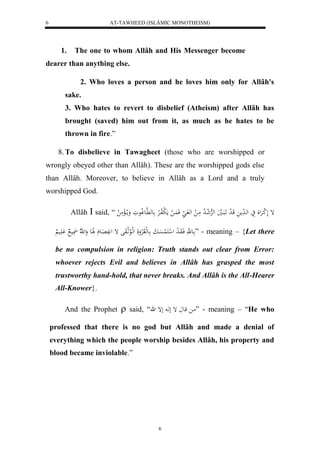
1. The one to whom Allâh and His Messenger become 
6 
dearer than anything else. 
2. Who loves a person and he loves him only for Allâh's 
sake. 
3. Who hates to revert to disbelief (Atheism) after Allâh has 
brought (saved) him out from it, as much as he hates to be 
thrown in fire.” 
8. To disbelieve in Tawagheet (those who are worshipped or 
wrongly obeyed other than Allâh). These are the worshipped gods else 
than Allâh. Moreover, to believe in Allâh as a Lord and a truly 
worshipped God. 
Allâh  said, “ إ لَ ل كارَْل يَ لها دَم قَا ل د اََبَااهيَ لههرْل شا لا د مَا ل لهفَا فَ اَُ ل مَ ل بلافالرْ عه هَّاعولاعوَ وَما لاالْمَ ل 
اع هَّ فَاوَا ل د ل ل كَ لُسَْابَ اعهل لالرْوَلَ لهلالاعثلاوَل إ ل فََّ اَِع لََاَع وَل هّلا يا اَََْي ” - meaning – {Let there 
be no compulsion in religion: Truth stands out clear from Error: 
whoever rejects Evil and believes in Allâh has grasped the most 
trustworthy hand-hold, that never breaks. And Allâh is the All-Hearer 
All-Knower}. 
And the Prophet  said, “ ما قاع إ لها لإ ه ” - meaning – “He who 
professed that there is no god but Allâh and made a denial of 
everything which the people worship besides Allâh, his property and 
blood became inviolable.”
AT-TAWHEED (ISLÂMIC MONOTHEISM) 
7 
The meaning of [the confession]: Muhammad-ur-Rasûl- 
Allâh 
(The second confession of a Muslim, which means: 
Muhammad  is the Messenger of Allâh). 
The belief that he is sent from Allâh, so that we should believe him in 
what he has informed, and obey him in what he has ordered, and leave 
what he has forbade, and worship Allâh as he has decreed. Moreover, we 
should believe that he is the last (end) of the Prophets and that his Message 
(Islâm) is quite general for all mankind and jinn. 
In fact, the veneration of the Prophet with his orders and prohibition 
and sticking to his rules are the true expression for the real meaning of this 
testimony (confession). 
However, this is a mere submission to the orders of Allâh, who sent 
him to all people as a bearer of glad tidings, and a warner, and as one who 
invites to Allâh (Islâmic Monotheism, i.e. to worship none but Allâh 
Alone) by His Leave, and as a lamp spreading light (through his 
instructions from the Qur’ân and the Sunnah – the Legal ways of the 
Prophet) 
Our duty towards the Prophet of Allâh . 
7 
1. Believing him. 
Allâh  said, “ وَمَاع مالَُ اََّ لا اَْ ل لللَاَعَ ” - meaning – {Nor does he say 
(aught) of (his own) Desire}.
AT-TAWHEED (ISLÂMIC MONOTHEISM) 
8 
8 
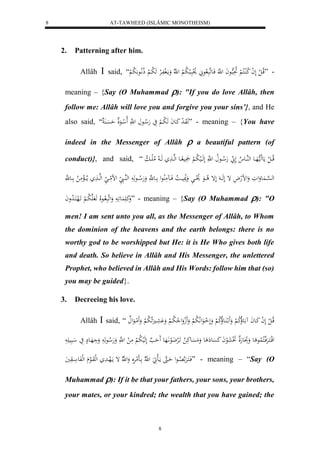
2. Patterning after him. 
Allâh  said, “ - ”قلاا ل ل لَ ل ا لا كلُاكلا لْ لا بَِهاعاَ ل هَّ فَاعهَبَ لاعَ لال وبَال ب لا ب لْ ل هّلا وَمالَ ففَالرْ هَ لا با لْ ذلا اَّ لاع لا ب ل 
meaning – {Say (O Muhammad ): "If you do love Allâh, then 
follow me: Allâh will love you and forgive you your sins’}, and He 
also said, “ هَوَا ل د كَاعاَ هَ لا با لْ يَ هَلا اع ل هَّ لَا ل اعَل حَسَْا ” - meaning – {You have 
indeed in the Messenger of Allâh  a beautiful pattern (of 
conduct)}, and said, “ قلااا ل ل مَع مََا ههَااع لههُااع لا لَ هَلا ااعلا ل هَّ لَهَاالي لا ب لْ ي ااع لههاا هَاا لا لاملَاا لا ب 
له ه سْاا عَُوَلوَ وَلضلهلاَ إ لَهَااا لَإ لا اااعَ لال وااا وَلانَيااا لا ا فَااا مََلُاعل اااع هَّ وَهَلا اااع هَ لههُااا لض مااا لههااا ما لاااالْمَ لا اااع ه وَكَ عَََُ اَ وَلهَبَ لااعلَا هَ هَ لا با لْ اََلهكَا لا دواَ ” - meaning – {Say (O Muhammad ): "O 
men! I am sent unto you all, as the Messenger of Allâh, to Whom 
the dominion of the heavens and the earth belongs: there is no 
worthy god to be worshipped but He: it is He Who gives both life 
and death. So believe in Allâh and His Messenger, the unlettered 
Prophet, who believed in Allâh and His Words: follow him that (so) 
you may be guided}. 
3. Decreeing his love. 
Allâh  said, “ قلاا ل ل لَ ل ا كَاعاَ اعَلاُلا ك لْ وَََ لا اَُعلاُلا ك لْ وَلَ ل ااعَللَّا لا ب لْ وَََلجوَل لا لا با ل وَ عََْا لَََا لا ب لْ وَََ لماعَل 
لقلاكَارَْفلاكلالُاع ع وَتََِعهَل تََلعَلعاَ كَسَْع ع وَمَسَْعكَ لا اََلرْضَلعاَّهََع حَََ ه ل هَلي لا ب لْ مَ ل ل هَّ وَهَلا اعهَ وَ هَاع يَ ابَي فَاكَارَْ ه لااِاعل حَااهَ مااَالهََ ل هّلا اااَلمرَََْ وَل هّلا إ مالَهاادَ لهلوَاالع لهلفَع ااوَيَ ” - meaning – “Say (O 
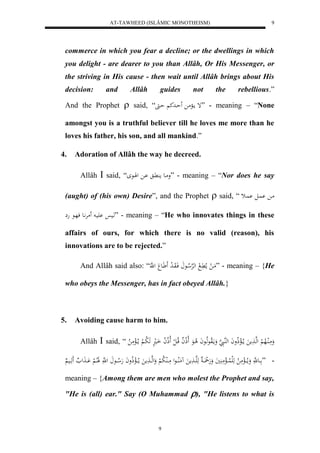
Muhammad ): If it be that your fathers, your sons, your brothers, 
your mates, or your kindred; the wealth that you have gained; the
AT-TAWHEED (ISLÂMIC MONOTHEISM) 
9 
commerce in which you fear a decline; or the dwellings in which 
you delight - are dearer to you than Allâh, Or His Messenger, or 
the striving in His cause - then wait until Allâh brings about His 
decision: and Allâh guides not the rebellious.” 
And the Prophet  said, “َ إ ماا مْ حَاادك حاا ” - meaning – “None 
amongst you is a truthful believer till he loves me more than he 
loves his father, his son, and all mankind.” 
4. Adoration of Allâh the way he decreed. 
Allâh  said, “ وماع م اَُّ اْ للَاع ” - meaning – “Nor does he say 
(aught) of (his own) Desire”, and the Prophet  said, “ ما اُْل اُْث 
هاي يَْا مَرَّْاع فهاع هِ ” - meaning – “He who innovates things in these 
affairs of ours, for which there is no valid (reason), his 
innovations are to be rejected.” 
And Allâh said also: “َّ مَا ل ملا اََّ ل لههرْلا اع فَاوَا ل د اََََع ل ه ” - meaning – {He 
who obeys the Messenger, has in fact obeyed Allâh.} 
5. Avoiding cause harm to him. 
Allâh  said, “ وَمَالُالاه لْ لهها مََ ما لاالْذلاواَ لههُا هَ وَمالَاوعهلااعاَ لا اعَ لَاذلا ا قلاا ل ل لَاذلا لا ا اَال هَ لا با لْ ما لاالْمَ لا 
- ” ااع هَّ وَما لاااالْمَ لا هَلَ لُااالْمَ يََُ وَهَلََّ ااا هَهَاا مََ مَُلُااااعل مَاالُ لا ب لْ وَلههااا مََ ما لااالْذلا واَ هَلا اااع ل ه لََاا لا لْ اَْاا لََ هَََااي meaning – {Among them are men who molest the Prophet and say, 
"He is (all) ear." Say (O Muhammad ), "He listens to what is 
9
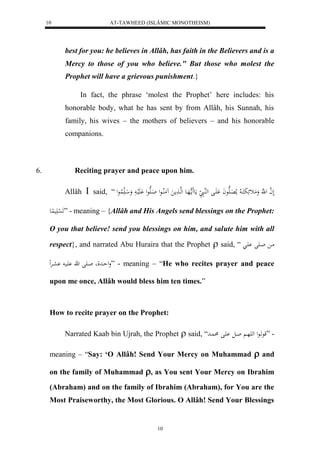
AT-TAWHEED (ISLÂMIC MONOTHEISM) 
10 
best for you: he believes in Allâh, has faith in the Believers and is a 
Mercy to those of you who believe." But those who molest the 
Prophet will have a grievous punishment.} 
In fact, the phrase ‘molest the Prophet’ here includes: his 
honorable body, what he has sent by from Allâh, his Sunnah, his 
family, his wives – the mothers of believers – and his honorable 
companions. 
6. Reciting prayer and peace upon him. 
Allâh  said, “ لَ ه ا ل هَّ وَمَثئَبَكَا لا ملا اَِهَعاَ اَََْل لههُا مَع مََا ههَاع لهها مََ مَُلُااعل اَاهَعل لَََْيا وَ ا لُا عل 
لََ سْ يََ عُِ ” - meaning – {Allâh and His Angels send blessings on the Prophet: 
O you that believe! send you blessings on him, and salute him with all 
respect}, and narrated Abu Huraira that the Prophet  said, “ ما اا لَ اَْ 
ولحادل اا لَ ه يَْا عْارْ لِ ” - meaning – “He who recites prayer and peace 
upon me once, Allâh would bless him ten times.” 
How to recite prayer on the Prophet: 
Narrated Kaab bin Ujrah, the Prophet  said, “ - ”قعهاعل له هَا اال اَْل اُد 
meaning – “Say: ‘O Allâh! Send Your Mercy on Muhammad  and 
on the family of Muhammad , as You sent Your Mercy on Ibrahim 
(Abraham) and on the family of Ibrahim (Abraham), for You are the 
Most Praiseworthy, the Most Glorious. O Allâh! Send Your Blessings 
10
AT-TAWHEED (ISLÂMIC MONOTHEISM) 
11 
on Muhammad  and the family of Muhammad , as You sent your 
Blessings on Ibrahim (Abraham) and on the family of Ibrahim 
(Abraham), for You are the Most Praiseworthy, the Most Glorious’.” 
At-Tawhîd (Islâmic Monotheism) 
At-Tawhîd (Islâmic Monotheism) is to consider and believe in one 
God, unification of Allâh is to believe in His Oneness of Rububiah 
(Lordship) and His Holy Names and Qualities, and to believe that He is the 
Owning Lord Who only deserves to be worshipped. Therefore, At-Tawhîd 
(Islâmic Monotheism) is to perform Monotheism Allâh in all what is 
specified for Him among all said and done adoration, and it is the basis of 
Islâm, from which its ordinances, regulations, orders and prohibitions 
originated. 
The Surplus of At-Tawhîd (Islâmic Monotheism) 
1. It is a reason for entering Paradise and get out of the Hell fire. 
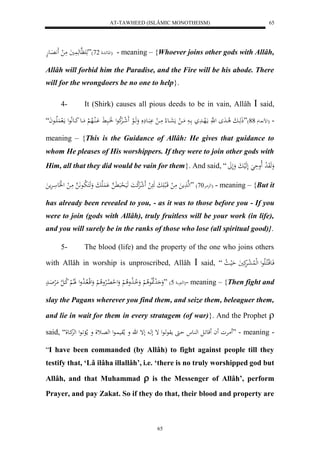
Allâh  said, “ هَوَاا ل د كَفَاارَْ لههاا مََ قَاعهلاعل لَ ه ا ل هَّ لا ااعَ لهل سََُْااي لا ل لاا لا مَالرْ وَقَااع لهل سََُْااي لا مااَع 
لَ ل رَْلئَيلَ ل لْبلالا دول ل هَّ هَ بّ وَهَ ه لا ب لْ لَهَّ لا مَ ل ملا ل عرَْل ك ع هَّ فَاوَ ل د حَ هرْ ل هّلا لَََْي ل ل لَْهُ وَمَالوَللَا لههُاعلاه وَمَاع هَ هََّاعهَ يََُ مَا ل 
اََََِّعهْ ” - meaning – “They did blaspheme who said: "Allâh is Christ the 
son of Mary." But said Isa (Jesus): "O Children of Israel! Worship 
Allâh, my Lord and your Lord." Whoever joins other gods with Allâh, 
11
AT-TAWHEED (ISLÂMIC MONOTHEISM) 
12 
Allâh will forbid him the Paradise, and the Fire will be his abode. 
There will for the wrongdoers be no one to help.”. 
Muslim (a Hadith Scholar) narrated that the Prophet  said, “ م هو 
ه” - meaning – “He who meets with Allâh not adopting a partner 
with Him in worship shall enter Paradise, and he who meets Him 
adopting a partner with Him in worship shall enter Hell Fire.” And 
Utban narrated that the Prophet  said, “ فانا ه حارْ اَْل له اُعه ” - meaning – 
“..for Allâh has immuned Hell Fire from (reaching) who said, ‘Lâ 
ilâha illallâh’ desiring by that only the Face of Allâh (His 
Satisfaction).” 
2. It is a condition for the acceptance of deeds, and polytheism 
12 
causes them to be nullified. 
Allâh  said, “ وَهَوَاا ل د لَاوحَاا لَهَلياابَ وَلَلََ لههاا مََ مَاا ل قَالب اََابَ هَاا ل لََ شاارَْل ك اَ هَيَ ل حاابَ هََّ لَََُْااابَ 
وَهَكَ لا باع هََّ مَا ل ل لََع ارَْم ” - meaning – {But it has already been revealed to you, 
- as it was to those before you - "If you were to join (gods with Allâh), 
truly fruitless will be your work (in life), and you will surely be in the 
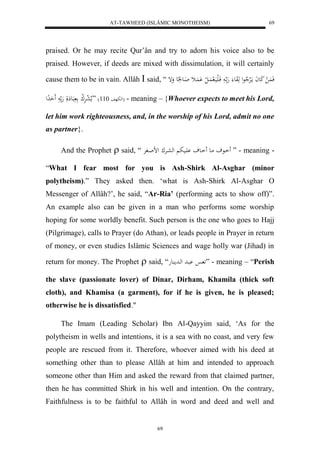
ranks of those who lose (all spiritual good)}, and He said, “ فَ اَُ ل كَاعاَ مالَرْلا اعل 
هَوَاع هَ ا فَالَيَال اَُ ل ل اََُْث اَاع عَُِ وَإ ملا ل عارَْل ك بَاع لَ هَ ا حَََادِل ” - meaning – “So, whoever 
expects to meet his Lord, let him work righteousness, and, in the 
worship of his Lord, admit no one as partner.”. 
Imam Abu Abdi-llah At-Tastari (may Allâh be Merciful with him) 
said, “Faith is in saying, deed, intention, and Sunnah; so if there was a
AT-TAWHEED (ISLÂMIC MONOTHEISM) 
13 
saying without a deed, then it is a Kufr (disbelief), or if it was a saying 
and a deed without an intention, then it is hypocrisy, and if it was a 
saying, an intention, and a deed without a Sunnah, then it is a Bid’a 
(novelty).” 
3. It expiates sins and erases them, for Allâh says in the Qudsi 
Hadith (Sacred Tradition which was reported by the Prophet as the 
Saying of Allâh), “ ماع ل ا ” - meaning – “O son of Adam, were you 
to come to Me with sins nearly as great as the earth and were you 
then to face Me, ascribing no partner to Me, I would bring you 
forgiveness nearly as great as your sins.” 
 
13 
 
1. Tawhîd Ar-Rububiah (Islâmic Monotheism of Allâh’s 
Lordship) 
This is a belief that Allâh has created mankind and bestowed upon 
them their means of living, and can give life to them and can take it from 
them. Or we can say that it is the Monotheism of Allâh in His deeds, like 
the belief that he is the Creator and the Providor. 
In fact, the earlier disbelievers have admitted this kind of belief, and 
so have Jewish, Nazareth, Sabians and Magans people. No body denied this 
Tawhîd except Dahriah in the passed time. 
The Proof of Tawhîd Ar-Rububiah:
AT-TAWHEED (ISLÂMIC MONOTHEISM) 
14 
One thing can be said to these ignorant people who deny the existence 
of the Bountiful Lord: no rational person can accept an impact without an 
effect, or an action without a doer or a creation without a Creator. 
Moreover, it is quite obvious that if you see a needle, you would 
certainly be assured that it has a Maker. So what can be said about this 
marvelous bright universe, which dazzle sights? Has it been created 
without a Creator and found without a finder? And much more, have it 
been organized without an organizer, and all what exists in this universe, 
stars, clouds, lightening, thunders, deserts, seas, day and night, dark and 
light, trees and roses, jinn and mankind, Angels and animals, and all sorts 
of uncountable creatures? Have all of these been found without a Finder 
Who could create them from nothing. 
No one, who has a tip of rationalism, can say that. 
In short, proofs of Ar-Rububiah (Lordship) of Allâh can not be 
counted, and He Spoke the Truth when He said, “ لََ لا ا لََاواعل مَا ل وَال شَا لَ لََ لا ا ل 
ل لَااَعهَلاوعاَ ” - meaning – {Were they created of nothing, or were they 
themselves the creators?}, and when He said, “ ل هّلا اَعهَ لا لا ك ل شَ لَ وَلا عَ ل لا ك ل شَ لَ 
وَكَيال ” - meaning – {Allâh is the Creator of all things, and He is the 
Guardian and Disposer of all affairs}. 
One of the rational evidences we were talking about is a debate 
between Abu Hanifah (may Allâh be Merciful with him) and a group of 
scholastic people who were arguing with him Tawhîd Ar-Rububiah 
(Islâmic Monotheism for Allâh’s Lordship). Abu Hanifah asked them, “ 
before we talk about this issue would you tell me about that ship in Dijlah 
14
AT-TAWHEED (ISLÂMIC MONOTHEISM) 
15 
River, which has loaded itself with food and goods, and then returned by 
itself, after all it anchored and emptied its goods without having someone 
to direct?”, “ this is quite impossible, and could not happen by any way!” 
they said, then Abu Hanifah told them, “what would you then say about all 
this upper and lower universe??” – and this story was narrated about 
someone other than Abu Hanifah. 
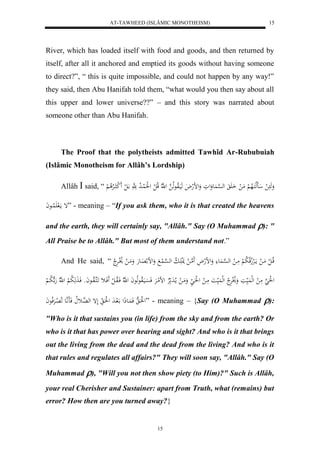
The Proof that the polytheists admitted Tawhîd Ar-Rububuiah 
(Islâmic Monotheism for Allâh’s Lordship) 
Allâh  said, “ وَهَ ل اَهلكَالاه لْ مَ ل اَ له ه سْ عَُوَلوَ وَلضلهلاَ هَيَالاوعهلا ه ل ه لّا قلا ل ل ل لَُ لُا لا د هََّ ا لَ ل لََ ك االارْلا لْ 
إ مالَ لََُااعاَ ” - meaning – “If you ask them, who it is that created the heavens 
and the earth, they will certainly say, "Allâh." Say (O Muhammad ): " 
All Praise be to Allâh." But most of them understand not.” 
And He said, “ قلاا ل ل مَا ل مااَلرْلاجقلا لا ب لْ مَا ل له ه سْا عَُ وَلضلهلاَ هََما ل نَل اََ لا ب له ه سْا لُ وَلض ل اَِعهَ وَمَا ل لاْلارَْلا 
ل لَُ هَ مَ ل لهل يَُ اَ وَلاْلرَْلا لهل يَُ اَ مَا ل ل لَُا وَمَا ل ما لادَ لارْ لضلمارَْ فَسَْايَالاوعهلاعاَ ل هّلا فَالاوا ل ل فَََاث اََكهالاواعاَو فَا هَََ لا ب لْ ل ه لّا هَ ه لا با لْ 
ل لَُا ه فَ اَُعذَل الَ ادَ ل لَُا لَإ له هاُثلا فَاَ اَّ هع لَا لاِرَْفلاعاَ ” - meaning – {Say (O Muhammad ): 
"Who is it that sustains you (in life) from the sky and from the earth? Or 
who is it that has power over hearing and sight? And who is it that brings 
out the living from the dead and the dead from the living? And who is it 
that rules and regulates all affairs?" They will soon say, "Allâh." Say (O 
Muhammad ), "Will you not then show piety (to Him)?" Such is Allâh, 
your real Cherisher and Sustainer: apart from Truth, what (remains) but 
error? How then are you turned away?} 
15
AT-TAWHEED (ISLÂMIC MONOTHEISM) 
16 
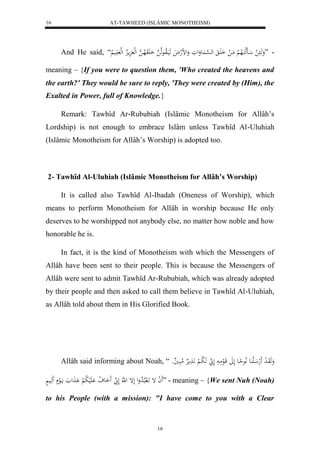
And He said, “ - ”وَهَا ل ااَهلكَالاه لْ مَا ل اَ اََ له ه سْا عَُوَلوَ وَلضلهلاَ هَيَالاواعهلا ه اَ وَََلاها ه لهل مَِالاِ لهل اََي لا 
meaning – {If you were to question them, 'Who created the heavens and 
the earth?' They would be sure to reply, 'They were created by (Him), the 
Exalted in Power, full of Knowledge.} 
Remark: Tawhîd Ar-Rububiah (Islâmic Monotheism for Allâh’s 
Lordship) is not enough to embrace Islâm unless Tawhîd Al-Uluhiah 
(Islâmic Monotheism for Allâh’s Worship) is adopted too. 
2- Tawhîd Al-Uluhiah (Islâmic Monotheism for Allâh’s Worship) 
It is called also Tawhîd Al-Ibadah (Oneness of Worship), which 
means to perform Monotheism for Allâh in worship because He only 
deserves to be worshipped not anybody else, no matter how noble and how 
honorable he is. 
In fact, it is the kind of Monotheism with which the Messengers of 
Allâh have been sent to their people. This is because the Messengers of 
Allâh were sent to admit Tawhîd Ar-Rububiah, which was already adopted 
by their people and then asked to call them believe in Tawhîd Al-Uluhiah, 
as Allâh told about them in His Glorified Book. 
Allâh said informing about Noah, “ وَهَوَا ل د لََه الَ عَُ لَّاعحِاع لَلََ قَالعمَا لَ هَ لا با لْ اَّ مَََ رْ لامبَا يو 
لََ ا إ اََل بلالا دول لَإ ل هَّ لَ اَََع لا ف لَََْي لا ب لْ اَْ لََ مااَلع هَََاي ” - meaning – {We sent Nuh (Noah) 
to his People (with a mission): "I have come to you with a Clear 
16
AT-TAWHEED (ISLÂMIC MONOTHEISM) 
17 
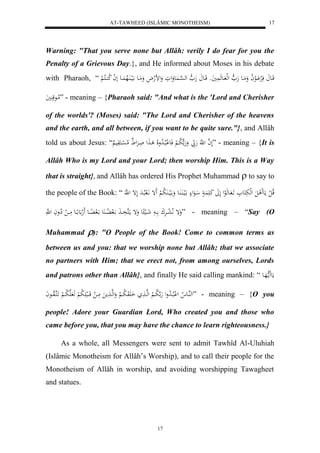
Warning: "That you serve none but Allâh: verily I do fear for you the 
Penalty of a Grievous Day.}, and He informed about Moses in his debate 
with Pharaoh, “ قَااع فَلرْ اَْالعلا ا وَمَااع هَ ه لهل ااعهَ يََُو قَااع هَ ه له ه سْاا عَُوَلوَ وَلضلهلاَ ومَااع الَيا اَُلاه اَُاع ل ل ا لا ك اُاكلا لْ 
لاماعقَ يََُ ” - meaning – {Pharaoh said: "And what is the 'Lord and Cherisher 
of the worlds'? (Moses) said: "The Lord and Cherisher of the heavens 
and the earth, and all between, if you want to be quite sure."}, and Allâh 
told us about Jesus: “ لَ ه ا ل هَّ هَ بّ وَهَ ه لا با لْ فَع لْبلاا لا دولَا ا لََ اَارَْل لام ل سْاكَوَي ” - meaning – {It is 
Allâh Who is my Lord and your Lord; then worship Him. This is a Way 
that is straight}, and Allâh has ordered His Prophet Muhammad  to say to 
the people of the Book: “ قلا ل ل مَع لََ لَ لهلبَكَع اََ اعهَلعل لَلََ كَ اَََُ اعَل الَيا اَُ اَُع وَ الَياا لَُا ب لْ إََ اَّلَ بلاادَ لَإ ل ه 
وَإ لَّا ل عااارَْكَ ااا شَااالي ع وَإ ماكَهذَااا الَ لااُاا عَُ الَ اُِااع لََه ع ااِاع مَااا ل لِاواَ ل ه ” - meaning – “Say (O 
Muhammad ): "O People of the Book! Come to common terms as 
between us and you: that we worship none but Allâh; that we associate 
no partners with Him; that we erect not, from among ourselves, Lords 
and patrons other than Allâh}, and finally He said calling mankind: “ مَع مََا ههَاع 
لههُااع لا ل لْبلااا لا د ول هَ ه لا باا لْ لههاا اَ وَََ لا باا لْ وَلههاا مََ مَاا ل قَااالب لََا ب لْ هَ هَ لا باا لْ اََكهالاوااعاَ ” - meaning – {O you 
people! Adore your Guardian Lord, Who created you and those who 
came before you, that you may have the chance to learn righteousness.} 
As a whole, all Messengers were sent to admit Tawhîd Al-Uluhiah 
(Islâmic Monotheism for Allâh’s Worship), and to call their people for the 
Monotheism of Allâh in worship, and avoiding worshipping Tawagheet 
and statues. 
17
AT-TAWHEED (ISLÂMIC MONOTHEISM) 
18 
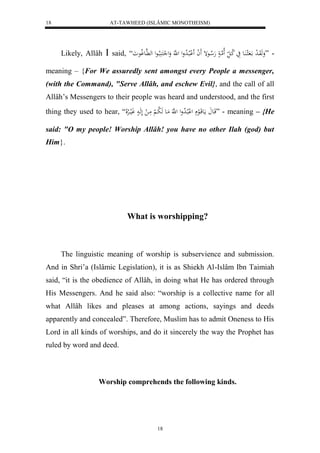
Likely, Allâh  said, “ - ”وَهَوَا ل د ا لا اَُع يَ لا كا ل لَاهما هَلا اعإ لََ ا للالْبلاا لا دول ل ه وَل ل كَ بَُلااعل له هَّاعولاعوَ 
meaning – {For We assuredly sent amongst every People a messenger, 
(with the Command), "Serve Allâh, and eschew Evil}, and the call of all 
Allâh’s Messengers to their people was heard and understood, and the first 
thing they used to hear, “ قَاع ماعَقَالع ل لْبلاا لا دول ل هَّ مَاع هَ لا با لْ مَا ل لَهَا وَلياالارْ لَا ” - meaning – {He 
said: "O my people! Worship Allâh! you have no other Ilah (god) but 
Him}. 
What is worshipping? 
The linguistic meaning of worship is subservience and submission. 
And in Shri’a (Islâmic Legislation), it is as Shiekh Al-Islâm Ibn Taimiah 
said, “it is the obedience of Allâh, in doing what He has ordered through 
His Messengers. And he said also: “worship is a collective name for all 
what Allâh likes and pleases at among actions, sayings and deeds 
apparently and concealed”. Therefore, Muslim has to admit Oneness to His 
Lord in all kinds of worships, and do it sincerely the way the Prophet has 
ruled by word and deed. 
Worship comprehends the following kinds. 
18
AT-TAWHEED (ISLÂMIC MONOTHEISM) 
19 
Be informed that worship comprehends Salat (Prayer), Tawaf 
(circumambulating), Hajj (Pilgrimage), Syiamm (Fasting), Nathr (Vow), 
Ietikaf (seclusion), Thabh (slaughtering), Sujud (prostration), Ruku 
(kneeling), Khawf (fear), Rahbah (awe), Raghbah (desire), Khashiah (fear 
causing avoidance), Tawakkul (depending), Istighathah (call upon for 
help), and Rajaa (hope) and many other kinds of worship which were 
decreed by Allâh in His Noble Book, or by His Messenger in the Sound 
Sunnah in word and deed. Therefore, if any of these is offered to someone 
besides Allâh, then this is considered Shirk (Polytheism), for Allâh says, 
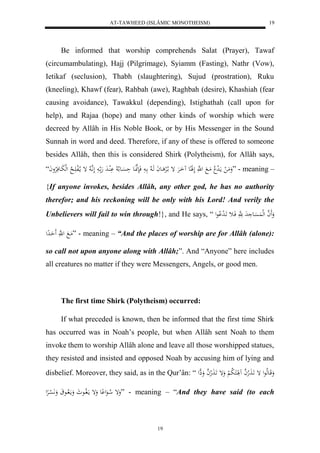
وَمَ ل ما لَ د لا مَا ل هَّ لَلََاِع اَُارَْ إ ا لالرْ اعاَ هَا لا ا فَنَهنَّاعَ حَسَْاع لا لا لَُْادَ هَ ا لَ اَّ ه لا إ ما لالف اََ لا لهلبَاعفَلارْواَ “ ” - meaning – 
{If anyone invokes, besides Allâh, any other god, he has no authority 
therefor; and his reckoning will be only with his Lord! And verily the 
Unbelievers will fail to win through!}, and He says, “ وَََ ه ا لهل سََُْاع دَ هَ فَاث اََ ل د لْاعل 
مَا ل هَّ حَََادِل ” - meaning – “And the places of worship are for Allâh (alone): 
so call not upon anyone along with Allâh;”. And “Anyone” here includes 
all creatures no matter if they were Messengers, Angels, or good men. 
The first time Shirk (Polytheism) occurred: 
If what preceded is known, then be informed that the first time Shirk 
has occurred was in Noah’s people, but when Allâh sent Noah to them 
invoke them to worship Allâh alone and leave all those worshipped statues, 
they resisted and insisted and opposed Noah by accusing him of lying and 
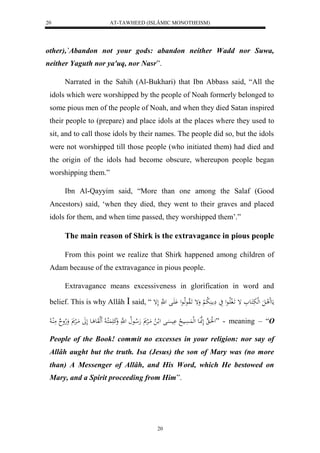
disbelief. Moreover, they said, as in the Qur’ân: “ وَقَاعهلاعل إ اََ لََاهه ا لََُاَكَ لا ب لْ وَإ اََ لََاهه ا وَاِل 
وَإ لا اعَل عِْ وَإ مافَلااع وَما لااع وَ لََّ سْارِْل ” - meaning – “And they have said (to each 
19
AT-TAWHEED (ISLÂMIC MONOTHEISM) 
20 
other),`Abandon not your gods: abandon neither Wadd nor Suwa, 
neither Yaguth nor ya'uq, nor Nasr”. 
Narrated in the Sahih (Al-Bukhari) that Ibn Abbass said, “All the 
idols which were worshipped by the people of Noah formerly belonged to 
some pious men of the people of Noah, and when they died Satan inspired 
their people to (prepare) and place idols at the places where they used to 
sit, and to call those idols by their names. The people did so, but the idols 
were not worshipped till those people (who initiated them) had died and 
the origin of the idols had become obscure, whereupon people began 
worshipping them.” 
Ibn Al-Qayyim said, “More than one among the Salaf (Good 
Ancestors) said, ‘when they died, they went to their graves and placed 
idols for them, and when time passed, they worshipped them’.” 
The main reason of Shirk is the extravagance in pious people 
From this point we realize that Shirk happened among children of 
Adam because of the extravagance in pious people. 
Extravagance means excessiveness in glorification in word and 
belief. This is why Allâh  said, “ مَع لََ الَ لهلبَكَاع إ اََل فلَااعل يَ مَِا لَُا ب لْ وَإ الاوعهلااعل اَََْل ل هَّ لَإ 
ل لَُا ه لَهنَّاعَ لهل سََُْاي لا يَْسَْال ل لا لا مَالرْ هَلا اعلا ل هَّ وَكَ كَََُلاا لا هََلوَع اع لَلََ مَالرْ وَلاهو مَلُا لا ” - meaning – “O 
People of the Book! commit no excesses in your religion: nor say of 
Allâh aught but the truth. Isa (Jesus) the son of Mary was (no more 
than) A Messenger of Allâh, and His Word, which He bestowed on 
Mary, and a Spirit proceeding from Him”. 
20
AT-TAWHEED (ISLÂMIC MONOTHEISM) 
21 
Furthermore, ‘Aishah said, ‘when the last moment of the life of 
Allâh's Messenger came, he started putting his 'Khamisa' on his face. And 
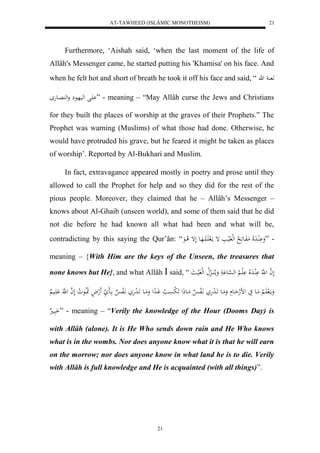
when he felt hot and short of breath he took it off his face and said, “ ه ه 
اَْل لهيهاع وله اُِعه ” - meaning – “May Allâh curse the Jews and Christians 
for they built the places of worship at the graves of their Prophets.” The 
Prophet was warning (Muslims) of what those had done. Otherwise, he 
would have protruded his grave, but he feared it might be taken as places 
of worship’. Reported by Al-Bukhari and Muslim. 
In fact, extravagance appeared mostly in poetry and prose until they 
allowed to call the Prophet for help and so they did for the rest of the 
pious people. Moreover, they claimed that he – Allâh’s Messenger – 
knows about Al-Ghaib (unseen world), and some of them said that he did 
not die before he had known all what had been and what will be, 
contradicting by this saying the Qur’ân: “ - ”وَ لَُْادَلَا مَفَاع لََا لهلفَليا إ مالَ لََُاهَاع لَإ لا اعَ 
meaning – {With Him are the keys of the Unseen, the treasures that 
none knows but He}, and what Allâh  said, “ لَ ه ا ل هَّ لَُْادَلَا لََْا لْا له ه سْاع وَم ا لا اَُا لا لهلفَليا 
وَمالَ اََا لْا مَااع يَ لض لهحَااع وَمَااع اََا ل دهَ اَّلَفاا مَااعذَل لََ بسَْاا لا وَاادِل وَمَااع اََا ل دهَ اَّلَفاا اااَ لََهلاْ اََا لاع لا و لَ ه ا ل هَّ اَََْاي اَبَا ” - meaning – “Verily the knowledge of the Hour (Dooms Day) is 
with Allâh (alone). It is He Who sends down rain and He Who knows 
what is in the wombs. Nor does anyone know what it is that he will earn 
on the morrow; nor does anyone know in what land he is to die. Verily 
with Allâh is full knowledge and He is acquainted (with all things)”. 
21
AT-TAWHEED (ISLÂMIC MONOTHEISM) 
22 
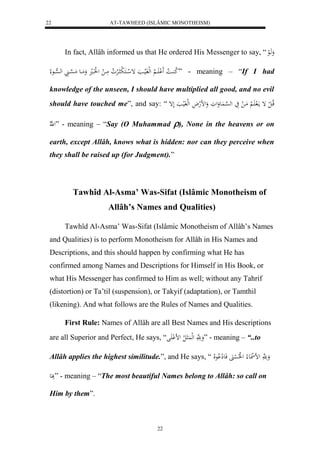
In fact, Allâh informed us that He ordered His Messenger to say, “ وَهَالع 
لا ك اُا لا ا لََْ اََا لْا لهلفَلياا إ ل ااكَ ل ب الرْ لا و مَاا ل ل لََاال وَمَااع مَ ه سْاا له ه سْااع لا ” - meaning – “If I had 
knowledge of the unseen, I should have multiplied all good, and no evil 
should have touched me”, and say: “ قلاا ل ل إ مالَ اََ لْا مَا ل يَ له ه سْا عَُوَلوَ وَلضلهلاَ ل هلفَليا لَإ 
ل ه لّا ” - meaning – “Say (O Muhammad ), None in the heavens or on 
earth, except Allâh, knows what is hidden: nor can they perceive when 
they shall be raised up (for Judgment).” 
Tawhîd Al-Asma’ Was-Sifat (Islâmic Monotheism of 
Allâh’s Names and Qualities) 
Tawhîd Al-Asma’ Was-Sifat (Islâmic Monotheism of Allâh’s Names 
and Qualities) is to perform Monotheism for Allâh in His Names and 
Descriptions, and this should happen by confirming what He has 
confirmed among Names and Descriptions for Himself in His Book, or 
what His Messenger has confirmed to Him as well; without any Tahrif 
(distortion) or Ta’til (suspension), or Takyif (adaptation), or Tamthil 
(likening). And what follows are the Rules of Names and Qualities. 
First Rule: Names of Allâh are all Best Names and His descriptions 
are all Superior and Perfect, He says, “ وَ هََّ لهل للا لض لْ لََ ” - meaning – “..to 
Allâh applies the highest similitude.”, and He says, “ وَ هََّ لض ل ع لا ل لُلا ل سْنََ فَعلِ لْاعلَا 
بََِع ” - meaning – “The most beautiful Names belong to Allâh: so call on 
22 
Him by them”.
AT-TAWHEED (ISLÂMIC MONOTHEISM) 
23 
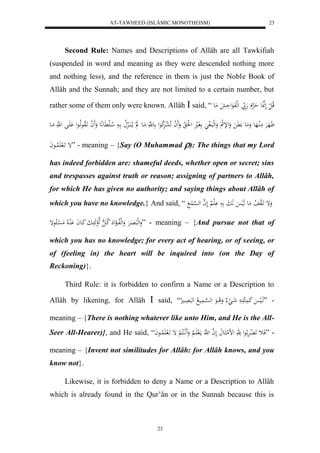
Second Rule: Names and Descriptions of Allâh are all Tawkifiah 
(suspended in word and meaning as they were descended nothing more 
and nothing less), and the reference in them is just the Noble Book of 
Allâh and the Sunnah; and they are not limited to a certain number, but 
rather some of them only were known. Allâh  said, “ قلا ل ل لَهنََّع حَهرْ هَ بّ لهلفَ عَلحَ مَع 
ظَهَرَْ مَلُاهَع وَمَع وَللإل وَلهلبَال ف فَل ل لَُ وَََ ل ا لَا ل عرَْلا كعل ع هَّ مَاع ل ما لا اَُا ل ا لا الَ عََّ عَِّ وَََ ل ا اََلاوعهلااعل اَََْل ل هَّ مَاع 
إ اََل لََُااعاَ ” - meaning – {Say (O Muhammad ): The things that my Lord 
has indeed forbidden are: shameful deeds, whether open or secret; sins 
and trespasses against truth or reason; assigning of partners to Allâh, 
for which He has given no authority; and saying things about Allâh of 
which you have no knowledge.} And said, “ وَإ اََلو لا ف مَع هَلي هَبَ لََْ لَ ه ا له ه سْ لُ 
وَلهلبَ اَِرَْ وَلهللافا لَْ لا كا ه ل لَالوهَ ابَ كَاعاَ لَُْا لا مَ ل سْا لاعإ ” - meaning – {And pursue not that of 
which you has no knowledge; for every act of hearing, or of seeing, or 
of (feeling in) the heart will be inquired into (on the Day of 
Reckoning)}. 
Third Rule: it is forbidden to confirm a Name or a Description to 
Allâh by likening, for Allâh  said, “ - ”هَاالي كَ ل اََا شَاا لَ وَلا ااعَ له ه سْاا يَُ لا لهبَ اَِا لا 
meaning – {There is nothing whatever like unto Him, and He is the All- 
Seer All-Hearer)}, and He said, “ - ”فَاث لََاُرَْ لاعل هََّ لضلم اع لَ ه ا ل هَّ مالَ اََ لْا وَََ لَّااكلا لْ إ اََل لََُااعاَ 
meaning – {Invent not similitudes for Allâh: for Allâh knows, and you 
know not}. 
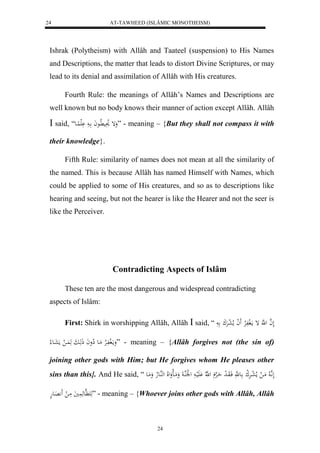
Likewise, it is forbidden to deny a Name or a Description to Allâh 
which is already found in the Qur’ân or in the Sunnah because this is 
23
AT-TAWHEED (ISLÂMIC MONOTHEISM) 
24 
Ishrak (Polytheism) with Allâh and Taateel (suspension) to His Names 
and Descriptions, the matter that leads to distort Divine Scriptures, or may 
lead to its denial and assimilation of Allâh with His creatures. 
Fourth Rule: the meanings of Allâh’s Names and Descriptions are 
well known but no body knows their manner of action except Allâh. Allâh 
 said, “ وَإ لاوَي اَّ لاعاَ ا لََْ اُِع ” - meaning – {But they shall not compass it with 
24 
their knowledge}. 
Fifth Rule: similarity of names does not mean at all the similarity of 
the named. This is because Allâh has named Himself with Names, which 
could be applied to some of His creatures, and so as to descriptions like 
hearing and seeing, but not the hearer is like the Hearer and not the seer is 
like the Perceiver. 
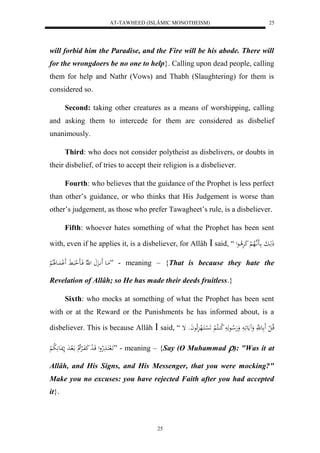
Contradicting Aspects of Islâm 
These ten are the most dangerous and widespread contradicting 
aspects of Islâm: 
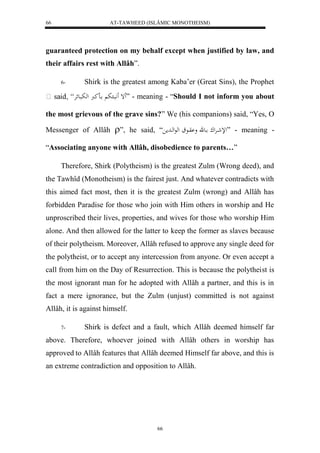
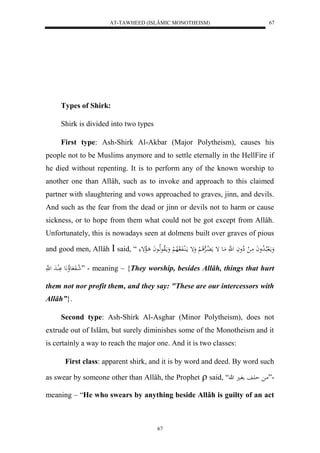
First: Shirk in worshipping Allâh, Allâh  said, “ لَ ه ا ل هَّ إ مالَ ففَلارْ لََ ا ملا ل عرَْكَ 
وَمالَ ففَالارْ مَاع لِاواَ ذَهَابَ هَ اَُ ل مَعَاع لا ” - meaning – {Allâh forgives not (the sin of) 
joining other gods with Him; but He forgives whom He pleases other 
sins than this}. And He said, “ لَ اَّ ه لا مَا ل ملا ل عارَْل ك اع هَّ فَاوَا ل د حَاهرْ ل هّلا لَََْيا ل ل لَْهُا وَمَاالوَللَا لههُاعلاه وَمَاع 
هَ هََّعهَ يََُ مَا ل اََََِّعهْ ” - meaning – {Whoever joins other gods with Allâh, Allâh
AT-TAWHEED (ISLÂMIC MONOTHEISM) 
25 
will forbid him the Paradise, and the Fire will be his abode. There will 
for the wrongdoers be no one to help}. Calling upon dead people, calling 
them for help and Nathr (Vows) and Thabh (Slaughtering) for them is 
considered so. 
Second: taking other creatures as a means of worshipping, calling 
and asking them to intercede for them are considered as disbelief 
unanimously. 
Third: who does not consider polytheist as disbelivers, or doubts in 
their disbelief, of tries to accept their religion is a disbeliever. 
Fourth: who believes that the guidance of the Prophet is less perfect 
than other’s guidance, or who thinks that His Judgement is worse than 
other’s judgement, as those who prefer Tawagheet’s rule, is a disbeliever. 
Fifth: whoever hates something of what the Prophet has been sent 
with, even if he applies it, is a disbeliever, for Allâh  said, “ ذَهَابَ ااَ اَّ هلاه لْ كَرَْلا اعل 
مَااع اَََّا ل هّلا فَاااَ ل حبَ لََْ اَُاعلََلال ” - meaning – {That is because they hate the 
Revelation of Allâh; so He has made their deeds fruitless.} 
Sixth: who mocks at something of what the Prophet has been sent 
with or at the Reward or the Punishments he has informed about, is a 
disbeliever. This is because Allâh  said, “ قلاا ل ل اع هَّ وَ مَُع اَ وَهَلا اعهَ لا ك اُ كلا لْ لََ سْاكَاله ئَِلاعاَو إ 
اََل كَا لََاهول قَا ل د كَفَالرْلال الَ ادَ لَناعَ لََّا ب ل ” - meaning – {Say (O Muhammad ): "Was it at 
Allâh, and His Signs, and His Messenger, that you were mocking?" 
Make you no excuses: you have rejected Faith after you had accepted 
it}. 
25
AT-TAWHEED (ISLÂMIC MONOTHEISM) 
26 
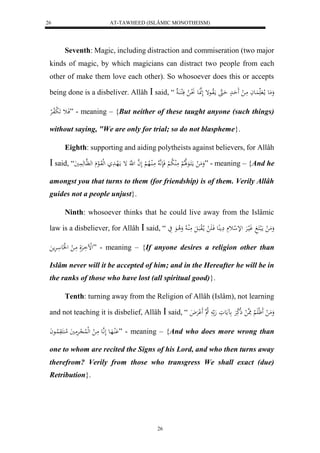
Seventh: Magic, including distraction and commiseration (two major 
kinds of magic, by which magicians can distract two people from each 
other of make them love each other). So whosoever does this or accepts 
being done is a disbeliver. Allâh  said, “ وَمَع ما لا اَُعاَ مَا ل حَََادْ حَاهَ مالَاواعإ لَهنَّاعَ لَ نُا لا فَلكا اَُ 
فَاث لََ بلافالرْ ” - meaning – {But neither of these taught anyone (such things) 
without saying, "We are only for trial; so do not blaspheme}. 
Eighth: supporting and aiding polytheists against believers, for Allâh 
 said, “ وَمَ ل ماكََاعَهلَلالْ مَلُ لا ب لْ فَنَهَّ لا مَالُالاه لْ لَ ه ا ل هَّ إ مالَهادَ لهلوَالع له هَّاع هَ يََُ ” - meaning – {And he 
amongst you that turns to them (for friendship) is of them. Verily Allâh 
guides not a people unjust}. 
Ninth: whosoever thinks that he could live away from the Islâmic 
law is a disbeliever, for Allâh  said, “ وَمَ ل مالَبكَغَ وَليارَْ للإ ل ث مَِ عُِ فَا لََ م ا لالوبَالَ مَلُا لا وَلا اعَ يَ 
لللْاَارَْلَ مَا ل ل لََع ارَْم ” - meaning – {If anyone desires a religion other than 
Islâm never will it be accepted of him; and in the Hereafter he will be in 
the ranks of those who have lost (all spiritual good)}. 
Tenth: turning away from the Religion of Allâh (Islâm), not learning 
and not teaching it is disbelief, Allâh  said, “ وَمَ ل ظََل لََْا مَِه ل ذلا كَرَْ مََعوَ هَ لا ه لََْرَْلاَ 
لَُْاهَاع لَ اَّ هع مَا ل لهللُا لاِرَْمَيَ لام كَُوَ لُااعاَ ” - meaning – {And who does more wrong than 
one to whom are recited the Signs of his Lord, and who then turns away 
therefrom? Verily from those who transgress We shall exact (due) 
Retribution}. 
26
AT-TAWHEED (ISLÂMIC MONOTHEISM) 
27 
All these contradictions are applicable to all people. No matter if one 
is serious or not, afraid or not, except those who are compelled, for Allâh 
 said, “ لَإ مَااا ل لَا ل كاارَََْ وَقَالَبلااا لا لام لَّ اَُاا علإنااَعاَ ” - meaning – {..Except under 
compulsion, his heart remaining firm in}. 
All of these contradictions are the most dangerous and the most 
widespread phenomenon among people; therefore, Muslim has to be 
careful of them for the sake of himself. May Allâh protect us from what 
may entail His Anger, and necessitate His Punishment. 
Fundamentals of Islâmic doctrine 
It is well known from the sound evidence in the Book and the 
Sunnah that sayings and deeds are not accepted unless originate from a 
true doctrine. So if the doctrine is not sound then all what originates will 
be nullified for Allâh  said, “ وَمَا ل مَ ل بلافالرْ علإناعَاَ فَاوَا ل د حَابَ لَََُْاا لا وَلا اعَ يَ لللْاَارَْلَ مَا ل 
ل لََع رَْم ” - meaning – {If any one rejects faith, fruitless is his work, and in 
the Hereafter he will be in the ranks of those who have lost (all spiritual 
good)}. 
27 
First, the Belief in Allâh: 
The belief in Allâh necessitates the belief that He is the only worthy 
god being worshipped for being the only Creator, Cherisher, and Provider 
of the creation. It is He Who can reward their pious and punish their 
rebellious. In fact, it is this purpose for which He created the Worlds, He 
said, “ وَمَع اَ لََو لا ا ل ل لَْ ه وَللإ لَإ هَيَال بلالا دوَ وْ مَع لَاهَم لا د مَلُالاه لْ مَ ل هَلج وَمَع لَاهَما لا د لََ ا ملا لَّ لُااعَ وْ لَ ه ا ل هَّ لا اعَ
AT-TAWHEED (ISLÂMIC MONOTHEISM) 
28 
لهاهرْهجل لَا ذلاو لهللاواهعلَ لهل كََُا لا ي ” - meaning – {I have only created Jinn and men, that 
they may serve Me. No Sustenance do I require of them, nor do I 
require that they should feed Me. For Allâh is He Who gives (all) 
Sustenance, - Lord of Power - steadfast (forever).} 
28 
Second, the belief in Angels: 
This includes the belief in them specifically and as a whole. So 
Muslim has to believe that there exists Angels whom Allâh created and 
molded them to obey. They are of many types, some of them are assigned 
to hold the Throne (of Allâh), others are treasurers for Paradise and Hell, 
others are assigned to record people’s deeds. And we believe in those 
whom Allâh named such as Jibril (Gabriel), MiKa’el (Michael), Malek 
the treasurer of Hell, and Israfil the one who will blow the Sur (Trumpet). 
‘Aishah narrated that the Prophet  said, “ - ”ا وَاا للاثئبا ما اَّعه وا اَ للْاعا 
meaning – “Angels have been created (by Allâh) from light, and jinn 
have been created (by Allâh) from fire without smoke, and Adam has 
been created (by Allâh) from what was described for you (dust)”. 
Third, the belief in Books: 
It should be generally believed that Allâh has descended Noble 
Books unto His Prophets and Messengers to clarify His Right on people 
and invoke it. We believe specifically in those which Allâh named like the 
Tawrat (Torah), the Injil (Gospel), the Zabur (Psalms), and the Qua’ân. In 
fact, Qur'ân is the Last and the Best of them, and it is the Book which 
overwhelmed and confirmed what had preceded. Moreover, it is the Book 
to which the entire nation has to resort in judgement in addition to the 
sound Sunnah reported, Allâh  said, “ وَََ هََِّل اَُع لَهَليابَ لهلبَكَاع اع لَُ لام اَِ دَ قِع هَ اَُع ااَليَ مَدَملا
AT-TAWHEED (ISLÂMIC MONOTHEISM) 
29 
مَا ل لهلبَكَاع وَلامهَلي اَُُِع لَََْيا ” - meaning – {To you We sent the Scripture in truth, 
confirming the Scripture that came before it, and guarding it in safety}. 
Fourth, the belief in the Messengers: 
A Muslim has to believe in Messengers specifically and as a whole. 
So we believe that Allâh has sent to His servants warning and bearing 
good tidings Messengers invoking what is Truth. Consequently, he who 
followed their Message has won happiness, and he who left them out shall 
feel regret and be disappointed. 
Their last and best one is our Prophet Muhammad . Allâh  said, 
وَهَوَ ل د ا لا عَُ يَ لا ك ل لَاهم هَلا عإ لََ ا للالْبلالا دول ل هَّ وَل ل كَ بَُلاعل له هَّعولاعوَ 
- meaning – {For We assuredly sent amongst every People a 
messenger, (with the Command), "Serve Allând eschew Evil}. 
And He said, “ مَاع كَاعاَ لا هُا د اعَ حَََادْ مَا ل هَ اعهَ لا ب لْ وَهَبَا ل هَلا اع ل هَّ وَاَاع لههُبَي ايَ وَكَاعاَ ل ه لّا 
لا ب ل شَ لَ يَََْ عُِ ” - meaning – {Muhammad  is not the father of any of your 
men, but (he is) the Messenger of Allâh, and the Seal of the Prophets}. 
And we believe in whom Allâh named like Nuh (Noah), Hud, Saleh, 
Ibrahim (Abraham), Musa (Moses), Isa (Jesus), and others may Allâh 
bless them all. 
Fifth, the belief in the Last Day (Day of Resurrection): 
This includes the belief in what Allâh has revealed and what His 
Messenger has informed about. These are things that shall happen after 
death like the grave trial and torture and ease, the Sirat (Path over Hell), 
29
AT-TAWHEED (ISLÂMIC MONOTHEISM) 
30 
Mizan (Balance of deeds), Account, Reward, and distributing books of 
deeds. This includes the aimed basin of the Prophet Muhammad , seeing 
and speaking with Allâh which are gifted only to believers. 
Sixth, the belief in Allâh’s Decree and Predestination. 
It is the strict dogma that Allâh has created and owned everything, 
and that He has preordained the destiny of everything: guidance and going 
astray, and that everything is under His Control. 
As for the belief in Allâh’s Preordainment, it is done according to 
Allâh’s Knowledge which has preceded and what His Wisdom 
necessitates. It includes the following: Knowledge, Writing down, Will, 
Creating. 
30
AT-TAWHEED (ISLÂMIC MONOTHEISM) 
31 
At-Tawheed-II 
Fundamentals of Islâmic doctrine 
Islâm – as preceded – is a doctrine and a Shari’a (Islâmic 
Legislation), and we have pointed to some of its rules and mentioned its 
pillars, which are considered a fundamental to its laws. 
On the other hand, Islâmic doctrine has six fundamentals and they 
are called faith pillars, and they are: 
1- The Belief in Allâh. 2- The Belief in Angels. 3- The Belief in 
Books. 4- The Belief in Messengers. 5- The Belief in The Last Day 
(Day of Resurrection) 6- The Belief in Al-Qadar (Destiny) good and 
evil. 
In fact, this is shown in Allâh’s Book and in His Messenger’s 
31 
Sunnah. 
In Allâh’s Book, He says, “ لَييسَ ل لَْرَّيينَل لَُلُّوَلوييو لْ يَُُُّّيو لََََُِّلَّرَييرَل لَْ يي ل 
- ” لَََْ غَيي ل لَََ يََّينلل لَْرَّيينَلمَييلَلامَييلَللَّييونَّْل لَََْسَييوَلَّل لَْا يَِّي لََّ لَََْ اََّ يََياَّل لَََْ نَََّييو ل لََْ نرَّس ييسلَل 
meaning – “It is not righteousness that you turn your faces towards East 
or West; but it is righteousness to believe in Allâh and the Last Day, and 
the Angels, and the Book, and the Messengers”, and concerning the 
Qadar (Destiny), He says, “ إَّننولكُّنرلشَيَءٍل لََِقَ يو لُُّلَّقَيرَ.ٍول مَََيول مَ نََُّيولإَّال ةَََّْيرَلَلكَلَ ي ل 
لَّولَلرَصَي لََّ ” - meaning – {Verily, all things have We created in proportion 
and measure. And Our Command is but a single (Act), like the 
twinkling of an eye}.
AT-TAWHEED (ISLÂMIC MONOTHEISM) 
32 
Omar bin Al-Khattab narrated, ‘One day we were sitting in the 
company of Allâh's Messenger when there appeared before us a man 
dressed in pure white clothes, his hair extraordinarily black. There were 
no signs of travel on him. None amongst us recognized him. At last, he sat 
with the Messenger. He knelt before him placed his palms on his thighs 
and said, ‘O Muhammad , inform me about Islâm’. The Messenger of 
Allâh said, “ لْإسي لَل لُل ي ر ” - meaning - “Al-Islâm implies that you 
testify ‘Lâ ilâha illallâh’ (None has the right to be worshipped but 
Allâh), and you establish Salat (Prayer), pay Zakat, observe the fast 
of Ramadan, and perform Hajj (Pilgrimage) to the (House of Allâh), 
if you are solvent enough (to bear the expense of) the journey”. He 
(the inquirer) said, ‘You have told the truth’. He (Umar ibn al-Khattab) 
said, ‘It amazed us that he would put the question and then he would 
himself verify the truth’. He (the inquirer) said, ‘Inform me about Iman 
(Faith)’. He (the Prophet) replied, “ لُليمملللييومل مَ اَ نَي ” - meaning - 
“That you affirm your faith in Allâh, in His angels, in His Books, in 
His Messengers, in the Day of Judgment, and you affirm your faith in 
the Divine Decree about good and evil”. He (the inquirer) said, ‘You 
have told the truth’. He (the inquirer) again said, ‘Inform me about al- 
Ihsan (performance of good deeds)’. He (the Noble Prophet) said, “ لُلعررل 
اللهلكأني لليَُْ ” - meaning - “That you worship Allâh as if you are seeing 
Him, for though you don't see Him, He, verily, sees you”. He (the 
inquirer) again said, ‘Inform me about the hour (of the Doom)’. He (the 
Prophet) remarked, “One who is asked knows no more than the one 
who is inquiring (about it)”. He (the inquirer) said, ‘Tell me some of its 
indications’. He (the Holy Prophet) said, “ لُلليرل مْميال.ل يو ” - meaning - 
“That the slave-girl will give birth to her mistress and master, that 
32
AT-TAWHEED (ISLÂMIC MONOTHEISM) 
33 
you will find barefooted, destitute goat-herds vying with one another 
in the construction of magnificent buildings”. He (the narrator, Umar 
ibn al-Khattab) said, ‘Then he (the inquirer) went on his way but I stayed 
with him (the Noble Prophet) for a long while. He then, said to me, “ يِرل 
لعليي لَمييلل لْ ييوارل ييول ييَ ” - meaning - “Omar, do you know who this 
inquirer was?” I replied, ‘Allâh and His Messenger know best’. He (the 
Noble Prophet) remarked, “ إنيي ل رُ يير ” - meaning - “He was Jibril 
(Gabriel, the Angel). He came to you in order to instruct you in 
matters of your religion”. 
As a matter of fact, these pillars are set into full agreement amongst 
Messengers and Divine Laws. Holy Books have been descended to assure, 
and none of the mankind is considered faithful except after believing in 
them, and whoever denies one of them is kept out of faith into unfaith. 
1- The Belief in Allâh 
The Belief in Allâh is the faith and the certain dogma that He is the 
Lord, Owner, and Creator all of what exists. And it is to believe that He is 
the only One who deserves to be worshipped, and He is the One who has 
the Perfect Descriptions which is far above defects and deficiency in 
addition to adherence to it in word and deed. 
Belief in Allâh includes four subjects: 
First: the belief in His Existence 
Human nature, mind, Shari’a, and common sense prove this fact. 
33
AT-TAWHEED (ISLÂMIC MONOTHEISM) 
34 
1- Evidence of human nature on the Existence of Allâh: every 
creature is created in a pattern that he has a Creator without any previous 
planning or learning. And no one is ever distorted from this pattern except 
those who were subjected to effecting incidents. For the Prophet says, “ ميول 
ميللموليوإلإال وليرل ليفل لْ ي لَ ” - meaning – “No child is born except on Al- 
Fitrah (Islâm) and then his parents make him Jewish, Christian or 
Magian.” 
2- Evidence of human mind on the Existence of Allâh: this is 
illustrated in the fact that all of these creatures -preceding and succeeding-must 
have a Creator in order to exist, because they can not create 
themselves and they can not be created by chance as well. And what Allâh 
said assures it, “ُ لَل لَُِّّقُّو لْمَّلَلغَسَ لََّشَيَءٍل لَل لََُِّ لَْخَولَّقُّو لَ ” - meaning – {Were they 
created of nothing, or were they themselves the creators?}. 
3- Evidence of Islâmic Legislation on the Existence of Allâh. This is 
because all Holy Books confirm this fact, and the Divine Laws which have 
been descended including the best advantage to the creation is the strongest 
evidence that it descended from an All-Wise All-Knower Lord Who knows 
best about their benefits. Moreover, all what we see and hear about these 
universal signs is a true evidence that it came from a Lord Who is Able to 
do anything He told about. 
4- Evidence of the common sense on the Existence of Allâh is 
34 
illustrated in two ways: 
First one: we often see and hear the response to those who invoke and 
call upon Allâh for help, the matter that proves certainly His Existence. 
This is mentioned clearly in the Qur’ân: “ - ” نََُّوةًولإَّذَلنَيوإَ لمَّيلَللَرَيرُّلسَوسَينَنَرَ وللَي لُّ
AT-TAWHEED (ISLÂMIC MONOTHEISM) 
35 
meaning – “(Remember) Nuh (Noah), when he cried (to Us) aforetime: 
We listened to his (prayer)”. And in the Sunnah we know the story of the 
Bedouin man who asked the Messenger of Allâh call Allâh to them for 
rain. 
Second one: signs of Prophets which are called Miracles have been 
perceived by so many people, this proves as well the Existence of their 
Sender (Allâh) because these are supernatural phenomena gifted to those 
Prophets for support and aid. Such us, 
- Musa (Moses) who stroke the sea with his rod so it was divided. 
35 
- Jesus who raised the dead. 
- Muhammad who pointed to the moon so it was divided into two. 
Second, The Belief in His Rububiah (Lordship) 
This means that He is the only Lord and He has no partner and no 
supporter. (Tawhîd Ar-Rububiah). Ar-Rub (Lord) is the One Who has the 
Creation, the Ownership, and the Commandment, Allâh said, “ اللَ ل لَْخَلَقُّل 
مََْمَ لَُّ ” - meaning – {Everything is governed by laws under His 
Command}. 
Third: The Belief in His Worship 
This means that no one has the right to be worshipped but Allâh with 
no other partner. (Tawhîd Al-Uluhiah). Al-Ilah (God) is the One who 
should be worshipped with love and glorification, Allâh said, “ إَََّلَ لَََُّإَّلَ ل 
ةَََّْرَلالإَّلَ لإَّال وَُِّل لْنَةَ و لُُّ لْنَةَّس لَُّ ” - meaning – {And your God is One God: 
there is no god but He, Most Compassionate, Most Merciful}. 
Fourth: The Belief in His Names and Qualities.
AT-TAWHEED (ISLÂMIC MONOTHEISM) 
36 
This means that we should confirm and belief in what Allâh has 
stated in His Book (the Qur’ân) or mentioned through His Messenger 
(Muhammad ) without changing their meaning or ignoring their meaning or 
ignoring them completely or twisting the meaning or likening them (giving 
resemblance). Allâh said, “ مَل مْس وءل لْح ف ” - meaning – {The most 
beautiful Names belong to Allâh: so call on Him by them}, and He said, 
لس لك ثل لشيء“ ” - meaning – “There is nothing whatever like unto Him, 
and He is the One that hears and sees (all things)”. (Tawhîd Al-Asma’ 
Was-Sifat). 
The belief in Allâh brings forth to the believer so many significant 
36 
benefits, like 
First: the fulfillment of the Oneness of Allâh in a matter that no one 
else is called for help, and no one else is feared or hoped for. 
Second: the perfection of His love and His glorification on the basis 
of His Best Names and Supreme Qualities. 
Third: the fulfillment of His worship by doing what He decreed and 
avoid what He banned. 
Fourth: achieving happiness in this life and in Thereafter. 
2- The Belief in Angels 
The Belief in Angels is the faith and the certain dogma that there exist 
angels whom Allâh created out of light, and He assigned to them some
AT-TAWHEED (ISLÂMIC MONOTHEISM) 
37 
deeds to perform. On the other hand He gifted them the tendency to obey 
Him completely and the enough power to do that. 
Angels are members of an unseen world created to worship their Lord; 
however, they have no divine nature or divine property at all. In fact, Allâh 
has created them and gifted them the complete submission to His command 
with the complete ability to execute, Allâh said, “ لَََي لمَيلَلسَّييل لْن ي و ل 
مََْ.َضَّل مَََلَل رَ لُُّال نَ رَََّ لَََُُّ لَل رَوإَلَّ ل اََل نَحَ وَََُُّل ر حُّو لَُ لْلنسَرَلل لََْ ن يو.َلال 
نُّ لَََُُّ ” - meaning – {To Him belong all (creatures) in the heavens and on 
earth: even those who are in His (very) Presence are not too proud to 
serve Him, Nor are they (ever) weary (of His service): They celebrate His 
praises night and day, nor do they ever flag or intermit}. 
There are so many angels to the extent that no body can count them a 
full counting except Allâh. It was reported in the Sahihain (Bukhari and 
Muslim two sound books) that Anas narrated that the Al-Bait Al-Ma'mur 
was raised up to the Prophet and Seventy thousand angels enter into it daily 
and, after they come out, they never return again. 
And the belief in Angels includes four aspects: 
First: the belief in their existence. 
Second: the belief in whom we were informed of their names, like: 
Jibril (Gabriel), and in whom we were not informed by their names, we 
believe in them on the whole. 
Third: the belief in what we were informed about their qualifications, 
as those of Jibril (Gabriel), for the Prophet told us that he saw him in the 
shape Allâh created him at, and he had six hundred wings. 
37
AT-TAWHEED (ISLÂMIC MONOTHEISM) 
38 
Fourth: the belief in what we were informed about their deeds that 
Allâh orders them to do, such as glorifying His praises night and day, and 
never become bored or slacken. 
Furthermore, some of them may have specific deeds such as Jibril 
(Gabriel) the trustworthy, whom Allâh sends to Prophets and Messengers. 
And such as Mickael (Michael) who is responsible for rain and plants. 
And such as Israfil who is responsible for blowing in the Trumpet at 
the time when the Hour breaks out, and the creatures are Sent to the Doom. 
And such as The Angel of Death who is responsible for take life from 
38 
people at time of death. 
And such as Malik who is responsible for Hell, and he is its treasurer. 
And such as those who are responsible for the embryo in the uterus; 
when it is four months old in its mother’s womb, Allâh sends an angel to 
write down his earnings, his moment of death, his work, and whether he 
would be wretched or blessed. 
And such as those who are assigned to preserve people. 
And such as those who are assigned to write down people’s deeds 
each person at his own; two of them do that, one to the right side and 
another one to the left side. 
And such as those who are assigned to ask the dead after he is put in 
his grave about his Lord, his Religion, and his Prophet.
AT-TAWHEED (ISLÂMIC MONOTHEISM) 
39 
The belief in Angels brings forth to the believer so many 
39 
significant benefits, like: 
First: to be acquainted about the Greatness of Allâh and His Strength 
and Authority, this is because the greatness of the creature receals clearly 
the Greatness of the Creator. 
Second: performing thanks to Allâh who cares for people to an extent 
that He assigned to all of these Angels the mission of preserving them and 
writing down their deeds and so many other beneficial missions. 
Third: loving those Angels for the worship they perform to Allâh. 
However, some of those deviated people have denied the fact that 
Angels are real bodies, but rather they claimed that they are just the unseen 
power of good in creatures. As a matter of fact, this is refutation for the 
Book of Allâh (Qur’ân) and the Prophet’s Sunnah and the consensus of 
Muslim Nation. 
Allâh said, “ لَْحَ يرُّلنََّّْلسَيورَّ لََّ لْن ي و ل مََْ.َضَّل وَُ يرَّل لَْ اََّ يََاَّل.ُّسُّي لَ لََّييل 
حَاٍلمَثَ فل ثََُّي لَََ .ََُّلَيو ل ” - meaning – {All Praise be to Allâh, Who created 
(out of nothing) the heavens and the earth, Who made the Angels 
messengers with wings, two, or three, or four (pairs)}. 
The Jinn 
The world of jinn is an unseen world; they were created from fire 
before man was created, for Allâh said, “ لَََقَيرَل لََِقَ يول لْإنَ يو لَُمَّيلَلصَلَصَيونٍلمَّيلَل 
ةَ ي لٍٍمَ ي و وٍُل لَََْنَيونلُ لََِقَ يو لُُّمَّيلَللَرَيرُّلمَّيلَلنَيو.َّل لْن ي ولَّل ” - meaning – {We created
AT-TAWHEED (ISLÂMIC MONOTHEISM) 
40 
man from sounding clay, from mud molded into shape; And the Jinn 
race, We had created before, from the fire of a scorching wind}. 
The jinn are assigned to execute the orders of Allâh and resign from 
doing from what he prohibited. However, some of them are believers and 
some of them are not. Some of them are pious but others are not. Allâh has 
said, “ ننولمَّ نول لَْ لَّ و لَُ مَََّ نول لَْقَوسَّ و لَُسَ لَل سَلَ لََلسَأ لَََُّئَّ للَحَنَلََْ.َشَرً وْل نمول لَْقلَوسَّ و لَُ 
سَ يََونُّو لْلَّنَ ي نلََةَ رًيو ” - meaning – {Amongst us are some that submit their 
wills (to Allâh), and some that swerve from justice. Now those who 
submit their wills; they have sought out (the path) of right conduct. But 
those who swerve, they are (but) fuel for Hell-fire}, and He said, “ ننيولمَّ نيول 
لْنصيولَّحُّو لَُ مَََّ نيولإُّ لََُذَلَّي لكُّ نيولرَ اَََّْيقَللَّيرَإًْ ” - meaning – {There are among us 
some that are righteous, and some the contrary: we follow divergent 
paths}. Very similar to the situation amongst mankind, the disbeliever 
surely enters the Hell Fire, and the believer enters Paradise as those of man 
do. Allâh said, “ُ لَََّ لَل وَِفَلمَقَولَل.َل ل ننَو وَُّلسَرَّأ يلَّااءَّل.َل وللُّ يََ ل لَو لَّ ” - meaning – 
{But for such as fear the time when they will stand before (the Judgment 
Seat of) their Lord, there will be two Paradises, Then which of the 
favours of your Lord, will you (both) deny?}. 
Moreover, Allâh prohibited injustice amongst mankind and jinn, for 
Allâh said in the Qudsi Hadith: “ يول ريوإي ” - meaning – “O My servants, I 
have forbidden oppression for Myself and have made it forbidden 
amongst you, so do not oppress one another.” However, they sometimes 
impinge upon humans, and humans impinge upon them as well. 
An example of the assault that humans commit against jinn is wiping 
themselves (their anuses after answering the call of nature) with dung or 
with bones. Muslim reported that Ibn Mass’oud said informed about the 
40
AT-TAWHEED (ISLÂMIC MONOTHEISM) 
41 
jinn asked the Prophet for food, then he said, “ - ”ل لََكرل ظ لَذك لَ سْ لَاللهل لس 
meaning - “Every bone on which the name of Allâh is recited is your 
provision. The time it falls in your hand it shall be covered with flesh, 
and the dung of (the camels) is fodder for your animals”. And then he 
said [to his companions], “ سي لَل ين نو لْل يو ” - meaning - “Don't perform 
Istinja’ (wiping anus after answering the call of nature) with these 
(things) for these are the food of your brothers (Jinn).” 
And some of the assault committed by jinn against humans: 
1- They prevail over them by whispering into their hearts. 
2- The frighten some people and try to prevail over them by fear, 
especially when these humans call them for help, for Allâh said, “ نني لكَيو لَُ 
يَُونَلمَّيلَل لْإني ل عُّيوذُّ لََُلَّ يَََُّونٍلمَّيلَل لَْنَّي للسَي إُّْ لَُِّ لََ.َ قًَِيو .َّ” - meaning – {True, 
there were persons among mankind who took shelter with persons among 
the Jinn, but they increased them in folly}. 
3- The jinn overthrow humans and knock them down. 
In fact epilepsy (a disease which overthrow man unconscious) is 
41 
classified into two types: 
1- Epilepsy because of the jinn. 
2- Epilepsy because of a physical disease. 
3- The Belief in Holly Books
AT-TAWHEED (ISLÂMIC MONOTHEISM) 
42 
It is the true belief that Allâh has descended some Holly Books of His 
to some of His Messengers and Prophets. And it is the true belief that the 
Qur’ân abrogated all preceding Books and that Allâh has privileged Qur’ân 
by some characteristics, and that Allâh has spoken it actually. 
The Holly Books that we mean here are those which Allâh descended 
to His Messengers and Prophets as a Mercy from Allâh and a Guidance to 
people in order to achieve happiness in this world and in the Hereafter. 
The Belief in Holly Books includes four different aspects: 
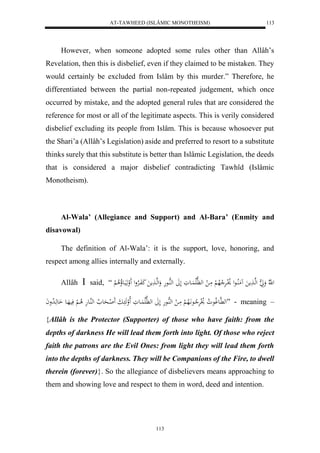
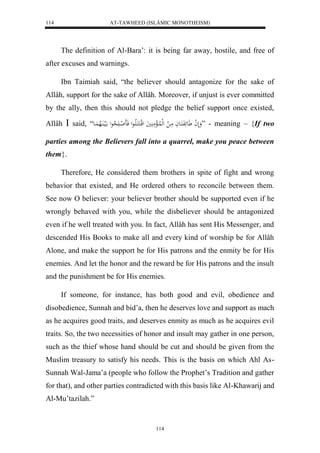
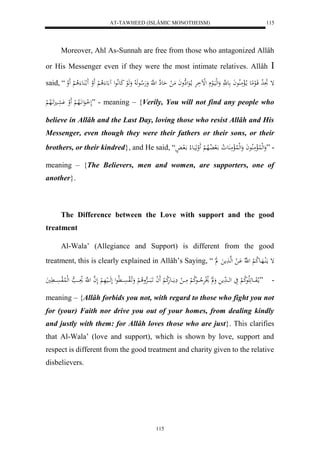
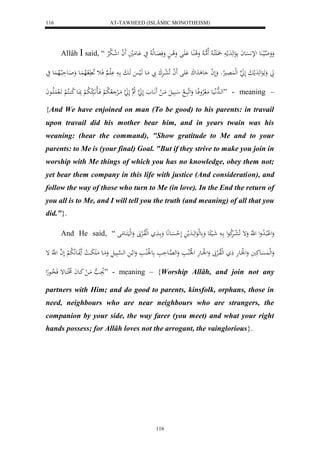
First: the belief that they were truly descended down from Allâh. 
Second: the belief in what we were informed by their names, such as 
the Qur’ân which was descended to Muhammad , and the Tawrat (Torah) 
of Musa (Moses), and the Injil (Gospel) of Isa (Jesus), and the Zabur 
(Psalms) of Dawud (David), and we believe as a whole in those which are 
unknown to us. 
Third: the belief in what we know it is sound in them and reached us, 
such as what the Qur’ân comprehended and what is still not distorted from 
the preceding Books. 
Fourth: to fulfill all ordinances which were not abrogated and be 
satisfied with and accept with full submission whether we perceived its 
foresight or not. In fact, all Books before the Qur’ân are abrogated by the 
Qur’ân, Allâh said, “ ن لَ يولإَّلَسَي ل لَْ نَََّيو للَّيولَحَ قَّلمُّصَيرَّ لًوللَّ يوللَيسَلَل رَ ي لمَّيلَل لَْ لََّنَيو ل 
مََُّ سَ ييول لَسَيي ل ” - meaning – “To you We sent the Scripture in truth, 
confirming the Scripture that came before it, and guarding it in safety”. 
42
AT-TAWHEED (ISLÂMIC MONOTHEISM) 
43 
Therefore, one can not adopt one of the preceding Books laws except if it is 
sound and approbated by the Qur’ân. 
The Belief in the Holly Books brings forth to the believer so many 
43 
significant benefits, like: 
First: to know how Allâh cares for His slaves, for He has descended 
to every people a Book to guide them. 
Second: to know the Wisdom of Allâh in His legislation, for he 
decreed for every people what is suitable for them, He said, “ ل رَل عُل ولمي لََ 
شي ال مَ و يُو ” - meaning – {To each among you have We prescribed a 
Law and an Open Way}. 
Third: to perform all praise and thanks to Allâh for this. 
4- The Belief in Allâh’s Messengers 
It is the true belief that Allâh has sent among every nation a 
Messenger proclaiming them to worship Allâh alone with no other partner 
and disbelieves in what is worshipped else. And it is the belief that they are 
all pious, honest, trustworthy, and that they have proclaimed the Messages 
that have been sent to them quite clearly and they have relayed the 
argument of Allâh upon Alamin (mankind and jinn and all other creatures). 
A Messenger is a person who is sent by a certain Message. And it is 
here the person who is inspired by legislation and ordered to proclaim.
AT-TAWHEED (ISLÂMIC MONOTHEISM) 
44 
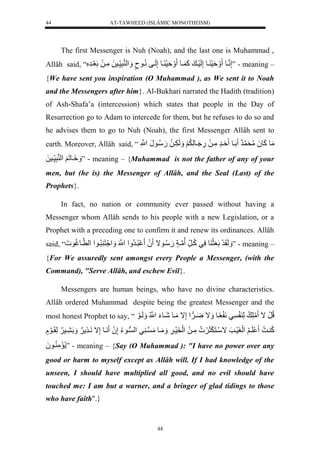
The first Messenger is Nuh (Noah), and the last one is Muhammad , 
Allâh said, “ إَّننيول ةَََسَ يولإَّلَسَي لكَ يول ةَََسَ يولإَّلَيفلنُّيونٍل لََْ نرَّس يسلَلمَّيلَللَعَيرَّلَُّ ” - meaning – 
{We have sent you inspiration (O Muhammad ), as We sent it to Noah 
and the Messengers after him}. Al-Bukhari narrated the Hadith (tradition) 
of Ash-Shafa’a (intercession) which states that people in the Day of 
Resurrection go to Adam to intercede for them, but he refuses to do so and 
he advises them to go to Nuh (Noah), the first Messenger Allâh sent to 
earth. Moreover, Allâh said, “ مَولكَو لَُمُّحَن رَل لَيول ةَيرٍلمَّيلَل.َّ يَُولَّ لَََُّ لَََ يََّلَل.َسُّيونَلنَّْْل 
يَََِولَ لََ لْ نرَّس يسلَل ” - meaning – {Muhammad is not the father of any of your 
men, but (he is) the Messenger of Allâh, and the Seal (Last) of the 
Prophets}. 
In fact, no nation or community ever passed without having a 
Messenger whom Allâh sends to his people with a new Legislation, or a 
Prophet with a preceding one to confirm it and renew its ordinances. Allâh 
said, “ لَََقَرَللَعَثَ ولسَّيلكُّي رل نمياٍل.َسُّيوال لَُ رُّيرُّ لَْنْللَْ نََََُْ رُّيو لْ لْن يوغُّو ل ” - meaning – 
{For We assuredly sent amongst every People a Messenger, (with the 
Command), "Serve Allâh, and eschew Evil}. 
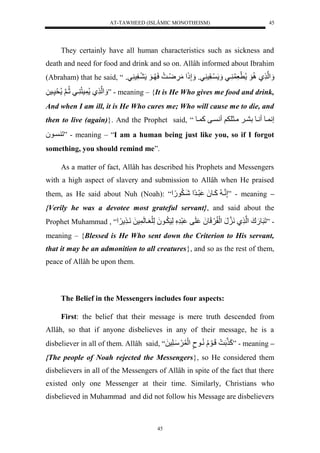
Messengers are human beings, who have no divine characteristics. 
Allâh ordered Muhammad despite being the greatest Messenger and the 
most honest Prophet to say, “ لُّرَلال مَلَّ للَّ يلنَ عًيول اََل يََ لْإَّالمَيولشَيوءَلنُّْْل لََلَيوَل 
كُّ ي ل لَي لَُّ لَْغَسَيتَلاسَينَ ثَََ لمَّيلَل لَْخَسَي لََّ مَََيولمَن ي يل لْو يوءُّلإَّ لَُ نَيولإَّالنَي لََ لَََ يس لََلَّقَيوَللٍل 
مَمَّ يو لَُ ” - meaning – {Say (O Muhammad ): "I have no power over any 
good or harm to myself except as Allâh will. If I had knowledge of the 
unseen, I should have multiplied all good, and no evil should have 
touched me: I am but a warner, and a bringer of glad tidings to those 
who have faith".} 
44
AT-TAWHEED (ISLÂMIC MONOTHEISM) 
45 
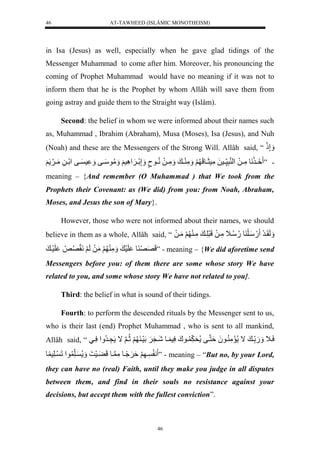
They certainly have all human characteristics such as sickness and 
death and need for food and drink and so on. Allâh informed about Ibrahim 
(Abraham) that he said, “ لََْن يل وَُِّل عَّ ييل يقَّس يول لََإَّذَ لْمَ يََََّ لسَ يوَل ي س يول 
لََْن يل سنُّ ييلثُّينلَ حَسَّيسلَّل ” - meaning – {It is He Who gives me food and drink, 
And when I am ill, it is He Who cures me; Who will cause me to die, and 
then to live (again)}. And the Prophet said, “ إن يول نيولل ي لَميثل لََ ن يفلك يول 
ل يوُ ” - meaning – “I am a human being just like you, so if I forgot 
something, you should remind me”. 
As a matter of fact, Allâh has described his Prophets and Messengers 
with a high aspect of slavery and submission to Allâh when He praised 
them, as He said about Nuh (Noah): “ْ .ً إَّنني لكَيو لَُ رَيرً لْشَي وَُّ ” - meaning – 
{Verily he was a devotee most grateful servant}, and said about the 
Prophet Muhammad , “ًَْ - ”لَرَو.َكَل لْن يلنَن نَل لَْ لَََو لَُ لَفل رَرَّ لَُّلَّسَ يَُّو لَُلَّلَعَيولَ سلَلنَي 
meaning – {Blessed is He Who sent down the Criterion to His servant, 
that it may be an admonition to all creatures}, and so as the rest of them, 
peace of Allâh be upon them. 
The Belief in the Messengers includes four aspects: 
First: the belief that their message is mere truth descended from 
Allâh, so that if anyone disbelieves in any of their message, he is a 
disbeliever in all of them. Allâh said, “ كَ نلَ للَيوَلُّلنُّيونٍل لَْ سَََيلَّسلَل ” - meaning – 
{The people of Noah rejected the Messengers}, so He considered them 
disbelievers in all of the Messengers of Allâh in spite of the fact that there 
existed only one Messenger at their time. Similarly, Christians who 
disbelieved in Muhammad and did not follow his Message are disbelievers 
45
AT-TAWHEED (ISLÂMIC MONOTHEISM) 
46 
in Isa (Jesus) as well, especially when he gave glad tidings of the 
Messenger Muhammad to come after him. Moreover, his pronouncing the 
coming of Prophet Muhammad would have no meaning if it was not to 
inform them that he is the Prophet by whom Allâh will save them from 
going astray and guide them to the Straight way (Islâm). 
Second: the belief in whom we were informed about their names such 
as, Muhammad , Ibrahim (Abraham), Musa (Moses), Isa (Jesus), and Nuh 
(Noah) and these are the Messengers of the Strong Will. Allâh said, “ إَََّذَل 
- ” يَِي نَولمَّييلَل لْ نرَّس ييسلَلمَّسثَييولَ لََ مَََّ يي ل مَََّييلَلنُّييونٍل إَََّلَيي سَََِّْ لََ مََُّوسَييفل س ييفل لَْييلَّلمَيي لََ 
meaning – {And remember (O Muhammad ) that We took from the 
Prophets their Covenant: as (We did) from you: from Noah, Abraham, 
Moses, and Jesus the son of Mary}. 
However, those who were not informed about their names, we should 
believe in them as a whole, Allâh said, “ لَََقَيرَل .َلسَيلَ ول.ُّسُّي لَمَّيلَللَرَلَّي لمَّي لََمَيلَل 
لَصَصَ ول لَسَ ل مَََّ لََمَلَللَ لََنَقَصُّصَل لَسَي ل ” - meaning – {We did aforetime send 
Messengers before you: of them there are some whose story We have 
related to you, and some whose story We have not related to you}. 
Third: the belief in what is sound of their tidings. 
Fourth: to perform the descended rituals by the Messenger sent to us, 
who is their last (end) Prophet Muhammad , who is sent to all mankind, 
Allâh said, “ سَي لَ .َََل ي لال مَمَّ يو لَُةَننيفل حَ يوكَلسَّس يولشَينَ لََلَسَي لََثُّينلَال نَّيرُّ لَْسَّييل 
ن ي لََةَ يًََُولمَّن يوللَ يَْسَ ل يلَّ و لْلَ يلَّس و ” - meaning – “But no, by your Lord, 
they can have no (real) Faith, until they make you judge in all disputes 
between them, and find in their souls no resistance against your 
decisions, but accept them with the fullest conviction”. 
46
AT-TAWHEED (ISLÂMIC MONOTHEISM) 
47 
The Belief in the Messengers brings forth to the believer so many 
47 
significant benefits, like: 
First: to know how Merciful Allâh is with His slaves and how He 
cares for them. This is because He sent to them these Messengers in order 
to guide them ahead to the Way of Allâh and show them clearly how to 
worship their Lord because the human mind is incapable to know that. 
Second: to perform all thanks and praise to Allâh for this great grace. 
Third: to love all Allâh’s Messengers and glorify and praise as it is 
suitable for them. This is because they are the Messengers of Allâh, who 
did what they had to do concerning worshipping and proclaimed the Word 
of Allâh to His slaves. 
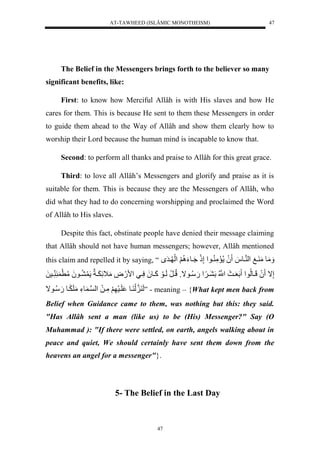
Despite this fact, obstinate people have denied their message claiming 
that Allâh should not have human messengers; however, Allâh mentioned 
this claim and repelled it by saying, “ مَََولمَ ي لََ لْ نيو ل لَُ مَمَّ يو لْإَّذَل يَُوءَ لََُِّ لَْ يرَ ل 
إَّال لَُلَييولُّو لْ لَعَييللََّلنُّْْللَ يي لًَْ.َسُّييواوللُّييرَللَييوَلكَييو لَُسَّيييل مْ.َضَّلمَ اََّ يََياَل ييو لَُمُّ لئَّ ييسلَل 
لَ ن لَ يول لَيسَ لََمَّيلَل لْن ي وءَّلمَلَ يًَول.َسُّيوا ” - meaning – {What kept men back from 
Belief when Guidance came to them, was nothing but this: they said. 
"Has Allâh sent a man (like us) to be (His) Messenger?" Say (O 
Muhammad ): "If there were settled, on earth, angels walking about in 
peace and quiet, We should certainly have sent them down from the 
heavens an angel for a messenger"}. 
5- The Belief in the Last Day
AT-TAWHEED (ISLÂMIC MONOTHEISM) 
48 
The belief in the Last Day is the true certain belief in all what Allâh 
has stated in His Book, and all what His Messenger has informed about in 
his Sunnah (Tradition). It is like events which shall be after death such as 
the trial of the grave, and its happiness and torture, the Resurrection, Al- 
Hashr (the Gathering), As-Sohof (the Scrolls), Al-Hisab (the Account), Al- 
Mizan (the Balance), Al-Hawd (the Fountain), As-Sirat (the Bridge), Ash- 
Shafa’a (the Intercession), the Paradise and the Hell, in addition to all what 
Allâh has prepared to their people and all what will be amongst signs of the 
Last Day, small ones and Big ones. 
The Last Day is the Day of Resurrection on which people will be sent 
to get their fair account, rewards and punishments. It was named as such 
because there is no day after it, for people of Paradise will settle in their 
places, and people of Hell will settle in theirs too. 
The Belief in the Last Day includes three aspects: 
First: the Belief in the Resurrection, which means the raise of the 
dead. And this happens when the second blow in the Trumpet is blown, at 
that time all mankind will stand before their Lord barefooted, naked and 
uncircumcised. Allâh said, “ - ”كَ وللَرَ نَول نَنَل لََِقٍلنُّعَّسرُّ لُُّ رً لْ لَسَ يولإَّننيولكُّ نيولسَيو لَّسلَل 
meaning – {As We produced the first Creation, so shall We produce a 
new one: a promise We have undertaken: truly shall We fulfil it}. 
Furthermore, Resurrection is a truth confirmed by the Scriptures of the 
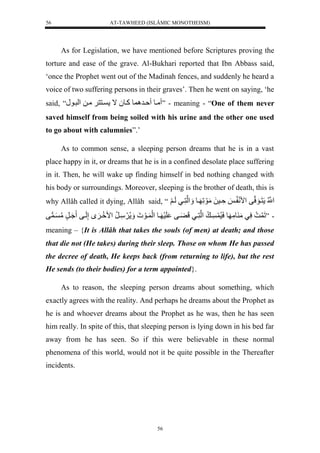
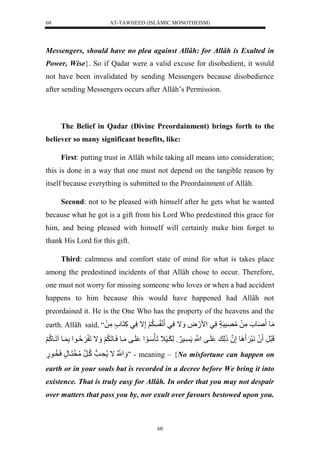
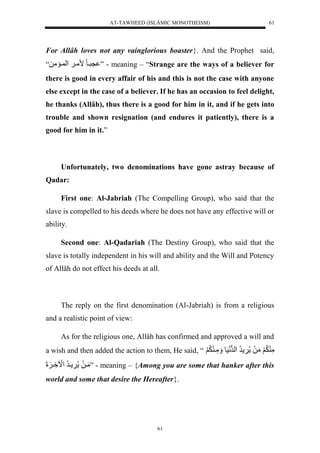
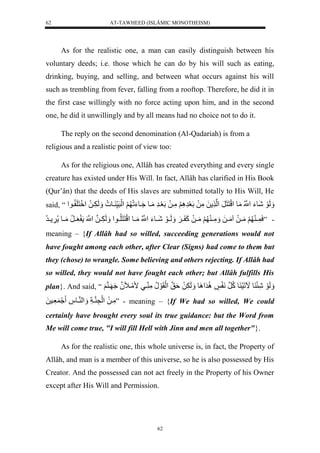
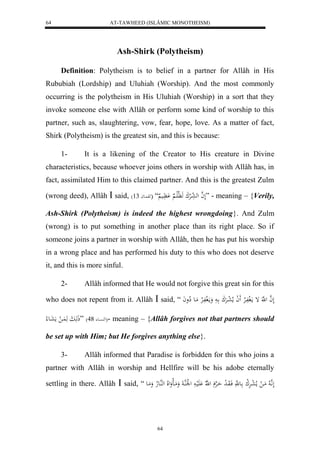
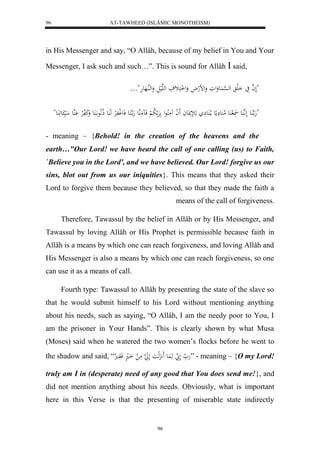
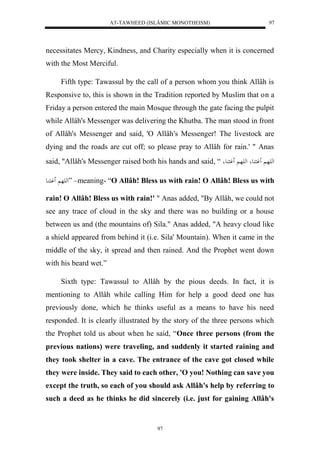
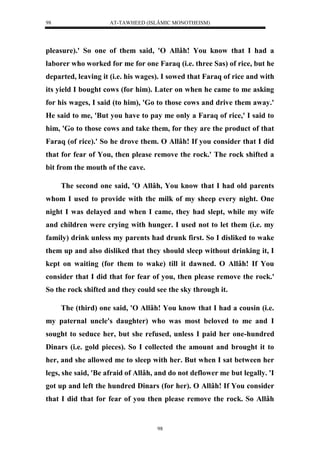
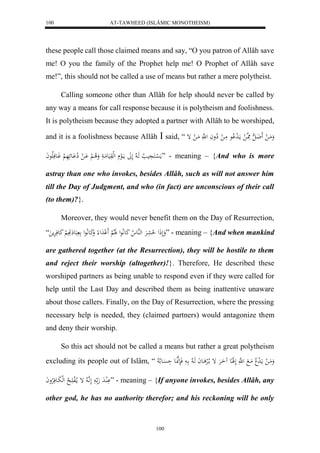
Noble Book of Allâh and the Honorable Sunnah of His Messenger and the 
Consensus (of Muslim Legal Scholars). Allâh said, “ ثُّنلَإَّننلَََُّلَعَرَلذَلَّي للَ س نُّيو وَُل 
ثُّينلَإَّننيَُّ لََ يوَلَل لَْقَّسَومَياَّللُّرَعَثُّيو لَُ ” - meaning – {After that, at length you will die. 
Again, on the Day of Judgment, will you be raised up}, and the Prophet 
48
AT-TAWHEED (ISLÂMIC MONOTHEISM) 
49 
has said, “ ح ي لَ لْ يو ل يولل لْقسوميالة يولل ي لَْلغي اَ ” - meaning – “The people 
would be assembled on the Day of Resurrection barefooted, naked and 
uncircumcised”. And, in fact, it is the mere commensurate aspect of 
Wisdom, which necessitates that Allâh should make a Day of Return to 
repay them for what they have done. Allâh said, “ سَحَ يرَنُّ لََ نن يول لََِقَ يوكُّ لََ رَثًيول 
لََ ننلَََُّإَّلَسَ ولاللُّ عَََُُّيو لَُ ” - meaning – {Did you then think that We had created 
you in jest, and that you would not be brought back to Us (for 
account)?”} and He said to His Prophet: “ إَّنلُ لْني يلسَي ضَََل لَسَي ل لَْقُّي اََ لَُلَي إََْوكَل 
إَّلَيفلمَعَيوإٍل ” - meaning – {Verily He Who ordained the Qur’ân for you, will 
bring you, back to the Place of Return}. 
Second: the belief in the Account and the Repay. This means that the 
slave (of Allâh) will be accounted for his deeds and then he will be repaid 
for them, and this has been confirmed by the Book and the Sunnah and the 
Consensus of Muslim community, Allâh said, “ لإَّنلُإَّلَسَ يولإَّ يولَ وََلثُّينلَإَّنلُ لَسَ يول 
ةَّ ولَ لََ ” - meaning – {For to Us will be their Return; Then it will be for Us 
to call them to account}. And Ibn Omar narrated that the Prophet said, “ ل 
رَنَفل لَْ مَمَّلُّل وَلَل لَْقَّسَومَاَّلمَّلَل.َلل ل ن ل يَََُنرلةَننيفل يَْ لََ لَسَي لكَ ي لسَسُّقَي .ُّ لُُّلَّ نُّولَّي لسَسَقُّيونُّل 
رََِللَعَ فََُّّلسَسَقُّونُّل يَل.َ ل فََُّّللَونَلسَ نٍَّ يللَرَلسَنَ لََُّ ول لَسَي لسَّييل لْيرونَسَول إَََّن ييل غَل يََُِّوللَي ل 
لَْسَوَلَلسَسُّعَ فلصَحَّس اَلةَ ولَّ ل لََ نميول لَْ نيو.ُّل لَََْ يوسَّقُّو لَُسَسُّ يوإَ للَّ ي لََ لَيفل.ُّءُّ ل لَْخَ اََّيقَّل 
يَِمُّاءَّل لْني لَلكَي لُّو لْ لَيفلنْلَّْ ” - meaning – “A believer will be brought to his 
Lord, the Exalted and Glorious, on the Day of Resurrection, and he 
would place upon him His veil, and make him confess his faults. Then, 
He would say, ‘Do you recognize (your faults)?’ He would reply, ‘My 
Lord, I do’. He (the Lord) would say, ‘I concealed them for you in the 
worldly life, and today I forgive them for you. And he would then be 
given the book containing (the account of his) good deeds’. So far as 
49
AT-TAWHEED (ISLÂMIC MONOTHEISM) 
50 
the non-believers and hypocrites are concerned, there would be 
general announcement about them before the entire creation saying, 
‘These people told a lie about Allâh’.” This is in addition to the 
Consensus of Muslim community about the approval of the Account and 
the Repay on the deeds and this is as we said before the mere 
commensurate aspect of Wisdom. 
Third: the belief in the Paradise and the Hell and that both are the 
everlasting return of creation. For Paradise is the place of happiness which 
is prepared for the pious believers who truly believed in what Allâh has 
decreed to believe, and to those who obeyed Allâh and His Messenger, 
faithful to their Lord following His Prophet. 
It is where all sorts of ease exist, and there exists what no eye has 
perceived and no ear has heard and no human mind has ever thought about. 
Allâh said, “ إَّنلُ لْن لَلامَ و لْ لُّو لْ لْنصولَّحَو ل لَََئَّي ل يُِّ لََ سََِي لَُّ لَْرَ نياَّول يَُ لََُُِّّْْ يرلَل 
.َل لََ نو ل يرَ لٍُلَنَي يََّلمَّيلَللَحَنَّ يول مْنَ يو.ُّل وَِلَّيرَّ لَلسَّس يول لَيرً لْ.َ يََّيَلنُّْْل ي لََ .َََ يَُّو لْ 
يي لذَلَّيي للَّ ييلَل يييَل.َلنيي لُّ ” - meaning – {Those who have faith and do 
righteous deeds; They are the best of creatures. Their reward is with 
Allâh: Paradises of Eternity, beneath which rivers flow; they will dwell 
therein forever; Allâh well pleased with them, and they with Him: all this 
for such as fear their Lord and Cherisher}. And He said, “ سَ لَلَعَلَي لَُّنَ ي لمَيول 
ييَلللَ ي لََمَّيلَللُّينَلَّل يسُّلٍل يَُ ءًْللَّ يولكَيونُّو لْ عَ لُّيو لَُ ” - meaning – {Now no person 
knows what delights of the eye are kept hidden (in reserve) for them, as a 
reward for their (good) Deeds}. 
On the other hand, Hell is where torture exists, prepared for 
wrongdoers disbelievers, who disbelieved in Allâh and disobeyed His 
Messengers. There exist all sorts of suffering and exemplary punishment, 
50
AT-TAWHEED (ISLÂMIC MONOTHEISM) 
51 
which would not cross anyone’s mind. Allâh said, “ لََْنقُّو لْ لْ نو.َل لْننَّيل رن ل 
لَّلَ وََسَّ لَل ” - meaning – {Fear the Fire, which is prepared for those who 
reject Faith}. And He said, “ إَّننول نَرَنَوللَّلنظولَّ سلَلنَو.ً لْ ةَورَللَّ لََسُّ إَََّْلُّ ول إَََّ لَُ 
نَغَّسثُّو لْ غَوثُّو لْلَّ وءٍلكَولَ رَّل وَّيل لَْوُّ وُُّ لَُلَّئَ ل لْن ل سَََوءَ لمُّ لَََ لَقًو ” - meaning – 
{We have prepared a Fire whose (smoke and flames), like the wall and 
roof of a tent, will hem them in. If they implore relief they will be granted 
water like melted brass, that will scald their faces. How dreadful the 
drink! How uncomfortable a couch to recline on!}. 
The Belief in the Last Day brings forth to the believer so many 
51 
significant benefits, like: 
First: prompting the desire to obey and the care for them looking 
forward to being rewarded on that Day. 
Second: prompting the awe from disobeying or accepting disobeying 
fearing the punishment of that Day. 
Third: the consolation of the believer in what he does not get in this 
world in return of what he hopes to get in the Thereafter. 
Despite this fact, disbelievers have denied the Resurrection after death 
claiming that it is inconceivable; however, this is obsolete and its desuetude 
is proved by Divine Legislation, common sense, and reason. 
Concerning the Divine Legislation, Allâh said, “ زَ لََ لْن لَلكَ لََُّْ لَُلَيلَل 
رَعَثُّو لْلُّيرَللَلَيفل .َََل ييللَنُّرَعَيثُّنللثُّينلَلَنُّ رنيمُّنلُلَّ يول لَينُّ لََ ذَََلَّي ل لَيفلنَّْْل يس لََ ” - meaning – 
{The Unbelievers claimed that they will not be raised up (for Judgment). 
Say (O Muhammad ): "Yea, by my Lord, you shall surely be raised up:
AT-TAWHEED (ISLÂMIC MONOTHEISM) 
52 
then shall you be told (the truth) of all that you did. And that is easy for 
Allâh."}, and all Holly Books have agreed upon this aspect. 
Concerning the common sense, Allâh has shown His slaves examples 
about the raising of the dead, five of them are mentioned in Surat Al- 
Bakarah (The Cow), they are: 
First example: the people of Musa (Moses) asked their Prophet to 
show them Allâh plainly, for this reason, Allâh made them dead then He 
gave them life, as He said, “ إَََّذَللُّلَينُّ لََ ومُّوسَيفللَيلَلنُّيمَمَّلَللَي لةَننيفلنَي لنَْْل ي لًََل 
سَأ لَ لَََُّ لْنصو قَاُّل نَنُّ لََلَ ظُّ وَََُُّلثُّنلَلَعَثَ وكُّ لََمَّلَللَعَرَّلمَوَلَّ لَََُّلَعَلنيَُّ لََلَ ي لََََُُُّّ ” - meaning 
– {And remember when you said: "O Moses! We shall never believe in 
you until we see Allâh manifestly," but you were dazed by thunder and 
lightning even as you looked on. Then We raised you up after your death; 
you had the chance to be grateful}. 
Second example: the story of the murdered person whom the conflict 
in Bani Israel (The Children of Israel) was about. Al-Bakarah (The 
Cow):73. 
Third example: the story of those who went forth from their homes in 
thousands, fearing death. Allâh told them ‘die!’, and then He restored them 
to life. 
Fourth example: the story of the one who passed by a dead town and 
regarded that it is unlikely to have this town alive again. Allâh then took 
life from him hundred years and then gave it back to him. 
Fifth example: the story of Ibrahim (Abraham) the Intimate when he 
asked Allâh to show him how He gives life to the dead. 
52
AT-TAWHEED (ISLÂMIC MONOTHEISM) 
53 
So, these are true seen examples, which shows the possibility of 
raising dead into life again. In addition to what we mentioned about the 
Signs (Miracles) of Isa (Jesus) when Allâh gave him the ability to raise 
dead out of their graves, only after Allâh’s permission. 
Yet the proof of reason on the possibility of Resurrection is stated 
53 
in two aspects: 
First aspect: Allâh has created the earth and heavens and all what is 
between them from the very beginning, and the One who could once start 
the creation can surely recreate it again. Allâh said, “ وَََُِّل لْن يل رَيرَ ل لَْخَلَيقَلثُّينلَ 
عَّسيرُّ لُُّ يََُِّوَل يَِوَ لُُّ لَسَي ل ” - meaning – {It is He Who begins (the process of) 
creation; then repeats it; and for Him it is most easy}. 
Second aspect: we see the earth barren with no single green tree in it, 
but when Allâh sends down water (rain) on it, it is stirred to life, and swells 
and puts forth every lovely kind of growth. The One Who could give life to 
this earth is for sure easily capable of giving raise to dead. Allâh said, “ مَََّلَل 
ا ولَّي ل نني للَي ل مْ.َضَل وَِشَّيعَاًلسَي ذٍََّ لْ ن لَ يول لَسَ يول لَْ يوءَل نََِْين ل .َََلَي لإَّنلُ لْني يل ةَسَو يَِول 
لَ حَسَّيل لَْ يوَلَفلإَّنني ل لَيفلكُّي رلشَييَءٍللَيرَّ لََ ” - meaning – {And among His Signs in 
this: where you see the earth barren and desolate; but when We send 
down rain to it, it is stirred to life and yields increase. Truly, He Who 
gives life to the (dead) earth can surely give life to (men) who are dead. 
For He has power over all things}. 
The Belief in what shall be after death follows the belief in the 
Last Day:
AT-TAWHEED (ISLÂMIC MONOTHEISM) 
54 
a) The Fitnah (Trial) of the grave: 
It is asking the dead after burying him about his Lord, his Religion, 
and his Prophet. Yet there, Allâh will keep firm with the word that stands 
firm those who believe, so he would say, ‘my Lord is Allâh, my Religion 
is Islâm, and my Prophet is Muhammad ’. Then Allâh will cause to go 
astray wrongdoers, and the disbeliever would say, ‘Hah! Hah! I do not 
know’, and the hypocrite would say, ‘I do not know, I heard people say 
so and I said as they did’. 
b) The Torture of the grave and its Ease: 
Concerning the Torture of the grave, it would be the chance of 
wrongdoers (disbelievers or hypocrites). Allâh said, 
مَََلَل ظَلَ لَُّمَّن لَل سَْنَ ل لَفلنَّْْلكَ لًول لََلَونَل ةََّيَلإَّلَنيل لَََ لََ ونَلإَّلَسَ لشَيَءَل مَََلَللَيونَل 
سَيأنُّ نُّلمَّثَيرَلمَيول ني نَلنُّْْل لَََيوَللَي لإَّذَل لْنظيولَّ و لَُسَّييلغَ ي ل لَْ يوَ ل لَََْ اََّ يََاُّللَوسَّي ول 
رَّ لََل وَََُُِّّ لْ ن لَََُّ لَْسَوَلَللُّنَ لَََُ ل لَْ يو لَُّلَّ يولكُّ ينُّ لََلَقُّولُّيو لَُ لَيفلنَّْْلغَسَي لََ لَْحَي قَّل 
كََُّ نُّ لََ لَلا ولَّ للَ نَ رَََّ وَََُُّ 
- meaning - {Who can be more wicked than one who invented a lie 
against Allâh, or said: "I have received inspiration," when he had 
received none, or (again) who said, "I can reveal the like of what Allâh 
has revealed?" If you could but see how the wicked (do fare) in the flood 
of confusion at death! The angels stretch forth their hands, (saying), 
"Yield up your souls: this day shall you receive your reward, a penalty of 
shame, for that you used to tell lies against Allâh, and scornfully to reject 
of His Signs!"} And He said about the people of the Pharaoh: “ لْ نيو.ُّل 
- ” عَ يَََُّيو لَُ لَسَ ييولغُّييرُّ لْ ييس ول ييوَلَللَقُّييولُّل لْن ييو اُّل إَ لَُِّّييو لْانَلسَّ ييوَ لَُ شَييرنل لَْعَيي ل 
meaning – {In front of the Fire will they be brought, morning and 
54
AT-TAWHEED (ISLÂMIC MONOTHEISM) 
55 
evening: and (the Sentence will be) on the Day that Judgment will be 
established: "Cast you the People of Pharaoh into the severest 
Punishment!"}. And the Prophet said, “َ - ”لعييوذ لَْلييوملمييلل يي ل لْقريي 
meaning – “Seek the Protection of Allâh from the grave torture”. 
Yet concerning the Ease of the Grave, it is the chance of the honest 
believers, Allâh said, “ إَّنلُ لْن لَللَولُّو لْ.َلو ولنُّْْلثُّنلَ سَْنَقَومُّو لْلَنَ ن نُّل لَيسَ لََ لَْ ل اََّ يََاُّل ال 
لَخَوسُّو لْ اََللَحَ نُّو لْ لَ لََُّْلَّولَنَ ناَّل لْننَّيلكُّ نُّ لََلُّو يرُّ لََُ ” - meaning – {In the case of 
those who say, "Our Lord is Allâh," and, further, stand straight and 
steadfast, the angels descend on them (from time to time): "Fear you 
not!" (they suggest), "Nor grieve! but receive the Glad Tidings of the 
Paradise (of Bliss), that which you were promised!}. Moreover, Al-Bara’ 
bin ‘Azeb narrated that the Prophet said about the believer who will answer 
the questions of the two Angels in his grave, “ - ” يوإيلم يوإٍلميلل لْ ي وء 
meaning – “..then a crier will call from Heaven, ‘My servant has 
spoken the truth, so spread a bed for him from Paradise, clothe him 
from Paradise, and open a door for him into Paradise’. So some of its 
air and perfume will come to him, and a space will be made for him as 
far as the eye can see.” 
However, people of distortion went astray in this aspect, so they 
denied the torture of the grave and its Ease claiming that this is 
inconceivable because it contradicts with reality. They said that if we dug a 
grave, we would have found it as it was and not changed, neither wider nor 
narrower. 
As a matter of fact, this claim is obsolete by all considerable means: 
Legislation, common sense, and reason. 
55
AT-TAWHEED (ISLÂMIC MONOTHEISM) 
56 
As for Legislation, we have mentioned before Scriptures proving the 
torture and ease of the grave. Al-Bukhari reported that Ibn Abbass said, 
‘once the Prophet went out of the Madinah fences, and suddenly he heard a 
voice of two suffering persons in their graves’. Then he went on saying, ‘he 
said, “ ميول ةير ولكيو لُال ينن لَميلل لْريون ” - meaning - “One of them never 
saved himself from being soiled with his urine and the other one used 
to go about with calumnies”.’ 
As to common sense, a sleeping person dreams that he is in a vast 
place happy in it, or dreams that he is in a confined desolate place suffering 
in it. Then, he will wake up finding himself in bed nothing changed with 
his body or surroundings. Moreover, sleeping is the brother of death, this is 
why Allâh called it dying, Allâh said, “نُّْْلل نَيوَسنفل مْنَ ي لةَّيسلَلمَوَلَّ يول لََْننَّييللَي لََ 
- ”لَ لسَّيلمَ ومَّ ولسَسُّ ي ل لْننَّييللَ يَْفل لَسَ يول لَْ يوَ ل سَََّيرُّل مْ يَِ لإَّلَيفل يَُرٍلمُّ ي ف 
meaning – {It is Allâh that takes the souls (of men) at death; and those 
that die not (He takes) during their sleep. Those on whom He has passed 
the decree of death, He keeps back (from returning to life), but the rest 
He sends (to their bodies) for a term appointed}. 
As to reason, the sleeping person dreams about something, which 
exactly agrees with the reality. And perhaps he dreams about the Prophet as 
he is and whoever dreams about the Prophet as he was, then he has seen 
him really. In spite of this, that sleeping person is lying down in his bed far 
away from he has seen. So if this were believable in these normal 
phenomena of this world, would not it be quite possible in the Thereafter 
incidents. 
56
AT-TAWHEED (ISLÂMIC MONOTHEISM) 
57 
6- The Belief in the Qadar (Divine Preordainment) 
The Belief in Qadar is the certain doctrine that Allâh has created 
everything and that He is its Lord and Owner, and that He has 
predetermined circumstances, good and evil ones, sweet and bitter ones. 
Furthermore, He is the One Who created guidance and aberration, misery 
and happiness, and He is the One Who owns terms (of death) and 
subsistence (for living). 
Qadar (Divine Preordainment) is the Predestination of Allâh for the 
whole creation in accordance with His Earliest Knowledge and what His 
Wisdom necessitates. 
The belief in Qadar includes four different aspects: 
First: the belief that Allâh know every single thing as a whole and in 
detail, from the beginning and everlasting, whether it is related to His 
Deeds or his slaves deeds. 
Second: the belief that what previously mentioned about His 
Knowledge is inscribed in a Preserved Tablet. And in these two aspect 
Allâh says, “ لَ لََلَعَلَي لََ نلُنَْْل عَلَي لَُّمَيولسَّييل لْن ي وءَّل مََْ.َضَّلإَّنلُذَلَّي لسَّييلكَّنَيو لإَّنلُذَلَّي ل 
لَيفلنَّْْل يس لََ ” - meaning – {Know you not that Allâh knows all that is in 
heaven and on earth? Indeed it is all in a Record, and that is easy for 
Allâh}. 
Third: the belief that all creatures would not exist or persist except 
with His Will, whether it is concerned about His Deeds or His slaves deeds. 
As for His Deeds, Allâh said, “ لوي ل خَلُّيقُّلمَيول يوءُّل خَنَيو.ُّل .َََ ” - meaning – 
57
AT-TAWHEED (ISLÂMIC MONOTHEISM) 
58 
{Your Lord does create and choose as He pleases!} And as for His 
creatures: “ لَََيوَلشَيوءَلنُّْْللَ يلن لََ لَيسَ لَََُّسَلَقَيولَلُّوكُّلََ ” - meaning – {If Allâh had 
pleased, He could have given them power over you, and they would have 
fought you}. 
Fourth: the belief that Allâh has created all creatures, selves, 
descriptions, and activities. Allâh said, “نُّْْل وَِلَّقُّلكُّ رلشَيَءٍل وَََُِّل لَفلكُّي رلشَييَءٍل 
كَََّسيرَل ” - meaning – {Allâh is the Creator of all things, and He is the 
Guardian and Disposer of all affairs}. And He said, “ لََََِقَلكُّينرلشَييَءٍلسَقَيرن.َ لُُّ 
لَقَيرَّ ” - meaning – {It is He Who created all things, and ordered them in 
due proportions}, and informed that His Prophet Ibrahim (Abraham) said, 
نََُّْْل لََِقَ يَُّ لََ مَََيوللَعَ لُّيو لَ“ُ ” - meaning – {But Allâh has created you and your 
handiwork!}. 
In fact, this sort of belief in Qadar does not by any way contradict 
with the fact that the slave has a will in choosing his deeds and the ability 
to perform them. This is because the Divine Legislation (Ash-Shar’) and 
the reality prove this to him. 
As for Divine Legislation (Ash-Shar’), Allâh said about the human 
will: “ سَ لَلشَوءَل لْنخَ لإَّلَفل.َل لمَآلًو ” - meaning – {Therefore, whose will, let him 
take a (straight) Return to his Lord!}, and said, “ - ”سَيأَلُّو لْةَي ثَََ لَََُّ ننيفلشَّيئَنُّ لََ 
meaning – {So approach your tilth when or how you will}, and He said 
about the ability: “ْ سَولنقُّو لْنَْْلمَول سَْنَ عَنُّ لََ سَََْ عُّو لْ رَّسعُّو ” - meaning – {So fear 
(obey) Allâh as much as you can; listen and obey}. And said, “ ال لَََّ ي لُُّنُّْْل 
نَ ولإَّال سََُّيعَ وللَ يولمَيولكَ يرَ ل لَسَ يولمَيول كَْنَ يرَ ل ” - meaning – {On no soul does 
Allâh place a burden greater than it can bear. It gets every good that it 
earns, and it suffers every ill that it earns}. 
58
AT-TAWHEED (ISLÂMIC MONOTHEISM) 
59 
As for reality, every human being knows that he has a will and a 
potency by which he can do or not do whatever he wants. However, there is 
a difference between what occurs by his will such as walking, and what 
occurs unwillingly like trembling. However, the will of the slave (of Allâh) 
and his potency are both subjected to the Will of his Lord and His Potency, 
for Allâh said, “ ”لَّ لَلشَوءَلمَّ لَََُّ لَُ نَقَّس وََل مَََوللَ وءُّ لََُإَّال لَُ وءَلنُّْْل.َو ل لَْعلَولَ سلَل 
- meaning – {(With profit) to whoever among you wills to go straight. But 
you shall not will except as Allâh wills; the Cherisher of the Worlds}, and 
because Allâh owns this whole universe and nothing against His 
Knowledge or Will occurs in His Ownership. 
Moreover, faith in Qadar, the way we stated, does not by any means 
give an excuse for the slave to quit duties, or commit forbidden acts. As a 
result, his pleading is absurd from different aspects: 
First: Allâh’s Saying, “ سَسَقُّونُّل لْن لَل شَ كََُّو لْلَوَلشَوءَلنُّْْلمَول شَي كَََ ول اََلاللَو نَُّْيول 
اََلةَنَمَ ولمَّلَلشَيَءٍلكَ لَّ لكَ ن ل لْن لَلمَّلَللَرَلَّ لََةَننفلذَ لُّْو لْلَأَسَ وللُّرَل يَِرَل يرَكُّ لََمَّيلَلل لَي لٍَ 
سَنُّخَ وََُُّّ لُُّلَ ولإَّ لَُلَننرَّعُّو لَُإَّال لْنظينلل إَََّ لَُ نَينُّ لََإَّاللَخَ صَُُّّيو لَُ ” - meaning – {Those who 
give partners (to Allâh) will say: "If Allâh had wished, we should not 
have given partners to Him, nor would our fathers: nor should we have 
had any taboos." So did their ancestors argue falsely, until they tasted of 
Our wrath. Say (O Muhammad ): "Have you any (certain) knowledge? If 
so, produce it before us. You follow nothing but conjecture: you do 
nothing but lie."}, so if they had an excuse in Qadar, Allâh would not have 
tasted them His Wrath. 
Second: Allâh’s Says, “ .ُّسُّي لَمُّرَ ي لَل مََُّ ي .َّ لَلمال يَُّو لَُلَّل نيو ل لَيفلنْْلَّل 
ةُّننياَللَعَيرَل لْوَسُّيرَّل كَََيو لَُنُّْْل ي لْةَ سََّ يو ” - meaning – {Messengers who gave 
good news as well as warning, that mankind, after (the coming) of the 
59
AT-TAWHEED (ISLÂMIC MONOTHEISM) 
60 
Messengers, should have no plea against Allâh: for Allâh is Exalted in 
Power, Wise}. So if Qadar were a valid excuse for disobedient, it would 
not have been invalidated by sending Messengers because disobedience 
after sending Messengers occurs after Allâh’s Permission. 
The Belief in Qadar (Divine Preordainment) brings forth to the 
believer so many significant benefits, like: 
First: putting trust in Allâh while taking all means into consideration; 
this is done in a way that one must not depend on the tangible reason by 
itself because everything is submitted to the Preordainment of Allâh. 
Second: not to be pleased with himself after he gets what he wanted 
because what he got is a gift from his Lord Who predestined this grace for 
him, and being pleased with himself will certainly make him forget to 
thank His Lord for this gift. 
Third: calmness and comfort state of mind for what is takes place 
among the predestined incidents of that Allâh chose to occur. Therefore, 
one must not worry for missing someone who loves or when a bad accident 
happens to him because this would have happened had Allâh not 
preordained it. He is the One Who has the property of the heavens and the 
earth. Allâh said, “ مَول صَو لمَّلَلمُّصَّسرَاٍلسَّيل مْ.َضَّل اََلسَّيل نَ لَََُّإَّالسَّيلكَّلنَو لمَّلَل 
لَرَرَّل لَُنَرَ وَِلإَّنلُذَلَّ ل لَيفلنَّْْل يس وََللَّ يََسَ لَلَأَسَيوَ لْ لَيفلمَيولسَيولَ لَََُّ اََللَ ةََُّيو لْلَّ يولالَيوكُّ لََ 
نََُّْْلال حَّيوتلكُّينرلمُّخَنَيونٍلسَخُّيو.ٍل ” - meaning – {No misfortune can happen on 
earth or in your souls but is recorded in a decree before We bring it into 
existence. That is truly easy for Allâh. In order that you may not despair 
over matters that pass you by, nor exult over favours bestowed upon you. 
60
AT-TAWHEED (ISLÂMIC MONOTHEISM) 
61 
For Allâh loves not any vainglorious boaster}. And the Prophet said, 
نريولًممي لَ لْ يممل“ ” - meaning – “Strange are the ways of a believer for 
there is good in every affair of his and this is not the case with anyone 
else except in the case of a believer. If he has an occasion to feel delight, 
he thanks (Allâh), thus there is a good for him in it, and if he gets into 
trouble and shown resignation (and endures it patiently), there is a 
good for him in it.” 
Unfortunately, two denominations have gone astray because of 
61 
Qadar: 
First one: Al-Jabriah (The Compelling Group), who said that the 
slave is compelled to his deeds where he does not have any effective will or 
ability. 
Second one: Al-Qadariah (The Destiny Group), who said that the 
slave is totally independent in his will and ability and the Will and Potency 
of Allâh do not effect his deeds at all. 
The reply on the first denomination (Al-Jabriah) is from a religious 
and a realistic point of view: 
As for the religious one, Allâh has confirmed and approved a will and 
a wish and then added the action to them, He said, “ مَّ لَََُّمَلَل رُّل لْرلونَسَول مَََّي لَََُّ 
مَيلَل يرُّل لَْا يَِّ لََلَ ” - meaning – {Among you are some that hanker after this 
world and some that desire the Hereafter}.
AT-TAWHEED (ISLÂMIC MONOTHEISM) 
62 
As for the realistic one, a man can easily distinguish between his 
voluntary deeds; i.e. those which he can do by his will such as eating, 
drinking, buying, and selling, and between what occurs against his will 
such as trembling from fever, falling from a rooftop. Therefore, he did it in 
the first case willingly with no force acting upon him, and in the second 
one, he did it unwillingly and by all means had no choice not to do it. 
The reply on the second denomination (Al-Qadariah) is from a 
religious and a realistic point of view too: 
As for the religious one, Allâh has created everything and every single 
creature has existed under His Will. In fact, Allâh has clarified in His Book 
(Qur’ân) that the deeds of His slaves are submitted totally to His Will, He 
said, “ لَََوَلشَوءَلنُّْْلمَول لَْنَنَرَل لْن لَلمَّلَللَعَرَّ لَََِّمَّيلَللَعَيرَّلمَيول يَُوءَلَ لََ لَْرَس يو ل لَََ يََّلَلل نََِْلَ يو لْ 
- ”سَ يي لََمَييلَلامَييلَل مَََّيي لََمَييلَلكَ يي لََ لَََييوَلشَييوءَلنُّْْلمَييول لَْنَنَلُّييو لْ لَََ يََّينللنَْْل عَييرُّلمَييول ييرلُّ 
meaning – {If Allâh had so willed, succeeding generations would not 
have fought among each other, after Clear (Signs) had come to them but 
they (chose) to wrangle. Some believing and others rejecting. If Allâh had 
so willed, they would not have fought each other; but Allâh fulfills His 
plan}. And said, “ لَََوَلشَّئَ وللَالَسَ ولكُّنرلنَ ل رَُِّ وَِْل لَََ لَََّلةَنقل لَْقَوَلنُّلمَّ ييلممَينَّلُ لَ ي نلََ 
مَّيلَل لَْنَّ نياَّل لََْ نيو ل عَّيسلَل ” - meaning – {If We had so willed, We could 
certainly have brought every soul its true guidance: but the Word from 
Me will come true, "I will fill Hell with Jinn and men all together"}. 
As for the realistic one, this whole universe is, in fact, the Property of 
Allâh, and man is a member of this universe, so he is also possessed by His 
Creator. And the possessed can not act freely in the Property of his Owner 
except after His Will and Permission. 
62
AT-TAWHEED (ISLÂMIC MONOTHEISM) 
63 
Tawheed-III 
63
AT-TAWHEED (ISLÂMIC MONOTHEISM) 
64 
Ash-Shirk (Polytheism) 
Definition: Polytheism is to belief in a partner for Allâh in His 
Rububiah (Lordship) and Uluhiah (Worship). And the most commonly 
occurring is the polytheism in His Uluhiah (Worship) in a sort that they 
invoke someone else with Allâh or perform some kind of worship to this 
partner, such as, slaughtering, vow, fear, hope, love. As a matter of fact, 
Shirk (Polytheism) is the greatest sin, and this is because: 
1- It is a likening of the Creator to His creature in Divine 
characteristics, because whoever joins others in worship with Allâh has, in 
fact, assimilated Him to this claimed partner. And this is the greatest Zulm 
(wrong deed), Allâh  said, ) لَ ه ا له عالرْكَ هَ لَّالَا اَََّْي “ )هو اُعا 31 ” - meaning – {Verily, 
Ash-Shirk (Polytheism) is indeed the highest wrongdoing}. And Zulm 
(wrong) is to put something in another place than its right place. So if 
someone joins a partner in worship with Allâh, then he has put his worship 
in a wrong place and has performed his duty to this who does not deserve 
it, and this is more sinful. 
2- Allâh informed that He would not forgive this great sin for this 
who does not repent from it. Allâh  said, “ لَ ه ا ل ه إ مالَ ففَالارْ لََ ا ملا ل عارَْكَ ا ومالَ ففَالارْ مَاع لِاواَ 
له سُْاع 84 ( ”ذَهَابَ هَ اَُ ل مَعَاع لا (- meaning – {Allâh forgives not that partners should 
be set up with Him; but He forgives anything else}. 
3- Allâh informed that Paradise is forbidden for this who joins a 
partner with Allâh in worship and Hellfire will be his adobe eternally 
settling in there. Allâh  said, “ لَ اَّ ه لا مَا ل ملا ل عارَْل ك اع هَّ فَاوَا ل د حَاهرْ ل هّلا لَََْيا ل ل لَْهُا وَمَاالوَللَا لههُاعلاه وَمَاع 
64
AT-TAWHEED (ISLÂMIC MONOTHEISM) 
65 
للاعئادل 27 (”هَ هََّعهَ يََُ مَ ل اََََِّعهْ ( - meaning – {Whoever joins other gods with Allâh, 
Allâh will forbid him the Paradise, and the Fire will be his abode. There 
will for the wrongdoers be no one to help}. 
4- It (Shirk) causes all pious deeds to be in vain, Allâh  said, 
- )لض ااع 44 (”ذَهَاابَ لا اادَ ل هَّ مالَهاادَ اا مَاا ل مَعَااع لا مَاا ل بََْااع وَهَاالع لََ شاارَْلا كعل اََُابَ اَْالُالاه لْ مَااع كَااعلَّاعل مالَ لََُاااعاَ “ 
meaning – {This is the Guidance of Allâh: He gives that guidance to 
whom He pleases of His worshippers. If they were to join other gods with 
Him, all that they did would be vain for them}. And said, “ وَهَوَ ل د لَاوحَ لَهَليبَ ولَلََ 
له مِارْ 27 ( ”لهه مََ مَ ل قَالب بَََ هَ ل لََ شرَْل كاَ هَيَ ل حبَ هََّ لَََُْابَ وَهَكَ لا باع هََّ مَا ل ل لََع ارَْم ( - meaning – {But it 
has already been revealed to you, - as it was to those before you - If you 
were to join (gods with Allâh), truly fruitless will be your work (in life), 
and you will surely be in the ranks of those who lose (all spiritual good)}. 
5- The blood (life) and the property of the one who joins others 
with Allâh in worship is unproscribed, Allâh  said, “ فَاعقلاكلاالَاعل لهللُا ل عارَْكَيَ حَليا لا 
لهكع ا 5( ”وَ ل دلاَلاعلا لْ وَ لا اا لَاولا لْ وَل ل ح لااِلارْولا لْ وَلقلا لاا لا دول لََالالْ لا كا ه ل مَلرْاَادْ (- meaning – {Then fight and 
slay the Pagans wherever you find them, and seize them, beleaguer them, 
and lie in wait for them in every stratagem (of war)}. And the Prophet  
said, “ مَارْو اَ قَع اَل له اُع حا موعهاعل إ لها لإ ه و ملاوي اُعل له اِثل و ملا اَْعل لهكِاعل ” - meaning - 
“I have been commanded (by Allâh) to fight against people till they 
testify that, ‘Lâ ilâha illallâh’, i.e. ‘there is no truly worshipped god but 
Allâh, and that Muhammad  is the Messenger of Allâh’, perform 
Prayer, and pay Zakat. So if they do that, their blood and property are 
65
AT-TAWHEED (ISLÂMIC MONOTHEISM) 
66 
guaranteed protection on my behalf except when justified by law, and 
their affairs rest with Allâh”. 
6- Shirk is the greatest among Kaba’er (Great Sins), the Prophet 
إَ بََّا ب ااكرُ لهبباعئرْ ” - meaning - “Should I not inform you about 
the most grievous of the grave sins?” We (his companions) said, “Yes, O 
Messenger of Allâh ”, he said, “ للإشاارْلك ااعق و وْااع لهعلهاادم ” - meaning - 
“Associating anyone with Allâh, disobedience to parents…” 
Therefore, Shirk (Polytheism) is the greatest Zulm (Wrong deed), and 
the Tawhîd (Monotheism) is the fairest just. And whatever contradicts with 
this aimed fact most, then it is the greatest Zulm (wrong) and Allâh has 
forbidden Paradise for those who join with Him others in worship and He 
unproscribed their lives, properties, and wives for those who worship Him 
alone. And then allowed for the latter to keep the former as slaves because 
of their polytheism. Moreover, Allâh refused to approve any single deed for 
the polytheist, or to accept any intercession from anyone. Or even accept a 
call from him on the Day of Resurrection. This is because the polytheist is 
the most ignorant man for he adopted with Allâh a partner, and this is in 
fact a mere ignorance, but the Zulm (unjust) committed is not against 
Allâh, it is against himself. 
7- Shirk is defect and a fault, which Allâh deemed himself far 
above. Therefore, whoever joined with Allâh others in worship has 
approved to Allâh features that Allâh deemed Himself far above, and this is 
an extreme contradiction and opposition to Allâh. 
66
AT-TAWHEED (ISLÂMIC MONOTHEISM) 
67 
67 
Types of Shirk: 
Shirk is divided into two types 
First type: Ash-Shirk Al-Akbar (Major Polytheism), causes his 
people not to be Muslims anymore and to settle eternally in the HellFire if 
he died without repenting. It is to perform any of the known worship to 
another one than Allâh, such as to invoke and approach to this claimed 
partner with slaughtering and vows approached to graves, jinn, and devils. 
And such as the fear from the dead or jinn or devils not to harm or cause 
sickness, or to hope from them what could not be got except from Allâh. 
Unfortunately, this is nowadays seen at dolmens built over graves of pious 
and good men, Allâh  said, “ وَمالَ بلاا لا دواَ مَا ل لِاواَ ل هَّ مَاع إ مَ لااُهرْلا لْ وَإ مااَلُافَ لالاه لْ وَمالَاوعهلااعاَ الاْإ 
لا شافَ علاُ عََّ لَُْادَ ل ه ” - meaning – {They worship, besides Allâh, things that hurt 
them not nor profit them, and they say: "These are our intercessors with 
Allâh”}. 
Second type: Ash-Shirk Al-Asghar (Minor Polytheism), does not 
extrude out of Islâm, but surely diminishes some of the Monotheism and it 
is certainly a way to reach the major one. And it is two classes: 
First class: apparent shirk, and it is by word and deed. By word such 
as swear by someone other than Allâh, the Prophet  said, “ -”ما ح اَف فا ه 
meaning – “He who swears by anything beside Allâh is guilty of an act
AT-TAWHEED (ISLÂMIC MONOTHEISM) 
68 
of disbelief (or of associating something with Allâh)”. And saying ([let it 
be] whatever Allâh and you want), for when someone said to Allâh’s 
Messenger, ‘[let it be] whatever Allâh and you want’, he replied by saying, 
كَا ق اَّد ل “ ” - meaning - “have you considered me a peer for Allâh? But 
you should rather say, ‘[let it be] what Allâh alone wants’.” And 
similarly saying ‘had it not been for Allâh and so and so’, but rather one 
should say, ‘‘[let it be] whatever Allâh wants then so and so wants’. It is so 
‘had it not been for Allâh then so and so’ because ‘then’ indicates 
succession with lessening, so it makes the will of the slave be led after the 
Will of Allâh, as He said, “ - )لهكبااعمرْ 72 ( ”وَمَااع عَََااع لاواَ لَإ لََ ا مَعَااع ل هّلا هَ ه لهل ااعهَ يََُ 
meaning – {But you shall not will except as Allâh wills; the Cherisher of 
the Worlds}. As for ‘and’, it indicates uniting and sharing in the mentioned 
features. Such as when someone says, “I only have (as a supporter) Allâh 
and you”, or says, “this is from Allâh’s and your Blessings”. 
Concerning deeds and the apparent Shirk in them, an example is given 
in wearing a ring or a string in order to eliminate or fend affliction. 
Moreover, hanging a amulet in fearing of envy (by an eye) is not a means 
stated in Allâh’s Legislation to do that; therefore, if someone uses these 
kinds of incantations, believing that it is acouse, then he has committed a 
minor polytheism. But if he, on the other hand, believes that these 
incantations are profitable by themselves, then he has committed by this act 
a major polytheism because he depended on something other than Allâh. 
Second class: a non-apparent polytheism, and it is the polytheism in 
wills and intentions, such as dissimulation, which is when someone 
performs a worship but he intentionally aims at the praise of people for this 
deed. An example is given in a man who prays well or gives alms to be 
68
AT-TAWHEED (ISLÂMIC MONOTHEISM) 
69 
praised. Or he may recite Qur’ân and try to adorn his voice also to be 
praised. However, if deeds are mixed with dissimulation, it will certainly 
cause them to be in vain. Allâh  said, “ فَ لَُ كَعاَ مالَرْلا عل هَوَع هَ ا فَالَيَال اَُ ل ل اََُْث اَاع عَُِ وَإ 
لهبهف 337 ( ”ملا ل عرَْل ك بَع لََِ هَ حَََدِل ( - meaning – {Whoever expects to meet his Lord, 
let him work righteousness, and, in the worship of his Lord, admit no one 
as partner}. 
And the Prophet  said, “ اَاعف ماع اَاعف اَْيب لهعارْك لضاافرْ ” - meaning - 
“What I fear most for you is Ash-Shirk Al-Asghar (minor 
polytheism).” They asked then. ‘what is Ash-Shirk Al-Asghar O 
Messenger of Allâh?’, he said, “Ar-Ria’ (performing acts to show off)”. 
An example also can be given in a man who performs some worship 
hoping for some worldly benefit. Such person is the one who goes to Hajj 
(Pilgrimage), calls to Prayer (do Athan), or leads people in Prayer in return 
of money, or even studies Islâmic Sciences and wage holly war (Jihad) in 
return for money. The Prophet  said, “ ا بْاد لهادم عُه ” - meaning – “Perish 
the slave (passionate lover) of Dinar, Dirham, Khamila (thick soft 
cloth), and Khamisa (a garment), for if he is given, he is pleased; 
otherwise he is dissatisfied." 
The Imam (Leading Scholar) Ibn Al-Qayyim said, ‘As for the 
polytheism in wells and intentions, it is a sea with no coast, and very few 
people are rescued from it. Therefore, whoever aimed with his deed at 
something other than to please Allâh at him and intended to approach 
someone other than Him and asked the reward from that claimed partner, 
then he has committed Shirk in his well and intention. On the contrary, 
Faithfulness is to be faithful to Allâh in word and deed and well and 
69
AT-TAWHEED (ISLÂMIC MONOTHEISM) 
70 
intention. And this is the Hanifiah (inclination from polytheism to 
monotheism) of Ibrahim (Abraham) that Allâh has ordered all His slaves, 
and would not accept anything else (in the Day of Resurrection), and it is 
the virtue of Islâm. Allâh  said, “ وَمَ ل مالَبكَغَ وَليارَْ للإ ل اث مَِ اُِع فَا اََ ل ما لالوبَالَ مَلُا لا وَلا اعَ يَ لللْاَارَْلَ 
مَا ل ل لََع ارَْم ” - meaning – {If anyone desires a religion other than Islâm, 
never will it be accepted of him; and in the Hereafter he will be in the 
ranks of those who have lost (all spiritual good)}. In fact, it is the creed of 
Ibrahim (Abraham) which whoever refuses is ignorant most.” 
We sum up from what is mentioned that there are some differences 
between Major and Minor Shirk and they are: 
1- The Major Shirk excludes his people from Islâm into disbelief 
70 
while the Minor Shirk does not. 
2- The Major Shirk immortalizes his people in Hell Fire, while 
the Minor one does not immortalize them if they ever entered into it. 
3- The Major Shirk thwarts all pious deeds (causes them to be in 
vain), while the Minor one does not. However, dissimulation and the work 
for the worldly reward cause the deeds to be in vain if they exist. 
4- The Major Shirk unproscribes life and property, while Minor 
Shirk does not. 
Kufr (Disbelief)
AT-TAWHEED (ISLÂMIC MONOTHEISM) 
71 
71 
Definition: 
Kufr (disbelief) is the opposite of Iman (faith), so Kufr is to deny the 
belief in Allâh or His Messengers whether it is accompanied with 
accusation of lying or not; therefore, it is enough to have doubt, suspicion, 
renunciation, envy, pride, or proceeding after one’s fancies which repel 
proceeding after the Holly Letter (Islâm). So these are enough to cause one 
to be a disbeliver although denial is greater. 
Its types: Kufr is of two types: 
First type: Kufr Akbar (Major Disbelief), which excludes from Islâm, 
and it is divided into five kinds: 
First kind: denial disbelief, and the proof is what Allâh  said, “ وَمَا ل 
ظََل اََ لْا مَِا ه ل لفلاكَاارَْ اَََْل ل هَّ كَا ع لََو كَاهَ اع لَُ هَ هُاع اع لَا هَََالي يَ هَاهُ مَ لااعِ هَلَبَاعفَرَْم ” - meaning 
– {And who does more wrong than he who intents a lie against Allâh or 
rejects the Truth when it reaches him? Is there not a home in Hell for 
those who reject Faith?} 
Second kind: disbelief of refusal and arrogance in addition to inner 
belief, and the proof is Allâh’s Saying, “ وَلَ ل ذ قلاالَ اَُع هَلَ ثَُئَبَا ل ل ا لا لِا دول لَْ فَسَْا لَِا دول لَإ 
لَ ل اََي بََََ وَل ل اكَ ل ببَارَْ وَكَاعاَ مَا ل لهلبَاعفَرَْم ” - meaning – {And behold, We said to the 
angels: "Bow down to Adam:" and they bowed down: not so Iblis: he 
refused and was haughty: he was of those who reject Faith}. 
Third kind: disbelief of doubt and suspicion, for Allâh says, “ وَ اََِالَ 
هُكَ لا وَلا عَ ظَع هَ اَُلفسَْ قَع مَاع ظََا لا ه لََ ا بَََيادَ ا ادَِلو وَمَاع ظََا لا ه له ه سْاع قَعئَ اَُ وَهَا ل لاه لَِِ لا و لَلََ هَ بّ ض ادَ ه ا
AT-TAWHEED (ISLÂMIC MONOTHEISM) 
72 
اَليارِْل مَلُاهَع لام وَُ بََِعو قَع هَ لا اَعحَبلا لا وَلا عَ لاوَعوَلاه لَا كَََفَلرْوَ عهها اَ وَََابَ مَا ل اَ لاارَْل لا ه مَا ل لَّا لَّفَا لا ه اهعلكَ هَلا اثو 
هَبَهُاع لا اعَ ل هّلا هَ بّ وَإ لَا ل شارَْلا ك ارَْ بّ حَََادِل ” - meaning – {He went into his garden in a 
state (of mind) unjust to his soul: he said, "I deem not that this will ever 
perish, "Nor do I deem that the Hour (of Judgment) will (ever) come. 
Even if I am brought back to my Lord, I shall surely find (there) 
something better in exchange." His companion said to him, in the course 
of the argument with him: "Does you deny Him Who created you out of 
the dust, then out of a sperm-drop, then fashioned you into a man? "But 
(I think) for my part that He is Allâh, my Lord, and none shall I associate 
with my Lord}. 
Fourth kind: disbelief of turning away of, Allâh  said, “ وَلهها مََ كَفَالارْول 
هَُْاع لَالَّا لََاهول لامل رَْ لا ضاعاَ ” - meaning – {But those who reject Faith turn away from 
that whereof they are warned}. 
Fifth kind: disbelief of hypocrisy. Allâh  said, “ ذَهَابَ ااَ اَّ هلاه لْ مَُلُااعل لا ه كَ فَالارْول 
فَ لَّابَ لَََْ قلاالَااعبََِ لْ فَالاها لْ إ مالَفوَلاهاعاَ ” - meaning – {That is because they believed, then 
they rejected Faith: so a seal was set on their hearts: therefore they 
understand not}. 
Second type: Kufr Asghar (Minor Disbelief), which does not exclude 
from Islâm but rather it is Kufr Amali (a practical disbelief). In fact, it is 
the sins which were stated in the Scriptures of Qur’ân and Sunnah as a 
disbelief while they do not get to a extent of the Major disbelief, such as 
the disbelief in the Grace of Allâh which was mentioned in Allâh’s Saying, 
- ”وَضَااارَْ ل هّلا مَااا ث قَالرْمااَا كَع اَّاَا ل ا مَُ اَُاا لام لَّ هُااا مَال يََهَاااع هَلجقلااهَاااع هَوَااادِل مَااا ل لا كااا ل مَبَاااعاْ فَبَفَااارَْ ل و ااااَلَّا لا ل ه “َّ 
72
AT-TAWHEED (ISLÂMIC MONOTHEISM) 
73 
meaning – {Allâh sets forth a Parable: a city enjoying security and quiet, 
abundantly supplied with sustenance from every place: yet was it 
ungrateful for the favours of Allâh}. 
And such as fighting a Muslim which is mentioned in the Prophet’s 
Hadith, “ ابع للاسْا فسْاع و قكعها كفارْ ” - meaning – “Abusing a Muslim is an 
outrage and fighting against him is disbelief”. And in his saying, “ إ رَْ عل 
اد كفاعهلِ م اُرْ اُب هقاع ا ” - meaning – “Do not return to disbelief 
after me by striking the necks of one another”. And such as swearing by 
someone else than Allâh, for the Prophet  said, “ ما ح اَف فا ه ” - meaning 
– “He who swears by anything beside Allâh is guilty of an act of 
disbelief (or of associating something with Allâh)”. These are considered 
among the deeds of the minor disbelief because Allâh has considered that 
the person who had committed a Kabirah (a major sin) still a believer, 
Allâh  said, “ مَع مََا ههَاع لهها مََ مَُلُااعل لا ككَا اَََْلي لا ب لْ لهلوَ اَِع لا ا يَ لهلوَلكا اََل ” - meaning – {O you 
who believed! The law of equality is prescribed to you in cases of 
murder}. Therefore, He did not exclude those who commit murder from 
being believers but rather He considered them as being brothers to the 
relatives of the murdered person, He said, “ فَ لَُ لْافَ هَ لا مَ ل اَََي شَ لَ فَع بَع عهل لَُ لارْوفَ 
وَََ لَِ لَهَلي نَ ل حسَْاعاْ ” - meaning – {But if any remission is made by the brother of 
the slain, then grant any reasonable demand, and compensate him with 
handsome gratitude}, and certainly brotherhood of Islâm is meant and 
nothing else. Allâh also said, “ - ”وَلَ ل ا عََئَفَكَااعاَ مَاا ل لهللُااالْمَ يََُ لقلاكَكَالَاااعل فَاَ ل ااا لا حعل الَيا اَُلاه اَُاع 
meaning – {If two parties among the Believers fall into a quarrel, make 
73
AT-TAWHEED (ISLÂMIC MONOTHEISM) 
74 
you peace between them}. Until He said, “ - ”لَهنََّع لهللُالْمَلُااعاَ لَ ل ااعَل فَاَ ل اا لََا حعل ااَليَ اَََاعَمل لا ب ل 
meaning – {The Believers are but a single Brotherhood: so make peace 
and reconciliation between your two (contending) brothers}, quoted from 
“The Explanation of the Tahawiah”, briefly. 
We can now sum up the main differences between the major and the 
74 
minor disbelief as follows: 
1- The major disbelief excludes from Islâm and nullifies deeds, 
while the minor one does not exclude from Islâm nor does it nullify deeds 
but rather it decreases their reward and exposes its perpetrator to the threat 
(of Allâh). 
2- The major disbelief immortalizes the person concerned in Hell 
Fire, while the minor one would not immortalize him there if he ever 
entered it from the beginning. 
3- The major disbelief unproscribes life and property, while the 
minor one does not. 
4- The major disbelief necessitates mere enmity between the 
disbeliever and the believer, so that the latter is forbidden from loving or 
supporting the former including his closest relatives. As of the minor 
disbelief, it does not forbid absolute supporting, but rather its perpetrator is 
beloved and supported as much as he conceals of faith and hated and 
antagonized as much as he reveals and commits sins and disobeyment. 
Hypocrisy
AT-TAWHEED (ISLÂMIC MONOTHEISM) 
75 
Hypocrisy in Shar’a (Islâmic Legislation) means showing Islâm and 
good intention and concealing disbelief and evil intentions. And it is called 
as such because it enters in Shar’ from a door and then exits from another 
door. Allâh pointed out to this and said, “ لَ ه ا لهللُا اَُعفَوَيَ لا ا لْ لهلفَع الاوعاَ ” - meaning – 
{Verily the Hypocrites are rebellious and perverse}. These are people who 
get out of the Shar’. Moreover, Allâh considered hypocrites more evil than 
disbelievers and said, “ لَ ه ا لهللُا اَُعفَوَيَ يَ لهاهد لهكَ لض ل افَلَ مَا ل لههُاعهَ ” - meaning – {The 
Hypocrites will be in the lowest depths of the Fire}, and said, “ لَ ه ا لهللُا اَُعفَوَيَ 
لاَْ اع لَِْاعاَ ل هَّ وَلا اعَ اَاع لَِْالاه ل ” - meaning – {The Hypocrites, they think they are 
over-reaching Allâh but He will over-reach them}, and He said, “ لاَْ ع لَِْاعاَ ل ه 
وَلهه مََ مَُلُاعل وَمَع لَْدَ لْاعاَ لَإ لَََّافسَْلاه لْ وَمَاع مَ ل عا لالارْواَو يَ قلاالَااعبََِ لْ مَارَْ لا فَاا لَِ لَِا لْ ل هّلا مَرَْضِاع وَلََالالْ اَْ لََ هَََاي بَِاعَ 
كَاعلَّاعل مَ ل با لاعاَ ” - meaning – {Fain would they deceive Allâh and those who 
believe, but they only deceive themselves, and realize (it) not! In their 
hearts is a disease; and Allâh has increased their disease: and grievous is 
the penalty they (incur), because they are false (to themselves)}. 
Types of Hypocrisy: hypocrisy is divided into two types: 
First type, the doctrinal hypocrisy, is the major hypocrisy whereof 
hypocrite shows faith and Islâm and conceals disbelief. This type excludes 
from the religion completely and its perpetrator will turn out to be in the 
lowest depth (grade) of the Hell Fire. Moreover, Allâh has described 
hypocrites with all evil descriptions: disbelief, absence of faith, mocking at 
Religion and its people and scorning them, and a complete tendency 
towards the enemies of Islâm to share them this enmity. Unfortunately, 
75
AT-TAWHEED (ISLÂMIC MONOTHEISM) 
76 
these people exist at all times, especially when the Islâmic authority is 
powerful and they are unable to show their bad intentions, so they pretend 
to be Muslims in order to intrigue against their Religion in secret. They 
pretend so and live in Muslim societies also to preserve their lives and 
properties. Therefore, the hypocrite shows his belief in Allâh and His 
Angels, Books, Messengers, and The Last Day, while he is internally out of 
this belief denying all these aspects. He does not belief in Allâh, nor does 
he belief that Allâh has spoken His Word to His Messenger in order to 
guide people lest they should go astray and be punished. 
As a matter of fact, Allâh has disclosed the truth of these hypocrites 
and revealed their secrets in His Noble Book, and then explained aspects, 
which instruct believers lest they should be deceived by them. 
Consequently, He mentioned the classification of people into three classes 
in the beginning of Surat Al-Baqarah (The Cow), believers, disbelievers, 
and hypocrites. Therefore, He stated for the believers fours Ayah (Signs), 
and for the disbelievers two, and for the hypocrites thirteen Ayah (Signs). 
This is certainly because they are many and because their harm is severe to 
Islâm and Muslim society and apparently belonging to them while in reality 
they are their bitter enemies. They substantiate this enmity at any suitable 
opportunity, while ignorant people think this is peacemaking whereof it is 
an extreme ignorance and mischeif. 
This hypocrisy is classified into six kinds: 
1- Accusing the Prophet of telling lies. 
2- Denying some of what the Prophet has been sent with. 
76 
3- Hating the Prophet.
AT-TAWHEED (ISLÂMIC MONOTHEISM) 
77 
4- Hating some of what the Prophet has been sent with. 
5- Happiness and pleasure at the declination of Islâm. 
6- Abominating the victory of Islâm. 
Second type, the practical hypocrisy, which is committing a deed of 
what hypocrites used to do in spite of still having faith at heart, and this 
does not exclude from Islâm although it is a way to do so. The person who 
does so still have faith in spite of hypocrisy, but if hypocrisy increases he 
will turn out to be a mere hypocrite, the Prophet  said, “ - ” هَ ا ما كا فيا 
meaning – “Four characteristics makes anyone, who possesses them, a 
sheer hypocrite. Anyone who possesses one of them possesses a 
characteristic of hypocrisy till he abandons it. When he talks he lies, 
when he makes a covenant he acts treacherously, when he gives a 
promise he breaks it, and when he quarrels he deviates from the 
truth”. Therefore, whoever bears these four habits has actually collected 
all sorts of evil and all traits of hypocrites. However, a man who bears one 
of them is characterized by one trait of hypocrisy. In fact, a man may bear 
some good and Faith traits and some bad and hypocrisy ones. Moreover, he 
deserves to be rewarded and punished according to what he has performed 
from what these traits may lead to. Such as laziness in performing Salat 
(Prayers) in the Mosque because this is a sign of hypocrisy. It is actually a 
dangerous evil from which the Messenger’s companions were afraid not to 
fall in. Ibn Abi Mulaikah said, “I saw thirty of the Messenger’s companions 
where all fear hypocrisy.” 
77
AT-TAWHEED (ISLÂMIC MONOTHEISM) 
78 
Differences between major and minor hypocrisy: 
1- Major hypocrisy excludes out of Islâm, while minor one does 
78 
not. 
2- Major one means the contradiction in secrecy and openness 
due to belief and religious doctrines, while in the minor hypocrisy, the 
contradiction is due to performing rituals excluding doctrines. 
3- A believer should not be characterized by the major hypocrisy; 
however, he would commit some traits of the minor hypocrisy. 
4- A person marked by the major hypocrisy usually does not 
repent, and even if he did repent, it is controversial whether the ruler should 
accept his repentance. On the other hand, a man who bears traits of the 
minor hypocrisy would repent, and if he did, Allâh might accept his 
repentance. 
Concerning mere hypocrites, Allâh said about them, “ لا ا لا ل ب لْا لُ فَالاه لْ إ 
مالَرْ لااعاَ ” - meaning – {Deaf, dumb, and blind, they will not return (to the 
path)}. Which means returning to Islâm by heart, and Allâh said about 
them, “ وَََإ مارََْلواَ اَََّ هلاه لْ ما لالفكَالُا عاَ يَ لا ك ل عَْ مَاهرْلِ لََو مَاهرََْاليَ لا ه إ ما كلاع ا لاعاَ وَإ لا ا لْ ماهََه كلارْواَ ” - meaning – 
{See they not that they are tried every year once or twice? Yet they turn 
not in repentance, and they take no heed}. 
Sheikh Al-Islâm (The Great Scholar of Islâm) Ibn Taimiah said, 
“scholars argued whether his repentance should be accepted since this 
could not be known because they always show faith and Islâm”.
AT-TAWHEED (ISLÂMIC MONOTHEISM) 
79 
One of the aspects of Shirk in the world at the present time is 
offering sacrifices, vows and gifts for sanctuaries and graves. 
The Prophet has actually closed all ways to Shirk and warned his 
Ummah (Muslims) strictly not to fall in it. One of these ways is the issue of 
graves, where he put preserving restraints from worshipping them or 
exaggerating their rank. Such as: 
1- He warned of exaggeration in pious and good men. This is 
because exaggeration leads afterwards to worshipping, he said, “ - ”لمعك ولهف عَ 
meaning – “Be aware of Exaggeration, for (Nations) who were before 
you were cursed because of exaggeration ”. And he said, “ْ - ”إ اََّرْو 
meaning – “Do not over praise me as Christians over praised Isa 
(Jesus) the son of Mariam (Mary) because I am only a slave, so you 
should say, ‘the slave and the Messenger of Allâh’.” 
2- He warned of constructing buildings over graves. For Abu Al- 
Hayyaj Al-Asadi said, ‘Ali bin Abi Taleb told me once, “shall I send you 
for a mission once the Messenger of Allâh  sent by for, [it is] “ - ”إ اَد 
meaning – “Do not leave any idol unless it is destroyed, nor you leave 
an up leveled grave unless you level it down to ground”. 
Jaber said, “the Messenger of Allâh  prohibited from plastering 
graves and sitting in them as well as constructing a building on them.” 
79
AT-TAWHEED (ISLÂMIC MONOTHEISM) 
80 
3- He warned of performing prayer at these graves. A’ishah said, 
‘when the last moment of the life of Allâh's Messenger came, he started 
putting his 'Khamisa' on his face. And when he felt hot and short of breath 
he took it off his face and said, “ ه اُ ه اَْل لهيهاع وله اُِعه ” - meaning – “May 
Allâh curse the Jews and Christians for they built the places of 
worship at the graves of their Prophets.” The Prophet was warning 
(Muslims) of what those had done. Otherwise, he would have protruded his 
grave, but he feared it might be taken as places of worship’, and he said, “ إَ 
ولا م قاب بَ كاع عَّل مكذا وَا ” - meaning – “Those who were before you (nations) 
used to construct places for prayer over their Prophets’ graves. Verily, 
I forbade you from doing so”. In fact, taking graves as mosques means 
performing prayers there even if there is no building to pray, since every 
place constructed for the purpose of performing prayer is a mosque. The 
Prophet  said, “ اَاا ا لضهلا ” - meaning – “The earth has been 
submitted for me (and all Muslims) as a pure place to perform 
Prayer”, so if they instruct a building thereon, it would be worse. 
Unfortunately, most people violated these prohibitions and committed 
what the Prophet has forbidden until they fell in the Major Shirk. They 
constructed buildings, sanctuaries, and sepulchers over graves. 
Moreover, they made from them shrine to be visited at which all sorts 
of polytheism is committed, such as, slaughtering for them, invoking to 
them, calling them for help, offering vows and so on. The great scholar Ibn 
Al-Qayyim said, “whoever compares between what the Prophet ordered or 
restrained from and what most people nowadays do, would certainly find a 
great contradiction to an extent that they would never agree. 
80
AT-TAWHEED (ISLÂMIC MONOTHEISM) 
81 
The Prophet actually restrained from performing prayers at graves and 
these people perform prayers there. He restrained from taking them as 
mosques, while these people construct buildings there and call them sights 
resembling houses (mosques) of Allâh. Furthermore, he forbade lighting 
lamps there, while they specialize periods where they ignite lamps. Also he 
restrained from taking these places as feasts to celebrate, while those 
specialize for them feasts and ceremonies where they gather for exactly as 
they gather for Islâmic feasts or more. 
Besides, he decreed that they must be leveled, for Muslim narrated 
that Ibn Abi Al-Hayyaj…, and he (Muslim) also reported in his Sound 
Book (of Hadith) that Thumamah bin Shafei said, “we were once with 
Fudalah bin Ubeid in Rome – Rodus, when one of our friends died. 
Fudalah then ordered to level his grave and said, ‘I heard the Messenger of 
Allâh  once commanding to level graves’.” 
After all, these people exaggerate in contradicting and opposing these 
two Hadith (traditions) and raise graves up and build domes on them…. So 
you may notice this great difference between what the Messenger of Allâh 
 has decreed with the great purpose of His prohibition and what these 
81 
people have decreed and meant. 
No doubt, this is a mischief which can not be controlled 
anymore….(mentioning this blights)… and one of them is that reason for 
which our Prophet decreed visiting the graves for us is to recall the 
Thereafter and do well deeds concerning the dead like calling Mercy from 
Allâh for him etc.
AT-TAWHEED (ISLÂMIC MONOTHEISM) 
82 
Therefore, a man who visits the tombs is doing well for himself as 
well as for the dead; however, these polytheists have turned this aspect 
upside down and altered their Religion when they made the reason from 
visiting the graves Ash-Shirk and calling the dead for help, aid and support 
against enemies and so on. So they turned out to be behaving badly towards 
themselves and towards the dead even if the consequence was just being 
deprived of what Allâh has decreed for our good in this concern.” 
Consequently, we know that offering vows and sacrifices for shrines 
is a major Shirk. It is actually caused by the disobedience of the Prophet’s 
guidance due to the behaving with the dead and their graves. Some of these 
instructions were: not to construct buildings over them, or make mosques 
(places to pray) over there because when this happened, domes were built 
and vows were offered, then ignorant people thought that these buried 
people can benefit and harm, and that they can respond to their call so they 
offered them vows and sacrifices and are still doing this. 
Finally, these graves with their people turned out to be worshipped 
statues, the Prophet  said, “َ له هَا إ تِ ال قارُ ” - meaning – “O Allâh! Do not 
let them make my grave a worshipped idol!” In fact, the Messenger of 
Allâh  never asked this from Allâh except for that something like this is 
going to happen with other than his grave, and it did happen in many 
Islâmic countries. However, Allâh preserved his grave ? from such 
ignorance as a response for his call. Although some ignorant people may 
commit some violations there but because his grave is in his house and 
surrounded by three walls it is very difficult to reach his honorable grave. 
Ibn Al-Qayyim said, “So, the Lord of the ‘Alamin responded his call when 
He surrounded his grave by three walls”. 
82
AT-TAWHEED (ISLÂMIC MONOTHEISM) 
83 
Al-Bid’a (The Novelty) 
Definition: the word is derived from creating something new without 
any previous example, it is similar to Allâh’s Saying, “ - ” ادََم لا له ه سْا عَُوَلوَ وَلضلهلاَ 
meaning – {To Him is due the primal origin of the heavens and the 
earth}, which means He is its Inventor without any primary sample, and 
similar to what He said, “ قلاا ل ل مَاع لا كلُا لا ا ا ل د عِْ مَا ل لههرْلا الَ ” - meaning – {Say (O 
Muhammad ): "I am no bringer of new-fangled doctrine among the 
Messengers}, which means that I was not the first one who came with a 
Holly Letter from His Lord, but rather so many Messengers preceded me. 
Novelty is divided into two classes: 
A novelty in habits, such as creating new inventions, and this is 
allowed because allowance is a fundamental rule in habits unless there is an 
evidence to forbid. 
A novelty in Religion, which is forbidden because this is its 
fundamental rule, the Prophet  said, “ ما حَاد ي مَرَّْاع ” - meaning – “He 
83
AT-TAWHEED (ISLÂMIC MONOTHEISM) 
84 
who innovates things in these affairs of ours, for which there is no valid 
(reason), his innovations are to be rejected.” 
84 
Types of Novelty: 
The novelty in Religion is two types: 
First type: is the doctrinal spoken novelty, such as what Jahmiah, 
Mu’tazilah, Rafidah, and many other misguided denominations say and 
belief. An example is given in statement, which claims that the Noble 
Qur’ân is Allâh’s creation. 
Second type: is the novelty in worship, which is performing worship, 
which have not been decreed by Allâh. And it consists of classes: 
First class: the novelty in the basis of worship, like bringing about a 
worship, which was not originally decreed in Shar’ (Islâm). An example is 
given in claiming a prayer not originally decreed or feasts such as birthdays 
etc.. 
Second class: the novelty that is created as an addition to a certain 
decreed worship, such as claiming a fifth Rak’a (kneeling) in Thuhr (noon) 
or ‘Asr (afternoon) prayers. 
Third class: the novelty, which is created in the manner of the 
decreed worship, that is performing it in a different manner it was 
descended at. An example is given in reciting Allâh’s invocations in a 
group by a melodic sound, or to be severe on one’s self in worship to an 
extent which contradicts with the Prophet’s Sunnah.
AT-TAWHEED (ISLÂMIC MONOTHEISM) 
85 
Fourth class: the novelty which is committed by setting a time for a 
decreed worship Allâh never decreed before, such as setting the fifteenth of 
Sha’ban day for fasting and its night for praying. This is because fasting 
and praying are intrinsically legitimate, however, setting a certain date and 
time for them needs absolute evidence to do. 
The legislation decision (worldly sentence) of the novelty in Islâm 
85 
by all its classes: 
Every novelty in Religion is forbidden and going astray for the 
Prophet  said, “ ولمااعك و اادثعو لضمااعه ” - meaning – “Be aware of the 
innovated aspects (in Islâm) for every innovated aspect is a bid’a and 
every bid’a is miss-guidance, and every miss-guidance is in the Hell 
Fire”. And said, “ ما اُْل اُْث ” - meaning – “He who innovates things in 
these affairs of ours, for which there is no valid (reason), his 
innovations are to be rejected.” 
So these two traditions show that every newly originated aspect in 
Islâm is a novelty, and that every novelty is a non-acceptable miss-guidance. 
This means that novelties in worship or doctrines are forbidden 
and their forbiddance varies according to the type of novelty. Actually, 
some of them are an explicit disbelief such as circumambulating graves as 
an approach to their people or calling them for help or offering sacrifices 
and vows for them. And such as what Jahmiah or Mu’tazilah say, or what 
might be a means of polytheism like constructing over graves and praying 
there. Besides, other novelties are considered as a doctrinal Fisq 
(disobedience), such as the novelty of Al-Khawarij or Al-Qadariah or Al-
AT-TAWHEED (ISLÂMIC MONOTHEISM) 
86 
Murji’a in their sayings and doctrines which contradicts Religious 
evidences. However, some of the novelties are disobedience like the 
novelty of performing prayer and fasting in the sunlight, or committing 
castration as a means to stop the sexual desire. 
86 
Remark: 
Those who classified the novelty into bad and good are mistaken and 
against the Hadith (tradition) of the Prophet who said, “ - ”فانا كال د اْ ضاثه 
meaning – “for every bid’a (novelty) is a missguidance”, so the Prophet 
considered all novelties as a misguidance, but these people claim that there 
exists some good novelty. The Hafeth (Great Scholar) Ibn Rajab said, “so 
the Prophet’s saying, “ كال د اْ ضاثه ” – “for every bid’a (novelty) is a 
missguidance” is one of his words which are concise but comprehensive in 
meaning, and no exception can be suggested where it is a great basis 
among the fundamentals of Islâm similar to his saying, “ – ”ما حَاد ي مَرَّْاع 
“He who innovates anything in Islâm”. Therefore, whoever introduces a 
newly originated thing as an aspect of Islâm when it has no basis in it to 
prove is a misguided person, and Islâm disavow his claim whether it is 
doctrinal, in word or in deed apparently or concealed.” 
Furthermore, these people have no evidences to prove that there exists 
a good novelty except what Omar said about Tarawih Prayer (night Prayer 
in Ramadan), “what a good novelty it is”. 
Besides, they said that many things were newly originated in Islâm 
and none of our good ancestors (scholars in the first three centuries after 
the Prophet’s death) did deny one of them. Some examples for that are: the
AT-TAWHEED (ISLÂMIC MONOTHEISM) 
87 
collection of Qur’ân in one Book, writing down the Hadith (tradition) of 
the Prophet. 
In fact, these things do have a basis in Islâm so they are not novelties. 
As for the saying of Omar (what a good novelty it is), he did not mean at 
all what is concerned with the Religion but rather this concerns only 
linguistic innovation. In fact, the novelty (as explained before) has no basis 
in Islâm to prove. 
However, collecting the Qur’ân in One Book does have a basis in 
Islâm because the Prophet used to order his companions to write down 
recited Ayat (signs), and because it was actually written but separately and 
the companions collected those separated sheets in One Book keeping them 
not to be lost. Moreover, the Prophet performed Salat At-Tarawih with his 
companions three nights but remained absent on the last one lest it should 
be decreed for them. 
However, the companions kept praying separately (without Imam) at 
the time of the Prophet and after his death until Omar gathered them behind 
one Imam as it used to be at the time of the Prophet, thus, it is certainly not 
a novelty in Religion. As for writing the Hadith (tradition) of the Prophet, 
he used to allow his companions sometimes to write down his tradition 
when someone asked it from him. In fact, the reason why he disallowed 
writing his tradition down most of the times is that it may be confused with 
Qur’ân. So, when the Prophet died, this reason was not valid anymore 
because the Qur’ân had been checked up and verified completely before his 
death. 
87
AT-TAWHEED (ISLÂMIC MONOTHEISM) 
88 
Thus, Muslims have written down Prophet’s Hadith to preserve it not 
to be lost, may Allâh reward them the best reward for they have kept their 
Lord’s Book and their Prophet’s tradition not to be distorted by fools. 
Samples of novelties these days.They are: 
1- Celebrating the Prophet’s Birthday. 
2- Novelties in worship and approach to Allâh. 
Novelties these days are plenty because of the fact that knowledge is 
diminished and people who invoke to Allâh have adopted these novelties as 
been decreed, and resembling disbelievers in rituals and habits has spread 
confirming what the Prophet  said, “ْ هككاب ا ما كاعا قاب بَ ” - meaning – 
“You would tread the same path as was trodden by those before you”. 
Celebrating the Prophet’s Birthday in Rabih Al-Awwal (third month of the 
Hijri calendar): 
In fact, this is a resembling to Christians in their feast which is called 
‘Christmas’; however, ignorant Muslims and miss-guided scholars 
celebrate in Rabih Al-Awwal yearly celebrate the Prophet’s Birthday. 
Some of them celebrate this occasion in mosques and some of them do it in 
houses or specially prepared places. Many people attend these celebrations 
doing what Christians do in their Christmas novelty. 
In addition to its being a newly generated aspect in Islâm, these 
celebration include so many forms of polytheism and abominable acts such 
as reciting poems which exaggerate in praising the Prophet or calling him 
for help, where he forbade these acts by saying, “ْ إ اََّرْو ” - meaning – “Do 
88
AT-TAWHEED (ISLÂMIC MONOTHEISM) 
89 
not praise me excessively as Jesus, son of Marry was praised, but call 
me Allâh's Slave and His Messenger.” 
These people may think that the Prophet himself attends their 
celebration, which is accompanied by melodic and tonal songs and drums 
and other Sufis heresies. Besides, there might be a mixture between men 
and women, which may cause seduction and certainly leads to adultery. As 
a matter of fact, even if none of these breaches occur and it was limited to 
celebration and feeling delightful, but this does not set aside the fact that it 
is a novelty and each novelty is a miss-guidance. Besides, it is an inevitable 
means that leads to those mentioned breaches. 
We said, ‘it is a Bid’a (novelty)’ because it has no considerable origin 
in the Book (Qur’ân) or in the Sunnah (Prophet’s Tradition) or even in the 
deeds of the Good Ancestors in the best three centuries. However, it took 
place tardily after the fourth century, where the Fatimis (group of the Shi’a) 
produced it. 
Al-Imam Abu Hafs Taju-Din Al-Fakihani said, “As to follow, some 
blessed people asked me repeatedly about the meeting that some people do 
in Rabih Al-Awwal, where they call it Al-Mawlid (The Birthday) whether 
it has a basis in the Religion or not. They purposed the question inclusively, 
and aimed at the required answer. So I said, hoping Allâh’s granted 
success, ‘I did not find any basis for this Mawlid in the Book (Qur’ân) nor 
in the Sunnah (Prophet’s Tradition), and none of the Muslim Nation’s 
Scholars, who are traditionalist examples in Islâm, has done such things. 
But rather, it is a Bid’a (novelty) originated by liars. 
Sheikh Al-Islâm Ibn Taimiah said, “and as for what some people 
originated, either resembling the Christians or expressing their love to the 
89
AT-TAWHEED (ISLÂMIC MONOTHEISM) 
90 
Prophet, such as considering the Prophet’s Birthday as a feast, not 
mentioning the disagreement in the date of his birth, is a newly originated 
act. Actually, our good ancestors have not considered its existence, so if it 
were a pure or likely good act, they should have done it because they are 
worthier than anybody else in it. 
In fact, they loved their Prophet most and honored him most, and even 
more they observe performing good deeds most. However, they realized 
that loving and honoring the Prophet is only represented by following and 
obeying him. They expressed their love to the Prophet by following his 
orders, restoring his Sunnah (Tradition) internally and externally, spreading 
his Message, and fighting for the sake of this by heart, word and deed. 
This is the way of the foremost to embrace Islâm and Al-Muhajirun 
(those who migrated from Makkah to Al-Madinah) and the Ansar (the 
citizens of Al-Madinah who helped and gave aid to Al-Muhajirun) and also 
those who followed them exactly (in faith)…” briefly. 
Many letters have been written to deny this Bid’a (novelty) which is 
may lead later on to produce other birthdays for Awlia’ (patrons of Allâh) 
and Islâmic leaders. So it will certainly open a huge source of evil in Islâm. 
Novelties in worship and approach to Allâh: 
Novelties produced in worship these times are many. In fact, the basis 
in worship is entail, so that none of them should be legislated except with 
evidence. However, those which are not provided with evidence are 
novelties for the Prophet  said, “ ما اُْل اُْاث ” - meaning – “He who 
90
AT-TAWHEED (ISLÂMIC MONOTHEISM) 
91 
innovates things in these affairs of ours, for which there is no valid 
(reason), his innovations are to be rejected”. 
Such worship which are performed these days without any 
considerable evidence are plenty, some of them are: 
Pronounce the intention for the Prayer, such as saying, ‘I intend to 
pray to Allâh such and such Prayer. This is a Bid’a (novelty) for it is not 
stated in the Prophet’s Sunnah (Tradition) and because Allâh  said, “ قلاا ل ل 
اَََ لا لُااعاَ ل هَّ ادَم لَُا ب لْ وَل هّلا مالَ اََ لْا مَاع يَ له ه سْا عَُوَلوَ وَمَاع يَ لضلهلاَ وَل ه لّا لا با ل شَا لَ اَََْي ” - meaning – 
{Say (O Muhammad ): "What! Will you instruct Allâh about your 
religion? But Allâh knows all that is in the heavens and on earth: He has 
full knowledge of all things}. 
As a matter of fact, the intention is expressed in the heart for it is one 
of the heart activities not the tongue. And likely the Bid’a of invocation of 
Allâh publicly after the Prayer because the decreed is that everybody 
should perform invocation to Allâh by his own. 
Another one is reciting Surat Al-Fatihah in certain occasions and after 
Du’a’ (calling Allâh for help) and for the dead. And also such innovated 
activities like making obsequies for the dead, cooking for people, and 
employing a reader to recite Qur’ân there. Moreover, they believe that it 
benefits the dead, where it is a misleading novelty Allâh never decreed. 
Another one is the celebration in Islâmic occasions such as Al-Isra’ 
wal Mi’raj () and Al-Hijrah An-Nabawiyah (Prophet’s migration to Al- 
Madinah). These are also innovated celebrations with no basis in the 
Religion. Furthermore, some people perform Umrah (Minor Pilgrimage) in 
91
AT-TAWHEED (ISLÂMIC MONOTHEISM) 
92 
Rajab (the seventh month of the Hijri calendar) on purpose where they call 
it Al-Umrah Ar-Rajabiah. In fact, there should not be any specifications 
due to worship in this month. 
Some of the innovated novelties are the Sufis invocations that 
contradict with the decreed invocations in statements, forms, and times. 
Another Bid’a is to specify the fifteenth of Sha’ban (the eighth month 
of the Hijri calendar) in praying its night and fasting its day for none of 
them was stated in the Prophet’s Sunnah (Tradition). 
Another one is the construction of building over graves and making 
them places to perform Prayers, not mentioning visiting them to call the 
dead for help and all other polytheist acts which are committed there 
besides being visited by women who are prohibited from doing this 
repeatedly. 
92 
Lastly: 
We should say that Bida’ (novelties) are the message of Kufr 
(disbelief). It is an addition to our Religion not previously decreed by Allâh 
or His Messenger. In fact, Bid’a is worse than Kabirah (great sin), and the 
Satan is more delighted by it because the sinner commits his sins where he 
knows that it is a sin, so he may repent afterwards. On the other hand, the 
person who commits Bid’a, believes that it is a worship by which he should 
approach to Allâh, so, most likely, he may not ever repent. Moreover, Bida’ 
annihilate Prophet’s traditions in the society and render traditions and those 
who are bound to them ostracized. 
Finally, bida’ keep their people away from Allâh, necessitates His 
Rage and Punishment, and cause hearts miss-guidance and corruption.
AT-TAWHEED (ISLÂMIC MONOTHEISM) 
93 
93 
 
 
 

AT-TAWHEED (ISLÂMIC MONOTHEISM) 
94 
Tawheed-IV 
Tawassul (Use of a Means) 
94 
It is divided into two types: 
First type: a worship by which a slave aims to approach the 
Contentment and Paradise of Allâh, this is why we say that all worships are 
means to escape from Hell Fire and enter the Paradise. 
Second type: is the part that is considered as a way to have the call for 
help responded, and divided into: 
First class: is the Tawassul (Use of a Means) for Allâh by His Best 
Names, whether by all of them as a whole or by One of them only. 
An example for the first which is calling Allâh for help using all His 
Best Names is what was reported in the sound Hadith (tradition) in the 
Du’a’ of worry and grief which says, “ له هَ ل بْادك ل ا بْادك ” - meaning – “O 
Allâh! I am Your servant, and the son of Your servant”..Until he said, 
“I call upon You by every Name of Yours…” And the evidence is in his 
saying, “ بل ل ع هب ” – ‘by every Name of Yours’. And we say, ‘O Allâh 
we call you by Your Best Names’. Allâh says, “ - ”وَ هََّ لض ل اع لا ل لُلا ل سْانََ فَاعلِ لْا علَا بَِاعَ 
meaning – {The most beautiful Names belong to Allâh: so call on Him by 
them}.
AT-TAWHEED (ISLÂMIC MONOTHEISM) 
95 
Second class, which is the Tawassul (Use of a Means) for Allâh by 
One of His Names, such as your saying, “O Forgiver, forgive me, O 
Merciful, be Merciful with me, O Allâh, You indeed Love pardon, so 
Pardon me”. So this is a call using a means which is One of His Best 
Names. 
Second type: is the Tawassul (Use of a Means) by all of His 
Qualifications as a whole or using One of them, including His Deeds for 
they are considered Qualifications as well. Such as saying, “O Allâh, I call 
You by Your Best Names and Your Superior Qualifications”, and this is a 
sound Du’a’. In fact, this Tawassul may also be general including all 
Qualifications such as the preceding example, or it may be specific using 
One of them, such as , “ اَْاعذ اا لِ ه وقدهَاا ماا شاارْ ” - meaning – “I seek 
Protection of Allâh from what I feel or fear of” . So this is a Tawassul 
using One of Allâh’s Qualifications. 
Furthermore, an example is given for the Tawassul by Allâh’s Deeds 
is, “ له هَا اال اَْل اُد و اَْل اُد ” - meaning – “O Allâh! Send Your Mercy 
on Muhammad  and on the family of Muhammad , as You sent 
Your Mercy on Ibrahim (Abraham) and on the family of Ibrahim 
(Abraham)”, so that you are asking Allâh, Who bestowed upon Ibrahim 
(Abraham) praising him and his family to His Angels, to praise the Prophet 
95 
Muhammad  and his family. 
Third type: is the Tawassul to Allâh by your belief in Him, so that you 
can ask Allâh to respond your call because you have believed in Him and
AT-TAWHEED (ISLÂMIC MONOTHEISM) 
96 
in His Messenger and say, “O Allâh, because of my belief in You and Your 
Messenger, I ask such and such…”. This is sound for Allâh  said, 
"لَ ه ا يَ اَلَ له ه سْ عَُوَلوَ وَلضلهلاَ وَل ل اكَثفَ لههَليلَ وَلههُاهَعهَ"… 
"هَ ا ه عَُ لَ اَّ ه عَُ ل عَُ لام عَُ مَِِع ما لا عَُ هَلإنَعاَ لََ ا مَُلُاعل رَْ لا ب لْ فَ مََهُع هَ ا ه عَُ فَع ل وفَلرْ هَ عَُ ذلالَّا ع ا عََُ وَكَ فَلرْ هَُْع ي ع عَََُ" 
- meaning – {Behold! in the creation of the heavens and the 
earth…"Our Lord! we have heard the call of one calling (us) to Faith, 
`Believe you in the Lord', and we have believed. Our Lord! forgive us our 
sins, blot out from us our iniquities}. This means that they asked their 
Lord to forgive them because they believed, so that they made the faith a 
96 
means of the call of forgiveness. 
Therefore, Tawassul by the belief in Allâh or by His Messenger, and 
Tawassul by loving Allâh or His Prophet is permissible because faith in 
Allâh is a means by which one can reach forgiveness, and loving Allâh and 
His Messenger is also a means by which one can reach forgiveness, so one 
can use it as a means of call. 
Fourth type: Tawassul to Allâh by presenting the state of the slave so 
that he would submit himself to his Lord without mentioning anything 
about his needs, such as saying, “O Allâh, I am the needy poor to You, I 
am the prisoner in Your Hands”. This is clearly shown by what Musa 
(Moses) said when he watered the two women’s flocks before he went to 
the shadow and said, “ هَ لَ هَ عَُ هََََِّلاَ لَ هَ ا مَ ل اَال فَوَا ” - meaning – {O my Lord! 
truly am I in (desperate) need of any good that You does send me!}, and 
did not mention anything about his needs. Obviously, what is important 
here in this Verse is that the presenting of miserable state indirectly
AT-TAWHEED (ISLÂMIC MONOTHEISM) 
97 
necessitates Mercy, Kindness, and Charity especially when it is concerned 
with the Most Merciful. 
Fifth type: Tawassul by the call of a person whom you think Allâh is 
Responsive to, this is shown in the Tradition reported by Muslim that on a 
Friday a person entered the main Mosque through the gate facing the pulpit 
while Allâh's Messenger was delivering the Khutba. The man stood in front 
of Allâh's Messenger and said, 'O Allâh's Messenger! The livestock are 
dying and the roads are cut off; so please pray to Allâh for rain.' " Anas 
said, "Allâh's Messenger raised both his hands and said, “ له هَ وَ عُ له هَ وَ عُ 
له هَ وَ اُع ” –meaning- “O Allâh! Bless us with rain! O Allâh! Bless us with 
rain! O Allâh! Bless us with rain!' " Anas added, "By Allâh, we could not 
see any trace of cloud in the sky and there was no building or a house 
between us and (the mountains of) Sila." Anas added, "A heavy cloud like 
a shield appeared from behind it (i.e. Sila' Mountain). When it came in the 
middle of the sky, it spread and then rained. And the Prophet went down 
with his beard wet.” 
Sixth type: Tawassul to Allâh by the pious deeds. In fact, it is 
mentioning to Allâh while calling Him for help a good deed one has 
previously done, which he thinks useful as a means to have his need 
responded. It is clearly illustrated by the story of the three persons which 
the Prophet told us about when he said, “Once three persons (from the 
previous nations) were traveling, and suddenly it started raining and 
they took shelter in a cave. The entrance of the cave got closed while 
they were inside. They said to each other, 'O you! Nothing can save you 
except the truth, so each of you should ask Allâh's help by referring to 
such a deed as he thinks he did sincerely (i.e. just for gaining Allâh's 
97
AT-TAWHEED (ISLÂMIC MONOTHEISM) 
98 
pleasure).' So one of them said, 'O Allâh! You know that I had a 
laborer who worked for me for one Faraq (i.e. three Sas) of rice, but he 
departed, leaving it (i.e. his wages). I sowed that Faraq of rice and with 
its yield I bought cows (for him). Later on when he came to me asking 
for his wages, I said (to him), 'Go to those cows and drive them away.' 
He said to me, 'But you have to pay me only a Faraq of rice,' I said to 
him, 'Go to those cows and take them, for they are the product of that 
Faraq (of rice).' So he drove them. O Allâh! If you consider that I did 
that for fear of You, then please remove the rock.' The rock shifted a 
bit from the mouth of the cave. 
The second one said, 'O Allâh, You know that I had old parents 
whom I used to provide with the milk of my sheep every night. One 
night I was delayed and when I came, they had slept, while my wife 
and children were crying with hunger. I used not to let them (i.e. my 
family) drink unless my parents had drunk first. So I disliked to wake 
them up and also disliked that they should sleep without drinking it, I 
kept on waiting (for them to wake) till it dawned. O Allâh! If You 
consider that I did that for fear of you, then please remove the rock.' 
So the rock shifted and they could see the sky through it. 
The (third) one said, 'O Allâh! You know that I had a cousin (i.e. 
my paternal uncle's daughter) who was most beloved to me and I 
sought to seduce her, but she refused, unless I paid her one-hundred 
Dinars (i.e. gold pieces). So I collected the amount and brought it to 
her, and she allowed me to sleep with her. But when I sat between her 
legs, she said, 'Be afraid of Allâh, and do not deflower me but legally. 'I 
got up and left the hundred Dinars (for her). O Allâh! If You consider 
that I did that for fear of you then please remove the rock. So Allâh 
98
AT-TAWHEED (ISLÂMIC MONOTHEISM) 
99 
saved them and they came out (of the cave)." (This Hadith indicates that 
one can only ask Allâh for help directly or through his performed good 
deeds. But to ask Allâh through dead or absent prophets, saints, spirits, 
holy men, angels etc. is absolutely forbidden in Islâm and it is a kind of 
disbelief.)” 
Therefore, if anybody today ever said, “O Allâh, I ask You by my 
filial piety to make my children pious with me”, then it is permissible as a 
use of means to call Allâh using the good deeds for this purpose. 
On the other hand, the type that is not permissible is the use of means 
which is not a sound way to call Allâh with, such as using the means of the 
Prophet, himself, or his high rank. This is because the rank of the Prophet is 
not useful for you but rather for him and he benefits from it on the Day of 
Resurrection. Similarly is in the case of his self. 
As a matter of fact, the most obvious evidence can by stated for the 
prohibition of this act is that when the rain was withheld at the time of 
Omar bin Al-Khattab, he went to call Allâh for blessing of rain. In fact, he 
said, “O Allâh, we used to let the Prophet intercede for us to bless us with 
rain, but now, [because of the Prophet’s death], we ask your Prophet’s 
uncle Al-Abbass bin Abdel-Muttalib to do that. Then Al-Abbass rose up 
and began to call Allâh for rain. This is an obvious incident, which proves 
that the companions used the Prophet’s call as a means of response and not 
his self. 
Whereas the use of Polytheists to their statues and idols and the use of 
ignorant Muslims to their pious and good men as a means of response is 
certainly a polytheist means of call. We should not say it is a novelty, but 
rather it is polytheism and never called a means of worship. This is because 
99
AT-TAWHEED (ISLÂMIC MONOTHEISM) 
100 
these people call those claimed means and say, “O you patron of Allâh save 
me! O you the family of the Prophet help me! O Prophet of Allâh save 
me!”, this should not be called a use of means but rather a mere polytheist. 
Calling someone other than Allâh for help should never be called by 
any way a means for call response because it is polytheism and foolishness. 
It is polytheism because they adopted a partner with Allâh to be worshiped, 
and it is a foolishness because Allâh  said, “ وَمَا ل ضَََا ه ل مَِا ه ل ما لَ د لْاع مَا ل لِاواَ ل ه مَا ل إ 
مَ ل سْاكَ يَِ لا هَا لا لَلََ مااَلع لهلوَيَعمَا وَلا ا لْ اَْ ل لِا اَْعئَهَ لْ وَاعفَلَاعاَ ” - meaning – {And who is more 
astray than one who invokes, besides Allâh, such as will not answer him 
till the Day of Judgment, and who (in fact) are unconscious of their call 
(to them)?}. 
Moreover, they would never benefit them on the Day of Resurrection, 
وَلَذَل لا حعَرَْ لههُع لا كَعلَّاعل لََلالْ لََ دَل وَكَعلَّاعل بَع تَََِِ لْ كَعفَرَْم “ ” - meaning – {And when mankind 
are gathered together (at the Resurrection), they will be hostile to them 
and reject their worship (altogether)!}. Therefore, He described these 
worshiped partners as being unable to respond even if they were called for 
help until the Last Day and described them as being inattentive unaware 
about those callers. Finally, on the Day of Resurrection, where the pressing 
necessary help is needed, they (claimed partners) would antagonize them 
and deny their worship. 
So this act should not be called a means but rather a great polytheism 
excluding its people out of Islâm, “ وَمَا ل ما لَ د لا مَا ل هَّ لَلََاِع اَُارَْ إ ا لالرْ اعاَ هَا لا ا فَنَهنَّاعَ حَسَْاع لا لا 
لَُْادَ هَ ا لَ اَّ ه لا إ ما لالف اََ لا ل هلبَاعفَلارْواَ ” - meaning – {If anyone invokes, besides Allâh, any 
other god, he has no authority therefor; and his reckoning will be only 
100
AT-TAWHEED (ISLÂMIC MONOTHEISM) 
101 
with his Lord! And verily the Unbelievers will fail to win through!}. So 
Allâh called this caller a disbeliever. 
101 
Magic and Divination 
These are devilish prohibited acts, which contradicts or nullifies 
Islâmic doctrine because it occurs only via polytheist means. 
1. Magic, is a hidden act with an impalpable reason: 
It is called so because it happens with invisible aspects. It is 
incantations and some pronounced words in addition to some medicines. 
Some of this magic affects hearts and bodies, it may cause sickness, 
death, hatred between a husband and his wife; however, its effect never 
occurs unless Allâh allowed. 
It is a devilish act, which could never be achieved unless polytheism is 
committed and sacrifices are offered to malicious spirits. This is the reason 
why Allâh coupled this act with polytheism, where the Prophet  said, 
ل ك بُاعل لهسْاب للاع واعو“ ” - meaning – “Be aware of the seven destroying sins” 
and when they (the companions) said, “what are they”, he said, “ للإشارْلك اعق 
ولهسْحرْ ” - meaning – “Shirk (Polytheism) and Magic, etc..”. Therefore, it is 
included in polytheism in two aspects: 
The first one is the fact that it includes the use of devils and calling 
them for help and being attached to them passionately to the extent that one 
would do whatever these malicious spirits want. In this case, they will help 
this magician for he has learnt this magic from the devils, Allâh  said,
AT-TAWHEED (ISLÂMIC MONOTHEISM) 
102 
وَهَبَاا ه له ه عاايَع يَََ كَفَاالارْول ما لا لُاااعاَ لههُااع له سْاا ل حرَْ “ ” - meaning – {But the Devils have 
disbelieved for they taught men magic}. 
The second aspect is the claim that they know the Ghaib (the invisible 
world, including the unseen and the pre-occurring incidents) and the claim 
that they share Allâh with this knowledge, where this is certainly a disbelief 
and going astray. Allâh  said, “َ - ”وَهَوَا ل د لَََُْااعل هَ اَُ ل ل ل شاكَارَْللَا مَاع هَا لا يَ لللْاَارَْلَ مَا ل اَاث 
meaning – {And they knew that the buyers of (magic) would have no 
share in the happiness of the Hereafter}. 
If it is as such, so no doubt that it is disbelief and polytheist whose 
perpetrator must be killed. This was reported about many of the Prophet’s 
companions. 
Unfortunately, people have become lenient with the danger of magic 
and magicians, and even considered magic as a sort of art, for which they 
used to make encouraging prizes, and organize parties and competitions for 
magicians. Thousands of audiences attend these parties and encourage this 
sort of competitions. Obviously, this is the result of ignorance and slighting 
due to Islâmic legislation. 
2- Divination: is the claim of knowing the Ghaib (the unseen world) 
and the pretending of perceiving incidents before they take place, in 
addition to the claim that they can find missed or stolen objects. All of 
these acts are done surely using the aid of devils who used to steal a 
hearing at the heaven, as Allâh  said, “ ا ل ل لَااَّبَ ا لا لا ب لْ اَََْل مَا ل اََ اَُاهِلا له ه عايَع لا يو اََ اَُاهِلا اَََْل 
لا كا ل فََهاعكْ ثََايَ وْْ ما لالَلاواعاَ له ه سْا لُ وَََ ل ك االارْلا لْ كَاعذَ لاعاَ ” - meaning – {Shall I inform you, (O 
people!), on whom it is that the devils descend? They descend on every 
102
AT-TAWHEED (ISLÂMIC MONOTHEISM) 
103 
lying, wicked person, (Into whose ears) they pour hearsay vanities, and 
most of them are liars}. 
As a matter of fact, devils used to steal a hearing of a word said by 
one of the Angels and then report it to the predictor. Then the predictor 
reports the word to people and tells a hundred lies with it. 
Allâh alone has the knowledge of Ghaib (unseen world) and no one 
else does. So if anybody ever claims the possession of this knowledge or 
even believes those who do that, is in fact making a partner for Allâh in 
what He is only qualified with. 
Divination is not at all far off polytheism because it is an approach to 
the devils by doing what they desire, so it is polytheism in the Divinity of 
Allâh by pretending the share of His Knowledge. And it is polytheism in 
worship in an aspect that it is an approach to someone other than Allâh in 
worship. Abu Hurairah said, ‘the Messenger of Allâh  said, “ – ”ما اََل كع اُع 
meaning – “He who goes to a predictor (to ask) and believes him has 
committed an act of disbelief”.’ 
Something else people should be aware of, which is the fact that 
magicians and predictors play with people’s doctrines so that they would 
disguise in doctors’ forms to ask people slaughter in the name of their 
claimed partners. Sometimes, they order their patients to slaughter a sheep 
or a chicken with certain descriptions, or they write some devilish charms 
and polytheist talismans to hung or put in their houses. Others pretend to be 
predictors who can see the unseen world and inform about lost and stolen 
objects for people. 
103
AT-TAWHEED (ISLÂMIC MONOTHEISM) 
104 
Other magicians disguise in the form of a patron to Allâh who can do 
extraordinary acts and charisma like penetrating into a fire without being 
hurt. They usually do many other activities, which are actually magic deeds 
done by the devils. Other activities, however, are just imaginations with no 
real existence but rather some sight illusions exactly as pharaoh’s 
magicians did with ropes and sticks. 
Sheikh Al-Islâm Ibn Taimiah said about his debate to the Rifa’iah 
Ahmadiah Bata’ihiah magicians, “their (Rifa’iah) leader said loudly, ‘we 
can do such and such things’, and claimed to have extraordinary power like 
resisting fire and so on. Then I told him loudly with anger, ‘I am speaking 
now to every single member of your party in the universe, I can do what 
you can do, and whoever is burnt should be the looser, so let Allâh curse 
him. However, we should wash our bodies first with vinegar and hot 
water’. Some people asked me about that and I told them that they have 
some tricks in case they have to enter fire, in fact they anoint their bodies 
with some frog sebum and bitter orange peel’. 
People then clamored for that and their leader tried to show the ability 
to do that. Then he said, ‘you and me should enter the fire now after we 
anoint ourselves with some sulfer’, ‘let’s do it!’, I replied repeatedly and he 
just put his hand as if he was going to take off his shirt. Hereupon, I told 
him, ‘no way! Until we wash ourselves with vinegar and hot water’, then 
he pretended to be confused as usual and said, ‘whoever loves his leader 
must go and gather some firewood or some chump!’. I then said, ‘this is for 
retardation and spreading the gathering, a small lamp is quite enough, we 
extend our hands into the fire after we wash them and whoever is burnt 
loses or let Allâh curse him’. And when I said that he was scared and 
104
AT-TAWHEED (ISLÂMIC MONOTHEISM) 
105 
became low”. The evidence from this is that all of these liars try to deceive 
people with such tricks and illusions. 
Asking the blessing from some places, ruins, and people, dead of 
105 
alive. 
One of the innovated novelties is to ask the blessing from creatures. It 
is a sort of idolatry and a commerce by which some mercenaries plunder 
properties of naïve people. Asking the blessing from something is to 
request good effect where it exists in this blessed thing and it flows with it. 
Whereas asking the blessing from where it exists is never achieved except 
from Allâh Who owns that and has the ability to donate. He is the One 
Who can descend and confirm the Blessing, whereas the creature is unable 
to donate or confirm this blessing. 
As a matter of fact, asking the blessing from places, ruins, and people, 
dead or alive is prohibited because it is either polytheism if one believes 
that this man (or thing) is useful and beneficial by itself. Or it is a means of 
polytheism if he believes that visiting and touching this man (or thing) is a 
reason by which Allâh will benefit him. However, the companions used to 
ask the blessing by keeping some of the Prophet’s hair or saliva. In fact, 
this is especially for the Prophet at the time he lived between them because 
they did not do that with his grave after his death. Moreover, they did not 
keep on visiting places where he used to sit or pray asking for the blessing, 
and it should be worthier not to do that with pious or good people.
AT-TAWHEED (ISLÂMIC MONOTHEISM) 
106 
The rest of the Prophet’s companions did not ask the blessing from the 
well-known patrons of Allâh like Abu Bakr and Omar and many others, 
neither in their lifetime nor after their death. They (the companions) did not 
go to Hira’ cave for Prayer or worship, and did not go to At-Tur (Mount) 
where Allâh spoke to Musa (Moses). Furthermore, the place where the 
Prophet used to pray in his Mosque and the place where he used to step on 
by his noble feet have been left out and no one among our good ancestors 
once asked the blessing from them by touching or kissing. This is 
obviously because he did decree for his Ummah (people) to do that and 
Islâmic scholars have conformed that this act is of no basis in his 
legislation. 
The judge by what Allâh has not revealed: 
Belief in Allâh and worshipping Him necessitate submission to His 
Judge, satisfaction with His Shari’a (Legislation), and resorting to His 
Book (Qur’ân) and His Messenger’s Sunnah (Tradition) in disagreements. 
These disagreements may be in sayings, fundamentals, litigation, blood, 
properties, and other legitimate rights. This is because Allâh is the Judge 
and the Rule must be His. So human rulers have to judge by what Allâh has 
revealed and subjects have to resort back to this judgement, which is stated 
in the Book of Allâh and in the Tradition of His Messenger. Allâh said 
concerning the rulers, “ لَ ه ا ل هَّ مااَللاملارْلا ك لْ لََ ا اَ لاا هَِْول لضمَع اَّعَوَ لَلََ لََ هَََاع وَلَذَل حَ بَ لُاكلا لْ ااَليَ لههُاع لََ ا 
لَ لِا ب لُااعل عهل ا ل د ” - meaning – {Allâh does command you to render back your 
Trusts to those to whom they are due; and when you judge between man 
and man, that you judge with justice}. And said concerning the subjects, 
106
AT-TAWHEED (ISLÂMIC MONOTHEISM) 
107 
مَع مََا ههَاااع لههااا مََ مَُلُااااعل يََََ لااااعل ل هَّ وَََ يََ لااااعل لههرْلا اااع وَلَالواَ لضلمااارَْ مَااالُ لا ب لْ فَااا ن ل ا اََ اَُااعجَلْكلا لْ يَ شَااا لَ فَاااالارْهِولَا لَلََ ل ه “ 
وَلههرْلا ع لَ ل ا لا ك كُلا لْ اَ لالْمَلُاعاَ ع هَّ وَلهليَالع لللْاَارَْ ذَهَابَ اَلياا رْ وَََ ل حسَْا لا اََال وَمث ” - meaning – {O you who 
believed! obey Allâh, and obey the Messenger, and those charged with 
authority among you. If you differ in anything among yourselves, refer it 
to Allâh and His Messenger (Qur'ânic and Sunnah Scriptures), if you do 
believe in Allâh and the Last Day: that is best, and most suitable for final 
determination}. After all, He clarified that there exists no faith when there 
is no resorting to what Allâh has revealed, and said, “ ل اََرَْ لَلََ لهه مََ مالَِ لْا لُاعاَ اَََّ هلاها لْ 
مَُلُااعل بَِااعَ لَا اَّ لَهَلياابَ وَمَاع لَااَّا مَا ل قَالب اََابَ ملارَْما لا دواَ لََ ا ماكََحَااعكَ لُاعل لَلََ له هَّاعو لاعوَ وَقَاا ل د لَامَالارْول لََ ا مَ ل بلافاالارْول ا وَملارَْماا لا د 
له ه عالي عََّ لا ا لََ ا ملا اَُهَلاه لْ ضَاثإ يادِل ” - meaning – {Has you (O Muhammad ) not 
turned your vision to those who declare that they believe in the 
revelations that have come to you and to those before you? Their (real) 
wish is to resort together for judgment (in their disputes) to the Evil One, 
though they were ordered to reject him. But Satan's wish is to lead them 
astray far away (from the Right)}. Until He said, “ فَاث وَهَ ا بَ إ ما لالْمَلُااعاَ حَاه 
لاوَ بَ لُااعكَ فَي اَُع شَا رََِْ الَياا اَُلاه لْ لا ه إ ا لا دول يَ لَََّافسَْاهَ لْ حَرَْ اع مَِا هع قَ اَُل ياَ وَملاسَْا لُاعل لََ سْا يََ عُِ ” - meaning – 
{But no, by your Lord, they can have no (real) Faith, until they make you 
judge in all disputes between them, and find in their souls no resistance 
against your decisions, but accept them with the fullest conviction}. 
Therefore, Allâh has denied certainly supporting His denying with an 
Oath the faith of this who refused to resort to the Prophet’s judge and be 
satisfied with it. So is the case with those rulers who do not rule by what 
Allâh has revealed and He confirmed their injustice and going out of the 
obedience, He said: 
107
AT-TAWHEED (ISLÂMIC MONOTHEISM) 
108 
وَمَ ل ل لَ و لا ب لْ بََِع ل هّلا فَالالوهَ ابَ لا ا لْ لهلبَاعفَلارْواَ “ ” - meaning – {And if any do fail to 
judge by (the light of) what Allâh has revealed, they are (no better than) 
Unbelievers}. 
وَمَا ل ل لَ و لا با لْ بَِاعَ اَََّ ل هّلا فَالالوهَ ابَ لا ا لْ له هَّاعهَ لُاعاَ “ ” - meaning – “And if any fail to 
judge by (the light of) what Allâh has revealed, they are (no better than) 
wrongdoers.” 
وَمَ ل ل لَ و لا ب لْ بََِع ل هّلا فَالالوهَ بَ لا لْ لهلفَع الاوعاَ “ ” - meaning – “And if any do fail to 
judge by (the light of) what Allâh has revealed, they are (no better than) 
those who rebel.” 
Resorting to what Allâh has revealed in His Legislation is by all 
means necessary in case of disagreements between scholars of Islâm. So 
that nothing should be acceptable except what is proved by evidence from 
the Book (Qur’ân) or the Sunnah (Prophet’s Tradition) without being 
fanatic to or sided. Furthermore, this should applicable in case of legitimate 
procedures and litigation in addition to the rest of the human rights. In fact, 
it should not be limited to the personal law (marriage and divorce etc.) just 
like some countries whose rules pretend to be Muslims; actually, Islâm is 
part and parcel, Allâh  said, “ مَع مََا ههَع لهه مََ مَُلُاعل للِ لا الَاعل يَ له سْلَ كَعفها ” - meaning – {O 
you who believe! Enter into Islâm whole-heartedly}, and said, “ فَََاكلاالْمَلُااعاَ 
ابَال لهلبَكَاع وَ لََ بلافالارْواَ ابَال ” - meaning – {Then is it only a part of the Book 
that you believe in, and do you reject the rest?}. 
Similarly, those who follow some scholars’ diligence have to attribute 
these scholars’ opinions to the Qur’ân and the Sunnah and adopt them 
108
AT-TAWHEED (ISLÂMIC MONOTHEISM) 
109 
according to their agreement with these two principles. Especially when it 
is concerned with doctrines because these scholars recommended that. 
However, the one who contradicts this principle is by all means not 
following their diligence, and he is one of those whom Allâh mentioned, 
لهتََ لَاول لََ حبَعهَلا لْ وَلاهل بَع اَّلَاه لْ لََه ع ع مَ ل لِاواَ ل هَّ وَلهل سََُْي ل ل مَالرْ “ ” - meaning – {They take their 
priests and their anchorites to be their lords in derogation of Allâh, and 
(they take as their Lord) Isa (Jesus), the son of Mary}. 
This Verse is not specially descended for Christians, but rather 
concerned with whomever followed this path and broke the orders of Allâh 
and His Messengers. Therefore, whosoever judged between people by what 
Allâh has not decreed or suited oneself in judgement has excluded himself 
from faith and Islâm even if he claimed being faithful. This is because 
Allâh denied the belief of those who did that by saying, “ م اُِْعا ” -meaning- 
“claim”, and ensured that by saying, “ وَقَ ل د لَامَلارْول لََ ا مَ ل بلافلارْول ” –meaning- {though 
they were ordered to reject him}. 
Verily, because the disbelief in Taghut (anything wrongly worshipped 
or obeyed other than the Real God, Allâh) is a basis of Tawhîd 
(Monotheism), as stated in Surat Al-Baqarah (The Cow). Therefore, if this 
basis is not achieved there exists no Tawhîd at all, and when Tawhîd exists 
not, then deeds are nullified for Allâh  said, “ فَ اَُ ل مَ ل بلافالرْ عه هَّاعولاعوَ وَما لاالْمَ ل اع هَّ فَاوَا ل د 
ل ل كَ لُسَْابَ اعهل لالرْوَلَ لهلالاعثلاوَل ” - meaning – {Whoever rejects Taghut (those who are 
obeyed or worshipped besides Allâh)and believes in Allâh has certainly 
grasped the most trustworthy hand-hold}, because the resorting to the 
Taghut as a judge is a belief in it. 
109
AT-TAWHEED (ISLÂMIC MONOTHEISM) 
110 
Verily, the resorting to what Allâh has revealed in His Book and to 
His Messenger as a Sunnah is a doctrine according which belief is 
approved or denied; however, it should not be applied for the fact that it is 
more applicable for the human benefits and whatsoever. This should be 
quite understood as the basic doctrine according which Muslim would be 
rewarded or punished. In fact, Allâh dispraised those who resorted to the 
Judge of Allâh and His Messenger just because its benefits and said, “ وَلَذَل 
- ” لِا لْاااعل لَلََ ل هَّ وَهَلا ااعهَ هَاايَ ل ح لا ب الَيااا اَُلاه لْ لَذَل فَرَْماا مَاالُالاه لْ لامل رَْ لا ضااعاَو وَلَ ل ا مَ لا باا ل لََاا لا لْ ل لَُاا ه مااَاللَاعل لَهَلياا لاماا لَ يَََُْ 
meaning – {When they are summoned to Allâh and His Messenger 
(Muhammad ), in order that He may judge between them, behold, some 
of them decline (to come). But if the right is on their side, they come to 
him with all submission}. 
So they do not really care except for what it suits them, and everything 
else is neglected because they did not consider the resorting to the 
Messenger’s judge as worship. 
The sentence of those who judge by which Allâh has not 
110 
revealed: 
Allâh  said, “ وَمَا ل ل لَ و لا با لْ بَِاعَ اَََّ ل هّلا فَالالوهَ ابَ لا ا لْ لهلبَاعفَلارْواَ ” - meaning – {And if 
any do fail to judge by (the light of) what Allâh has revealed, they are (no 
better than) Unbelievers}. 
Allâh has stated and decided in this Verse (sign) that the judge by 
which He has not revealed is disbelief. Sometimes, it is a major disbelief
AT-TAWHEED (ISLÂMIC MONOTHEISM) 
111 
that excludes his perpetrator from Islâm, and sometimes it is considered a 
minor one whose perpetrator is not excluded from Islâm. This depends 
upon the case of the person. 
The person who thinks that the judge by the Revelation of Allâh is 
not necessary, or believes that he has the choice whether to judge by it or 
not, or thinks that other rules and principles are better than Allâh’s, or 
thinks that it is not applicable in our time, or aimed by its omission the 
satisfaction of disbelievers, then he certainly commits a major disbelief by 
that. 
However, if he believes that the judgement by Allâh’s Revelation is 
inevitable but he left it out knowing that he deserves punishment, then he is 
a disobedient and this is called a minor disbelief. Whereas, if he did not 
know about the Judge of Allâh in a certain case and he tried his best to 
reach a decision and made a mistake then he has striven but failed and his 
mistake is forgiven. 
This is due to the personal judgements, whereas the case is different in 
the public judgements. Ibn Taimiah said, “so if the ruler investigated the 
right judgement but he judged without knowledge, then he deserves Hell 
Fire. And if he is a scholar and he judged by what contradicts with his 
knowledge, then he also deserves Hell Fire. And if he judged without just 
or knowledge, then he is worthier being in the Hell Fire. This is due to the 
judgement concerning personal quarrels. 
As for he judged in a public case and he converted the Right into 
wrong and the wrong into right, and considered the Sunnah as a bid’a and 
the bid’a as a Sunnah, and prohibited what Allâh and His Messenger have 
allowed, then allowed what they have prohibited, then this another case 
111
AT-TAWHEED (ISLÂMIC MONOTHEISM) 
112 
whose judgement should be left to the Lord of the ‘Alamin (All Creation). 
He is the Ilah (God) of the Messengers and the Only Owner of the Day of 
Recompense Whom He deserves the whole Praise in this world and in the 
Thereafter. 
هَا لا ل لُلا ل با لْا وَلَهَليا اَ لالرْ لااعاَ “ ” - meaning – {To Him belongs the Command, and 
to Him will you (all) be brought back}. “ لا اعَ لهها لََه الَ هَلا اعهَ لا عللَالادَ وَ مَِا ل لَُا 
هَيلا لَّهَارَْلَا اَََْل لها دَم لا ك ا وَكَفَال اع هَّ شَاهَيدِل ” - meaning – {It is He Who has sent His 
Messenger (Muhammad ) with Guidance and the Religion of Truth, to 
proclaim it over all religion: and enough is Allâh for a Witness}. 
And he –Ibn Taimiah- said also, “no doubt that whosoever believes 
not in the necessity of judgement by what Allâh has revealed is a 
disbeliever. Therefore, if he ever believed that it is permissible to judge 
between people by which he thinks just, then he is also a disbeliever. 
Certainly, every Ummah (Nation) pretends to investigate the just way 
to judge between people. This way could be the outcome of their leaders’ 
diligence. In fact, many people who belong themselves to Islâm judge by 
their ancestors’ traditions even if Allâh has not decreed it. They think that 
their traditions should be applied in judgement neglecting the Book 
(Qur’ân) and the Sunnah (Prophet’s Tradition), and this is certainly 
disbelief. If they ever knew that they should not judge except by what 
Allâh has revealed and they insisted not to do, then they are disbelievers.” 
The Scholar Muhammad bin Ibrahim said, “as for a deeds which was said it 
is a minor disbelief when somebody judges by what Allâh has not revealed, 
it is so when it is committed one time or so. 
112
AT-TAWHEED (ISLÂMIC MONOTHEISM) 
113 
However, when someone adopted some rules other than Allâh’s 
Revelation, then this is disbelief, even if they claimed to be mistaken. They 
would certainly be excluded from Islâm by this murder.” Therefore, he 
differentiated between the partial non-repeated judgement, which once 
occurred by mistake, and the adopted general rules that are considered the 
reference for most or all of the legitimate aspects. This is verily considered 
disbelief excluding its people from Islâm. This is because whosoever put 
the Shari’a (Allâh’s Legislation) aside and preferred to resort to a substitute 
thinks surely that this substitute is better than Islâmic Legislation, the deeds 
that is considered a major disbelief contradicting Tawhîd (Islâmic 
Monotheism). 
Al-Wala’ (Allegiance and Support) and Al-Bara’ (Enmity and 
113 
disavowal) 
The definition of Al-Wala’: it is the support, love, honoring, and 
respect among allies internally and externally. 
Allâh  said, “ ل هّلا وََ ه ا لهها مََ مَُلُاااعل لاْلاارَْلا لاه لْ مَا ل له هَّلَا اَُاعوَ لَلََ لههُاا عهَ وَلهها مََ كَفَاالارْول لََ وهَيَااعلاُلا لْ 
له هَّاعولاع لا و لاْلرَْلا اعاَّلَاه لْ مَا ل لههُاعهَ لَلََ له هَّلَا اَُعوَ لَالوهَ ابَ لََ ااحَع لا لههُاعهَ لا ا لْ فَيهَاع اَعهَا لا دواَ ” - meaning – 
{Allâh is the Protector (Supporter) of those who have faith: from the 
depths of darkness He will lead them forth into light. Of those who reject 
faith the patrons are the Evil Ones: from light they will lead them forth 
into the depths of darkness. They will be Companions of the Fire, to dwell 
therein (forever)}. So the allegiance of disbelievers means approaching to 
them and showing love and respect to them in word, deed and intention.
AT-TAWHEED (ISLÂMIC MONOTHEISM) 
114 
The definition of Al-Bara’: it is being far away, hostile, and free of 
114 
after excuses and warnings. 
Ibn Taimiah said, “the believer should antagonize for the sake of 
Allâh, support for the sake of Allâh. Moreover, if unjust is ever committed 
by the ally, then this should not pledge the belief support once existed, 
Allâh  said, “ وَلَ ل ا عََئَفَكَاعاَ مَا ل لهللُاالْمَ يََُ لقلاكَكَالَااعل فَاَ ل اا لََا حعل الَيا اَُلاه اَُع ” - meaning – {If two 
parties among the Believers fall into a quarrel, make you peace between 
them}. 
Therefore, He considered them brothers in spite of fight and wrong 
behavior that existed, and He ordered others to reconcile between them. 
See now O believer: your believer brother should be supported even if he 
wrongly behaved with you, while the disbeliever should be antagonized 
even if he well treated with you. In fact, Allâh has sent His Messenger, and 
descended His Books to make all and every kind of worship be for Allâh 
Alone, and make the support be for His patrons and the enmity be for His 
enemies. And let the honor and the reward be for His patrons and the insult 
and the punishment be for His enemies. 
If someone, for instance, has both good and evil, obedience and 
disobedience, Sunnah and bid’a, then he deserves love and support as mach 
as he acquires good traits, and deserves enmity as much as he acquires evil 
traits. So, the two necessities of honor and insult may gather in one person, 
such as the thief whose hand should be cut and should be given from the 
Muslim treasury to satisfy his needs. This is the basis on which Ahl As- 
Sunnah Wal-Jama’a (people who follow the Prophet’s Tradition and gather 
for that), and other parties contradicted with this basis like Al-Khawarij and 
Al-Mu’tazilah.”
AT-TAWHEED (ISLÂMIC MONOTHEISM) 
115 
Moreover, Ahl As-Sunnah are free from those who antagonized Allâh 
or His Messenger even if they were the most intimate relatives. Allâh  
said, “ إ تََِ لا د قَالعمِع ما لالْمَلُاعاَ ع هَّ وَلهليَالع لللْاَرَْ ما لاعَلهِواَ مَ ل حَعهِ ل هَّ وَ هَلا عهَ لا وَ هَلع كَعلَّاعل ع لا لْ لََو لا عَُ لا لْ لََو 
لَ ل ااعَل اَّلَاه لْ لََو عََْا اََََلاه ل ” - meaning – {Verily, You will not find any people who 
believe in Allâh and the Last Day, loving those who resist Allâh and His 
Messenger, even though they were their fathers or their sons, or their 
brothers, or their kindred}, and He said, “ - ”وَلهللُالْمَلُاعاَ وَلهللُالْمَ عَُ لا و الَ لالُاه لْ لََ وهَيَاع لا الَ ا 
meaning – {The Believers, men and women, are supporters, one of 
another}. 
The Difference between the Love with support and the good 
115 
treatment 
Al-Wala’ (Allegiance and Support) is different from the good 
treatment, this is clearly explained in Allâh’s Saying, “ إ مالَُاهَاع لا ك لْ ل هّلا اَْ ل لهها م ل 
- ”ما لاوَااااع لَََاعلا ك لْ يَ لهاااا دَم وَ ل لاْلرَْلا ااااعلا ك لْ مَاااا ل مَِااَااعهَلا ك لْ لََ ا اََبَاااااهرْولا لْ وَاَ لالوسَْاااا لَّاعل لَهَااااليهَ لْ لَ ه ا ل هَّ لاوَاااا ه لهللُالوسَْاااا يَََّ 
meaning – {Allâh forbids you not, with regard to those who fight you not 
for (your) Faith nor drive you out of your homes, from dealing kindly 
and justly with them: for Allâh loves those who are just}. This clarifies 
that Al-Wala’ (love and support), which is shown by love, support and 
respect is different from the good treatment and charity given to the relative 
disbelievers.
AT-TAWHEED (ISLÂMIC MONOTHEISM) 
116 
Allâh  said, “ وَوَ ه اليا عَُ للإ سََّْعاَ عَلهَدَملا لَََََّكا لا لَاهما لا وَل اُِع اَََْل وَل ا وَفَ اَِعهلا لا يَ اَْعمَليَ لََ ا ل ل شا لا ب لرْ 
اَ وَهَعَلهَدَملبَ لَ هَ ا لهل لَََُِاو وَلَ ل ا ع دَلكَ لََْ لََ ا لَا ل عارَْكَ بَّ مَاع هَالي هَابَ ا لََْا فَاث لَا لََّ لاه اَُع وَاَاعحَلبالاه عَُ يَ 
لهااهدلَّايَع مَل لارْوفِااع وَلهَبَاا ل اابَيلَ مَاا ل اَََّاَع لَ هَ ا لا ه لَ هَ ا مَاالرْ لا لا ب لْ فَااالا اَّبَ لا لا ب لْ بَِااَع لا ك اُاكلا لْ اََل لََُاااعاَ ” - meaning – 
{And We have enjoined on man (To be good) to his parents: in travail 
upon travail did his mother bear him, and in years twain was his 
weaning: (hear the command), "Show gratitude to Me and to your 
parents: to Me is (your final) Goal. "But if they strive to make you join in 
worship with Me things of which you has no knowledge, obey them not; 
yet bear them company in this life with justice (And consideration), and 
follow the way of those who turn to Me (in love). In the End the return of 
you all is to Me, and I will tell you the truth (and meaning) of all that you 
did."}. 
And He said, “ وَل لْبلااا لا دول ل هَّ وَإ لَا ل عاارَْلا كعل اا شَاالي ع وَ عهلعَلهَاادَمل لَ ل ح سَْااع عَِّ وَ اا لهللاواالرْبََ وَلهليَكَااعمَل 
وَلهل سََُْاعكَيَ وَل ل لَْاعهَ ذَ لهللاوالرْبََ وَل ل لَْاعهَ ل ل لْلالُاا وَله هاِعحَ ع ل لَْلُا وَل لا له ه سْابَيلَ وَمَاع مَ بَََا ل ا لََناعَلَّا لا ب لْ لَ ه ا ل ه إ 
لاوَا ه مَا ل كَااعاَ لاخلكَاعإ فَ لا ذاعهِل ” - meaning – {Worship Allâh, and join not any 
partners with Him; and do good to parents, kinsfolk, orphans, those in 
need, neighbours who are near neighbours who are strangers, the 
companion by your side, the way farer (you meet) and what your right 
hands possess; for Allâh loves not the arrogant, the vainglorious}. 
116
AT-TAWHEED (ISLÂMIC MONOTHEISM) 
117 
Disbelievers Love and Support Manifestations 
1- Resembling them in their clothing and speaking etc., the 
Messenger of Allâh  said, “ْ ما عَاب واع فهاع ما هُ ” - meaning – “He who 
resembles disbelievers shall be considered as one of them”. 
2- Residing in their countries with the intention not to move to 
the Islâmic countries for the purpose of performing Religious rituals, Allâh 
 said, “ لَ ه ا لهه مََ اََعَفهعلا لْ لهل ثَُئَبَ لا ظَعهَ لَََّافسَْهَ لْ قَعهلاعل فَي لا ك اُكلا لْ قَاعهلاعل لا كهُاع لام ل سْكَ لاُ فَيَ يَ لضلهلاَ قَاعهلاعل 
ل لََا بااا ل لََه لا لا ل هَّ وَل اااا فَاكلااهَاااع لارْول فَيهَااااع فَالالوهَ اااابَ مَاااالوَللا لْ هَااااهُ لْا وَ ااااع ل و مَ اَِاا لَِو لَإ لهللُا ل سْكَ لاُااا فَيَ مَاااا ل 
له رَْ ع وَله سَْع وَلهلعَهلدَلاَ إ مَ ل سْكَ يََّ لاعاَ حَي وَإ مالَهكَ لا دواَ بَيثو فَ الالوهَ بَ سََْْال ل هّلا لََ ا مالَ لافاعَ اَْلُالاه لْ وَكَاعاَ ل هّلا 
لَْافااعل وَلافاعهِل ” - meaning – {When angels take the souls of those who die in sin 
against their souls, they say: "In what (plight) were you?" They reply: 
"Weak and oppressed were we in the earth." They say: "Was not the 
earth of Allâh spacious enough for you to move yourselves away (from 
evil)?" Such men will find their abode in Hell, what an evil refuge! 
Except those who are (really) weak and oppressed, men, women, and 
children who have no means in their power, nor (a guidepost) to direct 
their way. For these, there is hope that Allâh will forgive: for Allâh does 
blot out (sins) and forgive again and again}. Therefore, Allâh did not 
excused those who stay in the disbelievers’ countries except for those who 
are deemed weak and can not emigrate. As well as those who can achieve 
by their stay a Religious benefit such as invoking Allâh and teach Islâm. 
117
AT-TAWHEED (ISLÂMIC MONOTHEISM) 
118 
3- Travelling to their countries for the purpose of recreation and 
self amusement is prohibited unless necessary such as medical treatment, 
commerce, or teaching on the condition that he should show his Islâmic 
identity far away from corrupted places. 
4- Their support against Muslims, praising them and defending 
their dignity is one of the contradicting aspects to Islâm and a main reason 
for apostasy. 
5- Calling them for help and trusting them, in addition to 
inaugurating them in positions where they can know Muslims’ secrets, 
Allâh  said, “ مَع مََا ههَع لهه مََ مَُلُاعل إ اََكهذَ لَاول عََّ مَ ل لِاو لََّا ب لْ إ مَالهلاع لََّا ب لْ اَبَعإ وَهِول مَع كََُْه لْ قَ ل د دَ ل و 
لهلبَال ف عَُ لا مَ ل فََلاعَل هَ لْ وَمَع لاتَلفَ لا الا دولاهلا لْ لََ كبَالارْ قَ ل د ايَهاهُع هَ لا ب لْ لللْماعَوَ لَ ل ا لا كلُاكلا لْ اََل وَلَااعاَو اع لَََّاكلا لْ لَالوإ لا بهاعاَّلَاه لْ 
وَإ لاوَبهااع لََّا ب لْ وَاَ لالْمَلُاااعاَ عهلبَكَااع لا ك اا وَلَذَل هَلاوااعلا ك لْ قَااعهلاعل مَُهُااع وَلَذَل اَ اََال عل هَْاُاعل اَََْالي لا ب لْ لض عََّمَاالَ مَاا ل لهفَاالي قلااا ل ل 
- ”لامعاَ لاعل فَالي لََّا ب لْ لَ ه ا ل هَّ اَََْي ا لََوَ له هاِ لا دوهَو لَ ل ا لََسَْ ل سْا لا ب لْ حَسَْا لََا سْالْ لا لْ وَلَ ل ا لَا اَِلب لا ب لْ اي مالَفرَْلا حاعل بَِاعَ 
meaning – {O you who believed! take not into your intimacy those outside 
your ranks: they will not fail to corrupt you. They only desire your ruin: 
rank hatred has already appeared from their mouths and what their 
hearts conceal is far worse. We have made plain to you the Ayat (Signs), 
if you have wisdom. Ah! You are those who love them, but they love you 
not, though you believe in the whole of the Book, when they meet you, 
they say, "We believe", but when they are alone, they bite off the very tips 
of their fingers at you in their rage. Say (O Muhammad ): "Perish in 
your rage; Allâh knows well all the secrets of the hearts." If aught that is 
good befalls you, it grieves them; but if some misfortune overtakes you, 
they rejoice at it}. 
118
AT-TAWHEED (ISLÂMIC MONOTHEISM) 
119 
6- Historiography according to their occasions and feasts, such as 
119 
Christmas. 
7- Sharing them in their feasts, helping them in their celebrations, 
or greeting them for their occasions are also other manifestations. 
8- Praising them and glorifying what they have achieved, such as 
honoring their civilization, admiring their manners, and respecting their 
skills without considering their spoiled doctrines and false religion. 
However, this does not mean that Muslims should not learn armament, 
manufacture, and economy constituents, but rather it is demanded, Allâh  
said, “ وَََ هَْدول لََلالْ مَع ل ل كَ لََّ كلا لْ مَ ل قلاااهعل ” - meaning – {Against them make ready your 
strength to the utmost of your power}, and said, “ قلاا ل ل مَا ل حَاهرْ جَم اَُ ل هَّ لههايَ لََ اارَْ 
هَ بَاع وَله هَّي بَاعوَ مَا ل لها رَْلج قلاا ل ل ا هَهَا مََ مَُلُااعل يَ ل لَُيَاعلَ لهاهدلَّايَع اَ عهَ اَِ مااَلع لهلوَيَعمَا ” - meaning – 
{Say (O Muhammad ): Who has forbidden the beautiful (gifts) of 
Allâh, which He has produced for His servants, and the things, clean and 
pure, (which He has provided) for sustenance? Say (O Muhammad ): 
They are, in the life of this world, for those who believe, (and) purely for 
them on the Day of Judgment}. 
9- Name by their names. 
10- Calling forgiveness and Mercy for them, Allâh  said, “ مَاع كَاعاَ هَ هَُا 
- ”وَلهها مََ مَُلُااعل لََ ا مَ ل سْاكَال ففَلارْول هَلَ لُا ل عارَْكَيَ وَهَالع كَاعلَّاعل لَالواَ قلااالرْبََ مَا ل الَ ادَ مَاع اََبَااهيَ لََالالْ اَََّ هلاها لْ لََ ااحَع لا ل ل لَْحَاي meaning – {It is not allowable, for the Prophet and those who believed,
AT-TAWHEED (ISLÂMIC MONOTHEISM) 
120 
that they should pray for forgiveness for Pagans, even though they be of 
kin, after it is clear to them that they are companions of the Fire}. 
Mocking at the Religion 
Allâh  said, “ وَهَاا ل اااَهلكَالاه لْ هَيَالاوااعهلا ه لَهنَّااعَ لا كهُااع نََلاااع لا لا وَاَّلََ اا لا قلااا ل ل ااع هَّ وَ مَُع اَاَ وَهَلا ااعهَ لا ك اُا كلا لْ 
لََ سْاكَاله ئَِلاعاَ ” - meaning – {If you does question them, they declare (with 
emphasis); "We were only talking idly and in play." Say (O Muhammad 
): "Was it at Allâh, and His Signs, and His Messenger, that you were 
120 
mocking?"}. 
As a matter of fact, mocking at something that the Prophet has been 
sent with is disbelief by consensus of Islâmic scholars, even if he did not 
mean to mock really, such as being joking. 
Ibn Jarir, Ibn Hatem, Abu Ash-Sheikh, and others reported that Abdu-llah 
bin Omar said, ‘a man in Tabuk Battle once said, “I have not ever seen 
such people like our Qur’ân readers, they are gluttonous coward liars”, 
another man then replied, “you have lied! But rather you are a hypocrite, I 
shall inform the Messenger of Allâh ”. 
So the Prophet knew about that man and a Qur’ânic Ayah (Verse) then 
descended’. Ibn Omar then said, ‘I saw that man then hanging himself 
(begging) by the Prophet’s camel noseband (with stones being fallen at
AT-TAWHEED (ISLÂMIC MONOTHEISM) 
121 
him) and saying, “O Messenger of Allâh, I was only talking idly and 
joking!”, and the Prophet replying repeatedly, “ ”قلا ل ل ع هَّ وَ مَُع وَهَلا عهَ لا ك كُلا لْ لََ سْكَاله ئَِلا عاَ 
- meaning – {Say (O Muhammad ): "Was it at Allâh, and His Signs, 
and His Messenger, that you were mocking?"}. 
Therefore, whosoever mocks at something, which the Prophet has 
been sent with, is a dibeliever. Such as mocking learning Islâmic 
Legislation or at its people, mocking at the Reward and the Punishment of 
Allâh, or mocking at those who enjoin Al-Ma’ruf (Islâmic Monotheism and 
all that Islâm has ordained) and forbid Al-Munkar (Polytheism, disbelief 
and all that Islâm has forbidden) is disbelief as well. Or whosoever mocks 
at Prayers or those who perform Prayers, mocking at those who let their 
beards grow, or those who leave practicing Ar-Riba (usury) is a disbeliver. 
Every Muslim should be severe with those who mock at his Religion 
even if he was a close relative, and he should not sit with him lest he should 
be considered one of them, for Allâh  said, “ وَقَا ل د اَّاَهِ اَََْلي لا ب لْ يَ لهلبَكَاع ل ا لَذَل ل اكلا لْ 
مُااَعوَ ل هَّ ملا ل بفَاالارْ بَِااَع وَملا ل سْااكَاله لََِا بَِااَع فَااث اََلو لااا لا دول مَ لاهاا لْ حَااهَ لَْاع لا ضاا عل يَ حَاادَم وَاال لَهَّ لا باا لْ لَذِل مَاا لالَالاه لْ لَ ه ا ل هَّ 
اعمَ لا ل هللُا اَُعفَوَيَ وَلهلبَاعفَرَْم يَ هَاهُ ي اع ” - meaning – {Already has He sent you 
word in the Book, that when you hear the Signs of Allâh held in defiance 
and ridicule, you are not to sit with them unless they turn to a different 
theme. If you did, you would be like them. For Allâh will collect the 
Hypocrites and those who defy Faith, all in Hell}. 
Samples about some misleading denominations. 
121
AT-TAWHEED (ISLÂMIC MONOTHEISM) 
122 
The Prophet  said, “ لفترقا لهيهع مِ ” – - meaning – “The Jews were split 
up into seventy-one or seventy-two sects; and the Christians were split 
up into seventy one or seventy-two sects; and my Ummah (nation) will 
be split up into seventy-three sects. All deserve the Hell Fire except one 
of them”, and when they asked, ‘which one O Messenger of Allâh?’, he 
replied, “those who (worship Allâh) the way my companions and I do”. 
Some of these denominations are: 
Sufis 
Sufis can be classified into three stages: 
Qadianiah 
It is an activity that arose in 1900 AC as a result of an English 
colonialism plan in the Indian continent. That plan aimed to turn Muslims 
away from Islâm and Jihad (the Sacred Fight in Islâm) lest they should face 
them in the name of Islâm. Mirza Ghulam Ahmad Al-Qadiani, who was 
known to be one of a family, which had betrayed its Religion and 
homeland, issued this activity. Moreover, he was known to have a bad 
reputation: distemper and drug addict. 
Some of the thoughts and doctrines that they invoke are: 
122
AT-TAWHEED (ISLÂMIC MONOTHEISM) 
123 
They believe that Ghulam is the promised Jesus. 
They believe that Allâh perform Prayers and fasting, and that He 
sleeps and wakes up, write and sign, and can be mistaken and may have 
sexual intercourse. Glorified and Exalted is He High above (the great 
falsehood) that they say. 
This leader Ghulam claims that his God is English because he speaks 
123 
English with him. 
They believe that Jibril (Gabriel) is still descending to Ghulam 
Ahmad, and that he is inspired, and that his revelation is like the Qur’ân. 
Cancellation of the Sacred Fight doctrine and exchanging it with the 
blind obedience to the English Government because it is the responsible 
manager according to the Qur’ânic Scripture. 
Everyone one is a disbeliever except those who belong to them, and 
whoever marries out of their party members is also a disbeliever. 
They consider alcoholic drinks, opium, and intoxicating substances 
permissible. 
They believe that the Prophecy was not ended with the Prophet 
Muhammad  but rather it is still going on and Allâh sends Messengers in 
case of needs. And they consider Ghulam Ahmad the best of the 
Messengers. 
They have good relations with the Israeli government for they have 
established centers and schools for them. Qadianis are plenty in India and 
Pakistan.
AT-TAWHEED (ISLÂMIC MONOTHEISM) 
124 
Shi’a (Shiism) 
They are classified into four sects: 
1- The earlier Shi’a who are called “the faithful Shi’a”, these 
invoke the succession of Ali bin Abi Taleb, these people have supported 
him and fought with him in Siffin and Jamal (Camel) battles, but they did 
not antagonize the rest of the Prophet’s companions. In fact, many of them 
are amongst the Prophet’s companions. 
2- The preferring Shi’a who prefer Ali bin Abi Taleb to the rest 
of the companions without disparaging their rank and merits. 
3- The Saba’iah Shi’a who are called also Tabri’iah (Acquittal). 
Actually they curse the Prophet’s companions an consider them 
disbelievers except for some of them like Salman Al-Farissi, Abu Tharr, 
Al-Miqdad, and Ammar bin Yasser. 
This party has been divided into twenty four groups, one of them is 
the Saba’iah, the followers of Abdul-llah bin Saba’ the Jewish, who 
claimed that Ali bin Abi Taleb was the Prophet’s partner in Prophecy. And 
one of these parties is the Nusairiah (Alawis), who claim that Allâh has 
incarnated in Ali and in his descendents. 
One of the most wide spread party among the twenty four is the 
Imamiah (related to the Imams, Ali and his descendents), which is a large 
group divided into thirty nine subgroups. One of them is the Batinis (a 
party with hidden doctrines), and the Qaramitah (a part of Ismailiah), and 
the Ja’fariah (after the Imam Ja’far Al-Sadeq, the fourth descendent of Ali) 
. 
124
AT-TAWHEED (ISLÂMIC MONOTHEISM) 
125 
Al-Ithna Ashariah (related to the twelve Imams whom they think 
infallible) is a part of the Imamiah. Some of their doctrines are: 
1- The Resurrection is mentally due and necessary with respect 
125 
to Allâh. 
2- They believe that the Prophet, his guardian (Ali), the two 
grandsons (Al-Hassan and Al-Hussein, Ali’s children), the rest of the 
Imams, and their enemies shall be revived again after Al-Mahdi shows up. 
This is called the doctrine of Ar-Raj’a (The return) from death before the 
Last Day. 
3- They believe that Allâh will not torture anyone of their sect for 
any major of minor sin, either in the Day of Resurrection or in the grave. 
Al-Ithna Ashariah is one of the Imamiah parties and it is the meant 
group whenever Imamiah is mentioned. These people believe in the 
leadership of Ali Ar-Rida after his father Musa Al-Kathem, then his son 
Muhammad At-Taqi known as Al-Jawad, then his son known as Al-Hadi, 
then his sonAl-Hassan Al-Askari before his son Al-Mahdi comes whom 
they think the expected Mahdi. 
In fact, they did not disagree in this order of their Imams; however, 
they disagreed in the exact time when Al-Mahdi disappeared as well as the 
duration of his backbiting. Some of them said he was dead, and that he 
would return back whenever unjust is spread. This group appeared in the 
year 255 A.H, and claimed the Bida’. This is why when they call their 
Imam Al-Kathem (at his grave), they say, “you are the one whom Allâh 
changed His mind about”. This means that his brother Ismail (Ishmael) was 
the Imam who should have inherited the leadership after his father, but he
AT-TAWHEED (ISLÂMIC MONOTHEISM) 
126 
died before his father, so Allâh changed His mind and made him the next 
Imam for them, as they claim. 
Furthermore, they think that all Muslim parties shall enter the Hell 
Fire and be perpetuated there including Ahl As-Sunnah (Muslims who 
followed the Tradition of the Prophet Muhammad ), but they will be 
126 
saved. 
Ar-Rawafidh (The Refusing People): these were called so because 
they refused the leadership of Abu Bakr and Omar. Another source of 
information said that they are the followers of Zaid bin Ali bin Al-Hussein 
bin Ali bin Abi Taleb, and when he knew that their defamation in Abu Bakr 
and Omar, reprimanded them but they left him, he then said, “have you 
refused me?”. This is why they were called Ar-Rawafidh (The Refusing 
People). 


03 tawheed

  • 1.
    All perfect praisebe to Allaah, The Lord of the Worlds. I testify that there is none worthy of worship except Allaah, and that Muhammad is His slave and Messenger, may Allaah exalt his mention as well as that of his family and all his companions. This material has been reviewed and forwarded for publishing and distribution by the English language department of IslamWeb. All rights are reserved for the author except for free distribution, without any modification to any part of the book. We would like to express our sincere appreciation to those who contributed to the publication of this book. May Allaah reward them abundantly for their efforts. If you have other beneficial E-books or articles that you would like to have published on our site (without reserving copyrights); or if you have any corrections, comments, or questions about this publication, please feel free to contact us at: ewebmaster@islamweb.net
  • 2.
    AT-TAWHEED (ISLÂMIC MONOTHEISM) 2 At-Tawheed-I The meaning of [the confession]: Lâ ilâha illallâh (The first confession of a Muslim which means: ‘None has the right to be worshipped but Allâh’) and its conditions: The conditions of Lâ ilâha illallâh and its meaning: Lâ ilâha illallâh is the key to Paradise, but every key should have teeth by which it opens or it would not be useful. The conditions of Lâ ilâha illallâh are the teeth of this key, and they 2 are: 1. Knowing its meaning, which is the negation of worship except to Allâh, then confirming it only to Him. Allâh  said, “ فَاع لْ لََْ اَََّ ه لا إ لَهَا لَإ ل ه لّا ” – meaning – {Know, therefore, None has the right to be worshipped but Allâh, and ask forgiveness for your fault, and for the men and women who believed.} This means that there is no truly worshipped god in earth so is in heaven except Allâh.
  • 3.
    AT-TAWHEED (ISLÂMIC MONOTHEISM) 3 And the Prophet  said, “ ما ماعو و اع م اَ اََّ ” - meaning - “Whoever dies while he knows that there is no true god worthier to be worshipped but Allâh shall enter the Paradise”. Reported by Muslim. 2. The certainty, which negates doubt. This could be only achieved by having a certain heart, which never doubts in it. Allâh  said, “ لَهنَّاعَ لهللُالْمَلُااعاَ لهها مََ مَُلُااعل اع هَّ وَهَلا اعهَ لا ه ل م الَرََْاع لاعل ” - meaning – {Only those are Believers who have believed in Allâh and His Messenger, and have never since doubted in it.} And the Prophet  said, “ شَهد اَ إ لها لإ ه ” - meaning – “Any slave who meets with Allâh, bearing witness that none has the right to be worshipped but Allâh, and that I am his Messenger, without entertaining any doubt about these (two fundamentals), will not be banished from entering Paradise”. 3. Accepting whatever this word necessitates in heart and saying, Allâh said about disbelievers: “ لَ اَّ هلاه لْ كَعلَّاعل لَذَل قَيلَ لََلالْ إ لَهَا لَإ ل ه لّا مَ ل سْاكَ ل برَُلاواَو وَمالَاوعهلااعاَ ئَََهُاع هَكَاعهَلا كع لََُكََ اَُع هَعَاع رَْْْ لَلُُااعاْ ” - meaning – {For they, when they were told that none has the right to be worshipped but Allâh, would puff themselves up with Pride. And say: "What! Shall we give up our gods for the sake of a Poet possessed?’}, this means that they disobeyed to say it where believers did. And the Prophet  said, “ مَارْو اَ قَع اَل له اُع ” - meaning - “I have been ordered (by Allâh) to fight the people till they say, ‘None has 3
  • 4.
    AT-TAWHEED (ISLÂMIC MONOTHEISM) 4 the right to be worshipped but Allâh’, and whoever said it then he will save his life and property from me except on trespassing the law (rights and conditions for which he will be punished justly)”. 4. Submission and surrender to what it shows. Allâh  said, “ وَََ يََّبلااعل لَلََ هَ لا با لْ وَََ ل ا لََُاعل هَا لا ” - meaning – {Turn yourselves to your Lord (in repentance) and bow to His (Will)}. 5. The Truth, which negates lying. This means that one should say 4 it truly from heart. Allâh  said, “ ل و حَََسَْا لههُاع لا لََ ا ما لالكارَْلا كاعل لََ ا مالَاوعهلااعل مَُهُاع وَلا ا لْ إ م ا لالفكَالُااعاَو وَهَوَا ل د فَاكَاهُاع لهها مََ مَا ل قَاالب هَََ لْ فَا اََيَال هَََُ ل هّلا لهها مََ اَادَقلاعل وَهَايَال هَََُ لهلبَاعذَ يَ ” - meaning – {Alif Lam Mim. Do men think that they will be left alone on saying, "We believe," and that they will not be tested? We did test those before them, and Allâh will certainly know those who are true from those who are false (believers).} And the Prophet  said, “ ماع ما حَاد معاهد ” - meaning – “If anyone testifies (sincerely from his heart) that there is no god but Allâh, and that Muhammad  is His bondsman and His messenger, Allâh immunes him from Hell Fire.” 6. Loyalty, which is the purification of the deeds with the good intention from any kind of Shirk (polytheism).
  • 5.
    AT-TAWHEED (ISLÂMIC MONOTHEISM) 5 Allâh  said, “ وَمَاع لَامَا لارْول لَإ هَيَال بلاا لا دول ل هَّ لاخل اَََِيَ هَا لا لها دَم ” - meaning – {And they have been commanded no more than this: to worship Allâh, offering Him sincere devotion, being True (in faith).} And the Prophet  said, “ اا د له اُاع عاافع يْ ” - meaning - “The luckiest person who will have my intercession on the Day of Resurrection will be the one who said, 'None has the right to be worshipped but Allâh,' sincerely from the bottom of his heart.” And he also said, “ لا ه حارْ اَْال له اُاعه ماا قاع ” - meaning – “Allâh immuned from Hell Fire whomever he said, ‘Lâ ilâha illallâh’ only aiming at the face of Allâh Glorified and Exalted (desiring His Satisfaction)” 7. Loving this pure word and loving whatever it necessitates or shows, and loving its people who perform its meaning and take it strongly with its conditions, and hate whatever may negate that. Allâh  said, “ وَمَ ل لههُاع مَا ل ماكَهذَا لَا مَا ل لِاواَ ل هَّ اَََّدَل لِِ لاوَبهاعاَّلَاه ل ك لا حا ل هَّ وَلهها مََ مَُلُااعل شَََاهد لا حبااع هَ ” - meaning – {Yet there are men who take (for worship) others besides Allâh, as equal (with Allâh): they love them as they should love Allâh, but those of Faith are overflowing in their love for Allâh}. And the Prophet  said, “ ثاث ما كا فيا ” - meaning - “Whoever possesses the following three qualities will taste the sweetness of faith: 5
  • 6.
    AT-TAWHEED (ISLÂMIC MONOTHEISM) 6 1. The one to whom Allâh and His Messenger become 6 dearer than anything else. 2. Who loves a person and he loves him only for Allâh's sake. 3. Who hates to revert to disbelief (Atheism) after Allâh has brought (saved) him out from it, as much as he hates to be thrown in fire.” 8. To disbelieve in Tawagheet (those who are worshipped or wrongly obeyed other than Allâh). These are the worshipped gods else than Allâh. Moreover, to believe in Allâh as a Lord and a truly worshipped God. Allâh  said, “ إ لَ ل كارَْل يَ لها دَم قَا ل د اََبَااهيَ لههرْل شا لا د مَا ل لهفَا فَ اَُ ل مَ ل بلافالرْ عه هَّاعولاعوَ وَما لاالْمَ ل اع هَّ فَاوَا ل د ل ل كَ لُسَْابَ اعهل لالرْوَلَ لهلالاعثلاوَل إ ل فََّ اَِع لََاَع وَل هّلا يا اَََْي ” - meaning – {Let there be no compulsion in religion: Truth stands out clear from Error: whoever rejects Evil and believes in Allâh has grasped the most trustworthy hand-hold, that never breaks. And Allâh is the All-Hearer All-Knower}. And the Prophet  said, “ ما قاع إ لها لإ ه ” - meaning – “He who professed that there is no god but Allâh and made a denial of everything which the people worship besides Allâh, his property and blood became inviolable.”
  • 7.
    AT-TAWHEED (ISLÂMIC MONOTHEISM) 7 The meaning of [the confession]: Muhammad-ur-Rasûl- Allâh (The second confession of a Muslim, which means: Muhammad  is the Messenger of Allâh). The belief that he is sent from Allâh, so that we should believe him in what he has informed, and obey him in what he has ordered, and leave what he has forbade, and worship Allâh as he has decreed. Moreover, we should believe that he is the last (end) of the Prophets and that his Message (Islâm) is quite general for all mankind and jinn. In fact, the veneration of the Prophet with his orders and prohibition and sticking to his rules are the true expression for the real meaning of this testimony (confession). However, this is a mere submission to the orders of Allâh, who sent him to all people as a bearer of glad tidings, and a warner, and as one who invites to Allâh (Islâmic Monotheism, i.e. to worship none but Allâh Alone) by His Leave, and as a lamp spreading light (through his instructions from the Qur’ân and the Sunnah – the Legal ways of the Prophet) Our duty towards the Prophet of Allâh . 7 1. Believing him. Allâh  said, “ وَمَاع مالَُ اََّ لا اَْ ل لللَاَعَ ” - meaning – {Nor does he say (aught) of (his own) Desire}.
  • 8.
    AT-TAWHEED (ISLÂMIC MONOTHEISM) 8 8 2. Patterning after him. Allâh  said, “ - ”قلاا ل ل لَ ل ا لا كلُاكلا لْ لا بَِهاعاَ ل هَّ فَاعهَبَ لاعَ لال وبَال ب لا ب لْ ل هّلا وَمالَ ففَالرْ هَ لا با لْ ذلا اَّ لاع لا ب ل meaning – {Say (O Muhammad ): "If you do love Allâh, then follow me: Allâh will love you and forgive you your sins’}, and He also said, “ هَوَا ل د كَاعاَ هَ لا با لْ يَ هَلا اع ل هَّ لَا ل اعَل حَسَْا ” - meaning – {You have indeed in the Messenger of Allâh  a beautiful pattern (of conduct)}, and said, “ قلااا ل ل مَع مََا ههَااع لههُااع لا لَ هَلا ااعلا ل هَّ لَهَاالي لا ب لْ ي ااع لههاا هَاا لا لاملَاا لا ب له ه سْاا عَُوَلوَ وَلضلهلاَ إ لَهَااا لَإ لا اااعَ لال وااا وَلانَيااا لا ا فَااا مََلُاعل اااع هَّ وَهَلا اااع هَ لههُااا لض مااا لههااا ما لاااالْمَ لا اااع ه وَكَ عَََُ اَ وَلهَبَ لااعلَا هَ هَ لا با لْ اََلهكَا لا دواَ ” - meaning – {Say (O Muhammad ): "O men! I am sent unto you all, as the Messenger of Allâh, to Whom the dominion of the heavens and the earth belongs: there is no worthy god to be worshipped but He: it is He Who gives both life and death. So believe in Allâh and His Messenger, the unlettered Prophet, who believed in Allâh and His Words: follow him that (so) you may be guided}. 3. Decreeing his love. Allâh  said, “ قلاا ل ل لَ ل ا كَاعاَ اعَلاُلا ك لْ وَََ لا اَُعلاُلا ك لْ وَلَ ل ااعَللَّا لا ب لْ وَََلجوَل لا لا با ل وَ عََْا لَََا لا ب لْ وَََ لماعَل لقلاكَارَْفلاكلالُاع ع وَتََِعهَل تََلعَلعاَ كَسَْع ع وَمَسَْعكَ لا اََلرْضَلعاَّهََع حَََ ه ل هَلي لا ب لْ مَ ل ل هَّ وَهَلا اعهَ وَ هَاع يَ ابَي فَاكَارَْ ه لااِاعل حَااهَ مااَالهََ ل هّلا اااَلمرَََْ وَل هّلا إ مالَهاادَ لهلوَاالع لهلفَع ااوَيَ ” - meaning – “Say (O Muhammad ): If it be that your fathers, your sons, your brothers, your mates, or your kindred; the wealth that you have gained; the
  • 9.
    AT-TAWHEED (ISLÂMIC MONOTHEISM) 9 commerce in which you fear a decline; or the dwellings in which you delight - are dearer to you than Allâh, Or His Messenger, or the striving in His cause - then wait until Allâh brings about His decision: and Allâh guides not the rebellious.” And the Prophet  said, “َ إ ماا مْ حَاادك حاا ” - meaning – “None amongst you is a truthful believer till he loves me more than he loves his father, his son, and all mankind.” 4. Adoration of Allâh the way he decreed. Allâh  said, “ وماع م اَُّ اْ للَاع ” - meaning – “Nor does he say (aught) of (his own) Desire”, and the Prophet  said, “ ما اُْل اُْث هاي يَْا مَرَّْاع فهاع هِ ” - meaning – “He who innovates things in these affairs of ours, for which there is no valid (reason), his innovations are to be rejected.” And Allâh said also: “َّ مَا ل ملا اََّ ل لههرْلا اع فَاوَا ل د اََََع ل ه ” - meaning – {He who obeys the Messenger, has in fact obeyed Allâh.} 5. Avoiding cause harm to him. Allâh  said, “ وَمَالُالاه لْ لهها مََ ما لاالْذلاواَ لههُا هَ وَمالَاوعهلااعاَ لا اعَ لَاذلا ا قلاا ل ل لَاذلا لا ا اَال هَ لا با لْ ما لاالْمَ لا - ” ااع هَّ وَما لاااالْمَ لا هَلَ لُااالْمَ يََُ وَهَلََّ ااا هَهَاا مََ مَُلُااااعل مَاالُ لا ب لْ وَلههااا مََ ما لااالْذلا واَ هَلا اااع ل ه لََاا لا لْ اَْاا لََ هَََااي meaning – {Among them are men who molest the Prophet and say, "He is (all) ear." Say (O Muhammad ), "He listens to what is 9
  • 10.
    AT-TAWHEED (ISLÂMIC MONOTHEISM) 10 best for you: he believes in Allâh, has faith in the Believers and is a Mercy to those of you who believe." But those who molest the Prophet will have a grievous punishment.} In fact, the phrase ‘molest the Prophet’ here includes: his honorable body, what he has sent by from Allâh, his Sunnah, his family, his wives – the mothers of believers – and his honorable companions. 6. Reciting prayer and peace upon him. Allâh  said, “ لَ ه ا ل هَّ وَمَثئَبَكَا لا ملا اَِهَعاَ اَََْل لههُا مَع مََا ههَاع لهها مََ مَُلُااعل اَاهَعل لَََْيا وَ ا لُا عل لََ سْ يََ عُِ ” - meaning – {Allâh and His Angels send blessings on the Prophet: O you that believe! send you blessings on him, and salute him with all respect}, and narrated Abu Huraira that the Prophet  said, “ ما اا لَ اَْ ولحادل اا لَ ه يَْا عْارْ لِ ” - meaning – “He who recites prayer and peace upon me once, Allâh would bless him ten times.” How to recite prayer on the Prophet: Narrated Kaab bin Ujrah, the Prophet  said, “ - ”قعهاعل له هَا اال اَْل اُد meaning – “Say: ‘O Allâh! Send Your Mercy on Muhammad  and on the family of Muhammad , as You sent Your Mercy on Ibrahim (Abraham) and on the family of Ibrahim (Abraham), for You are the Most Praiseworthy, the Most Glorious. O Allâh! Send Your Blessings 10
  • 11.
    AT-TAWHEED (ISLÂMIC MONOTHEISM) 11 on Muhammad  and the family of Muhammad , as You sent your Blessings on Ibrahim (Abraham) and on the family of Ibrahim (Abraham), for You are the Most Praiseworthy, the Most Glorious’.” At-Tawhîd (Islâmic Monotheism) At-Tawhîd (Islâmic Monotheism) is to consider and believe in one God, unification of Allâh is to believe in His Oneness of Rububiah (Lordship) and His Holy Names and Qualities, and to believe that He is the Owning Lord Who only deserves to be worshipped. Therefore, At-Tawhîd (Islâmic Monotheism) is to perform Monotheism Allâh in all what is specified for Him among all said and done adoration, and it is the basis of Islâm, from which its ordinances, regulations, orders and prohibitions originated. The Surplus of At-Tawhîd (Islâmic Monotheism) 1. It is a reason for entering Paradise and get out of the Hell fire. Allâh  said, “ هَوَاا ل د كَفَاارَْ لههاا مََ قَاعهلاعل لَ ه ا ل هَّ لا ااعَ لهل سََُْااي لا ل لاا لا مَالرْ وَقَااع لهل سََُْااي لا مااَع لَ ل رَْلئَيلَ ل لْبلالا دول ل هَّ هَ بّ وَهَ ه لا ب لْ لَهَّ لا مَ ل ملا ل عرَْل ك ع هَّ فَاوَ ل د حَ هرْ ل هّلا لَََْي ل ل لَْهُ وَمَالوَللَا لههُاعلاه وَمَاع هَ هََّاعهَ يََُ مَا ل اََََِّعهْ ” - meaning – “They did blaspheme who said: "Allâh is Christ the son of Mary." But said Isa (Jesus): "O Children of Israel! Worship Allâh, my Lord and your Lord." Whoever joins other gods with Allâh, 11
  • 12.
    AT-TAWHEED (ISLÂMIC MONOTHEISM) 12 Allâh will forbid him the Paradise, and the Fire will be his abode. There will for the wrongdoers be no one to help.”. Muslim (a Hadith Scholar) narrated that the Prophet  said, “ م هو ه” - meaning – “He who meets with Allâh not adopting a partner with Him in worship shall enter Paradise, and he who meets Him adopting a partner with Him in worship shall enter Hell Fire.” And Utban narrated that the Prophet  said, “ فانا ه حارْ اَْل له اُعه ” - meaning – “..for Allâh has immuned Hell Fire from (reaching) who said, ‘Lâ ilâha illallâh’ desiring by that only the Face of Allâh (His Satisfaction).” 2. It is a condition for the acceptance of deeds, and polytheism 12 causes them to be nullified. Allâh  said, “ وَهَوَاا ل د لَاوحَاا لَهَلياابَ وَلَلََ لههاا مََ مَاا ل قَالب اََابَ هَاا ل لََ شاارَْل ك اَ هَيَ ل حاابَ هََّ لَََُْااابَ وَهَكَ لا باع هََّ مَا ل ل لََع ارَْم ” - meaning – {But it has already been revealed to you, - as it was to those before you - "If you were to join (gods with Allâh), truly fruitless will be your work (in life), and you will surely be in the ranks of those who lose (all spiritual good)}, and He said, “ فَ اَُ ل كَاعاَ مالَرْلا اعل هَوَاع هَ ا فَالَيَال اَُ ل ل اََُْث اَاع عَُِ وَإ ملا ل عارَْل ك بَاع لَ هَ ا حَََادِل ” - meaning – “So, whoever expects to meet his Lord, let him work righteousness, and, in the worship of his Lord, admit no one as partner.”. Imam Abu Abdi-llah At-Tastari (may Allâh be Merciful with him) said, “Faith is in saying, deed, intention, and Sunnah; so if there was a
  • 13.
    AT-TAWHEED (ISLÂMIC MONOTHEISM) 13 saying without a deed, then it is a Kufr (disbelief), or if it was a saying and a deed without an intention, then it is hypocrisy, and if it was a saying, an intention, and a deed without a Sunnah, then it is a Bid’a (novelty).” 3. It expiates sins and erases them, for Allâh says in the Qudsi Hadith (Sacred Tradition which was reported by the Prophet as the Saying of Allâh), “ ماع ل ا ” - meaning – “O son of Adam, were you to come to Me with sins nearly as great as the earth and were you then to face Me, ascribing no partner to Me, I would bring you forgiveness nearly as great as your sins.”  13  1. Tawhîd Ar-Rububiah (Islâmic Monotheism of Allâh’s Lordship) This is a belief that Allâh has created mankind and bestowed upon them their means of living, and can give life to them and can take it from them. Or we can say that it is the Monotheism of Allâh in His deeds, like the belief that he is the Creator and the Providor. In fact, the earlier disbelievers have admitted this kind of belief, and so have Jewish, Nazareth, Sabians and Magans people. No body denied this Tawhîd except Dahriah in the passed time. The Proof of Tawhîd Ar-Rububiah:
  • 14.
    AT-TAWHEED (ISLÂMIC MONOTHEISM) 14 One thing can be said to these ignorant people who deny the existence of the Bountiful Lord: no rational person can accept an impact without an effect, or an action without a doer or a creation without a Creator. Moreover, it is quite obvious that if you see a needle, you would certainly be assured that it has a Maker. So what can be said about this marvelous bright universe, which dazzle sights? Has it been created without a Creator and found without a finder? And much more, have it been organized without an organizer, and all what exists in this universe, stars, clouds, lightening, thunders, deserts, seas, day and night, dark and light, trees and roses, jinn and mankind, Angels and animals, and all sorts of uncountable creatures? Have all of these been found without a Finder Who could create them from nothing. No one, who has a tip of rationalism, can say that. In short, proofs of Ar-Rububiah (Lordship) of Allâh can not be counted, and He Spoke the Truth when He said, “ لََ لا ا لََاواعل مَا ل وَال شَا لَ لََ لا ا ل ل لَااَعهَلاوعاَ ” - meaning – {Were they created of nothing, or were they themselves the creators?}, and when He said, “ ل هّلا اَعهَ لا لا ك ل شَ لَ وَلا عَ ل لا ك ل شَ لَ وَكَيال ” - meaning – {Allâh is the Creator of all things, and He is the Guardian and Disposer of all affairs}. One of the rational evidences we were talking about is a debate between Abu Hanifah (may Allâh be Merciful with him) and a group of scholastic people who were arguing with him Tawhîd Ar-Rububiah (Islâmic Monotheism for Allâh’s Lordship). Abu Hanifah asked them, “ before we talk about this issue would you tell me about that ship in Dijlah 14
  • 15.
    AT-TAWHEED (ISLÂMIC MONOTHEISM) 15 River, which has loaded itself with food and goods, and then returned by itself, after all it anchored and emptied its goods without having someone to direct?”, “ this is quite impossible, and could not happen by any way!” they said, then Abu Hanifah told them, “what would you then say about all this upper and lower universe??” – and this story was narrated about someone other than Abu Hanifah. The Proof that the polytheists admitted Tawhîd Ar-Rububuiah (Islâmic Monotheism for Allâh’s Lordship) Allâh  said, “ وَهَ ل اَهلكَالاه لْ مَ ل اَ له ه سْ عَُوَلوَ وَلضلهلاَ هَيَالاوعهلا ه ل ه لّا قلا ل ل ل لَُ لُا لا د هََّ ا لَ ل لََ ك االارْلا لْ إ مالَ لََُااعاَ ” - meaning – “If you ask them, who it is that created the heavens and the earth, they will certainly say, "Allâh." Say (O Muhammad ): " All Praise be to Allâh." But most of them understand not.” And He said, “ قلاا ل ل مَا ل مااَلرْلاجقلا لا ب لْ مَا ل له ه سْا عَُ وَلضلهلاَ هََما ل نَل اََ لا ب له ه سْا لُ وَلض ل اَِعهَ وَمَا ل لاْلارَْلا ل لَُ هَ مَ ل لهل يَُ اَ وَلاْلرَْلا لهل يَُ اَ مَا ل ل لَُا وَمَا ل ما لادَ لارْ لضلمارَْ فَسَْايَالاوعهلاعاَ ل هّلا فَالاوا ل ل فَََاث اََكهالاواعاَو فَا هَََ لا ب لْ ل ه لّا هَ ه لا با لْ ل لَُا ه فَ اَُعذَل الَ ادَ ل لَُا لَإ له هاُثلا فَاَ اَّ هع لَا لاِرَْفلاعاَ ” - meaning – {Say (O Muhammad ): "Who is it that sustains you (in life) from the sky and from the earth? Or who is it that has power over hearing and sight? And who is it that brings out the living from the dead and the dead from the living? And who is it that rules and regulates all affairs?" They will soon say, "Allâh." Say (O Muhammad ), "Will you not then show piety (to Him)?" Such is Allâh, your real Cherisher and Sustainer: apart from Truth, what (remains) but error? How then are you turned away?} 15
  • 16.
    AT-TAWHEED (ISLÂMIC MONOTHEISM) 16 And He said, “ - ”وَهَا ل ااَهلكَالاه لْ مَا ل اَ اََ له ه سْا عَُوَلوَ وَلضلهلاَ هَيَالاواعهلا ه اَ وَََلاها ه لهل مَِالاِ لهل اََي لا meaning – {If you were to question them, 'Who created the heavens and the earth?' They would be sure to reply, 'They were created by (Him), the Exalted in Power, full of Knowledge.} Remark: Tawhîd Ar-Rububiah (Islâmic Monotheism for Allâh’s Lordship) is not enough to embrace Islâm unless Tawhîd Al-Uluhiah (Islâmic Monotheism for Allâh’s Worship) is adopted too. 2- Tawhîd Al-Uluhiah (Islâmic Monotheism for Allâh’s Worship) It is called also Tawhîd Al-Ibadah (Oneness of Worship), which means to perform Monotheism for Allâh in worship because He only deserves to be worshipped not anybody else, no matter how noble and how honorable he is. In fact, it is the kind of Monotheism with which the Messengers of Allâh have been sent to their people. This is because the Messengers of Allâh were sent to admit Tawhîd Ar-Rububiah, which was already adopted by their people and then asked to call them believe in Tawhîd Al-Uluhiah, as Allâh told about them in His Glorified Book. Allâh said informing about Noah, “ وَهَوَا ل د لََه الَ عَُ لَّاعحِاع لَلََ قَالعمَا لَ هَ لا با لْ اَّ مَََ رْ لامبَا يو لََ ا إ اََل بلالا دول لَإ ل هَّ لَ اَََع لا ف لَََْي لا ب لْ اَْ لََ مااَلع هَََاي ” - meaning – {We sent Nuh (Noah) to his People (with a mission): "I have come to you with a Clear 16
  • 17.
    AT-TAWHEED (ISLÂMIC MONOTHEISM) 17 Warning: "That you serve none but Allâh: verily I do fear for you the Penalty of a Grievous Day.}, and He informed about Moses in his debate with Pharaoh, “ قَااع فَلرْ اَْالعلا ا وَمَااع هَ ه لهل ااعهَ يََُو قَااع هَ ه له ه سْاا عَُوَلوَ وَلضلهلاَ ومَااع الَيا اَُلاه اَُاع ل ل ا لا ك اُاكلا لْ لاماعقَ يََُ ” - meaning – {Pharaoh said: "And what is the 'Lord and Cherisher of the worlds'? (Moses) said: "The Lord and Cherisher of the heavens and the earth, and all between, if you want to be quite sure."}, and Allâh told us about Jesus: “ لَ ه ا ل هَّ هَ بّ وَهَ ه لا با لْ فَع لْبلاا لا دولَا ا لََ اَارَْل لام ل سْاكَوَي ” - meaning – {It is Allâh Who is my Lord and your Lord; then worship Him. This is a Way that is straight}, and Allâh has ordered His Prophet Muhammad  to say to the people of the Book: “ قلا ل ل مَع لََ لَ لهلبَكَع اََ اعهَلعل لَلََ كَ اَََُ اعَل الَيا اَُ اَُع وَ الَياا لَُا ب لْ إََ اَّلَ بلاادَ لَإ ل ه وَإ لَّا ل عااارَْكَ ااا شَااالي ع وَإ ماكَهذَااا الَ لااُاا عَُ الَ اُِااع لََه ع ااِاع مَااا ل لِاواَ ل ه ” - meaning – “Say (O Muhammad ): "O People of the Book! Come to common terms as between us and you: that we worship none but Allâh; that we associate no partners with Him; that we erect not, from among ourselves, Lords and patrons other than Allâh}, and finally He said calling mankind: “ مَع مََا ههَاع لههُااع لا ل لْبلااا لا د ول هَ ه لا باا لْ لههاا اَ وَََ لا باا لْ وَلههاا مََ مَاا ل قَااالب لََا ب لْ هَ هَ لا باا لْ اََكهالاوااعاَ ” - meaning – {O you people! Adore your Guardian Lord, Who created you and those who came before you, that you may have the chance to learn righteousness.} As a whole, all Messengers were sent to admit Tawhîd Al-Uluhiah (Islâmic Monotheism for Allâh’s Worship), and to call their people for the Monotheism of Allâh in worship, and avoiding worshipping Tawagheet and statues. 17
  • 18.
    AT-TAWHEED (ISLÂMIC MONOTHEISM) 18 Likely, Allâh  said, “ - ”وَهَوَا ل د ا لا اَُع يَ لا كا ل لَاهما هَلا اعإ لََ ا للالْبلاا لا دول ل ه وَل ل كَ بَُلااعل له هَّاعولاعوَ meaning – {For We assuredly sent amongst every People a messenger, (with the Command), "Serve Allâh, and eschew Evil}, and the call of all Allâh’s Messengers to their people was heard and understood, and the first thing they used to hear, “ قَاع ماعَقَالع ل لْبلاا لا دول ل هَّ مَاع هَ لا با لْ مَا ل لَهَا وَلياالارْ لَا ” - meaning – {He said: "O my people! Worship Allâh! you have no other Ilah (god) but Him}. What is worshipping? The linguistic meaning of worship is subservience and submission. And in Shri’a (Islâmic Legislation), it is as Shiekh Al-Islâm Ibn Taimiah said, “it is the obedience of Allâh, in doing what He has ordered through His Messengers. And he said also: “worship is a collective name for all what Allâh likes and pleases at among actions, sayings and deeds apparently and concealed”. Therefore, Muslim has to admit Oneness to His Lord in all kinds of worships, and do it sincerely the way the Prophet has ruled by word and deed. Worship comprehends the following kinds. 18
  • 19.
    AT-TAWHEED (ISLÂMIC MONOTHEISM) 19 Be informed that worship comprehends Salat (Prayer), Tawaf (circumambulating), Hajj (Pilgrimage), Syiamm (Fasting), Nathr (Vow), Ietikaf (seclusion), Thabh (slaughtering), Sujud (prostration), Ruku (kneeling), Khawf (fear), Rahbah (awe), Raghbah (desire), Khashiah (fear causing avoidance), Tawakkul (depending), Istighathah (call upon for help), and Rajaa (hope) and many other kinds of worship which were decreed by Allâh in His Noble Book, or by His Messenger in the Sound Sunnah in word and deed. Therefore, if any of these is offered to someone besides Allâh, then this is considered Shirk (Polytheism), for Allâh says, وَمَ ل ما لَ د لا مَا ل هَّ لَلََاِع اَُارَْ إ ا لالرْ اعاَ هَا لا ا فَنَهنَّاعَ حَسَْاع لا لا لَُْادَ هَ ا لَ اَّ ه لا إ ما لالف اََ لا لهلبَاعفَلارْواَ “ ” - meaning – {If anyone invokes, besides Allâh, any other god, he has no authority therefor; and his reckoning will be only with his Lord! And verily the Unbelievers will fail to win through!}, and He says, “ وَََ ه ا لهل سََُْاع دَ هَ فَاث اََ ل د لْاعل مَا ل هَّ حَََادِل ” - meaning – “And the places of worship are for Allâh (alone): so call not upon anyone along with Allâh;”. And “Anyone” here includes all creatures no matter if they were Messengers, Angels, or good men. The first time Shirk (Polytheism) occurred: If what preceded is known, then be informed that the first time Shirk has occurred was in Noah’s people, but when Allâh sent Noah to them invoke them to worship Allâh alone and leave all those worshipped statues, they resisted and insisted and opposed Noah by accusing him of lying and disbelief. Moreover, they said, as in the Qur’ân: “ وَقَاعهلاعل إ اََ لََاهه ا لََُاَكَ لا ب لْ وَإ اََ لََاهه ا وَاِل وَإ لا اعَل عِْ وَإ مافَلااع وَما لااع وَ لََّ سْارِْل ” - meaning – “And they have said (to each 19
  • 20.
    AT-TAWHEED (ISLÂMIC MONOTHEISM) 20 other),`Abandon not your gods: abandon neither Wadd nor Suwa, neither Yaguth nor ya'uq, nor Nasr”. Narrated in the Sahih (Al-Bukhari) that Ibn Abbass said, “All the idols which were worshipped by the people of Noah formerly belonged to some pious men of the people of Noah, and when they died Satan inspired their people to (prepare) and place idols at the places where they used to sit, and to call those idols by their names. The people did so, but the idols were not worshipped till those people (who initiated them) had died and the origin of the idols had become obscure, whereupon people began worshipping them.” Ibn Al-Qayyim said, “More than one among the Salaf (Good Ancestors) said, ‘when they died, they went to their graves and placed idols for them, and when time passed, they worshipped them’.” The main reason of Shirk is the extravagance in pious people From this point we realize that Shirk happened among children of Adam because of the extravagance in pious people. Extravagance means excessiveness in glorification in word and belief. This is why Allâh  said, “ مَع لََ الَ لهلبَكَاع إ اََل فلَااعل يَ مَِا لَُا ب لْ وَإ الاوعهلااعل اَََْل ل هَّ لَإ ل لَُا ه لَهنَّاعَ لهل سََُْاي لا يَْسَْال ل لا لا مَالرْ هَلا اعلا ل هَّ وَكَ كَََُلاا لا هََلوَع اع لَلََ مَالرْ وَلاهو مَلُا لا ” - meaning – “O People of the Book! commit no excesses in your religion: nor say of Allâh aught but the truth. Isa (Jesus) the son of Mary was (no more than) A Messenger of Allâh, and His Word, which He bestowed on Mary, and a Spirit proceeding from Him”. 20
  • 21.
    AT-TAWHEED (ISLÂMIC MONOTHEISM) 21 Furthermore, ‘Aishah said, ‘when the last moment of the life of Allâh's Messenger came, he started putting his 'Khamisa' on his face. And when he felt hot and short of breath he took it off his face and said, “ ه ه اَْل لهيهاع وله اُِعه ” - meaning – “May Allâh curse the Jews and Christians for they built the places of worship at the graves of their Prophets.” The Prophet was warning (Muslims) of what those had done. Otherwise, he would have protruded his grave, but he feared it might be taken as places of worship’. Reported by Al-Bukhari and Muslim. In fact, extravagance appeared mostly in poetry and prose until they allowed to call the Prophet for help and so they did for the rest of the pious people. Moreover, they claimed that he – Allâh’s Messenger – knows about Al-Ghaib (unseen world), and some of them said that he did not die before he had known all what had been and what will be, contradicting by this saying the Qur’ân: “ - ”وَ لَُْادَلَا مَفَاع لََا لهلفَليا إ مالَ لََُاهَاع لَإ لا اعَ meaning – {With Him are the keys of the Unseen, the treasures that none knows but He}, and what Allâh  said, “ لَ ه ا ل هَّ لَُْادَلَا لََْا لْا له ه سْاع وَم ا لا اَُا لا لهلفَليا وَمالَ اََا لْا مَااع يَ لض لهحَااع وَمَااع اََا ل دهَ اَّلَفاا مَااعذَل لََ بسَْاا لا وَاادِل وَمَااع اََا ل دهَ اَّلَفاا اااَ لََهلاْ اََا لاع لا و لَ ه ا ل هَّ اَََْاي اَبَا ” - meaning – “Verily the knowledge of the Hour (Dooms Day) is with Allâh (alone). It is He Who sends down rain and He Who knows what is in the wombs. Nor does anyone know what it is that he will earn on the morrow; nor does anyone know in what land he is to die. Verily with Allâh is full knowledge and He is acquainted (with all things)”. 21
  • 22.
    AT-TAWHEED (ISLÂMIC MONOTHEISM) 22 In fact, Allâh informed us that He ordered His Messenger to say, “ وَهَالع لا ك اُا لا ا لََْ اََا لْا لهلفَلياا إ ل ااكَ ل ب الرْ لا و مَاا ل ل لََاال وَمَااع مَ ه سْاا له ه سْااع لا ” - meaning – “If I had knowledge of the unseen, I should have multiplied all good, and no evil should have touched me”, and say: “ قلاا ل ل إ مالَ اََ لْا مَا ل يَ له ه سْا عَُوَلوَ وَلضلهلاَ ل هلفَليا لَإ ل ه لّا ” - meaning – “Say (O Muhammad ), None in the heavens or on earth, except Allâh, knows what is hidden: nor can they perceive when they shall be raised up (for Judgment).” Tawhîd Al-Asma’ Was-Sifat (Islâmic Monotheism of Allâh’s Names and Qualities) Tawhîd Al-Asma’ Was-Sifat (Islâmic Monotheism of Allâh’s Names and Qualities) is to perform Monotheism for Allâh in His Names and Descriptions, and this should happen by confirming what He has confirmed among Names and Descriptions for Himself in His Book, or what His Messenger has confirmed to Him as well; without any Tahrif (distortion) or Ta’til (suspension), or Takyif (adaptation), or Tamthil (likening). And what follows are the Rules of Names and Qualities. First Rule: Names of Allâh are all Best Names and His descriptions are all Superior and Perfect, He says, “ وَ هََّ لهل للا لض لْ لََ ” - meaning – “..to Allâh applies the highest similitude.”, and He says, “ وَ هََّ لض ل ع لا ل لُلا ل سْنََ فَعلِ لْاعلَا بََِع ” - meaning – “The most beautiful Names belong to Allâh: so call on 22 Him by them”.
  • 23.
    AT-TAWHEED (ISLÂMIC MONOTHEISM) 23 Second Rule: Names and Descriptions of Allâh are all Tawkifiah (suspended in word and meaning as they were descended nothing more and nothing less), and the reference in them is just the Noble Book of Allâh and the Sunnah; and they are not limited to a certain number, but rather some of them only were known. Allâh  said, “ قلا ل ل لَهنََّع حَهرْ هَ بّ لهلفَ عَلحَ مَع ظَهَرَْ مَلُاهَع وَمَع وَللإل وَلهلبَال ف فَل ل لَُ وَََ ل ا لَا ل عرَْلا كعل ع هَّ مَاع ل ما لا اَُا ل ا لا الَ عََّ عَِّ وَََ ل ا اََلاوعهلااعل اَََْل ل هَّ مَاع إ اََل لََُااعاَ ” - meaning – {Say (O Muhammad ): The things that my Lord has indeed forbidden are: shameful deeds, whether open or secret; sins and trespasses against truth or reason; assigning of partners to Allâh, for which He has given no authority; and saying things about Allâh of which you have no knowledge.} And said, “ وَإ اََلو لا ف مَع هَلي هَبَ لََْ لَ ه ا له ه سْ لُ وَلهلبَ اَِرَْ وَلهللافا لَْ لا كا ه ل لَالوهَ ابَ كَاعاَ لَُْا لا مَ ل سْا لاعإ ” - meaning – {And pursue not that of which you has no knowledge; for every act of hearing, or of seeing, or of (feeling in) the heart will be inquired into (on the Day of Reckoning)}. Third Rule: it is forbidden to confirm a Name or a Description to Allâh by likening, for Allâh  said, “ - ”هَاالي كَ ل اََا شَاا لَ وَلا ااعَ له ه سْاا يَُ لا لهبَ اَِا لا meaning – {There is nothing whatever like unto Him, and He is the All- Seer All-Hearer)}, and He said, “ - ”فَاث لََاُرَْ لاعل هََّ لضلم اع لَ ه ا ل هَّ مالَ اََ لْا وَََ لَّااكلا لْ إ اََل لََُااعاَ meaning – {Invent not similitudes for Allâh: for Allâh knows, and you know not}. Likewise, it is forbidden to deny a Name or a Description to Allâh which is already found in the Qur’ân or in the Sunnah because this is 23
  • 24.
    AT-TAWHEED (ISLÂMIC MONOTHEISM) 24 Ishrak (Polytheism) with Allâh and Taateel (suspension) to His Names and Descriptions, the matter that leads to distort Divine Scriptures, or may lead to its denial and assimilation of Allâh with His creatures. Fourth Rule: the meanings of Allâh’s Names and Descriptions are well known but no body knows their manner of action except Allâh. Allâh  said, “ وَإ لاوَي اَّ لاعاَ ا لََْ اُِع ” - meaning – {But they shall not compass it with 24 their knowledge}. Fifth Rule: similarity of names does not mean at all the similarity of the named. This is because Allâh has named Himself with Names, which could be applied to some of His creatures, and so as to descriptions like hearing and seeing, but not the hearer is like the Hearer and not the seer is like the Perceiver. Contradicting Aspects of Islâm These ten are the most dangerous and widespread contradicting aspects of Islâm: First: Shirk in worshipping Allâh, Allâh  said, “ لَ ه ا ل هَّ إ مالَ ففَلارْ لََ ا ملا ل عرَْكَ وَمالَ ففَالارْ مَاع لِاواَ ذَهَابَ هَ اَُ ل مَعَاع لا ” - meaning – {Allâh forgives not (the sin of) joining other gods with Him; but He forgives whom He pleases other sins than this}. And He said, “ لَ اَّ ه لا مَا ل ملا ل عارَْل ك اع هَّ فَاوَا ل د حَاهرْ ل هّلا لَََْيا ل ل لَْهُا وَمَاالوَللَا لههُاعلاه وَمَاع هَ هََّعهَ يََُ مَا ل اََََِّعهْ ” - meaning – {Whoever joins other gods with Allâh, Allâh
  • 25.
    AT-TAWHEED (ISLÂMIC MONOTHEISM) 25 will forbid him the Paradise, and the Fire will be his abode. There will for the wrongdoers be no one to help}. Calling upon dead people, calling them for help and Nathr (Vows) and Thabh (Slaughtering) for them is considered so. Second: taking other creatures as a means of worshipping, calling and asking them to intercede for them are considered as disbelief unanimously. Third: who does not consider polytheist as disbelivers, or doubts in their disbelief, of tries to accept their religion is a disbeliever. Fourth: who believes that the guidance of the Prophet is less perfect than other’s guidance, or who thinks that His Judgement is worse than other’s judgement, as those who prefer Tawagheet’s rule, is a disbeliever. Fifth: whoever hates something of what the Prophet has been sent with, even if he applies it, is a disbeliever, for Allâh  said, “ ذَهَابَ ااَ اَّ هلاه لْ كَرَْلا اعل مَااع اَََّا ل هّلا فَاااَ ل حبَ لََْ اَُاعلََلال ” - meaning – {That is because they hate the Revelation of Allâh; so He has made their deeds fruitless.} Sixth: who mocks at something of what the Prophet has been sent with or at the Reward or the Punishments he has informed about, is a disbeliever. This is because Allâh  said, “ قلاا ل ل اع هَّ وَ مَُع اَ وَهَلا اعهَ لا ك اُ كلا لْ لََ سْاكَاله ئَِلاعاَو إ اََل كَا لََاهول قَا ل د كَفَالرْلال الَ ادَ لَناعَ لََّا ب ل ” - meaning – {Say (O Muhammad ): "Was it at Allâh, and His Signs, and His Messenger, that you were mocking?" Make you no excuses: you have rejected Faith after you had accepted it}. 25
  • 26.
    AT-TAWHEED (ISLÂMIC MONOTHEISM) 26 Seventh: Magic, including distraction and commiseration (two major kinds of magic, by which magicians can distract two people from each other of make them love each other). So whosoever does this or accepts being done is a disbeliver. Allâh  said, “ وَمَع ما لا اَُعاَ مَا ل حَََادْ حَاهَ مالَاواعإ لَهنَّاعَ لَ نُا لا فَلكا اَُ فَاث لََ بلافالرْ ” - meaning – {But neither of these taught anyone (such things) without saying, "We are only for trial; so do not blaspheme}. Eighth: supporting and aiding polytheists against believers, for Allâh  said, “ وَمَ ل ماكََاعَهلَلالْ مَلُ لا ب لْ فَنَهَّ لا مَالُالاه لْ لَ ه ا ل هَّ إ مالَهادَ لهلوَالع له هَّاع هَ يََُ ” - meaning – {And he amongst you that turns to them (for friendship) is of them. Verily Allâh guides not a people unjust}. Ninth: whosoever thinks that he could live away from the Islâmic law is a disbeliever, for Allâh  said, “ وَمَ ل مالَبكَغَ وَليارَْ للإ ل ث مَِ عُِ فَا لََ م ا لالوبَالَ مَلُا لا وَلا اعَ يَ لللْاَارَْلَ مَا ل ل لََع ارَْم ” - meaning – {If anyone desires a religion other than Islâm never will it be accepted of him; and in the Hereafter he will be in the ranks of those who have lost (all spiritual good)}. Tenth: turning away from the Religion of Allâh (Islâm), not learning and not teaching it is disbelief, Allâh  said, “ وَمَ ل ظََل لََْا مَِه ل ذلا كَرَْ مََعوَ هَ لا ه لََْرَْلاَ لَُْاهَاع لَ اَّ هع مَا ل لهللُا لاِرَْمَيَ لام كَُوَ لُااعاَ ” - meaning – {And who does more wrong than one to whom are recited the Signs of his Lord, and who then turns away therefrom? Verily from those who transgress We shall exact (due) Retribution}. 26
  • 27.
    AT-TAWHEED (ISLÂMIC MONOTHEISM) 27 All these contradictions are applicable to all people. No matter if one is serious or not, afraid or not, except those who are compelled, for Allâh  said, “ لَإ مَااا ل لَا ل كاارَََْ وَقَالَبلااا لا لام لَّ اَُاا علإنااَعاَ ” - meaning – {..Except under compulsion, his heart remaining firm in}. All of these contradictions are the most dangerous and the most widespread phenomenon among people; therefore, Muslim has to be careful of them for the sake of himself. May Allâh protect us from what may entail His Anger, and necessitate His Punishment. Fundamentals of Islâmic doctrine It is well known from the sound evidence in the Book and the Sunnah that sayings and deeds are not accepted unless originate from a true doctrine. So if the doctrine is not sound then all what originates will be nullified for Allâh  said, “ وَمَا ل مَ ل بلافالرْ علإناعَاَ فَاوَا ل د حَابَ لَََُْاا لا وَلا اعَ يَ لللْاَارَْلَ مَا ل ل لََع رَْم ” - meaning – {If any one rejects faith, fruitless is his work, and in the Hereafter he will be in the ranks of those who have lost (all spiritual good)}. 27 First, the Belief in Allâh: The belief in Allâh necessitates the belief that He is the only worthy god being worshipped for being the only Creator, Cherisher, and Provider of the creation. It is He Who can reward their pious and punish their rebellious. In fact, it is this purpose for which He created the Worlds, He said, “ وَمَع اَ لََو لا ا ل ل لَْ ه وَللإ لَإ هَيَال بلالا دوَ وْ مَع لَاهَم لا د مَلُالاه لْ مَ ل هَلج وَمَع لَاهَما لا د لََ ا ملا لَّ لُااعَ وْ لَ ه ا ل هَّ لا اعَ
  • 28.
    AT-TAWHEED (ISLÂMIC MONOTHEISM) 28 لهاهرْهجل لَا ذلاو لهللاواهعلَ لهل كََُا لا ي ” - meaning – {I have only created Jinn and men, that they may serve Me. No Sustenance do I require of them, nor do I require that they should feed Me. For Allâh is He Who gives (all) Sustenance, - Lord of Power - steadfast (forever).} 28 Second, the belief in Angels: This includes the belief in them specifically and as a whole. So Muslim has to believe that there exists Angels whom Allâh created and molded them to obey. They are of many types, some of them are assigned to hold the Throne (of Allâh), others are treasurers for Paradise and Hell, others are assigned to record people’s deeds. And we believe in those whom Allâh named such as Jibril (Gabriel), MiKa’el (Michael), Malek the treasurer of Hell, and Israfil the one who will blow the Sur (Trumpet). ‘Aishah narrated that the Prophet  said, “ - ”ا وَاا للاثئبا ما اَّعه وا اَ للْاعا meaning – “Angels have been created (by Allâh) from light, and jinn have been created (by Allâh) from fire without smoke, and Adam has been created (by Allâh) from what was described for you (dust)”. Third, the belief in Books: It should be generally believed that Allâh has descended Noble Books unto His Prophets and Messengers to clarify His Right on people and invoke it. We believe specifically in those which Allâh named like the Tawrat (Torah), the Injil (Gospel), the Zabur (Psalms), and the Qua’ân. In fact, Qur'ân is the Last and the Best of them, and it is the Book which overwhelmed and confirmed what had preceded. Moreover, it is the Book to which the entire nation has to resort in judgement in addition to the sound Sunnah reported, Allâh  said, “ وَََ هََِّل اَُع لَهَليابَ لهلبَكَاع اع لَُ لام اَِ دَ قِع هَ اَُع ااَليَ مَدَملا
  • 29.
    AT-TAWHEED (ISLÂMIC MONOTHEISM) 29 مَا ل لهلبَكَاع وَلامهَلي اَُُِع لَََْيا ” - meaning – {To you We sent the Scripture in truth, confirming the Scripture that came before it, and guarding it in safety}. Fourth, the belief in the Messengers: A Muslim has to believe in Messengers specifically and as a whole. So we believe that Allâh has sent to His servants warning and bearing good tidings Messengers invoking what is Truth. Consequently, he who followed their Message has won happiness, and he who left them out shall feel regret and be disappointed. Their last and best one is our Prophet Muhammad . Allâh  said, وَهَوَ ل د ا لا عَُ يَ لا ك ل لَاهم هَلا عإ لََ ا للالْبلالا دول ل هَّ وَل ل كَ بَُلاعل له هَّعولاعوَ - meaning – {For We assuredly sent amongst every People a messenger, (with the Command), "Serve Allând eschew Evil}. And He said, “ مَاع كَاعاَ لا هُا د اعَ حَََادْ مَا ل هَ اعهَ لا ب لْ وَهَبَا ل هَلا اع ل هَّ وَاَاع لههُبَي ايَ وَكَاعاَ ل ه لّا لا ب ل شَ لَ يَََْ عُِ ” - meaning – {Muhammad  is not the father of any of your men, but (he is) the Messenger of Allâh, and the Seal of the Prophets}. And we believe in whom Allâh named like Nuh (Noah), Hud, Saleh, Ibrahim (Abraham), Musa (Moses), Isa (Jesus), and others may Allâh bless them all. Fifth, the belief in the Last Day (Day of Resurrection): This includes the belief in what Allâh has revealed and what His Messenger has informed about. These are things that shall happen after death like the grave trial and torture and ease, the Sirat (Path over Hell), 29
  • 30.
    AT-TAWHEED (ISLÂMIC MONOTHEISM) 30 Mizan (Balance of deeds), Account, Reward, and distributing books of deeds. This includes the aimed basin of the Prophet Muhammad , seeing and speaking with Allâh which are gifted only to believers. Sixth, the belief in Allâh’s Decree and Predestination. It is the strict dogma that Allâh has created and owned everything, and that He has preordained the destiny of everything: guidance and going astray, and that everything is under His Control. As for the belief in Allâh’s Preordainment, it is done according to Allâh’s Knowledge which has preceded and what His Wisdom necessitates. It includes the following: Knowledge, Writing down, Will, Creating. 30
  • 31.
    AT-TAWHEED (ISLÂMIC MONOTHEISM) 31 At-Tawheed-II Fundamentals of Islâmic doctrine Islâm – as preceded – is a doctrine and a Shari’a (Islâmic Legislation), and we have pointed to some of its rules and mentioned its pillars, which are considered a fundamental to its laws. On the other hand, Islâmic doctrine has six fundamentals and they are called faith pillars, and they are: 1- The Belief in Allâh. 2- The Belief in Angels. 3- The Belief in Books. 4- The Belief in Messengers. 5- The Belief in The Last Day (Day of Resurrection) 6- The Belief in Al-Qadar (Destiny) good and evil. In fact, this is shown in Allâh’s Book and in His Messenger’s 31 Sunnah. In Allâh’s Book, He says, “ لَييسَ ل لَْرَّيينَل لَُلُّوَلوييو لْ يَُُُّّيو لََََُِّلَّرَييرَل لَْ يي ل - ” لَََْ غَيي ل لَََ يََّينلل لَْرَّيينَلمَييلَلامَييلَللَّييونَّْل لَََْسَييوَلَّل لَْا يَِّي لََّ لَََْ اََّ يََياَّل لَََْ نَََّييو ل لََْ نرَّس ييسلَل meaning – “It is not righteousness that you turn your faces towards East or West; but it is righteousness to believe in Allâh and the Last Day, and the Angels, and the Book, and the Messengers”, and concerning the Qadar (Destiny), He says, “ إَّننولكُّنرلشَيَءٍل لََِقَ يو لُُّلَّقَيرَ.ٍول مَََيول مَ نََُّيولإَّال ةَََّْيرَلَلكَلَ ي ل لَّولَلرَصَي لََّ ” - meaning – {Verily, all things have We created in proportion and measure. And Our Command is but a single (Act), like the twinkling of an eye}.
  • 32.
    AT-TAWHEED (ISLÂMIC MONOTHEISM) 32 Omar bin Al-Khattab narrated, ‘One day we were sitting in the company of Allâh's Messenger when there appeared before us a man dressed in pure white clothes, his hair extraordinarily black. There were no signs of travel on him. None amongst us recognized him. At last, he sat with the Messenger. He knelt before him placed his palms on his thighs and said, ‘O Muhammad , inform me about Islâm’. The Messenger of Allâh said, “ لْإسي لَل لُل ي ر ” - meaning - “Al-Islâm implies that you testify ‘Lâ ilâha illallâh’ (None has the right to be worshipped but Allâh), and you establish Salat (Prayer), pay Zakat, observe the fast of Ramadan, and perform Hajj (Pilgrimage) to the (House of Allâh), if you are solvent enough (to bear the expense of) the journey”. He (the inquirer) said, ‘You have told the truth’. He (Umar ibn al-Khattab) said, ‘It amazed us that he would put the question and then he would himself verify the truth’. He (the inquirer) said, ‘Inform me about Iman (Faith)’. He (the Prophet) replied, “ لُليمملللييومل مَ اَ نَي ” - meaning - “That you affirm your faith in Allâh, in His angels, in His Books, in His Messengers, in the Day of Judgment, and you affirm your faith in the Divine Decree about good and evil”. He (the inquirer) said, ‘You have told the truth’. He (the inquirer) again said, ‘Inform me about al- Ihsan (performance of good deeds)’. He (the Noble Prophet) said, “ لُلعررل اللهلكأني لليَُْ ” - meaning - “That you worship Allâh as if you are seeing Him, for though you don't see Him, He, verily, sees you”. He (the inquirer) again said, ‘Inform me about the hour (of the Doom)’. He (the Prophet) remarked, “One who is asked knows no more than the one who is inquiring (about it)”. He (the inquirer) said, ‘Tell me some of its indications’. He (the Holy Prophet) said, “ لُلليرل مْميال.ل يو ” - meaning - “That the slave-girl will give birth to her mistress and master, that 32
  • 33.
    AT-TAWHEED (ISLÂMIC MONOTHEISM) 33 you will find barefooted, destitute goat-herds vying with one another in the construction of magnificent buildings”. He (the narrator, Umar ibn al-Khattab) said, ‘Then he (the inquirer) went on his way but I stayed with him (the Noble Prophet) for a long while. He then, said to me, “ يِرل لعليي لَمييلل لْ ييوارل ييول ييَ ” - meaning - “Omar, do you know who this inquirer was?” I replied, ‘Allâh and His Messenger know best’. He (the Noble Prophet) remarked, “ إنيي ل رُ يير ” - meaning - “He was Jibril (Gabriel, the Angel). He came to you in order to instruct you in matters of your religion”. As a matter of fact, these pillars are set into full agreement amongst Messengers and Divine Laws. Holy Books have been descended to assure, and none of the mankind is considered faithful except after believing in them, and whoever denies one of them is kept out of faith into unfaith. 1- The Belief in Allâh The Belief in Allâh is the faith and the certain dogma that He is the Lord, Owner, and Creator all of what exists. And it is to believe that He is the only One who deserves to be worshipped, and He is the One who has the Perfect Descriptions which is far above defects and deficiency in addition to adherence to it in word and deed. Belief in Allâh includes four subjects: First: the belief in His Existence Human nature, mind, Shari’a, and common sense prove this fact. 33
  • 34.
    AT-TAWHEED (ISLÂMIC MONOTHEISM) 34 1- Evidence of human nature on the Existence of Allâh: every creature is created in a pattern that he has a Creator without any previous planning or learning. And no one is ever distorted from this pattern except those who were subjected to effecting incidents. For the Prophet says, “ ميول ميللموليوإلإال وليرل ليفل لْ ي لَ ” - meaning – “No child is born except on Al- Fitrah (Islâm) and then his parents make him Jewish, Christian or Magian.” 2- Evidence of human mind on the Existence of Allâh: this is illustrated in the fact that all of these creatures -preceding and succeeding-must have a Creator in order to exist, because they can not create themselves and they can not be created by chance as well. And what Allâh said assures it, “ُ لَل لَُِّّقُّو لْمَّلَلغَسَ لََّشَيَءٍل لَل لََُِّ لَْخَولَّقُّو لَ ” - meaning – {Were they created of nothing, or were they themselves the creators?}. 3- Evidence of Islâmic Legislation on the Existence of Allâh. This is because all Holy Books confirm this fact, and the Divine Laws which have been descended including the best advantage to the creation is the strongest evidence that it descended from an All-Wise All-Knower Lord Who knows best about their benefits. Moreover, all what we see and hear about these universal signs is a true evidence that it came from a Lord Who is Able to do anything He told about. 4- Evidence of the common sense on the Existence of Allâh is 34 illustrated in two ways: First one: we often see and hear the response to those who invoke and call upon Allâh for help, the matter that proves certainly His Existence. This is mentioned clearly in the Qur’ân: “ - ” نََُّوةًولإَّذَلنَيوإَ لمَّيلَللَرَيرُّلسَوسَينَنَرَ وللَي لُّ
  • 35.
    AT-TAWHEED (ISLÂMIC MONOTHEISM) 35 meaning – “(Remember) Nuh (Noah), when he cried (to Us) aforetime: We listened to his (prayer)”. And in the Sunnah we know the story of the Bedouin man who asked the Messenger of Allâh call Allâh to them for rain. Second one: signs of Prophets which are called Miracles have been perceived by so many people, this proves as well the Existence of their Sender (Allâh) because these are supernatural phenomena gifted to those Prophets for support and aid. Such us, - Musa (Moses) who stroke the sea with his rod so it was divided. 35 - Jesus who raised the dead. - Muhammad who pointed to the moon so it was divided into two. Second, The Belief in His Rububiah (Lordship) This means that He is the only Lord and He has no partner and no supporter. (Tawhîd Ar-Rububiah). Ar-Rub (Lord) is the One Who has the Creation, the Ownership, and the Commandment, Allâh said, “ اللَ ل لَْخَلَقُّل مََْمَ لَُّ ” - meaning – {Everything is governed by laws under His Command}. Third: The Belief in His Worship This means that no one has the right to be worshipped but Allâh with no other partner. (Tawhîd Al-Uluhiah). Al-Ilah (God) is the One who should be worshipped with love and glorification, Allâh said, “ إَََّلَ لَََُّإَّلَ ل ةَََّْرَلالإَّلَ لإَّال وَُِّل لْنَةَ و لُُّ لْنَةَّس لَُّ ” - meaning – {And your God is One God: there is no god but He, Most Compassionate, Most Merciful}. Fourth: The Belief in His Names and Qualities.
  • 36.
    AT-TAWHEED (ISLÂMIC MONOTHEISM) 36 This means that we should confirm and belief in what Allâh has stated in His Book (the Qur’ân) or mentioned through His Messenger (Muhammad ) without changing their meaning or ignoring their meaning or ignoring them completely or twisting the meaning or likening them (giving resemblance). Allâh said, “ مَل مْس وءل لْح ف ” - meaning – {The most beautiful Names belong to Allâh: so call on Him by them}, and He said, لس لك ثل لشيء“ ” - meaning – “There is nothing whatever like unto Him, and He is the One that hears and sees (all things)”. (Tawhîd Al-Asma’ Was-Sifat). The belief in Allâh brings forth to the believer so many significant 36 benefits, like First: the fulfillment of the Oneness of Allâh in a matter that no one else is called for help, and no one else is feared or hoped for. Second: the perfection of His love and His glorification on the basis of His Best Names and Supreme Qualities. Third: the fulfillment of His worship by doing what He decreed and avoid what He banned. Fourth: achieving happiness in this life and in Thereafter. 2- The Belief in Angels The Belief in Angels is the faith and the certain dogma that there exist angels whom Allâh created out of light, and He assigned to them some
  • 37.
    AT-TAWHEED (ISLÂMIC MONOTHEISM) 37 deeds to perform. On the other hand He gifted them the tendency to obey Him completely and the enough power to do that. Angels are members of an unseen world created to worship their Lord; however, they have no divine nature or divine property at all. In fact, Allâh has created them and gifted them the complete submission to His command with the complete ability to execute, Allâh said, “ لَََي لمَيلَلسَّييل لْن ي و ل مََْ.َضَّل مَََلَل رَ لُُّال نَ رَََّ لَََُُّ لَل رَوإَلَّ ل اََل نَحَ وَََُُّل ر حُّو لَُ لْلنسَرَلل لََْ ن يو.َلال نُّ لَََُُّ ” - meaning – {To Him belong all (creatures) in the heavens and on earth: even those who are in His (very) Presence are not too proud to serve Him, Nor are they (ever) weary (of His service): They celebrate His praises night and day, nor do they ever flag or intermit}. There are so many angels to the extent that no body can count them a full counting except Allâh. It was reported in the Sahihain (Bukhari and Muslim two sound books) that Anas narrated that the Al-Bait Al-Ma'mur was raised up to the Prophet and Seventy thousand angels enter into it daily and, after they come out, they never return again. And the belief in Angels includes four aspects: First: the belief in their existence. Second: the belief in whom we were informed of their names, like: Jibril (Gabriel), and in whom we were not informed by their names, we believe in them on the whole. Third: the belief in what we were informed about their qualifications, as those of Jibril (Gabriel), for the Prophet told us that he saw him in the shape Allâh created him at, and he had six hundred wings. 37
  • 38.
    AT-TAWHEED (ISLÂMIC MONOTHEISM) 38 Fourth: the belief in what we were informed about their deeds that Allâh orders them to do, such as glorifying His praises night and day, and never become bored or slacken. Furthermore, some of them may have specific deeds such as Jibril (Gabriel) the trustworthy, whom Allâh sends to Prophets and Messengers. And such as Mickael (Michael) who is responsible for rain and plants. And such as Israfil who is responsible for blowing in the Trumpet at the time when the Hour breaks out, and the creatures are Sent to the Doom. And such as The Angel of Death who is responsible for take life from 38 people at time of death. And such as Malik who is responsible for Hell, and he is its treasurer. And such as those who are responsible for the embryo in the uterus; when it is four months old in its mother’s womb, Allâh sends an angel to write down his earnings, his moment of death, his work, and whether he would be wretched or blessed. And such as those who are assigned to preserve people. And such as those who are assigned to write down people’s deeds each person at his own; two of them do that, one to the right side and another one to the left side. And such as those who are assigned to ask the dead after he is put in his grave about his Lord, his Religion, and his Prophet.
  • 39.
    AT-TAWHEED (ISLÂMIC MONOTHEISM) 39 The belief in Angels brings forth to the believer so many 39 significant benefits, like: First: to be acquainted about the Greatness of Allâh and His Strength and Authority, this is because the greatness of the creature receals clearly the Greatness of the Creator. Second: performing thanks to Allâh who cares for people to an extent that He assigned to all of these Angels the mission of preserving them and writing down their deeds and so many other beneficial missions. Third: loving those Angels for the worship they perform to Allâh. However, some of those deviated people have denied the fact that Angels are real bodies, but rather they claimed that they are just the unseen power of good in creatures. As a matter of fact, this is refutation for the Book of Allâh (Qur’ân) and the Prophet’s Sunnah and the consensus of Muslim Nation. Allâh said, “ لَْحَ يرُّلنََّّْلسَيورَّ لََّ لْن ي و ل مََْ.َضَّل وَُ يرَّل لَْ اََّ يََاَّل.ُّسُّي لَ لََّييل حَاٍلمَثَ فل ثََُّي لَََ .ََُّلَيو ل ” - meaning – {All Praise be to Allâh, Who created (out of nothing) the heavens and the earth, Who made the Angels messengers with wings, two, or three, or four (pairs)}. The Jinn The world of jinn is an unseen world; they were created from fire before man was created, for Allâh said, “ لَََقَيرَل لََِقَ يول لْإنَ يو لَُمَّيلَلصَلَصَيونٍلمَّيلَل ةَ ي لٍٍمَ ي و وٍُل لَََْنَيونلُ لََِقَ يو لُُّمَّيلَللَرَيرُّلمَّيلَلنَيو.َّل لْن ي ولَّل ” - meaning – {We created
  • 40.
    AT-TAWHEED (ISLÂMIC MONOTHEISM) 40 man from sounding clay, from mud molded into shape; And the Jinn race, We had created before, from the fire of a scorching wind}. The jinn are assigned to execute the orders of Allâh and resign from doing from what he prohibited. However, some of them are believers and some of them are not. Some of them are pious but others are not. Allâh has said, “ ننولمَّ نول لَْ لَّ و لَُ مَََّ نول لَْقَوسَّ و لَُسَ لَل سَلَ لََلسَأ لَََُّئَّ للَحَنَلََْ.َشَرً وْل نمول لَْقلَوسَّ و لَُ سَ يََونُّو لْلَّنَ ي نلََةَ رًيو ” - meaning – {Amongst us are some that submit their wills (to Allâh), and some that swerve from justice. Now those who submit their wills; they have sought out (the path) of right conduct. But those who swerve, they are (but) fuel for Hell-fire}, and He said, “ ننيولمَّ نيول لْنصيولَّحُّو لَُ مَََّ نيولإُّ لََُذَلَّي لكُّ نيولرَ اَََّْيقَللَّيرَإًْ ” - meaning – {There are among us some that are righteous, and some the contrary: we follow divergent paths}. Very similar to the situation amongst mankind, the disbeliever surely enters the Hell Fire, and the believer enters Paradise as those of man do. Allâh said, “ُ لَََّ لَل وَِفَلمَقَولَل.َل ل ننَو وَُّلسَرَّأ يلَّااءَّل.َل وللُّ يََ ل لَو لَّ ” - meaning – {But for such as fear the time when they will stand before (the Judgment Seat of) their Lord, there will be two Paradises, Then which of the favours of your Lord, will you (both) deny?}. Moreover, Allâh prohibited injustice amongst mankind and jinn, for Allâh said in the Qudsi Hadith: “ يول ريوإي ” - meaning – “O My servants, I have forbidden oppression for Myself and have made it forbidden amongst you, so do not oppress one another.” However, they sometimes impinge upon humans, and humans impinge upon them as well. An example of the assault that humans commit against jinn is wiping themselves (their anuses after answering the call of nature) with dung or with bones. Muslim reported that Ibn Mass’oud said informed about the 40
  • 41.
    AT-TAWHEED (ISLÂMIC MONOTHEISM) 41 jinn asked the Prophet for food, then he said, “ - ”ل لََكرل ظ لَذك لَ سْ لَاللهل لس meaning - “Every bone on which the name of Allâh is recited is your provision. The time it falls in your hand it shall be covered with flesh, and the dung of (the camels) is fodder for your animals”. And then he said [to his companions], “ سي لَل ين نو لْل يو ” - meaning - “Don't perform Istinja’ (wiping anus after answering the call of nature) with these (things) for these are the food of your brothers (Jinn).” And some of the assault committed by jinn against humans: 1- They prevail over them by whispering into their hearts. 2- The frighten some people and try to prevail over them by fear, especially when these humans call them for help, for Allâh said, “ نني لكَيو لَُ يَُونَلمَّيلَل لْإني ل عُّيوذُّ لََُلَّ يَََُّونٍلمَّيلَل لَْنَّي للسَي إُّْ لَُِّ لََ.َ قًَِيو .َّ” - meaning – {True, there were persons among mankind who took shelter with persons among the Jinn, but they increased them in folly}. 3- The jinn overthrow humans and knock them down. In fact epilepsy (a disease which overthrow man unconscious) is 41 classified into two types: 1- Epilepsy because of the jinn. 2- Epilepsy because of a physical disease. 3- The Belief in Holly Books
  • 42.
    AT-TAWHEED (ISLÂMIC MONOTHEISM) 42 It is the true belief that Allâh has descended some Holly Books of His to some of His Messengers and Prophets. And it is the true belief that the Qur’ân abrogated all preceding Books and that Allâh has privileged Qur’ân by some characteristics, and that Allâh has spoken it actually. The Holly Books that we mean here are those which Allâh descended to His Messengers and Prophets as a Mercy from Allâh and a Guidance to people in order to achieve happiness in this world and in the Hereafter. The Belief in Holly Books includes four different aspects: First: the belief that they were truly descended down from Allâh. Second: the belief in what we were informed by their names, such as the Qur’ân which was descended to Muhammad , and the Tawrat (Torah) of Musa (Moses), and the Injil (Gospel) of Isa (Jesus), and the Zabur (Psalms) of Dawud (David), and we believe as a whole in those which are unknown to us. Third: the belief in what we know it is sound in them and reached us, such as what the Qur’ân comprehended and what is still not distorted from the preceding Books. Fourth: to fulfill all ordinances which were not abrogated and be satisfied with and accept with full submission whether we perceived its foresight or not. In fact, all Books before the Qur’ân are abrogated by the Qur’ân, Allâh said, “ ن لَ يولإَّلَسَي ل لَْ نَََّيو للَّيولَحَ قَّلمُّصَيرَّ لًوللَّ يوللَيسَلَل رَ ي لمَّيلَل لَْ لََّنَيو ل مََُّ سَ ييول لَسَيي ل ” - meaning – “To you We sent the Scripture in truth, confirming the Scripture that came before it, and guarding it in safety”. 42
  • 43.
    AT-TAWHEED (ISLÂMIC MONOTHEISM) 43 Therefore, one can not adopt one of the preceding Books laws except if it is sound and approbated by the Qur’ân. The Belief in the Holly Books brings forth to the believer so many 43 significant benefits, like: First: to know how Allâh cares for His slaves, for He has descended to every people a Book to guide them. Second: to know the Wisdom of Allâh in His legislation, for he decreed for every people what is suitable for them, He said, “ ل رَل عُل ولمي لََ شي ال مَ و يُو ” - meaning – {To each among you have We prescribed a Law and an Open Way}. Third: to perform all praise and thanks to Allâh for this. 4- The Belief in Allâh’s Messengers It is the true belief that Allâh has sent among every nation a Messenger proclaiming them to worship Allâh alone with no other partner and disbelieves in what is worshipped else. And it is the belief that they are all pious, honest, trustworthy, and that they have proclaimed the Messages that have been sent to them quite clearly and they have relayed the argument of Allâh upon Alamin (mankind and jinn and all other creatures). A Messenger is a person who is sent by a certain Message. And it is here the person who is inspired by legislation and ordered to proclaim.
  • 44.
    AT-TAWHEED (ISLÂMIC MONOTHEISM) 44 The first Messenger is Nuh (Noah), and the last one is Muhammad , Allâh said, “ إَّننيول ةَََسَ يولإَّلَسَي لكَ يول ةَََسَ يولإَّلَيفلنُّيونٍل لََْ نرَّس يسلَلمَّيلَللَعَيرَّلَُّ ” - meaning – {We have sent you inspiration (O Muhammad ), as We sent it to Noah and the Messengers after him}. Al-Bukhari narrated the Hadith (tradition) of Ash-Shafa’a (intercession) which states that people in the Day of Resurrection go to Adam to intercede for them, but he refuses to do so and he advises them to go to Nuh (Noah), the first Messenger Allâh sent to earth. Moreover, Allâh said, “ مَولكَو لَُمُّحَن رَل لَيول ةَيرٍلمَّيلَل.َّ يَُولَّ لَََُّ لَََ يََّلَل.َسُّيونَلنَّْْل يَََِولَ لََ لْ نرَّس يسلَل ” - meaning – {Muhammad is not the father of any of your men, but (he is) the Messenger of Allâh, and the Seal (Last) of the Prophets}. In fact, no nation or community ever passed without having a Messenger whom Allâh sends to his people with a new Legislation, or a Prophet with a preceding one to confirm it and renew its ordinances. Allâh said, “ لَََقَرَللَعَثَ ولسَّيلكُّي رل نمياٍل.َسُّيوال لَُ رُّيرُّ لَْنْللَْ نََََُْ رُّيو لْ لْن يوغُّو ل ” - meaning – {For We assuredly sent amongst every People a Messenger, (with the Command), "Serve Allâh, and eschew Evil}. Messengers are human beings, who have no divine characteristics. Allâh ordered Muhammad despite being the greatest Messenger and the most honest Prophet to say, “ لُّرَلال مَلَّ للَّ يلنَ عًيول اََل يََ لْإَّالمَيولشَيوءَلنُّْْل لََلَيوَل كُّ ي ل لَي لَُّ لَْغَسَيتَلاسَينَ ثَََ لمَّيلَل لَْخَسَي لََّ مَََيولمَن ي يل لْو يوءُّلإَّ لَُ نَيولإَّالنَي لََ لَََ يس لََلَّقَيوَللٍل مَمَّ يو لَُ ” - meaning – {Say (O Muhammad ): "I have no power over any good or harm to myself except as Allâh will. If I had knowledge of the unseen, I should have multiplied all good, and no evil should have touched me: I am but a warner, and a bringer of glad tidings to those who have faith".} 44
  • 45.
    AT-TAWHEED (ISLÂMIC MONOTHEISM) 45 They certainly have all human characteristics such as sickness and death and need for food and drink and so on. Allâh informed about Ibrahim (Abraham) that he said, “ لََْن يل وَُِّل عَّ ييل يقَّس يول لََإَّذَ لْمَ يََََّ لسَ يوَل ي س يول لََْن يل سنُّ ييلثُّينلَ حَسَّيسلَّل ” - meaning – {It is He Who gives me food and drink, And when I am ill, it is He Who cures me; Who will cause me to die, and then to live (again)}. And the Prophet said, “ إن يول نيولل ي لَميثل لََ ن يفلك يول ل يوُ ” - meaning – “I am a human being just like you, so if I forgot something, you should remind me”. As a matter of fact, Allâh has described his Prophets and Messengers with a high aspect of slavery and submission to Allâh when He praised them, as He said about Nuh (Noah): “ْ .ً إَّنني لكَيو لَُ رَيرً لْشَي وَُّ ” - meaning – {Verily he was a devotee most grateful servant}, and said about the Prophet Muhammad , “ًَْ - ”لَرَو.َكَل لْن يلنَن نَل لَْ لَََو لَُ لَفل رَرَّ لَُّلَّسَ يَُّو لَُلَّلَعَيولَ سلَلنَي meaning – {Blessed is He Who sent down the Criterion to His servant, that it may be an admonition to all creatures}, and so as the rest of them, peace of Allâh be upon them. The Belief in the Messengers includes four aspects: First: the belief that their message is mere truth descended from Allâh, so that if anyone disbelieves in any of their message, he is a disbeliever in all of them. Allâh said, “ كَ نلَ للَيوَلُّلنُّيونٍل لَْ سَََيلَّسلَل ” - meaning – {The people of Noah rejected the Messengers}, so He considered them disbelievers in all of the Messengers of Allâh in spite of the fact that there existed only one Messenger at their time. Similarly, Christians who disbelieved in Muhammad and did not follow his Message are disbelievers 45
  • 46.
    AT-TAWHEED (ISLÂMIC MONOTHEISM) 46 in Isa (Jesus) as well, especially when he gave glad tidings of the Messenger Muhammad to come after him. Moreover, his pronouncing the coming of Prophet Muhammad would have no meaning if it was not to inform them that he is the Prophet by whom Allâh will save them from going astray and guide them to the Straight way (Islâm). Second: the belief in whom we were informed about their names such as, Muhammad , Ibrahim (Abraham), Musa (Moses), Isa (Jesus), and Nuh (Noah) and these are the Messengers of the Strong Will. Allâh said, “ إَََّذَل - ” يَِي نَولمَّييلَل لْ نرَّس ييسلَلمَّسثَييولَ لََ مَََّ يي ل مَََّييلَلنُّييونٍل إَََّلَيي سَََِّْ لََ مََُّوسَييفل س ييفل لَْييلَّلمَيي لََ meaning – {And remember (O Muhammad ) that We took from the Prophets their Covenant: as (We did) from you: from Noah, Abraham, Moses, and Jesus the son of Mary}. However, those who were not informed about their names, we should believe in them as a whole, Allâh said, “ لَََقَيرَل .َلسَيلَ ول.ُّسُّي لَمَّيلَللَرَلَّي لمَّي لََمَيلَل لَصَصَ ول لَسَ ل مَََّ لََمَلَللَ لََنَقَصُّصَل لَسَي ل ” - meaning – {We did aforetime send Messengers before you: of them there are some whose story We have related to you, and some whose story We have not related to you}. Third: the belief in what is sound of their tidings. Fourth: to perform the descended rituals by the Messenger sent to us, who is their last (end) Prophet Muhammad , who is sent to all mankind, Allâh said, “ سَي لَ .َََل ي لال مَمَّ يو لَُةَننيفل حَ يوكَلسَّس يولشَينَ لََلَسَي لََثُّينلَال نَّيرُّ لَْسَّييل ن ي لََةَ يًََُولمَّن يوللَ يَْسَ ل يلَّ و لْلَ يلَّس و ” - meaning – “But no, by your Lord, they can have no (real) Faith, until they make you judge in all disputes between them, and find in their souls no resistance against your decisions, but accept them with the fullest conviction”. 46
  • 47.
    AT-TAWHEED (ISLÂMIC MONOTHEISM) 47 The Belief in the Messengers brings forth to the believer so many 47 significant benefits, like: First: to know how Merciful Allâh is with His slaves and how He cares for them. This is because He sent to them these Messengers in order to guide them ahead to the Way of Allâh and show them clearly how to worship their Lord because the human mind is incapable to know that. Second: to perform all thanks and praise to Allâh for this great grace. Third: to love all Allâh’s Messengers and glorify and praise as it is suitable for them. This is because they are the Messengers of Allâh, who did what they had to do concerning worshipping and proclaimed the Word of Allâh to His slaves. Despite this fact, obstinate people have denied their message claiming that Allâh should not have human messengers; however, Allâh mentioned this claim and repelled it by saying, “ مَََولمَ ي لََ لْ نيو ل لَُ مَمَّ يو لْإَّذَل يَُوءَ لََُِّ لَْ يرَ ل إَّال لَُلَييولُّو لْ لَعَييللََّلنُّْْللَ يي لًَْ.َسُّييواوللُّييرَللَييوَلكَييو لَُسَّيييل مْ.َضَّلمَ اََّ يََياَل ييو لَُمُّ لئَّ ييسلَل لَ ن لَ يول لَيسَ لََمَّيلَل لْن ي وءَّلمَلَ يًَول.َسُّيوا ” - meaning – {What kept men back from Belief when Guidance came to them, was nothing but this: they said. "Has Allâh sent a man (like us) to be (His) Messenger?" Say (O Muhammad ): "If there were settled, on earth, angels walking about in peace and quiet, We should certainly have sent them down from the heavens an angel for a messenger"}. 5- The Belief in the Last Day
  • 48.
    AT-TAWHEED (ISLÂMIC MONOTHEISM) 48 The belief in the Last Day is the true certain belief in all what Allâh has stated in His Book, and all what His Messenger has informed about in his Sunnah (Tradition). It is like events which shall be after death such as the trial of the grave, and its happiness and torture, the Resurrection, Al- Hashr (the Gathering), As-Sohof (the Scrolls), Al-Hisab (the Account), Al- Mizan (the Balance), Al-Hawd (the Fountain), As-Sirat (the Bridge), Ash- Shafa’a (the Intercession), the Paradise and the Hell, in addition to all what Allâh has prepared to their people and all what will be amongst signs of the Last Day, small ones and Big ones. The Last Day is the Day of Resurrection on which people will be sent to get their fair account, rewards and punishments. It was named as such because there is no day after it, for people of Paradise will settle in their places, and people of Hell will settle in theirs too. The Belief in the Last Day includes three aspects: First: the Belief in the Resurrection, which means the raise of the dead. And this happens when the second blow in the Trumpet is blown, at that time all mankind will stand before their Lord barefooted, naked and uncircumcised. Allâh said, “ - ”كَ وللَرَ نَول نَنَل لََِقٍلنُّعَّسرُّ لُُّ رً لْ لَسَ يولإَّننيولكُّ نيولسَيو لَّسلَل meaning – {As We produced the first Creation, so shall We produce a new one: a promise We have undertaken: truly shall We fulfil it}. Furthermore, Resurrection is a truth confirmed by the Scriptures of the Noble Book of Allâh and the Honorable Sunnah of His Messenger and the Consensus (of Muslim Legal Scholars). Allâh said, “ ثُّنلَإَّننلَََُّلَعَرَلذَلَّي للَ س نُّيو وَُل ثُّينلَإَّننيَُّ لََ يوَلَل لَْقَّسَومَياَّللُّرَعَثُّيو لَُ ” - meaning – {After that, at length you will die. Again, on the Day of Judgment, will you be raised up}, and the Prophet 48
  • 49.
    AT-TAWHEED (ISLÂMIC MONOTHEISM) 49 has said, “ ح ي لَ لْ يو ل يولل لْقسوميالة يولل ي لَْلغي اَ ” - meaning – “The people would be assembled on the Day of Resurrection barefooted, naked and uncircumcised”. And, in fact, it is the mere commensurate aspect of Wisdom, which necessitates that Allâh should make a Day of Return to repay them for what they have done. Allâh said, “ سَحَ يرَنُّ لََ نن يول لََِقَ يوكُّ لََ رَثًيول لََ ننلَََُّإَّلَسَ ولاللُّ عَََُُّيو لَُ ” - meaning – {Did you then think that We had created you in jest, and that you would not be brought back to Us (for account)?”} and He said to His Prophet: “ إَّنلُ لْني يلسَي ضَََل لَسَي ل لَْقُّي اََ لَُلَي إََْوكَل إَّلَيفلمَعَيوإٍل ” - meaning – {Verily He Who ordained the Qur’ân for you, will bring you, back to the Place of Return}. Second: the belief in the Account and the Repay. This means that the slave (of Allâh) will be accounted for his deeds and then he will be repaid for them, and this has been confirmed by the Book and the Sunnah and the Consensus of Muslim community, Allâh said, “ لإَّنلُإَّلَسَ يولإَّ يولَ وََلثُّينلَإَّنلُ لَسَ يول ةَّ ولَ لََ ” - meaning – {For to Us will be their Return; Then it will be for Us to call them to account}. And Ibn Omar narrated that the Prophet said, “ ل رَنَفل لَْ مَمَّلُّل وَلَل لَْقَّسَومَاَّلمَّلَل.َلل ل ن ل يَََُنرلةَننيفل يَْ لََ لَسَي لكَ ي لسَسُّقَي .ُّ لُُّلَّ نُّولَّي لسَسَقُّيونُّل رََِللَعَ فََُّّلسَسَقُّونُّل يَل.َ ل فََُّّللَونَلسَ نٍَّ يللَرَلسَنَ لََُّ ول لَسَي لسَّييل لْيرونَسَول إَََّن ييل غَل يََُِّوللَي ل لَْسَوَلَلسَسُّعَ فلصَحَّس اَلةَ ولَّ ل لََ نميول لَْ نيو.ُّل لَََْ يوسَّقُّو لَُسَسُّ يوإَ للَّ ي لََ لَيفل.ُّءُّ ل لَْخَ اََّيقَّل يَِمُّاءَّل لْني لَلكَي لُّو لْ لَيفلنْلَّْ ” - meaning – “A believer will be brought to his Lord, the Exalted and Glorious, on the Day of Resurrection, and he would place upon him His veil, and make him confess his faults. Then, He would say, ‘Do you recognize (your faults)?’ He would reply, ‘My Lord, I do’. He (the Lord) would say, ‘I concealed them for you in the worldly life, and today I forgive them for you. And he would then be given the book containing (the account of his) good deeds’. So far as 49
  • 50.
    AT-TAWHEED (ISLÂMIC MONOTHEISM) 50 the non-believers and hypocrites are concerned, there would be general announcement about them before the entire creation saying, ‘These people told a lie about Allâh’.” This is in addition to the Consensus of Muslim community about the approval of the Account and the Repay on the deeds and this is as we said before the mere commensurate aspect of Wisdom. Third: the belief in the Paradise and the Hell and that both are the everlasting return of creation. For Paradise is the place of happiness which is prepared for the pious believers who truly believed in what Allâh has decreed to believe, and to those who obeyed Allâh and His Messenger, faithful to their Lord following His Prophet. It is where all sorts of ease exist, and there exists what no eye has perceived and no ear has heard and no human mind has ever thought about. Allâh said, “ إَّنلُ لْن لَلامَ و لْ لُّو لْ لْنصولَّحَو ل لَََئَّي ل يُِّ لََ سََِي لَُّ لَْرَ نياَّول يَُ لََُُِّّْْ يرلَل .َل لََ نو ل يرَ لٍُلَنَي يََّلمَّيلَللَحَنَّ يول مْنَ يو.ُّل وَِلَّيرَّ لَلسَّس يول لَيرً لْ.َ يََّيَلنُّْْل ي لََ .َََ يَُّو لْ يي لذَلَّيي للَّ ييلَل يييَل.َلنيي لُّ ” - meaning – {Those who have faith and do righteous deeds; They are the best of creatures. Their reward is with Allâh: Paradises of Eternity, beneath which rivers flow; they will dwell therein forever; Allâh well pleased with them, and they with Him: all this for such as fear their Lord and Cherisher}. And He said, “ سَ لَلَعَلَي لَُّنَ ي لمَيول ييَلللَ ي لََمَّيلَللُّينَلَّل يسُّلٍل يَُ ءًْللَّ يولكَيونُّو لْ عَ لُّيو لَُ ” - meaning – {Now no person knows what delights of the eye are kept hidden (in reserve) for them, as a reward for their (good) Deeds}. On the other hand, Hell is where torture exists, prepared for wrongdoers disbelievers, who disbelieved in Allâh and disobeyed His Messengers. There exist all sorts of suffering and exemplary punishment, 50
  • 51.
    AT-TAWHEED (ISLÂMIC MONOTHEISM) 51 which would not cross anyone’s mind. Allâh said, “ لََْنقُّو لْ لْ نو.َل لْننَّيل رن ل لَّلَ وََسَّ لَل ” - meaning – {Fear the Fire, which is prepared for those who reject Faith}. And He said, “ إَّننول نَرَنَوللَّلنظولَّ سلَلنَو.ً لْ ةَورَللَّ لََسُّ إَََّْلُّ ول إَََّ لَُ نَغَّسثُّو لْ غَوثُّو لْلَّ وءٍلكَولَ رَّل وَّيل لَْوُّ وُُّ لَُلَّئَ ل لْن ل سَََوءَ لمُّ لَََ لَقًو ” - meaning – {We have prepared a Fire whose (smoke and flames), like the wall and roof of a tent, will hem them in. If they implore relief they will be granted water like melted brass, that will scald their faces. How dreadful the drink! How uncomfortable a couch to recline on!}. The Belief in the Last Day brings forth to the believer so many 51 significant benefits, like: First: prompting the desire to obey and the care for them looking forward to being rewarded on that Day. Second: prompting the awe from disobeying or accepting disobeying fearing the punishment of that Day. Third: the consolation of the believer in what he does not get in this world in return of what he hopes to get in the Thereafter. Despite this fact, disbelievers have denied the Resurrection after death claiming that it is inconceivable; however, this is obsolete and its desuetude is proved by Divine Legislation, common sense, and reason. Concerning the Divine Legislation, Allâh said, “ زَ لََ لْن لَلكَ لََُّْ لَُلَيلَل رَعَثُّو لْلُّيرَللَلَيفل .َََل ييللَنُّرَعَيثُّنللثُّينلَلَنُّ رنيمُّنلُلَّ يول لَينُّ لََ ذَََلَّي ل لَيفلنَّْْل يس لََ ” - meaning – {The Unbelievers claimed that they will not be raised up (for Judgment). Say (O Muhammad ): "Yea, by my Lord, you shall surely be raised up:
  • 52.
    AT-TAWHEED (ISLÂMIC MONOTHEISM) 52 then shall you be told (the truth) of all that you did. And that is easy for Allâh."}, and all Holly Books have agreed upon this aspect. Concerning the common sense, Allâh has shown His slaves examples about the raising of the dead, five of them are mentioned in Surat Al- Bakarah (The Cow), they are: First example: the people of Musa (Moses) asked their Prophet to show them Allâh plainly, for this reason, Allâh made them dead then He gave them life, as He said, “ إَََّذَللُّلَينُّ لََ ومُّوسَيفللَيلَلنُّيمَمَّلَللَي لةَننيفلنَي لنَْْل ي لًََل سَأ لَ لَََُّ لْنصو قَاُّل نَنُّ لََلَ ظُّ وَََُُّلثُّنلَلَعَثَ وكُّ لََمَّلَللَعَرَّلمَوَلَّ لَََُّلَعَلنيَُّ لََلَ ي لََََُُُّّ ” - meaning – {And remember when you said: "O Moses! We shall never believe in you until we see Allâh manifestly," but you were dazed by thunder and lightning even as you looked on. Then We raised you up after your death; you had the chance to be grateful}. Second example: the story of the murdered person whom the conflict in Bani Israel (The Children of Israel) was about. Al-Bakarah (The Cow):73. Third example: the story of those who went forth from their homes in thousands, fearing death. Allâh told them ‘die!’, and then He restored them to life. Fourth example: the story of the one who passed by a dead town and regarded that it is unlikely to have this town alive again. Allâh then took life from him hundred years and then gave it back to him. Fifth example: the story of Ibrahim (Abraham) the Intimate when he asked Allâh to show him how He gives life to the dead. 52
  • 53.
    AT-TAWHEED (ISLÂMIC MONOTHEISM) 53 So, these are true seen examples, which shows the possibility of raising dead into life again. In addition to what we mentioned about the Signs (Miracles) of Isa (Jesus) when Allâh gave him the ability to raise dead out of their graves, only after Allâh’s permission. Yet the proof of reason on the possibility of Resurrection is stated 53 in two aspects: First aspect: Allâh has created the earth and heavens and all what is between them from the very beginning, and the One who could once start the creation can surely recreate it again. Allâh said, “ وَََُِّل لْن يل رَيرَ ل لَْخَلَيقَلثُّينلَ عَّسيرُّ لُُّ يََُِّوَل يَِوَ لُُّ لَسَي ل ” - meaning – {It is He Who begins (the process of) creation; then repeats it; and for Him it is most easy}. Second aspect: we see the earth barren with no single green tree in it, but when Allâh sends down water (rain) on it, it is stirred to life, and swells and puts forth every lovely kind of growth. The One Who could give life to this earth is for sure easily capable of giving raise to dead. Allâh said, “ مَََّلَل ا ولَّي ل نني للَي ل مْ.َضَل وَِشَّيعَاًلسَي ذٍََّ لْ ن لَ يول لَسَ يول لَْ يوءَل نََِْين ل .َََلَي لإَّنلُ لْني يل ةَسَو يَِول لَ حَسَّيل لَْ يوَلَفلإَّنني ل لَيفلكُّي رلشَييَءٍللَيرَّ لََ ” - meaning – {And among His Signs in this: where you see the earth barren and desolate; but when We send down rain to it, it is stirred to life and yields increase. Truly, He Who gives life to the (dead) earth can surely give life to (men) who are dead. For He has power over all things}. The Belief in what shall be after death follows the belief in the Last Day:
  • 54.
    AT-TAWHEED (ISLÂMIC MONOTHEISM) 54 a) The Fitnah (Trial) of the grave: It is asking the dead after burying him about his Lord, his Religion, and his Prophet. Yet there, Allâh will keep firm with the word that stands firm those who believe, so he would say, ‘my Lord is Allâh, my Religion is Islâm, and my Prophet is Muhammad ’. Then Allâh will cause to go astray wrongdoers, and the disbeliever would say, ‘Hah! Hah! I do not know’, and the hypocrite would say, ‘I do not know, I heard people say so and I said as they did’. b) The Torture of the grave and its Ease: Concerning the Torture of the grave, it would be the chance of wrongdoers (disbelievers or hypocrites). Allâh said, مَََلَل ظَلَ لَُّمَّن لَل سَْنَ ل لَفلنَّْْلكَ لًول لََلَونَل ةََّيَلإَّلَنيل لَََ لََ ونَلإَّلَسَ لشَيَءَل مَََلَللَيونَل سَيأنُّ نُّلمَّثَيرَلمَيول ني نَلنُّْْل لَََيوَللَي لإَّذَل لْنظيولَّ و لَُسَّييلغَ ي ل لَْ يوَ ل لَََْ اََّ يََاُّللَوسَّي ول رَّ لََل وَََُُِّّ لْ ن لَََُّ لَْسَوَلَللُّنَ لَََُ ل لَْ يو لَُّلَّ يولكُّ ينُّ لََلَقُّولُّيو لَُ لَيفلنَّْْلغَسَي لََ لَْحَي قَّل كََُّ نُّ لََ لَلا ولَّ للَ نَ رَََّ وَََُُّ - meaning - {Who can be more wicked than one who invented a lie against Allâh, or said: "I have received inspiration," when he had received none, or (again) who said, "I can reveal the like of what Allâh has revealed?" If you could but see how the wicked (do fare) in the flood of confusion at death! The angels stretch forth their hands, (saying), "Yield up your souls: this day shall you receive your reward, a penalty of shame, for that you used to tell lies against Allâh, and scornfully to reject of His Signs!"} And He said about the people of the Pharaoh: “ لْ نيو.ُّل - ” عَ يَََُّيو لَُ لَسَ ييولغُّييرُّ لْ ييس ول ييوَلَللَقُّييولُّل لْن ييو اُّل إَ لَُِّّييو لْانَلسَّ ييوَ لَُ شَييرنل لَْعَيي ل meaning – {In front of the Fire will they be brought, morning and 54
  • 55.
    AT-TAWHEED (ISLÂMIC MONOTHEISM) 55 evening: and (the Sentence will be) on the Day that Judgment will be established: "Cast you the People of Pharaoh into the severest Punishment!"}. And the Prophet said, “َ - ”لعييوذ لَْلييوملمييلل يي ل لْقريي meaning – “Seek the Protection of Allâh from the grave torture”. Yet concerning the Ease of the Grave, it is the chance of the honest believers, Allâh said, “ إَّنلُ لْن لَللَولُّو لْ.َلو ولنُّْْلثُّنلَ سَْنَقَومُّو لْلَنَ ن نُّل لَيسَ لََ لَْ ل اََّ يََاُّل ال لَخَوسُّو لْ اََللَحَ نُّو لْ لَ لََُّْلَّولَنَ ناَّل لْننَّيلكُّ نُّ لََلُّو يرُّ لََُ ” - meaning – {In the case of those who say, "Our Lord is Allâh," and, further, stand straight and steadfast, the angels descend on them (from time to time): "Fear you not!" (they suggest), "Nor grieve! but receive the Glad Tidings of the Paradise (of Bliss), that which you were promised!}. Moreover, Al-Bara’ bin ‘Azeb narrated that the Prophet said about the believer who will answer the questions of the two Angels in his grave, “ - ” يوإيلم يوإٍلميلل لْ ي وء meaning – “..then a crier will call from Heaven, ‘My servant has spoken the truth, so spread a bed for him from Paradise, clothe him from Paradise, and open a door for him into Paradise’. So some of its air and perfume will come to him, and a space will be made for him as far as the eye can see.” However, people of distortion went astray in this aspect, so they denied the torture of the grave and its Ease claiming that this is inconceivable because it contradicts with reality. They said that if we dug a grave, we would have found it as it was and not changed, neither wider nor narrower. As a matter of fact, this claim is obsolete by all considerable means: Legislation, common sense, and reason. 55
  • 56.
    AT-TAWHEED (ISLÂMIC MONOTHEISM) 56 As for Legislation, we have mentioned before Scriptures proving the torture and ease of the grave. Al-Bukhari reported that Ibn Abbass said, ‘once the Prophet went out of the Madinah fences, and suddenly he heard a voice of two suffering persons in their graves’. Then he went on saying, ‘he said, “ ميول ةير ولكيو لُال ينن لَميلل لْريون ” - meaning - “One of them never saved himself from being soiled with his urine and the other one used to go about with calumnies”.’ As to common sense, a sleeping person dreams that he is in a vast place happy in it, or dreams that he is in a confined desolate place suffering in it. Then, he will wake up finding himself in bed nothing changed with his body or surroundings. Moreover, sleeping is the brother of death, this is why Allâh called it dying, Allâh said, “نُّْْلل نَيوَسنفل مْنَ ي لةَّيسلَلمَوَلَّ يول لََْننَّييللَي لََ - ”لَ لسَّيلمَ ومَّ ولسَسُّ ي ل لْننَّييللَ يَْفل لَسَ يول لَْ يوَ ل سَََّيرُّل مْ يَِ لإَّلَيفل يَُرٍلمُّ ي ف meaning – {It is Allâh that takes the souls (of men) at death; and those that die not (He takes) during their sleep. Those on whom He has passed the decree of death, He keeps back (from returning to life), but the rest He sends (to their bodies) for a term appointed}. As to reason, the sleeping person dreams about something, which exactly agrees with the reality. And perhaps he dreams about the Prophet as he is and whoever dreams about the Prophet as he was, then he has seen him really. In spite of this, that sleeping person is lying down in his bed far away from he has seen. So if this were believable in these normal phenomena of this world, would not it be quite possible in the Thereafter incidents. 56
  • 57.
    AT-TAWHEED (ISLÂMIC MONOTHEISM) 57 6- The Belief in the Qadar (Divine Preordainment) The Belief in Qadar is the certain doctrine that Allâh has created everything and that He is its Lord and Owner, and that He has predetermined circumstances, good and evil ones, sweet and bitter ones. Furthermore, He is the One Who created guidance and aberration, misery and happiness, and He is the One Who owns terms (of death) and subsistence (for living). Qadar (Divine Preordainment) is the Predestination of Allâh for the whole creation in accordance with His Earliest Knowledge and what His Wisdom necessitates. The belief in Qadar includes four different aspects: First: the belief that Allâh know every single thing as a whole and in detail, from the beginning and everlasting, whether it is related to His Deeds or his slaves deeds. Second: the belief that what previously mentioned about His Knowledge is inscribed in a Preserved Tablet. And in these two aspect Allâh says, “ لَ لََلَعَلَي لََ نلُنَْْل عَلَي لَُّمَيولسَّييل لْن ي وءَّل مََْ.َضَّلإَّنلُذَلَّي لسَّييلكَّنَيو لإَّنلُذَلَّي ل لَيفلنَّْْل يس لََ ” - meaning – {Know you not that Allâh knows all that is in heaven and on earth? Indeed it is all in a Record, and that is easy for Allâh}. Third: the belief that all creatures would not exist or persist except with His Will, whether it is concerned about His Deeds or His slaves deeds. As for His Deeds, Allâh said, “ لوي ل خَلُّيقُّلمَيول يوءُّل خَنَيو.ُّل .َََ ” - meaning – 57
  • 58.
    AT-TAWHEED (ISLÂMIC MONOTHEISM) 58 {Your Lord does create and choose as He pleases!} And as for His creatures: “ لَََيوَلشَيوءَلنُّْْللَ يلن لََ لَيسَ لَََُّسَلَقَيولَلُّوكُّلََ ” - meaning – {If Allâh had pleased, He could have given them power over you, and they would have fought you}. Fourth: the belief that Allâh has created all creatures, selves, descriptions, and activities. Allâh said, “نُّْْل وَِلَّقُّلكُّ رلشَيَءٍل وَََُِّل لَفلكُّي رلشَييَءٍل كَََّسيرَل ” - meaning – {Allâh is the Creator of all things, and He is the Guardian and Disposer of all affairs}. And He said, “ لََََِقَلكُّينرلشَييَءٍلسَقَيرن.َ لُُّ لَقَيرَّ ” - meaning – {It is He Who created all things, and ordered them in due proportions}, and informed that His Prophet Ibrahim (Abraham) said, نََُّْْل لََِقَ يَُّ لََ مَََيوللَعَ لُّيو لَ“ُ ” - meaning – {But Allâh has created you and your handiwork!}. In fact, this sort of belief in Qadar does not by any way contradict with the fact that the slave has a will in choosing his deeds and the ability to perform them. This is because the Divine Legislation (Ash-Shar’) and the reality prove this to him. As for Divine Legislation (Ash-Shar’), Allâh said about the human will: “ سَ لَلشَوءَل لْنخَ لإَّلَفل.َل لمَآلًو ” - meaning – {Therefore, whose will, let him take a (straight) Return to his Lord!}, and said, “ - ”سَيأَلُّو لْةَي ثَََ لَََُّ ننيفلشَّيئَنُّ لََ meaning – {So approach your tilth when or how you will}, and He said about the ability: “ْ سَولنقُّو لْنَْْلمَول سَْنَ عَنُّ لََ سَََْ عُّو لْ رَّسعُّو ” - meaning – {So fear (obey) Allâh as much as you can; listen and obey}. And said, “ ال لَََّ ي لُُّنُّْْل نَ ولإَّال سََُّيعَ وللَ يولمَيولكَ يرَ ل لَسَ يولمَيول كَْنَ يرَ ل ” - meaning – {On no soul does Allâh place a burden greater than it can bear. It gets every good that it earns, and it suffers every ill that it earns}. 58
  • 59.
    AT-TAWHEED (ISLÂMIC MONOTHEISM) 59 As for reality, every human being knows that he has a will and a potency by which he can do or not do whatever he wants. However, there is a difference between what occurs by his will such as walking, and what occurs unwillingly like trembling. However, the will of the slave (of Allâh) and his potency are both subjected to the Will of his Lord and His Potency, for Allâh said, “ ”لَّ لَلشَوءَلمَّ لَََُّ لَُ نَقَّس وََل مَََوللَ وءُّ لََُإَّال لَُ وءَلنُّْْل.َو ل لَْعلَولَ سلَل - meaning – {(With profit) to whoever among you wills to go straight. But you shall not will except as Allâh wills; the Cherisher of the Worlds}, and because Allâh owns this whole universe and nothing against His Knowledge or Will occurs in His Ownership. Moreover, faith in Qadar, the way we stated, does not by any means give an excuse for the slave to quit duties, or commit forbidden acts. As a result, his pleading is absurd from different aspects: First: Allâh’s Saying, “ سَسَقُّونُّل لْن لَل شَ كََُّو لْلَوَلشَوءَلنُّْْلمَول شَي كَََ ول اََلاللَو نَُّْيول اََلةَنَمَ ولمَّلَلشَيَءٍلكَ لَّ لكَ ن ل لْن لَلمَّلَللَرَلَّ لََةَننفلذَ لُّْو لْلَأَسَ وللُّرَل يَِرَل يرَكُّ لََمَّيلَلل لَي لٍَ سَنُّخَ وََُُّّ لُُّلَ ولإَّ لَُلَننرَّعُّو لَُإَّال لْنظينلل إَََّ لَُ نَينُّ لََإَّاللَخَ صَُُّّيو لَُ ” - meaning – {Those who give partners (to Allâh) will say: "If Allâh had wished, we should not have given partners to Him, nor would our fathers: nor should we have had any taboos." So did their ancestors argue falsely, until they tasted of Our wrath. Say (O Muhammad ): "Have you any (certain) knowledge? If so, produce it before us. You follow nothing but conjecture: you do nothing but lie."}, so if they had an excuse in Qadar, Allâh would not have tasted them His Wrath. Second: Allâh’s Says, “ .ُّسُّي لَمُّرَ ي لَل مََُّ ي .َّ لَلمال يَُّو لَُلَّل نيو ل لَيفلنْْلَّل ةُّننياَللَعَيرَل لْوَسُّيرَّل كَََيو لَُنُّْْل ي لْةَ سََّ يو ” - meaning – {Messengers who gave good news as well as warning, that mankind, after (the coming) of the 59
  • 60.
    AT-TAWHEED (ISLÂMIC MONOTHEISM) 60 Messengers, should have no plea against Allâh: for Allâh is Exalted in Power, Wise}. So if Qadar were a valid excuse for disobedient, it would not have been invalidated by sending Messengers because disobedience after sending Messengers occurs after Allâh’s Permission. The Belief in Qadar (Divine Preordainment) brings forth to the believer so many significant benefits, like: First: putting trust in Allâh while taking all means into consideration; this is done in a way that one must not depend on the tangible reason by itself because everything is submitted to the Preordainment of Allâh. Second: not to be pleased with himself after he gets what he wanted because what he got is a gift from his Lord Who predestined this grace for him, and being pleased with himself will certainly make him forget to thank His Lord for this gift. Third: calmness and comfort state of mind for what is takes place among the predestined incidents of that Allâh chose to occur. Therefore, one must not worry for missing someone who loves or when a bad accident happens to him because this would have happened had Allâh not preordained it. He is the One Who has the property of the heavens and the earth. Allâh said, “ مَول صَو لمَّلَلمُّصَّسرَاٍلسَّيل مْ.َضَّل اََلسَّيل نَ لَََُّإَّالسَّيلكَّلنَو لمَّلَل لَرَرَّل لَُنَرَ وَِلإَّنلُذَلَّ ل لَيفلنَّْْل يس وََللَّ يََسَ لَلَأَسَيوَ لْ لَيفلمَيولسَيولَ لَََُّ اََللَ ةََُّيو لْلَّ يولالَيوكُّ لََ نََُّْْلال حَّيوتلكُّينرلمُّخَنَيونٍلسَخُّيو.ٍل ” - meaning – {No misfortune can happen on earth or in your souls but is recorded in a decree before We bring it into existence. That is truly easy for Allâh. In order that you may not despair over matters that pass you by, nor exult over favours bestowed upon you. 60
  • 61.
    AT-TAWHEED (ISLÂMIC MONOTHEISM) 61 For Allâh loves not any vainglorious boaster}. And the Prophet said, نريولًممي لَ لْ يممل“ ” - meaning – “Strange are the ways of a believer for there is good in every affair of his and this is not the case with anyone else except in the case of a believer. If he has an occasion to feel delight, he thanks (Allâh), thus there is a good for him in it, and if he gets into trouble and shown resignation (and endures it patiently), there is a good for him in it.” Unfortunately, two denominations have gone astray because of 61 Qadar: First one: Al-Jabriah (The Compelling Group), who said that the slave is compelled to his deeds where he does not have any effective will or ability. Second one: Al-Qadariah (The Destiny Group), who said that the slave is totally independent in his will and ability and the Will and Potency of Allâh do not effect his deeds at all. The reply on the first denomination (Al-Jabriah) is from a religious and a realistic point of view: As for the religious one, Allâh has confirmed and approved a will and a wish and then added the action to them, He said, “ مَّ لَََُّمَلَل رُّل لْرلونَسَول مَََّي لَََُّ مَيلَل يرُّل لَْا يَِّ لََلَ ” - meaning – {Among you are some that hanker after this world and some that desire the Hereafter}.
  • 62.
    AT-TAWHEED (ISLÂMIC MONOTHEISM) 62 As for the realistic one, a man can easily distinguish between his voluntary deeds; i.e. those which he can do by his will such as eating, drinking, buying, and selling, and between what occurs against his will such as trembling from fever, falling from a rooftop. Therefore, he did it in the first case willingly with no force acting upon him, and in the second one, he did it unwillingly and by all means had no choice not to do it. The reply on the second denomination (Al-Qadariah) is from a religious and a realistic point of view too: As for the religious one, Allâh has created everything and every single creature has existed under His Will. In fact, Allâh has clarified in His Book (Qur’ân) that the deeds of His slaves are submitted totally to His Will, He said, “ لَََوَلشَوءَلنُّْْلمَول لَْنَنَرَل لْن لَلمَّلَللَعَرَّ لَََِّمَّيلَللَعَيرَّلمَيول يَُوءَلَ لََ لَْرَس يو ل لَََ يََّلَلل نََِْلَ يو لْ - ”سَ يي لََمَييلَلامَييلَل مَََّيي لََمَييلَلكَ يي لََ لَََييوَلشَييوءَلنُّْْلمَييول لَْنَنَلُّييو لْ لَََ يََّينللنَْْل عَييرُّلمَييول ييرلُّ meaning – {If Allâh had so willed, succeeding generations would not have fought among each other, after Clear (Signs) had come to them but they (chose) to wrangle. Some believing and others rejecting. If Allâh had so willed, they would not have fought each other; but Allâh fulfills His plan}. And said, “ لَََوَلشَّئَ وللَالَسَ ولكُّنرلنَ ل رَُِّ وَِْل لَََ لَََّلةَنقل لَْقَوَلنُّلمَّ ييلممَينَّلُ لَ ي نلََ مَّيلَل لَْنَّ نياَّل لََْ نيو ل عَّيسلَل ” - meaning – {If We had so willed, We could certainly have brought every soul its true guidance: but the Word from Me will come true, "I will fill Hell with Jinn and men all together"}. As for the realistic one, this whole universe is, in fact, the Property of Allâh, and man is a member of this universe, so he is also possessed by His Creator. And the possessed can not act freely in the Property of his Owner except after His Will and Permission. 62
  • 63.
  • 64.
    AT-TAWHEED (ISLÂMIC MONOTHEISM) 64 Ash-Shirk (Polytheism) Definition: Polytheism is to belief in a partner for Allâh in His Rububiah (Lordship) and Uluhiah (Worship). And the most commonly occurring is the polytheism in His Uluhiah (Worship) in a sort that they invoke someone else with Allâh or perform some kind of worship to this partner, such as, slaughtering, vow, fear, hope, love. As a matter of fact, Shirk (Polytheism) is the greatest sin, and this is because: 1- It is a likening of the Creator to His creature in Divine characteristics, because whoever joins others in worship with Allâh has, in fact, assimilated Him to this claimed partner. And this is the greatest Zulm (wrong deed), Allâh  said, ) لَ ه ا له عالرْكَ هَ لَّالَا اَََّْي “ )هو اُعا 31 ” - meaning – {Verily, Ash-Shirk (Polytheism) is indeed the highest wrongdoing}. And Zulm (wrong) is to put something in another place than its right place. So if someone joins a partner in worship with Allâh, then he has put his worship in a wrong place and has performed his duty to this who does not deserve it, and this is more sinful. 2- Allâh informed that He would not forgive this great sin for this who does not repent from it. Allâh  said, “ لَ ه ا ل ه إ مالَ ففَالارْ لََ ا ملا ل عارَْكَ ا ومالَ ففَالارْ مَاع لِاواَ له سُْاع 84 ( ”ذَهَابَ هَ اَُ ل مَعَاع لا (- meaning – {Allâh forgives not that partners should be set up with Him; but He forgives anything else}. 3- Allâh informed that Paradise is forbidden for this who joins a partner with Allâh in worship and Hellfire will be his adobe eternally settling in there. Allâh  said, “ لَ اَّ ه لا مَا ل ملا ل عارَْل ك اع هَّ فَاوَا ل د حَاهرْ ل هّلا لَََْيا ل ل لَْهُا وَمَاالوَللَا لههُاعلاه وَمَاع 64
  • 65.
    AT-TAWHEED (ISLÂMIC MONOTHEISM) 65 للاعئادل 27 (”هَ هََّعهَ يََُ مَ ل اََََِّعهْ ( - meaning – {Whoever joins other gods with Allâh, Allâh will forbid him the Paradise, and the Fire will be his abode. There will for the wrongdoers be no one to help}. 4- It (Shirk) causes all pious deeds to be in vain, Allâh  said, - )لض ااع 44 (”ذَهَاابَ لا اادَ ل هَّ مالَهاادَ اا مَاا ل مَعَااع لا مَاا ل بََْااع وَهَاالع لََ شاارَْلا كعل اََُابَ اَْالُالاه لْ مَااع كَااعلَّاعل مالَ لََُاااعاَ “ meaning – {This is the Guidance of Allâh: He gives that guidance to whom He pleases of His worshippers. If they were to join other gods with Him, all that they did would be vain for them}. And said, “ وَهَوَ ل د لَاوحَ لَهَليبَ ولَلََ له مِارْ 27 ( ”لهه مََ مَ ل قَالب بَََ هَ ل لََ شرَْل كاَ هَيَ ل حبَ هََّ لَََُْابَ وَهَكَ لا باع هََّ مَا ل ل لََع ارَْم ( - meaning – {But it has already been revealed to you, - as it was to those before you - If you were to join (gods with Allâh), truly fruitless will be your work (in life), and you will surely be in the ranks of those who lose (all spiritual good)}. 5- The blood (life) and the property of the one who joins others with Allâh in worship is unproscribed, Allâh  said, “ فَاعقلاكلاالَاعل لهللُا ل عارَْكَيَ حَليا لا لهكع ا 5( ”وَ ل دلاَلاعلا لْ وَ لا اا لَاولا لْ وَل ل ح لااِلارْولا لْ وَلقلا لاا لا دول لََالالْ لا كا ه ل مَلرْاَادْ (- meaning – {Then fight and slay the Pagans wherever you find them, and seize them, beleaguer them, and lie in wait for them in every stratagem (of war)}. And the Prophet  said, “ مَارْو اَ قَع اَل له اُع حا موعهاعل إ لها لإ ه و ملاوي اُعل له اِثل و ملا اَْعل لهكِاعل ” - meaning - “I have been commanded (by Allâh) to fight against people till they testify that, ‘Lâ ilâha illallâh’, i.e. ‘there is no truly worshipped god but Allâh, and that Muhammad  is the Messenger of Allâh’, perform Prayer, and pay Zakat. So if they do that, their blood and property are 65
  • 66.
    AT-TAWHEED (ISLÂMIC MONOTHEISM) 66 guaranteed protection on my behalf except when justified by law, and their affairs rest with Allâh”. 6- Shirk is the greatest among Kaba’er (Great Sins), the Prophet إَ بََّا ب ااكرُ لهبباعئرْ ” - meaning - “Should I not inform you about the most grievous of the grave sins?” We (his companions) said, “Yes, O Messenger of Allâh ”, he said, “ للإشاارْلك ااعق و وْااع لهعلهاادم ” - meaning - “Associating anyone with Allâh, disobedience to parents…” Therefore, Shirk (Polytheism) is the greatest Zulm (Wrong deed), and the Tawhîd (Monotheism) is the fairest just. And whatever contradicts with this aimed fact most, then it is the greatest Zulm (wrong) and Allâh has forbidden Paradise for those who join with Him others in worship and He unproscribed their lives, properties, and wives for those who worship Him alone. And then allowed for the latter to keep the former as slaves because of their polytheism. Moreover, Allâh refused to approve any single deed for the polytheist, or to accept any intercession from anyone. Or even accept a call from him on the Day of Resurrection. This is because the polytheist is the most ignorant man for he adopted with Allâh a partner, and this is in fact a mere ignorance, but the Zulm (unjust) committed is not against Allâh, it is against himself. 7- Shirk is defect and a fault, which Allâh deemed himself far above. Therefore, whoever joined with Allâh others in worship has approved to Allâh features that Allâh deemed Himself far above, and this is an extreme contradiction and opposition to Allâh. 66
  • 67.
    AT-TAWHEED (ISLÂMIC MONOTHEISM) 67 67 Types of Shirk: Shirk is divided into two types First type: Ash-Shirk Al-Akbar (Major Polytheism), causes his people not to be Muslims anymore and to settle eternally in the HellFire if he died without repenting. It is to perform any of the known worship to another one than Allâh, such as to invoke and approach to this claimed partner with slaughtering and vows approached to graves, jinn, and devils. And such as the fear from the dead or jinn or devils not to harm or cause sickness, or to hope from them what could not be got except from Allâh. Unfortunately, this is nowadays seen at dolmens built over graves of pious and good men, Allâh  said, “ وَمالَ بلاا لا دواَ مَا ل لِاواَ ل هَّ مَاع إ مَ لااُهرْلا لْ وَإ مااَلُافَ لالاه لْ وَمالَاوعهلااعاَ الاْإ لا شافَ علاُ عََّ لَُْادَ ل ه ” - meaning – {They worship, besides Allâh, things that hurt them not nor profit them, and they say: "These are our intercessors with Allâh”}. Second type: Ash-Shirk Al-Asghar (Minor Polytheism), does not extrude out of Islâm, but surely diminishes some of the Monotheism and it is certainly a way to reach the major one. And it is two classes: First class: apparent shirk, and it is by word and deed. By word such as swear by someone other than Allâh, the Prophet  said, “ -”ما ح اَف فا ه meaning – “He who swears by anything beside Allâh is guilty of an act
  • 68.
    AT-TAWHEED (ISLÂMIC MONOTHEISM) 68 of disbelief (or of associating something with Allâh)”. And saying ([let it be] whatever Allâh and you want), for when someone said to Allâh’s Messenger, ‘[let it be] whatever Allâh and you want’, he replied by saying, كَا ق اَّد ل “ ” - meaning - “have you considered me a peer for Allâh? But you should rather say, ‘[let it be] what Allâh alone wants’.” And similarly saying ‘had it not been for Allâh and so and so’, but rather one should say, ‘‘[let it be] whatever Allâh wants then so and so wants’. It is so ‘had it not been for Allâh then so and so’ because ‘then’ indicates succession with lessening, so it makes the will of the slave be led after the Will of Allâh, as He said, “ - )لهكبااعمرْ 72 ( ”وَمَااع عَََااع لاواَ لَإ لََ ا مَعَااع ل هّلا هَ ه لهل ااعهَ يََُ meaning – {But you shall not will except as Allâh wills; the Cherisher of the Worlds}. As for ‘and’, it indicates uniting and sharing in the mentioned features. Such as when someone says, “I only have (as a supporter) Allâh and you”, or says, “this is from Allâh’s and your Blessings”. Concerning deeds and the apparent Shirk in them, an example is given in wearing a ring or a string in order to eliminate or fend affliction. Moreover, hanging a amulet in fearing of envy (by an eye) is not a means stated in Allâh’s Legislation to do that; therefore, if someone uses these kinds of incantations, believing that it is acouse, then he has committed a minor polytheism. But if he, on the other hand, believes that these incantations are profitable by themselves, then he has committed by this act a major polytheism because he depended on something other than Allâh. Second class: a non-apparent polytheism, and it is the polytheism in wills and intentions, such as dissimulation, which is when someone performs a worship but he intentionally aims at the praise of people for this deed. An example is given in a man who prays well or gives alms to be 68
  • 69.
    AT-TAWHEED (ISLÂMIC MONOTHEISM) 69 praised. Or he may recite Qur’ân and try to adorn his voice also to be praised. However, if deeds are mixed with dissimulation, it will certainly cause them to be in vain. Allâh  said, “ فَ لَُ كَعاَ مالَرْلا عل هَوَع هَ ا فَالَيَال اَُ ل ل اََُْث اَاع عَُِ وَإ لهبهف 337 ( ”ملا ل عرَْل ك بَع لََِ هَ حَََدِل ( - meaning – {Whoever expects to meet his Lord, let him work righteousness, and, in the worship of his Lord, admit no one as partner}. And the Prophet  said, “ اَاعف ماع اَاعف اَْيب لهعارْك لضاافرْ ” - meaning - “What I fear most for you is Ash-Shirk Al-Asghar (minor polytheism).” They asked then. ‘what is Ash-Shirk Al-Asghar O Messenger of Allâh?’, he said, “Ar-Ria’ (performing acts to show off)”. An example also can be given in a man who performs some worship hoping for some worldly benefit. Such person is the one who goes to Hajj (Pilgrimage), calls to Prayer (do Athan), or leads people in Prayer in return of money, or even studies Islâmic Sciences and wage holly war (Jihad) in return for money. The Prophet  said, “ ا بْاد لهادم عُه ” - meaning – “Perish the slave (passionate lover) of Dinar, Dirham, Khamila (thick soft cloth), and Khamisa (a garment), for if he is given, he is pleased; otherwise he is dissatisfied." The Imam (Leading Scholar) Ibn Al-Qayyim said, ‘As for the polytheism in wells and intentions, it is a sea with no coast, and very few people are rescued from it. Therefore, whoever aimed with his deed at something other than to please Allâh at him and intended to approach someone other than Him and asked the reward from that claimed partner, then he has committed Shirk in his well and intention. On the contrary, Faithfulness is to be faithful to Allâh in word and deed and well and 69
  • 70.
    AT-TAWHEED (ISLÂMIC MONOTHEISM) 70 intention. And this is the Hanifiah (inclination from polytheism to monotheism) of Ibrahim (Abraham) that Allâh has ordered all His slaves, and would not accept anything else (in the Day of Resurrection), and it is the virtue of Islâm. Allâh  said, “ وَمَ ل مالَبكَغَ وَليارَْ للإ ل اث مَِ اُِع فَا اََ ل ما لالوبَالَ مَلُا لا وَلا اعَ يَ لللْاَارَْلَ مَا ل ل لََع ارَْم ” - meaning – {If anyone desires a religion other than Islâm, never will it be accepted of him; and in the Hereafter he will be in the ranks of those who have lost (all spiritual good)}. In fact, it is the creed of Ibrahim (Abraham) which whoever refuses is ignorant most.” We sum up from what is mentioned that there are some differences between Major and Minor Shirk and they are: 1- The Major Shirk excludes his people from Islâm into disbelief 70 while the Minor Shirk does not. 2- The Major Shirk immortalizes his people in Hell Fire, while the Minor one does not immortalize them if they ever entered into it. 3- The Major Shirk thwarts all pious deeds (causes them to be in vain), while the Minor one does not. However, dissimulation and the work for the worldly reward cause the deeds to be in vain if they exist. 4- The Major Shirk unproscribes life and property, while Minor Shirk does not. Kufr (Disbelief)
  • 71.
    AT-TAWHEED (ISLÂMIC MONOTHEISM) 71 71 Definition: Kufr (disbelief) is the opposite of Iman (faith), so Kufr is to deny the belief in Allâh or His Messengers whether it is accompanied with accusation of lying or not; therefore, it is enough to have doubt, suspicion, renunciation, envy, pride, or proceeding after one’s fancies which repel proceeding after the Holly Letter (Islâm). So these are enough to cause one to be a disbeliver although denial is greater. Its types: Kufr is of two types: First type: Kufr Akbar (Major Disbelief), which excludes from Islâm, and it is divided into five kinds: First kind: denial disbelief, and the proof is what Allâh  said, “ وَمَا ل ظََل اََ لْا مَِا ه ل لفلاكَاارَْ اَََْل ل هَّ كَا ع لََو كَاهَ اع لَُ هَ هُاع اع لَا هَََالي يَ هَاهُ مَ لااعِ هَلَبَاعفَرَْم ” - meaning – {And who does more wrong than he who intents a lie against Allâh or rejects the Truth when it reaches him? Is there not a home in Hell for those who reject Faith?} Second kind: disbelief of refusal and arrogance in addition to inner belief, and the proof is Allâh’s Saying, “ وَلَ ل ذ قلاالَ اَُع هَلَ ثَُئَبَا ل ل ا لا لِا دول لَْ فَسَْا لَِا دول لَإ لَ ل اََي بََََ وَل ل اكَ ل ببَارَْ وَكَاعاَ مَا ل لهلبَاعفَرَْم ” - meaning – {And behold, We said to the angels: "Bow down to Adam:" and they bowed down: not so Iblis: he refused and was haughty: he was of those who reject Faith}. Third kind: disbelief of doubt and suspicion, for Allâh says, “ وَ اََِالَ هُكَ لا وَلا عَ ظَع هَ اَُلفسَْ قَع مَاع ظََا لا ه لََ ا بَََيادَ ا ادَِلو وَمَاع ظََا لا ه له ه سْاع قَعئَ اَُ وَهَا ل لاه لَِِ لا و لَلََ هَ بّ ض ادَ ه ا
  • 72.
    AT-TAWHEED (ISLÂMIC MONOTHEISM) 72 اَليارِْل مَلُاهَع لام وَُ بََِعو قَع هَ لا اَعحَبلا لا وَلا عَ لاوَعوَلاه لَا كَََفَلرْوَ عهها اَ وَََابَ مَا ل اَ لاارَْل لا ه مَا ل لَّا لَّفَا لا ه اهعلكَ هَلا اثو هَبَهُاع لا اعَ ل هّلا هَ بّ وَإ لَا ل شارَْلا ك ارَْ بّ حَََادِل ” - meaning – {He went into his garden in a state (of mind) unjust to his soul: he said, "I deem not that this will ever perish, "Nor do I deem that the Hour (of Judgment) will (ever) come. Even if I am brought back to my Lord, I shall surely find (there) something better in exchange." His companion said to him, in the course of the argument with him: "Does you deny Him Who created you out of the dust, then out of a sperm-drop, then fashioned you into a man? "But (I think) for my part that He is Allâh, my Lord, and none shall I associate with my Lord}. Fourth kind: disbelief of turning away of, Allâh  said, “ وَلهها مََ كَفَالارْول هَُْاع لَالَّا لََاهول لامل رَْ لا ضاعاَ ” - meaning – {But those who reject Faith turn away from that whereof they are warned}. Fifth kind: disbelief of hypocrisy. Allâh  said, “ ذَهَابَ ااَ اَّ هلاه لْ مَُلُااعل لا ه كَ فَالارْول فَ لَّابَ لَََْ قلاالَااعبََِ لْ فَالاها لْ إ مالَفوَلاهاعاَ ” - meaning – {That is because they believed, then they rejected Faith: so a seal was set on their hearts: therefore they understand not}. Second type: Kufr Asghar (Minor Disbelief), which does not exclude from Islâm but rather it is Kufr Amali (a practical disbelief). In fact, it is the sins which were stated in the Scriptures of Qur’ân and Sunnah as a disbelief while they do not get to a extent of the Major disbelief, such as the disbelief in the Grace of Allâh which was mentioned in Allâh’s Saying, - ”وَضَااارَْ ل هّلا مَااا ث قَالرْمااَا كَع اَّاَا ل ا مَُ اَُاا لام لَّ هُااا مَال يََهَاااع هَلجقلااهَاااع هَوَااادِل مَااا ل لا كااا ل مَبَاااعاْ فَبَفَااارَْ ل و ااااَلَّا لا ل ه “َّ 72
  • 73.
    AT-TAWHEED (ISLÂMIC MONOTHEISM) 73 meaning – {Allâh sets forth a Parable: a city enjoying security and quiet, abundantly supplied with sustenance from every place: yet was it ungrateful for the favours of Allâh}. And such as fighting a Muslim which is mentioned in the Prophet’s Hadith, “ ابع للاسْا فسْاع و قكعها كفارْ ” - meaning – “Abusing a Muslim is an outrage and fighting against him is disbelief”. And in his saying, “ إ رَْ عل اد كفاعهلِ م اُرْ اُب هقاع ا ” - meaning – “Do not return to disbelief after me by striking the necks of one another”. And such as swearing by someone else than Allâh, for the Prophet  said, “ ما ح اَف فا ه ” - meaning – “He who swears by anything beside Allâh is guilty of an act of disbelief (or of associating something with Allâh)”. These are considered among the deeds of the minor disbelief because Allâh has considered that the person who had committed a Kabirah (a major sin) still a believer, Allâh  said, “ مَع مََا ههَاع لهها مََ مَُلُااعل لا ككَا اَََْلي لا ب لْ لهلوَ اَِع لا ا يَ لهلوَلكا اََل ” - meaning – {O you who believed! The law of equality is prescribed to you in cases of murder}. Therefore, He did not exclude those who commit murder from being believers but rather He considered them as being brothers to the relatives of the murdered person, He said, “ فَ لَُ لْافَ هَ لا مَ ل اَََي شَ لَ فَع بَع عهل لَُ لارْوفَ وَََ لَِ لَهَلي نَ ل حسَْاعاْ ” - meaning – {But if any remission is made by the brother of the slain, then grant any reasonable demand, and compensate him with handsome gratitude}, and certainly brotherhood of Islâm is meant and nothing else. Allâh also said, “ - ”وَلَ ل ا عََئَفَكَااعاَ مَاا ل لهللُااالْمَ يََُ لقلاكَكَالَاااعل فَاَ ل ااا لا حعل الَيا اَُلاه اَُاع meaning – {If two parties among the Believers fall into a quarrel, make 73
  • 74.
    AT-TAWHEED (ISLÂMIC MONOTHEISM) 74 you peace between them}. Until He said, “ - ”لَهنََّع لهللُالْمَلُااعاَ لَ ل ااعَل فَاَ ل اا لََا حعل ااَليَ اَََاعَمل لا ب ل meaning – {The Believers are but a single Brotherhood: so make peace and reconciliation between your two (contending) brothers}, quoted from “The Explanation of the Tahawiah”, briefly. We can now sum up the main differences between the major and the 74 minor disbelief as follows: 1- The major disbelief excludes from Islâm and nullifies deeds, while the minor one does not exclude from Islâm nor does it nullify deeds but rather it decreases their reward and exposes its perpetrator to the threat (of Allâh). 2- The major disbelief immortalizes the person concerned in Hell Fire, while the minor one would not immortalize him there if he ever entered it from the beginning. 3- The major disbelief unproscribes life and property, while the minor one does not. 4- The major disbelief necessitates mere enmity between the disbeliever and the believer, so that the latter is forbidden from loving or supporting the former including his closest relatives. As of the minor disbelief, it does not forbid absolute supporting, but rather its perpetrator is beloved and supported as much as he conceals of faith and hated and antagonized as much as he reveals and commits sins and disobeyment. Hypocrisy
  • 75.
    AT-TAWHEED (ISLÂMIC MONOTHEISM) 75 Hypocrisy in Shar’a (Islâmic Legislation) means showing Islâm and good intention and concealing disbelief and evil intentions. And it is called as such because it enters in Shar’ from a door and then exits from another door. Allâh pointed out to this and said, “ لَ ه ا لهللُا اَُعفَوَيَ لا ا لْ لهلفَع الاوعاَ ” - meaning – {Verily the Hypocrites are rebellious and perverse}. These are people who get out of the Shar’. Moreover, Allâh considered hypocrites more evil than disbelievers and said, “ لَ ه ا لهللُا اَُعفَوَيَ يَ لهاهد لهكَ لض ل افَلَ مَا ل لههُاعهَ ” - meaning – {The Hypocrites will be in the lowest depths of the Fire}, and said, “ لَ ه ا لهللُا اَُعفَوَيَ لاَْ اع لَِْاعاَ ل هَّ وَلا اعَ اَاع لَِْالاه ل ” - meaning – {The Hypocrites, they think they are over-reaching Allâh but He will over-reach them}, and He said, “ لاَْ ع لَِْاعاَ ل ه وَلهه مََ مَُلُاعل وَمَع لَْدَ لْاعاَ لَإ لَََّافسَْلاه لْ وَمَاع مَ ل عا لالارْواَو يَ قلاالَااعبََِ لْ مَارَْ لا فَاا لَِ لَِا لْ ل هّلا مَرَْضِاع وَلََالالْ اَْ لََ هَََاي بَِاعَ كَاعلَّاعل مَ ل با لاعاَ ” - meaning – {Fain would they deceive Allâh and those who believe, but they only deceive themselves, and realize (it) not! In their hearts is a disease; and Allâh has increased their disease: and grievous is the penalty they (incur), because they are false (to themselves)}. Types of Hypocrisy: hypocrisy is divided into two types: First type, the doctrinal hypocrisy, is the major hypocrisy whereof hypocrite shows faith and Islâm and conceals disbelief. This type excludes from the religion completely and its perpetrator will turn out to be in the lowest depth (grade) of the Hell Fire. Moreover, Allâh has described hypocrites with all evil descriptions: disbelief, absence of faith, mocking at Religion and its people and scorning them, and a complete tendency towards the enemies of Islâm to share them this enmity. Unfortunately, 75
  • 76.
    AT-TAWHEED (ISLÂMIC MONOTHEISM) 76 these people exist at all times, especially when the Islâmic authority is powerful and they are unable to show their bad intentions, so they pretend to be Muslims in order to intrigue against their Religion in secret. They pretend so and live in Muslim societies also to preserve their lives and properties. Therefore, the hypocrite shows his belief in Allâh and His Angels, Books, Messengers, and The Last Day, while he is internally out of this belief denying all these aspects. He does not belief in Allâh, nor does he belief that Allâh has spoken His Word to His Messenger in order to guide people lest they should go astray and be punished. As a matter of fact, Allâh has disclosed the truth of these hypocrites and revealed their secrets in His Noble Book, and then explained aspects, which instruct believers lest they should be deceived by them. Consequently, He mentioned the classification of people into three classes in the beginning of Surat Al-Baqarah (The Cow), believers, disbelievers, and hypocrites. Therefore, He stated for the believers fours Ayah (Signs), and for the disbelievers two, and for the hypocrites thirteen Ayah (Signs). This is certainly because they are many and because their harm is severe to Islâm and Muslim society and apparently belonging to them while in reality they are their bitter enemies. They substantiate this enmity at any suitable opportunity, while ignorant people think this is peacemaking whereof it is an extreme ignorance and mischeif. This hypocrisy is classified into six kinds: 1- Accusing the Prophet of telling lies. 2- Denying some of what the Prophet has been sent with. 76 3- Hating the Prophet.
  • 77.
    AT-TAWHEED (ISLÂMIC MONOTHEISM) 77 4- Hating some of what the Prophet has been sent with. 5- Happiness and pleasure at the declination of Islâm. 6- Abominating the victory of Islâm. Second type, the practical hypocrisy, which is committing a deed of what hypocrites used to do in spite of still having faith at heart, and this does not exclude from Islâm although it is a way to do so. The person who does so still have faith in spite of hypocrisy, but if hypocrisy increases he will turn out to be a mere hypocrite, the Prophet  said, “ - ” هَ ا ما كا فيا meaning – “Four characteristics makes anyone, who possesses them, a sheer hypocrite. Anyone who possesses one of them possesses a characteristic of hypocrisy till he abandons it. When he talks he lies, when he makes a covenant he acts treacherously, when he gives a promise he breaks it, and when he quarrels he deviates from the truth”. Therefore, whoever bears these four habits has actually collected all sorts of evil and all traits of hypocrites. However, a man who bears one of them is characterized by one trait of hypocrisy. In fact, a man may bear some good and Faith traits and some bad and hypocrisy ones. Moreover, he deserves to be rewarded and punished according to what he has performed from what these traits may lead to. Such as laziness in performing Salat (Prayers) in the Mosque because this is a sign of hypocrisy. It is actually a dangerous evil from which the Messenger’s companions were afraid not to fall in. Ibn Abi Mulaikah said, “I saw thirty of the Messenger’s companions where all fear hypocrisy.” 77
  • 78.
    AT-TAWHEED (ISLÂMIC MONOTHEISM) 78 Differences between major and minor hypocrisy: 1- Major hypocrisy excludes out of Islâm, while minor one does 78 not. 2- Major one means the contradiction in secrecy and openness due to belief and religious doctrines, while in the minor hypocrisy, the contradiction is due to performing rituals excluding doctrines. 3- A believer should not be characterized by the major hypocrisy; however, he would commit some traits of the minor hypocrisy. 4- A person marked by the major hypocrisy usually does not repent, and even if he did repent, it is controversial whether the ruler should accept his repentance. On the other hand, a man who bears traits of the minor hypocrisy would repent, and if he did, Allâh might accept his repentance. Concerning mere hypocrites, Allâh said about them, “ لا ا لا ل ب لْا لُ فَالاه لْ إ مالَرْ لااعاَ ” - meaning – {Deaf, dumb, and blind, they will not return (to the path)}. Which means returning to Islâm by heart, and Allâh said about them, “ وَََإ مارََْلواَ اَََّ هلاه لْ ما لالفكَالُا عاَ يَ لا ك ل عَْ مَاهرْلِ لََو مَاهرََْاليَ لا ه إ ما كلاع ا لاعاَ وَإ لا ا لْ ماهََه كلارْواَ ” - meaning – {See they not that they are tried every year once or twice? Yet they turn not in repentance, and they take no heed}. Sheikh Al-Islâm (The Great Scholar of Islâm) Ibn Taimiah said, “scholars argued whether his repentance should be accepted since this could not be known because they always show faith and Islâm”.
  • 79.
    AT-TAWHEED (ISLÂMIC MONOTHEISM) 79 One of the aspects of Shirk in the world at the present time is offering sacrifices, vows and gifts for sanctuaries and graves. The Prophet has actually closed all ways to Shirk and warned his Ummah (Muslims) strictly not to fall in it. One of these ways is the issue of graves, where he put preserving restraints from worshipping them or exaggerating their rank. Such as: 1- He warned of exaggeration in pious and good men. This is because exaggeration leads afterwards to worshipping, he said, “ - ”لمعك ولهف عَ meaning – “Be aware of Exaggeration, for (Nations) who were before you were cursed because of exaggeration ”. And he said, “ْ - ”إ اََّرْو meaning – “Do not over praise me as Christians over praised Isa (Jesus) the son of Mariam (Mary) because I am only a slave, so you should say, ‘the slave and the Messenger of Allâh’.” 2- He warned of constructing buildings over graves. For Abu Al- Hayyaj Al-Asadi said, ‘Ali bin Abi Taleb told me once, “shall I send you for a mission once the Messenger of Allâh  sent by for, [it is] “ - ”إ اَد meaning – “Do not leave any idol unless it is destroyed, nor you leave an up leveled grave unless you level it down to ground”. Jaber said, “the Messenger of Allâh  prohibited from plastering graves and sitting in them as well as constructing a building on them.” 79
  • 80.
    AT-TAWHEED (ISLÂMIC MONOTHEISM) 80 3- He warned of performing prayer at these graves. A’ishah said, ‘when the last moment of the life of Allâh's Messenger came, he started putting his 'Khamisa' on his face. And when he felt hot and short of breath he took it off his face and said, “ ه اُ ه اَْل لهيهاع وله اُِعه ” - meaning – “May Allâh curse the Jews and Christians for they built the places of worship at the graves of their Prophets.” The Prophet was warning (Muslims) of what those had done. Otherwise, he would have protruded his grave, but he feared it might be taken as places of worship’, and he said, “ إَ ولا م قاب بَ كاع عَّل مكذا وَا ” - meaning – “Those who were before you (nations) used to construct places for prayer over their Prophets’ graves. Verily, I forbade you from doing so”. In fact, taking graves as mosques means performing prayers there even if there is no building to pray, since every place constructed for the purpose of performing prayer is a mosque. The Prophet  said, “ اَاا ا لضهلا ” - meaning – “The earth has been submitted for me (and all Muslims) as a pure place to perform Prayer”, so if they instruct a building thereon, it would be worse. Unfortunately, most people violated these prohibitions and committed what the Prophet has forbidden until they fell in the Major Shirk. They constructed buildings, sanctuaries, and sepulchers over graves. Moreover, they made from them shrine to be visited at which all sorts of polytheism is committed, such as, slaughtering for them, invoking to them, calling them for help, offering vows and so on. The great scholar Ibn Al-Qayyim said, “whoever compares between what the Prophet ordered or restrained from and what most people nowadays do, would certainly find a great contradiction to an extent that they would never agree. 80
  • 81.
    AT-TAWHEED (ISLÂMIC MONOTHEISM) 81 The Prophet actually restrained from performing prayers at graves and these people perform prayers there. He restrained from taking them as mosques, while these people construct buildings there and call them sights resembling houses (mosques) of Allâh. Furthermore, he forbade lighting lamps there, while they specialize periods where they ignite lamps. Also he restrained from taking these places as feasts to celebrate, while those specialize for them feasts and ceremonies where they gather for exactly as they gather for Islâmic feasts or more. Besides, he decreed that they must be leveled, for Muslim narrated that Ibn Abi Al-Hayyaj…, and he (Muslim) also reported in his Sound Book (of Hadith) that Thumamah bin Shafei said, “we were once with Fudalah bin Ubeid in Rome – Rodus, when one of our friends died. Fudalah then ordered to level his grave and said, ‘I heard the Messenger of Allâh  once commanding to level graves’.” After all, these people exaggerate in contradicting and opposing these two Hadith (traditions) and raise graves up and build domes on them…. So you may notice this great difference between what the Messenger of Allâh  has decreed with the great purpose of His prohibition and what these 81 people have decreed and meant. No doubt, this is a mischief which can not be controlled anymore….(mentioning this blights)… and one of them is that reason for which our Prophet decreed visiting the graves for us is to recall the Thereafter and do well deeds concerning the dead like calling Mercy from Allâh for him etc.
  • 82.
    AT-TAWHEED (ISLÂMIC MONOTHEISM) 82 Therefore, a man who visits the tombs is doing well for himself as well as for the dead; however, these polytheists have turned this aspect upside down and altered their Religion when they made the reason from visiting the graves Ash-Shirk and calling the dead for help, aid and support against enemies and so on. So they turned out to be behaving badly towards themselves and towards the dead even if the consequence was just being deprived of what Allâh has decreed for our good in this concern.” Consequently, we know that offering vows and sacrifices for shrines is a major Shirk. It is actually caused by the disobedience of the Prophet’s guidance due to the behaving with the dead and their graves. Some of these instructions were: not to construct buildings over them, or make mosques (places to pray) over there because when this happened, domes were built and vows were offered, then ignorant people thought that these buried people can benefit and harm, and that they can respond to their call so they offered them vows and sacrifices and are still doing this. Finally, these graves with their people turned out to be worshipped statues, the Prophet  said, “َ له هَا إ تِ ال قارُ ” - meaning – “O Allâh! Do not let them make my grave a worshipped idol!” In fact, the Messenger of Allâh  never asked this from Allâh except for that something like this is going to happen with other than his grave, and it did happen in many Islâmic countries. However, Allâh preserved his grave ? from such ignorance as a response for his call. Although some ignorant people may commit some violations there but because his grave is in his house and surrounded by three walls it is very difficult to reach his honorable grave. Ibn Al-Qayyim said, “So, the Lord of the ‘Alamin responded his call when He surrounded his grave by three walls”. 82
  • 83.
    AT-TAWHEED (ISLÂMIC MONOTHEISM) 83 Al-Bid’a (The Novelty) Definition: the word is derived from creating something new without any previous example, it is similar to Allâh’s Saying, “ - ” ادََم لا له ه سْا عَُوَلوَ وَلضلهلاَ meaning – {To Him is due the primal origin of the heavens and the earth}, which means He is its Inventor without any primary sample, and similar to what He said, “ قلاا ل ل مَاع لا كلُا لا ا ا ل د عِْ مَا ل لههرْلا الَ ” - meaning – {Say (O Muhammad ): "I am no bringer of new-fangled doctrine among the Messengers}, which means that I was not the first one who came with a Holly Letter from His Lord, but rather so many Messengers preceded me. Novelty is divided into two classes: A novelty in habits, such as creating new inventions, and this is allowed because allowance is a fundamental rule in habits unless there is an evidence to forbid. A novelty in Religion, which is forbidden because this is its fundamental rule, the Prophet  said, “ ما حَاد ي مَرَّْاع ” - meaning – “He 83
  • 84.
    AT-TAWHEED (ISLÂMIC MONOTHEISM) 84 who innovates things in these affairs of ours, for which there is no valid (reason), his innovations are to be rejected.” 84 Types of Novelty: The novelty in Religion is two types: First type: is the doctrinal spoken novelty, such as what Jahmiah, Mu’tazilah, Rafidah, and many other misguided denominations say and belief. An example is given in statement, which claims that the Noble Qur’ân is Allâh’s creation. Second type: is the novelty in worship, which is performing worship, which have not been decreed by Allâh. And it consists of classes: First class: the novelty in the basis of worship, like bringing about a worship, which was not originally decreed in Shar’ (Islâm). An example is given in claiming a prayer not originally decreed or feasts such as birthdays etc.. Second class: the novelty that is created as an addition to a certain decreed worship, such as claiming a fifth Rak’a (kneeling) in Thuhr (noon) or ‘Asr (afternoon) prayers. Third class: the novelty, which is created in the manner of the decreed worship, that is performing it in a different manner it was descended at. An example is given in reciting Allâh’s invocations in a group by a melodic sound, or to be severe on one’s self in worship to an extent which contradicts with the Prophet’s Sunnah.
  • 85.
    AT-TAWHEED (ISLÂMIC MONOTHEISM) 85 Fourth class: the novelty which is committed by setting a time for a decreed worship Allâh never decreed before, such as setting the fifteenth of Sha’ban day for fasting and its night for praying. This is because fasting and praying are intrinsically legitimate, however, setting a certain date and time for them needs absolute evidence to do. The legislation decision (worldly sentence) of the novelty in Islâm 85 by all its classes: Every novelty in Religion is forbidden and going astray for the Prophet  said, “ ولمااعك و اادثعو لضمااعه ” - meaning – “Be aware of the innovated aspects (in Islâm) for every innovated aspect is a bid’a and every bid’a is miss-guidance, and every miss-guidance is in the Hell Fire”. And said, “ ما اُْل اُْث ” - meaning – “He who innovates things in these affairs of ours, for which there is no valid (reason), his innovations are to be rejected.” So these two traditions show that every newly originated aspect in Islâm is a novelty, and that every novelty is a non-acceptable miss-guidance. This means that novelties in worship or doctrines are forbidden and their forbiddance varies according to the type of novelty. Actually, some of them are an explicit disbelief such as circumambulating graves as an approach to their people or calling them for help or offering sacrifices and vows for them. And such as what Jahmiah or Mu’tazilah say, or what might be a means of polytheism like constructing over graves and praying there. Besides, other novelties are considered as a doctrinal Fisq (disobedience), such as the novelty of Al-Khawarij or Al-Qadariah or Al-
  • 86.
    AT-TAWHEED (ISLÂMIC MONOTHEISM) 86 Murji’a in their sayings and doctrines which contradicts Religious evidences. However, some of the novelties are disobedience like the novelty of performing prayer and fasting in the sunlight, or committing castration as a means to stop the sexual desire. 86 Remark: Those who classified the novelty into bad and good are mistaken and against the Hadith (tradition) of the Prophet who said, “ - ”فانا كال د اْ ضاثه meaning – “for every bid’a (novelty) is a missguidance”, so the Prophet considered all novelties as a misguidance, but these people claim that there exists some good novelty. The Hafeth (Great Scholar) Ibn Rajab said, “so the Prophet’s saying, “ كال د اْ ضاثه ” – “for every bid’a (novelty) is a missguidance” is one of his words which are concise but comprehensive in meaning, and no exception can be suggested where it is a great basis among the fundamentals of Islâm similar to his saying, “ – ”ما حَاد ي مَرَّْاع “He who innovates anything in Islâm”. Therefore, whoever introduces a newly originated thing as an aspect of Islâm when it has no basis in it to prove is a misguided person, and Islâm disavow his claim whether it is doctrinal, in word or in deed apparently or concealed.” Furthermore, these people have no evidences to prove that there exists a good novelty except what Omar said about Tarawih Prayer (night Prayer in Ramadan), “what a good novelty it is”. Besides, they said that many things were newly originated in Islâm and none of our good ancestors (scholars in the first three centuries after the Prophet’s death) did deny one of them. Some examples for that are: the
  • 87.
    AT-TAWHEED (ISLÂMIC MONOTHEISM) 87 collection of Qur’ân in one Book, writing down the Hadith (tradition) of the Prophet. In fact, these things do have a basis in Islâm so they are not novelties. As for the saying of Omar (what a good novelty it is), he did not mean at all what is concerned with the Religion but rather this concerns only linguistic innovation. In fact, the novelty (as explained before) has no basis in Islâm to prove. However, collecting the Qur’ân in One Book does have a basis in Islâm because the Prophet used to order his companions to write down recited Ayat (signs), and because it was actually written but separately and the companions collected those separated sheets in One Book keeping them not to be lost. Moreover, the Prophet performed Salat At-Tarawih with his companions three nights but remained absent on the last one lest it should be decreed for them. However, the companions kept praying separately (without Imam) at the time of the Prophet and after his death until Omar gathered them behind one Imam as it used to be at the time of the Prophet, thus, it is certainly not a novelty in Religion. As for writing the Hadith (tradition) of the Prophet, he used to allow his companions sometimes to write down his tradition when someone asked it from him. In fact, the reason why he disallowed writing his tradition down most of the times is that it may be confused with Qur’ân. So, when the Prophet died, this reason was not valid anymore because the Qur’ân had been checked up and verified completely before his death. 87
  • 88.
    AT-TAWHEED (ISLÂMIC MONOTHEISM) 88 Thus, Muslims have written down Prophet’s Hadith to preserve it not to be lost, may Allâh reward them the best reward for they have kept their Lord’s Book and their Prophet’s tradition not to be distorted by fools. Samples of novelties these days.They are: 1- Celebrating the Prophet’s Birthday. 2- Novelties in worship and approach to Allâh. Novelties these days are plenty because of the fact that knowledge is diminished and people who invoke to Allâh have adopted these novelties as been decreed, and resembling disbelievers in rituals and habits has spread confirming what the Prophet  said, “ْ هككاب ا ما كاعا قاب بَ ” - meaning – “You would tread the same path as was trodden by those before you”. Celebrating the Prophet’s Birthday in Rabih Al-Awwal (third month of the Hijri calendar): In fact, this is a resembling to Christians in their feast which is called ‘Christmas’; however, ignorant Muslims and miss-guided scholars celebrate in Rabih Al-Awwal yearly celebrate the Prophet’s Birthday. Some of them celebrate this occasion in mosques and some of them do it in houses or specially prepared places. Many people attend these celebrations doing what Christians do in their Christmas novelty. In addition to its being a newly generated aspect in Islâm, these celebration include so many forms of polytheism and abominable acts such as reciting poems which exaggerate in praising the Prophet or calling him for help, where he forbade these acts by saying, “ْ إ اََّرْو ” - meaning – “Do 88
  • 89.
    AT-TAWHEED (ISLÂMIC MONOTHEISM) 89 not praise me excessively as Jesus, son of Marry was praised, but call me Allâh's Slave and His Messenger.” These people may think that the Prophet himself attends their celebration, which is accompanied by melodic and tonal songs and drums and other Sufis heresies. Besides, there might be a mixture between men and women, which may cause seduction and certainly leads to adultery. As a matter of fact, even if none of these breaches occur and it was limited to celebration and feeling delightful, but this does not set aside the fact that it is a novelty and each novelty is a miss-guidance. Besides, it is an inevitable means that leads to those mentioned breaches. We said, ‘it is a Bid’a (novelty)’ because it has no considerable origin in the Book (Qur’ân) or in the Sunnah (Prophet’s Tradition) or even in the deeds of the Good Ancestors in the best three centuries. However, it took place tardily after the fourth century, where the Fatimis (group of the Shi’a) produced it. Al-Imam Abu Hafs Taju-Din Al-Fakihani said, “As to follow, some blessed people asked me repeatedly about the meeting that some people do in Rabih Al-Awwal, where they call it Al-Mawlid (The Birthday) whether it has a basis in the Religion or not. They purposed the question inclusively, and aimed at the required answer. So I said, hoping Allâh’s granted success, ‘I did not find any basis for this Mawlid in the Book (Qur’ân) nor in the Sunnah (Prophet’s Tradition), and none of the Muslim Nation’s Scholars, who are traditionalist examples in Islâm, has done such things. But rather, it is a Bid’a (novelty) originated by liars. Sheikh Al-Islâm Ibn Taimiah said, “and as for what some people originated, either resembling the Christians or expressing their love to the 89
  • 90.
    AT-TAWHEED (ISLÂMIC MONOTHEISM) 90 Prophet, such as considering the Prophet’s Birthday as a feast, not mentioning the disagreement in the date of his birth, is a newly originated act. Actually, our good ancestors have not considered its existence, so if it were a pure or likely good act, they should have done it because they are worthier than anybody else in it. In fact, they loved their Prophet most and honored him most, and even more they observe performing good deeds most. However, they realized that loving and honoring the Prophet is only represented by following and obeying him. They expressed their love to the Prophet by following his orders, restoring his Sunnah (Tradition) internally and externally, spreading his Message, and fighting for the sake of this by heart, word and deed. This is the way of the foremost to embrace Islâm and Al-Muhajirun (those who migrated from Makkah to Al-Madinah) and the Ansar (the citizens of Al-Madinah who helped and gave aid to Al-Muhajirun) and also those who followed them exactly (in faith)…” briefly. Many letters have been written to deny this Bid’a (novelty) which is may lead later on to produce other birthdays for Awlia’ (patrons of Allâh) and Islâmic leaders. So it will certainly open a huge source of evil in Islâm. Novelties in worship and approach to Allâh: Novelties produced in worship these times are many. In fact, the basis in worship is entail, so that none of them should be legislated except with evidence. However, those which are not provided with evidence are novelties for the Prophet  said, “ ما اُْل اُْاث ” - meaning – “He who 90
  • 91.
    AT-TAWHEED (ISLÂMIC MONOTHEISM) 91 innovates things in these affairs of ours, for which there is no valid (reason), his innovations are to be rejected”. Such worship which are performed these days without any considerable evidence are plenty, some of them are: Pronounce the intention for the Prayer, such as saying, ‘I intend to pray to Allâh such and such Prayer. This is a Bid’a (novelty) for it is not stated in the Prophet’s Sunnah (Tradition) and because Allâh  said, “ قلاا ل ل اَََ لا لُااعاَ ل هَّ ادَم لَُا ب لْ وَل هّلا مالَ اََ لْا مَاع يَ له ه سْا عَُوَلوَ وَمَاع يَ لضلهلاَ وَل ه لّا لا با ل شَا لَ اَََْي ” - meaning – {Say (O Muhammad ): "What! Will you instruct Allâh about your religion? But Allâh knows all that is in the heavens and on earth: He has full knowledge of all things}. As a matter of fact, the intention is expressed in the heart for it is one of the heart activities not the tongue. And likely the Bid’a of invocation of Allâh publicly after the Prayer because the decreed is that everybody should perform invocation to Allâh by his own. Another one is reciting Surat Al-Fatihah in certain occasions and after Du’a’ (calling Allâh for help) and for the dead. And also such innovated activities like making obsequies for the dead, cooking for people, and employing a reader to recite Qur’ân there. Moreover, they believe that it benefits the dead, where it is a misleading novelty Allâh never decreed. Another one is the celebration in Islâmic occasions such as Al-Isra’ wal Mi’raj () and Al-Hijrah An-Nabawiyah (Prophet’s migration to Al- Madinah). These are also innovated celebrations with no basis in the Religion. Furthermore, some people perform Umrah (Minor Pilgrimage) in 91
  • 92.
    AT-TAWHEED (ISLÂMIC MONOTHEISM) 92 Rajab (the seventh month of the Hijri calendar) on purpose where they call it Al-Umrah Ar-Rajabiah. In fact, there should not be any specifications due to worship in this month. Some of the innovated novelties are the Sufis invocations that contradict with the decreed invocations in statements, forms, and times. Another Bid’a is to specify the fifteenth of Sha’ban (the eighth month of the Hijri calendar) in praying its night and fasting its day for none of them was stated in the Prophet’s Sunnah (Tradition). Another one is the construction of building over graves and making them places to perform Prayers, not mentioning visiting them to call the dead for help and all other polytheist acts which are committed there besides being visited by women who are prohibited from doing this repeatedly. 92 Lastly: We should say that Bida’ (novelties) are the message of Kufr (disbelief). It is an addition to our Religion not previously decreed by Allâh or His Messenger. In fact, Bid’a is worse than Kabirah (great sin), and the Satan is more delighted by it because the sinner commits his sins where he knows that it is a sin, so he may repent afterwards. On the other hand, the person who commits Bid’a, believes that it is a worship by which he should approach to Allâh, so, most likely, he may not ever repent. Moreover, Bida’ annihilate Prophet’s traditions in the society and render traditions and those who are bound to them ostracized. Finally, bida’ keep their people away from Allâh, necessitates His Rage and Punishment, and cause hearts miss-guidance and corruption.
  • 93.
    AT-TAWHEED (ISLÂMIC MONOTHEISM) 93 93    
  • 94.
    AT-TAWHEED (ISLÂMIC MONOTHEISM) 94 Tawheed-IV Tawassul (Use of a Means) 94 It is divided into two types: First type: a worship by which a slave aims to approach the Contentment and Paradise of Allâh, this is why we say that all worships are means to escape from Hell Fire and enter the Paradise. Second type: is the part that is considered as a way to have the call for help responded, and divided into: First class: is the Tawassul (Use of a Means) for Allâh by His Best Names, whether by all of them as a whole or by One of them only. An example for the first which is calling Allâh for help using all His Best Names is what was reported in the sound Hadith (tradition) in the Du’a’ of worry and grief which says, “ له هَ ل بْادك ل ا بْادك ” - meaning – “O Allâh! I am Your servant, and the son of Your servant”..Until he said, “I call upon You by every Name of Yours…” And the evidence is in his saying, “ بل ل ع هب ” – ‘by every Name of Yours’. And we say, ‘O Allâh we call you by Your Best Names’. Allâh says, “ - ”وَ هََّ لض ل اع لا ل لُلا ل سْانََ فَاعلِ لْا علَا بَِاعَ meaning – {The most beautiful Names belong to Allâh: so call on Him by them}.
  • 95.
    AT-TAWHEED (ISLÂMIC MONOTHEISM) 95 Second class, which is the Tawassul (Use of a Means) for Allâh by One of His Names, such as your saying, “O Forgiver, forgive me, O Merciful, be Merciful with me, O Allâh, You indeed Love pardon, so Pardon me”. So this is a call using a means which is One of His Best Names. Second type: is the Tawassul (Use of a Means) by all of His Qualifications as a whole or using One of them, including His Deeds for they are considered Qualifications as well. Such as saying, “O Allâh, I call You by Your Best Names and Your Superior Qualifications”, and this is a sound Du’a’. In fact, this Tawassul may also be general including all Qualifications such as the preceding example, or it may be specific using One of them, such as , “ اَْاعذ اا لِ ه وقدهَاا ماا شاارْ ” - meaning – “I seek Protection of Allâh from what I feel or fear of” . So this is a Tawassul using One of Allâh’s Qualifications. Furthermore, an example is given for the Tawassul by Allâh’s Deeds is, “ له هَا اال اَْل اُد و اَْل اُد ” - meaning – “O Allâh! Send Your Mercy on Muhammad  and on the family of Muhammad , as You sent Your Mercy on Ibrahim (Abraham) and on the family of Ibrahim (Abraham)”, so that you are asking Allâh, Who bestowed upon Ibrahim (Abraham) praising him and his family to His Angels, to praise the Prophet 95 Muhammad  and his family. Third type: is the Tawassul to Allâh by your belief in Him, so that you can ask Allâh to respond your call because you have believed in Him and
  • 96.
    AT-TAWHEED (ISLÂMIC MONOTHEISM) 96 in His Messenger and say, “O Allâh, because of my belief in You and Your Messenger, I ask such and such…”. This is sound for Allâh  said, "لَ ه ا يَ اَلَ له ه سْ عَُوَلوَ وَلضلهلاَ وَل ل اكَثفَ لههَليلَ وَلههُاهَعهَ"… "هَ ا ه عَُ لَ اَّ ه عَُ ل عَُ لام عَُ مَِِع ما لا عَُ هَلإنَعاَ لََ ا مَُلُاعل رَْ لا ب لْ فَ مََهُع هَ ا ه عَُ فَع ل وفَلرْ هَ عَُ ذلالَّا ع ا عََُ وَكَ فَلرْ هَُْع ي ع عَََُ" - meaning – {Behold! in the creation of the heavens and the earth…"Our Lord! we have heard the call of one calling (us) to Faith, `Believe you in the Lord', and we have believed. Our Lord! forgive us our sins, blot out from us our iniquities}. This means that they asked their Lord to forgive them because they believed, so that they made the faith a 96 means of the call of forgiveness. Therefore, Tawassul by the belief in Allâh or by His Messenger, and Tawassul by loving Allâh or His Prophet is permissible because faith in Allâh is a means by which one can reach forgiveness, and loving Allâh and His Messenger is also a means by which one can reach forgiveness, so one can use it as a means of call. Fourth type: Tawassul to Allâh by presenting the state of the slave so that he would submit himself to his Lord without mentioning anything about his needs, such as saying, “O Allâh, I am the needy poor to You, I am the prisoner in Your Hands”. This is clearly shown by what Musa (Moses) said when he watered the two women’s flocks before he went to the shadow and said, “ هَ لَ هَ عَُ هََََِّلاَ لَ هَ ا مَ ل اَال فَوَا ” - meaning – {O my Lord! truly am I in (desperate) need of any good that You does send me!}, and did not mention anything about his needs. Obviously, what is important here in this Verse is that the presenting of miserable state indirectly
  • 97.
    AT-TAWHEED (ISLÂMIC MONOTHEISM) 97 necessitates Mercy, Kindness, and Charity especially when it is concerned with the Most Merciful. Fifth type: Tawassul by the call of a person whom you think Allâh is Responsive to, this is shown in the Tradition reported by Muslim that on a Friday a person entered the main Mosque through the gate facing the pulpit while Allâh's Messenger was delivering the Khutba. The man stood in front of Allâh's Messenger and said, 'O Allâh's Messenger! The livestock are dying and the roads are cut off; so please pray to Allâh for rain.' " Anas said, "Allâh's Messenger raised both his hands and said, “ له هَ وَ عُ له هَ وَ عُ له هَ وَ اُع ” –meaning- “O Allâh! Bless us with rain! O Allâh! Bless us with rain! O Allâh! Bless us with rain!' " Anas added, "By Allâh, we could not see any trace of cloud in the sky and there was no building or a house between us and (the mountains of) Sila." Anas added, "A heavy cloud like a shield appeared from behind it (i.e. Sila' Mountain). When it came in the middle of the sky, it spread and then rained. And the Prophet went down with his beard wet.” Sixth type: Tawassul to Allâh by the pious deeds. In fact, it is mentioning to Allâh while calling Him for help a good deed one has previously done, which he thinks useful as a means to have his need responded. It is clearly illustrated by the story of the three persons which the Prophet told us about when he said, “Once three persons (from the previous nations) were traveling, and suddenly it started raining and they took shelter in a cave. The entrance of the cave got closed while they were inside. They said to each other, 'O you! Nothing can save you except the truth, so each of you should ask Allâh's help by referring to such a deed as he thinks he did sincerely (i.e. just for gaining Allâh's 97
  • 98.
    AT-TAWHEED (ISLÂMIC MONOTHEISM) 98 pleasure).' So one of them said, 'O Allâh! You know that I had a laborer who worked for me for one Faraq (i.e. three Sas) of rice, but he departed, leaving it (i.e. his wages). I sowed that Faraq of rice and with its yield I bought cows (for him). Later on when he came to me asking for his wages, I said (to him), 'Go to those cows and drive them away.' He said to me, 'But you have to pay me only a Faraq of rice,' I said to him, 'Go to those cows and take them, for they are the product of that Faraq (of rice).' So he drove them. O Allâh! If you consider that I did that for fear of You, then please remove the rock.' The rock shifted a bit from the mouth of the cave. The second one said, 'O Allâh, You know that I had old parents whom I used to provide with the milk of my sheep every night. One night I was delayed and when I came, they had slept, while my wife and children were crying with hunger. I used not to let them (i.e. my family) drink unless my parents had drunk first. So I disliked to wake them up and also disliked that they should sleep without drinking it, I kept on waiting (for them to wake) till it dawned. O Allâh! If You consider that I did that for fear of you, then please remove the rock.' So the rock shifted and they could see the sky through it. The (third) one said, 'O Allâh! You know that I had a cousin (i.e. my paternal uncle's daughter) who was most beloved to me and I sought to seduce her, but she refused, unless I paid her one-hundred Dinars (i.e. gold pieces). So I collected the amount and brought it to her, and she allowed me to sleep with her. But when I sat between her legs, she said, 'Be afraid of Allâh, and do not deflower me but legally. 'I got up and left the hundred Dinars (for her). O Allâh! If You consider that I did that for fear of you then please remove the rock. So Allâh 98
  • 99.
    AT-TAWHEED (ISLÂMIC MONOTHEISM) 99 saved them and they came out (of the cave)." (This Hadith indicates that one can only ask Allâh for help directly or through his performed good deeds. But to ask Allâh through dead or absent prophets, saints, spirits, holy men, angels etc. is absolutely forbidden in Islâm and it is a kind of disbelief.)” Therefore, if anybody today ever said, “O Allâh, I ask You by my filial piety to make my children pious with me”, then it is permissible as a use of means to call Allâh using the good deeds for this purpose. On the other hand, the type that is not permissible is the use of means which is not a sound way to call Allâh with, such as using the means of the Prophet, himself, or his high rank. This is because the rank of the Prophet is not useful for you but rather for him and he benefits from it on the Day of Resurrection. Similarly is in the case of his self. As a matter of fact, the most obvious evidence can by stated for the prohibition of this act is that when the rain was withheld at the time of Omar bin Al-Khattab, he went to call Allâh for blessing of rain. In fact, he said, “O Allâh, we used to let the Prophet intercede for us to bless us with rain, but now, [because of the Prophet’s death], we ask your Prophet’s uncle Al-Abbass bin Abdel-Muttalib to do that. Then Al-Abbass rose up and began to call Allâh for rain. This is an obvious incident, which proves that the companions used the Prophet’s call as a means of response and not his self. Whereas the use of Polytheists to their statues and idols and the use of ignorant Muslims to their pious and good men as a means of response is certainly a polytheist means of call. We should not say it is a novelty, but rather it is polytheism and never called a means of worship. This is because 99
  • 100.
    AT-TAWHEED (ISLÂMIC MONOTHEISM) 100 these people call those claimed means and say, “O you patron of Allâh save me! O you the family of the Prophet help me! O Prophet of Allâh save me!”, this should not be called a use of means but rather a mere polytheist. Calling someone other than Allâh for help should never be called by any way a means for call response because it is polytheism and foolishness. It is polytheism because they adopted a partner with Allâh to be worshiped, and it is a foolishness because Allâh  said, “ وَمَا ل ضَََا ه ل مَِا ه ل ما لَ د لْاع مَا ل لِاواَ ل ه مَا ل إ مَ ل سْاكَ يَِ لا هَا لا لَلََ مااَلع لهلوَيَعمَا وَلا ا لْ اَْ ل لِا اَْعئَهَ لْ وَاعفَلَاعاَ ” - meaning – {And who is more astray than one who invokes, besides Allâh, such as will not answer him till the Day of Judgment, and who (in fact) are unconscious of their call (to them)?}. Moreover, they would never benefit them on the Day of Resurrection, وَلَذَل لا حعَرَْ لههُع لا كَعلَّاعل لََلالْ لََ دَل وَكَعلَّاعل بَع تَََِِ لْ كَعفَرَْم “ ” - meaning – {And when mankind are gathered together (at the Resurrection), they will be hostile to them and reject their worship (altogether)!}. Therefore, He described these worshiped partners as being unable to respond even if they were called for help until the Last Day and described them as being inattentive unaware about those callers. Finally, on the Day of Resurrection, where the pressing necessary help is needed, they (claimed partners) would antagonize them and deny their worship. So this act should not be called a means but rather a great polytheism excluding its people out of Islâm, “ وَمَا ل ما لَ د لا مَا ل هَّ لَلََاِع اَُارَْ إ ا لالرْ اعاَ هَا لا ا فَنَهنَّاعَ حَسَْاع لا لا لَُْادَ هَ ا لَ اَّ ه لا إ ما لالف اََ لا ل هلبَاعفَلارْواَ ” - meaning – {If anyone invokes, besides Allâh, any other god, he has no authority therefor; and his reckoning will be only 100
  • 101.
    AT-TAWHEED (ISLÂMIC MONOTHEISM) 101 with his Lord! And verily the Unbelievers will fail to win through!}. So Allâh called this caller a disbeliever. 101 Magic and Divination These are devilish prohibited acts, which contradicts or nullifies Islâmic doctrine because it occurs only via polytheist means. 1. Magic, is a hidden act with an impalpable reason: It is called so because it happens with invisible aspects. It is incantations and some pronounced words in addition to some medicines. Some of this magic affects hearts and bodies, it may cause sickness, death, hatred between a husband and his wife; however, its effect never occurs unless Allâh allowed. It is a devilish act, which could never be achieved unless polytheism is committed and sacrifices are offered to malicious spirits. This is the reason why Allâh coupled this act with polytheism, where the Prophet  said, ل ك بُاعل لهسْاب للاع واعو“ ” - meaning – “Be aware of the seven destroying sins” and when they (the companions) said, “what are they”, he said, “ للإشارْلك اعق ولهسْحرْ ” - meaning – “Shirk (Polytheism) and Magic, etc..”. Therefore, it is included in polytheism in two aspects: The first one is the fact that it includes the use of devils and calling them for help and being attached to them passionately to the extent that one would do whatever these malicious spirits want. In this case, they will help this magician for he has learnt this magic from the devils, Allâh  said,
  • 102.
    AT-TAWHEED (ISLÂMIC MONOTHEISM) 102 وَهَبَاا ه له ه عاايَع يَََ كَفَاالارْول ما لا لُاااعاَ لههُااع له سْاا ل حرَْ “ ” - meaning – {But the Devils have disbelieved for they taught men magic}. The second aspect is the claim that they know the Ghaib (the invisible world, including the unseen and the pre-occurring incidents) and the claim that they share Allâh with this knowledge, where this is certainly a disbelief and going astray. Allâh  said, “َ - ”وَهَوَا ل د لَََُْااعل هَ اَُ ل ل ل شاكَارَْللَا مَاع هَا لا يَ لللْاَارَْلَ مَا ل اَاث meaning – {And they knew that the buyers of (magic) would have no share in the happiness of the Hereafter}. If it is as such, so no doubt that it is disbelief and polytheist whose perpetrator must be killed. This was reported about many of the Prophet’s companions. Unfortunately, people have become lenient with the danger of magic and magicians, and even considered magic as a sort of art, for which they used to make encouraging prizes, and organize parties and competitions for magicians. Thousands of audiences attend these parties and encourage this sort of competitions. Obviously, this is the result of ignorance and slighting due to Islâmic legislation. 2- Divination: is the claim of knowing the Ghaib (the unseen world) and the pretending of perceiving incidents before they take place, in addition to the claim that they can find missed or stolen objects. All of these acts are done surely using the aid of devils who used to steal a hearing at the heaven, as Allâh  said, “ ا ل ل لَااَّبَ ا لا لا ب لْ اَََْل مَا ل اََ اَُاهِلا له ه عايَع لا يو اََ اَُاهِلا اَََْل لا كا ل فََهاعكْ ثََايَ وْْ ما لالَلاواعاَ له ه سْا لُ وَََ ل ك االارْلا لْ كَاعذَ لاعاَ ” - meaning – {Shall I inform you, (O people!), on whom it is that the devils descend? They descend on every 102
  • 103.
    AT-TAWHEED (ISLÂMIC MONOTHEISM) 103 lying, wicked person, (Into whose ears) they pour hearsay vanities, and most of them are liars}. As a matter of fact, devils used to steal a hearing of a word said by one of the Angels and then report it to the predictor. Then the predictor reports the word to people and tells a hundred lies with it. Allâh alone has the knowledge of Ghaib (unseen world) and no one else does. So if anybody ever claims the possession of this knowledge or even believes those who do that, is in fact making a partner for Allâh in what He is only qualified with. Divination is not at all far off polytheism because it is an approach to the devils by doing what they desire, so it is polytheism in the Divinity of Allâh by pretending the share of His Knowledge. And it is polytheism in worship in an aspect that it is an approach to someone other than Allâh in worship. Abu Hurairah said, ‘the Messenger of Allâh  said, “ – ”ما اََل كع اُع meaning – “He who goes to a predictor (to ask) and believes him has committed an act of disbelief”.’ Something else people should be aware of, which is the fact that magicians and predictors play with people’s doctrines so that they would disguise in doctors’ forms to ask people slaughter in the name of their claimed partners. Sometimes, they order their patients to slaughter a sheep or a chicken with certain descriptions, or they write some devilish charms and polytheist talismans to hung or put in their houses. Others pretend to be predictors who can see the unseen world and inform about lost and stolen objects for people. 103
  • 104.
    AT-TAWHEED (ISLÂMIC MONOTHEISM) 104 Other magicians disguise in the form of a patron to Allâh who can do extraordinary acts and charisma like penetrating into a fire without being hurt. They usually do many other activities, which are actually magic deeds done by the devils. Other activities, however, are just imaginations with no real existence but rather some sight illusions exactly as pharaoh’s magicians did with ropes and sticks. Sheikh Al-Islâm Ibn Taimiah said about his debate to the Rifa’iah Ahmadiah Bata’ihiah magicians, “their (Rifa’iah) leader said loudly, ‘we can do such and such things’, and claimed to have extraordinary power like resisting fire and so on. Then I told him loudly with anger, ‘I am speaking now to every single member of your party in the universe, I can do what you can do, and whoever is burnt should be the looser, so let Allâh curse him. However, we should wash our bodies first with vinegar and hot water’. Some people asked me about that and I told them that they have some tricks in case they have to enter fire, in fact they anoint their bodies with some frog sebum and bitter orange peel’. People then clamored for that and their leader tried to show the ability to do that. Then he said, ‘you and me should enter the fire now after we anoint ourselves with some sulfer’, ‘let’s do it!’, I replied repeatedly and he just put his hand as if he was going to take off his shirt. Hereupon, I told him, ‘no way! Until we wash ourselves with vinegar and hot water’, then he pretended to be confused as usual and said, ‘whoever loves his leader must go and gather some firewood or some chump!’. I then said, ‘this is for retardation and spreading the gathering, a small lamp is quite enough, we extend our hands into the fire after we wash them and whoever is burnt loses or let Allâh curse him’. And when I said that he was scared and 104
  • 105.
    AT-TAWHEED (ISLÂMIC MONOTHEISM) 105 became low”. The evidence from this is that all of these liars try to deceive people with such tricks and illusions. Asking the blessing from some places, ruins, and people, dead of 105 alive. One of the innovated novelties is to ask the blessing from creatures. It is a sort of idolatry and a commerce by which some mercenaries plunder properties of naïve people. Asking the blessing from something is to request good effect where it exists in this blessed thing and it flows with it. Whereas asking the blessing from where it exists is never achieved except from Allâh Who owns that and has the ability to donate. He is the One Who can descend and confirm the Blessing, whereas the creature is unable to donate or confirm this blessing. As a matter of fact, asking the blessing from places, ruins, and people, dead or alive is prohibited because it is either polytheism if one believes that this man (or thing) is useful and beneficial by itself. Or it is a means of polytheism if he believes that visiting and touching this man (or thing) is a reason by which Allâh will benefit him. However, the companions used to ask the blessing by keeping some of the Prophet’s hair or saliva. In fact, this is especially for the Prophet at the time he lived between them because they did not do that with his grave after his death. Moreover, they did not keep on visiting places where he used to sit or pray asking for the blessing, and it should be worthier not to do that with pious or good people.
  • 106.
    AT-TAWHEED (ISLÂMIC MONOTHEISM) 106 The rest of the Prophet’s companions did not ask the blessing from the well-known patrons of Allâh like Abu Bakr and Omar and many others, neither in their lifetime nor after their death. They (the companions) did not go to Hira’ cave for Prayer or worship, and did not go to At-Tur (Mount) where Allâh spoke to Musa (Moses). Furthermore, the place where the Prophet used to pray in his Mosque and the place where he used to step on by his noble feet have been left out and no one among our good ancestors once asked the blessing from them by touching or kissing. This is obviously because he did decree for his Ummah (people) to do that and Islâmic scholars have conformed that this act is of no basis in his legislation. The judge by what Allâh has not revealed: Belief in Allâh and worshipping Him necessitate submission to His Judge, satisfaction with His Shari’a (Legislation), and resorting to His Book (Qur’ân) and His Messenger’s Sunnah (Tradition) in disagreements. These disagreements may be in sayings, fundamentals, litigation, blood, properties, and other legitimate rights. This is because Allâh is the Judge and the Rule must be His. So human rulers have to judge by what Allâh has revealed and subjects have to resort back to this judgement, which is stated in the Book of Allâh and in the Tradition of His Messenger. Allâh said concerning the rulers, “ لَ ه ا ل هَّ مااَللاملارْلا ك لْ لََ ا اَ لاا هَِْول لضمَع اَّعَوَ لَلََ لََ هَََاع وَلَذَل حَ بَ لُاكلا لْ ااَليَ لههُاع لََ ا لَ لِا ب لُااعل عهل ا ل د ” - meaning – {Allâh does command you to render back your Trusts to those to whom they are due; and when you judge between man and man, that you judge with justice}. And said concerning the subjects, 106
  • 107.
    AT-TAWHEED (ISLÂMIC MONOTHEISM) 107 مَع مََا ههَاااع لههااا مََ مَُلُااااعل يََََ لااااعل ل هَّ وَََ يََ لااااعل لههرْلا اااع وَلَالواَ لضلمااارَْ مَااالُ لا ب لْ فَااا ن ل ا اََ اَُااعجَلْكلا لْ يَ شَااا لَ فَاااالارْهِولَا لَلََ ل ه “ وَلههرْلا ع لَ ل ا لا ك كُلا لْ اَ لالْمَلُاعاَ ع هَّ وَلهليَالع لللْاَارَْ ذَهَابَ اَلياا رْ وَََ ل حسَْا لا اََال وَمث ” - meaning – {O you who believed! obey Allâh, and obey the Messenger, and those charged with authority among you. If you differ in anything among yourselves, refer it to Allâh and His Messenger (Qur'ânic and Sunnah Scriptures), if you do believe in Allâh and the Last Day: that is best, and most suitable for final determination}. After all, He clarified that there exists no faith when there is no resorting to what Allâh has revealed, and said, “ ل اََرَْ لَلََ لهه مََ مالَِ لْا لُاعاَ اَََّ هلاها لْ مَُلُااعل بَِااعَ لَا اَّ لَهَلياابَ وَمَاع لَااَّا مَا ل قَالب اََابَ ملارَْما لا دواَ لََ ا ماكََحَااعكَ لُاعل لَلََ له هَّاعو لاعوَ وَقَاا ل د لَامَالارْول لََ ا مَ ل بلافاالارْول ا وَملارَْماا لا د له ه عالي عََّ لا ا لََ ا ملا اَُهَلاه لْ ضَاثإ يادِل ” - meaning – {Has you (O Muhammad ) not turned your vision to those who declare that they believe in the revelations that have come to you and to those before you? Their (real) wish is to resort together for judgment (in their disputes) to the Evil One, though they were ordered to reject him. But Satan's wish is to lead them astray far away (from the Right)}. Until He said, “ فَاث وَهَ ا بَ إ ما لالْمَلُااعاَ حَاه لاوَ بَ لُااعكَ فَي اَُع شَا رََِْ الَياا اَُلاه لْ لا ه إ ا لا دول يَ لَََّافسَْاهَ لْ حَرَْ اع مَِا هع قَ اَُل ياَ وَملاسَْا لُاعل لََ سْا يََ عُِ ” - meaning – {But no, by your Lord, they can have no (real) Faith, until they make you judge in all disputes between them, and find in their souls no resistance against your decisions, but accept them with the fullest conviction}. Therefore, Allâh has denied certainly supporting His denying with an Oath the faith of this who refused to resort to the Prophet’s judge and be satisfied with it. So is the case with those rulers who do not rule by what Allâh has revealed and He confirmed their injustice and going out of the obedience, He said: 107
  • 108.
    AT-TAWHEED (ISLÂMIC MONOTHEISM) 108 وَمَ ل ل لَ و لا ب لْ بََِع ل هّلا فَالالوهَ ابَ لا ا لْ لهلبَاعفَلارْواَ “ ” - meaning – {And if any do fail to judge by (the light of) what Allâh has revealed, they are (no better than) Unbelievers}. وَمَا ل ل لَ و لا با لْ بَِاعَ اَََّ ل هّلا فَالالوهَ ابَ لا ا لْ له هَّاعهَ لُاعاَ “ ” - meaning – “And if any fail to judge by (the light of) what Allâh has revealed, they are (no better than) wrongdoers.” وَمَ ل ل لَ و لا ب لْ بََِع ل هّلا فَالالوهَ بَ لا لْ لهلفَع الاوعاَ “ ” - meaning – “And if any do fail to judge by (the light of) what Allâh has revealed, they are (no better than) those who rebel.” Resorting to what Allâh has revealed in His Legislation is by all means necessary in case of disagreements between scholars of Islâm. So that nothing should be acceptable except what is proved by evidence from the Book (Qur’ân) or the Sunnah (Prophet’s Tradition) without being fanatic to or sided. Furthermore, this should applicable in case of legitimate procedures and litigation in addition to the rest of the human rights. In fact, it should not be limited to the personal law (marriage and divorce etc.) just like some countries whose rules pretend to be Muslims; actually, Islâm is part and parcel, Allâh  said, “ مَع مََا ههَع لهه مََ مَُلُاعل للِ لا الَاعل يَ له سْلَ كَعفها ” - meaning – {O you who believe! Enter into Islâm whole-heartedly}, and said, “ فَََاكلاالْمَلُااعاَ ابَال لهلبَكَاع وَ لََ بلافالارْواَ ابَال ” - meaning – {Then is it only a part of the Book that you believe in, and do you reject the rest?}. Similarly, those who follow some scholars’ diligence have to attribute these scholars’ opinions to the Qur’ân and the Sunnah and adopt them 108
  • 109.
    AT-TAWHEED (ISLÂMIC MONOTHEISM) 109 according to their agreement with these two principles. Especially when it is concerned with doctrines because these scholars recommended that. However, the one who contradicts this principle is by all means not following their diligence, and he is one of those whom Allâh mentioned, لهتََ لَاول لََ حبَعهَلا لْ وَلاهل بَع اَّلَاه لْ لََه ع ع مَ ل لِاواَ ل هَّ وَلهل سََُْي ل ل مَالرْ “ ” - meaning – {They take their priests and their anchorites to be their lords in derogation of Allâh, and (they take as their Lord) Isa (Jesus), the son of Mary}. This Verse is not specially descended for Christians, but rather concerned with whomever followed this path and broke the orders of Allâh and His Messengers. Therefore, whosoever judged between people by what Allâh has not decreed or suited oneself in judgement has excluded himself from faith and Islâm even if he claimed being faithful. This is because Allâh denied the belief of those who did that by saying, “ م اُِْعا ” -meaning- “claim”, and ensured that by saying, “ وَقَ ل د لَامَلارْول لََ ا مَ ل بلافلارْول ” –meaning- {though they were ordered to reject him}. Verily, because the disbelief in Taghut (anything wrongly worshipped or obeyed other than the Real God, Allâh) is a basis of Tawhîd (Monotheism), as stated in Surat Al-Baqarah (The Cow). Therefore, if this basis is not achieved there exists no Tawhîd at all, and when Tawhîd exists not, then deeds are nullified for Allâh  said, “ فَ اَُ ل مَ ل بلافالرْ عه هَّاعولاعوَ وَما لاالْمَ ل اع هَّ فَاوَا ل د ل ل كَ لُسَْابَ اعهل لالرْوَلَ لهلالاعثلاوَل ” - meaning – {Whoever rejects Taghut (those who are obeyed or worshipped besides Allâh)and believes in Allâh has certainly grasped the most trustworthy hand-hold}, because the resorting to the Taghut as a judge is a belief in it. 109
  • 110.
    AT-TAWHEED (ISLÂMIC MONOTHEISM) 110 Verily, the resorting to what Allâh has revealed in His Book and to His Messenger as a Sunnah is a doctrine according which belief is approved or denied; however, it should not be applied for the fact that it is more applicable for the human benefits and whatsoever. This should be quite understood as the basic doctrine according which Muslim would be rewarded or punished. In fact, Allâh dispraised those who resorted to the Judge of Allâh and His Messenger just because its benefits and said, “ وَلَذَل - ” لِا لْاااعل لَلََ ل هَّ وَهَلا ااعهَ هَاايَ ل ح لا ب الَيااا اَُلاه لْ لَذَل فَرَْماا مَاالُالاه لْ لامل رَْ لا ضااعاَو وَلَ ل ا مَ لا باا ل لََاا لا لْ ل لَُاا ه مااَاللَاعل لَهَلياا لاماا لَ يَََُْ meaning – {When they are summoned to Allâh and His Messenger (Muhammad ), in order that He may judge between them, behold, some of them decline (to come). But if the right is on their side, they come to him with all submission}. So they do not really care except for what it suits them, and everything else is neglected because they did not consider the resorting to the Messenger’s judge as worship. The sentence of those who judge by which Allâh has not 110 revealed: Allâh  said, “ وَمَا ل ل لَ و لا با لْ بَِاعَ اَََّ ل هّلا فَالالوهَ ابَ لا ا لْ لهلبَاعفَلارْواَ ” - meaning – {And if any do fail to judge by (the light of) what Allâh has revealed, they are (no better than) Unbelievers}. Allâh has stated and decided in this Verse (sign) that the judge by which He has not revealed is disbelief. Sometimes, it is a major disbelief
  • 111.
    AT-TAWHEED (ISLÂMIC MONOTHEISM) 111 that excludes his perpetrator from Islâm, and sometimes it is considered a minor one whose perpetrator is not excluded from Islâm. This depends upon the case of the person. The person who thinks that the judge by the Revelation of Allâh is not necessary, or believes that he has the choice whether to judge by it or not, or thinks that other rules and principles are better than Allâh’s, or thinks that it is not applicable in our time, or aimed by its omission the satisfaction of disbelievers, then he certainly commits a major disbelief by that. However, if he believes that the judgement by Allâh’s Revelation is inevitable but he left it out knowing that he deserves punishment, then he is a disobedient and this is called a minor disbelief. Whereas, if he did not know about the Judge of Allâh in a certain case and he tried his best to reach a decision and made a mistake then he has striven but failed and his mistake is forgiven. This is due to the personal judgements, whereas the case is different in the public judgements. Ibn Taimiah said, “so if the ruler investigated the right judgement but he judged without knowledge, then he deserves Hell Fire. And if he is a scholar and he judged by what contradicts with his knowledge, then he also deserves Hell Fire. And if he judged without just or knowledge, then he is worthier being in the Hell Fire. This is due to the judgement concerning personal quarrels. As for he judged in a public case and he converted the Right into wrong and the wrong into right, and considered the Sunnah as a bid’a and the bid’a as a Sunnah, and prohibited what Allâh and His Messenger have allowed, then allowed what they have prohibited, then this another case 111
  • 112.
    AT-TAWHEED (ISLÂMIC MONOTHEISM) 112 whose judgement should be left to the Lord of the ‘Alamin (All Creation). He is the Ilah (God) of the Messengers and the Only Owner of the Day of Recompense Whom He deserves the whole Praise in this world and in the Thereafter. هَا لا ل لُلا ل با لْا وَلَهَليا اَ لالرْ لااعاَ “ ” - meaning – {To Him belongs the Command, and to Him will you (all) be brought back}. “ لا اعَ لهها لََه الَ هَلا اعهَ لا عللَالادَ وَ مَِا ل لَُا هَيلا لَّهَارَْلَا اَََْل لها دَم لا ك ا وَكَفَال اع هَّ شَاهَيدِل ” - meaning – {It is He Who has sent His Messenger (Muhammad ) with Guidance and the Religion of Truth, to proclaim it over all religion: and enough is Allâh for a Witness}. And he –Ibn Taimiah- said also, “no doubt that whosoever believes not in the necessity of judgement by what Allâh has revealed is a disbeliever. Therefore, if he ever believed that it is permissible to judge between people by which he thinks just, then he is also a disbeliever. Certainly, every Ummah (Nation) pretends to investigate the just way to judge between people. This way could be the outcome of their leaders’ diligence. In fact, many people who belong themselves to Islâm judge by their ancestors’ traditions even if Allâh has not decreed it. They think that their traditions should be applied in judgement neglecting the Book (Qur’ân) and the Sunnah (Prophet’s Tradition), and this is certainly disbelief. If they ever knew that they should not judge except by what Allâh has revealed and they insisted not to do, then they are disbelievers.” The Scholar Muhammad bin Ibrahim said, “as for a deeds which was said it is a minor disbelief when somebody judges by what Allâh has not revealed, it is so when it is committed one time or so. 112
  • 113.
    AT-TAWHEED (ISLÂMIC MONOTHEISM) 113 However, when someone adopted some rules other than Allâh’s Revelation, then this is disbelief, even if they claimed to be mistaken. They would certainly be excluded from Islâm by this murder.” Therefore, he differentiated between the partial non-repeated judgement, which once occurred by mistake, and the adopted general rules that are considered the reference for most or all of the legitimate aspects. This is verily considered disbelief excluding its people from Islâm. This is because whosoever put the Shari’a (Allâh’s Legislation) aside and preferred to resort to a substitute thinks surely that this substitute is better than Islâmic Legislation, the deeds that is considered a major disbelief contradicting Tawhîd (Islâmic Monotheism). Al-Wala’ (Allegiance and Support) and Al-Bara’ (Enmity and 113 disavowal) The definition of Al-Wala’: it is the support, love, honoring, and respect among allies internally and externally. Allâh  said, “ ل هّلا وََ ه ا لهها مََ مَُلُاااعل لاْلاارَْلا لاه لْ مَا ل له هَّلَا اَُاعوَ لَلََ لههُاا عهَ وَلهها مََ كَفَاالارْول لََ وهَيَااعلاُلا لْ له هَّاعولاع لا و لاْلرَْلا اعاَّلَاه لْ مَا ل لههُاعهَ لَلََ له هَّلَا اَُعوَ لَالوهَ ابَ لََ ااحَع لا لههُاعهَ لا ا لْ فَيهَاع اَعهَا لا دواَ ” - meaning – {Allâh is the Protector (Supporter) of those who have faith: from the depths of darkness He will lead them forth into light. Of those who reject faith the patrons are the Evil Ones: from light they will lead them forth into the depths of darkness. They will be Companions of the Fire, to dwell therein (forever)}. So the allegiance of disbelievers means approaching to them and showing love and respect to them in word, deed and intention.
  • 114.
    AT-TAWHEED (ISLÂMIC MONOTHEISM) 114 The definition of Al-Bara’: it is being far away, hostile, and free of 114 after excuses and warnings. Ibn Taimiah said, “the believer should antagonize for the sake of Allâh, support for the sake of Allâh. Moreover, if unjust is ever committed by the ally, then this should not pledge the belief support once existed, Allâh  said, “ وَلَ ل ا عََئَفَكَاعاَ مَا ل لهللُاالْمَ يََُ لقلاكَكَالَااعل فَاَ ل اا لََا حعل الَيا اَُلاه اَُع ” - meaning – {If two parties among the Believers fall into a quarrel, make you peace between them}. Therefore, He considered them brothers in spite of fight and wrong behavior that existed, and He ordered others to reconcile between them. See now O believer: your believer brother should be supported even if he wrongly behaved with you, while the disbeliever should be antagonized even if he well treated with you. In fact, Allâh has sent His Messenger, and descended His Books to make all and every kind of worship be for Allâh Alone, and make the support be for His patrons and the enmity be for His enemies. And let the honor and the reward be for His patrons and the insult and the punishment be for His enemies. If someone, for instance, has both good and evil, obedience and disobedience, Sunnah and bid’a, then he deserves love and support as mach as he acquires good traits, and deserves enmity as much as he acquires evil traits. So, the two necessities of honor and insult may gather in one person, such as the thief whose hand should be cut and should be given from the Muslim treasury to satisfy his needs. This is the basis on which Ahl As- Sunnah Wal-Jama’a (people who follow the Prophet’s Tradition and gather for that), and other parties contradicted with this basis like Al-Khawarij and Al-Mu’tazilah.”
  • 115.
    AT-TAWHEED (ISLÂMIC MONOTHEISM) 115 Moreover, Ahl As-Sunnah are free from those who antagonized Allâh or His Messenger even if they were the most intimate relatives. Allâh  said, “ إ تََِ لا د قَالعمِع ما لالْمَلُاعاَ ع هَّ وَلهليَالع لللْاَرَْ ما لاعَلهِواَ مَ ل حَعهِ ل هَّ وَ هَلا عهَ لا وَ هَلع كَعلَّاعل ع لا لْ لََو لا عَُ لا لْ لََو لَ ل ااعَل اَّلَاه لْ لََو عََْا اََََلاه ل ” - meaning – {Verily, You will not find any people who believe in Allâh and the Last Day, loving those who resist Allâh and His Messenger, even though they were their fathers or their sons, or their brothers, or their kindred}, and He said, “ - ”وَلهللُالْمَلُاعاَ وَلهللُالْمَ عَُ لا و الَ لالُاه لْ لََ وهَيَاع لا الَ ا meaning – {The Believers, men and women, are supporters, one of another}. The Difference between the Love with support and the good 115 treatment Al-Wala’ (Allegiance and Support) is different from the good treatment, this is clearly explained in Allâh’s Saying, “ إ مالَُاهَاع لا ك لْ ل هّلا اَْ ل لهها م ل - ”ما لاوَااااع لَََاعلا ك لْ يَ لهاااا دَم وَ ل لاْلرَْلا ااااعلا ك لْ مَاااا ل مَِااَااعهَلا ك لْ لََ ا اََبَاااااهرْولا لْ وَاَ لالوسَْاااا لَّاعل لَهَااااليهَ لْ لَ ه ا ل هَّ لاوَاااا ه لهللُالوسَْاااا يَََّ meaning – {Allâh forbids you not, with regard to those who fight you not for (your) Faith nor drive you out of your homes, from dealing kindly and justly with them: for Allâh loves those who are just}. This clarifies that Al-Wala’ (love and support), which is shown by love, support and respect is different from the good treatment and charity given to the relative disbelievers.
  • 116.
    AT-TAWHEED (ISLÂMIC MONOTHEISM) 116 Allâh  said, “ وَوَ ه اليا عَُ للإ سََّْعاَ عَلهَدَملا لَََََّكا لا لَاهما لا وَل اُِع اَََْل وَل ا وَفَ اَِعهلا لا يَ اَْعمَليَ لََ ا ل ل شا لا ب لرْ اَ وَهَعَلهَدَملبَ لَ هَ ا لهل لَََُِاو وَلَ ل ا ع دَلكَ لََْ لََ ا لَا ل عارَْكَ بَّ مَاع هَالي هَابَ ا لََْا فَاث لَا لََّ لاه اَُع وَاَاعحَلبالاه عَُ يَ لهااهدلَّايَع مَل لارْوفِااع وَلهَبَاا ل اابَيلَ مَاا ل اَََّاَع لَ هَ ا لا ه لَ هَ ا مَاالرْ لا لا ب لْ فَااالا اَّبَ لا لا ب لْ بَِااَع لا ك اُاكلا لْ اََل لََُاااعاَ ” - meaning – {And We have enjoined on man (To be good) to his parents: in travail upon travail did his mother bear him, and in years twain was his weaning: (hear the command), "Show gratitude to Me and to your parents: to Me is (your final) Goal. "But if they strive to make you join in worship with Me things of which you has no knowledge, obey them not; yet bear them company in this life with justice (And consideration), and follow the way of those who turn to Me (in love). In the End the return of you all is to Me, and I will tell you the truth (and meaning) of all that you did."}. And He said, “ وَل لْبلااا لا دول ل هَّ وَإ لَا ل عاارَْلا كعل اا شَاالي ع وَ عهلعَلهَاادَمل لَ ل ح سَْااع عَِّ وَ اا لهللاواالرْبََ وَلهليَكَااعمَل وَلهل سََُْاعكَيَ وَل ل لَْاعهَ ذَ لهللاوالرْبََ وَل ل لَْاعهَ ل ل لْلالُاا وَله هاِعحَ ع ل لَْلُا وَل لا له ه سْابَيلَ وَمَاع مَ بَََا ل ا لََناعَلَّا لا ب لْ لَ ه ا ل ه إ لاوَا ه مَا ل كَااعاَ لاخلكَاعإ فَ لا ذاعهِل ” - meaning – {Worship Allâh, and join not any partners with Him; and do good to parents, kinsfolk, orphans, those in need, neighbours who are near neighbours who are strangers, the companion by your side, the way farer (you meet) and what your right hands possess; for Allâh loves not the arrogant, the vainglorious}. 116
  • 117.
    AT-TAWHEED (ISLÂMIC MONOTHEISM) 117 Disbelievers Love and Support Manifestations 1- Resembling them in their clothing and speaking etc., the Messenger of Allâh  said, “ْ ما عَاب واع فهاع ما هُ ” - meaning – “He who resembles disbelievers shall be considered as one of them”. 2- Residing in their countries with the intention not to move to the Islâmic countries for the purpose of performing Religious rituals, Allâh  said, “ لَ ه ا لهه مََ اََعَفهعلا لْ لهل ثَُئَبَ لا ظَعهَ لَََّافسَْهَ لْ قَعهلاعل فَي لا ك اُكلا لْ قَاعهلاعل لا كهُاع لام ل سْكَ لاُ فَيَ يَ لضلهلاَ قَاعهلاعل ل لََا بااا ل لََه لا لا ل هَّ وَل اااا فَاكلااهَاااع لارْول فَيهَااااع فَالالوهَ اااابَ مَاااالوَللا لْ هَااااهُ لْا وَ ااااع ل و مَ اَِاا لَِو لَإ لهللُا ل سْكَ لاُااا فَيَ مَاااا ل له رَْ ع وَله سَْع وَلهلعَهلدَلاَ إ مَ ل سْكَ يََّ لاعاَ حَي وَإ مالَهكَ لا دواَ بَيثو فَ الالوهَ بَ سََْْال ل هّلا لََ ا مالَ لافاعَ اَْلُالاه لْ وَكَاعاَ ل هّلا لَْافااعل وَلافاعهِل ” - meaning – {When angels take the souls of those who die in sin against their souls, they say: "In what (plight) were you?" They reply: "Weak and oppressed were we in the earth." They say: "Was not the earth of Allâh spacious enough for you to move yourselves away (from evil)?" Such men will find their abode in Hell, what an evil refuge! Except those who are (really) weak and oppressed, men, women, and children who have no means in their power, nor (a guidepost) to direct their way. For these, there is hope that Allâh will forgive: for Allâh does blot out (sins) and forgive again and again}. Therefore, Allâh did not excused those who stay in the disbelievers’ countries except for those who are deemed weak and can not emigrate. As well as those who can achieve by their stay a Religious benefit such as invoking Allâh and teach Islâm. 117
  • 118.
    AT-TAWHEED (ISLÂMIC MONOTHEISM) 118 3- Travelling to their countries for the purpose of recreation and self amusement is prohibited unless necessary such as medical treatment, commerce, or teaching on the condition that he should show his Islâmic identity far away from corrupted places. 4- Their support against Muslims, praising them and defending their dignity is one of the contradicting aspects to Islâm and a main reason for apostasy. 5- Calling them for help and trusting them, in addition to inaugurating them in positions where they can know Muslims’ secrets, Allâh  said, “ مَع مََا ههَع لهه مََ مَُلُاعل إ اََكهذَ لَاول عََّ مَ ل لِاو لََّا ب لْ إ مَالهلاع لََّا ب لْ اَبَعإ وَهِول مَع كََُْه لْ قَ ل د دَ ل و لهلبَال ف عَُ لا مَ ل فََلاعَل هَ لْ وَمَع لاتَلفَ لا الا دولاهلا لْ لََ كبَالارْ قَ ل د ايَهاهُع هَ لا ب لْ لللْماعَوَ لَ ل ا لا كلُاكلا لْ اََل وَلَااعاَو اع لَََّاكلا لْ لَالوإ لا بهاعاَّلَاه لْ وَإ لاوَبهااع لََّا ب لْ وَاَ لالْمَلُاااعاَ عهلبَكَااع لا ك اا وَلَذَل هَلاوااعلا ك لْ قَااعهلاعل مَُهُااع وَلَذَل اَ اََال عل هَْاُاعل اَََْالي لا ب لْ لض عََّمَاالَ مَاا ل لهفَاالي قلااا ل ل - ”لامعاَ لاعل فَالي لََّا ب لْ لَ ه ا ل هَّ اَََْي ا لََوَ له هاِ لا دوهَو لَ ل ا لََسَْ ل سْا لا ب لْ حَسَْا لََا سْالْ لا لْ وَلَ ل ا لَا اَِلب لا ب لْ اي مالَفرَْلا حاعل بَِاعَ meaning – {O you who believed! take not into your intimacy those outside your ranks: they will not fail to corrupt you. They only desire your ruin: rank hatred has already appeared from their mouths and what their hearts conceal is far worse. We have made plain to you the Ayat (Signs), if you have wisdom. Ah! You are those who love them, but they love you not, though you believe in the whole of the Book, when they meet you, they say, "We believe", but when they are alone, they bite off the very tips of their fingers at you in their rage. Say (O Muhammad ): "Perish in your rage; Allâh knows well all the secrets of the hearts." If aught that is good befalls you, it grieves them; but if some misfortune overtakes you, they rejoice at it}. 118
  • 119.
    AT-TAWHEED (ISLÂMIC MONOTHEISM) 119 6- Historiography according to their occasions and feasts, such as 119 Christmas. 7- Sharing them in their feasts, helping them in their celebrations, or greeting them for their occasions are also other manifestations. 8- Praising them and glorifying what they have achieved, such as honoring their civilization, admiring their manners, and respecting their skills without considering their spoiled doctrines and false religion. However, this does not mean that Muslims should not learn armament, manufacture, and economy constituents, but rather it is demanded, Allâh  said, “ وَََ هَْدول لََلالْ مَع ل ل كَ لََّ كلا لْ مَ ل قلاااهعل ” - meaning – {Against them make ready your strength to the utmost of your power}, and said, “ قلاا ل ل مَا ل حَاهرْ جَم اَُ ل هَّ لههايَ لََ اارَْ هَ بَاع وَله هَّي بَاعوَ مَا ل لها رَْلج قلاا ل ل ا هَهَا مََ مَُلُااعل يَ ل لَُيَاعلَ لهاهدلَّايَع اَ عهَ اَِ مااَلع لهلوَيَعمَا ” - meaning – {Say (O Muhammad ): Who has forbidden the beautiful (gifts) of Allâh, which He has produced for His servants, and the things, clean and pure, (which He has provided) for sustenance? Say (O Muhammad ): They are, in the life of this world, for those who believe, (and) purely for them on the Day of Judgment}. 9- Name by their names. 10- Calling forgiveness and Mercy for them, Allâh  said, “ مَاع كَاعاَ هَ هَُا - ”وَلهها مََ مَُلُااعل لََ ا مَ ل سْاكَال ففَلارْول هَلَ لُا ل عارَْكَيَ وَهَالع كَاعلَّاعل لَالواَ قلااالرْبََ مَا ل الَ ادَ مَاع اََبَااهيَ لََالالْ اَََّ هلاها لْ لََ ااحَع لا ل ل لَْحَاي meaning – {It is not allowable, for the Prophet and those who believed,
  • 120.
    AT-TAWHEED (ISLÂMIC MONOTHEISM) 120 that they should pray for forgiveness for Pagans, even though they be of kin, after it is clear to them that they are companions of the Fire}. Mocking at the Religion Allâh  said, “ وَهَاا ل اااَهلكَالاه لْ هَيَالاوااعهلا ه لَهنَّااعَ لا كهُااع نََلاااع لا لا وَاَّلََ اا لا قلااا ل ل ااع هَّ وَ مَُع اَاَ وَهَلا ااعهَ لا ك اُا كلا لْ لََ سْاكَاله ئَِلاعاَ ” - meaning – {If you does question them, they declare (with emphasis); "We were only talking idly and in play." Say (O Muhammad ): "Was it at Allâh, and His Signs, and His Messenger, that you were 120 mocking?"}. As a matter of fact, mocking at something that the Prophet has been sent with is disbelief by consensus of Islâmic scholars, even if he did not mean to mock really, such as being joking. Ibn Jarir, Ibn Hatem, Abu Ash-Sheikh, and others reported that Abdu-llah bin Omar said, ‘a man in Tabuk Battle once said, “I have not ever seen such people like our Qur’ân readers, they are gluttonous coward liars”, another man then replied, “you have lied! But rather you are a hypocrite, I shall inform the Messenger of Allâh ”. So the Prophet knew about that man and a Qur’ânic Ayah (Verse) then descended’. Ibn Omar then said, ‘I saw that man then hanging himself (begging) by the Prophet’s camel noseband (with stones being fallen at
  • 121.
    AT-TAWHEED (ISLÂMIC MONOTHEISM) 121 him) and saying, “O Messenger of Allâh, I was only talking idly and joking!”, and the Prophet replying repeatedly, “ ”قلا ل ل ع هَّ وَ مَُع وَهَلا عهَ لا ك كُلا لْ لََ سْكَاله ئَِلا عاَ - meaning – {Say (O Muhammad ): "Was it at Allâh, and His Signs, and His Messenger, that you were mocking?"}. Therefore, whosoever mocks at something, which the Prophet has been sent with, is a dibeliever. Such as mocking learning Islâmic Legislation or at its people, mocking at the Reward and the Punishment of Allâh, or mocking at those who enjoin Al-Ma’ruf (Islâmic Monotheism and all that Islâm has ordained) and forbid Al-Munkar (Polytheism, disbelief and all that Islâm has forbidden) is disbelief as well. Or whosoever mocks at Prayers or those who perform Prayers, mocking at those who let their beards grow, or those who leave practicing Ar-Riba (usury) is a disbeliver. Every Muslim should be severe with those who mock at his Religion even if he was a close relative, and he should not sit with him lest he should be considered one of them, for Allâh  said, “ وَقَا ل د اَّاَهِ اَََْلي لا ب لْ يَ لهلبَكَاع ل ا لَذَل ل اكلا لْ مُااَعوَ ل هَّ ملا ل بفَاالارْ بَِااَع وَملا ل سْااكَاله لََِا بَِااَع فَااث اََلو لااا لا دول مَ لاهاا لْ حَااهَ لَْاع لا ضاا عل يَ حَاادَم وَاال لَهَّ لا باا لْ لَذِل مَاا لالَالاه لْ لَ ه ا ل هَّ اعمَ لا ل هللُا اَُعفَوَيَ وَلهلبَاعفَرَْم يَ هَاهُ ي اع ” - meaning – {Already has He sent you word in the Book, that when you hear the Signs of Allâh held in defiance and ridicule, you are not to sit with them unless they turn to a different theme. If you did, you would be like them. For Allâh will collect the Hypocrites and those who defy Faith, all in Hell}. Samples about some misleading denominations. 121
  • 122.
    AT-TAWHEED (ISLÂMIC MONOTHEISM) 122 The Prophet  said, “ لفترقا لهيهع مِ ” – - meaning – “The Jews were split up into seventy-one or seventy-two sects; and the Christians were split up into seventy one or seventy-two sects; and my Ummah (nation) will be split up into seventy-three sects. All deserve the Hell Fire except one of them”, and when they asked, ‘which one O Messenger of Allâh?’, he replied, “those who (worship Allâh) the way my companions and I do”. Some of these denominations are: Sufis Sufis can be classified into three stages: Qadianiah It is an activity that arose in 1900 AC as a result of an English colonialism plan in the Indian continent. That plan aimed to turn Muslims away from Islâm and Jihad (the Sacred Fight in Islâm) lest they should face them in the name of Islâm. Mirza Ghulam Ahmad Al-Qadiani, who was known to be one of a family, which had betrayed its Religion and homeland, issued this activity. Moreover, he was known to have a bad reputation: distemper and drug addict. Some of the thoughts and doctrines that they invoke are: 122
  • 123.
    AT-TAWHEED (ISLÂMIC MONOTHEISM) 123 They believe that Ghulam is the promised Jesus. They believe that Allâh perform Prayers and fasting, and that He sleeps and wakes up, write and sign, and can be mistaken and may have sexual intercourse. Glorified and Exalted is He High above (the great falsehood) that they say. This leader Ghulam claims that his God is English because he speaks 123 English with him. They believe that Jibril (Gabriel) is still descending to Ghulam Ahmad, and that he is inspired, and that his revelation is like the Qur’ân. Cancellation of the Sacred Fight doctrine and exchanging it with the blind obedience to the English Government because it is the responsible manager according to the Qur’ânic Scripture. Everyone one is a disbeliever except those who belong to them, and whoever marries out of their party members is also a disbeliever. They consider alcoholic drinks, opium, and intoxicating substances permissible. They believe that the Prophecy was not ended with the Prophet Muhammad  but rather it is still going on and Allâh sends Messengers in case of needs. And they consider Ghulam Ahmad the best of the Messengers. They have good relations with the Israeli government for they have established centers and schools for them. Qadianis are plenty in India and Pakistan.
  • 124.
    AT-TAWHEED (ISLÂMIC MONOTHEISM) 124 Shi’a (Shiism) They are classified into four sects: 1- The earlier Shi’a who are called “the faithful Shi’a”, these invoke the succession of Ali bin Abi Taleb, these people have supported him and fought with him in Siffin and Jamal (Camel) battles, but they did not antagonize the rest of the Prophet’s companions. In fact, many of them are amongst the Prophet’s companions. 2- The preferring Shi’a who prefer Ali bin Abi Taleb to the rest of the companions without disparaging their rank and merits. 3- The Saba’iah Shi’a who are called also Tabri’iah (Acquittal). Actually they curse the Prophet’s companions an consider them disbelievers except for some of them like Salman Al-Farissi, Abu Tharr, Al-Miqdad, and Ammar bin Yasser. This party has been divided into twenty four groups, one of them is the Saba’iah, the followers of Abdul-llah bin Saba’ the Jewish, who claimed that Ali bin Abi Taleb was the Prophet’s partner in Prophecy. And one of these parties is the Nusairiah (Alawis), who claim that Allâh has incarnated in Ali and in his descendents. One of the most wide spread party among the twenty four is the Imamiah (related to the Imams, Ali and his descendents), which is a large group divided into thirty nine subgroups. One of them is the Batinis (a party with hidden doctrines), and the Qaramitah (a part of Ismailiah), and the Ja’fariah (after the Imam Ja’far Al-Sadeq, the fourth descendent of Ali) . 124
  • 125.
    AT-TAWHEED (ISLÂMIC MONOTHEISM) 125 Al-Ithna Ashariah (related to the twelve Imams whom they think infallible) is a part of the Imamiah. Some of their doctrines are: 1- The Resurrection is mentally due and necessary with respect 125 to Allâh. 2- They believe that the Prophet, his guardian (Ali), the two grandsons (Al-Hassan and Al-Hussein, Ali’s children), the rest of the Imams, and their enemies shall be revived again after Al-Mahdi shows up. This is called the doctrine of Ar-Raj’a (The return) from death before the Last Day. 3- They believe that Allâh will not torture anyone of their sect for any major of minor sin, either in the Day of Resurrection or in the grave. Al-Ithna Ashariah is one of the Imamiah parties and it is the meant group whenever Imamiah is mentioned. These people believe in the leadership of Ali Ar-Rida after his father Musa Al-Kathem, then his son Muhammad At-Taqi known as Al-Jawad, then his son known as Al-Hadi, then his sonAl-Hassan Al-Askari before his son Al-Mahdi comes whom they think the expected Mahdi. In fact, they did not disagree in this order of their Imams; however, they disagreed in the exact time when Al-Mahdi disappeared as well as the duration of his backbiting. Some of them said he was dead, and that he would return back whenever unjust is spread. This group appeared in the year 255 A.H, and claimed the Bida’. This is why when they call their Imam Al-Kathem (at his grave), they say, “you are the one whom Allâh changed His mind about”. This means that his brother Ismail (Ishmael) was the Imam who should have inherited the leadership after his father, but he
  • 126.
    AT-TAWHEED (ISLÂMIC MONOTHEISM) 126 died before his father, so Allâh changed His mind and made him the next Imam for them, as they claim. Furthermore, they think that all Muslim parties shall enter the Hell Fire and be perpetuated there including Ahl As-Sunnah (Muslims who followed the Tradition of the Prophet Muhammad ), but they will be 126 saved. Ar-Rawafidh (The Refusing People): these were called so because they refused the leadership of Abu Bakr and Omar. Another source of information said that they are the followers of Zaid bin Ali bin Al-Hussein bin Ali bin Abi Taleb, and when he knew that their defamation in Abu Bakr and Omar, reprimanded them but they left him, he then said, “have you refused me?”. This is why they were called Ar-Rawafidh (The Refusing People). 