The Believer's Provision Series (8)
Fasting
Is
Protection
Dr. Khaled Ibn Abdul-Rahman Al-Jeraisy
Translated by
Dr. Mohamed Atif Mogahed Mohamed
qwwwwwwwwwwwwwwwwwea da da da da da da da da da da da da da da da da da da da da da da da da da da da da da da dzxxxxxxxxxxxxxxxxxc
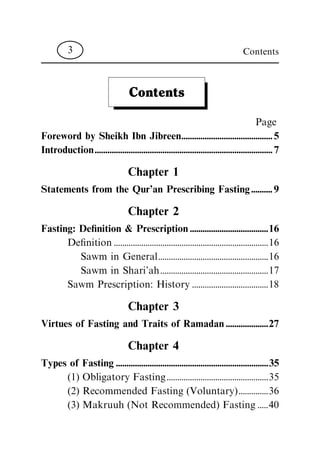
Contents
Page
Foreword by Sheikh Ibn Jibreen...........................................5
Introduction....................................................................................7
Chapter 1
Statements from the Qur'an Prescribing Fasting..........9
Chapter 2
Fasting: De®nition & Prescription.....................................16
De®nition.........................................................................16
Sawm in General....................................................16
Sawm in Shari'ah...................................................17
Sawm Prescription: History ....................................18
Chapter 3
Virtues of Fasting and Traits of Ramadan....................27
Chapter 4
Types of Fasting........................................................................35
(1) Obligatory Fasting................................................35
(2) Recommended Fasting (Voluntary)..............36
(3) Makruuh (Not Recommended) Fasting.....40
Contents3
(4) Prohibited Fasting ................................................45
Chapter 5
Fasting Requirements & Issues............................................51
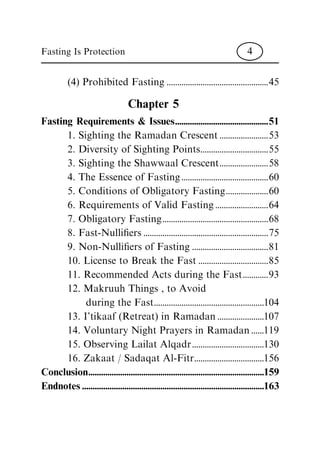
1. Sighting the Ramadan Crescent .......................53
2. Diversity of Sighting Points................................55
3. Sighting the Shawwaal Crescent.......................58
4. The Essence of Fasting .........................................60
5. Conditions of Obligatory Fasting....................60
6. Requirements of Valid Fasting .........................64
7. Obligatory Fasting..................................................68
8. Fast-Nulli®ers ...........................................................75
9. Non-Nulli®ers of Fasting ....................................81
10. License to Break the Fast .................................85
11. Recommended Acts during the Fast............93
12. Makruuh Things , to Avoid
during the Fast....................................................104
13. I'tikaaf (Retreat) in Ramadan ......................107
14. Voluntary Night Prayers in Ramadan ......119
15. Observing Lailat Alqadr..................................130
16. Zakaat / Sadaqat Al-Fitr.................................156
Conclusion...................................................................................159
Endnotes......................................................................................163
Fasting Is Protection 4
Foreword
PraisebetoAllah.ItestifythatthereisnoGod
but Allah, and I testify that Mohammad is His
slave and Messenger.
May Allah's peace and blessings be upon
Prophet Mohammad and upon his kin, his
companions and his followers.
I have read this valuable treatise, Fasting Is
Protection, by Dr. Khaled Ibn Abdul-Rahman
Al-Jeraisy - may Allah grant him success. The
content is well selected and comprehensive. It
covers fasting in terms of its history, aims,
requirements, types, nullifiers and related acts
of worship, such as voluntary night prayers,
observing Lailat Al-Qadr (the Night of Power /
Decree)andzakaatul-fitr(zakaahforcompleting
the fast of Ramadan). The selected material,
including Hadiths, is well documented.
The book is greatly beneficial. May Allah
Foreword5
reward the author greatly and bless his efforts.
May Allah's peace and blessings be upon His
Prophet Mohammad and upon his kin, his
companions and his followers.
Abdullah Ibn Abdul-Rahman Al-Jibreen
25/10/1425 H
Fasting Is Protection 6
Introduction
PraisebetoAllah.ItestifythatthereisnoGod
but Allah, and I testify that Mohammad is His
slave and Messenger.
May Allah's peace and blessings be upon His
Prophet Mohammad and upon his kin, his
companions and his followers.
Thanks be to Allah for the blessings and
rewards of fasting.
This book provides a comprehensive survey of
fasting. It includes the virtues, major issues and
rules of fasting. I hope it will benefit fellow
Muslims.
The title of the book is derived from this
Hadith: "Fasting is for me," says Allah (N)*
,
"and I give reward accordingly, for man gives up
* (N) is pronounced /'azza wa jalla/, which Muslims say to
praise Allah. It means "May He be exalted and glori®ed".
Introduction7
sex, food and drink for My Sake. Fasting is
protection. Whoever fasts rejoices twice, the first
time on breaking the fast, and the second on
meeting the Lord. "The smell of the mouth of the
fasting person is considered by Allah to be better
than the fragrance of musk."
(1)
The book has five chapters:
Chapter 1: Statements from the Qur'an
Prescribing Fasting
Chapter 2: Fasting: Definition & Prescription
Chapter 3: Virtues of Fasting and Traits of
Ramadan
Chapter 4: Types of Fasting
Chapter 5: Fasting Requirements & Issues
May Allah (N) accept this work, make it
beneficial to fellow Muslims and reward me for it.
May Allah's peace and blessings be upon His
Prophet Mohammad and upon his kin, his
companions and his followers.
Fasting Is Protection 8
Chapter 1
Statements from the Qur'an Prescribing Fasting
The following statements, from the Qur'an,
embody the basics of fasting. As usual, the
Sunnah details and illustrates the Qur'anic
general or basic statements. So, related Hadiths
on fasting details and illustrations will be
mentioned whenever necessary.
1. Surat Al-Baqarah / Ayahs 183-187
"(183)Oyouwhobelieve!Fastingisprescribed
foryou,asitwasprescribedforthosebeforeyou,
that you may observe taqwa); (184) (Fast) a
certain number of days; and (for) him who is sick
among you, or on a journey, (the same) number
of other days; and for those who can afford it
there is a ransom: the feeding of a man in need.
But whoso does good of his own accord, it is
betterforhim:andthatyoufastisbetterforyouif
Chapter1:StatementsfromtheQur'anPrescribingFasting9
you did but know. (185) The month of Ramadan
in which was revealed the Qur'an, a guidance for
mankind, and clear proofs of the guidance, and
the Criterion (of right and wrong). And
whosoever of you is present, let him fast the
month, and whosoever of you is sick or on a
journey, (let him fast the same) number of other
days. Allah desires for you ease; He desires not
hardship for you; and (He desires) that you
should complete the period, and that you should
magnify Allah for having guided you, and that
peradventure you may be thankful. (186) And
when My servants question you concerning Me,
then surely I am nigh. I answer the prayer of the
suppliant when he cries unto Me. So let them bear
My call and let them trust in Me, in order that
they may be led aright. (187) It is made lawful for
you to go unto your wives on the night of the fast.
They are raiment for you and you are raiment for
them. Allah is aware that you were deceiving
yourselves in this respect and He has turned in
Fasting Is Protection 10
mercy toward you and relieved you. So hold
intercoursewiththemandseekthatwhichAllah
hasordainedforyou,andeatanddrinkuntilthe
white thread becomes distinct to you from the
black thread of the dawn. Then strictly observe
thefasttillnightfallandtouchthemnot,butbeat
your devotions in the mosques. These are the
limits imposed by Allah, so approach them not.
ThusAllahexpoundsHisrevelationstomankind
that they may observetaqwa."
2. Surat Al-Baqarah / Ayah 196
"(196)Performthepilgrimageandthevisit(to
Mecca)forAllah.Andifyouareprevented,then
sendsuchgiftsascanbeobtainedwithease,and
shavenotyourheadsuntilthegiftshavereached
theirdestination.Andwhoeveramongyouissick
orhasanailmentoftheheadmustpayaransom
of fasting or alms giving or offering. And if you
are in safety, then whosoever contents himself
withtheVisitforthePilgrimage(shallgive)such
Chapter1:StatementsfromtheQur'anPrescribingFasting11
gifts as can be had with ease. And whosoever
cannot find (such gifts) then a fast of three days
while on the pilgrimage, and of seven when you
have returned; that is, ten in all. That is for him
whose folk are not present at the Inviolable Place
of Worship. Observe your duty to Allah, and
know that Allah is severe in punishment."
3. Surat Al-Nissaa'/Ayah 92
"(92) It is not for a believer to kill a believer
unless (it be) by mistake. He who has killed a
believer by mistake must set free a believing slave,
and pay the blood money to the family of the
slain, unless they remit it as a charity. If he (the
victim) be of a people hostile unto you, and he is a
believer, then (the penance is) to set free a
believing slave. And if he comes of a folk
between whom and you there is a covenant,
then the blood money must be paid unto his folk
and (also) a believing slave must be set free. And
whoso has not the wherewithal must fast two
Fasting Is Protection 12
consecutive months. A penance from Allah.
Allah is Knower, Wise."
4. Surat Al-Maa'idah / Ayah 89
"(89) Allah will not take you to task for that
which is unintentional in your oaths, but He will
take you to task for the oaths which you swear in
earnest. The expiation thereof is the feeding of ten
of the needy with the average of that wherewith
you feed your own folk, or the clothing of them,
or the liberation of a slave, and for him who finds
not (the wherewithal to do so) then a three-day
fast. This is the expiation of your oaths when you
have sworn; and keep your oaths. Thus Allah
expounds unto you His revelations in order that
you may give thanks."
5. Surat Al-Maa'idah / Ayah 95
"(95) O you who believe! Kill no wild game
while you are on the pilgrimage. Whoso of you
kills it of set purpose he shall pay its forfeit in the
Chapter 1: Statements from the Qur'an Prescribing Fasting13
equivalent of that which he has killed, of domestic
animals, the judge to be two men among you
known for justice; (the forfeit) to be brought as an
offering to the Ka'bah; or, for expiation, he shall
feed poor persons, or the equivalent thereof in
fasting, that he may taste the evil consequences of
his deed. Allah forgives whatever (of this kind)
may have happened in the past, but whoso
relapses, Allah will take retribution from him.
Allah is Mighty, Able to Requite (the wrong)."
6. Surat Al-Mujaadilah / Ayahs 3-4
"(3) Those who put away their wives (by saying
they are as their mothers) and afterward would go
back on that which they have said; (the penalty)
in that case (is) the freeing of a slave before they
touch one another. Unto this you are exhorted;
and Allah is informed of what you do. (4) And he
who finds not (the wherewithal), let him fast for
two successive months before they touch one
another; and for him who is unable to do so (the
Fasting Is Protection 14
penance is) the feeding of sixty needy ones. This,
that you may put trust in Allah and His
messenger. Such are the limits (imposed by
Allah); and for disbelievers is a painful doom."
c c c
Chapter 1: Statements from the Qur'an Prescribing Fasting15
Chapter 2
Fasting: De®nition & Prescription
Definition
Sawm in General
In general, the term sawm (fasting) basically
refers to deliberate stoppage of an act, verbal or
non-verbal. It includes stoppage of movement,
e.g. of water, wind and animals. For example, the
term sawm may refer to stoppage of speaking, as
in this Qur'anic verse, where Maryam, the
Mother of Jesus, was instructed to say, "(26) So
eat and drink and be consoled. And if you meet
any mortal, say: Lo! I have vowed a fast unto the
Beneficent, and may not speak this day to any
mortal." [19/26] The phrase "a fast" refers to ``not
speaking''. Fasting also includes the common
meaning of stoppage of such activities as eating
and drinking, and hence using the word "saa'im"
Fasting Is Protection 16
to describe the person that stops eating, drinking
and sexual intercourse.
(2)
Sawm in Shari'ah
In the Shari'ah literature, the definitions of
sawm can be summed up as "abstention from
particular things that cause the break of
fast".
(3)
This definition can be detailed as follows:
- Fasting is required of the accountable Muslim
(who is an adult, is in a sane state of mind and
is aware of sawm as an Islamic obligation).
- The Muslim must be able to bear it.
- It is required of those who are not eligible for
license to break their fast, due to, for example,
travel or illness.
- The intention to fast is necessary.
- The Muslim has to abstain from all nullifiers of
fasting, such as eating, drinking, sexual
intercourse and deliberate vomiting.
- The abstention lasts from dawn to sunset.
Chapter 2: Fasting: De®nition & Prescription17
Asfortheword"Ramadan",itisderivedfrom
the word ramdh, meaning "burning", as sins are
burnedduringthefastingmonth.Itisalsosaidto
be derived from ramadh, meaning "thirst".(4)
Sawm Prescription: History
Asanactofworship,sawm wasprescribedfor
the People of the Book earlier. In this regard,
Allah(N)says,"(183)Oyouwhobelieve!Fasting
is prescribed for you, as it was prescribed for
those before you, that you may exercise taqwa."
[2/183] Sawm reached its perfect form in Allah's
last message of Islam. Four stages of sawm
prescription can be identified:
First Stage
The Prophet (|) first instructed the Muslims
to fast during three days of each lunar month as
well as the tenth of Al-Muharram (the 1st month
(*) (|) is a prayer Muslims say when Prophet Mohammad is
mentioned. It is pronounced / Salla allaahu 'alaihi wa sal-
lam/, and it means "May Allah's prayers and peace be upon
him".
Fasting Is Protection 18
of the Arabic calendar). This is called the
'Aashuuraa' Day, and those are called "the 3
white days". According to one Hadith, "The
Messenger of Allah would instruct and encourage
us[Muslims]tofastduringthe'Aashuuraa'Dayand
would remind us to do so. However, when the month
of Ramadan was designated for sawm, he did not
instruct or forbid us, nor did he remind us (of the
'Ashuuraa' Day)." (5)
According to another Hadith, "Allah's
Messenger used to fast three days in each month,
to fast the 'Aashuraa' Day till Allah revealed the
Ayah: "(183) O you who believe! Fasting is
prescribed for you, as it was prescribed for those
before you, that you may exercise taqwa." [2/183]
Since then, whoever wanted to fast did so, and
whoeverwantednottofasthadtogiveamealtoone
needy person for each day instead.(6)
A Related Question
Whichdaysofthelunarmontharethe3"white
days"?
Chapter 2: Fasting: De®nition & Prescription19
Answer
Muslimscholarsagreethatitisasunnah tofast
during three days of each lunar month. Al-
Jumhuur(scholarsoftheHanafi,theShaafi'iand
theHanbalischoolsofthought)recommendthe
fastofthe3"whitedays".Thesearethe13th,14th
and15(7) Thesearedescribedas"white"because
of the moon's distinct fullness and brightness.
The following support the recommendation.
According to the Hadith, the Prophet (|),
addressing Abu Dharr, said, "O Abu Dharr, if
youintendtofastduring3dayseverymonth,let
them be the 13th, 14th and 15th."(8) In addition,
Sahih Al-Bukhari hasachaptertitled"Fastingthe
ThreeWhiteDays:the13th,14th and15th".
However,fastingduringanythreedaysofthe
monthisvalidandrewardable,byAllah'sGrace.
It is the fasting that matters, but not those
particular days. According to one Hadith, Abu
Hurairah said, "My dear friend [Prophet
Fasting Is Protection 20
Mohammad(|)]advisedmetofastduringthree
days of every month, to perform the Dhuhaa
prayer and to perform the Witr prayer before
going to bed at night."(9) This Hadith does not
specifyanyparticulardays.
Second Stage
In this stage, fasting during the month of
Ramadan became obligatory, as mentioned in
theseverses:"(183)Oyouwhobelieve!Fastingis
prescribedforyou,asitwasprescribedforthose
beforeyou,thatyoumayexercisetaqwa.[2/183]
As a result, the fasting of the 'Aashuuraa' Day
becamevoluntary."(10)Inthisregard,theProphet
(|)said,"The`Aashuuraa'DayisoneofAllah's
days. You may fast the day if you wish, or you
maynotfastthedayifyouwish."(11)
Third Stage
The third stage was characterized by the
license not to fast during the month of
Ramadan in return for a ransom. An able
Chapter 2: Fasting: De®nition& Prescription21
Muslimhadtheoptionnottofast,buthadtofeed
a needy person for each day instead. As
mentioned in the Qur'an, "... [For] those who
canaffordit,thereisaransom:thefeedingofa
maninneed....."[2/184]
Fourth Stage
Thefourthstageretractedthelicensegivenin
thethirdstage.AbleMuslimshadtofast,andthe
optionnottofastinreturnforaransomstopped.
The new command was: "(185).... And
whosoever of you is present, let him fast the
month,Thus,thisAyahabrogatedthecommand
inAyahNo.2/184.(12)
However,thelicensenottofastinRamadan
remainedfortwospecificcases:thecaseofillness
thatcanbecomplicatedorprolongedbyfasting
orthatcanmakefastingunbearable;andthecase
oftravelingduringtheday.Inreturn,theMuslim
whotakesthelicenseinthesetwocaseshastofast
Fasting Is Protection 22
the same number of missed days later, once the
reason for license is over. As stated in the Qur'an,
".... [And] whosoever of you is sick or on a
journey, (let him fast the same) number of other
days. ..." [2/185]
Thus, Muslims are commanded to fast the
whole month of Ramadan, while there is license
not to fast in the cases of illness and travel and to
fast the missed days later. Shari'ah is meant for
the good and ease of man. Allah (N) says, "....
Allah desires for you ease; He desires not
hardship for you; and (He desires) that you
should complete the period, and that you should
magnify Allah for having guided you, and that
peradventure you may be thankful." [2/185].
Changes in the Fasting Format
Fasting went through various developments in
accordance with human nature and evolving
conditions of earlier Muslims. In its final format,
fasting meant abstaining from certain things
Chapter 2: Fasting: De®nition & Prescription23
desigrated as muftiraat (things that cause the
break of fast) from dawn to sunset.
When fasting was first prescribed, eating,
drinking and intercourse were conditional in the
period from sunset to dawn. Toeat, drink or have
intercourse, one had to stay awake during the
night in question. In other words, if one slept
anytime from sunset to dawn, one was not
allowed to do any of these things during the rest
of the night, but had to wait till the sunset of the
following day to break his fast as usual. Also,
onceoneperformedtheIshaaprayer,onewasnot
allowed to eat, drink or have intercourse during
the rest of the night.
The two conditions were later lifted by
Qur'anic Revelations. As a result, Muslims were
allowed to eat, drink and have intercourse from
sunset to dawn. This has been the fasting format
ever since.
Fordocumentationofthechangesinformat,the
Fasting Is Protection 24
reader may wish to consult the Hadiths narrated by
Al-Baraa' Ibn Aazib
(13)
, Kaab Ibn Maalik,
(14)
Al-
Baraa' Ibn Aazib
(15)
and Ibn Abbaas.
(16)(17)
Related Question
In Ayah 2, Surat Al-Baqarah, Muslims are
licensed to "... eat and drink until the white thread
becomes distinct... from the black thread of the
dawn..."? What do the words "white thread" and
"black thread" refer to? Answering the question,
the Prophet (|) says, "It is the blackness of night
and the whiteness of day"
(18)
For further
explanations, the reader may wish to consult
related Hadiths.
(19)(20)
The command and the way to fast, as we do
now, were finally settled in Sha'baan (the 8
th
month of the Muslim calendar) in the 2
nd
year
after Hijrah. The Prophet (|) did his fast
accordingly for 9 years.
Though Muslims have to fast the whole month
of Ramadan, as a basic act of worship, the
Chapter 2: Fasting: De®nition & Prescription25
Prophet(|)recommendsthefastof'Aashuuraa'
on a voluntary basis. In one Hadith, the Prophet
(|) says, "This is the 'Aashuuraa' day. Allah
does not oblige you to fast this day. You may fast
ifyouwish,oryoumaynotfastifyouwish."(21)
In
a similar Hadith, he says, "The 'Aashuuraa' Day
is one of Allah's days. You may fast if you wish,
or you may not fast if you wish."(22)
In fact, he
said he was going to fast it in addition to the day
before it the following year(23)
, but it was not to
happen because the Prophet (|) died before the
return of the day.(24)
c c c
Fasting Is Protection 26
Chapter 3
Virtues of Fasting and Traits of Ramadan
Fasting has a great number of virtues, by the
Grace of Allah (N). The following are some of
them.
1.FastingthemonthofRamadanisoneofthe
pillarsofIslam.Itisasignofone'sfaithtoaffirm
belief in fasting as an obligation for all Muslims.
According to the Hadith, Islam is built on five
pillars: bearing witness that there is no God but
Allah, and Mohamed is the Messenger of Allah;
establishing prayers; paying zakaah; fasting the
whole month of Ramadan; and doing hajj
(pilgrimage to Makkah)."(25)
2. Fasting the days of Ramadan with the
intention to please Allah (N) alone and seek
reward from Him is a sign of pure faith, which
qualifies one for forgiveness of sins. Prophet
Chapter 3: Virtues of Fasting and Traits of Ramadan27
Mohammad (|) says, "If one fasts during the
monthofRamadan,intendingtoaffirmfaithin
Allah, to please Him and to seek reward from
Him,one'sprevioussinswillbeforgiven."(26)
Similarly, doing voluntary acts of worship of
Allah(N)duringthenightsofRamadanisasign
ofpurefaithandqualifiesoneforrewardsfrom
Allah(N).ProphetMohammad(|)says,"Ifone
stays up during the nights of Ramadan,
worshipping Allah, intending to affirm faith in
Allah, to please Him and to seek reward from
Him,one'sprevioussinswillbeforgiven."(27)
Of the Ramadan nights, Lailat Alqadr (the
NightofPower/Decree)isspecial.Asmentioned
in the Qur'an, it is better than 1,000 nights.
Prophet Mohammad (|) says, "If one stays up
the Night of Power /Decree worshipping Allah,
intendingtoaffirmfaithinAllah,topleaseHim
andtoseekrewardfromHim,one'sprevioussins
willbeforgiven."(28)
3. Unlike other acts of worship, fasting, by
Fasting Is Protection 28
nature, is not observable to people, and so it
provides for genuinely pure intentions. This may
explain why Allah (N) allocates special rewards
for it. According to the Hadith, "All man's good
actsarerewardedinmultiples,rangingfrom10to
700 folds. As for fasting, Allah says: It is done
especially for My Sake, and I will reward it for its
special worth; it is for My Sake that man abstains
from sex and food!"(29)
4. Fasting provides the Muslim with a strong
will to resist whims and Satan's whispering. It is,
therefore, a means to safety from eternal torment
in the Hereafter. As the Prophet (|) says,
"Fasting is protection."(30)
5. Fasting is prescribed to control the sexual
urge temporarily, and hence it strengthens
chastity. Addressing Muslim youth, the Prophet
(|) says, "O Muslim youth, let those who can
afford it get married. Marriage helps you cast
down your eyes, and it guards you against sexual
Chapter 3: Virtues of Fasting and Traits of Ramadan29
sins. As for those who cannot afford it, let them
fast; fasting controls the urge."
(31)
6. Fasting has disciplinary effects on behavior.
For example, it involves abstention from false
witness. It also makes the Muslim put up with
personal offences. The Prophet (|) says, 'When
fasting, you must not engage in acts of insult or
ignorance. If called bad names or offended, one is
to say, "I am fasting. I am fasting.'"
(32)
The
Prophet (|) also says, "If one does not abstain
from false witness, Allah sees no benefit in one's
abstaining from food and drink."
(33)
7. In terms of patience, fasting supersedes
other acts of worship. The prophet says, "One
half of patience exists in fasting."
(34)
8. By fasting, the Muslim can enter paradise
through Al-Rayyaan Gate, especially for people
who observe the fast. The Prophet (|) says,
"Heaven has a gate called Al-Rayyaan, through
which none but those who observe the fast go in.
Fasting Is Protection 30
Once they are called in, the gate is closed, not to
be opened again."(35)
9.ThesmelloftheMuslim'smouthduringthe
fast is considered by Allah (N) to be better than
the fragrance of musk.(36)
10. Those who observe the fast are promised
double joy. The Prophet (|) says, "The Muslim
who observes the fast rejoices twice: on having
breakfast;andonmeetingAllahhavingobserved
the fast."(37)
11. Fasting is an opportune occasion for
answerable supplication. Allah (N) says, "(He
desires)thatyoushouldcompletetheperiod,and
thatyoushouldmagnifyAllahforhavingguided
you,andthatperadventureyoumaybethankful.
(186). And when My servants question you
concerning Me, then surely I am nigh. I answer
theprayerofthesuppliantwhenhecriesuntoMe.
SoletthembearMycallandletthemtrustinMe,
inorderthattheymaybeledaright."[2/185-186]
Chapter 3: Virtues of Fasting and Traits of Ramadan31
In these Ayahs, answering payers follows the
mention of fasting. "On breaking the fast, a
Muslim has an opportunity of saying a prayer
that cannot be turned down."
(38)
12. Fasting encourages Muslims to follow the
Prophet's example of behavior, especially in
relation to generosity. "The Prophet was the
most generous of all. He was especially generous
in Ramadan, when (Angel) Gabriel - may peace
be unto him - met him."
(39)
13. It is a great blessing that Ramadan is the
chosen month for fasting. Ramadan is a blessed
month with numerous virtues. The following are
some of them:
- It is the month of the Qur'an. It was in
Ramadan that the Qur'an was first sent down in
its entirety from the Preserved Tablet to the Place
of Dignity in our worldly heaven on Lailat Al-
Qadr (the Night of Power / Decree). It was also on
the same blessed Night, in Ramadan, that
Fasting Is Protection 32
Prophet Mohammad (|) started receiving
Qur'an revelations, which continued for his
twenty-three years of prophethood.(40)
In this
respect, the Qur'an says:
"(185) The month of Ramadan in which was
revealedtheQur'an,aguidanceformankind,and
clearproofsoftheguidance,andtheCriterion(of
right and wrong)...."[2/185];
"(3)Lo!Werevealeditonablessed night.Lo!We
are ever warning."[44/3];
"(1)Lo!WerevealeditonLailatAl-Qadr.(2)Ah,
what will convey unto you what Lailat Al-Qadr
is! (3) Lailat Al-Qadr is better than a thousand
months." [97/1-3]
- As mentioned above, Ramadan is blessed with
the Night of Power. On it, acts of worship are better
invaluethanthosedoneinathousandmonths,(over
eighty-three years). According to the Hadith, Lailat
Al-Qadr is one of the odd-numbered nights of the
last 10 days of Ramadan(41)
.
Chapter 3: Virtues of Fasting and Traits of Ramadan33
- Ramadan provides great opportunities for
doers of good to be nearer to Allah (N). During
it, the gates of Hell are closed while the gates of
Heaven are wide open. Every night, Allah (N)
pardons a lot of people and takes them out of the
Hellfire. In Prophet Mohamed's words, "On the
first night of Ramadan, the devils and rebellious
jinn are confined, the gates of Hell are all closed,
while the gates of Heaven are all open. There, an
announcement is made: `O doer of good, come
closer. O doer of evil, stay away'. Every Ramadan
night, Allah releases some people from the
Hellfire."
(42)
May Allah (N) bless us and let us witness this
great month, fast its days and worship during its
nights, too, for His Sake alone. O Allah, let us
remain Muslim forever. O Allah, let us be among
the ones You pardon in Ramadan.
c c c
Fasting Is Protection 34
Chapter 4
Types of Fasting
In general, fasting is classified into four grades
obligatory; recommended; makruuh; and
banned.
(1) Obligatory Fasting
In terms of time, obligatory fasting may be
specific or non-specific. Specific obligatory
fasting has to be done on particular days. The
days can be specified by Allah (N), as in the case
of the month of Ramadan. They may be specified
by a Muslim, as in the case of self-pledging to fast
on particular days.
As for non-specific fasting, it does not have to
be done on particular days, as in the following
cases: making-up for days missed in Ramadan;
atonement, as for breaking an oath and for
violating the ban on hunting during hajj.
Chapter 4: Types of Fasting35
In terms of sequence, obligatory fasting may be
consecutive or non-consecutive. For example,
one has to fast 2 consecutive days if atoning for
Zihaar. Yet, one does not have to fast consecutive
days in such cases as: atoning for shaving / cutting
one's hair before reaching the Haraam Mosque,
where an offering has to be sacrificed; self-
pledging to fast on non-specified days; and
making up for days missed in Ramadan. In
these cases, it is advisable to fast consecutively so
that one can carry out one's obligations as
quickly as possible.
(2) Recommended Fasting
Comprising this category is voluntary fasting,
recommended by the Sunnah, as in the following
cases:
(a) The Prophet Daawuud style of fasting, in which
one fasts on alternate days. This is considered
the best for voluntary fasting. According to
the Hadith, "Fast one day, and break fast the
Fasting Is Protection 36
following day. This is how Prophet Daawuud
used to fast. It is the best way."
(43)
(b) Fasting the 13th
, 14th
and 15th
days of every
lunar month. As narrated by Abu Hurairah,
Prophet Mohammad (|) recommended three
activities: "fasting three days every month;
performing the D huha prayer; a nd
performing the witr prayer before going to
bed."
(44)
A similar Hadith.
(45)
was narrated by
Abu Al-Dardaa'.
(c)Fasting Mondays and Thursdays on a weekly
basis, especially Mondays. Asked about
fasting on Monday, the Prophet (|) said, "I
was born on a Monday, and I received
revelations on a Monday."
(46)
According to
Osaamah Ibn Zaid, the Prophet (|) used to
fast on Mondays and Thursdays; asked about
the two days, the Prophet (|) said, "Records
of People's deeds are checked on Mondays
and Thursdays."
(47)
"I want my deeds to be
Chapter 4: Types of Fasting37
checked while I am fasting."
(48)
(d) The Muslim is advised to fast as often as
possible during the month of Sha'baan. As
narrated by 'Aisha, the Prophet did the most
voluntary fasting in Sha'baan. She said, "I
have never seen the Prophet fast as often as he
did in the month of Sha'baan."
(49)
(e)The Muslim is advised to fast six days,
preferably consecutively, during the month of
Shawwaal. The Prophet (|) says, "If one fasts
during Ramadan, then fasts six days in
Shawwaal, it is equal (in reward) to fasting a
whole year."
(50)
(f) It is advisable to fast the first nine days of Dhul-
Hijjah, especially the ninth, the Arafah Day.
Fasting this day is considered a means to
atonement of minor sins of two years, the one
before it and another after. It is also a means
to alleviating some major sins and to raising
the rank of believers. As mentioned in the
Fasting Is Protection 38
Hadith,"ItrustthatAllahwillrewardfasting
the ArafahDay byatoning forthe sins ofthe
previous year and the following one."(51)
(g) Fasting during the month of Al-Muharram,
especiallythe9th andthe10th,theAashuuraa'
Day, is considered the next best to fasting in
Ramadan.PriorityisgiventotheAashuuraa'
Day,yetitisrecommendedtofastbothdays.
The Prophet (|) says, "The best fasting next
tothatinRamadanisthatwhichtakesplacein
Al-Muharram."(52) The Prophet (|)
instructed the Muslims to fast the
Aashuuraa' Day.(53)He also wanted them to
fastthedaybeforeitsoastobedifferentfrom
the Jews, but he died before he could do
that.(54)
(h) It is recommended to fast the last day of each
month of the Muslim calendar, except the 30th
ofSha'baaniftheRamadancrescentissaidto
have been sighted. According to the Hadith,
Chapter 4: Types of Fasting39
the Prophet (|) said to one Muslim, "O..., are
you going to fast the last day of this
month?"
(55)
(i) The Muslim may fast a day or more as a means
to pleasing Allah (N). The Prophet (|) says,
"When a Muslim fasts one day for the Sake of
Allah, in return, Allah will keep his face away
from the Hellfire for a period of seventy
years."
(56)
(3) Makruuh(not recommended) Fasting
It is classified as makruuh(not recommended)
to fast on the following days:
(a) Friday solely and deliberately
The Prophet (|) says, "Never fast (voluntarily)
on a Friday unless together with a day before or
after it."
(57)
In another Hadith, he says, "Never
assign for Friday nights special (voluntary) acts of
worship, nor assign special fasting for Friday,
unless it falls within your fast days."
(58)
Fasting Is Protection 40
(b) Saturday solely and deliberately
The Prophet (|) says, "Do not fast on a
Saturday, unless as part of your obligatory
fasting. If you had nothing to eat (on a
Saturday), you should look for something, even
to chew, such as the skin of a vine tree or a
branch."
(59)
That Saturday is revered by the Jews may
explain why it is not recommended to assign it
special fasting. The same applies to Sunday,
which is revered by Christians. In fact, one is to
dissociate oneself from the occasions revered by
Jews and Christians, unless as part of one's usual
fasting.
(60)
(c) The Arafah Day (for pilgrims)
On the Arafah Day, during hajj, the Prophet
(|) had a drink of milk and people saw him do
so.
(61)
When asked about fasting the Arafah Day by
pilgrims, Ibn Omar said, "I did hajj with the
Chapter 4: Types of Fasting41
Prophet,buthedidnotfast theArafah Day.Idid
hajj withAbuBakr,buthedidnotfasttheArafah
Day. I did hajj with Omar, but he did not fast the
Arafah Day. I did hajj with Othman, but he did
notfasttheArafahDay.Idonotfastiteither,nor
do I instruct any (pilgrim) to fast or not to fast
it."(62)
(d) The Day of Doubt
The "day of doubt" refers to the 30th
of
Sha'baan. This is a typical confusing scenario
where fasting this day is not recommended: the
Ramadan crescent is not sighted yet; the sky is
clear enough for sighting; there is nothing to
block vision either, such as dust; and a claim to
sighting the crescent by someone untrustworthy
is rejected.
Abu-Haneefah, Ibn Malik, Ibn Hanbal
consider it makruuh to fast the Day of Doubt,
whereas Al-Shafi'iy considers it muharram
(forbidden); this seems the stronger view given
Fasting Is Protection 42
the clear ban in the Hadith. However, the four
imams consider it ok to fast that day in the
following cases: if one is accustomed to fasting on
Mondays; if one is making up for a missed day
from the Ramadan before; or one is fasting as
atonement for something.
(63)
The Prophet (|) says, "The month is twenty-
nine nights. So, do not fast till you sight the
crescent. If it is too blurred to sight it, let the
month (of Sha'baan) be complete (30
days)."
(64)
In another Hadith, he says, "If one
fasts the 'doubtful day', one disobeys Abu-
Alqaassim (Prophet Mohammad)."
(65)
(e) A Day or Two Prior to Ramadan
It is makruuh to fast a day or two prior to
Ramadan. The rulings on the 'day of doubt'
apply to this case. The Prophet (|) says, "One is
not to fast a day or two prior to Ramadan unless
one is fulfilling a monthly custom."
(66)
(f) Days Revered by Kaafirs
Chapter 4: Types of Fasting43
It is makruuh to fast a sole day that is revered
by kaafirs, such as a Saturday or a Sunday. The
ruling on these two days is already mentioned.
The same applies to the Nairuuz and Mahrajaan
days
(67)
, two Persian celebrations. The ban on
fasting such days is to avoid any association with
glorifying them.
(68)
(g) Continuous Fasting
To fast two days continuously, without
breaking fast, is makruuh. According to the
Hadith, the Prophet (|) did continuous fasting
in the beginning of one Ramadan. Some Muslims
did like him. Having learned about them, he did
not approve of what they did. He mentioned that
he was not like them in that respect.
(69)
(h) Fasting All Days
It is makruuhto fast all days, even if excluding
the days on which fasting is forbidden, namely
the two Eids and the tashreeq days (Dhul-Hijjah
11
th
, 12
th
and 13
th
). This style of fasting may
Fasting Is Protection 44
result in weakness, hence undermining duties and
obligations as well as earning a living. The
Prophet (|) says, "It is not fasting if you fast
forever. It is not fasting if you fast forever. It is
not fasting if you fast forever."
(70)
In another
Hadith, answering a question about those who
fast all days, the Prophet (|) said, "He (whoever
fasts all days) has neither fasted nor broken
fast."
(71)
This may refer to losing reward for
disobeying the Prophet's instructions on the one
hand and for not breaking fast when one should.
(4) Prohibited Fasting
Fasting is muharram (prohibited) on
particular days for their own significance and
on other days because of necessity.
(a) Days Banned for Their Own Significance
There are five days on which fasting is
prohibited for specific reasons. They are: Eed
Al-Fitr (Shawwaal 1
st
); Eed Al-Adh-haa (Dhul-
Hijjah 10); and the Tashreeq Days
(72)
(Dhul-
Chapter 4: Types of Fasting45
Hijjah, 11th, 12th and 13th). The ban on fasting
these days is in the following Hadiths:
"The Prophet forbade fasting on two
particular days: yawm alfitr (Eed Al-Fitr) and
yawm alnahr (Eed Al-Adh-ha / Sacrifice
Day)."(73)
"The Tashreeq Days are days for eating and
drinking and for remembering Allah."(74)
"The Arafah Day, the Sacrifice Day and the
Tashreeq Days are celebration days for us, the
people of Islam. They are days for eating and
drinking."(75)
ThebanonfastingtheArafahDayasstatedin
the above-mentioned Hadith applies only to
pilgrims, those performing hajj. As for those
whoarenotperforminghajj,theyareencouraged
to fast on the Arafah Day.
Also,thereisalicenseforthepilgrimswhoare
doing hajj tamattu' style (omrah-break-hajj) or
qaarin style (omrah and hajj combined), but
Fasting Is Protection 46
cannot afford to offer a sacrifice. In this case, a
pilgrim is permitted to fast during the Tashreeq
Days as atonement. According to the Hadith,
"No Fasting was allowed during the Tashreeq
days unless one could not afford a sacrifice."
(76)
In
another Hadith, "Fasting is for those who are
doing hajj tamattu' style. If unable to offer a
sacrifice or to fast, the pilgrim can fast during the
Mina Days."
(77)
(b) Days Banned for Necessity
Because of necessity, fasting is banned on the
following days:
1- Days of Menstruation and Post-Natal
Menses
During menstruation and menses, a woman
must not fast. If she did, It would be a sin, and her
fasting would not valid. Once menstruation or
menses stops, she has to make up for the fasting
days she misses. Regarding obligatory prayers
missed during those days, she is not to make up
Chapter 4: Types of Fasting47
for them; prayers are repeated every day, but
fasting is not. Though not allowed to fast during
menstruation or menses, a woman should not eat
or drink openly on the days of Ramadan.
The following are related Hadiths:
- In one Hadith, explaining his description of
women's `unfulfilled faith', the Prophet
(|) says, "... Isn't she banned from salaah
and fasting during menstruation?..."
(78)
- As related by Aisha, "When we had it (the
period), we were instructed to make up for
missed days of fasting, but not for missed
salaah."
(79)
- In another Hadith, she said, "When I had to
make up for missed days of fasting during
Ramadan, I could not do them except in
Sha'baan."
(80)
2- Voluntary Fasting without Husband's
Approval
Fasting Is Protection 48
Ontheonehand,awifeistogetherhusband's
approvalifshewantstodovoluntaryfasting;she
has duties towards her husband and family
responsibilities, and fasting may have negative
effects. So, if he does not approve, she must not
fast. On the other hand, he should let her fast if
fasting does not undermine her duties.(81) The
Prophet(|)says,"Awifeisnottofastwhileher
husband is not away unless she gets his
permission. She is not to let anyone into their
home without his permission. If she gives a
charity from his money without his permission,
he shares its reward."(82)
3. Fasting Leading to Death
In lightofShari'ah statements prioritizingthe
protection of basic necessities, life included,
fasting becomes muharram if it threatens one's
veryexistence.Forexample,Allah(N)says,"(29)
O you who believe! Squander not your wealth
among yourselves in vanity, except it be a trade
by mutual consent, andkill not oneanother. Lo!
Chapter 4: Types of Fasting49
Allah is ever Merciful unto you." [4/29] He also
says, "(195) Spend your wealth for the cause
of Allah, and be not cast by your own hands to
ruin; and do good. Lo! Allah loves the
beneficent." [2/195]
NOTE
Ayah [2/195] was revealed in connection with
not spending for jihad purposes while choosing
staying home with family and the comfort of
wealth. Whoever does this, particularly on a
regular basis, causes his own ruin and incurs
punishment. However, the revelation has a
broader meaning. Spending includes all aspects
of good, and ruin includes all possible dangers,
especiallytosurvival.(83)Also,theHadithstresses
theneedtoprotectlife;theProphet(|)says,"Let
usnotcauseharm.Letusnotreturnharm."(84)
c c c
Fasting Is Protection 50
Chapter 5
Fasting Requirements & Issues
This chapter deals with the major issues of
fasting. They are presented under sixteen
headings:
1. Sighting the Ramadan Crescent
2. Diversity of Sighting Points
3. Sighting the Shawwaal Crescent
4. The Essence of Fasting
5. Conditions for Obligatory Fasting
6. Requirements of Valid Fasting
7. Obligatory Fasting
8. Fast-Nullifiers
9. Non-Nullifiers of Fasting
10. License to Break the Fast
11. Recommended Acts during the Fast
Chapter 5: Fasting Requirements & Issues51
12. Makruuh things, to Avoid during the Fast
13. I'tikaaf (Retreat) in Ramadan
14. Voluntary Night Prayers in Ramadan
15. Observing Lailat Alqadr
16. Zakaat / Sadaqat Al-Fitr
Fasting Is Protection 52
1. Sighting the Ramadan Crescent
There are two possible scenarios for declaring
the sighting of the Ramadan crescent, hence the
beginning of fasting:
Scenario 1
This scenario takes place in the evening of
Sha'baan 29. One Muslim that is known to be
credibletestifiesthathehassightedtheRamadan
crescent. The imam/ruler accepts the testimony -
one witness is considered sufficient by the Al-
Jumhuur (followers of the Hanafi, Maaliki and
Hanbali schools of thought). Naturally, this
makes Sha'baan 29 days.
Scenario 2
It is the evening of Sha'baan 29, and the
crescentcannotbesighted.Thismaybeduetothe
fact that the crescent has not emerged yet. It may
beduetopoorvisibilitycausedbydustorclouds,
etc. In this case, Sha'baan has to be completed
Chapter 5: Fasting Requirements & Issues53
thirty days, and the day that follows marks the
beginning of Ramadan and the fast. Lunar
months do not exceed thirty days. The
following are related Hadiths:
The Prophet (|) says, "The month is twenty-
nine nights. So, do not fast till you sight the
crescent. If it is too blurred to sight it, let the
month (of Sha'baan) be complete, (30 days)."
(85)
In another Hadith, the Prophet (|)
mentioned how they calculated the month,
referring to a complete one being thirty days.
(86)
Abdullah Ibn Omar said, "Once, people
sighted the (Ramadan) crescent, and when I
told him I had seen it, he started fasting and
instructed the Muslims to start too."
(87)
Related Issue
Can the beginning of the Arabic month, hence of
fasting, be established by calculating the lunar cycle?
Muslims are commanded to start and end the
fast of Ramadan on the basis of sighting the
Fasting Is Protection 54
crescent, not of the birth or presence of the moon.
It is true that observatories these days can
calculate with great accuracy when the crescent
is born, even calculate when it can or cannot be
seen in particular places. Though undeniable, this
is not taken as the mark to start or end the fast.
Shari'ah categorically designates sighting the
crescent to signal the beginning and end of fast.
Thus, there is no conflict between the Shari'ah
demand and astronomical calculations. These are
concerned with accurate calculations irrespective
of fasting whereas that is concerned with the
command to fast once the crescent is sighted. It
does not matter if the crescent is there but cannot
be seen for one reason or another.
2. Diversity of Sighting Points
What is meant by "diversity of sighting points"?
How is this diversity related to establishing the
beginning or end of a lunar month?
Like sunrise, moonrise varies from country to
country. For example, the crescent can be sighted
Chapter 5: Fasting Requirements & Issues55
in one country a night earlier than in another. The
minimum distance for moonrise variation is
approximately 133 km.
Aljumhuur (the Hanafi, Maliki and Hanbali
schools of thought) argue for starting and ending
the fast on the same days for all Muslims. They base
their argument on this Hadith
(88)
: "The month is
twenty-nine nights. So, do not fast till you sight
the crescent. If it is too blurred to sight it, let the
month (of Sha'baan) be complete (30 days)".
In the light of this diversity of sighting points,
some scholars following the Shaafi'i school of
thought allow varied starts and ends to fasting in
areas between which there are long distances.
They base their ruling on a Hadith narrated by
Kuraib. According to this Hadith, Muslims in
Syria sighted the Ramadan crescent a night
earlier than those in Madeenah, and so started
their fast earlier. Kuraib witnessed the beginning
of Ramadan in Syria, but witnessed the end in
Fasting Is Protection 56
Madeenah. When he asked if the Syria sighting
wasgoodforMadeenahtoo,IbnAbbaassaidto
him, "No, it isn't, this is what the Messenger of
Allahinstructedustodo."(89)
Al-Jumhuurconsiderthefastandthebreakof
fast on Eed Day an occasion for Muslim unity
regardlessofvariedsightingpoints.Theybelieve
that if the Ramadan crescent is sighted in any
country,allMuslimshavetostartfasting.Ifitis
not sighted, the month of Sh'abaan has to be
completedto30days.(90)
The Jumhuur's argument that all Muslims
start fasting once the crescent is sighted in any
country seems stronger. It provides for Muslim
unity, while avoiding possible causes of
dissension. Also, the Prophet's Hadith stresses
the sighting of the crescent in general. Besides,
astronomically speaking, the time difference
between the most distant Muslim countries is
not more than nine hours. Modern
Chapter 5: Fasting Requirements & Issues57
communication has made it easy to spread the
news of sighting the crescent very fast, and this is
an opportunity for unifying the beginning and
end of the fast.
(91)
Thus, the issue of the diversity of sighting
points is made redundant by fast communication,
something that did not exist when Kuraib
narrated the Hadith on the Syria-Madeenah
sighting and fasting.
Waallahu a'lam (Only Allah knows the whole
truth).
The above is our argument for the Jumhuur's
ruling, but the whole truth is with Allah alone.
3. Sighting the Shawwaal Crescent
The end of Ramadan is established in one of
the following ways:
1. If the Shawwaal crescent is sighted by two
credible witnesses, the imam (ruler)
declares the end of fasting - hence
Ramadan is not 30 days.
Fasting Is Protection 58
2. If the crescent cannot be sighted, even in the
case of a clear sky, fasting continues till day
thirty - hence Ramadan is 30 days.
Whereas the declaration of fasting requires
sighting the crescent by only one credible witness,
the end of fasting requires two credible witnesses.
Obviously, the two-witness requirement guards
against possible waste of time allocated to such a
great act of worship.
Related Issue
The declaration of the beginning of a lunar
month generally requires two credible witnesses
stating they have sighted the crescent. Only in the
case of the Ramadan crescent, only one credible
witness is required. The Prophet (|) would take
extra precautions for sighting the Sha'baan
crescent, awaiting eagerly the Ramadan
crescent.(92)
He said, "Do not fast a day or two
ahead of Ramadan."(93)
Naturally, confirmation
of the beginning of Sha'baan is good for sighting
the Ramadan crescent.
Chapter 5: Fasting Requirements & Issues59
4. The Essence of Fasting
Fasting is basically abstinence from all fast-
breakersfromdawntofullsunset.Allah(N)says,
"(187)... [And] eat and drink until the white
thread becomes distinct to you from the black
thread of the dawn. Then strictly observe the fast
till nightfall...." [2/187] Thus, abstinence is the
essence of fasting.
5. Conditions for Obligatory Fasting
There are five conditions which make it
obligatory on a person to fast. If one of the
conditions is lacking, the person is not obliged to
fast. They are: (a) being Muslim; (b) being sane;
(c) being an adult; and being aware of obligatory
fasting.
(A) Being Muslim
Naturally, fasting is not required of a non-
Muslim. However, if a person becomes Muslim
during Ramadan, he /she is to start fasting, but
Fasting Is Protection 60
without having to make up for days missed as
kaafir. Allah (N) forgives one's sins committed
before being Muslim. Allah (N) says, "Tell those
who disbelieve that if they cease, that which is
past will be forgiven them ..." [8/38] Also, the
Prophet (|) says, "... Becoming Muslim
abolishes previous sins."(94)(95)
(B) Being sane
Basically, no obligation is addressed to
someone that is insane or unable to reason.
Actsofworshiprequireawarenessandtheability
toreason.AccordingtotheHadith,"Threetypes
of people are ont held accountable: someone
insane; someone asleep; and a child, who has not
reached puberty."(96)
Related Issue
Whataboutsomeonethatgetsdrunk?Doeshe
havetofast?Doeshehavetomakeupforwhathe
misses?
A drunk person is normally sane, and so is
Chapter 5: Fasting Requirements & Issues61
obliged to fast. By getting drunk, the fasting
condition of mental awareness is lacking. So, he
has committed a sin deliberately, and he may
commit another if he does not fast as a result. In
this case, he has to fast as soon as he recovers
from drunkenness, and has to make up for what
he may miss.
(C) Being an Adult
Adulthood indicates awareness of the
significance of duties and obligations and pure
surrender.Itisastatenotcharacteristicofachild.
So, one is not required to fast till one has reached
puberty.
Related Question
Is it all right to tell a young boy or girl that can
reason well enough, e.g. at the age of six, to fast?
Will such fast count?
Answer
If the young can endure the fast, it is all right to
Fasting Is Protection 62
ask them to fast. It is a kind of training, and it
counts, as salaah does. However, fasting needs
endurance, but salaah is not as demanding as
fasting.
(D) Being Aware of Obligatory Fasting
When a Muslim that fulfills the conditions of
adulthood and sanity learns that the Ramadan
crescent has been sighted, he / she has to start
fasting. This is normally the case in Muslim
communities, where information is not lacking in
that regard.
Related Question
What about a new Muslim in a non-Muslim
country?
Answer
Modern communication has made the
Ramadan news available to all in no time.
Therefore, knowledge necessary for the start of
fasting is not a problem anymore.
Chapter 5: Fasting Requirements & Issues63
6. Requirements of Valid Fasting
What makes one's fast valid? Three things
do. They are: (a) being Muslim; (b) intention;
and(c)nomenstruationormensesinthecaseof
females.
(A) Being Muslim
The state of being Muslim obliges one to
observethefast,anditisacriterionforitsvalidity
too.Inotherwords,anon-Muslim'sfastdoesnot
count.However,anewMuslimdoesnothaveto
makeupfordaysmissedbeforeadoptingIslam.
"Becoming Muslim abolishes all previous
sins."(97)
(B) Intention
TheMuslimwhoisobligedtofastmusthave
the intention to do the fast on a particular day.
For example, one has to have the intention
tonight for fasting tomorrow in the case of
obligatory fasting, e.g. Ramadan. If, at night,
Fasting Is Protection 64
one intends not to fast during the following day,
yet abstains from fast-breakers that day, one's
abstenance does not count as fasting because of
the lack of intention. Similarly, one's fast does
not count if, during the day, one changes
intention not to continue fasting despite
abstenance from fast-breakers. As an act of
worship, fasting is not valid without the
intention to do it. According to the Hadith, "If
one does not have the intention to fast
(obligatorily), one's fast is not valid."(98)
As for voluntary fasting, it is not necessary to
have the intention the night before; in this case,
one can have the intention before noon, and the
fast remains valid. As related by 'Aishah, "The
Prophet once came in and asked me: `O 'Aishah,
is there anything to eat?' `We have nothing,' I
answered. `Well, I am fasting, then,' said the
Prophet."(99)
Chapter 5: Fasting Requirements & Issues65
(C) No Menstruation or Menses
A woman must not fast when she is in
menstruation or menses. So, if she gets the
period during the day while fasting, this stops
thefast,andshehastomakeupforitlater.Also,
if the period stops at night, she has to make the
intentiontofastthefollowingday.Thisway,her
fast is valid, even if she did not do a purification
wash, which is necessary for salaah.
Related Question 1
IfaMuslimwakesupinastatethatrequiresa
purification wash, does his / her fast remain
valid?
Answer 1
Yes,itremainsvalid.Forexample,havingwet
dreams during a fasting day does not spoil one's
fast. Also, the fast is not spoiled by not having
done the purification wash after having had
Fasting Is Protection 66
intercourse during the night. This, as mentioned
in the Hadith, happened to the Prophet (|), and
he continued his fast.
(100)
Related Question 2
Does an apostate who has returned to Islam
have to make up for missed fasting?
Answer 2
Yes, he /she does. Before quitting Islam he had
been under obligation to fast. Therefore, once
back to Islam, he / she has to make up for it.
Wallaahu a'lam (Only Allah (N) knows the
whole truth).
Related Question 3
What about the fast of one who quit Islam
after having intended to fast?
Answer 3
The fast in such a case is not valid.
Chapter 5: Fasting Requirements & Issues67
7. Obligatory Fasting
The Muslim must be fully aware of how to
observe the obligatory types of fasting. The
following are certain things that have to be
observed:
(A) Consecutiveness
- InthecaseofRamadanonehastofastallofit,
which is naturally consecutive. "... And
whosoever of you is present, let him fast the
month,...." [2/185]
- In the case of fasting as atonement for killing
by mistake, the fast has to be done
consecutively. "(92) ... And whoso has not
the wherewithal must fast two consecutive
months. A penance from Allah. Allah is
Knower, Wise." [4/92]
- If atoning for a dhihaar statement (saying to
one's wife that she is forbidden to him as his
mother is), one has to observe consecutive
Fasting Is Protection 68
fasting. "(4) And he who finds not (the
wherewithal), let him fast for two successive
months before they touch one another;..."
[58/4]
- Consecutive fasting is required for atoning for
intercourse on a Ramadan day if one cannot
afford to free a slave. It is called "major
atonement", and in this case, one has to fast
two consecutive months. According to a
related Hadith, a man could not afford to
free a slave as atonement, was unable to fast
two consecutive months either and could not
afford to feed sixty needy people. To help him
atone for his sin, the Prophet (|) got him
some food to give the needy, but the man
happened to have the poorest family in Al-
Madeenah. Smiling, the Prophet (|) told him
to give the food to his poor family.
(101)
- Consecutive fasting is also necessary if one
pledges or takes an oath to fast a number of
Chapter 5: Fasting Requirements & Issues69
particular consecutive days, e.g. the first ten
days of Rajab or the month of Sha'baan.
(B) Non-Obligatory Consecutiveness
There is obligatory fasting that does not have
to be done consecutively, as in the following
cases:
- If one has to make up for days missed in
Ramadan, it is recommended that one should
do it as soon as possible and consecutively
However, consecutiveness is not obligatory.
In this regard, Allah (N) says, "... [And] (for)
him who is sick among you, or on a journey,
(the same) number of other days;..."[2/184]
This Qur'anic statement does not demand
consecutiveness. There must be no fasting on
days designated as no-fasting days, e.g. Eed
days.
- In the tamattu' style hajj, a pilgrim does omrah
first, has a break from ihram, and then starts
Hajj with new ihram. In this case, the pilgrim
Fasting Is Protection 70
has to offer a sacrifice,(102)
but if this is
unaffordable, the pilgrim has to fast ten days
of the Hajj month prefrebly three days during
the hajj time and seven after returning home.
It is recommended that the three days be
before the 10th
of Thul-Hijjah - excluding the
9th
(the Arafa Day) - or be the 11th
, 12th
and
13th
. Allah (N) says, "(196)... And if you are in
safety, then whosoever contents himself with
the omrah for the pilgrimage (shall give) such
gifts as can be had with ease. And whosoever
cannot find (such gifts), then a fast of three
days while on the pilgrimage, and of seven
when you have returned; that is, ten in all.
That is for him whose folk are not present at
Al-Masjid Al-Haraam. Observe taqwa of
Allah, and know that Allah is severe in
punishment.'" [2/196]
- When on omrah or hajj, a Muslim may have to
offer a ransom for certain violations of related
Chapter 5: Fasting Requirements & Issues71
rituals. For example, he /she may use perfume,
shave or have a haircut while in the state of
ihram. Fasting three days is one way of
atoning for such violations. The three days
do not have to be consecutive.
- It is forbidden for a Muslim in a state of ihram
to kill animals in hunting. Any violation of
this prohibition necessitates atonement.
Fasting is one option for atonement. With
respect to this violation, Allah (N) says, "(95)
O you who believe! Kill no wild game while
you are on the pilgrimage. Whoso of you kills
it of set purpose he shall pay its forfeit in the
equivalent of that which he has killed, of
domestic animals, the judge to be two men
among you known for justice; (the forfeit) to
be brought as an offering to the Ka'bah; or,
for expiation, he shall feed poor persons, or
the equivalent thereof in fasting, that he may
taste the evil consequences of his deed. Allah
Fasting Is Protection 72
forgives whatever (of this kind) may have
happened in the past, but whoso relapses,
Allah will take retribution from him. Allah is
Mighty, Able to Requite (the wrong). " [5/95]
This Ayah does not demand the fast of
consecutive days.
In this regard, there is agreement among the
ulama on banning hunting completely in the
haram area, regardless of ihram. This ban applies
to killing, wounding, harming, usurping and
scaring animals as well as to helping in the hunt.
Suppose someone kills an animal in the haram
area, it is a sin that necessitates atonement. In this
case, one may choose to offer an equivalent
animal, if available, as a sacrifice to be
slaughtered and given to the poor of the haram
area. For example, a camel can be sacrificed for
an ostrich, a cow for a wild buffalo and a goat for
a gazelle. Instead of offering a sacrifice, one may
choose to estimate the price of the equivalent
Chapter 5: Fasting Requirements & Issues73
animal and buy food for the poor of the haram
area. One may also choose to fast a number of
days equal to the number of poor people whom
the estimated price was going to cover in terms of
food. The second and third options apply if there
are no equivalent animals available.
For those in a state of ihram, they are
particularly banned from hunting regardless of
place. This ban applies to buying, selling or
milking such wild animals. However, the ban
does not apply to fishing at all. Allah (N) says,
"(96) To hunt and to eat the fish of the sea is made
lawful for you, a provision for you and for
seafarers; but to hunt on land is forbidden you so
long as you are on the pilgrimage...." [5/96]
- If a Muslim has to atone for an oath that is
not fulfilled, he / she may have to fast three days
in case he / she cannot afford the feeding or
clothing ten poor people or the freeing of a slave.
Allah (N) says, "(89) Allah will not take you to
Fasting Is Protection 74
task for that which is unintentional in your oaths,
but He will take you to task for the oaths which
you swear in earnest. The expiation thereof is the
feeding of ten of the needy with the average of
that wherewith you feed your own folk, or the
clothing of them, or the liberation of a slave, and
for him who finds not (the wherewithal to do so)
then a three day fast. This is the expiation of your
oaths when you have sworn; and keep your oaths.
Thus Allah expounds unto you His revelations in
order that you may give thanks."[4/89]
This Ayah includes three ways of atoning for
unfulfilled oaths. They start with the easiest, and
one of them is sufficient. If one cannot atone by
any of them, one can fast three days.
(103)
8. Fast-Nulli®ers
Fast-nullifiers top the list of questions
frequently asked, particularly during the month
of Ramadan. They fall into three categories:
Chapter 5: Fasting Requirements & Issues75
general nullifiers; nullifiers requiring making up;
and nullifiers requiring making up and
atonement.
(A) General Fast-Nullifiers
Fasting is generally nullified if one of its
conditions is violated. For example, fast is
nullified if one becomes no-Muslim, or one
starts menstruating. Fast is also nullified by any
deliberate act of drinking, eating or taking
medicine or anything into the stomach through
the body's openings as well as intercourse.
(B) Nullifiers Requiring Only Making up for Nullified
Days
The following are examples of cases where one
has to make up for nullified fast without
atonement:
1. Deliberate eating or drinking of something
that is not normally eaten or drunk (e.g.
uncooked rice or drinking alcohol used for
burning) or taking medicine through the
Fasting Is Protection 76
mouth. In such cases, fast is clearly nullified
by the deliberate in-take of things to the
stomach, and one is just required to make up
for nullified days.
2. For one reason or another, one may not be
aware that the fasting day has started or has
notended,andsooneeats,drinks,etc.Inthis
case, the fast is nullified, and one has to just
make up for it.
3. In cases of ejaculation by other than
intercourse, one has just to make up for the
spoiled fast.
(C) Nullifiers Requiring Making up for Nullified Days
and Atonement
Two acts nullify the fast, and they require
atonementinadditiontomakingupfornullified
days.
1. Deliberate intercourse during a Ramadan
day requires making up for the day as well as
Chapter 5: Fasting Requirements & Issues77
atoning for spoiling the fast. To atone in this case,
one has to free a slave; if this is impossible, one
has to fast for two consecutive months; if this is
impossible, one has to feed sixty needy people - a
meal each - from normally available food.
Related Question 1
What about wives in this case?
The making up and the atonement apply to
husbands and wives alike if they are deliberately
involved. If the wife is forced into it, she has only
to make up for the day, but she does not have to
do any atoning. Atonement is necessary only if
she becomes willingly involved.(104)
Wallaahu a'lam (only Allah knows the whole
truth).
Related Question 2
What about interrupting the required
successive 2-month fast?
Fasting Is Protection 78
Answer 2
According to the Hadith, one has to fast two
consecutive months.(105)So, if interruption is for
validreasons,suchasillnessortheperiod,thereis
no problem. One has to resume fasting once
reasons end. Yet, if interruption is deliberate or
fornovalidreasons,thereisaproblem;onehasto
start the fast of two months afresh.
Wallaahua'lam(onlyAllahknowsthewholetruth).
Related Question 3
What about the atonement for intercourse on
more than one day in Ramadan?
Answer:
There has to be one-time atonement for each
single day.
Wallaahu a'lam (only Allah knows the whole
truth).
Related Question 4
What about atonement for intercourse on a
Chapter 5: Fasting Requirements & Issues79
make-up day for a Ramadan day?
Answer:
No atonement is necessary in this case. One
has only to fast another day instead.
2. One's fast is nullified if one deliberatelyeats
or drinks despite being physically able, having
made the intention to fast, and having no valid
reason to break the fast. Muslims must guard
against nullifying their fast. Regrettably, some
people nullify their fast by smoking, thus
committing two sins: spoiling the fast and
damaging their health. May Allah protect us
from such things. Medical literature affirms and
warnsagainstthedamagesmokingcauses.Asthe
Prophet(|)says,"Letusnotcauseharm.Letus
not return harm."(106)
Note
Itisadvisablethatoneabstainfromotherfast-
breakers, e.g. food and drink, if one has already
spoiledthefastbyintercourse;thereisnoneedto
Fasting Is Protection 80
indulge in further violations on a Ramadan day.
9. Non-Nulli®ers of Fasting
This section contains acts that do not spoil the
fast. These acts can be described as follows: they
are not deliberate; one cannot guard against
them; there are no definite statements in Shari'ah
regarding them; they may have no precedents to
compare with; they may have doubtful elements;
they may have been allowed during the day in
Ramadan and other months; and they are not
things to eat or drink, nor are they like eating or
drinking. The following are examples of things
that do not spoil the fast:
1. Swallowing saliva, even if accumulated in the
mouth.
2. Swallowing nasal discharge.
3. Inhaling or swallowing dust entering the
mouth from the air.
4. Eating and drinking because one has
Chapter 5: Fasting Requirements & Issues81
forgotten one is fasting.
5. Perfuming oneself and dying hair, hands or
feet with henna.
6. Gargling and inhaling water into the nose for
cleaning - exaggeration of these two acts
deliberately letting water into the stomach
spoils the fast.
7. Swallowing whatever is left between teeth not
deliberately or by mistake.
8. Unavoidable vomiting - if it is done
deliberately, one has to make up for the
day.
(107)(108)
9. Kissing that does not cause ejaculation.
10.Emission of sperm due to repeated looking.
11. Repeated looks that do not cause ejaculation.
12. Emission of sperm or semen caused by
thoughts.
13. Thinking it is not dawn yet, without having
evidence to the contrary; in this case one's fast
Fasting Is Protection 82
is considered valid; if one realizes later that
dawn has been there already, one has to make
up for the day. The same applies to the case of
breaking fast thinking the sun has set, but
realizing later that it has not set yet.
14. Cleaning teeth with the siwaak during the day,
but without swallowing parts of the siwaak,
does not spoil the fast. However, the smell of
one's mouth during the fast is considered by
Allah (N), to be better than the fragrance of
musk.
15. Putting eye-drops in one's eye and putting
kohl on the eyelashes and eyelids do not spoil
one's fast. The Prophet (|) put kohl during
the fast,
(109)
and he told a Muslim with a
troubled eye he could use kohl.
(110)
16. Inhaling air perfumed with sweet smell, such
as musk, does not spoil one's fast. However
one has to avoid the deliberate inhalation of
its smoke directly into his system, otherwise
Chapter 5: Fasting Requirements & Issues83
the fast is spoiled.
Wallaahu a'lam (only Allah (N) knows the
whole truth).
17. Treatment with cubing, which involves
sucking blood out of the body, does not spoil
one's fast, but it is not recommended.
(111)
18. Taking a shower / bath does not spoil one's
fast. According to the Hadith, the Prophet
(|) washed his body while fasting.
(112)
19. Putting drops (medicine) into the penis does
not spoil the fast.
Wallaahu a'lam (only Allah knows the whole
truth).
20.Entry of such things as dust into one's mouth
does not spoil one's fast, as one cannot help it.
Thus, the above-mentioned 20 acts are cases
that do not spoil one's fast.
(113)
As mentioned
earlier, they are characterized by the following:
they are not deliberate; one cannot just guard
Fasting Is Protection 84
against them; there are no specifically related
rulings, while comparison to other cases is not
possible; and forgetfulness is involved. These can
help make one aware of what spoils the fast and
what does not.
10. License to Break Fast(114)
There are seven situations in which one is
licensed not to fast. They are: (1) illness; (2)
travelling; (3) pregnancy; (4) breast-feeding; (5)
old age; (6) extreme fatigue due to thirst or
hunger; and (7) coercion. Two more situations
are related to jihad, i.e. fighting or awaiting
battle, which will not be served properly by thirst
and hunger.
(1) Illness
Giving the license to break the fast in illness,
Allah (N) says, "... [And] whosoever of you is sick
or on a journey, (let him fast the same) number of
Chapter 5: Fasting Requirements & Issues85
other days...."[2/185]
What illness qualifies for the license to break
the fast?
There are three illness scenarios:
1. One expects that fasting will most probably
cause one's death.
2. One expects that fasting will lead to grave
physical harm, e.g. loss of hearing or eyesight.
3. One expects that fasting will certainly
complicate illness and delay recovery, or that
fasting is unbearable in illness.
Inthefirsttwoscenarios,onemustnotfast,for
the preservation of life and important body
functions is necessary. As for the third scenario,
one is allowed to break the fast. In fact, fasting is
not recommended. One has to guard against
whatever may eventually threaten one's life, such
as advanced stage of diabetes, severe stomach
ulcers causing bleeding, acute kidney
Fasting Is Protection 86
inflammation, bronchitis, heart diseases and
sclerosis.
Related Question
Does one have to make the intention by night
to take the license not to fast the following day?
Answer
No, it is not necessary according to Al-
Jamhoor, but Imam Shafi'i considers it
necessary only if illness is not continuous.
(2) Traveling
The license not to fast when traveling is
included in the illness-related Ayah: "... [And]
whosoever of you is sick or on a journey, (let him
fast the same) number of other days...."[2/185]
What travel qualifies for breaking fast?
There are four conditions for the license to
break fast when traveling:
1. The distance to travel must be long enough to
permit shortening salaah. In fact, there is no
Chapter 5: Fasting Requirements & Issues87
definite statement specifying the distance that
qualifies for shortening salaah or breaking
fast. However, it is implied in one Hadith; the
Prophet (|) says, "No woman that believes in
Allah and the Last Day is to travel a distance
that takes one day and night without a
mahram."(115)
This distance is taken as
minimum that qualifies for shortening salaah
and breaking fast. It is estimated to be
approximately 89 km.
2. The traveler must not make the intention to
reside in one place for four days and
nights.(116)
3. The journey has to be for a permissible
purpose, i.e. not for sin; the license is meant
to ease one's suffering, not to help in sin.(117)
4. One must set off and leave the residential areas
of one's town /village before the break of
dawn. Even if dawn breaks when traveling,
one is licensed to break fast.
Fasting Is Protection 88
Related Question
Whendoesthelicenseexpire?
Answer
Itexpiresintwocases:(1)ifoneintendstohave
permanent residence inthe placeofdestination,
or if his stay reaches four days and nights and
beyond; (2) as soon as one returns to his home
place,beitnightorday.
(3) Pregnancy and Breastfeeding
Apregnantwomanisallowedtofast.Also,a
woman breastfeeding is allowed to fast,
providing there is no menses. However, both of
themarelicensedtobreakfastifthereisdangerto
theirhealthortotheirbabies-apregnantwoman
feelsforababyinsideherthewayshefeelsfora
partofherbody.(118)Thetwotypesofwomancan
alsobreakfastiftheyhavetoacttopreventillness
orcomplications.
Chapter 5: Fasting Requirements & Issues89
This is how the license applies:
1.Ifthereisadirectorindirectthreattotheirlives
or the lives of their babies or their health, a
pregnant woman and a breastfeeding woman
must not fast.
2. If there is danger of falling ill or complication
of illness - as based on previous experience or
on a report by a responsible Muslim doctor -
or if fasting is unbearable, the two types of
woman are licensed to break their fast.
Related Question
Whatdoesapregnantorbreastfeedingwoman
have to do if she breaks her fast?
Answer
In this respect, these statements are relevant:
"... [And] for those who can afford it there is a
ransom: the feeding of a man in need...." [2/184]
"... [And] whosoever of you is sick or on a
Fasting Is Protection 90
journey, (let him fast the same) number of other
days...."[2/185]
Al-Jumhuur rule that if the mother fears for
her life, she has only to make up for the missed
days later, when the conditions for the license
stop. If she fears for her baby, she has to make up
for the missed days and to pay ransom, feeding
one needy person per missed day. The make-up
fast is considered for herself, whereas the ransom
for the baby.
Wallaahu a'lam (only Allah knows the whole
truth).
4. Aging
Aging people have a health problem. Their
health deteriorates as they grow old till they die.
They become chronically unable to fast.
Therefore, they have a license to break their fast
and pay ransom of feeding a needy person per
missed day. This is in line with Ibn Abbaas's
interpretation of the ransom Ayah (2/184).
(119)
Chapter 5: Fasting Requirements & Issues91
5. Extreme Fatigue
Like illness, extreme fatigue is a good enough
reasonforalicensetobreakfast.Itcanbeathreat
to life, which Islam considers obligatory to
preserve. If one feels there is a high probability
ofrisktohislifeduetofatigue,onehasthelicense
tobreakfast.Thisappliestothosewithextremely
physically demanding jobs, such as mining.
However, they have to make up for the days
they miss.(120)It applies also to the case of Jihad
(fighting in defense of home). Defenders have to
bephysicallyabletorepelaggression,andsothey
qualifyforthelicensetobreaktheirfast,evenifin
a stationary position. They have to make up for
missed days as soon as war is over.(121)
6. Coercion
If one is forced to break fast, for example
under a threat of death, one is licensed to break
fast. Also, if water is forced into one's throat,
Fasting Is Protection 92
one'sfastisremainsvalid,andthereisnoneedfor
any make up fasting. The Prophet (|) says,
"Allah forgives my nation for things done by
mistake, things done in forgetfulness and things
done under coercion."(122)
11. Recommended Acts during the Fast
Prescribing fast, Allah (N) says, "(183) O you
whobelieve!Fastingisprescribedforyou,evenas
it was prescribed for those before you, that you
may achieve taqwa." [2/183] The Ayah states the
purpose of fasting; it is the achievement of taqwa.
Fasting is a unique experience where one
exercises self-discipline, patience, submission to
Allah (N), association with the usual state of the
poor and needy and sharing and caring, seeking
to please Allah (N).
Ten things can be recommended for the
achievement of the desired taqwa through
fasting:
Chapter 5: Fasting Requirements & Issues93
1. Restraining the Senses
A heart accustomed to such sins as lying and
backbiting will direct the senses to committing
them. This, in turn, reinforces the worsening of
the heart. In contrast, through sense restraint
from sins, the heart becomes accustomed to
resisting them. Thus, it occupies itself and the
senses with positive acts of worship, such as
remembrance of Allah (N), reading the Qur'an
and doing good. Fasting is a great opportunity
for heart purification and sense discipline. One
canbecomesoforgivingthatonedoesnotreturn
an offense. As the Prophet (|) says, "Fasting is
protection. When fasting, you must not call bad
names or offend anyone. If one tries to quarrel
with you or call you bad names, you should say
twice: I am fasting."(123)This is how one can
restrain the tongue.
Regardingtheeyes,theyhave toberestrained
fromlookingatobscenitiesandforbiddenthings.
Fasting Is Protection 94
Instead, they have to be directed to reflecting on
Allah's Book and on His great creation.
Similarly, hearing has to be restrained from
listening to slandering, lies and obscenities in
general. Instead, it should concentrate on
listening to what is good, such as, useful
knowledge and Qur'anic recitations. The same
logic applies to the other senses.
The following Qur'anic statements are
relevant to the argument for the role of the
heart and the senses:
- "(70) O you who believe! Guard your duty to
Allah (N), and speak words straight to the
point; (71) He will adjust your works for you
and will forgive you your sins...." [33 - 70-71]
- "(42) Listeners for the sake of falsehood!
Greedy for illicit gain! If then they have
recourse unto you (Mohammad) judge
between them or disclaim jurisdiction. If you
disclaim jurisdiction, then they cannot harm
Chapter 5: Fasting Requirements & Issues95
you at all. But if you judge, judge between
them with equity. Lo! Allah loves the
equitable. "[5:42]
- "(30) Tell the believing men to lower their gaze
and be modest. That is purer for them. Lo!
Allah is Aware of what they do."[24: 30]
Regarding related Hadiths, the Prophet (|)
says:
"If one does not refrain from giving and using
false witness, Allah sees no benefit in one's
abstaining from drink and food."(124)
This
Hadith affirms how fasting, as an act of
worship, has a practical function as well. It is
expected to reform behavior by preventing one
from committing sins.
2. Greater Generosity
Muslims are encouraged to one vie for doing
good, such as giving charity, caring for those in
distress, being good and generous to family
relatives. According to the Hadith, "The
Fasting Is Protection 96
Prophet was the most generous of all, and he was
especially generous in Ramadan, when Jibreel
(angel Gabriel) would meet him every night for
the recitation of the Qur'an. The Messenger of
Allah was more generous than the (good) wind
sent with rain.(125)
Following in the footsteps of the Prophet (|),
alotofwealthyMuslimsmakeRamadanthetime
to pay their zakaah. In fact, they give a lot of
charityduringit,too.Ramadanisanopportunity
for Muslims to do good and to get manifold
rewards from Allah (N). The Prophet (|) says,
"Man is rewarded in multiples for his deeds. For
onegooddeedoneisgivenarewardrangingfrom
tenfold to 700 folds, except fasting, for which
Allah rewards accordingly; Allah says: `Man
abstains from food and dink in order to please
Me.' The Muslim who observes the fast rejoices
twice: once on having breakfast; and another on
meeting Allah. Even the smell of the Muslim's
mouth during the fast is considered by Allah, to
Chapter 5: Fasting Requirements & Issues97
be better than the fragrance of musk."(126)
3. Inviting Fellow Muslims to Breakfast
Muslims are encouraged to invite fellow
Muslims to breakfast on Ramadan evenings,
even if the breakfast is only a date or a drink of
water. The Prophet (|) says, "If one invites to
breakfast a fasting fellow Muslim, one gets a
reward similar to that of his fellow Muslim, but
without reducing the latter's reward."(127)
4. The Suhuur tradition
Muslims are encouraged to have suhuur
(something to eat or drink, however little it
might be, anytime before the fasting day begins).
It may be as little as a mouthful of water, and it
may begin after the middle of the night.(128)
The
Prophet (|) says, "Have suhuur. It is a
blessing."(129)
Suhuur distinguishes our fast from
that of the People of the Book."(130)
He also says,
"Suhuur is a blessed meal and so you should not
missit,evenifitisonlyamouthfulofwater;Allah
Fasting Is Protection 98
(N) and His angels pray for those having
suhuur."
(131)
5. Delaying Suhuur
The Prophet (|) encourages Muslims not to
delay breaking their fast once the sun sets, while
encouraging them to delay suhuur as late as
possible, but not to miss it. In one Hadith, he
says, "It is good for people to break their fast as
soon as possible."
(132)
In another Hadith, he says,
"It is good for my nation to break their fast as
soon as possible, but to have suhuur as late as
possible."
(133)
At the time of the Prophet (|), the period
between suhuur and the dawn prayer was
estimated as very short. This is mentioned in a
number of Hadiths. For example, Zaid Ibn
Thaabit estimated it as the period taken to
recite about 50 Qura'nic verses.
(134)
It was also
estimated as short a period as that between a call
made by Bilal and another made by Ibn Om
Chapter 5: Fasting Requirements & Issues99
Maktoom.(135) This was made for the dawn
prayer, but that was made very shortly before
it.(136)Showing how short it was, Sahl Ibn Saad
said,"Iwouldhavesuhuur withmyfamily,butI
had to hurry to catch prostration or the dawn
prayerincongregationwiththeProphet."(137)
Related Question
What is the wisdom underlying the
recommendationofhavingsuhuur andaslateas
possible?Isn'tRamadansupposedtobeamonth
forthirstandhunger?
Answer
The Prophet (|) has established the suhuur
tradition as ease for those fasting. It is not
obligatory, yet it is recommended for blessings'
sake. It also serves to prevent non-stop
fasting.(138)However, the practice of overeating
at suhuur time spoils the expected benefits of
fasting.AsmentionedintheHadith,amouthful
ofwaterisgoodenoughforsuhuur.
Fasting Is Protection 100
Wal-laahua'lam(Only Allah knows the whole
truth).
6. Early Break of Fast
As soon as the sun sets (hence the call for the
sunset prayer), Muslims should break their fast
without delay. Calling on them to complete their
fast, the Qur'an says, "Then, complete the fast till
nighttime." [2/187] The Prophet (|) says, "It is
good for people to break their fast as soon as
possible."
(139)
"The Prophet would break his fast
by eating moist dates before (the sunset)
salaah."
(140)
In one Hadith, he says, "When
night comes from that direction and day goes in
that direction, and the sun sets, it is time for
breaking fast."
(141)
According to a Qudsi Hadith,
"Allah, the Almighty, the Exalted, says: The
sooner My slaves break their fast, the more I love
them."
(142)
7. Dates for Breakfast
Breaking fast, Prophet Mohammad (|)
Chapter 5: Fasting Requirements & Issues101
wouldeatsomedates.Whentherewerenodates,
he would have a drink of water.(143)
8. Prayers on Breaking Fast
As the Prophet (|) used to do, Muslims
should take the opportunity of breaking fast to
say some prayers. The Prophet (|) says, "The
Muslim observing fast is privileged with an
answerable prayer on breaking fast."(144) On
breaking his fast, the Prophet (|) would pray,
"Thirst has gone, veins have been moistened and
the reward has been fixed by the Grace of Allah.
O Allah, for Your Sake I have fasted, and on
Your provision I have broken my fast."(145)
9. Reciting the Qur'an & Religious Studies & Remembrance
As a blessed month, Ramadan is an
opportunity for Muslims to remember Allah
(N) as much as possible in a variety of ways: in
wordanddeedandestablishedactsofworship.It
is known for being the month of active worship,
especially for Qur'an reading and religious
Fasting Is Protection 102
learning. It was in Ramadan that Allah (N) sent
down His revelations. As mentioned in Surat Al-
Baqarah, "(185) The month of Ramadan in
which was revealed the Qur'an, a guidance for
mankind, and clear proofs of the guidance, and
the Criterion (of right and wrong)." [2/185] Also,
Ramadan was the time during which Angel
Jibreel used to meet the Prophet (|) for
studying the Qur'an.
10. I'tikaaf (Retreat)
It is advisable for a Muslim to do i'tikaaf, once
in a while during the month of Ramadan. The last
ten days of Ramadan are most opportune for
retreat, because they have Lailat Al-Qadr (the
Night of Decree / Power). The Qur'an describes it
as better than a thousand months. On it, devout
Muslims do as much remembrance of Allah (N)
as possible, say as many prayers as possible and
recite as much Qur'an as they can. "It was the
Prophet's custom to make retreat, in the mosque,
during the last ten days of Ramadan. It went on
Chapter 5: Fasting Requirements & Issues103
till his death, and his wives continued the
tradition of retreat afterwards."
(146)
According
to the Hadith, "Once the (last) ten days started, he
would intensify worship in seclusion,
(147)
stay up
the night (in worship) and wake his wives up (for
the same purpose)."
(148)
12. Makruuh Things, to Avoid during the Fast
Things are considered makruuhif done during
fasting if they cause weakness, spoil the fast or
reduce rewards. They are to be avoided. It is
makruuh to do such things as the following:
1. Hijaamah (Cubbing)
Hijaamah refers to taking blood out of the
body by suction or bleeding. This involves loss of
blood, and, therefore, weakens the body. Thus,
one had better avoid hijaamah while fasting.
(149)
2. Tasting Food
One is not to taste food without good reasons
or real need. Food going into the mouth may
Fasting Is Protection 104
spoil the fast, as it may go down the throat. As
Imam Ahmad puts it, "It is better not to taste
food during the fast. Yet, if done, it will not be
that terrible."
(150)
For example, a cook may need
to check how salty food is; a mother may have to
chew a bit food for her baby; or one may have to
check if food has gone bad or not. In contrast,
there is no need, for example, to taste honey or
milk for in order to compare types. In this case,
tasting is considered (makruuh).
(151)
3. Kissing Spouse
Kissing may lead to spoiling the fast. For
example, it may eventually cause ejaculation or
intercourse. Therefore, one had better avoid it.
However, there is no harm in kissing if it is certain
it will not result in spoiling the fast. The view on
kissing applies to touching and hugging. The
following are related Hadiths:
- As narrated by 'A'ishah, "The Prophet
would kiss and play (with his wives)
Chapter 5: Fasting Requirements & Issues105
during the fast, but he was in perfect
control of himself."(152)
- She also said, "The Messenger of Allah
kissed some of his wives while
fasting...."(153)
- "In one case, the Prophet told one youth
not to kiss his wife, but, in another case, he
told an old man he could kiss his wife."(154)
4. Extreme Gargling
The Prophet (|) says, "Be generous with
washing for salaah; let water go through fingers
"and toes"; and take water in through your nose
to clean it unless you are fasting."(155)
While
fasting, the Muslim is to avoid over-gargling. The
same applies to taking water in through the nose.
In either case, water may pass through the throat,
spoiling the fast.(156)
5. Chewing Gum
Itisadvisabletoavoidchewinggum,especially
Fasting Is Protection 106
if it contains any components of nutritious value,
such as sugar. At best, chewing it means passing a
lot of saliva into the stomach, causing thirst. At
worst, nutritious elements passing into the
stomach will spoil one's fast.
6. Other Practices
Among other acts deemed makruuhduring the
month of Ramadan, are the following: deliberate
delay of breakfast; continued fasting without
having suhuur; using foul language, especially
when angry; spending too much time watching
television. Doing such things is more harmful
than useful.
13. I'tikaaf (Retreat) in Ramadan(157)
Meaning and Opportune Times for I'tikaaf
The Arabic word i'tikaaf has a general
meaning and a specific one. In general, it means
"keeping or continuing to do something", be it
good or evil. This meaning was mentioned in
Chapter 5: Fasting Requirements & Issues107
three Qur'anic verses (Surat Al-Anbiya'/ 52;
Surat Ta Ha/ 91; and Al-Baqarah/187).
As for the specific meaning, in Shari'ah,
i'tikaaf refers to retreat or staying in the
mosque, as an act of worship, seeking to please
Allah (N). It requires that one be able to reason
and be in a state of tahaarah (cleanliness, required
for salaah).
(158)
This is understood from Surat Al-
Baqarah, Ayah 187, which commands the
Muslims in a state of i'tikaaf not to have
intercourse with their wives. As mentioned
earlier, "It was the Prophet's custom to make
i'tikaaf / retreat, in the mosque, during the last ten
days of Ramadan. It went on till his death, and his
wives continued the tradition of retreat
afterwards."
(159)
As for the ruling on i'tikaaf, it is a
recommended sunnah /tradition to be done any
time, but it is considered best during the last ten
days of Ramadan because of Lailat Al-Qadr (the
Fasting Is Protection 108
NightofDecree/Power).Ifapledge,i'tikaaf has
tobefulfilledintermsofduration,sequence,etc.
as pledged. In this regard, the Prophet (|) says,
"If one makes a pledge to Allah to do good, one
hastofulfillit."(160) Accordingtoanother,Omar
Ibn Al-Khattaab mentioned that had made a
pledge before Islam to make i'tikaaf in the
Haraam Mosque for one night. The Prophet
(|) told him to fulfill it.(161)
I'tikaaf Place
Regarding where to make i'tikaaf, the ulama
areagreedthatitmustbeinthemosque.Inother
words, for i'tikaaf to be valid, it has to be in a
mosque,whichisahousemeantforworship.All
mosquesaregood,forAllah(N)doesnotspecify
a particular mosque in the related Ayah ("...
Touch them not [your wives] while you are in
i'tikaaf inthemosques...")[2/187].Asforthebest
of all places for i'tikaaf, they are in descending
order, the Haraam Mosque, in Makkah, the
Chapter 5: Fasting Requirements & Issues109
Prophet's Mosque, in Medina, and Al-Aqsa
Mosque, in Alquds (Jerusalem). Also, apart
from those three, a jaami' (a bigger mosque
where the Friday prayer is performed) is
considered better than a non-jaami mosque; one
does not have to go out, breaking retreat, for the
Friday prayer.(162)
With respect to women's i'tikaaf, they can
make it at home for privacy reasons. In the
Shaafi'i view, women's i'tikaaf in the mosque is
not recommended, while the Hanafi view
demands that it be done in the place where they
usually pray at home, as a condition for
validity.(163)
I'tikaaf Times
A Muslim can make i'tikaaf any time of the
year.TheProphet(|)wasreportedtohavemade
it for ten days in the month of Shawwaal.(164)
However, Ramadan is considered the best for
i'tikaaf, particularly in the last ten days; during
Fasting Is Protection 110
these, the Prophet (|) regularly made i'tikaaf,
and so did his wives after his death.
(165)
It is recommended that one start and end
i'tikaaf immediately after performing a dawn
prayer,
(166)
as the Prophet (|) did.
(167)
According
to one Hadith, the Prophet (|) and some of his
companions once made i'tikaaf during the middle
ten days of Ramadan, and they left the mosque
on the morning of the twentieth.
(168)
Related Question
Does the recommendation of starting and
ending i'tikaaf after the dawn prayer apply to all
types?
Answer
For night i'tikaaf only, it should start a little
before sunset, and end after dawn; for day i'tikaaf
only, it should start immediately after dawn and
end after sunset; for i'tikaaf of both day and
night, it should start and end before sunset.
(169)
Chapter 5: Fasting Requirements & Issues111
I'tikaaf Conditions
Valid i'tikaaf requires the following: (1) being
Muslim; (2) being able to reason and distinguish
things; (3) having the intention to make it (4)
being in a state of cleanliness, e.g. no
menstruation or janaabah (janaabah refers to
thephysicalstateafterintercourseorwetdreams,
which requires washing the whole body); (5) and
taking place in a mosque.
Related Question 1
Is it necessary to fast as a condition for valid
i'tikaaf?
Answer 1
Let us first examine the following Qur'anic
statementandHadith.TheQur'ansays,"(187)...
Then strictly observe the fast till nightfall and
touch them not [your wives] while you are in
i'tikaaf in the mosques...."[2/187] In the Hadith,
Omar Ibn Al-Khattaab said to the Prophet (|),
"Before Islam, I made a pledge for i'tikaaf in the
Fasting Is Protection 112
HaraamMosquefor one night."
(170)
The Prophet
(|) said to him, "Fulfill it then."
(171)
The Ayah
mentions i'tikaaf after fasting, as if implying the
latter is a condition for the former. In fact, fasting
is not a condition for i'tikaaf. The Hadith
mentions i'tikaaf for a night, at which there is
no fasting. Although most of the Prophet's
i'tikaaf was made while fasting, he made i'tikaaf
in the month of Shawwaal, as mentioned earlier.
Also, Omar's Hadith is about one night's
i'tikaaf.
(172)
Besides, no ulama have ever ruled
that fasting is a condition for i'tikaaf. Another
conclusion can be made from the Hadith in
relation to the length of i'tikaaftime; there are no
conditions or set limits.
(173)
Related Question 2
Is there a minimum or a maximum period of
time for i'tikaaf?
Answer 2
Obviously, a minimum period of i'tikaaf
Chapter 5: Fasting Requirements & Issues113
should be one day or one night. This period is
good enough to satisfy the meaning of i'tikaaf, i.e.
binding oneself to something. As for the
maximum period of i'tikaaf, there is no limit.
However, considering the Prophet's sunnah, he
often used to make i'tikaaf during the last ten
days of Ramadan. He also made i'tikaaf during
the month of Shawwaal. In his last year, the
Prophet (|) made i'tikaaf for 20 days.
(174)
Various reasons have been put forward to
explain the 20-day period.
(175)
Regardless of the
length of i'tikaaf time, the Prophet's acts imply
the value of doing more and more good.
However, it should not be too long to take one
away from one's family and earning a living.
Wallaahu A'lam (only Allah knows the whole
truth.)
(176)
What Spoils I'tikaaf
As clearly stated in the Qur'an, a Muslim in
retreat must avoid all sexual contact with wife.
Fasting Is Protection 114
"(187)... [And] touch them not [your wives] while
you are in i'tikaaf in the mosques...."[2/187]
Retreat is an act of worship, and it is meant to be
in the mosque. One must not leave the mosque
except for necessary matters, such as food and the
call of nature.(177)
Once the urgent matter is over,
one has to return to retreat. Even visiting the sick
is not recommended during i'tikaaf."(178)
As
related by 'Aisha, "When in i'tikaaf, the
Messenger of Allah never left the mosque for
the house unless it was necessary."(179)
Thus,
sexual intercourse nullifies i'tikaaf, and going
out of the mosque deliberately and without real
need(180)
ends i'tikaaf.(181)
However, a wife can
visit her husband during I'tikaaf.
(182)
What One Can Do during i'tikaaf
I'tikaaf is meant to provide seclusion for
concentrated worship. As an important spiritual
experience, it has a disciplining impact on self.
Chapter 5: Fasting Requirements & Issues115
Onevoluntarilydeniesoneselfmaterialpleasures
for a period of time. This brings one closer to
Allah (N) and leads to spiritual uplifting and
rewards from Him. Out of this experience, one
feels better and stronger.
In order to make the best out of the i'tikaaf
period, the followingis a list ofwhatthe Muslim
can do:
1. It is advisable to pray, read the Qur'an, learn
parts of it by heart, acquire religious
knowledge, engage in academic discourse, or
engage in remembrance of Allah (N) and
supplication.
2. It is advisable to pray for the Prophet (|) as
much as possible, especially on Fridays. In
this regard, the Prophet (|) says, "Friday is
oneofyourbestdays;Adamwascreatedona
Friday; he died on a Friday; the horn will be
blown (announcing Doomsday); and the
Destruction (of this world) will occur on a
Fasting Is Protection 116
Friday. So, pray for me as often as you can.
Your deeds will be shown to me."(183)
3. ItisadvisabletosupplicateAllah(N)asmuch
as possible, observing proper etiquette and
opportune times. These times include: when
prostrating; when fasting; the odd-numbered
nights of the last ten days of Ramadan;
between the call for salaah and the start of
salaah; and the opportune period on Fridays.
This period is believed to be from the time the
imam sits on the pulpit till the end of the
Friday salaah. Others believe it is the hour
before sunset on Fridays.(184)
Sahar time (the
last third of the night, preceding dawn) is also
good for supplicating Allah (N), especially
when praying for fellow Muslims in need or
affliction. Praying for the followers of
Prophet Mohammad (|) at this time is
highly rewarded - one can get a reward equal
to the rewards of whomever one prays for.
Chapter 5: Fasting Requirements & Issues117
4. It is advisable to avoid unnecessary talk and
arguments when in i'tikaaf. This is for
reflection. However, if one has to talk, one is
to say good things. The Prophet (|) says, "If
you really believe in Allah and the Last Day,
you had better say good things, or remain
silent."(185)
5. One should practice self-retreat often in order
to have time for reflection on one's deeds to
see if they are pleasing to Allah (N) or not.
This will provide opportunities for early
repentance and change of direction towards
a good life in this world and the Hereafter.
6. The Muslim should exert considerable effort
to accustom himself to staying up parts of the
night for prayers and remembrance of Allah
(N). This will bring about in his heart a sweet
feeling of faith, stimulating further responses
or similar acts of worship during the night.
These, in turn, will lead to the recurrence of
Fasting Is Protection 118
that feeling and spiritual joy.
7. When in i'tikaaf, the Muslim should be fully
aware of what it means to love Prophet
Mohammad (|) and be his follower. This
will provide good opportunities to maintain
such awareness and fulfill its requirements
once retreat is over.
14. Voluntary Night Prayers in Ramadan(186)
Offering voluntary salaah during the night is
considered a sign of faith. Describing the faithful,
Allah (N) says, "(16) Who forsake their beds to
cry unto their Lord in fear and hope, and spend of
what we have bestowed on them." [32/16] Also,
the Prophet (|) says, "If one stays up the nights
of Ramadan (praying and doing acts of
remembrance) for the sake of Allah, one's past
sins will be forgiven."
(187)
About how to perform
the voluntary prayers during the night, the
Prophet (|) says, "The night prayers are to be
performed in sets of two rak'as, one after the
Chapter 5: Fasting Requirements & Issues119
other. Then, they are to be concluded with one
rak'ah, before the break of dawn." (188)
Encouraging fellow Muslims to offer voluntary
prayers during the night, the Prophet (|) says,
"The best prayers other than obligatory ones are
those offered in the middle of the night."(189)
Describing how the Prophet (|) prayed, 'Aisha
said, "The Prophet would pray 11 rakh'as during
the night, in Ramadan as well as in other months.
He would pray a 4-rak'ah set first. You can't
imagine how well performed and how long they
were! Then, he would pray another 4-rak'ah set.
You can't imagine how well performed and how
long they were! He would conclude with a 3-
rak'ah set...."(190)
Regarding salaah during the night, the
Prophet (|) would typically prolong Qur'anic
recitation when physically endurable. He would
also offer it regularly. In fact, the Prophet (|)
commends the acts of worship that are done on a
regular basis.(191)
Fasting Is Protection 120
Six Questions Related to Salaah during the Night
There are six questions that need to be
answered with respect to salaah during the
night. Three of them are related to these Ayahs:
"(16) Who forsake their beds to cry unto their
Lordinfearandhope,andspendofwhatwehave
bestowed on them. (17) No soul knows what is
kepthidforthemofjoy,asarewardforwhatthey
used to do." [32/16-17]
Related Question 1
How do they forsake their beds?
Answer 2
Forsakingbedsinvolvesabandoningsleepand
its comfort, and simultaneously spending the
nightinpayersandremembranceofAllah(N).It
may also mean staying up awaiting the last
obligatory salaah, especially in congregation.
One can also stay awake waiting for the break
ofdawnsoastoofferthefirstobligatorysalaahin
congregation on time.(192)
Chapter 5: Fasting Requirements & Issues121
Related Question 2
Whataboutfear andhope,andhowisprayer
relatedtospending?
Answer 2
FearisfrompunishmentbyAllah(N).Hopeis
forrewardfromAllah(N).SpendinginthisAyah
combines obligations such as zakaah and
voluntaryactssuchasnightprayers.Themodel
to follow with regard to all such matters is
ProphetMohammad(|),aswaswellexpressed
inversebyAbdullahIbnRawaahah.(193)
Related Question 3
Whatisthejoykepthidden?
Answer 3
It is the reward Allah (N) has allocated to
those who stay up the night in worship and
remembrance of Him. Their reward is eternal
bliss and pleasure that no human mind can
imagine. They offer prayers in secret during the
Fasting Is Protection 122
night, and so Allah (N) keeps their reward
hidden, as a big surprise for them. According to
the Hadith, Prophet Mohammad (|) says,
"Allah says: I have prepared for My righteous
slaves rewards that eyes have never seen and
minds can never imagine."(194)
Related Question 4
What is meant by "The night prayers are to be
performed in sets of two rak'as" in the afore-
mentioned Hadith?
Answer 4
As explained by the narrator, Ibn Omar, the
Hadith means what it says, i.e. exiting salaah
after completing each 2 rak'ahs.(195)
Even though
there is more evidence in support of the 2-rak'ah
sets, and related Hadiths are more frequently
quoted, the 4-rak'ah sets are well established, as
mentioned earlier in the Hadith by 'Aisha.
Obviously, the 2-rak'ah sets provide more ease,
rest and room for urgent matters.(196)
Chapter 5: Fasting Requirements & Issues123
Related Question 5
What about the taraaweeh salaah in
Ramadan? Which style is to be followed: the 2-
rak'ahsetsorthe4-rak'ahsets?Whichisbetter:
toperformitincongregationorindividually?
Answer 5
The taraaweeh salaah in Ramadan falls into
the category of voluntary night prayers. With
respecttotaraaweeh, towincidentsarerelevant.
ThefirstisabouttheProphet(|),andthesecond
isaboutOmarIbnal-Khattaab.
According to the Hadith, the Prophet (|)
wenttothemosqueinthemiddleofthenightfor
voluntary salaah. Some Muslims joined him in
congregation, as their imam. The Prophet (|)
did the same the following day, but the
congregationwaslargerasthenewshadspread.
On the third night, the congregation was much
larger. On the fourth night the mosque was too
crowdedwithpeople,buttheProphet(|)didnot
Fasting Is Protection 124
show up. He showed up only for the dawn prayer.
Having finished the dawn prayer, he addressed
the congregation, explaining to them why he did
not show up on the fourth night; he became
worried lest it would become obligatory and they
would not be able to fulfill the obligation. As
mentioned by Ibn Shihaab,
(197)
the night salaah
remained that way during the Prophet's life, Abu-
Bakr's era and part of Omar's caliphate.
(198)
As for the second incident, Omar Ibn Al-
Khattaab went to the mosque on a Ramadan
night. There, he saw some people praying
individually, while others in congregation,
behind an imam. He thought it would be ideal
for all to follow one imam. He gathered them in
one congregation with Obayy Ibn Kaab as their
imam. Seeing the people in the mosque praying in
one congregation led by one imam, omar was
very pleased with the new arrangement of
voluntary night salaah, particularly as the
prayers were offered during the latter part of
Chapter 5: Fasting Requirements & Issues125
the night, a much better time and more
opportune than the earlier part.
(199)
From the afore-mentioned incidents, some
conclusions can be made:
(200)
- The Prophet (|) approved of the action of
those who joined him in congregational
prayers. During the three nights.
- His decision not to show up on the fourth
night was out of mercy for Muslims.
- By the death of the Prophet (|), taraaweeh
salaah remained voluntary. However, Omar
saw it commendable to have one congregation
for all, following one imam in the mosque.
This step has significant implications, such as:
D Muslims are to follow the Prophet's
guidance with respect to voluntary
congregational prayers during the night.
D Omar was well aware of the Prophet's worry
about how the regular performance of
Fasting Is Protection 126
voluntary night salaah in congregation
might lead to its becoming obligatory.
Suchanobligationwasgoingtobetoomuch
for Muslims to endure and fulfill. So, what
the Prophet (|) did was motivated by
mercy for Muslims.
D Omar had in mind the unity of Muslims in
prayer. Apparently, praying individually
was a sign of disunity, whereas following
one imam in congregation was conducive
to unity, particularly in the case of a
competent imam, who was able to recite
nicely and effectively.
Thus, it can be safely concluded that Muslims
should perform the taraaweeh salaah in
congregation. Omar did so, and the other
companions followed suit, and so did the
Muslims afterwards.
Furthermore, Omar highlighted the
Chapter 5: Fasting Requirements & Issues127
significance of congregational salaah in the last
third of the night. At this time, as the Hadith
maintains, Allah (N) calls on Muslims to ask
Him for blessings and forgiveness, promising to
answer their prayers.
(201)
Related Question 6
Is there a fixed number of rak'as for the
taraweeh salaah?
Answer 6
As mentioned earlier in the Hadith related by
A'isha, the Prophet (|) would not perform more
eleven raka'hs for the voluntary night salaah, be it
in Ramadan or any other month.
(202)
In another
Hadith, she said, "[During the night, he offered]
seven rak'ahs, nine rak'ahs or eleven rak'ahs,
exluding the dawn voluntary prayer."
(203)
She
also said, "During the night, the Prophet would
offer thirteen rak'ahs, including the witr (single
rak'ah) and the dawn's voluntary two-rak'ah
prayer."
(204)
Fasting Is Protection 128
CommentingontheHadithsrelatedby'Aisha
regarding the voluntary night salaah, Imam Ibn
Hajar mentioned how the Hadiths seemed
confusing to some people. Clearing the
misunderstanding, he says that they involve
various times and conditions. The thirteen
rak'ahs mentioned in one Hadith include the
dawn's voluntary two-rak'ah prayer.(205)
To conclude the argument on the number of
rak'ahs of the voluntary night salaah, it is clear
that the Prophet (|) used to offer eleven as
maximum.(206) However, the Salaf's
understanding and practice imply flexibility, i.e.
there is room for increase. That the Prophet (|)
says that the night's voluntary salaah is in two-
rak'ah sets(207) does not impose a limit on the
numberofrak'ahs,butshowstheircombination.
Regarding the term qiyaam Ramadan (staying
upduringthenightinRamadan),itissaidtorefer
to the taraaweeh salaah. By performing this
Chapter 5: Fasting Requirements & Issues129
salaah, qiyaam is realized. However, qiyaam is
not limited to the taraaweeh salaah. Even the
taraaweeh or qiyaam salaah is not limited to
eleven rak'ahs; one may decide to offer only two
or offer more than eleven. Either offer falls within
the broad category of taraaweeh.
Wallaahu a'lam (The whole truth is with Allah
alone).
15. Observing Lailat Alqadr
Lailat Alqadr (the Night of Power / of Decree)
has a special status as mentioned in the Qur'an
and the Sunnah.
The Qur'an says:
- "(185) The month of Ramadan in which was
revealed the Qur'an, a guidance for mankind, and
clear proofs of the guidance, and the Criterion (of
right and wrong)." [2/185]
- "(1) Ha. Mim. (2) By the Scripture that makes
plain. (3) Lo! We revealed it on a blessed night.
Fasting Is Protection 130
Lo! We are ever warning. (4) Whereupon every
wise command is made clear (5) As a command
from Our presence. Lo! We are ever sending."
[44/1-5]
-"(1)Lo!WerevealeditontheNightofPower.
(2)Ah,whatwillconveyuntoyouwhattheNight
of Power is! (3)The Night of Power isbetter than
a thousand months. (4) The angels and the Spirit
descend therein, by the permission of their Lord,
withalldecrees.(5)(Thatnightis)Peaceuntilthe
rising of the dawn." [97/1-5]
In the Hadith, the Prophet (|) sys:
"If one stays up the nights of Ramadan
(praying and doing acts of remembrance) for
the sake of Allah, one's past sins will be
forgiven."(208)
- "Once the ten days started, he would intensify
worship in seclusion, stay up the night (in
worship) and wake his wives up (for the same
purpose)."(209)
Chapter 5: Fasting Requirements & Issues131
- "Seek Lailat Al-Qadr in the odd-numbered
nights of the last ten days of Ramadan."
(210)
- "... Seek it on the fifth, seventh or ninth night
(of the last ten days of Ramadan)."
(211)
Teaching 'Aisha what prayers to say on Lailat
Al-Qadr, the Prophet (|) said, "Say: O Allah,
You are Forgiving and Generous, and You love
to forgive. Forgive my sins."
(212)
Relevant Points about Lailat Al-qadr
In the light of the above - mentioned Ayahs
and Hadiths about Lailat Alqadr, there are some
relevant points worth mentioning. The points are
presented below:
(1) Implications of the Qur'anic Ayahs on Lailat Alqadr
The above-mentioned statements form the
Qur'an as well as the Sunnah affirm Lailat
Alqadr as a special night in Ramadan. On this
night, the Qur'an was sent down as a whole to our
universe, Afterwards, it was revealed unto
Fasting Is Protection 132
Prophet Mohammad (|) part by part on
relevant occasions. According to the Hadith,
"OntheblessednightofAlqadr,inRamadan,the
whole year's list of worldly affairs is passed on
from the Preserved Tablet to the angels in charge
of records. The list contains all the details of the
year's occurrences, including distribution of
livelihoods and lives to end, etc. All the
occurrences are final, non-changeable. They are
divinely decreed. Allah (N) says, "(5) As a
command from Our presence....." [44/5] It is all
with His Permission, Command and
Knowledge.(213)
(2) Occasion of Surat Al-Qadr Revelation
There are various explanations for the
occasion of the revelation of Surat Al-
Qadr.(214)
This is one that has been cited often.
"As told by the Prophet, a man from Jacob's
descendents fought for the cause of Allah for a
thousand months. On hearing this, fellow
Chapter 5: Fasting Requirements & Issues133
Muslims were amazed. So, the Prophet (|)
received this revelation: '(1) Lo! We revealed it
ontheNightofPower.(2)Ah,whatwillconvey
unto you what the Night of Power is! (3) The
Night of Power is better than a thousand
months....'[91/1-3] Thus, the pure acts of
worship done one Lailat Alqadr are better than
jihad forathousandmonths."Inanotherversion
ofthisexplanation,themandidactsofworship
duringthenightandfoughttheenemyduringthe
day, and kept doing so for a thousand
months.(215)
(3) Meaning and Implications of Al-Qadr
(A)Meaning(216)(217)(218)
The Arabic word alqadr has a variety of
meanings. It refers to such qualities as the
extent, amount, value, sanctity or prestige of
something. It can also refer to Allah's design,
laws and destiny of things, matters and His
creation in general; in this sense, Al-Qadr is
Fasting Is Protection 134
synonymous with the Arabic word Al-Qadar.
(B) Implications
(219)
In Qur'anic literature the word Al-Qadr in the
phrase Lailat Al-Qadr has mainly three
meanings:
- It may be synonymous with the Arabic word
Al-Qadar, i.e. Divine Destiny. Hence, on
Lailat Al-Qadr, the year's affairs of all
creatures, recorded in the Tablet, are
revealed by Allah (N) to the angels in
charge. This implies that Allah (N) knows
those affairs before they take place and that
they occur in accordance with His laws. This
meaning is obvious in the two following
Ayahs: "Whereupon (on that night) every
wise command is made clear. "[44/4] "The
angels and the Spirit descend therein (on that
night), by the permission of their Lord, with
all decrees."[97/4]
- It may mean "magnificent status", and hence,
Chapter 5: Fasting Requirements & Issues135
the Night's significance in relation to the
following: the revelation of the Qur'an was on
it; the great status of the Messenger (|) unto
whom the Qura n was revealed; the honor
bestowed on the nation to which the
Messenger (|) was sent; the blessings,
mercy and forgiveness Allah (N) grants on
it; the descent of angels on it with all decrees;
the great rewards promised to those who spent
the Night in worship and remembrance; and
the high status given to them by Allah (N).
- It may imply restriction as well, in the sense
that Allah (N) has not specified the exact
Night. The sense of restriction may refer to the
presence of so many angels on it that there is
hardly a space left.
- There is the view that the Arabic word Al-Qadr
in the phrase Lailat Al-Qadr differs from Al-
Qadar. Whereas the latter refers to Divine
Destiny, the former refers to the account of
Fasting Is Protection 136
what is destined and revealed to angels in
minute details for the year in hand.(220)
(4) Virtues of Lailat Al-Qadr
(221)
In Surat Al-Qadr, Allah (N) states that Lailat
Al-Qadrissuchamagnificentnightthatitsstatus
is beyond comprehension: "(2) Ah, what will
conveyuntotheewhattheNightofPoweris!"[97/
2] Then, He mentions its virtues. These include
the following:
(A) Worship on Lailat Al-Qadr is worth more
than that in a thousand months, i.e. eighty-
threeyearsandfourmonths:"(3)TheNightof
Power is better than a thousand months."[97/
3] This shows how merciful and generous to
people Allah (N) is.
(B) During Lailat Al-Qadr, angels are busy with
assignments of mercy and blessings. They
attend assemblies of remembrance of Allah
(N) and Qra nic recitations, done by the
Chapter 5: Fasting Requirements & Issues137
faithful in abundance. Angel Jibreel's
(Gabriel's) descent is a sign of the great
status of the Night.
(C) During Lailat Al-Qadr, angels keep praying
for those engaged in acts of worship, seeking
to please Allah (N).
(D) Lailat Al-Qadr is a night for good, not evil.
During it, Satan's usual evil is restrained.
(E) As mentioned earlier, on Lailat Al-Qadr, the
year's affairs of all creatures are revealed by
Allah (N) to the angels in charge.
(F) It was on Lailat Al-Qadr that the whole
Qura n was sent down from the Preserved
Tablet to the House of Honor, in the nearest
heaven to earth. From there, the Qura n was
revealed unto Prophet Mohammad (|) part
by part over a period of twenty-three years.
(5) The Special Rewards of Lailat Al-Qadr
The followers of Prophet Mohammad (|)
Fasting Is Protection 138
have been blessed with multiple rewards from
Allah (N) for small deeds. That Lailat Al-Qadr's
reward is better than one thousand nights
provides a good example. According to the
Hadith, Allah (N) bestows His blessings unto
whomever He wishes, yet He is never unjust to
any.(222)
The view that Lailat Al-Qadr's special reward
is for the followers of Mohammad (|) is held by
such scholars as Imam Malik, Ibn Hajar, Al-
Nawawi and Al-Siyooti.(223)
However, Ibn
Katheer maintains that Lailat Al-Qadr's special
reward applied to earlier nations as well.(224)
Evidence is in favor of the former view.
(6) Locating Lailat Al-Qadr
All arguments on locating Lailat Al-Qadr
centerroundthisHadith:"SeekLailatAl-Qadrin
an odd-numbered night in the last ten in
Ramadan."(225)
There are over forty Hadiths of
the saheeh (sound) rank related to locating it. Let
Chapter 5: Fasting Requirements & Issues139
us sum up the strongest argument evident in these
Hadiths:
1. There is a chapter in Sahih Al-Bukhari on
seeking Lailat Al-Qadr on an odd-numbered
night in the last ten days of Ramadan. In the
light of this chapter, Ibn Hajar concludes that
itisinRamadan,itisinthelasttendays,andit
is on an odd-numbered night.(226)
He
mentions the possibility of its being the night
of the twenty-fifth of Ramadan, a view
advocated by Abu Thawr, Al-Muzani and
Ibn Khuzaimah(227)
as well as others.(228)
Ibn
Hajar puts forward forty-eight related
statements, in favor of its being an odd-
numbered night in the last ten days.(229)
2. According to Imam Alnawawi, "Lailat Al-
Qadr shifts within the last ten days of
Ramadan, thus accommodating varied
sound relevant Hadiths."(230)
3. Ibn Taymiyah says the following: "Lailat Al-
Fasting Is Protection 140
QadriswithinthelasttendaysofRamadan.It
is well established that the Prophet (|) says,
'It is in the last ten days of Ramadan, and in
the odd ones in particular.'"(231)
4. There is a Salafi opinion derived from the
Hanbali and the Hanafi schools of thought,
arguing that Lailat Al-Qadr is on the twenty-
seventh of Ramadan.(232)This is based on
Obayy Ibn Kaab's statement: "By Allah -
there is no God but He - by Allah, I know
which night it is. It is the night which the
MessengerofAllahinstructedustoobserve.It
ismarkedbyclearsunriseinthemorningthat
follows.(233)Defending this opinion, some
argue that the related Ayah number (27)
speaks for itself.(234) Only Allah knows the
truth.
5. Having mentioned related views, Al-Shinqeeti
reaches this conclusion: Considering the
arguments for identifying Lailat Al-Qadr to
Chapter 5: Fasting Requirements & Issues141
be an odd-numbered one in the last ten of
Ramadan, the night of the twenty-seventh is
the highly likely candidate according to the
majority of ulama. This conclusion is
supported by evidence, and it is reiterated by
followers of Ibn Hanbal. As mentioned by Al-
Qastalaani(235)
, two Hadiths are used in
support of the night of the twenty-seventh of
Ramadan. One in Sahih Muslim is narrated
by Obayy Ibn Kaab. The other in Musnad
Ahmad is narrated by Ibn Omar. The same
conclusion is reached by Al-Shaashi, a
follower of the Shaafi'iy school of
thought.(236)
In one Hadith, Ibn Abbass reported that an
old man told the Prophet (|) it was too difficult
for him to stay up the Ramadan nights seeking
Lailat Al-Qadr. The old man asked the Prophet
(|)foranightwhichhecouldstayupinworship,
and it could be Lailat Al-Qadr. The Prophet (|)
told him to concentrate on the twenty-
Fasting Is Protection 142
seventh.
(237)
Summing up the argument regarding the
location of Lailat Al-Qadr, it can be safely
concluded that it is an odd-numbered night in
the last ten days of Ramadan
(238)
, and it is highly
likely on the twenty-seventh. Wa-llaahu a'lam
(the whole truth is with Allah).
(7) Signs of Lailat Al-Qadr
Lailat Al-Qadr is believed to have certain
signs. Some are general, i.e. can be identified by
all. Others are special, i.e. experienced by
particular individuals. The following are general
signs:
1. In the morning following it, the sun rises with
distinct clarity and roundness, but without
disturbing rays. One can look at it as if looking
at a bright full moon.
2. On that night, the moon appears like half a big
bowl.
Chapter 5: Fasting Requirements & Issues143
3. The night is quiet, with nothing disturbing
such as meteorites. The sky is obviously clear
and looks well lit by the bright full moon. The
night is neither unbearably hot nor cold.
The above-mentioned sings are derived from
the following Hadiths:
1. Zirr Ibn Hubaish asked Obayy Ibn Kaab, "...
How do you know that Lailat Al-Qadr is that
of the twenty-seventh?" Obayy answered, "By
the sign which the Prophet mentioned to us,
i.e., the sun rises on the day that follows it
without rays."(239)
2. The Prophet (|) said, "It is marked by a sun
rising clear, without the usual rays. The sun is
like the crescent...."(240)
3. Once, in the Prophet's presence, some
companions were speaking about Lailat Al-
Qadrwhen he said, "Did you see the moon rise
like half a bowl?"(241)
4. According to another Hadith, the Prophet (|)
Fasting Is Protection 144
said, "The signs of Lailat Al-Qadr are that the
sky is clear and bright, with a moon bright
shining. It is neither unbearably hot nor cold.
No meteorites appear till the night is over.
(242)
(8) The Prophet's Knowledge of Lailat Al-Qadr
Explaining Ayah No. 2 of Surat Al-Qadr, Ibn
Oyaynah concludes that the Prophet (|) was
told when it is.
(243)
This is how Ibn Hajar
understands Ibn Oyaynah's explanation.
(244)
According to one Hadith,
(245)
the Prophet (|)
was out to tell fellow Muslims about the time of
Lailat Al-Qadr, when he saw two Muslims
fighting. This distracted him, but he
recommended that Muslims seek the blessed
night on the twenty-ninth, twenty-seventh or
twenty-fifth of Ramadan.
In another Hadith, the Prophet (|) says, "I
was shown Lailat Al-Qadr in a dream, but when
awakened by some family member, I forgot
it.
(246)
So, you should seek it in the last ten days
Chapter 5: Fasting Requirements & Issues145
of Ramadan."(247)
The aforementioned Hadiths suggest that the
Prophet (|) knew when Lailat Al-Qadr was.
However, on two occasions, he wanted to inform
fellow Muslims about it, but he was
distracted.(248)
A Lesson to Learn
The Prophet (|) was distracted by a fight
between two from informing fellow Muslims
about the time of Lailat Al-Qadr. Each one
insisted he was right. This raises the issue of
fighting and disputes among fellow Muslims,
especiallyscholars.Suchdisputesmayleadtoloss
of good things and to punishment.(249)
It is not
beneficial to try to win an argument at all costs.
This is meant to achieve a personal victory rather
than establishing the truth. Therefore, Muslims
are advised to avoid unnecessary disputes at the
academic level, and not to disturb or distract
Muslim scholars from urgent issues.
Fasting Is Protection 146
(9) The Wisdom Underlying Unspecific Date for Lailat Al-Qadr
According to the Hadith, distracted by a
dispute between two, the Prophet (|) said that
perhaps it was good that the night was not
specified.(250) The absence of a definite night
motivates Muslims to observe the whole month
or at least the last ten days in earnest
worship.(251)In other words, it is more beneficial
nottoknowtheexactnight,otherwiseonewould
concentrate on one particular night at the
expense of all other nights. Even the last ten
days would receive less attention from
worshippers. The I'tikaaf (retreat) typical of the
lasttendayswouldnotbeobserved-theProphet
(|)usedtoobservei'tikaaf inthelasttendaysof
Ramadan. And so did his wives after his
death.(252) According to the Hadith, "Once the
ten days started, he would intensify worship in
seclusion,stayupthenight(inworship)andwake
his wives up (for the same purpose)."(253)(254)
Chapter 5: Fasting Requirements & Issues147
(10) Lailat Al-Qadr Not Cancelled
The afore-mentioned Hadith regarding the
dispute between two Muslims, causing the
Prophet (|) not to inform fellow Muslims
about the exact date of Lailat Al-Qadr, may be
understood as cancellation of the night
altogether. Al-Bukhari explains that the Hadith
meant the cancellation of information on the
night's exact date, not the night itself.(255)
This is
obvious in the rest of the Hadith, as the Prophet
(|) continues, "... Seek it on the twenty-ninth,
twenty-seventh or twenty-fifth of
Ramadan."(256)
Also, in another Hadith, the
Prophet (|) instructs Muslims to seek the
blessed night on the odd-numbered days of
Ramadan.(257)
How can the night itself be
cancelled while the Prophet (|) instructs
Muslims later to seek it?!(258)Evidently, the
reference to cancellation meant the information,
not the real night.(259)
If it meant the cancellation
ofthenightitself,therewouldbenocommandto
Fasting Is Protection 148
seek it al all. Related Hadiths and actual
occurrence of signs affirm the continuation of
Lailat Al-Qadr.
(260)
This will continue till the
Resurrection Day, by the Grace of Allah (N), as a
favor from Him to the followers of Prophet
Mohammad (|).
(11) Experiencing Lailat Al-Qadr
As related by Abu Saeed, the Prophet (|) said,
"I saw myself prostrating in water and mud."
Abu Saeed continued, "The sky started pouring
that night,
(261)
and as a result, water went through
the roof of the Prophet's mosque
(262)
on the night
of the twenty-first. I saw the Prophet leaving the
mosque in the morning, and his face was stained
with mud and water."
(263)
The Prophet (|) also said, "As you dreamt of
the night was in the last ten days (of Ramadan),
then seek it in the odd-numbered nights
therein."
(264)
In another Hadith, some Muslims dreamt that
Chapter 5: Fasting Requirements & Issues149
Lailat Al-Qadr was in the last seven.
Commenting on this, the Prophet (|) said, "As
youdreamtofittobeinthelastseven,thenseekit
inthelastseven."(265)
Thetwosetsofdays(lastten
/ seven) for seeking Lailat AL-Qadr are
mentioned in this Hadith: "Seek it in the last
ten. However, if one is unable or weak, one
should not miss seeking it in the last seven."(266)
The following can be inferred from this
section:
1. Lailat Al-Qadr can be experienced in a dream
which materializes later, as in the case of the
Prophet (|) when he dreamt he was
prostrating in mud and water. This dream
came true.
2. Visions are taken into consideration in the
case of referring to an existential matter that
does not contradict an Islamic principle. For
example, the Prophet (|) affirmed that the
men's vision of Lailat Al-Qadr was consistent
Fasting Is Protection 150
with his instruction to seek it in the last ten
days of Ramadan. His instruction was not
based on their vision, for the night is already
locatedinthelastten,eveniftheyhadnothad
thevision.Thesamelogicappliestosuchcases
as the call for prayer.(267)
3. ItisIslamicallyacceptablethatLailatAl-Qadr
can be experienced in a dream. Some
companions of the Prophet (|) had such
experiences.
Related Question 1
IsthereasignmarkingexperiencingLailatAl-
Qadr by someone awake?(268)
Answer 1
Therearevariedviewsinthisregard.Thereare
views that suggest seeing or hearing signs. For
example, it is said that one may see all things in a
prostrating position. One may see bright lights
shiningeverywhere,evenindarkplaces.Itisalso
saidthatonemayhearangelsgreetingwithpeace
Chapter 5: Fasting Requirements & Issues151
orspeaking.Afurthersignissaidtobetheanswer
of the prayers of whoever experiences Lailat Al-
Qadr.
However, Al-Tabari maintains that none of
the above signs are necessary. One does not have
to see or hear anything to be experiencing Lailat
Al-Qadr.(269)
Asfor Annawawi, hemaintainsthat
the Night exists, anditcan beseen andrealized by
as many as Allah (N) wishes every Ramadan.
This is verified by the Hadith and by the
numerous reports given by trustworthy Muslim
individuals.(270)
This view is favored by the author. It is
possible for whomever Allah (N) wishes to
experience Lailat Al-Qadr by miraculous signs
while fully awake. However no such signs are
really necessary for it to happen. The Lailah
occurs, be it during sleep or in a wide awake state.
Wallaahua'lam.
The whole truth is only with Allah.
Fasting Is Protection 152
Related Question 2
Whatprayersarerecommendedtobesaidon
LailatAl-Qadr?
Answer 2
ItisrecommendedthattheMuslimsupplicate
Allah (N) as much as possible at all times. The
Month of Ramadan, especially the last ten, is a
great opportunity for more supplication. The
odd-numbered nights, which include Lailat Al-
Qadr,areregardedasthemostopportunetimes
for supplication. As recommended by the
Hadith, the Muslim is to ask Allah (N), saying,
"OAllah(N),YouareForgiving,andYoulove
toforgive.So,forgiveme."(271)TheProphet(|)'s
instruction to supplicate Allah (N) for
forgiveness is a consistent conclusion with the
perseverance in worship during Ramadan,
especially the last ten days. It is a wonderful
experiencetodoone'sbestregardlessofseeingor
awaitingmaterialresults.(272)
Chapter 5: Fasting Requirements & Issues153
Related Question 3
Is the reward assigned to acts of worship on
Lailat Al-Qadr to be given to whoever observes it,
regardless of knowing whether it is the real night
or not?
Answer 3
In the Hadith, the Prophet (|) says, "If one
faithfully observes Lailat Al-Qadr seeking
reward from Allah, one's past sins will be
forgiven."
(273)
In a similar Hadith, he says, "If
one faithfully observes Lailat Al-Qadr seeking
reward from Allah, and it happens to be the real
night, one is granted forgiveness."
(274)
He also
says, "If faithfully observing Lailat Al-Qadr
seeking reward from Allah, one is given the
fortune to experience it, one's past and future sins
will be forgiven."
(275)
The above-mentioned Hadiths imply a variety
of states regarding observance of Lailat Al-Qadr.
There are those who observe the nights
Fasting Is Protection 154
recommended in the Hadith, hoping for the
promised reward. Some may be fortunate enough
to see signs of it in vision or in reality. Others may
not see any signs or even realize which one it is.
According to Annawawi and Ibn Hajar, one can
be guided to realize a particular night is Lailat Al-
Qadr, without necessarily seeing extraordinary
signs. In such a case, one gets the promised
reward. This does not deny the reward to
whomever stays up the night in worship seeking
Lailat Al-Qadr not knowing when it is or being
shown any signs of it. What matters in all states of
Lailat Al-Qadr is spending the night on acts of
worship for the sake of pleasing Allah (N).
However, it does not necessarily follow that if one
sees signs, though miraculous, one will observe
the night in worship or get the reward. The whole
truth is with Allah alone.
(276)
Thus, three possibilities can be identified: one
faithfully observes Lailat Al-Qadr without
knowing it is the night or not, and in this case
Chapter 5: Fasting Requirements & Issues155
one is well rewarded; knowing it by non-
miraculous signs, one realizes it is the night, and
in this case, one is forgiven all sins; and one that is
faithfully observing it, and seeking reward from
Allah (N), is granted experiencing the sought
night - in this case, one is well rewarded and is
given the appointed reward, by having all sins
forgiven in addition to the privilege of
experiencing the night in vision or reality. Allah
(N) grants blessings to whomever He wills.
16. Zakaat / Sadaqat Al-Fitr
It is a blessing from Allah (N) to be given the
opportunity to follow one's fasting by an act of
zakaah to be given to the poor and needy. This
has purifying effects and it a perfect note with
which fasting ends. It is also a reward to the poor,
thus contributing to the spread of love and
charity. Though little, zakaat al-fitr has great
significance for all.
The name zakaat al-fitr derives from the
Fasting Is Protection 156
prescription of zakkah in association with
breaking the Ramadan fast.(277)
This zakaah
was prescribed in the second year of Hijrah (the
Prophet's migration from Makkah to Medina),
the same year fasting was prescribed. It is
obligatory for each Muslim that has some extra
earnings above what his family needs on the Eed
day and night. It has to be paid on behalf of
dependents, poor servants included, by their
parents or guardians who can afford it. The
amount of zakaat al-fitr per person is equal to
2700 grams(278)
of the average food in the place in
question. At his time, the Prophet (|) defined
four types of food: dates, barley,(279)
iqt
(280)
and
raisins. As for the time zakaat al-fitr is due, the
Prophet (|) recommended the time from the
dawn prayer to a little before leaving for the Eed
prayer.ItcanbepaidadayortwobeforeEed,but
delay beyond the Eed prayer is not advisable
becauseofmissingtheopportunityandtheaimof
making the poor happy that day.
Let us conclude the zakaat al-fitr section by
Chapter 5: Fasting Requirements & Issues157
reiterating the following:
1. "The Messenger of Allah prescribed zakaat al-
fitr in order to purify our fast of possible sins
such as vain arguments and obscenities, and
to feed the needy."
(281)
2. "As prescribed by the Messenger of Allah,
zakaat al-fitr is a saa' (about 2700 grams) of
dates or barley on each Muslim, be it salve /
free, male / female or young / old. He
instructed that it be given (to the deserving
recipients) till the time people are ready to
leave their homes for the Eed prayer."
(282)
3. As narrated by Saeed Al-Khudri, "Zakaat al-
fitr we used to give out was a saa' of food,
barley, dates, iqt or raisins."
(283)
c c c
Fasting Is Protection 158
Conclusion
The following quotation from Ibn Al-Qayyim
is a worthy conclusion of this book. "Fasting is
meanttorestraintheappetitivedimensionofself,
to give it a break from routine and to moderate
the animalistic instincts. This energizes the quest
of self for maximum happiness and bliss and for
higher aspirations towards eternity. By
experiencing hunger and thirst, self is subdued
and is reminded of the sufferings of the needy.
Also, there will be no easy access for Satan.
Physical power will not be left to follow its usual
course which involves harm to survival in this
worldandtheHereafter.Fastingsubjugateseach
organ and puts it under the control and
protection of piety. It represents an exercise for
the good and those close to Allah (N). Of all
humandeeds,fastingispurelyfortheLordofthe
Worlds. By fasting, the Muslim does not act, but
Conclusion159
abstains from acts of sexual intercourse, eating
and drinking for the sake of the Lord. In other
words, the Muslim denies himself the pleasures of
life in order to please Allah (N). None but Allah
(N) knows for sure whether he is actually fasting
or not and this makes fasting a special act of
worship.
As for its effects, fasting plays an important
role in protecting the outer parts and the inner
powers of the body. It involves a halt to the intake
of harmful elements while discharging others that
are a hazard to health. By so doing, fasting
enhances the health of body and soul, and it
regains what is lost for the appetitive instincts.
Thus,it isa great help towards achievingpiety. As
stated in the Qur'an, "(183) O you who believe!
Fasting is prescribed for you, even as it was
prescribed for those before you, that you may
achieve taqwa." [2/183] In the Hadith, the
Prophet (|) says, "Fasting if protection."(284)
Fasting Is Protection 160
He recommended voluntary fasting as a
protective way of controlling sexual desires to
those who cannot afford the costs of marriage
and married life.(285)
Initsentirety,fastingisprescribedasasource
ofmercy,kindnessandprotectionforpeople.Itis
indeed part of the message delivered by the
MessengerofAllah,whoseguidanceisperfect,is
the most fruitfuland the simplest for all."(286)
This concludes my humble effort towards
this treatise on fasting. Any shortcomings are
my responsibility. Comments meant to correct
errors or to improve the book will be very much
appreciated. Done for the sake of Allah (N),
they will be rewarded. May Allah make my
intentions pure and reward me for the effort.
May He extend the reward to my parents and to
fellow believers. May He make me a means to
good.
May Allah's peace and blessings be upon
Conclusion161
ProphetMohammad ,hiscompanionsandall his
followers.
May all praise be to Allah, the Lord of the
worlds.
c c c
Fasting Is Protection 162
Endnotes
(1) Sahih Al-Bukhari, Hadiths No. 7492 and No. 1894.
Sahih Muslim, Hadith No. 1151.
(2) Lisaan Al-Arab, an Arabic-Arabic dictionary, p. 4/2529.
Alqaamuus Al-Muheet, an Arabic-Arabic dictionary, p.
1460.
(3) The Kuwaiti Ministry of Endowments and Islamic A€airs:
Al-Mawsuu'ah Al-Fiqhiyyah (Encyclopedia of
Jurisprudence), in Arabic, Kuwait, p. 28/7.
(4) Abul-'ula, Mohammad Mustafa: Nuur Al-Eemaan (Light of
Faith), in Arabic, p.1/1261.
(5) Sahih Muslim, Hadith No. 1128.
(6) Sunan Abi-Daawuud, Hadith No. 507.
Musnad Ahmad, Hadith No. 5/246.
(7) The Kuwaiti Ministry of Endowments and Islamic A€airs:
Al-Mawsuu'ah Al-Fiqhiyyah (Encyclopedia of
Jurisprudence), in Arabic, Kuwait, p. 28/93.
(8) Sunan Attermidhiy, Hadith No. 761.
(9) Sahih Al-Bukhari, Hadith No. 1178.
Sahih Muslim, Hadith No. 721.
(10) Sahih Al-Bukhari, Hadith No. 1892.
(11) Sahih Al-Bukhari, Hadith No. 1892.
Sahih Muslim, Hadith No. 1126.
Endnotes163
(12) Sahih al-Bukhari, Hadith No. 1949.
Sahih Muslim, Hadith No. 1145.
(13) Sahih Al-Bukhari, Hadith No. 1915.
(14) Sunan Abi-Daawuud, Hadith No. 506.
Musnad Ahmad, Hadith No. 3/460.
(15) Sahih Al-Bukhari, Hadith No. 1915.
(16) Tafsseer Al-Tabari, explanation of Ayah No. 187, in Surat
Al-Baqarah.
(17) Abul-'ula, Mohammad Mustafa: Nuur Al-Eemaan, p. 1/267.
(18) Sahih Muslim, Hadith No. 1916.
Sahih Muslim, Hadith No. 1090.
(19) Sahih Muslim, Hadith No. 621.
Sahih Muslim, Hadith No. 1093.
(20) Sahih Al-Bukhari, Hadith No. 623.
Sahih Muslim, Hadith No. 1092.
(21) Sahih Al-Bukhari, Hadith No. 2003.
Sahih Muslim, Hadith No. 1129.
(22) See Endnote11.
(23) Sahih Muslim, Hadith No. 1134.
(24) Ibid.
(25) Sahih Muslim, Hadith No. 16.
Sahih Al-Bukhari, Hadith No. 28 - fasting comes after hajj.
(26) Sahih Al-Bukhari, Hadith No. 38.
Sahih Muslim, Hadith No. 760.
(27) Sahih Al-Bukhari, Hadith No. 37.
Sahih Muslim, Hadith No. 759.
Fasting Is Protection 164
(28) Sahih Al-Bukhari, Hadith No. 35.
Sahih Muslim, Hadith No. 760.
(29) Sahih Al-Bukhari, Hadiths No. 7492 and No. 1894.
Sahih Muslim, Hadith No. 1151.
(30) Ibid.
(31) Sahih Al-Bukhari, Hadith No. 1905.
Sahih Muslim, Hadith No. 1400.
(32) Sahih Al-Bukhari, Hadith No. 1894.
Sahih Muslim, Hadith No. 1151.
(33) Sahih Al-Bukhari, Hadith No. 1903 .
(34) Sunan Attermidhiyy, Hadith No. 3519.
Sunan Ibn Maajah, Hadith No. 1745.
(35) Sahih Al-Bukhari, Hadith No. 1896.
Sahih Muslim, Hadith No. 1152.
(36) See Footnote No. 1.
(37) Ibid.
(38) Sunan Ibn Maajah, Hadith No. 1753.
(39) Sahih Al-Bukhari, Hadith No. 1902.
Sahih Muslim, Hadith No. 2308.
(40) Tafseer Ibn Katheer, p. 1858.
(41) Sahih Al-Bukhari, Hadith No. 813.
Sahih Muslim, Hadith No. 1167..
(42) Sunan Attermidhiyy, Hadith No. 682.
(43) Sahih Al-Bukhari, Hadith No. 1976.
Sahih Muslim, Hadith No. 1159.
(44) Sahih Al-Bukhari, Hadith No. 1981.
Endnotes165
Sahih Muslim, Hadith No. 721.
(45) Sahih Muslim, Hadith No. 722.
(46) Sahih Muslim, Hadith No. 1162.
(47) Sunan Abi Daawwuud, Hadith No. 2436.
(48) Sunan Attermidhyi, Hadith No. 747.
(49) Sahih Al-Bukhari, Hadith No. 1969.
Sahih Muslim, Hadith No. 1154.
(50) Sahih Muslim, Hadith No. 1164.
(51) Sahih Muslim, Hadith No. 1162.
(52) Sahih Muslim, Hadith No. 1162.
(53) Sahih Al-Bukhari, Hadith No. 2004.
Sahih Muslim, Hadith No. 1130.
(54) Please see Endnote No. 23.
(55) Sahih Al-Bukhari, Hadith No. 1983.
Sahih Muslim, Hadith No. 1161.
(56) Sahih Al-Bukhari, Hadith No. 2840.
Sahih Muslim, Hadith No. 1153.
(57) Sahih Al-Bukhari, Hadith No. 1985.
Sahih Muslim, Hadith No. 1144.
(58) Sahih Muslim, Hadith No. 1144.
(59) Sunan Abi Daawuud, Hadith No. 2421.
Sunan Attermidhiy, Hadith No. 744.
(60) See Al-Mawsoo'ah Al-Fiqhiyya (Encyclopedia of Jurisprudence), in
Arabic, 28/15.
(61) Sunan Abi Daawuud, Hadith No. 1989.
Sunan Attermidhiy, Hadith No. 1124.
Fasting Is Protection 166
(62) Sunan Attermidhiy, Hadith No. 751.
(63) Al-Zuhaili, Wahbah: Islamic Jurisprudence: Evidence, p. 2/
579.
(64) Sahih Al-Bukhari, Hadith No. 1907.
Sahih Muslim, Hadith No. 1080.
(65) Sunan Abi Daawuud, Hadith No. 2334.
Sunan Attermidhiy, Hadith No. 686.
Sunan Annasaa'iy, Hadith No. 2498.
Sunan Ibn Maajah, Hadith No. 1645.
(66) Sahih Al-Bukhari, Hadith No. 1914.
Sahih Muslim, Hadith No. 1082.
(67) Nairuuz is a Persian celebration, meaning Spring Day, on
the 4th day of spring. Marajaan is another Persian
celebration, on the 19th day of the fall /autumn.
(68) See Ibn Qudaamah's Al-Mughni, in Arabic, p. 2/99; Al-
Buhuuti's Arrawdh Al-Murbi' Sharh Zaad Al-Mustanqi', in
Arabic, p. 1/146; and Ibn Aabideen's Radd Al-Mihtaar li
Ibn Aabideen, in Arabic, p. 2/85.
(69) Sahih Al-Bukhari, Hadith No. 7241.
Sahih Muslim, Hadith No. 1104.
For more regarding continuing the fast, you may consult
the following Hadiths: Sahih Al-Bukhari, Hadith No. 1963;
Sahih Al-Bukhari, Hadith No. 1964; Fat-hul Baari, Hadith
No. 4/244.
(70) Sahih Al-Bukhari, Hadith No. 1977.
Sahih Muslim, Hadith No. 1159.
Endnotes167
(71) Sahih Muslim, Hadith No. 1162.
(72) They are the 11th, 12th and 13th of the Arabic month of
Dhul-Hijjah.
(73) Sahih Al-Bukhari, Hadith No. 1991.
Sahih Muslim, Hadith No. 827.
(74) Sahih Muslim, Hadith No. 1141.
(75) Musnad Ahmad, Hadith No. 17514.
(76) Sahih Al-Bukhari, Hadiths No. 1997 and No. 1998.
(77) Sahih Al-Bukhari, Hadith No. 1999.
(78) Sahih Al-Bukhari, Hadiths No. 1951 and No. 304.
Sahih Muslim, Hadith No. 80.
(79) Sahih Al-Bukhari, Hadith No. 321.
Sahih Muslim, Hadith No. 335.
(80) Sahih Al-Bukhari, Hadith No. 1950.
Sahih Muslim, Hadith No. 1146.
(81) This is from a fatwa by Sheikh Abdullah Al-Jibreen, in
Fataawaa Al-Siyaam (Fatwas on Fasting), in Arabic,
compiled by Ahmad Al-Mideifer, p. 72.
(82) Sahih Al-Bukhari, Hadith No. 5195.
Sahih Muslim, Hadith No. 1026.
See Al-Qurtubi's Sharh Sahih Muslim (Explanation of Sahih
Al-Bukhari), in Arabic, 4/1727.
(83) See Ibn Katheer's Tafseer Al-Quraan Al-'Azheem
(Explaining the Great Qur'an), in Arabic, published by Bait
Al-Afkaar, p. 200.
(84) Muwatta' Maalik, Hadith No. 2/745.
Fasting Is Protection 168
Musnad Ahmad, Hadith No. 2867.
Sunan Ibn Maajah, Hadith No. 2341.
See, Mohamed Fouad's Commentary on Muwatta' Al-Im-
aam Maalik, 2/745.
(85) See Endnote No. 65.
(86) Sahih Al-Bukhari, Hadith No. 1913.
Sahih Muslim, Hadith No. 1080.
(87) Sunan Abi Daawuud, Hadith No. 2342.
(88) Sahih Al-Bukhari, Hadith No. 1909.
Sahih Muslim, Hadith No. 1081.
(89) Sahih Muslim, Hadith No. 1087.
(90) See Al-Shawkaani's Nail Al-Awtaar, in Arabic, 4/194.
(91) Al-Zuhaili, Wahbah: Al-Fiqh Al-Islaami wa Adillatuh
(Islamic Jurisprudence and Its Evidences), in Arabic, 2/610,
quoted from a paper by Sheikh Mohammad Al-Saayis,
Mujamma Albuhuuth Al-Islamiyyah third conference
proceedings, p. 99.
(92) Sunan Attermidhiy, Hadith No. 687
See Ibn Abi Hatim's Al-Ilal, 670.
(93) See Endnote No. 67.
(94) Sahih Muslim, Hadith No. 121.
(95) Musnad Ahmad, Hadith No. 4/199 and Hadith No. 4/204.
(96) Sunan Annassaaey, Hadith No. 3462.
Musnad Ahmad, Hadith No. 6/101 and Hadith No. 1/118.
(97) See Endnote No. 95.
(98) Sunan Abi Daawuud, Hadith No. 2454
Endnotes169
(99) Sahih Muslim, Hadith No. 1154.
(100) Sahih Al-Bukhari, Hadith No. 1926.
Sahih Muslim, Hadith No. 1109.
(101) Sahih Al-Bukhari, Hadith No. 1936.
Sahih Muslim, Hadith No. 1111.
(102) This endnote is related to an Arabic word in the original.
The word is bidnah, meaning a camel or cow which is
well-fed before sacri®ce - the plural form is budn.
(103) See Tafseer Al-Quraan Al-Azheem (Explanation of the
Great Qur'an), published by Bait Al-Afkaar, p. 576.
(104) See Al-Mawsooah Al-Fiqhiyya (Encyclopedia of
Jurisprudence), in Arabic, No. 28/60.
Al-Mirdaawi's Al-Inssaaf, No. 3/313.
(105) See Endnote No. 103.
(106) See Endnote No.84
(107) Sunan Attermidhiy, Hadith No. 720.
(108) Sahih Al-Bukhari, Hadith No. 1937.
(109) Sunan Ibn Maajah, Hadith No.1678. This Hadith is judged
as "weak" by Al-Bussairy in Al-Misbaah, No. 1/299.
(110) Sunan Attermidhiy, Hadith No. 726.
(111) For varied views on hijaamah, see:
- Sahih Al-Bukari, Hadith No. 1983.
- Sahih Muslim, Hadith No. 1202.
- Sunan Attirmidhiyy, Hadith No. 774.
- Al-Mirdaawi's Al-Insaaf, 3/302.
- Al-Shawkaani's Nail Al-Awtaar, 4/203.
Fasting Is Protection 170
(112) See Endnote No. 101.
(113) From Al-Mawsoo'ah Al-Fiqhiyya (Encyclopedia of
Jurisprudence), No. 28/60.
(114) Ibid, No. 28/44-59.
(115) Sahih Al-Bukhari, Hadith No. 1088.
Sahih Muslim, Hadith No. 1339.
(116) This is the view of the Maalikis, and the Shaa®'is, whereas
the Hanbalis require the intention not stay more than 4
days, and the Hana®s require 15 days.
See Al-Mawsoo'ah Al-Fiqhiyya (Encyclopedia of Jurispru-
dence), No. 28/47.
(117) For more information on shortening salaah and licensing
the break of fast, see Al-Zuhaili, Wahbah: Al-Fiqh Al-
Islaami wa Adillatuh (Islamic Jurisprudence and Its
Evidences), 1/142.
(118) See Al-Mughniy, in Arabic, and Ibn Qudaamah's Al-Sharh
Al-Kabeer, in Arabic, No. 3/20.
(119) Sahih Al-Bukhari, Hadith No. 4505.
(120) See Al-Mawsoo'ah Al-Fiqhiyya (Encyclopedia of
Jurisprudence), No. 28/57.
(121) Ibid.
(122) Al-Haakim's Al-Mustadrak, p. 2/198. The Hadith is
classi®ed as sahih (sound) by Al-Haakim and Al-
Zhahabiy.
(123) See Endnote No. 32.
(124) See Endnote No. 33.
Endnotes171
(125) Sahih Al-Bukhari, Hadith No. 6.
Sahih Muslim, Hadith No. 2308.
(126) See Endnote No. 32.
(127) Sunan Attermidhiy, Hadith No. 807.
(128) The middle of the night in this sentence does not refer to
the usual 12 midnight as we know it, but it refers to the
middle period between complete sunset and a little before
dawn.
(129) Sahih Al-Bukhari, Hadith No. 1923.
Sahih Muslim, Hadith No. 1095.
(130) Sahih Muslim, Hadith No. 1096.
(131) Musnad Ahmad, Hadith No. 3/44.
(132) Sahih Al-Bukhari, Hadith No. 1957.
Sahih Muslim, Hadith No. 1098.
(133) Musnad Ahmad, Hadith No. 5/147.
(134) Sahih Al-Bukhari, Hadith No. 1921.
Sahih Muslim, Hadith No. 1097.
(135) Sahih Al-Bukhari, Hadith No. 623.
Sahih Muslim, Hadith No. 1092.
(136) Sahih Al-Bukhari, Hadith No. 1919.
(137) Sahih Al-Bukhari, Hadiths No. 1920, No. 577.
(138) According to sound Hadiths, the Prophet (|) bans non-
stop fasting or linking the fast of one day with the
following. He recommends breaking the fast as soon as
the sun sets, and the sooner the better. However, one may
wait till suhuur time should one wish to prolong the fast,
Fasting Is Protection 172
yet this is not recommended. For more on this issue, see
the following references:
Sahih Al-Bukhari, Hadith No. 1965 and Hadith No. 1963.
Sahih Muslim, Hadith No. 1103.
Tafsseer Ibn Katheer, published by Bait Al-Afkaar Al-
Dawliyyah, p. 195.
Sunan Attermidhiy, Hadith No. 699.
Sahih Muslim, Hadith No. 1105.
(139) See Endnote No. 132.
(140) Sunan Attermidhiy, Hadith No. 696.
(141) Sahih Al-Bukhari, Hadith No. 1954.
Sahih Muslim, Hadith No. 1100.
(142) Ahmad's Musnad Al-Mukathireen, Hadith No. 7240.
(143) See Endnote No. 140.
(144) See Endnote No.38.
(145) Sunan Abi Daawuud, Hadiths No. 2357 and No. 2358.
(146) Sahih Al-Bukhari, Hadith No. 2026.
Sahih Muslim, Hadith No. 1172.
(147) Endnote in the Arabic original is about a metaphor
expressing getting mobilized for serious work.
(148) Sahih Al-Bukhari, Hadith No. 2024.
Sahih Muslim, Hadith No. 1174.
(149) Hijaamah is already dealt with in an earlier section.
(150) See Al-Buhuutiy's Kashshaaf Al-Oinaa' 'An Matn Al-
Iqnaa', in Arabic, p. 2/329.
(151) See Al-Mawsoo'ah Al-Fiqhiyya (Encyclopedia of
Endnotes173
Jurisprudence), No. 28/68.
(152) Sahih Al-Bukhari, Hadith No. 1927.
Sahih Muslim, Hadith No. 1106.
(153) Sahih Al-Bukhari, Hadith No. 1928.
Sahih Muslim, Hadith No. 1106.
(154) Sunan Abi Daawuud, Hadith No. 2387.
(155) Sunan Attermidhiy, Hadith No. 788.
(156) See Al-Mawsoo'ah Al-Fiqhiyya (Encyclopedia of
Jurisprudence), No. 28/71.
(157) I'tikaaf / retreat has already been mentioned, but it is
detailed here.
(158) See Al-Buhuutiy's Kashshaaf Al-Oinaa' 'An Matn Al-
Iqnaa', in Arabic, 1/168.
(159) See Endnote No.146.
(160) Sahih Al-Bukhari, Hadith No. 6696.
(161) Sahih Al-Bukhari, Hadith No. 2032.
Sahih Muslim, Hadith No. 1656.
(162) See Ibn Hajar's Fat-hulbaari, 4/317 for the ban on sexual
intercourse during i'tikaaf (retreat).
(163) Ibid, p. 4/323.
- Annawawi's Al-Minhaaj, p. 44.
(164) Sahih Al-Bukhari Hadith No. 2023
- Sahih Muslim Hadith No. 1173
- Ibn Hajar's Fat-hulbaari, 4/325.
(165) See Endnote No.146.
(166) See Endnote No. 164.
Fasting Is Protection 174
(167) Sahih Al-Bukhari has a chapter in the Book of I'tikaaf
carrying the same actions done by the Prophet (|):
"I'tikaaf and Going Out in the morning of the 20th".
(168) Sahih Al-Bukhari, Hadith No. 2040.
Sahih Muslim, Hadith No. 1167.
(169) See Ibn Hajar's Fat-hulbaari, 4/332.
(170) Ibid, 4/322 for the meaning of i'tikaaf for one day / one
night.
(171) See Endnote No. 161.
(172) Sahih Al-Bukhari, Hadith No. 2042.
(173) See Ibn Hajar's Fat-hulbaari, 4/322.
(174) Sahih Al-Bukhari, Hadith No. 2044.
(175) See Ibn Hajar's Fat-hulbaari, p. 4/334.
(176) This is based on an answer by Shaikh Ibn Jibreen in A
Dialogue on I'tikaaf, prepared by Salim Al-Juhani, p. 11.
(177) Now such facilities are available for making i'tikaaf easy
in the mosque.
(178) See Ibn Katheer's Tafseer Al-Quraan Al-'Azheem
(Explaining the Great Qur'an), in Arabic, published by
Bait Al-Afkaar, p. 196.
(179) Sahih Al-Bukhari, Hadith No. 2029.
Sahih Muslim, Hadith No. 297.
(180) "Need" in this context and related Hadiths refers to such
things as the 'call of nature'.
(181) Sahih Al-Bukhari, Hadith No. 2029.
Sahih Muslim, Hadith No. 297.
Endnotes175
(182) Sahih Al-Bukhari, Hadith No. 2035.
Sahih Muslim, Hadith No. 2175.
(183) Musnad Ahmad, Hadith No. 4/8.
Sunan Abi Daawuud, Hadith No. 1047.
(184) This is investigated by Ibn Al-Qayyim in his Zaad
Almi'aad, 1/131.
(185) Sahih Al-Bukhari, Hadith No. 6475.
Sahih Muslim, Hadith No. 47.
(186) For more on the name "taraaweeh" salaah, see Ibn
Hajjar's Fat-hulbaari, 4/294.
(187) See Endnote No. 27.
See also Ibn Hajar's Fat-hulbaari, 4/296.
(188) Sahih Al-Bukhari, Hadith No. 990.
Sahih Muslim, Hadith No. 749.
(189) Sahih Muslim, Hadith No. 1163.
(190) Sahih Al-Bukhari, Hadith No. 1147.
Sahih Muslim, Hadith No. 738.
(191) Sahih Al-Bukhari, Hadiths No. 43 and 1315.
Sahih Muslim, Hadiths No. 255, 785 and 782.
(192) See Tafseer Ibn Katheer, in Arabic, published by Bait Al-
Afkaar, p. 1345.
(193) Ibid.
(194) Ibid., p. 1346.
Sahih Al-Bukhari, Hadith No. 4779.
Sahih Muslim, Hadith No. 2824.
(195) Sahih Muslim, Hadith No. 749.
Fasting Is Protection 176
(196) See Ibn Hajar's Fat-hulbaari, 2/556.
(197) Sahih Al-Bukhari, Hadith No. 2009.
Sahih Muslim, Hadith No. 759.
(198) Sahih Al-Bukhari, Hadith No. 924.
Sahih Muslim, Hadith No. 761.
(199) Sahih Al-Bukhari, Hadith No. 2010.
See Ibn Hajar's Fat-hulbaari, 4/297.
(200) See Ibn Hajar's Fat-hulbaari, 4/297.
(201) Sahih Al-Bukhari, Hadith No. 1145.
Sahih Muslim, Hadith No. 758.
(202) See Endnote No. 190.
(203) Sahih Al-Bukhari, Hadith No. 1139.
(204) Sahih Al-Bukhari, Hadith No. 1140.
Sahih Muslim, Hadith No. 738.
(205) See Ibn Hajar's Fat-hulbaari, 3/26.
(206) Ibid.
(207) See Endnote No. 190.
(208) See Endnote No. 28.
(209) See Endnotes No. 147 and 148.
(210) Sahih Al-Bukhari, Hadith No. 2017.
Sahih Muslim, Hadith No. 1169.
(211) Sahih Al-Bukhari, Hadith No. 2023.
Sahih Muslim, Hadith No. 1167.
See Ibn Hajar's Fat-hulbaari, 4/315.
(212) Sunan Attermidhiy, Hadith No. 3513.
(213) See Ibn Katheer's Tafseer Al-Quraan Al-'Azheem
Endnotes177
(Explaining the Great Qur'an), in Arabic, published by
Bait Al-Afkaar, 188.
(214) TafseerAl-Tabari, 30/259.
Tafseer Ibn Katheer, p. 1859.
Al-Waahidi's Asbaab Annuzuul, p. 461.
Assuyuuti's Lubaab Annuquul, p. 327.
(215) Tafseer Ibn Jareer, 30/259.
(216) See Ibn Faaris's Mu'jam Al-Maqaayees, 2/388.
(217) See Tahaanuuni's Mawsoo'at Kashshaaf Istilaahaat Al-
Funuun wa Al-'Uluu, 2/130.1
(218) See Al-Fayyuumi's Al-Misbaah Al-Muneer, p. 178.
(219) See Ibn Hajjar's Fat-hulbaari, 4/300.
See Annawawi's Al-Minhaaj, 8/298.
Tafseer Al-Qurtubi, 20/130.
Abu Hayyaan's Al-Bahr Al-Muheet, 8/92.
(220) Ibn Hajar's Fat-hulbaari, 4/301.
(221) Tafseer Ibn Katheer, published by Bait Al-Afkaar, p. 1858.
Ibn Hayyaan's Tafseer Al-Bahr Al-Muheet, 8/492.
(222) Sahih Al-Bukhari, Hadith No. 557.
(223) Muwatta' Maalik, Hadith No. 1/218.
Ibn Hajar's Fat-hulbaari, p. 4/304.
Al-Siyuuti's Al-Khassaa'iss Al-Kubra, p. 1/208.
(224) See Tafseer Al-Quraan Al-'Azheem (Explaining the Great
Qur'an), in Arabic, published by Bait Al-Afkaar, 1860.
(225) See Endnote No. 210.
(226) Ibn Hajar's Fat-hulbaari, 4/306.
Fasting Is Protection 178
(227) Sahih Ibn Khuzaimah, Hadith No. 3/323.
(228) Ibn Hajar's Fat-hulbaari, p. 4/312.
(229) Ibid., 4/313.
(230) See Al-Majmuu' - Sharh Al-Muhadhdhab - No. 6/449
(231) See Majmuu' Al-Fataawaa, 25/284.
Sahih Al-Bukhari, Hadith No. 813.
Sahih Muslim, Hadith No. 1167.
(232) Tafseer Ibn Katheer, published by Bait Al-Afkaar, p. 1861.
(233) Sahih Muslim, Hadiths No. 762 and No. 1169.
Al-Mubaarakfuuri's Minnat Al-Mun'im ® Sharh Sahih
Muslim, 1/480.
(234) See Abu Hayyaan's Al-Bahr Al-Muheet, p. 8/493.
(235) See Irshaad Al-Saari, 4/595.
(236) Al-Shinqeeti, Mohamed Ahmad: Zaad Al-Musilm, in
Arabic, 3/305.
(237) Musnad Ahmad, Hadith No. 1/240.
(238) See Ibn Katheer's Tafseer Al-Quraan Al-'Azheem
(Explaining the Great Qur'an), in Arabic, published by Bait
Al-Afkaar, p. 1862. Ibn Katheer mentions views stressing the
importance of all the last ten nights in Ramadan.
(239) See Endnote No. 233.
See Annawawi's Al-Minhaaj, 8/360.
(240) Musnad Ahmad, Hadith No. 5/324.
See Al-Haithami's Al-Majma', 3/175.
(241) Sahih Muslim, Hadith No. 1170.
See Annawawi's Al-Minhaaj, 8/306.
Endnotes179
(242) See Endnote No. 240.
(243) Sahih Al-Bukhari, Hadith No. 2014.
(244) Ibn Hajar's Fat-hulbaari, 4/300.
(245) See Endnote No. 211.
(246) Endnote is related to the Arabic original.
(247) Sahih Muslim, Hadith No. 1166.
See Annawawi's Al-Minhaaj, 8/299.
(248) Ibn Hajar's Fat-hulbaari, 4/315.
Al-Qastalaani's Al-Irshaad, 4/594
(249) See Al-Qurtubi's Al-Mufhim, 4/1953.
See Ibn Katheer's Tafseer, p. 1862.
See Annawawi's Al-Minhaaj, 8/304.
(250) See Endnote No. 211.
(251) Ibn Hajar's Fat-hulbaari, 4/314.
(252) See Endnote No. 146.
(253) See Endnote No. 158.
(254) See Ibn Katheer's Tafseer, p. 1862.
(255) Ibn Hajar's Fat-hulbaari, 4/314.
(256) See Endnote No. 211.
(257) See Endnote No. 210.
(258) Al-Shinqeeti, Mohamed Ahmad: Zaad Al-Musilm, in
Arabic, 3/202.
(259) See Ibn Katheer's Tafseer, p. 1860.
(260) See Al-Qurtubi's Al-Mufhim, 4/1952.
(261) Sahih Al-Bukhari, Hadith No. 2016.
Sahih Muslim, Hadith No. 2761.
Fasting Is Protection 180
(262) Sahih Muslim, Hadith No. 2761.
See Annawawi's Al-Minhaaj, 8/301.
Sahih Al-Bukhari, Hadith No. 2016.
(263) Sahih Al-Bukhari, Hadith No. 2018.
Sahih Muslim, Hadith No. 1167.
(264) Sahih Al-Bukhari, Hadith No. 1158.
Sahih Muslim, Hadith No. 1165.
(265) Sahih Al-Bukhari, Hadith No. 2015.
Sahih Muslim, Hadith No. 1165.
(266) Sahih Muslim, Hadith No. 1165.
(267) See Al-Qurtubi's Al-Mufhim, 4/1955
(268) Al-Baihaqiy's Addalaa'il, 7/33.
Al-Shinqeeti, Mohamed Ahmad: Zaad Al-Musilm, in Ara-
bic, 3/206.
(269) Ibn Hajar's Fat-hulbaari, 4/313.
(270) See Annawawi's Al-Minhaaj, 8/306.
(271) See Ibn Katheer's Tafseer, p. 1862.
Musnad Ahmad, Hadith No. 6/182.
Sunan Attermidhiy, Hadith No. 3513
(272) Al-Haazimi, Ibraheem: Sutuu' Al-Fajr bi Fadhaail Lailat
Al-Qadr, p. 179.
Ibn Rajab: Lataaif Al-Maarif, p. 219.
(273) See Endnote No. 28.
(274) Sahih Al-Bukhari, Hadith No. 35.
Sahih Muslim, Hadith No. 760.
(275) Musnad Ahmad, Hadith No. 5/318.
Endnotes181
(276) Ibn Hajjar's Fat-hulbaari, 4/313.
See Annawawi's Al-Minhaaj, 6/283.
See Al-Qurtubi's Al-Mufhim, 3/1306.
(277) Ibn Hajar's Fat-hulbaari, p. 3/430.
(278) Al-Zuhaili, Wahbah: Al-Fiqh Al-Islaami wa Adillatuh
(Islamic Jurisprudence and Its Evidences), in Arabic, 1/142.
(279) Ibn Hajar's Fat-hulbaari, 3/431.
(280) "Iqt / Aqt" is a kind of food made from sour milk.
See Al-Fayyuumi's Al-Misbaah, an Arabic-Arabic Dictionary.
(281) Sunan Abi Daawood, Hadith No. 1609.
Sunan Ibn Maajah, Hadith No. 1827.
Al-Haakim's Al-Mustadrak, No. 1/409
Al-Albaani's Al-Irwaa', 3/232.
(282) Sahih Al-Bukhari, Hadith No. 1503.
Sahih Muslim, Hadith No. 984.
(283) Sahih Al-Bukhari, Hadith No. 1506.
Sahih Muslim, Hadith No. 985.
A mahram is either her husband or a man whom she is
forbidden to marry, e.g. father, brother, son, uncle or
grandfather.
(284) See Endnote No. 1.
(285) See Endnote No. 31.
(286) Ibn Al-Qayyim: Zaad Al-Meeaad ® Hadyy Khair Al-'Ibaad,
2/28.
c c c
Fasting Is Protection 182

En Fasting is_Protection

  • 1.
    The Believer's ProvisionSeries (8) Fasting Is Protection Dr. Khaled Ibn Abdul-Rahman Al-Jeraisy Translated by Dr. Mohamed Atif Mogahed Mohamed qwwwwwwwwwwwwwwwwwea da da da da da da da da da da da da da da da da da da da da da da da da da da da da da da dzxxxxxxxxxxxxxxxxxc
  • 3.
    Contents Page Foreword by SheikhIbn Jibreen...........................................5 Introduction....................................................................................7 Chapter 1 Statements from the Qur'an Prescribing Fasting..........9 Chapter 2 Fasting: De®nition & Prescription.....................................16 De®nition.........................................................................16 Sawm in General....................................................16 Sawm in Shari'ah...................................................17 Sawm Prescription: History ....................................18 Chapter 3 Virtues of Fasting and Traits of Ramadan....................27 Chapter 4 Types of Fasting........................................................................35 (1) Obligatory Fasting................................................35 (2) Recommended Fasting (Voluntary)..............36 (3) Makruuh (Not Recommended) Fasting.....40 Contents3
  • 4.
    (4) Prohibited Fasting................................................45 Chapter 5 Fasting Requirements & Issues............................................51 1. Sighting the Ramadan Crescent .......................53 2. Diversity of Sighting Points................................55 3. Sighting the Shawwaal Crescent.......................58 4. The Essence of Fasting .........................................60 5. Conditions of Obligatory Fasting....................60 6. Requirements of Valid Fasting .........................64 7. Obligatory Fasting..................................................68 8. Fast-Nulli®ers ...........................................................75 9. Non-Nulli®ers of Fasting ....................................81 10. License to Break the Fast .................................85 11. Recommended Acts during the Fast............93 12. Makruuh Things , to Avoid during the Fast....................................................104 13. I'tikaaf (Retreat) in Ramadan ......................107 14. Voluntary Night Prayers in Ramadan ......119 15. Observing Lailat Alqadr..................................130 16. Zakaat / Sadaqat Al-Fitr.................................156 Conclusion...................................................................................159 Endnotes......................................................................................163 Fasting Is Protection 4
  • 5.
    Foreword PraisebetoAllah.ItestifythatthereisnoGod but Allah, andI testify that Mohammad is His slave and Messenger. May Allah's peace and blessings be upon Prophet Mohammad and upon his kin, his companions and his followers. I have read this valuable treatise, Fasting Is Protection, by Dr. Khaled Ibn Abdul-Rahman Al-Jeraisy - may Allah grant him success. The content is well selected and comprehensive. It covers fasting in terms of its history, aims, requirements, types, nullifiers and related acts of worship, such as voluntary night prayers, observing Lailat Al-Qadr (the Night of Power / Decree)andzakaatul-fitr(zakaahforcompleting the fast of Ramadan). The selected material, including Hadiths, is well documented. The book is greatly beneficial. May Allah Foreword5
  • 6.
    reward the authorgreatly and bless his efforts. May Allah's peace and blessings be upon His Prophet Mohammad and upon his kin, his companions and his followers. Abdullah Ibn Abdul-Rahman Al-Jibreen 25/10/1425 H Fasting Is Protection 6
  • 7.
    Introduction PraisebetoAllah.ItestifythatthereisnoGod but Allah, andI testify that Mohammad is His slave and Messenger. May Allah's peace and blessings be upon His Prophet Mohammad and upon his kin, his companions and his followers. Thanks be to Allah for the blessings and rewards of fasting. This book provides a comprehensive survey of fasting. It includes the virtues, major issues and rules of fasting. I hope it will benefit fellow Muslims. The title of the book is derived from this Hadith: "Fasting is for me," says Allah (N)* , "and I give reward accordingly, for man gives up * (N) is pronounced /'azza wa jalla/, which Muslims say to praise Allah. It means "May He be exalted and glori®ed". Introduction7
  • 8.
    sex, food anddrink for My Sake. Fasting is protection. Whoever fasts rejoices twice, the first time on breaking the fast, and the second on meeting the Lord. "The smell of the mouth of the fasting person is considered by Allah to be better than the fragrance of musk." (1) The book has five chapters: Chapter 1: Statements from the Qur'an Prescribing Fasting Chapter 2: Fasting: Definition & Prescription Chapter 3: Virtues of Fasting and Traits of Ramadan Chapter 4: Types of Fasting Chapter 5: Fasting Requirements & Issues May Allah (N) accept this work, make it beneficial to fellow Muslims and reward me for it. May Allah's peace and blessings be upon His Prophet Mohammad and upon his kin, his companions and his followers. Fasting Is Protection 8
  • 9.
    Chapter 1 Statements fromthe Qur'an Prescribing Fasting The following statements, from the Qur'an, embody the basics of fasting. As usual, the Sunnah details and illustrates the Qur'anic general or basic statements. So, related Hadiths on fasting details and illustrations will be mentioned whenever necessary. 1. Surat Al-Baqarah / Ayahs 183-187 "(183)Oyouwhobelieve!Fastingisprescribed foryou,asitwasprescribedforthosebeforeyou, that you may observe taqwa); (184) (Fast) a certain number of days; and (for) him who is sick among you, or on a journey, (the same) number of other days; and for those who can afford it there is a ransom: the feeding of a man in need. But whoso does good of his own accord, it is betterforhim:andthatyoufastisbetterforyouif Chapter1:StatementsfromtheQur'anPrescribingFasting9
  • 10.
    you did butknow. (185) The month of Ramadan in which was revealed the Qur'an, a guidance for mankind, and clear proofs of the guidance, and the Criterion (of right and wrong). And whosoever of you is present, let him fast the month, and whosoever of you is sick or on a journey, (let him fast the same) number of other days. Allah desires for you ease; He desires not hardship for you; and (He desires) that you should complete the period, and that you should magnify Allah for having guided you, and that peradventure you may be thankful. (186) And when My servants question you concerning Me, then surely I am nigh. I answer the prayer of the suppliant when he cries unto Me. So let them bear My call and let them trust in Me, in order that they may be led aright. (187) It is made lawful for you to go unto your wives on the night of the fast. They are raiment for you and you are raiment for them. Allah is aware that you were deceiving yourselves in this respect and He has turned in Fasting Is Protection 10
  • 11.
    mercy toward youand relieved you. So hold intercoursewiththemandseekthatwhichAllah hasordainedforyou,andeatanddrinkuntilthe white thread becomes distinct to you from the black thread of the dawn. Then strictly observe thefasttillnightfallandtouchthemnot,butbeat your devotions in the mosques. These are the limits imposed by Allah, so approach them not. ThusAllahexpoundsHisrevelationstomankind that they may observetaqwa." 2. Surat Al-Baqarah / Ayah 196 "(196)Performthepilgrimageandthevisit(to Mecca)forAllah.Andifyouareprevented,then sendsuchgiftsascanbeobtainedwithease,and shavenotyourheadsuntilthegiftshavereached theirdestination.Andwhoeveramongyouissick orhasanailmentoftheheadmustpayaransom of fasting or alms giving or offering. And if you are in safety, then whosoever contents himself withtheVisitforthePilgrimage(shallgive)such Chapter1:StatementsfromtheQur'anPrescribingFasting11
  • 12.
    gifts as canbe had with ease. And whosoever cannot find (such gifts) then a fast of three days while on the pilgrimage, and of seven when you have returned; that is, ten in all. That is for him whose folk are not present at the Inviolable Place of Worship. Observe your duty to Allah, and know that Allah is severe in punishment." 3. Surat Al-Nissaa'/Ayah 92 "(92) It is not for a believer to kill a believer unless (it be) by mistake. He who has killed a believer by mistake must set free a believing slave, and pay the blood money to the family of the slain, unless they remit it as a charity. If he (the victim) be of a people hostile unto you, and he is a believer, then (the penance is) to set free a believing slave. And if he comes of a folk between whom and you there is a covenant, then the blood money must be paid unto his folk and (also) a believing slave must be set free. And whoso has not the wherewithal must fast two Fasting Is Protection 12
  • 13.
    consecutive months. Apenance from Allah. Allah is Knower, Wise." 4. Surat Al-Maa'idah / Ayah 89 "(89) Allah will not take you to task for that which is unintentional in your oaths, but He will take you to task for the oaths which you swear in earnest. The expiation thereof is the feeding of ten of the needy with the average of that wherewith you feed your own folk, or the clothing of them, or the liberation of a slave, and for him who finds not (the wherewithal to do so) then a three-day fast. This is the expiation of your oaths when you have sworn; and keep your oaths. Thus Allah expounds unto you His revelations in order that you may give thanks." 5. Surat Al-Maa'idah / Ayah 95 "(95) O you who believe! Kill no wild game while you are on the pilgrimage. Whoso of you kills it of set purpose he shall pay its forfeit in the Chapter 1: Statements from the Qur'an Prescribing Fasting13
  • 14.
    equivalent of thatwhich he has killed, of domestic animals, the judge to be two men among you known for justice; (the forfeit) to be brought as an offering to the Ka'bah; or, for expiation, he shall feed poor persons, or the equivalent thereof in fasting, that he may taste the evil consequences of his deed. Allah forgives whatever (of this kind) may have happened in the past, but whoso relapses, Allah will take retribution from him. Allah is Mighty, Able to Requite (the wrong)." 6. Surat Al-Mujaadilah / Ayahs 3-4 "(3) Those who put away their wives (by saying they are as their mothers) and afterward would go back on that which they have said; (the penalty) in that case (is) the freeing of a slave before they touch one another. Unto this you are exhorted; and Allah is informed of what you do. (4) And he who finds not (the wherewithal), let him fast for two successive months before they touch one another; and for him who is unable to do so (the Fasting Is Protection 14
  • 15.
    penance is) thefeeding of sixty needy ones. This, that you may put trust in Allah and His messenger. Such are the limits (imposed by Allah); and for disbelievers is a painful doom." c c c Chapter 1: Statements from the Qur'an Prescribing Fasting15
  • 16.
    Chapter 2 Fasting: De®nition& Prescription Definition Sawm in General In general, the term sawm (fasting) basically refers to deliberate stoppage of an act, verbal or non-verbal. It includes stoppage of movement, e.g. of water, wind and animals. For example, the term sawm may refer to stoppage of speaking, as in this Qur'anic verse, where Maryam, the Mother of Jesus, was instructed to say, "(26) So eat and drink and be consoled. And if you meet any mortal, say: Lo! I have vowed a fast unto the Beneficent, and may not speak this day to any mortal." [19/26] The phrase "a fast" refers to ``not speaking''. Fasting also includes the common meaning of stoppage of such activities as eating and drinking, and hence using the word "saa'im" Fasting Is Protection 16
  • 17.
    to describe theperson that stops eating, drinking and sexual intercourse. (2) Sawm in Shari'ah In the Shari'ah literature, the definitions of sawm can be summed up as "abstention from particular things that cause the break of fast". (3) This definition can be detailed as follows: - Fasting is required of the accountable Muslim (who is an adult, is in a sane state of mind and is aware of sawm as an Islamic obligation). - The Muslim must be able to bear it. - It is required of those who are not eligible for license to break their fast, due to, for example, travel or illness. - The intention to fast is necessary. - The Muslim has to abstain from all nullifiers of fasting, such as eating, drinking, sexual intercourse and deliberate vomiting. - The abstention lasts from dawn to sunset. Chapter 2: Fasting: De®nition & Prescription17
  • 18.
    Asfortheword"Ramadan",itisderivedfrom the word ramdh,meaning "burning", as sins are burnedduringthefastingmonth.Itisalsosaidto be derived from ramadh, meaning "thirst".(4) Sawm Prescription: History Asanactofworship,sawm wasprescribedfor the People of the Book earlier. In this regard, Allah(N)says,"(183)Oyouwhobelieve!Fasting is prescribed for you, as it was prescribed for those before you, that you may exercise taqwa." [2/183] Sawm reached its perfect form in Allah's last message of Islam. Four stages of sawm prescription can be identified: First Stage The Prophet (|) first instructed the Muslims to fast during three days of each lunar month as well as the tenth of Al-Muharram (the 1st month (*) (|) is a prayer Muslims say when Prophet Mohammad is mentioned. It is pronounced / Salla allaahu 'alaihi wa sal- lam/, and it means "May Allah's prayers and peace be upon him". Fasting Is Protection 18
  • 19.
    of the Arabiccalendar). This is called the 'Aashuuraa' Day, and those are called "the 3 white days". According to one Hadith, "The Messenger of Allah would instruct and encourage us[Muslims]tofastduringthe'Aashuuraa'Dayand would remind us to do so. However, when the month of Ramadan was designated for sawm, he did not instruct or forbid us, nor did he remind us (of the 'Ashuuraa' Day)." (5) According to another Hadith, "Allah's Messenger used to fast three days in each month, to fast the 'Aashuraa' Day till Allah revealed the Ayah: "(183) O you who believe! Fasting is prescribed for you, as it was prescribed for those before you, that you may exercise taqwa." [2/183] Since then, whoever wanted to fast did so, and whoeverwantednottofasthadtogiveamealtoone needy person for each day instead.(6) A Related Question Whichdaysofthelunarmontharethe3"white days"? Chapter 2: Fasting: De®nition & Prescription19
  • 20.
    Answer Muslimscholarsagreethatitisasunnah tofast during threedays of each lunar month. Al- Jumhuur(scholarsoftheHanafi,theShaafi'iand theHanbalischoolsofthought)recommendthe fastofthe3"whitedays".Thesearethe13th,14th and15(7) Thesearedescribedas"white"because of the moon's distinct fullness and brightness. The following support the recommendation. According to the Hadith, the Prophet (|), addressing Abu Dharr, said, "O Abu Dharr, if youintendtofastduring3dayseverymonth,let them be the 13th, 14th and 15th."(8) In addition, Sahih Al-Bukhari hasachaptertitled"Fastingthe ThreeWhiteDays:the13th,14th and15th". However,fastingduringanythreedaysofthe monthisvalidandrewardable,byAllah'sGrace. It is the fasting that matters, but not those particular days. According to one Hadith, Abu Hurairah said, "My dear friend [Prophet Fasting Is Protection 20
  • 21.
    Mohammad(|)]advisedmetofastduringthree days of everymonth, to perform the Dhuhaa prayer and to perform the Witr prayer before going to bed at night."(9) This Hadith does not specifyanyparticulardays. Second Stage In this stage, fasting during the month of Ramadan became obligatory, as mentioned in theseverses:"(183)Oyouwhobelieve!Fastingis prescribedforyou,asitwasprescribedforthose beforeyou,thatyoumayexercisetaqwa.[2/183] As a result, the fasting of the 'Aashuuraa' Day becamevoluntary."(10)Inthisregard,theProphet (|)said,"The`Aashuuraa'DayisoneofAllah's days. You may fast the day if you wish, or you maynotfastthedayifyouwish."(11) Third Stage The third stage was characterized by the license not to fast during the month of Ramadan in return for a ransom. An able Chapter 2: Fasting: De®nition& Prescription21
  • 22.
    Muslimhadtheoptionnottofast,buthadtofeed a needy personfor each day instead. As mentioned in the Qur'an, "... [For] those who canaffordit,thereisaransom:thefeedingofa maninneed....."[2/184] Fourth Stage Thefourthstageretractedthelicensegivenin thethirdstage.AbleMuslimshadtofast,andthe optionnottofastinreturnforaransomstopped. The new command was: "(185).... And whosoever of you is present, let him fast the month,Thus,thisAyahabrogatedthecommand inAyahNo.2/184.(12) However,thelicensenottofastinRamadan remainedfortwospecificcases:thecaseofillness thatcanbecomplicatedorprolongedbyfasting orthatcanmakefastingunbearable;andthecase oftravelingduringtheday.Inreturn,theMuslim whotakesthelicenseinthesetwocaseshastofast Fasting Is Protection 22
  • 23.
    the same numberof missed days later, once the reason for license is over. As stated in the Qur'an, ".... [And] whosoever of you is sick or on a journey, (let him fast the same) number of other days. ..." [2/185] Thus, Muslims are commanded to fast the whole month of Ramadan, while there is license not to fast in the cases of illness and travel and to fast the missed days later. Shari'ah is meant for the good and ease of man. Allah (N) says, ".... Allah desires for you ease; He desires not hardship for you; and (He desires) that you should complete the period, and that you should magnify Allah for having guided you, and that peradventure you may be thankful." [2/185]. Changes in the Fasting Format Fasting went through various developments in accordance with human nature and evolving conditions of earlier Muslims. In its final format, fasting meant abstaining from certain things Chapter 2: Fasting: De®nition & Prescription23
  • 24.
    desigrated as muftiraat(things that cause the break of fast) from dawn to sunset. When fasting was first prescribed, eating, drinking and intercourse were conditional in the period from sunset to dawn. Toeat, drink or have intercourse, one had to stay awake during the night in question. In other words, if one slept anytime from sunset to dawn, one was not allowed to do any of these things during the rest of the night, but had to wait till the sunset of the following day to break his fast as usual. Also, onceoneperformedtheIshaaprayer,onewasnot allowed to eat, drink or have intercourse during the rest of the night. The two conditions were later lifted by Qur'anic Revelations. As a result, Muslims were allowed to eat, drink and have intercourse from sunset to dawn. This has been the fasting format ever since. Fordocumentationofthechangesinformat,the Fasting Is Protection 24
  • 25.
    reader may wishto consult the Hadiths narrated by Al-Baraa' Ibn Aazib (13) , Kaab Ibn Maalik, (14) Al- Baraa' Ibn Aazib (15) and Ibn Abbaas. (16)(17) Related Question In Ayah 2, Surat Al-Baqarah, Muslims are licensed to "... eat and drink until the white thread becomes distinct... from the black thread of the dawn..."? What do the words "white thread" and "black thread" refer to? Answering the question, the Prophet (|) says, "It is the blackness of night and the whiteness of day" (18) For further explanations, the reader may wish to consult related Hadiths. (19)(20) The command and the way to fast, as we do now, were finally settled in Sha'baan (the 8 th month of the Muslim calendar) in the 2 nd year after Hijrah. The Prophet (|) did his fast accordingly for 9 years. Though Muslims have to fast the whole month of Ramadan, as a basic act of worship, the Chapter 2: Fasting: De®nition & Prescription25
  • 26.
    Prophet(|)recommendsthefastof'Aashuuraa' on a voluntarybasis. In one Hadith, the Prophet (|) says, "This is the 'Aashuuraa' day. Allah does not oblige you to fast this day. You may fast ifyouwish,oryoumaynotfastifyouwish."(21) In a similar Hadith, he says, "The 'Aashuuraa' Day is one of Allah's days. You may fast if you wish, or you may not fast if you wish."(22) In fact, he said he was going to fast it in addition to the day before it the following year(23) , but it was not to happen because the Prophet (|) died before the return of the day.(24) c c c Fasting Is Protection 26
  • 27.
    Chapter 3 Virtues ofFasting and Traits of Ramadan Fasting has a great number of virtues, by the Grace of Allah (N). The following are some of them. 1.FastingthemonthofRamadanisoneofthe pillarsofIslam.Itisasignofone'sfaithtoaffirm belief in fasting as an obligation for all Muslims. According to the Hadith, Islam is built on five pillars: bearing witness that there is no God but Allah, and Mohamed is the Messenger of Allah; establishing prayers; paying zakaah; fasting the whole month of Ramadan; and doing hajj (pilgrimage to Makkah)."(25) 2. Fasting the days of Ramadan with the intention to please Allah (N) alone and seek reward from Him is a sign of pure faith, which qualifies one for forgiveness of sins. Prophet Chapter 3: Virtues of Fasting and Traits of Ramadan27
  • 28.
    Mohammad (|) says,"If one fasts during the monthofRamadan,intendingtoaffirmfaithin Allah, to please Him and to seek reward from Him,one'sprevioussinswillbeforgiven."(26) Similarly, doing voluntary acts of worship of Allah(N)duringthenightsofRamadanisasign ofpurefaithandqualifiesoneforrewardsfrom Allah(N).ProphetMohammad(|)says,"Ifone stays up during the nights of Ramadan, worshipping Allah, intending to affirm faith in Allah, to please Him and to seek reward from Him,one'sprevioussinswillbeforgiven."(27) Of the Ramadan nights, Lailat Alqadr (the NightofPower/Decree)isspecial.Asmentioned in the Qur'an, it is better than 1,000 nights. Prophet Mohammad (|) says, "If one stays up the Night of Power /Decree worshipping Allah, intendingtoaffirmfaithinAllah,topleaseHim andtoseekrewardfromHim,one'sprevioussins willbeforgiven."(28) 3. Unlike other acts of worship, fasting, by Fasting Is Protection 28
  • 29.
    nature, is notobservable to people, and so it provides for genuinely pure intentions. This may explain why Allah (N) allocates special rewards for it. According to the Hadith, "All man's good actsarerewardedinmultiples,rangingfrom10to 700 folds. As for fasting, Allah says: It is done especially for My Sake, and I will reward it for its special worth; it is for My Sake that man abstains from sex and food!"(29) 4. Fasting provides the Muslim with a strong will to resist whims and Satan's whispering. It is, therefore, a means to safety from eternal torment in the Hereafter. As the Prophet (|) says, "Fasting is protection."(30) 5. Fasting is prescribed to control the sexual urge temporarily, and hence it strengthens chastity. Addressing Muslim youth, the Prophet (|) says, "O Muslim youth, let those who can afford it get married. Marriage helps you cast down your eyes, and it guards you against sexual Chapter 3: Virtues of Fasting and Traits of Ramadan29
  • 30.
    sins. As forthose who cannot afford it, let them fast; fasting controls the urge." (31) 6. Fasting has disciplinary effects on behavior. For example, it involves abstention from false witness. It also makes the Muslim put up with personal offences. The Prophet (|) says, 'When fasting, you must not engage in acts of insult or ignorance. If called bad names or offended, one is to say, "I am fasting. I am fasting.'" (32) The Prophet (|) also says, "If one does not abstain from false witness, Allah sees no benefit in one's abstaining from food and drink." (33) 7. In terms of patience, fasting supersedes other acts of worship. The prophet says, "One half of patience exists in fasting." (34) 8. By fasting, the Muslim can enter paradise through Al-Rayyaan Gate, especially for people who observe the fast. The Prophet (|) says, "Heaven has a gate called Al-Rayyaan, through which none but those who observe the fast go in. Fasting Is Protection 30
  • 31.
    Once they arecalled in, the gate is closed, not to be opened again."(35) 9.ThesmelloftheMuslim'smouthduringthe fast is considered by Allah (N) to be better than the fragrance of musk.(36) 10. Those who observe the fast are promised double joy. The Prophet (|) says, "The Muslim who observes the fast rejoices twice: on having breakfast;andonmeetingAllahhavingobserved the fast."(37) 11. Fasting is an opportune occasion for answerable supplication. Allah (N) says, "(He desires)thatyoushouldcompletetheperiod,and thatyoushouldmagnifyAllahforhavingguided you,andthatperadventureyoumaybethankful. (186). And when My servants question you concerning Me, then surely I am nigh. I answer theprayerofthesuppliantwhenhecriesuntoMe. SoletthembearMycallandletthemtrustinMe, inorderthattheymaybeledaright."[2/185-186] Chapter 3: Virtues of Fasting and Traits of Ramadan31
  • 32.
    In these Ayahs,answering payers follows the mention of fasting. "On breaking the fast, a Muslim has an opportunity of saying a prayer that cannot be turned down." (38) 12. Fasting encourages Muslims to follow the Prophet's example of behavior, especially in relation to generosity. "The Prophet was the most generous of all. He was especially generous in Ramadan, when (Angel) Gabriel - may peace be unto him - met him." (39) 13. It is a great blessing that Ramadan is the chosen month for fasting. Ramadan is a blessed month with numerous virtues. The following are some of them: - It is the month of the Qur'an. It was in Ramadan that the Qur'an was first sent down in its entirety from the Preserved Tablet to the Place of Dignity in our worldly heaven on Lailat Al- Qadr (the Night of Power / Decree). It was also on the same blessed Night, in Ramadan, that Fasting Is Protection 32
  • 33.
    Prophet Mohammad (|)started receiving Qur'an revelations, which continued for his twenty-three years of prophethood.(40) In this respect, the Qur'an says: "(185) The month of Ramadan in which was revealedtheQur'an,aguidanceformankind,and clearproofsoftheguidance,andtheCriterion(of right and wrong)...."[2/185]; "(3)Lo!Werevealeditonablessed night.Lo!We are ever warning."[44/3]; "(1)Lo!WerevealeditonLailatAl-Qadr.(2)Ah, what will convey unto you what Lailat Al-Qadr is! (3) Lailat Al-Qadr is better than a thousand months." [97/1-3] - As mentioned above, Ramadan is blessed with the Night of Power. On it, acts of worship are better invaluethanthosedoneinathousandmonths,(over eighty-three years). According to the Hadith, Lailat Al-Qadr is one of the odd-numbered nights of the last 10 days of Ramadan(41) . Chapter 3: Virtues of Fasting and Traits of Ramadan33
  • 34.
    - Ramadan providesgreat opportunities for doers of good to be nearer to Allah (N). During it, the gates of Hell are closed while the gates of Heaven are wide open. Every night, Allah (N) pardons a lot of people and takes them out of the Hellfire. In Prophet Mohamed's words, "On the first night of Ramadan, the devils and rebellious jinn are confined, the gates of Hell are all closed, while the gates of Heaven are all open. There, an announcement is made: `O doer of good, come closer. O doer of evil, stay away'. Every Ramadan night, Allah releases some people from the Hellfire." (42) May Allah (N) bless us and let us witness this great month, fast its days and worship during its nights, too, for His Sake alone. O Allah, let us remain Muslim forever. O Allah, let us be among the ones You pardon in Ramadan. c c c Fasting Is Protection 34
  • 35.
    Chapter 4 Types ofFasting In general, fasting is classified into four grades obligatory; recommended; makruuh; and banned. (1) Obligatory Fasting In terms of time, obligatory fasting may be specific or non-specific. Specific obligatory fasting has to be done on particular days. The days can be specified by Allah (N), as in the case of the month of Ramadan. They may be specified by a Muslim, as in the case of self-pledging to fast on particular days. As for non-specific fasting, it does not have to be done on particular days, as in the following cases: making-up for days missed in Ramadan; atonement, as for breaking an oath and for violating the ban on hunting during hajj. Chapter 4: Types of Fasting35
  • 36.
    In terms ofsequence, obligatory fasting may be consecutive or non-consecutive. For example, one has to fast 2 consecutive days if atoning for Zihaar. Yet, one does not have to fast consecutive days in such cases as: atoning for shaving / cutting one's hair before reaching the Haraam Mosque, where an offering has to be sacrificed; self- pledging to fast on non-specified days; and making up for days missed in Ramadan. In these cases, it is advisable to fast consecutively so that one can carry out one's obligations as quickly as possible. (2) Recommended Fasting Comprising this category is voluntary fasting, recommended by the Sunnah, as in the following cases: (a) The Prophet Daawuud style of fasting, in which one fasts on alternate days. This is considered the best for voluntary fasting. According to the Hadith, "Fast one day, and break fast the Fasting Is Protection 36
  • 37.
    following day. Thisis how Prophet Daawuud used to fast. It is the best way." (43) (b) Fasting the 13th , 14th and 15th days of every lunar month. As narrated by Abu Hurairah, Prophet Mohammad (|) recommended three activities: "fasting three days every month; performing the D huha prayer; a nd performing the witr prayer before going to bed." (44) A similar Hadith. (45) was narrated by Abu Al-Dardaa'. (c)Fasting Mondays and Thursdays on a weekly basis, especially Mondays. Asked about fasting on Monday, the Prophet (|) said, "I was born on a Monday, and I received revelations on a Monday." (46) According to Osaamah Ibn Zaid, the Prophet (|) used to fast on Mondays and Thursdays; asked about the two days, the Prophet (|) said, "Records of People's deeds are checked on Mondays and Thursdays." (47) "I want my deeds to be Chapter 4: Types of Fasting37
  • 38.
    checked while Iam fasting." (48) (d) The Muslim is advised to fast as often as possible during the month of Sha'baan. As narrated by 'Aisha, the Prophet did the most voluntary fasting in Sha'baan. She said, "I have never seen the Prophet fast as often as he did in the month of Sha'baan." (49) (e)The Muslim is advised to fast six days, preferably consecutively, during the month of Shawwaal. The Prophet (|) says, "If one fasts during Ramadan, then fasts six days in Shawwaal, it is equal (in reward) to fasting a whole year." (50) (f) It is advisable to fast the first nine days of Dhul- Hijjah, especially the ninth, the Arafah Day. Fasting this day is considered a means to atonement of minor sins of two years, the one before it and another after. It is also a means to alleviating some major sins and to raising the rank of believers. As mentioned in the Fasting Is Protection 38
  • 39.
    Hadith,"ItrustthatAllahwillrewardfasting the ArafahDay byatoningforthe sins ofthe previous year and the following one."(51) (g) Fasting during the month of Al-Muharram, especiallythe9th andthe10th,theAashuuraa' Day, is considered the next best to fasting in Ramadan.PriorityisgiventotheAashuuraa' Day,yetitisrecommendedtofastbothdays. The Prophet (|) says, "The best fasting next tothatinRamadanisthatwhichtakesplacein Al-Muharram."(52) The Prophet (|) instructed the Muslims to fast the Aashuuraa' Day.(53)He also wanted them to fastthedaybeforeitsoastobedifferentfrom the Jews, but he died before he could do that.(54) (h) It is recommended to fast the last day of each month of the Muslim calendar, except the 30th ofSha'baaniftheRamadancrescentissaidto have been sighted. According to the Hadith, Chapter 4: Types of Fasting39
  • 40.
    the Prophet (|)said to one Muslim, "O..., are you going to fast the last day of this month?" (55) (i) The Muslim may fast a day or more as a means to pleasing Allah (N). The Prophet (|) says, "When a Muslim fasts one day for the Sake of Allah, in return, Allah will keep his face away from the Hellfire for a period of seventy years." (56) (3) Makruuh(not recommended) Fasting It is classified as makruuh(not recommended) to fast on the following days: (a) Friday solely and deliberately The Prophet (|) says, "Never fast (voluntarily) on a Friday unless together with a day before or after it." (57) In another Hadith, he says, "Never assign for Friday nights special (voluntary) acts of worship, nor assign special fasting for Friday, unless it falls within your fast days." (58) Fasting Is Protection 40
  • 41.
    (b) Saturday solelyand deliberately The Prophet (|) says, "Do not fast on a Saturday, unless as part of your obligatory fasting. If you had nothing to eat (on a Saturday), you should look for something, even to chew, such as the skin of a vine tree or a branch." (59) That Saturday is revered by the Jews may explain why it is not recommended to assign it special fasting. The same applies to Sunday, which is revered by Christians. In fact, one is to dissociate oneself from the occasions revered by Jews and Christians, unless as part of one's usual fasting. (60) (c) The Arafah Day (for pilgrims) On the Arafah Day, during hajj, the Prophet (|) had a drink of milk and people saw him do so. (61) When asked about fasting the Arafah Day by pilgrims, Ibn Omar said, "I did hajj with the Chapter 4: Types of Fasting41
  • 42.
    Prophet,buthedidnotfast theArafah Day.Idid hajjwithAbuBakr,buthedidnotfasttheArafah Day. I did hajj with Omar, but he did not fast the Arafah Day. I did hajj with Othman, but he did notfasttheArafahDay.Idonotfastiteither,nor do I instruct any (pilgrim) to fast or not to fast it."(62) (d) The Day of Doubt The "day of doubt" refers to the 30th of Sha'baan. This is a typical confusing scenario where fasting this day is not recommended: the Ramadan crescent is not sighted yet; the sky is clear enough for sighting; there is nothing to block vision either, such as dust; and a claim to sighting the crescent by someone untrustworthy is rejected. Abu-Haneefah, Ibn Malik, Ibn Hanbal consider it makruuh to fast the Day of Doubt, whereas Al-Shafi'iy considers it muharram (forbidden); this seems the stronger view given Fasting Is Protection 42
  • 43.
    the clear banin the Hadith. However, the four imams consider it ok to fast that day in the following cases: if one is accustomed to fasting on Mondays; if one is making up for a missed day from the Ramadan before; or one is fasting as atonement for something. (63) The Prophet (|) says, "The month is twenty- nine nights. So, do not fast till you sight the crescent. If it is too blurred to sight it, let the month (of Sha'baan) be complete (30 days)." (64) In another Hadith, he says, "If one fasts the 'doubtful day', one disobeys Abu- Alqaassim (Prophet Mohammad)." (65) (e) A Day or Two Prior to Ramadan It is makruuh to fast a day or two prior to Ramadan. The rulings on the 'day of doubt' apply to this case. The Prophet (|) says, "One is not to fast a day or two prior to Ramadan unless one is fulfilling a monthly custom." (66) (f) Days Revered by Kaafirs Chapter 4: Types of Fasting43
  • 44.
    It is makruuhto fast a sole day that is revered by kaafirs, such as a Saturday or a Sunday. The ruling on these two days is already mentioned. The same applies to the Nairuuz and Mahrajaan days (67) , two Persian celebrations. The ban on fasting such days is to avoid any association with glorifying them. (68) (g) Continuous Fasting To fast two days continuously, without breaking fast, is makruuh. According to the Hadith, the Prophet (|) did continuous fasting in the beginning of one Ramadan. Some Muslims did like him. Having learned about them, he did not approve of what they did. He mentioned that he was not like them in that respect. (69) (h) Fasting All Days It is makruuhto fast all days, even if excluding the days on which fasting is forbidden, namely the two Eids and the tashreeq days (Dhul-Hijjah 11 th , 12 th and 13 th ). This style of fasting may Fasting Is Protection 44
  • 45.
    result in weakness,hence undermining duties and obligations as well as earning a living. The Prophet (|) says, "It is not fasting if you fast forever. It is not fasting if you fast forever. It is not fasting if you fast forever." (70) In another Hadith, answering a question about those who fast all days, the Prophet (|) said, "He (whoever fasts all days) has neither fasted nor broken fast." (71) This may refer to losing reward for disobeying the Prophet's instructions on the one hand and for not breaking fast when one should. (4) Prohibited Fasting Fasting is muharram (prohibited) on particular days for their own significance and on other days because of necessity. (a) Days Banned for Their Own Significance There are five days on which fasting is prohibited for specific reasons. They are: Eed Al-Fitr (Shawwaal 1 st ); Eed Al-Adh-haa (Dhul- Hijjah 10); and the Tashreeq Days (72) (Dhul- Chapter 4: Types of Fasting45
  • 46.
    Hijjah, 11th, 12thand 13th). The ban on fasting these days is in the following Hadiths: "The Prophet forbade fasting on two particular days: yawm alfitr (Eed Al-Fitr) and yawm alnahr (Eed Al-Adh-ha / Sacrifice Day)."(73) "The Tashreeq Days are days for eating and drinking and for remembering Allah."(74) "The Arafah Day, the Sacrifice Day and the Tashreeq Days are celebration days for us, the people of Islam. They are days for eating and drinking."(75) ThebanonfastingtheArafahDayasstatedin the above-mentioned Hadith applies only to pilgrims, those performing hajj. As for those whoarenotperforminghajj,theyareencouraged to fast on the Arafah Day. Also,thereisalicenseforthepilgrimswhoare doing hajj tamattu' style (omrah-break-hajj) or qaarin style (omrah and hajj combined), but Fasting Is Protection 46
  • 47.
    cannot afford tooffer a sacrifice. In this case, a pilgrim is permitted to fast during the Tashreeq Days as atonement. According to the Hadith, "No Fasting was allowed during the Tashreeq days unless one could not afford a sacrifice." (76) In another Hadith, "Fasting is for those who are doing hajj tamattu' style. If unable to offer a sacrifice or to fast, the pilgrim can fast during the Mina Days." (77) (b) Days Banned for Necessity Because of necessity, fasting is banned on the following days: 1- Days of Menstruation and Post-Natal Menses During menstruation and menses, a woman must not fast. If she did, It would be a sin, and her fasting would not valid. Once menstruation or menses stops, she has to make up for the fasting days she misses. Regarding obligatory prayers missed during those days, she is not to make up Chapter 4: Types of Fasting47
  • 48.
    for them; prayersare repeated every day, but fasting is not. Though not allowed to fast during menstruation or menses, a woman should not eat or drink openly on the days of Ramadan. The following are related Hadiths: - In one Hadith, explaining his description of women's `unfulfilled faith', the Prophet (|) says, "... Isn't she banned from salaah and fasting during menstruation?..." (78) - As related by Aisha, "When we had it (the period), we were instructed to make up for missed days of fasting, but not for missed salaah." (79) - In another Hadith, she said, "When I had to make up for missed days of fasting during Ramadan, I could not do them except in Sha'baan." (80) 2- Voluntary Fasting without Husband's Approval Fasting Is Protection 48
  • 49.
    Ontheonehand,awifeistogetherhusband's approvalifshewantstodovoluntaryfasting;she has duties towardsher husband and family responsibilities, and fasting may have negative effects. So, if he does not approve, she must not fast. On the other hand, he should let her fast if fasting does not undermine her duties.(81) The Prophet(|)says,"Awifeisnottofastwhileher husband is not away unless she gets his permission. She is not to let anyone into their home without his permission. If she gives a charity from his money without his permission, he shares its reward."(82) 3. Fasting Leading to Death In lightofShari'ah statements prioritizingthe protection of basic necessities, life included, fasting becomes muharram if it threatens one's veryexistence.Forexample,Allah(N)says,"(29) O you who believe! Squander not your wealth among yourselves in vanity, except it be a trade by mutual consent, andkill not oneanother. Lo! Chapter 4: Types of Fasting49
  • 50.
    Allah is everMerciful unto you." [4/29] He also says, "(195) Spend your wealth for the cause of Allah, and be not cast by your own hands to ruin; and do good. Lo! Allah loves the beneficent." [2/195] NOTE Ayah [2/195] was revealed in connection with not spending for jihad purposes while choosing staying home with family and the comfort of wealth. Whoever does this, particularly on a regular basis, causes his own ruin and incurs punishment. However, the revelation has a broader meaning. Spending includes all aspects of good, and ruin includes all possible dangers, especiallytosurvival.(83)Also,theHadithstresses theneedtoprotectlife;theProphet(|)says,"Let usnotcauseharm.Letusnotreturnharm."(84) c c c Fasting Is Protection 50
  • 51.
    Chapter 5 Fasting Requirements& Issues This chapter deals with the major issues of fasting. They are presented under sixteen headings: 1. Sighting the Ramadan Crescent 2. Diversity of Sighting Points 3. Sighting the Shawwaal Crescent 4. The Essence of Fasting 5. Conditions for Obligatory Fasting 6. Requirements of Valid Fasting 7. Obligatory Fasting 8. Fast-Nullifiers 9. Non-Nullifiers of Fasting 10. License to Break the Fast 11. Recommended Acts during the Fast Chapter 5: Fasting Requirements & Issues51
  • 52.
    12. Makruuh things,to Avoid during the Fast 13. I'tikaaf (Retreat) in Ramadan 14. Voluntary Night Prayers in Ramadan 15. Observing Lailat Alqadr 16. Zakaat / Sadaqat Al-Fitr Fasting Is Protection 52
  • 53.
    1. Sighting theRamadan Crescent There are two possible scenarios for declaring the sighting of the Ramadan crescent, hence the beginning of fasting: Scenario 1 This scenario takes place in the evening of Sha'baan 29. One Muslim that is known to be credibletestifiesthathehassightedtheRamadan crescent. The imam/ruler accepts the testimony - one witness is considered sufficient by the Al- Jumhuur (followers of the Hanafi, Maaliki and Hanbali schools of thought). Naturally, this makes Sha'baan 29 days. Scenario 2 It is the evening of Sha'baan 29, and the crescentcannotbesighted.Thismaybeduetothe fact that the crescent has not emerged yet. It may beduetopoorvisibilitycausedbydustorclouds, etc. In this case, Sha'baan has to be completed Chapter 5: Fasting Requirements & Issues53
  • 54.
    thirty days, andthe day that follows marks the beginning of Ramadan and the fast. Lunar months do not exceed thirty days. The following are related Hadiths: The Prophet (|) says, "The month is twenty- nine nights. So, do not fast till you sight the crescent. If it is too blurred to sight it, let the month (of Sha'baan) be complete, (30 days)." (85) In another Hadith, the Prophet (|) mentioned how they calculated the month, referring to a complete one being thirty days. (86) Abdullah Ibn Omar said, "Once, people sighted the (Ramadan) crescent, and when I told him I had seen it, he started fasting and instructed the Muslims to start too." (87) Related Issue Can the beginning of the Arabic month, hence of fasting, be established by calculating the lunar cycle? Muslims are commanded to start and end the fast of Ramadan on the basis of sighting the Fasting Is Protection 54
  • 55.
    crescent, not ofthe birth or presence of the moon. It is true that observatories these days can calculate with great accuracy when the crescent is born, even calculate when it can or cannot be seen in particular places. Though undeniable, this is not taken as the mark to start or end the fast. Shari'ah categorically designates sighting the crescent to signal the beginning and end of fast. Thus, there is no conflict between the Shari'ah demand and astronomical calculations. These are concerned with accurate calculations irrespective of fasting whereas that is concerned with the command to fast once the crescent is sighted. It does not matter if the crescent is there but cannot be seen for one reason or another. 2. Diversity of Sighting Points What is meant by "diversity of sighting points"? How is this diversity related to establishing the beginning or end of a lunar month? Like sunrise, moonrise varies from country to country. For example, the crescent can be sighted Chapter 5: Fasting Requirements & Issues55
  • 56.
    in one countrya night earlier than in another. The minimum distance for moonrise variation is approximately 133 km. Aljumhuur (the Hanafi, Maliki and Hanbali schools of thought) argue for starting and ending the fast on the same days for all Muslims. They base their argument on this Hadith (88) : "The month is twenty-nine nights. So, do not fast till you sight the crescent. If it is too blurred to sight it, let the month (of Sha'baan) be complete (30 days)". In the light of this diversity of sighting points, some scholars following the Shaafi'i school of thought allow varied starts and ends to fasting in areas between which there are long distances. They base their ruling on a Hadith narrated by Kuraib. According to this Hadith, Muslims in Syria sighted the Ramadan crescent a night earlier than those in Madeenah, and so started their fast earlier. Kuraib witnessed the beginning of Ramadan in Syria, but witnessed the end in Fasting Is Protection 56
  • 57.
    Madeenah. When heasked if the Syria sighting wasgoodforMadeenahtoo,IbnAbbaassaidto him, "No, it isn't, this is what the Messenger of Allahinstructedustodo."(89) Al-Jumhuurconsiderthefastandthebreakof fast on Eed Day an occasion for Muslim unity regardlessofvariedsightingpoints.Theybelieve that if the Ramadan crescent is sighted in any country,allMuslimshavetostartfasting.Ifitis not sighted, the month of Sh'abaan has to be completedto30days.(90) The Jumhuur's argument that all Muslims start fasting once the crescent is sighted in any country seems stronger. It provides for Muslim unity, while avoiding possible causes of dissension. Also, the Prophet's Hadith stresses the sighting of the crescent in general. Besides, astronomically speaking, the time difference between the most distant Muslim countries is not more than nine hours. Modern Chapter 5: Fasting Requirements & Issues57
  • 58.
    communication has madeit easy to spread the news of sighting the crescent very fast, and this is an opportunity for unifying the beginning and end of the fast. (91) Thus, the issue of the diversity of sighting points is made redundant by fast communication, something that did not exist when Kuraib narrated the Hadith on the Syria-Madeenah sighting and fasting. Waallahu a'lam (Only Allah knows the whole truth). The above is our argument for the Jumhuur's ruling, but the whole truth is with Allah alone. 3. Sighting the Shawwaal Crescent The end of Ramadan is established in one of the following ways: 1. If the Shawwaal crescent is sighted by two credible witnesses, the imam (ruler) declares the end of fasting - hence Ramadan is not 30 days. Fasting Is Protection 58
  • 59.
    2. If thecrescent cannot be sighted, even in the case of a clear sky, fasting continues till day thirty - hence Ramadan is 30 days. Whereas the declaration of fasting requires sighting the crescent by only one credible witness, the end of fasting requires two credible witnesses. Obviously, the two-witness requirement guards against possible waste of time allocated to such a great act of worship. Related Issue The declaration of the beginning of a lunar month generally requires two credible witnesses stating they have sighted the crescent. Only in the case of the Ramadan crescent, only one credible witness is required. The Prophet (|) would take extra precautions for sighting the Sha'baan crescent, awaiting eagerly the Ramadan crescent.(92) He said, "Do not fast a day or two ahead of Ramadan."(93) Naturally, confirmation of the beginning of Sha'baan is good for sighting the Ramadan crescent. Chapter 5: Fasting Requirements & Issues59
  • 60.
    4. The Essenceof Fasting Fasting is basically abstinence from all fast- breakersfromdawntofullsunset.Allah(N)says, "(187)... [And] eat and drink until the white thread becomes distinct to you from the black thread of the dawn. Then strictly observe the fast till nightfall...." [2/187] Thus, abstinence is the essence of fasting. 5. Conditions for Obligatory Fasting There are five conditions which make it obligatory on a person to fast. If one of the conditions is lacking, the person is not obliged to fast. They are: (a) being Muslim; (b) being sane; (c) being an adult; and being aware of obligatory fasting. (A) Being Muslim Naturally, fasting is not required of a non- Muslim. However, if a person becomes Muslim during Ramadan, he /she is to start fasting, but Fasting Is Protection 60
  • 61.
    without having tomake up for days missed as kaafir. Allah (N) forgives one's sins committed before being Muslim. Allah (N) says, "Tell those who disbelieve that if they cease, that which is past will be forgiven them ..." [8/38] Also, the Prophet (|) says, "... Becoming Muslim abolishes previous sins."(94)(95) (B) Being sane Basically, no obligation is addressed to someone that is insane or unable to reason. Actsofworshiprequireawarenessandtheability toreason.AccordingtotheHadith,"Threetypes of people are ont held accountable: someone insane; someone asleep; and a child, who has not reached puberty."(96) Related Issue Whataboutsomeonethatgetsdrunk?Doeshe havetofast?Doeshehavetomakeupforwhathe misses? A drunk person is normally sane, and so is Chapter 5: Fasting Requirements & Issues61
  • 62.
    obliged to fast.By getting drunk, the fasting condition of mental awareness is lacking. So, he has committed a sin deliberately, and he may commit another if he does not fast as a result. In this case, he has to fast as soon as he recovers from drunkenness, and has to make up for what he may miss. (C) Being an Adult Adulthood indicates awareness of the significance of duties and obligations and pure surrender.Itisastatenotcharacteristicofachild. So, one is not required to fast till one has reached puberty. Related Question Is it all right to tell a young boy or girl that can reason well enough, e.g. at the age of six, to fast? Will such fast count? Answer If the young can endure the fast, it is all right to Fasting Is Protection 62
  • 63.
    ask them tofast. It is a kind of training, and it counts, as salaah does. However, fasting needs endurance, but salaah is not as demanding as fasting. (D) Being Aware of Obligatory Fasting When a Muslim that fulfills the conditions of adulthood and sanity learns that the Ramadan crescent has been sighted, he / she has to start fasting. This is normally the case in Muslim communities, where information is not lacking in that regard. Related Question What about a new Muslim in a non-Muslim country? Answer Modern communication has made the Ramadan news available to all in no time. Therefore, knowledge necessary for the start of fasting is not a problem anymore. Chapter 5: Fasting Requirements & Issues63
  • 64.
    6. Requirements ofValid Fasting What makes one's fast valid? Three things do. They are: (a) being Muslim; (b) intention; and(c)nomenstruationormensesinthecaseof females. (A) Being Muslim The state of being Muslim obliges one to observethefast,anditisacriterionforitsvalidity too.Inotherwords,anon-Muslim'sfastdoesnot count.However,anewMuslimdoesnothaveto makeupfordaysmissedbeforeadoptingIslam. "Becoming Muslim abolishes all previous sins."(97) (B) Intention TheMuslimwhoisobligedtofastmusthave the intention to do the fast on a particular day. For example, one has to have the intention tonight for fasting tomorrow in the case of obligatory fasting, e.g. Ramadan. If, at night, Fasting Is Protection 64
  • 65.
    one intends notto fast during the following day, yet abstains from fast-breakers that day, one's abstenance does not count as fasting because of the lack of intention. Similarly, one's fast does not count if, during the day, one changes intention not to continue fasting despite abstenance from fast-breakers. As an act of worship, fasting is not valid without the intention to do it. According to the Hadith, "If one does not have the intention to fast (obligatorily), one's fast is not valid."(98) As for voluntary fasting, it is not necessary to have the intention the night before; in this case, one can have the intention before noon, and the fast remains valid. As related by 'Aishah, "The Prophet once came in and asked me: `O 'Aishah, is there anything to eat?' `We have nothing,' I answered. `Well, I am fasting, then,' said the Prophet."(99) Chapter 5: Fasting Requirements & Issues65
  • 66.
    (C) No Menstruationor Menses A woman must not fast when she is in menstruation or menses. So, if she gets the period during the day while fasting, this stops thefast,andshehastomakeupforitlater.Also, if the period stops at night, she has to make the intentiontofastthefollowingday.Thisway,her fast is valid, even if she did not do a purification wash, which is necessary for salaah. Related Question 1 IfaMuslimwakesupinastatethatrequiresa purification wash, does his / her fast remain valid? Answer 1 Yes,itremainsvalid.Forexample,havingwet dreams during a fasting day does not spoil one's fast. Also, the fast is not spoiled by not having done the purification wash after having had Fasting Is Protection 66
  • 67.
    intercourse during thenight. This, as mentioned in the Hadith, happened to the Prophet (|), and he continued his fast. (100) Related Question 2 Does an apostate who has returned to Islam have to make up for missed fasting? Answer 2 Yes, he /she does. Before quitting Islam he had been under obligation to fast. Therefore, once back to Islam, he / she has to make up for it. Wallaahu a'lam (Only Allah (N) knows the whole truth). Related Question 3 What about the fast of one who quit Islam after having intended to fast? Answer 3 The fast in such a case is not valid. Chapter 5: Fasting Requirements & Issues67
  • 68.
    7. Obligatory Fasting TheMuslim must be fully aware of how to observe the obligatory types of fasting. The following are certain things that have to be observed: (A) Consecutiveness - InthecaseofRamadanonehastofastallofit, which is naturally consecutive. "... And whosoever of you is present, let him fast the month,...." [2/185] - In the case of fasting as atonement for killing by mistake, the fast has to be done consecutively. "(92) ... And whoso has not the wherewithal must fast two consecutive months. A penance from Allah. Allah is Knower, Wise." [4/92] - If atoning for a dhihaar statement (saying to one's wife that she is forbidden to him as his mother is), one has to observe consecutive Fasting Is Protection 68
  • 69.
    fasting. "(4) Andhe who finds not (the wherewithal), let him fast for two successive months before they touch one another;..." [58/4] - Consecutive fasting is required for atoning for intercourse on a Ramadan day if one cannot afford to free a slave. It is called "major atonement", and in this case, one has to fast two consecutive months. According to a related Hadith, a man could not afford to free a slave as atonement, was unable to fast two consecutive months either and could not afford to feed sixty needy people. To help him atone for his sin, the Prophet (|) got him some food to give the needy, but the man happened to have the poorest family in Al- Madeenah. Smiling, the Prophet (|) told him to give the food to his poor family. (101) - Consecutive fasting is also necessary if one pledges or takes an oath to fast a number of Chapter 5: Fasting Requirements & Issues69
  • 70.
    particular consecutive days,e.g. the first ten days of Rajab or the month of Sha'baan. (B) Non-Obligatory Consecutiveness There is obligatory fasting that does not have to be done consecutively, as in the following cases: - If one has to make up for days missed in Ramadan, it is recommended that one should do it as soon as possible and consecutively However, consecutiveness is not obligatory. In this regard, Allah (N) says, "... [And] (for) him who is sick among you, or on a journey, (the same) number of other days;..."[2/184] This Qur'anic statement does not demand consecutiveness. There must be no fasting on days designated as no-fasting days, e.g. Eed days. - In the tamattu' style hajj, a pilgrim does omrah first, has a break from ihram, and then starts Hajj with new ihram. In this case, the pilgrim Fasting Is Protection 70
  • 71.
    has to offera sacrifice,(102) but if this is unaffordable, the pilgrim has to fast ten days of the Hajj month prefrebly three days during the hajj time and seven after returning home. It is recommended that the three days be before the 10th of Thul-Hijjah - excluding the 9th (the Arafa Day) - or be the 11th , 12th and 13th . Allah (N) says, "(196)... And if you are in safety, then whosoever contents himself with the omrah for the pilgrimage (shall give) such gifts as can be had with ease. And whosoever cannot find (such gifts), then a fast of three days while on the pilgrimage, and of seven when you have returned; that is, ten in all. That is for him whose folk are not present at Al-Masjid Al-Haraam. Observe taqwa of Allah, and know that Allah is severe in punishment.'" [2/196] - When on omrah or hajj, a Muslim may have to offer a ransom for certain violations of related Chapter 5: Fasting Requirements & Issues71
  • 72.
    rituals. For example,he /she may use perfume, shave or have a haircut while in the state of ihram. Fasting three days is one way of atoning for such violations. The three days do not have to be consecutive. - It is forbidden for a Muslim in a state of ihram to kill animals in hunting. Any violation of this prohibition necessitates atonement. Fasting is one option for atonement. With respect to this violation, Allah (N) says, "(95) O you who believe! Kill no wild game while you are on the pilgrimage. Whoso of you kills it of set purpose he shall pay its forfeit in the equivalent of that which he has killed, of domestic animals, the judge to be two men among you known for justice; (the forfeit) to be brought as an offering to the Ka'bah; or, for expiation, he shall feed poor persons, or the equivalent thereof in fasting, that he may taste the evil consequences of his deed. Allah Fasting Is Protection 72
  • 73.
    forgives whatever (ofthis kind) may have happened in the past, but whoso relapses, Allah will take retribution from him. Allah is Mighty, Able to Requite (the wrong). " [5/95] This Ayah does not demand the fast of consecutive days. In this regard, there is agreement among the ulama on banning hunting completely in the haram area, regardless of ihram. This ban applies to killing, wounding, harming, usurping and scaring animals as well as to helping in the hunt. Suppose someone kills an animal in the haram area, it is a sin that necessitates atonement. In this case, one may choose to offer an equivalent animal, if available, as a sacrifice to be slaughtered and given to the poor of the haram area. For example, a camel can be sacrificed for an ostrich, a cow for a wild buffalo and a goat for a gazelle. Instead of offering a sacrifice, one may choose to estimate the price of the equivalent Chapter 5: Fasting Requirements & Issues73
  • 74.
    animal and buyfood for the poor of the haram area. One may also choose to fast a number of days equal to the number of poor people whom the estimated price was going to cover in terms of food. The second and third options apply if there are no equivalent animals available. For those in a state of ihram, they are particularly banned from hunting regardless of place. This ban applies to buying, selling or milking such wild animals. However, the ban does not apply to fishing at all. Allah (N) says, "(96) To hunt and to eat the fish of the sea is made lawful for you, a provision for you and for seafarers; but to hunt on land is forbidden you so long as you are on the pilgrimage...." [5/96] - If a Muslim has to atone for an oath that is not fulfilled, he / she may have to fast three days in case he / she cannot afford the feeding or clothing ten poor people or the freeing of a slave. Allah (N) says, "(89) Allah will not take you to Fasting Is Protection 74
  • 75.
    task for thatwhich is unintentional in your oaths, but He will take you to task for the oaths which you swear in earnest. The expiation thereof is the feeding of ten of the needy with the average of that wherewith you feed your own folk, or the clothing of them, or the liberation of a slave, and for him who finds not (the wherewithal to do so) then a three day fast. This is the expiation of your oaths when you have sworn; and keep your oaths. Thus Allah expounds unto you His revelations in order that you may give thanks."[4/89] This Ayah includes three ways of atoning for unfulfilled oaths. They start with the easiest, and one of them is sufficient. If one cannot atone by any of them, one can fast three days. (103) 8. Fast-Nulli®ers Fast-nullifiers top the list of questions frequently asked, particularly during the month of Ramadan. They fall into three categories: Chapter 5: Fasting Requirements & Issues75
  • 76.
    general nullifiers; nullifiersrequiring making up; and nullifiers requiring making up and atonement. (A) General Fast-Nullifiers Fasting is generally nullified if one of its conditions is violated. For example, fast is nullified if one becomes no-Muslim, or one starts menstruating. Fast is also nullified by any deliberate act of drinking, eating or taking medicine or anything into the stomach through the body's openings as well as intercourse. (B) Nullifiers Requiring Only Making up for Nullified Days The following are examples of cases where one has to make up for nullified fast without atonement: 1. Deliberate eating or drinking of something that is not normally eaten or drunk (e.g. uncooked rice or drinking alcohol used for burning) or taking medicine through the Fasting Is Protection 76
  • 77.
    mouth. In suchcases, fast is clearly nullified by the deliberate in-take of things to the stomach, and one is just required to make up for nullified days. 2. For one reason or another, one may not be aware that the fasting day has started or has notended,andsooneeats,drinks,etc.Inthis case, the fast is nullified, and one has to just make up for it. 3. In cases of ejaculation by other than intercourse, one has just to make up for the spoiled fast. (C) Nullifiers Requiring Making up for Nullified Days and Atonement Two acts nullify the fast, and they require atonementinadditiontomakingupfornullified days. 1. Deliberate intercourse during a Ramadan day requires making up for the day as well as Chapter 5: Fasting Requirements & Issues77
  • 78.
    atoning for spoilingthe fast. To atone in this case, one has to free a slave; if this is impossible, one has to fast for two consecutive months; if this is impossible, one has to feed sixty needy people - a meal each - from normally available food. Related Question 1 What about wives in this case? The making up and the atonement apply to husbands and wives alike if they are deliberately involved. If the wife is forced into it, she has only to make up for the day, but she does not have to do any atoning. Atonement is necessary only if she becomes willingly involved.(104) Wallaahu a'lam (only Allah knows the whole truth). Related Question 2 What about interrupting the required successive 2-month fast? Fasting Is Protection 78
  • 79.
    Answer 2 According tothe Hadith, one has to fast two consecutive months.(105)So, if interruption is for validreasons,suchasillnessortheperiod,thereis no problem. One has to resume fasting once reasons end. Yet, if interruption is deliberate or fornovalidreasons,thereisaproblem;onehasto start the fast of two months afresh. Wallaahua'lam(onlyAllahknowsthewholetruth). Related Question 3 What about the atonement for intercourse on more than one day in Ramadan? Answer: There has to be one-time atonement for each single day. Wallaahu a'lam (only Allah knows the whole truth). Related Question 4 What about atonement for intercourse on a Chapter 5: Fasting Requirements & Issues79
  • 80.
    make-up day fora Ramadan day? Answer: No atonement is necessary in this case. One has only to fast another day instead. 2. One's fast is nullified if one deliberatelyeats or drinks despite being physically able, having made the intention to fast, and having no valid reason to break the fast. Muslims must guard against nullifying their fast. Regrettably, some people nullify their fast by smoking, thus committing two sins: spoiling the fast and damaging their health. May Allah protect us from such things. Medical literature affirms and warnsagainstthedamagesmokingcauses.Asthe Prophet(|)says,"Letusnotcauseharm.Letus not return harm."(106) Note Itisadvisablethatoneabstainfromotherfast- breakers, e.g. food and drink, if one has already spoiledthefastbyintercourse;thereisnoneedto Fasting Is Protection 80
  • 81.
    indulge in furtherviolations on a Ramadan day. 9. Non-Nulli®ers of Fasting This section contains acts that do not spoil the fast. These acts can be described as follows: they are not deliberate; one cannot guard against them; there are no definite statements in Shari'ah regarding them; they may have no precedents to compare with; they may have doubtful elements; they may have been allowed during the day in Ramadan and other months; and they are not things to eat or drink, nor are they like eating or drinking. The following are examples of things that do not spoil the fast: 1. Swallowing saliva, even if accumulated in the mouth. 2. Swallowing nasal discharge. 3. Inhaling or swallowing dust entering the mouth from the air. 4. Eating and drinking because one has Chapter 5: Fasting Requirements & Issues81
  • 82.
    forgotten one isfasting. 5. Perfuming oneself and dying hair, hands or feet with henna. 6. Gargling and inhaling water into the nose for cleaning - exaggeration of these two acts deliberately letting water into the stomach spoils the fast. 7. Swallowing whatever is left between teeth not deliberately or by mistake. 8. Unavoidable vomiting - if it is done deliberately, one has to make up for the day. (107)(108) 9. Kissing that does not cause ejaculation. 10.Emission of sperm due to repeated looking. 11. Repeated looks that do not cause ejaculation. 12. Emission of sperm or semen caused by thoughts. 13. Thinking it is not dawn yet, without having evidence to the contrary; in this case one's fast Fasting Is Protection 82
  • 83.
    is considered valid;if one realizes later that dawn has been there already, one has to make up for the day. The same applies to the case of breaking fast thinking the sun has set, but realizing later that it has not set yet. 14. Cleaning teeth with the siwaak during the day, but without swallowing parts of the siwaak, does not spoil the fast. However, the smell of one's mouth during the fast is considered by Allah (N), to be better than the fragrance of musk. 15. Putting eye-drops in one's eye and putting kohl on the eyelashes and eyelids do not spoil one's fast. The Prophet (|) put kohl during the fast, (109) and he told a Muslim with a troubled eye he could use kohl. (110) 16. Inhaling air perfumed with sweet smell, such as musk, does not spoil one's fast. However one has to avoid the deliberate inhalation of its smoke directly into his system, otherwise Chapter 5: Fasting Requirements & Issues83
  • 84.
    the fast isspoiled. Wallaahu a'lam (only Allah (N) knows the whole truth). 17. Treatment with cubing, which involves sucking blood out of the body, does not spoil one's fast, but it is not recommended. (111) 18. Taking a shower / bath does not spoil one's fast. According to the Hadith, the Prophet (|) washed his body while fasting. (112) 19. Putting drops (medicine) into the penis does not spoil the fast. Wallaahu a'lam (only Allah knows the whole truth). 20.Entry of such things as dust into one's mouth does not spoil one's fast, as one cannot help it. Thus, the above-mentioned 20 acts are cases that do not spoil one's fast. (113) As mentioned earlier, they are characterized by the following: they are not deliberate; one cannot just guard Fasting Is Protection 84
  • 85.
    against them; thereare no specifically related rulings, while comparison to other cases is not possible; and forgetfulness is involved. These can help make one aware of what spoils the fast and what does not. 10. License to Break Fast(114) There are seven situations in which one is licensed not to fast. They are: (1) illness; (2) travelling; (3) pregnancy; (4) breast-feeding; (5) old age; (6) extreme fatigue due to thirst or hunger; and (7) coercion. Two more situations are related to jihad, i.e. fighting or awaiting battle, which will not be served properly by thirst and hunger. (1) Illness Giving the license to break the fast in illness, Allah (N) says, "... [And] whosoever of you is sick or on a journey, (let him fast the same) number of Chapter 5: Fasting Requirements & Issues85
  • 86.
    other days...."[2/185] What illnessqualifies for the license to break the fast? There are three illness scenarios: 1. One expects that fasting will most probably cause one's death. 2. One expects that fasting will lead to grave physical harm, e.g. loss of hearing or eyesight. 3. One expects that fasting will certainly complicate illness and delay recovery, or that fasting is unbearable in illness. Inthefirsttwoscenarios,onemustnotfast,for the preservation of life and important body functions is necessary. As for the third scenario, one is allowed to break the fast. In fact, fasting is not recommended. One has to guard against whatever may eventually threaten one's life, such as advanced stage of diabetes, severe stomach ulcers causing bleeding, acute kidney Fasting Is Protection 86
  • 87.
    inflammation, bronchitis, heartdiseases and sclerosis. Related Question Does one have to make the intention by night to take the license not to fast the following day? Answer No, it is not necessary according to Al- Jamhoor, but Imam Shafi'i considers it necessary only if illness is not continuous. (2) Traveling The license not to fast when traveling is included in the illness-related Ayah: "... [And] whosoever of you is sick or on a journey, (let him fast the same) number of other days...."[2/185] What travel qualifies for breaking fast? There are four conditions for the license to break fast when traveling: 1. The distance to travel must be long enough to permit shortening salaah. In fact, there is no Chapter 5: Fasting Requirements & Issues87
  • 88.
    definite statement specifyingthe distance that qualifies for shortening salaah or breaking fast. However, it is implied in one Hadith; the Prophet (|) says, "No woman that believes in Allah and the Last Day is to travel a distance that takes one day and night without a mahram."(115) This distance is taken as minimum that qualifies for shortening salaah and breaking fast. It is estimated to be approximately 89 km. 2. The traveler must not make the intention to reside in one place for four days and nights.(116) 3. The journey has to be for a permissible purpose, i.e. not for sin; the license is meant to ease one's suffering, not to help in sin.(117) 4. One must set off and leave the residential areas of one's town /village before the break of dawn. Even if dawn breaks when traveling, one is licensed to break fast. Fasting Is Protection 88
  • 89.
    Related Question Whendoesthelicenseexpire? Answer Itexpiresintwocases:(1)ifoneintendstohave permanent residenceinthe placeofdestination, or if his stay reaches four days and nights and beyond; (2) as soon as one returns to his home place,beitnightorday. (3) Pregnancy and Breastfeeding Apregnantwomanisallowedtofast.Also,a woman breastfeeding is allowed to fast, providing there is no menses. However, both of themarelicensedtobreakfastifthereisdangerto theirhealthortotheirbabies-apregnantwoman feelsforababyinsideherthewayshefeelsfora partofherbody.(118)Thetwotypesofwomancan alsobreakfastiftheyhavetoacttopreventillness orcomplications. Chapter 5: Fasting Requirements & Issues89
  • 90.
    This is howthe license applies: 1.Ifthereisadirectorindirectthreattotheirlives or the lives of their babies or their health, a pregnant woman and a breastfeeding woman must not fast. 2. If there is danger of falling ill or complication of illness - as based on previous experience or on a report by a responsible Muslim doctor - or if fasting is unbearable, the two types of woman are licensed to break their fast. Related Question Whatdoesapregnantorbreastfeedingwoman have to do if she breaks her fast? Answer In this respect, these statements are relevant: "... [And] for those who can afford it there is a ransom: the feeding of a man in need...." [2/184] "... [And] whosoever of you is sick or on a Fasting Is Protection 90
  • 91.
    journey, (let himfast the same) number of other days...."[2/185] Al-Jumhuur rule that if the mother fears for her life, she has only to make up for the missed days later, when the conditions for the license stop. If she fears for her baby, she has to make up for the missed days and to pay ransom, feeding one needy person per missed day. The make-up fast is considered for herself, whereas the ransom for the baby. Wallaahu a'lam (only Allah knows the whole truth). 4. Aging Aging people have a health problem. Their health deteriorates as they grow old till they die. They become chronically unable to fast. Therefore, they have a license to break their fast and pay ransom of feeding a needy person per missed day. This is in line with Ibn Abbaas's interpretation of the ransom Ayah (2/184). (119) Chapter 5: Fasting Requirements & Issues91
  • 92.
    5. Extreme Fatigue Likeillness, extreme fatigue is a good enough reasonforalicensetobreakfast.Itcanbeathreat to life, which Islam considers obligatory to preserve. If one feels there is a high probability ofrisktohislifeduetofatigue,onehasthelicense tobreakfast.Thisappliestothosewithextremely physically demanding jobs, such as mining. However, they have to make up for the days they miss.(120)It applies also to the case of Jihad (fighting in defense of home). Defenders have to bephysicallyabletorepelaggression,andsothey qualifyforthelicensetobreaktheirfast,evenifin a stationary position. They have to make up for missed days as soon as war is over.(121) 6. Coercion If one is forced to break fast, for example under a threat of death, one is licensed to break fast. Also, if water is forced into one's throat, Fasting Is Protection 92
  • 93.
    one'sfastisremainsvalid,andthereisnoneedfor any make upfasting. The Prophet (|) says, "Allah forgives my nation for things done by mistake, things done in forgetfulness and things done under coercion."(122) 11. Recommended Acts during the Fast Prescribing fast, Allah (N) says, "(183) O you whobelieve!Fastingisprescribedforyou,evenas it was prescribed for those before you, that you may achieve taqwa." [2/183] The Ayah states the purpose of fasting; it is the achievement of taqwa. Fasting is a unique experience where one exercises self-discipline, patience, submission to Allah (N), association with the usual state of the poor and needy and sharing and caring, seeking to please Allah (N). Ten things can be recommended for the achievement of the desired taqwa through fasting: Chapter 5: Fasting Requirements & Issues93
  • 94.
    1. Restraining theSenses A heart accustomed to such sins as lying and backbiting will direct the senses to committing them. This, in turn, reinforces the worsening of the heart. In contrast, through sense restraint from sins, the heart becomes accustomed to resisting them. Thus, it occupies itself and the senses with positive acts of worship, such as remembrance of Allah (N), reading the Qur'an and doing good. Fasting is a great opportunity for heart purification and sense discipline. One canbecomesoforgivingthatonedoesnotreturn an offense. As the Prophet (|) says, "Fasting is protection. When fasting, you must not call bad names or offend anyone. If one tries to quarrel with you or call you bad names, you should say twice: I am fasting."(123)This is how one can restrain the tongue. Regardingtheeyes,theyhave toberestrained fromlookingatobscenitiesandforbiddenthings. Fasting Is Protection 94
  • 95.
    Instead, they haveto be directed to reflecting on Allah's Book and on His great creation. Similarly, hearing has to be restrained from listening to slandering, lies and obscenities in general. Instead, it should concentrate on listening to what is good, such as, useful knowledge and Qur'anic recitations. The same logic applies to the other senses. The following Qur'anic statements are relevant to the argument for the role of the heart and the senses: - "(70) O you who believe! Guard your duty to Allah (N), and speak words straight to the point; (71) He will adjust your works for you and will forgive you your sins...." [33 - 70-71] - "(42) Listeners for the sake of falsehood! Greedy for illicit gain! If then they have recourse unto you (Mohammad) judge between them or disclaim jurisdiction. If you disclaim jurisdiction, then they cannot harm Chapter 5: Fasting Requirements & Issues95
  • 96.
    you at all.But if you judge, judge between them with equity. Lo! Allah loves the equitable. "[5:42] - "(30) Tell the believing men to lower their gaze and be modest. That is purer for them. Lo! Allah is Aware of what they do."[24: 30] Regarding related Hadiths, the Prophet (|) says: "If one does not refrain from giving and using false witness, Allah sees no benefit in one's abstaining from drink and food."(124) This Hadith affirms how fasting, as an act of worship, has a practical function as well. It is expected to reform behavior by preventing one from committing sins. 2. Greater Generosity Muslims are encouraged to one vie for doing good, such as giving charity, caring for those in distress, being good and generous to family relatives. According to the Hadith, "The Fasting Is Protection 96
  • 97.
    Prophet was themost generous of all, and he was especially generous in Ramadan, when Jibreel (angel Gabriel) would meet him every night for the recitation of the Qur'an. The Messenger of Allah was more generous than the (good) wind sent with rain.(125) Following in the footsteps of the Prophet (|), alotofwealthyMuslimsmakeRamadanthetime to pay their zakaah. In fact, they give a lot of charityduringit,too.Ramadanisanopportunity for Muslims to do good and to get manifold rewards from Allah (N). The Prophet (|) says, "Man is rewarded in multiples for his deeds. For onegooddeedoneisgivenarewardrangingfrom tenfold to 700 folds, except fasting, for which Allah rewards accordingly; Allah says: `Man abstains from food and dink in order to please Me.' The Muslim who observes the fast rejoices twice: once on having breakfast; and another on meeting Allah. Even the smell of the Muslim's mouth during the fast is considered by Allah, to Chapter 5: Fasting Requirements & Issues97
  • 98.
    be better thanthe fragrance of musk."(126) 3. Inviting Fellow Muslims to Breakfast Muslims are encouraged to invite fellow Muslims to breakfast on Ramadan evenings, even if the breakfast is only a date or a drink of water. The Prophet (|) says, "If one invites to breakfast a fasting fellow Muslim, one gets a reward similar to that of his fellow Muslim, but without reducing the latter's reward."(127) 4. The Suhuur tradition Muslims are encouraged to have suhuur (something to eat or drink, however little it might be, anytime before the fasting day begins). It may be as little as a mouthful of water, and it may begin after the middle of the night.(128) The Prophet (|) says, "Have suhuur. It is a blessing."(129) Suhuur distinguishes our fast from that of the People of the Book."(130) He also says, "Suhuur is a blessed meal and so you should not missit,evenifitisonlyamouthfulofwater;Allah Fasting Is Protection 98
  • 99.
    (N) and Hisangels pray for those having suhuur." (131) 5. Delaying Suhuur The Prophet (|) encourages Muslims not to delay breaking their fast once the sun sets, while encouraging them to delay suhuur as late as possible, but not to miss it. In one Hadith, he says, "It is good for people to break their fast as soon as possible." (132) In another Hadith, he says, "It is good for my nation to break their fast as soon as possible, but to have suhuur as late as possible." (133) At the time of the Prophet (|), the period between suhuur and the dawn prayer was estimated as very short. This is mentioned in a number of Hadiths. For example, Zaid Ibn Thaabit estimated it as the period taken to recite about 50 Qura'nic verses. (134) It was also estimated as short a period as that between a call made by Bilal and another made by Ibn Om Chapter 5: Fasting Requirements & Issues99
  • 100.
    Maktoom.(135) This wasmade for the dawn prayer, but that was made very shortly before it.(136)Showing how short it was, Sahl Ibn Saad said,"Iwouldhavesuhuur withmyfamily,butI had to hurry to catch prostration or the dawn prayerincongregationwiththeProphet."(137) Related Question What is the wisdom underlying the recommendationofhavingsuhuur andaslateas possible?Isn'tRamadansupposedtobeamonth forthirstandhunger? Answer The Prophet (|) has established the suhuur tradition as ease for those fasting. It is not obligatory, yet it is recommended for blessings' sake. It also serves to prevent non-stop fasting.(138)However, the practice of overeating at suhuur time spoils the expected benefits of fasting.AsmentionedintheHadith,amouthful ofwaterisgoodenoughforsuhuur. Fasting Is Protection 100
  • 101.
    Wal-laahua'lam(Only Allah knowsthe whole truth). 6. Early Break of Fast As soon as the sun sets (hence the call for the sunset prayer), Muslims should break their fast without delay. Calling on them to complete their fast, the Qur'an says, "Then, complete the fast till nighttime." [2/187] The Prophet (|) says, "It is good for people to break their fast as soon as possible." (139) "The Prophet would break his fast by eating moist dates before (the sunset) salaah." (140) In one Hadith, he says, "When night comes from that direction and day goes in that direction, and the sun sets, it is time for breaking fast." (141) According to a Qudsi Hadith, "Allah, the Almighty, the Exalted, says: The sooner My slaves break their fast, the more I love them." (142) 7. Dates for Breakfast Breaking fast, Prophet Mohammad (|) Chapter 5: Fasting Requirements & Issues101
  • 102.
    wouldeatsomedates.Whentherewerenodates, he would havea drink of water.(143) 8. Prayers on Breaking Fast As the Prophet (|) used to do, Muslims should take the opportunity of breaking fast to say some prayers. The Prophet (|) says, "The Muslim observing fast is privileged with an answerable prayer on breaking fast."(144) On breaking his fast, the Prophet (|) would pray, "Thirst has gone, veins have been moistened and the reward has been fixed by the Grace of Allah. O Allah, for Your Sake I have fasted, and on Your provision I have broken my fast."(145) 9. Reciting the Qur'an & Religious Studies & Remembrance As a blessed month, Ramadan is an opportunity for Muslims to remember Allah (N) as much as possible in a variety of ways: in wordanddeedandestablishedactsofworship.It is known for being the month of active worship, especially for Qur'an reading and religious Fasting Is Protection 102
  • 103.
    learning. It wasin Ramadan that Allah (N) sent down His revelations. As mentioned in Surat Al- Baqarah, "(185) The month of Ramadan in which was revealed the Qur'an, a guidance for mankind, and clear proofs of the guidance, and the Criterion (of right and wrong)." [2/185] Also, Ramadan was the time during which Angel Jibreel used to meet the Prophet (|) for studying the Qur'an. 10. I'tikaaf (Retreat) It is advisable for a Muslim to do i'tikaaf, once in a while during the month of Ramadan. The last ten days of Ramadan are most opportune for retreat, because they have Lailat Al-Qadr (the Night of Decree / Power). The Qur'an describes it as better than a thousand months. On it, devout Muslims do as much remembrance of Allah (N) as possible, say as many prayers as possible and recite as much Qur'an as they can. "It was the Prophet's custom to make retreat, in the mosque, during the last ten days of Ramadan. It went on Chapter 5: Fasting Requirements & Issues103
  • 104.
    till his death,and his wives continued the tradition of retreat afterwards." (146) According to the Hadith, "Once the (last) ten days started, he would intensify worship in seclusion, (147) stay up the night (in worship) and wake his wives up (for the same purpose)." (148) 12. Makruuh Things, to Avoid during the Fast Things are considered makruuhif done during fasting if they cause weakness, spoil the fast or reduce rewards. They are to be avoided. It is makruuh to do such things as the following: 1. Hijaamah (Cubbing) Hijaamah refers to taking blood out of the body by suction or bleeding. This involves loss of blood, and, therefore, weakens the body. Thus, one had better avoid hijaamah while fasting. (149) 2. Tasting Food One is not to taste food without good reasons or real need. Food going into the mouth may Fasting Is Protection 104
  • 105.
    spoil the fast,as it may go down the throat. As Imam Ahmad puts it, "It is better not to taste food during the fast. Yet, if done, it will not be that terrible." (150) For example, a cook may need to check how salty food is; a mother may have to chew a bit food for her baby; or one may have to check if food has gone bad or not. In contrast, there is no need, for example, to taste honey or milk for in order to compare types. In this case, tasting is considered (makruuh). (151) 3. Kissing Spouse Kissing may lead to spoiling the fast. For example, it may eventually cause ejaculation or intercourse. Therefore, one had better avoid it. However, there is no harm in kissing if it is certain it will not result in spoiling the fast. The view on kissing applies to touching and hugging. The following are related Hadiths: - As narrated by 'A'ishah, "The Prophet would kiss and play (with his wives) Chapter 5: Fasting Requirements & Issues105
  • 106.
    during the fast,but he was in perfect control of himself."(152) - She also said, "The Messenger of Allah kissed some of his wives while fasting...."(153) - "In one case, the Prophet told one youth not to kiss his wife, but, in another case, he told an old man he could kiss his wife."(154) 4. Extreme Gargling The Prophet (|) says, "Be generous with washing for salaah; let water go through fingers "and toes"; and take water in through your nose to clean it unless you are fasting."(155) While fasting, the Muslim is to avoid over-gargling. The same applies to taking water in through the nose. In either case, water may pass through the throat, spoiling the fast.(156) 5. Chewing Gum Itisadvisabletoavoidchewinggum,especially Fasting Is Protection 106
  • 107.
    if it containsany components of nutritious value, such as sugar. At best, chewing it means passing a lot of saliva into the stomach, causing thirst. At worst, nutritious elements passing into the stomach will spoil one's fast. 6. Other Practices Among other acts deemed makruuhduring the month of Ramadan, are the following: deliberate delay of breakfast; continued fasting without having suhuur; using foul language, especially when angry; spending too much time watching television. Doing such things is more harmful than useful. 13. I'tikaaf (Retreat) in Ramadan(157) Meaning and Opportune Times for I'tikaaf The Arabic word i'tikaaf has a general meaning and a specific one. In general, it means "keeping or continuing to do something", be it good or evil. This meaning was mentioned in Chapter 5: Fasting Requirements & Issues107
  • 108.
    three Qur'anic verses(Surat Al-Anbiya'/ 52; Surat Ta Ha/ 91; and Al-Baqarah/187). As for the specific meaning, in Shari'ah, i'tikaaf refers to retreat or staying in the mosque, as an act of worship, seeking to please Allah (N). It requires that one be able to reason and be in a state of tahaarah (cleanliness, required for salaah). (158) This is understood from Surat Al- Baqarah, Ayah 187, which commands the Muslims in a state of i'tikaaf not to have intercourse with their wives. As mentioned earlier, "It was the Prophet's custom to make i'tikaaf / retreat, in the mosque, during the last ten days of Ramadan. It went on till his death, and his wives continued the tradition of retreat afterwards." (159) As for the ruling on i'tikaaf, it is a recommended sunnah /tradition to be done any time, but it is considered best during the last ten days of Ramadan because of Lailat Al-Qadr (the Fasting Is Protection 108
  • 109.
    NightofDecree/Power).Ifapledge,i'tikaaf has tobefulfilledintermsofduration,sequence,etc. as pledged.In this regard, the Prophet (|) says, "If one makes a pledge to Allah to do good, one hastofulfillit."(160) Accordingtoanother,Omar Ibn Al-Khattaab mentioned that had made a pledge before Islam to make i'tikaaf in the Haraam Mosque for one night. The Prophet (|) told him to fulfill it.(161) I'tikaaf Place Regarding where to make i'tikaaf, the ulama areagreedthatitmustbeinthemosque.Inother words, for i'tikaaf to be valid, it has to be in a mosque,whichisahousemeantforworship.All mosquesaregood,forAllah(N)doesnotspecify a particular mosque in the related Ayah ("... Touch them not [your wives] while you are in i'tikaaf inthemosques...")[2/187].Asforthebest of all places for i'tikaaf, they are in descending order, the Haraam Mosque, in Makkah, the Chapter 5: Fasting Requirements & Issues109
  • 110.
    Prophet's Mosque, inMedina, and Al-Aqsa Mosque, in Alquds (Jerusalem). Also, apart from those three, a jaami' (a bigger mosque where the Friday prayer is performed) is considered better than a non-jaami mosque; one does not have to go out, breaking retreat, for the Friday prayer.(162) With respect to women's i'tikaaf, they can make it at home for privacy reasons. In the Shaafi'i view, women's i'tikaaf in the mosque is not recommended, while the Hanafi view demands that it be done in the place where they usually pray at home, as a condition for validity.(163) I'tikaaf Times A Muslim can make i'tikaaf any time of the year.TheProphet(|)wasreportedtohavemade it for ten days in the month of Shawwaal.(164) However, Ramadan is considered the best for i'tikaaf, particularly in the last ten days; during Fasting Is Protection 110
  • 111.
    these, the Prophet(|) regularly made i'tikaaf, and so did his wives after his death. (165) It is recommended that one start and end i'tikaaf immediately after performing a dawn prayer, (166) as the Prophet (|) did. (167) According to one Hadith, the Prophet (|) and some of his companions once made i'tikaaf during the middle ten days of Ramadan, and they left the mosque on the morning of the twentieth. (168) Related Question Does the recommendation of starting and ending i'tikaaf after the dawn prayer apply to all types? Answer For night i'tikaaf only, it should start a little before sunset, and end after dawn; for day i'tikaaf only, it should start immediately after dawn and end after sunset; for i'tikaaf of both day and night, it should start and end before sunset. (169) Chapter 5: Fasting Requirements & Issues111
  • 112.
    I'tikaaf Conditions Valid i'tikaafrequires the following: (1) being Muslim; (2) being able to reason and distinguish things; (3) having the intention to make it (4) being in a state of cleanliness, e.g. no menstruation or janaabah (janaabah refers to thephysicalstateafterintercourseorwetdreams, which requires washing the whole body); (5) and taking place in a mosque. Related Question 1 Is it necessary to fast as a condition for valid i'tikaaf? Answer 1 Let us first examine the following Qur'anic statementandHadith.TheQur'ansays,"(187)... Then strictly observe the fast till nightfall and touch them not [your wives] while you are in i'tikaaf in the mosques...."[2/187] In the Hadith, Omar Ibn Al-Khattaab said to the Prophet (|), "Before Islam, I made a pledge for i'tikaaf in the Fasting Is Protection 112
  • 113.
    HaraamMosquefor one night." (170) TheProphet (|) said to him, "Fulfill it then." (171) The Ayah mentions i'tikaaf after fasting, as if implying the latter is a condition for the former. In fact, fasting is not a condition for i'tikaaf. The Hadith mentions i'tikaaf for a night, at which there is no fasting. Although most of the Prophet's i'tikaaf was made while fasting, he made i'tikaaf in the month of Shawwaal, as mentioned earlier. Also, Omar's Hadith is about one night's i'tikaaf. (172) Besides, no ulama have ever ruled that fasting is a condition for i'tikaaf. Another conclusion can be made from the Hadith in relation to the length of i'tikaaftime; there are no conditions or set limits. (173) Related Question 2 Is there a minimum or a maximum period of time for i'tikaaf? Answer 2 Obviously, a minimum period of i'tikaaf Chapter 5: Fasting Requirements & Issues113
  • 114.
    should be oneday or one night. This period is good enough to satisfy the meaning of i'tikaaf, i.e. binding oneself to something. As for the maximum period of i'tikaaf, there is no limit. However, considering the Prophet's sunnah, he often used to make i'tikaaf during the last ten days of Ramadan. He also made i'tikaaf during the month of Shawwaal. In his last year, the Prophet (|) made i'tikaaf for 20 days. (174) Various reasons have been put forward to explain the 20-day period. (175) Regardless of the length of i'tikaaf time, the Prophet's acts imply the value of doing more and more good. However, it should not be too long to take one away from one's family and earning a living. Wallaahu A'lam (only Allah knows the whole truth.) (176) What Spoils I'tikaaf As clearly stated in the Qur'an, a Muslim in retreat must avoid all sexual contact with wife. Fasting Is Protection 114
  • 115.
    "(187)... [And] touchthem not [your wives] while you are in i'tikaaf in the mosques...."[2/187] Retreat is an act of worship, and it is meant to be in the mosque. One must not leave the mosque except for necessary matters, such as food and the call of nature.(177) Once the urgent matter is over, one has to return to retreat. Even visiting the sick is not recommended during i'tikaaf."(178) As related by 'Aisha, "When in i'tikaaf, the Messenger of Allah never left the mosque for the house unless it was necessary."(179) Thus, sexual intercourse nullifies i'tikaaf, and going out of the mosque deliberately and without real need(180) ends i'tikaaf.(181) However, a wife can visit her husband during I'tikaaf. (182) What One Can Do during i'tikaaf I'tikaaf is meant to provide seclusion for concentrated worship. As an important spiritual experience, it has a disciplining impact on self. Chapter 5: Fasting Requirements & Issues115
  • 116.
    Onevoluntarilydeniesoneselfmaterialpleasures for a periodof time. This brings one closer to Allah (N) and leads to spiritual uplifting and rewards from Him. Out of this experience, one feels better and stronger. In order to make the best out of the i'tikaaf period, the followingis a list ofwhatthe Muslim can do: 1. It is advisable to pray, read the Qur'an, learn parts of it by heart, acquire religious knowledge, engage in academic discourse, or engage in remembrance of Allah (N) and supplication. 2. It is advisable to pray for the Prophet (|) as much as possible, especially on Fridays. In this regard, the Prophet (|) says, "Friday is oneofyourbestdays;Adamwascreatedona Friday; he died on a Friday; the horn will be blown (announcing Doomsday); and the Destruction (of this world) will occur on a Fasting Is Protection 116
  • 117.
    Friday. So, prayfor me as often as you can. Your deeds will be shown to me."(183) 3. ItisadvisabletosupplicateAllah(N)asmuch as possible, observing proper etiquette and opportune times. These times include: when prostrating; when fasting; the odd-numbered nights of the last ten days of Ramadan; between the call for salaah and the start of salaah; and the opportune period on Fridays. This period is believed to be from the time the imam sits on the pulpit till the end of the Friday salaah. Others believe it is the hour before sunset on Fridays.(184) Sahar time (the last third of the night, preceding dawn) is also good for supplicating Allah (N), especially when praying for fellow Muslims in need or affliction. Praying for the followers of Prophet Mohammad (|) at this time is highly rewarded - one can get a reward equal to the rewards of whomever one prays for. Chapter 5: Fasting Requirements & Issues117
  • 118.
    4. It isadvisable to avoid unnecessary talk and arguments when in i'tikaaf. This is for reflection. However, if one has to talk, one is to say good things. The Prophet (|) says, "If you really believe in Allah and the Last Day, you had better say good things, or remain silent."(185) 5. One should practice self-retreat often in order to have time for reflection on one's deeds to see if they are pleasing to Allah (N) or not. This will provide opportunities for early repentance and change of direction towards a good life in this world and the Hereafter. 6. The Muslim should exert considerable effort to accustom himself to staying up parts of the night for prayers and remembrance of Allah (N). This will bring about in his heart a sweet feeling of faith, stimulating further responses or similar acts of worship during the night. These, in turn, will lead to the recurrence of Fasting Is Protection 118
  • 119.
    that feeling andspiritual joy. 7. When in i'tikaaf, the Muslim should be fully aware of what it means to love Prophet Mohammad (|) and be his follower. This will provide good opportunities to maintain such awareness and fulfill its requirements once retreat is over. 14. Voluntary Night Prayers in Ramadan(186) Offering voluntary salaah during the night is considered a sign of faith. Describing the faithful, Allah (N) says, "(16) Who forsake their beds to cry unto their Lord in fear and hope, and spend of what we have bestowed on them." [32/16] Also, the Prophet (|) says, "If one stays up the nights of Ramadan (praying and doing acts of remembrance) for the sake of Allah, one's past sins will be forgiven." (187) About how to perform the voluntary prayers during the night, the Prophet (|) says, "The night prayers are to be performed in sets of two rak'as, one after the Chapter 5: Fasting Requirements & Issues119
  • 120.
    other. Then, theyare to be concluded with one rak'ah, before the break of dawn." (188) Encouraging fellow Muslims to offer voluntary prayers during the night, the Prophet (|) says, "The best prayers other than obligatory ones are those offered in the middle of the night."(189) Describing how the Prophet (|) prayed, 'Aisha said, "The Prophet would pray 11 rakh'as during the night, in Ramadan as well as in other months. He would pray a 4-rak'ah set first. You can't imagine how well performed and how long they were! Then, he would pray another 4-rak'ah set. You can't imagine how well performed and how long they were! He would conclude with a 3- rak'ah set...."(190) Regarding salaah during the night, the Prophet (|) would typically prolong Qur'anic recitation when physically endurable. He would also offer it regularly. In fact, the Prophet (|) commends the acts of worship that are done on a regular basis.(191) Fasting Is Protection 120
  • 121.
    Six Questions Relatedto Salaah during the Night There are six questions that need to be answered with respect to salaah during the night. Three of them are related to these Ayahs: "(16) Who forsake their beds to cry unto their Lordinfearandhope,andspendofwhatwehave bestowed on them. (17) No soul knows what is kepthidforthemofjoy,asarewardforwhatthey used to do." [32/16-17] Related Question 1 How do they forsake their beds? Answer 2 Forsakingbedsinvolvesabandoningsleepand its comfort, and simultaneously spending the nightinpayersandremembranceofAllah(N).It may also mean staying up awaiting the last obligatory salaah, especially in congregation. One can also stay awake waiting for the break ofdawnsoastoofferthefirstobligatorysalaahin congregation on time.(192) Chapter 5: Fasting Requirements & Issues121
  • 122.
    Related Question 2 Whataboutfearandhope,andhowisprayer relatedtospending? Answer 2 FearisfrompunishmentbyAllah(N).Hopeis forrewardfromAllah(N).SpendinginthisAyah combines obligations such as zakaah and voluntaryactssuchasnightprayers.Themodel to follow with regard to all such matters is ProphetMohammad(|),aswaswellexpressed inversebyAbdullahIbnRawaahah.(193) Related Question 3 Whatisthejoykepthidden? Answer 3 It is the reward Allah (N) has allocated to those who stay up the night in worship and remembrance of Him. Their reward is eternal bliss and pleasure that no human mind can imagine. They offer prayers in secret during the Fasting Is Protection 122
  • 123.
    night, and soAllah (N) keeps their reward hidden, as a big surprise for them. According to the Hadith, Prophet Mohammad (|) says, "Allah says: I have prepared for My righteous slaves rewards that eyes have never seen and minds can never imagine."(194) Related Question 4 What is meant by "The night prayers are to be performed in sets of two rak'as" in the afore- mentioned Hadith? Answer 4 As explained by the narrator, Ibn Omar, the Hadith means what it says, i.e. exiting salaah after completing each 2 rak'ahs.(195) Even though there is more evidence in support of the 2-rak'ah sets, and related Hadiths are more frequently quoted, the 4-rak'ah sets are well established, as mentioned earlier in the Hadith by 'Aisha. Obviously, the 2-rak'ah sets provide more ease, rest and room for urgent matters.(196) Chapter 5: Fasting Requirements & Issues123
  • 124.
    Related Question 5 Whatabout the taraaweeh salaah in Ramadan? Which style is to be followed: the 2- rak'ahsetsorthe4-rak'ahsets?Whichisbetter: toperformitincongregationorindividually? Answer 5 The taraaweeh salaah in Ramadan falls into the category of voluntary night prayers. With respecttotaraaweeh, towincidentsarerelevant. ThefirstisabouttheProphet(|),andthesecond isaboutOmarIbnal-Khattaab. According to the Hadith, the Prophet (|) wenttothemosqueinthemiddleofthenightfor voluntary salaah. Some Muslims joined him in congregation, as their imam. The Prophet (|) did the same the following day, but the congregationwaslargerasthenewshadspread. On the third night, the congregation was much larger. On the fourth night the mosque was too crowdedwithpeople,buttheProphet(|)didnot Fasting Is Protection 124
  • 125.
    show up. Heshowed up only for the dawn prayer. Having finished the dawn prayer, he addressed the congregation, explaining to them why he did not show up on the fourth night; he became worried lest it would become obligatory and they would not be able to fulfill the obligation. As mentioned by Ibn Shihaab, (197) the night salaah remained that way during the Prophet's life, Abu- Bakr's era and part of Omar's caliphate. (198) As for the second incident, Omar Ibn Al- Khattaab went to the mosque on a Ramadan night. There, he saw some people praying individually, while others in congregation, behind an imam. He thought it would be ideal for all to follow one imam. He gathered them in one congregation with Obayy Ibn Kaab as their imam. Seeing the people in the mosque praying in one congregation led by one imam, omar was very pleased with the new arrangement of voluntary night salaah, particularly as the prayers were offered during the latter part of Chapter 5: Fasting Requirements & Issues125
  • 126.
    the night, amuch better time and more opportune than the earlier part. (199) From the afore-mentioned incidents, some conclusions can be made: (200) - The Prophet (|) approved of the action of those who joined him in congregational prayers. During the three nights. - His decision not to show up on the fourth night was out of mercy for Muslims. - By the death of the Prophet (|), taraaweeh salaah remained voluntary. However, Omar saw it commendable to have one congregation for all, following one imam in the mosque. This step has significant implications, such as: D Muslims are to follow the Prophet's guidance with respect to voluntary congregational prayers during the night. D Omar was well aware of the Prophet's worry about how the regular performance of Fasting Is Protection 126
  • 127.
    voluntary night salaahin congregation might lead to its becoming obligatory. Suchanobligationwasgoingtobetoomuch for Muslims to endure and fulfill. So, what the Prophet (|) did was motivated by mercy for Muslims. D Omar had in mind the unity of Muslims in prayer. Apparently, praying individually was a sign of disunity, whereas following one imam in congregation was conducive to unity, particularly in the case of a competent imam, who was able to recite nicely and effectively. Thus, it can be safely concluded that Muslims should perform the taraaweeh salaah in congregation. Omar did so, and the other companions followed suit, and so did the Muslims afterwards. Furthermore, Omar highlighted the Chapter 5: Fasting Requirements & Issues127
  • 128.
    significance of congregationalsalaah in the last third of the night. At this time, as the Hadith maintains, Allah (N) calls on Muslims to ask Him for blessings and forgiveness, promising to answer their prayers. (201) Related Question 6 Is there a fixed number of rak'as for the taraweeh salaah? Answer 6 As mentioned earlier in the Hadith related by A'isha, the Prophet (|) would not perform more eleven raka'hs for the voluntary night salaah, be it in Ramadan or any other month. (202) In another Hadith, she said, "[During the night, he offered] seven rak'ahs, nine rak'ahs or eleven rak'ahs, exluding the dawn voluntary prayer." (203) She also said, "During the night, the Prophet would offer thirteen rak'ahs, including the witr (single rak'ah) and the dawn's voluntary two-rak'ah prayer." (204) Fasting Is Protection 128
  • 129.
    CommentingontheHadithsrelatedby'Aisha regarding the voluntarynight salaah, Imam Ibn Hajar mentioned how the Hadiths seemed confusing to some people. Clearing the misunderstanding, he says that they involve various times and conditions. The thirteen rak'ahs mentioned in one Hadith include the dawn's voluntary two-rak'ah prayer.(205) To conclude the argument on the number of rak'ahs of the voluntary night salaah, it is clear that the Prophet (|) used to offer eleven as maximum.(206) However, the Salaf's understanding and practice imply flexibility, i.e. there is room for increase. That the Prophet (|) says that the night's voluntary salaah is in two- rak'ah sets(207) does not impose a limit on the numberofrak'ahs,butshowstheircombination. Regarding the term qiyaam Ramadan (staying upduringthenightinRamadan),itissaidtorefer to the taraaweeh salaah. By performing this Chapter 5: Fasting Requirements & Issues129
  • 130.
    salaah, qiyaam isrealized. However, qiyaam is not limited to the taraaweeh salaah. Even the taraaweeh or qiyaam salaah is not limited to eleven rak'ahs; one may decide to offer only two or offer more than eleven. Either offer falls within the broad category of taraaweeh. Wallaahu a'lam (The whole truth is with Allah alone). 15. Observing Lailat Alqadr Lailat Alqadr (the Night of Power / of Decree) has a special status as mentioned in the Qur'an and the Sunnah. The Qur'an says: - "(185) The month of Ramadan in which was revealed the Qur'an, a guidance for mankind, and clear proofs of the guidance, and the Criterion (of right and wrong)." [2/185] - "(1) Ha. Mim. (2) By the Scripture that makes plain. (3) Lo! We revealed it on a blessed night. Fasting Is Protection 130
  • 131.
    Lo! We areever warning. (4) Whereupon every wise command is made clear (5) As a command from Our presence. Lo! We are ever sending." [44/1-5] -"(1)Lo!WerevealeditontheNightofPower. (2)Ah,whatwillconveyuntoyouwhattheNight of Power is! (3)The Night of Power isbetter than a thousand months. (4) The angels and the Spirit descend therein, by the permission of their Lord, withalldecrees.(5)(Thatnightis)Peaceuntilthe rising of the dawn." [97/1-5] In the Hadith, the Prophet (|) sys: "If one stays up the nights of Ramadan (praying and doing acts of remembrance) for the sake of Allah, one's past sins will be forgiven."(208) - "Once the ten days started, he would intensify worship in seclusion, stay up the night (in worship) and wake his wives up (for the same purpose)."(209) Chapter 5: Fasting Requirements & Issues131
  • 132.
    - "Seek LailatAl-Qadr in the odd-numbered nights of the last ten days of Ramadan." (210) - "... Seek it on the fifth, seventh or ninth night (of the last ten days of Ramadan)." (211) Teaching 'Aisha what prayers to say on Lailat Al-Qadr, the Prophet (|) said, "Say: O Allah, You are Forgiving and Generous, and You love to forgive. Forgive my sins." (212) Relevant Points about Lailat Al-qadr In the light of the above - mentioned Ayahs and Hadiths about Lailat Alqadr, there are some relevant points worth mentioning. The points are presented below: (1) Implications of the Qur'anic Ayahs on Lailat Alqadr The above-mentioned statements form the Qur'an as well as the Sunnah affirm Lailat Alqadr as a special night in Ramadan. On this night, the Qur'an was sent down as a whole to our universe, Afterwards, it was revealed unto Fasting Is Protection 132
  • 133.
    Prophet Mohammad (|)part by part on relevant occasions. According to the Hadith, "OntheblessednightofAlqadr,inRamadan,the whole year's list of worldly affairs is passed on from the Preserved Tablet to the angels in charge of records. The list contains all the details of the year's occurrences, including distribution of livelihoods and lives to end, etc. All the occurrences are final, non-changeable. They are divinely decreed. Allah (N) says, "(5) As a command from Our presence....." [44/5] It is all with His Permission, Command and Knowledge.(213) (2) Occasion of Surat Al-Qadr Revelation There are various explanations for the occasion of the revelation of Surat Al- Qadr.(214) This is one that has been cited often. "As told by the Prophet, a man from Jacob's descendents fought for the cause of Allah for a thousand months. On hearing this, fellow Chapter 5: Fasting Requirements & Issues133
  • 134.
    Muslims were amazed.So, the Prophet (|) received this revelation: '(1) Lo! We revealed it ontheNightofPower.(2)Ah,whatwillconvey unto you what the Night of Power is! (3) The Night of Power is better than a thousand months....'[91/1-3] Thus, the pure acts of worship done one Lailat Alqadr are better than jihad forathousandmonths."Inanotherversion ofthisexplanation,themandidactsofworship duringthenightandfoughttheenemyduringthe day, and kept doing so for a thousand months.(215) (3) Meaning and Implications of Al-Qadr (A)Meaning(216)(217)(218) The Arabic word alqadr has a variety of meanings. It refers to such qualities as the extent, amount, value, sanctity or prestige of something. It can also refer to Allah's design, laws and destiny of things, matters and His creation in general; in this sense, Al-Qadr is Fasting Is Protection 134
  • 135.
    synonymous with theArabic word Al-Qadar. (B) Implications (219) In Qur'anic literature the word Al-Qadr in the phrase Lailat Al-Qadr has mainly three meanings: - It may be synonymous with the Arabic word Al-Qadar, i.e. Divine Destiny. Hence, on Lailat Al-Qadr, the year's affairs of all creatures, recorded in the Tablet, are revealed by Allah (N) to the angels in charge. This implies that Allah (N) knows those affairs before they take place and that they occur in accordance with His laws. This meaning is obvious in the two following Ayahs: "Whereupon (on that night) every wise command is made clear. "[44/4] "The angels and the Spirit descend therein (on that night), by the permission of their Lord, with all decrees."[97/4] - It may mean "magnificent status", and hence, Chapter 5: Fasting Requirements & Issues135
  • 136.
    the Night's significancein relation to the following: the revelation of the Qur'an was on it; the great status of the Messenger (|) unto whom the Qura n was revealed; the honor bestowed on the nation to which the Messenger (|) was sent; the blessings, mercy and forgiveness Allah (N) grants on it; the descent of angels on it with all decrees; the great rewards promised to those who spent the Night in worship and remembrance; and the high status given to them by Allah (N). - It may imply restriction as well, in the sense that Allah (N) has not specified the exact Night. The sense of restriction may refer to the presence of so many angels on it that there is hardly a space left. - There is the view that the Arabic word Al-Qadr in the phrase Lailat Al-Qadr differs from Al- Qadar. Whereas the latter refers to Divine Destiny, the former refers to the account of Fasting Is Protection 136
  • 137.
    what is destinedand revealed to angels in minute details for the year in hand.(220) (4) Virtues of Lailat Al-Qadr (221) In Surat Al-Qadr, Allah (N) states that Lailat Al-Qadrissuchamagnificentnightthatitsstatus is beyond comprehension: "(2) Ah, what will conveyuntotheewhattheNightofPoweris!"[97/ 2] Then, He mentions its virtues. These include the following: (A) Worship on Lailat Al-Qadr is worth more than that in a thousand months, i.e. eighty- threeyearsandfourmonths:"(3)TheNightof Power is better than a thousand months."[97/ 3] This shows how merciful and generous to people Allah (N) is. (B) During Lailat Al-Qadr, angels are busy with assignments of mercy and blessings. They attend assemblies of remembrance of Allah (N) and Qra nic recitations, done by the Chapter 5: Fasting Requirements & Issues137
  • 138.
    faithful in abundance.Angel Jibreel's (Gabriel's) descent is a sign of the great status of the Night. (C) During Lailat Al-Qadr, angels keep praying for those engaged in acts of worship, seeking to please Allah (N). (D) Lailat Al-Qadr is a night for good, not evil. During it, Satan's usual evil is restrained. (E) As mentioned earlier, on Lailat Al-Qadr, the year's affairs of all creatures are revealed by Allah (N) to the angels in charge. (F) It was on Lailat Al-Qadr that the whole Qura n was sent down from the Preserved Tablet to the House of Honor, in the nearest heaven to earth. From there, the Qura n was revealed unto Prophet Mohammad (|) part by part over a period of twenty-three years. (5) The Special Rewards of Lailat Al-Qadr The followers of Prophet Mohammad (|) Fasting Is Protection 138
  • 139.
    have been blessedwith multiple rewards from Allah (N) for small deeds. That Lailat Al-Qadr's reward is better than one thousand nights provides a good example. According to the Hadith, Allah (N) bestows His blessings unto whomever He wishes, yet He is never unjust to any.(222) The view that Lailat Al-Qadr's special reward is for the followers of Mohammad (|) is held by such scholars as Imam Malik, Ibn Hajar, Al- Nawawi and Al-Siyooti.(223) However, Ibn Katheer maintains that Lailat Al-Qadr's special reward applied to earlier nations as well.(224) Evidence is in favor of the former view. (6) Locating Lailat Al-Qadr All arguments on locating Lailat Al-Qadr centerroundthisHadith:"SeekLailatAl-Qadrin an odd-numbered night in the last ten in Ramadan."(225) There are over forty Hadiths of the saheeh (sound) rank related to locating it. Let Chapter 5: Fasting Requirements & Issues139
  • 140.
    us sum upthe strongest argument evident in these Hadiths: 1. There is a chapter in Sahih Al-Bukhari on seeking Lailat Al-Qadr on an odd-numbered night in the last ten days of Ramadan. In the light of this chapter, Ibn Hajar concludes that itisinRamadan,itisinthelasttendays,andit is on an odd-numbered night.(226) He mentions the possibility of its being the night of the twenty-fifth of Ramadan, a view advocated by Abu Thawr, Al-Muzani and Ibn Khuzaimah(227) as well as others.(228) Ibn Hajar puts forward forty-eight related statements, in favor of its being an odd- numbered night in the last ten days.(229) 2. According to Imam Alnawawi, "Lailat Al- Qadr shifts within the last ten days of Ramadan, thus accommodating varied sound relevant Hadiths."(230) 3. Ibn Taymiyah says the following: "Lailat Al- Fasting Is Protection 140
  • 141.
    QadriswithinthelasttendaysofRamadan.It is well establishedthat the Prophet (|) says, 'It is in the last ten days of Ramadan, and in the odd ones in particular.'"(231) 4. There is a Salafi opinion derived from the Hanbali and the Hanafi schools of thought, arguing that Lailat Al-Qadr is on the twenty- seventh of Ramadan.(232)This is based on Obayy Ibn Kaab's statement: "By Allah - there is no God but He - by Allah, I know which night it is. It is the night which the MessengerofAllahinstructedustoobserve.It ismarkedbyclearsunriseinthemorningthat follows.(233)Defending this opinion, some argue that the related Ayah number (27) speaks for itself.(234) Only Allah knows the truth. 5. Having mentioned related views, Al-Shinqeeti reaches this conclusion: Considering the arguments for identifying Lailat Al-Qadr to Chapter 5: Fasting Requirements & Issues141
  • 142.
    be an odd-numberedone in the last ten of Ramadan, the night of the twenty-seventh is the highly likely candidate according to the majority of ulama. This conclusion is supported by evidence, and it is reiterated by followers of Ibn Hanbal. As mentioned by Al- Qastalaani(235) , two Hadiths are used in support of the night of the twenty-seventh of Ramadan. One in Sahih Muslim is narrated by Obayy Ibn Kaab. The other in Musnad Ahmad is narrated by Ibn Omar. The same conclusion is reached by Al-Shaashi, a follower of the Shaafi'iy school of thought.(236) In one Hadith, Ibn Abbass reported that an old man told the Prophet (|) it was too difficult for him to stay up the Ramadan nights seeking Lailat Al-Qadr. The old man asked the Prophet (|)foranightwhichhecouldstayupinworship, and it could be Lailat Al-Qadr. The Prophet (|) told him to concentrate on the twenty- Fasting Is Protection 142
  • 143.
    seventh. (237) Summing up theargument regarding the location of Lailat Al-Qadr, it can be safely concluded that it is an odd-numbered night in the last ten days of Ramadan (238) , and it is highly likely on the twenty-seventh. Wa-llaahu a'lam (the whole truth is with Allah). (7) Signs of Lailat Al-Qadr Lailat Al-Qadr is believed to have certain signs. Some are general, i.e. can be identified by all. Others are special, i.e. experienced by particular individuals. The following are general signs: 1. In the morning following it, the sun rises with distinct clarity and roundness, but without disturbing rays. One can look at it as if looking at a bright full moon. 2. On that night, the moon appears like half a big bowl. Chapter 5: Fasting Requirements & Issues143
  • 144.
    3. The nightis quiet, with nothing disturbing such as meteorites. The sky is obviously clear and looks well lit by the bright full moon. The night is neither unbearably hot nor cold. The above-mentioned sings are derived from the following Hadiths: 1. Zirr Ibn Hubaish asked Obayy Ibn Kaab, "... How do you know that Lailat Al-Qadr is that of the twenty-seventh?" Obayy answered, "By the sign which the Prophet mentioned to us, i.e., the sun rises on the day that follows it without rays."(239) 2. The Prophet (|) said, "It is marked by a sun rising clear, without the usual rays. The sun is like the crescent...."(240) 3. Once, in the Prophet's presence, some companions were speaking about Lailat Al- Qadrwhen he said, "Did you see the moon rise like half a bowl?"(241) 4. According to another Hadith, the Prophet (|) Fasting Is Protection 144
  • 145.
    said, "The signsof Lailat Al-Qadr are that the sky is clear and bright, with a moon bright shining. It is neither unbearably hot nor cold. No meteorites appear till the night is over. (242) (8) The Prophet's Knowledge of Lailat Al-Qadr Explaining Ayah No. 2 of Surat Al-Qadr, Ibn Oyaynah concludes that the Prophet (|) was told when it is. (243) This is how Ibn Hajar understands Ibn Oyaynah's explanation. (244) According to one Hadith, (245) the Prophet (|) was out to tell fellow Muslims about the time of Lailat Al-Qadr, when he saw two Muslims fighting. This distracted him, but he recommended that Muslims seek the blessed night on the twenty-ninth, twenty-seventh or twenty-fifth of Ramadan. In another Hadith, the Prophet (|) says, "I was shown Lailat Al-Qadr in a dream, but when awakened by some family member, I forgot it. (246) So, you should seek it in the last ten days Chapter 5: Fasting Requirements & Issues145
  • 146.
    of Ramadan."(247) The aforementionedHadiths suggest that the Prophet (|) knew when Lailat Al-Qadr was. However, on two occasions, he wanted to inform fellow Muslims about it, but he was distracted.(248) A Lesson to Learn The Prophet (|) was distracted by a fight between two from informing fellow Muslims about the time of Lailat Al-Qadr. Each one insisted he was right. This raises the issue of fighting and disputes among fellow Muslims, especiallyscholars.Suchdisputesmayleadtoloss of good things and to punishment.(249) It is not beneficial to try to win an argument at all costs. This is meant to achieve a personal victory rather than establishing the truth. Therefore, Muslims are advised to avoid unnecessary disputes at the academic level, and not to disturb or distract Muslim scholars from urgent issues. Fasting Is Protection 146
  • 147.
    (9) The WisdomUnderlying Unspecific Date for Lailat Al-Qadr According to the Hadith, distracted by a dispute between two, the Prophet (|) said that perhaps it was good that the night was not specified.(250) The absence of a definite night motivates Muslims to observe the whole month or at least the last ten days in earnest worship.(251)In other words, it is more beneficial nottoknowtheexactnight,otherwiseonewould concentrate on one particular night at the expense of all other nights. Even the last ten days would receive less attention from worshippers. The I'tikaaf (retreat) typical of the lasttendayswouldnotbeobserved-theProphet (|)usedtoobservei'tikaaf inthelasttendaysof Ramadan. And so did his wives after his death.(252) According to the Hadith, "Once the ten days started, he would intensify worship in seclusion,stayupthenight(inworship)andwake his wives up (for the same purpose)."(253)(254) Chapter 5: Fasting Requirements & Issues147
  • 148.
    (10) Lailat Al-QadrNot Cancelled The afore-mentioned Hadith regarding the dispute between two Muslims, causing the Prophet (|) not to inform fellow Muslims about the exact date of Lailat Al-Qadr, may be understood as cancellation of the night altogether. Al-Bukhari explains that the Hadith meant the cancellation of information on the night's exact date, not the night itself.(255) This is obvious in the rest of the Hadith, as the Prophet (|) continues, "... Seek it on the twenty-ninth, twenty-seventh or twenty-fifth of Ramadan."(256) Also, in another Hadith, the Prophet (|) instructs Muslims to seek the blessed night on the odd-numbered days of Ramadan.(257) How can the night itself be cancelled while the Prophet (|) instructs Muslims later to seek it?!(258)Evidently, the reference to cancellation meant the information, not the real night.(259) If it meant the cancellation ofthenightitself,therewouldbenocommandto Fasting Is Protection 148
  • 149.
    seek it alall. Related Hadiths and actual occurrence of signs affirm the continuation of Lailat Al-Qadr. (260) This will continue till the Resurrection Day, by the Grace of Allah (N), as a favor from Him to the followers of Prophet Mohammad (|). (11) Experiencing Lailat Al-Qadr As related by Abu Saeed, the Prophet (|) said, "I saw myself prostrating in water and mud." Abu Saeed continued, "The sky started pouring that night, (261) and as a result, water went through the roof of the Prophet's mosque (262) on the night of the twenty-first. I saw the Prophet leaving the mosque in the morning, and his face was stained with mud and water." (263) The Prophet (|) also said, "As you dreamt of the night was in the last ten days (of Ramadan), then seek it in the odd-numbered nights therein." (264) In another Hadith, some Muslims dreamt that Chapter 5: Fasting Requirements & Issues149
  • 150.
    Lailat Al-Qadr wasin the last seven. Commenting on this, the Prophet (|) said, "As youdreamtofittobeinthelastseven,thenseekit inthelastseven."(265) Thetwosetsofdays(lastten / seven) for seeking Lailat AL-Qadr are mentioned in this Hadith: "Seek it in the last ten. However, if one is unable or weak, one should not miss seeking it in the last seven."(266) The following can be inferred from this section: 1. Lailat Al-Qadr can be experienced in a dream which materializes later, as in the case of the Prophet (|) when he dreamt he was prostrating in mud and water. This dream came true. 2. Visions are taken into consideration in the case of referring to an existential matter that does not contradict an Islamic principle. For example, the Prophet (|) affirmed that the men's vision of Lailat Al-Qadr was consistent Fasting Is Protection 150
  • 151.
    with his instructionto seek it in the last ten days of Ramadan. His instruction was not based on their vision, for the night is already locatedinthelastten,eveniftheyhadnothad thevision.Thesamelogicappliestosuchcases as the call for prayer.(267) 3. ItisIslamicallyacceptablethatLailatAl-Qadr can be experienced in a dream. Some companions of the Prophet (|) had such experiences. Related Question 1 IsthereasignmarkingexperiencingLailatAl- Qadr by someone awake?(268) Answer 1 Therearevariedviewsinthisregard.Thereare views that suggest seeing or hearing signs. For example, it is said that one may see all things in a prostrating position. One may see bright lights shiningeverywhere,evenindarkplaces.Itisalso saidthatonemayhearangelsgreetingwithpeace Chapter 5: Fasting Requirements & Issues151
  • 152.
    orspeaking.Afurthersignissaidtobetheanswer of the prayersof whoever experiences Lailat Al- Qadr. However, Al-Tabari maintains that none of the above signs are necessary. One does not have to see or hear anything to be experiencing Lailat Al-Qadr.(269) Asfor Annawawi, hemaintainsthat the Night exists, anditcan beseen andrealized by as many as Allah (N) wishes every Ramadan. This is verified by the Hadith and by the numerous reports given by trustworthy Muslim individuals.(270) This view is favored by the author. It is possible for whomever Allah (N) wishes to experience Lailat Al-Qadr by miraculous signs while fully awake. However no such signs are really necessary for it to happen. The Lailah occurs, be it during sleep or in a wide awake state. Wallaahua'lam. The whole truth is only with Allah. Fasting Is Protection 152
  • 153.
    Related Question 2 Whatprayersarerecommendedtobesaidon LailatAl-Qadr? Answer2 ItisrecommendedthattheMuslimsupplicate Allah (N) as much as possible at all times. The Month of Ramadan, especially the last ten, is a great opportunity for more supplication. The odd-numbered nights, which include Lailat Al- Qadr,areregardedasthemostopportunetimes for supplication. As recommended by the Hadith, the Muslim is to ask Allah (N), saying, "OAllah(N),YouareForgiving,andYoulove toforgive.So,forgiveme."(271)TheProphet(|)'s instruction to supplicate Allah (N) for forgiveness is a consistent conclusion with the perseverance in worship during Ramadan, especially the last ten days. It is a wonderful experiencetodoone'sbestregardlessofseeingor awaitingmaterialresults.(272) Chapter 5: Fasting Requirements & Issues153
  • 154.
    Related Question 3 Isthe reward assigned to acts of worship on Lailat Al-Qadr to be given to whoever observes it, regardless of knowing whether it is the real night or not? Answer 3 In the Hadith, the Prophet (|) says, "If one faithfully observes Lailat Al-Qadr seeking reward from Allah, one's past sins will be forgiven." (273) In a similar Hadith, he says, "If one faithfully observes Lailat Al-Qadr seeking reward from Allah, and it happens to be the real night, one is granted forgiveness." (274) He also says, "If faithfully observing Lailat Al-Qadr seeking reward from Allah, one is given the fortune to experience it, one's past and future sins will be forgiven." (275) The above-mentioned Hadiths imply a variety of states regarding observance of Lailat Al-Qadr. There are those who observe the nights Fasting Is Protection 154
  • 155.
    recommended in theHadith, hoping for the promised reward. Some may be fortunate enough to see signs of it in vision or in reality. Others may not see any signs or even realize which one it is. According to Annawawi and Ibn Hajar, one can be guided to realize a particular night is Lailat Al- Qadr, without necessarily seeing extraordinary signs. In such a case, one gets the promised reward. This does not deny the reward to whomever stays up the night in worship seeking Lailat Al-Qadr not knowing when it is or being shown any signs of it. What matters in all states of Lailat Al-Qadr is spending the night on acts of worship for the sake of pleasing Allah (N). However, it does not necessarily follow that if one sees signs, though miraculous, one will observe the night in worship or get the reward. The whole truth is with Allah alone. (276) Thus, three possibilities can be identified: one faithfully observes Lailat Al-Qadr without knowing it is the night or not, and in this case Chapter 5: Fasting Requirements & Issues155
  • 156.
    one is wellrewarded; knowing it by non- miraculous signs, one realizes it is the night, and in this case, one is forgiven all sins; and one that is faithfully observing it, and seeking reward from Allah (N), is granted experiencing the sought night - in this case, one is well rewarded and is given the appointed reward, by having all sins forgiven in addition to the privilege of experiencing the night in vision or reality. Allah (N) grants blessings to whomever He wills. 16. Zakaat / Sadaqat Al-Fitr It is a blessing from Allah (N) to be given the opportunity to follow one's fasting by an act of zakaah to be given to the poor and needy. This has purifying effects and it a perfect note with which fasting ends. It is also a reward to the poor, thus contributing to the spread of love and charity. Though little, zakaat al-fitr has great significance for all. The name zakaat al-fitr derives from the Fasting Is Protection 156
  • 157.
    prescription of zakkahin association with breaking the Ramadan fast.(277) This zakaah was prescribed in the second year of Hijrah (the Prophet's migration from Makkah to Medina), the same year fasting was prescribed. It is obligatory for each Muslim that has some extra earnings above what his family needs on the Eed day and night. It has to be paid on behalf of dependents, poor servants included, by their parents or guardians who can afford it. The amount of zakaat al-fitr per person is equal to 2700 grams(278) of the average food in the place in question. At his time, the Prophet (|) defined four types of food: dates, barley,(279) iqt (280) and raisins. As for the time zakaat al-fitr is due, the Prophet (|) recommended the time from the dawn prayer to a little before leaving for the Eed prayer.ItcanbepaidadayortwobeforeEed,but delay beyond the Eed prayer is not advisable becauseofmissingtheopportunityandtheaimof making the poor happy that day. Let us conclude the zakaat al-fitr section by Chapter 5: Fasting Requirements & Issues157
  • 158.
    reiterating the following: 1."The Messenger of Allah prescribed zakaat al- fitr in order to purify our fast of possible sins such as vain arguments and obscenities, and to feed the needy." (281) 2. "As prescribed by the Messenger of Allah, zakaat al-fitr is a saa' (about 2700 grams) of dates or barley on each Muslim, be it salve / free, male / female or young / old. He instructed that it be given (to the deserving recipients) till the time people are ready to leave their homes for the Eed prayer." (282) 3. As narrated by Saeed Al-Khudri, "Zakaat al- fitr we used to give out was a saa' of food, barley, dates, iqt or raisins." (283) c c c Fasting Is Protection 158
  • 159.
    Conclusion The following quotationfrom Ibn Al-Qayyim is a worthy conclusion of this book. "Fasting is meanttorestraintheappetitivedimensionofself, to give it a break from routine and to moderate the animalistic instincts. This energizes the quest of self for maximum happiness and bliss and for higher aspirations towards eternity. By experiencing hunger and thirst, self is subdued and is reminded of the sufferings of the needy. Also, there will be no easy access for Satan. Physical power will not be left to follow its usual course which involves harm to survival in this worldandtheHereafter.Fastingsubjugateseach organ and puts it under the control and protection of piety. It represents an exercise for the good and those close to Allah (N). Of all humandeeds,fastingispurelyfortheLordofthe Worlds. By fasting, the Muslim does not act, but Conclusion159
  • 160.
    abstains from actsof sexual intercourse, eating and drinking for the sake of the Lord. In other words, the Muslim denies himself the pleasures of life in order to please Allah (N). None but Allah (N) knows for sure whether he is actually fasting or not and this makes fasting a special act of worship. As for its effects, fasting plays an important role in protecting the outer parts and the inner powers of the body. It involves a halt to the intake of harmful elements while discharging others that are a hazard to health. By so doing, fasting enhances the health of body and soul, and it regains what is lost for the appetitive instincts. Thus,it isa great help towards achievingpiety. As stated in the Qur'an, "(183) O you who believe! Fasting is prescribed for you, even as it was prescribed for those before you, that you may achieve taqwa." [2/183] In the Hadith, the Prophet (|) says, "Fasting if protection."(284) Fasting Is Protection 160
  • 161.
    He recommended voluntaryfasting as a protective way of controlling sexual desires to those who cannot afford the costs of marriage and married life.(285) Initsentirety,fastingisprescribedasasource ofmercy,kindnessandprotectionforpeople.Itis indeed part of the message delivered by the MessengerofAllah,whoseguidanceisperfect,is the most fruitfuland the simplest for all."(286) This concludes my humble effort towards this treatise on fasting. Any shortcomings are my responsibility. Comments meant to correct errors or to improve the book will be very much appreciated. Done for the sake of Allah (N), they will be rewarded. May Allah make my intentions pure and reward me for the effort. May He extend the reward to my parents and to fellow believers. May He make me a means to good. May Allah's peace and blessings be upon Conclusion161
  • 162.
    ProphetMohammad ,hiscompanionsandall his followers. Mayall praise be to Allah, the Lord of the worlds. c c c Fasting Is Protection 162
  • 163.
    Endnotes (1) Sahih Al-Bukhari,Hadiths No. 7492 and No. 1894. Sahih Muslim, Hadith No. 1151. (2) Lisaan Al-Arab, an Arabic-Arabic dictionary, p. 4/2529. Alqaamuus Al-Muheet, an Arabic-Arabic dictionary, p. 1460. (3) The Kuwaiti Ministry of Endowments and Islamic A€airs: Al-Mawsuu'ah Al-Fiqhiyyah (Encyclopedia of Jurisprudence), in Arabic, Kuwait, p. 28/7. (4) Abul-'ula, Mohammad Mustafa: Nuur Al-Eemaan (Light of Faith), in Arabic, p.1/1261. (5) Sahih Muslim, Hadith No. 1128. (6) Sunan Abi-Daawuud, Hadith No. 507. Musnad Ahmad, Hadith No. 5/246. (7) The Kuwaiti Ministry of Endowments and Islamic A€airs: Al-Mawsuu'ah Al-Fiqhiyyah (Encyclopedia of Jurisprudence), in Arabic, Kuwait, p. 28/93. (8) Sunan Attermidhiy, Hadith No. 761. (9) Sahih Al-Bukhari, Hadith No. 1178. Sahih Muslim, Hadith No. 721. (10) Sahih Al-Bukhari, Hadith No. 1892. (11) Sahih Al-Bukhari, Hadith No. 1892. Sahih Muslim, Hadith No. 1126. Endnotes163
  • 164.
    (12) Sahih al-Bukhari,Hadith No. 1949. Sahih Muslim, Hadith No. 1145. (13) Sahih Al-Bukhari, Hadith No. 1915. (14) Sunan Abi-Daawuud, Hadith No. 506. Musnad Ahmad, Hadith No. 3/460. (15) Sahih Al-Bukhari, Hadith No. 1915. (16) Tafsseer Al-Tabari, explanation of Ayah No. 187, in Surat Al-Baqarah. (17) Abul-'ula, Mohammad Mustafa: Nuur Al-Eemaan, p. 1/267. (18) Sahih Muslim, Hadith No. 1916. Sahih Muslim, Hadith No. 1090. (19) Sahih Muslim, Hadith No. 621. Sahih Muslim, Hadith No. 1093. (20) Sahih Al-Bukhari, Hadith No. 623. Sahih Muslim, Hadith No. 1092. (21) Sahih Al-Bukhari, Hadith No. 2003. Sahih Muslim, Hadith No. 1129. (22) See Endnote11. (23) Sahih Muslim, Hadith No. 1134. (24) Ibid. (25) Sahih Muslim, Hadith No. 16. Sahih Al-Bukhari, Hadith No. 28 - fasting comes after hajj. (26) Sahih Al-Bukhari, Hadith No. 38. Sahih Muslim, Hadith No. 760. (27) Sahih Al-Bukhari, Hadith No. 37. Sahih Muslim, Hadith No. 759. Fasting Is Protection 164
  • 165.
    (28) Sahih Al-Bukhari,Hadith No. 35. Sahih Muslim, Hadith No. 760. (29) Sahih Al-Bukhari, Hadiths No. 7492 and No. 1894. Sahih Muslim, Hadith No. 1151. (30) Ibid. (31) Sahih Al-Bukhari, Hadith No. 1905. Sahih Muslim, Hadith No. 1400. (32) Sahih Al-Bukhari, Hadith No. 1894. Sahih Muslim, Hadith No. 1151. (33) Sahih Al-Bukhari, Hadith No. 1903 . (34) Sunan Attermidhiyy, Hadith No. 3519. Sunan Ibn Maajah, Hadith No. 1745. (35) Sahih Al-Bukhari, Hadith No. 1896. Sahih Muslim, Hadith No. 1152. (36) See Footnote No. 1. (37) Ibid. (38) Sunan Ibn Maajah, Hadith No. 1753. (39) Sahih Al-Bukhari, Hadith No. 1902. Sahih Muslim, Hadith No. 2308. (40) Tafseer Ibn Katheer, p. 1858. (41) Sahih Al-Bukhari, Hadith No. 813. Sahih Muslim, Hadith No. 1167.. (42) Sunan Attermidhiyy, Hadith No. 682. (43) Sahih Al-Bukhari, Hadith No. 1976. Sahih Muslim, Hadith No. 1159. (44) Sahih Al-Bukhari, Hadith No. 1981. Endnotes165
  • 166.
    Sahih Muslim, HadithNo. 721. (45) Sahih Muslim, Hadith No. 722. (46) Sahih Muslim, Hadith No. 1162. (47) Sunan Abi Daawwuud, Hadith No. 2436. (48) Sunan Attermidhyi, Hadith No. 747. (49) Sahih Al-Bukhari, Hadith No. 1969. Sahih Muslim, Hadith No. 1154. (50) Sahih Muslim, Hadith No. 1164. (51) Sahih Muslim, Hadith No. 1162. (52) Sahih Muslim, Hadith No. 1162. (53) Sahih Al-Bukhari, Hadith No. 2004. Sahih Muslim, Hadith No. 1130. (54) Please see Endnote No. 23. (55) Sahih Al-Bukhari, Hadith No. 1983. Sahih Muslim, Hadith No. 1161. (56) Sahih Al-Bukhari, Hadith No. 2840. Sahih Muslim, Hadith No. 1153. (57) Sahih Al-Bukhari, Hadith No. 1985. Sahih Muslim, Hadith No. 1144. (58) Sahih Muslim, Hadith No. 1144. (59) Sunan Abi Daawuud, Hadith No. 2421. Sunan Attermidhiy, Hadith No. 744. (60) See Al-Mawsoo'ah Al-Fiqhiyya (Encyclopedia of Jurisprudence), in Arabic, 28/15. (61) Sunan Abi Daawuud, Hadith No. 1989. Sunan Attermidhiy, Hadith No. 1124. Fasting Is Protection 166
  • 167.
    (62) Sunan Attermidhiy,Hadith No. 751. (63) Al-Zuhaili, Wahbah: Islamic Jurisprudence: Evidence, p. 2/ 579. (64) Sahih Al-Bukhari, Hadith No. 1907. Sahih Muslim, Hadith No. 1080. (65) Sunan Abi Daawuud, Hadith No. 2334. Sunan Attermidhiy, Hadith No. 686. Sunan Annasaa'iy, Hadith No. 2498. Sunan Ibn Maajah, Hadith No. 1645. (66) Sahih Al-Bukhari, Hadith No. 1914. Sahih Muslim, Hadith No. 1082. (67) Nairuuz is a Persian celebration, meaning Spring Day, on the 4th day of spring. Marajaan is another Persian celebration, on the 19th day of the fall /autumn. (68) See Ibn Qudaamah's Al-Mughni, in Arabic, p. 2/99; Al- Buhuuti's Arrawdh Al-Murbi' Sharh Zaad Al-Mustanqi', in Arabic, p. 1/146; and Ibn Aabideen's Radd Al-Mihtaar li Ibn Aabideen, in Arabic, p. 2/85. (69) Sahih Al-Bukhari, Hadith No. 7241. Sahih Muslim, Hadith No. 1104. For more regarding continuing the fast, you may consult the following Hadiths: Sahih Al-Bukhari, Hadith No. 1963; Sahih Al-Bukhari, Hadith No. 1964; Fat-hul Baari, Hadith No. 4/244. (70) Sahih Al-Bukhari, Hadith No. 1977. Sahih Muslim, Hadith No. 1159. Endnotes167
  • 168.
    (71) Sahih Muslim,Hadith No. 1162. (72) They are the 11th, 12th and 13th of the Arabic month of Dhul-Hijjah. (73) Sahih Al-Bukhari, Hadith No. 1991. Sahih Muslim, Hadith No. 827. (74) Sahih Muslim, Hadith No. 1141. (75) Musnad Ahmad, Hadith No. 17514. (76) Sahih Al-Bukhari, Hadiths No. 1997 and No. 1998. (77) Sahih Al-Bukhari, Hadith No. 1999. (78) Sahih Al-Bukhari, Hadiths No. 1951 and No. 304. Sahih Muslim, Hadith No. 80. (79) Sahih Al-Bukhari, Hadith No. 321. Sahih Muslim, Hadith No. 335. (80) Sahih Al-Bukhari, Hadith No. 1950. Sahih Muslim, Hadith No. 1146. (81) This is from a fatwa by Sheikh Abdullah Al-Jibreen, in Fataawaa Al-Siyaam (Fatwas on Fasting), in Arabic, compiled by Ahmad Al-Mideifer, p. 72. (82) Sahih Al-Bukhari, Hadith No. 5195. Sahih Muslim, Hadith No. 1026. See Al-Qurtubi's Sharh Sahih Muslim (Explanation of Sahih Al-Bukhari), in Arabic, 4/1727. (83) See Ibn Katheer's Tafseer Al-Quraan Al-'Azheem (Explaining the Great Qur'an), in Arabic, published by Bait Al-Afkaar, p. 200. (84) Muwatta' Maalik, Hadith No. 2/745. Fasting Is Protection 168
  • 169.
    Musnad Ahmad, HadithNo. 2867. Sunan Ibn Maajah, Hadith No. 2341. See, Mohamed Fouad's Commentary on Muwatta' Al-Im- aam Maalik, 2/745. (85) See Endnote No. 65. (86) Sahih Al-Bukhari, Hadith No. 1913. Sahih Muslim, Hadith No. 1080. (87) Sunan Abi Daawuud, Hadith No. 2342. (88) Sahih Al-Bukhari, Hadith No. 1909. Sahih Muslim, Hadith No. 1081. (89) Sahih Muslim, Hadith No. 1087. (90) See Al-Shawkaani's Nail Al-Awtaar, in Arabic, 4/194. (91) Al-Zuhaili, Wahbah: Al-Fiqh Al-Islaami wa Adillatuh (Islamic Jurisprudence and Its Evidences), in Arabic, 2/610, quoted from a paper by Sheikh Mohammad Al-Saayis, Mujamma Albuhuuth Al-Islamiyyah third conference proceedings, p. 99. (92) Sunan Attermidhiy, Hadith No. 687 See Ibn Abi Hatim's Al-Ilal, 670. (93) See Endnote No. 67. (94) Sahih Muslim, Hadith No. 121. (95) Musnad Ahmad, Hadith No. 4/199 and Hadith No. 4/204. (96) Sunan Annassaaey, Hadith No. 3462. Musnad Ahmad, Hadith No. 6/101 and Hadith No. 1/118. (97) See Endnote No. 95. (98) Sunan Abi Daawuud, Hadith No. 2454 Endnotes169
  • 170.
    (99) Sahih Muslim,Hadith No. 1154. (100) Sahih Al-Bukhari, Hadith No. 1926. Sahih Muslim, Hadith No. 1109. (101) Sahih Al-Bukhari, Hadith No. 1936. Sahih Muslim, Hadith No. 1111. (102) This endnote is related to an Arabic word in the original. The word is bidnah, meaning a camel or cow which is well-fed before sacri®ce - the plural form is budn. (103) See Tafseer Al-Quraan Al-Azheem (Explanation of the Great Qur'an), published by Bait Al-Afkaar, p. 576. (104) See Al-Mawsooah Al-Fiqhiyya (Encyclopedia of Jurisprudence), in Arabic, No. 28/60. Al-Mirdaawi's Al-Inssaaf, No. 3/313. (105) See Endnote No. 103. (106) See Endnote No.84 (107) Sunan Attermidhiy, Hadith No. 720. (108) Sahih Al-Bukhari, Hadith No. 1937. (109) Sunan Ibn Maajah, Hadith No.1678. This Hadith is judged as "weak" by Al-Bussairy in Al-Misbaah, No. 1/299. (110) Sunan Attermidhiy, Hadith No. 726. (111) For varied views on hijaamah, see: - Sahih Al-Bukari, Hadith No. 1983. - Sahih Muslim, Hadith No. 1202. - Sunan Attirmidhiyy, Hadith No. 774. - Al-Mirdaawi's Al-Insaaf, 3/302. - Al-Shawkaani's Nail Al-Awtaar, 4/203. Fasting Is Protection 170
  • 171.
    (112) See EndnoteNo. 101. (113) From Al-Mawsoo'ah Al-Fiqhiyya (Encyclopedia of Jurisprudence), No. 28/60. (114) Ibid, No. 28/44-59. (115) Sahih Al-Bukhari, Hadith No. 1088. Sahih Muslim, Hadith No. 1339. (116) This is the view of the Maalikis, and the Shaa®'is, whereas the Hanbalis require the intention not stay more than 4 days, and the Hana®s require 15 days. See Al-Mawsoo'ah Al-Fiqhiyya (Encyclopedia of Jurispru- dence), No. 28/47. (117) For more information on shortening salaah and licensing the break of fast, see Al-Zuhaili, Wahbah: Al-Fiqh Al- Islaami wa Adillatuh (Islamic Jurisprudence and Its Evidences), 1/142. (118) See Al-Mughniy, in Arabic, and Ibn Qudaamah's Al-Sharh Al-Kabeer, in Arabic, No. 3/20. (119) Sahih Al-Bukhari, Hadith No. 4505. (120) See Al-Mawsoo'ah Al-Fiqhiyya (Encyclopedia of Jurisprudence), No. 28/57. (121) Ibid. (122) Al-Haakim's Al-Mustadrak, p. 2/198. The Hadith is classi®ed as sahih (sound) by Al-Haakim and Al- Zhahabiy. (123) See Endnote No. 32. (124) See Endnote No. 33. Endnotes171
  • 172.
    (125) Sahih Al-Bukhari,Hadith No. 6. Sahih Muslim, Hadith No. 2308. (126) See Endnote No. 32. (127) Sunan Attermidhiy, Hadith No. 807. (128) The middle of the night in this sentence does not refer to the usual 12 midnight as we know it, but it refers to the middle period between complete sunset and a little before dawn. (129) Sahih Al-Bukhari, Hadith No. 1923. Sahih Muslim, Hadith No. 1095. (130) Sahih Muslim, Hadith No. 1096. (131) Musnad Ahmad, Hadith No. 3/44. (132) Sahih Al-Bukhari, Hadith No. 1957. Sahih Muslim, Hadith No. 1098. (133) Musnad Ahmad, Hadith No. 5/147. (134) Sahih Al-Bukhari, Hadith No. 1921. Sahih Muslim, Hadith No. 1097. (135) Sahih Al-Bukhari, Hadith No. 623. Sahih Muslim, Hadith No. 1092. (136) Sahih Al-Bukhari, Hadith No. 1919. (137) Sahih Al-Bukhari, Hadiths No. 1920, No. 577. (138) According to sound Hadiths, the Prophet (|) bans non- stop fasting or linking the fast of one day with the following. He recommends breaking the fast as soon as the sun sets, and the sooner the better. However, one may wait till suhuur time should one wish to prolong the fast, Fasting Is Protection 172
  • 173.
    yet this isnot recommended. For more on this issue, see the following references: Sahih Al-Bukhari, Hadith No. 1965 and Hadith No. 1963. Sahih Muslim, Hadith No. 1103. Tafsseer Ibn Katheer, published by Bait Al-Afkaar Al- Dawliyyah, p. 195. Sunan Attermidhiy, Hadith No. 699. Sahih Muslim, Hadith No. 1105. (139) See Endnote No. 132. (140) Sunan Attermidhiy, Hadith No. 696. (141) Sahih Al-Bukhari, Hadith No. 1954. Sahih Muslim, Hadith No. 1100. (142) Ahmad's Musnad Al-Mukathireen, Hadith No. 7240. (143) See Endnote No. 140. (144) See Endnote No.38. (145) Sunan Abi Daawuud, Hadiths No. 2357 and No. 2358. (146) Sahih Al-Bukhari, Hadith No. 2026. Sahih Muslim, Hadith No. 1172. (147) Endnote in the Arabic original is about a metaphor expressing getting mobilized for serious work. (148) Sahih Al-Bukhari, Hadith No. 2024. Sahih Muslim, Hadith No. 1174. (149) Hijaamah is already dealt with in an earlier section. (150) See Al-Buhuutiy's Kashshaaf Al-Oinaa' 'An Matn Al- Iqnaa', in Arabic, p. 2/329. (151) See Al-Mawsoo'ah Al-Fiqhiyya (Encyclopedia of Endnotes173
  • 174.
    Jurisprudence), No. 28/68. (152)Sahih Al-Bukhari, Hadith No. 1927. Sahih Muslim, Hadith No. 1106. (153) Sahih Al-Bukhari, Hadith No. 1928. Sahih Muslim, Hadith No. 1106. (154) Sunan Abi Daawuud, Hadith No. 2387. (155) Sunan Attermidhiy, Hadith No. 788. (156) See Al-Mawsoo'ah Al-Fiqhiyya (Encyclopedia of Jurisprudence), No. 28/71. (157) I'tikaaf / retreat has already been mentioned, but it is detailed here. (158) See Al-Buhuutiy's Kashshaaf Al-Oinaa' 'An Matn Al- Iqnaa', in Arabic, 1/168. (159) See Endnote No.146. (160) Sahih Al-Bukhari, Hadith No. 6696. (161) Sahih Al-Bukhari, Hadith No. 2032. Sahih Muslim, Hadith No. 1656. (162) See Ibn Hajar's Fat-hulbaari, 4/317 for the ban on sexual intercourse during i'tikaaf (retreat). (163) Ibid, p. 4/323. - Annawawi's Al-Minhaaj, p. 44. (164) Sahih Al-Bukhari Hadith No. 2023 - Sahih Muslim Hadith No. 1173 - Ibn Hajar's Fat-hulbaari, 4/325. (165) See Endnote No.146. (166) See Endnote No. 164. Fasting Is Protection 174
  • 175.
    (167) Sahih Al-Bukharihas a chapter in the Book of I'tikaaf carrying the same actions done by the Prophet (|): "I'tikaaf and Going Out in the morning of the 20th". (168) Sahih Al-Bukhari, Hadith No. 2040. Sahih Muslim, Hadith No. 1167. (169) See Ibn Hajar's Fat-hulbaari, 4/332. (170) Ibid, 4/322 for the meaning of i'tikaaf for one day / one night. (171) See Endnote No. 161. (172) Sahih Al-Bukhari, Hadith No. 2042. (173) See Ibn Hajar's Fat-hulbaari, 4/322. (174) Sahih Al-Bukhari, Hadith No. 2044. (175) See Ibn Hajar's Fat-hulbaari, p. 4/334. (176) This is based on an answer by Shaikh Ibn Jibreen in A Dialogue on I'tikaaf, prepared by Salim Al-Juhani, p. 11. (177) Now such facilities are available for making i'tikaaf easy in the mosque. (178) See Ibn Katheer's Tafseer Al-Quraan Al-'Azheem (Explaining the Great Qur'an), in Arabic, published by Bait Al-Afkaar, p. 196. (179) Sahih Al-Bukhari, Hadith No. 2029. Sahih Muslim, Hadith No. 297. (180) "Need" in this context and related Hadiths refers to such things as the 'call of nature'. (181) Sahih Al-Bukhari, Hadith No. 2029. Sahih Muslim, Hadith No. 297. Endnotes175
  • 176.
    (182) Sahih Al-Bukhari,Hadith No. 2035. Sahih Muslim, Hadith No. 2175. (183) Musnad Ahmad, Hadith No. 4/8. Sunan Abi Daawuud, Hadith No. 1047. (184) This is investigated by Ibn Al-Qayyim in his Zaad Almi'aad, 1/131. (185) Sahih Al-Bukhari, Hadith No. 6475. Sahih Muslim, Hadith No. 47. (186) For more on the name "taraaweeh" salaah, see Ibn Hajjar's Fat-hulbaari, 4/294. (187) See Endnote No. 27. See also Ibn Hajar's Fat-hulbaari, 4/296. (188) Sahih Al-Bukhari, Hadith No. 990. Sahih Muslim, Hadith No. 749. (189) Sahih Muslim, Hadith No. 1163. (190) Sahih Al-Bukhari, Hadith No. 1147. Sahih Muslim, Hadith No. 738. (191) Sahih Al-Bukhari, Hadiths No. 43 and 1315. Sahih Muslim, Hadiths No. 255, 785 and 782. (192) See Tafseer Ibn Katheer, in Arabic, published by Bait Al- Afkaar, p. 1345. (193) Ibid. (194) Ibid., p. 1346. Sahih Al-Bukhari, Hadith No. 4779. Sahih Muslim, Hadith No. 2824. (195) Sahih Muslim, Hadith No. 749. Fasting Is Protection 176
  • 177.
    (196) See IbnHajar's Fat-hulbaari, 2/556. (197) Sahih Al-Bukhari, Hadith No. 2009. Sahih Muslim, Hadith No. 759. (198) Sahih Al-Bukhari, Hadith No. 924. Sahih Muslim, Hadith No. 761. (199) Sahih Al-Bukhari, Hadith No. 2010. See Ibn Hajar's Fat-hulbaari, 4/297. (200) See Ibn Hajar's Fat-hulbaari, 4/297. (201) Sahih Al-Bukhari, Hadith No. 1145. Sahih Muslim, Hadith No. 758. (202) See Endnote No. 190. (203) Sahih Al-Bukhari, Hadith No. 1139. (204) Sahih Al-Bukhari, Hadith No. 1140. Sahih Muslim, Hadith No. 738. (205) See Ibn Hajar's Fat-hulbaari, 3/26. (206) Ibid. (207) See Endnote No. 190. (208) See Endnote No. 28. (209) See Endnotes No. 147 and 148. (210) Sahih Al-Bukhari, Hadith No. 2017. Sahih Muslim, Hadith No. 1169. (211) Sahih Al-Bukhari, Hadith No. 2023. Sahih Muslim, Hadith No. 1167. See Ibn Hajar's Fat-hulbaari, 4/315. (212) Sunan Attermidhiy, Hadith No. 3513. (213) See Ibn Katheer's Tafseer Al-Quraan Al-'Azheem Endnotes177
  • 178.
    (Explaining the GreatQur'an), in Arabic, published by Bait Al-Afkaar, 188. (214) TafseerAl-Tabari, 30/259. Tafseer Ibn Katheer, p. 1859. Al-Waahidi's Asbaab Annuzuul, p. 461. Assuyuuti's Lubaab Annuquul, p. 327. (215) Tafseer Ibn Jareer, 30/259. (216) See Ibn Faaris's Mu'jam Al-Maqaayees, 2/388. (217) See Tahaanuuni's Mawsoo'at Kashshaaf Istilaahaat Al- Funuun wa Al-'Uluu, 2/130.1 (218) See Al-Fayyuumi's Al-Misbaah Al-Muneer, p. 178. (219) See Ibn Hajjar's Fat-hulbaari, 4/300. See Annawawi's Al-Minhaaj, 8/298. Tafseer Al-Qurtubi, 20/130. Abu Hayyaan's Al-Bahr Al-Muheet, 8/92. (220) Ibn Hajar's Fat-hulbaari, 4/301. (221) Tafseer Ibn Katheer, published by Bait Al-Afkaar, p. 1858. Ibn Hayyaan's Tafseer Al-Bahr Al-Muheet, 8/492. (222) Sahih Al-Bukhari, Hadith No. 557. (223) Muwatta' Maalik, Hadith No. 1/218. Ibn Hajar's Fat-hulbaari, p. 4/304. Al-Siyuuti's Al-Khassaa'iss Al-Kubra, p. 1/208. (224) See Tafseer Al-Quraan Al-'Azheem (Explaining the Great Qur'an), in Arabic, published by Bait Al-Afkaar, 1860. (225) See Endnote No. 210. (226) Ibn Hajar's Fat-hulbaari, 4/306. Fasting Is Protection 178
  • 179.
    (227) Sahih IbnKhuzaimah, Hadith No. 3/323. (228) Ibn Hajar's Fat-hulbaari, p. 4/312. (229) Ibid., 4/313. (230) See Al-Majmuu' - Sharh Al-Muhadhdhab - No. 6/449 (231) See Majmuu' Al-Fataawaa, 25/284. Sahih Al-Bukhari, Hadith No. 813. Sahih Muslim, Hadith No. 1167. (232) Tafseer Ibn Katheer, published by Bait Al-Afkaar, p. 1861. (233) Sahih Muslim, Hadiths No. 762 and No. 1169. Al-Mubaarakfuuri's Minnat Al-Mun'im ® Sharh Sahih Muslim, 1/480. (234) See Abu Hayyaan's Al-Bahr Al-Muheet, p. 8/493. (235) See Irshaad Al-Saari, 4/595. (236) Al-Shinqeeti, Mohamed Ahmad: Zaad Al-Musilm, in Arabic, 3/305. (237) Musnad Ahmad, Hadith No. 1/240. (238) See Ibn Katheer's Tafseer Al-Quraan Al-'Azheem (Explaining the Great Qur'an), in Arabic, published by Bait Al-Afkaar, p. 1862. Ibn Katheer mentions views stressing the importance of all the last ten nights in Ramadan. (239) See Endnote No. 233. See Annawawi's Al-Minhaaj, 8/360. (240) Musnad Ahmad, Hadith No. 5/324. See Al-Haithami's Al-Majma', 3/175. (241) Sahih Muslim, Hadith No. 1170. See Annawawi's Al-Minhaaj, 8/306. Endnotes179
  • 180.
    (242) See EndnoteNo. 240. (243) Sahih Al-Bukhari, Hadith No. 2014. (244) Ibn Hajar's Fat-hulbaari, 4/300. (245) See Endnote No. 211. (246) Endnote is related to the Arabic original. (247) Sahih Muslim, Hadith No. 1166. See Annawawi's Al-Minhaaj, 8/299. (248) Ibn Hajar's Fat-hulbaari, 4/315. Al-Qastalaani's Al-Irshaad, 4/594 (249) See Al-Qurtubi's Al-Mufhim, 4/1953. See Ibn Katheer's Tafseer, p. 1862. See Annawawi's Al-Minhaaj, 8/304. (250) See Endnote No. 211. (251) Ibn Hajar's Fat-hulbaari, 4/314. (252) See Endnote No. 146. (253) See Endnote No. 158. (254) See Ibn Katheer's Tafseer, p. 1862. (255) Ibn Hajar's Fat-hulbaari, 4/314. (256) See Endnote No. 211. (257) See Endnote No. 210. (258) Al-Shinqeeti, Mohamed Ahmad: Zaad Al-Musilm, in Arabic, 3/202. (259) See Ibn Katheer's Tafseer, p. 1860. (260) See Al-Qurtubi's Al-Mufhim, 4/1952. (261) Sahih Al-Bukhari, Hadith No. 2016. Sahih Muslim, Hadith No. 2761. Fasting Is Protection 180
  • 181.
    (262) Sahih Muslim,Hadith No. 2761. See Annawawi's Al-Minhaaj, 8/301. Sahih Al-Bukhari, Hadith No. 2016. (263) Sahih Al-Bukhari, Hadith No. 2018. Sahih Muslim, Hadith No. 1167. (264) Sahih Al-Bukhari, Hadith No. 1158. Sahih Muslim, Hadith No. 1165. (265) Sahih Al-Bukhari, Hadith No. 2015. Sahih Muslim, Hadith No. 1165. (266) Sahih Muslim, Hadith No. 1165. (267) See Al-Qurtubi's Al-Mufhim, 4/1955 (268) Al-Baihaqiy's Addalaa'il, 7/33. Al-Shinqeeti, Mohamed Ahmad: Zaad Al-Musilm, in Ara- bic, 3/206. (269) Ibn Hajar's Fat-hulbaari, 4/313. (270) See Annawawi's Al-Minhaaj, 8/306. (271) See Ibn Katheer's Tafseer, p. 1862. Musnad Ahmad, Hadith No. 6/182. Sunan Attermidhiy, Hadith No. 3513 (272) Al-Haazimi, Ibraheem: Sutuu' Al-Fajr bi Fadhaail Lailat Al-Qadr, p. 179. Ibn Rajab: Lataaif Al-Maarif, p. 219. (273) See Endnote No. 28. (274) Sahih Al-Bukhari, Hadith No. 35. Sahih Muslim, Hadith No. 760. (275) Musnad Ahmad, Hadith No. 5/318. Endnotes181
  • 182.
    (276) Ibn Hajjar'sFat-hulbaari, 4/313. See Annawawi's Al-Minhaaj, 6/283. See Al-Qurtubi's Al-Mufhim, 3/1306. (277) Ibn Hajar's Fat-hulbaari, p. 3/430. (278) Al-Zuhaili, Wahbah: Al-Fiqh Al-Islaami wa Adillatuh (Islamic Jurisprudence and Its Evidences), in Arabic, 1/142. (279) Ibn Hajar's Fat-hulbaari, 3/431. (280) "Iqt / Aqt" is a kind of food made from sour milk. See Al-Fayyuumi's Al-Misbaah, an Arabic-Arabic Dictionary. (281) Sunan Abi Daawood, Hadith No. 1609. Sunan Ibn Maajah, Hadith No. 1827. Al-Haakim's Al-Mustadrak, No. 1/409 Al-Albaani's Al-Irwaa', 3/232. (282) Sahih Al-Bukhari, Hadith No. 1503. Sahih Muslim, Hadith No. 984. (283) Sahih Al-Bukhari, Hadith No. 1506. Sahih Muslim, Hadith No. 985. A mahram is either her husband or a man whom she is forbidden to marry, e.g. father, brother, son, uncle or grandfather. (284) See Endnote No. 1. (285) See Endnote No. 31. (286) Ibn Al-Qayyim: Zaad Al-Meeaad ® Hadyy Khair Al-'Ibaad, 2/28. c c c Fasting Is Protection 182