Table of Contents 
Introduction 4 
Instrument Cluster 10 
Warning and control lights 10 
Gauges 16 
Entertainment Systems 22 
AM/FM stereo cassette with CD 22 
AM/FM stereo cassette 31 
AM/FM stereo 38 
CD changer 42 
Climate Controls 47 
Manual heating and air conditioning 47 
Electronic automatic temperature control 49 
Lights 54 
Headlamps 54 
Turn signal control 56 
Bulb replacement 56 
Driver Controls 63 
Windshield wiper/washer control 63 
Steering wheel adjustment 64 
Power windows 74 
Mirrors 75 
Speed control 77 
Message center 86 
Locks and Security 93 
Keys 93 
Locks 93 
Anti-theft system 95 
2003 Crown Victoria (cro) 
Owners Guide (post-2002-fmt) 
USA English (fus) 
Table of Contents 
1
Table of Contents 
Seating and Safety Restraints 106 
Seating 106 
Safety restraints 110 
Air bags 125 
Child restraints 132 
Driving 143 
Starting 143 
Brakes 147 
Traction control 149 
Air suspension 151 
Transmission operation 152 
Vehicle loading 156 
Trailer towing 158 
Roadside Emergencies 162 
Getting roadside assistance 162 
Hazard flasher switch 163 
Fuel pump shut-off switch 163 
Fuses and relays 164 
Changing tires 171 
Jump starting 176 
Wrecker towing 181 
Customer Assistance 182 
Reporting safety defects (U.S. only) 190 
Cleaning 191 
2 
2003 Crown Victoria (cro) 
Owners Guide (post-2002-fmt) 
USA English (fus)
Maintenance and Specifications 197 
Engine compartment 199 
Engine oil 200 
Battery 204 
Fuel information 212 
Air filter(s) 225 
Part numbers 230 
Refill capacities 230 
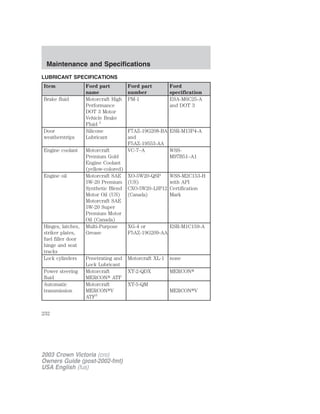
Lubricant specifications 232 
Accessories 237 
Index 240 
All rights reserved. Reproduction by any means, electronic or mechanical 
including photocopying, recording or by any information storage and retrieval 
system or translation in whole or part is not permitted without written 
authorization from Ford Motor Company. Ford may change the contents without 
notice and without incurring obligation. 
Copyright © 2003 Ford Motor Company 
2003 Crown Victoria (cro) 
Owners Guide (post-2002-fmt) 
USA English (fus) 
Table of Contents 
3
Introduction 
Introduction 
CALIFORNIA Proposition 65 Warning 
WARNING: Engine exhaust, some of its constituents, and 
certain vehicle components contain or emit chemicals known to 
the State of California to cause cancer and birth defects or other 
reproductive harm. In addition, certain fluids contained in vehicles and 
certain products of component wear contain or emit chemicals known 
to the State of California to cause cancer and birth defects or other 
reproductive harm. 
CONGRATULATIONS 
Congratulations on acquiring your new Ford. Please take the time to get 
well acquainted with your vehicle by reading this handbook. The more 
you know and understand about your vehicle the greater the safety and 
pleasure you will derive from driving it. 
For more information on Ford Motor Company and its products visit the 
following website: 
• In the United States: www.ford.com 
• In Canada: www.ford.ca 
• In Australia: www.ford.com.au 
• In Mexico: www.ford.com.mx 
Additional owner information is given in separate publications. 
This Owner’s Guide describes every option and model variant available 
and therefore some of the items covered may not apply to your 
particular vehicle. Furthermore, due to printing cycles it may describe 
options before they are generally available. 
Remember to pass on the Owner’s Guide when reselling the vehicle. It is 
an integral part of the vehicle. 
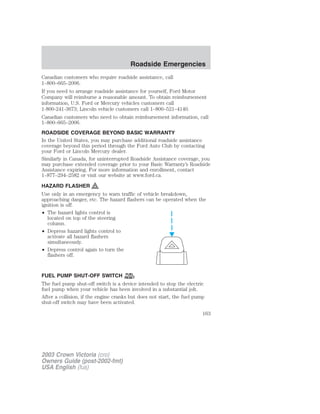
Fuel pump shut-off switch In the event of an accident the 
safety switch will automatically cut off the fuel supply to the 
engine. The switch can also be activated through sudden vibration (e.g. 
collision when parking). To reset the switch, refer to the Fuel pump 
shut-off switch in the Roadside emergencies chapter. 
4 
2003 Crown Victoria (cro) 
Owners Guide (post-2002-fmt) 
USA English (fus)
SAFETY AND ENVIRONMENT PROTECTION 
Warning symbols in this guide 
How can you reduce the risk of personal injury and prevent possible 
damage to others, your vehicle and its equipment? In this guide, answers 
to such questions are contained in comments highlighted by the warning 
triangle symbol. These comments should be read and observed. 
Warning symbols on your vehicle 
When you see this symbol, it is 
imperative that you consult the 
relevant section of this guide before 
touching or attempting adjustment 
of any kind. 
Protecting the environment 
We must all play our part in 
protecting the environment. Correct 
vehicle usage and the authorized 
disposal of waste cleaning and 
lubrication materials are significant 
steps towards this aim. Information in this respect is highlighted in this 
guide with the tree symbol. 
BREAKING-IN YOUR VEHICLE 
Your vehicle does not need an extensive break-in. Try not to drive 
continuously at the same speed for the first 1,600 km (1,000 miles) of 
new vehicle operation. Vary your speed to allow parts to adjust 
themselves to other parts. 
Drive your new vehicle at least 800 km (500 miles) before towing a 
trailer. 
Do not add friction modifier compounds or special break-in oils during 
the first few thousand kilometers (miles) of operation, since these 
additives may prevent piston ring seating. See Engine oil in the 
Maintenance and specifications chapter for more information on oil 
usage. 
2003 Crown Victoria (cro) 
Owners Guide (post-2002-fmt) 
USA English (fus) 
Introduction 
5
Introduction 
SPECIAL NOTICES 
Emission warranty 
The New Vehicle Limited Warranty includes Bumper-to-Bumper 
Coverage, Safety Restraint Coverage, Corrosion Coverage, and 7.3L 
Power Stroke Diesel Engine Coverage. In addition, your vehicle is eligible 
for Emissions Defect and Emissions Performance Warranties. For a 
detailed description of what is covered and what is not covered, refer to 
the Warranty Guide that is provided to you along with your Owner’s 
Guide. 
Data Recording 
Computers in your vehicle are capable of recording detailed data 
potentially including but not limited to information such as: 
• the use of restraint systems including seat belts by the driver and 
passengers, 
• information about the performance of various systems and modules in 
the vehicle, and 
• information related to engine, throttle, steering, brake or other system 
status. 
Any of this information could potentially include information regarding 
how the driver operates the vehicle potentially including but not limited 
to information regarding vehicle speed, brake or accelerator application 
or steering input. This information may be stored during regular 
operation or in a crash or near crash event. 
This stored information may be read out and used by: 
• Ford Motor Company. 
• service and repair facilities. 
• law enforcement or government agencies. 
• others who may assert a right or obtain your consent to know such 
information. 
6 
2003 Crown Victoria (cro) 
Owners Guide (post-2002-fmt) 
USA English (fus)
Special instructions 
For your added safety, your vehicle is fitted with sophisticated electronic 
controls. 
Please read the section Supplemental Restraint System (SRS) 
in the Seating and safety restraints chapter. Failure to follow 
the specific warnings and instructions could result in personal injury. 
Front seat mounted rear facing child or infant seats should 
NEVER be used in front of a passenger side air bag unless the 
air bag can be and is turned OFF. 
Notice to owners of natural gas fueled vehicles 
Before you drive your vehicle, be sure to read the Dedicated Natural 
Gas Vehicle supplement. This book contains important operation and 
maintenance information. 
Notice to owners of Severe Duty vehicles 
Before you drive your vehicle, be sure to read the “Severe Duty Owner’s 
Guide Supplement.” This book contains important operation and 
maintenance information. 
MIDDLE EAST/NORTH AFRICA VEHICLE SPECIFIC INFORMATION 
For your particular global region, your vehicle may be equipped with 
features and options that are different from the ones that are described 
in this Owner Guide; therefore, a supplement has been supplied that 
complements this book. By referring to the pages in the provided 
supplement, you can properly identify those features, recommendations 
and specifications that are unique to your vehicle. Refer to this Owner 
Guide for all other required information and warnings. 
2003 Crown Victoria (cro) 
Owners Guide (post-2002-fmt) 
USA English (fus) 
Introduction 
7
Introduction 
These are some of the symbols you may see on your vehicle. 
Vehicle Symbol Glossary 
Safety Alert See Owner’s Guide 
Fasten Safety Belt Air Bag-Front 
Air Bag-Side Child Seat 
Child Seat Installation 
Warning 
Child Seat Lower 
Anchor 
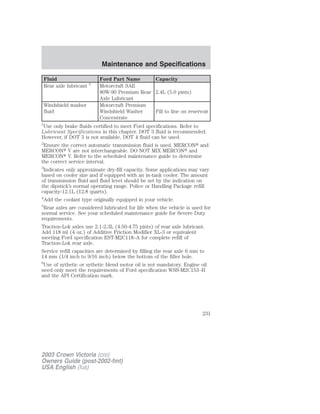
Child Seat Tether 
Anchor 
Brake System 
Anti-Lock Brake System 
Brake Fluid - 
Non-Petroleum Based 
Traction Control AdvanceTrac 
Master Lighting Switch Hazard Warning Flasher 
Fog Lamps-Front Fuse Compartment 
Fuel Pump Reset Windshield Wash/Wipe 
Windshield 
Defrost/Demist 
Rear Window 
Defrost/Demist 
8 
2003 Crown Victoria (cro) 
Owners Guide (post-2002-fmt) 
USA English (fus)
Vehicle Symbol Glossary 
Power Windows 
Front/Rear 
Power Window Lockout 
Child Safety Door 
Lock/Unlock 
Interior Luggage 
Compartment Release 
Symbol 
Panic Alarm Engine Oil 
Engine Coolant 
Engine Coolant 
Temperature 
Do Not Open When Hot Battery 
Avoid Smoking, Flames, 
or Sparks 
Battery Acid 
Explosive Gas Fan Warning 
Power Steering Fluid 
Maintain Correct Fluid 
Level 
MAX 
MIN 
Emission System Engine Air Filter 
Passenger Compartment 
Air Filter 
Jack 
Check fuel cap Low tire warning 
2003 Crown Victoria (cro) 
Owners Guide (post-2002-fmt) 
USA English (fus) 
Introduction 
9
Instrument Cluster 
Instrument Cluster 
WARNING LIGHTS AND CHIMES 
Warning lights and gauges can alert you to a vehicle condition that may 
become serious enough to cause expensive repairs. A warning light may 
illuminate when a problem exists with one of your vehicle’s functions. 
Many lights will illuminate when you start your vehicle to make sure the 
bulb works. If any light remains on after starting the vehicle, have 
the respective system inspected immediately. 
Standard instrument cluster 
Optional instrument cluster 
Check engine 
Illuminates briefly to ensure the 
system is functional. If it comes on 
CHECK 
after the engine is started, one of 
the engine’s emission control 
ENGINE 
systems may be malfunctioning. The 
light may illuminate without a driveability concern being noted and will 
not require towing. 
10 
2003 Crown Victoria (cro) 
Owners Guide (post-2002-fmt) 
USA English (fus)
Light remains on: 
Temporary malfunctions may cause your light to illuminate. Examples 
are: 
1. The vehicle has run out of fuel. 
2. Poor fuel quality or water in the fuel. 
3. The fuel cap may not have been properly installed and securely 
tightened. 
These temporary malfunctions can be corrected by filling the fuel tank 
with high quality fuel of the recommended octane and/or properly 
installing and securely tightening the fuel cap. After three driving cycles 
without these or any other temporary malfunctions present, the light 
should turn off. (A driving cycle consists of a cold engine startup 
followed by mixed city/highway driving.) No additional vehicle service is 
required. 
If the light remains on, have your vehicle serviced at the first available 
opportunity. 
Light is blinking: 
Engine misfire is occurring which could damage your catalytic converter. 
You should drive in a moderate fashion (avoid heavy acceleration and 
deceleration) and have your vehicle serviced at the first available 
opportunity. 
Under engine misfire conditions, excessive exhaust temperatures 
could damage the catalytic converter, the fuel system, interior 
floor coverings or other vehicle components, possibly causing a fire. 
Check fuel cap 
Illuminates when the fuel cap is not 
CHECK 
installed correctly. Check the fuel 
cap for proper installation. When 
FUEL 
the fuel filler cap is properly 
CAP 
re-installed, the light(s) will turn off 
after a period of normal driving. Continuing to operate the vehicle with 
the check fuel cap light on, or a mis-installed fuel cap can activate the 
Service Engine Soon/Check Engine warning light. 
It may take a long period of time for the system to detect an 
improperly installed fuel filler cap. 
For more information, refer to Fuel filler cap in the Maintenance and 
specifications chapter. 
2003 Crown Victoria (cro) 
Owners Guide (post-2002-fmt) 
USA English (fus) 
Instrument Cluster 
11
Instrument Cluster 
Brake system warning 
• Standard instrument cluster 
! 
BRAKE 
• Optional instrument cluster 
To confirm the brake system 
warning light is functional, it will 
momentarily illuminate when the 
ignition is turned to the ON position (alternatively for some vehicles 
when the ignition is moved from the ON position to START position, the 
light will momentarily illuminate prior to reaching the START position). 
It also illuminates if the parking brake is engaged. If the brake system 
warning light does not illuminate as described, seek service immediately. 
Illumination after the parking brake is released indicates low brake fluid 
level or a brake system malfunction and the brake system should be 
serviced immediately by a qualified technician. Refer to Brakes in the 
Driving chapter for more information. 
Anti-lock brake system (ABS) 
To confirm the anti-lock brake 
system (ABS) warning light is 
ABS 
functional it will momentarily 
illuminate when the ignition is 
turned to the ON position 
(alternatively for some vehicles when the ignition is moved from the ON 
position to the START position, the light will momentarily illuminate just 
prior to reaching the START position). If the light remains on, continues 
to flash or fails to illuminate, have the ABS serviced immediately. If the 
ABS light remains on, it means the anti-lock brake system has 
malfunctioned and is disabled, however, the normal brake system will 
still function unless the brake warning light also remains illuminated and 
parking brake is off. Refer to Brakes in the Driving chapter for more 
information. 
12 
2003 Crown Victoria (cro) 
Owners Guide (post-2002-fmt) 
USA English (fus)
Safety belt 
Illuminates to remind you to fasten 
your safety belts. For more 
information, refer to the Seating 
and safety restraints chapter. 
Air bag readiness 
Illuminates to confirm that the air 
bags (front or side) are operational. 
If the light fails to illuminate, 
continues to flash or remains on, 
have the system serviced immediately. 
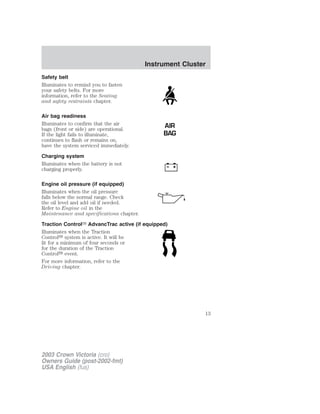
Charging system 
Illuminates when the battery is not 
charging properly. 
AIR 
BAG 
Engine oil pressure (if equipped) 
Illuminates when the oil pressure 
falls below the normal range. Check 
the oil level and add oil if needed. 
Refer to Engine oil in the 
Maintenance and specifications chapter. 
Traction Control AdvancTrac active (if equipped) 
Illuminates when the Traction 
Control system is active. It will be 
lit for a minimum of four seconds or 
for the duration of the Traction 
Control event. 
For more information, refer to the 
Driving chapter. 
2003 Crown Victoria (cro) 
Owners Guide (post-2002-fmt) 
USA English (fus) 
Instrument Cluster 
13
Instrument Cluster 
Air suspension (if equipped) 
• Standard instrument cluster 
• Optional instrument cluster 
Illuminates when the air suspension 
switch is turned OFF, the load limit 
is exceeded or the air suspension 
system requires servicing. 
Low fuel (if equipped) 
Illuminates when the fuel level in 
the fuel tank is at, or near empty 
(refer to Fuel gauge in this chapter 
for more information). 
O/D off 
• Standard instrument cluster 
AIR SUSPENSION 
OVERDRIVE OFF 
LOW 
WASHER 
FLUID 
• Optional instrument cluster 
Illuminates when the overdrive 
function has been turned OFF using 
the transmission control switch 
(TCS). If the light does not come on 
or the light flashes steadily, have 
your vehicle serviced as soon as 
possible, damage to the transmission could occur. 
Turn signals 
Illuminates when the turn signals or 
the hazard lights are turned on. If 
the lights stay on continuously or 
flash faster, check for a burned-out bulb. 
AIR 
SUSP 
CHECK 
DOOR 
AJAR 
km 
MILES 
/GAL 
TRUNK AJAR LTR/100 km 
LOW 
FUEL 
O/D 
OFF 
CHECK 
AIR SUSPENSION 
OVERDRIVE OFF 
DOOR 
AJAR 
LOW 
WASHER 
FLUID 
km 
MILES 
/GAL 
TRUNK AJAR LTR/100 km 
14 
2003 Crown Victoria (cro) 
Owners Guide (post-2002-fmt) 
USA English (fus)
High beams 
Illuminates when the high beam 
headlamps are turned on. 
Message center indicator lights (if equipped) 
Speed control 
This light comes on when either the 
SET/ACCEL or RESUME controls 
are pressed. It turns off when the 
speed control OFF control is pressed, the brake is applied or the ignition 
is turned to the OFF position. 
Door ajar 
Illuminates when one of the doors is 
not completely shut and the ignition 
is turned to ON. With the ignition 
ON, this light will flash six times (if 
a door is open). With the ignition in 
RUN position, a tone will sound for 
one second (if a door is open). 
Low washer fluid 
Momentarily illuminates when the 
ignition is turned to ON and will 
stay on when the windshield washer 
fluid is low. 
Trunk ajar 
If the trunk is not completely 
closed, this light comes on when 
you turn the ignition to ON. With 
the ignition ON, this light will flash 
five times and sound a tone for one 
second, then the light remains on (if 
the trunk is open). 
SPEED CONTROL 
CHECK 
AIR SUSPENSION 
OVERDRIVE OFF 
DOOR 
AJAR 
LOW 
WASHER 
FLUID 
km 
MILES 
/GAL 
TRUNK AJAR LTR/100 km 
CHECK 
AIR SUSPENSION 
OVERDRIVE OFF 
DOOR 
AJAR 
LOW 
WASHER 
FLUID 
km 
MILES 
/GAL 
TRUNK AJAR LTR/100 km 
CHECK 
AIR SUSPENSION 
OVERDRIVE OFF 
DOOR 
AJAR 
LOW 
WASHER 
FLUID 
km 
MILES 
/GAL 
TRUNK AJAR LTR/100 km 
2003 Crown Victoria (cro) 
Owners Guide (post-2002-fmt) 
USA English (fus) 
Instrument Cluster 
15
Instrument Cluster 
Safety belt warning chime 
Sounds to remind you to fasten your safety belts. 
BeltMinder chime 
Sounds intermittently to remind you to fasten your safety belts. 
Supplemental restraint system (SRS) warning chime 
Sounds when a malfunction in the supplemental restraint system (front 
or side airbags) has been detected. Have the supplemental restraint 
system inspected immediately. 
Headlamps on warning chime 
Sounds when the headlamps or parking lamps are on, the key is removed 
from the ignition and the driver’s door is opened. 
Key-in-ignition warning chime 
Sounds when the key is left in the ignition and the driver’s door is 
opened. 
GAUGES 
Standard instrument cluster gauges 
16 
2003 Crown Victoria (cro) 
Owners Guide (post-2002-fmt) 
USA English (fus)
Optional instrument cluster gauges 
Engine coolant temperature gauge 
Indicates the temperature of the engine coolant. At normal operating 
temperature, the needle remains within the normal area (the area 
between the “H” and “C”). If it enters the red section, the engine is 
overheating. Stop the vehicle as soon as safely possible, switch off the 
ignition and let it cool. Refer to Engine coolant in the Maintenance 
and specifications chapter. 
Never remove the coolant reservoir cap while the engine is 
running or hot. Steam and scalding liquid from a hot cooling 
system can burn you badly. 
• Standard instrument cluster 
H 
TEMP 
C 
2003 Crown Victoria (cro) 
Owners Guide (post-2002-fmt) 
USA English (fus) 
Instrument Cluster 
17
Instrument Cluster 
• Optional instrument cluster 
H 
NORM 
C 
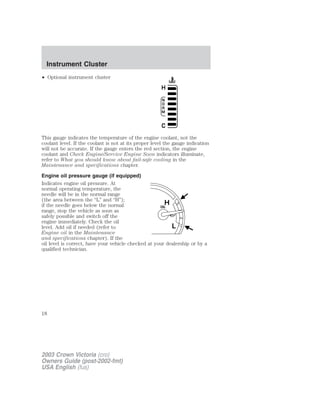
This gauge indicates the temperature of the engine coolant, not the 
coolant level. If the coolant is not at its proper level the gauge indication 
will not be accurate. If the gauge enters the red section, the engine 
coolant and Check Engine/Service Engine Soon indicators illuminate, 
refer to What you should know about fail-safe cooling in the 
Maintenance and specifications chapter. 
Engine oil pressure gauge (if equipped) 
Indicates engine oil pressure. At 
normal operating temperature, the 
needle will be in the normal range 
(the area between the “L” and “H”); 
if the needle goes below the normal 
H 
OIL 
range, stop the vehicle as soon as 
safely possible and switch off the 
engine immediately. Check the oil 
level. Add oil if needed (refer to 
L 
Engine oil in the Maintenance 
and specifications chapter). If the 
oil level is correct, have your vehicle checked at your dealership or by a 
qualified technician. 
18 
2003 Crown Victoria (cro) 
Owners Guide (post-2002-fmt) 
USA English (fus)
Battery voltage gauge (if equipped) 
Indicates battery voltage. If the 
pointer moves and stays outside the 
normal operating range (as 
indicated), have the vehicle’s 
electrical system checked as soon as 
possible. 
H 
Fuel gauge 
Displays approximately how much fuel is in the fuel tank. The fuel gauge 
may vary slightly when the vehicle is in motion or on a grade. 
When refueling the vehicle from empty indication, the amount of fuel 
that can be added will be less than the advertised capacity due to the 
reserve fuel. 
• Standard instrument cluster 
• Optional instrument cluster 
A minimum of four gallons must be 
added or removed from the fuel 
tank in order for the gauge to 
instantaneously update. If less than 
four gallons is added, the gauge will 
take between five to ten minutes to 
update. 
VOLTS 
L 
E 
F 
FUEL 
F 
1/2 
E 
2003 Crown Victoria (cro) 
Owners Guide (post-2002-fmt) 
USA English (fus) 
Instrument Cluster 
19
Instrument Cluster 
Speedometer 
Indicates the current vehicle speed. 
• Standard instrument cluster 
• Optional instrument cluster 
50 
MPH km/h 
40 
30 
20 
10 
40 
S km 
Odometer 
Registers the total kilometers (miles) of the vehicle. 
• Standard instrument cluster 
60 70 
80 
90 
100 
110 
120 
20 
60 
80 
100 
120 
140 
160 
180 
200 
0 0 0 0 0 0 0 
0 0 0 0 
km/h 
MPH 
MPH km/h 
30 
20 
10 
40 
50 
60 70 
80 
90 
100 
110 
120 
40 
20 
60 
80 
100 
120 
140 
160 
180 
200 
0 0 0 0 0 0 0 
0 0 0 0 
20 
2003 Crown Victoria (cro) 
Owners Guide (post-2002-fmt) 
USA English (fus)
• Optional instrument cluster 
S km 
km/h 
MPH 
Refer to Electronic Message Center in the Driver controls chapter for 
information on how to switch the display from metric to English 
measurements. 
Trip odometer 
Registers the kilometers (miles) of 
individual journeys. To reset, 
60 70 
depress the control. 
50 
80 
80 
100 
120 
140 
0 0 0 0 0 0 0 
0 0 0 0 
MPH km/h 
40 
30 
20 
10 
90 
100 
110 
120 
40 
20 
60 
160 
180 
200 
Refer to Electronic Message Center in the Driver controls chapter for 
Trip A and Trip B features on the optional instrument cluster. 
2003 Crown Victoria (cro) 
Owners Guide (post-2002-fmt) 
USA English (fus) 
Instrument Cluster 
21
Entertainment Systems 
PREMIUM AM/FM STEREO/CASSETTE/SINGLE CD 
1. Tape eject control 
2. CD eject control 
3. Bass/treble control 
4. Balance/fade control 
5. Compression/shuffle control 
6. Select control 
7. Side direction/Dolby control 
8. Rewind/fast forward control 
9. RDS or RDS/DSP control 
10. Autoset control 
11. Scan control 
12. Seek control 
13. Tune control 
14. AM/FM/CD control 
15. Phone/mute control 
16. Power/volume control 
17. Tape control 
18. CD door 
19. Cassette door 
Volume/power control 
Press the control to turn the audio 
system on or off. 
Audio power can also be turned on 
by pressing the AM/FM select 
control or the TAPE/CD select control. 
22 
2003 Crown Victoria (cro) 
Owners Guide (post-2002-fmt) 
USA English (fus)
Turn control to raise or lower 
volume. 
If the volume is set above a certain level and the ignition is turned off, 
the volume will come back on at a “nominal” listening level when the 
ignition switch is turned back on. 
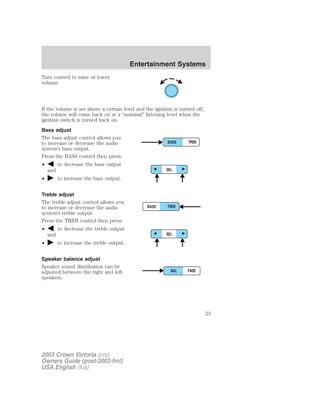
Bass adjust 
The bass adjust control allows you 
to increase or decrease the audio 
system’s bass output. 
Press the BASS control then press: 
• to decrease the bass output 
and 
• to increase the bass output. 
Treble adjust 
The treble adjust control allows you 
to increase or decrease the audio 
system’s treble output. 
Press the TREB control then press: 
• to decrease the treble output 
and 
• to increase the treble output. 
Speaker balance adjust 
Speaker sound distribution can be 
adjusted between the right and left 
speakers. 
2003 Crown Victoria (cro) 
Owners Guide (post-2002-fmt) 
USA English (fus) 
Entertainment Systems 
23
Entertainment Systems 
Press the BAL control then press: 
• to shift sound to the left and 
• to shift sound to the right. 
Speaker fade adjust 
Speaker sound can be adjusted 
between the front and rear 
speakers. 
Press the FADE control then press: 
• to shift the sound to the 
front and 
• to shift the sound to the rear. 
Seek function 
The seek function control works in radio, tape or CD mode. 
Seek function in radio mode 
• Press to find the next 
listenable station down the 
frequency band. 
• Press to find the next 
listenable station up the 
frequency band. 
Seek function in tape mode 
• Press to listen to the previous selection on the tape. 
• Press to listen to the next selection on the tape. 
Seek function in CD mode 
• Press to seek to the previous 
track of the current disc. 
• Press to seek forward to the 
next track of the current disc. 
After the last track has been 
completed, the first track of the current disc will automatically replay. 
24 
2003 Crown Victoria (cro) 
Owners Guide (post-2002-fmt) 
USA English (fus)
Scan function 
The scan function works in radio, 
tape or CD mode. 
Scan function in radio mode 
Press the SCAN control to hear a brief sampling of all listenable stations 
on the frequency band. Press the control again to stop the scan mode. 
Scan function in tape mode 
Press the SCAN control to hear a short sampling of all selections on the 
tape. (The tape scans in a forward direction. At the end of the tape’s 
first side, direction automatically reverses to the opposite side of the 
tape.) To stop on a particular selection, press the control again. 
Scan function in CD mode 
Press the SCAN control to hear a short sampling of all selections on the 
CD. (The CD scans in a forward direction, wrapping back to the first 
track at the end of the CD.) To stop on a particular selection, press the 
control again. 
AM/FM select 
The AM/FM select control works in 
radio, tape and CD modes. 
AM/FM select in radio mode 
This control allows you to select AM or FM frequency bands. Press the 
control to switch between AM, FM1 or FM2 memory preset stations. 
AM/FM select in tape mode 
Press this control to stop tape play and begin radio play. 
Radio station memory preset 
The radio is equipped with six station memory preset controls. These 
controls can be used to select up to six preset AM stations and twelve 
FM stations (six in FM1 and six in FM2). 
2003 Crown Victoria (cro) 
Owners Guide (post-2002-fmt) 
USA English (fus) 
Entertainment Systems 
25
Entertainment Systems 
Setting memory preset stations 
1. Select the frequency band with 
the AM/FM select control. 
2. Select a station. Refer to Tune 
adjust or Seek function for more information on selecting a station. 
3. Press and hold a memory preset control until the sound returns, 
indicating the station is held in memory of the control you selected. 
Autoset memory preset 
Autoset allows you to set strong radio stations without losing your 
original manually set preset stations. This feature is helpful on trips 
when you travel between cities with different radio stations. 
Starting autoset memory preset 
1. Select a frequency using the AM/FM select controls. 
2. Press the control. 
3. When the first six strong stations 
are filled, the station stored in 
memory preset control 1 will start 
playing. 
If there are less than six strong stations available on the frequency band, 
the remaining memory preset controls will all store the last strong 
station available. 
These stations are temporarily stored in the memory preset controls 
(until deactivated) and are accessed in the same manner as your original 
presets. 
To deactivate autoset and return to your audio system’s manually set 
memory stations, press the AUTO control again. 
Setting the clock with radio data system (RDS) feature 
Press the RDS control until SELECT 
HOUR or SELECT MINS is 
displayed. 
26 
2003 Crown Victoria (cro) 
Owners Guide (post-2002-fmt) 
USA English (fus)
Use the SEL control to manually set 
the time. 
• to decrease hours/minutes 
and 
• to increase hours/minutes. 
Tune adjust 
The tune control works in radio mode. 
Tune adjust in radio mode 
• Press to move to the next 
frequency down the band 
(whether or not a listenable 
station is located there). Hold the 
control to move through the 
frequencies quickly. 
• Press to move to the next frequency up the band (whether or not 
a listenable station is located there). Hold for quick movement. 
Tape/CD select 
• To begin tape play (with a tape 
loaded into the audio system) 
while in the radio or CD mode, 
press the TAPE control. Press the 
button during rewind or fast forward to stop the rewind or fast 
forward function. 
• To begin CD play (if CD is 
loaded), press the CD control. 
The first track of the disc will 
begin playing. If returning from 
radio or tape mode, CD play will begin where it stopped last. 
Rewind 
The rewind control works in tape 
and CD modes. 
• In tape mode, radio play will 
continue until rewind is stopped 
(with the TAPE control) or the beginning of the tape is reached. 
2003 Crown Victoria (cro) 
Owners Guide (post-2002-fmt) 
USA English (fus) 
Entertainment Systems 
27
Entertainment Systems 
Fast forward 
The fast forward control works in 
tape and CD modes. 
• In the tape mode, tape direction 
will automatically reverse when 
the end of the tape is reached. 
Tape direction select 
Press to play the alternate side of 
the tape. 
Eject function 
Press the EJ control to stop and 
eject a tape. 
Press the EJ control to stop and 
eject a CD. 
Dolby noise reduction 
Dolby noise reduction operates in 
tape mode. Dolby noise reduction 
reduces the amount of hiss and 
static during tape playback. 
Press the control to activate (and deactivate) the Dolby noise 
reduction. 
Dolby noise reduction is manufactured under license from Dolby 
Laboratories Licensing Corporation. “Dolby” and the double-D 
symbol are registered trademarks of Dolby Laboratories Licensing 
Corporation. 
Compression adjust 
Compression adjust brings soft and 
loud CD passages together for a 
more consistent listening level. 
Press the COMP control to activate 
and deactivate compression adjust. 
28 
2003 Crown Victoria (cro) 
Owners Guide (post-2002-fmt) 
USA English (fus)
Radio data system (RDS) feature 
This feature allows your audio system to receive station identification or 
program type from RDS-equipped FM radio stations. 
The Federal Communications Commission (FCC) and the Canadian Radio 
and Telecommunications Commission (CRTC) recommend that FM radio 
broadcasters use RDS technology to transmit information. FM radio 
stations are independently operated and individually elect to use RDS 
technology to transmit station ID and program type as desired. 
Press the RDS control until RDS ON 
or RDS OFF appears in the display. 
Use the SEL control to enable (ON) 
or disable (OFF) the feature. With the RDS activated, press the SEL 
control to scroll through the following selections: 
Traffic 
• Press the RDS control until 
TRAFFIC is displayed. 
• Use the SEL control to select ON 
or OFF. With the feature on, use 
the SEEK or SCAN control to 
find a radio station broadcasting a 
traffic report (if it is broadcasting 
RDS data). 
This feature also allows you to control the volume of traffic 
announcements. With the display reading TRAFFIC ON, adjust the 
volume (using the volume control) to the desired level. The volume level 
will show at the bottom of the display. Interrupting traffic 
announcements will be at the selected volume level. 
Traffic information is not available in most U.S. markets. 
Program type 
• Press the RDS control until the 
FIND program type is displayed. 
2003 Crown Victoria (cro) 
Owners Guide (post-2002-fmt) 
USA English (fus) 
Entertainment Systems 
29
Entertainment Systems 
• Use the SEL control to select the 
program type. With the feature 
on, use the SEEK or SCAN 
control to find the desired 
program type from the following 
selections: 
• Classic 
• Country 
• Info 
• Jazz 
• Oldies 
• R  B 
• Religious 
• Rock 
• Soft 
• Top 40 
Show 
• With RDS activated, press the 
RDS control until SHOW is 
displayed. 
• Use the SEL control to select 
TYPE (the display shows the 
program type), NAME (the 
display shows the call letters of 
the station) or NONE. 
Shuffle feature 
The shuffle feature operates in CD 
mode and plays all tracks in random 
order. 
Press the SHUFFLE control to start 
this feature. Random order play will continue until the SHUFFLE control 
is pressed again. 
Mute mode 
Press the MUTE control to mute the 
playing media. Press the MUTE 
control again to return to the 
playing media. 
30 
2003 Crown Victoria (cro) 
Owners Guide (post-2002-fmt) 
USA English (fus)
AM/FM STEREO CASSETTE 
FM1 ST 
BASS TREB BAL FADE 
SCAN 
EJ 
VOL - PUSH ON 
SEEK 
TUNE 
AM 
FM 
1 2 3 4 5 6 
Volume/power control 
Press the control to turn the audio 
system on or off. 
Turn the control to raise or lower 
volume. 
SIDE 
CLK 
TAPE 
AMS 
1 - 2 
REW FF 
VOL - PUSH ON 
VOL - PUSH ON 
If the volume is set above a certain level and the ignition is turned off, 
the volume will come back on at a “nominal” listening level when the 
ignition switch is turned back on. 
2003 Crown Victoria (cro) 
Owners Guide (post-2002-fmt) 
USA English (fus) 
Entertainment Systems 
31
Entertainment Systems 
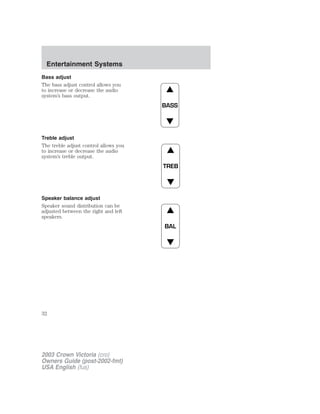
Bass adjust 
The bass adjust control allows you 
to increase or decrease the audio 
system’s bass output. 
Treble adjust 
The treble adjust control allows you 
to increase or decrease the audio 
system’s treble output. 
Speaker balance adjust 
Speaker sound distribution can be 
adjusted between the right and left 
speakers. 
BASS 
TREB 
BAL 
32 
2003 Crown Victoria (cro) 
Owners Guide (post-2002-fmt) 
USA English (fus)
Speaker fade adjust 
Speaker sound can be adjusted 
between the front and rear 
speakers. 
Seek function 
The seek function control works in radio mode. 
Seek function in radio mode 
• Press to find the next 
listenable station down the 
frequency band. 
• Press to find the next 
listenable station up the 
frequency band. 
Scan function 
The scan function works in radio 
mode. 
FADE 
SCAN 
Scan function in radio mode 
Press the SCAN control to hear a brief sampling of all listenable stations 
on the frequency band. Press the SCAN control again to stop the scan 
mode. 
2003 Crown Victoria (cro) 
Owners Guide (post-2002-fmt) 
USA English (fus) 
Entertainment Systems 
33
Entertainment Systems 
AM/FM select 
The AM/FM select control works in 
radio and tape modes. 
AM 
FM 
AM/FM select in radio mode 
This control allows you to select AM or FM frequency bands. Press the 
AM control to select from AM selections, and press the FM control to 
select from FM1 or FM2 memory preset stations. 
AM/FM select in tape mode 
Press this control to stop tape play and begin radio play. 
Radio station memory preset 
The radio is equipped with six station memory preset controls. These 
controls can be used to select up to six preset AM stations and twelve 
FM stations (six in FM1 and six in FM2). 
Setting memory preset stations 
1. Select the frequency band with the AM or the FM select control. 
2. Select a station. Refer to Tune adjust or Seek function for more 
information on selecting a station. 
3. Press and hold a memory preset control until the sound returns, 
indicating the station is held in memory on the control you selected. 
1 2 3 4 5 6 
34 
2003 Crown Victoria (cro) 
Owners Guide (post-2002-fmt) 
USA English (fus)
Setting the clock 
Press CLK to toggle between 
listening frequencies and clock 
mode while in radio mode. 
To set the hour, press and hold the 
CLK control and press the SEEK 
control: 
• to decrease hours and 
• to increase hours. 
To set the minute, press and hold 
the CLK control and press the 
TUNE control: 
• to decrease minutes and 
• to increase minutes. 
CLK 
TAPE 
AMS 
SEEK 
TUNE 
CLK 
TAPE 
AMS 
SEEK 
TUNE 
The CLK control will allow you to switch between media display mode 
(radio station, stereo information, etc.) and clock display mode (time). 
When in clock mode, the media information will display for 10 seconds, 
when the radio is turned on, and then revert to clock information. Any 
time that the media is changed, (new radio station, etc.), the media 
information will again display for 10 seconds before reverting back to the 
clock. In media mode, the media information will always be displayed. 
Tune adjust 
The tune control works in radio mode. 
2003 Crown Victoria (cro) 
Owners Guide (post-2002-fmt) 
USA English (fus) 
Entertainment Systems 
35
Entertainment Systems 
Tune adjust in radio mode 
• Press to move to the next 
frequency down the band 
(whether or not a listenable 
station is located there). Hold the 
control to move through the 
frequencies quickly. 
• Press to move to the next frequency up the band (whether or not 
a listenable station is located there). Hold for quick movement. 
Tape select 
• To enter tape mode while in radio 
mode, press the TAPE AMS 
control. 
CLK 
TAPE 
AMS 
Automatic Music Search 
The Automatic Music Search feature 
allows you to quickly locate the 
beginning of the tape selection 
CLK 
being played or to skip to the next 
selection. 
TAPE 
To activate the feature, momentarily 
AMS 
depress the TAPE AMS button. 
Then, press either REW (for the 
beginning of the current selection) or FF (to advance to the next 
selection). The tape deck stops and returns to play mode when the AMS 
circuit senses a blank section on the tape. 
In order to ensure proper operation of the AMS feature, the tape MUST 
have a blank section of at least four seconds duration between programs. 
36 
2003 Crown Victoria (cro) 
Owners Guide (post-2002-fmt) 
USA English (fus)
Rewind 
The rewind control works in tape 
mode. 
To rewind in tape mode, press the 
REW control. 
Fast forward 
The fast forward control works in 
tape mode. 
To fast forward in tape mode, press 
the FF control. 
In the tape mode, tape direction will automatically reverse when the end 
of the tape is reached. 
Tape direction select 
Press SIDE and 1–2 at the same 
time to play the alternate side of a 
tape. 
Eject function 
Press the control to stop and eject a 
tape. 
SIDE 
REW FF 
1 - 2 
SIDE 
REW FF 
1 - 2 
SIDE 
REW FF 
1 - 2 
EJ 
Dolby noise reduction 
Dolby noise reduction operates 
only in tape mode. Dolby noise 
reduction reduces the amount of 
4 
hiss and static during tape playback. 
Press the control to activate (and deactivate) Dolby noise 
reduction. 
Dolby noise reduction is manufactured under license from Dolby 
Laboratories Licensing Corporation. “Dolby” and the double-D symbol 
are registered trademarks of Dolby Laboratories Licensing Corporation. 
2003 Crown Victoria (cro) 
Owners Guide (post-2002-fmt) 
USA English (fus) 
Entertainment Systems 
37
Entertainment Systems 
AM/FM STEREO 
TONE TONE VOL 
ST DX 
SEEK 
FM 
12 
CLK TUNE 
VOL 
PUSH 
ON 
1 2 3 4 AM/FM 
Volume/power control 
Press the control to turn the audio 
system on or off. 
Turn the control to raise or lower 
volume. 
VOL 
PUSH 
ON 
VOL 
PUSH 
ON 
If the volume is set above a certain level and the ignition is turned off, 
the volume will come back on at a “nominal” listening level when the 
ignition switch is turned back on. 
38 
2003 Crown Victoria (cro) 
Owners Guide (post-2002-fmt) 
USA English (fus)
Bass adjust 
The bass adjust control allows you 
to increase or decrease the audio 
system’s bass output. 
Press the TONE control once, then 
use the volume knob to adjust the 
desired level. 
Treble adjust 
The treble adjust control allows you 
to increase or decrease the audio 
system’s treble output. 
Press the TONE control twice, then 
use the volume knob to adjust the 
desired level. 
Speaker balance adjust 
Speaker sound distribution can be 
adjusted between the right and left 
speakers. 
Press the TONE control three times, 
then use the volume knob to adjust 
the desired level. 
Speaker fade adjust (if equipped) 
Speaker sound can be adjusted 
between the front and rear 
speakers. 
Press the TONE control four times, 
then use the volume knob to adjust 
the desired level. 
TONE 
CLK 
Seek function 
The seek function control works in radio mode. 
VOL 
PUSH 
ON 
TONE 
CLK 
VOL 
PUSH 
ON 
TONE 
CLK 
VOL 
PUSH 
ON 
TONE 
CLK 
VOL 
PUSH 
ON 
2003 Crown Victoria (cro) 
Owners Guide (post-2002-fmt) 
USA English (fus) 
Entertainment Systems 
39
Entertainment Systems 
Seek function in radio mode 
• Press to find the next 
listenable station down the 
frequency band. 
• Press to find the next 
listenable station up the frequency band. 
AM/FM select 
The AM/FM select control works in 
radio mode. 
SEEK 
TUNE 
AM/FM 
AM/FM select in radio mode 
This control allows you to select AM or FM frequency bands. Press the 
control to switch between AM, FM1 or FM2 memory preset stations. 
Radio station memory preset 
1 2 3 4 
The radio is equipped with four station memory preset controls. These 
controls can be used to select up to four preset AM stations and eight 
FM stations (four in FM1 and four in FM2). 
Setting memory preset stations 
1. Select the frequency band with the AM/FM select control. 
2. Select a station. Refer to Tune adjust or Seek function for more 
information on selecting a station. 
3. Press and hold a memory preset control until the sound returns, 
indicating the station is held in memory on the control you selected. 
1 2 3 4 
40 
2003 Crown Victoria (cro) 
Owners Guide (post-2002-fmt) 
USA English (fus)
Setting the clock 
Press CLK to toggle between 
listening frequencies and clock 
mode. 
To set the hour, press and hold the 
CLK control until CLOCK SET 
appears in the display and press the 
SEEK control: 
• to decrease hours and 
• to increase hours. 
To set the minute, press and hold 
the CLK control until CLOCK SET 
appears in the display and press the 
TUNE control: 
TONE 
CLK 
TONE 
CLK 
• to decrease minutes and 
• to increase minutes. 
The CLK control will allow you to 
switch between media display mode 
(radio station, stereo information, 
etc.) and clock display mode (time). 
When in clock mode, the media information will display for ten seconds, 
when the radio is turned on, and then revert to clock information. Any 
time that the media is changed, (new radio station, etc.), the media 
information will again display for ten seconds before reverting back to 
the clock. In media mode, the media information will always be 
displayed. 
Tune adjust 
The tune control works in radio mode. 
2003 Crown Victoria (cro) 
Owners Guide (post-2002-fmt) 
USA English (fus) 
Entertainment Systems 
41
Entertainment Systems 
Tune adjust in radio mode 
• Press to move to the next 
frequency down the band 
(whether or not a listenable 
station is located there). Hold the 
control to move through the frequencies quickly. 
• Press to move to the next frequency up the band (whether or not 
a listenable station is located there). Hold for quick movement. 
CD CHANGER (IF EQUIPPED) 
The CD changer is located in one of the following locations: 
• in the trunk 
• in the center console 
• under the driver’s seat 
1. Slide the door to access the CD 
changer magazine. 
2. Press to eject the magazine. 
SEEK 
TUNE 
42 
2003 Crown Victoria (cro) 
Owners Guide (post-2002-fmt) 
USA English (fus)
3. Turn the magazine (A) over. 
4. Using the disc holder release 
knob (C), pull the disc holder (B) 
out of the magazine. 
A B 
C 
A 
If you pull too hard on the disc holder, the disc holder may come 
completely out of the magazine. If this happens, reinsert the disc holder 
back into the magazine while pressing on the lever (A). 
5. Line up the CD with the groove 
of the disc holder. Ensure that the 
label on the CD faces downwards. 
6. Press in on the disc holder until it 
locks securely into the magazine. If 
the disc holders are not fully locked 
into the magazine, the unit will not 
operate. 
2003 Crown Victoria (cro) 
Owners Guide (post-2002-fmt) 
USA English (fus) 
Entertainment Systems 
43
Entertainment Systems 
Ensure that the disc holder is 
evenly inserted and at the same 
level as the magazine (A). The unit 
will not operate if the disc holder is 
not inserted at the same level (B). 
A 
B 
Radio power must be turned on to play the CDs in the changer. The 
magazine may be stored in the glove box when not being used. 
The CD magazine may be inserted or ejected with the radio power off. 
ONLY use the magazine supplied with the CD changer, other types will 
damage the unit. 
Keep the CD changer door closed. Coins and foreign objects will damage 
the CD player and void your audio system warranty. 
TROUBLESHOOTING THE CD CHANGER (IF EQUIPPED) 
The laser beam used in the compact disc player is harmful to the 
eyes. Do not attempt to disassemble the case. 
If sound skips: 
• You may be traveling on a rough road, playing badly scratched discs or 
the disc may be dirty. Skipping will not scratch the discs or damage 
the player. 
If your changer does not work, it may be that: 
• A disc is already loaded where you want to insert a disc. 
• The disc is inserted with the label surface downward. 
• The disc is dusty or defective. 
• The player’s internal temperature is above 60°C (140°F). Allow the 
player to cool down before operating. 
• A disc with format and dimensions not within industry standards is 
inserted. 
CLEANING COMPACT DISCS 
Inspect all discs for contamination before playing. If necessary, clean 
discs only with an approved CD cleaner and wipe from the center out to 
the edge. Do not use circular motion. 
44 
2003 Crown Victoria (cro) 
Owners Guide (post-2002-fmt) 
USA English (fus)
CD AND CD CHANGER CARE 
• Handle discs by their edges only. Never touch the playing surface. 
• Do not expose discs to direct sunlight or heat sources for extended 
periods of time. 
• Do not insert more than one disc into each slot of the CD changer 
magazine. 
CD units are designed to play commercially pressed 12 cm 
(4.75 in) audio compact discs only. Due to technical 
incompatibility, certain recordable and re-recordable compact 
discs may not function correctly when used in Ford CD players. 
Irregular shaped CDs, CDs with a scratch protection film 
attached, and CDs with homemade paper (adhesive) labels should 
not be inserted into the CD player. The label may peel and cause 
the CD to become jammed. It is recommended that homemade 
CDs be identified with permanent felt tip marker rather than 
adhesive labels. Ball point pens may damage CDs. Please contact 
your dealer for further information. 
CLEANING CASSETTE PLAYER (IF EQUIPPED) 
Clean the tape player head with a cassette cleaning cartridge after 10 to 
12 hours of play in order to maintain the best sound and operation. 
CASSETTE AND CASSETTE PLAYER CARE 
• Use only cassettes that are 90 minutes long or less. 
• Do not expose tapes to direct sunlight, high humidity, extreme heat or 
extreme cold. Allow tapes that may have been exposed to extreme 
temperatures to reach a moderate temperature before playing. 
• Tighten very loose tapes by inserting a finger or pencil into the hole 
and turning the hub. 
• Remove loose labels before inserting tapes. 
• Do not leave tapes in the cassette player for a long time when not 
being played. 
2003 Crown Victoria (cro) 
Owners Guide (post-2002-fmt) 
USA English (fus) 
Entertainment Systems 
45
Entertainment Systems 
RADIO FREQUENCY INFORMATION 
The Federal Communications Commission (FCC) and the Canadian Radio 
and Telecommunications Commission(CRTC) establish the frequencies 
AM and FM stations may use for their broadcasts. Allowable frequencies 
are: 
AM 530, 540–1600, 1610 kHz 
FM 87.7, 87.9–107.7, 107.9 MHz 
Not all frequencies are used in a given area. 
RADIO RECEPTION FACTORS 
Three factors can affect radio reception: 
• Distance/strength. The further an FM signal travels, the weaker it is. 
The listenable range of the average FM station is approximately 40 km 
(24 miles). This range can be affected by “signal modulation.” Signal 
modulation is a process radio stations use to increase their 
strength/volume relative to other stations. 
• Terrain. Hills, mountains and tall buildings between your vehicle’s 
antenna and the radio station signal can cause FM reception problems. 
Static can be caused on AM stations by power lines, electric fences, 
traffic lights and thunderstorms. Moving away from an interfering 
structure (out of its “shadow”) returns your reception to normal. 
• Station overload. Weak signals are sometimes captured by stronger 
signals when you pass a broadcast tower. A stronger signal may 
temporarily overtake a weaker signal and play while the weak station 
frequency is displayed. 
The audio system automatically switches to single channel reception if it 
will improve the reception of a station normally received in stereo. 
AUDIO SYSTEM WARRANTIES AND SERVICE 
Refer to the Warranty Guide for audio system warranty information. 
If service is necessary, see your dealer or a qualified technician. 
46 
2003 Crown Victoria (cro) 
Owners Guide (post-2002-fmt) 
USA English (fus)
Climate Controls 
MANUAL HEATING AND AIR CONDITIONING SYSTEM 
(IF EQUIPPED) 
LO 
HI 
Fan speed control 
Controls the volume of air circulated 
in the vehicle. 
Temperature control knob 
Controls the temperature of the 
airflow inside the vehicle. 
Mode Selector Control 
Controls the direction of the airflow 
to the inside of the vehicle. 
OFF 
VENT FLOOR 
MIX 
NORM 
A/C 
MAX 
A/C 
LO 
HI 
OFF 
VENT FLOOR 
MIX 
NORM 
A/C 
MAX 
A/C 
• Max A/C – Distributes recirculated air through the instrument panel 
registers. The A/C compressor will only function if the outside 
temperature is above approximately 2°C (36°F). Max A/C is noisier 
than Norm A/C but more economical and efficient. This mode will 
reduce undesirable odors from entering the vehicle. 
• Norm A/C – Distributes outside air through the instrument panel 
registers. The A/C compressor will only function if the outside 
temperature is above approximately 2°C (36°F). 
• Vent – Distributes outside air through the instrument panel registers. 
The air cannot be cooled below the outside temperature. 
• Off – Outside air is shut out and the fan will not operate. This mode 
will reduce undesirable odors form entering the vehicle but may 
increase the possibility of interior window fogging. 
2003 Crown Victoria (cro) 
Owners Guide (post-2002-fmt) 
USA English (fus) 
Climate Controls 
47
Climate Controls 
• Floor – Distributes outside air through the floor ducts. The air cannot 
be cooled below the outside temperature. 
• Mix – Distributes outside air through the floor ducts, the windshield 
defroster ducts and the side window demisters. The A/C compressor 
will operate automatically if the outside temperature is above 
approximately 2°C (36°F). The air distributed through the floor ducts 
will be slightly warmer than that sent to the windshield defroster 
ducts and the side window demisters. 
• Defrost – Distributes outside air through the windshield defroster 
ducts and the side window demisters. The A/C compressor will 
operate automatically if the outside temperature is above 
approximately 2°C (36°F). This mode will clear ice and fog from the 
windshield. 
Since the air conditioner removes moisture from the air, it is 
considered normal operation if water drips on the ground under 
the air conditioner drain. 
Operating tips 
• To reduce fogging under humid weather conditions, place the climate 
control system in Defrost and Rear Defrost (if equipped) mode before 
driving. 
• To reduce humidity buildup inside the vehicle: Do not drive with the 
climate control system in Off mode. Do not drive with the climate 
control system in Max A/C mode (if equipped). 
• Under normal weather conditions, do not leave your vehicle in Max 
A/C (if equipped), recirculation control (if equipped), or Off mode 
when turning off the ignition. 
• Under snowy or dirty weather conditions, leave your vehicle in Max 
A/C (if equipped), recirculation control (if equipped), or Off mode 
when turning off the ignition. 
• Remove any snow, ice or leaves from the exterior base of the 
windshield. 
• To increase the efficiency of the A/C (if equipped), drive with the 
windows slightly open for 2–3 minutes or until the vehicle has been 
“aired” out. 
• Do not place objects under the front seat or over the defroster ducts. 
They may reduce visibility, fall into the ducts, or degrade the 
performance of your climate control system. 
48 
2003 Crown Victoria (cro) 
Owners Guide (post-2002-fmt) 
USA English (fus)
To aid in side window defogging/demisting in cold weather conditions: 
1. Select Vent. 
2. Set the temperature control to full heat. 
3. Set the fan speed to full fan. 
4. Direct the outer panel vents towards the side windows. 
5. To increase airflow to the outer panel vents, close the central panel 
vents. 
Do not place objects on top of the instrument panel as these 
objects may become projectiles in a collision or sudden stop. 
ELECTRONIC AUTOMATIC TEMPERATURE CONTROL (EATC) 
SYSTEM (IF EQUIPPED) 
The EATC system will maintain a 
selected temperature and 
F OFF 
automatically control the fan speed 
AUTO 
OUTSIDE TEMP AUTOMATIC 
and airflow location. 
MAX A/C NORM A/C VENT FLOOR FLR • DEF DEF 
LO 
HI 
Automatic operation 
Press Automatic/AUTO and select the desired temperature. The system 
will either heat or cool to achieve the selected temperature. The system 
will automatically determine fan speed, airflow location and if outside air 
or recirculated air is required. 
When in automatic operation and weather conditions require heat, the 
air will be sent to the floor ducts. However, until the engine has warmed, 
the fan speed will operate at a low speed and airflow will be directed to 
the windshield defroster ducts. Upon engine warm up, the system will 
automatically direct airflow to the floor ducts and operate the required 
fan speed to achieve the selected temperature. 
If unusual conditions exist (i.e.-window fogging, etc.), the manual 
overrides allow you to select airflow locations and the fan speed. To 
return to automatic operation, press Automatic/AUTO. 
2003 Crown Victoria (cro) 
Owners Guide (post-2002-fmt) 
USA English (fus) 
Climate Controls 
49
Climate Controls 
Temperature selection 
To control the temperature, select 
°F 
the desired temperature by pressing 
the temperature controls. 
AUTO 
For continuous maximum cooling, 
push the temperature control until 
16°C (60°F) is shown in the display 
window. The system will continue 
maximum cooling (disregarding the 
displayed temperature) until a 
OUTSIDE TEMP 
warmer temperature is selected by 
pressing the temperature control. 
MAX A/C NORM A/C VENT 
For continuous maximum heating, 
push the temperature control until 
32°C (90°F) appears in the display 
window. The system will continue maximum heating (disregarding the 
displayed temperature) until a cooler temperature is selected by pressing 
the temperature control. 
Temperature conversion 
If your vehicle has an English/Metric 
(E/M) control to change your 
OFF 
HI 
electronic cluster display (if 
AUTO 
OUTSIDE TEMP AUTOMATIC 
equipped) and the message center 
MAX A/C NORM A/C VENT FLOOR FLR • DEF DEF 
LO 
display (if equipped) from English 
to Metric, this control will also 
change the temperature display. 
Displaying outside temperature 
Press Ext Temp/Outside Temp to display the outside temperature. The 
outside temperature will be displayed until Ext Temp/Outside Temp has 
been pressed again. 
If the interior temperature or fan speed are adjusted or a manual 
override is selected while the outside temperature is being displayed, the 
new temperature, fan speed, or override control will appear in the 
display window for four seconds and the outside temperature will return 
to the display window. 
The outside temperature reading is most accurate when the vehicle is 
moving. Higher readings may be displayed when the vehicle is not 
50 
2003 Crown Victoria (cro) 
Owners Guide (post-2002-fmt) 
USA English (fus)
moving. Due to locations, the outside temperature readings displayed on 
the climate control system may not agree with those from the radio 
station broadcasts. 
Fan speed ( ) 
When in automatic operation, fan 
speed operates as necessary to 
achieve the selected temperature. If 
OFF 
HI 
desired, the fan speed can be 
controlled manually through the use 
AUTOMATIC 
of the fan speed control. To return 
to automatic fan operation, press 
Automatic/AUTO. 
FLR • DEF DEF 
LO 
Manual override controls 
The manual override controls allow 
you to determine airflow location 
F OFF 
and fan speed. To return to full 
AUTO 
OUTSIDE TEMP AUTOMATIC 
automatic control, press 
NORM A/C VENT FLOOR FLR • DEF DEF 
Automatic/AUTO. 
• Max A/C - Distributes recirculated air through the instrument panel 
registers. A temperature of 16°C (60°F) will appear in the display 
window until Automatic/AUTO, another manual override control, or 
the temperature control has been selected. The A/C compressor will 
only function if the outside temperature is above approximately 2°C 
(36°F). Max A/C is noisier than Norm A/C, but more economic and 
efficient. This mode will reduce undesirable odors from entering the 
vehicle. 
• Norm A/C- Distributes outside air through the instrument panel 
registers. The A/C compressor will only function if the outside 
temperature is above approximately 2°C (36°F). Norm A/C is more 
quiet than Max A/C, but not as economic and efficient. 
• Vent-Distributes outside air through the instrument panel registers. 
The air cannot be cooled below the outside temperature. 
• Floor- Distributes outside air through the floor ducts. The air cannot 
be cooled below the outside temperature. 
• Floor  Defrost - Distributes outside air through the windshield 
defroster ducts, floor ducts and the side window demisters. The A/C 
HI 
MAX A/C LO 
2003 Crown Victoria (cro) 
Owners Guide (post-2002-fmt) 
USA English (fus) 
Climate Controls 
51
Climate Controls 
compressor will operate automatically if the outside temperature is 
above approximately 2°C (36°F). The air distributed through the floor 
ducts will be slightly warmer than that sent to the windshield 
defroster ducts and the side window demisters. 
• Defrost - Distributes outside air through the windshield defroster 
ducts and the side window demisters. The A/C compressor will 
operate automatically if the outside temperature is above 
approximately 2°C (36°F). This mode will clear ice and fog from the 
windshield. 
Operating tips 
• To reduce fogging under humid weather conditions, place the climate 
control system in Defrost and Rear Defrost (if equipped) mode before 
driving. 
• To reduce humidity buildup inside the vehicle: Do not drive with the 
climate control system in Off mode. Do not drive with the climate 
control system in Max A/C mode (if equipped). 
• Under normal weather conditions, do not leave your vehicle in Max 
A/C (if equipped), recirculation control (if equipped) or Off mode 
when turning off the ignition. 
• Under snowy or dirty weather conditions, leave your vehicle in Max 
A/C (if equipped), recirculation control (if equipped), or Off mode 
when turning off the ignition. 
• Remove any snow, ice or leaves from the exterior base of the 
windshield. 
• To increase the efficiency of the A/C (if equipped), drive with the 
windows slightly open for 2–3 minutes or until the vehicle has been 
“aired” out. 
• Do not place objects under the front seat or over the defroster ducts. 
They may reduce visibility, fall into the ducts, or degrade the 
performance of your climate control system. 
To aid in side window defogging/demisting in cold weather conditions: 
1. Select VENT 
2. Set the temperature control to full heat 
3. Set the fan speed to HI 
4. Direct the outer panel vents towards to side windows 
To increase airflow to the outer panel vents, close the central panel vents. 
52 
2003 Crown Victoria (cro) 
Owners Guide (post-2002-fmt) 
USA English (fus)
Do not place objects on top of the instrument panel, as these 
objects may become projectiles in a collision or sudden stop. 
REAR WINDOW DEFROSTER 
The rear defroster control is located 
on the instrument panel. 
Press the rear defroster control to 
clear the rear window of thin ice 
and fog. 
• A small LED will illuminate when 
the rear defroster is activated. 
The ignition must be in the ON position to operate the rear window 
defroster. 
The defroster turns off automatically after 10 minutes or when the 
ignition is turned to the OFF position. To manually turn off the defroster 
before 10 minutes have passed, push the control again. 
Activating the rear window defroster will also activate the heated mirrors 
(if equipped). For more information refer to Heated outside mirrors in 
the Driver controls chapter. 
2003 Crown Victoria (cro) 
Owners Guide (post-2002-fmt) 
USA English (fus) 
Climate Controls 
53
Lights 
Lights 
HEADLAMP CONTROL 
Turns the lamps off. 
Turns on the parking 
lamps, instrument panel lamps, 
license plate lamps and tail lamps. 
Turns the headlamps on. 
Autolamp control 
The autolamp system provides light 
sensitive automatic on-off control of 
the exterior lights normally 
controlled by the headlamp control. 
The autolamp system also keeps the 
lights on for a predetermined period 
of time after the ignition switch is 
turned to OFF. 
• To turn autolamps on, rotate the 
control counterclockwise to the 
next position from OFF. 
• To turn autolamps off, rotate the control clockwise past OFF to the 
parking lamp position , then back to OFF. 
The headlamps will also turn on when the windshield wipers are 
activated, after a 10–20 second delay. 
Daytime running lamps (DRL) (if equipped) 
Turns the highbeam headlamps on with a reduced output. To activate: 
• the key must be in the ON position, 
• the parking brake released, and 
• the headlamp control is in the OFF or Parking lamps position. 
Always remember to turn on your headlamps at dusk or during 
inclement weather. The Daytime Running Light (DRL) System 
does not activate your tail lamps and generally may not provide 
adequate lighting during these conditions. Failure to activate your 
headlamps under these conditions may result in a collision. 
54 
2003 Crown Victoria (cro) 
Owners Guide (post-2002-fmt) 
USA English (fus)
High beams 
Push the lever toward the 
instrument panel to activate. Pull 
the lever towards you to deactivate. 
Flash to pass 
Pull toward you slightly to activate 
and release to deactivate. 
PANEL DIMMER CONTROL 
Use to adjust the brightness of the 
instrument panel during headlight 
and parklamp operation. 
• Rotate the thumbwheel from left 
to right to brighten the 
instrument panel. 
• Rotate the thumbwheel from right 
to left to dim the instrument 
panel. 
Domelamp Control 
The panel dimmer control also controls the domelamp operation. 
• Rotate the thumbwheel fully to the right, past detent to activate the 
domelamp. 
• In order to turn off the domelamp, rotate the thumbwheel to the left. 
AIMING THE HEADLAMPS 
The headlamps on your vehicle are properly aimed at the assembly plant. 
If your vehicle has been in an accident the alignment of your headlamps 
should be checked by a qualified service technician. 
2003 Crown Victoria (cro) 
Owners Guide (post-2002-fmt) 
USA English (fus) 
Lights 
55
Lights 
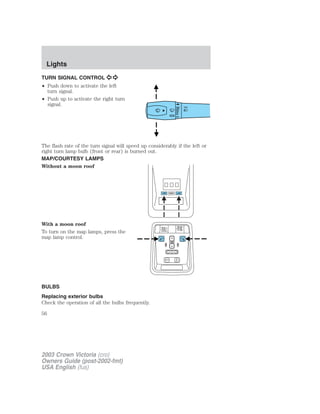
TURN SIGNAL CONTROL 
• Push down to activate the left 
turn signal. 
• Push up to activate the right turn 
signal. 
The flash rate of the turn signal will speed up considerably if the left or 
right turn lamp bulb (front or rear) is burned out. 
MAP/COURTESY LAMPS 
Without a moon roof 
With a moon roof 
To turn on the map lamps, press the 
map lamp control. 
BULBS 
Replacing exterior bulbs 
Check the operation of all the bulbs frequently. 
56 
2003 Crown Victoria (cro) 
Owners Guide (post-2002-fmt) 
USA English (fus)
Using the right bulbs 
Replacement bulbs are specified in the chart below. Headlamp bulbs 
must be marked with an authorized “D.O.T.” for North America and an 
“E” for Europe to assure lamp performance, light brightness and pattern 
and safe visibility. The correct bulbs will not damage the lamp assembly 
or void the lamp assembly warranty and will provide quality bulb burn 
time. 
Function Trade Number 
Headlamp 9007 
Park lamp and turn lamp (front) 3457 AK (amber) 
Side marker (front) 194 AK (amber) 
Cornering lamp (front) 3156K 
Tail, stop, turn (rear) 3157K 
Side marker (rear) 194 
Backup lamp 3156K 
License plate lamp 168 
High-mount brakelamp 912 
Luggage compartment lamp 212-2 
Dome lamp 906 
Rear reading lamp 211-2 
Map lamp 168 
Illuminated visor mirror 168 
Dual floorwell lamp 906 
Glove compartment 168 
All replacement bulbs are clear in color except where noted. 
To replace all instrument panel lights - see your dealer. 
Replacing the interior bulbs 
Check the operation of all bulbs frequently. 
Replacing headlamp bulbs 
To remove the headlamp bulb: 
1. Make sure headlamp switch is in OFF position, then open the hood. 
2. Remove the radiator cover by turning the three knobs to the unlock 
position. 
2003 Crown Victoria (cro) 
Owners Guide (post-2002-fmt) 
USA English (fus) 
Lights 
57
Lights 
3. Disconnect the electrical 
connector from the bulb by pulling 
rearward. 
4. Remove the bulb retaining ring by 
rotating it counterclockwise (when 
viewed from the rear) to free it 
from the bulb socket, and slide the 
ring off the plastic base. Keep the 
ring to retain the new bulb. 
5. Without turning, remove the old 
bulb from the lamp assembly by 
gently pulling it straight back out of 
the lamp assembly. 
To install the new bulb: 
Handle a halogen headlamp bulb carefully and keep out of 
children’s reach. Grasp the bulb only by its plastic base and do 
not touch the glass. The oil from your hand could cause the bulb to 
break the next time the headlamps are operated. 
NOTE: If the bulb is accidentally touched, it should be cleaned with 
rubbing alcohol before being used. 
1. With the flat side of the new bulb’s plastic base facing upward, insert 
the glass end of the bulb into the lamp assembly. Turn the bulb left or 
right to align the grooves in the plastic base with the tabs in the lamp 
assembly. When the grooves are aligned, push the bulb into the lamp 
assembly until the plastic base contacts the rear of the lamp assembly. 
2. Install the bulb retaining ring over the plastic base until it contacts the 
rear of the socket by rotating it clockwise until you feel a “stop.” 
3. Connect the electrical connector into the rear of the plastic base until 
it snaps, locking it into position. 
4. Install the protective cover over headlamps locking it in place with 
three knobs. 
58 
2003 Crown Victoria (cro) 
Owners Guide (post-2002-fmt) 
USA English (fus)
5. Turn the headlamps on and make sure they work properly. If the 
headlamp was correctly aligned before you changed the bulb, you should 
not need to align it again. 
Replacing front parking lamp/turn signal bulbs 
The park/turn lamp bulbs can be replaced with out removing the 
headlamp assembly. 
1. Make sure headlamp switch is in OFF position, then open the hood. 
2. Remove the radiator cover by turning the three knobs to the unlock 
position. 
3. Loosen the parking lamp retainer, on the outside of the lamp, screw 
and pull the lamp assembly forward. 
4. Disconnect the electrical 
connector from the bulb by pulling 
rearward. 
5. Rotate the bulb socket 
counterclockwise and remove from 
lamp assembly. 
6. Carefully pull bulb straight out of 
the socket and push in the new bulb 
until it snaps, locking it into 
position. 
7. To complete installation, follow the removal procedure in reverse 
order. 
Replacing tail lamp/brake/turn lamp bulbs 
The tail lamp, the brake lamp and the turn signal lamp bulbs are located 
in the tail lamp assembly. Follow the same steps to replace either bulb. 
2003 Crown Victoria (cro) 
Owners Guide (post-2002-fmt) 
USA English (fus) 
Lights 
59
Lights 
1. Make sure headlamp switch is in 
OFF position, then open the trunk 
and remove plastic retainer to 
expose the lamp assembly hardware. 
2. Carefully pull the carpet away to 
expose the plastic retainer. 
3. Remove three nut and washer 
assemblies and the lamp assembly 
from the vehicle. 
4. Remove the bulb socket by 
rotating it counterclockwise, then 
pulling it out of the lamp assembly. 
5. Pull the bulb from the socket and 
push in the new bulb. 
6. Install the bulb socket into the 
lamp assembly by rotating it 
clockwise. 
7. Install the lamp assembly on the 
vehicle with three nut and washer 
assemblies ensuring the washers on 
the nuts are flush with the body to prevent water from entering the 
trunk. 
8. Install the plastic retainer and carefully push the carpet back in to 
place. 
60 
2003 Crown Victoria (cro) 
Owners Guide (post-2002-fmt) 
USA English (fus)
Replacing license plate lamp bulbs 
1. Make sure headlamp switch is in 
OFF position, then remove two 
screws, grommets and the license 
plate lamp assembly from the trunk 
lid. 
2. Carefully pull the bulb from the 
socket and push in the new bulb. 
3. Install the lamp assembly on 
trunk lid with two grommets, 
ensuring the grommets are pushed 
all the way in to the trunk lid and secure with two screws. 
Replacing backup lamp bulbs 
1. Make sure headlamp switch is in 
OFF position, then open trunk and 
remove bulb socket from the trunk 
lid by turning counterclockwise. 
2. Pull the bulb straight out of the 
socket and push in the new bulb. 
3. Install the bulb socket in trunk lid 
by turning clockwise. 
Replacing high-mount brakelamp bulbs 
1. Make sure headlamp switch is in 
OFF position, then remove two 
screws from the lamp assembly. 
2. Carefully lift the lamp assembly 
up for access to the bulbs. 
2003 Crown Victoria (cro) 
Owners Guide (post-2002-fmt) 
USA English (fus) 
Lights 
61
Lights 
3. Carefully pull the bulb socket out 
of the lamp assembly. 
4. Pull the bulb straight out of the 
socket and push in the new bulb. 
To install, reverse the removal 
procedure. 
62 
2003 Crown Victoria (cro) 
Owners Guide (post-2002-fmt) 
USA English (fus)
Driver Controls 
WINDSHIELD WIPER/WASHER CONTROLS 
Rotate the windshield wiper control 
to the desired interval, low or high 
speed position. 
The bars of varying length are for 
intermittent wipers. When in this 
position rotate the control upward 
for fast intervals and downward for 
slow intervals. 
Push the end of the stalk to activate 
washer. Push and hold for a longer 
wash cycle. 
Windshield wiper/washer features 
The exterior lamps will illuminate after 10–20 second delay when the 
ignition is ON and the windshield wiper control is in the LO or HI 
position. 
The lights will remain on for 30 seconds after the wipers are turned off. 
Maintenance and care of windshield wiper blades 
Check the wiper blades for wear at least twice a year or when they seem 
less effective. Substances such as tree sap, road salt, oil film and some 
hot wax treatments used by commercial car washes reduce the 
effectiveness of wiper blades. 
Operation of the wipers on dry glass for long periods of time may cause 
deterioration of the wiper blades. Always use washer fluid when using 
the wipers to remove salt or dirt from a dry windshield. Avoid using the 
blades to remove frost or ice from the windshield. If the wiper blades are 
frozen to the windshield, loosen the wiper blades before operating the 
wipers to prevent damage to the wiper system. 
It the windshield is not clear after using the windshield washer wiper 
system, or if the wiper blades chatter, streak or smear when operating, it 
is possible that wax, road salt or oil film may be on the windshield or the 
wiper blades. Refer to Cleaning window and wiper blades in the 
Cleaning chapter. 
Changing the wiper blades 
To make changing the wiper blades easy, turn the ignition to ACC, then 
turn the wipers on. When the wipers reach the vertical position, turn the 
ignition to LOCK. 
2003 Crown Victoria (cro) 
Owners Guide (post-2002-fmt) 
USA English (fus) 
Driver Controls 
63
Driver Controls 
To replace the wiper blades: 
1. Pull the wiper arm away from the 
windshield and lock into the service 
position. 
2. Press and hold the tab on the 
blade and slide the blade off the 
wiper arm pin. 
3. To attach the new wiper blade, 
press and hold the tab on the blade 
and slide the blade on to the wiper 
arm pin. Then release the tab. 
4. Replace wiper blades every 6 months for optimum performance. 
TILT STEERING 
Pull the tilt steering control toward 
you to move the steering wheel up 
or down. Hold the control while 
adjusting the wheel to the desired 
position, then release the control. 
Never adjust the steering wheel when the vehicle is moving. 
OVERHEAD CONSOLE WITHOUT MOON ROOF (IF EQUIPPED) 
The appearance of your vehicle’s overhead console will vary according to 
your option package. Some of the features in the overhead console 
include a storage bin and compass. To program the Homelink, refer to 
Homelink Universal Transceiver it this chapter. 
64 
2003 Crown Victoria (cro) 
Owners Guide (post-2002-fmt) 
USA English (fus)
Storage compartment (if 
equipped): Press the OPEN control 
to open the storage compartment. 
The door will open slightly and can 
be moved to full open. 
The storage compartment may be 
used to secure sunglasses or a 
similar object. 
Electronic compass display (if equipped) 
Compass: The compass display is contained in the overhead console. 
The vehicle heading is displayed as one of N, NE, E, SE, S, SW, W and 
NW. 
The compass reading may be affected when you drive near large 
buildings, bridges, power lines and powerful broadcast antenna. Magnetic 
or metallic objects placed in or on the vehicle may also affect compass 
accuracy. Adjustments may need to be made to the zone and calibration 
of the compass. 
Compass zone adjustment 
1. Determine which magnetic zone 
you are in by referring to the zone 
3 2 1 
map. 
4 
2. Turn the ignition to the ON 
position. 
5 
15 
14 
13 
12 
6 7 8 91011 
2003 Crown Victoria (cro) 
Owners Guide (post-2002-fmt) 
USA English (fus) 
Driver Controls 
65
Driver Controls 
3. Press and hold the MODE control 
until VAR appears in the display, 
then release. The display should 
show the current zone number. 
4. Press the MODE control until the 
desired zone number appears. The 
display will flash and then return to 
normal operation. The zone is now 
updated. 
Compass calibration adjustment 
Perform this adjustment in an open 
area free from steel structures and 
high voltage lines: 
1. Press and hold the MODE control 
until CAL appears in the display 
(approximately eight seconds) and 
release. 
2. Drive the vehicle slowly (less 
than 5 km/h [3 mph]) in circles until 
CAL indicator turns off in about 2–3 complete circles. 
3. The compass is now calibrated. 
OVERHEAD CONSOLE WITH MOON ROOF (IF EQUIPPED) 
The appearance of your vehicle’s overhead console will vary according to 
your option package. Some of the features in the overhead console 
include Compass, Homelink, and Moon Roof controls. 
Compass mode 
The compass reading may be affected when you drive near large 
buildings, bridges, power lines and powerful broadcast antenna. Magnetic 
or metallic objects placed in, on or near the vehicle may also affect 
compass accuracy. 
1. Turn ignition to the ON position. 
2. Start the engine. 
66 
2003 Crown Victoria (cro) 
Owners Guide (post-2002-fmt) 
USA English (fus)
3. From a blank display press and 
release the MODE button once. The 
directional heading will be 
displayed. 
Note: If the compass is 
de-calibrated, CAL will be displayed 
in the right corner of the display. 
Refer to “Calibration mode” in this 
section for more details. 
4. The overhead console displays the compass heading in one of eight 
directions: NORTH, NORTHEAST, EAST, SOUTHEAST, SOUTH, 
SOUTHWEST, WEST, and NORTHWEST. 
Zone variation mode 
Most geographic areas (zones) have a magnetic north compass point that 
varies slightly from the northerly direction on maps. A correct zone 
setting will eliminate compass heading error. 
For optimum calibration, turn off all electrical accessories (heater/air 
conditioning, wipers, etc.) and make sure all vehicle doors are shut. 
To set the compass zone: 
1. Press and release the MODE 
button until the compass directional 
heading is displayed. 
2. Hold down the MODE button for 
5 seconds to enter zone mode. The 
display will read PRESS RESET TO 
SET ZONE XX where XX is the 
current zone. 
3. Release the MODE button. 
2003 Crown Victoria (cro) 
Owners Guide (post-2002-fmt) 
USA English (fus) 
Driver Controls 
67
Driver Controls 
4. Repeatedly press and release the 
RESET button to scroll through the 
zones 1–15 until the desired zone is 
displayed. 
5. Press the MODE button to save 
the new zone setting and return to 
the compass normal mode. 
Note: The compass exits the zone 
setting mode and returns to its 
previous setting after one minute of 
no activity. 
Note: If power is interrupted during the zone setting process, the 
compass resets to the same zone it was set to before the zone change 
process was started. 
Calibration mode 
To calibrate the compass: 
1. Press and release the MODE 
button until the compass directional 
heading is displayed. 
2. Hold down the MODE button for 
10 seconds to enter the calibration 
mode. The display will read PRESS 
RESET TO DECAL. 
3. Release the MODE button. 
3 2 1 
4 
5 
15 
14 
13 
6 7 8 91011 
4. Press the RESET button to 
de-calibrate the compass. The 
display will read CIRCLE SLOWLY 
TO CALIBRATE for a few seconds 
and then display a direction with 
CAL displayed on the right side. 
5. Slowly drive the vehicle in a 
circle (less than 5 km/h [3 mph]). 
This will take up to three circles to complete calibration. 
12 
68 
2003 Crown Victoria (cro) 
Owners Guide (post-2002-fmt) 
USA English (fus)
6. The correct compass heading will be displayed when the compass is 
calibrated. 
Note: If the RESET button is not pressed, the compass will exit 
calibration mode after three minutes of no activity and the original 
calibration data will be restored. 
Note: If power is interrupted during the calibration process, the compass 
resets to the original calibration data from before the calibration process 
started. 
HomeLink mode 
Train mode 
Note: Do not train the HomeLink with the vehicle parked in the garage. 
To train a HomeLink button to control a specific device: 
1. Select the HomeLink button to 
train. 
2. Press and continuously hold the 
button for 20 seconds. CHANNEL X 
TRANSMIT will be displayed (X will 
be 1, 2, or 3) during this time. 
Note: If more than one button is 
pressed, priority will be given to the 
lowest numbered channel. 
3. After 20 seconds, the display will 
read CHANNEL X TRANING to 
indicate training has started. 
Continue to hold the button. 
Note: If the channel being trained 
has not been previously trained, the 
channel will immediately enter the 
training mode (no 20 second delay). 
4. Point the original garage door 
opener/transmitter at the overhead 
console. Hold down the original transmitter’s button so the overhead 
console can learn the transmitter’s frequency and data stream. 
2003 Crown Victoria (cro) 
Owners Guide (post-2002-fmt) 
USA English (fus) 
Driver Controls 
69
Driver Controls 
5. Training will be complete in 100 
seconds or less. CHANNEL X 
TRAINED will be displayed when 
training is complete. 
6. DID NOT TRAIN will be displayed 
if the channel did not properly train. 
7. Release the channel X button. 
Training is complete. 
Note: Additional training may be 
required for rolling code equipped 
devices. Refer to the Rolling code 
programming in this section. 
Rolling code programming 
To train a garage door opener (or other rolling code equipped devices) 
with the rolling code feature, follow these instructions after completing 
the “Train mode” in this section. (A second person may make the 
following training procedures quicker  easier) 
1. Locate the “learn” or “smart” button on the garage door motor 
head unit. Exact location and color of the button may vary by product 
brand. If there is difficulty locating the “learn” or “smart” button refer to 
the device’s owner manual or contact HomeLink at 1–800–355–3515 or 
on the Internet at www.homelink.com. 
2. Press and release the “learn” or “smart” button on the garage door 
motor head unit. 
Note: Following step 2, there are 30 seconds in which to initiate step 3. 
70 
2003 Crown Victoria (cro) 
Owners Guide (post-2002-fmt) 
USA English (fus)
3. Press and release the 
programmed HomeLink button. 
Press and release the HomeLink 
button a second time to complete 
the training process. (Some garage 
door openers may require this 
procedure to be done a third time 
to complete the training.) 
The rolling code equipped device 
should now recognize the 
HomeLink signal and activate when 
the HomeLink button is pressed. The remaining two buttons may now be 
programmed if this has not previously been done. Refer to the “Train 
mode” in this section. 
Transmit mode 
1. Select the button for the desired 
channel (for example, for the garage 
door you wish to open). 
2. Press the button. CHANNEL X 
TRANSMIT is displayed. 
3. The proper signal is transmitted 
to the device being controlled. 
4. Release the button. 
Note: If more than one button is 
pressed, priority will be given to the 
lowest numbered channel. 
2003 Crown Victoria (cro) 
Owners Guide (post-2002-fmt) 
USA English (fus) 
Driver Controls 
71
Driver Controls 
Erase mode 
To erase all three HomeLink channel codes: 
1. Simultaneously press and hold 
buttons 1 and 3 for 20 seconds. 
2. CLEARING CHANNELS will be 
displayed when the channel codes 
are being erased. 
3. CHANNELS CLEARED will be 
displayed when the erase operation 
is complete. 
4. Release buttons 1 and 3. 
HomeLink default code mode 
HomeLink uses default codes for testing and for optional home lighting 
accessories. To load the default codes: 
1. Simultaneously press and hold 
buttons 1 and 3. CLEARING 
CHANNELS is displayed. 
72 
2003 Crown Victoria (cro) 
Owners Guide (post-2002-fmt) 
USA English (fus)
2. After 20 seconds CHANNELS 
CLEARED is displayed. Continue to 
hold the buttons. 
3. After 10 more seconds, 
CHANNELS DEFAULTED is 
displayed when all the channel 
default codes have been successfully 
loaded. 
Note: If you need to train the 
garage door opener, refer to “Train 
mode” in this section. 
AUXILIARY POWER POINT 
The auxiliary power point for five passenger vehicles is located in the 
floor console storage bin. For six passenger vehicles, the auxiliary power 
point is located under the cup holder and ashtray drawer in the center 
stack. 
Do not plug optional electrical accessories into the cigarette lighter. Use 
the power point. 
Do not use the power point for operating the cigarette lighter element. 
The Maximum power each power point can supply depends on the fuse 
rating. For example: a 20A fuse should supply a maximum of 240 Watts, 
a 15A fuse should supply a maximum of 180 Watts and a 10A fuse should 
supply a maximum of 120 Watts. Exceeding these limits will result in a 
blown fuse. 
Always keep the power point caps closed when not being used. 
Power outlets are designed for accessory plugs only. Do not hang 
any type of accessory or accessory bracket from the plug. 
Improper use of the power outlet can cause damage not covered 
by your warranty. 
2003 Crown Victoria (cro) 
Owners Guide (post-2002-fmt) 
USA English (fus) 
Driver Controls 
73
Driver Controls 
POWER WINDOWS 
Press and hold the rocker switches to open and close windows. 
• Press the top portion of the 
rocker switch to close. 
• Press the bottom portion of the 
rocker switch to open. 
One touch down 
• Press the bottom portion of the 
rocker switch completely down 
and release quickly. The driver’s 
window will open fully. Depress 
again to stop window operation. 
One touch down can be deactivated 
during operation by pushing down 
on the top part of the driver power 
window control. 
74 
2003 Crown Victoria (cro) 
Owners Guide (post-2002-fmt) 
USA English (fus)
Window lock 
The window lock feature allows only 
the driver to operate the power 
windows. 
To lock out all the window controls 
except for the driver’s press the left 
side of the control. Press the right 
side to restore the window controls. 
POWER SIDE VIEW MIRRORS 
To adjust your mirrors: 
1. Select to adjust the left 
mirror or to adjust the right 
mirror. 
2. Move the control in the direction 
you wish to tilt the mirror. 
3. Return to the center position to 
lock mirrors in place. 
Heated outside mirrors (if equipped) 
Both mirrors are heated 
automatically to remove ice, mist 
and fog when the rear window 
defrost is activated. 
Do not remove ice from the 
mirrors with a scraper or 
attempt to readjust the mirror 
glass if it is frozen in place. 
These actions could cause 
damage to the glass and mirrors. 
2003 Crown Victoria (cro) 
Owners Guide (post-2002-fmt) 
USA English (fus) 
Driver Controls 
75
Driver Controls 
Fold-away mirrors 
Pull the side mirrors in carefully 
when driving through a narrow 
space, like an automatic car wash. 
Automatic dimming inside rear view mirror (if equipped) 
Your vehicle is equipped with an 
inside rear view mirror which has an 
auto-dimming function. The 
electronic day/night mirror will 
change from the normal state to the 
OFF AUTO 
non-glare state when bright lights 
(glare) reach the mirror. When the mirror detects bright light from front 
or behind, it will automatically adjust (darken) to minimize glare. 
Do not block the sensor on the backside of the mirror since this may 
impair proper mirror performance. 
Press the control to turn the mirror OFF or AUTO. 
The mirror will automatically return to the normal state whenever the 
vehicle is placed in R (Reverse)(when the mirror is on) to ensure a 
bright clear view when backing up. 
POWER ADJUSTABLE FOOT PEDALS (IF EQUIPPED) 
The accelerator and brake pedal 
should only be adjusted when the 
vehicle is stopped and the gearshift 
lever is in the P (Park) position. 
Press and hold the rocker control to 
adjust accelerator and brake pedal. 
• Press the left side of the control to adjust the pedals toward you. 
• Press the right side of the control to adjust the pedals away from you. 
The adjustment allows for approximately 65 mm (2.5 inches) of 
maximum travel. 
76 
2003 Crown Victoria (cro) 
Owners Guide (post-2002-fmt) 
USA English (fus)
Never adjust the accelerator and brake pedal with feet on the 
pedals while the vehicle is moving. 
SPEED CONTROL (IF EQUIPPED) 
To turn speed control on 
• Press ON. 
Vehicle speed cannot be controlled 
until the vehicle is traveling at or 
above 48 km/h (30 mph). 
Do not shift the gearshift lever 
into N (Neutral) with the speed 
control on. 
Do not use the speed 
control in heavy traffic or 
on roads that are winding, 
slippery, or unpaved. 
To turn speed control off 
• Press OFF or 
• Turn off the vehicle ignition. 
Once speed control is switched off, 
the previously programmed set 
speed will be erased. 
ON 
OFF 
ON 
OFF 
2003 Crown Victoria (cro) 
Owners Guide (post-2002-fmt) 
USA English (fus) 
Driver Controls 
77
Driver Controls 
To set a speed 
• Press SET ACCEL. For speed 
control to operate, the speed 
control must be ON and the 
vehicle speed must be greater 
than 48 km/h (30 mph). 
RES 
SET 
ACCEL 
COAST 
If you drive up or down a steep hill, your vehicle speed may vary 
momentarily slower or faster than the set speed. This is normal. 
Speed control cannot reduce the vehicle speed if it increases above the 
set speed on a downhill. If your vehicle speed is faster than the set 
speed while driving on a downhill, you may want to shift to the next 
lower gear or apply the brakes to reduce your vehicle speed. 
If your vehicle slows down more than 16 km/h (10 mph) below your set 
speed on an uphill, your speed control will disengage. This is normal. 
Pressing RESUME will re-engage it. 
Do not use the speed control in heavy traffic or on roads that 
are winding, slippery, or unpaved. 
To set a higher set speed 
• Press and hold SET ACCEL. 
Release the control when the 
desired vehicle speed is reached 
or 
• Press and release SET ACCEL to 
operate the Tap-Up function. 
Each press will increase the set 
speed by 1.6 km/h (1 mph) or 
• Accelerate with your accelerator 
RES 
SET 
ACCEL 
COAST 
pedal. When the desired vehicle speed is reached, press and release 
SET ACCEL. 
You can accelerate with the accelerator pedal at any time during speed 
control usage. Releasing the accelerator pedal will return your vehicle to 
the previously programmed set speed. 
78 
2003 Crown Victoria (cro) 
Owners Guide (post-2002-fmt) 
USA English (fus)
To set a lower set speed 
• Press and hold COAST. Release 
the control when the desired 
speed is reached or 
• Press and release COAST to 
operate the Tap-Down function. 
Each press will decrease the set 
speed by 1.6 km/h (1 mph) or 
• Depress the brake pedal. When 
the desired vehicle speed is 
reached, press SET ACCEL. 
To disengage speed control 
• Depress the brake pedal. 
Disengaging the speed control will 
not erase the previously 
programmed set speed. 
RES 
SET 
ACCEL 
COAST 
RES 
SET 
ACCEL 
COAST 
2003 Crown Victoria (cro) 
Owners Guide (post-2002-fmt) 
USA English (fus) 
Driver Controls 
79
Driver Controls 
Pressing OFF will erase the 
previously programmed set speed. 
To return to a previously set speed 
• Press RES. For RESUME to 
operate, the vehicle speed must 
be faster than 48 km/h (30 mph). 
ON 
OFF 
RES 
SET 
ACCEL 
COAST 
Indicator light (if equipped) 
This light comes on when either the 
SET ACCEL or RES controls are 
pressed. It turns off when the speed 
control OFF control is pressed, the brake is applied or the ignition is 
turned to the OFF position. 
SPEED CONTROL 
80 
2003 Crown Victoria (cro) 
Owners Guide (post-2002-fmt) 
USA English (fus)
STEERING WHEEL CONTROLS (IF EQUIPPED) 
Radio control features 
• Press BAND/MODE to select AM, 
FM1, FM2, TAPE or CD (if 
equipped). 
In Radio mode: 
• Press MEM/NEXT to select a 
preset station from memory. 
In Tape mode: 
• Press MEM/NEXT to listen to the 
next selection on the tape. 
In CD mode: 
• Press MEM/NEXT to listen to the 
next track on the disc. 
NEXT 
MODE 
In any mode: 
• Press VOL up or down to adjust the volume. 
Climate control features 
• Press TEMP up or down to adjust temperature. 
• Press FAN up or down to adjust fan speed. 
MOON ROOF (IF EQUIPPED) 
To open the moon roof: 
• Press and hold the control 
forward to raise the moon roof to 
the vent position (when the glass 
panel is closed). 
• For one-touch operation, press 
and release the rear portion of 
the control; this will fully open 
the moon roof. 
• To stop one-touch operation at 
the desired position, press and 
release the forward portion of the control. 
To close the moon roof: 
• Press and hold the front portion of the control. 
2003 Crown Victoria (cro) 
Owners Guide (post-2002-fmt) 
USA English (fus) 
Driver Controls 
81
Driver Controls 
• To close from the vent position, press and hold the rear portion of the 
control. 
Do not let children play with the moon roof. They may seriously 
hurt themselves. 
HOMELINK WIRELESS CONTROL SYSTEM (IF EQUIPPED) 
The HomeLink Wireless Control System, located on the overhead 
console, provides a convenient way to replace up to three hand-held 
transmitters with a single built-in device. This feature will learn the radio 
frequency codes of most current transmitters to operate garage doors, 
entry gate operators, security systems, entry door locks, and home or 
office lighting. 
When programming your HomeLink Wireless Control System to 
a garage door or gate, be sure that people and objects are out of 
the way to prevent potential harm or damage. 
Do not use the HomeLink Wireless Control System with any garage 
door opener that lacks safety stop and reverse features as required by 
U.S. federal safety standards (this includes any garage door opener 
model manufactured before April 1, 1982). A garage door which cannot 
detect an object, signaling the door to stop and reverse, does not meet 
current U.S. federal safety standards. For more information, contact 
HomeLink at: www.homelink.com or 1–800–355–3515. 
Retain the original transmitter for use in other vehicles as well as for 
future programming procedures (i.e. new HomeLink equipped vehicle 
purchase). It is also suggested that upon the sale of the vehicle, the 
programmed Homelink buttons be erased for security purposes, refer to 
Programming in this section. 
Programming 
Do not program HomeLink with the vehicle parked in the garage. 
Note: Some vehicles may require the ignition switch to be turned to the 
second (or “ACC”) position for programming and/or operation of the 
HomeLink. It is also recommended that a new battery be placed in the 
hand-held transmitter of the device being programmed to HomeLink for 
quicker training and accurate transmission of the radio-frequency signal. 
82 
2003 Crown Victoria (cro) 
Owners Guide (post-2002-fmt) 
USA English (fus)
1. Press and hold the two outside 
buttons releasing only when the red 
light begins to flash after 20 
seconds. Do not repeat step one to 
program additional hand-held 
transmitters to the remaining two 
HomeLink buttons. This will erase 
previously programmed hand-held 
transmitter signals into HomeLink. 
2. Position the end of your 
hand-held transmitter 2–8 cm (1–3 
inches) away from the HomeLink button you wish to program (located 
on your overhead console) while keeping the red light in view. 
3. Simultaneously press and hold 
both the HomeLink and hand-held 
transmitter button. Do not release 
the buttons until step 4 has been 
completed. 
Some entry gates and garage door 
openers may require you to replace 
step 3 with procedures noted in the 
“Gate Operator and Canadian 
Programming” section for Canadian 
residents. 
4. The red light will flash slowly and then rapidly. Release both buttons 
when the red light flashes rapidly. (The rapid flashing light indicates 
acceptance of the hand-held transmitters’ radio frequency signals.) 
5. Press and hold the just-trained HomeLink button and observe the red 
light. If the light is a constant red, programming is complete and your 
device should activate when the HomeLink button is pressed and 
released. Note: To program the remaining two HomeLink buttons, 
begin with step 2 in the “Programming” section — do not repeat step 1. 
Note: If the red light blinks rapidly for two seconds and then turns to a 
continuous red, proceed with steps 6 through 8 to complete 
programming of a rolling code equipped device. 
6. At the garage door opener receiver (motor-head unit) in the garage, 
locate the “learn” or “smart” button (usually near where the hanging 
antenna wire is attached to the unit). 
7. Press and release the “learn” or “smart” button. (The name and color 
of the button may vary by manufacturer.) 
2003 Crown Victoria (cro) 
Owners Guide (post-2002-fmt) 
USA English (fus) 
Driver Controls 
83
Driver Controls 
Note: There are 30 seconds in which to initiate step eight. 
8. Return to the vehicle and firmly press, hold for two seconds and 
release the HomeLink button. Repeat the press/hold/release sequence 
again, and, depending on the brand of the garage door opener (or other 
rolling code equipped device), repeat this sequence a third time to 
complete the programming. 
HomeLink should now activate your rolling code equipped device. To 
program additional HomeLink buttons begin with step 2 in the 
“Programming” section. For questions or comments, please contact 
HomeLink at www.homelink.com or 1–800–355–3515. 
Gate Operator  Canadian Programming 
During programming, your 
hand-held transmitter may 
automatically stop transmitting — 
not allowing enough time for 
HomeLink to accept the signal 
from the hand-held transmitter. 
After completing steps 1 and 2 
outlined in the “Programming” 
section, replace step 3 with the 
following: 
Note: If programming a garage door opener or gate operator, it is 
advised to unplug the device during the “cycling” process to prevent 
overheating. 
• Continue to press and hold the HomeLink button (note step 3 in the 
“Programming” section) while you press and release — every two 
seconds (“cycle”) your hand-held transmitter until the frequency 
signal has been accepted by the HomeLink. The red indicator light 
will flash slowly and then rapidly after HomeLink accepts the radio 
frequency signal. 
• Proceed with step 4 in the “Programming” section. 
84 
2003 Crown Victoria (cro) 
Owners Guide (post-2002-fmt) 
USA English (fus)
Operating the HomeLink Wireless Control System 
To operate, simply press and release 
the appropriate HomeLink button. 
Activation will now occur for the 
trained product (garage door, gate 
operator, security system, entry 
door lock, or home or office lighting 
etc.). For convenience, the 
hand-held transmitter of the device 
may also be used at any time. In the 
event that there are still 
programming difficulties, contact 
HomeLink at www.homelink.com or 1–800–355–3515. 
Erasing HomeLink buttons 
To erase the three programmed 
buttons (individual buttons cannot 
be erased): 
• Press and hold the two outer 
HomeLink buttons until the red 
indicator light begins to 
flash-after 20 seconds. Release 
both buttons. Do not hold for 
longer that 30 seconds. 
HomeLink is now in the train (or 
learning) mode and can be programmed at any time beginning with step 
2 in the “Programming” section. 
Reprogramming a single HomeLink button 
To program a device to HomeLink using a HomeLink button previously 
trained, follow these steps: 
1. Press and hold the desired HomeLink button. Do NOT release the 
button. 
2. The red indicator light will begin to flash after 20 seconds. Without 
releasing the HomeLink button, follow step 2 in the “Programming” 
section. 
For questions or comments, contact HomeLink at www.homelink.com 
or 1–800–355–3515. 
2003 Crown Victoria (cro) 
Owners Guide (post-2002-fmt) 
USA English (fus) 
Driver Controls 
85
Driver Controls 
ELECTRONIC MESSAGE CENTER (IF EQUIPPED) 
The electronic message center only 
works when the ignition is in the 
ON position. 
The message center allows you to: 
• see problems such as door ajar, 
air suspension, trunk ajar, washer 
fluid low 
• see how many kilometers/miles 
you can drive before running out 
of fuel 
AIR SUSPENSION 
OVERDRIVE OFF 
DOOR 
AJAR 
LOW 
WASHER 
FLUID 
km 
MILES 
/GAL 
• see when overdrive has been deactivated 
• monitor the average fuel economy 
• check the distance traveled during a trip on either Trip A or Trip B 
• monitor the average speed 
Selectable features 
Reset 
Press this control to reset the 
selected message center function to 
zero. The only functions which can 
be reset are: 
• AVG ECON 
• TRIP A or TRIP B 
• AVG SPEED 
E/M 
Press this control to switch the 
electronic instrument cluster display 
and the message center display from 
metric to English units. 
CHECK 
TRUNK AJAR LTR/100 km 
DISTANCE 
TO EMPTY 
TRIP 
A 
AVG FUEL 
ECONOMY 
TRIP 
B 
AVG 
SPEED 
RESET E/M SELECT 
RESET E/M SELECT 
86 
2003 Crown Victoria (cro) 
Owners Guide (post-2002-fmt) 
USA English (fus)
Select 
Each press of the SELECT control 
will select a different function. 
• Press the right side of the control 
to advance the function to the 
right. 
• Press the left side of the control 
to advance the function to the 
left. 
RESET E/M SELECT 
To reset any function: 
1. Push either the right or left side of the SELECT control to choose the 
desired function. 
2. Press the RESET control and the 
selected message center function 
RESET E/M SELECT 
will be reset to zero. 
Message center functions 
DISTANCE TO EMPTY (DTE) 
This function estimates 
DISTANCE 
AVG FUEL 
approximately how far you can drive 
TO EMPTY 
ECONOMY 
with the fuel remaining in your tank 
TRIP 
TRIP 
AVG 
under normal driving conditions. 
A 
B 
SPEED 
Remember to turn the ignition OFF 
when refueling to allow this feature to correctly detect the added fuel. 
The DTE function will flash for 5 seconds and sound a tone for 1 second 
when you have approximately: 
• 80 km (50 miles) left before you run out of fuel 
• 40 km (25 miles) 
• 16 km (10 miles) 
2003 Crown Victoria (cro) 
Owners Guide (post-2002-fmt) 
USA English (fus) 
Driver Controls 
87
Driver Controls 
The message center will remain in 
the DTE function until the SELECT 
control is pressed to change 
functions. 
DTE is calculated using a running 
average fuel economy, which is 
based on your recent driving history 
of 800 km (500miles). This value is 
not the same as the average fuel 
economy display. The running average fuel economy is reinitialized to a 
factory default value if the battery is disconnected. 
If “CO” or “CS” is displayed, there is a problem with the fuel indication 
system and you should contact your dealer for service as soon as 
possible. 
AVG FUEL ECONOMY (average fuel economy) 
Select this function to display your 
average fuel economy in liters/100 
km or miles/gallon. 
If you calculate your average fuel 
economy by dividing miles traveled by gallons used, your figure may be 
different than displayed for the following reasons: 
• your vehicle was not perfectly level during fill-up 
• differences in the automatic shut-off points on the fuel pumps at 
service stations 
RESET E/M SELECT 
DISTANCE 
TO EMPTY 
TRIP 
A 
TRIP 
B 
AVG FUEL 
ECONOMY 
AVG 
SPEED 
• variations in top-off procedure from one fill-up to another 
• rounding of the displayed values to the nearest 0.1 liter (gallons) 
Press the RESET control while AVG 
ECON is displayed to reset the 
RESET E/M SELECT 
function. 
The average displayed is the average 
since the last reset. 
88 
2003 Crown Victoria (cro) 
Owners Guide (post-2002-fmt) 
USA English (fus)
TRIP A and TRIP B 
These two functions allow you to 
see how far you have traveled since 
you last reset. Trip A and Trip B are 
completely independent and must 
be reset individually. 
To reset either trip feature to zero, 
press the RESET control while the 
appropriate trip distance feature 
(TRIP A or TRIP B) is displayed. 
DISTANCE 
TO EMPTY 
TRIP 
A 
TRIP 
B 
AVG FUEL 
ECONOMY 
AVG 
SPEED 
DISTANCE 
TO EMPTY 
TRIP 
A 
TRIP 
B 
AVG FUEL 
ECONOMY 
AVG 
SPEED 
RESET E/M SELECT 
AVG SPEED (average speed) 
Select this function to display your 
DISTANCE 
AVG FUEL 
average speed in miles per hour or 
TO EMPTY 
ECONOMY 
kilometers per hour. 
TRIP 
TRIP 
A 
B 
Your vehicle must be moving to 
calculate your average speed. When your vehicle is not moving, the 
average speed is displayed at 0 kilometers (0 miles) per hour. 
OVERDRIVE CONTROL 
Activating overdrive 
AVG 
SPEED 
(Overdrive) is the normal drive position for the best fuel economy. 
The overdrive function allows automatic upshifts and downshifts through 
all available gears. 
Deactivating overdrive 
If your vehicle is equipped with a 
column-shift transmission, press the 
O/D 
Transmission Control Switch (TCS) 
OFF 
located on the end of the gearshift 
lever. 
2003 Crown Victoria (cro) 
Owners Guide (post-2002-fmt) 
USA English (fus) 
Driver Controls 
89
Driver Controls 
If your vehicle is equipped with a 
floor-shift transmission, overdrive 
can be deactivated by pressing the 
Transmission Control Switch (TCS) 
on the gearshift handle. 
The O/D OFF indicator light will 
illuminate on the instrument cluster. 
The transmission will operate in all 
gears except overdrive. 
To return to normal overdrive mode, 
press the Transmission Control Switch again. The O/D OFF will no longer 
be illuminated. 
When you shut off and re-start your vehicle, the transmission will 
automatically return to normal (Overdrive) mode. 
For additional information about the gearshift lever and the transmission 
control switch operation refer to the Automatic Transmission 
Operation section of the Driving chapter. 
FUEL DOOR RELEASE (IF EQUIPPED) 
Your vehicle is equipped with a 
locking fuel door. To open the door, 
press the control located on the 
door. 
90 
2003 Crown Victoria (cro) 
Owners Guide (post-2002-fmt) 
USA English (fus)
Fuel filler door override release (if equipped) 
If the remote release is inoperative, 
open the trunk, then pull the 
override release handle located 
inside the trunk to open the fuel 
filler door. 
INTERIOR TRUNK CONTROL 
The remote trunk release control is 
located on the driver’s door trim 
panel and can be operated at any 
time. 
You can render the switch 
inoperable by locking the button 
with your master key. 
CELL PHONE USE 
The use of Mobile Communications Equipment has become increasingly 
important in the conduct of business and personal affairs. However, 
drivers must not compromise their own or others’ safety when using 
such equipment. Mobile Communications can enhance personal safety 
and security when appropriately used, particularly in emergency 
situations. Safety must be paramount when using mobile communications 
equipment to avoid negating these benefits. 
Mobile Communication Equipment includes, but is not limited to cellular 
phones, pagers, portable email devices, in vehicle communications 
systems, telematics devices and portable two-way radios. 
2003 Crown Victoria (cro) 
Owners Guide (post-2002-fmt) 
USA English (fus) 
Driver Controls 
91
Driver Controls 
A driver’s first responsibility is the safe operation of the vehicle. 
The most important thing you can do to prevent a crash is to 
avoid distractions and pay attention to the road. Wait until it is safe to 
operate Mobile Communications Equipment. 
CENTER CONSOLE (IF EQUIPPED) 
Your vehicle may be equipped with a variety of console features. These 
include: 
• Utility compartment 
• Power point (inside storage bin) 
• Cupholders 
• Air vents to the rear seating positions (heat only) 
POSITIVE RETENTION FLOOR MAT 
Position the driver floor mat so that 
the eyelet is over the pointed end of 
the retention post and rotate 
forward to lock in. Make sure that 
the mat does not interfere with the 
operation of the accelerator or the 
brake pedal. To remove the floor 
mat, reverse the installation 
procedure. 
92 
2003 Crown Victoria (cro) 
Owners Guide (post-2002-fmt) 
USA English (fus)
Locks and Security 
KEYS 
The vehicle is equipped with a master (black) key and valet (gray) key 
lock system. The master key will access doors, trunk, glove box, ignition 
and remote trunk release. The valet key will access doors and ignition 
only. Before using this key, lock the trunk remote control to disable the 
Trunk remote control on the drivers door, then lock the glove 
compartment with your master key. 
POWER DOOR LOCKS 
Press control to unlock all doors. 
Note: When Perimeter Alarm is 
armed, this switch is disabled. 
Press control to lock all doors. 
Smart locks 
With the key in any ignition position, and either the driver’s or 
passenger’s door open, the doors cannot be locked using the power door 
lock switches. 
The vehicle may still be locked with the key in the ignition, and 
performing one of the following actions: 
• Pressing the manual lock button on the door. 
• Operating the remote entry transmitter. 
• Operating the keyless entry keypad. 
• Operating the driver’s door with a key. 
2003 Crown Victoria (cro) 
Owners Guide (post-2002-fmt) 
USA English (fus) 
Locks and Security 
93
Locks and Security 
Childproof door locks 
When these locks are set, the rear 
doors cannot be opened from the 
inside. The rear doors can be 
opened from the outside when the 
doors are unlocked. 
The childproof locks are located on 
rear edge of each rear door and 
must be set separately for each 
door. Setting the lock for one door 
will not automatically set the lock 
for both doors. 
Move lock control up to engage the 
childproof lock. Move control down 
to disengage childproof locks. 
INTERIOR LUGGAGE COMPARTMENT RELEASE 
Your vehicle is equipped with a mechanical interior luggage compartment 
release handle that provides a means of escape for children and adults in 
the event they become locked inside the luggage compartment. 
Adults are advised to familiarize themselves with the operation and 
location of the release handle. 
To open the luggage compartment 
door (lid) from within the luggage 
compartment, pull the illuminated 
“T” shaped handle and push up on 
the trunk lid. The handle is 
composed of a material that will 
glow for hours in darkness following 
brief exposure to ambient light. 
The “T” shaped handle will be 
located either on the luggage 
compartment door (lid) or inside 
the luggage compartment near the 
tail lamps. 
94 
2003 Crown Victoria (cro) 
Owners Guide (post-2002-fmt) 
USA English (fus)
Keep vehicle doors and 
luggage compartment 
locked and keep keys and remote 
transmitters out of a child’s reach. 
Unsupervised children could lock 
themselves in the trunk and risk 
injury. Children should be taught 
not to play in vehicles. 
On hot days, the temperature in the trunk or vehicle interior can 
rise very quickly. Exposure of people or animals to these high 
temperatures for even a short time can cause death or serious 
heat-related injuries, including brain damage. Small children are 
particularly at risk. 
REMOTE ENTRY SYSTEM (IF EQUIPPED) 
This device complies with part 15 of the FCC rules and with RS-210 of 
Industry Canada. Operation is subject to the following two conditions: 
(1) This device may not cause harmful interference, and (2) This device 
must accept any interference received, including interference that may 
cause undesired operation. 
Changes or modifications not expressly approved by the party 
responsible for compliance could void the user’s authority to 
operate the equipment. 
The remote entry system allows you to lock or unlock all vehicle doors 
without a key. 
The remote entry features operate with the ignition in any position, 
except in RUN, with the transmission not in either P (Park) or N 
(Neutral). 
If there is any potential remote keyless entry problem with your vehicle, 
ensure ALL remote entry transmitters are brought to the dealership, 
to aid in troubleshooting. 
2003 Crown Victoria (cro) 
Owners Guide (post-2002-fmt) 
USA English (fus) 
Locks and Security 
95
Locks and Security 
Unlocking the doors 
Press this control to unlock the 
driver’s door. The interior lamps will 
illuminate. 
Press the control a second time 
within five seconds to unlock all 
doors. 
Locking the doors 
Press this control to lock all doors. 
The horn will chirp and the 
parklamps/taillamps will flash to 
confirm the control was pressed. 
Deactivating/activating the horn chirp and flash confirmation 
feature 
The horn chirp and flash confirmation feature can be turned on/off 
through the following procedure using the power door locks: 
You must complete steps 1-7 within 30 seconds or the procedure will 
have to be repeated. If the procedure needs to be repeated, you must 
wait 30 seconds. 
1. Turn the ignition key to ON. 
2. Press the power door unlock control on the door panel three times. 
3. Turn the ignition key from ON to OFF. 
4. Press the power door unlock control three times. 
5. Turn the ignition back to ON. The door locks will cycle lock/unlock. 
6. With the ignition still in the ON position, press the unlock control 
twice. 
96 
2003 Crown Victoria (cro) 
Owners Guide (post-2002-fmt) 
USA English (fus)
7. After a five to ten second delay, the door locks will cycle lock/unlock 
to confirm successful programming. 
8. After having waited the necessary time for the programming to 
confirm, turn the ignition to OFF. 
Sounding a panic alarm 
Press this control to activate the 
alarm. 
To deactivate the alarm, press the 
control again or turn the ignition to 
ACC or ON. 
Panic alarm will only operate with 
the ignition in the OFF position. 
Opening the trunk 
Press the control once to open the 
trunk. 
Ensure that the trunk is closed and 
latched before driving your vehicle. 
Failure to latch the trunk may cause 
objects to fall out of the trunk or 
block the rear view. This feature will 
not work with the transmission out 
of P (Park) or N (Neutral) if the 
ignition is in either the ACC or ON 
position. 
Replacing the battery 
The remote transmitter is powered by one coin type three-volt lithium 
battery CR2032 or equivalent. Typical operating range will allow you to 
be up to 10 meters (33 feet) away from your vehicle. A decrease in 
operating range can be caused by the following factors: 
• Weather conditions 
• Nearby radio towers 
• Structures around the vehicle 
• Other vehicles parked next to the vehicle 
2003 Crown Victoria (cro) 
Owners Guide (post-2002-fmt) 
USA English (fus) 
Locks and Security 
97
Locks and Security 
To replace the battery: 
1. Twist a thin coin between the two 
halves of the transmitter near the 
key ring. DO NOT TAKE THE 
FRONT PART OF THE 
TRANSMITTER APART. 
2. Place the positive (+) side of new 
battery in the same orientation. 
Refer to the diagram inside the 
transmitter unit. 
3. Snap the two halves back 
together. 
Replacement of the battery will not cause the remote transmitter to 
become deprogrammed from your vehicle. The remote transmitter should 
operate normally after battery replacement. 
Replacing lost transmitters 
Take all your vehicle’s transmitters 
to your dealer if service is required. 
If a remote transmitter has been lost 
and you would like to remove it 
from the vehicle’s memory, or you 
would like to purchase additional 
remote transmitters and have them 
programmed to your vehicle: 
• Take all your vehicle’s 
transmitters to your dealer for 
programming, or 
• Perform the following programming procedure yourself. 
Place the key in the ignition and 
turn from 2 (LOCK) to 3 (OFF) and 
3 
cycle between 3 (OFF) and 4 (ON) 
four times in rapid succession within 
3 seconds. After doors lock/unlock, 
2 
press any control on all transmitters 
(up to four). When completed, turn 
the ignition to 3 (OFF). 
1 
All transmitters must be 
programmed at the same time. 
5 
4 
98 
2003 Crown Victoria (cro) 
Owners Guide (post-2002-fmt) 
USA English (fus)
Illuminated entry 
The interior lamps illuminate when the remote entry system is used to 
unlock the door(s) or sound the personal alarm. 
The system automatically turns off after 25 seconds after the UNLOCK 
button on the remote transmitter is pressed or when the ignition is 
turned to the START or ACC position. The dome lamp control (if 
equipped) must not be set to the OFF position for the illuminated entry 
system to operate. 
The inside lights will not turn off if: 
• they have been turned on with the dimmer control, or 
• any door is open. 
The battery saver will shut off the interior lamps 30 minutes after the 
last door is closed or after 10 minutes if the door is left open. 
Autolock (if equipped) 
This feature automatically locks all vehicle doors when: 
• all doors are closed, 
• the ignition is in the ON position, 
• the brake pedal is depressed, 
• you shift into any gear. 
Relock 
The autolock feature repeats when: 
• ignition is in RUN 
• a door is opened and closed 
• the transmission is placed in reverse (R) or any drive gear, and then 
• the brake pedal is depressed and then released 
Deactivating/activating the autolock feature 
Before following the procedure, make sure that the ignition is OFF and 
all vehicle doors are closed. 
Automatic door locks can also be turned on/off through the following 
procedure: 
You must complete steps 1-7 within 30 seconds or the procedure will 
have to be repeated. If the procedure needs to be repeated, you must 
wait 30 seconds. 
2003 Crown Victoria (cro) 
Owners Guide (post-2002-fmt) 
USA English (fus) 
Locks and Security 
99
Locks and Security 
1. Turn the ignition key to ON. 
2. Press the power door unlock control on the door panel three times. 
3. Turn the ignition key from ON to OFF. 
4. Press the power door unlock control three times. 
5. Turn the ignition back to ON. 
6. The door locks will lock/unlock to confirm programming mode is 
entered/active. 
7. With the ignition still in the ON position, press the unlock control 
once. After a five to ten second delay, the door will lock/unlock to 
confirm successful programming. 
8. After having waited the necessary time for the programming to 
confirm, turn the ignition to OFF. 
Once disabled, the autolock feature can be enabled by repeating the 
procedure in steps 1–8. 
KEYLESS ENTRY SYSTEM (IF EQUIPPED) 
With the keyless entry keypad, you 
can: 
• lock or unlock the vehicle doors 
without using the key. 
1 2 3 4 5 6 7 8 9 0 
• open the trunk. 
• disable/enable autolock. 
See also Remote entry system in this chapter for more information. 
Your vehicle has a factory-set 5–digit code that operates the keyless 
entry system. You can also program your own 5–digit personal entry 
code. 
The factory-set code is located: 
• On the owner’s wallet card in the glove compartment, 
• Taped to the computer module, or 
• At your dealer. 
When using the keyless entry keypad, press the middle of each button in 
order to ensure a good activation. 
100 
2003 Crown Victoria (cro) 
Owners Guide (post-2002-fmt) 
USA English (fus)
Programming your own entry code 
1. Enter the factory-set code (keypad will illuminate when pressed). 
2. Press the 1/2 control within five 
seconds of step 1. 
3. Enter your personal 5 digit code. 
Enter each digit within five seconds 
of the previous one. 
1 2 3 4 5 6 7 8 9 0 
All of the vehicle doors will lock and unlock to confirm programming of 
the new code. 
Do not set a code that includes five of the same number or presents 
them in sequential order; these types of codes are easier to figure out. 
You can program up to three personal codes to unlock your vehicle. 
These codes do not replace the permanent code that the dealership gave 
you. 
Erasing personal code 
To erase all of the personal entry codes programmed to a vehicle: 
1. Enter the factory-set code. 
2. Press and release 1/2 within 5 
1 2 3 4 5 6 7 8 9 0 
seconds of step 1. 
3. Press and hold 1/2 for two 
seconds. All of the vehicle doors will 
lock and then unlock to confirm 
erasure. 
Unlocking the doors and releasing the trunk with the keyless entry 
system 
To unlock the driver door, enter either the factory-set code or personal 
code (each digit pressed within 5 seconds of prior digit). The interior 
lamps will illuminate. 
2003 Crown Victoria (cro) 
Owners Guide (post-2002-fmt) 
USA English (fus) 
Locks and Security 
101
Locks and Security 
To unlock all doors, enter the 
factory-set code or personal code 
(driver door unlocks) and press 3/4 
within five seconds. 
To release the trunk, enter the 
factory-set code or personal code 
(driver door unlocks) and press 5/6 
within five seconds. 
1 2 3 4 5 6 7 8 9 0 
1 2 3 4 5 6 7 8 9 0 
After the factory-set code or personal code has been entered, you can 
unlock all doors (press 3/4) and release the trunk (press 5/6) as long as 
the controls are pressed within 5 seconds of each other. 
Locking doors with the keyless entry system 
It is not necessary to enter the factory-set code prior to locking all doors. 
To lock the doors: 
Press 7/8 and 9/0 at the same time. 
1 2 3 4 5 6 7 8 9 0 
SECURILOCK PASSIVE ANTI-THEFT SYSTEM 
SecuriLock passive anti-theft system is an engine immobilization 
system. This system is designed to prevent the engine from being started 
unless a coded key programmed to your vehicle is used. 
The SecuriLock passive anti-theft system is not compatible with 
non-Ford aftermarket remote start systems. Use of these systems may 
result in vehicle starting problems and a loss of security protection. 
THEFT INDICATOR 
The theft indicator is the flashing red indicator located on the dash 
panel. 
102 
2003 Crown Victoria (cro) 
Owners Guide (post-2002-fmt) 
USA English (fus)
• When the ignition is in the OFF position, the indicator will flash once 
every 2 seconds to indicate the SecuriLock system is functioning as 
a theft deterrent. 
• When the ignition is in the ON position, the indicator will glow for 3 
seconds to indicate normal system functionality. 
If a problem occurs with the SecuriLock system, the indicator will flash 
rapidly or glow steadily when the ignition is in the ON position. If this 
occurs, the vehicle should be taken to an authorized dealer for service. 
Automatic arming 
The vehicle is armed immediately 
after switching the ignition to the 3 
(OFF) or 2 (LOCK) position. The 
indicator on the instrument panel 
3 
will flash every two seconds when 
the vehicle is armed. 
2 
1 
Automatic disarming 
Switching the ignition to the 4 (ON) position with a coded key disarms 
the vehicle. The indicator on the instrument will illuminate for three 
seconds and then go out. If the indicator stays on for an extended period 
of time or flashes rapidly, have the system serviced by your dealership or 
a qualified technician. 
Key information 
Your vehicle is supplied with two coded keys (or three, if your vehicle 
is equipped with the valet feature). Only a coded key will start your 
vehicle. Spare coded keys can be purchased from your dealership. Your 
dealership can program your key or you can “do it yourself.” Refer to 
Programming spare keys. 
The following items may prevent the vehicle from starting: 
• Large metallic objects 
• Electronic devices on the key chain that can be used to purchase 
gasoline or similar items 
• A second key on the same key ring as the coded key 
5 
4 
2003 Crown Victoria (cro) 
Owners Guide (post-2002-fmt) 
USA English (fus) 
Locks and Security 
103
Locks and Security 
If any of these items are present, you need to keep these objects from 
touching the coded key while starting the engine. These objects and 
devices cannot damage the coded key, but can cause a momentary “no 
start” condition if they are too close to the key during engine start. If a 
problem occurs, turn ignition OFF and restart the engine with all other 
objects on the key ring held away from the ignition key. Check to make 
sure the coded key is an approved Ford coded key. 
If your keys are lost or stolen you will need to do the following: 
• Use your spare key to start the vehicle, or 
• Have your vehicle towed to a dealership or a locksmith. The key codes 
will need to be erased from your vehicle and new key codes will need 
to be re-coded. 
Replacing coded keys can be very costly and you may want to store an 
extra programmed key away from the vehicle in a safe place to prevent 
an unforeseen inconvenience. 
The correct coded key must be used for your vehicle. The use of the 
wrong type of coded key may lead to a “no start” condition. 
If an unprogrammed key is used in the ignition it will cause a “no 
start” condition. 
Programming spare keys 
A maximum of eight keys can be coded to your vehicle. Only 
SecuriLock keys can be used. To program a coded key yourself, you 
will need two previously programmed coded keys (keys that already 
operate your vehicle’s engine) and the new unprogrammed key(s) readily 
accessible for timely implementation of each step in the procedure. 
If two previously programmed coded keys are not available, you must 
bring your vehicle to your dealership to have the spare coded key(s) 
programmed. 
Please read and understand the entire procedure before you begin. 
104 
2003 Crown Victoria (cro) 
Owners Guide (post-2002-fmt) 
USA English (fus)
1. Insert the first previously 
programmed coded key into the 
ignition and turn the ignition from 3 
4 
(OFF) to 4 (ON) (maintain ignition 
3 
in 4 (ON) for at least one second). 
5 
2. Turn ignition to 3 (OFF) then 2 
2 
(LOCK) and remove the first coded 
key from the ignition. 
3. Within ten seconds of removing 
1 
the first coded key, insert the 
second previously programmed coded key into the ignition and turn the 
ignition from 3 (OFF) to 4 (ON) (maintain ignition in 4 (ON) for at least 
one second but no more than ten seconds). 
4. Turn the ignition to 3 (OFF) then 2 (LOCK) and remove the second 
coded key from the ignition. 
5. Within twenty seconds of removing the second coded key, insert the 
new unprogrammed key (new key) into the ignition and turn the ignition 
from 3 (OFF) to 4 (ON) (maintain ignition in 4 (ON) for at least one 
second). This step will program your new key. 
6. To program additional new unprogrammed key(s), repeat this 
procedure from step 1. 
If successful, the new coded key(s) will start the vehicle’s engine and the 
theft indicator will illuminate for three seconds and then go out. 
If not successful, the new coded key(s) will not start the vehicle’s engine 
and the theft indicator will flash on and off. You may repeat steps 1 
through 6. If failure repeats, bring your vehicle to your dealership to 
have the new spare key(s) programmed. 
2003 Crown Victoria (cro) 
Owners Guide (post-2002-fmt) 
USA English (fus) 
Locks and Security 
105
Seating and Safety Restraints 
SEATING 
Adjustable head restraints 
Your vehicle’s seats are equipped with head restraints which are 
vertically adjustable. The purpose of these head restraints is to help limit 
head motion in the event of a rear collision. To properly adjust your head 
restraints, lift the head restraint so that it is located directly behind your 
head or as close to that position as possible. Refer to the following to 
raise and lower the head restraints. 
The head restraints can be moved 
up and down. 
Push control to lower head restraint. 
Adjusting the front manual seat 
Never adjust the driver’s seat or seatback when the vehicle is 
moving. 
Always drive and ride with your seatback upright and the lap 
belt snug and low across the hips. 
106 
2003 Crown Victoria (cro) 
Owners Guide (post-2002-fmt) 
USA English (fus)
Seating and Safety Restraints 
Lift handle to move seat forward or 
backward. 
Pull lever up to adjust seatback. 
Using the manual recline function (if equipped) 
Never adjust the driver’s seat or seatback when the vehicle is 
moving. 
Do not pile cargo higher than the seatbacks to avoid injuring 
people in a collision or sudden stop. 
Always drive and ride with your seatback upright and the lap 
belt snug and low across the hips. 
Reclining the seatback can cause an occupant to slide under the 
seat’s safety belt, resulting in severe personal injuries in the 
event of a collision. 
2003 Crown Victoria (cro) 
Owners Guide (post-2002-fmt) 
USA English (fus) 
107
Seating and Safety Restraints 
To adjust the front seatback using 
the manual recliner: 
• Lift and hold the handle located 
on the side of the seat. 
• Lean against the seatback to 
adjust it to your desired position. 
You can recline the seat back or 
bring it forward. 
• Release the handle when the desired position has been reached. 
Using the power lumbar support (if equipped) 
The power lumbar control is located 
on the outboard side of the seat. 
Press one side of the control to 
adjust firmness. 
Press the other side of the control 
to adjust softness. 
Heated seats (if equipped) 
To operate the heated seats: 
• Push the indicated side of the 
control for maximum heat. 
• Push again to deactivate. 
• Push the indicated side of the 
control for minimum heat. 
• Push again to deactivate. 
The heated seat module resets at every ignition run cycle. While the 
ignition is in the run position, activating the high or low heated seat 
switch enables heating mode. When activated, they will turn off 
automatically when the ignition is turned to the OFF position. 
108 
2003 Crown Victoria (cro) 
Owners Guide (post-2002-fmt) 
USA English (fus)
Seating and Safety Restraints 
The indicator light will illuminate when the heated seats have been 
activated. 
Adjusting the power front seats – door mounted controls 
The controls for the power seats are located on the inside of each front 
door. 
Never adjust the driver’s seat or seatback when the vehicle is 
moving. 
Do not pile cargo higher than the seatbacks to avoid injuring 
people in a collision or sudden stop. 
Always drive and ride with your seatback upright and the lap 
belt snug and low across the hips. 
Reclining the seatback can cause an occupant to slide under the 
seat’s safety belt, resulting in severe personal injuries in the 
event of a collision. 
Press the control to recline the 
seatback forward or backward. 
2003 Crown Victoria (cro) 
Owners Guide (post-2002-fmt) 
USA English (fus) 
109
Seating and Safety Restraints 
Press to move the seat forward or 
backward. 
Press to move the front portion of 
the seat cushion up or down. 
Press to move the rear portion of 
the seat cushion up or down. 
SAFETY RESTRAINTS 
Personal Safety System 
The Personal Safety System provides an improved overall level of frontal 
crash protection to front seat occupants and is designed to help further 
reduce the risk of air bag-related injuries. The system is able to analyze 
different occupant conditions and crash severity before activating the 
appropriate safety devices to help better protect a range of occupants in 
a variety of frontal crash situations. 
110 
2003 Crown Victoria (cro) 
Owners Guide (post-2002-fmt) 
USA English (fus)
Seating and Safety Restraints 
Your vehicle’s Personal Safety System consists of the following items: 
• Driver and passenger dual-stage air bag supplemental restraints 
• Driver and front passenger side air bags (if equipped) 
• Front safety belts with pretensioners, energy management retractors, 
and safety belt usage sensors 
• Driver’s seat position sensor 
• Passenger occupant classification sensor 
• Front crash severity sensor 
• Restraints Control Module (RCM) with impact and safing sensors 
• Restraint system warning light and back-up tone 
• The electrical wiring for the air bags, crash sensor(s), safety belt 
pretensioners, front safety belt usage sensors, driver seat position 
sensor, passenger occupant classification sensor, and indicator lights 
How does the personal safety system work? 
The Personal safety system can adapt the deployment strategy of your 
vehicle’s safety devices according to crash severity and occupant 
conditions. A collection of crash and occupant sensors provides 
information to the Restraints control module (RCM). During a crash, the 
RCM activates the safety belt pretensioners and/or either one or both 
stages of the dual-stage air bag supplemental restraints based on crash 
severity and occupant conditions. 
The fact that the pretensioners or air bags did not activate for both front 
seat occupants in a collision does not mean that something is wrong with 
the system. Rather, it means the Personal safety system determined the 
accident conditions (crash severity, belt usage, etc.) were not 
appropriate to activate these safety devices. Front air bags and 
pretensioners are designed to activate only in frontal and near-frontal 
collisions, not rollovers, side-impacts, or rear-impacts unless the collision 
causes sufficient longitudinal deceleration. 
Driver and passenger dual-stage air bag supplemental restraints 
The dual-stage air bags offer the capability to tailor the level of air bag 
inflation energy. A lower, less forceful energy level is provided for more 
common, moderate-severity impacts. A higher energy level is used for 
the most severe impacts. Refer to Air bag supplemental restraints 
section in this chapter. 
Front crash severity sensor 
The front crash severity sensor enhances the ability to detect the 
severity of an impact. Positioned up front, it provides valuable 
2003 Crown Victoria (cro) 
Owners Guide (post-2002-fmt) 
USA English (fus) 
111
Seating and Safety Restraints 
information early in the crash event on the severity of the impact. This 
allows your Personal safety system to distinguish between different levels 
of crash severity and modify the deployment strategy of the dual-stage 
air bags and safety belt pretensioners. 
Driver’s seat position sensor 
The driver’s seat position sensor allows your Personal safety system to 
tailor the deployment level of the driver dual-stage air bag based on seat 
position. The system is designed to help protect smaller drivers sitting 
close to the driver air bag by providing a lower air bag output level. 
Passenger occupant classification sensor (OCS) 
For air bags to do their job they must inflate with great force, and this 
force can pose a potentially deadly risk to occupants that are very close 
to the air bag when it begins to inflate. For some occupants, this occurs 
because they are initially sitting very close to the air bag. For other 
occupants, this occurs when the occupant is not properly restrained by 
seat belts or child safety seats and they move forward during pre-crash 
braking. The most effective way to reduce the risk of unnecessary 
injuries is to make sure all occupants are properly restrained. Accident 
statistics suggest that children are much safer when properly restrained 
in the rear seating positions than in the front. 
Air bags can kill or injure a child in a child seat. NEVER place a 
rear-facing child seat in front of an active air bag. If you must 
use a forward-facing child seat in the front seat, move the seat all the 
way back. 
Always transport children 12 years old and under in the back 
seat and always properly use appropriate child restraints. 
The passenger occupant classification sensor can automatically turn off 
the passenger front air bag and side air bag (if equipped). The system is 
designed to help protect small (child size) occupants from air bag 
deployments when they are improperly seated or restrained in the front 
passenger seat contrary to proper child-seating or restraint usage 
recommendations. Even with this technology, parents are STRONGLY 
encouraged to always properly restrain children in the rear seat. The 
sensor also turns off the air bag(s) when the passenger seat is empty to 
prevent unnecessary replacement of the air bag(s) after a collision. 
Front safety belt usage sensors 
The front safety belt usage sensors detect whether or not the driver and 
front outboard passenger safety belts are fastened. This information 
112 
2003 Crown Victoria (cro) 
Owners Guide (post-2002-fmt) 
USA English (fus)
Seating and Safety Restraints 
allows your Personal safety system to tailor the air bag deployment and 
safety belt pretensioner activation depending upon safety belt usage. 
Refer to Safety belt section in this chapter. 
Front safety belt pretensioners 
The safety belt pretensioners at the front outboard seating positions are 
designed to tighten the safety belts firmly against the occupant’s body 
during a frontal or near-frontal collision. This maximizes the effectiveness 
of the safety belts and helps properly position the occupant relative to 
the air bag to improve protection. The safety belt pretensioners can be 
either activated alone or, if the collision is of sufficient severity, together 
with the air bags. 
Front safety belt energy management retractors 
The front safety belt energy management retractors allow webbing to be 
pulled out of the retractor in a gradual and controlled manner in 
response to the occupant’s forward momentum. This helps reduce the 
risk of force-related injuries to the occupant’s chest by limiting the load 
on the occupant. Refer to Energy management feature section in this 
chapter. 
Determining if the Personal safety system is operational 
The Personal safety system uses a warning light in the instrument cluster 
or a back-up tone to indicate the condition of the system. Refer to the 
Warning light section in the Instrument cluster chapter. Routine 
maintenance of the Personal safety system is not required. 
The Restraints control module (RCM) monitors its own internal circuits 
and the circuits for the air bag supplemental restraints, crash sensor(s), 
safety belt pretensioners, front safety belt buckle sensors, driver seat 
position sensor, and passenger occupant classification sensor. In addition, 
the RCM also monitors the restraints warning light in the instrument 
cluster. A difficulty with the system is indicated by one or more of the 
following. 
• The warning light will either flash or stay lit. 
• The warning light will not illuminate immediately after ignition is 
turned on. 
• A series of five beeps will be heard. The tone pattern will repeat 
periodically until the problem and warning light are repaired. 
If any of these things happen, even intermittently, have the Personal 
safety system serviced at your dealership or by a qualified technician 
immediately. Unless serviced, the system may not function properly in 
the event of a collision. 
2003 Crown Victoria (cro) 
Owners Guide (post-2002-fmt) 
USA English (fus) 
113
Seating and Safety Restraints 
Safety restraints precautions 
Always drive and ride with your seatback upright and the lap 
belt snug and low across the hips. 
To reduce the risk of injury, make sure children sit where they 
can be properly restrained. 
Never let a passenger hold a child on his or her lap while the 
vehicle is moving. The passenger cannot protect the child from 
injury in a collision. 
All occupants of the vehicle, including the driver, should always 
properly wear their safety belts, even when an air bag (SRS) is 
provided. 
It is extremely dangerous to ride in a cargo area, inside or 
outside of a vehicle. In a collision, people riding in these areas 
are more likely to be seriously injured or killed. Do not allow people to 
ride in any area of your vehicle that is not equipped with seats and 
safety belts. Be sure everyone in your vehicle is in a seat and using a 
safety belt properly. 
In a rollover crash, an unbelted person is significantly more likely 
to die than a person wearing a safety belt. 
Each seating position in your vehicle has a specific safety belt 
assembly which is made up of one buckle and one tongue that 
are designed to be used as a pair. 1) Use the shoulder belt on the 
outside shoulder only. Never wear the shoulder belt under the arm. 
2) Never swing the safety belt around your neck over the inside 
shoulder. 3) Never use a single belt for more than one person. 
Always transport children 12 years old and under in the back 
seat and always properly use appropriate child restraints. 
114 
2003 Crown Victoria (cro) 
Owners Guide (post-2002-fmt) 
USA English (fus)
Seating and Safety Restraints 
Safety belts and seats can become hot in a vehicle that has been 
closed up in sunny weather; they could burn a small child. Check 
seat covers and buckles before you place a child anywhere near them. 
Combination lap and shoulder belts 
1. Insert the belt tongue into the 
proper buckle (the buckle closest to 
the direction the tongue is coming 
from) until you hear a snap and feel 
it latch. Make sure the tongue is 
securely fastened in the buckle. 
2. To unfasten, push the release 
button and remove the tongue from 
the buckle. 
Energy management feature 
• This vehicle has a seat belt system with an energy management 
feature at the front outboard seating positions to help further reduce 
the risk of injury in the event of a head-on collision. 
• This seat belt system has a retractor assembly that is designed to pay 
out webbing in a controlled manner. This feature is designed to help 
reduce the belt force acting on the occupant’s chest. 
The front outboard and rear safety restraints in the vehicle are 
combination lap and shoulder belts. The front outboard passenger and 
rear seat safety belts have three types of locking modes described below: 
Vehicle sensitive mode 
This is the normal retractor mode, which allows free shoulder belt length 
adjustment to your movements and locking in response to vehicle 
2003 Crown Victoria (cro) 
Owners Guide (post-2002-fmt) 
USA English (fus) 
115
Seating and Safety Restraints 
movement. For example, if the driver brakes suddenly or turns a corner 
sharply, or the vehicle receives an impact of approximately 8 km/h 
(5 mph) or more, the combination safety belts will lock to help reduce 
forward movement of the driver and passengers. 
Webbing extraction sensitive mode 
The webbing extraction sensitive mode stops the belt webbing from 
retracting if it is pulled out too quickly. 
Automatic locking mode 
In this mode, the shoulder belt is pre-locked. The belt will still retract to 
remove any slack in the shoulder belt. 
The automatic locking mode is not available on the driver safety belt. 
When to use the automatic locking mode 
• Any time a child safety seat is installed in a passenger front outboard 
or any rear seating position. Children 12 years old and under should 
be properly restrained in the rear seat whenever possible. Refer to 
Safety Restraints for Children or Safety Seats for Children later in 
this chapter. 
How to use the automatic locking mode 
• Buckle the combination lap and 
shoulder belt. 
116 
2003 Crown Victoria (cro) 
Owners Guide (post-2002-fmt) 
USA English (fus)
Seating and Safety Restraints 
• Grasp the shoulder portion and 
pull downward until the entire 
belt is pulled out. 
• Allow the belt to retract. As the belt retracts, you will hear a clicking 
sound. This indicates the safety belt is now in the automatic locking 
mode. 
How to disengage the automatic locking mode 
Ford Motor Company recommends that all passenger safety belt 
assemblies and attaching hardware should be inspected by a 
qualified technician after any collision to verify that the automatic 
locking retractor feature for child seats is still working properly. Safety 
belt assemblies should be inspected according to the procedures in the 
Workshop Manual and replaced if either damage or improper operation 
is noted. Failure to replace the belt and retractor assembly could 
increase the risk of injury in a collision. 
Unbuckle the combination lap/shoulder belt and allow it to retract 
completely to disengage the automatic locking mode and activate the 
vehicle sensitive (emergency) locking mode. 
2003 Crown Victoria (cro) 
Owners Guide (post-2002-fmt) 
USA English (fus) 
117
Seating and Safety Restraints 
Front safety belt height adjustment 
Your vehicle has safety belt height 
adjustments for the driver and front 
outboard passenger. Adjust the 
height of the shoulder belt so the 
belt rests across the middle of your 
shoulder. 
To lower the shoulder belt height, 
push the button and slide the height 
adjuster down. To raise the height 
of the shoulder belt, push the 
button and slide the height adjuster 
up. Pull down on the height adjuster 
to make sure it is locked in place. 
Position the safety belt 
height adjusters so that the 
belt rests across the middle of 
your shoulder. Failure to adjust 
the safety belt properly could 
reduce the effectiveness of the 
seat belt and increase the risk of 
injury in a collision. 
Lap belts 
Adjusting the front center seat lap belt 
The lap belt should fit snugly and as low as possible around the 
hips, not across the waist. 
118 
2003 Crown Victoria (cro) 
Owners Guide (post-2002-fmt) 
USA English (fus)
Seating and Safety Restraints 
The lap belt does not adjust 
automatically. Insert the tongue into 
the correct buckle (the buckle 
closest to the direction the tongue is 
coming from). To lengthen the belt, 
turn the tongue at a right angle to 
the belt and pull across your lap 
until it reaches the buckle. To 
tighten the belt, pull the loose end 
of the belt through the tongue until 
it fits snugly across the hips. 
Shorten and fasten the belt when 
not in use. 
Safety belt warning light and indicator chime 
The safety belt warning light illuminates in the instrument cluster and a 
chime sounds to remind the occupants to fasten their safety belts. 
2003 Crown Victoria (cro) 
Owners Guide (post-2002-fmt) 
USA English (fus) 
119
Seating and Safety Restraints 
Conditions of operation 
If... Then... 
The driver’s safety belt is not 
buckled before the ignition switch 
is turned to the ON position... 
The safety belt warning light 
illuminates 1-2 minutes and the 
warning chime sounds 4-8 
seconds. 
The driver’s safety belt is buckled 
while the indicator light is 
illuminated and the warning chime 
is sounding... 
The safety belt warning light and 
warning chime turn off. 
The driver’s safety belt is buckled 
before the ignition switch is turned 
to the ON position... 
The safety belt warning light and 
indicator chime remain off. 
BeltMinder 
The BeltMinder feature is a supplemental warning to the safety belt 
warning function. This feature provides additional reminders by 
intermittently sounding a chime and illuminating the safety belt warning 
lamp in the instrument cluster when the driver’s safety belt is unbuckled. 
The BeltMinder feature uses information from the passenger occupant 
classification sensor to determine if a front seat passenger is present and 
therefore potentially in need of a warning. To avoid activating the 
BeltMinder feature for objects placed in the front passenger seat, 
warnings will only be given to large front seat occupants as determined 
by the passenger occupant classification sensor. 
Both the driver’s and passenger’s safety belt usages are monitored and 
either may activate the BeltMinder feature. The warnings are the same 
for the driver and the front passenger. If the BeltMinder warnings have 
expired (warnings for approximately 5 minutes) for one occupant (driver 
or front passenger), the other occupant can still activate the BeltMinder 
feature. 
120 
2003 Crown Victoria (cro) 
Owners Guide (post-2002-fmt) 
USA English (fus)
Seating and Safety Restraints 
If... Then... 
The driver’s and front passenger’s 
safety belts are buckled before the 
ignition switch is turned to the ON 
position or less than 1-2 minutes 
have elapsed since the ignition 
switch has been turned ON... 
The BeltMinder feature will not 
activate. 
The driver’s or front passenger’s 
safety belt is not buckled when the 
vehicle has reached at least 5 km/h 
(3 mph) and 1-2 minutes have 
elapsed since the ignition switch 
has been turned to ON... 
The BeltMinder feature is 
activated - the safety belt warning 
light illuminates and the warning 
chime sounds for 6 seconds every 
30 seconds, repeating for 
approximately 5 minutes or until 
the safety belts are buckled. 
The driver’s or front passenger’s 
safety belt becomes unbuckled for 
approximately 1 minute while the 
vehicle is traveling at least 5 km/h 
(3 mph) and more than 1-2 
minutes have elapsed since the 
ignition switch has been turned to 
ON... 
The BeltMinder feature is 
activated - the safety belt warning 
light illuminates and the warning 
chime sounds for 6 seconds every 
30 seconds, repeating for 
approximately 5 minutes or until 
the safety belts are buckled. 
The following are reasons most often given for not wearing safety belts: 
(All statistics based on U.S. data) 
Reasons given... Consider... 
“Crashes are rare 
events” 
36700 crashes occur every day. The more we 
drive, the more we are exposed to “rare” events, 
even for good drivers. 1 in 4 of us will be 
seriously injured in a crash during our 
lifetime. 
“I’m not going far” 3 of 4 fatal crashes occur within 25 miles of home. 
2003 Crown Victoria (cro) 
Owners Guide (post-2002-fmt) 
USA English (fus) 
121
Seating and Safety Restraints 
Reasons given... Consider... 
“Belts are 
uncomfortable” 
We design our safety belts to enhance comfort. If 
you are uncomfortable - try different positions for 
the safety belt upper anchorage and seatback 
which should be as upright as possible; this can 
improve comfort. 
“I was in a hurry” Prime time for an accident. BeltMinder reminds 
us to take a few seconds to buckle up. 
“Safety belts don’t 
work” 
Safety belts, when used properly, reduce risk of 
death to front seat occupants by 45% in cars, 
and by 60% in light trucks. 
“Traffic is light” Nearly 1 of 2 deaths occur in single-vehicle 
crashes, many when no other vehicles are around. 
“Belts wrinkle my 
clothes” 
Possibly, but a serious crash can do much more 
than wrinkle your clothes, particularly if you are 
unbelted. 
“The people I’m 
with don’t wear 
belts” 
Set the example, teen deaths occur 4 times more 
often in vehicles with TWO or MORE people. 
Children and younger brothers/sisters imitate 
behavior they see. 
“I have an air bag” Air bags offer greater protection when used with 
safety belts. Frontal airbags are not designed to 
inflate in rear and side crashes or rollovers. 
“I’d rather be 
thrown clear” 
Not a good idea. People who are ejected are 40 
times more likely to DIE. Safety belts help 
prevent ejection, WE CAN’T “PICK OUR CRASH”. 
Do not sit on top of a buckled safety belt to avoid the Belt 
Minder chime. Sitting on the safety belt will increase the risk of 
injury in an accident. To disable (one-time) or deactivate the Belt 
Minder feature please follow the directions stated below. 
One time disable 
If at any time the driver/front passenger quickly buckles then unbuckles, 
the BeltMinder feature for that seating position is disabled for the 
current ignition cycle. The BeltMinder feature will re-enable during the 
122 
2003 Crown Victoria (cro) 
Owners Guide (post-2002-fmt) 
USA English (fus)
Seating and Safety Restraints 
same ignition cycle if the occupant buckles and remains buckled for 
approximately 30 seconds. Confirmation is not given for the one time 
disable. 
Deactivating/activating the BeltMinder feature 
The driver and front passenger BeltMinder are 
deactivated/activated independently. When deactivating/activating 
one seating position, do not buckle the other position as this will 
terminate the process. 
Read steps 1 - 4 thoroughly before proceeding with the 
deactivation/activation programming procedure. 
The driver and front passenger BeltMinder features can be 
deactivated/activated by performing the following procedure: 
Before following the procedure, make sure that: 
• The parking brake is set 
• The gearshift is in P (Park) (automatic transmission) 
• The ignition switch is in the OFF position 
• The driver and front passenger safety belts are unbuckled 
To reduce the risk of injury, do not deactivate/activate the Belt 
Minder feature while driving the vehicle. 
1. Turn the ignition switch to the RUN (or ON) position. (DO NOT 
START THE ENGINE) 
2. Wait until the safety belt warning light turns off. (Approximately 1 
minute) 
• Step 3 must be completed within 50 seconds after the safety belt 
warning light turns off. 
3. For the seating position being disabled, buckle then unbuckle the 
safety belt 9 times, ending in the unbuckled state. (Step 3 must be 
completed within 50 seconds after the safety belt warning light turns 
off.) 
• After step 3, the restraint system warning light (airbag light) will be 
turned on for three seconds. 
4. Within 10 seconds of the light turning on, buckle then unbuckle the 
safety belt. 
• This will disable the BeltMinder feature for that seating position if it is 
currently enabled. As confirmation, the restraint system warning light 
will flash 4 times per second for 3 seconds. 
2003 Crown Victoria (cro) 
Owners Guide (post-2002-fmt) 
USA English (fus) 
123
Seating and Safety Restraints 
• This will enable the BeltMinder feature for that seating position if it is 
currently disabled. As confirmation, the restraint system warning light 
will flash 4 times per second for 3 seconds, followed by 3 seconds with 
the light off, then followed by the restraint system warning light 
flashing 4 times per second for 3 seconds again. 
Safety belt extension assembly 
If the safety belt is too short when fully extended, there is a 20 cm 
(8 inch) safety belt extension assembly that can be added (part number 
611C22). This assembly can be obtained from your dealer at no cost. 
Use only extensions manufactured by the same supplier as the safety 
belt. Manufacturer identification is located at the end of the webbing on 
the label. Also, use the safety belt extension only if the safety belt is too 
short for you when fully extended. 
Do not use extensions to change the fit of the shoulder belt 
across the torso. 
Safety belt maintenance 
Inspect the safety belt systems periodically to make sure they work 
properly and are not damaged. Inspect the safety belts to make sure 
there are no nicks, tears or cuts. Replace if necessary. All safety belt 
assemblies, including retractors, buckles, front seat belt buckle 
assemblies, buckle support assemblies (slide bar-if equipped), shoulder 
belt height adjusters (if equipped), shoulder belt guide on seatback (if 
equipped), child safety seat LATCH and tether anchors, and attaching 
hardware, should be inspected after a collision. Ford Motor Company 
recommends that all safety belt assemblies used in vehicles involved in a 
collision be replaced. However, if the collision was minor and a qualified 
technician finds that the belts do not show damage and continue to 
operate properly, they do not need to be replaced. Safety belt assemblies 
not in use during a collision should also be inspected and replaced if 
either damage or improper operation is noted. 
Failure to inspect and if necessary replace the safety belt 
assembly under the above conditions could result in severe 
personal injuries in the event of a collision. 
Refer to Interior in the Cleaning chapter. 
124 
2003 Crown Victoria (cro) 
Owners Guide (post-2002-fmt) 
USA English (fus)
Seating and Safety Restraints 
AIR BAG SUPPLEMENTAL RESTRAINT SYSTEM (SRS) 
Important SRS precautions 
The SRS is designed to work with 
the safety belt to help protect the 
driver and right front passenger 
from certain upper body injuries. Air 
bags DO NOT inflate slowly; there is 
a risk of injury from a deploying air 
bag. 
All occupants of the vehicle, including the driver, should always 
properly wear their safety belts, even when an air bag (SRS) is 
provided. 
Always transport children 12 years old and under in the back 
seat and always properly use appropriate child restraints. 
The National Highway Traffic Safety Administration (NHTSA) 
recommends a minimum distance of at least 25 cm (10 inches) 
between an occupant’s chest and the driver air bag module. 
2003 Crown Victoria (cro) 
Owners Guide (post-2002-fmt) 
USA English (fus) 
125
Seating and Safety Restraints 
Never place your arm over the air bag module as a deploying air 
bag can result in serious arm fractures or other injuries. 
To properly position yourself away from the air bag: 
• Move your seat to the rear as far as you can while still reaching the 
pedals comfortably. 
• Recline the seat slightly one or two degrees from the upright position. 
Do not put anything on or over the air bag module. Placing 
objects on or over the air bag inflation area may cause those 
objects to be propelled by the air bag into your face and torso causing 
serious injury. 
Do not attempt to service, repair, or modify the air bag 
supplemental restraint systems or its fuses. See your Ford or 
Lincoln Mercury dealer. 
The front passenger air bag is not designed to offer protection to 
an occupant in the center front seating position. 
Modifying or adding equipment to the front end of the vehicle 
(including frame, bumper, front end body structure and tow 
hooks) may affect the performance of the air bag system, increasing 
the risk of injury. Do not modify the front end of the vehicle. 
126 
2003 Crown Victoria (cro) 
Owners Guide (post-2002-fmt) 
USA English (fus)
Seating and Safety Restraints 
Children and air bags 
Children must always be properly 
restrained. Accident statistics 
suggest that children are safer when 
properly restrained in the rear 
seating positions than in the front 
seating position. Failure to follow 
these instructions may increase the 
risk of injury in a collision. 
Air bags can kill or injure a 
child in a child seat. 
NEVER place a rear-facing child 
seat in front of an active air bag. If 
you must use a forward-facing 
child seat in the front seat, move 
the seat all the way back. 
How does the air bag supplemental restraint system work? 
The air bag SRS is designed to 
activate when the vehicle sustains 
longitudinal deceleration sufficient 
to cause the sensors to close an 
electrical circuit that initiates air 
bag inflation. 
The fact that the air bags did not 
inflate in a collision does not mean 
that something is wrong with the 
system. Rather, it means the forces 
were not of the type sufficient to 
cause activation. Driver and passenger airbags are designed to inflate in 
frontal and near-frontal collisions, not rollover, side-impact, or 
rear-impacts unless the collision causes sufficient longitudinal 
deceleration. 
2003 Crown Victoria (cro) 
Owners Guide (post-2002-fmt) 
USA English (fus) 
127
Seating and Safety Restraints 
The air bags inflate and deflate 
rapidly upon activation. After air bag 
deployment, it is normal to notice a 
smoke-like, powdery residue or 
smell the burnt propellant. This may 
consist of cornstarch, talcum 
powder (to lubricate the bag) or 
sodium compounds (e.g., baking 
soda) that result from the 
combustion process that inflates the 
air bag. Small amounts of sodium 
hydroxide may be present which 
may irritate the skin and eyes, but 
none of the residue is toxic. 
While the system is designed to help 
reduce serious injuries, contact with 
a deploying air bag may also cause abrasions, swelling or temporary 
hearing loss. Because air bags must inflate rapidly and with considerable 
force, there is the risk of death or serious injuries such as fractures, 
facial and eye injuries or internal injuries, particularly to occupants who 
are not properly restrained or are otherwise out of position at the time 
of air bag deployment. Thus, it is extremely important that occupants be 
properly restrained as far away from the air bag module as possible while 
maintaining vehicle control. 
The SRS consists of the following items: 
• Driver and passenger air bag modules (which include the inflators and 
air bags) 
• Driver and passenger side air bags 
• One or more impact and safing sensors 
• A readiness light and tone 
• A diagnostic module 
• The electrical wiring which connects the components 
The diagnostic module monitors its own internal circuits as well as the 
supplemental air bag electrical system warning (including the impact 
sensors), the system wiring, the air bag system readiness light, the air 
bag back up power and the air bag ignitors. 
Several air bag system components get hot after inflation. Do not 
touch them after inflation. 
128 
2003 Crown Victoria (cro) 
Owners Guide (post-2002-fmt) 
USA English (fus)
Seating and Safety Restraints 
If the air bag has deployed, the air bag will not function 
again and must be replaced immediately. If the air bag is not 
replaced, the unrepaired area will increase the risk of injury in a 
collision. 
If the safety belt pretensioners deploy in an accident, they will 
not function again ( belt will not extract or retract) and must be 
replaced immediately. Failure to replace the retractor assemblies will 
increase the risk of injury. 
Determining if the system is operational 
The SRS uses a readiness light in the instrument cluster or a tone to 
indicate the condition of the system. Refer to Air bag readiness section 
in the Instrument cluster chapter. Routine maintenance of the air bag is 
not required. 
A difficulty with the system is indicated by one or more of the following: 
• The readiness light will either 
flash or stay lit. 
• The readiness light will not 
illuminate immediately after 
ignition is turned on. 
AIR 
BAG 
• A series of five beeps will be heard. The tone pattern will repeat 
periodically until the problem and/or light are repaired. 
If any of these things happen, even intermittently, have the SRS serviced 
at your dealership or by a qualified technician immediately. Unless 
serviced, the system may not function properly in the event of a 
collision. 
Side air bag system (if equipped) 
Do not place objects or mount equipment on or near the air bag 
cover on the side of the seatbacks of the front seats or in front 
seat areas that may come into contact with a deploying air bag. Failure 
to follow these instructions may increase the risk of personal injury in 
the event of a collision. 
2003 Crown Victoria (cro) 
Owners Guide (post-2002-fmt) 
USA English (fus) 
129
Seating and Safety Restraints 
Do not use accessory seat covers. The use of accessory seat 
covers may prevent the deployment of the side air bags and 
increase the risk of injury in an accident. 
Do not lean your head on the door. The side air bag could injure 
you as it deploys from the side of the seatback. 
Do not attempt to service, repair, or modify the air bag SRS, its 
fuses or the seat cover on a seat containing an air bag. See your 
Ford or Lincoln Mercury dealer. 
All occupants of the vehicle should always wear their safety belts 
even when an air bag SRS is provided. 
How does the side air bag system work? 
The design and development of the 
side airbag system included 
recommended testing procedures 
that were developed by a group of 
automotive safety experts known as 
the Side Airbag Technical Working 
Group. These recommended testing 
procedures help reduce the risk of 
injuries related to the deployment of 
side airbags. 
The side air bag system consists of 
the following: 
• An inflatable nylon bag (air bag) 
with a gas generator concealed 
behind the outboard bolster of 
the driver and front passenger 
seatbacks. 
• A special seat cover designed to allow airbag deployment. 
• The same warning light, electronic control and diagnostic unit as used 
for the front air bags. 
• Two crash sensors. 
Side air bags, in combination with seat belts, can help reduce the risk of 
severe injuries in the event of a significant side impact collision. 
130 
2003 Crown Victoria (cro) 
Owners Guide (post-2002-fmt) 
USA English (fus)
Seating and Safety Restraints 
The side air bags are fitted on the outboard side of the seatbacks of the 
front seats. In certain lateral collisions, the air bag on the side affected 
by the collision will be inflated. The air bag was designed to inflate 
between the door panel and occupant to further enhance the protection 
provided occupants in side impact collisions. 
The air bag SRS is designed to activate when the vehicle sustains lateral 
deceleration sufficient to cause the sensors to close an electrical circuit 
that initiates air bag inflation. 
The fact that the air bags did not inflate in a collision does not mean that 
something is wrong with the system. Rather, it means the forces were 
not of the type sufficient to cause activation. Side air bags are designed 
to inflate in side-impact collisions, not roll-over, rear-impact, frontal or 
near-frontal collisions, unless the collision causes sufficient lateral 
deceleration. 
Several air bag system 
components get hot after 
inflation. Do not touch them after 
inflation. 
If the side air bag has deployed, the air bag will not function 
again. The side air bag system (including the seat) must 
be inspected and serviced by a qualified technician in 
accordance with the vehicle service manual. If the air bag is not 
replaced, the unrepaired area will increase the risk of injury in a 
collision. 
Determining if the system is operational 
The SRS uses a readiness light in the instrument cluster or a tone to 
indicate the condition of the system. Refer to the Air bag readiness 
section in the Instrument cluster chapter. Routine maintenance of the 
side air bag is not required. 
A difficulty with the system is indicated by one or more of the following: 
• The readiness light (same light as for front air bag system) will either 
flash or stay lit. 
2003 Crown Victoria (cro) 
Owners Guide (post-2002-fmt) 
USA English (fus) 
131
Seating and Safety Restraints 
• The readiness light will not illuminate immediately after ignition is 
turned on. 
• A series of five beeps will be heard. The tone pattern will repeat 
periodically until the problem and/or light are repaired. 
If any of these things happen, even intermittently, have the SRS serviced 
at your dealership or by a qualified technician immediately. Unless 
serviced, the system may not function properly in the event of a 
collision. 
Disposal of air bags and air bag equipped vehicles (including 
pretensioners) 
See your local dealership or qualified technician. Air bags MUST BE 
disposed of by qualified personnel. 
SAFETY RESTRAINTS FOR CHILDREN 
See the following sections for directions on how to properly use safety 
restraints for children. Also see Air bag supplemental restraint system 
(SRS) in this chapter for special instructions about using air bags. 
Important child restraint precautions 
You are required by law to use safety restraints for children in the U.S. 
and Canada. If small children (generally children who are four years old 
or younger and who weigh 18 kg [40 lbs] or less) ride in your vehicle, 
you must put them in safety seats made especially for children. Check 
your local and state or provincial laws for specific requirements 
regarding the safety of children in your vehicle. When possible, always 
place children under age 12 in the rear seat of your vehicle. Accident 
statistics suggest that children are safer when properly restrained in the 
rear seating positions than in the front seating position. 
Never let a passenger hold a child on his or her lap while the 
vehicle is moving. The passenger cannot protect the child from 
injury in a collision. 
Always follow the instructions and warnings that come with any infant or 
child restraint you might use. 
Children and safety belts 
If the child is the proper size, restrain the child in a safety seat. 
Children who are too large for child safety seats (as specified by your 
child safety seat manufacturer) should always wear safety belts. 
132 
2003 Crown Victoria (cro) 
Owners Guide (post-2002-fmt) 
USA English (fus)
Seating and Safety Restraints 
Follow all the important safety restraint and air bag precautions that 
apply to adult passengers in your vehicle. 
If the shoulder belt portion of a combination lap and shoulder belt can 
be positioned so it does not cross or rest in front of the child’s face or 
neck, the child should wear the lap and shoulder belt. Moving the child 
closer to the center of the vehicle may help provide a good shoulder belt 
fit. 
Do not leave children, unreliable adults, or pets unattended in 
your vehicle. 
Child booster seats 
Children outgrow a typical convertible or toddler seat when they weigh 
40 pounds and are around 4 years of age. Although the lap/shoulder belt 
will provide some protection, these children are still too small for 
lap/shoulder belts to fit properly, which could increase the risk of serious 
injury. 
To improve the fit of both the lap and shoulder belt on children who 
have outgrown child safety seats, Ford Motor Company recommends use 
of a belt-positioning booster. 
Booster seats position a child so that safety belts fit better. They lift the 
child up so that the lap belt rests low across the hips and the knees 
bend comfortably. Booster seats also make the shoulder belt fit better 
and more comfortably for growing children. 
When children should use booster seats 
Children need to use booster seats from the time they outgrow the 
toddler seat until they are big enough for the vehicle seat and 
lap/shoulder belt to fit properly. Generally this is when they weigh about 
80 lbs (about 8 to 12 years old). 
Booster seats should be used until you can answer YES to ALL of these 
questions: 
• Can the child sit all the way back 
against the vehicle seat back with 
knees bent comfortably at the 
edge of the seat without 
slouching? 
• Does the lap belt rest low across the hips? 
2003 Crown Victoria (cro) 
Owners Guide (post-2002-fmt) 
USA English (fus) 
133
Seating and Safety Restraints 
• Is the shoulder belt centered on the shoulder and chest? 
• Can the child stay seated like this for the whole trip? 
Types of booster seats 
There are two types of belt-positioning booster seats: 
• Those that are backless. 
If your backless booster seat has a 
removable shield, remove the 
shield and use the lap/shoulder 
belt. If a seating position has a 
low seat back and no head 
restraint, a backless booster seat 
may place your child’s head (top 
of ear level) above the top of the 
seat. In this case, move the 
backless booster to another 
seating position with a higher seat back and lap/shoulder belts. 
• Those with a high back. 
If, with a backless booster seat, 
you cannot find a seating position 
that adequately supports your 
child’s head, a high back booster 
seat would be a better choice. 
Both can be used in any vehicle in a seating position equipped with 
lap/shoulder belts if your child is over 40 lbs. 
The shoulder belt should cross the chest, resting snugly on the center of 
the shoulder. The lap belt should rest low and snug across the hips, 
never up high across the stomach. 
If the booster seat slides on the vehicle seat, placing a rubberized mesh 
sold as shelf or carpet liner under the booster seat may improve this 
condition. 
The importance of shoulder belts 
Using a booster without a shoulder belt increases the risk of a child’s 
head hitting a hard surface in a collision. For this reason, you should 
134 
2003 Crown Victoria (cro) 
Owners Guide (post-2002-fmt) 
USA English (fus)
Seating and Safety Restraints 
never use a booster seat with a lap belt only. It is best to use a booster 
seat with lap/shoulder belts in the back seat- the safest place for children 
to ride. 
Follow all instructions provided by the manufacturer of the 
booster seat. 
Never put the shoulder belt under a child’s arm or behind the 
back because it eliminates the protection for the upper part of 
the body and may increase the risk of injury or death in a collision. 
Never use pillows, books, or towels to boost a child. They can 
slide around and increase the likelihood of injury or death in a 
collision. 
SAFETY SEATS FOR CHILDREN 
Child and infant or child safety seats 
Use a safety seat that is recommended for the size and weight of the 
child. Carefully follow all of the manufacturer’s instructions with the 
safety seat you put in your vehicle. If you do not install and use the 
safety seat properly, the child may be injured in a sudden stop or 
collision. 
2003 Crown Victoria (cro) 
Owners Guide (post-2002-fmt) 
USA English (fus) 
135
Seating and Safety Restraints 
When installing a child safety seat: 
• Review and follow the information 
presented in the Air bag 
supplemental restraint system 
(SRS) section in this chapter. 
• Use the correct safety belt buckle 
for that seating position (the 
buckle closest to the direction the 
tongue is coming from). 
• Insert the belt tongue into the 
proper buckle until you hear a 
snap and feel it latch. Make sure the tongue is securely fastened in the 
buckle. 
• Keep the buckle release button pointing up and away from the safety 
seat, with the tongue between the child seat and the release button, 
to prevent accidental unbuckling. 
• Place seat back in upright position. 
• Put the safety belt in the automatic locking mode. Refer to Automatic 
locking mode (passenger side front and outboard rear seating 
positions) (if equipped) section in this chapter. 
Ford recommends the use of a child safety seat having a top tether 
strap. Install the child safety seat in a seating position with a tether 
anchor. For more information on top tether straps, refer to Attaching 
child safety seats with tether straps in this chapter. 
Carefully follow all of the manufacturer’s instructions included 
with the safety seat you put in your vehicle. If you do not install 
and use the safety seat properly, the child may be injured in a sudden 
stop or collision. 
Rear-facing child seats or infant carriers should never be placed 
in the front seats. 
136 
2003 Crown Victoria (cro) 
Owners Guide (post-2002-fmt) 
USA English (fus)
Seating and Safety Restraints 
Installing child safety seats with combination lap and shoulder 
belts 
Air bags can kill or injure a child in a child seat. NEVER place a 
rear-facing child seat in front of an active air bag. If you must 
use a forward-facing child seat in the front seat, move the seat all the 
way back. 
Children 12 and under should be properly restrained in the rear 
seat whenever possible. 
1. Position the child safety seat in a 
seat with a combination lap and 
shoulder belt. 
2. Pull down on the shoulder belt 
and then grasp the shoulder belt 
and lap belt together. 
2003 Crown Victoria (cro) 
Owners Guide (post-2002-fmt) 
USA English (fus) 
137
Seating and Safety Restraints 
3. While holding the shoulder and 
lap belt portions together, route the 
tongue through the child seat 
according to the child seat 
manufacturer’s instructions. Be sure 
the belt webbing is not twisted. 
4. Insert the belt tongue into the 
proper buckle (the buckle closest to 
the direction the tongue is coming 
from) for that seating position until 
you hear a snap and feel the latch 
engage. Make sure the tongue is 
latched securely by pulling on it. 
5. To put the retractor in the 
automatic locking mode, grasp the 
shoulder portion of the belt and pull 
downward until all of the belt is 
pulled out and a click is heard. 
6. Allow the belt to retract. The belt will click as it retracts to indicate it 
is in the automatic locking mode. 
138 
2003 Crown Victoria (cro) 
Owners Guide (post-2002-fmt) 
USA English (fus)
Seating and Safety Restraints 
7. Pull the lap belt portion across 
the child seat toward the buckle and 
pull up on the shoulder belt while 
pushing down with your knee on the 
child seat. 
8. Allow the safety belt to retract to 
remove any slack in the belt. 
9. Before placing the child in the 
seat, forcibly move the seat forward 
and back to make sure the seat is 
securely held in place. To check 
this, grab the seat at the belt path 
and attempt to move it side to side 
and forward. There should be no 
more than one inch of movement for 
proper installation. 
10. Try to pull the belt out of the retractor to make sure the retractor is 
in the automatic locking mode (you should not be able to pull more belt 
out). If the retractor is not locked, unbuckle the belt and repeat steps 
two through nine. 
Check to make sure the child seat is properly secured before each use. 
Attaching child safety seats with tether straps 
Most new forward-facing child safety seats include a tether strap which 
goes over the back of the seat and hooks to an anchoring point. Tether 
straps are available as an accessory for many older safety seats. Contact 
the manufacturer of your child seat for information about ordering a 
tether strap. 
The rear seats of your vehicle are equipped with built-in tether strap 
anchors located behind the seats as described below. 
The tether anchors in your vehicle are located under a cover marked 
with the tether anchor symbol (shown with title). 
2003 Crown Victoria (cro) 
Owners Guide (post-2002-fmt) 
USA English (fus) 
139
Seating and Safety Restraints 
The tether strap anchors in your 
vehicle are in the following positions 
(shown from top view): 
Attach the tether strap only to the appropriate tether anchor as 
shown. The tether strap may not work properly if attached 
somewhere other than the correct tether anchor. 
1. Position the child safety seat on the seat cushion. 
2. Route the child safety seat tether strap over the back of the seat. 
For vehicles with adjustable head restraints, route the tether strap under 
the head restraint and between the head restraint posts, otherwise route 
the tether strap over the top of the seatback. 
3. Locate the correct anchor for the 
selected seating position. 
4. Open the tether anchor cover. 
140 
2003 Crown Victoria (cro) 
Owners Guide (post-2002-fmt) 
USA English (fus)
Seating and Safety Restraints 
5. Clip the tether strap to the 
anchor as shown. 
If the tether strap is clipped 
incorrectly, the child safety 
seat may not be retained properly 
in the event of a collision. 
6. Refer to the Installing child safety seats with combination lap and 
shoulder belts section of this chapter for further instructions to secure 
the child safety seat. 
7. Tighten the child safety seat tether strap according to the 
manufacturer’s instructions. 
If the safety seat is not anchored properly, the risk of a child 
being injured in a collision greatly increases. 
Attaching safety seats with LATCH (Lower Anchors and Tethers for 
Children) attachments 
Some child safety seats have two rigid or webbing mounted attachments 
that connect to two anchors at certain seating positions in your vehicle. 
This type of child seat eliminates the need to use seat belts to attach the 
child seat. For forward-facing child seats, the tether strap must also be 
attached to the proper tether anchor. See Attaching safety seats with 
tether straps in this chapter. 
Your vehicle has LATCH anchors for child seat installation at the seating 
positions marked with the child seat symbol. 
The anchors on both sides of the 
center of the rear seat are provided 
for child seats at the outboard seats, 
and are further apart than the pairs 
of lower anchors for child seat 
installation at other seats. DO NOT 
install child seats with LATCH 
attachments (rigid or mounted on 
belt webbing) to the lower anchors 
at the center rear seat. If you install a child seat at the center rear 
position, use the vehicle belt and the top tether anchor. 
2003 Crown Victoria (cro) 
Owners Guide (post-2002-fmt) 
USA English (fus) 
141
Seating and Safety Restraints 
Never attach two LATCH child safety seats to the same anchor. 
In a crash, one anchor may not be strong enough to hold two 
child safety seat attachments and may break, causing serious injury or 
death. 
The lower anchors for child seat 
installation are located at the rear 
section of the rear seat between the 
cushion and seat back. The LATCH 
anchors are below the locator 
symbols on the seat back. 
Follow the child seat manufacturer’s 
instructions to properly install a 
child seat with LATCH attachments. 
Two plastic LATCH guides can be 
obtained at no charge from any 
Ford or Lincoln-Mercury dealer. 
They snap onto the LATCH lower 
anchors in the seat to help attach a 
child seat with rigid attachments. The guides hold the seat trim away to 
expose the anchor and make it easier to attach some child seats. 
Attach LATCH lower attachments of the child seat only to the 
anchors shown. 
If you install a child seat with rigid LATCH attachments, do not tighten 
the tether strap enough to lift the child seat off the vehicle seat cushion 
when the child is seated in it. Keep the tether strap just snug without 
lifting the front of the child seat. Keeping the child seat just touching the 
vehicle seat gives the best protection in a severe crash. 
Each time you use the safety seat, check that the seat is properly 
attached to the lower anchors and tether anchor. Try to tilt the child 
seat from side to side. Also try to tug the seat forward. Check to see if 
the anchors hold the seat in place. 
If the safety seat is not anchored properly, the risk of a child 
being injured in a crash greatly increases. 
142 
2003 Crown Victoria (cro) 
Owners Guide (post-2002-fmt) 
USA English (fus)
Driving 
STARTING 
Positions of the ignition 
1. ACCESSORY, allows the electrical 
accessories such as the radio to 
operate while the engine is not 
running. 
2. LOCK, locks steering wheel 
(police vehicles only), the automatic 
transmission gearshift lever and 
allows key removal. 
3. OFF, shuts off the engine and all 
accessories without locking the steering wheel. This position also allows 
the automatic transmission shift lever to be moved from the P (Park) 
position without the brake pedal being depressed. 
When the key is in the ignition OFF position, the automatic 
transmission shift lever can be moved from the P (Park) position 
without the brake pedal depressed. To avoid unwanted vehicle 
movement, always set the parking brake. 
4. ON, all electrical circuits operational. Warning lights illuminated. Key 
position when driving. 
5. START, cranks the engine. Release the key as soon as the engine 
starts. 
Preparing to start your vehicle 
Engine starting is controlled by the powertrain control system. This 
system meets all Canadian Interference-Causing Equipment standard 
requirements regulating the impulse electrical field strength of radio 
noise. 
When starting a fuel-injected engine, avoid pressing the accelerator 
before or during starting. Only use the accelerator when you have 
difficulty starting the engine. For more information on starting the 
vehicle, refer to Starting the engine in this chapter. 
Extended idling at high engine speeds can produce very high 
temperatures in the engine and exhaust system, creating the risk 
of fire or other damage. 
3 
1 
2 
5 
4 
2003 Crown Victoria (cro) 
Owners Guide (post-2002-fmt) 
USA English (fus) 
Driving 
143
Driving 
Do not park, idle, or drive your vehicle in dry grass or other dry 
ground cover. The emission system heats up the engine 
compartment and exhaust system, which can start a fire. 
Do not start your vehicle in a closed garage or in other enclosed 
areas. Exhaust fumes can be toxic. Always open the garage door 
before you start the engine. See Guarding against exhaust fumes in 
this chapter for more instructions. 
If you smell exhaust fumes inside your vehicle, have your dealer 
inspect your vehicle immediately. Do not drive if you smell 
exhaust fumes. 
Important safety precautions 
A computer system controls the engine’s idle revolutions per minute 
(RPM). When the engine starts, the idle RPM runs higher than normal in 
order to warm the engine. If the engine idle speed does not slow down 
automatically, have the vehicle checked. Do not allow the vehicle to idle 
for more than 10 minutes at the higher engine RPM. 
Before starting the vehicle: 
1. Make sure all vehicle occupants have buckled their safety belts. For 
more information on safety belts and their proper usage, refer to the 
Seating and safety restraints chapter. 
2. Make sure the headlamps and vehicle accessories are off. 
3. Make sure the gearshift is in P 
(Park). 
144 
2003 Crown Victoria (cro) 
Owners Guide (post-2002-fmt) 
USA English (fus)
4. Make sure the parking brake is 
set. 
5. Turn the key to 4 (ON) without 
turning the key to 5 (START). 
HOOD 
3 
1 
2 
4 
5 
Make sure the corresponding lights illuminate or illuminate briefly. If a 
light fails to illuminate, have the vehicle serviced. 
• If the driver’s safety belt is fastened, the light may not illuminate. 
2003 Crown Victoria (cro) 
Owners Guide (post-2002-fmt) 
USA English (fus) 
Driving 
145
Driving 
Starting the engine 
1. Turn the key to 4 (ON) without 
turning the key to 5 (START). 
2. Turn the key to 5 (START), then 
release the key as soon as the 
engine starts. Excessive cranking 
could damage the starter. 
3 
2 
1 
5 
4 
Note: If the engine does not start within five seconds on the first try, 
turn the key to 3 (OFF), wait 10 seconds and try again. If the engine still 
fails to start, press the accelerator to the floor and try again; this will 
allow the engine to crank with the fuel shut off in case the engine is 
flooded with fuel. 
Using the engine block heater (if equipped) 
Use of an engine block heater is strongly recommended if you live in a 
region where temperatures reach -23° C (-10° F) or below. For best 
results, plug the heater in at least three hours before starting the vehicle. 
The heater can be plugged in the night before starting the vehicle. 
To reduce the risk of electrical shock, do not use your heater 
with ungrounded electrical systems or two-pronged (cheater) 
adapters. 
Guarding against exhaust fumes 
Carbon monoxide is present in exhaust fumes. Take precautions to avoid 
its dangerous effects. 
If you smell exhaust fumes inside your vehicle, have your dealer 
inspect your vehicle immediately. Do not drive if you smell 
exhaust fumes. 
Important ventilating information 
If the engine is idling while the vehicle is stopped for a long period of 
time, open the windows at least 2.5 cm (one inch) or adjust the heating 
or air conditioning to bring in fresh air. 
146 
2003 Crown Victoria (cro) 
Owners Guide (post-2002-fmt) 
USA English (fus)
BRAKES 
Your service brakes are self-adjusting. Refer to the scheduled 
maintenance guide for scheduled maintenance. 
Occasional brake noise is normal and often does not indicate a 
performance concern with the vehicle’s brake system. In normal 
operation, automotive brake systems may emit occasional or intermittent 
squeal or groan noises when the brakes are applied. Such noises are 
usually heard during the first few brake applications in the morning; 
however, they may be heard at any time while braking and can be 
aggravated by environmental conditions such as cold, heat, moisture, 
road dust, salt or mud. If a “metal-to-metal,” “continuous grinding” or 
“continuous squeal” sound is present while braking, the brake linings 
may be worn-out and should be inspected by a qualified service 
technician. 
If you are driving down a long or steep hill, shift to a lower gear. 
Do not apply your brakes continuously, as they may overheat 
and become less effective. 
Under normal operating conditions, brake dust may accumulate on the 
wheels. Some brake dust is inevitable as brakes wear and does not 
contribute to brake noise. The use of modern friction materials with 
emphasis on improved performance and environmental considerations 
can lead to more dust than in the past. Brake dust can be cleaned by 
weekly washing with soapy water and a soft sponge. Heavier deposits can 
be removed with Motorcraft Wheel and Tire Cleaner (ZC-37–A). 
Anti-lock brake system (ABS) 
This vehicle is equipped with an anti-lock braking system (ABS). A noise 
from the hydraulic pump motor and pulsation in the pedal may be 
observed during ABS braking events. Pedal pulsation coupled with noise 
while braking under panic conditions or on loose gravel, bumps, wet or 
snowy roads is normal and indicates proper functioning of the vehicle’s 
anti-lock brake system. If the vehicle has continuous vibration or shudder 
in the steering wheel while braking, the vehicle should be inspected by a 
qualified service technician. 
2003 Crown Victoria (cro) 
Owners Guide (post-2002-fmt) 
USA English (fus) 
Driving 
147
Driving 
The ABS operates by detecting the 
onset of wheel lockup during brake 
applications and compensates for 
this tendency. The wheels are 
prevented from locking even when 
the brakes are firmly applied. The 
accompanying illustration depicts 
the advantage of an ABS equipped 
vehicle (on bottom) to a non-ABS 
equipped vehicle (on top) during hard braking with loss of front braking 
traction. 
Using ABS 
• In an emergency or when maximum efficiency from the four-wheel 
ABS is required, apply continuous force on the brake. The four wheel 
ABS will be activated immediately, thus allowing you to retain steering 
control of your vehicle and, providing there is sufficient space, will 
enable you to avoid obstacles and bring the vehicle to a controlled 
stop. 
• The anti-lock system does not reduce stopping distance. Always leave 
enough room between your vehicle and the vehicle in front of you to 
stop. 
• We recommend that you familiarize yourself with this braking 
technique. However, avoid taking any unnecessary risks. 
ABS warning lamp ABS 
The ABS warning lamp in the instrument cluster momentarily illuminates 
when the ignition is turned to the ON position. If the light does not 
illuminate momentarily at start up, remains on or continues to flash, the 
ABS needs to be serviced. 
With the ABS light on, the anti-lock 
brake system is disabled and normal 
! 
braking is still effective unless the 
BRAKE 
brake warning light also remains 
illuminated with parking brake 
released. (If your brake warning lamp illuminates, have your vehicle 
serviced immediately.) 
148 
2003 Crown Victoria (cro) 
Owners Guide (post-2002-fmt) 
USA English (fus)
Parking brake 
Apply the parking brake whenever 
the vehicle is parked. To set the 
parking brake, press the parking 
brake pedal down until the pedal 
stops. 
The BRAKE warning lamp in the 
instrument cluster illuminates and 
remains illuminated (when the 
ignition is turned ON) until the 
parking brake is released. 
HOOD 
! 
BRAKE 
Always set the parking brake fully and make sure that the 
gearshift is securely latched in P (Park). 
The parking brake is not recommended to stop a moving vehicle. 
However, if the normal brakes fail, the parking brake can be used to stop 
your vehicle in an emergency. Since the parking brake applies only the 
rear brakes, the vehicle’s stopping distance will increase greatly and the 
handling of your vehicle will be adversely affected. 
Pull the release lever to release the 
brake. Driving with the parking 
brake on will cause the brakes to 
wear out quickly and reduce fuel 
economy. 
TRACTION CONTROL (IF EQUIPPED) 
Your vehicle may be equipped with the optional Traction Control 
system. This system helps you maintain the stability and steerability of 
2003 Crown Victoria (cro) 
Owners Guide (post-2002-fmt) 
USA English (fus) 
Driving 
149
Driving 
your vehicle. It is especially useful on slippery and/or hilly road surfaces. 
The system operates by detecting and controlling wheel spin. The system 
borrows many of the electronic and mechanical elements already present 
in the anti-lock braking system (ABS). 
Wheel-speed sensors allow excess rear wheel spin to be detected by the 
Traction Control portion of the ABS computer. Any excessive wheel 
spin is controlled by automatically applying and releasing the rear brakes 
in conjunction with engine torque reductions. Engine torque reduction is 
realized via the fully electronic spark and fuel injection systems. This 
process is very sensitive to driving conditions and very fast acting. The 
rear wheels “search” for optimum traction several times a second and 
adjustments are made accordingly. 
The Traction Control system will allow your vehicle to make better use 
of available traction on slippery surfaces while you are trying to 
accelerate or while your foot is on the accelerator pedal. The system is a 
driver aid which makes your vehicle easier to handle primarily on snow 
and ice covered roads. 
During Traction Control operation you may hear an electric motor type 
of sound coming from the engine compartment and the engine will not 
“rev-up” when you push further on the accelerator. This is normal 
system behavior. 
If you should become stuck in snow 
or ice or on a very slippery road 
surface, try switching the Traction 
Control system off. This may allow 
excess wheel spin to “dig” the 
vehicle out and enable a successful 
“rocking” maneuver. 
The traction control indicator 
flashes during a Traction Control 
system event. 
If the traction control indicator 
comes on and stays lit, either: 
• the Traction Control system 
requires service, or 
• the customer has disabled the system using the traction control switch 
located on the left side of the instrument panel. 
The Traction Control system will be on every time you turn the ignition 
key from OFF to ON until you deactivate the system using the traction 
control switch on the instrument panel left of the steering column. 
150 
2003 Crown Victoria (cro) 
Owners Guide (post-2002-fmt) 
USA English (fus)
STEERING 
Your vehicle is equipped with power steering. Power steering uses energy 
from the engine to decrease the driver’s effort in steering the vehicle. 
To prevent damage to the power steering pump: 
• Never hold the steering wheel to the extreme right or the extreme left 
for more than a few seconds when the engine is running. 
• Do not operate the vehicle with the power steering pump fluid level 
below the MIN mark on the reservoir. 
If the power steering system breaks down (or if the engine is turned 
off), you can steer the vehicle manually, but it takes more effort. 
If the steering wanders or pulls, check for: 
• Underinflated tire(s) on any wheel(s) 
• Uneven vehicle loading 
• High crown in center of road 
• High crosswinds 
• Wheels out of alignment 
• Loose or worn suspension components 
Speed sensitive steering 
The steering in your vehicle is speed sensitive. At high speeds, steering 
assist will decrease to improve steering feel. At lower speeds, 
maneuverability will be increased. 
If the amount of effort required to steer your vehicle changes while 
driving at a constant vehicle speed, have the power steering system 
checked by your dealer or a qualified service technician. 
AIR SUSPENSION SYSTEM (IF EQUIPPED) 
The air suspension system is designed to improve ride, handling and 
general vehicle performance during: 
• Certain road conditions 
• Steering maneuvers 
• Braking 
• Accelerations 
This system keeps the rear of your vehicle at a constant level by 
automatically adding air or releasing air from the springs. 
2003 Crown Victoria (cro) 
Owners Guide (post-2002-fmt) 
USA English (fus) 
Driving 
151
Driving 
If you exceed the load limit, the rear air suspension may not operate. 
The air suspension shut-off switch is 
located on the left side of the trunk. 
If this switch is in the OFF position, 
the rear air suspension will not 
operate. 
On vehicles equipped with 
Air Suspension, turn OFF 
the Air Suspension switch prior to 
jacking, hoisting or towing your 
vehicle. 
AIR SUSPENSION 
SWITCH 
INTERRUPTEUR DE 
LA SUSPENSION 
PNEUMATIQUE 
WARNING 
To prevent sudden 
vehicle movement, 
turn off air suspen-sion 
switch prior to 
jacking, hoisting or 
towing vehicle. 
AVERTISSEMENT 
OFF 
OFF-ARRET 
Pour prévenir tout mouvement soudain du véhi-cule, 
placer à l'arrêt l'interrupteur de la suspension 
pneumatique avant de lever le véhicule (cric ou 
pont élévateur) ou de le remorquer. 
Normal vehicle operation does not 
require any action by the driver. 
AUTOMATIC TRANSMISSION OPERATION 
Brake-shift interlock 
This vehicle is equipped with a brake-shift interlock feature that prevents 
the gearshift lever from being moved from P (Park) when the ignition is 
in the ON position unless the brake pedal is depressed. 
If you cannot move the gearshift lever out of P (Park) with ignition in 
the ON position and the brake pedal depressed: 
1. Apply the parking brake, turn ignition key to LOCK, then remove the 
key. 
2. Insert the key and turn it to OFF. Apply the brake pedal and shift 
to N (Neutral). 
When the key is in the ignition OFF position, the automatic 
transmission shift lever can be moved from the P (Park) position 
without the brake pedal depressed. To avoid unwanted vehicle 
movement, always set the parking brake. 
3. Start the vehicle. 
If it is necessary to use the above procedure to move the gearshift lever, 
it is possible that a fuse has blown or the vehicle’s brakelamps are not 
operating properly. Refer to Fuses and relays in the Roadside 
emergencies chapter. 
152 
2003 Crown Victoria (cro) 
Owners Guide (post-2002-fmt) 
USA English (fus)
Do not drive your vehicle until you verify that the brakelamps 
are working. 
Always set the parking brake fully and make sure the gearshift is 
latched in P (Park). Turn the ignition to the LOCK position and 
remove the key whenever you leave your vehicle. 
If the parking brake is fully released, but the brake warning lamp 
remains illuminated, the brakes may not be working properly. 
See your dealer or a qualified service technician. 
Driving with a 4–speed automatic transmission 
Understanding gearshift positions 
To put your vehicle in gear, start the engine, depress the brake pedal, 
then move gearshift lever out of P (Park). 
Hold the brake pedal down while you move the gearshift lever 
from P (Park) to another position. If you do not hold the brake 
pedal down, your vehicle may move unexpectedly and injure someone. 
P (Park) 
Always come to a complete stop 
before shifting into P (Park). Make 
sure the gearshift lever is securely 
latched in P (Park). This position 
locks the transmission and prevents 
the rear wheels from turning. 
Always set the parking brake fully and make sure the gearshift is 
latched in P (Park). Turn the ignition to the LOCK position and 
remove the key whenever you leave your vehicle. 
2003 Crown Victoria (cro) 
Owners Guide (post-2002-fmt) 
USA English (fus) 
Driving 
153
Driving 
R (Reverse) 
With the gearshift lever in R 
(Reverse), the vehicle will move 
backward. Always come to a 
complete stop before shifting into 
and out of R (Reverse). 
N (Neutral) 
With the gearshift lever in N 
(Neutral), the vehicle can be started 
and is free to roll. Hold the brake 
pedal down while in this gear. 
Overdrive 
The normal driving position for the 
best fuel economy. Transmission 
operates in gears one through four. 
If your vehicle is equipped with a 
column-shift transmission, overdrive 
can be deactivated by pressing the 
transmission control switch on the 
gearshift lever. 
If your vehicle is equipped with a 
floor-shift transmission, overdrive 
can be deactivated by pressing the 
transmission control switch on the 
gearshift handle. 
The transmission control indicator 
light (TCIL) will illuminate on the 
instrument cluster. 
O/D 
OFF 
O/D 
OFF 
154 
2003 Crown Victoria (cro) 
Owners Guide (post-2002-fmt) 
USA English (fus)
Drive 
Not shown on the display. Activate by pressing the transmission control 
switch on the gearshift lever with the gearshift in the Drive position. The 
O/D OFF indicator will illuminate in the instrument cluster. Transmission 
operates in gears one through three. Drive provides more engine braking 
than Overdrive and is useful when: 
• driving with a heavy load. 
• towing a trailer up or down steep hills. 
• additional engine braking is desired. 
If towing a trailer, refer to Driving while you tow in this chapter. 
To return to Overdrive mode, press the transmission control switch. The 
O/D OFF indicator light will no longer be illuminated. 
Each time the vehicle is started, the transmission will automatically 
return to normal Overdrive mode. 
Every time the vehicle is shut off and restarted, you must press the 
transmission control switch to cancel overdrive operation if the Overdrive 
mode is not desired. 
2 (Second) 
Use 2 (Second) to start-up on 
slippery roads or to provide 
additional engine braking on 
downgrades. 
1 (First) 
Use 1 (Low) to provide maximum 
engine braking on steep 
downgrades. Upshifts can be made 
by shifting to 2 (Second) or to 
Overdrive. Selecting 1 (Low) at 
higher speeds causes the transmission to shift to a lower gear, and will 
shift to 1 (Low) after vehicle decelerates to the proper speed. 
Forced Downshifts 
To gain acceleration in (Overdrive) or Drive (O/D OFF) when 
passing another vehicle, push the accelerator to the floor. The 
transmission will downshift to the appropriate gear: third, second or first 
gear. 
2003 Crown Victoria (cro) 
Owners Guide (post-2002-fmt) 
USA English (fus) 
Driving 
155
Driving 
If your vehicle gets stuck in mud or snow 
If your vehicle gets stuck in mud or snow, it may be rocked out by 
shifting from forward and reverse gears, stopping between shifts in a 
steady pattern. Press lightly on the accelerator in each gear. 
Do not rock the vehicle if the engine is not at normal operating 
temperature or damage to the transmission may occur. 
Do not rock the vehicle for more than a minute or damage to the 
transmission and tires may occur, or the engine may overheat. 
TRACTION-LOK AXLE (IF EQUIPPED) 
This axle provides added traction on slippery surfaces, particularly when 
one wheel is on a poor traction surface. Under normal conditions, the 
Traction-Lok axle functions like a standard rear axle. 
Extended use of other than the manufacturer’s specified size tires on a 
Traction-Lok rear axle could result in a permanent reduction in 
effectiveness. This loss of effectiveness does not affect normal driving 
and should not be noticeable to the driver. 
DRIVING THROUGH WATER 
Do not drive quickly through standing water, especially if the depth is 
unknown. Traction or brake capability may be limited and if the ignition 
system gets wet, your engine may stall. Water may also enter your 
engine’s air intake and severely damage your engine. 
If driving through deep or standing water is unavoidable, proceed very 
slowly. Never drive through water that is higher than the bottom of the 
hubs (for trucks) or the bottom of the wheel rims (for cars). 
Once through the water, always try the brakes. Wet brakes do not stop 
the vehicle as effectively as dry brakes. Drying can be improved by 
moving your vehicle slowly while applying light pressure on the brake 
pedal. 
Driving through deep water where the transmission vent tube is 
submerged may allow water into the transmission and cause 
internal transmission damage. Have the fluid checked and, if 
water is found, replace the fluid. 
VEHICLE LOADING 
Before loading a vehicle, familiarize yourself with the following terms: 
• Base Curb Weight: Weight of the vehicle including any standard 
equipment, fluids, lubricants, etc. It does not include occupants or 
aftermarket equipment. 
156 
2003 Crown Victoria (cro) 
Owners Guide (post-2002-fmt) 
USA English (fus)
• Payload: Combined maximum allowable weight of cargo, occupants 
and optional equipment. The payload equals the gross vehicle weight 
rating minus base curb weight. 
• GVW (Gross Vehicle Weight): Base curb weight plus payload 
weight. The GVW is not a limit or a specification. 
• GVWR (Gross Vehicle Weight Rating): Maximum permissible total 
weight of the base vehicle, occupants, optional equipment and cargo. 
The GVWR is specific to each vehicle and is listed on the Safety 
Certification Label on the driver’s door pillar. 
• GAWR (Gross Axle Weight Rating): Carrying capacity for each axle 
system. The GAWR is specific to each vehicle and is listed on the 
Safety Certification Label on the driver’s door pillar. 
• GCW (Gross Combined Weight): The combined weight of the 
towing vehicle (including occupants and cargo) and the loaded trailer. 
• GCWR (Gross Combined Weight Rating): Maximum permissible 
combined weight of the towing vehicle (including occupants and 
cargo) and the loaded trailer. 
• Maximum Trailer Weight Rating: Maximum weight of a trailer the 
vehicle is permitted to tow. The maximum trailer weight rating is 
determined by subtracting the vehicle curb weight for each 
engine/transmission combination, any required option weight for trailer 
towing and the weight of the driver from the GCWR for the towing 
vehicle. 
• Maximum Trailer Weight: Maximum weight of a trailer the loaded 
vehicle (including occupants and cargo) is permitted to tow. It is 
determined by subtracting the weight of the loaded trailer towing 
vehicle from the GCWR for the towing vehicle. 
• Trailer Weight Range: Specified weight range that the trailer must 
fall within that ranges from zero to the maximum trailer weight rating. 
Remember to figure in the tongue load of your loaded trailer when 
figuring the total weight. 
Do not exceed the GVWR or the GAWR specified on the 
certification label. 
Do not use replacement tires with lower load carrying capacities than the 
originals because they may lower the vehicle’s GVWR and GAWR 
limitations. Replacement tires with a higher limit than the originals do 
not increase the GVWR and GAWR limitations. 
2003 Crown Victoria (cro) 
Owners Guide (post-2002-fmt) 
USA English (fus) 
Driving 
157
Driving 
The Certification Label, found on the inside pillar of the driver’s door, 
lists several important vehicle weight rating limitations. Before adding 
any additional equipment, refer to these limitations. If you are adding 
weight to your vehicle, always ensure that the weight of occupants, cargo 
and equipment being carried is within the weight limitations that have 
been established for your vehicle including both gross vehicle weight and 
front and rear gross axle weight rating limits. Under no circumstance 
should these limitations be exceeded. 
Exceeding any vehicle weight rating limitation could result in 
serious damage to the vehicle loss of vehicle control, vehicle 
rollover, and/or personal injury. 
The weight of your loaded trailer should not exceed 907 kg (2,000 lbs). 
The GCW of your vehicle and trailer should not exceed 2,993 kg (6,600 
lbs). 
TRAILER TOWING 
Your vehicle is classified as a light duty towing vehicle. Do not tow a 
trailer until your vehicle has been driven at least 3,200 km (2,000 miles). 
Towing a trailer places an additional load on your vehicle’s engine, 
transmission, brakes, tires and suspension. Inspect these components 
carefully after towing. 
Your loaded trailer should weigh no more than 907 kg (2,000 lbs.). Do 
not exceed the GVWR specified on the certification label. 
Towing trailers beyond the maximum recommended gross trailer 
weight exceeds the limit of the vehicle and could result in 
engine damage, transmission damage, structural damage, loss of vehicle 
control, vehicle rollover and personal injury. 
Preparing to tow 
Use the proper equipment for towing a trailer and make sure it is 
properly attached to your vehicle. See your dealer or a reliable trailer 
dealer if you require assistance. 
Hitches 
Do not use hitches that clamp onto the vehicle bumper. Use a load 
carrying hitch. You must distribute the load in your trailer so that 
10–15% of the total weight of the trailer is on the tongue. 
158 
2003 Crown Victoria (cro) 
Owners Guide (post-2002-fmt) 
USA English (fus)
Safety chains 
Always connect the trailer’s safety chains to the frame or hook retainers 
of the vehicle hitch. To connect the trailer’s safety chains, cross the 
chains under the trailer tongue and allow slack for turning corners. 
If you use a rental trailer, follow the instructions that the rental agency 
gives to you. 
Do not attach safety chains to the bumper. 
Trailer brakes 
Electric brakes and manual, automatic or surge-type trailer brakes are 
safe if installed properly and adjusted to the manufacturer’s 
specifications. The trailer brakes must meet local and Federal 
regulations. 
Do not connect a trailer’s hydraulic brake system directly to your 
vehicle’s brake system. Your vehicle may not have enough 
braking power and your chances of having a collision greatly increase. 
The braking system of the tow vehicle is rated for operation at the 
GVWR not GCWR. 
Trailer lamps 
Trailer lamps are required on most towed vehicles. Make sure your 
trailer lamps conform to local and Federal regulations. See your dealer or 
trailer rental agency for proper instructions and equipment for hooking 
up trailer lamps. 
Driving while you tow 
When towing a trailer: 
• Turn off the speed control. The speed control may shut off 
automatically when you are towing on long, steep grades. 
• Consult your local motor vehicle speed regulations for towing a trailer. 
• To eliminate excessive shifting, use a lower gear. This will also assist 
in transmission cooling. (For additional information, refer to the 
Understanding the positions of the 4–speed automatic 
transmission section in this chapter. 
• Anticipate stops and brake gradually. 
• Do not exceed the GCWR rating or transmission damage may occur. 
Servicing after towing 
If you tow a trailer for long distances, your vehicle will require more 
frequent service intervals. Refer to your scheduled maintenance guide for 
more information. 
2003 Crown Victoria (cro) 
Owners Guide (post-2002-fmt) 
USA English (fus) 
Driving 
159
Driving 
Trailer towing tips 
• Practice turning, stopping and backing up before starting on a trip to 
get the feel of the vehicle trailer combination. When turning, make 
wider turns so the trailer wheels will clear curbs and other obstacles. 
• Allow more distance for stopping with a trailer attached. 
• If you are driving down a long or steep hill, shift to a lower gear. Do 
not apply the brakes continuously, as they may overheat and become 
less effective. 
• The trailer tongue weight should be 10–15% of the loaded trailer 
weight. 
• After you have traveled 80 km (50 miles), thoroughly check your 
hitch, electrical connections and trailer wheel lug nuts. 
• To aid in engine/transmission cooling and A/C efficiency during hot 
weather while stopped in traffic, place the gearshift lever in P (Park). 
• Vehicles with trailers should not be parked on a grade. If you must 
park on a grade, place wheel chocks under the trailer’s wheels. 
Launching or retrieving a boat 
Disconnect the wiring to the trailer before backing the trailer 
into the water. Reconnect the wiring to the trailer after the 
trailer is removed from the water. 
When backing down a ramp during boat launching or retrieval: 
• do not allow the static water level to rise above the bottom edge of 
the rear bumper. 
• do not allow waves to break higher than 15 cm (6 inches) above the 
bottom edge of the rear bumper. 
Exceeding these limits may allow water to enter vehicle components: 
• causing internal damage to the components. 
• affecting driveability, emissions and reliability. 
Replace the rear axle lubricant any time the axle has been submerged in 
water. Rear axle lubricant quantities are not to be checked or changed 
unless a leak is suspected or repair required. 
160 
2003 Crown Victoria (cro) 
Owners Guide (post-2002-fmt) 
USA English (fus)
RECREATIONAL TOWING (ALL WHEELS ON THE GROUND) 
Follow these guidelines for your specific powertrain combination to tow 
your vehicle with all four wheels on the ground (such as behind a 
recreational vehicle). 
These guidelines are designed to ensure that your transmission is not 
damaged due to insufficient lubrication. 
All Rear Wheel Drive (RWD) vehicles: 
This applies to all cars and 4x2 trucks/sport utilities with rear wheel 
drive capability. 
• Place the transmission in N (Neutral) 
• Maximum speed is 56 km/h (35 mph) 
• Maximum distance is 80 km (50 miles) 
If a distance of 80 km (50 miles) or a speed of 56 km/h (35 mph) must 
be exceeded, you must disconnect the driveshaft. Ford recommends the 
driveshaft be removed/installed only by a qualified technician. See your 
local dealer for driveshaft removal/installation. 
Improper removal/installation of the driveshaft can cause 
transmission fluid loss, damage to the driveshaft and internal 
transmission components. 
2003 Crown Victoria (cro) 
Owners Guide (post-2002-fmt) 
USA English (fus) 
Driving 
161
Roadside Emergencies 
GETTING ROADSIDE ASSISTANCE 
To fully assist you should you have a vehicle concern, Ford Motor 
Company offers a complimentary roadside assistance program. This 
program is separate from the New Vehicle Limited Warranty. The service 
is available: 
• 24–hours, seven days a week 
• for the New Vehicle Limited Warranty period of three years or 60,000 
km (36,000 miles), whichever occurs first on Ford and Mercury 
vehicles, and four years or 80,000 km (50,000 miles) on Lincoln 
vehicles. 
Roadside assistance will cover: 
• changing a flat tire 
• jump-starts 
• lock-out assistance 
• limited fuel delivery 
• towing of your disabled vehicle to the nearest Ford Motor Company 
dealership, or your selling dealer if within 56.3 km (35 miles) of the 
nearest Ford Motor Company dealership (one tow per disablement). 
Even non-warranty related tows, like accidents or getting stuck in the 
mud or snow, are covered (some exclusions apply, such as impound 
towing or repossession). 
Canadian customers refer to your Owner Information Guide for 
information on: 
• coverage period 
• exact fuel amounts 
• towing of your disabled vehicle 
• emergency travel expense reimbursement 
• travel planning benefits 
USING ROADSIDE ASSISTANCE 
Complete the roadside assistance identification card and place it in your 
wallet for quick reference. In the United States, this card is found in the 
Owner Guide portfolio in the glove compartment in Ford vehicles and is 
mailed to you if you own a Mercury or Lincoln. In Canada, the card is 
found in the Owner Information Guide in the glove compartment. 
U.S. Ford or Mercury vehicle customers who require roadside assistance, 
call 1–800–241–3673; Lincoln vehicle customers call 1–800–521–4140. 
162 
2003 Crown Victoria (cro) 
Owners Guide (post-2002-fmt) 
USA English (fus)
Canadian customers who require roadside assistance, call 
1–800–665–2006. 
If you need to arrange roadside assistance for yourself, Ford Motor 
Company will reimburse a reasonable amount. To obtain reimbursement 
information, U.S. Ford or Mercury vehicles customers call 
1-800-241-3673; Lincoln vehicle customers call 1–800–521–4140. 
Canadian customers who need to obtain reimbursement information, call 
1–800–665–2006. 
ROADSIDE COVERAGE BEYOND BASIC WARRANTY 
In the United States, you may purchase additional roadside assistance 
coverage beyond this period through the Ford Auto Club by contacting 
your Ford or Lincoln Mercury dealer. 
Similarly in Canada, for uninterrupted Roadside Assistance coverage, you 
may purchase extended coverage prior to your Basic Warranty’s Roadside 
Assistance expiring. For more information and enrollment, contact 
1–877–294–2582 or visit our website at www.ford.ca. 
HAZARD FLASHER 
Use only in an emergency to warn traffic of vehicle breakdown, 
approaching danger, etc. The hazard flashers can be operated when the 
ignition is off. 
• The hazard lights control is 
located on top of the steering 
column. 
• Depress hazard lights control to 
activate all hazard flashers 
simultaneously. 
• Depress control again to turn the 
flashers off. 
FUEL PUMP SHUT-OFF SWITCH FUEL 
RESET 
The fuel pump shut-off switch is a device intended to stop the electric 
fuel pump when your vehicle has been involved in a substantial jolt. 
After a collision, if the engine cranks but does not start, the fuel pump 
shut-off switch may have been activated. 
2003 Crown Victoria (cro) 
Owners Guide (post-2002-fmt) 
USA English (fus) 
Roadside Emergencies 
163
Roadside Emergencies 
The fuel pump shut-off switch is 
located on the left side of the trunk 
behind the left rear tail light and the 
trunk liner. 
Use the following procedure to reset the fuel pump shut-off switch. 
1. Turn the ignition to the OFF position. 
2. Check the fuel system for leaks. 
3. If no fuel leak is apparent, reset the fuel pump shut-off switch by 
pushing in on the reset button. 
4. Turn the ignition to the ON position. Pause for a few seconds and 
return the key to the OFF position. 
5. Make a further check for leaks in the fuel system. 
FUSES AND RELAYS 
Fuses 
If electrical components in the 
vehicle are not working, a fuse may 
have blown. Blown fuses are 
identified by a broken wire within 
the fuse. Check the appropriate 
15 
fuses before replacing any electrical 
components. 
164 
2003 Crown Victoria (cro) 
Owners Guide (post-2002-fmt) 
USA English (fus)
Note: Always replace a fuse with one that has the specified amperage 
rating. Using a fuse with a higher amperage rating can cause severe wire 
damage and could start a fire. 
Standard fuse amperage rating and color 
COLOR 
Fuse 
rating 
Mini 
fuses 
Standard 
fuses 
Maxi 
fuses 
Cartridge 
maxi 
fuses 
Fuse link 
cartridge 
2A Grey Grey — — — 
3A Violet Violet — — — 
4A Pink Pink — — — 
5A Tan Tan — — — 
7.5A Brown Brown — — — 
10A Red Red — — — 
15A Blue Blue — — — 
20A Yellow Yellow Yellow Blue Blue 
25A Natural Natural — — — 
30A Green Green Green Pink Pink 
40A — — Orange Green Green 
50A — — Red Red Red 
60A — — Blue — Yellow 
70A — — Tan — Brown 
80A — — Natural — Black 
Passenger compartment fuse panel 
The fuse panel is located below and to the left of the steering wheel by 
the brake pedal. Remove the panel cover to access the fuses. 
To remove a fuse use the fuse puller tool provided on the fuse panel 
cover. 
2003 Crown Victoria (cro) 
Owners Guide (post-2002-fmt) 
USA English (fus) 
Roadside Emergencies 
165
Roadside Emergencies 
27 25 
26 24 
23 21 
22 
18 16 
17 15 
14 12 
13 
9 7 
8 6 
5 3 
The fuses are coded as follows. 
Fuse/Relay 
Fuse Amp 
Location 
Rating 
19 
20 
10 
32 
31 
30 
11 29 
28 
4 
1 
2 
Passenger Compartment Fuse Panel 
Description 
1 15A Audio, CD changer 
2 5A Audio 
3 7.5A Mirrors 
4 10A Air bags 
5 25A Package tray and rear flasher (Police 
vehicle options) 
6 15A Instrument cluster warning lamps module, 
Overdrive control switch, Lighting Control 
Module (LCM), A/C clutch 
7 10A Driver’s Door Module (DDM), Premium 
radio, Start input to police PDB (Police 
vehicle option) 
8 25A Powertrain Control Module (PCM) power 
relay, Coil-on plugs, Radio noise capacitor, 
Passive Anti-Theft System (PATS) 
9 5A Transmission range sensor 
166 
2003 Crown Victoria (cro) 
Owners Guide (post-2002-fmt) 
USA English (fus)
Fuse/Relay 
Location 
Fuse Amp 
Rating 
Passenger Compartment Fuse Panel 
Description 
10 10A Rear window defrost, Heated mirrors 
11 5A Traction control indicator relay (ABS 
w/traction control only) 
12 15A Multi-function switch for turn/hazard 
lamps 
13 5A Radio 
14 10A Anti-lock Brake System (ABS), Instrument 
Cluster 
15 15A Speed control module, Power relay coil 
(Police vehicle option), LCM, Clock, EATC 
blower motor relay, Door lock switch 
illumination, Heated seat switch, Moonroof 
16 15A Reversing lamps, Shift lock, DRL module, 
VAP Steering, Electronic day/night mirror, 
Overhead console, Air suspension, Climate 
control, Heated seat module, Speed chime 
module (GCC only) 
17 7.5A Wiper motor 
18 — Not used 
19 15A Brake lamps 
20 20A Spot lamp (Police vehicle option) 
21 15A LCM for park lamps and interior 
illumination, Autolamp/Sunload sensor 
22 20A Speed control servo, Multi-function switch 
for hazard lamps, Brake on/off switch 
23 15A EATC module, Instrument cluster, Clock, 
LCM, Interior lamps, Door lock switches, 
Door ajar and roof lamps (Taxi vehicles) 
24 10A Left-hand low beam 
25 15A Cigar lighter 
26 10A Right-hand low beam 
2003 Crown Victoria (cro) 
Owners Guide (post-2002-fmt) 
USA English (fus) 
Roadside Emergencies 
167
Roadside Emergencies 
Fuse/Relay 
Location 
Fuse Amp 
Rating 
Passenger Compartment Fuse Panel 
Description 
27 25A LCM for cornering lamps and high beam 
headlamps 
28 20A* Power windows, DDM 
29 — Not used 
30 — Not used 
31 — Not used 
32 — Not used 
* Circuit breaker 
Power distribution box 
The power distribution box is located in the engine compartment. The 
power distribution box contains high-current fuses that protect your 
vehicle’s main electrical systems from overloads. 
Always disconnect the battery before servicing high current 
fuses. 
Always replace the cover to the power distribution box before 
reconnecting the battery or refilling fluid reservoirs 
If the battery has been disconnected and reconnected, refer to the 
Battery section of the Maintenance and specifications chapter. 
168 
2003 Crown Victoria (cro) 
Owners Guide (post-2002-fmt) 
USA English (fus)
503 
502 
501 
24 
23 
401 
20 
19 
22 
21 
RELAY 
303 
RELAY 
304 
RELAY 
302 
204 
203 
202 
209 206 
208 205 
207 201 
RELAY 
301 
602 
601 
18 16 14 12 10 8 6 4 2 
17 15 13 11 9 7 5 3 1 
The high-current fuses are coded as follows. 
Fuse/Relay 
Fuse Amp 
Location 
Rating 
118 114 110 106 102 
117 113 109 105 101 
116 112 108 104 
115 111 107 103 
Power Distribution Box Description 
1 25A* Audio 
2 20A* Power point 
3 25A* Heated seats 
4 15A* Horns 
5 20A* Fuel pump 
6 — Not used 
7 25A* Moonroof 
8 20A* Driver’s Door Module (DDM) 
9 — Not used 
10 — Not used 
11 20A* Daytime Running Lamps (DRL) 
12 — Not used 
13 — Not used 
14 — Not used 
15 — Not used 
2003 Crown Victoria (cro) 
Owners Guide (post-2002-fmt) 
USA English (fus) 
Roadside Emergencies 
169
Roadside Emergencies 
Fuse/Relay 
Location 
Fuse Amp 
Rating 
Power Distribution Box Description 
16 — Not used 
17 — Not used 
18 — Not used 
19 15A* Powertrain Control Module (PCM), Fuel 
injectors 
20 15A* PCM, HEGOs 
21 — Not used 
22 — Not used 
23 — Not used 
24 — Not used 
101 30A** Ignition switch 
102 50A** Cooling fan (engine) 
103 40A** Blower motor 
104 40A** Heated backlight relay 
105 30A** PCM power relay 
106 40A** Anti-lock Brake System (ABS) 
107 40A** Crown North America (Police vehicle 
option) 
108 50A** Crown North America (Police vehicle 
option) 
109 50A** Light bar (Police vehicle option) 
110 50A** Relay switch for PDB (Police vehicle 
option) 
111 30A** Power relay switch feed (Police vehicle 
option) 
112 50A** Ignition switch 
113 50A** Feeds IP fuses 3, 5, 21, 23, 25, 27 
114 30A** VAP Steering, Air suspension compressor, 
Instrument cluster 
115 50A** Ignition switch 
116 30A** Wipers 
117 50A** B+ feed for PDB (Police vehicle option) 
170 
2003 Crown Victoria (cro) 
Owners Guide (post-2002-fmt) 
USA English (fus)
Fuse/Relay 
Location 
Fuse Amp 
Rating 
Power Distribution Box Description 
118 20A** ABS 
201 1/2 ISO Horn relay 
202 1/2 ISO PCM relay 
203 1/2 ISO Fuel pump relay 
204 1/2 ISO A/C clutch relay 
205 1/2 ISO Traction control switch relay 
206 1/2 ISO Police vehicle relay 
207 — Not used 
208 1/2 ISO Moonroof relay 
209 — Not used 
301 Full ISO Blower motor relay 
302 Full ISO Starter solenoid relay 
303 Full ISO Air suspension relay 
304 Full ISO Heated backlight relay 
401 — Not used 
501 Diode PCM diode 
502 — Not used 
503 — Not used 
601 50A** Crown North America (Police vehicle 
option) 
602 20A** Adjustable pedals, Power seat, Locks, 
Decklid, Lumbar, Decklid release (Police 
vehicle option) 
* Mini fuse ** Circuit breaker/Maxi fuse 
Relays 
Relays are located in the power distribution box and should be replaced 
by qualified technicians. 
CHANGING THE TIRES 
If you get a flat tire while driving, do not apply the brake heavily. 
Instead, gradually decrease your speed. Hold the steering wheel firmly 
and slowly move to a safe place on the side of the road. 
2003 Crown Victoria (cro) 
Owners Guide (post-2002-fmt) 
USA English (fus) 
Roadside Emergencies 
171
Roadside Emergencies 
The use of tire sealants is not recommended and may 
compromise the integrity of your tires. 
Temporary spare tire information 
Your vehicle may have a temporary or full-size spare tire. The temporary 
spare tire for your vehicle is labeled as such. It is smaller than a regular 
tire and is designed for emergency use only. Replace this tire with a 
full-size tire as soon as possible. 
If you use the temporary spare tire continuously or do not follow 
these precautions, the tire could fail, causing you to lose control 
of the vehicle, possibly injuring yourself or others. 
When driving with the temporary spare tire do not: 
• exceed 80 km/h (50 mph) under any circumstances. 
• load the vehicle beyond maximum vehicle load rating listed on the 
Safety Compliance Label. 
• tow a trailer. 
• use tire chains. 
• drive through an automatic car wash, because of the vehicle’s reduced 
ground clearance. 
• try to repair the temporary spare tire or remove it from its wheel. 
• use the wheel for any other type of vehicle. 
• use more than one temporary spare tire at a time. 
Use of a temporary spare tire at any one wheel location can lead to 
impairment of the following: 
• Handling, stability and braking performance 
• Comfort and noise 
• Ground clearance and parking at curbs 
• Winter driving capability 
Tire change procedure 
To prevent the vehicle from moving when you change a tire, be 
sure the parking brake is set, then block (in both directions) the 
wheel that is diagonally opposite (other side and end of the vehicle) to 
the tire being changed. 
172 
2003 Crown Victoria (cro) 
Owners Guide (post-2002-fmt) 
USA English (fus)
If the vehicle slips off the jack, you or someone else could be 
seriously injured. 
1. Park on a level surface, activate 
hazard flashers and set parking 
brake. 
2. Place gearshift lever in P (Park), 
turn engine OFF and block the 
diagonally opposite wheel. 
3. Remove the spare tire and the 
jack. The jack could be located: 
• A — behind the mini spare tire or 
• B — behind the full size spare 
tire 
On vehicles equipped with 
Air Suspension, turn OFF 
the Air Suspension switch prior to 
jacking, hoisting or towing your 
vehicle. 
HOOD 
OFF 
2003 Crown Victoria (cro) 
Owners Guide (post-2002-fmt) 
USA English (fus) 
Roadside Emergencies 
173
Roadside Emergencies 
Refer to Air suspension system in the Driving chapter of the Owner’s 
Guide for more information. 
4. Remove the lug wrench from the 
jack. Rotate the lug wrench socket 
out from the handle. 
5. Locate pry off notch (if 
equipped) and remove the center 
ornament from the aluminum wheel 
with the tapered end of the wheel 
nut wrench that came with your 
vehicle. Insert and twist the handle, 
then pry against the wheel. 
6. If equipped with a full 
wheelcover, remove the wheelcover 
center ornament then loosen the five black plastic nuts which retain the 
wheelcover using the lug wrench. 
7. Loosen each wheel lug nut one-half turn counterclockwise but do not 
remove them until the wheel is raised off the ground. 
Before placing the jack under the vehicle, NOTE the jack location 
markings: 
JACK LOCATION-FRONT 
The jack location markings can be 
found on the lower outer edge of 
the body. 
• Locate the jack locator mark (B - 
circle) on the body (C) near the 
tire you are changing, then place 
the jack (D) under the frame 
(A) of the vehicle aligning it 
with the mark (B - circle). 
A 
174 
2003 Crown Victoria (cro) 
Owners Guide (post-2002-fmt) 
USA English (fus)
JACK LOCATION-REAR 
The jack location markings can be 
found on the lower outer edge of 
the body. 
• Locate the jack locator mark (B - 
triangle) on the body (C) near 
the tire you are changing, then 
place the jack (D) under the 
frame (A) of the vehicle 
aligning it with the mark (B - 
triangle). 
• Position the jack according to the 
following guides and turn the jack 
handle clockwise until the wheel 
is completely off the ground. 
To lessen risk of personal 
injury, do not put any part 
of your body under the vehicle 
while changing a tire. Do not start 
the engine when your vehicle is 
on the jack. The jack is ONLY 
meant for changing the tire. 
A 
D 
B 
C 
• Never use the rear differential 
as a jacking point. 
8. Remove the lug nuts with the lug wrench. 
9. Replace the flat tire with the spare tire, making sure the valve stem is 
facing outward. Reinstall lug nuts until the wheel is snug against the hub. 
Do not fully tighten the lug nuts until the wheel has been lowered. 
10. Lower the vehicle by turning the jack handle counterclockwise. 
2003 Crown Victoria (cro) 
Owners Guide (post-2002-fmt) 
USA English (fus) 
Roadside Emergencies 
175
Roadside Emergencies 
11. Remove the jack and fully 
tighten the lug nuts in the order 
shown. 
12. Put flat tire, jack and lug wrench 
away. 
13. Turn on the air suspension 
switch (if equipped). 
JUMP STARTING YOUR VEHICLE 
1 
3 4 
5 2 
The gases around the battery can explode if exposed to flames, 
sparks, or lit cigarettes. An explosion could result in injury or 
vehicle damage. 
Batteries contain sulfuric acid which can burn skin, eyes and 
clothing, if contacted. 
Do not attempt to push-start your vehicle. Automatic 
transmissions do not have push-start capability; also, the 
catalytic converter may become damaged. 
Preparing your vehicle 
When the battery is disconnected or a new battery is installed, the 
transmission must relearn its shift strategy. As a result, the transmission 
may have firm and/or soft shifts. This operation is considered normal and 
will not affect function or durability of the transmission. Over time, the 
adaptive learning process will fully update transmission operation. 
1. Use only a 12–volt supply to start your vehicle. 
2. Do not disconnect the battery of the disabled vehicle as this could 
damage the vehicle’s electrical system. 
3. Park the booster vehicle close to the hood of the disabled vehicle 
making sure the two vehicles do not touch. Set the parking brake on 
both vehicles and stay clear of the engine cooling fan and other moving 
parts. 
4. Check all battery terminals and remove any excessive corrosion before 
you attach the battery cables. Ensure that vent caps are tight and level. 
5. Turn the heater fan on in both vehicles to protect any electrical 
surges. Turn all other accessories off. 
176 
2003 Crown Victoria (cro) 
Owners Guide (post-2002-fmt) 
USA English (fus)
Connecting the jumper cables 
+ 
– 
+ 
– 
1. Connect the positive (+) jumper cable to the positive (+) terminal of 
the discharged battery. 
Note: In the illustrations, lightning bolts are used to designate the 
assisting (boosting) battery. 
+ 
– 
+ 
– 
2. Connect the other end of the positive (+) cable to the positive (+) 
terminal of the assisting battery. 
2003 Crown Victoria (cro) 
Owners Guide (post-2002-fmt) 
USA English (fus) 
Roadside Emergencies 
177
+ 
– 
Roadside Emergencies 
+ 
– 
3. Connect the negative (-) cable to the negative (-) terminal of the 
assisting battery. 
+ 
– 
+ 
– 
4. Make the final connection of the negative (-) cable to an exposed 
metal part of the stalled vehicle’s engine, away from the battery and the 
carburetor/fuel injection system. Do not use fuel lines, engine rocker 
covers or the intake manifold as grounding points. 
Do not connect the end of the second cable to the negative (-) 
terminal of the battery to be jumped. A spark may cause an 
explosion of the gases that surround the battery. 
5. Ensure that the cables are clear of fan blades, belts, moving parts of 
both engines, or any fuel delivery system parts. 
Jump starting 
1. Start the engine of the booster vehicle and run the engine at 
moderately increased speed. 
2. Start the engine of the disabled vehicle. 
178 
2003 Crown Victoria (cro) 
Owners Guide (post-2002-fmt) 
USA English (fus)
3. Once the disabled vehicle has been started, run both engines for an 
additional three minutes before disconnecting the jumper cables. 
Removing the jumper cables 
+ 
– 
+ 
– 
Remove the jumper cables in the reverse order that they were 
connected. 
1. Remove the jumper cable from the ground metal surface. 
Note: In the illustrations, lightning bolts are used to designate the 
assisting (boosting) battery. 
+ 
– 
+ 
– 
2. Remove the jumper cable on the negative (-) connection of the 
booster vehicle’s battery. 
2003 Crown Victoria (cro) 
Owners Guide (post-2002-fmt) 
USA English (fus) 
Roadside Emergencies 
179
+ 
– 
Roadside Emergencies 
+ 
– 
3. Remove the jumper cable from the positive (+) terminal of the booster 
vehicle’s battery. 
+ 
– 
+ 
– 
4. Remove the jumper cable from the positive (+) terminal of the 
disabled vehicle’s battery. 
After the disabled vehicle has been started and the jumper cables 
removed, allow it to idle for several minutes so the engine computer can 
relearn its idle conditions. 
180 
2003 Crown Victoria (cro) 
Owners Guide (post-2002-fmt) 
USA English (fus)
WRECKER TOWING 
If you need to have your vehicle towed, contact a professional towing 
service or, if you are a member of a roadside assistance program, your 
roadside assistance service provider. 
It is recommended that your vehicle be towed with a wheel lift or flatbed 
equipment. Do not tow with a slingbelt. Ford Motor Company has not 
approved a slingbelt towing procedure. 
Before your vehicle can be towed, the air suspension control in the 
luggage compartment must be turned to the OFF position (if equipped). 
If the vehicle is towed by other means or incorrectly, vehicle 
damage may occur. 
Ford Motor Company produces a towing manual for all authorized tow 
truck operators. Have your tow truck operator refer to this manual for 
proper hook-up and towing procedures for your vehicle. 
2003 Crown Victoria (cro) 
Owners Guide (post-2002-fmt) 
USA English (fus) 
Roadside Emergencies 
181
Customer Assistance 
Customer Assistance 
GETTING THE SERVICES YOU NEED 
At home 
Ford Motor Company and Ford of Canada have authorized dealerships to 
service your vehicle. It is preferred that you return to the authorized 
dealer where your vehicle was purchased when warranty repairs are 
needed. However, you may also take your vehicle to another Ford Motor 
Company or Ford of Canada dealership authorized for warranty repairs. 
Certain warranty repairs require special training though, so not all 
dealers are authorized to perform all warranty repairs. That means that 
depending on the warranty repair needed, the vehicle may need to be 
taken to another dealer. If a particular dealership cannot assist you, then 
contact the Customer Relationship Center. 
If you have questions or concerns, or are unsatisfied with the service you 
are receiving, follow these steps: 
1. Contact your Sales Representative or Service Advisor at your 
selling/servicing dealership. 
2. If your inquiry or concern remains unresolved, contact the Sales 
Manager or Service Manager at the dealership. 
3. If the inquiry or concern cannot be resolved at the dealership level, 
please contact the Ford Customer Relationship Center. 
Away from home 
If you own a Ford or Mercury vehicle and are away from home when 
your vehicle needs service, or if you need more help than the dealership 
could provide, after following the steps described above, contact the 
Ford Customer Relationship Center to find an authorized dealership to 
help you. 
In the United States: 
Ford Motor Company 
Customer Relationship Center 
16800 Executive Plaza Drive 
P.O. Box 6248 
Dearborn, Michigan 48121 
1-800-392-3673 (FORD) 
(TDD for the hearing impaired: 1-800-232-5952) 
www.ford.com 
182 
2003 Crown Victoria (cro) 
Owners Guide (post-2002-fmt) 
USA English (fus)
In Canada: 
Customer Relationship Centre 
Ford Motor Company of Canada, Limited 
P.O. Box 2000 
Oakville, Ontario L6J 5E4 
1-800-565-3673 (FORD) 
www.ford.ca 
If you own a Lincoln vehicle and are away from home when your vehicle 
needs service, or if you need more help than the dealership could 
provide, after following the steps described above, contact the Ford 
Customer Relationship Center to find an authorized dealership to help 
you. 
In the United States: 
Ford Motor Company 
Customer Relationship Center 
16800 Executive Plaza Drive 
P.O. Box 6248 
Dearborn, Michigan 48121 
1-800-521-4140 
(TDD for the hearing impaired: 1-800-232-5952) 
www.ford.com 
In Canada: 
Customer Relationship Centre 
Ford Motor Company of Canada, Limited 
P.O. Box 2000 
Oakville, Ontario L6J 5E4 
1-800-565-3673 (FORD) 
www.ford.ca 
In order to help you service your Ford or Lincoln Mercury vehicle, please 
have the following information available when contacting a Customer 
Relationship Center: 
• Your telephone number (home and business) 
• The name of the dealer and the city where the dealership is located 
• The year and make of your vehicle 
• The date of vehicle purchase 
• The current odometer reading 
• The vehicle identification number (VIN) 
If you still have a complaint involving a warranty dispute, you may wish 
to contact the Dispute Settlement Board (U.S.). 
2003 Crown Victoria (cro) 
Owners Guide (post-2002-fmt) 
USA English (fus) 
Customer Assistance 
183
Customer Assistance 
In some states (in the U.S.) you must directly notify Ford in writing 
before pursuing remedies under your state’s warranty laws. Ford is also 
allowed a final repair attempt in some states. 
In the United States, a warranty dispute must be submitted to the 
Dispute Settlement Board before taking action under the Magnuson-Moss 
Warranty Act, or to the extent allowed by state law, before pursuing 
replacement or repurchase remedies provided by certain state laws. This 
dispute handling procedure is not required prior to enforcing state 
created rights or other rights which are independent of the 
Magnuson-Moss Warranty Act or state replacement or repurchase laws. 
FORD EXTENDED SERVICE PLAN 
You can get more protection for your new car or light truck by 
purchasing Ford Extended Service Plan (Ford ESP) coverage. Ford ESP 
is an optional service contract which is backed by Ford Motor Company 
or Ford Motor Service Company (in the U.S.) and Ford of Canada (in 
Canada). It provides the following: 
• Benefits during the warranty period depending on the plan you 
purchase (such as: reimbursement for rentals; coverage for certain 
maintenance and wear items). 
• Protection against covered repair costs after your Bumper-to-Bumper 
Warranty expires. 
You may purchase Ford ESP from any participating Ford and Lincoln 
Mercury and Ford of Canada dealer. There are several plans available in 
various time, distance and deductible combinations which can be tailored 
to fit your own driving needs. Ford ESP also offers reimbursement 
benefits for towing and rental coverage. 
When you buy Ford ESP, you receive Peace-of-Mind protection 
throughout the United States and Canada, provided by a network of 
more than 5,000 participating Ford or Lincoln Mercury and Ford of 
Canada dealers. 
If you did not take advantage of the Ford Extended Service Plan at the 
time of purchasing your vehicle, you may still be eligible. Since this 
information is subject to change, please ask your dealer for complete 
details about Ford Extended Service Plan coverage options, or visit the 
Ford ESP website at www.ford-esp.com. 
THE DISPUTE SETTLEMENT BOARD (U.S. ONLY) 
The Dispute Settlement Board is: 
• an independent, third-party arbitration program for warranty disputes. 
184 
2003 Crown Victoria (cro) 
Owners Guide (post-2002-fmt) 
USA English (fus)
• available free to owners and lessees of qualifying Ford Motor Company 
vehicles. 
The Dispute Settlement Board may not be available in all states. Ford 
Motor Company reserves the right to change eligibility limitations, modify 
procedures and/or to discontinue this service without notice and without 
incurring obligations per applicable state law. 
What kinds of cases does the Board review? 
Unresolved warranty repair concerns or vehicle performance concerns as 
on Ford and Lincoln Mercury cars and Ford and Lincoln Mercury light 
trucks which are within the terms of any applicable written new vehicle 
warranty are eligible for review, except those involving: 
• a non-Ford product 
• a non-Ford dealership 
• sales disputes between customer and dealer except those associated 
with warranty repairs or concerns with the vehicle’s performance as 
designed 
• a request for reimbursement of consequential expenses unless a 
service or product concern is being reviewed 
• items not covered by the New Vehicle Limited Warranty (including 
maintenance and wear items) 
• alleged personal injury/property damage claims 
• cases currently in litigation 
• vehicles not used primarily for family, personal or household purposes 
(except in states where the Dispute Settlement Board is required to 
review commercial vehicles) 
• vehicles with non-U.S. warranties 
Concerns are ineligible for review if the New Vehicle Limited Warranty 
has expired at receipt of your application and, in certain states eligibility 
is dependent upon the customer’s possession of the vehicle. 
Eligibility may differ according to state law. For example, see the unique 
brochures for California, West Virginia, Georgia and Wisconsin 
purchasers/lessees. 
Board membership 
The Board consists of: 
• Three consumer representatives 
2003 Crown Victoria (cro) 
Owners Guide (post-2002-fmt) 
USA English (fus) 
Customer Assistance 
185
Customer Assistance 
• A Ford or Lincoln Mercury dealership representative 
Consumer candidates for Board membership are recruited and trained by 
an independent consulting firm. The dealership Board member is chosen 
from Ford and Lincoln Mercury dealership management, recognized for 
their business leadership qualities. 
What the Board needs 
To have your case reviewed you must complete the application in the 
DSB brochure and mail it to the address provided on the application 
form. Some states will require you to use certified mail, with return 
receipt requested. 
Your application is reviewed and, if it is determined to be eligible, you 
will receive an acknowledgment indicating: 
• The file number assigned to your application. 
• The toll-free phone number of the DSB’s independent administrator. 
Your dealership and a Ford Motor Company representative will then be 
asked to submit statements. 
To properly review your case, the Board needs the following information: 
• Legible copies of all documents and maintenance or repair orders 
relevant to the case. 
• The year, make, model, and Vehicle Identification Number (VIN) listed 
on your vehicle ownership license. 
• The date of repair(s) and mileage at the time of occurrence(s). 
• The current mileage. 
• The name of the dealer(s) who sold or serviced the vehicle. 
• A brief description of your unresolved concern. 
• A brief summary of the action taken by the dealer(s) and Ford Motor 
Company. 
• The names (if known) of all the people you contacted at the 
dealership(s). 
• A description of the action you expect to resolve your concern. 
You will receive a letter of explanation if your application does not 
qualify for Board review. 
Oral presentations 
If you would like to make an oral presentation, indicate YES to question 
6 on the application. While it is your right to make an oral presentation 
186 
2003 Crown Victoria (cro) 
Owners Guide (post-2002-fmt) 
USA English (fus)
before the Board, this is not a requirement and the Board will decide the 
case whether or not an oral presentation is made. An oral presentation 
may be requested by the Board as well. 
Making a decision 
Board members review all available information related to each 
complaint, including oral presentations, and arrive at a fair and impartial 
decision. Board review may be terminated at any time by either party. 
Every effort is made to decide the case within 40 days of the date that 
all requested information is received by the Board. Since the Board 
generally meets once a month, it may take longer for the Board to 
consider some cases. 
After a case is reviewed, the Board mails you a decision letter and a 
form on which to accept or reject the Board’s decision. The decisions of 
the Board are binding on Ford (and, in some cases, on the dealer) but 
not on consumers who are free to pursue other remedies available to 
them under state or federal law. 
To request a DSB Brochure/Application 
For a brochure/application, speak to your dealer or write/call to the 
Board at the following address/phone number: 
Dispute Settlement Board 
P.O. Box 5120 
Southfield, MI 48086–5120 
1–800–428–3718 
You may also contact the North American Customer Relationship Center 
at 1-800-392-3673 (Ford), TDD for the hearing impaired: 1-800-232-5952 
or by writing to the Center at the following address: 
Ford Motor Company 
Customer Relationship Center 
16800 Executive Plaza Drive 
P.O. Box 6248 
Dearborn, Michigan 48121 
UTILIZING THE MEDIATION/ARBITRATION PROGRAM 
(CANADA ONLY) 
In those cases where you continue to feel that the efforts by Ford and 
the dealer to resolve a factory-related vehicle service concern have been 
unsatisfactory, Ford of Canada participates in an impartial third party 
mediation/arbitration program administered by the Canadian Motor 
Vehicle Arbitration Plan (CAMVAP). 
2003 Crown Victoria (cro) 
Owners Guide (post-2002-fmt) 
USA English (fus) 
Customer Assistance 
187
Customer Assistance 
The CAMVAP program is a straight-forward and relatively speedy 
alternative to resolve a disagreement when all other efforts to produce a 
settlement have failed. This procedure is without cost to you and is 
designed to eliminate the need for lengthy and expensive legal 
proceedings. 
In the CAMVAP program, impartial third-party arbitrators conduct 
hearings at mutually convenient times and places in an informal 
environment. These impartial arbitrators review the positions of the 
parties, make decisions and, when appropriate, render awards to resolve 
disputes. CAMVAP decisions are fast, fair, and final; the arbitrator’s 
award is binding both to you and Ford of Canada. 
CAMVAP services are available in all territories and provinces. For more 
information, without charge or obligation, call your CAMVAP Provincial 
Administrator directly at 1-800-207-0685. 
GETTING ASSISTANCE OUTSIDE THE U.S. AND CANADA 
Before exporting your vehicle to a foreign country, contact the 
appropriate foreign embassy or consulate. These officials can inform you 
of local vehicle registration regulations and where to find unleaded fuel. 
If you cannot find unleaded fuel or can only get fuel with an anti-knock 
index lower than is recommended for your vehicle, contact a district or 
owner relations/customer relationship office. 
The use of leaded fuel in your vehicle without proper conversion may 
damage the effectiveness of your emission control system and may cause 
engine knocking or serious engine damage. Ford Motor Company/Ford of 
Canada is not responsible for any damage caused by use of improper 
fuel. 
In the United States, using leaded fuel may also result in difficulty 
importing your vehicle back into the U.S. 
If your vehicle must be serviced while you are traveling or living in 
Central or South America, the Caribbean, or the Middle East, contact the 
nearest Ford dealership. If the dealership cannot help you, write or call: 
FORD MOTOR COMPANY 
WORLDWIDE DIRECT MARKET OPERATIONS 
1555 Fairlane Drive 
Fairlane Business Park #3 
Allen Park, Michigan 48101 
U.S.A. 
Telephone: (313) 594-4857 
FAX: (313) 390-0804 
188 
2003 Crown Victoria (cro) 
Owners Guide (post-2002-fmt) 
USA English (fus)
If you are in another foreign country, contact the nearest Ford 
dealership. If the dealership employees cannot help you, they can direct 
you to the nearest Ford affiliate office. 
If you buy your vehicle in North America and then relocate outside of 
the U.S. or Canada, register your vehicle identification number (VIN) and 
new address with Ford Motor Company Worldwide Direct Market 
Operations. 
ORDERING ADDITIONAL OWNER’S LITERATURE 
To order the publications in this portfolio, contact Helm, Incorporated at: 
HELM, INCORPORATED 
P.O. Box 07150 
Detroit, Michigan 48207 
Or call: 
For a free publication catalog, order toll free: 1-800-782-4356 
Monday-Friday 8:00 a.m. - 6:00 p.m. EST 
Helm, Incorporated can also be reached by their website: 
www.helminc.com. 
(Items in this catalog may be purchased by credit card, check or 
money order.) 
Obtaining a French owner’s guide 
French Owner’s Guides can be obtained from your dealer or by writing to 
Ford Motor Company of Canada, Limited, Service Publications, P.O. Box 
1580, Station B, Mississauga, Ontario L4Y 4G3. 
IN CALIFORNIA (U.S. ONLY) 
California Civil Code Section 1793.2(d) requires that, if a manufacturer 
or its representative is unable to repair a motor vehicle to conform to the 
vehicle’s applicable express warranty after a reasonable number of 
attempts, the manufacturer shall be required to either replace the 
vehicle with one substantially identical or repurchase the vehicle and 
reimburse the buyer in an amount equal to the actual price paid or 
payable by the consumer (less a reasonable allowance for consumer 
use). The consumer has the right to choose whether to receive a refund 
or replacement vehicle. 
2003 Crown Victoria (cro) 
Owners Guide (post-2002-fmt) 
USA English (fus) 
Customer Assistance 
189
Customer Assistance 
California Civil Code Section 1793.22(b) presumes that the manufacturer 
has had a reasonable number of attempts to conform the vehicle to its 
applicable express warranties if, within the first 18 months of ownership of 
a new vehicle or the first 29,000 km (18,000 miles), whichever occurs first: 
1. Two or more repair attempts are made on the same nonconformity 
likely to cause death or serious bodily injury OR 
2. Four or more repair attempts are made on the same nonconformity (a 
defect or condition that substantially impairs the use, value or safety of 
the vehicle) OR 
3. The vehicle is out of service for repair of nonconformities for a total of 
more than 30 calendar days (not necessarily all at one time) 
In the case of 1 or 2 above, the consumer must also notify the 
manufacturer of the need for the repair of the nonconformity at the 
following address: 
Ford Motor Company 
16800 Executive Plaza Drive 
Mail Drop 3NE-B 
Dearborn, MI 48126 
REPORTING SAFETY DEFECTS (U.S. ONLY) 
If you believe that your vehicle has 
a defect which could cause a crash 
or could cause injury or death, you 
should immediately inform the National Highway Traffic Safety 
Administration (NHTSA) in addition to notifying Ford Motor Company. 
If NHTSA receives similar complaints, it may open an investigation, and 
if it finds that a safety defect exists in a group of vehicles, it may order a 
recall and remedy campaign. However, NHTSA cannot become involved 
in individual problems between you, your dealer, or Ford Motor 
Company. 
To contact NHTSA, you may either call the Auto Safety Hotline toll-free at 
1–800–424–9393 (or 366–0123 in the Washington D.C. area) or write to: 
NHTSA 
U.S. Department of Transportation 
Washington, D.C. 20590 
You can also obtain other information about motor vehicle safety from 
the Hotline. 
190 
2003 Crown Victoria (cro) 
Owners Guide (post-2002-fmt) 
USA English (fus)
Cleaning 
WASHING THE EXTERIOR 
Wash your vehicle regularly with cool or lukewarm water and a neutral 
Ph shampoo, such as Motorcraft Detail Wash (ZC-3–A), which is available 
from your dealer. 
• Never use strong household detergents or soap, such as dish washing 
or laundry liquid. These products can discolor and spot painted 
surfaces. 
• Never wash a vehicle that is “hot to the touch” or during exposure to 
strong, direct sunlight. 
• Always use a clean sponge or carwash mitt with plenty of water for 
best results. 
• Dry the vehicle with a chamois or soft terry cloth towel in order to 
eliminate water spotting. 
• It is especially important to wash the vehicle regularly during the 
winter months, as dirt and road salt are difficult to remove and cause 
damage to the vehicle. 
• Immediately remove items such as gasoline, diesel fuel, bird droppings 
and insect deposits because they can cause damage to the vehicle’s 
paintwork and trim over time. 
• Remove any exterior accessories, such as antennas, before entering a 
car wash. 
• Suntan lotions and insect repellents can damage any painted 
surface; if these substances come in contact with your vehicle, 
wash off as soon as possible. 
WAXING 
Applying a polymer paint sealant to your vehicle every six months will 
assist in reducing minor scratches and paint damage. 
• Wash the vehicle first. 
• Do not use waxes that contain abrasives. 
• Do not allow paint sealant to come in contact with any non-body 
(low-gloss black) colored trim, such as grained door handles, roof 
racks, bumpers, side moldings, mirror housings or the windshield cowl 
area. The paint sealant will “gray” or stain the parts over time. 
PAINT CHIPS 
Your dealer has touch-up paint and sprays to match your vehicle’s color. 
Take your color code (printed on a sticker in the driver’s door jam) to 
your dealer to ensure you get the correct color. 
2003 Crown Victoria (cro) 
Owners Guide (post-2002-fmt) 
USA English (fus) 
Cleaning 
191
Cleaning 
• Remove particles such as bird droppings, tree sap, insect deposits, tar 
spots, road salt and industrial fallout before repairing paint chips. 
• Always read the instructions before using the products. 
ALUMINUM WHEELS AND WHEEL COVERS 
Aluminum wheels and wheel covers are coated with a clearcoat paint 
finish. In order to maintain their shine: 
• Clean weekly with Motorcraft Wheel and Tire Cleaner (ZC-37–A), 
which is available from your dealer. Heavy dirt and brake dust 
accumulation may require agitation with a sponge. Rinse thoroughly 
with a strong stream of water. 
• Never apply any cleaning chemical to hot or warm wheel rims or 
covers. 
• Some automatic car washes may cause damage to the finish on your 
wheel rims or covers. Chemical-strength cleaners, or cleaning 
chemicals, in combination with brush agitation to remove brake dust 
and dirt, could wear away the clearcoat finish over time. 
• Do not use hydrofluoric acid-based or high caustic-based wheel 
cleaners, steel wool, fuels or strong household detergent. 
• To remove tar and grease, use Ford Extra Strength Tar and Road Oil 
Removal (B7A-19520–AA), available from your dealer. 
ENGINE 
Engines are more efficient when they are clean because grease and dirt 
buildup keep the engine warmer than normal. When washing: 
• Take care when using a power washer to clean the engine. The 
high-pressure fluid could penetrate the sealed parts and cause 
damage. 
• Do not spray a hot engine with cold water to avoid cracking the 
engine block or other engine components. 
• Spray Motorcraft Engine Shampoo and Degreaser (ZC-20) on all parts 
that require cleaning and pressure rinse clean. 
192 
2003 Crown Victoria (cro) 
Owners Guide (post-2002-fmt) 
USA English (fus)
• Cover the highlighted areas to prevent water damage when cleaning 
the engine. 
• Never wash or rinse the engine while it is running; water in the 
running engine may cause internal damage. 
PLASTIC (NON-PAINTED) EXTERIOR PARTS 
Use only approved products to clean plastic parts. These products are 
available from your dealer. 
• For routine cleaning, use Motorcraft Detail Wash (ZC-3–A). 
• If tar or grease spots are present, use Ford Extra Strength Tar and 
Road Oil Removal (B7A-19520–AA). 
WINDOWS AND WIPER BLADES 
The windshield, rear window and wiper blades should be cleaned 
regularly. If the wiper does not wipe properly, substances on the 
windshield, rear window or the wiper blades may be the cause. These 
may include hot wax treatments used by commercial car washes, tree 
sap, or other organic contamination. To clean these items, please follow 
these tips: 
• The windshield or rear window may be cleaned with a non-abrasive 
cleaner such as Motorcraft Ultra Clear Spray Glass Cleaner (ZC-23), 
available from your dealer. 
• Do not use abrasives, as they may cause scratches. 
2003 Crown Victoria (cro) 
Owners Guide (post-2002-fmt) 
USA English (fus) 
Cleaning 
193
Cleaning 
• Do not use fuel, kerosene, or paint thinner to clean any parts. 
• Wiper blades can be cleaned with isopropyl (rubbing) alcohol or 
windshield washer solution. Be sure to replace wiper blades when they 
appear worn or do not function properly. 
INSTRUMENT PANEL AND CLUSTER LENS 
Clean the instrument panel with a damp cloth, then dry with a dry cloth. 
• Avoid cleaners or polish that increase the gloss of the upper portion of 
the instrument panel. The dull finish in this area helps protect the 
driver from undesirable windshield reflection. 
Do not use chemical solvents or strong detergents when cleaning 
the steering wheel or instrument panel to avoid contamination of 
the air bag system. 
• Be certain to wash or wipe your hands clean if you have been in 
contact with certain products such as insect repellent and suntan 
lotion in order to avoid possible damage to the interior painted 
surfaces. 
INTERIOR TRIM 
• Clean the interior trim areas with a damp cloth, then dry by wiping 
with a dry, soft, clean cloth. 
• Do not use household or glass cleaners as these may damage the 
finish. 
CLEANING SEATS EQUIPPED WITH SIDE AIR BAGS 
Remove dust and loose dirt with a vacuum cleaner. In order to remove 
stains and soil, clean with Extra Strength Upholstery Cleaner 
(E8AZ-19523–AA). 
Never saturate the seat covers with any cleaning solution. 
Do not use chemical solvents or strong detergents when cleaning 
the seat where the side air bag is mounted. Such products could 
contaminate the side air bag system and affect performance of the side 
air bag in a collision. The air bag may not function correctly and not 
provide injury reduction benefits. 
194 
2003 Crown Victoria (cro) 
Owners Guide (post-2002-fmt) 
USA English (fus)
INTERIOR 
For fabric, carpets, cloth seats and safety belts: 
• Remove dust and loose dirt with a vacuum cleaner. 
• Remove light stains and soil with Ford Extra Strength Upholstery 
Cleaner (E8AZ-19523–AA). 
• If grease or tar is present on the material, spot-clean the area first 
with Motorcraft Spot and Stain Remover (ZC-14). 
• Never saturate the seat covers with cleaning solution. 
• Do not use household cleaning products or glass cleaners, which can 
stain and discolor the fabric and affect the flame retardant abilities of 
the seat materials. 
Do not use cleaning solvents, bleach or dye on the vehicle’s 
seatbelts, as these actions may weaken the belt webbing. 
LEATHER SEATS (IF EQUIPPED) 
Your leather seating surfaces have a clear, protective coating over the 
leather. 
• To clean, use a soft cloth with Motorcraft Deluxe Leather and Vinyl 
Cleaner (ZC-11–A). Dry the area with a soft cloth. 
• To help maintain its resiliency and color, use the Motorcraft Deluxe 
Leather Care Kit (ZC-11–D), available from your authorized dealer. 
• Do not use household cleaning products, alcohol solutions, solvents or 
cleaners intended for rubber, vinyl and plastics, or oil/petroleum-based 
leather conditioners. These products may cause premature wearing of 
the clear, protective coating. 
UNDERBODY 
Flush the complete underside of your vehicle frequently. Keep body and 
door drain holes free from packed dirt. 
2003 Crown Victoria (cro) 
Owners Guide (post-2002-fmt) 
USA English (fus) 
Cleaning 
195
Cleaning 
FORD, LINCOLN AND MERCURY CAR CARE PRODUCTS 
Your Ford, Lincoln or Mercury dealer has many quality products available 
to clean your vehicle and protect its finishes. These quality products 
have been specifically engineered to fulfill your automotive needs; they 
are custom designed to complement the style and appearance of your 
vehicle. Each product is made from high quality materials that meet or 
exceed rigid specifications. For best results, use the following products 
or products of equivalent quality: 
Motorcraft Custom Clearcoat Polish (ZC–8–A) 
Ford Custom Vinyl Protectant* (not available in Canada) 
(F2AZ—19530–A) 
Motorcraft Vinyl Cleaner (Canada only) (CXC-93) 
Motorcraft Vinyl Conditioner (Canada only) (CXC-94) 
Motorcraft Deluxe Leather and Vinyl Cleaner (not available in Canada) 
(ZC-11–A) 
Ford Extra Strength Tar and Road Oil Remover* (not available in 
Canada) (B7A-19520–AA) 
Ford Extra Strength Upholstery Cleaner (not available in Canada) 
(E8AZ-19523–AA) 
Motorcraft Custom Bright Metal Cleaner (ZC-15) 
Motorcraft Wheel and Tire Cleaner (ZC-37–A) 
Motorcraft Dash and Vinyl Cleaner (ZC-38–A) 
Motorcraft Car Care Kit (ZC-26) 
Ford Premium Car Wash Concentrate (F2SZ-19523–WC) 
Motorcraft Carlite Glass Cleaner (Canada only) (CXC-100) 
Motorcraft Spot and Stain Remover (ZC-14) 
Motorcraft Detail Wash (ZC-3–A) 
Motorcraft Tire Detailer (ZC-28) 
Motorcraft Triple Clean (ZC-13) 
Motorcraft Ultra-Clear Spray Glass Cleaner (not available in Canada) 
(ZC-23) 
Motorcraft Engine Shampoo and Degreaser (ZC-20) 
* May be sold with the Motorcraft name 
196 
2003 Crown Victoria (cro) 
Owners Guide (post-2002-fmt) 
USA English (fus)
Maintenance and Specifications 
SERVICE RECOMMENDATIONS 
To help you service your vehicle: 
• We highlight do-it-yourself items in the engine compartment for easy 
location. 
• We provide a scheduled maintenance guide which makes tracking 
routine service easy. 
If your vehicle requires professional service, your dealership can provide 
the necessary parts and service. Check your Warranty Guide/Owner 
Information Guide to find out which parts and services are covered. 
Use only recommended fuels, lubricants, fluids and service parts 
conforming to specifications. Motorcraft parts are designed and built to 
provide the best performance in your vehicle. 
PRECAUTIONS WHEN SERVICING YOUR VEHICLE 
• Do not work on a hot engine. 
• Make sure that nothing gets caught in moving parts. 
• Do not work on a vehicle with the engine running in an enclosed 
space, unless you are sure you have enough ventilation. 
• Keep all open flames and other burning (cigarettes) material away 
from the battery and all fuel related parts. 
Working with the engine off 
1. Set the parking brake and shift to P (Park). 
2. Turn off the engine and remove the key. 
3. Block the wheels. 
2003 Crown Victoria (cro) 
Owners Guide (post-2002-fmt) 
USA English (fus) 
197
Maintenance and Specifications 
Working with the engine on 
1. Set the parking brake and shift to P (Park). 
2. Block the wheels. 
Note: Do not start your engine with the air cleaner removed and do not 
remove it while the engine is running. 
OPENING THE HOOD 
1. Inside the vehicle, pull the hood 
release handle located under the 
instrument panel. 
2. Go to the front of the vehicle and 
release the auxiliary latch that is 
located under the front of the hood. 
3. Lift the hood until the lift 
cylinders hold it open. 
198 
2003 Crown Victoria (cro) 
Owners Guide (post-2002-fmt) 
USA English (fus)
Maintenance and Specifications 
IDENTIFYING COMPONENTS IN THE ENGINE COMPARTMENT 
4.6L SOHC V8 engine 
8 9 1 
7 6 5 4 
1. Brake fluid reservoir 
2. Engine oil dipstick 
3. Windshield washer fluid reservoir 
4. Air filter assembly 
5. Power steering fluid reservoir 
6. Engine coolant reservoir 
7. Battery 
8. Engine oil filler cap 
9. Automatic transmission fluid dipstick 
3 
2 
2003 Crown Victoria (cro) 
Owners Guide (post-2002-fmt) 
USA English (fus) 
199
Maintenance and Specifications 
WINDSHIELD WASHER FLUID 
Add fluid to fill the reservoir if the 
level is low. In very cold weather, do 
not fill the reservoir completely. 
Only use a washer fluid that meets 
Ford specification WSB-M8B16–A2. 
Refer to Lubricant specifications 
in this chapter. 
State or local regulations on volatile organic compounds may restrict the 
use of methanol, a common windshield washer antifreeze additive. 
Washer fluids containing non-methanol antifreeze agents should be used 
only if they provide cold weather protection without damaging the 
vehicle’s paint finish, wiper blades or washer system. 
If you operate your vehicle in temperatures below 4.5° C (40° 
F), use washer fluid with antifreeze protection. Failure to use 
washer fluid with antifreeze protection in cold weather could result in 
impaired windshield vision and increase the risk of injury or accident. 
Note: Do not put washer fluid in the engine coolant reservoir. Washer 
fluid placed in the cooling system may harm engine and cooling system 
components. 
ENGINE OIL 
Checking the engine oil 
Refer to the scheduled maintenance guide for the appropriate intervals 
for checking the engine oil. 
1. Make sure the vehicle is on level ground. 
2. Turn the engine off and wait up to 10 minutes for the oil to drain into 
the oil pan. 
3. Set the parking brake and ensure the gearshift is securely latched in P 
(Park). 
4. Open the hood. Protect yourself from engine heat. 
200 
2003 Crown Victoria (cro) 
Owners Guide (post-2002-fmt) 
USA English (fus)
Maintenance and Specifications 
5. Locate and carefully remove the 
engine oil level indicator (dipstick). 
6. Wipe the indicator clean. Insert the indicator fully, then remove it 
again. 
• If the oil level is within this 
range, the oil level is acceptable. 
DO NOT ADD OIL. 
• If the oil level is below this 
mark, engine oil must be added 
to raise the level within the 
normal operating range. 
DO NOT OVERFILL 
2003 Crown Victoria (cro) 
Owners Guide (post-2002-fmt) 
USA English (fus) 
201
Maintenance and Specifications 
• If required, add engine oil to the 
engine. Refer to Adding engine 
oil in this chapter. 
• Do not overfill the engine 
with oil. Oil levels above this 
mark may cause engine 
damage. If the engine is 
overfilled, some oil must be 
removed from the engine by a 
qualified service technician. 
7. Put the indicator back in and ensure it is fully seated. 
Adding engine oil 
1. Check the engine oil. For instructions, refer to Checking the engine 
oil in this chapter. 
2. If the engine oil level is not within the normal operating range, add 
only certified engine oil of the recommended viscosity. Remove the 
engine oil filler cap and use a funnel to pour the engine oil into the 
opening. 
3. Recheck the engine oil level. Make sure the oil level is not above the 
normal operating range on the engine oil level indicator (dipstick). 
4. Install the indicator and ensure it is fully seated. 
5. Fully install the engine oil filler cap by turning the filler cap clockwise 
until three clicks can be heard. 
To avoid possible oil loss, DO NOT operate the vehicle with the 
engine oil level indicator and/or the engine oil filler cap removed. 
202 
2003 Crown Victoria (cro) 
Owners Guide (post-2002-fmt) 
USA English (fus)
Maintenance and Specifications 
Engine oil and filter recommendations 
Look for this certification 
trademark. 
Use SAE 5W-20 engine oil. 
Only use oils “Certified For Gasoline Engines” by the American 
Petroleum Institute (API). To protect your engine’s warranty use 
Motorcraft SAE 5W-20 or an equivalent 5W-20 oil meeting Ford 
specification WSS-M2C153–H. SAE 5W-20 oil provides optimum fuel 
economy and durability performance meeting all requirements for 
your vehicle’s engine. 
Do not use supplemental engine oil additives, cleaners or other engine 
treatments. They are unnecessary and could lead to engine damage that 
is not covered by Ford warranty. 
Change your engine oil according to the appropriate schedule listed in 
the scheduled maintenance guide. 
Ford production and aftermarket (Motorcraft) oil filters are designed for 
added engine protection and long life. If a replacement oil filter is used 
that does not meet Ford material and design specifications, start-up 
engine noises or knock may be experienced. 
It is recommended you use the appropriate Motorcraft oil filter (or 
another brand meeting Ford specifications) for your engine application. 
2003 Crown Victoria (cro) 
Owners Guide (post-2002-fmt) 
USA English (fus) 
203
Maintenance and Specifications 
BATTERY 
Your vehicle is equipped with a 
Motorcraft maintenance-free battery 
which normally does not require 
additional water during its life of 
service. 
However, for severe usage or in high temperature climates, check the 
battery electrolyte level. Refer to the scheduled maintenance guide for 
the service interval schedules. 
Keep the electrolyte level in each cell up to the “level indicator”. 
Do not overfill the battery cells. 
If the electrolyte level in the battery is low, you can add plain tap water 
to the battery, as long as you do not use hard water (water with a high 
mineral or alkali content). If possible, however, try to only fill the battery 
cells with distilled water. If the battery needs water often, have the 
charging system checked. 
If your battery has a cover/shield, make sure it is reinstalled 
after the battery has been cleaned or replaced. 
For longer, trouble-free operation, keep the top of the battery clean and 
dry. Also, make certain the battery cables are always tightly fastened to 
the battery terminals. 
If you see any corrosion on the battery or terminals, remove the cables 
from the terminals and clean with a wire brush. You can neutralize the 
acid with a solution of baking soda and water. 
Batteries normally produce explosive gases which can cause 
personal injury. Therefore, do not allow flames, sparks or lighted 
substances to come near the battery. When working near the battery, 
always shield your face and protect your eyes. Always provide proper 
ventilation. 
204 
2003 Crown Victoria (cro) 
Owners Guide (post-2002-fmt) 
USA English (fus)
Maintenance and Specifications 
When lifting a plastic-cased battery, excessive pressure on the 
end walls could cause acid to flow through the vent caps, 
resulting in personal injury and/or damage to the vehicle or battery. 
Lift the battery with a battery carrier or with your hands on opposite 
corners. 
Keep batteries out of reach of children. Batteries contain sulfuric 
acid. Avoid contact with skin, eyes or clothing. Shield your eyes 
when working near the battery to protect against possible splashing of 
acid solution. In case of acid contact with skin or eyes, flush 
immediately with water for a minimum of 15 minutes and get prompt 
medical attention. If acid is swallowed, call a physician immediately. 
Battery posts, terminals and related accessories contain lead and 
lead compounds. Wash hands after handling. 
Because your vehicle’s engine is electronically controlled by a computer, 
some control conditions are maintained by power from the battery. When 
the battery is disconnected or a new battery is installed, the engine must 
relearn its idle and fuel trim strategy for optimum driveability and 
performance. To begin this process: 
1. With the vehicle at a complete stop, set the parking brake. 
2. Put the gearshift in P (Park), turn off all accessories and start the 
engine. 
3. Run the engine until it reaches normal operating temperature. 
4. Allow the engine to idle for at least one minute. 
5. Turn the A/C on and allow the engine to idle for at least one minute. 
6. Release the parking brake. With your foot on the brake pedal and with 
the A/C on, put the vehicle in D (Drive) and allow the engine to idle for 
at least one minute. 
7. Drive the vehicle to complete the relearning process. 
• The vehicle may need to be driven 16 km (10 miles) or more to 
relearn the idle and fuel trim strategy. 
• If you do not allow the engine to relearn its idle trim, the idle 
quality of your vehicle may be adversely affected until the idle 
trim is eventually relearned. 
If the battery has been disconnected or a new battery has been installed, 
the clock and radio settings must be reset once the battery is 
reconnected. 
2003 Crown Victoria (cro) 
Owners Guide (post-2002-fmt) 
USA English (fus) 
205
Maintenance and Specifications 
• Always dispose of automotive 
batteries in a responsible manner. 
Follow your local authorized 
standards for disposal. Call your 
local authorized recycling center 
to find out more about recycling 
automotive batteries. 
ENGINE COOLANT 
LEAD 
RETURN 
RECYCLE 
Checking engine coolant 
The concentration and level of engine coolant should be checked at the 
mileage intervals listed in the scheduled maintenance guide. The coolant 
concentration should be maintained at 50/50 coolant and distilled water, 
which equates to a freeze point of -36° C (-34° F). Coolant concentration 
testing is possible with a hydrometer or antifreeze tester (such as the 
Rotunda Battery and Antifreeze Tester, 014–R1060). The level of coolant 
should be maintained at the “cold full” of “cold fill range” level in the 
coolant reservoir. If the level falls below, add coolant per the instructions 
in the Adding engine coolant section. 
Your vehicle was factory-filled with a 50/50 engine coolant and water 
concentration. If the concentration of coolant falls below 40% or above 
60%, the engine parts could become damaged or not work properly. A 
50–50 mixture of coolant and water provides the following: 
• Freeze protection down to -36° C (-34° F). 
• Boiling protection up to 129° C (265° F). 
• Protection against rust and other forms of corrosion. 
• Enables calibrated gauges to work properly. 
206 
2003 Crown Victoria (cro) 
Owners Guide (post-2002-fmt) 
USA English (fus)
Maintenance and Specifications 
When the engine is cold, check the 
level of the engine coolant in the 
reservoir. 
• The engine coolant should be at the “cold fill level” or within the “cold 
fill range” as listed on the engine coolant reservoir (depending upon 
application). 
• Refer to the Scheduled Maintenance Guide for service interval 
schedules. 
• Be sure to read and understand Precautions when servicing your 
vehicle in this chapter. 
If the engine coolant has not been checked at the recommended interval, 
the engine coolant reservoir may become low or empty. If the reservoir is 
low or empty, add engine coolant to the reservoir. Refer to Adding 
engine coolant in this chapter. 
Note: Automotive fluids are not interchangeable; do not use engine 
coolant, antifreeze or windshield washer fluid outside of its specified 
function and vehicle location. 
Adding engine coolant 
When adding coolant, make sure it is a 50/50 mixture of engine coolant 
and distilled water. Add the mixture to the coolant reservoir, when the 
engine is cool, until the appropriate fill level is obtained. 
Do not add engine coolant when the engine is hot. Steam and 
scalding liquids released from a hot cooling system can burn you 
badly. Also, you can be burned if you spill coolant on hot engine parts. 
Do not put engine coolant in the windshield washer fluid 
container. If sprayed on the windshield, engine coolant could 
make it difficult to see through the windshield. 
• Add Motorcraft Premium Gold Engine Coolant 
(yellow-colored), VC-7–A (VC-7–B in Oregon), meeting Ford 
Specification WSS-M97B51–A1. 
2003 Crown Victoria (cro) 
Owners Guide (post-2002-fmt) 
USA English (fus) 
207
Maintenance and Specifications 
Note: Use of Motorcraft Cooling System Stop Leak Pellets, VC-6, may 
darken the color of Motorcraft Premium Gold Engine Coolant from 
yellow to golden tan. 
• Do not add/mix an orange-colored, extended life coolant such 
as Motorcraft Speciality Orange Engine Coolant, VC-2 (US) or 
CXC-209 (Canada), meeting Ford specification WSS-M97B44–D 
with the factory-filled coolant. Mixing Motorcraft Speciality Orange 
Engine Coolant or any orange-colored extended life product with your 
factory filled coolant can result in degraded corrosion protection. 
• A large amount of water without engine coolant may be added, in case 
of emergency, to reach a vehicle service location. In this instance, the 
cooling system must be drained and refilled with a 50/50 mixture of 
engine coolant and distilled water as soon as possible. Water alone 
(without engine coolant) can cause engine damage from corrosion, 
overheating or freezing. 
• Do not use alcohol, methanol, brine or any engine coolants 
mixed with alcohol or methanol antifreeze (coolant). Alcohol 
and other liquids can cause engine damage from overheating or 
freezing. 
• Do not add extra inhibitors or additives to the coolant. These 
can be harmful and compromise the corrosion protection of the engine 
coolant. 
For vehicles with overflow coolant systems with a non-pressurized cap 
on the coolant recovery system, add coolant to the coolant recovery 
reservoir when the engine is cool. Add the proper mixture of coolant and 
water to the “cold full” level. For all other vehicles, which have a coolant 
degas system with a pressurized cap, or if it is necessary to remove the 
coolant pressure relief cap on the radiator of a vehicle with an overflow 
system, follow these steps to add engine coolant. 
To reduce the risk of personal injury, make sure the engine is 
cool before unscrewing the coolant pressure relief cap. The 
cooling system is under pressure; steam and hot liquid can come out 
forcefully when the cap is loosened slightly. 
1. Before you begin, turn the engine off and let it cool. 
2. When the engine is cool, wrap a thick cloth around the coolant 
pressure relief cap on the coolant reservoir (an opaque plastic bottle). 
Slowly turn cap counterclockwise (left) until pressure begins to release. 
3. Step back while the pressure releases. 
208 
2003 Crown Victoria (cro) 
Owners Guide (post-2002-fmt) 
USA English (fus)
Maintenance and Specifications 
4. When you are sure that all the pressure has been released, use the 
cloth to turn it counterclockwise and remove the cap. 
5. Fill the coolant reservoir slowly with the proper coolant mixture (see 
above), to within the “cold fill range” or the “cold full” level on the 
reservoir. If you removed the radiator cap in an overflow system, fill the 
radiator until the coolant is visible and radiator is almost full. 
6. Replace the cap. Turn until tightly installed. (Cap must be tightly 
installed to prevent coolant loss.) 
After any coolant has been added, check the coolant concentration, refer 
to Checking Engine Coolant section. If the concentration is not 50/50 
(protection to –34° F/–36° C), drain some coolant and adjust the 
concentration. It may take several drains and additions to obtain a 50/50 
coolant concentration. 
Whenever coolant has been added, the coolant level in the coolant 
reservoir should be checked the next few times you drive the vehicle. If 
necessary, add enough 50/50 concentration of engine coolant and 
distilled water to bring the liquid level to the proper level. 
If you have to add more than 1.0 liter (1.0 quart) of engine coolant per 
month, have your dealer check the engine cooling system. Your cooling 
system may have a leak. Operating an engine with a low level of coolant 
can result in engine overheating and possible engine damage. 
Recycled engine coolant 
Ford Motor Company does NOT recommend the use of recycled engine 
coolant in vehicles originally equipped with Motorcraft Premium Gold 
Engine Coolant since a Ford-approved recycling process is not yet 
available. 
Used engine coolant should be disposed of in an appropriate 
manner. Follow your community’s regulations and standards for recycling 
and disposing of automotive fluids. 
Coolant refill capacity 
To find out how much fluid your vehicle’s cooling system can hold, refer 
to Refill capacities in this chapter. 
Fill your engine coolant reservoir as outlined in Adding engine coolant 
in this chapter. 
2003 Crown Victoria (cro) 
Owners Guide (post-2002-fmt) 
USA English (fus) 
209
Maintenance and Specifications 
Severe climates 
If you drive in extremely cold climates (less than –36° C [–34° F]): 
• It may be necessary to increase the coolant concentration 
above 50%. 
• NEVER increase the coolant concentration above 60%. 
• Increased engine coolant concentrations above 60% will 
decrease the overheat protection characteristics of the engine 
coolant and may cause engine damage. 
• Refer to the chart on the coolant container to ensure the 
coolant concentration in your vehicle will provide adequate 
freeze protection at the temperatures in which you drive in the 
winter months. 
If you drive in extremely hot climates: 
• It is still necessary to maintain the coolant concentration 
above 40%. 
• NEVER decrease the coolant concentration below 40%. 
• Decreased engine coolant concentrations below 40% will 
decrease the corrosion protection characteristics of the engine 
coolant and may cause engine damage. 
• Decreased engine coolant concentrations below 40% will 
decrease the freeze protection characteristics of the engine 
coolant and may cause engine damage. 
• Refer to the chart on the coolant container to ensure the 
coolant concentration in your vehicle will provide adequate 
protection at the temperatures in which you drive. 
Vehicles driven year-round in non-extreme climates should use a 50/50 
mixture of engine coolant and distilled water for optimum cooling system 
and engine protection. 
What you should know about fail-safe cooling 
If the engine coolant supply is depleted, this feature allows the vehicle to 
be driven temporarily before incremental component damage is incurred. 
The “fail-safe” distance depends on ambient temperatures, vehicle load 
and terrain. 
210 
2003 Crown Victoria (cro) 
Owners Guide (post-2002-fmt) 
USA English (fus)
Maintenance and Specifications 
How fail-safe cooling works 
• Standard cluster 
• Optional cluster 
H 
TEMP 
C 
H 
NORM 
C 
If the engine begins to overheat: 
• The engine coolant temperature gauge will move to the H (hot) area 
(if your vehicle is equipped with analog gauges). 
• The engine coolant temperature gauge will illuminate all eight bars 
and a tone will sound every five seconds for one minute (if your 
vehicle is equipped with digital gauges). 
• The Check Engine indicator light will illuminate. 
If the engine reaches a preset over-temperature condition, the engine 
will automatically switch to alternating cylinder operation. Each disabled 
cylinder acts as an air pump and cools the engine. 
When this occurs the vehicle will still operate. However: 
• The engine power will be limited. 
• The air conditioning system will be disabled. 
Continued operation will increase the engine temperature: 
• If your vehicle is equipped with digital gauges, the gauge bars will 
flash and a tone will sound every five seconds for one minute. 
2003 Crown Victoria (cro) 
Owners Guide (post-2002-fmt) 
USA English (fus) 
211
Maintenance and Specifications 
• The engine will completely shut down, causing steering and braking 
effort to increase. 
Once the engine temperature cools, the engine can be re-started. Take 
your vehicle to a service facility as soon as possible to minimize engine 
damage. 
When fail-safe mode is activated 
You have limited engine power when in the fail-safe mode, so drive the 
vehicle with caution. The vehicle will not be able to maintain high-speed 
operation and the engine will run rough. Remember that the engine is 
capable of completely shutting down automatically to prevent engine 
damage, therefore: 
1. Pull off the road as soon as safely possible and turn off the engine. 
2. Arrange for the vehicle to be taken to a service facility. 
3. If this is not possible, wait a short period for the engine to cool. 
4. Check the coolant level and replenish if low. 
Never remove the coolant reservoir cap while the engine is 
running or hot. 
5. Re-start the engine and take your vehicle to a service facility. 
Driving the vehicle without repairing the engine problem 
increases the chance of engine damage. Take your vehicle to a 
service facility as soon as possible. 
WHAT YOU SHOULD KNOW ABOUT AUTOMOTIVE FUELS 
Important safety precautions 
Do not overfill the fuel tank. The pressure in an overfilled tank 
may cause leakage and lead to fuel spray and fire. 
The fuel system may be under pressure. If the fuel filler cap is 
venting vapor or if you hear a hissing sound, wait until it stops 
before completely removing the fuel filler cap. Otherwise, fuel may 
spray out and injure you or others. 
212 
2003 Crown Victoria (cro) 
Owners Guide (post-2002-fmt) 
USA English (fus)
Maintenance and Specifications 
If you do not use the proper fuel filler cap, excessive pressure or 
vacuum in the fuel tank may damage the fuel system or cause 
the fuel cap to disengage in a collision, which may result in possible 
personal injury. 
Automotive fuels can cause serious injury or death if misused or 
mishandled. 
Gasoline may contain benzene, which is a cancer-causing agent. 
Observe the following guidelines when handling automotive fuel: 
• Extinguish all smoking materials 
and any open flames before 
fueling your vehicle. 
• Always turn off the vehicle before 
fueling. 
• Automotive fuels can be harmful 
or fatal if swallowed. Fuel such as gasoline is highly toxic and if 
swallowed can cause death or permanent injury. If fuel is swallowed, 
call a physician immediately, even if no symptoms are immediately 
apparent. The toxic effects of fuel may not be visible for hours. 
• Avoid inhaling fuel vapors. Inhaling too much fuel vapor of any kind 
can lead to eye and respiratory tract irritation. In severe cases, 
excessive or prolonged breathing of fuel vapor can cause serious 
illness and permanent injury. 
• Avoid getting fuel liquid in your eyes. If fuel is splashed in the eyes, 
remove contact lenses (if worn), flush with water for 15 minutes and 
seek medical attention. Failure to seek proper medical attention could 
lead to permanent injury. 
• Fuels can also be harmful if absorbed through the skin. If fuel is 
splashed on the skin and/or clothing, promptly remove contaminated 
clothing and wash skin thoroughly with soap and water. Repeated or 
prolonged skin contact with fuel liquid or vapor causes skin irritation. 
• Be particularly careful if you are taking “Antabuse” or other forms of 
disulfiram for the treatment of alcoholism. Breathing gasoline vapors, 
or skin contact could cause an adverse reaction. In sensitive 
individuals, serious personal injury or sickness may result. If fuel is 
2003 Crown Victoria (cro) 
Owners Guide (post-2002-fmt) 
USA English (fus) 
213
Maintenance and Specifications 
splashed on the skin, promptly wash skin thoroughly with soap and 
water. Consult a physician immediately if you experience an adverse 
reaction. 
When refueling always shut the engine off and never allow 
sparks or open flames near the filler neck. Never smoke while 
refueling. Fuel vapor is extremely hazardous under certain conditions. 
Care should be taken to avoid inhaling excess fumes. 
The flow of fuel through a fuel pump nozzle can produce static 
electricity, which can cause a fire if fuel is pumped into an 
ungrounded fuel container. 
Use the following guidelines to avoid static build-up when filling an 
ungrounded fuel container: 
• Place approved fuel container on the ground. 
• DO NOT fill a fuel container while it is in the vehicle (including the 
cargo area). 
• Keep the fuel pump nozzle in contact with the fuel container while 
filling. 
• DO NOT use a device that would hold the fuel pump handle in the fill 
position. 
Fuel Filler Cap 
Your fuel tank filler cap has an indexed design with a 1/8 turn on/off 
feature. 
When fueling your vehicle: 
1. Turn the engine off. 
2. Carefully turn the filler cap counterclockwise 1/8 of a turn until it 
stops. 
3. Pull to remove the cap from the fuel filler pipe. 
4. To install the cap, align the tabs on the cap with the notches on the 
filler pipe. 
5. Turn the filler cap clockwise 1/8 of a turn until it stops. 
“Check Fuel Cap” illuminates when the ignition is turned to the ON 
position to ensure your bulb is working. When this light turns on, check 
the fuel filler cap. Continuing to operate the vehicle with the Check Fuel 
214 
2003 Crown Victoria (cro) 
Owners Guide (post-2002-fmt) 
USA English (fus)
Maintenance and Specifications 
Cap light on, can activate the Service Engine Soon warning. When the 
fuel filler cap is properly re-installed, the light(s) will turn off after a 
period of normal driving. It may take a long period of time for the 
system to detect an improperly installed fuel filler cap. 
If you must replace the fuel filler cap, replace it with a fuel filler 
cap that is designed for your vehicle. The customer warranty may 
be void for any damage to the fuel tank or fuel system if the 
correct genuine Ford or Motorcraft fuel filler cap is not used. 
The fuel system may be under pressure. If the fuel filler cap is 
venting vapor or if you hear a hissing sound, wait until it stops 
before completely removing the fuel filler cap. Otherwise, fuel may 
spray out and injure you or others. 
If you do not use the proper fuel filler cap, excessive pressure or 
vacuum in the fuel tank may damage the fuel system or cause 
the fuel cap to disengage in a collision, which may result in possible 
personal injury. 
Choosing the right fuel 
Use only UNLEADED FUEL. The use of leaded fuel is prohibited by law 
and could damage your vehicle. 
Do not use fuel containing methanol. It can damage critical fuel system 
components. 
Your vehicle was not designed to use fuel or fuel additives with metallic 
compounds, including manganese-based compounds containing MMT. 
Repairs to correct the effects of using a fuel for which your vehicle was 
not designed may not be covered by your warranty. 
Octane recommendations 
Your vehicle is designed to use 
“Regular” unleaded gasoline with 
pump (R+M)/2 octane rating of 87. 
87 We do not recommend the use of 
gasolines labeled as “Regular” that 
(R+M)/2 METHOD 
are sold with octane ratings of 86 or lower in high altitude areas. 
Do not be concerned if your engine sometimes knocks lightly. However, if 
it knocks heavily under most driving conditions while you are using fuel 
with the recommended octane rating, see your dealer or a qualified 
service technician to prevent any engine damage. 
2003 Crown Victoria (cro) 
Owners Guide (post-2002-fmt) 
USA English (fus) 
215
Maintenance and Specifications 
Fuel quality 
If you are experiencing starting, rough idle or hesitation driveability 
problems during a cold start, try a different brand of “Regular” unleaded 
gasoline. “Premium” unleaded gasoline is not recommended (particularly 
in the United States) because it may cause these problems to become 
more pronounced. If the problems persist, see your dealer or a qualified 
service technician. 
It should not be necessary to add any aftermarket products to your fuel 
tank if you continue to use high quality fuel of the recommended octane 
rating. Aftermarket products could cause damage to the fuel system. 
Repairs to correct the effects of using an aftermarket product in your 
fuel may not be covered by your warranty. 
Many of the world’s automakers issued the World-wide Fuel Charter that 
recommends gasoline specifications to provide improved performance 
and emission control system protection for your vehicle. Gasolines that 
meet the World-wide Fuel Charter should be used when available. Ask 
your fuel supplier about gasolines that meet the World-wide Fuel 
Charter. 
Cleaner air 
Ford endorses the use of reformulated “cleaner-burning” gasolines to 
improve air quality. 
Running out of fuel 
Avoid running out of fuel because this situation may have an adverse 
affect on powertrain components. 
If you have run out of fuel: 
• You may need to cycle the ignition from OFF to ON several times after 
refueling, to allow the fuel system to pump the fuel from the tank to 
the engine. 
• Your “Check Engine” indicator may come on. For more information on 
the “Check Engine” indicator, refer to the Instrument Cluster 
chapter. 
Fuel Filter 
For fuel filter replacement, see your dealer or a qualified service 
technician. Refer to the scheduled maintenance guide for the appropriate 
intervals for changing the fuel filter. 
Replace the fuel filter with an authorized Motorcraft part. The 
customer warranty may be void for any damage to the fuel system 
if an authorized Motorcraft fuel filter is not used. 
216 
2003 Crown Victoria (cro) 
Owners Guide (post-2002-fmt) 
USA English (fus)
Maintenance and Specifications 
ESSENTIALS OF GOOD FUEL ECONOMY 
Measuring techniques 
Your best source of information about actual fuel economy is you, the 
driver. You must gather information as accurately and consistently as 
possible. Fuel expense, frequency of fill-ups or fuel gauge readings are 
NOT accurate as a measure of fuel economy. We do not recommend 
taking fuel economy measurements during the first 1,600 km (1,000 
miles) of driving (engine break-in period). You will get a more accurate 
measurement after 3,000 km–5,000 km (2,000 miles-3,000 miles). 
Filling the tank 
The advertised fuel capacity of the fuel tank on your vehicle is equal to 
the rated refill capacity of the fuel tank as listed in the Refill capacities 
section of this chapter. 
The advertised capacity is the amount of the indicated capacity and the 
empty reserve combined. Indicated capacity is the difference in the 
amount of fuel in a full tank and a tank when the fuel gauge indicates 
empty. Empty reserve is the small amount of fuel remaining in the fuel 
tank after the fuel gauge indicates empty. 
The amount of usable fuel in the empty reserve varies and should 
not be relied upon to increase driving range. When refueling your 
vehicle after the fuel gauge indicates empty, you might not be 
able to refuel the full amount of the advertised capacity of the 
fuel tank due to the empty reserve still present in the tank. 
For consistent results when filling the fuel tank: 
• Turn the engine/ignition switch to the off position prior to refueling, 
an error in the reading will result if the engine is left running. 
• Use the same filling rate setting (low — medium — high) each time 
the tank is filled. 
• Allow no more than 2 automatic click-offs when filling. 
• Always use fuel with the recommended octane rating. 
• Use a known quality gasoline, preferably a national brand. 
• Use the same side of the same pump and have the vehicle facing the 
same direction each time you fill up. 
• Have the vehicle loading and distribution the same every time. 
Your results will be most accurate if your filling method is consistent. 
Calculating fuel economy 
1. Fill the fuel tank completely and record the initial odometer reading 
(in kilometers or miles). 
2003 Crown Victoria (cro) 
Owners Guide (post-2002-fmt) 
USA English (fus) 
217
Maintenance and Specifications 
2. Each time you fill the tank, record the amount of fuel added (in liters 
or gallons). 
3. After at least three to five tank fill-ups, fill the fuel tank and record 
the current odometer reading. 
4. Subtract your initial odometer reading from the current odometer 
reading. 
5. Follow one of the simple calculations in order to determine fuel 
economy: 
Calculation 1: Multiply liters used by 100, then divide by total 
kilometers traveled. 
Calculation 2: Divide total miles traveled by total gallons used. 
Keep a record for at least one month and record the type of driving (city 
or highway). This will provide an accurate estimate of the vehicle’s fuel 
economy under current driving conditions. Additionally, keeping records 
during summer and winter will show how temperature impacts fuel 
economy. In general, lower temperatures give lower fuel economy. 
Driving style — good driving and fuel economy habits 
Give consideration to the lists that follow and you may be able to change 
a number of variables and improve your fuel economy. 
Habits 
• Smooth, moderate operation can yield up to 10% savings in fuel. 
• Steady speeds without stopping will usually give the best fuel 
economy. 
• Idling for long periods of time (greater than one minute) may waste 
fuel. 
• Anticipate stopping; slowing down may eliminate the need to stop. 
• Sudden or hard accelerations may reduce fuel economy. 
• Slow down gradually. 
• Driving at reasonable speeds (traveling at 88 km/h [55 mph] uses 15% 
less fuel than traveling at 105 km/h [65 mph]). 
• Revving the engine before turning it off may reduce fuel economy. 
• Using the air conditioner or defroster may reduce fuel economy. 
• You may want to turn off the speed control in hilly terrain if 
unnecessary shifting between third and fourth gear occurs. 
Unnecessary shifting of this type could result in reduced fuel 
economy. 
218 
2003 Crown Victoria (cro) 
Owners Guide (post-2002-fmt) 
USA English (fus)
Maintenance and Specifications 
• Warming up a vehicle on cold mornings is not required and may 
reduce fuel economy. 
• Resting your foot on the brake pedal while driving may reduce fuel 
economy. 
• Combine errands and minimize stop-and-go driving. 
Maintenance 
• Keep tires properly inflated and use only recommended size. 
• Operating a vehicle with the wheels out of alignment will reduce fuel 
economy. 
• Use recommended engine oil. Refer to Lubricant specifications in 
this chapter. 
• Perform all regularly scheduled maintenance items. Follow the 
recommended maintenance schedule and owner maintenance checks 
found in your vehicle scheduled maintenance guide. 
Conditions 
• Heavily loading a vehicle or towing a trailer may reduce fuel economy 
at any speed. 
• Carrying unnecessary weight may reduce fuel economy (approximately 
0.4 km/L [1 mpg] is lost for every 180 kg [400 lb] of weight carried). 
• Adding certain accessories to your vehicle (for example bug 
deflectors, rollbars/light bars, running boards, ski/luggage racks) may 
reduce fuel economy. 
• Using fuel blended with alcohol may lower fuel economy. 
• Fuel economy may decrease with lower temperatures during the first 
12–16 km (8–10 miles) of driving. 
• Driving on flat terrain offers improved fuel economy as compared to 
driving on hilly terrain. 
• Transmissions give their best fuel economy when operated in the top 
cruise gear and with steady pressure on the gas pedal. 
• Close windows for high speed driving. 
EPA window sticker 
Every new vehicle should have the EPA window sticker. Contact your 
dealer if the window sticker is not supplied with your vehicle. The EPA 
window sticker should be your guide for the fuel economy comparisons 
with other vehicles. 
2003 Crown Victoria (cro) 
Owners Guide (post-2002-fmt) 
USA English (fus) 
219
Maintenance and Specifications 
It is important to note the box in the lower left corner of the window 
sticker. These numbers represent the Range of L/100 km (MPG) 
expected on the vehicle under optimum conditions. Your fuel economy 
may vary depending upon the method of operation and conditions. 
EMISSION CONTROL SYSTEM 
Your vehicle is equipped with various emission control components and a 
catalytic converter which will enable your vehicle to comply with 
applicable exhaust emission standards. To make sure that the catalytic 
converter and other emission control components continue to work 
properly: 
• Use only the specified fuel listed. 
• Avoid running out of fuel. 
• Do not turn off the ignition while your vehicle is moving, especially at 
high speeds. 
• Have the items listed in your scheduled maintenance guide performed 
according to the specified schedule. 
The scheduled maintenance items listed in the scheduled maintenance 
guide are essential to the life and performance of your vehicle and to its 
emissions system. 
If other than Ford, Motorcraft or Ford-authorized parts are used for 
maintenance replacements or for service of components affecting 
emission control, such non-Ford parts should be equivalent to genuine 
Ford Motor Company parts in performance and durability. 
Do not park, idle, or drive your vehicle in dry grass or other dry 
ground cover. The emission system heats up the engine 
compartment and exhaust system, which can start a fire. 
Illumination of the “Check Engine” light, charging system warning light 
or the temperature warning light, fluid leaks, strange odors, smoke or 
loss of engine power, could indicate that the emission control system is 
not working properly. 
Exhaust leaks may result in entry of harmful and potentially 
lethal fumes into the passenger compartment. 
Do not make any unauthorized changes to your vehicle or engine. By 
law, vehicle owners and anyone who manufactures, repairs, services, 
sells, leases, trades vehicles, or supervises a fleet of vehicles are not 
220 
2003 Crown Victoria (cro) 
Owners Guide (post-2002-fmt) 
USA English (fus)
Maintenance and Specifications 
permitted to intentionally remove an emission control device or prevent 
it from working. Information about your vehicle’s emission system is on 
the Vehicle Emission Control Information Decal located on or near the 
engine. This decal identifies engine displacement and gives some tune up 
specifications. 
Please consult your Warranty Guide for complete emission warranty 
information. 
Readiness for Inspection/Maintenance (I/M) testing 
In some localities, it may be a legal requirement to pass an I/M test of 
the on-board diagnostics system. If your “Check Engine/Service Engine 
Soon” light is on, refer to the description in the Warning lights and 
chimes section of the Instrument cluster chapter. Your vehicle may not 
pass the I/M test with the “Check Engine/Service Engine Soon” light on. 
If the vehicle’s powertrain system or its battery has just been serviced, 
the on-board diagnostics system is reset to a “not ready for I/M test” 
condition. To ready the on-board diagnostics system for I/M testing, a 
minimum of 30 minutes of city and highway driving is necessary as 
described below: 
• First, at least 10 minutes of driving on an expressway or highway. 
• Next, at least 20 minutes driving in stop-and-go, city-type traffic with 
at least four idle periods. 
Allow the vehicle to sit for at least eight hours without starting the 
engine. Then, start the engine and complete the above driving cycle. The 
engine must warm up to its normal operating temperature. Once started, 
do not turn off the engine until the above driving cycle is complete. 
CHECKING AND ADDING POWER STEERING FLUID 
Check the power steering fluid. 
Refer to the scheduled maintenance 
guide for the service interval 
schedules. If adding fluid is 
necessary, use only MERCON ATF. 
1. Start the engine and let it run until it reaches normal operating 
temperature (the engine coolant temperature gauge indicator will be 
near the center of the normal area between H and C). 
2003 Crown Victoria (cro) 
Owners Guide (post-2002-fmt) 
USA English (fus) 
221
Maintenance and Specifications 
2. While the engine idles, turn the steering wheel left and right several 
times. 
3. Turn the engine off. 
4. Check the fluid level in the 
DONOT 
reservoir. It should be between the 
OVERFILL 
TEERING 
UID 
POWERSFLMIN and MAX lines. Do not add 
fluid if the level is in this range. 
MAX 
MIN 
5. If the fluid is low, add fluid in small amounts, continuously checking 
the level until it reaches the range between the MIN and MAX lines. Be 
sure to put the cap back on the reservoir. 
BRAKE FLUID RESERVOIR 
The fluid level will drop slowly as 
the brakes wear, and will rise when 
the brake components are replaced. 
Fluid levels below the “MAX” line 
MAX 
that do not trigger the brake system 
warning lamp are within the normal 
operating range, there is no need to 
add fluid. If the fluid levels are outside of the normal operating range, 
the performance of your brake system could be compromised, seek 
service from your dealer immediately. 
TRANSMISSION FLUID 
Checking automatic transmission fluid (if equipped) 
Refer to your scheduled maintenance guide for scheduled intervals for 
fluid checks and changes. Your transmission does not consume fluid. 
However, the fluid level should be checked if the transmission is not 
working properly, i.e., if the transmission slips or shifts slowly or if you 
notice some sign of fluid leakage. 
Automatic transmission fluid expands when warmed. To obtain an 
accurate fluid check, drive the vehicle until it is at normal operating 
temperature (approximately 30 km [20 miles]). If your vehicle has been 
operated for an extended period at high speeds, in city traffic during hot 
222 
2003 Crown Victoria (cro) 
Owners Guide (post-2002-fmt) 
USA English (fus)
Maintenance and Specifications 
weather or pulling a trailer, the vehicle should be turned off for about 30 
minutes to allow fluid to cool before checking. 
1. Drive the vehicle 30 km (20 miles) or until it reaches normal operating 
temperature. 
2. Park the vehicle on a level surface and engage the parking brake. 
3. With the parking brake engaged and your foot on the brake pedal, 
start the engine and move the gearshift lever through all of the gear 
ranges. Allow sufficient time for each gear to engage. 
4. Latch the gearshift lever in P (Park) and leave the engine running. 
5. Remove the dipstick, wiping it clean with a clean, dry lint free rag. If 
necessary, refer to Identifying components in the engine compartment 
in this chapter for the location of the dipstick. 
6. Install the dipstick making sure it is fully seated in the filler tube. 
7. Remove the dipstick and inspect the fluid level. The fluid should be in 
the designated area for normal operating temperature or ambient 
temperature. 
Low fluid level 
Do not drive the vehicle if the fluid 
level is at the bottom of the dipstick 
and the ambient temperature is 
above 10°C (50°F). 
DON’T ADD 
Correct fluid level 
The transmission fluid should be checked at normal operating 
temperature 66°C-77°C (150°F-170°F) on a level surface. The normal 
operating temperature can be reached after approximately 30 km 
(20 miles) of driving. 
You can check the fluid without driving if the ambient temperature is 
above 10°C (50°F). However, if fluid is added at this time, an overfill 
condition could result when the vehicle reaches normal operating 
temperature. 
2003 Crown Victoria (cro) 
Owners Guide (post-2002-fmt) 
USA English (fus) 
223
Maintenance and Specifications 
The transmission fluid should be in 
this range if at normal operating 
temperature (66°C-77°C 
[150°F-170°F]). 
The transmission fluid should be in 
this range if at ambient temperature 
(10°C-35°C [50°F-95°F]). 
DON’T ADD 
DON’T ADD 
High fluid level 
Fluid levels above the safe range 
may result in transmission failure. 
An overfill condition of transmission 
fluid may cause shift and/or 
DON’T ADD 
engagement concerns and/or 
possible damage. 
High fluid levels can be caused by 
an overheating condition. 
Adjusting automatic transmission fluid levels 
Before adding any fluid, make sure the correct type is used. The type of 
fluid used is normally indicated on the dipstick and also in the 
Lubricant specifications section in this chapter. 
Use of a non-approved automatic transmission fluid may cause 
internal transmission component damage. 
If necessary, add fluid in 250 ml (1/2 pint) increments through the filler 
tube until the level is correct. 
224 
2003 Crown Victoria (cro) 
Owners Guide (post-2002-fmt) 
USA English (fus)
Maintenance and Specifications 
If an overfill occurs, excess fluid 
should be removed by a qualified 
technician. 
An overfill condition of 
transmission fluid may cause 
shift and/or engagement 
concerns and/or possible 
damage. 
Do not use supplemental transmission fluid additives, treatments or 
cleaning agents. The use of these materials may affect transmission 
operation and result in damage to internal transmission components. 
AIR FILTER MAINTENANCE 
Refer to the scheduled maintenance guide for the appropriate intervals 
for changing the air filter element. 
When changing the air filter element, use only the Motorcraft air filter 
element listed. Refer to Motorcraft Part Numbers. 
Note: Do not start your engine with the air cleaner removed and do not 
remove it while the engine is running. 
Changing the air filter element 
1. Release the clamps that secure the air filter housing cover. 
2. Carefully separate the two halves of the air filter housing. 
3. Remove the air filter element from the air filter housing. 
4. Wipe the air filter housing and cover clean to remove any dirt or 
debris and to ensure good sealing. 
5. Install a new air filter element. Be 
careful not to crimp the filter 
element edges between the air filter 
housing and cover. This could cause 
filter damage and allow unfiltered 
air to enter the engine if not 
properly seated. 
6. Replace the air filter housing cover and secure the clamps. 
7. Replace the air inlet tube and secure the clamp. 
DON’T ADD 
2003 Crown Victoria (cro) 
Owners Guide (post-2002-fmt) 
USA English (fus) 
225
Maintenance and Specifications 
Note: Failure to use the correct air filter element may result in severe 
engine damage. The customer warranty may be voided for any damage to 
the engine if the correct air filter element is not used. 
INFORMATION ABOUT UNIFORM TIRE QUALITY GRADING 
New vehicles are fitted with tires 
that have a rating on them called 
Tire Quality Grades. The Quality 
grades can be found where 
applicable on the tire sidewall 
between tread shoulder and 
maximum section width. For 
example: 
• Treadwear 200 Traction AA Temperature A 
These Tire Quality Grades are determined by standards that the United 
States Department of Transportation has set. 
Tire Quality Grades apply to new pneumatic tires for use on passenger 
cars. They do not apply to deep tread, winter-type snow tires, 
space-saver or temporary use spare tires, tires with nominal rim 
diameters of 10 to 12 inches or limited production tires as defined in 
Title 49 Code of Federal Regulations Part 575.104(c)(2). 
U.S. Department of Transportation-Tire quality grades: The U.S. 
Department of Transportation requires Ford to give you the following 
information about tire grades exactly as the government has written it. 
Treadwear 
The treadwear grade is a comparative rating based on the wear rate of 
the tire when tested under controlled conditions on a specified 
government test course. For example, a tire graded 150 would wear one 
and one-half (1 1/2) times as well on the government course as a tire 
graded 100. The relative performance of tires depends upon the actual 
conditions of their use, however, and may depart significantly from the 
norm due to variations in driving habits, service practices, and 
differences in road characteristics and climate. 
Traction AA A B C 
The traction grades, from highest to lowest are AA, A, B, and C. The 
grades represent the tire’s ability to stop on wet pavement as measured 
under controlled conditions on specified government test surfaces of 
asphalt and concrete. A tire marked C may have poor traction 
performance. 
226 
2003 Crown Victoria (cro) 
Owners Guide (post-2002-fmt) 
USA English (fus)
Maintenance and Specifications 
The traction grade assigned to this tire is based on 
straight-ahead braking traction tests, and does not include 
acceleration, cornering, hydroplaning or peak traction characteristics. 
Temperature A B C 
The temperature grades are A (the highest), B and C, representing the 
tire’s resistance to the generation of heat and its ability to dissipate heat 
when tested under controlled conditions on a specified indoor laboratory 
test wheel. Sustained high temperature can cause the material of the tire 
to degenerate and reduce tire life, and excessive temperature can lead to 
sudden tire failure. The grade C corresponds to a level of performance 
which all passenger car tires must meet under the Federal Motor Vehicle 
Safety Standard No. 109. Grades B and A represent higher levels of 
performance on the laboratory test wheel than the minimum required by 
law. 
The temperature grade for this tire is established for a tire that 
is properly inflated and not overloaded. Excessive speed, 
underinflation, or excessive loading, either separately or in 
combination, can cause heat buildup and possible tire failure. 
SERVICING YOUR TIRES 
Checking the tire pressure 
• Use an accurate tire pressure gauge. 
• Check the tire pressure when tires are cold, after the vehicle has been 
parked for at least one hour or has been driven less than 5 km (3 
miles). 
• Adjust tire pressure to recommended specifications found on the 
Certification label and inside fuel door. 
Improperly inflated tires can affect vehicle handling and can fail 
suddenly, possibly resulting in loss of vehicle control. 
Tire rotation 
Because your vehicle’s tires perform different jobs, they often wear 
differently. To make sure your tires wear evenly and last longer, rotate 
them as indicated in the scheduled maintenance guide. If you notice that 
the tires wear unevenly, have them checked. 
2003 Crown Victoria (cro) 
Owners Guide (post-2002-fmt) 
USA English (fus) 
227
Maintenance and Specifications 
• Four tire rotation (for vehicles 
with aluminum wheels) 
• Five tire rotation (for vehicles 
with steel wheels and full size 
spare tires) 
Replacing the tires 
Replace the tires when the wear 
band is visible through the tire 
treads. 
228 
2003 Crown Victoria (cro) 
Owners Guide (post-2002-fmt) 
USA English (fus)
Maintenance and Specifications 
When replacing full size tires, never mix radial bias-belted, or 
bias-type tires. Use only the tire sizes that are listed on the 
Certification or Tire Label. Make sure that all tires are the same size, 
speed rating, and load-carrying capacity. Use only the tire combinations 
recommended on the label. If you do not follow these precautions, 
your vehicle may not drive properly and safely. 
Make sure that all replacement tires are of the same size, type, 
load-carrying capacity and tread design (e.g., “All Terrain”, 
“Touring”, etc.), as originally offered by Ford. 
Failure to follow these precautions may adversely affect the 
handling of the vehicle, and increase the risk of loss of vehicle 
control, vehicle rollover and/or personal injury. 
Tires that are larger or smaller than your vehicle’s original tires may also 
affect the accuracy of your speedometer. 
SNOW TIRES AND CHAINS 
Snow tires must be the same size and grade as the tires you 
currently have on your vehicle. 
The tires on your vehicle have all weather treads to provide traction in 
rain and snow. However, in some climates, you may need to use snow 
tires and chains. 
Follow these guidelines when using snow tires and chains: 
• Either cable type chains or SAE class S chains can be used. 
• Install chains securely, verifying that the chains do not touch any 
wiring, brake lines or fuel lines. 
• Drive cautiously. If you hear the chains rub or bang against your 
vehicle, stop and re-tighten the chains. If this does not work, remove 
the chains to prevent damage to your vehicle. 
• If possible, avoid fully loading your vehicle. 
• Remove the tire chains when they are no longer needed. Do not use 
tire chains on dry roads. 
• The suspension insulation and bumpers will help prevent vehicle 
damage. Do not remove these components from your vehicle when 
using snow tires and chains. 
2003 Crown Victoria (cro) 
Owners Guide (post-2002-fmt) 
USA English (fus) 
229
Maintenance and Specifications 
MOTORCRAFT PART NUMBERS 
Component 4.6L SOHC V8 engine 
Air filter element FA-1668 
Fuel filter FG-986B 
Battery-standard BXT-65–650 
Battery-heavy duty BXT-65–750 
Oil filter FL-820-S 
PCV valve EV-258 
Spark plugs* AWSF-32P 
* Refer to Vehicle Emissions Control Information (VECI) decal for spark 
plug gap information. 
REFILL CAPACITIES 
Fluid Ford Part Name Capacity 
Engine oil (includes 
filter change)6 
Motorcraft SAE 5W-20 
Premium Synthetic 
Blend Motor Oil (US) 
Motorcraft SAE 5W-20 
Super Premium Motor 
Oil (Canada) 
5.7L (6.0 quarts) 
Brake fluid Motorcraft High 
Performance DOT 3 
Motor Vehicle Brake 
Fluid1 
Fill to line on reservoir 
Power steering fluid Motorcraft MERCON 
ATF 
Fill to line on reservoir 
Transmission fluid 2 Motorcraft 
MERCONV ATF 
13.2L (13.9 quarts) 3 
Engine coolant 4 Motorcraft Premium 
Gold Engine Coolant 
(yellow-colored) 
18.0L (19.0 quarts) 
Fuel tank N/A 71.9L (19.0 gallons) 
230 
2003 Crown Victoria (cro) 
Owners Guide (post-2002-fmt) 
USA English (fus)
Maintenance and Specifications 
Fluid Ford Part Name Capacity 
Rear axle lubricant 5 Motorcraft SAE 
80W-90 Premium Rear 
Axle Lubricant 
2.4L (5.0 pints) 
Windshield washer 
fluid 
Motorcraft Premium 
Windshield Washer 
Concentrate 
Fill to line on reservoir 
1Use only brake fluids certified to meet Ford specifications. Refer to 
Lubricant Specifications in this chapter. DOT 3 fluid is recommended. 
However, if DOT 3 is not available, DOT 4 fluid can be used. 
2Ensure the correct automatic transmission fluid is used. MERCON and 
MERCON V are not interchangeable. DO NOT MIX MERCON and 
MERCON V. Refer to the scheduled maintenance guide to determine 
the correct service interval. 
3Indicates only approximate dry-fill capacity. Some applications may vary 
based on cooler size and if equipped with an in-tank cooler. The amount 
of transmission fluid and fluid level should be set by the indication on 
the dipstick’s normal operating range. Police or Handling Package refill 
capacity-12.1L (12.8 quarts). 
4Add the coolant type originally equipped in your vehicle. 
5Rear axles are considered lubricated for life when the vehicle is used for 
normal service. See your scheduled maintenance guide for Severe Duty 
requirements. 
Traction-Lok axles use 2.1-2.3L (4.50-4.75 pints) of rear axle lubricant. 
Add 118 ml (4 oz.) of Additive Friction Modifier XL-3 or equivalent 
meeting Ford specification EST-M2C118–A for complete refill of 
Traction-Lok rear axle. 
Service refill capacities are determined by filling the rear axle 6 mm to 
14 mm (1/4 inch to 9/16 inch) below the bottom of the filler hole. 
6Use of sythetic or sythetic blend motor oil is not mandatory. Engine oil 
need only meet the requirements of Ford specification WSS-M2C153–H 
and the API Certification mark. 
2003 Crown Victoria (cro) 
Owners Guide (post-2002-fmt) 
USA English (fus) 
231
Maintenance and Specifications 
LUBRICANT SPECIFICATIONS 
Item Ford part 
name 
Ford part 
number 
Ford 
specification 
Brake fluid Motorcraft High 
Performance 
DOT 3 Motor 
Vehicle Brake 
Fluid 1 
PM-1 ESA-M6C25-A 
and DOT 3 
Door 
weatherstrips 
Silicone 
Lubricant 
F7AZ-19G208-BA 
and 
F5AZ-19553-AA 
ESR-M13P4-A 
Engine coolant Motorcraft 
Premium Gold 
Engine Coolant 
(yellow-colored) 
VC-7–A WSS-M97B51– 
A1 
Engine oil Motorcraft SAE 
5W-20 Premium 
Synthetic Blend 
Motor Oil (US) 
Motorcraft SAE 
5W-20 Super 
Premium Motor 
Oil (Canada) 
XO-5W20-QSP 
(US) 
CXO-5W20–LSP12 
(Canada) 
WSS-M2C153-H 
with API 
Certification 
Mark 
Hinges, latches, 
striker plates, 
fuel filler door 
hinge and seat 
tracks 
Multi-Purpose 
Grease 
XG-4 or 
F5AZ-19G209-AA 
ESR-M1C159-A 
Lock cylinders Penetrating and 
Lock Lubricant 
Motorcraft XL-1 none 
Power steering 
fluid 
Motorcraft 
MERCON ATF 
XT-2-QDX MERCON 
Automatic 
transmission 
Motorcraft 
MERCONV 
ATF3 
XT-5-QM 
MERCONV 
232 
2003 Crown Victoria (cro) 
Owners Guide (post-2002-fmt) 
USA English (fus)
Maintenance and Specifications 
Item Ford part 
name 
Ford part 
number 
Ford 
specification 
Rear Axle 
Lubricant 2 
Motorcraft SAE 
80W-90 
Premium Rear 
Axle Lubricant 
XY-80W90-QL WSP-M2C197-A 
Windshield 
washer fluid 
Ultra-clear 
Windshield 
Washer 
Concentrate 
ZC-18–A ESR-M17P5-A 
1Use only brake fluids certified to meet Ford specifications. DOT 3 fluid 
is recommended. However, if DOT 3 is not available, DOT 4 fluid can be 
used. 
2Add 118 ml (4 oz.) of Additive Friction Modifier XL-2 or equivalent 
meeting Ford specification EST-M2C118-A for complete refill of 
Traction-Lok rear axles. 
3Ensure the correct automatic transmission fluid is used. Transmission 
fluid requirements are indicated on the dipstick or on the dipstick 
handle. MERCON and MERCON V are not interchangeable. DO NOT 
mix MERCON and MERCON V. Refer to your scheduled maintenance 
guide to determine the correct service interval. 
ENGINE DATA 
Engine 4.6L V8 engine 
Cubic inches 281 
Required fuel 87 octane 
Firing order 1-3-7-2-6-5-4-8 
Spark plug gap 1.3-1.4 mm (0.052-0.056 inch) 
Ignition system Coil on plug 
Compression ratio 9.4:1 
VEHICLE DIMENSIONS 
Vehicle dimensions mm (in) 
(1) Overall length 5 386 (212)/5538 (218)a 
(2) Overall width 1 987 (78.2) 
2003 Crown Victoria (cro) 
Owners Guide (post-2002-fmt) 
USA English (fus) 
233
Maintenance and Specifications 
Vehicle dimensions mm (in) 
(3) Overall height 1 443 (56.8) 
(4) Wheelbase 2 913 (114.7)/3066 (120.7)a 
(5) Track - Front 1 611 (63.4) 
(5) Track - Rear 1 666 (65.6) 
a Denotes long wheel base 
1 
4 
234 
2003 Crown Victoria (cro) 
Owners Guide (post-2002-fmt) 
USA English (fus)
Maintenance and Specifications 
IDENTIFYING YOUR VEHICLE 
Certification label 
The National Highway Traffic Safety 
Administration Regulations require 
that a Certification label be affixed 
to a vehicle and prescribe where the 
Certification label may be located. 
The Certification label is located on 
the front door latch pillar on the 
driver’s side. 
Vehicle identification number (VIN) 
The vehicle identification number is 
attached to a metal tag and is 
located on the driver side 
instrument panel. (Please note that 
in the graphic XXXX is 
representative of your vehicle 
identification number.) 
MFD. BY FORD MOTOR CO. IN U.S.A. 
DATE: XXXXX GVWR:XXXXXXXXXXXX 
FRONT GAWR: XXXXXX/XXXXXXX 
REAR GAWR: XXXXXXX/XXXXXXX 
THIS VEHICLE CONFORMS TO ALL APPLICABLE FEDERAL 
MOTOR VEHICLE SAFETY, BUMPER, AND THEFT PRE-VENTION 
STANDARDS IN EFFECT ON THE DATE OF 
XXXXX 
XXXXX 
MANUFACTURE SHOWN ABOVE. 
EXT PNT: XXXXXX XXXXXX RC: XX DSO: XXXX 
BAR INT TR TP/PS R AXLE TR SPR 
X XX XXX X XX X XXXX 
UPC ∇F85B-1520472-AB 
VIN: XXXXXXXXXXXXXXXXXX 
TYPE: XXXXXXXXXXXXXXX 
XXXXXXXXXXXXXXXXX 
2003 Crown Victoria (cro) 
Owners Guide (post-2002-fmt) 
USA English (fus) 
235
Maintenance and Specifications 
1. World manufacturer identifier 
2. Brake type and gross vehicle 
weight rating (GVWR) 
3. Vehicle line, series, body type 
4. Engine type 
5. Check digit 
6. Model year 
7. Assembly plant 
8. Production sequence number 
Engine number 
The engine number (the last eight numbers of the vehicle identification 
number) is stamped on the engine block, transmission, frame and 
transfer case (if equipped). 
236 
2003 Crown Victoria (cro) 
Owners Guide (post-2002-fmt) 
USA English (fus)
Accessories 
FORD ACCESSORIES FOR YOUR VEHICLE 
A wide selection of genuine Ford accessories are available for your 
vehicle through your local authorized Ford, Lincoln, Mercury or Ford of 
Canada dealer. These quality accessories have been specifically 
engineered to fulfill your automotive needs; they are custom designed to 
complement the style and aerodynamic appearance of your vehicle. In 
addition, each accessory is made from high quality materials and meets 
or exceeds Ford’s rigorous engineering and safety specifications. Ford 
Motor Company will repair or replace any properly dealer-installed Ford 
accessory found to be defective in factory-supplied materials or 
workmanship during the warranty period, as well as any component 
damaged by the defective accessory. The accessory will be warranted for 
whichever provides you the greatest benefit: 
• 12 months or 20,000 km (12,000 miles) (whichever occurs first), or 
• the remainder of your new vehicle limited warranty. 
This means that genuine Ford accessories purchased along with your 
new vehicle and installed by the dealer are covered for the full length of 
your New Vehicle’s Limited Warranty — 3 years or 60,000 km (36,000 
miles) (whichever occurs first). Contact your dealer for details and a 
copy of the warranty. 
Not all accessories are available for all models. 
Following is a list of several Ford Genuine Accessory products. Not all 
accessories are available for all models. To find out what accessories are 
available for your vehicle, please contact your dealer or visit our online 
store at: www.fordaccessories.com. 
Vehicle Security 
Air bag anti-theft locks 
Locking gas cap 
Remote keyless entry 
Styled wheel locks 
Underbody security lighting 
Vehicle security systems 
2003 Crown Victoria (cro) 
Owners Guide (post-2002-fmt) 
USA English (fus) 
Accessories 
237
Accessories 
Comfort and convenience 
Cargo net 
Cargo organizer 
Electrochromic compass mirror 
Electrochromic compass mirror with temperature display 
Engine block heaters 
Remote start system 
Travel equipment 
Daytime running lights (DRL) 
Protection and appearance equipment 
All-weather floor mats 
Carpeted floor mats 
Door edge guards 
First aid kit 
Flat splash guards 
Front end covers 
Full vehicle cover 
Highway safety kit 
Molded splash guards 
Side window deflectors 
Styled hood deflector 
Universal floor mats 
238 
2003 Crown Victoria (cro) 
Owners Guide (post-2002-fmt) 
USA English (fus)
For maximum vehicle performance, keep the following information in 
mind when adding accessories or equipment to your vehicle: 
• When adding accessories, equipment, passengers and luggage to your 
vehicle, do not exceed the total weight capacity of the vehicle or of 
the front or rear axle (GVWR or GAWR as indicated on the Safety 
compliance certification label). Consult your dealer for specific weight 
information. 
• The Federal Communications Commission (FCC) and Canadian Radio 
Telecommunications Commission (CRTC) regulate the use of mobile 
communications systems - such as two-way radios, telephones and 
theft alarms - that are equipped with radio transmitters. Any such 
equipment installed in your vehicle should comply with FCC or CRTC 
regulations and should be installed only by a qualified service 
technician. 
• Mobile communications systems may harm the operation of your 
vehicle, particularly if they are not properly designed for automotive 
use or are not properly installed. When operated, such systems may 
cause the engine to stumble or stall or cause the transmission to be 
damaged or operate improperly. In addition, such systems may be 
damaged or their performance may be affected by operating your 
vehicle. (Citizens band [CB] transceivers, garage door openers and 
other transmitters with outputs of five watts or less will not ordinarily 
effect your vehicle’s operation.) 
• Ford cannot assume responsibility for any adverse effects or damage 
that may result from the use of such equipment. 
2003 Crown Victoria (cro) 
Owners Guide (post-2002-fmt) 
USA English (fus) 
Accessories 
239
Index 
Index 
A 
ABS (see Brakes) .....................147 
Air bag supplemental 
restraint system ................125, 129 
and child safety seats ............127 
description ......................125, 129 
disposal ....................................132 
driver air bag ..................127, 130 
indicator light ...........13, 129, 131 
operation .........................127, 130 
passenger air bag ...........127, 130 
side air bag ..............................129 
Air cleaner filter ...............225, 230 
Air conditioning ..........................49 
manual heating and air 
conditioning system .................47 
Air suspension ...........................151 
description ..............................151 
warning light .............................14 
Antifreeze 
(see Engine coolant) ................206 
Anti-lock brake system 
(see Brakes) ......................147–148 
Audio system (see Radio) ...22, 31 
Automatic transmission 
driving an automatic 
overdrive .................................153 
fluid, adding ............................222 
fluid, checking ........................222 
fluid, refill capacities ..............230 
fluid, specification ..................233 
Auxiliary power point .................73 
Axle 
lubricant specifications ..232–233 
refill capacities ........................230 
traction lok ..............................156 
B 
Battery .......................................204 
acid, treating emergencies .....204 
charging system warning 
light ............................................13 
jumping a disabled battery ....176 
maintenance-free ....................204 
replacement, specifications ...230 
servicing ..................................204 
voltage gauge ............................19 
BeltMinder .................................120 
Brakes ........................................147 
anti-lock ...........................147–148 
anti-lock brake system 
(ABS) warning light .........12, 148 
brake warning light ..................12 
fluid, checking and adding ....222 
fluid, refill capacities ..............230 
fluid, specifications .........232–233 
lubricant specifications ..232–233 
parking ....................................149 
shift interlock ..........................152 
Bulbs ............................................56 
C 
Capacities for refilling fluids ....230 
CD changer .................................42 
CD-single premium .....................22 
Cell phone use ............................91 
Certification Label ....................235 
Changing a tire .........................171 
Child safety restraints ..............132 
child safety belts ....................132 
Child safety seats ......................135 
attaching with tether straps ..139 
in front seat ............................137 
in rear seat ..............................137 
Cleaning your vehicle 
engine compartment ..............192 
240 
2003 Crown Victoria (cro) 
Owners Guide (post-2002-fmt) 
USA English (fus)
instrument panel ....................194 
interior .............................194–195 
interior trim ............................194 
plastic parts ............................193 
safety belts ..............................195 
washing ....................................191 
waxing .....................................191 
wheels ......................................192 
wiper blades ............................193 
Climate control (see Air 
conditioning or Heating) ......47, 49 
Clock ................................26, 35, 41 
Compass, electronic 
set zone adjustment .................67 
Console ........................................92 
overhead ..............................64, 66 
Controls 
power seat ...............................109 
steering column ........................81 
Coolant 
checking and adding ..............206 
refill capacities ................209, 230 
specifications ..................232–233 
Cruise control 
(see Speed control) ....................77 
Customer Assistance ................162 
Ford accessories for your 
vehicle .....................................196 
Ford Extended Service 
Plan ..........................................184 
Getting assistance outside the 
U.S. and Canada .....................188 
Getting roadside assistance ...162 
Getting the service you 
need .........................................182 
Ordering additional owner’s 
literature .................................189 
The Dispute Settlement 
Board .......................................184 
Utilizing the 
Mediation/Arbitration 
Program ...................................187 
D 
Daytime running lamps 
(see Lamps) ................................54 
Defrost 
rear window ..............................53 
Dipstick 
automatic transmission 
fluid ..........................................222 
engine oil .................................200 
Doors 
lubricant specifications ..........232 
Driving under special 
conditions ..................................156 
through water .........................156 
E 
Electronic message center .........86 
Emergencies, roadside 
jump-starting ..........................176 
Emission control system ..........220 
Engine ........................................233 
check engine/service engine 
soon light ..................................10 
cleaning ...................................192 
coolant .....................................206 
fail-safe coolant ......................210 
idle speed control ...................204 
lubrication 
specifications ..................232–233 
refill capacities ........................230 
service points ..........................199 
starting after a collision .........163 
Engine block heater .................146 
Engine oil ..................................200 
2003 Crown Victoria (cro) 
Owners Guide (post-2002-fmt) 
USA English (fus) 
Index 
241
Index 
change oil soon warning, 
message center .......................200 
checking and adding ..............200 
dipstick ....................................200 
filter, specifications ........203, 230 
recommendations ...................203 
refill capacities ........................230 
specifications ..................232–233 
Exhaust fumes ..........................146 
F 
Fail safe cooling ........................210 
Floor mats ...................................92 
Fluid capacities .........................230 
Fuel ............................................212 
calculating fuel 
economy ............................69, 217 
cap .....................................11, 214 
capacity ...................................230 
choosing the right fuel ...........215 
comparisons with EPA fuel 
economy estimates .................219 
detergent in fuel .....................216 
filling your vehicle with 
fuel ...........................212, 214, 217 
filter, specifications ........216, 230 
fuel filler door override ............91 
fuel filler door release ..............90 
fuel pump shut-off switch .....163 
gauge .........................................19 
improving fuel economy ........217 
low fuel warning light ..............14 
octane rating ...................215, 233 
quality ......................................216 
running out of fuel .................216 
safety information relating to 
automotive fuels .....................212 
Fuses ..................................164–165 
G 
Garage door opener ....................82 
Gas cap (see Fuel cap) ......11, 214 
Gas mileage 
(see Fuel economy) .................217 
Gauges ...................................16–17 
battery voltage gauge ...............19 
engine coolant temperature 
gauge .........................................17 
engine oil pressure gauge ........18 
fuel gauge ..................................19 
odometer ...................................20 
speedometer .............................20 
trip odometer ............................21 
GAWR (Gross Axle Weight 
Rating) .......................................156 
definition .................................156 
driving with a heavy load ......156 
location ....................................156 
GVWR (Gross Vehicle Weight 
Rating) .......................................156 
calculating ...............................156 
definition .................................156 
driving with a heavy load ......156 
location ....................................156 
H 
Hazard flashers .........................163 
Head restraints .........................106 
Headlamps ...................................54 
aiming ........................................55 
autolamp system .......................54 
bulb specifications ....................57 
daytime running lights .............54 
flash to pass ..............................55 
high beam ...........................15, 55 
replacing bulbs .........................57 
turning on and off ....................54 
warning chime ..........................16 
242 
2003 Crown Victoria (cro) 
Owners Guide (post-2002-fmt) 
USA English (fus)
Heating 
heating and air conditioning 
system .................................47, 49 
HomeLink universal 
transceiver (see Garage 
door opener) ...................70, 82, 85 
Hood ..........................................198 
I 
Ignition ...............................143, 233 
Infant seats 
(see Safety seats) .....................135 
Inspection/maintenance (I/M) 
testing ........................................221 
Instrument panel 
cleaning ...................................194 
cluster ........................................10 
lighting up panel and 
interior .......................................55 
J 
Jack ............................................171 
positioning ...............................171 
storage .....................................171 
Jump-starting your vehicle ......176 
K 
Keyless entry system ...............100 
autolock .....................................99 
keypad .....................................100 
programming entry code .......101 
Keys .............................93, 102–104 
key in ignition chime ...............16 
positions of the ignition .........143 
L 
Lamps 
autolamp system .......................54 
bulb replacement 
specifications chart ..................57 
cargo lamps ...............................55 
daytime running light ...............54 
headlamps .................................54 
headlamps, flash to pass ..........55 
instrument panel, dimming .....55 
interior lamps .....................56–57 
replacing bulbs .......56–57, 59, 61 
Lane change indicator 
(see Turn signal) ........................56 
Lights, warning and indicator ....10 
air bag ........................................13 
air suspension ...........................14 
anti-lock brakes (ABS) ....12, 148 
brake ..........................................12 
charging system ........................13 
check engine .............................10 
fuel cap light .............................11 
high beam .................................15 
low fuel ......................................14 
oil pressure ...............................13 
overdrive off ..............................14 
safety belt .................................13 
speed control ............................80 
traction control active ..............13 
turn signal indicator .................14 
Limited slip axle 
(see Traction Loc) ....................156 
Load limits .................................156 
GAWR ......................................156 
GVWR ......................................156 
trailer towing ..........................156 
Locks 
autolock .....................................99 
childproof ..................................94 
doors ..........................................93 
2003 Crown Victoria (cro) 
Owners Guide (post-2002-fmt) 
USA English (fus) 
Index 
243
Index 
Lubricant specifications ...232–233 
Lumbar support, seats .............108 
M 
Message center ...........................86 
reset button ..............................86 
select button .............................87 
Mirrors 
automatic dimming rearview 
mirror ........................................76 
fold away ...................................76 
heated ........................................75 
side view mirrors (power) .......75 
Moon roof ....................................81 
Motorcraft parts ................216, 230 
O 
Octane rating ............................215 
Odometer .....................................20 
Oil (see Engine oil) ..................200 
Overdrive .............................89, 154 
P 
Panic alarm feature, remote 
entry system ................................97 
Parking brake ............................149 
Parts (see Motorcraft parts) ....230 
Passenger Occupant 
Classification Sensor .................112 
Pedals (see Power adjustable 
foot pedals) .................................76 
Power adjustable foot pedals .....76 
Power distribution box 
(see Fuses) ...............................168 
Power door locks ..................93, 99 
Power mirrors .............................75 
Power point .................................73 
Power steering ..........................151 
fluid, checking and adding ....221 
fluid, refill capacity ................230 
fluid, specifications .................232 
Power Windows ...........................74 
R 
Radio ......................................22, 31 
Radio reception ...........................46 
Rear window defroster ...............53 
Relays ................................164, 171 
Remote entry system ...........95, 97 
illuminated entry ......................99 
locking/unlocking doors ...........96 
opening the trunk .....................97 
panic alarm ...............................97 
replacement/additional 
transmitters ...............................98 
replacing the batteries .............97 
Roadside assistance ..................162 
S 
Safety Belt Maintenance ..........124 
Safety belts (see Safety 
restraints) ............16, 110, 114–118 
Safety defects, reporting ..........190 
Safety restraints ........110, 114–118 
belt minder .............................120 
extension assembly ................124 
for adults .........................115–117 
for children .............................132 
lap belt ....................................118 
Occupant Classification 
Sensor ......................................112 
244 
2003 Crown Victoria (cro) 
Owners Guide (post-2002-fmt) 
USA English (fus)
safety belt maintenance .........124 
warning light and 
chime ...................13, 16, 119–120 
Safety seats for children ..........135 
Seat belts 
(see Safety restraints) .............110 
Seats ..........................................106 
child safety seats ....................135 
cleaning ...................................194 
SecuriLock passive 
anti-theft system ...............102–104 
Servicing your vehicle ..............197 
Spare tire (see Changing 
the Tire) ....................................172 
Spark plugs, 
specifications .....................230, 233 
Specification chart, 
lubricants ...........................232–233 
Speed control ..............................77 
Speedometer ...............................20 
Starting your 
vehicle ........................143–144, 146 
jump starting ..........................176 
Steering 
speed sensitive .......................151 
Steering wheel 
controls ..........................64, 77, 81 
tilting .........................................64 
T 
Tires ...........................171, 226–227 
changing ..........................171–172 
checking the pressure ............227 
replacing ..................................228 
rotating ....................................227 
snow tires and chains ............229 
tire grades ...............................227 
treadwear ................................226 
Towing .......................................158 
recreational towing .................161 
trailer towing ..........................158 
wrecker ....................................181 
Traction control ........................149 
active light ................................13 
Traction-lok rear axle ...............156 
Transmission .............................152 
fluid, checking and adding 
(automatic) .............................222 
fluid, refill capacities ..............230 
lubricant specifications ..232–233 
Trip odometer .............................21 
Trunk ...........................................94 
remote release ....................91, 97 
Turn signal ............................14, 56 
V 
Vehicle dimensions ...................233 
Vehicle Identification Number 
(VIN) ..........................................235 
Vehicle loading ..........................156 
Ventilating your vehicle ...........146 
W 
Warning chimes ...........................16 
Warning lights (see Lights) .......10 
Washer fluid ..............................200 
Water, Driving through .............156 
Windows 
power .........................................74 
Windshield washer fluid and 
wipers 
checking and adding fluid .....200 
2003 Crown Victoria (cro) 
Owners Guide (post-2002-fmt) 
USA English (fus) 
Index 
245
Index 
checking and cleaning ..............63 
operation ...................................63 
replacing wiper blades .............63 
Wrecker towing .........................181 
246 
2003 Crown Victoria (cro) 
Owners Guide (post-2002-fmt) 
USA English (fus)
247
248

03 crown victoria

  • 1.
    Table of Contents Introduction 4 Instrument Cluster 10 Warning and control lights 10 Gauges 16 Entertainment Systems 22 AM/FM stereo cassette with CD 22 AM/FM stereo cassette 31 AM/FM stereo 38 CD changer 42 Climate Controls 47 Manual heating and air conditioning 47 Electronic automatic temperature control 49 Lights 54 Headlamps 54 Turn signal control 56 Bulb replacement 56 Driver Controls 63 Windshield wiper/washer control 63 Steering wheel adjustment 64 Power windows 74 Mirrors 75 Speed control 77 Message center 86 Locks and Security 93 Keys 93 Locks 93 Anti-theft system 95 2003 Crown Victoria (cro) Owners Guide (post-2002-fmt) USA English (fus) Table of Contents 1
  • 2.
    Table of Contents Seating and Safety Restraints 106 Seating 106 Safety restraints 110 Air bags 125 Child restraints 132 Driving 143 Starting 143 Brakes 147 Traction control 149 Air suspension 151 Transmission operation 152 Vehicle loading 156 Trailer towing 158 Roadside Emergencies 162 Getting roadside assistance 162 Hazard flasher switch 163 Fuel pump shut-off switch 163 Fuses and relays 164 Changing tires 171 Jump starting 176 Wrecker towing 181 Customer Assistance 182 Reporting safety defects (U.S. only) 190 Cleaning 191 2 2003 Crown Victoria (cro) Owners Guide (post-2002-fmt) USA English (fus)
  • 3.
    Maintenance and Specifications197 Engine compartment 199 Engine oil 200 Battery 204 Fuel information 212 Air filter(s) 225 Part numbers 230 Refill capacities 230 Lubricant specifications 232 Accessories 237 Index 240 All rights reserved. Reproduction by any means, electronic or mechanical including photocopying, recording or by any information storage and retrieval system or translation in whole or part is not permitted without written authorization from Ford Motor Company. Ford may change the contents without notice and without incurring obligation. Copyright © 2003 Ford Motor Company 2003 Crown Victoria (cro) Owners Guide (post-2002-fmt) USA English (fus) Table of Contents 3
  • 4.
    Introduction Introduction CALIFORNIAProposition 65 Warning WARNING: Engine exhaust, some of its constituents, and certain vehicle components contain or emit chemicals known to the State of California to cause cancer and birth defects or other reproductive harm. In addition, certain fluids contained in vehicles and certain products of component wear contain or emit chemicals known to the State of California to cause cancer and birth defects or other reproductive harm. CONGRATULATIONS Congratulations on acquiring your new Ford. Please take the time to get well acquainted with your vehicle by reading this handbook. The more you know and understand about your vehicle the greater the safety and pleasure you will derive from driving it. For more information on Ford Motor Company and its products visit the following website: • In the United States: www.ford.com • In Canada: www.ford.ca • In Australia: www.ford.com.au • In Mexico: www.ford.com.mx Additional owner information is given in separate publications. This Owner’s Guide describes every option and model variant available and therefore some of the items covered may not apply to your particular vehicle. Furthermore, due to printing cycles it may describe options before they are generally available. Remember to pass on the Owner’s Guide when reselling the vehicle. It is an integral part of the vehicle. Fuel pump shut-off switch In the event of an accident the safety switch will automatically cut off the fuel supply to the engine. The switch can also be activated through sudden vibration (e.g. collision when parking). To reset the switch, refer to the Fuel pump shut-off switch in the Roadside emergencies chapter. 4 2003 Crown Victoria (cro) Owners Guide (post-2002-fmt) USA English (fus)
  • 5.
    SAFETY AND ENVIRONMENTPROTECTION Warning symbols in this guide How can you reduce the risk of personal injury and prevent possible damage to others, your vehicle and its equipment? In this guide, answers to such questions are contained in comments highlighted by the warning triangle symbol. These comments should be read and observed. Warning symbols on your vehicle When you see this symbol, it is imperative that you consult the relevant section of this guide before touching or attempting adjustment of any kind. Protecting the environment We must all play our part in protecting the environment. Correct vehicle usage and the authorized disposal of waste cleaning and lubrication materials are significant steps towards this aim. Information in this respect is highlighted in this guide with the tree symbol. BREAKING-IN YOUR VEHICLE Your vehicle does not need an extensive break-in. Try not to drive continuously at the same speed for the first 1,600 km (1,000 miles) of new vehicle operation. Vary your speed to allow parts to adjust themselves to other parts. Drive your new vehicle at least 800 km (500 miles) before towing a trailer. Do not add friction modifier compounds or special break-in oils during the first few thousand kilometers (miles) of operation, since these additives may prevent piston ring seating. See Engine oil in the Maintenance and specifications chapter for more information on oil usage. 2003 Crown Victoria (cro) Owners Guide (post-2002-fmt) USA English (fus) Introduction 5
  • 6.
    Introduction SPECIAL NOTICES Emission warranty The New Vehicle Limited Warranty includes Bumper-to-Bumper Coverage, Safety Restraint Coverage, Corrosion Coverage, and 7.3L Power Stroke Diesel Engine Coverage. In addition, your vehicle is eligible for Emissions Defect and Emissions Performance Warranties. For a detailed description of what is covered and what is not covered, refer to the Warranty Guide that is provided to you along with your Owner’s Guide. Data Recording Computers in your vehicle are capable of recording detailed data potentially including but not limited to information such as: • the use of restraint systems including seat belts by the driver and passengers, • information about the performance of various systems and modules in the vehicle, and • information related to engine, throttle, steering, brake or other system status. Any of this information could potentially include information regarding how the driver operates the vehicle potentially including but not limited to information regarding vehicle speed, brake or accelerator application or steering input. This information may be stored during regular operation or in a crash or near crash event. This stored information may be read out and used by: • Ford Motor Company. • service and repair facilities. • law enforcement or government agencies. • others who may assert a right or obtain your consent to know such information. 6 2003 Crown Victoria (cro) Owners Guide (post-2002-fmt) USA English (fus)
  • 7.
    Special instructions Foryour added safety, your vehicle is fitted with sophisticated electronic controls. Please read the section Supplemental Restraint System (SRS) in the Seating and safety restraints chapter. Failure to follow the specific warnings and instructions could result in personal injury. Front seat mounted rear facing child or infant seats should NEVER be used in front of a passenger side air bag unless the air bag can be and is turned OFF. Notice to owners of natural gas fueled vehicles Before you drive your vehicle, be sure to read the Dedicated Natural Gas Vehicle supplement. This book contains important operation and maintenance information. Notice to owners of Severe Duty vehicles Before you drive your vehicle, be sure to read the “Severe Duty Owner’s Guide Supplement.” This book contains important operation and maintenance information. MIDDLE EAST/NORTH AFRICA VEHICLE SPECIFIC INFORMATION For your particular global region, your vehicle may be equipped with features and options that are different from the ones that are described in this Owner Guide; therefore, a supplement has been supplied that complements this book. By referring to the pages in the provided supplement, you can properly identify those features, recommendations and specifications that are unique to your vehicle. Refer to this Owner Guide for all other required information and warnings. 2003 Crown Victoria (cro) Owners Guide (post-2002-fmt) USA English (fus) Introduction 7
  • 8.
    Introduction These aresome of the symbols you may see on your vehicle. Vehicle Symbol Glossary Safety Alert See Owner’s Guide Fasten Safety Belt Air Bag-Front Air Bag-Side Child Seat Child Seat Installation Warning Child Seat Lower Anchor Child Seat Tether Anchor Brake System Anti-Lock Brake System Brake Fluid - Non-Petroleum Based Traction Control AdvanceTrac Master Lighting Switch Hazard Warning Flasher Fog Lamps-Front Fuse Compartment Fuel Pump Reset Windshield Wash/Wipe Windshield Defrost/Demist Rear Window Defrost/Demist 8 2003 Crown Victoria (cro) Owners Guide (post-2002-fmt) USA English (fus)
  • 9.
    Vehicle Symbol Glossary Power Windows Front/Rear Power Window Lockout Child Safety Door Lock/Unlock Interior Luggage Compartment Release Symbol Panic Alarm Engine Oil Engine Coolant Engine Coolant Temperature Do Not Open When Hot Battery Avoid Smoking, Flames, or Sparks Battery Acid Explosive Gas Fan Warning Power Steering Fluid Maintain Correct Fluid Level MAX MIN Emission System Engine Air Filter Passenger Compartment Air Filter Jack Check fuel cap Low tire warning 2003 Crown Victoria (cro) Owners Guide (post-2002-fmt) USA English (fus) Introduction 9
  • 10.
    Instrument Cluster InstrumentCluster WARNING LIGHTS AND CHIMES Warning lights and gauges can alert you to a vehicle condition that may become serious enough to cause expensive repairs. A warning light may illuminate when a problem exists with one of your vehicle’s functions. Many lights will illuminate when you start your vehicle to make sure the bulb works. If any light remains on after starting the vehicle, have the respective system inspected immediately. Standard instrument cluster Optional instrument cluster Check engine Illuminates briefly to ensure the system is functional. If it comes on CHECK after the engine is started, one of the engine’s emission control ENGINE systems may be malfunctioning. The light may illuminate without a driveability concern being noted and will not require towing. 10 2003 Crown Victoria (cro) Owners Guide (post-2002-fmt) USA English (fus)
  • 11.
    Light remains on: Temporary malfunctions may cause your light to illuminate. Examples are: 1. The vehicle has run out of fuel. 2. Poor fuel quality or water in the fuel. 3. The fuel cap may not have been properly installed and securely tightened. These temporary malfunctions can be corrected by filling the fuel tank with high quality fuel of the recommended octane and/or properly installing and securely tightening the fuel cap. After three driving cycles without these or any other temporary malfunctions present, the light should turn off. (A driving cycle consists of a cold engine startup followed by mixed city/highway driving.) No additional vehicle service is required. If the light remains on, have your vehicle serviced at the first available opportunity. Light is blinking: Engine misfire is occurring which could damage your catalytic converter. You should drive in a moderate fashion (avoid heavy acceleration and deceleration) and have your vehicle serviced at the first available opportunity. Under engine misfire conditions, excessive exhaust temperatures could damage the catalytic converter, the fuel system, interior floor coverings or other vehicle components, possibly causing a fire. Check fuel cap Illuminates when the fuel cap is not CHECK installed correctly. Check the fuel cap for proper installation. When FUEL the fuel filler cap is properly CAP re-installed, the light(s) will turn off after a period of normal driving. Continuing to operate the vehicle with the check fuel cap light on, or a mis-installed fuel cap can activate the Service Engine Soon/Check Engine warning light. It may take a long period of time for the system to detect an improperly installed fuel filler cap. For more information, refer to Fuel filler cap in the Maintenance and specifications chapter. 2003 Crown Victoria (cro) Owners Guide (post-2002-fmt) USA English (fus) Instrument Cluster 11
  • 12.
    Instrument Cluster Brakesystem warning • Standard instrument cluster ! BRAKE • Optional instrument cluster To confirm the brake system warning light is functional, it will momentarily illuminate when the ignition is turned to the ON position (alternatively for some vehicles when the ignition is moved from the ON position to START position, the light will momentarily illuminate prior to reaching the START position). It also illuminates if the parking brake is engaged. If the brake system warning light does not illuminate as described, seek service immediately. Illumination after the parking brake is released indicates low brake fluid level or a brake system malfunction and the brake system should be serviced immediately by a qualified technician. Refer to Brakes in the Driving chapter for more information. Anti-lock brake system (ABS) To confirm the anti-lock brake system (ABS) warning light is ABS functional it will momentarily illuminate when the ignition is turned to the ON position (alternatively for some vehicles when the ignition is moved from the ON position to the START position, the light will momentarily illuminate just prior to reaching the START position). If the light remains on, continues to flash or fails to illuminate, have the ABS serviced immediately. If the ABS light remains on, it means the anti-lock brake system has malfunctioned and is disabled, however, the normal brake system will still function unless the brake warning light also remains illuminated and parking brake is off. Refer to Brakes in the Driving chapter for more information. 12 2003 Crown Victoria (cro) Owners Guide (post-2002-fmt) USA English (fus)
  • 13.
    Safety belt Illuminatesto remind you to fasten your safety belts. For more information, refer to the Seating and safety restraints chapter. Air bag readiness Illuminates to confirm that the air bags (front or side) are operational. If the light fails to illuminate, continues to flash or remains on, have the system serviced immediately. Charging system Illuminates when the battery is not charging properly. AIR BAG Engine oil pressure (if equipped) Illuminates when the oil pressure falls below the normal range. Check the oil level and add oil if needed. Refer to Engine oil in the Maintenance and specifications chapter. Traction Control AdvancTrac active (if equipped) Illuminates when the Traction Control system is active. It will be lit for a minimum of four seconds or for the duration of the Traction Control event. For more information, refer to the Driving chapter. 2003 Crown Victoria (cro) Owners Guide (post-2002-fmt) USA English (fus) Instrument Cluster 13
  • 14.
    Instrument Cluster Airsuspension (if equipped) • Standard instrument cluster • Optional instrument cluster Illuminates when the air suspension switch is turned OFF, the load limit is exceeded or the air suspension system requires servicing. Low fuel (if equipped) Illuminates when the fuel level in the fuel tank is at, or near empty (refer to Fuel gauge in this chapter for more information). O/D off • Standard instrument cluster AIR SUSPENSION OVERDRIVE OFF LOW WASHER FLUID • Optional instrument cluster Illuminates when the overdrive function has been turned OFF using the transmission control switch (TCS). If the light does not come on or the light flashes steadily, have your vehicle serviced as soon as possible, damage to the transmission could occur. Turn signals Illuminates when the turn signals or the hazard lights are turned on. If the lights stay on continuously or flash faster, check for a burned-out bulb. AIR SUSP CHECK DOOR AJAR km MILES /GAL TRUNK AJAR LTR/100 km LOW FUEL O/D OFF CHECK AIR SUSPENSION OVERDRIVE OFF DOOR AJAR LOW WASHER FLUID km MILES /GAL TRUNK AJAR LTR/100 km 14 2003 Crown Victoria (cro) Owners Guide (post-2002-fmt) USA English (fus)
  • 15.
    High beams Illuminateswhen the high beam headlamps are turned on. Message center indicator lights (if equipped) Speed control This light comes on when either the SET/ACCEL or RESUME controls are pressed. It turns off when the speed control OFF control is pressed, the brake is applied or the ignition is turned to the OFF position. Door ajar Illuminates when one of the doors is not completely shut and the ignition is turned to ON. With the ignition ON, this light will flash six times (if a door is open). With the ignition in RUN position, a tone will sound for one second (if a door is open). Low washer fluid Momentarily illuminates when the ignition is turned to ON and will stay on when the windshield washer fluid is low. Trunk ajar If the trunk is not completely closed, this light comes on when you turn the ignition to ON. With the ignition ON, this light will flash five times and sound a tone for one second, then the light remains on (if the trunk is open). SPEED CONTROL CHECK AIR SUSPENSION OVERDRIVE OFF DOOR AJAR LOW WASHER FLUID km MILES /GAL TRUNK AJAR LTR/100 km CHECK AIR SUSPENSION OVERDRIVE OFF DOOR AJAR LOW WASHER FLUID km MILES /GAL TRUNK AJAR LTR/100 km CHECK AIR SUSPENSION OVERDRIVE OFF DOOR AJAR LOW WASHER FLUID km MILES /GAL TRUNK AJAR LTR/100 km 2003 Crown Victoria (cro) Owners Guide (post-2002-fmt) USA English (fus) Instrument Cluster 15
  • 16.
    Instrument Cluster Safetybelt warning chime Sounds to remind you to fasten your safety belts. BeltMinder chime Sounds intermittently to remind you to fasten your safety belts. Supplemental restraint system (SRS) warning chime Sounds when a malfunction in the supplemental restraint system (front or side airbags) has been detected. Have the supplemental restraint system inspected immediately. Headlamps on warning chime Sounds when the headlamps or parking lamps are on, the key is removed from the ignition and the driver’s door is opened. Key-in-ignition warning chime Sounds when the key is left in the ignition and the driver’s door is opened. GAUGES Standard instrument cluster gauges 16 2003 Crown Victoria (cro) Owners Guide (post-2002-fmt) USA English (fus)
  • 17.
    Optional instrument clustergauges Engine coolant temperature gauge Indicates the temperature of the engine coolant. At normal operating temperature, the needle remains within the normal area (the area between the “H” and “C”). If it enters the red section, the engine is overheating. Stop the vehicle as soon as safely possible, switch off the ignition and let it cool. Refer to Engine coolant in the Maintenance and specifications chapter. Never remove the coolant reservoir cap while the engine is running or hot. Steam and scalding liquid from a hot cooling system can burn you badly. • Standard instrument cluster H TEMP C 2003 Crown Victoria (cro) Owners Guide (post-2002-fmt) USA English (fus) Instrument Cluster 17
  • 18.
    Instrument Cluster •Optional instrument cluster H NORM C This gauge indicates the temperature of the engine coolant, not the coolant level. If the coolant is not at its proper level the gauge indication will not be accurate. If the gauge enters the red section, the engine coolant and Check Engine/Service Engine Soon indicators illuminate, refer to What you should know about fail-safe cooling in the Maintenance and specifications chapter. Engine oil pressure gauge (if equipped) Indicates engine oil pressure. At normal operating temperature, the needle will be in the normal range (the area between the “L” and “H”); if the needle goes below the normal H OIL range, stop the vehicle as soon as safely possible and switch off the engine immediately. Check the oil level. Add oil if needed (refer to L Engine oil in the Maintenance and specifications chapter). If the oil level is correct, have your vehicle checked at your dealership or by a qualified technician. 18 2003 Crown Victoria (cro) Owners Guide (post-2002-fmt) USA English (fus)
  • 19.
    Battery voltage gauge(if equipped) Indicates battery voltage. If the pointer moves and stays outside the normal operating range (as indicated), have the vehicle’s electrical system checked as soon as possible. H Fuel gauge Displays approximately how much fuel is in the fuel tank. The fuel gauge may vary slightly when the vehicle is in motion or on a grade. When refueling the vehicle from empty indication, the amount of fuel that can be added will be less than the advertised capacity due to the reserve fuel. • Standard instrument cluster • Optional instrument cluster A minimum of four gallons must be added or removed from the fuel tank in order for the gauge to instantaneously update. If less than four gallons is added, the gauge will take between five to ten minutes to update. VOLTS L E F FUEL F 1/2 E 2003 Crown Victoria (cro) Owners Guide (post-2002-fmt) USA English (fus) Instrument Cluster 19
  • 20.
    Instrument Cluster Speedometer Indicates the current vehicle speed. • Standard instrument cluster • Optional instrument cluster 50 MPH km/h 40 30 20 10 40 S km Odometer Registers the total kilometers (miles) of the vehicle. • Standard instrument cluster 60 70 80 90 100 110 120 20 60 80 100 120 140 160 180 200 0 0 0 0 0 0 0 0 0 0 0 km/h MPH MPH km/h 30 20 10 40 50 60 70 80 90 100 110 120 40 20 60 80 100 120 140 160 180 200 0 0 0 0 0 0 0 0 0 0 0 20 2003 Crown Victoria (cro) Owners Guide (post-2002-fmt) USA English (fus)
  • 21.
    • Optional instrumentcluster S km km/h MPH Refer to Electronic Message Center in the Driver controls chapter for information on how to switch the display from metric to English measurements. Trip odometer Registers the kilometers (miles) of individual journeys. To reset, 60 70 depress the control. 50 80 80 100 120 140 0 0 0 0 0 0 0 0 0 0 0 MPH km/h 40 30 20 10 90 100 110 120 40 20 60 160 180 200 Refer to Electronic Message Center in the Driver controls chapter for Trip A and Trip B features on the optional instrument cluster. 2003 Crown Victoria (cro) Owners Guide (post-2002-fmt) USA English (fus) Instrument Cluster 21
  • 22.
    Entertainment Systems EntertainmentSystems PREMIUM AM/FM STEREO/CASSETTE/SINGLE CD 1. Tape eject control 2. CD eject control 3. Bass/treble control 4. Balance/fade control 5. Compression/shuffle control 6. Select control 7. Side direction/Dolby control 8. Rewind/fast forward control 9. RDS or RDS/DSP control 10. Autoset control 11. Scan control 12. Seek control 13. Tune control 14. AM/FM/CD control 15. Phone/mute control 16. Power/volume control 17. Tape control 18. CD door 19. Cassette door Volume/power control Press the control to turn the audio system on or off. Audio power can also be turned on by pressing the AM/FM select control or the TAPE/CD select control. 22 2003 Crown Victoria (cro) Owners Guide (post-2002-fmt) USA English (fus)
  • 23.
    Turn control toraise or lower volume. If the volume is set above a certain level and the ignition is turned off, the volume will come back on at a “nominal” listening level when the ignition switch is turned back on. Bass adjust The bass adjust control allows you to increase or decrease the audio system’s bass output. Press the BASS control then press: • to decrease the bass output and • to increase the bass output. Treble adjust The treble adjust control allows you to increase or decrease the audio system’s treble output. Press the TREB control then press: • to decrease the treble output and • to increase the treble output. Speaker balance adjust Speaker sound distribution can be adjusted between the right and left speakers. 2003 Crown Victoria (cro) Owners Guide (post-2002-fmt) USA English (fus) Entertainment Systems 23
  • 24.
    Entertainment Systems Pressthe BAL control then press: • to shift sound to the left and • to shift sound to the right. Speaker fade adjust Speaker sound can be adjusted between the front and rear speakers. Press the FADE control then press: • to shift the sound to the front and • to shift the sound to the rear. Seek function The seek function control works in radio, tape or CD mode. Seek function in radio mode • Press to find the next listenable station down the frequency band. • Press to find the next listenable station up the frequency band. Seek function in tape mode • Press to listen to the previous selection on the tape. • Press to listen to the next selection on the tape. Seek function in CD mode • Press to seek to the previous track of the current disc. • Press to seek forward to the next track of the current disc. After the last track has been completed, the first track of the current disc will automatically replay. 24 2003 Crown Victoria (cro) Owners Guide (post-2002-fmt) USA English (fus)
  • 25.
    Scan function Thescan function works in radio, tape or CD mode. Scan function in radio mode Press the SCAN control to hear a brief sampling of all listenable stations on the frequency band. Press the control again to stop the scan mode. Scan function in tape mode Press the SCAN control to hear a short sampling of all selections on the tape. (The tape scans in a forward direction. At the end of the tape’s first side, direction automatically reverses to the opposite side of the tape.) To stop on a particular selection, press the control again. Scan function in CD mode Press the SCAN control to hear a short sampling of all selections on the CD. (The CD scans in a forward direction, wrapping back to the first track at the end of the CD.) To stop on a particular selection, press the control again. AM/FM select The AM/FM select control works in radio, tape and CD modes. AM/FM select in radio mode This control allows you to select AM or FM frequency bands. Press the control to switch between AM, FM1 or FM2 memory preset stations. AM/FM select in tape mode Press this control to stop tape play and begin radio play. Radio station memory preset The radio is equipped with six station memory preset controls. These controls can be used to select up to six preset AM stations and twelve FM stations (six in FM1 and six in FM2). 2003 Crown Victoria (cro) Owners Guide (post-2002-fmt) USA English (fus) Entertainment Systems 25
  • 26.
    Entertainment Systems Settingmemory preset stations 1. Select the frequency band with the AM/FM select control. 2. Select a station. Refer to Tune adjust or Seek function for more information on selecting a station. 3. Press and hold a memory preset control until the sound returns, indicating the station is held in memory of the control you selected. Autoset memory preset Autoset allows you to set strong radio stations without losing your original manually set preset stations. This feature is helpful on trips when you travel between cities with different radio stations. Starting autoset memory preset 1. Select a frequency using the AM/FM select controls. 2. Press the control. 3. When the first six strong stations are filled, the station stored in memory preset control 1 will start playing. If there are less than six strong stations available on the frequency band, the remaining memory preset controls will all store the last strong station available. These stations are temporarily stored in the memory preset controls (until deactivated) and are accessed in the same manner as your original presets. To deactivate autoset and return to your audio system’s manually set memory stations, press the AUTO control again. Setting the clock with radio data system (RDS) feature Press the RDS control until SELECT HOUR or SELECT MINS is displayed. 26 2003 Crown Victoria (cro) Owners Guide (post-2002-fmt) USA English (fus)
  • 27.
    Use the SELcontrol to manually set the time. • to decrease hours/minutes and • to increase hours/minutes. Tune adjust The tune control works in radio mode. Tune adjust in radio mode • Press to move to the next frequency down the band (whether or not a listenable station is located there). Hold the control to move through the frequencies quickly. • Press to move to the next frequency up the band (whether or not a listenable station is located there). Hold for quick movement. Tape/CD select • To begin tape play (with a tape loaded into the audio system) while in the radio or CD mode, press the TAPE control. Press the button during rewind or fast forward to stop the rewind or fast forward function. • To begin CD play (if CD is loaded), press the CD control. The first track of the disc will begin playing. If returning from radio or tape mode, CD play will begin where it stopped last. Rewind The rewind control works in tape and CD modes. • In tape mode, radio play will continue until rewind is stopped (with the TAPE control) or the beginning of the tape is reached. 2003 Crown Victoria (cro) Owners Guide (post-2002-fmt) USA English (fus) Entertainment Systems 27
  • 28.
    Entertainment Systems Fastforward The fast forward control works in tape and CD modes. • In the tape mode, tape direction will automatically reverse when the end of the tape is reached. Tape direction select Press to play the alternate side of the tape. Eject function Press the EJ control to stop and eject a tape. Press the EJ control to stop and eject a CD. Dolby noise reduction Dolby noise reduction operates in tape mode. Dolby noise reduction reduces the amount of hiss and static during tape playback. Press the control to activate (and deactivate) the Dolby noise reduction. Dolby noise reduction is manufactured under license from Dolby Laboratories Licensing Corporation. “Dolby” and the double-D symbol are registered trademarks of Dolby Laboratories Licensing Corporation. Compression adjust Compression adjust brings soft and loud CD passages together for a more consistent listening level. Press the COMP control to activate and deactivate compression adjust. 28 2003 Crown Victoria (cro) Owners Guide (post-2002-fmt) USA English (fus)
  • 29.
    Radio data system(RDS) feature This feature allows your audio system to receive station identification or program type from RDS-equipped FM radio stations. The Federal Communications Commission (FCC) and the Canadian Radio and Telecommunications Commission (CRTC) recommend that FM radio broadcasters use RDS technology to transmit information. FM radio stations are independently operated and individually elect to use RDS technology to transmit station ID and program type as desired. Press the RDS control until RDS ON or RDS OFF appears in the display. Use the SEL control to enable (ON) or disable (OFF) the feature. With the RDS activated, press the SEL control to scroll through the following selections: Traffic • Press the RDS control until TRAFFIC is displayed. • Use the SEL control to select ON or OFF. With the feature on, use the SEEK or SCAN control to find a radio station broadcasting a traffic report (if it is broadcasting RDS data). This feature also allows you to control the volume of traffic announcements. With the display reading TRAFFIC ON, adjust the volume (using the volume control) to the desired level. The volume level will show at the bottom of the display. Interrupting traffic announcements will be at the selected volume level. Traffic information is not available in most U.S. markets. Program type • Press the RDS control until the FIND program type is displayed. 2003 Crown Victoria (cro) Owners Guide (post-2002-fmt) USA English (fus) Entertainment Systems 29
  • 30.
    Entertainment Systems •Use the SEL control to select the program type. With the feature on, use the SEEK or SCAN control to find the desired program type from the following selections: • Classic • Country • Info • Jazz • Oldies • R B • Religious • Rock • Soft • Top 40 Show • With RDS activated, press the RDS control until SHOW is displayed. • Use the SEL control to select TYPE (the display shows the program type), NAME (the display shows the call letters of the station) or NONE. Shuffle feature The shuffle feature operates in CD mode and plays all tracks in random order. Press the SHUFFLE control to start this feature. Random order play will continue until the SHUFFLE control is pressed again. Mute mode Press the MUTE control to mute the playing media. Press the MUTE control again to return to the playing media. 30 2003 Crown Victoria (cro) Owners Guide (post-2002-fmt) USA English (fus)
  • 31.
    AM/FM STEREO CASSETTE FM1 ST BASS TREB BAL FADE SCAN EJ VOL - PUSH ON SEEK TUNE AM FM 1 2 3 4 5 6 Volume/power control Press the control to turn the audio system on or off. Turn the control to raise or lower volume. SIDE CLK TAPE AMS 1 - 2 REW FF VOL - PUSH ON VOL - PUSH ON If the volume is set above a certain level and the ignition is turned off, the volume will come back on at a “nominal” listening level when the ignition switch is turned back on. 2003 Crown Victoria (cro) Owners Guide (post-2002-fmt) USA English (fus) Entertainment Systems 31
  • 32.
    Entertainment Systems Bassadjust The bass adjust control allows you to increase or decrease the audio system’s bass output. Treble adjust The treble adjust control allows you to increase or decrease the audio system’s treble output. Speaker balance adjust Speaker sound distribution can be adjusted between the right and left speakers. BASS TREB BAL 32 2003 Crown Victoria (cro) Owners Guide (post-2002-fmt) USA English (fus)
  • 33.
    Speaker fade adjust Speaker sound can be adjusted between the front and rear speakers. Seek function The seek function control works in radio mode. Seek function in radio mode • Press to find the next listenable station down the frequency band. • Press to find the next listenable station up the frequency band. Scan function The scan function works in radio mode. FADE SCAN Scan function in radio mode Press the SCAN control to hear a brief sampling of all listenable stations on the frequency band. Press the SCAN control again to stop the scan mode. 2003 Crown Victoria (cro) Owners Guide (post-2002-fmt) USA English (fus) Entertainment Systems 33
  • 34.
    Entertainment Systems AM/FMselect The AM/FM select control works in radio and tape modes. AM FM AM/FM select in radio mode This control allows you to select AM or FM frequency bands. Press the AM control to select from AM selections, and press the FM control to select from FM1 or FM2 memory preset stations. AM/FM select in tape mode Press this control to stop tape play and begin radio play. Radio station memory preset The radio is equipped with six station memory preset controls. These controls can be used to select up to six preset AM stations and twelve FM stations (six in FM1 and six in FM2). Setting memory preset stations 1. Select the frequency band with the AM or the FM select control. 2. Select a station. Refer to Tune adjust or Seek function for more information on selecting a station. 3. Press and hold a memory preset control until the sound returns, indicating the station is held in memory on the control you selected. 1 2 3 4 5 6 34 2003 Crown Victoria (cro) Owners Guide (post-2002-fmt) USA English (fus)
  • 35.
    Setting the clock Press CLK to toggle between listening frequencies and clock mode while in radio mode. To set the hour, press and hold the CLK control and press the SEEK control: • to decrease hours and • to increase hours. To set the minute, press and hold the CLK control and press the TUNE control: • to decrease minutes and • to increase minutes. CLK TAPE AMS SEEK TUNE CLK TAPE AMS SEEK TUNE The CLK control will allow you to switch between media display mode (radio station, stereo information, etc.) and clock display mode (time). When in clock mode, the media information will display for 10 seconds, when the radio is turned on, and then revert to clock information. Any time that the media is changed, (new radio station, etc.), the media information will again display for 10 seconds before reverting back to the clock. In media mode, the media information will always be displayed. Tune adjust The tune control works in radio mode. 2003 Crown Victoria (cro) Owners Guide (post-2002-fmt) USA English (fus) Entertainment Systems 35
  • 36.
    Entertainment Systems Tuneadjust in radio mode • Press to move to the next frequency down the band (whether or not a listenable station is located there). Hold the control to move through the frequencies quickly. • Press to move to the next frequency up the band (whether or not a listenable station is located there). Hold for quick movement. Tape select • To enter tape mode while in radio mode, press the TAPE AMS control. CLK TAPE AMS Automatic Music Search The Automatic Music Search feature allows you to quickly locate the beginning of the tape selection CLK being played or to skip to the next selection. TAPE To activate the feature, momentarily AMS depress the TAPE AMS button. Then, press either REW (for the beginning of the current selection) or FF (to advance to the next selection). The tape deck stops and returns to play mode when the AMS circuit senses a blank section on the tape. In order to ensure proper operation of the AMS feature, the tape MUST have a blank section of at least four seconds duration between programs. 36 2003 Crown Victoria (cro) Owners Guide (post-2002-fmt) USA English (fus)
  • 37.
    Rewind The rewindcontrol works in tape mode. To rewind in tape mode, press the REW control. Fast forward The fast forward control works in tape mode. To fast forward in tape mode, press the FF control. In the tape mode, tape direction will automatically reverse when the end of the tape is reached. Tape direction select Press SIDE and 1–2 at the same time to play the alternate side of a tape. Eject function Press the control to stop and eject a tape. SIDE REW FF 1 - 2 SIDE REW FF 1 - 2 SIDE REW FF 1 - 2 EJ Dolby noise reduction Dolby noise reduction operates only in tape mode. Dolby noise reduction reduces the amount of 4 hiss and static during tape playback. Press the control to activate (and deactivate) Dolby noise reduction. Dolby noise reduction is manufactured under license from Dolby Laboratories Licensing Corporation. “Dolby” and the double-D symbol are registered trademarks of Dolby Laboratories Licensing Corporation. 2003 Crown Victoria (cro) Owners Guide (post-2002-fmt) USA English (fus) Entertainment Systems 37
  • 38.
    Entertainment Systems AM/FMSTEREO TONE TONE VOL ST DX SEEK FM 12 CLK TUNE VOL PUSH ON 1 2 3 4 AM/FM Volume/power control Press the control to turn the audio system on or off. Turn the control to raise or lower volume. VOL PUSH ON VOL PUSH ON If the volume is set above a certain level and the ignition is turned off, the volume will come back on at a “nominal” listening level when the ignition switch is turned back on. 38 2003 Crown Victoria (cro) Owners Guide (post-2002-fmt) USA English (fus)
  • 39.
    Bass adjust Thebass adjust control allows you to increase or decrease the audio system’s bass output. Press the TONE control once, then use the volume knob to adjust the desired level. Treble adjust The treble adjust control allows you to increase or decrease the audio system’s treble output. Press the TONE control twice, then use the volume knob to adjust the desired level. Speaker balance adjust Speaker sound distribution can be adjusted between the right and left speakers. Press the TONE control three times, then use the volume knob to adjust the desired level. Speaker fade adjust (if equipped) Speaker sound can be adjusted between the front and rear speakers. Press the TONE control four times, then use the volume knob to adjust the desired level. TONE CLK Seek function The seek function control works in radio mode. VOL PUSH ON TONE CLK VOL PUSH ON TONE CLK VOL PUSH ON TONE CLK VOL PUSH ON 2003 Crown Victoria (cro) Owners Guide (post-2002-fmt) USA English (fus) Entertainment Systems 39
  • 40.
    Entertainment Systems Seekfunction in radio mode • Press to find the next listenable station down the frequency band. • Press to find the next listenable station up the frequency band. AM/FM select The AM/FM select control works in radio mode. SEEK TUNE AM/FM AM/FM select in radio mode This control allows you to select AM or FM frequency bands. Press the control to switch between AM, FM1 or FM2 memory preset stations. Radio station memory preset 1 2 3 4 The radio is equipped with four station memory preset controls. These controls can be used to select up to four preset AM stations and eight FM stations (four in FM1 and four in FM2). Setting memory preset stations 1. Select the frequency band with the AM/FM select control. 2. Select a station. Refer to Tune adjust or Seek function for more information on selecting a station. 3. Press and hold a memory preset control until the sound returns, indicating the station is held in memory on the control you selected. 1 2 3 4 40 2003 Crown Victoria (cro) Owners Guide (post-2002-fmt) USA English (fus)
  • 41.
    Setting the clock Press CLK to toggle between listening frequencies and clock mode. To set the hour, press and hold the CLK control until CLOCK SET appears in the display and press the SEEK control: • to decrease hours and • to increase hours. To set the minute, press and hold the CLK control until CLOCK SET appears in the display and press the TUNE control: TONE CLK TONE CLK • to decrease minutes and • to increase minutes. The CLK control will allow you to switch between media display mode (radio station, stereo information, etc.) and clock display mode (time). When in clock mode, the media information will display for ten seconds, when the radio is turned on, and then revert to clock information. Any time that the media is changed, (new radio station, etc.), the media information will again display for ten seconds before reverting back to the clock. In media mode, the media information will always be displayed. Tune adjust The tune control works in radio mode. 2003 Crown Victoria (cro) Owners Guide (post-2002-fmt) USA English (fus) Entertainment Systems 41
  • 42.
    Entertainment Systems Tuneadjust in radio mode • Press to move to the next frequency down the band (whether or not a listenable station is located there). Hold the control to move through the frequencies quickly. • Press to move to the next frequency up the band (whether or not a listenable station is located there). Hold for quick movement. CD CHANGER (IF EQUIPPED) The CD changer is located in one of the following locations: • in the trunk • in the center console • under the driver’s seat 1. Slide the door to access the CD changer magazine. 2. Press to eject the magazine. SEEK TUNE 42 2003 Crown Victoria (cro) Owners Guide (post-2002-fmt) USA English (fus)
  • 43.
    3. Turn themagazine (A) over. 4. Using the disc holder release knob (C), pull the disc holder (B) out of the magazine. A B C A If you pull too hard on the disc holder, the disc holder may come completely out of the magazine. If this happens, reinsert the disc holder back into the magazine while pressing on the lever (A). 5. Line up the CD with the groove of the disc holder. Ensure that the label on the CD faces downwards. 6. Press in on the disc holder until it locks securely into the magazine. If the disc holders are not fully locked into the magazine, the unit will not operate. 2003 Crown Victoria (cro) Owners Guide (post-2002-fmt) USA English (fus) Entertainment Systems 43
  • 44.
    Entertainment Systems Ensurethat the disc holder is evenly inserted and at the same level as the magazine (A). The unit will not operate if the disc holder is not inserted at the same level (B). A B Radio power must be turned on to play the CDs in the changer. The magazine may be stored in the glove box when not being used. The CD magazine may be inserted or ejected with the radio power off. ONLY use the magazine supplied with the CD changer, other types will damage the unit. Keep the CD changer door closed. Coins and foreign objects will damage the CD player and void your audio system warranty. TROUBLESHOOTING THE CD CHANGER (IF EQUIPPED) The laser beam used in the compact disc player is harmful to the eyes. Do not attempt to disassemble the case. If sound skips: • You may be traveling on a rough road, playing badly scratched discs or the disc may be dirty. Skipping will not scratch the discs or damage the player. If your changer does not work, it may be that: • A disc is already loaded where you want to insert a disc. • The disc is inserted with the label surface downward. • The disc is dusty or defective. • The player’s internal temperature is above 60°C (140°F). Allow the player to cool down before operating. • A disc with format and dimensions not within industry standards is inserted. CLEANING COMPACT DISCS Inspect all discs for contamination before playing. If necessary, clean discs only with an approved CD cleaner and wipe from the center out to the edge. Do not use circular motion. 44 2003 Crown Victoria (cro) Owners Guide (post-2002-fmt) USA English (fus)
  • 45.
    CD AND CDCHANGER CARE • Handle discs by their edges only. Never touch the playing surface. • Do not expose discs to direct sunlight or heat sources for extended periods of time. • Do not insert more than one disc into each slot of the CD changer magazine. CD units are designed to play commercially pressed 12 cm (4.75 in) audio compact discs only. Due to technical incompatibility, certain recordable and re-recordable compact discs may not function correctly when used in Ford CD players. Irregular shaped CDs, CDs with a scratch protection film attached, and CDs with homemade paper (adhesive) labels should not be inserted into the CD player. The label may peel and cause the CD to become jammed. It is recommended that homemade CDs be identified with permanent felt tip marker rather than adhesive labels. Ball point pens may damage CDs. Please contact your dealer for further information. CLEANING CASSETTE PLAYER (IF EQUIPPED) Clean the tape player head with a cassette cleaning cartridge after 10 to 12 hours of play in order to maintain the best sound and operation. CASSETTE AND CASSETTE PLAYER CARE • Use only cassettes that are 90 minutes long or less. • Do not expose tapes to direct sunlight, high humidity, extreme heat or extreme cold. Allow tapes that may have been exposed to extreme temperatures to reach a moderate temperature before playing. • Tighten very loose tapes by inserting a finger or pencil into the hole and turning the hub. • Remove loose labels before inserting tapes. • Do not leave tapes in the cassette player for a long time when not being played. 2003 Crown Victoria (cro) Owners Guide (post-2002-fmt) USA English (fus) Entertainment Systems 45
  • 46.
    Entertainment Systems RADIOFREQUENCY INFORMATION The Federal Communications Commission (FCC) and the Canadian Radio and Telecommunications Commission(CRTC) establish the frequencies AM and FM stations may use for their broadcasts. Allowable frequencies are: AM 530, 540–1600, 1610 kHz FM 87.7, 87.9–107.7, 107.9 MHz Not all frequencies are used in a given area. RADIO RECEPTION FACTORS Three factors can affect radio reception: • Distance/strength. The further an FM signal travels, the weaker it is. The listenable range of the average FM station is approximately 40 km (24 miles). This range can be affected by “signal modulation.” Signal modulation is a process radio stations use to increase their strength/volume relative to other stations. • Terrain. Hills, mountains and tall buildings between your vehicle’s antenna and the radio station signal can cause FM reception problems. Static can be caused on AM stations by power lines, electric fences, traffic lights and thunderstorms. Moving away from an interfering structure (out of its “shadow”) returns your reception to normal. • Station overload. Weak signals are sometimes captured by stronger signals when you pass a broadcast tower. A stronger signal may temporarily overtake a weaker signal and play while the weak station frequency is displayed. The audio system automatically switches to single channel reception if it will improve the reception of a station normally received in stereo. AUDIO SYSTEM WARRANTIES AND SERVICE Refer to the Warranty Guide for audio system warranty information. If service is necessary, see your dealer or a qualified technician. 46 2003 Crown Victoria (cro) Owners Guide (post-2002-fmt) USA English (fus)
  • 47.
    Climate Controls MANUALHEATING AND AIR CONDITIONING SYSTEM (IF EQUIPPED) LO HI Fan speed control Controls the volume of air circulated in the vehicle. Temperature control knob Controls the temperature of the airflow inside the vehicle. Mode Selector Control Controls the direction of the airflow to the inside of the vehicle. OFF VENT FLOOR MIX NORM A/C MAX A/C LO HI OFF VENT FLOOR MIX NORM A/C MAX A/C • Max A/C – Distributes recirculated air through the instrument panel registers. The A/C compressor will only function if the outside temperature is above approximately 2°C (36°F). Max A/C is noisier than Norm A/C but more economical and efficient. This mode will reduce undesirable odors from entering the vehicle. • Norm A/C – Distributes outside air through the instrument panel registers. The A/C compressor will only function if the outside temperature is above approximately 2°C (36°F). • Vent – Distributes outside air through the instrument panel registers. The air cannot be cooled below the outside temperature. • Off – Outside air is shut out and the fan will not operate. This mode will reduce undesirable odors form entering the vehicle but may increase the possibility of interior window fogging. 2003 Crown Victoria (cro) Owners Guide (post-2002-fmt) USA English (fus) Climate Controls 47
  • 48.
    Climate Controls •Floor – Distributes outside air through the floor ducts. The air cannot be cooled below the outside temperature. • Mix – Distributes outside air through the floor ducts, the windshield defroster ducts and the side window demisters. The A/C compressor will operate automatically if the outside temperature is above approximately 2°C (36°F). The air distributed through the floor ducts will be slightly warmer than that sent to the windshield defroster ducts and the side window demisters. • Defrost – Distributes outside air through the windshield defroster ducts and the side window demisters. The A/C compressor will operate automatically if the outside temperature is above approximately 2°C (36°F). This mode will clear ice and fog from the windshield. Since the air conditioner removes moisture from the air, it is considered normal operation if water drips on the ground under the air conditioner drain. Operating tips • To reduce fogging under humid weather conditions, place the climate control system in Defrost and Rear Defrost (if equipped) mode before driving. • To reduce humidity buildup inside the vehicle: Do not drive with the climate control system in Off mode. Do not drive with the climate control system in Max A/C mode (if equipped). • Under normal weather conditions, do not leave your vehicle in Max A/C (if equipped), recirculation control (if equipped), or Off mode when turning off the ignition. • Under snowy or dirty weather conditions, leave your vehicle in Max A/C (if equipped), recirculation control (if equipped), or Off mode when turning off the ignition. • Remove any snow, ice or leaves from the exterior base of the windshield. • To increase the efficiency of the A/C (if equipped), drive with the windows slightly open for 2–3 minutes or until the vehicle has been “aired” out. • Do not place objects under the front seat or over the defroster ducts. They may reduce visibility, fall into the ducts, or degrade the performance of your climate control system. 48 2003 Crown Victoria (cro) Owners Guide (post-2002-fmt) USA English (fus)
  • 49.
    To aid inside window defogging/demisting in cold weather conditions: 1. Select Vent. 2. Set the temperature control to full heat. 3. Set the fan speed to full fan. 4. Direct the outer panel vents towards the side windows. 5. To increase airflow to the outer panel vents, close the central panel vents. Do not place objects on top of the instrument panel as these objects may become projectiles in a collision or sudden stop. ELECTRONIC AUTOMATIC TEMPERATURE CONTROL (EATC) SYSTEM (IF EQUIPPED) The EATC system will maintain a selected temperature and F OFF automatically control the fan speed AUTO OUTSIDE TEMP AUTOMATIC and airflow location. MAX A/C NORM A/C VENT FLOOR FLR • DEF DEF LO HI Automatic operation Press Automatic/AUTO and select the desired temperature. The system will either heat or cool to achieve the selected temperature. The system will automatically determine fan speed, airflow location and if outside air or recirculated air is required. When in automatic operation and weather conditions require heat, the air will be sent to the floor ducts. However, until the engine has warmed, the fan speed will operate at a low speed and airflow will be directed to the windshield defroster ducts. Upon engine warm up, the system will automatically direct airflow to the floor ducts and operate the required fan speed to achieve the selected temperature. If unusual conditions exist (i.e.-window fogging, etc.), the manual overrides allow you to select airflow locations and the fan speed. To return to automatic operation, press Automatic/AUTO. 2003 Crown Victoria (cro) Owners Guide (post-2002-fmt) USA English (fus) Climate Controls 49
  • 50.
    Climate Controls Temperatureselection To control the temperature, select °F the desired temperature by pressing the temperature controls. AUTO For continuous maximum cooling, push the temperature control until 16°C (60°F) is shown in the display window. The system will continue maximum cooling (disregarding the displayed temperature) until a OUTSIDE TEMP warmer temperature is selected by pressing the temperature control. MAX A/C NORM A/C VENT For continuous maximum heating, push the temperature control until 32°C (90°F) appears in the display window. The system will continue maximum heating (disregarding the displayed temperature) until a cooler temperature is selected by pressing the temperature control. Temperature conversion If your vehicle has an English/Metric (E/M) control to change your OFF HI electronic cluster display (if AUTO OUTSIDE TEMP AUTOMATIC equipped) and the message center MAX A/C NORM A/C VENT FLOOR FLR • DEF DEF LO display (if equipped) from English to Metric, this control will also change the temperature display. Displaying outside temperature Press Ext Temp/Outside Temp to display the outside temperature. The outside temperature will be displayed until Ext Temp/Outside Temp has been pressed again. If the interior temperature or fan speed are adjusted or a manual override is selected while the outside temperature is being displayed, the new temperature, fan speed, or override control will appear in the display window for four seconds and the outside temperature will return to the display window. The outside temperature reading is most accurate when the vehicle is moving. Higher readings may be displayed when the vehicle is not 50 2003 Crown Victoria (cro) Owners Guide (post-2002-fmt) USA English (fus)
  • 51.
    moving. Due tolocations, the outside temperature readings displayed on the climate control system may not agree with those from the radio station broadcasts. Fan speed ( ) When in automatic operation, fan speed operates as necessary to achieve the selected temperature. If OFF HI desired, the fan speed can be controlled manually through the use AUTOMATIC of the fan speed control. To return to automatic fan operation, press Automatic/AUTO. FLR • DEF DEF LO Manual override controls The manual override controls allow you to determine airflow location F OFF and fan speed. To return to full AUTO OUTSIDE TEMP AUTOMATIC automatic control, press NORM A/C VENT FLOOR FLR • DEF DEF Automatic/AUTO. • Max A/C - Distributes recirculated air through the instrument panel registers. A temperature of 16°C (60°F) will appear in the display window until Automatic/AUTO, another manual override control, or the temperature control has been selected. The A/C compressor will only function if the outside temperature is above approximately 2°C (36°F). Max A/C is noisier than Norm A/C, but more economic and efficient. This mode will reduce undesirable odors from entering the vehicle. • Norm A/C- Distributes outside air through the instrument panel registers. The A/C compressor will only function if the outside temperature is above approximately 2°C (36°F). Norm A/C is more quiet than Max A/C, but not as economic and efficient. • Vent-Distributes outside air through the instrument panel registers. The air cannot be cooled below the outside temperature. • Floor- Distributes outside air through the floor ducts. The air cannot be cooled below the outside temperature. • Floor Defrost - Distributes outside air through the windshield defroster ducts, floor ducts and the side window demisters. The A/C HI MAX A/C LO 2003 Crown Victoria (cro) Owners Guide (post-2002-fmt) USA English (fus) Climate Controls 51
  • 52.
    Climate Controls compressorwill operate automatically if the outside temperature is above approximately 2°C (36°F). The air distributed through the floor ducts will be slightly warmer than that sent to the windshield defroster ducts and the side window demisters. • Defrost - Distributes outside air through the windshield defroster ducts and the side window demisters. The A/C compressor will operate automatically if the outside temperature is above approximately 2°C (36°F). This mode will clear ice and fog from the windshield. Operating tips • To reduce fogging under humid weather conditions, place the climate control system in Defrost and Rear Defrost (if equipped) mode before driving. • To reduce humidity buildup inside the vehicle: Do not drive with the climate control system in Off mode. Do not drive with the climate control system in Max A/C mode (if equipped). • Under normal weather conditions, do not leave your vehicle in Max A/C (if equipped), recirculation control (if equipped) or Off mode when turning off the ignition. • Under snowy or dirty weather conditions, leave your vehicle in Max A/C (if equipped), recirculation control (if equipped), or Off mode when turning off the ignition. • Remove any snow, ice or leaves from the exterior base of the windshield. • To increase the efficiency of the A/C (if equipped), drive with the windows slightly open for 2–3 minutes or until the vehicle has been “aired” out. • Do not place objects under the front seat or over the defroster ducts. They may reduce visibility, fall into the ducts, or degrade the performance of your climate control system. To aid in side window defogging/demisting in cold weather conditions: 1. Select VENT 2. Set the temperature control to full heat 3. Set the fan speed to HI 4. Direct the outer panel vents towards to side windows To increase airflow to the outer panel vents, close the central panel vents. 52 2003 Crown Victoria (cro) Owners Guide (post-2002-fmt) USA English (fus)
  • 53.
    Do not placeobjects on top of the instrument panel, as these objects may become projectiles in a collision or sudden stop. REAR WINDOW DEFROSTER The rear defroster control is located on the instrument panel. Press the rear defroster control to clear the rear window of thin ice and fog. • A small LED will illuminate when the rear defroster is activated. The ignition must be in the ON position to operate the rear window defroster. The defroster turns off automatically after 10 minutes or when the ignition is turned to the OFF position. To manually turn off the defroster before 10 minutes have passed, push the control again. Activating the rear window defroster will also activate the heated mirrors (if equipped). For more information refer to Heated outside mirrors in the Driver controls chapter. 2003 Crown Victoria (cro) Owners Guide (post-2002-fmt) USA English (fus) Climate Controls 53
  • 54.
    Lights Lights HEADLAMPCONTROL Turns the lamps off. Turns on the parking lamps, instrument panel lamps, license plate lamps and tail lamps. Turns the headlamps on. Autolamp control The autolamp system provides light sensitive automatic on-off control of the exterior lights normally controlled by the headlamp control. The autolamp system also keeps the lights on for a predetermined period of time after the ignition switch is turned to OFF. • To turn autolamps on, rotate the control counterclockwise to the next position from OFF. • To turn autolamps off, rotate the control clockwise past OFF to the parking lamp position , then back to OFF. The headlamps will also turn on when the windshield wipers are activated, after a 10–20 second delay. Daytime running lamps (DRL) (if equipped) Turns the highbeam headlamps on with a reduced output. To activate: • the key must be in the ON position, • the parking brake released, and • the headlamp control is in the OFF or Parking lamps position. Always remember to turn on your headlamps at dusk or during inclement weather. The Daytime Running Light (DRL) System does not activate your tail lamps and generally may not provide adequate lighting during these conditions. Failure to activate your headlamps under these conditions may result in a collision. 54 2003 Crown Victoria (cro) Owners Guide (post-2002-fmt) USA English (fus)
  • 55.
    High beams Pushthe lever toward the instrument panel to activate. Pull the lever towards you to deactivate. Flash to pass Pull toward you slightly to activate and release to deactivate. PANEL DIMMER CONTROL Use to adjust the brightness of the instrument panel during headlight and parklamp operation. • Rotate the thumbwheel from left to right to brighten the instrument panel. • Rotate the thumbwheel from right to left to dim the instrument panel. Domelamp Control The panel dimmer control also controls the domelamp operation. • Rotate the thumbwheel fully to the right, past detent to activate the domelamp. • In order to turn off the domelamp, rotate the thumbwheel to the left. AIMING THE HEADLAMPS The headlamps on your vehicle are properly aimed at the assembly plant. If your vehicle has been in an accident the alignment of your headlamps should be checked by a qualified service technician. 2003 Crown Victoria (cro) Owners Guide (post-2002-fmt) USA English (fus) Lights 55
  • 56.
    Lights TURN SIGNALCONTROL • Push down to activate the left turn signal. • Push up to activate the right turn signal. The flash rate of the turn signal will speed up considerably if the left or right turn lamp bulb (front or rear) is burned out. MAP/COURTESY LAMPS Without a moon roof With a moon roof To turn on the map lamps, press the map lamp control. BULBS Replacing exterior bulbs Check the operation of all the bulbs frequently. 56 2003 Crown Victoria (cro) Owners Guide (post-2002-fmt) USA English (fus)
  • 57.
    Using the rightbulbs Replacement bulbs are specified in the chart below. Headlamp bulbs must be marked with an authorized “D.O.T.” for North America and an “E” for Europe to assure lamp performance, light brightness and pattern and safe visibility. The correct bulbs will not damage the lamp assembly or void the lamp assembly warranty and will provide quality bulb burn time. Function Trade Number Headlamp 9007 Park lamp and turn lamp (front) 3457 AK (amber) Side marker (front) 194 AK (amber) Cornering lamp (front) 3156K Tail, stop, turn (rear) 3157K Side marker (rear) 194 Backup lamp 3156K License plate lamp 168 High-mount brakelamp 912 Luggage compartment lamp 212-2 Dome lamp 906 Rear reading lamp 211-2 Map lamp 168 Illuminated visor mirror 168 Dual floorwell lamp 906 Glove compartment 168 All replacement bulbs are clear in color except where noted. To replace all instrument panel lights - see your dealer. Replacing the interior bulbs Check the operation of all bulbs frequently. Replacing headlamp bulbs To remove the headlamp bulb: 1. Make sure headlamp switch is in OFF position, then open the hood. 2. Remove the radiator cover by turning the three knobs to the unlock position. 2003 Crown Victoria (cro) Owners Guide (post-2002-fmt) USA English (fus) Lights 57
  • 58.
    Lights 3. Disconnectthe electrical connector from the bulb by pulling rearward. 4. Remove the bulb retaining ring by rotating it counterclockwise (when viewed from the rear) to free it from the bulb socket, and slide the ring off the plastic base. Keep the ring to retain the new bulb. 5. Without turning, remove the old bulb from the lamp assembly by gently pulling it straight back out of the lamp assembly. To install the new bulb: Handle a halogen headlamp bulb carefully and keep out of children’s reach. Grasp the bulb only by its plastic base and do not touch the glass. The oil from your hand could cause the bulb to break the next time the headlamps are operated. NOTE: If the bulb is accidentally touched, it should be cleaned with rubbing alcohol before being used. 1. With the flat side of the new bulb’s plastic base facing upward, insert the glass end of the bulb into the lamp assembly. Turn the bulb left or right to align the grooves in the plastic base with the tabs in the lamp assembly. When the grooves are aligned, push the bulb into the lamp assembly until the plastic base contacts the rear of the lamp assembly. 2. Install the bulb retaining ring over the plastic base until it contacts the rear of the socket by rotating it clockwise until you feel a “stop.” 3. Connect the electrical connector into the rear of the plastic base until it snaps, locking it into position. 4. Install the protective cover over headlamps locking it in place with three knobs. 58 2003 Crown Victoria (cro) Owners Guide (post-2002-fmt) USA English (fus)
  • 59.
    5. Turn theheadlamps on and make sure they work properly. If the headlamp was correctly aligned before you changed the bulb, you should not need to align it again. Replacing front parking lamp/turn signal bulbs The park/turn lamp bulbs can be replaced with out removing the headlamp assembly. 1. Make sure headlamp switch is in OFF position, then open the hood. 2. Remove the radiator cover by turning the three knobs to the unlock position. 3. Loosen the parking lamp retainer, on the outside of the lamp, screw and pull the lamp assembly forward. 4. Disconnect the electrical connector from the bulb by pulling rearward. 5. Rotate the bulb socket counterclockwise and remove from lamp assembly. 6. Carefully pull bulb straight out of the socket and push in the new bulb until it snaps, locking it into position. 7. To complete installation, follow the removal procedure in reverse order. Replacing tail lamp/brake/turn lamp bulbs The tail lamp, the brake lamp and the turn signal lamp bulbs are located in the tail lamp assembly. Follow the same steps to replace either bulb. 2003 Crown Victoria (cro) Owners Guide (post-2002-fmt) USA English (fus) Lights 59
  • 60.
    Lights 1. Makesure headlamp switch is in OFF position, then open the trunk and remove plastic retainer to expose the lamp assembly hardware. 2. Carefully pull the carpet away to expose the plastic retainer. 3. Remove three nut and washer assemblies and the lamp assembly from the vehicle. 4. Remove the bulb socket by rotating it counterclockwise, then pulling it out of the lamp assembly. 5. Pull the bulb from the socket and push in the new bulb. 6. Install the bulb socket into the lamp assembly by rotating it clockwise. 7. Install the lamp assembly on the vehicle with three nut and washer assemblies ensuring the washers on the nuts are flush with the body to prevent water from entering the trunk. 8. Install the plastic retainer and carefully push the carpet back in to place. 60 2003 Crown Victoria (cro) Owners Guide (post-2002-fmt) USA English (fus)
  • 61.
    Replacing license platelamp bulbs 1. Make sure headlamp switch is in OFF position, then remove two screws, grommets and the license plate lamp assembly from the trunk lid. 2. Carefully pull the bulb from the socket and push in the new bulb. 3. Install the lamp assembly on trunk lid with two grommets, ensuring the grommets are pushed all the way in to the trunk lid and secure with two screws. Replacing backup lamp bulbs 1. Make sure headlamp switch is in OFF position, then open trunk and remove bulb socket from the trunk lid by turning counterclockwise. 2. Pull the bulb straight out of the socket and push in the new bulb. 3. Install the bulb socket in trunk lid by turning clockwise. Replacing high-mount brakelamp bulbs 1. Make sure headlamp switch is in OFF position, then remove two screws from the lamp assembly. 2. Carefully lift the lamp assembly up for access to the bulbs. 2003 Crown Victoria (cro) Owners Guide (post-2002-fmt) USA English (fus) Lights 61
  • 62.
    Lights 3. Carefullypull the bulb socket out of the lamp assembly. 4. Pull the bulb straight out of the socket and push in the new bulb. To install, reverse the removal procedure. 62 2003 Crown Victoria (cro) Owners Guide (post-2002-fmt) USA English (fus)
  • 63.
    Driver Controls WINDSHIELDWIPER/WASHER CONTROLS Rotate the windshield wiper control to the desired interval, low or high speed position. The bars of varying length are for intermittent wipers. When in this position rotate the control upward for fast intervals and downward for slow intervals. Push the end of the stalk to activate washer. Push and hold for a longer wash cycle. Windshield wiper/washer features The exterior lamps will illuminate after 10–20 second delay when the ignition is ON and the windshield wiper control is in the LO or HI position. The lights will remain on for 30 seconds after the wipers are turned off. Maintenance and care of windshield wiper blades Check the wiper blades for wear at least twice a year or when they seem less effective. Substances such as tree sap, road salt, oil film and some hot wax treatments used by commercial car washes reduce the effectiveness of wiper blades. Operation of the wipers on dry glass for long periods of time may cause deterioration of the wiper blades. Always use washer fluid when using the wipers to remove salt or dirt from a dry windshield. Avoid using the blades to remove frost or ice from the windshield. If the wiper blades are frozen to the windshield, loosen the wiper blades before operating the wipers to prevent damage to the wiper system. It the windshield is not clear after using the windshield washer wiper system, or if the wiper blades chatter, streak or smear when operating, it is possible that wax, road salt or oil film may be on the windshield or the wiper blades. Refer to Cleaning window and wiper blades in the Cleaning chapter. Changing the wiper blades To make changing the wiper blades easy, turn the ignition to ACC, then turn the wipers on. When the wipers reach the vertical position, turn the ignition to LOCK. 2003 Crown Victoria (cro) Owners Guide (post-2002-fmt) USA English (fus) Driver Controls 63
  • 64.
    Driver Controls Toreplace the wiper blades: 1. Pull the wiper arm away from the windshield and lock into the service position. 2. Press and hold the tab on the blade and slide the blade off the wiper arm pin. 3. To attach the new wiper blade, press and hold the tab on the blade and slide the blade on to the wiper arm pin. Then release the tab. 4. Replace wiper blades every 6 months for optimum performance. TILT STEERING Pull the tilt steering control toward you to move the steering wheel up or down. Hold the control while adjusting the wheel to the desired position, then release the control. Never adjust the steering wheel when the vehicle is moving. OVERHEAD CONSOLE WITHOUT MOON ROOF (IF EQUIPPED) The appearance of your vehicle’s overhead console will vary according to your option package. Some of the features in the overhead console include a storage bin and compass. To program the Homelink, refer to Homelink Universal Transceiver it this chapter. 64 2003 Crown Victoria (cro) Owners Guide (post-2002-fmt) USA English (fus)
  • 65.
    Storage compartment (if equipped): Press the OPEN control to open the storage compartment. The door will open slightly and can be moved to full open. The storage compartment may be used to secure sunglasses or a similar object. Electronic compass display (if equipped) Compass: The compass display is contained in the overhead console. The vehicle heading is displayed as one of N, NE, E, SE, S, SW, W and NW. The compass reading may be affected when you drive near large buildings, bridges, power lines and powerful broadcast antenna. Magnetic or metallic objects placed in or on the vehicle may also affect compass accuracy. Adjustments may need to be made to the zone and calibration of the compass. Compass zone adjustment 1. Determine which magnetic zone you are in by referring to the zone 3 2 1 map. 4 2. Turn the ignition to the ON position. 5 15 14 13 12 6 7 8 91011 2003 Crown Victoria (cro) Owners Guide (post-2002-fmt) USA English (fus) Driver Controls 65
  • 66.
    Driver Controls 3.Press and hold the MODE control until VAR appears in the display, then release. The display should show the current zone number. 4. Press the MODE control until the desired zone number appears. The display will flash and then return to normal operation. The zone is now updated. Compass calibration adjustment Perform this adjustment in an open area free from steel structures and high voltage lines: 1. Press and hold the MODE control until CAL appears in the display (approximately eight seconds) and release. 2. Drive the vehicle slowly (less than 5 km/h [3 mph]) in circles until CAL indicator turns off in about 2–3 complete circles. 3. The compass is now calibrated. OVERHEAD CONSOLE WITH MOON ROOF (IF EQUIPPED) The appearance of your vehicle’s overhead console will vary according to your option package. Some of the features in the overhead console include Compass, Homelink, and Moon Roof controls. Compass mode The compass reading may be affected when you drive near large buildings, bridges, power lines and powerful broadcast antenna. Magnetic or metallic objects placed in, on or near the vehicle may also affect compass accuracy. 1. Turn ignition to the ON position. 2. Start the engine. 66 2003 Crown Victoria (cro) Owners Guide (post-2002-fmt) USA English (fus)
  • 67.
    3. From ablank display press and release the MODE button once. The directional heading will be displayed. Note: If the compass is de-calibrated, CAL will be displayed in the right corner of the display. Refer to “Calibration mode” in this section for more details. 4. The overhead console displays the compass heading in one of eight directions: NORTH, NORTHEAST, EAST, SOUTHEAST, SOUTH, SOUTHWEST, WEST, and NORTHWEST. Zone variation mode Most geographic areas (zones) have a magnetic north compass point that varies slightly from the northerly direction on maps. A correct zone setting will eliminate compass heading error. For optimum calibration, turn off all electrical accessories (heater/air conditioning, wipers, etc.) and make sure all vehicle doors are shut. To set the compass zone: 1. Press and release the MODE button until the compass directional heading is displayed. 2. Hold down the MODE button for 5 seconds to enter zone mode. The display will read PRESS RESET TO SET ZONE XX where XX is the current zone. 3. Release the MODE button. 2003 Crown Victoria (cro) Owners Guide (post-2002-fmt) USA English (fus) Driver Controls 67
  • 68.
    Driver Controls 4.Repeatedly press and release the RESET button to scroll through the zones 1–15 until the desired zone is displayed. 5. Press the MODE button to save the new zone setting and return to the compass normal mode. Note: The compass exits the zone setting mode and returns to its previous setting after one minute of no activity. Note: If power is interrupted during the zone setting process, the compass resets to the same zone it was set to before the zone change process was started. Calibration mode To calibrate the compass: 1. Press and release the MODE button until the compass directional heading is displayed. 2. Hold down the MODE button for 10 seconds to enter the calibration mode. The display will read PRESS RESET TO DECAL. 3. Release the MODE button. 3 2 1 4 5 15 14 13 6 7 8 91011 4. Press the RESET button to de-calibrate the compass. The display will read CIRCLE SLOWLY TO CALIBRATE for a few seconds and then display a direction with CAL displayed on the right side. 5. Slowly drive the vehicle in a circle (less than 5 km/h [3 mph]). This will take up to three circles to complete calibration. 12 68 2003 Crown Victoria (cro) Owners Guide (post-2002-fmt) USA English (fus)
  • 69.
    6. The correctcompass heading will be displayed when the compass is calibrated. Note: If the RESET button is not pressed, the compass will exit calibration mode after three minutes of no activity and the original calibration data will be restored. Note: If power is interrupted during the calibration process, the compass resets to the original calibration data from before the calibration process started. HomeLink mode Train mode Note: Do not train the HomeLink with the vehicle parked in the garage. To train a HomeLink button to control a specific device: 1. Select the HomeLink button to train. 2. Press and continuously hold the button for 20 seconds. CHANNEL X TRANSMIT will be displayed (X will be 1, 2, or 3) during this time. Note: If more than one button is pressed, priority will be given to the lowest numbered channel. 3. After 20 seconds, the display will read CHANNEL X TRANING to indicate training has started. Continue to hold the button. Note: If the channel being trained has not been previously trained, the channel will immediately enter the training mode (no 20 second delay). 4. Point the original garage door opener/transmitter at the overhead console. Hold down the original transmitter’s button so the overhead console can learn the transmitter’s frequency and data stream. 2003 Crown Victoria (cro) Owners Guide (post-2002-fmt) USA English (fus) Driver Controls 69
  • 70.
    Driver Controls 5.Training will be complete in 100 seconds or less. CHANNEL X TRAINED will be displayed when training is complete. 6. DID NOT TRAIN will be displayed if the channel did not properly train. 7. Release the channel X button. Training is complete. Note: Additional training may be required for rolling code equipped devices. Refer to the Rolling code programming in this section. Rolling code programming To train a garage door opener (or other rolling code equipped devices) with the rolling code feature, follow these instructions after completing the “Train mode” in this section. (A second person may make the following training procedures quicker easier) 1. Locate the “learn” or “smart” button on the garage door motor head unit. Exact location and color of the button may vary by product brand. If there is difficulty locating the “learn” or “smart” button refer to the device’s owner manual or contact HomeLink at 1–800–355–3515 or on the Internet at www.homelink.com. 2. Press and release the “learn” or “smart” button on the garage door motor head unit. Note: Following step 2, there are 30 seconds in which to initiate step 3. 70 2003 Crown Victoria (cro) Owners Guide (post-2002-fmt) USA English (fus)
  • 71.
    3. Press andrelease the programmed HomeLink button. Press and release the HomeLink button a second time to complete the training process. (Some garage door openers may require this procedure to be done a third time to complete the training.) The rolling code equipped device should now recognize the HomeLink signal and activate when the HomeLink button is pressed. The remaining two buttons may now be programmed if this has not previously been done. Refer to the “Train mode” in this section. Transmit mode 1. Select the button for the desired channel (for example, for the garage door you wish to open). 2. Press the button. CHANNEL X TRANSMIT is displayed. 3. The proper signal is transmitted to the device being controlled. 4. Release the button. Note: If more than one button is pressed, priority will be given to the lowest numbered channel. 2003 Crown Victoria (cro) Owners Guide (post-2002-fmt) USA English (fus) Driver Controls 71
  • 72.
    Driver Controls Erasemode To erase all three HomeLink channel codes: 1. Simultaneously press and hold buttons 1 and 3 for 20 seconds. 2. CLEARING CHANNELS will be displayed when the channel codes are being erased. 3. CHANNELS CLEARED will be displayed when the erase operation is complete. 4. Release buttons 1 and 3. HomeLink default code mode HomeLink uses default codes for testing and for optional home lighting accessories. To load the default codes: 1. Simultaneously press and hold buttons 1 and 3. CLEARING CHANNELS is displayed. 72 2003 Crown Victoria (cro) Owners Guide (post-2002-fmt) USA English (fus)
  • 73.
    2. After 20seconds CHANNELS CLEARED is displayed. Continue to hold the buttons. 3. After 10 more seconds, CHANNELS DEFAULTED is displayed when all the channel default codes have been successfully loaded. Note: If you need to train the garage door opener, refer to “Train mode” in this section. AUXILIARY POWER POINT The auxiliary power point for five passenger vehicles is located in the floor console storage bin. For six passenger vehicles, the auxiliary power point is located under the cup holder and ashtray drawer in the center stack. Do not plug optional electrical accessories into the cigarette lighter. Use the power point. Do not use the power point for operating the cigarette lighter element. The Maximum power each power point can supply depends on the fuse rating. For example: a 20A fuse should supply a maximum of 240 Watts, a 15A fuse should supply a maximum of 180 Watts and a 10A fuse should supply a maximum of 120 Watts. Exceeding these limits will result in a blown fuse. Always keep the power point caps closed when not being used. Power outlets are designed for accessory plugs only. Do not hang any type of accessory or accessory bracket from the plug. Improper use of the power outlet can cause damage not covered by your warranty. 2003 Crown Victoria (cro) Owners Guide (post-2002-fmt) USA English (fus) Driver Controls 73
  • 74.
    Driver Controls POWERWINDOWS Press and hold the rocker switches to open and close windows. • Press the top portion of the rocker switch to close. • Press the bottom portion of the rocker switch to open. One touch down • Press the bottom portion of the rocker switch completely down and release quickly. The driver’s window will open fully. Depress again to stop window operation. One touch down can be deactivated during operation by pushing down on the top part of the driver power window control. 74 2003 Crown Victoria (cro) Owners Guide (post-2002-fmt) USA English (fus)
  • 75.
    Window lock Thewindow lock feature allows only the driver to operate the power windows. To lock out all the window controls except for the driver’s press the left side of the control. Press the right side to restore the window controls. POWER SIDE VIEW MIRRORS To adjust your mirrors: 1. Select to adjust the left mirror or to adjust the right mirror. 2. Move the control in the direction you wish to tilt the mirror. 3. Return to the center position to lock mirrors in place. Heated outside mirrors (if equipped) Both mirrors are heated automatically to remove ice, mist and fog when the rear window defrost is activated. Do not remove ice from the mirrors with a scraper or attempt to readjust the mirror glass if it is frozen in place. These actions could cause damage to the glass and mirrors. 2003 Crown Victoria (cro) Owners Guide (post-2002-fmt) USA English (fus) Driver Controls 75
  • 76.
    Driver Controls Fold-awaymirrors Pull the side mirrors in carefully when driving through a narrow space, like an automatic car wash. Automatic dimming inside rear view mirror (if equipped) Your vehicle is equipped with an inside rear view mirror which has an auto-dimming function. The electronic day/night mirror will change from the normal state to the OFF AUTO non-glare state when bright lights (glare) reach the mirror. When the mirror detects bright light from front or behind, it will automatically adjust (darken) to minimize glare. Do not block the sensor on the backside of the mirror since this may impair proper mirror performance. Press the control to turn the mirror OFF or AUTO. The mirror will automatically return to the normal state whenever the vehicle is placed in R (Reverse)(when the mirror is on) to ensure a bright clear view when backing up. POWER ADJUSTABLE FOOT PEDALS (IF EQUIPPED) The accelerator and brake pedal should only be adjusted when the vehicle is stopped and the gearshift lever is in the P (Park) position. Press and hold the rocker control to adjust accelerator and brake pedal. • Press the left side of the control to adjust the pedals toward you. • Press the right side of the control to adjust the pedals away from you. The adjustment allows for approximately 65 mm (2.5 inches) of maximum travel. 76 2003 Crown Victoria (cro) Owners Guide (post-2002-fmt) USA English (fus)
  • 77.
    Never adjust theaccelerator and brake pedal with feet on the pedals while the vehicle is moving. SPEED CONTROL (IF EQUIPPED) To turn speed control on • Press ON. Vehicle speed cannot be controlled until the vehicle is traveling at or above 48 km/h (30 mph). Do not shift the gearshift lever into N (Neutral) with the speed control on. Do not use the speed control in heavy traffic or on roads that are winding, slippery, or unpaved. To turn speed control off • Press OFF or • Turn off the vehicle ignition. Once speed control is switched off, the previously programmed set speed will be erased. ON OFF ON OFF 2003 Crown Victoria (cro) Owners Guide (post-2002-fmt) USA English (fus) Driver Controls 77
  • 78.
    Driver Controls Toset a speed • Press SET ACCEL. For speed control to operate, the speed control must be ON and the vehicle speed must be greater than 48 km/h (30 mph). RES SET ACCEL COAST If you drive up or down a steep hill, your vehicle speed may vary momentarily slower or faster than the set speed. This is normal. Speed control cannot reduce the vehicle speed if it increases above the set speed on a downhill. If your vehicle speed is faster than the set speed while driving on a downhill, you may want to shift to the next lower gear or apply the brakes to reduce your vehicle speed. If your vehicle slows down more than 16 km/h (10 mph) below your set speed on an uphill, your speed control will disengage. This is normal. Pressing RESUME will re-engage it. Do not use the speed control in heavy traffic or on roads that are winding, slippery, or unpaved. To set a higher set speed • Press and hold SET ACCEL. Release the control when the desired vehicle speed is reached or • Press and release SET ACCEL to operate the Tap-Up function. Each press will increase the set speed by 1.6 km/h (1 mph) or • Accelerate with your accelerator RES SET ACCEL COAST pedal. When the desired vehicle speed is reached, press and release SET ACCEL. You can accelerate with the accelerator pedal at any time during speed control usage. Releasing the accelerator pedal will return your vehicle to the previously programmed set speed. 78 2003 Crown Victoria (cro) Owners Guide (post-2002-fmt) USA English (fus)
  • 79.
    To set alower set speed • Press and hold COAST. Release the control when the desired speed is reached or • Press and release COAST to operate the Tap-Down function. Each press will decrease the set speed by 1.6 km/h (1 mph) or • Depress the brake pedal. When the desired vehicle speed is reached, press SET ACCEL. To disengage speed control • Depress the brake pedal. Disengaging the speed control will not erase the previously programmed set speed. RES SET ACCEL COAST RES SET ACCEL COAST 2003 Crown Victoria (cro) Owners Guide (post-2002-fmt) USA English (fus) Driver Controls 79
  • 80.
    Driver Controls PressingOFF will erase the previously programmed set speed. To return to a previously set speed • Press RES. For RESUME to operate, the vehicle speed must be faster than 48 km/h (30 mph). ON OFF RES SET ACCEL COAST Indicator light (if equipped) This light comes on when either the SET ACCEL or RES controls are pressed. It turns off when the speed control OFF control is pressed, the brake is applied or the ignition is turned to the OFF position. SPEED CONTROL 80 2003 Crown Victoria (cro) Owners Guide (post-2002-fmt) USA English (fus)
  • 81.
    STEERING WHEEL CONTROLS(IF EQUIPPED) Radio control features • Press BAND/MODE to select AM, FM1, FM2, TAPE or CD (if equipped). In Radio mode: • Press MEM/NEXT to select a preset station from memory. In Tape mode: • Press MEM/NEXT to listen to the next selection on the tape. In CD mode: • Press MEM/NEXT to listen to the next track on the disc. NEXT MODE In any mode: • Press VOL up or down to adjust the volume. Climate control features • Press TEMP up or down to adjust temperature. • Press FAN up or down to adjust fan speed. MOON ROOF (IF EQUIPPED) To open the moon roof: • Press and hold the control forward to raise the moon roof to the vent position (when the glass panel is closed). • For one-touch operation, press and release the rear portion of the control; this will fully open the moon roof. • To stop one-touch operation at the desired position, press and release the forward portion of the control. To close the moon roof: • Press and hold the front portion of the control. 2003 Crown Victoria (cro) Owners Guide (post-2002-fmt) USA English (fus) Driver Controls 81
  • 82.
    Driver Controls •To close from the vent position, press and hold the rear portion of the control. Do not let children play with the moon roof. They may seriously hurt themselves. HOMELINK WIRELESS CONTROL SYSTEM (IF EQUIPPED) The HomeLink Wireless Control System, located on the overhead console, provides a convenient way to replace up to three hand-held transmitters with a single built-in device. This feature will learn the radio frequency codes of most current transmitters to operate garage doors, entry gate operators, security systems, entry door locks, and home or office lighting. When programming your HomeLink Wireless Control System to a garage door or gate, be sure that people and objects are out of the way to prevent potential harm or damage. Do not use the HomeLink Wireless Control System with any garage door opener that lacks safety stop and reverse features as required by U.S. federal safety standards (this includes any garage door opener model manufactured before April 1, 1982). A garage door which cannot detect an object, signaling the door to stop and reverse, does not meet current U.S. federal safety standards. For more information, contact HomeLink at: www.homelink.com or 1–800–355–3515. Retain the original transmitter for use in other vehicles as well as for future programming procedures (i.e. new HomeLink equipped vehicle purchase). It is also suggested that upon the sale of the vehicle, the programmed Homelink buttons be erased for security purposes, refer to Programming in this section. Programming Do not program HomeLink with the vehicle parked in the garage. Note: Some vehicles may require the ignition switch to be turned to the second (or “ACC”) position for programming and/or operation of the HomeLink. It is also recommended that a new battery be placed in the hand-held transmitter of the device being programmed to HomeLink for quicker training and accurate transmission of the radio-frequency signal. 82 2003 Crown Victoria (cro) Owners Guide (post-2002-fmt) USA English (fus)
  • 83.
    1. Press andhold the two outside buttons releasing only when the red light begins to flash after 20 seconds. Do not repeat step one to program additional hand-held transmitters to the remaining two HomeLink buttons. This will erase previously programmed hand-held transmitter signals into HomeLink. 2. Position the end of your hand-held transmitter 2–8 cm (1–3 inches) away from the HomeLink button you wish to program (located on your overhead console) while keeping the red light in view. 3. Simultaneously press and hold both the HomeLink and hand-held transmitter button. Do not release the buttons until step 4 has been completed. Some entry gates and garage door openers may require you to replace step 3 with procedures noted in the “Gate Operator and Canadian Programming” section for Canadian residents. 4. The red light will flash slowly and then rapidly. Release both buttons when the red light flashes rapidly. (The rapid flashing light indicates acceptance of the hand-held transmitters’ radio frequency signals.) 5. Press and hold the just-trained HomeLink button and observe the red light. If the light is a constant red, programming is complete and your device should activate when the HomeLink button is pressed and released. Note: To program the remaining two HomeLink buttons, begin with step 2 in the “Programming” section — do not repeat step 1. Note: If the red light blinks rapidly for two seconds and then turns to a continuous red, proceed with steps 6 through 8 to complete programming of a rolling code equipped device. 6. At the garage door opener receiver (motor-head unit) in the garage, locate the “learn” or “smart” button (usually near where the hanging antenna wire is attached to the unit). 7. Press and release the “learn” or “smart” button. (The name and color of the button may vary by manufacturer.) 2003 Crown Victoria (cro) Owners Guide (post-2002-fmt) USA English (fus) Driver Controls 83
  • 84.
    Driver Controls Note:There are 30 seconds in which to initiate step eight. 8. Return to the vehicle and firmly press, hold for two seconds and release the HomeLink button. Repeat the press/hold/release sequence again, and, depending on the brand of the garage door opener (or other rolling code equipped device), repeat this sequence a third time to complete the programming. HomeLink should now activate your rolling code equipped device. To program additional HomeLink buttons begin with step 2 in the “Programming” section. For questions or comments, please contact HomeLink at www.homelink.com or 1–800–355–3515. Gate Operator Canadian Programming During programming, your hand-held transmitter may automatically stop transmitting — not allowing enough time for HomeLink to accept the signal from the hand-held transmitter. After completing steps 1 and 2 outlined in the “Programming” section, replace step 3 with the following: Note: If programming a garage door opener or gate operator, it is advised to unplug the device during the “cycling” process to prevent overheating. • Continue to press and hold the HomeLink button (note step 3 in the “Programming” section) while you press and release — every two seconds (“cycle”) your hand-held transmitter until the frequency signal has been accepted by the HomeLink. The red indicator light will flash slowly and then rapidly after HomeLink accepts the radio frequency signal. • Proceed with step 4 in the “Programming” section. 84 2003 Crown Victoria (cro) Owners Guide (post-2002-fmt) USA English (fus)
  • 85.
    Operating the HomeLinkWireless Control System To operate, simply press and release the appropriate HomeLink button. Activation will now occur for the trained product (garage door, gate operator, security system, entry door lock, or home or office lighting etc.). For convenience, the hand-held transmitter of the device may also be used at any time. In the event that there are still programming difficulties, contact HomeLink at www.homelink.com or 1–800–355–3515. Erasing HomeLink buttons To erase the three programmed buttons (individual buttons cannot be erased): • Press and hold the two outer HomeLink buttons until the red indicator light begins to flash-after 20 seconds. Release both buttons. Do not hold for longer that 30 seconds. HomeLink is now in the train (or learning) mode and can be programmed at any time beginning with step 2 in the “Programming” section. Reprogramming a single HomeLink button To program a device to HomeLink using a HomeLink button previously trained, follow these steps: 1. Press and hold the desired HomeLink button. Do NOT release the button. 2. The red indicator light will begin to flash after 20 seconds. Without releasing the HomeLink button, follow step 2 in the “Programming” section. For questions or comments, contact HomeLink at www.homelink.com or 1–800–355–3515. 2003 Crown Victoria (cro) Owners Guide (post-2002-fmt) USA English (fus) Driver Controls 85
  • 86.
    Driver Controls ELECTRONICMESSAGE CENTER (IF EQUIPPED) The electronic message center only works when the ignition is in the ON position. The message center allows you to: • see problems such as door ajar, air suspension, trunk ajar, washer fluid low • see how many kilometers/miles you can drive before running out of fuel AIR SUSPENSION OVERDRIVE OFF DOOR AJAR LOW WASHER FLUID km MILES /GAL • see when overdrive has been deactivated • monitor the average fuel economy • check the distance traveled during a trip on either Trip A or Trip B • monitor the average speed Selectable features Reset Press this control to reset the selected message center function to zero. The only functions which can be reset are: • AVG ECON • TRIP A or TRIP B • AVG SPEED E/M Press this control to switch the electronic instrument cluster display and the message center display from metric to English units. CHECK TRUNK AJAR LTR/100 km DISTANCE TO EMPTY TRIP A AVG FUEL ECONOMY TRIP B AVG SPEED RESET E/M SELECT RESET E/M SELECT 86 2003 Crown Victoria (cro) Owners Guide (post-2002-fmt) USA English (fus)
  • 87.
    Select Each pressof the SELECT control will select a different function. • Press the right side of the control to advance the function to the right. • Press the left side of the control to advance the function to the left. RESET E/M SELECT To reset any function: 1. Push either the right or left side of the SELECT control to choose the desired function. 2. Press the RESET control and the selected message center function RESET E/M SELECT will be reset to zero. Message center functions DISTANCE TO EMPTY (DTE) This function estimates DISTANCE AVG FUEL approximately how far you can drive TO EMPTY ECONOMY with the fuel remaining in your tank TRIP TRIP AVG under normal driving conditions. A B SPEED Remember to turn the ignition OFF when refueling to allow this feature to correctly detect the added fuel. The DTE function will flash for 5 seconds and sound a tone for 1 second when you have approximately: • 80 km (50 miles) left before you run out of fuel • 40 km (25 miles) • 16 km (10 miles) 2003 Crown Victoria (cro) Owners Guide (post-2002-fmt) USA English (fus) Driver Controls 87
  • 88.
    Driver Controls Themessage center will remain in the DTE function until the SELECT control is pressed to change functions. DTE is calculated using a running average fuel economy, which is based on your recent driving history of 800 km (500miles). This value is not the same as the average fuel economy display. The running average fuel economy is reinitialized to a factory default value if the battery is disconnected. If “CO” or “CS” is displayed, there is a problem with the fuel indication system and you should contact your dealer for service as soon as possible. AVG FUEL ECONOMY (average fuel economy) Select this function to display your average fuel economy in liters/100 km or miles/gallon. If you calculate your average fuel economy by dividing miles traveled by gallons used, your figure may be different than displayed for the following reasons: • your vehicle was not perfectly level during fill-up • differences in the automatic shut-off points on the fuel pumps at service stations RESET E/M SELECT DISTANCE TO EMPTY TRIP A TRIP B AVG FUEL ECONOMY AVG SPEED • variations in top-off procedure from one fill-up to another • rounding of the displayed values to the nearest 0.1 liter (gallons) Press the RESET control while AVG ECON is displayed to reset the RESET E/M SELECT function. The average displayed is the average since the last reset. 88 2003 Crown Victoria (cro) Owners Guide (post-2002-fmt) USA English (fus)
  • 89.
    TRIP A andTRIP B These two functions allow you to see how far you have traveled since you last reset. Trip A and Trip B are completely independent and must be reset individually. To reset either trip feature to zero, press the RESET control while the appropriate trip distance feature (TRIP A or TRIP B) is displayed. DISTANCE TO EMPTY TRIP A TRIP B AVG FUEL ECONOMY AVG SPEED DISTANCE TO EMPTY TRIP A TRIP B AVG FUEL ECONOMY AVG SPEED RESET E/M SELECT AVG SPEED (average speed) Select this function to display your DISTANCE AVG FUEL average speed in miles per hour or TO EMPTY ECONOMY kilometers per hour. TRIP TRIP A B Your vehicle must be moving to calculate your average speed. When your vehicle is not moving, the average speed is displayed at 0 kilometers (0 miles) per hour. OVERDRIVE CONTROL Activating overdrive AVG SPEED (Overdrive) is the normal drive position for the best fuel economy. The overdrive function allows automatic upshifts and downshifts through all available gears. Deactivating overdrive If your vehicle is equipped with a column-shift transmission, press the O/D Transmission Control Switch (TCS) OFF located on the end of the gearshift lever. 2003 Crown Victoria (cro) Owners Guide (post-2002-fmt) USA English (fus) Driver Controls 89
  • 90.
    Driver Controls Ifyour vehicle is equipped with a floor-shift transmission, overdrive can be deactivated by pressing the Transmission Control Switch (TCS) on the gearshift handle. The O/D OFF indicator light will illuminate on the instrument cluster. The transmission will operate in all gears except overdrive. To return to normal overdrive mode, press the Transmission Control Switch again. The O/D OFF will no longer be illuminated. When you shut off and re-start your vehicle, the transmission will automatically return to normal (Overdrive) mode. For additional information about the gearshift lever and the transmission control switch operation refer to the Automatic Transmission Operation section of the Driving chapter. FUEL DOOR RELEASE (IF EQUIPPED) Your vehicle is equipped with a locking fuel door. To open the door, press the control located on the door. 90 2003 Crown Victoria (cro) Owners Guide (post-2002-fmt) USA English (fus)
  • 91.
    Fuel filler dooroverride release (if equipped) If the remote release is inoperative, open the trunk, then pull the override release handle located inside the trunk to open the fuel filler door. INTERIOR TRUNK CONTROL The remote trunk release control is located on the driver’s door trim panel and can be operated at any time. You can render the switch inoperable by locking the button with your master key. CELL PHONE USE The use of Mobile Communications Equipment has become increasingly important in the conduct of business and personal affairs. However, drivers must not compromise their own or others’ safety when using such equipment. Mobile Communications can enhance personal safety and security when appropriately used, particularly in emergency situations. Safety must be paramount when using mobile communications equipment to avoid negating these benefits. Mobile Communication Equipment includes, but is not limited to cellular phones, pagers, portable email devices, in vehicle communications systems, telematics devices and portable two-way radios. 2003 Crown Victoria (cro) Owners Guide (post-2002-fmt) USA English (fus) Driver Controls 91
  • 92.
    Driver Controls Adriver’s first responsibility is the safe operation of the vehicle. The most important thing you can do to prevent a crash is to avoid distractions and pay attention to the road. Wait until it is safe to operate Mobile Communications Equipment. CENTER CONSOLE (IF EQUIPPED) Your vehicle may be equipped with a variety of console features. These include: • Utility compartment • Power point (inside storage bin) • Cupholders • Air vents to the rear seating positions (heat only) POSITIVE RETENTION FLOOR MAT Position the driver floor mat so that the eyelet is over the pointed end of the retention post and rotate forward to lock in. Make sure that the mat does not interfere with the operation of the accelerator or the brake pedal. To remove the floor mat, reverse the installation procedure. 92 2003 Crown Victoria (cro) Owners Guide (post-2002-fmt) USA English (fus)
  • 93.
    Locks and Security KEYS The vehicle is equipped with a master (black) key and valet (gray) key lock system. The master key will access doors, trunk, glove box, ignition and remote trunk release. The valet key will access doors and ignition only. Before using this key, lock the trunk remote control to disable the Trunk remote control on the drivers door, then lock the glove compartment with your master key. POWER DOOR LOCKS Press control to unlock all doors. Note: When Perimeter Alarm is armed, this switch is disabled. Press control to lock all doors. Smart locks With the key in any ignition position, and either the driver’s or passenger’s door open, the doors cannot be locked using the power door lock switches. The vehicle may still be locked with the key in the ignition, and performing one of the following actions: • Pressing the manual lock button on the door. • Operating the remote entry transmitter. • Operating the keyless entry keypad. • Operating the driver’s door with a key. 2003 Crown Victoria (cro) Owners Guide (post-2002-fmt) USA English (fus) Locks and Security 93
  • 94.
    Locks and Security Childproof door locks When these locks are set, the rear doors cannot be opened from the inside. The rear doors can be opened from the outside when the doors are unlocked. The childproof locks are located on rear edge of each rear door and must be set separately for each door. Setting the lock for one door will not automatically set the lock for both doors. Move lock control up to engage the childproof lock. Move control down to disengage childproof locks. INTERIOR LUGGAGE COMPARTMENT RELEASE Your vehicle is equipped with a mechanical interior luggage compartment release handle that provides a means of escape for children and adults in the event they become locked inside the luggage compartment. Adults are advised to familiarize themselves with the operation and location of the release handle. To open the luggage compartment door (lid) from within the luggage compartment, pull the illuminated “T” shaped handle and push up on the trunk lid. The handle is composed of a material that will glow for hours in darkness following brief exposure to ambient light. The “T” shaped handle will be located either on the luggage compartment door (lid) or inside the luggage compartment near the tail lamps. 94 2003 Crown Victoria (cro) Owners Guide (post-2002-fmt) USA English (fus)
  • 95.
    Keep vehicle doorsand luggage compartment locked and keep keys and remote transmitters out of a child’s reach. Unsupervised children could lock themselves in the trunk and risk injury. Children should be taught not to play in vehicles. On hot days, the temperature in the trunk or vehicle interior can rise very quickly. Exposure of people or animals to these high temperatures for even a short time can cause death or serious heat-related injuries, including brain damage. Small children are particularly at risk. REMOTE ENTRY SYSTEM (IF EQUIPPED) This device complies with part 15 of the FCC rules and with RS-210 of Industry Canada. Operation is subject to the following two conditions: (1) This device may not cause harmful interference, and (2) This device must accept any interference received, including interference that may cause undesired operation. Changes or modifications not expressly approved by the party responsible for compliance could void the user’s authority to operate the equipment. The remote entry system allows you to lock or unlock all vehicle doors without a key. The remote entry features operate with the ignition in any position, except in RUN, with the transmission not in either P (Park) or N (Neutral). If there is any potential remote keyless entry problem with your vehicle, ensure ALL remote entry transmitters are brought to the dealership, to aid in troubleshooting. 2003 Crown Victoria (cro) Owners Guide (post-2002-fmt) USA English (fus) Locks and Security 95
  • 96.
    Locks and Security Unlocking the doors Press this control to unlock the driver’s door. The interior lamps will illuminate. Press the control a second time within five seconds to unlock all doors. Locking the doors Press this control to lock all doors. The horn will chirp and the parklamps/taillamps will flash to confirm the control was pressed. Deactivating/activating the horn chirp and flash confirmation feature The horn chirp and flash confirmation feature can be turned on/off through the following procedure using the power door locks: You must complete steps 1-7 within 30 seconds or the procedure will have to be repeated. If the procedure needs to be repeated, you must wait 30 seconds. 1. Turn the ignition key to ON. 2. Press the power door unlock control on the door panel three times. 3. Turn the ignition key from ON to OFF. 4. Press the power door unlock control three times. 5. Turn the ignition back to ON. The door locks will cycle lock/unlock. 6. With the ignition still in the ON position, press the unlock control twice. 96 2003 Crown Victoria (cro) Owners Guide (post-2002-fmt) USA English (fus)
  • 97.
    7. After afive to ten second delay, the door locks will cycle lock/unlock to confirm successful programming. 8. After having waited the necessary time for the programming to confirm, turn the ignition to OFF. Sounding a panic alarm Press this control to activate the alarm. To deactivate the alarm, press the control again or turn the ignition to ACC or ON. Panic alarm will only operate with the ignition in the OFF position. Opening the trunk Press the control once to open the trunk. Ensure that the trunk is closed and latched before driving your vehicle. Failure to latch the trunk may cause objects to fall out of the trunk or block the rear view. This feature will not work with the transmission out of P (Park) or N (Neutral) if the ignition is in either the ACC or ON position. Replacing the battery The remote transmitter is powered by one coin type three-volt lithium battery CR2032 or equivalent. Typical operating range will allow you to be up to 10 meters (33 feet) away from your vehicle. A decrease in operating range can be caused by the following factors: • Weather conditions • Nearby radio towers • Structures around the vehicle • Other vehicles parked next to the vehicle 2003 Crown Victoria (cro) Owners Guide (post-2002-fmt) USA English (fus) Locks and Security 97
  • 98.
    Locks and Security To replace the battery: 1. Twist a thin coin between the two halves of the transmitter near the key ring. DO NOT TAKE THE FRONT PART OF THE TRANSMITTER APART. 2. Place the positive (+) side of new battery in the same orientation. Refer to the diagram inside the transmitter unit. 3. Snap the two halves back together. Replacement of the battery will not cause the remote transmitter to become deprogrammed from your vehicle. The remote transmitter should operate normally after battery replacement. Replacing lost transmitters Take all your vehicle’s transmitters to your dealer if service is required. If a remote transmitter has been lost and you would like to remove it from the vehicle’s memory, or you would like to purchase additional remote transmitters and have them programmed to your vehicle: • Take all your vehicle’s transmitters to your dealer for programming, or • Perform the following programming procedure yourself. Place the key in the ignition and turn from 2 (LOCK) to 3 (OFF) and 3 cycle between 3 (OFF) and 4 (ON) four times in rapid succession within 3 seconds. After doors lock/unlock, 2 press any control on all transmitters (up to four). When completed, turn the ignition to 3 (OFF). 1 All transmitters must be programmed at the same time. 5 4 98 2003 Crown Victoria (cro) Owners Guide (post-2002-fmt) USA English (fus)
  • 99.
    Illuminated entry Theinterior lamps illuminate when the remote entry system is used to unlock the door(s) or sound the personal alarm. The system automatically turns off after 25 seconds after the UNLOCK button on the remote transmitter is pressed or when the ignition is turned to the START or ACC position. The dome lamp control (if equipped) must not be set to the OFF position for the illuminated entry system to operate. The inside lights will not turn off if: • they have been turned on with the dimmer control, or • any door is open. The battery saver will shut off the interior lamps 30 minutes after the last door is closed or after 10 minutes if the door is left open. Autolock (if equipped) This feature automatically locks all vehicle doors when: • all doors are closed, • the ignition is in the ON position, • the brake pedal is depressed, • you shift into any gear. Relock The autolock feature repeats when: • ignition is in RUN • a door is opened and closed • the transmission is placed in reverse (R) or any drive gear, and then • the brake pedal is depressed and then released Deactivating/activating the autolock feature Before following the procedure, make sure that the ignition is OFF and all vehicle doors are closed. Automatic door locks can also be turned on/off through the following procedure: You must complete steps 1-7 within 30 seconds or the procedure will have to be repeated. If the procedure needs to be repeated, you must wait 30 seconds. 2003 Crown Victoria (cro) Owners Guide (post-2002-fmt) USA English (fus) Locks and Security 99
  • 100.
    Locks and Security 1. Turn the ignition key to ON. 2. Press the power door unlock control on the door panel three times. 3. Turn the ignition key from ON to OFF. 4. Press the power door unlock control three times. 5. Turn the ignition back to ON. 6. The door locks will lock/unlock to confirm programming mode is entered/active. 7. With the ignition still in the ON position, press the unlock control once. After a five to ten second delay, the door will lock/unlock to confirm successful programming. 8. After having waited the necessary time for the programming to confirm, turn the ignition to OFF. Once disabled, the autolock feature can be enabled by repeating the procedure in steps 1–8. KEYLESS ENTRY SYSTEM (IF EQUIPPED) With the keyless entry keypad, you can: • lock or unlock the vehicle doors without using the key. 1 2 3 4 5 6 7 8 9 0 • open the trunk. • disable/enable autolock. See also Remote entry system in this chapter for more information. Your vehicle has a factory-set 5–digit code that operates the keyless entry system. You can also program your own 5–digit personal entry code. The factory-set code is located: • On the owner’s wallet card in the glove compartment, • Taped to the computer module, or • At your dealer. When using the keyless entry keypad, press the middle of each button in order to ensure a good activation. 100 2003 Crown Victoria (cro) Owners Guide (post-2002-fmt) USA English (fus)
  • 101.
    Programming your ownentry code 1. Enter the factory-set code (keypad will illuminate when pressed). 2. Press the 1/2 control within five seconds of step 1. 3. Enter your personal 5 digit code. Enter each digit within five seconds of the previous one. 1 2 3 4 5 6 7 8 9 0 All of the vehicle doors will lock and unlock to confirm programming of the new code. Do not set a code that includes five of the same number or presents them in sequential order; these types of codes are easier to figure out. You can program up to three personal codes to unlock your vehicle. These codes do not replace the permanent code that the dealership gave you. Erasing personal code To erase all of the personal entry codes programmed to a vehicle: 1. Enter the factory-set code. 2. Press and release 1/2 within 5 1 2 3 4 5 6 7 8 9 0 seconds of step 1. 3. Press and hold 1/2 for two seconds. All of the vehicle doors will lock and then unlock to confirm erasure. Unlocking the doors and releasing the trunk with the keyless entry system To unlock the driver door, enter either the factory-set code or personal code (each digit pressed within 5 seconds of prior digit). The interior lamps will illuminate. 2003 Crown Victoria (cro) Owners Guide (post-2002-fmt) USA English (fus) Locks and Security 101
  • 102.
    Locks and Security To unlock all doors, enter the factory-set code or personal code (driver door unlocks) and press 3/4 within five seconds. To release the trunk, enter the factory-set code or personal code (driver door unlocks) and press 5/6 within five seconds. 1 2 3 4 5 6 7 8 9 0 1 2 3 4 5 6 7 8 9 0 After the factory-set code or personal code has been entered, you can unlock all doors (press 3/4) and release the trunk (press 5/6) as long as the controls are pressed within 5 seconds of each other. Locking doors with the keyless entry system It is not necessary to enter the factory-set code prior to locking all doors. To lock the doors: Press 7/8 and 9/0 at the same time. 1 2 3 4 5 6 7 8 9 0 SECURILOCK PASSIVE ANTI-THEFT SYSTEM SecuriLock passive anti-theft system is an engine immobilization system. This system is designed to prevent the engine from being started unless a coded key programmed to your vehicle is used. The SecuriLock passive anti-theft system is not compatible with non-Ford aftermarket remote start systems. Use of these systems may result in vehicle starting problems and a loss of security protection. THEFT INDICATOR The theft indicator is the flashing red indicator located on the dash panel. 102 2003 Crown Victoria (cro) Owners Guide (post-2002-fmt) USA English (fus)
  • 103.
    • When theignition is in the OFF position, the indicator will flash once every 2 seconds to indicate the SecuriLock system is functioning as a theft deterrent. • When the ignition is in the ON position, the indicator will glow for 3 seconds to indicate normal system functionality. If a problem occurs with the SecuriLock system, the indicator will flash rapidly or glow steadily when the ignition is in the ON position. If this occurs, the vehicle should be taken to an authorized dealer for service. Automatic arming The vehicle is armed immediately after switching the ignition to the 3 (OFF) or 2 (LOCK) position. The indicator on the instrument panel 3 will flash every two seconds when the vehicle is armed. 2 1 Automatic disarming Switching the ignition to the 4 (ON) position with a coded key disarms the vehicle. The indicator on the instrument will illuminate for three seconds and then go out. If the indicator stays on for an extended period of time or flashes rapidly, have the system serviced by your dealership or a qualified technician. Key information Your vehicle is supplied with two coded keys (or three, if your vehicle is equipped with the valet feature). Only a coded key will start your vehicle. Spare coded keys can be purchased from your dealership. Your dealership can program your key or you can “do it yourself.” Refer to Programming spare keys. The following items may prevent the vehicle from starting: • Large metallic objects • Electronic devices on the key chain that can be used to purchase gasoline or similar items • A second key on the same key ring as the coded key 5 4 2003 Crown Victoria (cro) Owners Guide (post-2002-fmt) USA English (fus) Locks and Security 103
  • 104.
    Locks and Security If any of these items are present, you need to keep these objects from touching the coded key while starting the engine. These objects and devices cannot damage the coded key, but can cause a momentary “no start” condition if they are too close to the key during engine start. If a problem occurs, turn ignition OFF and restart the engine with all other objects on the key ring held away from the ignition key. Check to make sure the coded key is an approved Ford coded key. If your keys are lost or stolen you will need to do the following: • Use your spare key to start the vehicle, or • Have your vehicle towed to a dealership or a locksmith. The key codes will need to be erased from your vehicle and new key codes will need to be re-coded. Replacing coded keys can be very costly and you may want to store an extra programmed key away from the vehicle in a safe place to prevent an unforeseen inconvenience. The correct coded key must be used for your vehicle. The use of the wrong type of coded key may lead to a “no start” condition. If an unprogrammed key is used in the ignition it will cause a “no start” condition. Programming spare keys A maximum of eight keys can be coded to your vehicle. Only SecuriLock keys can be used. To program a coded key yourself, you will need two previously programmed coded keys (keys that already operate your vehicle’s engine) and the new unprogrammed key(s) readily accessible for timely implementation of each step in the procedure. If two previously programmed coded keys are not available, you must bring your vehicle to your dealership to have the spare coded key(s) programmed. Please read and understand the entire procedure before you begin. 104 2003 Crown Victoria (cro) Owners Guide (post-2002-fmt) USA English (fus)
  • 105.
    1. Insert thefirst previously programmed coded key into the ignition and turn the ignition from 3 4 (OFF) to 4 (ON) (maintain ignition 3 in 4 (ON) for at least one second). 5 2. Turn ignition to 3 (OFF) then 2 2 (LOCK) and remove the first coded key from the ignition. 3. Within ten seconds of removing 1 the first coded key, insert the second previously programmed coded key into the ignition and turn the ignition from 3 (OFF) to 4 (ON) (maintain ignition in 4 (ON) for at least one second but no more than ten seconds). 4. Turn the ignition to 3 (OFF) then 2 (LOCK) and remove the second coded key from the ignition. 5. Within twenty seconds of removing the second coded key, insert the new unprogrammed key (new key) into the ignition and turn the ignition from 3 (OFF) to 4 (ON) (maintain ignition in 4 (ON) for at least one second). This step will program your new key. 6. To program additional new unprogrammed key(s), repeat this procedure from step 1. If successful, the new coded key(s) will start the vehicle’s engine and the theft indicator will illuminate for three seconds and then go out. If not successful, the new coded key(s) will not start the vehicle’s engine and the theft indicator will flash on and off. You may repeat steps 1 through 6. If failure repeats, bring your vehicle to your dealership to have the new spare key(s) programmed. 2003 Crown Victoria (cro) Owners Guide (post-2002-fmt) USA English (fus) Locks and Security 105
  • 106.
    Seating and SafetyRestraints Seating and Safety Restraints SEATING Adjustable head restraints Your vehicle’s seats are equipped with head restraints which are vertically adjustable. The purpose of these head restraints is to help limit head motion in the event of a rear collision. To properly adjust your head restraints, lift the head restraint so that it is located directly behind your head or as close to that position as possible. Refer to the following to raise and lower the head restraints. The head restraints can be moved up and down. Push control to lower head restraint. Adjusting the front manual seat Never adjust the driver’s seat or seatback when the vehicle is moving. Always drive and ride with your seatback upright and the lap belt snug and low across the hips. 106 2003 Crown Victoria (cro) Owners Guide (post-2002-fmt) USA English (fus)
  • 107.
    Seating and SafetyRestraints Lift handle to move seat forward or backward. Pull lever up to adjust seatback. Using the manual recline function (if equipped) Never adjust the driver’s seat or seatback when the vehicle is moving. Do not pile cargo higher than the seatbacks to avoid injuring people in a collision or sudden stop. Always drive and ride with your seatback upright and the lap belt snug and low across the hips. Reclining the seatback can cause an occupant to slide under the seat’s safety belt, resulting in severe personal injuries in the event of a collision. 2003 Crown Victoria (cro) Owners Guide (post-2002-fmt) USA English (fus) 107
  • 108.
    Seating and SafetyRestraints To adjust the front seatback using the manual recliner: • Lift and hold the handle located on the side of the seat. • Lean against the seatback to adjust it to your desired position. You can recline the seat back or bring it forward. • Release the handle when the desired position has been reached. Using the power lumbar support (if equipped) The power lumbar control is located on the outboard side of the seat. Press one side of the control to adjust firmness. Press the other side of the control to adjust softness. Heated seats (if equipped) To operate the heated seats: • Push the indicated side of the control for maximum heat. • Push again to deactivate. • Push the indicated side of the control for minimum heat. • Push again to deactivate. The heated seat module resets at every ignition run cycle. While the ignition is in the run position, activating the high or low heated seat switch enables heating mode. When activated, they will turn off automatically when the ignition is turned to the OFF position. 108 2003 Crown Victoria (cro) Owners Guide (post-2002-fmt) USA English (fus)
  • 109.
    Seating and SafetyRestraints The indicator light will illuminate when the heated seats have been activated. Adjusting the power front seats – door mounted controls The controls for the power seats are located on the inside of each front door. Never adjust the driver’s seat or seatback when the vehicle is moving. Do not pile cargo higher than the seatbacks to avoid injuring people in a collision or sudden stop. Always drive and ride with your seatback upright and the lap belt snug and low across the hips. Reclining the seatback can cause an occupant to slide under the seat’s safety belt, resulting in severe personal injuries in the event of a collision. Press the control to recline the seatback forward or backward. 2003 Crown Victoria (cro) Owners Guide (post-2002-fmt) USA English (fus) 109
  • 110.
    Seating and SafetyRestraints Press to move the seat forward or backward. Press to move the front portion of the seat cushion up or down. Press to move the rear portion of the seat cushion up or down. SAFETY RESTRAINTS Personal Safety System The Personal Safety System provides an improved overall level of frontal crash protection to front seat occupants and is designed to help further reduce the risk of air bag-related injuries. The system is able to analyze different occupant conditions and crash severity before activating the appropriate safety devices to help better protect a range of occupants in a variety of frontal crash situations. 110 2003 Crown Victoria (cro) Owners Guide (post-2002-fmt) USA English (fus)
  • 111.
    Seating and SafetyRestraints Your vehicle’s Personal Safety System consists of the following items: • Driver and passenger dual-stage air bag supplemental restraints • Driver and front passenger side air bags (if equipped) • Front safety belts with pretensioners, energy management retractors, and safety belt usage sensors • Driver’s seat position sensor • Passenger occupant classification sensor • Front crash severity sensor • Restraints Control Module (RCM) with impact and safing sensors • Restraint system warning light and back-up tone • The electrical wiring for the air bags, crash sensor(s), safety belt pretensioners, front safety belt usage sensors, driver seat position sensor, passenger occupant classification sensor, and indicator lights How does the personal safety system work? The Personal safety system can adapt the deployment strategy of your vehicle’s safety devices according to crash severity and occupant conditions. A collection of crash and occupant sensors provides information to the Restraints control module (RCM). During a crash, the RCM activates the safety belt pretensioners and/or either one or both stages of the dual-stage air bag supplemental restraints based on crash severity and occupant conditions. The fact that the pretensioners or air bags did not activate for both front seat occupants in a collision does not mean that something is wrong with the system. Rather, it means the Personal safety system determined the accident conditions (crash severity, belt usage, etc.) were not appropriate to activate these safety devices. Front air bags and pretensioners are designed to activate only in frontal and near-frontal collisions, not rollovers, side-impacts, or rear-impacts unless the collision causes sufficient longitudinal deceleration. Driver and passenger dual-stage air bag supplemental restraints The dual-stage air bags offer the capability to tailor the level of air bag inflation energy. A lower, less forceful energy level is provided for more common, moderate-severity impacts. A higher energy level is used for the most severe impacts. Refer to Air bag supplemental restraints section in this chapter. Front crash severity sensor The front crash severity sensor enhances the ability to detect the severity of an impact. Positioned up front, it provides valuable 2003 Crown Victoria (cro) Owners Guide (post-2002-fmt) USA English (fus) 111
  • 112.
    Seating and SafetyRestraints information early in the crash event on the severity of the impact. This allows your Personal safety system to distinguish between different levels of crash severity and modify the deployment strategy of the dual-stage air bags and safety belt pretensioners. Driver’s seat position sensor The driver’s seat position sensor allows your Personal safety system to tailor the deployment level of the driver dual-stage air bag based on seat position. The system is designed to help protect smaller drivers sitting close to the driver air bag by providing a lower air bag output level. Passenger occupant classification sensor (OCS) For air bags to do their job they must inflate with great force, and this force can pose a potentially deadly risk to occupants that are very close to the air bag when it begins to inflate. For some occupants, this occurs because they are initially sitting very close to the air bag. For other occupants, this occurs when the occupant is not properly restrained by seat belts or child safety seats and they move forward during pre-crash braking. The most effective way to reduce the risk of unnecessary injuries is to make sure all occupants are properly restrained. Accident statistics suggest that children are much safer when properly restrained in the rear seating positions than in the front. Air bags can kill or injure a child in a child seat. NEVER place a rear-facing child seat in front of an active air bag. If you must use a forward-facing child seat in the front seat, move the seat all the way back. Always transport children 12 years old and under in the back seat and always properly use appropriate child restraints. The passenger occupant classification sensor can automatically turn off the passenger front air bag and side air bag (if equipped). The system is designed to help protect small (child size) occupants from air bag deployments when they are improperly seated or restrained in the front passenger seat contrary to proper child-seating or restraint usage recommendations. Even with this technology, parents are STRONGLY encouraged to always properly restrain children in the rear seat. The sensor also turns off the air bag(s) when the passenger seat is empty to prevent unnecessary replacement of the air bag(s) after a collision. Front safety belt usage sensors The front safety belt usage sensors detect whether or not the driver and front outboard passenger safety belts are fastened. This information 112 2003 Crown Victoria (cro) Owners Guide (post-2002-fmt) USA English (fus)
  • 113.
    Seating and SafetyRestraints allows your Personal safety system to tailor the air bag deployment and safety belt pretensioner activation depending upon safety belt usage. Refer to Safety belt section in this chapter. Front safety belt pretensioners The safety belt pretensioners at the front outboard seating positions are designed to tighten the safety belts firmly against the occupant’s body during a frontal or near-frontal collision. This maximizes the effectiveness of the safety belts and helps properly position the occupant relative to the air bag to improve protection. The safety belt pretensioners can be either activated alone or, if the collision is of sufficient severity, together with the air bags. Front safety belt energy management retractors The front safety belt energy management retractors allow webbing to be pulled out of the retractor in a gradual and controlled manner in response to the occupant’s forward momentum. This helps reduce the risk of force-related injuries to the occupant’s chest by limiting the load on the occupant. Refer to Energy management feature section in this chapter. Determining if the Personal safety system is operational The Personal safety system uses a warning light in the instrument cluster or a back-up tone to indicate the condition of the system. Refer to the Warning light section in the Instrument cluster chapter. Routine maintenance of the Personal safety system is not required. The Restraints control module (RCM) monitors its own internal circuits and the circuits for the air bag supplemental restraints, crash sensor(s), safety belt pretensioners, front safety belt buckle sensors, driver seat position sensor, and passenger occupant classification sensor. In addition, the RCM also monitors the restraints warning light in the instrument cluster. A difficulty with the system is indicated by one or more of the following. • The warning light will either flash or stay lit. • The warning light will not illuminate immediately after ignition is turned on. • A series of five beeps will be heard. The tone pattern will repeat periodically until the problem and warning light are repaired. If any of these things happen, even intermittently, have the Personal safety system serviced at your dealership or by a qualified technician immediately. Unless serviced, the system may not function properly in the event of a collision. 2003 Crown Victoria (cro) Owners Guide (post-2002-fmt) USA English (fus) 113
  • 114.
    Seating and SafetyRestraints Safety restraints precautions Always drive and ride with your seatback upright and the lap belt snug and low across the hips. To reduce the risk of injury, make sure children sit where they can be properly restrained. Never let a passenger hold a child on his or her lap while the vehicle is moving. The passenger cannot protect the child from injury in a collision. All occupants of the vehicle, including the driver, should always properly wear their safety belts, even when an air bag (SRS) is provided. It is extremely dangerous to ride in a cargo area, inside or outside of a vehicle. In a collision, people riding in these areas are more likely to be seriously injured or killed. Do not allow people to ride in any area of your vehicle that is not equipped with seats and safety belts. Be sure everyone in your vehicle is in a seat and using a safety belt properly. In a rollover crash, an unbelted person is significantly more likely to die than a person wearing a safety belt. Each seating position in your vehicle has a specific safety belt assembly which is made up of one buckle and one tongue that are designed to be used as a pair. 1) Use the shoulder belt on the outside shoulder only. Never wear the shoulder belt under the arm. 2) Never swing the safety belt around your neck over the inside shoulder. 3) Never use a single belt for more than one person. Always transport children 12 years old and under in the back seat and always properly use appropriate child restraints. 114 2003 Crown Victoria (cro) Owners Guide (post-2002-fmt) USA English (fus)
  • 115.
    Seating and SafetyRestraints Safety belts and seats can become hot in a vehicle that has been closed up in sunny weather; they could burn a small child. Check seat covers and buckles before you place a child anywhere near them. Combination lap and shoulder belts 1. Insert the belt tongue into the proper buckle (the buckle closest to the direction the tongue is coming from) until you hear a snap and feel it latch. Make sure the tongue is securely fastened in the buckle. 2. To unfasten, push the release button and remove the tongue from the buckle. Energy management feature • This vehicle has a seat belt system with an energy management feature at the front outboard seating positions to help further reduce the risk of injury in the event of a head-on collision. • This seat belt system has a retractor assembly that is designed to pay out webbing in a controlled manner. This feature is designed to help reduce the belt force acting on the occupant’s chest. The front outboard and rear safety restraints in the vehicle are combination lap and shoulder belts. The front outboard passenger and rear seat safety belts have three types of locking modes described below: Vehicle sensitive mode This is the normal retractor mode, which allows free shoulder belt length adjustment to your movements and locking in response to vehicle 2003 Crown Victoria (cro) Owners Guide (post-2002-fmt) USA English (fus) 115
  • 116.
    Seating and SafetyRestraints movement. For example, if the driver brakes suddenly or turns a corner sharply, or the vehicle receives an impact of approximately 8 km/h (5 mph) or more, the combination safety belts will lock to help reduce forward movement of the driver and passengers. Webbing extraction sensitive mode The webbing extraction sensitive mode stops the belt webbing from retracting if it is pulled out too quickly. Automatic locking mode In this mode, the shoulder belt is pre-locked. The belt will still retract to remove any slack in the shoulder belt. The automatic locking mode is not available on the driver safety belt. When to use the automatic locking mode • Any time a child safety seat is installed in a passenger front outboard or any rear seating position. Children 12 years old and under should be properly restrained in the rear seat whenever possible. Refer to Safety Restraints for Children or Safety Seats for Children later in this chapter. How to use the automatic locking mode • Buckle the combination lap and shoulder belt. 116 2003 Crown Victoria (cro) Owners Guide (post-2002-fmt) USA English (fus)
  • 117.
    Seating and SafetyRestraints • Grasp the shoulder portion and pull downward until the entire belt is pulled out. • Allow the belt to retract. As the belt retracts, you will hear a clicking sound. This indicates the safety belt is now in the automatic locking mode. How to disengage the automatic locking mode Ford Motor Company recommends that all passenger safety belt assemblies and attaching hardware should be inspected by a qualified technician after any collision to verify that the automatic locking retractor feature for child seats is still working properly. Safety belt assemblies should be inspected according to the procedures in the Workshop Manual and replaced if either damage or improper operation is noted. Failure to replace the belt and retractor assembly could increase the risk of injury in a collision. Unbuckle the combination lap/shoulder belt and allow it to retract completely to disengage the automatic locking mode and activate the vehicle sensitive (emergency) locking mode. 2003 Crown Victoria (cro) Owners Guide (post-2002-fmt) USA English (fus) 117
  • 118.
    Seating and SafetyRestraints Front safety belt height adjustment Your vehicle has safety belt height adjustments for the driver and front outboard passenger. Adjust the height of the shoulder belt so the belt rests across the middle of your shoulder. To lower the shoulder belt height, push the button and slide the height adjuster down. To raise the height of the shoulder belt, push the button and slide the height adjuster up. Pull down on the height adjuster to make sure it is locked in place. Position the safety belt height adjusters so that the belt rests across the middle of your shoulder. Failure to adjust the safety belt properly could reduce the effectiveness of the seat belt and increase the risk of injury in a collision. Lap belts Adjusting the front center seat lap belt The lap belt should fit snugly and as low as possible around the hips, not across the waist. 118 2003 Crown Victoria (cro) Owners Guide (post-2002-fmt) USA English (fus)
  • 119.
    Seating and SafetyRestraints The lap belt does not adjust automatically. Insert the tongue into the correct buckle (the buckle closest to the direction the tongue is coming from). To lengthen the belt, turn the tongue at a right angle to the belt and pull across your lap until it reaches the buckle. To tighten the belt, pull the loose end of the belt through the tongue until it fits snugly across the hips. Shorten and fasten the belt when not in use. Safety belt warning light and indicator chime The safety belt warning light illuminates in the instrument cluster and a chime sounds to remind the occupants to fasten their safety belts. 2003 Crown Victoria (cro) Owners Guide (post-2002-fmt) USA English (fus) 119
  • 120.
    Seating and SafetyRestraints Conditions of operation If... Then... The driver’s safety belt is not buckled before the ignition switch is turned to the ON position... The safety belt warning light illuminates 1-2 minutes and the warning chime sounds 4-8 seconds. The driver’s safety belt is buckled while the indicator light is illuminated and the warning chime is sounding... The safety belt warning light and warning chime turn off. The driver’s safety belt is buckled before the ignition switch is turned to the ON position... The safety belt warning light and indicator chime remain off. BeltMinder The BeltMinder feature is a supplemental warning to the safety belt warning function. This feature provides additional reminders by intermittently sounding a chime and illuminating the safety belt warning lamp in the instrument cluster when the driver’s safety belt is unbuckled. The BeltMinder feature uses information from the passenger occupant classification sensor to determine if a front seat passenger is present and therefore potentially in need of a warning. To avoid activating the BeltMinder feature for objects placed in the front passenger seat, warnings will only be given to large front seat occupants as determined by the passenger occupant classification sensor. Both the driver’s and passenger’s safety belt usages are monitored and either may activate the BeltMinder feature. The warnings are the same for the driver and the front passenger. If the BeltMinder warnings have expired (warnings for approximately 5 minutes) for one occupant (driver or front passenger), the other occupant can still activate the BeltMinder feature. 120 2003 Crown Victoria (cro) Owners Guide (post-2002-fmt) USA English (fus)
  • 121.
    Seating and SafetyRestraints If... Then... The driver’s and front passenger’s safety belts are buckled before the ignition switch is turned to the ON position or less than 1-2 minutes have elapsed since the ignition switch has been turned ON... The BeltMinder feature will not activate. The driver’s or front passenger’s safety belt is not buckled when the vehicle has reached at least 5 km/h (3 mph) and 1-2 minutes have elapsed since the ignition switch has been turned to ON... The BeltMinder feature is activated - the safety belt warning light illuminates and the warning chime sounds for 6 seconds every 30 seconds, repeating for approximately 5 minutes or until the safety belts are buckled. The driver’s or front passenger’s safety belt becomes unbuckled for approximately 1 minute while the vehicle is traveling at least 5 km/h (3 mph) and more than 1-2 minutes have elapsed since the ignition switch has been turned to ON... The BeltMinder feature is activated - the safety belt warning light illuminates and the warning chime sounds for 6 seconds every 30 seconds, repeating for approximately 5 minutes or until the safety belts are buckled. The following are reasons most often given for not wearing safety belts: (All statistics based on U.S. data) Reasons given... Consider... “Crashes are rare events” 36700 crashes occur every day. The more we drive, the more we are exposed to “rare” events, even for good drivers. 1 in 4 of us will be seriously injured in a crash during our lifetime. “I’m not going far” 3 of 4 fatal crashes occur within 25 miles of home. 2003 Crown Victoria (cro) Owners Guide (post-2002-fmt) USA English (fus) 121
  • 122.
    Seating and SafetyRestraints Reasons given... Consider... “Belts are uncomfortable” We design our safety belts to enhance comfort. If you are uncomfortable - try different positions for the safety belt upper anchorage and seatback which should be as upright as possible; this can improve comfort. “I was in a hurry” Prime time for an accident. BeltMinder reminds us to take a few seconds to buckle up. “Safety belts don’t work” Safety belts, when used properly, reduce risk of death to front seat occupants by 45% in cars, and by 60% in light trucks. “Traffic is light” Nearly 1 of 2 deaths occur in single-vehicle crashes, many when no other vehicles are around. “Belts wrinkle my clothes” Possibly, but a serious crash can do much more than wrinkle your clothes, particularly if you are unbelted. “The people I’m with don’t wear belts” Set the example, teen deaths occur 4 times more often in vehicles with TWO or MORE people. Children and younger brothers/sisters imitate behavior they see. “I have an air bag” Air bags offer greater protection when used with safety belts. Frontal airbags are not designed to inflate in rear and side crashes or rollovers. “I’d rather be thrown clear” Not a good idea. People who are ejected are 40 times more likely to DIE. Safety belts help prevent ejection, WE CAN’T “PICK OUR CRASH”. Do not sit on top of a buckled safety belt to avoid the Belt Minder chime. Sitting on the safety belt will increase the risk of injury in an accident. To disable (one-time) or deactivate the Belt Minder feature please follow the directions stated below. One time disable If at any time the driver/front passenger quickly buckles then unbuckles, the BeltMinder feature for that seating position is disabled for the current ignition cycle. The BeltMinder feature will re-enable during the 122 2003 Crown Victoria (cro) Owners Guide (post-2002-fmt) USA English (fus)
  • 123.
    Seating and SafetyRestraints same ignition cycle if the occupant buckles and remains buckled for approximately 30 seconds. Confirmation is not given for the one time disable. Deactivating/activating the BeltMinder feature The driver and front passenger BeltMinder are deactivated/activated independently. When deactivating/activating one seating position, do not buckle the other position as this will terminate the process. Read steps 1 - 4 thoroughly before proceeding with the deactivation/activation programming procedure. The driver and front passenger BeltMinder features can be deactivated/activated by performing the following procedure: Before following the procedure, make sure that: • The parking brake is set • The gearshift is in P (Park) (automatic transmission) • The ignition switch is in the OFF position • The driver and front passenger safety belts are unbuckled To reduce the risk of injury, do not deactivate/activate the Belt Minder feature while driving the vehicle. 1. Turn the ignition switch to the RUN (or ON) position. (DO NOT START THE ENGINE) 2. Wait until the safety belt warning light turns off. (Approximately 1 minute) • Step 3 must be completed within 50 seconds after the safety belt warning light turns off. 3. For the seating position being disabled, buckle then unbuckle the safety belt 9 times, ending in the unbuckled state. (Step 3 must be completed within 50 seconds after the safety belt warning light turns off.) • After step 3, the restraint system warning light (airbag light) will be turned on for three seconds. 4. Within 10 seconds of the light turning on, buckle then unbuckle the safety belt. • This will disable the BeltMinder feature for that seating position if it is currently enabled. As confirmation, the restraint system warning light will flash 4 times per second for 3 seconds. 2003 Crown Victoria (cro) Owners Guide (post-2002-fmt) USA English (fus) 123
  • 124.
    Seating and SafetyRestraints • This will enable the BeltMinder feature for that seating position if it is currently disabled. As confirmation, the restraint system warning light will flash 4 times per second for 3 seconds, followed by 3 seconds with the light off, then followed by the restraint system warning light flashing 4 times per second for 3 seconds again. Safety belt extension assembly If the safety belt is too short when fully extended, there is a 20 cm (8 inch) safety belt extension assembly that can be added (part number 611C22). This assembly can be obtained from your dealer at no cost. Use only extensions manufactured by the same supplier as the safety belt. Manufacturer identification is located at the end of the webbing on the label. Also, use the safety belt extension only if the safety belt is too short for you when fully extended. Do not use extensions to change the fit of the shoulder belt across the torso. Safety belt maintenance Inspect the safety belt systems periodically to make sure they work properly and are not damaged. Inspect the safety belts to make sure there are no nicks, tears or cuts. Replace if necessary. All safety belt assemblies, including retractors, buckles, front seat belt buckle assemblies, buckle support assemblies (slide bar-if equipped), shoulder belt height adjusters (if equipped), shoulder belt guide on seatback (if equipped), child safety seat LATCH and tether anchors, and attaching hardware, should be inspected after a collision. Ford Motor Company recommends that all safety belt assemblies used in vehicles involved in a collision be replaced. However, if the collision was minor and a qualified technician finds that the belts do not show damage and continue to operate properly, they do not need to be replaced. Safety belt assemblies not in use during a collision should also be inspected and replaced if either damage or improper operation is noted. Failure to inspect and if necessary replace the safety belt assembly under the above conditions could result in severe personal injuries in the event of a collision. Refer to Interior in the Cleaning chapter. 124 2003 Crown Victoria (cro) Owners Guide (post-2002-fmt) USA English (fus)
  • 125.
    Seating and SafetyRestraints AIR BAG SUPPLEMENTAL RESTRAINT SYSTEM (SRS) Important SRS precautions The SRS is designed to work with the safety belt to help protect the driver and right front passenger from certain upper body injuries. Air bags DO NOT inflate slowly; there is a risk of injury from a deploying air bag. All occupants of the vehicle, including the driver, should always properly wear their safety belts, even when an air bag (SRS) is provided. Always transport children 12 years old and under in the back seat and always properly use appropriate child restraints. The National Highway Traffic Safety Administration (NHTSA) recommends a minimum distance of at least 25 cm (10 inches) between an occupant’s chest and the driver air bag module. 2003 Crown Victoria (cro) Owners Guide (post-2002-fmt) USA English (fus) 125
  • 126.
    Seating and SafetyRestraints Never place your arm over the air bag module as a deploying air bag can result in serious arm fractures or other injuries. To properly position yourself away from the air bag: • Move your seat to the rear as far as you can while still reaching the pedals comfortably. • Recline the seat slightly one or two degrees from the upright position. Do not put anything on or over the air bag module. Placing objects on or over the air bag inflation area may cause those objects to be propelled by the air bag into your face and torso causing serious injury. Do not attempt to service, repair, or modify the air bag supplemental restraint systems or its fuses. See your Ford or Lincoln Mercury dealer. The front passenger air bag is not designed to offer protection to an occupant in the center front seating position. Modifying or adding equipment to the front end of the vehicle (including frame, bumper, front end body structure and tow hooks) may affect the performance of the air bag system, increasing the risk of injury. Do not modify the front end of the vehicle. 126 2003 Crown Victoria (cro) Owners Guide (post-2002-fmt) USA English (fus)
  • 127.
    Seating and SafetyRestraints Children and air bags Children must always be properly restrained. Accident statistics suggest that children are safer when properly restrained in the rear seating positions than in the front seating position. Failure to follow these instructions may increase the risk of injury in a collision. Air bags can kill or injure a child in a child seat. NEVER place a rear-facing child seat in front of an active air bag. If you must use a forward-facing child seat in the front seat, move the seat all the way back. How does the air bag supplemental restraint system work? The air bag SRS is designed to activate when the vehicle sustains longitudinal deceleration sufficient to cause the sensors to close an electrical circuit that initiates air bag inflation. The fact that the air bags did not inflate in a collision does not mean that something is wrong with the system. Rather, it means the forces were not of the type sufficient to cause activation. Driver and passenger airbags are designed to inflate in frontal and near-frontal collisions, not rollover, side-impact, or rear-impacts unless the collision causes sufficient longitudinal deceleration. 2003 Crown Victoria (cro) Owners Guide (post-2002-fmt) USA English (fus) 127
  • 128.
    Seating and SafetyRestraints The air bags inflate and deflate rapidly upon activation. After air bag deployment, it is normal to notice a smoke-like, powdery residue or smell the burnt propellant. This may consist of cornstarch, talcum powder (to lubricate the bag) or sodium compounds (e.g., baking soda) that result from the combustion process that inflates the air bag. Small amounts of sodium hydroxide may be present which may irritate the skin and eyes, but none of the residue is toxic. While the system is designed to help reduce serious injuries, contact with a deploying air bag may also cause abrasions, swelling or temporary hearing loss. Because air bags must inflate rapidly and with considerable force, there is the risk of death or serious injuries such as fractures, facial and eye injuries or internal injuries, particularly to occupants who are not properly restrained or are otherwise out of position at the time of air bag deployment. Thus, it is extremely important that occupants be properly restrained as far away from the air bag module as possible while maintaining vehicle control. The SRS consists of the following items: • Driver and passenger air bag modules (which include the inflators and air bags) • Driver and passenger side air bags • One or more impact and safing sensors • A readiness light and tone • A diagnostic module • The electrical wiring which connects the components The diagnostic module monitors its own internal circuits as well as the supplemental air bag electrical system warning (including the impact sensors), the system wiring, the air bag system readiness light, the air bag back up power and the air bag ignitors. Several air bag system components get hot after inflation. Do not touch them after inflation. 128 2003 Crown Victoria (cro) Owners Guide (post-2002-fmt) USA English (fus)
  • 129.
    Seating and SafetyRestraints If the air bag has deployed, the air bag will not function again and must be replaced immediately. If the air bag is not replaced, the unrepaired area will increase the risk of injury in a collision. If the safety belt pretensioners deploy in an accident, they will not function again ( belt will not extract or retract) and must be replaced immediately. Failure to replace the retractor assemblies will increase the risk of injury. Determining if the system is operational The SRS uses a readiness light in the instrument cluster or a tone to indicate the condition of the system. Refer to Air bag readiness section in the Instrument cluster chapter. Routine maintenance of the air bag is not required. A difficulty with the system is indicated by one or more of the following: • The readiness light will either flash or stay lit. • The readiness light will not illuminate immediately after ignition is turned on. AIR BAG • A series of five beeps will be heard. The tone pattern will repeat periodically until the problem and/or light are repaired. If any of these things happen, even intermittently, have the SRS serviced at your dealership or by a qualified technician immediately. Unless serviced, the system may not function properly in the event of a collision. Side air bag system (if equipped) Do not place objects or mount equipment on or near the air bag cover on the side of the seatbacks of the front seats or in front seat areas that may come into contact with a deploying air bag. Failure to follow these instructions may increase the risk of personal injury in the event of a collision. 2003 Crown Victoria (cro) Owners Guide (post-2002-fmt) USA English (fus) 129
  • 130.
    Seating and SafetyRestraints Do not use accessory seat covers. The use of accessory seat covers may prevent the deployment of the side air bags and increase the risk of injury in an accident. Do not lean your head on the door. The side air bag could injure you as it deploys from the side of the seatback. Do not attempt to service, repair, or modify the air bag SRS, its fuses or the seat cover on a seat containing an air bag. See your Ford or Lincoln Mercury dealer. All occupants of the vehicle should always wear their safety belts even when an air bag SRS is provided. How does the side air bag system work? The design and development of the side airbag system included recommended testing procedures that were developed by a group of automotive safety experts known as the Side Airbag Technical Working Group. These recommended testing procedures help reduce the risk of injuries related to the deployment of side airbags. The side air bag system consists of the following: • An inflatable nylon bag (air bag) with a gas generator concealed behind the outboard bolster of the driver and front passenger seatbacks. • A special seat cover designed to allow airbag deployment. • The same warning light, electronic control and diagnostic unit as used for the front air bags. • Two crash sensors. Side air bags, in combination with seat belts, can help reduce the risk of severe injuries in the event of a significant side impact collision. 130 2003 Crown Victoria (cro) Owners Guide (post-2002-fmt) USA English (fus)
  • 131.
    Seating and SafetyRestraints The side air bags are fitted on the outboard side of the seatbacks of the front seats. In certain lateral collisions, the air bag on the side affected by the collision will be inflated. The air bag was designed to inflate between the door panel and occupant to further enhance the protection provided occupants in side impact collisions. The air bag SRS is designed to activate when the vehicle sustains lateral deceleration sufficient to cause the sensors to close an electrical circuit that initiates air bag inflation. The fact that the air bags did not inflate in a collision does not mean that something is wrong with the system. Rather, it means the forces were not of the type sufficient to cause activation. Side air bags are designed to inflate in side-impact collisions, not roll-over, rear-impact, frontal or near-frontal collisions, unless the collision causes sufficient lateral deceleration. Several air bag system components get hot after inflation. Do not touch them after inflation. If the side air bag has deployed, the air bag will not function again. The side air bag system (including the seat) must be inspected and serviced by a qualified technician in accordance with the vehicle service manual. If the air bag is not replaced, the unrepaired area will increase the risk of injury in a collision. Determining if the system is operational The SRS uses a readiness light in the instrument cluster or a tone to indicate the condition of the system. Refer to the Air bag readiness section in the Instrument cluster chapter. Routine maintenance of the side air bag is not required. A difficulty with the system is indicated by one or more of the following: • The readiness light (same light as for front air bag system) will either flash or stay lit. 2003 Crown Victoria (cro) Owners Guide (post-2002-fmt) USA English (fus) 131
  • 132.
    Seating and SafetyRestraints • The readiness light will not illuminate immediately after ignition is turned on. • A series of five beeps will be heard. The tone pattern will repeat periodically until the problem and/or light are repaired. If any of these things happen, even intermittently, have the SRS serviced at your dealership or by a qualified technician immediately. Unless serviced, the system may not function properly in the event of a collision. Disposal of air bags and air bag equipped vehicles (including pretensioners) See your local dealership or qualified technician. Air bags MUST BE disposed of by qualified personnel. SAFETY RESTRAINTS FOR CHILDREN See the following sections for directions on how to properly use safety restraints for children. Also see Air bag supplemental restraint system (SRS) in this chapter for special instructions about using air bags. Important child restraint precautions You are required by law to use safety restraints for children in the U.S. and Canada. If small children (generally children who are four years old or younger and who weigh 18 kg [40 lbs] or less) ride in your vehicle, you must put them in safety seats made especially for children. Check your local and state or provincial laws for specific requirements regarding the safety of children in your vehicle. When possible, always place children under age 12 in the rear seat of your vehicle. Accident statistics suggest that children are safer when properly restrained in the rear seating positions than in the front seating position. Never let a passenger hold a child on his or her lap while the vehicle is moving. The passenger cannot protect the child from injury in a collision. Always follow the instructions and warnings that come with any infant or child restraint you might use. Children and safety belts If the child is the proper size, restrain the child in a safety seat. Children who are too large for child safety seats (as specified by your child safety seat manufacturer) should always wear safety belts. 132 2003 Crown Victoria (cro) Owners Guide (post-2002-fmt) USA English (fus)
  • 133.
    Seating and SafetyRestraints Follow all the important safety restraint and air bag precautions that apply to adult passengers in your vehicle. If the shoulder belt portion of a combination lap and shoulder belt can be positioned so it does not cross or rest in front of the child’s face or neck, the child should wear the lap and shoulder belt. Moving the child closer to the center of the vehicle may help provide a good shoulder belt fit. Do not leave children, unreliable adults, or pets unattended in your vehicle. Child booster seats Children outgrow a typical convertible or toddler seat when they weigh 40 pounds and are around 4 years of age. Although the lap/shoulder belt will provide some protection, these children are still too small for lap/shoulder belts to fit properly, which could increase the risk of serious injury. To improve the fit of both the lap and shoulder belt on children who have outgrown child safety seats, Ford Motor Company recommends use of a belt-positioning booster. Booster seats position a child so that safety belts fit better. They lift the child up so that the lap belt rests low across the hips and the knees bend comfortably. Booster seats also make the shoulder belt fit better and more comfortably for growing children. When children should use booster seats Children need to use booster seats from the time they outgrow the toddler seat until they are big enough for the vehicle seat and lap/shoulder belt to fit properly. Generally this is when they weigh about 80 lbs (about 8 to 12 years old). Booster seats should be used until you can answer YES to ALL of these questions: • Can the child sit all the way back against the vehicle seat back with knees bent comfortably at the edge of the seat without slouching? • Does the lap belt rest low across the hips? 2003 Crown Victoria (cro) Owners Guide (post-2002-fmt) USA English (fus) 133
  • 134.
    Seating and SafetyRestraints • Is the shoulder belt centered on the shoulder and chest? • Can the child stay seated like this for the whole trip? Types of booster seats There are two types of belt-positioning booster seats: • Those that are backless. If your backless booster seat has a removable shield, remove the shield and use the lap/shoulder belt. If a seating position has a low seat back and no head restraint, a backless booster seat may place your child’s head (top of ear level) above the top of the seat. In this case, move the backless booster to another seating position with a higher seat back and lap/shoulder belts. • Those with a high back. If, with a backless booster seat, you cannot find a seating position that adequately supports your child’s head, a high back booster seat would be a better choice. Both can be used in any vehicle in a seating position equipped with lap/shoulder belts if your child is over 40 lbs. The shoulder belt should cross the chest, resting snugly on the center of the shoulder. The lap belt should rest low and snug across the hips, never up high across the stomach. If the booster seat slides on the vehicle seat, placing a rubberized mesh sold as shelf or carpet liner under the booster seat may improve this condition. The importance of shoulder belts Using a booster without a shoulder belt increases the risk of a child’s head hitting a hard surface in a collision. For this reason, you should 134 2003 Crown Victoria (cro) Owners Guide (post-2002-fmt) USA English (fus)
  • 135.
    Seating and SafetyRestraints never use a booster seat with a lap belt only. It is best to use a booster seat with lap/shoulder belts in the back seat- the safest place for children to ride. Follow all instructions provided by the manufacturer of the booster seat. Never put the shoulder belt under a child’s arm or behind the back because it eliminates the protection for the upper part of the body and may increase the risk of injury or death in a collision. Never use pillows, books, or towels to boost a child. They can slide around and increase the likelihood of injury or death in a collision. SAFETY SEATS FOR CHILDREN Child and infant or child safety seats Use a safety seat that is recommended for the size and weight of the child. Carefully follow all of the manufacturer’s instructions with the safety seat you put in your vehicle. If you do not install and use the safety seat properly, the child may be injured in a sudden stop or collision. 2003 Crown Victoria (cro) Owners Guide (post-2002-fmt) USA English (fus) 135
  • 136.
    Seating and SafetyRestraints When installing a child safety seat: • Review and follow the information presented in the Air bag supplemental restraint system (SRS) section in this chapter. • Use the correct safety belt buckle for that seating position (the buckle closest to the direction the tongue is coming from). • Insert the belt tongue into the proper buckle until you hear a snap and feel it latch. Make sure the tongue is securely fastened in the buckle. • Keep the buckle release button pointing up and away from the safety seat, with the tongue between the child seat and the release button, to prevent accidental unbuckling. • Place seat back in upright position. • Put the safety belt in the automatic locking mode. Refer to Automatic locking mode (passenger side front and outboard rear seating positions) (if equipped) section in this chapter. Ford recommends the use of a child safety seat having a top tether strap. Install the child safety seat in a seating position with a tether anchor. For more information on top tether straps, refer to Attaching child safety seats with tether straps in this chapter. Carefully follow all of the manufacturer’s instructions included with the safety seat you put in your vehicle. If you do not install and use the safety seat properly, the child may be injured in a sudden stop or collision. Rear-facing child seats or infant carriers should never be placed in the front seats. 136 2003 Crown Victoria (cro) Owners Guide (post-2002-fmt) USA English (fus)
  • 137.
    Seating and SafetyRestraints Installing child safety seats with combination lap and shoulder belts Air bags can kill or injure a child in a child seat. NEVER place a rear-facing child seat in front of an active air bag. If you must use a forward-facing child seat in the front seat, move the seat all the way back. Children 12 and under should be properly restrained in the rear seat whenever possible. 1. Position the child safety seat in a seat with a combination lap and shoulder belt. 2. Pull down on the shoulder belt and then grasp the shoulder belt and lap belt together. 2003 Crown Victoria (cro) Owners Guide (post-2002-fmt) USA English (fus) 137
  • 138.
    Seating and SafetyRestraints 3. While holding the shoulder and lap belt portions together, route the tongue through the child seat according to the child seat manufacturer’s instructions. Be sure the belt webbing is not twisted. 4. Insert the belt tongue into the proper buckle (the buckle closest to the direction the tongue is coming from) for that seating position until you hear a snap and feel the latch engage. Make sure the tongue is latched securely by pulling on it. 5. To put the retractor in the automatic locking mode, grasp the shoulder portion of the belt and pull downward until all of the belt is pulled out and a click is heard. 6. Allow the belt to retract. The belt will click as it retracts to indicate it is in the automatic locking mode. 138 2003 Crown Victoria (cro) Owners Guide (post-2002-fmt) USA English (fus)
  • 139.
    Seating and SafetyRestraints 7. Pull the lap belt portion across the child seat toward the buckle and pull up on the shoulder belt while pushing down with your knee on the child seat. 8. Allow the safety belt to retract to remove any slack in the belt. 9. Before placing the child in the seat, forcibly move the seat forward and back to make sure the seat is securely held in place. To check this, grab the seat at the belt path and attempt to move it side to side and forward. There should be no more than one inch of movement for proper installation. 10. Try to pull the belt out of the retractor to make sure the retractor is in the automatic locking mode (you should not be able to pull more belt out). If the retractor is not locked, unbuckle the belt and repeat steps two through nine. Check to make sure the child seat is properly secured before each use. Attaching child safety seats with tether straps Most new forward-facing child safety seats include a tether strap which goes over the back of the seat and hooks to an anchoring point. Tether straps are available as an accessory for many older safety seats. Contact the manufacturer of your child seat for information about ordering a tether strap. The rear seats of your vehicle are equipped with built-in tether strap anchors located behind the seats as described below. The tether anchors in your vehicle are located under a cover marked with the tether anchor symbol (shown with title). 2003 Crown Victoria (cro) Owners Guide (post-2002-fmt) USA English (fus) 139
  • 140.
    Seating and SafetyRestraints The tether strap anchors in your vehicle are in the following positions (shown from top view): Attach the tether strap only to the appropriate tether anchor as shown. The tether strap may not work properly if attached somewhere other than the correct tether anchor. 1. Position the child safety seat on the seat cushion. 2. Route the child safety seat tether strap over the back of the seat. For vehicles with adjustable head restraints, route the tether strap under the head restraint and between the head restraint posts, otherwise route the tether strap over the top of the seatback. 3. Locate the correct anchor for the selected seating position. 4. Open the tether anchor cover. 140 2003 Crown Victoria (cro) Owners Guide (post-2002-fmt) USA English (fus)
  • 141.
    Seating and SafetyRestraints 5. Clip the tether strap to the anchor as shown. If the tether strap is clipped incorrectly, the child safety seat may not be retained properly in the event of a collision. 6. Refer to the Installing child safety seats with combination lap and shoulder belts section of this chapter for further instructions to secure the child safety seat. 7. Tighten the child safety seat tether strap according to the manufacturer’s instructions. If the safety seat is not anchored properly, the risk of a child being injured in a collision greatly increases. Attaching safety seats with LATCH (Lower Anchors and Tethers for Children) attachments Some child safety seats have two rigid or webbing mounted attachments that connect to two anchors at certain seating positions in your vehicle. This type of child seat eliminates the need to use seat belts to attach the child seat. For forward-facing child seats, the tether strap must also be attached to the proper tether anchor. See Attaching safety seats with tether straps in this chapter. Your vehicle has LATCH anchors for child seat installation at the seating positions marked with the child seat symbol. The anchors on both sides of the center of the rear seat are provided for child seats at the outboard seats, and are further apart than the pairs of lower anchors for child seat installation at other seats. DO NOT install child seats with LATCH attachments (rigid or mounted on belt webbing) to the lower anchors at the center rear seat. If you install a child seat at the center rear position, use the vehicle belt and the top tether anchor. 2003 Crown Victoria (cro) Owners Guide (post-2002-fmt) USA English (fus) 141
  • 142.
    Seating and SafetyRestraints Never attach two LATCH child safety seats to the same anchor. In a crash, one anchor may not be strong enough to hold two child safety seat attachments and may break, causing serious injury or death. The lower anchors for child seat installation are located at the rear section of the rear seat between the cushion and seat back. The LATCH anchors are below the locator symbols on the seat back. Follow the child seat manufacturer’s instructions to properly install a child seat with LATCH attachments. Two plastic LATCH guides can be obtained at no charge from any Ford or Lincoln-Mercury dealer. They snap onto the LATCH lower anchors in the seat to help attach a child seat with rigid attachments. The guides hold the seat trim away to expose the anchor and make it easier to attach some child seats. Attach LATCH lower attachments of the child seat only to the anchors shown. If you install a child seat with rigid LATCH attachments, do not tighten the tether strap enough to lift the child seat off the vehicle seat cushion when the child is seated in it. Keep the tether strap just snug without lifting the front of the child seat. Keeping the child seat just touching the vehicle seat gives the best protection in a severe crash. Each time you use the safety seat, check that the seat is properly attached to the lower anchors and tether anchor. Try to tilt the child seat from side to side. Also try to tug the seat forward. Check to see if the anchors hold the seat in place. If the safety seat is not anchored properly, the risk of a child being injured in a crash greatly increases. 142 2003 Crown Victoria (cro) Owners Guide (post-2002-fmt) USA English (fus)
  • 143.
    Driving STARTING Positionsof the ignition 1. ACCESSORY, allows the electrical accessories such as the radio to operate while the engine is not running. 2. LOCK, locks steering wheel (police vehicles only), the automatic transmission gearshift lever and allows key removal. 3. OFF, shuts off the engine and all accessories without locking the steering wheel. This position also allows the automatic transmission shift lever to be moved from the P (Park) position without the brake pedal being depressed. When the key is in the ignition OFF position, the automatic transmission shift lever can be moved from the P (Park) position without the brake pedal depressed. To avoid unwanted vehicle movement, always set the parking brake. 4. ON, all electrical circuits operational. Warning lights illuminated. Key position when driving. 5. START, cranks the engine. Release the key as soon as the engine starts. Preparing to start your vehicle Engine starting is controlled by the powertrain control system. This system meets all Canadian Interference-Causing Equipment standard requirements regulating the impulse electrical field strength of radio noise. When starting a fuel-injected engine, avoid pressing the accelerator before or during starting. Only use the accelerator when you have difficulty starting the engine. For more information on starting the vehicle, refer to Starting the engine in this chapter. Extended idling at high engine speeds can produce very high temperatures in the engine and exhaust system, creating the risk of fire or other damage. 3 1 2 5 4 2003 Crown Victoria (cro) Owners Guide (post-2002-fmt) USA English (fus) Driving 143
  • 144.
    Driving Do notpark, idle, or drive your vehicle in dry grass or other dry ground cover. The emission system heats up the engine compartment and exhaust system, which can start a fire. Do not start your vehicle in a closed garage or in other enclosed areas. Exhaust fumes can be toxic. Always open the garage door before you start the engine. See Guarding against exhaust fumes in this chapter for more instructions. If you smell exhaust fumes inside your vehicle, have your dealer inspect your vehicle immediately. Do not drive if you smell exhaust fumes. Important safety precautions A computer system controls the engine’s idle revolutions per minute (RPM). When the engine starts, the idle RPM runs higher than normal in order to warm the engine. If the engine idle speed does not slow down automatically, have the vehicle checked. Do not allow the vehicle to idle for more than 10 minutes at the higher engine RPM. Before starting the vehicle: 1. Make sure all vehicle occupants have buckled their safety belts. For more information on safety belts and their proper usage, refer to the Seating and safety restraints chapter. 2. Make sure the headlamps and vehicle accessories are off. 3. Make sure the gearshift is in P (Park). 144 2003 Crown Victoria (cro) Owners Guide (post-2002-fmt) USA English (fus)
  • 145.
    4. Make surethe parking brake is set. 5. Turn the key to 4 (ON) without turning the key to 5 (START). HOOD 3 1 2 4 5 Make sure the corresponding lights illuminate or illuminate briefly. If a light fails to illuminate, have the vehicle serviced. • If the driver’s safety belt is fastened, the light may not illuminate. 2003 Crown Victoria (cro) Owners Guide (post-2002-fmt) USA English (fus) Driving 145
  • 146.
    Driving Starting theengine 1. Turn the key to 4 (ON) without turning the key to 5 (START). 2. Turn the key to 5 (START), then release the key as soon as the engine starts. Excessive cranking could damage the starter. 3 2 1 5 4 Note: If the engine does not start within five seconds on the first try, turn the key to 3 (OFF), wait 10 seconds and try again. If the engine still fails to start, press the accelerator to the floor and try again; this will allow the engine to crank with the fuel shut off in case the engine is flooded with fuel. Using the engine block heater (if equipped) Use of an engine block heater is strongly recommended if you live in a region where temperatures reach -23° C (-10° F) or below. For best results, plug the heater in at least three hours before starting the vehicle. The heater can be plugged in the night before starting the vehicle. To reduce the risk of electrical shock, do not use your heater with ungrounded electrical systems or two-pronged (cheater) adapters. Guarding against exhaust fumes Carbon monoxide is present in exhaust fumes. Take precautions to avoid its dangerous effects. If you smell exhaust fumes inside your vehicle, have your dealer inspect your vehicle immediately. Do not drive if you smell exhaust fumes. Important ventilating information If the engine is idling while the vehicle is stopped for a long period of time, open the windows at least 2.5 cm (one inch) or adjust the heating or air conditioning to bring in fresh air. 146 2003 Crown Victoria (cro) Owners Guide (post-2002-fmt) USA English (fus)
  • 147.
    BRAKES Your servicebrakes are self-adjusting. Refer to the scheduled maintenance guide for scheduled maintenance. Occasional brake noise is normal and often does not indicate a performance concern with the vehicle’s brake system. In normal operation, automotive brake systems may emit occasional or intermittent squeal or groan noises when the brakes are applied. Such noises are usually heard during the first few brake applications in the morning; however, they may be heard at any time while braking and can be aggravated by environmental conditions such as cold, heat, moisture, road dust, salt or mud. If a “metal-to-metal,” “continuous grinding” or “continuous squeal” sound is present while braking, the brake linings may be worn-out and should be inspected by a qualified service technician. If you are driving down a long or steep hill, shift to a lower gear. Do not apply your brakes continuously, as they may overheat and become less effective. Under normal operating conditions, brake dust may accumulate on the wheels. Some brake dust is inevitable as brakes wear and does not contribute to brake noise. The use of modern friction materials with emphasis on improved performance and environmental considerations can lead to more dust than in the past. Brake dust can be cleaned by weekly washing with soapy water and a soft sponge. Heavier deposits can be removed with Motorcraft Wheel and Tire Cleaner (ZC-37–A). Anti-lock brake system (ABS) This vehicle is equipped with an anti-lock braking system (ABS). A noise from the hydraulic pump motor and pulsation in the pedal may be observed during ABS braking events. Pedal pulsation coupled with noise while braking under panic conditions or on loose gravel, bumps, wet or snowy roads is normal and indicates proper functioning of the vehicle’s anti-lock brake system. If the vehicle has continuous vibration or shudder in the steering wheel while braking, the vehicle should be inspected by a qualified service technician. 2003 Crown Victoria (cro) Owners Guide (post-2002-fmt) USA English (fus) Driving 147
  • 148.
    Driving The ABSoperates by detecting the onset of wheel lockup during brake applications and compensates for this tendency. The wheels are prevented from locking even when the brakes are firmly applied. The accompanying illustration depicts the advantage of an ABS equipped vehicle (on bottom) to a non-ABS equipped vehicle (on top) during hard braking with loss of front braking traction. Using ABS • In an emergency or when maximum efficiency from the four-wheel ABS is required, apply continuous force on the brake. The four wheel ABS will be activated immediately, thus allowing you to retain steering control of your vehicle and, providing there is sufficient space, will enable you to avoid obstacles and bring the vehicle to a controlled stop. • The anti-lock system does not reduce stopping distance. Always leave enough room between your vehicle and the vehicle in front of you to stop. • We recommend that you familiarize yourself with this braking technique. However, avoid taking any unnecessary risks. ABS warning lamp ABS The ABS warning lamp in the instrument cluster momentarily illuminates when the ignition is turned to the ON position. If the light does not illuminate momentarily at start up, remains on or continues to flash, the ABS needs to be serviced. With the ABS light on, the anti-lock brake system is disabled and normal ! braking is still effective unless the BRAKE brake warning light also remains illuminated with parking brake released. (If your brake warning lamp illuminates, have your vehicle serviced immediately.) 148 2003 Crown Victoria (cro) Owners Guide (post-2002-fmt) USA English (fus)
  • 149.
    Parking brake Applythe parking brake whenever the vehicle is parked. To set the parking brake, press the parking brake pedal down until the pedal stops. The BRAKE warning lamp in the instrument cluster illuminates and remains illuminated (when the ignition is turned ON) until the parking brake is released. HOOD ! BRAKE Always set the parking brake fully and make sure that the gearshift is securely latched in P (Park). The parking brake is not recommended to stop a moving vehicle. However, if the normal brakes fail, the parking brake can be used to stop your vehicle in an emergency. Since the parking brake applies only the rear brakes, the vehicle’s stopping distance will increase greatly and the handling of your vehicle will be adversely affected. Pull the release lever to release the brake. Driving with the parking brake on will cause the brakes to wear out quickly and reduce fuel economy. TRACTION CONTROL (IF EQUIPPED) Your vehicle may be equipped with the optional Traction Control system. This system helps you maintain the stability and steerability of 2003 Crown Victoria (cro) Owners Guide (post-2002-fmt) USA English (fus) Driving 149
  • 150.
    Driving your vehicle.It is especially useful on slippery and/or hilly road surfaces. The system operates by detecting and controlling wheel spin. The system borrows many of the electronic and mechanical elements already present in the anti-lock braking system (ABS). Wheel-speed sensors allow excess rear wheel spin to be detected by the Traction Control portion of the ABS computer. Any excessive wheel spin is controlled by automatically applying and releasing the rear brakes in conjunction with engine torque reductions. Engine torque reduction is realized via the fully electronic spark and fuel injection systems. This process is very sensitive to driving conditions and very fast acting. The rear wheels “search” for optimum traction several times a second and adjustments are made accordingly. The Traction Control system will allow your vehicle to make better use of available traction on slippery surfaces while you are trying to accelerate or while your foot is on the accelerator pedal. The system is a driver aid which makes your vehicle easier to handle primarily on snow and ice covered roads. During Traction Control operation you may hear an electric motor type of sound coming from the engine compartment and the engine will not “rev-up” when you push further on the accelerator. This is normal system behavior. If you should become stuck in snow or ice or on a very slippery road surface, try switching the Traction Control system off. This may allow excess wheel spin to “dig” the vehicle out and enable a successful “rocking” maneuver. The traction control indicator flashes during a Traction Control system event. If the traction control indicator comes on and stays lit, either: • the Traction Control system requires service, or • the customer has disabled the system using the traction control switch located on the left side of the instrument panel. The Traction Control system will be on every time you turn the ignition key from OFF to ON until you deactivate the system using the traction control switch on the instrument panel left of the steering column. 150 2003 Crown Victoria (cro) Owners Guide (post-2002-fmt) USA English (fus)
  • 151.
    STEERING Your vehicleis equipped with power steering. Power steering uses energy from the engine to decrease the driver’s effort in steering the vehicle. To prevent damage to the power steering pump: • Never hold the steering wheel to the extreme right or the extreme left for more than a few seconds when the engine is running. • Do not operate the vehicle with the power steering pump fluid level below the MIN mark on the reservoir. If the power steering system breaks down (or if the engine is turned off), you can steer the vehicle manually, but it takes more effort. If the steering wanders or pulls, check for: • Underinflated tire(s) on any wheel(s) • Uneven vehicle loading • High crown in center of road • High crosswinds • Wheels out of alignment • Loose or worn suspension components Speed sensitive steering The steering in your vehicle is speed sensitive. At high speeds, steering assist will decrease to improve steering feel. At lower speeds, maneuverability will be increased. If the amount of effort required to steer your vehicle changes while driving at a constant vehicle speed, have the power steering system checked by your dealer or a qualified service technician. AIR SUSPENSION SYSTEM (IF EQUIPPED) The air suspension system is designed to improve ride, handling and general vehicle performance during: • Certain road conditions • Steering maneuvers • Braking • Accelerations This system keeps the rear of your vehicle at a constant level by automatically adding air or releasing air from the springs. 2003 Crown Victoria (cro) Owners Guide (post-2002-fmt) USA English (fus) Driving 151
  • 152.
    Driving If youexceed the load limit, the rear air suspension may not operate. The air suspension shut-off switch is located on the left side of the trunk. If this switch is in the OFF position, the rear air suspension will not operate. On vehicles equipped with Air Suspension, turn OFF the Air Suspension switch prior to jacking, hoisting or towing your vehicle. AIR SUSPENSION SWITCH INTERRUPTEUR DE LA SUSPENSION PNEUMATIQUE WARNING To prevent sudden vehicle movement, turn off air suspen-sion switch prior to jacking, hoisting or towing vehicle. AVERTISSEMENT OFF OFF-ARRET Pour prévenir tout mouvement soudain du véhi-cule, placer à l'arrêt l'interrupteur de la suspension pneumatique avant de lever le véhicule (cric ou pont élévateur) ou de le remorquer. Normal vehicle operation does not require any action by the driver. AUTOMATIC TRANSMISSION OPERATION Brake-shift interlock This vehicle is equipped with a brake-shift interlock feature that prevents the gearshift lever from being moved from P (Park) when the ignition is in the ON position unless the brake pedal is depressed. If you cannot move the gearshift lever out of P (Park) with ignition in the ON position and the brake pedal depressed: 1. Apply the parking brake, turn ignition key to LOCK, then remove the key. 2. Insert the key and turn it to OFF. Apply the brake pedal and shift to N (Neutral). When the key is in the ignition OFF position, the automatic transmission shift lever can be moved from the P (Park) position without the brake pedal depressed. To avoid unwanted vehicle movement, always set the parking brake. 3. Start the vehicle. If it is necessary to use the above procedure to move the gearshift lever, it is possible that a fuse has blown or the vehicle’s brakelamps are not operating properly. Refer to Fuses and relays in the Roadside emergencies chapter. 152 2003 Crown Victoria (cro) Owners Guide (post-2002-fmt) USA English (fus)
  • 153.
    Do not driveyour vehicle until you verify that the brakelamps are working. Always set the parking brake fully and make sure the gearshift is latched in P (Park). Turn the ignition to the LOCK position and remove the key whenever you leave your vehicle. If the parking brake is fully released, but the brake warning lamp remains illuminated, the brakes may not be working properly. See your dealer or a qualified service technician. Driving with a 4–speed automatic transmission Understanding gearshift positions To put your vehicle in gear, start the engine, depress the brake pedal, then move gearshift lever out of P (Park). Hold the brake pedal down while you move the gearshift lever from P (Park) to another position. If you do not hold the brake pedal down, your vehicle may move unexpectedly and injure someone. P (Park) Always come to a complete stop before shifting into P (Park). Make sure the gearshift lever is securely latched in P (Park). This position locks the transmission and prevents the rear wheels from turning. Always set the parking brake fully and make sure the gearshift is latched in P (Park). Turn the ignition to the LOCK position and remove the key whenever you leave your vehicle. 2003 Crown Victoria (cro) Owners Guide (post-2002-fmt) USA English (fus) Driving 153
  • 154.
    Driving R (Reverse) With the gearshift lever in R (Reverse), the vehicle will move backward. Always come to a complete stop before shifting into and out of R (Reverse). N (Neutral) With the gearshift lever in N (Neutral), the vehicle can be started and is free to roll. Hold the brake pedal down while in this gear. Overdrive The normal driving position for the best fuel economy. Transmission operates in gears one through four. If your vehicle is equipped with a column-shift transmission, overdrive can be deactivated by pressing the transmission control switch on the gearshift lever. If your vehicle is equipped with a floor-shift transmission, overdrive can be deactivated by pressing the transmission control switch on the gearshift handle. The transmission control indicator light (TCIL) will illuminate on the instrument cluster. O/D OFF O/D OFF 154 2003 Crown Victoria (cro) Owners Guide (post-2002-fmt) USA English (fus)
  • 155.
    Drive Not shownon the display. Activate by pressing the transmission control switch on the gearshift lever with the gearshift in the Drive position. The O/D OFF indicator will illuminate in the instrument cluster. Transmission operates in gears one through three. Drive provides more engine braking than Overdrive and is useful when: • driving with a heavy load. • towing a trailer up or down steep hills. • additional engine braking is desired. If towing a trailer, refer to Driving while you tow in this chapter. To return to Overdrive mode, press the transmission control switch. The O/D OFF indicator light will no longer be illuminated. Each time the vehicle is started, the transmission will automatically return to normal Overdrive mode. Every time the vehicle is shut off and restarted, you must press the transmission control switch to cancel overdrive operation if the Overdrive mode is not desired. 2 (Second) Use 2 (Second) to start-up on slippery roads or to provide additional engine braking on downgrades. 1 (First) Use 1 (Low) to provide maximum engine braking on steep downgrades. Upshifts can be made by shifting to 2 (Second) or to Overdrive. Selecting 1 (Low) at higher speeds causes the transmission to shift to a lower gear, and will shift to 1 (Low) after vehicle decelerates to the proper speed. Forced Downshifts To gain acceleration in (Overdrive) or Drive (O/D OFF) when passing another vehicle, push the accelerator to the floor. The transmission will downshift to the appropriate gear: third, second or first gear. 2003 Crown Victoria (cro) Owners Guide (post-2002-fmt) USA English (fus) Driving 155
  • 156.
    Driving If yourvehicle gets stuck in mud or snow If your vehicle gets stuck in mud or snow, it may be rocked out by shifting from forward and reverse gears, stopping between shifts in a steady pattern. Press lightly on the accelerator in each gear. Do not rock the vehicle if the engine is not at normal operating temperature or damage to the transmission may occur. Do not rock the vehicle for more than a minute or damage to the transmission and tires may occur, or the engine may overheat. TRACTION-LOK AXLE (IF EQUIPPED) This axle provides added traction on slippery surfaces, particularly when one wheel is on a poor traction surface. Under normal conditions, the Traction-Lok axle functions like a standard rear axle. Extended use of other than the manufacturer’s specified size tires on a Traction-Lok rear axle could result in a permanent reduction in effectiveness. This loss of effectiveness does not affect normal driving and should not be noticeable to the driver. DRIVING THROUGH WATER Do not drive quickly through standing water, especially if the depth is unknown. Traction or brake capability may be limited and if the ignition system gets wet, your engine may stall. Water may also enter your engine’s air intake and severely damage your engine. If driving through deep or standing water is unavoidable, proceed very slowly. Never drive through water that is higher than the bottom of the hubs (for trucks) or the bottom of the wheel rims (for cars). Once through the water, always try the brakes. Wet brakes do not stop the vehicle as effectively as dry brakes. Drying can be improved by moving your vehicle slowly while applying light pressure on the brake pedal. Driving through deep water where the transmission vent tube is submerged may allow water into the transmission and cause internal transmission damage. Have the fluid checked and, if water is found, replace the fluid. VEHICLE LOADING Before loading a vehicle, familiarize yourself with the following terms: • Base Curb Weight: Weight of the vehicle including any standard equipment, fluids, lubricants, etc. It does not include occupants or aftermarket equipment. 156 2003 Crown Victoria (cro) Owners Guide (post-2002-fmt) USA English (fus)
  • 157.
    • Payload: Combinedmaximum allowable weight of cargo, occupants and optional equipment. The payload equals the gross vehicle weight rating minus base curb weight. • GVW (Gross Vehicle Weight): Base curb weight plus payload weight. The GVW is not a limit or a specification. • GVWR (Gross Vehicle Weight Rating): Maximum permissible total weight of the base vehicle, occupants, optional equipment and cargo. The GVWR is specific to each vehicle and is listed on the Safety Certification Label on the driver’s door pillar. • GAWR (Gross Axle Weight Rating): Carrying capacity for each axle system. The GAWR is specific to each vehicle and is listed on the Safety Certification Label on the driver’s door pillar. • GCW (Gross Combined Weight): The combined weight of the towing vehicle (including occupants and cargo) and the loaded trailer. • GCWR (Gross Combined Weight Rating): Maximum permissible combined weight of the towing vehicle (including occupants and cargo) and the loaded trailer. • Maximum Trailer Weight Rating: Maximum weight of a trailer the vehicle is permitted to tow. The maximum trailer weight rating is determined by subtracting the vehicle curb weight for each engine/transmission combination, any required option weight for trailer towing and the weight of the driver from the GCWR for the towing vehicle. • Maximum Trailer Weight: Maximum weight of a trailer the loaded vehicle (including occupants and cargo) is permitted to tow. It is determined by subtracting the weight of the loaded trailer towing vehicle from the GCWR for the towing vehicle. • Trailer Weight Range: Specified weight range that the trailer must fall within that ranges from zero to the maximum trailer weight rating. Remember to figure in the tongue load of your loaded trailer when figuring the total weight. Do not exceed the GVWR or the GAWR specified on the certification label. Do not use replacement tires with lower load carrying capacities than the originals because they may lower the vehicle’s GVWR and GAWR limitations. Replacement tires with a higher limit than the originals do not increase the GVWR and GAWR limitations. 2003 Crown Victoria (cro) Owners Guide (post-2002-fmt) USA English (fus) Driving 157
  • 158.
    Driving The CertificationLabel, found on the inside pillar of the driver’s door, lists several important vehicle weight rating limitations. Before adding any additional equipment, refer to these limitations. If you are adding weight to your vehicle, always ensure that the weight of occupants, cargo and equipment being carried is within the weight limitations that have been established for your vehicle including both gross vehicle weight and front and rear gross axle weight rating limits. Under no circumstance should these limitations be exceeded. Exceeding any vehicle weight rating limitation could result in serious damage to the vehicle loss of vehicle control, vehicle rollover, and/or personal injury. The weight of your loaded trailer should not exceed 907 kg (2,000 lbs). The GCW of your vehicle and trailer should not exceed 2,993 kg (6,600 lbs). TRAILER TOWING Your vehicle is classified as a light duty towing vehicle. Do not tow a trailer until your vehicle has been driven at least 3,200 km (2,000 miles). Towing a trailer places an additional load on your vehicle’s engine, transmission, brakes, tires and suspension. Inspect these components carefully after towing. Your loaded trailer should weigh no more than 907 kg (2,000 lbs.). Do not exceed the GVWR specified on the certification label. Towing trailers beyond the maximum recommended gross trailer weight exceeds the limit of the vehicle and could result in engine damage, transmission damage, structural damage, loss of vehicle control, vehicle rollover and personal injury. Preparing to tow Use the proper equipment for towing a trailer and make sure it is properly attached to your vehicle. See your dealer or a reliable trailer dealer if you require assistance. Hitches Do not use hitches that clamp onto the vehicle bumper. Use a load carrying hitch. You must distribute the load in your trailer so that 10–15% of the total weight of the trailer is on the tongue. 158 2003 Crown Victoria (cro) Owners Guide (post-2002-fmt) USA English (fus)
  • 159.
    Safety chains Alwaysconnect the trailer’s safety chains to the frame or hook retainers of the vehicle hitch. To connect the trailer’s safety chains, cross the chains under the trailer tongue and allow slack for turning corners. If you use a rental trailer, follow the instructions that the rental agency gives to you. Do not attach safety chains to the bumper. Trailer brakes Electric brakes and manual, automatic or surge-type trailer brakes are safe if installed properly and adjusted to the manufacturer’s specifications. The trailer brakes must meet local and Federal regulations. Do not connect a trailer’s hydraulic brake system directly to your vehicle’s brake system. Your vehicle may not have enough braking power and your chances of having a collision greatly increase. The braking system of the tow vehicle is rated for operation at the GVWR not GCWR. Trailer lamps Trailer lamps are required on most towed vehicles. Make sure your trailer lamps conform to local and Federal regulations. See your dealer or trailer rental agency for proper instructions and equipment for hooking up trailer lamps. Driving while you tow When towing a trailer: • Turn off the speed control. The speed control may shut off automatically when you are towing on long, steep grades. • Consult your local motor vehicle speed regulations for towing a trailer. • To eliminate excessive shifting, use a lower gear. This will also assist in transmission cooling. (For additional information, refer to the Understanding the positions of the 4–speed automatic transmission section in this chapter. • Anticipate stops and brake gradually. • Do not exceed the GCWR rating or transmission damage may occur. Servicing after towing If you tow a trailer for long distances, your vehicle will require more frequent service intervals. Refer to your scheduled maintenance guide for more information. 2003 Crown Victoria (cro) Owners Guide (post-2002-fmt) USA English (fus) Driving 159
  • 160.
    Driving Trailer towingtips • Practice turning, stopping and backing up before starting on a trip to get the feel of the vehicle trailer combination. When turning, make wider turns so the trailer wheels will clear curbs and other obstacles. • Allow more distance for stopping with a trailer attached. • If you are driving down a long or steep hill, shift to a lower gear. Do not apply the brakes continuously, as they may overheat and become less effective. • The trailer tongue weight should be 10–15% of the loaded trailer weight. • After you have traveled 80 km (50 miles), thoroughly check your hitch, electrical connections and trailer wheel lug nuts. • To aid in engine/transmission cooling and A/C efficiency during hot weather while stopped in traffic, place the gearshift lever in P (Park). • Vehicles with trailers should not be parked on a grade. If you must park on a grade, place wheel chocks under the trailer’s wheels. Launching or retrieving a boat Disconnect the wiring to the trailer before backing the trailer into the water. Reconnect the wiring to the trailer after the trailer is removed from the water. When backing down a ramp during boat launching or retrieval: • do not allow the static water level to rise above the bottom edge of the rear bumper. • do not allow waves to break higher than 15 cm (6 inches) above the bottom edge of the rear bumper. Exceeding these limits may allow water to enter vehicle components: • causing internal damage to the components. • affecting driveability, emissions and reliability. Replace the rear axle lubricant any time the axle has been submerged in water. Rear axle lubricant quantities are not to be checked or changed unless a leak is suspected or repair required. 160 2003 Crown Victoria (cro) Owners Guide (post-2002-fmt) USA English (fus)
  • 161.
    RECREATIONAL TOWING (ALLWHEELS ON THE GROUND) Follow these guidelines for your specific powertrain combination to tow your vehicle with all four wheels on the ground (such as behind a recreational vehicle). These guidelines are designed to ensure that your transmission is not damaged due to insufficient lubrication. All Rear Wheel Drive (RWD) vehicles: This applies to all cars and 4x2 trucks/sport utilities with rear wheel drive capability. • Place the transmission in N (Neutral) • Maximum speed is 56 km/h (35 mph) • Maximum distance is 80 km (50 miles) If a distance of 80 km (50 miles) or a speed of 56 km/h (35 mph) must be exceeded, you must disconnect the driveshaft. Ford recommends the driveshaft be removed/installed only by a qualified technician. See your local dealer for driveshaft removal/installation. Improper removal/installation of the driveshaft can cause transmission fluid loss, damage to the driveshaft and internal transmission components. 2003 Crown Victoria (cro) Owners Guide (post-2002-fmt) USA English (fus) Driving 161
  • 162.
    Roadside Emergencies RoadsideEmergencies GETTING ROADSIDE ASSISTANCE To fully assist you should you have a vehicle concern, Ford Motor Company offers a complimentary roadside assistance program. This program is separate from the New Vehicle Limited Warranty. The service is available: • 24–hours, seven days a week • for the New Vehicle Limited Warranty period of three years or 60,000 km (36,000 miles), whichever occurs first on Ford and Mercury vehicles, and four years or 80,000 km (50,000 miles) on Lincoln vehicles. Roadside assistance will cover: • changing a flat tire • jump-starts • lock-out assistance • limited fuel delivery • towing of your disabled vehicle to the nearest Ford Motor Company dealership, or your selling dealer if within 56.3 km (35 miles) of the nearest Ford Motor Company dealership (one tow per disablement). Even non-warranty related tows, like accidents or getting stuck in the mud or snow, are covered (some exclusions apply, such as impound towing or repossession). Canadian customers refer to your Owner Information Guide for information on: • coverage period • exact fuel amounts • towing of your disabled vehicle • emergency travel expense reimbursement • travel planning benefits USING ROADSIDE ASSISTANCE Complete the roadside assistance identification card and place it in your wallet for quick reference. In the United States, this card is found in the Owner Guide portfolio in the glove compartment in Ford vehicles and is mailed to you if you own a Mercury or Lincoln. In Canada, the card is found in the Owner Information Guide in the glove compartment. U.S. Ford or Mercury vehicle customers who require roadside assistance, call 1–800–241–3673; Lincoln vehicle customers call 1–800–521–4140. 162 2003 Crown Victoria (cro) Owners Guide (post-2002-fmt) USA English (fus)
  • 163.
    Canadian customers whorequire roadside assistance, call 1–800–665–2006. If you need to arrange roadside assistance for yourself, Ford Motor Company will reimburse a reasonable amount. To obtain reimbursement information, U.S. Ford or Mercury vehicles customers call 1-800-241-3673; Lincoln vehicle customers call 1–800–521–4140. Canadian customers who need to obtain reimbursement information, call 1–800–665–2006. ROADSIDE COVERAGE BEYOND BASIC WARRANTY In the United States, you may purchase additional roadside assistance coverage beyond this period through the Ford Auto Club by contacting your Ford or Lincoln Mercury dealer. Similarly in Canada, for uninterrupted Roadside Assistance coverage, you may purchase extended coverage prior to your Basic Warranty’s Roadside Assistance expiring. For more information and enrollment, contact 1–877–294–2582 or visit our website at www.ford.ca. HAZARD FLASHER Use only in an emergency to warn traffic of vehicle breakdown, approaching danger, etc. The hazard flashers can be operated when the ignition is off. • The hazard lights control is located on top of the steering column. • Depress hazard lights control to activate all hazard flashers simultaneously. • Depress control again to turn the flashers off. FUEL PUMP SHUT-OFF SWITCH FUEL RESET The fuel pump shut-off switch is a device intended to stop the electric fuel pump when your vehicle has been involved in a substantial jolt. After a collision, if the engine cranks but does not start, the fuel pump shut-off switch may have been activated. 2003 Crown Victoria (cro) Owners Guide (post-2002-fmt) USA English (fus) Roadside Emergencies 163
  • 164.
    Roadside Emergencies Thefuel pump shut-off switch is located on the left side of the trunk behind the left rear tail light and the trunk liner. Use the following procedure to reset the fuel pump shut-off switch. 1. Turn the ignition to the OFF position. 2. Check the fuel system for leaks. 3. If no fuel leak is apparent, reset the fuel pump shut-off switch by pushing in on the reset button. 4. Turn the ignition to the ON position. Pause for a few seconds and return the key to the OFF position. 5. Make a further check for leaks in the fuel system. FUSES AND RELAYS Fuses If electrical components in the vehicle are not working, a fuse may have blown. Blown fuses are identified by a broken wire within the fuse. Check the appropriate 15 fuses before replacing any electrical components. 164 2003 Crown Victoria (cro) Owners Guide (post-2002-fmt) USA English (fus)
  • 165.
    Note: Always replacea fuse with one that has the specified amperage rating. Using a fuse with a higher amperage rating can cause severe wire damage and could start a fire. Standard fuse amperage rating and color COLOR Fuse rating Mini fuses Standard fuses Maxi fuses Cartridge maxi fuses Fuse link cartridge 2A Grey Grey — — — 3A Violet Violet — — — 4A Pink Pink — — — 5A Tan Tan — — — 7.5A Brown Brown — — — 10A Red Red — — — 15A Blue Blue — — — 20A Yellow Yellow Yellow Blue Blue 25A Natural Natural — — — 30A Green Green Green Pink Pink 40A — — Orange Green Green 50A — — Red Red Red 60A — — Blue — Yellow 70A — — Tan — Brown 80A — — Natural — Black Passenger compartment fuse panel The fuse panel is located below and to the left of the steering wheel by the brake pedal. Remove the panel cover to access the fuses. To remove a fuse use the fuse puller tool provided on the fuse panel cover. 2003 Crown Victoria (cro) Owners Guide (post-2002-fmt) USA English (fus) Roadside Emergencies 165
  • 166.
    Roadside Emergencies 2725 26 24 23 21 22 18 16 17 15 14 12 13 9 7 8 6 5 3 The fuses are coded as follows. Fuse/Relay Fuse Amp Location Rating 19 20 10 32 31 30 11 29 28 4 1 2 Passenger Compartment Fuse Panel Description 1 15A Audio, CD changer 2 5A Audio 3 7.5A Mirrors 4 10A Air bags 5 25A Package tray and rear flasher (Police vehicle options) 6 15A Instrument cluster warning lamps module, Overdrive control switch, Lighting Control Module (LCM), A/C clutch 7 10A Driver’s Door Module (DDM), Premium radio, Start input to police PDB (Police vehicle option) 8 25A Powertrain Control Module (PCM) power relay, Coil-on plugs, Radio noise capacitor, Passive Anti-Theft System (PATS) 9 5A Transmission range sensor 166 2003 Crown Victoria (cro) Owners Guide (post-2002-fmt) USA English (fus)
  • 167.
    Fuse/Relay Location FuseAmp Rating Passenger Compartment Fuse Panel Description 10 10A Rear window defrost, Heated mirrors 11 5A Traction control indicator relay (ABS w/traction control only) 12 15A Multi-function switch for turn/hazard lamps 13 5A Radio 14 10A Anti-lock Brake System (ABS), Instrument Cluster 15 15A Speed control module, Power relay coil (Police vehicle option), LCM, Clock, EATC blower motor relay, Door lock switch illumination, Heated seat switch, Moonroof 16 15A Reversing lamps, Shift lock, DRL module, VAP Steering, Electronic day/night mirror, Overhead console, Air suspension, Climate control, Heated seat module, Speed chime module (GCC only) 17 7.5A Wiper motor 18 — Not used 19 15A Brake lamps 20 20A Spot lamp (Police vehicle option) 21 15A LCM for park lamps and interior illumination, Autolamp/Sunload sensor 22 20A Speed control servo, Multi-function switch for hazard lamps, Brake on/off switch 23 15A EATC module, Instrument cluster, Clock, LCM, Interior lamps, Door lock switches, Door ajar and roof lamps (Taxi vehicles) 24 10A Left-hand low beam 25 15A Cigar lighter 26 10A Right-hand low beam 2003 Crown Victoria (cro) Owners Guide (post-2002-fmt) USA English (fus) Roadside Emergencies 167
  • 168.
    Roadside Emergencies Fuse/Relay Location Fuse Amp Rating Passenger Compartment Fuse Panel Description 27 25A LCM for cornering lamps and high beam headlamps 28 20A* Power windows, DDM 29 — Not used 30 — Not used 31 — Not used 32 — Not used * Circuit breaker Power distribution box The power distribution box is located in the engine compartment. The power distribution box contains high-current fuses that protect your vehicle’s main electrical systems from overloads. Always disconnect the battery before servicing high current fuses. Always replace the cover to the power distribution box before reconnecting the battery or refilling fluid reservoirs If the battery has been disconnected and reconnected, refer to the Battery section of the Maintenance and specifications chapter. 168 2003 Crown Victoria (cro) Owners Guide (post-2002-fmt) USA English (fus)
  • 169.
    503 502 501 24 23 401 20 19 22 21 RELAY 303 RELAY 304 RELAY 302 204 203 202 209 206 208 205 207 201 RELAY 301 602 601 18 16 14 12 10 8 6 4 2 17 15 13 11 9 7 5 3 1 The high-current fuses are coded as follows. Fuse/Relay Fuse Amp Location Rating 118 114 110 106 102 117 113 109 105 101 116 112 108 104 115 111 107 103 Power Distribution Box Description 1 25A* Audio 2 20A* Power point 3 25A* Heated seats 4 15A* Horns 5 20A* Fuel pump 6 — Not used 7 25A* Moonroof 8 20A* Driver’s Door Module (DDM) 9 — Not used 10 — Not used 11 20A* Daytime Running Lamps (DRL) 12 — Not used 13 — Not used 14 — Not used 15 — Not used 2003 Crown Victoria (cro) Owners Guide (post-2002-fmt) USA English (fus) Roadside Emergencies 169
  • 170.
    Roadside Emergencies Fuse/Relay Location Fuse Amp Rating Power Distribution Box Description 16 — Not used 17 — Not used 18 — Not used 19 15A* Powertrain Control Module (PCM), Fuel injectors 20 15A* PCM, HEGOs 21 — Not used 22 — Not used 23 — Not used 24 — Not used 101 30A** Ignition switch 102 50A** Cooling fan (engine) 103 40A** Blower motor 104 40A** Heated backlight relay 105 30A** PCM power relay 106 40A** Anti-lock Brake System (ABS) 107 40A** Crown North America (Police vehicle option) 108 50A** Crown North America (Police vehicle option) 109 50A** Light bar (Police vehicle option) 110 50A** Relay switch for PDB (Police vehicle option) 111 30A** Power relay switch feed (Police vehicle option) 112 50A** Ignition switch 113 50A** Feeds IP fuses 3, 5, 21, 23, 25, 27 114 30A** VAP Steering, Air suspension compressor, Instrument cluster 115 50A** Ignition switch 116 30A** Wipers 117 50A** B+ feed for PDB (Police vehicle option) 170 2003 Crown Victoria (cro) Owners Guide (post-2002-fmt) USA English (fus)
  • 171.
    Fuse/Relay Location FuseAmp Rating Power Distribution Box Description 118 20A** ABS 201 1/2 ISO Horn relay 202 1/2 ISO PCM relay 203 1/2 ISO Fuel pump relay 204 1/2 ISO A/C clutch relay 205 1/2 ISO Traction control switch relay 206 1/2 ISO Police vehicle relay 207 — Not used 208 1/2 ISO Moonroof relay 209 — Not used 301 Full ISO Blower motor relay 302 Full ISO Starter solenoid relay 303 Full ISO Air suspension relay 304 Full ISO Heated backlight relay 401 — Not used 501 Diode PCM diode 502 — Not used 503 — Not used 601 50A** Crown North America (Police vehicle option) 602 20A** Adjustable pedals, Power seat, Locks, Decklid, Lumbar, Decklid release (Police vehicle option) * Mini fuse ** Circuit breaker/Maxi fuse Relays Relays are located in the power distribution box and should be replaced by qualified technicians. CHANGING THE TIRES If you get a flat tire while driving, do not apply the brake heavily. Instead, gradually decrease your speed. Hold the steering wheel firmly and slowly move to a safe place on the side of the road. 2003 Crown Victoria (cro) Owners Guide (post-2002-fmt) USA English (fus) Roadside Emergencies 171
  • 172.
    Roadside Emergencies Theuse of tire sealants is not recommended and may compromise the integrity of your tires. Temporary spare tire information Your vehicle may have a temporary or full-size spare tire. The temporary spare tire for your vehicle is labeled as such. It is smaller than a regular tire and is designed for emergency use only. Replace this tire with a full-size tire as soon as possible. If you use the temporary spare tire continuously or do not follow these precautions, the tire could fail, causing you to lose control of the vehicle, possibly injuring yourself or others. When driving with the temporary spare tire do not: • exceed 80 km/h (50 mph) under any circumstances. • load the vehicle beyond maximum vehicle load rating listed on the Safety Compliance Label. • tow a trailer. • use tire chains. • drive through an automatic car wash, because of the vehicle’s reduced ground clearance. • try to repair the temporary spare tire or remove it from its wheel. • use the wheel for any other type of vehicle. • use more than one temporary spare tire at a time. Use of a temporary spare tire at any one wheel location can lead to impairment of the following: • Handling, stability and braking performance • Comfort and noise • Ground clearance and parking at curbs • Winter driving capability Tire change procedure To prevent the vehicle from moving when you change a tire, be sure the parking brake is set, then block (in both directions) the wheel that is diagonally opposite (other side and end of the vehicle) to the tire being changed. 172 2003 Crown Victoria (cro) Owners Guide (post-2002-fmt) USA English (fus)
  • 173.
    If the vehicleslips off the jack, you or someone else could be seriously injured. 1. Park on a level surface, activate hazard flashers and set parking brake. 2. Place gearshift lever in P (Park), turn engine OFF and block the diagonally opposite wheel. 3. Remove the spare tire and the jack. The jack could be located: • A — behind the mini spare tire or • B — behind the full size spare tire On vehicles equipped with Air Suspension, turn OFF the Air Suspension switch prior to jacking, hoisting or towing your vehicle. HOOD OFF 2003 Crown Victoria (cro) Owners Guide (post-2002-fmt) USA English (fus) Roadside Emergencies 173
  • 174.
    Roadside Emergencies Referto Air suspension system in the Driving chapter of the Owner’s Guide for more information. 4. Remove the lug wrench from the jack. Rotate the lug wrench socket out from the handle. 5. Locate pry off notch (if equipped) and remove the center ornament from the aluminum wheel with the tapered end of the wheel nut wrench that came with your vehicle. Insert and twist the handle, then pry against the wheel. 6. If equipped with a full wheelcover, remove the wheelcover center ornament then loosen the five black plastic nuts which retain the wheelcover using the lug wrench. 7. Loosen each wheel lug nut one-half turn counterclockwise but do not remove them until the wheel is raised off the ground. Before placing the jack under the vehicle, NOTE the jack location markings: JACK LOCATION-FRONT The jack location markings can be found on the lower outer edge of the body. • Locate the jack locator mark (B - circle) on the body (C) near the tire you are changing, then place the jack (D) under the frame (A) of the vehicle aligning it with the mark (B - circle). A 174 2003 Crown Victoria (cro) Owners Guide (post-2002-fmt) USA English (fus)
  • 175.
    JACK LOCATION-REAR Thejack location markings can be found on the lower outer edge of the body. • Locate the jack locator mark (B - triangle) on the body (C) near the tire you are changing, then place the jack (D) under the frame (A) of the vehicle aligning it with the mark (B - triangle). • Position the jack according to the following guides and turn the jack handle clockwise until the wheel is completely off the ground. To lessen risk of personal injury, do not put any part of your body under the vehicle while changing a tire. Do not start the engine when your vehicle is on the jack. The jack is ONLY meant for changing the tire. A D B C • Never use the rear differential as a jacking point. 8. Remove the lug nuts with the lug wrench. 9. Replace the flat tire with the spare tire, making sure the valve stem is facing outward. Reinstall lug nuts until the wheel is snug against the hub. Do not fully tighten the lug nuts until the wheel has been lowered. 10. Lower the vehicle by turning the jack handle counterclockwise. 2003 Crown Victoria (cro) Owners Guide (post-2002-fmt) USA English (fus) Roadside Emergencies 175
  • 176.
    Roadside Emergencies 11.Remove the jack and fully tighten the lug nuts in the order shown. 12. Put flat tire, jack and lug wrench away. 13. Turn on the air suspension switch (if equipped). JUMP STARTING YOUR VEHICLE 1 3 4 5 2 The gases around the battery can explode if exposed to flames, sparks, or lit cigarettes. An explosion could result in injury or vehicle damage. Batteries contain sulfuric acid which can burn skin, eyes and clothing, if contacted. Do not attempt to push-start your vehicle. Automatic transmissions do not have push-start capability; also, the catalytic converter may become damaged. Preparing your vehicle When the battery is disconnected or a new battery is installed, the transmission must relearn its shift strategy. As a result, the transmission may have firm and/or soft shifts. This operation is considered normal and will not affect function or durability of the transmission. Over time, the adaptive learning process will fully update transmission operation. 1. Use only a 12–volt supply to start your vehicle. 2. Do not disconnect the battery of the disabled vehicle as this could damage the vehicle’s electrical system. 3. Park the booster vehicle close to the hood of the disabled vehicle making sure the two vehicles do not touch. Set the parking brake on both vehicles and stay clear of the engine cooling fan and other moving parts. 4. Check all battery terminals and remove any excessive corrosion before you attach the battery cables. Ensure that vent caps are tight and level. 5. Turn the heater fan on in both vehicles to protect any electrical surges. Turn all other accessories off. 176 2003 Crown Victoria (cro) Owners Guide (post-2002-fmt) USA English (fus)
  • 177.
    Connecting the jumpercables + – + – 1. Connect the positive (+) jumper cable to the positive (+) terminal of the discharged battery. Note: In the illustrations, lightning bolts are used to designate the assisting (boosting) battery. + – + – 2. Connect the other end of the positive (+) cable to the positive (+) terminal of the assisting battery. 2003 Crown Victoria (cro) Owners Guide (post-2002-fmt) USA English (fus) Roadside Emergencies 177
  • 178.
    + – RoadsideEmergencies + – 3. Connect the negative (-) cable to the negative (-) terminal of the assisting battery. + – + – 4. Make the final connection of the negative (-) cable to an exposed metal part of the stalled vehicle’s engine, away from the battery and the carburetor/fuel injection system. Do not use fuel lines, engine rocker covers or the intake manifold as grounding points. Do not connect the end of the second cable to the negative (-) terminal of the battery to be jumped. A spark may cause an explosion of the gases that surround the battery. 5. Ensure that the cables are clear of fan blades, belts, moving parts of both engines, or any fuel delivery system parts. Jump starting 1. Start the engine of the booster vehicle and run the engine at moderately increased speed. 2. Start the engine of the disabled vehicle. 178 2003 Crown Victoria (cro) Owners Guide (post-2002-fmt) USA English (fus)
  • 179.
    3. Once thedisabled vehicle has been started, run both engines for an additional three minutes before disconnecting the jumper cables. Removing the jumper cables + – + – Remove the jumper cables in the reverse order that they were connected. 1. Remove the jumper cable from the ground metal surface. Note: In the illustrations, lightning bolts are used to designate the assisting (boosting) battery. + – + – 2. Remove the jumper cable on the negative (-) connection of the booster vehicle’s battery. 2003 Crown Victoria (cro) Owners Guide (post-2002-fmt) USA English (fus) Roadside Emergencies 179
  • 180.
    + – RoadsideEmergencies + – 3. Remove the jumper cable from the positive (+) terminal of the booster vehicle’s battery. + – + – 4. Remove the jumper cable from the positive (+) terminal of the disabled vehicle’s battery. After the disabled vehicle has been started and the jumper cables removed, allow it to idle for several minutes so the engine computer can relearn its idle conditions. 180 2003 Crown Victoria (cro) Owners Guide (post-2002-fmt) USA English (fus)
  • 181.
    WRECKER TOWING Ifyou need to have your vehicle towed, contact a professional towing service or, if you are a member of a roadside assistance program, your roadside assistance service provider. It is recommended that your vehicle be towed with a wheel lift or flatbed equipment. Do not tow with a slingbelt. Ford Motor Company has not approved a slingbelt towing procedure. Before your vehicle can be towed, the air suspension control in the luggage compartment must be turned to the OFF position (if equipped). If the vehicle is towed by other means or incorrectly, vehicle damage may occur. Ford Motor Company produces a towing manual for all authorized tow truck operators. Have your tow truck operator refer to this manual for proper hook-up and towing procedures for your vehicle. 2003 Crown Victoria (cro) Owners Guide (post-2002-fmt) USA English (fus) Roadside Emergencies 181
  • 182.
    Customer Assistance CustomerAssistance GETTING THE SERVICES YOU NEED At home Ford Motor Company and Ford of Canada have authorized dealerships to service your vehicle. It is preferred that you return to the authorized dealer where your vehicle was purchased when warranty repairs are needed. However, you may also take your vehicle to another Ford Motor Company or Ford of Canada dealership authorized for warranty repairs. Certain warranty repairs require special training though, so not all dealers are authorized to perform all warranty repairs. That means that depending on the warranty repair needed, the vehicle may need to be taken to another dealer. If a particular dealership cannot assist you, then contact the Customer Relationship Center. If you have questions or concerns, or are unsatisfied with the service you are receiving, follow these steps: 1. Contact your Sales Representative or Service Advisor at your selling/servicing dealership. 2. If your inquiry or concern remains unresolved, contact the Sales Manager or Service Manager at the dealership. 3. If the inquiry or concern cannot be resolved at the dealership level, please contact the Ford Customer Relationship Center. Away from home If you own a Ford or Mercury vehicle and are away from home when your vehicle needs service, or if you need more help than the dealership could provide, after following the steps described above, contact the Ford Customer Relationship Center to find an authorized dealership to help you. In the United States: Ford Motor Company Customer Relationship Center 16800 Executive Plaza Drive P.O. Box 6248 Dearborn, Michigan 48121 1-800-392-3673 (FORD) (TDD for the hearing impaired: 1-800-232-5952) www.ford.com 182 2003 Crown Victoria (cro) Owners Guide (post-2002-fmt) USA English (fus)
  • 183.
    In Canada: CustomerRelationship Centre Ford Motor Company of Canada, Limited P.O. Box 2000 Oakville, Ontario L6J 5E4 1-800-565-3673 (FORD) www.ford.ca If you own a Lincoln vehicle and are away from home when your vehicle needs service, or if you need more help than the dealership could provide, after following the steps described above, contact the Ford Customer Relationship Center to find an authorized dealership to help you. In the United States: Ford Motor Company Customer Relationship Center 16800 Executive Plaza Drive P.O. Box 6248 Dearborn, Michigan 48121 1-800-521-4140 (TDD for the hearing impaired: 1-800-232-5952) www.ford.com In Canada: Customer Relationship Centre Ford Motor Company of Canada, Limited P.O. Box 2000 Oakville, Ontario L6J 5E4 1-800-565-3673 (FORD) www.ford.ca In order to help you service your Ford or Lincoln Mercury vehicle, please have the following information available when contacting a Customer Relationship Center: • Your telephone number (home and business) • The name of the dealer and the city where the dealership is located • The year and make of your vehicle • The date of vehicle purchase • The current odometer reading • The vehicle identification number (VIN) If you still have a complaint involving a warranty dispute, you may wish to contact the Dispute Settlement Board (U.S.). 2003 Crown Victoria (cro) Owners Guide (post-2002-fmt) USA English (fus) Customer Assistance 183
  • 184.
    Customer Assistance Insome states (in the U.S.) you must directly notify Ford in writing before pursuing remedies under your state’s warranty laws. Ford is also allowed a final repair attempt in some states. In the United States, a warranty dispute must be submitted to the Dispute Settlement Board before taking action under the Magnuson-Moss Warranty Act, or to the extent allowed by state law, before pursuing replacement or repurchase remedies provided by certain state laws. This dispute handling procedure is not required prior to enforcing state created rights or other rights which are independent of the Magnuson-Moss Warranty Act or state replacement or repurchase laws. FORD EXTENDED SERVICE PLAN You can get more protection for your new car or light truck by purchasing Ford Extended Service Plan (Ford ESP) coverage. Ford ESP is an optional service contract which is backed by Ford Motor Company or Ford Motor Service Company (in the U.S.) and Ford of Canada (in Canada). It provides the following: • Benefits during the warranty period depending on the plan you purchase (such as: reimbursement for rentals; coverage for certain maintenance and wear items). • Protection against covered repair costs after your Bumper-to-Bumper Warranty expires. You may purchase Ford ESP from any participating Ford and Lincoln Mercury and Ford of Canada dealer. There are several plans available in various time, distance and deductible combinations which can be tailored to fit your own driving needs. Ford ESP also offers reimbursement benefits for towing and rental coverage. When you buy Ford ESP, you receive Peace-of-Mind protection throughout the United States and Canada, provided by a network of more than 5,000 participating Ford or Lincoln Mercury and Ford of Canada dealers. If you did not take advantage of the Ford Extended Service Plan at the time of purchasing your vehicle, you may still be eligible. Since this information is subject to change, please ask your dealer for complete details about Ford Extended Service Plan coverage options, or visit the Ford ESP website at www.ford-esp.com. THE DISPUTE SETTLEMENT BOARD (U.S. ONLY) The Dispute Settlement Board is: • an independent, third-party arbitration program for warranty disputes. 184 2003 Crown Victoria (cro) Owners Guide (post-2002-fmt) USA English (fus)
  • 185.
    • available freeto owners and lessees of qualifying Ford Motor Company vehicles. The Dispute Settlement Board may not be available in all states. Ford Motor Company reserves the right to change eligibility limitations, modify procedures and/or to discontinue this service without notice and without incurring obligations per applicable state law. What kinds of cases does the Board review? Unresolved warranty repair concerns or vehicle performance concerns as on Ford and Lincoln Mercury cars and Ford and Lincoln Mercury light trucks which are within the terms of any applicable written new vehicle warranty are eligible for review, except those involving: • a non-Ford product • a non-Ford dealership • sales disputes between customer and dealer except those associated with warranty repairs or concerns with the vehicle’s performance as designed • a request for reimbursement of consequential expenses unless a service or product concern is being reviewed • items not covered by the New Vehicle Limited Warranty (including maintenance and wear items) • alleged personal injury/property damage claims • cases currently in litigation • vehicles not used primarily for family, personal or household purposes (except in states where the Dispute Settlement Board is required to review commercial vehicles) • vehicles with non-U.S. warranties Concerns are ineligible for review if the New Vehicle Limited Warranty has expired at receipt of your application and, in certain states eligibility is dependent upon the customer’s possession of the vehicle. Eligibility may differ according to state law. For example, see the unique brochures for California, West Virginia, Georgia and Wisconsin purchasers/lessees. Board membership The Board consists of: • Three consumer representatives 2003 Crown Victoria (cro) Owners Guide (post-2002-fmt) USA English (fus) Customer Assistance 185
  • 186.
    Customer Assistance •A Ford or Lincoln Mercury dealership representative Consumer candidates for Board membership are recruited and trained by an independent consulting firm. The dealership Board member is chosen from Ford and Lincoln Mercury dealership management, recognized for their business leadership qualities. What the Board needs To have your case reviewed you must complete the application in the DSB brochure and mail it to the address provided on the application form. Some states will require you to use certified mail, with return receipt requested. Your application is reviewed and, if it is determined to be eligible, you will receive an acknowledgment indicating: • The file number assigned to your application. • The toll-free phone number of the DSB’s independent administrator. Your dealership and a Ford Motor Company representative will then be asked to submit statements. To properly review your case, the Board needs the following information: • Legible copies of all documents and maintenance or repair orders relevant to the case. • The year, make, model, and Vehicle Identification Number (VIN) listed on your vehicle ownership license. • The date of repair(s) and mileage at the time of occurrence(s). • The current mileage. • The name of the dealer(s) who sold or serviced the vehicle. • A brief description of your unresolved concern. • A brief summary of the action taken by the dealer(s) and Ford Motor Company. • The names (if known) of all the people you contacted at the dealership(s). • A description of the action you expect to resolve your concern. You will receive a letter of explanation if your application does not qualify for Board review. Oral presentations If you would like to make an oral presentation, indicate YES to question 6 on the application. While it is your right to make an oral presentation 186 2003 Crown Victoria (cro) Owners Guide (post-2002-fmt) USA English (fus)
  • 187.
    before the Board,this is not a requirement and the Board will decide the case whether or not an oral presentation is made. An oral presentation may be requested by the Board as well. Making a decision Board members review all available information related to each complaint, including oral presentations, and arrive at a fair and impartial decision. Board review may be terminated at any time by either party. Every effort is made to decide the case within 40 days of the date that all requested information is received by the Board. Since the Board generally meets once a month, it may take longer for the Board to consider some cases. After a case is reviewed, the Board mails you a decision letter and a form on which to accept or reject the Board’s decision. The decisions of the Board are binding on Ford (and, in some cases, on the dealer) but not on consumers who are free to pursue other remedies available to them under state or federal law. To request a DSB Brochure/Application For a brochure/application, speak to your dealer or write/call to the Board at the following address/phone number: Dispute Settlement Board P.O. Box 5120 Southfield, MI 48086–5120 1–800–428–3718 You may also contact the North American Customer Relationship Center at 1-800-392-3673 (Ford), TDD for the hearing impaired: 1-800-232-5952 or by writing to the Center at the following address: Ford Motor Company Customer Relationship Center 16800 Executive Plaza Drive P.O. Box 6248 Dearborn, Michigan 48121 UTILIZING THE MEDIATION/ARBITRATION PROGRAM (CANADA ONLY) In those cases where you continue to feel that the efforts by Ford and the dealer to resolve a factory-related vehicle service concern have been unsatisfactory, Ford of Canada participates in an impartial third party mediation/arbitration program administered by the Canadian Motor Vehicle Arbitration Plan (CAMVAP). 2003 Crown Victoria (cro) Owners Guide (post-2002-fmt) USA English (fus) Customer Assistance 187
  • 188.
    Customer Assistance TheCAMVAP program is a straight-forward and relatively speedy alternative to resolve a disagreement when all other efforts to produce a settlement have failed. This procedure is without cost to you and is designed to eliminate the need for lengthy and expensive legal proceedings. In the CAMVAP program, impartial third-party arbitrators conduct hearings at mutually convenient times and places in an informal environment. These impartial arbitrators review the positions of the parties, make decisions and, when appropriate, render awards to resolve disputes. CAMVAP decisions are fast, fair, and final; the arbitrator’s award is binding both to you and Ford of Canada. CAMVAP services are available in all territories and provinces. For more information, without charge or obligation, call your CAMVAP Provincial Administrator directly at 1-800-207-0685. GETTING ASSISTANCE OUTSIDE THE U.S. AND CANADA Before exporting your vehicle to a foreign country, contact the appropriate foreign embassy or consulate. These officials can inform you of local vehicle registration regulations and where to find unleaded fuel. If you cannot find unleaded fuel or can only get fuel with an anti-knock index lower than is recommended for your vehicle, contact a district or owner relations/customer relationship office. The use of leaded fuel in your vehicle without proper conversion may damage the effectiveness of your emission control system and may cause engine knocking or serious engine damage. Ford Motor Company/Ford of Canada is not responsible for any damage caused by use of improper fuel. In the United States, using leaded fuel may also result in difficulty importing your vehicle back into the U.S. If your vehicle must be serviced while you are traveling or living in Central or South America, the Caribbean, or the Middle East, contact the nearest Ford dealership. If the dealership cannot help you, write or call: FORD MOTOR COMPANY WORLDWIDE DIRECT MARKET OPERATIONS 1555 Fairlane Drive Fairlane Business Park #3 Allen Park, Michigan 48101 U.S.A. Telephone: (313) 594-4857 FAX: (313) 390-0804 188 2003 Crown Victoria (cro) Owners Guide (post-2002-fmt) USA English (fus)
  • 189.
    If you arein another foreign country, contact the nearest Ford dealership. If the dealership employees cannot help you, they can direct you to the nearest Ford affiliate office. If you buy your vehicle in North America and then relocate outside of the U.S. or Canada, register your vehicle identification number (VIN) and new address with Ford Motor Company Worldwide Direct Market Operations. ORDERING ADDITIONAL OWNER’S LITERATURE To order the publications in this portfolio, contact Helm, Incorporated at: HELM, INCORPORATED P.O. Box 07150 Detroit, Michigan 48207 Or call: For a free publication catalog, order toll free: 1-800-782-4356 Monday-Friday 8:00 a.m. - 6:00 p.m. EST Helm, Incorporated can also be reached by their website: www.helminc.com. (Items in this catalog may be purchased by credit card, check or money order.) Obtaining a French owner’s guide French Owner’s Guides can be obtained from your dealer or by writing to Ford Motor Company of Canada, Limited, Service Publications, P.O. Box 1580, Station B, Mississauga, Ontario L4Y 4G3. IN CALIFORNIA (U.S. ONLY) California Civil Code Section 1793.2(d) requires that, if a manufacturer or its representative is unable to repair a motor vehicle to conform to the vehicle’s applicable express warranty after a reasonable number of attempts, the manufacturer shall be required to either replace the vehicle with one substantially identical or repurchase the vehicle and reimburse the buyer in an amount equal to the actual price paid or payable by the consumer (less a reasonable allowance for consumer use). The consumer has the right to choose whether to receive a refund or replacement vehicle. 2003 Crown Victoria (cro) Owners Guide (post-2002-fmt) USA English (fus) Customer Assistance 189
  • 190.
    Customer Assistance CaliforniaCivil Code Section 1793.22(b) presumes that the manufacturer has had a reasonable number of attempts to conform the vehicle to its applicable express warranties if, within the first 18 months of ownership of a new vehicle or the first 29,000 km (18,000 miles), whichever occurs first: 1. Two or more repair attempts are made on the same nonconformity likely to cause death or serious bodily injury OR 2. Four or more repair attempts are made on the same nonconformity (a defect or condition that substantially impairs the use, value or safety of the vehicle) OR 3. The vehicle is out of service for repair of nonconformities for a total of more than 30 calendar days (not necessarily all at one time) In the case of 1 or 2 above, the consumer must also notify the manufacturer of the need for the repair of the nonconformity at the following address: Ford Motor Company 16800 Executive Plaza Drive Mail Drop 3NE-B Dearborn, MI 48126 REPORTING SAFETY DEFECTS (U.S. ONLY) If you believe that your vehicle has a defect which could cause a crash or could cause injury or death, you should immediately inform the National Highway Traffic Safety Administration (NHTSA) in addition to notifying Ford Motor Company. If NHTSA receives similar complaints, it may open an investigation, and if it finds that a safety defect exists in a group of vehicles, it may order a recall and remedy campaign. However, NHTSA cannot become involved in individual problems between you, your dealer, or Ford Motor Company. To contact NHTSA, you may either call the Auto Safety Hotline toll-free at 1–800–424–9393 (or 366–0123 in the Washington D.C. area) or write to: NHTSA U.S. Department of Transportation Washington, D.C. 20590 You can also obtain other information about motor vehicle safety from the Hotline. 190 2003 Crown Victoria (cro) Owners Guide (post-2002-fmt) USA English (fus)
  • 191.
    Cleaning WASHING THEEXTERIOR Wash your vehicle regularly with cool or lukewarm water and a neutral Ph shampoo, such as Motorcraft Detail Wash (ZC-3–A), which is available from your dealer. • Never use strong household detergents or soap, such as dish washing or laundry liquid. These products can discolor and spot painted surfaces. • Never wash a vehicle that is “hot to the touch” or during exposure to strong, direct sunlight. • Always use a clean sponge or carwash mitt with plenty of water for best results. • Dry the vehicle with a chamois or soft terry cloth towel in order to eliminate water spotting. • It is especially important to wash the vehicle regularly during the winter months, as dirt and road salt are difficult to remove and cause damage to the vehicle. • Immediately remove items such as gasoline, diesel fuel, bird droppings and insect deposits because they can cause damage to the vehicle’s paintwork and trim over time. • Remove any exterior accessories, such as antennas, before entering a car wash. • Suntan lotions and insect repellents can damage any painted surface; if these substances come in contact with your vehicle, wash off as soon as possible. WAXING Applying a polymer paint sealant to your vehicle every six months will assist in reducing minor scratches and paint damage. • Wash the vehicle first. • Do not use waxes that contain abrasives. • Do not allow paint sealant to come in contact with any non-body (low-gloss black) colored trim, such as grained door handles, roof racks, bumpers, side moldings, mirror housings or the windshield cowl area. The paint sealant will “gray” or stain the parts over time. PAINT CHIPS Your dealer has touch-up paint and sprays to match your vehicle’s color. Take your color code (printed on a sticker in the driver’s door jam) to your dealer to ensure you get the correct color. 2003 Crown Victoria (cro) Owners Guide (post-2002-fmt) USA English (fus) Cleaning 191
  • 192.
    Cleaning • Removeparticles such as bird droppings, tree sap, insect deposits, tar spots, road salt and industrial fallout before repairing paint chips. • Always read the instructions before using the products. ALUMINUM WHEELS AND WHEEL COVERS Aluminum wheels and wheel covers are coated with a clearcoat paint finish. In order to maintain their shine: • Clean weekly with Motorcraft Wheel and Tire Cleaner (ZC-37–A), which is available from your dealer. Heavy dirt and brake dust accumulation may require agitation with a sponge. Rinse thoroughly with a strong stream of water. • Never apply any cleaning chemical to hot or warm wheel rims or covers. • Some automatic car washes may cause damage to the finish on your wheel rims or covers. Chemical-strength cleaners, or cleaning chemicals, in combination with brush agitation to remove brake dust and dirt, could wear away the clearcoat finish over time. • Do not use hydrofluoric acid-based or high caustic-based wheel cleaners, steel wool, fuels or strong household detergent. • To remove tar and grease, use Ford Extra Strength Tar and Road Oil Removal (B7A-19520–AA), available from your dealer. ENGINE Engines are more efficient when they are clean because grease and dirt buildup keep the engine warmer than normal. When washing: • Take care when using a power washer to clean the engine. The high-pressure fluid could penetrate the sealed parts and cause damage. • Do not spray a hot engine with cold water to avoid cracking the engine block or other engine components. • Spray Motorcraft Engine Shampoo and Degreaser (ZC-20) on all parts that require cleaning and pressure rinse clean. 192 2003 Crown Victoria (cro) Owners Guide (post-2002-fmt) USA English (fus)
  • 193.
    • Cover thehighlighted areas to prevent water damage when cleaning the engine. • Never wash or rinse the engine while it is running; water in the running engine may cause internal damage. PLASTIC (NON-PAINTED) EXTERIOR PARTS Use only approved products to clean plastic parts. These products are available from your dealer. • For routine cleaning, use Motorcraft Detail Wash (ZC-3–A). • If tar or grease spots are present, use Ford Extra Strength Tar and Road Oil Removal (B7A-19520–AA). WINDOWS AND WIPER BLADES The windshield, rear window and wiper blades should be cleaned regularly. If the wiper does not wipe properly, substances on the windshield, rear window or the wiper blades may be the cause. These may include hot wax treatments used by commercial car washes, tree sap, or other organic contamination. To clean these items, please follow these tips: • The windshield or rear window may be cleaned with a non-abrasive cleaner such as Motorcraft Ultra Clear Spray Glass Cleaner (ZC-23), available from your dealer. • Do not use abrasives, as they may cause scratches. 2003 Crown Victoria (cro) Owners Guide (post-2002-fmt) USA English (fus) Cleaning 193
  • 194.
    Cleaning • Donot use fuel, kerosene, or paint thinner to clean any parts. • Wiper blades can be cleaned with isopropyl (rubbing) alcohol or windshield washer solution. Be sure to replace wiper blades when they appear worn or do not function properly. INSTRUMENT PANEL AND CLUSTER LENS Clean the instrument panel with a damp cloth, then dry with a dry cloth. • Avoid cleaners or polish that increase the gloss of the upper portion of the instrument panel. The dull finish in this area helps protect the driver from undesirable windshield reflection. Do not use chemical solvents or strong detergents when cleaning the steering wheel or instrument panel to avoid contamination of the air bag system. • Be certain to wash or wipe your hands clean if you have been in contact with certain products such as insect repellent and suntan lotion in order to avoid possible damage to the interior painted surfaces. INTERIOR TRIM • Clean the interior trim areas with a damp cloth, then dry by wiping with a dry, soft, clean cloth. • Do not use household or glass cleaners as these may damage the finish. CLEANING SEATS EQUIPPED WITH SIDE AIR BAGS Remove dust and loose dirt with a vacuum cleaner. In order to remove stains and soil, clean with Extra Strength Upholstery Cleaner (E8AZ-19523–AA). Never saturate the seat covers with any cleaning solution. Do not use chemical solvents or strong detergents when cleaning the seat where the side air bag is mounted. Such products could contaminate the side air bag system and affect performance of the side air bag in a collision. The air bag may not function correctly and not provide injury reduction benefits. 194 2003 Crown Victoria (cro) Owners Guide (post-2002-fmt) USA English (fus)
  • 195.
    INTERIOR For fabric,carpets, cloth seats and safety belts: • Remove dust and loose dirt with a vacuum cleaner. • Remove light stains and soil with Ford Extra Strength Upholstery Cleaner (E8AZ-19523–AA). • If grease or tar is present on the material, spot-clean the area first with Motorcraft Spot and Stain Remover (ZC-14). • Never saturate the seat covers with cleaning solution. • Do not use household cleaning products or glass cleaners, which can stain and discolor the fabric and affect the flame retardant abilities of the seat materials. Do not use cleaning solvents, bleach or dye on the vehicle’s seatbelts, as these actions may weaken the belt webbing. LEATHER SEATS (IF EQUIPPED) Your leather seating surfaces have a clear, protective coating over the leather. • To clean, use a soft cloth with Motorcraft Deluxe Leather and Vinyl Cleaner (ZC-11–A). Dry the area with a soft cloth. • To help maintain its resiliency and color, use the Motorcraft Deluxe Leather Care Kit (ZC-11–D), available from your authorized dealer. • Do not use household cleaning products, alcohol solutions, solvents or cleaners intended for rubber, vinyl and plastics, or oil/petroleum-based leather conditioners. These products may cause premature wearing of the clear, protective coating. UNDERBODY Flush the complete underside of your vehicle frequently. Keep body and door drain holes free from packed dirt. 2003 Crown Victoria (cro) Owners Guide (post-2002-fmt) USA English (fus) Cleaning 195
  • 196.
    Cleaning FORD, LINCOLNAND MERCURY CAR CARE PRODUCTS Your Ford, Lincoln or Mercury dealer has many quality products available to clean your vehicle and protect its finishes. These quality products have been specifically engineered to fulfill your automotive needs; they are custom designed to complement the style and appearance of your vehicle. Each product is made from high quality materials that meet or exceed rigid specifications. For best results, use the following products or products of equivalent quality: Motorcraft Custom Clearcoat Polish (ZC–8–A) Ford Custom Vinyl Protectant* (not available in Canada) (F2AZ—19530–A) Motorcraft Vinyl Cleaner (Canada only) (CXC-93) Motorcraft Vinyl Conditioner (Canada only) (CXC-94) Motorcraft Deluxe Leather and Vinyl Cleaner (not available in Canada) (ZC-11–A) Ford Extra Strength Tar and Road Oil Remover* (not available in Canada) (B7A-19520–AA) Ford Extra Strength Upholstery Cleaner (not available in Canada) (E8AZ-19523–AA) Motorcraft Custom Bright Metal Cleaner (ZC-15) Motorcraft Wheel and Tire Cleaner (ZC-37–A) Motorcraft Dash and Vinyl Cleaner (ZC-38–A) Motorcraft Car Care Kit (ZC-26) Ford Premium Car Wash Concentrate (F2SZ-19523–WC) Motorcraft Carlite Glass Cleaner (Canada only) (CXC-100) Motorcraft Spot and Stain Remover (ZC-14) Motorcraft Detail Wash (ZC-3–A) Motorcraft Tire Detailer (ZC-28) Motorcraft Triple Clean (ZC-13) Motorcraft Ultra-Clear Spray Glass Cleaner (not available in Canada) (ZC-23) Motorcraft Engine Shampoo and Degreaser (ZC-20) * May be sold with the Motorcraft name 196 2003 Crown Victoria (cro) Owners Guide (post-2002-fmt) USA English (fus)
  • 197.
    Maintenance and Specifications Maintenance and Specifications SERVICE RECOMMENDATIONS To help you service your vehicle: • We highlight do-it-yourself items in the engine compartment for easy location. • We provide a scheduled maintenance guide which makes tracking routine service easy. If your vehicle requires professional service, your dealership can provide the necessary parts and service. Check your Warranty Guide/Owner Information Guide to find out which parts and services are covered. Use only recommended fuels, lubricants, fluids and service parts conforming to specifications. Motorcraft parts are designed and built to provide the best performance in your vehicle. PRECAUTIONS WHEN SERVICING YOUR VEHICLE • Do not work on a hot engine. • Make sure that nothing gets caught in moving parts. • Do not work on a vehicle with the engine running in an enclosed space, unless you are sure you have enough ventilation. • Keep all open flames and other burning (cigarettes) material away from the battery and all fuel related parts. Working with the engine off 1. Set the parking brake and shift to P (Park). 2. Turn off the engine and remove the key. 3. Block the wheels. 2003 Crown Victoria (cro) Owners Guide (post-2002-fmt) USA English (fus) 197
  • 198.
    Maintenance and Specifications Working with the engine on 1. Set the parking brake and shift to P (Park). 2. Block the wheels. Note: Do not start your engine with the air cleaner removed and do not remove it while the engine is running. OPENING THE HOOD 1. Inside the vehicle, pull the hood release handle located under the instrument panel. 2. Go to the front of the vehicle and release the auxiliary latch that is located under the front of the hood. 3. Lift the hood until the lift cylinders hold it open. 198 2003 Crown Victoria (cro) Owners Guide (post-2002-fmt) USA English (fus)
  • 199.
    Maintenance and Specifications IDENTIFYING COMPONENTS IN THE ENGINE COMPARTMENT 4.6L SOHC V8 engine 8 9 1 7 6 5 4 1. Brake fluid reservoir 2. Engine oil dipstick 3. Windshield washer fluid reservoir 4. Air filter assembly 5. Power steering fluid reservoir 6. Engine coolant reservoir 7. Battery 8. Engine oil filler cap 9. Automatic transmission fluid dipstick 3 2 2003 Crown Victoria (cro) Owners Guide (post-2002-fmt) USA English (fus) 199
  • 200.
    Maintenance and Specifications WINDSHIELD WASHER FLUID Add fluid to fill the reservoir if the level is low. In very cold weather, do not fill the reservoir completely. Only use a washer fluid that meets Ford specification WSB-M8B16–A2. Refer to Lubricant specifications in this chapter. State or local regulations on volatile organic compounds may restrict the use of methanol, a common windshield washer antifreeze additive. Washer fluids containing non-methanol antifreeze agents should be used only if they provide cold weather protection without damaging the vehicle’s paint finish, wiper blades or washer system. If you operate your vehicle in temperatures below 4.5° C (40° F), use washer fluid with antifreeze protection. Failure to use washer fluid with antifreeze protection in cold weather could result in impaired windshield vision and increase the risk of injury or accident. Note: Do not put washer fluid in the engine coolant reservoir. Washer fluid placed in the cooling system may harm engine and cooling system components. ENGINE OIL Checking the engine oil Refer to the scheduled maintenance guide for the appropriate intervals for checking the engine oil. 1. Make sure the vehicle is on level ground. 2. Turn the engine off and wait up to 10 minutes for the oil to drain into the oil pan. 3. Set the parking brake and ensure the gearshift is securely latched in P (Park). 4. Open the hood. Protect yourself from engine heat. 200 2003 Crown Victoria (cro) Owners Guide (post-2002-fmt) USA English (fus)
  • 201.
    Maintenance and Specifications 5. Locate and carefully remove the engine oil level indicator (dipstick). 6. Wipe the indicator clean. Insert the indicator fully, then remove it again. • If the oil level is within this range, the oil level is acceptable. DO NOT ADD OIL. • If the oil level is below this mark, engine oil must be added to raise the level within the normal operating range. DO NOT OVERFILL 2003 Crown Victoria (cro) Owners Guide (post-2002-fmt) USA English (fus) 201
  • 202.
    Maintenance and Specifications • If required, add engine oil to the engine. Refer to Adding engine oil in this chapter. • Do not overfill the engine with oil. Oil levels above this mark may cause engine damage. If the engine is overfilled, some oil must be removed from the engine by a qualified service technician. 7. Put the indicator back in and ensure it is fully seated. Adding engine oil 1. Check the engine oil. For instructions, refer to Checking the engine oil in this chapter. 2. If the engine oil level is not within the normal operating range, add only certified engine oil of the recommended viscosity. Remove the engine oil filler cap and use a funnel to pour the engine oil into the opening. 3. Recheck the engine oil level. Make sure the oil level is not above the normal operating range on the engine oil level indicator (dipstick). 4. Install the indicator and ensure it is fully seated. 5. Fully install the engine oil filler cap by turning the filler cap clockwise until three clicks can be heard. To avoid possible oil loss, DO NOT operate the vehicle with the engine oil level indicator and/or the engine oil filler cap removed. 202 2003 Crown Victoria (cro) Owners Guide (post-2002-fmt) USA English (fus)
  • 203.
    Maintenance and Specifications Engine oil and filter recommendations Look for this certification trademark. Use SAE 5W-20 engine oil. Only use oils “Certified For Gasoline Engines” by the American Petroleum Institute (API). To protect your engine’s warranty use Motorcraft SAE 5W-20 or an equivalent 5W-20 oil meeting Ford specification WSS-M2C153–H. SAE 5W-20 oil provides optimum fuel economy and durability performance meeting all requirements for your vehicle’s engine. Do not use supplemental engine oil additives, cleaners or other engine treatments. They are unnecessary and could lead to engine damage that is not covered by Ford warranty. Change your engine oil according to the appropriate schedule listed in the scheduled maintenance guide. Ford production and aftermarket (Motorcraft) oil filters are designed for added engine protection and long life. If a replacement oil filter is used that does not meet Ford material and design specifications, start-up engine noises or knock may be experienced. It is recommended you use the appropriate Motorcraft oil filter (or another brand meeting Ford specifications) for your engine application. 2003 Crown Victoria (cro) Owners Guide (post-2002-fmt) USA English (fus) 203
  • 204.
    Maintenance and Specifications BATTERY Your vehicle is equipped with a Motorcraft maintenance-free battery which normally does not require additional water during its life of service. However, for severe usage or in high temperature climates, check the battery electrolyte level. Refer to the scheduled maintenance guide for the service interval schedules. Keep the electrolyte level in each cell up to the “level indicator”. Do not overfill the battery cells. If the electrolyte level in the battery is low, you can add plain tap water to the battery, as long as you do not use hard water (water with a high mineral or alkali content). If possible, however, try to only fill the battery cells with distilled water. If the battery needs water often, have the charging system checked. If your battery has a cover/shield, make sure it is reinstalled after the battery has been cleaned or replaced. For longer, trouble-free operation, keep the top of the battery clean and dry. Also, make certain the battery cables are always tightly fastened to the battery terminals. If you see any corrosion on the battery or terminals, remove the cables from the terminals and clean with a wire brush. You can neutralize the acid with a solution of baking soda and water. Batteries normally produce explosive gases which can cause personal injury. Therefore, do not allow flames, sparks or lighted substances to come near the battery. When working near the battery, always shield your face and protect your eyes. Always provide proper ventilation. 204 2003 Crown Victoria (cro) Owners Guide (post-2002-fmt) USA English (fus)
  • 205.
    Maintenance and Specifications When lifting a plastic-cased battery, excessive pressure on the end walls could cause acid to flow through the vent caps, resulting in personal injury and/or damage to the vehicle or battery. Lift the battery with a battery carrier or with your hands on opposite corners. Keep batteries out of reach of children. Batteries contain sulfuric acid. Avoid contact with skin, eyes or clothing. Shield your eyes when working near the battery to protect against possible splashing of acid solution. In case of acid contact with skin or eyes, flush immediately with water for a minimum of 15 minutes and get prompt medical attention. If acid is swallowed, call a physician immediately. Battery posts, terminals and related accessories contain lead and lead compounds. Wash hands after handling. Because your vehicle’s engine is electronically controlled by a computer, some control conditions are maintained by power from the battery. When the battery is disconnected or a new battery is installed, the engine must relearn its idle and fuel trim strategy for optimum driveability and performance. To begin this process: 1. With the vehicle at a complete stop, set the parking brake. 2. Put the gearshift in P (Park), turn off all accessories and start the engine. 3. Run the engine until it reaches normal operating temperature. 4. Allow the engine to idle for at least one minute. 5. Turn the A/C on and allow the engine to idle for at least one minute. 6. Release the parking brake. With your foot on the brake pedal and with the A/C on, put the vehicle in D (Drive) and allow the engine to idle for at least one minute. 7. Drive the vehicle to complete the relearning process. • The vehicle may need to be driven 16 km (10 miles) or more to relearn the idle and fuel trim strategy. • If you do not allow the engine to relearn its idle trim, the idle quality of your vehicle may be adversely affected until the idle trim is eventually relearned. If the battery has been disconnected or a new battery has been installed, the clock and radio settings must be reset once the battery is reconnected. 2003 Crown Victoria (cro) Owners Guide (post-2002-fmt) USA English (fus) 205
  • 206.
    Maintenance and Specifications • Always dispose of automotive batteries in a responsible manner. Follow your local authorized standards for disposal. Call your local authorized recycling center to find out more about recycling automotive batteries. ENGINE COOLANT LEAD RETURN RECYCLE Checking engine coolant The concentration and level of engine coolant should be checked at the mileage intervals listed in the scheduled maintenance guide. The coolant concentration should be maintained at 50/50 coolant and distilled water, which equates to a freeze point of -36° C (-34° F). Coolant concentration testing is possible with a hydrometer or antifreeze tester (such as the Rotunda Battery and Antifreeze Tester, 014–R1060). The level of coolant should be maintained at the “cold full” of “cold fill range” level in the coolant reservoir. If the level falls below, add coolant per the instructions in the Adding engine coolant section. Your vehicle was factory-filled with a 50/50 engine coolant and water concentration. If the concentration of coolant falls below 40% or above 60%, the engine parts could become damaged or not work properly. A 50–50 mixture of coolant and water provides the following: • Freeze protection down to -36° C (-34° F). • Boiling protection up to 129° C (265° F). • Protection against rust and other forms of corrosion. • Enables calibrated gauges to work properly. 206 2003 Crown Victoria (cro) Owners Guide (post-2002-fmt) USA English (fus)
  • 207.
    Maintenance and Specifications When the engine is cold, check the level of the engine coolant in the reservoir. • The engine coolant should be at the “cold fill level” or within the “cold fill range” as listed on the engine coolant reservoir (depending upon application). • Refer to the Scheduled Maintenance Guide for service interval schedules. • Be sure to read and understand Precautions when servicing your vehicle in this chapter. If the engine coolant has not been checked at the recommended interval, the engine coolant reservoir may become low or empty. If the reservoir is low or empty, add engine coolant to the reservoir. Refer to Adding engine coolant in this chapter. Note: Automotive fluids are not interchangeable; do not use engine coolant, antifreeze or windshield washer fluid outside of its specified function and vehicle location. Adding engine coolant When adding coolant, make sure it is a 50/50 mixture of engine coolant and distilled water. Add the mixture to the coolant reservoir, when the engine is cool, until the appropriate fill level is obtained. Do not add engine coolant when the engine is hot. Steam and scalding liquids released from a hot cooling system can burn you badly. Also, you can be burned if you spill coolant on hot engine parts. Do not put engine coolant in the windshield washer fluid container. If sprayed on the windshield, engine coolant could make it difficult to see through the windshield. • Add Motorcraft Premium Gold Engine Coolant (yellow-colored), VC-7–A (VC-7–B in Oregon), meeting Ford Specification WSS-M97B51–A1. 2003 Crown Victoria (cro) Owners Guide (post-2002-fmt) USA English (fus) 207
  • 208.
    Maintenance and Specifications Note: Use of Motorcraft Cooling System Stop Leak Pellets, VC-6, may darken the color of Motorcraft Premium Gold Engine Coolant from yellow to golden tan. • Do not add/mix an orange-colored, extended life coolant such as Motorcraft Speciality Orange Engine Coolant, VC-2 (US) or CXC-209 (Canada), meeting Ford specification WSS-M97B44–D with the factory-filled coolant. Mixing Motorcraft Speciality Orange Engine Coolant or any orange-colored extended life product with your factory filled coolant can result in degraded corrosion protection. • A large amount of water without engine coolant may be added, in case of emergency, to reach a vehicle service location. In this instance, the cooling system must be drained and refilled with a 50/50 mixture of engine coolant and distilled water as soon as possible. Water alone (without engine coolant) can cause engine damage from corrosion, overheating or freezing. • Do not use alcohol, methanol, brine or any engine coolants mixed with alcohol or methanol antifreeze (coolant). Alcohol and other liquids can cause engine damage from overheating or freezing. • Do not add extra inhibitors or additives to the coolant. These can be harmful and compromise the corrosion protection of the engine coolant. For vehicles with overflow coolant systems with a non-pressurized cap on the coolant recovery system, add coolant to the coolant recovery reservoir when the engine is cool. Add the proper mixture of coolant and water to the “cold full” level. For all other vehicles, which have a coolant degas system with a pressurized cap, or if it is necessary to remove the coolant pressure relief cap on the radiator of a vehicle with an overflow system, follow these steps to add engine coolant. To reduce the risk of personal injury, make sure the engine is cool before unscrewing the coolant pressure relief cap. The cooling system is under pressure; steam and hot liquid can come out forcefully when the cap is loosened slightly. 1. Before you begin, turn the engine off and let it cool. 2. When the engine is cool, wrap a thick cloth around the coolant pressure relief cap on the coolant reservoir (an opaque plastic bottle). Slowly turn cap counterclockwise (left) until pressure begins to release. 3. Step back while the pressure releases. 208 2003 Crown Victoria (cro) Owners Guide (post-2002-fmt) USA English (fus)
  • 209.
    Maintenance and Specifications 4. When you are sure that all the pressure has been released, use the cloth to turn it counterclockwise and remove the cap. 5. Fill the coolant reservoir slowly with the proper coolant mixture (see above), to within the “cold fill range” or the “cold full” level on the reservoir. If you removed the radiator cap in an overflow system, fill the radiator until the coolant is visible and radiator is almost full. 6. Replace the cap. Turn until tightly installed. (Cap must be tightly installed to prevent coolant loss.) After any coolant has been added, check the coolant concentration, refer to Checking Engine Coolant section. If the concentration is not 50/50 (protection to –34° F/–36° C), drain some coolant and adjust the concentration. It may take several drains and additions to obtain a 50/50 coolant concentration. Whenever coolant has been added, the coolant level in the coolant reservoir should be checked the next few times you drive the vehicle. If necessary, add enough 50/50 concentration of engine coolant and distilled water to bring the liquid level to the proper level. If you have to add more than 1.0 liter (1.0 quart) of engine coolant per month, have your dealer check the engine cooling system. Your cooling system may have a leak. Operating an engine with a low level of coolant can result in engine overheating and possible engine damage. Recycled engine coolant Ford Motor Company does NOT recommend the use of recycled engine coolant in vehicles originally equipped with Motorcraft Premium Gold Engine Coolant since a Ford-approved recycling process is not yet available. Used engine coolant should be disposed of in an appropriate manner. Follow your community’s regulations and standards for recycling and disposing of automotive fluids. Coolant refill capacity To find out how much fluid your vehicle’s cooling system can hold, refer to Refill capacities in this chapter. Fill your engine coolant reservoir as outlined in Adding engine coolant in this chapter. 2003 Crown Victoria (cro) Owners Guide (post-2002-fmt) USA English (fus) 209
  • 210.
    Maintenance and Specifications Severe climates If you drive in extremely cold climates (less than –36° C [–34° F]): • It may be necessary to increase the coolant concentration above 50%. • NEVER increase the coolant concentration above 60%. • Increased engine coolant concentrations above 60% will decrease the overheat protection characteristics of the engine coolant and may cause engine damage. • Refer to the chart on the coolant container to ensure the coolant concentration in your vehicle will provide adequate freeze protection at the temperatures in which you drive in the winter months. If you drive in extremely hot climates: • It is still necessary to maintain the coolant concentration above 40%. • NEVER decrease the coolant concentration below 40%. • Decreased engine coolant concentrations below 40% will decrease the corrosion protection characteristics of the engine coolant and may cause engine damage. • Decreased engine coolant concentrations below 40% will decrease the freeze protection characteristics of the engine coolant and may cause engine damage. • Refer to the chart on the coolant container to ensure the coolant concentration in your vehicle will provide adequate protection at the temperatures in which you drive. Vehicles driven year-round in non-extreme climates should use a 50/50 mixture of engine coolant and distilled water for optimum cooling system and engine protection. What you should know about fail-safe cooling If the engine coolant supply is depleted, this feature allows the vehicle to be driven temporarily before incremental component damage is incurred. The “fail-safe” distance depends on ambient temperatures, vehicle load and terrain. 210 2003 Crown Victoria (cro) Owners Guide (post-2002-fmt) USA English (fus)
  • 211.
    Maintenance and Specifications How fail-safe cooling works • Standard cluster • Optional cluster H TEMP C H NORM C If the engine begins to overheat: • The engine coolant temperature gauge will move to the H (hot) area (if your vehicle is equipped with analog gauges). • The engine coolant temperature gauge will illuminate all eight bars and a tone will sound every five seconds for one minute (if your vehicle is equipped with digital gauges). • The Check Engine indicator light will illuminate. If the engine reaches a preset over-temperature condition, the engine will automatically switch to alternating cylinder operation. Each disabled cylinder acts as an air pump and cools the engine. When this occurs the vehicle will still operate. However: • The engine power will be limited. • The air conditioning system will be disabled. Continued operation will increase the engine temperature: • If your vehicle is equipped with digital gauges, the gauge bars will flash and a tone will sound every five seconds for one minute. 2003 Crown Victoria (cro) Owners Guide (post-2002-fmt) USA English (fus) 211
  • 212.
    Maintenance and Specifications • The engine will completely shut down, causing steering and braking effort to increase. Once the engine temperature cools, the engine can be re-started. Take your vehicle to a service facility as soon as possible to minimize engine damage. When fail-safe mode is activated You have limited engine power when in the fail-safe mode, so drive the vehicle with caution. The vehicle will not be able to maintain high-speed operation and the engine will run rough. Remember that the engine is capable of completely shutting down automatically to prevent engine damage, therefore: 1. Pull off the road as soon as safely possible and turn off the engine. 2. Arrange for the vehicle to be taken to a service facility. 3. If this is not possible, wait a short period for the engine to cool. 4. Check the coolant level and replenish if low. Never remove the coolant reservoir cap while the engine is running or hot. 5. Re-start the engine and take your vehicle to a service facility. Driving the vehicle without repairing the engine problem increases the chance of engine damage. Take your vehicle to a service facility as soon as possible. WHAT YOU SHOULD KNOW ABOUT AUTOMOTIVE FUELS Important safety precautions Do not overfill the fuel tank. The pressure in an overfilled tank may cause leakage and lead to fuel spray and fire. The fuel system may be under pressure. If the fuel filler cap is venting vapor or if you hear a hissing sound, wait until it stops before completely removing the fuel filler cap. Otherwise, fuel may spray out and injure you or others. 212 2003 Crown Victoria (cro) Owners Guide (post-2002-fmt) USA English (fus)
  • 213.
    Maintenance and Specifications If you do not use the proper fuel filler cap, excessive pressure or vacuum in the fuel tank may damage the fuel system or cause the fuel cap to disengage in a collision, which may result in possible personal injury. Automotive fuels can cause serious injury or death if misused or mishandled. Gasoline may contain benzene, which is a cancer-causing agent. Observe the following guidelines when handling automotive fuel: • Extinguish all smoking materials and any open flames before fueling your vehicle. • Always turn off the vehicle before fueling. • Automotive fuels can be harmful or fatal if swallowed. Fuel such as gasoline is highly toxic and if swallowed can cause death or permanent injury. If fuel is swallowed, call a physician immediately, even if no symptoms are immediately apparent. The toxic effects of fuel may not be visible for hours. • Avoid inhaling fuel vapors. Inhaling too much fuel vapor of any kind can lead to eye and respiratory tract irritation. In severe cases, excessive or prolonged breathing of fuel vapor can cause serious illness and permanent injury. • Avoid getting fuel liquid in your eyes. If fuel is splashed in the eyes, remove contact lenses (if worn), flush with water for 15 minutes and seek medical attention. Failure to seek proper medical attention could lead to permanent injury. • Fuels can also be harmful if absorbed through the skin. If fuel is splashed on the skin and/or clothing, promptly remove contaminated clothing and wash skin thoroughly with soap and water. Repeated or prolonged skin contact with fuel liquid or vapor causes skin irritation. • Be particularly careful if you are taking “Antabuse” or other forms of disulfiram for the treatment of alcoholism. Breathing gasoline vapors, or skin contact could cause an adverse reaction. In sensitive individuals, serious personal injury or sickness may result. If fuel is 2003 Crown Victoria (cro) Owners Guide (post-2002-fmt) USA English (fus) 213
  • 214.
    Maintenance and Specifications splashed on the skin, promptly wash skin thoroughly with soap and water. Consult a physician immediately if you experience an adverse reaction. When refueling always shut the engine off and never allow sparks or open flames near the filler neck. Never smoke while refueling. Fuel vapor is extremely hazardous under certain conditions. Care should be taken to avoid inhaling excess fumes. The flow of fuel through a fuel pump nozzle can produce static electricity, which can cause a fire if fuel is pumped into an ungrounded fuel container. Use the following guidelines to avoid static build-up when filling an ungrounded fuel container: • Place approved fuel container on the ground. • DO NOT fill a fuel container while it is in the vehicle (including the cargo area). • Keep the fuel pump nozzle in contact with the fuel container while filling. • DO NOT use a device that would hold the fuel pump handle in the fill position. Fuel Filler Cap Your fuel tank filler cap has an indexed design with a 1/8 turn on/off feature. When fueling your vehicle: 1. Turn the engine off. 2. Carefully turn the filler cap counterclockwise 1/8 of a turn until it stops. 3. Pull to remove the cap from the fuel filler pipe. 4. To install the cap, align the tabs on the cap with the notches on the filler pipe. 5. Turn the filler cap clockwise 1/8 of a turn until it stops. “Check Fuel Cap” illuminates when the ignition is turned to the ON position to ensure your bulb is working. When this light turns on, check the fuel filler cap. Continuing to operate the vehicle with the Check Fuel 214 2003 Crown Victoria (cro) Owners Guide (post-2002-fmt) USA English (fus)
  • 215.
    Maintenance and Specifications Cap light on, can activate the Service Engine Soon warning. When the fuel filler cap is properly re-installed, the light(s) will turn off after a period of normal driving. It may take a long period of time for the system to detect an improperly installed fuel filler cap. If you must replace the fuel filler cap, replace it with a fuel filler cap that is designed for your vehicle. The customer warranty may be void for any damage to the fuel tank or fuel system if the correct genuine Ford or Motorcraft fuel filler cap is not used. The fuel system may be under pressure. If the fuel filler cap is venting vapor or if you hear a hissing sound, wait until it stops before completely removing the fuel filler cap. Otherwise, fuel may spray out and injure you or others. If you do not use the proper fuel filler cap, excessive pressure or vacuum in the fuel tank may damage the fuel system or cause the fuel cap to disengage in a collision, which may result in possible personal injury. Choosing the right fuel Use only UNLEADED FUEL. The use of leaded fuel is prohibited by law and could damage your vehicle. Do not use fuel containing methanol. It can damage critical fuel system components. Your vehicle was not designed to use fuel or fuel additives with metallic compounds, including manganese-based compounds containing MMT. Repairs to correct the effects of using a fuel for which your vehicle was not designed may not be covered by your warranty. Octane recommendations Your vehicle is designed to use “Regular” unleaded gasoline with pump (R+M)/2 octane rating of 87. 87 We do not recommend the use of gasolines labeled as “Regular” that (R+M)/2 METHOD are sold with octane ratings of 86 or lower in high altitude areas. Do not be concerned if your engine sometimes knocks lightly. However, if it knocks heavily under most driving conditions while you are using fuel with the recommended octane rating, see your dealer or a qualified service technician to prevent any engine damage. 2003 Crown Victoria (cro) Owners Guide (post-2002-fmt) USA English (fus) 215
  • 216.
    Maintenance and Specifications Fuel quality If you are experiencing starting, rough idle or hesitation driveability problems during a cold start, try a different brand of “Regular” unleaded gasoline. “Premium” unleaded gasoline is not recommended (particularly in the United States) because it may cause these problems to become more pronounced. If the problems persist, see your dealer or a qualified service technician. It should not be necessary to add any aftermarket products to your fuel tank if you continue to use high quality fuel of the recommended octane rating. Aftermarket products could cause damage to the fuel system. Repairs to correct the effects of using an aftermarket product in your fuel may not be covered by your warranty. Many of the world’s automakers issued the World-wide Fuel Charter that recommends gasoline specifications to provide improved performance and emission control system protection for your vehicle. Gasolines that meet the World-wide Fuel Charter should be used when available. Ask your fuel supplier about gasolines that meet the World-wide Fuel Charter. Cleaner air Ford endorses the use of reformulated “cleaner-burning” gasolines to improve air quality. Running out of fuel Avoid running out of fuel because this situation may have an adverse affect on powertrain components. If you have run out of fuel: • You may need to cycle the ignition from OFF to ON several times after refueling, to allow the fuel system to pump the fuel from the tank to the engine. • Your “Check Engine” indicator may come on. For more information on the “Check Engine” indicator, refer to the Instrument Cluster chapter. Fuel Filter For fuel filter replacement, see your dealer or a qualified service technician. Refer to the scheduled maintenance guide for the appropriate intervals for changing the fuel filter. Replace the fuel filter with an authorized Motorcraft part. The customer warranty may be void for any damage to the fuel system if an authorized Motorcraft fuel filter is not used. 216 2003 Crown Victoria (cro) Owners Guide (post-2002-fmt) USA English (fus)
  • 217.
    Maintenance and Specifications ESSENTIALS OF GOOD FUEL ECONOMY Measuring techniques Your best source of information about actual fuel economy is you, the driver. You must gather information as accurately and consistently as possible. Fuel expense, frequency of fill-ups or fuel gauge readings are NOT accurate as a measure of fuel economy. We do not recommend taking fuel economy measurements during the first 1,600 km (1,000 miles) of driving (engine break-in period). You will get a more accurate measurement after 3,000 km–5,000 km (2,000 miles-3,000 miles). Filling the tank The advertised fuel capacity of the fuel tank on your vehicle is equal to the rated refill capacity of the fuel tank as listed in the Refill capacities section of this chapter. The advertised capacity is the amount of the indicated capacity and the empty reserve combined. Indicated capacity is the difference in the amount of fuel in a full tank and a tank when the fuel gauge indicates empty. Empty reserve is the small amount of fuel remaining in the fuel tank after the fuel gauge indicates empty. The amount of usable fuel in the empty reserve varies and should not be relied upon to increase driving range. When refueling your vehicle after the fuel gauge indicates empty, you might not be able to refuel the full amount of the advertised capacity of the fuel tank due to the empty reserve still present in the tank. For consistent results when filling the fuel tank: • Turn the engine/ignition switch to the off position prior to refueling, an error in the reading will result if the engine is left running. • Use the same filling rate setting (low — medium — high) each time the tank is filled. • Allow no more than 2 automatic click-offs when filling. • Always use fuel with the recommended octane rating. • Use a known quality gasoline, preferably a national brand. • Use the same side of the same pump and have the vehicle facing the same direction each time you fill up. • Have the vehicle loading and distribution the same every time. Your results will be most accurate if your filling method is consistent. Calculating fuel economy 1. Fill the fuel tank completely and record the initial odometer reading (in kilometers or miles). 2003 Crown Victoria (cro) Owners Guide (post-2002-fmt) USA English (fus) 217
  • 218.
    Maintenance and Specifications 2. Each time you fill the tank, record the amount of fuel added (in liters or gallons). 3. After at least three to five tank fill-ups, fill the fuel tank and record the current odometer reading. 4. Subtract your initial odometer reading from the current odometer reading. 5. Follow one of the simple calculations in order to determine fuel economy: Calculation 1: Multiply liters used by 100, then divide by total kilometers traveled. Calculation 2: Divide total miles traveled by total gallons used. Keep a record for at least one month and record the type of driving (city or highway). This will provide an accurate estimate of the vehicle’s fuel economy under current driving conditions. Additionally, keeping records during summer and winter will show how temperature impacts fuel economy. In general, lower temperatures give lower fuel economy. Driving style — good driving and fuel economy habits Give consideration to the lists that follow and you may be able to change a number of variables and improve your fuel economy. Habits • Smooth, moderate operation can yield up to 10% savings in fuel. • Steady speeds without stopping will usually give the best fuel economy. • Idling for long periods of time (greater than one minute) may waste fuel. • Anticipate stopping; slowing down may eliminate the need to stop. • Sudden or hard accelerations may reduce fuel economy. • Slow down gradually. • Driving at reasonable speeds (traveling at 88 km/h [55 mph] uses 15% less fuel than traveling at 105 km/h [65 mph]). • Revving the engine before turning it off may reduce fuel economy. • Using the air conditioner or defroster may reduce fuel economy. • You may want to turn off the speed control in hilly terrain if unnecessary shifting between third and fourth gear occurs. Unnecessary shifting of this type could result in reduced fuel economy. 218 2003 Crown Victoria (cro) Owners Guide (post-2002-fmt) USA English (fus)
  • 219.
    Maintenance and Specifications • Warming up a vehicle on cold mornings is not required and may reduce fuel economy. • Resting your foot on the brake pedal while driving may reduce fuel economy. • Combine errands and minimize stop-and-go driving. Maintenance • Keep tires properly inflated and use only recommended size. • Operating a vehicle with the wheels out of alignment will reduce fuel economy. • Use recommended engine oil. Refer to Lubricant specifications in this chapter. • Perform all regularly scheduled maintenance items. Follow the recommended maintenance schedule and owner maintenance checks found in your vehicle scheduled maintenance guide. Conditions • Heavily loading a vehicle or towing a trailer may reduce fuel economy at any speed. • Carrying unnecessary weight may reduce fuel economy (approximately 0.4 km/L [1 mpg] is lost for every 180 kg [400 lb] of weight carried). • Adding certain accessories to your vehicle (for example bug deflectors, rollbars/light bars, running boards, ski/luggage racks) may reduce fuel economy. • Using fuel blended with alcohol may lower fuel economy. • Fuel economy may decrease with lower temperatures during the first 12–16 km (8–10 miles) of driving. • Driving on flat terrain offers improved fuel economy as compared to driving on hilly terrain. • Transmissions give their best fuel economy when operated in the top cruise gear and with steady pressure on the gas pedal. • Close windows for high speed driving. EPA window sticker Every new vehicle should have the EPA window sticker. Contact your dealer if the window sticker is not supplied with your vehicle. The EPA window sticker should be your guide for the fuel economy comparisons with other vehicles. 2003 Crown Victoria (cro) Owners Guide (post-2002-fmt) USA English (fus) 219
  • 220.
    Maintenance and Specifications It is important to note the box in the lower left corner of the window sticker. These numbers represent the Range of L/100 km (MPG) expected on the vehicle under optimum conditions. Your fuel economy may vary depending upon the method of operation and conditions. EMISSION CONTROL SYSTEM Your vehicle is equipped with various emission control components and a catalytic converter which will enable your vehicle to comply with applicable exhaust emission standards. To make sure that the catalytic converter and other emission control components continue to work properly: • Use only the specified fuel listed. • Avoid running out of fuel. • Do not turn off the ignition while your vehicle is moving, especially at high speeds. • Have the items listed in your scheduled maintenance guide performed according to the specified schedule. The scheduled maintenance items listed in the scheduled maintenance guide are essential to the life and performance of your vehicle and to its emissions system. If other than Ford, Motorcraft or Ford-authorized parts are used for maintenance replacements or for service of components affecting emission control, such non-Ford parts should be equivalent to genuine Ford Motor Company parts in performance and durability. Do not park, idle, or drive your vehicle in dry grass or other dry ground cover. The emission system heats up the engine compartment and exhaust system, which can start a fire. Illumination of the “Check Engine” light, charging system warning light or the temperature warning light, fluid leaks, strange odors, smoke or loss of engine power, could indicate that the emission control system is not working properly. Exhaust leaks may result in entry of harmful and potentially lethal fumes into the passenger compartment. Do not make any unauthorized changes to your vehicle or engine. By law, vehicle owners and anyone who manufactures, repairs, services, sells, leases, trades vehicles, or supervises a fleet of vehicles are not 220 2003 Crown Victoria (cro) Owners Guide (post-2002-fmt) USA English (fus)
  • 221.
    Maintenance and Specifications permitted to intentionally remove an emission control device or prevent it from working. Information about your vehicle’s emission system is on the Vehicle Emission Control Information Decal located on or near the engine. This decal identifies engine displacement and gives some tune up specifications. Please consult your Warranty Guide for complete emission warranty information. Readiness for Inspection/Maintenance (I/M) testing In some localities, it may be a legal requirement to pass an I/M test of the on-board diagnostics system. If your “Check Engine/Service Engine Soon” light is on, refer to the description in the Warning lights and chimes section of the Instrument cluster chapter. Your vehicle may not pass the I/M test with the “Check Engine/Service Engine Soon” light on. If the vehicle’s powertrain system or its battery has just been serviced, the on-board diagnostics system is reset to a “not ready for I/M test” condition. To ready the on-board diagnostics system for I/M testing, a minimum of 30 minutes of city and highway driving is necessary as described below: • First, at least 10 minutes of driving on an expressway or highway. • Next, at least 20 minutes driving in stop-and-go, city-type traffic with at least four idle periods. Allow the vehicle to sit for at least eight hours without starting the engine. Then, start the engine and complete the above driving cycle. The engine must warm up to its normal operating temperature. Once started, do not turn off the engine until the above driving cycle is complete. CHECKING AND ADDING POWER STEERING FLUID Check the power steering fluid. Refer to the scheduled maintenance guide for the service interval schedules. If adding fluid is necessary, use only MERCON ATF. 1. Start the engine and let it run until it reaches normal operating temperature (the engine coolant temperature gauge indicator will be near the center of the normal area between H and C). 2003 Crown Victoria (cro) Owners Guide (post-2002-fmt) USA English (fus) 221
  • 222.
    Maintenance and Specifications 2. While the engine idles, turn the steering wheel left and right several times. 3. Turn the engine off. 4. Check the fluid level in the DONOT reservoir. It should be between the OVERFILL TEERING UID POWERSFLMIN and MAX lines. Do not add fluid if the level is in this range. MAX MIN 5. If the fluid is low, add fluid in small amounts, continuously checking the level until it reaches the range between the MIN and MAX lines. Be sure to put the cap back on the reservoir. BRAKE FLUID RESERVOIR The fluid level will drop slowly as the brakes wear, and will rise when the brake components are replaced. Fluid levels below the “MAX” line MAX that do not trigger the brake system warning lamp are within the normal operating range, there is no need to add fluid. If the fluid levels are outside of the normal operating range, the performance of your brake system could be compromised, seek service from your dealer immediately. TRANSMISSION FLUID Checking automatic transmission fluid (if equipped) Refer to your scheduled maintenance guide for scheduled intervals for fluid checks and changes. Your transmission does not consume fluid. However, the fluid level should be checked if the transmission is not working properly, i.e., if the transmission slips or shifts slowly or if you notice some sign of fluid leakage. Automatic transmission fluid expands when warmed. To obtain an accurate fluid check, drive the vehicle until it is at normal operating temperature (approximately 30 km [20 miles]). If your vehicle has been operated for an extended period at high speeds, in city traffic during hot 222 2003 Crown Victoria (cro) Owners Guide (post-2002-fmt) USA English (fus)
  • 223.
    Maintenance and Specifications weather or pulling a trailer, the vehicle should be turned off for about 30 minutes to allow fluid to cool before checking. 1. Drive the vehicle 30 km (20 miles) or until it reaches normal operating temperature. 2. Park the vehicle on a level surface and engage the parking brake. 3. With the parking brake engaged and your foot on the brake pedal, start the engine and move the gearshift lever through all of the gear ranges. Allow sufficient time for each gear to engage. 4. Latch the gearshift lever in P (Park) and leave the engine running. 5. Remove the dipstick, wiping it clean with a clean, dry lint free rag. If necessary, refer to Identifying components in the engine compartment in this chapter for the location of the dipstick. 6. Install the dipstick making sure it is fully seated in the filler tube. 7. Remove the dipstick and inspect the fluid level. The fluid should be in the designated area for normal operating temperature or ambient temperature. Low fluid level Do not drive the vehicle if the fluid level is at the bottom of the dipstick and the ambient temperature is above 10°C (50°F). DON’T ADD Correct fluid level The transmission fluid should be checked at normal operating temperature 66°C-77°C (150°F-170°F) on a level surface. The normal operating temperature can be reached after approximately 30 km (20 miles) of driving. You can check the fluid without driving if the ambient temperature is above 10°C (50°F). However, if fluid is added at this time, an overfill condition could result when the vehicle reaches normal operating temperature. 2003 Crown Victoria (cro) Owners Guide (post-2002-fmt) USA English (fus) 223
  • 224.
    Maintenance and Specifications The transmission fluid should be in this range if at normal operating temperature (66°C-77°C [150°F-170°F]). The transmission fluid should be in this range if at ambient temperature (10°C-35°C [50°F-95°F]). DON’T ADD DON’T ADD High fluid level Fluid levels above the safe range may result in transmission failure. An overfill condition of transmission fluid may cause shift and/or DON’T ADD engagement concerns and/or possible damage. High fluid levels can be caused by an overheating condition. Adjusting automatic transmission fluid levels Before adding any fluid, make sure the correct type is used. The type of fluid used is normally indicated on the dipstick and also in the Lubricant specifications section in this chapter. Use of a non-approved automatic transmission fluid may cause internal transmission component damage. If necessary, add fluid in 250 ml (1/2 pint) increments through the filler tube until the level is correct. 224 2003 Crown Victoria (cro) Owners Guide (post-2002-fmt) USA English (fus)
  • 225.
    Maintenance and Specifications If an overfill occurs, excess fluid should be removed by a qualified technician. An overfill condition of transmission fluid may cause shift and/or engagement concerns and/or possible damage. Do not use supplemental transmission fluid additives, treatments or cleaning agents. The use of these materials may affect transmission operation and result in damage to internal transmission components. AIR FILTER MAINTENANCE Refer to the scheduled maintenance guide for the appropriate intervals for changing the air filter element. When changing the air filter element, use only the Motorcraft air filter element listed. Refer to Motorcraft Part Numbers. Note: Do not start your engine with the air cleaner removed and do not remove it while the engine is running. Changing the air filter element 1. Release the clamps that secure the air filter housing cover. 2. Carefully separate the two halves of the air filter housing. 3. Remove the air filter element from the air filter housing. 4. Wipe the air filter housing and cover clean to remove any dirt or debris and to ensure good sealing. 5. Install a new air filter element. Be careful not to crimp the filter element edges between the air filter housing and cover. This could cause filter damage and allow unfiltered air to enter the engine if not properly seated. 6. Replace the air filter housing cover and secure the clamps. 7. Replace the air inlet tube and secure the clamp. DON’T ADD 2003 Crown Victoria (cro) Owners Guide (post-2002-fmt) USA English (fus) 225
  • 226.
    Maintenance and Specifications Note: Failure to use the correct air filter element may result in severe engine damage. The customer warranty may be voided for any damage to the engine if the correct air filter element is not used. INFORMATION ABOUT UNIFORM TIRE QUALITY GRADING New vehicles are fitted with tires that have a rating on them called Tire Quality Grades. The Quality grades can be found where applicable on the tire sidewall between tread shoulder and maximum section width. For example: • Treadwear 200 Traction AA Temperature A These Tire Quality Grades are determined by standards that the United States Department of Transportation has set. Tire Quality Grades apply to new pneumatic tires for use on passenger cars. They do not apply to deep tread, winter-type snow tires, space-saver or temporary use spare tires, tires with nominal rim diameters of 10 to 12 inches or limited production tires as defined in Title 49 Code of Federal Regulations Part 575.104(c)(2). U.S. Department of Transportation-Tire quality grades: The U.S. Department of Transportation requires Ford to give you the following information about tire grades exactly as the government has written it. Treadwear The treadwear grade is a comparative rating based on the wear rate of the tire when tested under controlled conditions on a specified government test course. For example, a tire graded 150 would wear one and one-half (1 1/2) times as well on the government course as a tire graded 100. The relative performance of tires depends upon the actual conditions of their use, however, and may depart significantly from the norm due to variations in driving habits, service practices, and differences in road characteristics and climate. Traction AA A B C The traction grades, from highest to lowest are AA, A, B, and C. The grades represent the tire’s ability to stop on wet pavement as measured under controlled conditions on specified government test surfaces of asphalt and concrete. A tire marked C may have poor traction performance. 226 2003 Crown Victoria (cro) Owners Guide (post-2002-fmt) USA English (fus)
  • 227.
    Maintenance and Specifications The traction grade assigned to this tire is based on straight-ahead braking traction tests, and does not include acceleration, cornering, hydroplaning or peak traction characteristics. Temperature A B C The temperature grades are A (the highest), B and C, representing the tire’s resistance to the generation of heat and its ability to dissipate heat when tested under controlled conditions on a specified indoor laboratory test wheel. Sustained high temperature can cause the material of the tire to degenerate and reduce tire life, and excessive temperature can lead to sudden tire failure. The grade C corresponds to a level of performance which all passenger car tires must meet under the Federal Motor Vehicle Safety Standard No. 109. Grades B and A represent higher levels of performance on the laboratory test wheel than the minimum required by law. The temperature grade for this tire is established for a tire that is properly inflated and not overloaded. Excessive speed, underinflation, or excessive loading, either separately or in combination, can cause heat buildup and possible tire failure. SERVICING YOUR TIRES Checking the tire pressure • Use an accurate tire pressure gauge. • Check the tire pressure when tires are cold, after the vehicle has been parked for at least one hour or has been driven less than 5 km (3 miles). • Adjust tire pressure to recommended specifications found on the Certification label and inside fuel door. Improperly inflated tires can affect vehicle handling and can fail suddenly, possibly resulting in loss of vehicle control. Tire rotation Because your vehicle’s tires perform different jobs, they often wear differently. To make sure your tires wear evenly and last longer, rotate them as indicated in the scheduled maintenance guide. If you notice that the tires wear unevenly, have them checked. 2003 Crown Victoria (cro) Owners Guide (post-2002-fmt) USA English (fus) 227
  • 228.
    Maintenance and Specifications • Four tire rotation (for vehicles with aluminum wheels) • Five tire rotation (for vehicles with steel wheels and full size spare tires) Replacing the tires Replace the tires when the wear band is visible through the tire treads. 228 2003 Crown Victoria (cro) Owners Guide (post-2002-fmt) USA English (fus)
  • 229.
    Maintenance and Specifications When replacing full size tires, never mix radial bias-belted, or bias-type tires. Use only the tire sizes that are listed on the Certification or Tire Label. Make sure that all tires are the same size, speed rating, and load-carrying capacity. Use only the tire combinations recommended on the label. If you do not follow these precautions, your vehicle may not drive properly and safely. Make sure that all replacement tires are of the same size, type, load-carrying capacity and tread design (e.g., “All Terrain”, “Touring”, etc.), as originally offered by Ford. Failure to follow these precautions may adversely affect the handling of the vehicle, and increase the risk of loss of vehicle control, vehicle rollover and/or personal injury. Tires that are larger or smaller than your vehicle’s original tires may also affect the accuracy of your speedometer. SNOW TIRES AND CHAINS Snow tires must be the same size and grade as the tires you currently have on your vehicle. The tires on your vehicle have all weather treads to provide traction in rain and snow. However, in some climates, you may need to use snow tires and chains. Follow these guidelines when using snow tires and chains: • Either cable type chains or SAE class S chains can be used. • Install chains securely, verifying that the chains do not touch any wiring, brake lines or fuel lines. • Drive cautiously. If you hear the chains rub or bang against your vehicle, stop and re-tighten the chains. If this does not work, remove the chains to prevent damage to your vehicle. • If possible, avoid fully loading your vehicle. • Remove the tire chains when they are no longer needed. Do not use tire chains on dry roads. • The suspension insulation and bumpers will help prevent vehicle damage. Do not remove these components from your vehicle when using snow tires and chains. 2003 Crown Victoria (cro) Owners Guide (post-2002-fmt) USA English (fus) 229
  • 230.
    Maintenance and Specifications MOTORCRAFT PART NUMBERS Component 4.6L SOHC V8 engine Air filter element FA-1668 Fuel filter FG-986B Battery-standard BXT-65–650 Battery-heavy duty BXT-65–750 Oil filter FL-820-S PCV valve EV-258 Spark plugs* AWSF-32P * Refer to Vehicle Emissions Control Information (VECI) decal for spark plug gap information. REFILL CAPACITIES Fluid Ford Part Name Capacity Engine oil (includes filter change)6 Motorcraft SAE 5W-20 Premium Synthetic Blend Motor Oil (US) Motorcraft SAE 5W-20 Super Premium Motor Oil (Canada) 5.7L (6.0 quarts) Brake fluid Motorcraft High Performance DOT 3 Motor Vehicle Brake Fluid1 Fill to line on reservoir Power steering fluid Motorcraft MERCON ATF Fill to line on reservoir Transmission fluid 2 Motorcraft MERCONV ATF 13.2L (13.9 quarts) 3 Engine coolant 4 Motorcraft Premium Gold Engine Coolant (yellow-colored) 18.0L (19.0 quarts) Fuel tank N/A 71.9L (19.0 gallons) 230 2003 Crown Victoria (cro) Owners Guide (post-2002-fmt) USA English (fus)
  • 231.
    Maintenance and Specifications Fluid Ford Part Name Capacity Rear axle lubricant 5 Motorcraft SAE 80W-90 Premium Rear Axle Lubricant 2.4L (5.0 pints) Windshield washer fluid Motorcraft Premium Windshield Washer Concentrate Fill to line on reservoir 1Use only brake fluids certified to meet Ford specifications. Refer to Lubricant Specifications in this chapter. DOT 3 fluid is recommended. However, if DOT 3 is not available, DOT 4 fluid can be used. 2Ensure the correct automatic transmission fluid is used. MERCON and MERCON V are not interchangeable. DO NOT MIX MERCON and MERCON V. Refer to the scheduled maintenance guide to determine the correct service interval. 3Indicates only approximate dry-fill capacity. Some applications may vary based on cooler size and if equipped with an in-tank cooler. The amount of transmission fluid and fluid level should be set by the indication on the dipstick’s normal operating range. Police or Handling Package refill capacity-12.1L (12.8 quarts). 4Add the coolant type originally equipped in your vehicle. 5Rear axles are considered lubricated for life when the vehicle is used for normal service. See your scheduled maintenance guide for Severe Duty requirements. Traction-Lok axles use 2.1-2.3L (4.50-4.75 pints) of rear axle lubricant. Add 118 ml (4 oz.) of Additive Friction Modifier XL-3 or equivalent meeting Ford specification EST-M2C118–A for complete refill of Traction-Lok rear axle. Service refill capacities are determined by filling the rear axle 6 mm to 14 mm (1/4 inch to 9/16 inch) below the bottom of the filler hole. 6Use of sythetic or sythetic blend motor oil is not mandatory. Engine oil need only meet the requirements of Ford specification WSS-M2C153–H and the API Certification mark. 2003 Crown Victoria (cro) Owners Guide (post-2002-fmt) USA English (fus) 231
  • 232.
    Maintenance and Specifications LUBRICANT SPECIFICATIONS Item Ford part name Ford part number Ford specification Brake fluid Motorcraft High Performance DOT 3 Motor Vehicle Brake Fluid 1 PM-1 ESA-M6C25-A and DOT 3 Door weatherstrips Silicone Lubricant F7AZ-19G208-BA and F5AZ-19553-AA ESR-M13P4-A Engine coolant Motorcraft Premium Gold Engine Coolant (yellow-colored) VC-7–A WSS-M97B51– A1 Engine oil Motorcraft SAE 5W-20 Premium Synthetic Blend Motor Oil (US) Motorcraft SAE 5W-20 Super Premium Motor Oil (Canada) XO-5W20-QSP (US) CXO-5W20–LSP12 (Canada) WSS-M2C153-H with API Certification Mark Hinges, latches, striker plates, fuel filler door hinge and seat tracks Multi-Purpose Grease XG-4 or F5AZ-19G209-AA ESR-M1C159-A Lock cylinders Penetrating and Lock Lubricant Motorcraft XL-1 none Power steering fluid Motorcraft MERCON ATF XT-2-QDX MERCON Automatic transmission Motorcraft MERCONV ATF3 XT-5-QM MERCONV 232 2003 Crown Victoria (cro) Owners Guide (post-2002-fmt) USA English (fus)
  • 233.
    Maintenance and Specifications Item Ford part name Ford part number Ford specification Rear Axle Lubricant 2 Motorcraft SAE 80W-90 Premium Rear Axle Lubricant XY-80W90-QL WSP-M2C197-A Windshield washer fluid Ultra-clear Windshield Washer Concentrate ZC-18–A ESR-M17P5-A 1Use only brake fluids certified to meet Ford specifications. DOT 3 fluid is recommended. However, if DOT 3 is not available, DOT 4 fluid can be used. 2Add 118 ml (4 oz.) of Additive Friction Modifier XL-2 or equivalent meeting Ford specification EST-M2C118-A for complete refill of Traction-Lok rear axles. 3Ensure the correct automatic transmission fluid is used. Transmission fluid requirements are indicated on the dipstick or on the dipstick handle. MERCON and MERCON V are not interchangeable. DO NOT mix MERCON and MERCON V. Refer to your scheduled maintenance guide to determine the correct service interval. ENGINE DATA Engine 4.6L V8 engine Cubic inches 281 Required fuel 87 octane Firing order 1-3-7-2-6-5-4-8 Spark plug gap 1.3-1.4 mm (0.052-0.056 inch) Ignition system Coil on plug Compression ratio 9.4:1 VEHICLE DIMENSIONS Vehicle dimensions mm (in) (1) Overall length 5 386 (212)/5538 (218)a (2) Overall width 1 987 (78.2) 2003 Crown Victoria (cro) Owners Guide (post-2002-fmt) USA English (fus) 233
  • 234.
    Maintenance and Specifications Vehicle dimensions mm (in) (3) Overall height 1 443 (56.8) (4) Wheelbase 2 913 (114.7)/3066 (120.7)a (5) Track - Front 1 611 (63.4) (5) Track - Rear 1 666 (65.6) a Denotes long wheel base 1 4 234 2003 Crown Victoria (cro) Owners Guide (post-2002-fmt) USA English (fus)
  • 235.
    Maintenance and Specifications IDENTIFYING YOUR VEHICLE Certification label The National Highway Traffic Safety Administration Regulations require that a Certification label be affixed to a vehicle and prescribe where the Certification label may be located. The Certification label is located on the front door latch pillar on the driver’s side. Vehicle identification number (VIN) The vehicle identification number is attached to a metal tag and is located on the driver side instrument panel. (Please note that in the graphic XXXX is representative of your vehicle identification number.) MFD. BY FORD MOTOR CO. IN U.S.A. DATE: XXXXX GVWR:XXXXXXXXXXXX FRONT GAWR: XXXXXX/XXXXXXX REAR GAWR: XXXXXXX/XXXXXXX THIS VEHICLE CONFORMS TO ALL APPLICABLE FEDERAL MOTOR VEHICLE SAFETY, BUMPER, AND THEFT PRE-VENTION STANDARDS IN EFFECT ON THE DATE OF XXXXX XXXXX MANUFACTURE SHOWN ABOVE. EXT PNT: XXXXXX XXXXXX RC: XX DSO: XXXX BAR INT TR TP/PS R AXLE TR SPR X XX XXX X XX X XXXX UPC ∇F85B-1520472-AB VIN: XXXXXXXXXXXXXXXXXX TYPE: XXXXXXXXXXXXXXX XXXXXXXXXXXXXXXXX 2003 Crown Victoria (cro) Owners Guide (post-2002-fmt) USA English (fus) 235
  • 236.
    Maintenance and Specifications 1. World manufacturer identifier 2. Brake type and gross vehicle weight rating (GVWR) 3. Vehicle line, series, body type 4. Engine type 5. Check digit 6. Model year 7. Assembly plant 8. Production sequence number Engine number The engine number (the last eight numbers of the vehicle identification number) is stamped on the engine block, transmission, frame and transfer case (if equipped). 236 2003 Crown Victoria (cro) Owners Guide (post-2002-fmt) USA English (fus)
  • 237.
    Accessories FORD ACCESSORIESFOR YOUR VEHICLE A wide selection of genuine Ford accessories are available for your vehicle through your local authorized Ford, Lincoln, Mercury or Ford of Canada dealer. These quality accessories have been specifically engineered to fulfill your automotive needs; they are custom designed to complement the style and aerodynamic appearance of your vehicle. In addition, each accessory is made from high quality materials and meets or exceeds Ford’s rigorous engineering and safety specifications. Ford Motor Company will repair or replace any properly dealer-installed Ford accessory found to be defective in factory-supplied materials or workmanship during the warranty period, as well as any component damaged by the defective accessory. The accessory will be warranted for whichever provides you the greatest benefit: • 12 months or 20,000 km (12,000 miles) (whichever occurs first), or • the remainder of your new vehicle limited warranty. This means that genuine Ford accessories purchased along with your new vehicle and installed by the dealer are covered for the full length of your New Vehicle’s Limited Warranty — 3 years or 60,000 km (36,000 miles) (whichever occurs first). Contact your dealer for details and a copy of the warranty. Not all accessories are available for all models. Following is a list of several Ford Genuine Accessory products. Not all accessories are available for all models. To find out what accessories are available for your vehicle, please contact your dealer or visit our online store at: www.fordaccessories.com. Vehicle Security Air bag anti-theft locks Locking gas cap Remote keyless entry Styled wheel locks Underbody security lighting Vehicle security systems 2003 Crown Victoria (cro) Owners Guide (post-2002-fmt) USA English (fus) Accessories 237
  • 238.
    Accessories Comfort andconvenience Cargo net Cargo organizer Electrochromic compass mirror Electrochromic compass mirror with temperature display Engine block heaters Remote start system Travel equipment Daytime running lights (DRL) Protection and appearance equipment All-weather floor mats Carpeted floor mats Door edge guards First aid kit Flat splash guards Front end covers Full vehicle cover Highway safety kit Molded splash guards Side window deflectors Styled hood deflector Universal floor mats 238 2003 Crown Victoria (cro) Owners Guide (post-2002-fmt) USA English (fus)
  • 239.
    For maximum vehicleperformance, keep the following information in mind when adding accessories or equipment to your vehicle: • When adding accessories, equipment, passengers and luggage to your vehicle, do not exceed the total weight capacity of the vehicle or of the front or rear axle (GVWR or GAWR as indicated on the Safety compliance certification label). Consult your dealer for specific weight information. • The Federal Communications Commission (FCC) and Canadian Radio Telecommunications Commission (CRTC) regulate the use of mobile communications systems - such as two-way radios, telephones and theft alarms - that are equipped with radio transmitters. Any such equipment installed in your vehicle should comply with FCC or CRTC regulations and should be installed only by a qualified service technician. • Mobile communications systems may harm the operation of your vehicle, particularly if they are not properly designed for automotive use or are not properly installed. When operated, such systems may cause the engine to stumble or stall or cause the transmission to be damaged or operate improperly. In addition, such systems may be damaged or their performance may be affected by operating your vehicle. (Citizens band [CB] transceivers, garage door openers and other transmitters with outputs of five watts or less will not ordinarily effect your vehicle’s operation.) • Ford cannot assume responsibility for any adverse effects or damage that may result from the use of such equipment. 2003 Crown Victoria (cro) Owners Guide (post-2002-fmt) USA English (fus) Accessories 239
  • 240.
    Index Index A ABS (see Brakes) .....................147 Air bag supplemental restraint system ................125, 129 and child safety seats ............127 description ......................125, 129 disposal ....................................132 driver air bag ..................127, 130 indicator light ...........13, 129, 131 operation .........................127, 130 passenger air bag ...........127, 130 side air bag ..............................129 Air cleaner filter ...............225, 230 Air conditioning ..........................49 manual heating and air conditioning system .................47 Air suspension ...........................151 description ..............................151 warning light .............................14 Antifreeze (see Engine coolant) ................206 Anti-lock brake system (see Brakes) ......................147–148 Audio system (see Radio) ...22, 31 Automatic transmission driving an automatic overdrive .................................153 fluid, adding ............................222 fluid, checking ........................222 fluid, refill capacities ..............230 fluid, specification ..................233 Auxiliary power point .................73 Axle lubricant specifications ..232–233 refill capacities ........................230 traction lok ..............................156 B Battery .......................................204 acid, treating emergencies .....204 charging system warning light ............................................13 jumping a disabled battery ....176 maintenance-free ....................204 replacement, specifications ...230 servicing ..................................204 voltage gauge ............................19 BeltMinder .................................120 Brakes ........................................147 anti-lock ...........................147–148 anti-lock brake system (ABS) warning light .........12, 148 brake warning light ..................12 fluid, checking and adding ....222 fluid, refill capacities ..............230 fluid, specifications .........232–233 lubricant specifications ..232–233 parking ....................................149 shift interlock ..........................152 Bulbs ............................................56 C Capacities for refilling fluids ....230 CD changer .................................42 CD-single premium .....................22 Cell phone use ............................91 Certification Label ....................235 Changing a tire .........................171 Child safety restraints ..............132 child safety belts ....................132 Child safety seats ......................135 attaching with tether straps ..139 in front seat ............................137 in rear seat ..............................137 Cleaning your vehicle engine compartment ..............192 240 2003 Crown Victoria (cro) Owners Guide (post-2002-fmt) USA English (fus)
  • 241.
    instrument panel ....................194 interior .............................194–195 interior trim ............................194 plastic parts ............................193 safety belts ..............................195 washing ....................................191 waxing .....................................191 wheels ......................................192 wiper blades ............................193 Climate control (see Air conditioning or Heating) ......47, 49 Clock ................................26, 35, 41 Compass, electronic set zone adjustment .................67 Console ........................................92 overhead ..............................64, 66 Controls power seat ...............................109 steering column ........................81 Coolant checking and adding ..............206 refill capacities ................209, 230 specifications ..................232–233 Cruise control (see Speed control) ....................77 Customer Assistance ................162 Ford accessories for your vehicle .....................................196 Ford Extended Service Plan ..........................................184 Getting assistance outside the U.S. and Canada .....................188 Getting roadside assistance ...162 Getting the service you need .........................................182 Ordering additional owner’s literature .................................189 The Dispute Settlement Board .......................................184 Utilizing the Mediation/Arbitration Program ...................................187 D Daytime running lamps (see Lamps) ................................54 Defrost rear window ..............................53 Dipstick automatic transmission fluid ..........................................222 engine oil .................................200 Doors lubricant specifications ..........232 Driving under special conditions ..................................156 through water .........................156 E Electronic message center .........86 Emergencies, roadside jump-starting ..........................176 Emission control system ..........220 Engine ........................................233 check engine/service engine soon light ..................................10 cleaning ...................................192 coolant .....................................206 fail-safe coolant ......................210 idle speed control ...................204 lubrication specifications ..................232–233 refill capacities ........................230 service points ..........................199 starting after a collision .........163 Engine block heater .................146 Engine oil ..................................200 2003 Crown Victoria (cro) Owners Guide (post-2002-fmt) USA English (fus) Index 241
  • 242.
    Index change oilsoon warning, message center .......................200 checking and adding ..............200 dipstick ....................................200 filter, specifications ........203, 230 recommendations ...................203 refill capacities ........................230 specifications ..................232–233 Exhaust fumes ..........................146 F Fail safe cooling ........................210 Floor mats ...................................92 Fluid capacities .........................230 Fuel ............................................212 calculating fuel economy ............................69, 217 cap .....................................11, 214 capacity ...................................230 choosing the right fuel ...........215 comparisons with EPA fuel economy estimates .................219 detergent in fuel .....................216 filling your vehicle with fuel ...........................212, 214, 217 filter, specifications ........216, 230 fuel filler door override ............91 fuel filler door release ..............90 fuel pump shut-off switch .....163 gauge .........................................19 improving fuel economy ........217 low fuel warning light ..............14 octane rating ...................215, 233 quality ......................................216 running out of fuel .................216 safety information relating to automotive fuels .....................212 Fuses ..................................164–165 G Garage door opener ....................82 Gas cap (see Fuel cap) ......11, 214 Gas mileage (see Fuel economy) .................217 Gauges ...................................16–17 battery voltage gauge ...............19 engine coolant temperature gauge .........................................17 engine oil pressure gauge ........18 fuel gauge ..................................19 odometer ...................................20 speedometer .............................20 trip odometer ............................21 GAWR (Gross Axle Weight Rating) .......................................156 definition .................................156 driving with a heavy load ......156 location ....................................156 GVWR (Gross Vehicle Weight Rating) .......................................156 calculating ...............................156 definition .................................156 driving with a heavy load ......156 location ....................................156 H Hazard flashers .........................163 Head restraints .........................106 Headlamps ...................................54 aiming ........................................55 autolamp system .......................54 bulb specifications ....................57 daytime running lights .............54 flash to pass ..............................55 high beam ...........................15, 55 replacing bulbs .........................57 turning on and off ....................54 warning chime ..........................16 242 2003 Crown Victoria (cro) Owners Guide (post-2002-fmt) USA English (fus)
  • 243.
    Heating heating andair conditioning system .................................47, 49 HomeLink universal transceiver (see Garage door opener) ...................70, 82, 85 Hood ..........................................198 I Ignition ...............................143, 233 Infant seats (see Safety seats) .....................135 Inspection/maintenance (I/M) testing ........................................221 Instrument panel cleaning ...................................194 cluster ........................................10 lighting up panel and interior .......................................55 J Jack ............................................171 positioning ...............................171 storage .....................................171 Jump-starting your vehicle ......176 K Keyless entry system ...............100 autolock .....................................99 keypad .....................................100 programming entry code .......101 Keys .............................93, 102–104 key in ignition chime ...............16 positions of the ignition .........143 L Lamps autolamp system .......................54 bulb replacement specifications chart ..................57 cargo lamps ...............................55 daytime running light ...............54 headlamps .................................54 headlamps, flash to pass ..........55 instrument panel, dimming .....55 interior lamps .....................56–57 replacing bulbs .......56–57, 59, 61 Lane change indicator (see Turn signal) ........................56 Lights, warning and indicator ....10 air bag ........................................13 air suspension ...........................14 anti-lock brakes (ABS) ....12, 148 brake ..........................................12 charging system ........................13 check engine .............................10 fuel cap light .............................11 high beam .................................15 low fuel ......................................14 oil pressure ...............................13 overdrive off ..............................14 safety belt .................................13 speed control ............................80 traction control active ..............13 turn signal indicator .................14 Limited slip axle (see Traction Loc) ....................156 Load limits .................................156 GAWR ......................................156 GVWR ......................................156 trailer towing ..........................156 Locks autolock .....................................99 childproof ..................................94 doors ..........................................93 2003 Crown Victoria (cro) Owners Guide (post-2002-fmt) USA English (fus) Index 243
  • 244.
    Index Lubricant specifications...232–233 Lumbar support, seats .............108 M Message center ...........................86 reset button ..............................86 select button .............................87 Mirrors automatic dimming rearview mirror ........................................76 fold away ...................................76 heated ........................................75 side view mirrors (power) .......75 Moon roof ....................................81 Motorcraft parts ................216, 230 O Octane rating ............................215 Odometer .....................................20 Oil (see Engine oil) ..................200 Overdrive .............................89, 154 P Panic alarm feature, remote entry system ................................97 Parking brake ............................149 Parts (see Motorcraft parts) ....230 Passenger Occupant Classification Sensor .................112 Pedals (see Power adjustable foot pedals) .................................76 Power adjustable foot pedals .....76 Power distribution box (see Fuses) ...............................168 Power door locks ..................93, 99 Power mirrors .............................75 Power point .................................73 Power steering ..........................151 fluid, checking and adding ....221 fluid, refill capacity ................230 fluid, specifications .................232 Power Windows ...........................74 R Radio ......................................22, 31 Radio reception ...........................46 Rear window defroster ...............53 Relays ................................164, 171 Remote entry system ...........95, 97 illuminated entry ......................99 locking/unlocking doors ...........96 opening the trunk .....................97 panic alarm ...............................97 replacement/additional transmitters ...............................98 replacing the batteries .............97 Roadside assistance ..................162 S Safety Belt Maintenance ..........124 Safety belts (see Safety restraints) ............16, 110, 114–118 Safety defects, reporting ..........190 Safety restraints ........110, 114–118 belt minder .............................120 extension assembly ................124 for adults .........................115–117 for children .............................132 lap belt ....................................118 Occupant Classification Sensor ......................................112 244 2003 Crown Victoria (cro) Owners Guide (post-2002-fmt) USA English (fus)
  • 245.
    safety belt maintenance.........124 warning light and chime ...................13, 16, 119–120 Safety seats for children ..........135 Seat belts (see Safety restraints) .............110 Seats ..........................................106 child safety seats ....................135 cleaning ...................................194 SecuriLock passive anti-theft system ...............102–104 Servicing your vehicle ..............197 Spare tire (see Changing the Tire) ....................................172 Spark plugs, specifications .....................230, 233 Specification chart, lubricants ...........................232–233 Speed control ..............................77 Speedometer ...............................20 Starting your vehicle ........................143–144, 146 jump starting ..........................176 Steering speed sensitive .......................151 Steering wheel controls ..........................64, 77, 81 tilting .........................................64 T Tires ...........................171, 226–227 changing ..........................171–172 checking the pressure ............227 replacing ..................................228 rotating ....................................227 snow tires and chains ............229 tire grades ...............................227 treadwear ................................226 Towing .......................................158 recreational towing .................161 trailer towing ..........................158 wrecker ....................................181 Traction control ........................149 active light ................................13 Traction-lok rear axle ...............156 Transmission .............................152 fluid, checking and adding (automatic) .............................222 fluid, refill capacities ..............230 lubricant specifications ..232–233 Trip odometer .............................21 Trunk ...........................................94 remote release ....................91, 97 Turn signal ............................14, 56 V Vehicle dimensions ...................233 Vehicle Identification Number (VIN) ..........................................235 Vehicle loading ..........................156 Ventilating your vehicle ...........146 W Warning chimes ...........................16 Warning lights (see Lights) .......10 Washer fluid ..............................200 Water, Driving through .............156 Windows power .........................................74 Windshield washer fluid and wipers checking and adding fluid .....200 2003 Crown Victoria (cro) Owners Guide (post-2002-fmt) USA English (fus) Index 245
  • 246.
    Index checking andcleaning ..............63 operation ...................................63 replacing wiper blades .............63 Wrecker towing .........................181 246 2003 Crown Victoria (cro) Owners Guide (post-2002-fmt) USA English (fus)
  • 247.
  • 248.