MANAGEMENT OF SECONDAY
CARIES
 NAME : Ankita
 AGE : 26 years old
 SEX : Female
 CHIEF COMPLAINT : Patient complains of mild occasional
pain and food lodgment in her right upper back tooth region
since 2 months.
 HOPI : Patient gave a history of filling in the same tooth two
years ago and presently complains of food lodgment and
mild occasional pain in the same tooth since two months
while chewing.
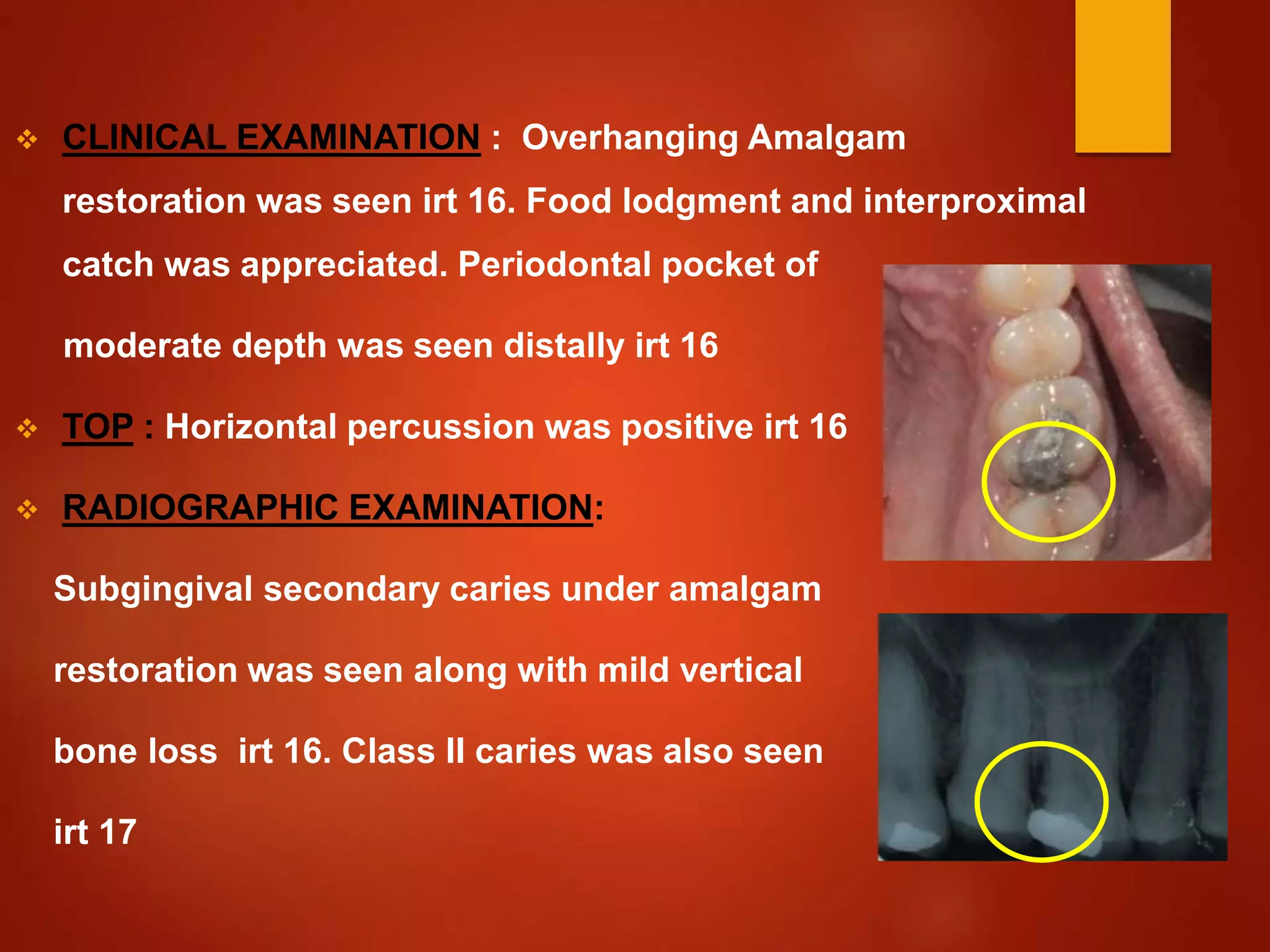
 CLINICAL EXAMINATION : Overhanging Amalgam
restoration was seen irt 16. Food lodgment and interproximal
catch was appreciated. Periodontal pocket of
moderate depth was seen distally irt 16
 TOP : Horizontal percussion was positive irt 16
 RADIOGRAPHIC EXAMINATION:
Subgingival secondary caries under amalgam
restoration was seen along with mild vertical
bone loss irt 16. Class II caries was also seen
irt 17
 DIAGNOSIS :
Secondary caries irt 16 and class II caries irt 17
and chronic localized periodontitis irt 16
 TREATMENT :
Subginval scaling followed by composite
restoration irt 16 and 17.
AFTER AMALGAM
REMOVAL
SECTIONAL MATRICES
AFTER CARIES
EXCAVATION
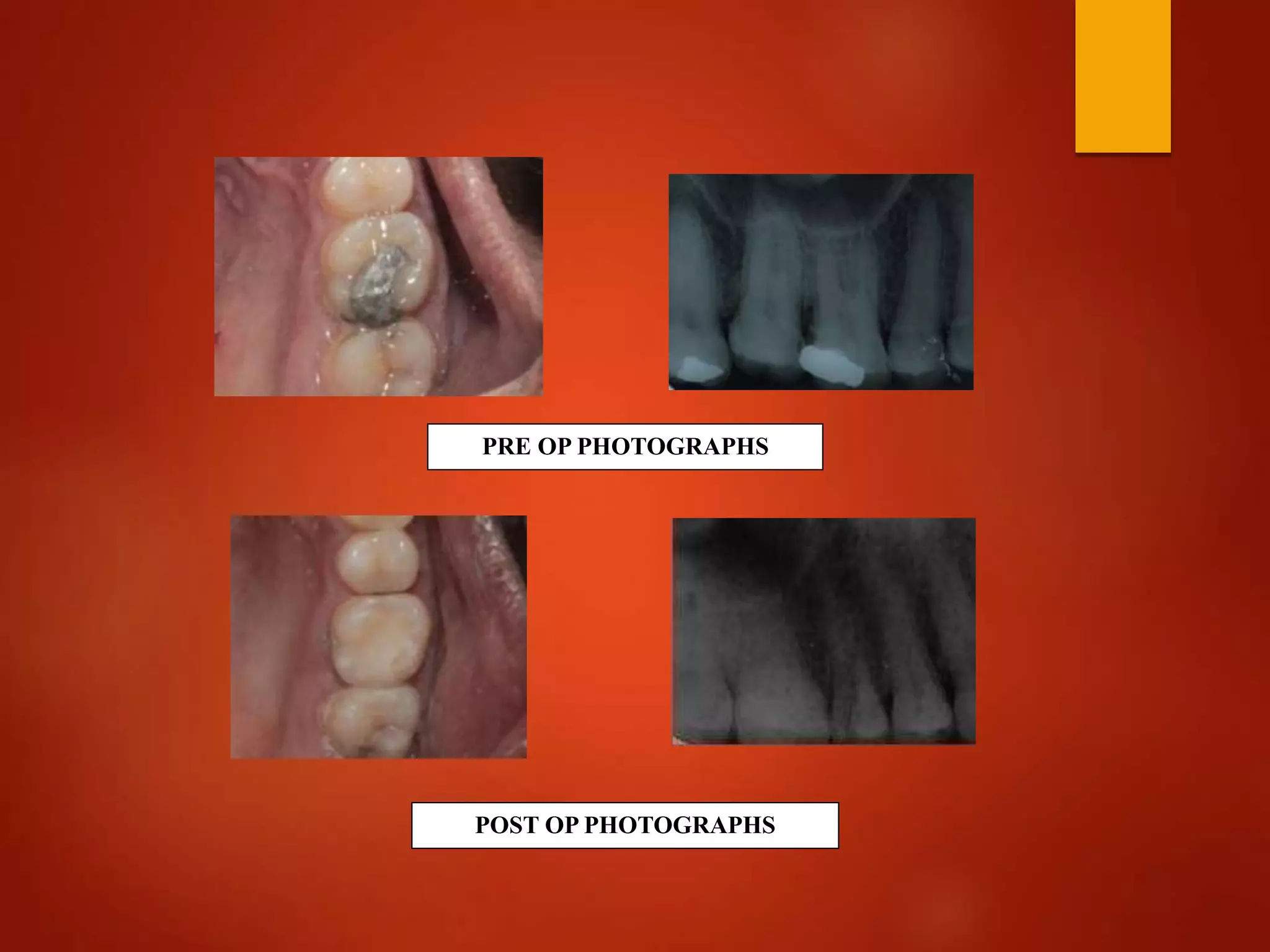
PRE OP PHOTOGRAPHS
POST OP PHOTOGRAPHS
RELATIONSHIP BETWEEN PROXIMAL TOOTH
OPEN CONTACTS AND PERIODONTAL
DISEASE
Gary R. Jernberg*, M. Bashar Bakdashf and Kathleen M. KeenanJ
They concluded that no tight contact between teeth resulted
in significant food impaction and will leads to periodontal pockets
with increased depth ultimately ending with perio-endo lesions.
A RANDOMIZED CLINICAL TRIAL ON
PROXIMAL CONTACTS OF POSTERIOR
COMPOSITES
B.A.C. Loomansa,*, N.J.M. Opdama, F.J.M. Roetersa, E.M. Bronkhorsta, R.C.W.
Burgersdijka, C.E. Do¨rferb
Class II posterior composite resin restorations placed with a
combination of sectional matrices and separation rings resulted
in a significant stronger proximal contact than when a
circumferential matrix system was used.
A MICROLEAKAGE OF POSTERIOR
PACKABLE RESIN COMPOSITES WITH AND
WITHOUT FLOWABLE LINERS
C Leevailoj • MA Cochran • BA Matis
BK Moore • JA Platt
They concluded that when Flowable composite significantly
reduced microleakage when used as liners in gingival margins of
Class II composite restorations.
Thank you

01 MANAGEMENT subgingival caries.pptx

  • 1.
  • 2.
     NAME :Ankita  AGE : 26 years old  SEX : Female  CHIEF COMPLAINT : Patient complains of mild occasional pain and food lodgment in her right upper back tooth region since 2 months.  HOPI : Patient gave a history of filling in the same tooth two years ago and presently complains of food lodgment and mild occasional pain in the same tooth since two months while chewing.
  • 3.
     CLINICAL EXAMINATION: Overhanging Amalgam restoration was seen irt 16. Food lodgment and interproximal catch was appreciated. Periodontal pocket of moderate depth was seen distally irt 16  TOP : Horizontal percussion was positive irt 16  RADIOGRAPHIC EXAMINATION: Subgingival secondary caries under amalgam restoration was seen along with mild vertical bone loss irt 16. Class II caries was also seen irt 17
  • 4.
     DIAGNOSIS : Secondarycaries irt 16 and class II caries irt 17 and chronic localized periodontitis irt 16  TREATMENT : Subginval scaling followed by composite restoration irt 16 and 17.
  • 5.
  • 6.
  • 7.
    RELATIONSHIP BETWEEN PROXIMALTOOTH OPEN CONTACTS AND PERIODONTAL DISEASE Gary R. Jernberg*, M. Bashar Bakdashf and Kathleen M. KeenanJ They concluded that no tight contact between teeth resulted in significant food impaction and will leads to periodontal pockets with increased depth ultimately ending with perio-endo lesions.
  • 8.
    A RANDOMIZED CLINICALTRIAL ON PROXIMAL CONTACTS OF POSTERIOR COMPOSITES B.A.C. Loomansa,*, N.J.M. Opdama, F.J.M. Roetersa, E.M. Bronkhorsta, R.C.W. Burgersdijka, C.E. Do¨rferb Class II posterior composite resin restorations placed with a combination of sectional matrices and separation rings resulted in a significant stronger proximal contact than when a circumferential matrix system was used.
  • 9.
    A MICROLEAKAGE OFPOSTERIOR PACKABLE RESIN COMPOSITES WITH AND WITHOUT FLOWABLE LINERS C Leevailoj • MA Cochran • BA Matis BK Moore • JA Platt They concluded that when Flowable composite significantly reduced microleakage when used as liners in gingival margins of Class II composite restorations.
  • 10.