CS316: ALGORITHMS
LECTURE 1: INTRODUCTION
Prepared by: Assoc. Prof. Ensaf Hussein
Presented by:
Assoc. Prof. Wessam El-Behaidy
Dr. Mohammed El-Said
1
GRADING POLICY
• Mid-term Exam 20%
• Quizzes & tasks 20%
• Sheets 10%
• Final-Exam 50%
2
RESOURCES
Textbook:
Thomas Cormen, Charles Leiserson, Ronald Rivest, and
Clifford Stein. Introduction to Algorithms. 3rd ed. MIT Press,
2009.
Anany Levitin, Introduction to the design and analysis of
algorithms 3rd Edition, 2012.
Handouts******
3
COURSE SYLLABUS
• Algorithms Design and Analysis
• Asymptotic Notations
• Compute Complexity for :
• Non-recursive algorithms
• Recursive Algorithms
• Substitution Method
• Iteration Tree
• Master Method
• Divide and Conquer Algorithms ( Merge Sort- Quick Sort)
• Linear time Sorting (count – bucket – radix)
• Graph
• BFS - DFS
• MST – Prim - Kruskal
• Shortest path – Dijkstra – Bellman Ford
• Dynamic Programming – Matrix Chain Multiplication - Longest Common
Subsequence
• Greedy Approach – Knapsack [0-1 / Fractional]
COURSE OBJECTIVES
➢ Design algorithms using Pseudocode.
➢ Demonstrate and study asymptotic notations in best, worst
and average case.
➢ Define and analyze the complexity of recursive and non-
recursive algorithms.
➢ Understand, analyze and apply standard algorithms
involving searching, sorting, tree, graph, greedy,
backtracking and dynamic programming algorithms.
WHY STUDYING ALGORITHMS?
• The study of algorithms is the cornerstone of
computer science.
• You have to know a standard set of important
algorithms from different areas of computing;
in addition, you should be able to design new
algorithms and analyze their efficiency.
• Algorithms can be seen as special kinds of
solutions to problems— not just answers but
precisely defined procedures for getting
answers
ALGORITHMS
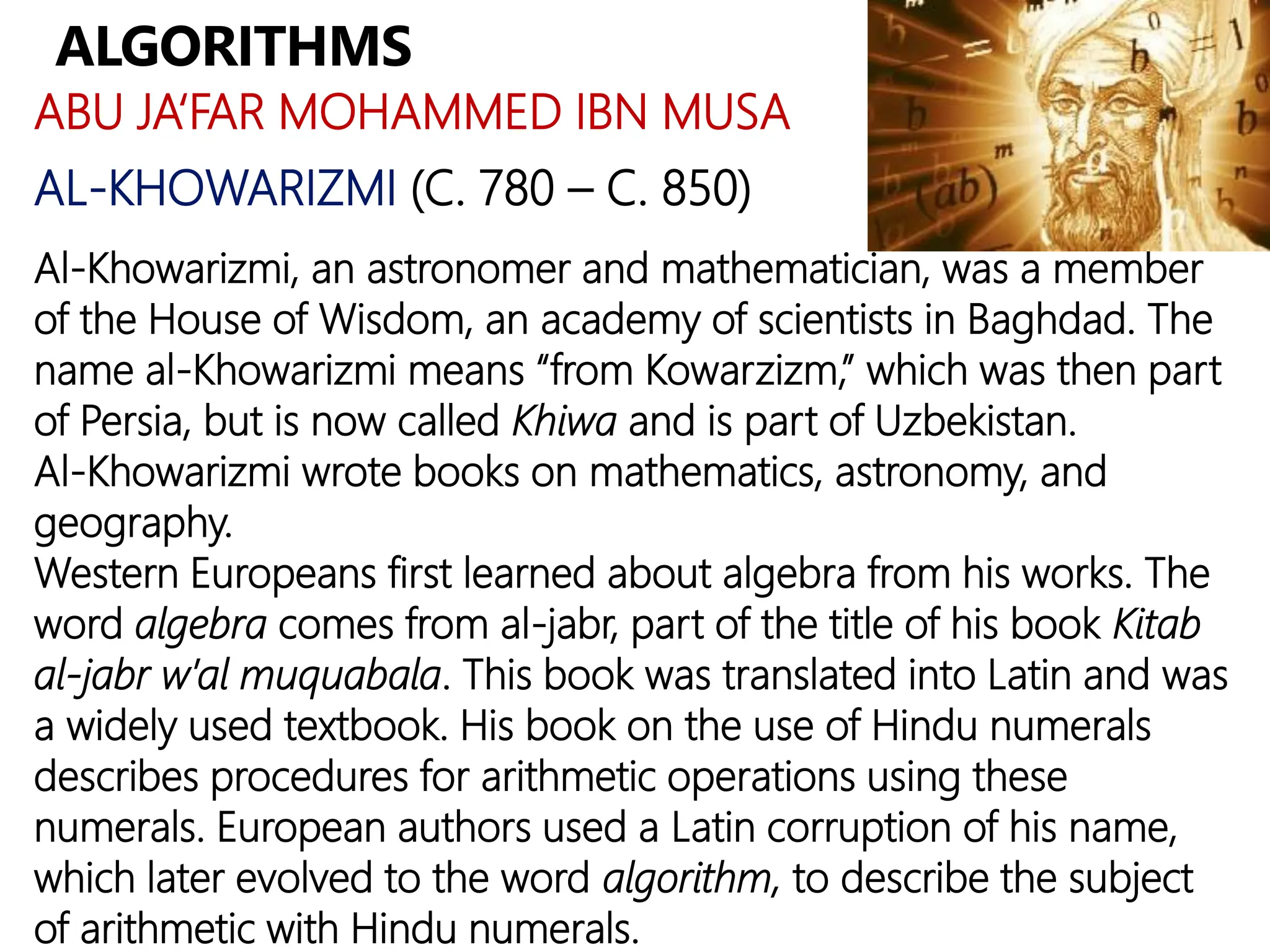
ABU JA‘FAR MOHAMMED IBN MUSA
AL-KHOWARIZMI (C. 780 – C. 850)
Al-Khowarizmi, an astronomer and mathematician, was a member
of the House of Wisdom, an academy of scientists in Baghdad. The
name al-Khowarizmi means “from Kowarzizm,” which was then part
of Persia, but is now called Khiwa and is part of Uzbekistan.
Al-Khowarizmi wrote books on mathematics, astronomy, and
geography.
Western Europeans first learned about algebra from his works. The
word algebra comes from al-jabr, part of the title of his book Kitab
al-jabr w’al muquabala. This book was translated into Latin and was
a widely used textbook. His book on the use of Hindu numerals
describes procedures for arithmetic operations using these
numerals. European authors used a Latin corruption of his name,
which later evolved to the word algorithm, to describe the subject
of arithmetic with Hindu numerals.
WHAT IS ALGORITHMS ?!
ALGORITHMS
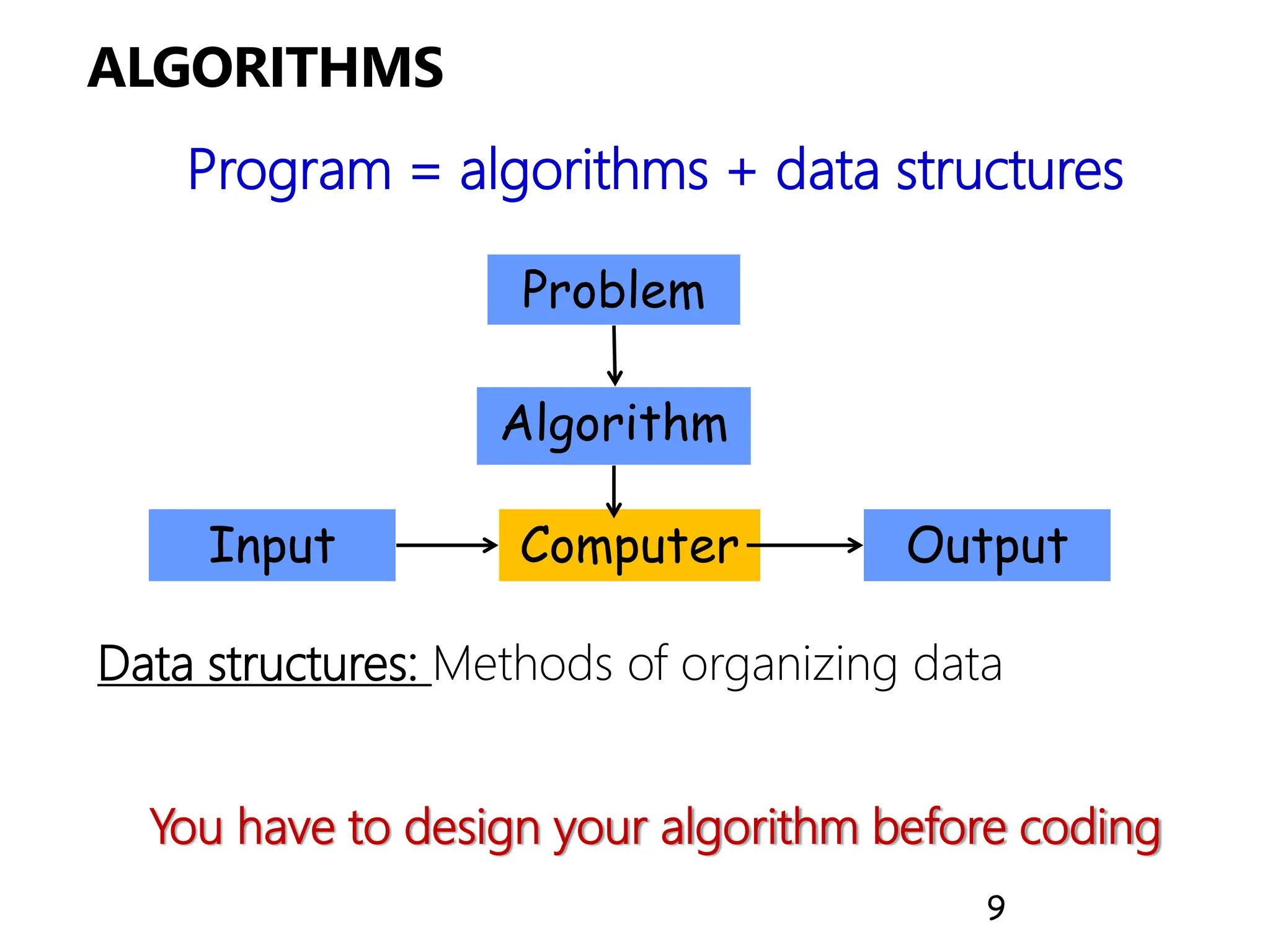
Program = algorithms + data structures
Data structures: Methods of organizing data
You have to design your algorithm before coding
9
Problem
Algorithm
Computer
Input Output
ALGORITHMS
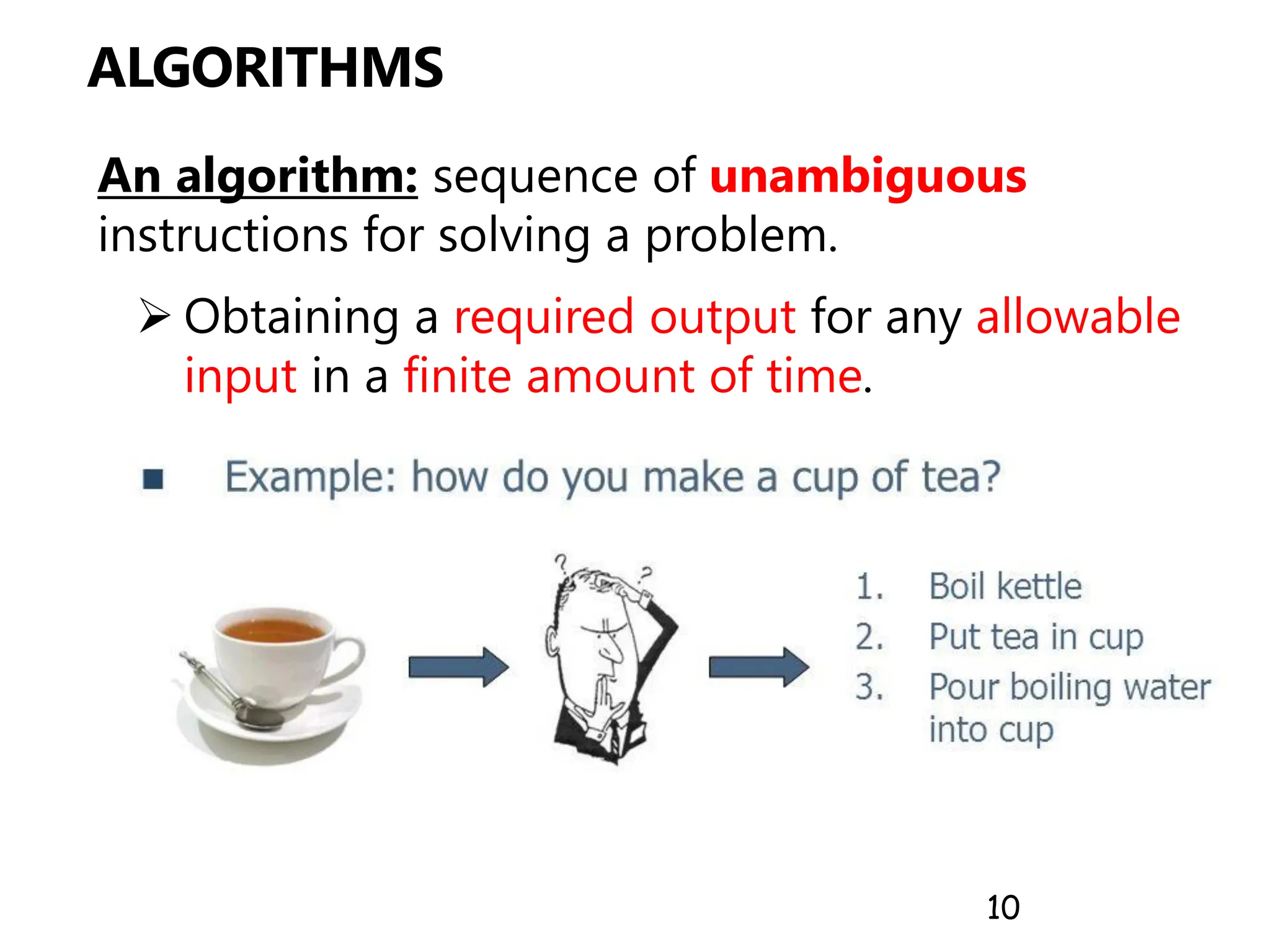
An algorithm: sequence of unambiguous
instructions for solving a problem.
➢ Obtaining a required output for any allowable
input in a finite amount of time.
10
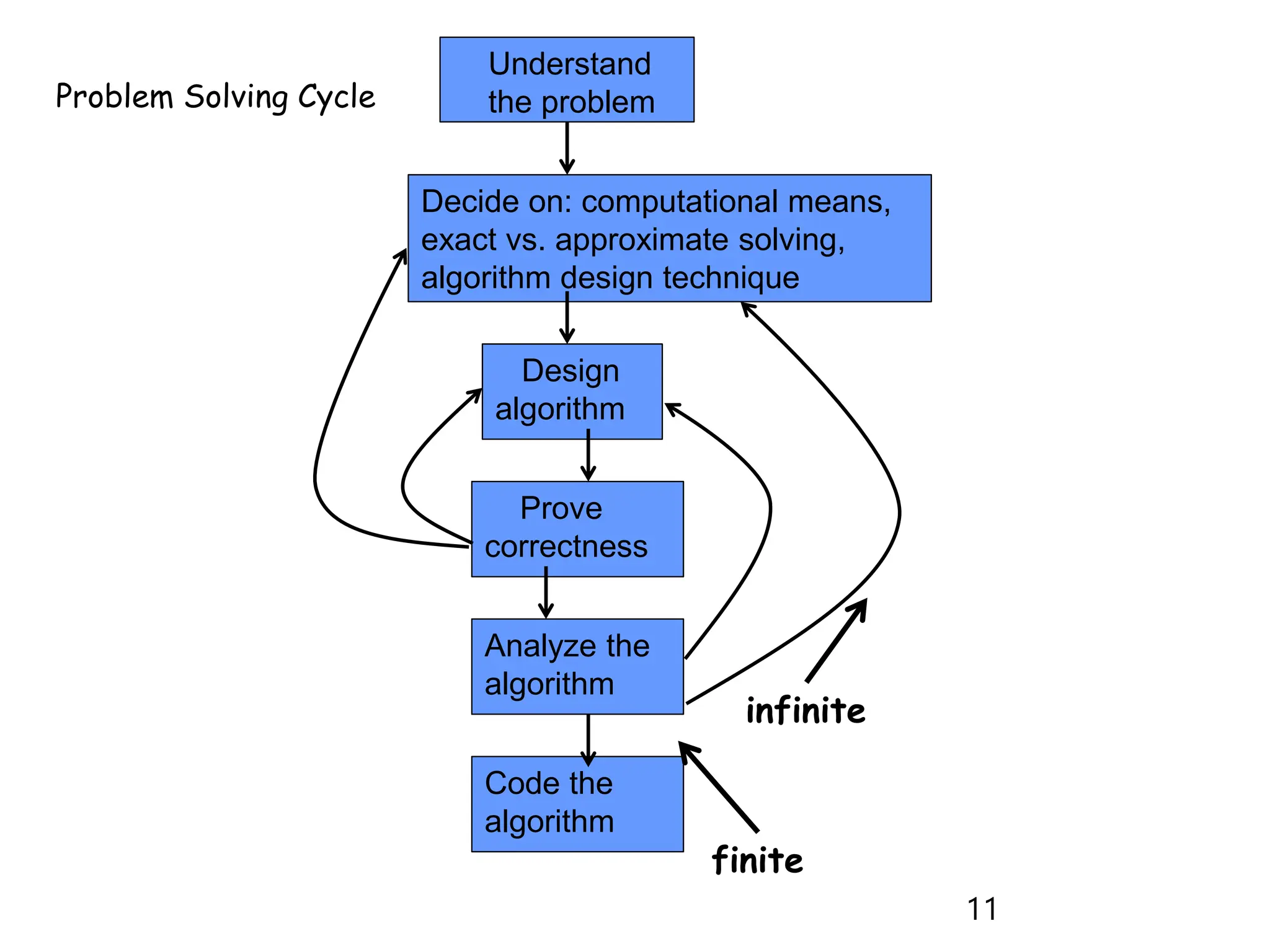
11
Understand
the problem
Decide on: computational means,
exact vs. approximate solving,
algorithm design technique
Design
algorithm
Prove
correctness
Analyze the
algorithm
Code the
algorithm
finite
infinite
Problem Solving Cycle
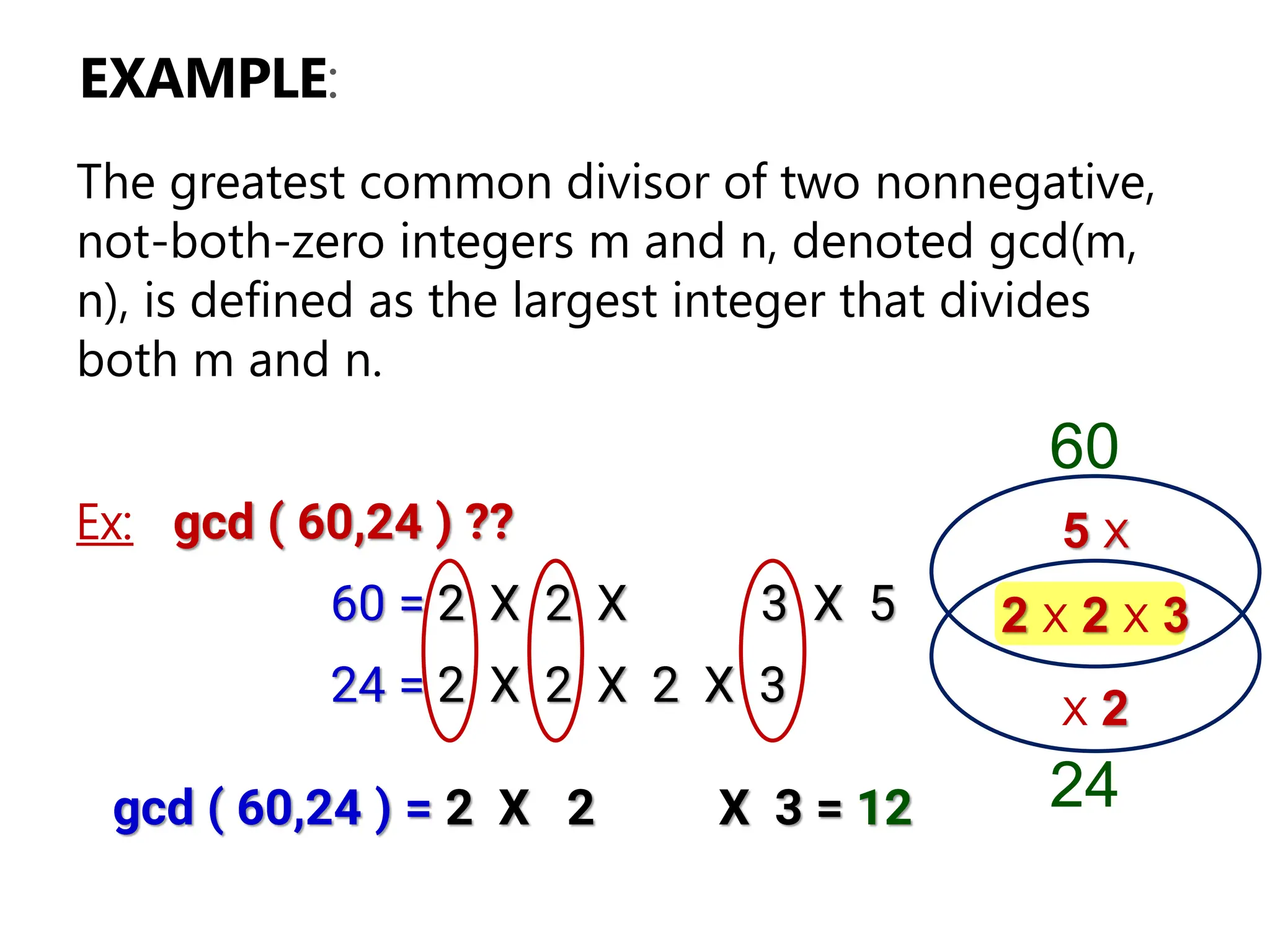
The greatest common divisor of two nonnegative,
not-both-zero integers m and n, denoted gcd(m,
n), is defined as the largest integer that divides
both m and n.
Ex: gcd ( 60,24 ) ??
60 = 2 X 2 X 3 X 5
24 = 2 X 2 X 2 X 3
gcd ( 60,24 ) = 2 X 2 X 3 = 12
5 X
2 X 2 X 3
60
X 2
24
EXAMPLE:
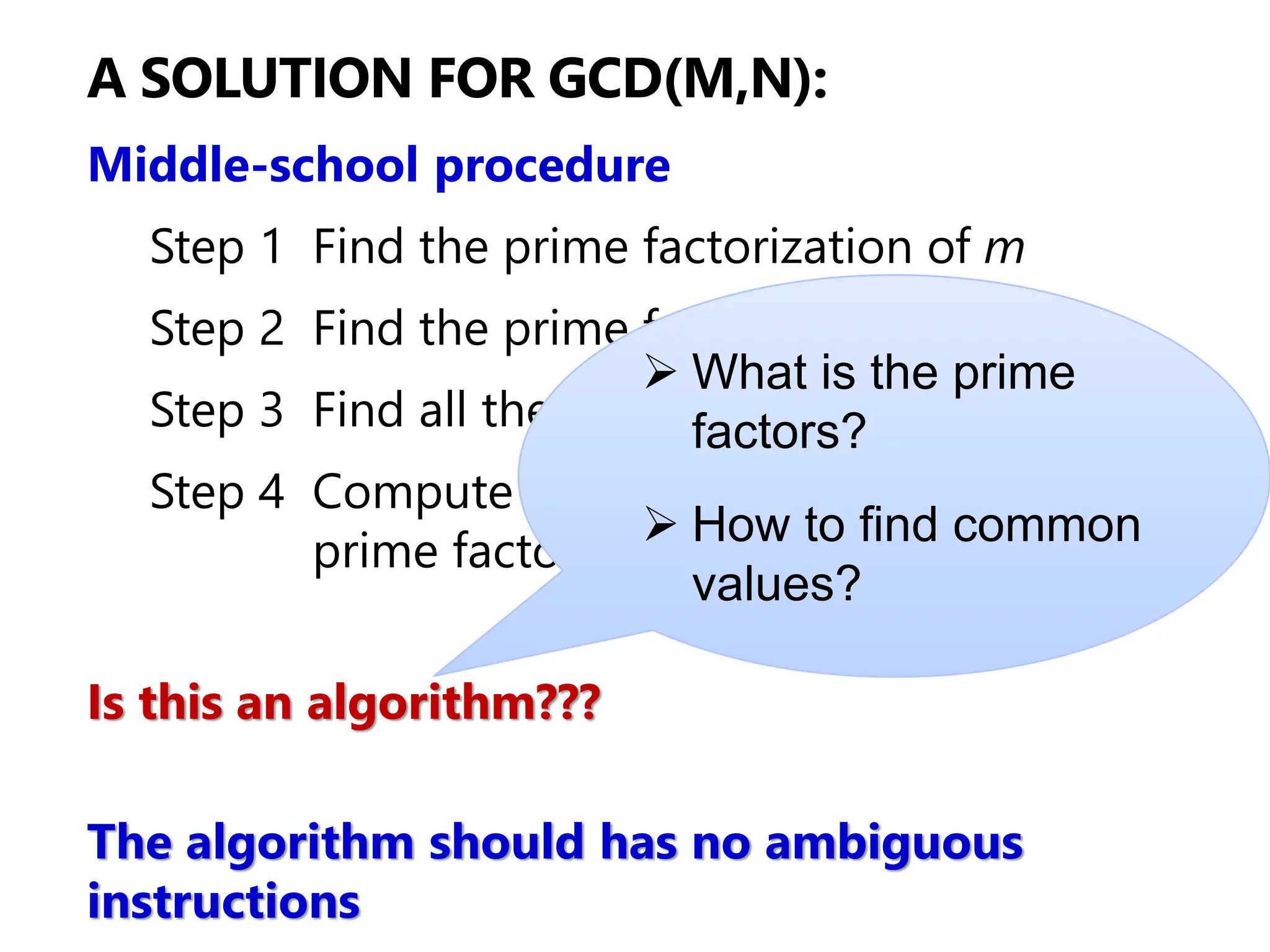
A SOLUTION FOR GCD(M,N):
Middle-school procedure
Step 1 Find the prime factorization of m
Step 2 Find the prime factorization of n
Step 3 Find all the common prime factors
Step 4 Compute the product of all the common
prime factors and return it as gcd(m,n)
Is this an algorithm???
The algorithm should has no ambiguous
instructions
➢ What is the prime
factors?
➢ How to find common
values?
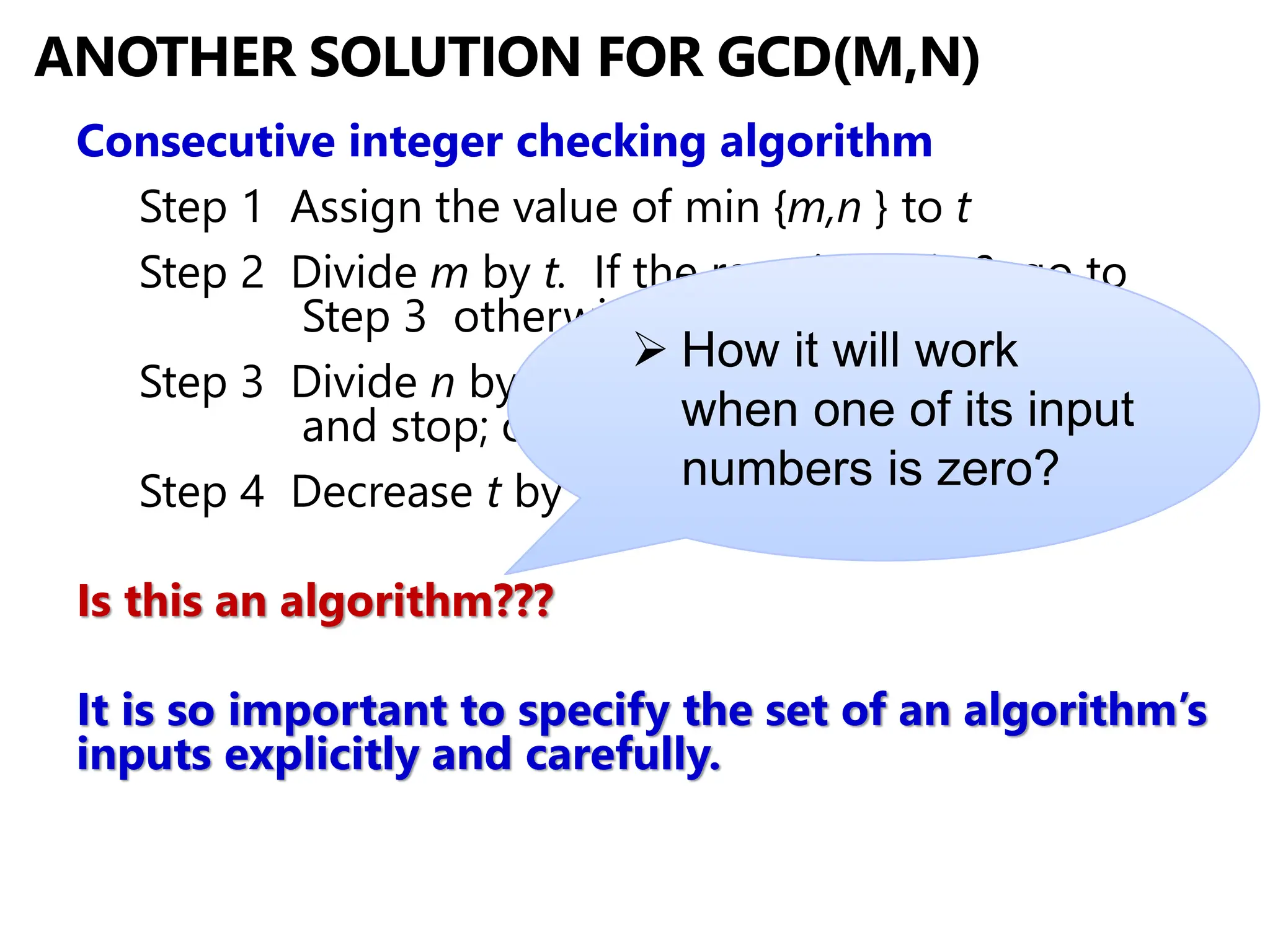
ANOTHER SOLUTION FOR GCD(M,N)
Consecutive integer checking algorithm
Step 1 Assign the value of min {m,n } to t
Step 2 Divide m by t. If the remainder is 0, go to
Step 3 otherwise, go to Step 4
Step 3 Divide n by t. If the remainder is 0, return t
and stop; otherwise, go to Step 4
Step 4 Decrease t by 1 and go to Step 2
Is this an algorithm???
It is so important to specify the set of an algorithm’s
inputs explicitly and carefully.
➢ How it will work
when one of its input
numbers is zero?
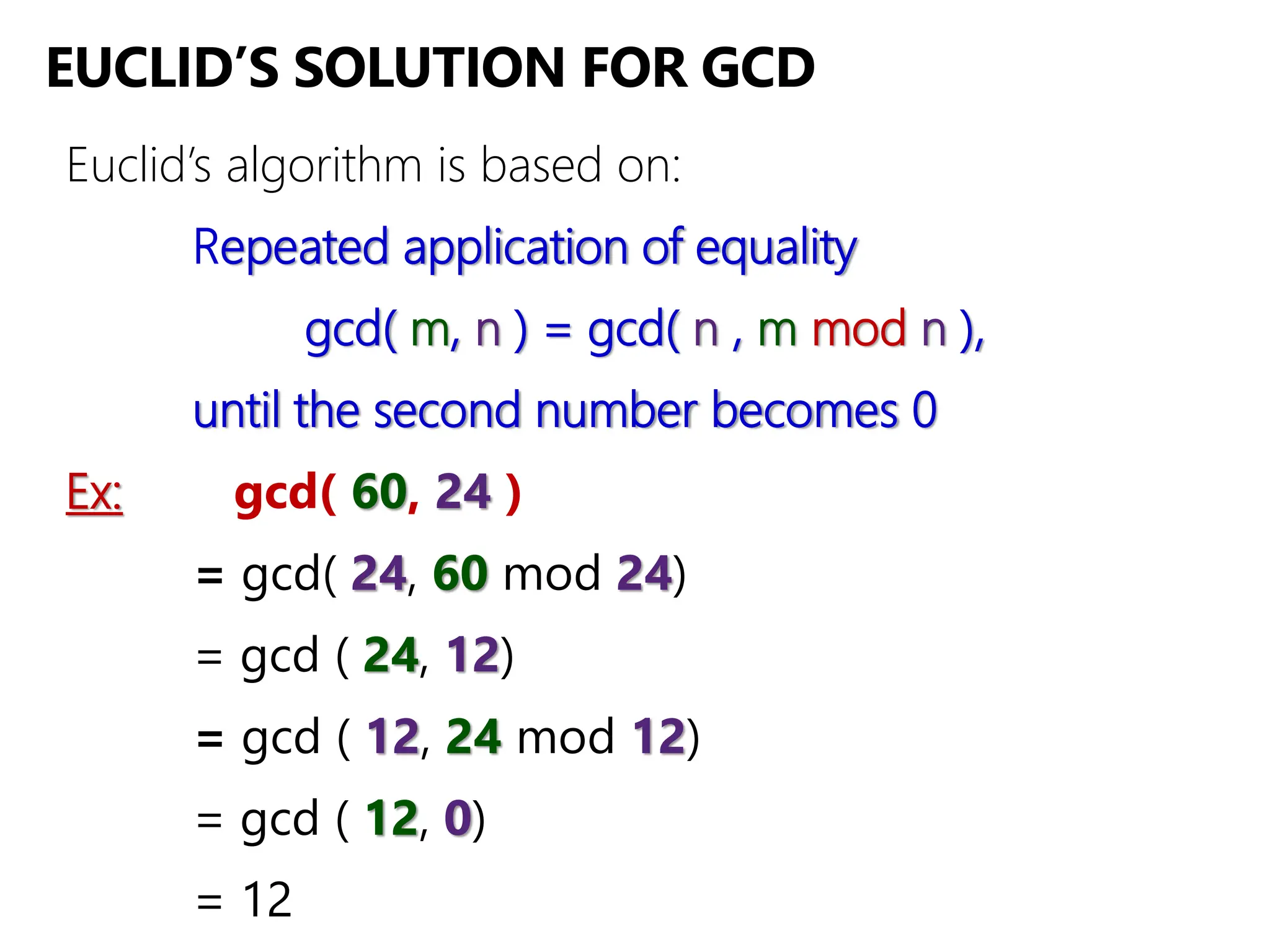
EUCLID’S SOLUTION FOR GCD
Euclid’s algorithm is based on:
Repeated application of equality
gcd( m, n ) = gcd( n , m mod n ),
until the second number becomes 0
Ex: gcd( 60, 24 )
= gcd( 24, 60 mod 24)
= gcd ( 24, 12)
= gcd ( 12, 24 mod 12)
= gcd ( 12, 0)
= 12
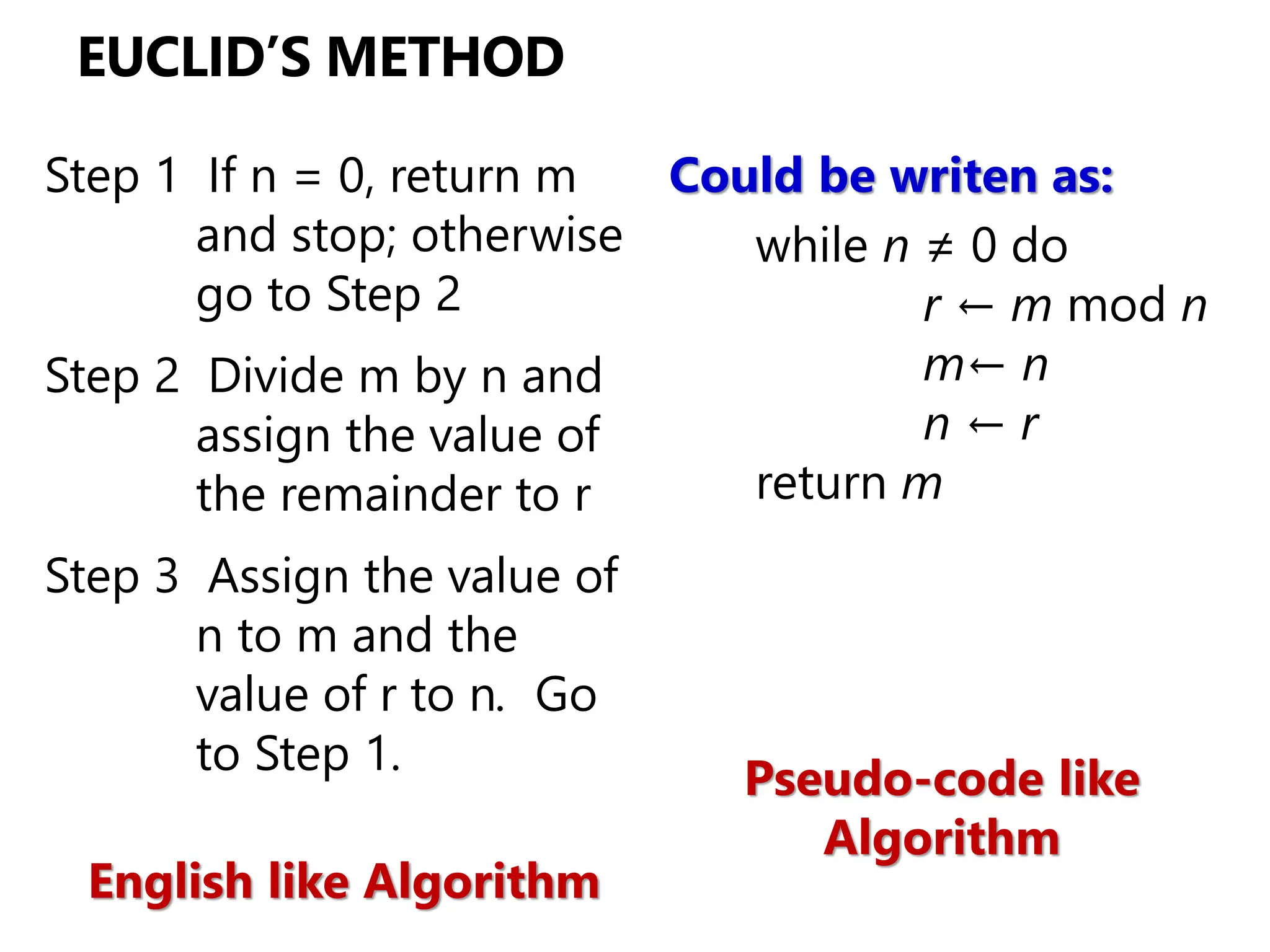
EUCLID’S METHOD
Step 1 If n = 0, return m
and stop; otherwise
go to Step 2
Step 2 Divide m by n and
assign the value of
the remainder to r
Step 3 Assign the value of
n to m and the
value of r to n. Go
to Step 1.
English like Algorithm
Could be writen as:
while n ≠ 0 do
r ← m mod n
m← n
n ← r
return m
Pseudo-code like
Algorithm
ALGORITHM DESIGN
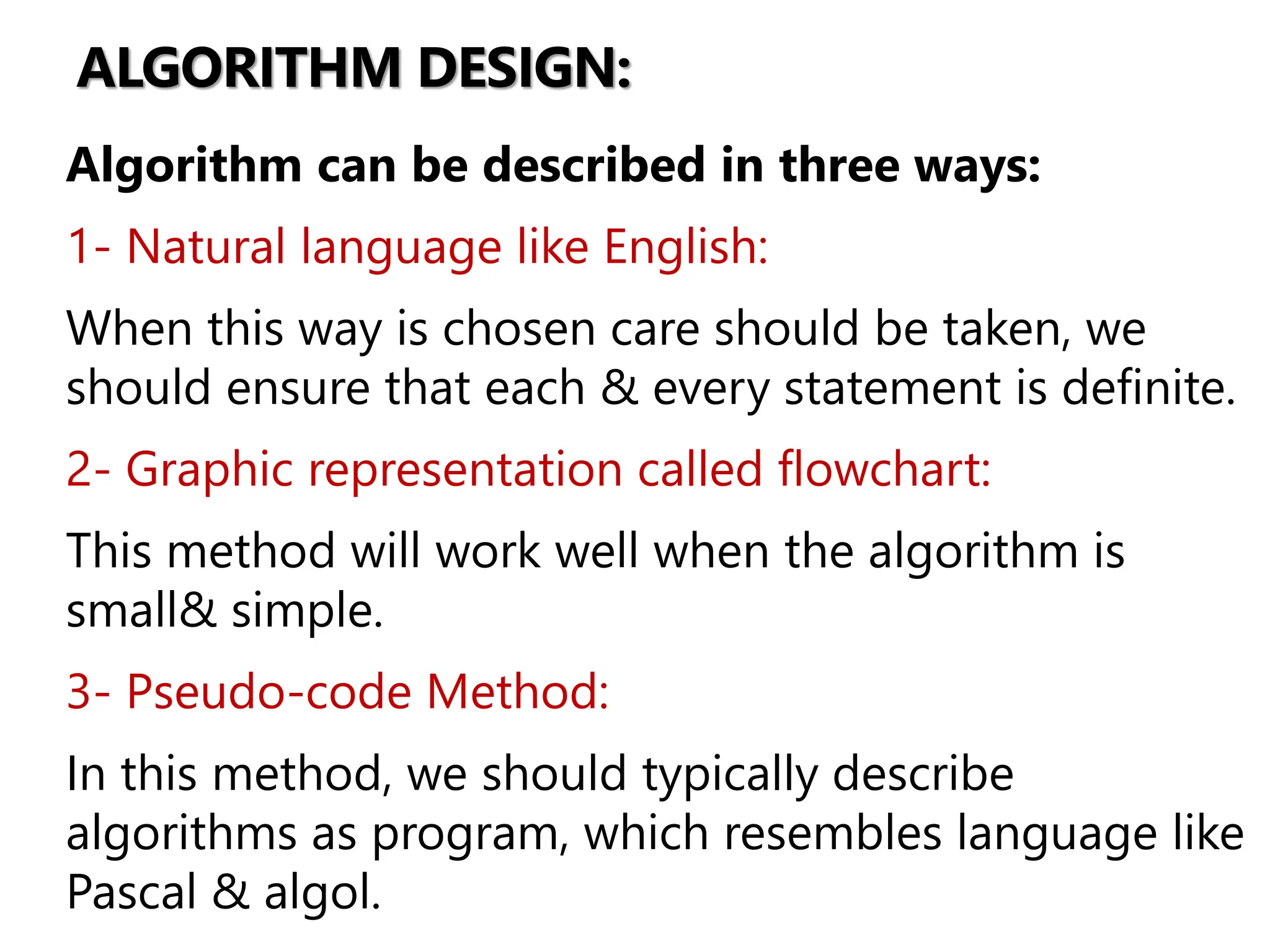
ALGORITHM DESIGN:
Algorithm can be described in three ways:
1- Natural language like English:
When this way is chosen care should be taken, we
should ensure that each & every statement is definite.
2- Graphic representation called flowchart:
This method will work well when the algorithm is
small& simple.
3- Pseudo-code Method:
In this method, we should typically describe
algorithms as program, which resembles language like
Pascal & algol.
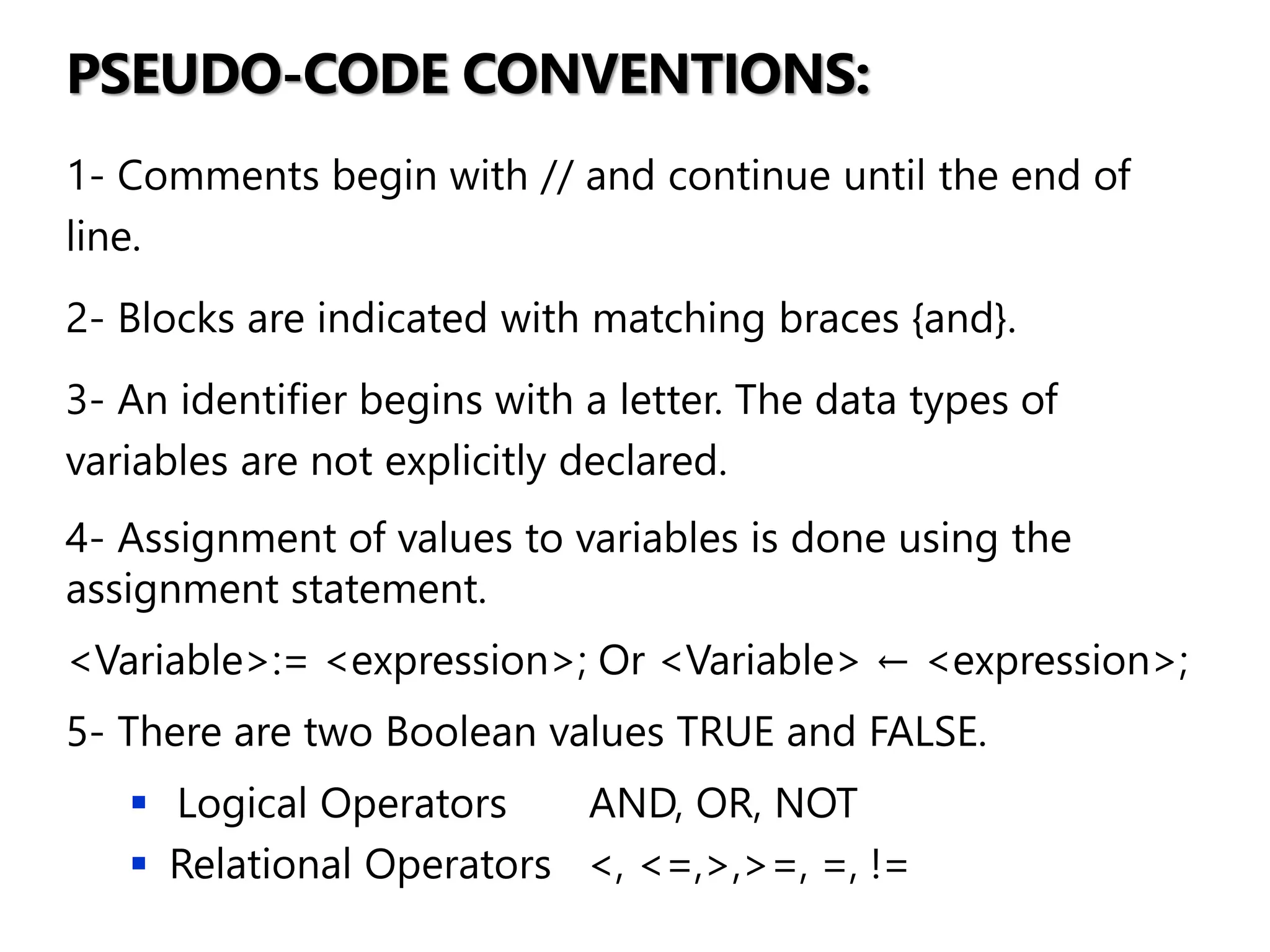
PSEUDO-CODE CONVENTIONS:
1- Comments begin with // and continue until the end of
line.
2- Blocks are indicated with matching braces {and}.
3- An identifier begins with a letter. The data types of
variables are not explicitly declared.
4- Assignment of values to variables is done using the
assignment statement.
<Variable>:= <expression>; Or <Variable> ← <expression>;
5- There are two Boolean values TRUE and FALSE.
▪ Logical Operators AND, OR, NOT
▪ Relational Operators <, <=,>,>=, =, !=
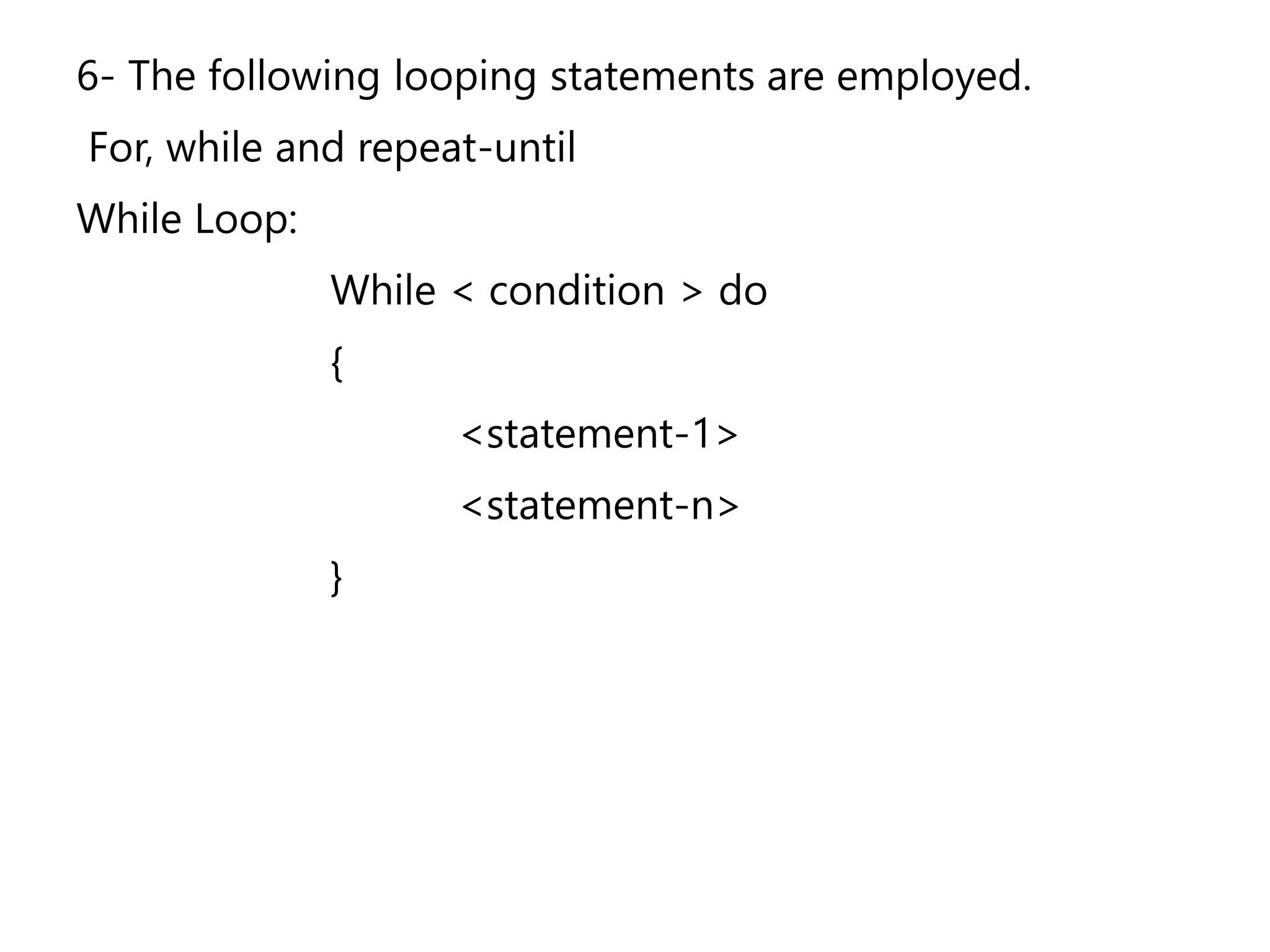
6- The following looping statements are employed.
For, while and repeat-until
While Loop:
While < condition > do
{
<statement-1>
<statement-n>
}
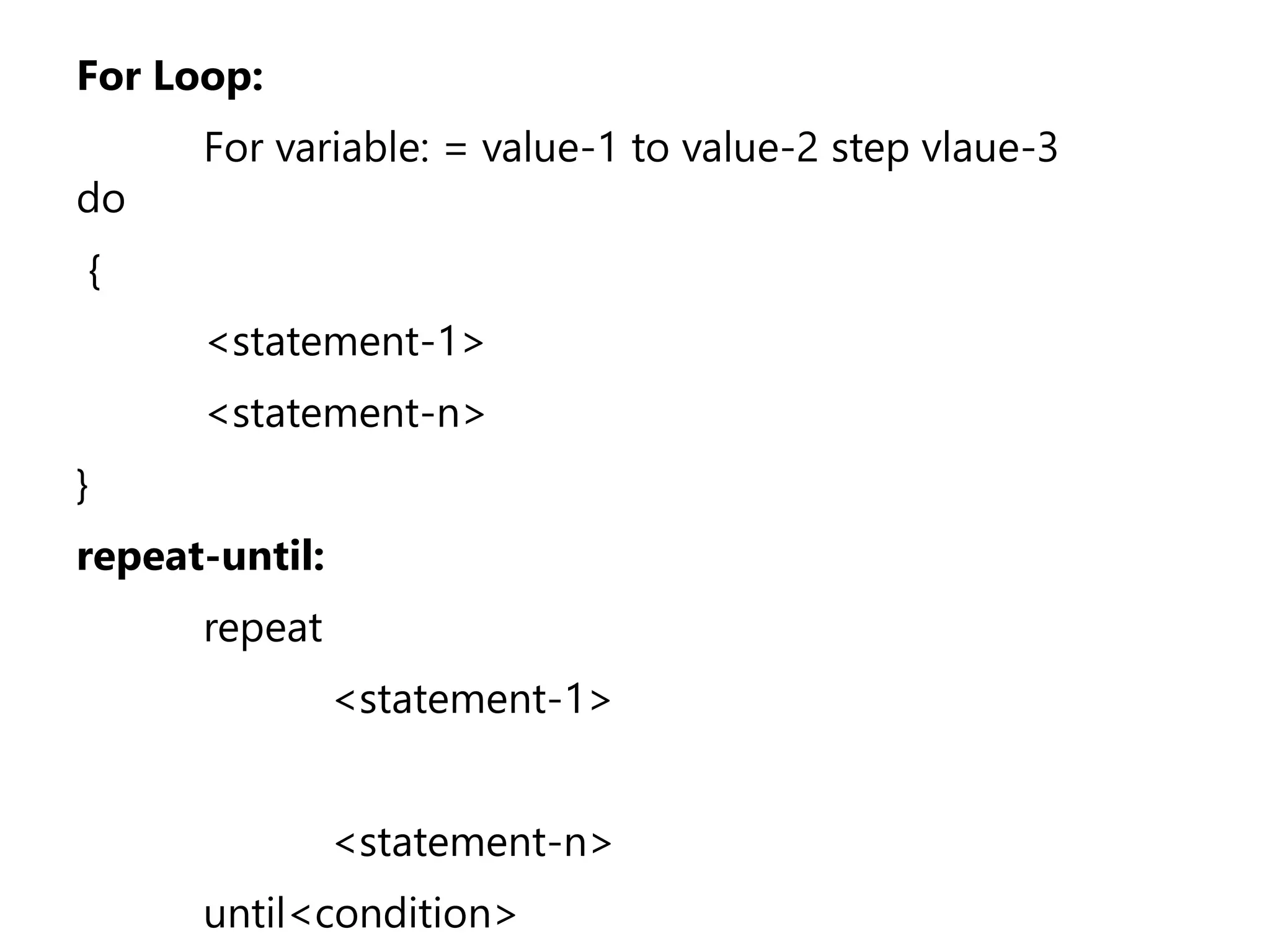
For Loop:
For variable: = value-1 to value-2 step vlaue-3
do
{
<statement-1>
<statement-n>
}
repeat-until:
repeat
<statement-1>
<statement-n>
until<condition>
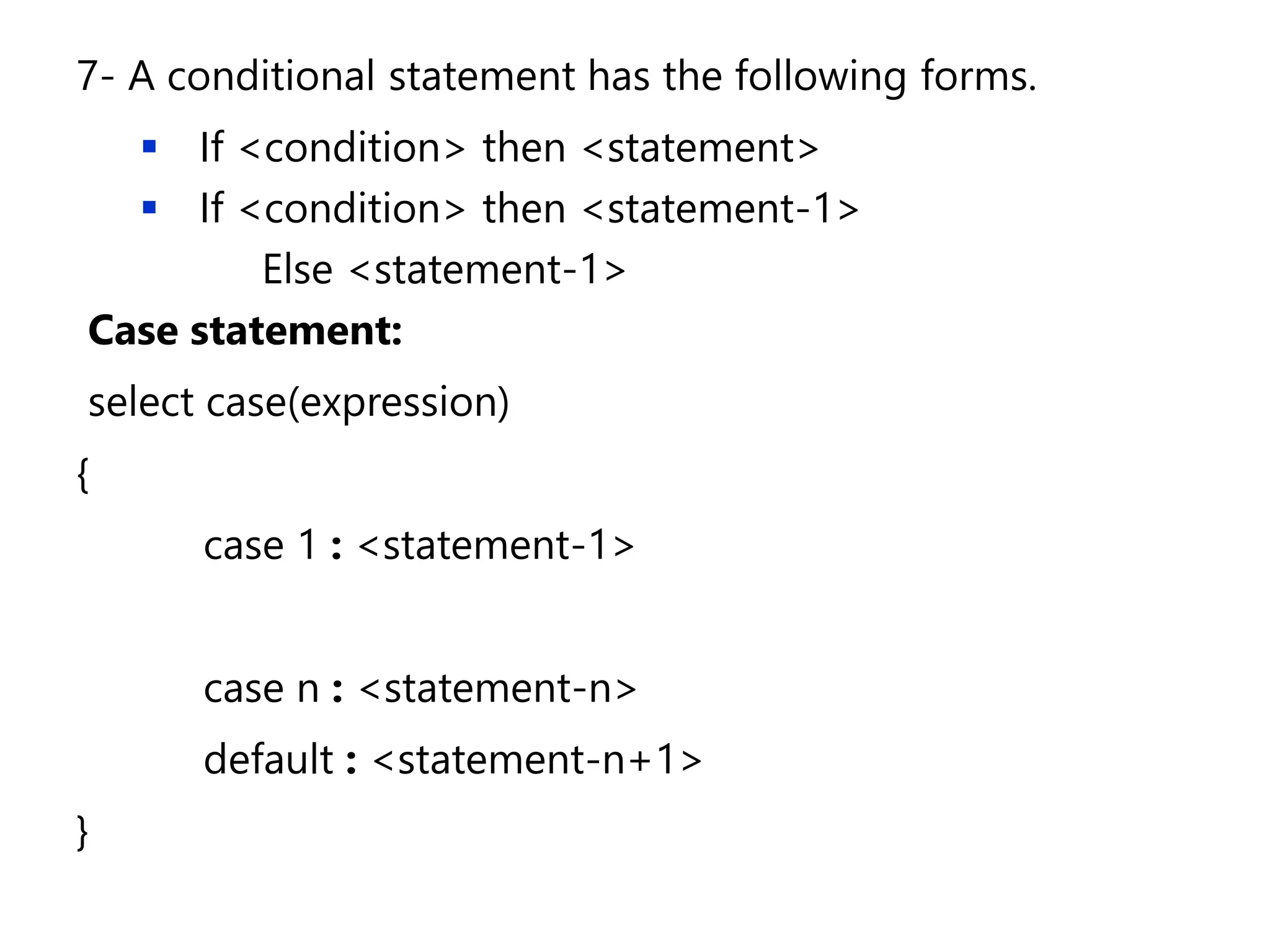
7- A conditional statement has the following forms.
▪ If <condition> then <statement>
▪ If <condition> then <statement-1>
Else <statement-1>
Case statement:
select case(expression)
{
case 1 : <statement-1>
case n : <statement-n>
default : <statement-n+1>
}
8- Input and output are done using the instructions read &
write.
9- There is only one type of procedure:
Algorithm, the heading takes the form,
Algorithm Name (Parameter lists)
➢ As an example, the following algorithm finds &
returns the maximum of ‘n’ given numbers:
EXAMPLE
1. algorithm Max( A, n)
2. // A is an array of size n
3. {
4. Result := A[1]
5. for I ← 2 to n do
6. if A[I] > Result then
7. Result ← A[I]
8. return Result
9. }
This algorithm:
• named Max
• A & n are
procedure
parameters.
• Result & I are Local
variables.
ANALYSIS OF ALGORITHMS
26
▪ Term “analysis of algorithms” means an
investigation of an algorithm’s efficiency
▪ The main goal is to determine the cost of
running an algorithm and how to reduce that
cost.
▪ Cost is expressed as Complexity
▪ Time Complexity our target
▪ Space Complexity
ANALYSIS OF ALGORITHMS
Always there is a tradeoff between time and space complexity
27
▪ It may be useful to time how long an algorithm takes to run.
But, Running time depends on CPU speed, operating system
(e.g. memory management, etc..)
▪ Time Complexity
Depends on:
- Size of Data (e.g. size of array 10 or 1000)
- Number of Operations needed (within loop or once)
- Organization of data (e.g. find item in first location, or last
location in a big array)
▪ Space Complexity Depends on:
- Size of Data
- Size of Program
SPACE & TIME COMPLEXITIES
TIME COMPLEXITY
It may be useful to time how long an algorithm takes
to run
• In some cases it may be essential to know how long
an algorithm takes on some system
• e.g. air traffic control systems
But, is this a good general comparison method?
Running time is affected by a number of factors other
than algorithm efficiency
28
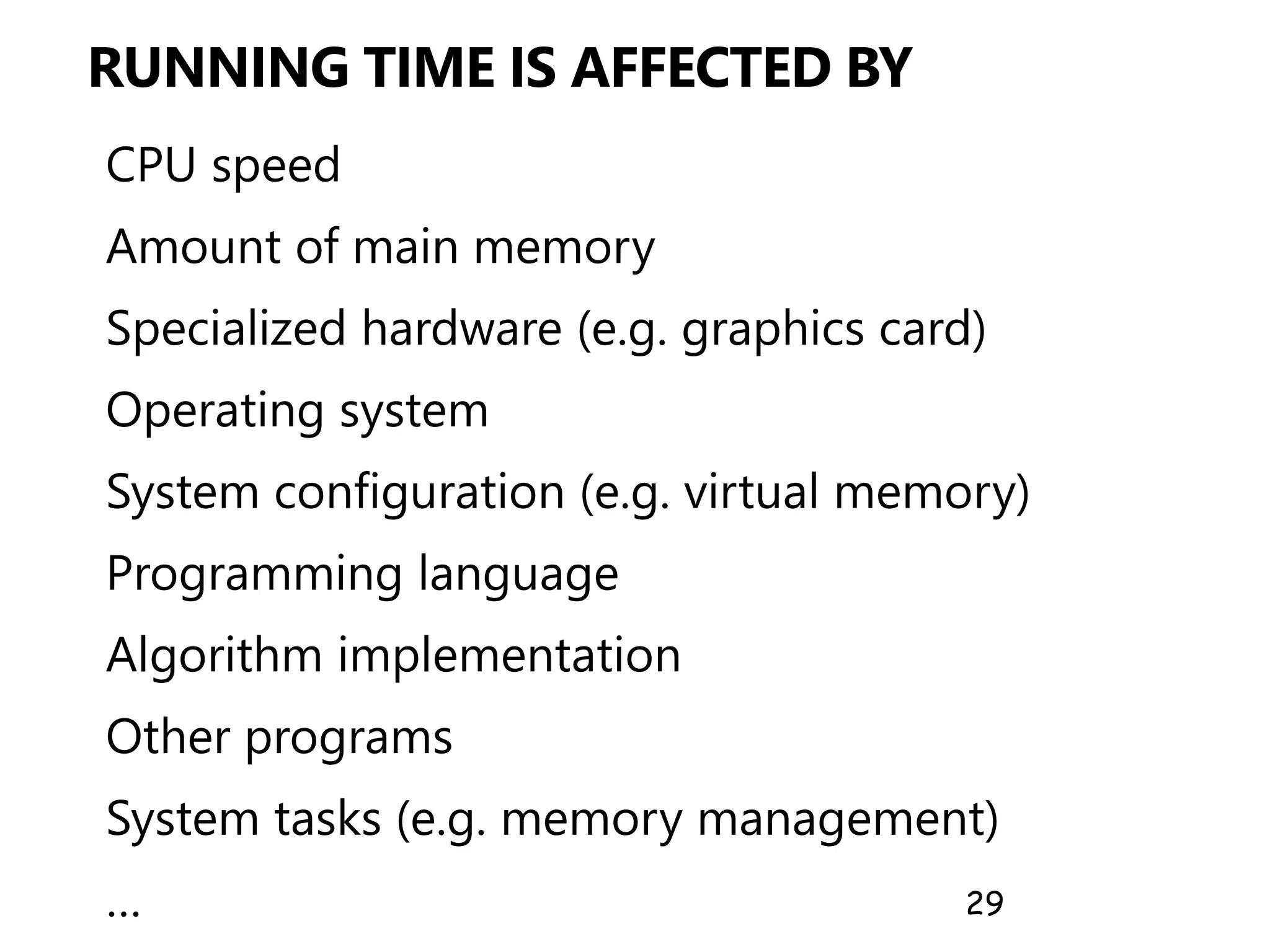
RUNNING TIME IS AFFECTED BY
CPU speed
Amount of main memory
Specialized hardware (e.g. graphics card)
Operating system
System configuration (e.g. virtual memory)
Programming language
Algorithm implementation
Other programs
System tasks (e.g. memory management)
… 29
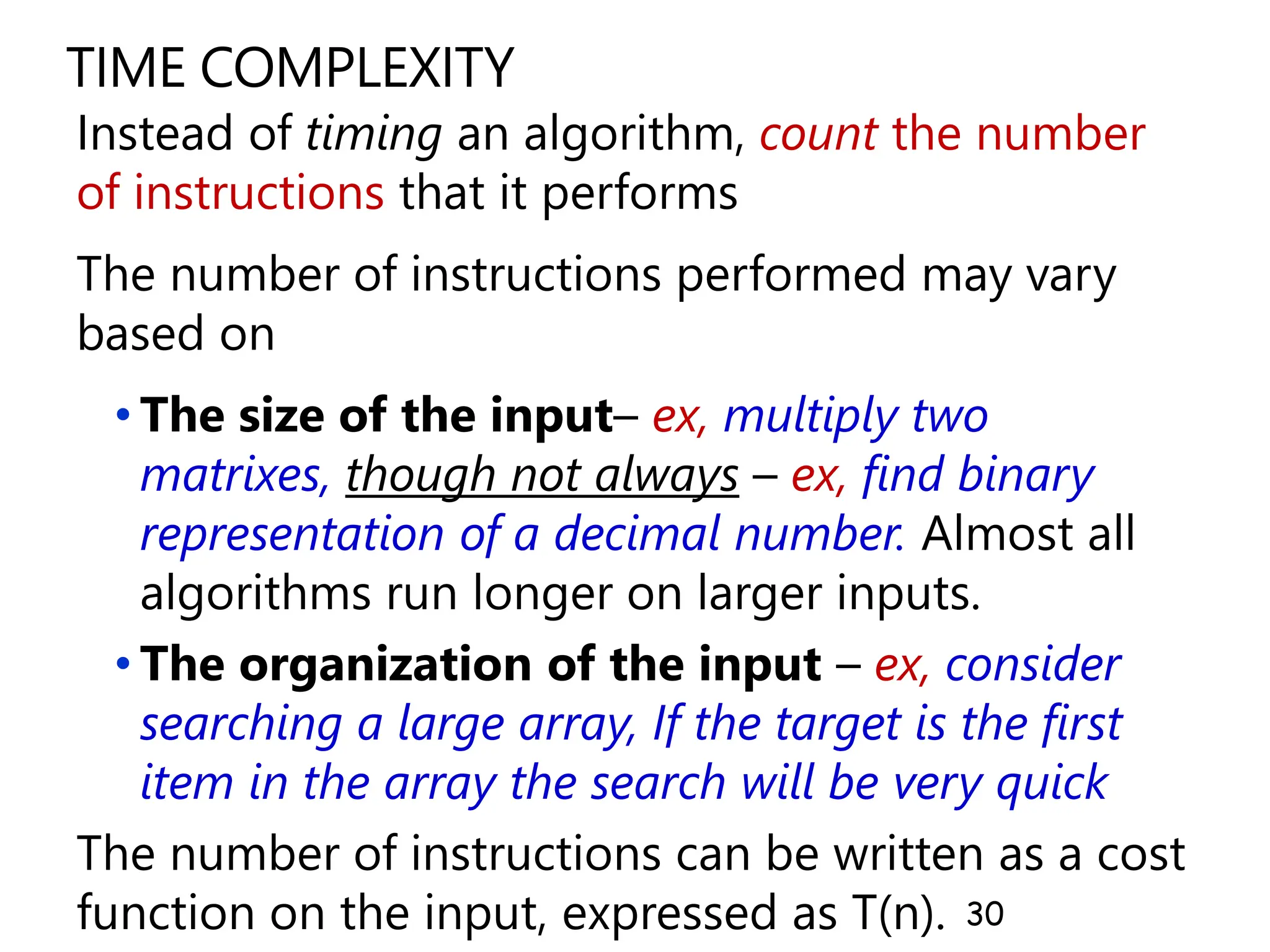
TIME COMPLEXITY
Instead of timing an algorithm, count the number
of instructions that it performs
The number of instructions performed may vary
based on
• The size of the input– ex, multiply two
matrixes, though not always – ex, find binary
representation of a decimal number. Almost all
algorithms run longer on larger inputs.
• The organization of the input – ex, consider
searching a large array, If the target is the first
item in the array the search will be very quick
The number of instructions can be written as a cost
function on the input, expressed as T(n). 30
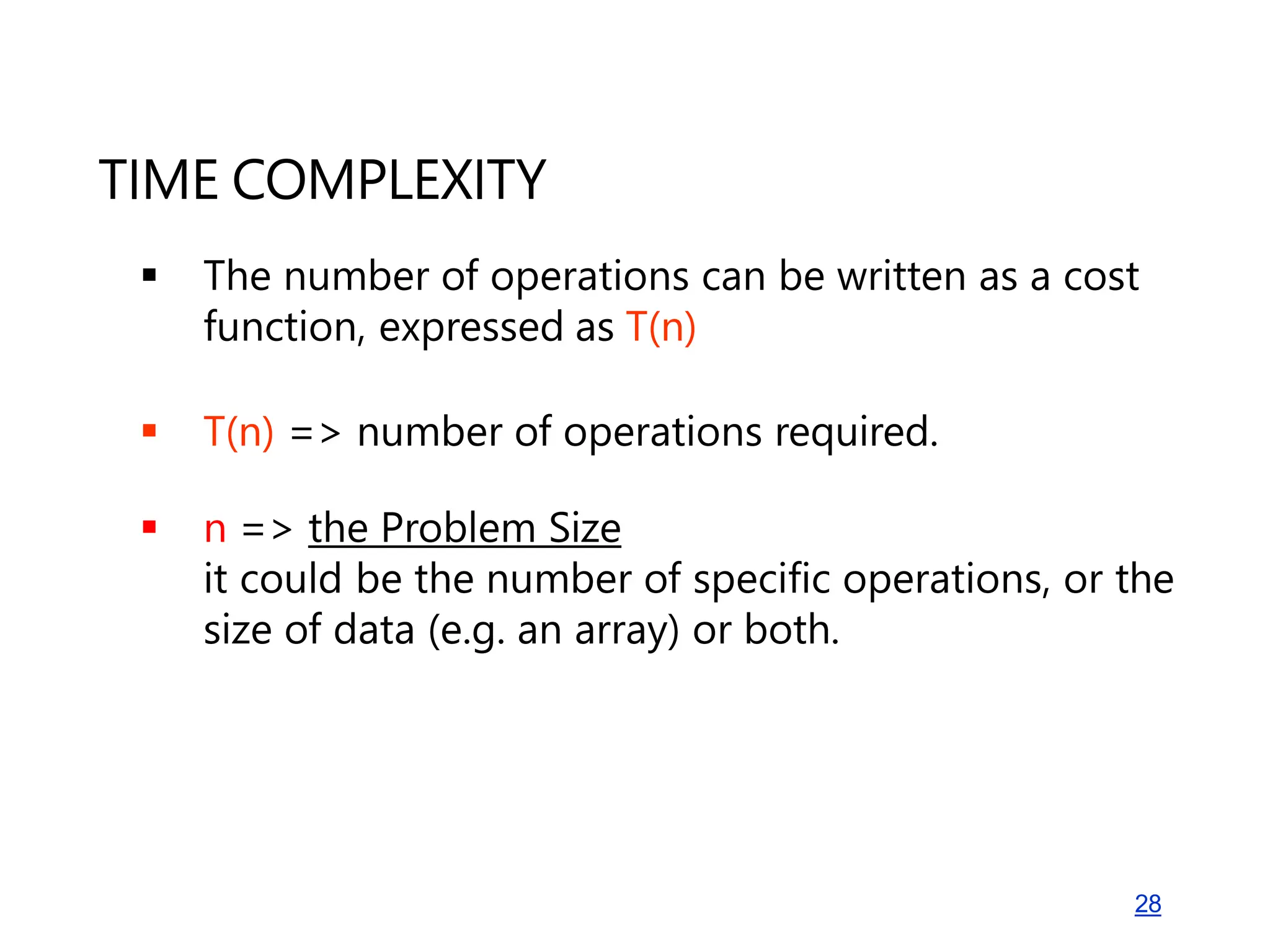
28
▪ The number of operations can be written as a cost
function, expressed as T(n)
▪ T(n) => number of operations required.
▪ n => the Problem Size
it could be the number of specific operations, or the
size of data (e.g. an array) or both.
TIME COMPLEXITY
32
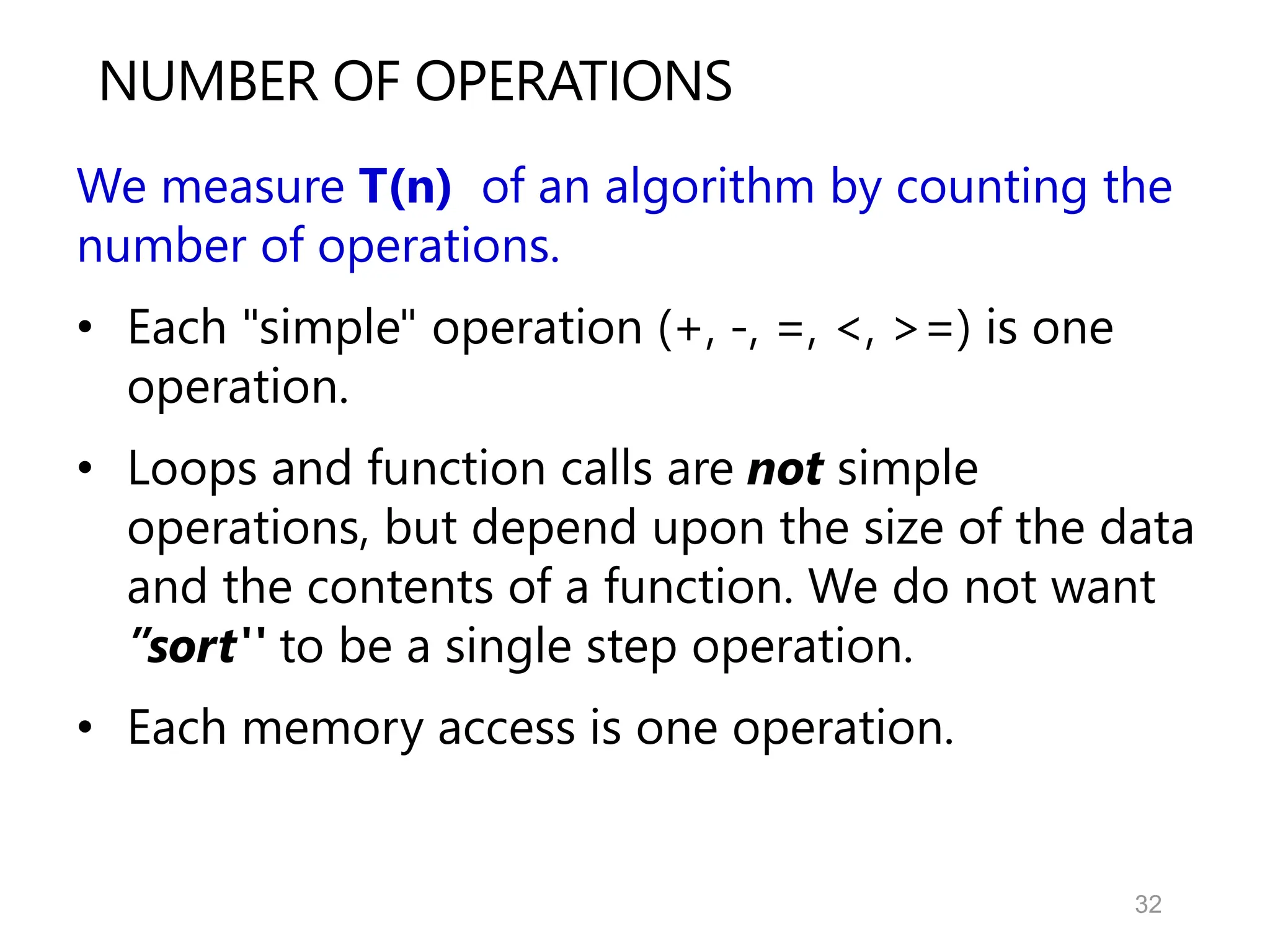
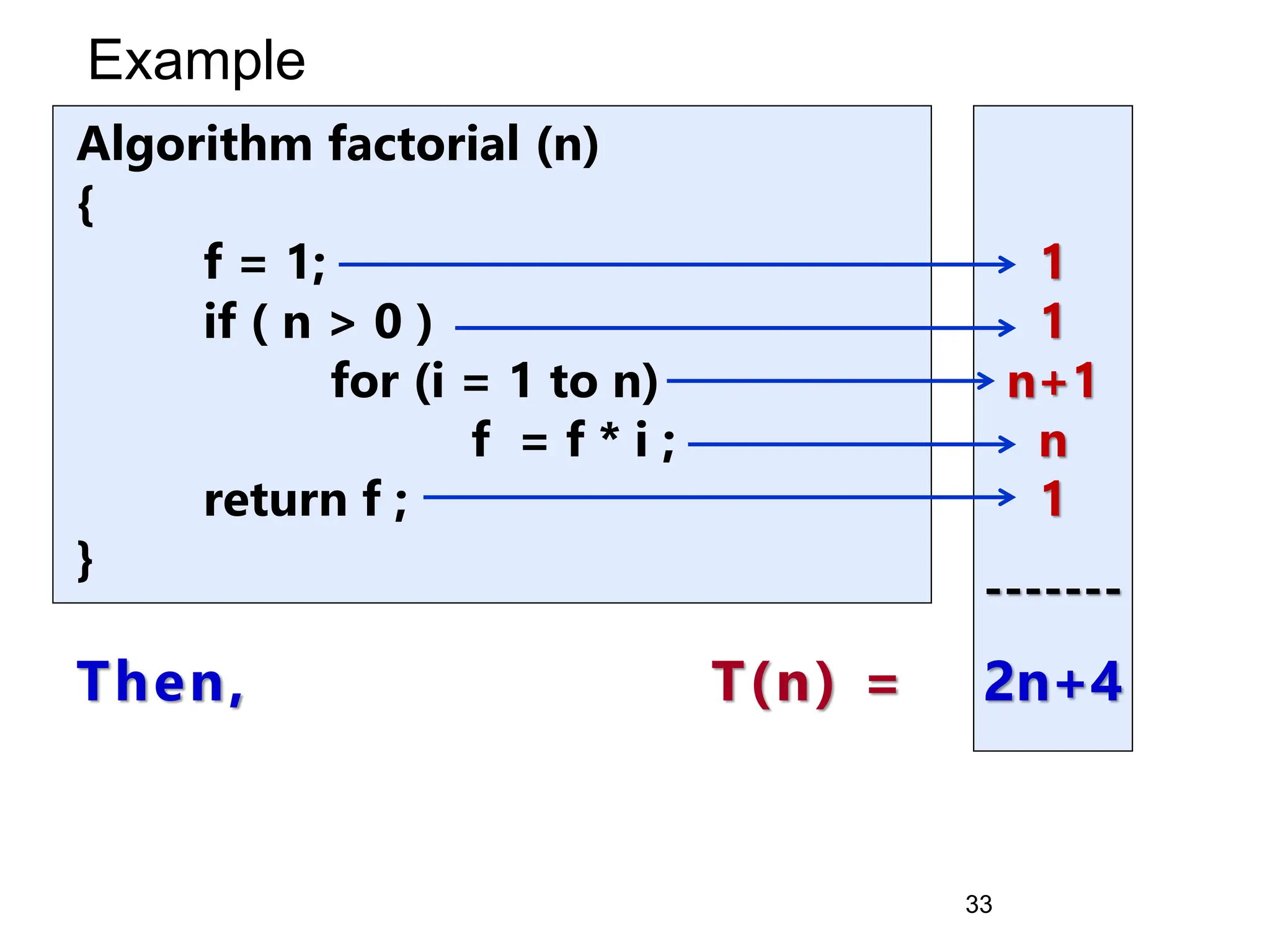
NUMBER OF OPERATIONS
We measure T(n) of an algorithm by counting the
number of operations.
• Each "simple" operation (+, -, =, <, >=) is one
operation.
• Loops and function calls are not simple
operations, but depend upon the size of the data
and the contents of a function. We do not want
”sort'' to be a single step operation.
• Each memory access is one operation.
Algorithm factorial (n)
{
f = 1;
if ( n > 0 )
for (i = 1 to n)
f = f * i ;
return f ;
}
Then, T(n) =
33
Example
1
1
n+1
n
1
-------
2n+4
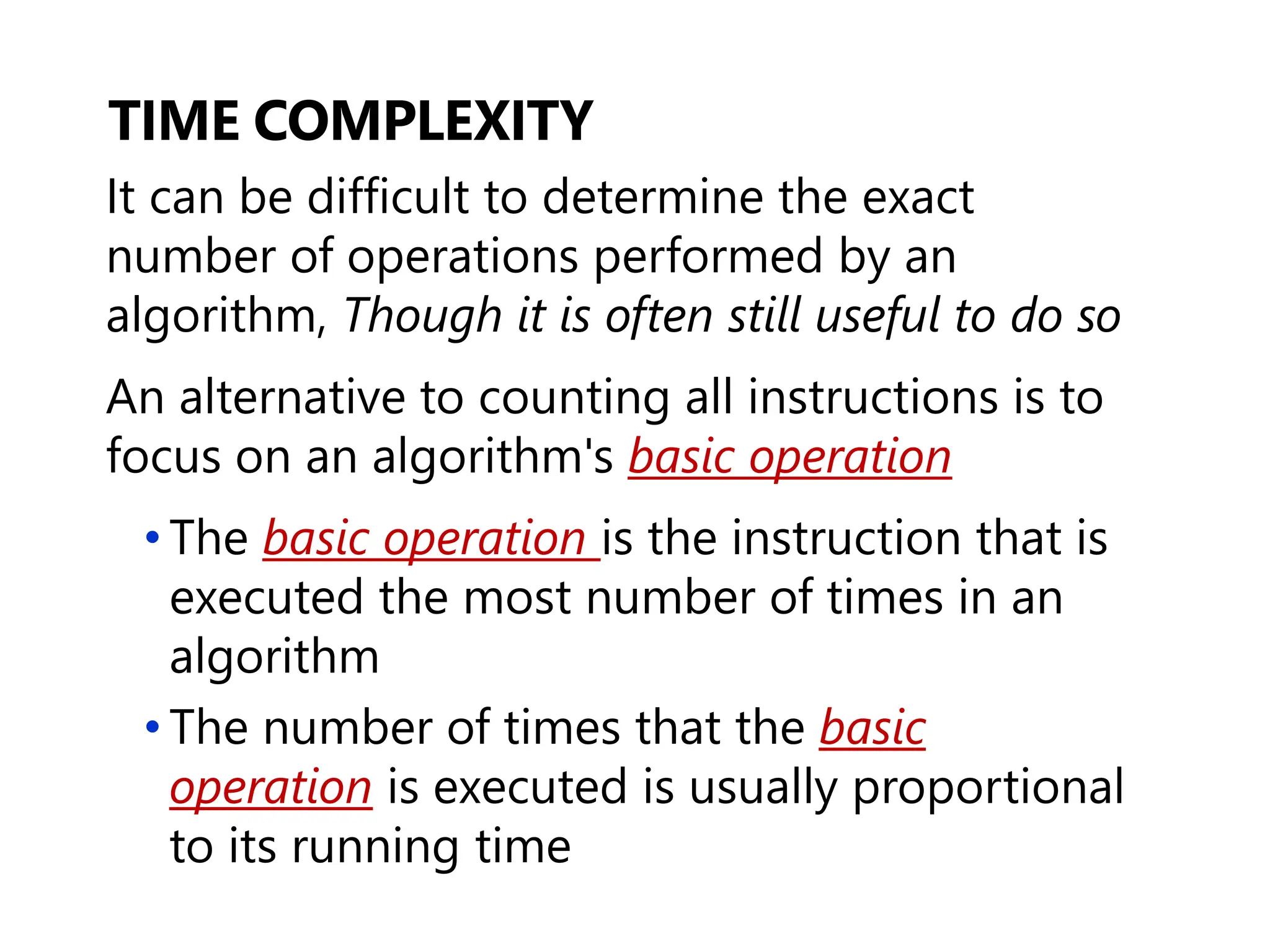
TIME COMPLEXITY
It can be difficult to determine the exact
number of operations performed by an
algorithm, Though it is often still useful to do so
An alternative to counting all instructions is to
focus on an algorithm's basic operation
• The basic operation is the instruction that is
executed the most number of times in an
algorithm
• The number of times that the basic
operation is executed is usually proportional
to its running time
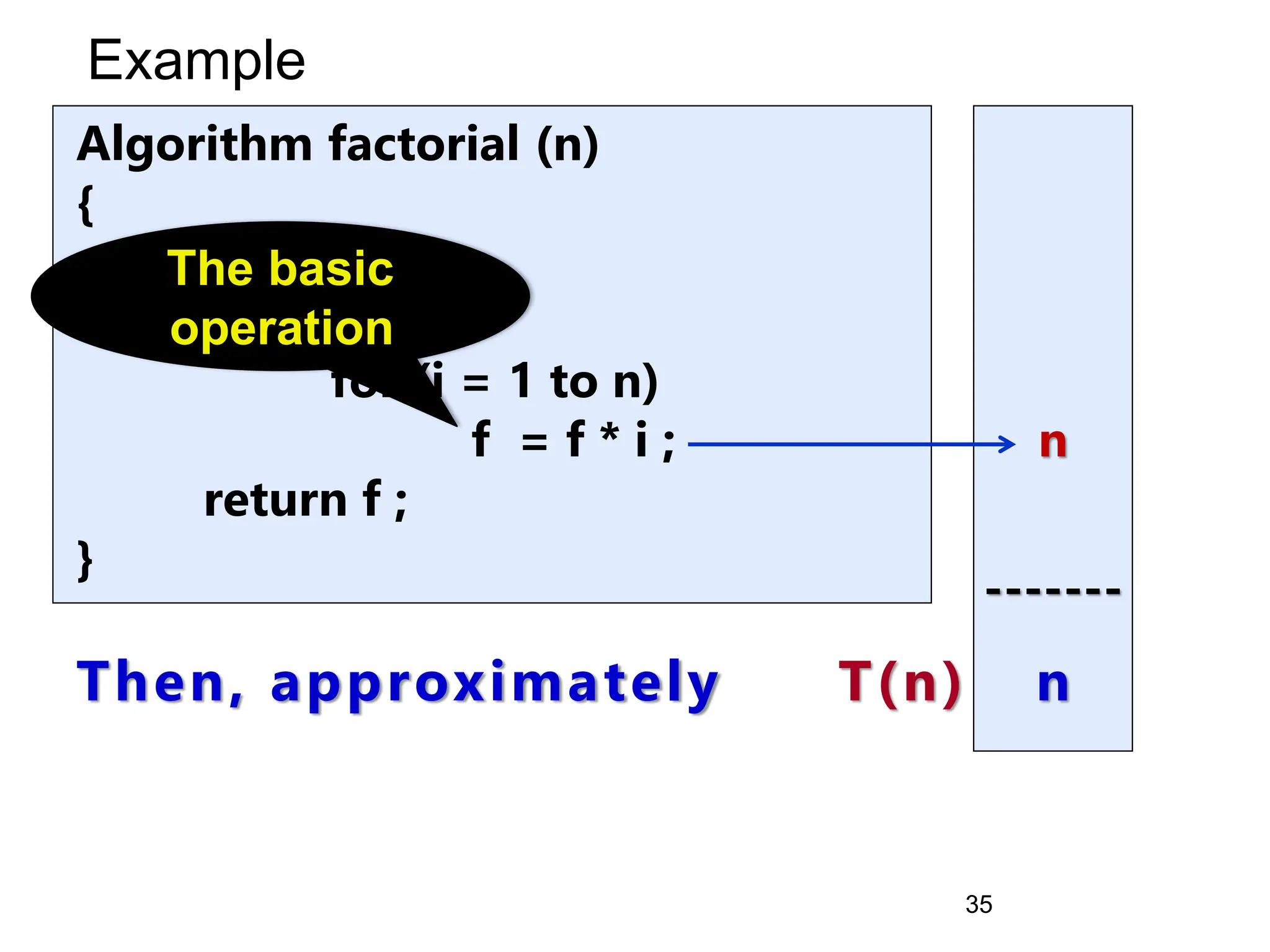
Algorithm factorial (n)
{
f = 1;
if ( n > 0 )
for (i = 1 to n)
f = f * i ;
return f ;
}
Then, approximately T(n) =
35
Example
n
-------
n
The basic
operation
36
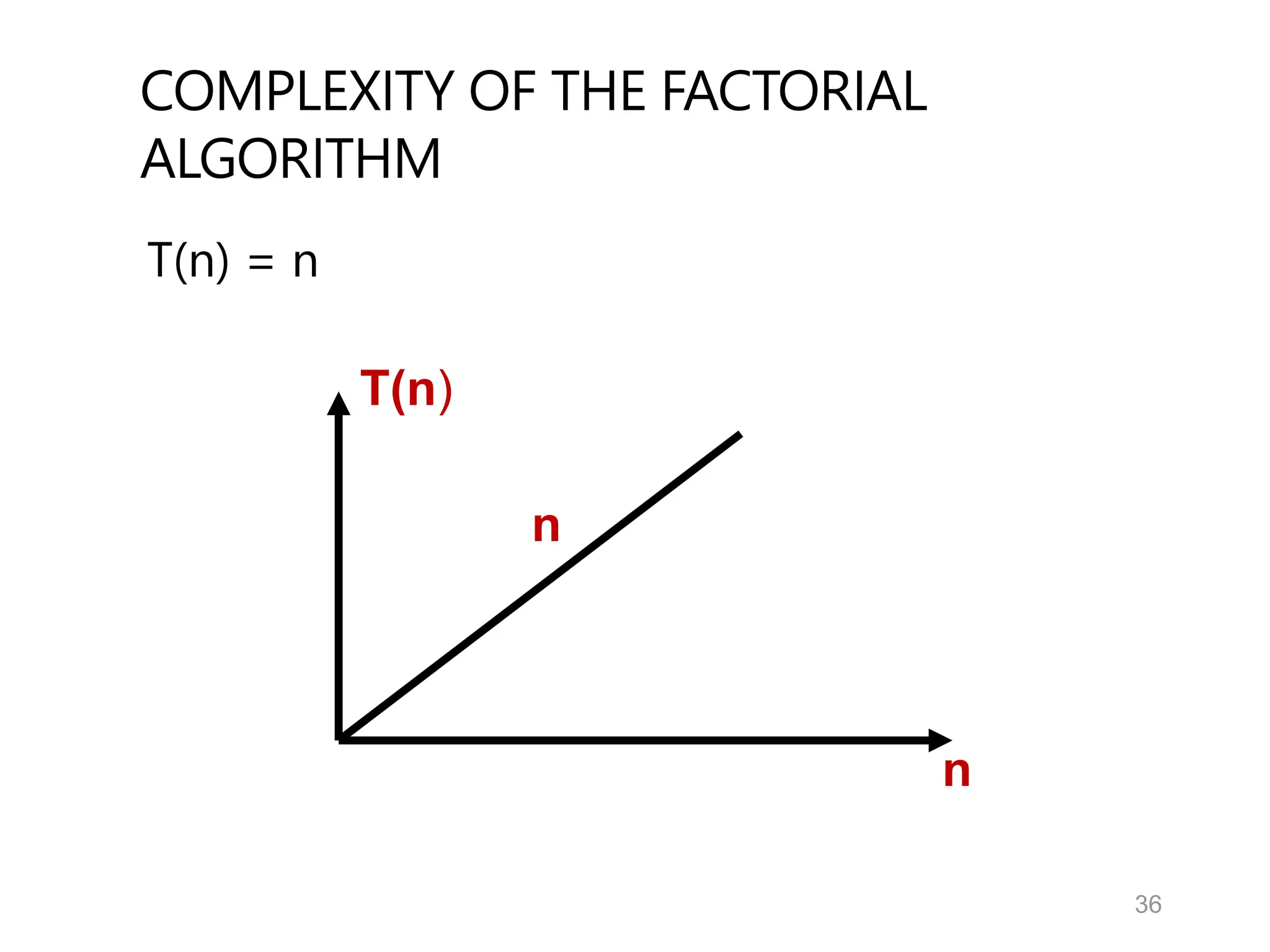
COMPLEXITY OF THE FACTORIAL
ALGORITHM
T(n) = n
T(n)
n
n
37
BEST-CASE, AVERAGE-CASE, WORST-
CASE
• The efficiencies of some algorithms may differ
significantly for inputs of the same size.
• For such algorithms, we need to distinguish
between the worst-case, average-case, and best-
case efficiencies.
• Some algorithms are same for all three cases – ex,
find the maximum value in an unsorted array.
38
EXAMPLE (2):
Algorithm linearSearch (a, key, n)
{
for (i = 0 to n-1)
if (a[i ]== key) return i;
return -1;
}
T(n) = number of array element comparisons.
Best case: T(n) = 1
Worst case: T(n) = n
39
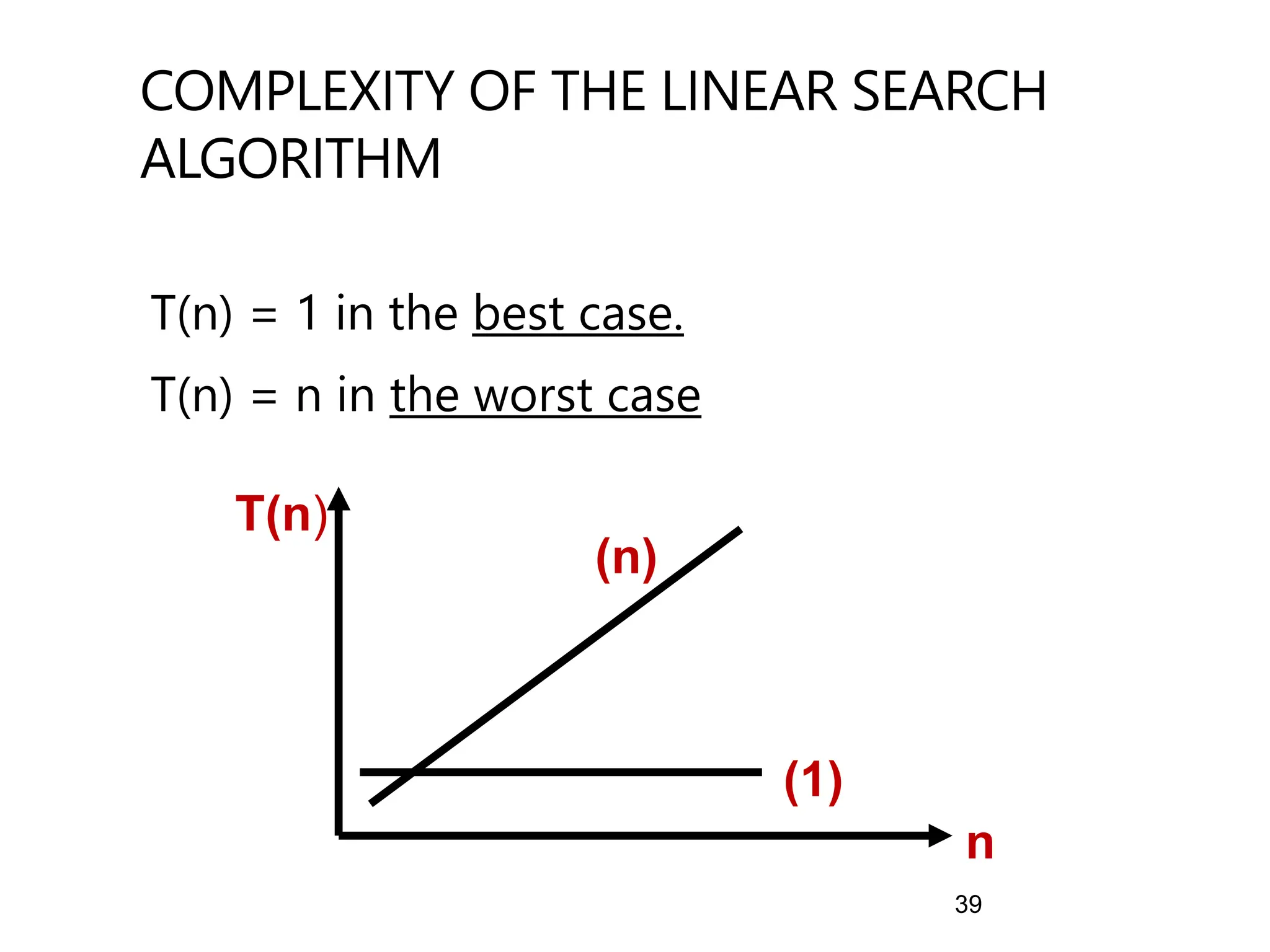
COMPLEXITY OF THE LINEAR SEARCH
ALGORITHM
T(n) = 1 in the best case.
T(n) = n in the worst case
T(n)
n
(n)
(1)
40
BEST-CASE, AVERAGE-CASE, WORST-
CASE
Average case not easy to be computed
• NOT the average of worst and best case
• Expected number of basic operations considered
as a random variable under some assumption
about the probability distribution of all possible
inputs of size n
• There are many important algorithms for which the
average case efficiency is much better than the
worst-case efficiency
41
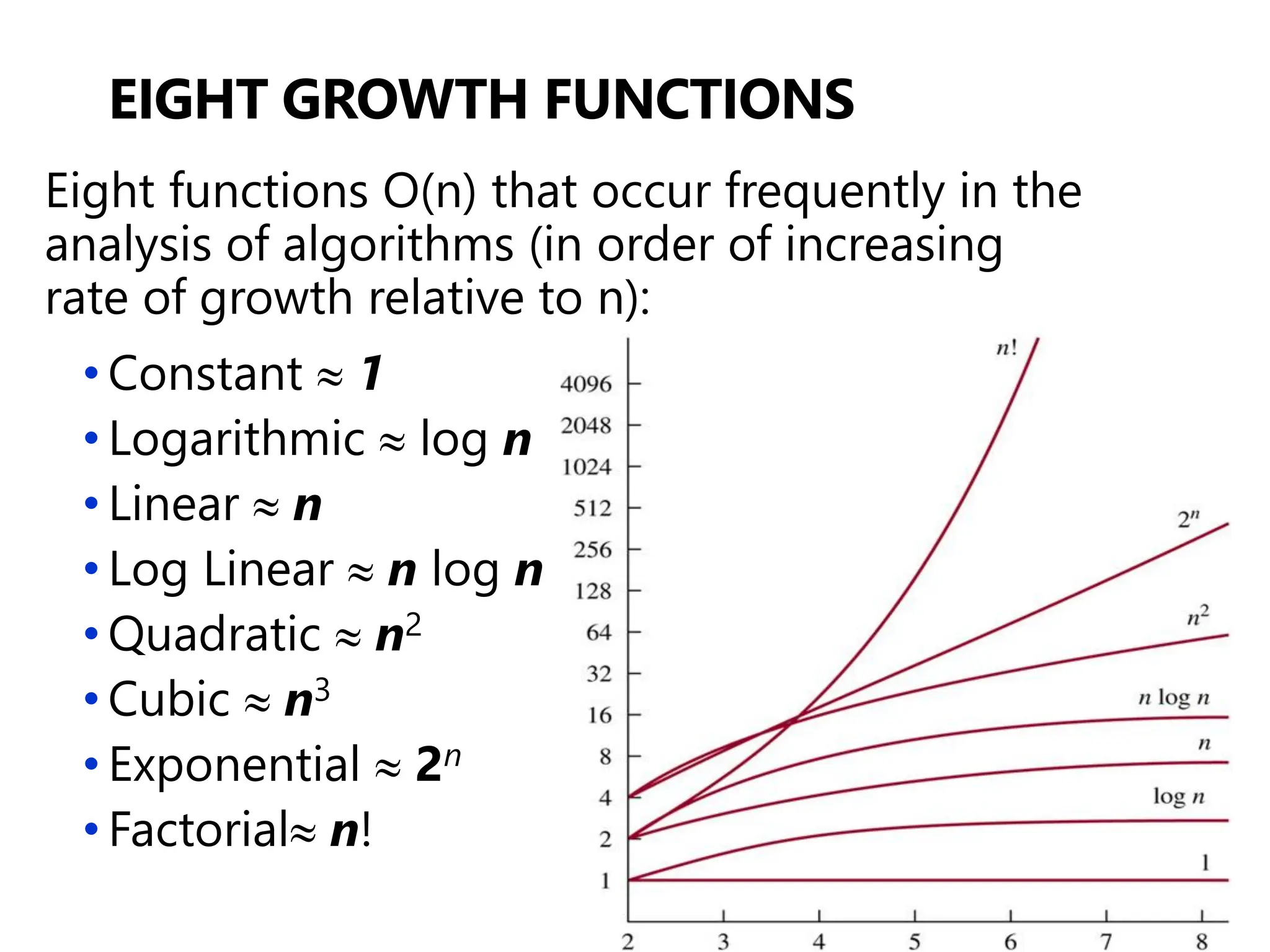
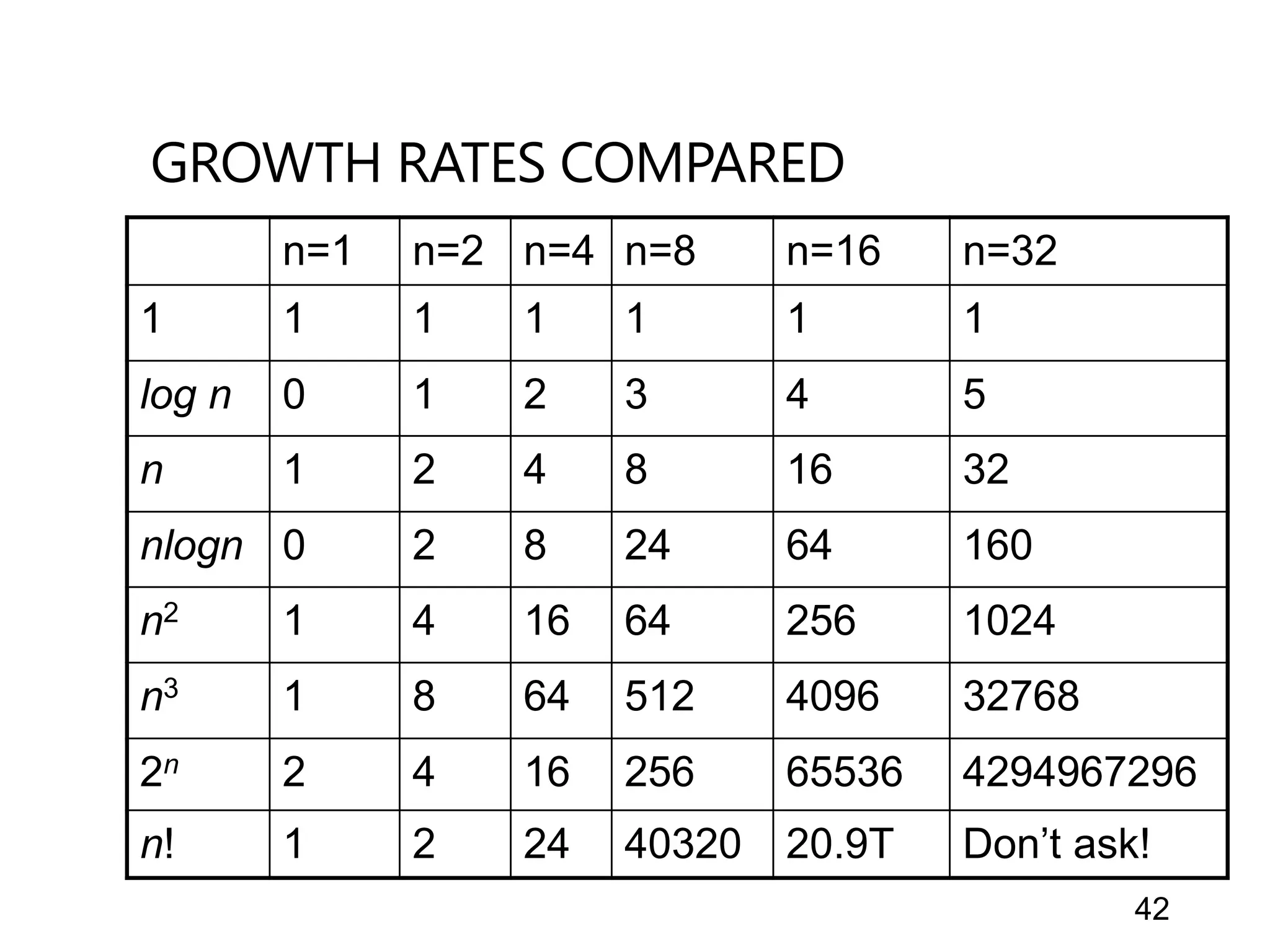
EIGHT GROWTH FUNCTIONS
Eight functions O(n) that occur frequently in the
analysis of algorithms (in order of increasing
rate of growth relative to n):
• Constant  1
• Logarithmic  log n
• Linear  n
• Log Linear  n log n
• Quadratic  n2
• Cubic  n3
• Exponential  2n
• Factorial n!
42
GROWTH RATES COMPARED
n=1 n=2 n=4 n=8 n=16 n=32
1 1 1 1 1 1 1
log n 0 1 2 3 4 5
n 1 2 4 8 16 32
nlogn 0 2 8 24 64 160
n2 1 4 16 64 256 1024
n3 1 8 64 512 4096 32768
2n 2 4 16 256 65536 4294967296
n! 1 2 24 40320 20.9T Don’t ask!
REFERENCES
Anany Levitin, Introduction to the design and analysis of
algorithms, 2nd Edition.
Chapter 1, sections 1.1, 1.2
Chapter 2, Sections 2.1,2.2

01 CS316_Introduction.pdf5959695559655565

  • 1.
    CS316: ALGORITHMS LECTURE 1:INTRODUCTION Prepared by: Assoc. Prof. Ensaf Hussein Presented by: Assoc. Prof. Wessam El-Behaidy Dr. Mohammed El-Said 1
  • 2.
    GRADING POLICY • Mid-termExam 20% • Quizzes & tasks 20% • Sheets 10% • Final-Exam 50% 2
  • 3.
    RESOURCES Textbook: Thomas Cormen, CharlesLeiserson, Ronald Rivest, and Clifford Stein. Introduction to Algorithms. 3rd ed. MIT Press, 2009. Anany Levitin, Introduction to the design and analysis of algorithms 3rd Edition, 2012. Handouts****** 3
  • 4.
    COURSE SYLLABUS • AlgorithmsDesign and Analysis • Asymptotic Notations • Compute Complexity for : • Non-recursive algorithms • Recursive Algorithms • Substitution Method • Iteration Tree • Master Method • Divide and Conquer Algorithms ( Merge Sort- Quick Sort) • Linear time Sorting (count – bucket – radix) • Graph • BFS - DFS • MST – Prim - Kruskal • Shortest path – Dijkstra – Bellman Ford • Dynamic Programming – Matrix Chain Multiplication - Longest Common Subsequence • Greedy Approach – Knapsack [0-1 / Fractional]
  • 5.
    COURSE OBJECTIVES ➢ Designalgorithms using Pseudocode. ➢ Demonstrate and study asymptotic notations in best, worst and average case. ➢ Define and analyze the complexity of recursive and non- recursive algorithms. ➢ Understand, analyze and apply standard algorithms involving searching, sorting, tree, graph, greedy, backtracking and dynamic programming algorithms.
  • 6.
    WHY STUDYING ALGORITHMS? •The study of algorithms is the cornerstone of computer science. • You have to know a standard set of important algorithms from different areas of computing; in addition, you should be able to design new algorithms and analyze their efficiency. • Algorithms can be seen as special kinds of solutions to problems— not just answers but precisely defined procedures for getting answers
  • 7.
    ALGORITHMS ABU JA‘FAR MOHAMMEDIBN MUSA AL-KHOWARIZMI (C. 780 – C. 850) Al-Khowarizmi, an astronomer and mathematician, was a member of the House of Wisdom, an academy of scientists in Baghdad. The name al-Khowarizmi means “from Kowarzizm,” which was then part of Persia, but is now called Khiwa and is part of Uzbekistan. Al-Khowarizmi wrote books on mathematics, astronomy, and geography. Western Europeans first learned about algebra from his works. The word algebra comes from al-jabr, part of the title of his book Kitab al-jabr w’al muquabala. This book was translated into Latin and was a widely used textbook. His book on the use of Hindu numerals describes procedures for arithmetic operations using these numerals. European authors used a Latin corruption of his name, which later evolved to the word algorithm, to describe the subject of arithmetic with Hindu numerals.
  • 8.
  • 9.
    ALGORITHMS Program = algorithms+ data structures Data structures: Methods of organizing data You have to design your algorithm before coding 9 Problem Algorithm Computer Input Output
  • 10.
    ALGORITHMS An algorithm: sequenceof unambiguous instructions for solving a problem. ➢ Obtaining a required output for any allowable input in a finite amount of time. 10
  • 11.
    11 Understand the problem Decide on:computational means, exact vs. approximate solving, algorithm design technique Design algorithm Prove correctness Analyze the algorithm Code the algorithm finite infinite Problem Solving Cycle
  • 12.
    The greatest commondivisor of two nonnegative, not-both-zero integers m and n, denoted gcd(m, n), is defined as the largest integer that divides both m and n. Ex: gcd ( 60,24 ) ?? 60 = 2 X 2 X 3 X 5 24 = 2 X 2 X 2 X 3 gcd ( 60,24 ) = 2 X 2 X 3 = 12 5 X 2 X 2 X 3 60 X 2 24 EXAMPLE:
  • 13.
    A SOLUTION FORGCD(M,N): Middle-school procedure Step 1 Find the prime factorization of m Step 2 Find the prime factorization of n Step 3 Find all the common prime factors Step 4 Compute the product of all the common prime factors and return it as gcd(m,n) Is this an algorithm??? The algorithm should has no ambiguous instructions ➢ What is the prime factors? ➢ How to find common values?
  • 14.
    ANOTHER SOLUTION FORGCD(M,N) Consecutive integer checking algorithm Step 1 Assign the value of min {m,n } to t Step 2 Divide m by t. If the remainder is 0, go to Step 3 otherwise, go to Step 4 Step 3 Divide n by t. If the remainder is 0, return t and stop; otherwise, go to Step 4 Step 4 Decrease t by 1 and go to Step 2 Is this an algorithm??? It is so important to specify the set of an algorithm’s inputs explicitly and carefully. ➢ How it will work when one of its input numbers is zero?
  • 15.
    EUCLID’S SOLUTION FORGCD Euclid’s algorithm is based on: Repeated application of equality gcd( m, n ) = gcd( n , m mod n ), until the second number becomes 0 Ex: gcd( 60, 24 ) = gcd( 24, 60 mod 24) = gcd ( 24, 12) = gcd ( 12, 24 mod 12) = gcd ( 12, 0) = 12
  • 16.
    EUCLID’S METHOD Step 1If n = 0, return m and stop; otherwise go to Step 2 Step 2 Divide m by n and assign the value of the remainder to r Step 3 Assign the value of n to m and the value of r to n. Go to Step 1. English like Algorithm Could be writen as: while n ≠ 0 do r ← m mod n m← n n ← r return m Pseudo-code like Algorithm
  • 17.
  • 18.
    ALGORITHM DESIGN: Algorithm canbe described in three ways: 1- Natural language like English: When this way is chosen care should be taken, we should ensure that each & every statement is definite. 2- Graphic representation called flowchart: This method will work well when the algorithm is small& simple. 3- Pseudo-code Method: In this method, we should typically describe algorithms as program, which resembles language like Pascal & algol.
  • 19.
    PSEUDO-CODE CONVENTIONS: 1- Commentsbegin with // and continue until the end of line. 2- Blocks are indicated with matching braces {and}. 3- An identifier begins with a letter. The data types of variables are not explicitly declared. 4- Assignment of values to variables is done using the assignment statement. <Variable>:= <expression>; Or <Variable> ← <expression>; 5- There are two Boolean values TRUE and FALSE. ▪ Logical Operators AND, OR, NOT ▪ Relational Operators <, <=,>,>=, =, !=
  • 20.
    6- The followinglooping statements are employed. For, while and repeat-until While Loop: While < condition > do { <statement-1> <statement-n> }
  • 21.
    For Loop: For variable:= value-1 to value-2 step vlaue-3 do { <statement-1> <statement-n> } repeat-until: repeat <statement-1> <statement-n> until<condition>
  • 22.
    7- A conditionalstatement has the following forms. ▪ If <condition> then <statement> ▪ If <condition> then <statement-1> Else <statement-1> Case statement: select case(expression) { case 1 : <statement-1> case n : <statement-n> default : <statement-n+1> }
  • 23.
    8- Input andoutput are done using the instructions read & write. 9- There is only one type of procedure: Algorithm, the heading takes the form, Algorithm Name (Parameter lists) ➢ As an example, the following algorithm finds & returns the maximum of ‘n’ given numbers:
  • 24.
    EXAMPLE 1. algorithm Max(A, n) 2. // A is an array of size n 3. { 4. Result := A[1] 5. for I ← 2 to n do 6. if A[I] > Result then 7. Result ← A[I] 8. return Result 9. } This algorithm: • named Max • A & n are procedure parameters. • Result & I are Local variables.
  • 25.
  • 26.
    26 ▪ Term “analysisof algorithms” means an investigation of an algorithm’s efficiency ▪ The main goal is to determine the cost of running an algorithm and how to reduce that cost. ▪ Cost is expressed as Complexity ▪ Time Complexity our target ▪ Space Complexity ANALYSIS OF ALGORITHMS Always there is a tradeoff between time and space complexity
  • 27.
    27 ▪ It maybe useful to time how long an algorithm takes to run. But, Running time depends on CPU speed, operating system (e.g. memory management, etc..) ▪ Time Complexity Depends on: - Size of Data (e.g. size of array 10 or 1000) - Number of Operations needed (within loop or once) - Organization of data (e.g. find item in first location, or last location in a big array) ▪ Space Complexity Depends on: - Size of Data - Size of Program SPACE & TIME COMPLEXITIES
  • 28.
    TIME COMPLEXITY It maybe useful to time how long an algorithm takes to run • In some cases it may be essential to know how long an algorithm takes on some system • e.g. air traffic control systems But, is this a good general comparison method? Running time is affected by a number of factors other than algorithm efficiency 28
  • 29.
    RUNNING TIME ISAFFECTED BY CPU speed Amount of main memory Specialized hardware (e.g. graphics card) Operating system System configuration (e.g. virtual memory) Programming language Algorithm implementation Other programs System tasks (e.g. memory management) … 29
  • 30.
    TIME COMPLEXITY Instead oftiming an algorithm, count the number of instructions that it performs The number of instructions performed may vary based on • The size of the input– ex, multiply two matrixes, though not always – ex, find binary representation of a decimal number. Almost all algorithms run longer on larger inputs. • The organization of the input – ex, consider searching a large array, If the target is the first item in the array the search will be very quick The number of instructions can be written as a cost function on the input, expressed as T(n). 30
  • 31.
    28 ▪ The numberof operations can be written as a cost function, expressed as T(n) ▪ T(n) => number of operations required. ▪ n => the Problem Size it could be the number of specific operations, or the size of data (e.g. an array) or both. TIME COMPLEXITY
  • 32.
    32 NUMBER OF OPERATIONS Wemeasure T(n) of an algorithm by counting the number of operations. • Each "simple" operation (+, -, =, <, >=) is one operation. • Loops and function calls are not simple operations, but depend upon the size of the data and the contents of a function. We do not want ”sort'' to be a single step operation. • Each memory access is one operation.
  • 33.
    Algorithm factorial (n) { f= 1; if ( n > 0 ) for (i = 1 to n) f = f * i ; return f ; } Then, T(n) = 33 Example 1 1 n+1 n 1 ------- 2n+4
  • 34.
    TIME COMPLEXITY It canbe difficult to determine the exact number of operations performed by an algorithm, Though it is often still useful to do so An alternative to counting all instructions is to focus on an algorithm's basic operation • The basic operation is the instruction that is executed the most number of times in an algorithm • The number of times that the basic operation is executed is usually proportional to its running time
  • 35.
    Algorithm factorial (n) { f= 1; if ( n > 0 ) for (i = 1 to n) f = f * i ; return f ; } Then, approximately T(n) = 35 Example n ------- n The basic operation
  • 36.
    36 COMPLEXITY OF THEFACTORIAL ALGORITHM T(n) = n T(n) n n
  • 37.
    37 BEST-CASE, AVERAGE-CASE, WORST- CASE •The efficiencies of some algorithms may differ significantly for inputs of the same size. • For such algorithms, we need to distinguish between the worst-case, average-case, and best- case efficiencies. • Some algorithms are same for all three cases – ex, find the maximum value in an unsorted array.
  • 38.
    38 EXAMPLE (2): Algorithm linearSearch(a, key, n) { for (i = 0 to n-1) if (a[i ]== key) return i; return -1; } T(n) = number of array element comparisons. Best case: T(n) = 1 Worst case: T(n) = n
  • 39.
    39 COMPLEXITY OF THELINEAR SEARCH ALGORITHM T(n) = 1 in the best case. T(n) = n in the worst case T(n) n (n) (1)
  • 40.
    40 BEST-CASE, AVERAGE-CASE, WORST- CASE Averagecase not easy to be computed • NOT the average of worst and best case • Expected number of basic operations considered as a random variable under some assumption about the probability distribution of all possible inputs of size n • There are many important algorithms for which the average case efficiency is much better than the worst-case efficiency
  • 41.
    41 EIGHT GROWTH FUNCTIONS Eightfunctions O(n) that occur frequently in the analysis of algorithms (in order of increasing rate of growth relative to n): • Constant  1 • Logarithmic  log n • Linear  n • Log Linear  n log n • Quadratic  n2 • Cubic  n3 • Exponential  2n • Factorial n!
  • 42.
    42 GROWTH RATES COMPARED n=1n=2 n=4 n=8 n=16 n=32 1 1 1 1 1 1 1 log n 0 1 2 3 4 5 n 1 2 4 8 16 32 nlogn 0 2 8 24 64 160 n2 1 4 16 64 256 1024 n3 1 8 64 512 4096 32768 2n 2 4 16 256 65536 4294967296 n! 1 2 24 40320 20.9T Don’t ask!
  • 43.
    REFERENCES Anany Levitin, Introductionto the design and analysis of algorithms, 2nd Edition. Chapter 1, sections 1.1, 1.2 Chapter 2, Sections 2.1,2.2