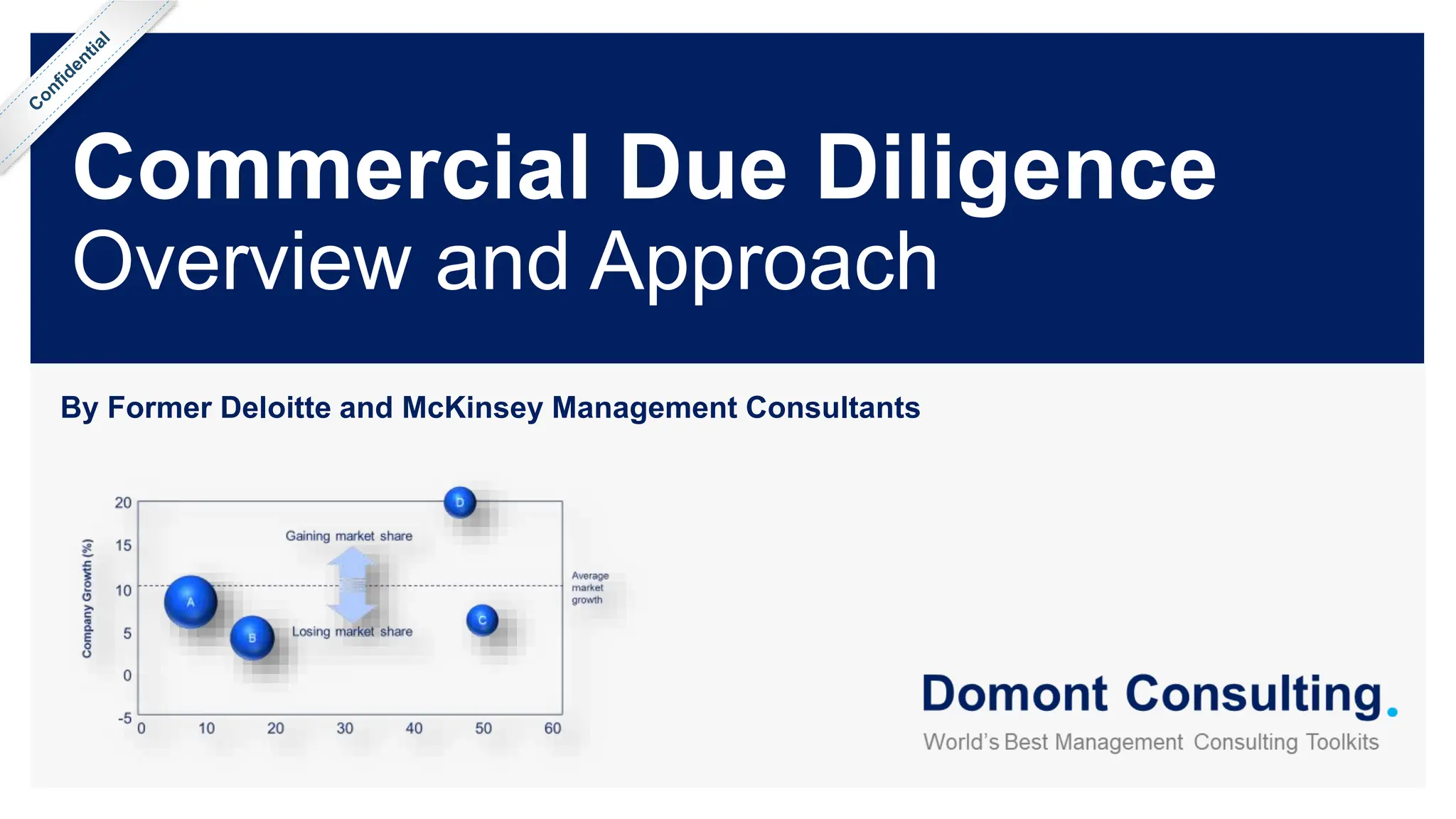
Commercial Due Diligence
Overview and Approach
By Former Deloitte and McKinsey Management Consultants
Table of Contents
2
Overview
The use of a hypothesis driven approach to undertake your CDD Project
1
2
Table of Contents
3
Overview
The use of a hypothesis driven approach to undertake your CDD Project
1
2
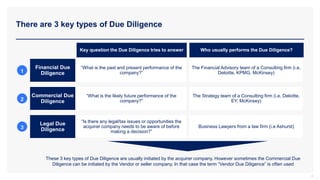
There are 3 key types of Due Diligence
4
1
2
3
“What is the past and present performance of the
company?”
Financial Due
Diligence
“What is the likely future performance of the
company?”
Commercial Due
Diligence
“Is there any legal/tax issues or opportunities the
acquirer company needs to be aware of before
making a decision?”
Legal Due
Diligence
Key question the Due Diligence tries to answer Who usually performs the Due Diligence?
The Financial Advisory team of a Consulting firm (i.e.
Deloitte, KPMG, McKinsey)
The Strategy team of a Consulting firm (i.e. Deloitte,
EY, McKinsey)
Business Lawyers from a law firm (i.e Ashurst)
These 3 key types of Due Diligence are usually initiated by the acquirer company. However sometimes the Commercial Due
Diligence can be initiated by the Vendor or seller company. In that case the term “Vendor Due Diligence” is often used
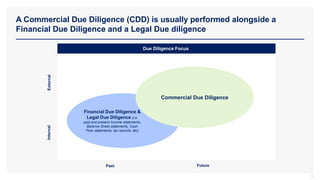
A Commercial Due Diligence (CDD) is usually performed alongside a
Financial Due Diligence and a Legal Due diligence
5
Internal
External
Future
Past
Financial Due Diligence &
Legal Due Diligence (i.e.
past and present Income statements,
Balance Sheet statements, Cash
Flow statements, tax records, etc)
Commercial Due Diligence
Due Diligence Focus
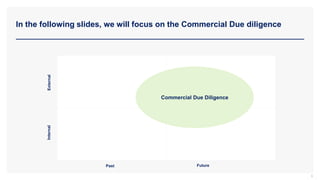
In the following slides, we will focus on the Commercial Due diligence
6
Internal
External
Future
Past
Commercial Due Diligence
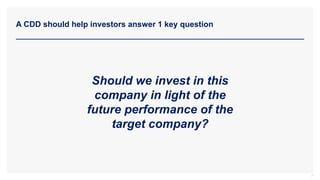
A CDD should help investors answer 1 key question
7
Should we invest in this
company in light of the
future performance of the
target company?
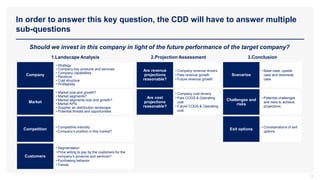
In order to answer this key question, the CDD will have to answer multiple
sub-questions
8
Should we invest in this company in light of the future performance of the target company?
• Segmentation
• Price willing to pay by the customers for the
company’s products and services?
• Purchasing behavior
• Trends
Customers
1.Landscape Analysis 2.Projection Assessment 3.Conclusion
• Strategy
• Company key products and services
• Company capabilities
• Revenue
• Cost structure
• Profitability
Company
• Company revenue drivers
• Past revenue growth
• Future revenue growth
Are revenue
projections
reasonable?
• Base case, upside
case and downside
case
Scenarios
• Market size and growth?
• Market segments?
• Market segments size and growth?
• Market KPIs
• Supplier an distribution landscape
• Potential threats and opportunities
Market
• Company cost drivers
• Past COGS & Operating
cost
• Future COGS & Operating
cost
Are cost
projections
reasonable?
• Potential challenges
and risks to achieve
projections
Challenges and
risks
• Competitive intensity
• Company’s position in this market?
Competition
• Considerations of exit
options
Exit options
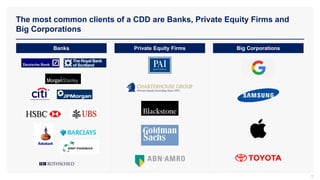
The most common clients of a CDD are Banks, Private Equity Firms and
Big Corporations
9
Banks Private Equity Firms Big Corporations
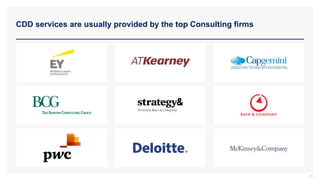
CDD services are usually provided by the top Consulting firms
10
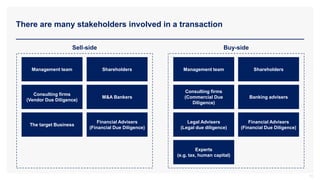
There are many stakeholders involved in a transaction
11
Sell-side Buy-side
Management team Shareholders
Banking advisers
Consulting firms
(Commercial Due
Diligence)
Experts
(e.g. tax, human capital)
Financial Advisers
(Financial Due Diligence)
Legal Advisers
(Legal due diligence)
Management team Shareholders
M&A Bankers
Consulting firms
(Vendor Due Diligence)
The target Business
Financial Advisers
(Financial Due Diligence)
Table of Contents
12
Overview
The use of a hypothesis driven approach to undertake your CDD Project
1
2
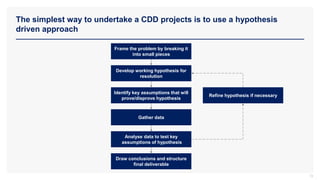
The simplest way to undertake a CDD projects is to use a hypothesis
driven approach
13
Develop working hypothesis for
resolution
Identify key assumptions that will
prove/disprove hypothesis
Gather data
Analyse data to test key
assumptions of hypothesis
Draw conclusions and structure
final deliverable
Frame the problem by breaking it
into small pieces
Refine hypothesis if necessary
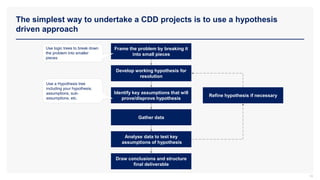
The simplest way to undertake a CDD projects is to use a hypothesis
driven approach
14
Develop working hypothesis for
resolution
Identify key assumptions that will
prove/disprove hypothesis
Gather data
Analyse data to test key
assumptions of hypothesis
Draw conclusions and structure
final deliverable
Frame the problem by breaking it
into small pieces
Refine hypothesis if necessary
Use logic trees to break down
the problem into smaller
pieces
Use a Hypothesis tree
including your hypothesis,
assumptions, sub-
assumptions, etc.
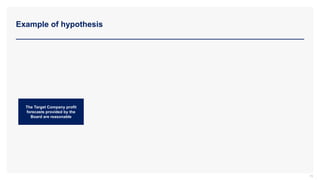
Example of hypothesis
15
The Target Company profit
forecasts provided by the
Board are reasonable
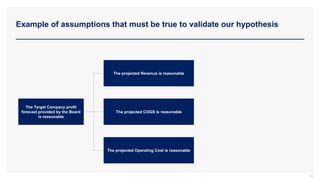
Example of assumptions that must be true to validate our hypothesis
16
The Target Company profit
forecast provided by the Board
is reasonable
The projected Revenue is reasonable
The projected COGS is reasonable
The projected Operating Cost is reasonable
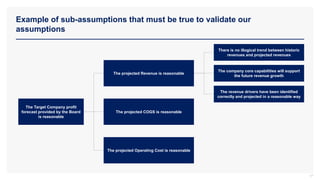
Example of sub-assumptions that must be true to validate our
assumptions
17
The Target Company profit
forecast provided by the Board
is reasonable
The projected Revenue is reasonable
The projected COGS is reasonable
The projected Operating Cost is reasonable
There is no illogical trend between historic
revenues and projected revenues
The company core capabilities will support
the future revenue growth
The revenue drivers have been identified
correctly and projected in a reasonable way
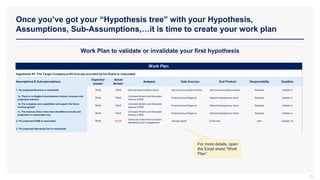
Once you’ve got your “Hypothesis tree” with your Hypothesis,
Assumptions, Sub-Assumptions,…it is time to create your work plan
18
Work Plan to validate or invalidate your first hypothesis
For more details, open
the Excel sheet “Work
Plan”
Hypothesis #1: The Target Company profit forecast provided by the Board is reasonable
Assumptions & Sub-assumptions
Expected
answer
Actual
Answer
Analyses Data Sources End Product Responsibility Deadline
1. The projected Revenue is reasonable TRUE TRUE See sub-assumptions below See sub-assumptions below See sub-assumptions below Raphael October 5
1a. There is no illogical trend between historic revenues and
projected revenues
TRUE TRUE
Compare Historic and forcasted
revenue CAGR
Financial Due Diligence Vertical Histogramme chart Raphael October 5
1b. The company core capabilities will support the future
revenue growth
TRUE TRUE
Compare Historic and forcasted
revenue CAGR
Financial Due Diligence Vertical Histogramme chart Raphael October 5
1c. The revenue drivers have been identified correctly and
projected in a reasonable way
TRUE TRUE
Compare Historic and forcasted
revenue CAGR
Financial Due Diligence Vertical Histogramme chart Raphael October 5
2. The projected COGS is reasonable TRUE FALSE
Check list of key revenue drivers
identified by the management
Industry report Driver tree John October 10
3. The projected Operating Cost is reasonable
Work Plan
Thanks for your attention!
19
www.domontconsulting.com

0. Overview and Approach.pptx this is major

  • 1.
    Commercial Due Diligence Overviewand Approach By Former Deloitte and McKinsey Management Consultants
  • 2.
    Table of Contents 2 Overview Theuse of a hypothesis driven approach to undertake your CDD Project 1 2
  • 3.
    Table of Contents 3 Overview Theuse of a hypothesis driven approach to undertake your CDD Project 1 2
  • 4.
    There are 3key types of Due Diligence 4 1 2 3 “What is the past and present performance of the company?” Financial Due Diligence “What is the likely future performance of the company?” Commercial Due Diligence “Is there any legal/tax issues or opportunities the acquirer company needs to be aware of before making a decision?” Legal Due Diligence Key question the Due Diligence tries to answer Who usually performs the Due Diligence? The Financial Advisory team of a Consulting firm (i.e. Deloitte, KPMG, McKinsey) The Strategy team of a Consulting firm (i.e. Deloitte, EY, McKinsey) Business Lawyers from a law firm (i.e Ashurst) These 3 key types of Due Diligence are usually initiated by the acquirer company. However sometimes the Commercial Due Diligence can be initiated by the Vendor or seller company. In that case the term “Vendor Due Diligence” is often used
  • 5.
    A Commercial DueDiligence (CDD) is usually performed alongside a Financial Due Diligence and a Legal Due diligence 5 Internal External Future Past Financial Due Diligence & Legal Due Diligence (i.e. past and present Income statements, Balance Sheet statements, Cash Flow statements, tax records, etc) Commercial Due Diligence Due Diligence Focus
  • 6.
    In the followingslides, we will focus on the Commercial Due diligence 6 Internal External Future Past Commercial Due Diligence
  • 7.
    A CDD shouldhelp investors answer 1 key question 7 Should we invest in this company in light of the future performance of the target company?
  • 8.
    In order toanswer this key question, the CDD will have to answer multiple sub-questions 8 Should we invest in this company in light of the future performance of the target company? • Segmentation • Price willing to pay by the customers for the company’s products and services? • Purchasing behavior • Trends Customers 1.Landscape Analysis 2.Projection Assessment 3.Conclusion • Strategy • Company key products and services • Company capabilities • Revenue • Cost structure • Profitability Company • Company revenue drivers • Past revenue growth • Future revenue growth Are revenue projections reasonable? • Base case, upside case and downside case Scenarios • Market size and growth? • Market segments? • Market segments size and growth? • Market KPIs • Supplier an distribution landscape • Potential threats and opportunities Market • Company cost drivers • Past COGS & Operating cost • Future COGS & Operating cost Are cost projections reasonable? • Potential challenges and risks to achieve projections Challenges and risks • Competitive intensity • Company’s position in this market? Competition • Considerations of exit options Exit options
  • 9.
    The most commonclients of a CDD are Banks, Private Equity Firms and Big Corporations 9 Banks Private Equity Firms Big Corporations
  • 10.
    CDD services areusually provided by the top Consulting firms 10
  • 11.
    There are manystakeholders involved in a transaction 11 Sell-side Buy-side Management team Shareholders Banking advisers Consulting firms (Commercial Due Diligence) Experts (e.g. tax, human capital) Financial Advisers (Financial Due Diligence) Legal Advisers (Legal due diligence) Management team Shareholders M&A Bankers Consulting firms (Vendor Due Diligence) The target Business Financial Advisers (Financial Due Diligence)
  • 12.
    Table of Contents 12 Overview Theuse of a hypothesis driven approach to undertake your CDD Project 1 2
  • 13.
    The simplest wayto undertake a CDD projects is to use a hypothesis driven approach 13 Develop working hypothesis for resolution Identify key assumptions that will prove/disprove hypothesis Gather data Analyse data to test key assumptions of hypothesis Draw conclusions and structure final deliverable Frame the problem by breaking it into small pieces Refine hypothesis if necessary
  • 14.
    The simplest wayto undertake a CDD projects is to use a hypothesis driven approach 14 Develop working hypothesis for resolution Identify key assumptions that will prove/disprove hypothesis Gather data Analyse data to test key assumptions of hypothesis Draw conclusions and structure final deliverable Frame the problem by breaking it into small pieces Refine hypothesis if necessary Use logic trees to break down the problem into smaller pieces Use a Hypothesis tree including your hypothesis, assumptions, sub- assumptions, etc.
  • 15.
    Example of hypothesis 15 TheTarget Company profit forecasts provided by the Board are reasonable
  • 16.
    Example of assumptionsthat must be true to validate our hypothesis 16 The Target Company profit forecast provided by the Board is reasonable The projected Revenue is reasonable The projected COGS is reasonable The projected Operating Cost is reasonable
  • 17.
    Example of sub-assumptionsthat must be true to validate our assumptions 17 The Target Company profit forecast provided by the Board is reasonable The projected Revenue is reasonable The projected COGS is reasonable The projected Operating Cost is reasonable There is no illogical trend between historic revenues and projected revenues The company core capabilities will support the future revenue growth The revenue drivers have been identified correctly and projected in a reasonable way
  • 18.
    Once you’ve gotyour “Hypothesis tree” with your Hypothesis, Assumptions, Sub-Assumptions,…it is time to create your work plan 18 Work Plan to validate or invalidate your first hypothesis For more details, open the Excel sheet “Work Plan” Hypothesis #1: The Target Company profit forecast provided by the Board is reasonable Assumptions & Sub-assumptions Expected answer Actual Answer Analyses Data Sources End Product Responsibility Deadline 1. The projected Revenue is reasonable TRUE TRUE See sub-assumptions below See sub-assumptions below See sub-assumptions below Raphael October 5 1a. There is no illogical trend between historic revenues and projected revenues TRUE TRUE Compare Historic and forcasted revenue CAGR Financial Due Diligence Vertical Histogramme chart Raphael October 5 1b. The company core capabilities will support the future revenue growth TRUE TRUE Compare Historic and forcasted revenue CAGR Financial Due Diligence Vertical Histogramme chart Raphael October 5 1c. The revenue drivers have been identified correctly and projected in a reasonable way TRUE TRUE Compare Historic and forcasted revenue CAGR Financial Due Diligence Vertical Histogramme chart Raphael October 5 2. The projected COGS is reasonable TRUE FALSE Check list of key revenue drivers identified by the management Industry report Driver tree John October 10 3. The projected Operating Cost is reasonable Work Plan
  • 19.
    Thanks for yourattention! 19 www.domontconsulting.com