
Diane Arbus
Chloe Hagger, Sian Williams & Lauren Symons
• March 14 1923- July 26 1971

• American photographer

• Felt alienated from “real life” as a
  child

• Grew up in a wealthy, family
  environment

• Married at 18 and sets up a fashion
  photography business with her
  husband
Style
• Most of Arbus‟s work is in black and white square format, mostly portraits

•    Arbus was often dismissed as a voyeur due to her photos of freaks,
    transvestites and nudists

• “Diane Arbus brought an unblinking, discerning eye to society's underside
  and to its pathetic, heroic, frightening, hilarious, all-too-human inhabitants”
  Frank Van Riper

• Her photos have a dark „edge‟
Identical Twins


"She was involved in the question of identity. Who am I and who are you?”
                             Patricia Bosworth
‘A young man with curlers at home on West 20th Street, N.Y.
Untitled
“Finally what I‟ve been searching
for”
http://www.youtube.com/watch?v=V0ZTxSZ25ws&feature=relmfu
“„My work doesn‟t do it for me anymore‟ she said. She had
 spent months photographing these mental retardates and
 she was exhausted, drained from the experience, and the
    pictures were no good – out of control. She could not
confront these subjects as she had in the past – it was a new
  thing for her. She didn‟t know what it meant. She had just
developed the contacts, but hadn‟t printed them. Suddenly it
                         didn‟t matter.”

                       Nancy Grossman

             (A Biography by Patricia Bosworth)
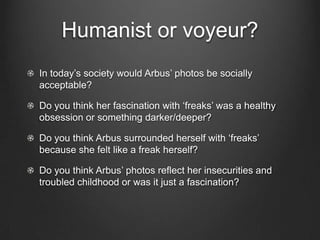
Humanist or voyeur?
In today‟s society would Arbus‟ photos be socially
acceptable?

Do you think her fascination with „freaks‟ was a healthy
obsession or something darker/deeper?

Do you think Arbus surrounded herself with „freaks‟
because she felt like a freak herself?

Do you think Arbus‟ photos reflect her insecurities and
troubled childhood or was it just a fascination?
Bibliography

Diane Arbus Presentation

  • 1.
    Diane Arbus Chloe Hagger,Sian Williams & Lauren Symons
  • 2.
    • March 141923- July 26 1971 • American photographer • Felt alienated from “real life” as a child • Grew up in a wealthy, family environment • Married at 18 and sets up a fashion photography business with her husband
  • 3.
    Style • Most ofArbus‟s work is in black and white square format, mostly portraits • Arbus was often dismissed as a voyeur due to her photos of freaks, transvestites and nudists • “Diane Arbus brought an unblinking, discerning eye to society's underside and to its pathetic, heroic, frightening, hilarious, all-too-human inhabitants” Frank Van Riper • Her photos have a dark „edge‟
  • 4.
    Identical Twins "She wasinvolved in the question of identity. Who am I and who are you?” Patricia Bosworth
  • 5.
    ‘A young manwith curlers at home on West 20th Street, N.Y.
  • 6.
    Untitled “Finally what I‟vebeen searching for”
  • 7.
  • 8.
    “„My work doesn‟tdo it for me anymore‟ she said. She had spent months photographing these mental retardates and she was exhausted, drained from the experience, and the pictures were no good – out of control. She could not confront these subjects as she had in the past – it was a new thing for her. She didn‟t know what it meant. She had just developed the contacts, but hadn‟t printed them. Suddenly it didn‟t matter.” Nancy Grossman (A Biography by Patricia Bosworth)
  • 9.
    Humanist or voyeur? Intoday‟s society would Arbus‟ photos be socially acceptable? Do you think her fascination with „freaks‟ was a healthy obsession or something darker/deeper? Do you think Arbus surrounded herself with „freaks‟ because she felt like a freak herself? Do you think Arbus‟ photos reflect her insecurities and troubled childhood or was it just a fascination?
  • 10.