Grid-based Genetic Operators for Graphical Layout Generation
The slides for the PACMHCI / EICS 2021 paper titled "Grid-based Genetic Operators for Graphical Layout Generation" authored by Morteza Shiripour, Niraj Ramesh Dayama, Antti Oulasvirta
For more Details: https://doi.org/10.1145/3461730
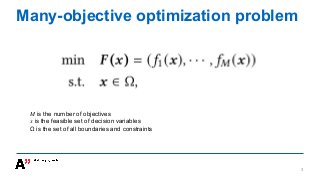
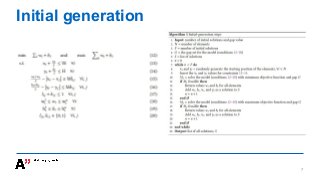
Many-objective optimization problem
𝑀is the number of objectives
𝑥 is the feasible set of decision variables
Ω is the set of all boundaries and constraints
3
4.
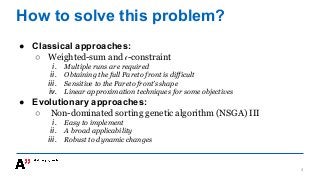
How to solvethis problem?
● Classical approaches:
○ Weighted-sum and 𝜖-constraint
i. Multiple runs are required
ii. Obtaining the full Pareto front is difficult
iii. Sensitive to the Pareto front’s shape
iv. Linear approximation techniques for some objectives
● Evolutionary approaches:
○ Non-dominated sorting genetic algorithm (NSGA) III
i. Easy to implement
ii. A broad applicability
iii. Robust to dynamic changes
4
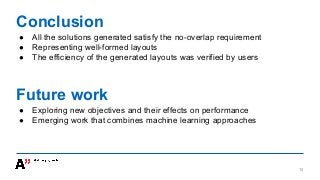
Conclusion
● All thesolutions generated satisfy the no-overlap requirement
● Representing well-formed layouts
● The efficiency of the generated layouts was verified by users
Future work
● Exploring new objectives and their effects on performance
● Emerging work that combines machine learning approaches
15




![谷歌留痕技术教程[ 𝙩𝙤𝙥 𝟮𝟯𝟯. 𝙘 𝙤𝙢 ]](https://cdn.slidesharecdn.com/ss_thumbnails/top233-260130173900-2eb784f9-thumbnail.jpg?width=640&height=640&fit=bounds)


![20260201 [FOSDEM] gomodjail - library sandboxing for Go modules.pdf](https://cdn.slidesharecdn.com/ss_thumbnails/20260201fosdemgomodjail-librarysandboxingforgomodules-260201225659-76609ec4-thumbnail.jpg?width=640&height=640&fit=bounds)


