Henry Lawson: The
Drover’s Wife
Distinctively Visual
As part of this study you will be asked
to explore the ways the images we see
and/or visualise in texts are created.
You will consider how literary form
and structure and the language used in
different texts create these images, affect
interpretation and shape meaning.
Distinctively Visual
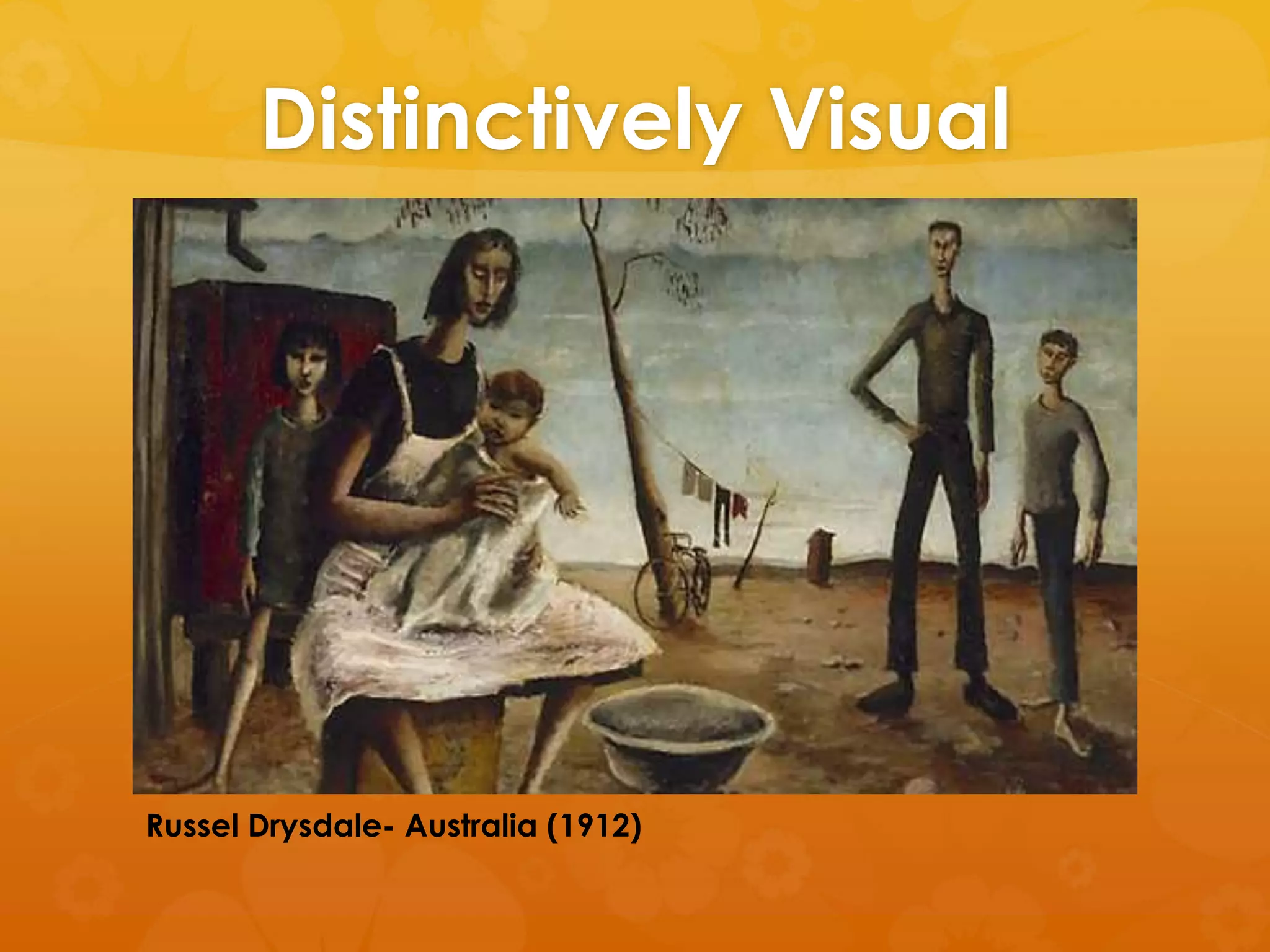
Russel Drysdale- Australia (1912)
Distinctively Visual
Russel Drysdale- Australia (1912)
1- What is the atmosphere of the painting? (use
adjectives and descriptive language)
2- Describe the setting using language that is
Distinctively Visual. (use the notes from the unit
'Deconstructing Visual Text' on our Google site to
help you)
3- What does this painting say about what it
may be like to live in the Australian bush?
Henry Lawson
 Who is he?
 What are his views?
 What does he value?
 Look at the Historical
Context of the text to
gain insight into
Lawson and his work.
Henry Lawson and the
Australian bush
By the 1890s Australia had been settled for a little more than 100
years and Lawson was arguably the first Australian-born writer who
really looked at Australia with Australian eyes, not influenced by his
knowledge of other landscapes. He was the first perhaps to give
voice to interpretations of an 'Australian' character.
He was also from the bush, had lived on a selection, had been
brought up in bush poverty, had suffered hardship and
unemployment, and knew of the characters and lifestyles he
talked about. His work reflected Australian experience with an
integrity readers recognised.
Information from: http://australia.gov.au/about-
australia/australian-story/henry-lawson
The Drover’s Wife
In “The Drover’s Wife,” Lawson
acknowledges the hardships of Australian
women living in the bush. This story was
unique in its time, as a female protagonist
was uncommon. Stories from this period
focused on the men living in the outback;
the drovers and their struggle, they
dismissed the life of the woman waiting
at home suffering in silence during their
husbands' long periods of absence.
The Drover’s Wife
In The Drover’s Wife, Lawson sheds light on
the life of such women, allowing the reader
insight into their often heroic actions as he
creates authentic depictions of their
existence in the bush, and their fight to
make it a home. In this story, we learn
about one such woman, struggling against
all odds to protect her family against the
elements and being shaped by the
landscape that she inhabits.
The Drover’s Wife: Form
•With a simple plot, emphasis on the
character and her experiences.
•Short sentences
Short Story
•omniscient - third person, mostly
written in present tense.
Narration
The Drover’s Wife: Setting
• The Australian Bush
Setting:
• unrelenting, monotonous,
isolated, harsh, bleak, uninviting
Descriptive Language:
Australian Bush
• "bush all round"
•“The bush consists of stunted,
rotten native apple-trees”
•"everlasting, maddening sameness"
•“no horizon”, “no ranges in the
distance” and “no undergrowth”
Bush Landscape
Setting: The House
• quaint, minimalist, having just the bare
necessities of life. “The kitchen has no
floor - or, rather, an earthen one -
called a "ground floor"
•”The two-roomed house is built of round
timber, slabs, and stringy-bark, and
floored with split slabs. A big bark
kitchen standing at one end is larger
than the house itself, veranda
included”
The House
The Drover’s Wife
• Protagonist, unnamed
The Drover's Wife:
• Stoic, protective, heroic,
hardened, strong, independent.
Descriptive Language:
The Drover’s Wife
• "gaunt sun-browned bushwoman"
•"she is not a coward"
•"she is used to being left alone"
•As a girl she built the usual castles
in the air; but all her girlish hopes
and aspirations have long been
dead.”
Characterisation:
The Drover’s Wife
•"all days are much the same to her"
•"used to the loneliness of it all"
•"she seems contented with her lot"
•"she loves her children, but has no
time to show it. She seems harsh to
them"
•"Sunday afternoon she dresses herself,
tidies the children, smartens up baby,
and goes for a lonely walk along the
bush-track"
Daily Life:
Characters
• "big, black, yellow-eyed dog-of-all-breeds"
• ""he is afraid of nothing on the face of the earth or under
it"
Alligator
• "four ragged, dried-up-looking children"
• “They are two boys and two girls - mere babies”
The Children
• “a sharp-faced urchin of eleven”
Tommy
• "he is careless, but a good enough husband"
The Drover
Language
•"Tommy's skinnin' me alive wif his
club.", "d'yer"
Vernacular Colloquialisms
•Sometimes vulgar, "Shet up you little
---!” “I'd like to screw their blanky
necks”
Terminology
Literary Techniques
•The surrounding landscape as
described by Lawson provides the
reader with a visual image of the
Australian Bush; this image also
extends to reflect the appearance
of the persona and her children – a
product of the environment and
their experiences.
Imagery
Literary Techniques
•In her husbands absence "she fought a
bushfire", "a flood", "the pleura-
pneumonia", and "a mad bullock". She
has also needed to protect herself and
the family from the odd "villainous-
looking sundowner", "gallows-faced
swagman" and black bellied snake.
She also finds time to shoo the "crows
and eagles" from her chickens.
Flashbacks
Literary Techniques
• She has had to make many sacrifices,
including her femininity in order to live in
the bush
• "her surroundings are not favourable to the
development of the 'womanly'
or sentimental side of nature.”
• “She put on an old pair of her husband's
trousers…”
• The Young Ladies Journal shows her interest
in a different life; she has made sacrifices
for her family.
Femininity
Literary Techniques
• The dam breaking; “her heart
[is] nearly broken too, for she
[thinks] how her husband would
feel when he [comes] home
and [sees] the result of years of
labour swept away. She cries
then”
Metaphor: The Dam
Literary Techniques
• The weather and the
surrounding landscape
reflect the mood and the
appearance of the
persona.
Pathetic Fallacy
Literary Techniques
•References to the bible may
be seen in the use of the
snake/serpent as symbol of
evil. Also in the walks taken
on a Sunday, as the day of
rest.
Biblical Allusion
Literary Techniques
• ‘’Bung! The crows leave..’’
“crash” “Thud, thud”
Onomatopoeia
• "Snake! Mother, here's a snake!"
Repetition
The Drover’s Wife
•“One of the children died while she
was here alone. She rode nineteen
miles for assistance, carrying the
dead child”
Sympathy
•"Mother, I won't never go drovin' blarst
me if I do!” … And she hugs him to her
worn-out breast and kisses him”
Empathy

Henry Lawson: The Drovers Wife

  • 1.
    Henry Lawson: The Drover’sWife Distinctively Visual
  • 2.
    Distinctively Visual As partof this study you will be asked to explore the ways the images we see and/or visualise in texts are created. You will consider how literary form and structure and the language used in different texts create these images, affect interpretation and shape meaning.
  • 3.
  • 4.
    Distinctively Visual Russel Drysdale-Australia (1912) 1- What is the atmosphere of the painting? (use adjectives and descriptive language) 2- Describe the setting using language that is Distinctively Visual. (use the notes from the unit 'Deconstructing Visual Text' on our Google site to help you) 3- What does this painting say about what it may be like to live in the Australian bush?
  • 5.
    Henry Lawson  Whois he?  What are his views?  What does he value?  Look at the Historical Context of the text to gain insight into Lawson and his work.
  • 6.
    Henry Lawson andthe Australian bush By the 1890s Australia had been settled for a little more than 100 years and Lawson was arguably the first Australian-born writer who really looked at Australia with Australian eyes, not influenced by his knowledge of other landscapes. He was the first perhaps to give voice to interpretations of an 'Australian' character. He was also from the bush, had lived on a selection, had been brought up in bush poverty, had suffered hardship and unemployment, and knew of the characters and lifestyles he talked about. His work reflected Australian experience with an integrity readers recognised. Information from: http://australia.gov.au/about- australia/australian-story/henry-lawson
  • 7.
    The Drover’s Wife In“The Drover’s Wife,” Lawson acknowledges the hardships of Australian women living in the bush. This story was unique in its time, as a female protagonist was uncommon. Stories from this period focused on the men living in the outback; the drovers and their struggle, they dismissed the life of the woman waiting at home suffering in silence during their husbands' long periods of absence.
  • 8.
    The Drover’s Wife InThe Drover’s Wife, Lawson sheds light on the life of such women, allowing the reader insight into their often heroic actions as he creates authentic depictions of their existence in the bush, and their fight to make it a home. In this story, we learn about one such woman, struggling against all odds to protect her family against the elements and being shaped by the landscape that she inhabits.
  • 9.
    The Drover’s Wife:Form •With a simple plot, emphasis on the character and her experiences. •Short sentences Short Story •omniscient - third person, mostly written in present tense. Narration
  • 10.
    The Drover’s Wife:Setting • The Australian Bush Setting: • unrelenting, monotonous, isolated, harsh, bleak, uninviting Descriptive Language:
  • 11.
    Australian Bush • "bushall round" •“The bush consists of stunted, rotten native apple-trees” •"everlasting, maddening sameness" •“no horizon”, “no ranges in the distance” and “no undergrowth” Bush Landscape
  • 12.
    Setting: The House •quaint, minimalist, having just the bare necessities of life. “The kitchen has no floor - or, rather, an earthen one - called a "ground floor" •”The two-roomed house is built of round timber, slabs, and stringy-bark, and floored with split slabs. A big bark kitchen standing at one end is larger than the house itself, veranda included” The House
  • 13.
    The Drover’s Wife •Protagonist, unnamed The Drover's Wife: • Stoic, protective, heroic, hardened, strong, independent. Descriptive Language:
  • 14.
    The Drover’s Wife •"gaunt sun-browned bushwoman" •"she is not a coward" •"she is used to being left alone" •As a girl she built the usual castles in the air; but all her girlish hopes and aspirations have long been dead.” Characterisation:
  • 15.
    The Drover’s Wife •"alldays are much the same to her" •"used to the loneliness of it all" •"she seems contented with her lot" •"she loves her children, but has no time to show it. She seems harsh to them" •"Sunday afternoon she dresses herself, tidies the children, smartens up baby, and goes for a lonely walk along the bush-track" Daily Life:
  • 16.
    Characters • "big, black,yellow-eyed dog-of-all-breeds" • ""he is afraid of nothing on the face of the earth or under it" Alligator • "four ragged, dried-up-looking children" • “They are two boys and two girls - mere babies” The Children • “a sharp-faced urchin of eleven” Tommy • "he is careless, but a good enough husband" The Drover
  • 17.
    Language •"Tommy's skinnin' mealive wif his club.", "d'yer" Vernacular Colloquialisms •Sometimes vulgar, "Shet up you little ---!” “I'd like to screw their blanky necks” Terminology
  • 18.
    Literary Techniques •The surroundinglandscape as described by Lawson provides the reader with a visual image of the Australian Bush; this image also extends to reflect the appearance of the persona and her children – a product of the environment and their experiences. Imagery
  • 19.
    Literary Techniques •In herhusbands absence "she fought a bushfire", "a flood", "the pleura- pneumonia", and "a mad bullock". She has also needed to protect herself and the family from the odd "villainous- looking sundowner", "gallows-faced swagman" and black bellied snake. She also finds time to shoo the "crows and eagles" from her chickens. Flashbacks
  • 20.
    Literary Techniques • Shehas had to make many sacrifices, including her femininity in order to live in the bush • "her surroundings are not favourable to the development of the 'womanly' or sentimental side of nature.” • “She put on an old pair of her husband's trousers…” • The Young Ladies Journal shows her interest in a different life; she has made sacrifices for her family. Femininity
  • 21.
    Literary Techniques • Thedam breaking; “her heart [is] nearly broken too, for she [thinks] how her husband would feel when he [comes] home and [sees] the result of years of labour swept away. She cries then” Metaphor: The Dam
  • 22.
    Literary Techniques • Theweather and the surrounding landscape reflect the mood and the appearance of the persona. Pathetic Fallacy
  • 23.
    Literary Techniques •References tothe bible may be seen in the use of the snake/serpent as symbol of evil. Also in the walks taken on a Sunday, as the day of rest. Biblical Allusion
  • 24.
    Literary Techniques • ‘’Bung!The crows leave..’’ “crash” “Thud, thud” Onomatopoeia • "Snake! Mother, here's a snake!" Repetition
  • 25.
    The Drover’s Wife •“Oneof the children died while she was here alone. She rode nineteen miles for assistance, carrying the dead child” Sympathy •"Mother, I won't never go drovin' blarst me if I do!” … And she hugs him to her worn-out breast and kisses him” Empathy