JOURNAL CLUB CALMING THE BIPOLAR STORM TREATING ACUTE MANIA AND MIXED EPISODE
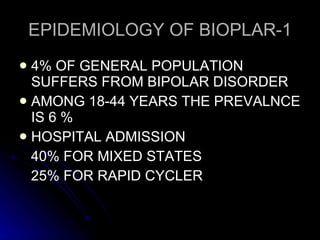
EPIDEMIOLOGY OF BIOPLAR-1 4% OF GENERAL POPULATION SUFFERS FROM BIPOLAR DISORDER AMONG 18-44 YEARS THE PREVALNCE IS 6 % HOSPITAL ADMISSION 40% FOR MIXED STATES 25% FOR RAPID CYCLER
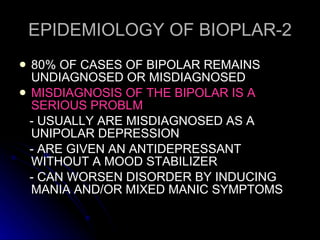
EPIDEMIOLOGY OF BIOPLAR-2 80% OF CASES OF BIPOLAR REMAINS UNDIAGNOSED OR MISDIAGNOSED MISDIAGNOSIS OF THE BIPOLAR IS A SERIOUS PROBLM - USUALLY ARE MISDIAGNOSED AS A UNIPOLAR DEPRESSION - ARE GIVEN AN ANTIDEPRESSANT WITHOUT A MOOD STABILIZER - CAN WORSEN DISORDER BY INDUCING MANIA AND/OR MIXED MANIC SYMPTOMS
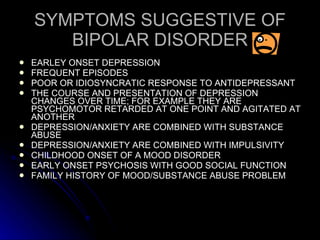
SYMPTOMS SUGGESTIVE OF BIPOLAR DISORDER EARLEY ONSET DEPRESSION FREQUENT EPISODES POOR OR IDIOSYNCRATIC RESPONSE TO ANTIDEPRESSANT THE COURSE AND PRESENTATION OF DEPRESSION CHANGES OVER TIME; FOR EXAMPLE THEY ARE PSYCHOMOTOR RETARDED AT ONE POINT AND AGITATED AT ANOTHER DEPRESSION/ANXIETY ARE COMBINED WITH SUBSTANCE ABUSE DEPRESSION/ANXIETY ARE COMBINED WITH IMPULSIVITY CHILDHOOD ONSET OF A MOOD DISORDER EARLY ONSET PSYCHOSIS WITH GOOD SOCIAL FUNCTION FAMILY HISTORY OF MOOD/SUBSTANCE ABUSE PROBLEM
MIXED BIPOLAR EPISODE-INCIDENCE Several studies were done to determine the incidence rate of mixed bipolar episodes The incidence rate ranges between 40% and 57% of bipolar patients
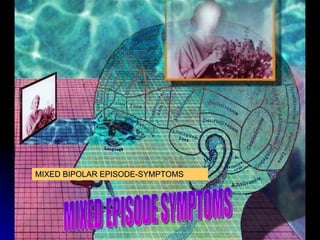
MIXED BIPOLAR EPISODE-SYMPTOMS MIXED EPISODE SYMPTOMS
MIXED BIPOLAR EPISODE-SYMPTOMS DSM-IV Criteria for Mixed Bipolar Episode Meets criteria A of Major Depressive Episode and B of Manic Episode for at least one week Mixed episodes are those where patients experience both depressive and manic/hypomanic episode There may be variability of mixed state symptoms in the same individual There can be possible predominance of either depressive or manic symptoms over time in the same individual
MIXED BIPOLAR EPISODE-SYMPTOMS The symptoms like irritability, anxiety, dysphoric mood, and agitation can be common symptom in the bipolar patient These symptoms should raise the index of suspicion that the patient is in a mixed state Life charts are valuable in recognizing and managing the most challenging bipolar patient
MIXED EPISODE COURSE
COURSE OF MIXED BIPOLAR Patients with mixed episode has a more severe course than those with classic euphoric mania Less frequent remissions Higher rates of recurrence More frequent substance abuse Poorer response to some medications More extensive co morbidities Increased potential for suicidal tendencies
STRATEGIES FOR THE TREATMENT OF BIPOLAR DISORDER Most bipolar need medications for their whole life Tolerability and treatment adherence are essential because of that STRATEGIES FOR THE TREATMENT OF BIPOLAR DISORDER
STRATEGIES FOR THE TREATMENT OF BIPOLAR DISORDER First start treatment with agents of proven efficacy Adequate dose of the drugs must be used Sometimes combination treatment can lower the dose of the single agent Familiarize with new agents and consider them based on evidence and feasibility Collaborate with psychosocial or medical standpoint
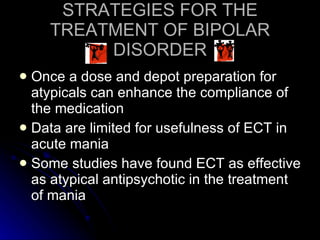
STRATEGIES FOR THE TREATMENT OF BIPOLAR DISORDER Once a dose and depot preparation for atypicals can enhance the compliance of the medication Data are limited for usefulness of ECT in acute mania Some studies have found ECT as effective as atypical antipsychotic in the treatment of mania
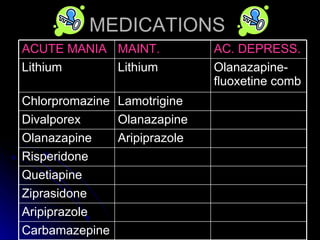
MEDICATIONS  Carbamazepine Aripiprazole Ziprasidone Quetiapine Risperidone Aripiprazole Olanazapine Olanazapine Divalporex Lamotrigine Chlorpromazine Olanazapine-fluoxetine comb Lithium Lithium AC. DEPRESS. MAINT. ACUTE MANIA
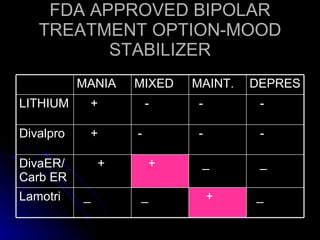
FDA APPROVED BIPOLAR TREATMENT OPTION-MOOD STABILIZER _ + _  _ Lamotri _ _ + + DivaER/Carb ER - - - + Divalpro - -  - + LITHIUM DEPRES MAINT. MIXED  MANIA
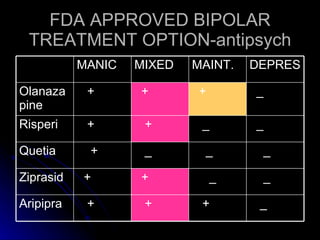
FDA APPROVED BIPOLAR TREATMENT OPTION-antipsych _ + + + Aripipra _ _ + + Ziprasid _ _ _ + Quetia _ _ + + Risperi _ +  + + Olanazapine DEPRES MAINT. MIXED MANIC
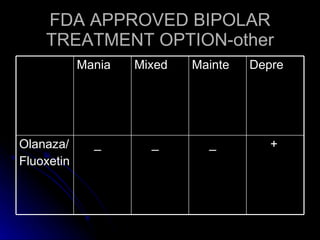
FDA APPROVED BIPOLAR TREATMENT OPTION-other + _ _ _ Olanaza/ Fluoxetin Depre Mainte Mixed Mania
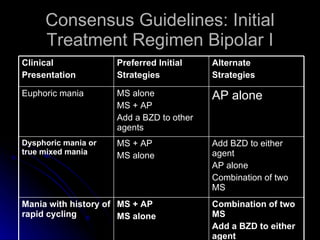
Consensus Guidelines: Initial Treatment Regimen Bipolar I Add BZD to either agent MS alone MS + AP AP alone Mania with psychosis Combination of two MS Add a BZD to either agent AP alone MS + AP MS alone Mania with history of rapid cycling Add BZD to either agent AP alone Combination of two MS MS + AP MS alone Dysphoric mania or true mixed mania AP alone MS alone MS + AP Add a BZD to other agents Euphoric mania Alternate Strategies Preferred Initial Strategies Clinical  Presentation
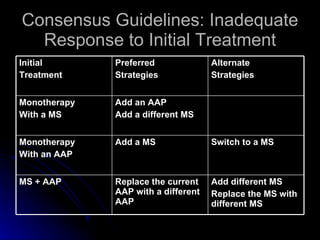
Consensus Guidelines: Inadequate Response to Initial Treatment Add different MS Replace the MS with different MS Replace the current AAP with a different AAP MS + AAP Switch to a MS Add a MS Monotherapy  With an AAP Add an AAP Add a different MS Monotherapy With a MS Alternate  Strategies Preferred  Strategies Initial Treatment
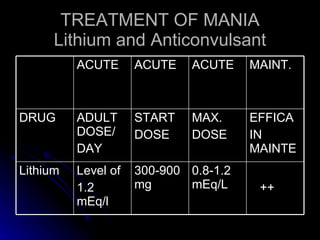
TREATMENT OF MANIA Lithium and Anticonvulsant ++ 0.8-1.2 mEq/L 300-900 mg Level of 1.2 mEq/l Lithium EFFICA IN MAINTE MAX. DOSE START DOSE ADULT DOSE/ DAY DRUG MAINT. ACUTE ACUTE ACUTE
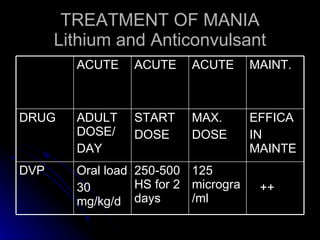
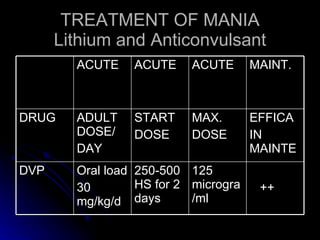
TREATMENT OF MANIA Lithium and Anticonvulsant ++ 125 microgra/ml 250-500 HS for 2 days Oral load 30 mg/kg/d DVP EFFICA IN MAINTE MAX. DOSE START DOSE ADULT DOSE/ DAY DRUG MAINT. ACUTE ACUTE ACUTE
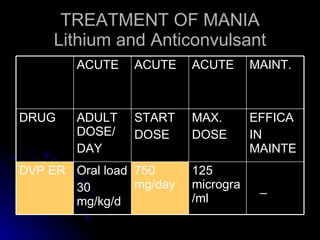
TREATMENT OF MANIA Lithium and Anticonvulsant _ 125 microgra/ml 750 mg/day Oral load 30 mg/kg/d DVP ER EFFICA IN MAINTE MAX. DOSE START DOSE ADULT DOSE/ DAY DRUG MAINT. ACUTE ACUTE ACUTE
TREATMENT OF MANIA Lithium and Anticonvulsant ++ 125 microgra/ml 250-500 HS for 2 days Oral load 30 mg/kg/d DVP EFFICA IN MAINTE MAX. DOSE START DOSE ADULT DOSE/ DAY DRUG MAINT. ACUTE ACUTE ACUTE
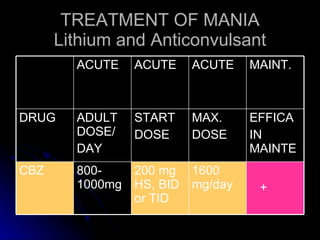
TREATMENT OF MANIA Lithium and Anticonvulsant + 1600 mg/day 200 mg HS, BID or TID 800-1000mg CBZ EFFICA IN MAINTE MAX. DOSE START DOSE ADULT DOSE/ DAY DRUG MAINT. ACUTE ACUTE ACUTE
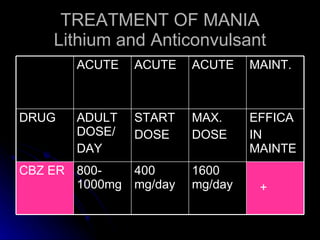
TREATMENT OF MANIA Lithium and Anticonvulsant + 1600 mg/day 400 mg/day 800-1000mg CBZ ER EFFICA IN MAINTE MAX. DOSE START DOSE ADULT DOSE/ DAY DRUG MAINT. ACUTE ACUTE ACUTE
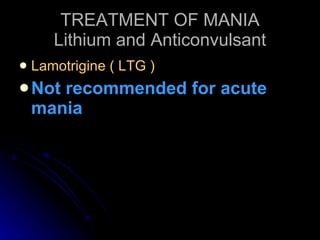
TREATMENT OF MANIA Lithium and Anticonvulsant Lamotrigine ( LTG ) Not recommended for acute mania
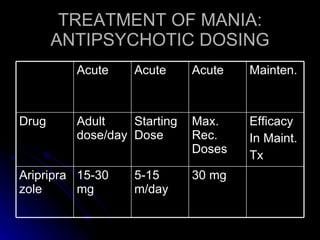
TREATMENT OF MANIA: ANTIPSYCHOTIC DOSING 30 mg 5-15 m/day 15-30 mg Aripriprazole Efficacy  In Maint. Tx Max. Rec. Doses Starting Dose Adult dose/day Drug Mainten. Acute Acute Acute
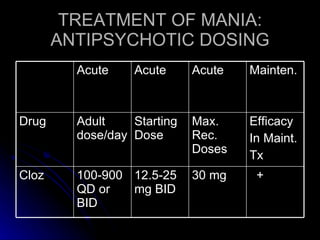
TREATMENT OF MANIA: ANTIPSYCHOTIC DOSING + 30 mg 12.5-25 mg BID 100-900 QD or BID Cloz Efficacy  In Maint. Tx Max. Rec. Doses Starting Dose Adult dose/day Drug Mainten. Acute Acute Acute
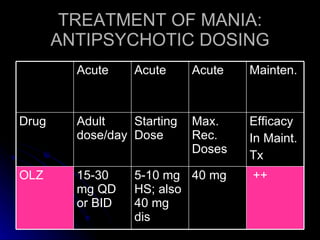
TREATMENT OF MANIA: ANTIPSYCHOTIC DOSING ++ 40 mg 5-10 mg HS; also 40 mg dis 15-30 mg QD or BID OLZ Efficacy  In Maint. Tx Max. Rec. Doses Starting Dose Adult dose/day Drug Mainten. Acute Acute Acute
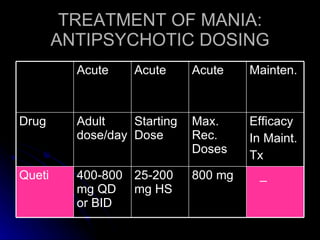
TREATMENT OF MANIA: ANTIPSYCHOTIC DOSING _ 800 mg 25-200 mg HS 400-800 mg QD or BID Queti Efficacy  In Maint. Tx Max. Rec. Doses Starting Dose Adult dose/day Drug Mainten. Acute Acute Acute
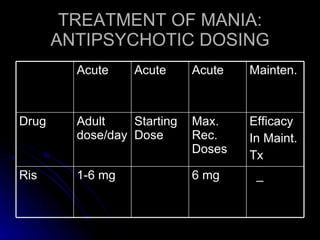
TREATMENT OF MANIA: ANTIPSYCHOTIC DOSING _ 6 mg 1-6 mg Ris Efficacy  In Maint. Tx Max. Rec. Doses Starting Dose Adult dose/day Drug Mainten. Acute Acute Acute
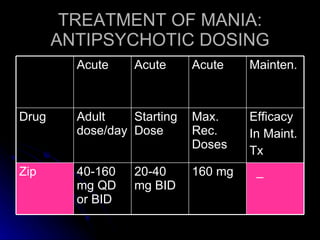
TREATMENT OF MANIA: ANTIPSYCHOTIC DOSING _ 160 mg 20-40 mg BID 40-160 mg QD or BID Zip Efficacy  In Maint. Tx Max. Rec. Doses Starting Dose Adult dose/day Drug Mainten. Acute Acute Acute
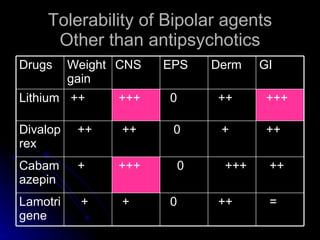
Tolerability of Bipolar agents Other than antipsychotics = ++ 0 + + Lamotrigene ++ +++ 0 +++ + Cabamazepin ++ + 0 ++ ++ Divaloprex +++ ++ 0 +++ ++ Lithium GI Derm EPS CNS Weight gain Drugs
Consensus Guidelines: Inadequate Response to Initial Treatment Optimize dose of initial therapy (foundation therapy) before making change GUIDELINES FOR TREATMENT FOR BIPOLAR
GUIDELINES FOR MEDICATIONS IN BIPOLAR-1 Patient should be taking a therapeutic dose of a mood stabilizer and that mood stabilizer should be maximized before prescribing an antidepressant
GUIDELINES FOR MEDICATIONS IN BIPOLAR-2 Combinations of mood stabilizers be should be considered as well.  If the first mood stabilizer does not work, consider adding a second one Addition of lithium should be considered in patients failing to respond adequately to these initial response
GUIDELINES FOR MEDICATIONS IN BIPOLAR-3 For classical euphoric and dysphoric and mixed mania and rapid cycling: Use a mood stabilizer alone or a mood stabilizer with an atypical are considered an appropriate first or second line of treatment
GUIDELINES FOR MEDICATIONS IN BIPOLAR-4 Treat psychosis properly A good core mood stabilizer, even in face of psychosis, should treat the whole affective syndrome A good core mood stabilizer
If the patient failed to respond to initial treatment with a monotherapy with a mood stabilizer, add an atypical or add a different mood stabilizer
Until the patient is clearly on a standard mood stabilizer, antidepressant should not be considered
If using anticonvulsants, it is important to ensure that the patient is at a therapeutic dose determined by blood level before declaring the failure
Measure lithium level to assess adequate dosing Li In Bipolar
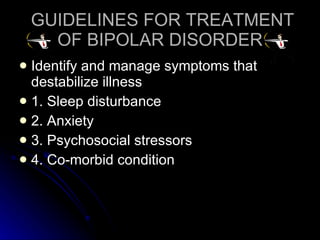
GUIDELINES FOR TREATMENT OF BIPOLAR DISORDER Identify and manage symptoms that destabilize illness 1. Sleep disturbance 2. Anxiety 3. Psychosocial stressors 4. Co-morbid condition
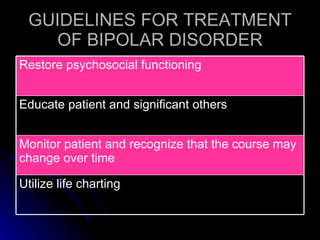
GUIDELINES FOR TREATMENT OF BIPOLAR DISORDER Utilize life charting Monitor patient and recognize that the course may change over time Educate patient and significant others Restore psychosocial functioning
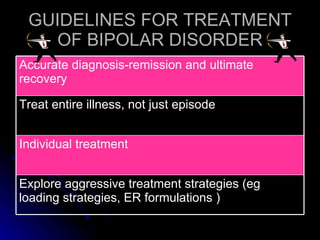
GUIDELINES FOR TREATMENT OF BIPOLAR DISORDER Explore aggressive treatment strategies (eg loading strategies, ER formulations ) Individual treatment Treat entire illness, not just episode Accurate diagnosis-remission and ultimate recovery
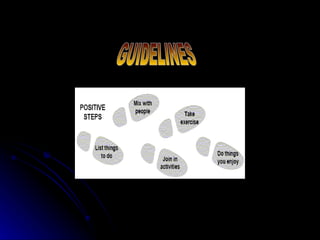
GUIDELINES
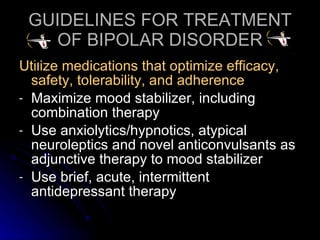
GUIDELINES FOR TREATMENT OF BIPOLAR DISORDER Utilize medications that optimize efficacy, safety, tolerability, and adherence Maximize mood stabilizer, including combination therapy Use anxiolytics/hypnotics, atypical neuroleptics and novel anticonvulsants as adjunctive therapy to mood stabilizer Use brief, acute, intermittent antidepressant therapy
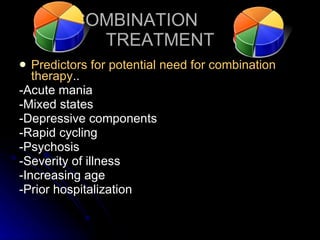
COMBINATION  TREATMENT Predictors for potential need for combination therapy .. -Acute mania -Mixed states -Depressive components -Rapid cycling -Psychosis -Severity of illness -Increasing age -Prior hospitalization
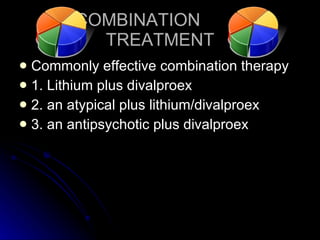
COMBINATION  TREATMENT Commonly effective combination therapy 1. Lithium plus divalproex 2. an atypical plus lithium/divalproex 3. an antipsychotic plus divalproex
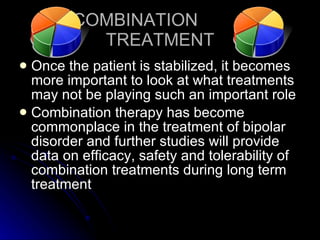
COMBINATION  TREATMENT Once the patient is stabilized, it becomes more important to look at what treatments may not be playing such an important role Combination therapy has become commonplace in the treatment of bipolar disorder and further studies will provide data on efficacy, safety and tolerability of combination treatments during long term treatment
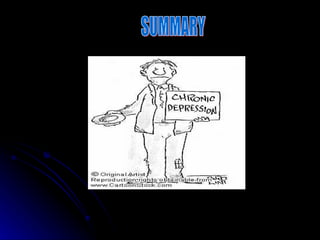
SUMMARY
SUMMARY Diagnosis and treatment of bipolar disorder, particularly mixed state can be very difficult and has serious implications When choosing a treatment regimen, medications that optimizes efficacy, safety, tolerability, and adherence should be prioritized

Bipolar Disorder

  • 1.
    JOURNAL CLUB CALMINGTHE BIPOLAR STORM TREATING ACUTE MANIA AND MIXED EPISODE
  • 2.
    EPIDEMIOLOGY OF BIOPLAR-14% OF GENERAL POPULATION SUFFERS FROM BIPOLAR DISORDER AMONG 18-44 YEARS THE PREVALNCE IS 6 % HOSPITAL ADMISSION 40% FOR MIXED STATES 25% FOR RAPID CYCLER
  • 3.
    EPIDEMIOLOGY OF BIOPLAR-280% OF CASES OF BIPOLAR REMAINS UNDIAGNOSED OR MISDIAGNOSED MISDIAGNOSIS OF THE BIPOLAR IS A SERIOUS PROBLM - USUALLY ARE MISDIAGNOSED AS A UNIPOLAR DEPRESSION - ARE GIVEN AN ANTIDEPRESSANT WITHOUT A MOOD STABILIZER - CAN WORSEN DISORDER BY INDUCING MANIA AND/OR MIXED MANIC SYMPTOMS
  • 4.
    SYMPTOMS SUGGESTIVE OFBIPOLAR DISORDER EARLEY ONSET DEPRESSION FREQUENT EPISODES POOR OR IDIOSYNCRATIC RESPONSE TO ANTIDEPRESSANT THE COURSE AND PRESENTATION OF DEPRESSION CHANGES OVER TIME; FOR EXAMPLE THEY ARE PSYCHOMOTOR RETARDED AT ONE POINT AND AGITATED AT ANOTHER DEPRESSION/ANXIETY ARE COMBINED WITH SUBSTANCE ABUSE DEPRESSION/ANXIETY ARE COMBINED WITH IMPULSIVITY CHILDHOOD ONSET OF A MOOD DISORDER EARLY ONSET PSYCHOSIS WITH GOOD SOCIAL FUNCTION FAMILY HISTORY OF MOOD/SUBSTANCE ABUSE PROBLEM
  • 5.
    MIXED BIPOLAR EPISODE-INCIDENCESeveral studies were done to determine the incidence rate of mixed bipolar episodes The incidence rate ranges between 40% and 57% of bipolar patients
  • 6.
    MIXED BIPOLAR EPISODE-SYMPTOMSMIXED EPISODE SYMPTOMS
  • 7.
    MIXED BIPOLAR EPISODE-SYMPTOMSDSM-IV Criteria for Mixed Bipolar Episode Meets criteria A of Major Depressive Episode and B of Manic Episode for at least one week Mixed episodes are those where patients experience both depressive and manic/hypomanic episode There may be variability of mixed state symptoms in the same individual There can be possible predominance of either depressive or manic symptoms over time in the same individual
  • 8.
    MIXED BIPOLAR EPISODE-SYMPTOMSThe symptoms like irritability, anxiety, dysphoric mood, and agitation can be common symptom in the bipolar patient These symptoms should raise the index of suspicion that the patient is in a mixed state Life charts are valuable in recognizing and managing the most challenging bipolar patient
  • 9.
  • 10.
    COURSE OF MIXEDBIPOLAR Patients with mixed episode has a more severe course than those with classic euphoric mania Less frequent remissions Higher rates of recurrence More frequent substance abuse Poorer response to some medications More extensive co morbidities Increased potential for suicidal tendencies
  • 11.
    STRATEGIES FOR THETREATMENT OF BIPOLAR DISORDER Most bipolar need medications for their whole life Tolerability and treatment adherence are essential because of that STRATEGIES FOR THE TREATMENT OF BIPOLAR DISORDER
  • 12.
    STRATEGIES FOR THETREATMENT OF BIPOLAR DISORDER First start treatment with agents of proven efficacy Adequate dose of the drugs must be used Sometimes combination treatment can lower the dose of the single agent Familiarize with new agents and consider them based on evidence and feasibility Collaborate with psychosocial or medical standpoint
  • 13.
    STRATEGIES FOR THETREATMENT OF BIPOLAR DISORDER Once a dose and depot preparation for atypicals can enhance the compliance of the medication Data are limited for usefulness of ECT in acute mania Some studies have found ECT as effective as atypical antipsychotic in the treatment of mania
  • 14.
    MEDICATIONS CarbamazepineAripiprazole Ziprasidone Quetiapine Risperidone Aripiprazole Olanazapine Olanazapine Divalporex Lamotrigine Chlorpromazine Olanazapine-fluoxetine comb Lithium Lithium AC. DEPRESS. MAINT. ACUTE MANIA
  • 15.
    FDA APPROVED BIPOLARTREATMENT OPTION-MOOD STABILIZER _ + _ _ Lamotri _ _ + + DivaER/Carb ER - - - + Divalpro - - - + LITHIUM DEPRES MAINT. MIXED MANIA
  • 16.
    FDA APPROVED BIPOLARTREATMENT OPTION-antipsych _ + + + Aripipra _ _ + + Ziprasid _ _ _ + Quetia _ _ + + Risperi _ + + + Olanazapine DEPRES MAINT. MIXED MANIC
  • 17.
    FDA APPROVED BIPOLARTREATMENT OPTION-other + _ _ _ Olanaza/ Fluoxetin Depre Mainte Mixed Mania
  • 18.
    Consensus Guidelines: InitialTreatment Regimen Bipolar I Add BZD to either agent MS alone MS + AP AP alone Mania with psychosis Combination of two MS Add a BZD to either agent AP alone MS + AP MS alone Mania with history of rapid cycling Add BZD to either agent AP alone Combination of two MS MS + AP MS alone Dysphoric mania or true mixed mania AP alone MS alone MS + AP Add a BZD to other agents Euphoric mania Alternate Strategies Preferred Initial Strategies Clinical Presentation
  • 19.
    Consensus Guidelines: InadequateResponse to Initial Treatment Add different MS Replace the MS with different MS Replace the current AAP with a different AAP MS + AAP Switch to a MS Add a MS Monotherapy With an AAP Add an AAP Add a different MS Monotherapy With a MS Alternate Strategies Preferred Strategies Initial Treatment
  • 20.
    TREATMENT OF MANIALithium and Anticonvulsant ++ 0.8-1.2 mEq/L 300-900 mg Level of 1.2 mEq/l Lithium EFFICA IN MAINTE MAX. DOSE START DOSE ADULT DOSE/ DAY DRUG MAINT. ACUTE ACUTE ACUTE
  • 21.
    TREATMENT OF MANIALithium and Anticonvulsant ++ 125 microgra/ml 250-500 HS for 2 days Oral load 30 mg/kg/d DVP EFFICA IN MAINTE MAX. DOSE START DOSE ADULT DOSE/ DAY DRUG MAINT. ACUTE ACUTE ACUTE
  • 22.
    TREATMENT OF MANIALithium and Anticonvulsant _ 125 microgra/ml 750 mg/day Oral load 30 mg/kg/d DVP ER EFFICA IN MAINTE MAX. DOSE START DOSE ADULT DOSE/ DAY DRUG MAINT. ACUTE ACUTE ACUTE
  • 23.
    TREATMENT OF MANIALithium and Anticonvulsant ++ 125 microgra/ml 250-500 HS for 2 days Oral load 30 mg/kg/d DVP EFFICA IN MAINTE MAX. DOSE START DOSE ADULT DOSE/ DAY DRUG MAINT. ACUTE ACUTE ACUTE
  • 24.
    TREATMENT OF MANIALithium and Anticonvulsant + 1600 mg/day 200 mg HS, BID or TID 800-1000mg CBZ EFFICA IN MAINTE MAX. DOSE START DOSE ADULT DOSE/ DAY DRUG MAINT. ACUTE ACUTE ACUTE
  • 25.
    TREATMENT OF MANIALithium and Anticonvulsant + 1600 mg/day 400 mg/day 800-1000mg CBZ ER EFFICA IN MAINTE MAX. DOSE START DOSE ADULT DOSE/ DAY DRUG MAINT. ACUTE ACUTE ACUTE
  • 26.
    TREATMENT OF MANIALithium and Anticonvulsant Lamotrigine ( LTG ) Not recommended for acute mania
  • 27.
    TREATMENT OF MANIA:ANTIPSYCHOTIC DOSING 30 mg 5-15 m/day 15-30 mg Aripriprazole Efficacy In Maint. Tx Max. Rec. Doses Starting Dose Adult dose/day Drug Mainten. Acute Acute Acute
  • 28.
    TREATMENT OF MANIA:ANTIPSYCHOTIC DOSING + 30 mg 12.5-25 mg BID 100-900 QD or BID Cloz Efficacy In Maint. Tx Max. Rec. Doses Starting Dose Adult dose/day Drug Mainten. Acute Acute Acute
  • 29.
    TREATMENT OF MANIA:ANTIPSYCHOTIC DOSING ++ 40 mg 5-10 mg HS; also 40 mg dis 15-30 mg QD or BID OLZ Efficacy In Maint. Tx Max. Rec. Doses Starting Dose Adult dose/day Drug Mainten. Acute Acute Acute
  • 30.
    TREATMENT OF MANIA:ANTIPSYCHOTIC DOSING _ 800 mg 25-200 mg HS 400-800 mg QD or BID Queti Efficacy In Maint. Tx Max. Rec. Doses Starting Dose Adult dose/day Drug Mainten. Acute Acute Acute
  • 31.
    TREATMENT OF MANIA:ANTIPSYCHOTIC DOSING _ 6 mg 1-6 mg Ris Efficacy In Maint. Tx Max. Rec. Doses Starting Dose Adult dose/day Drug Mainten. Acute Acute Acute
  • 32.
    TREATMENT OF MANIA:ANTIPSYCHOTIC DOSING _ 160 mg 20-40 mg BID 40-160 mg QD or BID Zip Efficacy In Maint. Tx Max. Rec. Doses Starting Dose Adult dose/day Drug Mainten. Acute Acute Acute
  • 33.
    Tolerability of Bipolaragents Other than antipsychotics = ++ 0 + + Lamotrigene ++ +++ 0 +++ + Cabamazepin ++ + 0 ++ ++ Divaloprex +++ ++ 0 +++ ++ Lithium GI Derm EPS CNS Weight gain Drugs
  • 34.
    Consensus Guidelines: InadequateResponse to Initial Treatment Optimize dose of initial therapy (foundation therapy) before making change GUIDELINES FOR TREATMENT FOR BIPOLAR
  • 35.
    GUIDELINES FOR MEDICATIONSIN BIPOLAR-1 Patient should be taking a therapeutic dose of a mood stabilizer and that mood stabilizer should be maximized before prescribing an antidepressant
  • 36.
    GUIDELINES FOR MEDICATIONSIN BIPOLAR-2 Combinations of mood stabilizers be should be considered as well. If the first mood stabilizer does not work, consider adding a second one Addition of lithium should be considered in patients failing to respond adequately to these initial response
  • 37.
    GUIDELINES FOR MEDICATIONSIN BIPOLAR-3 For classical euphoric and dysphoric and mixed mania and rapid cycling: Use a mood stabilizer alone or a mood stabilizer with an atypical are considered an appropriate first or second line of treatment
  • 38.
    GUIDELINES FOR MEDICATIONSIN BIPOLAR-4 Treat psychosis properly A good core mood stabilizer, even in face of psychosis, should treat the whole affective syndrome A good core mood stabilizer
  • 39.
    If the patientfailed to respond to initial treatment with a monotherapy with a mood stabilizer, add an atypical or add a different mood stabilizer
  • 40.
    Until the patientis clearly on a standard mood stabilizer, antidepressant should not be considered
  • 41.
    If using anticonvulsants,it is important to ensure that the patient is at a therapeutic dose determined by blood level before declaring the failure
  • 42.
    Measure lithium levelto assess adequate dosing Li In Bipolar
  • 43.
    GUIDELINES FOR TREATMENTOF BIPOLAR DISORDER Identify and manage symptoms that destabilize illness 1. Sleep disturbance 2. Anxiety 3. Psychosocial stressors 4. Co-morbid condition
  • 44.
    GUIDELINES FOR TREATMENTOF BIPOLAR DISORDER Utilize life charting Monitor patient and recognize that the course may change over time Educate patient and significant others Restore psychosocial functioning
  • 45.
    GUIDELINES FOR TREATMENTOF BIPOLAR DISORDER Explore aggressive treatment strategies (eg loading strategies, ER formulations ) Individual treatment Treat entire illness, not just episode Accurate diagnosis-remission and ultimate recovery
  • 46.
  • 47.
    GUIDELINES FOR TREATMENTOF BIPOLAR DISORDER Utilize medications that optimize efficacy, safety, tolerability, and adherence Maximize mood stabilizer, including combination therapy Use anxiolytics/hypnotics, atypical neuroleptics and novel anticonvulsants as adjunctive therapy to mood stabilizer Use brief, acute, intermittent antidepressant therapy
  • 48.
    COMBINATION TREATMENTPredictors for potential need for combination therapy .. -Acute mania -Mixed states -Depressive components -Rapid cycling -Psychosis -Severity of illness -Increasing age -Prior hospitalization
  • 49.
    COMBINATION TREATMENTCommonly effective combination therapy 1. Lithium plus divalproex 2. an atypical plus lithium/divalproex 3. an antipsychotic plus divalproex
  • 50.
    COMBINATION TREATMENTOnce the patient is stabilized, it becomes more important to look at what treatments may not be playing such an important role Combination therapy has become commonplace in the treatment of bipolar disorder and further studies will provide data on efficacy, safety and tolerability of combination treatments during long term treatment
  • 51.
  • 52.
    SUMMARY Diagnosis andtreatment of bipolar disorder, particularly mixed state can be very difficult and has serious implications When choosing a treatment regimen, medications that optimizes efficacy, safety, tolerability, and adherence should be prioritized