MARRIAGE AND SOCIAL
POSITION OF WOMEN
Raquel Álvarez Iglesias 1º C
MARRIAGE
¿AT WHAT AGE THEY MARRIED?
Usually, age doesnt appear in contracts.
· References to marriages between boys or girls of incipient puberty, which are told in
popular stories, haven’t got basis.
We see that the age of puberty was between 12 and 13 for girls and 14 for boys.
· A Ptolemaic document establishes the minimum age of the husband at 15.
·Even later we can see that Ankhshoshenq's instruction advised children: "Marry at
20, so you can have a child when you are young."
·There are also cases in which older men took very young wives: for example, the
scribe Qenherkhepeshef, from Deir el-Medina, married Nanakht, a 12-year-old girl,
when she was 54 years old.
MARRIAGE
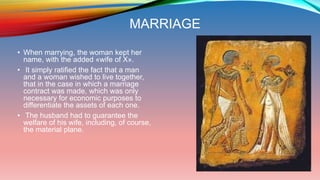
• When marrying, the woman kept her
name, with the added «wife of X».
• It simply ratified the fact that a man
and a woman wished to live together,
that in the case in which a marriage
contract was made, which was only
necessary for economic purposes to
differentiate the assets of each one.
• The husband had to guarantee the
welfare of his wife, including, of course,
the material plane.
EQUALITY BEFORE THE LAW
• For the ancient Egyptians, children
were the most important.
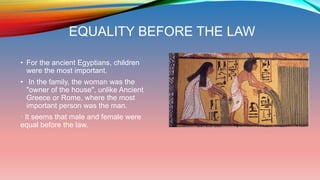
• In the family, the woman was the
"owner of the house", unlike Ancient
Greece or Rome, where the most
important person was the man.
· It seems that male and female were
equal before the law.
WOMEN´S JOBS
• Musicians and dancers: many of them were
slaves.
• Weavers
• Peasants: In the harvest, as seen in the art
of the chapels, she brought food or soda to
the men who worked, but didnt seed.
• Entrepreneurs: The Egyptian woman could
run her own business or collaborate and
help her husband.
• Doctors
• Maids
• Plañideras: They were women who were
paid to accompany to the funeral
procession, to which they preceded
dancing, crying and wailing, in memory of
the deceased.
• Official: Women held scribe positions in
different categories of state administration.
Among the women who were high-ranking
civil servants, for example, we can see
Nebet.
• Priestesses.
• Midwives
•
12

12

  • 1.
    MARRIAGE AND SOCIAL POSITIONOF WOMEN Raquel Álvarez Iglesias 1º C
  • 2.
    MARRIAGE ¿AT WHAT AGETHEY MARRIED? Usually, age doesnt appear in contracts. · References to marriages between boys or girls of incipient puberty, which are told in popular stories, haven’t got basis. We see that the age of puberty was between 12 and 13 for girls and 14 for boys. · A Ptolemaic document establishes the minimum age of the husband at 15. ·Even later we can see that Ankhshoshenq's instruction advised children: "Marry at 20, so you can have a child when you are young." ·There are also cases in which older men took very young wives: for example, the scribe Qenherkhepeshef, from Deir el-Medina, married Nanakht, a 12-year-old girl, when she was 54 years old.
  • 3.
    MARRIAGE • When marrying,the woman kept her name, with the added «wife of X». • It simply ratified the fact that a man and a woman wished to live together, that in the case in which a marriage contract was made, which was only necessary for economic purposes to differentiate the assets of each one. • The husband had to guarantee the welfare of his wife, including, of course, the material plane.
  • 4.
    EQUALITY BEFORE THELAW • For the ancient Egyptians, children were the most important. • In the family, the woman was the "owner of the house", unlike Ancient Greece or Rome, where the most important person was the man. · It seems that male and female were equal before the law.
  • 5.
    WOMEN´S JOBS • Musiciansand dancers: many of them were slaves. • Weavers • Peasants: In the harvest, as seen in the art of the chapels, she brought food or soda to the men who worked, but didnt seed. • Entrepreneurs: The Egyptian woman could run her own business or collaborate and help her husband. • Doctors • Maids • Plañideras: They were women who were paid to accompany to the funeral procession, to which they preceded dancing, crying and wailing, in memory of the deceased. • Official: Women held scribe positions in different categories of state administration. Among the women who were high-ranking civil servants, for example, we can see Nebet. • Priestesses. • Midwives •