Adapting to future impacts of climate
change and screening adaptation projects
and programmes - key concepts and
principles (part 1)
Workshop ‘Smart Decision-Making for Climate Change Adaptation Supported by Multi-Criteria Analysis’
Presented by Martin Rokitzki
(PlanAdapt, International consultant)
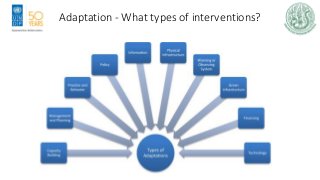
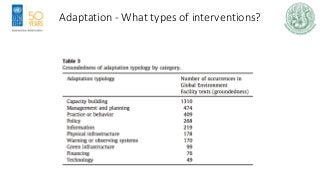
Adaptation - What types of interventions?
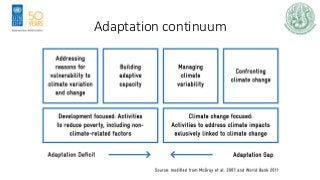
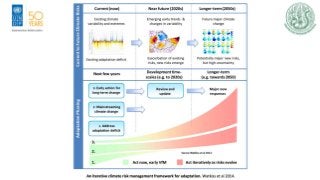
Adaptation continuum
Dealing with Uncertainty – Managing Risks
• Diversification
• Adaptive management
• Learning – iterative processes - flexibility
• No or low-regret
• (Indication of) Trends can be sufficient to make decisions - other
sectors that constantly make decisions under uncertainty, e.g.
finance/ insurance sector
• Better access to insurance and compensation mechanisms
Risk perception
• Risk perception – psychological (behavioral economics), risk-specific,
time-specific, resource-specific
• Risk screening of projects – Are the project outcomes threatened by
climate risk?
• 3 types of outcomes:
• Project implementation can go ahead as planned;
• Project design needs to be modified;
• Project should not go ahead.
Low regret – robust adadptation
• Robust adaptation measures are defined as measures which satisfy a
number of “robustness principles” such as
• (i) low regret,
• (ii) reversible and flexible (to keep the cost of being wrong about future
climate change as low as possible),
• (iii) incorporate safety or security margins to design criteria, and
• (iv) employ “soft” (e.g., institutional and planning solutions.
Risk of maladaptation
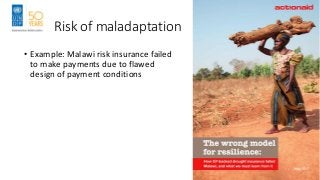
• Example: Malawi risk insurance failed
to make payments due to flawed
design of payment conditions
Trade-offs / conflicting criteria
• Example: The most profitable is often not the most environmentally-
friendly or socially inclusive or healthiest, e.g. use fertilizer or
pesticide in agriculture - ‘fallacy of win-win-win’
• Good decision-making considers them and makes them explicit
• Trade-off game: http://esgame.unige.ch/

National Adaptation Plans Thailand - Adapting to future impacts of climate change

  • 1.
    Adapting to futureimpacts of climate change and screening adaptation projects and programmes - key concepts and principles (part 1) Workshop ‘Smart Decision-Making for Climate Change Adaptation Supported by Multi-Criteria Analysis’ Presented by Martin Rokitzki (PlanAdapt, International consultant)
  • 2.
    Adaptation - Whattypes of interventions?
  • 3.
    Adaptation - Whattypes of interventions?
  • 4.
  • 5.
    Dealing with Uncertainty– Managing Risks • Diversification • Adaptive management • Learning – iterative processes - flexibility • No or low-regret • (Indication of) Trends can be sufficient to make decisions - other sectors that constantly make decisions under uncertainty, e.g. finance/ insurance sector • Better access to insurance and compensation mechanisms
  • 7.
    Risk perception • Riskperception – psychological (behavioral economics), risk-specific, time-specific, resource-specific • Risk screening of projects – Are the project outcomes threatened by climate risk? • 3 types of outcomes: • Project implementation can go ahead as planned; • Project design needs to be modified; • Project should not go ahead.
  • 8.
    Low regret –robust adadptation • Robust adaptation measures are defined as measures which satisfy a number of “robustness principles” such as • (i) low regret, • (ii) reversible and flexible (to keep the cost of being wrong about future climate change as low as possible), • (iii) incorporate safety or security margins to design criteria, and • (iv) employ “soft” (e.g., institutional and planning solutions.
  • 9.
    Risk of maladaptation •Example: Malawi risk insurance failed to make payments due to flawed design of payment conditions
  • 10.
    Trade-offs / conflictingcriteria • Example: The most profitable is often not the most environmentally- friendly or socially inclusive or healthiest, e.g. use fertilizer or pesticide in agriculture - ‘fallacy of win-win-win’ • Good decision-making considers them and makes them explicit • Trade-off game: http://esgame.unige.ch/