Presented by Phuong Hong Nguyen
International Food Policy Research Institute
Multi-state stories:
Insights from the frontrunners of
stunting reduction
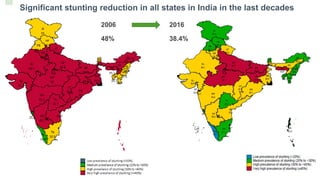
2016
38.4%
2006
Significant stunting reduction in all states in India in the last decades
2006
48%
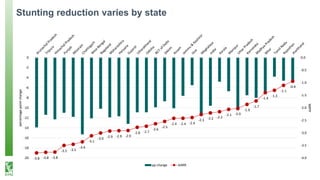
Stunting reduction varies by state
-3.8 -3.8 -3.8
-3.5 -3.5
-3.4
-3.1
-3.0
-2.9 -2.9 -2.9
-2.8 -2.7
-2.6
-2.5
-2.4 -2.4 -2.4
-2.3 -2.2 -2.2
-2.1 -2.0
-1.9
-1.7
-1.4
-1.3
-1.1
-0.9
-4.0
-3.5
-3.0
-2.5
-2.0
-1.5
-1.0
-0.5
0.0
-20
-18
-16
-14
-12
-10
-8
-6
-4
-2
0
AARR
percentagepointchange
pp change AARR
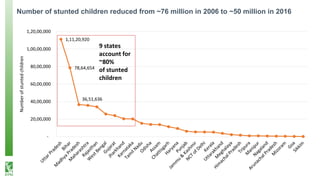
1,11,20,920
78,64,654
36,51,636
-
20,00,000
40,00,000
60,00,000
80,00,000
1,00,00,000
1,20,00,000
Numberofstuntedchildren
9 states
account for
~80%
of stunted
children
Number of stunted children reduced from ~76 million in 2006 to ~50 million in 2016
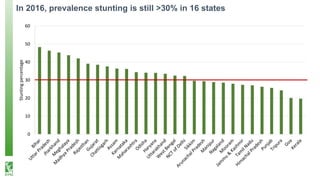
In 2016, prevalence stunting is still >30% in 16 states
0
10
20
30
40
50
60
Stuntingpercentage
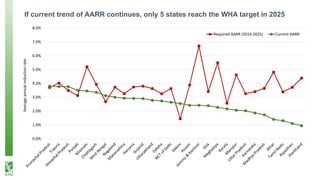
If current trend of AARR continues, only 5 states reach the WHA target in 2025
0.0%
1.0%
2.0%
3.0%
4.0%
5.0%
6.0%
7.0%
8.0%
Averageannualreductionrate
Required AARR (2016-2025) Current AARR
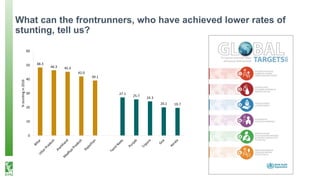
What can the frontrunners, who have achieved lower rates of
stunting, tell us?
48.3
46.3 45.3
42.0
39.1
27.1
25.7
24.3
20.1 19.7
0
10
20
30
40
50
60
%stuntingin2016
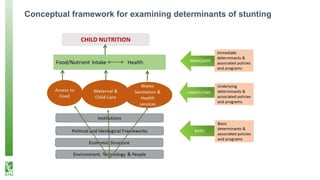
Conceptual framework for examining determinants of stunting
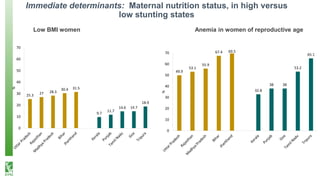
Immediate determinants: Maternal nutrition status, in high versus
low stunting states
Low BMI women Anemia in women of reproductive age
25.3 27 28.3
30.4 31.5
9.7
11.7
14.6 14.7
18.9
0
10
20
30
40
50
60
70
%
49.9
53.1
55.9
67.4 69.5
32.8
38 38
53.2
65.1
0
10
20
30
40
50
60
70
%
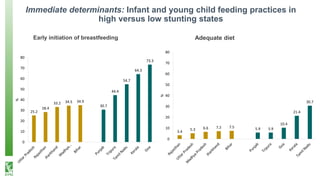
Immediate determinants: Infant and young child feeding practices in
high versus low stunting states
Early initiation of breastfeeding Adequate diet
25.2
28.4
33.2 34.5 34.9
30.7
44.4
54.7
64.3
73.3
0
10
20
30
40
50
60
70
80
%
3.4
5.3 6.6 7.2 7.5 5.9 5.9
10.4
21.4
30.7
0
10
20
30
40
50
60
70
80
%
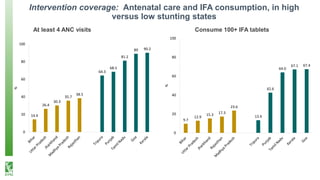
Intervention coverage: Antenatal care and IFA consumption, in high
versus low stunting states
At least 4 ANC visits Consume 100+ IFA tablets
14.4
26.4
30.3
35.7
38.5
64.3
68.5
81.2
89 90.2
0
20
40
60
80
100
%
9.7
12.9
15.3 17.3
23.6
13.4
42.6
64.0
67.1 67.4
0
20
40
60
80
100
%
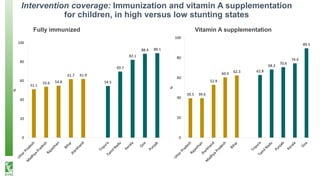
Intervention coverage: Immunization and vitamin A supplementation
for children, in high versus low stunting states
Fully immunized Vitamin A supplementation
51.1
53.6 54.8
61.7 61.9
54.5
69.7
82.1
88.4 89.1
0
20
40
60
80
100
%
39.5 39.6
52.9
60.4 62.3 62.8
68.3
70.6
74.4
89.5
0
20
40
60
80
100
%
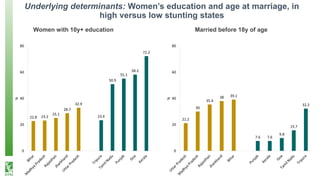
Underlying determinants: Women’s education and age at marriage, in
high versus low stunting states
Women with 10y+ education Married before 18y of age
22.8 23.2
25.1
28.7
32.9
23.4
50.9
55.1
58.2
72.2
0
20
40
60
80
%
21.2
30
35.4
38 39.1
7.6 7.6
9.8
15.7
32.2
0
20
40
60
80
%
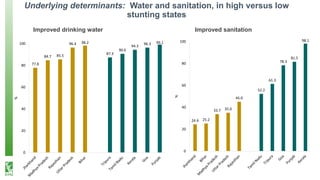
Underlying determinants: Water and sanitation, in high versus low
stunting states
Improved drinking water Improved sanitation
24.4 25.2
33.7 35.0
45.0
52.2
61.3
78.3
81.5
98.1
0
20
40
60
80
100
%
77.8
84.7 85.5
96.4 98.2
87.3
90.6
94.3
96.3 99.1
0
20
40
60
80
100
%
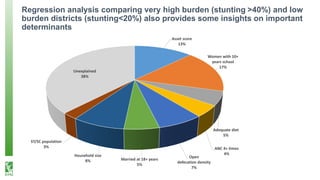
Regression analysis comparing very high burden (stunting >40%) and low
burden districts (stunting<20%) also provides some insights on important
determinants
Asset score
13%
Women with 10+
years school
17%
Adequate diet
5%
ANC 4+ times
4%
Open
defecation density
7%
Married at 18+ years
5%
Household size
8%
ST/SC population
3%
Unexplained
38%
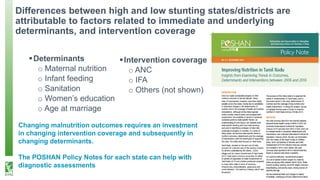
Differences between high and low stunting states/districts are
attributable to factors related to immediate and underlying
determinants, and intervention coverage
▪Determinants
o Maternal nutrition
o Infant feeding
o Sanitation
o Women’s education
o Age at marriage
▪Intervention coverage
o ANC
o IFA
o Others (not shown)
Changing malnutrition outcomes requires an investment
in changing intervention coverage and subsequently in
changing determinants.
The POSHAN Policy Notes for each state can help with
diagnostic assessments
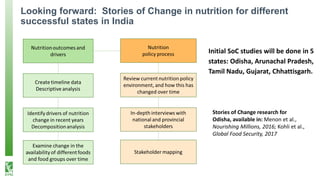
Looking forward: Stories of Change in nutrition for different
successful states in India
Initial SoC studies will be done in 5
states: Odisha, Arunachal Pradesh,
Tamil Nadu, Gujarat, Chhattisgarh.
Stories of Change research for
Odisha, available in: Menon et al.,
Nourishing Millions, 2016; Kohli et al.,
Global Food Security, 2017
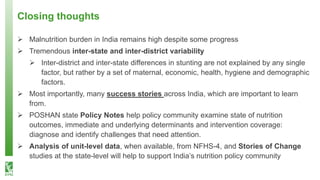
Closing thoughts
➢ Malnutrition burden in India remains high despite some progress
➢ Tremendous inter-state and inter-district variability
➢ Inter-district and inter-state differences in stunting are not explained by any single
factor, but rather by a set of maternal, economic, health, hygiene and demographic
factors.
➢ Most importantly, many success stories across India, which are important to learn
from.
➢ POSHAN state Policy Notes help policy community examine state of nutrition
outcomes, immediate and underlying determinants and intervention coverage:
diagnose and identify challenges that need attention.
➢ Analysis of unit-level data, when available, from NFHS-4, and Stories of Change
studies at the state-level will help to support India’s nutrition policy community

Multi-state stories:Insights from the frontrunners of stunting reduction

  • 1.
    Presented by PhuongHong Nguyen International Food Policy Research Institute Multi-state stories: Insights from the frontrunners of stunting reduction
  • 2.
    2016 38.4% 2006 Significant stunting reductionin all states in India in the last decades 2006 48%
  • 3.
    Stunting reduction variesby state -3.8 -3.8 -3.8 -3.5 -3.5 -3.4 -3.1 -3.0 -2.9 -2.9 -2.9 -2.8 -2.7 -2.6 -2.5 -2.4 -2.4 -2.4 -2.3 -2.2 -2.2 -2.1 -2.0 -1.9 -1.7 -1.4 -1.3 -1.1 -0.9 -4.0 -3.5 -3.0 -2.5 -2.0 -1.5 -1.0 -0.5 0.0 -20 -18 -16 -14 -12 -10 -8 -6 -4 -2 0 AARR percentagepointchange pp change AARR
  • 4.
    1,11,20,920 78,64,654 36,51,636 - 20,00,000 40,00,000 60,00,000 80,00,000 1,00,00,000 1,20,00,000 Numberofstuntedchildren 9 states account for ~80% ofstunted children Number of stunted children reduced from ~76 million in 2006 to ~50 million in 2016
  • 5.
    In 2016, prevalencestunting is still >30% in 16 states 0 10 20 30 40 50 60 Stuntingpercentage
  • 6.
    If current trendof AARR continues, only 5 states reach the WHA target in 2025 0.0% 1.0% 2.0% 3.0% 4.0% 5.0% 6.0% 7.0% 8.0% Averageannualreductionrate Required AARR (2016-2025) Current AARR
  • 7.
    What can thefrontrunners, who have achieved lower rates of stunting, tell us? 48.3 46.3 45.3 42.0 39.1 27.1 25.7 24.3 20.1 19.7 0 10 20 30 40 50 60 %stuntingin2016
  • 8.
    Conceptual framework forexamining determinants of stunting
  • 9.
    Immediate determinants: Maternalnutrition status, in high versus low stunting states Low BMI women Anemia in women of reproductive age 25.3 27 28.3 30.4 31.5 9.7 11.7 14.6 14.7 18.9 0 10 20 30 40 50 60 70 % 49.9 53.1 55.9 67.4 69.5 32.8 38 38 53.2 65.1 0 10 20 30 40 50 60 70 %
  • 10.
    Immediate determinants: Infantand young child feeding practices in high versus low stunting states Early initiation of breastfeeding Adequate diet 25.2 28.4 33.2 34.5 34.9 30.7 44.4 54.7 64.3 73.3 0 10 20 30 40 50 60 70 80 % 3.4 5.3 6.6 7.2 7.5 5.9 5.9 10.4 21.4 30.7 0 10 20 30 40 50 60 70 80 %
  • 11.
    Intervention coverage: Antenatalcare and IFA consumption, in high versus low stunting states At least 4 ANC visits Consume 100+ IFA tablets 14.4 26.4 30.3 35.7 38.5 64.3 68.5 81.2 89 90.2 0 20 40 60 80 100 % 9.7 12.9 15.3 17.3 23.6 13.4 42.6 64.0 67.1 67.4 0 20 40 60 80 100 %
  • 12.
    Intervention coverage: Immunizationand vitamin A supplementation for children, in high versus low stunting states Fully immunized Vitamin A supplementation 51.1 53.6 54.8 61.7 61.9 54.5 69.7 82.1 88.4 89.1 0 20 40 60 80 100 % 39.5 39.6 52.9 60.4 62.3 62.8 68.3 70.6 74.4 89.5 0 20 40 60 80 100 %
  • 13.
    Underlying determinants: Women’seducation and age at marriage, in high versus low stunting states Women with 10y+ education Married before 18y of age 22.8 23.2 25.1 28.7 32.9 23.4 50.9 55.1 58.2 72.2 0 20 40 60 80 % 21.2 30 35.4 38 39.1 7.6 7.6 9.8 15.7 32.2 0 20 40 60 80 %
  • 14.
    Underlying determinants: Waterand sanitation, in high versus low stunting states Improved drinking water Improved sanitation 24.4 25.2 33.7 35.0 45.0 52.2 61.3 78.3 81.5 98.1 0 20 40 60 80 100 % 77.8 84.7 85.5 96.4 98.2 87.3 90.6 94.3 96.3 99.1 0 20 40 60 80 100 %
  • 15.
    Regression analysis comparingvery high burden (stunting >40%) and low burden districts (stunting<20%) also provides some insights on important determinants Asset score 13% Women with 10+ years school 17% Adequate diet 5% ANC 4+ times 4% Open defecation density 7% Married at 18+ years 5% Household size 8% ST/SC population 3% Unexplained 38%
  • 16.
    Differences between highand low stunting states/districts are attributable to factors related to immediate and underlying determinants, and intervention coverage ▪Determinants o Maternal nutrition o Infant feeding o Sanitation o Women’s education o Age at marriage ▪Intervention coverage o ANC o IFA o Others (not shown) Changing malnutrition outcomes requires an investment in changing intervention coverage and subsequently in changing determinants. The POSHAN Policy Notes for each state can help with diagnostic assessments
  • 17.
    Looking forward: Storiesof Change in nutrition for different successful states in India Initial SoC studies will be done in 5 states: Odisha, Arunachal Pradesh, Tamil Nadu, Gujarat, Chhattisgarh. Stories of Change research for Odisha, available in: Menon et al., Nourishing Millions, 2016; Kohli et al., Global Food Security, 2017
  • 18.
    Closing thoughts ➢ Malnutritionburden in India remains high despite some progress ➢ Tremendous inter-state and inter-district variability ➢ Inter-district and inter-state differences in stunting are not explained by any single factor, but rather by a set of maternal, economic, health, hygiene and demographic factors. ➢ Most importantly, many success stories across India, which are important to learn from. ➢ POSHAN state Policy Notes help policy community examine state of nutrition outcomes, immediate and underlying determinants and intervention coverage: diagnose and identify challenges that need attention. ➢ Analysis of unit-level data, when available, from NFHS-4, and Stories of Change studies at the state-level will help to support India’s nutrition policy community