
1-Click Relocation
60
Interviews
(+24 today)Mentors: Craig Seidel, Adi Bittan
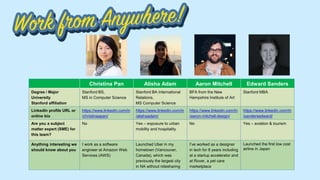
Christina Pan Alisha Adam Aaron Mitchell Edward Sanders
Degree / Major
University
Stanford affiliation
Stanford BS,
MS in Computer Science
Stanford BA International
Relations,
MS Computer Science
BFA from the New
Hampshire Institute of Art
Stanford MBA
LinkedIn profile URL or
online bio
https://www.linkedin.com/in
/christinaapan/
https://www.linkedin.com/in
/alishaadam/
https://www.linkedin.com/in
/aaron-mitchell-design/
https://www.linkedin.com/in
/sandersedward/
Are you a subject
matter expert (SME) for
this team?
No Yes – exposure to urban
mobility and hospitality
No Yes – aviation & tourism
Anything interesting we
should know about you
I work as a software
engineer at Amazon Web
Services (AWS)
Launched Uber in my
hometown (Vancouver,
Canada), which was
previously the largest city
in NA without ridesharing
I’ve worked as a designer
in tech for 8 years including
at a startup accelerator and
at Rover, a pet care
marketplace
Launched the first low cost
airline in Japan
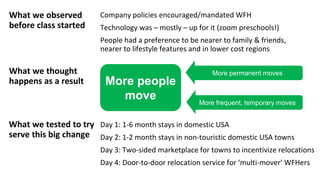
What we observed
before class started
Day 1: 1-6 month stays in domestic USA
Day 2: 1-2 month stays in non-touristic domestic USA towns
Day 3: Two-sided marketplace for towns to incentivize relocations
Day 4: Door-to-door relocation service for ‘multi-mover’ WFHers
Company policies encouraged/mandated WFH
Technology was – mostly – up for it (zoom preschools!)
People had a preference to be nearer to family & friends,
nearer to lifestyle features and in lower cost regions
What we thought
happens as a result More people
move
More permanent moves
More frequent, temporary moves
What we tested to try
serve this big change
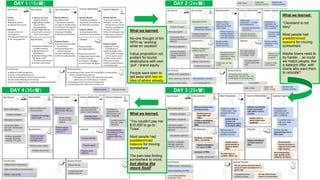
What we learned:
“Cleveland is not
sexy”
Most people had
predetermined
reasons for moving
somewhere
Maybe towns need to
try harder… so could
we match people, like
a date/job offer, with
towns who want them
to relocate?
What we learned:
“You couldn’t pay me
$10,000 to go to
Tulsa”
Most people had
predetermined
reasons for moving
somewhere
The pain less finding
somewhere to move,
but doing the
move itself
What we learned:
No-one thought of 6m
WFH as ‘working
while on vacation’
Value proposition not
evident for tourist
destinations with own
‘pull’ / brand equity
People were keen to
get away and had an
idea of where already
DAY 1-4
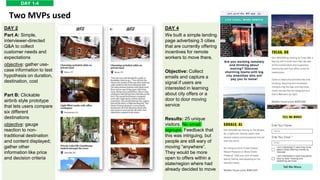
Two MVPs used
DAY 4
We built a simple landing
page advertising 3 cities
that are currently offering
incentives for remote
workers to move there.
Objective: Collect
emails and capture a
signal if users are
interested in learning
about city offers or a
door to door moving
service
Results: 25 unique
visitors. No email
signups. Feedback that
this was intriguing, but
people are still wary of
moving “anywhere”.
They would be more
open to offers within a
state/region where had
already decided to move
DAY 2
Part A: Simple,
interviewer-directed
Q&A to collect
customer needs and
expectations
objective: gather use-
case information to test
hypothesis on duration,
destination, cost
Part B: Clickable
airbnb style prototype
that lets users compare
six different
destinations
objective: gauge
reaction to non-
traditional destination
and content displayed;
gather other
information like price
and decision criteria
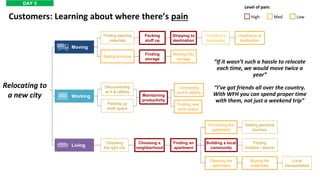
Relocating to
a new city
Moving
Working
Living
Finding new
work space
Disconnecting
wi-fi & utilities
Choosing
the right city
Choosing a
neighborhood
Finding an
apartment
Furnishing the
apartment
Building a local
community
Connecting
wi-fi & utilities
Cleaning the
apartment
Adding personal
touches
Level of pain:
High Med Low
Finding
hobbies / leisure
Buying the
essentials
Packing
stuff up
Shipping to
destination
Unpacking at
destination
Finding
storage
Finding packing
materials
Selling furniture
Moving into
storage
Travelling to
destination
Maintaining
productivity
Local
transportation
Packing up
work space
Customers: Learning about where there’s pain
“If it wasn’t such a hassle to relocate
each time, we would move twice a
year”
“I’ve got friends all over the country.
With WFH you can spend proper time
with them, not just a weekend trip”
DAY 5
WFA
Agreed
Relocation
Requirements
Partners
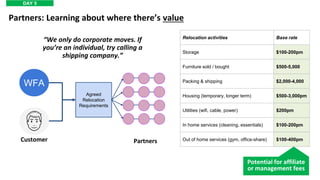
Partners: Learning about where there’s value
Relocation activities Base rate
Storage $100-200pm
Furniture sold / bought $500-5,000
Packing & shipping $2,000-4,000
Housing (temporary, longer term) $500-3,000pm
Utilities (wifi, cable, power) $200pm
In home services (cleaning, essentials) $100-200pm
Out of home services (gym, office-share) $100-400pmCustomer
Potential for affiliate
or management fees
“We only do corporate moves. If
you’re an individual, try calling a
shipping company.”
DAY 5
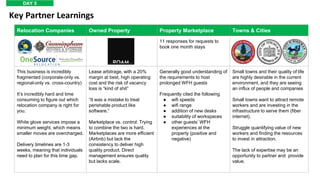
Relocation Companies Owned Property Property Marketplace Towns & Cities
11 responses for requests to
book one month stays
This business is incredibly
fragmented (corporate-only vs.
regional-only vs. cross-country)
It’s incredibly hard and time
consuming to figure out which
relocation company is right for
you.
White glove services impose a
minimum weight, which means
smaller moves are overcharged.
Delivery timelines are 1-3
weeks, meaning that individuals
need to plan for this time gap.
Lease arbitrage, with a 20%
margin at best, high operating
cost and the risk of vacancy
loss is “kind of shit”
“It was a mistake to treat
perishable product like
software.”
Marketplace vs. control: Trying
to combine the two is hard.
Marketplaces are more efficient
(Airbnb) but lack the
consistency to deliver high
quality product. Direct
management ensures quality
but lacks scale.
Generally good understanding of
the requirements to host
prolonged WFH guests
Frequently cited the following
● wifi speeds
● wifi range
● addition of new desks
● suitability of workspaces
● other guests’ WFH
experiences at the
property (positive and
negative)
Small towns and their quality of life
are highly desirable in the current
environment, and they are seeing
an influx of people and companies
Small towns want to attract remote
workers and are investing in the
infrastructure to serve them (fiber
internet).
Struggle quantifying value of new
workers and finding the resources
to invest in attraction.
The lack of expertise may be an
opportunity to partner and provide
value.
Key Partner Learnings
DAY 5
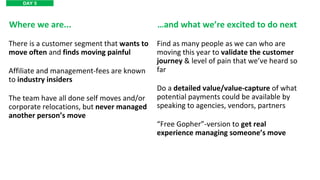
Where we are...
Find as many people as we can who are
moving this year to validate the customer
journey & level of pain that we’ve heard so
far
Do a detailed value/value-capture of what
potential payments could be available by
speaking to agencies, vendors, partners
“Free Gopher”-version to get real
experience managing someone’s move
…and what we’re excited to do next
DAY 5
There is a customer segment that wants to
move often and finds moving painful
Affiliate and management-fees are known
to industry insiders
The team have all done self moves and/or
corporate relocations, but never managed
another person’s move
Thank you!
APPENDIX
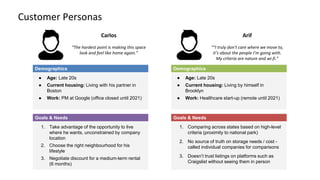
Carlos
“The hardest point is making this space
look and feel like home again.”
Customer Personas
● Age: Late 20s
● Current housing: Living with his partner in
Boston
● Work: PM at Google (office closed until 2021)
1. Take advantage of the opportunity to live
where he wants, unconstrained by company
location
2. Choose the right neighbourhood for his
lifestyle
3. Negotiate discount for a medium-term rental
(6 months)
Demographics
Goals & Needs
Arif
““I truly don’t care where we move to,
it’s about the people I’m going with.
My criteria are nature and wi-fi.”
“
● Age: Late 20s
● Current housing: Living by himself in
Brooklyn
● Work: Healthcare start-up (remote until 2021)
Demographics
1. Comparing across states based on high-level
criteria (proximity to national park)
2. No source of truth on storage needs / cost -
called individual companies for comparisons
3. Doesn’t trust listings on platforms such as
Craigslist without seeing them in person
Goals & Needs
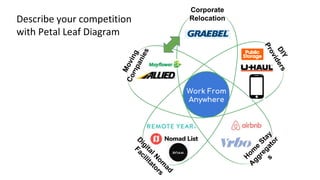
Describe your competition
with Petal Leaf Diagram
Work From
Anywhere

WorkFromAnywhere H4R Stanford 2020

  • 1.
  • 2.
    Christina Pan AlishaAdam Aaron Mitchell Edward Sanders Degree / Major University Stanford affiliation Stanford BS, MS in Computer Science Stanford BA International Relations, MS Computer Science BFA from the New Hampshire Institute of Art Stanford MBA LinkedIn profile URL or online bio https://www.linkedin.com/in /christinaapan/ https://www.linkedin.com/in /alishaadam/ https://www.linkedin.com/in /aaron-mitchell-design/ https://www.linkedin.com/in /sandersedward/ Are you a subject matter expert (SME) for this team? No Yes – exposure to urban mobility and hospitality No Yes – aviation & tourism Anything interesting we should know about you I work as a software engineer at Amazon Web Services (AWS) Launched Uber in my hometown (Vancouver, Canada), which was previously the largest city in NA without ridesharing I’ve worked as a designer in tech for 8 years including at a startup accelerator and at Rover, a pet care marketplace Launched the first low cost airline in Japan
  • 3.
    What we observed beforeclass started Day 1: 1-6 month stays in domestic USA Day 2: 1-2 month stays in non-touristic domestic USA towns Day 3: Two-sided marketplace for towns to incentivize relocations Day 4: Door-to-door relocation service for ‘multi-mover’ WFHers Company policies encouraged/mandated WFH Technology was – mostly – up for it (zoom preschools!) People had a preference to be nearer to family & friends, nearer to lifestyle features and in lower cost regions What we thought happens as a result More people move More permanent moves More frequent, temporary moves What we tested to try serve this big change
  • 4.
    What we learned: “Clevelandis not sexy” Most people had predetermined reasons for moving somewhere Maybe towns need to try harder… so could we match people, like a date/job offer, with towns who want them to relocate? What we learned: “You couldn’t pay me $10,000 to go to Tulsa” Most people had predetermined reasons for moving somewhere The pain less finding somewhere to move, but doing the move itself What we learned: No-one thought of 6m WFH as ‘working while on vacation’ Value proposition not evident for tourist destinations with own ‘pull’ / brand equity People were keen to get away and had an idea of where already
  • 5.
    DAY 1-4 Two MVPsused DAY 4 We built a simple landing page advertising 3 cities that are currently offering incentives for remote workers to move there. Objective: Collect emails and capture a signal if users are interested in learning about city offers or a door to door moving service Results: 25 unique visitors. No email signups. Feedback that this was intriguing, but people are still wary of moving “anywhere”. They would be more open to offers within a state/region where had already decided to move DAY 2 Part A: Simple, interviewer-directed Q&A to collect customer needs and expectations objective: gather use- case information to test hypothesis on duration, destination, cost Part B: Clickable airbnb style prototype that lets users compare six different destinations objective: gauge reaction to non- traditional destination and content displayed; gather other information like price and decision criteria
  • 6.
    Relocating to a newcity Moving Working Living Finding new work space Disconnecting wi-fi & utilities Choosing the right city Choosing a neighborhood Finding an apartment Furnishing the apartment Building a local community Connecting wi-fi & utilities Cleaning the apartment Adding personal touches Level of pain: High Med Low Finding hobbies / leisure Buying the essentials Packing stuff up Shipping to destination Unpacking at destination Finding storage Finding packing materials Selling furniture Moving into storage Travelling to destination Maintaining productivity Local transportation Packing up work space Customers: Learning about where there’s pain “If it wasn’t such a hassle to relocate each time, we would move twice a year” “I’ve got friends all over the country. With WFH you can spend proper time with them, not just a weekend trip” DAY 5
  • 7.
    WFA Agreed Relocation Requirements Partners Partners: Learning aboutwhere there’s value Relocation activities Base rate Storage $100-200pm Furniture sold / bought $500-5,000 Packing & shipping $2,000-4,000 Housing (temporary, longer term) $500-3,000pm Utilities (wifi, cable, power) $200pm In home services (cleaning, essentials) $100-200pm Out of home services (gym, office-share) $100-400pmCustomer Potential for affiliate or management fees “We only do corporate moves. If you’re an individual, try calling a shipping company.” DAY 5
  • 8.
    Relocation Companies OwnedProperty Property Marketplace Towns & Cities 11 responses for requests to book one month stays This business is incredibly fragmented (corporate-only vs. regional-only vs. cross-country) It’s incredibly hard and time consuming to figure out which relocation company is right for you. White glove services impose a minimum weight, which means smaller moves are overcharged. Delivery timelines are 1-3 weeks, meaning that individuals need to plan for this time gap. Lease arbitrage, with a 20% margin at best, high operating cost and the risk of vacancy loss is “kind of shit” “It was a mistake to treat perishable product like software.” Marketplace vs. control: Trying to combine the two is hard. Marketplaces are more efficient (Airbnb) but lack the consistency to deliver high quality product. Direct management ensures quality but lacks scale. Generally good understanding of the requirements to host prolonged WFH guests Frequently cited the following ● wifi speeds ● wifi range ● addition of new desks ● suitability of workspaces ● other guests’ WFH experiences at the property (positive and negative) Small towns and their quality of life are highly desirable in the current environment, and they are seeing an influx of people and companies Small towns want to attract remote workers and are investing in the infrastructure to serve them (fiber internet). Struggle quantifying value of new workers and finding the resources to invest in attraction. The lack of expertise may be an opportunity to partner and provide value. Key Partner Learnings DAY 5
  • 9.
    Where we are... Findas many people as we can who are moving this year to validate the customer journey & level of pain that we’ve heard so far Do a detailed value/value-capture of what potential payments could be available by speaking to agencies, vendors, partners “Free Gopher”-version to get real experience managing someone’s move …and what we’re excited to do next DAY 5 There is a customer segment that wants to move often and finds moving painful Affiliate and management-fees are known to industry insiders The team have all done self moves and/or corporate relocations, but never managed another person’s move
  • 10.
  • 11.
  • 12.
    Carlos “The hardest pointis making this space look and feel like home again.” Customer Personas ● Age: Late 20s ● Current housing: Living with his partner in Boston ● Work: PM at Google (office closed until 2021) 1. Take advantage of the opportunity to live where he wants, unconstrained by company location 2. Choose the right neighbourhood for his lifestyle 3. Negotiate discount for a medium-term rental (6 months) Demographics Goals & Needs Arif ““I truly don’t care where we move to, it’s about the people I’m going with. My criteria are nature and wi-fi.” “ ● Age: Late 20s ● Current housing: Living by himself in Brooklyn ● Work: Healthcare start-up (remote until 2021) Demographics 1. Comparing across states based on high-level criteria (proximity to national park) 2. No source of truth on storage needs / cost - called individual companies for comparisons 3. Doesn’t trust listings on platforms such as Craigslist without seeing them in person Goals & Needs
  • 13.
    Describe your competition withPetal Leaf Diagram Work From Anywhere