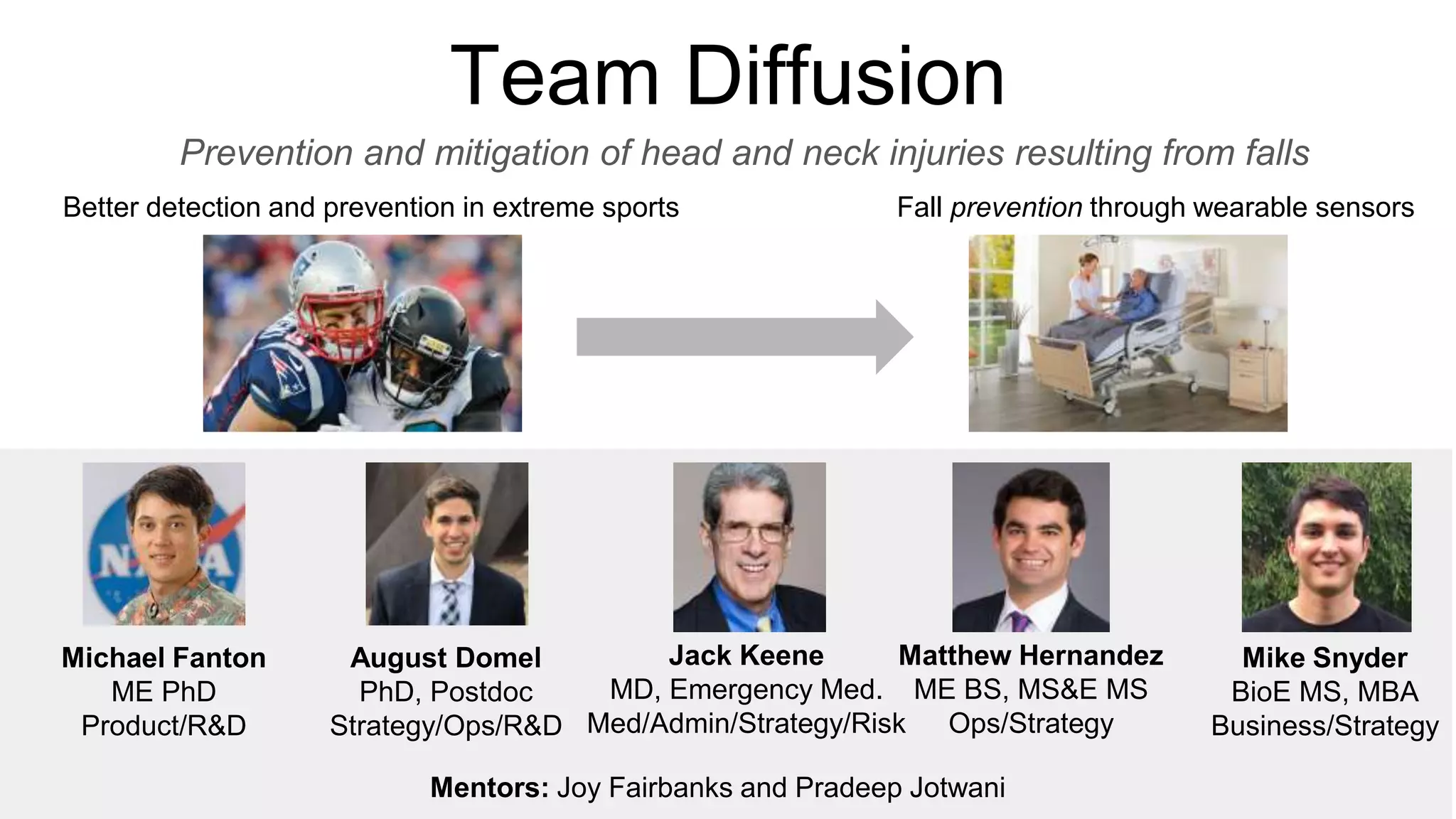
Team Diffusion
Michael Fanton
ME PhD
Product/R&D
Mike Snyder
BioE MS, MBA
Business/Strategy
August Domel
PhD, Postdoc
Strategy/Ops/R&D
Jack Keene
MD, Emergency Med.
Med/Admin/Strategy/Risk
Matthew Hernandez
ME BS, MS&E MS
Ops/Strategy
Prevention and mitigation of head and neck injuries resulting from falls
Better detection and prevention in extreme sports Fall prevention through wearable sensors
Mentors: Joy Fairbanks and Pradeep Jotwani
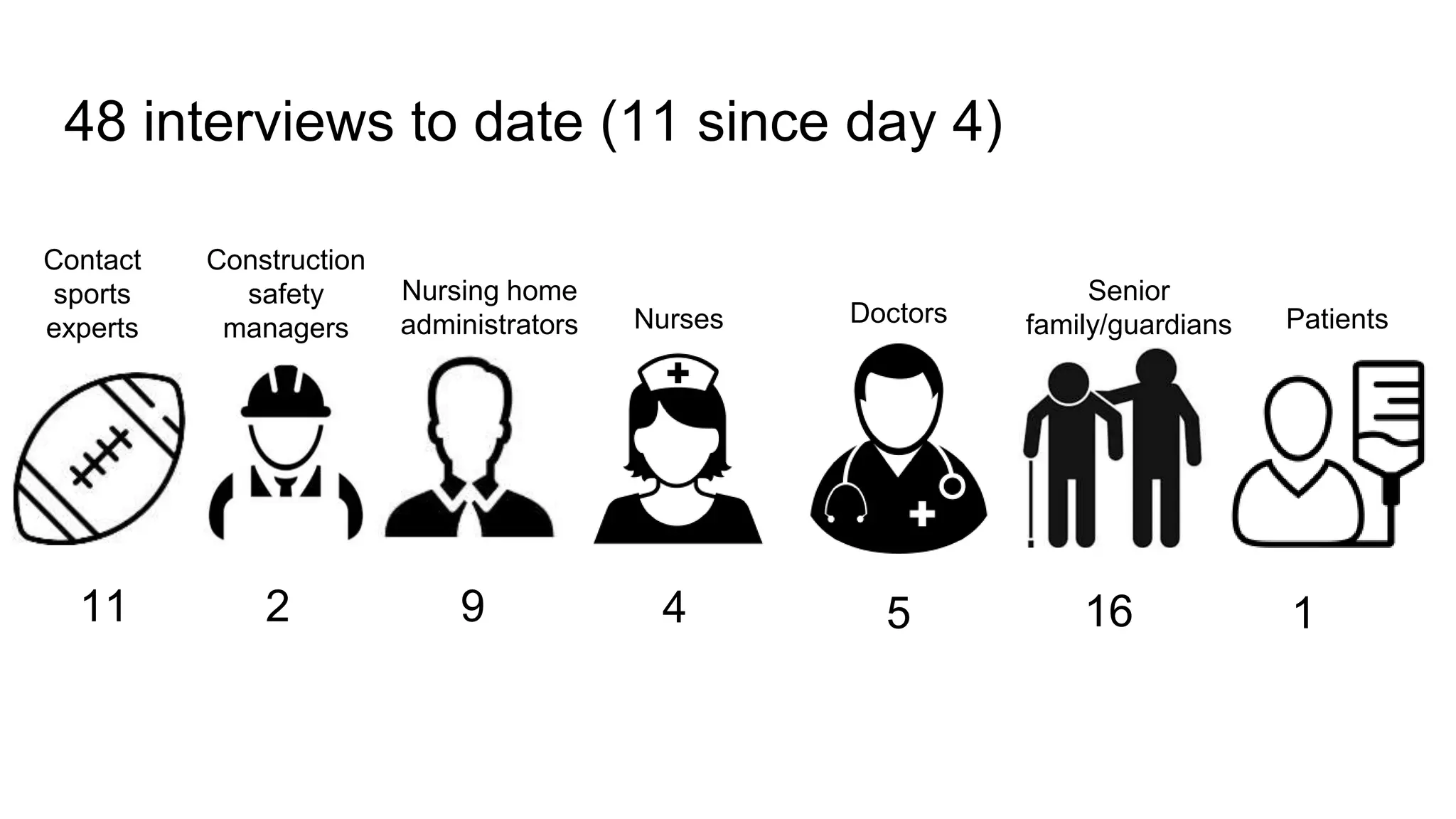
48 interviews to date (11 since day 4)
11
Contact
sports
experts
Nursing home
administrators Nurses Doctors
Senior
family/guardians
9 164 5
Patients
1
Construction
safety
managers
2
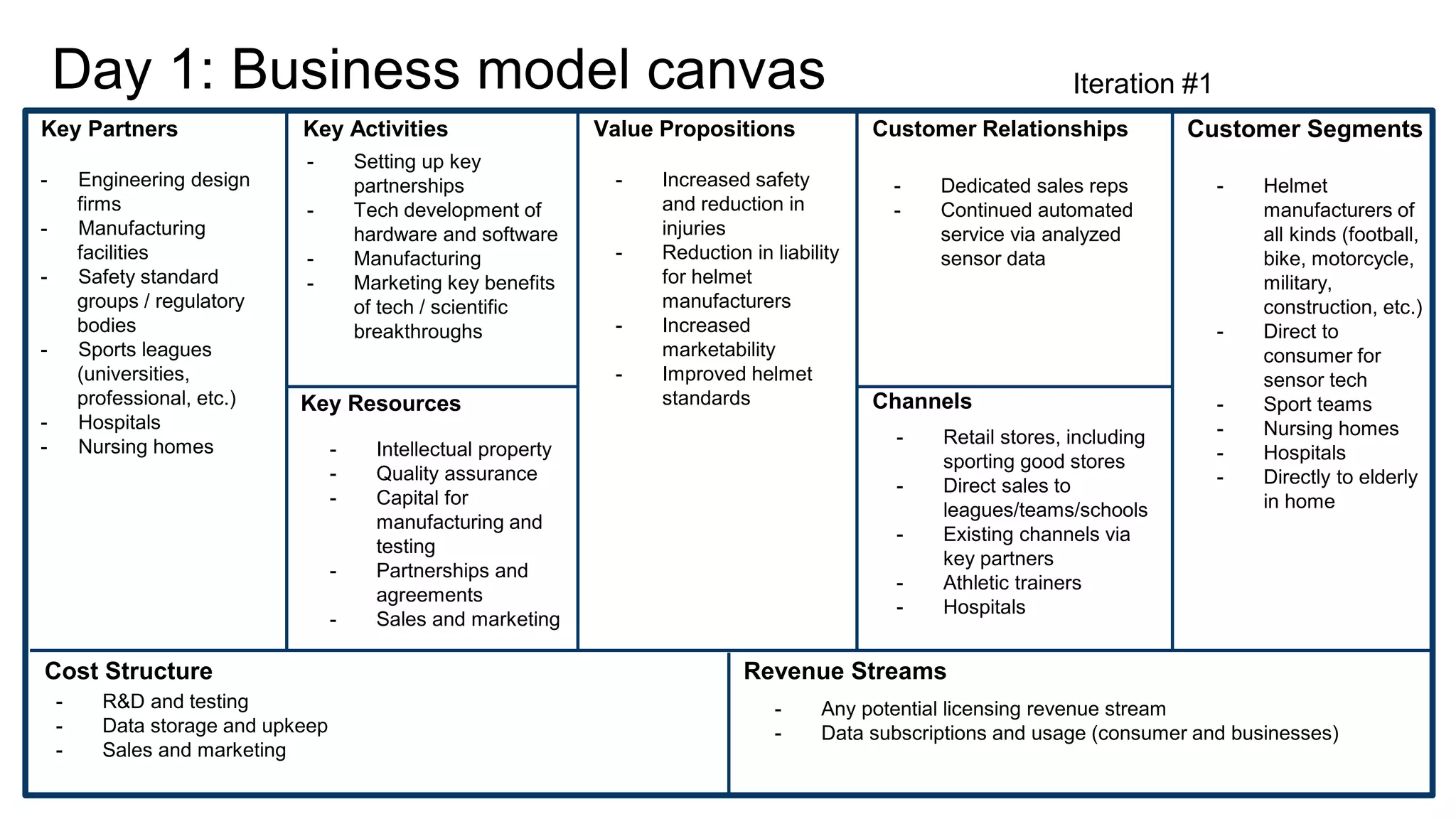
Day 1: Business model canvas
Key Partners Key Activities
Key Resources
Value Propositions Customer Relationships Customer Segments
Channels
Cost Structure Revenue Streams
- Engineering design
firms
- Manufacturing
facilities
- Safety standard
groups / regulatory
bodies
- Sports leagues
(universities,
professional, etc.)
- Hospitals
- Nursing homes
- Increased safety
and reduction in
injuries
- Reduction in liability
for helmet
manufacturers
- Increased
marketability
- Improved helmet
standards
- Helmet
manufacturers of
all kinds (football,
bike, motorcycle,
military,
construction, etc.)
- Direct to
consumer for
sensor tech
- Sport teams
- Nursing homes
- Hospitals
- Directly to elderly
in home
- Setting up key
partnerships
- Tech development of
hardware and software
- Manufacturing
- Marketing key benefits
of tech / scientific
breakthroughs
- Dedicated sales reps
- Continued automated
service via analyzed
sensor data
- Retail stores, including
sporting good stores
- Direct sales to
leagues/teams/schools
- Existing channels via
key partners
- Athletic trainers
- Hospitals
Iteration #1
- Intellectual property
- Quality assurance
- Capital for
manufacturing and
testing
- Partnerships and
agreements
- Sales and marketing
- R&D and testing
- Data storage and upkeep
- Sales and marketing
- Any potential licensing revenue stream
- Data subscriptions and usage (consumer and businesses)
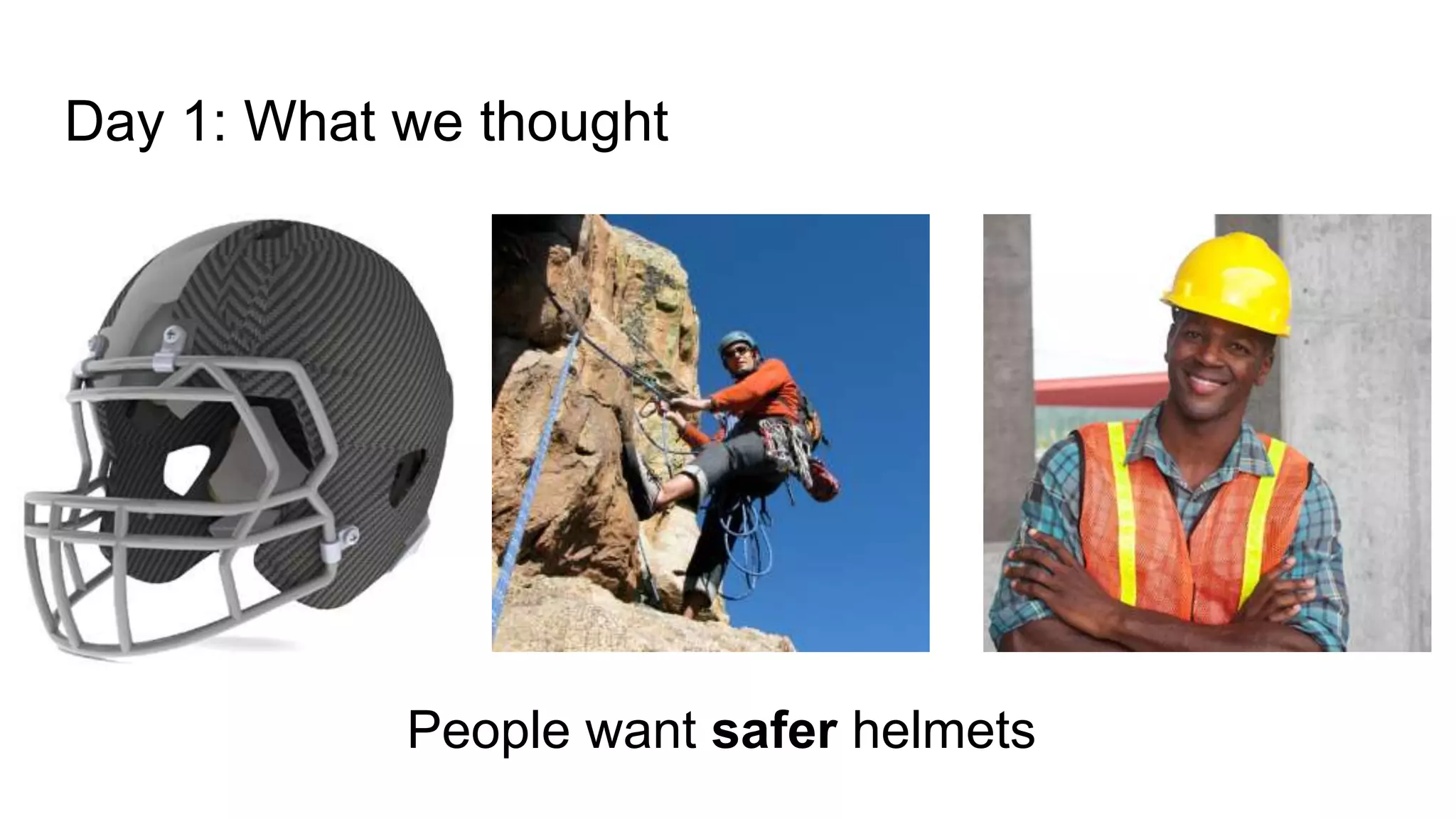
Day 1: What we thought
People want safer helmets
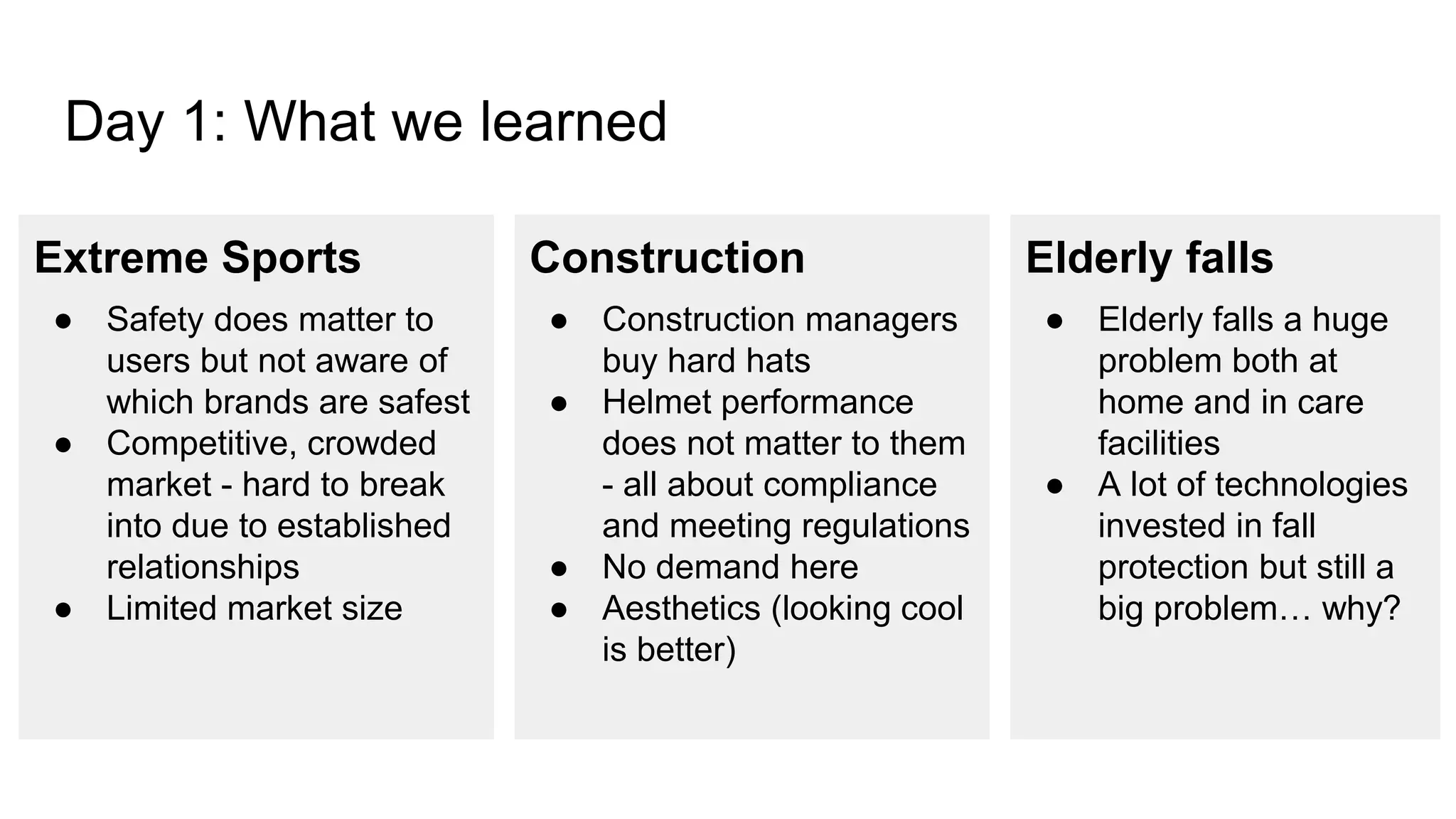
Day 1: What we learned
Extreme Sports
● Safety does matter to
users but not aware of
which brands are safest
● Competitive, crowded
market - hard to break
into due to established
relationships
● Limited market size
Construction
● Construction managers
buy hard hats
● Helmet performance
does not matter to them
- all about compliance
and meeting regulations
● No demand here
● Aesthetics (looking cool
is better)
Elderly falls
● Elderly falls a huge
problem both at
home and in care
facilities
● A lot of technologies
invested in fall
protection but still a
big problem… why?
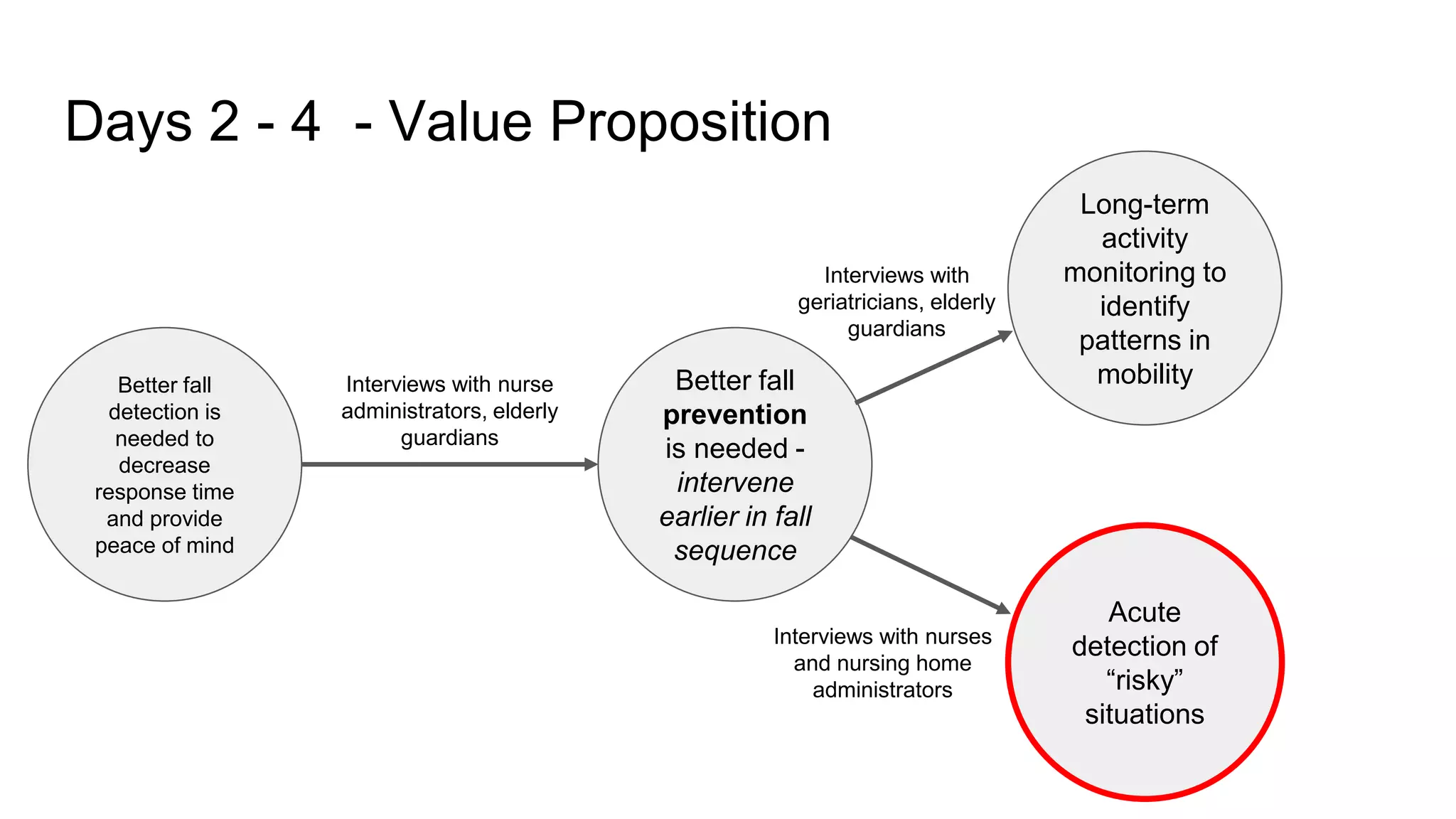
Days 2 - 4 - Value Proposition
Better fall
detection is
needed to
decrease
response time
and provide
peace of mind
Long-term
activity
monitoring to
identify
patterns in
mobilityBetter fall
prevention
is needed -
intervene
earlier in fall
sequence
Acute
detection of
“risky”
situations
Interviews with nurse
administrators, elderly
guardians
Interviews with
geriatricians, elderly
guardians
Interviews with nurses
and nursing home
administrators
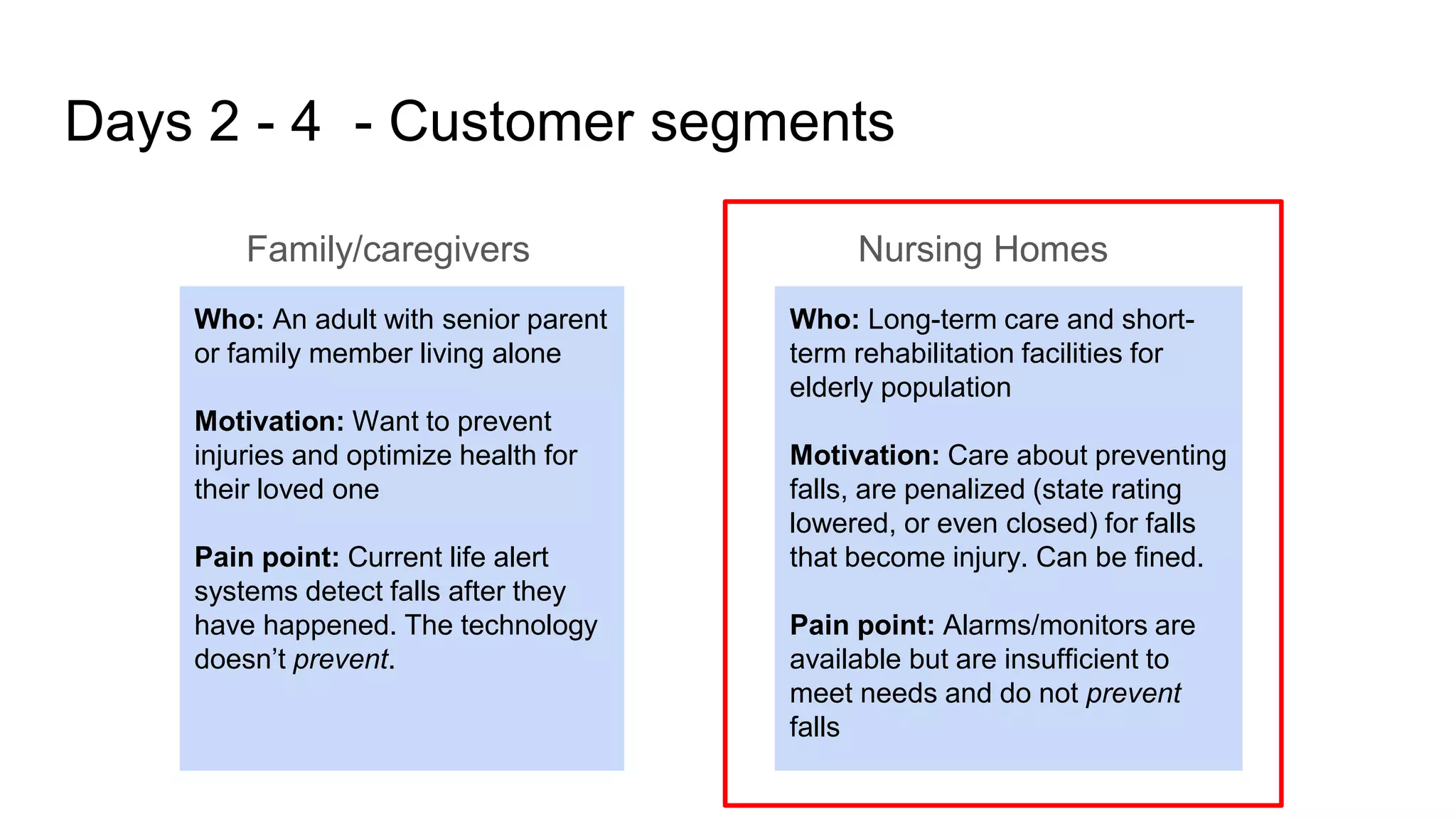
Days 2 - 4 - Customer segments
Family/caregivers Nursing Homes
Who: An adult with senior parent
or family member living alone
Motivation: Want to prevent
injuries and optimize health for
their loved one
Pain point: Current life alert
systems detect falls after they
have happened. The technology
doesn’t prevent.
Who: Long-term care and short-
term rehabilitation facilities for
elderly population
Motivation: Care about preventing
falls, are penalized (state rating
lowered, or even closed) for falls
that become injury. Can be fined.
Pain point: Alarms/monitors are
available but are insufficient to
meet needs and do not prevent
falls
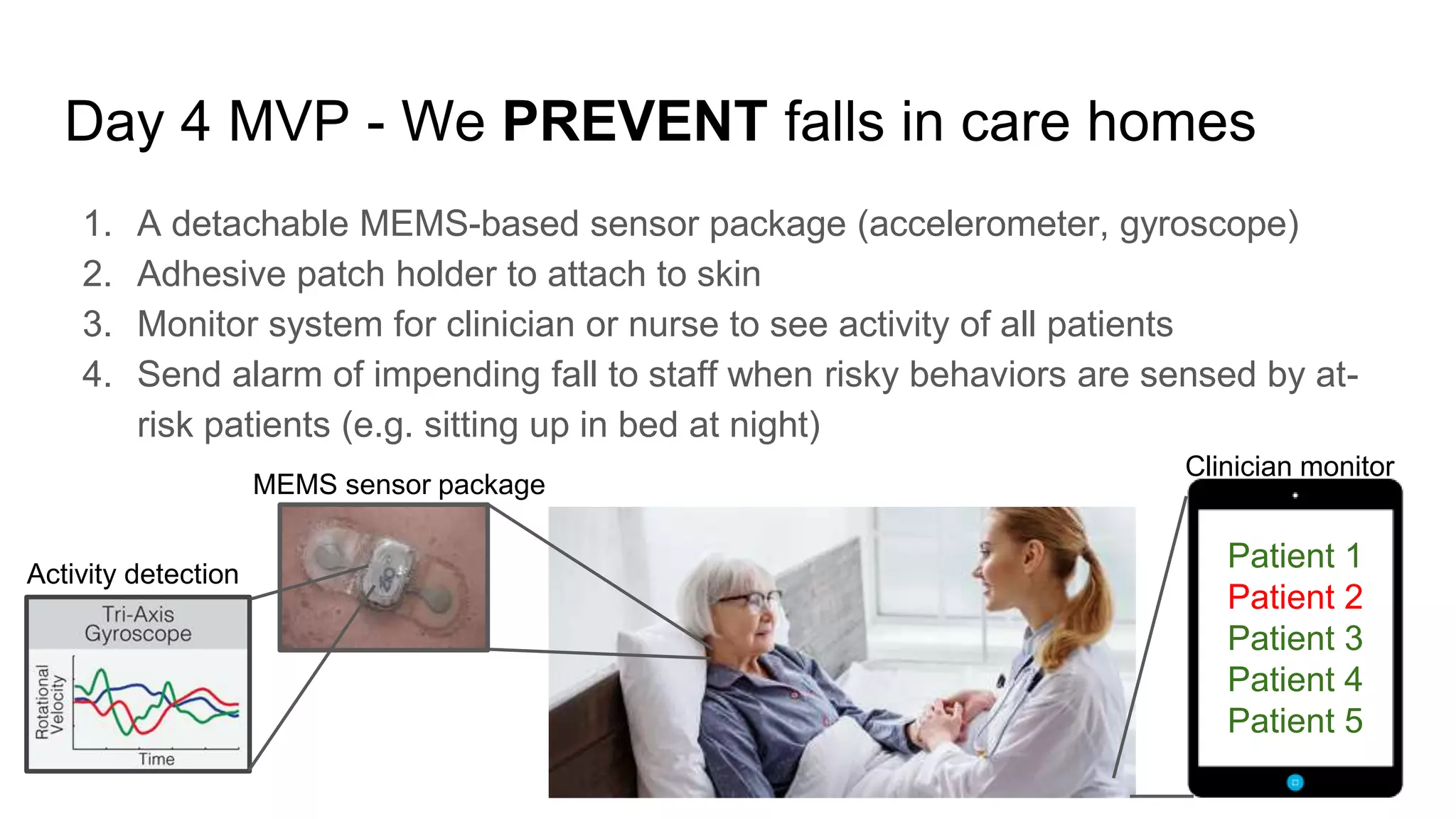
Day 4 MVP - We PREVENT falls in care homes
1. A detachable MEMS-based sensor package (accelerometer, gyroscope)
2. Adhesive patch holder to attach to skin
3. Monitor system for clinician or nurse to see activity of all patients
4. Send alarm of impending fall to staff when risky behaviors are sensed by at-
risk patients (e.g. sitting up in bed at night)
Patient 1
Patient 2
Patient 3
Patient 4
Patient 5
Activity detection
MEMS sensor package
Clinician monitor
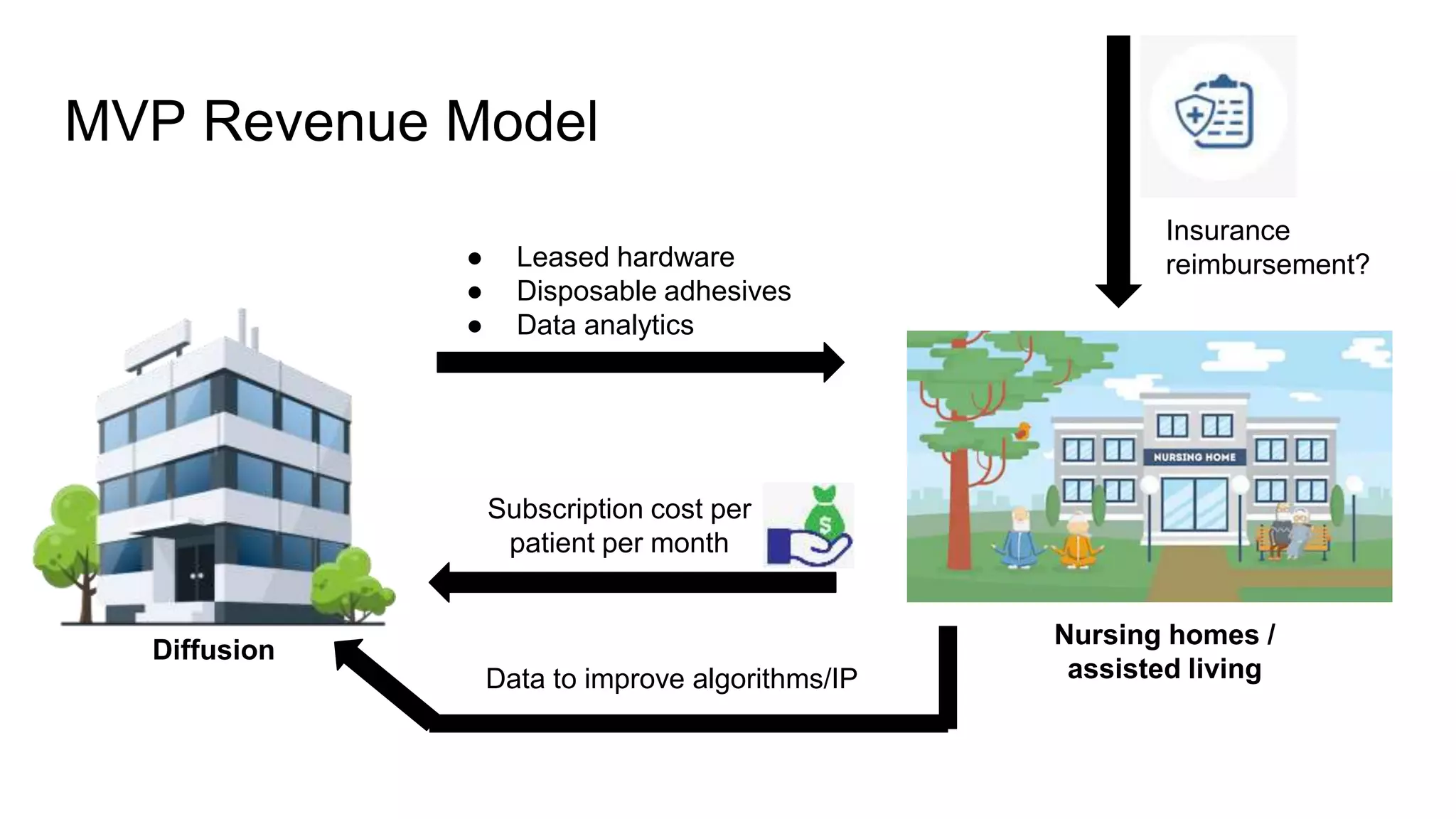
MVP Revenue Model
Subscription cost per
patient per month
Diffusion
● Leased hardware
● Disposable adhesives
● Data analytics
Data to improve algorithms/IP
Nursing homes /
assisted living
Insurance
reimbursement?
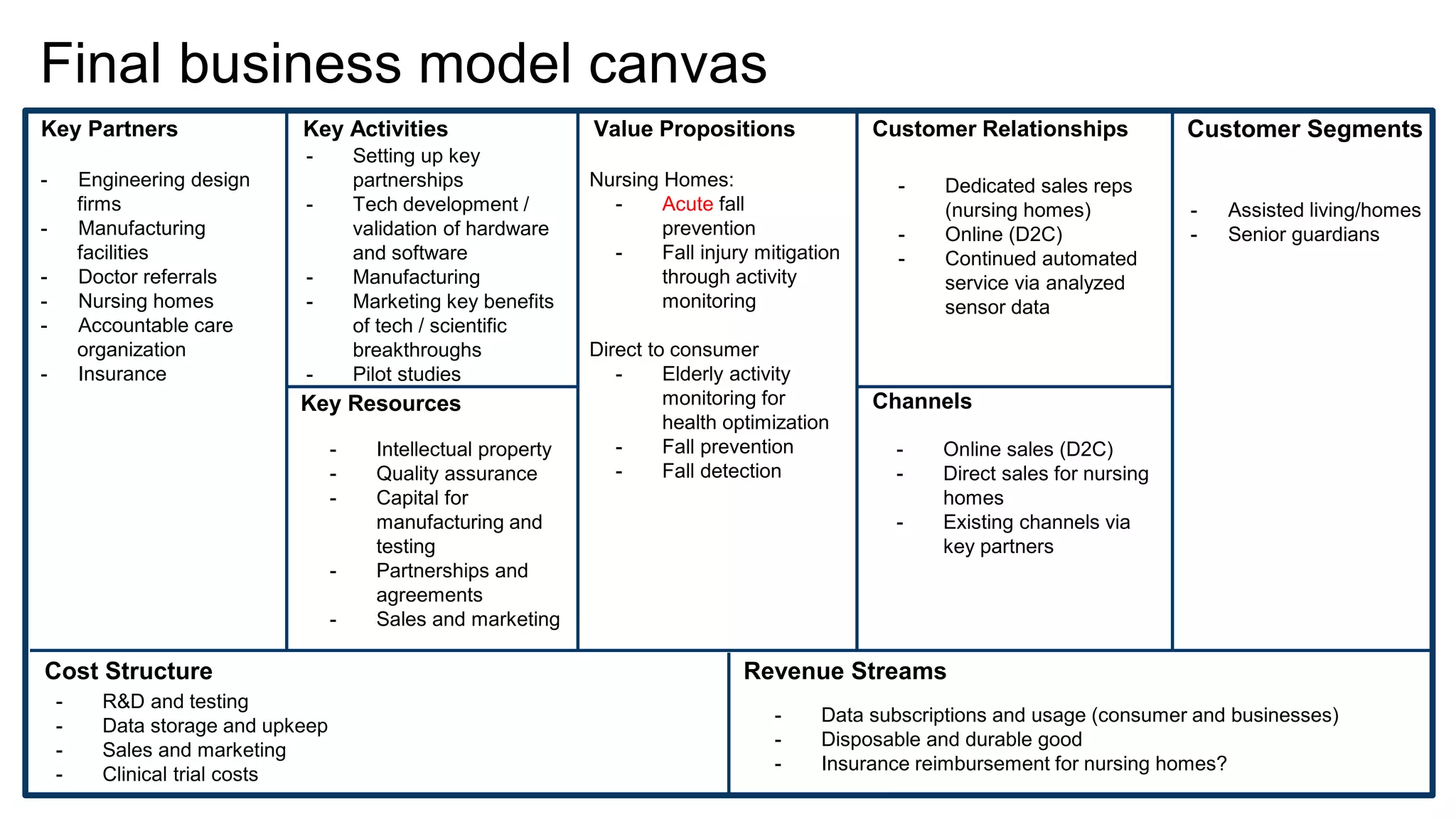
Final business model canvas
Key Partners Key Activities
Key Resources
Value Propositions Customer Relationships Customer Segments
Channels
Cost Structure Revenue Streams
- Engineering design
firms
- Manufacturing
facilities
- Doctor referrals
- Nursing homes
- Accountable care
organization
- Insurance
Nursing Homes:
- Acute fall
prevention
- Fall injury mitigation
through activity
monitoring
Direct to consumer
- Elderly activity
monitoring for
health optimization
- Fall prevention
- Fall detection
- Assisted living/homes
- Senior guardians
- Setting up key
partnerships
- Tech development /
validation of hardware
and software
- Manufacturing
- Marketing key benefits
of tech / scientific
breakthroughs
- Pilot studies
- Dedicated sales reps
(nursing homes)
- Online (D2C)
- Continued automated
service via analyzed
sensor data
- Online sales (D2C)
- Direct sales for nursing
homes
- Existing channels via
key partners
- Intellectual property
- Quality assurance
- Capital for
manufacturing and
testing
- Partnerships and
agreements
- Sales and marketing
- R&D and testing
- Data storage and upkeep
- Sales and marketing
- Clinical trial costs
- Data subscriptions and usage (consumer and businesses)
- Disposable and durable good
- Insurance reimbursement for nursing homes?
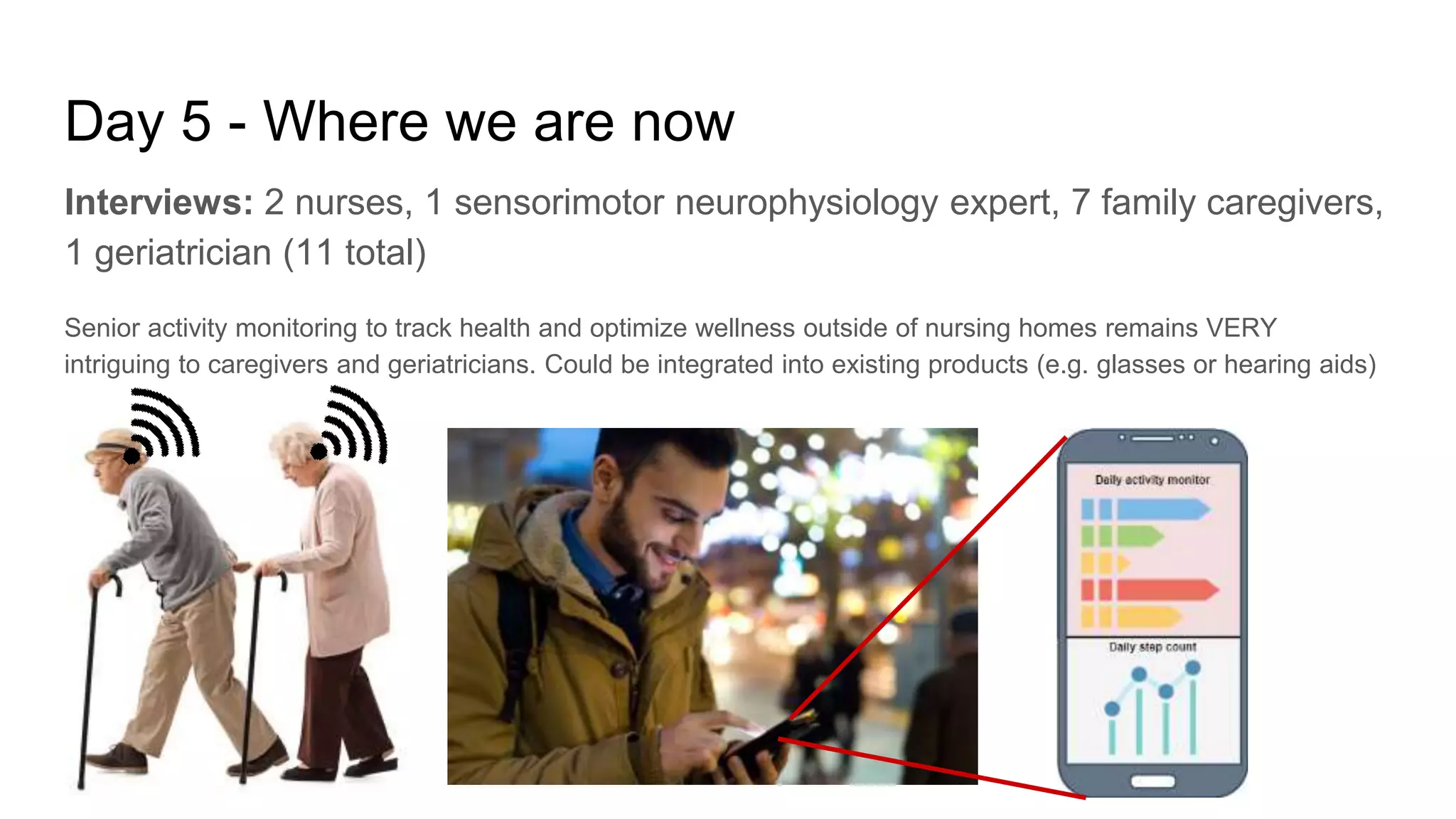
Day 5 - Where we are now
Interviews: 2 nurses, 1 sensorimotor neurophysiology expert, 7 family caregivers,
1 geriatrician (11 total)
Senior activity monitoring to track health and optimize wellness outside of nursing homes remains VERY
intriguing to caregivers and geriatricians. Could be integrated into existing products (e.g. glasses or hearing aids)
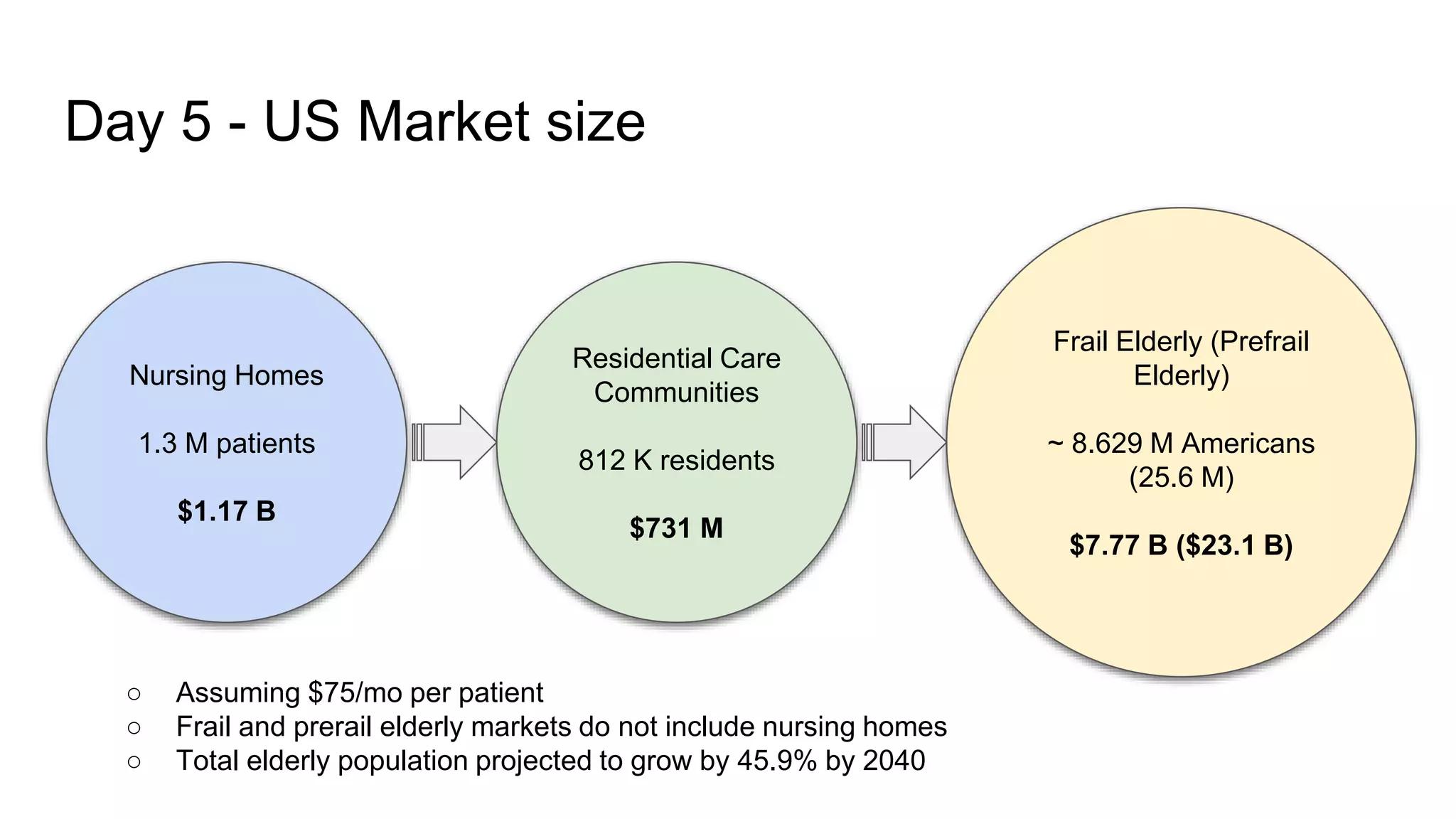
Day 5 - US Market size
○ Assuming $75/mo per patient
○ Frail and prerail elderly markets do not include nursing homes
○ Total elderly population projected to grow by 45.9% by 2040
Nursing Homes
1.3 M patients
$1.17 B
Frail Elderly (Prefrail
Elderly)
~ 8.629 M Americans
(25.6 M)
$7.77 B ($23.1 B)
Residential Care
Communities
812 K residents
$731 M
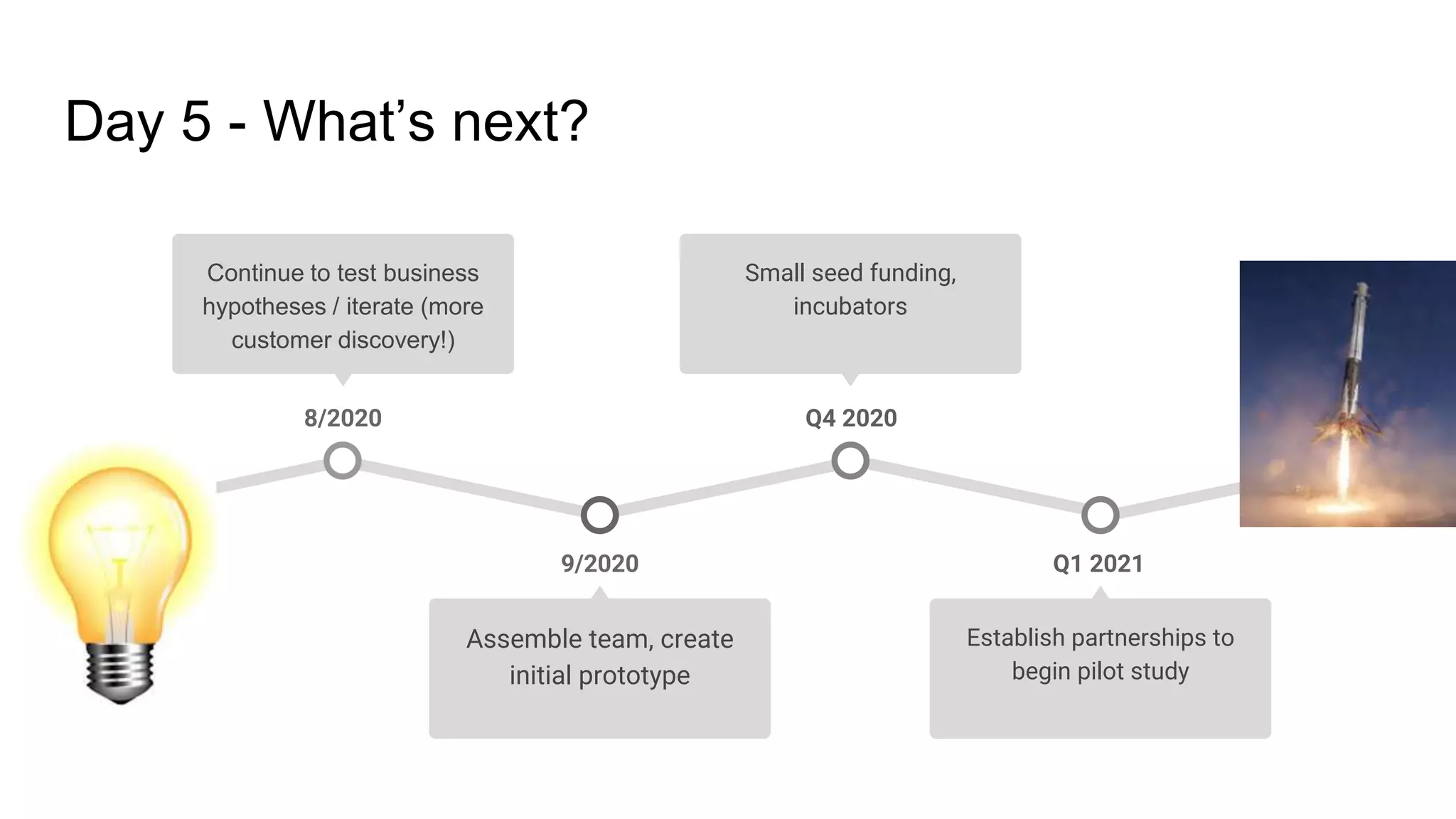
Day 5 - What’s next?
Q1 2021
Establish partnerships to
begin pilot study
Q4 2020
Small seed funding,
incubators
8/2020
Continue to test business
hypotheses / iterate (more
customer discovery!)
9/2020
Assemble team, create
initial prototype

Diffusion H4R Stanford 2020

  • 1.
    Team Diffusion Michael Fanton MEPhD Product/R&D Mike Snyder BioE MS, MBA Business/Strategy August Domel PhD, Postdoc Strategy/Ops/R&D Jack Keene MD, Emergency Med. Med/Admin/Strategy/Risk Matthew Hernandez ME BS, MS&E MS Ops/Strategy Prevention and mitigation of head and neck injuries resulting from falls Better detection and prevention in extreme sports Fall prevention through wearable sensors Mentors: Joy Fairbanks and Pradeep Jotwani
  • 2.
    48 interviews todate (11 since day 4) 11 Contact sports experts Nursing home administrators Nurses Doctors Senior family/guardians 9 164 5 Patients 1 Construction safety managers 2
  • 3.
    Day 1: Businessmodel canvas Key Partners Key Activities Key Resources Value Propositions Customer Relationships Customer Segments Channels Cost Structure Revenue Streams - Engineering design firms - Manufacturing facilities - Safety standard groups / regulatory bodies - Sports leagues (universities, professional, etc.) - Hospitals - Nursing homes - Increased safety and reduction in injuries - Reduction in liability for helmet manufacturers - Increased marketability - Improved helmet standards - Helmet manufacturers of all kinds (football, bike, motorcycle, military, construction, etc.) - Direct to consumer for sensor tech - Sport teams - Nursing homes - Hospitals - Directly to elderly in home - Setting up key partnerships - Tech development of hardware and software - Manufacturing - Marketing key benefits of tech / scientific breakthroughs - Dedicated sales reps - Continued automated service via analyzed sensor data - Retail stores, including sporting good stores - Direct sales to leagues/teams/schools - Existing channels via key partners - Athletic trainers - Hospitals Iteration #1 - Intellectual property - Quality assurance - Capital for manufacturing and testing - Partnerships and agreements - Sales and marketing - R&D and testing - Data storage and upkeep - Sales and marketing - Any potential licensing revenue stream - Data subscriptions and usage (consumer and businesses)
  • 4.
    Day 1: Whatwe thought People want safer helmets
  • 5.
    Day 1: Whatwe learned Extreme Sports ● Safety does matter to users but not aware of which brands are safest ● Competitive, crowded market - hard to break into due to established relationships ● Limited market size Construction ● Construction managers buy hard hats ● Helmet performance does not matter to them - all about compliance and meeting regulations ● No demand here ● Aesthetics (looking cool is better) Elderly falls ● Elderly falls a huge problem both at home and in care facilities ● A lot of technologies invested in fall protection but still a big problem… why?
  • 6.
    Days 2 -4 - Value Proposition Better fall detection is needed to decrease response time and provide peace of mind Long-term activity monitoring to identify patterns in mobilityBetter fall prevention is needed - intervene earlier in fall sequence Acute detection of “risky” situations Interviews with nurse administrators, elderly guardians Interviews with geriatricians, elderly guardians Interviews with nurses and nursing home administrators
  • 7.
    Days 2 -4 - Customer segments Family/caregivers Nursing Homes Who: An adult with senior parent or family member living alone Motivation: Want to prevent injuries and optimize health for their loved one Pain point: Current life alert systems detect falls after they have happened. The technology doesn’t prevent. Who: Long-term care and short- term rehabilitation facilities for elderly population Motivation: Care about preventing falls, are penalized (state rating lowered, or even closed) for falls that become injury. Can be fined. Pain point: Alarms/monitors are available but are insufficient to meet needs and do not prevent falls
  • 8.
    Day 4 MVP- We PREVENT falls in care homes 1. A detachable MEMS-based sensor package (accelerometer, gyroscope) 2. Adhesive patch holder to attach to skin 3. Monitor system for clinician or nurse to see activity of all patients 4. Send alarm of impending fall to staff when risky behaviors are sensed by at- risk patients (e.g. sitting up in bed at night) Patient 1 Patient 2 Patient 3 Patient 4 Patient 5 Activity detection MEMS sensor package Clinician monitor
  • 9.
    MVP Revenue Model Subscriptioncost per patient per month Diffusion ● Leased hardware ● Disposable adhesives ● Data analytics Data to improve algorithms/IP Nursing homes / assisted living Insurance reimbursement?
  • 10.
    Final business modelcanvas Key Partners Key Activities Key Resources Value Propositions Customer Relationships Customer Segments Channels Cost Structure Revenue Streams - Engineering design firms - Manufacturing facilities - Doctor referrals - Nursing homes - Accountable care organization - Insurance Nursing Homes: - Acute fall prevention - Fall injury mitigation through activity monitoring Direct to consumer - Elderly activity monitoring for health optimization - Fall prevention - Fall detection - Assisted living/homes - Senior guardians - Setting up key partnerships - Tech development / validation of hardware and software - Manufacturing - Marketing key benefits of tech / scientific breakthroughs - Pilot studies - Dedicated sales reps (nursing homes) - Online (D2C) - Continued automated service via analyzed sensor data - Online sales (D2C) - Direct sales for nursing homes - Existing channels via key partners - Intellectual property - Quality assurance - Capital for manufacturing and testing - Partnerships and agreements - Sales and marketing - R&D and testing - Data storage and upkeep - Sales and marketing - Clinical trial costs - Data subscriptions and usage (consumer and businesses) - Disposable and durable good - Insurance reimbursement for nursing homes?
  • 11.
    Day 5 -Where we are now Interviews: 2 nurses, 1 sensorimotor neurophysiology expert, 7 family caregivers, 1 geriatrician (11 total) Senior activity monitoring to track health and optimize wellness outside of nursing homes remains VERY intriguing to caregivers and geriatricians. Could be integrated into existing products (e.g. glasses or hearing aids)
  • 12.
    Day 5 -US Market size ○ Assuming $75/mo per patient ○ Frail and prerail elderly markets do not include nursing homes ○ Total elderly population projected to grow by 45.9% by 2040 Nursing Homes 1.3 M patients $1.17 B Frail Elderly (Prefrail Elderly) ~ 8.629 M Americans (25.6 M) $7.77 B ($23.1 B) Residential Care Communities 812 K residents $731 M
  • 13.
    Day 5 -What’s next? Q1 2021 Establish partnerships to begin pilot study Q4 2020 Small seed funding, incubators 8/2020 Continue to test business hypotheses / iterate (more customer discovery!) 9/2020 Assemble team, create initial prototype

Editor's Notes

  • #7 Intervene earlier in the fall sequence
  • #14 The rocket image is off the page to cut off empty space SpaceX rocket - on purpose