Donau-Universität Krems. Centrefor E-Governance.
Donau-Universität Krems,
Zentrum für E-GovernanceWelcome!
Data driven decision making
for Smart Cities
Dr. Gabriela Viale Pereira
2.
Donau-Universität Krems. Centrefor E-Governance.
Agenda
• Part I: Smart Cities and Sustainable Development
– Definitions
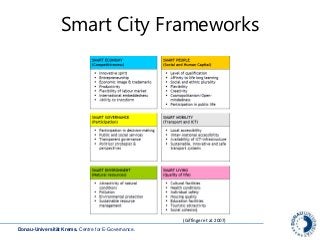
– Frameworks
– Generations (Cohen, 2014)
• Part II: Smart and Digital Governace
– Smart City Governance
Donau-Universität Krems. Centrefor E-Governance.
Contextualizing Smart City
• Challenges of increasing urbanization
• Lack of policies focusing in people‘s well-being
• Aggravation of urban problems
• Proliferation of smart cities as a strategic response
• Setting of responsiveness through ICT
– Empower, engage and enable involvement of multiple stakeholders in building
shared solutions
• Goal 11: Sustainable Cities and Communities
5.
Donau-Universität Krems. Centrefor E-Governance.
Smart Sustainable Cities
• Smart Cities deploy intelligent urban systems to serve sustainable
development, with the aim of addressing the origins of social
instability in cities, improving quality of life, encompassing the needs
of all citizens and fostering participation.
• Sustainable development requires a holistic and cross-sector policy
approach to ensure that economic, social and environmental
challenges are addressed together.
• Sustainable development is an issue of governance and requires
the right instruments to ensure policy coherence.
Donau-Universität Krems. Centrefor E-Governance.
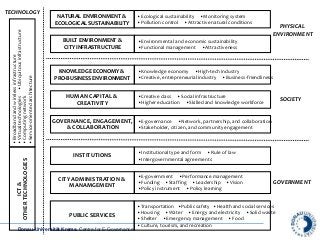
ICT&
OTHERTECHNOLOGIES
BUILT ENVIRONMENT &
CITY INFRASTRUCTURE
KNOWLEDGE ECONOMY &
PRO-BUSINESS ENVIRONMENT
HUMAN CAPITAL &
CREATIVITY
GOVERNANCE, ENGAGEMENT,
& COLLABORATION
CITY ADMINISTRATION &
MANAMGEMENT
INSTITUTIONS
PHYSICAL
ENVIRONMENT
SOCIETY
GOVERNMENT
•Broadbandandwirelessinfrastructure
•Virtualtechnologies•Ubiquitousinfrastructure
•Computingnetwork
•Service-orientedarchitecture
•Institutional type and form •Rule of law
•Intergovernmental agreements
•E-government •Performance management
•Funding •Staffing •Leadership •Vision
•Policy instrument •Policy learning
•E-governance •Network, partnership, and collaboration
•Stakeholder, citizen, and community engagement
•Creative class •Social infrastructure
•Higher education •Skilled and knowledge workforce
•Knowledge economy •High-tech industry
•Creative, entrepreneurial industry •Business-friendliness
•Environmental and economic sustainability
•Functional management •Attractiveness
PUBLIC SERVICES
•Transportation •Public safety •Health and social services
•Housing •Water •Energy and electricity •Solid waste
•Shelter •Emergency management •Food
•Culture, tourism, and recreation
NATURAL ENVIRONMENT &
ECOLOGICAL SUSTAINABILITY
•Ecological sustainability •Monitoring system
•Pollution control •Attractive natural conditions
TECHNOLOGY
8.
Donau-Universität Krems. Centrefor E-Governance.
Smart Cities Generations
• SMART CITIES 1.0: TECHNOLOGY DRIVEN
– Technology solutions with no proper understanding or capacity
– Lack of interaction with citizens
• “IBM defines a smarter city as one that makes optimal use of all the
interconnected information available today to better understand
and control its operations and optimize the use of limited
resources.”
9.
Donau-Universität Krems. Centrefor E-Governance.
Smart Cities Generations
• SMART CITIES 2.0: TECHNOLOGY ENABLED, CITY-LED
– City government driven
– The role of smart technologies and other innovations
– Tech solutions as enablers to improve quality of life
• Central operations center (smart services)
– Solution for the urgency and dynamism of urban problems
• Closed Circuit Television (CCTV) to observe and respond to the incidents faster and well
informed
• Command and Control of integrated operations
• Communication and coordination
• Monitoring and analysis of data
Donau-Universität Krems. Centrefor E-Governance.
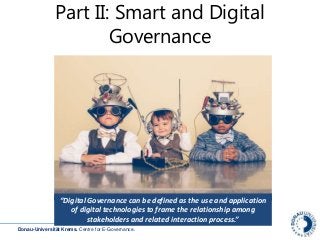
Part II: Smart and Digital
Governance
“Digital Governance can be defined as the use and application
of digital technologies to frame the relationship among
stakeholders and related interaction process.”
13.
Donau-Universität Krems. Centrefor E-Governance.
Smart Governance
• The capacity of employing intelligent and adaptive acts and
activities of looking after and making decision about something
(Scholl and AlAwadhi, 2016)
• Albino, Berardi and Dangelico (2015) state: “[…] smart governance
means various stakeholders are engaged in decision making and
public services”
14.
Donau-Universität Krems. Centrefor E-Governance.
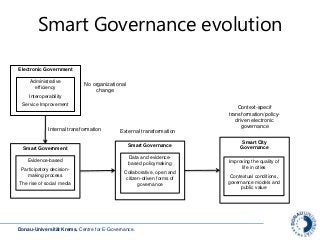
Smart Governance evolution
Electronic Government
Administrative
efficiency
Interoperability
Service Improvement
Smart Government
Evidence-based
Participatory decision-
making process
The rise of social media
Smart Governance
Data and evidence-
based policymaking
Collaborative, open and
citizen-driven forms of
governance
Smart City
Governance
Improving the quality of
life in cities
Contextual conditions,
governance models and
public value
No organizational
change
Internal transformation External transformation
Context-specif
transformation/policy-
driven electronic
governance
15.
Donau-Universität Krems. Centrefor E-Governance.
Value creation with society
• Leadership
• Citizen participation
• Partnerships
• Public-private partnerships
• Accountability
• Responsiveness
• Transparency
• Collaboration
• Data sharing
• Information integration services
• Communication
• Economic Growth
Osella, Ferro and Pautasso (2016)
16.
Donau-Universität Krems. Centrefor E-Governance.
The role of ICT
• ICT’s innovations are making it possible to process smart city data and
provide the necessary information for decision makers to improve policy
making
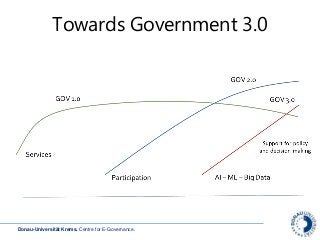
• New paradigm shift in policy making unveiling its major aspects: (a) More
people involved (the collaborative governance curve); (b) more accurate
and analytical, modeling and simulation tools (the AI curve) and (c) more
data available (the big data curve).
Donau-Universität Krems. Centrefor E-Governance.
ICT for Governance in
policy modelling
• Indicates the interplay between a number of technologies that are applied in
order to
– achieve the target of participative, evidence-based governance
– organizational and social processes associated with them
– improving the quality and effectiveness of policies and governance models
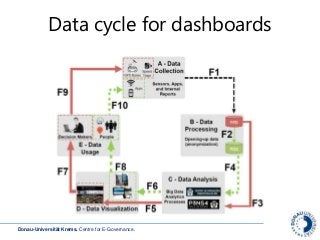
• Creating evidence-based platforms to support data-driven decision making
processes
– ICT-based tools to create visualizations based on datasets and social media engines
– Prevention rather than reaction
– Test policy options before implementation
19.
Donau-Universität Krems. Centrefor E-Governance.
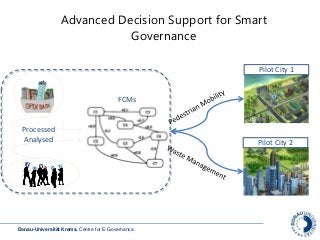
Advanced Decision Support for Smart
Governance
Pilot City 1
Pilot City 2
Processed
Analysed
FCMs
Donau-Universität Krems. Centrefor E-Governance.
Data-Smart Governance
• Open x internal data (shared information)
• Data-based decision-making
– Collecting smart city data from sensors, smart phones or citizens
– Linked to data repositories
– Performed through analytical logic
– Improve urban governance
Donau-Universität Krems. Centrefor E-Governance.
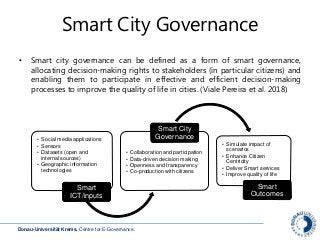
Smart City Governance
• Smart city governance can be defined as a form of smart governance,
allocating decision-making rights to stakeholders (in particular citizens) and
enabling them to participate in effective and efficient decision-making
processes to improve the quality of life in cities. (Viale Pereira et al. 2018)
• Social media applications
• Sensors
• Datasets (open and
internal sources)
• Geographic information
technologies
Smart
ICT/inputs
• Collaboration and participation
• Data-driven decision making
• Openness and transparency
• Co-production with citizens
Smart City
Governance
• Simulate impact of
scenarios
• Enhance Citizen
Centricity
• Deliver Smart services
• Improve quality of life
Smart
Outcomes
25.
Donau-Universität Krems. Centrefor E-Governance.
Thank you!
Gabriela Viale Pereira
gabriela.viale-pereira@donau-uni.ac.at
Department for E-Governance
Danube University Krems
Editor's Notes
#10 Smart services: connected streeming video for crime detection and prevention and integrated emergency services administration
Wifi in public spaces and Public transit
Inteligent lighting
Electric vehicle charging infrastructure

![Donau-Universität Krems. Centre for E-Governance.
Smart Governance
• The capacity of employing intelligent and adaptive acts and
activities of looking after and making decision about something
(Scholl and AlAwadhi, 2016)
• Albino, Berardi and Dangelico (2015) state: “[…] smart governance
means various stakeholders are engaged in decision making and
public services”](https://image.slidesharecdn.com/smartcitygovernancegabriela-180720001513/85/Data-Driven-Decision-Making-for-Smart-Cities-13-320.jpg?cb=1532045746)


![Samos Summit Digital Europe 2040 [g.misuraca]](https://cdn.slidesharecdn.com/ss_thumbnails/session2-pres2-samos-summitdigital-europe2040g-200713101758-thumbnail.jpg?width=640&height=640&fit=bounds)


