Downloaded 47 times
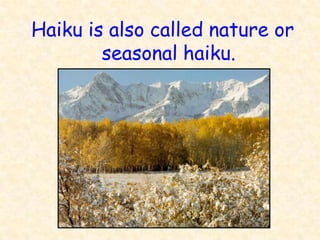
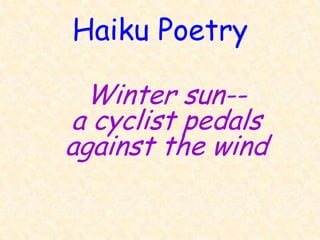
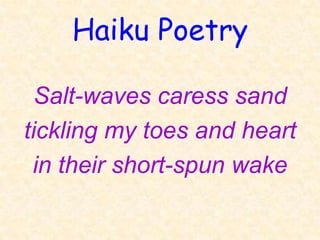
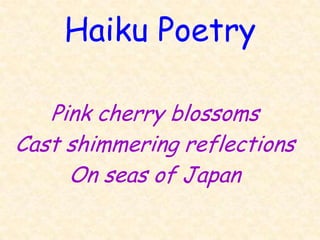
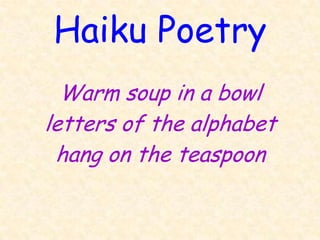






Haiku is a form of Japanese poetry with 3 lines containing a pattern of 5, 7, and 5 syllables. It focuses on nature and seasons, often capturing a single image or moment. While traditionally written in the present tense, the syllable structure is flexible. Haiku conveys impressions through fragmentary language and the juxtaposition of images across its short lines. Examples are provided to demonstrate how haiku poetry can capture moments of nature or everyday objects through minimal yet vivid language.


