RED BULL
HARVARD SUMMER
SCHOOL: STRATEGIC
Presentation by: Robert Wensley, Brett
MANAGEMENT
Lashley, Joanna Alencastro, Peter Jendrolovics
SOFT DRINK
INDUSTRY ANALYSIS
SWOT - STRENGTHS
• Nature of market
• Diverse market - health, energy
and concentrated drinks
• Low ingredient and manufacturing
costs
• High profit margins
SWOT - WEAKNESSES


•Health concerns
•Brand loyalties
•Retailers – generic brands
SWOT - OPPORTUNITIES

• Space for innovative products
• International market potential
•Potential for diet, healthier, or
flavored beverage versions
•Environmental marketing
SWOT - THREATS
•Threat from cheaper retailer owned
brands
•PepsiCo and Coca-Cola dominate the
market
•Large brands’ advertising and
marketing budgets
•Marketing regulations
MARKET TRENDS

SOFTDRIN    Health conscious market
KS
            High barriers to entry

            Growth of premium market

             segment
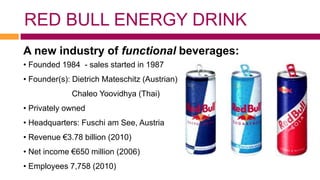
RED BULL ENERGY DRINK
A new industry of functional beverages:
• Founded 1984 - sales started in 1987
• Founder(s): Dietrich Mateschitz (Austrian),
             Chaleo Yoovidhya (Thai)
• Privately owned
• Headquarters: Fuschi am See, Austria
• Revenue €3.78 billion (2010)
• Net income €650 million (2006)
• Employees 7,758 (2010)
BRAND IMAGE AND VALUE

Euro brands rank and brand value
Constantly innovating – expanding and
looking for new opportunities
Aggressively marketing the slogan “Red
Bull gives you wings” through
advertisement
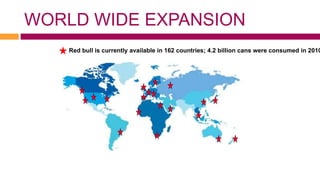
WORLD WIDE EXPANSION
    Red bull is currently available in 162 countries; 4.2 billion cans were consumed in 2010
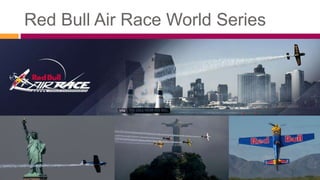
Red Bull Air Race World Series
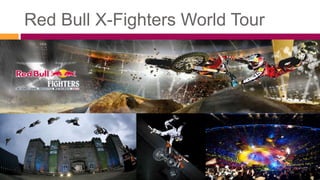
Red Bull X-Fighters World Tour
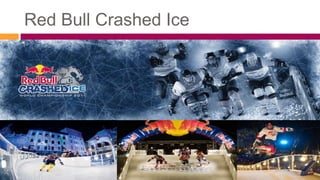
Red Bull Crashed Ice
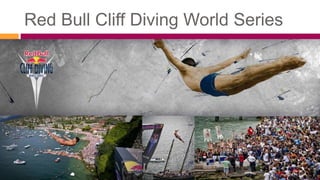
Red Bull Cliff Diving World Series
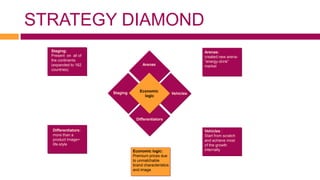
STRATEGY DIAMOND
  Staging:                                                         Arenas:
    .
  Present on all of
  the continents
                                                                   created new arena-
                                                                   ”energy-drink”
  (expanded to 162                   Arenas                        market
  countries)


                      Staging       Economic
                                                        Vehicles
                                      logic


                                  Differentiators

  Differentiators:                                                 Vehicles :
  more than a                                                      Start from scratch
  product Image+                                                   and achieve most
  life-style                                                       of the growth
                                Economic logic:                    internally
                                Premium prices due
                                to unmatchable
                                brand characteristics
                                and image
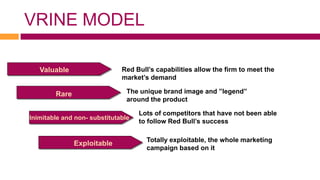
VRINE MODEL

   Valuable                   Red Bull’s capabilities allow the firm to meet the
                              market’s demand

        Rare                    The unique brand image and ”legend”
                                around the product

                                    Lots of competitors that have not been able
Inimitable and non- substitutable
                                    to follow Red Bull’s success

                                      Totally exploitable, the whole marketing
               Exploitable
                                      campaign based on it
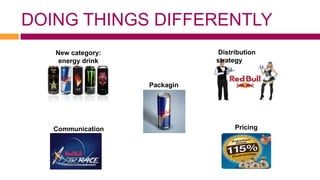
DOING THINGS DIFFERENTLY
   New category:              Distribution
   .energy drink              strategy
      market

                   Packagin
                   g


   Communication                   Pricing
   strategy                        strategy
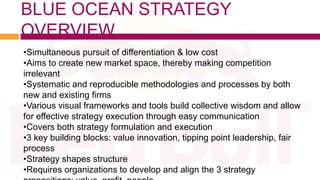
BLUE OCEAN STRATEGY
OVERVIEW
•Simultaneous pursuit of differentiation & low cost
•Aims to create new market space, thereby making competition
irrelevant
•Systematic and reproducible methodologies and processes by both
new and existing firms
•Various visual frameworks and tools build collective wisdom and allow
for effective strategy execution through easy communication
•Covers both strategy formulation and execution
•3 key building blocks: value innovation, tipping point leadership, fair
process
•Strategy shapes structure
•Requires organizations to develop and align the 3 strategy
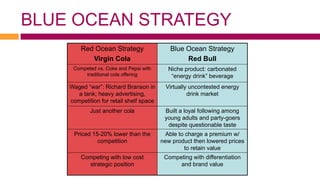
BLUE OCEAN STRATEGY
        Red Ocean Strategy                  Blue Ocean Strategy
           Virgin Cola                           Red Bull
     Competed vs. Coke and Pepsi with      Niche product: carbonated
         traditional cola offering          “energy drink” beverage
    Waged “war”: Richard Branson in       Virtually uncontested energy
       a tank; heavy advertising,                  drink market
    competition for retail shelf space
            Just another cola             Built a loyal following among
                                          young adults and party-goers
                                           despite questionable taste
     Priced 15-20% lower than the         Able to charge a premium w/
              competition                new product then lowered prices
                                                 to retain value
        Competing with low cost           Competing with differentiation
          strategic position                   and brand value
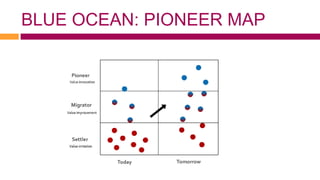
BLUE OCEAN: PIONEER MAP
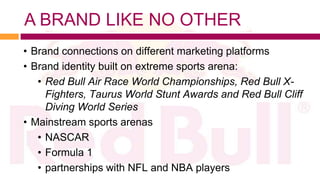
A BRAND LIKE NO OTHER
• Brand connections on different marketing platforms
• Brand identity built on extreme sports arena:
   • Red Bull Air Race World Championships, Red Bull X-
     Fighters, Taurus World Stunt Awards and Red Bull Cliff
     Diving World Series
• Mainstream sports arenas
   • NASCAR
   • Formula 1
   • partnerships with NFL and NBA players
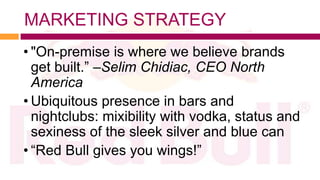
MARKETING STRATEGY
• "On-premise is where we believe brands
  get built.” –Selim Chidiac, CEO North
  America
• Ubiquitous presence in bars and
  nightclubs: mixibility with vodka, status and
  sexiness of the sleek silver and blue can
• “Red Bull gives you wings!”
ADRENALINE MARKETING
• Risqué marketing
• In-your-face, adrenaline junky image vs. Coke
  and Pepsi’s All-American approach
• Decision to foster rumors that Red Bull’s key
  ingredient, Taurine, was derived from bull
  testicles
RECOMMENDATIONS

• Geographical growth in emerging
  markets
• Turn unprofitable sports portfolio into
  profitable portfolio
• New product lines
NO RED BULL, NO WINGS!


 THANK
 YOU!
SOURCES
Kim, W. Chan., and Renée Mauborgne. Blue Ocean Strategy: How to Create
Uncontested Market Space and Make the Competition Irrelevant. Boston, MA: Harvard
Business School, 2005. Print.

Mi, JI, Six Misconceptions of Blue Ocean Strategy. Guanli Xue Jia (Management
Scientist) 2008.

Cirillo, Jennifer. "Red Bull - Running of the Bull." Beverage World June 2009: 18-21.
Web.

Bryce, David J., and Jeffrey H. Dyer. "Strategies to Crack Well-Guarded Markets."
Harvard Business Review May 2007: 84-92. Web. <http://www.hbr.org>.

McDonald, Duff. "The Mastermind of Adrenaline Marketing." Bloomberg Businessweek
23-29 May 2011: 64-70. Web.

Red Bull Blue Ocean Strategy

  • 1.
    RED BULL HARVARD SUMMER SCHOOL:STRATEGIC Presentation by: Robert Wensley, Brett MANAGEMENT Lashley, Joanna Alencastro, Peter Jendrolovics
  • 4.
  • 5.
    SWOT - STRENGTHS •Nature of market • Diverse market - health, energy and concentrated drinks • Low ingredient and manufacturing costs • High profit margins
  • 6.
    SWOT - WEAKNESSES •Healthconcerns •Brand loyalties •Retailers – generic brands
  • 7.
    SWOT - OPPORTUNITIES •Space for innovative products • International market potential •Potential for diet, healthier, or flavored beverage versions •Environmental marketing
  • 8.
    SWOT - THREATS •Threatfrom cheaper retailer owned brands •PepsiCo and Coca-Cola dominate the market •Large brands’ advertising and marketing budgets •Marketing regulations
  • 9.
    MARKET TRENDS SOFTDRIN  Health conscious market KS  High barriers to entry  Growth of premium market segment
  • 10.
    RED BULL ENERGYDRINK A new industry of functional beverages: • Founded 1984 - sales started in 1987 • Founder(s): Dietrich Mateschitz (Austrian), Chaleo Yoovidhya (Thai) • Privately owned • Headquarters: Fuschi am See, Austria • Revenue €3.78 billion (2010) • Net income €650 million (2006) • Employees 7,758 (2010)
  • 11.
    BRAND IMAGE ANDVALUE Euro brands rank and brand value Constantly innovating – expanding and looking for new opportunities Aggressively marketing the slogan “Red Bull gives you wings” through advertisement
  • 12.
    WORLD WIDE EXPANSION Red bull is currently available in 162 countries; 4.2 billion cans were consumed in 2010
  • 13.
    Red Bull AirRace World Series
  • 14.
  • 15.
  • 16.
    Red Bull CliffDiving World Series
  • 17.
    STRATEGY DIAMOND Staging: Arenas: . Present on all of the continents created new arena- ”energy-drink” (expanded to 162 Arenas market countries) Staging Economic Vehicles logic Differentiators Differentiators: Vehicles : more than a Start from scratch product Image+ and achieve most life-style of the growth Economic logic: internally Premium prices due to unmatchable brand characteristics and image
  • 18.
    VRINE MODEL Valuable Red Bull’s capabilities allow the firm to meet the market’s demand Rare The unique brand image and ”legend” around the product Lots of competitors that have not been able Inimitable and non- substitutable to follow Red Bull’s success Totally exploitable, the whole marketing Exploitable campaign based on it
  • 19.
    DOING THINGS DIFFERENTLY New category: Distribution .energy drink strategy market Packagin g Communication Pricing strategy strategy
  • 20.
    BLUE OCEAN STRATEGY OVERVIEW •Simultaneouspursuit of differentiation & low cost •Aims to create new market space, thereby making competition irrelevant •Systematic and reproducible methodologies and processes by both new and existing firms •Various visual frameworks and tools build collective wisdom and allow for effective strategy execution through easy communication •Covers both strategy formulation and execution •3 key building blocks: value innovation, tipping point leadership, fair process •Strategy shapes structure •Requires organizations to develop and align the 3 strategy
  • 21.
    BLUE OCEAN STRATEGY Red Ocean Strategy Blue Ocean Strategy Virgin Cola Red Bull Competed vs. Coke and Pepsi with Niche product: carbonated traditional cola offering “energy drink” beverage Waged “war”: Richard Branson in Virtually uncontested energy a tank; heavy advertising, drink market competition for retail shelf space Just another cola Built a loyal following among young adults and party-goers despite questionable taste Priced 15-20% lower than the Able to charge a premium w/ competition new product then lowered prices to retain value Competing with low cost Competing with differentiation strategic position and brand value
  • 22.
  • 23.
    A BRAND LIKENO OTHER • Brand connections on different marketing platforms • Brand identity built on extreme sports arena: • Red Bull Air Race World Championships, Red Bull X- Fighters, Taurus World Stunt Awards and Red Bull Cliff Diving World Series • Mainstream sports arenas • NASCAR • Formula 1 • partnerships with NFL and NBA players
  • 24.
    MARKETING STRATEGY • "On-premiseis where we believe brands get built.” –Selim Chidiac, CEO North America • Ubiquitous presence in bars and nightclubs: mixibility with vodka, status and sexiness of the sleek silver and blue can • “Red Bull gives you wings!”
  • 25.
    ADRENALINE MARKETING • Risquémarketing • In-your-face, adrenaline junky image vs. Coke and Pepsi’s All-American approach • Decision to foster rumors that Red Bull’s key ingredient, Taurine, was derived from bull testicles
  • 26.
    RECOMMENDATIONS • Geographical growthin emerging markets • Turn unprofitable sports portfolio into profitable portfolio • New product lines
  • 28.
    NO RED BULL,NO WINGS! THANK YOU!
  • 29.
    SOURCES Kim, W. Chan.,and Renée Mauborgne. Blue Ocean Strategy: How to Create Uncontested Market Space and Make the Competition Irrelevant. Boston, MA: Harvard Business School, 2005. Print. Mi, JI, Six Misconceptions of Blue Ocean Strategy. Guanli Xue Jia (Management Scientist) 2008. Cirillo, Jennifer. "Red Bull - Running of the Bull." Beverage World June 2009: 18-21. Web. Bryce, David J., and Jeffrey H. Dyer. "Strategies to Crack Well-Guarded Markets." Harvard Business Review May 2007: 84-92. Web. <http://www.hbr.org>. McDonald, Duff. "The Mastermind of Adrenaline Marketing." Bloomberg Businessweek 23-29 May 2011: 64-70. Web.

Editor's Notes

  • #6 • The nature of the soft drinks market — featuring an array of strong, powerful brands — ensures continued demand for its products. Significant advertising spends and high-profile campaigns from large brands benefit the overall market.• The market is diverse with many sectors — including, for example, health, energy and concentrated drinks — and thus offers consumers great choice.• Low ingredient and manufacturing costs leading to high profit margins make the market potentially lucrative for a wide variety of companies.• Economies of scale are available to all large companies, thus cutting down costs.
  • #7 -As consumers become more health conscious, sales of carbonated drinks — that are high in sugar and contain artificial additives or flavorings — might suffer.-Existing consumer brand loyalties could make it difficult for new products to break into the market.-Brands have their profit margins squeezed by large supermarkets and multiples, retailers who can command a low price for products.-It is easy for shops to produce their own-brand versions of existing products, to compete with well-known branded goods.
  • #8 • There is space for new brands and innovative products within the market — the recent emergence of the energy drink sector demonstrates this.• Brands are easily transferable into the international market; profits can be hugely increased by taking this step once a brand has succeeded in the domestic market.•Most carbonates involve a fairly versatile recipe — which means that they can be adapted into diet, healthier or flavored versions. Many retailers, not traditionally viewed as drinks vendors, are investigating if introducing soft drinks would increase their profits•Companies now have the opportunity to improve their brand image by addressing environmental concerns, by being a market leader in changing their packaging or introducing a large-scale recycling scheme.
  • #9 •Threat from cheaper retailer owned brand versions of their products.•The cola market dominates the carbonates market; PepsiCo and Coca-Cola both have huge shares of the cola market, thus limiting opportunities for new companies.•New product launches for smaller companies could be overwhelmed by large brands’ advertising and marketing budgets.•Marketing to children has been tightly regulated in recent years, and regulations could become even stricter in the future.•Many pressure groups are looking to pinpoint reasons for rising obesity levels, and soft drinks could be included amongst products deemed responsible.
  • #10 -There has been a flurry of negative publicity for sweet, carbonated drinks in recent years, as the nation becomes more health-conscious. There is an ongoing debate surrounding obesity levels and related causes; many believe ‘junk’ food and drink consumption is a root cause.-In recent years, there have been a number of products launched to combat health fears amongst the public; there has been an increase in the number of products with more natural flavorings and colorings.-Larger brands are still growing and command a large market share; they also spend significant amounts on advertising, making it even harder for smaller companies to enter the market and become serious competitors. A small number of companies have managed to break into the market, such as Innocent and Red Bull, but it is becoming increasingly difficult.-In the future, the public could be exposed to a greater selection of premium range drinks with a slightly higher price tag. The alcoholic drink and food market is full of premium alternatives, yet this has yet to fully develop in the soft drinks market.-Counter to the rise in health conscious branding, there has additionally been an influx of energy drink brands into the soft drinks market. Coca-Cola has launched the Relentless brand, the Monster brand has arrived in Europe from America, and Mountain Dew has been relaunched as an energy drink. Lucozade has also launched its energy product, called Lucozade Alert. There have also been new products placed on the market in the form of energy shots; these shots usually come in 60ml quantities, but contain as much caffeine as a regular-sized drink.
  • #11 Operating income €1.3 billion (2006) In 1982, Dietrich Mateschitz became aware of products called &quot;tonic drinks&quot;, which enjoyed widespread popularity throughout the Far East. The idea to market these functional drinks outside Asia came to him while sitting at a bar at the Mandarin Hotel in Hong Kong. In 1984, Mateschitz founded Red Bull. He fine-tuned the product, developed a unique marketing concept and in 1987, started selling Red Bull Energy Drink on the Austrian market. This was not only the launch of a completely new product, in fact it was the birth of a totally new product category. Today Red Bull is present in over 160 countries. Since 1987, around 30 billion cans of Red Bull have been consumed, more than 4.2 billion in 2010. The responsibility for the success of the world&apos;s No. 1 energy drink is shared by the company&apos;s 7,758 employees around the world (compared to 6.900 in 2009). The Red Bull headquarters are based in Fuschl am See, not far from Salzburg, Austria.Red Bull was one of the first functional beverages and the very first Energy Drink in times. For more than 23 years and all around the world it has been giving wings to people who want to be physically and mentally fit. Increases performanceIt has been extensively studied that Red Bull increases performance which is proven by e.g. the following digest of papers:Increases concentration and reaction speedIn various studies it was proven that Red Bull increases concentration and reaction speed:Improves vigilanceHere are some references to relevant studies about Red Bull improving vigilance:Stimulates metabolismHere is a digest of relevant studies which prove that Red Bull stimulates metabolism:Makes you feel more energetic and thus improves your overall well-being
  • #12 PIONEERBrand image: firstTV ads, expansion into the middle East, association with edgy sportsBrand value: Euro brands, mention brand valueTheir slogan is &quot;Red Bull gives you wiiings&quot;[6] and the product is aggressively marketed through advertising, tournament sponsorship (Red Bull Air Race, Red Bull Crashed Ice), sports team ownerships (Red Bull Racing, Scuderia Toro Rosso, EC Red Bull Salzburg, FC Red Bull Salzburg, Red Bull New York, RB Leipzig), celebrity endorsements, and with its record label, Red Bull Records, music
  • #13 company&apos;s 7,758 employees around the worldSince 1987 over 30 billion cans have been consumed4.2 billion in 2010
  • #15 Red Bull X-Fighters World Tour 2011: Four continents, six countries, more than 200.000 spectators and more than 1000 jumps
  • #16 Red Bull Crashed Ice: a combination of ice hockey, downhill skating and boardercross
  • #17 high diving at its most death-defying – an acrobatic descent into water from heights of up to 28m. Once in the air, the divers have approximately three seconds to coordinate their movements before they break the surface of the water at around 100kph (60mph). Schedule to take place in Boston – Aug 20, 2011
  • #24 “Consumers’ decisions to continue to choose Red Bull can be attributed to the brand’s ability, since early on, to make brand connections on different marketing platforms”Brand identity built on extreme sports arena: Red Bull Air Race World Championships, Red Bull X-Fighters, Taurus World Stunt Awards and Red Bull Cliff Diving World SeriesBuilding on its reputation as a performance enhancer for athletes and active individuals, Red Bull moved into more mainstream sports arenas with its own soccer, NASCAR, and Formula 1 teams and partnerships with NFL and NBA players who fit the “Red Bull personality”.
  • #26 Risqué marketing approach went where industry giants would not go and new entrants could not effectively copyIn-your-face, adrenaline junky image vs. Coke and Pepsi’s classic, refreshing, All-American approachDecision to foster rumors that Red Bull’s key ingredient, taurine, was derived from bull testicles
  • #30 Risqué marketing approach went where industry giants would not go and new entrants could not effectively copyIn-your-face, adrenaline junky image vs. Coke and Pepsi’s classic, refreshing, All-American approachDecision to foster rumors that Red Bull’s key ingredient, taurine, was derived from bull testicles