Challenges Facing Workers’ Compensation:
What Medical Tourism Needs to Do
RICHARD KRASNER, MA, MHA
CEO & PRINCIPAL CONSULTANT, FUTURECOMP CONSULTING
BLOGGER-IN-CHIEF, TRANSFORMING WORKERS’ COMP BLOG
©2015 FutureComp Consulting
Introduction
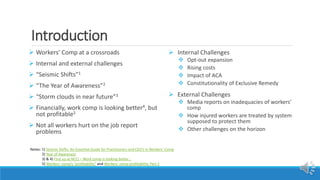
 Workers’ Comp at a crossroads
 Internal and external challenges
 “Seismic Shifts”1
 “The Year of Awareness”2
 “Storm clouds in near future”3
 Financially, work comp is looking better4, but
not profitable5
 Not all workers hurt on the job report
problems
 Internal Challenges
 Opt-out expansion
 Rising costs
 Impact of ACA
 Constitutionality of Exclusive Remedy
 External Challenges
 Media reports on inadequacies of workers’
comp
 How injured workers are treated by system
supposed to protect them
 Other challenges on the horizon
Notes: 1) Seismic Shifts: An Essential Guide for Practitioners and CEO’s in Workers’ Comp
2) Year of Awareness
3) & 4) First up at NCCI – Work comp is looking better…
5) Workers’ comp’s “profitability” and Workers’ comp profitability, Part 2
Challenges
Opt-out expansion
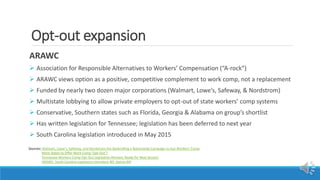
ARAWC
 Association for Responsible Alternatives to Workers’ Compensation (“A-rock”)
 ARAWC views option as a positive, competitive complement to work comp, not a replacement
 Funded by nearly two dozen major corporations (Walmart, Lowe’s, Safeway, & Nordstrom)
 Multistate lobbying to allow private employers to opt-out of state workers’ comp systems
 Conservative, Southern states such as Florida, Georgia & Alabama on group’s shortlist
 Has written legislation for Tennessee; legislation has been deferred to next year
 South Carolina legislation introduced in May 2015
Sources: Walmart, Lowe’s, Safeway, and Nordstrom Are Bankrolling a Nationwide Campaign to Gut Workers’ Comp
More States to Offer Work Comp ‘Opt-Out’?
Tennessee Workers Comp Opt-Out Legislation Revised, Ready for Next Session
ARAWC: South Carolina Legislators Introduce WC Option Bill
Opt-out expansion, cont’d.
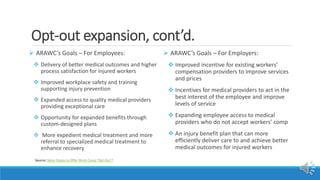
 ARAWC’s Goals – For Employees:
 Delivery of better medical outcomes and higher
process satisfaction for injured workers
 Improved workplace safety and training
supporting injury prevention
 Expanded access to quality medical providers
providing exceptional care
 Opportunity for expanded benefits through
custom-designed plans
 More expedient medical treatment and more
referral to specialized medical treatment to
enhance recovery
 ARAWC’s Goals – For Employers:
 Improved incentive for existing workers’
compensation providers to improve services
and prices
 Incentives for medical providers to act in the
best interest of the employee and improve
levels of service
 Expanding employee access to medical
providers who do not accept workers’ comp
 An injury benefit plan that can more
efficiently deliver care to and achieve better
medical outcomes for injured workers
Source: More States to Offer Work Comp ‘Opt-Out’?
Opt-out expansion, cont’d.
 Criticism of Opt-out legislation
 Opt-out has been criticized as limiting injured workers’ rights to medical benefits
 Workers are taken for granted
 Better medical care and return-to-work rates are alleged without evidence
 Texas system cited without qualification as a success
 Resistance to legislation to enforce ethical and equitable behavior on part of employers and
improve compliance with laws on the books
 Absence of transparency; 100,000, or 90% of employers in Texas fail to file required reports
 Worker intimidation; if an injured worker seeks advice from personal physician, they could
lose their benefits
Sources: Walmart, Lowe’s, Safeway, and Nordstrom Are Bankrolling a Nationwide Campaign to Gut Workers’ Comp
What Opt-out Advocates Need to Do
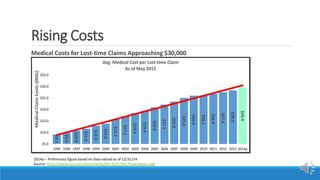
Rising Costs
Medical Costs for Lost-time Claims Approaching $30,000
2014p – Preliminary figure based on data valued as of 12/31/14
Source: https://www.ncci.com/Documents/AIS-2015-SOL-Presentation.pdf
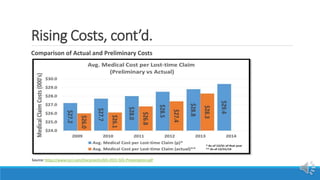
Rising Costs, cont’d.
Source: https://www.ncci.com/Documents/AIS-2015-SOL-Presentation.pdf
Comparison of Actual and Preliminary Costs
Rising Costs: Hospital Costs
 Outpatient costs still rising
 States with %-of-charge fee schedules or no fee schedules had highest payments to hospitals
for outpatient surgical episodes for knee and shoulder surgeries
 States with no fee schedules had 60 – 141% higher payments per episode compared with
states with fixed-amount schedules
 Tremendous variation in rates of change in hospital payments per surgical episode across
states
 SC saw reduction of 31% in avg. hospital payment from 2006 – 2013; AL grew by 81%
 States with %-of-charge-based fee schedules or no fee schedules had more rapid growth
than states with other regulations
 Most percent-of-charge-based states experienced growth that was 157-286% faster than
median of states with fixed-amount fee schedules
Source: Hospital Outpatient Costs Still Rising Says New Study
Rising Costs, cont’d.
 Consolidation
 Payments to hospitals on behalf of privately insured are an estimated 3% higher as a result of
consolidation
 Hospitals have increased their prices by nearly 50% after a merger; after two San Francisco
hospitals merged, their prices increased 28-44%
 Increase in Physician Fees
 7% increase on physician fees for total knee replacements due to concentration of
orthopedic groups
 From 2001-2010, average professional fee for total knee arthroplasty was $2,537
 In markets that moved from bottom quartile of concentration to top quartile, physician fees
paid by private payers increased by $168 per procedure
Sources: The Urge to Merge: Why Health Care Costs Are Still Rising
Increase in Physician Fees for Total Knee Replacements Due to Concentration in Orthopedic Markets
ACA Impact
 Doctor Shortage by 2025
 US will be short 46,000 – 90,000 doctors by 2025, according to Association of American
Medical Colleges (AAMC)
 AAMC estimates shortage of primary care physicians will be 12,500 – 31,100; 28,200 –
63,700 non-primary care physicians, most notably among surgical specialists
 Total physician demand projected to grow by up to 17%, with population aging and growth
accounting for majority
 ACO’s May Shift Claims into Workers’ Comp
 Workers’ Comp Research Institute (WCRI) found that millions of claims dollars may be shifted
into workers’ comp due to Accountable Care Organizations (ACO’s)
Sources: Doctor shortage to hit 90,000 by 2025, report says
Accountable Care Organizations May Shift Claims into Workers’ Comp
ACA Impact, cont’d.
 Hospital Closures Due to Failure to Expand Medicaid
 Hospitals in Kansas, Kentucky and Louisiana, as well as other states that rejected Medicaid
expansion are struggling
 283 mostly-rural hospitals are in financial trouble, and since 2010, 48 have closed
 Failure to Expand Medicaid Could Lead to Cost-Shifting to Workers’ Comp
 Problems will arise unless states expand Medicaid
 Problems due to two things:
 Cost pressure placed on facilities and health systems will lead to increased pressure to cost shift
 6.4 million adults who remain uninsured will be less healthy, have more incentive to get care under
work comp and heal more slowly
Sources: Hospital Closures Due to Failure to Expand Medicaid
Failure to Expand Medicaid Could Lead to Cost-Shifting to Workers’ Comp
Medicaid and Workers’ Comp
Constitutionality of Exclusive Remedy
 What is Exclusive Remedy?
 Protects employers from common lawsuits by employees to recover for work-related injuries
 Limits a worker's remedies for work-related injuries to a workers' compensation claim
against the employer
 “Trade-off” compromise whereby both employers and employees give up certain advantages
in return for others; so-called “Grand Bargain”
 Employers trade liability, regardless of fault, for protection from large tort awards, and
employees surrender a cause of action in return for swift but limited financial benefits
Source: http://definitions.uslegal.com/e/exclusive-remedy-rule/
Constitutionality of Exclusive Remedy, cont’d.
 Constitutionality
 Various reforms over the years have devalued the workers’ comp program that it can no
longer meet its constitutional declared objectives
 Plaintiffs in FL case Julio Cortes v Velda Farms allege comp system became “unconstitutional
as an exclusive remedy in stages,” as lawmakers made changes that slowly eroded benefits
and protections
 Plaintiffs asserted that anytime Legislature takes away a right, it must provide a “reasonable
alternative”
 Miami-Dade County Circuit Court Judge Jorge Cueto ruled in Padgett vs State of Florida, that
the exclusive remedy provision is unconstitutional
Source: Constitutionality of Workers' Comp Challenged: What that could mean for Medical Travel
Constitutionality of Exclusive Remedy, cont’d.
 Constitutionality, cont’d.
 Basis of ruling was that over the years, Florida’s workers’ comp act benefits had been eroded
as to no longer serve as an adequate remedy
 District Court judge in Oklahoma ruled that its state’s workers’ comp law does not provide
exclusive remedy for “foreseeable” injuries
 Judge ruled that employee could sue his employer because his injury was “foreseeable” and
therefore employee did not suffer a compensable injury under OK workers’ comp law
 Florida 3rd District Court of Appeal ruled in June, plaintiffs in Padgett had no legal standing,
constitutionality upheld; but plaintiffs will continue to change constitution
Sources: Update on Constitutionality of Work Comp in Florida
Exclusive Remedy in Workers’ Comp under Assault
Breaking News on ACA and Exclusive Remedy
Media Reports
Exposes deficiencies in Workers’ Comp system
 ProPublica/NPR
 The Demolition of Workers’ Comp
 “Reforms” pushed by big business and insurance carriers have dismantled state WC
systems
 Cutbacks have been drastic in some places, they guarantee workers will plummet into
poverty; workers often battle insurance companies for surgeries, prescriptions, and basic
help doctors recommend
 The Fallout of Workers’ Comp “Reforms”: 5 Tales of Harm
 Five case studies reveal real-life impact of rollbacks spreading across the country
 How Much Is Your Arm Worth? Depends On Where You Work
 Found there was different compensation for identical injuries; example: Arm injury AL
$49K, GA $118K
Sources: The Demolition of Workers Compensation
The Fallout of Workers’ Comp “Reform”: 5 Tales of Harm
How Much Is Your Arm Worth? Depends On Where You Work
Media Reports, cont’d.
 OSHA Report
 Adding Inequality to Injury: The Cost of Failing to Protect Workers on the Job
 More than 3 million workers seriously injured every year; thousands more are killed on the job
 Financial and social impacts of injuries and illnesses are huge, with workers and their families,
and taxpayer-supported programs paying most of the costs
 Workplace injuries create a trap which leaves them less able to save for future or make
investments in skills and education
 Injuries contribute to issue of income inequality
 Mother Jones article
 Criticizes push for opt-out legislation
 Industry response
 Slanted “reporting” public disservice; biased view of work comp system; facts not
substantiated
Sources: ADDING INEQUALITY TO INJURY: THE COSTS OF FAILING TO PROTECT WORKERS ON THE JOB
Walmart, Lowe’s, Safeway, and Nordstrom Are Bankrolling a Nationwide Campaign to Gut Workers’ Comp
ProPublica’s slanted “reporting” is a public disservice
Treatment of Injured Workers
 Injured workers denied basic medical care and services, as well as adequate compensation,
leading to impoverishment
 ProPublica/NPR and OSHA reports – lost limbs, delays in treatment, etc.
 Article “They Shoot Horses Don’t They?” discusses why injured workers are subjected to
various indignities after suffering a work-related injury
 Big businesses largely believe workers are disposable
 Workers who are injured on the job are cast aside
 Large corporations’ attitude towards worker and treatment of the workforce can be
summed up by one word: exploitation
 Work of ARAWC cited as a new “reform” trend taking workers’ rights back to time when
they had no recourse for injuries, and as a result became impoverished or died
Source: They Shoot Horses Don't They?
Seismic Shifts
 Seismic Shifts: An Essential Guide for Practitioners and CEO’s in Workers’ Comp
 Report by Peter Rousmaniere earlier this year found “next big wave…is already here” for
workers’ comp industry; offers contrasting view of industry direction over next decade
 Workers’ comp industry is shrinking
 1993 – today, number of serious work injuries dropped by over 35%
 Today – 2022, work injuries will likely drop by 35% again; study of impact of automation
suggests that over next decade or longer, injuries might be cut in half
 Cites Texas as example of the shrinking of the industry
 2013, Texas private sector workforce incurred 30% fewer lost time injuries than in 2004
 As the typical claim is increasing in complexity, total number of claims decreasing
Source: Seismic Shifts: An Essential Guide for Practitioners and CEO’s in Workers’ Comp
Seismic Shifts, cont’d.
 Factor behind shrinking of workers’ comp claims
 Shift from manufacturing to service
 Entering into 20th century, service sector roughly equal to goods-producing sector in share of national
output
 Change began in 1920’s; by 1960’s, the service sector eclipsed industry in creating economic value
 Employment in services climbed from 55% to 85% of total employment
 Manufacturing employment (70% male) dropped precipitously, and revival of manufacturing uses a
fraction of workers employed in the past
 Manufacturing employment much safer today; risk of “time lost” injury same as service sector
 1994: for every 10 manufacturing injuries involving one day’s lost time, there were 8 service sector
injuries
 2012: for every 2 manufacturing lost-time injuries, there were 10 service sector injuries
Source: Seismic Shifts: An Essential Guide for Practitioners and CEO’s in Workers’ Comp
Seismic Shifts, cont’d.
 Top Four Reason for Declining Injuries and Claims
 Workers may be reporting and claiming less out of intimidation or unhappiness with the
benefit package which has shrunk in past decades
 Employment sector shifts, notably in sharp reduction of high-risk manufacturing jobs;
continuation, if not acceleration of injury declines, without collapse of employment in a
major high-risk sector
 Employers are devoting more attention to work safety; lost-time claims have fallen faster
than injuries
 Employers are pushing down lost-time claims by stay-at-work arrangements, or expediting
return-to-work before convalescence goes on long enough for worker to qualify for lost-time
benefits; employers have assumed more exposure to claims costs through self-insurance and
high deductibles
Source: Seismic Shifts: An Essential Guide for Practitioners and CEO’s in Workers’ Comp
Seismic Shifts, cont’d.
 Claims Costs May Also Decline
 Cost of claims likely to moderate in growth, and even decline in near future
 Most up-to-date data on medical costs in workers’ comp indicates that past years’ annual increases per
claim in the 5 – 10% range have decreased 3%
 Correlation exists between general healthcare costs and medical cost trends in workers’ comp
 Increases in cost of healthcare have moderated through all lines of industry: Medicare, health
insurance, and workers’ comp; Cost of claims likely to follow suit
 High deductibles in health plans may induce individuals to seek medical care in workers’ comp
 For the foreseeable future, case can be made that core medical cost index in national healthcare will
remain low; in workers’ comp, that can translate into a flat rate of zero, or in selected areas, a negative
rate
Source: Seismic Shifts: An Essential Guide for Practitioners and CEO’s in Workers’ Comp
Seismic Shifts, cont’d.
 Other Shifts
 Technology – injury-saving telematics
 More transparent, analytical and collaborative claims data, i.e., “more lit up”
 Diversification
 Integrated Disability Management
 Total Absence Management
 Health and Productivity Management
Source: Seismic Shifts: An Essential Guide for Practitioners and CEO’s in Workers’ Comp
What Medical Tourism
Needs to Do
What Medical Tourism Needs to Do
 Be Prepared
 Whatever happens in the workers’ comp industry, the medical tourism industry needs to be prepared to
expand into and handle medical care for injured workers
 Educate yourselves on the issues related to occupational illness and injury, as well as the deficiencies in the
current US systems that would open itself to medical tourism
 Market other services such as orthopedic surgery, rehabilitation services, physical therapy,
medical prosthetics, etc.
 Attend Risk Management and Workers’ Comp Conferences in the US to learn more about the
industry and its needs for the future, whatever direction it takes
 Transparency
 Provide accurate pricing, cost of services, outcome data, and success stories to industry leaders
 Convince skeptical thought leaders and industry personnel that medical care outside of the US is equal to or
better than what is available domestically (i.e., change the perception)
 Partner with me to work with brokers, employers and insurance companies
Conclusion
Conclusion
 Workers’ Comp experiencing internal and external challenges that threaten its future
 Negative reports in the media have shined a light on workers’ comp’s failures and inadequacies
 Injured workers are being denied basic medical care, are being discarded and abused and
forced into poverty
 Seismic shifts such as a shrinking industry, declining claims costs, new injury-saving technology,
and diversification into “integrated disability management”, “total absence management”, or
“health and productivity management” may require expansion of medical services offered by
medical tourism industry
 Medical Tourism industry must take lead and go after the market; the market will not come
to you
Questions?
Contact Info:
Richard Krasner, MA, MHA
+1 561-738-0458
+1 561-603-1685, cell
Email: richard_krasner@hotmail.com
Skype: richard.krasner
LinkedIn: https://www.linkedin.com/in/richardkrasner
Blog: richardkrasner.wordpress.com

Challenges Facing Workers' Comp

  • 1.
    Challenges Facing Workers’Compensation: What Medical Tourism Needs to Do RICHARD KRASNER, MA, MHA CEO & PRINCIPAL CONSULTANT, FUTURECOMP CONSULTING BLOGGER-IN-CHIEF, TRANSFORMING WORKERS’ COMP BLOG ©2015 FutureComp Consulting
  • 2.
    Introduction  Workers’ Compat a crossroads  Internal and external challenges  “Seismic Shifts”1  “The Year of Awareness”2  “Storm clouds in near future”3  Financially, work comp is looking better4, but not profitable5  Not all workers hurt on the job report problems  Internal Challenges  Opt-out expansion  Rising costs  Impact of ACA  Constitutionality of Exclusive Remedy  External Challenges  Media reports on inadequacies of workers’ comp  How injured workers are treated by system supposed to protect them  Other challenges on the horizon Notes: 1) Seismic Shifts: An Essential Guide for Practitioners and CEO’s in Workers’ Comp 2) Year of Awareness 3) & 4) First up at NCCI – Work comp is looking better… 5) Workers’ comp’s “profitability” and Workers’ comp profitability, Part 2
  • 3.
  • 4.
    Opt-out expansion ARAWC  Associationfor Responsible Alternatives to Workers’ Compensation (“A-rock”)  ARAWC views option as a positive, competitive complement to work comp, not a replacement  Funded by nearly two dozen major corporations (Walmart, Lowe’s, Safeway, & Nordstrom)  Multistate lobbying to allow private employers to opt-out of state workers’ comp systems  Conservative, Southern states such as Florida, Georgia & Alabama on group’s shortlist  Has written legislation for Tennessee; legislation has been deferred to next year  South Carolina legislation introduced in May 2015 Sources: Walmart, Lowe’s, Safeway, and Nordstrom Are Bankrolling a Nationwide Campaign to Gut Workers’ Comp More States to Offer Work Comp ‘Opt-Out’? Tennessee Workers Comp Opt-Out Legislation Revised, Ready for Next Session ARAWC: South Carolina Legislators Introduce WC Option Bill
  • 5.
    Opt-out expansion, cont’d. ARAWC’s Goals – For Employees:  Delivery of better medical outcomes and higher process satisfaction for injured workers  Improved workplace safety and training supporting injury prevention  Expanded access to quality medical providers providing exceptional care  Opportunity for expanded benefits through custom-designed plans  More expedient medical treatment and more referral to specialized medical treatment to enhance recovery  ARAWC’s Goals – For Employers:  Improved incentive for existing workers’ compensation providers to improve services and prices  Incentives for medical providers to act in the best interest of the employee and improve levels of service  Expanding employee access to medical providers who do not accept workers’ comp  An injury benefit plan that can more efficiently deliver care to and achieve better medical outcomes for injured workers Source: More States to Offer Work Comp ‘Opt-Out’?
  • 6.
    Opt-out expansion, cont’d. Criticism of Opt-out legislation  Opt-out has been criticized as limiting injured workers’ rights to medical benefits  Workers are taken for granted  Better medical care and return-to-work rates are alleged without evidence  Texas system cited without qualification as a success  Resistance to legislation to enforce ethical and equitable behavior on part of employers and improve compliance with laws on the books  Absence of transparency; 100,000, or 90% of employers in Texas fail to file required reports  Worker intimidation; if an injured worker seeks advice from personal physician, they could lose their benefits Sources: Walmart, Lowe’s, Safeway, and Nordstrom Are Bankrolling a Nationwide Campaign to Gut Workers’ Comp What Opt-out Advocates Need to Do
  • 7.
    Rising Costs Medical Costsfor Lost-time Claims Approaching $30,000 2014p – Preliminary figure based on data valued as of 12/31/14 Source: https://www.ncci.com/Documents/AIS-2015-SOL-Presentation.pdf
  • 8.
    Rising Costs, cont’d. Source:https://www.ncci.com/Documents/AIS-2015-SOL-Presentation.pdf Comparison of Actual and Preliminary Costs
  • 9.
    Rising Costs: HospitalCosts  Outpatient costs still rising  States with %-of-charge fee schedules or no fee schedules had highest payments to hospitals for outpatient surgical episodes for knee and shoulder surgeries  States with no fee schedules had 60 – 141% higher payments per episode compared with states with fixed-amount schedules  Tremendous variation in rates of change in hospital payments per surgical episode across states  SC saw reduction of 31% in avg. hospital payment from 2006 – 2013; AL grew by 81%  States with %-of-charge-based fee schedules or no fee schedules had more rapid growth than states with other regulations  Most percent-of-charge-based states experienced growth that was 157-286% faster than median of states with fixed-amount fee schedules Source: Hospital Outpatient Costs Still Rising Says New Study
  • 10.
    Rising Costs, cont’d. Consolidation  Payments to hospitals on behalf of privately insured are an estimated 3% higher as a result of consolidation  Hospitals have increased their prices by nearly 50% after a merger; after two San Francisco hospitals merged, their prices increased 28-44%  Increase in Physician Fees  7% increase on physician fees for total knee replacements due to concentration of orthopedic groups  From 2001-2010, average professional fee for total knee arthroplasty was $2,537  In markets that moved from bottom quartile of concentration to top quartile, physician fees paid by private payers increased by $168 per procedure Sources: The Urge to Merge: Why Health Care Costs Are Still Rising Increase in Physician Fees for Total Knee Replacements Due to Concentration in Orthopedic Markets
  • 11.
    ACA Impact  DoctorShortage by 2025  US will be short 46,000 – 90,000 doctors by 2025, according to Association of American Medical Colleges (AAMC)  AAMC estimates shortage of primary care physicians will be 12,500 – 31,100; 28,200 – 63,700 non-primary care physicians, most notably among surgical specialists  Total physician demand projected to grow by up to 17%, with population aging and growth accounting for majority  ACO’s May Shift Claims into Workers’ Comp  Workers’ Comp Research Institute (WCRI) found that millions of claims dollars may be shifted into workers’ comp due to Accountable Care Organizations (ACO’s) Sources: Doctor shortage to hit 90,000 by 2025, report says Accountable Care Organizations May Shift Claims into Workers’ Comp
  • 12.
    ACA Impact, cont’d. Hospital Closures Due to Failure to Expand Medicaid  Hospitals in Kansas, Kentucky and Louisiana, as well as other states that rejected Medicaid expansion are struggling  283 mostly-rural hospitals are in financial trouble, and since 2010, 48 have closed  Failure to Expand Medicaid Could Lead to Cost-Shifting to Workers’ Comp  Problems will arise unless states expand Medicaid  Problems due to two things:  Cost pressure placed on facilities and health systems will lead to increased pressure to cost shift  6.4 million adults who remain uninsured will be less healthy, have more incentive to get care under work comp and heal more slowly Sources: Hospital Closures Due to Failure to Expand Medicaid Failure to Expand Medicaid Could Lead to Cost-Shifting to Workers’ Comp Medicaid and Workers’ Comp
  • 13.
    Constitutionality of ExclusiveRemedy  What is Exclusive Remedy?  Protects employers from common lawsuits by employees to recover for work-related injuries  Limits a worker's remedies for work-related injuries to a workers' compensation claim against the employer  “Trade-off” compromise whereby both employers and employees give up certain advantages in return for others; so-called “Grand Bargain”  Employers trade liability, regardless of fault, for protection from large tort awards, and employees surrender a cause of action in return for swift but limited financial benefits Source: http://definitions.uslegal.com/e/exclusive-remedy-rule/
  • 14.
    Constitutionality of ExclusiveRemedy, cont’d.  Constitutionality  Various reforms over the years have devalued the workers’ comp program that it can no longer meet its constitutional declared objectives  Plaintiffs in FL case Julio Cortes v Velda Farms allege comp system became “unconstitutional as an exclusive remedy in stages,” as lawmakers made changes that slowly eroded benefits and protections  Plaintiffs asserted that anytime Legislature takes away a right, it must provide a “reasonable alternative”  Miami-Dade County Circuit Court Judge Jorge Cueto ruled in Padgett vs State of Florida, that the exclusive remedy provision is unconstitutional Source: Constitutionality of Workers' Comp Challenged: What that could mean for Medical Travel
  • 15.
    Constitutionality of ExclusiveRemedy, cont’d.  Constitutionality, cont’d.  Basis of ruling was that over the years, Florida’s workers’ comp act benefits had been eroded as to no longer serve as an adequate remedy  District Court judge in Oklahoma ruled that its state’s workers’ comp law does not provide exclusive remedy for “foreseeable” injuries  Judge ruled that employee could sue his employer because his injury was “foreseeable” and therefore employee did not suffer a compensable injury under OK workers’ comp law  Florida 3rd District Court of Appeal ruled in June, plaintiffs in Padgett had no legal standing, constitutionality upheld; but plaintiffs will continue to change constitution Sources: Update on Constitutionality of Work Comp in Florida Exclusive Remedy in Workers’ Comp under Assault Breaking News on ACA and Exclusive Remedy
  • 16.
    Media Reports Exposes deficienciesin Workers’ Comp system  ProPublica/NPR  The Demolition of Workers’ Comp  “Reforms” pushed by big business and insurance carriers have dismantled state WC systems  Cutbacks have been drastic in some places, they guarantee workers will plummet into poverty; workers often battle insurance companies for surgeries, prescriptions, and basic help doctors recommend  The Fallout of Workers’ Comp “Reforms”: 5 Tales of Harm  Five case studies reveal real-life impact of rollbacks spreading across the country  How Much Is Your Arm Worth? Depends On Where You Work  Found there was different compensation for identical injuries; example: Arm injury AL $49K, GA $118K Sources: The Demolition of Workers Compensation The Fallout of Workers’ Comp “Reform”: 5 Tales of Harm How Much Is Your Arm Worth? Depends On Where You Work
  • 17.
    Media Reports, cont’d. OSHA Report  Adding Inequality to Injury: The Cost of Failing to Protect Workers on the Job  More than 3 million workers seriously injured every year; thousands more are killed on the job  Financial and social impacts of injuries and illnesses are huge, with workers and their families, and taxpayer-supported programs paying most of the costs  Workplace injuries create a trap which leaves them less able to save for future or make investments in skills and education  Injuries contribute to issue of income inequality  Mother Jones article  Criticizes push for opt-out legislation  Industry response  Slanted “reporting” public disservice; biased view of work comp system; facts not substantiated Sources: ADDING INEQUALITY TO INJURY: THE COSTS OF FAILING TO PROTECT WORKERS ON THE JOB Walmart, Lowe’s, Safeway, and Nordstrom Are Bankrolling a Nationwide Campaign to Gut Workers’ Comp ProPublica’s slanted “reporting” is a public disservice
  • 18.
    Treatment of InjuredWorkers  Injured workers denied basic medical care and services, as well as adequate compensation, leading to impoverishment  ProPublica/NPR and OSHA reports – lost limbs, delays in treatment, etc.  Article “They Shoot Horses Don’t They?” discusses why injured workers are subjected to various indignities after suffering a work-related injury  Big businesses largely believe workers are disposable  Workers who are injured on the job are cast aside  Large corporations’ attitude towards worker and treatment of the workforce can be summed up by one word: exploitation  Work of ARAWC cited as a new “reform” trend taking workers’ rights back to time when they had no recourse for injuries, and as a result became impoverished or died Source: They Shoot Horses Don't They?
  • 19.
    Seismic Shifts  SeismicShifts: An Essential Guide for Practitioners and CEO’s in Workers’ Comp  Report by Peter Rousmaniere earlier this year found “next big wave…is already here” for workers’ comp industry; offers contrasting view of industry direction over next decade  Workers’ comp industry is shrinking  1993 – today, number of serious work injuries dropped by over 35%  Today – 2022, work injuries will likely drop by 35% again; study of impact of automation suggests that over next decade or longer, injuries might be cut in half  Cites Texas as example of the shrinking of the industry  2013, Texas private sector workforce incurred 30% fewer lost time injuries than in 2004  As the typical claim is increasing in complexity, total number of claims decreasing Source: Seismic Shifts: An Essential Guide for Practitioners and CEO’s in Workers’ Comp
  • 20.
    Seismic Shifts, cont’d. Factor behind shrinking of workers’ comp claims  Shift from manufacturing to service  Entering into 20th century, service sector roughly equal to goods-producing sector in share of national output  Change began in 1920’s; by 1960’s, the service sector eclipsed industry in creating economic value  Employment in services climbed from 55% to 85% of total employment  Manufacturing employment (70% male) dropped precipitously, and revival of manufacturing uses a fraction of workers employed in the past  Manufacturing employment much safer today; risk of “time lost” injury same as service sector  1994: for every 10 manufacturing injuries involving one day’s lost time, there were 8 service sector injuries  2012: for every 2 manufacturing lost-time injuries, there were 10 service sector injuries Source: Seismic Shifts: An Essential Guide for Practitioners and CEO’s in Workers’ Comp
  • 21.
    Seismic Shifts, cont’d. Top Four Reason for Declining Injuries and Claims  Workers may be reporting and claiming less out of intimidation or unhappiness with the benefit package which has shrunk in past decades  Employment sector shifts, notably in sharp reduction of high-risk manufacturing jobs; continuation, if not acceleration of injury declines, without collapse of employment in a major high-risk sector  Employers are devoting more attention to work safety; lost-time claims have fallen faster than injuries  Employers are pushing down lost-time claims by stay-at-work arrangements, or expediting return-to-work before convalescence goes on long enough for worker to qualify for lost-time benefits; employers have assumed more exposure to claims costs through self-insurance and high deductibles Source: Seismic Shifts: An Essential Guide for Practitioners and CEO’s in Workers’ Comp
  • 22.
    Seismic Shifts, cont’d. Claims Costs May Also Decline  Cost of claims likely to moderate in growth, and even decline in near future  Most up-to-date data on medical costs in workers’ comp indicates that past years’ annual increases per claim in the 5 – 10% range have decreased 3%  Correlation exists between general healthcare costs and medical cost trends in workers’ comp  Increases in cost of healthcare have moderated through all lines of industry: Medicare, health insurance, and workers’ comp; Cost of claims likely to follow suit  High deductibles in health plans may induce individuals to seek medical care in workers’ comp  For the foreseeable future, case can be made that core medical cost index in national healthcare will remain low; in workers’ comp, that can translate into a flat rate of zero, or in selected areas, a negative rate Source: Seismic Shifts: An Essential Guide for Practitioners and CEO’s in Workers’ Comp
  • 23.
    Seismic Shifts, cont’d. Other Shifts  Technology – injury-saving telematics  More transparent, analytical and collaborative claims data, i.e., “more lit up”  Diversification  Integrated Disability Management  Total Absence Management  Health and Productivity Management Source: Seismic Shifts: An Essential Guide for Practitioners and CEO’s in Workers’ Comp
  • 24.
  • 25.
    What Medical TourismNeeds to Do  Be Prepared  Whatever happens in the workers’ comp industry, the medical tourism industry needs to be prepared to expand into and handle medical care for injured workers  Educate yourselves on the issues related to occupational illness and injury, as well as the deficiencies in the current US systems that would open itself to medical tourism  Market other services such as orthopedic surgery, rehabilitation services, physical therapy, medical prosthetics, etc.  Attend Risk Management and Workers’ Comp Conferences in the US to learn more about the industry and its needs for the future, whatever direction it takes  Transparency  Provide accurate pricing, cost of services, outcome data, and success stories to industry leaders  Convince skeptical thought leaders and industry personnel that medical care outside of the US is equal to or better than what is available domestically (i.e., change the perception)  Partner with me to work with brokers, employers and insurance companies
  • 26.
  • 27.
    Conclusion  Workers’ Compexperiencing internal and external challenges that threaten its future  Negative reports in the media have shined a light on workers’ comp’s failures and inadequacies  Injured workers are being denied basic medical care, are being discarded and abused and forced into poverty  Seismic shifts such as a shrinking industry, declining claims costs, new injury-saving technology, and diversification into “integrated disability management”, “total absence management”, or “health and productivity management” may require expansion of medical services offered by medical tourism industry  Medical Tourism industry must take lead and go after the market; the market will not come to you
  • 28.
    Questions? Contact Info: Richard Krasner,MA, MHA +1 561-738-0458 +1 561-603-1685, cell Email: richard_krasner@hotmail.com Skype: richard.krasner LinkedIn: https://www.linkedin.com/in/richardkrasner Blog: richardkrasner.wordpress.com