C E N T E R   F O R   S T R A T E G I C   A N D   B U D G E T A R Y   A S S E S S M E N T S


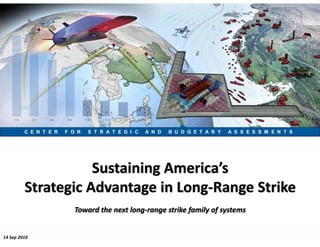
                    Sustaining America’s
         Strategic Advantage in Long-Range Strike
                          Toward the next long-range strike family of systems


14 Sep 2010
Overview

• Why this issue matters now

• A framework for thinking about long-range strike (LRS)
  – Post-Cold War planning assumptions
  – A new framework

• Attributes for future LRS capabilities

• Sustaining America’s advantage: toward the next LRS
  family of systems

• Initiatives and implementation
                                                           2
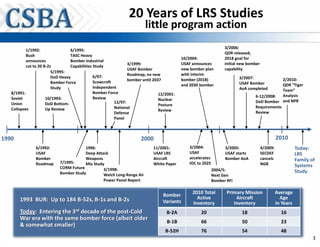
20 Years of LRS Studies
                                                                        little program action
                                                                                                                  3/2006:
           1/1992:                6/1995:
                                                                                                                  QDR released,
           Bush                   TASC Heavy
                                                                                           10/2004:               2018 goal for
           announces              Bomber Industrial
                                                                3/1999:                    USAF announces         initial new bomber
           cut to 20 B-2s         Capabilities Study
                                                                USAF Bomber                new bomber plan        capability
                         5/1995:
                                                                Roadmap, no new            with interim
                         DoD Heavy             6/97:                                                                     3/2007:
                                                                bomber until 2037          bomber (2018)                                      2/2010:
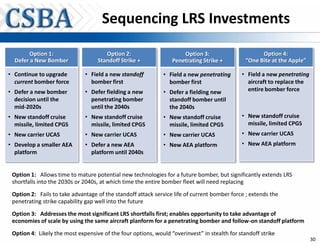
                         Bomber Force          Scowcroft                                                                 USAF Bomber
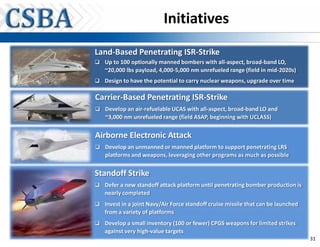
                                                                                           and 2030 bomber                                    QDR “Tiger
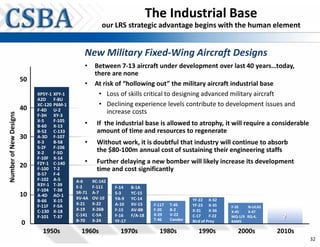
                         Study                 Independent                                                               AoA completed        Team”
   8/1991:                                     Bomber Force                     12/2001:                                         6-12/2008:   Analysis
   Soviet             10/1993:                 Review                           Nuclear
   Union              DoD Bottom-                        12/97:                                                                  DoD Bomber and NPR
                                                                                Posture                                          Requirements
   Collapses          Up Review                          National
                                                                                Review                                           Review
                                                         Defense
                                                         Panel


1990                                                                  2000                                                                       2010
               6/1992:                  1996:                               11/2001:          3/2004:             3/2005:              4/2009:              Today:
               USAF                     Deep Attack                         USAF LRS          USAF                USAF starts          SECDEF               LRS
               Bomber                   Weapons                             Aircraft          accelerates         Bomber AoA           cancels              Family of
               Roadmap      7/1995:     Mix Study                           White Paper       IOC to 2025                              NGB
                            CORM Future                                                                                                                     Systems
                                                 3/1998:                                                    2004/5:                                         Study
                            Bomber Study         Welch Long-Range Air                                       Next Gen
                                                 Power Panel Report                                         Bomber RFI


                                                                                 Bomber         2010 Total         Primary Mission               Average
       1993 BUR: Up to 184 B-52s, B-1s and B-2s                                                   Active               Aircraft                    Age
                                                                                 Variants       Inventory             Inventory                  in Years
       Today: Entering the 3rd decade of the post-Cold                             B-2A             20                    18                       16
       War era with the same bomber force (albeit older
                                                                                   B-1B             66                    50                       23
       & somewhat smaller)
                                                                                   B-52H            76                    54                       48
                                                                                                                                                                    3
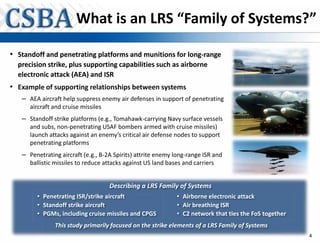
What is an LRS “Family of Systems?”

• Standoff and penetrating platforms and munitions for long-range
  precision strike, plus supporting capabilities such as airborne
  electronic attack (AEA) and ISR
• Example of supporting relationships between systems
   – AEA aircraft help suppress enemy air defenses in support of penetrating
      aircraft and cruise missiles
   – Standoff strike platforms (e.g., Tomahawk-carrying Navy surface vessels
      and subs, non-penetrating USAF bombers armed with cruise missiles)
      launch attacks against an enemy’s critical air defense nodes to support
      penetrating platforms
   – Penetrating aircraft (e.g., B-2A Spirits) attrite enemy long-range ISR and
      ballistic missiles to reduce attacks against US land bases and carriers


                                     Describing a LRS Family of Systems
        • Penetrating ISR/strike aircraft
                          / ik i       f                      • Airborne electronic attack
                                                                Ai b       l      i
        • Standoff strike aircraft                            • Air breathing ISR
        • PGMs, including cruise missiles and CPGS            • C2 network that ties the FoS together
               This study primarily focused on the strike elements of a LRS Family of Systems
                                                                                                        4
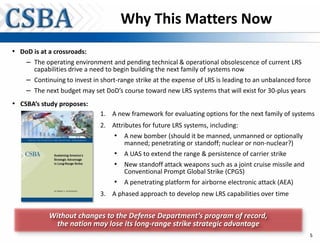
Why This Matters Now
• DoD is at a crossroads:
   – The operating environment and pending technical & operational obsolescence of current LRS
       capabilities drive a need to begin building the next family of systems now
    – Continuing to invest in short-range strike at the expense of LRS is leading to an unbalanced force
    – The next budget may set DoD’s course toward new LRS systems that will exist for 30-plus years
• CSBA’s study proposes:
                              1. A new framework for evaluating options for the next family of systems
                              2. Attributes for future LRS systems, including:
                                   • A new bomber (should it be manned, unmanned or optionally
                                      manned; penetrating or standoff; nuclear or non-nuclear?)
                                   • A UAS to extend the range & persistence of carrier strike
                                   • New standoff attack weapons such as a joint cruise missile and
                                      Conventional Prompt Global Strike (CPGS)
                                   • A penetrating platform for airborne electronic attack (AEA)
                              3. A phased approach to develop new LRS capabilities over time


            Without changes to the Defense Department’s program of record,
              the nation may lose its long-range strike strategic advantage
                                                                                                       5
Where We’ve Been
                 post-Cold War planning assumptions

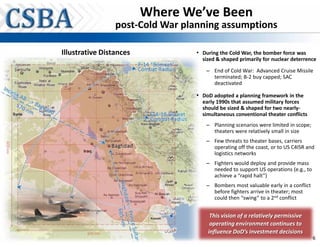
Illustrative Distances            • During the Cold War, the bomber force was
                                    sized & shaped primarily for nuclear deterrence

                                     – End of Cold War: Advanced Cruise Missile
                                       terminated; B-2 buy capped; SAC
                                       deactivated

                                  • DoD adopted a planning framework in the
                                    early 1990s that assumed military forces
                                    should be sized & shaped for two nearly-
                                    simultaneous conventional theater conflicts
                                     – Planning scenarios were limited in scope;
                                       theaters were relatively small in size
                                     – Few threats to theater bases, carriers
                                       operating off the coast, or to US C4ISR and
                                       logistics networks
                                     – Fighters would deploy and provide mass
                                       needed to support US operations (e.g., to
                                       achieve a “rapid halt”)
                                     – Bombers most valuable early in a conflict
                                       before fighters arrive in theater; most
                                       could then “swing” to a 2nd conflict


                                       This vision of a relatively permissive
                                       operating environment continues to
                                      influence DoD’s investment decisions
                                                                                   6
Toward a New Framework for
                                  Thinking About LRS


“Current US warfighting strategy hinges on the deployment of short-range fighters and
ground forces to foreign bases. We need the power to fight effectively from beyond
the theater, and that means shifting much of the burden to long-range air. The Gulf
War gave me a glimpse into the future of warfare. I saw adversaries who attacked
without warning. I saw adversaries armed with WMD and ballistic missiles.”
                                                         Gen “Chuck” Horner, 1996


“Pentagon preferences for short-range instead of long-range air power raise a puzzling
contradiction. The long-range bomber fleet is an element of the force structure that
appears ideally suited to the demands of the new security environment.”
                                                         Lt Gen Brent Scowcroft, 1997


                                                                                         7
Today’s Reality
• While operations in the Balkans, Afghanistan and Iraq reinforced DoD’s planning assumptions,
  our adversaries went to school on us
• In the process, they are well on the way to negating nearly all of DoD’s 1990s assumptions by:
                                                                                      p       y
    – Restricting or denying US access to forward bases through political
      coercion / precise missile and air strikes
    – Limiting freedom of maneuver for US Navy surface vessels

    – Degrading US C4ISR networks with kinetic and non-kinetic weapons

    – Hobbling US power projection by attacking “soft” logistics targets

    – Limiting the effectiveness of US precision strikes by:
         •   Fielding advanced integrated air defense systems (IADS);
         •   Using strategic depth to move potential targets further inland;
         •   Hardening and/or deeply burying potential targets; and
         •   Increasing the mobility of key military systems, such as SAMs and
             missile transporter erector launchers (TELs)


       Operating environments are becoming increasingly non-permissive in nature
                                                                                                   8
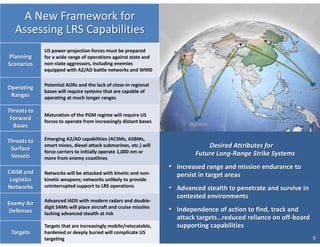
A New Framework for
  Assessing LRS Capabilities
             US power-projection forces must be prepared
Planning     for a wide range of operations against state and
Scenarios    non-state aggressors, including enemies
             equipped with A2/AD battle networks and WMD

             Potential AORs and the lack of close-in regional
Operating
             bases will require systems that are capable of
 Ranges      operating at much longer ranges

Threats to
             Maturation of the PGM regime will require US
 Forward     forces to operate from increasingly distant bases
  Bases

Threats to   Emerging A2/AD capabilities (ACSMs, ASBMs,
 Surface
             smart mines, diesel attack submarines, etc.) will                Desired Attributes for
             force carriers to initially operate 1,000 nm or              Future Long-Range Strike Systems
 Vessels     more from enemy coastlines
                                                                  • Increased range and mission endurance to
C4ISR and    Networks will be attacked with kinetic and non-        persist in target areas
 Logistics   kinetic weapons; networks unlikely to provide
Networks     uninterrupted support to LRS operations
                                                                  • Advanced stealth to penetrate and survive in
                                                                    contested environments
             Advanced IADS with modern radars and double-
Enemy Air
Defenses
             digit SAMs will place aircraft and cruise missiles
             lacking advanced stealth at risk
                                                                  • Independence of action to find, track and
                                                                    attack targets…reduced reliance on off-board
             Targets that are increasingly mobile/relocatable,      supporting capabilities
 Targets     hardened or deeply buried will complicate US
             targeting                                                                                             9
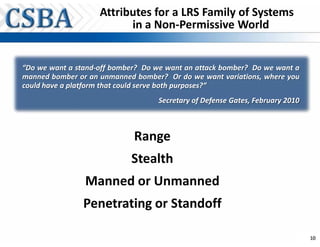
Attributes for a LRS Family of Systems
                          in a Non-Permissive World


“Do we want a stand-off bomber? Do we want an attack bomber? Do we want a
manned bomber or an unmanned bomber? Or do we want variations, where you
could have a platform that could serve both purposes?”
                                   Secretary of Defense Gates, February 2010


                             Range
                            Stealth
                Manned or Unmanned
                Penetrating or Standoff

                                                                               10
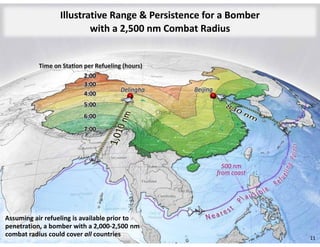
Illustrative Range & Persistence for a Bomber
                          with a 2,500 nm Combat Radius


Assuming air refueling is available prior to
penetration, a bomber with a 2,000-2,500 nm
combat radius could cover all countries                           11
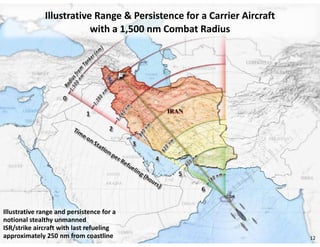
Illustrative Range & Persistence for a Carrier Aircraft
                          with a 1,500 nm Combat Radius


Illustrative range and persistence for a
notional stealthy unmanned
ISR/strike aircraft with last refueling
approximately 250 nm from coastline                                     12
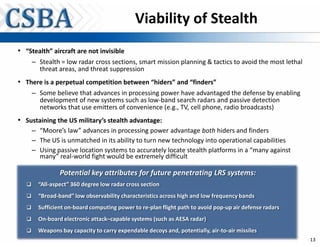
Viability of Stealth
• “Stealth” aircraft are not invisible
       – Stealth = low radar cross sections, smart mission planning & tactics to avoid the most lethal
         threat areas, and threat suppression
• There is a perpetual competition between “hiders” and “finders”
       – Some believe that advances in processing power have advantaged the defense by enabling
         development of new systems such as low-band search radars and passive detection
         networks that use emitters of convenience (e.g., TV, cell phone, radio broadcasts)
• Sustaining the US military’s stealth advantage:
       – “Moore’s law” advances in processing power advantage both hiders and finders
       – The US is unmatched in its ability to turn new technology into operational capabilities
       – Using passive location systems to accurately locate stealth platforms in a “many against
         many” real-world fight would be extremely difficult

                 Potential key attributes for future penetrating LRS systems:
   ‰     “All-aspect” 360 degree low radar cross section
   ‰     “Broad-band” low observability characteristics across high and low frequency bands
   ‰     Sufficient on-board computing power to re-plan flight path to avoid pop-up air defense radars
   ‰     On-board electronic attack–capable systems (such as AESA radar)
   ‰     Weapons bay capacity to carry expendable decoys and, potentially, air-to-air missiles
                                                                                                         13
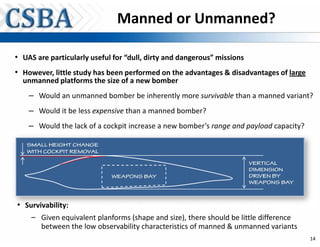
Manned or Unmanned?

• UAS are particularly useful for “dull, dirty and dangerous” missions
• However, little study has been performed on the advantages & disadvantages of large
  unmanned platforms the size of a new bomber
    – Would an unmanned bomber be inherently more survivable than a manned variant?
    – Would it be less expensive than a manned bomber?
    – Would the lack of a cockpit increase a new bomber’s range and payload capacity?


• Survivability:
    ‒ Given equivalent planforms (shape and size), there should be little difference
        between the low observability characteristics of manned & unmanned variants
                                                                                        14
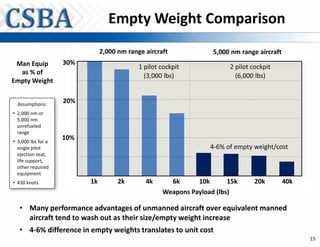
Empty Weight Comparison
                               2,000 nm range aircraft             5,000 nm range aircraft
 Man Equip          30%
                                            1 pilot cockpit             2 pilot cockpit
  as % of                                     (3,000 lbs)                 (6,000 lbs)
Empty Weight


  Assumptions:
                    20%
• 2,000 nm or
  5,000 nm
  unrefueled
  range
• 3,000 lbs for a
                    10%
  single pilot                                                    4-6% of empty weight/cost
  ejection seat,
  life support,
  other required
  equipment
• 430 knots               1k         2k       4k      6k      10k       15k      20k         40k
                                                    Weapons Payload (lbs)

   • Many performance advantages of unmanned aircraft over equivalent manned
     aircraft tend to wash out as their size/empty weight increase
   • 4-6% difference in empty weights translates to unit cost
                                                                                                   15
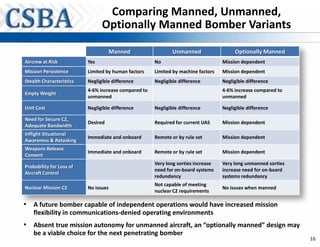
Comparing Manned, Unmanned,
                                Optionally Manned Bomber Variants

                                      Manned                  Unmanned                  Optionally Manned
Aircrew at Risk           Yes                         No                           Mission dependent
Mission Persistence       Limited by human factors    Limited by machine factors   Mission dependent
Stealth Characteristics   Negligible difference       Negligible difference        Negligible difference
                          4-6% increase compared to                                4-6% increase compared to
Empty Weight
                          unmanned                                                 unmanned

Unit Cost                 Negligible difference       Negligible difference        Negligible difference

Need for Secure C2,
                          Desired                     Required for current UAS     Mission dependent
Adequate Bandwidth
Inflight Situational
                          Immediate and onboard       Remote or by rule set        Mission dependent
Awareness & Retasking
Weapons Release
                          Immediate and onboard       Remote or by rule set        Mission dependent
Consent
                                                      Very long sorties increase   Very long unmanned sorties
Probability for Loss of
                                                      need for on-board systems    increase need for on-board
Aircraft Control
                                                      redundancy                   systems redundancy
                                                      Not capable of meeting
Nuclear Mission C2        No issues                                                No issues when manned
                                                      nuclear C2 requirements

• A future bomber capable of independent operations would have increased mission
    flexibility in communications-denied operating environments
• Absent true mission autonomy for unmanned aircraft, an “optionally manned” design may
    be a viable choice for the next penetrating bomber
                                                                                                                16
Standoff or Penetrating?
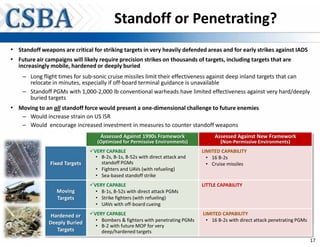
• Standoff weapons are critical for striking targets in very heavily defended areas and for early strikes against IADS
• Future air campaigns will likely require precision strikes on thousands of targets, including targets that are
   increasingly mobile, hardened or deeply buried
    – Long flight times for sub-sonic cruise missiles limit their effectiveness against deep inland targets that can
      relocate in minutes, especially if off-board terminal guidance is unavailable
    – Standoff PGMs with 1,000-2,000 lb conventional warheads have limited effectiveness against very hard/deeply
      buried targets
• Moving to an all standoff force would present a one-dimensional challenge to future enemies
    – Would increase strain on US ISR
    – Would encourage increased investment in measures to counter standoff weapons
                                   Assessed Against 1990s Framework                Assessed Against New Framework
                                  (Optimized for Permissive Environments)            (Non-Permissive Environments)
                               9VERY CAPABLE                                  LIMITED CAPABILITY
                                 • B-2s, B-1s, B-52s with direct attack and     • 16 B-2s
               Fixed Targets       standoff PGMs                                • Cruise missiles
                                 • Fighters and UAVs (with refueling)
                                 • Sea-based standoff strike
                               9VERY CAPABLE                                  LITTLE CAPABILITY
                  Moving         • B-1s, B-52s with direct attack PGMs
                  Targets        • Strike fighters (with refueling)
                                 • UAVs with off-board cueing

                Hardened or    9VERY CAPABLE                                  LIMITED CAPABILITY
                                 • Bombers & fighters with penetrating PGMs    • 16 B-2s with direct attack penetrating PGMs
               Deeply Buried
                                 • B-2 with future MOP for very
                  Targets          deep/hardened targets
                                                                                                                               17
Comparing Standoff and Penetrating
                                                                                                       LRS Capabilities

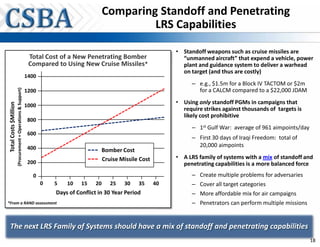
                                                                                                                         • Standoff weapons such as cruise missiles are
                                                                Total Cost of a New Penetrating Bomber                     “unmanned aircraft” that expend a vehicle, power
                                                                Compared to Using New Cruise Missiles*                     plant and guidance system to deliver a warhead
                                                                                                                           on target (and thus are costly)
                                                               1400
                                                                                                                               – e.g., $1.5m for a Block IV TACTOM or $2m
                        (Procurement + Operations & Support)


                                                               1200                                                              for a CALCM compared to a $22,000 JDAM
                                                                                                                         • Using only standoff PGMs in campaigns that
 Total Costs $Million


                                                               1000
                                                                                                                           require strikes against thousands of targets is
                                                                                                                           likely cost prohibitive
                                                                800
                                                                                                                               – 1st Gulf War: average of 961 aimpoints/day
                                                                600
                                                                                                                               – First 30 days of Iraqi Freedom: total of
                                                                400                                                              20,000 aimpoints
                                                                                              Bomber Cost
                                                                                              Cruise Missile Cost        • A LRS family of systems with a mix of standoff and
                                                                200                                                        penetrating capabilities is a more balanced force
                                                                  0                                                            –   Create multiple problems for adversaries
                                                                      0   5   10    15   20      25   30    35      40         –   Cover all target categories
                                                                          Days of Conflict in 30 Year Period                   –   More affordable mix for air campaigns
*From a RAND assessment                                                                                                        –   Penetrators can perform multiple missions


 The next LRS Family of Systems should have a mix of standoff and penetrating capabilities
                                                                                                                                                                               18
Toward the Next LRS Family of Systems


       Next Bomber
Air Leg of the Nuclear Triad
       Carrier Strike
    Standoff Weapons
Airborne Electronic Attack


                                    19
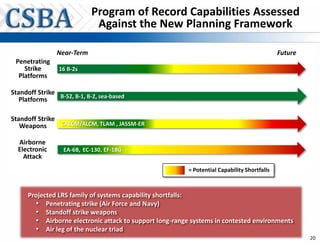
Program of Record Capabilities Assessed
                              Against the New Planning Framework

                Near-Term                                                                     Future
 Penetrating
    Strike       16 B-2s
  Platforms

Standoff Strike
                B-52, B-1, B-2, sea-based
   Platforms

Standoff Strike
   Weapons                EC-130
                CALCM/ALCM, TLAM , JASSM-ER

  Airborne
  Electronic      EA-6B, EC-130, EF-18G
                       ,      0,
    Attack
                                                          = Potential Capability Shortfalls


      Projected LRS family of systems capability shortfalls:
        • Penetrating strike (Air Force and Navy)
        • Standoff strike weapons
        • Airborne electronic attack to support long-range systems in contested environments
        • Air leg of the nuclear triad
                                                                                                       20
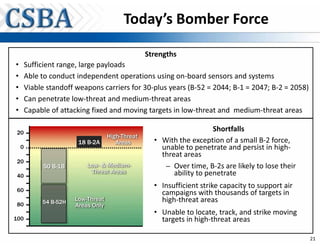
Today’s Bomber Force

                                                   Strengths
•       Sufficient range, large payloads
•       Able to conduct independent operations using on-board sensors and systems
•       Viable standoff weapons carriers for 30-plus years (B-52 = 2044; B-1 = 2047; B-2 = 2058)
•       Can penetrate low-threat and medium-threat areas
•       Capable of attacking fixed and moving targets in low-threat and medium-threat areas

20
                                                                        Shortfalls
                                     High-Threat
                         18 B-2A        Areas        • With the exception of a small B-2 force,
    0                                                  unable to penetrate and persist in high-
                                                       threat areas
20
             50 B-1B        Low- & Medium-              – Over time, B-2s are likely to lose their
                             Threat Areas                  ability to penetrate
40
                                                     • Insufficient strike capacity to support air
60
                                                       campaigns with thousands of targets in
             54 B-52H   Low-Threat                     high-threat areas
80                      Areas Only
                                                     • Unable to locate, track, and strike moving
100                                                    targets in high-threat areas

                                                                                                     21
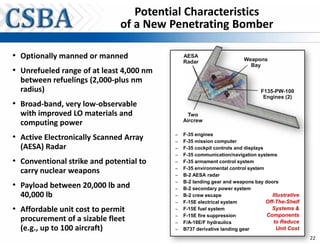
Potential Characteristics
                              of a New Penetrating Bomber

• Optionally manned or manned                 AESA
                                                                        Weapons
                                              Radar
                                                                          Bay
• Unrefueled range of at least 4,000 nm
  between refuelings (2,000-plus nm
  radius)                                                                      F135-PW-100
                                                                                Engines (2)
• Broad-band, very low-observable
  with improved LO materials and                Two
                                              Aircrew
  computing power
• Active Electronically Scanned Array     –
                                          –
                                              F-35 engines
                                              F-35 mission computer
  (AESA) Radar                            –   F-35 cockpit controls and displays
                                          –   F-35 communication/navigation systems
• Conventional strike and potential to    –   F-35 armament control system
                                          –   F-35 environmental control system
  carry nuclear weapons                   –   B-2 AESA radar

• Payload between 20,000 lb and           –
                                          –
                                              B-2 landing gear and weapons bay doors
                                              B-2 secondary power system
  40,000 lb                               –   B-2 crew escape                       Illustrative
                                          –   F-15E electrical system            Off-The-Shelf
• Affordable unit cost to permit          –   F-15E fuel system                    Systems &
                                          –   F-15E fire suppression             Components
  procurement of a sizable fleet          –   F/A-18E/F hydraulics                   to Reduce
  (e.g., up to 100 aircraft)              –   B737 derivative landing gear            Unit Cost
                                                                                                   22
Affordability is a Key Issue
                                                                 (size does matter)

          “We must avoid a situation in which the loss of even one aircraft –
          by accident or by combat – results in a loss of a significant portion
                                                                                  ”
          of the fleet, a national disaster akin to the sinking of a capital ship.”
                                                                           09
                                  —Secretary of Defense Gates, September 2009

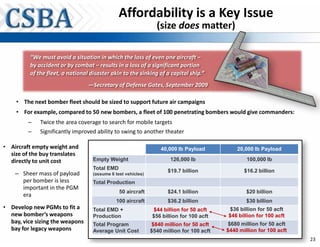
    • The next bomber fleet should be sized to support future air campaigns
                                                                          s
    • For example, compared to 50 new bombers, a fleet of 100 penetrating bombers would give commanders:
                                                                        g
         –    Twice the area coverage to search for mobile targets
         –    Significantly improved ability to swing to another theater

• Aircraft empty weight and                                        40,000 lb Payload           20,000 lb Payload
  size of the buy translates
  directly to unit cost             Empty Weight                       126,000 lb                  100,000 lb
                                    Total EMD                         $19.7 billion               $16.2 billion
    – Sheer mass of payload         (assume 6 test vehicles)
      per bomber is less            Total Production
      important in the PGM
                                                50 aircraft           $24.1 billion                $20 billion
      era
                                              100 aircraft            $36.2 billion                $30 billion
• Develop new PGMs to fit a         Total EMD +                $44 billion for 50 acft      $36 billion for 50 acft
  new bomber’s weapons              Production                 $56 billion for 100 acft    $46 billion for 100 acft
  bay, vice sizing the weapons      Total Program              $840 million for 50 acft     $680 million for 50 acft
  bay for legacy weapons            Average Unit Cost          $540 million for 100 acft   $440 million for 100 acft
                                                                                                                       23
Sustaining the Air Leg of the Nuclear Triad

• 2010 NPR determined the US should sustain the nuclear triad for decades

• However, without changes to DoD’s program of record, the triad is at peril of
  becoming a dyad by default
     – ALCMs are aging out, B-2s will eventually lose their ability to penetrate
• DoD should design its next cruise missile to carry both conventional and
  nuclear warheads
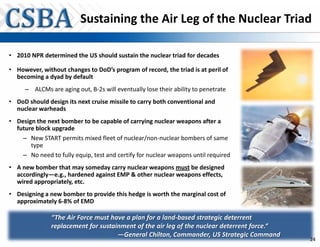
• Design the next bomber to be capable of carrying nuclear weapons after a
  future block upgrade
    – New START permits mixed fleet of nuclear/non-nuclear bombers of same
       type
    – No need to fully equip, test and certify for nuclear weapons until required
• A new bomber that may someday carry nuclear weapons must be designed
  accordingly—e.g., hardened against EMP & other nuclear weapons effects,
  wired appropriately, etc.
• Designing a new bomber to provide this hedge is worth the marginal cost of
  approximately 6-8% of EMD

               “The Air Force must have a plan for a land-based strategic deterrent
               replacement for sustainment of the air leg of the nuclear deterrent force.“
                                     —General Chilton, Commander, US Strategic Command
                                                                                             24
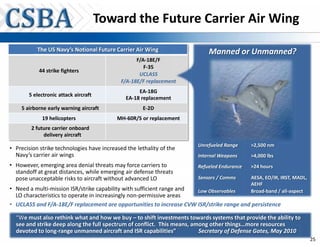
Toward the Future Carrier Air Wing

           The US Navy’s Notional Future Carrier Air Wing                  Manned or Unmanned?
                                                   F/A-18E/F
                                                      F-35
           44 strike fighters
                                                    UCLASS
                                             F/A-18E/F replacement
                                                                nt
                                                    EA-18G
       5 electronic attack aircraft
                                               EA-18 replacement
    5 airborne early warning aircraft                E-2D
             19 helicopters                MH-60R/S or replacement
                                                              ment
        2 future carrier onboard
             delivery aircraft
                                                                       Unrefueled Range     >2,500 nm
• Precision strike technologies have increased the lethality of the
  Navy’s carrier air wings                                             Internal Weapons     >4,000 lbs
• However, emerging area denial threats may force carriers to          Refueled Endurance   >24 hours
  standoff at great distances, while emerging air defense threats
  pose unacceptable risks to aircraft without advanced LO              Sensors / Comms      AESA, EO/IR, IRST, MADL,
                                                                                            AEHF
• Need a multi-mission ISR/strike capability with sufficient range and Low Observables      Broad-band / all-aspect
  LO characteristics to operate in increasingly non-permissive areas
• UCLASS and F/A-18E/F replacement are opportunities to increase CVW ISR/strike range and persistence

  “We must also rethink what and how we buy – to shift investments towards systems that provide the ability to
  see and strike deep along the full spectrum of conflict. This means, among other things…more resources
  devoted to long-range unmanned aircraft and ISR capabilities”          Secretary of Defense Gates, May 2010
                                                                                                                       25
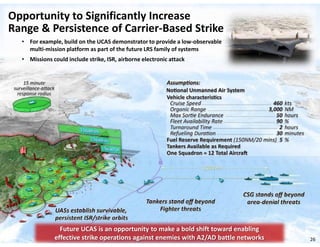
Opportunity to Significantly Increase
Range & Persistence of Carrier-Based Strike
  • For example, build on the UCAS demonstrator to provide a low-observable
                                                                          e
    multi-mission platform as part of the future LRS family of systems
  • Missions could include strike, ISR, airborne electronic attack


                Future UCAS is an opportunity to make a bold shift toward enabling
              effective strike operations against enemies with A2/AD battle networks   26
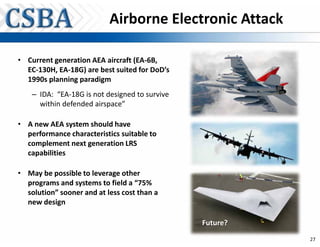
Airborne Electronic Attack

• Current generation AEA aircraft (EA-6B,
  EC-130H, EA-18G) are best suited for DoD’s
  1990s planning paradigm
    – IDA: “EA-18G is not designed to survive
      within defended airspace”

• A new AEA system should have
  performance characteristics suitable to
  complement next generation LRS
  capabilities

• May be possible to leverage other
  programs and systems to field a “75%
  solution” sooner and at less cost than a
  new design

                                                Future?
                                                          27
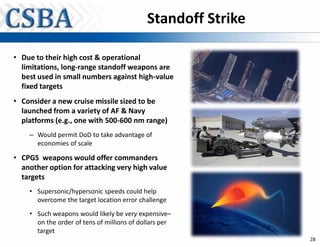
Standoff Strike

• Due to their high cost & operational
  limitations, long-range standoff weapons are
  best used in small numbers against high-value
  fixed targets
• Consider a new cruise missile sized to be
  launched from a variety of AF & Navy
  platforms (e.g., one with 500-600 nm range)
    – Would permit DoD to take advantage of
      economies of scale

• CPGS weapons would offer commanders
  another option for attacking very high value
  targets
    • Supersonic/hypersonic speeds could help
      overcome the target location error challenge
    • Such weapons would likely be very expensive–
      on the order of tens of millions of dollars per
      target
                                                              28
Sequencing and Initiatives


 Sequencing LRS
    Investments
  LRS Initiatives
The Industrial Base


                             29
Sequencing LRS Investments

       Option 1:                      Option 2:                      Option 3:                       Option 4:
  Defer a New Bomber               Standoff Strike +             Penetrating Strike +          “One Bite at the Apple”

• Continue to upgrade         • Field a new standoff          • Field a new penetrating      • Field a new penetrating
  current bomber force          bomber first                    bomber first                   aircraft to replace the
• Defer a new bomber          • Defer fielding a new          • Defer a fielding new           entire bomber force
  decision until the            penetrating bomber              standoff bomber until
  mid-2020s                     until the 2040s                 the 2040s
• New standoff cruise         • New standoff cruise           • New standoff cruise          • New standoff cruise
  missile, limited CPGS         missile, limited CPGS           missile, limited CPGS          missile, limited CPGS
• New carrier UCAS            • New carrier UCAS              • New carrier UCAS             • New carrier UCAS
• Develop a smaller AEA       • Defer a new AEA               • New AEA platform             • New AEA platform
  platform                      platform until 2040s


 Option 1: Allows time to mature potential new technologies for a future bomber, but significantly extends LRS
 shortfalls into the 2030s or 2040s, at which time the entire bomber fleet will need replacing
 Option 2: Fails to take advantage of the standoff attack service life of current bomber force ; extends the
 penetrating strike capability gap well into the future
 Option 3: Addresses the most significant LRS shortfalls first; enables opportunity to take advantage of
 economies of scale by using the same aircraft planform for a penetrating bomber and follow-on standoff platform

 Option 4: Likely the most expensive of the four options, would “overinvest” in stealth for standoff strike
                                                                                                                         30
Initiatives
Land-Based Penetrating ISR-Strike
‰ Up to 100 optionally manned bombers with all-aspect, broad-band LO,
   ~20,000 lbs payload, 4,000-5,000 nm unrefueled range (field in mid-2020s)
‰ Design to have the potential to carry nuclear weapons, upgrade over time


Carrier-Based Penetrating ISR-Strike
‰ Develop an air-refuelable UCAS with all-aspect, broad-band LO and
    ~3,000 nm unrefueled range (field ASAP, beginning with UCLASS)


Airborne Electronic Attack
‰ Develop an unmanned or manned platform to support penetrating LRS
    platforms and weapons, leveraging other programs as much as possible


S
Standoff Strike
‰ Defer a new standoff attack platform until penetrating bomber production is
   nearly completed
‰ Invest in a joint Navy/Air Force standoff cruise missile that can be launched
   from a variety of platforms
‰ Develop a small inventory (100 or fewer) CPGS weapons for limited strikes
   against very high-value targets
                                                                                  31
The Industrial Base
                                                          our LRS strategic advantage begins with the human element


                                                 New Military Fixed-Wing Aircraft Designs
                                                 •     Between 7-13 aircraft under development over last 40 years…today,
                                                       there are none
                        50
                                                 •     At risk of “hollowing out” the military aircraft industrial base
                             XP5Y-1   XFY-1             • Loss of skills critical to designing advanced military aircraft
                             A2D      F-8U
                             XC-120   P6M-1             • Declining experience levels contribute to development issues and
                        40   F-4D     U-2                   increase costs
Number of New Designs


                             F-3H     XY-3
                             X-5
                             B-60
                                      F-105
                                      X-13       •      If the industrial base is allowed to atrophy, it will require a considerable
                             B-52     C-133             amount of time and resources to regenerate
                        30   A-3D     F-107
                             X-3      B-58       •      Without work, it is doubtful that industry will continue to absorb
                             S-2F     F-106
                             X-2      F-5D              the $80-100m annual cost of sustaining their engineering staffs
                             F-10F    X-14
                             F2Y-1    C-140      •      Further delaying a new bomber will likely increase its development
                        20   F-100    T-2               time and cost significantly
                             B-57     F-4
                             F-102    A-5     A-6     XC-142
                             R3Y-1    T-39    E-2     F-111    F-14    B-1A
                             F-104    T-38    SR-71   A-7
                        10                                     S-3     YC-15
                             A-4D     AO-1
                                              XV-4A   OV-10    YA-9    YC-14                      YF-22 X-32
                             B-66     X-15
                                              X-21    X-22     A-10    XV-15     F-117   T-45     YF-23 X-35
                             F-11F    F-5A                                                                        F-35   N-UCAS
                             C-130    X-18    X-19    X-26B    F-15    AV-8B     F-20    B-2      X-31     X-36   X-45   X-47
                                              C-141   C-5A     F-16    F/A-18    X-29    V-22
                             F-101    T-37
                                              B-70    X-24     YF-17             T-46    Condor
                                                                                                  C-17     F-22
                                                                                                  Bird of Prey
                                                                                                                  MQ-1/9 RQ-4,     ?
                        0                                                                                         BAMS

                               1950s            1960s            1
                                                                 1970s             1980s             1990s          2000s         2010s
                                                                                                                                          32
Questions?


“We are probably going to proceed with a
long-range strike initiative coming out of
the Quadrennial Defense Review and
various other reviews going on…we’re
looking at a family of capabilities, both
manned and unmanned.”
            Secretary of Defense Gates
                         December 11, 2009


                                             33
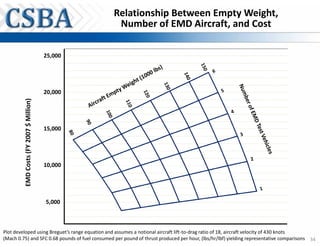
Relationship Between Empty Weight,
                                                   Number of EMD Aircraft, and Cost

                                         25,000


                                         20,000
         EMD Costs (FY 2007 $ Million)


                                         15,000


                                         10,000


                                         5,000


Plot developed using Breguet’s range equation and assumes a notional aircraft lift-to-drag ratio of 18, aircraft velocity of 430 knots
(Mach 0.75) and SFC 0.68 pounds of fuel consumed per pound of thrust produced per hour, (lbs/hr/lbf) yielding representative comparisons 34
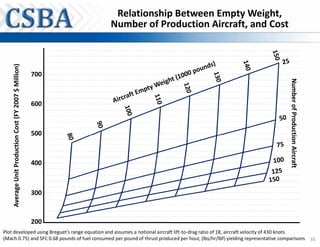
Relationship Between Empty Weight,
                                                             Number of Production Aircraft, and Cost
    Average Unit Production Cost (FY 2007 $ Million)


                                                       700


                                                                                                                               Number of Production Aircraft
                                                       600


                                                       500


                                                       400


                                                       300


                                                       200
Plot developed using Breguet’s range equation and assumes a notional aircraft lift-to-drag ratio of 18, aircraft velocity of 430 knots
(Mach 0.75) and SFC 0.68 pounds of fuel consumed per pound of thrust produced per hour, (lbs/hr/lbf) yielding representative comparisons 35

Sustaining America\'s Strategic Long Range Strike

  • 1.
    C E NT E R F O R S T R A T E G I C A N D B U D G E T A R Y A S S E S S M E N T S Sustaining America’s Strategic Advantage in Long-Range Strike Toward the next long-range strike family of systems 14 Sep 2010
  • 2.
    Overview • Why thisissue matters now • A framework for thinking about long-range strike (LRS) – Post-Cold War planning assumptions – A new framework • Attributes for future LRS capabilities • Sustaining America’s advantage: toward the next LRS family of systems • Initiatives and implementation 2
  • 3.
    20 Years ofLRS Studies little program action 3/2006: 1/1992: 6/1995: QDR released, Bush TASC Heavy 10/2004: 2018 goal for announces Bomber Industrial 3/1999: USAF announces initial new bomber cut to 20 B-2s Capabilities Study USAF Bomber new bomber plan capability 5/1995: Roadmap, no new with interim DoD Heavy 6/97: 3/2007: bomber until 2037 bomber (2018) 2/2010: Bomber Force Scowcroft USAF Bomber and 2030 bomber QDR “Tiger Study Independent AoA completed Team” 8/1991: Bomber Force 12/2001: 6-12/2008: Analysis Soviet 10/1993: Review Nuclear Union DoD Bottom- 12/97: DoD Bomber and NPR Posture Requirements Collapses Up Review National Review Review Defense Panel 1990 2000 2010 6/1992: 1996: 11/2001: 3/2004: 3/2005: 4/2009: Today: USAF Deep Attack USAF LRS USAF USAF starts SECDEF LRS Bomber Weapons Aircraft accelerates Bomber AoA cancels Family of Roadmap 7/1995: Mix Study White Paper IOC to 2025 NGB CORM Future Systems 3/1998: 2004/5: Study Bomber Study Welch Long-Range Air Next Gen Power Panel Report Bomber RFI Bomber 2010 Total Primary Mission Average 1993 BUR: Up to 184 B-52s, B-1s and B-2s Active Aircraft Age Variants Inventory Inventory in Years Today: Entering the 3rd decade of the post-Cold B-2A 20 18 16 War era with the same bomber force (albeit older B-1B 66 50 23 & somewhat smaller) B-52H 76 54 48 3
  • 4.
    What is anLRS “Family of Systems?” • Standoff and penetrating platforms and munitions for long-range precision strike, plus supporting capabilities such as airborne electronic attack (AEA) and ISR • Example of supporting relationships between systems – AEA aircraft help suppress enemy air defenses in support of penetrating aircraft and cruise missiles – Standoff strike platforms (e.g., Tomahawk-carrying Navy surface vessels and subs, non-penetrating USAF bombers armed with cruise missiles) launch attacks against an enemy’s critical air defense nodes to support penetrating platforms – Penetrating aircraft (e.g., B-2A Spirits) attrite enemy long-range ISR and ballistic missiles to reduce attacks against US land bases and carriers Describing a LRS Family of Systems • Penetrating ISR/strike aircraft / ik i f • Airborne electronic attack Ai b l i • Standoff strike aircraft • Air breathing ISR • PGMs, including cruise missiles and CPGS • C2 network that ties the FoS together This study primarily focused on the strike elements of a LRS Family of Systems 4
  • 5.
    Why This MattersNow • DoD is at a crossroads: – The operating environment and pending technical & operational obsolescence of current LRS capabilities drive a need to begin building the next family of systems now – Continuing to invest in short-range strike at the expense of LRS is leading to an unbalanced force – The next budget may set DoD’s course toward new LRS systems that will exist for 30-plus years • CSBA’s study proposes: 1. A new framework for evaluating options for the next family of systems 2. Attributes for future LRS systems, including: • A new bomber (should it be manned, unmanned or optionally manned; penetrating or standoff; nuclear or non-nuclear?) • A UAS to extend the range & persistence of carrier strike • New standoff attack weapons such as a joint cruise missile and Conventional Prompt Global Strike (CPGS) • A penetrating platform for airborne electronic attack (AEA) 3. A phased approach to develop new LRS capabilities over time Without changes to the Defense Department’s program of record, the nation may lose its long-range strike strategic advantage 5
  • 6.
    Where We’ve Been post-Cold War planning assumptions Illustrative Distances • During the Cold War, the bomber force was sized & shaped primarily for nuclear deterrence – End of Cold War: Advanced Cruise Missile terminated; B-2 buy capped; SAC deactivated • DoD adopted a planning framework in the early 1990s that assumed military forces should be sized & shaped for two nearly- simultaneous conventional theater conflicts – Planning scenarios were limited in scope; theaters were relatively small in size – Few threats to theater bases, carriers operating off the coast, or to US C4ISR and logistics networks – Fighters would deploy and provide mass needed to support US operations (e.g., to achieve a “rapid halt”) – Bombers most valuable early in a conflict before fighters arrive in theater; most could then “swing” to a 2nd conflict This vision of a relatively permissive operating environment continues to influence DoD’s investment decisions 6
  • 7.
    Toward a NewFramework for Thinking About LRS “Current US warfighting strategy hinges on the deployment of short-range fighters and ground forces to foreign bases. We need the power to fight effectively from beyond the theater, and that means shifting much of the burden to long-range air. The Gulf War gave me a glimpse into the future of warfare. I saw adversaries who attacked without warning. I saw adversaries armed with WMD and ballistic missiles.” Gen “Chuck” Horner, 1996 “Pentagon preferences for short-range instead of long-range air power raise a puzzling contradiction. The long-range bomber fleet is an element of the force structure that appears ideally suited to the demands of the new security environment.” Lt Gen Brent Scowcroft, 1997 7
  • 8.
    Today’s Reality • Whileoperations in the Balkans, Afghanistan and Iraq reinforced DoD’s planning assumptions, our adversaries went to school on us • In the process, they are well on the way to negating nearly all of DoD’s 1990s assumptions by: p y – Restricting or denying US access to forward bases through political coercion / precise missile and air strikes – Limiting freedom of maneuver for US Navy surface vessels – Degrading US C4ISR networks with kinetic and non-kinetic weapons – Hobbling US power projection by attacking “soft” logistics targets – Limiting the effectiveness of US precision strikes by: • Fielding advanced integrated air defense systems (IADS); • Using strategic depth to move potential targets further inland; • Hardening and/or deeply burying potential targets; and • Increasing the mobility of key military systems, such as SAMs and missile transporter erector launchers (TELs) Operating environments are becoming increasingly non-permissive in nature 8
  • 9.
    A New Frameworkfor Assessing LRS Capabilities US power-projection forces must be prepared Planning for a wide range of operations against state and Scenarios non-state aggressors, including enemies equipped with A2/AD battle networks and WMD Potential AORs and the lack of close-in regional Operating bases will require systems that are capable of Ranges operating at much longer ranges Threats to Maturation of the PGM regime will require US Forward forces to operate from increasingly distant bases Bases Threats to Emerging A2/AD capabilities (ACSMs, ASBMs, Surface smart mines, diesel attack submarines, etc.) will Desired Attributes for force carriers to initially operate 1,000 nm or Future Long-Range Strike Systems Vessels more from enemy coastlines • Increased range and mission endurance to C4ISR and Networks will be attacked with kinetic and non- persist in target areas Logistics kinetic weapons; networks unlikely to provide Networks uninterrupted support to LRS operations • Advanced stealth to penetrate and survive in contested environments Advanced IADS with modern radars and double- Enemy Air Defenses digit SAMs will place aircraft and cruise missiles lacking advanced stealth at risk • Independence of action to find, track and attack targets…reduced reliance on off-board Targets that are increasingly mobile/relocatable, supporting capabilities Targets hardened or deeply buried will complicate US targeting 9
  • 10.
    Attributes for aLRS Family of Systems in a Non-Permissive World “Do we want a stand-off bomber? Do we want an attack bomber? Do we want a manned bomber or an unmanned bomber? Or do we want variations, where you could have a platform that could serve both purposes?” Secretary of Defense Gates, February 2010 Range Stealth Manned or Unmanned Penetrating or Standoff 10
  • 11.
    Illustrative Range &Persistence for a Bomber with a 2,500 nm Combat Radius Assuming air refueling is available prior to penetration, a bomber with a 2,000-2,500 nm combat radius could cover all countries 11
  • 12.
    Illustrative Range &Persistence for a Carrier Aircraft with a 1,500 nm Combat Radius Illustrative range and persistence for a notional stealthy unmanned ISR/strike aircraft with last refueling approximately 250 nm from coastline 12
  • 13.
    Viability of Stealth •“Stealth” aircraft are not invisible – Stealth = low radar cross sections, smart mission planning & tactics to avoid the most lethal threat areas, and threat suppression • There is a perpetual competition between “hiders” and “finders” – Some believe that advances in processing power have advantaged the defense by enabling development of new systems such as low-band search radars and passive detection networks that use emitters of convenience (e.g., TV, cell phone, radio broadcasts) • Sustaining the US military’s stealth advantage: – “Moore’s law” advances in processing power advantage both hiders and finders – The US is unmatched in its ability to turn new technology into operational capabilities – Using passive location systems to accurately locate stealth platforms in a “many against many” real-world fight would be extremely difficult Potential key attributes for future penetrating LRS systems: ‰ “All-aspect” 360 degree low radar cross section ‰ “Broad-band” low observability characteristics across high and low frequency bands ‰ Sufficient on-board computing power to re-plan flight path to avoid pop-up air defense radars ‰ On-board electronic attack–capable systems (such as AESA radar) ‰ Weapons bay capacity to carry expendable decoys and, potentially, air-to-air missiles 13
  • 14.
    Manned or Unmanned? •UAS are particularly useful for “dull, dirty and dangerous” missions • However, little study has been performed on the advantages & disadvantages of large unmanned platforms the size of a new bomber – Would an unmanned bomber be inherently more survivable than a manned variant? – Would it be less expensive than a manned bomber? – Would the lack of a cockpit increase a new bomber’s range and payload capacity? • Survivability: ‒ Given equivalent planforms (shape and size), there should be little difference between the low observability characteristics of manned & unmanned variants 14
  • 15.
    Empty Weight Comparison 2,000 nm range aircraft 5,000 nm range aircraft Man Equip 30% 1 pilot cockpit 2 pilot cockpit as % of (3,000 lbs) (6,000 lbs) Empty Weight Assumptions: 20% • 2,000 nm or 5,000 nm unrefueled range • 3,000 lbs for a 10% single pilot 4-6% of empty weight/cost ejection seat, life support, other required equipment • 430 knots 1k 2k 4k 6k 10k 15k 20k 40k Weapons Payload (lbs) • Many performance advantages of unmanned aircraft over equivalent manned aircraft tend to wash out as their size/empty weight increase • 4-6% difference in empty weights translates to unit cost 15
  • 16.
    Comparing Manned, Unmanned, Optionally Manned Bomber Variants Manned Unmanned Optionally Manned Aircrew at Risk Yes No Mission dependent Mission Persistence Limited by human factors Limited by machine factors Mission dependent Stealth Characteristics Negligible difference Negligible difference Negligible difference 4-6% increase compared to 4-6% increase compared to Empty Weight unmanned unmanned Unit Cost Negligible difference Negligible difference Negligible difference Need for Secure C2, Desired Required for current UAS Mission dependent Adequate Bandwidth Inflight Situational Immediate and onboard Remote or by rule set Mission dependent Awareness & Retasking Weapons Release Immediate and onboard Remote or by rule set Mission dependent Consent Very long sorties increase Very long unmanned sorties Probability for Loss of need for on-board systems increase need for on-board Aircraft Control redundancy systems redundancy Not capable of meeting Nuclear Mission C2 No issues No issues when manned nuclear C2 requirements • A future bomber capable of independent operations would have increased mission flexibility in communications-denied operating environments • Absent true mission autonomy for unmanned aircraft, an “optionally manned” design may be a viable choice for the next penetrating bomber 16
  • 17.
    Standoff or Penetrating? •Standoff weapons are critical for striking targets in very heavily defended areas and for early strikes against IADS • Future air campaigns will likely require precision strikes on thousands of targets, including targets that are increasingly mobile, hardened or deeply buried – Long flight times for sub-sonic cruise missiles limit their effectiveness against deep inland targets that can relocate in minutes, especially if off-board terminal guidance is unavailable – Standoff PGMs with 1,000-2,000 lb conventional warheads have limited effectiveness against very hard/deeply buried targets • Moving to an all standoff force would present a one-dimensional challenge to future enemies – Would increase strain on US ISR – Would encourage increased investment in measures to counter standoff weapons Assessed Against 1990s Framework Assessed Against New Framework (Optimized for Permissive Environments) (Non-Permissive Environments) 9VERY CAPABLE LIMITED CAPABILITY • B-2s, B-1s, B-52s with direct attack and • 16 B-2s Fixed Targets standoff PGMs • Cruise missiles • Fighters and UAVs (with refueling) • Sea-based standoff strike 9VERY CAPABLE LITTLE CAPABILITY Moving • B-1s, B-52s with direct attack PGMs Targets • Strike fighters (with refueling) • UAVs with off-board cueing Hardened or 9VERY CAPABLE LIMITED CAPABILITY • Bombers & fighters with penetrating PGMs • 16 B-2s with direct attack penetrating PGMs Deeply Buried • B-2 with future MOP for very Targets deep/hardened targets 17
  • 18.
    Comparing Standoff andPenetrating LRS Capabilities • Standoff weapons such as cruise missiles are Total Cost of a New Penetrating Bomber “unmanned aircraft” that expend a vehicle, power Compared to Using New Cruise Missiles* plant and guidance system to deliver a warhead on target (and thus are costly) 1400 – e.g., $1.5m for a Block IV TACTOM or $2m (Procurement + Operations & Support) 1200 for a CALCM compared to a $22,000 JDAM • Using only standoff PGMs in campaigns that Total Costs $Million 1000 require strikes against thousands of targets is likely cost prohibitive 800 – 1st Gulf War: average of 961 aimpoints/day 600 – First 30 days of Iraqi Freedom: total of 400 20,000 aimpoints Bomber Cost Cruise Missile Cost • A LRS family of systems with a mix of standoff and 200 penetrating capabilities is a more balanced force 0 – Create multiple problems for adversaries 0 5 10 15 20 25 30 35 40 – Cover all target categories Days of Conflict in 30 Year Period – More affordable mix for air campaigns *From a RAND assessment – Penetrators can perform multiple missions The next LRS Family of Systems should have a mix of standoff and penetrating capabilities 18
  • 19.
    Toward the NextLRS Family of Systems Next Bomber Air Leg of the Nuclear Triad Carrier Strike Standoff Weapons Airborne Electronic Attack 19
  • 20.
    Program of RecordCapabilities Assessed Against the New Planning Framework Near-Term Future Penetrating Strike 16 B-2s Platforms Standoff Strike B-52, B-1, B-2, sea-based Platforms Standoff Strike Weapons EC-130 CALCM/ALCM, TLAM , JASSM-ER Airborne Electronic EA-6B, EC-130, EF-18G , 0, Attack = Potential Capability Shortfalls Projected LRS family of systems capability shortfalls: • Penetrating strike (Air Force and Navy) • Standoff strike weapons • Airborne electronic attack to support long-range systems in contested environments • Air leg of the nuclear triad 20
  • 21.
    Today’s Bomber Force Strengths • Sufficient range, large payloads • Able to conduct independent operations using on-board sensors and systems • Viable standoff weapons carriers for 30-plus years (B-52 = 2044; B-1 = 2047; B-2 = 2058) • Can penetrate low-threat and medium-threat areas • Capable of attacking fixed and moving targets in low-threat and medium-threat areas 20 Shortfalls High-Threat 18 B-2A Areas • With the exception of a small B-2 force, 0 unable to penetrate and persist in high- threat areas 20 50 B-1B Low- & Medium- – Over time, B-2s are likely to lose their Threat Areas ability to penetrate 40 • Insufficient strike capacity to support air 60 campaigns with thousands of targets in 54 B-52H Low-Threat high-threat areas 80 Areas Only • Unable to locate, track, and strike moving 100 targets in high-threat areas 21
  • 22.
    Potential Characteristics of a New Penetrating Bomber • Optionally manned or manned AESA Weapons Radar Bay • Unrefueled range of at least 4,000 nm between refuelings (2,000-plus nm radius) F135-PW-100 Engines (2) • Broad-band, very low-observable with improved LO materials and Two Aircrew computing power • Active Electronically Scanned Array – – F-35 engines F-35 mission computer (AESA) Radar – F-35 cockpit controls and displays – F-35 communication/navigation systems • Conventional strike and potential to – F-35 armament control system – F-35 environmental control system carry nuclear weapons – B-2 AESA radar • Payload between 20,000 lb and – – B-2 landing gear and weapons bay doors B-2 secondary power system 40,000 lb – B-2 crew escape Illustrative – F-15E electrical system Off-The-Shelf • Affordable unit cost to permit – F-15E fuel system Systems & – F-15E fire suppression Components procurement of a sizable fleet – F/A-18E/F hydraulics to Reduce (e.g., up to 100 aircraft) – B737 derivative landing gear Unit Cost 22
  • 23.
    Affordability is aKey Issue (size does matter) “We must avoid a situation in which the loss of even one aircraft – by accident or by combat – results in a loss of a significant portion ” of the fleet, a national disaster akin to the sinking of a capital ship.” 09 —Secretary of Defense Gates, September 2009 • The next bomber fleet should be sized to support future air campaigns s • For example, compared to 50 new bombers, a fleet of 100 penetrating bombers would give commanders: g – Twice the area coverage to search for mobile targets – Significantly improved ability to swing to another theater • Aircraft empty weight and 40,000 lb Payload 20,000 lb Payload size of the buy translates directly to unit cost Empty Weight 126,000 lb 100,000 lb Total EMD $19.7 billion $16.2 billion – Sheer mass of payload (assume 6 test vehicles) per bomber is less Total Production important in the PGM 50 aircraft $24.1 billion $20 billion era 100 aircraft $36.2 billion $30 billion • Develop new PGMs to fit a Total EMD + $44 billion for 50 acft $36 billion for 50 acft new bomber’s weapons Production $56 billion for 100 acft $46 billion for 100 acft bay, vice sizing the weapons Total Program $840 million for 50 acft $680 million for 50 acft bay for legacy weapons Average Unit Cost $540 million for 100 acft $440 million for 100 acft 23
  • 24.
    Sustaining the AirLeg of the Nuclear Triad • 2010 NPR determined the US should sustain the nuclear triad for decades • However, without changes to DoD’s program of record, the triad is at peril of becoming a dyad by default – ALCMs are aging out, B-2s will eventually lose their ability to penetrate • DoD should design its next cruise missile to carry both conventional and nuclear warheads • Design the next bomber to be capable of carrying nuclear weapons after a future block upgrade – New START permits mixed fleet of nuclear/non-nuclear bombers of same type – No need to fully equip, test and certify for nuclear weapons until required • A new bomber that may someday carry nuclear weapons must be designed accordingly—e.g., hardened against EMP & other nuclear weapons effects, wired appropriately, etc. • Designing a new bomber to provide this hedge is worth the marginal cost of approximately 6-8% of EMD “The Air Force must have a plan for a land-based strategic deterrent replacement for sustainment of the air leg of the nuclear deterrent force.“ —General Chilton, Commander, US Strategic Command 24
  • 25.
    Toward the FutureCarrier Air Wing The US Navy’s Notional Future Carrier Air Wing Manned or Unmanned? F/A-18E/F F-35 44 strike fighters UCLASS F/A-18E/F replacement nt EA-18G 5 electronic attack aircraft EA-18 replacement 5 airborne early warning aircraft E-2D 19 helicopters MH-60R/S or replacement ment 2 future carrier onboard delivery aircraft Unrefueled Range >2,500 nm • Precision strike technologies have increased the lethality of the Navy’s carrier air wings Internal Weapons >4,000 lbs • However, emerging area denial threats may force carriers to Refueled Endurance >24 hours standoff at great distances, while emerging air defense threats pose unacceptable risks to aircraft without advanced LO Sensors / Comms AESA, EO/IR, IRST, MADL, AEHF • Need a multi-mission ISR/strike capability with sufficient range and Low Observables Broad-band / all-aspect LO characteristics to operate in increasingly non-permissive areas • UCLASS and F/A-18E/F replacement are opportunities to increase CVW ISR/strike range and persistence “We must also rethink what and how we buy – to shift investments towards systems that provide the ability to see and strike deep along the full spectrum of conflict. This means, among other things…more resources devoted to long-range unmanned aircraft and ISR capabilities” Secretary of Defense Gates, May 2010 25
  • 26.
    Opportunity to SignificantlyIncrease Range & Persistence of Carrier-Based Strike • For example, build on the UCAS demonstrator to provide a low-observable e multi-mission platform as part of the future LRS family of systems • Missions could include strike, ISR, airborne electronic attack Future UCAS is an opportunity to make a bold shift toward enabling effective strike operations against enemies with A2/AD battle networks 26
  • 27.
    Airborne Electronic Attack •Current generation AEA aircraft (EA-6B, EC-130H, EA-18G) are best suited for DoD’s 1990s planning paradigm – IDA: “EA-18G is not designed to survive within defended airspace” • A new AEA system should have performance characteristics suitable to complement next generation LRS capabilities • May be possible to leverage other programs and systems to field a “75% solution” sooner and at less cost than a new design Future? 27
  • 28.
    Standoff Strike • Dueto their high cost & operational limitations, long-range standoff weapons are best used in small numbers against high-value fixed targets • Consider a new cruise missile sized to be launched from a variety of AF & Navy platforms (e.g., one with 500-600 nm range) – Would permit DoD to take advantage of economies of scale • CPGS weapons would offer commanders another option for attacking very high value targets • Supersonic/hypersonic speeds could help overcome the target location error challenge • Such weapons would likely be very expensive– on the order of tens of millions of dollars per target 28
  • 29.
    Sequencing and Initiatives Sequencing LRS Investments LRS Initiatives The Industrial Base 29
  • 30.
    Sequencing LRS Investments Option 1: Option 2: Option 3: Option 4: Defer a New Bomber Standoff Strike + Penetrating Strike + “One Bite at the Apple” • Continue to upgrade • Field a new standoff • Field a new penetrating • Field a new penetrating current bomber force bomber first bomber first aircraft to replace the • Defer a new bomber • Defer fielding a new • Defer a fielding new entire bomber force decision until the penetrating bomber standoff bomber until mid-2020s until the 2040s the 2040s • New standoff cruise • New standoff cruise • New standoff cruise • New standoff cruise missile, limited CPGS missile, limited CPGS missile, limited CPGS missile, limited CPGS • New carrier UCAS • New carrier UCAS • New carrier UCAS • New carrier UCAS • Develop a smaller AEA • Defer a new AEA • New AEA platform • New AEA platform platform platform until 2040s Option 1: Allows time to mature potential new technologies for a future bomber, but significantly extends LRS shortfalls into the 2030s or 2040s, at which time the entire bomber fleet will need replacing Option 2: Fails to take advantage of the standoff attack service life of current bomber force ; extends the penetrating strike capability gap well into the future Option 3: Addresses the most significant LRS shortfalls first; enables opportunity to take advantage of economies of scale by using the same aircraft planform for a penetrating bomber and follow-on standoff platform Option 4: Likely the most expensive of the four options, would “overinvest” in stealth for standoff strike 30
  • 31.
    Initiatives Land-Based Penetrating ISR-Strike ‰Up to 100 optionally manned bombers with all-aspect, broad-band LO, ~20,000 lbs payload, 4,000-5,000 nm unrefueled range (field in mid-2020s) ‰ Design to have the potential to carry nuclear weapons, upgrade over time Carrier-Based Penetrating ISR-Strike ‰ Develop an air-refuelable UCAS with all-aspect, broad-band LO and ~3,000 nm unrefueled range (field ASAP, beginning with UCLASS) Airborne Electronic Attack ‰ Develop an unmanned or manned platform to support penetrating LRS platforms and weapons, leveraging other programs as much as possible S Standoff Strike ‰ Defer a new standoff attack platform until penetrating bomber production is nearly completed ‰ Invest in a joint Navy/Air Force standoff cruise missile that can be launched from a variety of platforms ‰ Develop a small inventory (100 or fewer) CPGS weapons for limited strikes against very high-value targets 31
  • 32.
    The Industrial Base our LRS strategic advantage begins with the human element New Military Fixed-Wing Aircraft Designs • Between 7-13 aircraft under development over last 40 years…today, there are none 50 • At risk of “hollowing out” the military aircraft industrial base XP5Y-1 XFY-1 • Loss of skills critical to designing advanced military aircraft A2D F-8U XC-120 P6M-1 • Declining experience levels contribute to development issues and 40 F-4D U-2 increase costs Number of New Designs F-3H XY-3 X-5 B-60 F-105 X-13 • If the industrial base is allowed to atrophy, it will require a considerable B-52 C-133 amount of time and resources to regenerate 30 A-3D F-107 X-3 B-58 • Without work, it is doubtful that industry will continue to absorb S-2F F-106 X-2 F-5D the $80-100m annual cost of sustaining their engineering staffs F-10F X-14 F2Y-1 C-140 • Further delaying a new bomber will likely increase its development 20 F-100 T-2 time and cost significantly B-57 F-4 F-102 A-5 A-6 XC-142 R3Y-1 T-39 E-2 F-111 F-14 B-1A F-104 T-38 SR-71 A-7 10 S-3 YC-15 A-4D AO-1 XV-4A OV-10 YA-9 YC-14 YF-22 X-32 B-66 X-15 X-21 X-22 A-10 XV-15 F-117 T-45 YF-23 X-35 F-11F F-5A F-35 N-UCAS C-130 X-18 X-19 X-26B F-15 AV-8B F-20 B-2 X-31 X-36 X-45 X-47 C-141 C-5A F-16 F/A-18 X-29 V-22 F-101 T-37 B-70 X-24 YF-17 T-46 Condor C-17 F-22 Bird of Prey MQ-1/9 RQ-4, ? 0 BAMS 1950s 1960s 1 1970s 1980s 1990s 2000s 2010s 32
  • 33.
    Questions? “We are probablygoing to proceed with a long-range strike initiative coming out of the Quadrennial Defense Review and various other reviews going on…we’re looking at a family of capabilities, both manned and unmanned.” Secretary of Defense Gates December 11, 2009 33
  • 34.
    Relationship Between EmptyWeight, Number of EMD Aircraft, and Cost 25,000 20,000 EMD Costs (FY 2007 $ Million) 15,000 10,000 5,000 Plot developed using Breguet’s range equation and assumes a notional aircraft lift-to-drag ratio of 18, aircraft velocity of 430 knots (Mach 0.75) and SFC 0.68 pounds of fuel consumed per pound of thrust produced per hour, (lbs/hr/lbf) yielding representative comparisons 34
  • 35.
    Relationship Between EmptyWeight, Number of Production Aircraft, and Cost Average Unit Production Cost (FY 2007 $ Million) 700 Number of Production Aircraft 600 500 400 300 200 Plot developed using Breguet’s range equation and assumes a notional aircraft lift-to-drag ratio of 18, aircraft velocity of 430 knots (Mach 0.75) and SFC 0.68 pounds of fuel consumed per pound of thrust produced per hour, (lbs/hr/lbf) yielding representative comparisons 35