“She can tellyou the height of the attacker from
the trigonometry of the blood spatter, while I’m fuzzy
on what trigonometry is.”
— Ilona Andrews
3.
Triangles by Sides
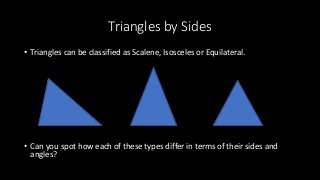
•Triangles can be classified as Scalene, Isosceles or Equilateral.
• Can you spot how each of these types differ in terms of their sides and
angles?
4.
Triangles by Angles
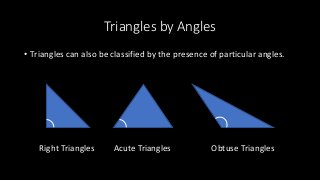
•Triangles can also be classified by the presence of particular angles.
Right Triangles Acute Triangles Obtuse Triangles
5.
Triangles inside Triangles
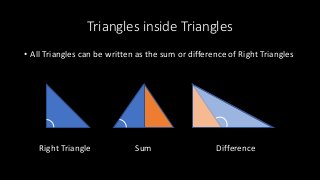
•All Triangles can be written as the sum or difference of Right Triangles
Right Triangle Sum Difference
6.
Considering all Triangles
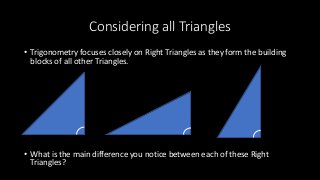
•Trigonometry focuses closely on Right Triangles as they form the building
blocks of all other Triangles.
• What is the main difference you notice between each of these Right
Triangles?
7.
The Hypotensue
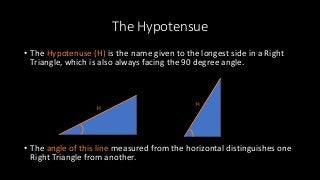
• TheHypotenuse (H) is the name given to the longest side in a Right
Triangle, which is also always facing the 90 degree angle.
• The angle of this line measured from the horizontal distinguishes one
Right Triangle from another.
H
H
8.
The “Other” Sides
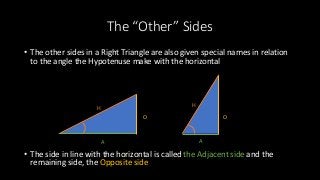
•The other sides in a Right Triangle are also given special names in relation
to the angle the Hypotenuse make with the horizontal
• The side in line with the horizontal is called the Adjacent side and the
remaining side, the Opposite side
H
H
A
O
A
O
9.
Relationships
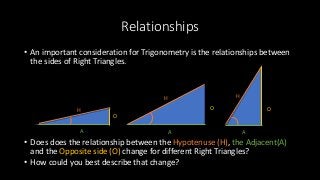
• An importantconsideration for Trigonometry is the relationships between
the sides of Right Triangles.
• Does does the relationship between the Hypotenuse (H), the Adjacent(A)
and the Opposite side (O) change for different Right Triangles?
• How could you best describe that change?
H
A
O
A
O
H
H
A
O
10.
Ratios
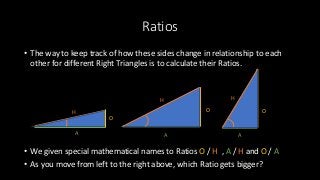
• The wayto keep track of how these sides change in relationship to each
other for different Right Triangles is to calculate their Ratios.
• We given special mathematical names to Ratios O / H , A / H and O / A
• As you move from left to the right above, which Ratio gets bigger?
H
A
O
A
O
H
H
A
O
11.
Size and Ratios
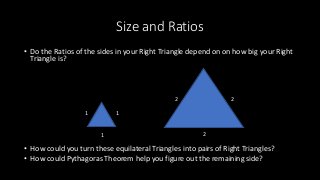
•Do the Ratios of the sides in your Right Triangle depend on on how big your Right
Triangle is?
• How could you turn these equilateral Triangles into pairs of Right Triangles?
• How could Pythagoras Theorem help you figure out the remaining side?
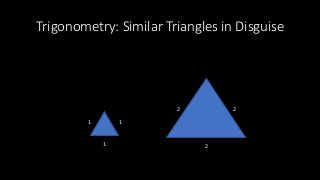
1 1
1 2
2 2
12.
Does size matter?
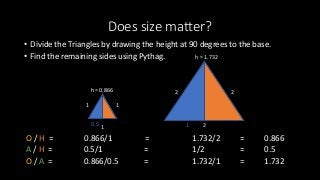
•Divide the Triangles by drawing the height at 90 degrees to the base.
• Find the remaining sides using Pythag.
O / H = 0.866/1 = 1.732/2 = 0.866
A / H = 0.5/1 = 1/2 = 0.5
O / A = 0.866/0.5 = 1.732/1 = 1.732
2
2 2
1 1
1
0.5 1
h = 0.866
h = 1.732
13.
Summing Up Part1
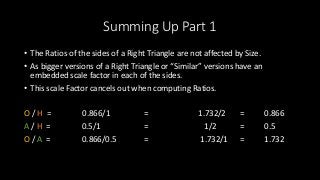
• The Ratios of the sides of a Right Triangle are not affected by Size.
• As bigger versions of a Right Triangle or “Similar” versions have an
embedded scale factor in each of the sides.
• This scale Factor cancels out when computing Ratios.
O / H = 0.866/1 = 1.732/2 = 0.866
A / H = 0.5/1 = 1/2 = 0.5
O / A = 0.866/0.5 = 1.732/1 = 1.732
14.
Summing Up Part2
• Every Triangle in existence can be expressed in Right Triangles.
• And each Triangle has in it, constant ratios independent of size and
only related to the shape of the underlying Right Triangles.
• This fact, that all Triangles are built out of a limited number of Right
Triangles whose ratio of sides we can tabulate, is the foundational
idea of Trigonometry.
• Using these Ratios such as 0.866 , 0.5 and 1.732 to solve for unknow
sides within Triangles and later relate these ratios to the angle that
created them, is essentially what Trigonometry is all about.
15.
“So, when aforensic analyst works out the height of
the attacker from the trigonometry of the blood
spatter, they’re just using the ratios of sides in a
Triangle, together with the idea of Similar Triangles”
— Peter Schutte