Featuring Fuengsin Trafford
Related by Paul Trafford
“Yet it is just within this fathom-long
body, with its perception & intellect,
that I declare that there is the world,
the origination of the world, the
cessation of the world, and the path
of practice leading to the cessation of
the world.”
*Rohitassa Sutta, AN 4.45
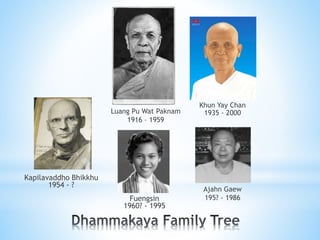
Luang Pu Wat Paknam
1916 – 1959
Kapilavaddho Bhikkhu
1954 - ?
Khun Yay Chan
1935 - 2000
Ajahn Gaew
195? - 1986Fuengsin
1960? - 1995
* 1955–56
* Vijjavaddho Bhikkhu (George Blake)
* Saddhavaddho Bhikkhu (Robert Albison)
* Pannyavaddho Bhikkhu (Peter Morgan)
[Ordination ceremony: http://youtu.be/SZwxJyfJ3Oo ]
* 1958-
Terry Magness (Suratano Bikkhu, 1970-201?)
* 1963-64
Ananda Bodhi (a.k.a. Leslie Dawson, Namgyal
Rinpoche)
*‘Ang’ [1 year old]
“Throughout their married life, Fuengsin’s
parents had monks to come to the house for
meals every day. ... In fact the welcome
became widely known and also attracted
monks on thudong — wandering monks, who
camped for a while in their garden before
moving on without settling anywhere.
Sometimes there were as many as 15 to 20
novices and monks, who were free to pop in
any time, and they knew that there would be
food and shelter for them.”
Thursday’s Lotus, p.26
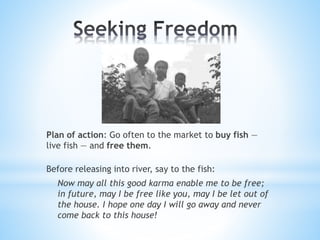
Plan of action: Go often to the market to buy fish —
live fish — and free them.
Before releasing into river, say to the fish:
Now may all this good karma enable me to be free;
in future, may I be free like you, may I be let out of
the house. I hope one day I will go away and never
come back to this house!
“The nun that I studied with was a frail
looking lady, small. [She] came from a farming
community, without much education. 20 years
later a lot of people went to study with her
and she founded one of the largest centres in
Thailand — the most famous centre in Thailand
— and her biography was printed. I spent a lot
of time with her, meditating, listening to her
teacher’s tapes.”
Thursday’s Lotus, p.69
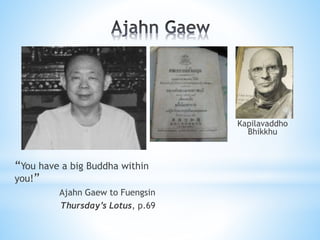
“You have a big Buddha within
you!”
Ajahn Gaew to Fuengsin
Thursday’s Lotus, p.69
Kapilavaddho
Bhikkhu
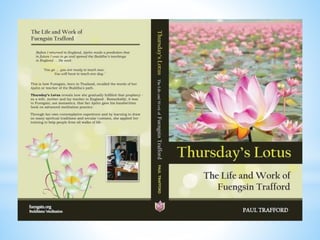
“Before I returned to England, Ajahn made a
prediction that in future I was to go and
spread the Buddha’s teachings in England; and
Ajahn brought me to prostrate myself in front
of Luang Phor [Wat Paknam] in order to ask
that he give his blessing to help me succeed in
this mission…
He asked me to pay respect and he lit
candles and incense and he said he would like
the power of communication and teaching be
transferred to me…
He said, ‘You go . . . you are ready to
teach now. You will have to teach one day.’”
Thursday’s Lotus, p.93
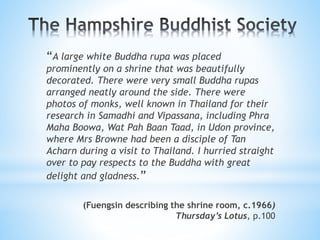
“A large white Buddha rupa was placed
prominently on a shrine that was beautifully
decorated. There were very small Buddha rupas
arranged neatly around the side. There were
photos of monks, well known in Thailand for their
research in Samadhi and Vipassana, including Phra
Maha Boowa, Wat Pah Baan Taad, in Udon province,
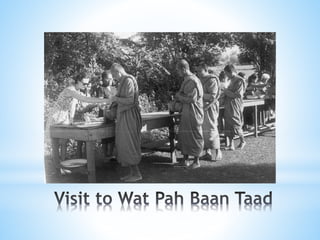
where Mrs Browne had been a disciple of Tan
Acharn during a visit to Thailand. I hurried straight
over to pay respects to the Buddha with great
delight and gladness.”
(Fuengsin describing the shrine room, c.1966)
Thursday’s Lotus, p.100
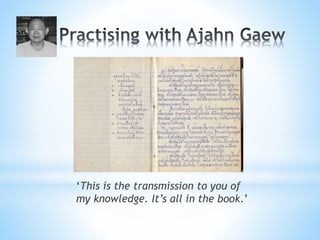
‘This is the transmission to you of
my knowledge. It’s all in the book.’
“I wasn’t well. My eye ached and there was a
lot of phlegm. It seemed I had a cold and fever.
…I quickly got up and went upstairs and
meditated for 45 minutes. I perspired a lot. At
first it seemed there was no peace, but after
15 minutes things improved and it seemed very
good. The mind was cool and calm, one-
pointed. The kilesas [defilements] tried to
enter, but the mind did not stray from the
feelings.”
From personal diary
Thursday’s Lotus, p.120
. . . Your behaviour is only a reflection
of your mind. When you meditate you
become single-minded — that doesn’t
mean narrow-minded, merely that your
mind is opening up and you are more
capable of appreciating and
understanding things.
Fuengsin in County Express interview
Thursday’s Lotus, p.164
“Before you teach, give compassion to the whole
class and think of them as your own body, as if they
are one with you. Visualise them in you and fix here
and try to visualise their five aggregates at one
spot. The visualisation that we do — each of the
aggregates condensed like a crystal — tiny spot like
a crystal — and it gets so everybody’s aggregates
condensed to one point, here at the centre of the
body. ... So they will understand more.”
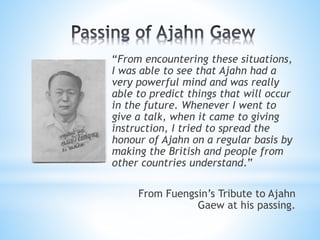
“From encountering these situations,
I was able to see that Ajahn had a
very powerful mind and was really
able to predict things that will occur
in the future. Whenever I went to
give a talk, when it came to giving
instruction, I tried to spread the
honour of Ajahn on a regular basis by
making the British and people from
other countries understand.”
From Fuengsin’s Tribute to Ajahn
Gaew at his passing.
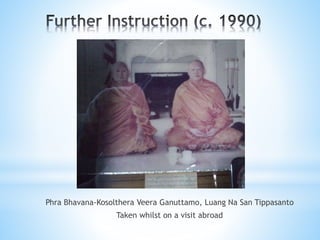
Phra Bhavana-Kosolthera Veera Ganuttamo, Luang Na San Tippasanto
Taken whilst on a visit abroad
“. . . Dr A. Keightley at King Edwards,
Stourbridge wanted me to teach meditation
there next [academic] year. He is very pleased
with my performance.
. . . Next month there will be 17 students to
attend the class. There are at least 40 students
who are waiting to learn to meditate.”
A Woman child, O Lord of Men, may prove
even a better offspring than a man.
Verse 16: The Daughter, Samyutta-nikaya 1.3.
Chulalongkorn
University
Faculty of Arts
Alumni (2497-
2501)
50th Anniversary.
Dhammakaya pioneers in the UK: featuring Fuengsin Trafford

Dhammakaya pioneers in the UK: featuring Fuengsin Trafford

  • 1.
  • 2.
    “Yet it isjust within this fathom-long body, with its perception & intellect, that I declare that there is the world, the origination of the world, the cessation of the world, and the path of practice leading to the cessation of the world.” *Rohitassa Sutta, AN 4.45
  • 4.
    Luang Pu WatPaknam 1916 – 1959 Kapilavaddho Bhikkhu 1954 - ? Khun Yay Chan 1935 - 2000 Ajahn Gaew 195? - 1986Fuengsin 1960? - 1995
  • 5.
    * 1955–56 * VijjavaddhoBhikkhu (George Blake) * Saddhavaddho Bhikkhu (Robert Albison) * Pannyavaddho Bhikkhu (Peter Morgan) [Ordination ceremony: http://youtu.be/SZwxJyfJ3Oo ] * 1958- Terry Magness (Suratano Bikkhu, 1970-201?) * 1963-64 Ananda Bodhi (a.k.a. Leslie Dawson, Namgyal Rinpoche)
  • 8.
  • 10.
    “Throughout their marriedlife, Fuengsin’s parents had monks to come to the house for meals every day. ... In fact the welcome became widely known and also attracted monks on thudong — wandering monks, who camped for a while in their garden before moving on without settling anywhere. Sometimes there were as many as 15 to 20 novices and monks, who were free to pop in any time, and they knew that there would be food and shelter for them.” Thursday’s Lotus, p.26
  • 11.
    Plan of action:Go often to the market to buy fish — live fish — and free them. Before releasing into river, say to the fish: Now may all this good karma enable me to be free; in future, may I be free like you, may I be let out of the house. I hope one day I will go away and never come back to this house!
  • 15.
    “The nun thatI studied with was a frail looking lady, small. [She] came from a farming community, without much education. 20 years later a lot of people went to study with her and she founded one of the largest centres in Thailand — the most famous centre in Thailand — and her biography was printed. I spent a lot of time with her, meditating, listening to her teacher’s tapes.” Thursday’s Lotus, p.69
  • 16.
    “You have abig Buddha within you!” Ajahn Gaew to Fuengsin Thursday’s Lotus, p.69 Kapilavaddho Bhikkhu
  • 21.
    “Before I returnedto England, Ajahn made a prediction that in future I was to go and spread the Buddha’s teachings in England; and Ajahn brought me to prostrate myself in front of Luang Phor [Wat Paknam] in order to ask that he give his blessing to help me succeed in this mission… He asked me to pay respect and he lit candles and incense and he said he would like the power of communication and teaching be transferred to me… He said, ‘You go . . . you are ready to teach now. You will have to teach one day.’” Thursday’s Lotus, p.93
  • 22.
    “A large whiteBuddha rupa was placed prominently on a shrine that was beautifully decorated. There were very small Buddha rupas arranged neatly around the side. There were photos of monks, well known in Thailand for their research in Samadhi and Vipassana, including Phra Maha Boowa, Wat Pah Baan Taad, in Udon province, where Mrs Browne had been a disciple of Tan Acharn during a visit to Thailand. I hurried straight over to pay respects to the Buddha with great delight and gladness.” (Fuengsin describing the shrine room, c.1966) Thursday’s Lotus, p.100
  • 24.
    ‘This is thetransmission to you of my knowledge. It’s all in the book.’
  • 25.
    “I wasn’t well.My eye ached and there was a lot of phlegm. It seemed I had a cold and fever. …I quickly got up and went upstairs and meditated for 45 minutes. I perspired a lot. At first it seemed there was no peace, but after 15 minutes things improved and it seemed very good. The mind was cool and calm, one- pointed. The kilesas [defilements] tried to enter, but the mind did not stray from the feelings.” From personal diary Thursday’s Lotus, p.120
  • 27.
    . . .Your behaviour is only a reflection of your mind. When you meditate you become single-minded — that doesn’t mean narrow-minded, merely that your mind is opening up and you are more capable of appreciating and understanding things. Fuengsin in County Express interview Thursday’s Lotus, p.164
  • 30.
    “Before you teach,give compassion to the whole class and think of them as your own body, as if they are one with you. Visualise them in you and fix here and try to visualise their five aggregates at one spot. The visualisation that we do — each of the aggregates condensed like a crystal — tiny spot like a crystal — and it gets so everybody’s aggregates condensed to one point, here at the centre of the body. ... So they will understand more.”
  • 32.
    “From encountering thesesituations, I was able to see that Ajahn had a very powerful mind and was really able to predict things that will occur in the future. Whenever I went to give a talk, when it came to giving instruction, I tried to spread the honour of Ajahn on a regular basis by making the British and people from other countries understand.” From Fuengsin’s Tribute to Ajahn Gaew at his passing.
  • 33.
    Phra Bhavana-Kosolthera VeeraGanuttamo, Luang Na San Tippasanto Taken whilst on a visit abroad
  • 34.
    “. . .Dr A. Keightley at King Edwards, Stourbridge wanted me to teach meditation there next [academic] year. He is very pleased with my performance. . . . Next month there will be 17 students to attend the class. There are at least 40 students who are waiting to learn to meditate.”
  • 38.
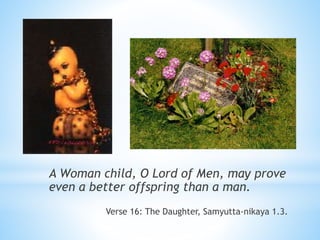
    A Woman child,O Lord of Men, may prove even a better offspring than a man. Verse 16: The Daughter, Samyutta-nikaya 1.3.
  • 40.

Editor's Notes

  • #2 A presentation originally given at a Dhammakaya Peace Meeting, which took place at the Quaker Meeting House on 23 March 2017. It followed a peace vigil in Radcliffe Square to draw attention to Thai Government’s violations of humans rights against Wat Phra Dhammakaya. The gatherings aimed to inform and spread loving kindness to Thailand. In that spirit, these slides recount the early days of the Dhammakaya tradition coming to the UK, focusing on Fuengsin Trafford (née Sarayutpitag). Subsequently revised on 20 April 2017 to include a link to full 15-minute film archive (on YouTube) of Western bhikkhu ordination at Wat Paknam, 1956
  • #3 The path to nirvana as taught by the Lord Buddha is called ‘the Middle Way’, an internal path inside each one of us.
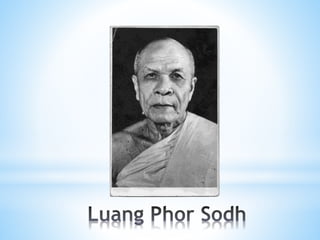
  • #4 The one who re-discovered the Middle Way was a Thai monk, Luang Phor Sodh, the late Abbot of Wat Paknam Bhasicharoen, Thonburi, Thailand.
  • #5 A kind of family tree indicating Fuengsin’s background in Dhammakaya meditation – the dates indicate the years during which the Dhammakaya method was practiced (through to passing away).
  • #6 In a 20 minute presentation we can only mention others who also practised the method. However, none of these came back to the UK and maintained/spread the practice here because of certain obstacles; they did not have the proper support – otherwise they may have been all together. Terry Magness did maintain dhammakaya meditation practice, but stayed in Thailand till his passing.
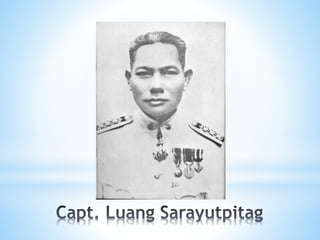
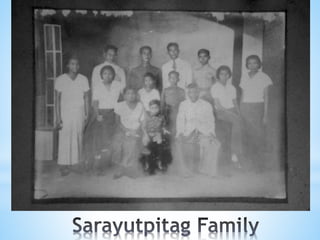
  • #7 Now we switch from the Dhamma family tree to the Lay family tree. This is Fuengsin’s father (who was formerly in the army and then worked in the Ministry of the Interior prison services (accountancy/tax inspection), very influential in character – a calm person described as a cool, shady tree.
  • #8 Before Fuengsin was born.
  • #9 Fuengsin had the nickname of Dang (= ‘red’).
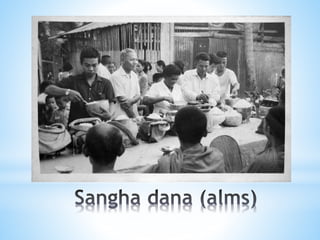
  • #10 Family were devout Buddhists, supported many monks. Here they are offering food to monks in the traditional style of Angthong province, where family + ancestors came from.
  • #12 Fuengsin had a very strong spirit, always seeking freedom, but her parents were very strict. When she learnt about the Law of Karma, she applied it in a dramatic way. The rebelliousness is disconcerting, yet the Bodhisattva Gotama was similarly determined to leave his family to find freedom. The internal motivation might have been similar.
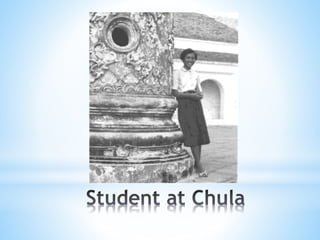
  • #13 University days meant new-found freedom and lots to smile about. (This was taken at Phra Pathom Chedi.)
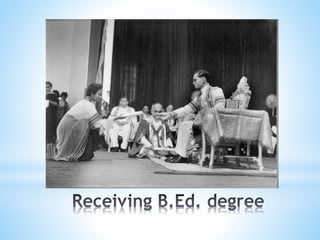
  • #14 Fuengsin graduated from Chula with B.A. (Liberal Arts) and B.Ed. In both cases she received the degree from His Majesty King Bhumibol.
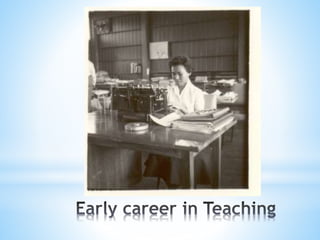
  • #15 Fuengsin trained as a teacher of English language (first job was at Thonburi Technical College, which is now KMUTT)
  • #16 In parallel, Fuengsin trained her mind through meditation, arriving in around 1960 at Wat Paknam. Her first teacher is described above – who is it … ?
  • #17 Fuengsin needed a teacher who was easy to access for her particular circumstances. She found Ajahn Gaew Potikanok, who, on seeing her for the first time made the declaration about the Buddha within. Ajahn Gaew was of Chinese origin and did a lot to promote Wat Paknam among the Chinese community. He also spoke English and hence got to know well Tan William Purfurst, who received ordination as Kapilavaddho bhikkhu. The photo on the right was given to Ajahn Gaew, signed with thanks and metta from Ven. Kapilavaddhp; the booklet in Thai and Chinese commemorates the ordination ceremony of three Western disciples of Kapilavaddho bhikkhu at Wat Paknam in 1956. 10,000 copies were printed.
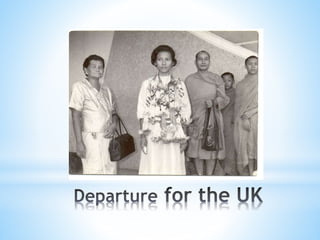
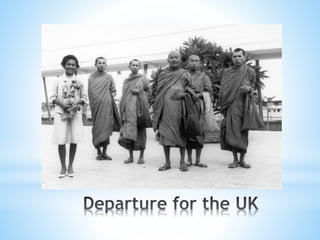
  • #18 1963. Fuengsin with her mother on one side and her first cousin, Chalerm Suttirak in robes, on the right. Taken at Don Meuang Airport as Fuengsin leaves on a UNESCO grant to study in London.
  • #19 Many monks, some relatives, came to say farewell to Fuengsin.
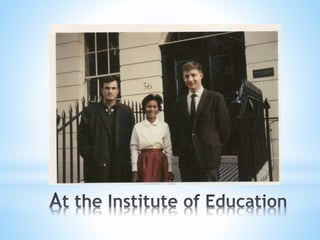
  • #20 At the Institute of Education alongside other students – Terry Walsh and David Bridges.
  • #21 1964. The sight of people from different countries (other international students at the Institute of Education) was quite unusual.
  • #22 Fuengsin’s family was disappointed the Fuengsin had got married to a ‘Farang’ – they expected her to continue her career to become a Professor rather than (what they expected) a housewife. Ajahn Gaew saw it differently.
  • #23 Fuengsin soon started to get to work (re the Dhamma) and made friends with Jane Browne. This is the description of the shrine room (a converted well house) at the Browne family home in Winchester.
  • #24 1972. In these early days, different denominations of Buddhists worked together and supported each other; Fuengsin joined Jane Browne on a trip to pay respects to Tan Maha Boowa, Abbot of Wat Pah Baan Taad, NE Thailand, even though this was not her tradition. Here Mrs Browne is putting food into the bowl of the Abbot with Fuengsin next to her.
  • #25 1972. Whilst in Thailand, Fuengsin continued her own practice, studying under Ajahn Gaew. He gave her this book, about 200 pages, which had been compiled by nuns who transcribed original teachings of the late abbot, Luang Pu Wat Paknam.
  • #26 Back in England, Fuengsin maintained a diary for about 5 years, recording some details of her meditation experiences (and struggles).
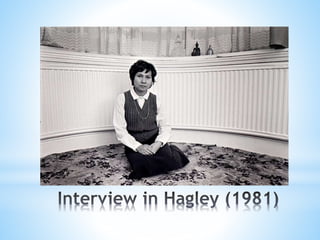
  • #27 The family moved to Hagley in the Midlands in 1975. Fuengsin was interviewed for the County Express, a local paper, in an article called ‘Woman to Woman’. Photograph is by Phil Loach.
  • #28 Fuengsin talked a lot about what Buddhism meant to her.
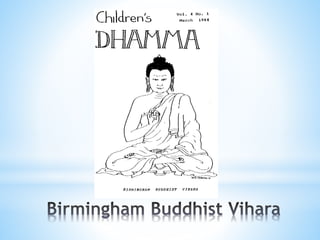
  • #29 Fuengsin soon became active in Birmingham, particularly the Birmingham Buddhist vihara, where she was on the education committee and was an editor for a children’s magazine. She contributed articles about famous Thai monastics such as Kruba Srivichai.
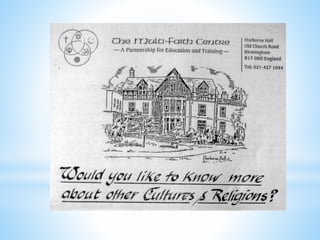
  • #30 Fuengsin also became involved in interfaith work, notably under a pioneering nun, Sr. Dr. Mary Hall, who embraced Vatican II with open arms, bringing together people of different faiths to really get to know each other and work together. They offered various courses at the beautiful centre of Harborne Hall, owned by an order of nuns.
  • #31 Fuengsin lacked some confidence when it came to teaching Westerners, especially the intellectuals who had a lot of book knowledge. Ajahn Gaew gave her some advice to help.
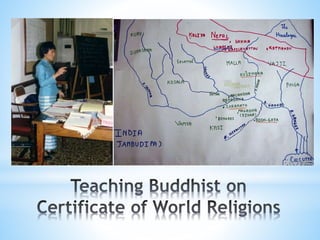
  • #32 Fuengsin’s confidence as a Buddhist teacher grew and she was proud to represent Thailand in this capacity; on the right is her own drawing, a map showing places where the Buddha taught.
  • #33 Rather too soon, in 1986, Ajahn Gaew passed away after battling with cancer. Fuengsin reflected on his vision.
  • #34 Fuengsin returned to Wat Paknam to seek another teacher and receiving instruction from Phra Bhavana-Kosolthera and Luang Na San Tippasanto, in 1989. A year or two later these meditation masters travelled abroad when this photo was taken. It is kept in the Museum (Mor-Sor-Jor) at Wat Paknam.
  • #35 Fuengsin was delighted to find in a local shop a crystal ball that she could use for teaching Sixth Form students in Stourbridge, the local town. Dr. Keightley was head of religious studies (keen on Zen).
  • #36 Fuengsin taught also at Selly Oak Colleges, now absorbed into the University of Birmingham. This photos was taken at the USPG College of Ascension (from left to right: Sharada Sugirtharajah, Dr Elizabeth Harris, Fuengsin, Canon Andrew Wingate, and Canon Jemima Prasadam.)
  • #37 1993. Multi-Faith Centre: Sr. Dr. Mary Hall in the centre surrounded by her team of programme coordinators of/from six world religions. The team presented at several places in New York State, including the United Nations.
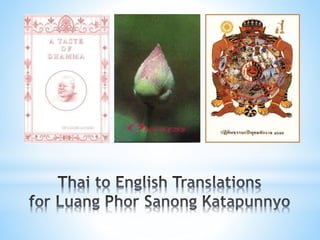
  • #38 In parallel, Fuengsin carried out translations from Thai to English for Ven. Ajahn Sanong Katapunnyo, the Abbot of Wat Sanghathan.
  • #39 … until her final translation of ‘Attachment’, the front cover image depicting the attachment between a parent and child. The quote ‘popped up’ spontaneously at the moment of Fuengsin’s passing (23 February 1995). Fuengsin’s ashes lie at the Forest Hermitage (or Wat Pah Santidhamma – the name that Fuengsin had chosen) in Warwickshire.
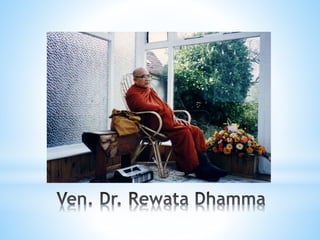
  • #40 At the reception was Ven. Dr. Rewata Dhamma, whom Fuengsin had assisted since his arrival in the UK in 1975. Taken in the sun lounge of the family home in Hagley.
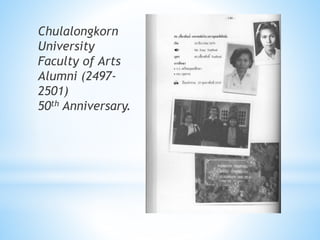
  • #41 Various memorials were published – this is from a 50th anniversary volume prepared by alumni of the Faculty of Arts at Chula.
  • #42 Find out more in Thursday’s Lotus: The Life and Work of Fuengsin Trafford’, http://fuengsin.org/lotus (free PDF available). Thank you.