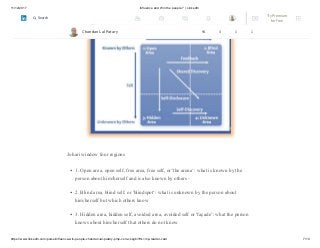
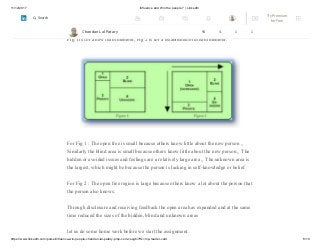
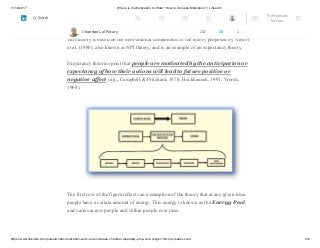
Acknowledgements
This book hasbeen shaped by the contributions of many people. I’d like
to wholeheartedly thank everyone who reviewed chapters, shared
stories, or provided advice. All my friends and colleagues from current
and previous organization helped me to build this book.
5.
11/12/2017 (2) Whatto do with the mid-level performer?How to help them? | LinkedIn
https://www.linkedin.com/pulse/what-do-mid-level-performerhow-help-them-patary-pmp-csm-cssgb/?trk=mp-reader-card 1/6
What to do with the mid-level performer?
How to help them?
Published on July 26, 2015 |
The intellect, character, and skill possessed by any man are the product of certain
original tendencies and the training which they have received.-Edward Thorndike
Edit article View stats
Chandan Lal Patary 97 1 1
2 Try Premium
for Free
Search
6.
11/12/2017 (2) Whatto do with the mid-level performer?How to help them? | LinkedIn
https://www.linkedin.com/pulse/what-do-mid-level-performerhow-help-them-patary-pmp-csm-cssgb/?trk=mp-reader-card 2/6
Most of the employees in the organization are not a star performer nor are they at the
bottom 10% in the bell curve. They are the mid-level performer!!
They are the challenge for the organization.
Mid-level performers need assistance. Because of the various competency gaps they
don’t get the attention which they deserve and because of those gaps they cannot
contribute as expected level.
How can manager motivate the mid-level performers? Managing them? Helping them to
come out with as a best players?
Most of the mid-level performer once in their life time had been performed as a star
performer. Mid-level performer has ability to execute the tasks with superior quality but
due certain priority mismatch they are not able to contribute in current cycle.
Organization need to apply patience and understand their needs and analyze the
situation.
Chandan Lal Patary 97 1 1
2 Try Premium
for Free
Search
7.
11/12/2017 (2) Whatto do with the mid-level performer?How to help them? | LinkedIn
https://www.linkedin.com/pulse/what-do-mid-level-performerhow-help-them-patary-pmp-csm-cssgb/?trk=mp-reader-card 3/6
Too many star performers in a team is not a healthy sign. All star performer has certain
basic nature. They are demanding in nature, they are passionate, they want to
achieve more, their expectation is high, they maintain high self-esteem and they
have different priority in life. Most of the population in team with this mindset is not
healthy for the team. For healthy workplace organization need mixture of people.
Minor dissatisfaction causes attrition to the star performer and impact the organization
and the running critical projects.
Most of the mid-level performer are loyal to the organization. They stick with the
organization for the long time. They build good network within the organization
and they become glue for the organization. For organization sustenance,
Organization need to focus those mid-level performer and come up with proper plan for
those population. Career planning, training need, counseling, identification of the
competency gap, personal and professional support is very much require to mid-level
performer. Constant coaching, mentoring for work life balance without losing patience
is require to bring them. Back from current level.
Managing mid-level performer is always a challenge. Manager has to know the
requirements, manager has to discuss with the employees to understand the priority in
their life. Need to match the job requirement vs current expectation vs competency gap.
Manager has to bridge the gap on behalf of them. Most of them are not good at
communication, manager as to come down to certain level to help them and
communicate them the current priorities of the organization.
Most of the mid-level performer will not do what organization demand them to do at
that time. They will have some other desire or priorities in their mind which they are not
able to communicate or managers are not able to understand o managers do not have
Chandan Lal Patary 97 1 1
2 Try Premium
for Free
Search
8.
11/12/2017 (2) Whatto do with the mid-level performer?How to help them? | LinkedIn
https://www.linkedin.com/pulse/what-do-mid-level-performerhow-help-them-patary-pmp-csm-cssgb/?trk=mp-reader-card 4/6
any other options available other than current assignments if there is a job mismatch
also.
Managers has to look for opportunities where mid-level performer has done something
worth of appreciation. Manager has to grab those opportunity to recognize them,
motivate them as mid-level performer always badly need self-esteem booster
recognition. It is very much require to maintain the motivation level for mid-level
performer to bring them from current performance level to next level.
If we compare star performer vs mid-level performer, all star performer are self-
aware about how to execute the tasks efficiently and branding the same on time
with perfection, communicate the results with all possible way so that they get
the due recognition. Over a period of time those star performers build the high
confidence level among team and with high self-esteem.
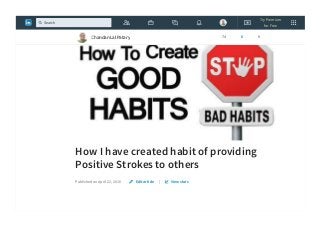
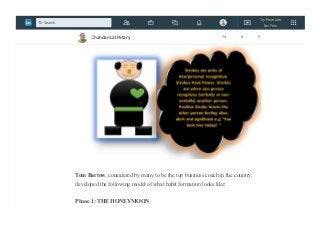
Sometime peer guidance does not work out if organization try to attach mentor-ship
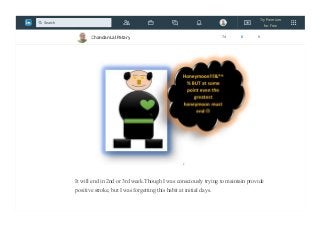
model with different performers. Line management has to involve to resolve this kind of
situation by driving into the exact scenarios. Line management organization need to
understand the bigger picture, analyze the case and guide the team members. Constant
motivation helps the situation to become better.
Mid-level performer though they are less passionate and low in motivation level
does not necessarily tells that they are not willing to perform. Managers need to
know that organization need them and invest time and money on them to bring
them into the expect level. Managers need to plan for them for long term career
plan so that they get the vision and feel attach with the organization vision and
work for it.
Chandan Lal Patary 97 1 1
2 Try Premium
for Free
Search
9.
11/12/2017 (2) Whatto do with the mid-level performer?How to help them? | LinkedIn
https://www.linkedin.com/pulse/what-do-mid-level-performerhow-help-them-patary-pmp-csm-cssgb/?trk=mp-reader-card 5/6
Mid-level performer are essential for the organization growth. Mentoring them, guiding
them, train them will be helpful to the organization for long term. Managers need to
provide continuous feedback to the team members, guide them and show the direction
so that proper mitigation can be taken well ahead. To improve the performance
continuous bidirectional interaction is a must. Organization need to show the
confidence on them to increase their confidence, trust has to establish and build.
Understanding how to get the most out of these middle performers requires both
enabling them and motivating them with the right mix of rewards and recognition
that is aligned with their personal drives and within reach through stretch goal.
Following this process correctly will lead to unprecedented success and sustained
competitive advantage.
Report this
1 Like
1 Comment
Add a comment…
Mandar Deo
Director Application Delivery
Like Reply 2 Likes
2y
Nice one very true
Chandan Lal Patary 97 1 1
Edit article
2 Try Premium
for Free
Search
11.
11/12/2017 (2) BuildingHigh Performance Team by using Pygmalion Effect | LinkedIn
https://www.linkedin.com/pulse/building-high-performance-team-using-pygmalion-effect-chandan-lal/?trk=mp-reader-card 1/7
Building High Performance Team by
using Pygmalion Effect
Published on August 19, 2015 |
The crux of this psychological phenomenon is the concept of self-fulfilling prophecy: If
you believe something is true of yourself, eventually it will be.
Edit article View stats
Chandan Lal Patary 348 10 5 23
2 Try Premium
for Free
Search
12.
11/12/2017 (2) BuildingHigh Performance Team by using Pygmalion Effect | LinkedIn
https://www.linkedin.com/pulse/building-high-performance-team-using-pygmalion-effect-chandan-lal/?trk=mp-reader-card 2/7
Greater expectations drive greater performance: Building high
performance team.
Building high performance team is actually already believing that having a high
performance team! We are all working for world class team, world class software
solution! We are already with high performance team wherever we work, believing is
bringing the reality.
Research has confirmed that people tend to act in ways that are consistent with what
others expect of them. The source of low expectations in the workplace is often a boss
who sees an employee as a pathetic performer and then treats the employee differently
than high performers. The employee who thinks he or she is a weak performer in the
eyes of the boss will often perform down to expectations.
Jeff Immelt, CEO and chairman of GE says, “The ability to demand high
performance without being heartless has been part of GE for a long time.” When
performance is measured against these high standards, productivity is likely to increase,
since people tend to live up to the expectations of their superiors.
As An agile coach we have to trust in this principle which is a proven concept to
implement at the team level.
Ensure that all the connected parties believe and practice this concept. If not, let us
correct them.
Pygmalion Effect:
Chandan Lal Patary 348 10 5 23
2 Try Premium
for Free
Search
13.
11/12/2017 (2) BuildingHigh Performance Team by using Pygmalion Effect | LinkedIn
https://www.linkedin.com/pulse/building-high-performance-team-using-pygmalion-effect-chandan-lal/?trk=mp-reader-card 3/7
The crux of this psychological phenomenon is the concept of self-fulfilling prophecy: If
you believe something is true of yourself, eventually it will be.
The first test of the Pygmalion Effect was performed by psychologist Robert Rosenthal
and occurred in an elementary school classroom with first and second grade students. At
the beginning of the year, all the students took an assessment test, and Rosenthal led the
teachers to believe that certain students were capable of great academic achievement.
Rosenthal chose these students at random, regardless of the actual results of the IQ tests.
Chandan Lal Patary 348 10 5 23
2 Try Premium
for Free
Search
14.
11/12/2017 (2) BuildingHigh Performance Team by using Pygmalion Effect | LinkedIn
https://www.linkedin.com/pulse/building-high-performance-team-using-pygmalion-effect-chandan-lal/?trk=mp-reader-card 4/7
At the end of the year, when the students were retested, the group of earmarked high
achievers did indeed show improvement over their peers.
Why was this? Later tests concluded that teachers subconsciously gave greater
opportunities, attention, and feedback to the special group. Their expectations for this
group were higher, and their expectations created the reality.
Rosenthal summarized his finding:
What one person expects of another can come to serve as a self-
fulfilling prophecy
Chandan Lal Patary 348 10 5 23
2 Try Premium
for Free
Search
15.
11/12/2017 (2) BuildingHigh Performance Team by using Pygmalion Effect | LinkedIn
https://www.linkedin.com/pulse/building-high-performance-team-using-pygmalion-effect-chandan-lal/?trk=mp-reader-card 5/7
The effect is named after Pygmalion, a Cypriot sculptor in a narrative by Ovid in Greek
mythology, who fell in love with a female statue named Galatea he had carved out of
ivory.
People rise and fall to meet your level of expectations for them. If you express
skepticism and doubt in others, they will return your lack of confidence with
mediocrity. But if you believe in them and expect them to do well, they will go the
extra mile trying to do their best.
—JOHN C. MAXWELL
The applications for the Pygmalion Effect can have benefits for both personal
development and leadership. Individually, we can challenge ourselves with more
difficult goals and tasks in an effort to rise to meet the challenge. As a leader, when we
expect great things from our team, we may see improved performance in return.
Positive attention and caring improved individual performance. Given this finding, any
coach or team member can use caring and outflowing concern at work to improve the
performance of the organization or work group. Humans crave attention and want to be
seen positively, which is why “saving face” is so important in many cultures.
As a coach how we are perceived is vital to our standing in the team and in the
organization.
It feels good when management cares about you and it is motivating, as reflected in
various studies.
Let us treat your team members positively, and reap real bottom line benefits.
Chandan Lal Patary 348 10 5 23
2 Try Premium
for Free
Search
17.
11/12/2017 Achieving HighAcceptability from a Team | LinkedIn
https://www.linkedin.com/pulse/achieving-high-acceptability-from-team-patary-pmp-csm-cssgb/?trk=mp-reader-card 1/4
Achieving High Acceptability from a
Team
Published on November 7, 2015 |
If a group or an individual is given the freedom to arrive at a decision themselves, it will
increase the probability that they will accept the decision.
Edit article View stats
Chandan Lal Patary 117 3 1
Try Premium
for Free
Search
18.
11/12/2017 Achieving HighAcceptability from a Team | LinkedIn
https://www.linkedin.com/pulse/achieving-high-acceptability-from-team-patary-pmp-csm-cssgb/?trk=mp-reader-card 2/4
However, the trouble with this proposal is the uncertainty that they will make poor
decisions.
One such system of using participation in leadership situations has been proposed by
Norman Maier, a psychologist from the University of Michigan,
based on considerable research.
Maier suggests that when a leader is making a decision of whether to allow a group to
participate in decision making, s/he must first decide whether the issue being addressed
is one that relates to the followers’ needs or impacts them in some significant way.
Maier’s research indicates that achieving high acceptability will primarily occur
(1) when each person involved participates in the discussion;
(2) when each person gets to talk and present their own ideas;
(3) when each person involved feels they received a benefit from the choice;
(4) when each person feels respected by the others;
(5) when each person involved feels a high-quality choice was made
Maier’s research suggests that obtaining a high-quality decision (a good choice) will
most likely occur:
(1) when there is agreement on what the problem or issue is;
(2) when the discussion moves from issue, to possible solutions, and THEN to
choice;
(3) when a conflict of ideas is encouraged;
(4) when all available facts are considered;
(5) when sufficient time is given to the deliberations;
Chandan Lal Patary 117 3 1
Try Premium
for Free
Search
19.
11/12/2017 Achieving HighAcceptability from a Team | LinkedIn
https://www.linkedin.com/pulse/achieving-high-acceptability-from-team-patary-pmp-csm-cssgb/?trk=mp-reader-card 3/4
(6) when solutions from other different situations are not allowed;
(7) when the problem or issue is discussed at two time intervals not just one;
(8) when the group making the decision is not too large.
Reference:Maier, N.R.F. (1963) Problem Solving Discussions and Conferences:
Leadership Methods and Skills. New York: McGraw-Hill
Report this
3 Likes
1 Comment
Add a comment…
Jim Sywilok
Agile Coach at Indev, LLC
Like Reply 1 Like
2y
Thank you for sharing. I can see this being very helpful scrum masters & agile coaches during their team's
retrospective.
Chandan Lal Patary
Enterprise Agile Coach at Société Générale
More from Chandan Lal Patary See all 306 articles
Chandan Lal Patary 117 3 1
Edit article
Try Premium
for Free
Search
21.
11/12/2017 Attitude Definesour Altitude | LinkedIn
https://www.linkedin.com/pulse/attitude-defines-our-altitude-chandan-lal-patary-pmp-csm-cssgb/?trk=mp-reader-card 1/7
Attitude Defines our Altitude
Published on August 31, 2015 |
Attitude!! Attitude!! Attitude defines our Altitude not our Aptitude…which directly link
to employees high Productivity.Spread this type thoughts to our team members.
Somebody quotes: “Ability is what we’re capable of doing. Motivation determines
what we do. Attitude determines how well we do it.”
Edit article View stats
Chandan Lal Patary 99 5 1
Try Premium
for Free
Search
22.
11/12/2017 Attitude Definesour Altitude | LinkedIn
https://www.linkedin.com/pulse/attitude-defines-our-altitude-chandan-lal-patary-pmp-csm-cssgb/?trk=mp-reader-card 2/7
Attitudes are thoughts that we have accepted as true and that lead us to think, feel, or act
positively or negatively toward a person, idea, or event. They represent an emotional
readiness to behave in a particular manner.
Our values, those beliefs, and preferences we feel are important serve as a
foundation for our attitudes.
Attitude is often synonyms with self-esteem. People formulate a powerful first
impression of our within fist 12-30 seconds.Judgement is happening from physical
posture, appearance.
Each of us lives our life according to a unique set of core values.
One of the most significant differences between high and low achievers is choice of
attitude.
Chandan Lal Patary 99 5 1
Try Premium
for Free
Search
23.
11/12/2017 Attitude Definesour Altitude | LinkedIn
https://www.linkedin.com/pulse/attitude-defines-our-altitude-chandan-lal-patary-pmp-csm-cssgb/?trk=mp-reader-card 3/7
People who go through life with a positive attitude are more likely to achieve their
personal and professional goals. People who filter their daily experiences through a
negative attitude find it difficult to achieve contentment or satisfaction in any aspect of
their lives.
Jack Welch, the former chairman and CEO of General Electric, believes that an
organization needs people with “positive energy” and needs to get rid of those people
who inject the workforce with “negative energy”—even if they are high
performers.
Many organizations have discovered the link between workers’ attitudes and
profitability. This discovery has led to major changes in the hiring process.
Employers today are less likely to assume that applicants’ technical abilities are the best
indicators of their future performance. They have discovered that the lack of technical
skills is not the primary reason why most new hires fail to meet expectations.
It is their lack of interpersonal skills that counts. Happy employees are productive
employees.
People who are self-motivated are inclined to set their own goals and monitor their own
progress toward those goals.Agile team !! Self Driven Team members.
Their attitude is
“I am responsible for this job.” They do not need a supervisor hovering around them
making sure they are on task and accomplishing what they are supposed to be
doing.Micro managers will force to resign!
Chandan Lal Patary 99 5 1
Try Premium
for Free
Search
24.
11/12/2017 Attitude Definesour Altitude | LinkedIn
https://www.linkedin.com/pulse/attitude-defines-our-altitude-chandan-lal-patary-pmp-csm-cssgb/?trk=mp-reader-card 4/7
Many find ways to administer their own rewards after they achieve their goals.
Employers often retain and promote those employees who take the initiative to make
their own decisions, find better ways of doing their jobs, read professional
publications to learn new things, and monitor the media for advances in technology.
Optimistic thoughts give rise to positive attitudes and effective interpersonal
relationships. When we are an optimist, our coworkers, managers, and—perhaps most
important—our customers feel our energy and vitality and tend to mirror your behavior.
If we feel the need to become a more optimistic person, we can spend more time
visualizing ourself succeeding.
Let us monitor our self-talk and discover whether or not we are focusing on the
negative aspects of the problems and disappointments in our life, or if we are
looking at them as learning experiences that will eventually lead us toward
our personal and professional goals.
Let us try to avoid having too much contact with pessimists, and refuse to be drawn into
a group of negative thinkers who see only problems, not solutions. Attitudes can be
contagious.
An attitude is nothing more than a personal thought process. We cannot control the
thinking that takes place in someone else’s mind, but we can sometimes influence it.
And sometimes we can’t do that either, so we have to set certain rules of behavior.
Some organizations have come to the conclusion that behavior that offends or threatens
others must stop.
Chandan Lal Patary 99 5 1
Try Premium
for Free
Search
25.
11/12/2017 Attitude Definesour Altitude | LinkedIn
https://www.linkedin.com/pulse/attitude-defines-our-altitude-chandan-lal-patary-pmp-csm-cssgb/?trk=mp-reader-card 5/7
When employees have positive attitudes, job performance and productivity are
likely to improve.
We are constantly placed in new situations with people from different backgrounds and
cultures. Each time we go to a new school, take a new job, get a promotion, or move to
a different neighborhood, we may need to alter our attitudes to cope effectively with the
change when events, such as a layoff, are beyond our control, we can accept this fact
and move on. It is often said that life is 10 percent what happens to us and 90
percent how we react to it.
Most companies realize that an employee’s attitude and performance cannot be
separated. When employees have negative attitudes about their work, their job
performance and productivity suffer.
Excellent work + Poor Attitude = Poor Productivity
Excellent IQ+ Excellent Work + Poor Attitude = Poor Productivity
When employees work with right mindset output increase.
“Excellence is not a skill. It is an attitude. “
do we have friends,colleagues,team members with such mindset?
How can we build such mindset? Agile team .......part of journey to build world class
place to live in ....
Chandan Lal Patary 99 5 1
Try Premium
for Free
Search
27.
11/12/2017 Basic CounselingSkills? for Leaders/Managers | LinkedIn
https://www.linkedin.com/pulse/basic-counseling-skills-leadersmanagers-patary-pmp-csm-cssgb/?trk=mp-reader-card 1/7
Basic Counseling Skills? for
Leaders/Managers
Published on October 24, 2015 |
Counseling is a process by means of which the helper expresses care and concern
towards the person with a problem, and facilitates that person's personal growth and
brings about change through self-knowledge.
Edit article View stats
Chandan Lal Patary 233 2 1 2
Try Premium
for Free
Search
28.
11/12/2017 Basic CounselingSkills? for Leaders/Managers | LinkedIn
https://www.linkedin.com/pulse/basic-counseling-skills-leadersmanagers-patary-pmp-csm-cssgb/?trk=mp-reader-card 2/7
–According to the American Counseling Association, counseling is:
“The application of mental health, psychological or human development principles,
through cognitive, affective, behavioral or systemic interventions, strategies that address
wellness, personal growth, or career development,
as well as pathology.”
Basic Counseling Skills
Whether working with couples or individuals, the following skills help counselors to
establish a positive environment, clarify what the client is saying, gather information,
and offer support and encouragement: (Source: Gladding 2000)
Attending:
Attending is the use of physical behaviors such as smiling, leaning forward, making eye
contact, gesturing, and nodding to convey to clients that the counselor is interested in
and open to them.
Open-ended and probing questions:
Open-ended and probing questions invite more than one or two word responses. These
can be used to gather information, increase clarity, stimulate thinking, or create
discussion.
Chandan Lal Patary 233 2 1 2
Try Premium
for Free
Search
29.
11/12/2017 Basic CounselingSkills? for Leaders/Managers | LinkedIn
https://www.linkedin.com/pulse/basic-counseling-skills-leadersmanagers-patary-pmp-csm-cssgb/?trk=mp-reader-card 3/7
Empathizing:
Empathy means placing yourself in the client’s situation while remaining objective.
Empathizing requires the counselor to not be judgmental and to be sensitive and
understanding.
Paraphrasing:
Paraphrasing means the counselor uses different words to restate in a nonjudgmental
way what the client has said. This is intended to help the client to know that the
counselor is aware of the client’s perspective and has heard what he or she has said.
Paraphrasing and restating also allows the client to correct any misunderstanding on the
part of the counselor.
Reflective listening:
Reflective listening involves repeating what a client has said, paraphrasing, displaying
empathy, and reflecting back verbal and nonverbal feelings. For example, saying, “So
you feel…” or “It sounds like you…” ensures the counselor understands what the client
has said.
What is Reflection?
Carl Rogers is famous for using this technique.
• It is also known as ‘echoing’.
• Reflection is the mirroring of emotional communication.
• This is done not only to show the client that the counselor is listening and
Chandan Lal Patary 233 2 1 2
Try Premium
for Free
Search
30.
11/12/2017 Basic CounselingSkills? for Leaders/Managers | LinkedIn
https://www.linkedin.com/pulse/basic-counseling-skills-leadersmanagers-patary-pmp-csm-cssgb/?trk=mp-reader-card 4/7
empathizing/understanding but is mainly used to encourage the client to say more.
• Its aim is to prompt the client to continue communicating or ‘carry on’ by echoing the
thoughts of the client.
Empathy
• According to Rogers (1961)…
– This is the ability to enter the client’s phenomenological world, to experience the
client’s world as if it were your own without ever losing the ‘as if’ quality.
• It involves two specific skills:
– Perception/understanding of what is taking place emotionally.
– The ability to communicate your understanding of that to your client.
Blurring the boundaries between managerial and counseling role, Redman
(1995) sees managers as on-going counselors who regard
counseling as part of a manager’s everyday life,
“We all have been counseled at some time. We all have been counseled by
somebody else.
It probably hasn’t been called that, it was just something that happened as part of
two people talking.... you have probably realized that you do some counseling”
Both Coaching and Counseling are “talking” therapies. There are similarities between
Coaching and Counseling in as much that the process relies heavily on the relationship
between the counselor/coach and client and the need for the Counselor or Coach to be
Chandan Lal Patary 233 2 1 2
Try Premium
for Free
Search
31.
11/12/2017 Basic CounselingSkills? for Leaders/Managers | LinkedIn
https://www.linkedin.com/pulse/basic-counseling-skills-leadersmanagers-patary-pmp-csm-cssgb/?trk=mp-reader-card 5/7
empathic, congruent and non-judgmental in their work with clients. Both require
enhanced listening skills, an ability to reflect, provide feedback, demonstrate honesty
and gain trust.Chandan Lal Patary 233 2 1 2
Try Premium
for Free
Search
32.
11/12/2017 Basic CounselingSkills? for Leaders/Managers | LinkedIn
https://www.linkedin.com/pulse/basic-counseling-skills-leadersmanagers-patary-pmp-csm-cssgb/?trk=mp-reader-card 6/7
Let us focus both Coaching and Counseling in a context wherever applicable.
Report this
2 Likes
1 Comment
Add a comment…
Jenny Gwilliam
Scrum Master Chapter Lead at Sky
Like Reply 2 Likes
2y
I feel every adult could benefit from developing and fine tuning these skills & not just Leaders and Managers.
Chandan Lal Patary
Enterprise Agile Coach at Société Générale
Chandan Lal Patary 233 2 1 2
Edit article
Try Premium
for Free
Search
34.
Behavior Analysis andBehavior
Modification? Excellent Tool for an Agile
coach
Published on March 21, 2016 |
Let us have a look at this common story ....
Edit article View stats
Chandan Lal Patary 211 9 1 14
Try Premium
for Free
Search
35.
"A couple whohad been living together for 3 years began to fight frequently. The
issues of disagreement ranged from who was going to do the dishes to the
quality of their love life.
Disturbed, the couple went to a behavior analyst, a psychologist who specialized
in behavior-modification techniques. He asked them to keep a detailed written
record of their interactions over the next 2 weeks.
When they returned with the data, he carefully reviewed the records with them.
In doing so, he noticed a pattern: Each of their arguments had occurred just
after one or the other had left a household chore undone, such as leaving dirty
dishes in the sink or draping clothes on the only chair in the bedroom.
Using the data the couple had collected, the behavior analyst asked them to list
all the chores that could possibly arise and assign each one a point value
depending on how long it took to complete. Then he had them divide the chores
equally and agree in a written contract to fulfill the ones assigned to them. If
either failed to carry out one of the assigned chores, he or she would have to
place $1 per point in a fund for the other to spend. They also agreed to a
program of verbal praise, promising to reward each other verbally for
completing a chore.
The couple agreed to try it for a month and to keep careful records of the number
of arguments they had during that period. To their surprise, the number declined
rapidly."
Chandan Lal Patary 211 9 1 14
Try Premium
for Free
Search
36.
Behavior modification ,a formalized technique for promoting the frequency of
desirable behaviors and decreasing the incidence of unwanted ones.
The techniques used by behavior analysts are as varied as the list of processes
that modify behavior.
Identifying goals and target behaviors . The first step is to define desired behavior
. Is it an increase in time spent studying? A decrease in weight? An increase in the
use of language? A reduction in the amount of aggression displayed by a child? The
goals must be stated in observable terms and must lead to specific targets. For
instance, a goal might be “to increase study time,” whereas the target behavior
would be “to study at least 2 hours per day on weekdays and an hour on Saturdays.”
Designing a data-recording system and recording preliminary data . To
determine whether behavior has changed, it is necessary to collect data before any
changes are made in the situation. This information provides a baseline against
which future changes can be measured.
Selecting a behavior-change strategy . The crucial step is to select an appropriate
strategy. Because all the principles of learning can be employed to bring about
behavior change, a “package” of treatments is normally used. This might include the
systematic use of positive reinforcement for desired behavior (verbal praise or
something more tangible, such as food), as well as a program of extinction for
undesirable behavior (ignoring a child who throws a tantrum). Selecting the right
reinforces is critical, and it may
Chandan Lal Patary 211 9 1 14
Try Premium
for Free
Search
37.
be necessary toexperiment a bit to find out what is important to a particular
individual.
Implementing the program . Probably the most important aspect of program
implementation is consistency. It is also important to reinforce the intended
behavior. For example, suppose a mother wants her son to spend more time on his
homework, but as soon as he sits down to study, he asks for a snack. If the mother
gets a snack for him, she is likely to be reinforcing her son’s delaying tactic, not his
studying.
Keeping careful records after the program is implemented . Another crucial task
is record keeping. If the target behaviors are not monitored, there is no way of
knowing whether the program has actually been successful.
Evaluating and altering the ongoing program . Finally, the results of the
program should be compared with baseline, pre-implementation data to determine
its effectiveness. If the program has been successful, the procedures employed can
be phased out gradually. For instance, if the program called for reinforcing every
instance of picking up one’s clothes from the bedroom floor, the reinforcement
schedule could be modified to a fixed-ratio schedule in which every third instance
was reinforced. However,
if the program has not been successful in bringing about the desired
behavior change, consideration of other approaches might be advisable.
where can we use these? e.g My scrum master is not doing the ceremonies, My PO is
not attending demo meeting, My team members are not writing user stories, my this is
Chandan Lal Patary 211 9 1 14
Try Premium
for Free
Search
38.
not interested ,that is not working , those managers will always blame etc.
How do we change the world ?
__________________________________________________
Chandan Lal Patary 211 9 1 14
Try Premium
for Free
Search
39.
Love the post?Hate the post? Have other ideas? Please leave a comment below!
Let us explore some discussion....
Report this
9 Likes
1 Comment
Add a comment…
Narayann Swaami
Agile Coach and Technology Leader
2y
The example of the couple is an example of resolving a behavior by the simple act of tracking it. The "art of
changing the world" has not changed in itself, it is in being the change that the change happens.
Chandan Lal Patary 211 9 1 14
Edit article
Try Premium
for Free
Search
41.
11/12/2017 Endure improvedmotivation through INTRINSIC motivation technique | LinkedIn
https://www.linkedin.com/pulse/endure-improved-motivation-through-intrinsic-patary-pmp-csm-cssgb/?trk=mp-reader-card 1/10
Endure improved motivation through
INTRINSIC motivation technique
Published on August 23, 2015 |
My son is not at all playing piano. I have consulted with “BABA/GURU” for his
advice. BABA has shared with me below practices to try. I am practicing these to
improve the situation at home and office.
Edit article View stats
Chandan Lal Patary 122 4 1 1
Try Premium
for Free
Search
42.
11/12/2017 Endure improvedmotivation through INTRINSIC motivation technique | LinkedIn
https://www.linkedin.com/pulse/endure-improved-motivation-through-intrinsic-patary-pmp-csm-cssgb/?trk=mp-reader-card 2/10
I feel as a leader(Agile coach/Program manager/Development Manager etc.) we need to
know this theory very well so that our action to achieve something become permanent.
We do not have to push much! Things become automatic.
How as Leader I will engage my team members? How I will motivate them? How I will
energize them ? How ?
The principles behind the Agile Manifesto include “build projects around motivated
individuals. Give them the environment and support they need, and trust them to
get the job done.” But why is motivation so important?
Let us explore intrinsic motivation through various research. Intrinsic motivation is the
sustainable way of driving something. Let us hear from Horse’s mouth.
"Intrinsic motivation occurs when we act without any obvious external rewards. We
simply enjoy an activity or see it as an opportunity to explore, learn, and actualize our
potentials."(Coon & Mitterer, 2010)
"Intrinsic motivation refers to the reason why we perform certain activities for inherent
satisfaction or pleasure; you might say performing one of these activities in reinforcing
in-and-of itself."(Brown, 2007)
According to (Ryan and Deci, 2000) (pp. 56), Intrinsic motivation is defined as the
doing of an activity for its inherent satisfaction rather than for some separable
consequence. When intrinsically motivated, a person is moved to act for the fun or
challenge entailed rather than because of external products, pressures or reward.
Chandan Lal Patary 122 4 1 1
Try Premium
for Free
Search
43.
11/12/2017 Endure improvedmotivation through INTRINSIC motivation technique | LinkedIn
https://www.linkedin.com/pulse/endure-improved-motivation-through-intrinsic-patary-pmp-csm-cssgb/?trk=mp-reader-card 3/10
Intrinsic motivation can be a powerful “engine of learning and development” (Larson
& Rusk, 2011, p. 91).
Intrinsic motivation is shaped by many factors (Eccles & Roeser, 2009) and is subject to
ups and downs, as these factors change from day to day (Ryan & Deci, 2000; Urdan,
2003).
Even in effective organized programs, the leaders report times when individual youth or
the group are unmotivated and difficult to motivate (Larson & Walker, 2010).
I also face the same with my kids.
An important conclusion of motivational researchers in recent years is that intrinsic
motivation is influenced by a wide array of factors at many levels of analysis (Eccles &
Roeser, 2009; Shernoff & Bempechat, in press).
I am also facing same situation.
Chandan Lal Patary 122 4 1 1
Try Premium
for Free
Search
44.
11/12/2017 Endure improvedmotivation through INTRINSIC motivation technique | LinkedIn
https://www.linkedin.com/pulse/endure-improved-motivation-through-intrinsic-patary-pmp-csm-cssgb/?trk=mp-reader-card 4/10
One important level is a person’s immediate experience in an activity.
Csikszentmihalyi’s(1984; Csikszentmihalyi & Larson, 1990) theory of “flow” identifies
factors in a person’s immediate interactions that influence intrinsic motivation. These
include experiencing clear goals in the activity, challenges that are matched to your
skills, and accurate feedback on your progress toward those goals. When people
experience these elements, they are more likely to experience a state of intrinsic
motivation that Csikszentmihalyi calls “flow.”
At another level, psychological research identifies individual dispositions that
influence intrinsic motivation. Ryan and Deci’s (2000) self-determination theory posits
that humans share three basic psychological needs (autonomy, relatedness, and
competence) and that people are most motivated when an activity serves one or more of
these needs.
Chandan Lal Patary 122 4 1 1
Try Premium
for Free
Search
45.
11/12/2017 Endure improvedmotivation through INTRINSIC motivation technique | LinkedIn
https://www.linkedin.com/pulse/endure-improved-motivation-through-intrinsic-patary-pmp-csm-cssgb/?trk=mp-reader-card 5/10
Additional disposition-like factors that contribute to motivation include a person’s
sense of efficacy in the activity (Bandura, 1997) and whether the activity is congruent
with the person’s values, expectations, and goals (Eccles & Roesner, 2009).
Too hard to try with my kids! but tried to convert this theory into practice.
At another level, people’s interpersonal experiences in the setting are critical to
motivation (Shernoff, 2013). Do youth feel like they belong? Do they feel the people
can be trusted and care about them?
Intrinsic motivation is shaped by ongoing relationship, including the relationships that
develop in working together on an activity in the setting (Meyer & Smithenry, 2014).
Research also indicates that culture influences motivation: Many of the factors just
mentioned—such as needs, expectations, goals, and the dynamics of relationships—
are mediated by cultural norms and ways of thinking (Markus & Kitayama, 2003).
Ryan and Deci (2000) have identified autonomy—which they define as experience of
agency and ownership—as a universal psychological need and a primary contributor to
intrinsic motivation (although, as noted above, individual agency is more highly valued
in Western culture; Markus & Kitayama, 2003).
In Ryan and Deci’s (2000) motivational theory, what these leaders were doing was
providing youth with “autonomy support.”
Leaders provided some degree of initial structure for youth’s projects—
general goals, models of how the work might unfold, and sometimes deadlines—
so there was a track for youth to follow. This kind of “appropriate structure” is
Chandan Lal Patary 122 4 1 1
Try Premium
for Free
Search
46.
11/12/2017 Endure improvedmotivation through INTRINSIC motivation technique | LinkedIn
https://www.linkedin.com/pulse/endure-improved-motivation-through-intrinsic-patary-pmp-csm-cssgb/?trk=mp-reader-card 6/10
important to motivation in many theories; in situations without any structure, motivation
is often short-lived (Eccles & Gootman, 2002).
Youth got in over their heads, got stuck, lost motivation, or were headed in a direction
that was unlikely to succeed. Leaders’ input helped youth get back on track, move
forward, and get remotivated (Larson & Angus, 2011a,2011b). Across the programs we
studied, this input improved youth’s motivation because it helped them regain a sense of
agency and control over their work (Larson& Angus, 2011a).
am I doing ? if I am doing , all these enough?
Research on school motivation has often concluded, put comically: “It’s the
relationships, stupid!” School motivation is influenced by students’ experiences of
interpersonal safety, belonging, and emotional closeness to teachers and peers
(Wentzel, 2009). Likewise, research in programs shows that positive relationships are
important to youth’s engagement (Hirsch, 2005).
Theory and research on intrinsic motivation often focus on the individual as the unit of
analysis, yet motivation can be a group experience (Markus & Kitayama, 2003).
In Ryan and Deci’s (2000) self-determination theory, “relatedness” is a basic
psychological need that contributes to intrinsic motivation. Collaborative work is found
to promote learning, partly because it increases motivation (Rogoff, 1998).
They balanced relating to youth in personal ways that created conditions of social
connection, trust, and friendship—which is important to intrinsic motivation (Ryan &
Deci, 2000)
Chandan Lal Patary 122 4 1 1
Try Premium
for Free
Search
47.
11/12/2017 Endure improvedmotivation through INTRINSIC motivation technique | LinkedIn
https://www.linkedin.com/pulse/endure-improved-motivation-through-intrinsic-patary-pmp-csm-cssgb/?trk=mp-reader-card 7/10
Motivation is influenced by many factors at multiple levels, including in the activity, in
relationships, and in the dispositions and goals that team members bring to a setting.
Team members to develop knowledge and skill to sustain the motivation.
Team member’s experiences ownership matters.
Help the team members to connect with big picture and help them to achieve the
same.
Positive and caring relationship
Work and fun balance.
At the end BABA/Guru was correct , it really worked like magic.
when my son will play at concert !
Chandan Lal Patary 122 4 1 1
Try Premium
for Free
Search
48.
11/12/2017 Endure improvedmotivation through INTRINSIC motivation technique | LinkedIn
https://www.linkedin.com/pulse/endure-improved-motivation-through-intrinsic-patary-pmp-csm-cssgb/?trk=mp-reader-card 8/10
Reference:
Csikszentmihalyi, M. (1997). Finding flow: The psychology of engagement with
everyday life.New York, NY: Basic Books.
Deci, E. L., & Ryan, R. M. (1995). Human autonomy: The basis for true self-
esteem. InM. Kernis (Ed.), Efficacy, agency, and self-esteem (pp. 31–49). New
York, NY: Plenum Press.
Deci, E. L., & Ryan, R. M. (2000). The “what” and “why” of goal pursuits: Human
needs and the self-determination of behavior. Psychological Inquiry, 11, 227–268.
Chandan Lal Patary 122 4 1 1
Edit article
Try Premium
for Free
Search
50.
11/12/2017 Find andRecognize Those Toxic Handler | LinkedIn
https://www.linkedin.com/pulse/find-recognize-those-toxic-handler-chandan-lal-patary-pmp-csm-cssgb/?trk=mp-reader-card 1/5
Find and Recognize Those Toxic Handler
Published on October 28, 2015 |
A great Harvard Business Review article titled “The Toxic Handler: Organizational
Hero—and Casualty” reveals the scientific basis for the importance of this role and how
it should be rewarded and encouraged.
For this article, the authors interviewed and observed 70 executives who
were either toxic handlers themselves or who had one working for them. The
Edit article View stats
Chandan Lal Patary 146 7 0
Try Premium
for Free
Search
51.
11/12/2017 Find andRecognize Those Toxic Handler | LinkedIn
https://www.linkedin.com/pulse/find-recognize-those-toxic-handler-chandan-lal-patary-pmp-csm-cssgb/?trk=mp-reader-card 2/5
authors defined a toxic handler as “a manager who voluntarily shoulders the sadness,
frustration, bitterness, and anger that are endemic to organizational life.”
In the article, the authors provide further insight into how beneficial
these unsung heroes are. “[Great] ideas dry up when people are hurting or when
they are focused on organizational dysfunction. It is toxic handlers who frequently
step in and absorb others’ pain so that high-quality work continues to get done.”
The work of the toxic handler is absolutely vital to success when large teams have to
collaborate and overcome every obstacle, even those erected unintentionally by the
organization. Toxicity is frequent, and deadly to productivity.
Peter Frost, author of Toxic Emotions at Work, notes that many organizations and
their leaders generate emotional pain, which is a form of toxicity. Some toxicity can
demoralize employees, damage performances, and ultimately contaminate the health of
the organization.
Toxicity often creates the kind of pain that shows up in worker’s diminished
sense of self-worth. One or more workers who are depressed or angry can poison
team or department morale.
Research identifies five specific ways in which the impact of toxic handlers
is felt:
1. They listen empathetically . In essence, they always have time for people who need
to talk. In fact, I always told people my door was open, and I meant it. As a result, team
members stopped by to chat. Sometimes they needed reassurance, and others just
wanted face time. Either way, I was a very good listener. Most important, I would never
judge why they came, what was bothering them, or how important it was. All that
Chandan Lal Patary 146 7 0
Try Premium
for Free
Search
52.
11/12/2017 Find andRecognize Those Toxic Handler | LinkedIn
https://www.linkedin.com/pulse/find-recognize-those-toxic-handler-chandan-lal-patary-pmp-csm-cssgb/?trk=mp-reader-card 3/5
mattered was it was important enough for them to stop by. Research confirms that being
nonjudgmental
is critical.
2. They suggest solutions . Compassion is all about helping. Alleviate
the pain if you can by listening, but help directly by intervening if that is what it takes.
Every minute a professional is cognitively off the air, you are losing partial or full
productivity. As a leader, you must address this for the welfare of the team.
3.They work behind the scenes to prevent pain . If you know someone
is going to face a situation that is very unpleasant, intervene if doing so makes sense.
Preventing a painful situation is better than dealing with the aftermath, so be alert, and
be proactive.
4. They carry the confidence of others . To be in this role, you must
be absolutely trustworthy. If not, who will ever come to you? And,
rest assured, if you violate an individual ’s trust, it will spread. Humans
have tremendous survival skills, and one such skill is group members
alerting others to danger. Sometimes this is referred to as gossip, but
it is how we are wired, and bad news travels fast. Be a confidant.
5. They reframe difficult messages . As just noted, reframing difficult
messages is valuable—especially if you work in an organization where
a senior leader or the chief executive doesn’t understand the feelings
of others. It can keep you busy, but the dividends are high.
As an Agile coach and leader we need to recognize those team members who create
positive work place, we need to produce such team members more and more.
Reference: P. Frost and S. Robinson, “The Toxic Handler: Organizational Hero—
and Casualty,” Harvard Business Review (July-August 1999, 97–106
Chandan Lal Patary 146 7 0
Edit article
Try Premium
for Free
Search
54.
Finding your Purposethrough Game?
Published on October 8, 2017 |Edit article View stats
Chandan Lal Patary 152 13 2 29
Try Premium
for Free
Search
55.
We played onegame with the team, theme is "How can I inspire myself and help
others to achieve the same?"
Whole team is require. It will take 180 mins for 8 team members. 15 mins for each team
members in isolation to write down( 8 nos A4 size paper, Large size room for all the
team members to sit comfortably, blocked for 2-3 hrs , no disturbance or interrupt).
Start listing books, events, films, poems, people, quotes, places, paintings,
experiences and whatever you find uplifting and exceptionally exciting( 15 mins
each).
As we recall these, or even read or see them again, we become aware of why they
inspire us and the feelings they generate.Why they build our purpose?
All the team members have to do this exercise and share.
Note: Rule of the game: No body criticize and tell any comments about others, We take
the input as it is. Complete respect and we create the environment Safe to share.
Now consider what could produce similar feelings about the performance in your
own company. What would need to be happening for you to feel inspired?
Chandan Lal Patary 152 13 2 29
Try Premium
for Free
Search
56.
Let us allspend 5 mins each to share whatever we have written down.( total 40 mins).
Listen carefully with EARS open.
Disclosing personal information in this way helps build better working
relationships. Suddenly people seem human and capable of being affected
emotionally, and indeed inspired.
Starting a conversation about inspiration puts your collective attention on the subject.
Then, by extending it to focus on workplace performance, you start a new dialogue that
could identify routes to truly exceptional results. You can create a stream of productive
ideas for transforming how you serve customers, present products and deal with staff.
Talk about inspiration as an essential component of high-level performance.
Inspiration alters people inwardly so that they think and act differently, often
performing beyond their own and other people’s expectations.
They feel the difference.
We need to discover each other's purpose and inspiration triggers.
Chandan Lal Patary 152 13 2 29
Try Premium
for Free
Search
57.
This exercise tohelp us to connect with the people and help us to connect with
organizational purpose and self.
Very powerful exercise ....Experience it..
Love this POST? NOT liked this POST? Please leave your comments.
Chandan Lal Patary 152 13 2 29
Try Premium
for Free
Search
59.
11/12/2017 Flow: IncreaseEngagement for Satisfaction | LinkedIn
https://www.linkedin.com/pulse/flow-increase-engagement-satisfaction-patary-pmp-csm-cssgb/?trk=mp-reader-card 1/7
Flow: Increase Engagement for
Satisfaction
Published on October 26, 2015 |
In a New York Times article, “Do Happier People Work Harder?” the authors make
reference to a Gallup poll that shows our workers are more disengaged than ever.
According to the article, Gallup ’s Healthways Well-Being Index is based on
Edit article View stats
Chandan Lal Patary 162 8 0
Try Premium
for Free
Search
60.
11/12/2017 Flow: IncreaseEngagement for Satisfaction | LinkedIn
https://www.linkedin.com/pulse/flow-increase-engagement-satisfaction-patary-pmp-csm-cssgb/?trk=mp-reader-card 2/7
a daily poll of 1,000 adults since 2008. Americans feel worse about their jobs
and work environments than they ever have before.
It is estimated by Gallup that this disengagement crisis is costing the economy over
$300 billion a year.
In his book Finding Flow, Csíkszentmihályi explains that flow is likely to occur when
an individual is faced with a task that has clear goals that require specific
responses.
A game of chess is a good example of when a flow state might occur. For the duration
of a game, the player has very specific goals and responses, allowing attention to be
focused entirely on the game during the period of play.
"Flow also happens when a person's skills are fully involved in overcoming a
challenge that is just about manageable, so it acts as a magnet for learning new
skills and increasing challenges,"
Csíkszentmihályi explains. "If challenges are too low, one gets back to flow by
increasing them. If challenges are too great, one can return to the flow state by learning
new skills."
The best moments usually occur when a person’s body or mind is stretched to its limits
in a voluntary effort to accomplish something difficult and worthwhile. Optimal
experience is thus something we make happen. (Csikszentmihalyi, 1990, p.3)
Chandan Lal Patary 162 8 0
Try Premium
for Free
Search
61.
11/12/2017 Flow: IncreaseEngagement for Satisfaction | LinkedIn
https://www.linkedin.com/pulse/flow-increase-engagement-satisfaction-patary-pmp-csm-cssgb/?trk=mp-reader-card 3/7
Conditions of flow, defined as a state in which challenges and skills are equally
matched, play an extremely important role in the workplace.
Chandan Lal Patary 162 8 0
Try Premium
for Free
Search
62.
11/12/2017 Flow: IncreaseEngagement for Satisfaction | LinkedIn
https://www.linkedin.com/pulse/flow-increase-engagement-satisfaction-patary-pmp-csm-cssgb/?trk=mp-reader-card 4/7
Cziksentmihalyi defines flow as “a state in which people are so involved in an activity
that nothing else seems to matter; the experience is so enjoyable that people will
continue to do it even at great cost, for the sheer sake of doing it.” (Cskikszentmihalyi,
1990, p.4)
One cannot force oneself to enter flow. It just happens. A flow state can be entered
while performing any activity, although it is most likely to occur when one is
Chandan Lal Patary 162 8 0
Try Premium
for Free
Search
63.
11/12/2017 Flow: IncreaseEngagement for Satisfaction | LinkedIn
https://www.linkedin.com/pulse/flow-increase-engagement-satisfaction-patary-pmp-csm-cssgb/?trk=mp-reader-card 5/7
wholeheartedly performing a task or activity for intrinsic purposes
Csíkszentmihályi identifies the following ten factors as accompanying an experience of
flow
1. Clear goals (expectations and rules are discernible and goals are attainable and align
appropriately with one's skill set and abilities). Moreover, the challenge level and skill
level should both be high.[5]
2. Concentrating, a high degree of concentration on a limited field of attention (a
person engaged in the activity will
have the opportunity to focus and to delve deeply into it).
3. A loss of the feeling of self-consciousness, the merging of action and awareness.
4. Distorted sense of time, one's subjective experience of time is altered.
5. Direct and immediate feedback (successes and failures in the course of the activity
are apparent, so that behavior can be adjusted as needed).
6. Balance between ability level and challenge (the activity is neither too easy nor too
difficult).
7. A sense of personal control over the situation or activity.
8. The activity is intrinsically rewarding, so there is an effortlessness of action.
9. A lack of awareness of bodily needs (to the extent that one can reach a point of great
hunger or fatigue without realizing it)
10. Absorption into the activity, narrowing of the focus of awareness down to the
activity itself, action awareness merging
Csikszentmihalyi argues that with increased experiences of flow, people experience
“growth towards complexity,” in which people flourish as their achievements grow and
Chandan Lal Patary 162 8 0
Try Premium
for Free
Search
64.
11/12/2017 Flow: IncreaseEngagement for Satisfaction | LinkedIn
https://www.linkedin.com/pulse/flow-increase-engagement-satisfaction-patary-pmp-csm-cssgb/?trk=mp-reader-card 6/7
with that comes development of increasing “emotional,
cognitive, and social complexity” (Vissar).
Employees are completely engaged when they are in flow zone.To be in flow zone , we
have to encourage them into High skill and high challenge level.
Reference:Csikszentmihalyi, Mihaly (1990). Flow: The Psychology of Optimal
Experience. New York, NY: Harper and Row.
Report this
8 Likes
0 Comments
Add a comment…
Chandan Lal Patary
Enterprise Agile Coach at Société Générale
More from Chandan Lal Patary See all 306 articles
Chandan Lal Patary 162 8 0
Edit article
Try Premium
for Free
Search
66.
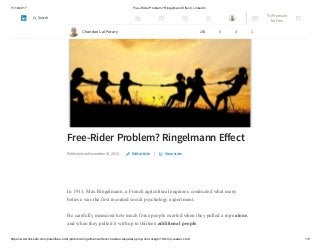
11/12/2017 Free-Rider Problem?Ringelmann Effect | LinkedIn
https://www.linkedin.com/pulse/free-rider-problem-ringelmann-effect-chandan-lal-patary-pmp-csm-cssgb/?trk=mp-reader-card 1/5
Free-Rider Problem? Ringelmann Effect
Published on November 15, 2015 |
In 1913, Max Ringelmann, a French agricultural engineer, conducted what many
believe was the first recorded social psychology experiment.
He carefully measured how much force people exerted when they pulled a rope alone,
and when they pulled it with up to thirteen additional people.
Edit article View stats
Chandan Lal Patary 208 5 3 1
Try Premium
for Free
Search
67.
11/12/2017 Free-Rider Problem?Ringelmann Effect | LinkedIn
https://www.linkedin.com/pulse/free-rider-problem-ringelmann-effect-chandan-lal-patary-pmp-csm-cssgb/?trk=mp-reader-card 2/5
He conducted additional studies in the lab and in the field and summarized all these
results together.
His results were mind-boggling.
Applying his findings back to the rope experiment, Ringelmann found that when a
person was added to the rope, everyone pulled with less strength.
When two people were on the line, they each pulled with 93 percent of the force of
a person working alone.
Three people each pulled with 85 percent of the force, and so on.
By the time eight people joined the rope, they were each pulling with half the force
of a single person.
As a result, a team of eight pulled the rope with no more total force than a team of
seven.
In a set of simple rope pulling experiments he discovered that, in what is now known as
the Ringelmann Effect, people’s efforts quickly diminish as team size increases.
Eight people, he found, didn’t even pull as hard as four individuals. He rationalized
the decay in effort by suggesting it was difficult for team members to coordinate effort,
and left it at that.
The Ringelmann Effect is another name for the dreaded free-rider problem. Free riders
are people who try to hide in a crowd and let others do the work.
Chandan Lal Patary 208 5 3 1
Try Premium
for Free
Search
68.
11/12/2017 Free-Rider Problem?Ringelmann Effect | LinkedIn
https://www.linkedin.com/pulse/free-rider-problem-ringelmann-effect-chandan-lal-patary-pmp-csm-cssgb/?trk=mp-reader-card 3/5
A summary of seventy-eight free-rider experiments published in the Journal of
Personality and Social Psychology validated Ringelmann’s finding—that
increasing the size of a group causes a decrease in individual effort.
But the study went a step further and examined the structural elements of cultures that
cause free-rider behavior.
According to Ringelmann (1913), groups fail to reach their full potential because
various interpersonal processes detracts from the group’s overall proficiency.
Namely, two distinct processes have been identified as potential sources for the reduced
productivity of groups: loss of motivation, and coordination problems.
Part of Amazon.com’s behavioral code is the “two-pizza rule”: if a project team can’t be
fed by two pizzas, it’s too big.
The rule exemplifies Bezos’s belief that real work should be managed by the smallest
teams possible.
It is also a perfect illustration of a hunting party.
Less is more for team !! No body can hide !
Report this
5 Likes
Chandan Lal Patary 208 5 3 1
Edit article
Try Premium
for Free
Search
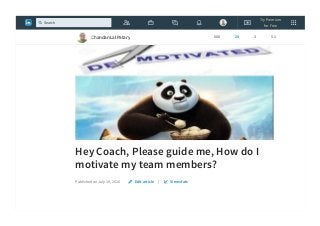
70.
Hey Coach, Pleaseguide me, How do I
motivate my team members?
Published on July 19, 2016 |Edit article View stats
Chandan Lal Patary 608 25 3 51
Try Premium
for Free
Search
71.
Most of thetime I get this question from my line managers.
I thought let me give it a thought and apply same to my coaches.
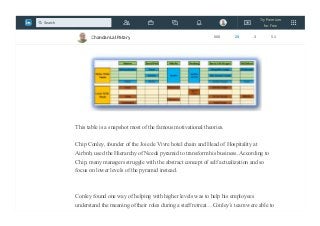
This table is a snapshot most of the famous motivational theories.
Chip Conley, founder of the Joie de Vivre hotel chain and Head of Hospitality at
Airbnb, used the Hierarchy of Needs pyramid to transform his business. According to
Chip, many managers struggle with the abstract concept of self actualization and so
focus on lower levels of the pyramid instead.
Conley found one way of helping with higher levels was to help his employees
understand the meaning of their roles during a staff retreat…Conley’s team were able to
Chandan Lal Patary 608 25 3 51
Try Premium
for Free
Search
72.
realize the importanceof their job to the company and to the people they were helping.
By showing them the value of their roles, the team were able to feel respected and
motivated to work harder.
We all have all these drivers, if we first satisfy lower order needs and focus more with
higher order needs, employees will become self driven.As a leader how can we do
below ?
How can we provide sensory, intellectual and emotional stimulation?
How can we provide team members status to be acknowledged and also belonging
to something?
How can we create a strong, motivating work environment where high performance
is standard?
How can we creates a sense of connectedness and comfort?
How can we create enjoyment of passion about anything, from sports to supporting
international causes?
How can we encourage people to perform better at work by having and
communicating high expectations of them?
Chandan Lal Patary 608 25 3 51
Try Premium
for Free
Search
73.
How can weencourage Happiness?
How can we stop punishing for failure?
How can we make a major effort to ensure that we offer competitive wages and
other forms of compensation?
How can we grow team members by providing challenging new tasks which are
reachable and according to their interest?
How can we give team members freedom to find their own unique solution which is
out of the box? through which they achieve personal and professional achievement?
How can we create good support system and guidance for the team members so that
they got inspire to do the assignment?
How can to rotate team members job so that they do not do the routine work, let
them discover new interesting work?
How can I set stretch goal for the team members and recognized on achievement the
same in public?
Chandan Lal Patary 608 25 3 51
Try Premium
for Free
Search
74.
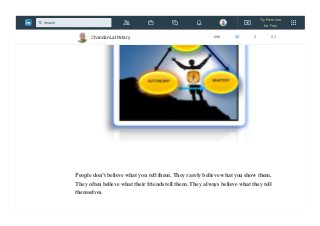
People don’t believewhat you tell them. They rarely believe what you show them.
They often believe what their friends tell them. They always believe what they tell
themselves.
Chandan Lal Patary 608 25 3 51
Try Premium
for Free
Search
75.
—Seth Godin
some pointsfrom south west airlines
Wikipedia mentions these three facts:
Southwest Airlines (SWA) is one of the world's most profitable airlines, posting a
profit for the 36th consecutive year in January 2009.
SWA is the largest airline in the United States by number of passengers carried
domestically per year (as of December 31, 2007)
SWA has carried more customers than any other U.S. airline since August 2006 for
combined domestic and international passengers according to the U.S. Department
of Transportation's Bureau of Transportation Statistics.
SWA mission statement – on the SWA web site – it reads:
“To our employees: We are committed to provide our Employees a stable work
environment with equal opportunity for learning and personal growth.
Creativity and innovation are encouraged for improving the effectiveness of
Chandan Lal Patary 608 25 3 51
Try Premium
for Free
Search
76.
Southwest Airlines. Aboveall, Employees will be provided the same concern,
respect, and caring attitude within the organization that they are expected to
share externally with every Southwest Customer.”
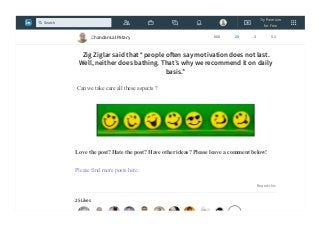
Zig Ziglar said that “people o en say motivation does not last.
Well, neither does bathing. That’s why we recommend it on daily
basis.”
Can we take care all these aspects ?
Love the post? Hate the post? Have other ideas? Please leave a comment below!
Please find more posts here
Report this
25 Likes
Chandan Lal Patary 608 25 3 51
Try Premium
for Free
Search
78.
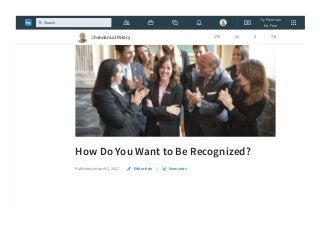
How Do YouWant to Be Recognized?
Published on April 2, 2017 |Edit article View stats
Chandan Lal Patary 175 11 2 78
Try Premium
for Free
Search
79.
Everyone wants tobe recognized some way.
Agile Development is often based on the effective communication, collaboration, and
coordination.
How can we increase engagement?
How can we increase self motivation?
How can we increase sharing - caring culture?
How can we encourage increased competence and growth?
Agile discourage to build Hero culture.
How do we build team culture and encourage individual to contribute their best and
doesn't recognize!
Eric Berne, the originator of Transactional Analysis, identified what he called 'six
hungers' that act as fundamental drivers that push us into action.
One of the hunger is Recognition hunger.When others recognize and acknowledge us,
our sense of identity is reinforced as we know ourselves to exist as individuals and to
Chandan Lal Patary 175 11 2 78
Try Premium
for Free
Search
80.
have an acceptedplace in society.
For Agile team we need to build system where we continuously provide feedback and
recognize each individual as an when we find there is something can be appreciate.
Harvard Business School professor and international change expert John Kotter’s work
spotlighting the need to “celebrate small wins” in any change effort.Without such
acknowledgement, teams often begin to lose direction, motivation, and enthusiasm.
what are the various Recolonization we can enable?
Examples of external rewards include pay, bonuses, plaques, notes, publicity in
newspapers, commendations at a company party, certificates, gifts, trips, and dinners.
Examples of internal rewards include satisfaction from accomplishing the team goal
and a sense of well-being deriving from strong work relationships, creative challenges,
increased responsibility, and learning opportunities.
What we can do to build such culture
a) Look for opportunity where you can appreciate others
b) Help individuals where he/she can perform better and You can appreciate
Chandan Lal Patary 175 11 2 78
Try Premium
for Free
Search
81.
c) Share thegoal with the members and share the expectation, help them to set
stretch goal
d) Create appreciation platform.Make it shorter and frequent
e) Crate many ways for appreciation, e.g Writing best code, share best stories,
Helping others in crises situation, Best support team members, Creative team
members etc
f) Celebrate the achievements
g) Make it Visual, in the board where all of the team members can see
h) Recognize best ideas , Best solutions, Best knowledge shared etc
Recognize the skills, knowledge, behaviors, and demeanor that support agile
performance to reinforce them at all levels of the organization.
A culture of recognition engages, energizes, and empowers employees.
Let us not recognize activities , recognize
outcomes.
Chandan Lal Patary 175 11 2 78
Try Premium
for Free
Search
83.
How I havecreated habit of providing
Positive Strokes to others
Published on April 22, 2016 |Edit article View stats
Chandan Lal Patary 74 6 0
Try Premium
for Free
Search
84.
I had decidedto make it a habit , to give positive stroke while discussing with others
wherever possible. I have followed a process to make it a habit.Let us find how?
Tom Bartow, considered by many to be the top business coach in the country,
developed the following model of what habit formation looks like:
Phase 1: THE HONEYMOON
Chandan Lal Patary 74 6 0
Try Premium
for Free
Search
85.
This phase ofhabit formation is characterized by the feeling of “this is easy.”
The honeymoon phase is usually the result of something inspiring.
It will end in 2nd or 3rd week.Though I was consciously trying to maintain provide
positive stroke, but I was forgetting this habit at initial days.
Chandan Lal Patary 74 6 0
Try Premium
for Free
Search
86.
Phase 2: THEFIGHT THRU
Inspiration fades and reality sets in.
A person finds himself struggling with the positive habit completion and old habits
seem to be right around the corner. The key to moving to the third phase of habit
formation is to win 2 or 3 “fight thru’s.” This is critical. To win the fight thru, use the
following techniques:
1. RECOGNIZE: Recognition is essential for winning the fight thru. When you have
entered the fight through, simply say to yourself, “I have entered the fight thru, and I
need to win a few to move past this.” Winning each fight thru will make it easier to
win the next. Conversely, when you choose to lose a fight thru, you make it easier to
lose the next one.
2. ASK 2 QUESTIONS: “How will I feel if I do this?” and “How will I feel if I don’t
do this?” Bring EMOTION into the equation. Let yourself feel the positive in
winning the fight thru and the negative in losing.
3. LIFE PROJECTION: If the above 2 techniques haven’t moved you to action, then
imagine in great detail how your life will be in 5 years if you do not begin making
changes. Be totally honest with yourself, and allow yourself to feel what life will be
like if the changes are not made.
Chandan Lal Patary 74 6 0
Try Premium
for Free
Search
87.
Phase 3: SECONDNATURE
Once in SECOND NATURE, the following are 3 common interruptions that will send a
person back to THE FIGHT THRU:
THE DISCOURAGEMENT MONSTER: An individual allows negative results
discourage him or her into thinking, “This isn’t working, and there is nothing I can
do.”
DISRUPTIONS: An individual experiences significant change to his or her current
pattern (e.g., vacations, holidays, illness, weekends).
SEDUCTION OF SUCCESS: An individual begins to focus on positive results and
begins to think, “I’m the special one. I have finally figured out how to have great
results with not so great process.”
If a person experiences an interruption that sends him or her back to the fight thru,
winning 2 or 3 fight thru’s will bring him or her back to second nature.
Chandan Lal Patary 74 6 0
Try Premium
for Free
Search
88.
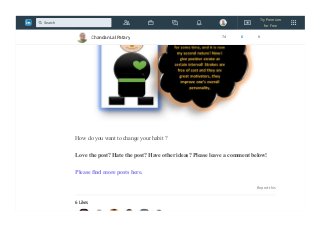
How do youwant to change your habit ?
Love the post? Hate the post? Have other ideas? Please leave a comment below!
Please find more posts here.
Report this
6 Likes
Chandan Lal Patary 74 6 0
Try Premium
for Free
Search
90.
11/12/2017 Influence !!How to master this skill? | LinkedIn
https://www.linkedin.com/pulse/influence-how-master-skill-chandan-lal-patary-pmp-csm-cssgb/?trk=mp-reader-card 1/6
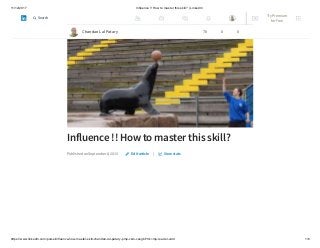
Influence !! How to master this skill?
Published on September 8, 2015 |Edit article View stats
Chandan Lal Patary 70 0 0
Try Premium
for Free
Search
91.
11/12/2017 Influence !!How to master this skill? | LinkedIn
https://www.linkedin.com/pulse/influence-how-master-skill-chandan-lal-patary-pmp-csm-cssgb/?trk=mp-reader-card 2/6
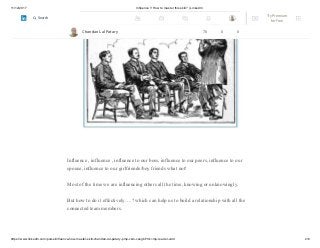
Influence , influence , influence to our boss, influence to our peers, influence to our
spouse, influence to our girlfriends/boy friends what not!
Most of the time we are influencing others all the time, knowing or unknowingly.
But how to do it effectively….? which can help us to build a relationship with all the
connected team members.
Chandan Lal Patary 70 0 0
Try Premium
for Free
Search
92.
11/12/2017 Influence !!How to master this skill? | LinkedIn
https://www.linkedin.com/pulse/influence-how-master-skill-chandan-lal-patary-pmp-csm-cssgb/?trk=mp-reader-card 3/6
Influence is not some magic power only a few people have. Every person on the planet
exercises influence all the time.
Most of our energy are spends to influence. Influence is part of nearly every
communication. It occurs in virtually every human interaction, every moment,
everywhere. It is so fundamental to leadership that there could be no leadership
without it. If we have power we are influencing if we don’t have we are
influencing max.Before anything else, getting ready is the secret to
success.
—HENRY FORD
We need to do good amount of homework, Preparation Is the Key to Influence.
We need to read others mind and help them with what they want to get the buy- in from
others.
“Some people may be uncooperative because they are too busy elsewhere, and some
because they are not really capable of helping. Others may well have goals, values, and
beliefs that are quite different and in conflict with the manager’s and may therefore have
no desire whatsoever to help or cooperate.”
So we need to know exactly what it is and act on it to help each other.
Interests, which play critical role, ask whether your request is aligned with the person’s
interests and values. If not, then the person’s interests would not be well served by
going along with you and, in this situation, most people most of the time will not
willingly consent to be influenced.
Chandan Lal Patary 70 0 0
Try Premium
for Free
Search
93.
11/12/2017 Influence !!How to master this skill? | LinkedIn
https://www.linkedin.com/pulse/influence-how-master-skill-chandan-lal-patary-pmp-csm-cssgb/?trk=mp-reader-card 4/6
You may not be able to influence people the first time and in the first way you approach
them.
Influence is often a process rather than an event.
Sometimes, the influence technique we are using is not one they respond well to. If we
keep trying the same approach, we may create greater and greater resistance. If the
influence technique we are using is not working, don't keep doing the same thing. Try
something else.
Culture play significant role when we are influencing people.
What works in Mexico may not work as well in Malaysia, just as the openness and
informality typical in Australia, even in business settings, may not be as acceptable in
Germany or the Netherlands (in fact, it could cause suspicion). Influence effectiveness
depends in part on the conventions, values, and beliefs prevalent in every culture.
People tend to assume that what they like, everyone else will like; that what works well
for them will also work for others. This is the case because, by and large, most people
believe that they are normal and that most other people share their view of reality.
If we are observant, if we listen to other people and observe their behavior and
the environments they create for themselves, we can discover how best to
influence most people. It will build capability over period of time and soon it will
become second nature. So consciously we need to make it a habit to build those
observation skill.
Chandan Lal Patary 70 0 0
Try Premium
for Free
Search
94.
11/12/2017 Influence !!How to master this skill? | LinkedIn
https://www.linkedin.com/pulse/influence-how-master-skill-chandan-lal-patary-pmp-csm-cssgb/?trk=mp-reader-card 5/6
Our business has to have mutual benefit to get the effective influence with
others.
Prepare our mind, know who is our audience, know their code, and structure a
winning persuasive argument accordingly.
Let us know who, what, when, where, and why about our message and our
audience.
Master Persuaders know that information and structure are the seeds for
perfect persuasion.
Report this
Chandan Lal Patary 70 0 0
Try Premium
for Free
Search
96.
11/12/2017 Influence andWin the people ? | LinkedIn
https://www.linkedin.com/pulse/influence-win-people-chandan-lal-patary-pmp-csm-cssgb/?trk=mp-reader-card 1/10
Influence and Win the people ?
Published on December 25, 2015 |
How to Influence and win the people through certain mechanism.
Each Person has Unique Personality Traits.
Dr. William Marston wrote “The Emotions of Normal People” in 1928 after earning
his doctorate from Harvard University. Marston theorized that people are motivated by
Edit article View stats
Chandan Lal Patary 94 4 1 1
Try Premium
for Free
Search
97.
11/12/2017 Influence andWin the people ? | LinkedIn
https://www.linkedin.com/pulse/influence-win-people-chandan-lal-patary-pmp-csm-cssgb/?trk=mp-reader-card 2/10
four intrinsic drives that direct behavioral patterns.
He used four descriptive characteristics for behavioral tendencies which are represented
by four letters of the alphabet: D, I, S and C. Thus the concept of “DISC” was
introduced.
The DiSC model provides a common language that people can use to better understand
themselves and to adapt their behaviors with others.
Developed in 1950, DISC is one of the world's most widely utilized and adapted models
of behaviour.
DiSC profiles help us and our team:
Increase your self-knowledge: how you respond to conflict, what motivates you,
what causes you stress and how you solve problems
Facilitate better teamwork and minimize team conflict
Develop stronger sales skills by identifying and responding to customer styles
Manage more effectively by understanding the dispositions and priorities of
employees and team members
Become more self-knowledgeable, well-rounded and effective leaders
DiSC stand for
Chandan Lal Patary 94 4 1 1
Try Premium
for Free
Search
98.
11/12/2017 Influence andWin the people ? | LinkedIn
https://www.linkedin.com/pulse/influence-win-people-chandan-lal-patary-pmp-csm-cssgb/?trk=mp-reader-card 3/10
D Dominance:
Person places emphasis on accomplishing results, the bottom line, confidence
Behaviors
- Sees the big picture
- Can be blunt
- Accepts challenges
- Gets straight to the point
I Influence
Person places emphasis on influencing or persuading others, openness, relationships
Behaviors
- Shows enthusiasm
- Is optimistic
- Likes to collaborate
- Dislikes being ignored
S Steadiness
Person places emphasis on cooperation, sincerity, dependability
Behaviors
- Doesn't like to be rushed
- Calm manner
- Calm approach
Chandan Lal Patary 94 4 1 1
Try Premium
for Free
Search
99.
11/12/2017 Influence andWin the people ? | LinkedIn
https://www.linkedin.com/pulse/influence-win-people-chandan-lal-patary-pmp-csm-cssgb/?trk=mp-reader-card 4/10
- Supportive actions
- Humility
C Conscientiousness
Person places emphasis on quality and accuracy, expertise, competency
Behaviors
- Enjoys independence
- Objective reasoning
- Wants the details
- Fears being wrong
Chandan Lal Patary 94 4 1 1
Try Premium
for Free
Search
100.
11/12/2017 Influence andWin the people ? | LinkedIn
https://www.linkedin.com/pulse/influence-win-people-chandan-lal-patary-pmp-csm-cssgb/?trk=mp-reader-card 5/10
Chandan Lal Patary 94 4 1 1
Try Premium
for Free
Search
101.
11/12/2017 Influence andWin the people ? | LinkedIn
https://www.linkedin.com/pulse/influence-win-people-chandan-lal-patary-pmp-csm-cssgb/?trk=mp-reader-card 6/10
whom you are interacting with ? D/I/S/C?
or apply Johari Window
A simple and useful tool for understanding and training selfawareness,
personal development, improving communications, interpersonal relationships,
group dynamics, team development and intergroup relationships.
Developed by American psychologists Joseph Luft and Harry Ingham in the
1950's, calling it 'Johari' after combining their first names, Joe and Harry
Chandan Lal Patary 94 4 1 1
Try Premium
for Free
Search
102.
11/12/2017 Influence andWin the people ? | LinkedIn
https://www.linkedin.com/pulse/influence-win-people-chandan-lal-patary-pmp-csm-cssgb/?trk=mp-reader-card 7/10
Johari window four regions
1. Open area, open self, free area, free self, or 'the arena‘: what is known by the
person about him/herself and is also known by others -
2. Blind area, blind self, or 'blindspot‘: what is unknown by the person about
him/herself but which others know
3. Hidden area, hidden self, avoided area, avoided self or 'façade’: what the person
knows about him/herself that others do not know
Chandan Lal Patary 94 4 1 1
Try Premium
for Free
Search
103.
11/12/2017 Influence andWin the people ? | LinkedIn
https://www.linkedin.com/pulse/influence-win-people-chandan-lal-patary-pmp-csm-cssgb/?trk=mp-reader-card 8/10
4. Unknown area or unknown self: what is unknown by the person about him/herself
and is also unknown by others
Fig 1 is for a new team member, Fig 2 is for a established/old team member.
For Fig 1 : The open free is small because others know little about the new person „
Similarly the blind area is small because others know little about the new person „ The
hidden or avoided issues and feelings are a relatively large area „ The unknown area is
the largest, which might be because the person is lacking in self-knowledge or belief
For Fig 2 : The open free region is large because others know a lot about the person that
the person also knows.
Through disclosure and receiving feedback the open area has expanded and at the same
time reduced the sizes of the hidden, blind and unknown areas
let us do some home work before we start the assignment.
Chandan Lal Patary 94 4 1 1
Try Premium
for Free
Search
104.
11/12/2017 Influence andWin the people ? | LinkedIn
https://www.linkedin.com/pulse/influence-win-people-chandan-lal-patary-pmp-csm-cssgb/?trk=mp-reader-card 9/10
Tom, Jerry and Spike also has become friend!!!
Report this
4 Likes
1 Comment
Add a comment…
Venkatesh Rajamani
Learner & Enterprise Agile Coach |Freelance Agility Trainer Scrum Alliance -CTC®|Scrum.org - PSM III®
Like Reply
2y
Hi is this article complete?
Chandan Lal Patary 94 4 1 1
Edit article
Try Premium
for Free
Search
106.
11/12/2017 Killing ToxicCulture by Praise and Appreciation | LinkedIn
https://www.linkedin.com/pulse/killing-toxic-culture-praise-appreciation-patary-pmp-csm-cssgb/?trk=mp-reader-card 1/9
Killing Toxic Culture by Praise and
Appreciation
Published on September 5, 2015 |
In a study published in 2011 (Conboy et al., 2011) it was found that the increasing use
of Agile approaches and growing pressure to adopt Agile Management, contribute to the
need for human resource departments and project managers to address people
challenges more.
Edit article View stats
Chandan Lal Patary 89 3 0
Try Premium
for Free
Search
107.
11/12/2017 Killing ToxicCulture by Praise and Appreciation | LinkedIn
https://www.linkedin.com/pulse/killing-toxic-culture-praise-appreciation-patary-pmp-csm-cssgb/?trk=mp-reader-card 2/9
There is a need to identify the problems that the Agile transition may cause. A list of the
most important people challenges in Agile was proposed as follows: developer fear
caused by transparency of skill deficiencies, the need for developers to be a
‘master of all trades’, increased reliance on social skills, a lack of business
knowledge among developers, the need to understand and learn values and
principles of Agile, not just the practices, lack of developer motivation to use
Agile methods and the need for Agile compliant performance evaluation.
Shane Hastie (2004) discusses how Agile differs from traditional methods by putting
much more emphasis on team work, cooperation and self organization. One of the
key to the success of Agile is trust, which needs to be present both between the leader
and the team and among the team members themselves.
Peter Frost, author of Toxic Emotions at Work, notes that many organizations and their
leaders generate emotional pain, which is a form of toxicity. Some toxicity can
demoralize employees, damage performances, and ultimately contaminate the
health of the organization.Worker humiliation is a common toxin in the
workplace; lack of recognition for work well done is another.
Chandan Lal Patary 89 3 0
Try Premium
for Free
Search
108.
11/12/2017 Killing ToxicCulture by Praise and Appreciation | LinkedIn
https://www.linkedin.com/pulse/killing-toxic-culture-praise-appreciation-patary-pmp-csm-cssgb/?trk=mp-reader-card 3/9
Agile work environment need more positive reinforcement to become successful.
Let us look into 2 principles , how praise and appreciation practices helps agile team to
become successful.
In the early fifties, Don Clifton, was teaching psychology at the University of Nebraska
when he noticed a major problem: The field of psychology was based almost entirely
on the study of what is wrong with people. He began to wonder if it would be
more important to study what is right with people.
The Theory of the Dipper and the Bucket:
Each of us has an invisible bucket. It is constantly emptied or filled, depending on
what others say or do to us. When our bucket is full, we feel great. When it’s
Chandan Lal Patary 89 3 0
Try Premium
for Free
Search
109.
11/12/2017 Killing ToxicCulture by Praise and Appreciation | LinkedIn
https://www.linkedin.com/pulse/killing-toxic-culture-praise-appreciation-patary-pmp-csm-cssgb/?trk=mp-reader-card 4/9
empty, we feel awful.Each of us also has an invisible dipper. When we use that
dipper to fill other people’s buckets – by saying or doing things to increase their
positive emotions – we also fill our own bucket. But when we use that dipper to
dip from others’ buckets – by saying or doing things that decrease their positive
emotions – we diminish ourselves.
Like the cup that run over, a full bucket gives us a positive outlook and renewed energy.
Every drop in that bucket makes us stronger and more optimistic.
But an empty bucket poisons our outlook, saps our energy, and undermines our
will. That’s why every time someone dips from our bucket, it hurts us. So we face a
Chandan Lal Patary 89 3 0
Try Premium
for Free
Search
110.
11/12/2017 Killing ToxicCulture by Praise and Appreciation | LinkedIn
https://www.linkedin.com/pulse/killing-toxic-culture-praise-appreciation-patary-pmp-csm-cssgb/?trk=mp-reader-card 5/9
choice every moment of every day. We can fill one another’s buckets, or we can dip
from them. It’s an important choice – one that profoundly influences our relationships,
productivity, health, and happiness.
Five Strategies for Increasing Positive Emotions:
To increase positive emotions in our life and others’ lives, we must make a habit of
filling buckets.
Strategy One – Prevent Bucket Dipping: Just as we have to start eliminating debt
before we can truly save, we must start to eliminate bucket dipping before we can truly
begin to fill buckets. The next time you see bucket dipping in progress, do something
about it. Convince others that unwarranted negativity only makes matters worse.
Strategy Two – Shine a Light on What is Right: Each interaction gives us the chance
to shine a light on what’s right – and fill a bucket. Every time you fill a bucket, you’re
setting something in motion.
Strategy Three – Make Best Friends:Whether you want to build many relationships or
just a few deep ones, your best approach is to fill a person’s bucket in your very first
interaction. This is a powerful way to initiate new relationships – and to strengthen your
existing relationships. In fact, your friendships are unlikely to survive, let alone thrive,
without regular bucket filling.
Strategy Four – Give Unexpectedly:An unexpected gift doesn’t have to be tangible
either. It can be a gift of trust or responsibility. Sharing something personal or entrusting
a friend with a secret can fill his or her bucket.
Chandan Lal Patary 89 3 0
Try Premium
for Free
Search
111.
11/12/2017 Killing ToxicCulture by Praise and Appreciation | LinkedIn
https://www.linkedin.com/pulse/killing-toxic-culture-praise-appreciation-patary-pmp-csm-cssgb/?trk=mp-reader-card 6/9
Strategy Five – Reverse the Golden Rule: In the case of bucket filling, “Do unto
others as you would have them do unto you’ doesn’t apply. Instead, we suggest a slight
variation: “Do unto others as they would have you do unto them.” When it comes to
robust and meaningful bucket filling, individualization is the key. So when you’re
bucket filling, go ahead and reverse – or at least redefine – the Golden Rule.
Manage emotional bank account :
An emotional bank account is an account of trust instead of money. It's an account
based on how safe you feel with another person. Covey identifies six ways to make
deposits (or reduce withdrawals):
When our trust level is high, because we’ve made lots of deposits, communication is
almost effortless. We can be our-self, and others understand and appreciate us. Then,
when we make mistakes or offend someone unexpectedly, we draw on that reserve and
the relationship still maintains a solid level of trust.
Conversely, when we are discourteous, disrespect others, interrupt others, speak
sarcastically or ignore others, our emotional bank account becomes overdrawn because
we have jeopardized the trust level. When the trust level is low, we have to be very
careful of what we say; we tend to be more political.
Our most precious relationships (with our spouse, kids, friends and boss) require
constant deposits, because those relationships continue to grow and change, and with
these changes come new expectations. If you have a teenager at home, you may make
several withdrawals in just one day! As your marriage evolves, your roles and
responsibilities may change, and your work and home lives may change over time
Chandan Lal Patary 89 3 0
Try Premium
for Free
Search
112.
11/12/2017 Killing ToxicCulture by Praise and Appreciation | LinkedIn
https://www.linkedin.com/pulse/killing-toxic-culture-praise-appreciation-patary-pmp-csm-cssgb/?trk=mp-reader-card 7/9
because of career changes or kids moving out or back in. These relationships require
constant investment.
Covey identifies six ways to make deposits (or reduce withdrawals):
1) Understanding the Individual. This means listening intently to what the other
person is saying and empathizing with how they may feel. It’s important to care for
others and act with kindness toward them.
2) Keeping Commitments. How do you feel when someone arrives right on time when
you have a meeting? How about when people simply do what they say they will do?
You build up an emotional reserve by keeping your commitments.
3) Clarifying Expectations. We are not mind readers, and yet we consistently expect
others to know what we expect of them. Communicating our expectations can help
create a higher level of trust. When we ask for what we want, and we get it, we can then
trust a little more.
4) Attending to the Little Things. Don’t you find that the little things tend to become
the BIG things when they do not receive our attention? Doing the little things is how we
honor and show respect for others. Small kindnesses, a smile, a little extra effort, a hug,
doing something you didn’t “have” to: these are the things that build trust.
5) Showing Personal Integrity. Integrity is the moral floor upon which trusting
relationships are built. When we operate with sound moral character, it makes it so easy
for others to trust us.
Chandan Lal Patary 89 3 0
Try Premium
for Free
Search
113.
11/12/2017 Killing ToxicCulture by Praise and Appreciation | LinkedIn
https://www.linkedin.com/pulse/killing-toxic-culture-praise-appreciation-patary-pmp-csm-cssgb/?trk=mp-reader-card 8/9
6) Apologizing When We Make a Withdrawal. We will make mistakes; it’s part of
life. But when you see you have violated a trust, sincerely apologizing is how we make
a deposit to counteract the damage we have done.
All these principles helps to understand and practices the best way of building a positive
culture.A leaders should ensure these practices are follows and mentor and coach as an
when there is a need.
All these factors will increase teaming effect in agile team and enhance the agile success
rate.
Report this
3 Likes
0 Comments
Add a comment…
Chandan Lal Patary
Enterprise Agile Coach at Société Générale
More from Chandan Lal Patary See all 306 articles
Chandan Lal Patary 89 3 0
Edit article
Try Premium
for Free
Search
115.
11/12/2017 Let's GoFishing ! | LinkedIn
https://www.linkedin.com/pulse/lets-go-fishing-chandan-lal-patary-pmp-csm-cssgb/?trk=mp-reader-card 1/4
Let's Go Fishing !
Published on November 12, 2015 |
The key characters Mary Jane Ramirez, a manager from First Guarantee Financial, and
Lonnie, a fishmonger from Seattle’s world famous Pike Place Fish Market, teach us
how to transform a “toxic energy dump” into a workplace that adds value, productivity
and profit to the company, creating happier workers, employers, and customers!
Imagine a workplace where everyone chooses to bring energy, passion, and a
Edit article View stats
Chandan Lal Patary 97 3 0
Try Premium
for Free
Search
116.
11/12/2017 Let's GoFishing ! | LinkedIn
https://www.linkedin.com/pulse/lets-go-fishing-chandan-lal-patary-pmp-csm-cssgb/?trk=mp-reader-card 2/4
positive attitude to the job every day. Imagine an environment in which people are
truly connected to their work, to their colleagues, and to their customers. Who wouldn’t
want to be in such a workplace? When you make room for play at work, great things
happen. They discovered this at Pike Place Fish Market in Seattle.
Pike Place defined four things that they believe lead to a good work experience:
Play – Allow yourself to be silly. Bring some fun and games into the workplace.
Have fun and create energy around at the office.
Choose your attitude – You decide for yourself what attitude you bring to your job.
Each day you choose how you are going to act or which “side of the bed” you wake
up on. The choice is yours and, the way you act, affects others.
Be present – How can you make sure you are fully available and aware during
conversations with people? It is about create a greater sense of intimacy between
individuals. Be there, in both body and mind.
Make their day – How can you engage fellow employees, customers and make
each other’s day? By giving your customers and colleagues good experiences.
The moral of the story: you can make any task rewarding and find purpose in
everything you do.
Reference : FISH! by Stephen Lundin
As consultant and author Dr. Charles Garfield drove over the San Francisco–Oakland
Bay Bridge on his way to work, he heard loud music coming from the tollbooth he was
Chandan Lal Patary 97 3 0
Try Premium
for Free
Search
117.
11/12/2017 Let's GoFishing ! | LinkedIn
https://www.linkedin.com/pulse/lets-go-fishing-chandan-lal-patary-pmp-csm-cssgb/?trk=mp-reader-card 3/4
about to enter. He rolled down his window to pay his toll and found a dancing tollbooth
operator. “I’m having a party,” the operator declared. Dr. Garfield drove away more
joyful than he did most mornings and realized he had just experienced a peak-
performing tollbooth operator.
Intrigued, Dr. Garfield followed up and discovered that the young man’s purpose in life
was to be a dancer. His coworkers described their booths as “vertical coffins,” but this
young man saw it as a stage for performing and his job as an opportunity to dance.
He developed a philosophy about his job, created an environment to support his vision,
and happened to entertain those he served.
Research on peak performers confirms what you might suspect about people who attain
high levels of success and sustain it over time.
Peak performers are not goal driven. Peak performers are values based and inspired by a
noble purpose.
Report this
3 Likes
0 Comments
Add a comment…
Chandan Lal Patary 97 3 0
Try Premium
for Free
Search
119.
11/12/2017 No MoreExcuses Please !! Dysfunctional Situation to Observe and Improve | LinkedIn
https://www.linkedin.com/pulse/more-excuses-please-dysfunctional-situation-observe-chandan-lal/?trk=mp-reader-card 1/8
No More Excuses Please !! Dysfunctional
Situation to Observe and Improve
Published on September 6, 2015 |
Excuse maker !! Are we aware about them?
Why we are always hearing excuses while working on certain tasks?
I am not upto the mark…..
Edit article View stats
Chandan Lal Patary 165 4 0 1
Try Premium
for Free
Search
120.
11/12/2017 No MoreExcuses Please !! Dysfunctional Situation to Observe and Improve | LinkedIn
https://www.linkedin.com/pulse/more-excuses-please-dysfunctional-situation-observe-chandan-lal/?trk=mp-reader-card 2/8
I am not getting enough paid…..
It is not my problem , it is somebody’s else problem ….
It was working but looks like ……
It was not communicated ….
They are not supportive …..
etc etc etc we all hear about excused everywhere in the organization.
It is a disease which is contagious and the medicine for this disease organization or
leaders or manager has to find out.
Chandan Lal Patary 165 4 0 1
Try Premium
for Free
Search
121.
11/12/2017 No MoreExcuses Please !! Dysfunctional Situation to Observe and Improve | LinkedIn
https://www.linkedin.com/pulse/more-excuses-please-dysfunctional-situation-observe-chandan-lal/?trk=mp-reader-card 3/8
Symptoms of Dysfunctional Office Politics:
Are we aware about all these?
The ten statements below concern ethics in interpersonal relationships on the job. The
more frequently any of these actions take place, the more likely the organization or
organizational unit is beset with dysfunctional office politics.
A conflict between two or more persons or groups was resolved on the basis
of who held the most power rather than on what would have made sense and
would have worked better.
A person or group “got even” in some way with another person or group.
Information about what was going on at work was withheld from a person
or group.
Information was reported about a person or group that was intentionally
exaggerated,misconstrued, and/or made mostly untrue by some other person
or group.
A person or group was led to believe one thing, when the other was clearly
true.
A person or group agreed with another person or group solely to “keep the
boat from rocking.”
A person or group’s worthwhile efforts or initiatives were intentionally
undermined.
Chandan Lal Patary 165 4 0 1
Try Premium
for Free
Search
122.
11/12/2017 No MoreExcuses Please !! Dysfunctional Situation to Observe and Improve | LinkedIn
https://www.linkedin.com/pulse/more-excuses-please-dysfunctional-situation-observe-chandan-lal/?trk=mp-reader-card 4/8
A person reported confidential or unfavorable information about a person or
group in order to gain a special advantage.
A person or group who looked at things differently and had different points
of view was punished and/or silenced by another person or group.
An organizational decision was based on self-interest rather than on what
made sense and would have worked better.
Team members owning Entrepreneur Mindset:
How can we build such team and team members ?
Below factors are mindsets of most of the entrepreneur which all the team members
should acquire over a period of time:
Organization will be able to face any challenged when we have below mindset with
most of the employees. There is an urgent need of below mindset to the organization.
In today’s world all the employee has to think like entrepreneur and leaders has to run
his/her own business.
Below are few characters which are very important in today’s world to survive and run
the organization. Below mindset changes are very crucial for a organization or team.
Desire and willingness to take initiative>: All employees should always ready to
jump into the opportunity. They should be willing to step forward and build
businesses based on their creative ideas.
Chandan Lal Patary 165 4 0 1
Try Premium
for Free
Search
123.
11/12/2017 No MoreExcuses Please !! Dysfunctional Situation to Observe and Improve | LinkedIn
https://www.linkedin.com/pulse/more-excuses-please-dysfunctional-situation-observe-chandan-lal/?trk=mp-reader-card 5/8
Preference for moderate risk. The path is full with risk, willingness to take
calculate risk is effective. The goal may appear to be high—even impossible—from
others’ perspective, but team members should typically have to thought through the
situation and believe that their goals are reasonable and attainable.
Confidence in their ability to succeed. Team members should have typically have
an abundance of confidence in their ability to succeed, and they tend to be
optimistic about their chances for business success. Team members might face many
barriers when starting and running their assignments and a healthy dose of optimism
can be an important component in their ultimate success.
Self-reliance. Team members should not shy away from the responsibility for
making their businesses succeed.
Perseverance. Even when things don’t work out as they planned, team members
should not give up. They simply keep trying. Real entrepreneurs follow the advice
contained in the Japanese proverb, “Fall seven times; stand up eight.”
Desire for immediate feedback. Team members should to know how they are
doing and are constantly looking for reinforcement. Tricia Fox, founder of Fox Day
Schools, Inc., claims, “I like being independent and successful. Nothing gives you
feedback like your own business.”
High level of energy. Entrepreneurs are more energetic than the average person.
That energy may be a critical factor given the incredible effort required to launch a
start-up company. Long hours—often 60 to 80 hours a week—and hard work are the
rule rather than the exception. Building a successful business requires a great deal of
stamina.
Chandan Lal Patary 165 4 0 1
Try Premium
for Free
Search
124.
11/12/2017 No MoreExcuses Please !! Dysfunctional Situation to Observe and Improve | LinkedIn
https://www.linkedin.com/pulse/more-excuses-please-dysfunctional-situation-observe-chandan-lal/?trk=mp-reader-card 6/8
Competitiveness. Team members should tend to exhibit competitive behavior, often
early in life. They enjoy competitive games and sports and always want to keep
score!
Future orientation. Team members tend to dream big and then formulate plans to
transform those dreams into reality. They have a well-defined sense of searching for
opportunities. They look ahead and are less concerned with what they accomplished
yesterday than what they can do tomorrow. Ever vigilant for new business
opportunities, entrepreneurs
observe the same events other people do, but they see something different.
Skill at organizing. Managers and leaders should know how to put the right people
and resources together to accomplish a task. Effectively combining people and jobs
enables entrepreneurs to bring their visions to reality.
Value of achievement over money. Achievement should be the primary motivating
force behind team members; money is simply a way of “keeping score” of
accomplishments—a symbol of achievement. “Money is not the driving motive of
most entrepreneurs,” says Nick Grouf, founder of a high-tech company. “It’s just a
very nice by-product of the process.”
High degree of commitment. Team members often should immerse themselves
completely in their businesses. “The commitment team have to make is tremendous;
team members usually should put everything on the line,” That commitment helps
overcome business-threatening mistakes, obstacles and pessimism from naysayers.
Tolerance for ambiguity. Team members should have a high tolerance for
ambiguous, ever-changing situations—the environment in which they most often
operate. This ability to handle uncertainty is critical, because managers and leaders
Chandan Lal Patary 165 4 0 1
Try Premium
for Free
Search
125.
11/12/2017 No MoreExcuses Please !! Dysfunctional Situation to Observe and Improve | LinkedIn
https://www.linkedin.com/pulse/more-excuses-please-dysfunctional-situation-observe-chandan-lal/?trk=mp-reader-card 7/8
+1
constantly make decisions using new, sometimes conflicting, information gleaned
from a variety of unfamiliar sources.
Flexibility. Team members should have ability to adapt to the changing demands of
their customers and their businesses. In this rapidly changing world economy,
rigidity often leads to failure. As society, its people, and their tastes change, team
members also must be willing to adapt their businesses to meet those changes.
Successful teams are willing to allow
their business models to evolve as market conditions warrant.
Tenacity. Obstacles, obstructions, and defeat typically do not dissuade team
members from doggedly pursuing their visions. Successful team members have the
willpower to conquer the barriers that stands in the way of their success.
How can we as a leader detect such situation and improve ?
Report this
4 Likes
0 Comments
Add a comment…
Chandan Lal Patary
Chandan Lal Patary 165 4 0 1
Edit article
Try Premium
for Free
Search
127.
11/12/2017 On thePath to Become a Charismatic Leader…. | LinkedIn
https://www.linkedin.com/pulse/path-become-charismatic-leader-chandan-lal-patary-pmp-csm-cssgb/?trk=mp-reader-card 1/6
On the Path to Become a Charismatic
Leader….
Published on September 24, 2015 |
Charisma is a Greek word meaning “Divinely inspired gift.” In the study of leadership,
charisma is a special quality of leaders whose purposes, powers, and extraordinary
determination differentiate them from others.
Edit article View stats
Chandan Lal Patary 128 4 0
Try Premium
for Free
Search
128.
11/12/2017 On thePath to Become a Charismatic Leader…. | LinkedIn
https://www.linkedin.com/pulse/path-become-charismatic-leader-chandan-lal-patary-pmp-csm-cssgb/?trk=mp-reader-card 2/6
A case in point is Steve Jobs of Apple Inc. and Pixar, whose name surfaces frequently in
discussions of charisma. Several years ago he was nominated Time magazine person of
the year by an entertainment executive, and given this accolade: “He is a true
visionary who continues to lead the technological revolution. Year after year, Apple
creates must-have products that shape how
we live our lives. Jobs and Apple continue to lead us into a wonderful new
technological future.”
Charismatic leaders use impression management to deliberately cultivate a certain
relationship with group members. In other words, they take steps to create a favorable,
successful impression, recognizing that the perceptions of constituents determine
whether they function as charismatic leaders.
AM I DOING THE SAME?
Jane A. Halpert performed a statistical analysis of the effects charismatic leaders have
on followers, and found that three dimensions are the most important. One key
dimension is Referent power, the ability to influence others because of one’s desirable
traits and characteristics. If we like a leader, he or she might be able to exercise referent
power.
Another dimension is Expert power, the ability to influence others because of one’s
specialized knowledge, skills, or abilities. An important part of Steve Jobs’ charisma
stems from his expert powers reflected in imagining and designing
electronic devices such as the iMac and iPod.
A third dimension of charismatic leadership is the ability to get group members excited
about their work, or to experience Job involvement.
Chandan Lal Patary 128 4 0
Try Premium
for Free
Search
129.
11/12/2017 On thePath to Become a Charismatic Leader…. | LinkedIn
https://www.linkedin.com/pulse/path-become-charismatic-leader-chandan-lal-patary-pmp-csm-cssgb/?trk=mp-reader-card 3/6
Job involvement is a key component of job satisfaction, and one empirical study has
provided evidence of the relationship between charismatic leadership and job
satisfaction.
The outstanding characteristic of charismatic leaders is that they are charismatic, and
therefore they can attract, motivate, or lead others! They also have other distinguishing
characteristics.
Chandan Lal Patary 128 4 0
Try Premium
for Free
Search
130.
11/12/2017 On thePath to Become a Charismatic Leader…. | LinkedIn
https://www.linkedin.com/pulse/path-become-charismatic-leader-chandan-lal-patary-pmp-csm-cssgb/?trk=mp-reader-card 4/6
Charismatic leaders are visionary because they offer an exciting image of
where the organization is headed and how to get there.
Charismatic leaders also have masterful communication skills. To inspire
people, the charismatic leader uses colorful language and exciting metaphors
and analogies.
Another key characteristic is the ability to inspire trust.
Chandan Lal Patary 128 4 0
Try Premium
for Free
Search
131.
11/12/2017 On thePath to Become a Charismatic Leader…. | LinkedIn
https://www.linkedin.com/pulse/path-become-charismatic-leader-chandan-lal-patary-pmp-csm-cssgb/?trk=mp-reader-card 5/6
Charismatic leaders have an energy and action orientation. Like
entrepreneurs, most charismatic leaders are energetic and serve as role models
forgetting things done on time. Emotional expressiveness and warmth are also
notable.
A key characteristic of charismatic leaders is the ability to express feelings
openly.
Another trait of charismatic leaders is that they romanticize Risk. They enjoy
risk so much that they feel empty in its absence.
In addition to treasuring risk, charismatic leaders use unconventional
strategies to achieve success. The charismatic leader inspires others by
formulating unusual strategies to achieve important goals.
A final strategy for becoming more charismatic leader is really an amalgam of
the ideas already introduced: being dramatic and unique in significant, positive
ways is a major contributor to charisma.
I am walking through this path……coming across many mentors who are having all the
above characteristics, I am admiring them and practicing all the skills to become a
charismatic leader……are you?
Report this
4 Likes
0 Comments
Chandan Lal Patary 128 4 0
Edit article
Try Premium
for Free
Search
133.
11/12/2017 Our SignatureStrengths? | LinkedIn
https://www.linkedin.com/pulse/our-signature-strengths-chandan-lal-patary-pmp-csm-cssgb/?trk=mp-reader-card 1/8
Our Signature Strengths?
Published on October 25, 2015 |
Signature strengths are part of that special formula that determines
the essence and direction of our Mission.
Signature strengths refer to stable characteristics and core values which have high
personal value.
Edit article View stats
Chandan Lal Patary 201 0 0
Try Premium
for Free
Search
134.
11/12/2017 Our SignatureStrengths? | LinkedIn
https://www.linkedin.com/pulse/our-signature-strengths-chandan-lal-patary-pmp-csm-cssgb/?trk=mp-reader-card 2/8
Ground-breaking research by psychologists Chris Peterson and Martin Seligman has
identified six core virtues, or strengths of character that, if systematically
developed, enable us to live in a way that inspires us.
These core virtues are:
1. Wisdom.
2. Courage.
3. Love.
4. Justice.
5. Temperance.
6. Transcendence.
Although the six core virtues are not new knowledge, Chris Peterson and Martin
Seligman have gone one step further by attempting to define and measure them. Their
research has identified 24 unique strengths, each one stemming from one of the six core
virtues. Check out the list below.
Which ones do you think are your signature strengths?
The 24 character strengths:
1. Wisdom and knowledge. Cognitive strengths that entail the acquisition and use of
knowledge:
(a) Creativity (originality, ingenuity): thinking of novel and productive ways to
conceptualize and do things; includes artistic achievement but is not limited to it.
Chandan Lal Patary 201 0 0
Try Premium
for Free
Search
135.
11/12/2017 Our SignatureStrengths? | LinkedIn
https://www.linkedin.com/pulse/our-signature-strengths-chandan-lal-patary-pmp-csm-cssgb/?trk=mp-reader-card 3/8
(b) Curiosity (interest, novelty-seeking, openness to experience):
taking an interest in ongoing experience for its own sake; finding subjects and topics
fascinating; exploring and discovering.
(c) Open-mindedness (judgement, critical thinking): thinking things through and
examining them from all sides; not jumping to conclusions; being able to change one’s
mind in light of evidence; weighing all evidence fairly.
(d) Love of learning: mastering new skills, topics, and bodies of knowledge, whether
on one’s own or formally; obviously related to the strength of curiosity but goes beyond
it to describe the tendency to add systematically to what one knows.
(e) Perspective (wisdom): being able to provide wise counsel to others; having ways of
looking at the world that make sense to oneself and to other people.
2. Courage. Emotional strengths that involve the exercise of will to accomplish goals in
the face of opposition, external or internal:
(a) Bravery (valour): not shrinking from threat, challenge, difficulty or pain; speaking
up for what is right even if there is opposition; acting on convictions even if unpopular;
includes physical bravery but is not limited to it.
Chandan Lal Patary 201 0 0
Try Premium
for Free
Search
136.
11/12/2017 Our SignatureStrengths? | LinkedIn
https://www.linkedin.com/pulse/our-signature-strengths-chandan-lal-patary-pmp-csm-cssgb/?trk=mp-reader-card 4/8
(b) Persistence (perseverance, industriousness): finishing what one starts; persisting in
a course of action in spite of obstacles; ‘getting it out the door’; taking pleasure in
completing tasks.
(c) Integrity (authenticity, honesty): speaking the truth but more broadly presenting
oneself in a genuine way and acting in a sincere way; being without pretence; taking
responsibility for one’s feelings and actions.
(d) Vitality (zest, enthusiasm, vigour, energy): approaching life with excitement and
energy; not doing things halfway or half-heartedly; living life as an adventure; feeling
alive and activated
3. Humanity. Interpersonal strengths that involve tending and befriending others:
(a) Love: valuing close relations with others, in particular those in which sharing and
caring are reciprocated; being close to people.
(b) Kindness (generosity, nurturance, care, compassion, altruistic love, ‘niceness’):
doing favours and good deeds for others; helping them; taking care of them.
(c) Social intelligence (emotional intelligence, personal intelligence): being aware of
the motives and feelings of other people and oneself; knowing what to do to fit into
different social situations; knowing what makes other people tick.
Chandan Lal Patary 201 0 0
Try Premium
for Free
Search
137.
11/12/2017 Our SignatureStrengths? | LinkedIn
https://www.linkedin.com/pulse/our-signature-strengths-chandan-lal-patary-pmp-csm-cssgb/?trk=mp-reader-card 5/8
4. Justice. Civic strengths that underlie healthy community life:
(a) Citizenship (social responsibility, loyalty, teamwork): working well as a member of
a group or team; being loyal to the group; doing one’s share.
(b) Fairness: treating all people the same according to notions of fairness and justice;
not letting personal feelings bias decisions about others; giving everyone a fair chance.
(c) Leadership: encouraging a group of which one is a member to get things done and
at the same time maintaining good relations within the group; organizing group
activities and seeing that they happen.
5. Temperance. Strengths that protect against excess:
(a) Forgiveness and mercy: forgiving those who have done wrong; accepting the
shortcomings of others; giving people a chance; not being vengeful.
(b) Humility/modesty: letting one’s accomplishments speak for themselves; not
regarding oneself as more special than one is.
(c) Prudence: being careful about one’s choices; not taking undue risks; not saying or
doing things that might later be regretted.
Chandan Lal Patary 201 0 0
Try Premium
for Free
Search
138.
11/12/2017 Our SignatureStrengths? | LinkedIn
https://www.linkedin.com/pulse/our-signature-strengths-chandan-lal-patary-pmp-csm-cssgb/?trk=mp-reader-card 6/8
(d) Self-regulation (self-control): regulating what one feels and does; being
disciplined; controlling one’s appetites and emotions.
6. Transcendence. Strengths that forge connections to the larger
universe and provide meaning:
(a) Appreciation of beauty and excellence (awe, wonder, elevation): noticing and
appreciating beauty, excellence, and/or skilled performance in various domains of life,
from nature to art to mathematics to science to everyday
experience.
(b) Gratitude: being aware of and thankful for the good things that happen; taking time
to express thanks.
(c) Hope (optimism, future-mindedness, future orientation): expecting the best in the
future and working to achieve it; believing that a good future is something that can be
brought about.
(d) Humour (playfulness): liking to laugh and tease; bringing smiles to other people;
seeing the light side; making (not necessarily telling) jokes.
(e) Spirituality (religiousness, faith, purpose): having coherent beliefs about the higher
purpose and meaning of the universe; knowing where one fits within the larger scheme;
having beliefs about the meaning of life that shape conduct and provide comfort.
When we are living life from our signature strengths, everything becomes more
exciting, more alive, and more real.
Learning becomes an adventure, obstacles that once overwhelmed we become
challenges that arouse our curiosity, relationships become more rewarding and
work becomes something that enriches our life.
Chandan Lal Patary 201 0 0
Try Premium
for Free
Search
140.
11/12/2017 Persuasion: Howto improve ? | LinkedIn
https://www.linkedin.com/pulse/persuasion-how-chandan-lal-patary-pmp-csm-cssgb/?trk=mp-reader-card 1/6
Persuasion: How to improve ?
Published on January 6, 2016 |
Managers must persuade peers in situations where lines of authority are unclear
or do not exist.
Edit article View stats
Chandan Lal Patary 71 0 0 1
Try Premium
for Free
Search
141.
11/12/2017 Persuasion: Howto improve ? | LinkedIn
https://www.linkedin.com/pulse/persuasion-how-chandan-lal-patary-pmp-csm-cssgb/?trk=mp-reader-card 2/6
Robert B. Cialdini has synthesized knowledge from experimental and social psychology
about methods for getting people to concede,comply, or change.
The six principles described next have accompanying tactics that can be used to
supplement the other approaches to persuasion.
1. Liking: People like those who like them:As a leader, you have a better
chance of persuading and influencing group members who like you. Emphasizing
similarities between you and the other person and offering praise are the two most
reliable techniques for getting another person to like you. The leader should
therefore emphasize similarities, such as common interests with group members.
Praising others is a powerful influence technique and can be used effectively even
when the leader finds something relatively small to compliment. Genuine praise is
the most effective.
2. Reciprocity: People repay in kind. Managers can often influence group
members to behave in a particular way by displaying the behavior first. The
leader might therefore serve as a model of trust, good ethics, or strong commitment
to company goals. In short, give what you want to receive.
3. Social proof: People follow the lead of similar others. Persuasion can have high
impact when it comes from peers. If you as the leader want to influence a group to
convert to a new procedure, such as virtually eliminating paper records in the office,
Chandan Lal Patary 71 0 0 1
Try Premium
for Free
Search
142.
11/12/2017 Persuasion: Howto improve ? | LinkedIn
https://www.linkedin.com/pulse/persuasion-how-chandan-lal-patary-pmp-csm-cssgb/?trk=mp-reader-card 3/6
ask a believer to speak up in a meeting or send his or her statement of support via
email. (But do not send around paper documents.)
4. Consistency: People align with their clear commitments. People need to feel
committed to what you want them to do. After people take a stand or go on record in
favor of a position, they prefer to stay with that commitment. Suppose you are the
team leader and you want team members to become more active in the community
as a way of creating a favorable image for the fi rm. If the team members talk about
their plans to get involved and also put their plans in writing, they are more likely to
follow through. If the people involved read their action plans to each other, the
commitment will be even stronger.
5. Authority: People defer to experts. As explained in our study of expert power
and credibility, people really do defer to experts. The action plan here is to make
constituents aware of your expertise to enhance the probability that your plan will
persuade them. A leader might mention certification in the technical area that is the
subject of influence. For example, a leader attempting to persuade team members to
use statistical data to improve quality might mention that he or she is certified in the
quality process Six Sigma (is a Six Sigma Black Belt).
6. Scarcity: People want more of what they can have less of. An application of this
principle is that the leader can persuade group members to act in a particular
direction if the members believe that the resource at issue is shrinking rapidly. They
might be influenced to enroll in a course in outsourcing knowledge work, for
example, if they are told that the course may not be offered again for a long time.
Another way to apply this principle is to persuade group members by using
Chandan Lal Patary 71 0 0 1
Try Premium
for Free
Search
143.
11/12/2017 Persuasion: Howto improve ? | LinkedIn
https://www.linkedin.com/pulse/persuasion-how-chandan-lal-patary-pmp-csm-cssgb/?trk=mp-reader-card 4/6
information not readily available to others. The leader might say, “I have some
preliminary sales data. If we can increase our sales by just 10 percent in the last
month of this quarter, we might be the highest performing unit in the company.”Chandan Lal Patary 71 0 0 1
Try Premium
for Free
Search
145.
Rapport Building.....Excellent
Communication skillfor an Coach
Published on January 25, 2016 |
Chandan Lal Patary
Enterprise Agile Coach at Société Générale
306 articles
147 5 1 14
Rapport building to Improve communication :
Edit article View stats
Try Premium
for Free
Search
146.
Rapport is theability to relate to others in a way that creates a level of trust and
understanding. It is the process of responsiveness at the unconscious level.
Successful interactions depend largely on our ability to establish and maintain rapport.It
allows us to connect with another person so they trust us more.
We are more likely to buy from, agree with, or support someone whom we can relate to
than someone we can’t.
Find similarities:
There are two ways to see other people. You can choose to emphasize the differences or
the similarities between you. You can always find things you have in common with
Messaging
Try Premium
for Free
Search
147.
someone, even ifit is just being human. Likewise, there will always be differences
between you and another. Even clones would have different experiences.
Matching Points:
Matching is something we all do naturally in some contexts. Watch what happens when
someone talks to a small child. They might crouch down to the child’s height, talk more
slowly (or excitedly).
First you match them i.e. you subtly match their non-verbal behavior. This is often
called ‘Pacing’.
Pacing is the process of building similarities at an unconscious level. It is the process of
establishing the ‘bridge’ of commonality between two or more people, and must be
done outside the conscious awareness of the other person. Pacing needs to be done with
an intention of respect and honoring the other person. In order to pace another person,
the behavior of matching and mirroring is used.
Romantic couples in restaurants often seem to be engaged in a dance, leaning and
smiling in mirror postures.
Try Premium
for Free
Search
148.
Mirroring :
Mirroring issimply the process of mimicking subtle behaviours within whoever we are
communicating. Before you go and start mimicking someone's every word, be aware
that mirroring must be subtle as to appear to be unconscious! This is the difference
between a good conversation and a punch or slap.
Mirroring can be achieved by copying any of these things:
Try Premium
for Free
Search
149.
Speech patterns
Body language
Vocabularystyle or specific choices of words
Pace, tempo, pitch, tone, volume
Treat people as if they were what they ought to be and you will help them become
what they are capable of becoming.
Goethe
Listen carefully to the other person’s point of view and imagine working from his
position before considering your own.
Develop a genuine interest about them
to build rapport.
Leading is changing your behavior so the other person follows. Rapport needs to be
established before leading will be effective. You cannot lead someone over a bridge
before first building it.
When we are in rapport with someone the similarities between us are emphasized and
the differences are minimized or played down. This works because people like people
Try Premium
for Free
Search
150.
who are likethemselves.
‘Rapport means you demonstrate understanding of the other person’s model of the
world’. Frogs into Princes - Bandler and Grinder, pg. 80
I am sure during your coaching you have applied some of these steps consciously or
unconsciously. We develop these skill for sure to get along with others.
Try Premium
for Free
Search
151.
Love the post?Hate the post? Have other ideas? Please leave a comment below!
Please find more posts here.
Report this
5 Likes
1 Comment
Try Premium
for Free
Search
153.
Self-Actualization Behaviors?
Published onJanuary 19, 2016 |
The term was originally introduced by the organismic theorist Kurt Goldstein for the
motive to realize one's full potential.
Edit article View stats
Chandan Lal Patary 88 0 0 1
Try Premium
for Free
Search
154.
Expressing one's creativity,quest for spiritual enlightenment, pursuit of knowledge,
and the desire to give to society are examples of self-actualization.
In Goldstein's view, it is the organism's master motive, the only real motive: "the
tendency to actualize itself as fully as possible is the basic drive... the drive of self-
actualization."
Carl Rogers similarly wrote of "the curative force in psychotherapy - man's
tendency to actualize himself, to become his potentialities... to express and activate
all the capacities of the organism."
Chandan Lal Patary 88 0 0 1
Try Premium
for Free
Search
155.
Abraham Maslow—the psychologistknown for his hierarchy
of needs theory—was eager to codify behaviors that were related to his concept
of self-actualization.
Maslow arrived at self-actualization by observing two of his mentors who, he believed,
were exceptional people. According to Maslow, they stood out from the run-of-the-mill
crowd in that they were so wholly given over to a sense of mission and performed at
such a high level that they appeared at a different
stage of personal development than most people.
They were, in essence, the human development equivalent of Olympic athletes. Maslow
set about the business of identifying more such people until he had amassed a couple
dozen examples of self-actualizers. From these he attempted to identify behaviors that
were commonly or consistently associated with self-actualization.
He arrived at the following nine criterion behaviors.
1. Experiences of flow states that represent total absorption and selflessness.
2. Make daily choices that move one toward growth and away from defensiveness.
3. Have knowledge of and the ability to listen to one’s true self.
4. Honesty.
5. A deep sense of understanding of one’s mission, destiny, and primary
relationships.
Chandan Lal Patary 88 0 0 1
Try Premium
for Free
Search
156.
6. An ongoingdedication to personal growth even if this means difficult practices
and choices.
7. Setting up peak experiences, in part by understanding what to avoid in one’s
weaknesses and lack of potential.
8. Engaging in self-reflection to better understand one’s preferences, identity,
behavioral leanings, bad habits, and other aspects of the self.
9. “Resacralization.” That is, breathing a sense of wonder, sacredness, and true
understanding into one’s perception of the world, into one’s relationships, and into
one’s actions.
Report this
0 Comments
Add a comment…
Chandan Lal Patary
Enterprise Agile Coach at Société Générale
More from Chandan Lal Patary See all 306 articles
Chandan Lal Patary 88 0 0 1
Edit article
Try Premium
for Free
Search
158.
Self-Disclosure an Excellenttool for
Increased engagement at Workshop
Published on June 15, 2016 |Edit article View stats
Chandan Lal Patary 78 6 0 2
Try Premium
for Free
Search
159.
I have beentaking workshop from long time and would like to share one common
problem I have been facing.
How to increase engage participants?
Some time I feel, Most of the participants are attending as an observer, it was a mostly
one way traffic!
I was wondering how I can engage and encourage more participation and make it two
way traffic.
One of the techniques worked for me out of several is "Constructive Self-Disclosure".
It has improved the effectiveness of the workshop output.
Self-Disclosure:
As a general rule, relationships grow stronger when people are willing to
reveal more about themselves and their work experiences.
It is a surprising but true fact of life that two people can work together for many years
and never really get to know each other.
If we encourages employees to hide their true feelings result is often a weakening of the
communication process.
Chandan Lal Patary 78 6 0 2
Try Premium
for Free
Search
160.
Self-disclosure leads toa more open and supportive environment in the workplace.
Self-disclosure is the process of letting another person know what you think,
feel, or want. It is one of the important ways you let yourself be known by others.
Self-disclosure can improve interpersonal communication, resolve conflict,
and strengthen interpersonal relationships.
Psychologists have long known that self-disclosure is one of the
hallmarks of intimate relationships. Revealing your motives,
intentions, goals, values, and emotions, can increase liking and
feelings of intimacy.
Social penetration theory states that as we get to know someone, we engage in a
reciprocal process of self-disclosure that changes in breadth and depth and affects how a
relationship develops. Depth refers to how personal or sensitive the information is, and
breadth refers to the range of topics discussed.
Self disclosure helps :
Chandan Lal Patary 78 6 0 2
Try Premium
for Free
Search
161.
Increased accuracy incommunication. Self-disclosure often takes the guesswork out
of the communication process. No one is a mind reader; if people conceal how they
really feel, it is difficult for others to know how to respond to them appropriately.
People who are frustrated by a heavy workload and loss of balance in their life, but
mask their true feelings, may never see the problem resolved.
The person who is in a position to solve this problem may be oblivious to what’s
important to you—unless you spell it out.
Stronger relationships. Another reward from self-disclosure is the strengthening of
interpersonal relationships. When two people engage in an open, authentic dialogue,
they often develop a high regard for each other’s views.
Often they discover they share common interests and concerns, and these
serve as a foundation for a deeper relationship.
Increased authenticity. “People trust you when you are genuine and authentic,
not a replica of someone else.”
Jack Welch, a highly successful CEO at General Electric for many years, says the most
powerful thing you can do to get ahead is to be real: “Think of authenticity as your
Chandan Lal Patary 78 6 0 2
Try Premium
for Free
Search
162.
foundation, your center,and don’t let any organization try to wring it out of you,
subtly or otherwise.”
Those who self-disclose are generally more liked by others than those who do not reveal
anything at all about themselves.
Research has shown in laboratory experiments with undergraduate students, that
strangers who engaged in reciprocal self-disclosure reported more positive evaluations
of their partner, than two people who did not divulge as much.
Go ahead and try this exercise.
Next time you are at work, at happy hour, or in class try engaging in discussion with
someone for at least an hour and gradually progress from more superficial small
talk to revealing personal and meaningful information.
Love the post? Hate the post? Have other ideas? Please leave a comment below!
Chandan Lal Patary 78 6 0 2
Edit artic
Try Premium
for Free
Search
164.
What DRIVES you? What are your main
Drivers?
Published on March 10, 2016 |
What is my behavior drivers?
Edit article View stats
Chandan Lal Patary 641 8 4 8
Try Premium
for Free
Search
165.
Sigmund Freud, anAustrian physician, developed psychoanalytic theory in the
early 1900s. According to Freud’s theory, conscious experience is only a small part of
our psychological makeup and experience. He argued that much of our behavior is
motivated by the unconscious , a part of the personality that contains the
memories, knowledge, beliefs, feelings, urges, drives, and instincts of which the
individual is not aware.
______________________________________________________
psychoanalytic theory, Freud’s theory that unconscious forces act
as determinants of personality.
__________________________________________________
Taibi Kahler PhD, a clinical psychologist who carried out research into the various
aspects of personality using some of the ideas derived from Transactional Analysis (TA)
Kahler (1975) identified five common drivers that motivate us, and which can be at the
root of dysfunctional behaviors.
These are commonly framed as the Transactional Analysis drivers, although they can be
used stand-alone.
Here are some structured notes on each of these:
1. Be Perfect
Chandan Lal Patary 641 8 4 8
Try Premium
for Free
Search
166.
2. Be Strong
3.Hurry Up
4. Please Others
5. Try Hard
when we are under stress we may go too far in our efforts to obey the Driver, which
results in being more stressed and not solving the problem (adapted from Kahler and
Hay by A Jesson 1993)
By identifying and overcoming unconscious Driver behaviour, we can significantly
improve our well being as well as our effectiveness, creativity, communication and
relationships.
____________________________________________________
We each have a ‘default’ Driver (or possibly two or more) that we
operate from.
______________________________________________________
Each of the five Drivers have positive merits but when used when we are busy and tired,
we may go into overdrive and find that they bring with them some negative
behaviours.
Chandan Lal Patary 641 8 4 8
Try Premium
for Free
Search
167.
Kahler went onto mention process scripts but did not at that time show the direct links
of each to a driver.
Capers provided the second part of the article, in which he described the OK Miniscript
and identified the allowers (or antitheses to the drivers):
According to Kahler, a Process Script is a false belief that starts from our Drivers.
Drivers are behaviors lasting from a split second to 7 seconds and they reinforce a
position of "I’m OK if …"
Distress triggers the scripts.
The scripts are reinforced by our sentence patterns (our thoughts), and replayed
throughout life in intensity as a function of distress.
Scripts are important because they can help you predict how you might
unknowinglysabotage your life. They can also be used to predict or shape your
success. If you can catch the script, you can change it.
In fact, Dr. Terry McGuire used process scripts and Process Model Therapy to select
astronauts for NASA.
He then used it successfully for 18 more years to select, place, motivate, build teams,
and predict success and failure of the astronauts.
Chandan Lal Patary 641 8 4 8
Try Premium
for Free
Search
______________________________________________________
Be Perfect It’sOK to be yourself
Hurry Up It’s OK to take your time
Try Hard It’s OK to do it
Please me It’s OK to consider yourself and respect yourself
Be Strong It’s OK to be open (and to take care of your own needs)
______________________________________________________
BE STRONG
Positive traits:-
Self-sufficient and helpful.
Calm under pressure.
Become energised when faced with problems that they have to cope with.
Great to have around you in a crises.
Chandan Lal Patary 641 8 4 8
Try Premium
for Free
Search
170.
Can make gooddiplomats.
Thinks logically when others around are panicking.
Tends to stay emotionally detached from crises situations, enabling them to problem
solve around difficult personal issues & deal effectively with angry people who may
be showing signs of distress.
Seen as consistent, reliable, strong sense of duty, capable of carrying out unpleasant
tasks.
Negative traits:-
Finds it difficult to admit to any weakness in any area.
Could see failure to cope as weakness.
Rarely asks for help if they get ‘overloaded’ with work.
Tend to work longer hours than others or take work home.
In extreme circumstances, may hide work not done to give the indication that they
have done it and are on top of the situation.
Deep down, they may feel unlovable and not ask for things for fear of refusal.
The Driver: Be strong! Typical statements:
Chandan Lal Patary 641 8 4 8
Try Premium
for Free
Search
171.
To a largeextent, I manage everything on my own.
There are few people I really trust.
My motto is: “How I feel is nobody’s business!”
I really have to be sick to allow myself to stay home from work.
There is nothing that easily shocks me.
BE PERFECT
Positive traits:-
Reputation for producing accurate reliable work.
Have high standards.
Task orientated.
Good at seeing the best way for achieving success or completion of a task.
They check facts carefully.
Prepare things thoroughly and pay attention to detail.
T heir motto could be: “if a jobs worth doing, its worth doing well”.
Tend to be well organised.
Chandan Lal Patary 641 8 4 8
Try Premium
for Free
Search
172.
Their projects/tasks seemto run smoothly and efficiently.
They tend to plan ahead so that they are not taken by surprise.
Negative traits:-
Cannot be relied on to produce work on time as they are too caught up with
checking and double checking.
Can spend agonizing time over using the right word, sentence etc.
Tend to produce many draft results from minor changes.
Worry about being seen as wrong so tend to be reluctant to actually produce a final
draft and produces a final piece of work preventing opportunities for consultation
with others.
When recognizing errors in their work, may feel worthless or inadequate despite
others thinking they have produced a good piece of work.
The Driver: Be perfect! Typical statements:
Whenever I do a job it is always thorough and flawless.
I dislike it when the work of others is sloppier than mine.
I am usually dissatisfied when I finish a job – I always see space for improvement.
Chandan Lal Patary 641 8 4 8
Try Premium
for Free
Search
173.
Being better thanothers is very important to me.
My facial expression is rather calm and concentrated.
TRY HARD
Positive traits:
Tackles things enthusiastically and puts a lot of effort in.
Energy peaks when something new to do comes up.
Enthusiastic approach to problem solving.
Relishes the opportunity to take on new tasks.
Highly committed to the righting of wrongs, likes to side with the underdog.
Makes a good club secretary/events organizer.
Valued for their high motivation levels.
Usually pays attention to areas that others may overlook.
Negative traits:
Usually committed to trying rather than succeeding.
Initial interest can wear off before finishing the task to hand.
Chandan Lal Patary 641 8 4 8
Try Premium
for Free
Search
174.
May volunteer fornew tasks even though they have not finished the last one.
Colleagues may resent the way they do the early exciting parts of a task or project
but expect others to finish off with the boring and mundane parts.
The Driver: Try hard! Typical statements:
“You can make it if you really try hard enough and long enough!” is my motto.
One has to put one's nose to the grindstone to be successful.
When I start something, I also finish it.
At the end of the day, I often feel that I can’t carry out that which I took on.
Taking every day as it comes would be out of the question for me.
HURRY UP
Positive traits:
Tend to get a lot done in a short space of time.
Their major strength is the amount that they can achieve.
Responds well to short deadlines.
Their energy peaks under pressure.
Chandan Lal Patary 641 8 4 8
Try Premium
for Free
Search
175.
Appear to enjoyhaving a lot to do.
Underlying motivation is to do things as quickly as possible.
Feels good when complete task in shortest possible time.
Negative traits:
Are more likely to delay starting a task until it becomes urgent.
In their haste, mistakes can and often appear.
Quality of work may be poor due to no time left to check it through
The Driver: Hurry up! Typical statements:
I am constantly in motion and busy.
Time is money!
I frequently interrupt others when they get verbose while explaining something.
I frequently deal with several things simultaneously.
As a member of a group I am usually the engine propelling everybody ahead.
Chandan Lal Patary 641 8 4 8
Try Premium
for Free
Search
176.
PLEASE ME/OTHERS
Positive traits:
Goodteam members.
Enjoy being with other people, showing a genuine interest in them.
Their aim is to please without having to be asked.
Tends to work out what others want and then provides it.
Understanding and empathetic.
Intuitive.
Will notice body language and other non verbal signals that others will ignore/miss.
Encourages harmony in work place and teams.
Most likely to remember important dates.
Considerate of others feelings and will encourage quieter colleagues to join
discussion/conversation etc.
Negative traits:
Chandan Lal Patary 641 8 4 8
Try Premium
for Free
Search
177.
When criticized byothers, they are likely to take it personally and get upset even
when comments are intended to be constructive and positive.
The Driver: Please others! Typical statements:
I have a problem with saying no.
It is more important to me to be accepted by others than to fight for my interests.
I nod my head a lot.
Positive feedback from others is very important to me, lacking it I am dissatisfied
with myself.
I always try to be as diplomatic as possible.
Chandan Lal Patary 641 8 4 8
Try Premium
for Free
Search
Which is yourpredominant working style?
Is there more than one?
What improvement strategies could you personally employ to alleviate these under
stress?
Now I know my Drivers, what action I will take to Improve myself ? Give it a thought.
Apply it at home !
Reference : The Process Therapy Model: The Six Personality Types with Adaptations.
Chandan Lal Patary 641 8 4 8
Try Premium
for Free
Search
180.
Love the post?Hate the post? Have other ideas? Please leave a
comment below!
Report this
8 Likes
Show previous comments
4 Comments
Add a comment…
Deepak Dhananjaya
Agile Coach, ACC (ICF)
2y
Chandan Lal Patary 641 8 4 8
Edit article
Try Premium
for Free
Search
182.
What's in itfor me? Why should I?
Published on May 19, 2017 |Edit article View stats
Chandan Lal Patary 87 2 1 49
Try Premium
for Free
Search
183.
Every time Irun any initiative e.g running Community of Practice (CoP) or any
voluntary contribution I find this challenge to get the people for contribution.
Every one underlying asking this question WIFM? What's in it for me? Why should I?
I try to put into three BIG basket
You will get
Learning, Exposure and Experience
Self Satisfaction
Social Recognition, Personal Branding
What are the some tips which worked for me with the people I am working with to build
such community.
1) Public goals : We set public goals for all our decisions.In a process team members
are accountable publicly and so they involve more to achieve the target
2) We display our outcome in BIG Visual bang! we shout what we have achieved , It
satisfies all involved party in the ecosystem
Chandan Lal Patary 87 2 1 49
Try Premium
for Free
Search
184.
3) We setBIG purpose in each of the event we drive. We inspire in daily stand up what
achievement each of the team members will get by doing this voluntary work.
4) Building NO "Fear from Failure" culture. We encourage failure, we see many
participation and many volunteers. No body to blame us.
5) Inspire team members what impact they making through various voluntary services.
6) Recognize in public , and set small target , do it more( Small, Consistent, reward).
7) Build team with lot of energetic team members, who never run low on energy, they
never with small hurdles
8) We as a team , help each other to make us perfect with lot of review, training.Good
feedback system to improve.
9) We make Physical board to demonstrate our work in progress items. Built in
transparency
10) We create BUZZ about our happening, upcoming and alert all to be aware about
our next steps. We build curiosity about our community to increase participation.
Chandan Lal Patary 87 2 1 49
Try Premium
for Free
Search
185.
11) We createfun filled ambient , where team members comes to learn and have fun
12)We share , care and we build a family!
We believe if we inject sense of achievement,
responsibility, job satisfaction, purpose,
involvement, empowerment and ownership.
Else we will have challenge to sustain voluntary community practices to run for long
run.
Give more public award!
Chandan Lal Patary 87 2 1 49
Try Premium
for Free
Search
186.
BTW community activitiescan not be forced !
Chandan Lal Patary 87 2 1 49
Try Premium
for Free
Search
187.
Love the post?Hate the post? Have other ideas? Please leave a comment below!
Please find more posts here
Report this
2 Likes
Chandan Lal Patary 87 2 1 49
Edit artic
Try Premium
for Free
Search
189.
11/12/2017 Where isthe Motivation to Work? How to Increase Motivation? | LinkedIn
https://www.linkedin.com/pulse/where-motivation-work-how-increase-chandan-lal-patary-pmp-csm-cssgb/?trk=mp-reader-card 1/6
Where is the Motivation to Work? How to
Increase Motivation?
Published on October 22, 2015 |
Feedback influences performance through motivation and that one important issue
is how differences in culture are reflected in motivation.
Let us look into this Motivational Theory.
Edit article View stats
Chandan Lal Patary 212 10 1
Try Premium
for Free
Search
190.
11/12/2017 Where isthe Motivation to Work? How to Increase Motivation? | LinkedIn
https://www.linkedin.com/pulse/where-motivation-work-how-increase-chandan-lal-patary-pmp-csm-cssgb/?trk=mp-reader-card 2/6
The theory to be used is one recently proposed by Pritchard and Ramstad (2003) and
summarized in Pritchard and Payne (2003).
This theory is based on the motivational components of the theory proposed by Naylor
et al. (1980), also known as NPI theory, and is an example of an expectancy theory.
Expectancy theories posit that people are motivated by the anticipation or
expectancy of how their actions will lead to future positive or
negative affect (e.g., Campbell & Pritchard, 1976; Heckhausen, 1991; Vroom,
1964).
The first row of the figure reflects an assumption of the theory that at any given time,
people have a certain amount of energy. This energy is known as the Energy Pool,
and varies across people and within people over time.
Chandan Lal Patary 212 10 1
Try Premium
for Free
Search
191.
11/12/2017 Where isthe Motivation to Work? How to Increase Motivation? | LinkedIn
https://www.linkedin.com/pulse/where-motivation-work-how-increase-chandan-lal-patary-pmp-csm-cssgb/?trk=mp-reader-card 3/6
People also have Needs, the satisfaction of which creates positive affect. To satisfy
these needs, an individual draws from his or her energy pool. This is shown by the
arrow from Energy Pool to Needs. This arrow is not meant to suggest that the Energy
Pool somehow causes Needs, rather that energy is used to satisfy needs.
As the second row of the figure indicates, motivation is the process of allocating this
energy to meet one’s needs. The motivation process is the mechanism for using energy
to meet needs.
The third row shows the components of this motivation process. The first box on the left
indicates that people allocate energy to Actions, or behaviors.
A police officer’s actions, for example,include patrolling neighborhoods, writing traffic
tickets, filing reports,and meeting with members of the community. When an officer
applies energy toward these actions, Results are generally produced. For example, an
officer may stop a driver (an action) he or she believes is under the influence of alcohol.
This stop may lead to an arrest (a result).
When results are observed by different individuals, Evaluations are made. Evaluations
occur when one or more evaluators, such as supervisors, peers, subordinates, and/or
the self, place the measured result on an evaluative continuum ranging from good
to bad. The officer’s arrest report (a result) may be evaluated by the officer him- or
herself, as well as by superiors or staff in the district attorney’s office.
After these evaluations are made, Outcomes occur that can be self administered or
externally administered. Outcomes can be intrinsic, such as feelings of
accomplishment, or can be extrinsic, such as forms of recognition or pay raises.
Chandan Lal Patary 212 10 1
Try Premium
for Free
Search
192.
11/12/2017 Where isthe Motivation to Work? How to Increase Motivation? | LinkedIn
https://www.linkedin.com/pulse/where-motivation-work-how-increase-chandan-lal-patary-pmp-csm-cssgb/?trk=mp-reader-card 4/6
The officer may feel a sense of pride in making the roads safer and for completing an
error-free report (a self-administered outcome), or he or she may receive praise from
superiors for doing a good job (an externally administered outcome).
Outcomes get their motivating power because of their ties to Need Satisfaction. When
needs are satisfied, positive affect occurs; when needs are not satisfied, negative affect
occurs.
It is the anticipation of this need satisfaction that influences the motivational process.
This anticipated satisfaction may or may not match the actual satisfaction that occurs
when the outcome is actually received.
The different components of the theory (actions, results, evaluations, outcomes,
and need satisfaction) together determine motivational force.
Motivational force is the degree to which a person believes that changes in energy
devoted to a given action will result in changes in need satisfaction.
Actions with high motivational force are predicted to have large amounts of energy
allocated to them.
Little or no energy will be allocated to actions with low motivational force.
The Pritchard and Ramstad theory is about relationships.
The overall theory focuses on the relationships between amount of energy allocated
to various acts and the expected levels of need satisfaction
Chandan Lal Patary 212 10 1
Try Premium
for Free
Search
194.
WHO I wantedto be ? I want to CHANGE
myself?
Published on January 18, 2016 |
Richard Boyatzis, Professor of Organizational Behavior at Case Western Reserve
Edit article View stats
Chandan Lal Patary 77 1 1 1
Try Premium
for Free
Search
195.
University, has proposed:Intentional Change Theory.
Intentional Change Theory was originally called Self-Directed Learning and it
attempts to describe the essential ‘components and processes of desirable,
sustainable change in one’s behavior, thoughts, feelings and perceptions’.
Bayatzis (2006) talks about desired sustainable changes being ‘discontinuous’.
More profound changes are often experienced as a sudden revelation or change of
perspective which couldn’t have been predicted beforehand.
However, he makes the point that increased self-awareness or mindfulness may result in
the experience of smoother transitions because you are more likely to be aware of the
change as it emerges.
He also points out that significant change is non-linear. In some circumstances a small
input can produce a disproportionately large change, at a different time it may produce
no change at all.
Five discoveries:
Intentional change involves a sequence of five discontinuities or discoveries:
Discovering the ideal self and personal vision. This is an image of the person (or
organisation) that you want to be in the future — a vision that is formed from your
values and philosophy and which stimulates positive emotions. This vision is
Chandan Lal Patary 77 1 1 1
Try Premium
for Free
Search
196.
sustained by ‘hope’which is influenced by your beliefs in your ability to bring
about this future (self-efficacy and optimism). The final component is the person’s
‘core identity’ — relatively unchanging personal attributes and strengths that
present an element of continuity between your current self and your future self.
Discovering the real self and comparing it to the ideal self. Building a complete
and accurate picture of yourself requires reflection and feedback from others in
order to recognise the various ways in which your identity manifests itself in
different situations. Part of this reflection on your real self is to identify gaps
between it and your ideal self that mark out areas for change. However, another
important result is to recognise positive strengths that need to be maintained and can
be built on in developing the ideal self.
Discovering mindfulness through a learning agenda. A personal learning agenda
is about more than just having a plan of how to change; it about an emotional
commitment to move from your current situation. It involves becoming more aware
of both the positive (hope, joy, enthusiasm, comfort, etc.) and the negative
motivators (fear, uncertainty, dissatisfaction, etc.) that might entice you to move
towards the goal or might put you off changing.
Discovering metamorphosis through experiment and practice. Any movement
from a current to a future self will involve changes of behaviour and thought
patterns. These are not things that will happen comfortably overnight. You need to
try out new behaviours in a spirit of experimentation and learning. Not only that,
you may need to practise learning new things from your existing activities and
environments as a way of changing your perspective. You might need to seek out
Chandan Lal Patary 77 1 1 1
Try Premium
for Free
Search
197.
safe environments inwhich you can get away with a certain amount of trial and
error.
Discovering relationships that enable learning. An important element in
sustainable change is finding environments that support the change rather than
making it more difficult. Relationships are important to all of the previous stages of
discovery. Other people can give us inspiration for what our ideal selves might be.
They can provide honest and timely feedback that helps us to see ourselves more
accurately. They can provide emotional motivation and support in planning for
change. And they can help us to try out new ways of being and thinking. Of course,
they could equally get in the way of these things.
Chandan Lal Patary 77 1 1 1
Try Premium
for Free
Search
198.
According to Bayatzis:
Peoplechange. People change in desired ways but not without intentional efforts.
Teams, organizations, communities, and even countries can change in desired ways.
But again, without intentional efforts, the changes are slow, result in
worse unintentional consequences to the original desire, and arouse a shared
hopelessness about the future and diminish the human spirit.
Chandan Lal Patary 77 1 1 1
Try Premium
for Free
Search
199.
Through intentional changetheory, we can understand how individuals, groups,
organizations, and whole communities can bring about desired changes in a sustainable
way.
But to understand intentional change, we must use a variety of concepts from
complexity theory.
It is through these at times elusive but enlightening concepts that we can guide and
reignite individual and collective will to make the world a better place.
Report this
1 Like
1 Comment
Add a comment…
Larry Lawhead, PMP, CSM
Scrum Master / Agile Team Coach :: AT&T Entertianment Group
Like Reply 1 Like
2y
Great post -- thank you.
Chandan Lal Patary
Chandan Lal Patary 77 1 1 1
Edit article
Try Premium
for Free
Search
201.
Why My ExcellentPlayer FAIL Miserably
in the Group?
Published on June 26, 2016 |Edit article View stats
Chandan Lal Patary 82 2 0 5
Try Premium
for Free
Search
202.
A system isa set of interacting or interdependent component parts forming a
complex/intricate whole.
Every system is delineated by its spatial and temporal boundaries, surrounded and
influenced by its environment, described by its structure and purpose and expressed in
its functioning.
The term system may also refer to a set of rules that governs structure or behavior.
Difficult to assess why one player behave in certain scenario where he was a excellent
person in most of the time.
Alternatively, and usually in the context of complex social systems, the term is used to
describe the set of rules that govern structure or behavior.
Chandan Lal Patary 82 2 0 5
Try Premium
for Free
Search
203.
It is impossibleto predict the behavior of the whole system with only
knowledge about the individual units, because we also need to understand
the interactions, or the relationships, between the units.
In other words, the system is something altogether different from the sum of the
parts.
With any system, the whole is different from the sum of the individual parts.
By shifting focus from the parts to the whole, we can better grasp the connections
between the different elements.
For example,
one cannot predict the quality of a couple based on knowledge about the
individual partners from before they were married. Eccentric individuals
can together form a well-functioning couple.
One of my roommate who is considered individually excellent personality, is
currently a totally dysfunctional couple. The behavior of couples and individuals is
governed by different rules.
Chandan Lal Patary 82 2 0 5
Try Premium
for Free
Search
204.
Different Levels needdifferent rules.
Though we may hire the best individual team members but not necessarily as a
whole team they will be able to operate excellent manner.
The other side of “the whole is different from the sum of the parts” is that
“the part derives properties from the whole that it does not have itself in any other
context"
The only way to discover the qualities of the whole system as well as some of the
most important extrinsic properties of the parts is by studying it as a whole, taking
into account the relationships between the interacting units.
Chandan Lal Patary 82 2 0 5
Try Premium
for Free
Search
205.
Because in healthy,flexible teams, the relationships and roles of team
members change according to the subject being discussed, one needs to observe
the executive team while it is doing its job as an executive team, not while involved
in outward-bound or leisure activities.
When people come together for any purpose for a period of time, a
relationship boundary develops around them which has a unifying force and makes
those within it act to some degree as a unit, a whole.
As people are drawn to form relationships or join a group, they find they have to
communicate, collaborate and share goals and must move, interact and change together
because their outcomes become connected and they become dependent on each other.
One way to see this is to pay attention to how group behavior is often quite
different from individual behavior.
Chandan Lal Patary 82 2 0 5
Try Premium
for Free
Search
206.
Groups of nicechildren can become cruel to a weaker child or to an animal.
A group of physically weak students can practice a sport, empower one another and
become a winning team.
Alcoholics and addicts can find the strength to change in a support group when
alone they are unable to give up their addictions.
Chandan Lal Patary 82 2 0 5
Try Premium
for Free
Search
207.
Individually one maybe excellent as a performer but we need to find how they perform
with others as a group player, then we can tag them as successful.
One may be a very good striker but if he is not able to get the pass from the other player
team will not win.Good striker alone can not win the match except few
exceptional penalty kick!
It is not simple cause and effect relation when individual behave differently when they
are with team vs when they perform alone, we have to think them as a system.
Chandan Lal Patary 82 2 0 5
Try Premium
for Free
Search
208.
Go beyond theFrame , enlarge the Frame,We will discover different perspective.
There should not be any blame game when we find good player is not up to the
expectation, there could be multiple changes with many emergent feedback which
influences individual to perform differently.
Think big, Think systemic to understand Whole Part relationship.
Chandan Lal Patary 82 2 0 5
Try Premium
for Free
Search
210.
WHY we needto know the "GROUND
RULES" of others?
Published on April 5, 2017 |Edit article View stats
Chandan Lal Patary 83 3 1 71
Try Premium
for Free
Search
211.
Rules shape ourbehavior.
For example, we learn that “Big boys don’t cry” and “You don’t scratch Nose in public.
From our childhood these rules has been imposed on us by our parents, Teachers,
Elders.
Many of these rules are also transmitted and reinforced by organizations and
institutions.
As we are growing old, these rules are part of our life.
Some of these rules were really building our character, personalities. It is working for
us, Guiding us.
Some of these rules we have questioned and corrected on the way.Some of these rules
we have redefined for ourselves. And all these rules are working for us.
By this time, we have learned how to act according to those rules. Generally, no one
around us needs to remind us of the rules as our parents, teachers, and friends did when
we were little.
Chandan Lal Patary 83 3 1 71
Try Premium
for Free
Search
212.
THESE RULES HAVEBECOME OUR SECOND NATURE. WE ARE IN AUTO
PILOT MODE!
We started sharing these rules with other as these rules are working for us.
We expect that others also should follow these same rule!we implicitly learn that the
rules with which we were raised and that are true for us must also be true for others who
share the same cultural heritage!
WE USE THE SAME "GROUND RULES"!!!!
When we come across some other people who has different ground rules , we become
upset, negative emotions build up,frustrated or annoyed.If they are culturally different
than these ground rules are much more different !
Our emotional reactions often lead us to make judgments about others.We say some one
GOOD when they align with our ground rules and we say some one BAD when they
upset us with their ground rules and belief systems.
Ground rules play critical role to connecting effectively with others which we make
them align or enemy of us.These rules of perceiving and interpreting form the basis of
Chandan Lal Patary 83 3 1 71
Try Premium
for Free
Search
213.
our own “filters”that we use in seeing the world.More strong the rules are more strong
is the filter!
These rules are inseparable and part of our life, belief , filters.
What do we do now ?
a) Align with other ground rules and understand their rules.Understand their filters
and appreciate
b) Your rules is not ultimate it may need some changes based on the circumstances
Chandan Lal Patary 83 3 1 71
Try Premium
for Free
Search
214.
c) Believe thatour way of perceiving and interpreting the world is not the only way
of perceiving and interpreting.
d) Recognize the existence of other possible interpretations
e) Accept the possibility of me being wrong, being adaptive, and flexible
f) MY WAY OR HIGHWAY will not always work in globalized world. Wear their
shoe and understand through their glasses.
g) Understand the emotional changes and manage efficiently
h) Crash course on others culture, go beyond define boundaries.
i) THIS PROCESS IS A JOURNEY OF CONTINUOUS LEARNING
What do you think? are you flexible enough to understand and discover others? I am
sure without that coaching will be tough.
Love the post? Hate the post? Have other ideas? Please leave a comment below!
Chandan Lal Patary 83 3 1 71
Try Premium
for Free
Search

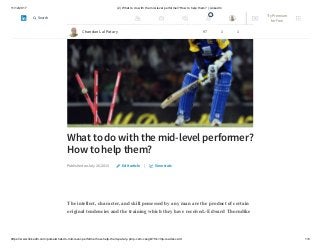
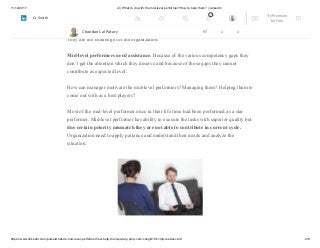

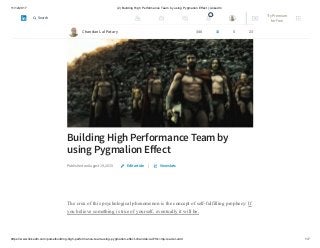
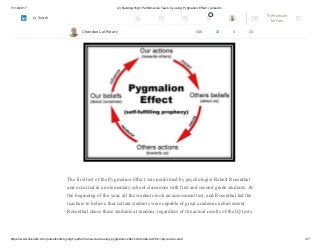
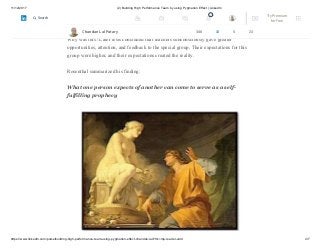


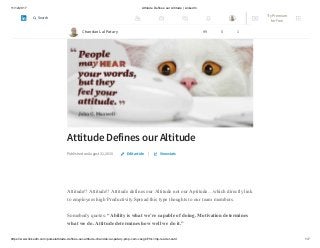
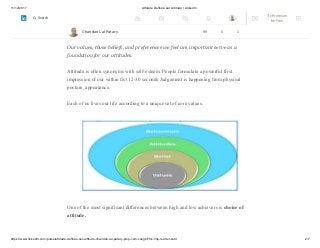

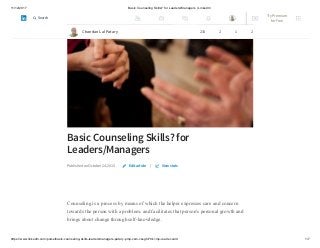
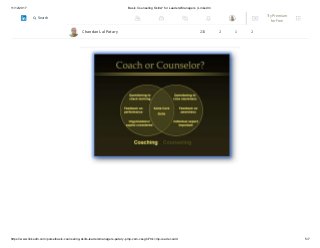

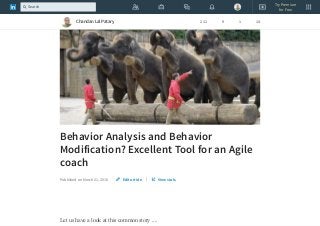
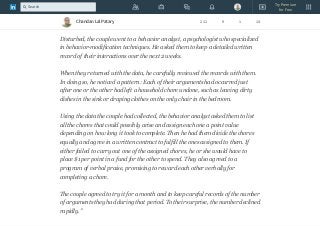
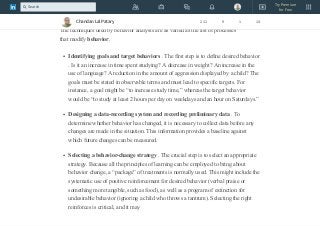
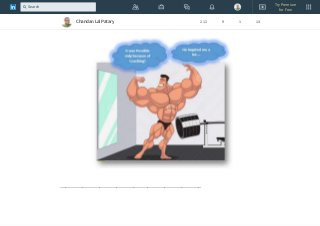


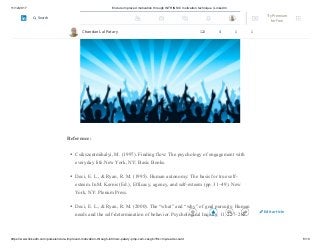

![11/12/2017 Find and Recognize Those Toxic Handler | LinkedIn
https://www.linkedin.com/pulse/find-recognize-those-toxic-handler-chandan-lal-patary-pmp-csm-cssgb/?trk=mp-reader-card 2/5
authors defined a toxic handler as “a manager who voluntarily shoulders the sadness,
frustration, bitterness, and anger that are endemic to organizational life.”
In the article, the authors provide further insight into how beneficial
these unsung heroes are. “[Great] ideas dry up when people are hurting or when
they are focused on organizational dysfunction. It is toxic handlers who frequently
step in and absorb others’ pain so that high-quality work continues to get done.”
The work of the toxic handler is absolutely vital to success when large teams have to
collaborate and overcome every obstacle, even those erected unintentionally by the
organization. Toxicity is frequent, and deadly to productivity.
Peter Frost, author of Toxic Emotions at Work, notes that many organizations and
their leaders generate emotional pain, which is a form of toxicity. Some toxicity can
demoralize employees, damage performances, and ultimately contaminate the health of
the organization.
Toxicity often creates the kind of pain that shows up in worker’s diminished
sense of self-worth. One or more workers who are depressed or angry can poison
team or department morale.
Research identifies five specific ways in which the impact of toxic handlers
is felt:
1. They listen empathetically . In essence, they always have time for people who need
to talk. In fact, I always told people my door was open, and I meant it. As a result, team
members stopped by to chat. Sometimes they needed reassurance, and others just
wanted face time. Either way, I was a very good listener. Most important, I would never
judge why they came, what was bothering them, or how important it was. All that
Chandan Lal Patary 146 7 0
Try Premium
for Free
Search](https://image.slidesharecdn.com/motivatingselfandothers-171112162249/85/The-Complete-Reference-Book-for-Motivating-Self-and-Others-51-320.jpg?cb=1512320826)


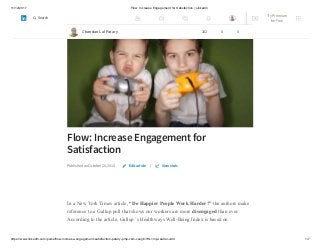
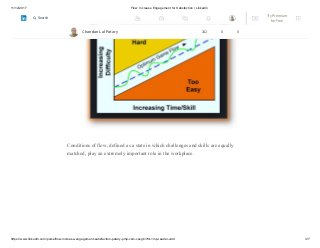
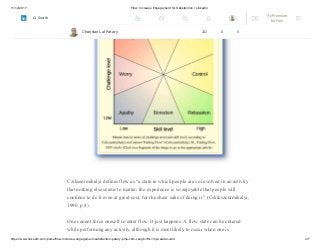
![11/12/2017 Flow: Increase Engagement for Satisfaction | LinkedIn
https://www.linkedin.com/pulse/flow-increase-engagement-satisfaction-patary-pmp-csm-cssgb/?trk=mp-reader-card 5/7
wholeheartedly performing a task or activity for intrinsic purposes
Csíkszentmihályi identifies the following ten factors as accompanying an experience of
flow
1. Clear goals (expectations and rules are discernible and goals are attainable and align
appropriately with one's skill set and abilities). Moreover, the challenge level and skill
level should both be high.[5]
2. Concentrating, a high degree of concentration on a limited field of attention (a
person engaged in the activity will
have the opportunity to focus and to delve deeply into it).
3. A loss of the feeling of self-consciousness, the merging of action and awareness.
4. Distorted sense of time, one's subjective experience of time is altered.
5. Direct and immediate feedback (successes and failures in the course of the activity
are apparent, so that behavior can be adjusted as needed).
6. Balance between ability level and challenge (the activity is neither too easy nor too
difficult).
7. A sense of personal control over the situation or activity.
8. The activity is intrinsically rewarding, so there is an effortlessness of action.
9. A lack of awareness of bodily needs (to the extent that one can reach a point of great
hunger or fatigue without realizing it)
10. Absorption into the activity, narrowing of the focus of awareness down to the
activity itself, action awareness merging
Csikszentmihalyi argues that with increased experiences of flow, people experience
“growth towards complexity,” in which people flourish as their achievements grow and
Chandan Lal Patary 162 8 0
Try Premium
for Free
Search](https://image.slidesharecdn.com/motivatingselfandothers-171112162249/85/The-Complete-Reference-Book-for-Motivating-Self-and-Others-63-320.jpg?cb=1512320826)