The UN perspective on Digital
Public Policy
Peter Major
Acting chair
United Nations
Commission on Science and Technology for Development
Politiques publiques à l'ère du numérique
Geneva, 29 November 2016
Outline
Global issues in the digital age
Global programs and initiatives
Public policy issues in the digital age and the impact of Internet
Organizations involved in international public policy
Internet Governance
The fourth industrial revolution
Conclusion
Global challenges
Source: The Millennium Project
www.millenium-project.org
• UN Millennium Development Goals (2000-2015)
• UN 2030 Agenda for Sustainable Development (SDGs)
• Sendai Framework for Disaster Risk Reduction
• Paris climate change agreement
• Addis Ababa Action Agenda
• Habitat III
• Connect 2020 Agenda for Global Telecommunication/ICT
• WSIS+10 High level meeting of the UNGA
Global programs and initiatives
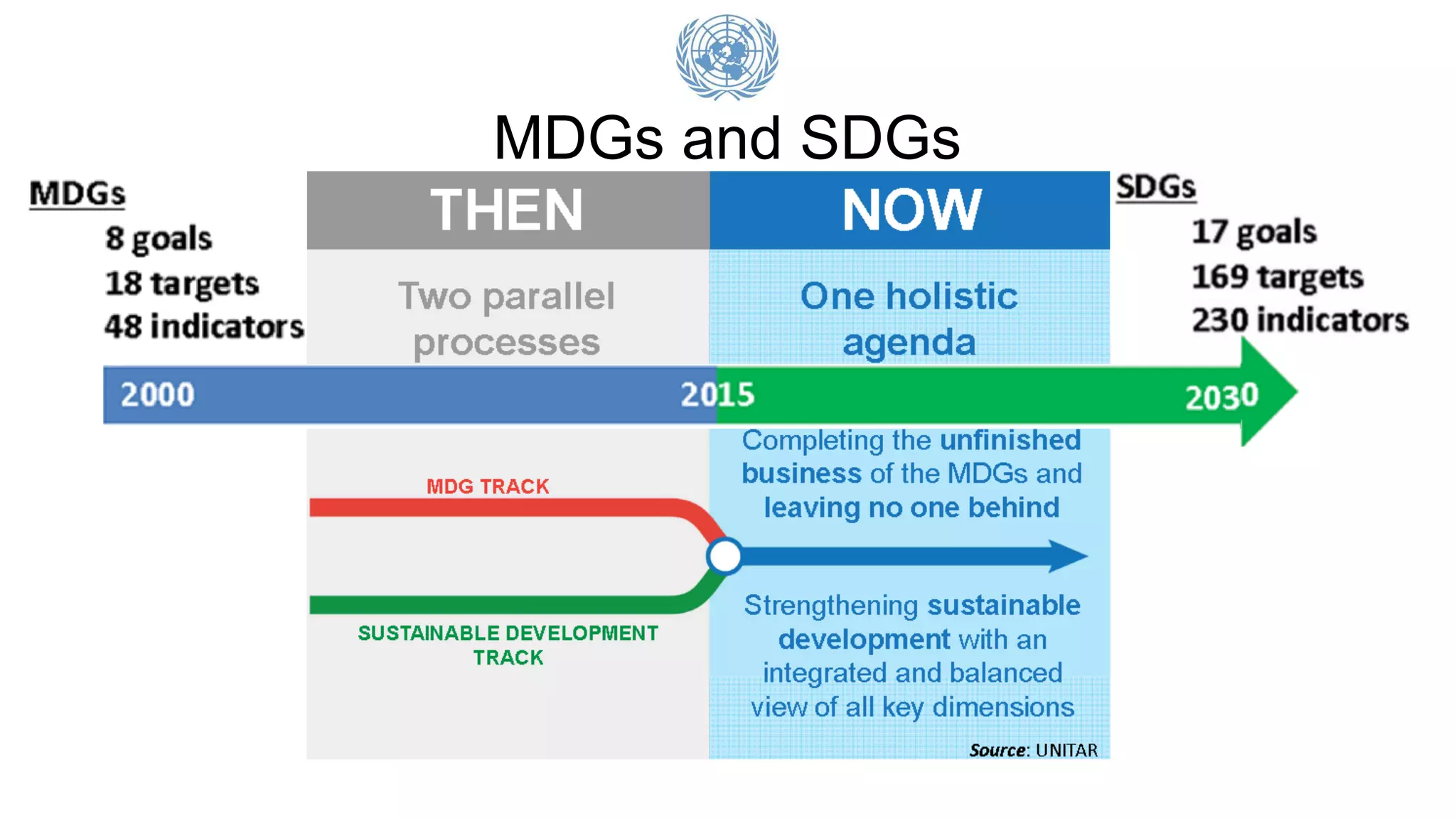
MDGs and SDGs
2030 Agenda of SDGs
Sendai 2011
Sendai Framework - Priorities
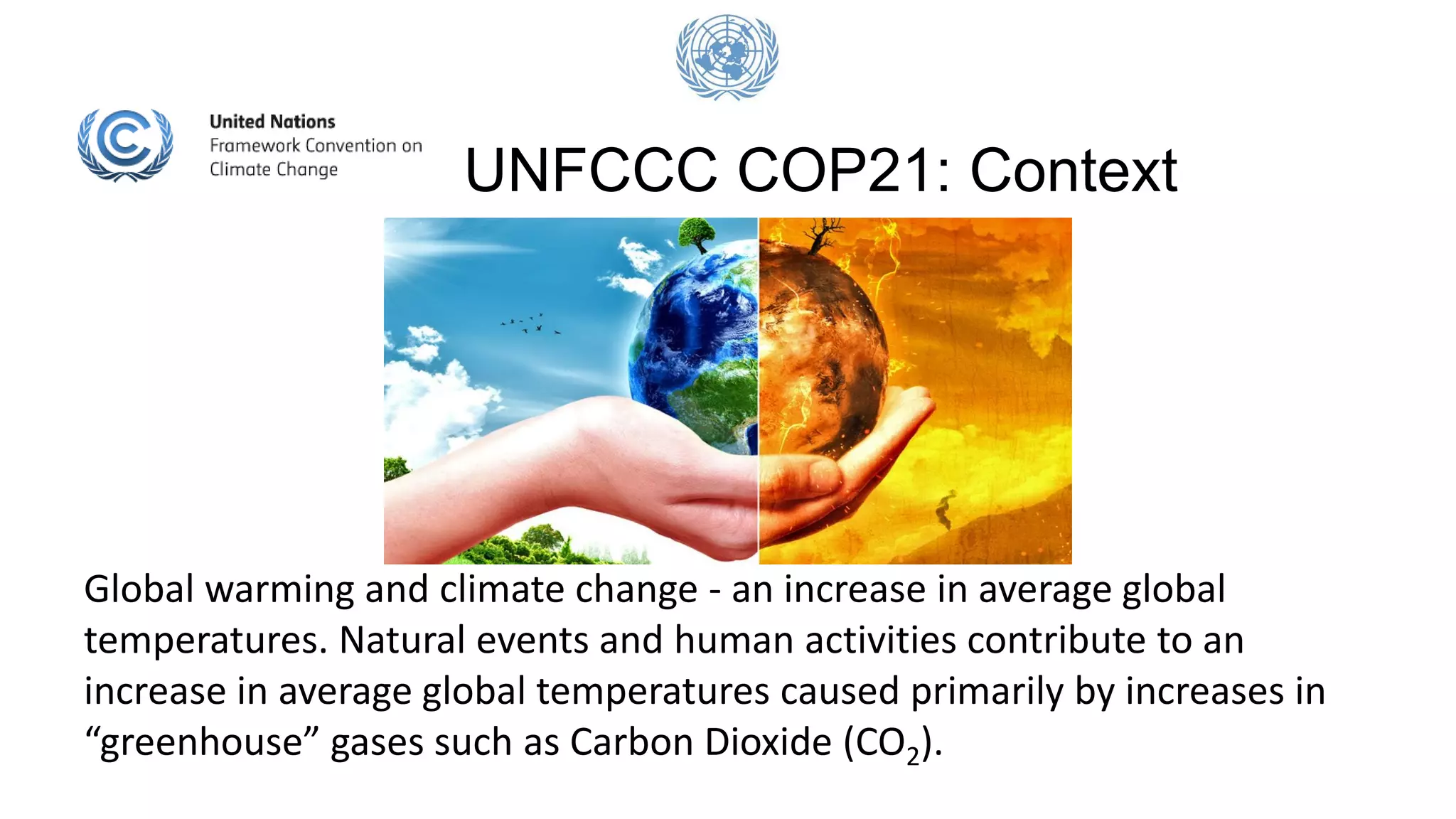
UNFCCC COP21: Context
Global warming and climate change - an increase in average global
temperatures. Natural events and human activities contribute to an
increase in average global temperatures caused primarily by increases in
“greenhouse” gases such as Carbon Dioxide (CO2).
UN HABITAT III - Context
Cities today occupy approximately only 2% of the total land, however:
World Urban Population: 54.5%
Sustainable development will depend on
how we will manage and guide the urbanization
Addis Ababa Action Agenda (AAAA)
• A comprehensive set of policy actions by Member States, with a
package of over 100 concrete measures to finance sustainable
development, transform the global economy and achieve the SDGs.
• A new global framework for financing sustainable development that
aligns all financing flows and policies with economic, social and
environmental priorities and ensures that financing is stable and
sustainable.
• Technology Facilitation Mechanism, Global Infrastructure Forum,
Social protection, Health, Foreign aid, MSMEs, measures for poorest
countries, taxation, climate change
Contribution of trade to the SDGs
Connect 2020 Agenda on
Global Telecom/ICT Development
• Growth: enable and foster access to and increased use of
telecommunication/ICT
• Inclusiveness: ​bridge the digital divide and provide
broadband for all
• Sustainability: manage challenges resulting from
telecommunication/ICT development
• Innovation and Partnership: lead, improve and adapt to the
changing telecommunication/ICT environment
WSIS+10 Context
• 1998 ITU PP Tunisia proposal World Summit on Information Society
• 2001 UN GA endorsed proposal
• 2003 Phase I Geneva Declaration & Plan of Action: Build a people-centered,
inclusive and development-oriented Information Society – Action Lines
• 2005 Phase II Tunis Agenda – Internet Governance Forum and Enhanced
Cooperation
• 2015 UNGA Commitment to outcomes of Geneva & Tunis phases of WSIS
Reaffirm the value and principles of multi-stakeholder cooperation
Extend mandate of IGF until 2025
Continue work of CSTD Working Group on Enhanced Cooperation
UN Global Programs and Initiatives
Public policy issues in the digital age
• Data protection
• Security and privacy
• Human rights
• Geo names protection
• Intellectual property rights
• Rights of persons with
disability
• Rights of children
• Child protection
• Consumer rights protection
• Brand name protection
• Capacity building/ user
awareness
• Intermediaries liability
• Net neutrality
Impact of Internet on Public Policy Issues
• Internet as a global asset
• Borderless access – borderless challenges
• Westphalia 1648 - nation states: borders,
national sovereignty & security
• How to handle public policy issues related to the Internet
and to ICTs on the international level?
• How to handle public policy issues related to the Internet
and to ICTs on the national level?
International organizations & digital public policy - 1
• UN – WSIS+10 review
• CSTD – mandate on WSIS review
• UNGIS – United Nations Group on Information Society
• ITU – Council WG on WSIS & Council WG on Internet Related
Public Policy
• WIPO – intellectual property rights
• UNCTAD – Science, Technology and Innovation Policy
reviews, e-commerce best practices
International organizations & digital public policy - 2
• UNGGE – information security
• UNODC – cyber crime issues
• UN Human Rights Council – human rights on-line
• WTO – trade and tax issues
• UNESCO – linguistic, educational and content issues
• IGF – Internet Governance Forum - discussion forum to raise
awareness on IG and show best practices (UN DESA)
• ICANN – public policy questions related to the management
of DNS – (GAC)
CSTD mandates
• CSTD is focal point in the system-wide follow-up to the outcomes of
World Summit on Information Society (WSIS)
Advises the Council thereon, including through the elaboration of
recommendations to the Council aimed at furthering the
implementation of the Summit outcomes
• CSTD acts as a forum for the examination of science and technology
(ST) questions and their implications for development;
works on the advancement of understanding on ST policies,
particularly in respect of developing countries and the formulation of
recommendations and guidelines on ST matters within the UN system.
Role of the CSTD in WSIS and after WSIS+10
• Working Group on Improvements to the IGF
• Working Group on Enhanced Cooperation 1.0 (WGEC)
• CSTD to report to ECOSOC on the overall review of WSIS
• CSTD is to follow AAAA Technology Facilitation Forum
• Chair of CSTD to create Working Group on Enhanced Cooperation
• to draft recommendation until the 21st session of CSTD in 2018 to
be submitted to UN GA through ECOSOC
Internet Governance - definition
“is the development and application by governments, the private
sector and civil society, in their respective roles, of shared
principles, norms, rules, decision-making procedures, and
programmes that shape the evolution and use of the Internet.”
• Internet is open and globally unregulated - self-regulation
• Development of the Internet including public policy - multi-
stakeholder model
• Governance of the Internet
• Governance on the Internet
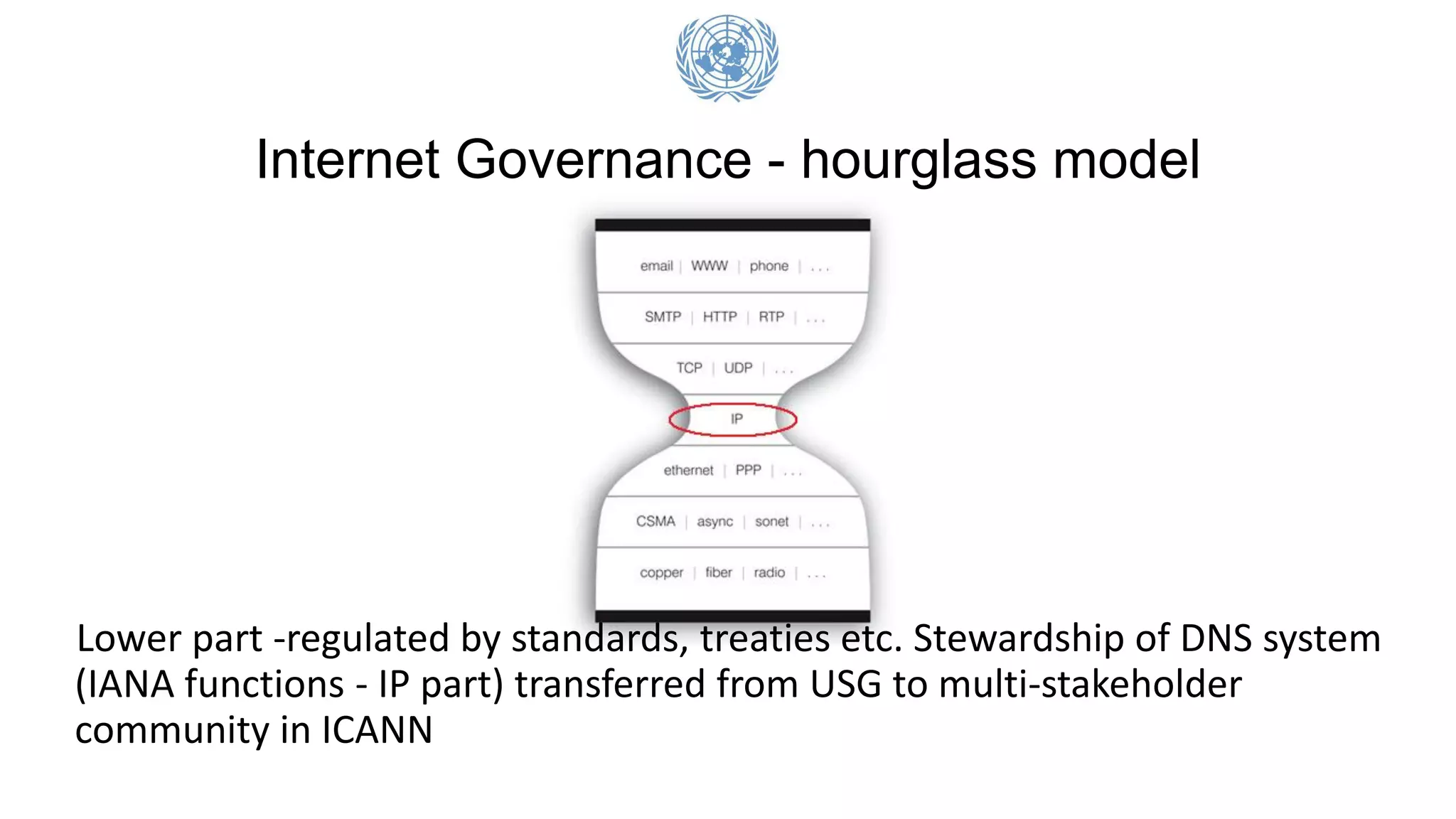
Internet Governance - hourglass model
Lower part -regulated by standards, treaties etc. Stewardship of DNS system
(IANA functions - IP part) transferred from USG to multi-stakeholder
community in ICANN
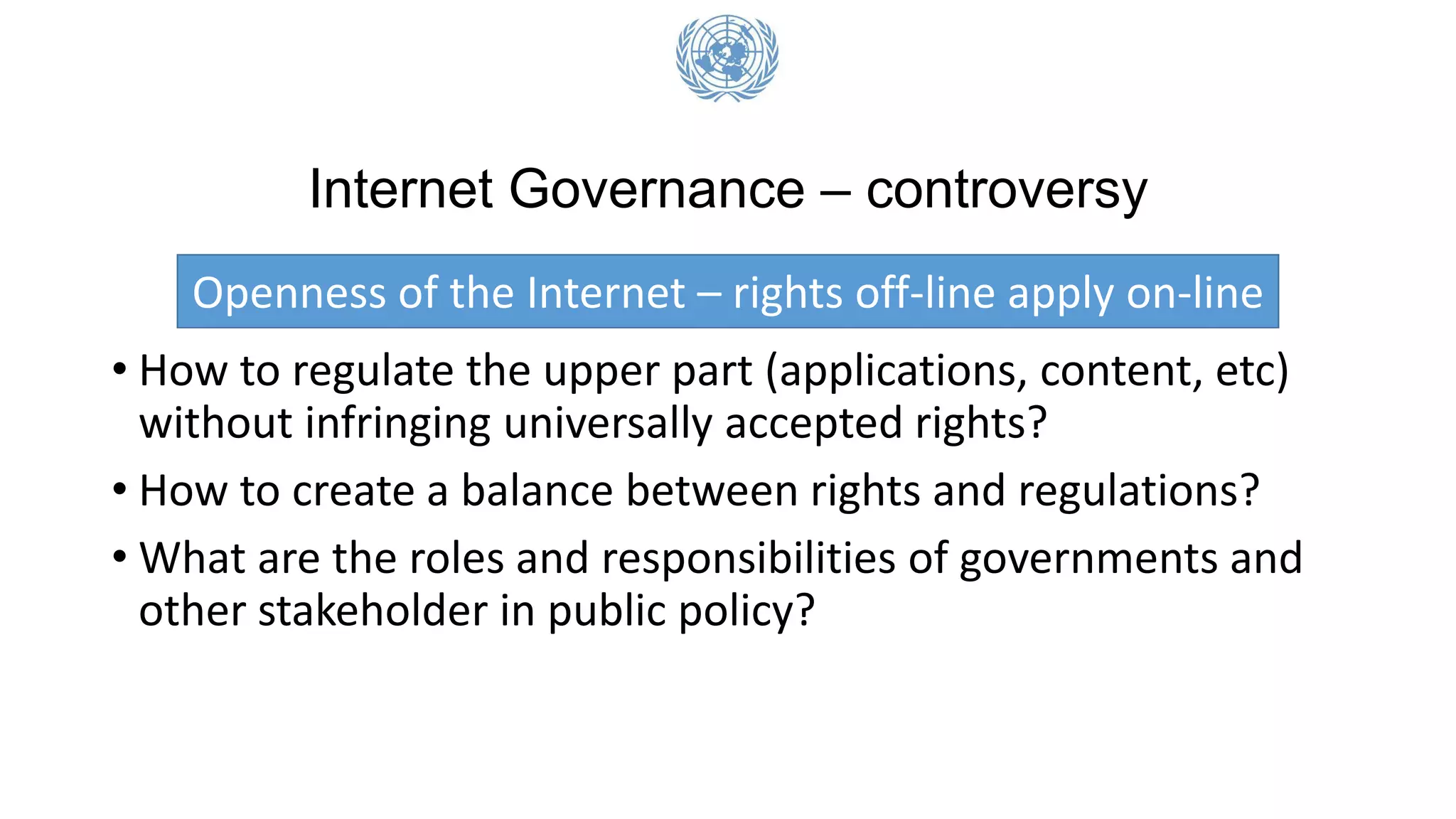
Internet Governance – controversy
Openness of the Internet – rights off-line apply on-line
• How to regulate the upper part (applications, content, etc)
without infringing universally accepted rights?
• How to create a balance between rights and regulations?
• What are the roles and responsibilities of governments and
other stakeholder in public policy?
New Challenge: Fourth Industrial Revolution
Source: The 4th Industrial Revolutions (by Christoph Roser at AllAboutLean.com)
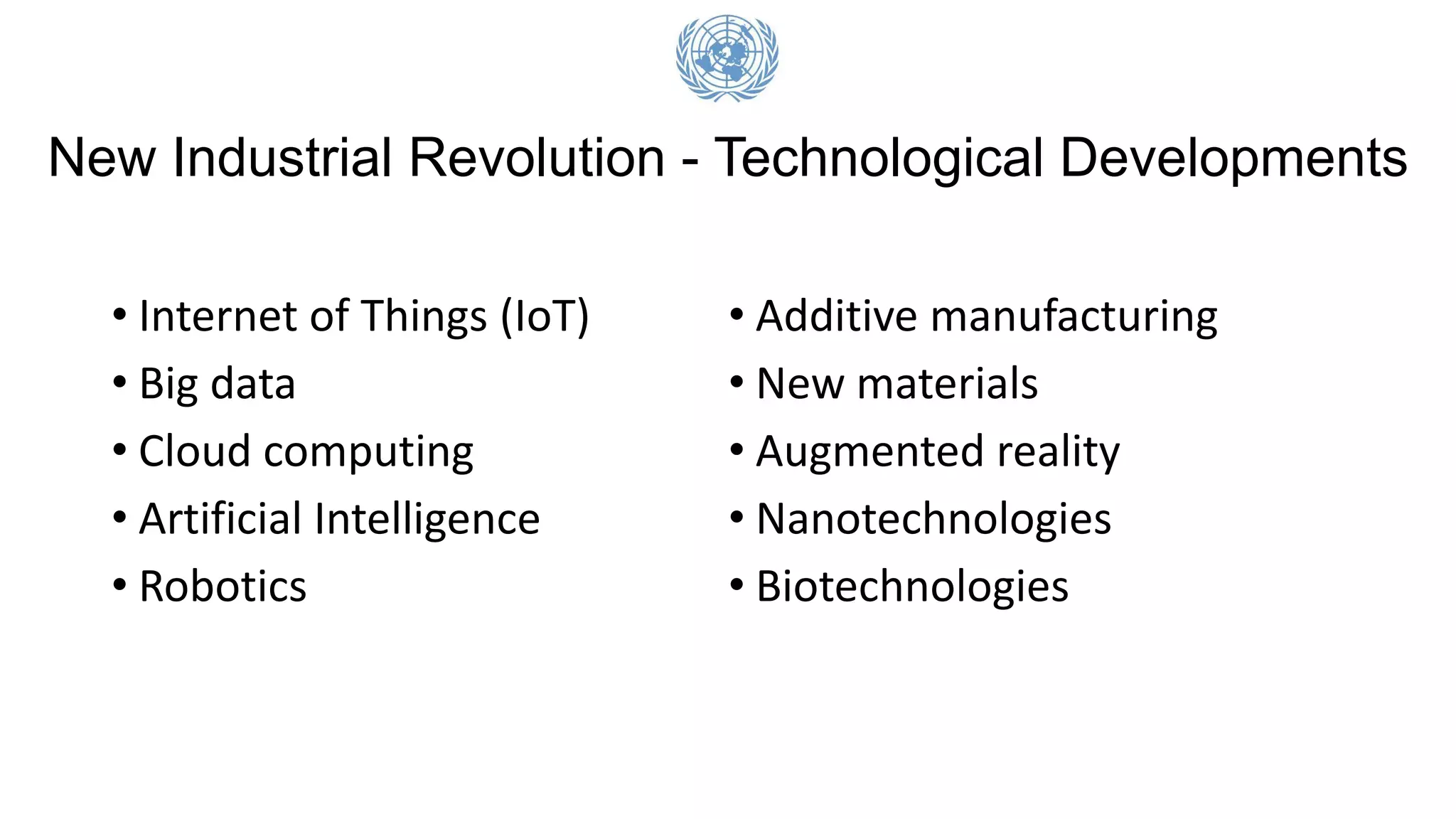
New Industrial Revolution - Technological Developments
• Internet of Things (IoT)
• Big data
• Cloud computing
• Artificial Intelligence
• Robotics
• Additive manufacturing
• New materials
• Augmented reality
• Nanotechnologies
• Biotechnologies
New Industrial Revolution - Challenges
• New industry and business models supersede conventional ones
• Workers need to adapt to new jobs profiles and skill requirements
• Integration of new technologies to be enabled
• Infrastructure, standards and policies to be developed/adjusted
To address challenges - multi-stakeholder approach
• Within and across countries
• Implementation of NIR – balancing interests: government,
enterprises, academia, trade unions, business associations
G20 Digital Economy Development and
Cooperation Initiative: Context
• Digitized, networked and intelligent ICTs enable modern
economic activities to be more flexible, agile and smart.
• Digital Economy important driver of global economic growth and
plays a significant role in accelerating economic development,
enhancing productivity of existing industries, cultivating new
markets and industries, and achieving inclusive, sustainable
growth
• Guiding principles: Innovation, Partnership, Synergy, Flexibility,
Inclusion, Open and enabling business environment
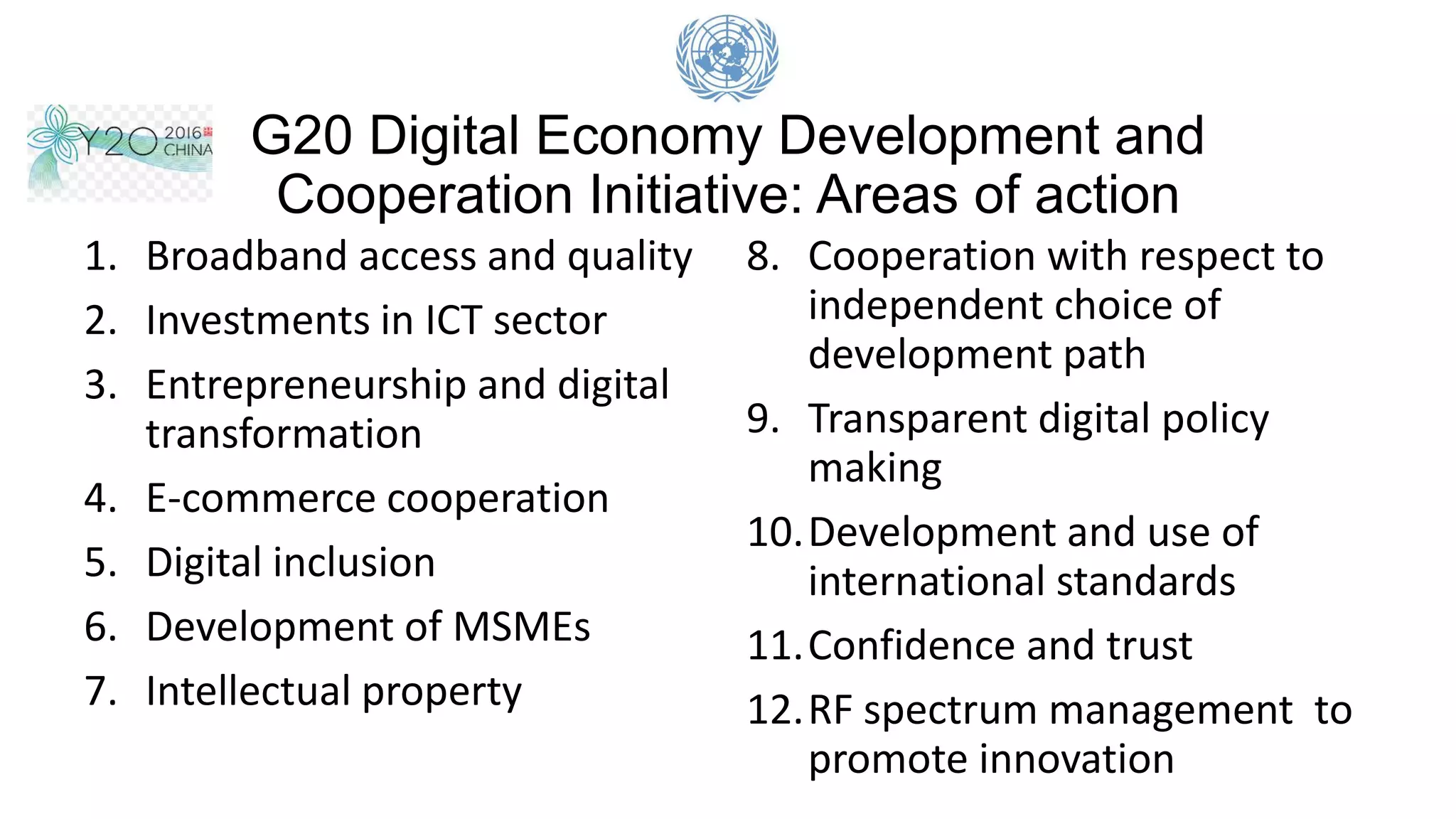
G20 Digital Economy Development and
Cooperation Initiative: Areas of action
1. Broadband access and quality
2. Investments in ICT sector
3. Entrepreneurship and digital
transformation
4. E-commerce cooperation
5. Digital inclusion
6. Development of MSMEs
7. Intellectual property
8. Cooperation with respect to
independent choice of
development path
9. Transparent digital policy
making
10.Development and use of
international standards
11.Confidence and trust
12.RF spectrum management to
promote innovation
• New challenges need new approaches and quick responses
• Monitor & analyze advances in technology, applications and
emerging issues
• To handle problems identify framework, international
organizations, mechanisms
• Time factor – reactive versus proactive governance
• How to strike a balance between regulations and openness
• How to ensure permissionless innovation
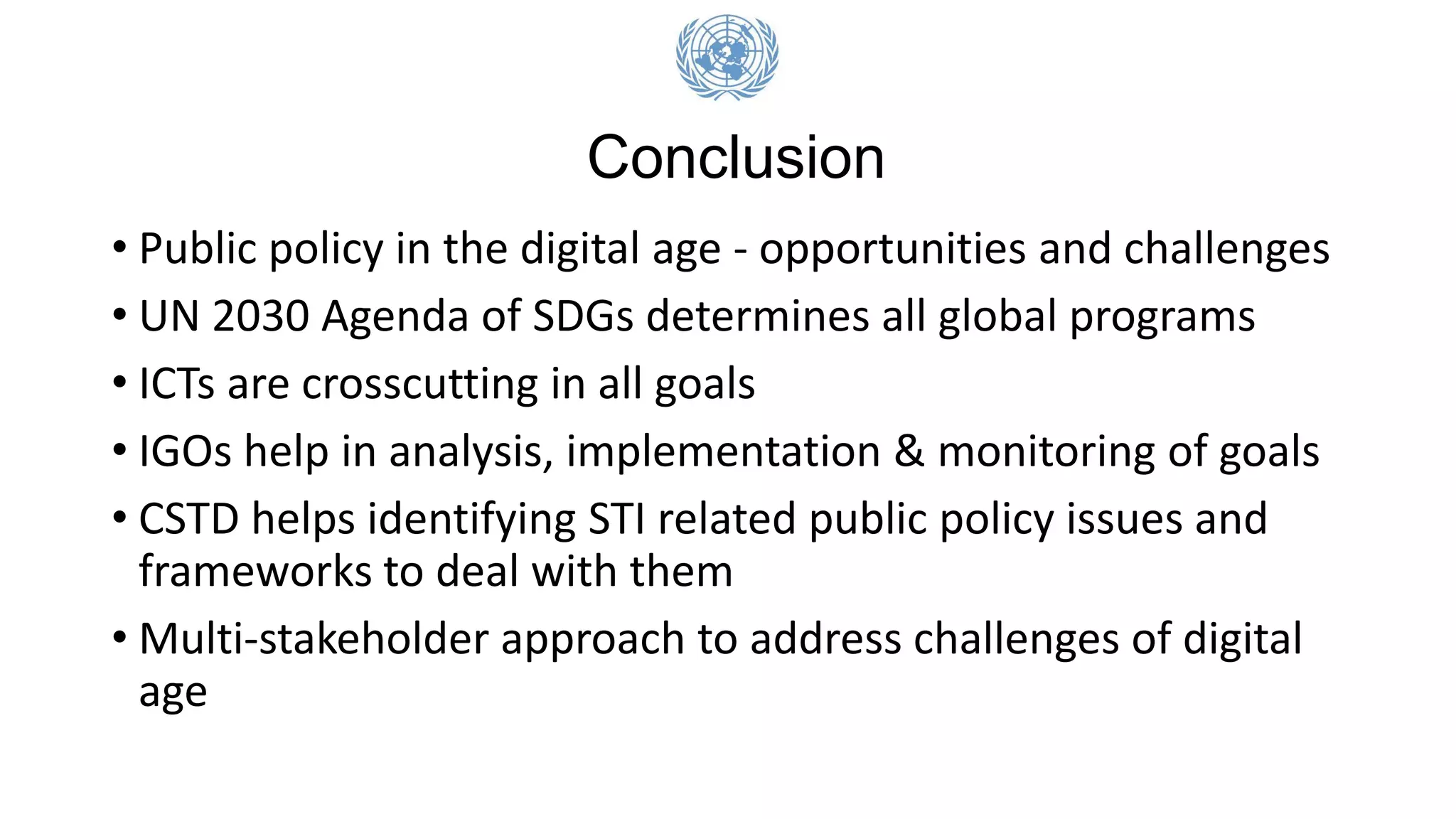
Internet Governance 2.0
• Public policy in the digital age - opportunities and challenges
• UN 2030 Agenda of SDGs determines all global programs
• ICTs are crosscutting in all goals
• IGOs help in analysis, implementation & monitoring of goals
• CSTD helps identifying STI related public policy issues and
frameworks to deal with them
• Multi-stakeholder approach to address challenges of digital
age
Conclusion
Q & A
pmajor@bluewin.ch
• COP – Conference of the Parties to the Convention
• CSTD – UN Commission on Science and Technology for Development
• ECOSOC – Economic and Social Council
• ITU – International Telecommunication Union (UN Specialized
Agency)
• STI – Science, Technology, Innovation
• UN – United Nations
• UNCTAD – UN Conference on Trade and Development
• UN DESA – UN Department of Economic and Social Affairs
Glossary
• UNESCO – UN Educational, Scientific and Educational Organization
• UNFCCC – UN Framework Convention on Climate Change
• UNGIS – UN Group on Information Society
• UNODC – UN Office on Drugs and Crime
• UNCTAD – UN Conference on Trade and Development
• UN GGE – UN Group of Governmental Experts on Information Security
• UNFCCC – UN Framework Convention on Climate Change
• UNISDR – UN International Strategy for Disaster Reduction
• WTO – World Trade Organization
Glossary (cont’d)

The UN perspective on Digital Public Policy

  • 1.
    The UN perspectiveon Digital Public Policy Peter Major Acting chair United Nations Commission on Science and Technology for Development Politiques publiques à l'ère du numérique Geneva, 29 November 2016
  • 2.
    Outline Global issues inthe digital age Global programs and initiatives Public policy issues in the digital age and the impact of Internet Organizations involved in international public policy Internet Governance The fourth industrial revolution Conclusion
  • 3.
    Global challenges Source: TheMillennium Project www.millenium-project.org
  • 4.
    • UN MillenniumDevelopment Goals (2000-2015) • UN 2030 Agenda for Sustainable Development (SDGs) • Sendai Framework for Disaster Risk Reduction • Paris climate change agreement • Addis Ababa Action Agenda • Habitat III • Connect 2020 Agenda for Global Telecommunication/ICT • WSIS+10 High level meeting of the UNGA Global programs and initiatives
  • 5.
  • 6.
  • 7.
  • 8.
    UNFCCC COP21: Context Globalwarming and climate change - an increase in average global temperatures. Natural events and human activities contribute to an increase in average global temperatures caused primarily by increases in “greenhouse” gases such as Carbon Dioxide (CO2).
  • 9.
    UN HABITAT III- Context Cities today occupy approximately only 2% of the total land, however: World Urban Population: 54.5% Sustainable development will depend on how we will manage and guide the urbanization
  • 10.
    Addis Ababa ActionAgenda (AAAA) • A comprehensive set of policy actions by Member States, with a package of over 100 concrete measures to finance sustainable development, transform the global economy and achieve the SDGs. • A new global framework for financing sustainable development that aligns all financing flows and policies with economic, social and environmental priorities and ensures that financing is stable and sustainable. • Technology Facilitation Mechanism, Global Infrastructure Forum, Social protection, Health, Foreign aid, MSMEs, measures for poorest countries, taxation, climate change
  • 11.
  • 12.
    Connect 2020 Agendaon Global Telecom/ICT Development • Growth: enable and foster access to and increased use of telecommunication/ICT • Inclusiveness: ​bridge the digital divide and provide broadband for all • Sustainability: manage challenges resulting from telecommunication/ICT development • Innovation and Partnership: lead, improve and adapt to the changing telecommunication/ICT environment
  • 13.
    WSIS+10 Context • 1998ITU PP Tunisia proposal World Summit on Information Society • 2001 UN GA endorsed proposal • 2003 Phase I Geneva Declaration & Plan of Action: Build a people-centered, inclusive and development-oriented Information Society – Action Lines • 2005 Phase II Tunis Agenda – Internet Governance Forum and Enhanced Cooperation • 2015 UNGA Commitment to outcomes of Geneva & Tunis phases of WSIS Reaffirm the value and principles of multi-stakeholder cooperation Extend mandate of IGF until 2025 Continue work of CSTD Working Group on Enhanced Cooperation
  • 14.
    UN Global Programsand Initiatives
  • 15.
    Public policy issuesin the digital age • Data protection • Security and privacy • Human rights • Geo names protection • Intellectual property rights • Rights of persons with disability • Rights of children • Child protection • Consumer rights protection • Brand name protection • Capacity building/ user awareness • Intermediaries liability • Net neutrality
  • 16.
    Impact of Interneton Public Policy Issues • Internet as a global asset • Borderless access – borderless challenges • Westphalia 1648 - nation states: borders, national sovereignty & security • How to handle public policy issues related to the Internet and to ICTs on the international level? • How to handle public policy issues related to the Internet and to ICTs on the national level?
  • 17.
    International organizations &digital public policy - 1 • UN – WSIS+10 review • CSTD – mandate on WSIS review • UNGIS – United Nations Group on Information Society • ITU – Council WG on WSIS & Council WG on Internet Related Public Policy • WIPO – intellectual property rights • UNCTAD – Science, Technology and Innovation Policy reviews, e-commerce best practices
  • 18.
    International organizations &digital public policy - 2 • UNGGE – information security • UNODC – cyber crime issues • UN Human Rights Council – human rights on-line • WTO – trade and tax issues • UNESCO – linguistic, educational and content issues • IGF – Internet Governance Forum - discussion forum to raise awareness on IG and show best practices (UN DESA) • ICANN – public policy questions related to the management of DNS – (GAC)
  • 19.
    CSTD mandates • CSTDis focal point in the system-wide follow-up to the outcomes of World Summit on Information Society (WSIS) Advises the Council thereon, including through the elaboration of recommendations to the Council aimed at furthering the implementation of the Summit outcomes • CSTD acts as a forum for the examination of science and technology (ST) questions and their implications for development; works on the advancement of understanding on ST policies, particularly in respect of developing countries and the formulation of recommendations and guidelines on ST matters within the UN system.
  • 20.
    Role of theCSTD in WSIS and after WSIS+10 • Working Group on Improvements to the IGF • Working Group on Enhanced Cooperation 1.0 (WGEC) • CSTD to report to ECOSOC on the overall review of WSIS • CSTD is to follow AAAA Technology Facilitation Forum • Chair of CSTD to create Working Group on Enhanced Cooperation • to draft recommendation until the 21st session of CSTD in 2018 to be submitted to UN GA through ECOSOC
  • 21.
    Internet Governance -definition “is the development and application by governments, the private sector and civil society, in their respective roles, of shared principles, norms, rules, decision-making procedures, and programmes that shape the evolution and use of the Internet.” • Internet is open and globally unregulated - self-regulation • Development of the Internet including public policy - multi- stakeholder model • Governance of the Internet • Governance on the Internet
  • 22.
    Internet Governance -hourglass model Lower part -regulated by standards, treaties etc. Stewardship of DNS system (IANA functions - IP part) transferred from USG to multi-stakeholder community in ICANN
  • 23.
    Internet Governance –controversy Openness of the Internet – rights off-line apply on-line • How to regulate the upper part (applications, content, etc) without infringing universally accepted rights? • How to create a balance between rights and regulations? • What are the roles and responsibilities of governments and other stakeholder in public policy?
  • 24.
    New Challenge: FourthIndustrial Revolution Source: The 4th Industrial Revolutions (by Christoph Roser at AllAboutLean.com)
  • 25.
    New Industrial Revolution- Technological Developments • Internet of Things (IoT) • Big data • Cloud computing • Artificial Intelligence • Robotics • Additive manufacturing • New materials • Augmented reality • Nanotechnologies • Biotechnologies
  • 26.
    New Industrial Revolution- Challenges • New industry and business models supersede conventional ones • Workers need to adapt to new jobs profiles and skill requirements • Integration of new technologies to be enabled • Infrastructure, standards and policies to be developed/adjusted To address challenges - multi-stakeholder approach • Within and across countries • Implementation of NIR – balancing interests: government, enterprises, academia, trade unions, business associations
  • 27.
    G20 Digital EconomyDevelopment and Cooperation Initiative: Context • Digitized, networked and intelligent ICTs enable modern economic activities to be more flexible, agile and smart. • Digital Economy important driver of global economic growth and plays a significant role in accelerating economic development, enhancing productivity of existing industries, cultivating new markets and industries, and achieving inclusive, sustainable growth • Guiding principles: Innovation, Partnership, Synergy, Flexibility, Inclusion, Open and enabling business environment
  • 28.
    G20 Digital EconomyDevelopment and Cooperation Initiative: Areas of action 1. Broadband access and quality 2. Investments in ICT sector 3. Entrepreneurship and digital transformation 4. E-commerce cooperation 5. Digital inclusion 6. Development of MSMEs 7. Intellectual property 8. Cooperation with respect to independent choice of development path 9. Transparent digital policy making 10.Development and use of international standards 11.Confidence and trust 12.RF spectrum management to promote innovation
  • 29.
    • New challengesneed new approaches and quick responses • Monitor & analyze advances in technology, applications and emerging issues • To handle problems identify framework, international organizations, mechanisms • Time factor – reactive versus proactive governance • How to strike a balance between regulations and openness • How to ensure permissionless innovation Internet Governance 2.0
  • 30.
    • Public policyin the digital age - opportunities and challenges • UN 2030 Agenda of SDGs determines all global programs • ICTs are crosscutting in all goals • IGOs help in analysis, implementation & monitoring of goals • CSTD helps identifying STI related public policy issues and frameworks to deal with them • Multi-stakeholder approach to address challenges of digital age Conclusion
  • 31.
  • 32.
    • COP –Conference of the Parties to the Convention • CSTD – UN Commission on Science and Technology for Development • ECOSOC – Economic and Social Council • ITU – International Telecommunication Union (UN Specialized Agency) • STI – Science, Technology, Innovation • UN – United Nations • UNCTAD – UN Conference on Trade and Development • UN DESA – UN Department of Economic and Social Affairs Glossary
  • 33.
    • UNESCO –UN Educational, Scientific and Educational Organization • UNFCCC – UN Framework Convention on Climate Change • UNGIS – UN Group on Information Society • UNODC – UN Office on Drugs and Crime • UNCTAD – UN Conference on Trade and Development • UN GGE – UN Group of Governmental Experts on Information Security • UNFCCC – UN Framework Convention on Climate Change • UNISDR – UN International Strategy for Disaster Reduction • WTO – World Trade Organization Glossary (cont’d)