The Incense Route -   Desert Cities in the Negev World Heritage Site no. 1107 Nominated 15/7/2005 Prepered by: Dr. Tsvika Tsuk, Michal Levi - NPA
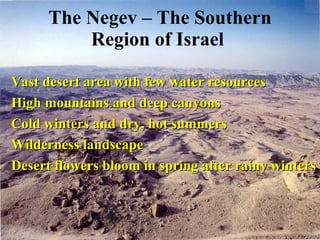
The Negev – The Southern Region of Israel  Vast desert area with few water resources  High mountains and deep canyons  Cold winters and dry, hot summers  Wilderness landscape  Desert flowers bloom in spring after rainy winters
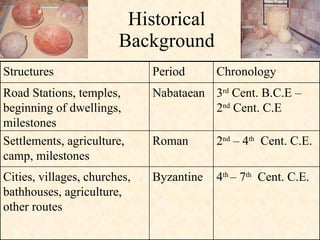
Historical Background 4 th  – 7 th   Cent. C.E. Byzantine Cities, villages, churches, bathhouses, agriculture, other routes  2 nd  – 4 th   Cent. C.E. Roman Settlements, agriculture, camp, milestones 3 rd  Cent. B.C.E – 2 nd  Cent. C.E Nabataean Road Stations, temples, beginning of dwellings, milestones Chronology   Period  Structures
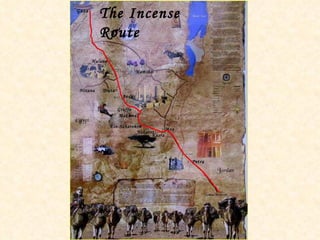
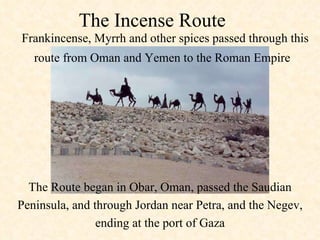
The Incense Route  Frankincense, Myrrh and other spices passed through this  route from Oman and Yemen to the Roman Empire The Route began in Obar, Oman, passed the Saudian Peninsula, and through Jordan near Petra, and the Negev, ending at the port of Gaza
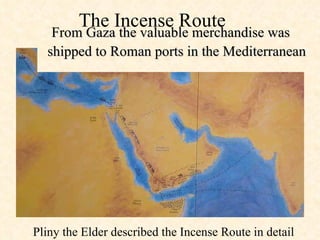
The Incense Route  From Gaza the valuable merchandise was shipped to Roman ports in the Mediterranean Pliny the Elder described the Incense Route in detail
Pliny’s Description  “ After the frankincense is collected, it is conveyed by camel to Sabota, and one of the gates of the city is opened to receive the merchandise. The kings enacted a permanent law that it is a serious crime for a camel bearing frankincense to divert from the main road. In Sabota, the priests levy a tithe on the frankincense for the god known as Sabin … From here, the merchandise may be conveyed through the land of the Gebbanites only, and therefore tax must be paid to the king of this people as well.  Their capital is Thomna, which is 1487.5 miles [2380 km] from Gaza in Judea, located on the coast of the Mediterranean. The journey is divided into 65 stages [36.6 km each], at each of which is a rest station for the camels.  Regular portions of frankincense must be paid to the priests of the lands, their kings, and their scribes. In addition, portions are also taken by guards at gates and their servants. In addition to these, they must pay all the way, in one place for water, elsewhere for a place at the way station, and also for food. Thus, expenses come to 688 denarii even before reaching the Mediterranean. Then our imperial tax officials must be paid again. Because of this,  the price of good frankincense can be six denerii per liter, average frankincense can be five denarii, and the third type can be three denarii”.  Pliny,  Historia Naturalis,  12:32: 63-65
Moa Kasra Nekarot Ein-Saharonim Makhmal Sivta Avdat Nizana Mamshit Gaza Petra The Incense Route Haluza Graffon


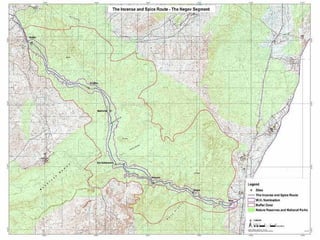
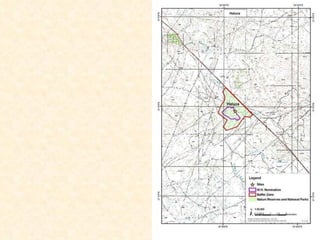
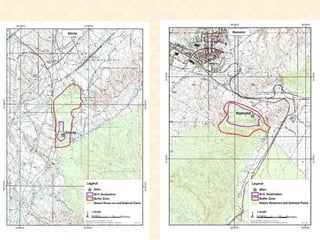
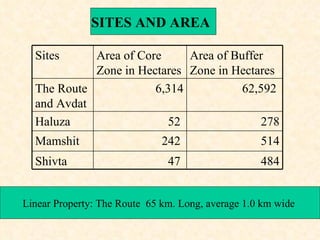
SITES AND AREA   Linear Property: The Route  65 km. Long, average 1.0 km wide  484 47  Shivta  514 242  Mamshit  278 52  Haluza  62,592  6,314 The Route and Avdat  Area of Buffer Zone in Hectares Area of Core Zone in Hectares  Sites
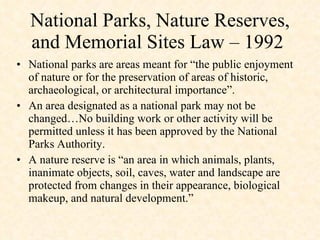
National parks are areas meant for “the public enjoyment of nature or for the preservation of areas of historic, archaeological, or architectural importance”.  An area designated as a national park may not be changed…No building work or other activity will be permitted unless it has been approved by the National Parks Authority.  A nature reserve is “an area in which animals, plants, inanimate objects, soil, caves, water and landscape are protected from changes in their appearance, biological makeup, and natural development.” National Parks, Nature Reserves, and Memorial Sites Law – 1992
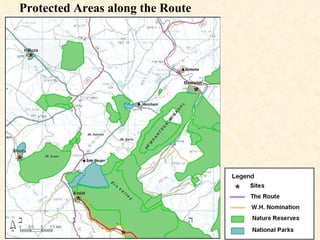
Protected Areas along the Route
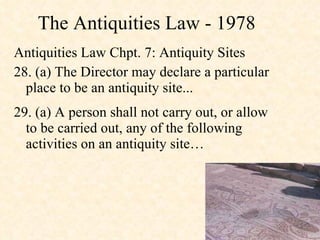
The Antiquities Law - 1978 Antiquities Law Chpt. 7: Antiquity Sites  28. (a) The Director may declare a particular place to be an antiquity site... 29. (a) A person shall not carry out, or allow to be carried out, any of the following activities on an antiquity site…
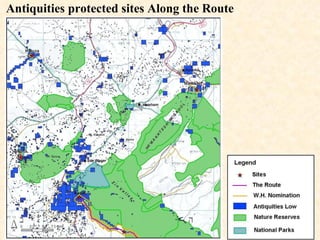
Antiquities protected sites Along the Route
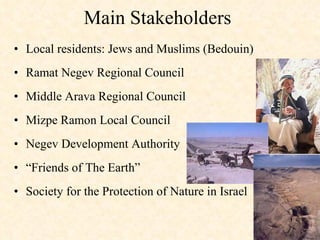
Main Stakeholders  Local residents: Jews and Muslims (Bedouin) Ramat Negev Regional Council Middle Arava Regional Council  Mizpe Ramon Local Council  Negev Development Authority  “ Friends of The Earth” Society for the Protection of Nature in Israel
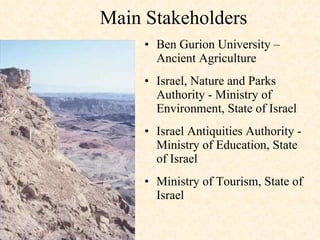
Main Stakeholders  Ben Gurion University – Ancient Agriculture Israel, Nature and Parks Authority - Ministry of Environment, State of Israel Israel Antiquities Authority - Ministry of Education, State of Israel Ministry of Tourism, State of Israel
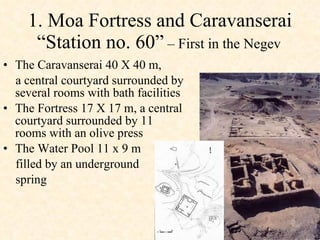
1. Moa Fortress and Caravanserai  “Station no. 60”  – First in the Negev  The Caravanserai 40 X 40 m,  a central courtyard surrounded by several rooms with bath facilities The Fortress 17 X 17 m, a central courtyard surrounded by 11 rooms with an olive press The Water Pool 11 x 9 m  filled by an underground  spring
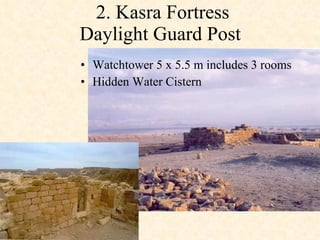
2. Kasra Fortress Daylight Guard Post  Watchtower 5 x 5.5 m includes 3 rooms Hidden Water Cistern
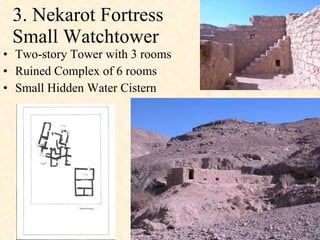
3. Nekarot Fortress Small Watchtower  Two-story Tower with 3 rooms  Ruined Complex of 6 rooms Small Hidden Water Cistern
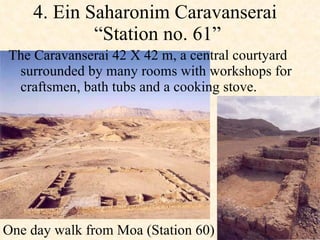
4. Ein Saharonim Caravanserai  “Station no. 61”  The Caravanserai 42 X 42 m, a central courtyard surrounded by many rooms with workshops for craftsmen, bath tubs and a cooking stove.  One day walk from Moa (Station 60)
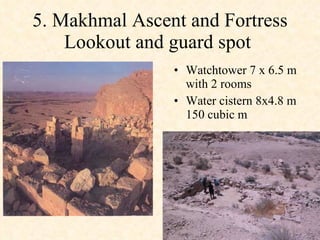
5. Makhmal Ascent and Fortress Lookout and guard spot  Watchtower 7 x 6.5 m with 2 rooms Water cistern 8x4.8 m 150 cubic m
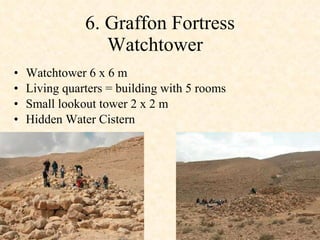
6. Graffon Fortress Watchtower  Watchtower 6 x 6 m Living quarters = building with 5 rooms  Small lookout tower 2 x 2 m Hidden Water Cistern
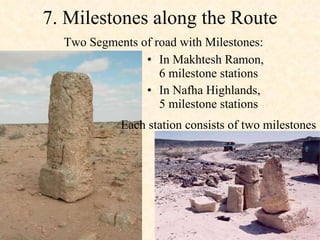
7. Milestones along the Route In Makhtesh Ramon,  6 milestone stations In Nafha Highlands,  5 milestone stations Two Segments of road with Milestones: Each station consists of two milestones
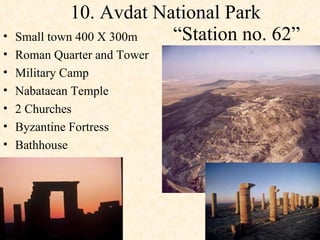
10. Avdat National Park    “Station no. 62” Small town 400 X 300m  Roman Quarter and Tower  Military Camp Nabataean Temple  2 Churches  Byzantine Fortress  Bathhouse
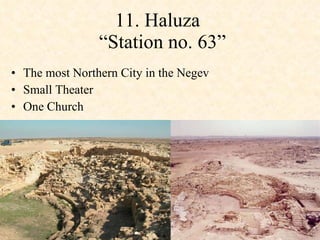
11. Haluza   “Station no. 63” The most Northern City in the Negev Small Theater  One Church
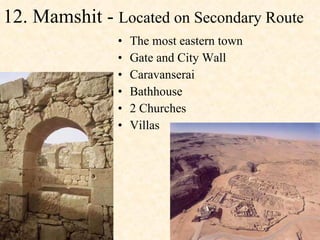
12. Mamshit -  Located on Secondary Route The most eastern town Gate and City Wall  Caravanserai  Bathhouse  2 Churches  Villas
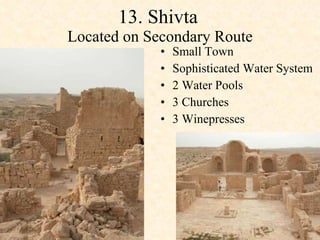
13. Shivta   Located on Secondary Route Small Town  Sophisticated Water System 2 Water Pools  3 Churches  3 Winepresses
 
 
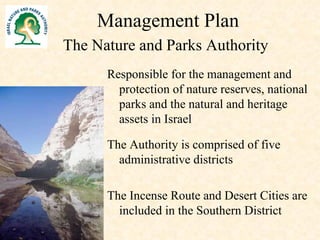
Management Plan   The Nature and Parks Authority   Responsible for the management and protection of nature reserves, national parks and the natural and heritage assets in Israel The Authority is comprised of five administrative districts The Incense Route and Desert Cities are included in the Southern District
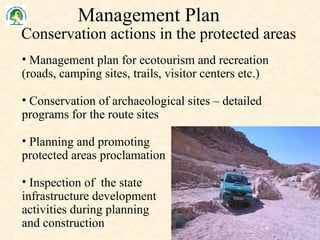
Conservation actions in the protected areas Management plan for ecotourism and recreation  (roads, camping sites, trails, visitor centers etc.) Conservation of archaeological sites – detailed  programs for the route sites Planning and  promoting   protected areas proclamation Inspection of  the state    infrastructure development    activities during planning    and construction Management Plan
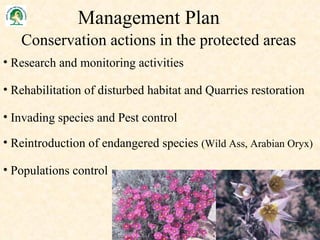
Research and monitoring activities Rehabilitation of disturbed habitat and Quarries restoration Invading species and Pest control Reintroduction of endangered species  (Wild Ass, Arabian Oryx) Populations control Conservation actions in the protected areas Management Plan
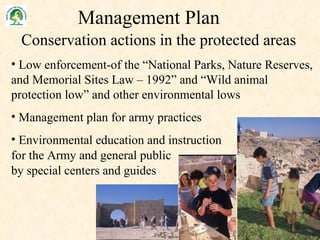
Low enforcement-of the “ National Parks, Nature Reserves, and Memorial Sites Law – 1992” and “Wild animal protection low” and other environmental lows Management plan for army practices  Environmental education and  instruction   for the Army and general public  by  special centers and guides Conservation actions in the protected areas Management Plan
Management Plan  Professional Training Education and training of the employees include courses in: Conservation Management Enforcement Visitor Service Public participation and education
See You in  The Negev…

The Incense Route

  • 1.
    The Incense Route- Desert Cities in the Negev World Heritage Site no. 1107 Nominated 15/7/2005 Prepered by: Dr. Tsvika Tsuk, Michal Levi - NPA
  • 2.
    The Negev –The Southern Region of Israel Vast desert area with few water resources High mountains and deep canyons Cold winters and dry, hot summers Wilderness landscape Desert flowers bloom in spring after rainy winters
  • 3.
    Historical Background 4th – 7 th Cent. C.E. Byzantine Cities, villages, churches, bathhouses, agriculture, other routes 2 nd – 4 th Cent. C.E. Roman Settlements, agriculture, camp, milestones 3 rd Cent. B.C.E – 2 nd Cent. C.E Nabataean Road Stations, temples, beginning of dwellings, milestones Chronology Period Structures
  • 4.
    The Incense Route Frankincense, Myrrh and other spices passed through this route from Oman and Yemen to the Roman Empire The Route began in Obar, Oman, passed the Saudian Peninsula, and through Jordan near Petra, and the Negev, ending at the port of Gaza
  • 5.
    The Incense Route From Gaza the valuable merchandise was shipped to Roman ports in the Mediterranean Pliny the Elder described the Incense Route in detail
  • 6.
    Pliny’s Description “ After the frankincense is collected, it is conveyed by camel to Sabota, and one of the gates of the city is opened to receive the merchandise. The kings enacted a permanent law that it is a serious crime for a camel bearing frankincense to divert from the main road. In Sabota, the priests levy a tithe on the frankincense for the god known as Sabin … From here, the merchandise may be conveyed through the land of the Gebbanites only, and therefore tax must be paid to the king of this people as well. Their capital is Thomna, which is 1487.5 miles [2380 km] from Gaza in Judea, located on the coast of the Mediterranean. The journey is divided into 65 stages [36.6 km each], at each of which is a rest station for the camels. Regular portions of frankincense must be paid to the priests of the lands, their kings, and their scribes. In addition, portions are also taken by guards at gates and their servants. In addition to these, they must pay all the way, in one place for water, elsewhere for a place at the way station, and also for food. Thus, expenses come to 688 denarii even before reaching the Mediterranean. Then our imperial tax officials must be paid again. Because of this, the price of good frankincense can be six denerii per liter, average frankincense can be five denarii, and the third type can be three denarii”. Pliny, Historia Naturalis, 12:32: 63-65
  • 7.
    Moa Kasra NekarotEin-Saharonim Makhmal Sivta Avdat Nizana Mamshit Gaza Petra The Incense Route Haluza Graffon
  • 8.
  • 9.
  • 10.
  • 11.
    SITES AND AREA Linear Property: The Route 65 km. Long, average 1.0 km wide 484 47 Shivta 514 242 Mamshit 278 52 Haluza 62,592 6,314 The Route and Avdat Area of Buffer Zone in Hectares Area of Core Zone in Hectares Sites
  • 12.
    National parks areareas meant for “the public enjoyment of nature or for the preservation of areas of historic, archaeological, or architectural importance”. An area designated as a national park may not be changed…No building work or other activity will be permitted unless it has been approved by the National Parks Authority. A nature reserve is “an area in which animals, plants, inanimate objects, soil, caves, water and landscape are protected from changes in their appearance, biological makeup, and natural development.” National Parks, Nature Reserves, and Memorial Sites Law – 1992
  • 13.
  • 14.
    The Antiquities Law- 1978 Antiquities Law Chpt. 7: Antiquity Sites 28. (a) The Director may declare a particular place to be an antiquity site... 29. (a) A person shall not carry out, or allow to be carried out, any of the following activities on an antiquity site…
  • 15.
  • 16.
    Main Stakeholders Local residents: Jews and Muslims (Bedouin) Ramat Negev Regional Council Middle Arava Regional Council Mizpe Ramon Local Council Negev Development Authority “ Friends of The Earth” Society for the Protection of Nature in Israel
  • 17.
    Main Stakeholders Ben Gurion University – Ancient Agriculture Israel, Nature and Parks Authority - Ministry of Environment, State of Israel Israel Antiquities Authority - Ministry of Education, State of Israel Ministry of Tourism, State of Israel
  • 18.
    1. Moa Fortressand Caravanserai “Station no. 60” – First in the Negev The Caravanserai 40 X 40 m, a central courtyard surrounded by several rooms with bath facilities The Fortress 17 X 17 m, a central courtyard surrounded by 11 rooms with an olive press The Water Pool 11 x 9 m filled by an underground spring
  • 19.
    2. Kasra FortressDaylight Guard Post Watchtower 5 x 5.5 m includes 3 rooms Hidden Water Cistern
  • 20.
    3. Nekarot FortressSmall Watchtower Two-story Tower with 3 rooms Ruined Complex of 6 rooms Small Hidden Water Cistern
  • 21.
    4. Ein SaharonimCaravanserai “Station no. 61” The Caravanserai 42 X 42 m, a central courtyard surrounded by many rooms with workshops for craftsmen, bath tubs and a cooking stove. One day walk from Moa (Station 60)
  • 22.
    5. Makhmal Ascentand Fortress Lookout and guard spot Watchtower 7 x 6.5 m with 2 rooms Water cistern 8x4.8 m 150 cubic m
  • 23.
    6. Graffon FortressWatchtower Watchtower 6 x 6 m Living quarters = building with 5 rooms Small lookout tower 2 x 2 m Hidden Water Cistern
  • 24.
    7. Milestones alongthe Route In Makhtesh Ramon, 6 milestone stations In Nafha Highlands, 5 milestone stations Two Segments of road with Milestones: Each station consists of two milestones
  • 25.
    10. Avdat NationalPark “Station no. 62” Small town 400 X 300m Roman Quarter and Tower Military Camp Nabataean Temple 2 Churches Byzantine Fortress Bathhouse
  • 26.
    11. Haluza “Station no. 63” The most Northern City in the Negev Small Theater One Church
  • 27.
    12. Mamshit - Located on Secondary Route The most eastern town Gate and City Wall Caravanserai Bathhouse 2 Churches Villas
  • 28.
    13. Shivta Located on Secondary Route Small Town Sophisticated Water System 2 Water Pools 3 Churches 3 Winepresses
  • 29.
  • 30.
  • 31.
    Management Plan The Nature and Parks Authority Responsible for the management and protection of nature reserves, national parks and the natural and heritage assets in Israel The Authority is comprised of five administrative districts The Incense Route and Desert Cities are included in the Southern District
  • 32.
    Conservation actions inthe protected areas Management plan for ecotourism and recreation (roads, camping sites, trails, visitor centers etc.) Conservation of archaeological sites – detailed programs for the route sites Planning and promoting protected areas proclamation Inspection of the state infrastructure development activities during planning and construction Management Plan
  • 33.
    Research and monitoringactivities Rehabilitation of disturbed habitat and Quarries restoration Invading species and Pest control Reintroduction of endangered species (Wild Ass, Arabian Oryx) Populations control Conservation actions in the protected areas Management Plan
  • 34.
    Low enforcement-of the“ National Parks, Nature Reserves, and Memorial Sites Law – 1992” and “Wild animal protection low” and other environmental lows Management plan for army practices Environmental education and instruction for the Army and general public by special centers and guides Conservation actions in the protected areas Management Plan
  • 35.
    Management Plan Professional Training Education and training of the employees include courses in: Conservation Management Enforcement Visitor Service Public participation and education
  • 36.
    See You in The Negev…