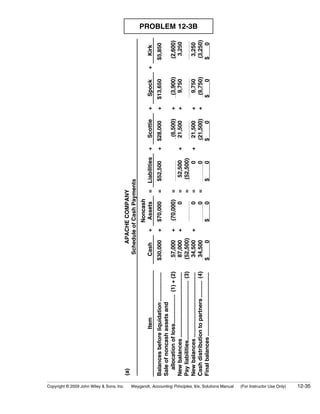
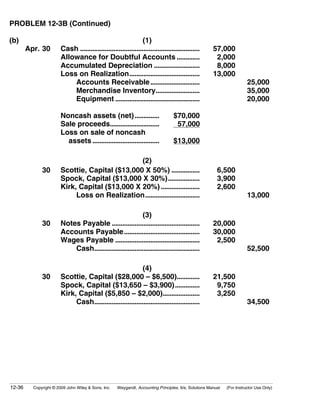
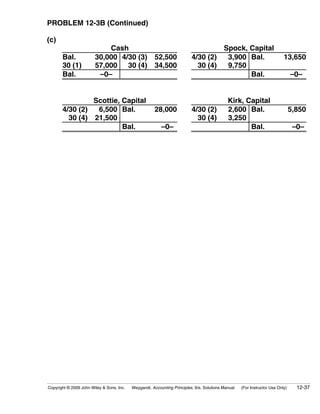
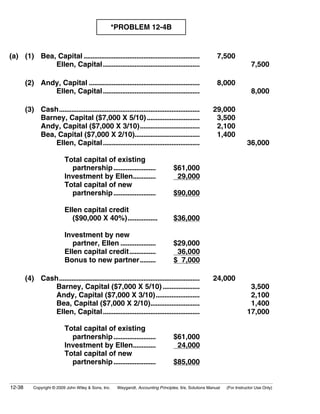
CHAPTER 12
                                  Accounting for Partnerships

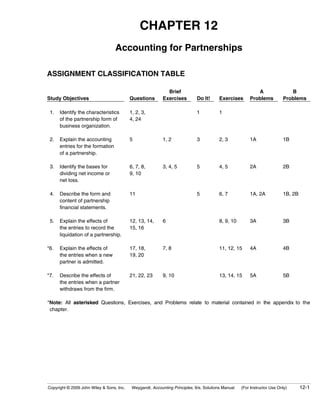
ASSIGNMENT CLASSIFICATION TABLE

                                                              Brief                                         A                 B
Study Objectives                           Questions        Exercises         Do It!      Exercises      Problems          Problems

 1.   Identify the characteristics         1, 2, 3,                           1           1
      of the partnership form of           4, 24
      business organization.

 2.   Explain the accounting               5                1, 2              3           2, 3           1A                1B
      entries for the formation
      of a partnership.

 3.   Identify the bases for               6, 7, 8,         3, 4, 5           5           4, 5           2A                2B
      dividing net income or               9, 10
      net loss.

 4.   Describe the form and                11                                 5           6, 7           1A, 2A            1B, 2B
      content of partnership
      financial statements.

 5.   Explain the effects of               12, 13, 14,      6                             8, 9, 10       3A                3B
      the entries to record the            15, 16
      liquidation of a partnership.

*6.   Explain the effects of               17, 18,          7, 8                          11, 12, 15     4A                4B
      the entries when a new               19, 20
      partner is admitted.

*7.   Describe the effects of              21, 22, 23       9, 10                         13, 14, 15     5A                5B
      the entries when a partner
      withdraws from the firm.

*Note: All asterisked Questions, Exercises, and Problems relate to material contained in the appendix*to the
 chapter.


Copyright © 2009 John Wiley & Sons, Inc.    Weygandt, Accounting Principles, 9/e, Solutions Manual   (For Instructor Use Only)      12-1

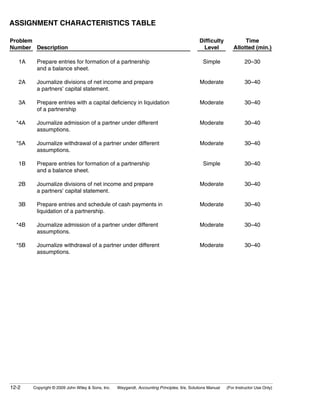
ASSIGNMENT CHARACTERISTICS TABLE

Problem                                                                                       Difficulty            Time
Number Description                                                                              Level          Allotted (min.)

   1A    Prepare entries for formation of a partnership                                         Simple               20–30
         and a balance sheet.

   2A    Journalize divisions of net income and prepare                                       Moderate               30–40
         a partners’ capital statement.

   3A    Prepare entries with a capital deficiency in liquidation                             Moderate               30–40
         of a partnership

  *4A    Journalize admission of a partner under different                                    Moderate               30–40
         assumptions.

  *5A    Journalize withdrawal of a partner under different                                   Moderate               30–40
         assumptions.

   1B    Prepare entries for formation of a partnership                                         Simple               30–40
         and a balance sheet.

   2B    Journalize divisions of net income and prepare                                       Moderate               30–40
         a partners’ capital statement.

   3B    Prepare entries and schedule of cash payments in                                     Moderate               30–40
         liquidation of a partnership.

  *4B    Journalize admission of a partner under different                                    Moderate               30–40
         assumptions.

  *5B    Journalize withdrawal of a partner under different                                   Moderate               30–40
         assumptions.


12-2    Copyright © 2009 John Wiley & Sons, Inc.   Weygandt, Accounting Principles, 9/e, Solutions Manual   (For Instructor Use Only)
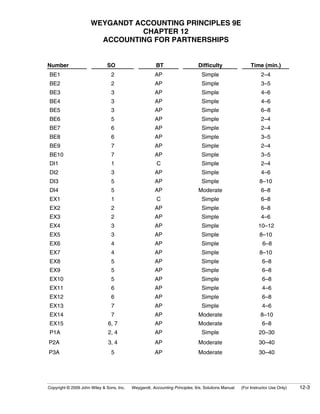
WEYGANDT ACCOUNTING PRINCIPLES 9E
                                 CHAPTER 12
                        ACCOUNTING FOR PARTNERSHIPS


Number                        SO                       BT                    Difficulty                  Time (min.)
BE1                             2                      AP                      Simple                         2–4
BE2                             2                      AP                      Simple                         3–5
BE3                             3                      AP                      Simple                         4–6
BE4                             3                      AP                      Simple                         4–6
BE5                             3                      AP                      Simple                         6–8
BE6                             5                      AP                      Simple                         2–4
BE7                             6                      AP                      Simple                         2–4
BE8                             6                      AP                      Simple                         3–5
BE9                             7                      AP                      Simple                         2–4
BE10                            7                      AP                      Simple                         3–5
DI1                             1                       C                      Simple                         2–4
DI2                             3                      AP                      Simple                         4–6
DI3                             5                      AP                      Simple                         8–10
DI4                             5                      AP                     Moderate                        6–8
EX1                             1                       C                      Simple                         6–8
EX2                             2                      AP                      Simple                         6–8
EX3                             2                      AP                      Simple                         4–6
EX4                             3                      AP                      Simple                        10–12
EX5                             3                      AP                      Simple                         8–10
EX6                             4                      AP                      Simple                          6–8
EX7                             4                      AP                      Simple                         8–10
EX8                             5                      AP                      Simple                          6–8
EX9                             5                      AP                      Simple                          6–8
EX10                            5                      AP                      Simple                          6–8
EX11                            6                      AP                      Simple                          4–6
EX12                            6                      AP                      Simple                          6–8
EX13                            7                      AP                      Simple                          4–6
EX14                            7                      AP                     Moderate                        8–10
EX15                           6, 7                    AP                     Moderate                         6–8
P1A                            2, 4                    AP                      Simple                        20–30
P2A                            3, 4                    AP                     Moderate                       30–40
P3A                             5                      AP                     Moderate                       30–40


Copyright © 2009 John Wiley & Sons, Inc.   Weygandt, Accounting Principles, 9/e, Solutions Manual   (For Instructor Use Only)   12-3
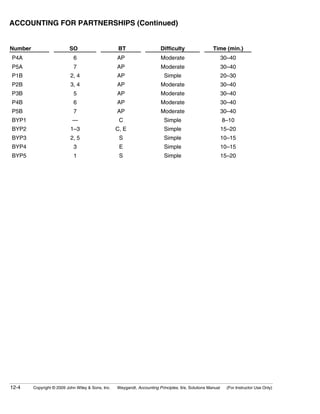
ACCOUNTING FOR PARTNERSHIPS (Continued)


Number                     SO                        BT                   Difficulty                  Time (min.)
P4A                          6                      AP                    Moderate                           30–40
P5A                          7                      AP                    Moderate                           30–40
P1B                         2, 4                    AP                      Simple                           20–30
P2B                         3, 4                    AP                    Moderate                           30–40
P3B                          5                      AP                    Moderate                           30–40
P4B                          6                      AP                    Moderate                           30–40
P5B                          7                      AP                    Moderate                           30–40
BYP1                         —                       C                      Simple                           8–10
BYP2                        1–3                     C, E                    Simple                           15–20
BYP3                        2, 5                     S                      Simple                           10–15
BYP4                         3                       E                      Simple                           10–15
BYP5                         1                       S                      Simple                           15–20


12-4     Copyright © 2009 John Wiley & Sons, Inc.   Weygandt, Accounting Principles, 9/e, Solutions Manual     (For Instructor Use Only)
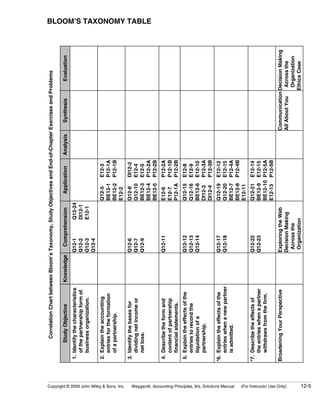
Correlation Chart between Bloom’s Taxonomy, Study Objectives and End-of-Chapter Exercises and Problems

                                                                Study Objective            Knowledge     Comprehension        Application      Analysis     Synthesis      Evaluation
                                                         1. Identify the characteristics               Q12-1       Q12-24
                                                            of the partnership form of                 Q12-2       DI12-1
                                                            business organization.                     Q12-3       E12-1
                                                                                                       Q12-4
                                                         2. Explain the accounting                                          Q12-5     E12-3
                                                            entries for the formation                                       BE12-1    P12-1A
                                                            of a partnership.                                               BE12-2    P12-1B
                                                                                                                            E12-2


Copyright © 2009 John Wiley & Sons, Inc.
                                                         3. Identify the bases for                     Q12-6                Q12-8     DI12-2
                                                            dividing net income or                     Q12-7                Q12-10    E12-4
                                                            net loss.                                  Q12-9                BE12-3    E12-5
                                                                                                                            BE12-4    P12-2A
                                                                                                                                                                                          BLOOM’S TAXONOMY TABLE


                                                                                                                            BE12-5    P12-2B
                                                         4. Describe the form and                      Q12-11               E12-6     P12-2A
                                                            content of partnership                                          E12-7     P12-1B
                                                            financial statements.                                           P12-1A    P12-2B
                                                         5. Explain the effects of the                 Q12-12               Q12-15    E12-8
                                                            entries to record the                      Q12-13               Q12-16    E12-9
                                                            liquidation of a                           Q12-14               BE12-6    E12-10
                                                            partnership.                                                    DI12-3    P12-3A
                                                                                                                            DI12-4    P12-3B
                                                         *6. Explain the effects of the                Q12-17               Q12-19    E12-12
                                                             entries when a new partner                Q12-18               Q12-20    E12-15
                                                             is admitted.                                                   BE12-7    P12-4A


Weygandt, Accounting Principles, 9/e, Solutions Manual
                                                                                                                            BE12-8    P12-4B
                                                                                                                            E12-11
                                                         *7. Describe the effects of                   Q12-22               Q12-21    E12-14
                                                             the entries when a partner                Q12-23               BE12-9    E12-15
                                                             withdraws from the firm.                                       BE12-10   P12-5A
                                                                                                                            E12-13    P12-5B
                                                         Broadening Your Perspective                   Exploring the Web                                  Communication Decision Making


(For Instructor Use Only)
                                                                                                       Decision Making                                    All About You  Across the
                                                                                                        Across the                                                       Organization
                                                                                                        Organization                                                    Ethics Case


12-5
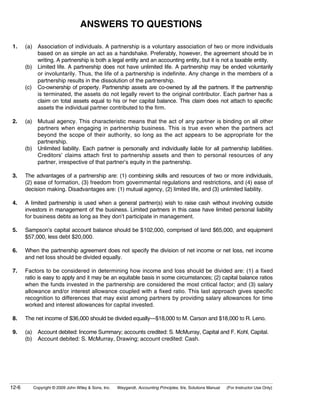
ANSWERS TO QUESTIONS

1.     (a) Association of individuals. A partnership is a voluntary association of two or more individuals
           based on as simple an act as a handshake. Preferably, however, the agreement should be in
           writing. A partnership is both a legal entity and an accounting entity, but it is not a taxable entity.
       (b) Limited life. A partnership does not have unlimited life. A partnership may be ended voluntarily
           or involuntarily. Thus, the life of a partnership is indefinite. Any change in the members of a
           partnership results in the dissolution of the partnership.
       (c) Co-ownership of property. Partnership assets are co-owned by all the partners. If the partnership
           is terminated, the assets do not legally revert to the original contributor. Each partner has a
           claim on total assets equal to his or her capital balance. This claim does not attach to specific
           assets the individual partner contributed to the firm.

2.     (a) Mutual agency. This characteristic means that the act of any partner is binding on all other
           partners when engaging in partnership business. This is true even when the partners act
           beyond the scope of their authority, so long as the act appears to be appropriate for the
           partnership.
       (b) Unlimited liability. Each partner is personally and individually liable for all partnership liabilities.
           Creditors’ claims attach first to partnership assets and then to personal resources of any
           partner, irrespective of that partner’s equity in the partnership.

3.     The advantages of a partnership are: (1) combining skills and resources of two or more individuals,
       (2) ease of formation, (3) freedom from governmental regulations and restrictions, and (4) ease of
       decision making. Disadvantages are: (1) mutual agency, (2) limited life, and (3) unlimited liability.

4.     A limited partnership is used when a general partner(s) wish to raise cash without involving outside
       investors in management of the business. Limited partners in this case have limited personal liability
       for business debts as long as they don’t participate in management.

5.     Sampson’s capital account balance should be $102,000, comprised of land $65,000, and equipment
       $57,000, less debt $20,000.

6.     When the partnership agreement does not specify the division of net income or net loss, net income
       and net loss should be divided equally.

7.     Factors to be considered in determining how income and loss should be divided are: (1) a fixed
       ratio is easy to apply and it may be an equitable basis in some circumstances; (2) capital balance ratios
       when the funds invested in the partnership are considered the most critical factor; and (3) salary
       allowance and/or interest allowance coupled with a fixed ratio. This last approach gives specific
       recognition to differences that may exist among partners by providing salary allowances for time
       worked and interest allowances for capital invested.

8.     The net income of $36,000 should be divided equally—$18,000 to M. Carson and $18,000 to R. Leno.

9.     (a) Account debited: Income Summary; accounts credited: S. McMurray, Capital and F. Kohl, Capital.
       (b) Account debited: S. McMurray, Drawing; account credited: Cash.


12-6      Copyright © 2009 John Wiley & Sons, Inc.   Weygandt, Accounting Principles, 9/e, Solutions Manual   (For Instructor Use Only)
Questions Chapter 12 (Continued)


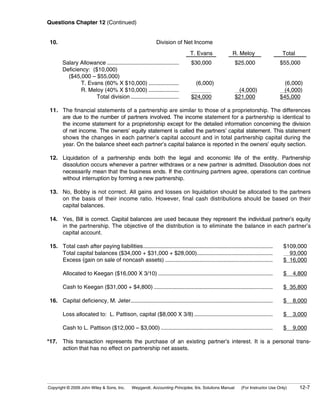
 10.                                                             Division of Net Income
                                                                                      T. Evans                 R. Meloy                     Total
        Salary Allowance ....................................................        ($30,000)                 ($25,000)                   ($55,000)
        Deficiency: ($10,000)
          ($45,000 – $55,000)
               T. Evans (60% X $10,000) ......................                      ( (6,000)                                              ( (6,000)
               R. Meloy (40% X $10,000) ......................                       (                           (4,000)                   ( (4,000)
                      Total division ...................................            ($24,000)                  ($21,000)                   ($45,000)

 11. The financial statements of a partnership are similar to those of a proprietorship. The differences
     are due to the number of partners involved. The income statement for a partnership is identical to
     the income statement for a proprietorship except for the detailed information concerning the division
     of net income. The owners’ equity statement is called the partners’ capital statement. This statement
     shows the changes in each partner’s capital account and in total partnership capital during the
     year. On the balance sheet each partner’s capital balance is reported in the owners’ equity section.

 12. Liquidation of a partnership ends both the legal and economic life of the entity. Partnership
     dissolution occurs whenever a partner withdraws or a new partner is admitted. Dissolution does not
     necessarily mean that the business ends. If the continuing partners agree, operations can continue
     without interruption by forming a new partnership.

 13. No, Bobby is not correct. All gains and losses on liquidation should be allocated to the partners
     on the basis of their income ratio. However, final cash distributions should be based on their
     capital balances.

 14. Yes, Bill is correct. Capital balances are used because they represent the individual partner’s equity
     in the partnership. The objective of the distribution is to eliminate the balance in each partner’s
     capital account.

 15. Total cash after paying liabilities..............................................................................................       $109,000
     Total capital balances ($34,000 + $31,000 + $28,000).......................................................                               93,000
     Excess (gain on sale of noncash assets) ..............................................................................                  $ 16,000

        Allocated to Keegan ($16,000 X 3/10) ...................................................................................             $   4,800

        Cash to Keegan ($31,000 + $4,800) ......................................................................................             $ 35,800

 16. Capital deficiency, M. Jeter.......................................................................................................     $   8,000

        Loss allocated to: L. Pattison, capital ($8,000 X 3/8) .........................................................                     $   3,000

        Cash to L. Pattison ($12,000 – $3,000) .................................................................................             $   9,000

*17. This transaction represents the purchase of an existing partner’s interest. It is a personal trans-
     action that has no effect on partnership net assets.


Copyright © 2009 John Wiley & Sons, Inc.          Weygandt, Accounting Principles, 9/e, Solutions Manual            (For Instructor Use Only)       12-7
Questions Chapter 12 (Continued)


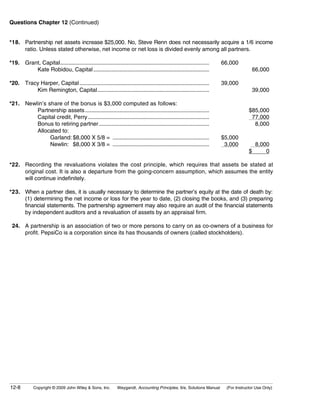
*18. Partnership net assets increase $25,000. No, Steve Renn does not necessarily acquire a 1/6 income
     ratio. Unless stated otherwise, net income or net loss is divided evenly among all partners.

*19. Grant, Capital............................................................................................................   66,000
         Kate Robidou, Capital ....................................................................................                             66,000

*20. Tracy Harper, Capital ..............................................................................................         39,000
         Kim Remington, Capital.................................................................................                                39,000

*21. Newlin’s share of the bonus is $3,000 computed as follows:
         Partnership assets..........................................................................................                          $85,000
         Capital credit, Perry........................................................................................                          77,000
         Bonus to retiring partner................................................................................                               8,000
         Allocated to:
               Garland: $8,000 X 5/8 = ......................................................................                     $5,000
               Newlin: $8,000 X 3/8 = ......................................................................                       3,000         8,000
                                                                                                                                               $     0

*22. Recording the revaluations violates the cost principle, which requires that assets be stated at
     original cost. It is also a departure from the going-concern assumption, which assumes the entity
     will continue indefinitely.

*23. When a partner dies, it is usually necessary to determine the partner’s equity at the date of death by:
     (1) determining the net income or loss for the year to date, (2) closing the books, and (3) preparing
     financial statements. The partnership agreement may also require an audit of the financial statements
     by independent auditors and a revaluation of assets by an appraisal firm.

 24. A partnership is an association of two or more persons to carry on as co-owners of a business for
     profit. PepsiCo is a corporation since its has thousands of owners (called stockholders).


12-8           Copyright © 2009 John Wiley & Sons, Inc.             Weygandt, Accounting Principles, 9/e, Solutions Manual         (For Instructor Use Only)
SOLUTIONS TO BRIEF EXERCISES

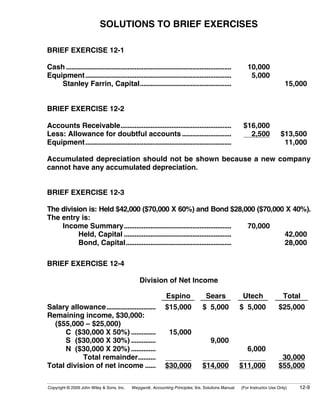
BRIEF EXERCISE 12-1

Cash ..............................................................................................      10,000
Equipment...................................................................................              5,000
    Stanley Farrin, Capital....................................................                                              15,000


BRIEF EXERCISE 12-2

Accounts Receivable...............................................................                     $16,000
Less: Allowance for doubtful accounts ............................                                       2,500             $13,500
Equipment...................................................................................                                11,000

Accumulated depreciation should not be shown because a new company
cannot have any accumulated depreciation.


BRIEF EXERCISE 12-3

The division is: Held $42,000 ($70,000 X 60%) and Bond $28,000 ($70,000 X 40%).
The entry is:
    Income Summary.............................................................       70,000
          Held, Capital .............................................................        42,000
          Bond, Capital............................................................          28,000

BRIEF EXERCISE 12-4

                                                 Division of Net Income

                                                               Espino                Sears            Utech                  Total
Salary allowance............................                   $15,000             $ 5,000            $ 5,000             $25,000
Remaining income, $30,000:
  ($55,000 – $25,000)
      C ($30,000 X 50%) ..............                           15,000
      S ($30,000 X 30%) ..............                                               9,000
      N ($30,000 X 20%) ..............                                             000,000               6,000
           Total remainder..........                                                                                       30,000
Total division of net income ......                            $30,000             $14,000            $11,000             $55,000

Copyright © 2009 John Wiley & Sons, Inc.     Weygandt, Accounting Principles, 9/e, Solutions Manual   (For Instructor Use Only)   12-9
BRIEF EXERCISE 12-5

                                                 Division of Net Income

                                                                                     Joe                  Sam                Total
Salary allowance ..............................................                  $15,000                 $10,000          $25,000
Interest allowance............................................                     7,000                   5,000           12,000
Remaining deficiency, ($9,000):
   [($25,000 + $12,000) – $28,000]
      Joe ($9,000 X 50%) ................................                           (4,500)
      Sam ($9,000 X 50%)................................                                                  (4,500)
          Total remainder ...............................                                                                  (9,000)
Total division of net income.........................                            $17,500                 $10,500          $28,000


BRIEF EXERCISE 12-6

A, Capital.........................................................................................          8,000
L, Capital .........................................................................................         7,000
F, Capital .........................................................................................         4,000
    Cash.........................................................................................                            19,000


*BRIEF EXERCISE 12-7

Cox, Capital....................................................................................           10,000
    Day, Capital ...........................................................................                                 10,000


*BRIEF EXERCISE 12-8

Cash..................................................................................................     52,000
Menke, Capital (50% X $11,900*).............................................                                5,950
Hibbett, Capital (50% X $11,900) .............................................                              5,950
    Kosko, Capital (45% X $142,000)....................................                                                      63,900

*[($40,000 + $50,000 + $52,000) X 45%] – $52,000 = $11,900.


12-10       Copyright © 2009 John Wiley & Sons, Inc.     Weygandt, Accounting Principles, 9/e, Solutions Manual   (For Instructor Use Only)
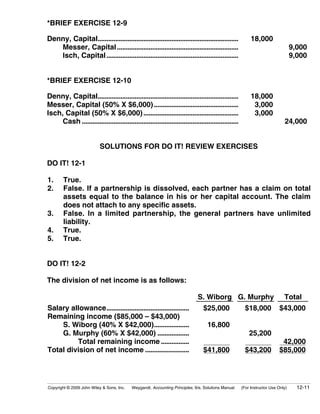
*BRIEF EXERCISE 12-9

Denny, Capital................................................................................             18,000
   Messer, Capital .....................................................................                                          9,000
   Isch, Capital ...........................................................................                                      9,000


*BRIEF EXERCISE 12-10

Denny, Capital................................................................................             18,000
Messer, Capital (50% X $6,000) ................................................                             3,000
Isch, Capital (50% X $6,000) ......................................................                         3,000
     Cash .........................................................................................                          24,000


                           SOLUTIONS FOR DO IT! REVIEW EXERCISES

DO IT! 12-1

1.      True.
2.      False. If a partnership is dissolved, each partner has a claim on total
        assets equal to the balance in his or her capital account. The claim
        does not attach to any specific assets.
3.      False. In a limited partnership, the general partners have unlimited
        liability.
4.      True.
5.      True.


DO IT! 12-2

The division of net income is as follows:

                                                                             S. Wiborg G. Murphy                             Total
Salary allowance...............................................                 $25,000                 $18,000           $43,000
Remaining income ($85,000 – $43,000)
    S. Wiborg (40% X $42,000)....................                                 16,800
    G. Murphy (60% X $42,000) ..................                                                          25,200
         Total remaining income ................                                                                           42,000
Total division of net income .........................                          $41,800                 $43,200           $85,000


Copyright © 2009 John Wiley & Sons, Inc.   Weygandt, Accounting Principles, 9/e, Solutions Manual     (For Instructor Use Only)     12-11
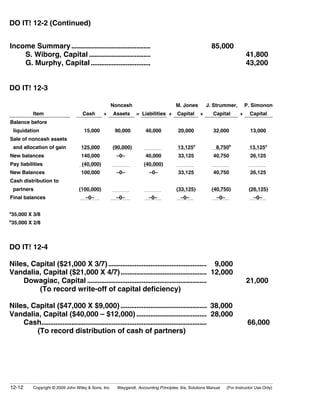
DO IT! 12-2 (Continued)


Income Summary .............................................                                               85,000
    S. Wiborg, Capital ...................................                                                                     41,800
    G. Murphy, Capital ..................................                                                                      43,200


DO IT! 12-3

                                                        Noncash                         M. Jones         J. Strummer,          P. Simonon
             Item                     Cash       +      Assets      = Liabilities +      Capital     +      Capital        +    Capital
Balance before
    liquidation                        15,000            90,000         40,000            20,000            32,000               13,000
Sale of noncash assets
    and allocation of gain           125,000            (90,000)                         13,125a              8,750b            13,125a
New balances                         140,000             –0–            40,000            33,125            40,750               26,125
Pay liabilities                       (40,000)                          (40,000)
New Balances                         100,000             –0–              –0–             33,125            40,750               26,125
Cash distribution to
    partners                        (100,000)                                            (33,125)          (40,750)             (26,125)
Final balances                          –0–              –0–              –0–              –0–                –0–                 –0–

a
    35,000 X 3/8
b
    35,000 X 2/8


DO IT! 12-4

Niles, Capital ($21,000 X 3/7) ........................................................ 9,000
Vandalia, Capital ($21,000 X 4/7)................................................. 12,000
    Dowagiac, Capital ....................................................................                                     21,000
         (To record write-off of capital deficiency)

Niles, Capital ($47,000 X $9,000) ................................................. 38,000
Vandalia, Capital ($40,000 – $12,000) ........................................ 28,000
    Cash..............................................................................................                          66,000
        (To record distribution of cash of partners)


12-12        Copyright © 2009 John Wiley & Sons, Inc.     Weygandt, Accounting Principles, 9/e, Solutions Manual    (For Instructor Use Only)
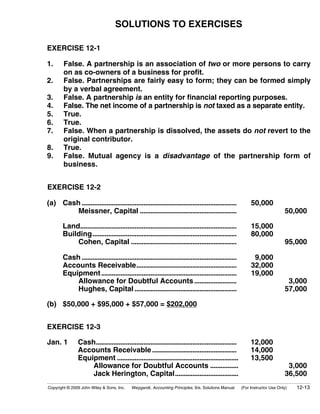
SOLUTIONS TO EXERCISES

EXERCISE 12-1

1.      False. A partnership is an association of two or more persons to carry
        on as co-owners of a business for profit.
2.      False. Partnerships are fairly easy to form; they can be formed simply
        by a verbal agreement.
3.      False. A partnership is an entity for financial reporting purposes.
4.      False. The net income of a partnership is not taxed as a separate entity.
5.      True.
6.      True.
7.      False. When a partnership is dissolved, the assets do not revert to the
        original contributor.
8.      True.
9.      False. Mutual agency is a disadvantage of the partnership form of
        business.


EXERCISE 12-2

(a) Cash ........................................................................................            50,000
        Meissner, Capital .......................................................                                              50,000

        Land.........................................................................................        15,000
        Building..................................................................................           80,000
            Cohen, Capital ............................................................                                        95,000

        Cash ........................................................................................         9,000
        Accounts Receivable.........................................................                         32,000
        Equipment .............................................................................              19,000
            Allowance for Doubtful Accounts ........................                                                            3,000
            Hughes, Capital ..........................................................                                         57,000

(b) $50,000 + $95,000 + $57,000 = $202,000


EXERCISE 12-3

Jan. 1          Cash................................................................................         12,000
                Accounts Receivable ................................................                         14,000
                Equipment .....................................................................              13,500
                    Allowance for Doubtful Accounts ................                                                            3,000
                    Jack Herington, Capital....................................                                                36,500
Copyright © 2009 John Wiley & Sons, Inc.    Weygandt, Accounting Principles, 9/e, Solutions Manual      (For Instructor Use Only)   12-13
EXERCISE 12-4

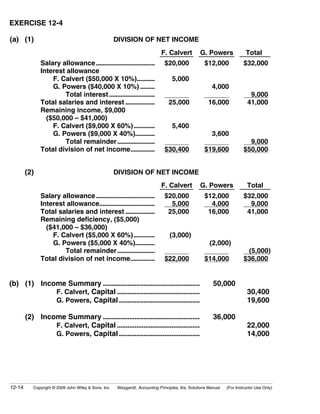
(a) (1)                                               DIVISION OF NET INCOME
                                                                             F. Calvert          G. Powers               Total
              Salary allowance ....................................           $20,000              $12,000              $32,000
              Interest allowance
                  F. Calvert ($50,000 X 10%)...........                           5,000
                  G. Powers ($40,000 X 10%) .........                                                  4,000
                      Total interest ............................                                                          9,000
              Total salaries and interest ..................                     25,000              16,000               41,000
              Remaining income, $9,000
                ($50,000 – $41,000)
                  F. Calvert ($9,000 X 60%).............                          5,400
                  G. Powers ($9,000 X 40%)............                                                 3,600
                      Total remainder .......................                                                             9,000
              Total division of net income...............                     $30,400              $19,600              $50,000


        (2)                                           DIVISION OF NET INCOME
                                                                             F. Calvert          G. Powers                Total
              Salary allowance ....................................          ($20,000)            ($12,000              $32,000
              Interest allowance..................................           ( 5,000)             ( 4,000                 9,000
              Total salaries and interest ..................                 ( 25,000)            ( 16,000               41,000
              Remaining deficiency, ($5,000)
                ($41,000 – $36,000)
                  F. Calvert ($5,000 X 60%).............                     ( (3,000)
                  G. Powers ($5,000 X 40%)............                                            ( (2,000)
                      Total remainder .......................                (       )                                   (5,000)
              Total division of net income...............                    ($22,000)            ($14,000              $36,000


(b) (1) Income Summary .......................................................                          50,000
            F. Calvert, Capital ...............................................                                           30,400
            G. Powers, Capital ..............................................                                             19,600

        (2) Income Summary .......................................................                      36,000
                F. Calvert, Capital ...............................................                                       22,000
                G. Powers, Capital ..............................................                                         14,000


12-14      Copyright © 2009 John Wiley & Sons, Inc.   Weygandt, Accounting Principles, 9/e, Solutions Manual   (For Instructor Use Only)
EXERCISE 12-5

(a) Income Summary................................................................                       70,000
        O. Guillen, Capital ($70,000 X 45%)......................                                                          31,500
        K. Williams, Capital ($70,000 X 55%) ...................                                                           38,500

(b) Income Summary................................................................                       70,000
        O. Guillen, Capital
           [$30,000 + ($15,000 X 45%)] ..............................                                                      36,750
        K. Williams, Capital
           [$25,000 + ($15,000 X 55%)] ..............................                                                      33,250

(c) Income Summary.................................................................                      70,000
        O. Guillen, Capital.......................................................                                         36,000
        K. Williams, Capital ....................................................                                          34,000

               Guillen: [$40,000 + $6,000 – ($20,000 X 50%)]
               Williams: [$35,000 + $9,000 – ($20,000 X 50%)]

(d) Guillen: $60,000 + $36,000 – $18,000 = $78,000
    Williams: $90,000 + $34,000 – $24,000 = $100,000


EXERCISE 12-6

(a)                                             STARRITE CO.
                                          Partners’ Capital Statement
                                    For the Year Ended December 31, 2010

                                                                   G. Stark                 J. Nyland                   Total
       Capital, January 1 .......................                  $20,000                   $18,000                   $38,000
       Add: Net income ........................                     15,000                    15,000                    30,000
                                                                    35,000                    33,000                    68,000
       Less: Drawings...........................                     8,000                      5,000                   13,000
       Capital, December 31.................                       $27,000                   $28,000                   $55,000


Copyright © 2009 John Wiley & Sons, Inc.   Weygandt, Accounting Principles, 9/e, Solutions Manual   (For Instructor Use Only)   12-15
EXERCISE 12-6 (Continued)

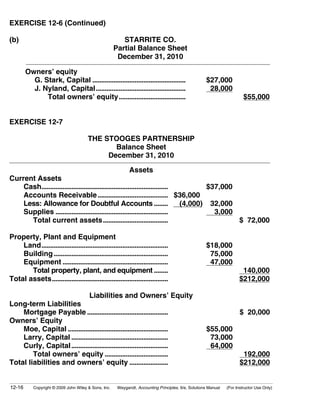
(b)                                                       STARRITE CO.
                                                       Partial Balance Sheet
                                                        December 31, 2010

        Owners’ equity
          G. Stark, Capital .....................................................                     $27,000
          J. Nyland, Capital...................................................                        28,000
              Total owners’ equity......................................                                                  $55,000


EXERCISE 12-7

                                        THE STOOGES PARTNERSHIP
                                               Balance Sheet
                                             December 31, 2010

                                                              Assets
Current Assets
    Cash........................................................................        $37,000
    Accounts Receivable ........................................ $36,000
    Less: Allowance for Doubtful Accounts ........                               (4,000) 32,000
    Supplies ................................................................             3,000
      Total current assets.....................................                                 $ 72,000

Property, Plant and Equipment
    Land........................................................................                      $18,000
    Building .................................................................                         75,000
    Equipment ............................................................                             47,000
       Total property, plant, and equipment ........                                                                    140,000
Total assets..................................................................                                         $212,000

                                         Liabilities and Owners’ Equity
Long-term Liabilities
    Mortgage Payable ..............................................                                                     $ 20,000
Owners’ Equity
    Moe, Capital .........................................................                            $55,000
    Larry, Capital .......................................................                             73,000
    Curly, Capital .......................................................                             64,000
        Total owners’ equity ....................................                                                        192,000
Total liabilities and owners’ equity ......................                                                             $212,000


12-16       Copyright © 2009 John Wiley & Sons, Inc.    Weygandt, Accounting Principles, 9/e, Solutions Manual   (For Instructor Use Only)
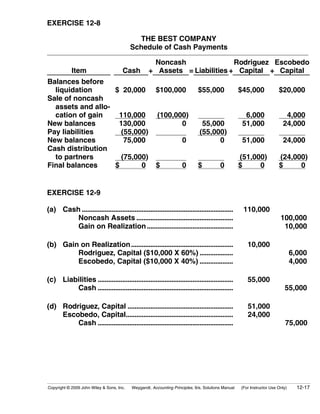
EXERCISE 12-8

                                             THE BEST COMPANY
                                           Schedule of Cash Payments

                                                    Noncash                Rodriguez Escobedo
            Item                      Cash         + Assets = Liabilities + Capital + Capital
Balances before
  liquidation      $ 20,000 ($100,000)                                      ($55,000)               $45,000             $20,000
Sale of noncash
  assets and allo-
  cation of gain    110,000 ( (100,000)                                     (        )                6,000                4,000
New balances        130,000 (        0)                                     ( 55,000)                51,000               24,000
Pay liabilities      (55,000) (       )                                     ( (55,000)
New balances          75,000 (       0)                                     (       0)               51,000               24,000
Cash distribution
  to partners        (75,000) (       )                                     (             )         (51,000)            (24,000)
Final balances     $       0 ($      0)                                     ($           0)         $     0             $     0


EXERCISE 12-9

(a) Cash ......................................................................................      110,000
        Noncash Assets .......................................................                                           100,000
        Gain on Realization .................................................                                             10,000

(b) Gain on Realization ..........................................................                     10,000
        Rodriguez, Capital ($10,000 X 60%) ...................                                                                  6,000
        Escobedo, Capital ($10,000 X 40%) ...................                                                                   4,000

(c) Liabilities .............................................................................          55,000
        Cash .............................................................................                                 55,000

(d) Rodriguez, Capital ............................................................                    51,000
    Escobedo, Capital.............................................................                     24,000
        Cash .............................................................................                                  75,000


Copyright © 2009 John Wiley & Sons, Inc.   Weygandt, Accounting Principles, 9/e, Solutions Manual   (For Instructor Use Only)     12-17
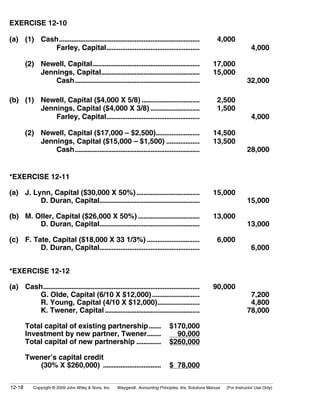
EXERCISE 12-10

(a) (1) Cash................................................................................               4,000
           Farley, Capital.....................................................                                              4,000

        (2) Newell, Capital.............................................................                 17,000
            Jennings, Capital........................................................                    15,000
                Cash.......................................................................                                32,000

(b) (1) Newell, Capital ($4,000 X 5/8) .................................                                   2,500
        Jennings, Capital ($4,000 X 3/8) ............................                                      1,500
            Farley, Capital.....................................................                                             4,000

        (2) Newell, Capital ($17,000 – $2,500).........................                                  14,500
            Jennings, Capital ($15,000 – $1,500) ...................                                     13,500
                Cash.......................................................................                                28,000


*EXERCISE 12-11

(a) J. Lynn, Capital ($30,000 X 50%) ....................................                                15,000
         D. Duran, Capital.........................................................                                        15,000

(b) M. Oller, Capital ($26,000 X 50%) ...................................                                13,000
        D. Duran, Capital.........................................................                                         13,000

(c) F. Tate, Capital ($18,000 X 33 1/3%) ..............................                                    6,000
         D. Duran, Capital.........................................................                                          6,000


*EXERCISE 12-12

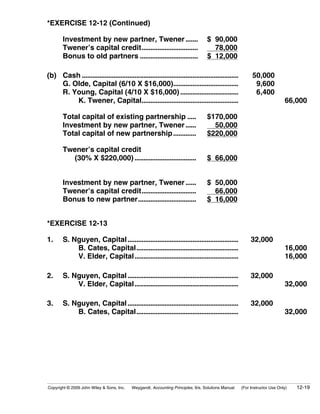
(a) Cash.........................................................................................        90,000
       G. Olde, Capital (6/10 X $12,000) ...........................                                                        7,200
       R. Young, Capital (4/10 X $12,000)........................                                                           4,800
       K. Twener, Capital ......................................................                                           78,000

        Total capital of existing partnership.......                              $170,000
        Investment by new partner, Twener........                                   90,000
        Total capital of new partnership ..............                           $260,000

        Twener’s capital credit
           (30% X $260,000) .................................                     $ 78,000

12-18       Copyright © 2009 John Wiley & Sons, Inc.   Weygandt, Accounting Principles, 9/e, Solutions Manual   (For Instructor Use Only)
*EXERCISE 12-12 (Continued)

        Investment by new partner, Twener .......                                 $ 90,000
        Twener’s capital credit................................                     78,000
        Bonus to old partners .................................                   $ 12,000

(b) Cash .........................................................................................         50,000
    G. Olde, Capital (6/10 X $16,000).....................................                                  9,600
    R. Young, Capital (4/10 X $16,000) .................................                                    6,400
        K. Twener, Capital.......................................................                                           66,000

        Total capital of existing partnership .....                               $170,000
        Investment by new partner, Twener ......                                    50,000
        Total capital of new partnership .............                            $220,000

        Twener’s capital credit
          (30% X $220,000) ...................................                    $ 66,000


        Investment by new partner, Twener ......                                  $ 50,000
        Twener’s capital credit...............................                      66,000
        Bonus to new partner.................................                     $ 16,000


*EXERCISE 12-13

1.      S. Nguyen, Capital ...............................................................                32,000
            B. Cates, Capital..........................................................                                     16,000
            V. Elder, Capital...........................................................                                    16,000

2.      S. Nguyen, Capital ...............................................................                32,000
            V. Elder, Capital...........................................................                                    32,000

3.      S. Nguyen, Capital ...............................................................                32,000
            B. Cates, Capital..........................................................                                     32,000


Copyright © 2009 John Wiley & Sons, Inc.   Weygandt, Accounting Principles, 9/e, Solutions Manual    (For Instructor Use Only)   12-19
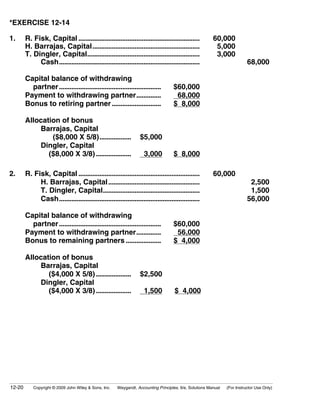
*EXERCISE 12-14

1.      R. Fisk, Capital .....................................................................           60,000
        H. Barrajas, Capital.............................................................                 5,000
        T. Dingler, Capital................................................................               3,000
             Cash................................................................................                          68,000

        Capital balance of withdrawing
          partner ..........................................................        $60,000
        Payment to withdrawing partner..............                                 68,000
        Bonus to retiring partner ............................                      $ 8,000

        Allocation of bonus
            Barrajas, Capital
                ($8,000 X 5/8)..................                  $5,000
            Dingler, Capital
               ($8,000 X 3/8) ....................                   3,000          $ 8,000

2.      R. Fisk, Capital .....................................................................           60,000
             H. Barrajas, Capital....................................................                                       2,500
             T. Dingler, Capital.......................................................                                     1,500
             Cash................................................................................                          56,000

        Capital balance of withdrawing
          partner ..........................................................        $60,000
        Payment to withdrawing partner..............                                 56,000
        Bonus to remaining partners ....................                            $ 4,000

        Allocation of bonus
            Barrajas, Capital
               ($4,000 X 5/8) ....................                $2,500
            Dingler, Capital
               ($4,000 X 3/8) ....................                   1,500           $ 4,000


12-20       Copyright © 2009 John Wiley & Sons, Inc.   Weygandt, Accounting Principles, 9/e, Solutions Manual   (For Instructor Use Only)
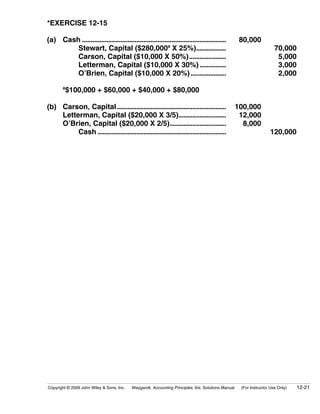
*EXERCISE 12-15

(a) Cash ..................................................................................          80,000
        Stewart, Capital ($280,000a X 25%).................                                                            70,000
        Carson, Capital ($10,000 X 50%).....................                                                            5,000
        Letterman, Capital ($10,000 X 30%) ...............                                                              3,000
        O’Brien, Capital ($10,000 X 20%) ....................                                                           2,000
       a
         $100,000 + $60,000 + $40,000 + $80,000

(b) Carson, Capital ..............................................................                  100,000
    Letterman, Capital ($20,000 X 3/5)...........................                                    12,000
    O’Brien, Capital ($20,000 X 2/5)................................                                  8,000
         Cash .........................................................................                             120,000


Copyright © 2009 John Wiley & Sons, Inc.   Weygandt, Accounting Principles, 9/e, Solutions Manual    (For Instructor Use Only)   12-21
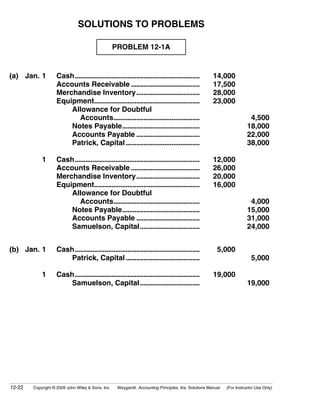
SOLUTIONS TO PROBLEMS

                                                   PROBLEM 12-1A


(a) Jan. 1          Cash.......................................................................       14,000
                    Accounts Receivable .......................................                       17,500
                    Merchandise Inventory....................................                         28,000
                    Equipment............................................................             23,000
                        Allowance for Doubtful
                           Accounts.................................................                                     4,500
                        Notes Payable............................................                                       18,000
                        Accounts Payable ....................................                                           22,000
                        Patrick, Capital ..........................................                                     38,000

            1       Cash.......................................................................       12,000
                    Accounts Receivable .......................................                       26,000
                    Merchandise Inventory....................................                         20,000
                    Equipment............................................................             16,000
                        Allowance for Doubtful
                           Accounts.................................................                                     4,000
                        Notes Payable............................................                                       15,000
                        Accounts Payable ....................................                                           31,000
                        Samuelson, Capital..................................                                            24,000


(b) Jan. 1          Cash.......................................................................         5,000
                       Patrick, Capital ..........................................                                        5,000

            1       Cash.......................................................................       19,000
                       Samuelson, Capital..................................                                             19,000


12-22   Copyright © 2009 John Wiley & Sons, Inc.    Weygandt, Accounting Principles, 9/e, Solutions Manual   (For Instructor Use Only)
PROBLEM 12-1A (Continued)

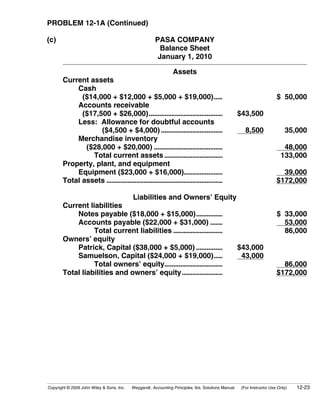
(c)                                                    PASA COMPANY
                                                         Balance Sheet
                                                        January 1, 2010

                                                                Assets
       Current assets
           Cash
             ($14,000 + $12,000 + $5,000 + $19,000).....                                                                $ 50,000
           Accounts receivable
             ($17,500 + $26,000)..........................................                          $43,500
           Less: Allowance for doubtful accounts
                   ($4,500 + $4,000) ...................................                               8,500                35,000
           Merchandise inventory
              ($28,000 + $20,000) .......................................                                                  48,000
                Total current assets .................................                                                    133,000
       Property, plant, and equipment
           Equipment ($23,000 + $16,000)......................                                                            39,000
       Total assets ..................................................................                                  $172,000

                                           Liabilities and Owners’ Equity
       Current liabilities
           Notes payable ($18,000 + $15,000)...............                                                             $ 33,000
           Accounts payable ($22,000 + $31,000) .......                                                                   53,000
                 Total current liabilities ............................                                                   86,000
       Owners’ equity
           Patrick, Capital ($38,000 + $5,000) ...............                                      $43,000
           Samuelson, Capital ($24,000 + $19,000).....                                               43,000
                 Total owners’ equity.................................                                                    86,000
       Total liabilities and owners’ equity.......................                                                      $172,000


Copyright © 2009 John Wiley & Sons, Inc.   Weygandt, Accounting Principles, 9/e, Solutions Manual    (For Instructor Use Only)   12-23
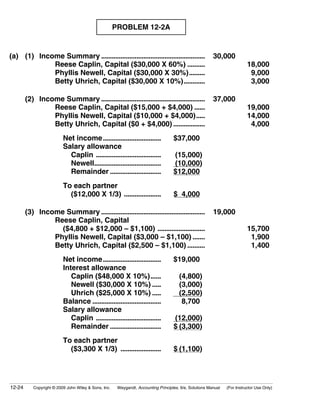
PROBLEM 12-2A


(a) (1) Income Summary ...........................................................                       30,000
            Reese Caplin, Capital ($30,000 X 60%) ..........                                                               18,000
            Phyllis Newell, Capital ($30,000 X 30%).........                                                                9,000
            Betty Uhrich, Capital ($30,000 X 10%)............                                                               3,000

        (2) Income Summary ...........................................................                   37,000
                Reese Caplin, Capital ($15,000 + $4,000) ......                                                            19,000
                Phyllis Newell, Capital ($10,000 + $4,000).....                                                            14,000
                Betty Uhrich, Capital ($0 + $4,000) ..................                                                      4,000
                          Net income.................................               $37,000
                          Salary allowance
                            Caplin .....................................            (15,000)
                            Newell......................................            (10,000)
                            Remainder .............................                 $12,000
                          To each partner
                            ($12,000 X 1/3) .....................                   $ 4,000

        (3) Income Summary ...........................................................                   19,000
                Reese Caplin, Capital
                  ($4,800 + $12,000 – $1,100) ...........................                                                  15,700
                Phyllis Newell, Capital ($3,000 – $1,100) .......                                                           1,900
                Betty Uhrich, Capital ($2,500 – $1,100) ..........                                                          1,400
                          Net income.................................               $19,000
                          Interest allowance
                             Caplin ($48,000 X 10%)......                              (4,800)
                             Newell ($30,000 X 10%) .....                              (3,000)
                             Uhrich ($25,000 X 10%) .....                              (2,500)
                          Balance .......................................               8,700
                          Salary allowance
                             Caplin .....................................           (12,000)
                             Remainder .............................                $ (3,300)
                          To each partner
                            ($3,300 X 1/3) .......................                  $ (1,100)


12-24      Copyright © 2009 John Wiley & Sons, Inc.    Weygandt, Accounting Principles, 9/e, Solutions Manual   (For Instructor Use Only)
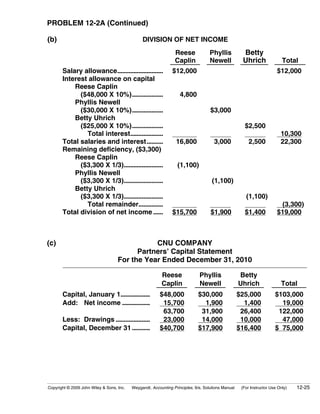
PROBLEM 12-2A (Continued)

(b)                                             DIVISION OF NET INCOME
                                                                 Reese             Phyllis           Betty
                                                                 Caplin            Newell            Uhrich                Total
       Salary allowance............................             $12,000                                    (            $12,000
       Interest allowance on capital
           Reese Caplin
             ($48,000 X 10%)...................                     4,800                                                          (
           Phyllis Newell                                               (
             ($30,000 X 10%)...................                                     $3,000
           Betty Uhrich                                                                                    (
             ($25,000 X 10%)...................                                                       $2,500
               Total interest....................                                                    (                    10,300
       Total salaries and interest..........                      16,800              3,000          ( 2,500              22,300
       Remaining deficiency, ($3,300)
           Reese Caplin
             ($3,300 X 1/3)........................                (1,100)
           Phyllis Newell
             ($3,300 X 1/3)........................                                  (1,100)
           Betty Uhrich
             ($3,300 X 1/3)........................                                                   ((1,100)
               Total remainder...............                                                                            (3,300)
       Total division of net income ......                      $15,700             $1,900           ($1,400            $19,000


(c)                                            CNU COMPANY
                                          Partners’ Capital Statement
                                    For the Year Ended December 31, 2010

                                                          Reese               Phyllis               Betty
                                                          Caplin              Newell                Uhrich                Total
       Capital, January 1..................              $48,000             $30,000                $25,000            $103,000
       Add: Net income .................                  15,700               1,900                  1,400              19,000
                                                          63,700              31,900                 26,400             122,000
       Less: Drawings .....................               23,000              14,000                 10,000              47,000
       Capital, December 31 ...........                  $40,700             $17,900                $16,400            $ 75,000


Copyright © 2009 John Wiley & Sons, Inc.   Weygandt, Accounting Principles, 9/e, Solutions Manual    (For Instructor Use Only)   12-25
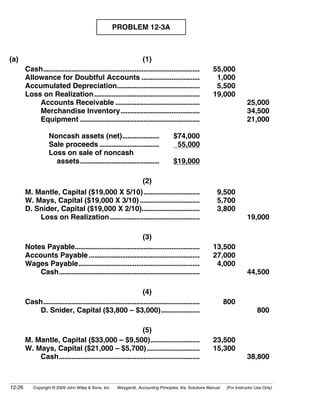
PROBLEM 12-3A


(a)                                                                  (1)
        Cash.........................................................................................      55,000
        Allowance for Doubtful Accounts .................................                                   1,000
        Accumulated Depreciation...............................................                             5,500
        Loss on Realization............................................................                    19,000
            Accounts Receivable ................................................                                             25,000
            Merchandise Inventory.............................................                                               34,500
            Equipment ....................................................................                                   21,000

                    Noncash assets (net).....................                         $74,000
                    Sale proceeds ..................................                   55,000
                    Loss on sale of noncash
                      assets.............................................             $19,000

                                                                      (2)
        M. Mantle, Capital ($19,000 X 5/10)................................                                  9,500
        W. Mays, Capital ($19,000 X 3/10) ..................................                                 5,700
        D. Snider, Capital ($19,000 X 2/10).................................                                 3,800
            Loss on Realization ...................................................                                          19,000

                                                                (3)
        Notes Payable.......................................................................               13,500
        Accounts Payable ...............................................................                   27,000
        Wages Payable.....................................................................                  4,000
            Cash................................................................................                             44,500

                                                                     (4)
        Cash.........................................................................................             800
           D. Snider, Capital ($3,800 – $3,000)......................                                                             800

                                                                (5)
        M. Mantle, Capital ($33,000 – $9,500)............................                                  23,500
        W. Mays, Capital ($21,000 – $5,700) ..............................                                 15,300
            Cash................................................................................                             38,800


12-26       Copyright © 2009 John Wiley & Sons, Inc.     Weygandt, Accounting Principles, 9/e, Solutions Manual   (For Instructor Use Only)
PROBLEM 12-3A (Continued)

(b)
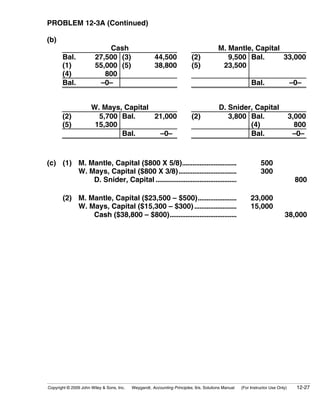
                            Cash                                                        M. Mantle, Capital
       Bal.             27,500 (3)                     44,500             (2)              9,500 Bal.      33,000
       (1)              55,000 (5)                     38,800             (5)            23,500
       (4)                 800
       Bal.              –0–                                                                             Bal.                   –0–


                      W. Mays, Capital                                                  D. Snider, Capital
       (2)              5,700 Bal.     21,000                             (2)              3,800 Bal.                           3,000
       (5)             15,300                                                                    (4)                              800
                              Bal.      –0–                                                      Bal.                            –0–


(c) (1) M. Mantle, Capital ($800 X 5/8)...............................                                        500
        W. Mays, Capital ($800 X 3/8).................................                                        300
            D. Snider, Capital ..............................................                                                    800

       (2) M. Mantle, Capital ($23,500 – $500)......................                                     23,000
           W. Mays, Capital ($15,300 – $300) ........................                                    15,000
               Cash ($38,800 – $800)......................................                                                 38,000


Copyright © 2009 John Wiley & Sons, Inc.   Weygandt, Accounting Principles, 9/e, Solutions Manual   (For Instructor Use Only)     12-27
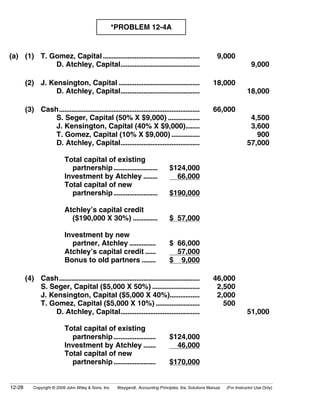
*PROBLEM 12-4A


(a) (1) T. Gomez, Capital .......................................................                           9,000
            D. Atchley, Capital.............................................                                                  9,000

        (2) J. Kensington, Capital ..............................................                         18,000
                 D. Atchley, Capital.............................................                                           18,000

        (3) Cash................................................................................          66,000
               S. Seger, Capital (50% X $9,000) ..................                                                           4,500
               J. Kensington, Capital (40% X $9,000)........                                                                 3,600
               T. Gomez, Capital (10% X $9,000) ................                                                               900
               D. Atchley, Capital.............................................                                             57,000

                            Total capital of existing
                              partnership .........................                $124,000
                            Investment by Atchley ........                           66,000
                            Total capital of new
                              partnership .........................                $190,000

                            Atchley’s capital credit
                              ($190,000 X 30%) ..............                      $ 57,000

                            Investment by new
                              partner, Atchley ...............                     $ 66,000
                            Atchley’s capital credit ......                          57,000
                            Bonus to old partners ........                         $ 9,000

        (4) Cash................................................................................          46,000
            S. Seger, Capital ($5,000 X 50%) ...........................                                   2,500
            J. Kensington, Capital ($5,000 X 40%).................                                         2,000
            T. Gomez, Capital ($5,000 X 10%) .........................                                       500
                 D. Atchley, Capital.............................................                                           51,000

                            Total capital of existing
                              partnership ........................                 $124,000
                            Investment by Atchley .......                            46,000
                            Total capital of new
                              partnership ........................                 $170,000


12-28       Copyright © 2009 John Wiley & Sons, Inc.    Weygandt, Accounting Principles, 9/e, Solutions Manual   (For Instructor Use Only)
*PROBLEM 12-4A (Continued)

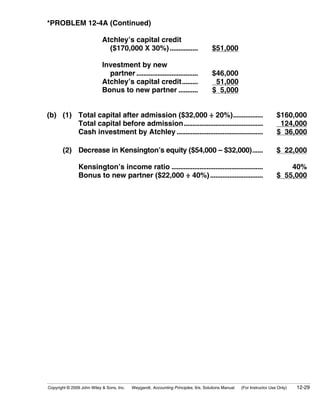
                            Atchley’s capital credit
                              ($170,000 X 30%) ................                      $51,000

                            Investment by new
                              partner ...................................            $46,000
                            Atchley’s capital credit.........                         51,000
                            Bonus to new partner ...........                         $ 5,000


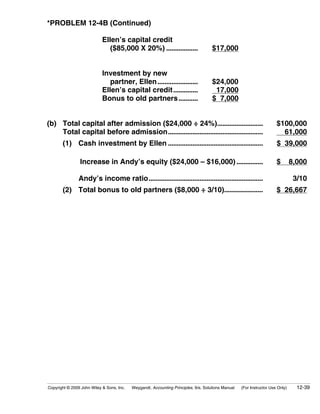
(b) (1) Total capital after admission ($32,000 ÷ 20%).................                                                 $160,000
        Total capital before admission.............................................                                     124,000
        Cash investment by Atchley .................................................                                   $ 36,000

       (2) Decrease in Kensington’s equity ($54,000 – $32,000)......                                                   $ 22,000

               Kensington’s income ratio ....................................................                              40%
               Bonus to new partner ($22,000 ÷ 40%) ..............................                                     $ 55,000


Copyright © 2009 John Wiley & Sons, Inc.   Weygandt, Accounting Principles, 9/e, Solutions Manual   (For Instructor Use Only)   12-29
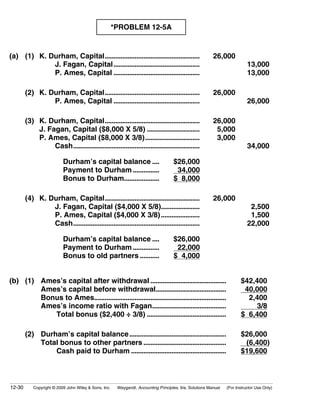
*PROBLEM 12-5A


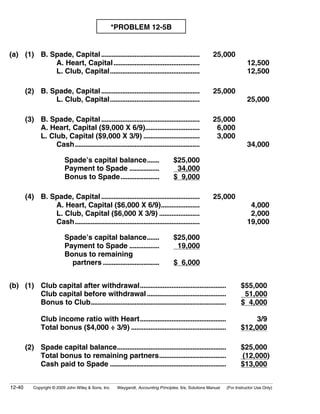
(a) (1) K. Durham, Capital......................................................                         26,000
            J. Fagan, Capital.................................................                                             13,000
            P. Ames, Capital .................................................                                             13,000

        (2) K. Durham, Capital......................................................                     26,000
                P. Ames, Capital .................................................                                         26,000

        (3) K. Durham, Capital......................................................                     26,000
            J. Fagan, Capital ($8,000 X 5/8) ..............................                               5,000
            P. Ames, Capital ($8,000 X 3/8)...............................                                3,000
                 Cash........................................................................                              34,000

                          Durham’s capital balance ....                             $26,000
                          Payment to Durham ...............                          34,000
                          Bonus to Durham....................                       $ 8,000

        (4) K. Durham, Capital......................................................                     26,000
                J. Fagan, Capital ($4,000 X 5/8)......................                                                      2,500
                P. Ames, Capital ($4,000 X 3/8) ......................                                                      1,500
                Cash........................................................................                               22,000

                          Durham’s capital balance ....                             $26,000
                          Payment to Durham ...............                          22,000
                          Bonus to old partners ...........                         $ 4,000


(b) (1) Ames’s capital after withdrawal ...........................................                                    $42,400
        Ames’s capital before withdrawal........................................                                        40,000
        Bonus to Ames...........................................................................                         2,400
        Ames’s income ratio with Fagan..........................................                                            3/8
           Total bonus ($2,400 ÷ 3/8) .............................................                                    $ 6,400

        (2) Durham’s capital balance.......................................................                            $26,000
            Total bonus to other partners ...............................................                               (6,400)
                Cash paid to Durham ......................................................                             $19,600


12-30      Copyright © 2009 John Wiley & Sons, Inc.    Weygandt, Accounting Principles, 9/e, Solutions Manual   (For Instructor Use Only)
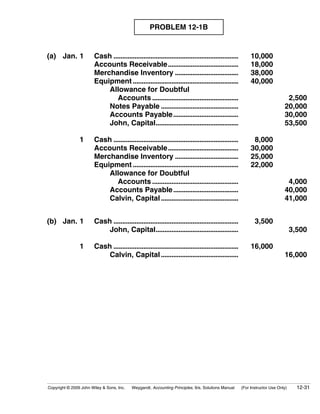
PROBLEM 12-1B


(a) Jan. 1              Cash .......................................................................        10,000
                        Accounts Receivable........................................                         18,000
                        Merchandise Inventory ....................................                          38,000
                        Equipment ............................................................              40,000
                            Allowance for Doubtful
                               Accounts .................................................                                      2,500
                            Notes Payable ............................................                                        20,000
                            Accounts Payable.....................................                                             30,000
                            John, Capital...............................................                                      53,500

                1       Cash .......................................................................         8,000
                        Accounts Receivable........................................                         30,000
                        Merchandise Inventory ....................................                          25,000
                        Equipment ............................................................              22,000
                            Allowance for Doubtful
                               Accounts .................................................                                      4,000
                            Accounts Payable.....................................                                             40,000
                            Calvin, Capital ............................................                                      41,000


(b) Jan. 1              Cash .......................................................................          3,500
                            John, Capital...............................................                                           3,500

                1       Cash .......................................................................        16,000
                            Calvin, Capital ............................................                                      16,000


Copyright © 2009 John Wiley & Sons, Inc.   Weygandt, Accounting Principles, 9/e, Solutions Manual      (For Instructor Use Only)     12-31
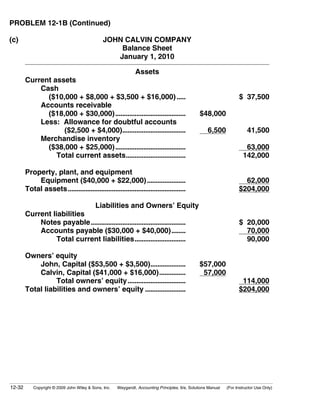
PROBLEM 12-1B (Continued)

(c)                                             JOHN CALVIN COMPANY
                                                    Balance Sheet
                                                   January 1, 2010

                                                                Assets
        Current assets
            Cash
              ($10,000 + $8,000 + $3,500 + $16,000) .....                                                             $ 37,500
            Accounts receivable
              ($18,000 + $30,000)........................................                         $48,000
            Less: Allowance for doubtful accounts
                   ($2,500 + $4,000)....................................                              6,500                41,500
            Merchandise inventory
              ($38,000 + $25,000)........................................                                                63,000
                 Total current assets..................................                                                 142,000

        Property, plant, and equipment
            Equipment ($40,000 + $22,000)......................                                                         62,000
        Total assets...................................................................                               $204,000

                                            Liabilities and Owners’ Equity
        Current liabilities
            Notes payable......................................................                                       $ 20,000
            Accounts payable ($30,000 + $40,000)........                                                                70,000
                  Total current liabilities.............................                                                90,000

        Owners’ equity
            John, Capital ($53,500 + $3,500)....................                                  $57,000
            Calvin, Capital ($41,000 + $16,000)...............                                     57,000
                  Total owners’ equity.................................                                                114,000
        Total liabilities and owners’ equity .......................                                                  $204,000


12-32       Copyright © 2009 John Wiley & Sons, Inc.   Weygandt, Accounting Principles, 9/e, Solutions Manual   (For Instructor Use Only)
PROBLEM 12-2B


(a) (1) Income Summary.........................................................                          50,000
            H. Krik, Capital ($50,000 X 50%).....................                                                          25,000
            N. Andres, Capital ($50,000 X 30%) ..............                                                              15,000
            S. Thabo, Capital ($50,000 X 20%).................                                                             10,000

       (2) Income Summary.........................................................                       40,000
               H. Krik, Capital
                  ($15,000 + $5,000) ..........................................                                            20,000
               N. Andres, Capital ($10,000 + $5,000) ..............                                                        15,000
               S. Thabo, Capital ($0 + $5,000).......................                                                       5,000

                           Net income......................................             $40,000
                           Salary allowances
                             Krik ...............................................       (15,000)
                             Andres..........................................           (10,000)
                           Remainder ......................................             $15,000

                           To each partner
                             ($15,000 X 1/3) ..........................                 $ 5,000


       (3) Income Summary.........................................................                       37,000
               H. Krik, Capital
                  ($4,000 + $20,000 + $3,000) ........................                                                     27,000
               N. Andres, Capital ($2,500 + $3,000).............                                                            5,500
               S. Thabo, Capital ($1,500 + $3,000)...............                                                           4,500

                           Net income......................................            $ 37,000
                           Interest allowance
                              Krik
                                ($40,000 X 10%)....................                       (4,000)
                              Andres ($25,000 X 10%) ...........                          (2,500)
                              Thabo ($15,000 X 10%)...........                            (1,500)
                           Balance............................................            29,000
                           Salary allowance
                              Krik ...............................................      (20,000)
                           Remainder ......................................            $ 9,000
                           To each partner
                              ($9,000 X 1/3) ............................              $ 3,000

Copyright © 2009 John Wiley & Sons, Inc.   Weygandt, Accounting Principles, 9/e, Solutions Manual   (For Instructor Use Only)   12-33
PROBLEM 12-2B (Continued)

(b)                                             DIVISION OF NET INCOME
                                                               H. Krik           N. Andres             S. Thabo             Total
        Salary allowance............................. $20,000                                                  (          $20,000
        Interest allowance on capital
            H. Krik
              ($40,000 X 10%)....................       4,000                                                                   (
            N. Andres                                    (
              ($25,000 X 10%)....................                                   $2,500
            S. Thabo
              ($15,000 X 10%)....................                                                        $1,500
                Total interest.....................                                                                          8,000
        Total salaries and interest...........         24,000                         2,500                1,500            28,000
        Remaining income, $2,700
            H. Krik
              ($9,000 X 1/3).........................   3,000
            N. Andres
              ($9,000 X 1/3).........................                                 3,000
            S. Thabo
              ($9,000 X 1/3).........................                                                      3,000
                Total remainder................                                                                             9,000
        Total division of net income ....... $27,000                                $5,500               $4,500           $37,000


(c)                                           KAT COMPANY
                                         Partners’ Capital Statement
                                   For the Year Ended December 31, 2010

                                                         H. Krik            N. Andres              S. Thabo                Total
        Capital, January 1...............               $40,000               $25,000                $15,000            $80,000
        Add: Net income...............                   27,000                 5,500                  4,500             37,000
                                                         67,000                30,500                 19,500            117,000
        Less: Drawings ..................                15,000                10,000                  5,000             30,000
        Capital, December 31...........                 $52,000               $20,500                $14,500            $87,000


12-34      Copyright © 2009 John Wiley & Sons, Inc.   Weygandt, Accounting Principles, 9/e, Solutions Manual   (For Instructor Use Only)
Copyright © 2009 John Wiley & Sons, Inc.
                                                         (a)                                                                   APACHE COMPANY
                                                                                                                            Schedule of Cash Payments
                                                                                                                                          Noncash
                                                                                    Item                                   Cash       +    Assets    =   Liabilities   +    Scottie    +    Spock     +    Kirk
                                                         Balances before liquidation .....................                $30,000)    +   $70,000)   =   $52,500)      +   $28,000)    +   $13,650)       $5,850)
                                                         Sale of noncash assets and
                                                           allocation of loss..................... (1) + (2)                57,000)   +   (70,000)   =                       (6,500)   +    (3,900)       (2,600)
                                                         New balances ...............................................      87,000)    +         0)   =     52,500)     +     21,500)   +     9,750)        3,250
                                                         Pay liabilities........................................... (3)   (52,500)               )   =    (52,500)                 )              )
                                                         New balances ...............................................      34,500)    +         0)   =          0)     +    21,500)    +     9,750)         3,250)
                                                                                                                                                                                                                     PROBLEM 12-3B


                                                         Cash distribution to partners ............ (4)                     34,500)             0)   =          0)         (21,500)    +    (9,750)        (3,250)
                                                         Final balances ..............................................    $      0)       $     0)       $      0)         $      0)       $     0)       $     0)


Weygandt, Accounting Principles, 9/e, Solutions Manual
(For Instructor Use Only)
12-35
PROBLEM 12-3B (Continued)

(b)                                                              (1)
        Apr. 30         Cash ....................................................................      57,000
                        Allowance for Doubtful Accounts .............                                   2,000
                        Accumulated Depreciation ..........................                             8,000
                        Loss on Realization........................................                    13,000
                            Accounts Receivable ............................                                             25,000
                            Merchandise Inventory.........................                                               35,000
                            Equipment ................................................                                   20,000

                        Noncash assets (net) ..............                        $70,000
                        Sale proceeds............................                   57,000
                        Loss on sale of noncash
                          assets ......................................            $13,000

                                                 (2)
              30        Scottie, Capital ($13,000 X 50%) ................                                6,500
                        Spock, Capital ($13,000 X 30%)..................                                 3,900
                        Kirk, Capital ($13,000 X 20%) ......................                             2,600
                             Loss on Realization...............................                                          13,000

                                                            (3)
              30        Notes Payable ..................................................               20,000
                        Accounts Payable...........................................                    30,000
                        Wages Payable ................................................                  2,500
                            Cash............................................................                             52,500

                                                             (4)
              30        Scottie, Capital ($28,000 – $6,500).............                               21,500
                        Spock, Capital ($13,650 – $3,900)..............                                 9,750
                        Kirk, Capital ($5,850 – $2,000).....................                            3,250
                             Cash............................................................                            34,500


12-36     Copyright © 2009 John Wiley & Sons, Inc.   Weygandt, Accounting Principles, 9/e, Solutions Manual   (For Instructor Use Only)
PROBLEM 12-3B (Continued)

(c)
                            Cash                                                   Spock, Capital
       Bal.             30,000 4/30 (3)                52,500             4/30 (2)  3,900 Bal.                             13,650
       30 (1)           57,000 4/30 (4)                34,500             4/30 (4)  9,750
       Bal.              –0–                                                              Bal.                                  –0–


                Scottie, Capital                                                             Kirk, Capital
       4/30 (2)  6,500 Bal.                            28,000             4/30 (2)           2,600 Bal.                         5,850
       4/30 (4) 21,500                                                    4/30 (4)           3,250
                         Bal.                             –0–                                       Bal.                         –0–


Copyright © 2009 John Wiley & Sons, Inc.   Weygandt, Accounting Principles, 9/e, Solutions Manual   (For Instructor Use Only)     12-37
*PROBLEM 12-4B


(a) (1) Bea, Capital ..................................................................                     7,500
            Ellen, Capital .......................................................                                            7,500

        (2) Andy, Capital ...............................................................                   8,000
               Ellen, Capital .......................................................                                         8,000

        (3) Cash................................................................................          29,000
            Barney, Capital ($7,000 X 5/10) ..............................                                 3,500
            Andy, Capital ($7,000 X 3/10)..................................                                2,100
            Bea, Capital ($7,000 X 2/10).....................................                              1,400
                Ellen, Capital .......................................................                                      36,000

                            Total capital of existing
                              partnership ........................                   $61,000
                            Investment by Ellen.............                          29,000
                            Total capital of new
                              partnership ........................                   $90,000

                            Ellen capital credit
                               ($90,000 X 40%).................                      $36,000

                            Investment by new
                               partner, Ellen ....................                   $29,000
                            Ellen capital credit...............                       36,000
                            Bonus to new partner.........                            $ 7,000

        (4) Cash................................................................................          24,000
               Barney, Capital ($7,000 X 5/10) .....................                                                         3,500
               Andy, Capital ($7,000 X 3/10).........................                                                        2,100
               Bea, Capital ($7,000 X 2/10)............................                                                      1,400
               Ellen, Capital .......................................................                                       17,000

                            Total capital of existing
                              partnership ........................                   $61,000
                            Investment by Ellen.............                          24,000
                            Total capital of new
                              partnership ........................                   $85,000


12-38       Copyright © 2009 John Wiley & Sons, Inc.    Weygandt, Accounting Principles, 9/e, Solutions Manual   (For Instructor Use Only)
*PROBLEM 12-4B (Continued)

                            Ellen’s capital credit
                               ($85,000 X 20%) ..................                    $17,000


                            Investment by new
                               partner, Ellen.......................                 $24,000
                            Ellen’s capital credit..............                      17,000
                            Bonus to old partners...........                         $ 7,000


(b) Total capital after admission ($24,000 ÷ 24%)..........................                                            $100,000
    Total capital before admission......................................................                                 61,000
       (1) Cash investment by Ellen ......................................................                             $ 39,000

                Increase in Andy’s equity ($24,000 – $16,000) ...............                                          $        8,000

               Andy’s income ratio.................................................................                              3/10
       (2) Total bonus to old partners ($8,000 ÷ 3/10)......................                                           $ 26,667


Copyright © 2009 John Wiley & Sons, Inc.   Weygandt, Accounting Principles, 9/e, Solutions Manual   (For Instructor Use Only)     12-39
*PROBLEM 12-5B


(a) (1) B. Spade, Capital ........................................................                       25,000
            A. Heart, Capital .................................................                                            12,500
            L. Club, Capital...................................................                                            12,500

        (2) B. Spade, Capital ........................................................                   25,000
                L. Club, Capital...................................................                                        25,000

        (3) B. Spade, Capital ........................................................                   25,000
            A. Heart, Capital ($9,000 X 6/9)...............................                               6,000
            L. Club, Capital ($9,000 X 3/9) ................................                              3,000
                 Cash.......................................................................                               34,000

                           Spade’s capital balance.......                           $25,000
                           Payment to Spade .................                        34,000
                           Bonus to Spade......................                     $ 9,000

        (4) B. Spade, Capital ........................................................                   25,000
                A. Heart, Capital ($6,000 X 6/9)......................                                                      4,000
                L. Club, Capital ($6,000 X 3/9) .......................                                                     2,000
                Cash.......................................................................                                19,000

                           Spade’s capital balance.......                           $25,000
                           Payment to Spade .................                        19,000
                           Bonus to remaining
                             partners ................................              $ 6,000


(b) (1) Club capital after withdrawal.................................................                                 $55,000
        Club capital before withdrawal .............................................                                    51,000
        Bonus to Club.............................................................................                     $ 4,000

               Club income ratio with Heart.................................................                                3/9
               Total bonus ($4,000 ÷ 3/9) ......................................................                       $12,000

        (2) Spade capital balance..............................................................                        $25,000
            Total bonus to remaining partners......................................                                    (12,000)
            Cash paid to Spade ..................................................................                      $13,000


12-40      Copyright © 2009 John Wiley & Sons, Inc.    Weygandt, Accounting Principles, 9/e, Solutions Manual   (For Instructor Use Only)
BYP 12-1                                        EXPLORING THE WEB


Students’ answers will depend upon the firm selected and the timing of
their exploration.


Copyright © 2009 John Wiley & Sons, Inc.   Weygandt, Accounting Principles, 9/e, Solutions Manual   (For Instructor Use Only)   12-41
BYP 12-2            DECISION MAKING ACROSS THE ORGANIZATION


(a) The major disadvantages of a partnership are mutual agency, limited
    life, and unlimited liability. Mutual agency means that each partner acts on
    behalf of the partnership when engaging in partnership business. The act
    of any partner is binding on all other partners, even when the partners
    act beyond the scope of their authority, so long as the act appears to be
    appropriate for the partnership. A partnership does not have unlimited
    life. A partnership may be ended voluntarily or involuntarily. For the
    partnership discussed here, limited life does not appear to be a major
    drawback. Unlimited liability means that each partner is personally and
    individually liable for all partnership liabilities. Creditors’ claims attach
    first to partnership assets, then to the personal resources of any partner,
    irrespective of that partner’s capital equity in the company. This is a major
    limitation of a partnership.

(b) The written partnership agreement, often referred to as the articles of
    co-partnership, is needed. It should contain such basic information as
    the name and principal location of the firm, the purpose of the business,
    and date of inception. In addition, the following should be specified:
    (1) names and capital contributions of partners, (2) rights and duties of
    partners, (3) basis for sharing net income or net loss, (4) provision for
    withdrawals of assets, (5) procedures for submitting disputes to arbitration,
    (6) procedures for the withdrawal or addition of a partner, and (7) rights
    and duties of surviving partners in the event of a partner’s death.

(c) The best approach would be to give Richard an interest allowance for the
    additional investment. This approach would therefore permit each party
    to share equally in net income or net loss after the interest allowance.


(d) The computer equipment should be depreciated on the books of the
    partnership, not on Richard’s personal tax return. The computer is owned
    by the partnership, and only Richard’s share of net income should be
    reported on his tax return. The computer would be reported at its fair
    market value when invested in the partnership, less the accumulated
    depreciation as of the end of the taxable year.


12-42   Copyright © 2009 John Wiley & Sons, Inc.   Weygandt, Accounting Principles, 9/e, Solutions Manual   (For Instructor Use Only)
BYP 12-2 (Continued)

(e) To facilitate the payment from partnership assets of the deceased
    partner’s equity, some companies obtain life insurance policies on
    each partner with the partnership as the beneficiary. The proceeds
    from the insurance policy on the deceased partner are then used to
    settle the estate.


Copyright © 2009 John Wiley & Sons, Inc.   Weygandt, Accounting Principles, 9/e, Solutions Manual   (For Instructor Use Only)   12-43
BYP 12-3                                  COMMUNICATION ACTIVITY


To:              Daniel Ortman
                 Sue Stafford

From:            Your Accountant

Subject:          Partnership Agreement for Pasta Shop


There are many important issues that should be included in your partnership
agreement. Prior to our meeting next Tuesday, in my office, it would be helpful
for you to consider the following matters.

1.      Facts about the business; i.e., name, location, purpose, and date of
        inception.

2.      Facts about the partners; i.e., the name and address of each partner,
        the beginning capital contribution of each partner, and the rights and
        duties of partners with respect to: (a) making business decisions, (b) active
        participation in the partnership (full/part-time), and (c) allowances for
        vacations and sick leave.

3.      Basis for sharing net income or net loss. The Uniform Partnership Act
        specifies that the basis will be equal unless another basis is stated in the
        partnership agreement. The basis may include provisions for partnership
        salaries and interest on capital balances with the remainder being divided
        on a proportionate basis.

4.      Provision for withdrawals of assets. There are two kinds of withdrawals:
        one is called drawings; the other is called a withdrawal of capital. The
        former relates to providing each partner with cash for normal living
        expenses. You may provide for periodic drawings of a fixed amount such
        as $1,000 a month, or an amount not to exceed a specified amount
        such as $1,500 or $2,000. Withdrawals of capital can affect the future
        of the partnership. Thus, you may want to provide for consultation with
        an attorney, a financial advisor, and/or a CPA and a formal approval
        procedure.


12-44     Copyright © 2009 John Wiley & Sons, Inc.   Weygandt, Accounting Principles, 9/e, Solutions Manual   (For Instructor Use Only)
BYP 12-3 (Continued)

5.     Procedures for submitting disputes to arbitration. Inevitably, disagreements
       will occur between partners. The partnership contract should provide a
       framework for resolving them. You may want to include some or all of the
       outside parties mentioned above in an arbitration committee.

6.     Procedures for the withdrawal or addition of a partner. At this time,
       consideration of this issue may seem premature. However, it is still
       useful to have basic procedures in place. For withdrawals, consideration
       should be given to both voluntary and “forced” withdrawals and the
       basis of determining and paying the capital equity of the partner who
       is leaving the firm. For additions, you may wish to state whether each
       admission must have the unanimous approval of existing partners and
       the terms of admission.

7.     Rights and duties of surviving partners. The death of a partner is often a
       traumatic experience. Thus, it is advisable that the partnership agreement
       specify the responsibilities of the surviving partners, assuming the
       business is continued, or if the business is terminated. Also, procedures
       should be included for determining the deceased partner’s equity in the
       firm. The procedures might include an audit of the financial statements
       and a revaluation of assets by an independent appraisal firm.

I look forward to a productive session with both of you next Tuesday.


Copyright © 2009 John Wiley & Sons, Inc.   Weygandt, Accounting Principles, 9/e, Solutions Manual   (For Instructor Use Only)   12-45
BYP 12-4                                               ETHICS CASE


(a) The stakeholders in this situation are Elizabeth and Laurie.

(b) The consequences of Elizabeth’s actions are that they cause significant
    differences in the time worked between the partners and in the amount
    of drawings made by each partner. Sooner or later, Laurie is going to
    become annoyed with Elizabeth’s actions and this could cause friction
    between the partners.

        The differences here emphasize the importance of a written partnership
        agreement. Time to be worked by each partner and allowable drawings
        are two subjects that should be in the agreement.

        Based on the information given, ethical considerations rest primarily
        on the issue of fairness. Elizabeth is not trying to hide anything from
        Laurie. However, her actions do not seem to be fair.

(c) For the differences in time worked, two changes in the partnership
    agreement should be considered. First, Laurie could be given a higher
    salary allowance than Elizabeth. Second, because Laurie is contributing
    more to net income than Elizabeth, she could be given a higher percentage
    of net income after deducting salary allowances.

        For the differences in drawings, the partnership agreement could be
        altered to allow for interest on average monthly “net” partners’ capitals.
        Net partners’ capitals would be the difference between the balances of
        the capital and drawing accounts at the end of each month. If this is not
        agreeable to Elizabeth, then the partnership agreement should be
        changed to limit the drawings of each partner to a fixed amount.


12-46     Copyright © 2009 John Wiley & Sons, Inc.   Weygandt, Accounting Principles, 9/e, Solutions Manual   (For Instructor Use Only)
BYP 12-5                                    ALL ABOUT YOU ACTIVITY


Given that the students may come up with variety of answers that are
correct, there is no single correct solution to this problem. You may wish to
have a show of hands on each question to see whether any consensus has
developed on any of the questions.


Copyright © 2009 John Wiley & Sons, Inc.   Weygandt, Accounting Principles, 9/e, Solutions Manual   (For Instructor Use Only)   12-47
NOTES
NOTES
NOTES
NOTES
NOTES
NOTES
NOTES
NOTES
NOTES
NOTES
NOTES
NOTES
NOTES
NOTES

Chapter 12 accounting for partnerships

  • 1.
    CHAPTER 12 Accounting for Partnerships ASSIGNMENT CLASSIFICATION TABLE Brief A B Study Objectives Questions Exercises Do It! Exercises Problems Problems 1. Identify the characteristics 1, 2, 3, 1 1 of the partnership form of 4, 24 business organization. 2. Explain the accounting 5 1, 2 3 2, 3 1A 1B entries for the formation of a partnership. 3. Identify the bases for 6, 7, 8, 3, 4, 5 5 4, 5 2A 2B dividing net income or 9, 10 net loss. 4. Describe the form and 11 5 6, 7 1A, 2A 1B, 2B content of partnership financial statements. 5. Explain the effects of 12, 13, 14, 6 8, 9, 10 3A 3B the entries to record the 15, 16 liquidation of a partnership. *6. Explain the effects of 17, 18, 7, 8 11, 12, 15 4A 4B the entries when a new 19, 20 partner is admitted. *7. Describe the effects of 21, 22, 23 9, 10 13, 14, 15 5A 5B the entries when a partner withdraws from the firm. *Note: All asterisked Questions, Exercises, and Problems relate to material contained in the appendix*to the chapter. Copyright © 2009 John Wiley & Sons, Inc. Weygandt, Accounting Principles, 9/e, Solutions Manual (For Instructor Use Only) 12-1
  • 2.
    ASSIGNMENT CHARACTERISTICS TABLE Problem Difficulty Time Number Description Level Allotted (min.) 1A Prepare entries for formation of a partnership Simple 20–30 and a balance sheet. 2A Journalize divisions of net income and prepare Moderate 30–40 a partners’ capital statement. 3A Prepare entries with a capital deficiency in liquidation Moderate 30–40 of a partnership *4A Journalize admission of a partner under different Moderate 30–40 assumptions. *5A Journalize withdrawal of a partner under different Moderate 30–40 assumptions. 1B Prepare entries for formation of a partnership Simple 30–40 and a balance sheet. 2B Journalize divisions of net income and prepare Moderate 30–40 a partners’ capital statement. 3B Prepare entries and schedule of cash payments in Moderate 30–40 liquidation of a partnership. *4B Journalize admission of a partner under different Moderate 30–40 assumptions. *5B Journalize withdrawal of a partner under different Moderate 30–40 assumptions. 12-2 Copyright © 2009 John Wiley & Sons, Inc. Weygandt, Accounting Principles, 9/e, Solutions Manual (For Instructor Use Only)
  • 3.
    WEYGANDT ACCOUNTING PRINCIPLES9E CHAPTER 12 ACCOUNTING FOR PARTNERSHIPS Number SO BT Difficulty Time (min.) BE1 2 AP Simple 2–4 BE2 2 AP Simple 3–5 BE3 3 AP Simple 4–6 BE4 3 AP Simple 4–6 BE5 3 AP Simple 6–8 BE6 5 AP Simple 2–4 BE7 6 AP Simple 2–4 BE8 6 AP Simple 3–5 BE9 7 AP Simple 2–4 BE10 7 AP Simple 3–5 DI1 1 C Simple 2–4 DI2 3 AP Simple 4–6 DI3 5 AP Simple 8–10 DI4 5 AP Moderate 6–8 EX1 1 C Simple 6–8 EX2 2 AP Simple 6–8 EX3 2 AP Simple 4–6 EX4 3 AP Simple 10–12 EX5 3 AP Simple 8–10 EX6 4 AP Simple 6–8 EX7 4 AP Simple 8–10 EX8 5 AP Simple 6–8 EX9 5 AP Simple 6–8 EX10 5 AP Simple 6–8 EX11 6 AP Simple 4–6 EX12 6 AP Simple 6–8 EX13 7 AP Simple 4–6 EX14 7 AP Moderate 8–10 EX15 6, 7 AP Moderate 6–8 P1A 2, 4 AP Simple 20–30 P2A 3, 4 AP Moderate 30–40 P3A 5 AP Moderate 30–40 Copyright © 2009 John Wiley & Sons, Inc. Weygandt, Accounting Principles, 9/e, Solutions Manual (For Instructor Use Only) 12-3
  • 4.
    ACCOUNTING FOR PARTNERSHIPS(Continued) Number SO BT Difficulty Time (min.) P4A 6 AP Moderate 30–40 P5A 7 AP Moderate 30–40 P1B 2, 4 AP Simple 20–30 P2B 3, 4 AP Moderate 30–40 P3B 5 AP Moderate 30–40 P4B 6 AP Moderate 30–40 P5B 7 AP Moderate 30–40 BYP1 — C Simple 8–10 BYP2 1–3 C, E Simple 15–20 BYP3 2, 5 S Simple 10–15 BYP4 3 E Simple 10–15 BYP5 1 S Simple 15–20 12-4 Copyright © 2009 John Wiley & Sons, Inc. Weygandt, Accounting Principles, 9/e, Solutions Manual (For Instructor Use Only)
  • 5.
    Correlation Chart betweenBloom’s Taxonomy, Study Objectives and End-of-Chapter Exercises and Problems Study Objective Knowledge Comprehension Application Analysis Synthesis Evaluation 1. Identify the characteristics Q12-1 Q12-24 of the partnership form of Q12-2 DI12-1 business organization. Q12-3 E12-1 Q12-4 2. Explain the accounting Q12-5 E12-3 entries for the formation BE12-1 P12-1A of a partnership. BE12-2 P12-1B E12-2 Copyright © 2009 John Wiley & Sons, Inc. 3. Identify the bases for Q12-6 Q12-8 DI12-2 dividing net income or Q12-7 Q12-10 E12-4 net loss. Q12-9 BE12-3 E12-5 BE12-4 P12-2A BLOOM’S TAXONOMY TABLE BE12-5 P12-2B 4. Describe the form and Q12-11 E12-6 P12-2A content of partnership E12-7 P12-1B financial statements. P12-1A P12-2B 5. Explain the effects of the Q12-12 Q12-15 E12-8 entries to record the Q12-13 Q12-16 E12-9 liquidation of a Q12-14 BE12-6 E12-10 partnership. DI12-3 P12-3A DI12-4 P12-3B *6. Explain the effects of the Q12-17 Q12-19 E12-12 entries when a new partner Q12-18 Q12-20 E12-15 is admitted. BE12-7 P12-4A Weygandt, Accounting Principles, 9/e, Solutions Manual BE12-8 P12-4B E12-11 *7. Describe the effects of Q12-22 Q12-21 E12-14 the entries when a partner Q12-23 BE12-9 E12-15 withdraws from the firm. BE12-10 P12-5A E12-13 P12-5B Broadening Your Perspective Exploring the Web Communication Decision Making (For Instructor Use Only) Decision Making All About You Across the Across the Organization Organization Ethics Case 12-5
  • 6.
    ANSWERS TO QUESTIONS 1. (a) Association of individuals. A partnership is a voluntary association of two or more individuals based on as simple an act as a handshake. Preferably, however, the agreement should be in writing. A partnership is both a legal entity and an accounting entity, but it is not a taxable entity. (b) Limited life. A partnership does not have unlimited life. A partnership may be ended voluntarily or involuntarily. Thus, the life of a partnership is indefinite. Any change in the members of a partnership results in the dissolution of the partnership. (c) Co-ownership of property. Partnership assets are co-owned by all the partners. If the partnership is terminated, the assets do not legally revert to the original contributor. Each partner has a claim on total assets equal to his or her capital balance. This claim does not attach to specific assets the individual partner contributed to the firm. 2. (a) Mutual agency. This characteristic means that the act of any partner is binding on all other partners when engaging in partnership business. This is true even when the partners act beyond the scope of their authority, so long as the act appears to be appropriate for the partnership. (b) Unlimited liability. Each partner is personally and individually liable for all partnership liabilities. Creditors’ claims attach first to partnership assets and then to personal resources of any partner, irrespective of that partner’s equity in the partnership. 3. The advantages of a partnership are: (1) combining skills and resources of two or more individuals, (2) ease of formation, (3) freedom from governmental regulations and restrictions, and (4) ease of decision making. Disadvantages are: (1) mutual agency, (2) limited life, and (3) unlimited liability. 4. A limited partnership is used when a general partner(s) wish to raise cash without involving outside investors in management of the business. Limited partners in this case have limited personal liability for business debts as long as they don’t participate in management. 5. Sampson’s capital account balance should be $102,000, comprised of land $65,000, and equipment $57,000, less debt $20,000. 6. When the partnership agreement does not specify the division of net income or net loss, net income and net loss should be divided equally. 7. Factors to be considered in determining how income and loss should be divided are: (1) a fixed ratio is easy to apply and it may be an equitable basis in some circumstances; (2) capital balance ratios when the funds invested in the partnership are considered the most critical factor; and (3) salary allowance and/or interest allowance coupled with a fixed ratio. This last approach gives specific recognition to differences that may exist among partners by providing salary allowances for time worked and interest allowances for capital invested. 8. The net income of $36,000 should be divided equally—$18,000 to M. Carson and $18,000 to R. Leno. 9. (a) Account debited: Income Summary; accounts credited: S. McMurray, Capital and F. Kohl, Capital. (b) Account debited: S. McMurray, Drawing; account credited: Cash. 12-6 Copyright © 2009 John Wiley & Sons, Inc. Weygandt, Accounting Principles, 9/e, Solutions Manual (For Instructor Use Only)
  • 7.
    Questions Chapter 12(Continued) 10. Division of Net Income T. Evans R. Meloy Total Salary Allowance .................................................... ($30,000) ($25,000) ($55,000) Deficiency: ($10,000) ($45,000 – $55,000) T. Evans (60% X $10,000) ...................... ( (6,000) ( (6,000) R. Meloy (40% X $10,000) ...................... ( (4,000) ( (4,000) Total division ................................... ($24,000) ($21,000) ($45,000) 11. The financial statements of a partnership are similar to those of a proprietorship. The differences are due to the number of partners involved. The income statement for a partnership is identical to the income statement for a proprietorship except for the detailed information concerning the division of net income. The owners’ equity statement is called the partners’ capital statement. This statement shows the changes in each partner’s capital account and in total partnership capital during the year. On the balance sheet each partner’s capital balance is reported in the owners’ equity section. 12. Liquidation of a partnership ends both the legal and economic life of the entity. Partnership dissolution occurs whenever a partner withdraws or a new partner is admitted. Dissolution does not necessarily mean that the business ends. If the continuing partners agree, operations can continue without interruption by forming a new partnership. 13. No, Bobby is not correct. All gains and losses on liquidation should be allocated to the partners on the basis of their income ratio. However, final cash distributions should be based on their capital balances. 14. Yes, Bill is correct. Capital balances are used because they represent the individual partner’s equity in the partnership. The objective of the distribution is to eliminate the balance in each partner’s capital account. 15. Total cash after paying liabilities.............................................................................................. $109,000 Total capital balances ($34,000 + $31,000 + $28,000)....................................................... 93,000 Excess (gain on sale of noncash assets) .............................................................................. $ 16,000 Allocated to Keegan ($16,000 X 3/10) ................................................................................... $ 4,800 Cash to Keegan ($31,000 + $4,800) ...................................................................................... $ 35,800 16. Capital deficiency, M. Jeter....................................................................................................... $ 8,000 Loss allocated to: L. Pattison, capital ($8,000 X 3/8) ......................................................... $ 3,000 Cash to L. Pattison ($12,000 – $3,000) ................................................................................. $ 9,000 *17. This transaction represents the purchase of an existing partner’s interest. It is a personal trans- action that has no effect on partnership net assets. Copyright © 2009 John Wiley & Sons, Inc. Weygandt, Accounting Principles, 9/e, Solutions Manual (For Instructor Use Only) 12-7
  • 8.
    Questions Chapter 12(Continued) *18. Partnership net assets increase $25,000. No, Steve Renn does not necessarily acquire a 1/6 income ratio. Unless stated otherwise, net income or net loss is divided evenly among all partners. *19. Grant, Capital............................................................................................................ 66,000 Kate Robidou, Capital .................................................................................... 66,000 *20. Tracy Harper, Capital .............................................................................................. 39,000 Kim Remington, Capital................................................................................. 39,000 *21. Newlin’s share of the bonus is $3,000 computed as follows: Partnership assets.......................................................................................... $85,000 Capital credit, Perry........................................................................................ 77,000 Bonus to retiring partner................................................................................ 8,000 Allocated to: Garland: $8,000 X 5/8 = ...................................................................... $5,000 Newlin: $8,000 X 3/8 = ...................................................................... 3,000 8,000 $ 0 *22. Recording the revaluations violates the cost principle, which requires that assets be stated at original cost. It is also a departure from the going-concern assumption, which assumes the entity will continue indefinitely. *23. When a partner dies, it is usually necessary to determine the partner’s equity at the date of death by: (1) determining the net income or loss for the year to date, (2) closing the books, and (3) preparing financial statements. The partnership agreement may also require an audit of the financial statements by independent auditors and a revaluation of assets by an appraisal firm. 24. A partnership is an association of two or more persons to carry on as co-owners of a business for profit. PepsiCo is a corporation since its has thousands of owners (called stockholders). 12-8 Copyright © 2009 John Wiley & Sons, Inc. Weygandt, Accounting Principles, 9/e, Solutions Manual (For Instructor Use Only)
  • 9.
    SOLUTIONS TO BRIEFEXERCISES BRIEF EXERCISE 12-1 Cash .............................................................................................. 10,000 Equipment................................................................................... 5,000 Stanley Farrin, Capital.................................................... 15,000 BRIEF EXERCISE 12-2 Accounts Receivable............................................................... $16,000 Less: Allowance for doubtful accounts ............................ 2,500 $13,500 Equipment................................................................................... 11,000 Accumulated depreciation should not be shown because a new company cannot have any accumulated depreciation. BRIEF EXERCISE 12-3 The division is: Held $42,000 ($70,000 X 60%) and Bond $28,000 ($70,000 X 40%). The entry is: Income Summary............................................................. 70,000 Held, Capital ............................................................. 42,000 Bond, Capital............................................................ 28,000 BRIEF EXERCISE 12-4 Division of Net Income Espino Sears Utech Total Salary allowance............................ $15,000 $ 5,000 $ 5,000 $25,000 Remaining income, $30,000: ($55,000 – $25,000) C ($30,000 X 50%) .............. 15,000 S ($30,000 X 30%) .............. 9,000 N ($30,000 X 20%) .............. 000,000 6,000 Total remainder.......... 30,000 Total division of net income ...... $30,000 $14,000 $11,000 $55,000 Copyright © 2009 John Wiley & Sons, Inc. Weygandt, Accounting Principles, 9/e, Solutions Manual (For Instructor Use Only) 12-9
  • 10.
    BRIEF EXERCISE 12-5 Division of Net Income Joe Sam Total Salary allowance .............................................. $15,000 $10,000 $25,000 Interest allowance............................................ 7,000 5,000 12,000 Remaining deficiency, ($9,000): [($25,000 + $12,000) – $28,000] Joe ($9,000 X 50%) ................................ (4,500) Sam ($9,000 X 50%)................................ (4,500) Total remainder ............................... (9,000) Total division of net income......................... $17,500 $10,500 $28,000 BRIEF EXERCISE 12-6 A, Capital......................................................................................... 8,000 L, Capital ......................................................................................... 7,000 F, Capital ......................................................................................... 4,000 Cash......................................................................................... 19,000 *BRIEF EXERCISE 12-7 Cox, Capital.................................................................................... 10,000 Day, Capital ........................................................................... 10,000 *BRIEF EXERCISE 12-8 Cash.................................................................................................. 52,000 Menke, Capital (50% X $11,900*)............................................. 5,950 Hibbett, Capital (50% X $11,900) ............................................. 5,950 Kosko, Capital (45% X $142,000).................................... 63,900 *[($40,000 + $50,000 + $52,000) X 45%] – $52,000 = $11,900. 12-10 Copyright © 2009 John Wiley & Sons, Inc. Weygandt, Accounting Principles, 9/e, Solutions Manual (For Instructor Use Only)
  • 11.
    *BRIEF EXERCISE 12-9 Denny,Capital................................................................................ 18,000 Messer, Capital ..................................................................... 9,000 Isch, Capital ........................................................................... 9,000 *BRIEF EXERCISE 12-10 Denny, Capital................................................................................ 18,000 Messer, Capital (50% X $6,000) ................................................ 3,000 Isch, Capital (50% X $6,000) ...................................................... 3,000 Cash ......................................................................................... 24,000 SOLUTIONS FOR DO IT! REVIEW EXERCISES DO IT! 12-1 1. True. 2. False. If a partnership is dissolved, each partner has a claim on total assets equal to the balance in his or her capital account. The claim does not attach to any specific assets. 3. False. In a limited partnership, the general partners have unlimited liability. 4. True. 5. True. DO IT! 12-2 The division of net income is as follows: S. Wiborg G. Murphy Total Salary allowance............................................... $25,000 $18,000 $43,000 Remaining income ($85,000 – $43,000) S. Wiborg (40% X $42,000).................... 16,800 G. Murphy (60% X $42,000) .................. 25,200 Total remaining income ................ 42,000 Total division of net income ......................... $41,800 $43,200 $85,000 Copyright © 2009 John Wiley & Sons, Inc. Weygandt, Accounting Principles, 9/e, Solutions Manual (For Instructor Use Only) 12-11
  • 12.
    DO IT! 12-2(Continued) Income Summary ............................................. 85,000 S. Wiborg, Capital ................................... 41,800 G. Murphy, Capital .................................. 43,200 DO IT! 12-3 Noncash M. Jones J. Strummer, P. Simonon Item Cash + Assets = Liabilities + Capital + Capital + Capital Balance before liquidation 15,000 90,000 40,000 20,000 32,000 13,000 Sale of noncash assets and allocation of gain 125,000 (90,000) 13,125a 8,750b 13,125a New balances 140,000 –0– 40,000 33,125 40,750 26,125 Pay liabilities (40,000) (40,000) New Balances 100,000 –0– –0– 33,125 40,750 26,125 Cash distribution to partners (100,000) (33,125) (40,750) (26,125) Final balances –0– –0– –0– –0– –0– –0– a 35,000 X 3/8 b 35,000 X 2/8 DO IT! 12-4 Niles, Capital ($21,000 X 3/7) ........................................................ 9,000 Vandalia, Capital ($21,000 X 4/7)................................................. 12,000 Dowagiac, Capital .................................................................... 21,000 (To record write-off of capital deficiency) Niles, Capital ($47,000 X $9,000) ................................................. 38,000 Vandalia, Capital ($40,000 – $12,000) ........................................ 28,000 Cash.............................................................................................. 66,000 (To record distribution of cash of partners) 12-12 Copyright © 2009 John Wiley & Sons, Inc. Weygandt, Accounting Principles, 9/e, Solutions Manual (For Instructor Use Only)
  • 13.
    SOLUTIONS TO EXERCISES EXERCISE12-1 1. False. A partnership is an association of two or more persons to carry on as co-owners of a business for profit. 2. False. Partnerships are fairly easy to form; they can be formed simply by a verbal agreement. 3. False. A partnership is an entity for financial reporting purposes. 4. False. The net income of a partnership is not taxed as a separate entity. 5. True. 6. True. 7. False. When a partnership is dissolved, the assets do not revert to the original contributor. 8. True. 9. False. Mutual agency is a disadvantage of the partnership form of business. EXERCISE 12-2 (a) Cash ........................................................................................ 50,000 Meissner, Capital ....................................................... 50,000 Land......................................................................................... 15,000 Building.................................................................................. 80,000 Cohen, Capital ............................................................ 95,000 Cash ........................................................................................ 9,000 Accounts Receivable......................................................... 32,000 Equipment ............................................................................. 19,000 Allowance for Doubtful Accounts ........................ 3,000 Hughes, Capital .......................................................... 57,000 (b) $50,000 + $95,000 + $57,000 = $202,000 EXERCISE 12-3 Jan. 1 Cash................................................................................ 12,000 Accounts Receivable ................................................ 14,000 Equipment ..................................................................... 13,500 Allowance for Doubtful Accounts ................ 3,000 Jack Herington, Capital.................................... 36,500 Copyright © 2009 John Wiley & Sons, Inc. Weygandt, Accounting Principles, 9/e, Solutions Manual (For Instructor Use Only) 12-13
  • 14.
    EXERCISE 12-4 (a) (1) DIVISION OF NET INCOME F. Calvert G. Powers Total Salary allowance .................................... $20,000 $12,000 $32,000 Interest allowance F. Calvert ($50,000 X 10%)........... 5,000 G. Powers ($40,000 X 10%) ......... 4,000 Total interest ............................ 9,000 Total salaries and interest .................. 25,000 16,000 41,000 Remaining income, $9,000 ($50,000 – $41,000) F. Calvert ($9,000 X 60%)............. 5,400 G. Powers ($9,000 X 40%)............ 3,600 Total remainder ....................... 9,000 Total division of net income............... $30,400 $19,600 $50,000 (2) DIVISION OF NET INCOME F. Calvert G. Powers Total Salary allowance .................................... ($20,000) ($12,000 $32,000 Interest allowance.................................. ( 5,000) ( 4,000 9,000 Total salaries and interest .................. ( 25,000) ( 16,000 41,000 Remaining deficiency, ($5,000) ($41,000 – $36,000) F. Calvert ($5,000 X 60%)............. ( (3,000) G. Powers ($5,000 X 40%)............ ( (2,000) Total remainder ....................... ( ) (5,000) Total division of net income............... ($22,000) ($14,000 $36,000 (b) (1) Income Summary ....................................................... 50,000 F. Calvert, Capital ............................................... 30,400 G. Powers, Capital .............................................. 19,600 (2) Income Summary ....................................................... 36,000 F. Calvert, Capital ............................................... 22,000 G. Powers, Capital .............................................. 14,000 12-14 Copyright © 2009 John Wiley & Sons, Inc. Weygandt, Accounting Principles, 9/e, Solutions Manual (For Instructor Use Only)
  • 15.
    EXERCISE 12-5 (a) IncomeSummary................................................................ 70,000 O. Guillen, Capital ($70,000 X 45%)...................... 31,500 K. Williams, Capital ($70,000 X 55%) ................... 38,500 (b) Income Summary................................................................ 70,000 O. Guillen, Capital [$30,000 + ($15,000 X 45%)] .............................. 36,750 K. Williams, Capital [$25,000 + ($15,000 X 55%)] .............................. 33,250 (c) Income Summary................................................................. 70,000 O. Guillen, Capital....................................................... 36,000 K. Williams, Capital .................................................... 34,000 Guillen: [$40,000 + $6,000 – ($20,000 X 50%)] Williams: [$35,000 + $9,000 – ($20,000 X 50%)] (d) Guillen: $60,000 + $36,000 – $18,000 = $78,000 Williams: $90,000 + $34,000 – $24,000 = $100,000 EXERCISE 12-6 (a) STARRITE CO. Partners’ Capital Statement For the Year Ended December 31, 2010 G. Stark J. Nyland Total Capital, January 1 ....................... $20,000 $18,000 $38,000 Add: Net income ........................ 15,000 15,000 30,000 35,000 33,000 68,000 Less: Drawings........................... 8,000 5,000 13,000 Capital, December 31................. $27,000 $28,000 $55,000 Copyright © 2009 John Wiley & Sons, Inc. Weygandt, Accounting Principles, 9/e, Solutions Manual (For Instructor Use Only) 12-15
  • 16.
    EXERCISE 12-6 (Continued) (b) STARRITE CO. Partial Balance Sheet December 31, 2010 Owners’ equity G. Stark, Capital ..................................................... $27,000 J. Nyland, Capital................................................... 28,000 Total owners’ equity...................................... $55,000 EXERCISE 12-7 THE STOOGES PARTNERSHIP Balance Sheet December 31, 2010 Assets Current Assets Cash........................................................................ $37,000 Accounts Receivable ........................................ $36,000 Less: Allowance for Doubtful Accounts ........ (4,000) 32,000 Supplies ................................................................ 3,000 Total current assets..................................... $ 72,000 Property, Plant and Equipment Land........................................................................ $18,000 Building ................................................................. 75,000 Equipment ............................................................ 47,000 Total property, plant, and equipment ........ 140,000 Total assets.................................................................. $212,000 Liabilities and Owners’ Equity Long-term Liabilities Mortgage Payable .............................................. $ 20,000 Owners’ Equity Moe, Capital ......................................................... $55,000 Larry, Capital ....................................................... 73,000 Curly, Capital ....................................................... 64,000 Total owners’ equity .................................... 192,000 Total liabilities and owners’ equity ...................... $212,000 12-16 Copyright © 2009 John Wiley & Sons, Inc. Weygandt, Accounting Principles, 9/e, Solutions Manual (For Instructor Use Only)
  • 17.
    EXERCISE 12-8 THE BEST COMPANY Schedule of Cash Payments Noncash Rodriguez Escobedo Item Cash + Assets = Liabilities + Capital + Capital Balances before liquidation $ 20,000 ($100,000) ($55,000) $45,000 $20,000 Sale of noncash assets and allo- cation of gain 110,000 ( (100,000) ( ) 6,000 4,000 New balances 130,000 ( 0) ( 55,000) 51,000 24,000 Pay liabilities (55,000) ( ) ( (55,000) New balances 75,000 ( 0) ( 0) 51,000 24,000 Cash distribution to partners (75,000) ( ) ( ) (51,000) (24,000) Final balances $ 0 ($ 0) ($ 0) $ 0 $ 0 EXERCISE 12-9 (a) Cash ...................................................................................... 110,000 Noncash Assets ....................................................... 100,000 Gain on Realization ................................................. 10,000 (b) Gain on Realization .......................................................... 10,000 Rodriguez, Capital ($10,000 X 60%) ................... 6,000 Escobedo, Capital ($10,000 X 40%) ................... 4,000 (c) Liabilities ............................................................................. 55,000 Cash ............................................................................. 55,000 (d) Rodriguez, Capital ............................................................ 51,000 Escobedo, Capital............................................................. 24,000 Cash ............................................................................. 75,000 Copyright © 2009 John Wiley & Sons, Inc. Weygandt, Accounting Principles, 9/e, Solutions Manual (For Instructor Use Only) 12-17
  • 18.
    EXERCISE 12-10 (a) (1)Cash................................................................................ 4,000 Farley, Capital..................................................... 4,000 (2) Newell, Capital............................................................. 17,000 Jennings, Capital........................................................ 15,000 Cash....................................................................... 32,000 (b) (1) Newell, Capital ($4,000 X 5/8) ................................. 2,500 Jennings, Capital ($4,000 X 3/8) ............................ 1,500 Farley, Capital..................................................... 4,000 (2) Newell, Capital ($17,000 – $2,500)......................... 14,500 Jennings, Capital ($15,000 – $1,500) ................... 13,500 Cash....................................................................... 28,000 *EXERCISE 12-11 (a) J. Lynn, Capital ($30,000 X 50%) .................................... 15,000 D. Duran, Capital......................................................... 15,000 (b) M. Oller, Capital ($26,000 X 50%) ................................... 13,000 D. Duran, Capital......................................................... 13,000 (c) F. Tate, Capital ($18,000 X 33 1/3%) .............................. 6,000 D. Duran, Capital......................................................... 6,000 *EXERCISE 12-12 (a) Cash......................................................................................... 90,000 G. Olde, Capital (6/10 X $12,000) ........................... 7,200 R. Young, Capital (4/10 X $12,000)........................ 4,800 K. Twener, Capital ...................................................... 78,000 Total capital of existing partnership....... $170,000 Investment by new partner, Twener........ 90,000 Total capital of new partnership .............. $260,000 Twener’s capital credit (30% X $260,000) ................................. $ 78,000 12-18 Copyright © 2009 John Wiley & Sons, Inc. Weygandt, Accounting Principles, 9/e, Solutions Manual (For Instructor Use Only)
  • 19.
    *EXERCISE 12-12 (Continued) Investment by new partner, Twener ....... $ 90,000 Twener’s capital credit................................ 78,000 Bonus to old partners ................................. $ 12,000 (b) Cash ......................................................................................... 50,000 G. Olde, Capital (6/10 X $16,000)..................................... 9,600 R. Young, Capital (4/10 X $16,000) ................................. 6,400 K. Twener, Capital....................................................... 66,000 Total capital of existing partnership ..... $170,000 Investment by new partner, Twener ...... 50,000 Total capital of new partnership ............. $220,000 Twener’s capital credit (30% X $220,000) ................................... $ 66,000 Investment by new partner, Twener ...... $ 50,000 Twener’s capital credit............................... 66,000 Bonus to new partner................................. $ 16,000 *EXERCISE 12-13 1. S. Nguyen, Capital ............................................................... 32,000 B. Cates, Capital.......................................................... 16,000 V. Elder, Capital........................................................... 16,000 2. S. Nguyen, Capital ............................................................... 32,000 V. Elder, Capital........................................................... 32,000 3. S. Nguyen, Capital ............................................................... 32,000 B. Cates, Capital.......................................................... 32,000 Copyright © 2009 John Wiley & Sons, Inc. Weygandt, Accounting Principles, 9/e, Solutions Manual (For Instructor Use Only) 12-19
  • 20.
    *EXERCISE 12-14 1. R. Fisk, Capital ..................................................................... 60,000 H. Barrajas, Capital............................................................. 5,000 T. Dingler, Capital................................................................ 3,000 Cash................................................................................ 68,000 Capital balance of withdrawing partner .......................................................... $60,000 Payment to withdrawing partner.............. 68,000 Bonus to retiring partner ............................ $ 8,000 Allocation of bonus Barrajas, Capital ($8,000 X 5/8).................. $5,000 Dingler, Capital ($8,000 X 3/8) .................... 3,000 $ 8,000 2. R. Fisk, Capital ..................................................................... 60,000 H. Barrajas, Capital.................................................... 2,500 T. Dingler, Capital....................................................... 1,500 Cash................................................................................ 56,000 Capital balance of withdrawing partner .......................................................... $60,000 Payment to withdrawing partner.............. 56,000 Bonus to remaining partners .................... $ 4,000 Allocation of bonus Barrajas, Capital ($4,000 X 5/8) .................... $2,500 Dingler, Capital ($4,000 X 3/8) .................... 1,500 $ 4,000 12-20 Copyright © 2009 John Wiley & Sons, Inc. Weygandt, Accounting Principles, 9/e, Solutions Manual (For Instructor Use Only)
  • 21.
    *EXERCISE 12-15 (a) Cash.................................................................................. 80,000 Stewart, Capital ($280,000a X 25%)................. 70,000 Carson, Capital ($10,000 X 50%)..................... 5,000 Letterman, Capital ($10,000 X 30%) ............... 3,000 O’Brien, Capital ($10,000 X 20%) .................... 2,000 a $100,000 + $60,000 + $40,000 + $80,000 (b) Carson, Capital .............................................................. 100,000 Letterman, Capital ($20,000 X 3/5)........................... 12,000 O’Brien, Capital ($20,000 X 2/5)................................ 8,000 Cash ......................................................................... 120,000 Copyright © 2009 John Wiley & Sons, Inc. Weygandt, Accounting Principles, 9/e, Solutions Manual (For Instructor Use Only) 12-21
  • 22.
    SOLUTIONS TO PROBLEMS PROBLEM 12-1A (a) Jan. 1 Cash....................................................................... 14,000 Accounts Receivable ....................................... 17,500 Merchandise Inventory.................................... 28,000 Equipment............................................................ 23,000 Allowance for Doubtful Accounts................................................. 4,500 Notes Payable............................................ 18,000 Accounts Payable .................................... 22,000 Patrick, Capital .......................................... 38,000 1 Cash....................................................................... 12,000 Accounts Receivable ....................................... 26,000 Merchandise Inventory.................................... 20,000 Equipment............................................................ 16,000 Allowance for Doubtful Accounts................................................. 4,000 Notes Payable............................................ 15,000 Accounts Payable .................................... 31,000 Samuelson, Capital.................................. 24,000 (b) Jan. 1 Cash....................................................................... 5,000 Patrick, Capital .......................................... 5,000 1 Cash....................................................................... 19,000 Samuelson, Capital.................................. 19,000 12-22 Copyright © 2009 John Wiley & Sons, Inc. Weygandt, Accounting Principles, 9/e, Solutions Manual (For Instructor Use Only)
  • 23.
    PROBLEM 12-1A (Continued) (c) PASA COMPANY Balance Sheet January 1, 2010 Assets Current assets Cash ($14,000 + $12,000 + $5,000 + $19,000)..... $ 50,000 Accounts receivable ($17,500 + $26,000).......................................... $43,500 Less: Allowance for doubtful accounts ($4,500 + $4,000) ................................... 8,500 35,000 Merchandise inventory ($28,000 + $20,000) ....................................... 48,000 Total current assets ................................. 133,000 Property, plant, and equipment Equipment ($23,000 + $16,000)...................... 39,000 Total assets .................................................................. $172,000 Liabilities and Owners’ Equity Current liabilities Notes payable ($18,000 + $15,000)............... $ 33,000 Accounts payable ($22,000 + $31,000) ....... 53,000 Total current liabilities ............................ 86,000 Owners’ equity Patrick, Capital ($38,000 + $5,000) ............... $43,000 Samuelson, Capital ($24,000 + $19,000)..... 43,000 Total owners’ equity................................. 86,000 Total liabilities and owners’ equity....................... $172,000 Copyright © 2009 John Wiley & Sons, Inc. Weygandt, Accounting Principles, 9/e, Solutions Manual (For Instructor Use Only) 12-23
  • 24.
    PROBLEM 12-2A (a) (1)Income Summary ........................................................... 30,000 Reese Caplin, Capital ($30,000 X 60%) .......... 18,000 Phyllis Newell, Capital ($30,000 X 30%)......... 9,000 Betty Uhrich, Capital ($30,000 X 10%)............ 3,000 (2) Income Summary ........................................................... 37,000 Reese Caplin, Capital ($15,000 + $4,000) ...... 19,000 Phyllis Newell, Capital ($10,000 + $4,000)..... 14,000 Betty Uhrich, Capital ($0 + $4,000) .................. 4,000 Net income................................. $37,000 Salary allowance Caplin ..................................... (15,000) Newell...................................... (10,000) Remainder ............................. $12,000 To each partner ($12,000 X 1/3) ..................... $ 4,000 (3) Income Summary ........................................................... 19,000 Reese Caplin, Capital ($4,800 + $12,000 – $1,100) ........................... 15,700 Phyllis Newell, Capital ($3,000 – $1,100) ....... 1,900 Betty Uhrich, Capital ($2,500 – $1,100) .......... 1,400 Net income................................. $19,000 Interest allowance Caplin ($48,000 X 10%)...... (4,800) Newell ($30,000 X 10%) ..... (3,000) Uhrich ($25,000 X 10%) ..... (2,500) Balance ....................................... 8,700 Salary allowance Caplin ..................................... (12,000) Remainder ............................. $ (3,300) To each partner ($3,300 X 1/3) ....................... $ (1,100) 12-24 Copyright © 2009 John Wiley & Sons, Inc. Weygandt, Accounting Principles, 9/e, Solutions Manual (For Instructor Use Only)
  • 25.
    PROBLEM 12-2A (Continued) (b) DIVISION OF NET INCOME Reese Phyllis Betty Caplin Newell Uhrich Total Salary allowance............................ $12,000 ( $12,000 Interest allowance on capital Reese Caplin ($48,000 X 10%)................... 4,800 ( Phyllis Newell ( ($30,000 X 10%)................... $3,000 Betty Uhrich ( ($25,000 X 10%)................... $2,500 Total interest.................... ( 10,300 Total salaries and interest.......... 16,800 3,000 ( 2,500 22,300 Remaining deficiency, ($3,300) Reese Caplin ($3,300 X 1/3)........................ (1,100) Phyllis Newell ($3,300 X 1/3)........................ (1,100) Betty Uhrich ($3,300 X 1/3)........................ ((1,100) Total remainder............... (3,300) Total division of net income ...... $15,700 $1,900 ($1,400 $19,000 (c) CNU COMPANY Partners’ Capital Statement For the Year Ended December 31, 2010 Reese Phyllis Betty Caplin Newell Uhrich Total Capital, January 1.................. $48,000 $30,000 $25,000 $103,000 Add: Net income ................. 15,700 1,900 1,400 19,000 63,700 31,900 26,400 122,000 Less: Drawings ..................... 23,000 14,000 10,000 47,000 Capital, December 31 ........... $40,700 $17,900 $16,400 $ 75,000 Copyright © 2009 John Wiley & Sons, Inc. Weygandt, Accounting Principles, 9/e, Solutions Manual (For Instructor Use Only) 12-25
  • 26.
    PROBLEM 12-3A (a) (1) Cash......................................................................................... 55,000 Allowance for Doubtful Accounts ................................. 1,000 Accumulated Depreciation............................................... 5,500 Loss on Realization............................................................ 19,000 Accounts Receivable ................................................ 25,000 Merchandise Inventory............................................. 34,500 Equipment .................................................................... 21,000 Noncash assets (net)..................... $74,000 Sale proceeds .................................. 55,000 Loss on sale of noncash assets............................................. $19,000 (2) M. Mantle, Capital ($19,000 X 5/10)................................ 9,500 W. Mays, Capital ($19,000 X 3/10) .................................. 5,700 D. Snider, Capital ($19,000 X 2/10)................................. 3,800 Loss on Realization ................................................... 19,000 (3) Notes Payable....................................................................... 13,500 Accounts Payable ............................................................... 27,000 Wages Payable..................................................................... 4,000 Cash................................................................................ 44,500 (4) Cash......................................................................................... 800 D. Snider, Capital ($3,800 – $3,000)...................... 800 (5) M. Mantle, Capital ($33,000 – $9,500)............................ 23,500 W. Mays, Capital ($21,000 – $5,700) .............................. 15,300 Cash................................................................................ 38,800 12-26 Copyright © 2009 John Wiley & Sons, Inc. Weygandt, Accounting Principles, 9/e, Solutions Manual (For Instructor Use Only)
  • 27.
    PROBLEM 12-3A (Continued) (b) Cash M. Mantle, Capital Bal. 27,500 (3) 44,500 (2) 9,500 Bal. 33,000 (1) 55,000 (5) 38,800 (5) 23,500 (4) 800 Bal. –0– Bal. –0– W. Mays, Capital D. Snider, Capital (2) 5,700 Bal. 21,000 (2) 3,800 Bal. 3,000 (5) 15,300 (4) 800 Bal. –0– Bal. –0– (c) (1) M. Mantle, Capital ($800 X 5/8)............................... 500 W. Mays, Capital ($800 X 3/8)................................. 300 D. Snider, Capital .............................................. 800 (2) M. Mantle, Capital ($23,500 – $500)...................... 23,000 W. Mays, Capital ($15,300 – $300) ........................ 15,000 Cash ($38,800 – $800)...................................... 38,000 Copyright © 2009 John Wiley & Sons, Inc. Weygandt, Accounting Principles, 9/e, Solutions Manual (For Instructor Use Only) 12-27
  • 28.
    *PROBLEM 12-4A (a) (1)T. Gomez, Capital ....................................................... 9,000 D. Atchley, Capital............................................. 9,000 (2) J. Kensington, Capital .............................................. 18,000 D. Atchley, Capital............................................. 18,000 (3) Cash................................................................................ 66,000 S. Seger, Capital (50% X $9,000) .................. 4,500 J. Kensington, Capital (40% X $9,000)........ 3,600 T. Gomez, Capital (10% X $9,000) ................ 900 D. Atchley, Capital............................................. 57,000 Total capital of existing partnership ......................... $124,000 Investment by Atchley ........ 66,000 Total capital of new partnership ......................... $190,000 Atchley’s capital credit ($190,000 X 30%) .............. $ 57,000 Investment by new partner, Atchley ............... $ 66,000 Atchley’s capital credit ...... 57,000 Bonus to old partners ........ $ 9,000 (4) Cash................................................................................ 46,000 S. Seger, Capital ($5,000 X 50%) ........................... 2,500 J. Kensington, Capital ($5,000 X 40%)................. 2,000 T. Gomez, Capital ($5,000 X 10%) ......................... 500 D. Atchley, Capital............................................. 51,000 Total capital of existing partnership ........................ $124,000 Investment by Atchley ....... 46,000 Total capital of new partnership ........................ $170,000 12-28 Copyright © 2009 John Wiley & Sons, Inc. Weygandt, Accounting Principles, 9/e, Solutions Manual (For Instructor Use Only)
  • 29.
    *PROBLEM 12-4A (Continued) Atchley’s capital credit ($170,000 X 30%) ................ $51,000 Investment by new partner ................................... $46,000 Atchley’s capital credit......... 51,000 Bonus to new partner ........... $ 5,000 (b) (1) Total capital after admission ($32,000 ÷ 20%)................. $160,000 Total capital before admission............................................. 124,000 Cash investment by Atchley ................................................. $ 36,000 (2) Decrease in Kensington’s equity ($54,000 – $32,000)...... $ 22,000 Kensington’s income ratio .................................................... 40% Bonus to new partner ($22,000 ÷ 40%) .............................. $ 55,000 Copyright © 2009 John Wiley & Sons, Inc. Weygandt, Accounting Principles, 9/e, Solutions Manual (For Instructor Use Only) 12-29
  • 30.
    *PROBLEM 12-5A (a) (1)K. Durham, Capital...................................................... 26,000 J. Fagan, Capital................................................. 13,000 P. Ames, Capital ................................................. 13,000 (2) K. Durham, Capital...................................................... 26,000 P. Ames, Capital ................................................. 26,000 (3) K. Durham, Capital...................................................... 26,000 J. Fagan, Capital ($8,000 X 5/8) .............................. 5,000 P. Ames, Capital ($8,000 X 3/8)............................... 3,000 Cash........................................................................ 34,000 Durham’s capital balance .... $26,000 Payment to Durham ............... 34,000 Bonus to Durham.................... $ 8,000 (4) K. Durham, Capital...................................................... 26,000 J. Fagan, Capital ($4,000 X 5/8)...................... 2,500 P. Ames, Capital ($4,000 X 3/8) ...................... 1,500 Cash........................................................................ 22,000 Durham’s capital balance .... $26,000 Payment to Durham ............... 22,000 Bonus to old partners ........... $ 4,000 (b) (1) Ames’s capital after withdrawal ........................................... $42,400 Ames’s capital before withdrawal........................................ 40,000 Bonus to Ames........................................................................... 2,400 Ames’s income ratio with Fagan.......................................... 3/8 Total bonus ($2,400 ÷ 3/8) ............................................. $ 6,400 (2) Durham’s capital balance....................................................... $26,000 Total bonus to other partners ............................................... (6,400) Cash paid to Durham ...................................................... $19,600 12-30 Copyright © 2009 John Wiley & Sons, Inc. Weygandt, Accounting Principles, 9/e, Solutions Manual (For Instructor Use Only)
  • 31.
    PROBLEM 12-1B (a) Jan.1 Cash ....................................................................... 10,000 Accounts Receivable........................................ 18,000 Merchandise Inventory .................................... 38,000 Equipment ............................................................ 40,000 Allowance for Doubtful Accounts ................................................. 2,500 Notes Payable ............................................ 20,000 Accounts Payable..................................... 30,000 John, Capital............................................... 53,500 1 Cash ....................................................................... 8,000 Accounts Receivable........................................ 30,000 Merchandise Inventory .................................... 25,000 Equipment ............................................................ 22,000 Allowance for Doubtful Accounts ................................................. 4,000 Accounts Payable..................................... 40,000 Calvin, Capital ............................................ 41,000 (b) Jan. 1 Cash ....................................................................... 3,500 John, Capital............................................... 3,500 1 Cash ....................................................................... 16,000 Calvin, Capital ............................................ 16,000 Copyright © 2009 John Wiley & Sons, Inc. Weygandt, Accounting Principles, 9/e, Solutions Manual (For Instructor Use Only) 12-31
  • 32.
    PROBLEM 12-1B (Continued) (c) JOHN CALVIN COMPANY Balance Sheet January 1, 2010 Assets Current assets Cash ($10,000 + $8,000 + $3,500 + $16,000) ..... $ 37,500 Accounts receivable ($18,000 + $30,000)........................................ $48,000 Less: Allowance for doubtful accounts ($2,500 + $4,000).................................... 6,500 41,500 Merchandise inventory ($38,000 + $25,000)........................................ 63,000 Total current assets.................................. 142,000 Property, plant, and equipment Equipment ($40,000 + $22,000)...................... 62,000 Total assets................................................................... $204,000 Liabilities and Owners’ Equity Current liabilities Notes payable...................................................... $ 20,000 Accounts payable ($30,000 + $40,000)........ 70,000 Total current liabilities............................. 90,000 Owners’ equity John, Capital ($53,500 + $3,500).................... $57,000 Calvin, Capital ($41,000 + $16,000)............... 57,000 Total owners’ equity................................. 114,000 Total liabilities and owners’ equity ....................... $204,000 12-32 Copyright © 2009 John Wiley & Sons, Inc. Weygandt, Accounting Principles, 9/e, Solutions Manual (For Instructor Use Only)
  • 33.
    PROBLEM 12-2B (a) (1)Income Summary......................................................... 50,000 H. Krik, Capital ($50,000 X 50%)..................... 25,000 N. Andres, Capital ($50,000 X 30%) .............. 15,000 S. Thabo, Capital ($50,000 X 20%)................. 10,000 (2) Income Summary......................................................... 40,000 H. Krik, Capital ($15,000 + $5,000) .......................................... 20,000 N. Andres, Capital ($10,000 + $5,000) .............. 15,000 S. Thabo, Capital ($0 + $5,000)....................... 5,000 Net income...................................... $40,000 Salary allowances Krik ............................................... (15,000) Andres.......................................... (10,000) Remainder ...................................... $15,000 To each partner ($15,000 X 1/3) .......................... $ 5,000 (3) Income Summary......................................................... 37,000 H. Krik, Capital ($4,000 + $20,000 + $3,000) ........................ 27,000 N. Andres, Capital ($2,500 + $3,000)............. 5,500 S. Thabo, Capital ($1,500 + $3,000)............... 4,500 Net income...................................... $ 37,000 Interest allowance Krik ($40,000 X 10%).................... (4,000) Andres ($25,000 X 10%) ........... (2,500) Thabo ($15,000 X 10%)........... (1,500) Balance............................................ 29,000 Salary allowance Krik ............................................... (20,000) Remainder ...................................... $ 9,000 To each partner ($9,000 X 1/3) ............................ $ 3,000 Copyright © 2009 John Wiley & Sons, Inc. Weygandt, Accounting Principles, 9/e, Solutions Manual (For Instructor Use Only) 12-33
  • 34.
    PROBLEM 12-2B (Continued) (b) DIVISION OF NET INCOME H. Krik N. Andres S. Thabo Total Salary allowance............................. $20,000 ( $20,000 Interest allowance on capital H. Krik ($40,000 X 10%).................... 4,000 ( N. Andres ( ($25,000 X 10%).................... $2,500 S. Thabo ($15,000 X 10%).................... $1,500 Total interest..................... 8,000 Total salaries and interest........... 24,000 2,500 1,500 28,000 Remaining income, $2,700 H. Krik ($9,000 X 1/3)......................... 3,000 N. Andres ($9,000 X 1/3)......................... 3,000 S. Thabo ($9,000 X 1/3)......................... 3,000 Total remainder................ 9,000 Total division of net income ....... $27,000 $5,500 $4,500 $37,000 (c) KAT COMPANY Partners’ Capital Statement For the Year Ended December 31, 2010 H. Krik N. Andres S. Thabo Total Capital, January 1............... $40,000 $25,000 $15,000 $80,000 Add: Net income............... 27,000 5,500 4,500 37,000 67,000 30,500 19,500 117,000 Less: Drawings .................. 15,000 10,000 5,000 30,000 Capital, December 31........... $52,000 $20,500 $14,500 $87,000 12-34 Copyright © 2009 John Wiley & Sons, Inc. Weygandt, Accounting Principles, 9/e, Solutions Manual (For Instructor Use Only)
  • 35.
    Copyright © 2009John Wiley & Sons, Inc. (a) APACHE COMPANY Schedule of Cash Payments Noncash Item Cash + Assets = Liabilities + Scottie + Spock + Kirk Balances before liquidation ..................... $30,000) + $70,000) = $52,500) + $28,000) + $13,650) $5,850) Sale of noncash assets and allocation of loss..................... (1) + (2) 57,000) + (70,000) = (6,500) + (3,900) (2,600) New balances ............................................... 87,000) + 0) = 52,500) + 21,500) + 9,750) 3,250 Pay liabilities........................................... (3) (52,500) ) = (52,500) ) ) New balances ............................................... 34,500) + 0) = 0) + 21,500) + 9,750) 3,250) PROBLEM 12-3B Cash distribution to partners ............ (4) 34,500) 0) = 0) (21,500) + (9,750) (3,250) Final balances .............................................. $ 0) $ 0) $ 0) $ 0) $ 0) $ 0) Weygandt, Accounting Principles, 9/e, Solutions Manual (For Instructor Use Only) 12-35
  • 36.
    PROBLEM 12-3B (Continued) (b) (1) Apr. 30 Cash .................................................................... 57,000 Allowance for Doubtful Accounts ............. 2,000 Accumulated Depreciation .......................... 8,000 Loss on Realization........................................ 13,000 Accounts Receivable ............................ 25,000 Merchandise Inventory......................... 35,000 Equipment ................................................ 20,000 Noncash assets (net) .............. $70,000 Sale proceeds............................ 57,000 Loss on sale of noncash assets ...................................... $13,000 (2) 30 Scottie, Capital ($13,000 X 50%) ................ 6,500 Spock, Capital ($13,000 X 30%).................. 3,900 Kirk, Capital ($13,000 X 20%) ...................... 2,600 Loss on Realization............................... 13,000 (3) 30 Notes Payable .................................................. 20,000 Accounts Payable........................................... 30,000 Wages Payable ................................................ 2,500 Cash............................................................ 52,500 (4) 30 Scottie, Capital ($28,000 – $6,500)............. 21,500 Spock, Capital ($13,650 – $3,900).............. 9,750 Kirk, Capital ($5,850 – $2,000)..................... 3,250 Cash............................................................ 34,500 12-36 Copyright © 2009 John Wiley & Sons, Inc. Weygandt, Accounting Principles, 9/e, Solutions Manual (For Instructor Use Only)
  • 37.
    PROBLEM 12-3B (Continued) (c) Cash Spock, Capital Bal. 30,000 4/30 (3) 52,500 4/30 (2) 3,900 Bal. 13,650 30 (1) 57,000 4/30 (4) 34,500 4/30 (4) 9,750 Bal. –0– Bal. –0– Scottie, Capital Kirk, Capital 4/30 (2) 6,500 Bal. 28,000 4/30 (2) 2,600 Bal. 5,850 4/30 (4) 21,500 4/30 (4) 3,250 Bal. –0– Bal. –0– Copyright © 2009 John Wiley & Sons, Inc. Weygandt, Accounting Principles, 9/e, Solutions Manual (For Instructor Use Only) 12-37
  • 38.
    *PROBLEM 12-4B (a) (1)Bea, Capital .................................................................. 7,500 Ellen, Capital ....................................................... 7,500 (2) Andy, Capital ............................................................... 8,000 Ellen, Capital ....................................................... 8,000 (3) Cash................................................................................ 29,000 Barney, Capital ($7,000 X 5/10) .............................. 3,500 Andy, Capital ($7,000 X 3/10).................................. 2,100 Bea, Capital ($7,000 X 2/10)..................................... 1,400 Ellen, Capital ....................................................... 36,000 Total capital of existing partnership ........................ $61,000 Investment by Ellen............. 29,000 Total capital of new partnership ........................ $90,000 Ellen capital credit ($90,000 X 40%)................. $36,000 Investment by new partner, Ellen .................... $29,000 Ellen capital credit............... 36,000 Bonus to new partner......... $ 7,000 (4) Cash................................................................................ 24,000 Barney, Capital ($7,000 X 5/10) ..................... 3,500 Andy, Capital ($7,000 X 3/10)......................... 2,100 Bea, Capital ($7,000 X 2/10)............................ 1,400 Ellen, Capital ....................................................... 17,000 Total capital of existing partnership ........................ $61,000 Investment by Ellen............. 24,000 Total capital of new partnership ........................ $85,000 12-38 Copyright © 2009 John Wiley & Sons, Inc. Weygandt, Accounting Principles, 9/e, Solutions Manual (For Instructor Use Only)
  • 39.
    *PROBLEM 12-4B (Continued) Ellen’s capital credit ($85,000 X 20%) .................. $17,000 Investment by new partner, Ellen....................... $24,000 Ellen’s capital credit.............. 17,000 Bonus to old partners........... $ 7,000 (b) Total capital after admission ($24,000 ÷ 24%).......................... $100,000 Total capital before admission...................................................... 61,000 (1) Cash investment by Ellen ...................................................... $ 39,000 Increase in Andy’s equity ($24,000 – $16,000) ............... $ 8,000 Andy’s income ratio................................................................. 3/10 (2) Total bonus to old partners ($8,000 ÷ 3/10)...................... $ 26,667 Copyright © 2009 John Wiley & Sons, Inc. Weygandt, Accounting Principles, 9/e, Solutions Manual (For Instructor Use Only) 12-39
  • 40.
    *PROBLEM 12-5B (a) (1)B. Spade, Capital ........................................................ 25,000 A. Heart, Capital ................................................. 12,500 L. Club, Capital................................................... 12,500 (2) B. Spade, Capital ........................................................ 25,000 L. Club, Capital................................................... 25,000 (3) B. Spade, Capital ........................................................ 25,000 A. Heart, Capital ($9,000 X 6/9)............................... 6,000 L. Club, Capital ($9,000 X 3/9) ................................ 3,000 Cash....................................................................... 34,000 Spade’s capital balance....... $25,000 Payment to Spade ................. 34,000 Bonus to Spade...................... $ 9,000 (4) B. Spade, Capital ........................................................ 25,000 A. Heart, Capital ($6,000 X 6/9)...................... 4,000 L. Club, Capital ($6,000 X 3/9) ....................... 2,000 Cash....................................................................... 19,000 Spade’s capital balance....... $25,000 Payment to Spade ................. 19,000 Bonus to remaining partners ................................ $ 6,000 (b) (1) Club capital after withdrawal................................................. $55,000 Club capital before withdrawal ............................................. 51,000 Bonus to Club............................................................................. $ 4,000 Club income ratio with Heart................................................. 3/9 Total bonus ($4,000 ÷ 3/9) ...................................................... $12,000 (2) Spade capital balance.............................................................. $25,000 Total bonus to remaining partners...................................... (12,000) Cash paid to Spade .................................................................. $13,000 12-40 Copyright © 2009 John Wiley & Sons, Inc. Weygandt, Accounting Principles, 9/e, Solutions Manual (For Instructor Use Only)
  • 41.
    BYP 12-1 EXPLORING THE WEB Students’ answers will depend upon the firm selected and the timing of their exploration. Copyright © 2009 John Wiley & Sons, Inc. Weygandt, Accounting Principles, 9/e, Solutions Manual (For Instructor Use Only) 12-41
  • 42.
    BYP 12-2 DECISION MAKING ACROSS THE ORGANIZATION (a) The major disadvantages of a partnership are mutual agency, limited life, and unlimited liability. Mutual agency means that each partner acts on behalf of the partnership when engaging in partnership business. The act of any partner is binding on all other partners, even when the partners act beyond the scope of their authority, so long as the act appears to be appropriate for the partnership. A partnership does not have unlimited life. A partnership may be ended voluntarily or involuntarily. For the partnership discussed here, limited life does not appear to be a major drawback. Unlimited liability means that each partner is personally and individually liable for all partnership liabilities. Creditors’ claims attach first to partnership assets, then to the personal resources of any partner, irrespective of that partner’s capital equity in the company. This is a major limitation of a partnership. (b) The written partnership agreement, often referred to as the articles of co-partnership, is needed. It should contain such basic information as the name and principal location of the firm, the purpose of the business, and date of inception. In addition, the following should be specified: (1) names and capital contributions of partners, (2) rights and duties of partners, (3) basis for sharing net income or net loss, (4) provision for withdrawals of assets, (5) procedures for submitting disputes to arbitration, (6) procedures for the withdrawal or addition of a partner, and (7) rights and duties of surviving partners in the event of a partner’s death. (c) The best approach would be to give Richard an interest allowance for the additional investment. This approach would therefore permit each party to share equally in net income or net loss after the interest allowance. (d) The computer equipment should be depreciated on the books of the partnership, not on Richard’s personal tax return. The computer is owned by the partnership, and only Richard’s share of net income should be reported on his tax return. The computer would be reported at its fair market value when invested in the partnership, less the accumulated depreciation as of the end of the taxable year. 12-42 Copyright © 2009 John Wiley & Sons, Inc. Weygandt, Accounting Principles, 9/e, Solutions Manual (For Instructor Use Only)
  • 43.
    BYP 12-2 (Continued) (e)To facilitate the payment from partnership assets of the deceased partner’s equity, some companies obtain life insurance policies on each partner with the partnership as the beneficiary. The proceeds from the insurance policy on the deceased partner are then used to settle the estate. Copyright © 2009 John Wiley & Sons, Inc. Weygandt, Accounting Principles, 9/e, Solutions Manual (For Instructor Use Only) 12-43
  • 44.
    BYP 12-3 COMMUNICATION ACTIVITY To: Daniel Ortman Sue Stafford From: Your Accountant Subject: Partnership Agreement for Pasta Shop There are many important issues that should be included in your partnership agreement. Prior to our meeting next Tuesday, in my office, it would be helpful for you to consider the following matters. 1. Facts about the business; i.e., name, location, purpose, and date of inception. 2. Facts about the partners; i.e., the name and address of each partner, the beginning capital contribution of each partner, and the rights and duties of partners with respect to: (a) making business decisions, (b) active participation in the partnership (full/part-time), and (c) allowances for vacations and sick leave. 3. Basis for sharing net income or net loss. The Uniform Partnership Act specifies that the basis will be equal unless another basis is stated in the partnership agreement. The basis may include provisions for partnership salaries and interest on capital balances with the remainder being divided on a proportionate basis. 4. Provision for withdrawals of assets. There are two kinds of withdrawals: one is called drawings; the other is called a withdrawal of capital. The former relates to providing each partner with cash for normal living expenses. You may provide for periodic drawings of a fixed amount such as $1,000 a month, or an amount not to exceed a specified amount such as $1,500 or $2,000. Withdrawals of capital can affect the future of the partnership. Thus, you may want to provide for consultation with an attorney, a financial advisor, and/or a CPA and a formal approval procedure. 12-44 Copyright © 2009 John Wiley & Sons, Inc. Weygandt, Accounting Principles, 9/e, Solutions Manual (For Instructor Use Only)
  • 45.
    BYP 12-3 (Continued) 5. Procedures for submitting disputes to arbitration. Inevitably, disagreements will occur between partners. The partnership contract should provide a framework for resolving them. You may want to include some or all of the outside parties mentioned above in an arbitration committee. 6. Procedures for the withdrawal or addition of a partner. At this time, consideration of this issue may seem premature. However, it is still useful to have basic procedures in place. For withdrawals, consideration should be given to both voluntary and “forced” withdrawals and the basis of determining and paying the capital equity of the partner who is leaving the firm. For additions, you may wish to state whether each admission must have the unanimous approval of existing partners and the terms of admission. 7. Rights and duties of surviving partners. The death of a partner is often a traumatic experience. Thus, it is advisable that the partnership agreement specify the responsibilities of the surviving partners, assuming the business is continued, or if the business is terminated. Also, procedures should be included for determining the deceased partner’s equity in the firm. The procedures might include an audit of the financial statements and a revaluation of assets by an independent appraisal firm. I look forward to a productive session with both of you next Tuesday. Copyright © 2009 John Wiley & Sons, Inc. Weygandt, Accounting Principles, 9/e, Solutions Manual (For Instructor Use Only) 12-45
  • 46.
    BYP 12-4 ETHICS CASE (a) The stakeholders in this situation are Elizabeth and Laurie. (b) The consequences of Elizabeth’s actions are that they cause significant differences in the time worked between the partners and in the amount of drawings made by each partner. Sooner or later, Laurie is going to become annoyed with Elizabeth’s actions and this could cause friction between the partners. The differences here emphasize the importance of a written partnership agreement. Time to be worked by each partner and allowable drawings are two subjects that should be in the agreement. Based on the information given, ethical considerations rest primarily on the issue of fairness. Elizabeth is not trying to hide anything from Laurie. However, her actions do not seem to be fair. (c) For the differences in time worked, two changes in the partnership agreement should be considered. First, Laurie could be given a higher salary allowance than Elizabeth. Second, because Laurie is contributing more to net income than Elizabeth, she could be given a higher percentage of net income after deducting salary allowances. For the differences in drawings, the partnership agreement could be altered to allow for interest on average monthly “net” partners’ capitals. Net partners’ capitals would be the difference between the balances of the capital and drawing accounts at the end of each month. If this is not agreeable to Elizabeth, then the partnership agreement should be changed to limit the drawings of each partner to a fixed amount. 12-46 Copyright © 2009 John Wiley & Sons, Inc. Weygandt, Accounting Principles, 9/e, Solutions Manual (For Instructor Use Only)
  • 47.
    BYP 12-5 ALL ABOUT YOU ACTIVITY Given that the students may come up with variety of answers that are correct, there is no single correct solution to this problem. You may wish to have a show of hands on each question to see whether any consensus has developed on any of the questions. Copyright © 2009 John Wiley & Sons, Inc. Weygandt, Accounting Principles, 9/e, Solutions Manual (For Instructor Use Only) 12-47
  • 49.
  • 50.
  • 51.
  • 52.
  • 53.
  • 54.
  • 55.
  • 56.
  • 57.
  • 58.
  • 59.
  • 60.
  • 61.
  • 62.