MEASURING FORCES
YEAR 8 – FORCES
AIM
• Aim: To measure the
force required to
perform some common
activities.
EQUIPMENT
• spring balance
• door
• sticky tape
• pencil case
• drawer
• shoe
• bucket
• (any other object that is
appropriate)
RISK ASSESSMENT
Risk

Injury

Prevention

Fill out a risk assessment for your experiment
METHOD
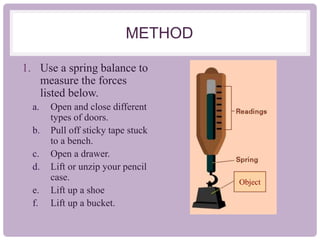
1. Use a spring balance to
measure the forces
listed below.
a.

b.
c.
d.
e.
f.

Open and close different
types of doors.
Pull off sticky tape stuck
to a bench.
Open a drawer.
Lift or unzip your pencil
case.
Lift up a shoe
Lift up a bucket.

Object
METHOD
2. Some of the forces may
change as you measure
them. If so, record the
smallest and largest
measurements you take.
We call this the range of
measurements. Note that
some of the forces may be
too large or too small for
you to be able to measure.

3. Record your results in a
table.
RESULTS
Object
door
sticky tape
pencil case
drawer
shoe

bucket

Measured Force (Newtons, N)
DISCUSSION
1. Look carefully at your results. Explain what factors
made some measurements very large.
1. List the forces in order from smallest to largest. (If
you cannot measure the force, predict the order and
give reasons to justify your answer.)
CONCLUSION
Write your conclusion here.

Measuring forces prac