BY
MOHAMED ABDUL WAHAB MOHAMED
ALI
ASS. LECTURER AT TROPICAL
MEDICINE AND GASTRO-ENTROLOGY
DEPARTMENT
Case Presentation
Case 1
 A 53-year-old patient presents with fatigue, night sweats
and early satiety.
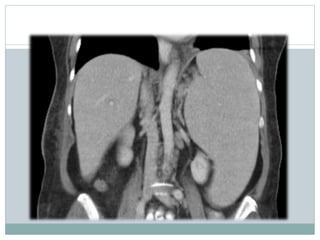
 Physical examination reveals an enlarged spleen.
 CBC is remarkable for a white blood cell (WBC) count
of 34,000/µL, with the differential showing blasts (3%),
promyelocytes, myelocytes, basophils, eosinophils, and
nucleated red blood cells (RBCs).
 leukocyte alkaline phosphatase (LAP) score is 16 ( low).
 Of the following pairings of a diagnosis with an
associated cytogenetic abnormality, which is the most
likely?
A. Acute promyelocytic leukemia, t(15;17)
B. Burkitt lymphoma, t(8;14)
C. Chronic myelogenous leukemia, t(9;22)
D. Follicular lymphoma, t(14;18)
Answer: C. Chronic myelogenous leukemia,
t(9;22)
 Chronic myelogenous (or myeloid) leukemia (CML)
is one of the few malignancies characterized by a
single genetic rearrangement.
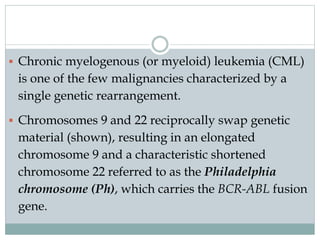
 Chromosomes 9 and 22 reciprocally swap genetic
material (shown), resulting in an elongated
chromosome 9 and a characteristic shortened
chromosome 22 referred to as the Philadelphia
chromosome (Ph), which carries the BCR-ABL fusion
gene.
ABL is an oncogene that is usually translated
into a tyrosine kinase that functions to control
cell proliferation. The fusion gene BCR-
ABL translates into a tyrosine kinase that is
constitutively activated and results in
uncontrolled cell proliferation and evasion of
apoptosis.
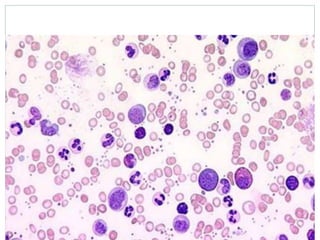
Cells divide continually but do not arrest their
maturation process. The result is a "bone
marrow picture in peripheral blood" that
includes precursor cells as well as intermediate
forms (shown).
Cells are depleted of their enzymes, which is why the
alkaline phosphatase is low in CML but not in leukemoid
reactions.
 The spleen may enlarge and encroach on the gastric body,
resulting in focal pain and early satiety.
The hypermetabolic activity also results in weight loss,
fevers, and night sweats.
High cell turnover can cause hyperuricemia.
The initial workup should include a CBC, a chemistry
profile, serum uric acid level, and BM aspiration and
biopsy.
 Cytogenetic examination of the bone marrow should be
performed to confirm the diagnosis and the stage or phase
of the disease.
Fluorescence in situ hybridization (FISH) testing can
detect BCR-ABL in uncommon cases where Ph is
negative in conjunction with regular cytogenetics.
 Reverse transcription polymerase chain reaction
(RT-PCR) testing is usually also performed on
diagnosis to provide a quantitative estimate of the
burden of disease to follow during therapy.
Which of the following is first-line therapy for Ph-
positive CML?
A.Busulfan
B. Interferon alfa
C. Allogeneic stem-cell transplant
D.Imatinib mesylate
Answer: D. Imatinib mesylate
At one time, allogeneic bone marrow transplant (BMT)
was the first-line therapy for CML; however, with the
advent of imatinib and other tyrosine kinase inhibitors
(TKIs), BMT has come to be considered third- or fourth-
line therapy, except in specific patient subpopulations.
The availability of TKIs has greatly improved patient
survival; the 7-year overall survival for patients receiving
imatinib has been reported to be 85%.
Case 2
A 67-year-old man presents to the office with
fatigue. He also reports recently experiencing
easy bruisability and mild abdominal
discomfort.
Examination reveals a slightly ill-looking man
with a few palpable cervical lymph nodes
measuring 1-2 cm each, a palpable spleen about
3 cm below the left costal margin, and a few
petechiae on his lower extremities
What is the most appropriate next step in the workup?
1) Computed tomography (CT) of the abdomen to rule
out an infiltrative tumor of the spleen
2) Skin biopsy of the petechial rash to confirm the
diagnosis of vasculitis
3) CBC with examination of the peripheral smear for
any abnormalities
4) Referral for emergency plasmapheresis without any
delay
Answer: C. CBC with examination of the peripheral
smear for any abnormalities
The patient's CBC reveals a hemoglobin =11.5 g/dL and
a WBC = 63,000/µL with 92% lymphocytes, platelet
count = 25,000/µL.
Before immunophenotyping became available, the
peripheral blood morphology evaluation was generally
considered sufficient for a diagnosis of CLL. Currently,
however, flow cytometry is considered essential for
demonstrating the clonality of the lymphocytes and
confirming the diagnosis.
The smear shows numerous mature-appearing lymphocytes
with dense nuclei, anemia, and thrombocytopenia; it also shows
the characteristic "smudge cell," which is an artifact of slide
preparation causing disruption of the fragile lymphocytes in
chronic lymphocytic leukemia (CLL).
Flow cytometry in this patient shows a clonal
lymphocytic population that is positive for CD5,
CD20, and CD23, thus confirming the diagnosis
of CLL.
The patient returns 4 weeks later with a rash .
 A repeat CBC shows marked thrombocytopenia
with a platelet count of 10,000/µL.
A bone marrow biopsy reveals 30%
involvement of marrow with neoplastic
lymphocytes, but there also seems to be
adequate active hematopoiesis present, and
megakaryocytes are mildly increased.
What is the most appropriate next step?
A. Start chemotherapy
B. Start prednisone therapy
C. Initiate transfusion of cross-matched platelets
D. Continue with observation because the bone marrow is
not heavily involved with disease
Answer: B. Start prednisone therapy.
Autoimmune thrombocytopenia (AIT) develops in
2-5% of cases of CLL. Autoimmune hemolytic
anemia (AIHA) is seen in as many as 10% of
Pts.About 1/3 of patients who have CLL with AIT
also have AIHA (Evan’s syndrome).
The diagnosis is generally made on clinical
grounds when the bone marrow is not heavily
involved with neoplastic cells and spleen size does
not explain the severe thrombocytopenia.
 Marrow megakaryocytes are generally normal to
increased in number.
 AIT or AIHA usually responds to treatment with
steroids initially, but many patients relapse after
treatment cessation.
 Other options include intravenous (IV)
immunoglobulin, Rituximab (anti-CD20) and,
more recently, alemtuzumab (anti-CD52) have
also been used for the treatment of autoimmune
complications.
Initially, the patient's condition improves with prednisone,
but then it starts to worsen over the following few months.
He also gradually begins to experience more fatigue, a
poorer appetite, and enlarging cervical and mediastinal
LNs
He has a huge splenomegaly by 6 months.
the WBC count is 150,000/µL, the hemoglobin level is
10.5 g/dL, and the platelet count is 20,000/µL.
What is the most appropriate next step?
A. Continue to observe, providing palliative support and
managing symptoms
B. Discuss initiating chemotherapy with the patient
C. Rule out any concurrent infections, which are probably
the reason for the lymphadenopathies
D. Refer the patient to cardiothoracic surgery for excisional
biopsy of the mediastinal lymph nodes
Answer: B. Discuss initiating chemotherapy with patient.
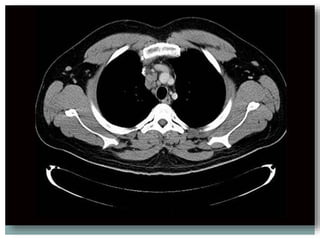
Enlarging lymph nodes, worsening splenomegaly, and
progressive marrow failure are evidence of disease
progression and are indications for chemotherapy.
 Several regimens are in clinical use for treatment of
CLL including fludarabine, bendamustine, and
alkylating agents.
A few targeted/biologic agents have been introduced for
use either alone or in combination with established
chemotherapy.
Case 3
 23 year-old female complains of a rash on her
ankles and shins, and easy bruising for 10 days. The
bruises occur on her arms and sides, unrelated to
trauma.
 she reports nosebleeds, gum bleeding with flossing,
and an unusually heavy menses one week ago.
 She had an upper respiratory infection 3 weeks ago,
which has now resolved.
 On physical exam, she has no lymphadenopathy or
hepatosplenomegaly. Her stool is guaiac positive.
what is the most likely bleeding disorder?
Coagulation abnormality
Abnormality of vascular integrity or platelet function
Answer = Abnormality of vascular integrity or
platelet function
Coagulation abnormalities typically lead to deep
bleeding into the muscles, joints, or body cavities
Mucosal bleeding occurs when there is an
abnormality in vascular integrity due to defects in
vessel wall, or deficiency or defects in von
Willebrand factor or platelets
What additional history would help
you in this case?
 Have you had bleeding problems in the past,
particularly with procedures or trauma?
 What medications and supplements, i.e., not
prescribed by a physician, are you taking?
 Do you drink alcohol? If so, how often?
 Do you use intravenous drugs?
 Do you have exposure to any chemicals or radiation
at work or at home?
 Does anyone in your family have a problem with
bleeding?
 Have you had a recent unexpected loss of weight, ,
fevers, night sweats and fatigue ?
• Do you have any heartburn, dyspepsia, or chronic
indigestion?
II. PHYSICAL EXAM
No splenomegaly or lymphadenopathy
III. LABORATORY DATA
Patient Normal
WBC (x 103/ml) 6.0 4.3-10
Hemoglobin (gm/dl) 13.1 12-16
Hematocrit (%) 39 38-50
RBC (x 106/ml) 4.7 4.2-5.4
MCV (fL) 86 78-96
Platelet Count (x 103/ml) 3 150-450
MPV (fl) 14 7.2-11.1
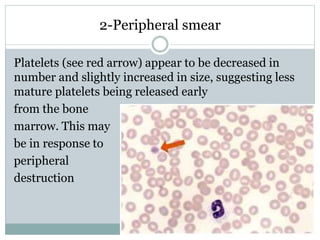
2-Peripheral smear
Platelets (see red arrow) appear to be decreased in
number and slightly increased in size, suggesting less
mature platelets being released early
from the bone
marrow. This may
be in response to
peripheral
destruction
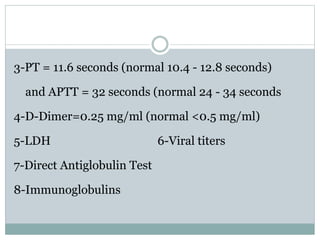
3-PT = 11.6 seconds (normal 10.4 - 12.8 seconds)
and APTT = 32 seconds (normal 24 - 34 seconds
4-D-Dimer=0.25 mg/ml (normal <0.5 mg/ml)
5-LDH 6-Viral titers
7-Direct Antiglobulin Test
8-Immunoglobulins
Interpretation of Laboratory Findings
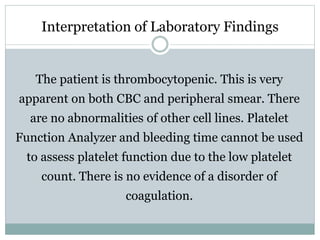
The patient is thrombocytopenic. This is very
apparent on both CBC and peripheral smear. There
are no abnormalities of other cell lines. Platelet
Function Analyzer and bleeding time cannot be used
to assess platelet function due to the low platelet
count. There is no evidence of a disorder of
coagulation.
IV. PATHOPHYSIOLOGY
Decreased Production of Platelets in the Bone
Marrow
Accelerated Destruction of Platelets
Sequestration of Platelets
Dilutional Thrombocytopenia
DIFFERENTIAL DIAGNOSIS
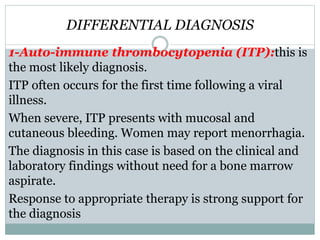
1-Auto-immune thrombocytopenia (ITP):this is
the most likely diagnosis.
ITP often occurs for the first time following a viral
illness.
When severe, ITP presents with mucosal and
cutaneous bleeding. Women may report menorrhagia.
The diagnosis in this case is based on the clinical and
laboratory findings without need for a bone marrow
aspirate.
Response to appropriate therapy is strong support for
the diagnosis
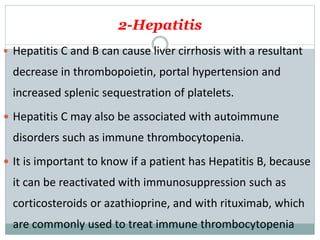
2-Hepatitis
 Hepatitis C and B can cause liver cirrhosis with a resultant
decrease in thrombopoietin, portal hypertension and
increased splenic sequestration of platelets.
 Hepatitis C may also be associated with autoimmune
disorders such as immune thrombocytopenia.
 It is important to know if a patient has Hepatitis B, because
it can be reactivated with immunosuppression such as
corticosteroids or azathioprine, and with rituximab, which
are commonly used to treat immune thrombocytopenia
3- HIV
HIV can cause thrombocytopenia by several different
mechanisms including:
 decreased platelet production due to a direct effect of
the virus on the bone marrow.
 Immune-mediated increased platelet destruction can
also occur.
 HIV-positive patients may also be taking medications
that affect platelet production
4-Systemic Lupus Erythematosus (SLE)
 There is no history of arthritis or other symptoms to
suggest lupus.
 She has no evidence of malar rash or synovitis on
examamination
 Thrombocytopenia can be the first manifestation of
SLE and other autoimmune diseases. It should be
considered in your differential diagnosis, especially in a
young woman.
What are the best treatment options
for this patient?
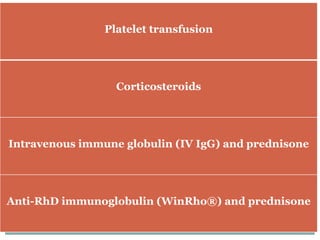
Platelet transfusion
Corticosteroids
Intravenous immune globulin (IV IgG) and prednisone
Anti-RhD immunoglobulin (WinRho®) and prednisone
1-platelet transfusion
 Although it may be necessary in a patient with ITP
who presents with life-threatening bleeding, the
response typically results in small increases in the
platelet count and is of short duration.
 The patient does not have life-threatening bleeding
and does not require transfusion
2-Corticosteroides
 they are an appropriate first choice.
 You begin prednisone at 1-2 mg/kg/day or high dose
dexamethasone daily for 4 days .
 Either treatment has a 60-70% likelihood of success.
However, there are side effects with either form of steroid.
When the platelet count is critically low (i.e. <5,000/ml)
and/or the patient shows signs of serious bleeding,
prednisone alone may not raise the platelet count rapidly .
3-IV IGg and Prednisolone
When the platelet count is critically low (i.e. <5,000/ml)
and/or the patient shows signs of serious bleeding.
 When a rapid increase in platelet count is needed,
intravenous immune globulin should be given in
conjunction with steroid therapy.
Intravenous immunoglobulin therapy blocks antibody-
coated platelets from being removed from the circulation by
monocytes and macrophages
4-Anti-RhD immunoglobulin (WinRho®)
and prednisone
 It may be useful in Rh positive patients. The anti-RhD Ig
attaches to the patient'sRBCs, which are then cleared by the
RES. Theoretically, this competition decreases the
clearance of the antibody coated platelets by the RES.
 It can be used instead of IVIG, and sometimes is given
monthly as a chronic therapy as a second line agent.
 Not surprisingly, administration of anti-RhD can result in
mild to severe hemolysis and anemia.
Thank You

Case presentation

  • 2.
    BY MOHAMED ABDUL WAHABMOHAMED ALI ASS. LECTURER AT TROPICAL MEDICINE AND GASTRO-ENTROLOGY DEPARTMENT Case Presentation
  • 3.
    Case 1  A53-year-old patient presents with fatigue, night sweats and early satiety.  Physical examination reveals an enlarged spleen.  CBC is remarkable for a white blood cell (WBC) count of 34,000/µL, with the differential showing blasts (3%), promyelocytes, myelocytes, basophils, eosinophils, and nucleated red blood cells (RBCs).  leukocyte alkaline phosphatase (LAP) score is 16 ( low).
  • 5.
     Of thefollowing pairings of a diagnosis with an associated cytogenetic abnormality, which is the most likely? A. Acute promyelocytic leukemia, t(15;17) B. Burkitt lymphoma, t(8;14) C. Chronic myelogenous leukemia, t(9;22) D. Follicular lymphoma, t(14;18)
  • 6.
    Answer: C. Chronicmyelogenous leukemia, t(9;22)
  • 7.
     Chronic myelogenous(or myeloid) leukemia (CML) is one of the few malignancies characterized by a single genetic rearrangement.  Chromosomes 9 and 22 reciprocally swap genetic material (shown), resulting in an elongated chromosome 9 and a characteristic shortened chromosome 22 referred to as the Philadelphia chromosome (Ph), which carries the BCR-ABL fusion gene.
  • 9.
    ABL is anoncogene that is usually translated into a tyrosine kinase that functions to control cell proliferation. The fusion gene BCR- ABL translates into a tyrosine kinase that is constitutively activated and results in uncontrolled cell proliferation and evasion of apoptosis.
  • 10.
    Cells divide continuallybut do not arrest their maturation process. The result is a "bone marrow picture in peripheral blood" that includes precursor cells as well as intermediate forms (shown).
  • 12.
    Cells are depletedof their enzymes, which is why the alkaline phosphatase is low in CML but not in leukemoid reactions.  The spleen may enlarge and encroach on the gastric body, resulting in focal pain and early satiety. The hypermetabolic activity also results in weight loss, fevers, and night sweats. High cell turnover can cause hyperuricemia.
  • 13.
    The initial workupshould include a CBC, a chemistry profile, serum uric acid level, and BM aspiration and biopsy.  Cytogenetic examination of the bone marrow should be performed to confirm the diagnosis and the stage or phase of the disease. Fluorescence in situ hybridization (FISH) testing can detect BCR-ABL in uncommon cases where Ph is negative in conjunction with regular cytogenetics.
  • 14.
     Reverse transcriptionpolymerase chain reaction (RT-PCR) testing is usually also performed on diagnosis to provide a quantitative estimate of the burden of disease to follow during therapy.
  • 15.
    Which of thefollowing is first-line therapy for Ph- positive CML? A.Busulfan B. Interferon alfa C. Allogeneic stem-cell transplant D.Imatinib mesylate
  • 16.
    Answer: D. Imatinibmesylate At one time, allogeneic bone marrow transplant (BMT) was the first-line therapy for CML; however, with the advent of imatinib and other tyrosine kinase inhibitors (TKIs), BMT has come to be considered third- or fourth- line therapy, except in specific patient subpopulations. The availability of TKIs has greatly improved patient survival; the 7-year overall survival for patients receiving imatinib has been reported to be 85%.
  • 18.
    Case 2 A 67-year-oldman presents to the office with fatigue. He also reports recently experiencing easy bruisability and mild abdominal discomfort. Examination reveals a slightly ill-looking man with a few palpable cervical lymph nodes measuring 1-2 cm each, a palpable spleen about 3 cm below the left costal margin, and a few petechiae on his lower extremities
  • 20.
    What is themost appropriate next step in the workup? 1) Computed tomography (CT) of the abdomen to rule out an infiltrative tumor of the spleen 2) Skin biopsy of the petechial rash to confirm the diagnosis of vasculitis 3) CBC with examination of the peripheral smear for any abnormalities 4) Referral for emergency plasmapheresis without any delay
  • 21.
    Answer: C. CBCwith examination of the peripheral smear for any abnormalities
  • 22.
    The patient's CBCreveals a hemoglobin =11.5 g/dL and a WBC = 63,000/µL with 92% lymphocytes, platelet count = 25,000/µL. Before immunophenotyping became available, the peripheral blood morphology evaluation was generally considered sufficient for a diagnosis of CLL. Currently, however, flow cytometry is considered essential for demonstrating the clonality of the lymphocytes and confirming the diagnosis.
  • 23.
    The smear showsnumerous mature-appearing lymphocytes with dense nuclei, anemia, and thrombocytopenia; it also shows the characteristic "smudge cell," which is an artifact of slide preparation causing disruption of the fragile lymphocytes in chronic lymphocytic leukemia (CLL).
  • 24.
    Flow cytometry inthis patient shows a clonal lymphocytic population that is positive for CD5, CD20, and CD23, thus confirming the diagnosis of CLL. The patient returns 4 weeks later with a rash .  A repeat CBC shows marked thrombocytopenia with a platelet count of 10,000/µL.
  • 25.
    A bone marrowbiopsy reveals 30% involvement of marrow with neoplastic lymphocytes, but there also seems to be adequate active hematopoiesis present, and megakaryocytes are mildly increased.
  • 26.
    What is themost appropriate next step? A. Start chemotherapy B. Start prednisone therapy C. Initiate transfusion of cross-matched platelets D. Continue with observation because the bone marrow is not heavily involved with disease
  • 27.
    Answer: B. Startprednisone therapy.
  • 28.
    Autoimmune thrombocytopenia (AIT)develops in 2-5% of cases of CLL. Autoimmune hemolytic anemia (AIHA) is seen in as many as 10% of Pts.About 1/3 of patients who have CLL with AIT also have AIHA (Evan’s syndrome). The diagnosis is generally made on clinical grounds when the bone marrow is not heavily involved with neoplastic cells and spleen size does not explain the severe thrombocytopenia.
  • 29.
     Marrow megakaryocytesare generally normal to increased in number.  AIT or AIHA usually responds to treatment with steroids initially, but many patients relapse after treatment cessation.  Other options include intravenous (IV) immunoglobulin, Rituximab (anti-CD20) and, more recently, alemtuzumab (anti-CD52) have also been used for the treatment of autoimmune complications.
  • 30.
    Initially, the patient'scondition improves with prednisone, but then it starts to worsen over the following few months. He also gradually begins to experience more fatigue, a poorer appetite, and enlarging cervical and mediastinal LNs He has a huge splenomegaly by 6 months. the WBC count is 150,000/µL, the hemoglobin level is 10.5 g/dL, and the platelet count is 20,000/µL.
  • 31.
    What is themost appropriate next step? A. Continue to observe, providing palliative support and managing symptoms B. Discuss initiating chemotherapy with the patient C. Rule out any concurrent infections, which are probably the reason for the lymphadenopathies D. Refer the patient to cardiothoracic surgery for excisional biopsy of the mediastinal lymph nodes
  • 33.
    Answer: B. Discussinitiating chemotherapy with patient. Enlarging lymph nodes, worsening splenomegaly, and progressive marrow failure are evidence of disease progression and are indications for chemotherapy.  Several regimens are in clinical use for treatment of CLL including fludarabine, bendamustine, and alkylating agents. A few targeted/biologic agents have been introduced for use either alone or in combination with established chemotherapy.
  • 35.
    Case 3  23year-old female complains of a rash on her ankles and shins, and easy bruising for 10 days. The bruises occur on her arms and sides, unrelated to trauma.  she reports nosebleeds, gum bleeding with flossing, and an unusually heavy menses one week ago.  She had an upper respiratory infection 3 weeks ago, which has now resolved.  On physical exam, she has no lymphadenopathy or hepatosplenomegaly. Her stool is guaiac positive.
  • 36.
    what is themost likely bleeding disorder? Coagulation abnormality Abnormality of vascular integrity or platelet function
  • 37.
    Answer = Abnormalityof vascular integrity or platelet function Coagulation abnormalities typically lead to deep bleeding into the muscles, joints, or body cavities Mucosal bleeding occurs when there is an abnormality in vascular integrity due to defects in vessel wall, or deficiency or defects in von Willebrand factor or platelets
  • 38.
    What additional historywould help you in this case?
  • 39.
     Have youhad bleeding problems in the past, particularly with procedures or trauma?  What medications and supplements, i.e., not prescribed by a physician, are you taking?  Do you drink alcohol? If so, how often?  Do you use intravenous drugs?  Do you have exposure to any chemicals or radiation at work or at home?  Does anyone in your family have a problem with bleeding?
  • 40.
     Have youhad a recent unexpected loss of weight, , fevers, night sweats and fatigue ? • Do you have any heartburn, dyspepsia, or chronic indigestion? II. PHYSICAL EXAM No splenomegaly or lymphadenopathy
  • 41.
    III. LABORATORY DATA PatientNormal WBC (x 103/ml) 6.0 4.3-10 Hemoglobin (gm/dl) 13.1 12-16 Hematocrit (%) 39 38-50 RBC (x 106/ml) 4.7 4.2-5.4 MCV (fL) 86 78-96 Platelet Count (x 103/ml) 3 150-450 MPV (fl) 14 7.2-11.1
  • 42.
    2-Peripheral smear Platelets (seered arrow) appear to be decreased in number and slightly increased in size, suggesting less mature platelets being released early from the bone marrow. This may be in response to peripheral destruction
  • 43.
    3-PT = 11.6seconds (normal 10.4 - 12.8 seconds) and APTT = 32 seconds (normal 24 - 34 seconds 4-D-Dimer=0.25 mg/ml (normal <0.5 mg/ml) 5-LDH 6-Viral titers 7-Direct Antiglobulin Test 8-Immunoglobulins
  • 44.
    Interpretation of LaboratoryFindings The patient is thrombocytopenic. This is very apparent on both CBC and peripheral smear. There are no abnormalities of other cell lines. Platelet Function Analyzer and bleeding time cannot be used to assess platelet function due to the low platelet count. There is no evidence of a disorder of coagulation.
  • 45.
    IV. PATHOPHYSIOLOGY Decreased Productionof Platelets in the Bone Marrow Accelerated Destruction of Platelets Sequestration of Platelets Dilutional Thrombocytopenia
  • 46.
    DIFFERENTIAL DIAGNOSIS 1-Auto-immune thrombocytopenia(ITP):this is the most likely diagnosis. ITP often occurs for the first time following a viral illness. When severe, ITP presents with mucosal and cutaneous bleeding. Women may report menorrhagia. The diagnosis in this case is based on the clinical and laboratory findings without need for a bone marrow aspirate. Response to appropriate therapy is strong support for the diagnosis
  • 47.
    2-Hepatitis  Hepatitis Cand B can cause liver cirrhosis with a resultant decrease in thrombopoietin, portal hypertension and increased splenic sequestration of platelets.  Hepatitis C may also be associated with autoimmune disorders such as immune thrombocytopenia.  It is important to know if a patient has Hepatitis B, because it can be reactivated with immunosuppression such as corticosteroids or azathioprine, and with rituximab, which are commonly used to treat immune thrombocytopenia
  • 48.
    3- HIV HIV cancause thrombocytopenia by several different mechanisms including:  decreased platelet production due to a direct effect of the virus on the bone marrow.  Immune-mediated increased platelet destruction can also occur.  HIV-positive patients may also be taking medications that affect platelet production
  • 49.
    4-Systemic Lupus Erythematosus(SLE)  There is no history of arthritis or other symptoms to suggest lupus.  She has no evidence of malar rash or synovitis on examamination  Thrombocytopenia can be the first manifestation of SLE and other autoimmune diseases. It should be considered in your differential diagnosis, especially in a young woman.
  • 50.
    What are thebest treatment options for this patient?
  • 51.
    Platelet transfusion Corticosteroids Intravenous immuneglobulin (IV IgG) and prednisone Anti-RhD immunoglobulin (WinRho®) and prednisone
  • 52.
    1-platelet transfusion  Althoughit may be necessary in a patient with ITP who presents with life-threatening bleeding, the response typically results in small increases in the platelet count and is of short duration.  The patient does not have life-threatening bleeding and does not require transfusion
  • 53.
    2-Corticosteroides  they arean appropriate first choice.  You begin prednisone at 1-2 mg/kg/day or high dose dexamethasone daily for 4 days .  Either treatment has a 60-70% likelihood of success. However, there are side effects with either form of steroid. When the platelet count is critically low (i.e. <5,000/ml) and/or the patient shows signs of serious bleeding, prednisone alone may not raise the platelet count rapidly .
  • 54.
    3-IV IGg andPrednisolone When the platelet count is critically low (i.e. <5,000/ml) and/or the patient shows signs of serious bleeding.  When a rapid increase in platelet count is needed, intravenous immune globulin should be given in conjunction with steroid therapy. Intravenous immunoglobulin therapy blocks antibody- coated platelets from being removed from the circulation by monocytes and macrophages
  • 55.
    4-Anti-RhD immunoglobulin (WinRho®) andprednisone  It may be useful in Rh positive patients. The anti-RhD Ig attaches to the patient'sRBCs, which are then cleared by the RES. Theoretically, this competition decreases the clearance of the antibody coated platelets by the RES.  It can be used instead of IVIG, and sometimes is given monthly as a chronic therapy as a second line agent.  Not surprisingly, administration of anti-RhD can result in mild to severe hemolysis and anemia.
  • 56.