PROJECT REPORT
ON
AUTOMATIC TRAFFIC SIGN & SIGNAL DETECTION
In partial fulfillment of the requirements for the award of the degree of
Bachelor of Technology
In
Electronics & Communication Engineering
Maulana Abul Kalam Azad University of Technology
(Formerly known as West Bengal University of Technology)
Submitted by
MILAN MAHADANI (11900312036)
PIYUSH BENIA (11900312042)
NISHAT TARIK (11900312039)
Under the guidance of
Mr. MANAS SAHA
Asst. Prof. of ECE Dept.
S.I.T Siliguri
DEPARTMENT OF ELECTRONICS & COMMUNICATION
ENGINEERING
SILIGURI INSTITUTE OF TECHNOLOGY
PO: SUKNA, SILIGURI, PIN: 734 009, WEST BENGAL
2015-2016
SILIGURI INSTITUTE OF TECHNOLOGY
PO: SUKNA, SILIGURI, PIN: 734 009, WEST BENGAL
2015-2016
DEPARTMENT OF ELECTRONICS & COMMUNICATION ENGINEERING
CERTIFICATE
Certified that the project work entitled ‘AUTOMATIC TRAFFIC SIGN & SIGNAL DETECTION’ is a
bonafied work carried out by:
MILAN MAHADANI ROLL NO. 11900312036
PIYUSH BENIA ROLL NO. 11900312042
NISHAT TARIK ROLL NO. 11900312039
In partial fulfillment for the award for degree of BACHELOR OF TECHNOLOGY in
ELECTRONICS & COMMUNICATION ENGINEERING of the MAULANA ABUL KALAM
AZAD UNIVERSITY OF TECHNOLOGY, WEST BENGAL (Formerly known as West Bengal University
of Technology) during the year 2015-2016. It is certified that all corrections/suggestions
indicated for Internal Assessment has been incorporated in the report deposited in the
Department. The project report has been approved as it satisfies the academic
requirements in respect of Project Work prescribed for Bachelor of Engineering Degree.
------------------------ -------------------------------
Mr. MANAS SAHA Mr. GAUTAM DAS
Asst. Prof. ECE Dept Head of ECE Dept.
SIT, Siliguri SIT Siliguri
CONTENTS
1. Acknowledgement………………………………………………………………1
2. Abstract………………………………………………………………………….2
3. Introduction……………………………………………………………………...3
4. Review of literature……………………………………………………………...4
5. Components Description………………………………………………………...5-9
6. Operation………………………………………………………………………...10
7. Result & Discussion……………………………………………………………..11-13
8. Applications & Advantages……………………………………………………..14
9. Merits and Demerits……………………………………………………………..15
10. Conclusion……………………………………………………………………….16
11. References……………………………………………………………………….17
List of Figures:
12. Abstract
12.1Automatic Traffic Signal Detection……….……………………..……………………..2
13. Introduction
14. Review of literature
15. Components Description
4.1 Webcam……………………………………..………………………………………….5
4.2 Driver Monitor……………………………………………..…………………………...6
4.3 Speaker……………………………. ……………………......………………………....6
4.4 Main Code………………………………………………………………………………7-9
5 Operation
5.1 Block Diagram of basic operation……………………………………………………...10
5.2 Basic Flow of Operation…………………………………………...…………………..10
6 Result & Discussion
6.1 Webcam mounted car………………………………………………………………….11
6.2 Image Snapping……………………………………………...……...………………....12
6.3 Image Recognition………………………………………...…………………………...13
7 Applications & Advantages
7.1: Surveillance robot in city…………………..……….…………………...14
8 Merits and Demerits
8.1: Implementation of GPS technology………………………………….……..…………...15
ACKNOWLEDGEMENT
Our Project deals with “AUTOMATIC TRAFFIC SIGN AND SIGNAL DETECTION” in
partial fulfilment of the degree of Bachelor of Technology in Electronics and Communication
Dept. under West Bengal University of Technology. First of all, I would like to express my
thanks to my Project Guide Mr. MANAS SAHA, Asst Professor, ECE dept for his valuable
suggestions, efforts and encouragement. I would like to express my sincere thanks to
Dr. GAUTAM DAS, Associate Professor and H.O.D of ECE Dept for this valuable
contribution. We have been fortunate enough that MR. MANAS SAHA and
Dr. GAUTAM DAS gave us the freedom, support and whole hearted co-ordination for the
completion of our project.
Presented By-
PIYUSH BENIA
MILAN MAHADANI
NISHAT TARIK
ABSTRACT:
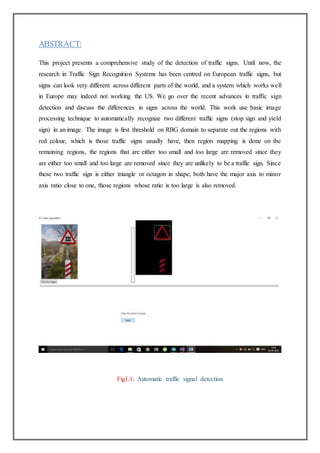
This project presents a comprehensive study of the detection of traffic signs. Until now, the
research in Traffic Sign Recognition Systems has been centred on European traffic signs, but
signs can look very different across different parts of the world, and a system which works well
in Europe may indeed not working the US. We go over the recent advances in traffic sign
detection and discuss the differences in signs across the world. This work use basic image
processing technique to automatically recognize two different traffic signs (stop sign and yield
sign) in an image. The image is first threshold on RBG domain to separate out the regions with
red colour, which is those traffic signs usually have, then region mapping is done on the
remaining regions, the regions that are either too small and too large are removed since they
are either too small and too large are removed since they are unlikely to be a traffic sign. Since
these two traffic sign is either triangle or octagon in shape, both have the major axis to minor
axis ratio close to one, those regions whose ratio is too large is also removed.
Fig1.1: Automatic traffic signal detection
INTRODUCTION:
Traffic sign detection has become an important topic of attention, not only for researchers in
intelligent vehicles and driver assistance areas but also those active in the machine vision area.
Traffic Sign Recognition (TSR) generally consists of two layers, detection and classification.
With the German Traffic Sign Recognition Benchmark (GTSRB) in 2011, the classification
problem was largely solved. To achieve a fully functional TSR system, the detection step needs
to work as well. With the introduction of the German Traffic Sign Detection Benchmark
(GTDSB) competition, a good amount of work has been done to that effect, even with
suggestions of the detection problem being solved.
We contend that while good progress has definitely been made, the research community
is not quite there yet. Not all traffic signs look the same, especially the US signs are
significantly different in appearance from those in Europe. Systems which do not consider them
cannot be expected to perform in the same manner as for what they are designed for namely
almost exclusively European signs. We have taken fresh look at the specific issues, challenges,
features, and evaluation of US traffic signs in a comprehensive manner.
To do this in a systematic way, the very first order of business is to draw out differences
in how these signs appear. Given, these rather stark appearances differences, we undertook a
major database collection, annotation, organization, and public distribution effort. Secondly,
we explored the overall landscape of appearance based object detection research – including
European traffic signs – and carefully selected two most promising approaches, one (Integral
Channel Features) which has offered very good results on European signs and another
(Aggregate Channel Features) which was very recently introduced in the literature, but has
never been applied to the traffic sign case. TSR is becoming more and more relevant, as cars
obtain better and better Advanced Driver Assistance Systems (ADAS).
REVIEW OF LITERATURE:
Review of Literature, basically mean the survey of scholarly articles, books and other sources
(e.g. dissertations, conference proceedings) relevant to a particular issue, area of research, or
theory, providing a description, summary, and critical evaluation of each work. The purpose is
to offer an overview of significant literature published on a topic.
Similar to primary research, development of the literature review requires four stages:
 Problem formulation- we are basically concerned about road casualties which occur
during adverse weather conditions, to prevent this major issue our desired system will
work as a boon to our society.
 Literature search-
Arturo de la Escalera and Miguel Angel Salichs, ”Road Traffic Sign Detection
and Classification”, IEEE Transactions on Industrial Electronics, vol. 44, No. 6,
December 1997.
Long Chen, QingQuan Li, Ming Li, and Qingzhou Mao, ”Traffic Sign Detection
and Recognition for Intelligent Vehicle”, IEEE Intelligent Vehicles Symposium (IV),
Baden- Baden, Germany, June 5-9, 2011.
Hilario Gomez-Moreno, Pedro Gil-Jimenez and Sergio Lafuente-Arroyo, “Goal
Evaluation of Segmentation Algorithms for Traffic Sign Recognition”, IEEE
Transactions on Intelligent Transportation Systems, vol. 11, No. 4, December 2010.
Analysis and interpretation- This design is developed to ensure the safety of the people.
By implementing this design a safe journey is possible decreasing the accident rate. If this
system is installed in the car then driving will become much easier and hassle free. In this
project we tried to develop a basic image processing algorithm to recognize stop sign and
yield sign in an image. The Processing methods used in this algorithm include R, G, B
domain thresholding, image dilation, region mapping and thresholding based on region
properties, etc.
COMPONENTS DESCRIPTION:
In this project we have used two types of components. These are
 Hardware
 Software
Hardware Parts:-
In this the major hardware parts are
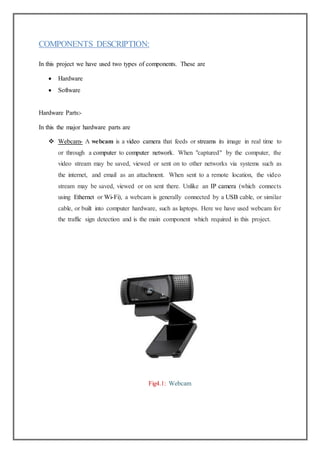
 Webcam- A webcam is a video camera that feeds or streams its image in real time to
or through a computer to computer network. When "captured" by the computer, the
video stream may be saved, viewed or sent on to other networks via systems such as
the internet, and email as an attachment. When sent to a remote location, the video
stream may be saved, viewed or on sent there. Unlike an IP camera (which connects
using Ethernet or Wi-Fi), a webcam is generally connected by a USB cable, or similar
cable, or built into computer hardware, such as laptops. Here we have used webcam for
the traffic sign detection and is the main component which required in this project.
Fig4.1: Webcam
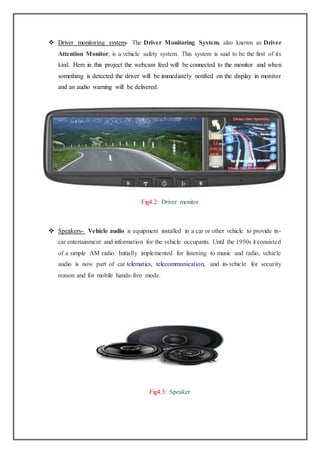
 Driver monitoring system- The Driver Monitoring System, also known as Driver
Attention Monitor, is a vehicle safety system. This system is said to be the first of its
kind. Here in this project the webcam feed will be connected to the monitor and when
something is detected the driver will be immediately notified on the display in monitor
and an audio warning will be delivered.
Fig4.2: Driver monitor
 Speakers- Vehicle audio is equipment installed in a car or other vehicle to provide in-
car entertainment and information for the vehicle occupants. Until the 1950s it consisted
of a simple AM radio. Initially implemented for listening to music and radio, vehicle
audio is now part of car telematics, telecommunication, and in-vehicle for security
reason and for mobile hands-free mode.
Fig4.3: Speaker
Software Parts:-
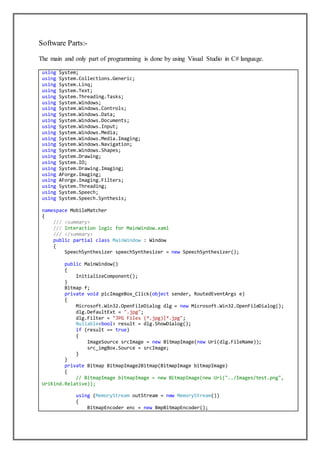
The main and only part of programming is done by using Visual Studio in C# language.
using System;
using System.Collections.Generic;
using System.Linq;
using System.Text;
using System.Threading.Tasks;
using System.Windows;
using System.Windows.Controls;
using System.Windows.Data;
using System.Windows.Documents;
using System.Windows.Input;
using System.Windows.Media;
using System.Windows.Media.Imaging;
using System.Windows.Navigation;
using System.Windows.Shapes;
using System.Drawing;
using System.IO;
using System.Drawing.Imaging;
using AForge.Imaging;
using AForge.Imaging.Filters;
using System.Threading;
using System.Speech;
using System.Speech.Synthesis;
namespace MobileMatcher
{
/// <summary>
/// Interaction logic for MainWindow.xaml
/// </summary>
public partial class MainWindow : Window
{
SpeechSynthesizer speechSynthesizer = new SpeechSynthesizer();
public MainWindow()
{
InitializeComponent();
}
Bitmap f;
private void picImageBox_Click(object sender, RoutedEventArgs e)
{
Microsoft.Win32.OpenFileDialog dlg = new Microsoft.Win32.OpenFileDialog();
dlg.DefaultExt = ".jpg";
dlg.Filter = "JPG Files (*.jpg)|*.jpg";
Nullable<bool> result = dlg.ShowDialog();
if (result == true)
{
ImageSource srcImage = new BitmapImage(new Uri(dlg.FileName));
src_imgBox.Source = srcImage;
}
}
private Bitmap BitmapImage2Bitmap(BitmapImage bitmapImage)
{
// BitmapImage bitmapImage = new BitmapImage(new Uri("../Images/test.png",
UriKind.Relative));
using (MemoryStream outStream = new MemoryStream())
{
BitmapEncoder enc = new BmpBitmapEncoder();
enc.Frames.Add(BitmapFrame.Create(bitmapImage));
enc.Save(outStream);
System.Drawing.Bitmap bitmap = new System.Drawing.Bitmap(outStream);
return new Bitmap(bitmap);
}
}
private ImageSource Bitmap2ImageSource(Bitmap bitmapImage)
{
// BitmapImage bitmapImage = new BitmapImage(new Uri("../Images/test.png",
UriKind.Relative));
using (MemoryStream outStream = new MemoryStream())
{
MemoryStream ms = new MemoryStream();
bitmapImage.Save(ms, ImageFormat.Bmp);
ms.Seek(0, SeekOrigin.Begin);
BitmapImage bi = new BitmapImage();
bi.BeginInit();
bi.StreamSource = ms;
bi.EndInit();
bi.Freeze();
return bi;
}
}
private void pick_templete_image_Click(object sender, RoutedEventArgs e)
{
Microsoft.Win32.OpenFileDialog dlg = new Microsoft.Win32.OpenFileDialog();
dlg.DefaultExt = ".png";
dlg.Filter = "PNG Files (*.png)|*.png|JPG Files (*.jpg)|*.jpg|GIF Files
(*.gif)|*.gif";
Nullable<bool> result = dlg.ShowDialog();
if (result == true)
{
ImageSource tempImage = new BitmapImage(new Uri(dlg.FileName));
dimg.Source = tempImage;
}
}
private Bitmap bitmapconverter(Bitmap image)
{
Bitmap pic1 = new Bitmap(image.Width, image.Height,
System.Drawing.Imaging.PixelFormat.Format24bppRgb);
return image;
}
private void cmp_Click(object sender, RoutedEventArgs e)
{
BitmapImage srcimg = src_imgBox.Source as BitmapImage;
Bitmap img = BitmapImage2Bitmap(srcimg);
EuclideanColorFiltering filter = new EuclideanColorFiltering();
// set center color and radius
filter.CenterColor = new RGB(255, 10, 10);
filter.Radius = 150;
filter.ApplyInPlace(img);
BlobCounter blobCounter = new BlobCounter();
blobCounter.MinWidth = 5;
blobCounter.MinHeight = 5;
blobCounter.FilterBlobs = true;
blobCounter.ObjectsOrder = ObjectsOrder.Size;
blobCounter.ProcessImage(img);
System.Drawing.Rectangle[] rects = blobCounter.GetObjectsRectangles();
ExtractBiggestBlob filter1 = new ExtractBiggestBlob();
// apply the filter to get original output
Bitmap biggestBlobsImage = filter.Apply(img);
foreach (System.Drawing.Rectangle recs in rects)
if (rects.Length > 0)
{
System.Drawing.Rectangle objectRect = rects[0];
Graphics g = Graphics.FromImage(img);
using (System.Drawing.Pen pen = new
System.Drawing.Pen(System.Drawing.Color.FromArgb(160, 255, 160), 5))
{
g.DrawRectangle(pen, objectRect);
}
g.Dispose();
}
/*Dispatcher.BeginInvoke(new ThreadStart(delegate
{
speechSynthesizer.Speak("Warning!!!");
}));*/
MemoryStream ms = new MemoryStream();
img.Save(ms, ImageFormat.Bmp);
ms.Seek(0, SeekOrigin.Begin);
BitmapImage bi = new BitmapImage();
bi.BeginInit();
bi.StreamSource = ms;
bi.EndInit();
bi.Freeze();
Dispatcher.BeginInvoke(new ThreadStart(delegate
{
dimg.Source = bi;
}));
}
}
}
Fig4.4: Main Code
OPERATION:
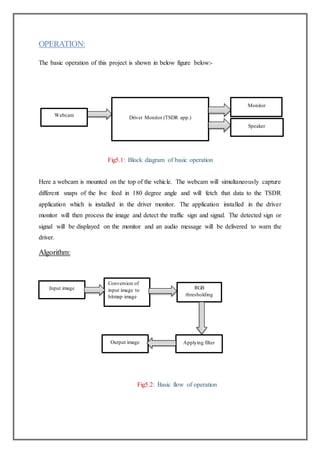
The basic operation of this project is shown in below figure below:-
Fig5.1: Block diagram of basic operation
Here a webcam is mounted on the top of the vehicle. The webcam will simultaneously capture
different snaps of the live feed in 180 degree angle and will fetch that data to the TSDR
application which is installed in the driver monitor. The application installed in the driver
monitor will then process the image and detect the traffic sign and signal. The detected sign or
signal will be displayed on the monitor and an audio message will be delivered to warn the
driver.
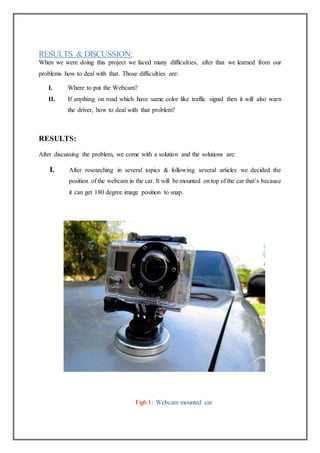
Algorithm:
Fig5.2: Basic flow of operation
Driver Monitor (TSDR app.)Webcam
Monitor
Speaker
Input image
Conversion of
input image to
bitmap image
RGB
thresholding
Applying filterOutput image
RESULTS & DISCUSSION:
When we were doing this project we faced many difficulties, after that we learned from our
problems how to deal with that. Those difficulties are:
I. Where to put the Webcam?
II. If anything on road which have same color like traffic signal then it will also warn
the driver, how to deal with that problem?
RESULTS:
After discussing the problem, we come with a solution and the solutions are:
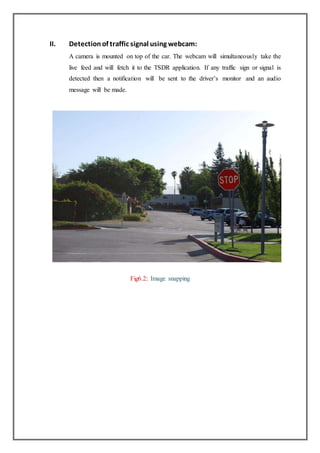
I. After researching in several topics & following several articles we decided the
position of the webcam in the car. It will be mounted on top of the car that’s because
it can get 180 degree image position to snap.
Fig6.1: Webcam mounted car
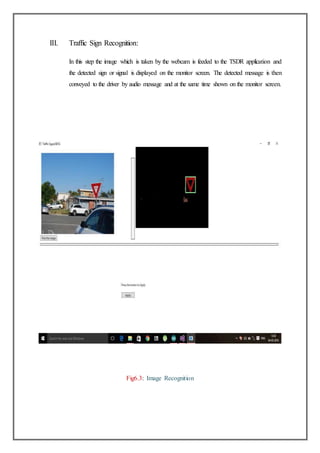
II. Detectionof traffic signal using webcam:
A camera is mounted on top of the car. The webcam will simultaneously take the
live feed and will fetch it to the TSDR application. If any traffic sign or signal is
detected then a notification will be sent to the driver’s monitor and an audio
message will be made.
Fig6.2: Image snapping
III. Traffic Sign Recognition:
In this step the image which is taken by the webcam is feeded to the TSDR application and
the detected sign or signal is displayed on the monitor screen. The detected message is then
conveyed to the driver by audio message and at the same time shown on the monitor screen.
Fig6.3: Image Recognition
APPLICATION & ADVANTAGES:
Applications of traffic sign detection in car:
I. “Traffic Sign Detector Project” can be used in the various vehicles for detecting
and notifying the driver about the traffic sign detected ahead if the driver is busy in
some other activity.
II. In hill areas where fog prevails all-round the year, this type of system will be used
better and helpful. With the use of this system hill accidents can be avoided as the
notification will be sent to the driver beforehand.
III. We can make a surveillance robot using this system and plant the robot in any city
or area. The robot will freely roam in the city and gather all the information. If the
amount of garbage is out of limit, then the robot will collect the information & send
the information to any concern authorities.
Fig7.1: Surveillance robot in city
MERITS and DEMERITS:
Merits:
I. “Traffic Sign Detection System” in cars provides an automatic safety system
for cars and drivers.
II. It reduces the chance of road accidents.
III. It increases the awareness among the people.
IV. It is cost efficient, so it is easy to maintain.
Demerits:
I. Since it’s a color segmented process so sometimes when similar color is detected,
which is not a traffic signal then also sometimes it gives warning.
II. We should concern about braking system, emergency braking can hamper any one’s
life.
Future development:
I. We can implement GSM technology to inform the relatives or owners of the vehicle
if any accident occurs.
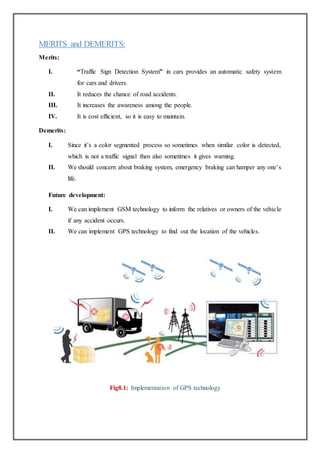
II. We can implement GPS technology to find out the location of the vehicles.
Fig8.1: Implementation of GPS technology
CONCLUSION:
This design is developed to ensure the safety of the people. By implementing this design a
safe journey is possible decreasing the accident rate. Government must enforce laws to
install such circuit in every car and must regulate all car companies to preinstall such
mechanism while manufacturing the car itself. If this system is installed in the car then
driving will become much easier and hassle free. This project tried to develop a basic image
processing algorithm to recognize stop sign and yield sign in an image. The Processing
methods used in this algorithm include R, G, B domain thresholding, image dilation, region
mapping and thresholding based on region properties, etc.
In this type of system, future scope can be safely landing of car aside without disturbing
other vehicles.
REFERENCES:
 Arturo de la Escalera and Miguel Angel Salichs, ”Road Traffic Sign Detection and
Classification”, IEEE Transactions on Industrial Electronics, vol. 44, No. 6, December
1997.
 Long Chen, QingQuan Li, Ming Li, and Qingzhou Mao, ”Traffic Sign Detection and
Recognition for Intelligent Vehicle”, IEEE Intelligent Vehicles Symposium (IV),
Baden- Baden, Germany, June 5-9, 2011.
 Hilario Gomez-Moreno, Pedro Gil-Jimenez and Sergio Lafuente-Arroyo, “Goal
Evaluation of Segmentation Algorithms for Traffic Sign Recognition”, IEEE
Transactions on Intelligent Transportation Systems, vol. 11, No. 4, December 2010.

project complete - Copy

  • 1.
    PROJECT REPORT ON AUTOMATIC TRAFFICSIGN & SIGNAL DETECTION In partial fulfillment of the requirements for the award of the degree of Bachelor of Technology In Electronics & Communication Engineering Maulana Abul Kalam Azad University of Technology (Formerly known as West Bengal University of Technology) Submitted by MILAN MAHADANI (11900312036) PIYUSH BENIA (11900312042) NISHAT TARIK (11900312039) Under the guidance of Mr. MANAS SAHA Asst. Prof. of ECE Dept. S.I.T Siliguri DEPARTMENT OF ELECTRONICS & COMMUNICATION ENGINEERING SILIGURI INSTITUTE OF TECHNOLOGY PO: SUKNA, SILIGURI, PIN: 734 009, WEST BENGAL 2015-2016
  • 2.
    SILIGURI INSTITUTE OFTECHNOLOGY PO: SUKNA, SILIGURI, PIN: 734 009, WEST BENGAL 2015-2016 DEPARTMENT OF ELECTRONICS & COMMUNICATION ENGINEERING CERTIFICATE Certified that the project work entitled ‘AUTOMATIC TRAFFIC SIGN & SIGNAL DETECTION’ is a bonafied work carried out by: MILAN MAHADANI ROLL NO. 11900312036 PIYUSH BENIA ROLL NO. 11900312042 NISHAT TARIK ROLL NO. 11900312039 In partial fulfillment for the award for degree of BACHELOR OF TECHNOLOGY in ELECTRONICS & COMMUNICATION ENGINEERING of the MAULANA ABUL KALAM AZAD UNIVERSITY OF TECHNOLOGY, WEST BENGAL (Formerly known as West Bengal University of Technology) during the year 2015-2016. It is certified that all corrections/suggestions indicated for Internal Assessment has been incorporated in the report deposited in the Department. The project report has been approved as it satisfies the academic requirements in respect of Project Work prescribed for Bachelor of Engineering Degree. ------------------------ ------------------------------- Mr. MANAS SAHA Mr. GAUTAM DAS Asst. Prof. ECE Dept Head of ECE Dept. SIT, Siliguri SIT Siliguri
  • 3.
    CONTENTS 1. Acknowledgement………………………………………………………………1 2. Abstract………………………………………………………………………….2 3.Introduction……………………………………………………………………...3 4. Review of literature……………………………………………………………...4 5. Components Description………………………………………………………...5-9 6. Operation………………………………………………………………………...10 7. Result & Discussion……………………………………………………………..11-13 8. Applications & Advantages……………………………………………………..14 9. Merits and Demerits……………………………………………………………..15 10. Conclusion……………………………………………………………………….16 11. References……………………………………………………………………….17
  • 4.
    List of Figures: 12.Abstract 12.1Automatic Traffic Signal Detection……….……………………..……………………..2 13. Introduction 14. Review of literature 15. Components Description 4.1 Webcam……………………………………..………………………………………….5 4.2 Driver Monitor……………………………………………..…………………………...6 4.3 Speaker……………………………. ……………………......………………………....6 4.4 Main Code………………………………………………………………………………7-9 5 Operation 5.1 Block Diagram of basic operation……………………………………………………...10 5.2 Basic Flow of Operation…………………………………………...…………………..10 6 Result & Discussion 6.1 Webcam mounted car………………………………………………………………….11 6.2 Image Snapping……………………………………………...……...………………....12 6.3 Image Recognition………………………………………...…………………………...13 7 Applications & Advantages 7.1: Surveillance robot in city…………………..……….…………………...14 8 Merits and Demerits 8.1: Implementation of GPS technology………………………………….……..…………...15
  • 5.
    ACKNOWLEDGEMENT Our Project dealswith “AUTOMATIC TRAFFIC SIGN AND SIGNAL DETECTION” in partial fulfilment of the degree of Bachelor of Technology in Electronics and Communication Dept. under West Bengal University of Technology. First of all, I would like to express my thanks to my Project Guide Mr. MANAS SAHA, Asst Professor, ECE dept for his valuable suggestions, efforts and encouragement. I would like to express my sincere thanks to Dr. GAUTAM DAS, Associate Professor and H.O.D of ECE Dept for this valuable contribution. We have been fortunate enough that MR. MANAS SAHA and Dr. GAUTAM DAS gave us the freedom, support and whole hearted co-ordination for the completion of our project. Presented By- PIYUSH BENIA MILAN MAHADANI NISHAT TARIK
  • 6.
    ABSTRACT: This project presentsa comprehensive study of the detection of traffic signs. Until now, the research in Traffic Sign Recognition Systems has been centred on European traffic signs, but signs can look very different across different parts of the world, and a system which works well in Europe may indeed not working the US. We go over the recent advances in traffic sign detection and discuss the differences in signs across the world. This work use basic image processing technique to automatically recognize two different traffic signs (stop sign and yield sign) in an image. The image is first threshold on RBG domain to separate out the regions with red colour, which is those traffic signs usually have, then region mapping is done on the remaining regions, the regions that are either too small and too large are removed since they are either too small and too large are removed since they are unlikely to be a traffic sign. Since these two traffic sign is either triangle or octagon in shape, both have the major axis to minor axis ratio close to one, those regions whose ratio is too large is also removed. Fig1.1: Automatic traffic signal detection
  • 7.
    INTRODUCTION: Traffic sign detectionhas become an important topic of attention, not only for researchers in intelligent vehicles and driver assistance areas but also those active in the machine vision area. Traffic Sign Recognition (TSR) generally consists of two layers, detection and classification. With the German Traffic Sign Recognition Benchmark (GTSRB) in 2011, the classification problem was largely solved. To achieve a fully functional TSR system, the detection step needs to work as well. With the introduction of the German Traffic Sign Detection Benchmark (GTDSB) competition, a good amount of work has been done to that effect, even with suggestions of the detection problem being solved. We contend that while good progress has definitely been made, the research community is not quite there yet. Not all traffic signs look the same, especially the US signs are significantly different in appearance from those in Europe. Systems which do not consider them cannot be expected to perform in the same manner as for what they are designed for namely almost exclusively European signs. We have taken fresh look at the specific issues, challenges, features, and evaluation of US traffic signs in a comprehensive manner. To do this in a systematic way, the very first order of business is to draw out differences in how these signs appear. Given, these rather stark appearances differences, we undertook a major database collection, annotation, organization, and public distribution effort. Secondly, we explored the overall landscape of appearance based object detection research – including European traffic signs – and carefully selected two most promising approaches, one (Integral Channel Features) which has offered very good results on European signs and another (Aggregate Channel Features) which was very recently introduced in the literature, but has never been applied to the traffic sign case. TSR is becoming more and more relevant, as cars obtain better and better Advanced Driver Assistance Systems (ADAS).
  • 8.
    REVIEW OF LITERATURE: Reviewof Literature, basically mean the survey of scholarly articles, books and other sources (e.g. dissertations, conference proceedings) relevant to a particular issue, area of research, or theory, providing a description, summary, and critical evaluation of each work. The purpose is to offer an overview of significant literature published on a topic. Similar to primary research, development of the literature review requires four stages:  Problem formulation- we are basically concerned about road casualties which occur during adverse weather conditions, to prevent this major issue our desired system will work as a boon to our society.  Literature search- Arturo de la Escalera and Miguel Angel Salichs, ”Road Traffic Sign Detection and Classification”, IEEE Transactions on Industrial Electronics, vol. 44, No. 6, December 1997. Long Chen, QingQuan Li, Ming Li, and Qingzhou Mao, ”Traffic Sign Detection and Recognition for Intelligent Vehicle”, IEEE Intelligent Vehicles Symposium (IV), Baden- Baden, Germany, June 5-9, 2011. Hilario Gomez-Moreno, Pedro Gil-Jimenez and Sergio Lafuente-Arroyo, “Goal Evaluation of Segmentation Algorithms for Traffic Sign Recognition”, IEEE Transactions on Intelligent Transportation Systems, vol. 11, No. 4, December 2010. Analysis and interpretation- This design is developed to ensure the safety of the people. By implementing this design a safe journey is possible decreasing the accident rate. If this system is installed in the car then driving will become much easier and hassle free. In this project we tried to develop a basic image processing algorithm to recognize stop sign and yield sign in an image. The Processing methods used in this algorithm include R, G, B domain thresholding, image dilation, region mapping and thresholding based on region properties, etc.
  • 9.
    COMPONENTS DESCRIPTION: In thisproject we have used two types of components. These are  Hardware  Software Hardware Parts:- In this the major hardware parts are  Webcam- A webcam is a video camera that feeds or streams its image in real time to or through a computer to computer network. When "captured" by the computer, the video stream may be saved, viewed or sent on to other networks via systems such as the internet, and email as an attachment. When sent to a remote location, the video stream may be saved, viewed or on sent there. Unlike an IP camera (which connects using Ethernet or Wi-Fi), a webcam is generally connected by a USB cable, or similar cable, or built into computer hardware, such as laptops. Here we have used webcam for the traffic sign detection and is the main component which required in this project. Fig4.1: Webcam
  • 10.
     Driver monitoringsystem- The Driver Monitoring System, also known as Driver Attention Monitor, is a vehicle safety system. This system is said to be the first of its kind. Here in this project the webcam feed will be connected to the monitor and when something is detected the driver will be immediately notified on the display in monitor and an audio warning will be delivered. Fig4.2: Driver monitor  Speakers- Vehicle audio is equipment installed in a car or other vehicle to provide in- car entertainment and information for the vehicle occupants. Until the 1950s it consisted of a simple AM radio. Initially implemented for listening to music and radio, vehicle audio is now part of car telematics, telecommunication, and in-vehicle for security reason and for mobile hands-free mode. Fig4.3: Speaker
  • 11.
    Software Parts:- The mainand only part of programming is done by using Visual Studio in C# language. using System; using System.Collections.Generic; using System.Linq; using System.Text; using System.Threading.Tasks; using System.Windows; using System.Windows.Controls; using System.Windows.Data; using System.Windows.Documents; using System.Windows.Input; using System.Windows.Media; using System.Windows.Media.Imaging; using System.Windows.Navigation; using System.Windows.Shapes; using System.Drawing; using System.IO; using System.Drawing.Imaging; using AForge.Imaging; using AForge.Imaging.Filters; using System.Threading; using System.Speech; using System.Speech.Synthesis; namespace MobileMatcher { /// <summary> /// Interaction logic for MainWindow.xaml /// </summary> public partial class MainWindow : Window { SpeechSynthesizer speechSynthesizer = new SpeechSynthesizer(); public MainWindow() { InitializeComponent(); } Bitmap f; private void picImageBox_Click(object sender, RoutedEventArgs e) { Microsoft.Win32.OpenFileDialog dlg = new Microsoft.Win32.OpenFileDialog(); dlg.DefaultExt = ".jpg"; dlg.Filter = "JPG Files (*.jpg)|*.jpg"; Nullable<bool> result = dlg.ShowDialog(); if (result == true) { ImageSource srcImage = new BitmapImage(new Uri(dlg.FileName)); src_imgBox.Source = srcImage; } } private Bitmap BitmapImage2Bitmap(BitmapImage bitmapImage) { // BitmapImage bitmapImage = new BitmapImage(new Uri("../Images/test.png", UriKind.Relative)); using (MemoryStream outStream = new MemoryStream()) { BitmapEncoder enc = new BmpBitmapEncoder();
  • 12.
    enc.Frames.Add(BitmapFrame.Create(bitmapImage)); enc.Save(outStream); System.Drawing.Bitmap bitmap =new System.Drawing.Bitmap(outStream); return new Bitmap(bitmap); } } private ImageSource Bitmap2ImageSource(Bitmap bitmapImage) { // BitmapImage bitmapImage = new BitmapImage(new Uri("../Images/test.png", UriKind.Relative)); using (MemoryStream outStream = new MemoryStream()) { MemoryStream ms = new MemoryStream(); bitmapImage.Save(ms, ImageFormat.Bmp); ms.Seek(0, SeekOrigin.Begin); BitmapImage bi = new BitmapImage(); bi.BeginInit(); bi.StreamSource = ms; bi.EndInit(); bi.Freeze(); return bi; } } private void pick_templete_image_Click(object sender, RoutedEventArgs e) { Microsoft.Win32.OpenFileDialog dlg = new Microsoft.Win32.OpenFileDialog(); dlg.DefaultExt = ".png"; dlg.Filter = "PNG Files (*.png)|*.png|JPG Files (*.jpg)|*.jpg|GIF Files (*.gif)|*.gif"; Nullable<bool> result = dlg.ShowDialog(); if (result == true) { ImageSource tempImage = new BitmapImage(new Uri(dlg.FileName)); dimg.Source = tempImage; } } private Bitmap bitmapconverter(Bitmap image) { Bitmap pic1 = new Bitmap(image.Width, image.Height, System.Drawing.Imaging.PixelFormat.Format24bppRgb); return image; } private void cmp_Click(object sender, RoutedEventArgs e) { BitmapImage srcimg = src_imgBox.Source as BitmapImage; Bitmap img = BitmapImage2Bitmap(srcimg); EuclideanColorFiltering filter = new EuclideanColorFiltering(); // set center color and radius filter.CenterColor = new RGB(255, 10, 10); filter.Radius = 150; filter.ApplyInPlace(img); BlobCounter blobCounter = new BlobCounter(); blobCounter.MinWidth = 5; blobCounter.MinHeight = 5; blobCounter.FilterBlobs = true; blobCounter.ObjectsOrder = ObjectsOrder.Size; blobCounter.ProcessImage(img); System.Drawing.Rectangle[] rects = blobCounter.GetObjectsRectangles(); ExtractBiggestBlob filter1 = new ExtractBiggestBlob();
  • 13.
    // apply thefilter to get original output Bitmap biggestBlobsImage = filter.Apply(img); foreach (System.Drawing.Rectangle recs in rects) if (rects.Length > 0) { System.Drawing.Rectangle objectRect = rects[0]; Graphics g = Graphics.FromImage(img); using (System.Drawing.Pen pen = new System.Drawing.Pen(System.Drawing.Color.FromArgb(160, 255, 160), 5)) { g.DrawRectangle(pen, objectRect); } g.Dispose(); } /*Dispatcher.BeginInvoke(new ThreadStart(delegate { speechSynthesizer.Speak("Warning!!!"); }));*/ MemoryStream ms = new MemoryStream(); img.Save(ms, ImageFormat.Bmp); ms.Seek(0, SeekOrigin.Begin); BitmapImage bi = new BitmapImage(); bi.BeginInit(); bi.StreamSource = ms; bi.EndInit(); bi.Freeze(); Dispatcher.BeginInvoke(new ThreadStart(delegate { dimg.Source = bi; })); } } } Fig4.4: Main Code
  • 14.
    OPERATION: The basic operationof this project is shown in below figure below:- Fig5.1: Block diagram of basic operation Here a webcam is mounted on the top of the vehicle. The webcam will simultaneously capture different snaps of the live feed in 180 degree angle and will fetch that data to the TSDR application which is installed in the driver monitor. The application installed in the driver monitor will then process the image and detect the traffic sign and signal. The detected sign or signal will be displayed on the monitor and an audio message will be delivered to warn the driver. Algorithm: Fig5.2: Basic flow of operation Driver Monitor (TSDR app.)Webcam Monitor Speaker Input image Conversion of input image to bitmap image RGB thresholding Applying filterOutput image
  • 15.
    RESULTS & DISCUSSION: Whenwe were doing this project we faced many difficulties, after that we learned from our problems how to deal with that. Those difficulties are: I. Where to put the Webcam? II. If anything on road which have same color like traffic signal then it will also warn the driver, how to deal with that problem? RESULTS: After discussing the problem, we come with a solution and the solutions are: I. After researching in several topics & following several articles we decided the position of the webcam in the car. It will be mounted on top of the car that’s because it can get 180 degree image position to snap. Fig6.1: Webcam mounted car
  • 16.
    II. Detectionof trafficsignal using webcam: A camera is mounted on top of the car. The webcam will simultaneously take the live feed and will fetch it to the TSDR application. If any traffic sign or signal is detected then a notification will be sent to the driver’s monitor and an audio message will be made. Fig6.2: Image snapping
  • 17.
    III. Traffic SignRecognition: In this step the image which is taken by the webcam is feeded to the TSDR application and the detected sign or signal is displayed on the monitor screen. The detected message is then conveyed to the driver by audio message and at the same time shown on the monitor screen. Fig6.3: Image Recognition
  • 18.
    APPLICATION & ADVANTAGES: Applicationsof traffic sign detection in car: I. “Traffic Sign Detector Project” can be used in the various vehicles for detecting and notifying the driver about the traffic sign detected ahead if the driver is busy in some other activity. II. In hill areas where fog prevails all-round the year, this type of system will be used better and helpful. With the use of this system hill accidents can be avoided as the notification will be sent to the driver beforehand. III. We can make a surveillance robot using this system and plant the robot in any city or area. The robot will freely roam in the city and gather all the information. If the amount of garbage is out of limit, then the robot will collect the information & send the information to any concern authorities. Fig7.1: Surveillance robot in city
  • 19.
    MERITS and DEMERITS: Merits: I.“Traffic Sign Detection System” in cars provides an automatic safety system for cars and drivers. II. It reduces the chance of road accidents. III. It increases the awareness among the people. IV. It is cost efficient, so it is easy to maintain. Demerits: I. Since it’s a color segmented process so sometimes when similar color is detected, which is not a traffic signal then also sometimes it gives warning. II. We should concern about braking system, emergency braking can hamper any one’s life. Future development: I. We can implement GSM technology to inform the relatives or owners of the vehicle if any accident occurs. II. We can implement GPS technology to find out the location of the vehicles. Fig8.1: Implementation of GPS technology
  • 20.
    CONCLUSION: This design isdeveloped to ensure the safety of the people. By implementing this design a safe journey is possible decreasing the accident rate. Government must enforce laws to install such circuit in every car and must regulate all car companies to preinstall such mechanism while manufacturing the car itself. If this system is installed in the car then driving will become much easier and hassle free. This project tried to develop a basic image processing algorithm to recognize stop sign and yield sign in an image. The Processing methods used in this algorithm include R, G, B domain thresholding, image dilation, region mapping and thresholding based on region properties, etc. In this type of system, future scope can be safely landing of car aside without disturbing other vehicles.
  • 21.
    REFERENCES:  Arturo dela Escalera and Miguel Angel Salichs, ”Road Traffic Sign Detection and Classification”, IEEE Transactions on Industrial Electronics, vol. 44, No. 6, December 1997.  Long Chen, QingQuan Li, Ming Li, and Qingzhou Mao, ”Traffic Sign Detection and Recognition for Intelligent Vehicle”, IEEE Intelligent Vehicles Symposium (IV), Baden- Baden, Germany, June 5-9, 2011.  Hilario Gomez-Moreno, Pedro Gil-Jimenez and Sergio Lafuente-Arroyo, “Goal Evaluation of Segmentation Algorithms for Traffic Sign Recognition”, IEEE Transactions on Intelligent Transportation Systems, vol. 11, No. 4, December 2010.