Optimization of Oxime Formation Process Louis Matty 4 December 2011
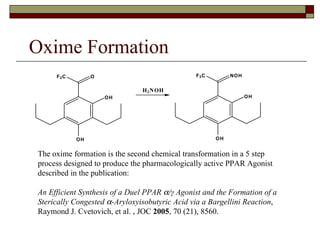
Oxime Formation The oxime formation is the second chemical transformation in a 5 step process designed to produce the pharmacologically active PPAR Agonist described in the publication: An Efficient Synthesis of a Duel PPAR   /γ Agonist and the Formation of a Sterically Congested   -Aryloxyisobutyric Acid via a Bargellini Reaction , Raymond J. Cvetovich, et al. , JOC  2005 , 70 (21), 8560. O H F 3 C N O H O H O H F 3 C O O H H 2 N O H
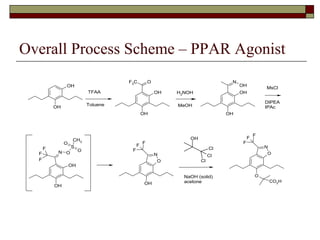
Overall Process Scheme – PPAR Agonist
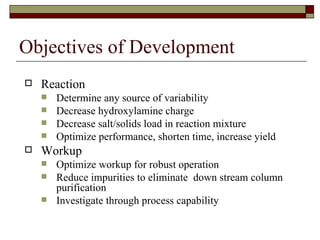
Objectives of Development Reaction Determine any source of variability Decrease hydroxylamine charge Decrease salt/solids load in reaction mixture Optimize performance, shorten time, increase yield Workup Optimize workup for robust operation Reduce impurities to eliminate  down stream column purification Investigate through process capability
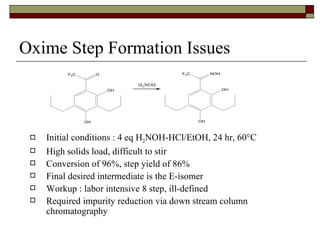
Oxime Step Formation Issues Initial conditions : 4 eq H 2 NOH-HCl/EtOH, 24 hr, 60°C High solids load, difficult to stir Conversion of 96%, step yield of 86% Final desired intermediate is the E-isomer Workup : labor intensive 8 step, ill-defined Required impurity reduction via down stream column chromatography
Proposed Reaction Screens Use Hydroxylamine HCl salt or Free base Base additive Solvent choice Temperature Concentration Addition mode – hydroxylamine
Trends of Reaction Screens Reaction time variability source acidic carryover from previous acylation step Hydroxylamine free base eliminated solids content Base additive enabled reduction of hydroxylamine 4 eq- 2 eq Choice of base additive  n-butylamine >>tri-butylamine.  NH 3 OH poor. Solvent choice indicated that MeOH > EtOH > IPa Reaction temperature – best at stated 60C Reaction concentration – no effect Mode of addition – no effect
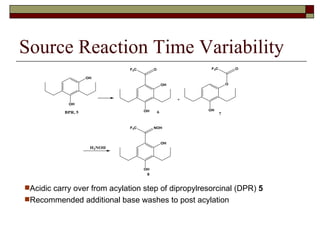
Source Reaction Time Variability Acidic carry over from acylation step of dipropylresorcinal (DPR)  5 Recommended additional base washes to post acylation
Proposed Workup Evalution Evaluate workup “as is” Define steps of workup to determine performance Screen changes - determine trend (better/worse) Determine conditions of impurity formation, NaOH extraction
Workup Definition Initial HCl quench, wash to remove excess H 2 NOH Removal of DPR via NaOH/toluene extraction Subsequent pH adjustment, iPAc extraction, brine washes Hold batch solution for next step
Test Modified Process -Serendipity Strikes Performance exceeded Basis Reaction Reaction <18 hr, high conversion Oxime product crystallized upon cooldown White dense crystal, mono salt of n-BA Correct E-isomer Simple water addition to increase recovery of high purity intermediate LCWP >98  LCAP > 99
Final Process NH 2 OH, 2 eq N-butylamine, 2 eq Solvent change to methanol Faster, consistent reaction time < 18 hours, 60°C Improved step yield 88% to 93% Clean solids via simple crystallization as salt via H 2 O Total elimination of extractive workup Elimination of silica gel treatment for next step. Simple quantitative salt break recovery prep for next step
Conclusion Step optimization is affected by previous step Break down of process activity enables definition of process issues Use of Lean Six Sigma screens effective means to determine directional trends

Oxime Formation Step Optimization

  • 1.
    Optimization of OximeFormation Process Louis Matty 4 December 2011
  • 2.
    Oxime Formation Theoxime formation is the second chemical transformation in a 5 step process designed to produce the pharmacologically active PPAR Agonist described in the publication: An Efficient Synthesis of a Duel PPAR  /γ Agonist and the Formation of a Sterically Congested  -Aryloxyisobutyric Acid via a Bargellini Reaction , Raymond J. Cvetovich, et al. , JOC 2005 , 70 (21), 8560. O H F 3 C N O H O H O H F 3 C O O H H 2 N O H
  • 3.
    Overall Process Scheme– PPAR Agonist
  • 4.
    Objectives of DevelopmentReaction Determine any source of variability Decrease hydroxylamine charge Decrease salt/solids load in reaction mixture Optimize performance, shorten time, increase yield Workup Optimize workup for robust operation Reduce impurities to eliminate down stream column purification Investigate through process capability
  • 5.
    Oxime Step FormationIssues Initial conditions : 4 eq H 2 NOH-HCl/EtOH, 24 hr, 60°C High solids load, difficult to stir Conversion of 96%, step yield of 86% Final desired intermediate is the E-isomer Workup : labor intensive 8 step, ill-defined Required impurity reduction via down stream column chromatography
  • 6.
    Proposed Reaction ScreensUse Hydroxylamine HCl salt or Free base Base additive Solvent choice Temperature Concentration Addition mode – hydroxylamine
  • 7.
    Trends of ReactionScreens Reaction time variability source acidic carryover from previous acylation step Hydroxylamine free base eliminated solids content Base additive enabled reduction of hydroxylamine 4 eq- 2 eq Choice of base additive n-butylamine >>tri-butylamine. NH 3 OH poor. Solvent choice indicated that MeOH > EtOH > IPa Reaction temperature – best at stated 60C Reaction concentration – no effect Mode of addition – no effect
  • 8.
    Source Reaction TimeVariability Acidic carry over from acylation step of dipropylresorcinal (DPR) 5 Recommended additional base washes to post acylation
  • 9.
    Proposed Workup EvalutionEvaluate workup “as is” Define steps of workup to determine performance Screen changes - determine trend (better/worse) Determine conditions of impurity formation, NaOH extraction
  • 10.
    Workup Definition InitialHCl quench, wash to remove excess H 2 NOH Removal of DPR via NaOH/toluene extraction Subsequent pH adjustment, iPAc extraction, brine washes Hold batch solution for next step
  • 11.
    Test Modified Process-Serendipity Strikes Performance exceeded Basis Reaction Reaction <18 hr, high conversion Oxime product crystallized upon cooldown White dense crystal, mono salt of n-BA Correct E-isomer Simple water addition to increase recovery of high purity intermediate LCWP >98 LCAP > 99
  • 12.
    Final Process NH2 OH, 2 eq N-butylamine, 2 eq Solvent change to methanol Faster, consistent reaction time < 18 hours, 60°C Improved step yield 88% to 93% Clean solids via simple crystallization as salt via H 2 O Total elimination of extractive workup Elimination of silica gel treatment for next step. Simple quantitative salt break recovery prep for next step
  • 13.
    Conclusion Step optimizationis affected by previous step Break down of process activity enables definition of process issues Use of Lean Six Sigma screens effective means to determine directional trends