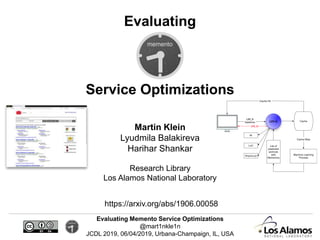
Evaluating Memento Service Optimizations
@mart1nkle1n
JCDL 2019, 06/04/2019, Urbana-Champaign, IL, USA
Evaluating
Service Optimizations
Martin Klein
Lyudmila Balakireva
Harihar Shankar
Research Library
Los Alamos National Laboratory
https://arxiv.org/abs/1906.00058
Evaluating Memento Service Optimizations
@mart1nkle1n
JCDL 2019, 06/04/2019, Urbana-Champaign, IL, USA
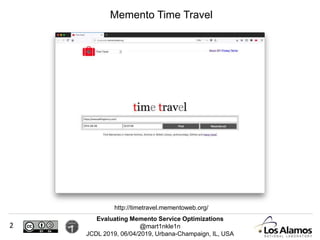
Memento Time Travel
http://timetravel.mementoweb.org/
2
Evaluating Memento Service Optimizations
@mart1nkle1n
JCDL 2019, 06/04/2019, Urbana-Champaign, IL, USA
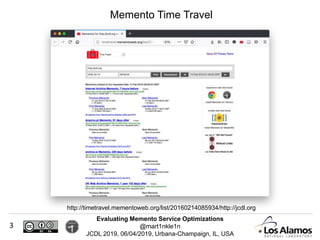
Memento Time Travel
http://timetravel.mementoweb.org/list/20160214085934/http://jcdl.org
3
Evaluating Memento Service Optimizations
@mart1nkle1n
JCDL 2019, 06/04/2019, Urbana-Champaign, IL, USA
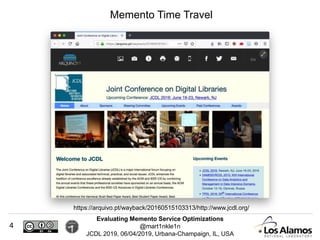
Memento Time Travel
https://arquivo.pt/wayback/20160515103313/http://www.jcdl.org/
4
Evaluating Memento Service Optimizations
@mart1nkle1n
JCDL 2019, 06/04/2019, Urbana-Champaign, IL, USA
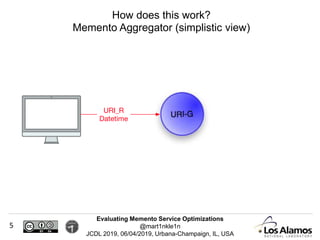
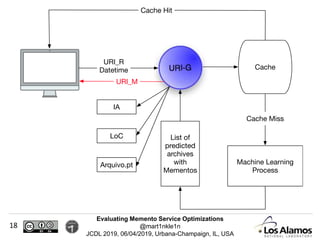
How does this work?
Memento Aggregator (simplistic view)
5
Evaluating Memento Service Optimizations
@mart1nkle1n
JCDL 2019, 06/04/2019, Urbana-Champaign, IL, USA
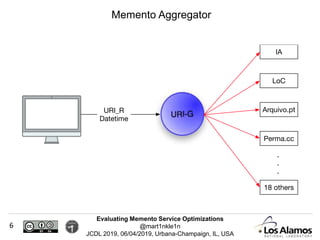
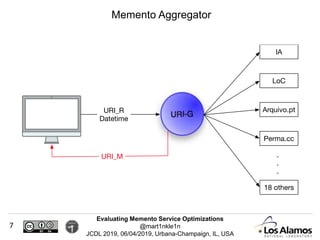
Memento Aggregator
6
Evaluating Memento Service Optimizations
@mart1nkle1n
JCDL 2019, 06/04/2019, Urbana-Champaign, IL, USA
Memento Aggregator
7
Evaluating Memento Service Optimizations
@mart1nkle1n
JCDL 2019, 06/04/2019, Urbana-Champaign, IL, USA
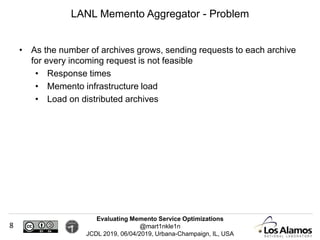
• As the number of archives grows, sending requests to each archive
for every incoming request is not feasible
• Response times
• Memento infrastructure load
• Load on distributed archives
LANL Memento Aggregator - Problem
8
Evaluating Memento Service Optimizations
@mart1nkle1n
JCDL 2019, 06/04/2019, Urbana-Champaign, IL, USA
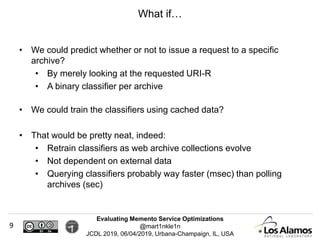
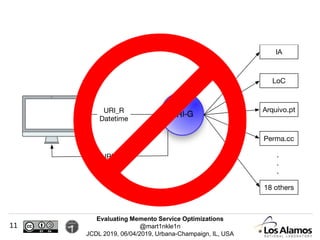
• We could predict whether or not to issue a request to a specific
archive?
• By merely looking at the requested URI-R
• A binary classifier per archive
• We could train the classifiers using cached data?
• That would be pretty neat, indeed:
• Retrain classifiers as web archive collections evolve
• Not dependent on external data
• Querying classifiers probably way faster (msec) than polling
archives (sec)
What if…
9
Evaluating Memento Service Optimizations
@mart1nkle1n
JCDL 2019, 06/04/2019, Urbana-Champaign, IL, USA
10
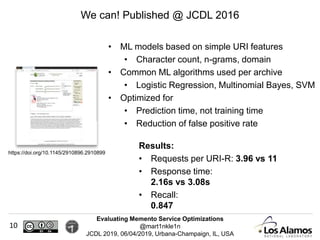
We can! Published @ JCDL 2016
https://doi.org/10.1145/2910896.2910899
• ML models based on simple URI features
• Character count, n-grams, domain
• Common ML algorithms used per archive
• Logistic Regression, Multinomial Bayes, SVM
• Optimized for
• Prediction time, not training time
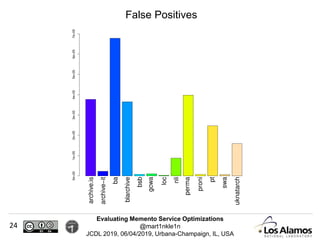
• Reduction of false positive rate
Results:
• Requests per URI-R: 3.96 vs 11
• Response time:
2.16s vs 3.08s
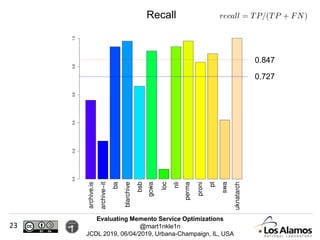
• Recall:
0.847
Evaluating Memento Service Optimizations
@mart1nkle1n
JCDL 2019, 06/04/2019, Urbana-Champaign, IL, USA
11
Evaluating Memento Service Optimizations
@mart1nkle1n
JCDL 2019, 06/04/2019, Urbana-Champaign, IL, USA
In Production…
12
Evaluating Memento Service Optimizations
@mart1nkle1n
JCDL 2019, 06/04/2019, Urbana-Champaign, IL, USA
13
Evaluating Memento Service Optimizations
@mart1nkle1n
JCDL 2019, 06/04/2019, Urbana-Champaign, IL, USA
14
Evaluating Memento Service Optimizations
@mart1nkle1n
JCDL 2019, 06/04/2019, Urbana-Champaign, IL, USA
15
Evaluating Memento Service Optimizations
@mart1nkle1n
JCDL 2019, 06/04/2019, Urbana-Champaign, IL, USA
16
Evaluating Memento Service Optimizations
@mart1nkle1n
JCDL 2019, 06/04/2019, Urbana-Champaign, IL, USA
17
Evaluating Memento Service Optimizations
@mart1nkle1n
JCDL 2019, 06/04/2019, Urbana-Champaign, IL, USA
18
Evaluating Memento Service Optimizations
@mart1nkle1n
JCDL 2019, 06/04/2019, Urbana-Champaign, IL, USA
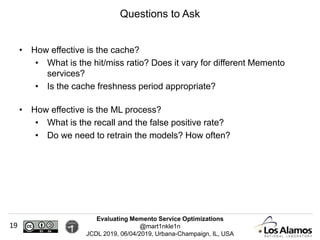
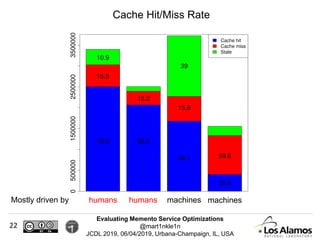
• How effective is the cache?
• What is the hit/miss ratio? Does it vary for different Memento
services?
• Is the cache freshness period appropriate?
• How effective is the ML process?
• What is the recall and the false positive rate?
• Do we need to retrain the models? How often?
Questions to Ask
19
Evaluating Memento Service Optimizations
@mart1nkle1n
JCDL 2019, 06/04/2019, Urbana-Champaign, IL, USA
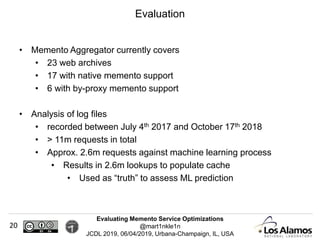
• Memento Aggregator currently covers
• 23 web archives
• 17 with native memento support
• 6 with by-proxy memento support
• Analysis of log files
• recorded between July 4th 2017 and October 17th 2018
• > 11m requests in total
• Approx. 2.6m requests against machine learning process
• Results in 2.6m lookups to populate cache
• Used as “truth” to assess ML prediction
Evaluation
20
Evaluating Memento Service Optimizations
@mart1nkle1n
JCDL 2019, 06/04/2019, Urbana-Champaign, IL, USA
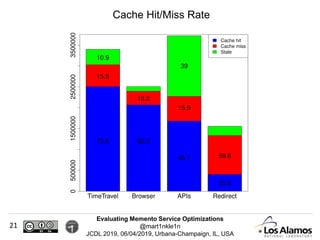
Cache Hit/Miss Rate
21
Evaluating Memento Service Optimizations
@mart1nkle1n
JCDL 2019, 06/04/2019, Urbana-Champaign, IL, USA
Cache Hit/Miss Rate
22
humanshumans machines machinesMostly driven by
Evaluating Memento Service Optimizations
@mart1nkle1n
JCDL 2019, 06/04/2019, Urbana-Champaign, IL, USA
Recall
23
0.847
0.727
Evaluating Memento Service Optimizations
@mart1nkle1n
JCDL 2019, 06/04/2019, Urbana-Champaign, IL, USA
False Positives
24
Evaluating Memento Service Optimizations
@mart1nkle1n
JCDL 2019, 06/04/2019, Urbana-Champaign, IL, USA
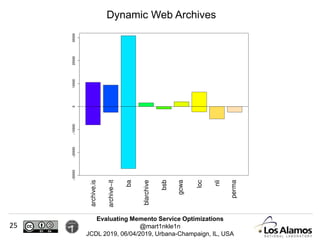
Dynamic Web Archives
25
Evaluating Memento Service Optimizations
@mart1nkle1n
JCDL 2019, 06/04/2019, Urbana-Champaign, IL, USA
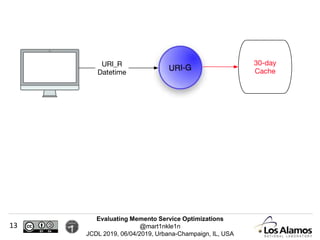
• Memento Aggregator cache is very effective
• ~ 60% of requests served from cache
• Human-driven services benefit the most
• Machine learning process saves!
• Requests & time while at acceptable recall level
• Recall: 0.727
• Re-training seems necessary, frequency TBD
Optimization
• ML model trained on archival holdings, not usage logs/cache
• Beneficial for new archives
• Neural network classifier, based on simple URI features, show
promising results
Takeaways
26
Evaluating Memento Service Optimizations
@mart1nkle1n
JCDL 2019, 06/04/2019, Urbana-Champaign, IL, USA
Evaluating
Service Optimizations
Martin Klein
Lyudmila Balakireva
Harihar Shankar
Research Library
Los Alamos National Laboratory
https://arxiv.org/abs/1906.00058

Evaluating Memento Service Optimizations

  • 1.
    Evaluating Memento ServiceOptimizations @mart1nkle1n JCDL 2019, 06/04/2019, Urbana-Champaign, IL, USA Evaluating Service Optimizations Martin Klein Lyudmila Balakireva Harihar Shankar Research Library Los Alamos National Laboratory https://arxiv.org/abs/1906.00058
  • 2.
    Evaluating Memento ServiceOptimizations @mart1nkle1n JCDL 2019, 06/04/2019, Urbana-Champaign, IL, USA Memento Time Travel http://timetravel.mementoweb.org/ 2
  • 3.
    Evaluating Memento ServiceOptimizations @mart1nkle1n JCDL 2019, 06/04/2019, Urbana-Champaign, IL, USA Memento Time Travel http://timetravel.mementoweb.org/list/20160214085934/http://jcdl.org 3
  • 4.
    Evaluating Memento ServiceOptimizations @mart1nkle1n JCDL 2019, 06/04/2019, Urbana-Champaign, IL, USA Memento Time Travel https://arquivo.pt/wayback/20160515103313/http://www.jcdl.org/ 4
  • 5.
    Evaluating Memento ServiceOptimizations @mart1nkle1n JCDL 2019, 06/04/2019, Urbana-Champaign, IL, USA How does this work? Memento Aggregator (simplistic view) 5
  • 6.
    Evaluating Memento ServiceOptimizations @mart1nkle1n JCDL 2019, 06/04/2019, Urbana-Champaign, IL, USA Memento Aggregator 6
  • 7.
    Evaluating Memento ServiceOptimizations @mart1nkle1n JCDL 2019, 06/04/2019, Urbana-Champaign, IL, USA Memento Aggregator 7
  • 8.
    Evaluating Memento ServiceOptimizations @mart1nkle1n JCDL 2019, 06/04/2019, Urbana-Champaign, IL, USA • As the number of archives grows, sending requests to each archive for every incoming request is not feasible • Response times • Memento infrastructure load • Load on distributed archives LANL Memento Aggregator - Problem 8
  • 9.
    Evaluating Memento ServiceOptimizations @mart1nkle1n JCDL 2019, 06/04/2019, Urbana-Champaign, IL, USA • We could predict whether or not to issue a request to a specific archive? • By merely looking at the requested URI-R • A binary classifier per archive • We could train the classifiers using cached data? • That would be pretty neat, indeed: • Retrain classifiers as web archive collections evolve • Not dependent on external data • Querying classifiers probably way faster (msec) than polling archives (sec) What if… 9
  • 10.
    Evaluating Memento ServiceOptimizations @mart1nkle1n JCDL 2019, 06/04/2019, Urbana-Champaign, IL, USA 10 We can! Published @ JCDL 2016 https://doi.org/10.1145/2910896.2910899 • ML models based on simple URI features • Character count, n-grams, domain • Common ML algorithms used per archive • Logistic Regression, Multinomial Bayes, SVM • Optimized for • Prediction time, not training time • Reduction of false positive rate Results: • Requests per URI-R: 3.96 vs 11 • Response time: 2.16s vs 3.08s • Recall: 0.847
  • 11.
    Evaluating Memento ServiceOptimizations @mart1nkle1n JCDL 2019, 06/04/2019, Urbana-Champaign, IL, USA 11
  • 12.
    Evaluating Memento ServiceOptimizations @mart1nkle1n JCDL 2019, 06/04/2019, Urbana-Champaign, IL, USA In Production… 12
  • 13.
    Evaluating Memento ServiceOptimizations @mart1nkle1n JCDL 2019, 06/04/2019, Urbana-Champaign, IL, USA 13
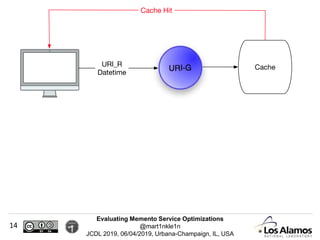
  • 14.
    Evaluating Memento ServiceOptimizations @mart1nkle1n JCDL 2019, 06/04/2019, Urbana-Champaign, IL, USA 14
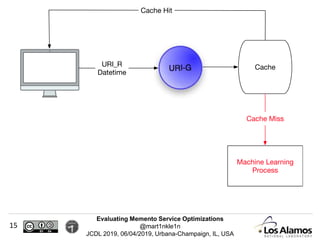
  • 15.
    Evaluating Memento ServiceOptimizations @mart1nkle1n JCDL 2019, 06/04/2019, Urbana-Champaign, IL, USA 15
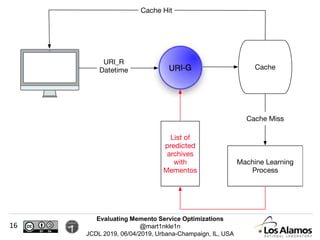
  • 16.
    Evaluating Memento ServiceOptimizations @mart1nkle1n JCDL 2019, 06/04/2019, Urbana-Champaign, IL, USA 16
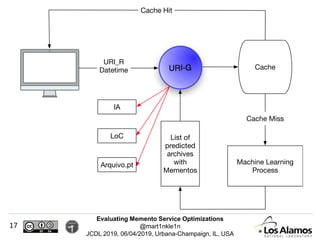
  • 17.
    Evaluating Memento ServiceOptimizations @mart1nkle1n JCDL 2019, 06/04/2019, Urbana-Champaign, IL, USA 17
  • 18.
    Evaluating Memento ServiceOptimizations @mart1nkle1n JCDL 2019, 06/04/2019, Urbana-Champaign, IL, USA 18
  • 19.
    Evaluating Memento ServiceOptimizations @mart1nkle1n JCDL 2019, 06/04/2019, Urbana-Champaign, IL, USA • How effective is the cache? • What is the hit/miss ratio? Does it vary for different Memento services? • Is the cache freshness period appropriate? • How effective is the ML process? • What is the recall and the false positive rate? • Do we need to retrain the models? How often? Questions to Ask 19
  • 20.
    Evaluating Memento ServiceOptimizations @mart1nkle1n JCDL 2019, 06/04/2019, Urbana-Champaign, IL, USA • Memento Aggregator currently covers • 23 web archives • 17 with native memento support • 6 with by-proxy memento support • Analysis of log files • recorded between July 4th 2017 and October 17th 2018 • > 11m requests in total • Approx. 2.6m requests against machine learning process • Results in 2.6m lookups to populate cache • Used as “truth” to assess ML prediction Evaluation 20
  • 21.
    Evaluating Memento ServiceOptimizations @mart1nkle1n JCDL 2019, 06/04/2019, Urbana-Champaign, IL, USA Cache Hit/Miss Rate 21
  • 22.
    Evaluating Memento ServiceOptimizations @mart1nkle1n JCDL 2019, 06/04/2019, Urbana-Champaign, IL, USA Cache Hit/Miss Rate 22 humanshumans machines machinesMostly driven by
  • 23.
    Evaluating Memento ServiceOptimizations @mart1nkle1n JCDL 2019, 06/04/2019, Urbana-Champaign, IL, USA Recall 23 0.847 0.727
  • 24.
    Evaluating Memento ServiceOptimizations @mart1nkle1n JCDL 2019, 06/04/2019, Urbana-Champaign, IL, USA False Positives 24
  • 25.
    Evaluating Memento ServiceOptimizations @mart1nkle1n JCDL 2019, 06/04/2019, Urbana-Champaign, IL, USA Dynamic Web Archives 25
  • 26.
    Evaluating Memento ServiceOptimizations @mart1nkle1n JCDL 2019, 06/04/2019, Urbana-Champaign, IL, USA • Memento Aggregator cache is very effective • ~ 60% of requests served from cache • Human-driven services benefit the most • Machine learning process saves! • Requests & time while at acceptable recall level • Recall: 0.727 • Re-training seems necessary, frequency TBD Optimization • ML model trained on archival holdings, not usage logs/cache • Beneficial for new archives • Neural network classifier, based on simple URI features, show promising results Takeaways 26
  • 27.
    Evaluating Memento ServiceOptimizations @mart1nkle1n JCDL 2019, 06/04/2019, Urbana-Champaign, IL, USA Evaluating Service Optimizations Martin Klein Lyudmila Balakireva Harihar Shankar Research Library Los Alamos National Laboratory https://arxiv.org/abs/1906.00058