Geology Curriculum
in Latvia
Congress of Geology in Vila Nova da Barquinha, Portugal
from 20th to 24th January 2020
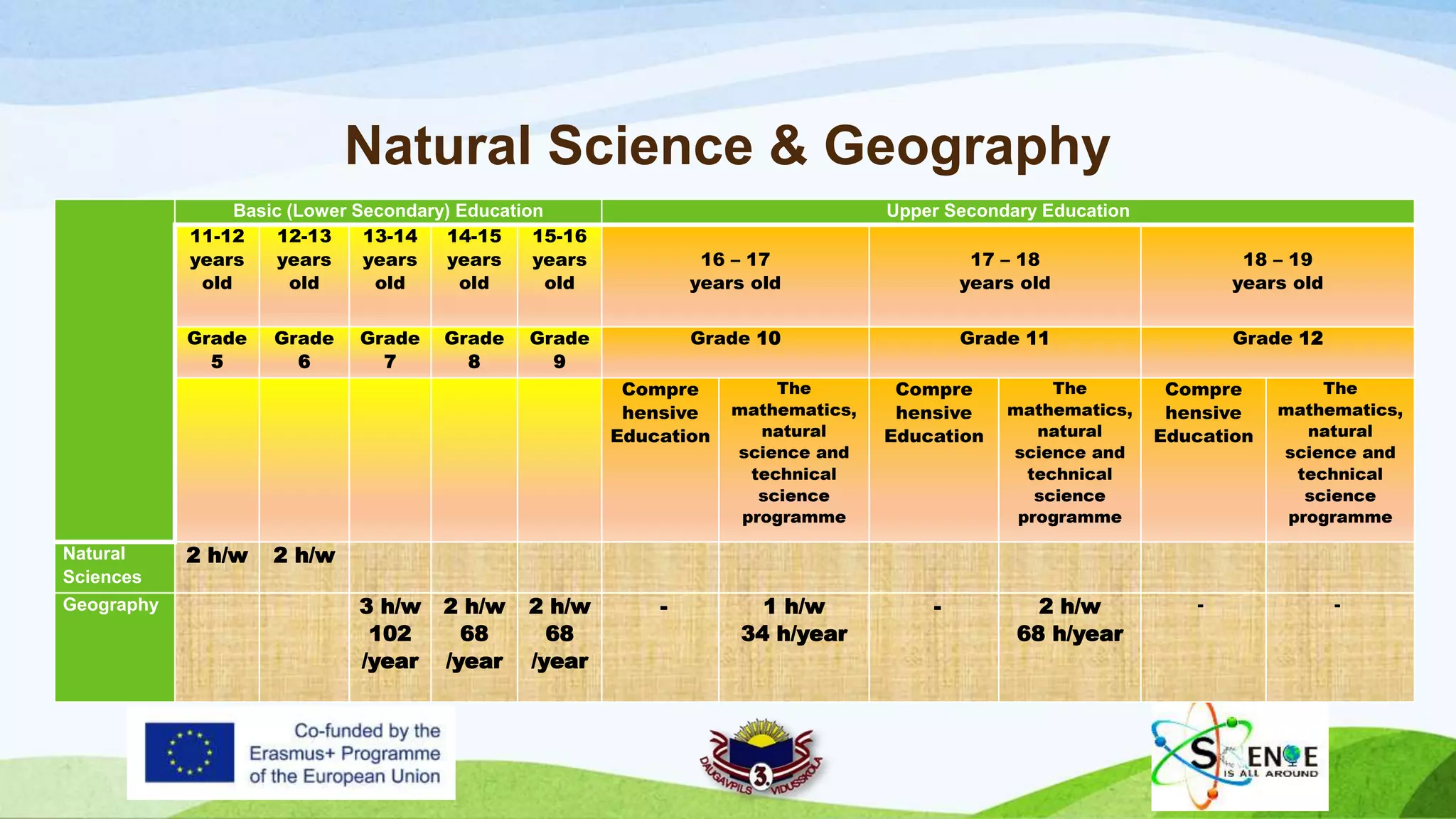
Natural Science & Geography
• Добавьте первый пункт списка
• Добавьте второй пункт списка
• Добавьте третий пункт списка
Basic (Lower Secondary) Education Upper Secondary Education
11-12
years
old
12-13
years
old
13-14
years
old
14-15
years
old
15-16
years
old
16 – 17
years old
17 – 18
years old
18 – 19
years old
Grade
5
Grade
6
Grade
7
Grade
8
Grade
9
Grade 10 Grade 11 Grade 12
Compre
hensive
Education
The
mathematics,
natural
science and
technical
science
programme
Compre
hensive
Education
The
mathematics,
natural
science and
technical
science
programme
Compre
hensive
Education
The
mathematics,
natural
science and
technical
science
programme
Natural
Sciences
2 h/w 2 h/w
Geography 3 h/w
102
/year
2 h/w
68
/year
2 h/w
68
/year
- 1 h/w
34 h/year
- 2 h/w
68 h/year
- -
Grade 7 (13-14 years old)
• Theories (hypotheses) about the origin of the Earth (1 h)
• Structure of the Earth (1-2 h)
• Structure of the Earth's crust (1-2 h)
• Hypotheses about the formation and movement of continents (1 h)
• Lithospheric plates and their processes and phenomena (1 h)
• Formation and transformation of terrain in Africa, Australia, America (1 h)
• General features of continental terrain and geographic location of relief terrain (1 h)
• Laboratory works are not foreseen but volcanic activity and earthquakes could be
considered in the future
Grade 8 (14-15 years old)
• The geologic history of Earth
• Volcanic and earthquake regions in Asia and Europe
• No practice!
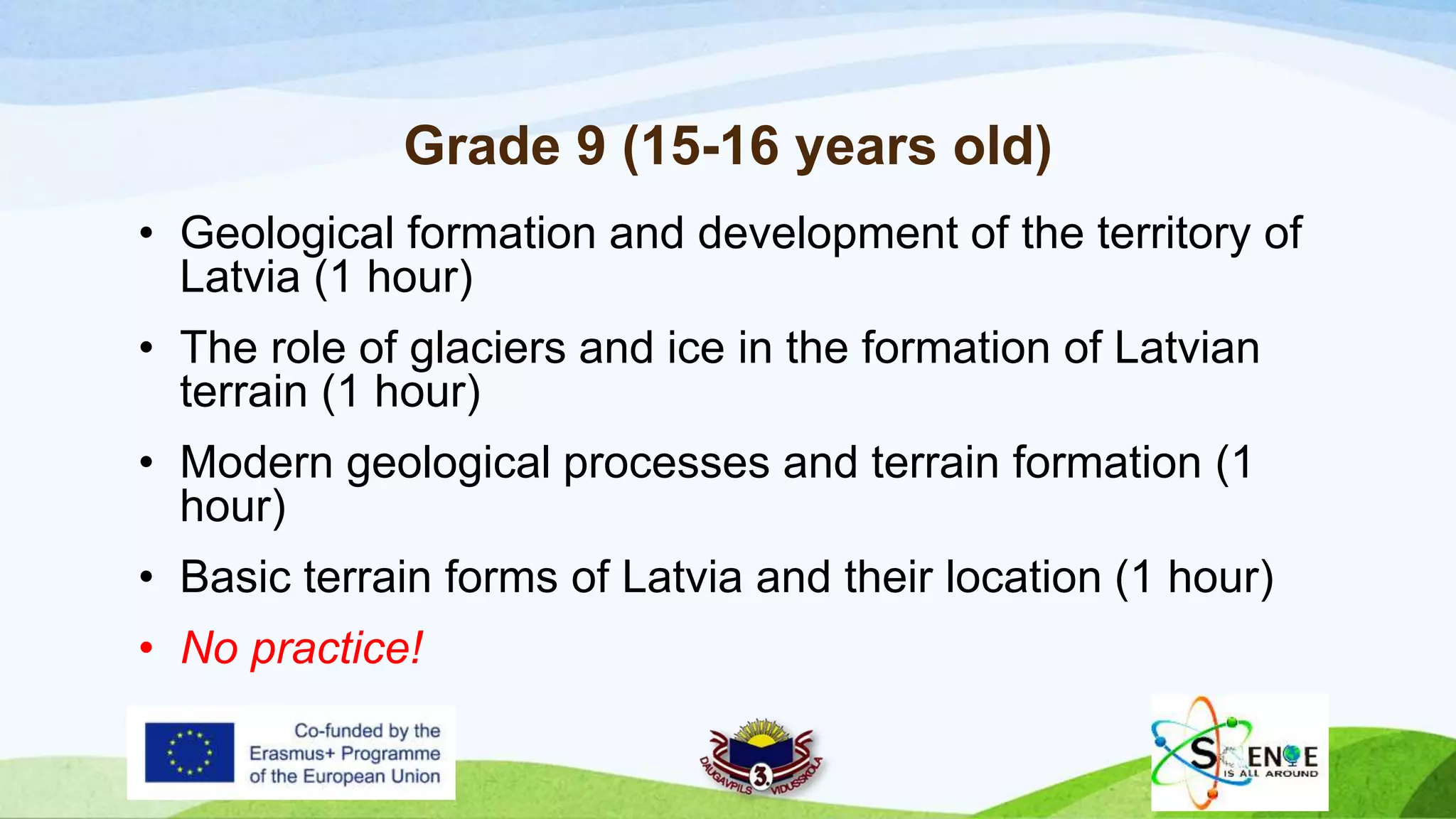
Grade 9 (15-16 years old)
• Geological formation and development of the territory of
Latvia (1 hour)
• The role of glaciers and ice in the formation of Latvian
terrain (1 hour)
• Modern geological processes and terrain formation (1
hour)
• Basic terrain forms of Latvia and their location (1 hour)
• No practice!
Grade 10 (16-17 years old) &
Grade 11 (17-18 years old)
• The Earth’s structure and geological processes (6 hours)
• the internal structure of the Earth
• the tectonic movement and its short-term results (earthquakes, volcanoes)
• human life in earthquake regions
• As in secondary school geography is more about economy, there is
little geology
• No practical work! Only drawings and movies
• Exam!
Changes to the Education Approach
in Latvia
• The Ministry of Education and Science proposes changes to the education
approach in Latvia in order to develop, approve and successively introduce
such a curriculum and approach to education, which would develop value-
based knowledge, skills and attitudes necessary in the 21st century.
For the first time the curriculum is reviewed as a whole by introducing a
competence-based approach, in a uniform system and successively at all
levels of education, starting from the age of one and a half and up to grade
12.
• The National Centre for Education (NCE) implements the project from
October 2016 until October 2021 with the financial support of European
Structural Funds.
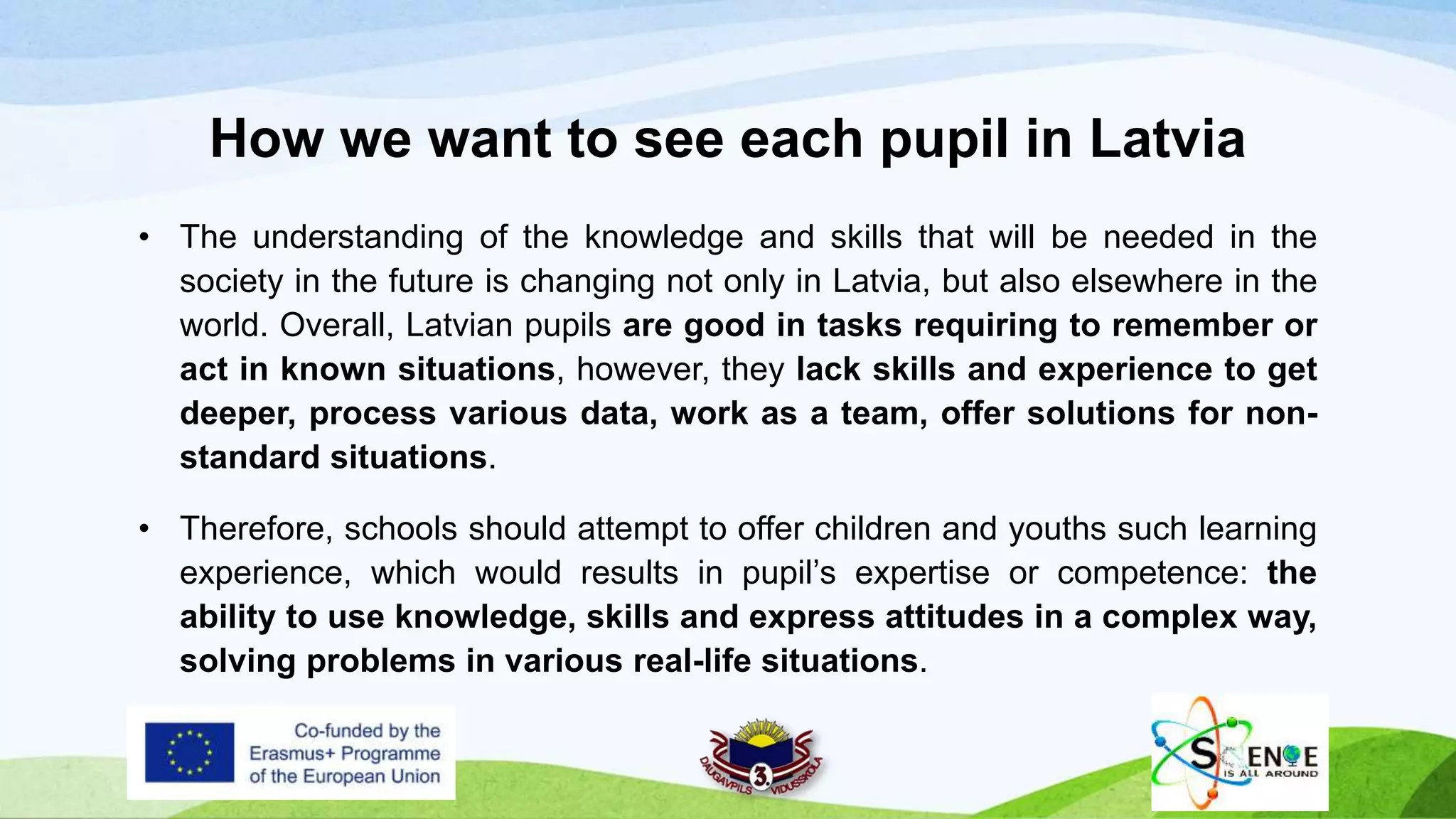
How we want to see each pupil in Latvia
• The understanding of the knowledge and skills that will be needed in the
society in the future is changing not only in Latvia, but also elsewhere in the
world. Overall, Latvian pupils are good in tasks requiring to remember or
act in known situations, however, they lack skills and experience to get
deeper, process various data, work as a team, offer solutions for non-
standard situations.
• Therefore, schools should attempt to offer children and youths such learning
experience, which would results in pupil’s expertise or competence: the
ability to use knowledge, skills and express attitudes in a complex way,
solving problems in various real-life situations.
THANK YOU FOR YOUR ATTENTION!
IK DANK U VOOR UW AANDACHT!
VI RINGRAZIO PER L’ATTENZIONE!
AGRADEÇO A VOSSA ATENÇÃO!
GRACIAS POR TU ATENCIÓN!
PALDIES PAR UZMANĪBU!

Geology curriculum in latvia

  • 1.
    Geology Curriculum in Latvia Congressof Geology in Vila Nova da Barquinha, Portugal from 20th to 24th January 2020
  • 2.
    Natural Science &Geography • Добавьте первый пункт списка • Добавьте второй пункт списка • Добавьте третий пункт списка Basic (Lower Secondary) Education Upper Secondary Education 11-12 years old 12-13 years old 13-14 years old 14-15 years old 15-16 years old 16 – 17 years old 17 – 18 years old 18 – 19 years old Grade 5 Grade 6 Grade 7 Grade 8 Grade 9 Grade 10 Grade 11 Grade 12 Compre hensive Education The mathematics, natural science and technical science programme Compre hensive Education The mathematics, natural science and technical science programme Compre hensive Education The mathematics, natural science and technical science programme Natural Sciences 2 h/w 2 h/w Geography 3 h/w 102 /year 2 h/w 68 /year 2 h/w 68 /year - 1 h/w 34 h/year - 2 h/w 68 h/year - -
  • 3.
    Grade 7 (13-14years old) • Theories (hypotheses) about the origin of the Earth (1 h) • Structure of the Earth (1-2 h) • Structure of the Earth's crust (1-2 h) • Hypotheses about the formation and movement of continents (1 h) • Lithospheric plates and their processes and phenomena (1 h) • Formation and transformation of terrain in Africa, Australia, America (1 h) • General features of continental terrain and geographic location of relief terrain (1 h) • Laboratory works are not foreseen but volcanic activity and earthquakes could be considered in the future
  • 4.
    Grade 8 (14-15years old) • The geologic history of Earth • Volcanic and earthquake regions in Asia and Europe • No practice!
  • 5.
    Grade 9 (15-16years old) • Geological formation and development of the territory of Latvia (1 hour) • The role of glaciers and ice in the formation of Latvian terrain (1 hour) • Modern geological processes and terrain formation (1 hour) • Basic terrain forms of Latvia and their location (1 hour) • No practice!
  • 6.
    Grade 10 (16-17years old) & Grade 11 (17-18 years old) • The Earth’s structure and geological processes (6 hours) • the internal structure of the Earth • the tectonic movement and its short-term results (earthquakes, volcanoes) • human life in earthquake regions • As in secondary school geography is more about economy, there is little geology • No practical work! Only drawings and movies • Exam!
  • 7.
    Changes to theEducation Approach in Latvia • The Ministry of Education and Science proposes changes to the education approach in Latvia in order to develop, approve and successively introduce such a curriculum and approach to education, which would develop value- based knowledge, skills and attitudes necessary in the 21st century. For the first time the curriculum is reviewed as a whole by introducing a competence-based approach, in a uniform system and successively at all levels of education, starting from the age of one and a half and up to grade 12. • The National Centre for Education (NCE) implements the project from October 2016 until October 2021 with the financial support of European Structural Funds.
  • 8.
    How we wantto see each pupil in Latvia • The understanding of the knowledge and skills that will be needed in the society in the future is changing not only in Latvia, but also elsewhere in the world. Overall, Latvian pupils are good in tasks requiring to remember or act in known situations, however, they lack skills and experience to get deeper, process various data, work as a team, offer solutions for non- standard situations. • Therefore, schools should attempt to offer children and youths such learning experience, which would results in pupil’s expertise or competence: the ability to use knowledge, skills and express attitudes in a complex way, solving problems in various real-life situations.
  • 9.
    THANK YOU FORYOUR ATTENTION! IK DANK U VOOR UW AANDACHT! VI RINGRAZIO PER L’ATTENZIONE! AGRADEÇO A VOSSA ATENÇÃO! GRACIAS POR TU ATENCIÓN! PALDIES PAR UZMANĪBU!