INDEXINDEX
1.1. What ishydraulic fracking?What is hydraulic fracking?
2.2. UsesUses
3.3. Economic effectsEconomic effects
4.4. Advantages of FrackingAdvantages of Fracking
3.
What is HydraulicFracking?What is Hydraulic Fracking?
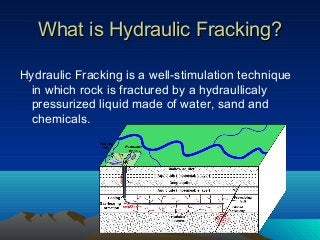
Hydraulic Fracking is a well-stimulation technique
in which rock is fractured by a hydraullicaly
pressurized liquid made of water, sand and
chemicals.
4.
UsesUses
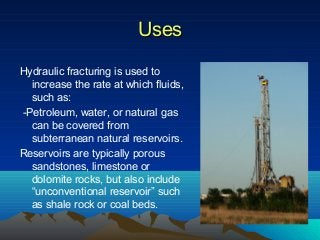
Hydraulic fracturing isused to
increase the rate at which fluids,
such as:
-Petroleum, water, or natural gas
can be covered from
subterranean natural reservoirs.
Reservoirs are typically porous
sandstones, limestone or
dolomite rocks, but also include
“unconventional reservoir” such
as shale rock or coal beds.
5.
Economic effectsEconomic effects
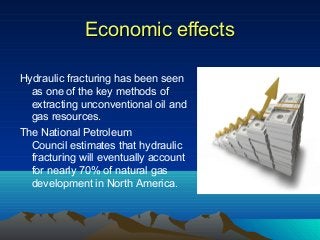
Hydraulicfracturing has been seen
as one of the key methods of
extracting unconventional oil and
gas resources.
The National Petroleum
Council estimates that hydraulic
fracturing will eventually account
for nearly 70% of natural gas
development in North America.
6.
Advantages of FrackingAdvantagesof Fracking
Advantages of Fracking:
1. Generating electricity with natural gas
2. Thanks to Fracking, it is the same cost of generating electricity
with coal.
3. Because of this, the United States now has a much more diverse
energy portfolio.
In addition, natural gas releases two to three times less carbon into
the atmosphere than coal, and it releases far less particulate
matter as well.