
































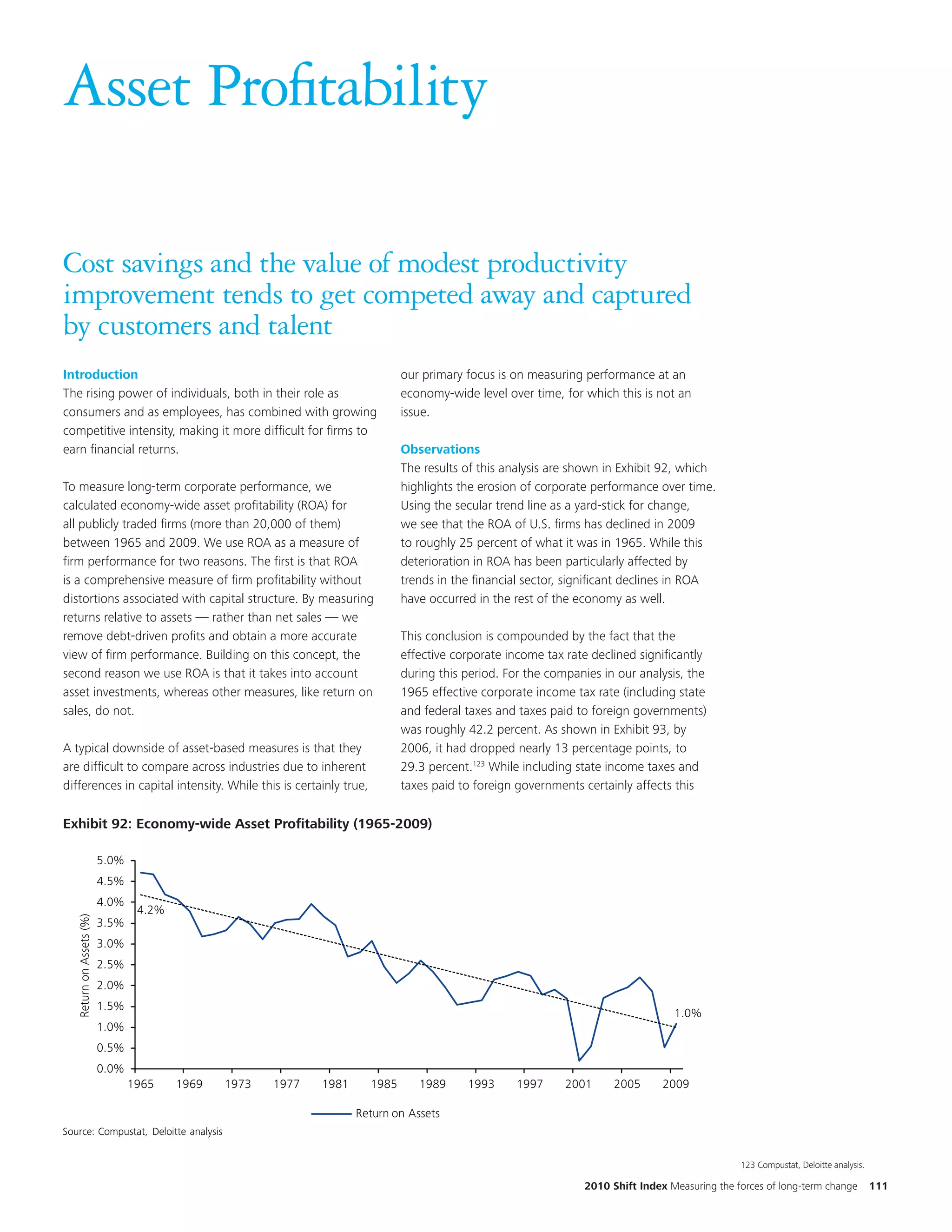
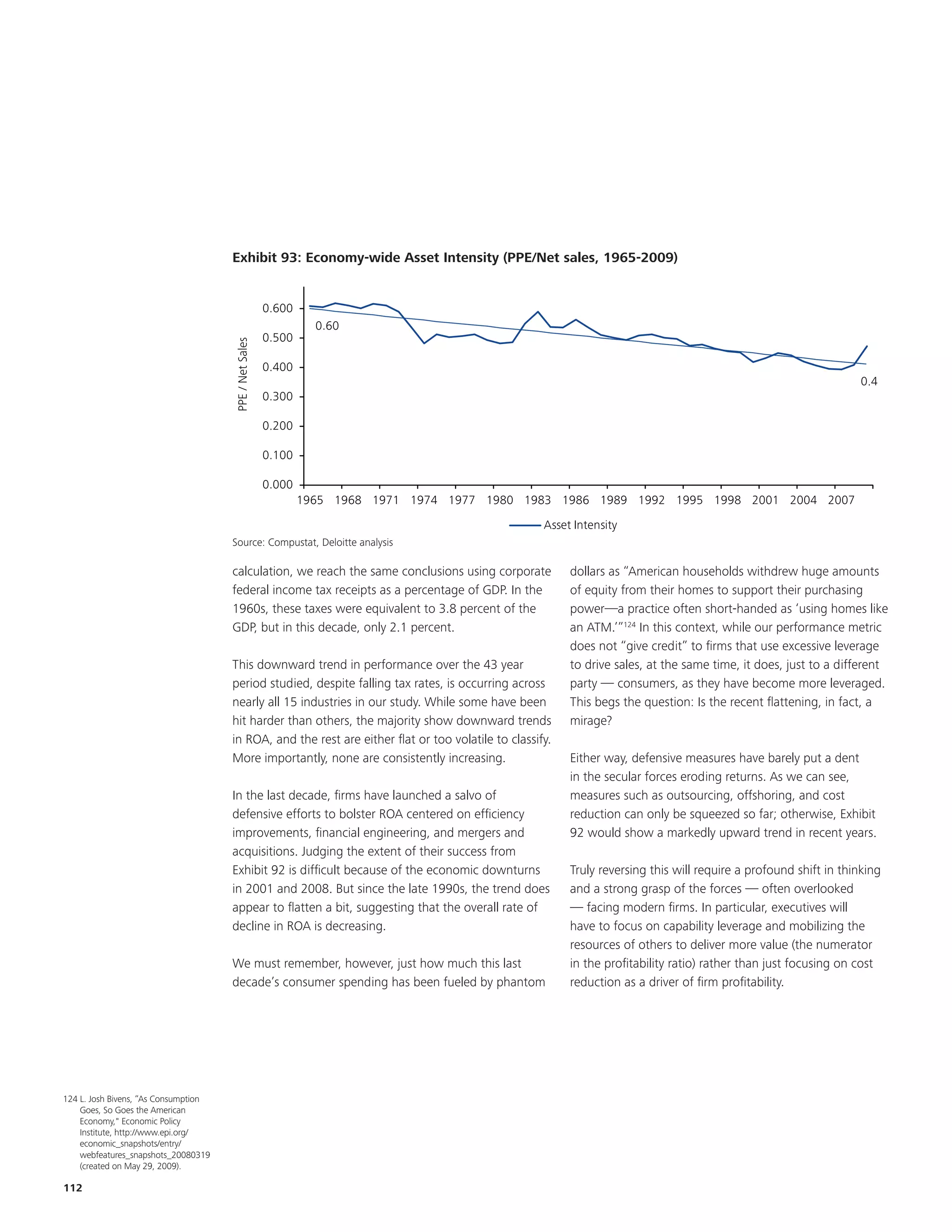
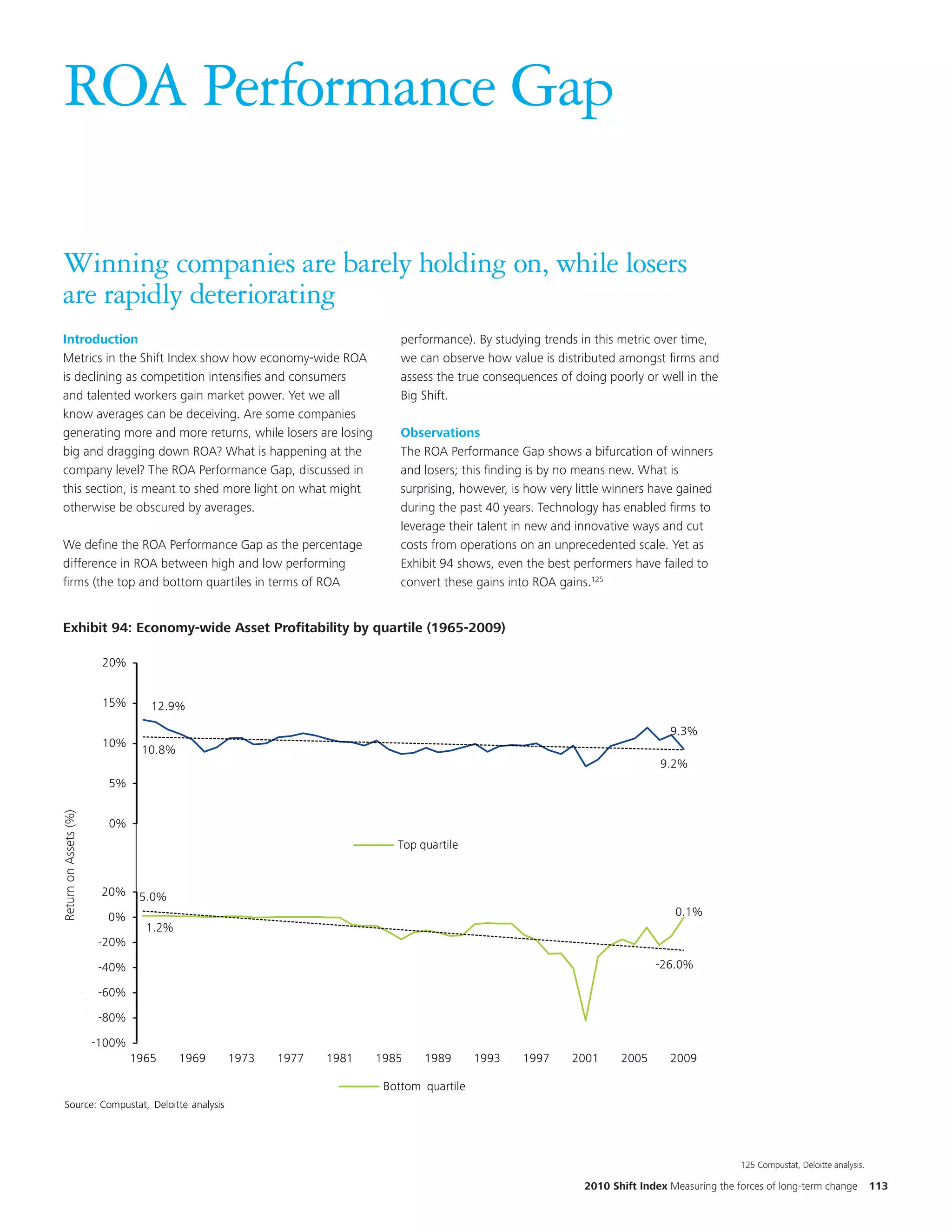
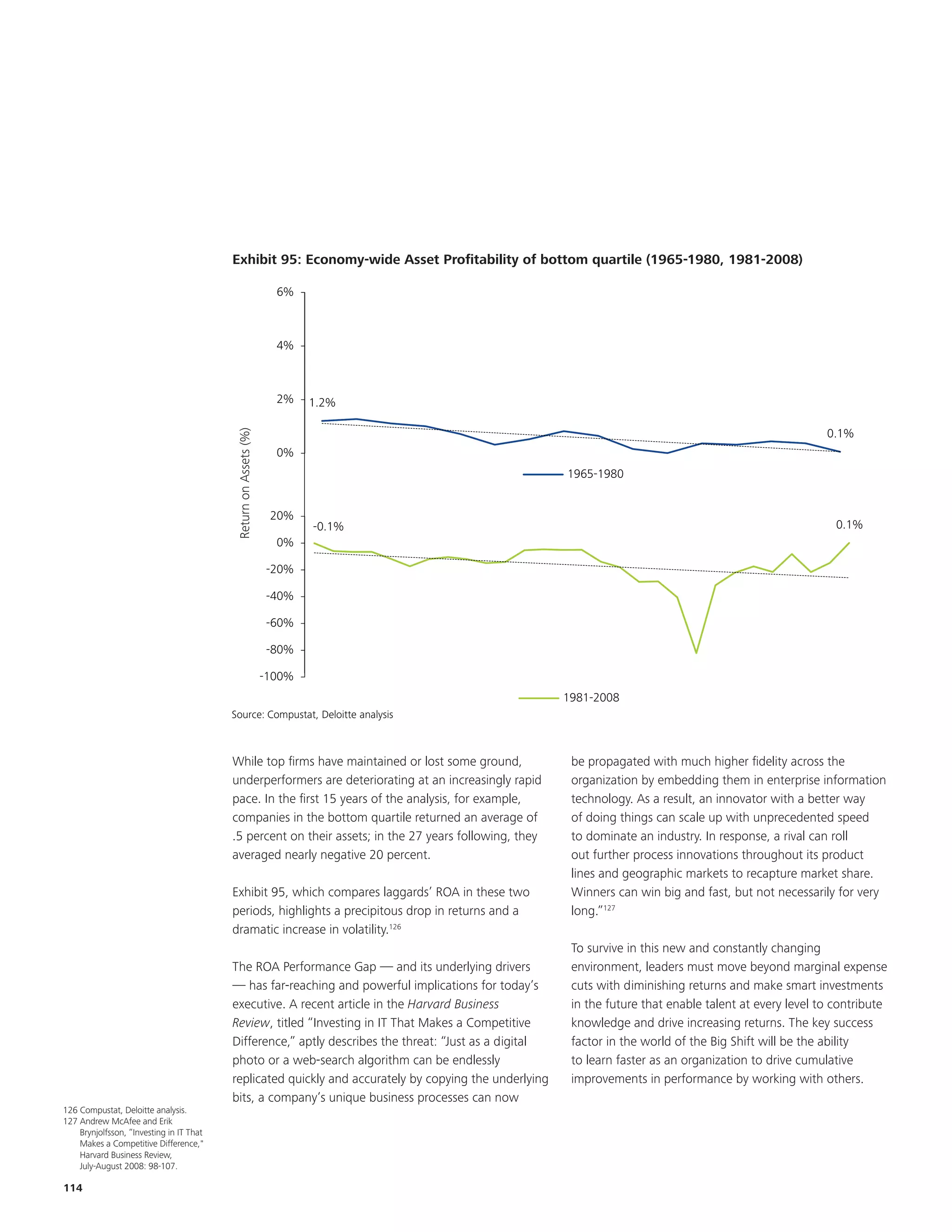


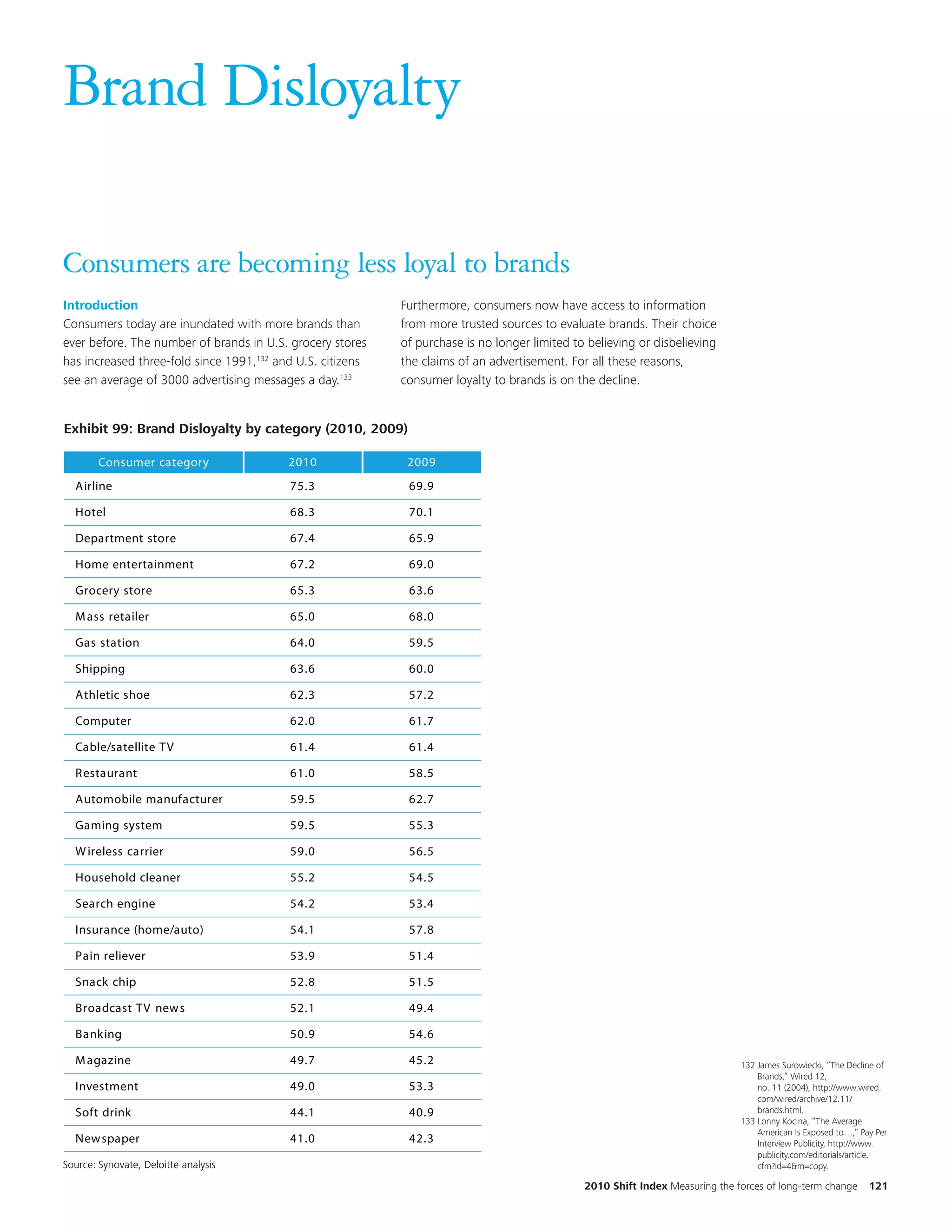
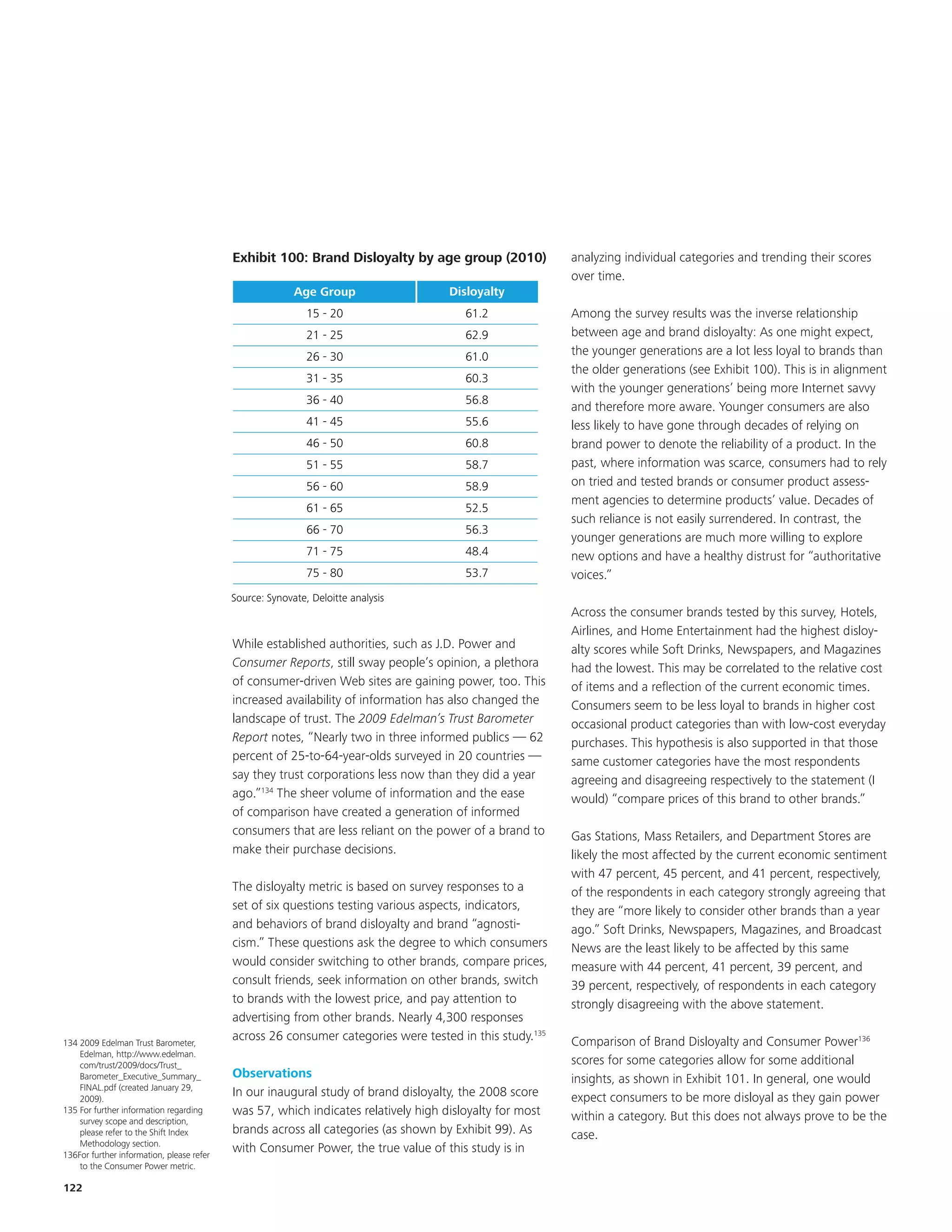
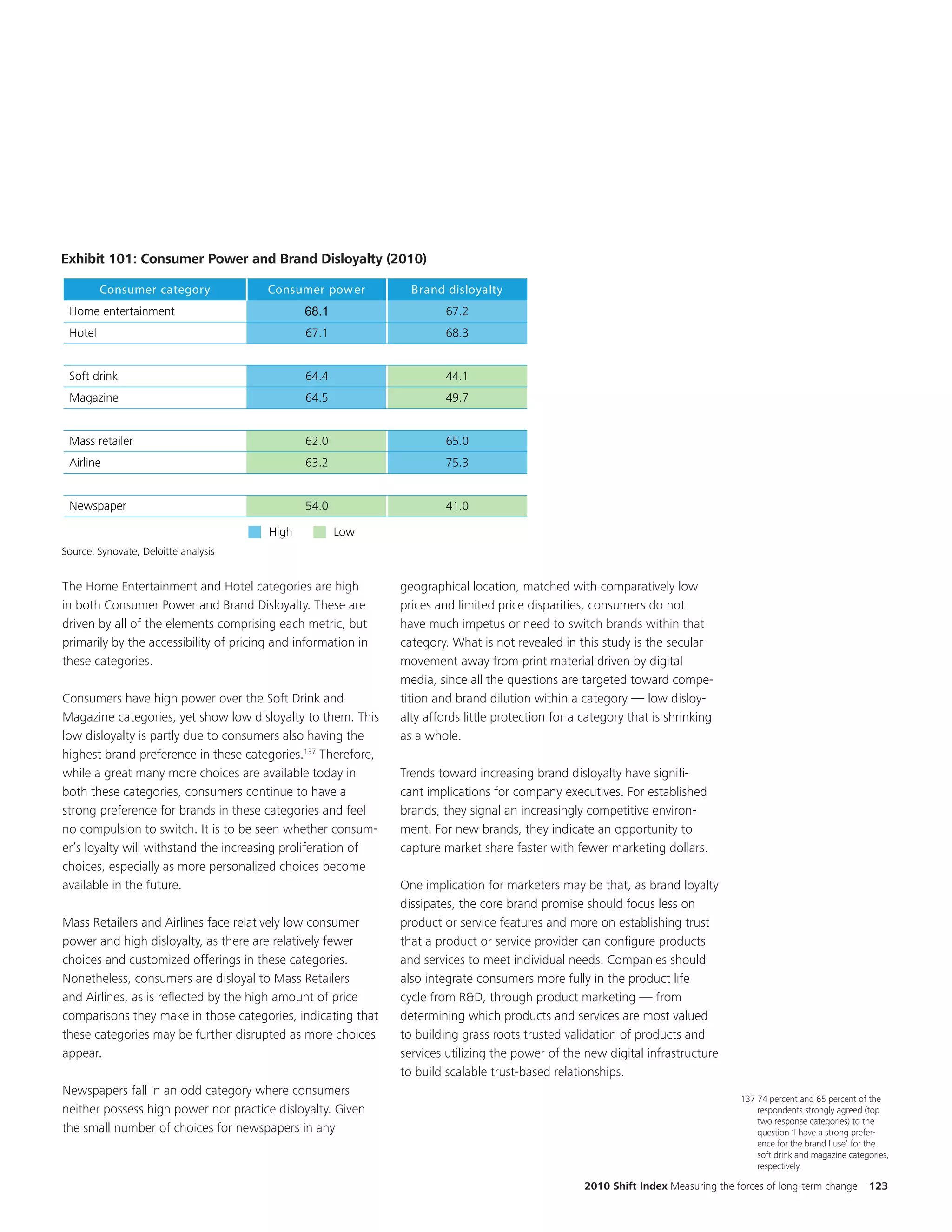

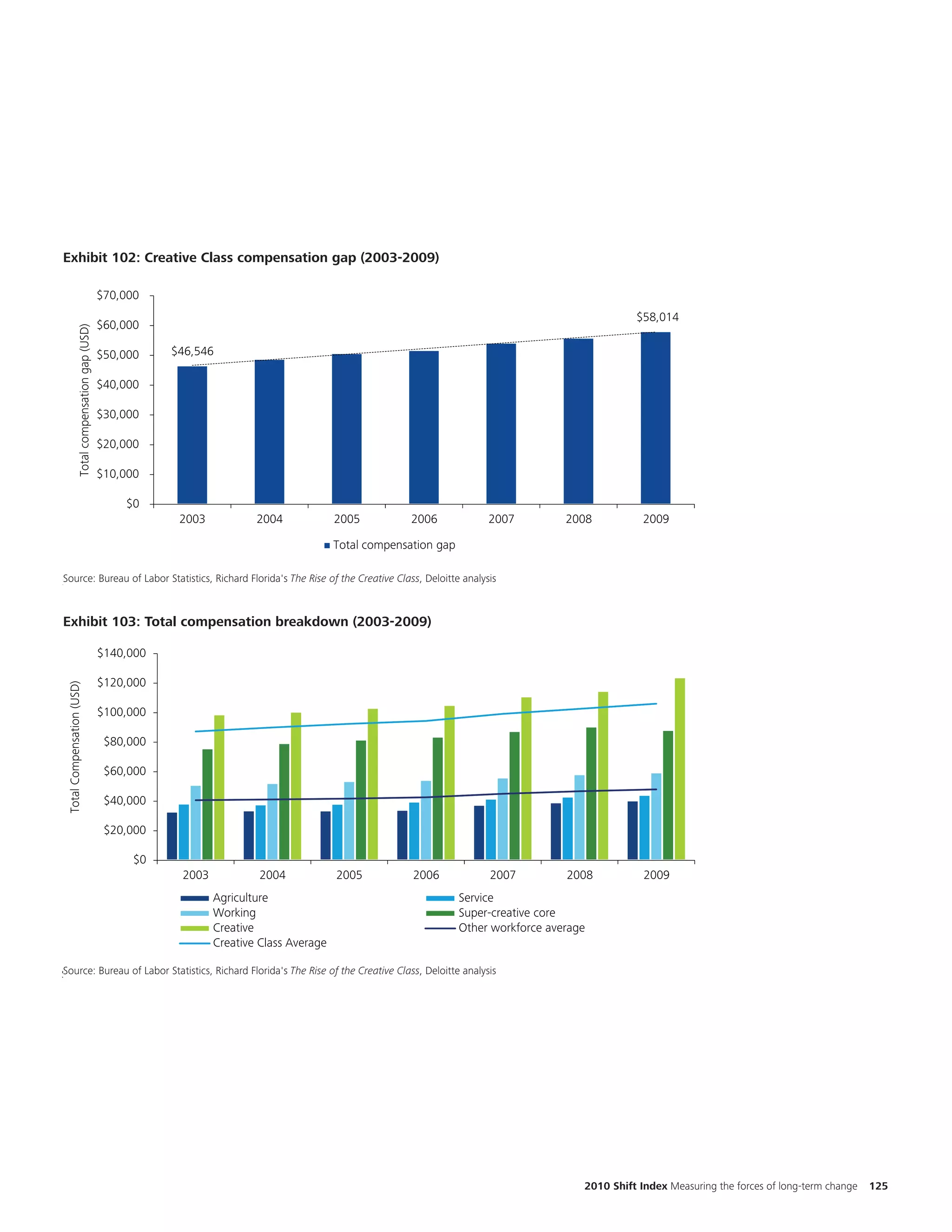
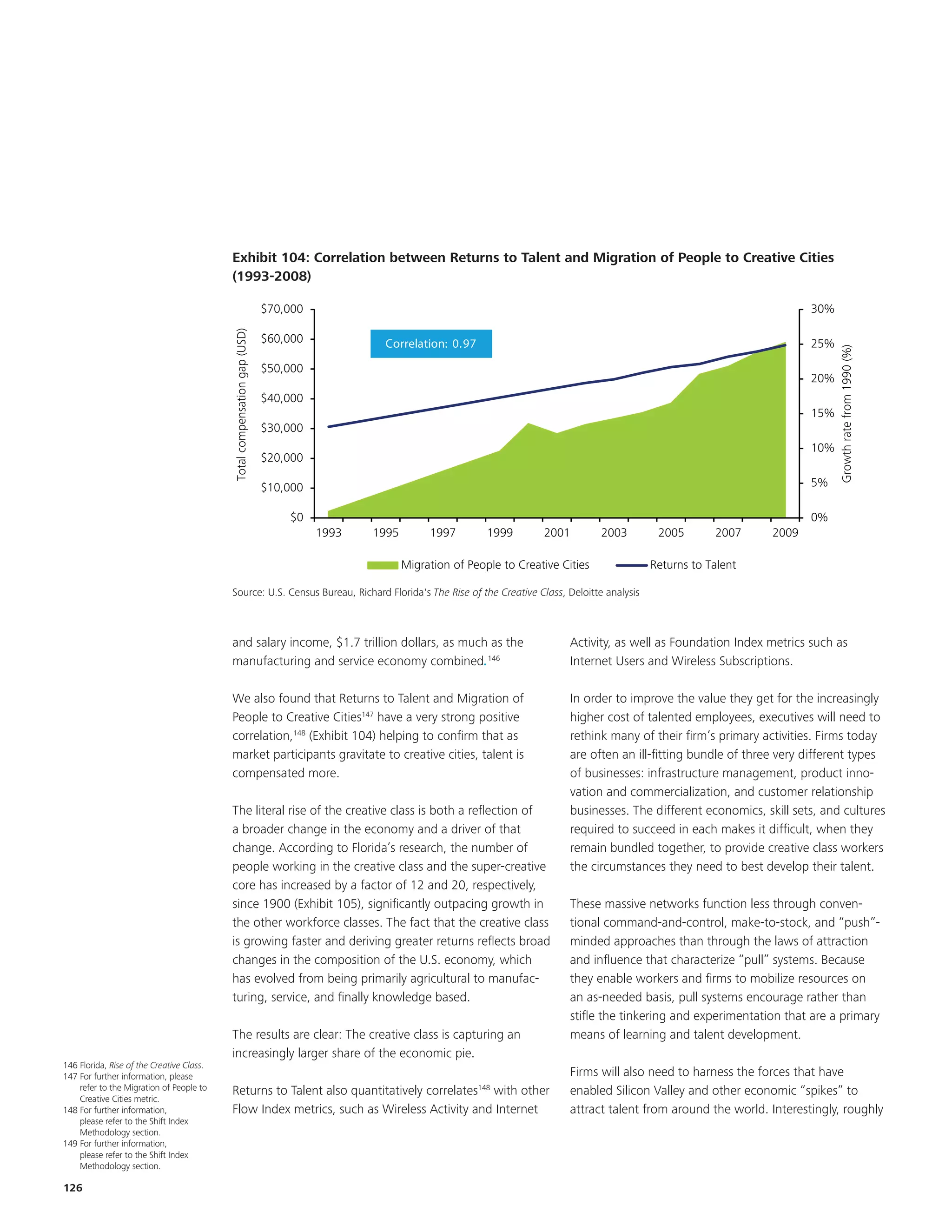
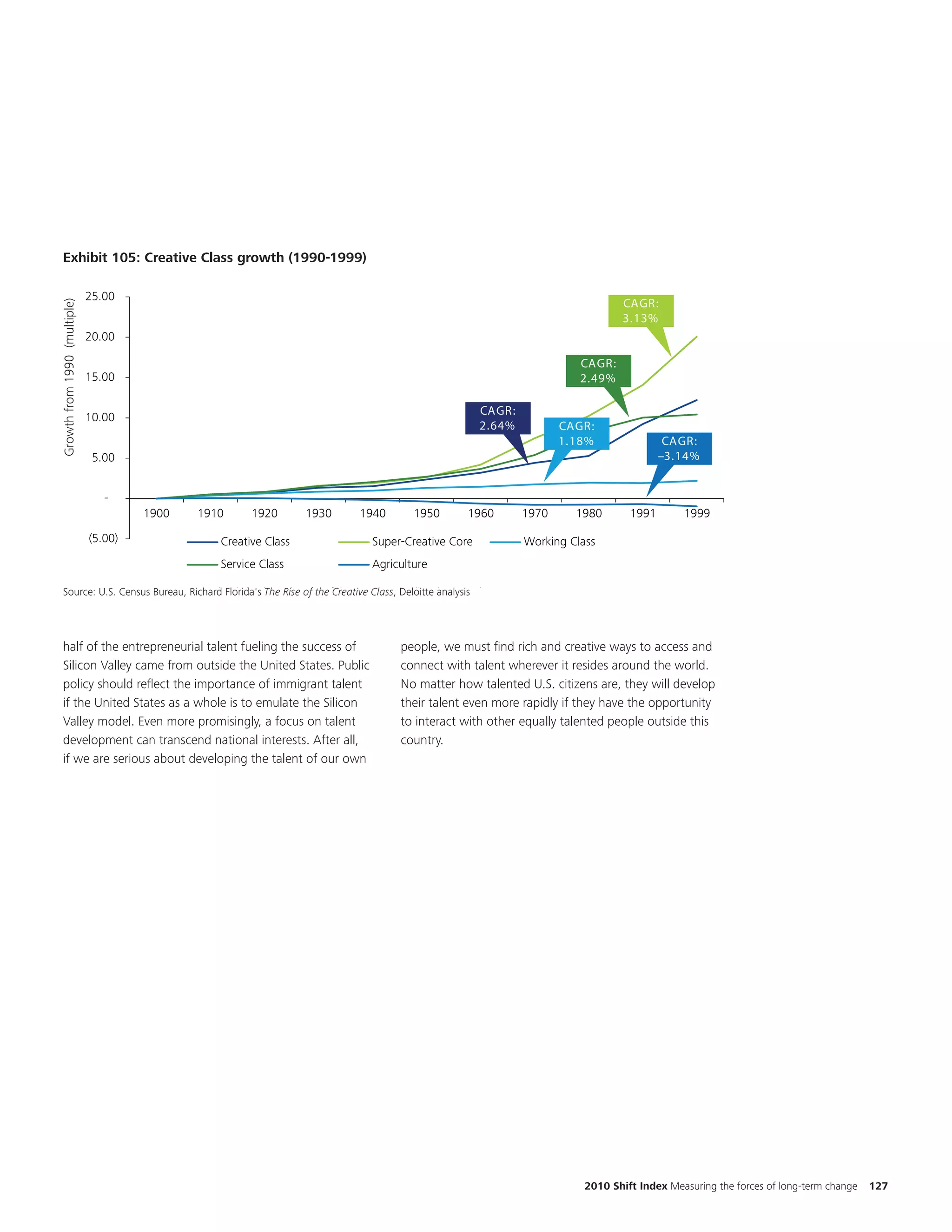
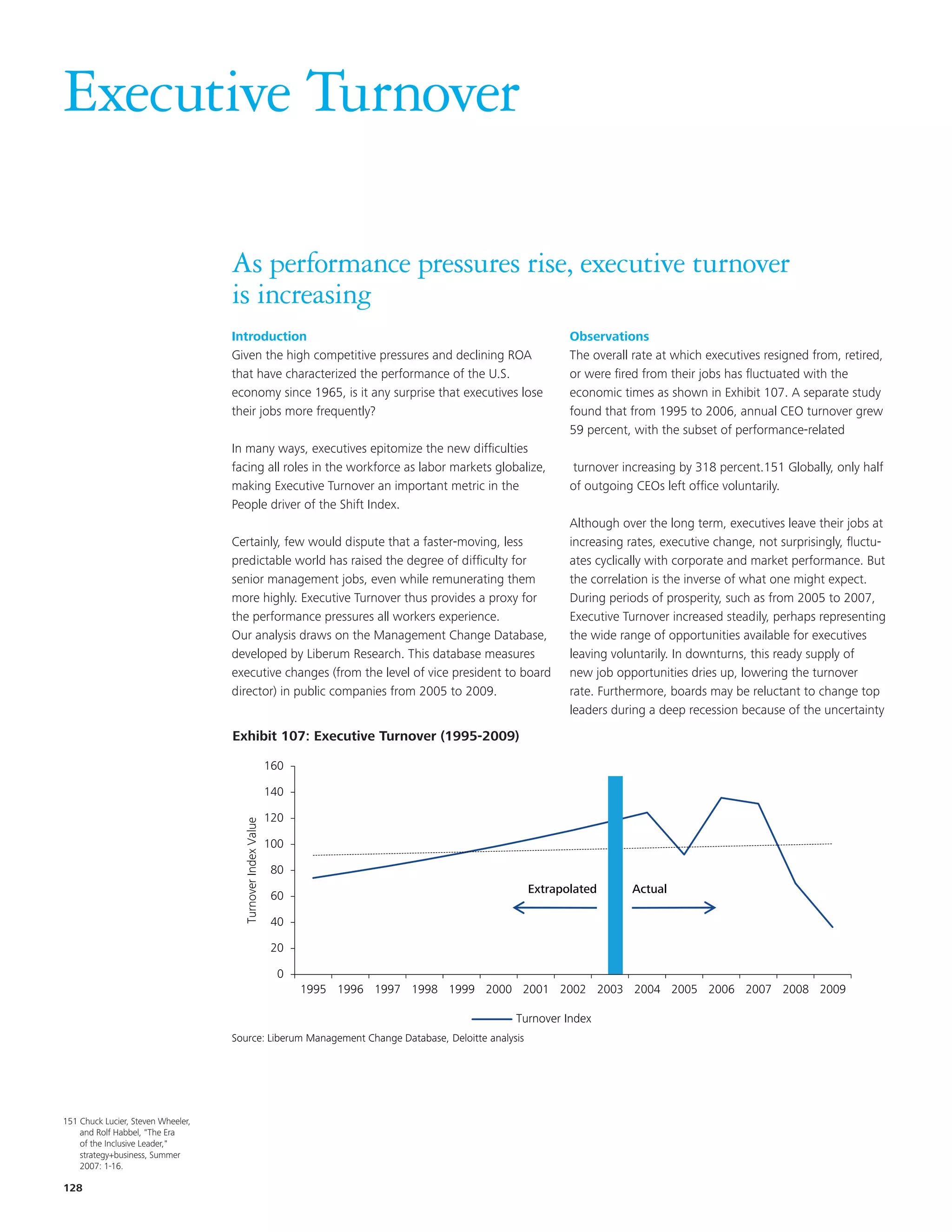



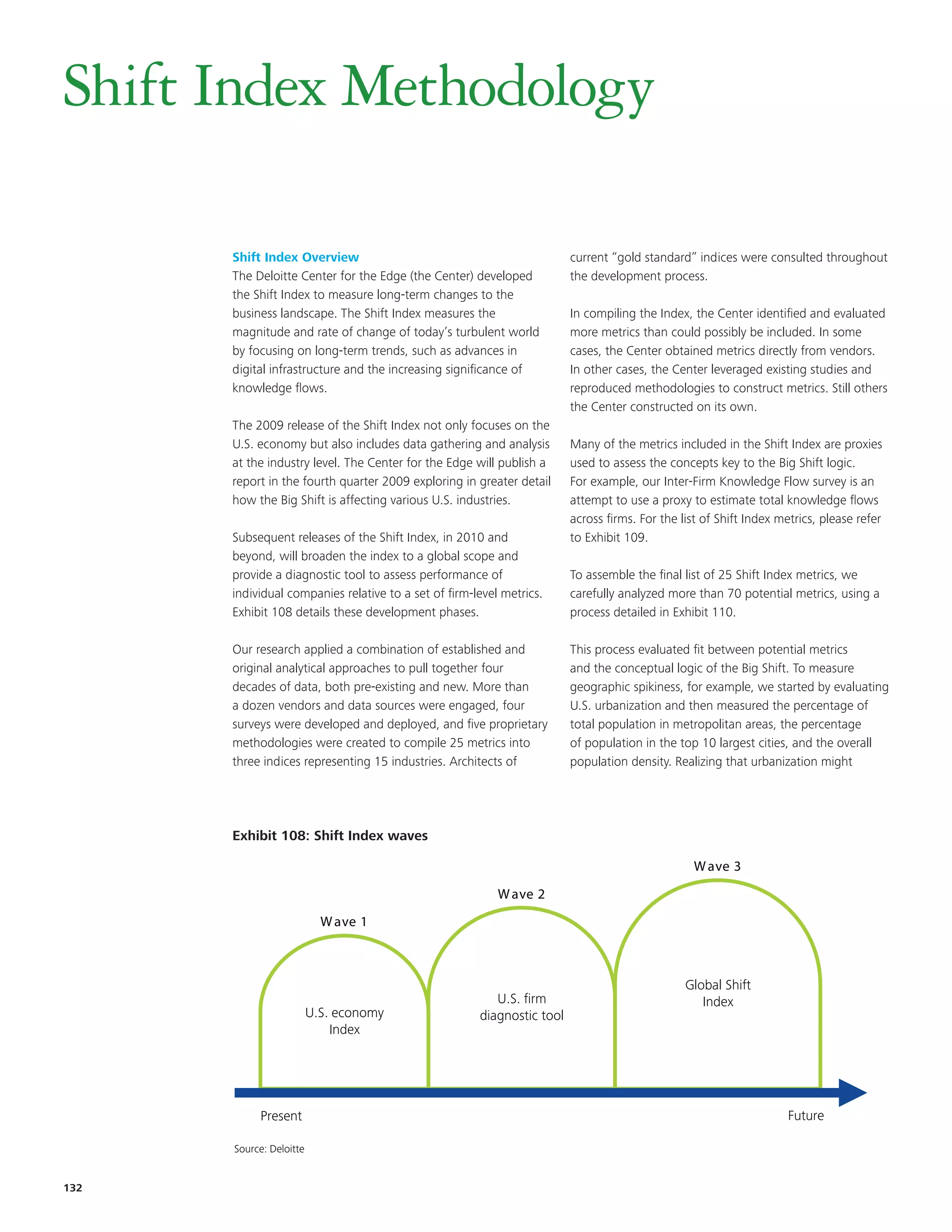













Measuring the forces of long-term change
        The 2010 Shift Index


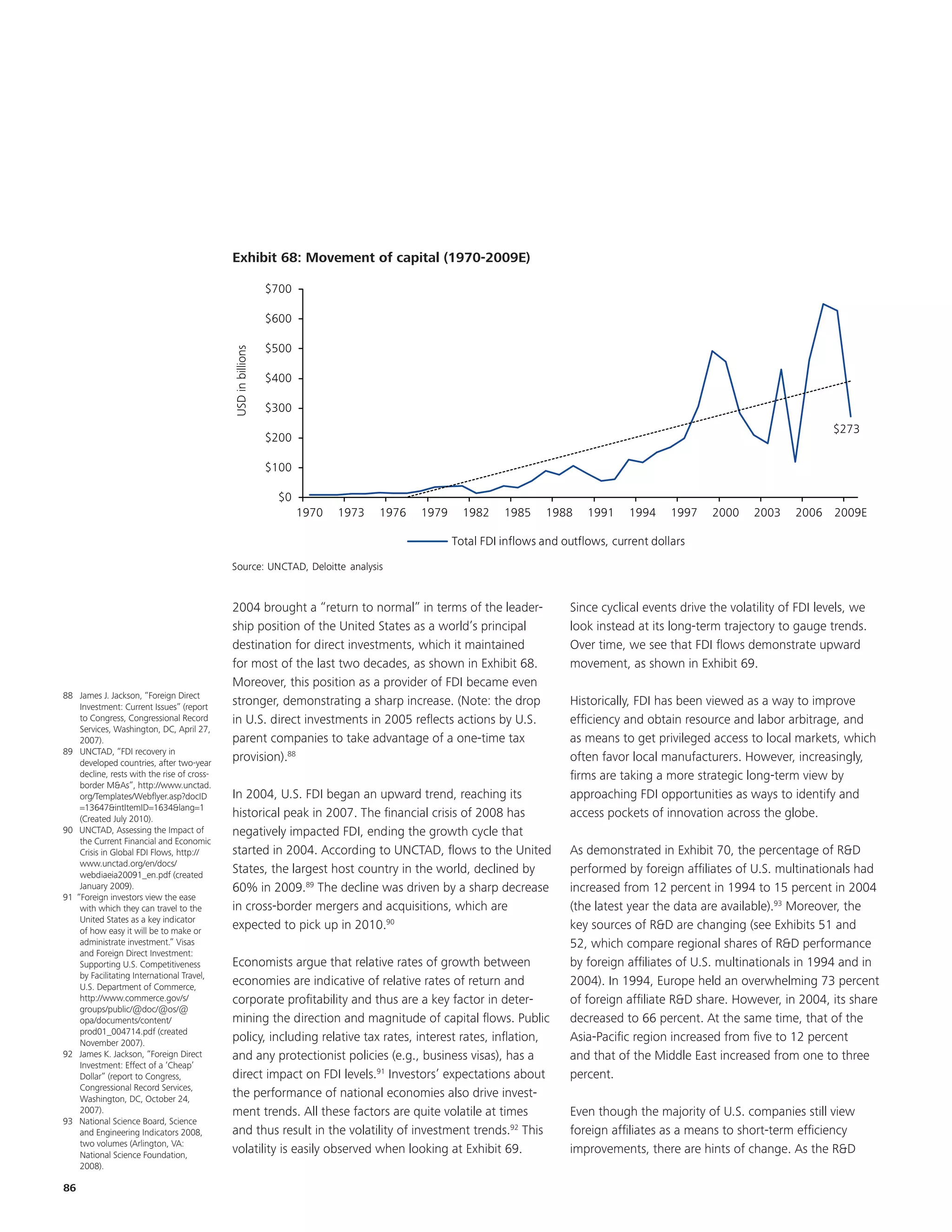
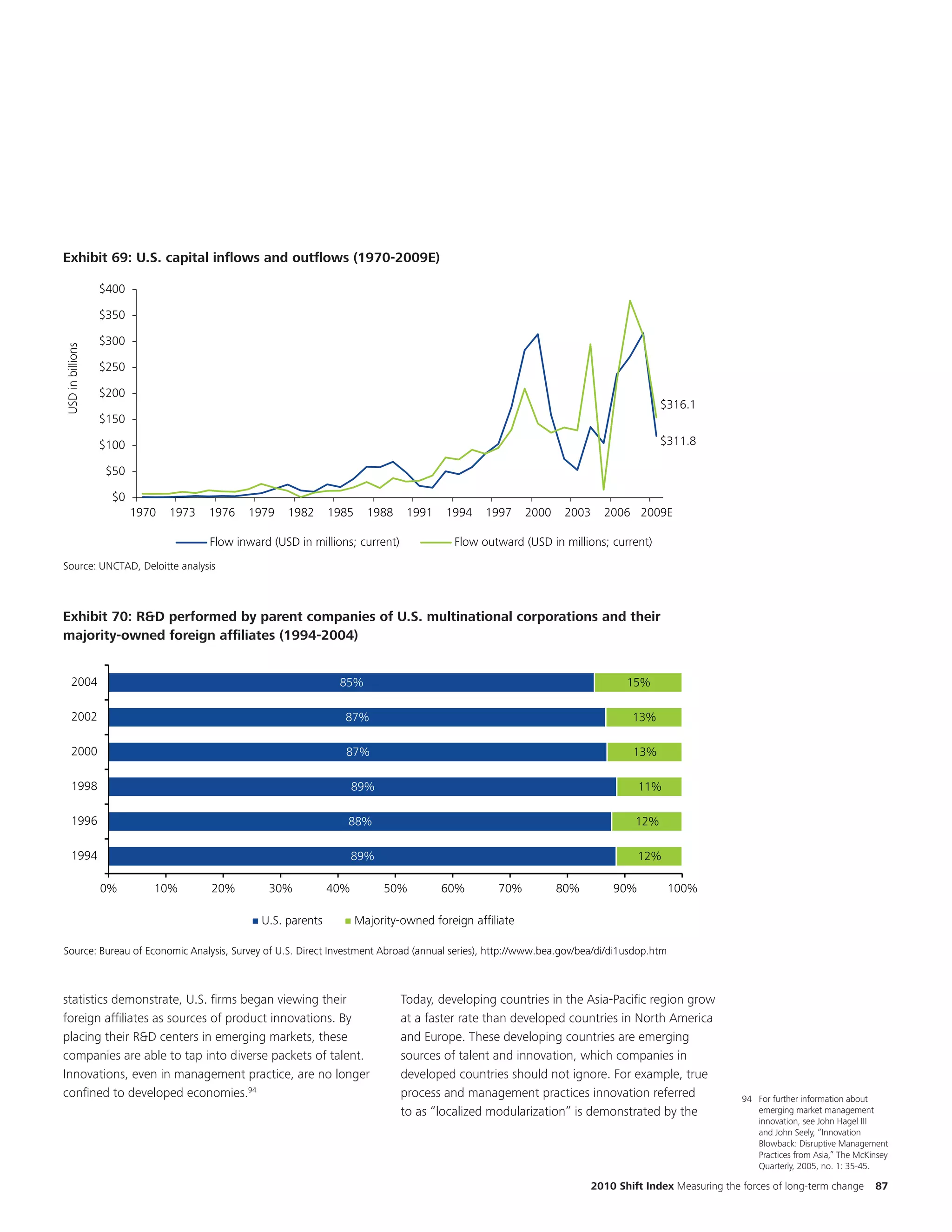
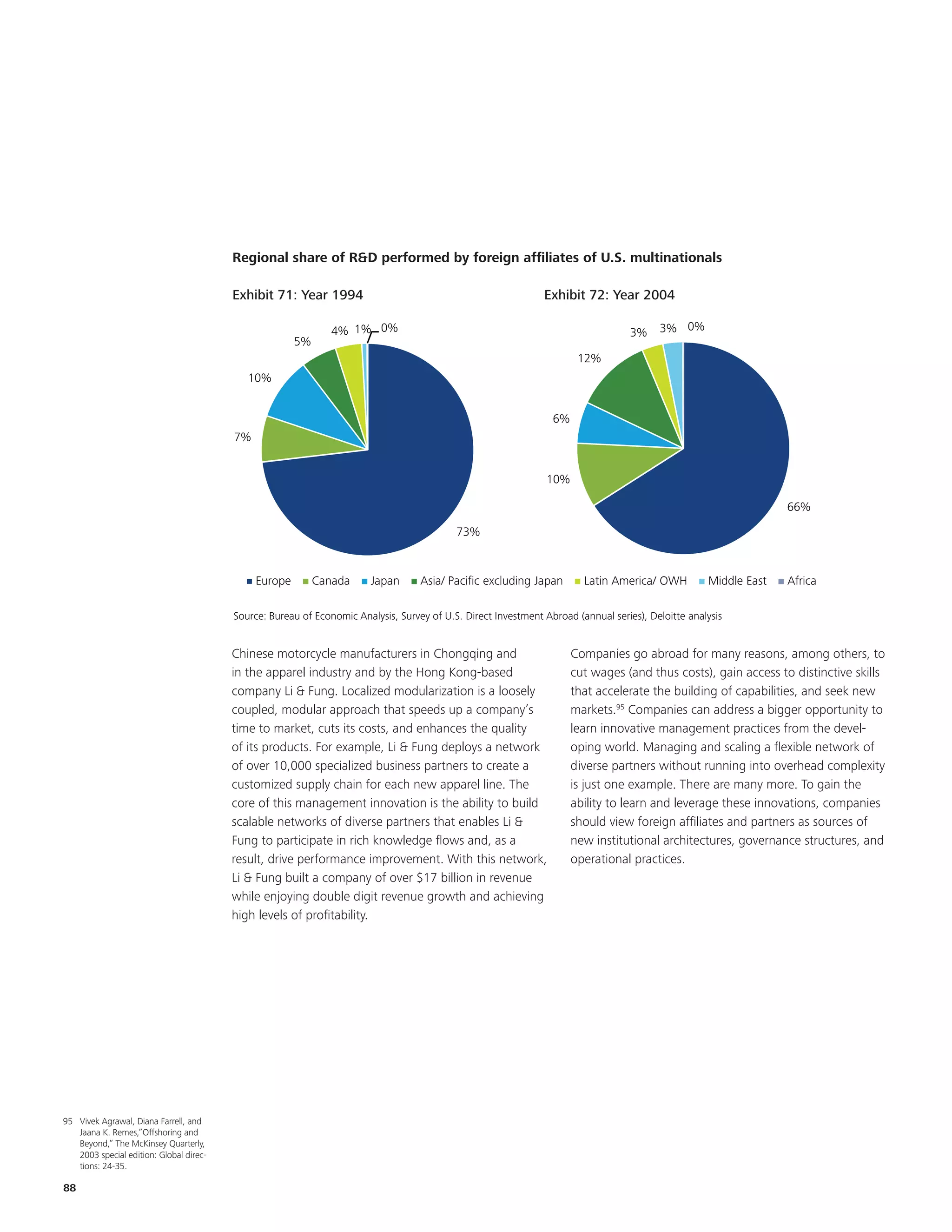
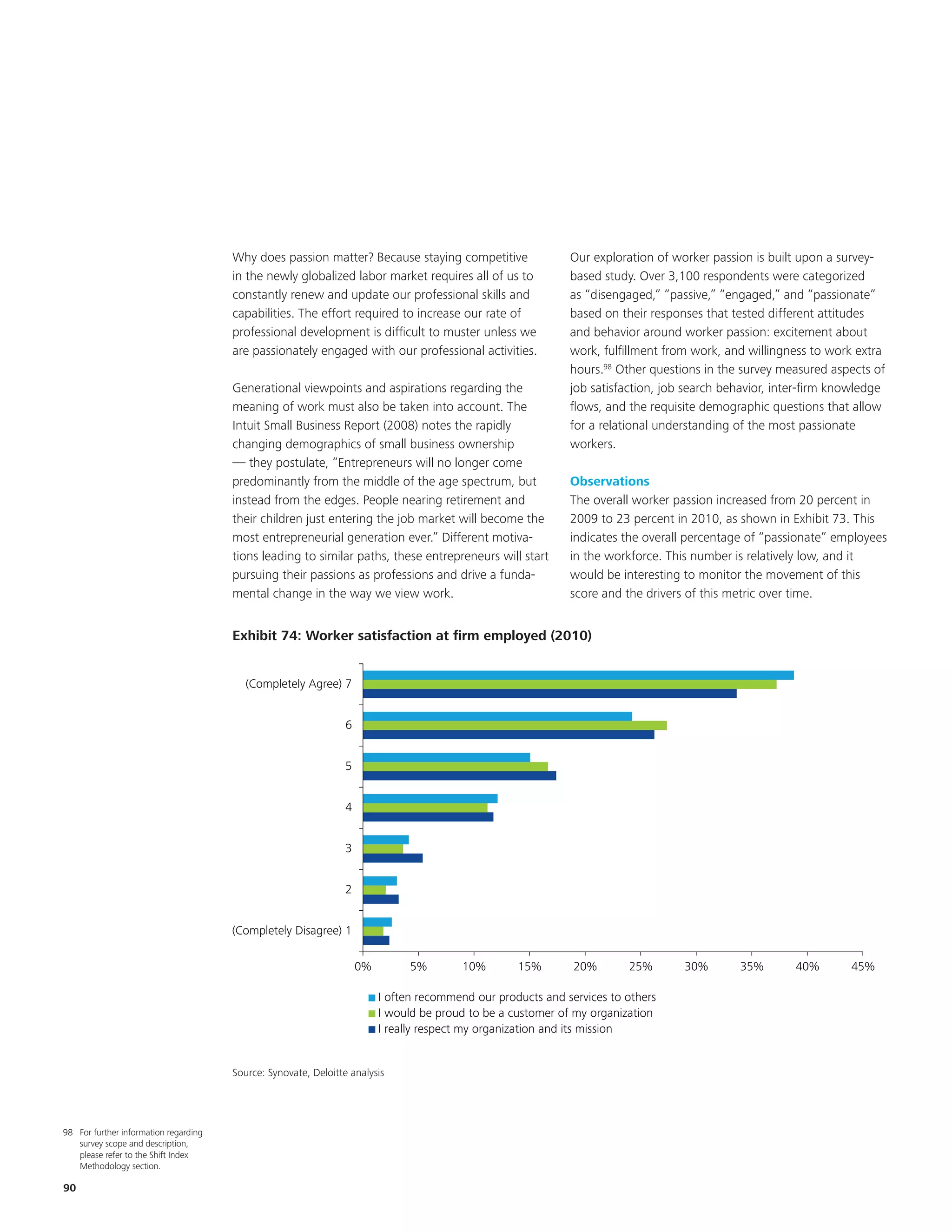
Deloitte Center for the Edge
John Hagel III
John Seely Brown
Duleesha Kulasooriya
Dan Elbert
Contents

2    Executive Summary

4    2010 Shift Index: What's New?

16   Key Ideas

18   Overview: Context, Findings, and Implications

24   Cross-Industry Perspectives

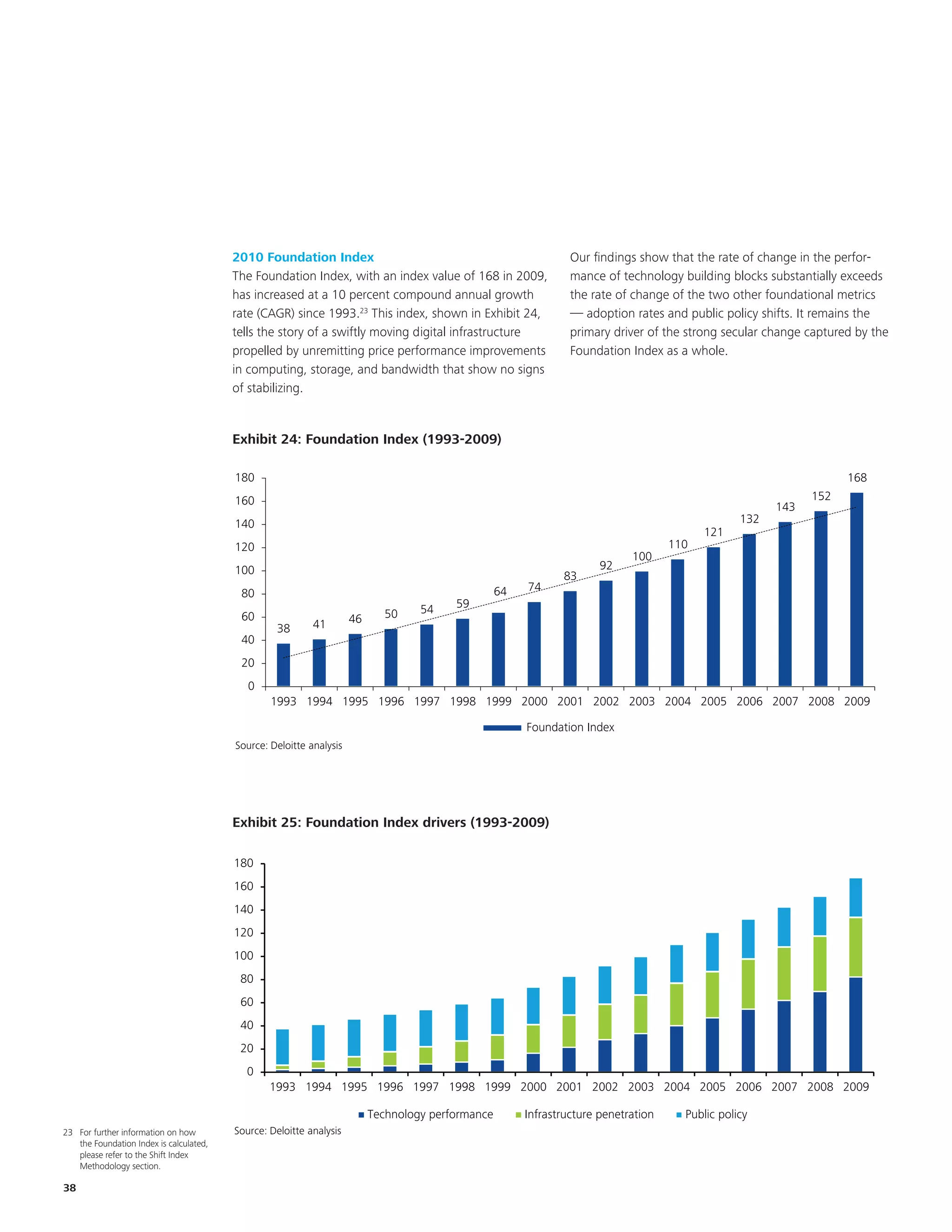
36   The Shift Index: Numbers and Trends

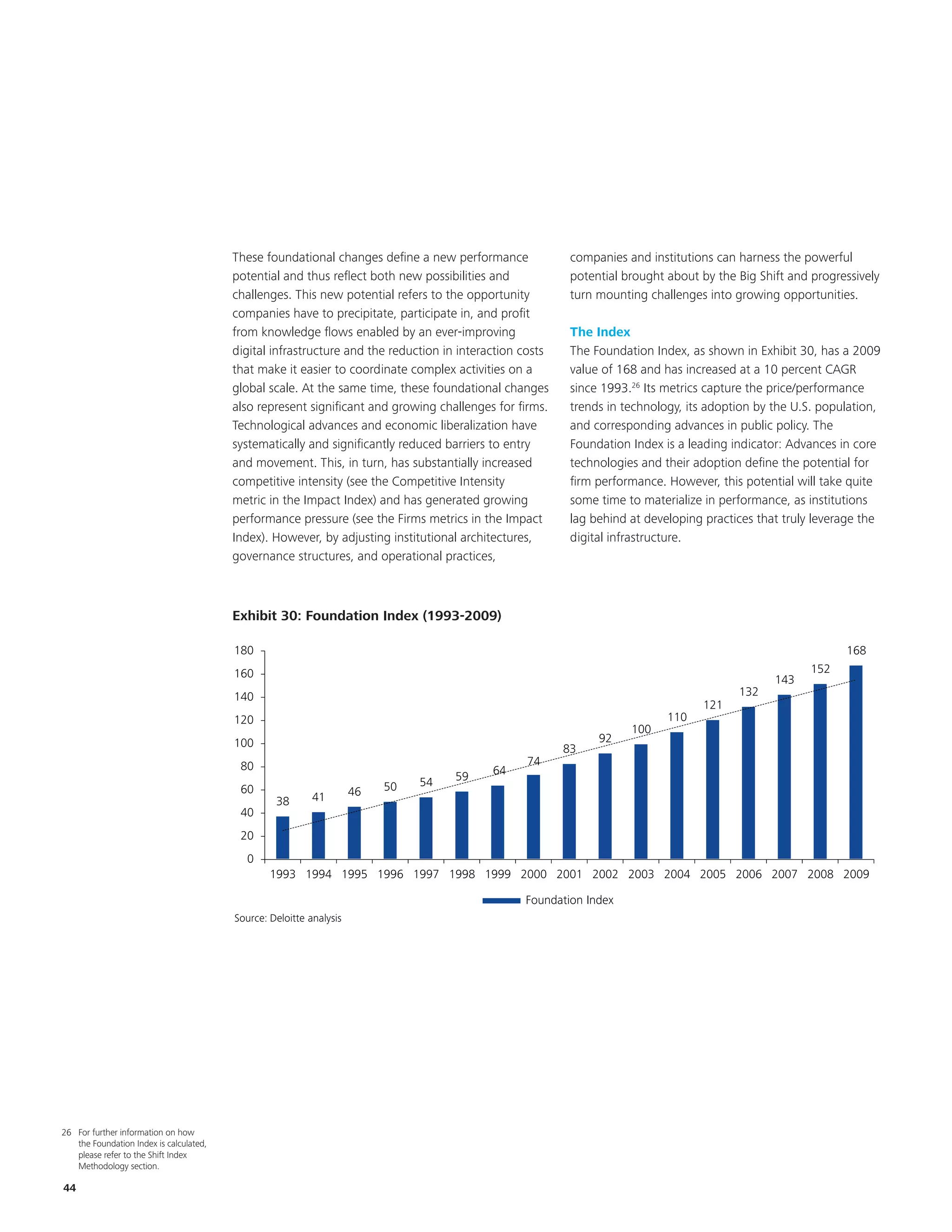
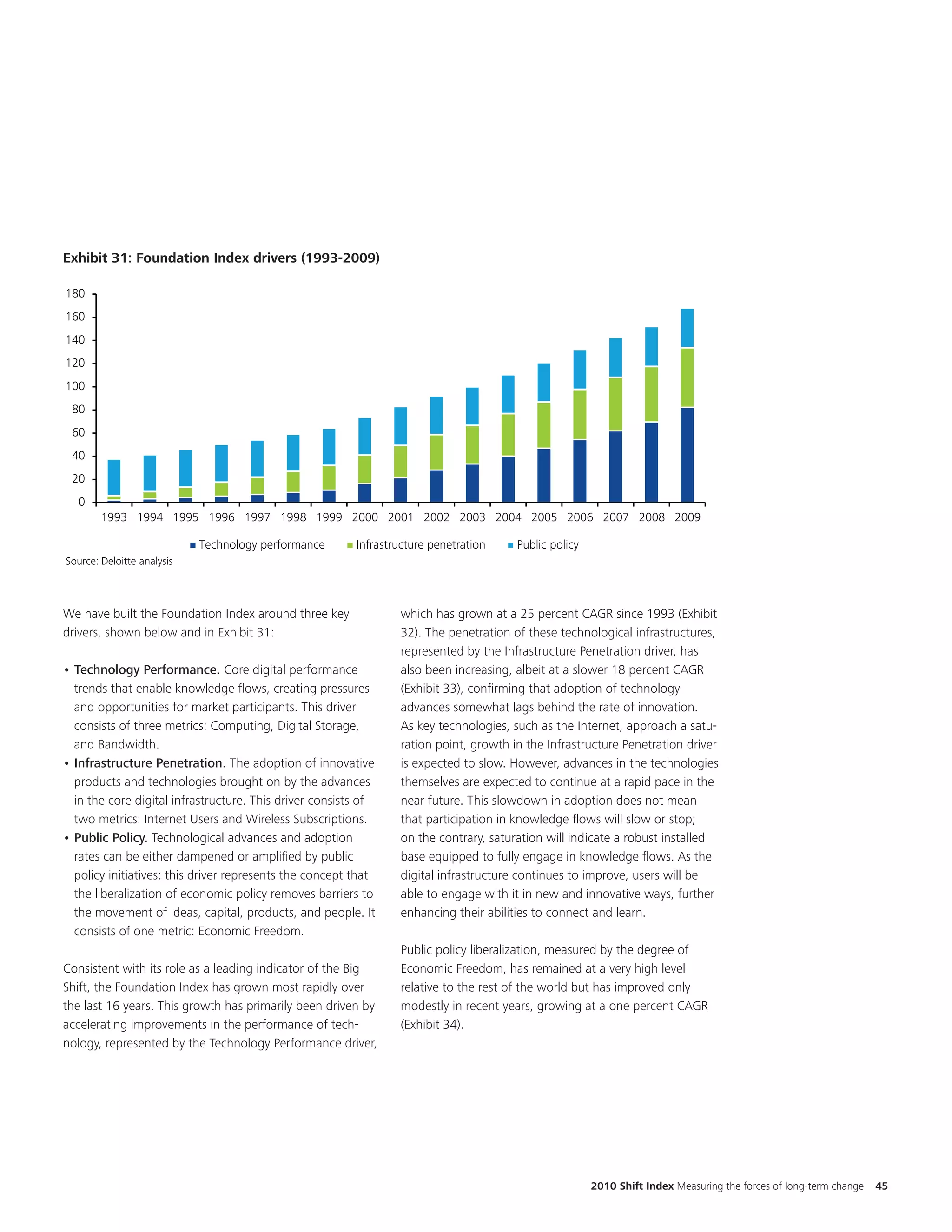
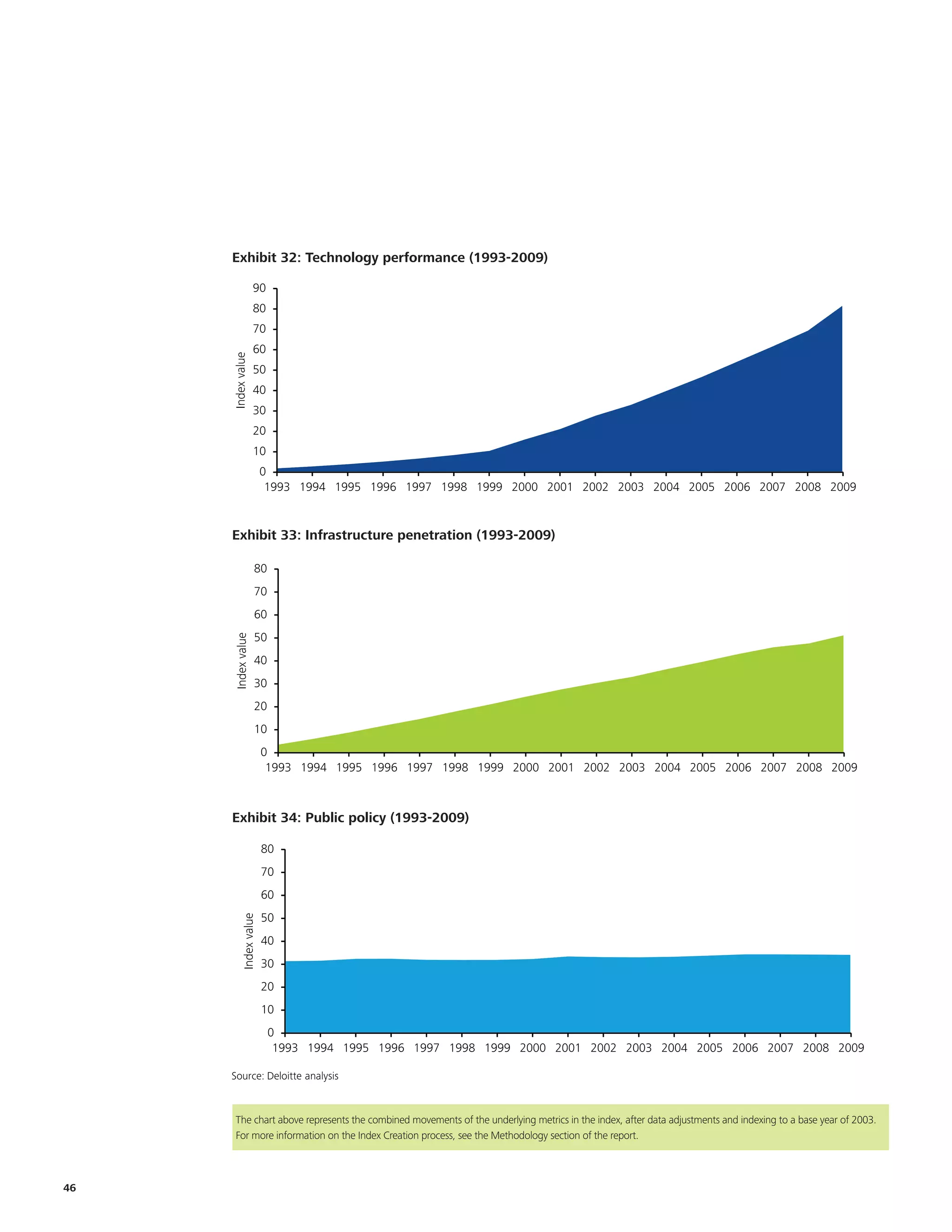
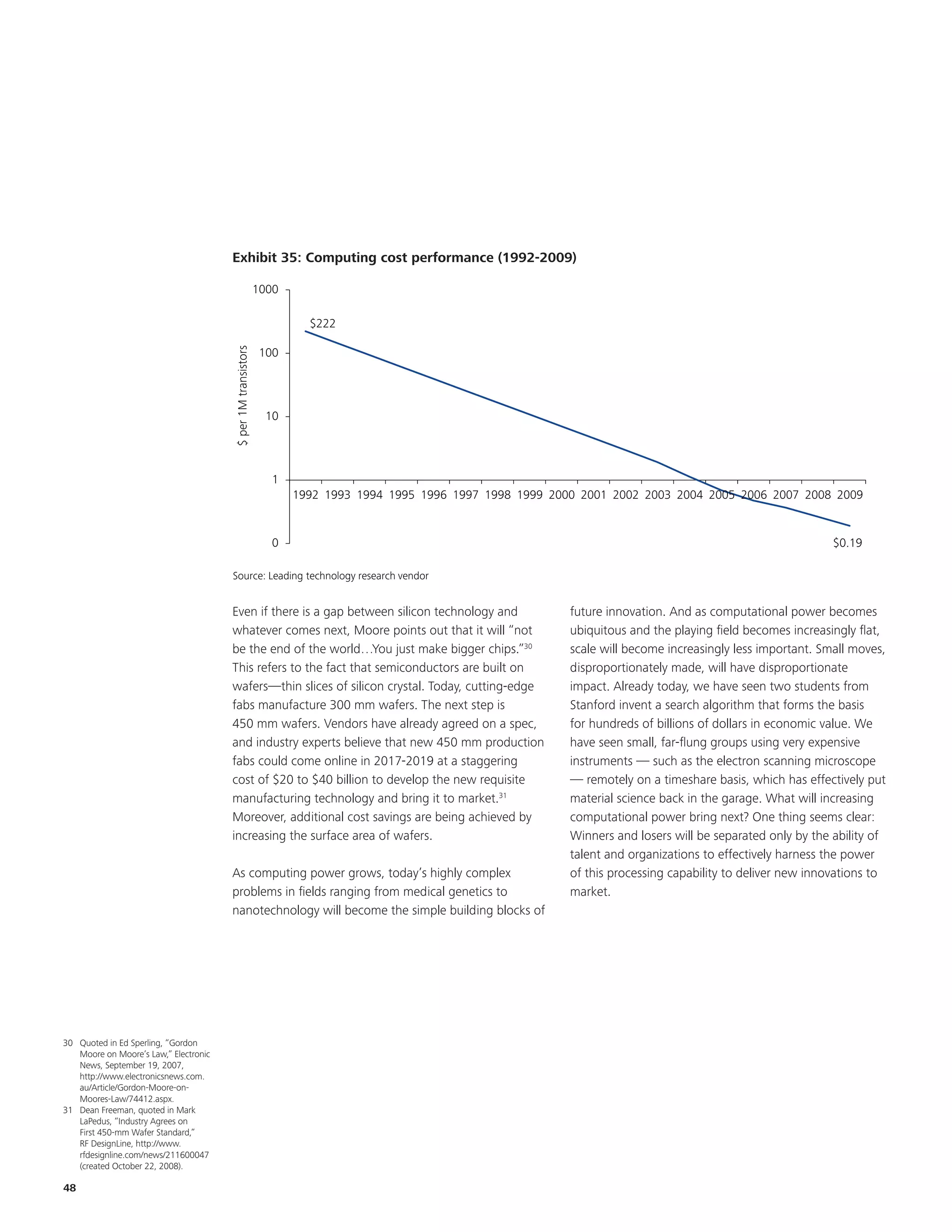
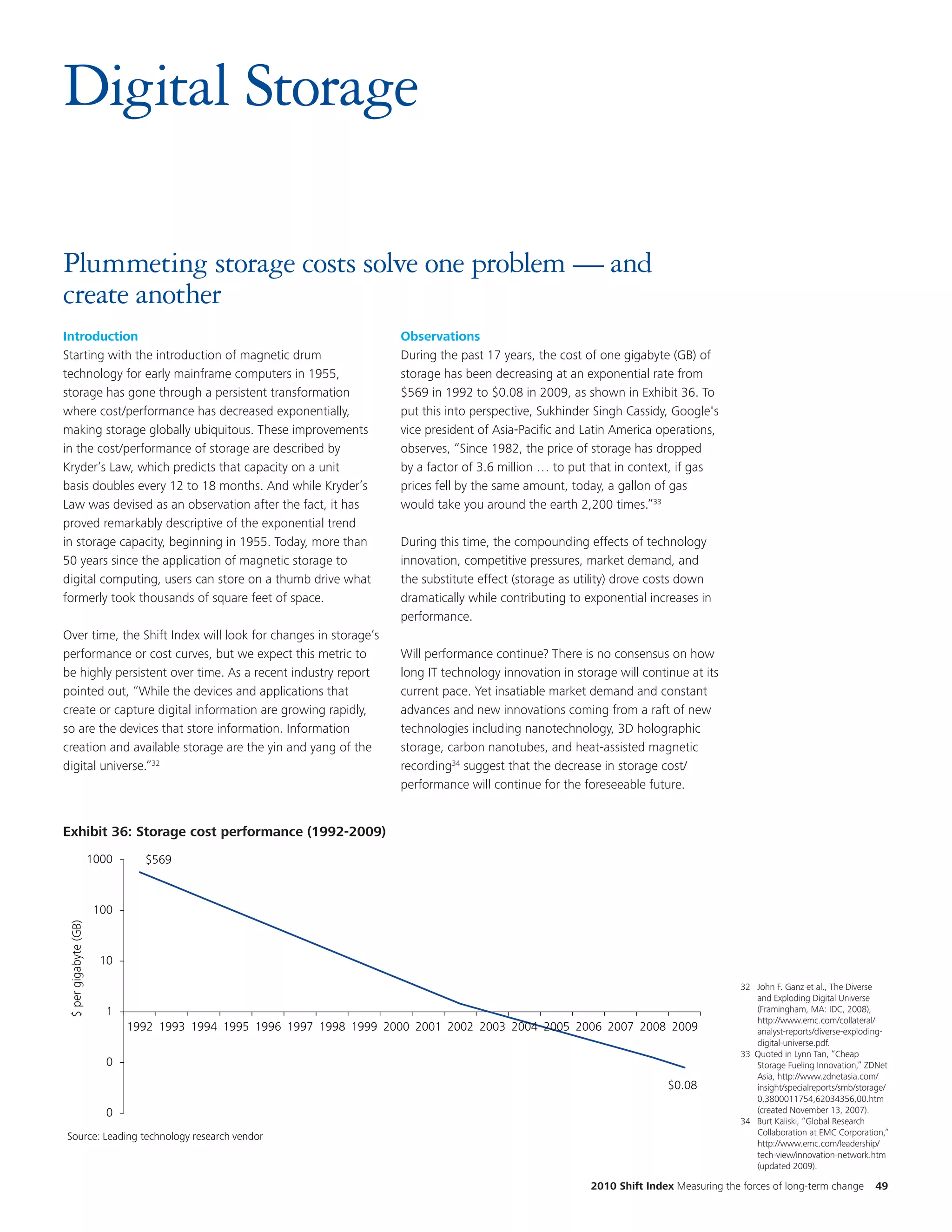
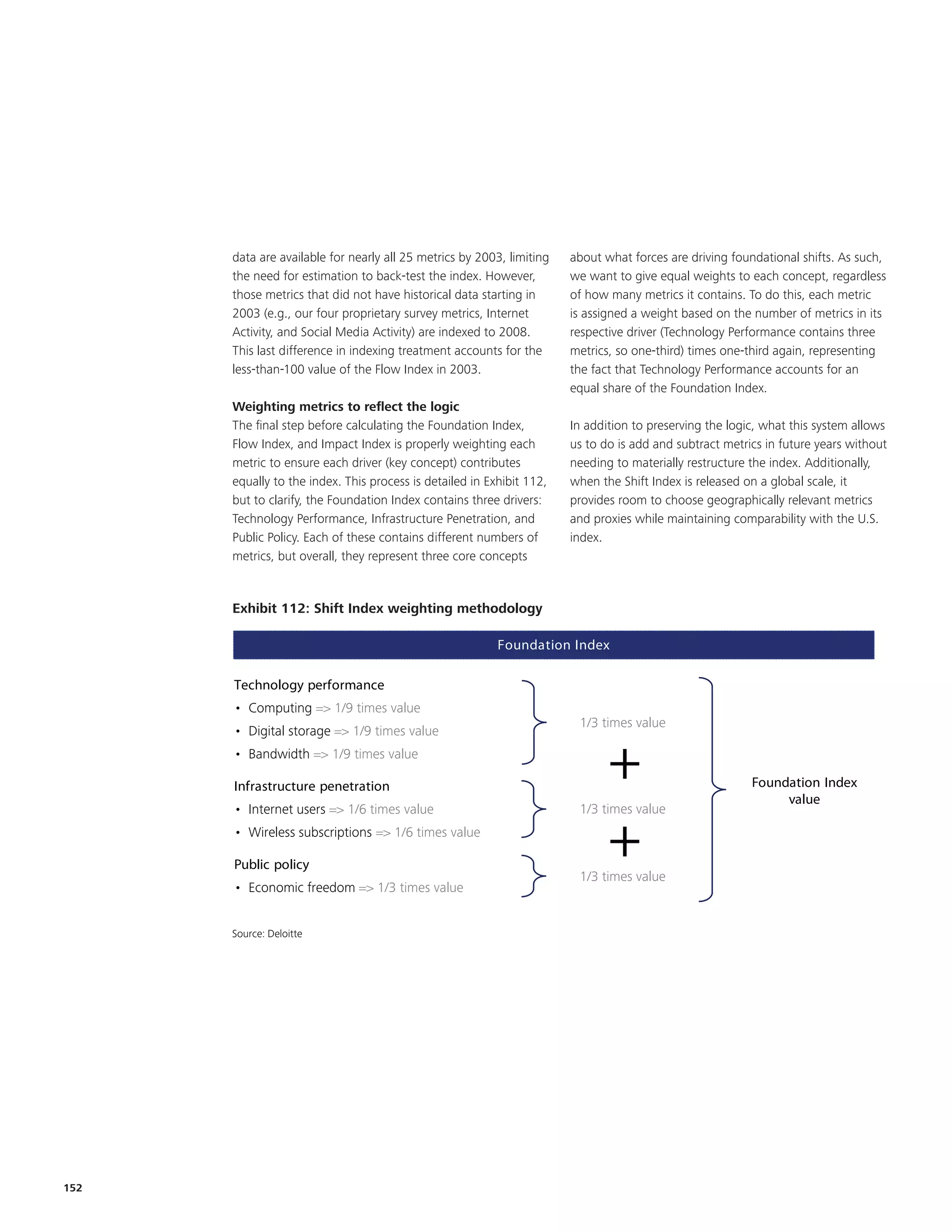
42   2010 Foundation Index

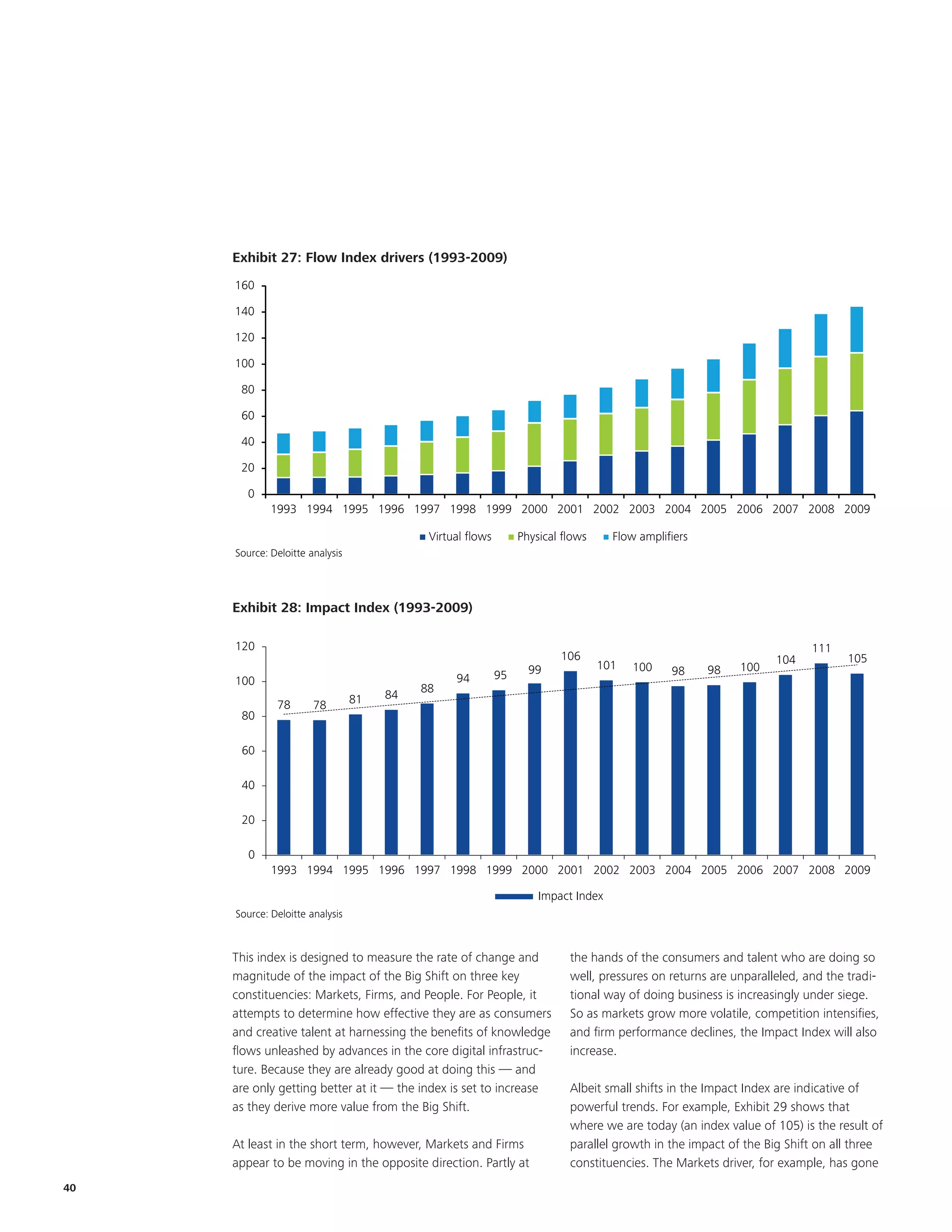
61   2010 Flow Index

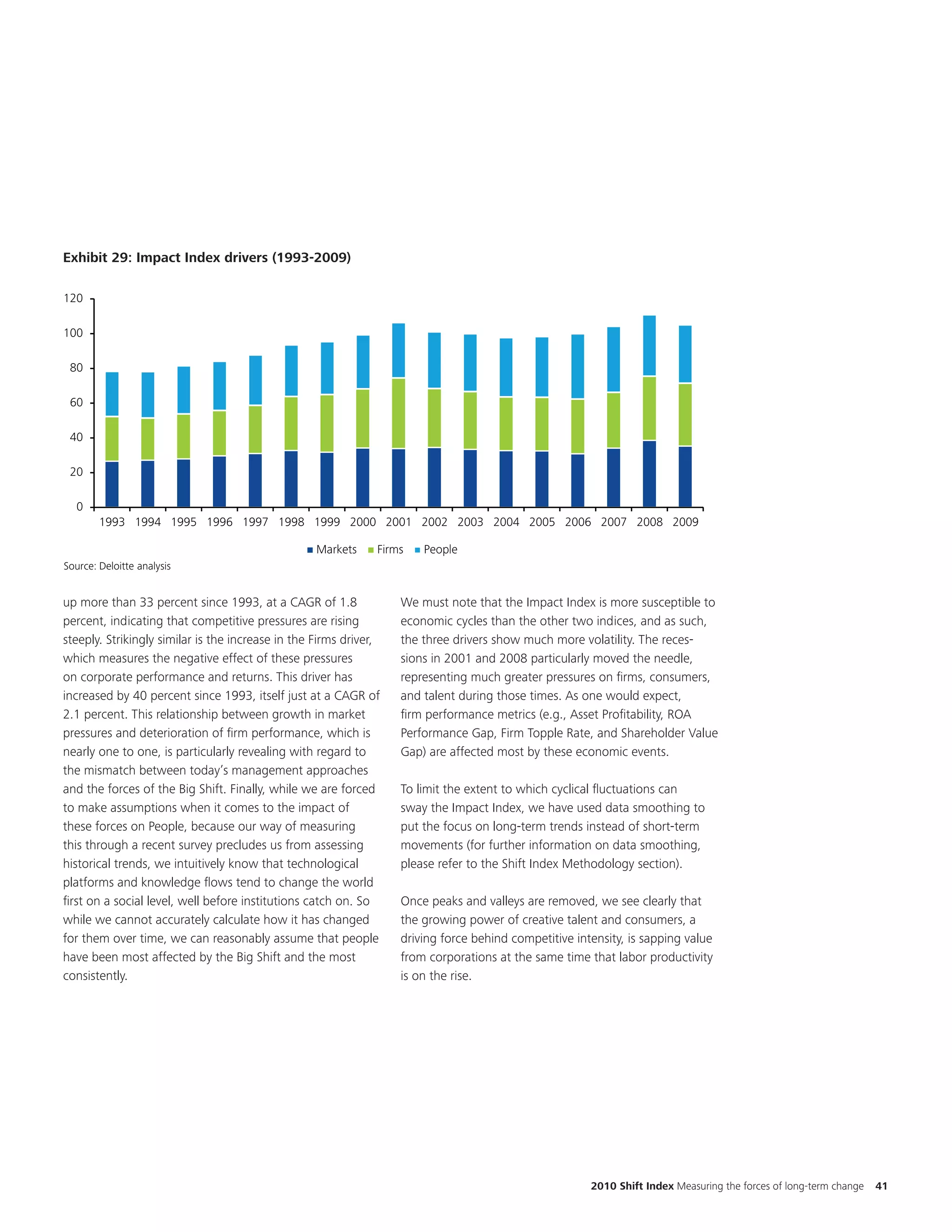
97   2010 Impact Index

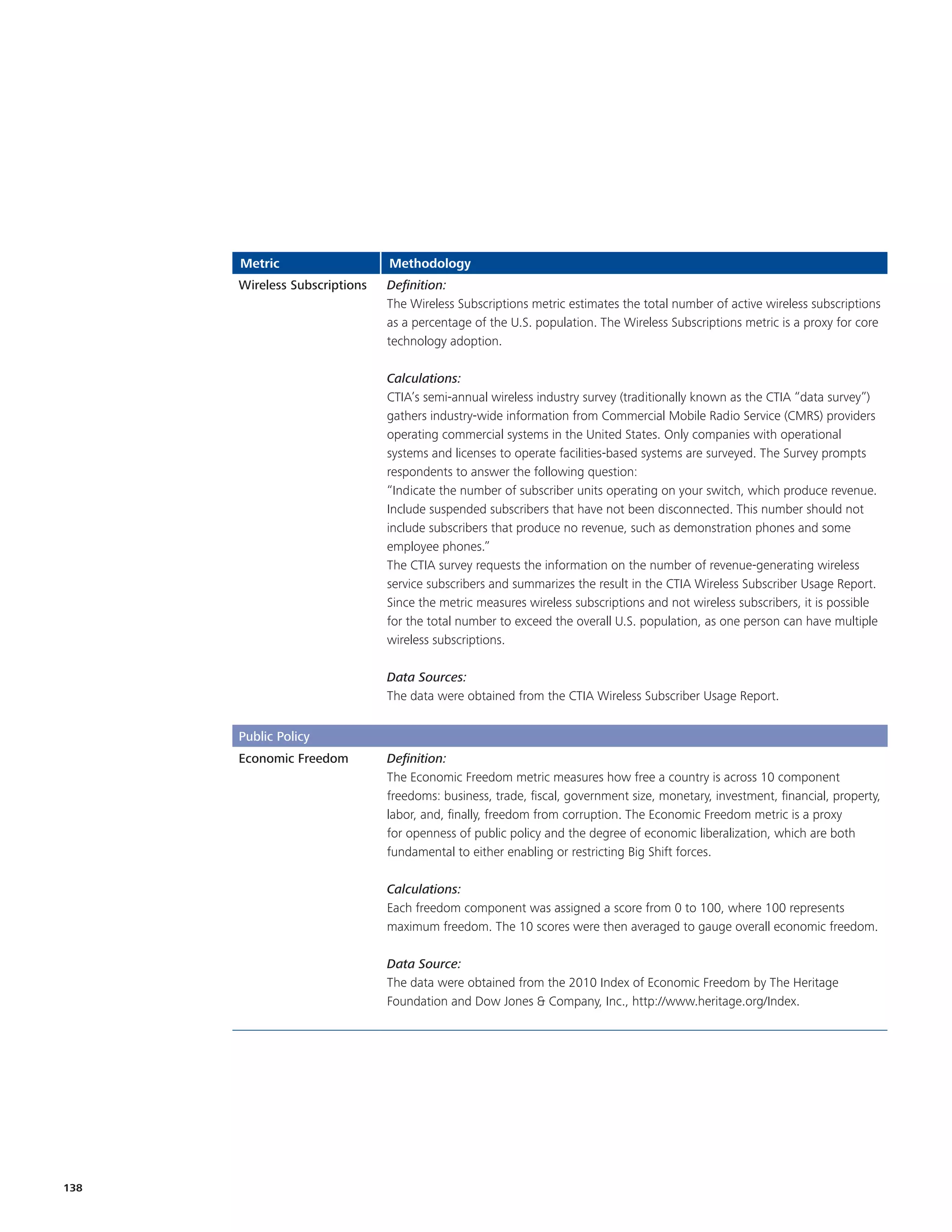
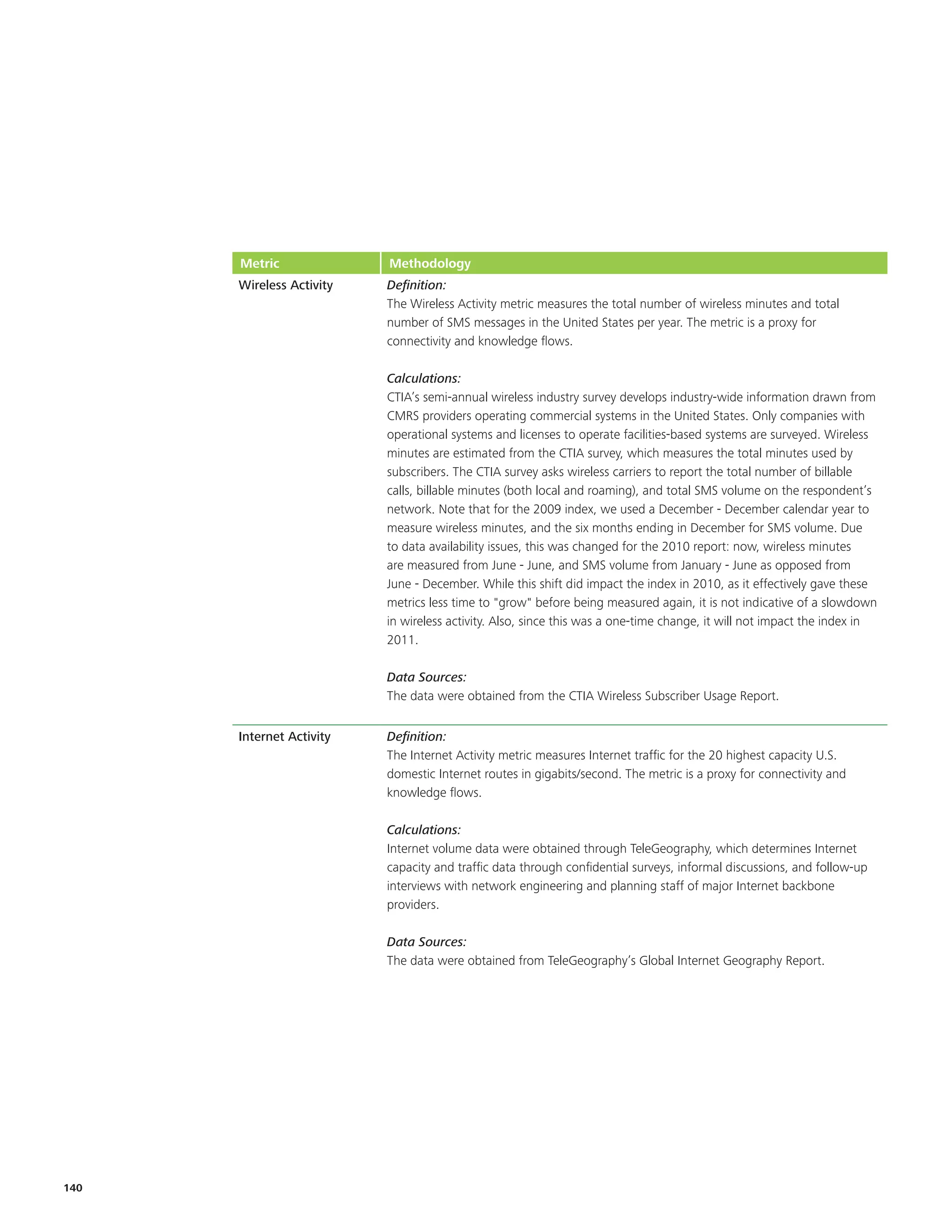
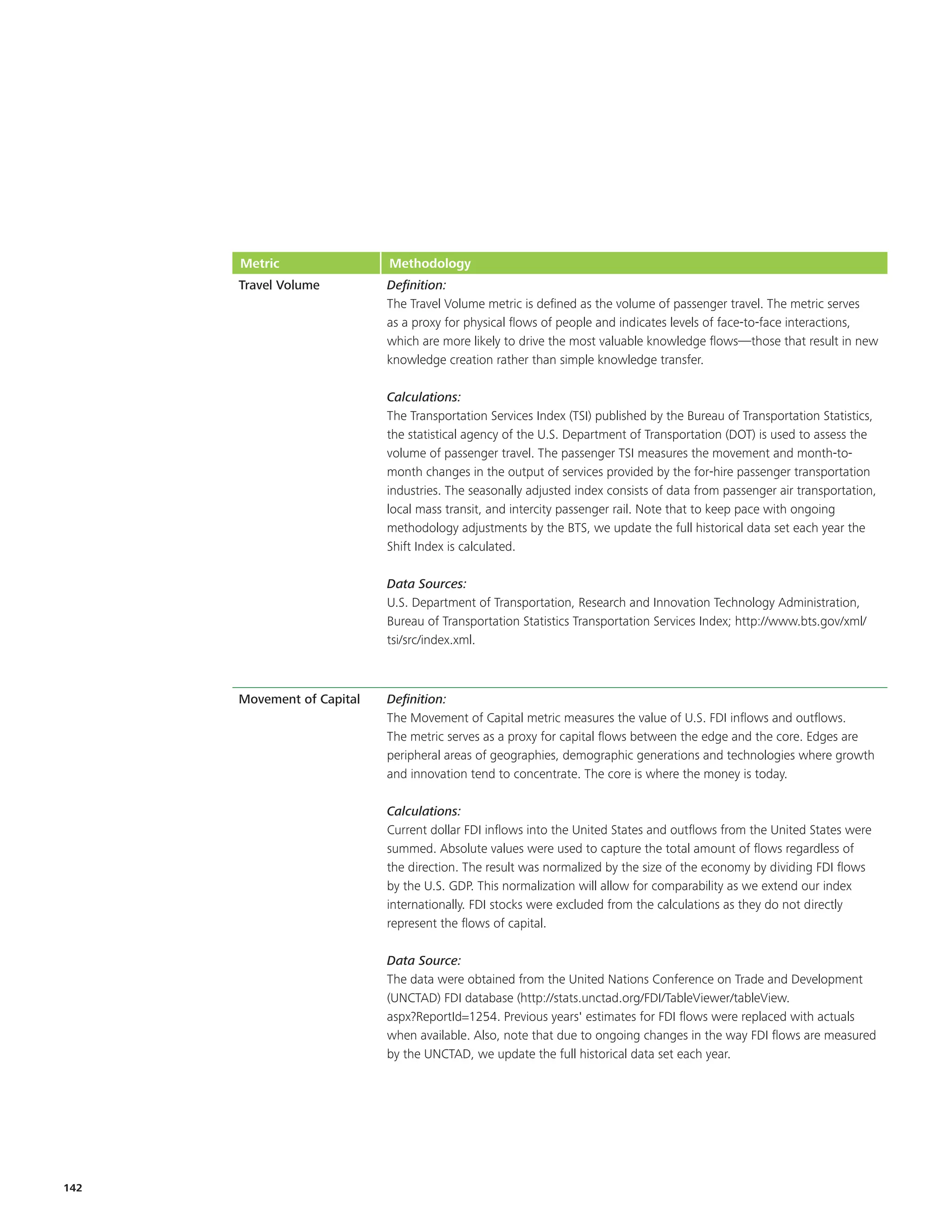
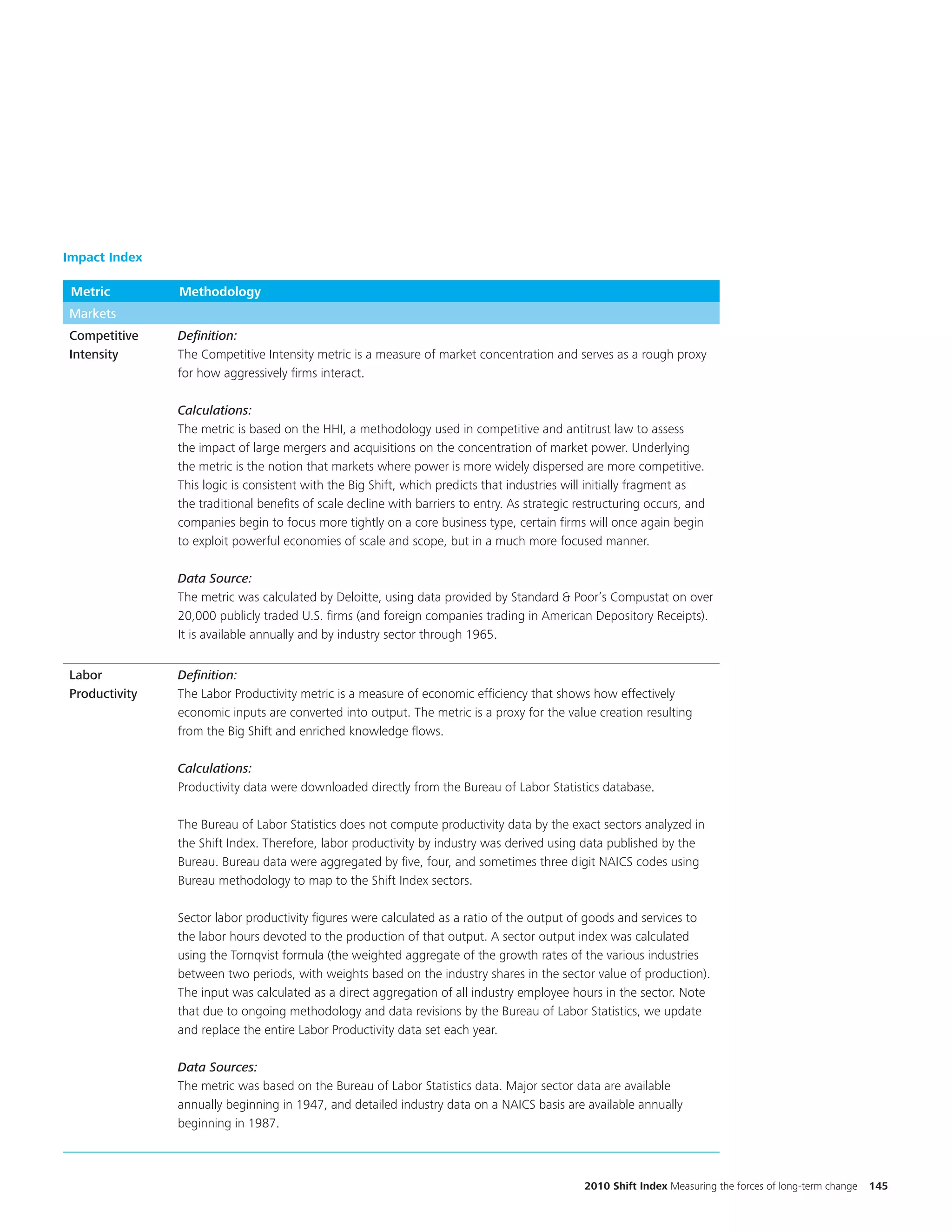
131 Shift Index Methodology

154 Appendix

192 Acknowledgements
Executive Summary

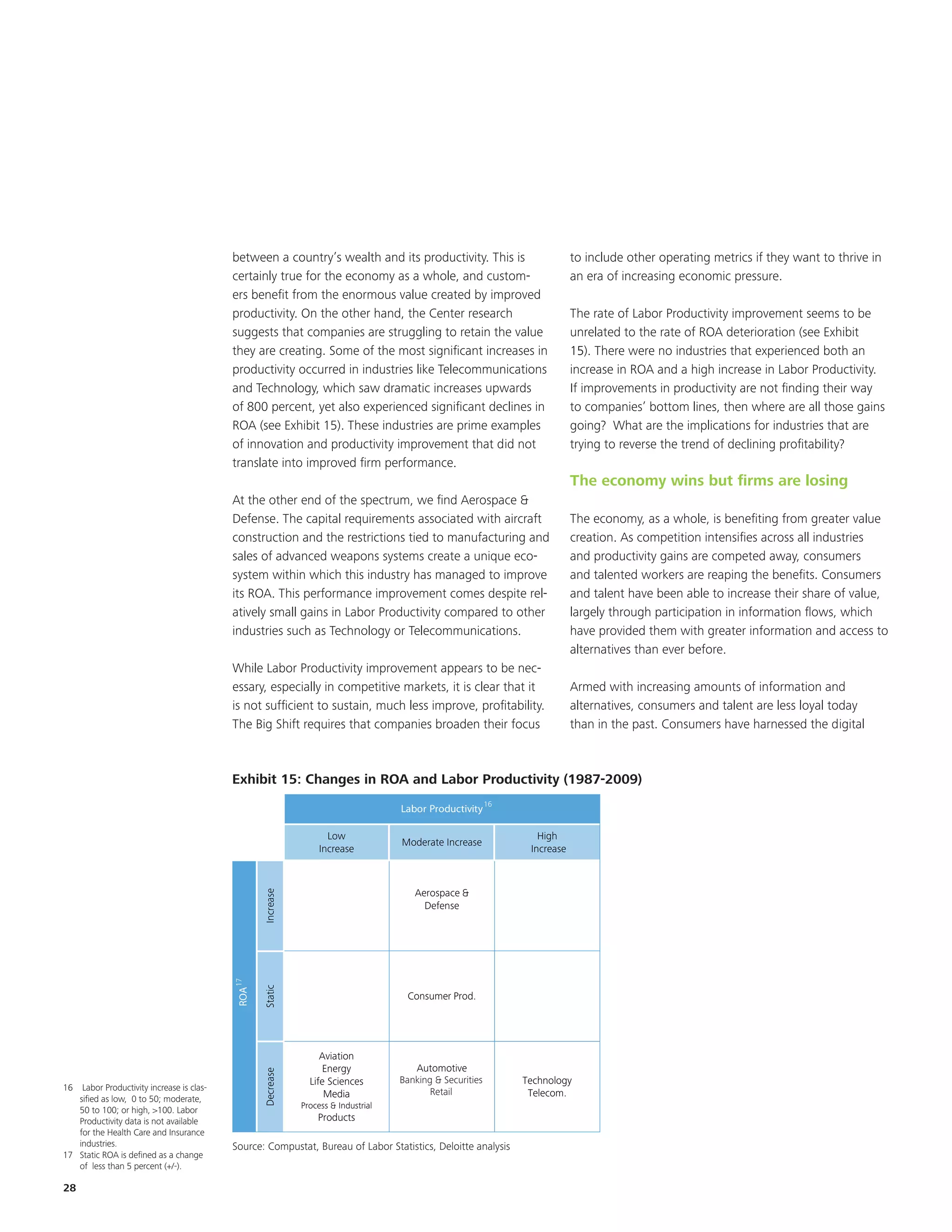
                                    In the midst of an economic downturn, when it’s all too             passionate about their current work. We discuss reasons
                                    easy to fixate on cyclical events, there’s real danger of           why this should be troubling to executives, particularly in
                                    losing sight of deeper trends. Strictly cyclical thinking risks     the face of growing economic pressure that far tran-
                                    discounting or even ignoring powerful forces of longer-             scends our recent economic downturn when passionate
                                    term change. To provide a clear, comprehensive, and                 workers hold the key to sustained performance
                                    sustained view of the deep dynamics changing our world,             improvement.
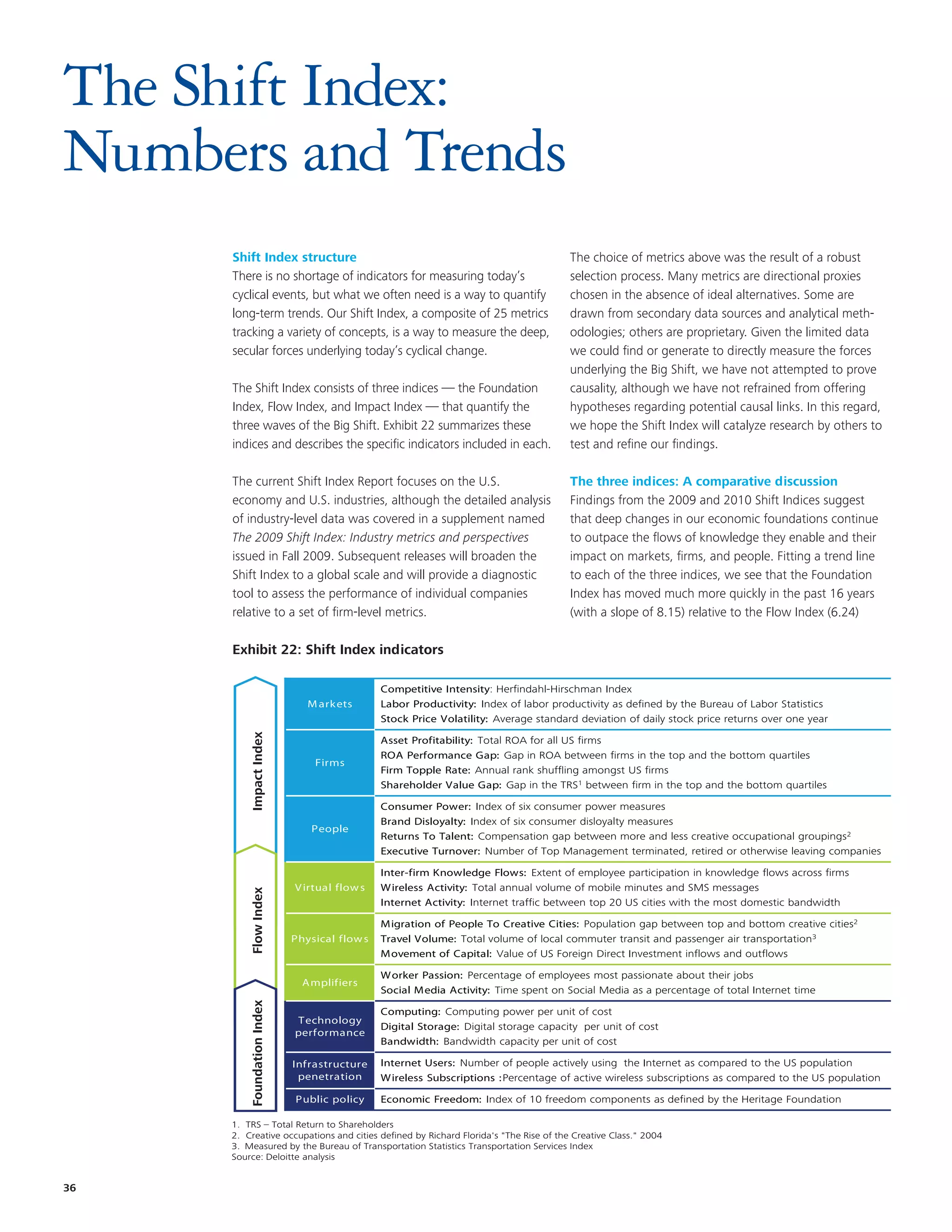
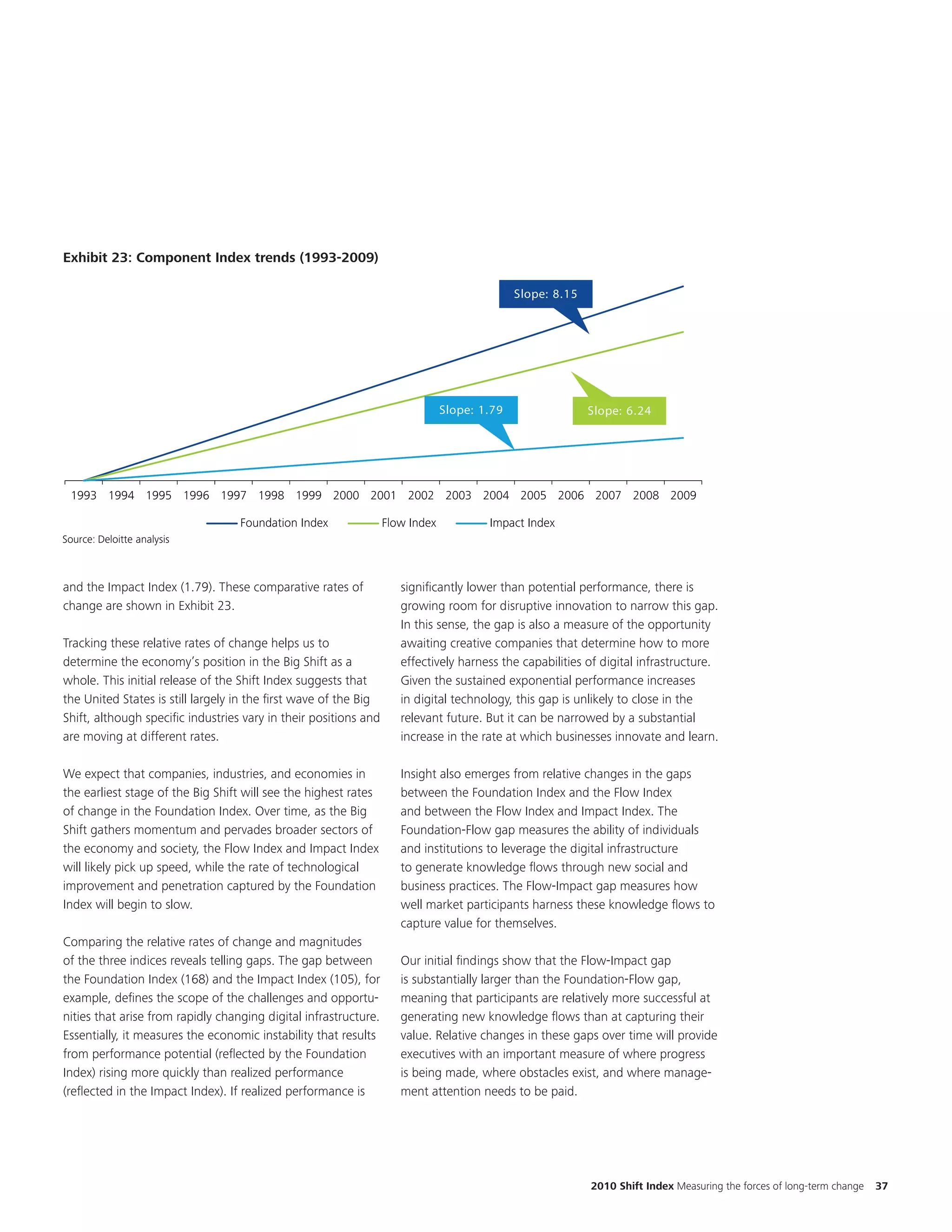
                                    Deloitte's Center for the Edge has developed a Shift Index        • Performance continues to decline. Whether measured
                                    consisting of three indices and 25 metrics designed to              through return on assets (ROA), return on invested
                                    make longer-term performance trends more visible and                capital (ROIC) or return on equity (ROE), the long-term
                                    actionable.                                                         downward trend we observed and reported last year
                                                                                                        holds true. We discuss this in the context of several
                                    Our first release of the Shift Index, in 2009, highlighted          macro-trends—transition to a service economy, M&A
                                    a core performance challenge for the firm that has been             activity, outsourcing, and growth of intangible assets--
                                    playing out for decades. Remarkably, the return on assets           that have been put forth as factors to explain (or explain
                                    (ROA) for U.S. firms has steadily fallen to almost one-             away) the observed decline.
                                    quarter of 1965 levels while there have been continuous,          • Other indicators have been affected by the cyclical
                                    albeit much more modest, improvements in labor                      economic downturn. While we firmly believe the
                                    productivity.                                                       long-term trends will play out, the continued economic
                                                                                                        downturn—in particular the lack of access to capital,
                                    Additional findings include the following:                          decreased consumer spending and the resulting business
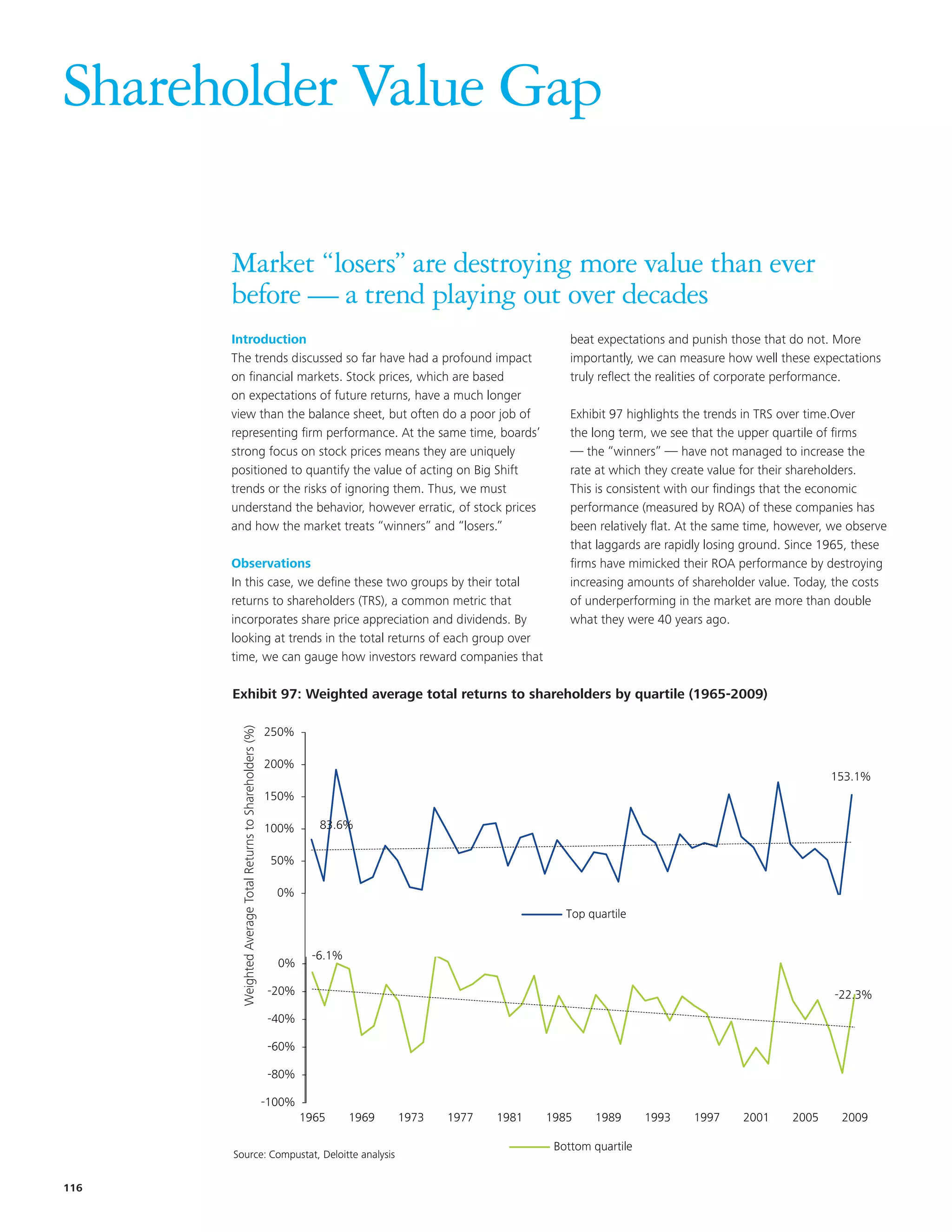
                                    • The ROA performance gap between winners and losers                bankruptcies-- has in the short term influenced some of
                                      has increased over time, with the “winners” barely                the trends. Notably, capital movement slowed dramati-
                                      maintaining previous performance levels, while the losers         cally, overall competitive intensity decreased, the ROA
                                      experience rapid deterioration in performance.                    performance gap narrowed, and executive turnover
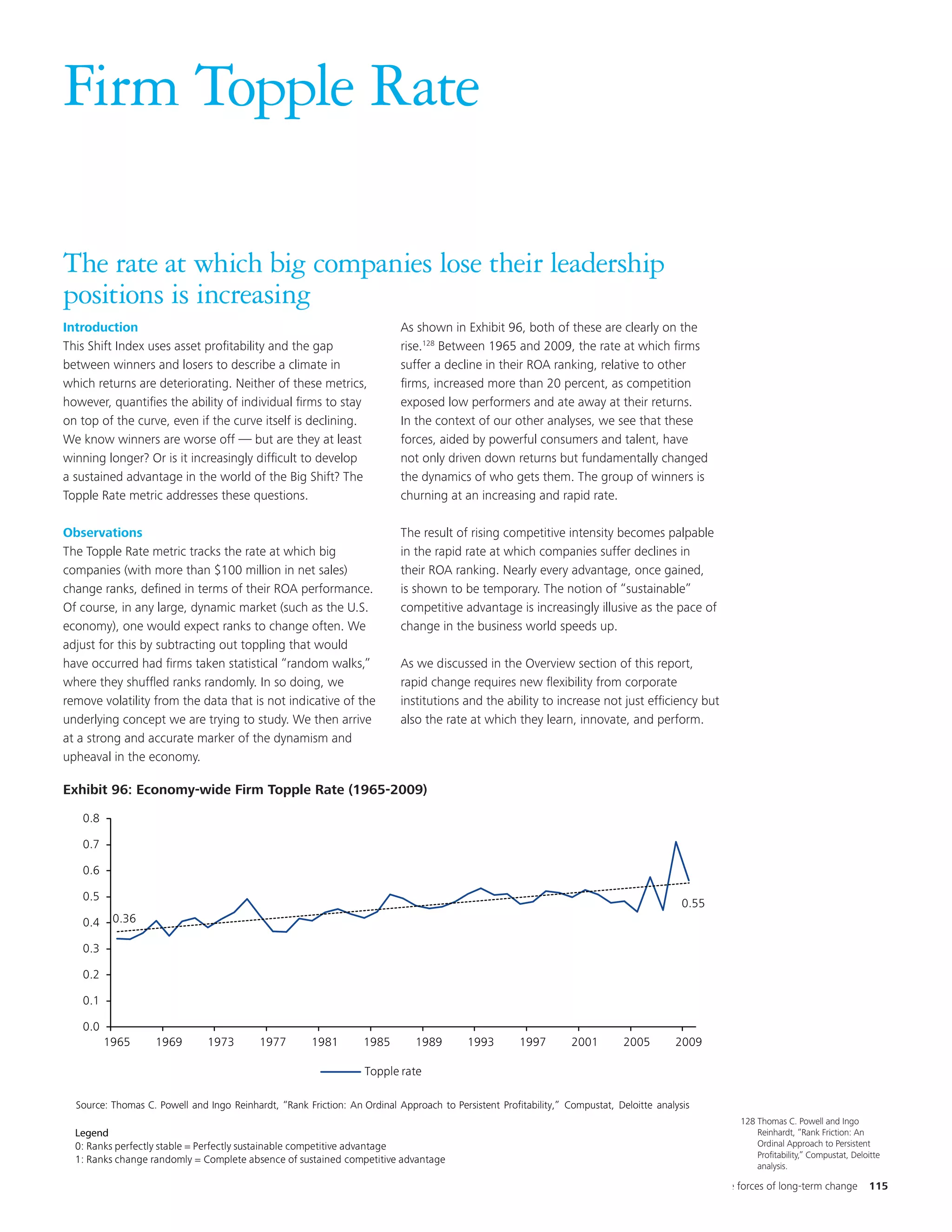
                                    • The “topple rate” at which big companies lose their lead-         reached a five-year low. Brand disloyalty increased while
                                      ership positions has more than doubled, suggesting that           the consumer’s perception of power in the marketplace,
                                      “winners” have increasingly precarious positions.                 which had been rising as brand loyalty diminished, also
                                    • U.S. competitive intensity has more than doubled during           decreased.
                                      the last 40 years.
                                    • While the performance of U.S. firms is deteriorating,           Given the long-term trends, we cannot reasonably expect
                                      the benefits of productivity improvements appear to             to see a significant easing of performance pressure as the
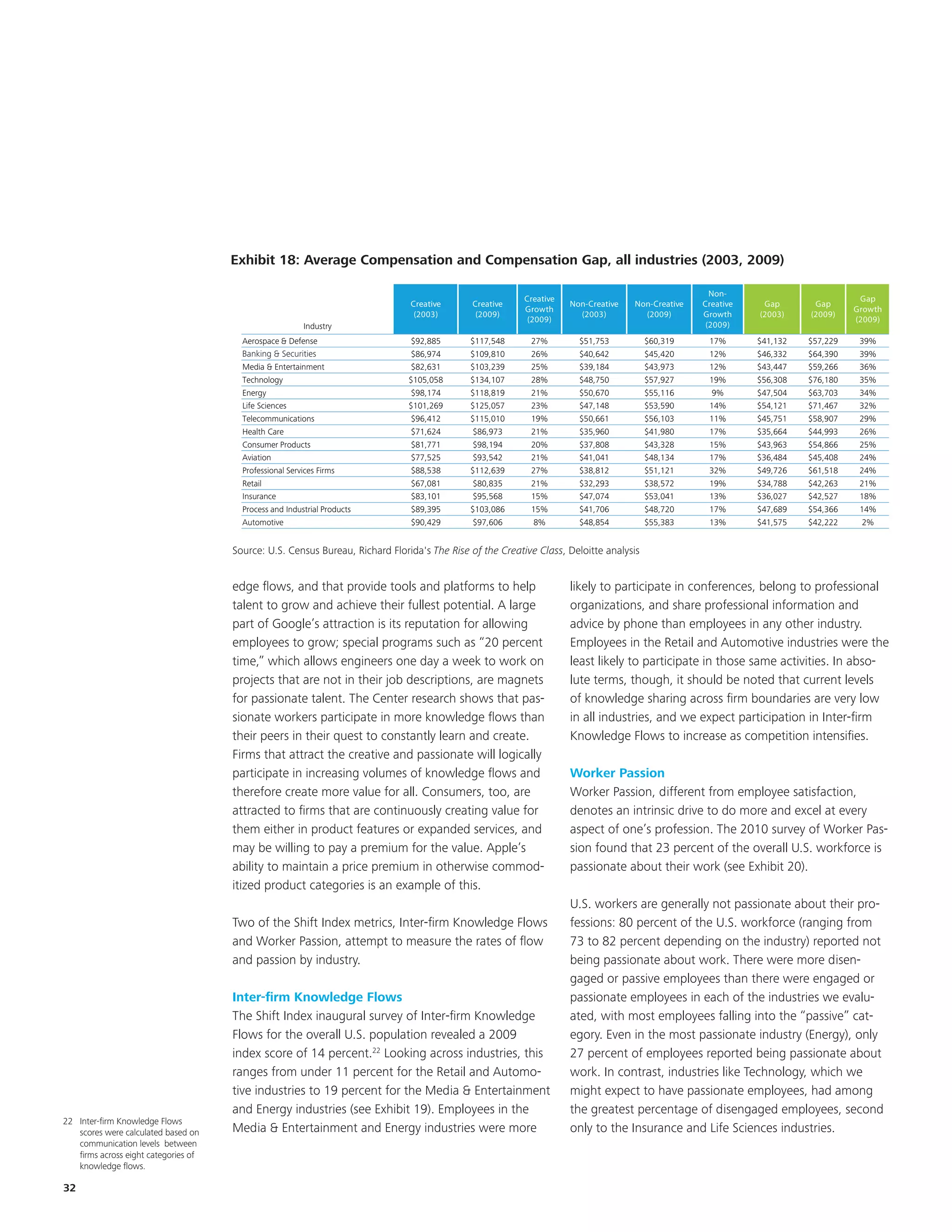
                                      be captured in part by creative talent, which is experi-        current economic downturn begins to dissipate—on the
                                      encing greater growth in total compensation. Increasing         contrary, all long-term trends point to a continued erosion
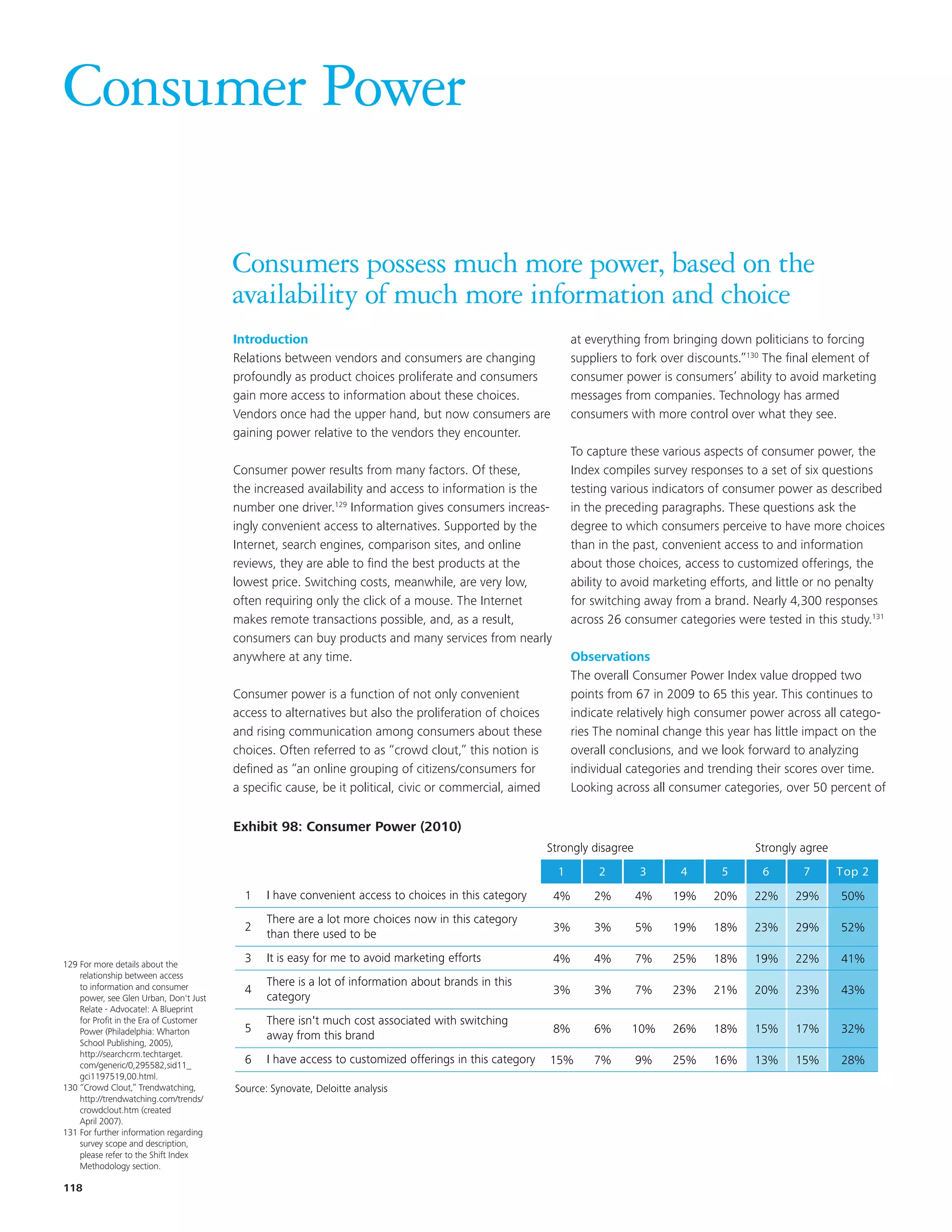
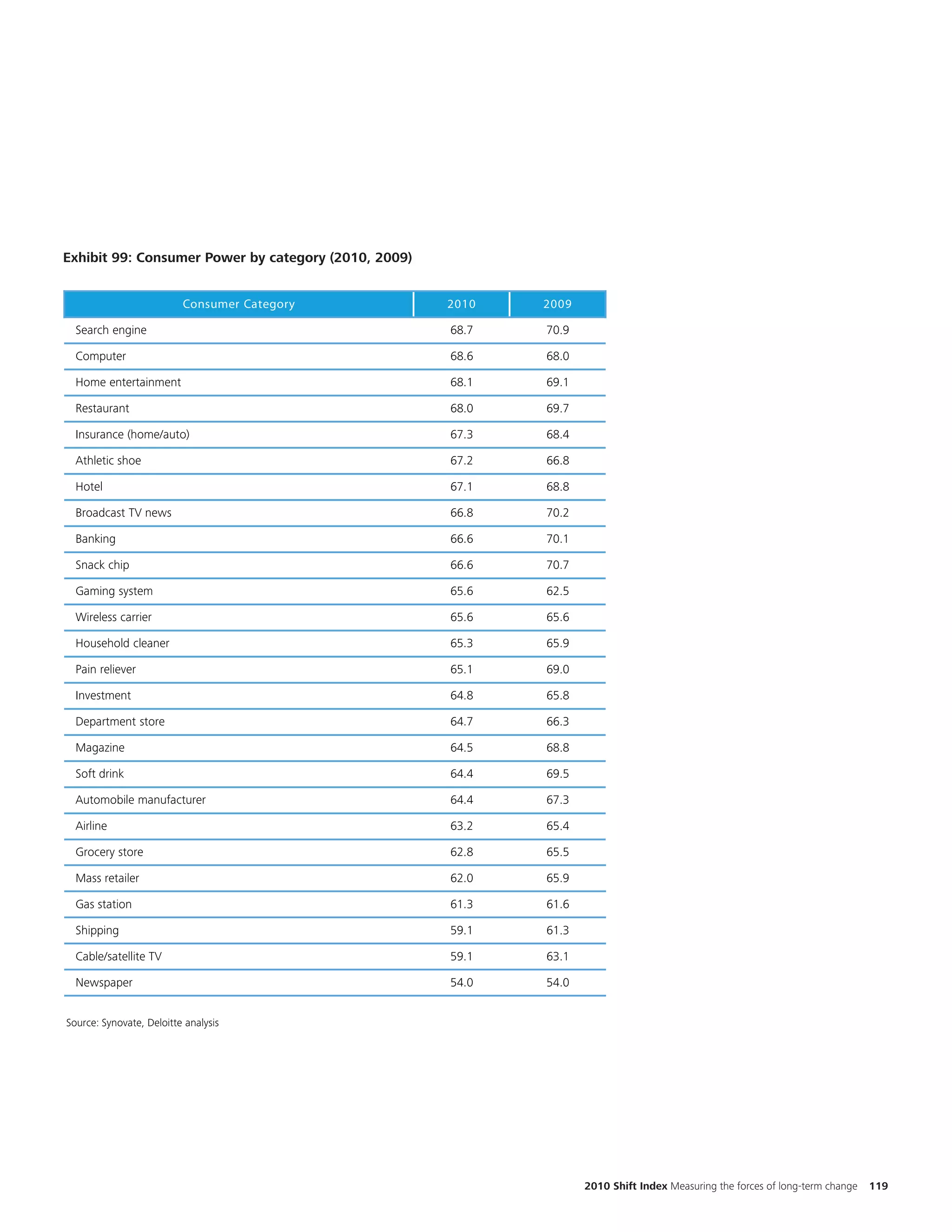
                                      customer disloyalty indicates that customers also appear        of performance. So what can be done to reverse these
                                      to be gaining and using power.                                  performance trends?
                                    • The exponentially advancing price/performance capa-
                                      bility of computing, storage, and bandwidth is driving          The answer to this question can be found in the three
                                      an adoption rate for our new “digital infrastructure” that      waves of deep change occurring in today’s epochal “Big
                                      is two to five times faster than previous infrastructures,      Shift.” The first, the “Foundation” wave, involves changes
                                      such as electricity and telephone networks.                     to the fundamentals of our business landscape catalyzed
                                                                                                      by the emergence and spread of digital technology
                                    What’s new in the 2010 Shift Index? This annual release of        infrastructure and reinforced by long-term public policy
                                    the Shift Index updates the metrics we provided last year         shifts toward economic liberalization. The metrics in our
                                    and goes deeper into some key dimensions of the Big Shift.        Foundation Index monitor changes in these key founda-
As used in this document,           Given the Index focus on longer-term trends, though, it is        tions and provide leading indicators of the potential for
“Deloitte” means Deloitte LLP       not surprising that we did not find major departures from         change on other fronts. Changes in foundations have
and its subsidiaries. Please see
                                    these trends:                                                     systematically and significantly reduced barriers to entry
www.deloitte.com/us/about
for a detailed description of the   • Worker Passion remains low and in some industries               and to movement, leading to a doubling of competitive
legal structure of Deloitte LLP       has declined. Less than a quarter of the workforce is           intensity.
and its subsidiaries.

2
The second, the “Flow” wave, focuses on the key driver           The Shift Index seeks to measure these three waves of
of performance in a world increasingly shaped by digital         deep and overlapping change operating beneath the visible
infrastructure. This second wave looks at the flows of           surfaces of today’s events. The relative rates of change
knowledge, capital, and talent enabled by the founda-            across the three indices will help executives understand
tional advances, as well as the amplifiers of these flows.       where we are in the Big Shift and what to anticipate in
Because of higher unpredictability and volatility created        the future. Current metrics indicate that we are still in the
by the Big Shift, knowledge flows are a particular key to        first wave of the Big Shift and facing challenges in moving
improving performance. Developments on this front will           forward into the second. Changes still manifest them-
likely lag behind the foundations metrics because of the         selves much more as challenges rather than opportunities
time required to understand changes in foundations and           because our institutions and practices are still geared to
develop new practices consistent with new opportunities.         earlier infrastructures. At the same time, an understanding
                                                                 of these three waves leads to significant insights about the
The third, the “Impact” wave, centers on the consequences        moves required to reverse current performance trends:
of the Big Shift. Given the time it will take for the first      • Deeper, yet strategic, restructuring of firm economics
two waves to play out and manifest themselves, this third           to generate maximum possible value from existing
wave—and its related index—provides an even greater                 resources;
lagging indicator. While current trends in firm performance      • Development of new management practices to more
indicate sustained deterioration, we expect, over time,             effectively catalyze and participate in growing knowledge
that performance will improve as firms begin to figure              flows; and
out how to participate in and harness knowledge flows.           • Significant innovation in institutional arrangements to
Doing so will require significant institutional innovations,        drive scalable participation in knowledge flows and reap
not just changes in practices, resulting in value creation          the increasing returns to performance improvement.
through increasing returns performance improvement. In
the end, these innovations will lead to a fundamental shift      The inaugural index will be regularly updated to track
in rationale from scalable efficiency to scalable learning       changes over time and allow better comparison of perfor-
as firms use digital infrastructure to create environments       mance trends across industries, countries, and firms. We
where performance improvement accelerates as more                have designed this year’s Shift Index report both as a
participants join. Early signs of these changes are visible in   standalone summary of the findings to date, and as an
the varied kinds of emerging open innovation and process         update for those who have read the original 2009 report.
network initiatives underway today.


                                                                                                      2010 Shift Index Measuring the forces of long-term change   3
2010 Shift Index: What’s new?

      The true recovery: Why companies need to ignite
      and tap into employee passion now
      The story of the Big Shift is a story of long-term trends       Why does passion matter?
      and the increasing pressures on firms in an environment         Passionate workers drive sustained extreme performance
      of constant, and disruptive, change. The Shift Index was        improvement. Without passionate workers, at all levels of
      developed last year to help describe and quantify the           the organization, companies will find it increasingly difficult
      dimensions of the Big Shift. This annual release of the Shift   to turn around the continued deterioration in financial
      Index updates the metrics we provided last year and goes        performance which has thus far been a key marker of the
      deeper into some key dimensions of the Big Shift. Given         Big Shift. Other measures like incentive based compensa-
      its focus on longer-term trends, though, it is not surprising   tion systems may be an important element in a broader
      that we are not finding major departures from these             program to address mounting performance pressure, but
      trends. We have designed this year’s Shift Index report         the evidence so far suggests they certainly have not been
      both as a standalone summary of the findings to date, and       sufficient to slow down, much less reverse, continued
      as an update for those who have read the original report        deterioration in performance
      last year.
                                                                      Why is passion so important in driving sustained extreme
      We hope that each year the annual surveys provide fodder        performance improvement? The passionate worker
      for fresh perspectives. In its first year the Shift Index was   possesses dispositions that are going to be increasingly
      widely discussed among leaders in business and beyond.          valuable in the world of the Big Shift. Two dispositions, in
      These discussions raised some interesting, and persistent,      particular, explain why passionate workers are so vital to a
      questions. In response, we have re-examined our indices         firm’s performance:
      and our assumptions and reinvestigated the correlation
      between metrics to see where additional analysis might          1. Passionate workers have a “questing” disposition.
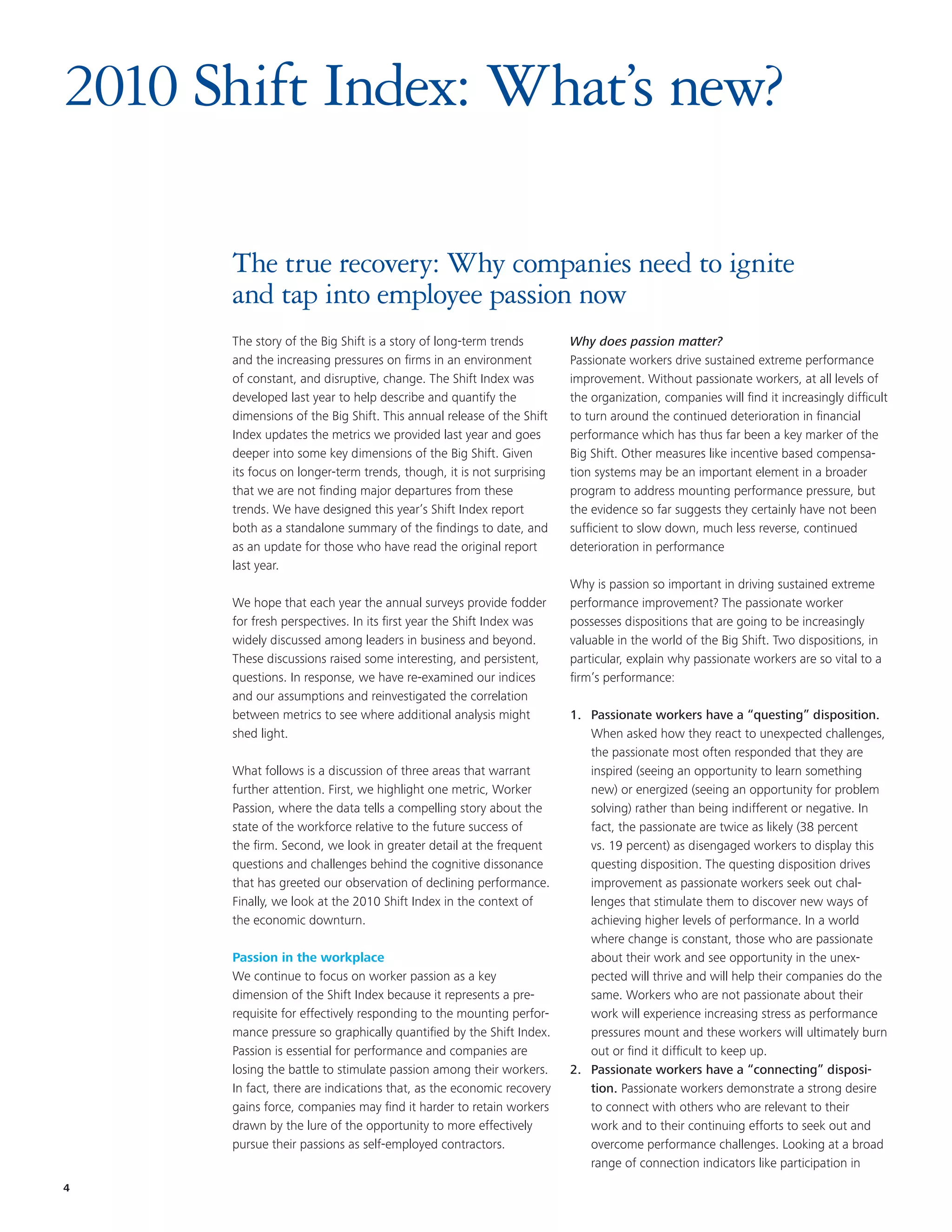
      shed light.                                                        When asked how they react to unexpected challenges,
                                                                         the passionate most often responded that they are
      What follows is a discussion of three areas that warrant           inspired (seeing an opportunity to learn something
      further attention. First, we highlight one metric, Worker          new) or energized (seeing an opportunity for problem
      Passion, where the data tells a compelling story about the         solving) rather than being indifferent or negative. In
      state of the workforce relative to the future success of           fact, the passionate are twice as likely (38 percent
      the firm. Second, we look in greater detail at the frequent        vs. 19 percent) as disengaged workers to display this
      questions and challenges behind the cognitive dissonance           questing disposition. The questing disposition drives
      that has greeted our observation of declining performance.         improvement as passionate workers seek out chal-
      Finally, we look at the 2010 Shift Index in the context of         lenges that stimulate them to discover new ways of
      the economic downturn.                                             achieving higher levels of performance. In a world
                                                                         where change is constant, those who are passionate
      Passion in the workplace                                           about their work and see opportunity in the unex-
      We continue to focus on worker passion as a key                    pected will thrive and will help their companies do the
      dimension of the Shift Index because it represents a pre-          same. Workers who are not passionate about their
      requisite for effectively responding to the mounting perfor-       work will experience increasing stress as performance
      mance pressure so graphically quantified by the Shift Index.       pressures mount and these workers will ultimately burn
      Passion is essential for performance and companies are             out or find it difficult to keep up.
      losing the battle to stimulate passion among their workers.     2. Passionate workers have a “connecting” disposi-
      In fact, there are indications that, as the economic recovery      tion. Passionate workers demonstrate a strong desire
      gains force, companies may find it harder to retain workers        to connect with others who are relevant to their
      drawn by the lure of the opportunity to more effectively           work and to their continuing efforts to seek out and
      pursue their passions as self-employed contractors.                overcome performance challenges. Looking at a broad
                                                                         range of connection indicators like participation in
4
Exhibit 1: Passion and ‘questioning disposition’

Exhibit 1: Passion and "questioning disposition"

                                             45%

                                             40%                                                                                              38%
                                                                                                                    34%
                                             35%

                                                                                         28%
% of respondents


                                             30%

                                             25%
                                                                19%
                                             20%

                                             15%

                                             10%

                                              5%

                                              0%
                                                             Disengaged                 Passive                   Engaged                  Passionate
                                                       When asked how they would respond to each Worker Passion category who reported feeling ‘Inspired
                                                                     Percentage of workers in an unexpected challenge responded ‘Energized’ or
                                                                          "Energized" or "Inspired" when faced with an unexpected challenge
Source: 2010 Deloitte Worker Passion / Inter-firm Knowledge Flow Survey (n=3108); Administered by Synovate


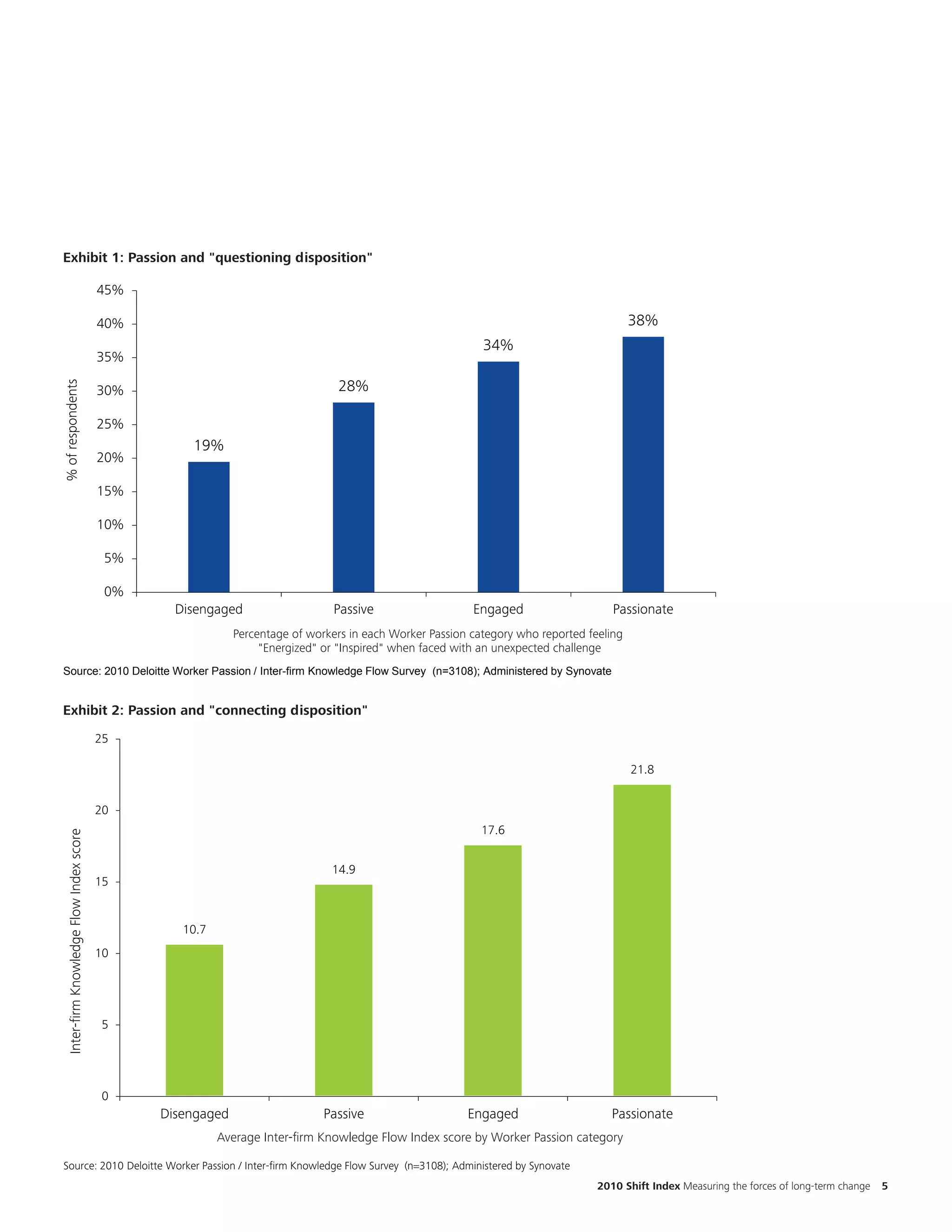
 Exhibit 2: Passion and knowledge flows
Exhibit 2: Passion and "connecting disposition"
 Exhibit 2: Passion and knowledge flows
                                             25
                                             25
                                                                                                                                              21.8
                                                                                                                                              21.8
                                             20
                                             20                                                                    17.6
     Inter-firm Knowledge Flow Index score


                                                                                                                   17.6
  Inter-firm Knowledge Flow Index score


                                                                                        14.9
                                             15
                                                                                        14.9
                                             15
1                                                 Footer
                                                              10.7
                                             10               10.7
                                             10


                                             5
                                             5


                                             0
                                             0             Disengaged                  Passive                Engaged                   Passionate
                                                           Disengaged                  Passive Flow Index score by Worker Passion category
                                                                   Average Inter-firm Knowledge               Engaged                   Passionate
Source: 2010 Deloitte Worker Passion / Inter-firm Knowledge Flow Survey (n=3108); Administered by Synovate
                                                                                                                                        2010 Shift Index Measuring the forces of long-term change   5
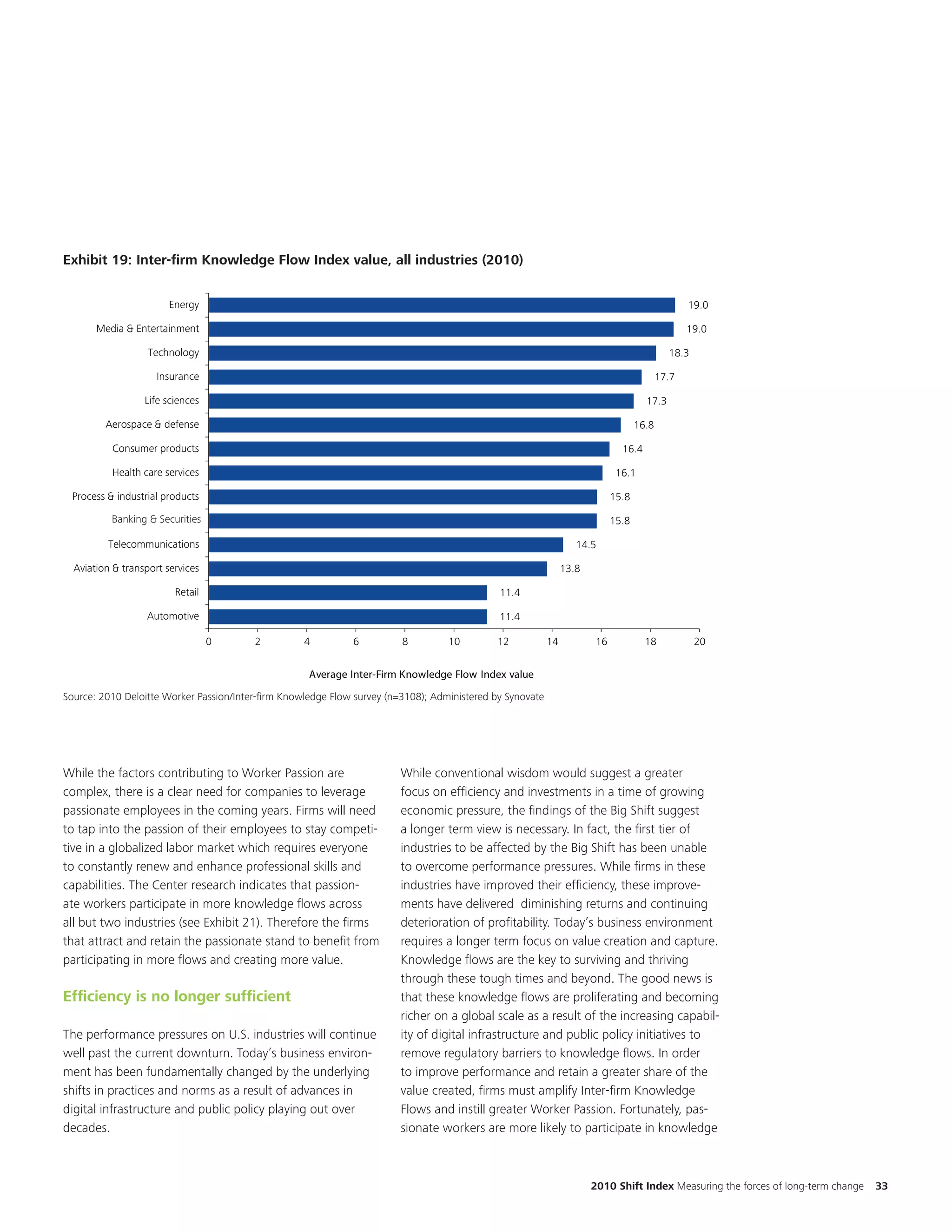
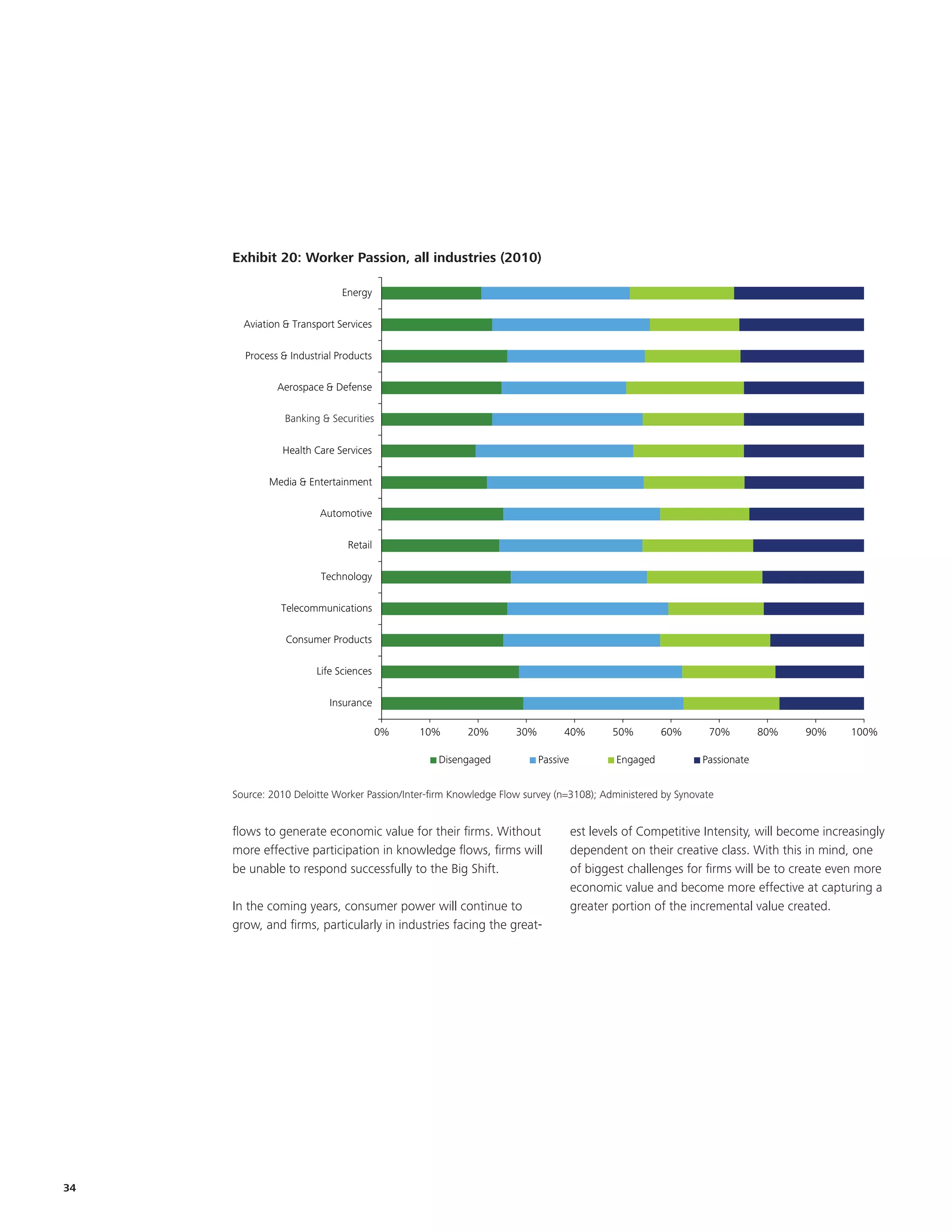
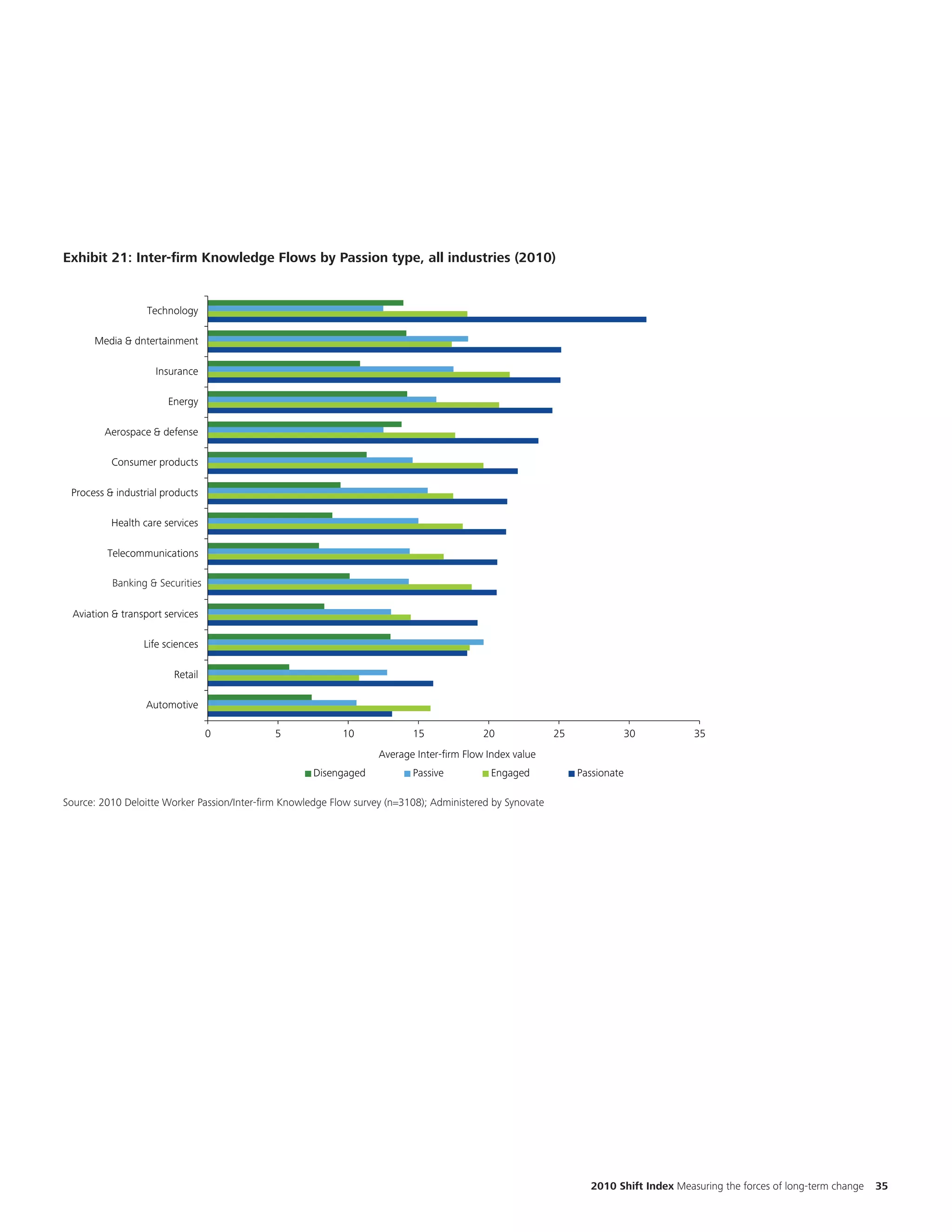
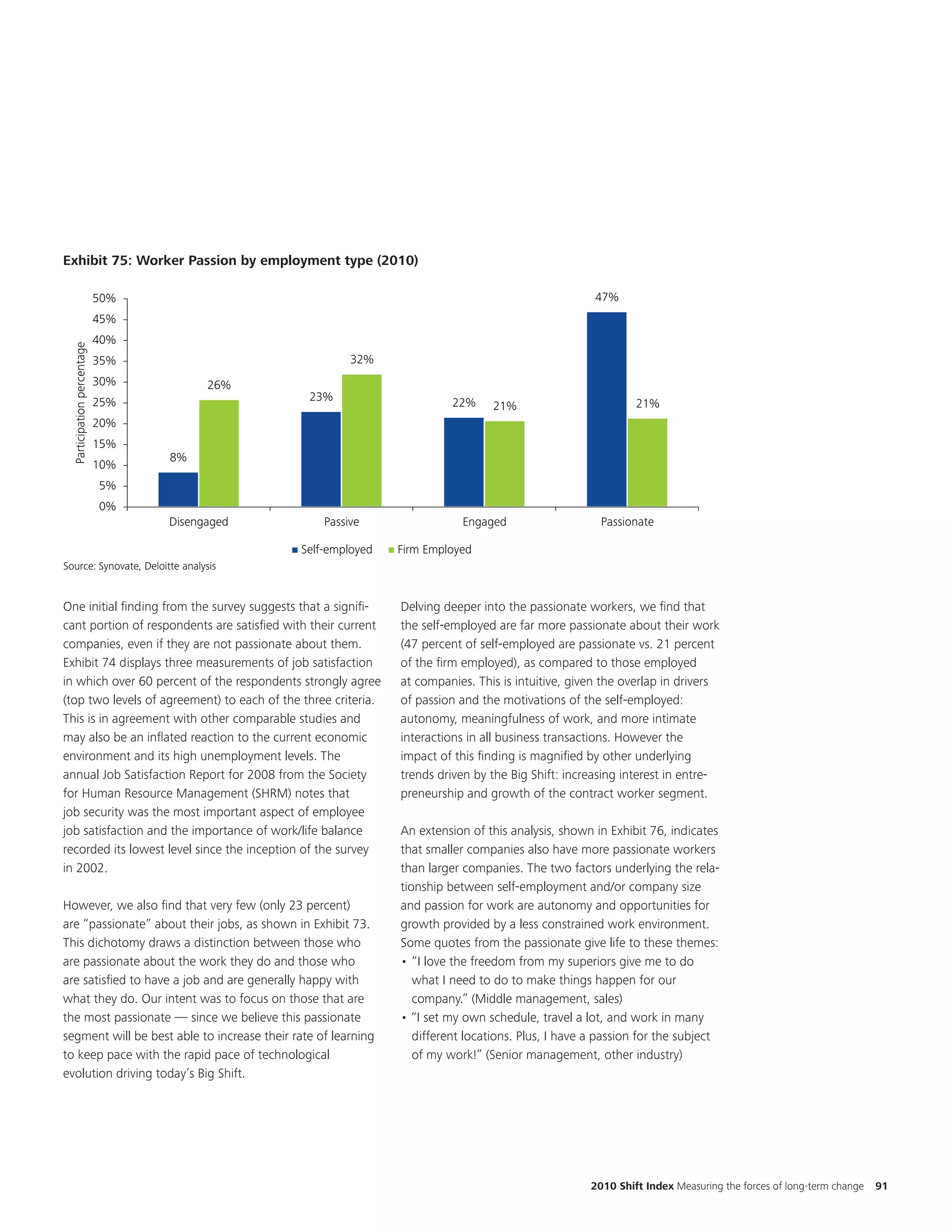
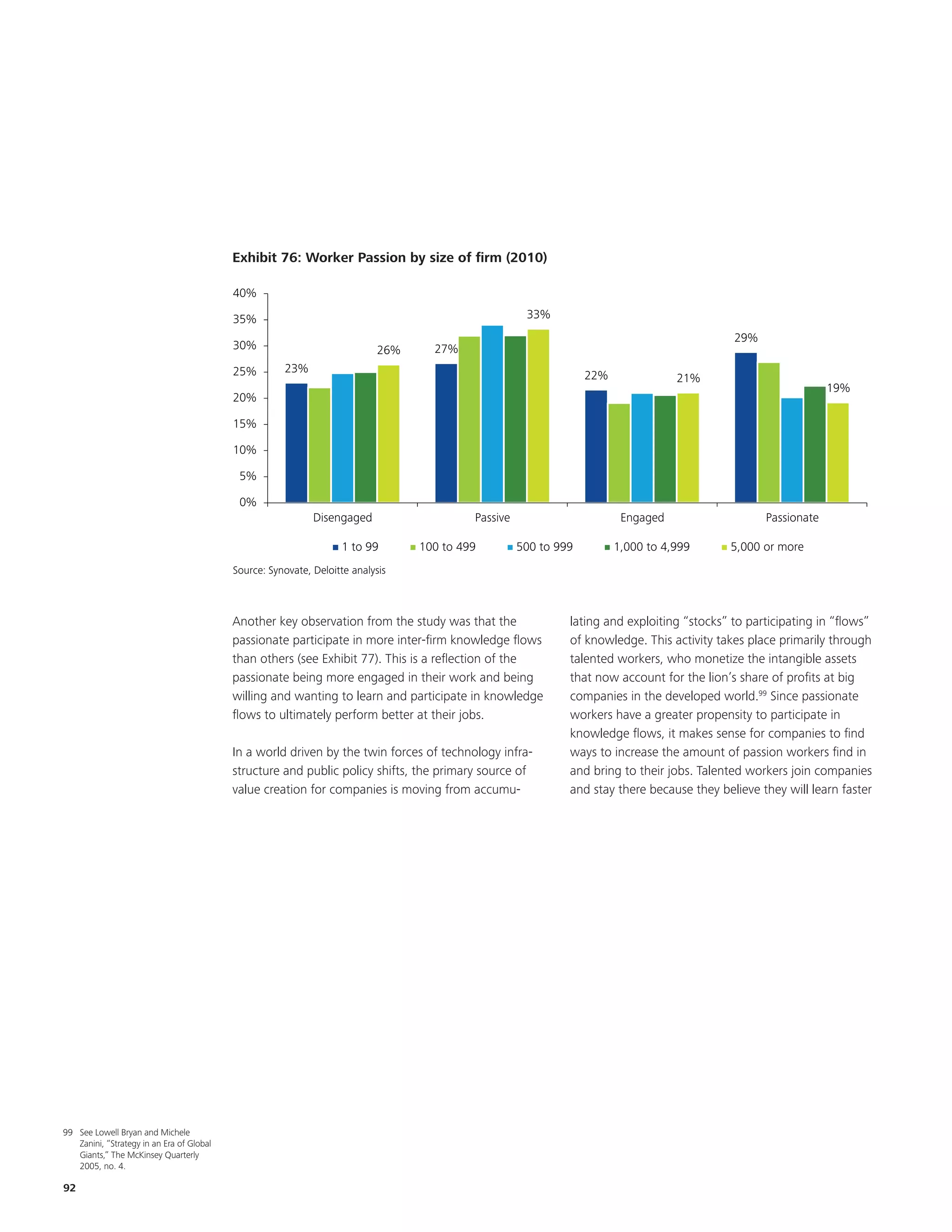
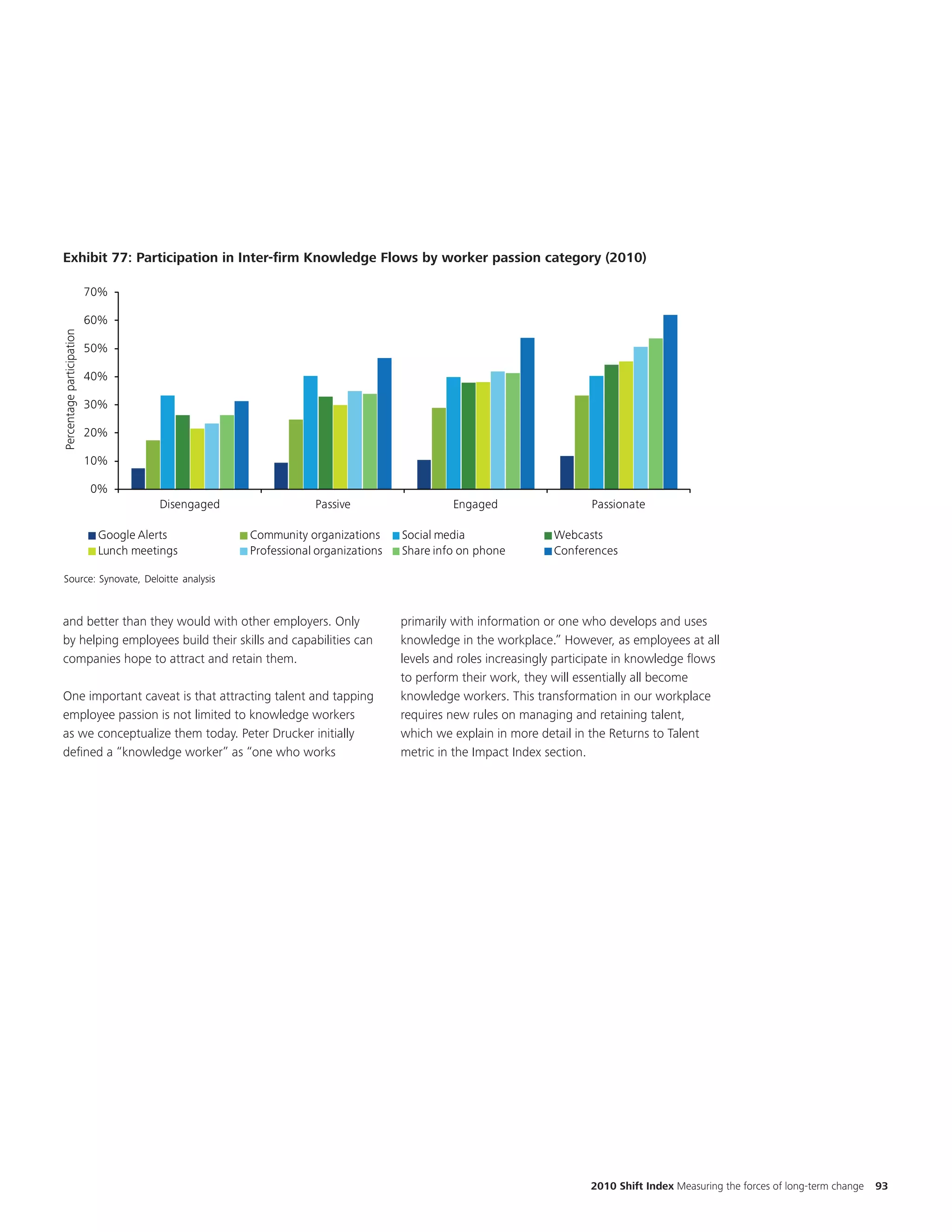
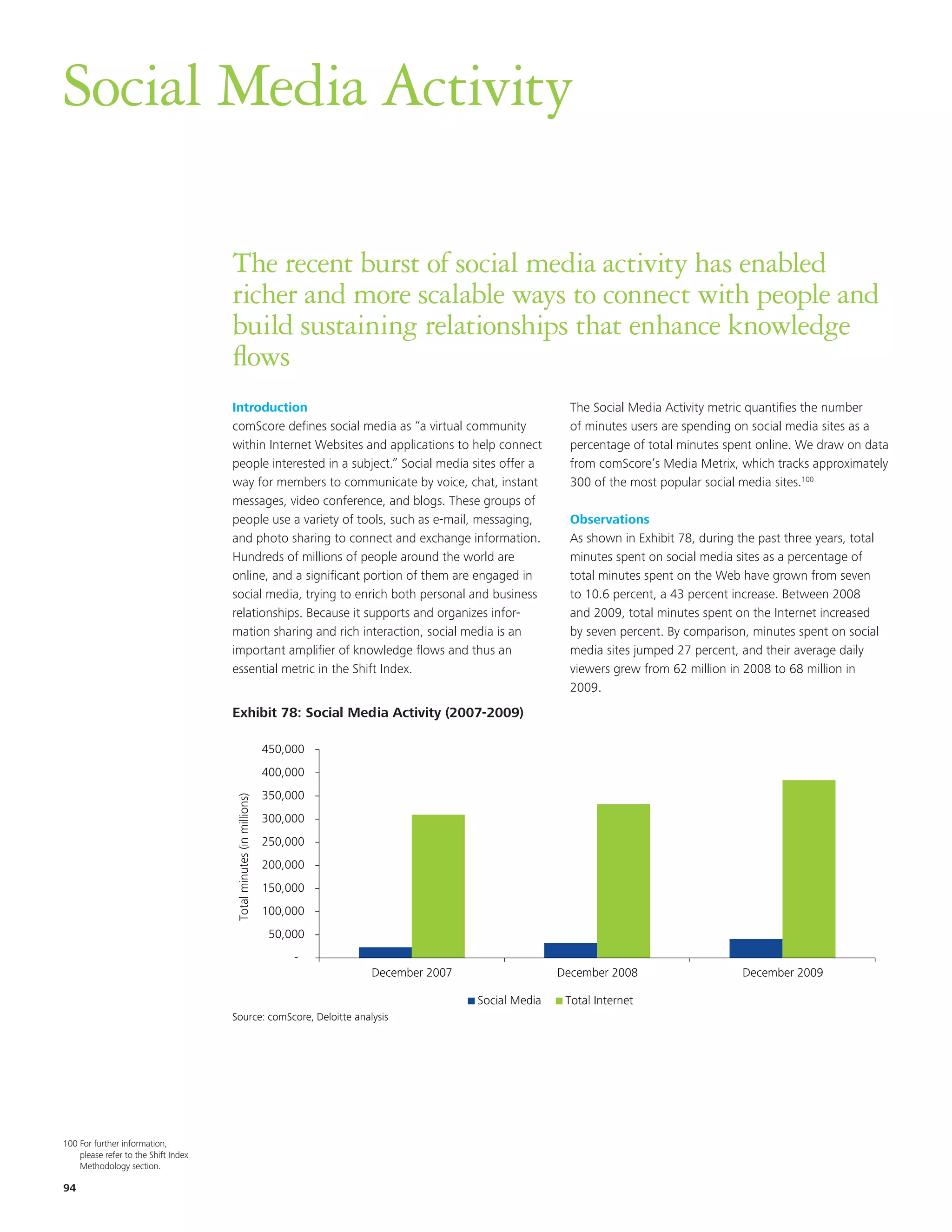
conferences and social media, passionate workers are        companies (with largest percentage in the smallest firms
                                          twice as likely (Inter-firm Knowledge score of 21.8 vs.     and the smallest percentage in the largest firms); they are
                                          10.7) to participate in knowledge flows as workers          more often in management, sales, and human resources
                                          who lack passion. Our Shift Index suggests that             functions; they can be found across industries — the
                                          effective participation in an increasing range of diverse   percentage of passionate workers in most industries was
                                          knowledge flows will be a key driver of performance         close to the overall average of 23 percent — although the
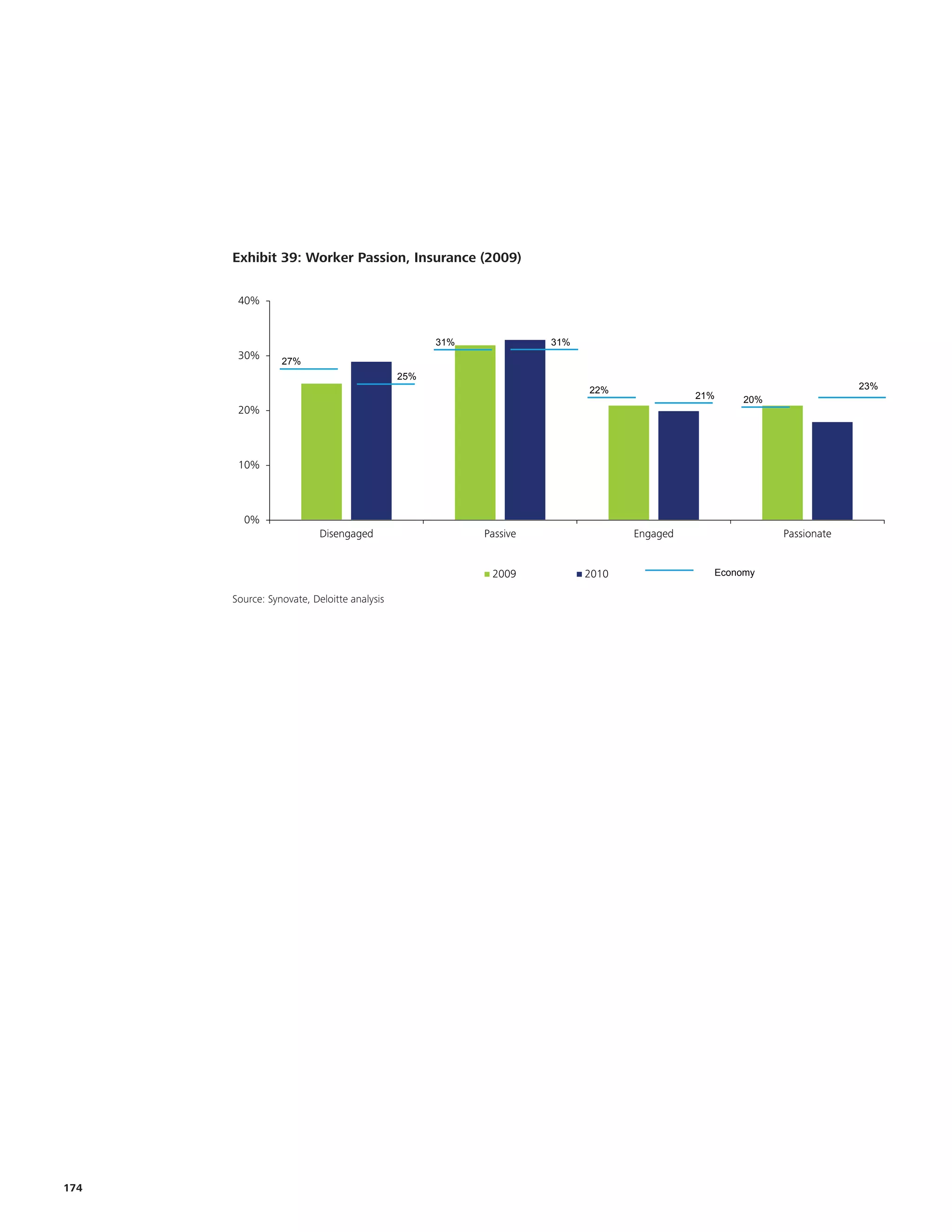
                                          improvement in the Big Shift. Passionate workers do         Energy industry has the highest percentage of passionate
                                          this naturally and effectively, driving value for them-     workers (27 percent) while the Insurance industry has the
                                          selves and their firms. Workers who lack passion and        lowest (18 percent).
                                          do not connect with others to improve performance
                                          will find themselves at a significant disadvantage.         Frustrated or destabilized, free-agency beckons
                                                                                                      This is the secondary story behind our focus on passionate
                                      Companies have not yet ignited worker passion                   workers: not only do firms need them to survive, but
                                      If passionate workers are a driving force behind perfor-        as workers become more interested in integrating their
                                      mance improvement, the data suggests firms are falling far      passions into their professions, those that do not find that
                                      short on this dimension. The 2010 Worker Passion Survey         opportunity in their current work will look for situations
                                      scored only 23 percent of workers as “passionate” about         that they believe will better support their development. For
                                      their current jobs, a modest increase over the 20 percent       many workers that means independent work, as contrac-
                                      reported in our 2009 report, but within the margin of           tors or consultants or in other forms of self-employment.
                                      error. To the extent that there is a real increase, it seems
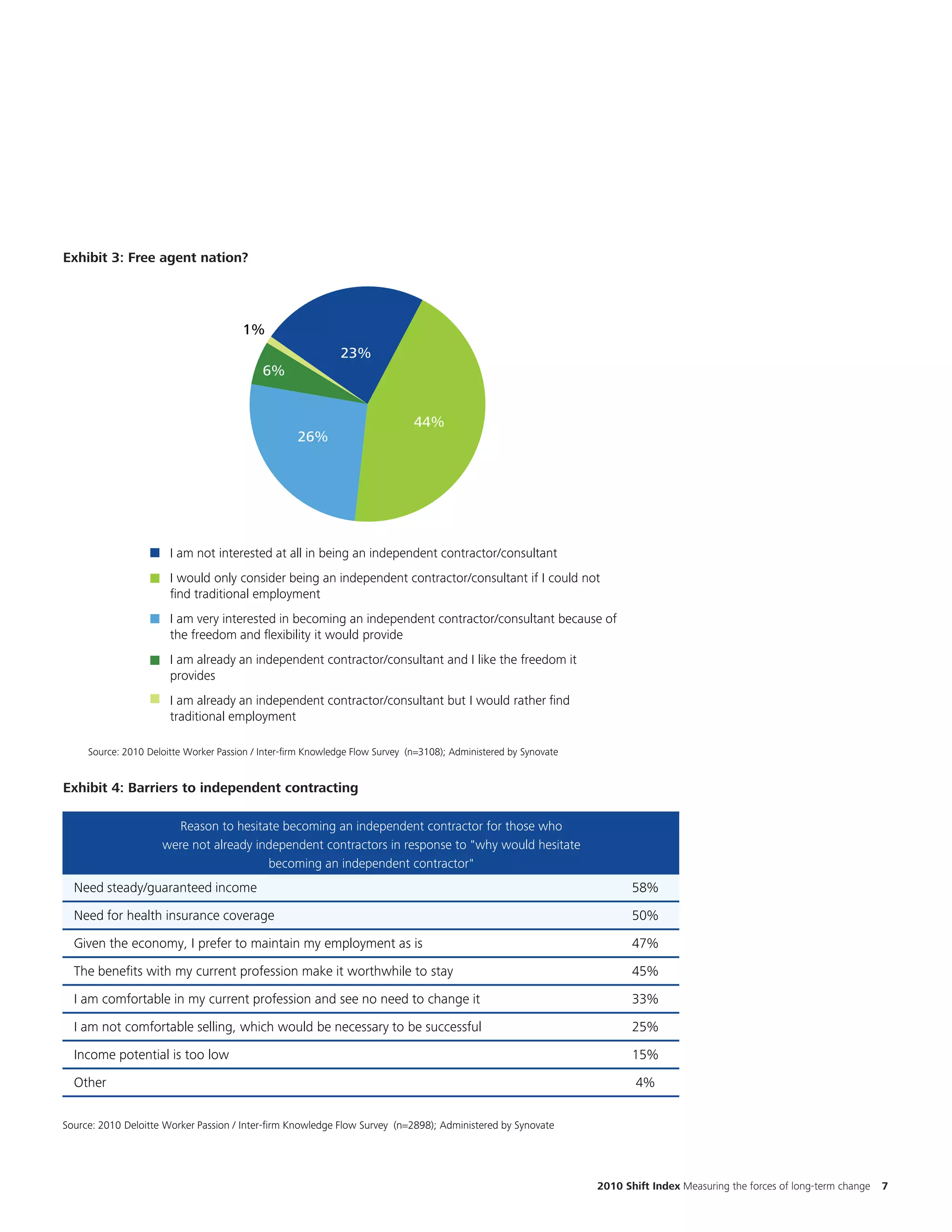
                                      to be driven largely by the increase in respondents who         Although only seven percent of the workers surveyed are
                                      reported working extra hours even though they were not          independent contractors, 26 percent indicated an interest
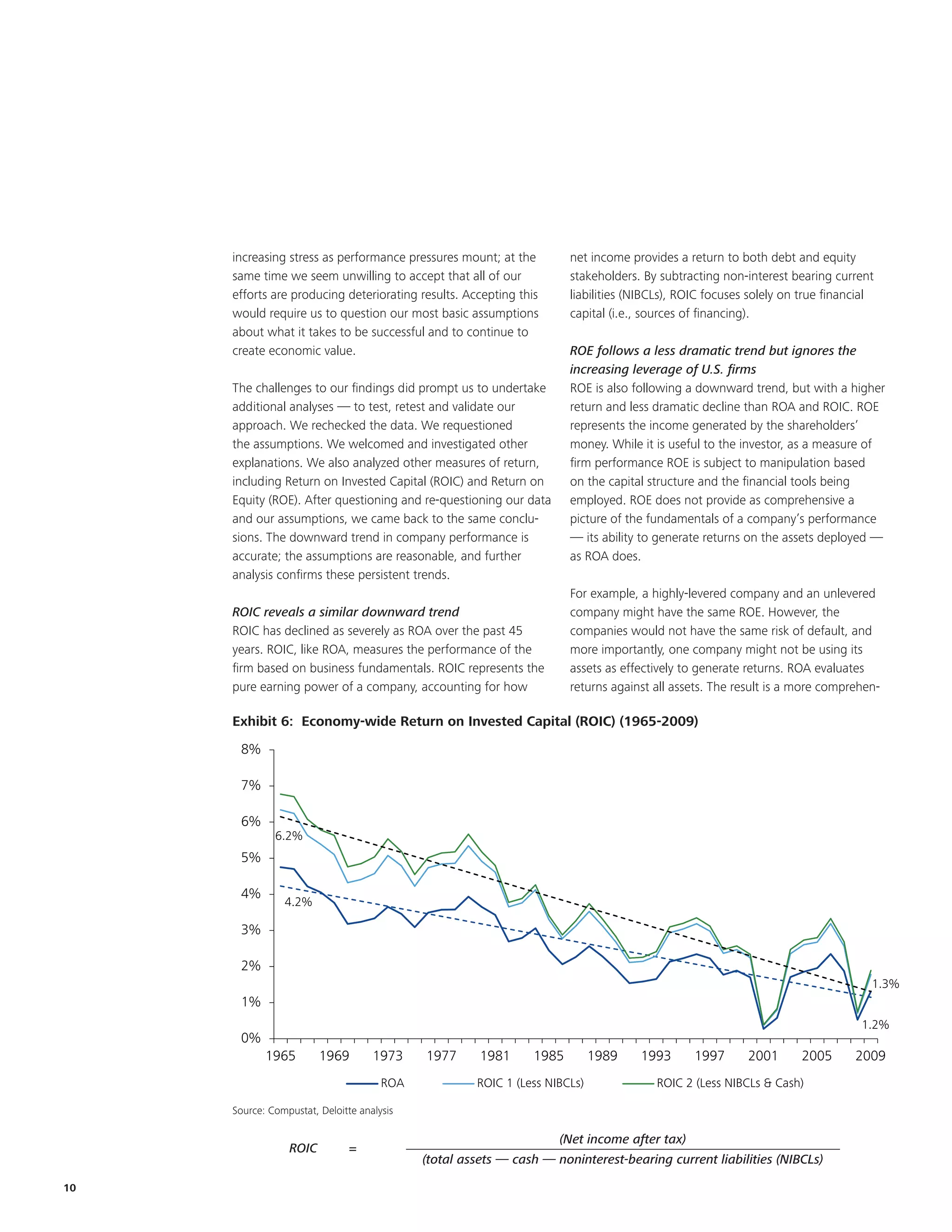
                                      required to do so. While the question was designed to           in becoming an independent contractor or consultant.1
                                      reveal a passionate orientation toward work, in the current     Sixty percent of those interested in becoming an indepen-
                                      downturn, willingness to work additional hours may              dent contractor or consultant are either passive or disen-
                                      indicate more about job insecurity and anxiety than about       gaged in their current jobs. This suggests that the workers
                                      passion for work. We are skeptical that there has been          most prone to considering the option of self-employment
                                      any material increase in worker passion in the past year.       are generally those who are least engaged in their current
                                      The bottom line is that nearly 80 percent of workers lack       work.
                                      passion regarding their jobs.
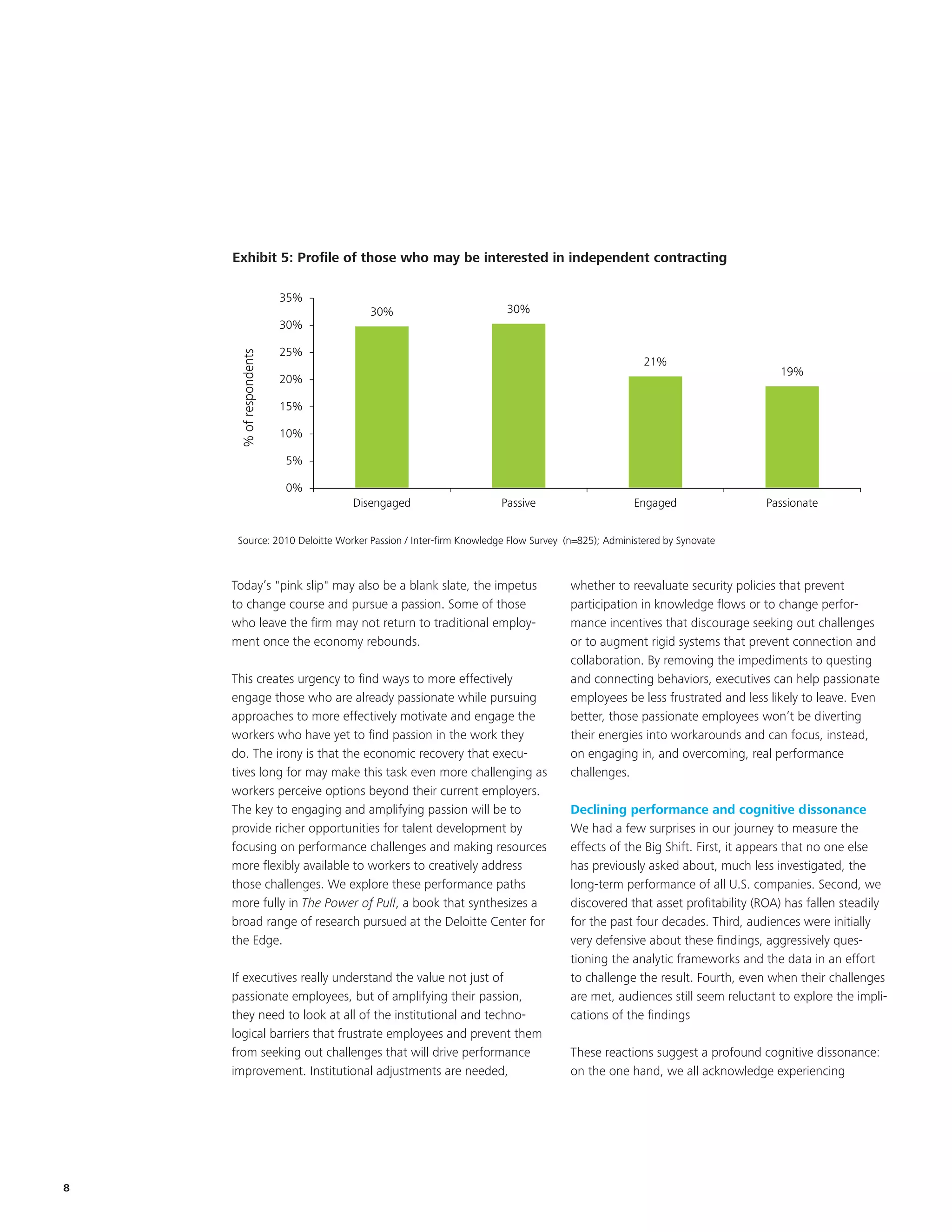
                                                                                                      In looking at what is holding back workers from pursuing
                                      Passion is revealed in what people do. Passionate workers       the option of becoming an independent contractor,
                                      are fully engaged in their work and their interactions and      employees cited the need for steady or guaranteed income
                                      constantly seek to improve their performance in every-          and the need for health insurance coverage as the primary
                                      thing that they do. Passion, as opposed to job satisfaction     reasons for hesitating to become self-employed. These
                                      or happiness, is not driven by job security and work-life       perceived barriers could erode as the recovery gains steam
                                      balance. In fact, passionate workers may be “unhappy” at        and changes in health care policy are implemented. It
                                      work precisely because they see the potential for them-         seems likely that more workers will pursue their passions
                                      selves and their companies but feel blocked in achieving        through independent employment over the next several
                                      it. Institutional barriers and management practices, as well    years if the nature of work in their current firms does not
                                      as technical and cultural barriers, can frustrate passionate    change.
                                      workers by making it difficult to connect with others and
                                      engage in and overcome performance challenges.                  Implications for the executive
                                                                                                      This is a time of transition, for workers and for firms. Even
                                      So who are these passionate workers and where can they          in tough times, a portion of the workforce is willing to
                                      be found? The Worker Passion survey revealed some char-         leave traditional employment for new opportunities. Those
                                      acteristics of ”passionate” workers: they are more often        that remain do so for reasons — guaranteed employment
                                      found among the self-employed (47 percent are passionate        and health care benefits — that are steadily eroding.
1 Results based on respondents over
   age 18 who reported working 30     versus 21 percent among firm-employed) and in smaller           Current levels of unemployment exacerbate this trend.
   or more hours per week.

6
Exhibit 3: Free agent nation?


                                       1%
                                                             23%
                                           6%


                                                                             44%
                                                   26%


                       I am not interested at all in being an independent contractor/consultant
                       I would only consider being an independent contractor/consultant if I could not
                       find traditional employment
                       I am very interested in becoming an independent contractor/consultant because of
                       the freedom and flexibility it would provide
                       I am already an independent contractor/consultant and I like the freedom it
                       provides
                       I am already an independent contractor/consultant but I would rather find
                       traditional employment

     Source: 2010 Deloitte Worker Passion / Inter-firm Knowledge Flow Survey (n=3108); Administered by Synovate


Exhibit 4: Barriers to independent contracting
 Exhibit 4: Barriers to independent contracting
                                                                                                                                                                    Need to fix su
                       ReasonReason to hesitate becoming an independent contractor
                                to hesitate becoming an independent contractor for those who                                                                        another place
                     were For those who weren’t already independent contractors, response to
                          not already independent contractors in response to "why would hesitate                                                                    question?
                               “why would hesitate becoming ancontractor" contractor”
                                         becoming an independent independent
  Need steady/guaranteed income                                                                                         58%

  Need for health insurance coverage                                                                                    50%

  Given the economy, I prefer to maintain my employment as is                                                           47%
  The benefits with my current profession make it worthwhile to stay                                                    45%

  I am comfortable in my current profession and see no need to change it                                                33%
  I am not comfortable selling, which would be necessary to be successful                                               25%

  Income potential is too low                                                                                           15%

  Other                                                                                                                  4%


Source: 2010 Deloitte Worker Passion / Inter-firm Knowledge Flow Survey (n=2898); Administered by Synovate


                                                                                                                 2010 Shift Index Measuring the forces of long-term change   7
Exhibit 5: Profile of those w ho may be interested in independent contracting
    Exhibit            of those who may be interested in independent contracting

                         35%
                                  30%                           30%
                         30%

                         25%
      % of respondents


                                                                                              21%
                                                                                                                      19%
                         20%

                         15%

                         10%

                         5%

                         0%
                               Disengaged                     Passive                       Engaged                Passionate


     Source: 2010 Deloitte Worker Passion / Inter-firm Knowledge Flow Survey (n=825); Administered by Synovate


    Today’s "pink slip" may also be a blank slate, the impetus                whether to reevaluate security policies that prevent
    to change course and pursue a passion. Some of those                      participation in knowledge flows or to change perfor-
    who leave the firm may not return to traditional employ-                  mance incentives that discourage seeking out challenges
    ment once the economy rebounds.                                           or to augment rigid systems that prevent connection and
                                                                              collaboration. By removing the impediments to questing
    This creates urgency to find ways to more effectively                     and connecting behaviors, executives can help passionate
    engage those who are already passionate while pursuing                    employees be less frustrated and less likely to leave. Even
    approaches to more effectively motivate and engage the                    better, those passionate employees won’t be diverting
    workers who have yet to find passion in the work they                     their energies into workarounds and can focus, instead,
    do. The irony is that the economic recovery that execu-                   on engaging in, and overcoming, real performance
    tives long for may make this task even more challenging as                challenges.
    workers perceive options beyond their current employers.
    The key to engaging and amplifying passion will be to                     Declining performance and cognitive dissonance
    provide richer opportunities for talent development by                    We had a few surprises in our journey to measure the
    focusing on performance challenges and making resources                   effects of the Big Shift. First, it appears that no one else
    more flexibly available to workers to creatively address                  has previously asked about, much less investigated, the
    those challenges. We explore these performance paths                      long-term performance of all U.S. companies. Second, we
    more fully in The Power of Pull, a book that synthesizes a                discovered that asset profitability (ROA) has fallen steadily
    broad range of research pursued at the Deloitte Center for                for the past four decades. Third, audiences were initially
    the Edge.                                                                 very defensive about these findings, aggressively ques-
                                                                              tioning the analytic frameworks and the data in an effort
    If executives really understand the value not just of                     to challenge the result. Fourth, even when their challenges
    passionate employees, but of amplifying their passion,                    are met, audiences still seem reluctant to explore the impli-
    5 need to look at all of the institutional and techno-
    they     Footer                                                           cations of the findings
    logical barriers that frustrate employees and prevent them
    from seeking out challenges that will drive performance                   These reactions suggest a profound cognitive dissonance:
    improvement. Institutional adjustments are needed,                        on the one hand, we all acknowledge experiencing


8
2010 Shift Index Measuring the forces of long-term change   9
increasing stress as performance pressures mount; at the         net income provides a return to both debt and equity
     same time we seem unwilling to accept that all of our            stakeholders. By subtracting non-interest bearing current
     efforts are producing deteriorating results. Accepting this      liabilities (NIBCLs), ROIC focuses solely on true financial
     would require us to question our most basic assumptions          capital (i.e., sources of financing).
     about what it takes to be successful and to continue to
     create economic value.                                           ROE follows a less dramatic trend but ignores the
                                                                      increasing leverage of U.S. firms
     The challenges to our findings did prompt us to undertake        ROE is also following a downward trend, but with a higher
     additional analyses — to test, retest and validate our           return and less dramatic decline than ROA and ROIC. ROE
     approach. We rechecked the data. We requestioned                 represents the income generated by the shareholders’
     the assumptions. We welcomed and investigated other              money. While it is useful to the investor, as a measure of
     explanations. We also analyzed other measures of return,         firm performance ROE is subject to manipulation based
     including Return on Invested Capital (ROIC) and Return on        on the capital structure and the financial tools being
     Equity (ROE). After questioning and re-questioning our data      employed. ROE does not provide as comprehensive a
     and our assumptions, we came back to the same conclu-            picture of the fundamentals of a company’s performance
     sions. The downward trend in company performance is              — its ability to generate returns on the assets deployed —
     accurate; the assumptions are reasonable, and further            as ROA does.
     analysis confirms these persistent trends.
                                                                      For example, a highly-levered company and an unlevered
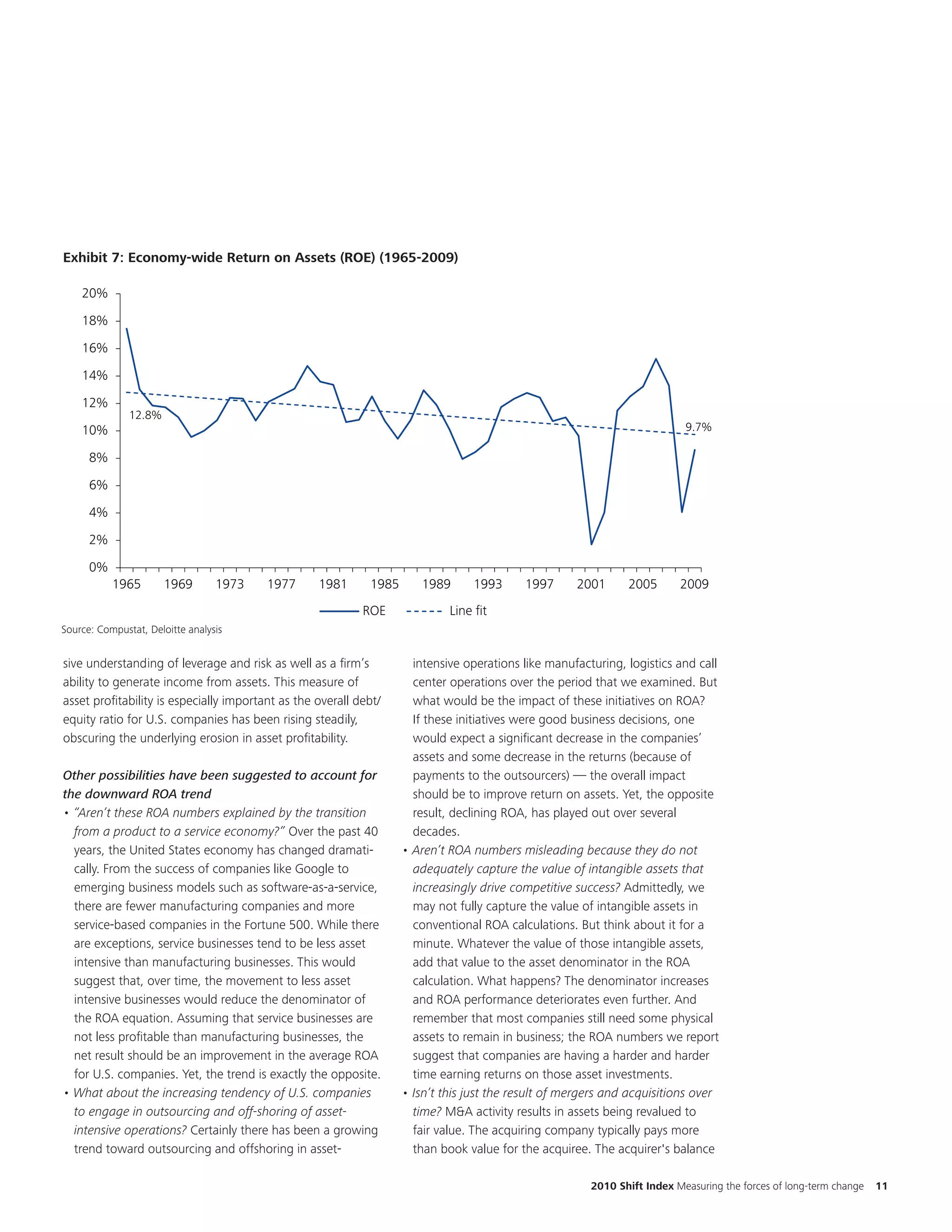
     ROIC reveals a similar downward trend                            company might have the same ROE. However, the
     ROIC has declined as severely as ROA over the past 45            companies would not have the same risk of default, and
     years. ROIC, like ROA, measures the performance of the           more importantly, one company might not be using its
     firm based on business fundamentals. ROIC represents the         assets as effectively to generate returns. ROA evaluates
     pure earning power of a company, accounting for how              returns against all assets. The result is a more comprehen-

     Exhibit 6: Economy-wide Return on Invested Capital (ROIC) (1965-2009)
      Exhibit 6: Return on Invested Capital (ROIC) (1965 – 2009)
      8%

      7%

      6%
              6.2%
      5%

      4%
                4.2%

      3%

      2%
                                                                                                                                1.3%
      1%
                                                                                                                              1.2%
      0%
            1965        1969       1973     1977      1981     1985         1989   1993       1997      2001       2005      2009
                                    ROA              ROIC 1 (Less NIBCLs)             ROIC 2 (Less NIBCLs & Cash)

     Source: Compustat, ,Deloitteanalysis
     Source: Compustat Deloitte Analysis

                                                                    (Net income after tax)
                 ROIC         =
                                            (total assets — cash — noninterest-bearing current liabilities (NIBCLs)

10
Exhibit 7: Economy-wide Return on Assets (ROE) (1965-2009)
Exhibit 7: Return on Equity (ROE) (1965 – 2009)

    20%

    18%

    16%

    14%

    12%
               12.8%
    10%                                                                                                                    9.7%

      8%

      6%

      4%

      2%

      0%
           1965        1969       1973   1977      1981      1985      1989       1993     1997      2001      2005       2009
                                                            ROE              Line fit
Source: Compustat, Deloitte analysis
  Source: Compustat, Deloitte Analysis

sive understanding of leverage and risk as well as a firm’s           intensive operations like manufacturing, logistics and call
ability to generate income from assets. This measure of               center operations over the period that we examined. But
asset profitability is especially important as the overall debt/      what would be the impact of these initiatives on ROA?
equity ratio for U.S. companies has been rising steadily,             If these initiatives were good business decisions, one
obscuring the underlying erosion in asset profitability.              would expect a significant decrease in the companies’
                                                                      assets and some decrease in the returns (because of
Other possibilities have been suggested to account for                payments to the outsourcers) — the overall impact
the downward ROA trend                                                should be to improve return on assets. Yet, the opposite
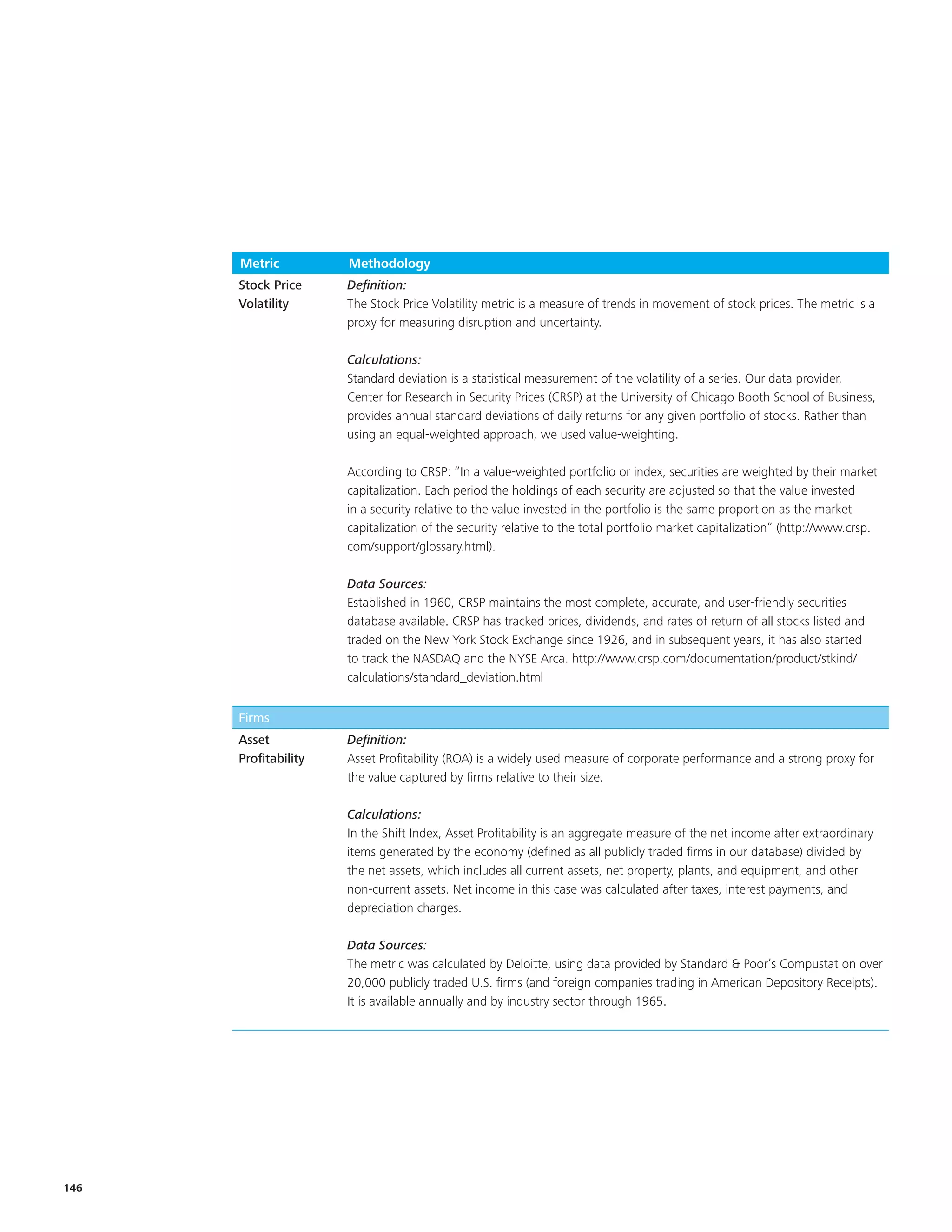
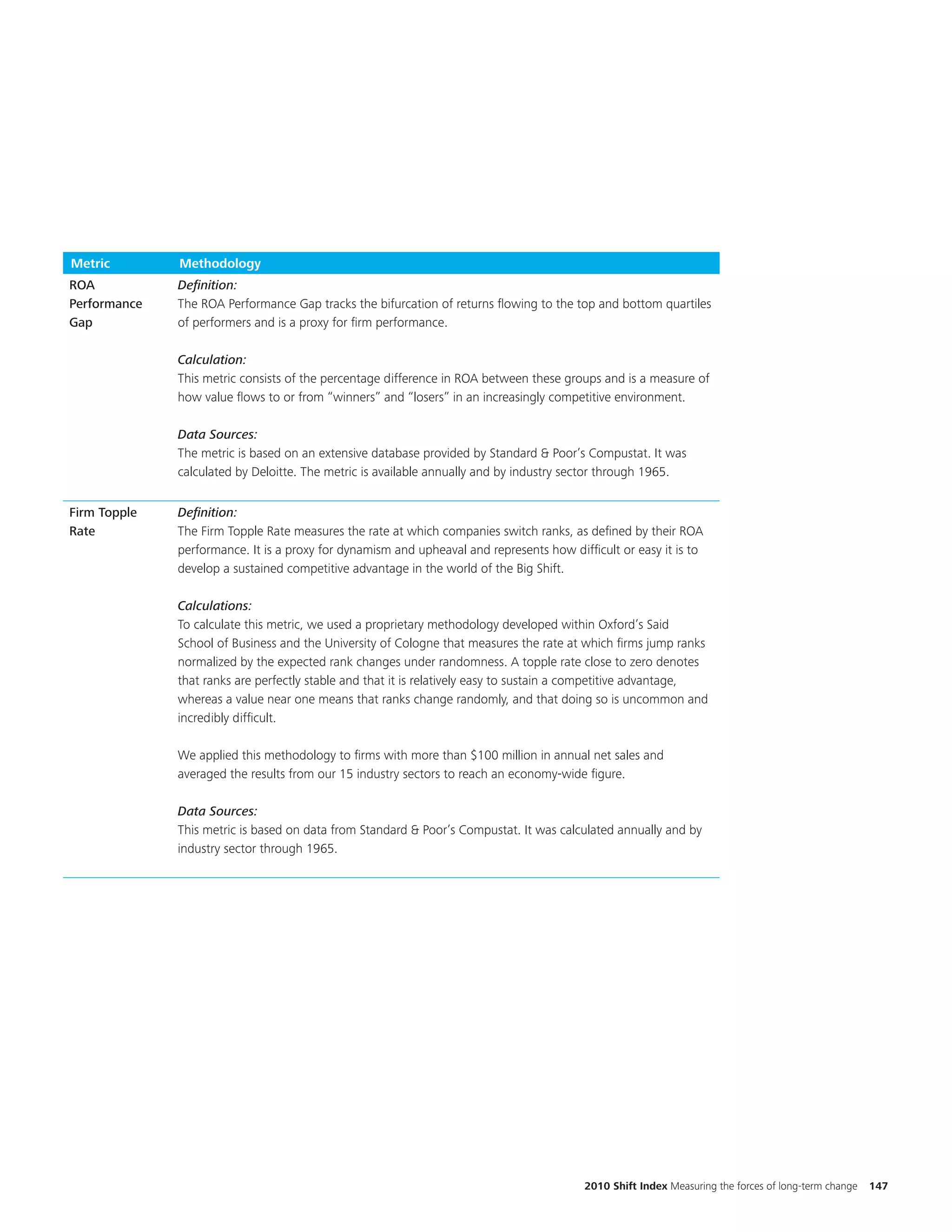
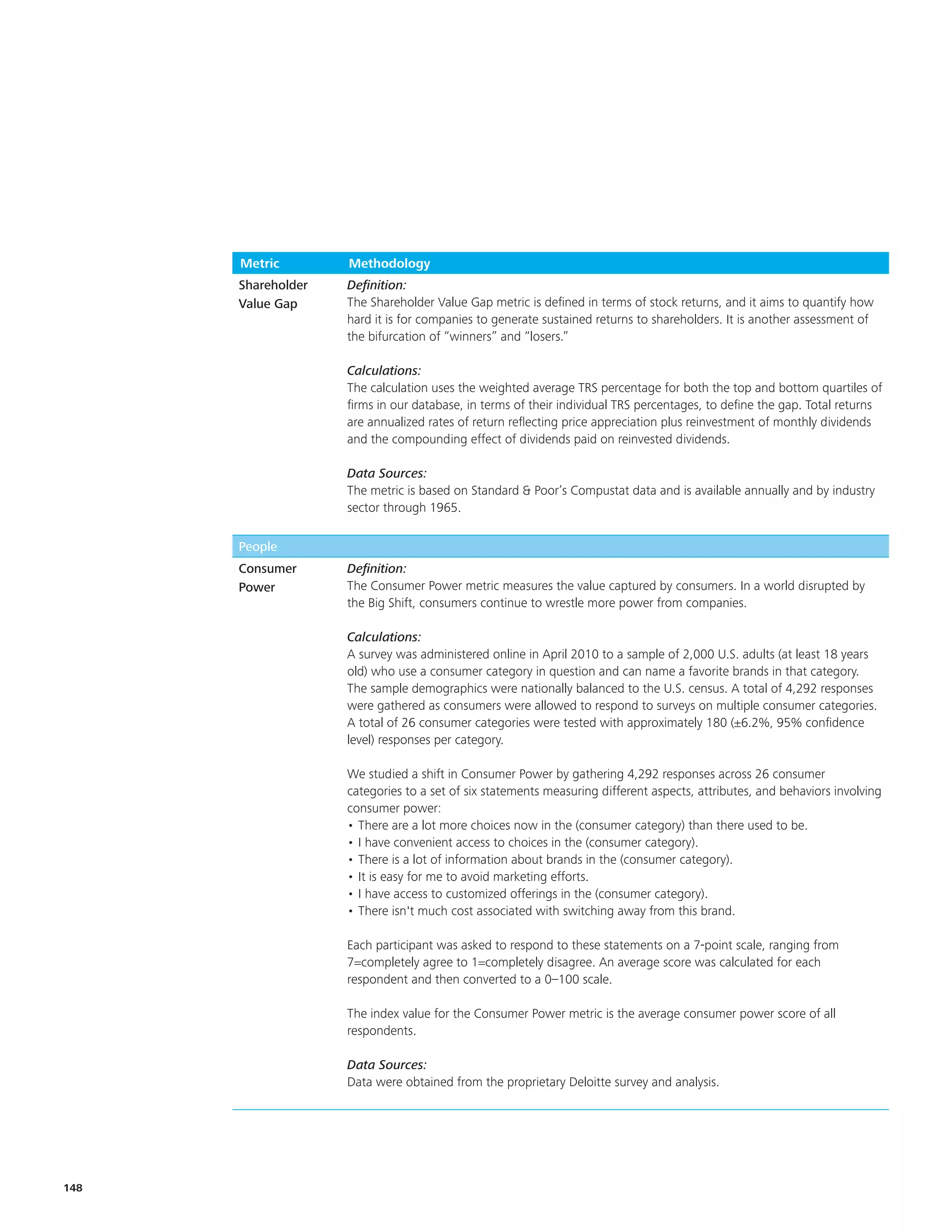
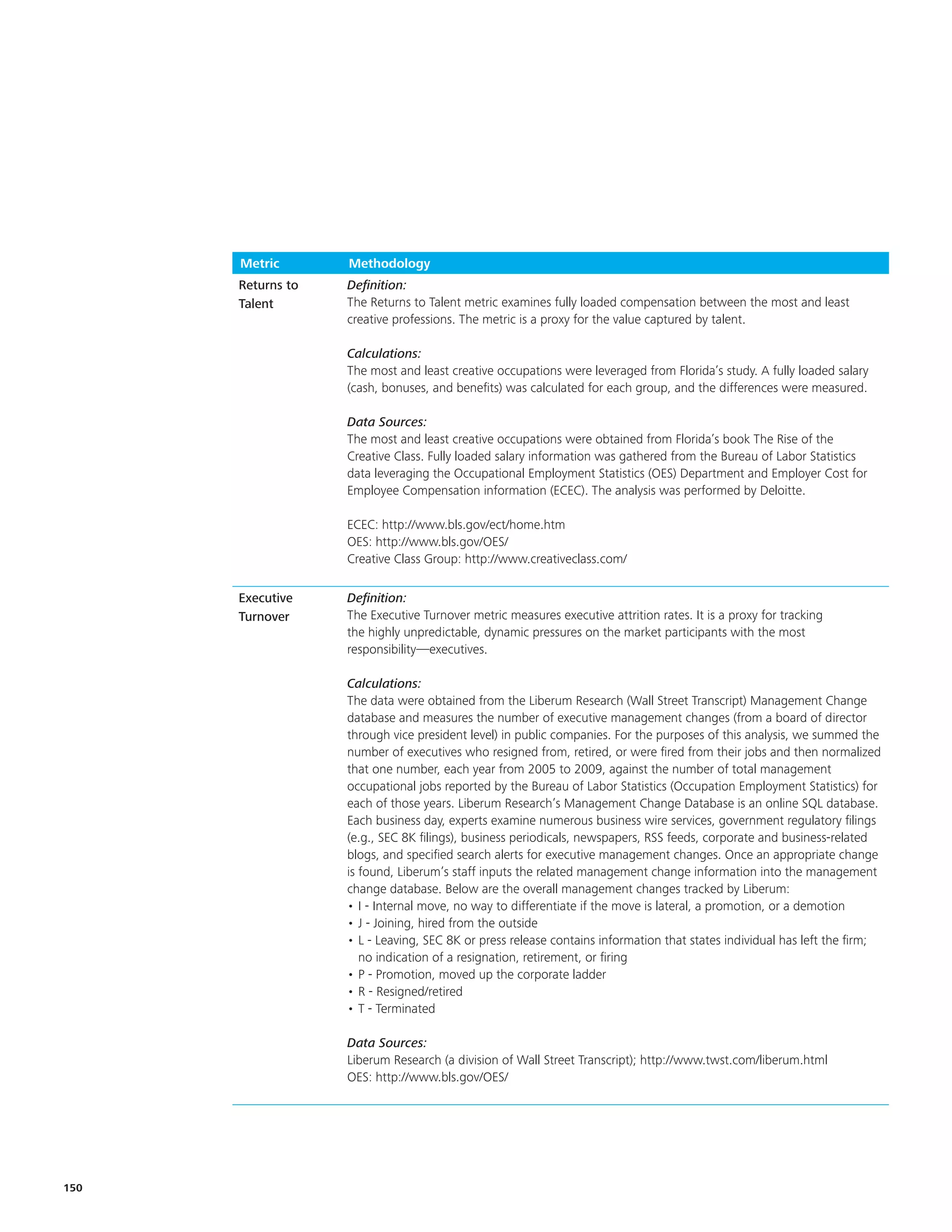
• “Aren’t these ROA numbers explained by the transition               result, declining ROA, has played out over several
  from a product to a service economy?” Over the past 40              decades.
  years, the United States economy has changed dramati-             • Aren’t ROA numbers misleading because they do not
  cally. From the success of companies like Google to                 adequately capture the value of intangible assets that
  emerging business models such as software-as-a-service,             increasingly drive competitive success? Admittedly, we
  there are fewer manufacturing companies and more                    may not fully capture the value of intangible assets in
7         Footer
  service-based companies in the Fortune 500. While there             conventional ROA calculations. But think about it for a
  are exceptions, service businesses tend to be less asset            minute. Whatever the value of those intangible assets,
  intensive than manufacturing businesses. This would                 add that value to the asset denominator in the ROA
  suggest that, over time, the movement to less asset                 calculation. What happens? The denominator increases
  intensive businesses would reduce the denominator of                and ROA performance deteriorates even further. And
  the ROA equation. Assuming that service businesses are              remember that most companies still need some physical
  not less profitable than manufacturing businesses, the              assets to remain in business; the ROA numbers we report
  net result should be an improvement in the average ROA              suggest that companies are having a harder and harder
  for U.S. companies. Yet, the trend is exactly the opposite.         time earning returns on those asset investments.
• What about the increasing tendency of U.S. companies              • Isn’t this just the result of mergers and acquisitions over
  to engage in outsourcing and off-shoring of asset-                  time? M&A activity results in assets being revalued to
  intensive operations? Certainly there has been a growing            fair value. The acquiring company typically pays more
  trend toward outsourcing and offshoring in asset-                   than book value for the acquiree. The acquirer's balance

                                                                                                        2010 Shift Index Measuring the forces of long-term change   11
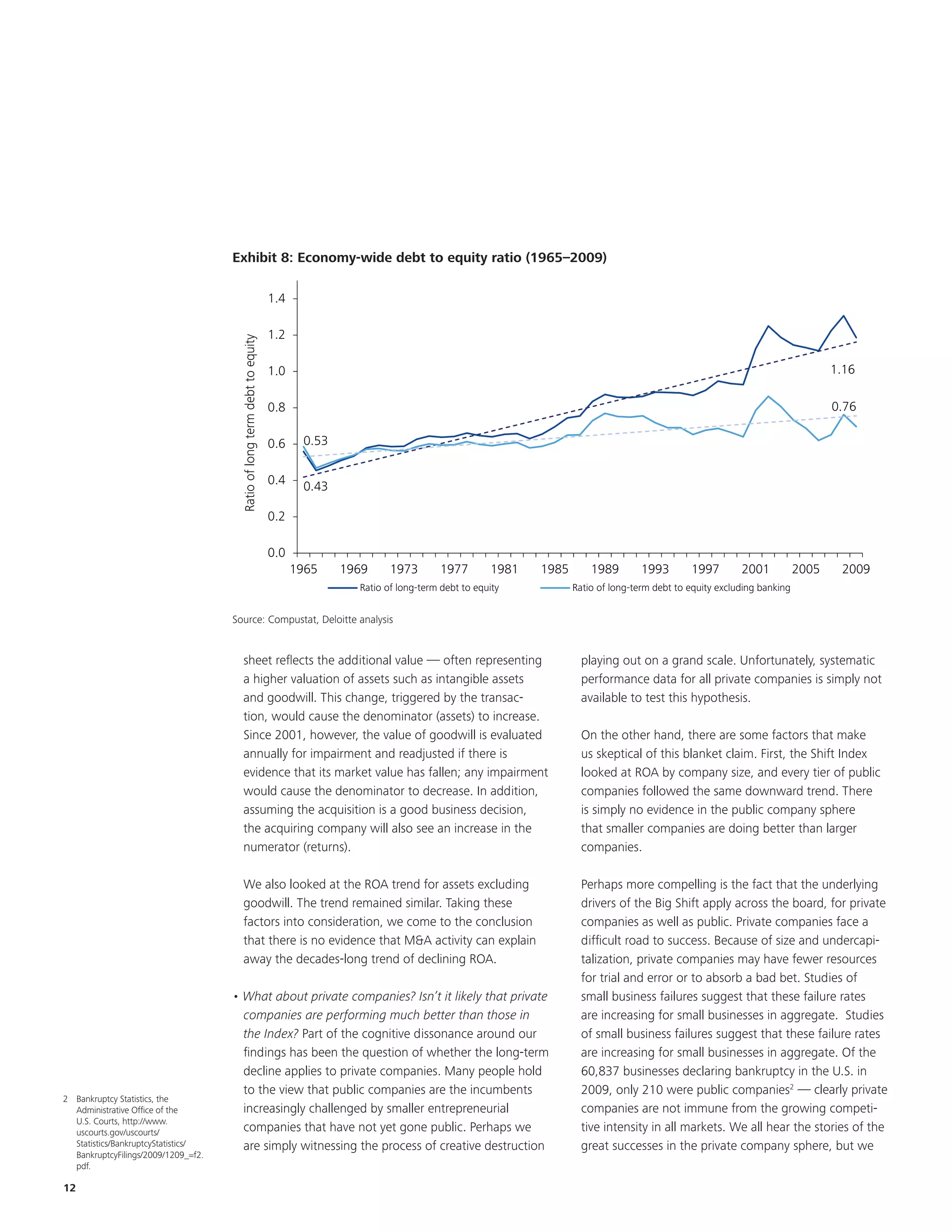
Exhibit 8: Economy-widedebt to equity ratio (1965 – 2009)
                                     Exhibit Economy-w ide debt to equity ratio (1965–2009)


                                                                           1.4

                                                                           1.2
                                       Ratio of long term debt to equity


                                                                           1.0                                                                                                                      1.16

                                                                           0.8                                                                                                                      0.76

                                                                           0.6    0.53

                                                                           0.4    0.43

                                                                           0.2

                                                                           0.0
                                                                                 1965    1969     1973        1977       1981   1985       1989        1993       1997        2001           2005    2009
                                                                                           Ratio of long-term debt to equity           Ratio of long-term debt to equity excluding banking


                                        Source: Compustat, Deloitte Analysis
                                     Source: Compustat, Deloitte analysis


                                         sheet reflects the additional value — often representing                                        playing out on a grand scale. Unfortunately, systematic
                                         a higher valuation of assets such as intangible assets                                          performance data for all private companies is simply not
                                         and goodwill. This change, triggered by the transac-                                            available to test this hypothesis.
                                         tion, would cause the denominator (assets) to increase.
                                         Since 2001, however, the value of goodwill is evaluated                                         On the other hand, there are some factors that make
                                         annually for impairment and readjusted if there is                                              us skeptical of this blanket claim. First, the Shift Index
                                         evidence that its market value has fallen; any impairment                                       looked at ROA by company size, and every tier of public
                                         would cause the denominator to decrease. In addition,                                           companies followed the same downward trend. There
                                         assuming the acquisition is a good business decision,                                           is simply no evidence in the public company sphere
                                         the acquiring company will also see an increase in the                                          that smaller companies are doing better than larger
                                         numerator (returns).                                                                            companies.

                                         We also looked at the ROA trend for assets excluding                                            Perhaps more compelling is the fact that the underlying
                                         goodwill. The trend remained similar. Taking these                                              drivers of the Big Shift apply across the board, for private
                                         factors into consideration, we come to the conclusion                                           companies as well as public. Private companies face a
                                         that there is no evidence that M&A activity can explain                                         difficult road to success. Because of size and undercapi-
                                         away the decades-long trend of declining ROA.                                                   talization, private companies may have fewer resources
                                                                                                                                         for trial and error or to absorb a bad bet. Studies of
                                     • What about private companies? Isn’t it likely that private                                        small business failures suggest that these failure rates
                                       companies are performing much better than those in                                                are increasing for small businesses in aggregate. Studies
                                       the Index? Part of the cognitive dissonance around our                                            of small business failures suggest that these failure rates
                                       findings has been the question of whether the long-term                                           are increasing for small businesses in aggregate. Of the
                                       decline applies to private companies. Many people hold                                            60,837 businesses declaring bankruptcy in the U.S. in
                                       to the view that public companies are the incumbents                                              2009, only 210 were public companies2 — clearly private
2 Bankruptcy Statistics, the
  Administrative Office of the         increasingly challenged by smaller entrepreneurial                                                companies are not immune from the growing competi-
  U.S. Courts, http://www.
  uscourts.gov/uscourts/               companies that have not yet gone public. Perhaps we                                               tive intensity in all markets. We all hear the stories of the
  Statistics/BankruptcyStatistics/     are simply witnessing the process of creative destruction                                         great successes in the private company sphere, but we
  BankruptcyFilings/2009/1209_=f2.
  pdf.

12
Exhibit 9: Summary of forces and Impact on ROA

                                         Return
                                                        =      Return on assets (ROA)
                                         Assets


    Economic trend                Resulting impact of company                        Expected impact on ROA trend
 Transition from           • Service-based companies tend to have
                                                                             • Assuming constant returns, as assets reduced,
 product to service          fewer tangible assets than product-based
                                                                               ROA should have improved over time
 economy                     companies
                           • Firm assets are market valued at point of       • Depends on the asset valuation and returns
 Increased M&A               sale, usually resulting in an increase over       over time; current impairment rules should
 activity                    book value being added to the acquiring           keep assets at market value, and therefore
                             firm's balance sheets                             ROA accurately reflects business performance
                           • Companies shed assets related to asset-
 Outsourcing/                                                                • Assuming constant returns, as assets reduced,
                             intensive operations (e.g., manufacturing,
 offshoring                                                                    ROA should have improved over time
                             call centers)
 Increased                 • Intangible assets make up a larger portion      • Including additional intangible assets in
 importance of               of total assets and are increasingly              the denominator would only make the
 intangible assets           important for driving competitive success         deterioration of ROA more severe

  only hear of a few of the failures occurring on a daily          understanding of the factors underlying long-term perfor-
  basis in this domain. There are simply too many of them.         mance trends.

Two other points have been raised, relatively recently, to         The economic downturn and the Shift Index
challenge our observation that, over time, assets are gen-         The Shift Index describes the fundamental changes and
erating smaller returns. The first is that the corresponding       long-term trends that existing indicators cannot usefully or
trend in inflation rates makes the decline in ROA less dire.       accurately reflect. As a result of its long-term orientation,
If inflation declines, the nominal return necessary to offset      most of this year’s findings are consistent with last year’s.
inflation declines, and the expected return on assets may          However, the economic downturn has had an impact
decline as well. However, although inflation has declined          across the Index. The following five metrics, in particular,
from the spikes in the 1970s and 1980s, there has not              displayed year-over-year change that seems most attribut-
been a significant erosion in the inflation rate over the 45-      able to the severity of the economic climate. The impact
year period we studied. The second argument is that the            of these cyclical effects will likely be short-term. As the
decreasing cost of capital over time mitigates the observed        economy recovers, we expect that the longer-term trends
trend in ROA. If the cost of capital declines, the expected        will continue to play out for these metrics as well.
returns on any invested capital is also lower. This is a
complicated question because it goes back to a company’s           The Flow Index reflects the dramatic slowing of
capital structure and financing decisions, and the cost of         movement of capital
capital varies from one company to the next.                       The instability, additional risk and uncertainty in the global
                                                                   environment drove global foreign direct investment (FDI)
We do not yet have definitive data to discuss either of            inflows to developed countries to contract by 44 percent in
these points in detail, but they merit further investiga-          2009. The U.S. suffered the most significant decline of all
tion. Our hypothesis is that, while both inflation rates and       developed countries, a 60 percent decrease decrease in FDI
cost of capital may have some mitigating effect, neither           inflows from 2008 to 2009. Both the number and value
                                                                                                                                       2 Bankruptcy Statistics, the
will have a large enough impact to explain or offset the           of cross-border mergers and acquisitions decreased, with              Administrative Office of the
level of long-term ROA deterioration. We will continue             transaction values dropping dramatically from $68 billion in          U.S. Courts, http://www.
                                                                                                                                         uscourts.gov/uscourts/
to investigate these questions and invite you to continue          2008 to $18 billion in 2009.3                                         Statistics/BankruptcyStatistics/
                                                                                                                                         BankruptcyFilings/2009/1209_=f2.
challenging our thinking and help deepen our collective                                                                                  pdf.

                                                                                                        2010 Shift Index Measuring the forces of long-term change      13
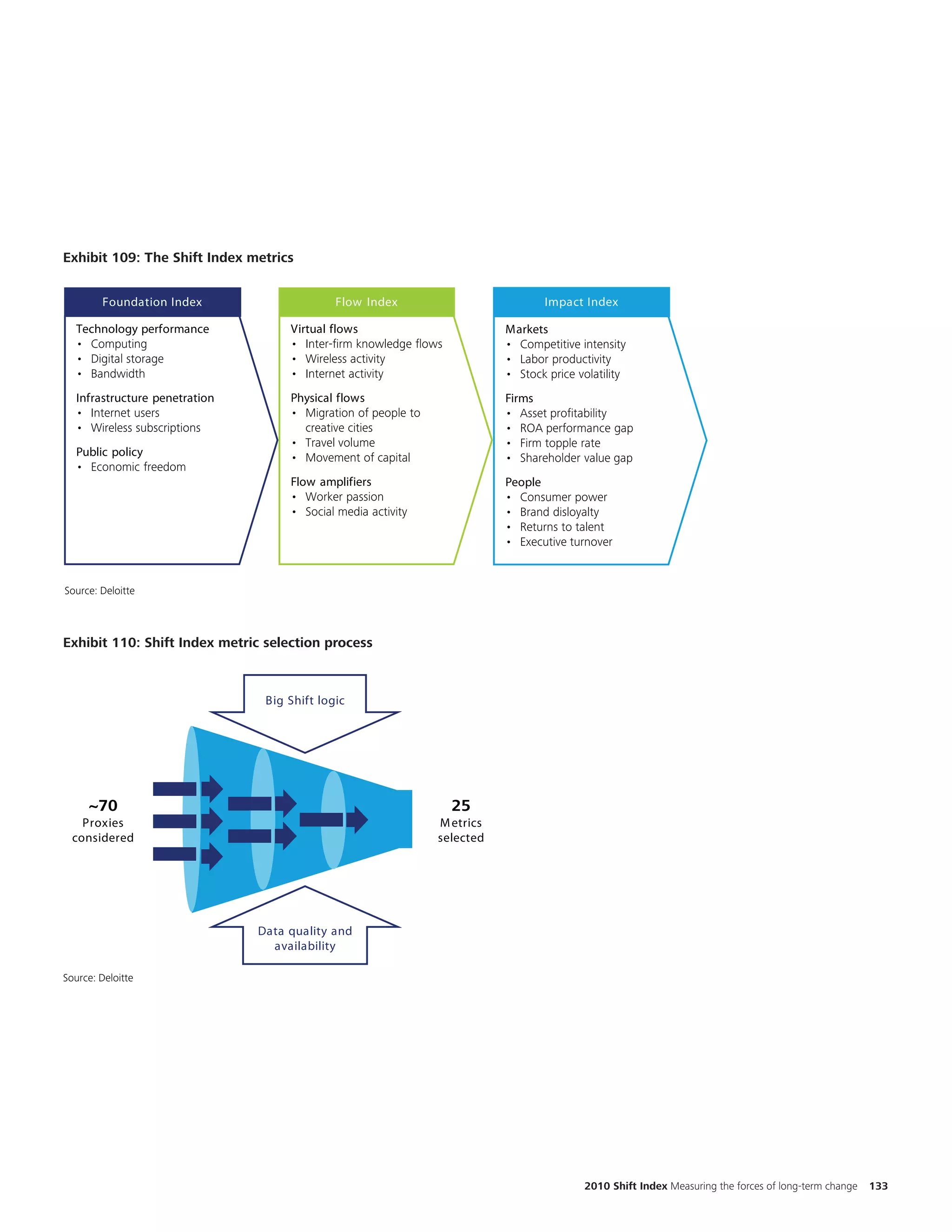
Exhibit 10: The Shift Index metrics
      Exhibit 10: The Shift Index metrics
                          Foundation Index                       Flow Index                           Impact Index

                     Technology Performance              Virtual Flows                         Markets
                     • Computing                         • Inter-firm Knowledge Flows          • Competitive Intensity
                     • Digital Storage                   • Wireless Activity                   • Labor Productivity
                     • Bandwidth                         • Internet Activity                   • Stock Price Volatility
                     Infrastructure Penetration          Physical Flows                        Firms
                     • Internet Users                    • Migration of People to              • Asset Profitability
                     • Wireless Subscriptions            Creative Cities                       • ROA Performance Gap
                                                         • Travel Volume                       • Firm Topple Rate
                     Public Policy                       • Movement of Capital                 • Shareholder Value Gap
                     • Economic Freedom
                                                         Flow Amplifiers                       People
                                                         • Worker Passion                      • Consumer Power
                                                         • Social Media Activity               • Brand Disloyalty
                                                                                               • Returns to Talent
                                                                                               • Executive Turnover


     Source: Deloitte
      Source: Deloitte


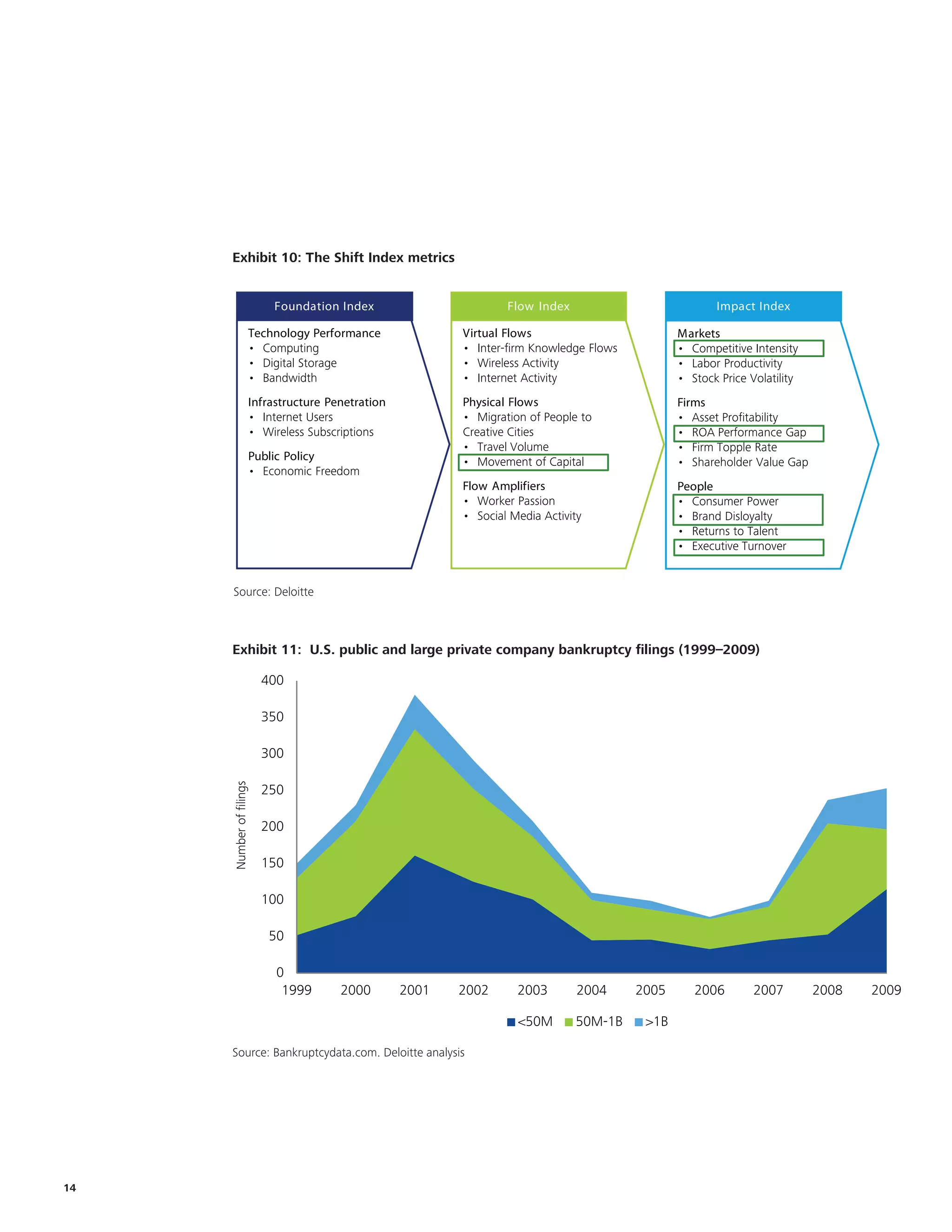
     Exhibit 11: U.S. public and large private company bankruptcy filings (1999–2009)
      Exhibit 11: U.S. public                  company bankruptcy filings (1999 – 2009)

                         400

                         350

                         300
     Number of filings


                         250

                         200

                         150

                         100

                          50

                           0
                            1999      2000        2001   2002      2003        2004     2005      2006        2007        2008   2009

                                                                   <50M       50M-1B     >1B
     Bankruptcydata.com, Deloitte Analysis
     Source: Bankruptcydata.com. Deloitte analysis


14
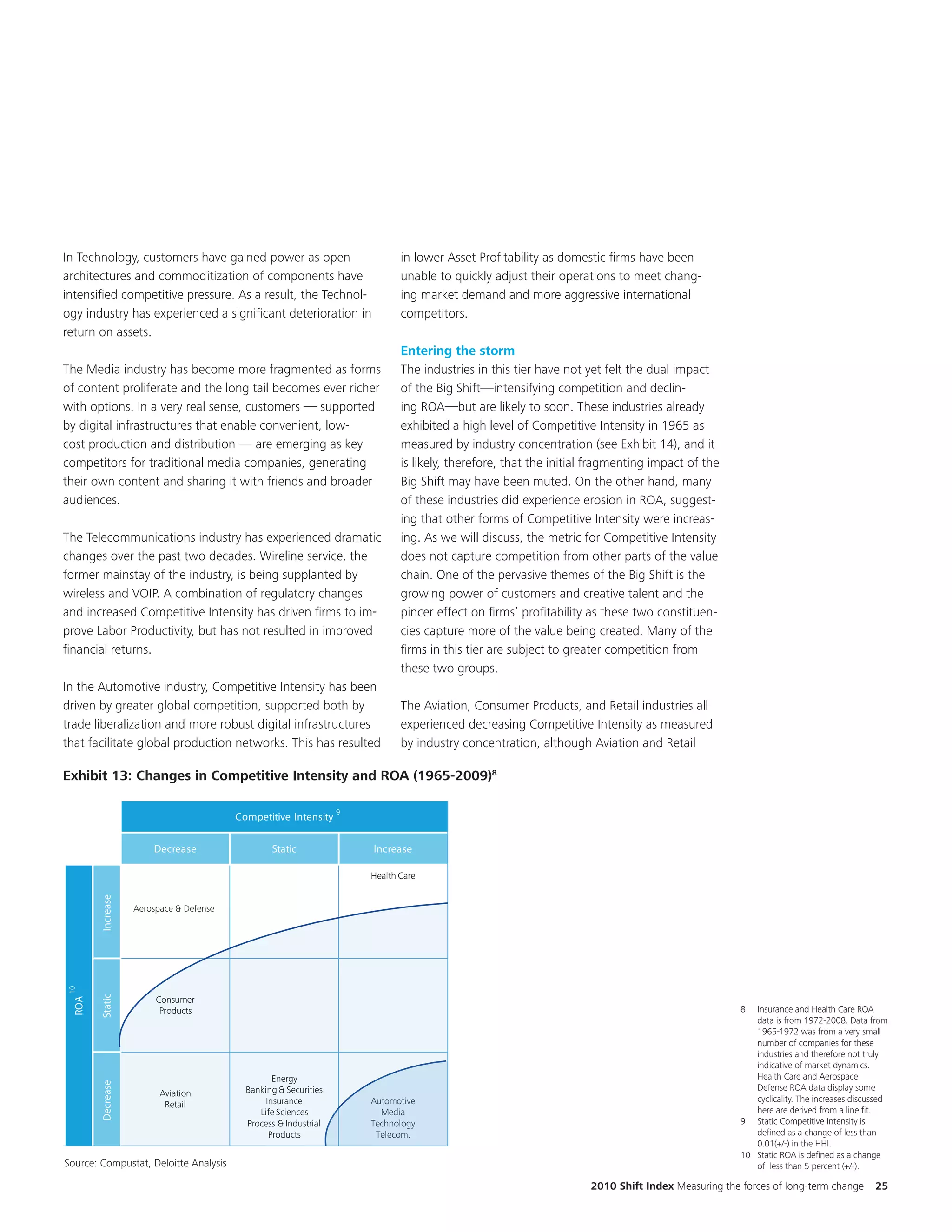
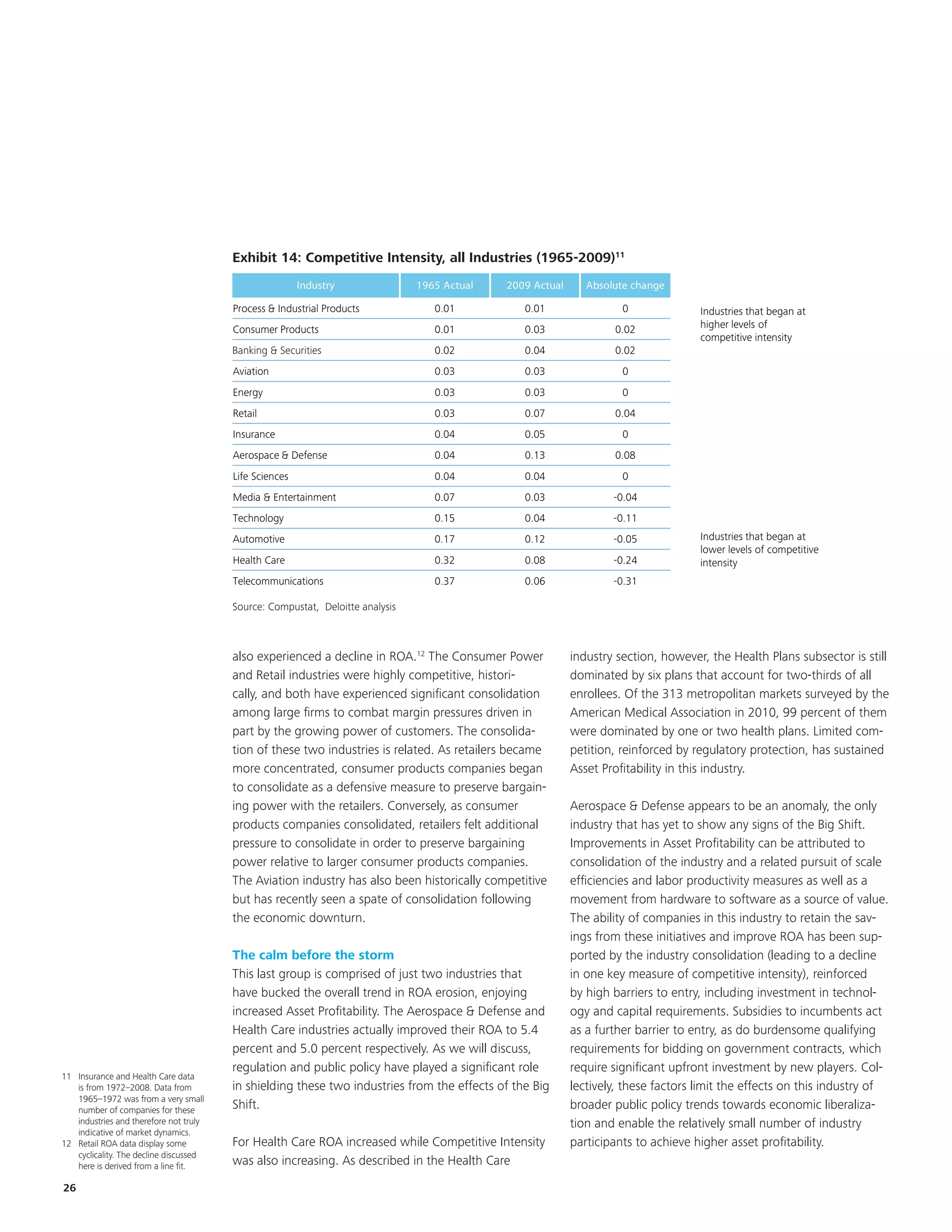
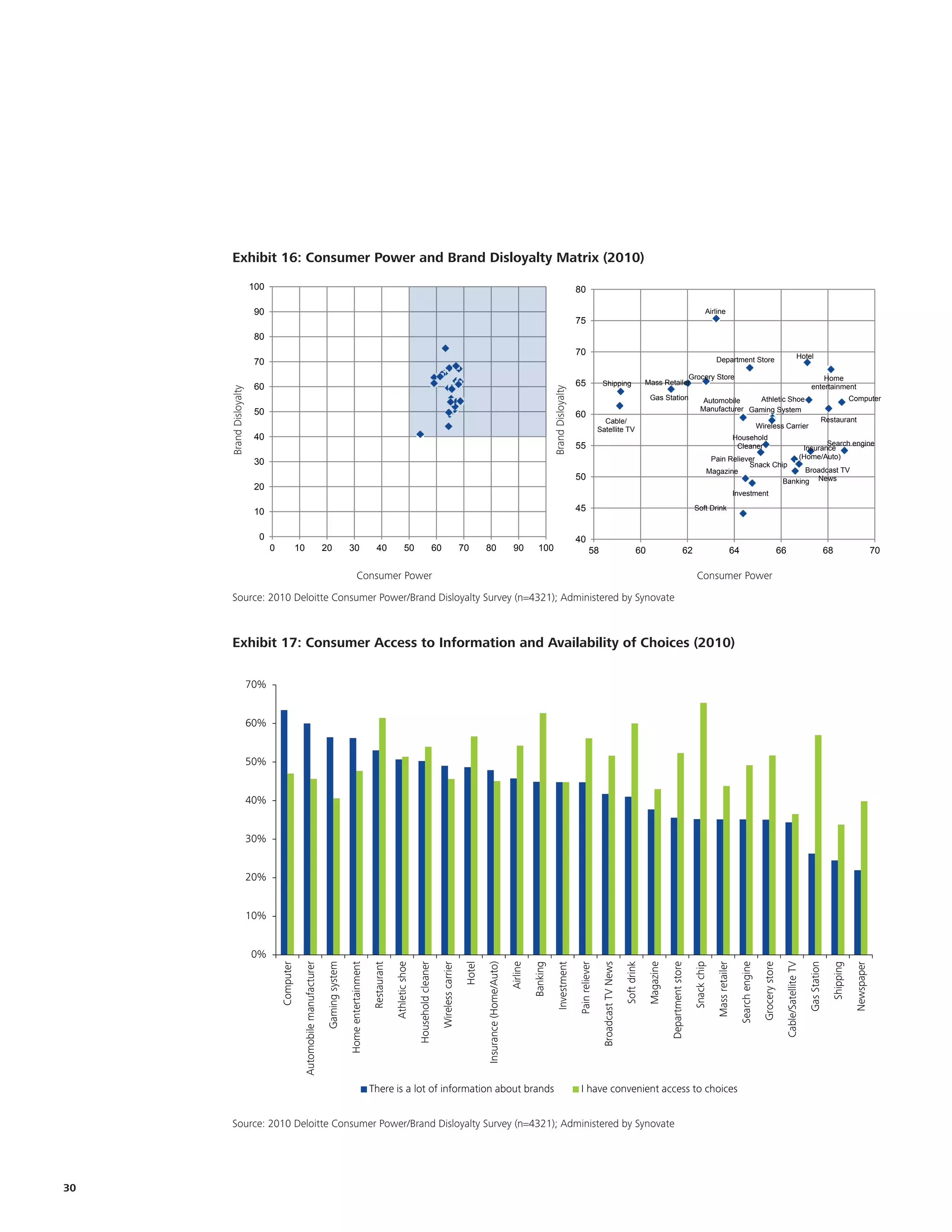
Markets experienced a reversal in Competitive Intensity        Brand Disloyalty increased while Consumer Power
M&A activities, which tend to lessen competitive intensity,    decreased
have declined as a result of difficulty in accessing capital   The wealth of information and discussion around products
and overall market uncertainty. At the same time, financial    and brands continued to erode brand loyalty — the Brand
challenges and skittish consumers led to a sharp rise in       Disloyalty Index increased by 1.2 points, to 58.4. Given
business bankruptcies, driving competitors out of the          the declining power of the brand, it is surprising that
market. The resulting consolidation offset the effects of      consumers perceived less power in the marketplace during
fewer M&A transactions — overall competitive intensity         this same period — the Consumer Power Index dropped
decreased.                                                     1.9 points, to 64.8, for the 2010 Index.

The ROA Performance Gap narrowed for firms                     The unexpected drop in Consumer Power makes sense
The ROA performance gap in 2009 decreased relative to          within the context of the downturn. Bankruptcies, consoli-
2008. The difference in performance between the top            dation of product lines, and reductions in new product
and the bottom quartiles of companies decreased for two        development have decreased product choice, particularly
reasons: first, returns in the top quartile companies were     for customized products. At the same time, targeted
significantly lower as a result of the downturn; second,       marketing for the remaining products makes it difficult for
poorly performing companies in the bottom quartile             the consumer to avoid marketing efforts. These two factors
dropped out of the market, effectively raising the average     drove the consumers’ perception of having less power
ROA of the bottom quartile.                                    relative to the prior year.

Smaller businesses and startups are particularly challenged    The journey continues
by the limited access to capital and lower consumer            From our first conception of the Shift Index, our view was
spending of this downturn. As a result, small business         that traditional economic indicators no longer accurately
(assets less than $50 million) bankruptcies are rising much    or usefully capture the long-term shifts that are producing
faster than mid-size or large company bankruptcies.            a world of constant and rapid change and increasing
Meanwhile, mid-size companies (with assets at $50 million      performance pressure. Creating a new set of indices is not
to $1billion) filed fewer bankruptcies in 2009. We expect      a straightforward or simple process. Through our discus-
their performance to improve as they take market share         sions and analysis we continue to refine our perspective on
from small players and companies in the bottom quartile.4      the metrics that make up the Index. When we set out on
                                                               this journey, more than anything else we wanted to serve
Executive Turnover declined                                    as a catalyst to re-focus attention on longer-term trends
Executive turnover continued to slide, reaching a five-year    that, ultimately, will have a much more profound impact
low. Although somewhat counterintuitive, the economic          on the markets and society we work and live in than the
downturn actually led to fewer changes in leadership. Both     short-term changes that dominate our media attention.
the companies and the executives exhibited a propensity        Our goal, in part, is to motivate others to join us on this
to “stay the course” and avoid additional instability in an    journey as we continue to develop and refine the analytics
uncertain environment. Executives were also less likely to     and insights that can more effectively capture these longer-
retire as a result of personal wealth devaluation. As the      term changes. We invite everyone to undertake additional
economy improves, we expect executive turnover to rise         research to test, challenge, refine and add to the metrics
as executives seek new opportunities and with companies        we have presented.
being more willing to make leadership changes. Companies
are also expected to make strategic decisions that require     In that spirit, it is our pleasure to present the 2010 Shift
                                                                                                                                   3 "FDI recovery in developed
different skill sets.                                          Index. We welcome your thoughts and questions. Let the                 countries, after two-year decline,
                                                                                                                                      rests with the rise of cross-border
                                                               discussion continue.                                                   M&As", United Nations Conference
                                                                                                                                      on Trade and Development
                                                                                                                                      (UNCTAD) Press Release, July
                                                                                                                                      22,2010, http://www.unctad.org/
                                                                                                                                      Templates/webflyer.asp?docid=136
                                                                                                                                      47&intItemID=1634&lang=1.
                                                                                                                                   4 “The Year in Bankruptcy: 2009”,
                                                                                                                                      Jones Day, January/February 2010,
                                                                                                                                      http://www.jonesday.com/the-year-
                                                                                                                                      in-bankruptcy-2009-02-09-2010/.

                                                                                                    2010 Shift Index Measuring the forces of long-term change        15
Key Ideas

     Foundation Index              As computing costs drop, the pace of innovation accelerates                              Computing
                                                                                                                            p. 47
     The fast moving,
     relentless evolution of a     Plummeting storage costs solve one problem—and create another                            Digital Storage
     new digital infrastructure                                                                                             p. 49
     and shifts in global public
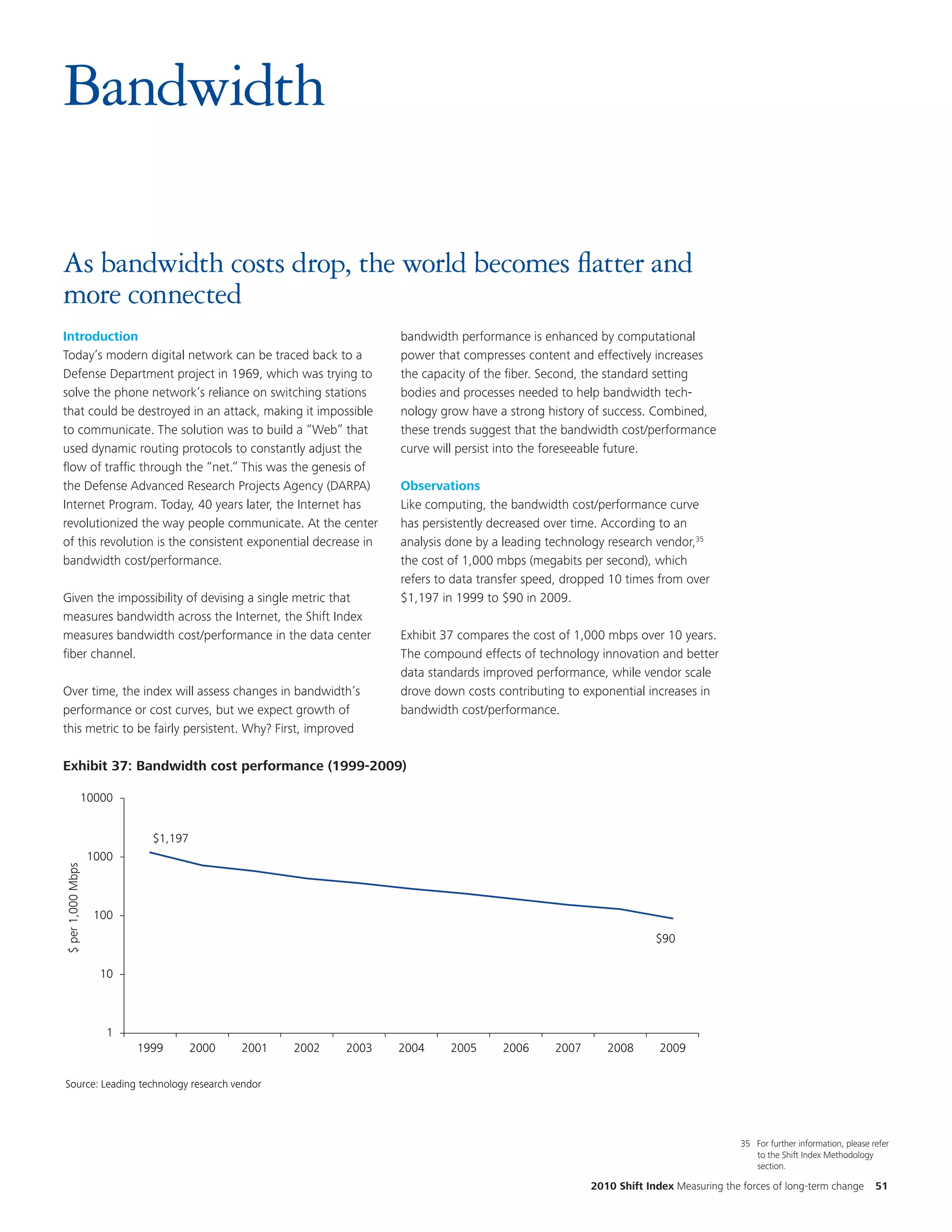
     policy are reducing           As bandwidth costs drop, the world becomes flatter and more connected                    Bandwidth
     barriers to entry and                                                                                                  p. 51
     movement
                                   Accelerating Internet adoption makes digital technology more accessible,                 Internet Users
                                   increasing pressure as well as creating opportunity                                      p. 53

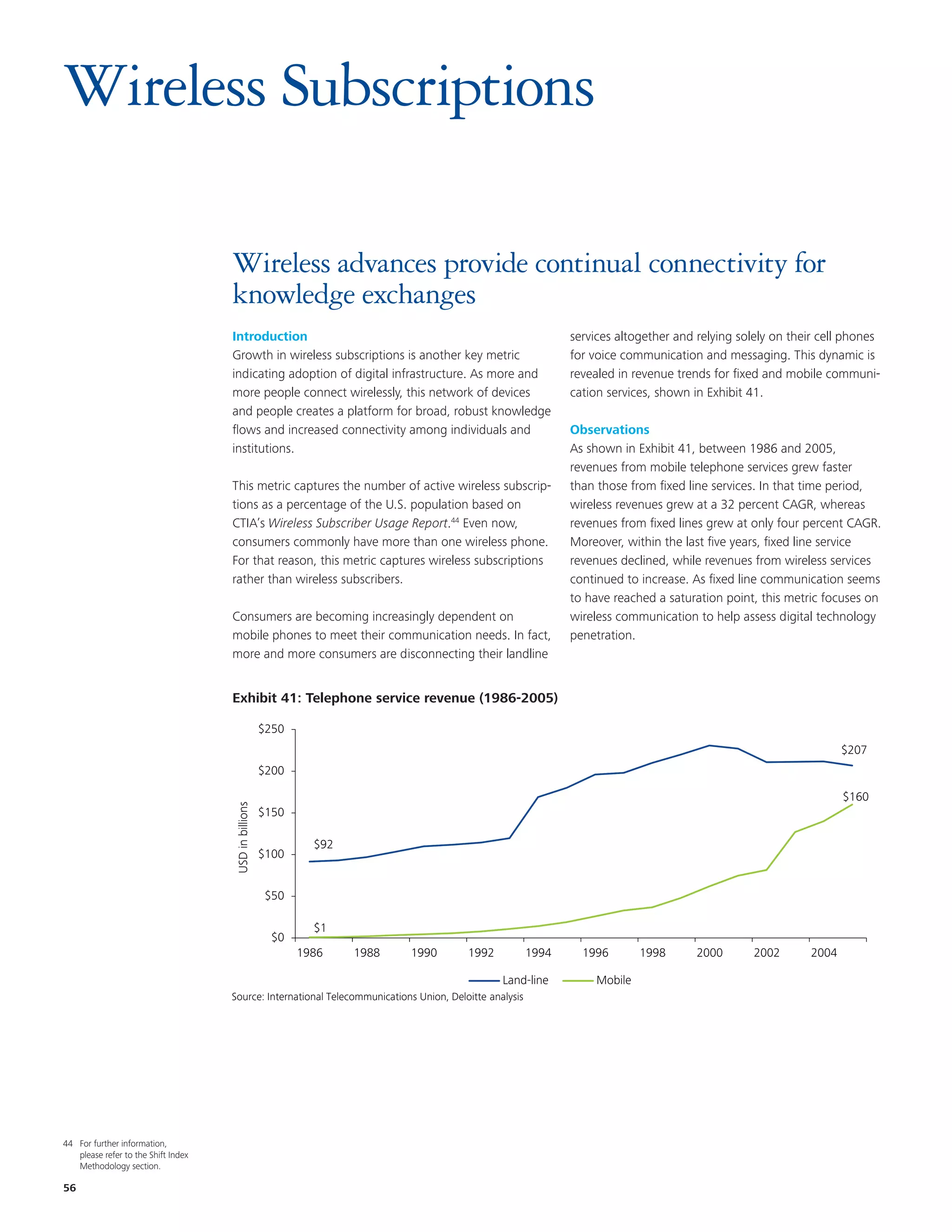
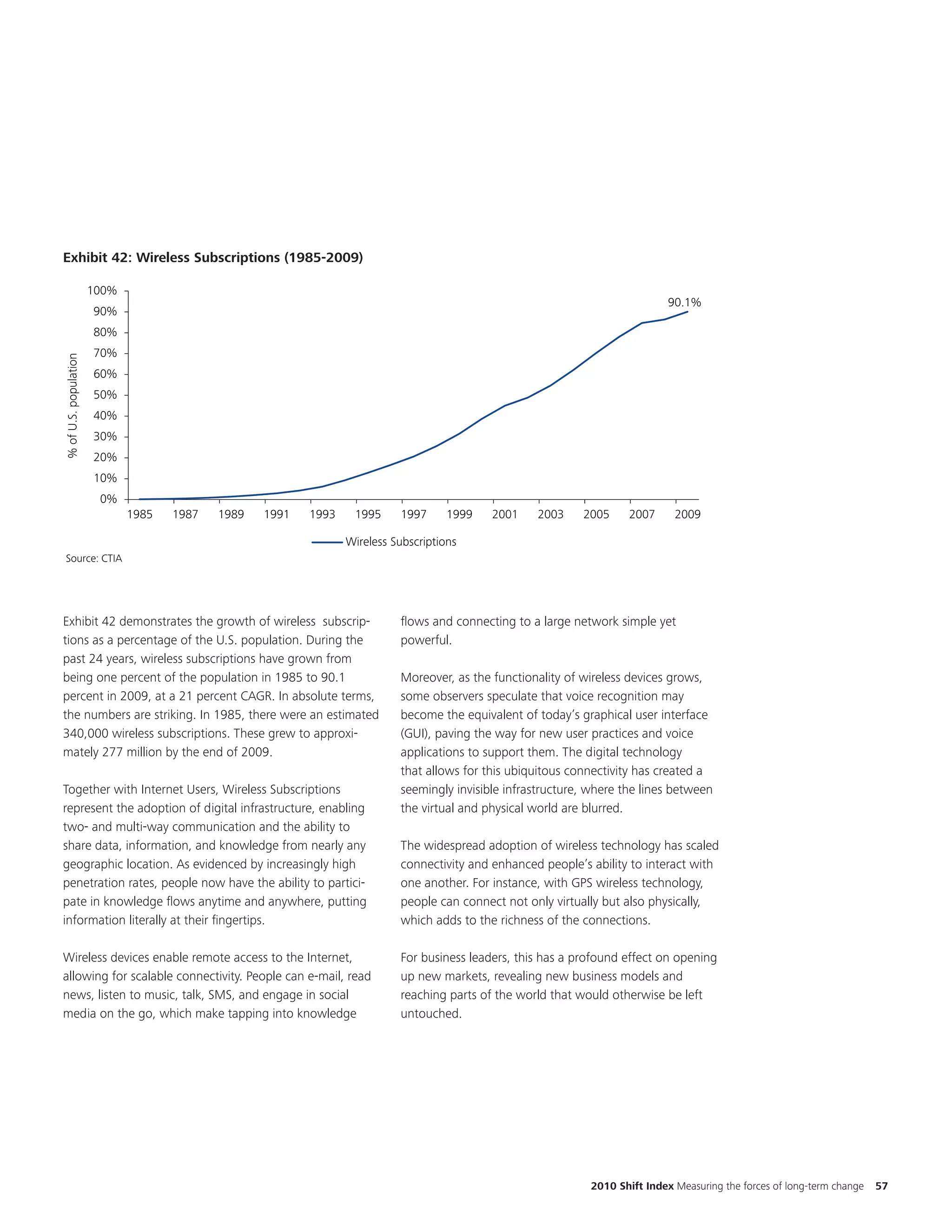
                                   Wireless advances provide continual connectivity for knowledge exchanges                 Wireless Subscriptions
                                                                                                                            p. 56

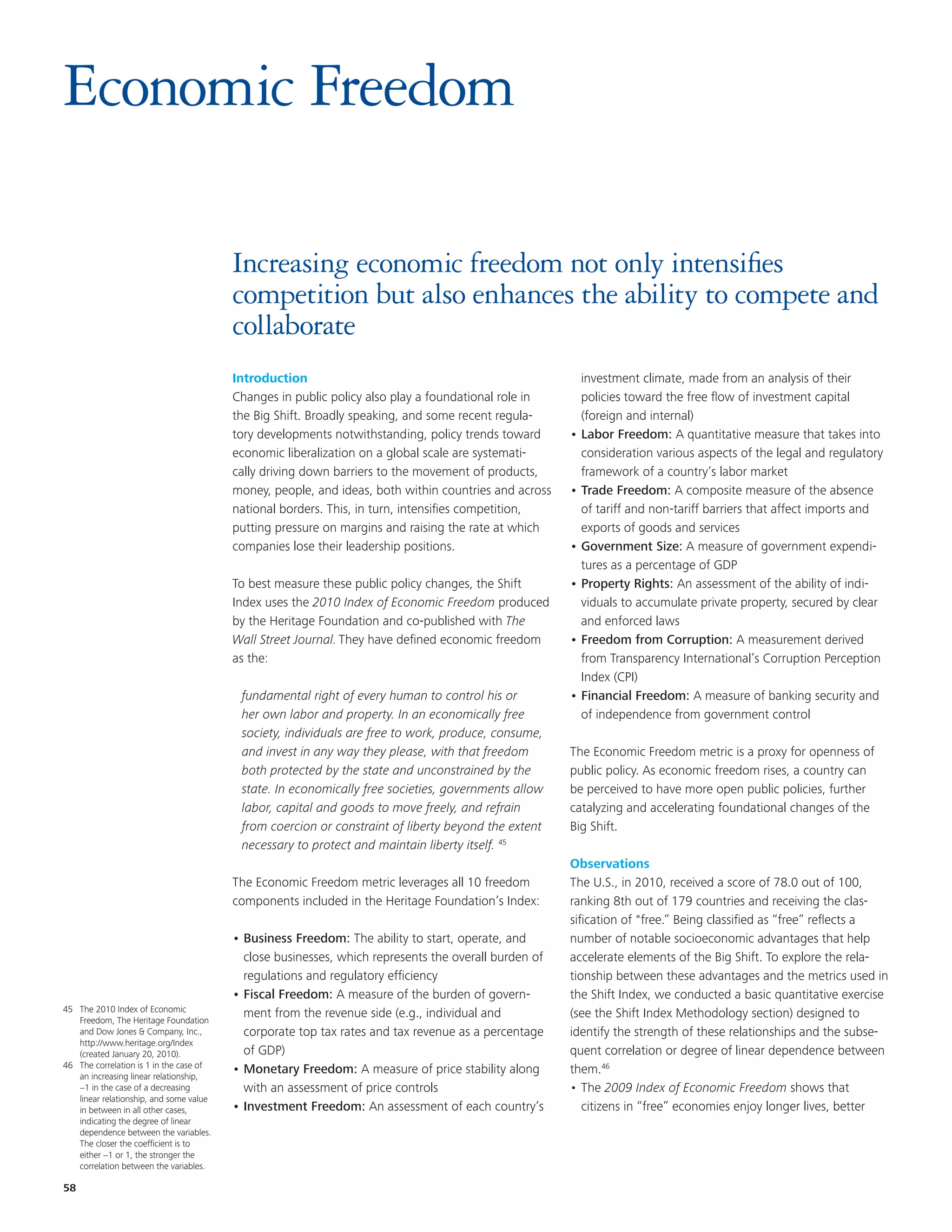
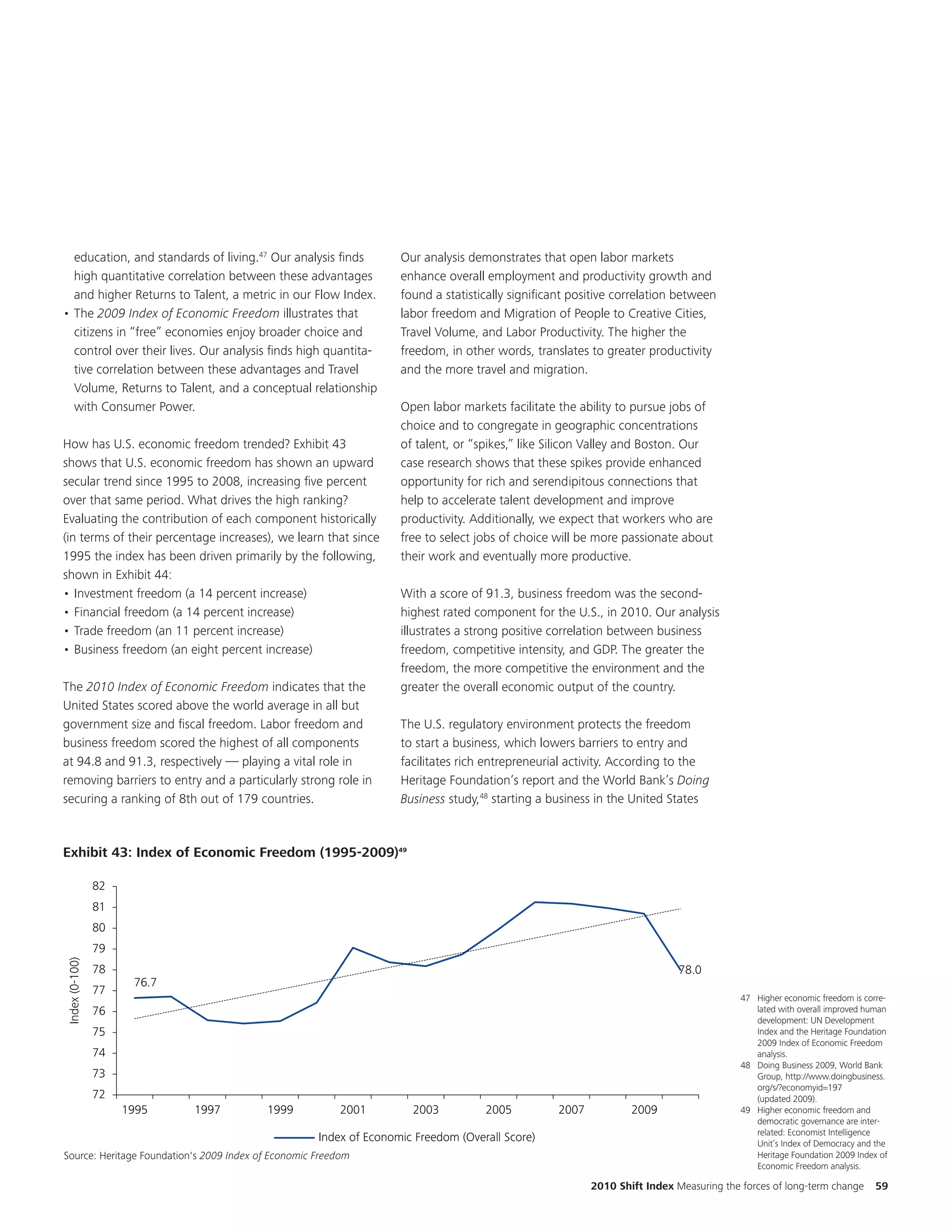
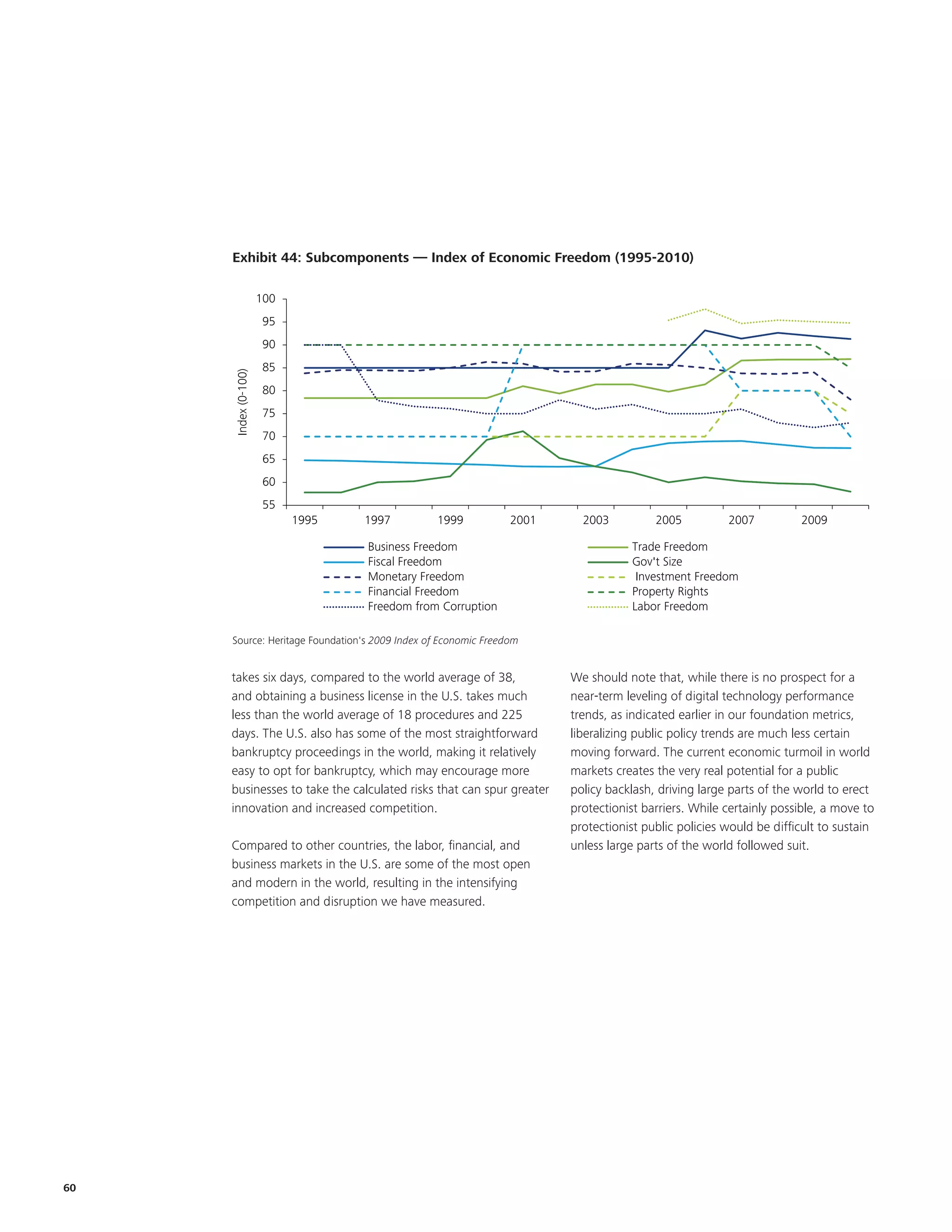
                                   Increasing economic freedom further intensifies competition but also enhances the        Economic Freedom
                                   ability to compete and collaborate                                                       p. 58


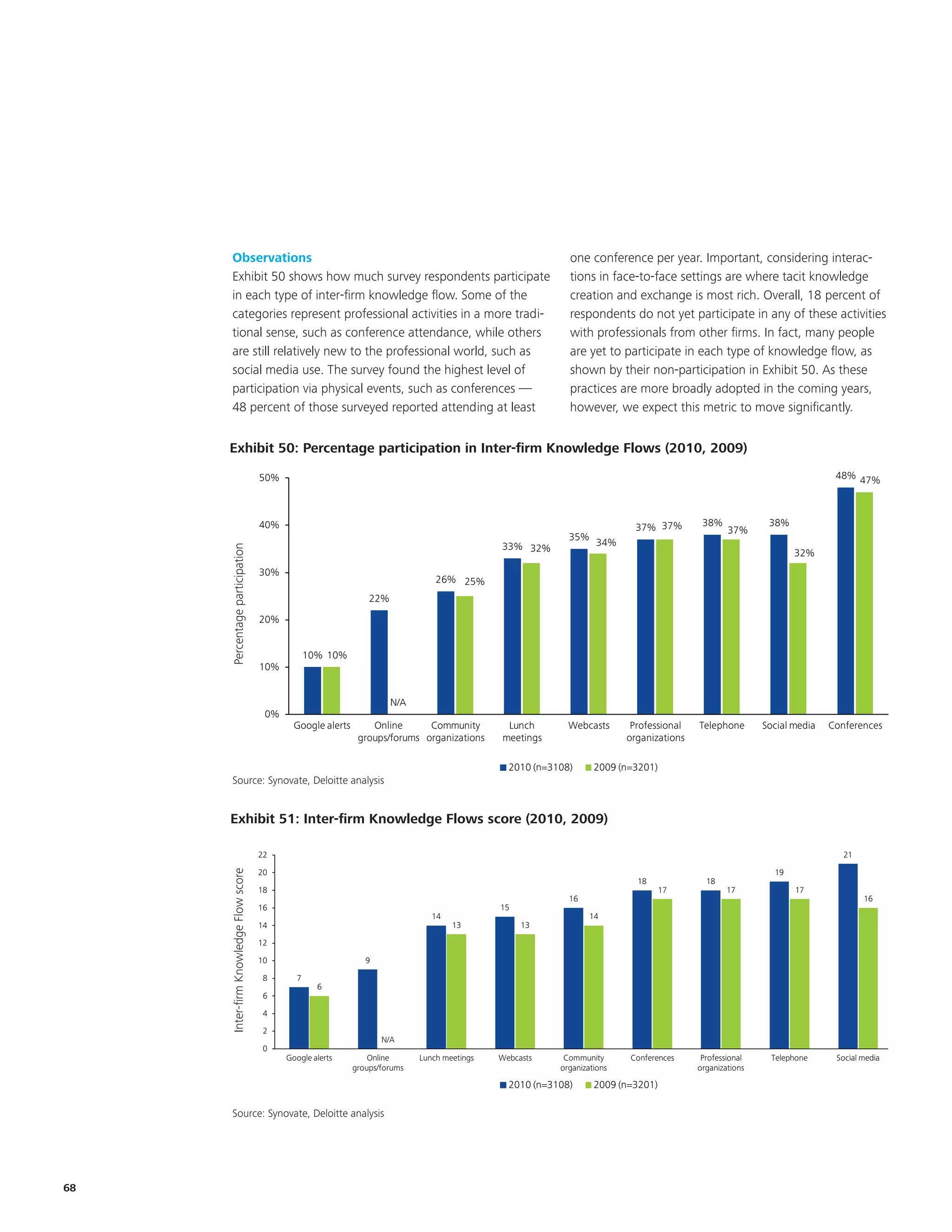
     Flow Index                    Individuals are finding new ways to reach beyond the four walls of their organization    Inter-Firm Knowledge
                                   to participate in diverse knowledge flows                                                Flows p. 67
     Sources of economic
     value are moving from         More diverse communication options are increasing wireless usage and significantly       Wireless Activity
     “stocks” of knowledge         increasing the scalability of connections                                                p. 71
     to “flows” of new
     knowledge                     The rapid growth of Internet activity reflects both broader availability and richer      Internet Activity
                                   opportunities for connection with a growing range of people and resources                p. 74

                                   Increasing migration suggests virtual connection is not enough – people increasingly     Migration of People to
                                   seek rich and serendipitous face to face encounters as well                              Creative Cities p. 78

                                   Travel volume continues to grow as virtual connectivity expands, indicating these may    Travel Volume
                                   not be substitutes but complements                                                       p. 83

                                   Capital flows are an important means not just to improve efficiency but also to access   Movement of Capital
                                   pockets of innovation globally                                                           p. 85

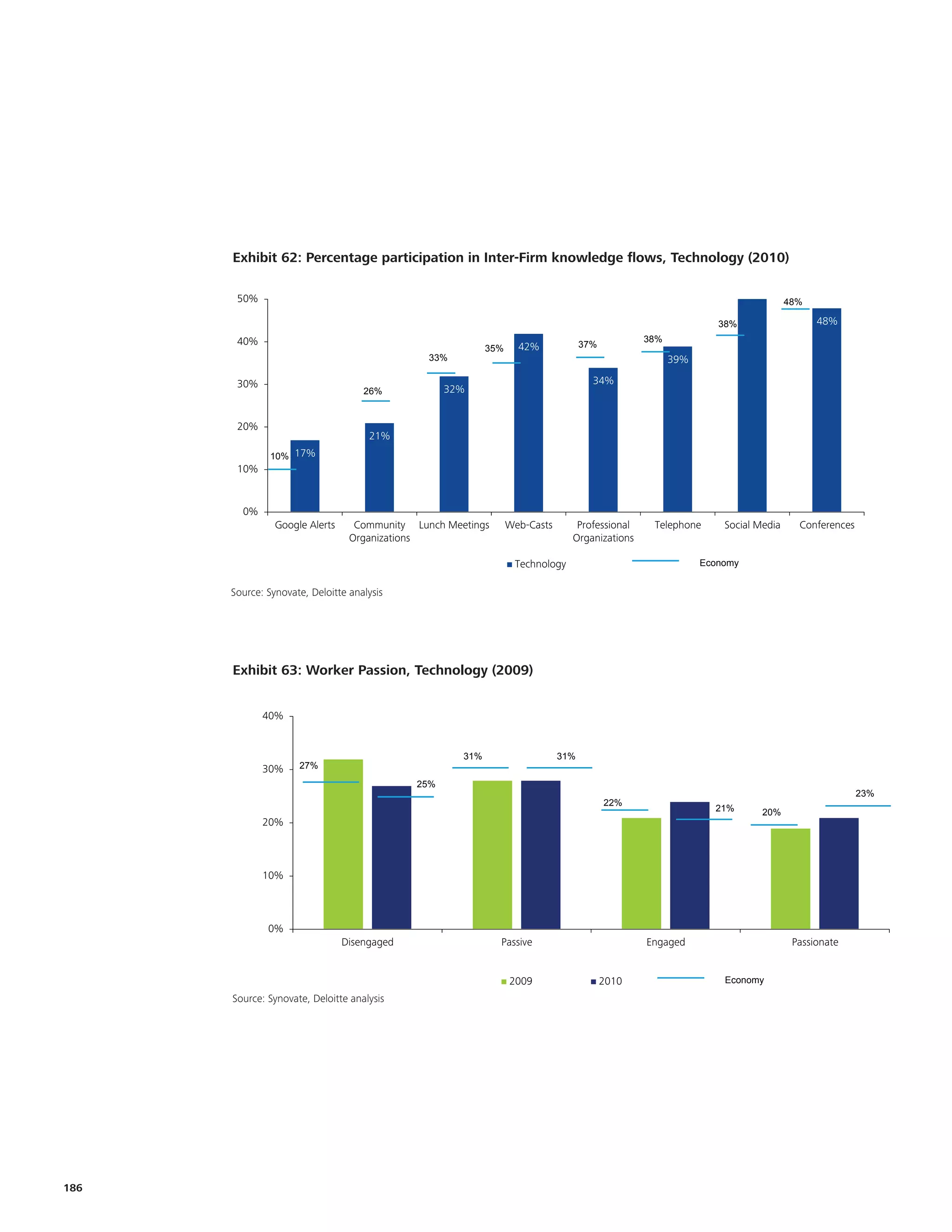
                                   Workers who are passionate about their jobs are more likely to participate in            Worker Passion
                                   knowledge flows and generate value for companies                                         p. 89

                                   The recent burst of social media activity has enabled richer and more scalable ways to   Social Media Activity
                                   connect with people and build sustaining relationships that enhance knowledge flows      p. 94


16
Impact Index                 Competitive intensity is increasing as barriers to entry and movement erode under the           Competitive Intensity
                             influence of digital infrastructures and public policy                                          p. 103
Foundations and
knowledge flows are          Advances in technology and business innovation, coupled with open public policy                 Labor Productivity
fundamentally reshaping      and fierce competition, have both enabled and forced a long-term increase in labor              p. 106
the economic playing field   productivity

                             A long-term surge in competitive intensity, amplified by macro-economic forces and              Stock Price Volatility
                             public policy initiatives, has led to increasing volatility and greater market uncertainty      p. 109

                             Cost savings and the value of modest productivity improvement tends to get                      Asset Profitability
                             competed away and captured by customers and talent                                              p. 111

                             Winning companies are barely holding on, while losers are rapidly deteriorating                 ROA Performance Gap
                                                                                                                             p. 113

                             The rate at which big companies lose their leadership positions is increasing                   Firm Topple Rate
                                                                                                                             p. 115

                             Market “losers” are destroying more value than ever before – a trend playing out over Shareholder Value Gap
                             decades                                                                               p. 116

                             Consumers possess much more power, based on the availability of much more                       Consumer Power
                             information and choice                                                                          p. 118

                             Consumers are becoming less loyal to brands                                                     Brand Disloyalty
                                                                                                                             p. 121

                             As contributions from the creative classes become more valuable, talented workers               Returns to Talent
                             are garnering higher compensation and market power                                              p. 124

                             As performance pressures rise, executive turnover is increasing                                 Executive Turnover
                             is increasing                                                                                   p. 128


                                                                                             2010 Shift Index Measuring the forces of long-term change   17
Overview: Context, Findings,
and Implications
      Introduction: The Big Shift                                      dynamics changing our world. We experience instead a
      During a steep economic downturn, managers obsess over           daily bombardment of short-term economic indicators —
      short-term performance goals, such as cost cutting, sales,       employment, inventory levels, inflation, commodity prices, etc.
      and market share growth. Meanwhile, economists chart
      data like GDP growth, unemployment levels, and balance-          To help managers in this decidedly challenging time, we
      of-trade shifts to gauge the health of the overall business      have developed a framework for understanding three
      environment. The problem is, focusing only on traditional        waves of transformation in the competitive landscape:
      metrics often masks long-term forces of change that              foundations for major change; flows of resources, such as
      undercut normal sources of economic value.                       knowledge, that allow firms to enhance productivity; and
                                                                       the impacts of the foundations and flows on companies
      “Normal” may in fact be a thing of the past: Even when           and the economy. Combined, those factors reflect what
      the economy heats up again, companies’ returns will              we call the Big Shift in the global business environment.
      remain under pressure. Trends set in motion decades ago          Additionally, we have developed a Shift Index consisting of
      are fundamentally altering the global business environ-          three indices that quantify the three waves of long-term
      ment, abetted by a new digital infrastructure built on the       change we see happening today. By quantifying these
      sustained exponential pace of performance improvements           forces, we seek to help institutional leaders steer a course
      in computing, storage, and bandwidth. This infrastruc-           for "true north,” while helping to minimize distraction from
      ture is not just bits and bytes — it consists of institutions,   short-term events — and the growing din of metrics that
      practices, and protocols that together organize and deliver      reflect them.
      the increasing power of digital technology to business and
      society. This power must be harnessed if business is to          Today we face epochal challenges that continue to
      thrive.                                                          intensify. Steps we take now to address them will not
                                                                       only help us to weather today’s economic storm but also
      No one, to our knowledge, has yet quantified the dimen-          position us to create significant economic value in an
      sions of deep change precipitated by digital technolo-           ever-more challenging business landscape. We believe that
      gies and public policy shifts. Fragmentary metrics and           the Shift Index can serve as a useful compass and catalyst
      sporadic studies exist, to be sure. But nothing yet captures     for the discussions and actions required to make this
      a clear, comprehensive, and sustained view of the deep           happen.


18
18
Key findings                                                   • While the performance of U.S. firms is deteriorating, at
The Shift Index report highlights a core performance             least some of the benefits of the productivity improve-
challenge and paradox for the firm that has been playing         ments appear to be captured by creative talent, which
out for decades. ROA for U.S. firms has steadily fallen          is experiencing greater growth in total compensation.
to almost one-quarter of 1965 levels at the same time            Customers also appear to be gaining and using power as
that we have seen continued, albeit much more modest,            reflected in increasing customer disloyalty toward brands.
improvements in labor productivity. While this deteriora-      • The exponentially advancing price/performance capa-
tion in ROA has been particularly affected by trends in the      bility of computing, storage, and bandwidth is driving
financial sector, significant declines in ROA have occurred      an adoption rate for the digital infrastructure that is two
in the rest of the economy as well. Some additional              to five times faster than previous infrastructures, such as
findings that highlight the performance challenges facing        electricity and telephone networks.
U.S. firms include the following:
• The gap in ROA performance between winners and               These findings have two levels of implication. First, the
   losers has increased over time, with the “winners” barely   gap between potential and realized firm performance is
   maintaining previous performance levels, while the losers   steadily widening as productivity grows at a rate far slower
   experience rapid deterioration in performance.              than the underlying performance increases of the digital
• The “topple rate,” at which big companies lose their         infrastructure. Potential performance refers to the oppor-
  EKM – positions, has more than from v5.
   leadership Color updated doubled, suggesting                tunity companies have to harness the increasing power
   that “winners” have increasingly precarious positions.      and capability of the digital infrastructure to create higher
      Formulation issue? Final?
   Some of them dropped out of the market during the           returns for themselves as they achieve even higher levels of
   recent economy downturn, which temperately raising          productivity improvement through product, process, and
                                                                                                                                                               Title chang
   the average ROA of the bottom players.                      institutional innovations.
• U.S. competitive intensity has more than doubled during
   the last 40 years.                                          Second, the financial performance of the firm continues to
                                                               deteriorate as a quickly evolving digital infrastructure and


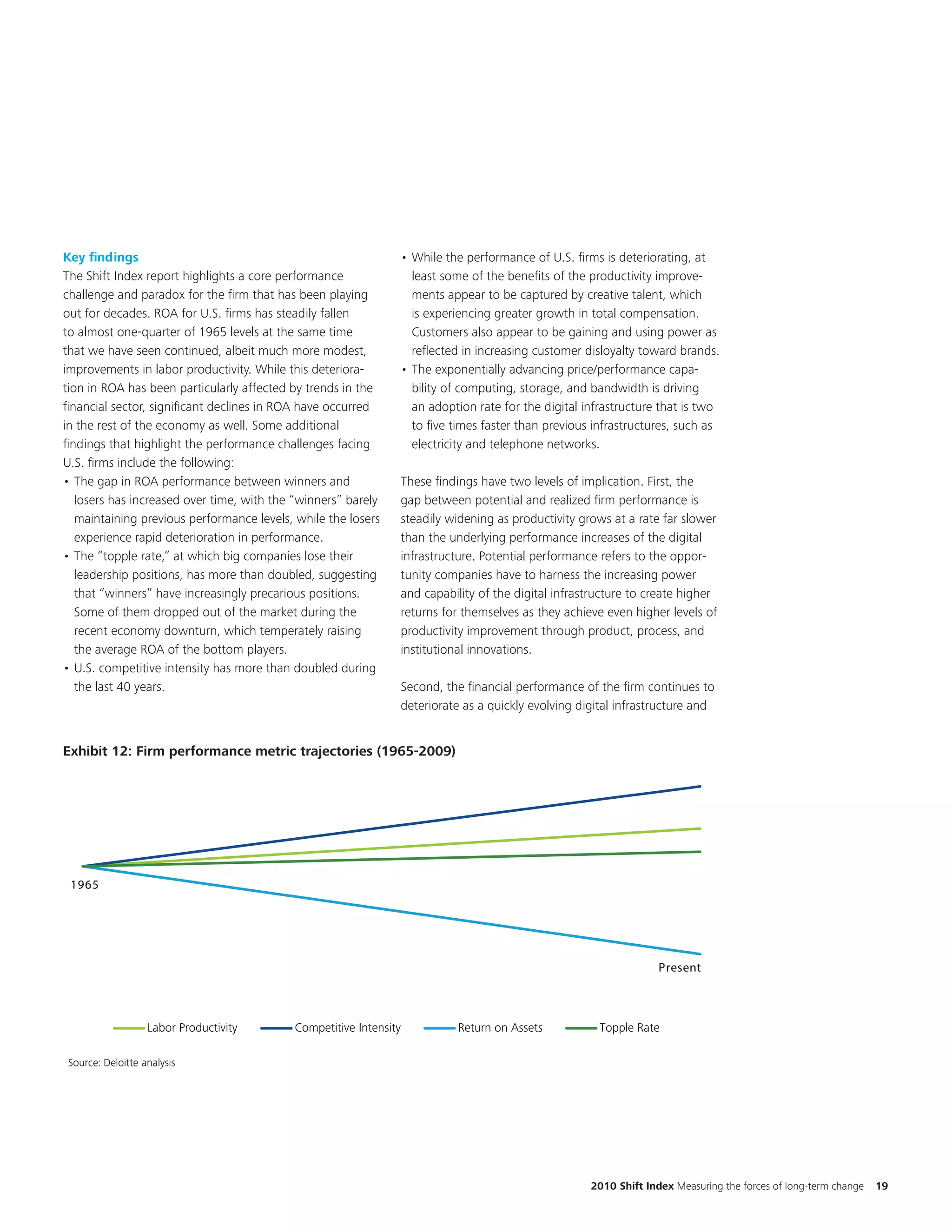
Exhibit 12: Firm performance metric trajectories (1965-2009)
 Exhibit 1: Firm performance metric trajectories (1965-2009)


 1965


                                                                                                                 Present


                  Labor Productivity       Competitive Intensity          Return on Assets           Topple Rate

Source: Deloitte analysis


                                                                                                                               Not sure about the19
                                                                                                   2010 Shift Index Measuring the forces of long-term change

                                                                                                                                  formulation
public policy liberalization combine to intensify competi-       To quantify these waves, we broke the corresponding
     tion. (Recent regulatory moves to the contrary, the over-        Shift Index into three separate indices. In this section, we
     whelming policy trend since World War II has been toward         will explain each wave and the metrics we have chosen to
     reducing barriers to entry and movement in terms of freer        represent it.
     trade and investment flows as well as deregulation of
     major industries.) The benefits from the modest produc-          The first wave involves the fast-moving, relentless evolution
     tivity improvements companies have achieved increasingly         of a new digital infrastructure and shifts in global public
     accrue not to the firm or its shareholders, but to creative      policy that have reduced barriers to entry and movement,
     talent and customers, who are gaining market power as            enabling vastly greater productivity, transparency, and
     competition intensifies.                                         connectivity. Consider how companies can use digital
                                                                      technology to create ecosystems of diverse, far-flung users,
     How do we reverse this trend? For precedent and inspira-         designers, and suppliers in which product and process
     tion, we might look to the generation of companies that          innovations fuel performance gains without introducing
     emerged in the early-20th century. As Alfred Chandler and        too much complexity. This wave is represented in the first
     Ronald Coase later made clear, these companies discov-           index of the Shift Index — the Foundation Index. It quan-
     ered how to harness the capabilities of newly emerging           tifies and tracks the rate of change in the foundational
     energy, transportation, and communication infrastruc-            forces taking place today.
     tures to generate efficiency at scale. Today’s companies
     must make the most of our own era’s new infrastructure           The Foundation Index reflects new possibilities and chal-
     through institutional innovations that shift the rationale       lenges for business as a result of new technology capa-
     from scalable efficiency to scalable learning by using digital   bility and public policy shifts. In this sense, it is a leading
     infrastructure to create environments where performance          indicator because it shapes opportunities for new business
     improvement accelerates as more participants join, as illus-     and social practices to emerge in subsequent waves of
     trated in various kinds of emerging open innovation and          change as everyone seeks to explore and master new
     process network initiatives. Only then will the corporate        potentialities. However, business will also be exposed to
     sector generate greater productivity improvement from the        challenges as a result of increased competition. Key metrics
     rapidly evolving digital infrastructure and capture their fair   in this index include the change in performance of the
     share of the ensuing rewards. As this takes place, the Shift     technology components underlying the digital infrastruc-
     Index will turn from an indicator of corporate decline to        ture, growth in the adoption rate of this infrastructure, and
     one reflecting powerful new modes of economic growth.            the degree of product and labor market regulation in the
                                                                      economy.
     Three Waves; three indices
     The trends reported above, and the connections across            The second wave of change, represented in the second
     them, are consistent with the theoretical model we used          index in the Shift Index, the Flow Index, is characterized
     to define and structure the metrics in the Shift Index. The      by the increasing flows of capital, talent, and knowledge
     Shift Index seeks to measure three waves of deep and             across geographic and institutional boundaries. In this
     overlapping change operating beneath the visible surfaces        wave, intensifying competition and the increasing rate of
     of today’s events. In brief, this theoretical model suggests     change precipitated by the first wave shifts the sources of
     that a first wave of change in the foundations of our            economic value from “stocks” of knowledge to “flows” of
     business and society are expanding flows of knowledge            new knowledge.
     in a second. These two waves will intensify competition
     in the near term and put increasing pressure on corporate        Knowledge flows — which occur in any social, fluid envi-
     performance. Later, institutional innovations emerging in a      ronment where learning and collaboration can take place
     third wave of change will harness the unique potential of        — are quickly becoming one of the most crucial sources
     these foundations and flows, improving corporate perfor-         of value creation. Facebook, Twitter, LinkedIn, and other
     mance as more value is created and delivered to markets.         social media foster them, as do virtual communities and
     In other words, change occurs in distinct waves that are         online discussion forums and companies situated near one
     causally related.                                                another, working on similar problems. Twentieth-century
                                                                      institutions built and protected knowledge stocks—propri-

20
etary resources that no one else could access. The more             to master the Big Shift and turn performance challenges
the business environment changes, however, the faster the           into opportunities. The ultimate differentiator among
value of what you know at any point in time diminishes.             companies, though, may be a competency for creating and
In this world, success hinges on the ability to participate         sharing knowledge across enterprises. Growth in intercom-
in a growing array of knowledge flows in order to rapidly           pany knowledge flows will be a particularly important sign
refresh your knowledge stocks. For instance, when an                that firms are adopting the new institutional architectures,
organization tries to improve cycle times in a manufac-             governance structures, and operational practices necessary
turing process, it finds far more value in problem solving          to take full advantage of the digital infrastructure.
shaped by the diverse experiences, perspectives, and
learning of a tightly knit team (shared through knowledge           The final wave — captured by the Impact Index — reflects
flows) than in a training manual (knowledge stocks) alone.          how well companies are exploiting foundational improve-
                                                                    ments in the digital infrastructure by creating and sharing
Knowledge flows can help companies gain competi-                    knowledge — and what impacts those changes are having
tive advantage in an age of near-constant disruption.               on markets, firms, and individuals. For now, institutional
The software company SAP, for instance, routinely taps              performance is broadly suffering in the face of intensifying
the more than 1.5 million participants in its Developer             competition. But over time, as firms learn how to harness
Network, which extends well beyond the boundaries                   the digital infrastructure and participate more effectively in
of the firm. Those who post questions for the network               knowledge flows, their performance will improve.
community to address will receive a response in 17
minutes, on average, and 85 percent of all the questions            Differences in approach between top performing and
posted to date have been rated as “resolved.” By providing          underperforming companies are telling. As some organiza-
a virtual platform for customers, developers, system                tions participate more in knowledge flows, we should see
integrators, and service vendors to create and exchange             them break ahead of the pack and significantly improve
knowledge, SAP has significantly increased the productivity         overall performance in the long term. Others, still wedded
of all the participants in its ecosystem.                           to the old ways of operating, are likely to deteriorate
                                                                    quickly.
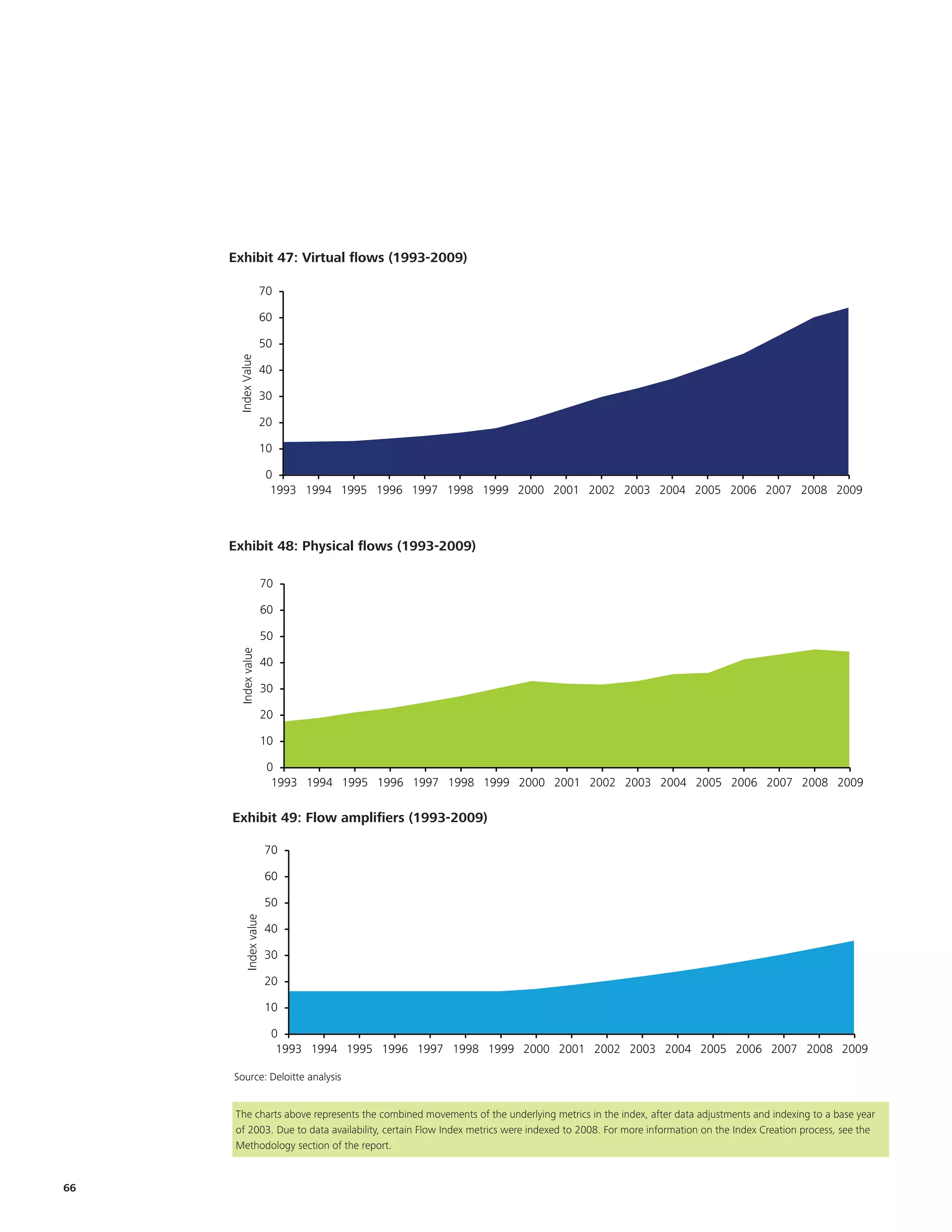
The metrics in the Flow Index capture physical and virtual
flows as well as elements that can amplify a flow —                 This conceptual framework for the Big Shift underscores
examples of these “amplifiers” include social media use             the belief that knowledge flows will be the key determi-
and the degree of passion with which employees are                  nant of company success as deep foundational changes
engaged with their jobs. This index represents how quickly          alter the sources of value creation. Knowledge flows thus
individual and institutional practices are able to catch up         serve as the key link connecting foundational changes to
with the opportunities offered by the advances in digital           the impact that firms and other market participants will
infrastructure. The Flow Index illustrates a conceptual way         experience.
to represent practices. Given the slower rate with which
social and professional practices change relative to the            To respond to the growing long-term performance
digital infrastructure, this index will likely serve as a lagging   pressures described earlier, companies must design and
indicator of the Big Shift, trailing behind the Foundation          then track operational metrics showing how well they
Index. It will be useful to track the degree of lag over time.      participate in knowledge flows. For example, they might
                                                                    want to identify relevant geographic clusters of talent
The good news is that strong foundational technology                around the world and assess their access to that talent. In
is enabling much richer and more diverse knowledge                  addition, they might want to track the number of institu-
flows. The bad news is that mind-sets and practices tend            tions with which they collaborate to improve performance.
to hamper the generation of and participation in those              Success against these metrics will provide a clue as to how
flows. That is why we give such prominence to them in               well companies will perform later as the Big Shift continues
the second wave of the Big Shift. The number and quality            to unfold.
of knowledge flows at a firm — partly determined by
its adoption of openness, cross-enterprise teams, and               Implications for business executives
information sharing — will be key indicators of its ability         Our research findings highlight the stark performance

                                                                                                         2010 Shift Index Measuring the forces of long-term change   21
challenges for companies. What is more, the data suggest       and motivated but also tend to be unhappy because they
     that unless firms take radical action, the gap between their   see a lot of potential for themselves and their companies,
     potential and their realized opportunities will grow wider.    although they can feel blocked in their efforts to achieve it.
     That is because the benefits from the modest productivity      Management should identify those who are adept partici-
     improvements that companies have achieved increasingly         pants in knowledge flows, provide them with platforms
     accrue not to the firm or its shareholders, but to creative    and tools to pursue their passions, equip them with
     talent and customers, who are gaining market power as          proper guidance and governance, and then celebrate their
     competition intensifies.                                       successes to inspire others.

     Until now, companies were designed to become more              Performance pressures will continue to increase well past
     efficient by growing ever larger, and that is how they         the current downturn. As a result, beneath these surface
     created considerable economic value. However, the rapidly      pressures are underlying shifts in practices and norms
     changing digital infrastructure has altered the equation: As   that are driven by the continuous advances in the digital
     stability gives way to change and uncertainty, institutions    infrastructure:
     must increase not just efficiency but also the rate at which   • A rich medium for connectivity and knowledge flows
     they learn and innovate, which, in turn, will boost their        is emerging as wireless subscriptions have grown from
     rate of performance improvement. Scalable efficiency, as         one percent of the U.S. population in 1985 to 90 percent
     mentioned above, must be replaced by scalable learning.          in 2009, at a 31 percent compound annual growth
     The mismatch between the way companies are operated              rate (CAGR). As a result of technology advances in the
     and governed on the one hand and how the business                areas of computing, storage, and bandwidth, innova-
     landscape is changing on the other helps to explain why          tions, such as 3G and emerging 4G wireless networks,
     returns are deteriorating while talent and customers reap        and more powerful and affordable access devices, such
     the rewards of productivity.                                     as smartphones and netbooks, the line between the
                                                                      Internet and wireless media will continue to blur, moving
     In contrast to the 20th century — when senior manage-            us to a world of ubiquitous connectivity.
     ment decided what shape a company should take in terms         • Practices from personal connectivity are bleeding
     of culture, values, processes, and organizational structure      over into professional connectivity — institutional
     — now we will see institutional innovations largely              boundaries are becoming increasingly permeable as
     propelled by individuals, especially the younger workers,        employees harness the tools they have adopted in their
     who put digital technologies, such as social media, to their     personal lives to enhance their professional productivity,
     most effective use. Findings from our research indicate          often without the knowledge of, and sometimes over the
     a correlation between the rapidly growing use of social          opposition of, corporate authorities.
     media and the increasing knowledge flows between               • Talent is migrating to the most vibrant geographies
     organizations.                                                   and institutions because that is where they can improve
                                                                      their performance more rapidly by learning faster. Our
     Worker passion also appears to be an important amplifier:        analysis has shown that the top 10 creative cities have
     When people are engaged with their work and pushing              outpaced the bottom 10 in terms of population growth
     the performance envelope, they seek ways to connect              since 1990. Between 1990 and 2008, the top 10 creative
     with others who share their passion and who can help             cities grew more than twice as fast as the bottom 10.
     them improve faster. Self-employed people are more than        • Companies appear to have difficulty holding onto
     twice as likely to be passionate about their work as those       passionate workers. Workers who are passionate about
     who work for firms, according to a survey we conducted.          their jobs are more likely to participate in knowledge
     This suggests a potential red flag for institutional leaders     flows and generate value for their companies — on
     — companies appear to have difficulty holding onto               average, the more passionate participate twice as much
     passionate workers.                                              as the disengaged in nearly all the knowledge flows
                                                                      activities surveyed. We also found that self-employed
     But management can play an important supporting role,            people are more than twice as likely to be passionate
     recognizing that passionate employees are often talented         about their work as those who work for firms. The


22
current evolution in employee mind-set and shifts in the    organization. All workers can continually improve their
  talent marketplace require new rules on managing and        performance by engaging in creative problem solving,
  retaining talent.                                           often by connecting with peers inside and outside the firm.
                                                              Japanese automakers used elements of this approach with
Leaders must move beyond the marginal expense cuts on         dramatic effects on the bottom line, turning assembly-line
which they might be focusing now in order to weather          employees from manual laborers into problem solvers.
the economic downturn. They need instead to be ruthless
about deciding which assets, metrics, operations, and         At the end of the day, the Big Shift framework puts a
practices have the greatest potential to generate long-term   number of key questions on the leadership agenda: Are
profitable growth and shedding those that do not. They        companies organized to effectively generate and partici-
must keep coming back to the most basic question of all:      pate in a broader range of knowledge flows, especially
What business are we really in?                               those that go beyond the boundaries of the firm? How
                                                              can they best create and capture value from such flows?
It is not just about being lean but also about making smart   And most importantly, how do they measure their progress
investments in the future. One of the easiest but most        navigating the Big Shift in the business landscape? We
powerful ways firms can achieve the performance improve-      hope that the Shift Index will help executives answer those
ments promised by technology is to jettison management’s      questions — in these difficult times and beyond.
distinction between creative talent and the rest of the


                                                                                                 2010 Shift Index Measuring the forces of long-term change   23
Cross-Industry Perspectives

                                            The forces of the Big Shift are affecting U.S. industries at     of the value created by productivity improvements. Access
                                            varying rates of speed. One set of industries has already        to information and a greater availability of alternatives
                                            been severely disrupted, and is suffering the conse-             have put customers squarely in the driver’s seat. Similarly,
                                            quences: declining return on assets (ROA) and increased          as talent becomes more central to strategic advantage and
                                            Competitive Intensity. A second set, which includes the          as labor markets become more transparent, creative talent
                                            bulk of U.S. industries, is currently midstream: some are        has increased its bargaining position.
                                            seeing declining ROA, and others are facing increases in
                                            Competitive Intensity, but none have yet encountered             How, then, can firms also benefit from the Big Shift? The
                                            both. A third, smaller set of as-yet-unaffected industries       key is to not only create value but to capture the value
                                            shows little change in performance.                              created. To do so, firms must learn how to participate in
                                                                                                             and harness knowledge flows and how to tap into the
                                            These findings — a follow-up to the macro-level study            passion of workers who will be a significant source of value
                                            released in June 20095 — reflect a U.S. corporate sector         creation as companies shift away from accumulating and
                                            on a troubling trajectory. The difficulties are more visible     exploiting stocks of knowledge. This move from scalable
                                            in some industries, but all industries will, to some degree,     efficiency to scalable learning will be a key to surviving, and
                                            eventually be subject to the forces of the Big Shift, which      thriving, in the world of the Big Shift.
                                            represent a fundamental reordering of the economy driven
                                            by a new digital infrastructure6 and public policy changes.      Most Industries are Feeling the Effects of
                                                                                                             the Big Shift
                                            The industry-level findings are cause for some alarm. U.S.
                                            industries are currently more productive than ever, as           The 2009 Shift Index highlighted trends at the economy-
                                            measured by improvements to Labor Productivity. Yet those        wide level in the U.S.: declining ROA, increasing Competi-
                                            improvements have not translated into financial returns.         tive Intensity, increasing Labor Productivity. The industry-
                                            Underlying this performance paradox is the growing               level findings are similar. With few exceptions, all U.S.
                                            Competitive Intensity in most industries. Consolidation          industries are being affected by the foundational forces of
                                            has helped offset these effects in some cases, but it is a       the Big Shift.
                                            short-term solution. Likewise, firms in most industries are
                                            investing heavily in technology, but the benefits are short-     One set of industries — most notably Technology, Media,
                                            lived as competing firms do the same.                            Telecommunications, and Automotive — is already being
                                                                                                             affected by the Big Shift.7 These industries have experi-
                                            The breadth and magnitude of disruption to U.S. indus-           enced significant increases in Competitive Intensity and
                                            tries, and a trajectory that suggests more disruption to         corresponding declines in profitability. A middle tier of
                                            come, call into question the very rationale for today’s          industries, representing the majority of industries evaluated
                                            companies. Do they exist simply to achieve ever-lower            in this report, appears to be experiencing the initial effects
                                            costs by getting bigger and bigger — “scalable effi-             of the Big Shift. A third tier consists of two industries that
                                            ciency”? Or can they turn the forces of the Big Shift to their   have, so far, been insulated from the forces of the Big Shift.
                                            advantage by focusing instead on “scalable learning” —
                                            the ability to improve performance more rapidly and learn        In the middle of the storm
                                            faster by effectively integrating more and more participants     Industries that have experienced both increases in Compet-
5    See John Hagel III, John Seely         distributed across traditional institutional boundaries?         itive Intensity and declines in Asset Profitability are the early
     Brown, and Lang Davison, The
     2009 Shift Index: Measuring the                                                                         entrants into the Big Shift. Eleven of the fourteen industries
     Forces of Long-Term Change (San        U.S. firms can learn two key lessons from the industries         have experienced declining ROA, but only four have also
     Jose: Deloitte Development, June,
     2009).                                 experiencing early disruption. First, the assumption that        endured a significant increase in Competitive Intensity (see
6    More than just bits and bytes,
     this digital infrastructure consists   productivity improvement leads to higher returns is flawed:      Exhibit 13). These industries include Technology, Media,
     of the institutions, practices, and    industries with higher productivity gains do not neces-          Telecommunications, and Automotive. They embody the
     protocols that together organize
     and deliver the increasing power of    sarily experience improvement in ROA. This is the perfor-        long term forces that are re-shaping the business environ-
     digital technology to business and
     society.                               mance paradox mentioned earlier. Second, customers and           ment, and are thus harbingers of changes to come in other
7    For further information regarding      talented employees appear to be the primary beneficiaries        industries.
     survey scope and description,
     please refer to the Shift Index
     Methodology section.

24
In Technology, customers have gained power as open                           in lower Asset Profitability as domestic firms have been
architectures and commoditization of components have                         unable to quickly adjust their operations to meet chang-
intensified competitive pressure. As a result, the Technol-                  ing market demand and more aggressive international
ogy industry has experienced a significant deterioration in                  competitors.
return on assets.
                                                                             Entering the storm
The Media industry has become more fragmented as forms                       The industries in this tier have not yet felt the dual impact
of content proliferate and the long tail becomes ever richer                 of the Big Shift—intensifying competition and declin-
with options. In a very real sense, customers — supported                    ing ROA—but are likely to soon. These industries already
by digital infrastructures that enable convenient, low-                      exhibited a high level of Competitive Intensity in 1965 as
cost production and distribution — are emerging as key                       measured by industry concentration (see Exhibit 14), and it
competitors for traditional media companies, generating                      is likely, therefore, that the initial fragmenting impact of the
their own content and sharing it with friends and broader                    Big Shift may have been muted. On the other hand, many
audiences.                                                                   of these industries did experience erosion in ROA, suggest-
                                                                             ing that other forms of Competitive Intensity were increas-
The Telecommunications industry has experienced dramatic                     ing. As we will discuss, the metric for Competitive Intensity
changes over the past two decades. Wireline service, the                     does not capture competition from other parts of the value
former mainstay of the industry, is being supplanted by                      chain. One of the pervasive themes of the Big Shift is the
wireless and VOIP. A combination of regulatory changes                       growing power of customers and creative talent and the
and increased Competitive Intensity has driven firms to im-                  pincer effect on firms’ profitability as these two constituen-
prove Labor Productivity, but has not resulted in improved                   cies capture more of the value being created. Many of the
financial returns.                                                           firms in this tier are subject to greater competition from
                                                                             these two groups.
In the Automotive industry, Competitive Intensity has been
driven by greater global competition, supported both by                      The Aviation, Consumer Products, and Retail industries all
trade liberalization and more robust digital infrastructures                 experienced decreasing Competitive Intensity as measured
that facilitate global production networks. This has resulted                by industry concentration, although Aviation and Retail

Exhibit 13: Changes in Competitive Intensity and ROA (1965-2009)8
Exhibit 13: Changes in Competitive Intensity and ROA (1965-2009)

                                                                  9
                                         Competitive Intensity


                       Decrease                  Static               Increase
                                                                                                                                                                                Updated 9/
                   Aerospace & Defense                                Health Care
                                                                                                                                                                                Would need t
        Increase


                   Aerospace & Defense                                                                                                                                          footnotes…

                                                                                                                                                                              MAY NEED T
                                                                                                                                                                              RESOLVE TH
                                                                                                                                                                              INDUSTRY
 10


        Static


                        Consumer
  ROA


                         Products                                                                                                                 8
                                                                                                                                                                              PLACEMENT
                                                                                                                                                      Insurance and Health Care ROA
                                                                                                                                                      data is from 1972-2008. Data from
                                                                                                                                                     1965-1972 was from a very small
                                                                                                                                                     number of companies for these
                                                                                                                                                     industries and therefore not truly
                                                                                                                                                     indicative of market dynamics.
                                                  Energy                                                                                             Health Care and Aerospace
        Decrease


                                           Banking & Securities                                                                                      Defense ROA data display some
                         Aviation
                                                Insurance             Automotive                                                                     cyclicality. The increases discussed
                          Retail
                                              Life Sciences             Media                                                                        here are derived from a line fit.
                                           Process & Industrial       Technology                                                                  9 Static Competitive Intensity is
                                                 Products              Telecom.                                                                      defined as a change of less than
                                                                                                                                                     0.01(+/-) in the HHI.
                                                                                                                                                  10 Static ROA is defined as a change
Source: Compustat, Deloitte Analysis                                                                                                                 of less than 5 percent (+/-).
Source: Compustat, Deloitte analysis
                                                                                                                   2010 Shift Index Measuring the forces of long-term change           25
Exhibit 14: Competitive Intensity, All Industries (1965-2009)
                                        Exhibit 14: Competitive Intensity, all Industries (1965-2009)11
                                                        Industry               1965 Actual     2009 Actual      Absolute change

                                        Process & Industrial Products             0.01             0.01                0              Industries that began at
                                        Consumer Products                         0.01             0.03              0.02             higher levels of
                                                                                                                                      competitive intensity
                                        Banking & Securities
                                        Financial Services                        0.02             0.04              0.02
                                        Aviation                                  0.03             0.03                0
                                        Energy                                    0.03             0.03                0
                                        Retail                                    0.03             0.07              0.04
                                        Insurance                                 0.04             0.05                0
                                        Aerospace & Defense                       0.04             0.13              0.08
                                        Life Sciences                             0.04             0.04                0
                                        Media & Entertainment                     0.07             0.03              -0.04
                                        Technology                                0.15             0.04              -0.11
                                        Automotive                                0.17             0.12              -0.05            Industries that began at
                                                                                                                                      lower levels of competitive
                                        Health Care                               0.32             0.08              -0.24            intensity
                                        Telecommunications                        0.37             0.06              -0.31

                                        Source: Compustat, Deloitte analysis


                                        also experienced a decline in ROA.12 The Consumer Power              industry section, however, the Health Plans subsector is still
                                        and Retail industries were Analysis competitive, histori-
                                           Source: Compustat, Deloitte highly                                dominated by six plans that account for two-thirds of all
                                        cally, and both have experienced significant consolidation           enrollees. Of the 313 metropolitan markets surveyed by the
                                        among large firms to combat margin pressures driven in               American Medical Association in 2010, 99 percent of them
                                        part by the growing power of customers. The consolida-               were dominated by one or two health plans. Limited com-
                                        tion of these two industries is related. As retailers became         petition, reinforced by regulatory protection, has sustained
                                        more concentrated, consumer products companies began                 Asset Profitability in this industry.
                                        to consolidate as a defensive measure to preserve bargain-
                                        ing power with the retailers. Conversely, as consumer                Aerospace & Defense appears to be an anomaly, the only
                                        products companies consolidated, retailers felt additional           industry that has yet to show any signs of the Big Shift.
                                        pressure to consolidate in order to preserve bargaining              Improvements in Asset Profitability can be attributed to
                                        power relative to larger consumer products companies.                consolidation of the industry and a related pursuit of scale
                                        The Aviation industry has also been historically competitive         efficiencies and labor productivity measures as well as a
                                        but has recently seen a spate of consolidation following             movement from hardware to software as a source of value.
                                        the economic downturn.                                               The ability of companies in this industry to retain the sav-
                                                                                                             ings from these initiatives and improve ROA has been sup-
                                        The calm before the storm                                            ported by the industry consolidation (leading to a decline
                                        This last group is comprised of just two industries that             in one key measure of competitive intensity), reinforced
                                        have bucked the overall trend in ROA erosion, enjoying               by high barriers to entry, including investment in technol-
                                        increased Asset Profitability. The Aerospace & Defense and           ogy and capital requirements. Subsidies to incumbents act
                                        Health Care industries actually improved their ROA to 5.4            as a further barrier to entry, as do burdensome qualifying
                                        percent and 5.0 percent respectively. As we will discuss,            requirements for bidding on government contracts, which
                                        regulation and public policy have played a significant role          require significant upfront investment by new players. Col-
11 Insurance and Health Care data
   is from 1972–2008. Data from         in shielding these two industries from the effects of the Big        lectively, these factors limit the effects on this industry of
   1965–1972 was from a very small
   number of companies for these        Shift.                                                               broader public policy trends towards economic liberaliza-
   industries and therefore not truly                                                                        tion and enable the relatively small number of industry
   indicative of market dynamics.
12 Retail ROA data display some         For Health Care ROA increased while Competitive Intensity            participants to achieve higher asset profitability.
   cyclicality. The decline discussed
   here is derived from a line fit.     was also increasing. As described in the Health Care

26
The future is uncertain for these two industries. Of the         Similarly, the Health Care industry has been, and contin-
two, Health Care is perhaps more exposed to changes              ues to be, deeply affected by regulation and government
that could dramatically reshape the industry: changing           spending at the national and state levels. Variable state
legislation, medical tourism, new provider delivery options      regulations create barriers to entry for plans wishing
and alternative Health Care options are just a few looming       to provide national coverage. Providers are also largely
changes. In an intriguing parallel, the movement towards         regulated at a state level, and only a few have a national
greater emphasis on prevention in both of these industries       reputation (such as the Mayo Clinic) or a national network
may represent a major catalyst for accelerated change. In        (such as some laboratory companies).
the Aerospace & Defense industry, the rise of asymmetric
warfare driven by a new generation of “competitors” may          The primary determinant of the extent to which industries
also catalyze interesting industry changes. In particular, the   are affected by the Big Shift thus appears to be public
increasing emphasis on advanced software capabilities in         policy. The exponential improvement of capabilities of the
intelligence, surveillance and reconnaissance domains per-       digital infrastructure and its broader adoption across the
haps sets the stage for the evolution of a more fragmented       business landscape creates the potential for intensifying
and competitive software driven industry.                        competition. Whether or not that potential is realized,
                                                                 however, appears to depend on the state of the regulatory
Technology or public policy as key differentiators               environment and, in particular, the degree to which public
What is it that determines why industries are affected by        policy actively increases barriers to entry or barriers to
the Big Shift sooner rather than later? All of the industries    movement or helps to reduce them.
in this report have access to the increasingly ubiquitous
digital infrastructure, so the infrastructure itself does not    Lessons learned from the industries
appear to be a significant differentiator in how industries      disrupted to date
are affected. Of course, industries differ in terms of how
they use the digital infrastructure and how creatively they      All industries, whether part of the first wave of impact or
re-think their own operations relative to the potential of       not, should take note of the trends driving the first tier of
this infrastructure. In this regard, Competitive Intensity       industries. The performance paradox — decreasing profit-
appears to provide motivation for making the most of the         ability in the face of improving productivity — is evident in
infrastructure. A 2002 study found that the impact of IT         Technology, Media, Telecommunications, and Automotive
investment on productivity growth depended upon the              (see Exhibit 13).
presence of one or more competitors that had used IT to
develop fundamental innovations in business practices or         At an industry level, there appears to be some relationship
processes, putting pressure on all companies to replicate        between Labor Productivity and competition: industries
the innovations.13 While the digital infrastructure reduces      that have faced significant increases in Competitive
barriers to entry and movement and enhances the likeli-          Intensity have also improved their productivity. For
hood that a disruptive innovator can change the game in          example, the Technology industry has experienced one of
an industry, other factors can dampen these effects.             the greatest increases in Competitive Intensity as well as
                                                                 Labor Productivity improvements driven by advances in
In fact, the Center findings suggest that public policy sig-     technology and business innovations. Industries that are
nificantly determines the extent to which a given industry       typically on the leading edge of innovation and adoption
is affected by the Big Shift. Aerospace & Defense and            of new practices are most likely to experience higher
Health Care are the least affected industries and are also       increases in productivity.
associated with high levels of regulation and government
purchasing activity. Since 1989, the U.S. government has         Unfortunately, productivity is not translating into profit
accounted for approximately 40 to 60 percent of total an-        for companies. The old assumption that improvements in              13 "How IT Enables Productivity
nual sales in the Aerospace & Defense industry.14 Procure-       productivity lead to higher returns turns out to be flawed.            Growth," McKinsey Global
                                                                                                                                        Institute, November 2002.
ment policies and national security considerations have          What used to be the key to success — an unremitting                 14 "Global Military Aerospace
                                                                                                                                        Products Manufacturing," IBIS
a profound influence on this industry and its relationship       focus on efficiency — is no longer sufficient. In his book,            World Industry Report, March 26,
with its largest customer — the U.S. government.                 The Power of Productivity,15 Bill Lewis makes a connection             2009.
                                                                                                                                     15 William Lewis, The Power of
                                                                                                                                        Productivity (Chicago: the
                                                                                                                                        University of Chicago Press, 2994).

                                                                                                      2010 Shift Index Measuring the forces of long-term change         27
between a country’s wealth and its productivity. This is                           to include other operating metrics if they want to thrive in
                                            certainly true for the economy as a whole, and custom-                             an era of increasing economic pressure.
                                            ers benefit from the enormous value created by improved
                                            productivity. On the other hand, the Center research                               The rate of Labor Productivity improvement seems to be
                                            suggests that companies are struggling to retain the value                         unrelated to the rate of ROA deterioration (see Exhibit
                                            they are creating. Some of the most significant increases in                       15). There were no industries that experienced both an
                                            productivity occurred in industries like Telecommunications                        increase in ROA and a high increase in Labor Productivity.
                                            and Technology, which saw dramatic increases upwards                               If improvements in productivity are not finding their way
                                            of 800 percent, yet also experienced significant declines in                       to companies’ bottom lines, then where are all those gains
                                            ROA (see Exhibit 15). These industries are prime examples                          going? What are the implications for industries that are
                                            of innovation and productivity improvement that did not                            trying to reverse the trend of declining profitability?
                                            translate into improved firm performance.
                                                                                                                               The economy wins but firms are losing
                                            At the other end of the spectrum, we find Aerospace &
                                            Defense. The capital requirements associated with aircraft                         The economy, as a whole, is benefiting from greater value
                                            construction and the restrictions tied to manufacturing and                        creation. As competition intensifies across all industries
                                            sales of advanced weapons systems create a unique eco-                             and productivity gains are competed away, consumers
                                            system within which this industry has managed to improve                           and talented workers are reaping the benefits. Consumers
                                            its ROA. This performance improvement comes despite rel-                           and talent have been able to increase their share of value,
                                            atively small gains in Labor Productivity compared to other                        largely through participation in information flows, which
                                            industries such as Technology or Telecommunications.                               have provided them with greater information and access to
                                                                                                                               alternatives than ever before.
                                            While Labor Productivity improvement appears to be nec-
                                            essary, especially in competitive markets, it is clear that it                     Armed with increasing amounts of information and
                                            is not sufficient to sustain, much less improve, profitability.                    alternatives, consumers and talent are less loyal today
                                            The Big Shift requires that companies broaden their focus                          than in the past. Consumers have harnessed the digital


                                           Exhibit 15: 15: Changes and ROA and Labor Productivity
                                            Exhibit Changes in ROA in Labor Productivity (1987-2009)                       (1987-2009)
                                                                                                       12     16                                                                              13
                                                                                       Labor Productivity

                                                                       Low                                            High
                                                                                       Moderate Increase
                                                                     Increase                                       Increase


                                                                                          Aerospace &
                                                     Increase


                                                                                            Defense
                                              13


                                                                                                                                           12
                                            ROA 17

                                                     Static


                                                                                        Consumer Prod.


                                                                     Aviation
                                                                      Energy                Automotive
                                                     Decrease


                                                                  Life Sciences        Banking & Securities
                                                                                         Financial Services        Technology
16  Labor Productivity increase is clas-                                                      Retail
                                                                      Media                   Retail                Telecom.
   sified as low, 0 to 50; moderate,
   50 to 100; or high, >100. Labor                              Process & Industrial
   Productivity data is not available                               Products
   for the Health Care and Insurance
   industries.                             Source: Compustat, Bureau of Labor Statistics, Deloitte analysis
17 Static ROA is defined as a change       Source: Compustat, Deloitte Analysis
   of less than 5 percent (+/-).

28
infrastructure to expand their range of options regarding        ented workers today have the opportunity to take learning
vendors and products, gain information about vendors             from one industry and apply it to others as the digital infra-
and products, compare vendors and products, and make             structure has lowered switching costs in the employment
it easier to switch from one vendor or product to another.       landscape. For example, while the Retail industry provides
Choices abound, information is plentiful, and brand loyalty      lower monetary rewards to creative and non-creative talent
is declining. Want a camera? Explore options on                  alike, Technology companies participating in e-Commerce
dpreview.com, one of various independent resources that          provide ample opportunities for Retail talent. Consequently,
provide news, reviews, and information about digital             industries that do not offer sufficient monetary rewards
photography. Need a programmer? Check out options on             or development opportunities may lose critical talent as
elance.com where one can gain instant access to 100,000          employees flee to those industries that offer them greater
rated professionals who offer technical, marketing, and          rewards.
business expertise. And so on.
                                                                 The power consumers and talent have gained, largely as a
Similarly, talented workers today are less loyal to their        result of their participation in knowledge flows, funda-
employers, often viewing jobs as fairly transactional. Tal-      mentally changes the competitive landscape. This shifting
ent uses the digital infrastructure to participate in both       power dynamic will lead to increased Competitive Intensity
information and knowledge flows. For example, where em-          for firms as they have to try harder to meet consumer de-
ployees historically would have used a software program's        mand and attract and retain talent. We expect that growth
built-in help function, they now do a quick search online to     in Consumer Power will have a direct effect on Competitive
find a solution. If a solution does not exist, they post their   Intensity within a given industry. In this regard, Consumer
question and small communities develop to suggest ideas.         Power and talent power could be viewed as leading indica-
Through participation in these knowledge and information         tors of Competitive Intensity. HHI, a traditional measure of
flows, talented workers are learning at a faster pace than       competition, could be viewed as a lagging indicator in this
ever before. In addition, talented workers use the digital       context. Rather than focusing solely on direct competitors,
infrastructure to connect with their professional network to     executives would be well-served to look at consumer and
generate and explore job opportunities, including develop-       talent trends to preview competitive dynamics.
ing new ventures of their own. Talent, particularly creative
talent, looks for jobs that provide them with the greatest       Our 2010 Shift Index survey provides interesting insights
benefit. In today’s environment, benefits take the form of       related to the power consumers and talent have today. The
fast-paced learning environments and monetary rewards.           following sections provide some highlights from the Shift
Talented employees are also gaining power as a result of         Index Consumer Power, Brand Disloyalty, and Returns to
their crucial role in developing and sustaining the intan-       Talent metrics.
gible assets that increasingly drive competitive differentia-
tion and profitability.                                          Consumers
                                                                 The Shift Index Consumer Power and Brand Disloyalty
All industries will be affected by these changing power          survey indicates that few sectors have been spared in any
dynamics, including those that were historically less            of the metrics evaluated.19 The indices were normalized
competitive. As traditional industry boundaries dissolve,        to a 0–100 scale — any score over 50.0 indicates that the
competition will emerge from unexpected edges. Consum-           majority of respondents believe they have more power
ers will move fluidly across industry boundaries, looking        as consumers or are more disloyal towards brands. The
beyond traditional providers of goods and services to find       Consumer Power index values for the consumer catego-
the solutions that meet their needs. Talent will also look       ries ranged from 54.0 for Newspapers to 68.7 for Search
                                                                                                                                     18 Steve King, Anthony Townsend,
beyond traditional firms for employment. According to            Engines. Similarly, the Brand Disloyalty index values range             and Carolyn Ockels, "Intuit Future
                                                                                                                                         of Small Business Report," January
the Intuit Small Business Report (2007), “Entrepreneurs          from 41.0 for Newspapers to 75.3 for Airlines. These num-               2007.
will no longer come predominantly from the middle of the         bers indicate that consumers perceive themselves to have            19 The Consumer Power and Brand
                                                                                                                                         Disloyalty indices were created
age spectrum but instead from the edges. People nearing          significant power across all categories and are relatively              as the aggregate responses to six
                                                                                                                                         questions per each index. While
retirement and their children just entering the market will      disloyal to brands in many categories as well.                          only categories that were directly
become the most entrepreneurial generation ever.”18 Tal-                                                                                 related to consumers were studied,
                                                                                                                                         we assume the impact to industries
                                                                                                                                         and firms upstream on the value
                                                                                                                                         chain as the disruptions trickle up.

                                                                                                      2010 Shift Index Measuring the forces of long-term change          29
Exhibit 16: Consumer Power and Brand Disloyalty Matrix (2010)
                        100                                                                                                                                                                                                                                   80

                         90                                                                                                                                                                                                                                                                                                                           Airline
                                                                                                                                                                                                                                                              75
                         80
                                                                                                                                                                                                                                                              70                                                                                                                                                               Hotel
                         70                                                                                                                                                                                                                                                                                                                                Department Store

                                                                                                                                                                                                                                                                                                                            Grocery Store                                                                                                  Home
                         60                                                                                                                                                                                                                                   65               Shipping                         Mass Retailer
                                                                                                                                                                                                                                                                                                                                                                                                                                       entertainment
     Brand Disloyalty


                                                                                                                                                                                                                                           Brand Disloyalty
                                                                                                                                                                                                                                                                                                                 Gas Station                       Automobile    Athletic Shoe                                                                                 Computer
                         50                                                                                                                                                                                                                                                                                                                       Manufacturer Gaming System
                                                                                                                                                                                                                                                              60
                                                                                                                                                                                                                                                                                Cable/                                                                                                                                                         Restaurant
                                                                                                                                                                                                                                                                              Satellite TV                                                                                                   Wireless Carrier
                         40                                                                                                                                                                                                                                                                                                                                                Household
                                                                                                                                                                                                                                                              55                                                                                                            Cleaner      Search engine
                                                                                                                                                                                                                                                                                                                                                                                  Insurance
                                                                                                                                                                                                                                                                                                                                                        Pain Reliever           (Home/Auto)
                         30                                                                                                                                                                                                                                                                                                                                        Snack Chip
                                                                                                                                                                                                                                                                                                                                                       Magazine                    Broadcast TV
                                                                                                                                                                                                                                                              50                                                                                                            Banking News
                         20
                                                                                                                                                                                                                                                                                                                                                                           Investment

                         10                                                                                                                                                                                                                                   45                                                                              Soft Drink


                          0                                                                                                                                                                                                                                   40
                              0              10                         20              30                      40                50                          60                      70       80                       90         100                                 58                                  60                            62                            64                                      66                                  68                       70

                                                                                                 Consumer Power                                                                                                                                                                                                                                 Consumer Power

      Source: 2010 Deloitte Consumer Power/Brand Disloyalty Survey (n=4321); Administered by Synovate


      Exhibit 17: Consumer Access to Information and Availability of Choices (2010)
      Exhibit 17: Consumer Access to Information and Availability of Choices (2010)


            4 70%Footer                                                                                                                                                                                                                                                                                                                                                                                             © 2009 Deloitte Touche Tohmatsu


                        60%


                        50%


                        40%


                        30%


                        20%


                        10%


                        0%
                                              Automobile manufacturer


                                                                                                                                                                                                                                                                                                                                                                                                                Cable/Satellite TV
                                                                                                                                                                                               Insurance (Home/Auto)


                                                                                                                                                                                                                                                                               Broadcast TV News


                                                                                                                                                                                                                                                                                                                                                                                                                                     Gas Station
                                                                                                                                          Household cleaner


                                                                                                                                                                                                                                                              Pain reliever


                                                                                                                                                                                                                                                                                                                           Department store
                                                                        Gaming system


                                                                                                                          Athletic shoe


                                                                                                                                                                   Wireless carrier


                                                                                                                                                                                                                                                                                                   Soft drink


                                                                                                                                                                                                                                                                                                                                                           Mass retailer

                                                                                                                                                                                                                                                                                                                                                                             Search engine

                                                                                                                                                                                                                                                                                                                                                                                               Grocery store
                                                                                        Home entertainment


                                                                                                                                                                                                                                                                                                                                              Snack chip
                                  Computer


                                                                                                                                                                                       Hotel


                                                                                                                                                                                                                       Airline
                                                                                                             Restaurant


                                                                                                                                                                                                                                 Banking


                                                                                                                                                                                                                                                                                                                                                                                                                                                    Shipping
                                                                                                                                                                                                                                              Investment


                                                                                                                                                                                                                                                                                                                Magazine


                                                                                                                                                                                                                                                                                                                                                                                                                                                                Newspaper


                                                                                                             There is a lot of information about brands                                                                                                        I have convenient access to choices


      Source: 2010 Deloitte Consumer Power/Brand Disloyalty Survey (n=4321); Administered by Synovate

               Source: Synovate, Deloitte Analysis


30
The two major trends underlying Consumer Power are               industries had gap increases greater than 20 percent.
more convenient access to alternatives and greater infor-        In a world where industry boundaries are blurring (for ex-
mation about alternatives. Each of these trends is driven        ample, Consumer Products and Retail) and disruptions can
by consumers’ use of digital infrastructure to participate       come from outside traditional industry lines (for example,
in information flows. The ubiquity of devices (desktops,         Media, Telecommunications and Technology industries all
laptops, mobile, etc.) to access the information, the in-        competing to create and distribute digital content), firms
creasing richness of the information (descriptions, reviews,     are also competing across industry boundaries for the best
comparisons, etc.), along with increased trustworthiness         talent. Talented employees are likewise searching for op-
of the source (independent consumers) has decimated              portunities across industry boundaries, often applying their
information asymmetry. Technology enables consumers to           learning from one industry to careers in another.
conveniently and effectively compare products and prices
when making a purchase decision. These trends are also           In the future, we expect to see a cross-industry war for
leading to a lower reliance on brands as an indicator of         more and more categories of talent. This poses a special
value and reliability. Trusted flows of information are begin-   challenge for those industries that are currently lagging in
ning to trump brand in purchasing decisions.                     rewarding talent through faster-paced learning environ-
                                                                 ments or higher cash compensation.
As Exhibit 16 shows, consumers perceive power over
most categories and are disloyal to the majority of them.        Knowledge flows are key to converting
The few categories that fall below the midpoint value            challenges to opportunities
for Brand Disloyalty (Newspaper, Soft Drink, Magazine,
and Investments) are all low-cost items where consumers          As the source of economic value creation shifts from stocks
may not invest a lot of time exploring options (see Exhibit      to flows of knowledge in this era of intensifying competi-
17).20 Some of the higher-cost categories (Hotel, Airline,       tion and more rapid change, participating in these flows
Home Entertainment) fall on the high end of the spectrum         becomes essential if firms are to convert challenges to
for both Consumer Power and Brand Disloyalty. For these          opportunities. Currently the value that firms create is being
categories, consumers are participating in information           captured primarily by consumers and creative talent: they
flows to gauge value and reliability and are consequently        have harnessed knowledge flows ahead of the firms and
becoming more brand agnostic.                                    they are reaping benefits at the expense of the firms. Con-
                                                                 sumers enjoy lower prices and more alternatives, fueled by
Talent                                                           access to information. Creative talent has benefited from
The second group of winners from the Big Shift are               increased cash compensation. Firms have an opportunity to
talented employees. The Center research shows that total         participate in the same knowledge flows and networks and
cash compensation to creative talent in the U.S. has grown       rebalance that equation. Participating in knowledge flows
by 22 percent in the U.S. from $87,000 to $106,000               will also significantly "grow the pie" and move firms away
during the time period from 2003 to 2009. This pattern           from a zero-sum game mindset that drives much of their
is repeated in all industries, with growth in total cash         behavior today.
compensation for creative talent ranging from a rate of
eight percent in the Automotive industry all the way to 28       Participating in knowledge flows is mutually beneficial for
percent in the Technology industry.                              firms, talent, and consumers. The greater the firm’s partici-
                                                                 pation in knowledge flows, the more value they can create.
The gap between compensation for creative and non-               This value will be distributed between firms, talent and
creative workers is also growing.21 Based on the Returns         consumers, but as they start offering more non-monetary
to Talent metric, we found the gap increasing nearly 25          value to talent and consumers, firms have an opportunity
percent over the past seven years across the overall U.S.        to retain an increasing share of the monetary value. Talent,
talent pool. Looking at the compensation gap across indus-       particularly the creative and passionate talent, is attracted
tries provides an equally compelling picture: 12 of the 15       to firms that are rich in relationships, generate knowl-           20 Although the survey focused
                                                                                                                                       primarily on B2C consumer catego-
                                                                                                                                       ries, similar trends hold true in B2B
                                                                                                                                       categories as well.
                                                                                                                                    21 As defined by Richard Florida; The
                                                                                                                                       Rise of the Creative Class (New
                                                                                                                                       York: Basic Books, 2003).

                                                                                                     2010 Shift Index Measuring the forces of long-term change          31
Exhibit 18: Average Compensation Gap, AllCompensation Gap, all industries (2003, 2009)
                                       Exhibit 18: Average Compensation and Compensation and Industries (2003, 2008)


                                                                                                                                                               Non-
                                                                                                                  Creative                                                                   Gap
                                                                                    Creative        Creative                 Non-Creative     Non-Creative   Creative    Gap       Gap
                                                                                                                  Growth                                                                    Growth
                                                                                     (2003)          (2009)                    (2003)           (2009)       Growth     (2003)    (2009)
                                                                                                                   (2009)                                                                   (2009)
                                                         Industry                                                                                             (2009)
                                        Aerospace & Defense                        $92,885         $117,548        27%          $51,753            $60,319    17%       $41,132   $57,229    39%
                                        Banking & Securities
                                        Financial Services                         $86,974         $109,810        26%          $40,642            $45,420    12%       $46,332   $64,390    39%
                                        Media & Entertainment                      $82,631         $103,239        25%          $39,184            $43,973    12%       $43,447   $59,266    36%
                                        Technology                                 $105,058        $134,107        28%          $48,750            $57,927    19%       $56,308   $76,180    35%
                                        Energy                                     $98,174         $118,819        21%          $50,670            $55,116    9%        $47,504   $63,703    34%
                                        Life Sciences                              $101,269        $125,057        23%          $47,148            $53,590    14%       $54,121   $71,467    32%
                                        Telecommunications                         $96,412         $115,010        19%          $50,661            $56,103    11%       $45,751   $58,907    29%
                                        Health Care                                $71,624         $86,973         21%          $35,960            $41,980    17%       $35,664   $44,993    26%
                                        Consumer Products                          $81,771         $98,194         20%          $37,808            $43,328    15%       $43,963   $54,866    25%
                                        Aviation                                   $77,525         $93,542         21%          $41,041            $48,134    17%       $36,484   $45,408    24%
                                        Professional Services Firms                $88,538         $112,639        27%          $38,812            $51,121    32%       $49,726   $61,518    24%
                                        Retail                                     $67,081         $80,835         21%          $32,293            $38,572    19%       $34,788   $42,263    21%
                                        Insurance                                  $83,101         $95,568         15%          $47,074            $53,041    13%       $36,027   $42,527    18%
                                        Process and Industrial Products            $89,395         $103,086        15%          $41,706            $48,720    17%       $47,689   $54,366    14%
                                        Automotive                                 $90,429         $97,606         8%           $48,854            $55,383    13%       $41,575   $42,222    2%


                                      Source:US Census Bureau, Richard Richard"The Rise of TheCreative Class,“CreativeAnalysis Deloitte analysis
                                       Source: U.S. Census Bureau, Florida's Florida's the Rise of the Deloitte Class,


                                      edge flows, and that provide tools and platforms to help                               likely to participate in conferences, belong to professional
                                      talent to grow and achieve their fullest potential. A large                            organizations, and share professional information and
                                      part of Google’s attraction is its reputation for allowing                             advice by phone than employees in any other industry.
                                      employees to grow; special programs such as “20 percent                                Employees in the Retail and Automotive industries were the
                                      time,” which allows engineers one day a week to work on                                least likely to participate in those same activities. In abso-
                                      projects that are not in their job descriptions, are magnets                           lute terms, though, it should be noted that current levels
                                      for passionate talent. The Center research shows that pas-                             of knowledge sharing across firm boundaries are very low
                                      sionate workers participate in more knowledge flows than                               in all industries, and we expect participation in Inter-firm
                                      their peers in their quest to constantly learn and create.                             Knowledge Flows to increase as competition intensifies.
                                      Firms that attract the creative and passionate will logically
                                      participate in increasing volumes of knowledge flows and                               Worker Passion
                                      therefore create more value for all. Consumers, too, are                               Worker Passion, different from employee satisfaction,
                                      attracted to firms that are continuously creating value for                            denotes an intrinsic drive to do more and excel at every
                                      them either in product features or expanded services, and                              aspect of one’s profession. The 2010 survey of Worker Pas-
                                      may be willing to pay a premium for the value. Apple’s                                 sion found that 23 percent of the overall U.S. workforce is
                                      ability to maintain a price premium in otherwise commod-                               passionate about their work (see Exhibit 20).
                                      itized product categories is an example of this.
                                                                                                                             U.S. workers are generally not passionate about their pro-
                                      Two of the Shift Index metrics, Inter-firm Knowledge Flows                             fessions: 80 percent of the U.S. workforce (ranging from
                                      and Worker Passion, attempt to measure the rates of flow                               73 to 82 percent depending on the industry) reported not
                                      and passion by industry.                                                               being passionate about work. There were more disen-
                                                                                                                             gaged or passive employees than there were engaged or
                                      Inter-firm Knowledge Flows                                                             passionate employees in each of the industries we evalu-
                                      The Shift Index inaugural survey of Inter-firm Knowledge                               ated, with most employees falling into the “passive” cat-
                                      Flows for the overall U.S. population revealed a 2009                                  egory. Even in the most passionate industry (Energy), only
                                      index score of 14 percent.22 Looking across industries, this                           27 percent of employees reported being passionate about
                                      ranges from under 11 percent for the Retail and Automo-                                work. In contrast, industries like Technology, which we
                                      tive industries to 19 percent for the Media & Entertainment                            might expect to have passionate employees, had among
                                      and Energy industries (see Exhibit 19). Employees in the                               the greatest percentage of disengaged employees, second
22 Inter-firm Knowledge Flows
   scores were calculated based on    Media & Entertainment and Energy industries were more                                  only to the Insurance and Life Sciences industries.
   communication levels between
   firms across eight categories of
   knowledge flows.

32
Exhibit 19: Inter-firm Knowledge Flow Index value, (2010)
Exhibit 19: Inter-firm Knowledge Flow Index Value, All Industries all industries (2010)


                                                                                                                                                                              Updated 9
                        Energy                                                                                                                    19.0

       Media & Entertainment                                                                                                                      19.0

                   Technology                                                                                                                18.3

                     Insurance                                                                                                             17.7

                  Life sciences                                                                                                       17.3

         Aerospace & defense                                                                                                        16.8

           Consumer products                                                                                                   16.4

           Health care services                                                                                               16.1

  Process & industrial products                                                                                              15.8

Banking & financial & Securities
          Banking institutions                                                                                               15.8

          Telecommunications                                                                                       14.5

  Aviation & transport services                                                                                 13.8

                         Retail                                                               11.4

                   Automotive                                                                 11.4

                                   0     2          4         6          8         10        12            14           16            18            20


                                                     Average Inter-Firm Knowledge Flow Index value

Source: 2010 Deloitte Worker Passion/Inter-firm Knowledge Flow survey (n=3108); Administered by Synovate
 Source: Synovate, Deloitte Analysis


While the factors contributing to Worker Passion are                    While conventional wisdom would suggest a greater
complex, there is a clear need for companies to leverage                focus on efficiency and investments in a time of growing
passionate employees in the coming years. Firms will need               economic pressure, the findings of the Big Shift suggest
to tap into the passion of their employees to stay competi-             a longer term view is necessary. In fact, the first tier of
tive in a globalized labor market which requires everyone               industries to be affected by the Big Shift has been unable
to constantly renew and enhance professional skills and                 to overcome performance pressures. While firms in these
capabilities. The Center research indicates that passion-               industries have improved their efficiency, these improve-
ate workers participate in more knowledge flows across                  ments have delivered diminishing returns and continuing
all but two industries (see Exhibit 21). Therefore the firms            deterioration of profitability. Today’s business environment
that attract and retain the passionate stand to benefit from            requires a longer term focus on value creation and capture.
participating in more flows and creating more value.                    Knowledge flows are the key to surviving and thriving
                                                                        through these tough times and beyond. The good news is
Efficiency is no longer sufficient                                      that these knowledge flows are proliferating and becoming
                                                                        richer on a global scale as a result of the increasing capabil-
The performance pressures on U.S. industries will continue              ity of digital infrastructure and public policy initiatives to
well past the current downturn. Today’s business environ-               remove regulatory barriers to knowledge flows. In order
ment has been fundamentally changed by the underlying                   to improve performance and retain a greater share of the
shifts in practices and norms as a result of advances in                value created, firms must amplify Inter-firm Knowledge
digital infrastructure and public policy playing out over               Flows and instill greater Worker Passion. Fortunately, pas-
decades.                                                                sionate workers are more likely to participate in knowledge


                                                                                                                       2010 Shift Index Measuring the forces of long-term change   33
Exhibit 20: Worker Passion, All Industries (2010)
     Exhibit 20: Worker Passion, all industries (2010)

                             Energy

       Aviation & Transport Services

       Process & Industrial Products

              Aerospace & Defense

     Banking & Financial & Securities
                Banking Institutions

                Health Care Services

            Media & Entertainment

                        Automotive

                              Retail

                        Technology

               Telecommunications

                Consumer Products

                       Life Sciences

                          Insurance

                                        0%   10%       20%        30%        40%          50%        60%    70%         80%    90%      100%

                                                 Disengaged             Passive            Engaged         Passionate

       Source: Deloitte Survey and Analysis
     Source: 2010 Deloitte Worker Passion/Inter-firm Knowledge Flow survey (n=3108); Administered by Synovate


     flows to generate economic value for their firms. Without                    est levels of Competitive Intensity, will become increasingly
     more effective participation in knowledge flows, firms will                  dependent on their creative class. With this in mind, one
     be unable to respond successfully to the Big Shift.                          of biggest challenges for firms will be to create even more
                                                                                  economic value and become more effective at capturing a
     In the coming years, consumer power will continue to                         greater portion of the incremental value created.
     grow, and firms, particularly in industries facing the great-


34
Exhibit 21: Inter-firm Knowledge Flows by Passion type, all industries (2010)
Exhibit 21: Inter-firm Knowledge Flows by passion Type, All Industries (2010)


                   Technology
                                                                                                                                                                         Updated 9
       Media & dntertainment

                     Insurance
                                                                                                                                                                         Can you add
                                                                                                                                                                         legend to the
                        Energy                                                                                                                                           (above the
         Aerospace & defense                                                                                                                                             Passionate,
                                                                                                                                                                         engaged…) s
           Consumer products
                                                                                                                                                                         “Average Inte
  Process & industrial products                                                                                                                                          Flow Index V
           Health care services
                                                                                                                                                                         We should al
          Telecommunications                                                                                                                                             change the o
                                                                                                                                                                         from disenga
           Banking & Securities
Banking & financial institutions
                                                                                                                                                                         passionate to
  Aviation & transport services                                                                                                                                          with the prev
                                                                                                                                                                         exhibit
                  Life sciences

                         Retail

                   Automotive

                                   0         5              10             15              20              25                30        35
                                                                    Average Inter-firm Flow Index value
                                                      Disengaged           Passive           Engaged            Passionate

Source: 2010 Deloitte Worker Passion/Inter-firm Knowledge Flow survey (n=3108); Administered by Synovate


 Source: Synovate, Deloitte Analysis


                                                                                                                  2010 Shift Index Measuring the forces of long-term change   35
The Shift Index:
Numbers and Trends
      Shift Index structure                                                           The choice of metrics above was the result of a robust
      There is no shortage of indicators for measuring today’s                        selection process. Many metrics are directional proxies
      cyclical events, but what we often need is a way to quantify                    chosen in the absence of ideal alternatives. Some are
      long-term trends. Our Shift Index, a composite of 25 metrics                    drawn from secondary data sources and analytical meth-
      tracking a variety of concepts, is a way to measure the deep,                   odologies; others are proprietary. Given the limited data
      secular forces underlying today’s cyclical change.                              we could find or generate to directly measure the forces
                                                                                      underlying the Big Shift, we have not attempted to prove
      The Shift Index consists of three indices — the Foundation                      causality, although we have not refrained from offering
      Index, Flow Index, and Impact Index — that quantify the                         hypotheses regarding potential causal links. In this regard,
      three waves of the Big Shift. Exhibit 22 summarizes these                       we hope the Shift Index will catalyze research by others to
      indices and describes the specific indicators included in each.                 test and refine our findings.

      The current Shift Index Report focuses on the U.S.                              The three indices: A comparative discussion
      economy and U.S. industries, although the detailed analysis                     Findings from the 2009 and 2010 Shift Indices suggest
      of industry-level data was covered in aok?
      EKM          - Sentence case supplement named                                   that deep changes in our economic foundations continue
      The 2009 Shift Index: Industry metrics and perspectives                         to outpace the flows of knowledge they enable and their
      issued in Fall 2009. Subsequent releases will broaden the                       impact on markets, firms, and people. Fitting a trend line
      Shift Index to a global scale and will provide a diagnostic                     to each of the three indices, we see that the Foundation
      tool to assess the performance of individual companies                          Index has moved much change in the past 16 years
                                                                                                         No more quickly
      relative to a set of firm-level metrics.                                        (with a slope of 8.15) relative to the Flow Index (6.24)

      Exhibit 22: Shift Index indicators
      Exhibit 2: Shift Index indicators


                                               Competitive Intensity: Herfindahl-Hirschman Index
                                M ark ets      Labor Productivity: Index of labor productivity as defined by the Bureau of Labor Statistics
                                               Stock Price Volatility: Average standard deviation of daily stock price returns over one year
          Impact Index


                                               Asset Profitability: Total ROA for all US firms
                                               ROA Performance Gap: Gap in ROA between firms in the top and the bottom quartiles
                                 Firms
                                               Firm Topple Rate: Annual rank shuffling amongst US firms
                                               Shareholder Value Gap: Gap in the TRS1 between firm in the top and the bottom quartiles

                                               Consumer Power: Index of six consumer power measures
                                               Brand Disloyalty: Index of six consumer disloyalty measures
                                People
                                               Returns To Talent: Compensation gap between more and less creative occupational groupings2
                                               Executive Turnover: Number of Top Management terminated, retired or otherwise leaving companies

                                               Inter-firm Knowledge Flows: Extent of employee participation in knowledge flows across firms
                             V irtual flow s   W ireless Activity: Total annual volume of mobile minutes and SMS messages
          Flow Index


                                               Internet Activity: Internet traffic between top 20 US cities with the most domestic bandwidth

                                               Migration of People To Creative Cities: Population gap between top and bottom creative cities2
                             Physical flow s   Travel Volume: Total volume of local commuter transit and passenger air transportation3
                                               Movement of Capital: Value of US Foreign Direct Investment inflows and outflows

                                               W orker Passion: Percentage of employees most passionate about their jobs
                               A mplifiers
                                               Social Media Activity: Time spent on Social Media as a percentage of total Internet time
          Foundation Index


                                               Computing: Computing power per unit of cost
                             T echnology
                                               Digital Storage: Digital storage capacity per unit of cost
                             performance
                                               Bandwidth: Bandwidth capacity per unit of cost

                             Infrastructure    Internet Users: Number of people actively using the Internet as compared to the US population
                              penetration      W ireless Subscriptions : Percentage of active wireless subscriptions as compared to the US population

                             Public policy     Economic Freedom: Index of 10 freedom components as defined by the Heritage Foundation

      1. TRS – Total Return to Shareholders
      2. Creative occupations and cities defined by Richard Florida's "The Rise of the Creative Class." 2004
      3. Measured by the Bureau of Transportation Statistics Transportation Services Index
      Source: Deloitte analysis


36
EKM

                                                                               Title changed (2008 to 2009)


Exhibit 23: Component Index trends (1993-2009)
Exhibit 3: Component Index trends (1993-2009)
                                                                                             Slope: 8.15


                                                                               Slope: 1.79                 Slope: 6.24


 1993 1994 1995 1996 1997 1998 1999 2000 2001 2002 2003 2004 2005 2006 2007 2008 2009

                                   Foundation Index               Flow Index           Impact Index
Source: Deloitte analysis


and the Impact Index (1.79). These comparative rates of              significantly lower than potential performance, there is
change are shown in Exhibit 23.                                      growing room for disruptive innovation to narrow this gap.
                                                                     In this sense, the gap is also a measure of the opportunity
Tracking these relative rates of change helps us to                  awaiting creative companies that determine how to more
determine the economy’s position in the Big Shift as a               effectively harness the capabilities of digital infrastructure.
whole. This initial release of the Shift Index suggests that         Given the sustained exponential performance increases
the United States is still largely in the first wave of the Big      in digital technology, this gap is unlikely to close in the
Shift, although specific industries vary in their positions and      relevant future. But it can be narrowed by a substantial
are moving at different rates.                                       increase in the rate at which businesses innovate and learn.

We expect that companies, industries, and economies in               Insight also emerges from relative changes in the gaps
the earliest stage of the Big Shift will see the highest rates       between the Foundation Index and the Flow Index
of change in the Foundation Index. Over time, as the Big             and between the Flow Index and Impact Index. The
Shift gathers momentum and pervades broader sectors of               Foundation-Flow gap measures the ability of individuals
the economy and society, the Flow Index and Impact Index             and institutions to leverage the digital infrastructure
will likely pick up speed, while the rate of technological           to generate knowledge flows through new social and
improvement and penetration captured by the Foundation               business practices. The Flow-Impact gap measures how
Index will begin to slow.                                            well market participants harness these knowledge flows to
                                                                     capture value for themselves.
Comparing the relative rates of change and magnitudes
of the three indices reveals telling gaps. The gap between           Our initial findings show that the Flow-Impact gap
the Foundation Index (168) and the Impact Index (105), for           is substantially larger than the Foundation-Flow gap,
example, defines the scope of the challenges and opportu-            meaning that participants are relatively more successful at
nities that arise from rapidly changing digital infrastructure.      generating new knowledge flows than at capturing their
Essentially, it measures the economic instability that results       value. Relative changes in these gaps over time will provide
from performance potential (reflected by the Foundation              executives with an important measure of where progress
Index) rising more quickly than realized performance                 is being made, where obstacles exist, and where manage-
(reflected in the Impact Index). If realized performance is          ment attention needs to be paid.


                                                                                                           2010 Shift Index Measuring the forces of long-term change   37
2010 Foundation Index                                                   Our findings show that the rate of change in the perfor-
                                         The Foundation Index, with an index value of 168 in 2009,               mance of technology building blocks substantially exceeds
                                            EKM
                                         has increased at a 10 percent compound annual growth                    the rate of change of the two other foundational metrics
                                         rate (CAGR) since 1993.23 This index, shown in Exhibit 24,              — adoption rates and public policy shifts. It remains the
                                         tells the story of a swiftly moving digital infrastructure              primary driver of the strong secular change captured by the
                                         propelled by unremitting price performance improvements
                                                                                                                    Title and chart are updated to 2009
                                                                                                                 Foundation Index as a whole.
                                         in computing, storage, and bandwidth that show no signs
                                         of stabilizing.


                                         Exhibit 24: Foundation Index (1993-2009)
                                         Exhibit 4: Foundation Index (1993-2009)

                                         180                                                                                                                        168
                                         160                                                                                                                  152
                                                                                                                                                        143
                                         140                                                                                                      132
                                                                                                                                           121
                                         120                                                                                         110
                                                                                                                             100
                                         100                                                                           92
                                                                                                               83
                                                                                                   64   74
                                          80
                                                                                   54    59
                                          60                         46     50
                                                   38      41
                                          40
                                          20
                                           EKM
                                           0
                                                 1993 1994 1995 1996 1997 1998 1999 2000 2001 2002 2003 2004 2005 2006 2007 2008 2009

                                                                                                                   Title
                                                                                                        Foundation Index    and chart are updated to 2009
                                         Source: Deloitte analysis


                                         Exhibit 25: Foundation Index drivers (1993-2009)
                                         Exhibit 5: Foundation Index drivers (1993-2009)

                                         180
                                         160
                                         140
                                         120
                                         100
                                          80
                                          60
                                          40
                                          20
                                           0
                                                 1993 1994 1995 1996 1997 1998 1999 2000 2001 2002 2003 2004 2005 2006 2007 2008 2009

                                                                          Technology performance        Infrastructure penetration     Public policy
23 For further information on how        Source: Deloitte analysis
   the Foundation Index is calculated,
   please refer to the Shift Index
   Methodology section.

38
EKM

                                                                       Title and chart are updated to 2009


Exhibit 26: Flow Index (1993-2009)
        6: Flow Index (1993-2009)

160                                                                                                                       145
                                                                                                                   139
140                                                                                                        128
                                                                                                   117
120
                                                                                            104
                                                                                      97
100                                                                              89
                                                                            83
                                                         72       77
 80                                                65
                                      57   61
 60                         51   54
         47       49

 40

 20

  0
        1993 1994 1995 1996 1997 1998 1999 2000 2001 2002 2003 2004 2005 2006 2007 2008 2009

                                                               Flow Index
Source: Deloitte analysis


As Exhibit 25 demonstrates, Technology Performance                  rely on proxies like Migration of People to Creative Cities
metrics (e.g., Computing, Digital Storage and Bandwidth)            and Travel Volume to provide indirect measures of this
have been driving the changes in the Foundation Index               kind of activity. Social media use, conference and webcast
since 1993. These metrics have been increasing rapidly at           attendance, professional information and advice shared by
a 25 percent CAGR as a result of technological innovations          telephone and in lunch meetings — all of these serve as
and decreasing costs. Infrastructure Penetration metrics            suggestive proxies of various kinds of knowledge flows.
(e.g., Internet Users and Wireless Subscriptions) have              As Exhibit 27 demonstrates, Virtual Flow metrics (e.g.,
been growing slower, but at a still significant CAGR of 18          Inter-Firm Knowledge Flows, Wireless Activity, and Internet
percent. Public policy has maintained a relatively constant         Activity) have been driving the index, increasing at an 11
position in the Foundation Index for the past 15 years.             percent CAGR.

However, policy is still a key wild card. There is consider-        While virtual flows are gaining importance as a result of
able risk that policy responses to the current economic             technological advancements, physical flows are still a key
downturn may increase barriers to entry and movement.               to knowledge creation and transfer. As a result, Physical
The Shift Index will represent this trend over time relative        Flow metrics (e.g., Movement of Capital, Migration of
to the changes in the other foundations.                            People to Creative Cities, and Travel Volume) maintain a
                                                                    significant contribution to the Flow Index, increasing at a
2010 Flow Index                                                     six percent CAGR since 1993. Flow Amplifiers (e.g., Worker
The Flow Index, with an index value of 145 in 2009, has             Passion and Social Media Activity) have also been gaining
increased at a seven percent CAGR since 1993.24 The                 importance and are expected to be a major driver of the
Flow Index, shown in Exhibit 26, measures the rate of               index in the future.
change and magnitude of knowledge flows resulting from
the advances in digital infrastructure and public policy            2010 Impact Index
liberalization.                                                     The Impact Index, with an index value of 105 in 2009,
                                                                    has grown at a 1.9 percent CAGR since 1993. This index,
When considering the Flow Index, it’s important to bear             shown in Exhibit 28, captures the dynamics of firms’
                                                                                                                                        24 For further information on how
in mind that the face-to-face interactions driving the most         performance as they respond to increasing competi-                     the Flow Index is calculated,
valuable knowledge flows — resulting in new knowledge               tion and productivity, as well as powerful new classes of              please refer to the Shift Index
                                                                                                                                           Methodology section.
creation — are difficult to measure directly, forcing us to         consumers and talent.25                                             25 For further information on how
                                                                                                                                           the Impact Index is calculated,
                                                                                                                                           please refer to the Shift Index
                                                                                                                                           Methodology section.

                                                                                                         2010 Shift Index Measuring the forces of long-term change           39
EKM

                                                                                  Title and chart are updated to 2009


     Exhibit 27:Flow Index drivers (1993-2009)
     Exhibit 7: Flow Index drivers (1993-2009)

     160

     140

     120

     100

      80

      60

      40
       EKM
      20

       0
             1993 1994 1995 1996 1997 1998 1999 2000 2001 Title and chart are2006 2007 2008 2009
                                                          2002 2003 2004 2005 updated to 2009

                                            Virtual flows        Physical flows      Flow amplifiers
     Source: Deloitte analysis


     Exhibit 28: Impact Index (1993-2009)
     Exhibit 8: Impact Index (1993-2009)

     120                                                                                                                 111
                                                                         106                                      104          105
                                                                   99              101   100    98     98   100
     100                                         94         95
                                           88
                                 81   84
              78       78
      80

      60

      40

      20

        0
             1993 1994 1995 1996 1997 1998 1999 2000 2001 2002 2003 2004 2005 2006 2007 2008 2009

                                                                     Impact Index
     Source: Deloitte analysis


     This index is designed to measure the rate of change and              the hands of the consumers and talent who are doing so
     magnitude of the impact of the Big Shift on three key                 well, pressures on returns are unparalleled, and the tradi-
     constituencies: Markets, Firms, and People. For People, it            tional way of doing business is increasingly under siege.
     attempts to determine how effective they are as consumers             So as markets grow more volatile, competition intensifies,
     and creative talent at harnessing the benefits of knowledge           and firm performance declines, the Impact Index will also
     flows unleashed by advances in the core digital infrastruc-           increase.
     ture. Because they are already good at doing this — and
     are only getting better at it — the index is set to increase          Albeit small shifts in the Impact Index are indicative of
     as they derive more value from the Big Shift.                         powerful trends. For example, Exhibit 29 shows that
                                                                           where we are today (an index value of 105) is the result of
     At least in the short term, however, Markets and Firms                parallel growth in the impact of the Big Shift on all three
     appear to be moving in the opposite direction. Partly at              constituencies. The Markets driver, for example, has gone
40
EKM

                                                                       Title and chart are updated to 2009


Exhibit 29: Impact Index drivers (1993-2009)
Exhibit 9: Impact Index drivers (1993-2009)

120

100

 80

 60

 40

 20

  0
        1993 1994 1995 1996 1997 1998 1999 2000 2001 2002 2003 2004 2005 2006 2007 2008 2009

                                                   Markets     Firms   People
Source: Deloitte analysis


up more than 33 percent since 1993, at a CAGR of 1.8               We must note that the Impact Index is more susceptible to
percent, indicating that competitive pressures are rising          economic cycles than the other two indices, and as such,
steeply. Strikingly similar is the increase in the Firms driver,   the three drivers show much more volatility. The reces-
which measures the negative effect of these pressures              sions in 2001 and 2008 particularly moved the needle,
on corporate performance and returns. This driver has              representing much greater pressures on firms, consumers,
increased by 40 percent since 1993, itself just at a CAGR of       and talent during those times. As one would expect,
2.1 percent. This relationship between growth in market            firm performance metrics (e.g., Asset Profitability, ROA
pressures and deterioration of firm performance, which is          Performance Gap, Firm Topple Rate, and Shareholder Value
nearly one to one, is particularly revealing with regard to        Gap) are affected most by these economic events.
the mismatch between today’s management approaches
and the forces of the Big Shift. Finally, while we are forced      To limit the extent to which cyclical fluctuations can
to make assumptions when it comes to the impact of                 sway the Impact Index, we have used data smoothing to
these forces on People, because our way of measuring               put the focus on long-term trends instead of short-term
this through a recent survey precludes us from assessing           movements (for further information on data smoothing,
historical trends, we intuitively know that technological          please refer to the Shift Index Methodology section).
platforms and knowledge flows tend to change the world
first on a social level, well before institutions catch on. So     Once peaks and valleys are removed, we see clearly that
while we cannot accurately calculate how it has changed            the growing power of creative talent and consumers, a
for them over time, we can reasonably assume that people           driving force behind competitive intensity, is sapping value
have been most affected by the Big Shift and the most              from corporations at the same time that labor productivity
consistently.                                                      is on the rise.


                                                                                                       2010 Shift Index Measuring the forces of long-term change   41
2010 Foundation Index

      47   Computing: As computing costs drop, the pace of innovation accelerates

      49   Digital Storage: Plummeting storage costs solve one problem—and create another

      51   Bandwidth: As bandwidth costs drop, the world becomes flatter and more connected

      53   Internet Users: Accelerating Internet adoption makes digital technology more accessible, increasing
           pressure as well as creating opportunity

      56   Wireless Subscriptions: Wireless advances provide continual connectivity for knowledge exchanges

      58   Economic Freedom: Increasing economic freedom further intensifies competition but also enhances the
           ability to compete and collaborate


                                                                   2010 Shift Index Measuring the forces of long-term change   42
2010 Foundation Index                                                                                                                      168


The fast moving, relentless evolution of a new digital
infrastructure and shifts in global public policy are
reducing barriers to entry and movement
The Foundation Index quantifies the first wave of the Big        • Wireless subscriptions have grown dramatically since
Shift, which involves the fast-moving, relentless evolution        1965, jumping from one percent of the U.S. population
of a new digital infrastructure and shifts in global public        to more than 90 percent in 2009, creating another
policy that have reduced barriers to entry and movement.           medium for connectivity and knowledge flows. As
Key findings include:                                              core digital technology continues to improve, the line
• The exponentially advancing price/performance capability         between the Internet and wireless media will continue to
  of computing, storage, and bandwidth is contributing to          blur, further enhancing our abilities to connect regardless
  an adoption rate for the digital infrastructure that is two      of physical location.
  to five times faster than previous infrastructures, such as    • U.S. Economic Freedom has shown an upward trend
  electricity and telephone networks.                              from 1995 to 2009, increasing five percent over that
• The cost of 1 mm transistors has steadily dropped                period while consistently staying above the world
  from over $222 in 1992 to $0.19 in 2009, leveling                average. Over the past 15 years, it was primarily driven
  the playing field by reducing the importance of scale            by investment freedom (a 14 percent increase), financial
  and thus increasing opportunities for innovation. Intel          freedom (a 14 percent increase), trade freedom (an
  technologists anticipate this trend to continue for at least     11 percent increase), and business freedom (an eight
  the next four generations of processors.                         percent increase). While there is no prospect for a
• The cost of one gigabyte (GB) of storage has been                near-term leveling of improvements in digital technology,
  decreasing at an exponential rate from $569 in 1992              the trend toward increasingly open public policy is
  to $0.08 in 2009. The increase of both storage and               uncertain moving forward. The current turmoil in world
  bandwidth has helped to enable the boom in user-                 markets has created a very real potential for a policy
  generated content, which has helped to break down                backlash and a rebuilding of protectionist barriers. These
  information asymmetries between vendors and                      barriers would detract from the benefits created by
  customers who now have easier access to product                  advances in the digital infrastructure and its adoption
  price and quality information. The cost of 1,000 mbps            by market participants. It is encouraging, however,
  (megabits per second), which refers to data transfer             that while a move to protectionist policies is certainly
  speed, dropped 10 times from over $1,197 in 1999 to              possible, it would be difficult to sustain unless large parts
  $90 in 2009, allowing for cheaper and more reliable data         of the world followed suit.
  transfer.
• The percentage of the U.S. population using the Internet       Advances in computing, storage, and bandwidth, coupled
  has grown from one percent in 1990 to 67 percent               with wireless networks and powerful devices such as
  in 2009, taking less time to penetrate 50 percent of           smartphones and netbooks, have created an increasingly
  U.S. households than any other technology in history.          robust platform for users to connect and communicate
  As access continues to spread and as content and               anywhere and anytime. Meanwhile, access to this platform
  services improve, we expect the Internet to become an          has become easier and more affordable, creating a new
  increasingly dominant enabler of the robust knowledge          foundation for the ways we interact and participate in
  flows central to economic value creation.                      knowledge flows.


                                                                                                      2010 Shift Index Measuring the forces of long-term change   43
These foundational changes define a new performance              companies and institutions can harness the powerful
                                         potential and thus reflect both new possibilities and            potential brought about by the Big Shift and progressively
                                         challenges. This new potential refers to the opportunity         turn mounting challenges into growing opportunities.
                                         companies have to precipitate, participate in, and profit
                                         from knowledge flows enabled by an ever-improving                The Index
                                         digital infrastructure and the reduction in interaction costs    The Foundation Index, as shown in Exhibit 30, has a 2009
                                         that make it easier to coordinate complex activities on a        value of 168 and has increased at a 10 percent CAGR
                                         global scale. At the same time, these foundational changes       since 1993.26 Its metrics capture the price/performance
                                         also represent significant and growing challenges for firms.     trends in technology, its adoption by the U.S. population,
                                         Technological advances and economic liberalization have          and corresponding advances in public policy. The
                                         systematically and significantly reduced barriers to entry       Foundation Index is a leading indicator: Advances in core
                                            EKM
                                         and movement. This, in turn, has substantially increased         technologies and their adoption define the potential for
                                         competitive intensity (see the Competitive Intensity             firm performance. However, this potential will take quite
                                         metric in the Impact Index) and has generated growing            some time to materialize in performance, as institutions
                                         performance pressure (see the Firms metrics in the Impact        lag Title and chart practices that truly leverage the
                                                                                                              behind at developing are updated to 2009
                                         Index). However, by adjusting institutional architectures,       digital infrastructure.
                                         governance structures, and operational practices,


                                         Exhibit 30: Foundation Index (1993-2009)
                                         Exhibit 10: Foundation Index (1993-2009)

                                         180                                                                                                                 168
                                         160                                                                                                           152
                                                                                                                                                143
                                         140                                                                                             132
                                                                                                                                  121
                                         120                                                                                110
                                                                                                                     100
                                         100                                                                   92
                                                                                                         83
                                          80                                                     74
                                                                                    59     64
                                                                          50   54
                                          60                         46
                                                  38       41
                                          40
                                          20
                                           0
                                                 1993 1994 1995 1996 1997 1998 1999 2000 2001 2002 2003 2004 2005 2006 2007 2008 2009

                                                                                                 Foundation Index
                                         Source: Deloitte analysis


26 For further information on how
   the Foundation Index is calculated,
   please refer to the Shift Index
   Methodology section.

44
EKM

                                                                     Title and chart are updated to 2009


Exhibit 31: Foundation Index drivers (1993-2009)
Exhibit 11: Foundation Index drivers (1993-2009)

180
160
140
120
100
 80
 60
 40
 20
   0
        1993 1994 1995 1996 1997 1998 1999 2000 2001 2002 2003 2004 2005 2006 2007 2008 2009

                            Technology performance       Infrastructure penetration    Public policy
Source: Deloitte analysis


We have built the Foundation Index around three key              which has grown at a 25 percent CAGR since 1993 (Exhibit
drivers, shown below and in Exhibit 31:                          32). The penetration of these technological infrastructures,
                                                                 represented by the Infrastructure Penetration driver, has
• Technology Performance. Core digital performance               also been increasing, albeit at a slower 18 percent CAGR
  trends that enable knowledge flows, creating pressures         (Exhibit 33), confirming that adoption of technology
  and opportunities for market participants. This driver         advances somewhat lags behind the rate of innovation.
  consists of three metrics: Computing, Digital Storage,         As key technologies, such as the Internet, approach a satu-
  and Bandwidth.                                                 ration point, growth in the Infrastructure Penetration driver
• Infrastructure Penetration. The adoption of innovative         is expected to slow. However, advances in the technologies
  products and technologies brought on by the advances           themselves are expected to continue at a rapid pace in the
  in the core digital infrastructure. This driver consists of    near future. This slowdown in adoption does not mean
  two metrics: Internet Users and Wireless Subscriptions.        that participation in knowledge flows will slow or stop;
• Public Policy. Technological advances and adoption             on the contrary, saturation will indicate a robust installed
  rates can be either dampened or amplified by public            base equipped to fully engage in knowledge flows. As the
  policy initiatives; this driver represents the concept that    digital infrastructure continues to improve, users will be
  the liberalization of economic policy removes barriers to      able to engage with it in new and innovative ways, further
  the movement of ideas, capital, products, and people. It       enhancing their abilities to connect and learn.
  consists of one metric: Economic Freedom.
                                                                 Public policy liberalization, measured by the degree of
Consistent with its role as a leading indicator of the Big       Economic Freedom, has remained at a very high level
Shift, the Foundation Index has grown most rapidly over          relative to the rest of the world but has improved only
the last 16 years. This growth has primarily been driven by      modestly in recent years, growing at a one percent CAGR
accelerating improvements in the performance of tech-            (Exhibit 34).
nology, represented by the Technology Performance driver,


                                                                                                       2010 Shift Index Measuring the forces of long-term change   45
EKM

                                                                                       Title and chart are updated to 2009


      Exhibit 32: Technology performance (1993-2009)
     Exhibit 12: Technology performance (1993-2009)
                     90
                     80
                     70
                     60
       Index value


                     50
       EKM
         40
                     30
                     20
                                                                                       Title and chart are updated to 2009
                     10
                           0
                            1993 1994 1995 1996 1997 1998 1999 2000 2001 2002 2003 2004 2005 2006 2007 2008 2009

     Source: Deloitte analysis
      Exhibit 33: Infrastructure penetration (1993-2009)
     Exhibit 13: Infrastructure penetration (1993-2009)
                      80
                      70
                      60
                      50
       Index value


            EKM
             40
                      30
                      20
                                                                                         Title and chart are updated to 2009
                      10
                           0
                            1993 1994 1995 1996 1997 1998 1999 2000 2001 2002 2003 2004 2005 2006 2007 2008 2009

     Source: Deloitte analysis

      Exhibit 34: Public policy (1993-2009)
      Exhibit 14: Public policy (1993-2009)
                           80
                           70
                           60
                           50
             Index value


                           40
                           30
                           20
                           10
                            0
                             1993 1994 1995 1996 1997 1998 1999 2000 2001 2002 2003 2004 2005 2006 2007 2008 2009

      Source: Deloitte analysis


        The chart above represents the combined movements of the underlying metrics in the index, after data adjustments and indexing to a base year of 2003.
        For more information on the Index Creation process, see the Methodology section of the report.


46
Computing

As computing costs drop, the pace of innovation
accelerates
Introduction                                                   is by making things smaller and we're approaching the
During the last 30 years, computing has gone through           limit that materials are made of atoms. We're not too far
a number of transformations, moving from mainframe             away from that. But talking to the Intel technologists, they
to client-server and, today, just starting to progress into    think they can still see reasonably clearly for the next four
the cloud. Driving these paradigm shifts has been a            generations. That's further than I've ever been able to see.
remarkably persistent exponential drop in computing            It's amazing how creative the people have been about
cost/performance. The exponential decline in the cost of       getting around the apparent barriers that are going to
computing was described by Gordon Moore in a 1965              limit the rate at which the technology can expand.”27 Beau
paper where he predicted the number of transistors on an       Vrolyk, former executive at SGI and current Silicon Valley
integrated circuit would double every 24 months. More          investor with deep expertise in digital systems agrees:
than 40 years later, Moore’s Law has proved to be one          "As device physics approaches a limit to Moore's Law,
of the most enduring technology predictions ever made.         architecture innovations like multi-core and parallelism
Today, the average smartphone has more computing               have allowed the industry to continue to provide significant
power than the original Apollo mission to the moon.            advances in price/performance that resemble Gordon's
                                                               projections."28 We can assume that the cost performance
The remarkably persistent decrease in computing cost/          of computing will continue to decline at its current
performance is the result of ever-more R&D expense             trajectory for the foreseeable future and to add to the
and capital investment by semiconductor vendors.               forces underlying the Big Shift.
Engineers work to shrink transistors down to the atomic
level, material scientists explore the electrical properties   Observations
of exotic materials used in chips, physicists employ           As Exhibit 35 shows, the cost of 1 mm transistors has
quantum mechanics to build atomic computers, and               steadily dropped from over $222 dollars in 1992 to $0.19
process engineers improve manufacturing throughput             in 2009, declining at a negative 34 percent CAGR. To put
and quality. Once the engineers and scientists have a          this into perspective, if previous technologies had advanced
working proof of concept for a new semiconductor design,       at the pace of semiconductors, a 200HP car would have
equipment vendors invest billions of dollars creating the      achieved over 500,000 mpg by 1944.
new manufacturing equipment required to produce the
new semiconductor spec. These investments continue             In order to keep extending Moore’s Law way into the
apace, even during recessions, as vendors look to position     future, experts expect that silicon will be replaced by other
themselves for the resumption of economic growth.              substrates or that new forms of computing will have to
                                                               emerge, such as quantum computing for specialized tasks.
Over time, the Shift Index will look for changes in            Physicist Stephen Hawking once responded to a question
computing performance or cost curves. That said, we            about the limits of computing by defining the fundamental
expect this metric to be highly predictable. While the         limitations to microelectronics in terms of the speed of light
history of technology is rife with predictions that turned     and the atomic nature of matter.29 In fact, the computing
out to be wrong, the ability of human intelligence to          industry has consistently responded to computing
constantly extend Moore’s Law into a relevant future has       limitations by exploiting the expansive possibilities
persisted. Regarding the extensibility of Moore’s Law,         suggested by the physical laws of nature.
Moore said, “One of the principle ways we achieve this
                                                                                                                                  27 Gordon Moore, interview by
                                                                                                                                     Charlie Rose, Charlie Rose, PBS,
                                                                                                                                     November 14, 2005.
                                                                                                                                  28 Beau Vrolyk, email message to
                                                                                                                                     John Seely Brown, May 26, 2009.
                                                                                                                                  29 Brian Gardiner, “IDF: Gordon
                                                                                                                                     Moore Predicts End of Moore’s
                                                                                                                                     Law (Again),” Wired, September
                                                                                                                                     18, 2007, http://www.wired.
                                                                                                                                     com/epicenter/2007/09/
                                                                                                                                     idf-gordon-mo-1.

                                                                                                   2010 Shift Index Measuring the forces of long-term change       47
EKM

                                                                                                                  Title and chart are updated to 2009


                                       Exhibit 35: Computing cost performance (1992-2009)
                                               15:

                                                              1000

                                                                       $222
                                       $ per 1M transistors


                                                               100


                                                                10


                                                                 1
                                                                     1992 1993 1994 1995 1996 1997 1998 1999 2000 2001 2002 2003 2004 2005 2006 2007 2008 2009


                                                                 0                                                                                               $0.19

                                       Source: Leading technology research vendor


                                       Even if there is a gap between silicon technology and                    future innovation. And as computational power becomes
                                       whatever comes next, Moore points out that it will “not                  ubiquitous and the playing field becomes increasingly flat,
                                       be the end of the world…You just make bigger chips.”30                   scale will become increasingly less important. Small moves,
                                       This refers to the fact that semiconductors are built on                 disproportionately made, will have disproportionate
                                       wafers—thin slices of silicon crystal. Today, cutting-edge               impact. Already today, we have seen two students from
                                       fabs manufacture 300 mm wafers. The next step is                         Stanford invent a search algorithm that forms the basis
                                       450 mm wafers. Vendors have already agreed on a spec,                    for hundreds of billions of dollars in economic value. We
                                       and industry experts believe that new 450 mm production                  have seen small, far-flung groups using very expensive
                                       fabs could come online in 2017-2019 at a staggering                      instruments — such as the electron scanning microscope
                                       cost of $20 to $40 billion to develop the new requisite                  — remotely on a timeshare basis, which has effectively put
                                       manufacturing technology and bring it to market.31                       material science back in the garage. What will increasing
                                       Moreover, additional cost savings are being achieved by                  computational power bring next? One thing seems clear:
                                       increasing the surface area of wafers.                                   Winners and losers will be separated only by the ability of
                                                                                                                talent and organizations to effectively harness the power
                                       As computing power grows, today’s highly complex                         of this processing capability to deliver new innovations to
                                       problems in fields ranging from medical genetics to                      market.
                                       nanotechnology will become the simple building blocks of


30 Quoted in Ed Sperling, “Gordon
   Moore on Moore’s Law,” Electronic
   News, September 19, 2007,
   http://www.electronicsnews.com.
   au/Article/Gordon-Moore-on-
   Moores-Law/74412.aspx.
31 Dean Freeman, quoted in Mark
   LaPedus, “Industry Agrees on
   First 450-mm Wafer Standard,”
   RF DesignLine, http://www.
   rfdesignline.com/news/211600047
   (created October 22, 2008).

48
Digital Storage

Plummeting storage costs solve one problem — and
create another
Introduction                                                            Observations
Starting with the introduction of magnetic drum                         During the past 17 years, the cost of one gigabyte (GB) of
technology for early mainframe computers in 1955,                       storage has been decreasing at an exponential rate from
storage has gone through a persistent transformation                    $569 in 1992 to $0.08 in 2009, as shown in Exhibit 36. To
where cost/performance has decreased exponentially,                     put this into perspective, Sukhinder Singh Cassidy, Google's
making storage globally ubiquitous. These improvements                  vice president of Asia-Pacific and Latin America operations,
in the cost/performance of storage are described by                     observes, “Since 1982, the price of storage has dropped
Kryder’s Law, which predicts that capacity on a unit                    by a factor of 3.6 million … to put that in context, if gas
basis doubles every 12 to 18 months. And while Kryder’s                 prices fell by the same amount, today, a gallon of gas
Law was devised as an observation after the fact, it has                would take you around the earth 2,200 times.”33
proved remarkably descriptive of the exponential trend
in storage capacity, beginning in 1955. Today, more than                During this time, the compounding effects of technology
50 years since the application of magnetic storage to                   innovation, competitive pressures, market demand, and
digital computing, users can store on a thumb drive what                the substitute effect (storage as utility) drove costs down
formerly took thousands of square feet of space.                        dramatically while contributing to exponential increases in
                                                                        performance.
Over time, the Shift Index will look for changes in storage’s
performance or cost curves, but we expect this metric to                Will performance continue? There is no consensus on how
be EKM
   highly persistent over time. As a recent industry report             long IT technology innovation in storage will continue at its
pointed out, “While the devices and applications that                   current pace. Yet insatiable market demand and constant
create or capture digital information are growing rapidly,              advances and new innovations coming from a raft of new
so are the devices that store information. Information                      Title and chart are updated to 2009
                                                                        technologies including nanotechnology, 3D holographic
creation and available storage are the yin and yang of the              storage, carbon nanotubes, and heat-assisted magnetic
digital universe.”32                                                    recording34 suggest that the decrease in storage cost/
                                                                        performance will continue for the foreseeable future.


 Exhibit 16: Storage cost performance (1992-2009)
Exhibit 36: Storage cost performance (1992-2009)
                       1000     $569


                        100
 $ per gigabyte (GB)


                         10

                                                                                                                                           32 John F. Ganz et al., The Diverse
                                                                                                                                              and Exploding Digital Universe
                          1                                                                                                                   (Framingham, MA: IDC, 2008),
                                                                                                                                              http://www.emc.com/collateral/
                              1992 1993 1994 1995 1996 1997 1998 1999 2000 2001 2002 2003 2004 2005 2006 2007 2008 2009                       analyst-reports/diverse-exploding-
                                                                                                                                              digital-universe.pdf.
                                                                                                                                           33 Quoted in Lynn Tan, “Cheap
                          0                                                                                                                   Storage Fueling Innovation,” ZDNet
                                                                                                                                              Asia, http://www.zdnetasia.com/
                                                                                                                            $0.08             insight/specialreports/smb/storage/
                                                                                                                                              0,3800011754,62034356,00.htm
                          0                                                                                                                   (created November 13, 2007).
                                                                                                                                           34 Burt Kaliski, “Global Research
Source: Leading technology research vendor                                                                                                    Collaboration at EMC Corporation,”
                                                                                                                                              http://www.emc.com/leadership/
                                                                                                                                              tech-view/innovation-network.htm
                                                                                                                                              (updated 2009).

                                                                                                            2010 Shift Index Measuring the forces of long-term change        49
The rapid rise of storage, on the one hand, makes it easier    Solving the storage problem, however, creates a separate
     to generate digital data without worrying about where          difficulty: the proliferation of digital data. As more
     to keep it. No political process is necessary to determine     and more videos, blogs, papers, comments, articles,
     whether video of milk shooting from a teenager’s nose          advertisements, etc., clamor for our interest, our attention
     is more or less worthy of storage than video of a CEO          comes to be increasingly scarce. As we will discuss in the
     speaking at the Commonwealth Club in San Francisco.            Flows Index, participating in and sampling streams of
     Both can be stored with little trade off. More broadly, the    data, information, and, most particularly, knowledge, is
     increase in storage capacity has enabled the boom in user-     increasingly important in the Big Shift. Doing so without
     generated content, which has helped to lower information       the proper set of filters, however, makes it difficult to
     asymmetries between vendors and customers, who now             separate the valuable signal from the valueless noise.
     have easier access to product price and quality information,
     much of it posted by their peers.


50
Bandwidth

As bandwidth costs drop, the world becomes flatter and
more connected
Introduction                                                     bandwidth performance is enhanced by computational
Today’s modern digital network can be traced back to a           power that compresses content and effectively increases
Defense Department project in 1969, which was trying to          the capacity of the fiber. Second, the standard setting
solve the phone network’s reliance on switching stations         bodies and processes needed to help bandwidth tech-
that could be destroyed in an attack, making it impossible       nology grow have a strong history of success. Combined,
to communicate. The solution was to build a “Web” that           these trends suggest that the bandwidth cost/performance
used dynamic routing protocols to constantly adjust the          curve will persist into the foreseeable future.
flow of traffic through the “net.” This was the genesis of
the Defense Advanced Research Projects Agency (DARPA)            Observations
Internet Program. Today, 40 years later, the Internet has        Like computing, the bandwidth cost/performance curve
revolutionized the way people communicate. At the center         has persistently decreased over time. According to an
of this revolution is the consistent exponential decrease in     analysis done by a leading technology research vendor,35
bandwidth cost/performance.                                      the cost of 1,000 mbps (megabits per second), which
                                                                 refers to data transfer speed, dropped 10 times from over
Given the impossibility of devising a single metric that         $1,197 in 1999 to $90 in 2009.
   EKM
measures bandwidth across the Internet, the Shift Index
measures bandwidth cost/performance in the data center           Exhibit 37 compares the cost of 1,000 mbps over 10 years.
fiber channel.                                                   The compound effects of technology innovation and better
                                                                    Title and chart are updated to 2009
                                                                 data standards improved performance, while vendor scale
Over time, the index will assess changes in bandwidth’s          drove down costs contributing to exponential increases in
performance or cost curves, but we expect growth of              bandwidth cost/performance.
this metric to be fairly persistent. Why? First, improved

Exhibit 37: Bandwidth cost performance (1999-2009)
Exhibit 17: Bandwidth cost performance (1999-2009)

               10000


                            $1,197
                   1000
$ per 1,000 Mbps


                    100
                                                                                                                 $90

                     10


                      1
                          1999       2000   2001   2002   2003   2004     2005     2006      2007      2008       2009

Source: Leading technology research vendor


                                                                                                                                   35 For further information, please refer
                                                                                                                                      to the Shift Index Methodology
                                                                                                                                      section.

                                                                                                    2010 Shift Index Measuring the forces of long-term change          51
Corning optical fiber scientists conclude that due to the     Cable and digital television face the threat of disintermedi-
                                        decrease in bandwidth cost/performance ratio, fiber           ation in an age where bandwidth has enabled 70,000,000
                                        network “traffic is going up by 2.5x every two years and      videos to be uploaded onto YouTube with 13 hours of new
                                        capacity is going up by 1.6x and this trend is likely to      content being added every minute.37 More broadly, when
                                        continue on this trajectory for the foreseeable future.”36    businesses are able to integrate data with talent wherever
                                        This assessment implies that bandwidth cost/performance       it resides, firms in every industry become freer from the
                                        trends are also likely to continue in the future.             constraints of time and space.

                                        As bandwidth cost decreases, the world becomes flatter        As the benefits of bandwidth cost performance reach more
                                        and more connected. Bandwidth cost performance allows         people, the world is becoming a smaller place. Strategies
                                        for cheap and reliable connectivity and, thus, acts as a      relying on the distance between competitors — big fixed
                                        great equalizer by increasing the number of market partici-   asset plays, for instance, or attempts to limit customer
                                        pants. At the same time, as bandwidth cost/performance        access to information — are becoming considerably
                                        continues to improve, it becomes highly disruptive. Optical   weaker.
                                        fiber into the home, for example, threatens video rentals.


36 Bob Tkach, the 2008 Tindall
   Award winner and director of
   Transmission Systems and Network
   Research at Alcatel-Lucent and
   Corning SMEs.
37 Adam Singer, “49 Amazing Social
   Media, Web 2.0 and Internet
   Stats,” The Future Buzz, http://
   thefuturebuzz.com/2009/01/12/
   social-media-web-20-Internet-
   numbers-stats (created January 12,
   2009).

52
Internet Users

Accelerating Internet adoption makes digital technology
more accessible, increasing pressure as well as creating
opportunity
Introduction                                                             the U.S. population to provide a penetration value for this
More than any other single metric, the growth rate in the                installed base.
percentage of people actively using the Internet represents
the speed at which the evolving digital infrastructure is                Observations
being adopted. That is because the Internet is itself the                As of December 2009, approximately 67 percent of all
sum total of all the functionality underlying it — advances              U.S. citizens (206 million) were actively using the Internet.
in reliable broadband and mobile Internet infrastructure,                Over the past 19 years, Internet users as a percentage of
for instance, the vast “server farms” that support search                the U.S. population has shown strong growth, from one
engines, and the countless Internet applications that run                percent in 1990 to 67 percent in 2009, as shown in
on browsers. The significance of the Internet also stems                 Exhibit 38.
from the instant access it provides users to the breadth
of information and resources needed to fuel innovation,                  To put these numbers in context, consider Exhibit 39,
collaboration, and efficiency.                                           which shows that it took less time for the Internet to
                                                                         penetrate 50 percent of U.S. households than any other
comScore’s State of the Internet Report was the basis of                 technology in history. The adoption rate for the Internet
the data for this metric.38 comScore defines active “Internet            is twice what it was for electricity, and it penetrated 50
  EKM
Users” as persons using the Internet more than once                      percent of households in nine years, whereas it took the
during the month-long period in which they are surveyed.                 telephone, electricity, and the computer 46, 19, and 17
Data for personal computer (PC) and mobile Internet users                years, respectively, to reach the same milestone.39
were provided in this report, but only the PC Internet user                 Title and chart are updated to 2009
figures were incorporated into the Index given the very                  One of the drivers for Internet user growth has been the
high overlap of mobile and PC Internet users in the United               constant technology cost performance improvement
States. The overall usage figures were normalized against                discussed in the previous section. Internet access and PCs


Exhibit 38: Internet Users (1990-2009)
        18:

                       80%

                       70%                                                                                                          67%

                       60%
% of U.S. population


                       50%

                       40%

                       30%

                       20%

                       10%

                       0%
                                                                                                                                             38 For further information, please refer
                             1990 1991 1992 1993 1994 1995 1996 1997 1998 1999 2000 2001 2002 2003 2004 2005 2006 2007 2008 2009                to the Shift Index Methodology
                                                                                                                                                section.
                                                                      Internet Users                                                         39 “Consumption Spreads Faster
                                                                                                                                                Today,” New York Times, http://
Source: comScore, Deloitte analysis                                                                                                             www.nytimes.com/imagep-
                                                                                                                                                ages/2008/02/10/opinion/10op.
                                                                                                                                                graphic.ready.html (updated 2008),
                                                                                                                                                Deloitte analysis.

                                                                                                              2010 Shift Index Measuring the forces of long-term change          53
have become increasingly affordable, making it possible           Over time, as access becomes even more widespread and
                                          for more and more people to get online. For example,              services continue to improve, the Internet will increasingly
                                          IDC reports that the average system price for PCs fell from       become a dominant medium for the knowledge flows
                                          $1,699 in 1999, to $934 in 2008.40                                that are central to economic value creation. Consider
                                                                                                            how LinkedIn, Facebook, and Twitter enable individuals
                                          Mobile Internet users are also gaining critical mass.             to post news articles, videos, photos, white papers, and
                                          Technological improvements such as 3G, signifying the             other media to audiences of followers, friends, and
                                          third-generation of wireless networks, and advances in            professional colleagues. Or how the German software
                                          smartphone and netbook device capabilities have allowed           maker SAP used the Internet to create a virtual platform
                                          for on-the-go remote Internet access. An example of this          in which customers, developers, system integrators, and
                                          trend is the Apple iPhone and iPod Touch products, which          service vendors could create and exchange knowledge,
                                          have sold over 30 million units to date, and with them,           thus increasing the productivity of all the participants in its
                                          over one billion downloads from the Apple App Store.41            ecosystem. The relatively low cost and nearly instantaneous
                                          Exhibit 40 reflects these trends in the number of mobile          sharing of ideas, knowledge, and skills facilitated by the
                                          Internet users growing from 12 percent in 2007 to 22              Internet is making collaborative work considerably easier.
                                          percent in 2009 — almost double in the past two years.
                                          The demographic profile of the mobile Internet audience           Internet behavior trends suggest that users are paving
                                          skews toward younger users and provides a hint of the             the way in terms of how information sharing is utilized.
                                          future. According to a recent study, when given a choice          comScore’s State of the Internet Report in January 2009
                                          of EKM electronic devices, boomer Internet users
                                             consumer                                                       provides a snapshot of some recent statistics regarding
                                          (45+) overwhelmingly chose PCs over mobile phones (51             Internet user behavior: The average user was online 20
                                          percent and 21 percent, respectively), while the opposite         days in the month, for a total of 31.1 hours, and viewed
                                          was true for Gen Y (18-24) (47 percent and 38 percent,                                  No Change
                                                                                                            2,668 pages. Of the total time spent online, 22 percent
                                          respectively).42 We are at the beginning of a trend toward        was spent at communications sites. Users spent an
                                          mobility, accessibility, and convergence of the physical          average of 6.3 hours with e-mail and 5.1 hours on instant
                                          and virtual.                                                      messaging alone, 77 percent of Internet visitors viewed an


                                          Exhibit 39: Technology adoption — U.S. households
                                          Exhibit 19: Technology adoption — U.S. households

                                                            50      46
                                                            45
                                                            40
                                                            35
                                          Number of years


                                                            30
                                                            25
                                                                                19
                                                            20                                     17                 16
                                                            15                                                                           12
                                                                                                                                                             9
                                                            10
40 “Introducing the New Standard &
    Poor’s NetAdvantage,” Standard &
                                                             5
    Poor’s, http://www.netadvantage.                         0
    standardandpoors.com/NASApp/
    NetAdvantage/showIndustrySurvey.                             Telephone   Electricity        Computer          Cellphone           Color TV           Internet
    do?code=coh (updated 2009).
41 “Apple’s Revolutionary App Store                                                        Years to reach 50% penetration
    Downloads Top One Billion in Just
    Nine Months." Apple. April 24,        Source: Deloitte analysis
    2009 <http://www.apple.com/pr/
    library/2009/04/24appstore.html>;
    "Apple Previews Developer Beta of
    iPhone OS 3.0". Apple. March 17,
    2009 <http://www.apple.com/pr/
    library/2009/03/17iphone.html>.
42 Accenture 'Get Ready: Digital
    Lifestyle 3.0' report in late 2008.

54
EKM

                                                                    Title and chart are updated to 2009


Exhibit 40: Mobile Internet users (2007-2009)
 Exhibit 20: Mobile Internet users (2007-2009)

                       25%
                                                                                                     22%

                       20%                                       18%
% of U.S. population


                       15%
                                 12%

                       10%


                       5%


                       0%
                             December 2007                 December 2008                       December 2009

                                                    Mobile Internet users
Source: comScore, Deloitte analysis


online video in the U.S., and 93 percent of Internet visitors   users. Additionally, online music platforms such as Apple’s
conducted at least one search. The average searcher             iTunes music store have helped to fuel the Internet’s
conducted 100 searches in one month. The total online           growth.
spending in January 2009 at U.S. sites was $17.6 billion, up
two percent from January 2008. Travel accounted for $6.7        Internet-enabled collaboration has changed the game
billion, or 38 percent of total online spending in January.43   during the past 20 years or so for scientific research,
Around the clock, Internet users are finding diverse ways       software development, conference planning, political
to connect and share information.                               activism, and fiction writing, to name just a few. We will
                                                                continue to keep a close eye on how these changes bring
Societal trends and advances to the digital infrastructure      utility and value to both customers and businesses over
are constantly fostering new ways for users to engage with      time. Being aware of the latest trends and determining
the Internet — and with each other via the Internet. For        how to best leverage the creativity and collaboration of
instance, online games, such World of Warcraft, and other       Internet users will be key to a constantly changing future.
game systems will continue to drive growth in Internet


                                                                                                                                   43 comScore Media Metrix, January
                                                                                                                                      2009; comScore qSearch, January
                                                                                                                                      2009; e-Commerce Reports,
                                                                                                                                      January 2009.

                                                                                                    2010 Shift Index Measuring the forces of long-term change      55
Wireless Subscriptions

                                     Wireless advances provide continual connectivity for
                                     knowledge exchanges
                                     Introduction                                                               services altogether and relying solely on their cell phones
                                     Growth in wireless subscriptions is another key metric                     for voice communication and messaging. This dynamic is
                                     indicating adoption of digital infrastructure. As more and                 revealed in revenue trends for fixed and mobile communi-
                                     more people connect wirelessly, this network of devices                    cation services, shown in Exhibit 41.
                                     and people creates a platform for broad, robust knowledge
                                     flows and increased connectivity among individuals and                     Observations
                                     institutions.                                                              As shown in Exhibit 41, between 1986 and 2005,
                                                                                                                revenues from mobile telephone services grew faster
                                     This metric captures the number of active wireless subscrip-               than those from fixed line services. In that time period,
                                     tions as a percentage of the U.S. population based on                      wireless revenues grew at a 32 percent CAGR, whereas
                                     CTIA’s Wireless Subscriber Usage Report.44 Even now,                       revenues from fixed lines grew at only four percent CAGR.
                                       EKM
                                     consumers commonly have more than one wireless phone.                      Moreover, within the last five years, fixed line service
                                     For that reason, this metric captures wireless subscriptions               revenues declined, while revenues from wireless services
                                     rather than wireless subscribers.                                          continued to increase. As fixed line communication seems
                                                                                                                                     No Change
                                                                                                                to have reached a saturation point, this metric focuses on
                                     Consumers are becoming increasingly dependent on                           wireless communication to help assess digital technology
                                     mobile phones to meet their communication needs. In fact,                  penetration.
                                     more and more consumers are disconnecting their landline


                                     Exhibit 21: Telephone service revenue (1986-2005)
                                             41:

                                                       $250
                                                                                                                                                                    $207
                                                       $200

                                                                                                                                                                    $160
                                     USD in billions


                                                       $150

                                                                $92
                                                       $100


                                                        $50

                                                                $1
                                                         $0
                                                              1986    1988   1990        1992            1994     1996        1998      2000      2002       2004

                                                                                                 Land-line           Mobile
                                     Source: International Telecommunications Union, Deloitte analysis


44 For further information,
   please refer to the Shift Index
   Methodology section.

56
EKM

                                                                               Title and chart are updated to 2009


Exhibit 42: Wireless Subscriptions (1985-2009)
Exhibit 22: Wireless Subscriptions (1985-2009)

                       100%
                                                                                                                              90.1%
                       90%
                       80%
                       70%
% of U.S. population


                       60%
                       50%
                       40%
                       30%
                       20%
                       10%
                        0%
                              1985   1987   1989   1991   1993    1995     1997      1999   2001    2003     2005     2007     2009

                                                                 Wireless Subscriptions
Source: CTIA


Exhibit 42 demonstrates the growth of wireless subscrip-                   flows and connecting to a large network simple yet
tions as a percentage of the U.S. population. During the                   powerful.
past 24 years, wireless subscriptions have grown from
being one percent of the population in 1985 to 90.1                        Moreover, as the functionality of wireless devices grows,
percent in 2009, at a 21 percent CAGR. In absolute terms,                  some observers speculate that voice recognition may
the numbers are striking. In 1985, there were an estimated                 become the equivalent of today’s graphical user interface
340,000 wireless subscriptions. These grew to approxi-                     (GUI), paving the way for new user practices and voice
mately 277 million by the end of 2009.                                     applications to support them. The digital technology
                                                                           that allows for this ubiquitous connectivity has created a
Together with Internet Users, Wireless Subscriptions                       seemingly invisible infrastructure, where the lines between
represent the adoption of digital infrastructure, enabling                 the virtual and physical world are blurred.
two- and multi-way communication and the ability to
share data, information, and knowledge from nearly any                     The widespread adoption of wireless technology has scaled
geographic location. As evidenced by increasingly high                     connectivity and enhanced people’s ability to interact with
penetration rates, people now have the ability to partici-                 one another. For instance, with GPS wireless technology,
pate in knowledge flows anytime and anywhere, putting                      people can connect not only virtually but also physically,
information literally at their fingertips.                                 which adds to the richness of the connections.

Wireless devices enable remote access to the Internet,                     For business leaders, this has a profound effect on opening
allowing for scalable connectivity. People can e-mail, read                up new markets, revealing new business models and
news, listen to music, talk, SMS, and engage in social                     reaching parts of the world that would otherwise be left
media on the go, which make tapping into knowledge                         untouched.


                                                                                                              2010 Shift Index Measuring the forces of long-term change   57
Economic Freedom

                                         Increasing economic freedom not only intensifies
                                         competition but also enhances the ability to compete and
                                         collaborate
                                         Introduction                                                   investment climate, made from an analysis of their
                                         Changes in public policy also play a foundational role in      policies toward the free flow of investment capital
                                         the Big Shift. Broadly speaking, and some recent regula-       (foreign and internal)
                                         tory developments notwithstanding, policy trends toward      • Labor Freedom: A quantitative measure that takes into
                                         economic liberalization on a global scale are systemati-       consideration various aspects of the legal and regulatory
                                         cally driving down barriers to the movement of products,       framework of a country’s labor market
                                         money, people, and ideas, both within countries and across   • Trade Freedom: A composite measure of the absence
                                         national borders. This, in turn, intensifies competition,      of tariff and non-tariff barriers that affect imports and
                                         putting pressure on margins and raising the rate at which      exports of goods and services
                                         companies lose their leadership positions.                   • Government Size: A measure of government expendi-
                                                                                                        tures as a percentage of GDP
                                         To best measure these public policy changes, the Shift       • Property Rights: An assessment of the ability of indi-
                                         Index uses the 2010 Index of Economic Freedom produced         viduals to accumulate private property, secured by clear
                                         by the Heritage Foundation and co-published with The           and enforced laws
                                         Wall Street Journal. They have defined economic freedom      • Freedom from Corruption: A measurement derived
                                         as the:                                                        from Transparency International’s Corruption Perception
                                                                                                        Index (CPI)
                                          fundamental right of every human to control his or          • Financial Freedom: A measure of banking security and
                                          her own labor and property. In an economically free           of independence from government control
                                          society, individuals are free to work, produce, consume,
                                          and invest in any way they please, with that freedom        The Economic Freedom metric is a proxy for openness of
                                          both protected by the state and unconstrained by the        public policy. As economic freedom rises, a country can
                                          state. In economically free societies, governments allow    be perceived to have more open public policies, further
                                          labor, capital and goods to move freely, and refrain        catalyzing and accelerating foundational changes of the
                                          from coercion or constraint of liberty beyond the extent    Big Shift.
                                          necessary to protect and maintain liberty itself. 45
                                                                                                      Observations
                                         The Economic Freedom metric leverages all 10 freedom         The U.S., in 2010, received a score of 78.0 out of 100,
                                         components included in the Heritage Foundation’s Index:      ranking 8th out of 179 countries and receiving the clas-
                                                                                                      sification of "free.” Being classified as “free” reflects a
                                         • Business Freedom: The ability to start, operate, and       number of notable socioeconomic advantages that help
                                           close businesses, which represents the overall burden of   accelerate elements of the Big Shift. To explore the rela-
                                           regulations and regulatory efficiency                      tionship between these advantages and the metrics used in
                                         • Fiscal Freedom: A measure of the burden of govern-         the Shift Index, we conducted a basic quantitative exercise
45 The 2010 Index of Economic
   Freedom, The Heritage Foundation
                                           ment from the revenue side (e.g., individual and           (see the Shift Index Methodology section) designed to
   and Dow Jones & Company, Inc.,          corporate top tax rates and tax revenue as a percentage    identify the strength of these relationships and the subse-
   http://www.heritage.org/Index
   (created January 20, 2010).             of GDP)                                                    quent correlation or degree of linear dependence between
46 The correlation is 1 in the case of
   an increasing linear relationship,
                                         • Monetary Freedom: A measure of price stability along       them.46
   −1 in the case of a decreasing          with an assessment of price controls                       • The 2009 Index of Economic Freedom shows that
   linear relationship, and some value
   in between in all other cases,        • Investment Freedom: An assessment of each country’s           citizens in “free” economies enjoy longer lives, better
   indicating the degree of linear
   dependence between the variables.
   The closer the coefficient is to
   either −1 or 1, the stronger the
   correlation between the variables.

58
education, and standards of living.47 Our analysis finds          Our analysis demonstrates that open labor markets
  high quantitative correlation between these advantages            enhance overall employment and productivity growth and
  and higher Returns to Talent, a metric in our Flow Index.         found a statistically significant positive correlation between
• The 2009 Index of Economic Freedom illustrates that               labor freedom and Migration of People to Creative Cities,
  citizens in “free” economies enjoy broader choice and             Travel Volume, and Labor Productivity. The higher the
  control over their lives. Our analysis finds high quantita-       freedom, in other words, translates to greater productivity
  tive correlation between these advantages and Travel              and the more travel and migration.
  Volume, Returns to Talent, and a conceptual relationship
  with Consumer Power.                                              Open labor markets facilitate the ability to pursue jobs of
                                                                    choice and to congregate in geographic concentrations
How has U.S. economic freedom trended? Exhibit 43                   of talent, or “spikes,” like Silicon Valley and Boston. Our
shows that U.S. economic freedom has shown an upward                case research shows that these spikes provide enhanced
secular trend since 1995 to 2008, increasing five percent           opportunity for rich and serendipitous connections that
over that same period. What drives the high ranking?                help to accelerate talent development and improve
Evaluating the contribution of each component historically          productivity. Additionally, we expect that workers who are
(in terms of their percentage increases), we learn that since       free to select jobs of choice will be more passionate about
1995 the index has been driven primarily by the following,          their work and eventually more productive.
shown in Exhibit 44:
• Investment freedom (a 14 percent increase)                        With a score of 91.3, business freedom was the second-
• Financial freedom (a 14 percent increase)                         highest rated component for the U.S., in 2010. Our analysis
• Trade freedom (an 11 percent increase)                            illustrates a strong positive correlation between business
• Business freedom (an eight percent increase)                      freedom, competitive intensity, and GDP. The greater the
                                                                    freedom, the more competitive the environment and the
The 2010 Index of Economic Freedom indicates that the               greater the overall economic output of the country.
  EKM
United States scored above the world average in all but
government size and fiscal freedom. Labor freedom and               The U.S. regulatory environment protects the freedom
business freedom scored the highest of all components               to start a business, which lowers barriers to entry and
at 94.8 and 91.3, respectively — playing a vital role in            facilitates rich entrepreneurial activity. According to the
removing barriers to entry and a particularly strong role in        Heritage Foundation’s report and the World Bank’s Doing
securing a ranking of 8th out of 179 countries.                     Business study,48 starting a business in the United States


Exhibit 23: Index of Economic Freedom (1995-2009)
Exhibit 43: Index of Economic Freedom (1995-2009)49

                82
                81
                80
                79
Index (0-100)


                78                                                                                                          78.0
                      76.7
                77
                                                                                                                                         47 Higher economic freedom is corre-
                76                                                                                                                          lated with overall improved human
                                                                                                                                            development: UN Development
                75                                                                                                                          Index and the Heritage Foundation
                                                                                                                                            2009 Index of Economic Freedom
                74                                                                                                                          analysis.
                                                                                                                                         48 Doing Business 2009, World Bank
                73                                                                                                                          Group, http://www.doingbusiness.
                                                                                                                                            org/s/?economyid=197
                72                                                                                                                          (updated 2009).
                     1995    1997         1999           2001         2003          2005           2007           2009                   49 Higher economic freedom and
                                                                                                                                            democratic governance are inter-
                                                                                                                                            related: Economist Intelligence
                                                     Index of Economic Freedom (Overall Score)                                              Unit’s Index of Democracy and the
Source: Heritage Foundation's 2009 Index of Economic Freedom
                              2009 Index of Economic Freedom                                                                                Heritage Foundation 2009 Index of
                                                                                                                                            Economic Freedom analysis.

                                                                                                          2010 Shift Index Measuring the forces of long-term change       59
EKM


     Exhibit 44: Subcomponents — Index of Economic Freedom (1995-2010)
     Exhibit 24: Subcomponents - Index of Economic Freedom (1995-2010)

                     100
                      95
                      90
                      85
     Index (0-100)


                      80
                      75
                      70
                      65
                      60
                      55
                           1995         1997        1999          2001     2003          2005          2007          2009

                                        Business Freedom                            Trade Freedom
                                        Fiscal Freedom                              Gov't Size
                                        Monetary Freedom                             Investment Freedom
                                        Financial Freedom                           Property Rights
                                        Freedom from Corruption                     Labor Freedom
     Source: Heritage Foundation's 2009 Index of Economic Freedom
     Source: Heritage Foundation's 2009 Index of Economic Freedom


     takes six days, compared to the world average of 38,                We should note that, while there is no prospect for a
     and obtaining a business license in the U.S. takes much             near-term leveling of digital technology performance
     less than the world average of 18 procedures and 225                trends, as indicated earlier in our foundation metrics,
     days. The U.S. also has some of the most straightforward            liberalizing public policy trends are much less certain
     bankruptcy proceedings in the world, making it relatively           moving forward. The current economic turmoil in world
     easy to opt for bankruptcy, which may encourage more                markets creates the very real potential for a public
     businesses to take the calculated risks that can spur greater       policy backlash, driving large parts of the world to erect
     innovation and increased competition.                               protectionist barriers. While certainly possible, a move to
                                                                         protectionist public policies would be difficult to sustain
     Compared to other countries, the labor, financial, and              unless large parts of the world followed suit.
     business markets in the U.S. are some of the most open
     and modern in the world, resulting in the intensifying
     competition and disruption we have measured.


60
2010 Flow Index

      67 Inter-Firm Knowledge Flows: Individuals are finding new ways to reach beyond the four walls of their orga-
         nization to participate in diverse knowledge flows

      71 Wireless Activity: More diverse communication options are increasing wireless usage and significantly
         increasing the scalability of connections

      74 Internet Activity: The rapid growth of Internet activity reflects both broader availability and richer opportuni-
         ties for connection with a growing range of people and resources

      78 Migration of People to Creative Cities: Increasing migration suggests virtual connection is not enough—
         people increasingly seek rich and serendipitous face-to-face encounters as well

      83 Travel Volume: Travel volume continues to grow as virtual connectivity expands, indicating that these may
         not be substitutes but complements

      85 Movement of Capital: Capital flows are an important means not just to improve efficiency but also to access
         pockets of innovation globally

      89 Worker Passion: Workers who are passionate about their jobs are more likely to participate in knowledge
         flows and generate value for companies

      94 Social Media Activity: The recent burst of social activity has enabled richer and more scalable ways to
         connect with people and build sustaining relationships that enhance knowledge flows


                                                                     2010 Shift Index Measuring the forces of long-term change   61
2010 Flow Index                                                                                               145


      Sources of economic value are moving from “stocks” of
      knowledge to “flows” of new knowledge
      Remote communications today are easier than ever.                 faster than the least creative cities; in fact, between
      Wireless connectivity and Internet access are virtually           1990 and 2008, the top 10 creative cities grew more
      ubiquitous in the U.S., and there is rarely a moment today        than twice as fast as the bottom 10. This migration to
      that we are not connected to the rest of the world. What          creative cities is not only beneficial for the cities and their
      may seem commonplace today was a luxury little less than          economic livelihood; it also correlates with an increase in
      two decades ago. As the digital infrastructure penetrates         Returns to Talent. By better understanding the drivers of
      ever-more deeply into the social and economic domains,            the disproportionate growth in creative cities, business
      practices from personal connectivity are bleeding over            leaders can create organizations that mimic the environ-
      into professional connectivity: Institutional boundaries are      ment that makes those cities so creative.
      becoming increasingly permeable as employees harness            • Companies appear to have difficulty holding onto
      the tools they have adopted in their personal lives to            passionate workers. Workers who are passionate about
      enhance their professional productivity, often without the        their jobs are more likely to participate in knowledge
      knowledge, and sometimes despite the opposition, of their         flows and generate value for their companies — on
      employers.                                                        average, the more passionate participate twice as much
                                                                        as the disengaged in nearly all the knowledge flows
      With the Flow Index, we measure the changes in social             activities surveyed. We also found that self-employed
      and working practices that are emerging in response to            people are more than twice as likely to be passionate
      the new digital infrastructure. More and more people are          about their work as those who work for firms. The
      adopting practices that utilize the power of the digital          current evolution in employee mind-set and shifts in
      infrastructure to create and participate in knowledge             the talent marketplace require new rules on assessing,
      flows. Our approach to measuring these knowledge flows            managing and retaining talent.
      includes measuring flows of capital, talent, and knowledge      • Knowledge flows across companies are currently in their
      across geographic and institutional boundaries.                   infancy. But our survey-based research indicates that
                                                                        increased interest and participation in new types on
      The Flow Index measures Virtual Flows, Physical Flows,            knowledge flows available through the current digital
      and Flow Amplifiers. Virtual Flows occur as a direct result a     revolution, such as participation in social media and use
      strong digital infrastructure. As computing, digital storage,     of Internet knowledge management tools, will drive a
      and bandwidth performance improve exponentially,                  marked increase in knowledge flows across firm bound-
      virtual flows are likely to grow more rapidly than the other      aries. Of the people that currently use social media to
      drivers of the Flow Index. However, Physical Flows will           connect to other professionals in other firms, 60 percent
      not be fully replaced by Virtual Flows. As people become          claimed they are participating more heavily in this activity
      more and more connected virtually, the importance of              than last year. With only 38 percent of those surveyed
      tacit knowledge exchange through physical, face-to-face           currently participating in social media in the professional
      interactions will only increase, leading to more physical         sphere across firms, this will likely drive significant growth
      flows. Both Virtual and Physical Flows are enriched by Flow       in knowledge flows in coming years. This assumption is
      Amplifiers. These amplifiers enhance the robustness of            also supported by our research on the growth of social
      both kinds of flows, making them even more meaningful.            media platforms: Between 2007 and 2008, the total
      Some of the findings from our inaugural research are given        minutes spent on social media sites increased 27 percent.
      below:                                                            Moreover, the average daily visitors to social media sites
      • Talent migrates to the most vibrant geographies and             grew to 62 million in 2008, up 49 percent year over year
         institutions because that is where it can improve its          from 42 million in 2007.
         performance more rapidly by learning faster. Our analysis
         shows that the most creative cities tend to grow much


62
• Residents of the U.S. travel more and more each year.         increased likelihood of mobility and a profound increase
  And as people’s movement increases, Big Shift forces are      in population growth within creative cities. These epicen-
  amplified, and opportunities for rich and serendipitous       ters of creativity, with a high concentration of talent, have
  connections are more likely. Travel within the U.S. has       helped to propel recent growth in GDP and power much
  increased 56 percent over the past 19 years. This rise in     of the increase in productivity. We attribute this in part
  travel also correlates with labor productivity, suggesting    to the increased opportunity for rich and serendipitous
  that the amount people travel can directly affect the         encounters.
  way they work. One plausible explanation for this is that
  people benefit in multiple ways from the physical inter-      The Index
  actions that are more likely as a result of higher travel     The Flow Index, shown in Exhibit 45, has a 2009 score
  volume. Face-to-face interactions will always play a role     of 145 and has increased at a seven percent CAGR
  in promoting productive and trust-based business rela-        since 1993.50 The Flow Index measures the velocity and
  tionships. By better understanding the role travel plays in   magnitude of knowledge flows resulting from the adoption
  a Big Shift world, business leaders can more strategically    of practices that take advantage of the advances in digital
  consider the trade-offs when making decisions about           infrastructure and public policy liberalization.
  travel.
• Historically, foreign direct investment (FDI) has been        The metrics in the Flows Index capture physical and virtual
  viewed as a way to improve efficiency, obtain resources,      flows as well as elements that can amplify a flow—exam-
  participate in labor arbitrage, and enjoy privileged access   ples of these “amplifiers” include social media use and the
  to local markets, which often favors local manufacturers.     degree of passion with which employees are engaged with
  However, increasingly, firms are taking a more strategic      their jobs. Given the slower rate with which social and
  long-term view by approaching FDI opportunities as            professional practices change relative to the digital infra-
  ways to identify and access pockets of talent and inno-       structure, this index will likely serve as a lagging indicator
  vation across the globe. U.S. FDI flows (both inflows         of the Big Shift, trailing behind the Foundational Index. As
  and outflows) have increased steadily over the past few       such, we track the degree of lag over time.
  decades, with capital movement in 1970 being only
  three percent of what it is today.                            Eight metrics within three key drivers are included in the
• Wireless activity (mobile phone usage in minutes talked       Flow Index:
  and SMS text messages sent) and Internet activity
  continue to grow exponentially. Ten years ago, the            • Virtual Flows. Knowledge flows enabled by advancing
  average user spent 64 minutes per month on his or               digital infrastructure and its impact on increasing virtual
  her mobile phone; today, the average user spends 375            connections. This driver consists of three metrics: Inter-
  minutes. SMS text messages, which are a more recent             Firm Knowledge Flows, Wireless Activity, and Internet
  phenomenon, have shown similar growth: in Q1 2009,              Activity.
  the average U.S. mobile subscriber sent or received 486       • Physical Flows. Knowledge flows enabled by the
  text messages per month but made just 182 calls. On             movement of people and capital, strengthening virtual
  the Internet, traffic across the 20 highest-capacity routes     connections with physical interaction. This driver consists
  has grown 37 percent in the past year. The on-demand            of three metrics: Migration of People to Creative Cities,
  rich media experiences offered by the ever-improving            Travel Volume, and Movement of Capital.
  modes of virtual communications will continue to shape        • Flow Amplifiers. Knowledge flows amplified and
  how we interact with the world, both personally and             enriched as people’s passion for their profession
  professionally.                                                 increases and technological capabilities for collabora-
                                                                  tion improve. This driver consists of two metrics: Worker
Taking a step back, we can see the interrelated nature            Passion and Social Media Activity.
of many of the foundation and flow metrics discussed
                                                                                                                                    50 For further information on how
in this report. The results of our research have shown          Historically, the Flow Index has grown at an increasing rate,          the Flow Index is calculated, please
                                                                                                                                       see the Shift Index Methodology
that as economic freedom increases, people are freer to         reflecting faster and faster growth in its underlying metrics.         section. Note that because several
take control over their careers and lives. This leads to an     Exhibit 46 shows the contribution of each metric to the                metrics in the Flow Index are
                                                                                                                                       indexed to 2008 due to limited
                                                                                                                                       data availability, the value in 2003
                                                                                                                                       (the base year) does not equal 100.

                                                                                                     2010 Shift Index Measuring the forces of long-term change         63
EKM


                                                                              Title and chart are updated to 2009


     Exhibit 45: Flow Index (1993-2009)
     Exhibit 25: Flow Index (1993-2009)

     160
                                                                                                                                  145
                                                                                                                            139
     140                                                                                                              128
                                                                                                                117
     120
                                                                                                          104
                                                                                                  97
     100                                                                                   89
                                                                                   83
                                                                 72      77
      80                                                    65
                                           57       61
      60                         51   54
               47      49

      40
        EKM
      20

       0                                                                          Title and chart are updated to 2009
               1993 1994 1995 1996 1997 1998 1999 2000 2001 2002 2003 2004 2005 2006 2007 2008 2009

                                                                      Flow Index
     Source: Deloitte analysis

     Exhibit 46: Flow Index drivers (1993-2009)
      Exhibit 26: Flow Index drivers (1993-2009)

      160

      140

      120

      100

       80

       60

       40

       20

           0
               1993 1994 1995 1996 1997 1998 1999 2000 2001 2002 2003 2004 2005 2006 2007 2008 2009

                                                Virtual flows    Physical flows         Flow amplifiers
      Source: Deloitte analysis


64
overall index value, and Exhibits 47 through 49 show the       Exhibit 49 depicts Flow Amplifiers, which were flat initially
growth of each index driver. Comparing the three, it is        but started growing near the millennium; this is a function
evident that the Virtual Flows and Amplifiers have been        of both the metrics and the methodology. The initial period
driving the increasing rate of the change of the Flow Index.   reflects the two metrics in this category (Worker Passion
                                                               and Social Media Activity) both being relatively new (one
As shown in Exhibit 47, Virtual Flows have grown at a          is based on a custom survey, and the other represents
consistently accelerating pace with an overall CAGR of         a recent phenomenon). With no prior data for Worker
11 percent. This has been powered by the exponential           Passion, we assumed a flat trend for passion for the
growth of wireless and Internet activity. We expect this       past years using job satisfaction trends as a rough proxy.
trend to continue if not accelerate, as the above metrics      Therefore, the more recent curvature of the graph is a
continue growing exponentially, and knowledge flows            reflection of the recent exponential growth in Social Media
between companies start increasing exponentially as well.      Activity.
In contrast, Physical Flows, as shown in Exhibit 48, have
grown fairly linearly, with a CAGR of six percent. While       Overall, we expect the Flow Index to grow at an ever-
there was a dip in Capital Flows in 2009, we expect this       increasing pace in the coming years. With more people
trend to continue at a steady pace, reflecting the long-term   adopting new conventions and practices that take
secular trends in capital flows, migration of people to        advantage of the advances in digital infrastructure, it is
creative cities, and travel.                                   very likely that the growth rate of this index may eventually
                                                               surpass that of the Foundation Index.


                                                                                                   2010 Shift Index Measuring the forces of long-term change   65
EKM


                                                                                   Title and chart are updated to 2009


     Exhibit 47: Virtual flows (1993-2009)
     Exhibit 27: Virtual flows (1993-2009)
                     70

                     60

                     50
       Index Value


                     40

       EKM
         30

                     20

                     10
                                                                                   Title and chart are updated to 2009
                         0
                          1993 1994 1995 1996 1997 1998 1999 2000 2001 2002 2003 2004 2005 2006 2007 2008 2009

     Source: Deloitte analysis

     Exhibit 48: Physical flows (1993-2009)
     Exhibit 28: Physical flows (1993-2009)
                         70

                         60

                         50
       Index value


          EKM
           40

                         30

                         20
                                                                                    Title and chart are updated to 2009
                         10

                          0
                           1993 1994 1995 1996 1997 1998 1999 2000 2001 2002 2003 2004 2005 2006 2007 2008 2009

     Source: Deloitte analysis
     Exhibit 49: Flow amplifiers (1993-2009)
     Exhibit 29: Flow amplifiers (1993-2009)
                         70

                         60

                         50
           Index value


                         40

                         30

                         20

                         10

                          0
                           1993 1994 1995 1996 1997 1998 1999 2000 2001 2002 2003 2004 2005 2006 2007 2008 2009

      Source: Deloitte analysis


      The charts above represents the combined movements of the underlying metrics in the index, after data adjustments and indexing to a base year
      of 2003. Due to data availability, certain Flow Index metrics were indexed to 2008. For more information on the Index Creation process, see the
      Methodology section of the report.


66
Inter-firm Knowledge Flows

Individuals are finding new ways to reach beyond the
four walls of their organization to participate in diverse
knowledge flows
Introduction                                                   While research suggests that there is a high correlation
As the digital infrastructure and public policy shifts         between inter-firm knowledge flows and innovation,51 an
undermine stability and accelerate change, the primary         often-overlooked, but critical subtlety is the types of flows
sources of economic value are shifting. “Stocks” of            that result in these benefits. We believe the most valuable
knowledge — fixed and enduring know-how and experi-            type of knowledge is tacit knowledge, which cannot easily
ence — were once what companies accumulated and                be codified or abstractly aggregated. Tacit knowledge,
exploited to generate profits. Think of the proprietary        which often embodies subtle but critical insights about
formula for soft drinks or the patents protecting block-       processes or nuances of relationships, is best communi-
buster drugs in the pharmaceuticals industry.                  cated through stories and personal connections — modali-
                                                               ties that are typically discounted in most enterprises. While
As the world becomes less predictable and faster changing,     it would be impossible to quantify the core and richness of
however, stocks of knowledge depreciate at a faster rate.      the types of flows that harness the greatest value, we have
The value of what we know at any one point in time             attempted to look at key drivers of these types of interac-
diminishes. As one simple example, look at the rapid           tions in hopes that they would serve as a proxy for inter-
compression in product lifecycles across many industries       firm knowledge flows.
on a global scale. Even the most successful products fall
by the wayside more quickly as new generations come            Our exploration of inter-firm knowledge flows led us to
through the pipeline faster and faster. In more stable         design a survey-based study with more than 3,100 respon-
periods, companies had plenty of time to exploit what they     dents.52 Our conclusions were drawn from their responses
learned and discovered, knowing that they could generate       to two questions that tested their participation and
value from that knowledge for an indefinite period. Not        frequency of participation in eight categories ranging from
anymore.                                                       using social media to connect with other professionals
                                                               to conference attendance. Other questions in the survey
To succeed now, companies — and individuals — have             measured aspects of the surveyed respondents’ participa-
to continually refresh what they know by participating         tion in these eight categories.
in relevant “flows” of new knowledge. Tapping into and
harnessing the flows of knowledge, especially flows            The expectation is that over time this trend will reveal
generated by the creation of new knowledge, increasingly       the degree to which people are participating in inter-
defines one’s competitive edge, personally and profession-     firm knowledge flows and the impact of that activity on
ally. This capability is partly enabled by new technological   organizations.
advancements that allow people to
connect virtually.


                                                                                                                                  51 See, for instance, Alessia
                                                                                                                                     Sammarra and Lucio Biggiero,
                                                                                                                                     “Heterogeneity and Specificity of
                                                                                                                                     Inter-Firm Knowledge Flows in
                                                                                                                                     Innovation Networks,” Journal of
                                                                                                                                     Management Studies 45, no. 4
                                                                                                                                     (2008): 800-29.
                                                                                                                                  52 For further information regarding
                                                                                                                                     survey scope and description,
                                                                                                                                     please refer to the Shift Index
                                                                                                                                     Methodology section.

                                                                                                   2010 Shift Index Measuring the forces of long-term change        67
Observations                                                   one conference per year. Important, considering interac-
      Exhibit 50 shows how much survey respondents participate       tions in face-to-face settings are where tacit knowledge
              EKM
      in each type of inter-firm knowledge flow. Some of the         creation and exchange is most rich. Overall, 18 percent of
      categories represent professional activities in a more tradi- type. Shows not yet participate in any of these activities
                                                         New chart respondents do comparison of 2010 and 2009.
      tional sense, such as conference attendance, while others      with professionals from other firms. In fact, many people
      are still relatively new to the professional world, such as DK are yet to participate in each type of knowledge flow, as
                                                                     - Please confirm this is appropriate.
      social media use. The survey found the highest level of        shown by their non-participation in Exhibit 50. As these
      participation via physical events, such as conferences —       practices are more broadly adopted in the coming years,
      48 percent of those surveyed reported attending at least       however, we expect this metric to move significantly.
                                       Exhibit 30: Percentage participation in Inter-firm Knowledge Flows (2010 vs 2009)

     Exhibit 50: Percentage participation in Inter-firm Knowledge Flows (2010, 2009)

                                       50%                                                                                                                                              48% 47%


                                       40%                                                                                               37% 37%        38%             38%
                                                                                                                                                               37%
                                                                                                                        35%
                                                                                                   33% 32%                     34%
     Percentage participation


                                                                                                                                                                              32%
                                       30%
                                                                                       26% 25%

                                            EKM                       22%

                                       20%
                                                                                                  New chart type. Shows comparison of 2010 and 2009.
                                                    10% 10%
                                       10%                                                                     DK - Please confirm this is appropriate.
                                       EKM    if new chart type is
                                                   ok?           N/A
                                        0%                                        New chart type. Shows comparison of 2010 and 2009.
                                               Google alerts             Online       Community      Lunch              Webcasts        Professional   Telephone       Social media   Conferences
                                       Exhibit 30: Percentage participation in Inter-firm Knowledge Flows organizations
                                                         groups/forums organizations  meetings                 (2010 vs 2009)
                                                                           DK - Please confirm this is appropriate.

                                                                                                     2010 (n=3108)             2009 (n=3201)
      Source: Synovate, Deloitte analysis
        Exhibit 31: Inter-firm ,Knowledge Flows score (2008)                                                                                                                            48% 47%
            50% Synovate Deloitte analysis
            Source:


     Exhibit 51: Inter-firm Knowledge Flows score (2010, 2009)
                                       40%                                                                                               37% 37%        38%             38%
                                                                                                                                                               37%
                                       22                                                                               35%                                                               21
                                                                                                   33% 32%                     34%
                                       20                                                                                                                                19   32%
     Inter-firm Knowledge Flow score


                                                                                                                                             18          18
                                       30%
                                       18                                                                                                         17           17             17
                                                                                       26% 25%                          16                                                                      16
                                       16                                                          15
                                                                      22%             14                                      14
                                       14                                                  13            13
                                       20%
                                       12

                                       10                            9

                                        8       7
                                                    10% 10%
                                       10%             6
                                        6

                                        4
                                                                            N/A
                                        0%
                                        2
                                               Google alerts              N/A
                                                                         Online    Community         Lunch              Webcasts        Professional   Telephone       Social media   Conferences
                                        0
                                             Google alerts         groups/forumsLunch meetings
                                                                     Online       organizations     meetings
                                                                                                   Webcasts         Community          organizations
                                                                                                                                        Conferences     Professional     Telephone       Social media
                                                                  groups/forums                                    organizations                       organizations

                                                                                                     2010 (n=3108)             2009 (n=3201)
                                                                                                        2010 (n=3108)        2009 (n=3201)

           Source: Synovate , Deloitte analysis
      Source: Synovate, Deloitte analysis
                                                                                                                                                                    REQUEST 8/9/10
                           Source: Synovate , Deloitte analysis
                                                                                                                                                              Fix the x-axis labels – can’t seem
                                                                                                                                                               to get the text to wrap
                                                                                                                                                              Remove outline box on data label s
68


                                                                                                                                                                                © 2009 Deloitte Touche Tohmatsu
The 2009 Inter-Firm Knowledge Flow Index value was 16         Knowledge Flows from the year prior. As shown in Exhibit
percent — the current volume of inter-firm knowledge          52, emerging activities were on the rise, such as using
flows as a percentage of the total possible. This score is    social media to connect with other professionals. While
based on the participation and frequency of participation     overall participation for this activity was at 38 percent in
in the activities tested (shown in Exhibit 51). Changes in    2009, 60 percent of respondents participating in social
this score over Notwill illustrate trends in how and how
    EKM – time updated                                        media activities indicated they were spending more time
much people participate in knowledge flows in their           on these activities, as compared to 2008. Similarly, the
professional lives.
                                                          NEED TO show that Google alert subscriptions and Web-cast
                                                              results
                                                                      ASSESS HOW THIS WAS CALCULATED.
                                                              attendance are also on the rise.
Knowledge flows are expected to continue rising. While          DK - Please confirm this is appropriate.
limited to two years of data, participants in last year's     Forrester recently released research findings supporting
survey were asked the increase in time spent on Inter-Firm    the notion that business users are incorporating social


Exhibit 52: Increase in in time spent on Inter-firm knowledge Flow activities in 2008 compared to 2007
  Exhibit 32: Increase time spent on Inter-firm Knowledge Flow activities in 2009 compared to 2008


               Social Media                                                                                            60%

                 Web-Casts                                                            32%

              Google Alerts                                                        32%

                  Telephone                                                 28%

           Lunch Meetings                                          21%
    EKM
 Community organizations                                           20%

Professional organizations                             13%       Please note that 2009 is Q4, 2008 is Q2, 2007 is Q2
               Conferences                             13%
                                               Conversationalist is a new category for 2009, this may want to called out
                              0%           10%               20%           30%              40%         50%         60%           70%

                                                     Percentage Increase from 2007 to 2008


Exhibit 53: Social profiles of of technology decisionmakers (2009)
  Exhibit 33: Social profiles technology decisionmakers (2009)


           Creators                                                 33%
                                                             27%

Conversationalists                                   21%


             Critics                                                               45%
                                                                          37%

         Collectors                                                             41%
                                                              29%

            Joiners                                                                   46%
                                                              29%

        Spectators                                                                                                        79%
                                                                                                              69%

          Inactives                      12%
                                                       23%

                       0%         10%          20%         30%            40%         50%         60%      70%       80%         90%
          Synovate , Deloitte analysis
  Source: Forrester Research Inc.
                                                                   2009     2008

  Base: 1,217 North American and European technology decision-makers at firms with 100 or more employees

                                                                                                              2010 Shift Index Measuring the forces of long-term change   69
EKM
                                                                                                                              Updated with 2010 numbers

                                                                                                               Need to confirm calculation by looking at 2008 calcs


                                            Exhibit 54: Inter-firm Knowledge Flow participation by level (2010)
                                                    34: Inter-firm Knowledge Flow participation by level (2010)

                                                                       80%

                                                                       70%
                                            Percentage participation


                                                                       60%

                                                                       50%

                                                                       40%

                                                                       30%

                                                                       20%

                                                                       10%

                                                                       0%
                                                                               Executive        Senior         Middle       Lower-level     Non-management       Administrative
                                                                                              management     management     management

                                                                             Conferences             Telephone               Professional organization     Webcasts
                                                                             Lunch meetings          Social media            Community organization        Google Alerts
                                            media into their work lives. In this survey,53 more than                  senior role in the company the higher the participation
                                            1200 buyers in Deloitte America and Europe were asked
                                            Source: Synovate,
                                                              North analysis                                          in knowledge flows. Companies should look for ways to
                                            the extent to which they use social technologies to make                  increase participation in knowledge flows at all levels of the
                                            buying decisions as well as for personal reasons. While only              organization, while looking to harness the knowledge of all
                                            representing the technology sector, the results (shown in                 their employees to fuel efficiency and innovation.
                                            Exhibit 53) are striking. The survey found that 70 percent
                                            of the decision makers were “spectators,” meaning these                   A key challenge for companies in the 21st century is to
                                            buyers were reading blogs, watching user-generated video,                 become more open to ideas from the outside and seek
                                            and participating in other forms of social media. Some 59                 out and make use of resources wherever they may be
                                            percent of these decision makers are “joiners,” meaning                   located, internally or externally. Enabling and encouraging
                                            they belong to social networks. Another 24 percent are                    participation in inter-firm knowledge flows, while ensuring
                                            “creators,” meaning they write blogs or upload articles,                  appropriate guidance and governance, will help generate a
                                            and 37 percent of these buyers are “critics,” meaning they                robust network of relationships across internal and external
                                            react to content displayed in social media space. These and               participants, creating opportunities for the “productive
                                            similar findings from the survey indicate that professionals              friction” that shapes learning as people with different
                                            are relying on social media to make business decisions and                backgrounds and skill sets engage with each other on
53 For further information on this
   survey, please refer to the Social
                                            are using this social media to form and join communities                  real problems.56 While many executives pursue the
   Media Activity metric.                   with peers of similar interests.54                                        supposed nirvana of a frictionless economy, we believe that
54 Bernoff, Josh. "New Research:
   B2B Buyers Have Very High Social                                                                                   aggressive talent development inevitably and necessarily
   Participation". Groundswell.
   February 23, 2009 <http://blogs.
                                            Our own survey also found a perhaps somewhat                              generates friction. It forces people out of their comfort
   forrester.com/groundswell/data/          predictable correlation between the role of employees                     zone and often involves confronting others with very
   index.html>.
55 Our survey explicitly defined the        within a company55 and their participation in different                   different views as to what the right approach to a given
   administrative role as one with
   clerical or assistant duties and the
                                            types of knowledge flows. As Exhibit 54 shows, the more                   situation, challenge, or opportunity might be.
   executive role as a CEO, COO,
   president, senior VP, director, or VP.
56 John Hagel III and John Seely
   Brown, “Productive Friction: How
   Difficult Business Partnerships Can
   Accelerate Innovation,” Harvard
   Business Review, February 1, 2005.

70
Wireless Activity

More diverse communication options are increasing
wireless usage and significantly increasing the scalability
of connections
Introduction                                                                   Over the past 19 years, total wireless minutes have shown
This report stresses the importance of knowledge                               a strong upward trend, growing from 11 billion in 1991 to
flows and tries to measure the degree to which they                            2.2 trillion in 2009.
are increasing across inter-firm boundaries. We believe
capturing the channels and vehicles through which                              Similar to wireless minutes, SMS volume has increased
knowledge moves is also important, as these play a crucial                     exponentially over the past nine years, growing from 14
enabling function. In this regard, mobile telephony and the                    million messages sent in 2000 (the earliest year for which
mobile Internet are playing increasingly vital roles.                          data are available) to 135 billion in 2009.
Directly measuring knowledge flows through mobile
devices is difficult if not impossible. Yet wireless minutes                   Exhibit 56 provides a snapshot of wireless minutes and
and SMS volume (commonly referred to as text messaging)                        SMS volume by age, suggesting that phone calls are losing
provide suggestive proxies. Together, they help represent                      ground to text messaging, which as a medium for commu-
the increasing degree to which connectivity and mobility                       nication and knowledge sharing is increasing in popularity.
are becoming essential in both social and business life.                       As of Q1 2009, a typical U.S. mobile subscriber sends
                                                                               or receives 486 text messages per month, as compared
Observations
              EKM                                                              to placing or receiving 182 phone calls. Research shows
As shown in Exhibit 55, Wireless Activity (wireless minutes                    that the typical U.S. teen mobile subscriber (ages 13–17)
and SMS volume) have increased sharply since 1991                              now sends or receives 2,779 text messages per month
despite competing connectivity applications, such as
                                                                                   Title and chart are updated to 2009
                                                                               (as compared to making or receiving 631 mobile phone
computer-based instant messaging.                                              calls).57


Exhibit 55: Wireless Activities: Wireless minutes (1991-2009) vs. SMS volume (2000-2009)
 Exhibit 35: Wireless Activities: Wireless minutes (1991-2009) vs. SMS volume (2000-2009)

                               2,500                                                                                               160
                                                                                                              2,203                140
                                                                                                                                         SMS Messages (Billions)
 Wireless Minutes (Billions)


                               2,000
                                                                                                                      110          120

                               1,500                                                                                               100

                                                                                                                                   80
                               1,000                                                                                               60

                                                                                                                                   40
                                500
                                                                                                                                   20

                                  0                                                                                                0
                                       1991   1993   1995   1997     1999       2001      2003       2005      2007         2009

                                                            Wireless minutes           SMS volume
Source: CTIA, Deloitte analysis

                                                                                                                                                                   57 "In U.S., SMS Text Messaging Tops
                                                                                                                                                                      Mobile Phone Calling." Nielsen
                                                                                                                                                                      News September 22, 2008.

                                                                                                                  2010 Shift Index Measuring the forces of long-term change                          71
Exhibit 56: M onthly V oice and Text Usage by Age (April 2009 - M arch 2010)

                                        Exhibit 56: Average number of phone calls and text messages by age Used (2008)
                                                                         Texts Sent / Received Voice Minutes group

                                               <18                                                                                                                        2,779
                                                                                      631

                                             18-24                                                                    1,299
                                                                                                       981

                                             25-34                                  592
                                                                                                     952

                                             35-44                           441
                                                                                                   896

                                             45-54                  234
                                                                                            757

                                             55-64           80
                                                                                    587

                                               65+        32
                                                                           398
                                          Exhibit 56: M onthly V oice and Text Usage by Age (April 2009 - M arch 2010)
                                                  0               500            1,000            1,500            2,000                                 2,500                3,000
                                                                                              Texts Sent / Received
                                                                                                    sent/received
                                             Source: The Nielsen Company April 2009 - March 2010, Deloitte Analysis
                                                                                                                              Voice Minutes Used
                                                                                                                              Voice minutes used

                                        Source: The Nielsen Company, April 2009 - March 2010, Deloitte analysis                                                           2,779
                                               <18                                    631
                                        Comparing growth rates of wireless activity highlights a                   1,299 the core, growth in Wireless Activity runs parallel with
                                                                                                                      At
                                            18-24
                                        shift in the way users are utilizing technology to 981       connect          the technological advancements of the digital infra-
                                        and share information with one another. The exponen-
                                                                                   592                                structure, enabling users to leverage mobile phones in a
                                            25-34                                                  952
                                        tial growth of wireless minutes over the past 19 years                        multitude of ways. These technology performance metrics,
                                        translates to a CAGR of 34 percent, as compared to SMS,
                                            35-44                           441                                       such as Computing, Digital Storage, and Bandwidth
                                                                                                 896
                                        which grew at a CAGR of 176 percent over the past nine                        continue to evolve at exponential rates, and our analysis
                                        years. Overall, in the 234 nine years since its introduction,
                                            45-54                  first                                              shows that they are highly correlated to the growth of
                                                                                          757
                                        SMS volume grew more than four times as fast as mobile                        Wireless Activity, which serves as a catalyst for this platform
                                            55-64            80
                                        minutes did in its first nine years, as shown in Exhibit 55.                  for knowledge flows. The falling cost of mobile phones
                                                                                   587
                                        This rapid growth of SMS volume could be attributed to                        has made wireless connectivity an affordable prospect
                                              65+         32
                                        the technological advancements that allowed inter-carrier                     for many. In 1982, the first mobile phones cost about
                                                                         398
                                          1          Footer
                                        texting as well as societal adoption patterns. Currently,                     $4,000, weighed almost two pounds, and were thrilling
                                        this growth continues at a much faster pace 1,000 wireless
                                                      0                   500                    than                 1,500 58 Compare that with the latest mobile devices,
                                                                                                                      to users.           2,000             2,500               3,000
                                        minutes. For example, a snapshot of the most recent SMS                       such as the iPhone, which cost about $200 and weighs
                                            Source: The Nielsen Company April 2009 - March 2010, Deloitte Analysis
                                        activity shows a surge to 135 billion messages in 2009, up                    just less than five ounces.59 New-generation phones allow
                                        22 percent from 110 billion messages in 2008. By compar-                      audio conferencing, call holding, call merging, caller ID,
                                        ison, the growth of wireless minutes during this same                         and integration with other cellular network features, which
                                        period was only two percent.                                                  have fueled the growth of wireless minutes over the years.


58 Liane Cassavoy, “In Pictures:
   A History of Cell Phones,” PC
   World, May 7, 2007, http://www.
   pcworld.com/article/131450-15/in_
   pictures_a_history_of_cell_phones.
   html.
59 Jason Chen, “iPhone 3G’s True
   Price Compared,” Gizmodo, http://
   gizmodo.com/5015540/iphone-
   3gs-true-price-compared (created
                                         1           Footer
   June 11, 2008).

72
Additionally, these technologically advanced phones have      and societal trends are constantly changing the ways in
keyboards (virtual in some cases), automatic spell checking   which people share information, as evidenced by the
and correction, predictive word capabilities, and a dynamic   historical growth of these types of wireless activity. The gap
dictionary that learns new words, which have enhanced         between personal and professional lives is slowly closing.
the SMS experience for people of all ages.60                  While traditional mobile phone features, such as text and
                                                              voice, will continue to be utilized, people are now more
Increased wireless activity has catalyzed the frequency       willing to experiment with new connection platforms,
and richness of virtual connections. Improvements to          such as Twitter, where sharing 140 characters of informa-
wireless technology and mobile Internet access have now       tion with others becomes a daily, if not hourly, practice.
empowered individuals to connect via such modes as            Additionally, with technological advancements, such as
e-mail, social media, and blogging at all times and in all    Google Latitude, people are redefining the boundaries
places. With more means of connecting with one another,       between the virtual and physical world, now able to locate
people are now able to reach a broader base with higher       friends and colleagues on digital maps and then connect
frequency and more scalability.                               with them in person.

Overall, while voice communication has increased over         Traditional means of communication are changing. Thus,
time, the visual SMS message as a means of communi-           finding innovative and effective ways to harness the
cating is increasing in popularity — perhaps because it       potential of these communications and mobilize resources
supports frequent and concise communication with a            will be essential.
broader range of participants. Technology advancements


                                                                                                                                  60 "iPhone,” Wikipedia, http://
                                                                                                                                     en.wikipedia.org/wiki/IPhone (last
                                                                                                                                     modified June 9, 2009).

                                                                                                   2010 Shift Index Measuring the forces of long-term change         73
Internet Activity

                                           The rapid growth of Internet activity reflects both
                                           broader availability and richer opportunities for
                                           connection with a growing range of people and resources
                                           Introduction                                                                       domestic routes. Examining the rate of traffic growth on
                                           Wikipedia defines the Internet as “a global network                                the top 20 major inter-city routes is a reasonable proxy for
                                           of interconnected computers, enabling users to share                               the country’s overall Internet traffic patterns.
                                           information along multiple channels.”61 Over the past
                                           decade, bolstered by technological breakthroughs, the                              By studying this trend over time, we can see how much
                                           channels that support the Internet have continued to grow.                         information is being transmitted via the Internet and
                                           From e-mail to instant messaging to streaming video to                             attempt to interpret the effects on knowledge flows.
                                           social media — there are endless ways for people to share
                                           information, communicate, and view content. The richness    Observations
                                           and magnitude of the data transmitted across these          As shown in Exhibit 57, Internet Activity has grown
                                           channels is constantly expanding as a result of societal andexponentially in the last 19 years.62 For the top 20 U.S.
                                             EKM P                                                     routes (in terms of capacity), average Internet volume
                                           technological changes that are foundational to this activity.
                                                                                    Title and chart are updated to 2009 (Need to show 2009 on axis)
                                                                                                       increased 37 percent between 2008 and 2009. Some of
                                           While nearly impossible to quantify how much volume         the most rapid growth was found along the following
                                           travels across the Internet as a Historical data changedroutes: Chicago-Denver, New York-San Francisco, and source
                                                                            whole, TeleGeography’s       significantly. Requires reviewing original                                          dat
                                           Global Internet Geography Report provides data for and current data inFrancisco. to ensure consistency
                                                                                                       Chicago-San model
                                           Internet volume on the top 20 highest-capacity U.S.

                                           Exhibit 57: Internet Activity (1990-2009)
                                           Exhibit 37: Internet Activity (1990-2009)

                                                                            3,500

                                                                            3,000
                                             (PetaByte = 1,000 terabytes)


                                                                            2,500
                                                   PetaByte/month


                                                                            2,000

                                                                            1,500

                                                                            1,000

                                                                             500

                                                                               0


                                                                                                                   Average Internet Activity

                                           Source: Minnesota Internet Traffic Studies (MINTS), Deloitte analysis


61 “Internet,” Wikipedia, http://
    en.wikipedia.org/wiki/Internet (last
    modified June 8, 2009).
62 Minnesota Internet Traffic Study
    (MINTS), Deloitte analysis.

74
This steady growth over the 19 year period translates to     The installed base of users armed with cell phones and
a CAGR of 119 percent. Underlying this growth are the        wireless access will spur even more Internet volume and
rapid improvements in computational power, storage, and      continue to support this growth. This is because users are
bandwidth that enabled Web content to become richer          now able to remotely access video, web content, images,
and more robust.                                             and other means of information sharing in virtually any
                                                             location, whereas before they were constrained to their
While exploring basic quantitative relationships between     desk or home.
the metrics comprising the Big Shift, we found an            Exhibit 59 takes mobile data traffic and shows how
unsurprisingly high correlation between the growth           profound the impact of technologically advanced mobile
of Internet volume and the growth of the usage               devices and laptops is on Internet volume.64 A single laptop
of connectivity platforms, such as the Internet and          can generate as much traffic as 450 basic-feature phones,
  EKM
wireless devices. The penetration of these technological     and a high-end handset, such as an iPhone or Blackberry
advancements is evident, with the rise of Internet users     device, creates aschart areas 30 basic-feature2009
                                                                 Title and much traffic updated to phones.
and wireless subscriptions nearing penetration levels        These new devices offer content and applications not
of 67 percent (as shown in Exhibit Historical data changed significantly.generation of phones, such as original
                                    58) and 90 percent       supported by the previous Requires reviewing                                                                                   source data
respectively, as of 2009. We have already seen the mobileand currentmusic, whichmodel for aensure consistency
                                                             video and data in account to large amount of the
Internet user base increase 49 percent from a year ago.63    richness and volume of mobile Internet traffic.65


Exhibit 58: Correlation between Internet Activity and Internet Users (1990-2009)
Exhibit 38: Correlation between Internet Activity and Internet Users (1990-2009)

                                    3,500                                                                                              80%                                                                        REQU
 Internet Volume (PetaByte/Month)


                                                                                                                                             Internet Users (% of US Population)
                                    3,000                                                                                              70%

                                                                                                                                       60%                                                                     Please swi
                                    2,500                 Correlation: 0.74
                                                                                                                                       50%                                                                      legend, so
                                    2,000                                                                                                                                                                       Volume” is
                                                                                                                                       40%
                                    1,500                                                                                                                                                                       Users” is s
                                                                                                                                       30%
                                                                                                                                                                                                                order of the
                                    1,000
                                                                                                                                       20%
                                     500                                                                                               10%

                                       0                                                                                               0%
                                            1990   1992      1994      1996    1998      2000   2002     2004      2006   2008

                                                                    Average Internet volume       Internet Users

Source: comScore, Minnesota Internet Traffic Studies (MINTS), Deloitte analysis


                                                                                                                                                                                   63 For further information, please
                                                                                                                                                                                      refer to the Internet Users and
                                                                                                                                                                                      Wireless Subscriptions metrics.
                                                                                                                                                                                   64 Cisco® Visual Networking Index
                                                                                                                                                                                      Forecast: Global Mobile Data
                                                                                                                                                                                      Traffic Forecast Update, Cisco,
                                                                                                                                                                                      http://www.cisco.com/en/US/
                                                                                                                                                                                      solutions/collateral/ns341/ns525/
                                                                                                                                                                                      ns537/ns705/ns827/white_paper_
                                                                                                                                                                                      c11-520862.html (created on
                                                                                                                                                                                      January 29, 2009).
                                                                                                                                                                                   65 Ibid.

                                                                                                                          2010 Shift Index Measuring the forces of long-term change                                 75
EKM P

                                                                                                                                               No changes


                                      Exhibit 59: High-end handsets and laptops can multiply traffic
                                      Exhibit 39: High-end handsets and laptops can multiply traffic


                                                                                                   =


                                                                                                   =                   X 450

                                                         EKM
                                      Source: Cisco® Visual Networking Index Forecast


                                                                                                                                               No changes
                                      As shown in Exhibit 60, we also see strong growth in                               2008), there was a 70 percent increase in users, who are
                                      peer–to-peer exchanges of music, video, and files. In a                            all sharing and downloading rich content.66
                                      two-month span (from September 2008 to November


                                      Exhibit 60: Illicit P2P usage — Number of users on Pirate Bay network (2006-2008)
                                              40:                     number of users on Pirate     network (2006-2008)

                                                                                  30

                                                                                                                                                                       25.1
                                      Pirate Bay unique peers (USD in millions)


                                                                                  25


                                                                                  20

                                                                                                                                                        14.8
                                                                                  15
                                                                                                                                        12.0
                                                                                                                         10.0
                                                                                  10                             8.4

                                                                                                        4.3
                                                                                      5
                                                                                           2.1

                                                                                  -
                                                                                          May 06       Dec 06   Dec 07   Jan 08        Apr 08         Sept 08         Nov 08

                                      Source: The Pirate Bay
66 TeleGeography Research,
   “TeleGeography International
   Telecom Trends Seminar”, http://
   www.ptc.org/ptc09/images/papers/
   PTC'09_TeleGeography_Slides.pdf
   (Created January 2009).

76
As noted, the amount of video content being transmitted         Online communities, which emphasize communication
over the Internet continues to grow. The recent Olympics        and information sharing among participants, are also
in Beijing are a testament to the globally connected rich       flourishing. Social media dominates this category; social
content experience shared by online users. The number           networking leaders, like Facebook, MySpace, Twitter, and
of professional content providers continues to grow,            LinkedIn, continue to grow their membership bases.
opting to push content nearer to end users in an effort         The growth in Internet Activity indicates new ways for
gain viewership. These Web sites offer original content         businesses to participate in and create communities on
to subscribers through news, product information,               the Internet. Emerging practices, such as open source
blogs, reviews, games, and entertainment. New players           software, that leverage these virtual communities hold
are popping up every day in the content delivery space,         great promise for companies.67 Organizations will have
spurring greater Internet Activity.                             plenty of opportunities to leverage the Internet through
                                                                networks, communities, and other connectivity platforms,
Electronic networks and geographic spikes reinforce each        but will have to approach this process in a strategic
other, helping to integrate physical and virtual connections.   manner to attain the most value.
Our analysis of Migration of People to Creative Cities
has shown large disparities between population growth           The massive amount of information exchanged virtually,
in the 10 most and least creative cities in the United          however, will make filtering the signal from the noise even
States. Striking, but perhaps not so surprising, is the         more difficult. Society’s case of information overload will
high correlation between cities with the highest Internet       only increase, for better and for worse. The capability to
volume and top creative cities, as identified by Dr. Richard    filter and amass the right information at the right time for
Florida. Some 90 percent of the cities having highest the       the right purposes will be one of the great challenges in
Internet volume were also creative cities, indicating their     the Big Shift era — both for individuals and institutions.
remarkable role in the growth of information sharing and
Internet volume.


                                                                                                                                   67 John Hagel III and John Seely
                                                                                                                                      Brown, "Creation Nets: Harnessing
                                                                                                                                      the Potential of Open Innovation,"
                                                                                                                                      Journal of Service Science Vol. 1,
                                                                                                                                      No. 2 (2008): 27-40.

                                                                                                    2010 Shift Index Measuring the forces of long-term change        77
Migration of People to Creative
Cities

                                            Increasing migration suggests virtual connection is not
                                            enough—people increasingly seek rich and serendipitous
                                            face-to-face encounters as well
                                            Introduction                                                     likely to engage in tacit knowledge creation and exchange
                                            When it comes to creating flows of new, tacit knowledge,         — at least in creative areas of the country.
                                            face-to-face interactions are by far the most valuable.
                                            Yet these interactions and the knowledge flows they can          Observations
                                            generate are difficult to measure directly, and we must turn     Cities that attract creative talent (defined by Richard Florida
                                            instead to proxies.                                              to include professions such as computer engineers, health
                                                                                                             care professionals, and architects) are rich spawning
                                            One of these is the growth in population, as provided by         grounds for knowledge flows, especially across firms. As
                                            the U.S. Census Bureau, within the creative cities defined       people congregate in these creative epicenters, they are
                                            by Dr. Richard Florida.68 This matters because the more          much more likely to make serendipitous connections with
                                            creative talent that gathers in one place, one can reason-       people from outside their own firm. Increasing returns
                                            ably assume, the more face-to-face interactions will occur       appear to be at work here — cities that have larger
                                            between them — and the more new knowledge will be                concentrations of creative talent are growing faster than
                                            created. As creative talent congregates, innovation and          those with lower concentrations.
                                            economic growth ensue.
                                                                                                             Consider the population growth of the top 10 creative
                                            Richard Florida ranks each U.S. region69 by its creative index   cities (with population greater than one million) against the
                                            score, which is calculated as three equally weighted parts:      bottom 10. As shown in Exhibit 62, the top 10 cities show
                                            technology, talent, and tolerance. This same index score         a significant upward trend in population growth and an
                                            can also reveal a region’s underlying creative capabilities by   increasing gap relative to the bottom 10.71
                                            unveiling the subcomponents of each weighted part. Cities
                                            with high creative index scores have high concentrations of      On average, the top 10 creative cities have outpaced the
                                            creative class workers (talent), have high concentrations of     bottom 10 in terms of population growth since 1990, and
                                            high-tech companies and innovative activity (technology),        by 2009, the growth gap between the two comparative
                                            and are demographically diverse (tolerance). We have             sets had reached an absolute 25 percent. In other words,
                                            extended Florida’s work by tracking migration patterns           the growth of the top 10 creative cities has been more
                                            across creative cities and tallying the rate at which the        sustained than that of the bottom 10. Between 1990 and
68 Richard Florida, The Rise of the         population gap between the top and bottom 10 creative            2009, the top 10 cities grew by 45 percent, whereas the
   Creative Class (New York: Basic
   Books, 2004).                            cities (identified in Exhibit 61) widens.70                      bottom 10 grew by only 20 percent. The actual number
69 Metropolitan Statistical Areas
   (MSA) and Consolidated                                                                                    of people also swelled, with 23 million more people in
   Metropolitan Statistical Areas           This metric thus becomes a proxy for the level of tacit          aggregate living in top creative cities, which equates to
   (CMSA) as defined by the U.S.
   Census: Robert Bernstein,                knowledge, geographic spikiness, and mobility to areas           approximately 12 percent of the U.S. population living in
   “Statistical Brief,” Bureau of the
   Census, http://www.census.gov/           most likely to have rich knowledge flows. As the migration       the top creative cities, as compared with just five percent
   apsd/www/statbrief/sb94_9.pdf            of people to creative cities maintains an upward trend,          of the U.S. population living in the bottom creative cities.
   (created May 1, 2009).
70 The list of creative cities was pulled   society can be perceived to be more “spiky” and more
   from Florida’s The Rise of the
   Creative Class.
71 Deloitte analysis based on “Creative
   Cities” from Richard Florida’s The
   Rise of the Creative Class and
   population data from the U.S.
   Census Bureau.

78
EKM

                                                                                                             No change


Exhibit 61: Top 10 Creative Cities and Bottom 10 Creative Cities
Exhibit 41: Top 10 Creative Cities and Bottom 10 Creative Cities
                                     Creative cities/           Creativity       Overall (all      Technology        Talent           Tolerance
   Rank
                                        regions                   index         regions rank)         rank            rank              rank
            1                    Austin                           0.963              1                  2               9                 22
            2                    San Francisco                    0.958              2                  6               12                20
            3                    Seattle                          0.955              3                  21              15                 3
            4                    Boston                           0.934              5                  35              11                12
            5                    Raleigh-Durham                   0.932              6                  5               2                 52
            6                    Portland                         0.926              7                  12              45                 7
            7                    Minneapolis                      0.900              10                 47              22                17
            8                    Washington - Baltimore           0.897              11                 41              1                 45
            9                    Sacramento                       0.895              13                 15              27                47
        10                       Denver                           0.876              14                 61              18                25


        40                       Norfolk                          0.557             113                130              90               149
        41                       Cleveland                        0.550             118                139              95               139
        42                       Milwaukee                        0.539             124                155              108              120
        43                       Grand Rapids                     0.525             131                102              206               86
        44                       Memphis                          0.524             132                 78              135              183
  EKM
   45                            Jacksonville                     0.498             143                224              107               88
        46                       Greensboro                       0.492             145                148              159              113
        47                       New Orleans                      0.490             147                211              99               113
                                                                                          Title and chart are updated to 2009
        48                       Buffalo                          0.483             150                148              104              175
        49                       Louisville                       0.409             171                189              160              143
Source: Richard Florida, The Rise of the Creative Class
Source: Richard Florida, “The Rise of the Creative Class”


Exhibit 62: Migration to Creative Cities growth and gap (1990-2009)
Exhibit 42: Migration to Creative Cities growth and gap (1990-2009)

                           50%
                           45%
                           40%
    Growth from 1990 (%)


                           35%                                                                                                  25%

                           30%
                           25%
                           20%                          14%
                           15%
                           10%
                           5%
                           0%
                                    1990        2000     2001     2002       2003    2004       2005    2006     2007         2008      2009

                                      Top 10 Creative Cities growth from 1990             Bottom 10 Creative Cities growth from 1990

Source: U.S. Census Bureau, Richard Florida's The Rise of the Creative Class, Deloitte analysis
Source: U.S. Census Bureau, Richard Florida's "The Rise of the Creative Class,“ Deloitte analysis


                                                                                                                             2010 Shift Index Measuring the forces of long-term change   79
As noted earlier in our report, although Big Shift forces are                      more easily in a given spike and coordinate activities across
                                    significantly driven by technological advances, we should                          spikes. For example, Silicon Valley was able to specialize
                                    re-emphasize that not all of the connections are virtual. At                       more deeply in technology innovation and commercial-
                                    the same time that the Internet helps to connect people                            ization, as it was able to move manufacturing activities
                                    in virtual groups, increases in the Economic Freedom                               to other spikes. At the same time, China has developed
                                    metric make it easier for people from around the world                             a series of spikes specializing in manufacturing for tech-
                                    to travel and gather in geographic spikes (see Exhibit 63).                        nology companies. Serendipity within spikes is further
                                    These spikes represent concentrations of talent in dense                           enhanced by wireless technology that more effectively
                                    geographic settlements, like Silicon Valley and Boston. At                         integrates physical and virtual presence.
                                    a time when the world is increasingly flat, the world is also
                                    paradoxically becoming increasingly spiky.72 The share of                          Our analysis illustrates a high correlation between the
                                    the world’s population living in urban areas has grown                             growth of creative cities and that of GDP, suggesting that
                                    from 30 percent in 1950 to about 50 percent today. As                              the movement of people to creative cities drives significant
                                    we have seen, much of this growth is into the cities and                           economic value creation (see Exhibit 64).
                                    regions that drive the world’s economy, which are growing
                                    at a much more rapid rate than less creative cities.                               The Returns to Talent metric in the Impact Index also
                                                                                                                       correlates strongly with Migration of People to Creative
                                    The reason these spikes are becoming more and more                                 Cities, suggesting that the types of talent that make up the
                                    important is because we are facing more and more                                   workforce in creative cities are valued increasingly highly as
                                    pressure as individuals and companies as we struggle to                            they become more concentrated in these creative epicen-
                                    develop talent. These spikes become important as areas for                         ters (see Exhibit 65) and interact more and more.
                                    talent development because people feel not only opportu-                           As labor freedom and economic freedom increase, people
                                      EKM
                                    nity but also pressure to grow. They are driven to congre-                         appear to have a propensity to migrate to creative cities,
                                    gate or risk being marginalized.                                                   leading to higher concentrations of talent. These epicen-
                                                                                                                       ters of creative talent likely contributed to the recent
                                                                                                                                                    Title and chart are updated
                                                                                                                                                              to
                                    Spikes will become more viable as more connectivity is                             growth in GDP and played a role in productivity increases.
                                    facilitated. This connectivity enables people to specialize
                                                                                                              Please adjust the chart format to make it the same


                                    Exhibit 63: Correlation between Migration Of People To Creative Cities and Economic Freedom
                                    Exhibit 43: Correlation between Migration Of People To Creative Cities and Economic Freedom
                                    (1993-2009)
                                    (1993-2009)

                                                                                                                                                                         82
                                                            25%

                                                                                                                                                                         80
                                                            20%                 Correlation: 0.81
                                     Growth from 1990 (%)


                                                                                                                                                                         78
                                                                                                                                                                              Index (0-100)


                                                            15%
                                                                                                                                                                         76
                                                            10%
                                                                                                                                                                         74

                                                            5%                                                                                                           72

                                                            0%                                                                                                           70
                                                                  1993 1994 1995 1996 1997 1998 1999 2000 2001 2002 2003 2004 2005 2006 2007 2008 2009

                                                                              Migration of People to Creative Cities              Index of Economic Freedom

72 Richard Florida, “The World is
   Spiky,” The Atlantic Monthly,    Source: U.S. Census Bureau, Heritage Foundation, Richard Florida's The Rise ofof the Creative Class,“ Deloitte analysis
                                    Source: U.S. Census Bureau, Heritage Foundation, Richard Florida's "The Rise the Creative Class, Deloitte analysis
   October 2005: 48-51.

80
EKM      Formatting and data from v5


Exhibit 44: Correlation between Migration of People to Creative Cities and GDP (1993-2009)
        64:                                            Creative Cities and

                              25%
                                                                                                                                   $14,000

                              20%                                                                                                  $12,000
                                                   Correlation: 0.99
       Growth from 1990 (%)


                                                                                                                                   $10,000


                                                                                                                                             (Billions USD)
                              15%
                                                                                                                                   $8,000

                              10%                                                                                                  $6,000

                                                                                                                                   $4,000
                               5%
                                                                                                                                   $2,000

                              EKM
                               0%                                                                                                  $0
                                    1993 1994 1995 1996 1997 1998 1999 2000 2001 2002 2003 2004 2005 2006 2007 2008 2009

                                                     Migration of People to Creative Cities
                                                                               GDP
                                                                           Title and chart are updated to 2009
                                              Please adjust the chart format to make it the same as “The 2009 Shift Index”
Source: U.S. Census Bureau, Bureau of Economic Analysis, Deloitte analysis

                                                                                                                                                                                     REQU
Exhibit 65: Correlation between migration of people to creative cities and returns to talent
(1993-2009) Correlation between migration of people to creative cities and returns to talent
  Exhibit 45:                                                                                                                                                                   Please swit
  (1993-2009)
                                                                                                                                                                                 legend, so “
                              25%                                                                                                  $60,000                                       Creative Cit
                                                                                                                                                                                 second? Th
                                                                                                                                              Total Compensation Gap (USD)
                                                   Correlation: 0.99                                                               $50,000
                              20%
                                                                                                                                                                                 legend, mat
Growth from 1990 (%)


                                                                                                                                   $40,000                                       axis.
                              15%
                                                                                                                                                                                Please adju
                                                                                                                                   $30,000
                                                                                                                                                                                 make it the
                              10%
                                                                                                                                   $20,000                                       Shift Index
                              5%
                                                                                                                                   $10,000

                              0%                                                                                                   $0
                                    1993 1994 1995 1996 1997 1998 1999 2000 2001 2002 2003 2004 2005 2006 2007 2008 2009

                                                      Migration of People to Creative Cities     Returns to Talent

Source: U.S. Census Bureau, Bureau of Labor Statistics, Richard Florida's The"The Rise of Creative Class, Deloitte analysis
  Source: U.S. Census Bureau, Bureau of Labor Statistics, Richard Florida's Rise of the the Creative Class,“ Deloitte analysis


                                                                                                                         2010 Shift Index Measuring the forces of long-term change   81
There is a simple but powerful reason that, in the past two      companies that do not attract top talent now will find it
                                          decades, talented people have moved to creative cities at        ever harder to do so in the future. By better understanding
                                          an increasingly higher rate, relative to less creative cities.   the drivers of the disproportionate growth in creative
                                          They are migrating because they believe they can learn           cities, business leaders can create organizations that mimic
                                          faster and better there.73 And with inter-firm knowledge         the environment that makes those cities so creative. Best
                                          flows74 becoming increasingly vital to economic value            practices, such as recognizing and tapping into creative
                                          creation, talented workers are going where these flows are       talent, making the best use of technology, and striving for
                                          most likely to occur.                                            innovation and diversity are all significant components of
                                                                                                           cities’ creative index. Firms will find it helpful to deploy
                                          The same self-reinforcing dynamic may hold true for              similar approaches — such as pull platforms and mass
                                          talented workers, who “migrate” to companies that                career customization practices75 — as they adapt to the
                                          have high concentrations of creative talent. Like cities,        exigencies of the Big Shift.76


73 We acknowledge that this is not
   the only factor to creative city
   growth—creative cities also tend
   to be pleasant places, and creative
   people may just like hanging out
   with other “creative people” or
   may be seeking a different way of
   life.
74 For further information, please
   refer to the Inter-Firm Knowledge
   Flows metric.
75 Cathy Benko and Anne Weisberg,
   Mass Career Customization
   (Boston: Harvard Business School
   Publishing, 2007).
76 For more information about the
   strategic, organizational, and oper-
   ational changes needed to attract
   and develop talented workers, see
   John Hagel III, John Seely Brown,
   and Lang Davison, “Talent is
   Everything,” The Conference Board
   Review, May-June 2009, http://
   www.tcbreview.com/talent-is-
   everything.php.

82
Travel Volume

Travel volume continues to grow as virtual connectivity
expands, indicating that these may not be substitutes but
complements
Introduction
Steady advances in technology and physical infrastructure                     The seasonally adjusted index consists of data from
during the last 20 years have created travel options that                     passenger air transportation (the largest component of the
are more universally accessible, yet still affordable.77                      passenger TSI80), intercity passenger rail, and mass transit81
Withstanding travel declines related to the financial                         (the smallest component of the passenger TSI).
downturn, U.S. residents travel more and more each
year. As the movement of people increases, so, too, do                        As with the Migration of People to Creative Cities82 metric,
the opportunities for rich and serendipitous connections                      certain kinds of interactions are more likely to drive the
between them, connections that are vital for knowledge                        most valuable knowledge flows — those that result in new
flows to take place. Thus, the flow of travelers captured in                  knowledge creation rather than simple knowledge transfer.
this metric becomes an important part of how we measure                       These are primarily face-to-face interactions. While we
long-term change as a whole.                                                  cannot measure these knowledge flows directly, we can
                                                                              look to proxies, such as the TSI.
To measure the volume of people travelling, the Shift Index
uses the Transportation Services Index (TSI) for Passengers,                  Observations
published by the Bureau of Transportation Statistics                          Since 1990, the passenger TSI has shown a strong upward
(BTS) , the statistical agency of the U.S. Department of                      secular trend, as shown in Exhibit 66. Using 2000 as a base
Transportation (DOT). The passenger TSI measures the                          year with an index value of 100, the passenger TSI has
movement and month-to-month changes in the output of                          ranged from a value of 74 at the beginning of 1990 to 115
services provided by the for-hire passenger transportation                    at the end of 2009, reflecting an increase of 55 percent
industries.78 The passenger TSI measures the movement and                     over 19 years.

                                                                                                                                                                                         Update
month-to-month changes in the output of services provided
by the for-hire passenger transportation industries.79

Exhibit 46: Transportation Services Index - Passenger (1990-2009)
Exhibit 66: Transportation Services Index - Passenger (1990-2009)                                                                                                                        end po
                            130                                                                                                                          77 Domestic Research: Travel
                                                                                                                                                            Volume and Trends," U.S. Travel
                                                                                                                                                            Association, http://www.tia.org/
                            120                                                                                                               116           Travel/tvt.asp (created May 8,
Chain-type Index 2000=100


                                                                                                                                                            2009).
                                                                                                                                                         78 Kajal Lahiri et al., “Monthly Output
                            110                                                                                                                             Index for the U.S. Transportation
                                                                                                                                                            Sector,” Journal of Transportation
                            100                                                                                                                             and Statistics, 2002: 1-23.
                                                                                                                                                         79 "Transportation Services Index
                                                                                                                                                            FAQ," Bureau of Transportation
                             90                                                                                                                             Statistics, http://www.bts.gov/help/
                                                                                                                                                            transportation_services_index.html
                                                                                                                                                            (created May 15, 2009).
                             80                                                                                                                          80 Peg Young et al., “Transportation
                                                                                                                                                            Services Index and the Economy,”
                             70                                                                                                                             Bureau of Transportation Statistics
                                                                                                                                                            Technical Report, December 2007:
                                   68                                                                                                                       1-12.
                             60                                                                                                                          81 The index does not include intercity
                                  1990   1992   1994   1996      1998         2000         2002         2004         2006          2008                     buses, sightseeing services, taxis,
                                                                                                                                                            private automobiles, bicycles, and
                                                                                                                                                            other non-motorized vehicles
                                                        Transportation Services Index - Passenger                                                           due to limited data availability or
                                                                                                                                                            because they did not reflect service
Source: Bureau of Transportation Statistics (BTS), the statistical agency of the U.S. Department of Transportation (DOT), Deloitte analysis                 for hire.
                                                                                                                                                         82 For further information, please
                                                                                                                                                            refer to the Migration of People to
                                                                                                                                                            Creative Cities metric.

                                                                                                                          2010 Shift Index Measuring the forces of long-term change         83
The movement of the index over time can be compared            There appears to be a statistically strong correlation
                                           with other economic measures to understand the                 between travel activity and broader labor productivity
                                           relationship of transportation to long-term changes in         — as travel activity increases, so does our measure of
                                           the economy. In fact, in 2004, then U.S. Transportation        labor productivity. One plausible explanation for this
                                           Secretary Norman Mineta announced the TSI as a new             correlation is that people benefit from face-to-face physical
                                           economic indicator, intended to use changes in passenger       interactions facilitated by travel and as a result are able to
                                           activity as a measure of macroeconomic performance.83          be more productive in their jobs.

                                           Although TSI growth has been strong, it has not always         One of the counterintuitive findings yielded by our
                                           held a positive slope. Exhibit 66 also shows dips in 2001,     basic correlation analysis (detailed in the Shift Index
                                           2003, and 2009:84                                              Methodology section) is that growth in digital technology
                                           • In 2001, the dip in the Passenger TSI was driven             infrastructure correlates with growth in travel rather than
                                             principally by 9/11, and reverberations of the dot-com       being inversely related. Many people had predicted an
                                             crash. The passenger TSI dropped over 23 percent in one      inverse relationship between them, maintaining that
                                             month and did not rebound to its pre-9/11 level until        travel would decrease as the option to connect virtually
                                             June 2004, nearly three years later; otherwise, the TSI      became richer and more robust. In all cases, Travel Volume
                                             has shown strong upward trends from 1990.                    correlated, at the level of statistical significance, with
                                           • In 2003, the dip in passenger TSI could be attributed to     Internet Users, Wireless Subscriptions, Wireless Activity,
                                             a decrease in revenue passenger miles; overproduction,       and Internet Activity. One plausible explanation for this
                                             spending of billions of dollars to expand, and too much      is that the digital world actually scales the ability to have
                                             debt contributed to lagging financial health and a           more and more physical interactions. The frequency and
                                             reduced number of flights.                                   ubiquitous nature of virtual communication increases the
                                           • The downturn in the economy in 2009 led to reduction         propensity to travel by creating more reasons to connect
                                             in both personal and professional travel. Travel volume      with people physically. Until we reach the age of the
                                             is expected in increase to a previous trajectory as the      holograph deck, it seems humans are resistant to the
                                             economy rebounds.                                            notion that technological advancements may replace the
                                                                                                          need for face-to-face interaction. Instead, in a society
                                           The TSI has shown another trough corresponding to              where people are free to travel and migrate as they desire,
                                           today’s Great Recession. Clearly, the passenger TSI reflects   people are taking advantage of technology innovations
                                           economic and political pressures and can be expected to        to meet in new and creative ways for tacit knowledge
                                           continue to do so in the future. What we are interested in     exchange.
                                           here, however, is the longer-term trends in travel volume.
                                                                                                          Travel will likely always remain a critical mode for increased
                                           As confirmed in other prominent research,85 increases in       physical face-to-face interactions. Business leaders should
                                           travel are strongly correlated with growth in GDP.86 After     consider the tradeoffs when cutting back on travel during
                                           evaluating the relationship, one can easily see that the       economic downturns or thinking of technology as a pure
                                           TSI is a coincident indicator of GDP. While not purporting     play substitute for travel rather than as a complement.
                                           causality, people’s movement on land and in air is             Travel is not only interrelated with macro-economic activity,
                                           interrelated with economic expansions and contractions.        such as economic value growth and labor productivity, but
83 "Remarks for the Honorable
   Norman Mineta Secretary of              Secretary Norman Mineta noted, “A transportation system        also with Shift Index metrics, such as Wireless Activity and
   Transportation," U.S. Department
   of Transportation Office of Public      that keeps the business of America moving is vital to the      Internet Activity. The physical and virtual worlds remain
   Affairs, http://www.dot.gov/affairs/    strength of our Nation’s economy” and, we argue, equally       intertwined.
   minetasp012904.htm (created May
   15, 2009).                              fundamental to Big Shift forces.
84 Peg Young et al., "The
   Transportation Services Index
   Shows Monthly Change in Freight
   and Passenger Transportation
   Services," Bureau of Transportation
   Statistics Technical Report,
   September 2007: 1-4.
85 Ibid.
86 For further information, please refer
   to the Shift Index Methodology
   section.

84
Movement of Capital

Capital flows are an important means not just to improve
efficiency but also to access pockets of innovation globally
Introduction                                                           equity investments and intra-company loans) and stocks
The flow of capital across geographic and institutional                of capital (e.g., reinvested capital and retained earnings).
boundaries is an important, albeit indirect, indicator of              For the purpose of the Shift Index, we review FDI flows
the forces of long-term change. These capital flows can                only and exclude FDI stocks. Moreover, we evaluate the
be understood as a form of arbitrage in which knowledge                total amount of capital movement as captured by both
moves, via conduits created by investment, from one                    inflows and outflows together without netting the two.
country — and company — to another.                                    This approach allows us to focus directly on the flow of
                                                                       funds between countries triggered by both public policy
Companies in emerging economies, for example, take                     liberalization trends and competitive pressures that force
stakes in or buy outright companies in developed countries             companies to seek business optimization by searching
for, among other reasons (such as brand equity), access to             for both efficiency and innovation outside of their home
knowledge and expertise. Developed country companies,                  country.
on the other hand, have traditionally invested in emerging-
market companies to acquire local knowledge, for           Observations
                                                           As Title 67 demonstrates, U.S. FDI flows have steadily
instance, regarding the most efficient means of distribution   Exhibit and chart are updated to 2009
  EKM
in those markets. Thus, capital flows become a means for   increased tracking GDP since 1970 and peaked in 1999.
the knowledge flows that drive economic value creation.
                                  Question: Previously 2008 to 2003, total FDI flows decreased as a result 2009 be
                                                           From 2001
                                                                        was listed as “2008E”, should                                                      considered
                                                           of the economic downturn and the aftermath of the
The Shift Index uses Foreign Direct Investments (FDI)
                                                                               the same way?
                                                           September 11th terrorist attack. Investors faced uncertain-
inflows and outflows as a proxy for capital flows between Historical data changedviewing foreign invest-
                                                     Note: ties, and U.S. policymakers began slightly in recent years.
countries. FDI measures both flows of capital (e.g.,
           87
                                                           ments as a risk to national security.


Exhibit 67: Foreign direct investment flows (1970-2009)
        47:                                 (1970-2009E)

              $700                                                                                                   $16,000

              $600                                                                                                   $14,000

                                                                                                                     $12,000
              $500
Billion USD


                                                                                                                                Billion USD


                                                                                                                     $10,000
              $400
                                                                                                                     $8,000
              $300                                                                                                                            87 FDI, which includes equity capital,
                                                                                                                     $6,000                      reinvested earnings, and intra-
                                                                                                                                                 company loans, is defined by OECD
              $200                                                                                                                               as “investment by a resident entity
                                                                                                                     $4,000                      in one economy with the objective
                                                                                                                                                 of obtaining a lasting interest in
              $100                                                                                                   $2,000                      an enterprise resident in another
                                                                                                                                                 economy. The lasting interest
                $0                                                                                                   $-                          means the existence of a long-term
                                                                                                                                                 relationship between the direct
                     1970   1974    1978    1982      1986      1990      1994     1998      2002       2006     2008                            investor and the enterprise and a
                                                                                                                                                 significant degree of influence by
                                       Total FDI inflows and outflows, Current Dollars            GDP                                            the direct investor on the manage-
                                                                                                                                                 ment of the direct investment
                                                                                                                                                 enterprise. The ownership of at
Source: UNCTAD, Deloitte analysis                                                                                                                least 10 percent of the voting
                                                                                                                                                 power, representing the influence
                                                                                                                                                 by the investor, is the basic criterion
                                                                                                                                                 used. Hence, control by the foreign
                                                                                                                                                 investor is not required.” OECD
                                                                                                                                                 Factbook 2009 (Paris: OECD,
                                                                                                                                                 2009).

                                                                                                            2010 Shift Index Measuring the forces of long-term change               85
68:
                                             Exhibit 48: Movement of capital (1970-2009E)

                                                               $700

                                                               $600

                                                               $500
                                             USD in billions


                                                               $400

                                                               $300
                                                                                                                                                                              $273
                                                               $200

                                                               $100

                                                                $0
                                                                      1970   1973   1976   1979     1982    1985    1988     1991    1994     1997   2000     2003    2006 2009E

                                                                                                  Total FDI inflows and outflows, current dollars

                                             Source: UNCTAD, Deloitte analysis


                                             2004 brought a “return to normal” in terms of the leader-                   Since cyclical events drive the volatility of FDI levels, we
                                             ship position of the United States as a world’s principal                   look instead at its long-term trajectory to gauge trends.
                                             destination for direct investments, which it maintained                     Over time, we see that FDI flows demonstrate upward
                                             for most of the last two decades, as shown in Exhibit 68.                   movement, as shown in Exhibit 69.
                                             Moreover, this position as a provider of FDI became even
88 James J. Jackson, “Foreign Direct
    Investment: Current Issues” (report
                                             stronger, demonstrating a sharp increase. (Note: the drop                   Historically, FDI has been viewed as a way to improve
    to Congress, Congressional Record        in U.S. direct investments in 2005 reflects actions by U.S.                 efficiency and obtain resource and labor arbitrage, and
    Services, Washington, DC, April 27,
    2007).                                   parent companies to take advantage of a one-time tax                        as means to get privileged access to local markets, which
89 UNCTAD, “FDI recovery in
    developed countries, after two-year
                                             provision).88                                                               often favor local manufacturers. However, increasingly,
    decline, rests with the rise of cross-                                                                               firms are taking a more strategic long-term view by
    border M&As”, http://www.unctad.
    org/Templates/Webflyer.asp?docID         In 2004, U.S. FDI began an upward trend, reaching its                       approaching FDI opportunities as ways to identify and
    =13647&intItemID=1634&lang=1
    (Created July 2010).
                                             historical peak in 2007. The financial crisis of 2008 has                   access pockets of innovation across the globe.
90 UNCTAD, Assessing the Impact of           negatively impacted FDI, ending the growth cycle that
    the Current Financial and Economic
    Crisis in Global FDI Flows, http://      started in 2004. According to UNCTAD, flows to the United                   As demonstrated in Exhibit 70, the percentage of R&D
    www.unctad.org/en/docs/
    webdiaeia20091_en.pdf (created
                                             States, the largest host country in the world, declined by                  performed by foreign affiliates of U.S. multinationals had
    January 2009).                           60% in 2009.89 The decline was driven by a sharp decrease                   increased from 12 percent in 1994 to 15 percent in 2004
91 “Foreign investors view the ease
    with which they can travel to the        in cross-border mergers and acquisitions, which are                         (the latest year the data are available).93 Moreover, the
    United States as a key indicator
    of how easy it will be to make or
                                             expected to pick up in 2010.90                                              key sources of R&D are changing (see Exhibits 51 and
    administrate investment.” Visas                                                                                      52, which compare regional shares of R&D performance
    and Foreign Direct Investment:
    Supporting U.S. Competitiveness          Economists argue that relative rates of growth between                      by foreign affiliates of U.S. multinationals in 1994 and in
    by Facilitating International Travel,
    U.S. Department of Commerce,
                                             economies are indicative of relative rates of return and                    2004). In 1994, Europe held an overwhelming 73 percent
    http://www.commerce.gov/s/               corporate profitability and thus are a key factor in deter-                 of foreign affiliate R&D share. However, in 2004, its share
    groups/public/@doc/@os/@
    opa/documents/content/                   mining the direction and magnitude of capital flows. Public                 decreased to 66 percent. At the same time, that of the
    prod01_004714.pdf (created
    November 2007).
                                             policy, including relative tax rates, interest rates, inflation,            Asia-Pacific region increased from five to 12 percent
92 James K. Jackson, “Foreign Direct         and any protectionist policies (e.g., business visas), has a                and that of the Middle East increased from one to three
    Investment: Effect of a ‘Cheap’
    Dollar” (report to Congress,             direct impact on FDI levels.91 Investors’ expectations about                percent.
    Congressional Record Services,
    Washington, DC, October 24,
                                             the performance of national economies also drive invest-
    2007).                                   ment trends. All these factors are quite volatile at times                  Even though the majority of U.S. companies still view
93 National Science Board, Science
    and Engineering Indicators 2008,         and thus result in the volatility of investment trends.92 This              foreign affiliates as a means to short-term efficiency
    two volumes (Arlington, VA:
    National Science Foundation,
                                             volatility is easily observed when looking at Exhibit 69.                   improvements, there are hints of change. As the R&D
    2008).

86
EKM                                                                         Title and chart are updated to 2009

                                               Question: Previously 2008 was listed as “2008E”, should 2009 be listed the
                                                                               same way?
                                                         Note: Historical data changed slightly in recent years.


Exhibit 69: U.S. capital inflows and outflows (1970-2009E)
        49:

                  $400

                  $350

                  $300
USD in billions


                  $250

                  $200
                                                                                                                                    $316.1
                  $150

                  $100                                                                                                              $311.8


        EKM
          $50

                    $0
                         1970   1973   1976   1979    1982      1985     1988    1991    1994    1997 No updates
                                                                                                       2000 2003 2006 2009E

                                       Flow inward (USD in millions; current)             Flow outward (USD in millions; current)
Source: UNCTAD, Deloitte analysis


        50:
Exhibit 70: R&D performed by parent companies of U.S. multinational corporations and their
majority-owned foreign affiliates (1994-2004)


     2004                                                        85%                                                       15%

     2002                                                         87%                                                        13%

     2000                                                         87%                                                        13%

     1998                                                             89%                                                      11%

     1996                                                          88%                                                       12%

     1994                                                             89%                                                      12%

                  0%        10%        20%        30%           40%         50%         60%        70%        80%        90%           100%

                                                 U.S. parents          Majority-owned foreign affiliate

Source: Bureau of Economic Analysis, Survey of U.S. Direct Investment Abroad (annual series), http://www.bea.gov/bea/di/di1usdop.htm


statistics demonstrate, U.S. firms began viewing their                          Today, developing countries in the Asia-Pacific region grow
foreign affiliates as sources of product innovations. By                        at a faster rate than developed countries in North America
placing their R&D centers in emerging markets, these                            and Europe. These developing countries are emerging
companies are able to tap into diverse packets of talent.                       sources of talent and innovation, which companies in
Innovations, even in management practice, are no longer                         developed countries should not ignore. For example, true
confined to developed economies.94                                              process and management practices innovation referred               94 For further information about
                                                                                to as “localized modularization” is demonstrated by the               emerging market management
                                                                                                                                                      innovation, see John Hagel III
                                                                                                                                                      and John Seely, “Innovation
                                                                                                                                                      Blowback: Disruptive Management
                                                                                                                                                      Practices from Asia,” The McKinsey
                                                                                                                                                      Quarterly, 2005, no. 1: 35-45.

                                                                                                                    2010 Shift Index Measuring the forces of long-term change       87
EKM

                                                                                                                                               No updates


                                         Regional share of R&D performed by foreign affiliates of U.S. multinationals
                                         Regional share of R&D performed by foreign affiliates of U.S. multinationals
                                         Exhibit 71: Year 1994                          Exhibit 72: Year 2004
                                         Exhibit 51: Year 1994                           Exhibit 52: Year 2004
                                                               4% 1% 0%                                                            3%    3% 0%
                                                       5%
                                                                                                                       12%
                                            10%


                                                                                                                 6%
                                         7%


                                                                                                                10%

                                                                                                                                                                  66%

                                                                                           73%


                                              Europe        Canada      Japan      Asia/ Pacific excluding Japan        Latin America/ OWH          Middle East   Africa

                                         Source: Bureau of Economic Analysis, Survey of U.S. Direct Investment Abroad (annual series), Deloitte analysis


                                         Chinese motorcycle manufacturers in Chongqing and                            Companies go abroad for many reasons, among others, to
                                         in the apparel industry and by the Hong Kong-based                           cut wages (and thus costs), gain access to distinctive skills
                                         company Li & Fung. Localized modularization is a loosely                     that accelerate the building of capabilities, and seek new
                                         coupled, modular approach that speeds up a company’s                         markets.95 Companies can address a bigger opportunity to
                                         time to market, cuts its costs, and enhances the quality                     learn innovative management practices from the devel-
                                         of its products. For example, Li & Fung deploys a network                    oping world. Managing and scaling a flexible network of
                                         of over 10,000 specialized business partners to create a                     diverse partners without running into overhead complexity
                                         customized supply chain for each new apparel line. The                       is just one example. There are many more. To gain the
                                         core of this management innovation is the ability to build                   ability to learn and leverage these innovations, companies
                                         scalable networks of diverse partners that enables Li &                      should view foreign affiliates and partners as sources of
                                         Fung to participate in rich knowledge flows and, as a                        new institutional architectures, governance structures, and
                                         result, drive performance improvement. With this network,                    operational practices.
                                         Li & Fung built a company of over $17 billion in revenue
                                         while enjoying double digit revenue growth and achieving
                                         high levels of profitability.


95 Vivek Agrawal, Diana Farrell, and
   Jaana K. Remes,”Offshoring and
   Beyond,” The McKinsey Quarterly,
   2003 special edition: Global direc-
   tions: 24-35.

88
Worker Passion

Workers who are passionate about their jobs are more
likely to participate in knowledge flows and generate
value for companies
Introduction                                                 A generation ago, most workers followed a tried and
What exactly is worker passion? Passion is not commonly      tested path of pursuing a whole career at a single
associated with work — most HR research tries to measure     employer — rarely deviating from a single field of
“employee satisfaction,” which is an entirely different      expertise. Work was less a pursuit of passion than a means
thing. Passion is when people discover the work that they    to put food on the table and a roof overhead. They hoped
love and when their job becomes more than a mode of          it would earn them enough money to make it possible for
income. Passionate workers are fully engaged in their        them to pursue their passions after work or, if not then,
work and their interactions, and they strive for excel-      after retirement.
lence in everything they do. Satisfaction, meanwhile, is a
description of how content individuals are with their jobs.  Today’s workers are faced with dual forces that will drive
Satisfied workers can very easily be content and satisfied   a fundamental change in their perceptions about work.
with their jobs and yet have no passion for their work.      Unlike prior generations that often developed a career with
   EKM
From an employer’s perspective, passionate workers are       a single employer, and enjoyed considerable job stability,
talented and motivated employees. They also tend towe are switching fromno longer compete onlyof 2008 to the
                                DK to confirm that      be   today’s workers the one year view with workers
unhappy, however, because they see a lot of potentialcomparison view of 2010 and 2009 to falling interaction
                                                         for in local labor markets, but, thanks
themselves and for their companies, but can feel blocked     costs,96 with workers across the globe. As a Silicon Valley
in their efforts to achieve it.                              billboard put it, “1,000,000 people overseas can do your
                                                             job. What makes you so special?”97

Exhibit53: Worker Passion (2010 (2010, 2009)
 Exhibit 73: Worker Passion vs. 2009)

40%


35%
                                          31%    31%
30%
                         27%
                25%
25%                                                                    23%
                                                                 22%
                                                           21%
                                                                             20%
20%


15%


10%


 5%                                                                                                                            96 See Patrick Butler et al., “A
                                                                                                                                  Revolution in Interaction,” The
                                                                                                                                  McKinsey Quarterly, 1997, no. 1.
 0%                                                                                                                            97 For more about this billboard, see
                                                                                                                                  “What Makes You So Special?:
               Disengaged                   Passive         Engaged    Passionate                                                 With Over 1 Million People in the
                                                                                                                                  World Able to Do Your Job, Altium
                                                                                                                                  Acts to Help More,” Reuters,
                                       2010 (n=3108)   2009 (n=3201)                                                              http://www.reuters.com/article/
                                                                                                                                  pressRelease/idUS180975+20-Apr-
 Source: Synovate, Deloitte analysis
Source: Synovate, Deloitte analysis                                                                                               2009+MW20090420 (created April
                                                                                                                                  20, 2009).

                                                                                                2010 Shift Index Measuring the forces of long-term change       89
Why does passion matter? Because staying competitive                   Our exploration of worker passion is built upon a survey-
                                       in the newly globalized labor market requires all of us to             based study. Over 3,100 respondents were categorized
                                       constantly renew and update our professional skills and                as “disengaged,” “passive,” “engaged,” and “passionate”
                                       capabilities. The effort required to increase our rate of              based on their responses that tested different attitudes
                                       professional development is difficult to muster unless we              and behavior around worker passion: excitement about
                                       are passionately engaged with our professional activities.             work, fulfillment from work, and willingness to work extra
                                                                                                              hours.98 Other questions in the survey measured aspects of
                                       Generational viewpoints and aspirations regarding the                  job satisfaction, job search behavior, inter-firm knowledge
                                       meaning of work must also be taken into account. The                   flows, and the requisite demographic questions that allow
                                       Intuit Small Business Report (2008) notes the rapidly                  for a relational understanding of the most passionate
                                       changing demographics of small business ownership                      workers.
                                       — they postulate, “Entrepreneurs will no longer come
                                       predominantly from the middle of the age spectrum, but         Observations           No Change
                                       insteadEKM edges. People nearing retirement andnotes overall worker passion increased from 20 percent in
                                                from the - 200v version per v5                        The
                                       their children just entering the job market will become the    2009 to 23 percent in 2010, as shown in Exhibit 73. This
                                       most entrepreneurial generation ever.” Different last year’s chartthe overall percentage of “passionate” employees
                                                                              This is motiva-         indicates because the same questions were not a
                                                                               2010 survey. Check the text around this chart and it
                                       tions leading to similar paths, these entrepreneurs will start in the workforce. This number is relatively low, to make sure it
                                       pursuing their passions as professions and drive a funda-      would be interesting to If not, the movement of this
                                                                                                                  sense. monitor reevaluate.
                                       mental change in the way we view work.                         score and the drivers of this metric over time.


                                       Exhibit 74: Worker satisfaction at firm employed (2010)
                                        Exhibit 54: Worker satisfaction at firm employed (2009)

                                          (Completely Agree) 7


                                                                 6


                                                                 5


                                                                 4


                                                                 3


                                                                 2


                                       (Completely Disagree) 1

                                                                     0%          5%       10%       15%        20%       25%       30%       35%        40%       45%

                                                                          I often recommend our products and services to others
                                                                          I would be proud to be a customer of my organization
                                                                          I really respect my organization and its mission


                                       Source: Synovate, Deloitte analysis


98 For further information regarding
   survey scope and description,
   please refer to the Shift Index
   Methodology section.                    Source: Synovate, Deloitte analysis

90
EKM                                                                                 Updated to 2010.

                                                Details of calculation are in data sheet behind chart. Need to confirm index
                                                                              used in pivot table


Exhibit 75: Worker Passion by employment type (2010)
Exhibit 55: Worker Passion by employment type (2010)

                             50%                                                                          47%
                             45%
                             40%
  Participation percentage


                             35%                              32%
                             30%         26%
                             25%                      23%                      22%    21%                          21%
                             20%
                             15%
                                   8%
                             10%
                             5%
                             0%
                                   Disengaged            Passive                 Engaged                    Passionate

                                                     Self-employed   Firm Employed
Source: Synovate, Deloitte analysis


One initial finding from the survey suggests that a signifi-         Delving deeper into the passionate workers, we find that
cant portion of respondents are satisfied with their current         the self-employed are far more passionate about their work
companies, even if they are not passionate about them.               (47 percent of self-employed are passionate vs. 21 percent
Exhibit 74 displays three measurements of job satisfaction           of the firm employed), as compared to those employed
in which over 60 percent of the respondents strongly agree           at companies. This is intuitive, given the overlap in drivers
(top two levels of agreement) to each of the three criteria.         of passion and the motivations of the self-employed:
This is in agreement with other comparable studies and               autonomy, meaningfulness of work, and more intimate
may also be an inflated reaction to the current economic             interactions in all business transactions. However the
environment and its high unemployment levels. The                    impact of this finding is magnified by other underlying
annual Job Satisfaction Report for 2008 from the Society             trends driven by the Big Shift: increasing interest in entre-
for Human Resource Management (SHRM) notes that                      preneurship and growth of the contract worker segment.
job security was the most important aspect of employee
job satisfaction and the importance of work/life balance             An extension of this analysis, shown in Exhibit 76, indicates
recorded its lowest level since the inception of the survey          that smaller companies also have more passionate workers
in 2002.                                                             than larger companies. The two factors underlying the rela-
                                                                     tionship between self-employment and/or company size
However, we also find that very few (only 23 percent)                and passion for work are autonomy and opportunities for
are “passionate” about their jobs, as shown in Exhibit 73.           growth provided by a less constrained work environment.
This dichotomy draws a distinction between those who                 Some quotes from the passionate give life to these themes:
are passionate about the work they do and those who                  • “I love the freedom from my superiors give me to do
are satisfied to have a job and are generally happy with                what I need to do to make things happen for our
what they do. Our intent was to focus on those that are                 company.” (Middle management, sales)
the most passionate — since we believe this passionate               • “I set my own schedule, travel a lot, and work in many
segment will be best able to increase their rate of learning            different locations. Plus, I have a passion for the subject
to keep pace with the rapid pace of technological                       of my work!” (Senior management, other industry)
evolution driving today’s Big Shift.


                                                                                                          2010 Shift Index Measuring the forces of long-term change   91
EKM                                                                                Updated to 2010.

                                                                                  Details of calculation are in data sheet behind chart. Need to con
                                                                                                                used in pivot table


                                           Exhibit 76: Worker Passion by size of firm (2010)
                                           Exhibit 56: Worker passion by size of firm (2010)

                                           40%

                                           35%                                                        33%
                                                                                                                                             29%
                                           30%                              26%     27%
                                           25%        23%
                                                                                                                  22%              21%
                                                                                                                                                                19%
                                           20%

                                           15%

                                           10%

                                            5%

                                            0%
                                                             Disengaged                    Passive                       Engaged                   Passionate

                                                                   1 to 99        100 to 499         500 to 999         1,000 to 4,999      5,000 or more
                                           Source: Synovate, Deloitte analysis


                                           Another key observation from the study was that the                lating and exploiting “stocks” to participating in “flows”
                                           passionate participate in more inter-firm knowledge flows          of knowledge. This activity takes place primarily through
                                           than others (see Exhibit 77). This is a reflection of the          talented workers, who monetize the intangible assets
                                           passionate being more engaged in their work and being              that now account for the lion’s share of profits at big
                                           willing and wanting to learn and participate in knowledge          companies in the developed world.99 Since passionate
                                           flows to ultimately perform better at their jobs.                  workers have a greater propensity to participate in
                                                                                                              knowledge flows, it makes sense for companies to find
                                           In a world driven by the twin forces of technology infra-          ways to increase the amount of passion workers find in
                                           structure and public policy shifts, the primary source of          and bring to their jobs. Talented workers join companies
                                           value creation for companies is moving from accumu-                and stay there because they believe they will learn faster


99 See Lowell Bryan and Michele
   Zanini, “Strategy in an Era of Global
   Giants,” The McKinsey Quarterly
   2005, no. 4.

92
Exhibit 57: Participation in Inter-firm Knowledge Flows by worker passion (2010) (2010)
Exhibit 77: Participation in Inter-firm Knowledge Flows by type of worker category
                                                                                                                                                                          I arrang
                           70%                                                                                                                                            to be in
                           60%                                                                                                                                            order fo
Percentage participation


                           50%

                           40%
                                                                                                                                                                          passion
                           30%

                           20%                                                                                                                                            You ma
                           10%

                           0%
                                                                                                                                                                          have fix
                                      Disengaged               Passive                   Engaged                   Passionate
                                                                                                                                                                          Exhibit
                            Google Alerts          Community organizations      Social media                Webcasts
                            Lunch meetings         Professional organizations   Share info on phone         Conferences

 Source: Synovate, Deloitte analysis


and better than they would with other employers. Only                           primarily with information or one who develops and uses
by helping employees build their skills and capabilities can                    knowledge in the workplace.” However, as employees at all
companies hope to attract and retain them.                                      levels and roles increasingly participate in knowledge flows
                                                                                to perform their work, they will essentially all become
One important caveat is that attracting talent and tapping                      knowledge workers. This transformation in our workplace
employee passion is not limited to knowledge workers                            requires new rules on managing and retaining talent,
as we conceptualize them today. Peter Drucker initially                         which we explain in more detail in the Returns to Talent
defined a “knowledge worker” as “one who works                                  metric in the Impact Index section.


                                                                                                                   2010 Shift Index Measuring the forces of long-term change   93
Social Media Activity

                                      The recent burst of social media activity has enabled
                                      richer and more scalable ways to connect with people and
                                      build sustaining relationships that enhance knowledge
                                      flows
                                      Introduction                                                             The Social Media Activity metric quantifies the number
                                      comScore defines social media as “a virtual community                    of minutes users are spending on social media sites as a
                                      within Internet Websites and applications to help connect                percentage of total minutes spent online. We draw on data
                                      people interested in a subject.” Social media sites offer a              from comScore’s Media Metrix, which tracks approximately
                                      way for members to communicate by voice, chat, instant                   300 of the most popular social media sites.100
                                      messages, video conference, and blogs. These groups of
                                      people use a variety of tools, such as e-mail, messaging,                Observations
                                      and photo sharing to connect and exchange information.                   As shown in Exhibit 78, during the past three years, total
                                        EKM
                                      Hundreds of millions of people around the world are                      minutes spent on social media sites as a percentage of
                                      online, and a significant portion of them are engaged in                 total minutes spent on the Web have grown from seven
                                      social media, trying to enrich both personal and business                to 10.6 percent, a 43 percent increase. Between 2008
                                      relationships. Because it supports and organizes infor-                  and 2009,and minutes spent on the Internet increased
                                                                                                                  Title total chart are updated to 2009
                                      mation sharing and rich interaction, social media is an                  by seven percent. By comparison, minutes spent on social
                                      important amplifier of knowledge flows and thus an                       media sites jumped 27 percent, and their average daily
                                      essential metric in the Shift Index.                                     viewers grew from 62 million in 2008 to 68 million in
                                                                                                               2009.
                                      Exhibit 78: Social Media Activity (2007-2009)
                                      Exhibit 58: Social Media Activity (2007-2009)

                                                                    450,000
                                                                    400,000
                                                                    350,000
                                      Total minutes (in millions)


                                                                    300,000
                                                                    250,000
                                                                    200,000
                                                                    150,000
                                                                    100,000
                                                                     50,000
                                                                         -
                                                                              December 2007                  December 2008                     December 2009

                                                                                              Social Media    Total Internet
                                      Source: comScore, Deloitte analysis


100 For further information,
    please refer to the Shift Index
    Methodology section.

94
A recent report by Forrester, highlighting social networking  media at all), which decreased to 18 percent in 2009 from
adoption trends, showed that over half of all online adults   25 percent in 2008, as shown in Exhibit 80. The online
in the U.S. participate in social networks, with at least 80  individual is no longer a passive bystander: People are
percent participating at least once a month.101 Another       immersed, actively participating as creators who write
report discussed the concept of Social Technographics®        blogs, make Web pages, and update online content.
(a method of benchmarking consumers by their level of         Society has embraced social media as a means of expres-
participation in social computing behaviors) and meta-        sion and a creative outlet.103
   EKMused a ladder to help visualize the concept
phorically
(shown in Exhibit 79) — the higher the rung, the more
                                                                                     No updates
                                                              Technological advancements, as previously discussed in
involved the participation.102 According to Forrester, people this report, have also allowed social media platforms to
                                     “Conversationalists “were added. Please note that I may have
are playing an increasingly active role in their social media serve as catalysts for open innovation. For example, more              messed up the
experience as indicated by a growth in all “profiles” except           formatting here while adding
                                                              than 550,000 applications are currently available on the
for “inactives” (those who do not participate in social       Facebook platform with more than 70 percent of Facebook


Exhibit 79: Social Technographics ladder
 Exhibit 59: Social Technographics ladder
                                                          •   Publish a blog
                                                          •   Publish your own Web pages
                                    Creators
                                                          •   Upload video you created
                                                          •   Upload audio/music you created
                                                          •   Write articles or stories and post them

                                  Conversation-           • Update status on social networking site
                                     alists               • Post updates on Twitter


                                                          •   Post ratings/reviews of products or services
                                     Critics              •   Comment on someone else’s blog
                                                          •   Contribute to online forums
Groups include                                            •   Contribute to/edit articles in a wiki
customers
participating in at                                       • Use RSS feeds
least one of the                    Collectors            • “Vote” for Web sites online
indicated activities                                      • Add “tags” to Web pages or photos
at least monthly

                                     Joiners              • Maintain profile on a social networking site
                                                          • Visit social networking sites


                                                          •   Read blogs
                                                          •   Listen to podcasts
                                   Spectators             •   Watch video from other users
                                                          •   Read online forums
                                                          •   Read customer ratings/reviews


                                    Inactives             • None of the above                                                   101 Owyang, Jerimiah K. "The
                                                                                                                                    Future of The Social Web".
                                                                                                                                    Forrester Research, Inc. April 27,
                                                                                                                                    2009 <http://www.forrester.
                                                                                                                                    com/Research/Document/
                                                                                                                                    Excerpt/0,7211,46970,00.html>.
                                                                                                                                102 Bernoff, Josh. "The Growth of
                                                                                                                                    Social Technology Adoption".
                                                                                                                                    Groundswell. February 23, 2009
Source: Forrester Research Inc.                                                                                                     <http://blogs.forrester.com/ground-
                                                                                                                                    swell/data/index.html>.
                                                                                                                                103 Ibid.

                                                                                                 2010 Shift Index Measuring the forces of long-term change         95
EKM – Not updated

                                                                                                                       Needs to be calculated


                                         Exhibit 80: Social technographics profile of of U.S. online adults (2008)
                                           Exhibit 60: Social technographics profile U.S. online adults (2008)

                                                           2008                     21%
                                           Creators
                                                           2007                    18%


                                                           2008                                   37%
                                           Critics
                                                           2007                          25%


                                                           2008                    19%
                                           Collectors
                                                           2007              12%


                                                           2008                                 35%
                                           Joiners
                                                           2007                          25%


                                                           2008                                                                69%
                                             Spectators
                                                           2007                                            48%


                                                           2008                          25%
                                           Inactives
                                                           2007                                         44%


                                           Source: Forrester Research Inc.


                                         visitors using them.104 More broadly, social media platforms   business leaders to rethink how to best engage employees
                                         have spurred new technologies, including blogs, picture-       and consumers.
                                         sharing, vlogs, wall postings, e-mail, instant messaging,
                                         music-sharing, crowd sourcing, and voice over IP, to name      To make the most out of this new environment, companies
                                         a few.105 These technologies amplify knowledge flows by        should provide their employees with appropriate guidance
                                         making them richer and more personalized.                      and governance on how to participate in knowledge flows.
                                                                                                        They can also use pull approaches as a new way to interact
                                         Time spent on social media as a percentage of total time       with consumers. Collaboration marketing, for example,
                                         on the Internet is increasing. That means the World Wide       acknowledges newly powerful consumers by focusing on
                                         Web is evolving into not only a network of information but     a company’s ability to attract (create incentives for people
                                         also a network of people. This network is changing how         to seek you out), assist (be as helpful and engaging as
                                         people connect and interact with one another, blurring         possible), and affiliate (mobilize and leverage third parties).
                                         the lines between personal and professional and forcing


104 Facebook, “Press room-Statistics-
    Platform”, http://www.facebook.
    com/press/info.php?statistics.
105 “Social Media,” Wikipedia, http://
    en.wikipedia.org/wiki/Social_media
    (last modified June 8, 2009).

96
2010 Impact Index

      103 Competitive Intensity: Competitive intensity is increasing as barriers to entry and movement erode under the
          influence of digital infrastructures and public policy

      106 Labor Productivity: Advances in technology and business innovation, coupled with open public policy and
          fierce competition, have both enabled and forced a long-term increase in labor productivity

      109 Stock Price Volatility: A long-term surge in competitive intensity, amplified by macro-economic forces and
          public policy initiatives, has led to increasing volatility and greater market uncertainty

      111 Asset Profitability: Cost savings and the value of modest productivity improvement tends to get competed
          away and captured by customers and talent

      113 ROA Performance Gap: Winning companies are barely holding on, while losers are rapidly deteriorating

      115 Firm Topple Rate: The rate at which big companies lose their leadership positions is increasing

      116 Shareholder Value Gap: Market “losers” are destroying more value than ever before – a trend playing out
          over decades

      118 Consumer Power: Consumers possess much more power, based on the availability of much more information
          and choice

      121 Brand Disloyalty: Consumers are becoming less loyal to brands

      124 Returns to Talent: As contributions from the creative classes become more valuable, talented workers are
          garnering higher compensation and market power

      128 Executive Turnover: As performance pressures rise, executive turnover is increasing


97                                                                  2010 Shift Index Measuring the forces of long-term change   97
2010 Impact Index                                                                                            105


      Foundations and knowledge flows are fundamentally
      reshaping the economic playing field
      Trends set in motion decades ago are fundamentally                defensive nature of scale-based corporate strategy has
      altering the global landscape as a new digital infra-             never been more clear.
      structure, built on the sustained exponential pace of           • At the same time, as returns were bifurcating but
      performance improvements in computing, storage, and               generally on the decline, management innovations
      bandwidth, progressively transforms the business environ-         and technology have enabled workers and companies
      ment. The Foundation Index and the Flow Index are meant           to be more productive. As measured by the Bureau of
      to capture this dynamic, while the Impact Index shows             Labor Statistics, the productivity of labor has more than
      how and why it all matters. The Impact Index is a lagging         doubled since 1965. This begs a fundamental question:
      indicator of how foundational shifts and new flows of             If not captured by firms, where did this value go?
      knowledge are tangibly changing the way companies and           • It appears that the bulk of it has been captured by
      consumers operate.                                                consumers and talent, who have learned to harness the
                                                                        power of digital infrastructure much more quickly than
      By our calculations, ROA for public companies has                 their institutional counterparts. Our Consumer Power
      decreased to one-quarter of its level in 1965. While              Index indicates that consumers wield significant power
      this deterioration in ROA has been particularly affected          with a 2010 score of 65 out of 100 — put simply, this
      by trends in the financial sector, significant declines in        means that companies have to deliver more and more
      ROA have occurred in the rest of the economy as well.             value at what is often a lower price. Meanwhile, we see
      Also, when you look at the best companies — the top               that the total compensation of creative class occupations
      25 percent of earners — even they have barely held                is, on average, more than double that of other occupa-
      their ground. Clearly, there is a fundamental disconnect          tions. Moreover, the compensation gap between the
      between the mind-set and practices of companies and the           creative class and the rest of the workforce has been
      environment in which they compete. Here’s why:                    increasing, at a four percent CAGR during the past seven
      • Aided by technology, interaction costs are plummeting,          years, suggesting the increasing importance companies
        and public policy has enabled freer movement by                 place on talent. By participating in knowledge flows,
        eroding the barriers that once protected incumbents. At         creative talent is capturing an increasingly larger share of
        the same time, the economy itself has “gone digital” and        the economic pie.
        is increasingly service based, meaning that companies
        need fewer assets to effectively compete. These shifts        Traditional, scale-based strategies have provided little
        have led to rapidly intensifying competition, which has       sustained relief from these trends. Instead, companies are
        more than doubled since 1965.                                 toppling from their leadership positions at nearly double
      • As mentioned briefly above, this competition has taken        the 1965 rate, and executives, using 20th-century strate-
        an extreme and consistent toll on profits. By comparing       gies to address 21st-century problems, are seeing their
        net income and assets, we see that economy-wide               tenures decline.
        profitability is significantly lower in 2010 than what it
        was in 1965.                                                  Taken together, these findings suggest a fundamental
      • In addition, economic and shareholder returns are             re-thinking of the way we do business is in order. Success
        increasingly polarized. During the past 40 years, the best    in the digital era will be defined by how well companies
        firms (those in the top quartile of performers) have barely   share knowledge — how well they leverage foundations
        held their ground, only marginally increasing their profit-   and participate in flows. In a constantly changing, highly
        ability and shareholder returns. The worst performers,        uncertain world, the value of what companies know today
        however, have seen their percentage losses for both           is rapidly diminishing; new measures of success must be
        more than double. Today, the costs of falling behind          based on how fast they can learn. In this sense, we must
        are at their highest point in decades, and the purely         transition from scalable efficiency to scalable learning, as


98
EKM


                                            Title and chart are updated to 2009. Slight historical changes captured


Exhibit 81: Impact Index (1993-2009)
 Exhibit 61: Impact Index (1993-2009)

 120                                                                                                             111
                                                                 106                                      104           105
                                                            99         101    100    98     98     100
 100                                         93    95
                                       88
                             81   84
          78       78
   80

   60

   40

   20

    0
         1993 1994 1995 1996 1997 1998 1999 2000 2001 2002 2003 2004 2005 2006 2007 2008 2009

                                                             Impact Index

 Source: Deloitte analysis


mentioned a number of times in this report. Our hope             competition will put growing pressure on returns) and
is that the findings above, revealed by the Impact Index,        long-term trends (that returns have been steadily declining
tangibly quantify the imperative for this shift.                 since 1965). However, as we predict above, there will
                                                                 come a time when companies learn to harness the new
Rather than a cause for pessimism, these findings can            digital infrastructure and generate powerful, new modes
be viewed as an opportunity to remake the institutional          of economic growth. At that time, the way many of these
architectures of today’s corporations. Companies in the          metrics contribute to the index (that is, positively or nega-
early-20th century learned to exploit the benefits of scale      tively) will have to be reassessed.
in response to the energy, transportation, and communica-
tions infrastructures of their time. Today’s companies must      As with the Foundation Index and the Flow Index, this
develop and adapt institutional innovations of their own         index is broken down into three drivers. In this case, these
if they are to make the most of this era’s emerging digital      drivers are designed to quantify the impact of the Big Shift
infrastructure. Once these innovations are sufficiently          on three key constituencies:
diffused through the economy, the Impact Index will turn
from an indicator of corporate value destruction to a            • Markets. The impact of technological platforms, open
reflection of powerful new modes of economic growth.               public policy, and knowledge flows on market-level
                                                                   dynamics facing corporations. This driver consists of
The Index                                                          three metrics: Stock Price Volatility, Labor Productivity,
Today, the Impact Index score is 105, as shown in Exhibit          and Competitive Intensity.
81. Note that this index measures the impact of the Big          • Firms. The impact of intensifying competition, vola-
Shift: So as competitive pressures force down returns, as          tility, and powerful consumers and talent on firm
markets become more volatile, or as brand loyalty erodes,          performance. This driver consists of four metrics: Asset
the index will increase.106                                        Profitability, ROA Performance Gap, Firm Topple Rate,
                                                                   and Shareholder Value Gap.
In this sense, to decide whether a decrease in a metric          • People. The impact of technology, open public policy,
(such as profitability) should increase the index, we had to       and knowledge flows on consumers and talent,
make a guess as to which direction it would go — at least          including executives. This driver consists of four metrics:
in the short term — in response to the Big Shift. These            Consumer Power, Returns to Talent, Brand Disloyalty, and         106 For further information on how
                                                                                                                                        the Impact Index is calculated,
decisions were made in accordance with our logic (that             Executive Turnover.                                                  please refer to the Shift Index
                                                                                                                                        Methodology section.

                                                                                                     2010 Shift Index Measuring the forces of long-term change            99
Individually, these drivers tell us how the Big Shift has           in computing power. But we do expect the index to keep
                                           affected key groups over time. Collectively, as shown               growing — perhaps at an even faster rate — as companies
                                           in Exhibit 82, they describe how rapid changes in the               begin to adapt their institutional architectures and business
                                           Foundations and Flows are altering the dynamics                     practices to more effectively harness the potential of the
                                           between companies, customers and the markets in                     digital infrastructure and richer knowledge flows.
                                           which they operate.
                                                                                                              Slower growth does not mean that movements in this
                                           Right away, we can tell that the Impact Index has not              index are of less importance. Shifts, albeit small, in the
                                           grown as consistently as the Foundation Index and the              Impact Index are indicative of powerful trends, many of
                                           Flow Index. This is to be expected: Unlike the latter two,         which were discussed in the previous section. For example,
                                           the Impact Index is particularly susceptible to short-term         where we are today (an index value of 105) is the result of
                                           cyclicality, as it is based on a number of financial measures      parallel growth in the impact of the Big Shift on all three
                                           that fluctuate over time. As such, we made an attempt to           constituencies: Markets, Firms, and People. The impact
                                           smooth the data to represent long-term trajectories more           on Markets, a reflection of growing competitive intensity,
                                           clearly relative to short-term movements.107                       labor productivity, and volatility in stock prices, has gone
                                             EKM                                                              up more than 33 percent since 1993, as shown in Exhibit
                                           After doing this, we see that growth in this index is much         83. Since 1993, it has grown at roughly a 1.8 percent
                                           slower than in the Foundation Index or Flow Index: It has          CAGR each year. As companies learn to harness the new
                                           grown at a CAGR of 1.9 percent since Title The reason
                                                                                      1993. and chart        are updated toand knowledge flowshistorical changes
                                                                                                              digital infrastructure 2009. Slight to become                    c
                                           for this is that, at least right now, the underlying metrics       more productive and more effectively compete, we expect
                                           in the Impact Index do not move as fast as, say, increases         this to not only continue but also increase significantly.


                                           Exhibit 82: Impact Index drivers (1993-2009)
                                           Exhibit 62: Impact Index drivers (1993-2009)

                                           120

                                           100

                                            80

                                            60

                                            40

                                            20

                                             0
                                                   1993 1994 1995 1996 1997 1998 1999 2000 2001 2002 2003 2004 2005 2006 2007 2008 2009

                                                                                             Markets       Firms   People
                                           Source: Deloitte analysis


107 For further information on data
    smoothing, please refer to the Shift
    Index Methodology section.

100
EKM


                                                                             Title and chart are updated to 2009


Exhibit 83: Market (1993-2009)
Exhibit 63: Market (1993-2009)
                        45
                        40
                        35
   Index driver value


                        30
                        25
                        20
  EKM
                        15
                        10
                         5                                                  Title and chart are updated to 2009.
                         0
                          1993 1994 1995 1996 1997 1998 1999 2000 2001 2002 2003 2004 2005 2006 2007 2008 2009

Source: Deloitte analysis


Exhibit 84: Firm (1993-2009)
Exhibit 64: Firm (1993-2009)
                        80
                        70
                        60
  Index driver value


                        50
    40
  EKM
                        30
                        20
                        10                       Title and chart are updated to 2009. Slight historical changes captured
                         0
                          1993 1994 1995 1996 1997 1998 1999 2000 2001 2002 2003 2004 2005 2006 2007 2008 2009

Source: Deloitte analysis

Exhibit 65: People (1993-2009)
        85:
                        80
                        70
                        60
  Index driver value


                        50
                        40
                        30
                        20
                        10
                         0
                          1993 1994 1995 1996 1997 1998 1999 2000 2001 2002 2003 2004 2005 2006 2007 2008 2009

Source: Deloitte analysis


The chart above represents the combined movements of the underlying metrics in the index, after data adjustments and indexing to a base year of
2003. For more information on the Index Creation process, see the Methodology section of the report.

                                                                                                                  2010 Shift Index Measuring the forces of long-term change   101
The economic downturn may also have a lasting effect on       Unfortunately, we are forced to make assumptions when
      these dynamics. Again, “normal” may in fact be a thing of     it comes to the impact of the Big Shift on People because
      the past.                                                     our way of measuring this through a recent survey
                                                                    precludes us from assessing historical trends (Exhibit 85
      The impact at the firm level — shown in Exhibit 84 — is       represents an estimate). But understanding that changes in
      highly telling. Despite an obsessive focus on tenets of       digital technologies and practices tend to impact individ-
      traditional, scale-based corporate strategy — cut costs       uals before institutions, we can be confident that people
      and acquire others to achieve industry leadership and         have been impacted the most and the most consistently
      to capture economies of scale — the pressures in the          by the Big Shift. As technology continues to reshape the
      Markets driver impact Firms nearly one to one. Since 1993,    playing field and put power in the hands of consumers and
      the Firms driver, which measures the negative impact of       talent, we expect this driver to increase.
      the Big Shift on individual companies, has grown a full
      40 percent, at a CAGR of 2.1 percent. The similarity to       Overall, we expect the Impact Index to increase at a
      increases in market pressures, despite aggressive efforts     growing rate over the coming years, but with much more
      to offset them, is striking. If companies do not catch up     volatility than the Foundation Index or the Flow Index. As
      in their ability to harness the new digital infrastructure,   individuals continue to outpace institutions in the value
      they will see their performance continue to deteriorate       they gain from technology, the broad competitive forces
      (perhaps even more quickly) as competition inevitably         degrading performance will only increase and, with them,
      grows steeper.                                                the index, until firms finally develop the institutional archi-
                                                                    tectures and business practices required to more effectively
                                                                    create and capture economic value.


102
Competitive Intensity

Competitive intensity is increasing as barriers to entry
and movement erode under the influence of digital
infrastructure and public policy
Introduction                                                   in industry concentration by measuring the market share
Many executives have the sense that the world is more          held by the top 50 firms. Concentration and competi-
competitive today than ever before. Indeed, consultants        tion are not the same thing, of course, and HHI is a thus
and academics alike have argued and tried to prove             very rough proxy. They are sufficiently related, however,
the same hypothesis.108 We chose to include a proxy            to allow one to draw relevant, even if rough, conclusions
for competitive intensity in the Shift Index as a way of       about changes in competitive dynamics over time.
measuring the falling barriers to entry and movement
resulting from digital technology and public                   To illustrate how this works, imagine an industry with high
policy changes.                                                fixed costs of production. These costs (to build and operate
                                                               factories, for example) are barriers to entry that enable
During the last several decades, public policy liberaliza-     a small group of players to win the lion’s share of sales.
tion has opened up the global economy, allowing freer          According to HHI, market power is highly concentrated
flow of capital across geographical and institutional lines.   in this industry, and by correlation, it is relatively uncom-
Businesses now find it easier to enter and exit markets,       petitive. At the same time, consider the converse state
industries, and countries, and workers enjoy fewer restric-    of affairs, in which barriers are low and sales are spread
tions on where they can work.                                  evenly across a large number of firms. HHI would predict
                                                               this industry to be much more competitive because more
Meanwhile, digital technology has removed previous             players have a greater chance — and imperative — to
barriers to the free flow of information, eroding the infor-   compete for customer business.
mation asymmetries that once favored sellers over buyers.
Indeed, as described later in this report, today’s consumers   Of course, this framework breaks down in a number of
have a growing wealth of knowledge and choice when             situations, and comparing industries with different struc-
buying goods and services and a loose attachment to            tural characteristics using HHI is problematic. Overall,
brands. The shift in market power from makers of goods         however, longitudinal shifts in this metric provide a good
and services to the people who buy them continues to           indicator for how competitive intensity has changed
raise the pressure on firms to innovate and sell in new and    over time.
creative ways.
                                                               Exhibit 86 plots HHI from 1965 to 2009.109 Before 1995,
Many of today’s companies continue to follow tradi-            industry concentration decreased consistently, indicating
tional scale-based notions of corporate strategy, pursuing     that competitive intensity was steadily increasing. Despite
mergers and acquisitions to achieve industry leadership,       a brief resurgence in recent years, market concentration
focusing tirelessly on cost reduction, and making every        is less than half of what it was in 1965 — suggesting that
effort to squeeze value from the channel. As quickly           competitive intensity has more than doubled in the same
as they accomplish these things, however, competitors          period.
enter with new efficiencies and ideas. Even the best firms
struggle to stay ahead.                                        Additionally, worth noting is that HHI values between
                                                               0 and 0.10 denote low industry concentration and by
Observations                                                   extension high competitive intensity. Throughout almost
There is no single, widely agreed upon way to measure          the entire period under analysis, the U.S. has fallen in that
                                                                                                                                   108 See, for example, William L. Huyett
competition. The Shift Index uses a measure called the         range. While competition is increasing, it has certainly                and Patrick Viguerie, “Extreme
                                                                                                                                       Competition,” The McKinsey
Herfindahl-Hirschman Index, or HHI, which tracks changes       always been intense.                                                    Quarterly, 2005,
                                                                                                                                       no. 2 and Richard D’Aveni, Hyper-
                                                                                                                                       Competition (New York: Free Press,
                                                                                                                                       1994).
                                                                                                                                   109 Compustat, Deloitte analysis.

                                                                                                   2010 Shift Index Measuring the forces of long-term change         103
EKM


                                                                                                                            Title and chart are updated to 2009


                                              Exhibit 86: Economy-wide Herfindahl-Hirschman Index (HHI) (1965-2009)
                                              Exhibit 66: Economy-wide Herfindahl-Hirschman Index (HHI) (1965-2009)

                                                   0.16
                                                                                                                                                     Moderate competitive intensity
                                                   0.14             0.14

                                                   0.12

                                                       0.1
                                                                                                                                                           High competitive intensity
                                                   0.08
                                                                                                                                                                                    0.06
                                                   0.06

                                                   0.04

                                                   0.02
                                                                                                                                                      Very high competitive intensity
                                                              0
                                                                  1965     1969    1973    1977      1981      1985         1989      1993       1997        2001       2005        2009

                                                                                                                      HHI
                                              Source: Compustat, Deloitte analysis


                                              As mentioned above, our methodology suggests that                         But over the long term, we actually view this behavior
                                              competitive intensity has eased in recent years. This is not              as a response to increasing competitive intensity and,
                                              EKM we attribute, however, to a decline in competi-
                                                EKM
                                              something                                                                 consequently, do not see it as a threat to the validity of
                                              tion, but, rather, to a wave of mergers and acquisitions                  our metric. To explain, executives, seeking to defend their
                                              (shown in Exhibit 87) that have increased industry concen-                company’s position, acquire competitors both to reduce
                                              tration and thus HHI.110 Technically, this is a situation where            Title and chart are updated tocosts through
                                                                                                                           Title pressure and to squeeze out more 2009
                                                                                                                        near-term and chart are updated to 2009
                                              our methodology breaks down: In a given year, HHI might                   greater economies of scale. However, if barriers to entry
                                              “get it wrong” because of heavy mergers and acquisitions.                 and barriers to movement continue to erode as a result of


                                              Exhibit 87: Economy-wide merger activity (1972-2009)
                                            Exhibit 67: Economy-wide merger activity (1972-2009)
                                              Exhibit 67: Economy-wide merger activity (1972-2009)

                                                          600
                                                            600

                                                          500
                                                            500
                                              Number of mergers
                                              Number of mergers


                                                          400
                                                            400

                                                          300
                                                            300
                                                                                                                                                                                217
                                                                                                                                                                                  217
                                                          200
                                                            200

                                                          100
                                                            100

                                                                       3232
                                                                  0 0
                                                                    1972
                                                                      1972    1976
                                                                                1976   1980
                                                                                         1980     1984
                                                                                                    1984    1988
                                                                                                              1988      1992
                                                                                                                          1992       1996
                                                                                                                                       1996       2000
                                                                                                                                                    2000       2004
                                                                                                                                                                 2004       2008 2009
                                                                                                                                                                              2008

110 Deloitte analysis based on historical                                                                    Merger activity
                                                                                                              Merger activity
    data from CRSP U.S. Stock
    Database ©200903 Center for
    Research in Security Prices (CRSP®),    Source: CRSP U.S. Stock Database ©200903 Center forfor Research Security Prices (CRSP®), The University of of Chicago Booth School of
                                              Source: CRSP U.S. Stock Database ©200903 Center Research in in Security Prices (CRSP®), The University Chicago Booth School of
    University of Chicago Booth School      Business, Deloitte analysis
                                              Business, Deloitte analysis
    of Business.

104
continued digital infrastructure advances and public policy    The profound increase in competitive intensity since the
shifts favoring greater liberalization, we expect that these   mid-1960s shows no sign of slowing and should provide
defensive moves will only have short-term impacts until        considerable impetus for businesses to rethink traditional
another wave of competitors emerge to challenge incum-         strategic, organizational, and operational approaches—
bents. So even if over a few years, HHI increases due to       away from the scalable efficiency that was the principal
mergers and acquisitions, we believe the long-term trend is    rational for the 20th century toward the scalable learning
highly indicative of a tectonic shift toward increasing        and performance better suited for today’s environment.
competitive pressure.                                          For more regarding this point of view, please refer to the
                                                               Implications for Business Executives section.


                                                                                                 2010 Shift Index Measuring the forces of long-term change   105
Labor Productivity

                                          Advances in technology and business innovation,
                                          coupled with open public policy and fierce competition,
                                          have both enabled and forced a long-term increase in
                                          labor productivity
                                          Introduction                                                           can only reduce costs so far before reaching zero, this is
                                          Robert Solow once famously said, “You can see the                      ultimately a diminishing returns game. The fixation on
                                          computer age everywhere but in the productivity                        inputs, moreover, overlooks a bigger opportunity: the
                                          statistics.”111 Often referred to as the productivity paradox,         potential to sell more with the same amount of cost.
                                          this notion states that big investments in information
                                          technology have had little influence on long-term increases            By focusing on “revenue productivity,” executives can
                                          in labor productivity.                                                 switch from wringing out ever-more elusive efficiency gains
                                                                                                                 to unleashing the potential of employees by increasing
                                          A central hypothesis of the Big Shift is that digital                  the rate at which they learn, leading to innovation and
                                          technology, as it increasingly penetrates business and                 continuous performance improvement. We believe there is
                                          social domains, holds the potential to unleash substantial             tremendous opportunity to couple the digital infrastructure
                                          increases in the rate of productivity growth. In this view,            with new management approaches to empower, create,
                                          the fact that technology has yet to make its mark on                   and mobilize the knowledge workers possess to monetize
                                          productivity may say more about traditional institutional              the intangible assets that make up the lion’s share of
                                          architectures and management practices than about what                 company profits in the digital era.
                                          is possible in the future as companies come to better terms
                                          with the Big Shift.                                                    We obtained our economy-wide productivity data from
                                                                                                                 the Bureau of Labor Statistics.112 This measure describes
                                          Traditional approaches to productivity improvement too                 the relationship between real output and the labor time
                                          often focus on manipulating inputs — the denominator,                  involved in its production — it shows the changes from
                                          or cost, side of the productivity ratio. Since companies               period to period in the amount of goods and services


                                           Exhibit 68: Economy-wide labor productivity (1965-2009)
                                          Exhibit 88: Economy-wide labor productivity (1965-2009)

                                                                 160

                                                                 140
                                                                                                                                                                      135
                                                                 120
                                            Labor productivity


                                                                 100

111 Robert Solow, New York Review of                              80
    Books, July 12, 1987.
112 In this study, “economy-wide”                                 60
    refers to the U.S. nonfarm business
    sector. Nonfarm business sector                                     57
    output is constructed by excluding                            40
    from GDP the following outputs:
    general government, nonprofit
                                                                  20
    institutions, private households,
    and farms; it is published by the
    Bureau of Economic Analysis at                                 0
    the same time as (or in conjunc-
                                                                       1965   1969   1973   1977   1981   1985      1989      1993      1997     2001      2005      2009
    tion with) GDP. Corresponding
    exclusions are made in labor inputs
    by BLS. Nonfarm business output
    accounted for about 76 percent of      Source: Bureau of Labor Statistics, Deloitte analysis
    the value of GDP in 2008.

106
(GDP) produced per hour worked. In other words, labor          been two times the average of the previous two decades.
productivity is simply defined as a measure of economic        Exhibit 90 describes how productivity growth increased
efficiency which shows how effectively economic inputs         from 1.4 percent per year between 1973 and 1995, to
are converted into outputs. Advances in productivity, that     2.7 percent per year between 1996 and 2009, perhaps
is, the ability to produce more with the same or less input,   reflecting the rise of outsourcing, which reduced the price
are a significant source of increased potential national       of inputs.
income.113
                                                            With regard to harnessing the potential of the new
Observations                                                digital infrastructure to increase their rate of productivity
The U.S. sector as a whole has been able to achieve         improvement, companies will need to embrace new
modest productivity gains since 1965. As shown in Exhibit   institutional architectures, governance structures, and
88, the upward secular trend is apparent, suggesting that   operational practices. They will need to track, for example,
in the face of steadily increasing competitive pressures,   employee adoption of new technologies, how well
companies have been able to achieve productivity growth.    employees are sharing knowledge across organizational
                                                            boundaries, and the extent to which their companies
EKM – Not updated
While the chart above depicts fairly consistent growth over are part of an ecosystem that is creating new value for
time, Exhibit 89 suggests that the rates of growth over the customers. The changes in the digital infrastructure
past five decades have varied.114                           are occurring at such a rapid rate that no longer can
                                   Needs to be updated, but no changes applied. strategies of determining how the
                                                            companies afford to flex their muscle with
                                                                                                           Difficulty
                                   growth rates were calculated previously. will stem from harnessing chart for approach.
Consistent with an in-depth study of the changes in the     scalable efficiency. The real gains See data behind
pace of productivity over the last several decades, our
                                                   115
                                                            the potential of scalable learning.
research shows that productivity growth since 1995 has


Exhibit 89: Labor productivity growth rates by decade (1965-2008)
Exhibit 69: Labor productivity growth rates by decade (1965-2008)

                              3.0%
Compound Annual Growth Rate


                              2.5%


                              2.0%


                              1.5%


                              1.0%


                              0.5%


                              0.0%
                                     60' s          70' s      80' s                90' s                00' s
                                                                                                                                 113 Bureau of Labor Statistics, "Labor
                                                                                                                                     Productivity and Costs". United
                                                                                                                                     States Department of Labor. June
Source: Bureau of Labor Statistics, Deloitte analysis
                                                                                                                                     14, 2009 <http://www.bls.gov/lpc/
                                                                                                                                     faqs.htm#P01>.
                                                                                                                                 114 Note that the 60’s column of data
                                                                                                                                     includes data from 1965-1970 and
                                                                                                                                     the 00’s column includes data from
                                                                                                                                     2000-2009.
                                                                                                                                 115 Dale W. Jorgenson, Mun S. Ho,
                                                                                                                                     and Kevin J. Stiroh, “Will the
                                                                                                                                     U.S. Productivity Resurgence
                                                                                                                                     Continue?,” Current Issues in
                                                                                                                                     Economics and Finance 10,
                                                                                                                                     no. 13 (2004): 1-7, http://www.
                                                                                                                                     newyorkfed.org/research/current_
                                                                                                                                     issues/ci10-13.pdf.

                                                                                                 2010 Shift Index Measuring the forces of long-term change        107
EKM


                                                                                                Title and chart are updated to 2009. Historical changes to be di


                                                    90:
                                            Exhibit 70: U.S. productivity growth

                                                                  5.0%

                                                                  4.0%                                                                                                3.74%
                                                                           3.1%

                                                                  3.0%
                                           Y-O-Y percent change


                                                                  2.0%

                                                                  1.0%

                                                                  0.0%
                                                                          1965    1969   1973   1977   1981   1985     1989      1993     1997     2001     2005     2009
                                                                  -1.0%

                                                                  -2.0%


                                            Source: Federal Reserve Bank of New York


                                            It is not just about being lean; it is also about making                 It becomes a strategic imperative for companies to rethink
                                            smart investments in the future. One of the easiest but                  the way they look at their employees. Corporations are
                                            most significant ways firms can achieve the performance                  social institutions, which function best when committed
                                            improvements promised by technology is to invite creative                human beings (not human “resources”) collaborate in
                                            problem solving from the entire workforce — not just                     relationships based on trust and respect. Destroy this
                                            the “creative” classes, and not just the workers inside                  and the whole institution of business collapses.116 As
                                            the firm. That way, all workers, wherever they reside                    previously asserted, businesses must abandon the short-
                                            — not just a select subset — contribute to solutions.                    term mind-set. Then, they can cut inputs, embracing a
                                            Japanese automakers used elements of this approach with                  long-term perspective centered on producing more value
                                            dramatic effects on the bottom line, turning assembly-line               in their outputs. Companies need to find and create
                                            employees from manual laborers into creative “problem                    platforms that allow employees to access information
                                            solvers.” Executives need to treat their organizations as                and connect with others; harnessing the power of these
                                            a community of engaged members, not a collection of                      knowledge flows will allow for long-term, increasing
                                            workers mindlessly following the detailed instructions of a              productivity gains.
                                            process manual.


116 Henry Mintzberg, “Productivity
    Is Killing American Enterprise,”
    Harvard Business Review, July 1,
    2007, http://hbr.harvardbusiness.
    org/2007/07/productivity-is-killing-
    american-enterprise/ar/2.

108
Stock Price Volatility

A long-term surge in competitive intensity, amplified by
macroeconomic forces and public policy initiatives, has
led to increasing volatility and greater market uncertainty
Introduction                                                                    increasingly severe upward and downward swings. Since
It stands to reason that equity markets are a primary place                     stock prices are heavily driven by investors’ reactions to
in which the forces of long-term change would become                            the news of the day as well as assumptions about what is
visible. Paradoxically, perhaps, these long-term forces are                     to come, volatility in stock prices can be seen as a reflec-
playing out in the form of increased short-term volatility in                   tion of increasingly volatile events and greater uncertainty
stock prices.                                                                   about the future.

Our analysis of this metric draws on data from the Center                       Volatility in the markets has been a topic among experts
for Research in Security Prices (CRSP) at the University Of                     for years. Recently, Professor Robert Stambaugh from the           117 Established in 1960, CRSP
                                                                                                                                                       maintains the most complete,
Chicago Booth School Of Business.117 By looking at the                          Wharton School of the University of Pennsylvania said that             accurate, and easily usable securi-
one-year standard deviation of daily value-weighted118                          while stocks have been traditionally viewed as less volatile           ties database available. CRSP has
                                                                                                                                                       tracked prices, dividends, and
total returns across the entire U.S. economy,119 we tried                       over the long-term due to “mean reversion,”121 in many                 rates of return of all stocks listed
                                                                                                                                                       and traded on the New York Stock
to establish a proxy for market-related uncertainty as                          respects stock prices tend to be more uncertain and more               Exchange since 1926, and in subse-
expressed through stock price volatility.120                                    volatile over long horizons.122                                        quent years, they have also started
                                                                                                                                                       to track the NASDAQ and the NYSE
           EKM                                                                                                                                         Arca, previously known as ArcaEx,
                                                                                                                                                       an abbreviation of Archipelago
Observations                                                                    Stambaugh went on to say that the uncertainty of the                   Exchange.
Over the last 36 years stock price volatility has increased at                  long-term trend erodes even short-term “certainties.” The          118 “In a value-weighted portfolio
                                                                                                                                                       or index, securities are weighted
a four percent CAGR, as shown in Exhibit 91. Not only are                          Title and chart are updated to 2009.
                                                                                prospect of 50 years of uncertainty is much more unset-                by their market capitalization.
                                                                                                                                                       Each period the holdings of each
annualized stock price daily returns increasingly volatile;                     tling than the prospect of one to two years’ uncertainty               security are adjusted so that
the magnitude of the volatility has gone up as well, with                       followed by a resumption of stability.                                 the value invested in a security
                                                                                                                                                       relative to the value invested in the
                                                                                                                                                       portfolio is the same proportion
                                                                                                                                                       as the market capitalization of
                                                                                                                                                       the security relative to the total
Exhibit 91: Economy-wide Stock Price volatility (1972-2009)                                                                                            portfolio market capitalization.”
Exhibit 71: Economy-wide Stock Price volatility (1972-2009)                                                                                            CRSP Glossary, s.v. “Value-
                                                                                                                                                       Weighted Portfolio,” http://www.
                                                                                                                                                       crsp.com/support/glossary.html.
                      0.030                                                                                                                        119 Calculated (or derived) based
                                                                                                                                                       on data from CRSP U.S. Stock
                                                                                                                                                       Database ©201003 Center for
                      0.025                                                                                                                            Research in Security Prices (CRSP®),
                                                                                                                                                       The University of Chicago Booth
                                                                                                                                                       School of Business.
Standard deviations


                      0.020                                                                                                                        120 Stock price volatility is a suitable
                                                                                                                                                       proxy for uncertainty about
                                                                                                                                                       where the markets are headed.
                      0.015                                                                                                          0.018             Stambaugh, Robert and Jeremy
                                                                                                                                                       Siegel. "Why Stock-Price Volatility
                                                                                                                                                       Should Never Be a Surprise, Even
                      0.010                                                                                                                            in the Long Run". Knowledge@
                                                                                                                                                       Wharton. April 29, 2009 <http://
                                                                                                                                                       knowledge.wharton.upenn.edu/
                      0.005                                                                                                                            article.cfm?articleid=2229>.
                                0.005                                                                                                              121Volatility does tend to even out
                                                                                                                                                       over time and stock returns tend
                      0.000                                                                                                                            to fluctuate around a trend line.
                                                                                                                                                       Stambaugh, Robert and Jeremy
                              1972      1975   1978   1981   1984   1987      1990     1993    1996    1999     2002    2005     2008                  Siegel. "Why Stock-Price Volatility
                                                                                                                                                       Should Never Be a Surprise, Even
                                                                                                                                                       in the Long Run". Knowledge@
                                                                    Stock price volatility
                                                                                                                                                       Wharton. April 29, 2009 <http://
                                                                                                                                                       knowledge.wharton.upenn.edu/
Source: CRSP U.S. Stock Database ©200903 Center for Research in Security Prices (CRSP®), The University of Chicago Booth School of                     article.cfm?articleid=2229>.
Business, Deloitte analysis                                                                                                                        122 Lubos Pastor and Robert F.
                                                                                                                                                       Stambaugh, “Are Stocks Really Less
                                                                                                                                                       Volatile in the Long Run?,” http://
                                                                                                                                                       ssrn.com/abstract=1136847 (last
                                                                                                                                                       revised May 29, 2009).

                                                                                                                   2010 Shift Index Measuring the forces of long-term change          109
Mean reversion contributing to smoothed volatility is a           which, in turn, manifest as greater short-term stock price
      well-known concept; however, we agree with Professor              volatility.
      Stambaugh that the trend around which stock returns
      coalesce is itself uncertain. In the interview, he noted that     Surveying today’s business landscape, perhaps investors
      even “two centuries of data leaves one with enough uncer-         intuitively grasp that “normal” is a thing of the past —
      tainty that as you look at the implied variance of stock          that we have entered a world that does not stabilize as
      returns over the longer horizons, the risk actually does rise     easily as it once might have. Investors may also sense a
      significantly with the time horizon.”                             mismatch between the mind-set and capabilities of today’s
                                                                        companies and the environment in which they compete.
      According to our findings, the long-term trend is toward
      higher short-term stock price volatility. That is, in any given   As we hope this report makes clear, companies must soon
      week or month, stock prices are likely to fluctuate more          come to terms with the Big Shift through new institu-
      widely than they would have in a given week or month 20           tional architectures, governance structures, and operating
      or 30 years ago. The explanation for this might well be that      practices. These new approaches will enable firms to better
      investors, even if they might not phrase it this way them-        navigate and even thrive in a less stable environment. Once
      selves, are concerned about long-term changes occurring           they do, investor uncertainty may be calmed as investors
      as digital technology increasingly penetrates economic            grow confident that companies (and the economy as a
      life. They are increasingly less certain that U.S. companies      whole) can create economic value in the age of the Big
      (and the national economy) are capable of handling the            Shift. In this scenario, we would expect, going forward, to
      challenges these long-term changes present. In this way,          see a decrease in the short-term volatility of stock prices.
      longer-term uncertainty amplifies short-term doubts,


110
Asset Profitability

Cost savings and the value of modest productivity
improvement tends to get competed away and captured
by customers and talent
Introduction                                                                  our primary focus is on measuring performance at an
The rising power of individuals, both in their role as                        economy-wide level over time, for which this is not an
consumers and as employees, has combined with growing                         issue.
competitive intensity, making it more difficult for firms to
earn financial returns.                                                       Observations
                                                                              The results of this analysis are shown in Exhibit 92, which
To measure long-term corporate performance, we                                highlights the erosion of corporate performance over time.
calculated economy-wide asset profitability (ROA) for                         Using the secular trend line as a yard-stick for change,
all publicly traded firms (more than 20,000 of them)                          we see that the ROA of U.S. firms has declined in 2009
between 1965 and 2009. We use ROA as a measure of                             to roughly 25 percent of what it was in 1965. While this
firm performance for two reasons. The first is that ROA                       deterioration in ROA has been particularly affected by
is a comprehensive measure of firm profitability without                      trends in the financial sector, significant declines in ROA
distortions associated with capital structure. By measuring                   have occurred in the rest of the economy as well.
returns relative to assets — rather than net sales — we
remove debt-driven profits and obtain a more accurate                         This conclusion is compounded by the fact that the
view of firm performance. Building on this concept, the                       effective corporate income tax rate declined significantly
second reason we use ROA is that it takes into account                        during this period. For the companies in our analysis, the
asset investments, whereas other measures, like return on                     1965 effective corporate income tax rate (including state
sales, do not.                                                                and federal taxes and taxes paid to foreign governments)
                                                                              was roughly 42.2 percent. As shown in Exhibit 93, by
A typical downside of asset-based measures is that they                       2006, it had dropped nearly 13 percentage points, to
are difficult to compare across industries due to inherent                    29.3 percent.123 While including state income taxes and
differences in capital intensity. While this is certainly true,               taxes paid to foreign governments certainly affects this

Exhibit 92: Economy-wide Asset Profitability (1965-2009)
Exhibit 72: Economy-wide Asset Profitability (1965-2009)
                                                                                                                                                                              Update
                          5.0%                                                                                                                                                end poi
                          4.5%
                          4.0%
                                  4.2%
   Return on Assets (%)


                          3.5%
                          3.0%
                          2.5%
                          2.0%
                          1.5%
                                                                                                                                  1.0%
                          1.0%
                          0.5%
                          0.0%
                                 1965    1969   1973   1977   1981     1985      1989     1993     1997      2001     2005      2009

                                                                     Return on Assets
Source: Compustat, Deloitte analysis


                                                                                                                                                123 Compustat, Deloitte analysis.

                                                                                                                2010 Shift Index Measuring the forces of long-term change           111
Exhibit 93: Economy-wide Asset Intensity (PPE / Net Sales, 1965-2009)
                                      Exhibit 93: Economy-wide Asset Intensity (PPE / Net Sales, 1965-2009)
                                      Exhibit 93: Economy-wide Asset Intensity (PPE/Net sales, 1965-2009)
                                                                                   0.700
                                                        0.700
                                                                                   0.600
                                                        0.600
                                                                                            0.60
                                                                                  0.60
                                                                                    0.500
                                                        0.500
                                                                PPE / Net Sales
                                      PPE / Net Sales


                                                                                   0.400
                                                        0.400
                                                                                                                                                                                      0.41
                                                                                                                                                                               0.41
                                                                                   0.300
                                                        0.300
                                                                                   0.200
                                                        0.200
                                                                                   0.100
                                                        0.100
                                                                                   0.000
                                                        0.000
                                                                         1965 1968 1971 1974 1977 1980 1983 1986 1989 1992 1995 1998 2001 2004 2007
                                                                1965 1968 1971 1974 1977 1980 1983 1986 1989 1992 1995 1998 2001 2004 2007
                                                     Source: Compustat, Deloitte analysis
                                      Source: Compustat, Deloitte analysis
                                                                                                                Asset Intensity
                                                                                                   Asset Intensity
                                      Source: Compustat, Deloitte analysis

                                      calculation, we reach the same conclusions using corporate                     dollars as “American households withdrew huge amounts
                                      federal income tax receipts as a percentage of GDP. In the                     of equity from their homes to support their purchasing
                                      1960s, these taxes were equivalent to 3.8 percent of the                       power—a practice often short-handed as ‘using homes like
                                      GDP, but in this decade, only 2.1 percent.                                     an ATM.’”124 In this context, while our performance metric

                                      OLDOLD VERSION BELOW
                                         VERSION BELOW
                                      This downward trend in performance over the 43 year
                                                                                                                     does not “give credit” to firms that use excessive leverage
                                                                                                                     to drive sales, at the same time, it does, just to a different
                                      period studied, despite falling tax rates, is occurring across                 party — consumers, as they have become more leveraged.
                                      nearly all 15 industries in our study. While some have been                    This begs the question: Is the recent flattening, in fact, a
                                      hit harder than others, the majority show downward trends                      mirage?
                                      in ROA, and the rest are either flat or too volatile to classify.
                                      More importantly, none are consistently increasing.                            Either way, defensive measures have barely put a dent
                                                                                                                     in the secular forces eroding returns. As we can see,
                                      In the last decade, firms have launched a salvo of                             measures such as outsourcing, offshoring, and cost
                                      defensive efforts to bolster ROA centered on efficiency                        reduction can only be squeezed so far; otherwise, Exhibit
                                      improvements, financial engineering, and mergers and                           92 would show a markedly upward trend in recent years.
                                      acquisitions. Judging the extent of their success from
                                      Exhibit 92 is difficult because of the economic downturns                      Truly reversing this will require a profound shift in thinking
                                      in 2001 and 2008. But since the late 1990s, the trend does                     and a strong grasp of the forces — often overlooked
                                      appear to flatten a bit, suggesting that the overall rate of                   — facing modern firms. In particular, executives will
                                      decline in ROA is decreasing.                                                  have to focus on capability leverage and mobilizing the
                                                                                                                     resources of others to deliver more value (the numerator
                                      We must remember, however, just how much this last                             in the profitability ratio) rather than just focusing on cost
                                      decade’s consumer spending has been fueled by phantom                          reduction as a driver of firm profitability.


124 L. Josh Bivens, “As Consumption
    Goes, So Goes the American
    Economy," Economic Policy
    Institute, http://www.epi.org/
    economic_snapshots/entry/
    webfeatures_snapshots_20080319
    (created on May 29, 2009).

112
ROA Performance Gap

 Winning companies are barely holding on, while losers
 are rapidly deteriorating
 Introduction                                                                           performance). By studying trends in this metric over time,
 Metrics in the Shift Index show how economy-wide ROA                                   we can observe how value is distributed amongst firms and
 is declining as competition intensifies and consumers                                  assess the true consequences of doing poorly or well in the
 and talented workers gain market power. Yet we all                                     Big Shift.
 know averages can be deceiving. Are some companies
 generating more and more returns, while losers are losing                              Observations
 big and dragging down ROA? What is happening at the                                    The ROA Performance Gap shows a bifurcation of winners
 company level? The ROA Performance Gap, discussed in                                   and losers; this finding is by no means new. What is
 this section, is meant to shed more light on what might                                surprising, however, is how very little winners have gained
 otherwise be obscured by averages.                                                     during the past 40 years. Technology has enabled firms to
                                                                                        leverage their talent in new and innovative ways and cut
 We define the ROA Performance Gap as the percentage                                    costs from operations on an unprecedented scale. Yet as
 difference in ROA between high and low performing                                      Exhibit 94 shows, even the best performers have failed to
 firms (the top and bottom quartiles in terms of ROA                                    convert these gains into ROA gains.125


 Exhibit 94: Economy-wide Asset Profitability by quartile (1965-2009)
 Exhibit 74: Economy-wide Asset Profitability by quartile (1965-2009)
                                                                                                                                                                                         Added
                                        20%                                                                                                                                              points
                                        15%       12.9%

                                                                                                                                           9.3%
                                        10%
                                                10.8%
                                                                                                                                         9.2%
                                         5%
Return on Assets (%)


                                         0%
                                                                                       Top quartile


                                        20%     5.0%
                                                                                                                                            0.1%
                Return on Assets (%)


                                         0%
                                                 1.2%
                                       -20%

                                       -40%                                                                                             -26.0%

                                       -60%

                                       -80%

                                       -100%
                                               1965     1969   1973   1977   1981   1985    1989       1993    1997     2001     2005      2009

                                                                                     Bottom quartile
   Source: Compustat, Deloitte analysis


                                                                                                                                                          125 Compustat, Deloitte analysis.

                                                                                                                          2010 Shift Index Measuring the forces of long-term change           113
EKM


                                                                                                           Title and chart are updated to 2009.


                                          Exhibit 95: Economy-wide Asset Profitability of bottom quartile (1965-1980, 1981-2008)
                                          Exhibit 75: Economy-wide Asset Profitability of bottom quartile (1965-1980, 1981-2008)
                                                                          6%


                                                                          4%


                                                                          2%    1.2%

                                                                                                                                                          0.1%
                                           Return on Assets (%)


                                                                          0%
                                                                                                        1965-1980


                                                                         20%
                                                                                -0.1%                                                                       0.1%
                                                                          0%
                                                 Return on Assets (%)


                                                                        -20%

                                                                        -40%

                                                                        -60%

                                                                        -80%

                                                                        -100%
                                                                                                        1981-2008
                                          Source: Compustat, Deloitte analysis


                                          While top firms have maintained or lost some ground,           be propagated with much higher fidelity across the
                                          underperformers are deteriorating at an increasingly rapid     organization by embedding them in enterprise information
                                          pace. In the first 15 years of the analysis, for example,      technology. As a result, an innovator with a better way
                                          companies in the bottom quartile returned an average of        of doing things can scale up with unprecedented speed
                                          .5 percent on their assets; in the 27 years following, they    to dominate an industry. In response, a rival can roll
                                          averaged nearly negative 20 percent.                           out further process innovations throughout its product
                                                                                                         lines and geographic markets to recapture market share.
                                          Exhibit 95, which compares laggards’ ROA in these two          Winners can win big and fast, but not necessarily for very
                                          periods, highlights a precipitous drop in returns and a        long.”127
                                          dramatic increase in volatility.126
                                                                                                         To survive in this new and constantly changing
                                          The ROA Performance Gap — and its underlying drivers           environment, leaders must move beyond marginal expense
                                          — has far-reaching and powerful implications for today’s       cuts with diminishing returns and make smart investments
                                          executive. A recent article in the Harvard Business            in the future that enable talent at every level to contribute
                                          Review, titled “Investing in IT That Makes a Competitive       knowledge and drive increasing returns. The key success
                                          Difference,” aptly describes the threat: “Just as a digital    factor in the world of the Big Shift will be the ability
                                          photo or a web-search algorithm can be endlessly               to learn faster as an organization to drive cumulative
                                          replicated quickly and accurately by copying the underlying    improvements in performance by working with others.
                                          bits, a company’s unique business processes can now
126 Compustat, Deloitte analysis.
127 Andrew McAfee and Erik
    Brynjolfsson, “Investing in IT That
    Makes a Competitive Difference,"
    Harvard Business Review,
    July-August 2008: 98-107.

114
Firm Topple Rate

The rate at which big companies lose their leadership
positions is increasing
Introduction                                                                       As shown in Exhibit 96, both of these are clearly on the
This Shift Index uses asset profitability and the gap                              rise.128 Between 1965 and 2009, the rate at which firms
between winners and losers to describe a climate in                                suffer a decline in their ROA ranking, relative to other
which returns are deteriorating. Neither of these metrics,                         firms, increased more than 20 percent, as competition
however, quantifies the ability of individual firms to stay                        exposed low performers and ate away at their returns.
on top of the curve, even if the curve itself is declining.                        In the context of our other analyses, we see that these
We know winners are worse off — but are they at least                              forces, aided by powerful consumers and talent, have
winning longer? Or is it increasingly difficult to develop                         not only driven down returns but fundamentally changed
a sustained advantage in the world of the Big Shift? The                           the dynamics of who gets them. The group of winners is
Topple Rate metric addresses these questions.                                      churning at an increasing and rapid rate.

Observations                                                                       The result of rising competitive intensity becomes palpable
The Topple Rate metric tracks the rate at which big                                in the rapid rate at which companies suffer declines in
companies (with more than $100 million in net sales)                               their ROA ranking. Nearly every advantage, once gained,
change ranks, defined in terms of their ROA performance.                           is shown to be temporary. The notion of “sustainable”
Of course, in any large, dynamic market (such as the U.S.                          competitive advantage is increasingly illusive as the pace of
economy), one would expect ranks to change often. We                               change in the business world speeds up.
adjust for this by subtracting out toppling that would
have occurred had firms taken statistical “random walks,”                          As we discussed in the Overview section of this report,
where they shuffled ranks randomly. In so doing, we                                rapid change requires new flexibility from corporate
remove volatility from the data that is not indicative of the                      institutions and the ability to increase not just efficiency but
underlying concept we are trying to study. We then arrive                          also the rate at which they learn, innovate, and perform.
at a strong and accurate marker of the dynamism and
upheaval in the economy.

  Exhibit 76: Economy-wide Firm Topple Rate (1965-2009)
Exhibit 96: Economy-wide Firm Topple Rate (1965-2009)
                                                                                                                                                                              Updat
   0.8
  Exhibit 76: Economy-wide Firm Topple Rate (1965-2009)
                                                                                                                                                                       Updatedend po
                                                                                                                                                                              line-fit
   0.7
   0.8                                                                                                                                                                 end points
   0.6
   0.7
   0.5
   0.6                                                                                                                                                   0.55
   0.4     0.36
   0.5
                                                                                                                                     0.55
   0.4 0.36
   0.3
   0.3
   0.2
   0.2
   0.1
   0.1
   0.0
   0.0 1965           1969        1973          1977        1981         1985         1989         1993         1997         2001          2005        2009
      1965         1969       1973       1977        1981       1985       1989        1993       1997       2001       2005        2009
                                                                          Topple rate
                                                                Topple rate

  Source: Thomas C. C. Powell and Ingo Reinhardt, Friction: Friction: An Ordinal to Persistent to Persistent Compustat, Deloitte analysis Deloitte analysis
  Source: Thomas Powell and Ingo Reinhardt, “Rank “Rank An Ordinal Approach Approach Profitability,” Profitability,” Compustat,
                                                                                                                                                                128 Thomas C. Powell and Ingo
  Legend
  Legend                                                                                                                                                            Reinhardt, “Rank Friction: An
  0: Ranks perfectly stable = Perfectly sustainable competitive advantage
  0: Ranks perfectly stable = Perfectly sustainable competitive advantage                                                                                           Ordinal Approach to Persistent
                                                                                                                                                                    Profitability,” Compustat, Deloitte
  1: Ranks change randomly = Complete absence of sustained competitive advantage advantage
  1: Ranks change randomly = Complete absence of sustained competitive                                                                                              analysis.

                                                                                                                                2010 Shift Index Measuring the forces of long-term change          115
Shareholder Value Gap

      Market “losers” are destroying more value than ever
      before — a trend playing out over decades
      Introduction                                                                                           beat expectations and punish those that do not. More
      The trends discussed so far have had a profound impact                                                 importantly, we can measure how well these expectations
      on financial markets. Stock prices, which are based                                                    truly reflect the realities of corporate performance.
      on expectations of future returns, have a much longer
      view than the balance sheet, but often do a poor job of                                                Exhibit 97 highlights the trends in TRS over time.Over
      representing firm performance. At the same time, boards’                                               the long term, we see that the upper quartile of firms
      strong focus on stock prices means they are uniquely                                                   — the “winners” — have not managed to increase the
      positioned to quantify the value of acting on Big Shift                                                rate at which they create value for their shareholders.
      trends or the risks of ignoring them. Thus, we must                                                    This is consistent with our findings that the economic
      understand the behavior, however erratic, of stock prices                                              performance (measured by ROA) of these companies has
      and how the market treats “winners” and “losers.”                                                      been relatively flat. At the same time, however, we observe
            EKM                                                                                              that laggards are rapidly losing ground. Since 1965, these
      Observations                                                                                           firms have mimicked their ROA performance by destroying
      In this case, we define these two groups by their total                                                increasing amounts of shareholder value. Today, the costs
      returns to shareholders (TRS), a common metric that                                                    of Title and chart are updatedthan 2009.
                                                                                                                underperforming in the market are more to double
      incorporates share price appreciation and dividends. By                                                what they were 40 years ago.
      looking at trends in the total returns of each group over
      time, we can gauge how investors reward companies that

      Exhibit 97: Weighted average total returns to shareholders by quartile (1965-2009)
      Exhibit 77: Weighted average total returns to shareholders by quartile (1965-2009)
                                                            250%
       Weighted Average Total Returns to Shareholders (%)


                                                            200%
                                                                                                                                                             153.1%
                                                            150%

                                                            100%       83.6%

                                                             50%

                                                              0%
                                                                                                            Top quartile


                                                                     -6.1%
                                                              0%

                                                            -20%                                                                                              -22.3%
                                                            -40%

                                                            -60%

                                                            -80%

                                                            -100%
                                                                    1965     1969   1973   1977   1981   1985    1989       1993    1997     2001     2005     2009

                                                                                                          Bottom quartile
      Source: Compustat, Deloitte analysis


116
In a market captivated by short-term movements,                 performance rather than simply trying to tell a more
the long-term polarization of returns has powerful              compelling “story” to the investment community.
implications for executives. Once again, it suggests that       A tangential — but highly relevant — implication of these
current business strategies are less and less effective and     trends is that it will only become more and more difficult to
that investors are recognizing this in their diminished         meet investor expectations as competition puts pressure on
expectations regarding companies’ long-term performance.        economic, and thus shareholder, returns. Executives must
Given the ROA trends reviewed earlier, this is not surprising   be increasingly wary of this dynamic; as we show in a later
and suggests that the answer is much more likely to             section, turnover in their ranks is increasing.
involve fundamental shifts in strategies and operational


                                                                                                                                   109
                                                                                                                                         Compustat, Deloitte analysis.
                                                                                                   2010 Shift Index Measuring the forces of long-term change       117
Consumer Power

                                        Consumers possess much more power, based on the
                                        availability of much more information and choice
                                        Introduction                                                          at everything from bringing down politicians to forcing
                                        Relations between vendors and consumers are changing                  suppliers to fork over discounts.”130 The final element of
                                        profoundly as product choices proliferate and consumers               consumer power is consumers’ ability to avoid marketing
                                        gain more access to information about these choices.                  messages from companies. Technology has armed
                                        Vendors once had the upper hand, but now consumers are                consumers with more control over what they see.
                                        gaining power relative to the vendors they encounter.
                                                                                                              To capture these various aspects of consumer power, the
                                        Consumer power results from many factors. Of these,                   Index compiles survey responses to a set of six questions
                                        the increased availability and access to information is the           testing various indicators of consumer power as described
                                        number one driver.129 Information gives consumers increas-            in the preceding paragraphs. These questions ask the
                                        ingly convenient access to alternatives. Supported by the             degree to which consumers perceive to have more choices
                                        Internet, search engines, comparison sites, and online                than in the past, convenient access to and information
                                        reviews, they are able to find the best products at the               about those choices, access to customized offerings, the
                                        lowest price. Switching costs, meanwhile, are very low,               ability to avoid marketing efforts, and little or no penalty
                                        often requiring only the click of a mouse. The Internet               for switching away from a brand. Nearly 4,300 responses
                                        makes remote transactions possible, and, as a result,                 across 26 consumer categories were tested in this study.131
                                        consumers can buy products and many services from nearly
                                          EKM
                                        anywhere at any time.                                          Observations
                                                                                                       The overall Consumer Power Index value dropped two
                                        Consumer power is a function of not only convenient            points from 67 inchart are updatedcontinues to
                                                                                                          Title and 2009 to 65 this year. This to 2010.
                                        access to alternatives but also the proliferation of choices   indicate relatively high consumer power across all catego-
                                        and rising communication among consumers about these    Requires review to changeif correct little impact on the
                                                                                                       ries The nominal see this year has themes were                        targeted
                                        choices. Often referred to as “crowd clout,” this notion is    overall conclusions, and we look forward to analyzing
                                        defined as “an online grouping of citizens/consumers for       individual categories and trending their scores over time.
                                        a specific cause, be it political, civic or commercial, aimed  Looking across all consumer categories, over 50 percent of
                                        Exhibit 78: Consumer Power (2010)
                                        Exhibit 98: Consumer Power (2010)
                                                                                                        Strongly disagree                        Strongly agree
                                                                                                          1        2        3      4      5       6       7       Top 2
                                          1    I have convenient access to choices in this category      4%       2%        4%   19%     20%     22%    29%       50%
                                               There are a lot more choices now in this category
                                          2                                                              3%       3%        5%   19%     18%     23%    29%       52%
                                               than there used to be

129 For more details about the
                                          3    It is easy for me to avoid marketing efforts              4%       4%        7%   25%     18%     19%    22%       41%
    relationship between access
    to information and consumer                There is a lot of information about brands in this
                                          4                                                              3%       3%        7%   23%     21%     20%    23%       43%
    power, see Glen Urban, Don't Just          category
    Relate - Advocate!: A Blueprint
    for Profit in the Era of Customer          There isn't much cost associated with switching
    Power (Philadelphia: Wharton          5                                                              8%       6%     10%     26%     18%     15%    17%       32%
                                               away from this brand
    School Publishing, 2005),
    http://searchcrm.techtarget.
    com/generic/0,295582,sid11_
                                          6    I have access to customized offerings in this category   15%       7%        9%   25%     16%     13%    15%       28%
    gci1197519,00.html.
130 “Crowd Clout,” Trendwatching,       Source: Synovate, Deloitte analysis
    http://trendwatching.com/trends/
    crowdclout.htm (created
    April 2007).
131 For further information regarding
    survey scope and description,
    please refer to the Shift Index
    Methodology section.

118
EKM


                                              Title and chart are updated to 2010 vs 2009


Exhibit 99: Consumer Power by category (2010, 2009)
Exhibit 79: Consumer Power by category (2010 vs 2009)

                          Consumer Category             2010     2009

  Search engine                                         68.7     70.9

  Computer                                              68.6     68.0

  Home entertainment                                    68.1     69.1

  Restaurant                                            68.0     69.7

  Insurance (home/auto)                                 67.3     68.4

  Athletic shoe                                         67.2     66.8

  Hotel                                                 67.1     68.8

  Broadcast TV news                                     66.8     70.2

  Banking                                               66.6     70.1

  Snack chip                                            66.6     70.7

  Gaming system                                         65.6     62.5

  Wireless carrier                                      65.6     65.6

  Household cleaner                                     65.3     65.9

  Pain reliever                                         65.1     69.0

  Investment                                            64.8     65.8

  Department store                                      64.7     66.3

  Magazine                                              64.5     68.8

  Soft drink                                            64.4     69.5

  Automobile manufacturer                               64.4     67.3

  Airline                                               63.2     65.4

  Grocery store                                         62.8     65.5

  Mass retailer                                         62.0     65.9

  Gas station                                           61.3     61.6

  Shipping                                              59.1     61.3

  Cable/satellite TV                                    59.1     63.1

  Newspaper                                             54.0     54.0


Source: Synovate, Deloitte analysis


                                                                        2010 Shift Index Measuring the forces of long-term change   119
respondents strongly agreed that they had more choices           low in comparison, consumers still have high absolute
      than before and also now had convenient access to those          power in all these categories. In addition, each of these
      choices (as shown by Exhibit 98). Switching costs and            consumer categories face threats from forces other than
      customized offerings were the lowest contributors to             competition: changes in public policy blurring telecom-
      overall consumer power.                                          munication and media providers; traditional print media
                                                                       versus ubiquitous digital news media; environmental
      As much insight as the overall numbers provide, analyzing        concerns driving toward lowered fossil fuel usage; and
      the absolute and relative responses to each consumer             increased usage of digital media (downloadable books,
      category provides deeper insights into the changes in            music, and movies) lowering shipments of physical
      competitive pressures and consumer preferences. The              products.
      survey findings show high consumer power in most
      categories, with the exception of Newspapers, a category         Trends toward high consumer power have significant impli-
      in which consumers options are limited. While there are          cations for company executives. In particular, consumer
      many options for news media available in the new digital         power provides a foundation, and an outlet, for brand
      era, those who still prefer paper versions are usually limited   disloyalty, especially if vendors are slow to respond to
      to two or three local options and just as few national           evolving customer needs and power.
      options.
                                                                       De-emphasizing traditional marketing efforts will undoubt-
      Each consumer category with high consumer power scores           edly help companies capture the attention of consumers,
      are driven by different underlying elements. The existence       but that may not be enough. In the marketing world,
      of many more choices drives Athletic shoes, snack chips,         consumers’ demands are creating a shift in the way
      soft drinks, and home entertainment; while low switching         companies engage with them, one in which companies
      costs drive search engine and broadcast TV news. These           will no longer tactically succeed by trying to isolate
      high consumer power scores indicate greater competitive          consumers and limit their choices. They will need to look
      intensity in these categories than others. Some categories       instead for ways to help consumers make the most of their
      (Snack Chips and Soft Drinks) currently have strong brand        new-found power, for instance, by helping them connect
      loyalty, which may protect them in the interim, but still        to the information they need and other vendors that might
      leave them very vulnerable to competitive threats.               help them. This suggests that companies will rethink their
      Similarly, categories at the low end were also driven            role as content providers. By giving customers complete
      by specific elements for power. Cable/Satellite TV and           and honest information, as well transparent access to
      Newspapers were driven mainly by the lack of accessible          alternative solutions that may better serve their needs,
      options from a consumer standpoint, while Gas Stations           companies can build trust with their customers that will
      and Shipping were driven by less information availability        provide companies with long-term returns and increased
      than others. The current low consumer power does not             loyalty.
      provide much solace for providers of these services. While


120
Brand Disloyalty

Consumers are becoming less loyal to brands
 EKM
Introduction                                                   Furthermore, consumers now have access to information
Consumers today are inundated with more brands than            from more trusted sources to evaluate brands. Their choice
ever before. The number of brands in U.S. grocery stores    Titlepurchase is no longer limited to believing or disbelieving
                                                               of and chart are updated to 2010 vs 2009
has increased three-fold since 1991,132 and U.S. citizens      the claims of an advertisement. For all these reasons,
see an average of 3000 advertising messages a day.133          consumer loyalty to brands is on the decline.


Exhibit 99: Brand Disloyalty by category (2010, 2009)
Exhibit 80: Brand Disloyalty by category (2010 vs 2009)
        Consumer category                 2010                  2009
  Airline                                 75.3                  69.9

  Hotel                                   68.3                  70.1

  Department store                        67.4                  65.9

  Home entertainment                      67.2                  69.0

  Grocery store                           65.3                  63.6

  M ass retailer                          65.0                  68.0

  Gas station                             64.0                  59.5

  Shipping                                63.6                  60.0

  Athletic shoe                           62.3                  57.2

  Computer                                62.0                  61.7

  Cable/satellite TV                      61.4                  61.4

  Restaurant                              61.0                  58.5

  Automobile manufacturer                 59.5                  62.7

  Gaming system                           59.5                  55.3

  W ireless carrier                       59.0                  56.5

  Household cleaner                       55.2                  54.5

  Search engine                           54.2                  53.4

  Insurance (home/auto)                   54.1                  57.8

  Pain reliever                           53.9                  51.4

  Snack chip                              52.8                  51.5

  Broadcast TV new s                      52.1                  49.4

  Banking                                 50.9                  54.6

  M agazine                               49.7                  45.2                                                           132 James Surowiecki, “The Decline of
                                                                                                                                   Brands,” Wired 12,
  Investment                              49.0                  53.3                                                               no. 11 (2004), http://www.wired.
                                                                                                                                   com/wired/archive/12.11/
  Soft drink                              44.1                  40.9                                                               brands.html.
                                                                                                                               133 Lonny Kocina, “The Average
                                                                                                                                   American Is Exposed to…,” Pay Per
  New spaper                              41.0                  42.3                                                               Interview Publicity, http://www.
                                                                                                                                   publicity.com/editorials/article.
Source: Synovate, Deloitte analysis                                                                                                cfm?id=4&m=copy.

                                                                                               2010 Shift Index Measuring the forces of long-term change       121
EKM
                                                                                                           Title and chart are updated to 2010

                                                                                  Calculated using the average of all respondents within each ag


                                           Exhibit 100: Brand Disloyalty by age group (2010)             analyzing individual categories and trending their scores
                                           Exhibit 81: Brand Disloyalty by age group (2010)
                                                                                                         over time.
                                                         Age Group                  Disloyalty
                                                            15 - 20                    61.2              Among the survey results was the inverse relationship
                                                            21 - 25                    62.9              between age and brand disloyalty: As one might expect,
                                                            26 - 30                    61.0              the younger generations are a lot less loyal to brands than
                                                                                                         the older generations (see Exhibit 100). This is in alignment
                                                            31 - 35                    60.3
                                                                                                         with the younger generations’ being more Internet savvy
                                                            36 - 40                    56.8
                                                                                                         and therefore more aware. Younger consumers are also
                                                            41 - 45                    55.6              less likely to have gone through decades of relying on
                                                            46 - 50                    60.8              brand power to denote the reliability of a product. In the
                                                            51 - 55                    58.7              past, where information was scarce, consumers had to rely
                                                            56 - 60                    58.9              on tried and tested brands or consumer product assess-
                                                                                                         ment agencies to determine products’ value. Decades of
                                                            61 - 65                    52.5
                                                                                                         such reliance is not easily surrendered. In contrast, the
                                                            66 - 70                    56.3
                                                                                                         younger generations are much more willing to explore
                                                            71 - 75                    48.4              new options and have a healthy distrust for “authoritative
                                                            75 - 80                    53.7              voices.”
                                           Source: Synovate, Deloitte analysis
                                                                                                         Across the consumer brands tested by this survey, Hotels,
                                                                                                         Airlines, and Home Entertainment had the highest disloy-
                                           While established authorities, such as J.D. Power and         alty scores while Soft Drinks, Newspapers, and Magazines
                                           Consumer Reports, still sway people’s opinion, a plethora     had the lowest. This may be correlated to the relative cost
                                           of consumer-driven Web sites are gaining power, too. This     of items and a reflection of the current economic times.
                                           increased availability of information has also changed the    Consumers seem to be less loyal to brands in higher cost
                                           landscape of trust. The 2009 Edelman’s Trust Barometer        occasional product categories than with low-cost everyday
                                           Report notes, “Nearly two in three informed publics — 62      purchases. This hypothesis is also supported in that those
                                           percent of 25-to-64-year-olds surveyed in 20 countries —      same customer categories have the most respondents
                                           say they trust corporations less now than they did a year     agreeing and disagreeing respectively to the statement (I
                                           ago.”134 The sheer volume of information and the ease         would) “compare prices of this brand to other brands.”
                                           of comparison have created a generation of informed
                                           consumers that are less reliant on the power of a brand to    Gas Stations, Mass Retailers, and Department Stores are
                                           make their purchase decisions.                                likely the most affected by the current economic sentiment
                                                                                                         with 47 percent, 45 percent, and 41 percent, respectively,
                                           The disloyalty metric is based on survey responses to a       of the respondents in each category strongly agreeing that
                                           set of six questions testing various aspects, indicators,     they are “more likely to consider other brands than a year
                                           and behaviors of brand disloyalty and brand “agnosti-         ago.” Soft Drinks, Newspapers, Magazines, and Broadcast
                                           cism.” These questions ask the degree to which consumers      News are the least likely to be affected by this same
                                           would consider switching to other brands, compare prices,     measure with 44 percent, 41 percent, 39 percent, and
                                           consult friends, seek information on other brands, switch     39 percent, respectively, of respondents in each category
                                           to brands with the lowest price, and pay attention to         strongly disagreeing with the above statement.
                                           advertising from other brands. Nearly 4,300 responses
134 2009 Edelman Trust Barometer,
                                           across 26 consumer categories were tested in this study.135   Comparison of Brand Disloyalty and Consumer Power136
    Edelman, http://www.edelman.
    com/trust/2009/docs/Trust_                                                                           scores for some categories allow for some additional
    Barometer_Executive_Summary_           Observations                                                  insights, as shown in Exhibit 101. In general, one would
    FINAL.pdf (created January 29,
    2009).
                                           In our inaugural study of brand disloyalty, the 2008 score    expect consumers to be more disloyal as they gain power
135 For further information regarding      was 57, which indicates relatively high disloyalty for most   within a category. But this does not always prove to be the
    survey scope and description,
    please refer to the Shift Index        brands across all categories (as shown by Exhibit 99). As     case.
    Methodology section.
136For further information, please refer
                                           with Consumer Power, the true value of this study is in
    to the Consumer Power metric.

122
EKM
  EKM
                                               Updated categories values. Consider re-evaluating categories
                                               Updated categories values. Consider re-evaluating categories


Exhibit 82: Consumer Power and Brand Disloyalty (2010)
Exhibit 101:Consumer Power and Brand Disloyalty (2010)
Exhibit 82: Consumer Power and Brand Disloyalty (2010) disloyalty
      Consumer category      Consumer pow er        Brand
 Home entertainment                          68.1                     67.2
       Consumer category                Consumer pow er          Brand disloyalty
 Hotel                                       67.1                     68.3
 Home entertainment                          68.1                     67.2
 Hotel                                         67.1                     68.3
 Soft drink                                    64.4                     44.1
 Magazine                                      64.5                     49.7
 Soft drink                                    64.4                     44.1
 Magazine                                      64.5                     49.7
 Mass retailer                                 62.0                     65.0
 Airline                                       63.2                     75.3
 Mass retailer                                 62.0                     65.0
 Airline                                       63.2                     75.3
 Newspaper                                     54.0                     41.0

 Newspaper                                     54.0                     41.0

                                        High          Low
Source: Synovate, Deloitte analysis
                                        High          Low
Source: Synovate, Deloitte analysis
The Home Entertainment and Hotel categories are high           geographical location, matched with comparatively low
in both Consumer Power and Brand Disloyalty. These are         prices and limited price disparities, consumers do not
driven by all of the elements comprising each metric, but      have much impetus or need to switch brands within that
primarily by the accessibility of pricing and information in   category. What is not revealed in this study is the secular
these categories.                                              movement away from print material driven by digital
                                                               media, since all the questions are targeted toward compe-
Consumers have high power over the Soft Drink and              tition and brand dilution within a category — low disloy-
Magazine categories, yet show low disloyalty to them. This     alty affords little protection for a category that is shrinking
low disloyalty is partly due to consumers also having the      as a whole.
highest brand preference in these categories.137 Therefore,
while a great many more choices are available today in         Trends toward increasing brand disloyalty have signifi-
both these categories, consumers continue to have a            cant implications for company executives. For established
strong preference for brands in these categories and feel      brands, they signal an increasingly competitive environ-
no compulsion to switch. It is to be seen whether consum-      ment. For new brands, they indicate an opportunity to
er’s loyalty will withstand the increasing proliferation of    capture market share faster with fewer marketing dollars.
choices, especially as more personalized choices become
available in the future.                                       One implication for marketers may be that, as brand loyalty
                                                               dissipates, the core brand promise should focus less on
Mass Retailers and Airlines face relatively low consumer       product or service features and more on establishing trust
power and high disloyalty, as there are relatively fewer       that a product or service provider can configure products
choices and customized offerings in these categories.          and services to meet individual needs. Companies should
Nonetheless, consumers are disloyal to Mass Retailers          also integrate consumers more fully in the product life
and Airlines, as is reflected by the high amount of price      cycle from R&D, through product marketing — from
comparisons they make in those categories, indicating that     determining which products and services are most valued
these categories may be further disrupted as more choices      to building grass roots trusted validation of products and
appear.                                                        services utilizing the power of the new digital infrastructure
                                                               to build scalable trust-based relationships.
Newspapers fall in an odd category where consumers
                                                                                                                                    137 74 percent and 65 percent of the
neither possess high power nor practice disloyalty. Given                                                                               respondents strongly agreed (top
                                                                                                                                        two response categories) to the
the small number of choices for newspapers in any                                                                                       question ‘I have a strong prefer-
                                                                                                                                        ence for the brand I use’ for the
                                                                                                                                        soft drink and magazine categories,
                                                                                                                                        respectively.

                                                                                                    2010 Shift Index Measuring the forces of long-term change        123
Returns to Talent

                                          As contributions from the creative classes become
                                          more valuable, talented workers are garnering higher
                                          compensation and market power
                                          Introduction                                                     diversely specialized, and customizable configurations.
                                          As U.S. companies use fewer tangible assets to generate          Because they can react quickly to fast-moving, unpredict-
                                          revenues and profits, the so-called creative classes of          able circumstances, these “networks of creation” are
                                          workers play an increasing role in firms’ profitability.138      supremely well suited for the Big Shift era.143 Along with
                                          These workers now garner disproportionate returns,               the geographic concentrations of talent we call “spikes”
                                          relative to other workforce classes, and wield growing           (described in the Migration of People to Creative Cities
                                          power relative to the firms that employ them.                    metric), creation nets are the places where creative class
                                                                                                           workers connect to amplify and accelerate learning and
                                          We used data from the Bureau of Labor Statistics139 to           performance.
                                          track long-term trends in fully loaded compensation across
                                          a wide range of occupational groupings.140 In so doing,          Observations
                                          we also relied on analysis conducted by Richard Florida’s        For the last six years, the U.S. national labor market, as
                                          Creative Class Group,141 which categorizes the Bureau’s          well as each industry, has reflected an increasingly greater
                                          occupational classifications into the following categories:142   value gap between the creative class and the rest of
                                                                                                           the workforce. Occupational groupings with high value
                                          Creative Class                                                   growth, such as Management and Professional as well as
                                          • Super-Creative Core: Computer science and math-                Business and Financial, have contributed significantly to the
                                            ematics; architecture and engineering; life, physical, and     creative class value gap increase.
                                            social sciences; education, training, and library manage-
                                            ment; and arts, design, entertainment, sports and media        Exhibit 102 shows the pronounced total compensation
                                            studies.                                                       gap over the last six years. Creative class occupations, on
                                          • Creative: Management; business and financial opera-            average, have been valued approximately $52,234 or 119
                                            tions; law; health care and technical fields; high-end sales   percent more than other workforce occupations, with
                                            and sales management.                                          the gap between the creative class and the rest of the
                                                                                                           workforce increasing at a four percent annual growth rate
                                          Other Workforce Class                                            during the past seven years. Looking closer at each class
                                          • Working: Construction and extraction; installation,            and its drivers in Exhibit 103, we see “creative” occupations
138 In 2009, asset intensity in the
    United States was 60 percent of its     maintenance, and repair; production; and transportation        garnering the most within the creative class and “working”
    1965 level.
139 These, in turn, leverage                and material moving                                            occupations receiving the highest total compensation
    Occupational Employment Statistics    • Service: Health care support; food services; building          within the rest of the workforce (please note, agriculture in
    (OES) department and Employer
    Cost for Employee Compensation          and ground cleaning and maintenance; personal care             the OES data does not include farms).
    (ECEC) information.
140 Including health insurance, other       and service; low-end sales and related areas; office
    employee benefits, and bonuses.         and administrative support; and community and social           Conducting our basic correlation analysis, we also
141 Florida, The Rise of the Creative
    Class.                                  services                                                       see interesting sets of relationships when comparing
142 “The 2000 Standard Occupational
    Classification (SOC) system is used   • Agriculture: Farming, fishing, and forestry                    the growth of the Returns to Talent gap with other
    by Federal statistical agencies                                                                        indicators.144
    to classify workers into occupa-
    tional categories for the purpose     Annual mean total compensation within these classes is
    of collecting, calculating, or
    disseminating data.” “Standard        a proxy for the Returns to Talent metric. As companies           We found that GDP growth and the Returns to Talent
    Occupational Classification,”         develop tighter focus, they become better able to partici-       metric have a very strong positive correlation, signaling that
    Bureau of Labor Statistics, http://
    www.bls.gov/SOC (accessed             pate in (and eventually orchestrate) new distributed,            creative market participants benefit from and, in turn, may
    June 9, 2009).
143 Hagel and Brown, "Creation Nets.”     inter-firm organizational forms — exemplified by open            contribute strongly to economic growth.145 Furthermore,
144 For further information,              source initiatives — that are now mobilizing tens and even       among the manufacturing, service, and creative sectors of
    please refer to the Shift Index
    Methodology section.                  hundreds of thousands of participants in highly flexible,        the economy, the latter accounts for nearly half of all wage
145 Ibid.

124
EKM


                                                                                                  Title and chart are updated to 2009.


Exhibit 102: Creative Class compensation gap (2003-2009)
Exhibit 83: Creative Class compensation gap (2003-2009)

                                               $70,000
                                                                                                                                         $58,014
                                               $60,000
                Total compensation gap (USD)


                                               $50,000    $46,546

                                               $40,000

                                               $30,000

                                               $20,000
        EKM
                                               $10,000

                                                   $0                  Title and chart are updated to 2009. Should we try to make the average lines
                                                           2003          a weighted average? This would require an extrapolating the employment
                                                                         2004      2005          2006      2007     2008    2009
                                                                                                       numbers we have by decade
                                                                                   Total compensation gap

Source: Bureau of Labor Statistics, Richard Florida's The Rise of the Creative Class, Deloitte analysis
Source: Bureau of Labor Statistics, Richard Florida's "The Rise of the Creative Class“, Deloitte analysis


Exhibit 84: Total compensation breakdown (2003-2009)
        103: Total compensation breakdown (2003-2009)

                                               $140,000

                                               $120,000
 Total Compensation (USD)


                                               $100,000

                                                $80,000

                                                $60,000

                                                $40,000

                                                $20,000

                                                     $0
                                                           2003            2004            2005   2006        2007          2008           2009
                                                                  Agriculture                            Service
                                                                  Working                                Super-creative core
                                                                  Creative                               Other workforce average
                                                                  Creative Class Average

Source: Bureau of Labor Statistics, Richard Florida's "TheRise of the Creative Class, Deloitte analysis
Source: Bureau of Labor Statistics, Richard Florida's The Rise of the Creative Class,“ Deloitte analysis


                                                                                                                               2010 Shift Index Measuring the forces of long-term change   125
EKM


                                                                                                                 Title and chart are updated to 2009. Slight historical chan


                                           Exhibit 104: Correlation between Returns to Talent and Migration of People to Creative Cities
                                           Exhibit 85: Correlation between Returns to Talent and Migration of People to Creative Cities
                                           (1993-2008)

                                                                          $70,000                                                                                                 30%
                                           Total compensation gap (USD)


                                                                          $60,000           Correlation: 0.97                                                                     25%


                                                                                                                                                                                        Growth rate from 1990 (%)
                                                                          $50,000
                                                                                                                                                                                  20%
                                                                          $40,000
                                                                                                                                                                                  15%
                                                                          $30,000
                                                                                                                                                                                  10%
                                                                          $20,000

                                                                          $10,000                                                                                                 5%

                                                                              $0                                                                                                  0%
                                                                                    1993   1995        1997        1999       2001         2003      2005       2007       2009

                                                                                                  Migration of People to Creative Cities           Returns to Talent

                                           Source: U.S. Census Bureau, Richard Florida's The Rise of the Creative Class, Deloitte analysis
                                           Source: U.S. Census Bureau, Richard Florida's "The Rise of the Creative Class,“ Deloitte analysis


                                           and salary income, $1.7 trillion dollars, as much as the                                 Activity, as well as Foundation Index metrics such as
                                           manufacturing and service economy combined.146                                           Internet Users and Wireless Subscriptions.

                                           We also found that Returns to Talent and Migration of                                    In order to improve the value they get for the increasingly
                                           People to Creative Cities147 have a very strong positive                                 higher cost of talented employees, executives will need to
                                           correlation,148 (Exhibit 104) helping to confirm that as                                 rethink many of their firm’s primary activities. Firms today
                                           market participants gravitate to creative cities, talent is                              are often an ill-fitting bundle of three very different types
                                           compensated more.                                                                        of businesses: infrastructure management, product inno-
                                                                                                                                    vation and commercialization, and customer relationship
                                           The literal rise of the creative class is both a reflection of                           businesses. The different economics, skill sets, and cultures
                                           a broader change in the economy and a driver of that                                     required to succeed in each makes it difficult, when they
                                           change. According to Florida’s research, the number of                                   remain bundled together, to provide creative class workers
                                           people working in the creative class and the super-creative                              the circumstances they need to best develop their talent.
                                           core has increased by a factor of 12 and 20, respectively,
                                           since 1900 (Exhibit 105), significantly outpacing growth in                              These massive networks function less through conven-
                                           the other workforce classes. The fact that the creative class                            tional command-and-control, make-to-stock, and “push”-
                                           is growing faster and deriving greater returns reflects broad                            minded approaches than through the laws of attraction
                                           changes in the composition of the U.S. economy, which                                    and influence that characterize “pull” systems. Because
                                           has evolved from being primarily agricultural to manufac-                                they enable workers and firms to mobilize resources on
                                           turing, service, and finally knowledge based.                                            an as-needed basis, pull systems encourage rather than
                                                                                                                                    stifle the tinkering and experimentation that are a primary
                                           The results are clear: The creative class is capturing an                                means of learning and talent development.
                                           increasingly larger share of the economic pie.
146 Florida, Rise of the Creative Class.
147 For further information, please                                                                                                 Firms will also need to harness the forces that have
    refer to the Migration of People to    Returns to Talent also quantitatively correlates148 with other                           enabled Silicon Valley and other economic “spikes” to
    Creative Cities metric.
148 For further information,               Flow Index metrics, such as Wireless Activity and Internet                               attract talent from around the world. Interestingly, roughly
    please refer to the Shift Index
    Methodology section.
149 For further information,
    please refer to the Shift Index
    Methodology section.

126
EKM – Not updated

                                                         No updates included. Could not replicate CAGRs. Additional data is available
                                                                     in the shift database. We should include latest data


  Exhibit 105: Creative Class growth (1990-1999)
     Exhibit 86: Creative Class growth (1990-1999)

                              25.00
                                                                                                                           CAGR:
Growth from 1990 (multiple)


                                                                                                                           3.13%
                              20.00

                                                                                                                   CAGR:
                              15.00                                                                                2.49%

                                                                                                 CAGR:
                              10.00
                                                                                                 2.64%          CAGR:
                                                                                                                1.18%                CAGR:
                               5.00                                                                                                 –3.14%


                                 -
                                       1900   1910     1920       1930   1940     1950        1960       1970     1980       1991       1999

                              (5.00)             Creative Class           Super-Creative Core            Working Class
                                                 Service Class            Agriculture

  Source: U.S. Census Bureau, Richard Florida's The "The of the Creative Class, Deloitte analysis
      Source: US Census Bureau, Richard Florida's Rise Rise of the Creative Class“, Deloitte analysis


  half of the entrepreneurial talent fueling the success of                     people, we must find rich and creative ways to access and
  Silicon Valley came from outside the United States. Public                    connect with talent wherever it resides around the world.
  policy should reflect the importance of immigrant talent                      No matter how talented U.S. citizens are, they will develop
  if the United States as a whole is to emulate the Silicon                     their talent even more rapidly if they have the opportunity
  Valley model. Even more promisingly, a focus on talent                        to interact with other equally talented people outside this
  development can transcend national interests. After all,                      country.
  if we are serious about developing the talent of our own


                                                                                                                    2010 Shift Index Measuring the forces of long-term change   127
Executive Turnover

                                    As performance pressures rise, executive turnover
                                    is increasing
                                    Introduction                                                           Observations
                                    Given the high competitive pressures and declining ROA                 The overall rate at which executives resigned from, retired,
                                    that have characterized the performance of the U.S.                    or were fired from their jobs has fluctuated with the
                                    economy since 1965, is it any surprise that executives lose            economic times as shown in Exhibit 107. A separate study
                                    their jobs more frequently?                                            found that from 1995 to 2006, annual CEO turnover grew
                                                                                                           59 percent, with the subset of performance-related
                                    In many ways, executives epitomize the new difficulties
                                    facing all roles in the workforce as labor markets globalize,          turnover increasing by 318 percent.151 Globally, only half
                                    making Executive Turnover an important metric in the                   of outgoing CEOs left office voluntarily.
                                    People driver of the Shift Index.
                                                                                                           Although over the long term, executives leave their jobs at
                                    Certainly, few would dispute that a faster-moving, less                increasing rates, executive change, not surprisingly, fluctu-
                                    predictable world has raised the degree of difficulty for              ates cyclically with corporate and market performance. But
                                    senior management jobs, even while remunerating them                   the correlation is the inverse of what one might expect.
                                    more highly. Executive Turnover thus provides a proxy for              During periods of prosperity, such as from 2005 to 2007,
                                    the performance pressures all workers experience.                      Executive Turnover increased steadily, perhaps representing
                                    Our analysis draws on the Management Change Database,                  the wide range of opportunities available for executives
                                    developed by Liberum Research. This database measures                  leaving voluntarily. In downturns, this ready supply of
                                    executive changes (from the level of vice president to board           new job opportunities dries up, lowering the turnover
                                    director) in public companies from 2005 to 2009.                       rate. Furthermore, boards may be reluctant to change top
                                                                                                           leaders during a deep recession because of the uncertainty
                                    Exhibit 87: Executive Turnover (1995-2009)
                                            107: Executive Turnover (1995-2009)

                                                             160

                                                             140

                                                             120
                                      Turnover Index Value


                                                             100

                                                              80
                                                                                                    Extrapolated       Actual
                                                              60

                                                              40

                                                              20

                                                               0
                                                                   1995 1996 1997 1998 1999 2000 2001 2002 2003 2004 2005 2006 2007 2008 2009

                                                                                                Turnover Index
                                    Source: Liberum Management Change Database, Deloitte analysis


151 Chuck Lucier, Steven Wheeler,
    and Rolf Habbel, "The Era
    of the Inclusive Leader,"
    strategy+business, Summer
    2007: 1-16.

128
and risk involved in quickly finding new talent — and             expect companies to be making strategic decisions that
because it might send a pessimistic signal to investors and       require different skill sets.
other stakeholders.
                                                                  No small part of the difficulty facing today’s business
This has been further evidenced by 2009 data demon-               leaders arises from running industrial-age corporations in
strating a continuing slide in executive turnover, reaching       the digital era.
a five-year low. Both companies and executives exhibited a
propensity to “stay the course” and avoid additional insta-       This leaves executives in somewhat of a quandary. Should
bility in an uncertain environment. Executives were also less     they try to make longer-lasting changes to the organiza-
likely to retire as a result of personal wealth devaluation. As   tions they lead, even when their tenures (not to mention
the economy improves, we expect executive turnover to             their performance incentives) are shorter term? One key
rise as executives seek new opportunities and companies           might be to rethink executive compensation by tying it to
are more willing to make leadership changes. We can also          longer-term performance measures.


                                                                                                    2010 Shift Index Measuring the forces of long-term change   129
130
Shift Index Methodology

      132 Shift Index Overview

      136 Shift Index Metrics Overview

      151 Index Creation Methodology


                                         2010 Shift Index Measuring the forces of long-term change   131
Shift Index Methodology

      Shift Index Overview                                              current “gold standard” indices were consulted throughout
      The Deloitte Center for the Edge (the Center) developed           the development process.
      the Shift Index to measure long-term changes to the
      business landscape. The Shift Index measures the                  In compiling the Index, the Center identified and evaluated
      magnitude and rate of change of today’s turbulent world           more metrics than could possibly be included. In some
      by focusing on long-term trends, such as advances in              cases, the Center obtained metrics directly from vendors.
      digital infrastructure and the increasing significance of         In other cases, the Center leveraged existing studies and
      knowledge flows.                                                  reproduced methodologies to construct metrics. Still others
                                                                        the Center constructed on its own.
      The 2009 release of the Shift Index not only focuses on the
      U.S. economy but also includes data gathering and analysis        Many of the metrics included in the Shift Index are proxies
      at the industry level. The Center for the Edge will publish a     used to assess the concepts key to the Big Shift logic.
      report in the fourth quarter 2009 exploring in greater detail     For example, our Inter-Firm Knowledge Flow survey is an
      how the Big Shift is affecting various U.S. industries.           attempt to use a proxy to estimate total knowledge flows
                                                                        across firms. For the list of Shift Index metrics, please refer
      Subsequent releases of the Shift Index, in 2010 and               to Exhibit 109.
      beyond, will broaden the index to a global scope and
      provide a diagnostic tool to assess performance of                To assemble the final list of 25 Shift Index metrics, we
      individual companies relative to a set of firm-level metrics.     carefully analyzed more than 70 potential metrics, using a
      Exhibit 108 details these development phases.                     process detailed in Exhibit 110.

      Our research applied a combination of established and             This process evaluated fit between potential metrics
      original analytical approaches to pull together four              and the conceptual logic of the Big Shift. To measure
        EKM
      decades of data, both pre-existing and new. More than             geographic spikiness, for example, we started by evaluating
      a dozen vendors and data sources were engaged, four               U.S. urbanization and then measured the percentage of
      surveys were developed and deployed, and five proprietary         total population in metropolitan areas, the percentage
                                                                                              No updates
      methodologies were created to compile 25 metrics into             of population in the top 10 largest cities, and the overall
      three indices representing 15 industries. Architects of           population density. Realizing that urbanization might


      Exhibit 108:Shift Index waves
      Exhibit 88: Shift Index waves

                                                                                                W ave 3
                                                          W ave 2
                           W ave 1


                                                                                               Global Shift
                                                         U.S. firm                                Index
                         U.S. economy                 diagnostic tool
                             Index


           Present                                                                                                 Future

      Source: Deloitte


132
EKM


                                                                            No updates


Exhibit 109: The Shift Index metrics
Exhibit 89: The Shift Index metrics
        Foundation Index                      Flow Index                          Impact Index

   Technology performance            Virtual flows                         Markets
   • Computing                       • Inter-firm knowledge flows          • Competitive intensity
   • Digital storage                 • Wireless activity                   • Labor productivity
   • Bandwidth                       • Internet activity                   • Stock price volatility
   Infrastructure penetration        Physical flows                        Firms
   • Internet users                  • Migration of people to              • Asset profitability
   • Wireless subscriptions            creative cities                     • ROA performance gap
                                     • Travel volume                       • Firm topple rate
   Public policy                     • Movement of capital                 • Shareholder value gap
   • Economic freedom
                                     Flow amplifiers                       People
                                     • Worker passion                      • Consumer power
  EKM                                • Social media activity               • Brand disloyalty
                                                                           • Returns to talent
                                                                           • Executive turnover
                                                                            No updates
Source: Deloitte


Exhibit 110: Shift Index metric selection process
Exhibit 90: Shift Index metric selection process

                                 Big Shift logic


     ~70                                                            25
    Proxies                                                     M etrics
  considered                                                    selected


                                Data quality and
                                  availability

Source: Deloitte


                                                                                          2010 Shift Index Measuring the forces of long-term change   133
not be an ideal measure to assess pull forces that certain       consistent with the logic of the Big Shift than using any
      geographic centers such as Silicon Valley and Washington,        general measure of U.S. urbanization.
      DC possess over other cities, we elected to apply Richard        Data quality and availability was another factor evaluated
      Florida’s study of creative cities. The creative cities          when selecting metrics. Proxies with outdated data or
      identified by Florida are the epicenters of diversity, talent,   ones that are no longer maintained were discarded. For
      and tolerance. Thus, they represented places where people        example, total factor productivity was a potential proxy
      migrate to benefit from cognitive diversity and sharing of       for productivity improvements, but available data sources
      tacit knowledge. As the Big Shift takes further hold, we         lacked industry-level information and had three-year data
      anticipate increased migration to the most creative cities,      lags. These limitations led us to include Labor Productivity
      as compared to the least creative ones. Selecting the            rather than total factor productivity in the Impact Index.
      Migration of People to Creative Cities metric as a proxy         For a representative list of metrics considered for the Shift
      for geographic spikiness seemed more appropriate and             Index, please refer to Exhibit 111.


      Exhibit 111: Shift Index Proxies Considered but Not Selected

        Component
                            Proxies Considered
        Index Driver
       Foundation Index
       Technology           • Market spending on hardware, software, and IT services (U.S.$ per person)
       Performance          • Broadband connections (xDSL, ISDN PRI, FWB, cable, and FTTx) per person
       Infrastructure       •   Telecommunication equipment exports and imports (U.S.$)
       Penetration          •   Percentage of automatic phone lines compared to the percentage of digital phone lines
                            •   Number of fixed telephone line subscribers per 100 inhabitants
                            •   Number of mobile cellular telephone subscribers per 100 inhabitants
                            •   Total fixed and cellular telephone subscribers per 100 inhabitants
                            •   Number of people within mobile cellular network coverage as a percentage of total population
                            •   Total number of personal computers
                            •   Percentage of homes with a Personal Computer
                            •   Internet users per 100 inhabitants
                            •   Total Internet subscribers (fixed broadband) per 100 inhabitants
       Public Policy        • Number of regulations per industry
                            • Number of new regulations per year
       Flow Index
       Virtual Flows        •   Number of joint ventures
                            •   Number of co-branded products
                            •   Patent citations
                            •   Percentage of time spent interacting with external business partners
                            •   Patent distribution
                            •   Open innovation participation
                            •   Bibliometric analysis –academic paper citations
                            •   People movement/immigration
                            •   International Internet bandwidth (Mbps)
                            •   International Internet bandwidth per inhabitant (bit/s)


134
Component
                  Proxies Considered
 Index Driver
Physical Flows    • Percentage of total population in metropolitan areas
                  • Percentage of population in top 10 largest cities
                  • Population density
Flow Amplifiers   •   Total number of people participating in online communities
                  •   Total number of open sourced products
                  •   Total number of social networking sites
                  •   Total unique users engaged in social networking sites
Impact Index
Markets           •   Total factor productivity
                  •   Average time to complete a set of employee tasks
                  •   Firm distribution (startup vs. incumbent)
                  •   Number of new firms created
                  •   Number of days stock price has changed more than three STD from average of yearly returns
Firms             •   Profit elasticity
                  •   Profit margin (EBITDA/revenue)
                  •   Economic margin
                  •   Return on invested capital
                  •   Shareholder value creation
People            •   Rank shuffling by Interbrand Survey score
                  •   Minimum wage as percentage of value added per worker
                  •   Hiring patterns for top management team
                  •   Average compensation of senior executives
                  •   Median age (in years) of patents cited


                                                                                            2010 Shift Index Measuring the forces of long-term change   135
Shift Index Metrics Overview
      The following set of tables provides detailed descriptions of each metric used to compile the Shift Index, including metric
      definition, high level calculations, and primary data sources.

      Foundation Index

       Metric                      Methodology
       Technology Performance
       Computing                   Definition:
                                   Computing measures the vendor cost associated with putting one million transistors on
                                   a semiconductor. The metric provides visibility into cost/performance associated with the
                                   computational power at the core of the Big Shift.

                                   Calculations:
                                   The metric was derived from Moore’s Law, which furnishes insight into the basic computing
                                   performance curve. Initial insights were confirmed by direct observations of the number
                                   of transistors vendors are able to put on the most powerful commercially available
                                   semiconductors, an analysis of wholesale pricing for individual chips and as a breakdown
                                   component of servers, and an assessment of vendor margins to determine cost as a
                                   component of wholesale price.

                                   Data Source:
                                   The data were obtained from a number of publicly available sources of information about
                                   semiconductor performance as defined by millions of transistors per semiconductor
                                   including vendors, wholesale distributors of semiconductors, and leading technology
                                   research vendors.


       Digital Storage             Definition:
                                   Digital Storage measures the vendor cost associated with producing one gigabyte (GB) of
                                   digital storage. The metric provides visibility into the cost/performance curve associated
                                   with digital storage allowing for the computational power at the core of the Big Shift.

                                   Calculations:
                                   The metric is described by Kryder’s Law, which is derived from Moore’s Law. Kryder’s
                                   Law provides insight into the basic cost/performance curve that governs digital storage.
                                   Initial insights were confirmed by direct observations of the wholesale pricing for one GB
                                   of memory and an assessment of vendor margins to determine cost as a component of
                                   wholesale price.

                                   Data Sources:
                                   The data were obtained from a number of publicly available sources of cost information
                                   including vendors, wholesale distributors of digital storage, and leading technology
                                   research vendors


136
Metric                       Methodology
Bandwidth                    Definition:
                             The 2009 Shift Index measure for bandwidth captured the vendor cost associated with
                             producing Giabit Ethernet/Fiber (GbE-Fiber) as deployed in data centers. In 2010, we
                             chose to transition the bandwidth metric from GbE (1,000 Mbps) to 10 GbE (10 Gigabits)
                             based on increasing market penetration of 10 GbE and the resulting cost reduction as
                             manufacturing volumes increase. Regardless of the measure used, this metric provides
                             visibility into the cost/performance curve associated with network bandwidth, one of the
                             key components of the new digital infrastructure.

                             Calculations:
                             Because technology performance in the Shift Index is designed to measure the impact
                             of innovation and bandwidth, which is the result of a complex array of technologies that
                             extend from the enterprise data center to the last mile into residential homes, this metric
                             focuses on GbE–Fiber in the data center as the best commercially available example
                             of bandwidth innovation. Initial insights were confirmed by direct observations of the
                             wholesale pricing for GbE-Fiber and an assessment of vendor margins to determine cost as
                             a component of wholesale price.

                             Data Sources:
                             The data were obtained from a number of publicly available sources of cost information
                             including vendors, wholesale distributors of network equipment in the data center, and
                             leading technology research vendors.


Infrastructure Penetration
Internet Users               Definition:
                             The Internet Users metric measures the number of “active” Internet users in the United
                             States as a percentage of total U.S. population. “Active” users are defined as those who
                             access Internet at least daily. The Internet Users metric is a proxy for the core technology
                             adoptions.

                             Calculations:
                             Active Internet user data were obtained directly from a report published by comScore.
                             comScore conducts monthly enumeration phone surveys to collect data on the Internet
                             usage and user demographics. Each month, comScore utilizes data from the most recent
                             wave of the surveys and from the 11 preceding waves to estimate the proportion of
                             households in the United States with at least one member using the Internet and the
                             average number of Internet users in these households. comScore then takes the product of
                             these two estimates and compares it with the census-based estimate of the total number of
                             households in the United States to assess total Internet penetration.

                             Data Sources:
                             The data were obtained from comScore’s Media Metrics report.


                                                                                                    2010 Shift Index Measuring the forces of long-term change   137
Metric                   Methodology
      Wireless Subscriptions   Definition:
                               The Wireless Subscriptions metric estimates the total number of active wireless subscriptions
                               as a percentage of the U.S. population. The Wireless Subscriptions metric is a proxy for core
                               technology adoption.

                               Calculations:
                               CTIA’s semi-annual wireless industry survey (traditionally known as the CTIA “data survey”)
                               gathers industry-wide information from Commercial Mobile Radio Service (CMRS) providers
                               operating commercial systems in the United States. Only companies with operational
                               systems and licenses to operate facilities-based systems are surveyed. The Survey prompts
                               respondents to answer the following question:
                               “Indicate the number of subscriber units operating on your switch, which produce revenue.
                               Include suspended subscribers that have not been disconnected. This number should not
                               include subscribers that produce no revenue, such as demonstration phones and some
                               employee phones.”
                               The CTIA survey requests the information on the number of revenue-generating wireless
                               service subscribers and summarizes the result in the CTIA Wireless Subscriber Usage Report.
                               Since the metric measures wireless subscriptions and not wireless subscribers, it is possible
                               for the total number to exceed the overall U.S. population, as one person can have multiple
                               wireless subscriptions.

                               Data Sources:
                               The data were obtained from the CTIA Wireless Subscriber Usage Report.


      Public Policy
      Economic Freedom         Definition:
                               The Economic Freedom metric measures how free a country is across 10 component
                               freedoms: business, trade, fiscal, government size, monetary, investment, financial, property,
                               labor, and, finally, freedom from corruption. The Economic Freedom metric is a proxy
                               for openness of public policy and the degree of economic liberalization, which are both
                               fundamental to either enabling or restricting Big Shift forces.

                               Calculations:
                               Each freedom component was assigned a score from 0 to 100, where 100 represents
                               maximum freedom. The 10 scores were then averaged to gauge overall economic freedom.

                               Data Source:
                               The data were obtained from the 2010 Index of Economic Freedom by The Heritage
                               Foundation and Dow Jones & Company, Inc., http://www.heritage.org/Index.


138
Flow Index

 Metric                Methodology
Virtual Flows
Inter-Firm Knowledge   Definition:
Flows                  The Inter-Firm Knowledge Flows metric is a proxy for knowledge flows across firms. Success
                       in a world disrupted by the Big Shift will require individuals and firms to participate in
                       knowledge flows that extend beyond the four walls of the firm.

                       Calculations:
                       We explored the types and volume of inter-firm knowledge flows in the United States
                       through a national survey of 3,108 respondents. The survey was administered online
                       in April 2010. The results are based on a representative (95% confidence level) sample
                       of approximately 200 (±5.8%) respondents in 15 industries, including 50 respondents
                       (±11.7%) tagged as senior management, 75 (±9.5%) as middle management, and 75
                       (±9.5%) as front-line workers. In the survey, we tested the participation and volume of
                       participation in eight types of knowledge flows:
                       1) In which of the following activities do you participate:
                       • Use social media to connect with other professionals (e.g., blogs, Twitter, and LinkedIn)
                       • Subscribe to Google alerts
                       • Attend conferences
                       • Attend Web-casts
                       • Share professional information and advice over the telephone
                       • Arrange lunch meetings with other professionals to exchange ideas and advice
                       • Participate in community organizations
                       • Participate in professional organizations

                       2) How often do you participate in each of the above professional activities?
                       • Daily
                       • Several times a week
                       • Weekly
                       • A few times a month
                       • Monthly
                       • Once every few months
                       • Once a year
                       • Less often than once a year

                       The knowledge flow activities were normalized by the maximum possible participation for
                       each activity (e.g., daily for social media and weekly for Web-casts).

                       Thus, an Inter-Firm Knowledge Flow value was calculated for each individual based on his
                       or her participation in knowledge flows. The average of these flows is the index value for
                       the Inter-Firm Knowledge Flow value metric.

                       Data Sources:
                       Data were obtained from the proprietary Deloitte survey and analysis.


                                                                                            2010 Shift Index Measuring the forces of long-term change   139
Metric              Methodology
      Wireless Activity   Definition:
                          The Wireless Activity metric measures the total number of wireless minutes and total
                          number of SMS messages in the United States per year. The metric is a proxy for
                          connectivity and knowledge flows.

                          Calculations:
                          CTIA’s semi-annual wireless industry survey develops industry-wide information drawn from
                          CMRS providers operating commercial systems in the United States. Only companies with
                          operational systems and licenses to operate facilities-based systems are surveyed. Wireless
                          minutes are estimated from the CTIA survey, which measures the total minutes used by
                          subscribers. The CTIA survey asks wireless carriers to report the total number of billable
                          calls, billable minutes (both local and roaming), and total SMS volume on the respondent’s
                          network. Note that for the 2009 index, we used a December - December calendar year to
                          measure wireless minutes, and the six months ending in December for SMS volume. Due
                          to data availability issues, this was changed for the 2010 report: now, wireless minutes
                          are measured from June - June, and SMS volume from January - June as opposed from
                          June - December. While this shift did impact the index in 2010, as it effectively gave these
                          metrics less time to "grow" before being measured again, it is not indicative of a slowdown
                          in wireless activity. Also, since this was a one-time change, it will not impact the index in
                          2011.

                          Data Sources:
                          The data were obtained from the CTIA Wireless Subscriber Usage Report.


      Internet Activity   Definition:
                          The Internet Activity metric measures Internet traffic for the 20 highest capacity U.S.
                          domestic Internet routes in gigabits/second. The metric is a proxy for connectivity and
                          knowledge flows.

                          Calculations:
                          Internet volume data were obtained through TeleGeography, which determines Internet
                          capacity and traffic data through confidential surveys, informal discussions, and follow-up
                          interviews with network engineering and planning staff of major Internet backbone
                          providers.

                          Data Sources:
                          The data were obtained from TeleGeography’s Global Internet Geography Report.


140
Metric                   Methodology
Physical Flows
Migration of People to   Definition:
Creative Cities          The Migration of People to Creative Cities metric measures the increase in population in
                         cities ranked as most creative as compared to the increase in population in cities ranked as
                         least creative. The metric serves as a proxy for physical flow of people towards centers of
                         creativity and innovation in order to access knowledge flows more effectively and intimately.

                         Calculations:
                         As one of the proxies for physical knowledge flows expressed through face-to-face
                         interactions and serendipitous connections, we were measuring the growth in population,
                         as provided by the U.S. Census Bureau, within creative cities, as defined by Richard Florida.

                         The most and least creative cities are defined by Richard Florida in his book The Rise of the
                         Creative Class. Each city with more than one million people in population is ranked by its
                         creative index score. Florida determined the creative index score by adding three equally
                         weighted components: technology, talent, and tolerance. U.S. Census Bureau data were
                         used to determine the population of the cities defined by Florida as most and least creative.
                         We defined the metric as a gap between the two groups’ population.

                         Data Sources:
                         Florida’s book, The Rise of the Creative Class and the U.S. Census Bureau http://www.
                         census.gov/popest/cities/cities.html.


                                                                                               2010 Shift Index Measuring the forces of long-term change   141
Metric                Methodology
      Travel Volume         Definition:
                            The Travel Volume metric is defined as the volume of passenger travel. The metric serves
                            as a proxy for physical flows of people and indicates levels of face-to-face interactions,
                            which are more likely to drive the most valuable knowledge flows—those that result in new
                            knowledge creation rather than simple knowledge transfer.

                            Calculations:
                            The Transportation Services Index (TSI) published by the Bureau of Transportation Statistics,
                            the statistical agency of the U.S. Department of Transportation (DOT) is used to assess the
                            volume of passenger travel. The passenger TSI measures the movement and month-to-
                            month changes in the output of services provided by the for-hire passenger transportation
                            industries. The seasonally adjusted index consists of data from passenger air transportation,
                            local mass transit, and intercity passenger rail. Note that to keep pace with ongoing
                            methodology adjustments by the BTS, we update the full historical data set each year the
                            Shift Index is calculated.

                            Data Sources:
                            U.S. Department of Transportation, Research and Innovation Technology Administration,
                            Bureau of Transportation Statistics Transportation Services Index; http://www.bts.gov/xml/
                            tsi/src/index.xml.


      Movement of Capital   Definition:
                            The Movement of Capital metric measures the value of U.S. FDI inflows and outflows.
                            The metric serves as a proxy for capital flows between the edge and the core. Edges are
                            peripheral areas of geographies, demographic generations and technologies where growth
                            and innovation tend to concentrate. The core is where the money is today.

                            Calculations:
                            Current dollar FDI inflows into the United States and outflows from the United States were
                            summed. Absolute values were used to capture the total amount of flows regardless of
                            the direction. The result was normalized by the size of the economy by dividing FDI flows
                            by the U.S. GDP. This normalization will allow for comparability as we extend our index
                            internationally. FDI stocks were excluded from the calculations as they do not directly
                            represent the flows of capital.

                            Data Source:
                            The data were obtained from the United Nations Conference on Trade and Development
                            (UNCTAD) FDI database (http://stats.unctad.org/FDI/TableViewer/tableView.
                            aspx?ReportId=1254. Previous years' estimates for FDI flows were replaced with actuals
                            when available. Also, note that due to ongoing changes in the way FDI flows are measured
                            by the UNCTAD, we update the full historical data set each year.


142
Metric            Methodology
Flow Amplifiers
Worker Passion    Definition:
                  The Worker Passion metric measures how passionate U.S. workers are about their jobs.
                  Passionate workers are fully engaged in their work and their interactions and strive for
                  excellence in everything they do. Therefore, worker passion acts as an amplifier to the
                  knowledge flows, thereby accelerating the growth of the Flow Index.

                  Calculations:
                  Our exploration of worker passion was designed around a national survey with 3,108
                  respondents. The survey was administered online in April 2010. The results are based on a
                  representative (95% confidence level) sample of approximately 200 (±5.8%) respondents
                  in 15 industries, including 50 respondents (±11.7%) tagged as senior management, 75
                  (±9.5%) as middle management, and 75 (±9.5%) as front-line workers.

                  In the survey, we tested different attitudes and behavior around worker passion—
                  excitement about work, fulfillment from work, and willingness to work extra hours—using
                  the following six statements/questions:

                  Please tell us how much you agree or disagree with each statement below relating to your
                  specific job (7-point scale from strongly agree to strongly disagree):
                  1) I talk to my friends about what I like about my job.
                  2) I am generally excited to go to work each day.
                  3) I usually find myself working extra hours, even though I don't have to.
                  4) My job gives me the potential to do my best.
                  5) To what extent do you love your job? (7-point scale from a lot to not at all)
                  6) Which of the following statements best describes your current situation?
                  • I’m currently in my dream job at my dream company.
                  • I’m currently in my dream job, but I’d rather be at a different company.
                  • I’m not currently in my dream job, but I’m happy with my company.
                  • I’m not currently in my dream job, and I’m not happy at my company.

                  A response was classified as a “top two” response if it was a 7 or 6 on the 7-point scales or
                  a 1 or 2 on the last question.

                  The respondents were then classified as “disengaged,” “passive,” “engaged, "and
                  “passionate” based on the number of “top two” responses:
                  • Passionate: 5-6 of the statements
                  • Engaged: 3-4 of the statements
                  • Passive: 1-2 of the statements
                  • Disengaged: None of the statements

                  The index value for Worker Passion is the percentage of “passionate” respondents to the
                  number of total respondents.

                  Data Sources:
                  Data were obtained from the proprietary Deloitte survey and analysis.


                                                                                       2010 Shift Index Measuring the forces of long-term change   143
Metric                  Methodology
      Social Media Activity   Definition:
                              Social Media Activity is a measure of how many minutes Internet users spend on social
                              media Web sites relative to the total minutes they spend on the Internet. The metric is
                              a proxy for two- and multiple-way communication, which amplifies knowledge flows by
                              offering the ability to collaborate.

                              Calculations:
                              comScore provides industry-leading Internet audience measurement that reports details of
                              online media usage, visitor demographics, and online buying power for home, work, and
                              university audiences across local U.S. markets and across the globe. Using proprietary data
                              collection technology and cutting-edge methodology, comScore is able to capture great
                              volumes of extremely granular data about online consumer behavior. comScore deploys
                              passive, non-invasive measurement in its collection technologies, projecting the data to the
                              universe of persons online. For the purposes of collecting data for our analysis, comScore
                              defines social media as a virtual community within Internet Web sites and applications to
                              help connect people interested in a subject.

                              Data Sources:
                              The data were obtained from comScore’s Media Metrics report.


144
Impact Index

 Metric        Methodology
Markets
Competitive    Definition:
Intensity      The Competitive Intensity metric is a measure of market concentration and serves as a rough proxy
               for how aggressively firms interact.

               Calculations:
               The metric is based on the HHI, a methodology used in competitive and antitrust law to assess
               the impact of large mergers and acquisitions on the concentration of market power. Underlying
               the metric is the notion that markets where power is more widely dispersed are more competitive.
               This logic is consistent with the Big Shift, which predicts that industries will initially fragment as
               the traditional benefits of scale decline with barriers to entry. As strategic restructuring occurs, and
               companies begin to focus more tightly on a core business type, certain firms will once again begin
               to exploit powerful economies of scale and scope, but in a much more focused manner.

               Data Source:
               The metric was calculated by Deloitte, using data provided by Standard & Poor’s Compustat on over
               20,000 publicly traded U.S. firms (and foreign companies trading in American Depository Receipts).
               It is available annually and by industry sector through 1965.


Labor          Definition:
Productivity   The Labor Productivity metric is a measure of economic efficiency that shows how effectively
               economic inputs are converted into output. The metric is a proxy for the value creation resulting
               from the Big Shift and enriched knowledge flows.

               Calculations:
               Productivity data were downloaded directly from the Bureau of Labor Statistics database.

               The Bureau of Labor Statistics does not compute productivity data by the exact sectors analyzed in
               the Shift Index. Therefore, labor productivity by industry was derived using data published by the
               Bureau. Bureau data were aggregated by five, four, and sometimes three digit NAICS codes using
               Bureau methodology to map to the Shift Index sectors.

               Sector labor productivity figures were calculated as a ratio of the output of goods and services to
               the labor hours devoted to the production of that output. A sector output index was calculated
               using the Tornqvist formula (the weighted aggregate of the growth rates of the various industries
               between two periods, with weights based on the industry shares in the sector value of production).
               The input was calculated as a direct aggregation of all industry employee hours in the sector. Note
               that due to ongoing methodology and data revisions by the Bureau of Labor Statistics, we update
               and replace the entire Labor Productivity data set each year.

               Data Sources:
               The metric was based on the Bureau of Labor Statistics data. Major sector data are available
               annually beginning in 1947, and detailed industry data on a NAICS basis are available annually
               beginning in 1987.


                                                                                               2010 Shift Index Measuring the forces of long-term change   145
Metric          Methodology
      Stock Price     Definition:
      Volatility      The Stock Price Volatility metric is a measure of trends in movement of stock prices. The metric is a
                      proxy for measuring disruption and uncertainty.

                      Calculations:
                      Standard deviation is a statistical measurement of the volatility of a series. Our data provider,
                      Center for Research in Security Prices (CRSP) at the University of Chicago Booth School of Business,
                      provides annual standard deviations of daily returns for any given portfolio of stocks. Rather than
                      using an equal-weighted approach, we used value-weighting.

                      According to CRSP: “In a value-weighted portfolio or index, securities are weighted by their market
                      capitalization. Each period the holdings of each security are adjusted so that the value invested
                      in a security relative to the value invested in the portfolio is the same proportion as the market
                      capitalization of the security relative to the total portfolio market capitalization” (http://www.crsp.
                      com/support/glossary.html).

                      Data Sources:
                      Established in 1960, CRSP maintains the most complete, accurate, and user-friendly securities
                      database available. CRSP has tracked prices, dividends, and rates of return of all stocks listed and
                      traded on the New York Stock Exchange since 1926, and in subsequent years, it has also started
                      to track the NASDAQ and the NYSE Arca. http://www.crsp.com/documentation/product/stkind/
                      calculations/standard_deviation.html


      Firms
      Asset           Definition:
      Profitability   Asset Profitability (ROA) is a widely used measure of corporate performance and a strong proxy for
                      the value captured by firms relative to their size.

                      Calculations:
                      In the Shift Index, Asset Profitability is an aggregate measure of the net income after extraordinary
                      items generated by the economy (defined as all publicly traded firms in our database) divided by
                      the net assets, which includes all current assets, net property, plants, and equipment, and other
                      non-current assets. Net income in this case was calculated after taxes, interest payments, and
                      depreciation charges.

                      Data Sources:
                      The metric was calculated by Deloitte, using data provided by Standard & Poor’s Compustat on over
                      20,000 publicly traded U.S. firms (and foreign companies trading in American Depository Receipts).
                      It is available annually and by industry sector through 1965.


146
Metric        Methodology
ROA           Definition:
Performance   The ROA Performance Gap tracks the bifurcation of returns flowing to the top and bottom quartiles
Gap           of performers and is a proxy for firm performance.

              Calculation:
              This metric consists of the percentage difference in ROA between these groups and is a measure of
              how value flows to or from “winners” and “losers” in an increasingly competitive environment.

              Data Sources:
              The metric is based on an extensive database provided by Standard & Poor’s Compustat. It was
              calculated by Deloitte. The metric is available annually and by industry sector through 1965.


Firm Topple   Definition:
Rate          The Firm Topple Rate measures the rate at which companies switch ranks, as defined by their ROA
              performance. It is a proxy for dynamism and upheaval and represents how difficult or easy it is to
              develop a sustained competitive advantage in the world of the Big Shift.

              Calculations:
              To calculate this metric, we used a proprietary methodology developed within Oxford’s Said
              School of Business and the University of Cologne that measures the rate at which firms jump ranks
              normalized by the expected rank changes under randomness. A topple rate close to zero denotes
              that ranks are perfectly stable and that it is relatively easy to sustain a competitive advantage,
              whereas a value near one means that ranks change randomly, and that doing so is uncommon and
              incredibly difficult.

              We applied this methodology to firms with more than $100 million in annual net sales and
              averaged the results from our 15 industry sectors to reach an economy-wide figure.

              Data Sources:
              This metric is based on data from Standard & Poor’s Compustat. It was calculated annually and by
              industry sector through 1965.


                                                                                         2010 Shift Index Measuring the forces of long-term change   147
Metric        Methodology
      Shareholder   Definition:
      Value Gap     The Shareholder Value Gap metric is defined in terms of stock returns, and it aims to quantify how
                    hard it is for companies to generate sustained returns to shareholders. It is another assessment of
                    the bifurcation of “winners” and “losers.”

                    Calculations:
                    The calculation uses the weighted average TRS percentage for both the top and bottom quartiles of
                    firms in our database, in terms of their individual TRS percentages, to define the gap. Total returns
                    are annualized rates of return reflecting price appreciation plus reinvestment of monthly dividends
                    and the compounding effect of dividends paid on reinvested dividends.

                    Data Sources:
                    The metric is based on Standard & Poor’s Compustat data and is available annually and by industry
                    sector through 1965.

      People
      Consumer      Definition:
      Power         The Consumer Power metric measures the value captured by consumers. In a world disrupted by
                    the Big Shift, consumers continue to wrestle more power from companies.

                    Calculations:
                    A survey was administered online in April 2010 to a sample of 2,000 U.S. adults (at least 18 years
                    old) who use a consumer category in question and can name a favorite brands in that category.
                    The sample demographics were nationally balanced to the U.S. census. A total of 4,292 responses
                    were gathered as consumers were allowed to respond to surveys on multiple consumer categories.
                    A total of 26 consumer categories were tested with approximately 180 (±6.2%, 95% confidence
                    level) responses per category.

                    We studied a shift in Consumer Power by gathering 4,292 responses across 26 consumer
                    categories to a set of six statements measuring different aspects, attributes, and behaviors involving
                    consumer power:
                    • There are a lot more choices now in the (consumer category) than there used to be.
                    • I have convenient access to choices in the (consumer category).
                    • There is a lot of information about brands in the (consumer category).
                    • It is easy for me to avoid marketing efforts.
                    • I have access to customized offerings in the (consumer category).
                    • There isn't much cost associated with switching away from this brand.

                    Each participant was asked to respond to these statements on a 7-point scale, ranging from
                    7=completely agree to 1=completely disagree. An average score was calculated for each
                    respondent and then converted to a 0–100 scale.

                    The index value for the Consumer Power metric is the average consumer power score of all
                    respondents.

                    Data Sources:
                    Data were obtained from the proprietary Deloitte survey and analysis.


148
Metric             Methodology
Brand Disloyalty   Definition:
                   The Brand Disloyalty metric is another measure of value captured by consumers. As a result of
                   increased consumer power and a generational shift in reliance on brands, the Brand Disloyalty
                   measure is an indicator of consumer gain stemming from the Big Shift.

                   Calculations:
                   A survey was administered online in April 2010 to a sample of 2,000 U.S. adults (at least 18 years
                   old) who use a consumer category in question and can name a favorite brands in that category.
                   The sample demographics were nationally balanced to the U.S. census. A total of 4,292 responses
                   were gathered as consumers were allowed to respond to surveys on multiple consumer categories.
                   A total of 26 consumer categories were tested with approximately 180 (±6.2%, 95% confidence
                   level) responses per category.

                   We studied a shift in Brand Disloyalty by gathering 4,292 responses across 26 consumer categories
                   to a set of six statements measuring different aspects, attributes, and behaviors involving brand
                   disloyalty:
                   • I would consider switching to a different brand.
                   • I compare prices for this brand with other brands.
                   • I seek out information about other brands.
                   • I ask friends about the brands they use.
                   • I switch to the brand with the lowest price.
                   • I pay attention to advertising from other brands.

                   Each participant was asked to respond to these statements on a 7-point scale, ranging from
                   7=completely agree to 1=completely disagree. An average score was calculated for each
                   respondent and then converted to a 0–100 scale. The index value for the Brand Disloyalty metric is
                   the average brand disloyalty score of all respondents.

                   Data Sources:
                   Data were obtained from the proprietary Deloitte survey and analysis.


                                                                                              2010 Shift Index Measuring the forces of long-term change   149
Metric       Methodology
      Returns to   Definition:
      Talent       The Returns to Talent metric examines fully loaded compensation between the most and least
                   creative professions. The metric is a proxy for the value captured by talent.

                   Calculations:
                   The most and least creative occupations were leveraged from Florida’s study. A fully loaded salary
                   (cash, bonuses, and benefits) was calculated for each group, and the differences were measured.

                   Data Sources:
                   The most and least creative occupations were obtained from Florida’s book The Rise of the
                   Creative Class. Fully loaded salary information was gathered from the Bureau of Labor Statistics
                   data leveraging the Occupational Employment Statistics (OES) Department and Employer Cost for
                   Employee Compensation information (ECEC). The analysis was performed by Deloitte.

                   ECEC: http://www.bls.gov/ect/home.htm
                   OES: http://www.bls.gov/OES/
                   Creative Class Group: http://www.creativeclass.com/

      Executive    Definition:
      Turnover     The Executive Turnover metric measures executive attrition rates. It is a proxy for tracking
                   the highly unpredictable, dynamic pressures on the market participants with the most
                   responsibility—executives.

                   Calculations:
                   The data were obtained from the Liberum Research (Wall Street Transcript) Management Change
                   database and measures the number of executive management changes (from a board of director
                   through vice president level) in public companies. For the purposes of this analysis, we summed the
                   number of executives who resigned from, retired, or were fired from their jobs and then normalized
                   that one number, each year from 2005 to 2009, against the number of total management
                   occupational jobs reported by the Bureau of Labor Statistics (Occupation Employment Statistics) for
                   each of those years. Liberum Research’s Management Change Database is an online SQL database.
                   Each business day, experts examine numerous business wire services, government regulatory filings
                   (e.g., SEC 8K filings), business periodicals, newspapers, RSS feeds, corporate and business-related
                   blogs, and specified search alerts for executive management changes. Once an appropriate change
                   is found, Liberum’s staff inputs the related management change information into the management
                   change database. Below are the overall management changes tracked by Liberum:
                   • I - Internal move, no way to differentiate if the move is lateral, a promotion, or a demotion
                   • J - Joining, hired from the outside
                   • L - Leaving, SEC 8K or press release contains information that states individual has left the firm;
                      no indication of a resignation, retirement, or firing
                   • P - Promotion, moved up the corporate ladder
                   • R - Resigned/retired
                   • T - Terminated

                   Data Sources:
                   Liberum Research (a division of Wall Street Transcript); http://www.twst.com/liberum.html
                   OES: http://www.bls.gov/OES/


150
Index Creation Methodology                                        over time; the latter is what we want the Impact Index to
After a rigorous data collection process, we made several         represent. On the other hand, Labor Productivity moves
adjustments to the data to create the final Shift Index. To       very little, so any large fluctuations are critically important
ensure that each metric has an appropriate impact on the          to include. Essentially, the degree to which we want to
overall index and to focus on secular, long-term trends, we       smooth secular non-exponential metrics depends on how
performed five steps:                                             volatile they typically are.

Classifying metrics                                               To make this assessment, we calculate something called
A key challenge in assembling the index is being able to          a “deviation score” for each metric of this type, which
combine metrics of different magnitudes, trends, and              represents how much (on average) it deviates from its
volatility in a sensible way. The first step in this process      long-term trend line. This score sets the “threshold” for
involves carefully evaluating each metric with respect to         how much volatility we allow through to the final index.
historical trends, future projections, and qualitative research
and classifying it as either “secular non-exponential,”           We do this by revising the raw values to represent a
meaning any non-exponential metric with a defined or              combination of (a) the value predicted in a given year
assumed long-term trend, or “exponential,” which pertains         by linear regression and (b) the difference between the
to metrics such as Computing and Wireless Activity. With          raw value and the predicted one (e.g., volatility). The
these classifications, we then apply one of two smoothing/        former is always given a weight of one, but the latter is
transformation methodologies to make the metrics                  dynamic: This is where the deviation score comes in. The
statistically comparable.                                         higher the deviation score, the less weight is given to this
                                                                  difference. Before indexing, the contribution of Movement
Smoothing metric trends and volatility                            of Capital (which is highly volatile and, by extension, has
Metrics that are classified as exponential present a              a high deviation score) to the index in a given year is 100
particular challenge, in that their rapid growth can              percent of the predicted value and a small percentage of
overwhelm slower moving metrics in the index. At the              the deviation around that mean. By the same token, Labor
same time, accurately representing trends in the underlying       Productivity, which fluctuates much less, contributes a
data is critical, especially those related to technology and      very large percentage of that deviation in addition to 100
knowledge flows, whose exponentiality is at the core of           percent of its predicted value.
the Big Shift. Our solution to these concerns is exactly
the middle ground: We dampen exponential metrics,                 Because our next step is to index these values to a base
but not so much as to make them linear. To do this, we            year (2003) — which will be discussed in the next section
use a Box-Cox Transformation (a commonly accepted                 — this artificial inflation or deflation has no impact on
technique for normalizing exponential functions), which           the index and instead serves only to minimize or preserve
uses a transformation coefficient to effectively reduce           volatility in the underlying data.
their growth rate. All exponential metrics are transformed
using the same coefficient in order to preserve the relative      Normalizing rates of change
differences between them.                                         After smoothing exponential and non-exponential metrics
                                                                  to make them comparable and to represent long-term
For secular non-exponential metrics, we engage in a               trends, we normalize each metric by indexing it to 2003.
different kind of dampening: smoothing out volatility to          This process refocuses the Shift Index from magnitudes to
focus the index on long-term trends. This is of particular        rates of change, which is in the end what we are trying to
concern in the Impact Index, which contains a number of           measure.
metrics that are highly volatile in the short term, but over
the long run show defined trends. Stock Price Volatility,         By choosing 2003 as a base year, we can easily evaluate
for example, swings wildly, but is also trending upward           rates of change in the past five years. In addition, historical


                                                                                                       2010 Shift Index Measuring the forces of long-term change   151
data are available for nearly all 25 metrics by 2003, limiting   about what forces are driving foundational shifts. As such,
      the need for estimation to back-test the index. However,         we want to give equal weights to each concept, regardless
      those metrics that did not have historical data starting in      of how many metrics it contains. To do this, each metric
      2003 (e.g., our four proprietary survey metrics, Internet        is assigned a weight based on the number of metrics in its
      Activity, and Social Media Activity) are indexed to 2008.        respective driver (Technology Performance contains three
      This last difference in indexing treatment accounts for the      metrics, so one-third) times one-third again, representing
      less-than-100 value of the Flow Index in 2003.                   the fact that Technology Performance accounts for an
                                                                       equal share of the Foundation Index.
      Weighting metrics to reflect the logic
      The final step before calculating the Foundation Index,          In addition to preserving the logic, what this system allows
      Flow Index, and Impact Index is properly weighting each          us to do is add and subtract metrics in future years without
        EKM
      metric to ensure each driver (key concept) contributes           needing to materially restructure the index. Additionally,
      equally to the index. This process is detailed in Exhibit 112,   when the Shift Index is released on a global scale, it
      but to clarify, the Foundation Index contains three drivers:     provides room to choose geographically relevant metrics
      Technology Performance, Infrastructure Penetration, and                                No updates
                                                                       and proxies while maintaining comparability with the U.S.
      Public Policy. Each of these contains different numbers of       index.
      metrics, but overall, they represent three core concepts


      Exhibit 112: Shift Index weighting methodology
      Exhibit 92: Shift Index weighting methodology

                                                          Foundation Index

      Technology performance
      • Computing => 1/9 times value
                                                                        1/3 times value
      • Digital storage => 1/9 times value
      • Bandwidth => 1/9 times value

      Infrastructure penetration
                                                                              +                          Foundation Index
                                                                                                              value
      • Internet users => 1/6 times value                               1/3 times value
      • Wireless subscriptions => 1/6 times value

      Public policy
                                                                              +
                                                                        1/3 times value
      • Economic freedom => 1/3 times value


      Source: Deloitte


152
Other tools: Correlation model                                   Correlations greater than .60 (signifying an increasing linear
To explore conceptually plausible relationships in and           relationship) or less than -.60 (signifying a decreasing linear
among various Shift Index metrics, as well as with macro-        relationship) are considered to be significant and worthy of
economic indicators, we also conduct a simple quantitative       applying conceptual logic and/or further exploration.
exercise to identify the strength of these relationships         For example, the results of this basic analysis show a
and the subsequent correlations or degrees of linear             significant positive correlation between the Heritage
dependence. The formula and function we use to calculate         Foundation’s business freedom and GDP (.69) and
the correlation coefficient for a sample uses the covariance     between the Heritage Foundation’s business freedom and
of the samples and the standard deviations of each               Competitive Intensity (.88). Because business freedom
sample. To obtain the most accurate results, we only note        is defined as the “ability to start, operate, and close
quantitative correlation relationships between data sets         businesses that represents the overall burden of regulations
with a time series of at least three years and an identifiably   and regularity efficiency,” it seems plausible that as
linear trend.                                                    business freedom increases, there is greater opportunity
                                                                 to create economic value, for the regulatory environment
To be clear, this approach and our assertions do not imply       encourages growth while at the same time creating a more
causality. Two data sets might be related and have a strong      competitive environment due to lower barriers to entry and
correlation, but could be independently related to another       participation.
variable or not conceptually related at all. We invite others
to join with us and engage in further exploration and
rigorous analyses where interesting insights might be
developed further.


                                                                                                     2010 Shift Index Measuring the forces of long-term change   153
Appendix
Appendix

      155 Automotive

      159 Banking & Securities

      163 Consumer Products

      167 Health Care

      171 Insurance

      175 Media & Entertainment

      179 Retail

      183 Technology

      187 Telecommunications


154
Automotive

                                                                                                                                                                                                              Cha
  Exhibit 1: Competitive Intensity: Automotive (1965-2009)
  Exhibit 1.1: Competitive Intensity, Automotive (1965-2009)
                                                                                                                                                                                                              num
                            0.18

                            0.16
                                                                                                                                                                                                              the
                            0.14
                                          0.14                                                                                                                                                                two
                                                                                                                                                                                                              diffe
Herfindahl Index


                            0.12

                            0.10
                                          0.11                                                                                                                      0.07
                            0.08

                            0.06

                            0.04

                            0.02                                                                                                                                    0.03

                            0.00
                                   1965     1968         1971   1974   1977      1980    1983       1986   1989    1992     1995   1998   2001     2004     2007

                                                                         Automotive                          Economy
                                                                         Linear (Automotive)                 Linear (Automotive)
    Source: Compustat, Deloitte analysis
     Source: Compustat, Deloitte Analysis

                                           HHI Value                                 Industry Concentration                         Competitive Intensity

                                                 < .01                                Highly Un-concentrated                              Very High

                                            0 - 0.10                                     Un-concentrated                                    High

                                           0.10 - 0.18                               Moderate Concentration                               Moderate

                                            0.18 - 1                                    High Concentration                                  Low


                                                                                                                                                                                                              Ch
    Exhibit1.3: Labor Productivity, Automotive (1987-2009)
     Exhibit 2: Labor Productivity: Automotive (1987-2009)
                                                                                                                                                                                                              num
                             160                                                                                                                               144.7
                                                                                                                                                                                                              the
                             140

                             120
                                                                                                                                                                   135.1                                      two
                                                                                                                                                                                                              diff
       Productivity Index


                             100      95.9

                              80

                              60      71.9

                              40

                              20

                               0
                                     1987 1988 1989 1990 1991 1992 1993 1994 1995 1996 1997 1998 1999 2000 2001 2002 2003 2004 2005 2006 2007 2008 2009

                                                                              Automotive                       Economy
                                                                              Linear (Automotive)              Linear (Economy)
     Source: Bureau ofof Labor Statistics, Deloitte Analysis
       Source: Bureau Labor Statistics, Deloitte analysis


                                                                                                                                            2010 Shift Index Measuring the forces of long-term change   155
Exhibit 3: Asset Profitability, Automotive (1965-2008))
       Exhibit 1.4: Asset Profitability: Automotive (1965-2009)

                                            12%
                                                    7.2%
                                            10%

                                            8%

                                            6%
       ROA %


                                                   4.2%
                                            4%

                                            2%
                                                                                                                                                                           1.0%
                                            0%
                                                                                                                                                                            -0.04%
                                            -2% 1965       1968   1971   1974   1977   1980    1983       1986   1989      1992    1995   1998    2001   2004    2007

                                            -4%


                                                                                   Automotive                     Economy
                                                                                   Linear (Automotive)            Linear (Economy)
           Source: Compustat, Deloitte Analysis
          Source: Compustat, Deloitte analysis


               4: Asset Profitability Top Quartile and Bottom Quartile: Automotive (1965-2009)
       Exhibit 77: Asset Profitability Top Quartile and Bottom Quartile, Automotive (1965-2009)
                                             20%


                                             10%
                                                       11.7%

                                                                                                                                                                7.4%
      Asset Profitability


                                              0%
                                                                                                           Top Quartile


                                                     2.7%
                      Asset Profitability


                                              0%


                                            -20%                                                                                                                  -12.0%


                                            -40%


                                            -60%
                                                   1965        1969      1973   1977      1981        1985       1989       1993      1997       2001    2005      2009

        Source: Compustat, Deloitte analysis                                                             Bottom Quartile
        Source: Compustat, Deloitte analysis


156
Ch
 Exhibit 5: FirmTopple, Automotive (1966-2009)
 Exhibit 1.10: Firm Topple: Automotive (1966-2009)
                                                                                                                                                                                                      num
                         0.80
                                                                                                                                                                                                      the
                         0.70

                         0.60
                                                                                                                                                                                                      two
                                                                                                                                                             0.56

                         0.50                                                                                                                                0.55                                     diff
Topple Rate


                                  0.43
                         0.40

                         0.30     0.37
                         0.20

                         0.10

                         0.00
                                 1966    1969     1972   1975   1978     1981       1984   1987   1990      1993     1996   1999     2002    2005     2008
                                                                                                                                                                                                Change
                                                                                                                                                                                                number,
                                                                 Automotive                       Economy
                                                                 Linear (Automotive)              Linear (Economy)
Source: Compustat, Deloitte analysis
 Source: Compustat, Deloitte Analysis
                                                                                                                                                                                                the style
                                                                                                                                                                                                two tren
 Exhibit 6: Returns to Talent: Automotive (2003-2009)
Exhibit 4.7: Returns to Talent, Automotive (2003-2009)                                                                                                                                          different
                       $70,000
                                                                                                                                            $57818
                       $60,000

                       $50,000           $46650
Compensation Gap ($)


                                                                                                                                                     $50166
                       $40,000           $44119

                       $30,000

                       $20,000

                       $10,000

                           $0
                                         2003            2004             2005             2006              2007            2008              2009


                                                                       Automotive                 Economy

Source: U.S.Census Bureau, Richard Florida's "The Rise of the Creative Class, Deloitte analysis
Source: US Census Bureau, Richard Florida's The        of the Creative Class", Deloitte Analysis


                                                                                                                                    2010 Shift Index Measuring the forces of long-term change   157
Exhibit 7: Percentage participation in Inter-Firm knowledge flows, Automotive
      Exhibit XXX: Percentage participation in Inter-Firm knowledge flows, Automotive (2010)                                   (2010)

        50%                                                                                                                                       48%


        40%
                                                                                                               38%             38%
                                                                                              37%
                                                                           35%
                                                          33%
        30%                         26%                                                                       32%
                                                                                                                               30%                30%
                                                                          25%
        20%                             23%           22%                                  23%

                      10%
        10%

                      7%
         0%
               Google Alerts      Community Lunch Meetings            Web-Casts         Professional      Telephone      Social Media       Conferences
                                 Organizations                                         Organizations

                                                                          Automotive                                 Economy


      Source: Synovate, Deloitte analysis
      Source: Synovate, Deloitte Analysis

                                                                                                                                                              Ple
                                                                                                                                                              eco
       Exhibit 8: Worker Passion: Automotive
      Exhibit 1.17: Worker Passion, Automotive (2009)             (2009)
                                                                                                                                                              ma
       40%
                                                                                                                                                              kee
                                                                                                                                                              con
                                                    31%                         31%
       30%
                27%

                                              25%                                                                                                       23%
                                                                                       22%
                                                                                                              21%          20%
       20%


       10%


        0%
                           Disengaged                           Passive                             Engaged                          Passionate


                                                                 2009                  2010                          Economy


      Source: Synovate, Deloitte analysis
      Source: Synovate, Deloitte Analysis


158
Banking & Securities

                                                                                                                                                                                                      Cha
  Exhibit 9: Competitive Intensity, Banking & Securities                                         (1965-2009)
  Exhibit 2.1: Competitive Intensity, Banking & Securities (1965-2009)
                                                                                                                                                                                                      num
                       0.16
                                                                                                                                                                                                      the
                       0.14

                       0.12
                                                                                                                                                                                                      two
                                                                                                                                                                                                      diffe
Herfindahl Index


                       0.10 0.11

                       0.08

                       0.06

                       0.04
                                                                                                                                                               0.03
                               0.02
                       0.02
                                                                                                                                                          0.02
                       0.00
                              1965     1968       1971   1974   1977   1980      1983     1986     1989     1992    1995   1998   2001     2004     2007 2008

                                                                   Banking & Securities                Economy
                                                                   Linear (Banking)                    Linear (Economy)
     Source: Compustat, Deloitte analysis
      Source: Compustat, Deloitte Analysis

                                      HHI Value                             Industry Concentration                          Competitive Intensity

                                        < .01                                 Highly Un-concentrated                              Very High

                                       0 - 0.10                                  Un-concentrated                                    High

                                      0.10 - 0.18                           Moderate Concentration                                Moderate

                                       0.18 - 1                                High Concentration                                   Low


                                                                                                                                                                                                      Cha
   Exhibit 10: Labor Productivity, Banking & (1987-2009) (1987-2009)
   Exhibit 2.3: Labor Productivity, Banking & Securities Securities
                                                                                                                                                                                                      num
                        160                                                                                                                            135.1
                                                                                                                                                                                                      the
                        140

                        120
                                                                                                                                                                                                      two
                                                                                                                                                                                                      diff
  Productivity Index


                                                                                                                                                      122.0
                        100    95.9

                         80
                               67.0
                         60

                         40

                         20

                          0
                               1987 1988 1989 1990 1991 1992 1993 1994 1995 1996 1997 1998 1999 2000 2001 2002 2003 2004 2005 2006 2007 2008 2009

                                                                                Banking & Securities
                                                                                Economy
     Source: Bureau of Labor Statistics, Deloitte analysis
      Source: Bureau of Labor Statistics, Deloitte Analysis


                                                                                                                                    2010 Shift Index Measuring the forces of long-term change   159
Exhibit 77: Asset Profitability Top Quartile and Bottom Quartile, Banking & Securities (1965-2009)
                                               2%


      Exhibit 1% Asset Profitability of Subsectors, Banking & Securities (1965-2009)
                 11:
      Exhibit 2.5: Asset Profitability of Sub-Sectors, Banking & Securities (1965-2009)
                                                                                                                                                                          1.6%
                                         5%
                                                           1.1%

                                         4%     4.2
                                               0%
                                                                                                              Top Quartile
                                         3%           0.5%
                                               1%
      ROA %


                                                1.9

                                         2%0%
                  Asset Profitability


                                                                                                                                                                    1.0


                                           -1%                                                                                                                        0.6       -0.2%
                                         1%     0.6
                                                                                                                                                                          0.1
                                           -2%
                                         0%
                                               1965    1968     1971    1974    1977         1980    1983      1986        1989    1992   1995      1998     2001    2004         2007
                                           -3%
                                         -1%
                                                    1965      1969     1973     1977          1981     1985           1989        1993    1997       2001      2005             2009
                                                                          Banking                           Securities                    Economy
                                                                          Linear (Banking)                  Linear (Securities)           Linear (Economy)
                                                                                                            Bottom Quartile

       Source: Compustat, Deloitte Analysis
        Source: Compustat, Deloitte analysis


      Exhibit 12: Asset Profitability Top Quartile and Bottom Quartile, Banking & Securities (1965-2009)
       Exhibit 77: Asset Profitability Top Quartile and Bottom Quartile, Banking & Securities (1965-2009)
                                               2%


                                               1%
                                                                                                                                                                          1.6%

                                                             1.1%


                                               0%
        Asset Profitability


                                                                                                              Top Quartile
                                               1%     0.5%


                                               0%
                   Asset Profitability


                                           -1%                                                                                                                                  -0.2%

                                           -2%

                                           -3%
                                                    1965      1969     1973     1977          1981      1985          1989        1993    1997        2001      2005            2009

                                                                                                            Bottom Quartile

        Source: Compustat, Deloitte analysis


160
Change
                                                                                                                                                                                                                  number
                                                                                                                                                                                                                      Chan
  Exhibit 1.10: Firm Topple, Retail (1966-2009)
                                                                                                                                                                                                                  thenum
                                                                                                                                                                                                                       styl
                                     0.80
                                                                                                                                                                                                                  two tren
                                                                                                                                                                                                                      the s
                       0.70
                     Exhibit 2.8: Firm Topple of Sub-Sectors, Banking & Securities& Securities
                     Exhibit 13: Firm Topple of Subsectors, Banking (1972-2009)                                         (1972-2009)                                                                               differen
                                                                                                                                                                                                                      two t
                                     0.60                                                                                                                                   0.55

                                     0.50
                                         1.0%                                                                                                                                                                         differ
Topple Rate


                                            0.37
                                     0.40
                                                                                                                                                                            0.46
                                         0.8%
                                     0.30 0.35

                                     0.20
                 Topple Rate


                                         0.6%                                                                                                                                                    0.6
                                     0.10          0.5
                                                                                                                                                                                                 0.4
                                     0.00          0.4
                                          1966      1969    1972   1975     1978    1981        1984    1987     1990    1993      1996     1999    2002   2005      2008
                                        0.4%
                                                                                                                                                                                           0.4
                                                   0.3                        Retail                              Economy
                                                                              Linear (Retail)                     Linear (Economy)
               0.2%
      Source: Compustat, Deloitte Analysis


                                        0.0%
                                                1972       1975     1978     1981        1984          1987      1990      1993       1996         1999    2002        2005         2008
                                                                                                                                                                                                                  Change
                                                                                     Banking                               Securities                             Economy                                         number
                                                                                                                                                                                                                  the style
                                                                                     Linear (Banking)                      Linear (Banking)                       Linear (Securities)
                                                                                     Linear (Economy)                      Linear (Economy)

                                                                                                                                                                                                                  two tren
                 Exhibit 2.2: Returns to Talent, Banking Banking &(2003-2009)
                 Exhibit 14: Returns to Talent, & Securities Securities                                       (2003-2009)                                      62900
                                                                                                                                                                                                                  differen
                                     Source: Compustat, Deloitte Analysis


                                       60,000
              Compensation Gap ($)


                                       55,000                                                                                                                      57818


                                                         47466
                                       50,000


                                       45,000            46650


                                       40,000
                                                         2003                                                  2006                                                 2009


                                                                              Banking & Securities                                Economy

                  Source: U.S. Census Bureau, Richard Florida's The Rise of the Creative Class, Deloitte analysis
                   Source: US                                   "The Rise of the Creative Class", Deloitte Analysis


                                                                                                                                                      2010 Shift Index Measuring the forces of long-term change   161
Exhibit 15: Percentage participation in Inter-Firm knowledge flows, Banking & Securities (2010)
      Exhibit XXX: Percentage participation in Inter-Firm knowledge flows, , Banking & Securities (2010)

       50%                                                                                                                                   48%


                                                                                                         38%              38%                45%
       40%                                                                               37%
                                                                  35%
                                                  33%
                                                        36%             36%              35%             35%              35%
       30%
                               26% 32%


       20%

                     10%
       10%
                    11%


         0%
               Google Alerts     Community Lunch Meetings           Web-Casts        Professional    Telephone      Social Media       Conferences
                                Organizations                                       Organizations

                                                                  Banking & Securities                         Economy

      Source: Synovate, Deloitte analysis
      Source: Synovate, Deloitte Analysis                                                                                                                Ple
                                                                                                                                                         eco
      Exhibit 16: Worker Passion, Banking & Securities (2009)
      Exhibit 1.17: Worker Passion, Banking & Securities (2009)
                                                                                                                                                         ma
        40%
                                                                                                                                                         kee
                                                                                                                                                         con
                                                   31%                        31%
        30%
                27%

                                            25%                                                                                                    23%
                                                                                     22%
                                                                                                          21%
                                                                                                                     20%
        20%


        10%


         0%
                          Disengaged                          Passive                          Engaged                          Passionate


                                                               2009                 2010                        Economy


      Source: Synovate, Deloitte Analysis
      Source: Synovate, Deloitte analysis


162
Consumer Products

                                                                                                                                                                                                 Cha
  Exhibit 17: Competitive Intensity, Consumer Products                                        (1965-2009)
  Exhibit 2.1: Competitive Intensity, Consumer Products (1965-2009)
                                                                                                                                                                                                 num
                       0.16
                                                                                                                                                                                                 the
                       0.14

                       0.12
                                                                                                                                                                                                 two
                                                                                                                                                                                                 diffe
Herfindahl Index


                       0.10 0.11

                       0.08

                       0.06

                       0.04
                                                                                                                                                         0.03
                               0.01
                       0.02
                                                                                                                                                     0.02
                       0.00
                              1965     1968       1971   1974   1977   1980    1983    1986      1989   1992   1995   1998   2001     2004     2007 2008

                                                                              Consumer Proudcts
                                                                              Economy
   Source: Compustat, Deloitte analysis
    Source: Compustat, Deloitte Analysis

                                      HHI Value                           Industry Concentration                       Competitive Intensity

                                        < .01                             Highly Un-concentrated                             Very High

                                       0 - 0.10                                Un-concentrated                                 High

                                      0.10 - 0.18                         Moderate Concentration                             Moderate

                                       0.18 - 1                               High Concentration                               Low


   Exhibit 18: Labor Productivity, Consumer Products (1987-2009)
                                                                                                                                                                                                 Cha
     Exhibit 2.3: Labor Productivity, Consumer Products (1987-2009)
                                                                                                                                                                                                 num
                       160                                                                                                                       142.8
                                                                                                                                                                                                 the
                       140

                       120
                                                                                                                                                   135.1                                         two
                                                                                                                                                                                                 diff
  Productivity Index


                       100     95.9

                         80
                               72.1
                         60

                         40

                         20

                          0
                               1987 1988 1989 1990 1991 1992 1993 1994 1995 1996 1997 1998 1999 2000 2001 2002 2003 2004 2005 2006 2007 2008 2009

                                                                               Consumer Products
                                                                               Economy
   Source: Bureau of Labor Statistics, Deloitte analysis
    Source: Bureau of Labor Statistics, Deloitte Analysis


                                                                                                                               2010 Shift Index Measuring the forces of long-term change   163
Exhibit 19: Asset Profitability, Consumer(1965-2008)) (1965-2008)
          Exhibit 1.4: Asset Profitability, Consumer Products Products

                               9%

                               8%

                               7%
                                      6.2%
                               6%
        ROA %


                                                                                                                                                         6.4%
                               5%

                               4%
                                       4.2%
                               3%

                               2%                                                                                                                          1.0%
                               1%

                               0%

                                    1965     1968    1971   1974    1977   1980   1983    1986      1989   1992   1995    1998    2001    2004      2007
                                                                                  Consumer Products
                                                                                  Economy
          Source: Compustat, Deloitte analysis
           Source: Compustat, Deloitte Analysis


        Exhibit 20: Asset Profitability Top Quartile and Bottom Quartile, Consumer products (1965-2009)
      Exhibit 77: Asset Profitability Top Quartile and Bottom Quartile, Consumer products (1965-2009)
                             25%

                             20%

                             15%

                             10%
                                      11.3%
                                                                                                                                                 11.9%
                              5%
       Asset Profitability


                              0%
                                                                                     Top Quartile

                              0%
                                           1.6%
       Asset Profitability


                             -5%

                             -10%

                             -15%                                                                                                                     -12.4%

                             -20%

                             -25%
                                    1965      1969      1973       1977    1981      1985        1989      1993    1997       2001       2005       2009

                                                                                         Bottom Quartile                 Linear (Bottom Quartile)


164
Cha
  Exhibit 21:Firm Topple, Consumer Products (1966-2009)
  Exhibit 1.10: Firm Topple, Consumer Products (1966-2009)
                                                                                                                                                                                                num
                        0.80
                                                                                                                                                                                                the
                        0.70

                        0.60
                                                                                                                                                                                                two
                                                                                                                                                      0.49

                        0.50                                                                                                                          0.48                                      diff
Topple Rate


                                 0.38
                        0.40

                        0.30     0.38
                        0.20

                        0.10

                        0.00
                               1966     1969   1972   1975    1978   1981     1984    1987      1990   1993     1996   1999     2002   2005    2008


                                                                            Consumer Products
                                                                            Economy
 Source: Compustat, Deloitte analysis
  Source: Compustat, Deloitte Analysis


                                                                                                                                                                                                Cha
 Exhibit 22: Returns to Talent, Consumer Products                                    (2003-2009)
 Exhibit 3.8: Returns to Talent, Consumer Products (2003-2009)
                                                                                                                                                                                                num
                       $70,000
                                                                                                                                                                                                the
                                                                                                                                                                                                two
                       $60,000                                                                                                          $57818

                                          $46650
                                                                                                                                                                                                diffe
Compensation Gap ($)


                       $50,000

                                                                                                                                        $49960
                       $40,000             $45803

                       $30,000

                       $20,000

                       $10,000

                           $0
                                        2003           2004           2005              2006             2007            2008             2009

                                                                                Consumer Products
                                                                                Economy
 Source: U.S. Census Bureau, Richard Florida's The Rise of the Creative Class, Deloitte analysis
  Source: US                                   "The Rise of the Creative Class", Deloitte Analysis


                                                                                                                              2010 Shift Index Measuring the forces of long-term change   165
Exhibit XXX: Percentage participation in Inter-FirmInter-Firmflows, Consumer Products (2010)
       Exhibit 23: Percentage participation in knowledge knowledge flows, Consumer                                            Products (2010)
                                                                                                                                             48%
       50%

                                                                                                                        38%
                                                                                                      38%
                                                                                                            45%               45%
       40%                                                                                  37%                                                  43%
                                                   33%                   35%

                                                         35%
       30%                                                               32%
                                   26%
                                                                                         30%

       20%                             23%

                  10%
       10%
                    10%

        0%
               Google Alerts     Community Lunch Meetings            Web-Casts        Professional      Telephone       Social Media       Conferences
                                Organizations                                        Organizations

                                                                   Consumer Products                               Economy


      Source: Synovate, Deloitte analysis
      Source: Synovate, Deloitte Analysis

                                                                                                                                                             Ple
                                                                                                                                                             eco
       Exhibit 24: Worker Passion, Consumer Products
      Exhibit 1.17: Worker Passion, Consumer Products (2009)                   (2009)
                                                                                                                                                             ma
       40%
                                                                                                                                                             kee
                                                                                                                                                             con
                                                    31%                        31%
       30%
                27%

                                             25%
                                                                                      22%                                                              23%
                                                                                                                  21%    20%
       20%


       10%


        0%
                          Disengaged                           Passive                            Engaged                           Passionate


                                                                2009                 2010                          Economy

      Source: Synovate, Deloitte analysis
      Source: Synovate, Deloitte Analysis


166
Health Care

  Exhibit 25: Competitive Intensity, Health Care (1965-2009)
                                                                                                                                                                                                             Cha
  Exhibit 2.1: Competitive Intensity, Healthcare Services (1965-2009)
                                                                                                                                                                                                             num
                     0.35
                                                                                                                                                                                                             the
                     0.30
                                                                                                                                                                                                             two
                     0.25
                                                                                                                                                                                                             diffe
Herfindahl Index


                             0.27
                     0.20

                     0.15

                     0.10

                             0.01                                                                                                                                   0.04
                     0.05
                                                                                                                                                                   0.03
                     0.00
                            1965     1968       1971     1974   1977   1980      1983    1986        1989    1992     1995     1998    2001       2004   2007
                                                                                                                                                             2008

                                                                               Healthcare Services
                                                                               Economy
  Source: Compustat, Deloitte analysis
   Source: Compustat, Deloitte Analysis

                                    HHI Value                             Industry Concentration                                Competitive Intensity

                                      < .01                                   Highly Un-concentrated                                  Very High

                                     0 - 0.10                                    Un-concentrated                                           High

                                    0.10 - 0.18                           Moderate Concentration                                      Moderate

                                     0.18 - 1                                  High Concentration                                          Low


  Exhibit 26: Labor Productivity, Health Care (1994-2009)
                                                                                                                                                                                                             Cha
  Exhibit 2.3: Labor Productivity, Healthcare Services (1994-2009)
                                                                                                                                                                                                             num
                     180

                     160
                                                                                                                                                            166.5
                                                                                                                                                                                                             the
                     140
                                                                                                                                                              135.1                                          two
                                                                                                                                                                                                             diffe
Productivity Index


                     120
                            108.4
                     100

                      80
                             93.2
                      60

                      40

                      20

                       0
                              1994     1995       1996   1997   1998   1999     2000    2001    2002        2003    2004     2005   2006     2007   2008    2009

                                                                                Healthcare Services
                                                                                Economy
   Source: Bureau of Labor Statistics, Deloitte analysis
    Source: Bureau of Labor Statistics, Deloitte Analysis


                                                                                                                                           2010 Shift Index Measuring the forces of long-term change   167
Exhibit 27: Asset Profitability of Subsectors, Health Care (1965-2009)
         Exhibit 2.5: Asset Profitability of Sub-Sectors, Healthcare Services (1965-2009)

                                   20%


                                   15%


                                   10%

                                            4.7
      ROA %


                                    5%                                                                                                                                            3.0

                                            4.2                                                                                                                                  1.5
                                    0%                                                                                                                                            1.0
                                          1965     1968     1971    1974        1977       1980   1983      1986       1989    1992   1995      1998     2001   2004      2007
                                           0.1
                                   -5%


                                   -10%


                                   -15%                                   Plans                          Providers                    Economy
                                                                          Linear (Plans)                 Linear (Providers)           Linear (Economy)


        Source: Compustat,Deloitte Analysis
         Source: Compustat,
                            Deloitte analysis


       Exhibit 28: Asset Profitability Top Quartile and Bottom Quartile, Health Care (1965-2009)
      Exhibit 77: Asset Profitability Top Quartile and Bottom Quartile, Healthcare Services (1965-2009)

                                    60%
                                    50%
                                    40%
                                    30%
                                                  8.7%
                                    20%
      Asset Profitability


                                    10%
                                     0%                                                                                                                            9.7%
                                                                                                          Top Quartile
                                                  0.6%

                                     -5%
             Asset Profitability


                                   -15%
                                   -25%
                                                                                                                                                                       -23.9%
                                   -35%
                                   -45%
                                   -55%
                                   -65%
                                           1965          1969      1973        1977        1981     1985           1989       1993    1997        2001      2005       2009

                                                                                                     Bottom Quartile

      Source: Compustat, Deloitte analysis
       Source: Compustat, Deloitte analysis


168
C
Exhibit 4.6: Firm Topple of Sub-Sectors, HealthcareHealth Care (1973-2009)
 Exhibit 29: Firm Topple of Subsectors, Services (1973-2009)
                                                                                                                                                                                                       n
                          3.50
                                                                                                                                                                                                       th
                          3.00
                                                                                                                                                                                                       tr
                          2.50
                                                                                                                                                                                                       d
            Topple Rate


                          2.00

                          1.50
                                   1.0

                          1.00                                                                                                                           0.7
                                   0.6
                          0.50                                                                                                                               0.6
                                    0.4                                                                                                                0.6
                          0.00
                                 1983     1985     1987    1989   1991     1993       1995     1997   1999        2001   2003      2005    2007       2009


                                                                   Health Plans                       Providers

 Source: Compustat, Deloitte analysis
                             Analysis


 Exhibit 30: Returns to Talent, Health Care (2003-2009)
                                                                                                                                                                                                     Cha
Exhibit 4.7: Returns to Talent, Healthcare Services (2003-2009)
                                                                                                                                                                                                     num
                       $70,000
                                                                                                                                           $57818
                                                                                                                                                                                                     the
                       $60,000
                                          $46650                                                                                                                                                     two
                       $50,000
                                                                                                                                                                                                     diffe
Compensation Gap ($)


                       $40,000
                                                                                                                                             $43593
                       $30,000

                       $20,000               $37163


                       $10,000

                             $0
                                          2003            2004           2005                2006         2007              2008              2009


                                                                                Healthcare Services

 Source: U.S.Census Bureau, Richard Florida's "The Rise of the Creative Class, Deloitte analysis
 Source: US Census Bureau, Richard Florida's The Rise of the Creative Class", Deloitte Analysis


                                                                                                                                   2010 Shift Index Measuring the forces of long-term change   169
Exhibit XXX: Percentage participation in Inter-Firm knowledge flows, Health Care (2010)
        Exhibit 31: Percentage participation in Inter-Firm knowledge flows, Healthcare Services (2010)

         50%                                                                                                                             48%


                                                                                              45%         38%              38%
         40%
                                                   33%              35%                37%
                                                                            38%
                                                                                                            36%                 35%
         30%                     26%                    33%
                                       31%


         20%


                       10%
         10%

                       8%
           0%
                 Google Alerts      Community Lunch Meetings             Web-Casts       Professional     Telephone       Social Media     Conferences
                                   Organizations                                        Organizations

                                                                        Healthcare Services                           Economy


      Source: Synovate, Deloitte analysis
        Source: Synovate, Deloitte Analysis

                                                                                                                                                         Ple
                                                                                                                                                         eco
       Exhibit 32: Worker Passion, Health Care (2009)
      Exhibit 1.17: Worker Passion, Healthcare Services(2009)
                                                                                                                                                         ma
       40%
                                                                                                                                                         kee
                                                                                                                                                         con
                                                  31%                          31%
       30%
                27%

                                            25%
                                                                                       22%                                                       23%
                                                                                                                21%      20%
       20%


       10%


         0%
                         Disengaged                           Passive                           Engaged                           Passionate


                                                               2009                   2010                        Economy


      Source: Synovate, Deloitte analysis
      Source: Synovate, Deloitte Analysis


170
Insurance
                                                                                                                                                                                                                                            Cha
       Exhibit 2.1: Competitive Intensity, Insurance (1965-2009)
     Exhibit 33: Competitive Intensity, Insurance (1965-2009)                                                                                                                                                                               num
                          0.50
                          0.45
                                                                                                                                                                                                                                            the
                          0.40                                                                                                                                                                                                              two
                                                                                                                                                                                                                                            diff
                          0.35
    Herfindahl Index


                          0.30
                          0.25
                          0.20          0.16

                          0.15
                          0.10
                                        0.11                                                                                                                                                        0.03
                          0.05
                          0.00                                                                                                                                                                   -0.02
                                 1965             1968       1971     1974       1977       1980     1983         1986       1989        1992      1995      1998        2001     2004   2007
                         -0.05
                                                                                                                                                                                             2008

                                                                                       Insurance                                    Economy
                                                                                       Linear (Insurance)                           Linear (Economy)
     Source: Compustat, Deloitte analysis
      Source: Compustat, Deloitte Analysis

                                             HHI Value                                           Industry Concentration                                        Competitive Intensity

                                                   < .01                                         Highly Un-concentrated                                                  Very High

                                                  0 - 0.10                                           Un-concentrated                                                       High

                                             0.10 - 0.18                                        Moderate Concentration                                                   Moderate

                                                  0.18 - 1                                          High Concentration                                                     Low


                                                                                                                                                                                                              Change the exhibit
Exhibit 5.2: Asset Profitability of Sub-Sectors, Insurance (1972-2008)
     Exhibit 34: Asset Profitability of Subsectors, Insurance (1972-2008)                                                                                                                                     number, and adjust
                       8.0%                                                                                                                                                                                   the style and color of
                       7.0%
                                                                                                                                                                                                              trend lines to
                                                                                                                                                                                                              differentiate them.
                       6.0%


                       5.0%                 5.2


                       4.0%           3.7
    Herfindahl Index


                       3.0%       2.9                                                                                                                                                               3.1


                       2.0%
                                  2.3
                                                                                                                                                                                                    1.0
                       1.0%
                                                                                                                                                                                                    0.6

                       0.0%
                               1972           1975           1978         1981         1984        1987          1990          1993         1996        1999        2002          2005    2008       0.2

                       -1.0%


                       -2.0%                                        Life Insurance                        P&C Insurance                         Brokers
                                                                    Economy                               Linear (Life Insurance)               Linear (P&C Insurance)
                                                                    Linear (Brokers)                      Linear (Brokers)                      Linear (Economy)

     Source: Compustat, Deloitte Analysis
         Source: Compustat, Deloitte analysis

                                                                                                                                                                          2010 Shift Index Measuring the forces of long-term change   171
Source: Compustat, Deloitte analysis


                                      Exhibit 35: Asset Profitability Top Quartile and Bottom Quartile, Insurance (1965-2009)
                                              77:                     Top Quartile and Bottom Quartile, Insurance (1965-2009)


                                                                      150%


                                                                      100%


                                                                       50%
                                                                                  16.8%                                                                                                        13.4%
                                                Asset Profitability


                                                                           0%                                                                                                                               8.4%
                                                                                      9.5%
                                                                                                                                                                                                     7.8%
                                                                                      4.9%                           Life Insurance                      P&C Insurance                      Broker
                                                                                      2%
                                                                                                                                                                                                            5.6%
                                                                                      2%                                                                                                                    5.6%
                                                Asset Profitability


                                                                      -30%        0.4%
                                                                                                                                                                                                      -44.7%
                                                                      -80%


                                                                      -130%


                                                                      -180%
                                                                                1965         1969      1973      1977         1981      1985      1989       1993        1997     2001      2005       2009

                                                                                                                                                  Life Insurance                    P&C Insurance
                                       Source: Compustat, Deloitte analysis


                                      Exhibit 36: Firm Topple of Subsectors, Insurance (1973-2009)
                                         Exhibit 5.6: Firm Topple of Sub-Sectors, Insurance (1973-2009)

                                                       100%
                                                               90%
                                                               80%
                                                               70%
                                                               60%                                                                                                                                             0.6
                                                                                0.5
                                                               50%                                                                                                                                             0.6
                                       Topple Rate


                                                               40%                                                                                                                                             0.5
                                                                                0.4
                                                               30%
                                                               20%              0.3

                                                               10%
                                                                      0%
                                                                           1973         1976        1979      1982     1985      1988      1991       1994      1997       2000     2003      2006      2009


                                                                                                                       Life Insurance                    P&C Insurance                     Column1

                                      Source: Compustat, Deloitte analysis
                                        Source: Compustat, Deloitte Analysis


172
Exhibit 37: Returns to Talent, Insurance (2003-2009)
                                                                                                                                                                                                       Cha
Exhibit 4.7: Returns to Talent, Insurance (2003-2009)
                                                                                                                                                                                                       num
                       $70,000
                                                                                                                                              $57818
                                                                                                                                                                                                       the
                       $60,000
                                       $46650                                                                                                                                                          two
                       $50,000
                                                                                                                                                                                                       diffe
Compensation Gap ($)


                       $40,000
                                                                                                                                               $43482
                       $30,000

                       $20,000              $34821


                       $10,000

                            $0
                                       2003            2004            2005                 2006             2007             2008                2009


                                                                    Insurance                      Economy

Source: U.S.Census Bureau, Richard Florida's "The Rise of the Creative Class, Deloitte analysis
Source: US Census Bureau, Richard Florida's The Rise of the Creative Class", Deloitte Analysis


Exhibit XXX: Percentage participation in Inter-Firm knowledge flows, Insurance (2010) Insurance
 Exhibit 38: Percentage participation in Inter-Firm knowledge flows,                                                           (2010)
                                                                                                                                                                                                 • Please
          50%                                                                                                                               48%                                                    replace
          40%
                                                                                                   46%
                                                                                                             38%            38%
                                                                                                                                                                                                   named
                                                        33%   38%
                                                                          35%
                                                                                            37%                    41%
                                                                                                                                                                                                   Flow In
          30%
                                                26%                                                                                31%
                                                                                                                                                                                                 • Adjust t
                                                                                                                                                                                                   consist
          20%                                    22%                                                                                                                                               the othe
          10%
                                 10%
                                                                                                                                                                                                 • Please
                                 10%                                                                                                                                                               econom
                       0%
                            Google Alerts      Community Lunch Meetings    Web-Casts          Professional    Telephone      Social Media     Conferences
                                              Organizations                                  Organizations

                                                                                Insurance                                Economy

Source: Synovate, Deloitte analysis
Source: Synovate, Deloitte Analysis


                                                                                                                                     2010 Shift Index Measuring the forces of long-term change   173
P
                                                                                                                         e
      Exhibit 39: Worker Passion, Insurance (2009)
      Exhibit 1.17: Worker Passion, Insurance(2009)
                                                                                                                         m
       40%
                                                                                                                         k
                                                                                                                         c
                                                  31%             31%
       30%
                27%
                                            25%
                                                                        22%                                        23%
                                                                                         21%    20%
       20%


       10%


         0%
                         Disengaged                     Passive                Engaged                Passionate


                                                         2009           2010               Economy

      Source: Synovate, Deloitte analysis
      Source: Synovate, Deloitte Analysis


174
Media & Entertainment

                                                                                                                                                                                          Cha
 Exhibit 40: Competitive Intensity & Entertainment (1965-2009) (1965-2009)
 Exhibit 1.1: Competitive Intensity , Media , Media & Entertainment
                                                                                                                                                                                          num
                     0.16
                                                                                                                                                                                          the
                                                                                                                                                                                          two
                     0.14

                     0.12    0.11
                                                                                                                                                                                          diff
Herfindahl Index


                     0.10

                     0.08

                     0.06
                                                                                                                                              0.03
                               0.05
                     0.04
                                                                                                                                              0.02
                     0.02

                     0.00
                            1965       1968      1971   1974   1977    1980      1983      1986   1989   1992    1995     1998     2001     2004     2007


                                                                              Media & Entertainment
                                                                              Economy
 Source: Compustat, Deloitte analysis
  Source: Compustat, Deloitte Analysis

                                   HHI Value                          Industry Concentration                    Competitive Intensity

                                      < .01                           Highly Un-concentrated                         Very High

                                    0 - 0.10                             Un-concentrated                                High

                                   0.10 - 0.18                        Moderate Concentration                         Moderate

                                    0.18 - 1                            High Concentration                              Low


                                                                                                                                                                                          Cha
 Exhibit 41: Labor Productivity,& Entertainment (1987-2009) (1987-2009)
 Exhibit 1.3: Labor Productivity, Media Media & Entertainment
                                                                                                                                                                                          num
                     160
                                                                                                                                                                                          the
                     140

                     120
                                                                                                                                            135.1                                         two
                               95.9
                                                                                                                                                                                          diff
Productivity Index


                     100                                                                                                                    113.7

                     80
                               95.3
                     60

                     40

                     20

                      0
                            1987 1988 1989 1990 1991 1992 1993 1994 1995 1996 1997 1998 1999 2000 2001 2002 2003 2004 2005 2006 2007 2008 2009

                                                                       Media & Entertainment
                                                                       Economy
 Source: Bureau ofof Labor Statistics, Deloitte Analysis
  Source: Bureau Labor Statistics, Deloitte analysis


                                                                                                                        2010 Shift Index Measuring the forces of long-term change   175
Exhibit 42: Asset Profitability, & Entertainment (1965-2009) (1965-2009)
         Exhibit 1.4: Asset Profitability, Media Media & Entertainment

                                              10%
                                                     7.2%
                                              8%

                                              6%

                                              4%
         ROA %


                                                    4.2%
                                              2%
                                                                                                                                                                         1.0%
                                              0%

                                              -2% 1965                                                                                                                    -0.4%
                                                            1968   1971   1974   1977    1980     1983    1986    1989      1992    1995   1998   2001   2004   2007
                                              -4%

                                              -6%

                                              -8%


                                                                                                Media & Entertainment
                                                                                                Economy
            Source: Compustat, Deloitte analysis
             Source: Compustat, Deloitte Analysis


         Exhibit 43: Asset Profitability Top Quartile and Bottom Quartile, Media & Entertainment (1965-2009)
         Exhibit 77: Asset Profitability Top Quartile and Bottom Quartile, Media & Entertainment (1965-2009)


                                               20%
                                                         28.0%
      Asset Profitability


                                                0%                                                                                                                 3.0%
                                                                                                            Top Quartile

                                                            0.3%
                        Asset Profitability


                                                0%


                                              -20%

                                                                                                                                                                 -43.7%
                                              -40%


                                              -60%
                                                     1965        1969     1973    1977     1981          1985     1989       1993      1997       2001   2005     2009

                                                                                                          Bottom Quartile
           Source: Compustat, Deloitte analysis


176
Ch
Exhibit1.10: Firm Topple, Media & Entertainment (1966-2009)
 Exhibit 44: Firm Topple, Media & Entertainment (1966-2009)
                                                                                                                                                                                              num
                          0.80
                                                                                                                                                                                              the
                          0.70

                          0.60
                                                                                                                                                                                              two
                                                                                                                                                      0.56

                          0.50                                                                                                                        0.55                                    diff
     Topple Rate


                                  0.43
                          0.40

                          0.30    0.37
                          0.20

                          0.10

                          0.00
                                 1966    1969     1972   1975   1978   1981   1984    1987    1990   1993   1996   1999     2002     2005      2008


                                                                          Media & Entertainment
                                                                          Economy
Source: Compustat, Deloitte analysis
  Source: Compustat, Deloitte Analysis


Exhibit 45: Returns to Talent, Media & Entertainment (2003-2009)
                                                                                                                                                                                             Cha
Exhibit 4.7: Returns to Talent, Media & Entertainment (2003-2009)
                                                                                                                               $57818                                                        num
                       $60,000
                                         $46650
                                                                                                                                                                                             the
                                                                                                                                                                                             two
                                                                                                                                        $56113
                       $50,000


                                                                                                                                                                                             diffe
Compensation Gap ($)


                       $40,000           $45041

                       $30,000


                       $20,000


                       $10,000


                           $0
                                         2003            2004          2005           2006           2007           2008                2009


                                                                         Media & Entertainment

Source: U.S.Census Bureau, Richard Florida's "The Rise of the Creative Class, Deloitte analysis
Source: US Census Bureau, Richard Florida's The           the Creative Class", Deloitte Analysis


                                                                                                                           2010 Shift Index Measuring the forces of long-term change   177
Exhibit 46: Percentage participation in Inter-Firm knowledge flows, Media & Entertainment (2010)
      Exhibit XXX: Percentage participation in Inter-Firm knowledge flows, Media & Entertainment (2010)

        50%                                                                                                                     48%


                                                                                       46%
        40%                                                                                                     38%                    43%
                                                                                                 38%
                                                                                 37%                   40%
                                               33%             35%
                                                     35%
        30%                     26%
                                                                     29%

        20%                           22%
               10% 18%
        10%


         0%
                Google Alerts     Community Lunch Meetings       Web-Casts        Professional     Telephone     Social Media     Conferences
                                 Organizations                                   Organizations

                                                             Media & Entertainment                           Economy

       Source: Synovate, Deloitte analysis
       Source: Synovate, Deloitte Analysis


                                                                                                                                                   Ple
                                                                                                                                                   eco
      Exhibit 47: Worker Passion Media & Entertainment (2009)
      Exhibit 1.17: Worker Passion Media & Entertainment (2009)
                                                                                                                                                   ma
        40%
                                                                                                                                                   kee
                                                                                                                                                   con
                                                   31%                     31%
        30%
                 27%

                                             25%
                                                                                  22%                                                        23%
                                                                                                        21%       20%
        20%


        10%


         0%
                         Disengaged                        Passive                           Engaged                      Passionate


                                                            2009                 2010                        Economy

      Source: Synovate, Deloitte analysis
      Source: Synovate, Deloitte Analysis


178
Retail

                                                                                                                                                                                                        Ch
  Exhibit1.1: Competitive Intensity , Retail (1965-2009)
   Exhibit 48: Competitive Intensity , Retail (1965-2009)
                                                                                                                                                                                                        num
                        0.16
                                                                                                                                                                                                        the
                        0.14

                        0.12
                                                                                                                                                                                                        two
                                                                                                                                                                                                        diff
     Herfindahl Index


                        0.10
                                 0.11
                        0.08
                                                                                                                                                               0.07
                        0.06

                        0.04
                                                                                                                                                                  0.03
                        0.02
                                 0.02
                        0.00
                               1965     1968       1971   1974   1977    1980         1983   1986       1989   1992    1995   1998   2001     2004     2007

                                                                    Retail                                Economy
                                                                    Linear (Retail)                       Linear (Economy)
  Source: Compustat, Deloitte analysis
    Source: Compustat, Deloitte Analysis

                                      HHI Value                               Industry Concentration                           Competitive Intensity

                                         < .01                                 Highly Un-concentrated                                Very High

                                        0 - 0.10                                      Un-concentrated                                  High

                                      0.10 - 0.18                             Moderate Concentration                                 Moderate

                                        0.18 - 1                                 High Concentration                                    Low


                                                                                                                                                                                                        Ch
  Exhibit 1.3: Labor Productivity, Retail Retail (1987-2009)
   Exhibit 49: Labor Productivity, (1987-2009)
                                                                                                                                                                                                        nu
                        180
                                                                                                                                                          150.9
                                                                                                                                                                                                        the
                        160
                                                                                                                                                                                                        tw
                                                                                                                                                                                                        dif
                        140
                                                                                                                                                              135.1
                                  95.9
Productivity Index


                        120

                        100

                        80
                                      67.9
                        60

                        40

                        20

                          0
                               1987 1988 1989 1990 1991 1992 1993 1994 1995 1996 1997 1998 1999 2000 2001 2002 2003 2004 2005 2006 2007 2008 2009


                                                                    Retail                               Economy
                                                                    Linear (Retail)                      Linear (Economy)


  Source: Bureau of Labor Statistics, Deloitte analysis
   Source: Bureau of Labor Statistics, Deloitte Analysis

                                                                                                                                      2010 Shift Index Measuring the forces of long-term change   179
Exhibit 50: Asset Profitability,(1965-2009))
      Exhibit 1.4: Asset Profitability, Retail Retail (1965-2009)

                                      7%

                                      6%
                                             4.9%
                                      5%
      ROA %


                                      4%                                                                                                                               3.9%
                                             4.2%
                                      3%

                                      2%
                                                                                                                                                                     1.0%
                                      1%

                                      0%

                                           1965     1968     1971   1974   1977      1980      1983    1986   1989      1992     1995   1998   2001   2004    2007
                                                                                  Retail                         Economy
                                                                                  Linear (Retail)                Linear (Economy)
       Source: Compustat, Deloitte Analysis
      Source: Compustat, Deloitte analysis


      Exhibit 51: Asset Profitability Top Quartile and Bottom Quartile, Retail (1965-2009)
      Exhibit 77: Asset Profitability Top Quartile and Bottom Quartile, Retail (1965-2009)
                                      60%

                                      50%

                                      40%

                                      30%

                                      20%                                                                                                                10.0%
                                      10%
                                                  10.5%
                                       0%
                                                                                                         Top Quartile
        Asset Profitability


                                                  1.6%
                Asset Profitability


                                       0%


                                      -20%

                                                                                                                                                              -13.8%
                                      -40%


                                      -60%
                                             1965          1969     1973    1977          1981        1985    1989        1993      1997       2001    2005     2009

                                                                                                       Bottom Quartile
      Source: Compustat, Deloitte analysis
                         Deloitte analysis


180
Cha
Exhibit 52:Firm Topple, Retail (1966-2009)
Exhibit 1.10: Firm Topple, Retail (1966-2009
                                                                                                                                                                                                     num
                         0.80
                                                                                                                                                                                                     the
                         0.70

                         0.60
                                                                                                                                                                                                     two
                                                                                                                                                            0.55

                         0.50
                                                                                                                                                                                                     diff
Topple Rate


                                  0.37
                         0.40
                                                                                                                                                            0.46
                         0.30     0.35
                         0.20

                         0.10

                         0.00
                                 1966    1969     1972   1975   1978    1981        1984   1987    1990     1993    1996   1999    2002     2005     2008


                                                                  Retail                            Economy
                                                                  Linear (Retail)                   Linear (Economy)
   Source: Compustat, Deloitte Analysis
  Source: Compustat, Deloitte analysis


Exhibit 53: Returns to Talent, Retail (2003-2009)
                                                                                                                                                                                                     Cha
Exhibit 4.7: Returns to Talent, Retail (2003-2009)
                                                                                                                                                                                                     num
                       $70,000
                                                                                                                                           $57818
                                                                                                                                                                                                     the
                       $60,000
                                                                                                                                                                                                     two
                                         $46650
                       $50,000
                                                                                                                                                                                                     diffe
Compensation Gap ($)


                                                                                                                                                    $39669
                       $40,000           $31547

                       $30,000

                       $20,000

                       $10,000

                           $0
                                         2003            2004            2005              2006              2007           2008              2009


                                                                       Retail                     Economy

Source: U.S.Census Bureau, Richard Florida's "The Rise of the Creative Class, Deloitte analysis
Source: US Census Bureau, Richard Florida's The Rise of the Creative Class", Deloitte Analysis


                                                                                                                                   2010 Shift Index Measuring the forces of long-term change   181
Exhibit 54: Percentage participation in Inter-Firm knowledge flows,
      Exhibit XXX: Percentage participation in Inter-Firm knowledge flows, Retail (2010)               Retail (2010)

       50%                                                                                                                      48%


       40%                                                                                                      38%
                                                                                                 38%
                                                                                 37%
                                              33%              35%

       30%                     26%                                                                                                        32%
                                                                                                       29%
                                                                                                                       25%
       20%
                                      20%           21%                                20%
              10%
                                                                     16%
       10%
                    9%

         0%
               Google Alerts     Community Lunch Meetings        Web-Casts        Professional     Telephone     Social Media       Conferences
                                Organizations                                    Organizations

                                                                      Retail                                 Economy

      Source: Synovate, Deloitte analysis
                                                                                                                                                      Ple
      Source: Synovate, Deloitte Analysis


                                                                                                                                                      eco
       Exhibit 55: Worker Passion, Retail
      Exhibit 1.17: Worker Passion, Retail (2009)       (2009)                                                                                        ma
       40%
                                                                                                                                                      kee
                                                                                                                                                      con
                                                  31%                      31%
       30%
                27%

                                            25%
                                                                                  22%                                                           23%
                                                                                                        21%       20%
       20%


       10%


         0%
                         Disengaged                        Passive                           Engaged                         Passionate


                                                            2009                 2010                        Economy


      Source: Synovate, Deloitte analysis
      Source: Synovate, Deloitte Analysis


182
Technology

               Exhibit 56: Competitive Intensity , Technology (1965-2009)                                                                                                                                               Cha
                                                                                                                                                                                                                  Change t
Exhibit 1.1: CompetitiveCompetitive Intensity , Technology (1965-2009)
             Exhibit 1.1: Intensity , Technology (1965-2009)
                    0.20        0.20                                                                                                                                                                                    num
                                                                                                                                                                                                                  number, a
                                   0.18
                                   0.16
                                                        0.16
                                                                 0.18
                                                                 0.16
                                                                            0.16                                                                                                                                        the
                                                                                                                                                                                                                  the style
                                   0.14                          0.14                                                                                                                                                   two
                                                                                                                                                                                                                  two trend
                                            Herfindahl Index
               Herfindahl Index


                                   0.12                          0.12                                                                                                                                                   diffe
                                                                                                                                                                                                                  differentia
                                   0.10                          0.10
                                                        0.11                0.11
                                   0.08                          0.08

                                   0.06                          0.06

                                   0.04                          0.04                                                                                                                0.03        0.03

                                   0.02                          0.02
                                                                                                                                 0.01    0.01
                                   0.00                          0.00
                                          1965                        1965 1968 1971 1974 1977 1980 1983 1986 1989 1992 1995 1998 2001 2004 2007
                                                                 1968 1971 1974 1977 1980 1983 1986 1989 1992 1995 1998 2001 2004 2007

                                                                                      Technology Technology            Economy      Economy
                                                                                      Linear (Technology) (Technology) Linear (Economy) (Economy)
                                                                                                   Linear                           Linear

            Source: Compustat, Deloitte analysis
             Source: Compustat, Deloitte Analysis
 Source: Compustat, Deloitte Analysis

                                  HHI Value                     HHI Value                      Industry Concentration
                                                                                   Industry Concentration                                       Competitive Intensity
                                                                                                                                   Competitive Intensity

                                    < .01                         < .01                         Highly Un-concentrated
                                                                                   Highly Un-concentrated                                   Very High   Very High

                                   0 - 0.10                      0 - 0.10                         Un-concentrated
                                                                                      Un-concentrated                                         High        High

                                  0.10 - 0.18 0.10 - 0.18                                     Moderate Concentration
                                                                                   Moderate Concentration                                   Moderate    Moderate

                                   0.18 - 1                      0.18 - 1                        High Concentration
                                                                                     High Concentration                                       Low         Low


               Exhibit 57: Labor Productivity, Technology (1987-2009)
                                                                                                                                                                                                                            Cha
               Exhibit 1.3: Labor Productivity, Technology (1987-2009)
                                                                                                                                                                                                                            num
                                    500                                                                                                                                    394.0
                                                                                                                                                                                                                            the
                                    400
                                                                                                                                                                                                                            two
                                                                                                                                                                                                                            diffe
             Productivity Index


                                    300


                                    200                                                                                                                                      135.1
                                                               95.9
                                    100
                                                                                                                                                                                                                            © 200
                                      0
                                            1987 1988 1989 1990 1991 1992 1993 1994 1995 1996 1997 1998 1999 2000 2001 2002 2003 2004 2005 2006 2007 2008 2009

                                   -100
                                                    -59.9

                                                                                       Technology                        Economy
                                                                                       Linear (Technology)               Linear (Economy)

             Source: Bureau ofof Labor Statistics, Deloitte Analysis
              Source: Bureau Labor Statistics, Deloitte analysis


                                                                                                                                                          2010 Shift Index Measuring the forces of long-term change   183
Exhibit 58: Asset Profitability, Technology (1965-2009)
          Exhibit 1.4: Asset Profitability, Technology (1965-2009)

                                         15%
                                                         8.9%
                                         10%


                                                  5%
        ROA %


                                                        4.2%                                                                                                               1.1%

                                                  0%

                                                       1965     1968    1971   1974   1977   1980    1983      1986   1989    1992    1995    1998   2001   2004    2007
                                            -5%                                                                                                                            1.0%


                                    -10%


                                    -15%


                                                                                         Technology                     Economy
                                                                                         Linear (Technology)            Linear (Economy)
       Source: Compustat, Deloitte analysis
         Source: Compustat, Deloitte Analysis


          Exhibit 59: Asset Profitability Top Quartile and Bottom Quartile, Technology (1965-2009)
           Exhibit 77: Asset Profitability Top Quartile and Bottom Quartile, Technology (1965-2009)
                                                   60%

                                                   50%

                                                   40%

                                                   30%

                                                   20%                                                                                                             11.9%

                                                   10%
                                                               12.8%
                                                       0%
      Asset Profitability


                                                                                                                  Top Quartile
                            Asset Profitability


                                                   -10%
                                                               7.5%
                                                   -30%

                                                   -50%

                                                   -70%

                                                   -90%                                                                                                                -79.2%
                                                            1965       1969    1973     1977        1981       1985    1989       1993       1997    2001     2005      2009

                                                                                                                Bottom Quartile
          Source: Compustat, Deloitte analysis
        Source: Compustat, Deloitte analysis


184
Cha
  Exhibit 60: Firm Topple, Technology (1966-2009
  Exhibit 1.10: Firm Topple, Technology (1966-2009)
                                                                                                                                                                                                        num
                          0.80
                                                                                                                                                                                                        the
                          0.70

                          0.60
                                   0.51                                                                                                                                                                 two
                                                                                                                                                               0.57

                          0.50
                                                                                                                                                                                                        diffe
Topple Rate


                                                                                                                                                               0.55

                          0.40

                          0.30    0.37
                          0.20

                          0.10

                          0.00
                                 1966     1969     1972   1975   1978     1981       1984   1987    1990    1993       1996   1999    2002    2005      2008


                                                                  Technology                        Economy
                                                                  Linear (Technology)               Linear (Economy)
  Source: Compustat, Deloitte analysis
   Source: Compustat, Deloitte Analysis


  Exhibit 61: Returns to Talent, Technology (2003-2009)                                                                                                                                                 Cha
Exhibit 4.7: Returns to Talent, Technology (2003-2009)
                                                                                                                                              $71357
                                                                                                                                                                                                        num
                        $80,000
                                                                                                                                                                                                        the
                        $70,000
                                                                                                                                                                                                        two
                                          $57183

                        $60,000
                                                                                                                                                                                                        diffe
 Compensation Gap ($)


                        $50,000                                                                                                                 $57818

                        $40,000              $46650

                        $30,000

                        $20,000

                        $10,000

                            $0
                                          2003            2004             2005              2006             2007             2008              2009


                                                                        Technology                  Economy

  Source: U.S. Census Bureau,Richard Florida's "The Rise of the Creative Class, Deloitte analysis
          US Census Bureau, Richard Florida's The                        Class", Deloitte Analysis


                                                                                                                                      2010 Shift Index Measuring the forces of long-term change   185
Exhibit 62: Percentage participation in Inter-Firm knowledge flows, Technology (2010)
      Exhibit XXX: Percentage participation in Inter-Firm knowledge flows, Technology (2010)

        50%                                                                                                                         48%

                                                                                                                    38%                   48%
        40%                                                                                          38%
                                                                35%     42%             37%
                                                   33%                                                     39%

        30%                                                                               34%
                                    26%                 32%


        20%
                                     21%
               10% 17%
        10%


         0%
                Google Alerts     Community Lunch Meetings            Web-Casts      Professional     Telephone      Social Media     Conferences
                                 Organizations                                      Organizations

                                                                       Technology                                Economy


      Source: Synovate, Deloitte analysis
      Source: Synovate, Deloitte Analysis


                                                                                                                                                          P
                                                                                                                                                          e
       Exhibit 63: Worker Passion, Technology (2009)
           Exhibit 1.17: Worker Passion, Technology(2009)
                                                                                                                                                          m
              40%
                                                                                                                                                          k
                                                                                                                                                          c
                                                          31%                     31%
              30%    27%
                                                  25%
                                                                                                                                                    23%
                                                                                              22%
                                                                                                                   21%       20%
              20%


              10%


              0%
                                Disengaged                        Passive                            Engaged                         Passionate


                                                                      2009                    2010                   Economy

       Source: Synovate, Deloitte analysis
            Source: Synovate, Deloitte Analysis


186
Telecommunications

Exhibit 64: Competitive Intensity , Telecommunications (1965-2009)
                                                                                                                                                                                                          Cha
Exhibit 1.1: Competitive Intensity , Telecommunications (1965-2009)
                  0.30                                                                                                                                                                                    num
                                                0.25                                                                                                                                                      the
                                                0.20      0.17                                                                                                                                            two
                           Herfindahl Index


                                                0.15                                                                                                                                                      diffe
                                                0.10
                                                          0.11
                                                0.05
                                                                                                                                                                               0.03
                                                0.00
                                                       1965      1968   1971   1974    1977   1980    1983     1986   1989   1992   1995    1998    2001     2004     2007
                                                                                                                                                                              -0.02
                                               -0.05


                                                                                                     Telecommunications
                                                                                                     Economy

Source: Compustat, Deloitte analysis
 Source: Compustat, Deloitte Analysis

                                              HHI Value                               Industry Concentration                    Competitive Intensity

                                                < .01                                 Highly Un-concentrated                         Very High

                                               0 - 0.10                                  Un-concentrated                                High

                                              0.10 - 0.18                             Moderate Concentration                         Moderate

                                               0.18 - 1                                 High Concentration                              Low


                                                                                                                                                                                                          Ch
Exhibit 1.3: Labor Productivity, Telecommunications (1987-2009)
Exhibit 65: Labor Productivity, Telecommunications (1987-2009)
                                                                                                                                                                                                          num
                     250
                                                                                                                                                                                                          the
                     200                                                                                                                                                                                  two
                                                                                                                                                                                                          diff
                                                                                                                                                           199.6
Productivity Index


                                         95.9
                     150

                                                                                                                                                              135.1
                     100


                     50

                                               36.0
                      0
                             1987 1988 1989 1990 1991 1992 1993 1994 1995 1996 1997 1998 1999 2000 2001 2002 2003 2004 2005 2006 2007 2008 2009

                                                                                         Telecommunications
                                                                                         Economy

Source: Bureau of of Labor Statistics, Deloitte Analysis
  Source: Bureau Labor Statistics, Deloitte analysis


                                                                                                                                        2010 Shift Index Measuring the forces of long-term change   187
Exhibit 66: Asset Profitability, Telecommunications (1965-2009)
        Exhibit 1.4: Asset Profitability, Telecommunications (1965-2009)

                                      6%         5.2%

                                      4%
                                                                                                                                                                2.1%
                                                 4.2%
                                      2%

                                                                                                                                                                1.0%
                                      0%
      ROA %


                                      -2% 1965      1968   1971    1974   1977   1980   1983     1986    1989     1992    1995   1998    2001   2004   2007

                                      -4%

                                      -6%

                                      -8%


                                                                                        Telecommunications
                                                                                        Economy
      Source: Compustat, Deloitte analysis
        Source: Compustat, Deloitte Analysis


      Exhibit 67: Asset Profitability Top Quartile and Bottom Quartile, Telecommunications (1965-2009)
      Exhibit 77: Asset Profitability Top Quartile and Bottom Quartile, Telecommunications (1965-2009)
                                      60%

                                      50%

                                      40%

                                      30%

                                      20%                                                                                                          10.4%
                                      10%
                                                  8.9%
                                       0%
      Asset Profitability


                                                                                                  Top Quartile
                Asset Profitability


                                              11.5%
                                      -10%

                                      -30%

                                      -50%
                                                                                 y = -0.0121x + 0.1272                                                 -40.5%
                                      -70%

                                      -90%
                                             1965        1969     1973    1977      1981       1985      1989      1993      1997       2001    2005     2009

                                                                                                Bottom Quartile
      Source: Compustat, Deloitte analysis


188
Ch
Exhibit 68:Firm Topple, Telecommunications (1966-2009)
Exhibit 1.10: Firm Topple, Telecommunications (1966-2009)
                                                                                                                                                                                                  num
                         4.50

                         4.00
                                                                                                                                                                                                  the
                         3.50                                                                                                                                                                     two
                         3.00                                                                                                                                                                     diff
 Topple Rate


                         2.50

                         2.00

                         1.50
                                   1.02                                                                                                                  0.92
                         1.00

                         0.50
                                   0.37                                                                                                                     0.55
                         0.00
                                 1966     1969   1972   1975   1978   1981     1984    1987       1990   1993    1996   1999     2002    2005     2008


                                                                             Telecommunications
                                                                             Economy
Source: Compustat, Deloitte analysis
  Source: Compustat, Deloitte Analysis


Exhibit 69: Returns to Talent, Telecommunications (2003-2009)
                                                                                                                                                                                                  Cha
Exhibit 4.7: Returns to Talent, Telecommunications (2003-2009)
                                                                                                                                                                                                  num
                       $80,000
                                                                                                                                            $63125
                                                                                                                                                                                                  the
                       $70,000

                       $60,000
                                                                                                                                                                                                  two
                                                                                                                                                                                                  diffe
Compensation Gap ($)


                                           $49398
                       $50,000

                       $40,000                                                                                                              $57818
                                             $46650
                       $30,000

                       $20,000

                       $10,000

                           $0
                                          2003          2004          2005              2006              2007           2008              2009


                                                                             Telecommunications

Source: U.S.Census Bureau, Richard Florida's "The Rise of the Creative Class, Deloitte analysis
Source: US Census Bureau, Richard Florida's The           the          Class", Deloitte Analysis


                                                                                                                                2010 Shift Index Measuring the forces of long-term change   189
Exhibit 70: Percentage participation in Inter-Firm knowledge flows, Telecommunications (2010)
      Exhibit XXX: Percentage participation in Inter-Firm knowledge flows, Telecommunications (2010)

       50%                                                                                                               48%


                                                                                 37%        38%        38%
       40%
                                                               35%                                           41%
                                               33%

       30%                                                      33%                          33%                          34%
                                 26%            29%
                                                                                 27%
       20%                          23%

                    10%
       10%

                    7%
         0%
               Google Alerts     Community Lunch Meetings    Web-Casts      Professional   Telephone    Social Media   Conferences
                                Organizations                              Organizations

                                                            Telecommunications                     Economy


      Source: Synovate, Deloitte analysis
      Source: Synovate, Deloitte Analysis


190
Please adjust the
                                                                                                                                         economy line to mak
Exhibit 71: Worker Passion, Telecommunications (2009)
Exhibit 1.17: Worker Passion, Telecommunications (2009)
                                                                                                                                         match the number an
 40%
                                                                                                                                         keep the format
                                                                                                                                         consistent
                                             31%             31%

 30%      27%
                                       25%

                                                                     22%                                             23%
                                                                                     21%         20%
 20%


 10%


   0%
                   Disengaged                      Passive                 Engaged                      Passionate


                                                    2009           2010                    Economy

Source: Synovate, Deloitte analysis
 Source: Synovate, Deloitte Analysis


                                                                                                     2010 Shift Index Measuring the forces of long-term change   191
Acknowledgements

      Now in its second year, the Shift Index is the product of collaborative effort and support from many talented and
      dedicated people. While it is impossible to mention them all, we wish to express our profound gratitude to the many
      people who have made valuable contributions. At the same time, the authors take full responsibility for any errors or
      omissions in the Shift Index itself.

      We would like to specially thank the following individuals for their contributions that made the 2010 Shift Index possible:

      • Josh Smith
      • Nancy Lan
      • Maggie Wooll
      • Emily Koteff Moreano

      Economist Intelligence Unit: Leo Abruzzese, Richard Stein, Manuel Neumann, William Shallcross, Catherine Colebrook,
      and Vanesa Sanchez

      • Chris Nixon
      • Mark Astrinos
      • Josh Spry
      • Jason Trichel
      • Brett Dance

      Deloitte and Deloitte Touche Tohmatsu Limited leadership and sponsors of the Center for the Edge who have sponsored
      and supported this research:
      • Jim Quigley
      • Barry Salzberg
      • Phil Asmundson
      • Eric Openshaw
      • Teresa Briggs
      • Ed Carey
      • Dan Latimore
      • Vikram Mahidhar
      • Karen Mazer
      • Mike Canning
      • Dave Rosenblum
      • Kevin Lynch
      • Jennifer Steinmann
      • Dave Couture

      “Gold Standard” Index Architects who generously helped with development of the index methodology:

      • Ambassador Terry Miller, Director of the Center for International Trade and Economics (CITE) at The Heritage Foundation
      • Christopher Walker, Director of Studies at Freedom House
      • Ataman Ozyidirim, Associate Director of Economic Research at The Conference Board
      • David Campbell, Lecturer, Graziadio School of Business, Pepperdine University. Formerly a consultant to Hope Street
        Group and helped build the Economic Opportunity Index


192
Numerous collaborators who provided data, industry knowledge, and insights:

• Laurie Salmon and Matt Russell, Bureau of Labor Statistics Office of Employment and Unemployment Statistics
• Mark Cho and Christy Randall, comScore
• Robert Roche, CTIA
• David Ford and Misha Edel, Leading Technology Advisory Group
• Arian Hassani, Hope Street Group
• Richard Jackowitz, Liberum/Wall Street Transcript
• Scott Morano and Bruce Corner, Synovate
• Dave Eulitt and Alan Mauldin, TeleGeography,
• Steven Graefe, University of Chicago Booth School of Business: Center for Research in Security Prices
• Ingo Reinhardt, University of Cologne
• Irene Mia, World Economic Forum
• Richard Florida, Creative Class
• Scott Page, University of Michigan
• Carl Steidtmann and Ira Kalish, Deloitte
• Steve Denning

Participants in our research workshops, who provided feedback, insights, and examples, helping us refine our thoughts
and theory:

• Brian Arthur, Santa Fe/Stanford
• Prith Banerjee, HP/HP Labs
• Jeff Benesch, Deloitte
• Russell Hancock, Joint Venture Silicon Valley
• Hamilton Helmer, Strategy Capital
• John Kutz, Deloitte
• Paul Milgrom, Stanford
• Om Nalamasu, Applied Materials
• Don Proctor, Cisco
• Russell Siegelman, Kleiner Perkins

Our colleagues at Deloitte who provided subject matter expertise and guidance:

• Center for the Edge: Glen Dong, Regina Davis, Gina Battisto, and Carrie Howell
• Center for the Edge Fellows (Big Shift Research Stream): Josh Spry, Neda Jafarnia, Jason Trichel, Tamara Samoylova,
  Brent Dance, Mark Astrinos, Dan Elbert, Gautam Kasthurirangan, Scott Judd, Eric Newman, Sekhar Suryanarayanan,
  and Siddhi Saraiya
• Center for the Edge Fellows: Maryann Baribault, Brendan Brier, Alison Coleman Rezai, Andrew de Maar, Chetan Desai,
  Catherine Keller, Neal Kohl, Jayant Lakshmikanthan, Adit Mane, Silke Meixner, Jagannath Nemani, Tam Pham, Vijay
  Sharma, Sumit Sharma, Blythe Aronowitz, Jitin Asnaani, Indira Gillingham, Bill Wiltschko, Amit Sahasrabudhe, Holly
  Kellar, Megan Miller, Aliza Marks, Marcelus DeCoulode, Casey Ryan, Anita Chetan, Kelsey Miller, Josh Smith, and
  Nancy Lan
• Advanced Quantitative Services: Debarshi Chatterjee
• Marketing: Christine Brodeur, Audrey Hitchings, and Kathy Dorr
• Risk Review: Wally Gregory, Don Falkenhagen, Mark Albrecht, Rob Fitzgerald, Bill Park, and Don Schwegman
• Public Relations: Vince Hulbert, Jonathan Gandal, Anisha Sharma, and Hill & Knowlton
• Document & Creative Services: Emily Koteff Moreano, Santosh G.L., and Joey Suing


                                                                                               2010 Shift Index Measuring the forces of long-term change   193
Deloitte Center for the Edge

       The Center focuses on the boundary, or edge, of                                 John Hagel (Co-Chairman) has nearly
       the global business environment where strategic                                 30 years’ experience as a management
       opportunity is the highest                                                      consultant, author, speaker and
                                                                                       entrepreneur, and has helped companies
       The Deloitte Center for the Edge conducts original                              improve their performance by effectively
       research and develops substantive points of view for new                        applying information technology to
       corporate growth. The Silicon Valley-based Center helps                         reshape business strategies. In addition
       senior executives make sense of and profit from emerging      to holding significant positions at leading consulting firms
       opportunities on the edge of business and technology.         and companies throughout his career, Hagel is the author
       Center leaders believe that what is created on the edge       of a series of best-selling business books, including Net
       of the competitive landscape—in terms of technology,          Gain, Net Worth, Out of the Box and The Only Sustainable
       geography, demographics, markets—inevitably strikes           Edge.
       at the very heart of a business. The Center’s mission is
       to identify and explore emerging opportunities related                           John Seely Brown (“JSB”) (Independent
       to big shifts that aren’t yet on the senior management                           Co-Chairman) is a prolific writer, speaker
       agenda, but ought to be. While Center leaders are                                and educator. In addition to his work with
       focused on long-term trends and opportunities, they are                          the Center for the Edge, JSB is Advisor
       equally focused on implications for near-term action, the                        to the Provost and a Visiting Scholar at
       day-to-day environment of executives.                                            the University of Southern California. This
                                                                                        position followed a lengthy tenure at
       Below the surface of current events, buried amid the          Xerox Corporation, where he served as chief scientist and
       latest headlines and competitive moves, executives            director of the Xerox Palo Alto Research Center (PARC). JSB
       are beginning to see the outlines of a new business           has published more than 100 papers in scientific journals
       landscape. Performance pressures are mounting. The old        and authored or co-authored five books, including The
       ways of doing things are generating diminishing returns.      Social Life of Information and The Only Sustainable Edge.
       Companies are having harder time making money—and
       increasingly, their very survival is challenged. Executives                     Duleesha Kulasooriya (Research
       must learn ways not only to do their jobs differently,                          Lead) leads all research at the Center
       but also to do them better. That, in part, requires                             for the Edge. Prior to joining the Center,
       understanding the broader changes to the operating                              Duleesha was part of Deloitte’s Strategy
       environment:                                                                    & Operations practice. His eight years in
                                                                                       consulting were focused on corporate
       • What’s really driving intensifying competitive pressures?                     strategy and customer and market
       • What long-term opportunities are available?                 strategy, and also included projects related to performance
       • What needs to be done today to change course?               improvement, process redesign and change management.
                                                                     Duleesha led the teams of Edge Fellows to design and
       Decoding the deep structure of this economic shift will       publish the inaugural Shift Index in 2009, and has also
       allow executives to thrive in the face of intensifying        led research streams on social software, performance
       competition and growing economic pressure. The good           ecosystems and institutional innovation.
       news is that the actions needed to address near-term
       economic conditions are also the best long-term measures
       to take advantage of the opportunities these challenges
       create. For more information about the Center’s unique
       perspective on these challenges, visit www.deloitte.com/
       centerforedge.


194
The Shift Index focuses attention on both long-term challenges and opportunities facing executives and policy
makers. Foundational shifts are significantly intensifying competition, leading to growing performance pressures
extending well beyond the current economic downturn. As the Index reveals, companies to date have generally
found it very difficult to respond effectively to these performance pressures. On the other hand, the same
foundational changes create new opportunities to accelerate performance improvement. The key is to find ways
to participate more effectively in richer and more diverse knowledge flows. Adapting our institutions and our
practices to the long-term shifts around us will be the key in turning challenge into opportunity.

The 2010 Shift Index report is both a standalone summary of the findings to date, and an update for those who
have read the original 2009 report. In this year’s report we highlight one metric, Worker Passion, where the
data tell a compelling story about the state of the workforce and the imperative to ignite worker passions for
the future success of the firm. We look in greater detail at the questions and challenges behind the cognitive
dissonance that has greeted our observations. Finally, we consider the 2010 Shift Index in the context of the
economic downturn.

This Index puts a number of key questions on the leadership agenda: Are companies organized to effectively
generate and participate in a broader range of knowledge flows, especially those that go beyond the boundaries
of the firm? How can they best create and capture value from such flows? How can they ignite and tap into the
passions of their workforce to achieve sustainable performance improvement? And most importantly, how do
they measure their progress navigating the Big Shift in the business landscape? We hope that the Shift Index will
help executives answer those questions — in these difficult times and beyond.


This presentation contains general information only and is based on the experiences and research of Deloitte practitioners. Deloitte is not, by means
of this presentation, rendering business, financial, investment, or other professional advice or services. This presentation is not a substitute for such
professional advice or services, nor should it be used as a basis for any decision or action that may affect your business. Before making any decision
or taking any action that may affect your business, you should consult a qualified professional advisor. Deloitte, its affiliates, and related entities shall
not be responsible for any loss sustained by any person who relies on this presentation.

© 2010 Deloitte Development LLC. All rights reserved.
Member of Deloitte Touche Tohmatsu Limited

Deloitte. Shift Index 2010 - Importance of Passion

  • 1.
    Measuring the forcesof long-term change The 2010 Shift Index Deloitte Center for the Edge John Hagel III John Seely Brown Duleesha Kulasooriya Dan Elbert
  • 3.
    Contents 2 Executive Summary 4 2010 Shift Index: What's New? 16 Key Ideas 18 Overview: Context, Findings, and Implications 24 Cross-Industry Perspectives 36 The Shift Index: Numbers and Trends 42 2010 Foundation Index 61 2010 Flow Index 97 2010 Impact Index 131 Shift Index Methodology 154 Appendix 192 Acknowledgements
  • 4.
    Executive Summary In the midst of an economic downturn, when it’s all too passionate about their current work. We discuss reasons easy to fixate on cyclical events, there’s real danger of why this should be troubling to executives, particularly in losing sight of deeper trends. Strictly cyclical thinking risks the face of growing economic pressure that far tran- discounting or even ignoring powerful forces of longer- scends our recent economic downturn when passionate term change. To provide a clear, comprehensive, and workers hold the key to sustained performance sustained view of the deep dynamics changing our world, improvement. Deloitte's Center for the Edge has developed a Shift Index • Performance continues to decline. Whether measured consisting of three indices and 25 metrics designed to through return on assets (ROA), return on invested make longer-term performance trends more visible and capital (ROIC) or return on equity (ROE), the long-term actionable. downward trend we observed and reported last year holds true. We discuss this in the context of several Our first release of the Shift Index, in 2009, highlighted macro-trends—transition to a service economy, M&A a core performance challenge for the firm that has been activity, outsourcing, and growth of intangible assets-- playing out for decades. Remarkably, the return on assets that have been put forth as factors to explain (or explain (ROA) for U.S. firms has steadily fallen to almost one- away) the observed decline. quarter of 1965 levels while there have been continuous, • Other indicators have been affected by the cyclical albeit much more modest, improvements in labor economic downturn. While we firmly believe the productivity. long-term trends will play out, the continued economic downturn—in particular the lack of access to capital, Additional findings include the following: decreased consumer spending and the resulting business • The ROA performance gap between winners and losers bankruptcies-- has in the short term influenced some of has increased over time, with the “winners” barely the trends. Notably, capital movement slowed dramati- maintaining previous performance levels, while the losers cally, overall competitive intensity decreased, the ROA experience rapid deterioration in performance. performance gap narrowed, and executive turnover • The “topple rate” at which big companies lose their lead- reached a five-year low. Brand disloyalty increased while ership positions has more than doubled, suggesting that the consumer’s perception of power in the marketplace, “winners” have increasingly precarious positions. which had been rising as brand loyalty diminished, also • U.S. competitive intensity has more than doubled during decreased. the last 40 years. • While the performance of U.S. firms is deteriorating, Given the long-term trends, we cannot reasonably expect the benefits of productivity improvements appear to to see a significant easing of performance pressure as the be captured in part by creative talent, which is experi- current economic downturn begins to dissipate—on the encing greater growth in total compensation. Increasing contrary, all long-term trends point to a continued erosion customer disloyalty indicates that customers also appear of performance. So what can be done to reverse these to be gaining and using power. performance trends? • The exponentially advancing price/performance capa- bility of computing, storage, and bandwidth is driving The answer to this question can be found in the three an adoption rate for our new “digital infrastructure” that waves of deep change occurring in today’s epochal “Big is two to five times faster than previous infrastructures, Shift.” The first, the “Foundation” wave, involves changes such as electricity and telephone networks. to the fundamentals of our business landscape catalyzed by the emergence and spread of digital technology What’s new in the 2010 Shift Index? This annual release of infrastructure and reinforced by long-term public policy the Shift Index updates the metrics we provided last year shifts toward economic liberalization. The metrics in our and goes deeper into some key dimensions of the Big Shift. Foundation Index monitor changes in these key founda- As used in this document, Given the Index focus on longer-term trends, though, it is tions and provide leading indicators of the potential for “Deloitte” means Deloitte LLP not surprising that we did not find major departures from change on other fronts. Changes in foundations have and its subsidiaries. Please see these trends: systematically and significantly reduced barriers to entry www.deloitte.com/us/about for a detailed description of the • Worker Passion remains low and in some industries and to movement, leading to a doubling of competitive legal structure of Deloitte LLP has declined. Less than a quarter of the workforce is intensity. and its subsidiaries. 2
  • 5.
    The second, the“Flow” wave, focuses on the key driver The Shift Index seeks to measure these three waves of of performance in a world increasingly shaped by digital deep and overlapping change operating beneath the visible infrastructure. This second wave looks at the flows of surfaces of today’s events. The relative rates of change knowledge, capital, and talent enabled by the founda- across the three indices will help executives understand tional advances, as well as the amplifiers of these flows. where we are in the Big Shift and what to anticipate in Because of higher unpredictability and volatility created the future. Current metrics indicate that we are still in the by the Big Shift, knowledge flows are a particular key to first wave of the Big Shift and facing challenges in moving improving performance. Developments on this front will forward into the second. Changes still manifest them- likely lag behind the foundations metrics because of the selves much more as challenges rather than opportunities time required to understand changes in foundations and because our institutions and practices are still geared to develop new practices consistent with new opportunities. earlier infrastructures. At the same time, an understanding of these three waves leads to significant insights about the The third, the “Impact” wave, centers on the consequences moves required to reverse current performance trends: of the Big Shift. Given the time it will take for the first • Deeper, yet strategic, restructuring of firm economics two waves to play out and manifest themselves, this third to generate maximum possible value from existing wave—and its related index—provides an even greater resources; lagging indicator. While current trends in firm performance • Development of new management practices to more indicate sustained deterioration, we expect, over time, effectively catalyze and participate in growing knowledge that performance will improve as firms begin to figure flows; and out how to participate in and harness knowledge flows. • Significant innovation in institutional arrangements to Doing so will require significant institutional innovations, drive scalable participation in knowledge flows and reap not just changes in practices, resulting in value creation the increasing returns to performance improvement. through increasing returns performance improvement. In the end, these innovations will lead to a fundamental shift The inaugural index will be regularly updated to track in rationale from scalable efficiency to scalable learning changes over time and allow better comparison of perfor- as firms use digital infrastructure to create environments mance trends across industries, countries, and firms. We where performance improvement accelerates as more have designed this year’s Shift Index report both as a participants join. Early signs of these changes are visible in standalone summary of the findings to date, and as an the varied kinds of emerging open innovation and process update for those who have read the original 2009 report. network initiatives underway today. 2010 Shift Index Measuring the forces of long-term change 3
  • 6.
    2010 Shift Index:What’s new? The true recovery: Why companies need to ignite and tap into employee passion now The story of the Big Shift is a story of long-term trends Why does passion matter? and the increasing pressures on firms in an environment Passionate workers drive sustained extreme performance of constant, and disruptive, change. The Shift Index was improvement. Without passionate workers, at all levels of developed last year to help describe and quantify the the organization, companies will find it increasingly difficult dimensions of the Big Shift. This annual release of the Shift to turn around the continued deterioration in financial Index updates the metrics we provided last year and goes performance which has thus far been a key marker of the deeper into some key dimensions of the Big Shift. Given Big Shift. Other measures like incentive based compensa- its focus on longer-term trends, though, it is not surprising tion systems may be an important element in a broader that we are not finding major departures from these program to address mounting performance pressure, but trends. We have designed this year’s Shift Index report the evidence so far suggests they certainly have not been both as a standalone summary of the findings to date, and sufficient to slow down, much less reverse, continued as an update for those who have read the original report deterioration in performance last year. Why is passion so important in driving sustained extreme We hope that each year the annual surveys provide fodder performance improvement? The passionate worker for fresh perspectives. In its first year the Shift Index was possesses dispositions that are going to be increasingly widely discussed among leaders in business and beyond. valuable in the world of the Big Shift. Two dispositions, in These discussions raised some interesting, and persistent, particular, explain why passionate workers are so vital to a questions. In response, we have re-examined our indices firm’s performance: and our assumptions and reinvestigated the correlation between metrics to see where additional analysis might 1. Passionate workers have a “questing” disposition. shed light. When asked how they react to unexpected challenges, the passionate most often responded that they are What follows is a discussion of three areas that warrant inspired (seeing an opportunity to learn something further attention. First, we highlight one metric, Worker new) or energized (seeing an opportunity for problem Passion, where the data tells a compelling story about the solving) rather than being indifferent or negative. In state of the workforce relative to the future success of fact, the passionate are twice as likely (38 percent the firm. Second, we look in greater detail at the frequent vs. 19 percent) as disengaged workers to display this questions and challenges behind the cognitive dissonance questing disposition. The questing disposition drives that has greeted our observation of declining performance. improvement as passionate workers seek out chal- Finally, we look at the 2010 Shift Index in the context of lenges that stimulate them to discover new ways of the economic downturn. achieving higher levels of performance. In a world where change is constant, those who are passionate Passion in the workplace about their work and see opportunity in the unex- We continue to focus on worker passion as a key pected will thrive and will help their companies do the dimension of the Shift Index because it represents a pre- same. Workers who are not passionate about their requisite for effectively responding to the mounting perfor- work will experience increasing stress as performance mance pressure so graphically quantified by the Shift Index. pressures mount and these workers will ultimately burn Passion is essential for performance and companies are out or find it difficult to keep up. losing the battle to stimulate passion among their workers. 2. Passionate workers have a “connecting” disposi- In fact, there are indications that, as the economic recovery tion. Passionate workers demonstrate a strong desire gains force, companies may find it harder to retain workers to connect with others who are relevant to their drawn by the lure of the opportunity to more effectively work and to their continuing efforts to seek out and pursue their passions as self-employed contractors. overcome performance challenges. Looking at a broad range of connection indicators like participation in 4
  • 7.
    Exhibit 1: Passionand ‘questioning disposition’ Exhibit 1: Passion and "questioning disposition" 45% 40% 38% 34% 35% 28% % of respondents 30% 25% 19% 20% 15% 10% 5% 0% Disengaged Passive Engaged Passionate When asked how they would respond to each Worker Passion category who reported feeling ‘Inspired Percentage of workers in an unexpected challenge responded ‘Energized’ or "Energized" or "Inspired" when faced with an unexpected challenge Source: 2010 Deloitte Worker Passion / Inter-firm Knowledge Flow Survey (n=3108); Administered by Synovate Exhibit 2: Passion and knowledge flows Exhibit 2: Passion and "connecting disposition" Exhibit 2: Passion and knowledge flows 25 25 21.8 21.8 20 20 17.6 Inter-firm Knowledge Flow Index score 17.6 Inter-firm Knowledge Flow Index score 14.9 15 14.9 15 1 Footer 10.7 10 10.7 10 5 5 0 0 Disengaged Passive Engaged Passionate Disengaged Passive Flow Index score by Worker Passion category Average Inter-firm Knowledge Engaged Passionate Source: 2010 Deloitte Worker Passion / Inter-firm Knowledge Flow Survey (n=3108); Administered by Synovate Source: 2010 Deloitte Worker Passion / Inter-firm Knowledge Flow Survey (n=3108); Administered by Synovate 2010 Shift Index Measuring the forces of long-term change 5
  • 8.
    conferences and socialmedia, passionate workers are companies (with largest percentage in the smallest firms twice as likely (Inter-firm Knowledge score of 21.8 vs. and the smallest percentage in the largest firms); they are 10.7) to participate in knowledge flows as workers more often in management, sales, and human resources who lack passion. Our Shift Index suggests that functions; they can be found across industries — the effective participation in an increasing range of diverse percentage of passionate workers in most industries was knowledge flows will be a key driver of performance close to the overall average of 23 percent — although the improvement in the Big Shift. Passionate workers do Energy industry has the highest percentage of passionate this naturally and effectively, driving value for them- workers (27 percent) while the Insurance industry has the selves and their firms. Workers who lack passion and lowest (18 percent). do not connect with others to improve performance will find themselves at a significant disadvantage. Frustrated or destabilized, free-agency beckons This is the secondary story behind our focus on passionate Companies have not yet ignited worker passion workers: not only do firms need them to survive, but If passionate workers are a driving force behind perfor- as workers become more interested in integrating their mance improvement, the data suggests firms are falling far passions into their professions, those that do not find that short on this dimension. The 2010 Worker Passion Survey opportunity in their current work will look for situations scored only 23 percent of workers as “passionate” about that they believe will better support their development. For their current jobs, a modest increase over the 20 percent many workers that means independent work, as contrac- reported in our 2009 report, but within the margin of tors or consultants or in other forms of self-employment. error. To the extent that there is a real increase, it seems to be driven largely by the increase in respondents who Although only seven percent of the workers surveyed are reported working extra hours even though they were not independent contractors, 26 percent indicated an interest required to do so. While the question was designed to in becoming an independent contractor or consultant.1 reveal a passionate orientation toward work, in the current Sixty percent of those interested in becoming an indepen- downturn, willingness to work additional hours may dent contractor or consultant are either passive or disen- indicate more about job insecurity and anxiety than about gaged in their current jobs. This suggests that the workers passion for work. We are skeptical that there has been most prone to considering the option of self-employment any material increase in worker passion in the past year. are generally those who are least engaged in their current The bottom line is that nearly 80 percent of workers lack work. passion regarding their jobs. In looking at what is holding back workers from pursuing Passion is revealed in what people do. Passionate workers the option of becoming an independent contractor, are fully engaged in their work and their interactions and employees cited the need for steady or guaranteed income constantly seek to improve their performance in every- and the need for health insurance coverage as the primary thing that they do. Passion, as opposed to job satisfaction reasons for hesitating to become self-employed. These or happiness, is not driven by job security and work-life perceived barriers could erode as the recovery gains steam balance. In fact, passionate workers may be “unhappy” at and changes in health care policy are implemented. It work precisely because they see the potential for them- seems likely that more workers will pursue their passions selves and their companies but feel blocked in achieving through independent employment over the next several it. Institutional barriers and management practices, as well years if the nature of work in their current firms does not as technical and cultural barriers, can frustrate passionate change. workers by making it difficult to connect with others and engage in and overcome performance challenges. Implications for the executive This is a time of transition, for workers and for firms. Even So who are these passionate workers and where can they in tough times, a portion of the workforce is willing to be found? The Worker Passion survey revealed some char- leave traditional employment for new opportunities. Those acteristics of ”passionate” workers: they are more often that remain do so for reasons — guaranteed employment found among the self-employed (47 percent are passionate and health care benefits — that are steadily eroding. 1 Results based on respondents over age 18 who reported working 30 versus 21 percent among firm-employed) and in smaller Current levels of unemployment exacerbate this trend. or more hours per week. 6
  • 9.
    Exhibit 3: Freeagent nation? 1% 23% 6% 44% 26% I am not interested at all in being an independent contractor/consultant I would only consider being an independent contractor/consultant if I could not find traditional employment I am very interested in becoming an independent contractor/consultant because of the freedom and flexibility it would provide I am already an independent contractor/consultant and I like the freedom it provides I am already an independent contractor/consultant but I would rather find traditional employment Source: 2010 Deloitte Worker Passion / Inter-firm Knowledge Flow Survey (n=3108); Administered by Synovate Exhibit 4: Barriers to independent contracting Exhibit 4: Barriers to independent contracting Need to fix su ReasonReason to hesitate becoming an independent contractor to hesitate becoming an independent contractor for those who another place were For those who weren’t already independent contractors, response to not already independent contractors in response to "why would hesitate question? “why would hesitate becoming ancontractor" contractor” becoming an independent independent Need steady/guaranteed income 58% Need for health insurance coverage 50% Given the economy, I prefer to maintain my employment as is 47% The benefits with my current profession make it worthwhile to stay 45% I am comfortable in my current profession and see no need to change it 33% I am not comfortable selling, which would be necessary to be successful 25% Income potential is too low 15% Other 4% Source: 2010 Deloitte Worker Passion / Inter-firm Knowledge Flow Survey (n=2898); Administered by Synovate 2010 Shift Index Measuring the forces of long-term change 7
  • 10.
    Exhibit 5: Profileof those w ho may be interested in independent contracting Exhibit of those who may be interested in independent contracting 35% 30% 30% 30% 25% % of respondents 21% 19% 20% 15% 10% 5% 0% Disengaged Passive Engaged Passionate Source: 2010 Deloitte Worker Passion / Inter-firm Knowledge Flow Survey (n=825); Administered by Synovate Today’s "pink slip" may also be a blank slate, the impetus whether to reevaluate security policies that prevent to change course and pursue a passion. Some of those participation in knowledge flows or to change perfor- who leave the firm may not return to traditional employ- mance incentives that discourage seeking out challenges ment once the economy rebounds. or to augment rigid systems that prevent connection and collaboration. By removing the impediments to questing This creates urgency to find ways to more effectively and connecting behaviors, executives can help passionate engage those who are already passionate while pursuing employees be less frustrated and less likely to leave. Even approaches to more effectively motivate and engage the better, those passionate employees won’t be diverting workers who have yet to find passion in the work they their energies into workarounds and can focus, instead, do. The irony is that the economic recovery that execu- on engaging in, and overcoming, real performance tives long for may make this task even more challenging as challenges. workers perceive options beyond their current employers. The key to engaging and amplifying passion will be to Declining performance and cognitive dissonance provide richer opportunities for talent development by We had a few surprises in our journey to measure the focusing on performance challenges and making resources effects of the Big Shift. First, it appears that no one else more flexibly available to workers to creatively address has previously asked about, much less investigated, the those challenges. We explore these performance paths long-term performance of all U.S. companies. Second, we more fully in The Power of Pull, a book that synthesizes a discovered that asset profitability (ROA) has fallen steadily broad range of research pursued at the Deloitte Center for for the past four decades. Third, audiences were initially the Edge. very defensive about these findings, aggressively ques- tioning the analytic frameworks and the data in an effort If executives really understand the value not just of to challenge the result. Fourth, even when their challenges passionate employees, but of amplifying their passion, are met, audiences still seem reluctant to explore the impli- 5 need to look at all of the institutional and techno- they Footer cations of the findings logical barriers that frustrate employees and prevent them from seeking out challenges that will drive performance These reactions suggest a profound cognitive dissonance: improvement. Institutional adjustments are needed, on the one hand, we all acknowledge experiencing 8
  • 11.
    2010 Shift IndexMeasuring the forces of long-term change 9
  • 12.
    increasing stress asperformance pressures mount; at the net income provides a return to both debt and equity same time we seem unwilling to accept that all of our stakeholders. By subtracting non-interest bearing current efforts are producing deteriorating results. Accepting this liabilities (NIBCLs), ROIC focuses solely on true financial would require us to question our most basic assumptions capital (i.e., sources of financing). about what it takes to be successful and to continue to create economic value. ROE follows a less dramatic trend but ignores the increasing leverage of U.S. firms The challenges to our findings did prompt us to undertake ROE is also following a downward trend, but with a higher additional analyses — to test, retest and validate our return and less dramatic decline than ROA and ROIC. ROE approach. We rechecked the data. We requestioned represents the income generated by the shareholders’ the assumptions. We welcomed and investigated other money. While it is useful to the investor, as a measure of explanations. We also analyzed other measures of return, firm performance ROE is subject to manipulation based including Return on Invested Capital (ROIC) and Return on on the capital structure and the financial tools being Equity (ROE). After questioning and re-questioning our data employed. ROE does not provide as comprehensive a and our assumptions, we came back to the same conclu- picture of the fundamentals of a company’s performance sions. The downward trend in company performance is — its ability to generate returns on the assets deployed — accurate; the assumptions are reasonable, and further as ROA does. analysis confirms these persistent trends. For example, a highly-levered company and an unlevered ROIC reveals a similar downward trend company might have the same ROE. However, the ROIC has declined as severely as ROA over the past 45 companies would not have the same risk of default, and years. ROIC, like ROA, measures the performance of the more importantly, one company might not be using its firm based on business fundamentals. ROIC represents the assets as effectively to generate returns. ROA evaluates pure earning power of a company, accounting for how returns against all assets. The result is a more comprehen- Exhibit 6: Economy-wide Return on Invested Capital (ROIC) (1965-2009) Exhibit 6: Return on Invested Capital (ROIC) (1965 – 2009) 8% 7% 6% 6.2% 5% 4% 4.2% 3% 2% 1.3% 1% 1.2% 0% 1965 1969 1973 1977 1981 1985 1989 1993 1997 2001 2005 2009 ROA ROIC 1 (Less NIBCLs) ROIC 2 (Less NIBCLs & Cash) Source: Compustat, ,Deloitteanalysis Source: Compustat Deloitte Analysis (Net income after tax) ROIC = (total assets — cash — noninterest-bearing current liabilities (NIBCLs) 10
  • 13.
    Exhibit 7: Economy-wideReturn on Assets (ROE) (1965-2009) Exhibit 7: Return on Equity (ROE) (1965 – 2009) 20% 18% 16% 14% 12% 12.8% 10% 9.7% 8% 6% 4% 2% 0% 1965 1969 1973 1977 1981 1985 1989 1993 1997 2001 2005 2009 ROE Line fit Source: Compustat, Deloitte analysis Source: Compustat, Deloitte Analysis sive understanding of leverage and risk as well as a firm’s intensive operations like manufacturing, logistics and call ability to generate income from assets. This measure of center operations over the period that we examined. But asset profitability is especially important as the overall debt/ what would be the impact of these initiatives on ROA? equity ratio for U.S. companies has been rising steadily, If these initiatives were good business decisions, one obscuring the underlying erosion in asset profitability. would expect a significant decrease in the companies’ assets and some decrease in the returns (because of Other possibilities have been suggested to account for payments to the outsourcers) — the overall impact the downward ROA trend should be to improve return on assets. Yet, the opposite • “Aren’t these ROA numbers explained by the transition result, declining ROA, has played out over several from a product to a service economy?” Over the past 40 decades. years, the United States economy has changed dramati- • Aren’t ROA numbers misleading because they do not cally. From the success of companies like Google to adequately capture the value of intangible assets that emerging business models such as software-as-a-service, increasingly drive competitive success? Admittedly, we there are fewer manufacturing companies and more may not fully capture the value of intangible assets in 7 Footer service-based companies in the Fortune 500. While there conventional ROA calculations. But think about it for a are exceptions, service businesses tend to be less asset minute. Whatever the value of those intangible assets, intensive than manufacturing businesses. This would add that value to the asset denominator in the ROA suggest that, over time, the movement to less asset calculation. What happens? The denominator increases intensive businesses would reduce the denominator of and ROA performance deteriorates even further. And the ROA equation. Assuming that service businesses are remember that most companies still need some physical not less profitable than manufacturing businesses, the assets to remain in business; the ROA numbers we report net result should be an improvement in the average ROA suggest that companies are having a harder and harder for U.S. companies. Yet, the trend is exactly the opposite. time earning returns on those asset investments. • What about the increasing tendency of U.S. companies • Isn’t this just the result of mergers and acquisitions over to engage in outsourcing and off-shoring of asset- time? M&A activity results in assets being revalued to intensive operations? Certainly there has been a growing fair value. The acquiring company typically pays more trend toward outsourcing and offshoring in asset- than book value for the acquiree. The acquirer's balance 2010 Shift Index Measuring the forces of long-term change 11
  • 14.
    Exhibit 8: Economy-widedebtto equity ratio (1965 – 2009) Exhibit Economy-w ide debt to equity ratio (1965–2009) 1.4 1.2 Ratio of long term debt to equity 1.0 1.16 0.8 0.76 0.6 0.53 0.4 0.43 0.2 0.0 1965 1969 1973 1977 1981 1985 1989 1993 1997 2001 2005 2009 Ratio of long-term debt to equity Ratio of long-term debt to equity excluding banking Source: Compustat, Deloitte Analysis Source: Compustat, Deloitte analysis sheet reflects the additional value — often representing playing out on a grand scale. Unfortunately, systematic a higher valuation of assets such as intangible assets performance data for all private companies is simply not and goodwill. This change, triggered by the transac- available to test this hypothesis. tion, would cause the denominator (assets) to increase. Since 2001, however, the value of goodwill is evaluated On the other hand, there are some factors that make annually for impairment and readjusted if there is us skeptical of this blanket claim. First, the Shift Index evidence that its market value has fallen; any impairment looked at ROA by company size, and every tier of public would cause the denominator to decrease. In addition, companies followed the same downward trend. There assuming the acquisition is a good business decision, is simply no evidence in the public company sphere the acquiring company will also see an increase in the that smaller companies are doing better than larger numerator (returns). companies. We also looked at the ROA trend for assets excluding Perhaps more compelling is the fact that the underlying goodwill. The trend remained similar. Taking these drivers of the Big Shift apply across the board, for private factors into consideration, we come to the conclusion companies as well as public. Private companies face a that there is no evidence that M&A activity can explain difficult road to success. Because of size and undercapi- away the decades-long trend of declining ROA. talization, private companies may have fewer resources for trial and error or to absorb a bad bet. Studies of • What about private companies? Isn’t it likely that private small business failures suggest that these failure rates companies are performing much better than those in are increasing for small businesses in aggregate. Studies the Index? Part of the cognitive dissonance around our of small business failures suggest that these failure rates findings has been the question of whether the long-term are increasing for small businesses in aggregate. Of the decline applies to private companies. Many people hold 60,837 businesses declaring bankruptcy in the U.S. in to the view that public companies are the incumbents 2009, only 210 were public companies2 — clearly private 2 Bankruptcy Statistics, the Administrative Office of the increasingly challenged by smaller entrepreneurial companies are not immune from the growing competi- U.S. Courts, http://www. uscourts.gov/uscourts/ companies that have not yet gone public. Perhaps we tive intensity in all markets. We all hear the stories of the Statistics/BankruptcyStatistics/ are simply witnessing the process of creative destruction great successes in the private company sphere, but we BankruptcyFilings/2009/1209_=f2. pdf. 12
  • 15.
    Exhibit 9: Summaryof forces and Impact on ROA Return = Return on assets (ROA) Assets Economic trend Resulting impact of company Expected impact on ROA trend Transition from • Service-based companies tend to have • Assuming constant returns, as assets reduced, product to service fewer tangible assets than product-based ROA should have improved over time economy companies • Firm assets are market valued at point of • Depends on the asset valuation and returns Increased M&A sale, usually resulting in an increase over over time; current impairment rules should activity book value being added to the acquiring keep assets at market value, and therefore firm's balance sheets ROA accurately reflects business performance • Companies shed assets related to asset- Outsourcing/ • Assuming constant returns, as assets reduced, intensive operations (e.g., manufacturing, offshoring ROA should have improved over time call centers) Increased • Intangible assets make up a larger portion • Including additional intangible assets in importance of of total assets and are increasingly the denominator would only make the intangible assets important for driving competitive success deterioration of ROA more severe only hear of a few of the failures occurring on a daily understanding of the factors underlying long-term perfor- basis in this domain. There are simply too many of them. mance trends. Two other points have been raised, relatively recently, to The economic downturn and the Shift Index challenge our observation that, over time, assets are gen- The Shift Index describes the fundamental changes and erating smaller returns. The first is that the corresponding long-term trends that existing indicators cannot usefully or trend in inflation rates makes the decline in ROA less dire. accurately reflect. As a result of its long-term orientation, If inflation declines, the nominal return necessary to offset most of this year’s findings are consistent with last year’s. inflation declines, and the expected return on assets may However, the economic downturn has had an impact decline as well. However, although inflation has declined across the Index. The following five metrics, in particular, from the spikes in the 1970s and 1980s, there has not displayed year-over-year change that seems most attribut- been a significant erosion in the inflation rate over the 45- able to the severity of the economic climate. The impact year period we studied. The second argument is that the of these cyclical effects will likely be short-term. As the decreasing cost of capital over time mitigates the observed economy recovers, we expect that the longer-term trends trend in ROA. If the cost of capital declines, the expected will continue to play out for these metrics as well. returns on any invested capital is also lower. This is a complicated question because it goes back to a company’s The Flow Index reflects the dramatic slowing of capital structure and financing decisions, and the cost of movement of capital capital varies from one company to the next. The instability, additional risk and uncertainty in the global environment drove global foreign direct investment (FDI) We do not yet have definitive data to discuss either of inflows to developed countries to contract by 44 percent in these points in detail, but they merit further investiga- 2009. The U.S. suffered the most significant decline of all tion. Our hypothesis is that, while both inflation rates and developed countries, a 60 percent decrease decrease in FDI cost of capital may have some mitigating effect, neither inflows from 2008 to 2009. Both the number and value 2 Bankruptcy Statistics, the will have a large enough impact to explain or offset the of cross-border mergers and acquisitions decreased, with Administrative Office of the level of long-term ROA deterioration. We will continue transaction values dropping dramatically from $68 billion in U.S. Courts, http://www. uscourts.gov/uscourts/ to investigate these questions and invite you to continue 2008 to $18 billion in 2009.3 Statistics/BankruptcyStatistics/ BankruptcyFilings/2009/1209_=f2. challenging our thinking and help deepen our collective pdf. 2010 Shift Index Measuring the forces of long-term change 13
  • 16.
    Exhibit 10: TheShift Index metrics Exhibit 10: The Shift Index metrics Foundation Index Flow Index Impact Index Technology Performance Virtual Flows Markets • Computing • Inter-firm Knowledge Flows • Competitive Intensity • Digital Storage • Wireless Activity • Labor Productivity • Bandwidth • Internet Activity • Stock Price Volatility Infrastructure Penetration Physical Flows Firms • Internet Users • Migration of People to • Asset Profitability • Wireless Subscriptions Creative Cities • ROA Performance Gap • Travel Volume • Firm Topple Rate Public Policy • Movement of Capital • Shareholder Value Gap • Economic Freedom Flow Amplifiers People • Worker Passion • Consumer Power • Social Media Activity • Brand Disloyalty • Returns to Talent • Executive Turnover Source: Deloitte Source: Deloitte Exhibit 11: U.S. public and large private company bankruptcy filings (1999–2009) Exhibit 11: U.S. public company bankruptcy filings (1999 – 2009) 400 350 300 Number of filings 250 200 150 100 50 0 1999 2000 2001 2002 2003 2004 2005 2006 2007 2008 2009 <50M 50M-1B >1B Bankruptcydata.com, Deloitte Analysis Source: Bankruptcydata.com. Deloitte analysis 14
  • 17.
    Markets experienced areversal in Competitive Intensity Brand Disloyalty increased while Consumer Power M&A activities, which tend to lessen competitive intensity, decreased have declined as a result of difficulty in accessing capital The wealth of information and discussion around products and overall market uncertainty. At the same time, financial and brands continued to erode brand loyalty — the Brand challenges and skittish consumers led to a sharp rise in Disloyalty Index increased by 1.2 points, to 58.4. Given business bankruptcies, driving competitors out of the the declining power of the brand, it is surprising that market. The resulting consolidation offset the effects of consumers perceived less power in the marketplace during fewer M&A transactions — overall competitive intensity this same period — the Consumer Power Index dropped decreased. 1.9 points, to 64.8, for the 2010 Index. The ROA Performance Gap narrowed for firms The unexpected drop in Consumer Power makes sense The ROA performance gap in 2009 decreased relative to within the context of the downturn. Bankruptcies, consoli- 2008. The difference in performance between the top dation of product lines, and reductions in new product and the bottom quartiles of companies decreased for two development have decreased product choice, particularly reasons: first, returns in the top quartile companies were for customized products. At the same time, targeted significantly lower as a result of the downturn; second, marketing for the remaining products makes it difficult for poorly performing companies in the bottom quartile the consumer to avoid marketing efforts. These two factors dropped out of the market, effectively raising the average drove the consumers’ perception of having less power ROA of the bottom quartile. relative to the prior year. Smaller businesses and startups are particularly challenged The journey continues by the limited access to capital and lower consumer From our first conception of the Shift Index, our view was spending of this downturn. As a result, small business that traditional economic indicators no longer accurately (assets less than $50 million) bankruptcies are rising much or usefully capture the long-term shifts that are producing faster than mid-size or large company bankruptcies. a world of constant and rapid change and increasing Meanwhile, mid-size companies (with assets at $50 million performance pressure. Creating a new set of indices is not to $1billion) filed fewer bankruptcies in 2009. We expect a straightforward or simple process. Through our discus- their performance to improve as they take market share sions and analysis we continue to refine our perspective on from small players and companies in the bottom quartile.4 the metrics that make up the Index. When we set out on this journey, more than anything else we wanted to serve Executive Turnover declined as a catalyst to re-focus attention on longer-term trends Executive turnover continued to slide, reaching a five-year that, ultimately, will have a much more profound impact low. Although somewhat counterintuitive, the economic on the markets and society we work and live in than the downturn actually led to fewer changes in leadership. Both short-term changes that dominate our media attention. the companies and the executives exhibited a propensity Our goal, in part, is to motivate others to join us on this to “stay the course” and avoid additional instability in an journey as we continue to develop and refine the analytics uncertain environment. Executives were also less likely to and insights that can more effectively capture these longer- retire as a result of personal wealth devaluation. As the term changes. We invite everyone to undertake additional economy improves, we expect executive turnover to rise research to test, challenge, refine and add to the metrics as executives seek new opportunities and with companies we have presented. being more willing to make leadership changes. Companies are also expected to make strategic decisions that require In that spirit, it is our pleasure to present the 2010 Shift 3 "FDI recovery in developed different skill sets. Index. We welcome your thoughts and questions. Let the countries, after two-year decline, rests with the rise of cross-border discussion continue. M&As", United Nations Conference on Trade and Development (UNCTAD) Press Release, July 22,2010, http://www.unctad.org/ Templates/webflyer.asp?docid=136 47&intItemID=1634&lang=1. 4 “The Year in Bankruptcy: 2009”, Jones Day, January/February 2010, http://www.jonesday.com/the-year- in-bankruptcy-2009-02-09-2010/. 2010 Shift Index Measuring the forces of long-term change 15
  • 18.
    Key Ideas Foundation Index As computing costs drop, the pace of innovation accelerates Computing p. 47 The fast moving, relentless evolution of a Plummeting storage costs solve one problem—and create another Digital Storage new digital infrastructure p. 49 and shifts in global public policy are reducing As bandwidth costs drop, the world becomes flatter and more connected Bandwidth barriers to entry and p. 51 movement Accelerating Internet adoption makes digital technology more accessible, Internet Users increasing pressure as well as creating opportunity p. 53 Wireless advances provide continual connectivity for knowledge exchanges Wireless Subscriptions p. 56 Increasing economic freedom further intensifies competition but also enhances the Economic Freedom ability to compete and collaborate p. 58 Flow Index Individuals are finding new ways to reach beyond the four walls of their organization Inter-Firm Knowledge to participate in diverse knowledge flows Flows p. 67 Sources of economic value are moving from More diverse communication options are increasing wireless usage and significantly Wireless Activity “stocks” of knowledge increasing the scalability of connections p. 71 to “flows” of new knowledge The rapid growth of Internet activity reflects both broader availability and richer Internet Activity opportunities for connection with a growing range of people and resources p. 74 Increasing migration suggests virtual connection is not enough – people increasingly Migration of People to seek rich and serendipitous face to face encounters as well Creative Cities p. 78 Travel volume continues to grow as virtual connectivity expands, indicating these may Travel Volume not be substitutes but complements p. 83 Capital flows are an important means not just to improve efficiency but also to access Movement of Capital pockets of innovation globally p. 85 Workers who are passionate about their jobs are more likely to participate in Worker Passion knowledge flows and generate value for companies p. 89 The recent burst of social media activity has enabled richer and more scalable ways to Social Media Activity connect with people and build sustaining relationships that enhance knowledge flows p. 94 16
  • 19.
    Impact Index Competitive intensity is increasing as barriers to entry and movement erode under the Competitive Intensity influence of digital infrastructures and public policy p. 103 Foundations and knowledge flows are Advances in technology and business innovation, coupled with open public policy Labor Productivity fundamentally reshaping and fierce competition, have both enabled and forced a long-term increase in labor p. 106 the economic playing field productivity A long-term surge in competitive intensity, amplified by macro-economic forces and Stock Price Volatility public policy initiatives, has led to increasing volatility and greater market uncertainty p. 109 Cost savings and the value of modest productivity improvement tends to get Asset Profitability competed away and captured by customers and talent p. 111 Winning companies are barely holding on, while losers are rapidly deteriorating ROA Performance Gap p. 113 The rate at which big companies lose their leadership positions is increasing Firm Topple Rate p. 115 Market “losers” are destroying more value than ever before – a trend playing out over Shareholder Value Gap decades p. 116 Consumers possess much more power, based on the availability of much more Consumer Power information and choice p. 118 Consumers are becoming less loyal to brands Brand Disloyalty p. 121 As contributions from the creative classes become more valuable, talented workers Returns to Talent are garnering higher compensation and market power p. 124 As performance pressures rise, executive turnover is increasing Executive Turnover is increasing p. 128 2010 Shift Index Measuring the forces of long-term change 17
  • 20.
    Overview: Context, Findings, andImplications Introduction: The Big Shift dynamics changing our world. We experience instead a During a steep economic downturn, managers obsess over daily bombardment of short-term economic indicators — short-term performance goals, such as cost cutting, sales, employment, inventory levels, inflation, commodity prices, etc. and market share growth. Meanwhile, economists chart data like GDP growth, unemployment levels, and balance- To help managers in this decidedly challenging time, we of-trade shifts to gauge the health of the overall business have developed a framework for understanding three environment. The problem is, focusing only on traditional waves of transformation in the competitive landscape: metrics often masks long-term forces of change that foundations for major change; flows of resources, such as undercut normal sources of economic value. knowledge, that allow firms to enhance productivity; and the impacts of the foundations and flows on companies “Normal” may in fact be a thing of the past: Even when and the economy. Combined, those factors reflect what the economy heats up again, companies’ returns will we call the Big Shift in the global business environment. remain under pressure. Trends set in motion decades ago Additionally, we have developed a Shift Index consisting of are fundamentally altering the global business environ- three indices that quantify the three waves of long-term ment, abetted by a new digital infrastructure built on the change we see happening today. By quantifying these sustained exponential pace of performance improvements forces, we seek to help institutional leaders steer a course in computing, storage, and bandwidth. This infrastruc- for "true north,” while helping to minimize distraction from ture is not just bits and bytes — it consists of institutions, short-term events — and the growing din of metrics that practices, and protocols that together organize and deliver reflect them. the increasing power of digital technology to business and society. This power must be harnessed if business is to Today we face epochal challenges that continue to thrive. intensify. Steps we take now to address them will not only help us to weather today’s economic storm but also No one, to our knowledge, has yet quantified the dimen- position us to create significant economic value in an sions of deep change precipitated by digital technolo- ever-more challenging business landscape. We believe that gies and public policy shifts. Fragmentary metrics and the Shift Index can serve as a useful compass and catalyst sporadic studies exist, to be sure. But nothing yet captures for the discussions and actions required to make this a clear, comprehensive, and sustained view of the deep happen. 18 18
  • 21.
    Key findings • While the performance of U.S. firms is deteriorating, at The Shift Index report highlights a core performance least some of the benefits of the productivity improve- challenge and paradox for the firm that has been playing ments appear to be captured by creative talent, which out for decades. ROA for U.S. firms has steadily fallen is experiencing greater growth in total compensation. to almost one-quarter of 1965 levels at the same time Customers also appear to be gaining and using power as that we have seen continued, albeit much more modest, reflected in increasing customer disloyalty toward brands. improvements in labor productivity. While this deteriora- • The exponentially advancing price/performance capa- tion in ROA has been particularly affected by trends in the bility of computing, storage, and bandwidth is driving financial sector, significant declines in ROA have occurred an adoption rate for the digital infrastructure that is two in the rest of the economy as well. Some additional to five times faster than previous infrastructures, such as findings that highlight the performance challenges facing electricity and telephone networks. U.S. firms include the following: • The gap in ROA performance between winners and These findings have two levels of implication. First, the losers has increased over time, with the “winners” barely gap between potential and realized firm performance is maintaining previous performance levels, while the losers steadily widening as productivity grows at a rate far slower experience rapid deterioration in performance. than the underlying performance increases of the digital • The “topple rate,” at which big companies lose their infrastructure. Potential performance refers to the oppor- EKM – positions, has more than from v5. leadership Color updated doubled, suggesting tunity companies have to harness the increasing power that “winners” have increasingly precarious positions. and capability of the digital infrastructure to create higher Formulation issue? Final? Some of them dropped out of the market during the returns for themselves as they achieve even higher levels of recent economy downturn, which temperately raising productivity improvement through product, process, and Title chang the average ROA of the bottom players. institutional innovations. • U.S. competitive intensity has more than doubled during the last 40 years. Second, the financial performance of the firm continues to deteriorate as a quickly evolving digital infrastructure and Exhibit 12: Firm performance metric trajectories (1965-2009) Exhibit 1: Firm performance metric trajectories (1965-2009) 1965 Present Labor Productivity Competitive Intensity Return on Assets Topple Rate Source: Deloitte analysis Not sure about the19 2010 Shift Index Measuring the forces of long-term change formulation
  • 22.
    public policy liberalizationcombine to intensify competi- To quantify these waves, we broke the corresponding tion. (Recent regulatory moves to the contrary, the over- Shift Index into three separate indices. In this section, we whelming policy trend since World War II has been toward will explain each wave and the metrics we have chosen to reducing barriers to entry and movement in terms of freer represent it. trade and investment flows as well as deregulation of major industries.) The benefits from the modest produc- The first wave involves the fast-moving, relentless evolution tivity improvements companies have achieved increasingly of a new digital infrastructure and shifts in global public accrue not to the firm or its shareholders, but to creative policy that have reduced barriers to entry and movement, talent and customers, who are gaining market power as enabling vastly greater productivity, transparency, and competition intensifies. connectivity. Consider how companies can use digital technology to create ecosystems of diverse, far-flung users, How do we reverse this trend? For precedent and inspira- designers, and suppliers in which product and process tion, we might look to the generation of companies that innovations fuel performance gains without introducing emerged in the early-20th century. As Alfred Chandler and too much complexity. This wave is represented in the first Ronald Coase later made clear, these companies discov- index of the Shift Index — the Foundation Index. It quan- ered how to harness the capabilities of newly emerging tifies and tracks the rate of change in the foundational energy, transportation, and communication infrastruc- forces taking place today. tures to generate efficiency at scale. Today’s companies must make the most of our own era’s new infrastructure The Foundation Index reflects new possibilities and chal- through institutional innovations that shift the rationale lenges for business as a result of new technology capa- from scalable efficiency to scalable learning by using digital bility and public policy shifts. In this sense, it is a leading infrastructure to create environments where performance indicator because it shapes opportunities for new business improvement accelerates as more participants join, as illus- and social practices to emerge in subsequent waves of trated in various kinds of emerging open innovation and change as everyone seeks to explore and master new process network initiatives. Only then will the corporate potentialities. However, business will also be exposed to sector generate greater productivity improvement from the challenges as a result of increased competition. Key metrics rapidly evolving digital infrastructure and capture their fair in this index include the change in performance of the share of the ensuing rewards. As this takes place, the Shift technology components underlying the digital infrastruc- Index will turn from an indicator of corporate decline to ture, growth in the adoption rate of this infrastructure, and one reflecting powerful new modes of economic growth. the degree of product and labor market regulation in the economy. Three Waves; three indices The trends reported above, and the connections across The second wave of change, represented in the second them, are consistent with the theoretical model we used index in the Shift Index, the Flow Index, is characterized to define and structure the metrics in the Shift Index. The by the increasing flows of capital, talent, and knowledge Shift Index seeks to measure three waves of deep and across geographic and institutional boundaries. In this overlapping change operating beneath the visible surfaces wave, intensifying competition and the increasing rate of of today’s events. In brief, this theoretical model suggests change precipitated by the first wave shifts the sources of that a first wave of change in the foundations of our economic value from “stocks” of knowledge to “flows” of business and society are expanding flows of knowledge new knowledge. in a second. These two waves will intensify competition in the near term and put increasing pressure on corporate Knowledge flows — which occur in any social, fluid envi- performance. Later, institutional innovations emerging in a ronment where learning and collaboration can take place third wave of change will harness the unique potential of — are quickly becoming one of the most crucial sources these foundations and flows, improving corporate perfor- of value creation. Facebook, Twitter, LinkedIn, and other mance as more value is created and delivered to markets. social media foster them, as do virtual communities and In other words, change occurs in distinct waves that are online discussion forums and companies situated near one causally related. another, working on similar problems. Twentieth-century institutions built and protected knowledge stocks—propri- 20
  • 23.
    etary resources thatno one else could access. The more to master the Big Shift and turn performance challenges the business environment changes, however, the faster the into opportunities. The ultimate differentiator among value of what you know at any point in time diminishes. companies, though, may be a competency for creating and In this world, success hinges on the ability to participate sharing knowledge across enterprises. Growth in intercom- in a growing array of knowledge flows in order to rapidly pany knowledge flows will be a particularly important sign refresh your knowledge stocks. For instance, when an that firms are adopting the new institutional architectures, organization tries to improve cycle times in a manufac- governance structures, and operational practices necessary turing process, it finds far more value in problem solving to take full advantage of the digital infrastructure. shaped by the diverse experiences, perspectives, and learning of a tightly knit team (shared through knowledge The final wave — captured by the Impact Index — reflects flows) than in a training manual (knowledge stocks) alone. how well companies are exploiting foundational improve- ments in the digital infrastructure by creating and sharing Knowledge flows can help companies gain competi- knowledge — and what impacts those changes are having tive advantage in an age of near-constant disruption. on markets, firms, and individuals. For now, institutional The software company SAP, for instance, routinely taps performance is broadly suffering in the face of intensifying the more than 1.5 million participants in its Developer competition. But over time, as firms learn how to harness Network, which extends well beyond the boundaries the digital infrastructure and participate more effectively in of the firm. Those who post questions for the network knowledge flows, their performance will improve. community to address will receive a response in 17 minutes, on average, and 85 percent of all the questions Differences in approach between top performing and posted to date have been rated as “resolved.” By providing underperforming companies are telling. As some organiza- a virtual platform for customers, developers, system tions participate more in knowledge flows, we should see integrators, and service vendors to create and exchange them break ahead of the pack and significantly improve knowledge, SAP has significantly increased the productivity overall performance in the long term. Others, still wedded of all the participants in its ecosystem. to the old ways of operating, are likely to deteriorate quickly. The metrics in the Flow Index capture physical and virtual flows as well as elements that can amplify a flow — This conceptual framework for the Big Shift underscores examples of these “amplifiers” include social media use the belief that knowledge flows will be the key determi- and the degree of passion with which employees are nant of company success as deep foundational changes engaged with their jobs. This index represents how quickly alter the sources of value creation. Knowledge flows thus individual and institutional practices are able to catch up serve as the key link connecting foundational changes to with the opportunities offered by the advances in digital the impact that firms and other market participants will infrastructure. The Flow Index illustrates a conceptual way experience. to represent practices. Given the slower rate with which social and professional practices change relative to the To respond to the growing long-term performance digital infrastructure, this index will likely serve as a lagging pressures described earlier, companies must design and indicator of the Big Shift, trailing behind the Foundation then track operational metrics showing how well they Index. It will be useful to track the degree of lag over time. participate in knowledge flows. For example, they might want to identify relevant geographic clusters of talent The good news is that strong foundational technology around the world and assess their access to that talent. In is enabling much richer and more diverse knowledge addition, they might want to track the number of institu- flows. The bad news is that mind-sets and practices tend tions with which they collaborate to improve performance. to hamper the generation of and participation in those Success against these metrics will provide a clue as to how flows. That is why we give such prominence to them in well companies will perform later as the Big Shift continues the second wave of the Big Shift. The number and quality to unfold. of knowledge flows at a firm — partly determined by its adoption of openness, cross-enterprise teams, and Implications for business executives information sharing — will be key indicators of its ability Our research findings highlight the stark performance 2010 Shift Index Measuring the forces of long-term change 21
  • 24.
    challenges for companies.What is more, the data suggest and motivated but also tend to be unhappy because they that unless firms take radical action, the gap between their see a lot of potential for themselves and their companies, potential and their realized opportunities will grow wider. although they can feel blocked in their efforts to achieve it. That is because the benefits from the modest productivity Management should identify those who are adept partici- improvements that companies have achieved increasingly pants in knowledge flows, provide them with platforms accrue not to the firm or its shareholders, but to creative and tools to pursue their passions, equip them with talent and customers, who are gaining market power as proper guidance and governance, and then celebrate their competition intensifies. successes to inspire others. Until now, companies were designed to become more Performance pressures will continue to increase well past efficient by growing ever larger, and that is how they the current downturn. As a result, beneath these surface created considerable economic value. However, the rapidly pressures are underlying shifts in practices and norms changing digital infrastructure has altered the equation: As that are driven by the continuous advances in the digital stability gives way to change and uncertainty, institutions infrastructure: must increase not just efficiency but also the rate at which • A rich medium for connectivity and knowledge flows they learn and innovate, which, in turn, will boost their is emerging as wireless subscriptions have grown from rate of performance improvement. Scalable efficiency, as one percent of the U.S. population in 1985 to 90 percent mentioned above, must be replaced by scalable learning. in 2009, at a 31 percent compound annual growth The mismatch between the way companies are operated rate (CAGR). As a result of technology advances in the and governed on the one hand and how the business areas of computing, storage, and bandwidth, innova- landscape is changing on the other helps to explain why tions, such as 3G and emerging 4G wireless networks, returns are deteriorating while talent and customers reap and more powerful and affordable access devices, such the rewards of productivity. as smartphones and netbooks, the line between the Internet and wireless media will continue to blur, moving In contrast to the 20th century — when senior manage- us to a world of ubiquitous connectivity. ment decided what shape a company should take in terms • Practices from personal connectivity are bleeding of culture, values, processes, and organizational structure over into professional connectivity — institutional — now we will see institutional innovations largely boundaries are becoming increasingly permeable as propelled by individuals, especially the younger workers, employees harness the tools they have adopted in their who put digital technologies, such as social media, to their personal lives to enhance their professional productivity, most effective use. Findings from our research indicate often without the knowledge of, and sometimes over the a correlation between the rapidly growing use of social opposition of, corporate authorities. media and the increasing knowledge flows between • Talent is migrating to the most vibrant geographies organizations. and institutions because that is where they can improve their performance more rapidly by learning faster. Our Worker passion also appears to be an important amplifier: analysis has shown that the top 10 creative cities have When people are engaged with their work and pushing outpaced the bottom 10 in terms of population growth the performance envelope, they seek ways to connect since 1990. Between 1990 and 2008, the top 10 creative with others who share their passion and who can help cities grew more than twice as fast as the bottom 10. them improve faster. Self-employed people are more than • Companies appear to have difficulty holding onto twice as likely to be passionate about their work as those passionate workers. Workers who are passionate about who work for firms, according to a survey we conducted. their jobs are more likely to participate in knowledge This suggests a potential red flag for institutional leaders flows and generate value for their companies — on — companies appear to have difficulty holding onto average, the more passionate participate twice as much passionate workers. as the disengaged in nearly all the knowledge flows activities surveyed. We also found that self-employed But management can play an important supporting role, people are more than twice as likely to be passionate recognizing that passionate employees are often talented about their work as those who work for firms. The 22
  • 25.
    current evolution inemployee mind-set and shifts in the organization. All workers can continually improve their talent marketplace require new rules on managing and performance by engaging in creative problem solving, retaining talent. often by connecting with peers inside and outside the firm. Japanese automakers used elements of this approach with Leaders must move beyond the marginal expense cuts on dramatic effects on the bottom line, turning assembly-line which they might be focusing now in order to weather employees from manual laborers into problem solvers. the economic downturn. They need instead to be ruthless about deciding which assets, metrics, operations, and At the end of the day, the Big Shift framework puts a practices have the greatest potential to generate long-term number of key questions on the leadership agenda: Are profitable growth and shedding those that do not. They companies organized to effectively generate and partici- must keep coming back to the most basic question of all: pate in a broader range of knowledge flows, especially What business are we really in? those that go beyond the boundaries of the firm? How can they best create and capture value from such flows? It is not just about being lean but also about making smart And most importantly, how do they measure their progress investments in the future. One of the easiest but most navigating the Big Shift in the business landscape? We powerful ways firms can achieve the performance improve- hope that the Shift Index will help executives answer those ments promised by technology is to jettison management’s questions — in these difficult times and beyond. distinction between creative talent and the rest of the 2010 Shift Index Measuring the forces of long-term change 23
  • 26.
    Cross-Industry Perspectives The forces of the Big Shift are affecting U.S. industries at of the value created by productivity improvements. Access varying rates of speed. One set of industries has already to information and a greater availability of alternatives been severely disrupted, and is suffering the conse- have put customers squarely in the driver’s seat. Similarly, quences: declining return on assets (ROA) and increased as talent becomes more central to strategic advantage and Competitive Intensity. A second set, which includes the as labor markets become more transparent, creative talent bulk of U.S. industries, is currently midstream: some are has increased its bargaining position. seeing declining ROA, and others are facing increases in Competitive Intensity, but none have yet encountered How, then, can firms also benefit from the Big Shift? The both. A third, smaller set of as-yet-unaffected industries key is to not only create value but to capture the value shows little change in performance. created. To do so, firms must learn how to participate in and harness knowledge flows and how to tap into the These findings — a follow-up to the macro-level study passion of workers who will be a significant source of value released in June 20095 — reflect a U.S. corporate sector creation as companies shift away from accumulating and on a troubling trajectory. The difficulties are more visible exploiting stocks of knowledge. This move from scalable in some industries, but all industries will, to some degree, efficiency to scalable learning will be a key to surviving, and eventually be subject to the forces of the Big Shift, which thriving, in the world of the Big Shift. represent a fundamental reordering of the economy driven by a new digital infrastructure6 and public policy changes. Most Industries are Feeling the Effects of the Big Shift The industry-level findings are cause for some alarm. U.S. industries are currently more productive than ever, as The 2009 Shift Index highlighted trends at the economy- measured by improvements to Labor Productivity. Yet those wide level in the U.S.: declining ROA, increasing Competi- improvements have not translated into financial returns. tive Intensity, increasing Labor Productivity. The industry- Underlying this performance paradox is the growing level findings are similar. With few exceptions, all U.S. Competitive Intensity in most industries. Consolidation industries are being affected by the foundational forces of has helped offset these effects in some cases, but it is a the Big Shift. short-term solution. Likewise, firms in most industries are investing heavily in technology, but the benefits are short- One set of industries — most notably Technology, Media, lived as competing firms do the same. Telecommunications, and Automotive — is already being affected by the Big Shift.7 These industries have experi- The breadth and magnitude of disruption to U.S. indus- enced significant increases in Competitive Intensity and tries, and a trajectory that suggests more disruption to corresponding declines in profitability. A middle tier of come, call into question the very rationale for today’s industries, representing the majority of industries evaluated companies. Do they exist simply to achieve ever-lower in this report, appears to be experiencing the initial effects costs by getting bigger and bigger — “scalable effi- of the Big Shift. A third tier consists of two industries that ciency”? Or can they turn the forces of the Big Shift to their have, so far, been insulated from the forces of the Big Shift. advantage by focusing instead on “scalable learning” — the ability to improve performance more rapidly and learn In the middle of the storm faster by effectively integrating more and more participants Industries that have experienced both increases in Compet- 5 See John Hagel III, John Seely distributed across traditional institutional boundaries? itive Intensity and declines in Asset Profitability are the early Brown, and Lang Davison, The 2009 Shift Index: Measuring the entrants into the Big Shift. Eleven of the fourteen industries Forces of Long-Term Change (San U.S. firms can learn two key lessons from the industries have experienced declining ROA, but only four have also Jose: Deloitte Development, June, 2009). experiencing early disruption. First, the assumption that endured a significant increase in Competitive Intensity (see 6 More than just bits and bytes, this digital infrastructure consists productivity improvement leads to higher returns is flawed: Exhibit 13). These industries include Technology, Media, of the institutions, practices, and industries with higher productivity gains do not neces- Telecommunications, and Automotive. They embody the protocols that together organize and deliver the increasing power of sarily experience improvement in ROA. This is the perfor- long term forces that are re-shaping the business environ- digital technology to business and society. mance paradox mentioned earlier. Second, customers and ment, and are thus harbingers of changes to come in other 7 For further information regarding talented employees appear to be the primary beneficiaries industries. survey scope and description, please refer to the Shift Index Methodology section. 24
  • 27.
    In Technology, customershave gained power as open in lower Asset Profitability as domestic firms have been architectures and commoditization of components have unable to quickly adjust their operations to meet chang- intensified competitive pressure. As a result, the Technol- ing market demand and more aggressive international ogy industry has experienced a significant deterioration in competitors. return on assets. Entering the storm The Media industry has become more fragmented as forms The industries in this tier have not yet felt the dual impact of content proliferate and the long tail becomes ever richer of the Big Shift—intensifying competition and declin- with options. In a very real sense, customers — supported ing ROA—but are likely to soon. These industries already by digital infrastructures that enable convenient, low- exhibited a high level of Competitive Intensity in 1965 as cost production and distribution — are emerging as key measured by industry concentration (see Exhibit 14), and it competitors for traditional media companies, generating is likely, therefore, that the initial fragmenting impact of the their own content and sharing it with friends and broader Big Shift may have been muted. On the other hand, many audiences. of these industries did experience erosion in ROA, suggest- ing that other forms of Competitive Intensity were increas- The Telecommunications industry has experienced dramatic ing. As we will discuss, the metric for Competitive Intensity changes over the past two decades. Wireline service, the does not capture competition from other parts of the value former mainstay of the industry, is being supplanted by chain. One of the pervasive themes of the Big Shift is the wireless and VOIP. A combination of regulatory changes growing power of customers and creative talent and the and increased Competitive Intensity has driven firms to im- pincer effect on firms’ profitability as these two constituen- prove Labor Productivity, but has not resulted in improved cies capture more of the value being created. Many of the financial returns. firms in this tier are subject to greater competition from these two groups. In the Automotive industry, Competitive Intensity has been driven by greater global competition, supported both by The Aviation, Consumer Products, and Retail industries all trade liberalization and more robust digital infrastructures experienced decreasing Competitive Intensity as measured that facilitate global production networks. This has resulted by industry concentration, although Aviation and Retail Exhibit 13: Changes in Competitive Intensity and ROA (1965-2009)8 Exhibit 13: Changes in Competitive Intensity and ROA (1965-2009) 9 Competitive Intensity Decrease Static Increase Updated 9/ Aerospace & Defense Health Care Would need t Increase Aerospace & Defense footnotes… MAY NEED T RESOLVE TH INDUSTRY 10 Static Consumer ROA Products 8 PLACEMENT Insurance and Health Care ROA data is from 1972-2008. Data from 1965-1972 was from a very small number of companies for these industries and therefore not truly indicative of market dynamics. Energy Health Care and Aerospace Decrease Banking & Securities Defense ROA data display some Aviation Insurance Automotive cyclicality. The increases discussed Retail Life Sciences Media here are derived from a line fit. Process & Industrial Technology 9 Static Competitive Intensity is Products Telecom. defined as a change of less than 0.01(+/-) in the HHI. 10 Static ROA is defined as a change Source: Compustat, Deloitte Analysis of less than 5 percent (+/-). Source: Compustat, Deloitte analysis 2010 Shift Index Measuring the forces of long-term change 25
  • 28.
    Exhibit 14: CompetitiveIntensity, All Industries (1965-2009) Exhibit 14: Competitive Intensity, all Industries (1965-2009)11 Industry 1965 Actual 2009 Actual Absolute change Process & Industrial Products 0.01 0.01 0 Industries that began at Consumer Products 0.01 0.03 0.02 higher levels of competitive intensity Banking & Securities Financial Services 0.02 0.04 0.02 Aviation 0.03 0.03 0 Energy 0.03 0.03 0 Retail 0.03 0.07 0.04 Insurance 0.04 0.05 0 Aerospace & Defense 0.04 0.13 0.08 Life Sciences 0.04 0.04 0 Media & Entertainment 0.07 0.03 -0.04 Technology 0.15 0.04 -0.11 Automotive 0.17 0.12 -0.05 Industries that began at lower levels of competitive Health Care 0.32 0.08 -0.24 intensity Telecommunications 0.37 0.06 -0.31 Source: Compustat, Deloitte analysis also experienced a decline in ROA.12 The Consumer Power industry section, however, the Health Plans subsector is still and Retail industries were Analysis competitive, histori- Source: Compustat, Deloitte highly dominated by six plans that account for two-thirds of all cally, and both have experienced significant consolidation enrollees. Of the 313 metropolitan markets surveyed by the among large firms to combat margin pressures driven in American Medical Association in 2010, 99 percent of them part by the growing power of customers. The consolida- were dominated by one or two health plans. Limited com- tion of these two industries is related. As retailers became petition, reinforced by regulatory protection, has sustained more concentrated, consumer products companies began Asset Profitability in this industry. to consolidate as a defensive measure to preserve bargain- ing power with the retailers. Conversely, as consumer Aerospace & Defense appears to be an anomaly, the only products companies consolidated, retailers felt additional industry that has yet to show any signs of the Big Shift. pressure to consolidate in order to preserve bargaining Improvements in Asset Profitability can be attributed to power relative to larger consumer products companies. consolidation of the industry and a related pursuit of scale The Aviation industry has also been historically competitive efficiencies and labor productivity measures as well as a but has recently seen a spate of consolidation following movement from hardware to software as a source of value. the economic downturn. The ability of companies in this industry to retain the sav- ings from these initiatives and improve ROA has been sup- The calm before the storm ported by the industry consolidation (leading to a decline This last group is comprised of just two industries that in one key measure of competitive intensity), reinforced have bucked the overall trend in ROA erosion, enjoying by high barriers to entry, including investment in technol- increased Asset Profitability. The Aerospace & Defense and ogy and capital requirements. Subsidies to incumbents act Health Care industries actually improved their ROA to 5.4 as a further barrier to entry, as do burdensome qualifying percent and 5.0 percent respectively. As we will discuss, requirements for bidding on government contracts, which regulation and public policy have played a significant role require significant upfront investment by new players. Col- 11 Insurance and Health Care data is from 1972–2008. Data from in shielding these two industries from the effects of the Big lectively, these factors limit the effects on this industry of 1965–1972 was from a very small number of companies for these Shift. broader public policy trends towards economic liberaliza- industries and therefore not truly tion and enable the relatively small number of industry indicative of market dynamics. 12 Retail ROA data display some For Health Care ROA increased while Competitive Intensity participants to achieve higher asset profitability. cyclicality. The decline discussed here is derived from a line fit. was also increasing. As described in the Health Care 26
  • 29.
    The future isuncertain for these two industries. Of the Similarly, the Health Care industry has been, and contin- two, Health Care is perhaps more exposed to changes ues to be, deeply affected by regulation and government that could dramatically reshape the industry: changing spending at the national and state levels. Variable state legislation, medical tourism, new provider delivery options regulations create barriers to entry for plans wishing and alternative Health Care options are just a few looming to provide national coverage. Providers are also largely changes. In an intriguing parallel, the movement towards regulated at a state level, and only a few have a national greater emphasis on prevention in both of these industries reputation (such as the Mayo Clinic) or a national network may represent a major catalyst for accelerated change. In (such as some laboratory companies). the Aerospace & Defense industry, the rise of asymmetric warfare driven by a new generation of “competitors” may The primary determinant of the extent to which industries also catalyze interesting industry changes. In particular, the are affected by the Big Shift thus appears to be public increasing emphasis on advanced software capabilities in policy. The exponential improvement of capabilities of the intelligence, surveillance and reconnaissance domains per- digital infrastructure and its broader adoption across the haps sets the stage for the evolution of a more fragmented business landscape creates the potential for intensifying and competitive software driven industry. competition. Whether or not that potential is realized, however, appears to depend on the state of the regulatory Technology or public policy as key differentiators environment and, in particular, the degree to which public What is it that determines why industries are affected by policy actively increases barriers to entry or barriers to the Big Shift sooner rather than later? All of the industries movement or helps to reduce them. in this report have access to the increasingly ubiquitous digital infrastructure, so the infrastructure itself does not Lessons learned from the industries appear to be a significant differentiator in how industries disrupted to date are affected. Of course, industries differ in terms of how they use the digital infrastructure and how creatively they All industries, whether part of the first wave of impact or re-think their own operations relative to the potential of not, should take note of the trends driving the first tier of this infrastructure. In this regard, Competitive Intensity industries. The performance paradox — decreasing profit- appears to provide motivation for making the most of the ability in the face of improving productivity — is evident in infrastructure. A 2002 study found that the impact of IT Technology, Media, Telecommunications, and Automotive investment on productivity growth depended upon the (see Exhibit 13). presence of one or more competitors that had used IT to develop fundamental innovations in business practices or At an industry level, there appears to be some relationship processes, putting pressure on all companies to replicate between Labor Productivity and competition: industries the innovations.13 While the digital infrastructure reduces that have faced significant increases in Competitive barriers to entry and movement and enhances the likeli- Intensity have also improved their productivity. For hood that a disruptive innovator can change the game in example, the Technology industry has experienced one of an industry, other factors can dampen these effects. the greatest increases in Competitive Intensity as well as Labor Productivity improvements driven by advances in In fact, the Center findings suggest that public policy sig- technology and business innovations. Industries that are nificantly determines the extent to which a given industry typically on the leading edge of innovation and adoption is affected by the Big Shift. Aerospace & Defense and of new practices are most likely to experience higher Health Care are the least affected industries and are also increases in productivity. associated with high levels of regulation and government purchasing activity. Since 1989, the U.S. government has Unfortunately, productivity is not translating into profit accounted for approximately 40 to 60 percent of total an- for companies. The old assumption that improvements in 13 "How IT Enables Productivity nual sales in the Aerospace & Defense industry.14 Procure- productivity lead to higher returns turns out to be flawed. Growth," McKinsey Global Institute, November 2002. ment policies and national security considerations have What used to be the key to success — an unremitting 14 "Global Military Aerospace Products Manufacturing," IBIS a profound influence on this industry and its relationship focus on efficiency — is no longer sufficient. In his book, World Industry Report, March 26, with its largest customer — the U.S. government. The Power of Productivity,15 Bill Lewis makes a connection 2009. 15 William Lewis, The Power of Productivity (Chicago: the University of Chicago Press, 2994). 2010 Shift Index Measuring the forces of long-term change 27
  • 30.
    between a country’swealth and its productivity. This is to include other operating metrics if they want to thrive in certainly true for the economy as a whole, and custom- an era of increasing economic pressure. ers benefit from the enormous value created by improved productivity. On the other hand, the Center research The rate of Labor Productivity improvement seems to be suggests that companies are struggling to retain the value unrelated to the rate of ROA deterioration (see Exhibit they are creating. Some of the most significant increases in 15). There were no industries that experienced both an productivity occurred in industries like Telecommunications increase in ROA and a high increase in Labor Productivity. and Technology, which saw dramatic increases upwards If improvements in productivity are not finding their way of 800 percent, yet also experienced significant declines in to companies’ bottom lines, then where are all those gains ROA (see Exhibit 15). These industries are prime examples going? What are the implications for industries that are of innovation and productivity improvement that did not trying to reverse the trend of declining profitability? translate into improved firm performance. The economy wins but firms are losing At the other end of the spectrum, we find Aerospace & Defense. The capital requirements associated with aircraft The economy, as a whole, is benefiting from greater value construction and the restrictions tied to manufacturing and creation. As competition intensifies across all industries sales of advanced weapons systems create a unique eco- and productivity gains are competed away, consumers system within which this industry has managed to improve and talented workers are reaping the benefits. Consumers its ROA. This performance improvement comes despite rel- and talent have been able to increase their share of value, atively small gains in Labor Productivity compared to other largely through participation in information flows, which industries such as Technology or Telecommunications. have provided them with greater information and access to alternatives than ever before. While Labor Productivity improvement appears to be nec- essary, especially in competitive markets, it is clear that it Armed with increasing amounts of information and is not sufficient to sustain, much less improve, profitability. alternatives, consumers and talent are less loyal today The Big Shift requires that companies broaden their focus than in the past. Consumers have harnessed the digital Exhibit 15: 15: Changes and ROA and Labor Productivity Exhibit Changes in ROA in Labor Productivity (1987-2009) (1987-2009) 12 16 13 Labor Productivity Low High Moderate Increase Increase Increase Aerospace & Increase Defense 13 12 ROA 17 Static Consumer Prod. Aviation Energy Automotive Decrease Life Sciences Banking & Securities Financial Services Technology 16 Labor Productivity increase is clas- Retail Media Retail Telecom. sified as low, 0 to 50; moderate, 50 to 100; or high, >100. Labor Process & Industrial Productivity data is not available Products for the Health Care and Insurance industries. Source: Compustat, Bureau of Labor Statistics, Deloitte analysis 17 Static ROA is defined as a change Source: Compustat, Deloitte Analysis of less than 5 percent (+/-). 28
  • 31.
    infrastructure to expandtheir range of options regarding ented workers today have the opportunity to take learning vendors and products, gain information about vendors from one industry and apply it to others as the digital infra- and products, compare vendors and products, and make structure has lowered switching costs in the employment it easier to switch from one vendor or product to another. landscape. For example, while the Retail industry provides Choices abound, information is plentiful, and brand loyalty lower monetary rewards to creative and non-creative talent is declining. Want a camera? Explore options on alike, Technology companies participating in e-Commerce dpreview.com, one of various independent resources that provide ample opportunities for Retail talent. Consequently, provide news, reviews, and information about digital industries that do not offer sufficient monetary rewards photography. Need a programmer? Check out options on or development opportunities may lose critical talent as elance.com where one can gain instant access to 100,000 employees flee to those industries that offer them greater rated professionals who offer technical, marketing, and rewards. business expertise. And so on. The power consumers and talent have gained, largely as a Similarly, talented workers today are less loyal to their result of their participation in knowledge flows, funda- employers, often viewing jobs as fairly transactional. Tal- mentally changes the competitive landscape. This shifting ent uses the digital infrastructure to participate in both power dynamic will lead to increased Competitive Intensity information and knowledge flows. For example, where em- for firms as they have to try harder to meet consumer de- ployees historically would have used a software program's mand and attract and retain talent. We expect that growth built-in help function, they now do a quick search online to in Consumer Power will have a direct effect on Competitive find a solution. If a solution does not exist, they post their Intensity within a given industry. In this regard, Consumer question and small communities develop to suggest ideas. Power and talent power could be viewed as leading indica- Through participation in these knowledge and information tors of Competitive Intensity. HHI, a traditional measure of flows, talented workers are learning at a faster pace than competition, could be viewed as a lagging indicator in this ever before. In addition, talented workers use the digital context. Rather than focusing solely on direct competitors, infrastructure to connect with their professional network to executives would be well-served to look at consumer and generate and explore job opportunities, including develop- talent trends to preview competitive dynamics. ing new ventures of their own. Talent, particularly creative talent, looks for jobs that provide them with the greatest Our 2010 Shift Index survey provides interesting insights benefit. In today’s environment, benefits take the form of related to the power consumers and talent have today. The fast-paced learning environments and monetary rewards. following sections provide some highlights from the Shift Talented employees are also gaining power as a result of Index Consumer Power, Brand Disloyalty, and Returns to their crucial role in developing and sustaining the intan- Talent metrics. gible assets that increasingly drive competitive differentia- tion and profitability. Consumers The Shift Index Consumer Power and Brand Disloyalty All industries will be affected by these changing power survey indicates that few sectors have been spared in any dynamics, including those that were historically less of the metrics evaluated.19 The indices were normalized competitive. As traditional industry boundaries dissolve, to a 0–100 scale — any score over 50.0 indicates that the competition will emerge from unexpected edges. Consum- majority of respondents believe they have more power ers will move fluidly across industry boundaries, looking as consumers or are more disloyal towards brands. The beyond traditional providers of goods and services to find Consumer Power index values for the consumer catego- the solutions that meet their needs. Talent will also look ries ranged from 54.0 for Newspapers to 68.7 for Search 18 Steve King, Anthony Townsend, beyond traditional firms for employment. According to Engines. Similarly, the Brand Disloyalty index values range and Carolyn Ockels, "Intuit Future of Small Business Report," January the Intuit Small Business Report (2007), “Entrepreneurs from 41.0 for Newspapers to 75.3 for Airlines. These num- 2007. will no longer come predominantly from the middle of the bers indicate that consumers perceive themselves to have 19 The Consumer Power and Brand Disloyalty indices were created age spectrum but instead from the edges. People nearing significant power across all categories and are relatively as the aggregate responses to six questions per each index. While retirement and their children just entering the market will disloyal to brands in many categories as well. only categories that were directly become the most entrepreneurial generation ever.”18 Tal- related to consumers were studied, we assume the impact to industries and firms upstream on the value chain as the disruptions trickle up. 2010 Shift Index Measuring the forces of long-term change 29
  • 32.
    Exhibit 16: ConsumerPower and Brand Disloyalty Matrix (2010) 100 80 90 Airline 75 80 70 Hotel 70 Department Store Grocery Store Home 60 65 Shipping Mass Retailer entertainment Brand Disloyalty Brand Disloyalty Gas Station Automobile Athletic Shoe Computer 50 Manufacturer Gaming System 60 Cable/ Restaurant Satellite TV Wireless Carrier 40 Household 55 Cleaner Search engine Insurance Pain Reliever (Home/Auto) 30 Snack Chip Magazine Broadcast TV 50 Banking News 20 Investment 10 45 Soft Drink 0 40 0 10 20 30 40 50 60 70 80 90 100 58 60 62 64 66 68 70 Consumer Power Consumer Power Source: 2010 Deloitte Consumer Power/Brand Disloyalty Survey (n=4321); Administered by Synovate Exhibit 17: Consumer Access to Information and Availability of Choices (2010) Exhibit 17: Consumer Access to Information and Availability of Choices (2010) 4 70%Footer © 2009 Deloitte Touche Tohmatsu 60% 50% 40% 30% 20% 10% 0% Automobile manufacturer Cable/Satellite TV Insurance (Home/Auto) Broadcast TV News Gas Station Household cleaner Pain reliever Department store Gaming system Athletic shoe Wireless carrier Soft drink Mass retailer Search engine Grocery store Home entertainment Snack chip Computer Hotel Airline Restaurant Banking Shipping Investment Magazine Newspaper There is a lot of information about brands I have convenient access to choices Source: 2010 Deloitte Consumer Power/Brand Disloyalty Survey (n=4321); Administered by Synovate Source: Synovate, Deloitte Analysis 30
  • 33.
    The two majortrends underlying Consumer Power are industries had gap increases greater than 20 percent. more convenient access to alternatives and greater infor- In a world where industry boundaries are blurring (for ex- mation about alternatives. Each of these trends is driven ample, Consumer Products and Retail) and disruptions can by consumers’ use of digital infrastructure to participate come from outside traditional industry lines (for example, in information flows. The ubiquity of devices (desktops, Media, Telecommunications and Technology industries all laptops, mobile, etc.) to access the information, the in- competing to create and distribute digital content), firms creasing richness of the information (descriptions, reviews, are also competing across industry boundaries for the best comparisons, etc.), along with increased trustworthiness talent. Talented employees are likewise searching for op- of the source (independent consumers) has decimated portunities across industry boundaries, often applying their information asymmetry. Technology enables consumers to learning from one industry to careers in another. conveniently and effectively compare products and prices when making a purchase decision. These trends are also In the future, we expect to see a cross-industry war for leading to a lower reliance on brands as an indicator of more and more categories of talent. This poses a special value and reliability. Trusted flows of information are begin- challenge for those industries that are currently lagging in ning to trump brand in purchasing decisions. rewarding talent through faster-paced learning environ- ments or higher cash compensation. As Exhibit 16 shows, consumers perceive power over most categories and are disloyal to the majority of them. Knowledge flows are key to converting The few categories that fall below the midpoint value challenges to opportunities for Brand Disloyalty (Newspaper, Soft Drink, Magazine, and Investments) are all low-cost items where consumers As the source of economic value creation shifts from stocks may not invest a lot of time exploring options (see Exhibit to flows of knowledge in this era of intensifying competi- 17).20 Some of the higher-cost categories (Hotel, Airline, tion and more rapid change, participating in these flows Home Entertainment) fall on the high end of the spectrum becomes essential if firms are to convert challenges to for both Consumer Power and Brand Disloyalty. For these opportunities. Currently the value that firms create is being categories, consumers are participating in information captured primarily by consumers and creative talent: they flows to gauge value and reliability and are consequently have harnessed knowledge flows ahead of the firms and becoming more brand agnostic. they are reaping benefits at the expense of the firms. Con- sumers enjoy lower prices and more alternatives, fueled by Talent access to information. Creative talent has benefited from The second group of winners from the Big Shift are increased cash compensation. Firms have an opportunity to talented employees. The Center research shows that total participate in the same knowledge flows and networks and cash compensation to creative talent in the U.S. has grown rebalance that equation. Participating in knowledge flows by 22 percent in the U.S. from $87,000 to $106,000 will also significantly "grow the pie" and move firms away during the time period from 2003 to 2009. This pattern from a zero-sum game mindset that drives much of their is repeated in all industries, with growth in total cash behavior today. compensation for creative talent ranging from a rate of eight percent in the Automotive industry all the way to 28 Participating in knowledge flows is mutually beneficial for percent in the Technology industry. firms, talent, and consumers. The greater the firm’s partici- pation in knowledge flows, the more value they can create. The gap between compensation for creative and non- This value will be distributed between firms, talent and creative workers is also growing.21 Based on the Returns consumers, but as they start offering more non-monetary to Talent metric, we found the gap increasing nearly 25 value to talent and consumers, firms have an opportunity percent over the past seven years across the overall U.S. to retain an increasing share of the monetary value. Talent, talent pool. Looking at the compensation gap across indus- particularly the creative and passionate talent, is attracted tries provides an equally compelling picture: 12 of the 15 to firms that are rich in relationships, generate knowl- 20 Although the survey focused primarily on B2C consumer catego- ries, similar trends hold true in B2B categories as well. 21 As defined by Richard Florida; The Rise of the Creative Class (New York: Basic Books, 2003). 2010 Shift Index Measuring the forces of long-term change 31
  • 34.
    Exhibit 18: AverageCompensation Gap, AllCompensation Gap, all industries (2003, 2009) Exhibit 18: Average Compensation and Compensation and Industries (2003, 2008) Non- Creative Gap Creative Creative Non-Creative Non-Creative Creative Gap Gap Growth Growth (2003) (2009) (2003) (2009) Growth (2003) (2009) (2009) (2009) Industry (2009) Aerospace & Defense $92,885 $117,548 27% $51,753 $60,319 17% $41,132 $57,229 39% Banking & Securities Financial Services $86,974 $109,810 26% $40,642 $45,420 12% $46,332 $64,390 39% Media & Entertainment $82,631 $103,239 25% $39,184 $43,973 12% $43,447 $59,266 36% Technology $105,058 $134,107 28% $48,750 $57,927 19% $56,308 $76,180 35% Energy $98,174 $118,819 21% $50,670 $55,116 9% $47,504 $63,703 34% Life Sciences $101,269 $125,057 23% $47,148 $53,590 14% $54,121 $71,467 32% Telecommunications $96,412 $115,010 19% $50,661 $56,103 11% $45,751 $58,907 29% Health Care $71,624 $86,973 21% $35,960 $41,980 17% $35,664 $44,993 26% Consumer Products $81,771 $98,194 20% $37,808 $43,328 15% $43,963 $54,866 25% Aviation $77,525 $93,542 21% $41,041 $48,134 17% $36,484 $45,408 24% Professional Services Firms $88,538 $112,639 27% $38,812 $51,121 32% $49,726 $61,518 24% Retail $67,081 $80,835 21% $32,293 $38,572 19% $34,788 $42,263 21% Insurance $83,101 $95,568 15% $47,074 $53,041 13% $36,027 $42,527 18% Process and Industrial Products $89,395 $103,086 15% $41,706 $48,720 17% $47,689 $54,366 14% Automotive $90,429 $97,606 8% $48,854 $55,383 13% $41,575 $42,222 2% Source:US Census Bureau, Richard Richard"The Rise of TheCreative Class,“CreativeAnalysis Deloitte analysis Source: U.S. Census Bureau, Florida's Florida's the Rise of the Deloitte Class, edge flows, and that provide tools and platforms to help likely to participate in conferences, belong to professional talent to grow and achieve their fullest potential. A large organizations, and share professional information and part of Google’s attraction is its reputation for allowing advice by phone than employees in any other industry. employees to grow; special programs such as “20 percent Employees in the Retail and Automotive industries were the time,” which allows engineers one day a week to work on least likely to participate in those same activities. In abso- projects that are not in their job descriptions, are magnets lute terms, though, it should be noted that current levels for passionate talent. The Center research shows that pas- of knowledge sharing across firm boundaries are very low sionate workers participate in more knowledge flows than in all industries, and we expect participation in Inter-firm their peers in their quest to constantly learn and create. Knowledge Flows to increase as competition intensifies. Firms that attract the creative and passionate will logically participate in increasing volumes of knowledge flows and Worker Passion therefore create more value for all. Consumers, too, are Worker Passion, different from employee satisfaction, attracted to firms that are continuously creating value for denotes an intrinsic drive to do more and excel at every them either in product features or expanded services, and aspect of one’s profession. The 2010 survey of Worker Pas- may be willing to pay a premium for the value. Apple’s sion found that 23 percent of the overall U.S. workforce is ability to maintain a price premium in otherwise commod- passionate about their work (see Exhibit 20). itized product categories is an example of this. U.S. workers are generally not passionate about their pro- Two of the Shift Index metrics, Inter-firm Knowledge Flows fessions: 80 percent of the U.S. workforce (ranging from and Worker Passion, attempt to measure the rates of flow 73 to 82 percent depending on the industry) reported not and passion by industry. being passionate about work. There were more disen- gaged or passive employees than there were engaged or Inter-firm Knowledge Flows passionate employees in each of the industries we evalu- The Shift Index inaugural survey of Inter-firm Knowledge ated, with most employees falling into the “passive” cat- Flows for the overall U.S. population revealed a 2009 egory. Even in the most passionate industry (Energy), only index score of 14 percent.22 Looking across industries, this 27 percent of employees reported being passionate about ranges from under 11 percent for the Retail and Automo- work. In contrast, industries like Technology, which we tive industries to 19 percent for the Media & Entertainment might expect to have passionate employees, had among and Energy industries (see Exhibit 19). Employees in the the greatest percentage of disengaged employees, second 22 Inter-firm Knowledge Flows scores were calculated based on Media & Entertainment and Energy industries were more only to the Insurance and Life Sciences industries. communication levels between firms across eight categories of knowledge flows. 32
  • 35.
    Exhibit 19: Inter-firmKnowledge Flow Index value, (2010) Exhibit 19: Inter-firm Knowledge Flow Index Value, All Industries all industries (2010) Updated 9 Energy 19.0 Media & Entertainment 19.0 Technology 18.3 Insurance 17.7 Life sciences 17.3 Aerospace & defense 16.8 Consumer products 16.4 Health care services 16.1 Process & industrial products 15.8 Banking & financial & Securities Banking institutions 15.8 Telecommunications 14.5 Aviation & transport services 13.8 Retail 11.4 Automotive 11.4 0 2 4 6 8 10 12 14 16 18 20 Average Inter-Firm Knowledge Flow Index value Source: 2010 Deloitte Worker Passion/Inter-firm Knowledge Flow survey (n=3108); Administered by Synovate Source: Synovate, Deloitte Analysis While the factors contributing to Worker Passion are While conventional wisdom would suggest a greater complex, there is a clear need for companies to leverage focus on efficiency and investments in a time of growing passionate employees in the coming years. Firms will need economic pressure, the findings of the Big Shift suggest to tap into the passion of their employees to stay competi- a longer term view is necessary. In fact, the first tier of tive in a globalized labor market which requires everyone industries to be affected by the Big Shift has been unable to constantly renew and enhance professional skills and to overcome performance pressures. While firms in these capabilities. The Center research indicates that passion- industries have improved their efficiency, these improve- ate workers participate in more knowledge flows across ments have delivered diminishing returns and continuing all but two industries (see Exhibit 21). Therefore the firms deterioration of profitability. Today’s business environment that attract and retain the passionate stand to benefit from requires a longer term focus on value creation and capture. participating in more flows and creating more value. Knowledge flows are the key to surviving and thriving through these tough times and beyond. The good news is Efficiency is no longer sufficient that these knowledge flows are proliferating and becoming richer on a global scale as a result of the increasing capabil- The performance pressures on U.S. industries will continue ity of digital infrastructure and public policy initiatives to well past the current downturn. Today’s business environ- remove regulatory barriers to knowledge flows. In order ment has been fundamentally changed by the underlying to improve performance and retain a greater share of the shifts in practices and norms as a result of advances in value created, firms must amplify Inter-firm Knowledge digital infrastructure and public policy playing out over Flows and instill greater Worker Passion. Fortunately, pas- decades. sionate workers are more likely to participate in knowledge 2010 Shift Index Measuring the forces of long-term change 33
  • 36.
    Exhibit 20: WorkerPassion, All Industries (2010) Exhibit 20: Worker Passion, all industries (2010) Energy Aviation & Transport Services Process & Industrial Products Aerospace & Defense Banking & Financial & Securities Banking Institutions Health Care Services Media & Entertainment Automotive Retail Technology Telecommunications Consumer Products Life Sciences Insurance 0% 10% 20% 30% 40% 50% 60% 70% 80% 90% 100% Disengaged Passive Engaged Passionate Source: Deloitte Survey and Analysis Source: 2010 Deloitte Worker Passion/Inter-firm Knowledge Flow survey (n=3108); Administered by Synovate flows to generate economic value for their firms. Without est levels of Competitive Intensity, will become increasingly more effective participation in knowledge flows, firms will dependent on their creative class. With this in mind, one be unable to respond successfully to the Big Shift. of biggest challenges for firms will be to create even more economic value and become more effective at capturing a In the coming years, consumer power will continue to greater portion of the incremental value created. grow, and firms, particularly in industries facing the great- 34
  • 37.
    Exhibit 21: Inter-firmKnowledge Flows by Passion type, all industries (2010) Exhibit 21: Inter-firm Knowledge Flows by passion Type, All Industries (2010) Technology Updated 9 Media & dntertainment Insurance Can you add legend to the Energy (above the Aerospace & defense Passionate, engaged…) s Consumer products “Average Inte Process & industrial products Flow Index V Health care services We should al Telecommunications change the o from disenga Banking & Securities Banking & financial institutions passionate to Aviation & transport services with the prev exhibit Life sciences Retail Automotive 0 5 10 15 20 25 30 35 Average Inter-firm Flow Index value Disengaged Passive Engaged Passionate Source: 2010 Deloitte Worker Passion/Inter-firm Knowledge Flow survey (n=3108); Administered by Synovate Source: Synovate, Deloitte Analysis 2010 Shift Index Measuring the forces of long-term change 35
  • 38.
    The Shift Index: Numbersand Trends Shift Index structure The choice of metrics above was the result of a robust There is no shortage of indicators for measuring today’s selection process. Many metrics are directional proxies cyclical events, but what we often need is a way to quantify chosen in the absence of ideal alternatives. Some are long-term trends. Our Shift Index, a composite of 25 metrics drawn from secondary data sources and analytical meth- tracking a variety of concepts, is a way to measure the deep, odologies; others are proprietary. Given the limited data secular forces underlying today’s cyclical change. we could find or generate to directly measure the forces underlying the Big Shift, we have not attempted to prove The Shift Index consists of three indices — the Foundation causality, although we have not refrained from offering Index, Flow Index, and Impact Index — that quantify the hypotheses regarding potential causal links. In this regard, three waves of the Big Shift. Exhibit 22 summarizes these we hope the Shift Index will catalyze research by others to indices and describes the specific indicators included in each. test and refine our findings. The current Shift Index Report focuses on the U.S. The three indices: A comparative discussion economy and U.S. industries, although the detailed analysis Findings from the 2009 and 2010 Shift Indices suggest of industry-level data was covered in aok? EKM - Sentence case supplement named that deep changes in our economic foundations continue The 2009 Shift Index: Industry metrics and perspectives to outpace the flows of knowledge they enable and their issued in Fall 2009. Subsequent releases will broaden the impact on markets, firms, and people. Fitting a trend line Shift Index to a global scale and will provide a diagnostic to each of the three indices, we see that the Foundation tool to assess the performance of individual companies Index has moved much change in the past 16 years No more quickly relative to a set of firm-level metrics. (with a slope of 8.15) relative to the Flow Index (6.24) Exhibit 22: Shift Index indicators Exhibit 2: Shift Index indicators Competitive Intensity: Herfindahl-Hirschman Index M ark ets Labor Productivity: Index of labor productivity as defined by the Bureau of Labor Statistics Stock Price Volatility: Average standard deviation of daily stock price returns over one year Impact Index Asset Profitability: Total ROA for all US firms ROA Performance Gap: Gap in ROA between firms in the top and the bottom quartiles Firms Firm Topple Rate: Annual rank shuffling amongst US firms Shareholder Value Gap: Gap in the TRS1 between firm in the top and the bottom quartiles Consumer Power: Index of six consumer power measures Brand Disloyalty: Index of six consumer disloyalty measures People Returns To Talent: Compensation gap between more and less creative occupational groupings2 Executive Turnover: Number of Top Management terminated, retired or otherwise leaving companies Inter-firm Knowledge Flows: Extent of employee participation in knowledge flows across firms V irtual flow s W ireless Activity: Total annual volume of mobile minutes and SMS messages Flow Index Internet Activity: Internet traffic between top 20 US cities with the most domestic bandwidth Migration of People To Creative Cities: Population gap between top and bottom creative cities2 Physical flow s Travel Volume: Total volume of local commuter transit and passenger air transportation3 Movement of Capital: Value of US Foreign Direct Investment inflows and outflows W orker Passion: Percentage of employees most passionate about their jobs A mplifiers Social Media Activity: Time spent on Social Media as a percentage of total Internet time Foundation Index Computing: Computing power per unit of cost T echnology Digital Storage: Digital storage capacity per unit of cost performance Bandwidth: Bandwidth capacity per unit of cost Infrastructure Internet Users: Number of people actively using the Internet as compared to the US population penetration W ireless Subscriptions : Percentage of active wireless subscriptions as compared to the US population Public policy Economic Freedom: Index of 10 freedom components as defined by the Heritage Foundation 1. TRS – Total Return to Shareholders 2. Creative occupations and cities defined by Richard Florida's "The Rise of the Creative Class." 2004 3. Measured by the Bureau of Transportation Statistics Transportation Services Index Source: Deloitte analysis 36
  • 39.
    EKM Title changed (2008 to 2009) Exhibit 23: Component Index trends (1993-2009) Exhibit 3: Component Index trends (1993-2009) Slope: 8.15 Slope: 1.79 Slope: 6.24 1993 1994 1995 1996 1997 1998 1999 2000 2001 2002 2003 2004 2005 2006 2007 2008 2009 Foundation Index Flow Index Impact Index Source: Deloitte analysis and the Impact Index (1.79). These comparative rates of significantly lower than potential performance, there is change are shown in Exhibit 23. growing room for disruptive innovation to narrow this gap. In this sense, the gap is also a measure of the opportunity Tracking these relative rates of change helps us to awaiting creative companies that determine how to more determine the economy’s position in the Big Shift as a effectively harness the capabilities of digital infrastructure. whole. This initial release of the Shift Index suggests that Given the sustained exponential performance increases the United States is still largely in the first wave of the Big in digital technology, this gap is unlikely to close in the Shift, although specific industries vary in their positions and relevant future. But it can be narrowed by a substantial are moving at different rates. increase in the rate at which businesses innovate and learn. We expect that companies, industries, and economies in Insight also emerges from relative changes in the gaps the earliest stage of the Big Shift will see the highest rates between the Foundation Index and the Flow Index of change in the Foundation Index. Over time, as the Big and between the Flow Index and Impact Index. The Shift gathers momentum and pervades broader sectors of Foundation-Flow gap measures the ability of individuals the economy and society, the Flow Index and Impact Index and institutions to leverage the digital infrastructure will likely pick up speed, while the rate of technological to generate knowledge flows through new social and improvement and penetration captured by the Foundation business practices. The Flow-Impact gap measures how Index will begin to slow. well market participants harness these knowledge flows to capture value for themselves. Comparing the relative rates of change and magnitudes of the three indices reveals telling gaps. The gap between Our initial findings show that the Flow-Impact gap the Foundation Index (168) and the Impact Index (105), for is substantially larger than the Foundation-Flow gap, example, defines the scope of the challenges and opportu- meaning that participants are relatively more successful at nities that arise from rapidly changing digital infrastructure. generating new knowledge flows than at capturing their Essentially, it measures the economic instability that results value. Relative changes in these gaps over time will provide from performance potential (reflected by the Foundation executives with an important measure of where progress Index) rising more quickly than realized performance is being made, where obstacles exist, and where manage- (reflected in the Impact Index). If realized performance is ment attention needs to be paid. 2010 Shift Index Measuring the forces of long-term change 37
  • 40.
    2010 Foundation Index Our findings show that the rate of change in the perfor- The Foundation Index, with an index value of 168 in 2009, mance of technology building blocks substantially exceeds EKM has increased at a 10 percent compound annual growth the rate of change of the two other foundational metrics rate (CAGR) since 1993.23 This index, shown in Exhibit 24, — adoption rates and public policy shifts. It remains the tells the story of a swiftly moving digital infrastructure primary driver of the strong secular change captured by the propelled by unremitting price performance improvements Title and chart are updated to 2009 Foundation Index as a whole. in computing, storage, and bandwidth that show no signs of stabilizing. Exhibit 24: Foundation Index (1993-2009) Exhibit 4: Foundation Index (1993-2009) 180 168 160 152 143 140 132 121 120 110 100 100 92 83 64 74 80 54 59 60 46 50 38 41 40 20 EKM 0 1993 1994 1995 1996 1997 1998 1999 2000 2001 2002 2003 2004 2005 2006 2007 2008 2009 Title Foundation Index and chart are updated to 2009 Source: Deloitte analysis Exhibit 25: Foundation Index drivers (1993-2009) Exhibit 5: Foundation Index drivers (1993-2009) 180 160 140 120 100 80 60 40 20 0 1993 1994 1995 1996 1997 1998 1999 2000 2001 2002 2003 2004 2005 2006 2007 2008 2009 Technology performance Infrastructure penetration Public policy 23 For further information on how Source: Deloitte analysis the Foundation Index is calculated, please refer to the Shift Index Methodology section. 38
  • 41.
    EKM Title and chart are updated to 2009 Exhibit 26: Flow Index (1993-2009) 6: Flow Index (1993-2009) 160 145 139 140 128 117 120 104 97 100 89 83 72 77 80 65 57 61 60 51 54 47 49 40 20 0 1993 1994 1995 1996 1997 1998 1999 2000 2001 2002 2003 2004 2005 2006 2007 2008 2009 Flow Index Source: Deloitte analysis As Exhibit 25 demonstrates, Technology Performance rely on proxies like Migration of People to Creative Cities metrics (e.g., Computing, Digital Storage and Bandwidth) and Travel Volume to provide indirect measures of this have been driving the changes in the Foundation Index kind of activity. Social media use, conference and webcast since 1993. These metrics have been increasing rapidly at attendance, professional information and advice shared by a 25 percent CAGR as a result of technological innovations telephone and in lunch meetings — all of these serve as and decreasing costs. Infrastructure Penetration metrics suggestive proxies of various kinds of knowledge flows. (e.g., Internet Users and Wireless Subscriptions) have As Exhibit 27 demonstrates, Virtual Flow metrics (e.g., been growing slower, but at a still significant CAGR of 18 Inter-Firm Knowledge Flows, Wireless Activity, and Internet percent. Public policy has maintained a relatively constant Activity) have been driving the index, increasing at an 11 position in the Foundation Index for the past 15 years. percent CAGR. However, policy is still a key wild card. There is consider- While virtual flows are gaining importance as a result of able risk that policy responses to the current economic technological advancements, physical flows are still a key downturn may increase barriers to entry and movement. to knowledge creation and transfer. As a result, Physical The Shift Index will represent this trend over time relative Flow metrics (e.g., Movement of Capital, Migration of to the changes in the other foundations. People to Creative Cities, and Travel Volume) maintain a significant contribution to the Flow Index, increasing at a 2010 Flow Index six percent CAGR since 1993. Flow Amplifiers (e.g., Worker The Flow Index, with an index value of 145 in 2009, has Passion and Social Media Activity) have also been gaining increased at a seven percent CAGR since 1993.24 The importance and are expected to be a major driver of the Flow Index, shown in Exhibit 26, measures the rate of index in the future. change and magnitude of knowledge flows resulting from the advances in digital infrastructure and public policy 2010 Impact Index liberalization. The Impact Index, with an index value of 105 in 2009, has grown at a 1.9 percent CAGR since 1993. This index, When considering the Flow Index, it’s important to bear shown in Exhibit 28, captures the dynamics of firms’ 24 For further information on how in mind that the face-to-face interactions driving the most performance as they respond to increasing competi- the Flow Index is calculated, valuable knowledge flows — resulting in new knowledge tion and productivity, as well as powerful new classes of please refer to the Shift Index Methodology section. creation — are difficult to measure directly, forcing us to consumers and talent.25 25 For further information on how the Impact Index is calculated, please refer to the Shift Index Methodology section. 2010 Shift Index Measuring the forces of long-term change 39
  • 42.
    EKM Title and chart are updated to 2009 Exhibit 27:Flow Index drivers (1993-2009) Exhibit 7: Flow Index drivers (1993-2009) 160 140 120 100 80 60 40 EKM 20 0 1993 1994 1995 1996 1997 1998 1999 2000 2001 Title and chart are2006 2007 2008 2009 2002 2003 2004 2005 updated to 2009 Virtual flows Physical flows Flow amplifiers Source: Deloitte analysis Exhibit 28: Impact Index (1993-2009) Exhibit 8: Impact Index (1993-2009) 120 111 106 104 105 99 101 100 98 98 100 100 94 95 88 81 84 78 78 80 60 40 20 0 1993 1994 1995 1996 1997 1998 1999 2000 2001 2002 2003 2004 2005 2006 2007 2008 2009 Impact Index Source: Deloitte analysis This index is designed to measure the rate of change and the hands of the consumers and talent who are doing so magnitude of the impact of the Big Shift on three key well, pressures on returns are unparalleled, and the tradi- constituencies: Markets, Firms, and People. For People, it tional way of doing business is increasingly under siege. attempts to determine how effective they are as consumers So as markets grow more volatile, competition intensifies, and creative talent at harnessing the benefits of knowledge and firm performance declines, the Impact Index will also flows unleashed by advances in the core digital infrastruc- increase. ture. Because they are already good at doing this — and are only getting better at it — the index is set to increase Albeit small shifts in the Impact Index are indicative of as they derive more value from the Big Shift. powerful trends. For example, Exhibit 29 shows that where we are today (an index value of 105) is the result of At least in the short term, however, Markets and Firms parallel growth in the impact of the Big Shift on all three appear to be moving in the opposite direction. Partly at constituencies. The Markets driver, for example, has gone 40
  • 43.
    EKM Title and chart are updated to 2009 Exhibit 29: Impact Index drivers (1993-2009) Exhibit 9: Impact Index drivers (1993-2009) 120 100 80 60 40 20 0 1993 1994 1995 1996 1997 1998 1999 2000 2001 2002 2003 2004 2005 2006 2007 2008 2009 Markets Firms People Source: Deloitte analysis up more than 33 percent since 1993, at a CAGR of 1.8 We must note that the Impact Index is more susceptible to percent, indicating that competitive pressures are rising economic cycles than the other two indices, and as such, steeply. Strikingly similar is the increase in the Firms driver, the three drivers show much more volatility. The reces- which measures the negative effect of these pressures sions in 2001 and 2008 particularly moved the needle, on corporate performance and returns. This driver has representing much greater pressures on firms, consumers, increased by 40 percent since 1993, itself just at a CAGR of and talent during those times. As one would expect, 2.1 percent. This relationship between growth in market firm performance metrics (e.g., Asset Profitability, ROA pressures and deterioration of firm performance, which is Performance Gap, Firm Topple Rate, and Shareholder Value nearly one to one, is particularly revealing with regard to Gap) are affected most by these economic events. the mismatch between today’s management approaches and the forces of the Big Shift. Finally, while we are forced To limit the extent to which cyclical fluctuations can to make assumptions when it comes to the impact of sway the Impact Index, we have used data smoothing to these forces on People, because our way of measuring put the focus on long-term trends instead of short-term this through a recent survey precludes us from assessing movements (for further information on data smoothing, historical trends, we intuitively know that technological please refer to the Shift Index Methodology section). platforms and knowledge flows tend to change the world first on a social level, well before institutions catch on. So Once peaks and valleys are removed, we see clearly that while we cannot accurately calculate how it has changed the growing power of creative talent and consumers, a for them over time, we can reasonably assume that people driving force behind competitive intensity, is sapping value have been most affected by the Big Shift and the most from corporations at the same time that labor productivity consistently. is on the rise. 2010 Shift Index Measuring the forces of long-term change 41
  • 44.
    2010 Foundation Index 47 Computing: As computing costs drop, the pace of innovation accelerates 49 Digital Storage: Plummeting storage costs solve one problem—and create another 51 Bandwidth: As bandwidth costs drop, the world becomes flatter and more connected 53 Internet Users: Accelerating Internet adoption makes digital technology more accessible, increasing pressure as well as creating opportunity 56 Wireless Subscriptions: Wireless advances provide continual connectivity for knowledge exchanges 58 Economic Freedom: Increasing economic freedom further intensifies competition but also enhances the ability to compete and collaborate 2010 Shift Index Measuring the forces of long-term change 42
  • 45.
    2010 Foundation Index 168 The fast moving, relentless evolution of a new digital infrastructure and shifts in global public policy are reducing barriers to entry and movement The Foundation Index quantifies the first wave of the Big • Wireless subscriptions have grown dramatically since Shift, which involves the fast-moving, relentless evolution 1965, jumping from one percent of the U.S. population of a new digital infrastructure and shifts in global public to more than 90 percent in 2009, creating another policy that have reduced barriers to entry and movement. medium for connectivity and knowledge flows. As Key findings include: core digital technology continues to improve, the line • The exponentially advancing price/performance capability between the Internet and wireless media will continue to of computing, storage, and bandwidth is contributing to blur, further enhancing our abilities to connect regardless an adoption rate for the digital infrastructure that is two of physical location. to five times faster than previous infrastructures, such as • U.S. Economic Freedom has shown an upward trend electricity and telephone networks. from 1995 to 2009, increasing five percent over that • The cost of 1 mm transistors has steadily dropped period while consistently staying above the world from over $222 in 1992 to $0.19 in 2009, leveling average. Over the past 15 years, it was primarily driven the playing field by reducing the importance of scale by investment freedom (a 14 percent increase), financial and thus increasing opportunities for innovation. Intel freedom (a 14 percent increase), trade freedom (an technologists anticipate this trend to continue for at least 11 percent increase), and business freedom (an eight the next four generations of processors. percent increase). While there is no prospect for a • The cost of one gigabyte (GB) of storage has been near-term leveling of improvements in digital technology, decreasing at an exponential rate from $569 in 1992 the trend toward increasingly open public policy is to $0.08 in 2009. The increase of both storage and uncertain moving forward. The current turmoil in world bandwidth has helped to enable the boom in user- markets has created a very real potential for a policy generated content, which has helped to break down backlash and a rebuilding of protectionist barriers. These information asymmetries between vendors and barriers would detract from the benefits created by customers who now have easier access to product advances in the digital infrastructure and its adoption price and quality information. The cost of 1,000 mbps by market participants. It is encouraging, however, (megabits per second), which refers to data transfer that while a move to protectionist policies is certainly speed, dropped 10 times from over $1,197 in 1999 to possible, it would be difficult to sustain unless large parts $90 in 2009, allowing for cheaper and more reliable data of the world followed suit. transfer. • The percentage of the U.S. population using the Internet Advances in computing, storage, and bandwidth, coupled has grown from one percent in 1990 to 67 percent with wireless networks and powerful devices such as in 2009, taking less time to penetrate 50 percent of smartphones and netbooks, have created an increasingly U.S. households than any other technology in history. robust platform for users to connect and communicate As access continues to spread and as content and anywhere and anytime. Meanwhile, access to this platform services improve, we expect the Internet to become an has become easier and more affordable, creating a new increasingly dominant enabler of the robust knowledge foundation for the ways we interact and participate in flows central to economic value creation. knowledge flows. 2010 Shift Index Measuring the forces of long-term change 43
  • 46.
    These foundational changesdefine a new performance companies and institutions can harness the powerful potential and thus reflect both new possibilities and potential brought about by the Big Shift and progressively challenges. This new potential refers to the opportunity turn mounting challenges into growing opportunities. companies have to precipitate, participate in, and profit from knowledge flows enabled by an ever-improving The Index digital infrastructure and the reduction in interaction costs The Foundation Index, as shown in Exhibit 30, has a 2009 that make it easier to coordinate complex activities on a value of 168 and has increased at a 10 percent CAGR global scale. At the same time, these foundational changes since 1993.26 Its metrics capture the price/performance also represent significant and growing challenges for firms. trends in technology, its adoption by the U.S. population, Technological advances and economic liberalization have and corresponding advances in public policy. The systematically and significantly reduced barriers to entry Foundation Index is a leading indicator: Advances in core EKM and movement. This, in turn, has substantially increased technologies and their adoption define the potential for competitive intensity (see the Competitive Intensity firm performance. However, this potential will take quite metric in the Impact Index) and has generated growing some time to materialize in performance, as institutions performance pressure (see the Firms metrics in the Impact lag Title and chart practices that truly leverage the behind at developing are updated to 2009 Index). However, by adjusting institutional architectures, digital infrastructure. governance structures, and operational practices, Exhibit 30: Foundation Index (1993-2009) Exhibit 10: Foundation Index (1993-2009) 180 168 160 152 143 140 132 121 120 110 100 100 92 83 80 74 59 64 50 54 60 46 38 41 40 20 0 1993 1994 1995 1996 1997 1998 1999 2000 2001 2002 2003 2004 2005 2006 2007 2008 2009 Foundation Index Source: Deloitte analysis 26 For further information on how the Foundation Index is calculated, please refer to the Shift Index Methodology section. 44
  • 47.
    EKM Title and chart are updated to 2009 Exhibit 31: Foundation Index drivers (1993-2009) Exhibit 11: Foundation Index drivers (1993-2009) 180 160 140 120 100 80 60 40 20 0 1993 1994 1995 1996 1997 1998 1999 2000 2001 2002 2003 2004 2005 2006 2007 2008 2009 Technology performance Infrastructure penetration Public policy Source: Deloitte analysis We have built the Foundation Index around three key which has grown at a 25 percent CAGR since 1993 (Exhibit drivers, shown below and in Exhibit 31: 32). The penetration of these technological infrastructures, represented by the Infrastructure Penetration driver, has • Technology Performance. Core digital performance also been increasing, albeit at a slower 18 percent CAGR trends that enable knowledge flows, creating pressures (Exhibit 33), confirming that adoption of technology and opportunities for market participants. This driver advances somewhat lags behind the rate of innovation. consists of three metrics: Computing, Digital Storage, As key technologies, such as the Internet, approach a satu- and Bandwidth. ration point, growth in the Infrastructure Penetration driver • Infrastructure Penetration. The adoption of innovative is expected to slow. However, advances in the technologies products and technologies brought on by the advances themselves are expected to continue at a rapid pace in the in the core digital infrastructure. This driver consists of near future. This slowdown in adoption does not mean two metrics: Internet Users and Wireless Subscriptions. that participation in knowledge flows will slow or stop; • Public Policy. Technological advances and adoption on the contrary, saturation will indicate a robust installed rates can be either dampened or amplified by public base equipped to fully engage in knowledge flows. As the policy initiatives; this driver represents the concept that digital infrastructure continues to improve, users will be the liberalization of economic policy removes barriers to able to engage with it in new and innovative ways, further the movement of ideas, capital, products, and people. It enhancing their abilities to connect and learn. consists of one metric: Economic Freedom. Public policy liberalization, measured by the degree of Consistent with its role as a leading indicator of the Big Economic Freedom, has remained at a very high level Shift, the Foundation Index has grown most rapidly over relative to the rest of the world but has improved only the last 16 years. This growth has primarily been driven by modestly in recent years, growing at a one percent CAGR accelerating improvements in the performance of tech- (Exhibit 34). nology, represented by the Technology Performance driver, 2010 Shift Index Measuring the forces of long-term change 45
  • 48.
    EKM Title and chart are updated to 2009 Exhibit 32: Technology performance (1993-2009) Exhibit 12: Technology performance (1993-2009) 90 80 70 60 Index value 50 EKM 40 30 20 Title and chart are updated to 2009 10 0 1993 1994 1995 1996 1997 1998 1999 2000 2001 2002 2003 2004 2005 2006 2007 2008 2009 Source: Deloitte analysis Exhibit 33: Infrastructure penetration (1993-2009) Exhibit 13: Infrastructure penetration (1993-2009) 80 70 60 50 Index value EKM 40 30 20 Title and chart are updated to 2009 10 0 1993 1994 1995 1996 1997 1998 1999 2000 2001 2002 2003 2004 2005 2006 2007 2008 2009 Source: Deloitte analysis Exhibit 34: Public policy (1993-2009) Exhibit 14: Public policy (1993-2009) 80 70 60 50 Index value 40 30 20 10 0 1993 1994 1995 1996 1997 1998 1999 2000 2001 2002 2003 2004 2005 2006 2007 2008 2009 Source: Deloitte analysis The chart above represents the combined movements of the underlying metrics in the index, after data adjustments and indexing to a base year of 2003. For more information on the Index Creation process, see the Methodology section of the report. 46
  • 49.
    Computing As computing costsdrop, the pace of innovation accelerates Introduction is by making things smaller and we're approaching the During the last 30 years, computing has gone through limit that materials are made of atoms. We're not too far a number of transformations, moving from mainframe away from that. But talking to the Intel technologists, they to client-server and, today, just starting to progress into think they can still see reasonably clearly for the next four the cloud. Driving these paradigm shifts has been a generations. That's further than I've ever been able to see. remarkably persistent exponential drop in computing It's amazing how creative the people have been about cost/performance. The exponential decline in the cost of getting around the apparent barriers that are going to computing was described by Gordon Moore in a 1965 limit the rate at which the technology can expand.”27 Beau paper where he predicted the number of transistors on an Vrolyk, former executive at SGI and current Silicon Valley integrated circuit would double every 24 months. More investor with deep expertise in digital systems agrees: than 40 years later, Moore’s Law has proved to be one "As device physics approaches a limit to Moore's Law, of the most enduring technology predictions ever made. architecture innovations like multi-core and parallelism Today, the average smartphone has more computing have allowed the industry to continue to provide significant power than the original Apollo mission to the moon. advances in price/performance that resemble Gordon's projections."28 We can assume that the cost performance The remarkably persistent decrease in computing cost/ of computing will continue to decline at its current performance is the result of ever-more R&D expense trajectory for the foreseeable future and to add to the and capital investment by semiconductor vendors. forces underlying the Big Shift. Engineers work to shrink transistors down to the atomic level, material scientists explore the electrical properties Observations of exotic materials used in chips, physicists employ As Exhibit 35 shows, the cost of 1 mm transistors has quantum mechanics to build atomic computers, and steadily dropped from over $222 dollars in 1992 to $0.19 process engineers improve manufacturing throughput in 2009, declining at a negative 34 percent CAGR. To put and quality. Once the engineers and scientists have a this into perspective, if previous technologies had advanced working proof of concept for a new semiconductor design, at the pace of semiconductors, a 200HP car would have equipment vendors invest billions of dollars creating the achieved over 500,000 mpg by 1944. new manufacturing equipment required to produce the new semiconductor spec. These investments continue In order to keep extending Moore’s Law way into the apace, even during recessions, as vendors look to position future, experts expect that silicon will be replaced by other themselves for the resumption of economic growth. substrates or that new forms of computing will have to emerge, such as quantum computing for specialized tasks. Over time, the Shift Index will look for changes in Physicist Stephen Hawking once responded to a question computing performance or cost curves. That said, we about the limits of computing by defining the fundamental expect this metric to be highly predictable. While the limitations to microelectronics in terms of the speed of light history of technology is rife with predictions that turned and the atomic nature of matter.29 In fact, the computing out to be wrong, the ability of human intelligence to industry has consistently responded to computing constantly extend Moore’s Law into a relevant future has limitations by exploiting the expansive possibilities persisted. Regarding the extensibility of Moore’s Law, suggested by the physical laws of nature. Moore said, “One of the principle ways we achieve this 27 Gordon Moore, interview by Charlie Rose, Charlie Rose, PBS, November 14, 2005. 28 Beau Vrolyk, email message to John Seely Brown, May 26, 2009. 29 Brian Gardiner, “IDF: Gordon Moore Predicts End of Moore’s Law (Again),” Wired, September 18, 2007, http://www.wired. com/epicenter/2007/09/ idf-gordon-mo-1. 2010 Shift Index Measuring the forces of long-term change 47
  • 50.
    EKM Title and chart are updated to 2009 Exhibit 35: Computing cost performance (1992-2009) 15: 1000 $222 $ per 1M transistors 100 10 1 1992 1993 1994 1995 1996 1997 1998 1999 2000 2001 2002 2003 2004 2005 2006 2007 2008 2009 0 $0.19 Source: Leading technology research vendor Even if there is a gap between silicon technology and future innovation. And as computational power becomes whatever comes next, Moore points out that it will “not ubiquitous and the playing field becomes increasingly flat, be the end of the world…You just make bigger chips.”30 scale will become increasingly less important. Small moves, This refers to the fact that semiconductors are built on disproportionately made, will have disproportionate wafers—thin slices of silicon crystal. Today, cutting-edge impact. Already today, we have seen two students from fabs manufacture 300 mm wafers. The next step is Stanford invent a search algorithm that forms the basis 450 mm wafers. Vendors have already agreed on a spec, for hundreds of billions of dollars in economic value. We and industry experts believe that new 450 mm production have seen small, far-flung groups using very expensive fabs could come online in 2017-2019 at a staggering instruments — such as the electron scanning microscope cost of $20 to $40 billion to develop the new requisite — remotely on a timeshare basis, which has effectively put manufacturing technology and bring it to market.31 material science back in the garage. What will increasing Moreover, additional cost savings are being achieved by computational power bring next? One thing seems clear: increasing the surface area of wafers. Winners and losers will be separated only by the ability of talent and organizations to effectively harness the power As computing power grows, today’s highly complex of this processing capability to deliver new innovations to problems in fields ranging from medical genetics to market. nanotechnology will become the simple building blocks of 30 Quoted in Ed Sperling, “Gordon Moore on Moore’s Law,” Electronic News, September 19, 2007, http://www.electronicsnews.com. au/Article/Gordon-Moore-on- Moores-Law/74412.aspx. 31 Dean Freeman, quoted in Mark LaPedus, “Industry Agrees on First 450-mm Wafer Standard,” RF DesignLine, http://www. rfdesignline.com/news/211600047 (created October 22, 2008). 48
  • 51.
    Digital Storage Plummeting storagecosts solve one problem — and create another Introduction Observations Starting with the introduction of magnetic drum During the past 17 years, the cost of one gigabyte (GB) of technology for early mainframe computers in 1955, storage has been decreasing at an exponential rate from storage has gone through a persistent transformation $569 in 1992 to $0.08 in 2009, as shown in Exhibit 36. To where cost/performance has decreased exponentially, put this into perspective, Sukhinder Singh Cassidy, Google's making storage globally ubiquitous. These improvements vice president of Asia-Pacific and Latin America operations, in the cost/performance of storage are described by observes, “Since 1982, the price of storage has dropped Kryder’s Law, which predicts that capacity on a unit by a factor of 3.6 million … to put that in context, if gas basis doubles every 12 to 18 months. And while Kryder’s prices fell by the same amount, today, a gallon of gas Law was devised as an observation after the fact, it has would take you around the earth 2,200 times.”33 proved remarkably descriptive of the exponential trend in storage capacity, beginning in 1955. Today, more than During this time, the compounding effects of technology 50 years since the application of magnetic storage to innovation, competitive pressures, market demand, and digital computing, users can store on a thumb drive what the substitute effect (storage as utility) drove costs down formerly took thousands of square feet of space. dramatically while contributing to exponential increases in performance. Over time, the Shift Index will look for changes in storage’s performance or cost curves, but we expect this metric to Will performance continue? There is no consensus on how be EKM highly persistent over time. As a recent industry report long IT technology innovation in storage will continue at its pointed out, “While the devices and applications that current pace. Yet insatiable market demand and constant create or capture digital information are growing rapidly, advances and new innovations coming from a raft of new so are the devices that store information. Information Title and chart are updated to 2009 technologies including nanotechnology, 3D holographic creation and available storage are the yin and yang of the storage, carbon nanotubes, and heat-assisted magnetic digital universe.”32 recording34 suggest that the decrease in storage cost/ performance will continue for the foreseeable future. Exhibit 16: Storage cost performance (1992-2009) Exhibit 36: Storage cost performance (1992-2009) 1000 $569 100 $ per gigabyte (GB) 10 32 John F. Ganz et al., The Diverse and Exploding Digital Universe 1 (Framingham, MA: IDC, 2008), http://www.emc.com/collateral/ 1992 1993 1994 1995 1996 1997 1998 1999 2000 2001 2002 2003 2004 2005 2006 2007 2008 2009 analyst-reports/diverse-exploding- digital-universe.pdf. 33 Quoted in Lynn Tan, “Cheap 0 Storage Fueling Innovation,” ZDNet Asia, http://www.zdnetasia.com/ $0.08 insight/specialreports/smb/storage/ 0,3800011754,62034356,00.htm 0 (created November 13, 2007). 34 Burt Kaliski, “Global Research Source: Leading technology research vendor Collaboration at EMC Corporation,” http://www.emc.com/leadership/ tech-view/innovation-network.htm (updated 2009). 2010 Shift Index Measuring the forces of long-term change 49
  • 52.
    The rapid riseof storage, on the one hand, makes it easier Solving the storage problem, however, creates a separate to generate digital data without worrying about where difficulty: the proliferation of digital data. As more to keep it. No political process is necessary to determine and more videos, blogs, papers, comments, articles, whether video of milk shooting from a teenager’s nose advertisements, etc., clamor for our interest, our attention is more or less worthy of storage than video of a CEO comes to be increasingly scarce. As we will discuss in the speaking at the Commonwealth Club in San Francisco. Flows Index, participating in and sampling streams of Both can be stored with little trade off. More broadly, the data, information, and, most particularly, knowledge, is increase in storage capacity has enabled the boom in user- increasingly important in the Big Shift. Doing so without generated content, which has helped to lower information the proper set of filters, however, makes it difficult to asymmetries between vendors and customers, who now separate the valuable signal from the valueless noise. have easier access to product price and quality information, much of it posted by their peers. 50
  • 53.
    Bandwidth As bandwidth costsdrop, the world becomes flatter and more connected Introduction bandwidth performance is enhanced by computational Today’s modern digital network can be traced back to a power that compresses content and effectively increases Defense Department project in 1969, which was trying to the capacity of the fiber. Second, the standard setting solve the phone network’s reliance on switching stations bodies and processes needed to help bandwidth tech- that could be destroyed in an attack, making it impossible nology grow have a strong history of success. Combined, to communicate. The solution was to build a “Web” that these trends suggest that the bandwidth cost/performance used dynamic routing protocols to constantly adjust the curve will persist into the foreseeable future. flow of traffic through the “net.” This was the genesis of the Defense Advanced Research Projects Agency (DARPA) Observations Internet Program. Today, 40 years later, the Internet has Like computing, the bandwidth cost/performance curve revolutionized the way people communicate. At the center has persistently decreased over time. According to an of this revolution is the consistent exponential decrease in analysis done by a leading technology research vendor,35 bandwidth cost/performance. the cost of 1,000 mbps (megabits per second), which refers to data transfer speed, dropped 10 times from over Given the impossibility of devising a single metric that $1,197 in 1999 to $90 in 2009. EKM measures bandwidth across the Internet, the Shift Index measures bandwidth cost/performance in the data center Exhibit 37 compares the cost of 1,000 mbps over 10 years. fiber channel. The compound effects of technology innovation and better Title and chart are updated to 2009 data standards improved performance, while vendor scale Over time, the index will assess changes in bandwidth’s drove down costs contributing to exponential increases in performance or cost curves, but we expect growth of bandwidth cost/performance. this metric to be fairly persistent. Why? First, improved Exhibit 37: Bandwidth cost performance (1999-2009) Exhibit 17: Bandwidth cost performance (1999-2009) 10000 $1,197 1000 $ per 1,000 Mbps 100 $90 10 1 1999 2000 2001 2002 2003 2004 2005 2006 2007 2008 2009 Source: Leading technology research vendor 35 For further information, please refer to the Shift Index Methodology section. 2010 Shift Index Measuring the forces of long-term change 51
  • 54.
    Corning optical fiberscientists conclude that due to the Cable and digital television face the threat of disintermedi- decrease in bandwidth cost/performance ratio, fiber ation in an age where bandwidth has enabled 70,000,000 network “traffic is going up by 2.5x every two years and videos to be uploaded onto YouTube with 13 hours of new capacity is going up by 1.6x and this trend is likely to content being added every minute.37 More broadly, when continue on this trajectory for the foreseeable future.”36 businesses are able to integrate data with talent wherever This assessment implies that bandwidth cost/performance it resides, firms in every industry become freer from the trends are also likely to continue in the future. constraints of time and space. As bandwidth cost decreases, the world becomes flatter As the benefits of bandwidth cost performance reach more and more connected. Bandwidth cost performance allows people, the world is becoming a smaller place. Strategies for cheap and reliable connectivity and, thus, acts as a relying on the distance between competitors — big fixed great equalizer by increasing the number of market partici- asset plays, for instance, or attempts to limit customer pants. At the same time, as bandwidth cost/performance access to information — are becoming considerably continues to improve, it becomes highly disruptive. Optical weaker. fiber into the home, for example, threatens video rentals. 36 Bob Tkach, the 2008 Tindall Award winner and director of Transmission Systems and Network Research at Alcatel-Lucent and Corning SMEs. 37 Adam Singer, “49 Amazing Social Media, Web 2.0 and Internet Stats,” The Future Buzz, http:// thefuturebuzz.com/2009/01/12/ social-media-web-20-Internet- numbers-stats (created January 12, 2009). 52
  • 55.
    Internet Users Accelerating Internetadoption makes digital technology more accessible, increasing pressure as well as creating opportunity Introduction the U.S. population to provide a penetration value for this More than any other single metric, the growth rate in the installed base. percentage of people actively using the Internet represents the speed at which the evolving digital infrastructure is Observations being adopted. That is because the Internet is itself the As of December 2009, approximately 67 percent of all sum total of all the functionality underlying it — advances U.S. citizens (206 million) were actively using the Internet. in reliable broadband and mobile Internet infrastructure, Over the past 19 years, Internet users as a percentage of for instance, the vast “server farms” that support search the U.S. population has shown strong growth, from one engines, and the countless Internet applications that run percent in 1990 to 67 percent in 2009, as shown in on browsers. The significance of the Internet also stems Exhibit 38. from the instant access it provides users to the breadth of information and resources needed to fuel innovation, To put these numbers in context, consider Exhibit 39, collaboration, and efficiency. which shows that it took less time for the Internet to penetrate 50 percent of U.S. households than any other comScore’s State of the Internet Report was the basis of technology in history. The adoption rate for the Internet the data for this metric.38 comScore defines active “Internet is twice what it was for electricity, and it penetrated 50 EKM Users” as persons using the Internet more than once percent of households in nine years, whereas it took the during the month-long period in which they are surveyed. telephone, electricity, and the computer 46, 19, and 17 Data for personal computer (PC) and mobile Internet users years, respectively, to reach the same milestone.39 were provided in this report, but only the PC Internet user Title and chart are updated to 2009 figures were incorporated into the Index given the very One of the drivers for Internet user growth has been the high overlap of mobile and PC Internet users in the United constant technology cost performance improvement States. The overall usage figures were normalized against discussed in the previous section. Internet access and PCs Exhibit 38: Internet Users (1990-2009) 18: 80% 70% 67% 60% % of U.S. population 50% 40% 30% 20% 10% 0% 38 For further information, please refer 1990 1991 1992 1993 1994 1995 1996 1997 1998 1999 2000 2001 2002 2003 2004 2005 2006 2007 2008 2009 to the Shift Index Methodology section. Internet Users 39 “Consumption Spreads Faster Today,” New York Times, http:// Source: comScore, Deloitte analysis www.nytimes.com/imagep- ages/2008/02/10/opinion/10op. graphic.ready.html (updated 2008), Deloitte analysis. 2010 Shift Index Measuring the forces of long-term change 53
  • 56.
    have become increasinglyaffordable, making it possible Over time, as access becomes even more widespread and for more and more people to get online. For example, services continue to improve, the Internet will increasingly IDC reports that the average system price for PCs fell from become a dominant medium for the knowledge flows $1,699 in 1999, to $934 in 2008.40 that are central to economic value creation. Consider how LinkedIn, Facebook, and Twitter enable individuals Mobile Internet users are also gaining critical mass. to post news articles, videos, photos, white papers, and Technological improvements such as 3G, signifying the other media to audiences of followers, friends, and third-generation of wireless networks, and advances in professional colleagues. Or how the German software smartphone and netbook device capabilities have allowed maker SAP used the Internet to create a virtual platform for on-the-go remote Internet access. An example of this in which customers, developers, system integrators, and trend is the Apple iPhone and iPod Touch products, which service vendors could create and exchange knowledge, have sold over 30 million units to date, and with them, thus increasing the productivity of all the participants in its over one billion downloads from the Apple App Store.41 ecosystem. The relatively low cost and nearly instantaneous Exhibit 40 reflects these trends in the number of mobile sharing of ideas, knowledge, and skills facilitated by the Internet users growing from 12 percent in 2007 to 22 Internet is making collaborative work considerably easier. percent in 2009 — almost double in the past two years. The demographic profile of the mobile Internet audience Internet behavior trends suggest that users are paving skews toward younger users and provides a hint of the the way in terms of how information sharing is utilized. future. According to a recent study, when given a choice comScore’s State of the Internet Report in January 2009 of EKM electronic devices, boomer Internet users consumer provides a snapshot of some recent statistics regarding (45+) overwhelmingly chose PCs over mobile phones (51 Internet user behavior: The average user was online 20 percent and 21 percent, respectively), while the opposite days in the month, for a total of 31.1 hours, and viewed was true for Gen Y (18-24) (47 percent and 38 percent, No Change 2,668 pages. Of the total time spent online, 22 percent respectively).42 We are at the beginning of a trend toward was spent at communications sites. Users spent an mobility, accessibility, and convergence of the physical average of 6.3 hours with e-mail and 5.1 hours on instant and virtual. messaging alone, 77 percent of Internet visitors viewed an Exhibit 39: Technology adoption — U.S. households Exhibit 19: Technology adoption — U.S. households 50 46 45 40 35 Number of years 30 25 19 20 17 16 15 12 9 10 40 “Introducing the New Standard & Poor’s NetAdvantage,” Standard & 5 Poor’s, http://www.netadvantage. 0 standardandpoors.com/NASApp/ NetAdvantage/showIndustrySurvey. Telephone Electricity Computer Cellphone Color TV Internet do?code=coh (updated 2009). 41 “Apple’s Revolutionary App Store Years to reach 50% penetration Downloads Top One Billion in Just Nine Months." Apple. April 24, Source: Deloitte analysis 2009 <http://www.apple.com/pr/ library/2009/04/24appstore.html>; "Apple Previews Developer Beta of iPhone OS 3.0". Apple. March 17, 2009 <http://www.apple.com/pr/ library/2009/03/17iphone.html>. 42 Accenture 'Get Ready: Digital Lifestyle 3.0' report in late 2008. 54
  • 57.
    EKM Title and chart are updated to 2009 Exhibit 40: Mobile Internet users (2007-2009) Exhibit 20: Mobile Internet users (2007-2009) 25% 22% 20% 18% % of U.S. population 15% 12% 10% 5% 0% December 2007 December 2008 December 2009 Mobile Internet users Source: comScore, Deloitte analysis online video in the U.S., and 93 percent of Internet visitors users. Additionally, online music platforms such as Apple’s conducted at least one search. The average searcher iTunes music store have helped to fuel the Internet’s conducted 100 searches in one month. The total online growth. spending in January 2009 at U.S. sites was $17.6 billion, up two percent from January 2008. Travel accounted for $6.7 Internet-enabled collaboration has changed the game billion, or 38 percent of total online spending in January.43 during the past 20 years or so for scientific research, Around the clock, Internet users are finding diverse ways software development, conference planning, political to connect and share information. activism, and fiction writing, to name just a few. We will continue to keep a close eye on how these changes bring Societal trends and advances to the digital infrastructure utility and value to both customers and businesses over are constantly fostering new ways for users to engage with time. Being aware of the latest trends and determining the Internet — and with each other via the Internet. For how to best leverage the creativity and collaboration of instance, online games, such World of Warcraft, and other Internet users will be key to a constantly changing future. game systems will continue to drive growth in Internet 43 comScore Media Metrix, January 2009; comScore qSearch, January 2009; e-Commerce Reports, January 2009. 2010 Shift Index Measuring the forces of long-term change 55
  • 58.
    Wireless Subscriptions Wireless advances provide continual connectivity for knowledge exchanges Introduction services altogether and relying solely on their cell phones Growth in wireless subscriptions is another key metric for voice communication and messaging. This dynamic is indicating adoption of digital infrastructure. As more and revealed in revenue trends for fixed and mobile communi- more people connect wirelessly, this network of devices cation services, shown in Exhibit 41. and people creates a platform for broad, robust knowledge flows and increased connectivity among individuals and Observations institutions. As shown in Exhibit 41, between 1986 and 2005, revenues from mobile telephone services grew faster This metric captures the number of active wireless subscrip- than those from fixed line services. In that time period, tions as a percentage of the U.S. population based on wireless revenues grew at a 32 percent CAGR, whereas CTIA’s Wireless Subscriber Usage Report.44 Even now, revenues from fixed lines grew at only four percent CAGR. EKM consumers commonly have more than one wireless phone. Moreover, within the last five years, fixed line service For that reason, this metric captures wireless subscriptions revenues declined, while revenues from wireless services rather than wireless subscribers. continued to increase. As fixed line communication seems No Change to have reached a saturation point, this metric focuses on Consumers are becoming increasingly dependent on wireless communication to help assess digital technology mobile phones to meet their communication needs. In fact, penetration. more and more consumers are disconnecting their landline Exhibit 21: Telephone service revenue (1986-2005) 41: $250 $207 $200 $160 USD in billions $150 $92 $100 $50 $1 $0 1986 1988 1990 1992 1994 1996 1998 2000 2002 2004 Land-line Mobile Source: International Telecommunications Union, Deloitte analysis 44 For further information, please refer to the Shift Index Methodology section. 56
  • 59.
    EKM Title and chart are updated to 2009 Exhibit 42: Wireless Subscriptions (1985-2009) Exhibit 22: Wireless Subscriptions (1985-2009) 100% 90.1% 90% 80% 70% % of U.S. population 60% 50% 40% 30% 20% 10% 0% 1985 1987 1989 1991 1993 1995 1997 1999 2001 2003 2005 2007 2009 Wireless Subscriptions Source: CTIA Exhibit 42 demonstrates the growth of wireless subscrip- flows and connecting to a large network simple yet tions as a percentage of the U.S. population. During the powerful. past 24 years, wireless subscriptions have grown from being one percent of the population in 1985 to 90.1 Moreover, as the functionality of wireless devices grows, percent in 2009, at a 21 percent CAGR. In absolute terms, some observers speculate that voice recognition may the numbers are striking. In 1985, there were an estimated become the equivalent of today’s graphical user interface 340,000 wireless subscriptions. These grew to approxi- (GUI), paving the way for new user practices and voice mately 277 million by the end of 2009. applications to support them. The digital technology that allows for this ubiquitous connectivity has created a Together with Internet Users, Wireless Subscriptions seemingly invisible infrastructure, where the lines between represent the adoption of digital infrastructure, enabling the virtual and physical world are blurred. two- and multi-way communication and the ability to share data, information, and knowledge from nearly any The widespread adoption of wireless technology has scaled geographic location. As evidenced by increasingly high connectivity and enhanced people’s ability to interact with penetration rates, people now have the ability to partici- one another. For instance, with GPS wireless technology, pate in knowledge flows anytime and anywhere, putting people can connect not only virtually but also physically, information literally at their fingertips. which adds to the richness of the connections. Wireless devices enable remote access to the Internet, For business leaders, this has a profound effect on opening allowing for scalable connectivity. People can e-mail, read up new markets, revealing new business models and news, listen to music, talk, SMS, and engage in social reaching parts of the world that would otherwise be left media on the go, which make tapping into knowledge untouched. 2010 Shift Index Measuring the forces of long-term change 57
  • 60.
    Economic Freedom Increasing economic freedom not only intensifies competition but also enhances the ability to compete and collaborate Introduction investment climate, made from an analysis of their Changes in public policy also play a foundational role in policies toward the free flow of investment capital the Big Shift. Broadly speaking, and some recent regula- (foreign and internal) tory developments notwithstanding, policy trends toward • Labor Freedom: A quantitative measure that takes into economic liberalization on a global scale are systemati- consideration various aspects of the legal and regulatory cally driving down barriers to the movement of products, framework of a country’s labor market money, people, and ideas, both within countries and across • Trade Freedom: A composite measure of the absence national borders. This, in turn, intensifies competition, of tariff and non-tariff barriers that affect imports and putting pressure on margins and raising the rate at which exports of goods and services companies lose their leadership positions. • Government Size: A measure of government expendi- tures as a percentage of GDP To best measure these public policy changes, the Shift • Property Rights: An assessment of the ability of indi- Index uses the 2010 Index of Economic Freedom produced viduals to accumulate private property, secured by clear by the Heritage Foundation and co-published with The and enforced laws Wall Street Journal. They have defined economic freedom • Freedom from Corruption: A measurement derived as the: from Transparency International’s Corruption Perception Index (CPI) fundamental right of every human to control his or • Financial Freedom: A measure of banking security and her own labor and property. In an economically free of independence from government control society, individuals are free to work, produce, consume, and invest in any way they please, with that freedom The Economic Freedom metric is a proxy for openness of both protected by the state and unconstrained by the public policy. As economic freedom rises, a country can state. In economically free societies, governments allow be perceived to have more open public policies, further labor, capital and goods to move freely, and refrain catalyzing and accelerating foundational changes of the from coercion or constraint of liberty beyond the extent Big Shift. necessary to protect and maintain liberty itself. 45 Observations The Economic Freedom metric leverages all 10 freedom The U.S., in 2010, received a score of 78.0 out of 100, components included in the Heritage Foundation’s Index: ranking 8th out of 179 countries and receiving the clas- sification of "free.” Being classified as “free” reflects a • Business Freedom: The ability to start, operate, and number of notable socioeconomic advantages that help close businesses, which represents the overall burden of accelerate elements of the Big Shift. To explore the rela- regulations and regulatory efficiency tionship between these advantages and the metrics used in • Fiscal Freedom: A measure of the burden of govern- the Shift Index, we conducted a basic quantitative exercise 45 The 2010 Index of Economic Freedom, The Heritage Foundation ment from the revenue side (e.g., individual and (see the Shift Index Methodology section) designed to and Dow Jones & Company, Inc., corporate top tax rates and tax revenue as a percentage identify the strength of these relationships and the subse- http://www.heritage.org/Index (created January 20, 2010). of GDP) quent correlation or degree of linear dependence between 46 The correlation is 1 in the case of an increasing linear relationship, • Monetary Freedom: A measure of price stability along them.46 −1 in the case of a decreasing with an assessment of price controls • The 2009 Index of Economic Freedom shows that linear relationship, and some value in between in all other cases, • Investment Freedom: An assessment of each country’s citizens in “free” economies enjoy longer lives, better indicating the degree of linear dependence between the variables. The closer the coefficient is to either −1 or 1, the stronger the correlation between the variables. 58
  • 61.
    education, and standardsof living.47 Our analysis finds Our analysis demonstrates that open labor markets high quantitative correlation between these advantages enhance overall employment and productivity growth and and higher Returns to Talent, a metric in our Flow Index. found a statistically significant positive correlation between • The 2009 Index of Economic Freedom illustrates that labor freedom and Migration of People to Creative Cities, citizens in “free” economies enjoy broader choice and Travel Volume, and Labor Productivity. The higher the control over their lives. Our analysis finds high quantita- freedom, in other words, translates to greater productivity tive correlation between these advantages and Travel and the more travel and migration. Volume, Returns to Talent, and a conceptual relationship with Consumer Power. Open labor markets facilitate the ability to pursue jobs of choice and to congregate in geographic concentrations How has U.S. economic freedom trended? Exhibit 43 of talent, or “spikes,” like Silicon Valley and Boston. Our shows that U.S. economic freedom has shown an upward case research shows that these spikes provide enhanced secular trend since 1995 to 2008, increasing five percent opportunity for rich and serendipitous connections that over that same period. What drives the high ranking? help to accelerate talent development and improve Evaluating the contribution of each component historically productivity. Additionally, we expect that workers who are (in terms of their percentage increases), we learn that since free to select jobs of choice will be more passionate about 1995 the index has been driven primarily by the following, their work and eventually more productive. shown in Exhibit 44: • Investment freedom (a 14 percent increase) With a score of 91.3, business freedom was the second- • Financial freedom (a 14 percent increase) highest rated component for the U.S., in 2010. Our analysis • Trade freedom (an 11 percent increase) illustrates a strong positive correlation between business • Business freedom (an eight percent increase) freedom, competitive intensity, and GDP. The greater the freedom, the more competitive the environment and the The 2010 Index of Economic Freedom indicates that the greater the overall economic output of the country. EKM United States scored above the world average in all but government size and fiscal freedom. Labor freedom and The U.S. regulatory environment protects the freedom business freedom scored the highest of all components to start a business, which lowers barriers to entry and at 94.8 and 91.3, respectively — playing a vital role in facilitates rich entrepreneurial activity. According to the removing barriers to entry and a particularly strong role in Heritage Foundation’s report and the World Bank’s Doing securing a ranking of 8th out of 179 countries. Business study,48 starting a business in the United States Exhibit 23: Index of Economic Freedom (1995-2009) Exhibit 43: Index of Economic Freedom (1995-2009)49 82 81 80 79 Index (0-100) 78 78.0 76.7 77 47 Higher economic freedom is corre- 76 lated with overall improved human development: UN Development 75 Index and the Heritage Foundation 2009 Index of Economic Freedom 74 analysis. 48 Doing Business 2009, World Bank 73 Group, http://www.doingbusiness. org/s/?economyid=197 72 (updated 2009). 1995 1997 1999 2001 2003 2005 2007 2009 49 Higher economic freedom and democratic governance are inter- related: Economist Intelligence Index of Economic Freedom (Overall Score) Unit’s Index of Democracy and the Source: Heritage Foundation's 2009 Index of Economic Freedom 2009 Index of Economic Freedom Heritage Foundation 2009 Index of Economic Freedom analysis. 2010 Shift Index Measuring the forces of long-term change 59
  • 62.
    EKM Exhibit 44: Subcomponents — Index of Economic Freedom (1995-2010) Exhibit 24: Subcomponents - Index of Economic Freedom (1995-2010) 100 95 90 85 Index (0-100) 80 75 70 65 60 55 1995 1997 1999 2001 2003 2005 2007 2009 Business Freedom Trade Freedom Fiscal Freedom Gov't Size Monetary Freedom Investment Freedom Financial Freedom Property Rights Freedom from Corruption Labor Freedom Source: Heritage Foundation's 2009 Index of Economic Freedom Source: Heritage Foundation's 2009 Index of Economic Freedom takes six days, compared to the world average of 38, We should note that, while there is no prospect for a and obtaining a business license in the U.S. takes much near-term leveling of digital technology performance less than the world average of 18 procedures and 225 trends, as indicated earlier in our foundation metrics, days. The U.S. also has some of the most straightforward liberalizing public policy trends are much less certain bankruptcy proceedings in the world, making it relatively moving forward. The current economic turmoil in world easy to opt for bankruptcy, which may encourage more markets creates the very real potential for a public businesses to take the calculated risks that can spur greater policy backlash, driving large parts of the world to erect innovation and increased competition. protectionist barriers. While certainly possible, a move to protectionist public policies would be difficult to sustain Compared to other countries, the labor, financial, and unless large parts of the world followed suit. business markets in the U.S. are some of the most open and modern in the world, resulting in the intensifying competition and disruption we have measured. 60
  • 63.
    2010 Flow Index 67 Inter-Firm Knowledge Flows: Individuals are finding new ways to reach beyond the four walls of their orga- nization to participate in diverse knowledge flows 71 Wireless Activity: More diverse communication options are increasing wireless usage and significantly increasing the scalability of connections 74 Internet Activity: The rapid growth of Internet activity reflects both broader availability and richer opportuni- ties for connection with a growing range of people and resources 78 Migration of People to Creative Cities: Increasing migration suggests virtual connection is not enough— people increasingly seek rich and serendipitous face-to-face encounters as well 83 Travel Volume: Travel volume continues to grow as virtual connectivity expands, indicating that these may not be substitutes but complements 85 Movement of Capital: Capital flows are an important means not just to improve efficiency but also to access pockets of innovation globally 89 Worker Passion: Workers who are passionate about their jobs are more likely to participate in knowledge flows and generate value for companies 94 Social Media Activity: The recent burst of social activity has enabled richer and more scalable ways to connect with people and build sustaining relationships that enhance knowledge flows 2010 Shift Index Measuring the forces of long-term change 61
  • 64.
    2010 Flow Index 145 Sources of economic value are moving from “stocks” of knowledge to “flows” of new knowledge Remote communications today are easier than ever. faster than the least creative cities; in fact, between Wireless connectivity and Internet access are virtually 1990 and 2008, the top 10 creative cities grew more ubiquitous in the U.S., and there is rarely a moment today than twice as fast as the bottom 10. This migration to that we are not connected to the rest of the world. What creative cities is not only beneficial for the cities and their may seem commonplace today was a luxury little less than economic livelihood; it also correlates with an increase in two decades ago. As the digital infrastructure penetrates Returns to Talent. By better understanding the drivers of ever-more deeply into the social and economic domains, the disproportionate growth in creative cities, business practices from personal connectivity are bleeding over leaders can create organizations that mimic the environ- into professional connectivity: Institutional boundaries are ment that makes those cities so creative. becoming increasingly permeable as employees harness • Companies appear to have difficulty holding onto the tools they have adopted in their personal lives to passionate workers. Workers who are passionate about enhance their professional productivity, often without the their jobs are more likely to participate in knowledge knowledge, and sometimes despite the opposition, of their flows and generate value for their companies — on employers. average, the more passionate participate twice as much as the disengaged in nearly all the knowledge flows With the Flow Index, we measure the changes in social activities surveyed. We also found that self-employed and working practices that are emerging in response to people are more than twice as likely to be passionate the new digital infrastructure. More and more people are about their work as those who work for firms. The adopting practices that utilize the power of the digital current evolution in employee mind-set and shifts in infrastructure to create and participate in knowledge the talent marketplace require new rules on assessing, flows. Our approach to measuring these knowledge flows managing and retaining talent. includes measuring flows of capital, talent, and knowledge • Knowledge flows across companies are currently in their across geographic and institutional boundaries. infancy. But our survey-based research indicates that increased interest and participation in new types on The Flow Index measures Virtual Flows, Physical Flows, knowledge flows available through the current digital and Flow Amplifiers. Virtual Flows occur as a direct result a revolution, such as participation in social media and use strong digital infrastructure. As computing, digital storage, of Internet knowledge management tools, will drive a and bandwidth performance improve exponentially, marked increase in knowledge flows across firm bound- virtual flows are likely to grow more rapidly than the other aries. Of the people that currently use social media to drivers of the Flow Index. However, Physical Flows will connect to other professionals in other firms, 60 percent not be fully replaced by Virtual Flows. As people become claimed they are participating more heavily in this activity more and more connected virtually, the importance of than last year. With only 38 percent of those surveyed tacit knowledge exchange through physical, face-to-face currently participating in social media in the professional interactions will only increase, leading to more physical sphere across firms, this will likely drive significant growth flows. Both Virtual and Physical Flows are enriched by Flow in knowledge flows in coming years. This assumption is Amplifiers. These amplifiers enhance the robustness of also supported by our research on the growth of social both kinds of flows, making them even more meaningful. media platforms: Between 2007 and 2008, the total Some of the findings from our inaugural research are given minutes spent on social media sites increased 27 percent. below: Moreover, the average daily visitors to social media sites • Talent migrates to the most vibrant geographies and grew to 62 million in 2008, up 49 percent year over year institutions because that is where it can improve its from 42 million in 2007. performance more rapidly by learning faster. Our analysis shows that the most creative cities tend to grow much 62
  • 65.
    • Residents ofthe U.S. travel more and more each year. increased likelihood of mobility and a profound increase And as people’s movement increases, Big Shift forces are in population growth within creative cities. These epicen- amplified, and opportunities for rich and serendipitous ters of creativity, with a high concentration of talent, have connections are more likely. Travel within the U.S. has helped to propel recent growth in GDP and power much increased 56 percent over the past 19 years. This rise in of the increase in productivity. We attribute this in part travel also correlates with labor productivity, suggesting to the increased opportunity for rich and serendipitous that the amount people travel can directly affect the encounters. way they work. One plausible explanation for this is that people benefit in multiple ways from the physical inter- The Index actions that are more likely as a result of higher travel The Flow Index, shown in Exhibit 45, has a 2009 score volume. Face-to-face interactions will always play a role of 145 and has increased at a seven percent CAGR in promoting productive and trust-based business rela- since 1993.50 The Flow Index measures the velocity and tionships. By better understanding the role travel plays in magnitude of knowledge flows resulting from the adoption a Big Shift world, business leaders can more strategically of practices that take advantage of the advances in digital consider the trade-offs when making decisions about infrastructure and public policy liberalization. travel. • Historically, foreign direct investment (FDI) has been The metrics in the Flows Index capture physical and virtual viewed as a way to improve efficiency, obtain resources, flows as well as elements that can amplify a flow—exam- participate in labor arbitrage, and enjoy privileged access ples of these “amplifiers” include social media use and the to local markets, which often favors local manufacturers. degree of passion with which employees are engaged with However, increasingly, firms are taking a more strategic their jobs. Given the slower rate with which social and long-term view by approaching FDI opportunities as professional practices change relative to the digital infra- ways to identify and access pockets of talent and inno- structure, this index will likely serve as a lagging indicator vation across the globe. U.S. FDI flows (both inflows of the Big Shift, trailing behind the Foundational Index. As and outflows) have increased steadily over the past few such, we track the degree of lag over time. decades, with capital movement in 1970 being only three percent of what it is today. Eight metrics within three key drivers are included in the • Wireless activity (mobile phone usage in minutes talked Flow Index: and SMS text messages sent) and Internet activity continue to grow exponentially. Ten years ago, the • Virtual Flows. Knowledge flows enabled by advancing average user spent 64 minutes per month on his or digital infrastructure and its impact on increasing virtual her mobile phone; today, the average user spends 375 connections. This driver consists of three metrics: Inter- minutes. SMS text messages, which are a more recent Firm Knowledge Flows, Wireless Activity, and Internet phenomenon, have shown similar growth: in Q1 2009, Activity. the average U.S. mobile subscriber sent or received 486 • Physical Flows. Knowledge flows enabled by the text messages per month but made just 182 calls. On movement of people and capital, strengthening virtual the Internet, traffic across the 20 highest-capacity routes connections with physical interaction. This driver consists has grown 37 percent in the past year. The on-demand of three metrics: Migration of People to Creative Cities, rich media experiences offered by the ever-improving Travel Volume, and Movement of Capital. modes of virtual communications will continue to shape • Flow Amplifiers. Knowledge flows amplified and how we interact with the world, both personally and enriched as people’s passion for their profession professionally. increases and technological capabilities for collabora- tion improve. This driver consists of two metrics: Worker Taking a step back, we can see the interrelated nature Passion and Social Media Activity. of many of the foundation and flow metrics discussed 50 For further information on how in this report. The results of our research have shown Historically, the Flow Index has grown at an increasing rate, the Flow Index is calculated, please see the Shift Index Methodology that as economic freedom increases, people are freer to reflecting faster and faster growth in its underlying metrics. section. Note that because several take control over their careers and lives. This leads to an Exhibit 46 shows the contribution of each metric to the metrics in the Flow Index are indexed to 2008 due to limited data availability, the value in 2003 (the base year) does not equal 100. 2010 Shift Index Measuring the forces of long-term change 63
  • 66.
    EKM Title and chart are updated to 2009 Exhibit 45: Flow Index (1993-2009) Exhibit 25: Flow Index (1993-2009) 160 145 139 140 128 117 120 104 97 100 89 83 72 77 80 65 57 61 60 51 54 47 49 40 EKM 20 0 Title and chart are updated to 2009 1993 1994 1995 1996 1997 1998 1999 2000 2001 2002 2003 2004 2005 2006 2007 2008 2009 Flow Index Source: Deloitte analysis Exhibit 46: Flow Index drivers (1993-2009) Exhibit 26: Flow Index drivers (1993-2009) 160 140 120 100 80 60 40 20 0 1993 1994 1995 1996 1997 1998 1999 2000 2001 2002 2003 2004 2005 2006 2007 2008 2009 Virtual flows Physical flows Flow amplifiers Source: Deloitte analysis 64
  • 67.
    overall index value,and Exhibits 47 through 49 show the Exhibit 49 depicts Flow Amplifiers, which were flat initially growth of each index driver. Comparing the three, it is but started growing near the millennium; this is a function evident that the Virtual Flows and Amplifiers have been of both the metrics and the methodology. The initial period driving the increasing rate of the change of the Flow Index. reflects the two metrics in this category (Worker Passion and Social Media Activity) both being relatively new (one As shown in Exhibit 47, Virtual Flows have grown at a is based on a custom survey, and the other represents consistently accelerating pace with an overall CAGR of a recent phenomenon). With no prior data for Worker 11 percent. This has been powered by the exponential Passion, we assumed a flat trend for passion for the growth of wireless and Internet activity. We expect this past years using job satisfaction trends as a rough proxy. trend to continue if not accelerate, as the above metrics Therefore, the more recent curvature of the graph is a continue growing exponentially, and knowledge flows reflection of the recent exponential growth in Social Media between companies start increasing exponentially as well. Activity. In contrast, Physical Flows, as shown in Exhibit 48, have grown fairly linearly, with a CAGR of six percent. While Overall, we expect the Flow Index to grow at an ever- there was a dip in Capital Flows in 2009, we expect this increasing pace in the coming years. With more people trend to continue at a steady pace, reflecting the long-term adopting new conventions and practices that take secular trends in capital flows, migration of people to advantage of the advances in digital infrastructure, it is creative cities, and travel. very likely that the growth rate of this index may eventually surpass that of the Foundation Index. 2010 Shift Index Measuring the forces of long-term change 65
  • 68.
    EKM Title and chart are updated to 2009 Exhibit 47: Virtual flows (1993-2009) Exhibit 27: Virtual flows (1993-2009) 70 60 50 Index Value 40 EKM 30 20 10 Title and chart are updated to 2009 0 1993 1994 1995 1996 1997 1998 1999 2000 2001 2002 2003 2004 2005 2006 2007 2008 2009 Source: Deloitte analysis Exhibit 48: Physical flows (1993-2009) Exhibit 28: Physical flows (1993-2009) 70 60 50 Index value EKM 40 30 20 Title and chart are updated to 2009 10 0 1993 1994 1995 1996 1997 1998 1999 2000 2001 2002 2003 2004 2005 2006 2007 2008 2009 Source: Deloitte analysis Exhibit 49: Flow amplifiers (1993-2009) Exhibit 29: Flow amplifiers (1993-2009) 70 60 50 Index value 40 30 20 10 0 1993 1994 1995 1996 1997 1998 1999 2000 2001 2002 2003 2004 2005 2006 2007 2008 2009 Source: Deloitte analysis The charts above represents the combined movements of the underlying metrics in the index, after data adjustments and indexing to a base year of 2003. Due to data availability, certain Flow Index metrics were indexed to 2008. For more information on the Index Creation process, see the Methodology section of the report. 66
  • 69.
    Inter-firm Knowledge Flows Individualsare finding new ways to reach beyond the four walls of their organization to participate in diverse knowledge flows Introduction While research suggests that there is a high correlation As the digital infrastructure and public policy shifts between inter-firm knowledge flows and innovation,51 an undermine stability and accelerate change, the primary often-overlooked, but critical subtlety is the types of flows sources of economic value are shifting. “Stocks” of that result in these benefits. We believe the most valuable knowledge — fixed and enduring know-how and experi- type of knowledge is tacit knowledge, which cannot easily ence — were once what companies accumulated and be codified or abstractly aggregated. Tacit knowledge, exploited to generate profits. Think of the proprietary which often embodies subtle but critical insights about formula for soft drinks or the patents protecting block- processes or nuances of relationships, is best communi- buster drugs in the pharmaceuticals industry. cated through stories and personal connections — modali- ties that are typically discounted in most enterprises. While As the world becomes less predictable and faster changing, it would be impossible to quantify the core and richness of however, stocks of knowledge depreciate at a faster rate. the types of flows that harness the greatest value, we have The value of what we know at any one point in time attempted to look at key drivers of these types of interac- diminishes. As one simple example, look at the rapid tions in hopes that they would serve as a proxy for inter- compression in product lifecycles across many industries firm knowledge flows. on a global scale. Even the most successful products fall by the wayside more quickly as new generations come Our exploration of inter-firm knowledge flows led us to through the pipeline faster and faster. In more stable design a survey-based study with more than 3,100 respon- periods, companies had plenty of time to exploit what they dents.52 Our conclusions were drawn from their responses learned and discovered, knowing that they could generate to two questions that tested their participation and value from that knowledge for an indefinite period. Not frequency of participation in eight categories ranging from anymore. using social media to connect with other professionals to conference attendance. Other questions in the survey To succeed now, companies — and individuals — have measured aspects of the surveyed respondents’ participa- to continually refresh what they know by participating tion in these eight categories. in relevant “flows” of new knowledge. Tapping into and harnessing the flows of knowledge, especially flows The expectation is that over time this trend will reveal generated by the creation of new knowledge, increasingly the degree to which people are participating in inter- defines one’s competitive edge, personally and profession- firm knowledge flows and the impact of that activity on ally. This capability is partly enabled by new technological organizations. advancements that allow people to connect virtually. 51 See, for instance, Alessia Sammarra and Lucio Biggiero, “Heterogeneity and Specificity of Inter-Firm Knowledge Flows in Innovation Networks,” Journal of Management Studies 45, no. 4 (2008): 800-29. 52 For further information regarding survey scope and description, please refer to the Shift Index Methodology section. 2010 Shift Index Measuring the forces of long-term change 67
  • 70.
    Observations one conference per year. Important, considering interac- Exhibit 50 shows how much survey respondents participate tions in face-to-face settings are where tacit knowledge EKM in each type of inter-firm knowledge flow. Some of the creation and exchange is most rich. Overall, 18 percent of categories represent professional activities in a more tradi- type. Shows not yet participate in any of these activities New chart respondents do comparison of 2010 and 2009. tional sense, such as conference attendance, while others with professionals from other firms. In fact, many people are still relatively new to the professional world, such as DK are yet to participate in each type of knowledge flow, as - Please confirm this is appropriate. social media use. The survey found the highest level of shown by their non-participation in Exhibit 50. As these participation via physical events, such as conferences — practices are more broadly adopted in the coming years, 48 percent of those surveyed reported attending at least however, we expect this metric to move significantly. Exhibit 30: Percentage participation in Inter-firm Knowledge Flows (2010 vs 2009) Exhibit 50: Percentage participation in Inter-firm Knowledge Flows (2010, 2009) 50% 48% 47% 40% 37% 37% 38% 38% 37% 35% 33% 32% 34% Percentage participation 32% 30% 26% 25% EKM 22% 20% New chart type. Shows comparison of 2010 and 2009. 10% 10% 10% DK - Please confirm this is appropriate. EKM if new chart type is ok? N/A 0% New chart type. Shows comparison of 2010 and 2009. Google alerts Online Community Lunch Webcasts Professional Telephone Social media Conferences Exhibit 30: Percentage participation in Inter-firm Knowledge Flows organizations groups/forums organizations meetings (2010 vs 2009) DK - Please confirm this is appropriate. 2010 (n=3108) 2009 (n=3201) Source: Synovate, Deloitte analysis Exhibit 31: Inter-firm ,Knowledge Flows score (2008) 48% 47% 50% Synovate Deloitte analysis Source: Exhibit 51: Inter-firm Knowledge Flows score (2010, 2009) 40% 37% 37% 38% 38% 37% 22 35% 21 33% 32% 34% 20 19 32% Inter-firm Knowledge Flow score 18 18 30% 18 17 17 17 26% 25% 16 16 16 15 22% 14 14 14 13 13 20% 12 10 9 8 7 10% 10% 10% 6 6 4 N/A 0% 2 Google alerts N/A Online Community Lunch Webcasts Professional Telephone Social media Conferences 0 Google alerts groups/forumsLunch meetings Online organizations meetings Webcasts Community organizations Conferences Professional Telephone Social media groups/forums organizations organizations 2010 (n=3108) 2009 (n=3201) 2010 (n=3108) 2009 (n=3201) Source: Synovate , Deloitte analysis Source: Synovate, Deloitte analysis REQUEST 8/9/10 Source: Synovate , Deloitte analysis  Fix the x-axis labels – can’t seem to get the text to wrap  Remove outline box on data label s 68 © 2009 Deloitte Touche Tohmatsu
  • 71.
    The 2009 Inter-FirmKnowledge Flow Index value was 16 Knowledge Flows from the year prior. As shown in Exhibit percent — the current volume of inter-firm knowledge 52, emerging activities were on the rise, such as using flows as a percentage of the total possible. This score is social media to connect with other professionals. While based on the participation and frequency of participation overall participation for this activity was at 38 percent in in the activities tested (shown in Exhibit 51). Changes in 2009, 60 percent of respondents participating in social this score over Notwill illustrate trends in how and how EKM – time updated media activities indicated they were spending more time much people participate in knowledge flows in their on these activities, as compared to 2008. Similarly, the professional lives. NEED TO show that Google alert subscriptions and Web-cast results ASSESS HOW THIS WAS CALCULATED. attendance are also on the rise. Knowledge flows are expected to continue rising. While DK - Please confirm this is appropriate. limited to two years of data, participants in last year's Forrester recently released research findings supporting survey were asked the increase in time spent on Inter-Firm the notion that business users are incorporating social Exhibit 52: Increase in in time spent on Inter-firm knowledge Flow activities in 2008 compared to 2007 Exhibit 32: Increase time spent on Inter-firm Knowledge Flow activities in 2009 compared to 2008 Social Media 60% Web-Casts 32% Google Alerts 32% Telephone 28% Lunch Meetings 21% EKM Community organizations 20% Professional organizations 13% Please note that 2009 is Q4, 2008 is Q2, 2007 is Q2 Conferences 13% Conversationalist is a new category for 2009, this may want to called out 0% 10% 20% 30% 40% 50% 60% 70% Percentage Increase from 2007 to 2008 Exhibit 53: Social profiles of of technology decisionmakers (2009) Exhibit 33: Social profiles technology decisionmakers (2009) Creators 33% 27% Conversationalists 21% Critics 45% 37% Collectors 41% 29% Joiners 46% 29% Spectators 79% 69% Inactives 12% 23% 0% 10% 20% 30% 40% 50% 60% 70% 80% 90% Synovate , Deloitte analysis Source: Forrester Research Inc. 2009 2008 Base: 1,217 North American and European technology decision-makers at firms with 100 or more employees 2010 Shift Index Measuring the forces of long-term change 69
  • 72.
    EKM Updated with 2010 numbers Need to confirm calculation by looking at 2008 calcs Exhibit 54: Inter-firm Knowledge Flow participation by level (2010) 34: Inter-firm Knowledge Flow participation by level (2010) 80% 70% Percentage participation 60% 50% 40% 30% 20% 10% 0% Executive Senior Middle Lower-level Non-management Administrative management management management Conferences Telephone Professional organization Webcasts Lunch meetings Social media Community organization Google Alerts media into their work lives. In this survey,53 more than senior role in the company the higher the participation 1200 buyers in Deloitte America and Europe were asked Source: Synovate, North analysis in knowledge flows. Companies should look for ways to the extent to which they use social technologies to make increase participation in knowledge flows at all levels of the buying decisions as well as for personal reasons. While only organization, while looking to harness the knowledge of all representing the technology sector, the results (shown in their employees to fuel efficiency and innovation. Exhibit 53) are striking. The survey found that 70 percent of the decision makers were “spectators,” meaning these A key challenge for companies in the 21st century is to buyers were reading blogs, watching user-generated video, become more open to ideas from the outside and seek and participating in other forms of social media. Some 59 out and make use of resources wherever they may be percent of these decision makers are “joiners,” meaning located, internally or externally. Enabling and encouraging they belong to social networks. Another 24 percent are participation in inter-firm knowledge flows, while ensuring “creators,” meaning they write blogs or upload articles, appropriate guidance and governance, will help generate a and 37 percent of these buyers are “critics,” meaning they robust network of relationships across internal and external react to content displayed in social media space. These and participants, creating opportunities for the “productive similar findings from the survey indicate that professionals friction” that shapes learning as people with different are relying on social media to make business decisions and backgrounds and skill sets engage with each other on 53 For further information on this survey, please refer to the Social are using this social media to form and join communities real problems.56 While many executives pursue the Media Activity metric. with peers of similar interests.54 supposed nirvana of a frictionless economy, we believe that 54 Bernoff, Josh. "New Research: B2B Buyers Have Very High Social aggressive talent development inevitably and necessarily Participation". Groundswell. February 23, 2009 <http://blogs. Our own survey also found a perhaps somewhat generates friction. It forces people out of their comfort forrester.com/groundswell/data/ predictable correlation between the role of employees zone and often involves confronting others with very index.html>. 55 Our survey explicitly defined the within a company55 and their participation in different different views as to what the right approach to a given administrative role as one with clerical or assistant duties and the types of knowledge flows. As Exhibit 54 shows, the more situation, challenge, or opportunity might be. executive role as a CEO, COO, president, senior VP, director, or VP. 56 John Hagel III and John Seely Brown, “Productive Friction: How Difficult Business Partnerships Can Accelerate Innovation,” Harvard Business Review, February 1, 2005. 70
  • 73.
    Wireless Activity More diversecommunication options are increasing wireless usage and significantly increasing the scalability of connections Introduction Over the past 19 years, total wireless minutes have shown This report stresses the importance of knowledge a strong upward trend, growing from 11 billion in 1991 to flows and tries to measure the degree to which they 2.2 trillion in 2009. are increasing across inter-firm boundaries. We believe capturing the channels and vehicles through which Similar to wireless minutes, SMS volume has increased knowledge moves is also important, as these play a crucial exponentially over the past nine years, growing from 14 enabling function. In this regard, mobile telephony and the million messages sent in 2000 (the earliest year for which mobile Internet are playing increasingly vital roles. data are available) to 135 billion in 2009. Directly measuring knowledge flows through mobile devices is difficult if not impossible. Yet wireless minutes Exhibit 56 provides a snapshot of wireless minutes and and SMS volume (commonly referred to as text messaging) SMS volume by age, suggesting that phone calls are losing provide suggestive proxies. Together, they help represent ground to text messaging, which as a medium for commu- the increasing degree to which connectivity and mobility nication and knowledge sharing is increasing in popularity. are becoming essential in both social and business life. As of Q1 2009, a typical U.S. mobile subscriber sends or receives 486 text messages per month, as compared Observations EKM to placing or receiving 182 phone calls. Research shows As shown in Exhibit 55, Wireless Activity (wireless minutes that the typical U.S. teen mobile subscriber (ages 13–17) and SMS volume) have increased sharply since 1991 now sends or receives 2,779 text messages per month despite competing connectivity applications, such as Title and chart are updated to 2009 (as compared to making or receiving 631 mobile phone computer-based instant messaging. calls).57 Exhibit 55: Wireless Activities: Wireless minutes (1991-2009) vs. SMS volume (2000-2009) Exhibit 35: Wireless Activities: Wireless minutes (1991-2009) vs. SMS volume (2000-2009) 2,500 160 2,203 140 SMS Messages (Billions) Wireless Minutes (Billions) 2,000 110 120 1,500 100 80 1,000 60 40 500 20 0 0 1991 1993 1995 1997 1999 2001 2003 2005 2007 2009 Wireless minutes SMS volume Source: CTIA, Deloitte analysis 57 "In U.S., SMS Text Messaging Tops Mobile Phone Calling." Nielsen News September 22, 2008. 2010 Shift Index Measuring the forces of long-term change 71
  • 74.
    Exhibit 56: Monthly V oice and Text Usage by Age (April 2009 - M arch 2010) Exhibit 56: Average number of phone calls and text messages by age Used (2008) Texts Sent / Received Voice Minutes group <18 2,779 631 18-24 1,299 981 25-34 592 952 35-44 441 896 45-54 234 757 55-64 80 587 65+ 32 398 Exhibit 56: M onthly V oice and Text Usage by Age (April 2009 - M arch 2010) 0 500 1,000 1,500 2,000 2,500 3,000 Texts Sent / Received sent/received Source: The Nielsen Company April 2009 - March 2010, Deloitte Analysis Voice Minutes Used Voice minutes used Source: The Nielsen Company, April 2009 - March 2010, Deloitte analysis 2,779 <18 631 Comparing growth rates of wireless activity highlights a 1,299 the core, growth in Wireless Activity runs parallel with At 18-24 shift in the way users are utilizing technology to 981 connect the technological advancements of the digital infra- and share information with one another. The exponen- 592 structure, enabling users to leverage mobile phones in a 25-34 952 tial growth of wireless minutes over the past 19 years multitude of ways. These technology performance metrics, translates to a CAGR of 34 percent, as compared to SMS, 35-44 441 such as Computing, Digital Storage, and Bandwidth 896 which grew at a CAGR of 176 percent over the past nine continue to evolve at exponential rates, and our analysis years. Overall, in the 234 nine years since its introduction, 45-54 first shows that they are highly correlated to the growth of 757 SMS volume grew more than four times as fast as mobile Wireless Activity, which serves as a catalyst for this platform 55-64 80 minutes did in its first nine years, as shown in Exhibit 55. for knowledge flows. The falling cost of mobile phones 587 This rapid growth of SMS volume could be attributed to has made wireless connectivity an affordable prospect 65+ 32 the technological advancements that allowed inter-carrier for many. In 1982, the first mobile phones cost about 398 1 Footer texting as well as societal adoption patterns. Currently, $4,000, weighed almost two pounds, and were thrilling this growth continues at a much faster pace 1,000 wireless 0 500 than 1,500 58 Compare that with the latest mobile devices, to users. 2,000 2,500 3,000 minutes. For example, a snapshot of the most recent SMS such as the iPhone, which cost about $200 and weighs Source: The Nielsen Company April 2009 - March 2010, Deloitte Analysis activity shows a surge to 135 billion messages in 2009, up just less than five ounces.59 New-generation phones allow 22 percent from 110 billion messages in 2008. By compar- audio conferencing, call holding, call merging, caller ID, ison, the growth of wireless minutes during this same and integration with other cellular network features, which period was only two percent. have fueled the growth of wireless minutes over the years. 58 Liane Cassavoy, “In Pictures: A History of Cell Phones,” PC World, May 7, 2007, http://www. pcworld.com/article/131450-15/in_ pictures_a_history_of_cell_phones. html. 59 Jason Chen, “iPhone 3G’s True Price Compared,” Gizmodo, http:// gizmodo.com/5015540/iphone- 3gs-true-price-compared (created 1 Footer June 11, 2008). 72
  • 75.
    Additionally, these technologicallyadvanced phones have and societal trends are constantly changing the ways in keyboards (virtual in some cases), automatic spell checking which people share information, as evidenced by the and correction, predictive word capabilities, and a dynamic historical growth of these types of wireless activity. The gap dictionary that learns new words, which have enhanced between personal and professional lives is slowly closing. the SMS experience for people of all ages.60 While traditional mobile phone features, such as text and voice, will continue to be utilized, people are now more Increased wireless activity has catalyzed the frequency willing to experiment with new connection platforms, and richness of virtual connections. Improvements to such as Twitter, where sharing 140 characters of informa- wireless technology and mobile Internet access have now tion with others becomes a daily, if not hourly, practice. empowered individuals to connect via such modes as Additionally, with technological advancements, such as e-mail, social media, and blogging at all times and in all Google Latitude, people are redefining the boundaries places. With more means of connecting with one another, between the virtual and physical world, now able to locate people are now able to reach a broader base with higher friends and colleagues on digital maps and then connect frequency and more scalability. with them in person. Overall, while voice communication has increased over Traditional means of communication are changing. Thus, time, the visual SMS message as a means of communi- finding innovative and effective ways to harness the cating is increasing in popularity — perhaps because it potential of these communications and mobilize resources supports frequent and concise communication with a will be essential. broader range of participants. Technology advancements 60 "iPhone,” Wikipedia, http:// en.wikipedia.org/wiki/IPhone (last modified June 9, 2009). 2010 Shift Index Measuring the forces of long-term change 73
  • 76.
    Internet Activity The rapid growth of Internet activity reflects both broader availability and richer opportunities for connection with a growing range of people and resources Introduction domestic routes. Examining the rate of traffic growth on Wikipedia defines the Internet as “a global network the top 20 major inter-city routes is a reasonable proxy for of interconnected computers, enabling users to share the country’s overall Internet traffic patterns. information along multiple channels.”61 Over the past decade, bolstered by technological breakthroughs, the By studying this trend over time, we can see how much channels that support the Internet have continued to grow. information is being transmitted via the Internet and From e-mail to instant messaging to streaming video to attempt to interpret the effects on knowledge flows. social media — there are endless ways for people to share information, communicate, and view content. The richness Observations and magnitude of the data transmitted across these As shown in Exhibit 57, Internet Activity has grown channels is constantly expanding as a result of societal andexponentially in the last 19 years.62 For the top 20 U.S. EKM P routes (in terms of capacity), average Internet volume technological changes that are foundational to this activity. Title and chart are updated to 2009 (Need to show 2009 on axis) increased 37 percent between 2008 and 2009. Some of While nearly impossible to quantify how much volume the most rapid growth was found along the following travels across the Internet as a Historical data changedroutes: Chicago-Denver, New York-San Francisco, and source whole, TeleGeography’s significantly. Requires reviewing original dat Global Internet Geography Report provides data for and current data inFrancisco. to ensure consistency Chicago-San model Internet volume on the top 20 highest-capacity U.S. Exhibit 57: Internet Activity (1990-2009) Exhibit 37: Internet Activity (1990-2009) 3,500 3,000 (PetaByte = 1,000 terabytes) 2,500 PetaByte/month 2,000 1,500 1,000 500 0 Average Internet Activity Source: Minnesota Internet Traffic Studies (MINTS), Deloitte analysis 61 “Internet,” Wikipedia, http:// en.wikipedia.org/wiki/Internet (last modified June 8, 2009). 62 Minnesota Internet Traffic Study (MINTS), Deloitte analysis. 74
  • 77.
    This steady growthover the 19 year period translates to The installed base of users armed with cell phones and a CAGR of 119 percent. Underlying this growth are the wireless access will spur even more Internet volume and rapid improvements in computational power, storage, and continue to support this growth. This is because users are bandwidth that enabled Web content to become richer now able to remotely access video, web content, images, and more robust. and other means of information sharing in virtually any location, whereas before they were constrained to their While exploring basic quantitative relationships between desk or home. the metrics comprising the Big Shift, we found an Exhibit 59 takes mobile data traffic and shows how unsurprisingly high correlation between the growth profound the impact of technologically advanced mobile of Internet volume and the growth of the usage devices and laptops is on Internet volume.64 A single laptop of connectivity platforms, such as the Internet and can generate as much traffic as 450 basic-feature phones, EKM wireless devices. The penetration of these technological and a high-end handset, such as an iPhone or Blackberry advancements is evident, with the rise of Internet users device, creates aschart areas 30 basic-feature2009 Title and much traffic updated to phones. and wireless subscriptions nearing penetration levels These new devices offer content and applications not of 67 percent (as shown in Exhibit Historical data changed significantly.generation of phones, such as original 58) and 90 percent supported by the previous Requires reviewing source data respectively, as of 2009. We have already seen the mobileand currentmusic, whichmodel for aensure consistency video and data in account to large amount of the Internet user base increase 49 percent from a year ago.63 richness and volume of mobile Internet traffic.65 Exhibit 58: Correlation between Internet Activity and Internet Users (1990-2009) Exhibit 38: Correlation between Internet Activity and Internet Users (1990-2009) 3,500 80% REQU Internet Volume (PetaByte/Month) Internet Users (% of US Population) 3,000 70% 60%  Please swi 2,500 Correlation: 0.74 50% legend, so 2,000 Volume” is 40% 1,500 Users” is s 30% order of the 1,000 20% 500 10% 0 0% 1990 1992 1994 1996 1998 2000 2002 2004 2006 2008 Average Internet volume Internet Users Source: comScore, Minnesota Internet Traffic Studies (MINTS), Deloitte analysis 63 For further information, please refer to the Internet Users and Wireless Subscriptions metrics. 64 Cisco® Visual Networking Index Forecast: Global Mobile Data Traffic Forecast Update, Cisco, http://www.cisco.com/en/US/ solutions/collateral/ns341/ns525/ ns537/ns705/ns827/white_paper_ c11-520862.html (created on January 29, 2009). 65 Ibid. 2010 Shift Index Measuring the forces of long-term change 75
  • 78.
    EKM P No changes Exhibit 59: High-end handsets and laptops can multiply traffic Exhibit 39: High-end handsets and laptops can multiply traffic = = X 450 EKM Source: Cisco® Visual Networking Index Forecast No changes As shown in Exhibit 60, we also see strong growth in 2008), there was a 70 percent increase in users, who are peer–to-peer exchanges of music, video, and files. In a all sharing and downloading rich content.66 two-month span (from September 2008 to November Exhibit 60: Illicit P2P usage — Number of users on Pirate Bay network (2006-2008) 40: number of users on Pirate network (2006-2008) 30 25.1 Pirate Bay unique peers (USD in millions) 25 20 14.8 15 12.0 10.0 10 8.4 4.3 5 2.1 - May 06 Dec 06 Dec 07 Jan 08 Apr 08 Sept 08 Nov 08 Source: The Pirate Bay 66 TeleGeography Research, “TeleGeography International Telecom Trends Seminar”, http:// www.ptc.org/ptc09/images/papers/ PTC'09_TeleGeography_Slides.pdf (Created January 2009). 76
  • 79.
    As noted, theamount of video content being transmitted Online communities, which emphasize communication over the Internet continues to grow. The recent Olympics and information sharing among participants, are also in Beijing are a testament to the globally connected rich flourishing. Social media dominates this category; social content experience shared by online users. The number networking leaders, like Facebook, MySpace, Twitter, and of professional content providers continues to grow, LinkedIn, continue to grow their membership bases. opting to push content nearer to end users in an effort The growth in Internet Activity indicates new ways for gain viewership. These Web sites offer original content businesses to participate in and create communities on to subscribers through news, product information, the Internet. Emerging practices, such as open source blogs, reviews, games, and entertainment. New players software, that leverage these virtual communities hold are popping up every day in the content delivery space, great promise for companies.67 Organizations will have spurring greater Internet Activity. plenty of opportunities to leverage the Internet through networks, communities, and other connectivity platforms, Electronic networks and geographic spikes reinforce each but will have to approach this process in a strategic other, helping to integrate physical and virtual connections. manner to attain the most value. Our analysis of Migration of People to Creative Cities has shown large disparities between population growth The massive amount of information exchanged virtually, in the 10 most and least creative cities in the United however, will make filtering the signal from the noise even States. Striking, but perhaps not so surprising, is the more difficult. Society’s case of information overload will high correlation between cities with the highest Internet only increase, for better and for worse. The capability to volume and top creative cities, as identified by Dr. Richard filter and amass the right information at the right time for Florida. Some 90 percent of the cities having highest the the right purposes will be one of the great challenges in Internet volume were also creative cities, indicating their the Big Shift era — both for individuals and institutions. remarkable role in the growth of information sharing and Internet volume. 67 John Hagel III and John Seely Brown, "Creation Nets: Harnessing the Potential of Open Innovation," Journal of Service Science Vol. 1, No. 2 (2008): 27-40. 2010 Shift Index Measuring the forces of long-term change 77
  • 80.
    Migration of Peopleto Creative Cities Increasing migration suggests virtual connection is not enough—people increasingly seek rich and serendipitous face-to-face encounters as well Introduction likely to engage in tacit knowledge creation and exchange When it comes to creating flows of new, tacit knowledge, — at least in creative areas of the country. face-to-face interactions are by far the most valuable. Yet these interactions and the knowledge flows they can Observations generate are difficult to measure directly, and we must turn Cities that attract creative talent (defined by Richard Florida instead to proxies. to include professions such as computer engineers, health care professionals, and architects) are rich spawning One of these is the growth in population, as provided by grounds for knowledge flows, especially across firms. As the U.S. Census Bureau, within the creative cities defined people congregate in these creative epicenters, they are by Dr. Richard Florida.68 This matters because the more much more likely to make serendipitous connections with creative talent that gathers in one place, one can reason- people from outside their own firm. Increasing returns ably assume, the more face-to-face interactions will occur appear to be at work here — cities that have larger between them — and the more new knowledge will be concentrations of creative talent are growing faster than created. As creative talent congregates, innovation and those with lower concentrations. economic growth ensue. Consider the population growth of the top 10 creative Richard Florida ranks each U.S. region69 by its creative index cities (with population greater than one million) against the score, which is calculated as three equally weighted parts: bottom 10. As shown in Exhibit 62, the top 10 cities show technology, talent, and tolerance. This same index score a significant upward trend in population growth and an can also reveal a region’s underlying creative capabilities by increasing gap relative to the bottom 10.71 unveiling the subcomponents of each weighted part. Cities with high creative index scores have high concentrations of On average, the top 10 creative cities have outpaced the creative class workers (talent), have high concentrations of bottom 10 in terms of population growth since 1990, and high-tech companies and innovative activity (technology), by 2009, the growth gap between the two comparative and are demographically diverse (tolerance). We have sets had reached an absolute 25 percent. In other words, extended Florida’s work by tracking migration patterns the growth of the top 10 creative cities has been more across creative cities and tallying the rate at which the sustained than that of the bottom 10. Between 1990 and 68 Richard Florida, The Rise of the population gap between the top and bottom 10 creative 2009, the top 10 cities grew by 45 percent, whereas the Creative Class (New York: Basic Books, 2004). cities (identified in Exhibit 61) widens.70 bottom 10 grew by only 20 percent. The actual number 69 Metropolitan Statistical Areas (MSA) and Consolidated of people also swelled, with 23 million more people in Metropolitan Statistical Areas This metric thus becomes a proxy for the level of tacit aggregate living in top creative cities, which equates to (CMSA) as defined by the U.S. Census: Robert Bernstein, knowledge, geographic spikiness, and mobility to areas approximately 12 percent of the U.S. population living in “Statistical Brief,” Bureau of the Census, http://www.census.gov/ most likely to have rich knowledge flows. As the migration the top creative cities, as compared with just five percent apsd/www/statbrief/sb94_9.pdf of people to creative cities maintains an upward trend, of the U.S. population living in the bottom creative cities. (created May 1, 2009). 70 The list of creative cities was pulled society can be perceived to be more “spiky” and more from Florida’s The Rise of the Creative Class. 71 Deloitte analysis based on “Creative Cities” from Richard Florida’s The Rise of the Creative Class and population data from the U.S. Census Bureau. 78
  • 81.
    EKM No change Exhibit 61: Top 10 Creative Cities and Bottom 10 Creative Cities Exhibit 41: Top 10 Creative Cities and Bottom 10 Creative Cities Creative cities/ Creativity Overall (all Technology Talent Tolerance Rank regions index regions rank) rank rank rank 1 Austin 0.963 1 2 9 22 2 San Francisco 0.958 2 6 12 20 3 Seattle 0.955 3 21 15 3 4 Boston 0.934 5 35 11 12 5 Raleigh-Durham 0.932 6 5 2 52 6 Portland 0.926 7 12 45 7 7 Minneapolis 0.900 10 47 22 17 8 Washington - Baltimore 0.897 11 41 1 45 9 Sacramento 0.895 13 15 27 47 10 Denver 0.876 14 61 18 25 40 Norfolk 0.557 113 130 90 149 41 Cleveland 0.550 118 139 95 139 42 Milwaukee 0.539 124 155 108 120 43 Grand Rapids 0.525 131 102 206 86 44 Memphis 0.524 132 78 135 183 EKM 45 Jacksonville 0.498 143 224 107 88 46 Greensboro 0.492 145 148 159 113 47 New Orleans 0.490 147 211 99 113 Title and chart are updated to 2009 48 Buffalo 0.483 150 148 104 175 49 Louisville 0.409 171 189 160 143 Source: Richard Florida, The Rise of the Creative Class Source: Richard Florida, “The Rise of the Creative Class” Exhibit 62: Migration to Creative Cities growth and gap (1990-2009) Exhibit 42: Migration to Creative Cities growth and gap (1990-2009) 50% 45% 40% Growth from 1990 (%) 35% 25% 30% 25% 20% 14% 15% 10% 5% 0% 1990 2000 2001 2002 2003 2004 2005 2006 2007 2008 2009 Top 10 Creative Cities growth from 1990 Bottom 10 Creative Cities growth from 1990 Source: U.S. Census Bureau, Richard Florida's The Rise of the Creative Class, Deloitte analysis Source: U.S. Census Bureau, Richard Florida's "The Rise of the Creative Class,“ Deloitte analysis 2010 Shift Index Measuring the forces of long-term change 79
  • 82.
    As noted earlierin our report, although Big Shift forces are more easily in a given spike and coordinate activities across significantly driven by technological advances, we should spikes. For example, Silicon Valley was able to specialize re-emphasize that not all of the connections are virtual. At more deeply in technology innovation and commercial- the same time that the Internet helps to connect people ization, as it was able to move manufacturing activities in virtual groups, increases in the Economic Freedom to other spikes. At the same time, China has developed metric make it easier for people from around the world a series of spikes specializing in manufacturing for tech- to travel and gather in geographic spikes (see Exhibit 63). nology companies. Serendipity within spikes is further These spikes represent concentrations of talent in dense enhanced by wireless technology that more effectively geographic settlements, like Silicon Valley and Boston. At integrates physical and virtual presence. a time when the world is increasingly flat, the world is also paradoxically becoming increasingly spiky.72 The share of Our analysis illustrates a high correlation between the the world’s population living in urban areas has grown growth of creative cities and that of GDP, suggesting that from 30 percent in 1950 to about 50 percent today. As the movement of people to creative cities drives significant we have seen, much of this growth is into the cities and economic value creation (see Exhibit 64). regions that drive the world’s economy, which are growing at a much more rapid rate than less creative cities. The Returns to Talent metric in the Impact Index also correlates strongly with Migration of People to Creative The reason these spikes are becoming more and more Cities, suggesting that the types of talent that make up the important is because we are facing more and more workforce in creative cities are valued increasingly highly as pressure as individuals and companies as we struggle to they become more concentrated in these creative epicen- develop talent. These spikes become important as areas for ters (see Exhibit 65) and interact more and more. talent development because people feel not only opportu- As labor freedom and economic freedom increase, people EKM nity but also pressure to grow. They are driven to congre- appear to have a propensity to migrate to creative cities, gate or risk being marginalized. leading to higher concentrations of talent. These epicen- ters of creative talent likely contributed to the recent Title and chart are updated to Spikes will become more viable as more connectivity is growth in GDP and played a role in productivity increases. facilitated. This connectivity enables people to specialize Please adjust the chart format to make it the same Exhibit 63: Correlation between Migration Of People To Creative Cities and Economic Freedom Exhibit 43: Correlation between Migration Of People To Creative Cities and Economic Freedom (1993-2009) (1993-2009) 82 25% 80 20% Correlation: 0.81 Growth from 1990 (%) 78 Index (0-100) 15% 76 10% 74 5% 72 0% 70 1993 1994 1995 1996 1997 1998 1999 2000 2001 2002 2003 2004 2005 2006 2007 2008 2009 Migration of People to Creative Cities Index of Economic Freedom 72 Richard Florida, “The World is Spiky,” The Atlantic Monthly, Source: U.S. Census Bureau, Heritage Foundation, Richard Florida's The Rise ofof the Creative Class,“ Deloitte analysis Source: U.S. Census Bureau, Heritage Foundation, Richard Florida's "The Rise the Creative Class, Deloitte analysis October 2005: 48-51. 80
  • 83.
    EKM Formatting and data from v5 Exhibit 44: Correlation between Migration of People to Creative Cities and GDP (1993-2009) 64: Creative Cities and 25% $14,000 20% $12,000 Correlation: 0.99 Growth from 1990 (%) $10,000 (Billions USD) 15% $8,000 10% $6,000 $4,000 5% $2,000 EKM 0% $0 1993 1994 1995 1996 1997 1998 1999 2000 2001 2002 2003 2004 2005 2006 2007 2008 2009 Migration of People to Creative Cities GDP Title and chart are updated to 2009 Please adjust the chart format to make it the same as “The 2009 Shift Index” Source: U.S. Census Bureau, Bureau of Economic Analysis, Deloitte analysis REQU Exhibit 65: Correlation between migration of people to creative cities and returns to talent (1993-2009) Correlation between migration of people to creative cities and returns to talent Exhibit 45:  Please swit (1993-2009) legend, so “ 25% $60,000 Creative Cit second? Th Total Compensation Gap (USD) Correlation: 0.99 $50,000 20% legend, mat Growth from 1990 (%) $40,000 axis. 15%  Please adju $30,000 make it the 10% $20,000 Shift Index 5% $10,000 0% $0 1993 1994 1995 1996 1997 1998 1999 2000 2001 2002 2003 2004 2005 2006 2007 2008 2009 Migration of People to Creative Cities Returns to Talent Source: U.S. Census Bureau, Bureau of Labor Statistics, Richard Florida's The"The Rise of Creative Class, Deloitte analysis Source: U.S. Census Bureau, Bureau of Labor Statistics, Richard Florida's Rise of the the Creative Class,“ Deloitte analysis 2010 Shift Index Measuring the forces of long-term change 81
  • 84.
    There is asimple but powerful reason that, in the past two companies that do not attract top talent now will find it decades, talented people have moved to creative cities at ever harder to do so in the future. By better understanding an increasingly higher rate, relative to less creative cities. the drivers of the disproportionate growth in creative They are migrating because they believe they can learn cities, business leaders can create organizations that mimic faster and better there.73 And with inter-firm knowledge the environment that makes those cities so creative. Best flows74 becoming increasingly vital to economic value practices, such as recognizing and tapping into creative creation, talented workers are going where these flows are talent, making the best use of technology, and striving for most likely to occur. innovation and diversity are all significant components of cities’ creative index. Firms will find it helpful to deploy The same self-reinforcing dynamic may hold true for similar approaches — such as pull platforms and mass talented workers, who “migrate” to companies that career customization practices75 — as they adapt to the have high concentrations of creative talent. Like cities, exigencies of the Big Shift.76 73 We acknowledge that this is not the only factor to creative city growth—creative cities also tend to be pleasant places, and creative people may just like hanging out with other “creative people” or may be seeking a different way of life. 74 For further information, please refer to the Inter-Firm Knowledge Flows metric. 75 Cathy Benko and Anne Weisberg, Mass Career Customization (Boston: Harvard Business School Publishing, 2007). 76 For more information about the strategic, organizational, and oper- ational changes needed to attract and develop talented workers, see John Hagel III, John Seely Brown, and Lang Davison, “Talent is Everything,” The Conference Board Review, May-June 2009, http:// www.tcbreview.com/talent-is- everything.php. 82
  • 85.
    Travel Volume Travel volumecontinues to grow as virtual connectivity expands, indicating that these may not be substitutes but complements Introduction Steady advances in technology and physical infrastructure The seasonally adjusted index consists of data from during the last 20 years have created travel options that passenger air transportation (the largest component of the are more universally accessible, yet still affordable.77 passenger TSI80), intercity passenger rail, and mass transit81 Withstanding travel declines related to the financial (the smallest component of the passenger TSI). downturn, U.S. residents travel more and more each year. As the movement of people increases, so, too, do As with the Migration of People to Creative Cities82 metric, the opportunities for rich and serendipitous connections certain kinds of interactions are more likely to drive the between them, connections that are vital for knowledge most valuable knowledge flows — those that result in new flows to take place. Thus, the flow of travelers captured in knowledge creation rather than simple knowledge transfer. this metric becomes an important part of how we measure These are primarily face-to-face interactions. While we long-term change as a whole. cannot measure these knowledge flows directly, we can look to proxies, such as the TSI. To measure the volume of people travelling, the Shift Index uses the Transportation Services Index (TSI) for Passengers, Observations published by the Bureau of Transportation Statistics Since 1990, the passenger TSI has shown a strong upward (BTS) , the statistical agency of the U.S. Department of secular trend, as shown in Exhibit 66. Using 2000 as a base Transportation (DOT). The passenger TSI measures the year with an index value of 100, the passenger TSI has movement and month-to-month changes in the output of ranged from a value of 74 at the beginning of 1990 to 115 services provided by the for-hire passenger transportation at the end of 2009, reflecting an increase of 55 percent industries.78 The passenger TSI measures the movement and over 19 years. Update month-to-month changes in the output of services provided by the for-hire passenger transportation industries.79 Exhibit 46: Transportation Services Index - Passenger (1990-2009) Exhibit 66: Transportation Services Index - Passenger (1990-2009) end po 130 77 Domestic Research: Travel Volume and Trends," U.S. Travel Association, http://www.tia.org/ 120 116 Travel/tvt.asp (created May 8, Chain-type Index 2000=100 2009). 78 Kajal Lahiri et al., “Monthly Output 110 Index for the U.S. Transportation Sector,” Journal of Transportation 100 and Statistics, 2002: 1-23. 79 "Transportation Services Index FAQ," Bureau of Transportation 90 Statistics, http://www.bts.gov/help/ transportation_services_index.html (created May 15, 2009). 80 80 Peg Young et al., “Transportation Services Index and the Economy,” 70 Bureau of Transportation Statistics Technical Report, December 2007: 68 1-12. 60 81 The index does not include intercity 1990 1992 1994 1996 1998 2000 2002 2004 2006 2008 buses, sightseeing services, taxis, private automobiles, bicycles, and other non-motorized vehicles Transportation Services Index - Passenger due to limited data availability or because they did not reflect service Source: Bureau of Transportation Statistics (BTS), the statistical agency of the U.S. Department of Transportation (DOT), Deloitte analysis for hire. 82 For further information, please refer to the Migration of People to Creative Cities metric. 2010 Shift Index Measuring the forces of long-term change 83
  • 86.
    The movement ofthe index over time can be compared There appears to be a statistically strong correlation with other economic measures to understand the between travel activity and broader labor productivity relationship of transportation to long-term changes in — as travel activity increases, so does our measure of the economy. In fact, in 2004, then U.S. Transportation labor productivity. One plausible explanation for this Secretary Norman Mineta announced the TSI as a new correlation is that people benefit from face-to-face physical economic indicator, intended to use changes in passenger interactions facilitated by travel and as a result are able to activity as a measure of macroeconomic performance.83 be more productive in their jobs. Although TSI growth has been strong, it has not always One of the counterintuitive findings yielded by our held a positive slope. Exhibit 66 also shows dips in 2001, basic correlation analysis (detailed in the Shift Index 2003, and 2009:84 Methodology section) is that growth in digital technology • In 2001, the dip in the Passenger TSI was driven infrastructure correlates with growth in travel rather than principally by 9/11, and reverberations of the dot-com being inversely related. Many people had predicted an crash. The passenger TSI dropped over 23 percent in one inverse relationship between them, maintaining that month and did not rebound to its pre-9/11 level until travel would decrease as the option to connect virtually June 2004, nearly three years later; otherwise, the TSI became richer and more robust. In all cases, Travel Volume has shown strong upward trends from 1990. correlated, at the level of statistical significance, with • In 2003, the dip in passenger TSI could be attributed to Internet Users, Wireless Subscriptions, Wireless Activity, a decrease in revenue passenger miles; overproduction, and Internet Activity. One plausible explanation for this spending of billions of dollars to expand, and too much is that the digital world actually scales the ability to have debt contributed to lagging financial health and a more and more physical interactions. The frequency and reduced number of flights. ubiquitous nature of virtual communication increases the • The downturn in the economy in 2009 led to reduction propensity to travel by creating more reasons to connect in both personal and professional travel. Travel volume with people physically. Until we reach the age of the is expected in increase to a previous trajectory as the holograph deck, it seems humans are resistant to the economy rebounds. notion that technological advancements may replace the need for face-to-face interaction. Instead, in a society The TSI has shown another trough corresponding to where people are free to travel and migrate as they desire, today’s Great Recession. Clearly, the passenger TSI reflects people are taking advantage of technology innovations economic and political pressures and can be expected to to meet in new and creative ways for tacit knowledge continue to do so in the future. What we are interested in exchange. here, however, is the longer-term trends in travel volume. Travel will likely always remain a critical mode for increased As confirmed in other prominent research,85 increases in physical face-to-face interactions. Business leaders should travel are strongly correlated with growth in GDP.86 After consider the tradeoffs when cutting back on travel during evaluating the relationship, one can easily see that the economic downturns or thinking of technology as a pure TSI is a coincident indicator of GDP. While not purporting play substitute for travel rather than as a complement. causality, people’s movement on land and in air is Travel is not only interrelated with macro-economic activity, interrelated with economic expansions and contractions. such as economic value growth and labor productivity, but 83 "Remarks for the Honorable Norman Mineta Secretary of Secretary Norman Mineta noted, “A transportation system also with Shift Index metrics, such as Wireless Activity and Transportation," U.S. Department of Transportation Office of Public that keeps the business of America moving is vital to the Internet Activity. The physical and virtual worlds remain Affairs, http://www.dot.gov/affairs/ strength of our Nation’s economy” and, we argue, equally intertwined. minetasp012904.htm (created May 15, 2009). fundamental to Big Shift forces. 84 Peg Young et al., "The Transportation Services Index Shows Monthly Change in Freight and Passenger Transportation Services," Bureau of Transportation Statistics Technical Report, September 2007: 1-4. 85 Ibid. 86 For further information, please refer to the Shift Index Methodology section. 84
  • 87.
    Movement of Capital Capitalflows are an important means not just to improve efficiency but also to access pockets of innovation globally Introduction equity investments and intra-company loans) and stocks The flow of capital across geographic and institutional of capital (e.g., reinvested capital and retained earnings). boundaries is an important, albeit indirect, indicator of For the purpose of the Shift Index, we review FDI flows the forces of long-term change. These capital flows can only and exclude FDI stocks. Moreover, we evaluate the be understood as a form of arbitrage in which knowledge total amount of capital movement as captured by both moves, via conduits created by investment, from one inflows and outflows together without netting the two. country — and company — to another. This approach allows us to focus directly on the flow of funds between countries triggered by both public policy Companies in emerging economies, for example, take liberalization trends and competitive pressures that force stakes in or buy outright companies in developed countries companies to seek business optimization by searching for, among other reasons (such as brand equity), access to for both efficiency and innovation outside of their home knowledge and expertise. Developed country companies, country. on the other hand, have traditionally invested in emerging- market companies to acquire local knowledge, for Observations As Title 67 demonstrates, U.S. FDI flows have steadily instance, regarding the most efficient means of distribution Exhibit and chart are updated to 2009 EKM in those markets. Thus, capital flows become a means for increased tracking GDP since 1970 and peaked in 1999. the knowledge flows that drive economic value creation. Question: Previously 2008 to 2003, total FDI flows decreased as a result 2009 be From 2001 was listed as “2008E”, should considered of the economic downturn and the aftermath of the The Shift Index uses Foreign Direct Investments (FDI) the same way? September 11th terrorist attack. Investors faced uncertain- inflows and outflows as a proxy for capital flows between Historical data changedviewing foreign invest- Note: ties, and U.S. policymakers began slightly in recent years. countries. FDI measures both flows of capital (e.g., 87 ments as a risk to national security. Exhibit 67: Foreign direct investment flows (1970-2009) 47: (1970-2009E) $700 $16,000 $600 $14,000 $12,000 $500 Billion USD Billion USD $10,000 $400 $8,000 $300 87 FDI, which includes equity capital, $6,000 reinvested earnings, and intra- company loans, is defined by OECD $200 as “investment by a resident entity $4,000 in one economy with the objective of obtaining a lasting interest in $100 $2,000 an enterprise resident in another economy. The lasting interest $0 $- means the existence of a long-term relationship between the direct 1970 1974 1978 1982 1986 1990 1994 1998 2002 2006 2008 investor and the enterprise and a significant degree of influence by Total FDI inflows and outflows, Current Dollars GDP the direct investor on the manage- ment of the direct investment enterprise. The ownership of at Source: UNCTAD, Deloitte analysis least 10 percent of the voting power, representing the influence by the investor, is the basic criterion used. Hence, control by the foreign investor is not required.” OECD Factbook 2009 (Paris: OECD, 2009). 2010 Shift Index Measuring the forces of long-term change 85
  • 88.
    68: Exhibit 48: Movement of capital (1970-2009E) $700 $600 $500 USD in billions $400 $300 $273 $200 $100 $0 1970 1973 1976 1979 1982 1985 1988 1991 1994 1997 2000 2003 2006 2009E Total FDI inflows and outflows, current dollars Source: UNCTAD, Deloitte analysis 2004 brought a “return to normal” in terms of the leader- Since cyclical events drive the volatility of FDI levels, we ship position of the United States as a world’s principal look instead at its long-term trajectory to gauge trends. destination for direct investments, which it maintained Over time, we see that FDI flows demonstrate upward for most of the last two decades, as shown in Exhibit 68. movement, as shown in Exhibit 69. Moreover, this position as a provider of FDI became even 88 James J. Jackson, “Foreign Direct Investment: Current Issues” (report stronger, demonstrating a sharp increase. (Note: the drop Historically, FDI has been viewed as a way to improve to Congress, Congressional Record in U.S. direct investments in 2005 reflects actions by U.S. efficiency and obtain resource and labor arbitrage, and Services, Washington, DC, April 27, 2007). parent companies to take advantage of a one-time tax as means to get privileged access to local markets, which 89 UNCTAD, “FDI recovery in developed countries, after two-year provision).88 often favor local manufacturers. However, increasingly, decline, rests with the rise of cross- firms are taking a more strategic long-term view by border M&As”, http://www.unctad. org/Templates/Webflyer.asp?docID In 2004, U.S. FDI began an upward trend, reaching its approaching FDI opportunities as ways to identify and =13647&intItemID=1634&lang=1 (Created July 2010). historical peak in 2007. The financial crisis of 2008 has access pockets of innovation across the globe. 90 UNCTAD, Assessing the Impact of negatively impacted FDI, ending the growth cycle that the Current Financial and Economic Crisis in Global FDI Flows, http:// started in 2004. According to UNCTAD, flows to the United As demonstrated in Exhibit 70, the percentage of R&D www.unctad.org/en/docs/ webdiaeia20091_en.pdf (created States, the largest host country in the world, declined by performed by foreign affiliates of U.S. multinationals had January 2009). 60% in 2009.89 The decline was driven by a sharp decrease increased from 12 percent in 1994 to 15 percent in 2004 91 “Foreign investors view the ease with which they can travel to the in cross-border mergers and acquisitions, which are (the latest year the data are available).93 Moreover, the United States as a key indicator of how easy it will be to make or expected to pick up in 2010.90 key sources of R&D are changing (see Exhibits 51 and administrate investment.” Visas 52, which compare regional shares of R&D performance and Foreign Direct Investment: Supporting U.S. Competitiveness Economists argue that relative rates of growth between by foreign affiliates of U.S. multinationals in 1994 and in by Facilitating International Travel, U.S. Department of Commerce, economies are indicative of relative rates of return and 2004). In 1994, Europe held an overwhelming 73 percent http://www.commerce.gov/s/ corporate profitability and thus are a key factor in deter- of foreign affiliate R&D share. However, in 2004, its share groups/public/@doc/@os/@ opa/documents/content/ mining the direction and magnitude of capital flows. Public decreased to 66 percent. At the same time, that of the prod01_004714.pdf (created November 2007). policy, including relative tax rates, interest rates, inflation, Asia-Pacific region increased from five to 12 percent 92 James K. Jackson, “Foreign Direct and any protectionist policies (e.g., business visas), has a and that of the Middle East increased from one to three Investment: Effect of a ‘Cheap’ Dollar” (report to Congress, direct impact on FDI levels.91 Investors’ expectations about percent. Congressional Record Services, Washington, DC, October 24, the performance of national economies also drive invest- 2007). ment trends. All these factors are quite volatile at times Even though the majority of U.S. companies still view 93 National Science Board, Science and Engineering Indicators 2008, and thus result in the volatility of investment trends.92 This foreign affiliates as a means to short-term efficiency two volumes (Arlington, VA: National Science Foundation, volatility is easily observed when looking at Exhibit 69. improvements, there are hints of change. As the R&D 2008). 86
  • 89.
    EKM Title and chart are updated to 2009 Question: Previously 2008 was listed as “2008E”, should 2009 be listed the same way? Note: Historical data changed slightly in recent years. Exhibit 69: U.S. capital inflows and outflows (1970-2009E) 49: $400 $350 $300 USD in billions $250 $200 $316.1 $150 $100 $311.8 EKM $50 $0 1970 1973 1976 1979 1982 1985 1988 1991 1994 1997 No updates 2000 2003 2006 2009E Flow inward (USD in millions; current) Flow outward (USD in millions; current) Source: UNCTAD, Deloitte analysis 50: Exhibit 70: R&D performed by parent companies of U.S. multinational corporations and their majority-owned foreign affiliates (1994-2004) 2004 85% 15% 2002 87% 13% 2000 87% 13% 1998 89% 11% 1996 88% 12% 1994 89% 12% 0% 10% 20% 30% 40% 50% 60% 70% 80% 90% 100% U.S. parents Majority-owned foreign affiliate Source: Bureau of Economic Analysis, Survey of U.S. Direct Investment Abroad (annual series), http://www.bea.gov/bea/di/di1usdop.htm statistics demonstrate, U.S. firms began viewing their Today, developing countries in the Asia-Pacific region grow foreign affiliates as sources of product innovations. By at a faster rate than developed countries in North America placing their R&D centers in emerging markets, these and Europe. These developing countries are emerging companies are able to tap into diverse packets of talent. sources of talent and innovation, which companies in Innovations, even in management practice, are no longer developed countries should not ignore. For example, true confined to developed economies.94 process and management practices innovation referred 94 For further information about to as “localized modularization” is demonstrated by the emerging market management innovation, see John Hagel III and John Seely, “Innovation Blowback: Disruptive Management Practices from Asia,” The McKinsey Quarterly, 2005, no. 1: 35-45. 2010 Shift Index Measuring the forces of long-term change 87
  • 90.
    EKM No updates Regional share of R&D performed by foreign affiliates of U.S. multinationals Regional share of R&D performed by foreign affiliates of U.S. multinationals Exhibit 71: Year 1994 Exhibit 72: Year 2004 Exhibit 51: Year 1994 Exhibit 52: Year 2004 4% 1% 0% 3% 3% 0% 5% 12% 10% 6% 7% 10% 66% 73% Europe Canada Japan Asia/ Pacific excluding Japan Latin America/ OWH Middle East Africa Source: Bureau of Economic Analysis, Survey of U.S. Direct Investment Abroad (annual series), Deloitte analysis Chinese motorcycle manufacturers in Chongqing and Companies go abroad for many reasons, among others, to in the apparel industry and by the Hong Kong-based cut wages (and thus costs), gain access to distinctive skills company Li & Fung. Localized modularization is a loosely that accelerate the building of capabilities, and seek new coupled, modular approach that speeds up a company’s markets.95 Companies can address a bigger opportunity to time to market, cuts its costs, and enhances the quality learn innovative management practices from the devel- of its products. For example, Li & Fung deploys a network oping world. Managing and scaling a flexible network of of over 10,000 specialized business partners to create a diverse partners without running into overhead complexity customized supply chain for each new apparel line. The is just one example. There are many more. To gain the core of this management innovation is the ability to build ability to learn and leverage these innovations, companies scalable networks of diverse partners that enables Li & should view foreign affiliates and partners as sources of Fung to participate in rich knowledge flows and, as a new institutional architectures, governance structures, and result, drive performance improvement. With this network, operational practices. Li & Fung built a company of over $17 billion in revenue while enjoying double digit revenue growth and achieving high levels of profitability. 95 Vivek Agrawal, Diana Farrell, and Jaana K. Remes,”Offshoring and Beyond,” The McKinsey Quarterly, 2003 special edition: Global direc- tions: 24-35. 88
  • 91.
    Worker Passion Workers whoare passionate about their jobs are more likely to participate in knowledge flows and generate value for companies Introduction A generation ago, most workers followed a tried and What exactly is worker passion? Passion is not commonly tested path of pursuing a whole career at a single associated with work — most HR research tries to measure employer — rarely deviating from a single field of “employee satisfaction,” which is an entirely different expertise. Work was less a pursuit of passion than a means thing. Passion is when people discover the work that they to put food on the table and a roof overhead. They hoped love and when their job becomes more than a mode of it would earn them enough money to make it possible for income. Passionate workers are fully engaged in their them to pursue their passions after work or, if not then, work and their interactions, and they strive for excel- after retirement. lence in everything they do. Satisfaction, meanwhile, is a description of how content individuals are with their jobs. Today’s workers are faced with dual forces that will drive Satisfied workers can very easily be content and satisfied a fundamental change in their perceptions about work. with their jobs and yet have no passion for their work. Unlike prior generations that often developed a career with EKM From an employer’s perspective, passionate workers are a single employer, and enjoyed considerable job stability, talented and motivated employees. They also tend towe are switching fromno longer compete onlyof 2008 to the DK to confirm that be today’s workers the one year view with workers unhappy, however, because they see a lot of potentialcomparison view of 2010 and 2009 to falling interaction for in local labor markets, but, thanks themselves and for their companies, but can feel blocked costs,96 with workers across the globe. As a Silicon Valley in their efforts to achieve it. billboard put it, “1,000,000 people overseas can do your job. What makes you so special?”97 Exhibit53: Worker Passion (2010 (2010, 2009) Exhibit 73: Worker Passion vs. 2009) 40% 35% 31% 31% 30% 27% 25% 25% 23% 22% 21% 20% 20% 15% 10% 5% 96 See Patrick Butler et al., “A Revolution in Interaction,” The McKinsey Quarterly, 1997, no. 1. 0% 97 For more about this billboard, see “What Makes You So Special?: Disengaged Passive Engaged Passionate With Over 1 Million People in the World Able to Do Your Job, Altium Acts to Help More,” Reuters, 2010 (n=3108) 2009 (n=3201) http://www.reuters.com/article/ pressRelease/idUS180975+20-Apr- Source: Synovate, Deloitte analysis Source: Synovate, Deloitte analysis 2009+MW20090420 (created April 20, 2009). 2010 Shift Index Measuring the forces of long-term change 89
  • 92.
    Why does passionmatter? Because staying competitive Our exploration of worker passion is built upon a survey- in the newly globalized labor market requires all of us to based study. Over 3,100 respondents were categorized constantly renew and update our professional skills and as “disengaged,” “passive,” “engaged,” and “passionate” capabilities. The effort required to increase our rate of based on their responses that tested different attitudes professional development is difficult to muster unless we and behavior around worker passion: excitement about are passionately engaged with our professional activities. work, fulfillment from work, and willingness to work extra hours.98 Other questions in the survey measured aspects of Generational viewpoints and aspirations regarding the job satisfaction, job search behavior, inter-firm knowledge meaning of work must also be taken into account. The flows, and the requisite demographic questions that allow Intuit Small Business Report (2008) notes the rapidly for a relational understanding of the most passionate changing demographics of small business ownership workers. — they postulate, “Entrepreneurs will no longer come predominantly from the middle of the age spectrum, but Observations No Change insteadEKM edges. People nearing retirement andnotes overall worker passion increased from 20 percent in from the - 200v version per v5 The their children just entering the job market will become the 2009 to 23 percent in 2010, as shown in Exhibit 73. This most entrepreneurial generation ever.” Different last year’s chartthe overall percentage of “passionate” employees This is motiva- indicates because the same questions were not a 2010 survey. Check the text around this chart and it tions leading to similar paths, these entrepreneurs will start in the workforce. This number is relatively low, to make sure it pursuing their passions as professions and drive a funda- would be interesting to If not, the movement of this sense. monitor reevaluate. mental change in the way we view work. score and the drivers of this metric over time. Exhibit 74: Worker satisfaction at firm employed (2010) Exhibit 54: Worker satisfaction at firm employed (2009) (Completely Agree) 7 6 5 4 3 2 (Completely Disagree) 1 0% 5% 10% 15% 20% 25% 30% 35% 40% 45% I often recommend our products and services to others I would be proud to be a customer of my organization I really respect my organization and its mission Source: Synovate, Deloitte analysis 98 For further information regarding survey scope and description, please refer to the Shift Index Methodology section. Source: Synovate, Deloitte analysis 90
  • 93.
    EKM Updated to 2010. Details of calculation are in data sheet behind chart. Need to confirm index used in pivot table Exhibit 75: Worker Passion by employment type (2010) Exhibit 55: Worker Passion by employment type (2010) 50% 47% 45% 40% Participation percentage 35% 32% 30% 26% 25% 23% 22% 21% 21% 20% 15% 8% 10% 5% 0% Disengaged Passive Engaged Passionate Self-employed Firm Employed Source: Synovate, Deloitte analysis One initial finding from the survey suggests that a signifi- Delving deeper into the passionate workers, we find that cant portion of respondents are satisfied with their current the self-employed are far more passionate about their work companies, even if they are not passionate about them. (47 percent of self-employed are passionate vs. 21 percent Exhibit 74 displays three measurements of job satisfaction of the firm employed), as compared to those employed in which over 60 percent of the respondents strongly agree at companies. This is intuitive, given the overlap in drivers (top two levels of agreement) to each of the three criteria. of passion and the motivations of the self-employed: This is in agreement with other comparable studies and autonomy, meaningfulness of work, and more intimate may also be an inflated reaction to the current economic interactions in all business transactions. However the environment and its high unemployment levels. The impact of this finding is magnified by other underlying annual Job Satisfaction Report for 2008 from the Society trends driven by the Big Shift: increasing interest in entre- for Human Resource Management (SHRM) notes that preneurship and growth of the contract worker segment. job security was the most important aspect of employee job satisfaction and the importance of work/life balance An extension of this analysis, shown in Exhibit 76, indicates recorded its lowest level since the inception of the survey that smaller companies also have more passionate workers in 2002. than larger companies. The two factors underlying the rela- tionship between self-employment and/or company size However, we also find that very few (only 23 percent) and passion for work are autonomy and opportunities for are “passionate” about their jobs, as shown in Exhibit 73. growth provided by a less constrained work environment. This dichotomy draws a distinction between those who Some quotes from the passionate give life to these themes: are passionate about the work they do and those who • “I love the freedom from my superiors give me to do are satisfied to have a job and are generally happy with what I need to do to make things happen for our what they do. Our intent was to focus on those that are company.” (Middle management, sales) the most passionate — since we believe this passionate • “I set my own schedule, travel a lot, and work in many segment will be best able to increase their rate of learning different locations. Plus, I have a passion for the subject to keep pace with the rapid pace of technological of my work!” (Senior management, other industry) evolution driving today’s Big Shift. 2010 Shift Index Measuring the forces of long-term change 91
  • 94.
    EKM Updated to 2010. Details of calculation are in data sheet behind chart. Need to con used in pivot table Exhibit 76: Worker Passion by size of firm (2010) Exhibit 56: Worker passion by size of firm (2010) 40% 35% 33% 29% 30% 26% 27% 25% 23% 22% 21% 19% 20% 15% 10% 5% 0% Disengaged Passive Engaged Passionate 1 to 99 100 to 499 500 to 999 1,000 to 4,999 5,000 or more Source: Synovate, Deloitte analysis Another key observation from the study was that the lating and exploiting “stocks” to participating in “flows” passionate participate in more inter-firm knowledge flows of knowledge. This activity takes place primarily through than others (see Exhibit 77). This is a reflection of the talented workers, who monetize the intangible assets passionate being more engaged in their work and being that now account for the lion’s share of profits at big willing and wanting to learn and participate in knowledge companies in the developed world.99 Since passionate flows to ultimately perform better at their jobs. workers have a greater propensity to participate in knowledge flows, it makes sense for companies to find In a world driven by the twin forces of technology infra- ways to increase the amount of passion workers find in structure and public policy shifts, the primary source of and bring to their jobs. Talented workers join companies value creation for companies is moving from accumu- and stay there because they believe they will learn faster 99 See Lowell Bryan and Michele Zanini, “Strategy in an Era of Global Giants,” The McKinsey Quarterly 2005, no. 4. 92
  • 95.
    Exhibit 57: Participationin Inter-firm Knowledge Flows by worker passion (2010) (2010) Exhibit 77: Participation in Inter-firm Knowledge Flows by type of worker category I arrang 70% to be in 60% order fo Percentage participation 50% 40% passion 30% 20% You ma 10% 0% have fix Disengaged Passive Engaged Passionate Exhibit Google Alerts Community organizations Social media Webcasts Lunch meetings Professional organizations Share info on phone Conferences Source: Synovate, Deloitte analysis and better than they would with other employers. Only primarily with information or one who develops and uses by helping employees build their skills and capabilities can knowledge in the workplace.” However, as employees at all companies hope to attract and retain them. levels and roles increasingly participate in knowledge flows to perform their work, they will essentially all become One important caveat is that attracting talent and tapping knowledge workers. This transformation in our workplace employee passion is not limited to knowledge workers requires new rules on managing and retaining talent, as we conceptualize them today. Peter Drucker initially which we explain in more detail in the Returns to Talent defined a “knowledge worker” as “one who works metric in the Impact Index section. 2010 Shift Index Measuring the forces of long-term change 93
  • 96.
    Social Media Activity The recent burst of social media activity has enabled richer and more scalable ways to connect with people and build sustaining relationships that enhance knowledge flows Introduction The Social Media Activity metric quantifies the number comScore defines social media as “a virtual community of minutes users are spending on social media sites as a within Internet Websites and applications to help connect percentage of total minutes spent online. We draw on data people interested in a subject.” Social media sites offer a from comScore’s Media Metrix, which tracks approximately way for members to communicate by voice, chat, instant 300 of the most popular social media sites.100 messages, video conference, and blogs. These groups of people use a variety of tools, such as e-mail, messaging, Observations and photo sharing to connect and exchange information. As shown in Exhibit 78, during the past three years, total EKM Hundreds of millions of people around the world are minutes spent on social media sites as a percentage of online, and a significant portion of them are engaged in total minutes spent on the Web have grown from seven social media, trying to enrich both personal and business to 10.6 percent, a 43 percent increase. Between 2008 relationships. Because it supports and organizes infor- and 2009,and minutes spent on the Internet increased Title total chart are updated to 2009 mation sharing and rich interaction, social media is an by seven percent. By comparison, minutes spent on social important amplifier of knowledge flows and thus an media sites jumped 27 percent, and their average daily essential metric in the Shift Index. viewers grew from 62 million in 2008 to 68 million in 2009. Exhibit 78: Social Media Activity (2007-2009) Exhibit 58: Social Media Activity (2007-2009) 450,000 400,000 350,000 Total minutes (in millions) 300,000 250,000 200,000 150,000 100,000 50,000 - December 2007 December 2008 December 2009 Social Media Total Internet Source: comScore, Deloitte analysis 100 For further information, please refer to the Shift Index Methodology section. 94
  • 97.
    A recent reportby Forrester, highlighting social networking media at all), which decreased to 18 percent in 2009 from adoption trends, showed that over half of all online adults 25 percent in 2008, as shown in Exhibit 80. The online in the U.S. participate in social networks, with at least 80 individual is no longer a passive bystander: People are percent participating at least once a month.101 Another immersed, actively participating as creators who write report discussed the concept of Social Technographics® blogs, make Web pages, and update online content. (a method of benchmarking consumers by their level of Society has embraced social media as a means of expres- participation in social computing behaviors) and meta- sion and a creative outlet.103 EKMused a ladder to help visualize the concept phorically (shown in Exhibit 79) — the higher the rung, the more No updates Technological advancements, as previously discussed in involved the participation.102 According to Forrester, people this report, have also allowed social media platforms to “Conversationalists “were added. Please note that I may have are playing an increasingly active role in their social media serve as catalysts for open innovation. For example, more messed up the experience as indicated by a growth in all “profiles” except formatting here while adding than 550,000 applications are currently available on the for “inactives” (those who do not participate in social Facebook platform with more than 70 percent of Facebook Exhibit 79: Social Technographics ladder Exhibit 59: Social Technographics ladder • Publish a blog • Publish your own Web pages Creators • Upload video you created • Upload audio/music you created • Write articles or stories and post them Conversation- • Update status on social networking site alists • Post updates on Twitter • Post ratings/reviews of products or services Critics • Comment on someone else’s blog • Contribute to online forums Groups include • Contribute to/edit articles in a wiki customers participating in at • Use RSS feeds least one of the Collectors • “Vote” for Web sites online indicated activities • Add “tags” to Web pages or photos at least monthly Joiners • Maintain profile on a social networking site • Visit social networking sites • Read blogs • Listen to podcasts Spectators • Watch video from other users • Read online forums • Read customer ratings/reviews Inactives • None of the above 101 Owyang, Jerimiah K. "The Future of The Social Web". Forrester Research, Inc. April 27, 2009 <http://www.forrester. com/Research/Document/ Excerpt/0,7211,46970,00.html>. 102 Bernoff, Josh. "The Growth of Social Technology Adoption". Groundswell. February 23, 2009 Source: Forrester Research Inc. <http://blogs.forrester.com/ground- swell/data/index.html>. 103 Ibid. 2010 Shift Index Measuring the forces of long-term change 95
  • 98.
    EKM – Notupdated Needs to be calculated Exhibit 80: Social technographics profile of of U.S. online adults (2008) Exhibit 60: Social technographics profile U.S. online adults (2008) 2008 21% Creators 2007 18% 2008 37% Critics 2007 25% 2008 19% Collectors 2007 12% 2008 35% Joiners 2007 25% 2008 69% Spectators 2007 48% 2008 25% Inactives 2007 44% Source: Forrester Research Inc. visitors using them.104 More broadly, social media platforms business leaders to rethink how to best engage employees have spurred new technologies, including blogs, picture- and consumers. sharing, vlogs, wall postings, e-mail, instant messaging, music-sharing, crowd sourcing, and voice over IP, to name To make the most out of this new environment, companies a few.105 These technologies amplify knowledge flows by should provide their employees with appropriate guidance making them richer and more personalized. and governance on how to participate in knowledge flows. They can also use pull approaches as a new way to interact Time spent on social media as a percentage of total time with consumers. Collaboration marketing, for example, on the Internet is increasing. That means the World Wide acknowledges newly powerful consumers by focusing on Web is evolving into not only a network of information but a company’s ability to attract (create incentives for people also a network of people. This network is changing how to seek you out), assist (be as helpful and engaging as people connect and interact with one another, blurring possible), and affiliate (mobilize and leverage third parties). the lines between personal and professional and forcing 104 Facebook, “Press room-Statistics- Platform”, http://www.facebook. com/press/info.php?statistics. 105 “Social Media,” Wikipedia, http:// en.wikipedia.org/wiki/Social_media (last modified June 8, 2009). 96
  • 99.
    2010 Impact Index 103 Competitive Intensity: Competitive intensity is increasing as barriers to entry and movement erode under the influence of digital infrastructures and public policy 106 Labor Productivity: Advances in technology and business innovation, coupled with open public policy and fierce competition, have both enabled and forced a long-term increase in labor productivity 109 Stock Price Volatility: A long-term surge in competitive intensity, amplified by macro-economic forces and public policy initiatives, has led to increasing volatility and greater market uncertainty 111 Asset Profitability: Cost savings and the value of modest productivity improvement tends to get competed away and captured by customers and talent 113 ROA Performance Gap: Winning companies are barely holding on, while losers are rapidly deteriorating 115 Firm Topple Rate: The rate at which big companies lose their leadership positions is increasing 116 Shareholder Value Gap: Market “losers” are destroying more value than ever before – a trend playing out over decades 118 Consumer Power: Consumers possess much more power, based on the availability of much more information and choice 121 Brand Disloyalty: Consumers are becoming less loyal to brands 124 Returns to Talent: As contributions from the creative classes become more valuable, talented workers are garnering higher compensation and market power 128 Executive Turnover: As performance pressures rise, executive turnover is increasing 97 2010 Shift Index Measuring the forces of long-term change 97
  • 100.
    2010 Impact Index 105 Foundations and knowledge flows are fundamentally reshaping the economic playing field Trends set in motion decades ago are fundamentally defensive nature of scale-based corporate strategy has altering the global landscape as a new digital infra- never been more clear. structure, built on the sustained exponential pace of • At the same time, as returns were bifurcating but performance improvements in computing, storage, and generally on the decline, management innovations bandwidth, progressively transforms the business environ- and technology have enabled workers and companies ment. The Foundation Index and the Flow Index are meant to be more productive. As measured by the Bureau of to capture this dynamic, while the Impact Index shows Labor Statistics, the productivity of labor has more than how and why it all matters. The Impact Index is a lagging doubled since 1965. This begs a fundamental question: indicator of how foundational shifts and new flows of If not captured by firms, where did this value go? knowledge are tangibly changing the way companies and • It appears that the bulk of it has been captured by consumers operate. consumers and talent, who have learned to harness the power of digital infrastructure much more quickly than By our calculations, ROA for public companies has their institutional counterparts. Our Consumer Power decreased to one-quarter of its level in 1965. While Index indicates that consumers wield significant power this deterioration in ROA has been particularly affected with a 2010 score of 65 out of 100 — put simply, this by trends in the financial sector, significant declines in means that companies have to deliver more and more ROA have occurred in the rest of the economy as well. value at what is often a lower price. Meanwhile, we see Also, when you look at the best companies — the top that the total compensation of creative class occupations 25 percent of earners — even they have barely held is, on average, more than double that of other occupa- their ground. Clearly, there is a fundamental disconnect tions. Moreover, the compensation gap between the between the mind-set and practices of companies and the creative class and the rest of the workforce has been environment in which they compete. Here’s why: increasing, at a four percent CAGR during the past seven • Aided by technology, interaction costs are plummeting, years, suggesting the increasing importance companies and public policy has enabled freer movement by place on talent. By participating in knowledge flows, eroding the barriers that once protected incumbents. At creative talent is capturing an increasingly larger share of the same time, the economy itself has “gone digital” and the economic pie. is increasingly service based, meaning that companies need fewer assets to effectively compete. These shifts Traditional, scale-based strategies have provided little have led to rapidly intensifying competition, which has sustained relief from these trends. Instead, companies are more than doubled since 1965. toppling from their leadership positions at nearly double • As mentioned briefly above, this competition has taken the 1965 rate, and executives, using 20th-century strate- an extreme and consistent toll on profits. By comparing gies to address 21st-century problems, are seeing their net income and assets, we see that economy-wide tenures decline. profitability is significantly lower in 2010 than what it was in 1965. Taken together, these findings suggest a fundamental • In addition, economic and shareholder returns are re-thinking of the way we do business is in order. Success increasingly polarized. During the past 40 years, the best in the digital era will be defined by how well companies firms (those in the top quartile of performers) have barely share knowledge — how well they leverage foundations held their ground, only marginally increasing their profit- and participate in flows. In a constantly changing, highly ability and shareholder returns. The worst performers, uncertain world, the value of what companies know today however, have seen their percentage losses for both is rapidly diminishing; new measures of success must be more than double. Today, the costs of falling behind based on how fast they can learn. In this sense, we must are at their highest point in decades, and the purely transition from scalable efficiency to scalable learning, as 98
  • 101.
    EKM Title and chart are updated to 2009. Slight historical changes captured Exhibit 81: Impact Index (1993-2009) Exhibit 61: Impact Index (1993-2009) 120 111 106 104 105 99 101 100 98 98 100 100 93 95 88 81 84 78 78 80 60 40 20 0 1993 1994 1995 1996 1997 1998 1999 2000 2001 2002 2003 2004 2005 2006 2007 2008 2009 Impact Index Source: Deloitte analysis mentioned a number of times in this report. Our hope competition will put growing pressure on returns) and is that the findings above, revealed by the Impact Index, long-term trends (that returns have been steadily declining tangibly quantify the imperative for this shift. since 1965). However, as we predict above, there will come a time when companies learn to harness the new Rather than a cause for pessimism, these findings can digital infrastructure and generate powerful, new modes be viewed as an opportunity to remake the institutional of economic growth. At that time, the way many of these architectures of today’s corporations. Companies in the metrics contribute to the index (that is, positively or nega- early-20th century learned to exploit the benefits of scale tively) will have to be reassessed. in response to the energy, transportation, and communica- tions infrastructures of their time. Today’s companies must As with the Foundation Index and the Flow Index, this develop and adapt institutional innovations of their own index is broken down into three drivers. In this case, these if they are to make the most of this era’s emerging digital drivers are designed to quantify the impact of the Big Shift infrastructure. Once these innovations are sufficiently on three key constituencies: diffused through the economy, the Impact Index will turn from an indicator of corporate value destruction to a • Markets. The impact of technological platforms, open reflection of powerful new modes of economic growth. public policy, and knowledge flows on market-level dynamics facing corporations. This driver consists of The Index three metrics: Stock Price Volatility, Labor Productivity, Today, the Impact Index score is 105, as shown in Exhibit and Competitive Intensity. 81. Note that this index measures the impact of the Big • Firms. The impact of intensifying competition, vola- Shift: So as competitive pressures force down returns, as tility, and powerful consumers and talent on firm markets become more volatile, or as brand loyalty erodes, performance. This driver consists of four metrics: Asset the index will increase.106 Profitability, ROA Performance Gap, Firm Topple Rate, and Shareholder Value Gap. In this sense, to decide whether a decrease in a metric • People. The impact of technology, open public policy, (such as profitability) should increase the index, we had to and knowledge flows on consumers and talent, make a guess as to which direction it would go — at least including executives. This driver consists of four metrics: in the short term — in response to the Big Shift. These Consumer Power, Returns to Talent, Brand Disloyalty, and 106 For further information on how the Impact Index is calculated, decisions were made in accordance with our logic (that Executive Turnover. please refer to the Shift Index Methodology section. 2010 Shift Index Measuring the forces of long-term change 99
  • 102.
    Individually, these driverstell us how the Big Shift has in computing power. But we do expect the index to keep affected key groups over time. Collectively, as shown growing — perhaps at an even faster rate — as companies in Exhibit 82, they describe how rapid changes in the begin to adapt their institutional architectures and business Foundations and Flows are altering the dynamics practices to more effectively harness the potential of the between companies, customers and the markets in digital infrastructure and richer knowledge flows. which they operate. Slower growth does not mean that movements in this Right away, we can tell that the Impact Index has not index are of less importance. Shifts, albeit small, in the grown as consistently as the Foundation Index and the Impact Index are indicative of powerful trends, many of Flow Index. This is to be expected: Unlike the latter two, which were discussed in the previous section. For example, the Impact Index is particularly susceptible to short-term where we are today (an index value of 105) is the result of cyclicality, as it is based on a number of financial measures parallel growth in the impact of the Big Shift on all three that fluctuate over time. As such, we made an attempt to constituencies: Markets, Firms, and People. The impact smooth the data to represent long-term trajectories more on Markets, a reflection of growing competitive intensity, clearly relative to short-term movements.107 labor productivity, and volatility in stock prices, has gone EKM up more than 33 percent since 1993, as shown in Exhibit After doing this, we see that growth in this index is much 83. Since 1993, it has grown at roughly a 1.8 percent slower than in the Foundation Index or Flow Index: It has CAGR each year. As companies learn to harness the new grown at a CAGR of 1.9 percent since Title The reason 1993. and chart are updated toand knowledge flowshistorical changes digital infrastructure 2009. Slight to become c for this is that, at least right now, the underlying metrics more productive and more effectively compete, we expect in the Impact Index do not move as fast as, say, increases this to not only continue but also increase significantly. Exhibit 82: Impact Index drivers (1993-2009) Exhibit 62: Impact Index drivers (1993-2009) 120 100 80 60 40 20 0 1993 1994 1995 1996 1997 1998 1999 2000 2001 2002 2003 2004 2005 2006 2007 2008 2009 Markets Firms People Source: Deloitte analysis 107 For further information on data smoothing, please refer to the Shift Index Methodology section. 100
  • 103.
    EKM Title and chart are updated to 2009 Exhibit 83: Market (1993-2009) Exhibit 63: Market (1993-2009) 45 40 35 Index driver value 30 25 20 EKM 15 10 5 Title and chart are updated to 2009. 0 1993 1994 1995 1996 1997 1998 1999 2000 2001 2002 2003 2004 2005 2006 2007 2008 2009 Source: Deloitte analysis Exhibit 84: Firm (1993-2009) Exhibit 64: Firm (1993-2009) 80 70 60 Index driver value 50 40 EKM 30 20 10 Title and chart are updated to 2009. Slight historical changes captured 0 1993 1994 1995 1996 1997 1998 1999 2000 2001 2002 2003 2004 2005 2006 2007 2008 2009 Source: Deloitte analysis Exhibit 65: People (1993-2009) 85: 80 70 60 Index driver value 50 40 30 20 10 0 1993 1994 1995 1996 1997 1998 1999 2000 2001 2002 2003 2004 2005 2006 2007 2008 2009 Source: Deloitte analysis The chart above represents the combined movements of the underlying metrics in the index, after data adjustments and indexing to a base year of 2003. For more information on the Index Creation process, see the Methodology section of the report. 2010 Shift Index Measuring the forces of long-term change 101
  • 104.
    The economic downturnmay also have a lasting effect on Unfortunately, we are forced to make assumptions when these dynamics. Again, “normal” may in fact be a thing of it comes to the impact of the Big Shift on People because the past. our way of measuring this through a recent survey precludes us from assessing historical trends (Exhibit 85 The impact at the firm level — shown in Exhibit 84 — is represents an estimate). But understanding that changes in highly telling. Despite an obsessive focus on tenets of digital technologies and practices tend to impact individ- traditional, scale-based corporate strategy — cut costs uals before institutions, we can be confident that people and acquire others to achieve industry leadership and have been impacted the most and the most consistently to capture economies of scale — the pressures in the by the Big Shift. As technology continues to reshape the Markets driver impact Firms nearly one to one. Since 1993, playing field and put power in the hands of consumers and the Firms driver, which measures the negative impact of talent, we expect this driver to increase. the Big Shift on individual companies, has grown a full 40 percent, at a CAGR of 2.1 percent. The similarity to Overall, we expect the Impact Index to increase at a increases in market pressures, despite aggressive efforts growing rate over the coming years, but with much more to offset them, is striking. If companies do not catch up volatility than the Foundation Index or the Flow Index. As in their ability to harness the new digital infrastructure, individuals continue to outpace institutions in the value they will see their performance continue to deteriorate they gain from technology, the broad competitive forces (perhaps even more quickly) as competition inevitably degrading performance will only increase and, with them, grows steeper. the index, until firms finally develop the institutional archi- tectures and business practices required to more effectively create and capture economic value. 102
  • 105.
    Competitive Intensity Competitive intensityis increasing as barriers to entry and movement erode under the influence of digital infrastructure and public policy Introduction in industry concentration by measuring the market share Many executives have the sense that the world is more held by the top 50 firms. Concentration and competi- competitive today than ever before. Indeed, consultants tion are not the same thing, of course, and HHI is a thus and academics alike have argued and tried to prove very rough proxy. They are sufficiently related, however, the same hypothesis.108 We chose to include a proxy to allow one to draw relevant, even if rough, conclusions for competitive intensity in the Shift Index as a way of about changes in competitive dynamics over time. measuring the falling barriers to entry and movement resulting from digital technology and public To illustrate how this works, imagine an industry with high policy changes. fixed costs of production. These costs (to build and operate factories, for example) are barriers to entry that enable During the last several decades, public policy liberaliza- a small group of players to win the lion’s share of sales. tion has opened up the global economy, allowing freer According to HHI, market power is highly concentrated flow of capital across geographical and institutional lines. in this industry, and by correlation, it is relatively uncom- Businesses now find it easier to enter and exit markets, petitive. At the same time, consider the converse state industries, and countries, and workers enjoy fewer restric- of affairs, in which barriers are low and sales are spread tions on where they can work. evenly across a large number of firms. HHI would predict this industry to be much more competitive because more Meanwhile, digital technology has removed previous players have a greater chance — and imperative — to barriers to the free flow of information, eroding the infor- compete for customer business. mation asymmetries that once favored sellers over buyers. Indeed, as described later in this report, today’s consumers Of course, this framework breaks down in a number of have a growing wealth of knowledge and choice when situations, and comparing industries with different struc- buying goods and services and a loose attachment to tural characteristics using HHI is problematic. Overall, brands. The shift in market power from makers of goods however, longitudinal shifts in this metric provide a good and services to the people who buy them continues to indicator for how competitive intensity has changed raise the pressure on firms to innovate and sell in new and over time. creative ways. Exhibit 86 plots HHI from 1965 to 2009.109 Before 1995, Many of today’s companies continue to follow tradi- industry concentration decreased consistently, indicating tional scale-based notions of corporate strategy, pursuing that competitive intensity was steadily increasing. Despite mergers and acquisitions to achieve industry leadership, a brief resurgence in recent years, market concentration focusing tirelessly on cost reduction, and making every is less than half of what it was in 1965 — suggesting that effort to squeeze value from the channel. As quickly competitive intensity has more than doubled in the same as they accomplish these things, however, competitors period. enter with new efficiencies and ideas. Even the best firms struggle to stay ahead. Additionally, worth noting is that HHI values between 0 and 0.10 denote low industry concentration and by Observations extension high competitive intensity. Throughout almost There is no single, widely agreed upon way to measure the entire period under analysis, the U.S. has fallen in that 108 See, for example, William L. Huyett competition. The Shift Index uses a measure called the range. While competition is increasing, it has certainly and Patrick Viguerie, “Extreme Competition,” The McKinsey Herfindahl-Hirschman Index, or HHI, which tracks changes always been intense. Quarterly, 2005, no. 2 and Richard D’Aveni, Hyper- Competition (New York: Free Press, 1994). 109 Compustat, Deloitte analysis. 2010 Shift Index Measuring the forces of long-term change 103
  • 106.
    EKM Title and chart are updated to 2009 Exhibit 86: Economy-wide Herfindahl-Hirschman Index (HHI) (1965-2009) Exhibit 66: Economy-wide Herfindahl-Hirschman Index (HHI) (1965-2009) 0.16 Moderate competitive intensity 0.14 0.14 0.12 0.1 High competitive intensity 0.08 0.06 0.06 0.04 0.02 Very high competitive intensity 0 1965 1969 1973 1977 1981 1985 1989 1993 1997 2001 2005 2009 HHI Source: Compustat, Deloitte analysis As mentioned above, our methodology suggests that But over the long term, we actually view this behavior competitive intensity has eased in recent years. This is not as a response to increasing competitive intensity and, EKM we attribute, however, to a decline in competi- EKM something consequently, do not see it as a threat to the validity of tion, but, rather, to a wave of mergers and acquisitions our metric. To explain, executives, seeking to defend their (shown in Exhibit 87) that have increased industry concen- company’s position, acquire competitors both to reduce tration and thus HHI.110 Technically, this is a situation where Title and chart are updated tocosts through Title pressure and to squeeze out more 2009 near-term and chart are updated to 2009 our methodology breaks down: In a given year, HHI might greater economies of scale. However, if barriers to entry “get it wrong” because of heavy mergers and acquisitions. and barriers to movement continue to erode as a result of Exhibit 87: Economy-wide merger activity (1972-2009) Exhibit 67: Economy-wide merger activity (1972-2009) Exhibit 67: Economy-wide merger activity (1972-2009) 600 600 500 500 Number of mergers Number of mergers 400 400 300 300 217 217 200 200 100 100 3232 0 0 1972 1972 1976 1976 1980 1980 1984 1984 1988 1988 1992 1992 1996 1996 2000 2000 2004 2004 2008 2009 2008 110 Deloitte analysis based on historical Merger activity Merger activity data from CRSP U.S. Stock Database ©200903 Center for Research in Security Prices (CRSP®), Source: CRSP U.S. Stock Database ©200903 Center forfor Research Security Prices (CRSP®), The University of of Chicago Booth School of Source: CRSP U.S. Stock Database ©200903 Center Research in in Security Prices (CRSP®), The University Chicago Booth School of University of Chicago Booth School Business, Deloitte analysis Business, Deloitte analysis of Business. 104
  • 107.
    continued digital infrastructureadvances and public policy The profound increase in competitive intensity since the shifts favoring greater liberalization, we expect that these mid-1960s shows no sign of slowing and should provide defensive moves will only have short-term impacts until considerable impetus for businesses to rethink traditional another wave of competitors emerge to challenge incum- strategic, organizational, and operational approaches— bents. So even if over a few years, HHI increases due to away from the scalable efficiency that was the principal mergers and acquisitions, we believe the long-term trend is rational for the 20th century toward the scalable learning highly indicative of a tectonic shift toward increasing and performance better suited for today’s environment. competitive pressure. For more regarding this point of view, please refer to the Implications for Business Executives section. 2010 Shift Index Measuring the forces of long-term change 105
  • 108.
    Labor Productivity Advances in technology and business innovation, coupled with open public policy and fierce competition, have both enabled and forced a long-term increase in labor productivity Introduction can only reduce costs so far before reaching zero, this is Robert Solow once famously said, “You can see the ultimately a diminishing returns game. The fixation on computer age everywhere but in the productivity inputs, moreover, overlooks a bigger opportunity: the statistics.”111 Often referred to as the productivity paradox, potential to sell more with the same amount of cost. this notion states that big investments in information technology have had little influence on long-term increases By focusing on “revenue productivity,” executives can in labor productivity. switch from wringing out ever-more elusive efficiency gains to unleashing the potential of employees by increasing A central hypothesis of the Big Shift is that digital the rate at which they learn, leading to innovation and technology, as it increasingly penetrates business and continuous performance improvement. We believe there is social domains, holds the potential to unleash substantial tremendous opportunity to couple the digital infrastructure increases in the rate of productivity growth. In this view, with new management approaches to empower, create, the fact that technology has yet to make its mark on and mobilize the knowledge workers possess to monetize productivity may say more about traditional institutional the intangible assets that make up the lion’s share of architectures and management practices than about what company profits in the digital era. is possible in the future as companies come to better terms with the Big Shift. We obtained our economy-wide productivity data from the Bureau of Labor Statistics.112 This measure describes Traditional approaches to productivity improvement too the relationship between real output and the labor time often focus on manipulating inputs — the denominator, involved in its production — it shows the changes from or cost, side of the productivity ratio. Since companies period to period in the amount of goods and services Exhibit 68: Economy-wide labor productivity (1965-2009) Exhibit 88: Economy-wide labor productivity (1965-2009) 160 140 135 120 Labor productivity 100 111 Robert Solow, New York Review of 80 Books, July 12, 1987. 112 In this study, “economy-wide” 60 refers to the U.S. nonfarm business sector. Nonfarm business sector 57 output is constructed by excluding 40 from GDP the following outputs: general government, nonprofit 20 institutions, private households, and farms; it is published by the Bureau of Economic Analysis at 0 the same time as (or in conjunc- 1965 1969 1973 1977 1981 1985 1989 1993 1997 2001 2005 2009 tion with) GDP. Corresponding exclusions are made in labor inputs by BLS. Nonfarm business output accounted for about 76 percent of Source: Bureau of Labor Statistics, Deloitte analysis the value of GDP in 2008. 106
  • 109.
    (GDP) produced perhour worked. In other words, labor been two times the average of the previous two decades. productivity is simply defined as a measure of economic Exhibit 90 describes how productivity growth increased efficiency which shows how effectively economic inputs from 1.4 percent per year between 1973 and 1995, to are converted into outputs. Advances in productivity, that 2.7 percent per year between 1996 and 2009, perhaps is, the ability to produce more with the same or less input, reflecting the rise of outsourcing, which reduced the price are a significant source of increased potential national of inputs. income.113 With regard to harnessing the potential of the new Observations digital infrastructure to increase their rate of productivity The U.S. sector as a whole has been able to achieve improvement, companies will need to embrace new modest productivity gains since 1965. As shown in Exhibit institutional architectures, governance structures, and 88, the upward secular trend is apparent, suggesting that operational practices. They will need to track, for example, in the face of steadily increasing competitive pressures, employee adoption of new technologies, how well companies have been able to achieve productivity growth. employees are sharing knowledge across organizational boundaries, and the extent to which their companies EKM – Not updated While the chart above depicts fairly consistent growth over are part of an ecosystem that is creating new value for time, Exhibit 89 suggests that the rates of growth over the customers. The changes in the digital infrastructure past five decades have varied.114 are occurring at such a rapid rate that no longer can Needs to be updated, but no changes applied. strategies of determining how the companies afford to flex their muscle with Difficulty growth rates were calculated previously. will stem from harnessing chart for approach. Consistent with an in-depth study of the changes in the scalable efficiency. The real gains See data behind pace of productivity over the last several decades, our 115 the potential of scalable learning. research shows that productivity growth since 1995 has Exhibit 89: Labor productivity growth rates by decade (1965-2008) Exhibit 69: Labor productivity growth rates by decade (1965-2008) 3.0% Compound Annual Growth Rate 2.5% 2.0% 1.5% 1.0% 0.5% 0.0% 60' s 70' s 80' s 90' s 00' s 113 Bureau of Labor Statistics, "Labor Productivity and Costs". United States Department of Labor. June Source: Bureau of Labor Statistics, Deloitte analysis 14, 2009 <http://www.bls.gov/lpc/ faqs.htm#P01>. 114 Note that the 60’s column of data includes data from 1965-1970 and the 00’s column includes data from 2000-2009. 115 Dale W. Jorgenson, Mun S. Ho, and Kevin J. Stiroh, “Will the U.S. Productivity Resurgence Continue?,” Current Issues in Economics and Finance 10, no. 13 (2004): 1-7, http://www. newyorkfed.org/research/current_ issues/ci10-13.pdf. 2010 Shift Index Measuring the forces of long-term change 107
  • 110.
    EKM Title and chart are updated to 2009. Historical changes to be di 90: Exhibit 70: U.S. productivity growth 5.0% 4.0% 3.74% 3.1% 3.0% Y-O-Y percent change 2.0% 1.0% 0.0% 1965 1969 1973 1977 1981 1985 1989 1993 1997 2001 2005 2009 -1.0% -2.0% Source: Federal Reserve Bank of New York It is not just about being lean; it is also about making It becomes a strategic imperative for companies to rethink smart investments in the future. One of the easiest but the way they look at their employees. Corporations are most significant ways firms can achieve the performance social institutions, which function best when committed improvements promised by technology is to invite creative human beings (not human “resources”) collaborate in problem solving from the entire workforce — not just relationships based on trust and respect. Destroy this the “creative” classes, and not just the workers inside and the whole institution of business collapses.116 As the firm. That way, all workers, wherever they reside previously asserted, businesses must abandon the short- — not just a select subset — contribute to solutions. term mind-set. Then, they can cut inputs, embracing a Japanese automakers used elements of this approach with long-term perspective centered on producing more value dramatic effects on the bottom line, turning assembly-line in their outputs. Companies need to find and create employees from manual laborers into creative “problem platforms that allow employees to access information solvers.” Executives need to treat their organizations as and connect with others; harnessing the power of these a community of engaged members, not a collection of knowledge flows will allow for long-term, increasing workers mindlessly following the detailed instructions of a productivity gains. process manual. 116 Henry Mintzberg, “Productivity Is Killing American Enterprise,” Harvard Business Review, July 1, 2007, http://hbr.harvardbusiness. org/2007/07/productivity-is-killing- american-enterprise/ar/2. 108
  • 111.
    Stock Price Volatility Along-term surge in competitive intensity, amplified by macroeconomic forces and public policy initiatives, has led to increasing volatility and greater market uncertainty Introduction increasingly severe upward and downward swings. Since It stands to reason that equity markets are a primary place stock prices are heavily driven by investors’ reactions to in which the forces of long-term change would become the news of the day as well as assumptions about what is visible. Paradoxically, perhaps, these long-term forces are to come, volatility in stock prices can be seen as a reflec- playing out in the form of increased short-term volatility in tion of increasingly volatile events and greater uncertainty stock prices. about the future. Our analysis of this metric draws on data from the Center Volatility in the markets has been a topic among experts for Research in Security Prices (CRSP) at the University Of for years. Recently, Professor Robert Stambaugh from the 117 Established in 1960, CRSP maintains the most complete, Chicago Booth School Of Business.117 By looking at the Wharton School of the University of Pennsylvania said that accurate, and easily usable securi- one-year standard deviation of daily value-weighted118 while stocks have been traditionally viewed as less volatile ties database available. CRSP has tracked prices, dividends, and total returns across the entire U.S. economy,119 we tried over the long-term due to “mean reversion,”121 in many rates of return of all stocks listed and traded on the New York Stock to establish a proxy for market-related uncertainty as respects stock prices tend to be more uncertain and more Exchange since 1926, and in subse- expressed through stock price volatility.120 volatile over long horizons.122 quent years, they have also started to track the NASDAQ and the NYSE EKM Arca, previously known as ArcaEx, an abbreviation of Archipelago Observations Stambaugh went on to say that the uncertainty of the Exchange. Over the last 36 years stock price volatility has increased at long-term trend erodes even short-term “certainties.” The 118 “In a value-weighted portfolio or index, securities are weighted a four percent CAGR, as shown in Exhibit 91. Not only are Title and chart are updated to 2009. prospect of 50 years of uncertainty is much more unset- by their market capitalization. Each period the holdings of each annualized stock price daily returns increasingly volatile; tling than the prospect of one to two years’ uncertainty security are adjusted so that the magnitude of the volatility has gone up as well, with followed by a resumption of stability. the value invested in a security relative to the value invested in the portfolio is the same proportion as the market capitalization of the security relative to the total Exhibit 91: Economy-wide Stock Price volatility (1972-2009) portfolio market capitalization.” Exhibit 71: Economy-wide Stock Price volatility (1972-2009) CRSP Glossary, s.v. “Value- Weighted Portfolio,” http://www. crsp.com/support/glossary.html. 0.030 119 Calculated (or derived) based on data from CRSP U.S. Stock Database ©201003 Center for 0.025 Research in Security Prices (CRSP®), The University of Chicago Booth School of Business. Standard deviations 0.020 120 Stock price volatility is a suitable proxy for uncertainty about where the markets are headed. 0.015 0.018 Stambaugh, Robert and Jeremy Siegel. "Why Stock-Price Volatility Should Never Be a Surprise, Even 0.010 in the Long Run". Knowledge@ Wharton. April 29, 2009 <http:// knowledge.wharton.upenn.edu/ 0.005 article.cfm?articleid=2229>. 0.005 121Volatility does tend to even out over time and stock returns tend 0.000 to fluctuate around a trend line. Stambaugh, Robert and Jeremy 1972 1975 1978 1981 1984 1987 1990 1993 1996 1999 2002 2005 2008 Siegel. "Why Stock-Price Volatility Should Never Be a Surprise, Even in the Long Run". Knowledge@ Stock price volatility Wharton. April 29, 2009 <http:// knowledge.wharton.upenn.edu/ Source: CRSP U.S. Stock Database ©200903 Center for Research in Security Prices (CRSP®), The University of Chicago Booth School of article.cfm?articleid=2229>. Business, Deloitte analysis 122 Lubos Pastor and Robert F. Stambaugh, “Are Stocks Really Less Volatile in the Long Run?,” http:// ssrn.com/abstract=1136847 (last revised May 29, 2009). 2010 Shift Index Measuring the forces of long-term change 109
  • 112.
    Mean reversion contributingto smoothed volatility is a which, in turn, manifest as greater short-term stock price well-known concept; however, we agree with Professor volatility. Stambaugh that the trend around which stock returns coalesce is itself uncertain. In the interview, he noted that Surveying today’s business landscape, perhaps investors even “two centuries of data leaves one with enough uncer- intuitively grasp that “normal” is a thing of the past — tainty that as you look at the implied variance of stock that we have entered a world that does not stabilize as returns over the longer horizons, the risk actually does rise easily as it once might have. Investors may also sense a significantly with the time horizon.” mismatch between the mind-set and capabilities of today’s companies and the environment in which they compete. According to our findings, the long-term trend is toward higher short-term stock price volatility. That is, in any given As we hope this report makes clear, companies must soon week or month, stock prices are likely to fluctuate more come to terms with the Big Shift through new institu- widely than they would have in a given week or month 20 tional architectures, governance structures, and operating or 30 years ago. The explanation for this might well be that practices. These new approaches will enable firms to better investors, even if they might not phrase it this way them- navigate and even thrive in a less stable environment. Once selves, are concerned about long-term changes occurring they do, investor uncertainty may be calmed as investors as digital technology increasingly penetrates economic grow confident that companies (and the economy as a life. They are increasingly less certain that U.S. companies whole) can create economic value in the age of the Big (and the national economy) are capable of handling the Shift. In this scenario, we would expect, going forward, to challenges these long-term changes present. In this way, see a decrease in the short-term volatility of stock prices. longer-term uncertainty amplifies short-term doubts, 110
  • 113.
    Asset Profitability Cost savingsand the value of modest productivity improvement tends to get competed away and captured by customers and talent Introduction our primary focus is on measuring performance at an The rising power of individuals, both in their role as economy-wide level over time, for which this is not an consumers and as employees, has combined with growing issue. competitive intensity, making it more difficult for firms to earn financial returns. Observations The results of this analysis are shown in Exhibit 92, which To measure long-term corporate performance, we highlights the erosion of corporate performance over time. calculated economy-wide asset profitability (ROA) for Using the secular trend line as a yard-stick for change, all publicly traded firms (more than 20,000 of them) we see that the ROA of U.S. firms has declined in 2009 between 1965 and 2009. We use ROA as a measure of to roughly 25 percent of what it was in 1965. While this firm performance for two reasons. The first is that ROA deterioration in ROA has been particularly affected by is a comprehensive measure of firm profitability without trends in the financial sector, significant declines in ROA distortions associated with capital structure. By measuring have occurred in the rest of the economy as well. returns relative to assets — rather than net sales — we remove debt-driven profits and obtain a more accurate This conclusion is compounded by the fact that the view of firm performance. Building on this concept, the effective corporate income tax rate declined significantly second reason we use ROA is that it takes into account during this period. For the companies in our analysis, the asset investments, whereas other measures, like return on 1965 effective corporate income tax rate (including state sales, do not. and federal taxes and taxes paid to foreign governments) was roughly 42.2 percent. As shown in Exhibit 93, by A typical downside of asset-based measures is that they 2006, it had dropped nearly 13 percentage points, to are difficult to compare across industries due to inherent 29.3 percent.123 While including state income taxes and differences in capital intensity. While this is certainly true, taxes paid to foreign governments certainly affects this Exhibit 92: Economy-wide Asset Profitability (1965-2009) Exhibit 72: Economy-wide Asset Profitability (1965-2009) Update 5.0% end poi 4.5% 4.0% 4.2% Return on Assets (%) 3.5% 3.0% 2.5% 2.0% 1.5% 1.0% 1.0% 0.5% 0.0% 1965 1969 1973 1977 1981 1985 1989 1993 1997 2001 2005 2009 Return on Assets Source: Compustat, Deloitte analysis 123 Compustat, Deloitte analysis. 2010 Shift Index Measuring the forces of long-term change 111
  • 114.
    Exhibit 93: Economy-wideAsset Intensity (PPE / Net Sales, 1965-2009) Exhibit 93: Economy-wide Asset Intensity (PPE / Net Sales, 1965-2009) Exhibit 93: Economy-wide Asset Intensity (PPE/Net sales, 1965-2009) 0.700 0.700 0.600 0.600 0.60 0.60 0.500 0.500 PPE / Net Sales PPE / Net Sales 0.400 0.400 0.41 0.41 0.300 0.300 0.200 0.200 0.100 0.100 0.000 0.000 1965 1968 1971 1974 1977 1980 1983 1986 1989 1992 1995 1998 2001 2004 2007 1965 1968 1971 1974 1977 1980 1983 1986 1989 1992 1995 1998 2001 2004 2007 Source: Compustat, Deloitte analysis Source: Compustat, Deloitte analysis Asset Intensity Asset Intensity Source: Compustat, Deloitte analysis calculation, we reach the same conclusions using corporate dollars as “American households withdrew huge amounts federal income tax receipts as a percentage of GDP. In the of equity from their homes to support their purchasing 1960s, these taxes were equivalent to 3.8 percent of the power—a practice often short-handed as ‘using homes like GDP, but in this decade, only 2.1 percent. an ATM.’”124 In this context, while our performance metric OLDOLD VERSION BELOW VERSION BELOW This downward trend in performance over the 43 year does not “give credit” to firms that use excessive leverage to drive sales, at the same time, it does, just to a different period studied, despite falling tax rates, is occurring across party — consumers, as they have become more leveraged. nearly all 15 industries in our study. While some have been This begs the question: Is the recent flattening, in fact, a hit harder than others, the majority show downward trends mirage? in ROA, and the rest are either flat or too volatile to classify. More importantly, none are consistently increasing. Either way, defensive measures have barely put a dent in the secular forces eroding returns. As we can see, In the last decade, firms have launched a salvo of measures such as outsourcing, offshoring, and cost defensive efforts to bolster ROA centered on efficiency reduction can only be squeezed so far; otherwise, Exhibit improvements, financial engineering, and mergers and 92 would show a markedly upward trend in recent years. acquisitions. Judging the extent of their success from Exhibit 92 is difficult because of the economic downturns Truly reversing this will require a profound shift in thinking in 2001 and 2008. But since the late 1990s, the trend does and a strong grasp of the forces — often overlooked appear to flatten a bit, suggesting that the overall rate of — facing modern firms. In particular, executives will decline in ROA is decreasing. have to focus on capability leverage and mobilizing the resources of others to deliver more value (the numerator We must remember, however, just how much this last in the profitability ratio) rather than just focusing on cost decade’s consumer spending has been fueled by phantom reduction as a driver of firm profitability. 124 L. Josh Bivens, “As Consumption Goes, So Goes the American Economy," Economic Policy Institute, http://www.epi.org/ economic_snapshots/entry/ webfeatures_snapshots_20080319 (created on May 29, 2009). 112
  • 115.
    ROA Performance Gap Winning companies are barely holding on, while losers are rapidly deteriorating Introduction performance). By studying trends in this metric over time, Metrics in the Shift Index show how economy-wide ROA we can observe how value is distributed amongst firms and is declining as competition intensifies and consumers assess the true consequences of doing poorly or well in the and talented workers gain market power. Yet we all Big Shift. know averages can be deceiving. Are some companies generating more and more returns, while losers are losing Observations big and dragging down ROA? What is happening at the The ROA Performance Gap shows a bifurcation of winners company level? The ROA Performance Gap, discussed in and losers; this finding is by no means new. What is this section, is meant to shed more light on what might surprising, however, is how very little winners have gained otherwise be obscured by averages. during the past 40 years. Technology has enabled firms to leverage their talent in new and innovative ways and cut We define the ROA Performance Gap as the percentage costs from operations on an unprecedented scale. Yet as difference in ROA between high and low performing Exhibit 94 shows, even the best performers have failed to firms (the top and bottom quartiles in terms of ROA convert these gains into ROA gains.125 Exhibit 94: Economy-wide Asset Profitability by quartile (1965-2009) Exhibit 74: Economy-wide Asset Profitability by quartile (1965-2009) Added 20% points 15% 12.9% 9.3% 10% 10.8% 9.2% 5% Return on Assets (%) 0% Top quartile 20% 5.0% 0.1% Return on Assets (%) 0% 1.2% -20% -40% -26.0% -60% -80% -100% 1965 1969 1973 1977 1981 1985 1989 1993 1997 2001 2005 2009 Bottom quartile Source: Compustat, Deloitte analysis 125 Compustat, Deloitte analysis. 2010 Shift Index Measuring the forces of long-term change 113
  • 116.
    EKM Title and chart are updated to 2009. Exhibit 95: Economy-wide Asset Profitability of bottom quartile (1965-1980, 1981-2008) Exhibit 75: Economy-wide Asset Profitability of bottom quartile (1965-1980, 1981-2008) 6% 4% 2% 1.2% 0.1% Return on Assets (%) 0% 1965-1980 20% -0.1% 0.1% 0% Return on Assets (%) -20% -40% -60% -80% -100% 1981-2008 Source: Compustat, Deloitte analysis While top firms have maintained or lost some ground, be propagated with much higher fidelity across the underperformers are deteriorating at an increasingly rapid organization by embedding them in enterprise information pace. In the first 15 years of the analysis, for example, technology. As a result, an innovator with a better way companies in the bottom quartile returned an average of of doing things can scale up with unprecedented speed .5 percent on their assets; in the 27 years following, they to dominate an industry. In response, a rival can roll averaged nearly negative 20 percent. out further process innovations throughout its product lines and geographic markets to recapture market share. Exhibit 95, which compares laggards’ ROA in these two Winners can win big and fast, but not necessarily for very periods, highlights a precipitous drop in returns and a long.”127 dramatic increase in volatility.126 To survive in this new and constantly changing The ROA Performance Gap — and its underlying drivers environment, leaders must move beyond marginal expense — has far-reaching and powerful implications for today’s cuts with diminishing returns and make smart investments executive. A recent article in the Harvard Business in the future that enable talent at every level to contribute Review, titled “Investing in IT That Makes a Competitive knowledge and drive increasing returns. The key success Difference,” aptly describes the threat: “Just as a digital factor in the world of the Big Shift will be the ability photo or a web-search algorithm can be endlessly to learn faster as an organization to drive cumulative replicated quickly and accurately by copying the underlying improvements in performance by working with others. bits, a company’s unique business processes can now 126 Compustat, Deloitte analysis. 127 Andrew McAfee and Erik Brynjolfsson, “Investing in IT That Makes a Competitive Difference," Harvard Business Review, July-August 2008: 98-107. 114
  • 117.
    Firm Topple Rate Therate at which big companies lose their leadership positions is increasing Introduction As shown in Exhibit 96, both of these are clearly on the This Shift Index uses asset profitability and the gap rise.128 Between 1965 and 2009, the rate at which firms between winners and losers to describe a climate in suffer a decline in their ROA ranking, relative to other which returns are deteriorating. Neither of these metrics, firms, increased more than 20 percent, as competition however, quantifies the ability of individual firms to stay exposed low performers and ate away at their returns. on top of the curve, even if the curve itself is declining. In the context of our other analyses, we see that these We know winners are worse off — but are they at least forces, aided by powerful consumers and talent, have winning longer? Or is it increasingly difficult to develop not only driven down returns but fundamentally changed a sustained advantage in the world of the Big Shift? The the dynamics of who gets them. The group of winners is Topple Rate metric addresses these questions. churning at an increasing and rapid rate. Observations The result of rising competitive intensity becomes palpable The Topple Rate metric tracks the rate at which big in the rapid rate at which companies suffer declines in companies (with more than $100 million in net sales) their ROA ranking. Nearly every advantage, once gained, change ranks, defined in terms of their ROA performance. is shown to be temporary. The notion of “sustainable” Of course, in any large, dynamic market (such as the U.S. competitive advantage is increasingly illusive as the pace of economy), one would expect ranks to change often. We change in the business world speeds up. adjust for this by subtracting out toppling that would have occurred had firms taken statistical “random walks,” As we discussed in the Overview section of this report, where they shuffled ranks randomly. In so doing, we rapid change requires new flexibility from corporate remove volatility from the data that is not indicative of the institutions and the ability to increase not just efficiency but underlying concept we are trying to study. We then arrive also the rate at which they learn, innovate, and perform. at a strong and accurate marker of the dynamism and upheaval in the economy. Exhibit 76: Economy-wide Firm Topple Rate (1965-2009) Exhibit 96: Economy-wide Firm Topple Rate (1965-2009) Updat 0.8 Exhibit 76: Economy-wide Firm Topple Rate (1965-2009) Updatedend po line-fit 0.7 0.8 end points 0.6 0.7 0.5 0.6 0.55 0.4 0.36 0.5 0.55 0.4 0.36 0.3 0.3 0.2 0.2 0.1 0.1 0.0 0.0 1965 1969 1973 1977 1981 1985 1989 1993 1997 2001 2005 2009 1965 1969 1973 1977 1981 1985 1989 1993 1997 2001 2005 2009 Topple rate Topple rate Source: Thomas C. C. Powell and Ingo Reinhardt, Friction: Friction: An Ordinal to Persistent to Persistent Compustat, Deloitte analysis Deloitte analysis Source: Thomas Powell and Ingo Reinhardt, “Rank “Rank An Ordinal Approach Approach Profitability,” Profitability,” Compustat, 128 Thomas C. Powell and Ingo Legend Legend Reinhardt, “Rank Friction: An 0: Ranks perfectly stable = Perfectly sustainable competitive advantage 0: Ranks perfectly stable = Perfectly sustainable competitive advantage Ordinal Approach to Persistent Profitability,” Compustat, Deloitte 1: Ranks change randomly = Complete absence of sustained competitive advantage advantage 1: Ranks change randomly = Complete absence of sustained competitive analysis. 2010 Shift Index Measuring the forces of long-term change 115
  • 118.
    Shareholder Value Gap Market “losers” are destroying more value than ever before — a trend playing out over decades Introduction beat expectations and punish those that do not. More The trends discussed so far have had a profound impact importantly, we can measure how well these expectations on financial markets. Stock prices, which are based truly reflect the realities of corporate performance. on expectations of future returns, have a much longer view than the balance sheet, but often do a poor job of Exhibit 97 highlights the trends in TRS over time.Over representing firm performance. At the same time, boards’ the long term, we see that the upper quartile of firms strong focus on stock prices means they are uniquely — the “winners” — have not managed to increase the positioned to quantify the value of acting on Big Shift rate at which they create value for their shareholders. trends or the risks of ignoring them. Thus, we must This is consistent with our findings that the economic understand the behavior, however erratic, of stock prices performance (measured by ROA) of these companies has and how the market treats “winners” and “losers.” been relatively flat. At the same time, however, we observe EKM that laggards are rapidly losing ground. Since 1965, these Observations firms have mimicked their ROA performance by destroying In this case, we define these two groups by their total increasing amounts of shareholder value. Today, the costs returns to shareholders (TRS), a common metric that of Title and chart are updatedthan 2009. underperforming in the market are more to double incorporates share price appreciation and dividends. By what they were 40 years ago. looking at trends in the total returns of each group over time, we can gauge how investors reward companies that Exhibit 97: Weighted average total returns to shareholders by quartile (1965-2009) Exhibit 77: Weighted average total returns to shareholders by quartile (1965-2009) 250% Weighted Average Total Returns to Shareholders (%) 200% 153.1% 150% 100% 83.6% 50% 0% Top quartile -6.1% 0% -20% -22.3% -40% -60% -80% -100% 1965 1969 1973 1977 1981 1985 1989 1993 1997 2001 2005 2009 Bottom quartile Source: Compustat, Deloitte analysis 116
  • 119.
    In a marketcaptivated by short-term movements, performance rather than simply trying to tell a more the long-term polarization of returns has powerful compelling “story” to the investment community. implications for executives. Once again, it suggests that A tangential — but highly relevant — implication of these current business strategies are less and less effective and trends is that it will only become more and more difficult to that investors are recognizing this in their diminished meet investor expectations as competition puts pressure on expectations regarding companies’ long-term performance. economic, and thus shareholder, returns. Executives must Given the ROA trends reviewed earlier, this is not surprising be increasingly wary of this dynamic; as we show in a later and suggests that the answer is much more likely to section, turnover in their ranks is increasing. involve fundamental shifts in strategies and operational 109 Compustat, Deloitte analysis. 2010 Shift Index Measuring the forces of long-term change 117
  • 120.
    Consumer Power Consumers possess much more power, based on the availability of much more information and choice Introduction at everything from bringing down politicians to forcing Relations between vendors and consumers are changing suppliers to fork over discounts.”130 The final element of profoundly as product choices proliferate and consumers consumer power is consumers’ ability to avoid marketing gain more access to information about these choices. messages from companies. Technology has armed Vendors once had the upper hand, but now consumers are consumers with more control over what they see. gaining power relative to the vendors they encounter. To capture these various aspects of consumer power, the Consumer power results from many factors. Of these, Index compiles survey responses to a set of six questions the increased availability and access to information is the testing various indicators of consumer power as described number one driver.129 Information gives consumers increas- in the preceding paragraphs. These questions ask the ingly convenient access to alternatives. Supported by the degree to which consumers perceive to have more choices Internet, search engines, comparison sites, and online than in the past, convenient access to and information reviews, they are able to find the best products at the about those choices, access to customized offerings, the lowest price. Switching costs, meanwhile, are very low, ability to avoid marketing efforts, and little or no penalty often requiring only the click of a mouse. The Internet for switching away from a brand. Nearly 4,300 responses makes remote transactions possible, and, as a result, across 26 consumer categories were tested in this study.131 consumers can buy products and many services from nearly EKM anywhere at any time. Observations The overall Consumer Power Index value dropped two Consumer power is a function of not only convenient points from 67 inchart are updatedcontinues to Title and 2009 to 65 this year. This to 2010. access to alternatives but also the proliferation of choices indicate relatively high consumer power across all catego- and rising communication among consumers about these Requires review to changeif correct little impact on the ries The nominal see this year has themes were targeted choices. Often referred to as “crowd clout,” this notion is overall conclusions, and we look forward to analyzing defined as “an online grouping of citizens/consumers for individual categories and trending their scores over time. a specific cause, be it political, civic or commercial, aimed Looking across all consumer categories, over 50 percent of Exhibit 78: Consumer Power (2010) Exhibit 98: Consumer Power (2010) Strongly disagree Strongly agree 1 2 3 4 5 6 7 Top 2 1 I have convenient access to choices in this category 4% 2% 4% 19% 20% 22% 29% 50% There are a lot more choices now in this category 2 3% 3% 5% 19% 18% 23% 29% 52% than there used to be 129 For more details about the 3 It is easy for me to avoid marketing efforts 4% 4% 7% 25% 18% 19% 22% 41% relationship between access to information and consumer There is a lot of information about brands in this 4 3% 3% 7% 23% 21% 20% 23% 43% power, see Glen Urban, Don't Just category Relate - Advocate!: A Blueprint for Profit in the Era of Customer There isn't much cost associated with switching Power (Philadelphia: Wharton 5 8% 6% 10% 26% 18% 15% 17% 32% away from this brand School Publishing, 2005), http://searchcrm.techtarget. com/generic/0,295582,sid11_ 6 I have access to customized offerings in this category 15% 7% 9% 25% 16% 13% 15% 28% gci1197519,00.html. 130 “Crowd Clout,” Trendwatching, Source: Synovate, Deloitte analysis http://trendwatching.com/trends/ crowdclout.htm (created April 2007). 131 For further information regarding survey scope and description, please refer to the Shift Index Methodology section. 118
  • 121.
    EKM Title and chart are updated to 2010 vs 2009 Exhibit 99: Consumer Power by category (2010, 2009) Exhibit 79: Consumer Power by category (2010 vs 2009) Consumer Category 2010 2009 Search engine 68.7 70.9 Computer 68.6 68.0 Home entertainment 68.1 69.1 Restaurant 68.0 69.7 Insurance (home/auto) 67.3 68.4 Athletic shoe 67.2 66.8 Hotel 67.1 68.8 Broadcast TV news 66.8 70.2 Banking 66.6 70.1 Snack chip 66.6 70.7 Gaming system 65.6 62.5 Wireless carrier 65.6 65.6 Household cleaner 65.3 65.9 Pain reliever 65.1 69.0 Investment 64.8 65.8 Department store 64.7 66.3 Magazine 64.5 68.8 Soft drink 64.4 69.5 Automobile manufacturer 64.4 67.3 Airline 63.2 65.4 Grocery store 62.8 65.5 Mass retailer 62.0 65.9 Gas station 61.3 61.6 Shipping 59.1 61.3 Cable/satellite TV 59.1 63.1 Newspaper 54.0 54.0 Source: Synovate, Deloitte analysis 2010 Shift Index Measuring the forces of long-term change 119
  • 122.
    respondents strongly agreedthat they had more choices low in comparison, consumers still have high absolute than before and also now had convenient access to those power in all these categories. In addition, each of these choices (as shown by Exhibit 98). Switching costs and consumer categories face threats from forces other than customized offerings were the lowest contributors to competition: changes in public policy blurring telecom- overall consumer power. munication and media providers; traditional print media versus ubiquitous digital news media; environmental As much insight as the overall numbers provide, analyzing concerns driving toward lowered fossil fuel usage; and the absolute and relative responses to each consumer increased usage of digital media (downloadable books, category provides deeper insights into the changes in music, and movies) lowering shipments of physical competitive pressures and consumer preferences. The products. survey findings show high consumer power in most categories, with the exception of Newspapers, a category Trends toward high consumer power have significant impli- in which consumers options are limited. While there are cations for company executives. In particular, consumer many options for news media available in the new digital power provides a foundation, and an outlet, for brand era, those who still prefer paper versions are usually limited disloyalty, especially if vendors are slow to respond to to two or three local options and just as few national evolving customer needs and power. options. De-emphasizing traditional marketing efforts will undoubt- Each consumer category with high consumer power scores edly help companies capture the attention of consumers, are driven by different underlying elements. The existence but that may not be enough. In the marketing world, of many more choices drives Athletic shoes, snack chips, consumers’ demands are creating a shift in the way soft drinks, and home entertainment; while low switching companies engage with them, one in which companies costs drive search engine and broadcast TV news. These will no longer tactically succeed by trying to isolate high consumer power scores indicate greater competitive consumers and limit their choices. They will need to look intensity in these categories than others. Some categories instead for ways to help consumers make the most of their (Snack Chips and Soft Drinks) currently have strong brand new-found power, for instance, by helping them connect loyalty, which may protect them in the interim, but still to the information they need and other vendors that might leave them very vulnerable to competitive threats. help them. This suggests that companies will rethink their Similarly, categories at the low end were also driven role as content providers. By giving customers complete by specific elements for power. Cable/Satellite TV and and honest information, as well transparent access to Newspapers were driven mainly by the lack of accessible alternative solutions that may better serve their needs, options from a consumer standpoint, while Gas Stations companies can build trust with their customers that will and Shipping were driven by less information availability provide companies with long-term returns and increased than others. The current low consumer power does not loyalty. provide much solace for providers of these services. While 120
  • 123.
    Brand Disloyalty Consumers arebecoming less loyal to brands EKM Introduction Furthermore, consumers now have access to information Consumers today are inundated with more brands than from more trusted sources to evaluate brands. Their choice ever before. The number of brands in U.S. grocery stores Titlepurchase is no longer limited to believing or disbelieving of and chart are updated to 2010 vs 2009 has increased three-fold since 1991,132 and U.S. citizens the claims of an advertisement. For all these reasons, see an average of 3000 advertising messages a day.133 consumer loyalty to brands is on the decline. Exhibit 99: Brand Disloyalty by category (2010, 2009) Exhibit 80: Brand Disloyalty by category (2010 vs 2009) Consumer category 2010 2009 Airline 75.3 69.9 Hotel 68.3 70.1 Department store 67.4 65.9 Home entertainment 67.2 69.0 Grocery store 65.3 63.6 M ass retailer 65.0 68.0 Gas station 64.0 59.5 Shipping 63.6 60.0 Athletic shoe 62.3 57.2 Computer 62.0 61.7 Cable/satellite TV 61.4 61.4 Restaurant 61.0 58.5 Automobile manufacturer 59.5 62.7 Gaming system 59.5 55.3 W ireless carrier 59.0 56.5 Household cleaner 55.2 54.5 Search engine 54.2 53.4 Insurance (home/auto) 54.1 57.8 Pain reliever 53.9 51.4 Snack chip 52.8 51.5 Broadcast TV new s 52.1 49.4 Banking 50.9 54.6 M agazine 49.7 45.2 132 James Surowiecki, “The Decline of Brands,” Wired 12, Investment 49.0 53.3 no. 11 (2004), http://www.wired. com/wired/archive/12.11/ Soft drink 44.1 40.9 brands.html. 133 Lonny Kocina, “The Average American Is Exposed to…,” Pay Per New spaper 41.0 42.3 Interview Publicity, http://www. publicity.com/editorials/article. Source: Synovate, Deloitte analysis cfm?id=4&m=copy. 2010 Shift Index Measuring the forces of long-term change 121
  • 124.
    EKM Title and chart are updated to 2010 Calculated using the average of all respondents within each ag Exhibit 100: Brand Disloyalty by age group (2010) analyzing individual categories and trending their scores Exhibit 81: Brand Disloyalty by age group (2010) over time. Age Group Disloyalty 15 - 20 61.2 Among the survey results was the inverse relationship 21 - 25 62.9 between age and brand disloyalty: As one might expect, 26 - 30 61.0 the younger generations are a lot less loyal to brands than the older generations (see Exhibit 100). This is in alignment 31 - 35 60.3 with the younger generations’ being more Internet savvy 36 - 40 56.8 and therefore more aware. Younger consumers are also 41 - 45 55.6 less likely to have gone through decades of relying on 46 - 50 60.8 brand power to denote the reliability of a product. In the 51 - 55 58.7 past, where information was scarce, consumers had to rely 56 - 60 58.9 on tried and tested brands or consumer product assess- ment agencies to determine products’ value. Decades of 61 - 65 52.5 such reliance is not easily surrendered. In contrast, the 66 - 70 56.3 younger generations are much more willing to explore 71 - 75 48.4 new options and have a healthy distrust for “authoritative 75 - 80 53.7 voices.” Source: Synovate, Deloitte analysis Across the consumer brands tested by this survey, Hotels, Airlines, and Home Entertainment had the highest disloy- While established authorities, such as J.D. Power and alty scores while Soft Drinks, Newspapers, and Magazines Consumer Reports, still sway people’s opinion, a plethora had the lowest. This may be correlated to the relative cost of consumer-driven Web sites are gaining power, too. This of items and a reflection of the current economic times. increased availability of information has also changed the Consumers seem to be less loyal to brands in higher cost landscape of trust. The 2009 Edelman’s Trust Barometer occasional product categories than with low-cost everyday Report notes, “Nearly two in three informed publics — 62 purchases. This hypothesis is also supported in that those percent of 25-to-64-year-olds surveyed in 20 countries — same customer categories have the most respondents say they trust corporations less now than they did a year agreeing and disagreeing respectively to the statement (I ago.”134 The sheer volume of information and the ease would) “compare prices of this brand to other brands.” of comparison have created a generation of informed consumers that are less reliant on the power of a brand to Gas Stations, Mass Retailers, and Department Stores are make their purchase decisions. likely the most affected by the current economic sentiment with 47 percent, 45 percent, and 41 percent, respectively, The disloyalty metric is based on survey responses to a of the respondents in each category strongly agreeing that set of six questions testing various aspects, indicators, they are “more likely to consider other brands than a year and behaviors of brand disloyalty and brand “agnosti- ago.” Soft Drinks, Newspapers, Magazines, and Broadcast cism.” These questions ask the degree to which consumers News are the least likely to be affected by this same would consider switching to other brands, compare prices, measure with 44 percent, 41 percent, 39 percent, and consult friends, seek information on other brands, switch 39 percent, respectively, of respondents in each category to brands with the lowest price, and pay attention to strongly disagreeing with the above statement. advertising from other brands. Nearly 4,300 responses 134 2009 Edelman Trust Barometer, across 26 consumer categories were tested in this study.135 Comparison of Brand Disloyalty and Consumer Power136 Edelman, http://www.edelman. com/trust/2009/docs/Trust_ scores for some categories allow for some additional Barometer_Executive_Summary_ Observations insights, as shown in Exhibit 101. In general, one would FINAL.pdf (created January 29, 2009). In our inaugural study of brand disloyalty, the 2008 score expect consumers to be more disloyal as they gain power 135 For further information regarding was 57, which indicates relatively high disloyalty for most within a category. But this does not always prove to be the survey scope and description, please refer to the Shift Index brands across all categories (as shown by Exhibit 99). As case. Methodology section. 136For further information, please refer with Consumer Power, the true value of this study is in to the Consumer Power metric. 122
  • 125.
    EKM EKM Updated categories values. Consider re-evaluating categories Updated categories values. Consider re-evaluating categories Exhibit 82: Consumer Power and Brand Disloyalty (2010) Exhibit 101:Consumer Power and Brand Disloyalty (2010) Exhibit 82: Consumer Power and Brand Disloyalty (2010) disloyalty Consumer category Consumer pow er Brand Home entertainment 68.1 67.2 Consumer category Consumer pow er Brand disloyalty Hotel 67.1 68.3 Home entertainment 68.1 67.2 Hotel 67.1 68.3 Soft drink 64.4 44.1 Magazine 64.5 49.7 Soft drink 64.4 44.1 Magazine 64.5 49.7 Mass retailer 62.0 65.0 Airline 63.2 75.3 Mass retailer 62.0 65.0 Airline 63.2 75.3 Newspaper 54.0 41.0 Newspaper 54.0 41.0 High Low Source: Synovate, Deloitte analysis High Low Source: Synovate, Deloitte analysis The Home Entertainment and Hotel categories are high geographical location, matched with comparatively low in both Consumer Power and Brand Disloyalty. These are prices and limited price disparities, consumers do not driven by all of the elements comprising each metric, but have much impetus or need to switch brands within that primarily by the accessibility of pricing and information in category. What is not revealed in this study is the secular these categories. movement away from print material driven by digital media, since all the questions are targeted toward compe- Consumers have high power over the Soft Drink and tition and brand dilution within a category — low disloy- Magazine categories, yet show low disloyalty to them. This alty affords little protection for a category that is shrinking low disloyalty is partly due to consumers also having the as a whole. highest brand preference in these categories.137 Therefore, while a great many more choices are available today in Trends toward increasing brand disloyalty have signifi- both these categories, consumers continue to have a cant implications for company executives. For established strong preference for brands in these categories and feel brands, they signal an increasingly competitive environ- no compulsion to switch. It is to be seen whether consum- ment. For new brands, they indicate an opportunity to er’s loyalty will withstand the increasing proliferation of capture market share faster with fewer marketing dollars. choices, especially as more personalized choices become available in the future. One implication for marketers may be that, as brand loyalty dissipates, the core brand promise should focus less on Mass Retailers and Airlines face relatively low consumer product or service features and more on establishing trust power and high disloyalty, as there are relatively fewer that a product or service provider can configure products choices and customized offerings in these categories. and services to meet individual needs. Companies should Nonetheless, consumers are disloyal to Mass Retailers also integrate consumers more fully in the product life and Airlines, as is reflected by the high amount of price cycle from R&D, through product marketing — from comparisons they make in those categories, indicating that determining which products and services are most valued these categories may be further disrupted as more choices to building grass roots trusted validation of products and appear. services utilizing the power of the new digital infrastructure to build scalable trust-based relationships. Newspapers fall in an odd category where consumers 137 74 percent and 65 percent of the neither possess high power nor practice disloyalty. Given respondents strongly agreed (top two response categories) to the the small number of choices for newspapers in any question ‘I have a strong prefer- ence for the brand I use’ for the soft drink and magazine categories, respectively. 2010 Shift Index Measuring the forces of long-term change 123
  • 126.
    Returns to Talent As contributions from the creative classes become more valuable, talented workers are garnering higher compensation and market power Introduction diversely specialized, and customizable configurations. As U.S. companies use fewer tangible assets to generate Because they can react quickly to fast-moving, unpredict- revenues and profits, the so-called creative classes of able circumstances, these “networks of creation” are workers play an increasing role in firms’ profitability.138 supremely well suited for the Big Shift era.143 Along with These workers now garner disproportionate returns, the geographic concentrations of talent we call “spikes” relative to other workforce classes, and wield growing (described in the Migration of People to Creative Cities power relative to the firms that employ them. metric), creation nets are the places where creative class workers connect to amplify and accelerate learning and We used data from the Bureau of Labor Statistics139 to performance. track long-term trends in fully loaded compensation across a wide range of occupational groupings.140 In so doing, Observations we also relied on analysis conducted by Richard Florida’s For the last six years, the U.S. national labor market, as Creative Class Group,141 which categorizes the Bureau’s well as each industry, has reflected an increasingly greater occupational classifications into the following categories:142 value gap between the creative class and the rest of the workforce. Occupational groupings with high value Creative Class growth, such as Management and Professional as well as • Super-Creative Core: Computer science and math- Business and Financial, have contributed significantly to the ematics; architecture and engineering; life, physical, and creative class value gap increase. social sciences; education, training, and library manage- ment; and arts, design, entertainment, sports and media Exhibit 102 shows the pronounced total compensation studies. gap over the last six years. Creative class occupations, on • Creative: Management; business and financial opera- average, have been valued approximately $52,234 or 119 tions; law; health care and technical fields; high-end sales percent more than other workforce occupations, with and sales management. the gap between the creative class and the rest of the workforce increasing at a four percent annual growth rate Other Workforce Class during the past seven years. Looking closer at each class • Working: Construction and extraction; installation, and its drivers in Exhibit 103, we see “creative” occupations 138 In 2009, asset intensity in the United States was 60 percent of its maintenance, and repair; production; and transportation garnering the most within the creative class and “working” 1965 level. 139 These, in turn, leverage and material moving occupations receiving the highest total compensation Occupational Employment Statistics • Service: Health care support; food services; building within the rest of the workforce (please note, agriculture in (OES) department and Employer Cost for Employee Compensation and ground cleaning and maintenance; personal care the OES data does not include farms). (ECEC) information. 140 Including health insurance, other and service; low-end sales and related areas; office employee benefits, and bonuses. and administrative support; and community and social Conducting our basic correlation analysis, we also 141 Florida, The Rise of the Creative Class. services see interesting sets of relationships when comparing 142 “The 2000 Standard Occupational Classification (SOC) system is used • Agriculture: Farming, fishing, and forestry the growth of the Returns to Talent gap with other by Federal statistical agencies indicators.144 to classify workers into occupa- tional categories for the purpose Annual mean total compensation within these classes is of collecting, calculating, or disseminating data.” “Standard a proxy for the Returns to Talent metric. As companies We found that GDP growth and the Returns to Talent Occupational Classification,” develop tighter focus, they become better able to partici- metric have a very strong positive correlation, signaling that Bureau of Labor Statistics, http:// www.bls.gov/SOC (accessed pate in (and eventually orchestrate) new distributed, creative market participants benefit from and, in turn, may June 9, 2009). 143 Hagel and Brown, "Creation Nets.” inter-firm organizational forms — exemplified by open contribute strongly to economic growth.145 Furthermore, 144 For further information, source initiatives — that are now mobilizing tens and even among the manufacturing, service, and creative sectors of please refer to the Shift Index Methodology section. hundreds of thousands of participants in highly flexible, the economy, the latter accounts for nearly half of all wage 145 Ibid. 124
  • 127.
    EKM Title and chart are updated to 2009. Exhibit 102: Creative Class compensation gap (2003-2009) Exhibit 83: Creative Class compensation gap (2003-2009) $70,000 $58,014 $60,000 Total compensation gap (USD) $50,000 $46,546 $40,000 $30,000 $20,000 EKM $10,000 $0 Title and chart are updated to 2009. Should we try to make the average lines 2003 a weighted average? This would require an extrapolating the employment 2004 2005 2006 2007 2008 2009 numbers we have by decade Total compensation gap Source: Bureau of Labor Statistics, Richard Florida's The Rise of the Creative Class, Deloitte analysis Source: Bureau of Labor Statistics, Richard Florida's "The Rise of the Creative Class“, Deloitte analysis Exhibit 84: Total compensation breakdown (2003-2009) 103: Total compensation breakdown (2003-2009) $140,000 $120,000 Total Compensation (USD) $100,000 $80,000 $60,000 $40,000 $20,000 $0 2003 2004 2005 2006 2007 2008 2009 Agriculture Service Working Super-creative core Creative Other workforce average Creative Class Average Source: Bureau of Labor Statistics, Richard Florida's "TheRise of the Creative Class, Deloitte analysis Source: Bureau of Labor Statistics, Richard Florida's The Rise of the Creative Class,“ Deloitte analysis 2010 Shift Index Measuring the forces of long-term change 125
  • 128.
    EKM Title and chart are updated to 2009. Slight historical chan Exhibit 104: Correlation between Returns to Talent and Migration of People to Creative Cities Exhibit 85: Correlation between Returns to Talent and Migration of People to Creative Cities (1993-2008) $70,000 30% Total compensation gap (USD) $60,000 Correlation: 0.97 25% Growth rate from 1990 (%) $50,000 20% $40,000 15% $30,000 10% $20,000 $10,000 5% $0 0% 1993 1995 1997 1999 2001 2003 2005 2007 2009 Migration of People to Creative Cities Returns to Talent Source: U.S. Census Bureau, Richard Florida's The Rise of the Creative Class, Deloitte analysis Source: U.S. Census Bureau, Richard Florida's "The Rise of the Creative Class,“ Deloitte analysis and salary income, $1.7 trillion dollars, as much as the Activity, as well as Foundation Index metrics such as manufacturing and service economy combined.146 Internet Users and Wireless Subscriptions. We also found that Returns to Talent and Migration of In order to improve the value they get for the increasingly People to Creative Cities147 have a very strong positive higher cost of talented employees, executives will need to correlation,148 (Exhibit 104) helping to confirm that as rethink many of their firm’s primary activities. Firms today market participants gravitate to creative cities, talent is are often an ill-fitting bundle of three very different types compensated more. of businesses: infrastructure management, product inno- vation and commercialization, and customer relationship The literal rise of the creative class is both a reflection of businesses. The different economics, skill sets, and cultures a broader change in the economy and a driver of that required to succeed in each makes it difficult, when they change. According to Florida’s research, the number of remain bundled together, to provide creative class workers people working in the creative class and the super-creative the circumstances they need to best develop their talent. core has increased by a factor of 12 and 20, respectively, since 1900 (Exhibit 105), significantly outpacing growth in These massive networks function less through conven- the other workforce classes. The fact that the creative class tional command-and-control, make-to-stock, and “push”- is growing faster and deriving greater returns reflects broad minded approaches than through the laws of attraction changes in the composition of the U.S. economy, which and influence that characterize “pull” systems. Because has evolved from being primarily agricultural to manufac- they enable workers and firms to mobilize resources on turing, service, and finally knowledge based. an as-needed basis, pull systems encourage rather than stifle the tinkering and experimentation that are a primary The results are clear: The creative class is capturing an means of learning and talent development. increasingly larger share of the economic pie. 146 Florida, Rise of the Creative Class. 147 For further information, please Firms will also need to harness the forces that have refer to the Migration of People to Returns to Talent also quantitatively correlates148 with other enabled Silicon Valley and other economic “spikes” to Creative Cities metric. 148 For further information, Flow Index metrics, such as Wireless Activity and Internet attract talent from around the world. Interestingly, roughly please refer to the Shift Index Methodology section. 149 For further information, please refer to the Shift Index Methodology section. 126
  • 129.
    EKM – Notupdated No updates included. Could not replicate CAGRs. Additional data is available in the shift database. We should include latest data Exhibit 105: Creative Class growth (1990-1999) Exhibit 86: Creative Class growth (1990-1999) 25.00 CAGR: Growth from 1990 (multiple) 3.13% 20.00 CAGR: 15.00 2.49% CAGR: 10.00 2.64% CAGR: 1.18% CAGR: 5.00 –3.14% - 1900 1910 1920 1930 1940 1950 1960 1970 1980 1991 1999 (5.00) Creative Class Super-Creative Core Working Class Service Class Agriculture Source: U.S. Census Bureau, Richard Florida's The "The of the Creative Class, Deloitte analysis Source: US Census Bureau, Richard Florida's Rise Rise of the Creative Class“, Deloitte analysis half of the entrepreneurial talent fueling the success of people, we must find rich and creative ways to access and Silicon Valley came from outside the United States. Public connect with talent wherever it resides around the world. policy should reflect the importance of immigrant talent No matter how talented U.S. citizens are, they will develop if the United States as a whole is to emulate the Silicon their talent even more rapidly if they have the opportunity Valley model. Even more promisingly, a focus on talent to interact with other equally talented people outside this development can transcend national interests. After all, country. if we are serious about developing the talent of our own 2010 Shift Index Measuring the forces of long-term change 127
  • 130.
    Executive Turnover As performance pressures rise, executive turnover is increasing Introduction Observations Given the high competitive pressures and declining ROA The overall rate at which executives resigned from, retired, that have characterized the performance of the U.S. or were fired from their jobs has fluctuated with the economy since 1965, is it any surprise that executives lose economic times as shown in Exhibit 107. A separate study their jobs more frequently? found that from 1995 to 2006, annual CEO turnover grew 59 percent, with the subset of performance-related In many ways, executives epitomize the new difficulties facing all roles in the workforce as labor markets globalize, turnover increasing by 318 percent.151 Globally, only half making Executive Turnover an important metric in the of outgoing CEOs left office voluntarily. People driver of the Shift Index. Although over the long term, executives leave their jobs at Certainly, few would dispute that a faster-moving, less increasing rates, executive change, not surprisingly, fluctu- predictable world has raised the degree of difficulty for ates cyclically with corporate and market performance. But senior management jobs, even while remunerating them the correlation is the inverse of what one might expect. more highly. Executive Turnover thus provides a proxy for During periods of prosperity, such as from 2005 to 2007, the performance pressures all workers experience. Executive Turnover increased steadily, perhaps representing Our analysis draws on the Management Change Database, the wide range of opportunities available for executives developed by Liberum Research. This database measures leaving voluntarily. In downturns, this ready supply of executive changes (from the level of vice president to board new job opportunities dries up, lowering the turnover director) in public companies from 2005 to 2009. rate. Furthermore, boards may be reluctant to change top leaders during a deep recession because of the uncertainty Exhibit 87: Executive Turnover (1995-2009) 107: Executive Turnover (1995-2009) 160 140 120 Turnover Index Value 100 80 Extrapolated Actual 60 40 20 0 1995 1996 1997 1998 1999 2000 2001 2002 2003 2004 2005 2006 2007 2008 2009 Turnover Index Source: Liberum Management Change Database, Deloitte analysis 151 Chuck Lucier, Steven Wheeler, and Rolf Habbel, "The Era of the Inclusive Leader," strategy+business, Summer 2007: 1-16. 128
  • 131.
    and risk involvedin quickly finding new talent — and expect companies to be making strategic decisions that because it might send a pessimistic signal to investors and require different skill sets. other stakeholders. No small part of the difficulty facing today’s business This has been further evidenced by 2009 data demon- leaders arises from running industrial-age corporations in strating a continuing slide in executive turnover, reaching the digital era. a five-year low. Both companies and executives exhibited a propensity to “stay the course” and avoid additional insta- This leaves executives in somewhat of a quandary. Should bility in an uncertain environment. Executives were also less they try to make longer-lasting changes to the organiza- likely to retire as a result of personal wealth devaluation. As tions they lead, even when their tenures (not to mention the economy improves, we expect executive turnover to their performance incentives) are shorter term? One key rise as executives seek new opportunities and companies might be to rethink executive compensation by tying it to are more willing to make leadership changes. We can also longer-term performance measures. 2010 Shift Index Measuring the forces of long-term change 129
  • 132.
  • 133.
    Shift Index Methodology 132 Shift Index Overview 136 Shift Index Metrics Overview 151 Index Creation Methodology 2010 Shift Index Measuring the forces of long-term change 131
  • 134.
    Shift Index Methodology Shift Index Overview current “gold standard” indices were consulted throughout The Deloitte Center for the Edge (the Center) developed the development process. the Shift Index to measure long-term changes to the business landscape. The Shift Index measures the In compiling the Index, the Center identified and evaluated magnitude and rate of change of today’s turbulent world more metrics than could possibly be included. In some by focusing on long-term trends, such as advances in cases, the Center obtained metrics directly from vendors. digital infrastructure and the increasing significance of In other cases, the Center leveraged existing studies and knowledge flows. reproduced methodologies to construct metrics. Still others the Center constructed on its own. The 2009 release of the Shift Index not only focuses on the U.S. economy but also includes data gathering and analysis Many of the metrics included in the Shift Index are proxies at the industry level. The Center for the Edge will publish a used to assess the concepts key to the Big Shift logic. report in the fourth quarter 2009 exploring in greater detail For example, our Inter-Firm Knowledge Flow survey is an how the Big Shift is affecting various U.S. industries. attempt to use a proxy to estimate total knowledge flows across firms. For the list of Shift Index metrics, please refer Subsequent releases of the Shift Index, in 2010 and to Exhibit 109. beyond, will broaden the index to a global scope and provide a diagnostic tool to assess performance of To assemble the final list of 25 Shift Index metrics, we individual companies relative to a set of firm-level metrics. carefully analyzed more than 70 potential metrics, using a Exhibit 108 details these development phases. process detailed in Exhibit 110. Our research applied a combination of established and This process evaluated fit between potential metrics original analytical approaches to pull together four and the conceptual logic of the Big Shift. To measure EKM decades of data, both pre-existing and new. More than geographic spikiness, for example, we started by evaluating a dozen vendors and data sources were engaged, four U.S. urbanization and then measured the percentage of surveys were developed and deployed, and five proprietary total population in metropolitan areas, the percentage No updates methodologies were created to compile 25 metrics into of population in the top 10 largest cities, and the overall three indices representing 15 industries. Architects of population density. Realizing that urbanization might Exhibit 108:Shift Index waves Exhibit 88: Shift Index waves W ave 3 W ave 2 W ave 1 Global Shift U.S. firm Index U.S. economy diagnostic tool Index Present Future Source: Deloitte 132
  • 135.
    EKM No updates Exhibit 109: The Shift Index metrics Exhibit 89: The Shift Index metrics Foundation Index Flow Index Impact Index Technology performance Virtual flows Markets • Computing • Inter-firm knowledge flows • Competitive intensity • Digital storage • Wireless activity • Labor productivity • Bandwidth • Internet activity • Stock price volatility Infrastructure penetration Physical flows Firms • Internet users • Migration of people to • Asset profitability • Wireless subscriptions creative cities • ROA performance gap • Travel volume • Firm topple rate Public policy • Movement of capital • Shareholder value gap • Economic freedom Flow amplifiers People • Worker passion • Consumer power EKM • Social media activity • Brand disloyalty • Returns to talent • Executive turnover No updates Source: Deloitte Exhibit 110: Shift Index metric selection process Exhibit 90: Shift Index metric selection process Big Shift logic ~70 25 Proxies M etrics considered selected Data quality and availability Source: Deloitte 2010 Shift Index Measuring the forces of long-term change 133
  • 136.
    not be anideal measure to assess pull forces that certain consistent with the logic of the Big Shift than using any geographic centers such as Silicon Valley and Washington, general measure of U.S. urbanization. DC possess over other cities, we elected to apply Richard Data quality and availability was another factor evaluated Florida’s study of creative cities. The creative cities when selecting metrics. Proxies with outdated data or identified by Florida are the epicenters of diversity, talent, ones that are no longer maintained were discarded. For and tolerance. Thus, they represented places where people example, total factor productivity was a potential proxy migrate to benefit from cognitive diversity and sharing of for productivity improvements, but available data sources tacit knowledge. As the Big Shift takes further hold, we lacked industry-level information and had three-year data anticipate increased migration to the most creative cities, lags. These limitations led us to include Labor Productivity as compared to the least creative ones. Selecting the rather than total factor productivity in the Impact Index. Migration of People to Creative Cities metric as a proxy For a representative list of metrics considered for the Shift for geographic spikiness seemed more appropriate and Index, please refer to Exhibit 111. Exhibit 111: Shift Index Proxies Considered but Not Selected Component Proxies Considered Index Driver Foundation Index Technology • Market spending on hardware, software, and IT services (U.S.$ per person) Performance • Broadband connections (xDSL, ISDN PRI, FWB, cable, and FTTx) per person Infrastructure • Telecommunication equipment exports and imports (U.S.$) Penetration • Percentage of automatic phone lines compared to the percentage of digital phone lines • Number of fixed telephone line subscribers per 100 inhabitants • Number of mobile cellular telephone subscribers per 100 inhabitants • Total fixed and cellular telephone subscribers per 100 inhabitants • Number of people within mobile cellular network coverage as a percentage of total population • Total number of personal computers • Percentage of homes with a Personal Computer • Internet users per 100 inhabitants • Total Internet subscribers (fixed broadband) per 100 inhabitants Public Policy • Number of regulations per industry • Number of new regulations per year Flow Index Virtual Flows • Number of joint ventures • Number of co-branded products • Patent citations • Percentage of time spent interacting with external business partners • Patent distribution • Open innovation participation • Bibliometric analysis –academic paper citations • People movement/immigration • International Internet bandwidth (Mbps) • International Internet bandwidth per inhabitant (bit/s) 134
  • 137.
    Component Proxies Considered Index Driver Physical Flows • Percentage of total population in metropolitan areas • Percentage of population in top 10 largest cities • Population density Flow Amplifiers • Total number of people participating in online communities • Total number of open sourced products • Total number of social networking sites • Total unique users engaged in social networking sites Impact Index Markets • Total factor productivity • Average time to complete a set of employee tasks • Firm distribution (startup vs. incumbent) • Number of new firms created • Number of days stock price has changed more than three STD from average of yearly returns Firms • Profit elasticity • Profit margin (EBITDA/revenue) • Economic margin • Return on invested capital • Shareholder value creation People • Rank shuffling by Interbrand Survey score • Minimum wage as percentage of value added per worker • Hiring patterns for top management team • Average compensation of senior executives • Median age (in years) of patents cited 2010 Shift Index Measuring the forces of long-term change 135
  • 138.
    Shift Index MetricsOverview The following set of tables provides detailed descriptions of each metric used to compile the Shift Index, including metric definition, high level calculations, and primary data sources. Foundation Index Metric Methodology Technology Performance Computing Definition: Computing measures the vendor cost associated with putting one million transistors on a semiconductor. The metric provides visibility into cost/performance associated with the computational power at the core of the Big Shift. Calculations: The metric was derived from Moore’s Law, which furnishes insight into the basic computing performance curve. Initial insights were confirmed by direct observations of the number of transistors vendors are able to put on the most powerful commercially available semiconductors, an analysis of wholesale pricing for individual chips and as a breakdown component of servers, and an assessment of vendor margins to determine cost as a component of wholesale price. Data Source: The data were obtained from a number of publicly available sources of information about semiconductor performance as defined by millions of transistors per semiconductor including vendors, wholesale distributors of semiconductors, and leading technology research vendors. Digital Storage Definition: Digital Storage measures the vendor cost associated with producing one gigabyte (GB) of digital storage. The metric provides visibility into the cost/performance curve associated with digital storage allowing for the computational power at the core of the Big Shift. Calculations: The metric is described by Kryder’s Law, which is derived from Moore’s Law. Kryder’s Law provides insight into the basic cost/performance curve that governs digital storage. Initial insights were confirmed by direct observations of the wholesale pricing for one GB of memory and an assessment of vendor margins to determine cost as a component of wholesale price. Data Sources: The data were obtained from a number of publicly available sources of cost information including vendors, wholesale distributors of digital storage, and leading technology research vendors 136
  • 139.
    Metric Methodology Bandwidth Definition: The 2009 Shift Index measure for bandwidth captured the vendor cost associated with producing Giabit Ethernet/Fiber (GbE-Fiber) as deployed in data centers. In 2010, we chose to transition the bandwidth metric from GbE (1,000 Mbps) to 10 GbE (10 Gigabits) based on increasing market penetration of 10 GbE and the resulting cost reduction as manufacturing volumes increase. Regardless of the measure used, this metric provides visibility into the cost/performance curve associated with network bandwidth, one of the key components of the new digital infrastructure. Calculations: Because technology performance in the Shift Index is designed to measure the impact of innovation and bandwidth, which is the result of a complex array of technologies that extend from the enterprise data center to the last mile into residential homes, this metric focuses on GbE–Fiber in the data center as the best commercially available example of bandwidth innovation. Initial insights were confirmed by direct observations of the wholesale pricing for GbE-Fiber and an assessment of vendor margins to determine cost as a component of wholesale price. Data Sources: The data were obtained from a number of publicly available sources of cost information including vendors, wholesale distributors of network equipment in the data center, and leading technology research vendors. Infrastructure Penetration Internet Users Definition: The Internet Users metric measures the number of “active” Internet users in the United States as a percentage of total U.S. population. “Active” users are defined as those who access Internet at least daily. The Internet Users metric is a proxy for the core technology adoptions. Calculations: Active Internet user data were obtained directly from a report published by comScore. comScore conducts monthly enumeration phone surveys to collect data on the Internet usage and user demographics. Each month, comScore utilizes data from the most recent wave of the surveys and from the 11 preceding waves to estimate the proportion of households in the United States with at least one member using the Internet and the average number of Internet users in these households. comScore then takes the product of these two estimates and compares it with the census-based estimate of the total number of households in the United States to assess total Internet penetration. Data Sources: The data were obtained from comScore’s Media Metrics report. 2010 Shift Index Measuring the forces of long-term change 137
  • 140.
    Metric Methodology Wireless Subscriptions Definition: The Wireless Subscriptions metric estimates the total number of active wireless subscriptions as a percentage of the U.S. population. The Wireless Subscriptions metric is a proxy for core technology adoption. Calculations: CTIA’s semi-annual wireless industry survey (traditionally known as the CTIA “data survey”) gathers industry-wide information from Commercial Mobile Radio Service (CMRS) providers operating commercial systems in the United States. Only companies with operational systems and licenses to operate facilities-based systems are surveyed. The Survey prompts respondents to answer the following question: “Indicate the number of subscriber units operating on your switch, which produce revenue. Include suspended subscribers that have not been disconnected. This number should not include subscribers that produce no revenue, such as demonstration phones and some employee phones.” The CTIA survey requests the information on the number of revenue-generating wireless service subscribers and summarizes the result in the CTIA Wireless Subscriber Usage Report. Since the metric measures wireless subscriptions and not wireless subscribers, it is possible for the total number to exceed the overall U.S. population, as one person can have multiple wireless subscriptions. Data Sources: The data were obtained from the CTIA Wireless Subscriber Usage Report. Public Policy Economic Freedom Definition: The Economic Freedom metric measures how free a country is across 10 component freedoms: business, trade, fiscal, government size, monetary, investment, financial, property, labor, and, finally, freedom from corruption. The Economic Freedom metric is a proxy for openness of public policy and the degree of economic liberalization, which are both fundamental to either enabling or restricting Big Shift forces. Calculations: Each freedom component was assigned a score from 0 to 100, where 100 represents maximum freedom. The 10 scores were then averaged to gauge overall economic freedom. Data Source: The data were obtained from the 2010 Index of Economic Freedom by The Heritage Foundation and Dow Jones & Company, Inc., http://www.heritage.org/Index. 138
  • 141.
    Flow Index Metric Methodology Virtual Flows Inter-Firm Knowledge Definition: Flows The Inter-Firm Knowledge Flows metric is a proxy for knowledge flows across firms. Success in a world disrupted by the Big Shift will require individuals and firms to participate in knowledge flows that extend beyond the four walls of the firm. Calculations: We explored the types and volume of inter-firm knowledge flows in the United States through a national survey of 3,108 respondents. The survey was administered online in April 2010. The results are based on a representative (95% confidence level) sample of approximately 200 (±5.8%) respondents in 15 industries, including 50 respondents (±11.7%) tagged as senior management, 75 (±9.5%) as middle management, and 75 (±9.5%) as front-line workers. In the survey, we tested the participation and volume of participation in eight types of knowledge flows: 1) In which of the following activities do you participate: • Use social media to connect with other professionals (e.g., blogs, Twitter, and LinkedIn) • Subscribe to Google alerts • Attend conferences • Attend Web-casts • Share professional information and advice over the telephone • Arrange lunch meetings with other professionals to exchange ideas and advice • Participate in community organizations • Participate in professional organizations 2) How often do you participate in each of the above professional activities? • Daily • Several times a week • Weekly • A few times a month • Monthly • Once every few months • Once a year • Less often than once a year The knowledge flow activities were normalized by the maximum possible participation for each activity (e.g., daily for social media and weekly for Web-casts). Thus, an Inter-Firm Knowledge Flow value was calculated for each individual based on his or her participation in knowledge flows. The average of these flows is the index value for the Inter-Firm Knowledge Flow value metric. Data Sources: Data were obtained from the proprietary Deloitte survey and analysis. 2010 Shift Index Measuring the forces of long-term change 139
  • 142.
    Metric Methodology Wireless Activity Definition: The Wireless Activity metric measures the total number of wireless minutes and total number of SMS messages in the United States per year. The metric is a proxy for connectivity and knowledge flows. Calculations: CTIA’s semi-annual wireless industry survey develops industry-wide information drawn from CMRS providers operating commercial systems in the United States. Only companies with operational systems and licenses to operate facilities-based systems are surveyed. Wireless minutes are estimated from the CTIA survey, which measures the total minutes used by subscribers. The CTIA survey asks wireless carriers to report the total number of billable calls, billable minutes (both local and roaming), and total SMS volume on the respondent’s network. Note that for the 2009 index, we used a December - December calendar year to measure wireless minutes, and the six months ending in December for SMS volume. Due to data availability issues, this was changed for the 2010 report: now, wireless minutes are measured from June - June, and SMS volume from January - June as opposed from June - December. While this shift did impact the index in 2010, as it effectively gave these metrics less time to "grow" before being measured again, it is not indicative of a slowdown in wireless activity. Also, since this was a one-time change, it will not impact the index in 2011. Data Sources: The data were obtained from the CTIA Wireless Subscriber Usage Report. Internet Activity Definition: The Internet Activity metric measures Internet traffic for the 20 highest capacity U.S. domestic Internet routes in gigabits/second. The metric is a proxy for connectivity and knowledge flows. Calculations: Internet volume data were obtained through TeleGeography, which determines Internet capacity and traffic data through confidential surveys, informal discussions, and follow-up interviews with network engineering and planning staff of major Internet backbone providers. Data Sources: The data were obtained from TeleGeography’s Global Internet Geography Report. 140
  • 143.
    Metric Methodology Physical Flows Migration of People to Definition: Creative Cities The Migration of People to Creative Cities metric measures the increase in population in cities ranked as most creative as compared to the increase in population in cities ranked as least creative. The metric serves as a proxy for physical flow of people towards centers of creativity and innovation in order to access knowledge flows more effectively and intimately. Calculations: As one of the proxies for physical knowledge flows expressed through face-to-face interactions and serendipitous connections, we were measuring the growth in population, as provided by the U.S. Census Bureau, within creative cities, as defined by Richard Florida. The most and least creative cities are defined by Richard Florida in his book The Rise of the Creative Class. Each city with more than one million people in population is ranked by its creative index score. Florida determined the creative index score by adding three equally weighted components: technology, talent, and tolerance. U.S. Census Bureau data were used to determine the population of the cities defined by Florida as most and least creative. We defined the metric as a gap between the two groups’ population. Data Sources: Florida’s book, The Rise of the Creative Class and the U.S. Census Bureau http://www. census.gov/popest/cities/cities.html. 2010 Shift Index Measuring the forces of long-term change 141
  • 144.
    Metric Methodology Travel Volume Definition: The Travel Volume metric is defined as the volume of passenger travel. The metric serves as a proxy for physical flows of people and indicates levels of face-to-face interactions, which are more likely to drive the most valuable knowledge flows—those that result in new knowledge creation rather than simple knowledge transfer. Calculations: The Transportation Services Index (TSI) published by the Bureau of Transportation Statistics, the statistical agency of the U.S. Department of Transportation (DOT) is used to assess the volume of passenger travel. The passenger TSI measures the movement and month-to- month changes in the output of services provided by the for-hire passenger transportation industries. The seasonally adjusted index consists of data from passenger air transportation, local mass transit, and intercity passenger rail. Note that to keep pace with ongoing methodology adjustments by the BTS, we update the full historical data set each year the Shift Index is calculated. Data Sources: U.S. Department of Transportation, Research and Innovation Technology Administration, Bureau of Transportation Statistics Transportation Services Index; http://www.bts.gov/xml/ tsi/src/index.xml. Movement of Capital Definition: The Movement of Capital metric measures the value of U.S. FDI inflows and outflows. The metric serves as a proxy for capital flows between the edge and the core. Edges are peripheral areas of geographies, demographic generations and technologies where growth and innovation tend to concentrate. The core is where the money is today. Calculations: Current dollar FDI inflows into the United States and outflows from the United States were summed. Absolute values were used to capture the total amount of flows regardless of the direction. The result was normalized by the size of the economy by dividing FDI flows by the U.S. GDP. This normalization will allow for comparability as we extend our index internationally. FDI stocks were excluded from the calculations as they do not directly represent the flows of capital. Data Source: The data were obtained from the United Nations Conference on Trade and Development (UNCTAD) FDI database (http://stats.unctad.org/FDI/TableViewer/tableView. aspx?ReportId=1254. Previous years' estimates for FDI flows were replaced with actuals when available. Also, note that due to ongoing changes in the way FDI flows are measured by the UNCTAD, we update the full historical data set each year. 142
  • 145.
    Metric Methodology Flow Amplifiers Worker Passion Definition: The Worker Passion metric measures how passionate U.S. workers are about their jobs. Passionate workers are fully engaged in their work and their interactions and strive for excellence in everything they do. Therefore, worker passion acts as an amplifier to the knowledge flows, thereby accelerating the growth of the Flow Index. Calculations: Our exploration of worker passion was designed around a national survey with 3,108 respondents. The survey was administered online in April 2010. The results are based on a representative (95% confidence level) sample of approximately 200 (±5.8%) respondents in 15 industries, including 50 respondents (±11.7%) tagged as senior management, 75 (±9.5%) as middle management, and 75 (±9.5%) as front-line workers. In the survey, we tested different attitudes and behavior around worker passion— excitement about work, fulfillment from work, and willingness to work extra hours—using the following six statements/questions: Please tell us how much you agree or disagree with each statement below relating to your specific job (7-point scale from strongly agree to strongly disagree): 1) I talk to my friends about what I like about my job. 2) I am generally excited to go to work each day. 3) I usually find myself working extra hours, even though I don't have to. 4) My job gives me the potential to do my best. 5) To what extent do you love your job? (7-point scale from a lot to not at all) 6) Which of the following statements best describes your current situation? • I’m currently in my dream job at my dream company. • I’m currently in my dream job, but I’d rather be at a different company. • I’m not currently in my dream job, but I’m happy with my company. • I’m not currently in my dream job, and I’m not happy at my company. A response was classified as a “top two” response if it was a 7 or 6 on the 7-point scales or a 1 or 2 on the last question. The respondents were then classified as “disengaged,” “passive,” “engaged, "and “passionate” based on the number of “top two” responses: • Passionate: 5-6 of the statements • Engaged: 3-4 of the statements • Passive: 1-2 of the statements • Disengaged: None of the statements The index value for Worker Passion is the percentage of “passionate” respondents to the number of total respondents. Data Sources: Data were obtained from the proprietary Deloitte survey and analysis. 2010 Shift Index Measuring the forces of long-term change 143
  • 146.
    Metric Methodology Social Media Activity Definition: Social Media Activity is a measure of how many minutes Internet users spend on social media Web sites relative to the total minutes they spend on the Internet. The metric is a proxy for two- and multiple-way communication, which amplifies knowledge flows by offering the ability to collaborate. Calculations: comScore provides industry-leading Internet audience measurement that reports details of online media usage, visitor demographics, and online buying power for home, work, and university audiences across local U.S. markets and across the globe. Using proprietary data collection technology and cutting-edge methodology, comScore is able to capture great volumes of extremely granular data about online consumer behavior. comScore deploys passive, non-invasive measurement in its collection technologies, projecting the data to the universe of persons online. For the purposes of collecting data for our analysis, comScore defines social media as a virtual community within Internet Web sites and applications to help connect people interested in a subject. Data Sources: The data were obtained from comScore’s Media Metrics report. 144
  • 147.
    Impact Index Metric Methodology Markets Competitive Definition: Intensity The Competitive Intensity metric is a measure of market concentration and serves as a rough proxy for how aggressively firms interact. Calculations: The metric is based on the HHI, a methodology used in competitive and antitrust law to assess the impact of large mergers and acquisitions on the concentration of market power. Underlying the metric is the notion that markets where power is more widely dispersed are more competitive. This logic is consistent with the Big Shift, which predicts that industries will initially fragment as the traditional benefits of scale decline with barriers to entry. As strategic restructuring occurs, and companies begin to focus more tightly on a core business type, certain firms will once again begin to exploit powerful economies of scale and scope, but in a much more focused manner. Data Source: The metric was calculated by Deloitte, using data provided by Standard & Poor’s Compustat on over 20,000 publicly traded U.S. firms (and foreign companies trading in American Depository Receipts). It is available annually and by industry sector through 1965. Labor Definition: Productivity The Labor Productivity metric is a measure of economic efficiency that shows how effectively economic inputs are converted into output. The metric is a proxy for the value creation resulting from the Big Shift and enriched knowledge flows. Calculations: Productivity data were downloaded directly from the Bureau of Labor Statistics database. The Bureau of Labor Statistics does not compute productivity data by the exact sectors analyzed in the Shift Index. Therefore, labor productivity by industry was derived using data published by the Bureau. Bureau data were aggregated by five, four, and sometimes three digit NAICS codes using Bureau methodology to map to the Shift Index sectors. Sector labor productivity figures were calculated as a ratio of the output of goods and services to the labor hours devoted to the production of that output. A sector output index was calculated using the Tornqvist formula (the weighted aggregate of the growth rates of the various industries between two periods, with weights based on the industry shares in the sector value of production). The input was calculated as a direct aggregation of all industry employee hours in the sector. Note that due to ongoing methodology and data revisions by the Bureau of Labor Statistics, we update and replace the entire Labor Productivity data set each year. Data Sources: The metric was based on the Bureau of Labor Statistics data. Major sector data are available annually beginning in 1947, and detailed industry data on a NAICS basis are available annually beginning in 1987. 2010 Shift Index Measuring the forces of long-term change 145
  • 148.
    Metric Methodology Stock Price Definition: Volatility The Stock Price Volatility metric is a measure of trends in movement of stock prices. The metric is a proxy for measuring disruption and uncertainty. Calculations: Standard deviation is a statistical measurement of the volatility of a series. Our data provider, Center for Research in Security Prices (CRSP) at the University of Chicago Booth School of Business, provides annual standard deviations of daily returns for any given portfolio of stocks. Rather than using an equal-weighted approach, we used value-weighting. According to CRSP: “In a value-weighted portfolio or index, securities are weighted by their market capitalization. Each period the holdings of each security are adjusted so that the value invested in a security relative to the value invested in the portfolio is the same proportion as the market capitalization of the security relative to the total portfolio market capitalization” (http://www.crsp. com/support/glossary.html). Data Sources: Established in 1960, CRSP maintains the most complete, accurate, and user-friendly securities database available. CRSP has tracked prices, dividends, and rates of return of all stocks listed and traded on the New York Stock Exchange since 1926, and in subsequent years, it has also started to track the NASDAQ and the NYSE Arca. http://www.crsp.com/documentation/product/stkind/ calculations/standard_deviation.html Firms Asset Definition: Profitability Asset Profitability (ROA) is a widely used measure of corporate performance and a strong proxy for the value captured by firms relative to their size. Calculations: In the Shift Index, Asset Profitability is an aggregate measure of the net income after extraordinary items generated by the economy (defined as all publicly traded firms in our database) divided by the net assets, which includes all current assets, net property, plants, and equipment, and other non-current assets. Net income in this case was calculated after taxes, interest payments, and depreciation charges. Data Sources: The metric was calculated by Deloitte, using data provided by Standard & Poor’s Compustat on over 20,000 publicly traded U.S. firms (and foreign companies trading in American Depository Receipts). It is available annually and by industry sector through 1965. 146
  • 149.
    Metric Methodology ROA Definition: Performance The ROA Performance Gap tracks the bifurcation of returns flowing to the top and bottom quartiles Gap of performers and is a proxy for firm performance. Calculation: This metric consists of the percentage difference in ROA between these groups and is a measure of how value flows to or from “winners” and “losers” in an increasingly competitive environment. Data Sources: The metric is based on an extensive database provided by Standard & Poor’s Compustat. It was calculated by Deloitte. The metric is available annually and by industry sector through 1965. Firm Topple Definition: Rate The Firm Topple Rate measures the rate at which companies switch ranks, as defined by their ROA performance. It is a proxy for dynamism and upheaval and represents how difficult or easy it is to develop a sustained competitive advantage in the world of the Big Shift. Calculations: To calculate this metric, we used a proprietary methodology developed within Oxford’s Said School of Business and the University of Cologne that measures the rate at which firms jump ranks normalized by the expected rank changes under randomness. A topple rate close to zero denotes that ranks are perfectly stable and that it is relatively easy to sustain a competitive advantage, whereas a value near one means that ranks change randomly, and that doing so is uncommon and incredibly difficult. We applied this methodology to firms with more than $100 million in annual net sales and averaged the results from our 15 industry sectors to reach an economy-wide figure. Data Sources: This metric is based on data from Standard & Poor’s Compustat. It was calculated annually and by industry sector through 1965. 2010 Shift Index Measuring the forces of long-term change 147
  • 150.
    Metric Methodology Shareholder Definition: Value Gap The Shareholder Value Gap metric is defined in terms of stock returns, and it aims to quantify how hard it is for companies to generate sustained returns to shareholders. It is another assessment of the bifurcation of “winners” and “losers.” Calculations: The calculation uses the weighted average TRS percentage for both the top and bottom quartiles of firms in our database, in terms of their individual TRS percentages, to define the gap. Total returns are annualized rates of return reflecting price appreciation plus reinvestment of monthly dividends and the compounding effect of dividends paid on reinvested dividends. Data Sources: The metric is based on Standard & Poor’s Compustat data and is available annually and by industry sector through 1965. People Consumer Definition: Power The Consumer Power metric measures the value captured by consumers. In a world disrupted by the Big Shift, consumers continue to wrestle more power from companies. Calculations: A survey was administered online in April 2010 to a sample of 2,000 U.S. adults (at least 18 years old) who use a consumer category in question and can name a favorite brands in that category. The sample demographics were nationally balanced to the U.S. census. A total of 4,292 responses were gathered as consumers were allowed to respond to surveys on multiple consumer categories. A total of 26 consumer categories were tested with approximately 180 (±6.2%, 95% confidence level) responses per category. We studied a shift in Consumer Power by gathering 4,292 responses across 26 consumer categories to a set of six statements measuring different aspects, attributes, and behaviors involving consumer power: • There are a lot more choices now in the (consumer category) than there used to be. • I have convenient access to choices in the (consumer category). • There is a lot of information about brands in the (consumer category). • It is easy for me to avoid marketing efforts. • I have access to customized offerings in the (consumer category). • There isn't much cost associated with switching away from this brand. Each participant was asked to respond to these statements on a 7-point scale, ranging from 7=completely agree to 1=completely disagree. An average score was calculated for each respondent and then converted to a 0–100 scale. The index value for the Consumer Power metric is the average consumer power score of all respondents. Data Sources: Data were obtained from the proprietary Deloitte survey and analysis. 148
  • 151.
    Metric Methodology Brand Disloyalty Definition: The Brand Disloyalty metric is another measure of value captured by consumers. As a result of increased consumer power and a generational shift in reliance on brands, the Brand Disloyalty measure is an indicator of consumer gain stemming from the Big Shift. Calculations: A survey was administered online in April 2010 to a sample of 2,000 U.S. adults (at least 18 years old) who use a consumer category in question and can name a favorite brands in that category. The sample demographics were nationally balanced to the U.S. census. A total of 4,292 responses were gathered as consumers were allowed to respond to surveys on multiple consumer categories. A total of 26 consumer categories were tested with approximately 180 (±6.2%, 95% confidence level) responses per category. We studied a shift in Brand Disloyalty by gathering 4,292 responses across 26 consumer categories to a set of six statements measuring different aspects, attributes, and behaviors involving brand disloyalty: • I would consider switching to a different brand. • I compare prices for this brand with other brands. • I seek out information about other brands. • I ask friends about the brands they use. • I switch to the brand with the lowest price. • I pay attention to advertising from other brands. Each participant was asked to respond to these statements on a 7-point scale, ranging from 7=completely agree to 1=completely disagree. An average score was calculated for each respondent and then converted to a 0–100 scale. The index value for the Brand Disloyalty metric is the average brand disloyalty score of all respondents. Data Sources: Data were obtained from the proprietary Deloitte survey and analysis. 2010 Shift Index Measuring the forces of long-term change 149
  • 152.
    Metric Methodology Returns to Definition: Talent The Returns to Talent metric examines fully loaded compensation between the most and least creative professions. The metric is a proxy for the value captured by talent. Calculations: The most and least creative occupations were leveraged from Florida’s study. A fully loaded salary (cash, bonuses, and benefits) was calculated for each group, and the differences were measured. Data Sources: The most and least creative occupations were obtained from Florida’s book The Rise of the Creative Class. Fully loaded salary information was gathered from the Bureau of Labor Statistics data leveraging the Occupational Employment Statistics (OES) Department and Employer Cost for Employee Compensation information (ECEC). The analysis was performed by Deloitte. ECEC: http://www.bls.gov/ect/home.htm OES: http://www.bls.gov/OES/ Creative Class Group: http://www.creativeclass.com/ Executive Definition: Turnover The Executive Turnover metric measures executive attrition rates. It is a proxy for tracking the highly unpredictable, dynamic pressures on the market participants with the most responsibility—executives. Calculations: The data were obtained from the Liberum Research (Wall Street Transcript) Management Change database and measures the number of executive management changes (from a board of director through vice president level) in public companies. For the purposes of this analysis, we summed the number of executives who resigned from, retired, or were fired from their jobs and then normalized that one number, each year from 2005 to 2009, against the number of total management occupational jobs reported by the Bureau of Labor Statistics (Occupation Employment Statistics) for each of those years. Liberum Research’s Management Change Database is an online SQL database. Each business day, experts examine numerous business wire services, government regulatory filings (e.g., SEC 8K filings), business periodicals, newspapers, RSS feeds, corporate and business-related blogs, and specified search alerts for executive management changes. Once an appropriate change is found, Liberum’s staff inputs the related management change information into the management change database. Below are the overall management changes tracked by Liberum: • I - Internal move, no way to differentiate if the move is lateral, a promotion, or a demotion • J - Joining, hired from the outside • L - Leaving, SEC 8K or press release contains information that states individual has left the firm; no indication of a resignation, retirement, or firing • P - Promotion, moved up the corporate ladder • R - Resigned/retired • T - Terminated Data Sources: Liberum Research (a division of Wall Street Transcript); http://www.twst.com/liberum.html OES: http://www.bls.gov/OES/ 150
  • 153.
    Index Creation Methodology over time; the latter is what we want the Impact Index to After a rigorous data collection process, we made several represent. On the other hand, Labor Productivity moves adjustments to the data to create the final Shift Index. To very little, so any large fluctuations are critically important ensure that each metric has an appropriate impact on the to include. Essentially, the degree to which we want to overall index and to focus on secular, long-term trends, we smooth secular non-exponential metrics depends on how performed five steps: volatile they typically are. Classifying metrics To make this assessment, we calculate something called A key challenge in assembling the index is being able to a “deviation score” for each metric of this type, which combine metrics of different magnitudes, trends, and represents how much (on average) it deviates from its volatility in a sensible way. The first step in this process long-term trend line. This score sets the “threshold” for involves carefully evaluating each metric with respect to how much volatility we allow through to the final index. historical trends, future projections, and qualitative research and classifying it as either “secular non-exponential,” We do this by revising the raw values to represent a meaning any non-exponential metric with a defined or combination of (a) the value predicted in a given year assumed long-term trend, or “exponential,” which pertains by linear regression and (b) the difference between the to metrics such as Computing and Wireless Activity. With raw value and the predicted one (e.g., volatility). The these classifications, we then apply one of two smoothing/ former is always given a weight of one, but the latter is transformation methodologies to make the metrics dynamic: This is where the deviation score comes in. The statistically comparable. higher the deviation score, the less weight is given to this difference. Before indexing, the contribution of Movement Smoothing metric trends and volatility of Capital (which is highly volatile and, by extension, has Metrics that are classified as exponential present a a high deviation score) to the index in a given year is 100 particular challenge, in that their rapid growth can percent of the predicted value and a small percentage of overwhelm slower moving metrics in the index. At the the deviation around that mean. By the same token, Labor same time, accurately representing trends in the underlying Productivity, which fluctuates much less, contributes a data is critical, especially those related to technology and very large percentage of that deviation in addition to 100 knowledge flows, whose exponentiality is at the core of percent of its predicted value. the Big Shift. Our solution to these concerns is exactly the middle ground: We dampen exponential metrics, Because our next step is to index these values to a base but not so much as to make them linear. To do this, we year (2003) — which will be discussed in the next section use a Box-Cox Transformation (a commonly accepted — this artificial inflation or deflation has no impact on technique for normalizing exponential functions), which the index and instead serves only to minimize or preserve uses a transformation coefficient to effectively reduce volatility in the underlying data. their growth rate. All exponential metrics are transformed using the same coefficient in order to preserve the relative Normalizing rates of change differences between them. After smoothing exponential and non-exponential metrics to make them comparable and to represent long-term For secular non-exponential metrics, we engage in a trends, we normalize each metric by indexing it to 2003. different kind of dampening: smoothing out volatility to This process refocuses the Shift Index from magnitudes to focus the index on long-term trends. This is of particular rates of change, which is in the end what we are trying to concern in the Impact Index, which contains a number of measure. metrics that are highly volatile in the short term, but over the long run show defined trends. Stock Price Volatility, By choosing 2003 as a base year, we can easily evaluate for example, swings wildly, but is also trending upward rates of change in the past five years. In addition, historical 2010 Shift Index Measuring the forces of long-term change 151
  • 154.
    data are availablefor nearly all 25 metrics by 2003, limiting about what forces are driving foundational shifts. As such, the need for estimation to back-test the index. However, we want to give equal weights to each concept, regardless those metrics that did not have historical data starting in of how many metrics it contains. To do this, each metric 2003 (e.g., our four proprietary survey metrics, Internet is assigned a weight based on the number of metrics in its Activity, and Social Media Activity) are indexed to 2008. respective driver (Technology Performance contains three This last difference in indexing treatment accounts for the metrics, so one-third) times one-third again, representing less-than-100 value of the Flow Index in 2003. the fact that Technology Performance accounts for an equal share of the Foundation Index. Weighting metrics to reflect the logic The final step before calculating the Foundation Index, In addition to preserving the logic, what this system allows Flow Index, and Impact Index is properly weighting each us to do is add and subtract metrics in future years without EKM metric to ensure each driver (key concept) contributes needing to materially restructure the index. Additionally, equally to the index. This process is detailed in Exhibit 112, when the Shift Index is released on a global scale, it but to clarify, the Foundation Index contains three drivers: provides room to choose geographically relevant metrics Technology Performance, Infrastructure Penetration, and No updates and proxies while maintaining comparability with the U.S. Public Policy. Each of these contains different numbers of index. metrics, but overall, they represent three core concepts Exhibit 112: Shift Index weighting methodology Exhibit 92: Shift Index weighting methodology Foundation Index Technology performance • Computing => 1/9 times value 1/3 times value • Digital storage => 1/9 times value • Bandwidth => 1/9 times value Infrastructure penetration + Foundation Index value • Internet users => 1/6 times value 1/3 times value • Wireless subscriptions => 1/6 times value Public policy + 1/3 times value • Economic freedom => 1/3 times value Source: Deloitte 152
  • 155.
    Other tools: Correlationmodel Correlations greater than .60 (signifying an increasing linear To explore conceptually plausible relationships in and relationship) or less than -.60 (signifying a decreasing linear among various Shift Index metrics, as well as with macro- relationship) are considered to be significant and worthy of economic indicators, we also conduct a simple quantitative applying conceptual logic and/or further exploration. exercise to identify the strength of these relationships For example, the results of this basic analysis show a and the subsequent correlations or degrees of linear significant positive correlation between the Heritage dependence. The formula and function we use to calculate Foundation’s business freedom and GDP (.69) and the correlation coefficient for a sample uses the covariance between the Heritage Foundation’s business freedom and of the samples and the standard deviations of each Competitive Intensity (.88). Because business freedom sample. To obtain the most accurate results, we only note is defined as the “ability to start, operate, and close quantitative correlation relationships between data sets businesses that represents the overall burden of regulations with a time series of at least three years and an identifiably and regularity efficiency,” it seems plausible that as linear trend. business freedom increases, there is greater opportunity to create economic value, for the regulatory environment To be clear, this approach and our assertions do not imply encourages growth while at the same time creating a more causality. Two data sets might be related and have a strong competitive environment due to lower barriers to entry and correlation, but could be independently related to another participation. variable or not conceptually related at all. We invite others to join with us and engage in further exploration and rigorous analyses where interesting insights might be developed further. 2010 Shift Index Measuring the forces of long-term change 153
  • 156.
    Appendix Appendix 155 Automotive 159 Banking & Securities 163 Consumer Products 167 Health Care 171 Insurance 175 Media & Entertainment 179 Retail 183 Technology 187 Telecommunications 154
  • 157.
    Automotive Cha Exhibit 1: Competitive Intensity: Automotive (1965-2009) Exhibit 1.1: Competitive Intensity, Automotive (1965-2009) num 0.18 0.16 the 0.14 0.14 two diffe Herfindahl Index 0.12 0.10 0.11 0.07 0.08 0.06 0.04 0.02 0.03 0.00 1965 1968 1971 1974 1977 1980 1983 1986 1989 1992 1995 1998 2001 2004 2007 Automotive Economy Linear (Automotive) Linear (Automotive) Source: Compustat, Deloitte analysis Source: Compustat, Deloitte Analysis HHI Value Industry Concentration Competitive Intensity < .01 Highly Un-concentrated Very High 0 - 0.10 Un-concentrated High 0.10 - 0.18 Moderate Concentration Moderate 0.18 - 1 High Concentration Low Ch Exhibit1.3: Labor Productivity, Automotive (1987-2009) Exhibit 2: Labor Productivity: Automotive (1987-2009) num 160 144.7 the 140 120 135.1 two diff Productivity Index 100 95.9 80 60 71.9 40 20 0 1987 1988 1989 1990 1991 1992 1993 1994 1995 1996 1997 1998 1999 2000 2001 2002 2003 2004 2005 2006 2007 2008 2009 Automotive Economy Linear (Automotive) Linear (Economy) Source: Bureau ofof Labor Statistics, Deloitte Analysis Source: Bureau Labor Statistics, Deloitte analysis 2010 Shift Index Measuring the forces of long-term change 155
  • 158.
    Exhibit 3: AssetProfitability, Automotive (1965-2008)) Exhibit 1.4: Asset Profitability: Automotive (1965-2009) 12% 7.2% 10% 8% 6% ROA % 4.2% 4% 2% 1.0% 0% -0.04% -2% 1965 1968 1971 1974 1977 1980 1983 1986 1989 1992 1995 1998 2001 2004 2007 -4% Automotive Economy Linear (Automotive) Linear (Economy) Source: Compustat, Deloitte Analysis Source: Compustat, Deloitte analysis 4: Asset Profitability Top Quartile and Bottom Quartile: Automotive (1965-2009) Exhibit 77: Asset Profitability Top Quartile and Bottom Quartile, Automotive (1965-2009) 20% 10% 11.7% 7.4% Asset Profitability 0% Top Quartile 2.7% Asset Profitability 0% -20% -12.0% -40% -60% 1965 1969 1973 1977 1981 1985 1989 1993 1997 2001 2005 2009 Source: Compustat, Deloitte analysis Bottom Quartile Source: Compustat, Deloitte analysis 156
  • 159.
    Ch Exhibit 5:FirmTopple, Automotive (1966-2009) Exhibit 1.10: Firm Topple: Automotive (1966-2009) num 0.80 the 0.70 0.60 two 0.56 0.50 0.55 diff Topple Rate 0.43 0.40 0.30 0.37 0.20 0.10 0.00 1966 1969 1972 1975 1978 1981 1984 1987 1990 1993 1996 1999 2002 2005 2008 Change number, Automotive Economy Linear (Automotive) Linear (Economy) Source: Compustat, Deloitte analysis Source: Compustat, Deloitte Analysis the style two tren Exhibit 6: Returns to Talent: Automotive (2003-2009) Exhibit 4.7: Returns to Talent, Automotive (2003-2009) different $70,000 $57818 $60,000 $50,000 $46650 Compensation Gap ($) $50166 $40,000 $44119 $30,000 $20,000 $10,000 $0 2003 2004 2005 2006 2007 2008 2009 Automotive Economy Source: U.S.Census Bureau, Richard Florida's "The Rise of the Creative Class, Deloitte analysis Source: US Census Bureau, Richard Florida's The of the Creative Class", Deloitte Analysis 2010 Shift Index Measuring the forces of long-term change 157
  • 160.
    Exhibit 7: Percentageparticipation in Inter-Firm knowledge flows, Automotive Exhibit XXX: Percentage participation in Inter-Firm knowledge flows, Automotive (2010) (2010) 50% 48% 40% 38% 38% 37% 35% 33% 30% 26% 32% 30% 30% 25% 20% 23% 22% 23% 10% 10% 7% 0% Google Alerts Community Lunch Meetings Web-Casts Professional Telephone Social Media Conferences Organizations Organizations Automotive Economy Source: Synovate, Deloitte analysis Source: Synovate, Deloitte Analysis Ple eco Exhibit 8: Worker Passion: Automotive Exhibit 1.17: Worker Passion, Automotive (2009) (2009) ma 40% kee con 31% 31% 30% 27% 25% 23% 22% 21% 20% 20% 10% 0% Disengaged Passive Engaged Passionate 2009 2010 Economy Source: Synovate, Deloitte analysis Source: Synovate, Deloitte Analysis 158
  • 161.
    Banking & Securities Cha Exhibit 9: Competitive Intensity, Banking & Securities (1965-2009) Exhibit 2.1: Competitive Intensity, Banking & Securities (1965-2009) num 0.16 the 0.14 0.12 two diffe Herfindahl Index 0.10 0.11 0.08 0.06 0.04 0.03 0.02 0.02 0.02 0.00 1965 1968 1971 1974 1977 1980 1983 1986 1989 1992 1995 1998 2001 2004 2007 2008 Banking & Securities Economy Linear (Banking) Linear (Economy) Source: Compustat, Deloitte analysis Source: Compustat, Deloitte Analysis HHI Value Industry Concentration Competitive Intensity < .01 Highly Un-concentrated Very High 0 - 0.10 Un-concentrated High 0.10 - 0.18 Moderate Concentration Moderate 0.18 - 1 High Concentration Low Cha Exhibit 10: Labor Productivity, Banking & (1987-2009) (1987-2009) Exhibit 2.3: Labor Productivity, Banking & Securities Securities num 160 135.1 the 140 120 two diff Productivity Index 122.0 100 95.9 80 67.0 60 40 20 0 1987 1988 1989 1990 1991 1992 1993 1994 1995 1996 1997 1998 1999 2000 2001 2002 2003 2004 2005 2006 2007 2008 2009 Banking & Securities Economy Source: Bureau of Labor Statistics, Deloitte analysis Source: Bureau of Labor Statistics, Deloitte Analysis 2010 Shift Index Measuring the forces of long-term change 159
  • 162.
    Exhibit 77: AssetProfitability Top Quartile and Bottom Quartile, Banking & Securities (1965-2009) 2% Exhibit 1% Asset Profitability of Subsectors, Banking & Securities (1965-2009) 11: Exhibit 2.5: Asset Profitability of Sub-Sectors, Banking & Securities (1965-2009) 1.6% 5% 1.1% 4% 4.2 0% Top Quartile 3% 0.5% 1% ROA % 1.9 2%0% Asset Profitability 1.0 -1% 0.6 -0.2% 1% 0.6 0.1 -2% 0% 1965 1968 1971 1974 1977 1980 1983 1986 1989 1992 1995 1998 2001 2004 2007 -3% -1% 1965 1969 1973 1977 1981 1985 1989 1993 1997 2001 2005 2009 Banking Securities Economy Linear (Banking) Linear (Securities) Linear (Economy) Bottom Quartile Source: Compustat, Deloitte Analysis Source: Compustat, Deloitte analysis Exhibit 12: Asset Profitability Top Quartile and Bottom Quartile, Banking & Securities (1965-2009) Exhibit 77: Asset Profitability Top Quartile and Bottom Quartile, Banking & Securities (1965-2009) 2% 1% 1.6% 1.1% 0% Asset Profitability Top Quartile 1% 0.5% 0% Asset Profitability -1% -0.2% -2% -3% 1965 1969 1973 1977 1981 1985 1989 1993 1997 2001 2005 2009 Bottom Quartile Source: Compustat, Deloitte analysis 160
  • 163.
    Change number Chan Exhibit 1.10: Firm Topple, Retail (1966-2009) thenum styl 0.80 two tren the s 0.70 Exhibit 2.8: Firm Topple of Sub-Sectors, Banking & Securities& Securities Exhibit 13: Firm Topple of Subsectors, Banking (1972-2009) (1972-2009) differen two t 0.60 0.55 0.50 1.0% differ Topple Rate 0.37 0.40 0.46 0.8% 0.30 0.35 0.20 Topple Rate 0.6% 0.6 0.10 0.5 0.4 0.00 0.4 1966 1969 1972 1975 1978 1981 1984 1987 1990 1993 1996 1999 2002 2005 2008 0.4% 0.4 0.3 Retail Economy Linear (Retail) Linear (Economy) 0.2% Source: Compustat, Deloitte Analysis 0.0% 1972 1975 1978 1981 1984 1987 1990 1993 1996 1999 2002 2005 2008 Change Banking Securities Economy number the style Linear (Banking) Linear (Banking) Linear (Securities) Linear (Economy) Linear (Economy) two tren Exhibit 2.2: Returns to Talent, Banking Banking &(2003-2009) Exhibit 14: Returns to Talent, & Securities Securities (2003-2009) 62900 differen Source: Compustat, Deloitte Analysis 60,000 Compensation Gap ($) 55,000 57818 47466 50,000 45,000 46650 40,000 2003 2006 2009 Banking & Securities Economy Source: U.S. Census Bureau, Richard Florida's The Rise of the Creative Class, Deloitte analysis Source: US "The Rise of the Creative Class", Deloitte Analysis 2010 Shift Index Measuring the forces of long-term change 161
  • 164.
    Exhibit 15: Percentageparticipation in Inter-Firm knowledge flows, Banking & Securities (2010) Exhibit XXX: Percentage participation in Inter-Firm knowledge flows, , Banking & Securities (2010) 50% 48% 38% 38% 45% 40% 37% 35% 33% 36% 36% 35% 35% 35% 30% 26% 32% 20% 10% 10% 11% 0% Google Alerts Community Lunch Meetings Web-Casts Professional Telephone Social Media Conferences Organizations Organizations Banking & Securities Economy Source: Synovate, Deloitte analysis Source: Synovate, Deloitte Analysis Ple eco Exhibit 16: Worker Passion, Banking & Securities (2009) Exhibit 1.17: Worker Passion, Banking & Securities (2009) ma 40% kee con 31% 31% 30% 27% 25% 23% 22% 21% 20% 20% 10% 0% Disengaged Passive Engaged Passionate 2009 2010 Economy Source: Synovate, Deloitte Analysis Source: Synovate, Deloitte analysis 162
  • 165.
    Consumer Products Cha Exhibit 17: Competitive Intensity, Consumer Products (1965-2009) Exhibit 2.1: Competitive Intensity, Consumer Products (1965-2009) num 0.16 the 0.14 0.12 two diffe Herfindahl Index 0.10 0.11 0.08 0.06 0.04 0.03 0.01 0.02 0.02 0.00 1965 1968 1971 1974 1977 1980 1983 1986 1989 1992 1995 1998 2001 2004 2007 2008 Consumer Proudcts Economy Source: Compustat, Deloitte analysis Source: Compustat, Deloitte Analysis HHI Value Industry Concentration Competitive Intensity < .01 Highly Un-concentrated Very High 0 - 0.10 Un-concentrated High 0.10 - 0.18 Moderate Concentration Moderate 0.18 - 1 High Concentration Low Exhibit 18: Labor Productivity, Consumer Products (1987-2009) Cha Exhibit 2.3: Labor Productivity, Consumer Products (1987-2009) num 160 142.8 the 140 120 135.1 two diff Productivity Index 100 95.9 80 72.1 60 40 20 0 1987 1988 1989 1990 1991 1992 1993 1994 1995 1996 1997 1998 1999 2000 2001 2002 2003 2004 2005 2006 2007 2008 2009 Consumer Products Economy Source: Bureau of Labor Statistics, Deloitte analysis Source: Bureau of Labor Statistics, Deloitte Analysis 2010 Shift Index Measuring the forces of long-term change 163
  • 166.
    Exhibit 19: AssetProfitability, Consumer(1965-2008)) (1965-2008) Exhibit 1.4: Asset Profitability, Consumer Products Products 9% 8% 7% 6.2% 6% ROA % 6.4% 5% 4% 4.2% 3% 2% 1.0% 1% 0% 1965 1968 1971 1974 1977 1980 1983 1986 1989 1992 1995 1998 2001 2004 2007 Consumer Products Economy Source: Compustat, Deloitte analysis Source: Compustat, Deloitte Analysis Exhibit 20: Asset Profitability Top Quartile and Bottom Quartile, Consumer products (1965-2009) Exhibit 77: Asset Profitability Top Quartile and Bottom Quartile, Consumer products (1965-2009) 25% 20% 15% 10% 11.3% 11.9% 5% Asset Profitability 0% Top Quartile 0% 1.6% Asset Profitability -5% -10% -15% -12.4% -20% -25% 1965 1969 1973 1977 1981 1985 1989 1993 1997 2001 2005 2009 Bottom Quartile Linear (Bottom Quartile) 164
  • 167.
    Cha Exhibit21:Firm Topple, Consumer Products (1966-2009) Exhibit 1.10: Firm Topple, Consumer Products (1966-2009) num 0.80 the 0.70 0.60 two 0.49 0.50 0.48 diff Topple Rate 0.38 0.40 0.30 0.38 0.20 0.10 0.00 1966 1969 1972 1975 1978 1981 1984 1987 1990 1993 1996 1999 2002 2005 2008 Consumer Products Economy Source: Compustat, Deloitte analysis Source: Compustat, Deloitte Analysis Cha Exhibit 22: Returns to Talent, Consumer Products (2003-2009) Exhibit 3.8: Returns to Talent, Consumer Products (2003-2009) num $70,000 the two $60,000 $57818 $46650 diffe Compensation Gap ($) $50,000 $49960 $40,000 $45803 $30,000 $20,000 $10,000 $0 2003 2004 2005 2006 2007 2008 2009 Consumer Products Economy Source: U.S. Census Bureau, Richard Florida's The Rise of the Creative Class, Deloitte analysis Source: US "The Rise of the Creative Class", Deloitte Analysis 2010 Shift Index Measuring the forces of long-term change 165
  • 168.
    Exhibit XXX: Percentageparticipation in Inter-FirmInter-Firmflows, Consumer Products (2010) Exhibit 23: Percentage participation in knowledge knowledge flows, Consumer Products (2010) 48% 50% 38% 38% 45% 45% 40% 37% 43% 33% 35% 35% 30% 32% 26% 30% 20% 23% 10% 10% 10% 0% Google Alerts Community Lunch Meetings Web-Casts Professional Telephone Social Media Conferences Organizations Organizations Consumer Products Economy Source: Synovate, Deloitte analysis Source: Synovate, Deloitte Analysis Ple eco Exhibit 24: Worker Passion, Consumer Products Exhibit 1.17: Worker Passion, Consumer Products (2009) (2009) ma 40% kee con 31% 31% 30% 27% 25% 22% 23% 21% 20% 20% 10% 0% Disengaged Passive Engaged Passionate 2009 2010 Economy Source: Synovate, Deloitte analysis Source: Synovate, Deloitte Analysis 166
  • 169.
    Health Care Exhibit 25: Competitive Intensity, Health Care (1965-2009) Cha Exhibit 2.1: Competitive Intensity, Healthcare Services (1965-2009) num 0.35 the 0.30 two 0.25 diffe Herfindahl Index 0.27 0.20 0.15 0.10 0.01 0.04 0.05 0.03 0.00 1965 1968 1971 1974 1977 1980 1983 1986 1989 1992 1995 1998 2001 2004 2007 2008 Healthcare Services Economy Source: Compustat, Deloitte analysis Source: Compustat, Deloitte Analysis HHI Value Industry Concentration Competitive Intensity < .01 Highly Un-concentrated Very High 0 - 0.10 Un-concentrated High 0.10 - 0.18 Moderate Concentration Moderate 0.18 - 1 High Concentration Low Exhibit 26: Labor Productivity, Health Care (1994-2009) Cha Exhibit 2.3: Labor Productivity, Healthcare Services (1994-2009) num 180 160 166.5 the 140 135.1 two diffe Productivity Index 120 108.4 100 80 93.2 60 40 20 0 1994 1995 1996 1997 1998 1999 2000 2001 2002 2003 2004 2005 2006 2007 2008 2009 Healthcare Services Economy Source: Bureau of Labor Statistics, Deloitte analysis Source: Bureau of Labor Statistics, Deloitte Analysis 2010 Shift Index Measuring the forces of long-term change 167
  • 170.
    Exhibit 27: AssetProfitability of Subsectors, Health Care (1965-2009) Exhibit 2.5: Asset Profitability of Sub-Sectors, Healthcare Services (1965-2009) 20% 15% 10% 4.7 ROA % 5% 3.0 4.2 1.5 0% 1.0 1965 1968 1971 1974 1977 1980 1983 1986 1989 1992 1995 1998 2001 2004 2007 0.1 -5% -10% -15% Plans Providers Economy Linear (Plans) Linear (Providers) Linear (Economy) Source: Compustat,Deloitte Analysis Source: Compustat, Deloitte analysis Exhibit 28: Asset Profitability Top Quartile and Bottom Quartile, Health Care (1965-2009) Exhibit 77: Asset Profitability Top Quartile and Bottom Quartile, Healthcare Services (1965-2009) 60% 50% 40% 30% 8.7% 20% Asset Profitability 10% 0% 9.7% Top Quartile 0.6% -5% Asset Profitability -15% -25% -23.9% -35% -45% -55% -65% 1965 1969 1973 1977 1981 1985 1989 1993 1997 2001 2005 2009 Bottom Quartile Source: Compustat, Deloitte analysis Source: Compustat, Deloitte analysis 168
  • 171.
    C Exhibit 4.6: FirmTopple of Sub-Sectors, HealthcareHealth Care (1973-2009) Exhibit 29: Firm Topple of Subsectors, Services (1973-2009) n 3.50 th 3.00 tr 2.50 d Topple Rate 2.00 1.50 1.0 1.00 0.7 0.6 0.50 0.6 0.4 0.6 0.00 1983 1985 1987 1989 1991 1993 1995 1997 1999 2001 2003 2005 2007 2009 Health Plans Providers Source: Compustat, Deloitte analysis Analysis Exhibit 30: Returns to Talent, Health Care (2003-2009) Cha Exhibit 4.7: Returns to Talent, Healthcare Services (2003-2009) num $70,000 $57818 the $60,000 $46650 two $50,000 diffe Compensation Gap ($) $40,000 $43593 $30,000 $20,000 $37163 $10,000 $0 2003 2004 2005 2006 2007 2008 2009 Healthcare Services Source: U.S.Census Bureau, Richard Florida's "The Rise of the Creative Class, Deloitte analysis Source: US Census Bureau, Richard Florida's The Rise of the Creative Class", Deloitte Analysis 2010 Shift Index Measuring the forces of long-term change 169
  • 172.
    Exhibit XXX: Percentageparticipation in Inter-Firm knowledge flows, Health Care (2010) Exhibit 31: Percentage participation in Inter-Firm knowledge flows, Healthcare Services (2010) 50% 48% 45% 38% 38% 40% 33% 35% 37% 38% 36% 35% 30% 26% 33% 31% 20% 10% 10% 8% 0% Google Alerts Community Lunch Meetings Web-Casts Professional Telephone Social Media Conferences Organizations Organizations Healthcare Services Economy Source: Synovate, Deloitte analysis Source: Synovate, Deloitte Analysis Ple eco Exhibit 32: Worker Passion, Health Care (2009) Exhibit 1.17: Worker Passion, Healthcare Services(2009) ma 40% kee con 31% 31% 30% 27% 25% 22% 23% 21% 20% 20% 10% 0% Disengaged Passive Engaged Passionate 2009 2010 Economy Source: Synovate, Deloitte analysis Source: Synovate, Deloitte Analysis 170
  • 173.
    Insurance Cha Exhibit 2.1: Competitive Intensity, Insurance (1965-2009) Exhibit 33: Competitive Intensity, Insurance (1965-2009) num 0.50 0.45 the 0.40 two diff 0.35 Herfindahl Index 0.30 0.25 0.20 0.16 0.15 0.10 0.11 0.03 0.05 0.00 -0.02 1965 1968 1971 1974 1977 1980 1983 1986 1989 1992 1995 1998 2001 2004 2007 -0.05 2008 Insurance Economy Linear (Insurance) Linear (Economy) Source: Compustat, Deloitte analysis Source: Compustat, Deloitte Analysis HHI Value Industry Concentration Competitive Intensity < .01 Highly Un-concentrated Very High 0 - 0.10 Un-concentrated High 0.10 - 0.18 Moderate Concentration Moderate 0.18 - 1 High Concentration Low Change the exhibit Exhibit 5.2: Asset Profitability of Sub-Sectors, Insurance (1972-2008) Exhibit 34: Asset Profitability of Subsectors, Insurance (1972-2008) number, and adjust 8.0% the style and color of 7.0% trend lines to differentiate them. 6.0% 5.0% 5.2 4.0% 3.7 Herfindahl Index 3.0% 2.9 3.1 2.0% 2.3 1.0 1.0% 0.6 0.0% 1972 1975 1978 1981 1984 1987 1990 1993 1996 1999 2002 2005 2008 0.2 -1.0% -2.0% Life Insurance P&C Insurance Brokers Economy Linear (Life Insurance) Linear (P&C Insurance) Linear (Brokers) Linear (Brokers) Linear (Economy) Source: Compustat, Deloitte Analysis Source: Compustat, Deloitte analysis 2010 Shift Index Measuring the forces of long-term change 171
  • 174.
    Source: Compustat, Deloitteanalysis Exhibit 35: Asset Profitability Top Quartile and Bottom Quartile, Insurance (1965-2009) 77: Top Quartile and Bottom Quartile, Insurance (1965-2009) 150% 100% 50% 16.8% 13.4% Asset Profitability 0% 8.4% 9.5% 7.8% 4.9% Life Insurance P&C Insurance Broker 2% 5.6% 2% 5.6% Asset Profitability -30% 0.4% -44.7% -80% -130% -180% 1965 1969 1973 1977 1981 1985 1989 1993 1997 2001 2005 2009 Life Insurance P&C Insurance Source: Compustat, Deloitte analysis Exhibit 36: Firm Topple of Subsectors, Insurance (1973-2009) Exhibit 5.6: Firm Topple of Sub-Sectors, Insurance (1973-2009) 100% 90% 80% 70% 60% 0.6 0.5 50% 0.6 Topple Rate 40% 0.5 0.4 30% 20% 0.3 10% 0% 1973 1976 1979 1982 1985 1988 1991 1994 1997 2000 2003 2006 2009 Life Insurance P&C Insurance Column1 Source: Compustat, Deloitte analysis Source: Compustat, Deloitte Analysis 172
  • 175.
    Exhibit 37: Returnsto Talent, Insurance (2003-2009) Cha Exhibit 4.7: Returns to Talent, Insurance (2003-2009) num $70,000 $57818 the $60,000 $46650 two $50,000 diffe Compensation Gap ($) $40,000 $43482 $30,000 $20,000 $34821 $10,000 $0 2003 2004 2005 2006 2007 2008 2009 Insurance Economy Source: U.S.Census Bureau, Richard Florida's "The Rise of the Creative Class, Deloitte analysis Source: US Census Bureau, Richard Florida's The Rise of the Creative Class", Deloitte Analysis Exhibit XXX: Percentage participation in Inter-Firm knowledge flows, Insurance (2010) Insurance Exhibit 38: Percentage participation in Inter-Firm knowledge flows, (2010) • Please 50% 48% replace 40% 46% 38% 38% named 33% 38% 35% 37% 41% Flow In 30% 26% 31% • Adjust t consist 20% 22% the othe 10% 10% • Please 10% econom 0% Google Alerts Community Lunch Meetings Web-Casts Professional Telephone Social Media Conferences Organizations Organizations Insurance Economy Source: Synovate, Deloitte analysis Source: Synovate, Deloitte Analysis 2010 Shift Index Measuring the forces of long-term change 173
  • 176.
    P e Exhibit 39: Worker Passion, Insurance (2009) Exhibit 1.17: Worker Passion, Insurance(2009) m 40% k c 31% 31% 30% 27% 25% 22% 23% 21% 20% 20% 10% 0% Disengaged Passive Engaged Passionate 2009 2010 Economy Source: Synovate, Deloitte analysis Source: Synovate, Deloitte Analysis 174
  • 177.
    Media & Entertainment Cha Exhibit 40: Competitive Intensity & Entertainment (1965-2009) (1965-2009) Exhibit 1.1: Competitive Intensity , Media , Media & Entertainment num 0.16 the two 0.14 0.12 0.11 diff Herfindahl Index 0.10 0.08 0.06 0.03 0.05 0.04 0.02 0.02 0.00 1965 1968 1971 1974 1977 1980 1983 1986 1989 1992 1995 1998 2001 2004 2007 Media & Entertainment Economy Source: Compustat, Deloitte analysis Source: Compustat, Deloitte Analysis HHI Value Industry Concentration Competitive Intensity < .01 Highly Un-concentrated Very High 0 - 0.10 Un-concentrated High 0.10 - 0.18 Moderate Concentration Moderate 0.18 - 1 High Concentration Low Cha Exhibit 41: Labor Productivity,& Entertainment (1987-2009) (1987-2009) Exhibit 1.3: Labor Productivity, Media Media & Entertainment num 160 the 140 120 135.1 two 95.9 diff Productivity Index 100 113.7 80 95.3 60 40 20 0 1987 1988 1989 1990 1991 1992 1993 1994 1995 1996 1997 1998 1999 2000 2001 2002 2003 2004 2005 2006 2007 2008 2009 Media & Entertainment Economy Source: Bureau ofof Labor Statistics, Deloitte Analysis Source: Bureau Labor Statistics, Deloitte analysis 2010 Shift Index Measuring the forces of long-term change 175
  • 178.
    Exhibit 42: AssetProfitability, & Entertainment (1965-2009) (1965-2009) Exhibit 1.4: Asset Profitability, Media Media & Entertainment 10% 7.2% 8% 6% 4% ROA % 4.2% 2% 1.0% 0% -2% 1965 -0.4% 1968 1971 1974 1977 1980 1983 1986 1989 1992 1995 1998 2001 2004 2007 -4% -6% -8% Media & Entertainment Economy Source: Compustat, Deloitte analysis Source: Compustat, Deloitte Analysis Exhibit 43: Asset Profitability Top Quartile and Bottom Quartile, Media & Entertainment (1965-2009) Exhibit 77: Asset Profitability Top Quartile and Bottom Quartile, Media & Entertainment (1965-2009) 20% 28.0% Asset Profitability 0% 3.0% Top Quartile 0.3% Asset Profitability 0% -20% -43.7% -40% -60% 1965 1969 1973 1977 1981 1985 1989 1993 1997 2001 2005 2009 Bottom Quartile Source: Compustat, Deloitte analysis 176
  • 179.
    Ch Exhibit1.10: Firm Topple,Media & Entertainment (1966-2009) Exhibit 44: Firm Topple, Media & Entertainment (1966-2009) num 0.80 the 0.70 0.60 two 0.56 0.50 0.55 diff Topple Rate 0.43 0.40 0.30 0.37 0.20 0.10 0.00 1966 1969 1972 1975 1978 1981 1984 1987 1990 1993 1996 1999 2002 2005 2008 Media & Entertainment Economy Source: Compustat, Deloitte analysis Source: Compustat, Deloitte Analysis Exhibit 45: Returns to Talent, Media & Entertainment (2003-2009) Cha Exhibit 4.7: Returns to Talent, Media & Entertainment (2003-2009) $57818 num $60,000 $46650 the two $56113 $50,000 diffe Compensation Gap ($) $40,000 $45041 $30,000 $20,000 $10,000 $0 2003 2004 2005 2006 2007 2008 2009 Media & Entertainment Source: U.S.Census Bureau, Richard Florida's "The Rise of the Creative Class, Deloitte analysis Source: US Census Bureau, Richard Florida's The the Creative Class", Deloitte Analysis 2010 Shift Index Measuring the forces of long-term change 177
  • 180.
    Exhibit 46: Percentageparticipation in Inter-Firm knowledge flows, Media & Entertainment (2010) Exhibit XXX: Percentage participation in Inter-Firm knowledge flows, Media & Entertainment (2010) 50% 48% 46% 40% 38% 43% 38% 37% 40% 33% 35% 35% 30% 26% 29% 20% 22% 10% 18% 10% 0% Google Alerts Community Lunch Meetings Web-Casts Professional Telephone Social Media Conferences Organizations Organizations Media & Entertainment Economy Source: Synovate, Deloitte analysis Source: Synovate, Deloitte Analysis Ple eco Exhibit 47: Worker Passion Media & Entertainment (2009) Exhibit 1.17: Worker Passion Media & Entertainment (2009) ma 40% kee con 31% 31% 30% 27% 25% 22% 23% 21% 20% 20% 10% 0% Disengaged Passive Engaged Passionate 2009 2010 Economy Source: Synovate, Deloitte analysis Source: Synovate, Deloitte Analysis 178
  • 181.
    Retail Ch Exhibit1.1: Competitive Intensity , Retail (1965-2009) Exhibit 48: Competitive Intensity , Retail (1965-2009) num 0.16 the 0.14 0.12 two diff Herfindahl Index 0.10 0.11 0.08 0.07 0.06 0.04 0.03 0.02 0.02 0.00 1965 1968 1971 1974 1977 1980 1983 1986 1989 1992 1995 1998 2001 2004 2007 Retail Economy Linear (Retail) Linear (Economy) Source: Compustat, Deloitte analysis Source: Compustat, Deloitte Analysis HHI Value Industry Concentration Competitive Intensity < .01 Highly Un-concentrated Very High 0 - 0.10 Un-concentrated High 0.10 - 0.18 Moderate Concentration Moderate 0.18 - 1 High Concentration Low Ch Exhibit 1.3: Labor Productivity, Retail Retail (1987-2009) Exhibit 49: Labor Productivity, (1987-2009) nu 180 150.9 the 160 tw dif 140 135.1 95.9 Productivity Index 120 100 80 67.9 60 40 20 0 1987 1988 1989 1990 1991 1992 1993 1994 1995 1996 1997 1998 1999 2000 2001 2002 2003 2004 2005 2006 2007 2008 2009 Retail Economy Linear (Retail) Linear (Economy) Source: Bureau of Labor Statistics, Deloitte analysis Source: Bureau of Labor Statistics, Deloitte Analysis 2010 Shift Index Measuring the forces of long-term change 179
  • 182.
    Exhibit 50: AssetProfitability,(1965-2009)) Exhibit 1.4: Asset Profitability, Retail Retail (1965-2009) 7% 6% 4.9% 5% ROA % 4% 3.9% 4.2% 3% 2% 1.0% 1% 0% 1965 1968 1971 1974 1977 1980 1983 1986 1989 1992 1995 1998 2001 2004 2007 Retail Economy Linear (Retail) Linear (Economy) Source: Compustat, Deloitte Analysis Source: Compustat, Deloitte analysis Exhibit 51: Asset Profitability Top Quartile and Bottom Quartile, Retail (1965-2009) Exhibit 77: Asset Profitability Top Quartile and Bottom Quartile, Retail (1965-2009) 60% 50% 40% 30% 20% 10.0% 10% 10.5% 0% Top Quartile Asset Profitability 1.6% Asset Profitability 0% -20% -13.8% -40% -60% 1965 1969 1973 1977 1981 1985 1989 1993 1997 2001 2005 2009 Bottom Quartile Source: Compustat, Deloitte analysis Deloitte analysis 180
  • 183.
    Cha Exhibit 52:Firm Topple,Retail (1966-2009) Exhibit 1.10: Firm Topple, Retail (1966-2009 num 0.80 the 0.70 0.60 two 0.55 0.50 diff Topple Rate 0.37 0.40 0.46 0.30 0.35 0.20 0.10 0.00 1966 1969 1972 1975 1978 1981 1984 1987 1990 1993 1996 1999 2002 2005 2008 Retail Economy Linear (Retail) Linear (Economy) Source: Compustat, Deloitte Analysis Source: Compustat, Deloitte analysis Exhibit 53: Returns to Talent, Retail (2003-2009) Cha Exhibit 4.7: Returns to Talent, Retail (2003-2009) num $70,000 $57818 the $60,000 two $46650 $50,000 diffe Compensation Gap ($) $39669 $40,000 $31547 $30,000 $20,000 $10,000 $0 2003 2004 2005 2006 2007 2008 2009 Retail Economy Source: U.S.Census Bureau, Richard Florida's "The Rise of the Creative Class, Deloitte analysis Source: US Census Bureau, Richard Florida's The Rise of the Creative Class", Deloitte Analysis 2010 Shift Index Measuring the forces of long-term change 181
  • 184.
    Exhibit 54: Percentageparticipation in Inter-Firm knowledge flows, Exhibit XXX: Percentage participation in Inter-Firm knowledge flows, Retail (2010) Retail (2010) 50% 48% 40% 38% 38% 37% 33% 35% 30% 26% 32% 29% 25% 20% 20% 21% 20% 10% 16% 10% 9% 0% Google Alerts Community Lunch Meetings Web-Casts Professional Telephone Social Media Conferences Organizations Organizations Retail Economy Source: Synovate, Deloitte analysis Ple Source: Synovate, Deloitte Analysis eco Exhibit 55: Worker Passion, Retail Exhibit 1.17: Worker Passion, Retail (2009) (2009) ma 40% kee con 31% 31% 30% 27% 25% 22% 23% 21% 20% 20% 10% 0% Disengaged Passive Engaged Passionate 2009 2010 Economy Source: Synovate, Deloitte analysis Source: Synovate, Deloitte Analysis 182
  • 185.
    Technology Exhibit 56: Competitive Intensity , Technology (1965-2009) Cha Change t Exhibit 1.1: CompetitiveCompetitive Intensity , Technology (1965-2009) Exhibit 1.1: Intensity , Technology (1965-2009) 0.20 0.20 num number, a 0.18 0.16 0.16 0.18 0.16 0.16 the the style 0.14 0.14 two two trend Herfindahl Index Herfindahl Index 0.12 0.12 diffe differentia 0.10 0.10 0.11 0.11 0.08 0.08 0.06 0.06 0.04 0.04 0.03 0.03 0.02 0.02 0.01 0.01 0.00 0.00 1965 1965 1968 1971 1974 1977 1980 1983 1986 1989 1992 1995 1998 2001 2004 2007 1968 1971 1974 1977 1980 1983 1986 1989 1992 1995 1998 2001 2004 2007 Technology Technology Economy Economy Linear (Technology) (Technology) Linear (Economy) (Economy) Linear Linear Source: Compustat, Deloitte analysis Source: Compustat, Deloitte Analysis Source: Compustat, Deloitte Analysis HHI Value HHI Value Industry Concentration Industry Concentration Competitive Intensity Competitive Intensity < .01 < .01 Highly Un-concentrated Highly Un-concentrated Very High Very High 0 - 0.10 0 - 0.10 Un-concentrated Un-concentrated High High 0.10 - 0.18 0.10 - 0.18 Moderate Concentration Moderate Concentration Moderate Moderate 0.18 - 1 0.18 - 1 High Concentration High Concentration Low Low Exhibit 57: Labor Productivity, Technology (1987-2009) Cha Exhibit 1.3: Labor Productivity, Technology (1987-2009) num 500 394.0 the 400 two diffe Productivity Index 300 200 135.1 95.9 100 © 200 0 1987 1988 1989 1990 1991 1992 1993 1994 1995 1996 1997 1998 1999 2000 2001 2002 2003 2004 2005 2006 2007 2008 2009 -100 -59.9 Technology Economy Linear (Technology) Linear (Economy) Source: Bureau ofof Labor Statistics, Deloitte Analysis Source: Bureau Labor Statistics, Deloitte analysis 2010 Shift Index Measuring the forces of long-term change 183
  • 186.
    Exhibit 58: AssetProfitability, Technology (1965-2009) Exhibit 1.4: Asset Profitability, Technology (1965-2009) 15% 8.9% 10% 5% ROA % 4.2% 1.1% 0% 1965 1968 1971 1974 1977 1980 1983 1986 1989 1992 1995 1998 2001 2004 2007 -5% 1.0% -10% -15% Technology Economy Linear (Technology) Linear (Economy) Source: Compustat, Deloitte analysis Source: Compustat, Deloitte Analysis Exhibit 59: Asset Profitability Top Quartile and Bottom Quartile, Technology (1965-2009) Exhibit 77: Asset Profitability Top Quartile and Bottom Quartile, Technology (1965-2009) 60% 50% 40% 30% 20% 11.9% 10% 12.8% 0% Asset Profitability Top Quartile Asset Profitability -10% 7.5% -30% -50% -70% -90% -79.2% 1965 1969 1973 1977 1981 1985 1989 1993 1997 2001 2005 2009 Bottom Quartile Source: Compustat, Deloitte analysis Source: Compustat, Deloitte analysis 184
  • 187.
    Cha Exhibit60: Firm Topple, Technology (1966-2009 Exhibit 1.10: Firm Topple, Technology (1966-2009) num 0.80 the 0.70 0.60 0.51 two 0.57 0.50 diffe Topple Rate 0.55 0.40 0.30 0.37 0.20 0.10 0.00 1966 1969 1972 1975 1978 1981 1984 1987 1990 1993 1996 1999 2002 2005 2008 Technology Economy Linear (Technology) Linear (Economy) Source: Compustat, Deloitte analysis Source: Compustat, Deloitte Analysis Exhibit 61: Returns to Talent, Technology (2003-2009) Cha Exhibit 4.7: Returns to Talent, Technology (2003-2009) $71357 num $80,000 the $70,000 two $57183 $60,000 diffe Compensation Gap ($) $50,000 $57818 $40,000 $46650 $30,000 $20,000 $10,000 $0 2003 2004 2005 2006 2007 2008 2009 Technology Economy Source: U.S. Census Bureau,Richard Florida's "The Rise of the Creative Class, Deloitte analysis US Census Bureau, Richard Florida's The Class", Deloitte Analysis 2010 Shift Index Measuring the forces of long-term change 185
  • 188.
    Exhibit 62: Percentageparticipation in Inter-Firm knowledge flows, Technology (2010) Exhibit XXX: Percentage participation in Inter-Firm knowledge flows, Technology (2010) 50% 48% 38% 48% 40% 38% 35% 42% 37% 33% 39% 30% 34% 26% 32% 20% 21% 10% 17% 10% 0% Google Alerts Community Lunch Meetings Web-Casts Professional Telephone Social Media Conferences Organizations Organizations Technology Economy Source: Synovate, Deloitte analysis Source: Synovate, Deloitte Analysis P e Exhibit 63: Worker Passion, Technology (2009) Exhibit 1.17: Worker Passion, Technology(2009) m 40% k c 31% 31% 30% 27% 25% 23% 22% 21% 20% 20% 10% 0% Disengaged Passive Engaged Passionate 2009 2010 Economy Source: Synovate, Deloitte analysis Source: Synovate, Deloitte Analysis 186
  • 189.
    Telecommunications Exhibit 64: CompetitiveIntensity , Telecommunications (1965-2009) Cha Exhibit 1.1: Competitive Intensity , Telecommunications (1965-2009) 0.30 num 0.25 the 0.20 0.17 two Herfindahl Index 0.15 diffe 0.10 0.11 0.05 0.03 0.00 1965 1968 1971 1974 1977 1980 1983 1986 1989 1992 1995 1998 2001 2004 2007 -0.02 -0.05 Telecommunications Economy Source: Compustat, Deloitte analysis Source: Compustat, Deloitte Analysis HHI Value Industry Concentration Competitive Intensity < .01 Highly Un-concentrated Very High 0 - 0.10 Un-concentrated High 0.10 - 0.18 Moderate Concentration Moderate 0.18 - 1 High Concentration Low Ch Exhibit 1.3: Labor Productivity, Telecommunications (1987-2009) Exhibit 65: Labor Productivity, Telecommunications (1987-2009) num 250 the 200 two diff 199.6 Productivity Index 95.9 150 135.1 100 50 36.0 0 1987 1988 1989 1990 1991 1992 1993 1994 1995 1996 1997 1998 1999 2000 2001 2002 2003 2004 2005 2006 2007 2008 2009 Telecommunications Economy Source: Bureau of of Labor Statistics, Deloitte Analysis Source: Bureau Labor Statistics, Deloitte analysis 2010 Shift Index Measuring the forces of long-term change 187
  • 190.
    Exhibit 66: AssetProfitability, Telecommunications (1965-2009) Exhibit 1.4: Asset Profitability, Telecommunications (1965-2009) 6% 5.2% 4% 2.1% 4.2% 2% 1.0% 0% ROA % -2% 1965 1968 1971 1974 1977 1980 1983 1986 1989 1992 1995 1998 2001 2004 2007 -4% -6% -8% Telecommunications Economy Source: Compustat, Deloitte analysis Source: Compustat, Deloitte Analysis Exhibit 67: Asset Profitability Top Quartile and Bottom Quartile, Telecommunications (1965-2009) Exhibit 77: Asset Profitability Top Quartile and Bottom Quartile, Telecommunications (1965-2009) 60% 50% 40% 30% 20% 10.4% 10% 8.9% 0% Asset Profitability Top Quartile Asset Profitability 11.5% -10% -30% -50% y = -0.0121x + 0.1272 -40.5% -70% -90% 1965 1969 1973 1977 1981 1985 1989 1993 1997 2001 2005 2009 Bottom Quartile Source: Compustat, Deloitte analysis 188
  • 191.
    Ch Exhibit 68:Firm Topple,Telecommunications (1966-2009) Exhibit 1.10: Firm Topple, Telecommunications (1966-2009) num 4.50 4.00 the 3.50 two 3.00 diff Topple Rate 2.50 2.00 1.50 1.02 0.92 1.00 0.50 0.37 0.55 0.00 1966 1969 1972 1975 1978 1981 1984 1987 1990 1993 1996 1999 2002 2005 2008 Telecommunications Economy Source: Compustat, Deloitte analysis Source: Compustat, Deloitte Analysis Exhibit 69: Returns to Talent, Telecommunications (2003-2009) Cha Exhibit 4.7: Returns to Talent, Telecommunications (2003-2009) num $80,000 $63125 the $70,000 $60,000 two diffe Compensation Gap ($) $49398 $50,000 $40,000 $57818 $46650 $30,000 $20,000 $10,000 $0 2003 2004 2005 2006 2007 2008 2009 Telecommunications Source: U.S.Census Bureau, Richard Florida's "The Rise of the Creative Class, Deloitte analysis Source: US Census Bureau, Richard Florida's The the Class", Deloitte Analysis 2010 Shift Index Measuring the forces of long-term change 189
  • 192.
    Exhibit 70: Percentageparticipation in Inter-Firm knowledge flows, Telecommunications (2010) Exhibit XXX: Percentage participation in Inter-Firm knowledge flows, Telecommunications (2010) 50% 48% 37% 38% 38% 40% 35% 41% 33% 30% 33% 33% 34% 26% 29% 27% 20% 23% 10% 10% 7% 0% Google Alerts Community Lunch Meetings Web-Casts Professional Telephone Social Media Conferences Organizations Organizations Telecommunications Economy Source: Synovate, Deloitte analysis Source: Synovate, Deloitte Analysis 190
  • 193.
    Please adjust the economy line to mak Exhibit 71: Worker Passion, Telecommunications (2009) Exhibit 1.17: Worker Passion, Telecommunications (2009) match the number an 40% keep the format consistent 31% 31% 30% 27% 25% 22% 23% 21% 20% 20% 10% 0% Disengaged Passive Engaged Passionate 2009 2010 Economy Source: Synovate, Deloitte analysis Source: Synovate, Deloitte Analysis 2010 Shift Index Measuring the forces of long-term change 191
  • 194.
    Acknowledgements Now in its second year, the Shift Index is the product of collaborative effort and support from many talented and dedicated people. While it is impossible to mention them all, we wish to express our profound gratitude to the many people who have made valuable contributions. At the same time, the authors take full responsibility for any errors or omissions in the Shift Index itself. We would like to specially thank the following individuals for their contributions that made the 2010 Shift Index possible: • Josh Smith • Nancy Lan • Maggie Wooll • Emily Koteff Moreano Economist Intelligence Unit: Leo Abruzzese, Richard Stein, Manuel Neumann, William Shallcross, Catherine Colebrook, and Vanesa Sanchez • Chris Nixon • Mark Astrinos • Josh Spry • Jason Trichel • Brett Dance Deloitte and Deloitte Touche Tohmatsu Limited leadership and sponsors of the Center for the Edge who have sponsored and supported this research: • Jim Quigley • Barry Salzberg • Phil Asmundson • Eric Openshaw • Teresa Briggs • Ed Carey • Dan Latimore • Vikram Mahidhar • Karen Mazer • Mike Canning • Dave Rosenblum • Kevin Lynch • Jennifer Steinmann • Dave Couture “Gold Standard” Index Architects who generously helped with development of the index methodology: • Ambassador Terry Miller, Director of the Center for International Trade and Economics (CITE) at The Heritage Foundation • Christopher Walker, Director of Studies at Freedom House • Ataman Ozyidirim, Associate Director of Economic Research at The Conference Board • David Campbell, Lecturer, Graziadio School of Business, Pepperdine University. Formerly a consultant to Hope Street Group and helped build the Economic Opportunity Index 192
  • 195.
    Numerous collaborators whoprovided data, industry knowledge, and insights: • Laurie Salmon and Matt Russell, Bureau of Labor Statistics Office of Employment and Unemployment Statistics • Mark Cho and Christy Randall, comScore • Robert Roche, CTIA • David Ford and Misha Edel, Leading Technology Advisory Group • Arian Hassani, Hope Street Group • Richard Jackowitz, Liberum/Wall Street Transcript • Scott Morano and Bruce Corner, Synovate • Dave Eulitt and Alan Mauldin, TeleGeography, • Steven Graefe, University of Chicago Booth School of Business: Center for Research in Security Prices • Ingo Reinhardt, University of Cologne • Irene Mia, World Economic Forum • Richard Florida, Creative Class • Scott Page, University of Michigan • Carl Steidtmann and Ira Kalish, Deloitte • Steve Denning Participants in our research workshops, who provided feedback, insights, and examples, helping us refine our thoughts and theory: • Brian Arthur, Santa Fe/Stanford • Prith Banerjee, HP/HP Labs • Jeff Benesch, Deloitte • Russell Hancock, Joint Venture Silicon Valley • Hamilton Helmer, Strategy Capital • John Kutz, Deloitte • Paul Milgrom, Stanford • Om Nalamasu, Applied Materials • Don Proctor, Cisco • Russell Siegelman, Kleiner Perkins Our colleagues at Deloitte who provided subject matter expertise and guidance: • Center for the Edge: Glen Dong, Regina Davis, Gina Battisto, and Carrie Howell • Center for the Edge Fellows (Big Shift Research Stream): Josh Spry, Neda Jafarnia, Jason Trichel, Tamara Samoylova, Brent Dance, Mark Astrinos, Dan Elbert, Gautam Kasthurirangan, Scott Judd, Eric Newman, Sekhar Suryanarayanan, and Siddhi Saraiya • Center for the Edge Fellows: Maryann Baribault, Brendan Brier, Alison Coleman Rezai, Andrew de Maar, Chetan Desai, Catherine Keller, Neal Kohl, Jayant Lakshmikanthan, Adit Mane, Silke Meixner, Jagannath Nemani, Tam Pham, Vijay Sharma, Sumit Sharma, Blythe Aronowitz, Jitin Asnaani, Indira Gillingham, Bill Wiltschko, Amit Sahasrabudhe, Holly Kellar, Megan Miller, Aliza Marks, Marcelus DeCoulode, Casey Ryan, Anita Chetan, Kelsey Miller, Josh Smith, and Nancy Lan • Advanced Quantitative Services: Debarshi Chatterjee • Marketing: Christine Brodeur, Audrey Hitchings, and Kathy Dorr • Risk Review: Wally Gregory, Don Falkenhagen, Mark Albrecht, Rob Fitzgerald, Bill Park, and Don Schwegman • Public Relations: Vince Hulbert, Jonathan Gandal, Anisha Sharma, and Hill & Knowlton • Document & Creative Services: Emily Koteff Moreano, Santosh G.L., and Joey Suing 2010 Shift Index Measuring the forces of long-term change 193
  • 196.
    Deloitte Center forthe Edge The Center focuses on the boundary, or edge, of John Hagel (Co-Chairman) has nearly the global business environment where strategic 30 years’ experience as a management opportunity is the highest consultant, author, speaker and entrepreneur, and has helped companies The Deloitte Center for the Edge conducts original improve their performance by effectively research and develops substantive points of view for new applying information technology to corporate growth. The Silicon Valley-based Center helps reshape business strategies. In addition senior executives make sense of and profit from emerging to holding significant positions at leading consulting firms opportunities on the edge of business and technology. and companies throughout his career, Hagel is the author Center leaders believe that what is created on the edge of a series of best-selling business books, including Net of the competitive landscape—in terms of technology, Gain, Net Worth, Out of the Box and The Only Sustainable geography, demographics, markets—inevitably strikes Edge. at the very heart of a business. The Center’s mission is to identify and explore emerging opportunities related John Seely Brown (“JSB”) (Independent to big shifts that aren’t yet on the senior management Co-Chairman) is a prolific writer, speaker agenda, but ought to be. While Center leaders are and educator. In addition to his work with focused on long-term trends and opportunities, they are the Center for the Edge, JSB is Advisor equally focused on implications for near-term action, the to the Provost and a Visiting Scholar at day-to-day environment of executives. the University of Southern California. This position followed a lengthy tenure at Below the surface of current events, buried amid the Xerox Corporation, where he served as chief scientist and latest headlines and competitive moves, executives director of the Xerox Palo Alto Research Center (PARC). JSB are beginning to see the outlines of a new business has published more than 100 papers in scientific journals landscape. Performance pressures are mounting. The old and authored or co-authored five books, including The ways of doing things are generating diminishing returns. Social Life of Information and The Only Sustainable Edge. Companies are having harder time making money—and increasingly, their very survival is challenged. Executives Duleesha Kulasooriya (Research must learn ways not only to do their jobs differently, Lead) leads all research at the Center but also to do them better. That, in part, requires for the Edge. Prior to joining the Center, understanding the broader changes to the operating Duleesha was part of Deloitte’s Strategy environment: & Operations practice. His eight years in consulting were focused on corporate • What’s really driving intensifying competitive pressures? strategy and customer and market • What long-term opportunities are available? strategy, and also included projects related to performance • What needs to be done today to change course? improvement, process redesign and change management. Duleesha led the teams of Edge Fellows to design and Decoding the deep structure of this economic shift will publish the inaugural Shift Index in 2009, and has also allow executives to thrive in the face of intensifying led research streams on social software, performance competition and growing economic pressure. The good ecosystems and institutional innovation. news is that the actions needed to address near-term economic conditions are also the best long-term measures to take advantage of the opportunities these challenges create. For more information about the Center’s unique perspective on these challenges, visit www.deloitte.com/ centerforedge. 194
  • 198.
    The Shift Indexfocuses attention on both long-term challenges and opportunities facing executives and policy makers. Foundational shifts are significantly intensifying competition, leading to growing performance pressures extending well beyond the current economic downturn. As the Index reveals, companies to date have generally found it very difficult to respond effectively to these performance pressures. On the other hand, the same foundational changes create new opportunities to accelerate performance improvement. The key is to find ways to participate more effectively in richer and more diverse knowledge flows. Adapting our institutions and our practices to the long-term shifts around us will be the key in turning challenge into opportunity. The 2010 Shift Index report is both a standalone summary of the findings to date, and an update for those who have read the original 2009 report. In this year’s report we highlight one metric, Worker Passion, where the data tell a compelling story about the state of the workforce and the imperative to ignite worker passions for the future success of the firm. We look in greater detail at the questions and challenges behind the cognitive dissonance that has greeted our observations. Finally, we consider the 2010 Shift Index in the context of the economic downturn. This Index puts a number of key questions on the leadership agenda: Are companies organized to effectively generate and participate in a broader range of knowledge flows, especially those that go beyond the boundaries of the firm? How can they best create and capture value from such flows? How can they ignite and tap into the passions of their workforce to achieve sustainable performance improvement? And most importantly, how do they measure their progress navigating the Big Shift in the business landscape? We hope that the Shift Index will help executives answer those questions — in these difficult times and beyond. This presentation contains general information only and is based on the experiences and research of Deloitte practitioners. Deloitte is not, by means of this presentation, rendering business, financial, investment, or other professional advice or services. This presentation is not a substitute for such professional advice or services, nor should it be used as a basis for any decision or action that may affect your business. Before making any decision or taking any action that may affect your business, you should consult a qualified professional advisor. Deloitte, its affiliates, and related entities shall not be responsible for any loss sustained by any person who relies on this presentation. © 2010 Deloitte Development LLC. All rights reserved. Member of Deloitte Touche Tohmatsu Limited