Guide&to&Searching&Library&Resources:&Tools,&Strategies&&&Techniques&
I. Accessing*Library*Resources*&*Search*Tools*
*
1) Login:***
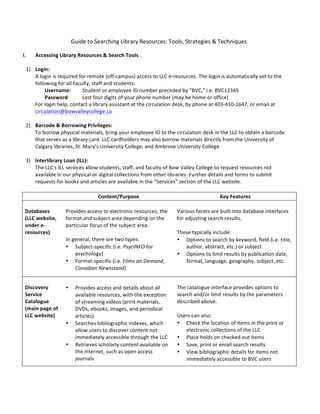
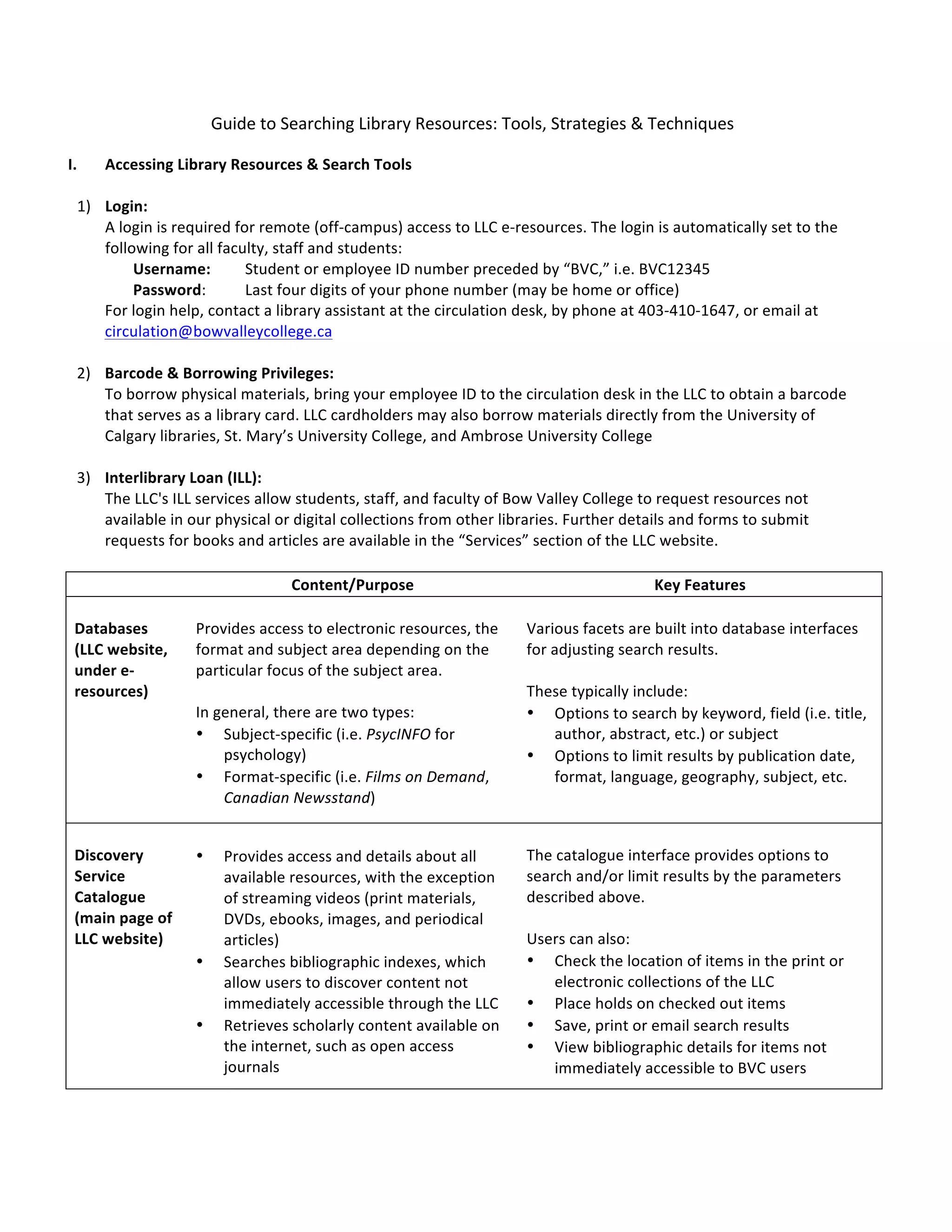
A&login&is&required&for&remote&(offAcampus)&access&to&LLC&eAresources.&The&login&is&automatically&set&to&the&
following&for&all&faculty,&staff&and&students:*
Username:& Student&or&employee&ID&number&preceded&by&“BVC,”&i.e.&BVC12345&
Password:& Last&four&digits&of&your&phone&number&(may&be&home&or&office)&
For&login&help,&contact&a&library&assistant&at&the&circulation&desk,&by&phone&at&403A410A1647,&or&email&at&
circulation@bowvalleycollege.ca&&
&
2) Barcode*&*Borrowing*Privileges:**
To&borrow&physical&materials,&bring&your&employee&ID&to&the&circulation&desk&in&the&LLC&to&obtain&a&barcode&
that&serves&as&a&library&card.&LLC&cardholders&may&also&borrow&materials&directly&from&the&University&of&
Calgary&libraries,&St.&Mary’s&University&College,&and&Ambrose&University&College&
*
3) Interlibrary*Loan*(ILL):**
The&LLC's&ILL&services&allow&students,&staff,&and&faculty&of&Bow&Valley&College&to&request&resources&not&
available&in&our&physical&or&digital&collections&from&other&libraries.&Further&details&and&forms&to&submit&
requests&for&books&and&articles&are&available&in&the&“Services”&section&of&the&LLC&website.*
&
* Content/Purpose* Key*Features*
*
Databases*
(LLC*website,*
under*eJ
resources)*
*
&
Provides&access&to&electronic&resources,&the&
format&and&subject&area&depending&on&the&
particular&focus&of&the&subject&area.&&
&
In&general,&there&are&two&types:&
• SubjectAspecific&(i.e.&PsycINFO&for&
psychology)&
• FormatAspecific&(i.e.&Films,on,Demand,&
Canadian,Newsstand)&
&
&
Various&facets&are&built&into&database&interfaces&
for&adjusting&search&results.&&
&
These&typically&include:&
• Options&to&search&by&keyword,&field&(i.e.&title,&
author,&abstract,&etc.)&or&subject&
• Options&to&limit&results&by&publication&date,&
format,&language,&geography,&subject,&etc.&
*
Discovery*
Service*
Catalogue*
(main*page*of*
LLC*website)*
*
&
• Provides&access&and&details&about&all&
available&resources,&with&the&exception&
of&streaming&videos&(print&materials,&
DVDs,&ebooks,&images,&and&periodical&
articles)&
• Searches&bibliographic&indexes,&which&
allow&users&to&discover&content&not&
immediately&accessible&through&the&LLC&&
• Retrieves&scholarly&content&available&on&
the&internet,&such&as&open&access&
journals&
&
The&catalogue&interface&provides&options&to&
search&and/or&limit&results&by&the&parameters&
described&above.&&
&
Users&can&also:&
• Check&the&location&of&items&in&the&print&or&
electronic&collections&of&the&LLC&
• Place&holds&on&checked&out&items&&
• Save,&print&or&email&search&results&&
• View&bibliographic&details&for&items&not&
immediately&accessible&to&BVC&users&
*
The*Alberta*
Library*(TAL)*
catalogue*
(http://*
talonline.ca/)*
*
&
TAL&is&a&consortium&of&public,&academic,&and&
special&libraries&in&Alberta&that&provide&
reciprocal&borrowing&privileges&allowing&
users&to&borrow&up&to&5&items&from&any&
library&in&Alberta.&TAL&Online&is&a&union&
catalogue&that&includes&over&16&million&
books,&CDs,&DVDs,&and&fullAtext&articles&
owned&or&licensed&by&Alberta's&libraries.&
&
Use&TAL&Online&to:&
• Search&holdings&of&300&Alberta&libraries,&
20,000&worldwide&libraries&and&free&online&
resources&such&as&Project&Gutenberg&and&
HathiTrust&
• Use&more&than&10&languages&to&find&material&
available&in&almost&500&languages&
• If&a&member&of&the&public&library,&submit&and&
check&the&status&of&interlibrary&loan&(ILL)&
requests&&
&
*
II. Search*Strategies*
*
Type* Key*Advantages*&*Disadvantages*
&
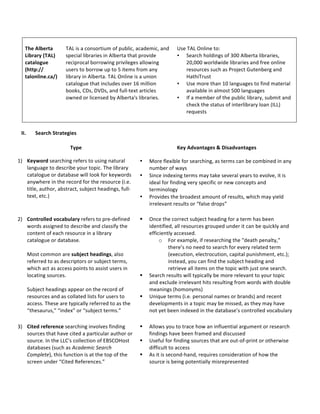
1) Keyword*searching&refers&to&using&natural&
language&to&describe&your&topic.&The&library&
catalogue&or&database&will&look&for&keywords&
anywhere&in&the&record&for&the&resource&(i.e.&
title,&author,&abstract,&subject&headings,&fullA
text,&etc.)*
&
• More&flexible&for&searching,&as&terms&can&be&combined&in&any&
number&of&ways&
• Since&indexing&terms&may&take&several&years&to&evolve,&it&is&
ideal&for&finding&very&specific&or&new&concepts&and&
terminology&&
• Provides&the&broadest&amount&of&results,&which&may&yield&
irrelevant&results&or&“false&drops”&
2) Controlled*vocabulary&refers&to&preAdefined&
words&assigned&to&describe&and&classify&the&
content&of&each&resource&in&a&library&
catalogue&or&database.&*
&
Most&common&are&subject*headings,&also&
referred&to&as&descriptors&or&subject&terms,&
which&act&as&access&points&to&assist&users&in&
locating&sources.&*
&
Subject&headings&appear&on&the&record&of&
resources&and&as&collated&lists&for&users&to&
access.&These&are&typically&referred&to&as&the&
“thesaurus,”&“index”&or&“subject&terms.”&&
! Once&the&correct&subject&heading&for&a&term&has&been&
identified,&all&resources&grouped&under&it&can&be&quickly&and&
efficiently&accessed.&&
o For&example,&if&researching&the&"death&penalty,"&
there’s&no&need&to&search&for&every&related&term&
(execution,&electrocution,&capital&punishment,&etc.);&
instead,&you&can&find&the&subject&heading&and&
retrieve&all&items&on&the&topic&with&just&one&search.&
! Search&results&will&typically&be&more&relevant&to&your&topic&
and&exclude&irrelevant&hits&resulting&from&words&with&double&
meanings&(homonyms)&&
! Unique&terms&(i.e.&personal&names&or&brands)&and&recent&
developments&in&a&topic&may&be&missed,&as&they&may&have&
not&yet&been&indexed&in&the&database’s&controlled&vocabulary&
3) Cited*reference&searching&involves&finding&
sources&that&have&cited&a&particular&author&or&
source.&In&the&LLC's&collection&of&EBSCOHost&
databases&(such&as&Academic,Search,
Complete),&this&function&is&at&the&top&of&the&
screen&under&“Cited&References.”&&
! Allows&you&to&trace&how&an&influential&argument&or&research&
findings&have&been&framed&and&discussed&&
! Useful&for&finding&sources&that&are&outAofAprint&or&otherwise&
difficult&to&access&
! As&it&is&secondAhand,&requires&consideration&of&how&the&
source&is&being&potentially&misrepresented&&
4) Pearl*growing&uses&the&characteristics&of&a&
highly&relevant&and&authoritative&article,&
referred&to&as&the&"pearl,"&to&search&for&
additional&related&sources.&
&
Bibliographic*mining&involves&reviewing&the&
references&at&the&end&of&a&book,&journal&
article,&dissertation&or&similar&work&and&
“mining”&it&for&further&resources&of&interest&
and&relevancy.&
&
Both&methods&allow&a&researcher&to&trace&the&history&and&
evolution&of&a&topic&or&area&of&study.&For&this&reason,&it&is&an&
excellent&technique&to&use&for&literature&reviews.&
&
1) Find&a&relevant&and&authoritative&article&
2) Locate&and&open&the&catalogue/database&record&for&that&
article&
3) Review&the&subject&terms&used&to&index&the&source;&use&
these&as&keywords&or&access&points&to&other&resources&
4) Review&and&find&the&references&cited&in&the&source&&
*
III. Search*Techniques*&*Features*
& *
What*is*it?*
*
How*to*Use*It?*
*
Limiters*
*
&
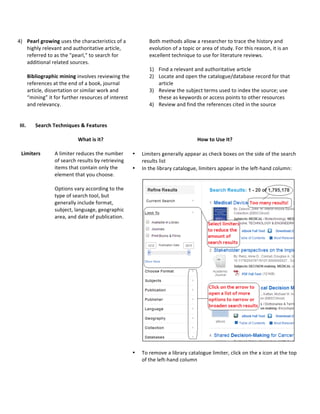
A&limiter&reduces&the&number&
of&search&results&by&retrieving&
items&that&contain&only&the&
element&that&you&choose.&&
&
Options&vary&according&to&the&
type&of&search&tool,&but&
generally&include&format,&
subject,&language,&geographic&
area,&and&date&of&publication.&&
&
&
• Limiters&generally&appear&as&check&boxes&on&the&side&of&the&search&
results&list&
• In&the&library&catalogue,&limiters&appear&in&the&leftAhand&column:&
&
&
&
• To&remove&a&library&catalogue&limiter,&click&on&the&x&icon&at&the&top&
of&the&leftAhand&column&
* & &
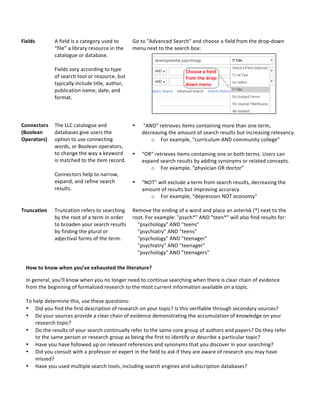
Fields*
*
A&field&is&a&category&used&to&
“file”&a&library&resource&in&the&
catalogue&or&database.&&
&
Fields&vary&according&to&type&
of&search&tool&or&resource,&but&
typically&include&title,&author,&
publication&name,&date,&and&
format.&&
&
Go&to&"Advanced&Search"&and&choose&a&field&from&the&dropAdown&
menu&next&to&the&search&box:&&
&
*
Connectors*
(Boolean*
Operators)*
*
&
The&LLC&catalogue&and&
databases&give&users&the&
option&to&use&connecting&
words,&or&Boolean&operators,&
to&change&the&way&a&keyword&
is&matched&to&the&item&record.&&
&
Connectors&help&to&narrow,&
expand,&and&refine&search&
results.&&
&
&
&
• &“AND”&retrieves&items&containing&more&than&one&term,&
decreasing&the&amount&of&search&results&but&increasing&relevancy.&&
o For&example,&“curriculum&AND&community&college”&
&
• “OR”&retrieves&items&containing&one&or&both&terms.&Users&can&
expand&search&results&by&adding&synonyms&or&related&concepts.&&
o For&example,&“physician&OR&doctor”&
&
• “NOT”&will&exclude&a&term&from&search&results,&decreasing&the&
amount&of&results&but&improving&accuracy.&&
o For&example,&“depression&NOT&economy”&
&
Truncation*
*
Truncation&refers&to&searching&
by&the&root&of&a&term&in&order&
to&broaden&your&search&results&
by&finding&the&plural&or&
adjectival&forms&of&the&term.&
&
Remove&the&ending&of&a&word&and&place&an*asterisk&(*)&next&to&the&
root.&For&example:&"psych*"&AND&"teen*"&will&also&find&results&for:&
&&&&"psychology"&AND&"teens"&
&&&&"psychiatry"&AND&"teens"&
&&&&"psychology"&AND&"teenager"&
&&&&"psychiatry"&AND&"teenager"&
&&&&"psychology"&AND&"teenagers"&
&
How*to*know*when*you’ve*exhausted*the*literature?**
In&general,&you’ll&know&when&you&no&longer&need&to&continue&searching&when&there&is&clear&chain&of&evidence&
from&the&beginning&of&formalized&research&to&the&most&current&information&available&on&a&topic.&&
&
To&help&determine&this,&use&these&questions:&
• Did&you&find&the&first&description&of&research&on&your&topic?&Is&this&verifiable&through&secondary&sources?&&
• Do&your&sources&provide&a&clear&chain&of&evidence&demonstrating&the&accumulation&of&knowledge&on&your&
research&topic?&&
• Do&the&results&of&your&search&continually&refer&to&the&same&core&group&of&authors&and&papers?&Do&they&refer&
to&the&same&person&or&research&group&as&being&the&first&to&identify&or&describe&a&particular&topic?&&
• Have&you&have&followed&up&on&relevant&references&and&synonyms&that&you&discover&in&your&searching?&
• Did&you&consult&with&a&professor&or&expert&in&the&field&to&ask&if&they&are&aware&of&research&you&may&have&
missed?&&
• Have&you&used&multiple&search&tools,&including&search&engines&and&subscription&databases?&

Search Strategies & Techniques