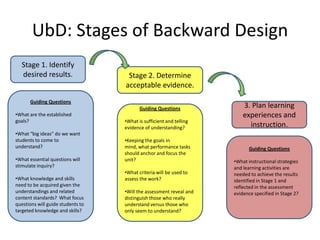
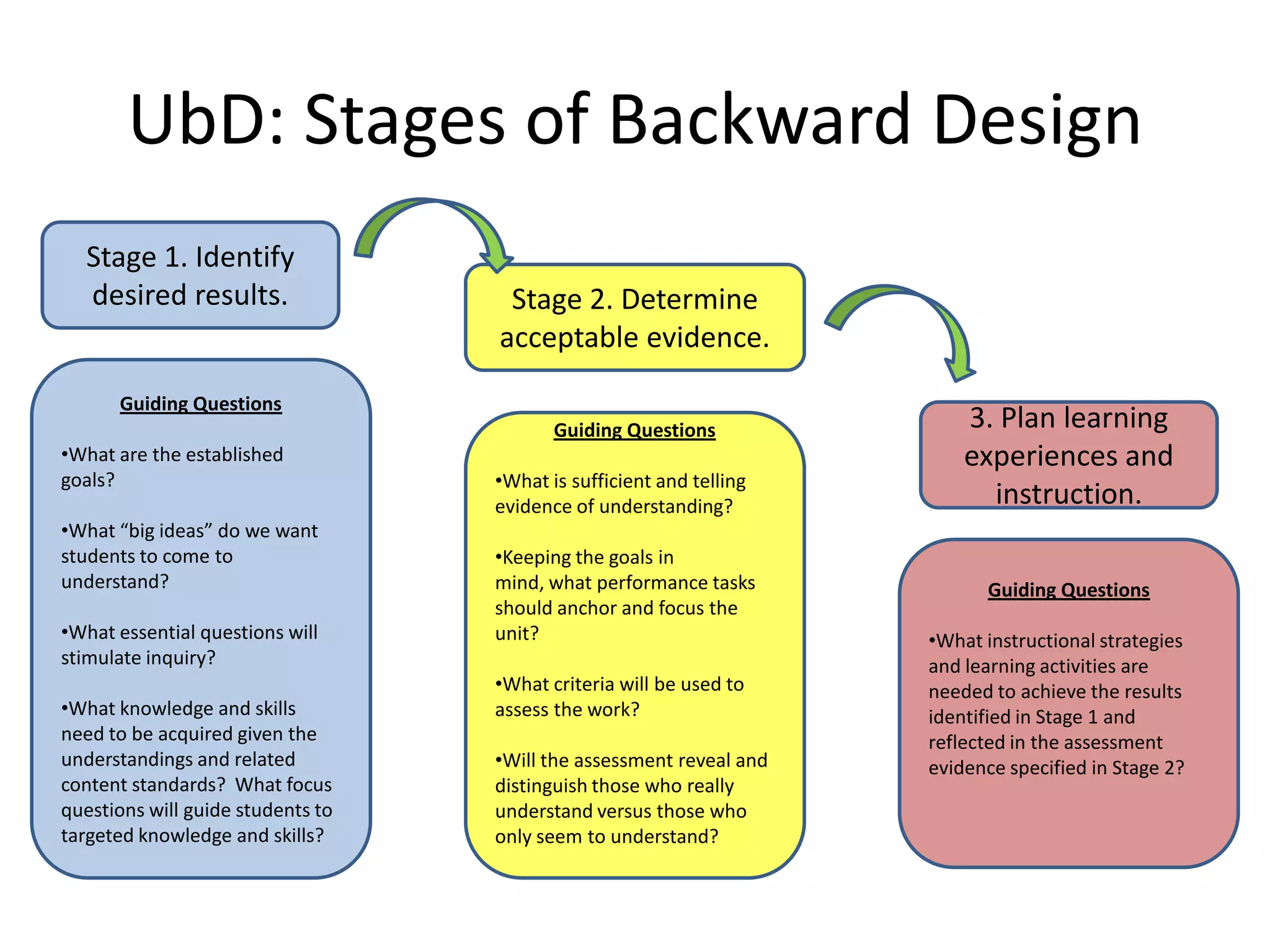
UbD: Stages of Backward Design
  Stage 1. Identify
  desired results.                  Stage 2. Determine
                                   acceptable evidence.
      Guiding Questions
                                          Guiding Questions              3. Plan learning
•What are the established                                                experiences and
goals?                             •What is sufficient and telling
                                   evidence of understanding?              instruction.
•What “big ideas” do we want
students to come to                •Keeping the goals in
understand?                        mind, what performance tasks            Guiding Questions
                                   should anchor and focus the
•What essential questions will     unit?                             •What instructional strategies
stimulate inquiry?                                                   and learning activities are
                                   •What criteria will be used to    needed to achieve the results
•What knowledge and skills         assess the work?                  identified in Stage 1 and
need to be acquired given the                                        reflected in the assessment
understandings and related         •Will the assessment reveal and   evidence specified in Stage 2?
content standards? What focus      distinguish those who really
questions will guide students to   understand versus those who
targeted knowledge and skills?     only seem to understand?
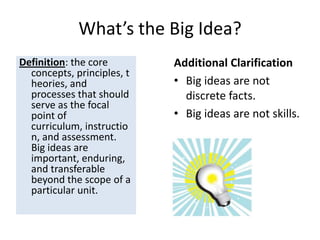
What’s the Big Idea?
Definition: the core        Additional Clarification
  concepts, principles, t
  heories, and              • Big ideas are not
  processes that should       discrete facts.
  serve as the focal
  point of                  • Big ideas are not skills.
  curriculum, instructio
  n, and assessment.
  Big ideas are
  important, enduring,
  and transferable
  beyond the scope of a
  particular unit.
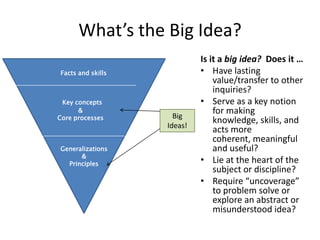
What’s the Big Idea?
                            Is it a big idea? Does it …
Facts and skills            • Have lasting
                                value/transfer to other
                                inquiries?
 Key concepts               • Serve as a key notion
      &                         for making
Core processes       Big
                                knowledge, skills, and
                   Ideas!
                                acts more
                                coherent, meaningful
Generalizations                 and useful?
      &
  Principles                • Lie at the heart of the
                                subject or discipline?
                            • Require “uncoverage”
                                to problem solve or
                                explore an abstract or
                                misunderstood idea?
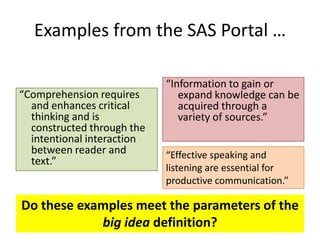
Examples from the SAS Portal …

                            “Information to gain or
“Comprehension requires        expand knowledge can be
  and enhances critical        acquired through a
  thinking and is              variety of sources.”
  constructed through the
  intentional interaction
  between reader and        “Effective speaking and
  text.”
                            listening are essential for
                            productive communication.”

Do these examples meet the parameters of the
            big idea definition?
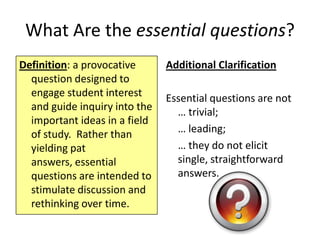
What Are the essential questions?
Definition: a provocative      Additional Clarification
  question designed to
  engage student interest      Essential questions are not
  and guide inquiry into the     … trivial;
  important ideas in a field
  of study. Rather than          … leading;
  yielding pat                   … they do not elicit
  answers, essential             single, straightforward
  questions are intended to      answers.
  stimulate discussion and
  rethinking over time.
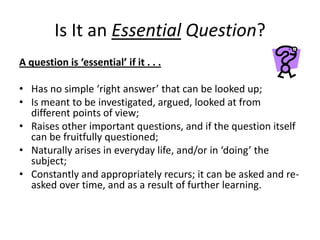
Is It an Essential Question?
A question is ‘essential’ if it . . .

• Has no simple ‘right answer’ that can be looked up;
• Is meant to be investigated, argued, looked at from
  different points of view;
• Raises other important questions, and if the question itself
  can be fruitfully questioned;
• Naturally arises in everyday life, and/or in ‘doing’ the
  subject;
• Constantly and appropriately recurs; it can be asked and re-
  asked over time, and as a result of further learning.
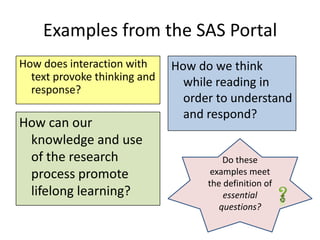
Examples from the SAS Portal
How does interaction with     How do we think
  text provoke thinking and     while reading in
  response?
                                order to understand
                                and respond?
How can our
 knowledge and use
 of the research                        Do these
 process promote                     examples meet
                                    the definition of
 lifelong learning?                     essential
                                       questions?
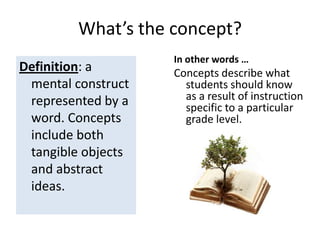
What’s the concept?
                    In other words …
Definition: a       Concepts describe what
 mental construct     students should know
 represented by a     as a result of instruction
                      specific to a particular
 word. Concepts       grade level.
 include both
 tangible objects
 and abstract
 ideas.
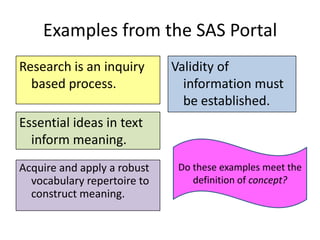
Examples from the SAS Portal
Research is an inquiry       Validity of
  based process.               information must
                               be established.
Essential ideas in text
  inform meaning.
Acquire and apply a robust    Do these examples meet the
  vocabulary repertoire to       definition of concept?
  construct meaning.
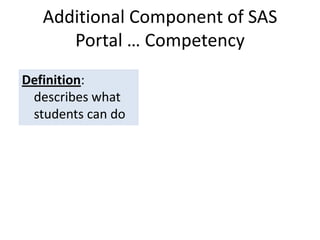
Additional Component of SAS
      Portal … Competency
Definition:
 describes what
 students can do
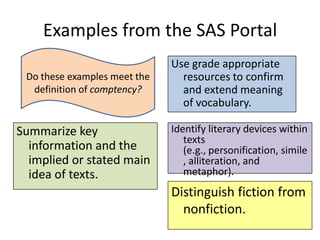
Examples from the SAS Portal
                              Use grade appropriate
 Do these examples meet the     resources to confirm
  definition of comptency?      and extend meaning
                                of vocabulary.

Summarize key                 Identify literary devices within
                                 texts
  information and the            (e.g., personification, simile
  implied or stated main         , alliteration, and
  idea of texts.                 metaphor).
                              Distinguish fiction from
                                nonfiction.
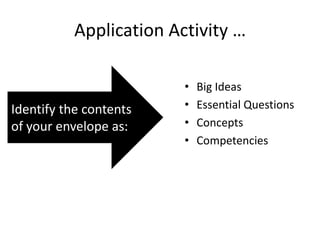
Application Activity …

                        •   Big Ideas
Identify the contents   •   Essential Questions
of your envelope as:    •   Concepts
                        •   Competencies
Application Activity
Based on our definitions and discussions of big
ideas, essential questions, concepts, and
competencies, write sample items of each for the
course that you plan develop one unit of online
instruction.

McCyber teacher academy 03 ubd

  • 1.
    UbD: Stages ofBackward Design Stage 1. Identify desired results. Stage 2. Determine acceptable evidence. Guiding Questions Guiding Questions 3. Plan learning •What are the established experiences and goals? •What is sufficient and telling evidence of understanding? instruction. •What “big ideas” do we want students to come to •Keeping the goals in understand? mind, what performance tasks Guiding Questions should anchor and focus the •What essential questions will unit? •What instructional strategies stimulate inquiry? and learning activities are •What criteria will be used to needed to achieve the results •What knowledge and skills assess the work? identified in Stage 1 and need to be acquired given the reflected in the assessment understandings and related •Will the assessment reveal and evidence specified in Stage 2? content standards? What focus distinguish those who really questions will guide students to understand versus those who targeted knowledge and skills? only seem to understand?
  • 2.
    What’s the BigIdea? Definition: the core Additional Clarification concepts, principles, t heories, and • Big ideas are not processes that should discrete facts. serve as the focal point of • Big ideas are not skills. curriculum, instructio n, and assessment. Big ideas are important, enduring, and transferable beyond the scope of a particular unit.
  • 3.
    What’s the BigIdea? Is it a big idea? Does it … Facts and skills • Have lasting value/transfer to other inquiries? Key concepts • Serve as a key notion & for making Core processes Big knowledge, skills, and Ideas! acts more coherent, meaningful Generalizations and useful? & Principles • Lie at the heart of the subject or discipline? • Require “uncoverage” to problem solve or explore an abstract or misunderstood idea?
  • 4.
    Examples from theSAS Portal … “Information to gain or “Comprehension requires expand knowledge can be and enhances critical acquired through a thinking and is variety of sources.” constructed through the intentional interaction between reader and “Effective speaking and text.” listening are essential for productive communication.” Do these examples meet the parameters of the big idea definition?
  • 5.
    What Are theessential questions? Definition: a provocative Additional Clarification question designed to engage student interest Essential questions are not and guide inquiry into the … trivial; important ideas in a field of study. Rather than … leading; yielding pat … they do not elicit answers, essential single, straightforward questions are intended to answers. stimulate discussion and rethinking over time.
  • 6.
    Is It anEssential Question? A question is ‘essential’ if it . . . • Has no simple ‘right answer’ that can be looked up; • Is meant to be investigated, argued, looked at from different points of view; • Raises other important questions, and if the question itself can be fruitfully questioned; • Naturally arises in everyday life, and/or in ‘doing’ the subject; • Constantly and appropriately recurs; it can be asked and re- asked over time, and as a result of further learning.
  • 7.
    Examples from theSAS Portal How does interaction with How do we think text provoke thinking and while reading in response? order to understand and respond? How can our knowledge and use of the research Do these process promote examples meet the definition of lifelong learning? essential questions?
  • 8.
    What’s the concept? In other words … Definition: a Concepts describe what mental construct students should know represented by a as a result of instruction specific to a particular word. Concepts grade level. include both tangible objects and abstract ideas.
  • 9.
    Examples from theSAS Portal Research is an inquiry Validity of based process. information must be established. Essential ideas in text inform meaning. Acquire and apply a robust Do these examples meet the vocabulary repertoire to definition of concept? construct meaning.
  • 10.
    Additional Component ofSAS Portal … Competency Definition: describes what students can do
  • 11.
    Examples from theSAS Portal Use grade appropriate Do these examples meet the resources to confirm definition of comptency? and extend meaning of vocabulary. Summarize key Identify literary devices within texts information and the (e.g., personification, simile implied or stated main , alliteration, and idea of texts. metaphor). Distinguish fiction from nonfiction.
  • 12.
    Application Activity … • Big Ideas Identify the contents • Essential Questions of your envelope as: • Concepts • Competencies
  • 13.
    Application Activity Based onour definitions and discussions of big ideas, essential questions, concepts, and competencies, write sample items of each for the course that you plan develop one unit of online instruction.