@jezhumble #lascot16
continuous delivery sounds great
but it won’t work here
@jezhumble
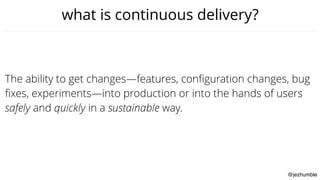
what is continuous delivery?
The ability to get changes—features, configuration changes, bug
fixes, experiments—into production or into the hands of users
safely and quickly in a sustainable way.
@jezhumble
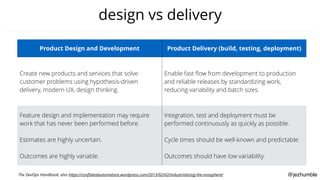
design vs delivery
Product Design and Development Product Delivery (build, testing, deployment)
Create new products and services that solve
customer problems using hypothesis-driven
delivery, modern UX, design thinking.
Enable fast flow from development to production
and reliable releases by standardizing work,
reducing variability and batch sizes.
Feature design and implementation may require
work that has never been performed before.
Estimates are highly uncertain.
Outcomes are highly variable.
Integration, test and deployment must be
performed continuously as quickly as possible.
Cycle times should be well-known and predictable.
Outcomes should have low variability.
The DevOps Handbook; also https://conflatedautomatons.wordpress.com/2013/02/02/industrializing-the-noosphere/
@jezhumble
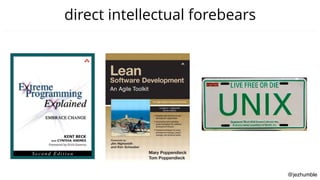
direct intellectual forebears
@jezhumble
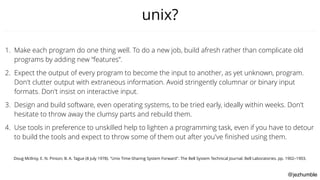
unix?
1. Make each program do one thing well. To do a new job, build afresh rather than complicate old
programs by adding new “features”.
2. Expect the output of every program to become the input to another, as yet unknown, program.
Don't clutter output with extraneous information. Avoid stringently columnar or binary input
formats. Don't insist on interactive input.
3. Design and build software, even operating systems, to be tried early, ideally within weeks. Don't
hesitate to throw away the clumsy parts and rebuild them.
4. Use tools in preference to unskilled help to lighten a programming task, even if you have to detour
to build the tools and expect to throw some of them out after you've finished using them.
Doug McIlroy, E. N. Pinson, B. A. Tague (8 July 1978). "Unix Time-Sharing System Forward". The Bell System Technical Journal. Bell Laboratories. pp. 1902–1903.
@jezhumble
it won’t work here because…
Stated reasons
• We're regulated
• We’re not building websites
• Too much legacy
• Our people are too stupid
Actual reasons
• Our culture sucks
• Our architecture sucks
@jezhumble
part the first
“we’re regulated”
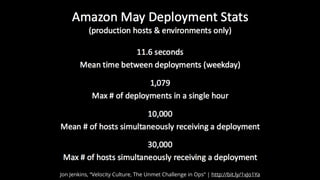
Jon Jenkins, “Velocity Culture, The Unmet Challenge in Ops” | http://bit.ly/1vJo1Ya
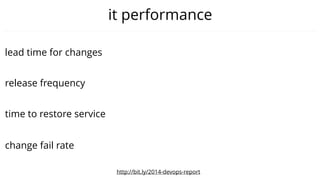
time to restore service
lead time for changes
release frequency
change fail rate
it performance
http://bit.ly/2014-devops-report
@jezhumble
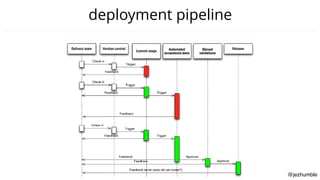
deployment pipeline
@jezhumble
part the second
“we’re not building websites”
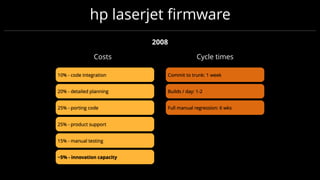
hp laserjet firmware
2008
~5% - innovation capacity
15% - manual testing
25% - product support
25% - porting code
20% - detailed planning
10% - code integration
Costs
Full manual regression: 6 wks
Builds / day: 1-2
Commit to trunk: 1 week
Cycle times
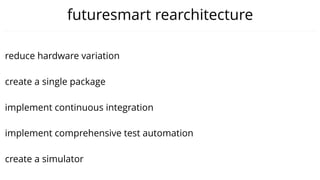
implement continuous integration
reduce hardware variation
create a single package
create a simulator
implement comprehensive test automation
futuresmart rearchitecture
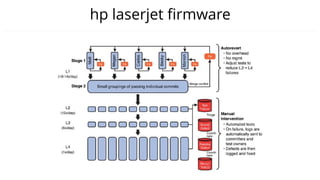
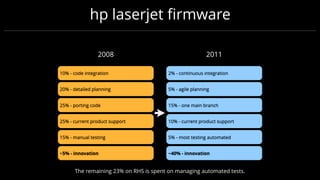
hp laserjet firmware
~5% - innovation
15% - manual testing
25% - current product support
25% - porting code
20% - detailed planning
10% - code integration
2008
~40% - innovation
5% - most testing automated
10% - current product support
15% - one main branch
5% - agile planning
2% - continuous integration
2011
The remaining 23% on RHS is spent on managing automated tests.
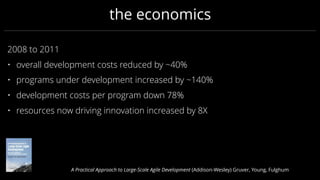
the economics
2008 to 2011
• overall development costs reduced by ~40%
• programs under development increased by ~140%
• development costs per program down 78%
• resources now driving innovation increased by 8X
A Practical Approach to Large-Scale Agile Development (Addison-Wesley) Gruver, Young, Fulghum
@jezhumble
part the third
“too much legacy”
http://www.flickr.com/photos/trustedsource/6132507962/
@jezhumble
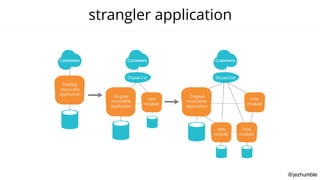
strangler application
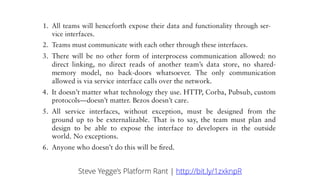
Steve Yegge’s Platform Rant | http://bit.ly/1zxknpR
@jezhumble
part the fourth
“our people are too stupid”
the production line
http://www.flickr.com/photos/toyotauk/4711057997/
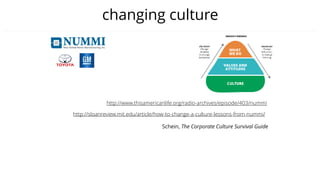
changing culture
http://www.thisamericanlife.org/radio-archives/episode/403/nummi
http://sloanreview.mit.edu/article/how-to-change-a-culture-lessons-from-nummi/
Schein, The Corporate Culture Survival Guide
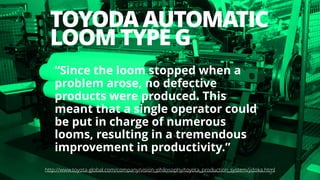
TOYODA AUTOMATIC
LOOM TYPE G
26
“Since the loom stopped when a
problem arose, no defective
products were produced. This
meant that a single operator could
be put in charge of numerous
looms, resulting in a tremendous
improvement in productivity.”
http://www.toyota-global.com/company/vision_philosophy/toyota_production_system/jidoka.html
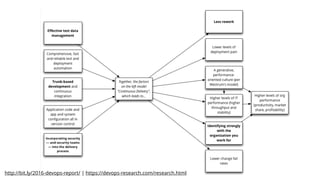
http://bit.ly/2016-devops-report/ | https://devops-research.com/research.html
Kaizen [improvement] opportunities
are infinite. Don’t think you have made
things better than before and be at
ease… This would be like the student
who becomes proud because they
bested their master two times out of
three in fencing. Once you pick up the
sprouts of kaizen ideas, it is important
to have the attitude in our daily work
that just underneath one kaizen idea is
yet another one.
—Taiichi Ohno
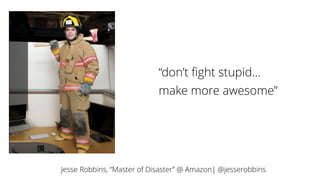
Jesse Robbins, “Master of Disaster” @ Amazon| @jesserobbins
“don’t fight stupid…
make more awesome”
thank you!
© 2016 DevOps Research and Assessment LLC
https://devops-research.com/
To receive the following:
• A copy of this presentation
• A 100 page excerpt from Lean Enterprise
• An excerpt from the DevOps Handbook
• A 20m preview of my Continuous Delivery video workshop
• Discount code for CD video + interviews with Eric Ries & more
Just pick up your phone and send an email
To: jezhumble@sendyourslides.com
Subject: devops
continuo

Continuous Delivery Sounds Great but it Won't Work Here

  • 1.
    @jezhumble #lascot16 continuous deliverysounds great but it won’t work here
  • 2.
    @jezhumble what is continuousdelivery? The ability to get changes—features, configuration changes, bug fixes, experiments—into production or into the hands of users safely and quickly in a sustainable way.
  • 3.
    @jezhumble design vs delivery ProductDesign and Development Product Delivery (build, testing, deployment) Create new products and services that solve customer problems using hypothesis-driven delivery, modern UX, design thinking. Enable fast flow from development to production and reliable releases by standardizing work, reducing variability and batch sizes. Feature design and implementation may require work that has never been performed before. Estimates are highly uncertain. Outcomes are highly variable. Integration, test and deployment must be performed continuously as quickly as possible. Cycle times should be well-known and predictable. Outcomes should have low variability. The DevOps Handbook; also https://conflatedautomatons.wordpress.com/2013/02/02/industrializing-the-noosphere/
  • 4.
  • 5.
    @jezhumble unix? 1. Make eachprogram do one thing well. To do a new job, build afresh rather than complicate old programs by adding new “features”. 2. Expect the output of every program to become the input to another, as yet unknown, program. Don't clutter output with extraneous information. Avoid stringently columnar or binary input formats. Don't insist on interactive input. 3. Design and build software, even operating systems, to be tried early, ideally within weeks. Don't hesitate to throw away the clumsy parts and rebuild them. 4. Use tools in preference to unskilled help to lighten a programming task, even if you have to detour to build the tools and expect to throw some of them out after you've finished using them. Doug McIlroy, E. N. Pinson, B. A. Tague (8 July 1978). "Unix Time-Sharing System Forward". The Bell System Technical Journal. Bell Laboratories. pp. 1902–1903.
  • 6.
    @jezhumble it won’t workhere because… Stated reasons • We're regulated • We’re not building websites • Too much legacy • Our people are too stupid Actual reasons • Our culture sucks • Our architecture sucks
  • 7.
  • 8.
    Jon Jenkins, “VelocityCulture, The Unmet Challenge in Ops” | http://bit.ly/1vJo1Ya
  • 9.
    time to restoreservice lead time for changes release frequency change fail rate it performance http://bit.ly/2014-devops-report
  • 10.
  • 12.
    @jezhumble part the second “we’renot building websites”
  • 13.
    hp laserjet firmware 2008 ~5%- innovation capacity 15% - manual testing 25% - product support 25% - porting code 20% - detailed planning 10% - code integration Costs Full manual regression: 6 wks Builds / day: 1-2 Commit to trunk: 1 week Cycle times
  • 14.
    implement continuous integration reducehardware variation create a single package create a simulator implement comprehensive test automation futuresmart rearchitecture
  • 15.
  • 16.
    hp laserjet firmware ~5%- innovation 15% - manual testing 25% - current product support 25% - porting code 20% - detailed planning 10% - code integration 2008 ~40% - innovation 5% - most testing automated 10% - current product support 15% - one main branch 5% - agile planning 2% - continuous integration 2011 The remaining 23% on RHS is spent on managing automated tests.
  • 17.
    the economics 2008 to2011 • overall development costs reduced by ~40% • programs under development increased by ~140% • development costs per program down 78% • resources now driving innovation increased by 8X A Practical Approach to Large-Scale Agile Development (Addison-Wesley) Gruver, Young, Fulghum
  • 18.
  • 20.
  • 21.
  • 22.
    Steve Yegge’s PlatformRant | http://bit.ly/1zxknpR
  • 23.
    @jezhumble part the fourth “ourpeople are too stupid”
  • 24.
  • 25.
  • 26.
    TOYODA AUTOMATIC LOOM TYPEG 26 “Since the loom stopped when a problem arose, no defective products were produced. This meant that a single operator could be put in charge of numerous looms, resulting in a tremendous improvement in productivity.” http://www.toyota-global.com/company/vision_philosophy/toyota_production_system/jidoka.html
  • 27.
  • 28.
    Kaizen [improvement] opportunities areinfinite. Don’t think you have made things better than before and be at ease… This would be like the student who becomes proud because they bested their master two times out of three in fencing. Once you pick up the sprouts of kaizen ideas, it is important to have the attitude in our daily work that just underneath one kaizen idea is yet another one. —Taiichi Ohno
  • 29.
    Jesse Robbins, “Masterof Disaster” @ Amazon| @jesserobbins “don’t fight stupid… make more awesome”
  • 30.
    thank you! © 2016DevOps Research and Assessment LLC https://devops-research.com/ To receive the following: • A copy of this presentation • A 100 page excerpt from Lean Enterprise • An excerpt from the DevOps Handbook • A 20m preview of my Continuous Delivery video workshop • Discount code for CD video + interviews with Eric Ries & more Just pick up your phone and send an email To: jezhumble@sendyourslides.com Subject: devops continuo