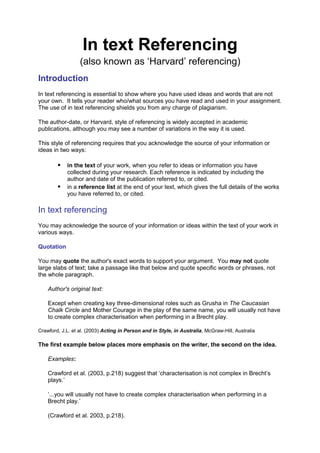
In text Referencing
                  (also known as ‘Harvard’ referencing)
Introduction
In text referencing is essential to show where you have used ideas and words that are not
your own. It tells your reader who/what sources you have read and used in your assignment.
The use of in text referencing shields you from any charge of plagiarism.

The author-date, or Harvard, style of referencing is widely accepted in academic
publications, although you may see a number of variations in the way it is used.

This style of referencing requires that you acknowledge the source of your information or
ideas in two ways:

           in the text of your work, when you refer to ideas or information you have
            collected during your research. Each reference is indicated by including the
            author and date of the publication referred to, or cited.
           in a reference list at the end of your text, which gives the full details of the works
            you have referred to, or cited.

In text referencing
You may acknowledge the source of your information or ideas within the text of your work in
various ways.

Quotation

You may quote the author's exact words to support your argument. You may not quote
large slabs of text; take a passage like that below and quote specific words or phrases, not
the whole paragraph.

    Author's original text:

    Except when creating key three-dimensional roles such as Grusha in The Caucasian
    Chalk Circle and Mother Courage in the play of the same name, you will usually not have
    to create complex characterisation when performing in a Brecht play.

Crawford, J.L. et al. (2003) Acting in Person and in Style, in Australia, McGraw-Hill, Australia

The first example below places more emphasis on the writer, the second on the idea.

    Examples:

    Crawford et al. (2003, p.218) suggest that ‘characterisation is not complex in Brecht’s
    plays.’

    ‘...you will usually not have to create complex characterisation when performing in a
    Brecht play.’

    (Crawford et al. 2003, p.218).
Paraphrase

You may paraphrase an author's words or ideas: restating them in your own words, but
without altering their meaning or providing your own interpretation of them.

   Examples:


   Crawford et al. (2003, p.218) suggest that as characterisation is not complex in Brecht’s
   plays as you would find in realistic plays by playwrights such as Chekhov.

   Characterisation was not as crucial in Brecht’s plays as an audience would find in
   realistic plays, “...except when creating key three-dimensional roles such as Grusha in
   The Caucasian Chalk Circle and Mother Courage...” (Crawford et al. 2003, p.218).

Summary

You may summarise - use your own words to present the key points of an author's
argument or ideas, without altering the meaning.

   Example:

   In their discussion on the way characterisation was changed in Brecht’s plays, Crawford
   et al. (2003, p.218) explain that roles were not generally three-dimensional; differing from
   the way they were presented in realistic plays by playwrights such as Chekhov.

Citing page numbers in-text
             Page numbers are essential if you are directly quoting someone else’s words.
              Insert page numbers after the year, separated by a comma. When paraphrasing
              or summarising, it is a good idea to include page numbers.
             Use the abbreviations p. for single page, and pp. for a page range, e.g. pp.11-12.
             See the various examples above for how to do this.

To cite a website in-text

As internet sources rarely have a page number, it is impossible to cite them. Citation of
websites should contain the author name(s) – person or organisation – and the date created
or revised.

       Examples: (The Australian, 2007) or (Hall, 2005)

Reference List
       The reference list, normally headed 'References', should appear at the end of your
       work, and should include details of all the sources of information which you have
       referred to, or cited, in your text.

       Please refer to the booklet produced by the library on constructing a reference list (or
       bibliography): I:intranetlibrarydocumentsHow to present a bibliography.doc

References:

       Harvard (author-date) style examples, (2007). [Online]. Available:
       http://www.lib.monash.edu.au/tutorials/citing/harvard.html [Accessed: 22/5/2007].
The Learning Centre, (n.d.) ‘Referencing: the in-text or ‘Harvard’ system’, University of New South Wales,
Sydney.

Harvard referencing

  • 1.
    In text Referencing (also known as ‘Harvard’ referencing) Introduction In text referencing is essential to show where you have used ideas and words that are not your own. It tells your reader who/what sources you have read and used in your assignment. The use of in text referencing shields you from any charge of plagiarism. The author-date, or Harvard, style of referencing is widely accepted in academic publications, although you may see a number of variations in the way it is used. This style of referencing requires that you acknowledge the source of your information or ideas in two ways:  in the text of your work, when you refer to ideas or information you have collected during your research. Each reference is indicated by including the author and date of the publication referred to, or cited.  in a reference list at the end of your text, which gives the full details of the works you have referred to, or cited. In text referencing You may acknowledge the source of your information or ideas within the text of your work in various ways. Quotation You may quote the author's exact words to support your argument. You may not quote large slabs of text; take a passage like that below and quote specific words or phrases, not the whole paragraph. Author's original text: Except when creating key three-dimensional roles such as Grusha in The Caucasian Chalk Circle and Mother Courage in the play of the same name, you will usually not have to create complex characterisation when performing in a Brecht play. Crawford, J.L. et al. (2003) Acting in Person and in Style, in Australia, McGraw-Hill, Australia The first example below places more emphasis on the writer, the second on the idea. Examples: Crawford et al. (2003, p.218) suggest that ‘characterisation is not complex in Brecht’s plays.’ ‘...you will usually not have to create complex characterisation when performing in a Brecht play.’ (Crawford et al. 2003, p.218).
  • 2.
    Paraphrase You may paraphrasean author's words or ideas: restating them in your own words, but without altering their meaning or providing your own interpretation of them. Examples: Crawford et al. (2003, p.218) suggest that as characterisation is not complex in Brecht’s plays as you would find in realistic plays by playwrights such as Chekhov. Characterisation was not as crucial in Brecht’s plays as an audience would find in realistic plays, “...except when creating key three-dimensional roles such as Grusha in The Caucasian Chalk Circle and Mother Courage...” (Crawford et al. 2003, p.218). Summary You may summarise - use your own words to present the key points of an author's argument or ideas, without altering the meaning. Example: In their discussion on the way characterisation was changed in Brecht’s plays, Crawford et al. (2003, p.218) explain that roles were not generally three-dimensional; differing from the way they were presented in realistic plays by playwrights such as Chekhov. Citing page numbers in-text  Page numbers are essential if you are directly quoting someone else’s words. Insert page numbers after the year, separated by a comma. When paraphrasing or summarising, it is a good idea to include page numbers.  Use the abbreviations p. for single page, and pp. for a page range, e.g. pp.11-12.  See the various examples above for how to do this. To cite a website in-text As internet sources rarely have a page number, it is impossible to cite them. Citation of websites should contain the author name(s) – person or organisation – and the date created or revised. Examples: (The Australian, 2007) or (Hall, 2005) Reference List The reference list, normally headed 'References', should appear at the end of your work, and should include details of all the sources of information which you have referred to, or cited, in your text. Please refer to the booklet produced by the library on constructing a reference list (or bibliography): I:intranetlibrarydocumentsHow to present a bibliography.doc References: Harvard (author-date) style examples, (2007). [Online]. Available: http://www.lib.monash.edu.au/tutorials/citing/harvard.html [Accessed: 22/5/2007].
  • 3.
    The Learning Centre,(n.d.) ‘Referencing: the in-text or ‘Harvard’ system’, University of New South Wales, Sydney.