Omega-3 Fats for Health and
Breast Cancer Prevention
David W.L. Ma, Ph.D.
Professor
Department of Human Health & Nutritional
Sciences
University of Guelph, Canada
Breast Cancer Statistics
• Globally, cancer is the 2nd leading cause of
death in 2015 after cardiovascular disease
contributing to 8.8 and 18 million deaths,
respectively1.
• Among female cancers, breast cancer is a
leading cause of death worldwide, which
increased 21% from 2005 to 2015 or 440,000
to 534,000 deaths1.
Lancet 2016; 388: 1545–602
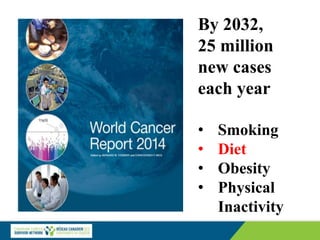
By 2032,
25 million
new cases
each year
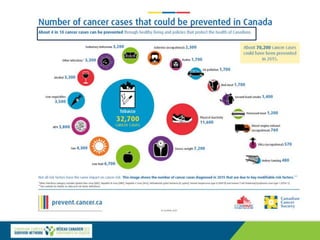
• Smoking
• Diet
• Obesity
• Physical
Inactivity
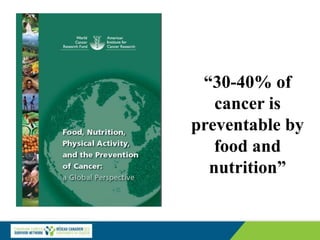
“30-40% of
cancer is
preventable by
food and
nutrition”
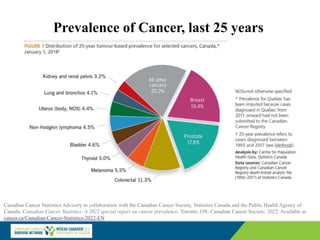
Prevalence of Cancer, last 25 years
Canadian Cancer Statistics Advisory in collaboration with the Canadian Cancer Society, Statistics Canada and the Public Health Agency of
Canada. Canadian Cancer Statistics: A 2022 special report on cancer prevalence. Toronto, ON: Canadian Cancer Society; 2022. Available at:
cancer.ca/Canadian-Cancer-Statistics-2022-EN
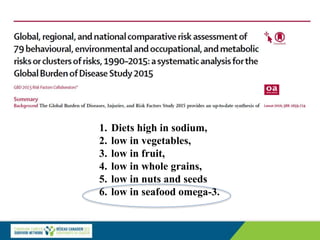
1. Diets high in sodium,
2. low in vegetables,
3. low in fruit,
4. low in whole grains,
5. low in nuts and seeds
6. low in seafood omega-3.
Research questions in my lab
1. Is there a causal link between omega-3 fatty acids
and breast cancer?
2. What is the role of individual omega-3 fatty acids?
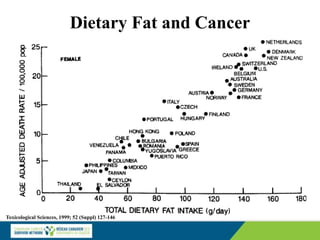
Dietary Fat and Cancer
Toxicological Sciences, 1999; 52 (Suppl) 127-146
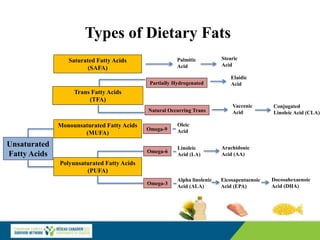
Unsaturated
Fatty Acids
Monounsaturated Fatty Acids
(MUFA)
Polyunsaturated Fatty Acids
(PUFA)
Omega-6
Omega-3
Linoleic
Acid (LA)
Alpha linolenic
Acid (ALA)
Arachidonic
Acid (AA)
Eicosapentaenoic
Acid (EPA)
Docosahexaenoic
Acid (DHA)
Saturated Fatty Acids
(SAFA)
Oleic
Acid
Palmitic
Acid
Stearic
Acid
Types of Dietary Fats
Omega-9
Trans Fatty Acids
(TFA)
Partially Hydrogenated
Natural Occurring Trans
Elaidic
Acid
Vaccenic
Acid
Conjugated
Linoleic Acid (CLA)
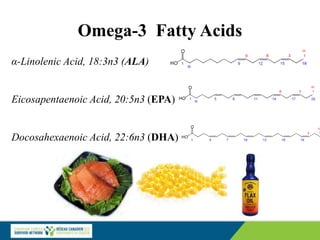
Omega-3 Fatty Acids
α-Linolenic Acid, 18:3n3 (ALA)
Eicosapentaenoic Acid, 20:5n3 (EPA)
Docosahexaenoic Acid, 22:6n3 (DHA)
Is there a causal link between
lifelong n-3 PUFA exposure and
mammary tumour
development?
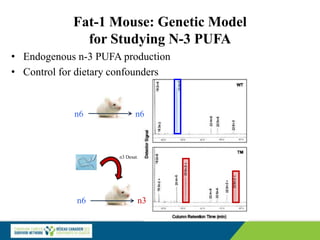
Fat-1 Mouse: Genetic Model
for Studying N-3 PUFA
• Endogenous n-3 PUFA production
• Control for dietary confounders
n3 Desat.
n6 n6
n6 n3
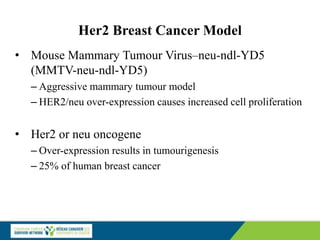
Her2 Breast Cancer Model
• Mouse Mammary Tumour Virus–neu-ndl-YD5
(MMTV-neu-ndl-YD5)
– Aggressive mammary tumour model
– HER2/neu over-expression causes increased cell proliferation
• Her2 or neu oncogene
– Over-expression results in tumourigenesis
– 25% of human breast cancer
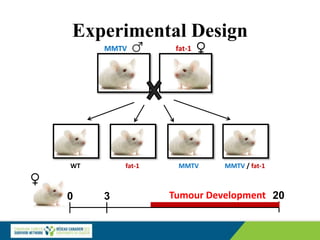
Experimental Design
MMTV fat-1
MMTV MMTV / fat-1
fat-1
WT
0 3 20
Tumour Development
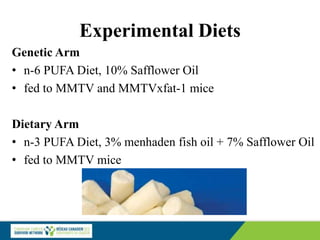
Experimental Diets
Genetic Arm
• n-6 PUFA Diet, 10% Safflower Oil
• fed to MMTV and MMTVxfat-1 mice
Dietary Arm
• n-3 PUFA Diet, 3% menhaden fish oil + 7% Safflower Oil
• fed to MMTV mice
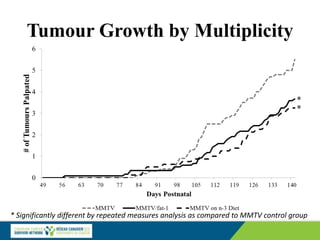
Tumour Growth by Multiplicity
* Significantly different by repeated measures analysis as compared to MMTV control group
*
*
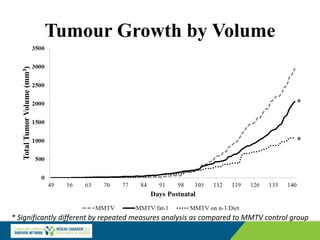
Tumour Growth by Volume
*
*
* Significantly different by repeated measures analysis as compared to MMTV control group
Is More Better?
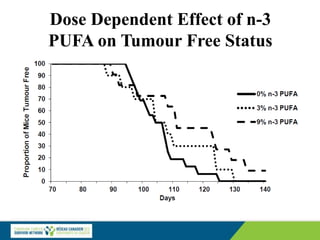
Dose Dependent Effect of n-3
PUFA on Tumour Free Status
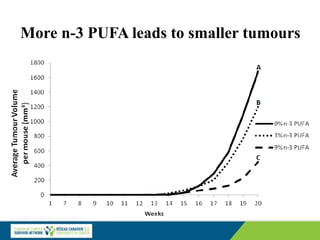
More n-3 PUFA leads to smaller tumours
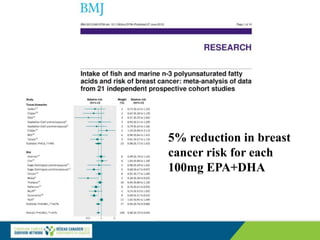
5% reduction in breast
cancer risk for each
100mg EPA+DHA
Is Plant or Fish based
n-3 PUFA Better?
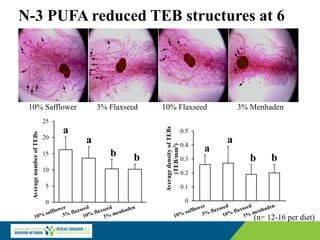
N-3 PUFA reduced TEB structures at 6
weeks
(n= 12-16 per diet)
0
5
10
15
20
25
Average
number
of
TEBs
a
a
b b
0
0.1
0.2
0.3
0.4
0.5
Average
density
of
TEBs
(TEB/mm
2
)
a
a
b b
10% Safflower 3% Flaxseed 10% Flaxseed 3% Menhaden
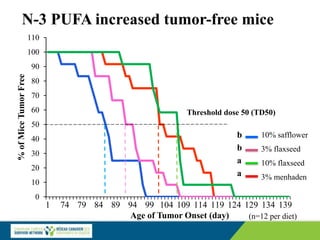
N-3 PUFA increased tumor-free mice
(n=12 per diet)
0
10
20
30
40
50
60
70
80
90
100
110
1 74 79 84 89 94 99 104 109 114 119 124 129 134 139
%
of
Mice
Tumor
Free
Age of Tumor Onset (day)
Threshold dose 50 (TD50)
b
b
a
a
10% safflower
3% flaxseed
10% flaxseed
3% menhaden
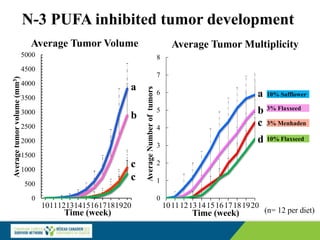
N-3 PUFA inhibited tumor development
Time (week)
10% Safflower
3% Flaxseed
10% Flaxseed
3% Menhaden
a
b
c
d
0
1
2
3
4
5
6
7
8
1011121314151617181920
Average
Number
of
tumors
0
500
1000
1500
2000
2500
3000
3500
4000
4500
5000
1011121314151617181920
Average
tumor
volume
(mm
3
)
a
b
c
c
Average Tumor Volume Average Tumor Multiplicity
Time (week) (n= 12 per diet)
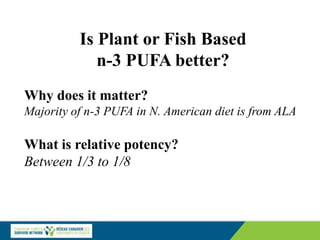
Is Plant or Fish Based
n-3 PUFA better?
Why does it matter?
Majority of n-3 PUFA in N. American diet is from ALA
What is relative potency?
Between 1/3 to 1/8
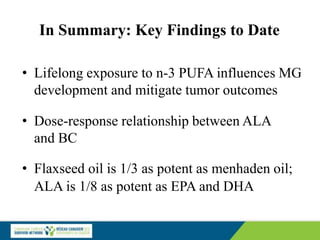
In Summary: Key Findings to Date
• Flaxseed oil is 1/3 as potent as menhaden oil;
ALA is 1/8 as potent as EPA and DHA
• Dose-response relationship between ALA
and BC
• Lifelong exposure to n-3 PUFA influences MG
development and mitigate tumor outcomes
Canadian Cancer Survivor Network
Contact Info
1750 Courtwood Crescent, Suite 210
Ottawa, ON K2C 2B5
Telephone / Téléphone : 613-898-1871
E-mail: jmanthorne@survivornet.ca or info@survivornet.ca
Website: www.survivornet.ca
Twitter: @survivornetca
Facebook: www.facebook.com/CanadianSurvivorNet
Instagram: @survivornet_ca
Pinterest: http://pinterest.com/survivornetwork/
CCSN David Ma Nov 9 2023 final.pptx

CCSN David Ma Nov 9 2023 final.pptx

  • 1.
    Omega-3 Fats forHealth and Breast Cancer Prevention David W.L. Ma, Ph.D. Professor Department of Human Health & Nutritional Sciences University of Guelph, Canada
  • 3.
    Breast Cancer Statistics •Globally, cancer is the 2nd leading cause of death in 2015 after cardiovascular disease contributing to 8.8 and 18 million deaths, respectively1. • Among female cancers, breast cancer is a leading cause of death worldwide, which increased 21% from 2005 to 2015 or 440,000 to 534,000 deaths1. Lancet 2016; 388: 1545–602
  • 4.
    By 2032, 25 million newcases each year • Smoking • Diet • Obesity • Physical Inactivity
  • 5.
    “30-40% of cancer is preventableby food and nutrition”
  • 6.
    Prevalence of Cancer,last 25 years Canadian Cancer Statistics Advisory in collaboration with the Canadian Cancer Society, Statistics Canada and the Public Health Agency of Canada. Canadian Cancer Statistics: A 2022 special report on cancer prevalence. Toronto, ON: Canadian Cancer Society; 2022. Available at: cancer.ca/Canadian-Cancer-Statistics-2022-EN
  • 8.
    1. Diets highin sodium, 2. low in vegetables, 3. low in fruit, 4. low in whole grains, 5. low in nuts and seeds 6. low in seafood omega-3.
  • 9.
    Research questions inmy lab 1. Is there a causal link between omega-3 fatty acids and breast cancer? 2. What is the role of individual omega-3 fatty acids?
  • 10.
    Dietary Fat andCancer Toxicological Sciences, 1999; 52 (Suppl) 127-146
  • 11.
    Unsaturated Fatty Acids Monounsaturated FattyAcids (MUFA) Polyunsaturated Fatty Acids (PUFA) Omega-6 Omega-3 Linoleic Acid (LA) Alpha linolenic Acid (ALA) Arachidonic Acid (AA) Eicosapentaenoic Acid (EPA) Docosahexaenoic Acid (DHA) Saturated Fatty Acids (SAFA) Oleic Acid Palmitic Acid Stearic Acid Types of Dietary Fats Omega-9 Trans Fatty Acids (TFA) Partially Hydrogenated Natural Occurring Trans Elaidic Acid Vaccenic Acid Conjugated Linoleic Acid (CLA)
  • 12.
    Omega-3 Fatty Acids α-LinolenicAcid, 18:3n3 (ALA) Eicosapentaenoic Acid, 20:5n3 (EPA) Docosahexaenoic Acid, 22:6n3 (DHA)
  • 13.
    Is there acausal link between lifelong n-3 PUFA exposure and mammary tumour development?
  • 14.
    Fat-1 Mouse: GeneticModel for Studying N-3 PUFA • Endogenous n-3 PUFA production • Control for dietary confounders n3 Desat. n6 n6 n6 n3
  • 15.
    Her2 Breast CancerModel • Mouse Mammary Tumour Virus–neu-ndl-YD5 (MMTV-neu-ndl-YD5) – Aggressive mammary tumour model – HER2/neu over-expression causes increased cell proliferation • Her2 or neu oncogene – Over-expression results in tumourigenesis – 25% of human breast cancer
  • 16.
    Experimental Design MMTV fat-1 MMTVMMTV / fat-1 fat-1 WT 0 3 20 Tumour Development
  • 17.
    Experimental Diets Genetic Arm •n-6 PUFA Diet, 10% Safflower Oil • fed to MMTV and MMTVxfat-1 mice Dietary Arm • n-3 PUFA Diet, 3% menhaden fish oil + 7% Safflower Oil • fed to MMTV mice
  • 18.
    Tumour Growth byMultiplicity * Significantly different by repeated measures analysis as compared to MMTV control group * *
  • 19.
    Tumour Growth byVolume * * * Significantly different by repeated measures analysis as compared to MMTV control group
  • 20.
  • 21.
    Dose Dependent Effectof n-3 PUFA on Tumour Free Status
  • 22.
    More n-3 PUFAleads to smaller tumours
  • 23.
    5% reduction inbreast cancer risk for each 100mg EPA+DHA
  • 24.
    Is Plant orFish based n-3 PUFA Better?
  • 25.
    N-3 PUFA reducedTEB structures at 6 weeks (n= 12-16 per diet) 0 5 10 15 20 25 Average number of TEBs a a b b 0 0.1 0.2 0.3 0.4 0.5 Average density of TEBs (TEB/mm 2 ) a a b b 10% Safflower 3% Flaxseed 10% Flaxseed 3% Menhaden
  • 26.
    N-3 PUFA increasedtumor-free mice (n=12 per diet) 0 10 20 30 40 50 60 70 80 90 100 110 1 74 79 84 89 94 99 104 109 114 119 124 129 134 139 % of Mice Tumor Free Age of Tumor Onset (day) Threshold dose 50 (TD50) b b a a 10% safflower 3% flaxseed 10% flaxseed 3% menhaden
  • 27.
    N-3 PUFA inhibitedtumor development Time (week) 10% Safflower 3% Flaxseed 10% Flaxseed 3% Menhaden a b c d 0 1 2 3 4 5 6 7 8 1011121314151617181920 Average Number of tumors 0 500 1000 1500 2000 2500 3000 3500 4000 4500 5000 1011121314151617181920 Average tumor volume (mm 3 ) a b c c Average Tumor Volume Average Tumor Multiplicity Time (week) (n= 12 per diet)
  • 28.
    Is Plant orFish Based n-3 PUFA better? Why does it matter? Majority of n-3 PUFA in N. American diet is from ALA What is relative potency? Between 1/3 to 1/8
  • 29.
    In Summary: KeyFindings to Date • Flaxseed oil is 1/3 as potent as menhaden oil; ALA is 1/8 as potent as EPA and DHA • Dose-response relationship between ALA and BC • Lifelong exposure to n-3 PUFA influences MG development and mitigate tumor outcomes
  • 30.
    Canadian Cancer SurvivorNetwork Contact Info 1750 Courtwood Crescent, Suite 210 Ottawa, ON K2C 2B5 Telephone / Téléphone : 613-898-1871 E-mail: jmanthorne@survivornet.ca or info@survivornet.ca Website: www.survivornet.ca Twitter: @survivornetca Facebook: www.facebook.com/CanadianSurvivorNet Instagram: @survivornet_ca Pinterest: http://pinterest.com/survivornetwork/