A tale of 3(+) projects…
Efforts to help deliver change to
school air quality in the UK
Reported by Dr Henry Burridge; e: h.Burridge@imperial.co.uk, tw: @HenryBurridge
Work carried out be a group of 30+ individuals from 10+ institutions
A tale of 3(+) projects…
How bad was air quality and ventilation in classrooms during the pandemic?
• CIVOS – investigating ‘Changes In the Ventilation of Schools’ during 2021 and
beyond…
What can researchers do to help change school air quality in the here and now?
• CIVOS – Phase 2 evidencing the effectiveness of remote ventilation behaviour
training to leverage the DfE provision of CO2 monitors to schools
• (+) – examining the potential for in-classroom observations and training to deliver
improvements in classroom ventilation behaviours
• Class-ACT – ‘Classroom Air Cleaning Technologies’ evidencing the impact of HEPA
or UVC filter provision within classrooms
What should researchers do to help change school air quality in the longer term?
• SAMHE – ‘Schools’ Air quality Monitoring for Health and Education’
Air quality & ventilation during the pandemic?
• CIVOS – investigating ‘Changes In the Ventilation of Schools’ when
monitoring CO2 during 2021 and beyond…
Collaboration between the Department for Education, Department for Health & Social Care, UK Health
Security Agency, University of Leeds and Imperial College London
• Can display monitors help with ventilation provision in UK classrooms?
• Can changes be sustained over time?
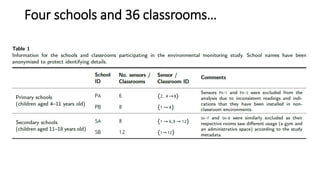
40 naturally ventilated classrooms in 4 schools (2 primary & 2 secondary)
Phase 1: Unintrusive monitoring (temperature, RH, CO2) from the start of
2021
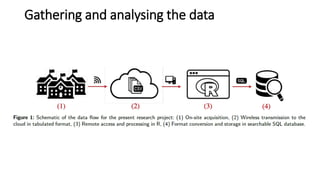
Gathering and analysing the data
Four schools and 36 classrooms…
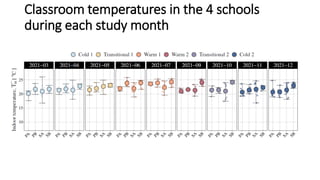
Classroom temperatures in the 4 schools
during each study month
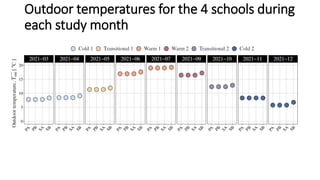
Outdoor temperatures for the 4 schools during
each study month
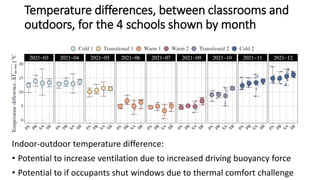
Temperature differences, between classrooms and
outdoors, for the 4 schools shown by month
Indoor-outdoor temperature difference:
• Potential to increase ventilation due to increased driving buoyancy force
• Potential to if occupants shut windows due to thermal comfort challenge
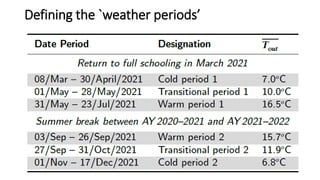
Defining the `weather periods’
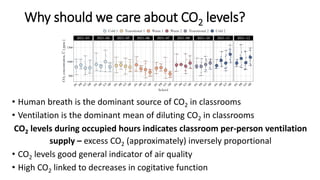
Why should we care about CO2 levels?
• Human breath is the dominant source of CO2 in classrooms
• Ventilation is the dominant mean of diluting CO2 in classrooms
CO2 levels during occupied hours indicates classroom per-person ventilation
supply – excess CO2 (approximately) inversely proportional
• CO2 levels good general indicator of air quality
• High CO2 linked to decreases in cogitative function
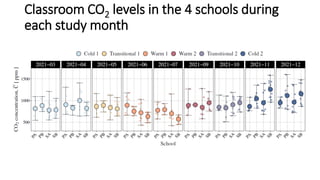
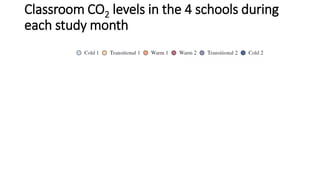
Classroom CO2 levels in the 4 schools during
each study month
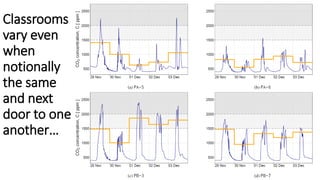
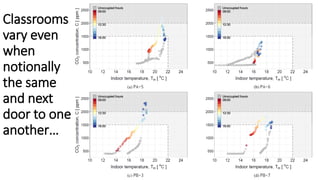
Classrooms
vary even
when
notionally
the same
and next
door to one
another…
Classrooms
vary even
when
notionally
the same
and next
door to one
another…
Classroom CO2 levels in the 4 schools during
each study month
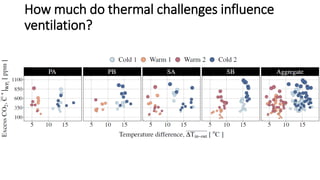
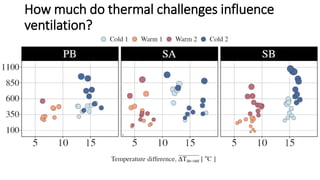
How much do thermal challenges influence
ventilation?
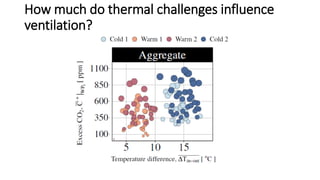
How much do thermal challenges influence
ventilation?
How much do thermal challenges influence
ventilation?
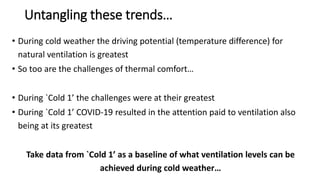
Untangling these trends…
• During cold weather the driving potential (temperature difference) for
natural ventilation is greatest
• So too are the challenges of thermal comfort…
• During `Cold 1’ the challenges were at their greatest
• During `Cold 1’ COVID-19 resulted in the attention paid to ventilation also
being at its greatest
Take data from `Cold 1’ as a baseline of what ventilation levels can be
achieved during cold weather…
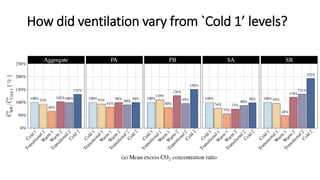
How did ventilation vary from `Cold 1’ levels?
Air quality & ventilation during the pandemic?
• Unique data set from within 36 classrooms throughout 2021— a year in which UK schools
were in the grips of the COVID-19 pandemic.
• Seasonal variations identified, investigation illustrates the thermal comfort needs, and
possibly the desire to reduce energy costs, are the most likely causes.
• Significant variations between notionally similar classrooms are consistent highlights
further investigation required into:
a) school classroom and building variation, and
b) the role of the ventilation behaviours of classroom occupants.
• Data highlights that in these classrooms (per-person) ventilation rates were significantly
lower at the end of 2021 than at the beginning — possible reasons include:
a) protocols for UK schools,
b) the UK Government’s messaging, and
c) the populations attitude towards the disease, throughout 2021 are likely contributors to this finding.
What can researchers do to help change
school air quality in the here and now?
CIVOS – Phase 2: evidencing the effectiveness of remote ventilation behaviour
training to leverage the DfE provision of CO2 monitors to schools
• Working during 2022 with the same 4 schools
• CO2 monitors with in-room displays provided to all ‘intervention’ classrooms
and compared to ‘control’ classrooms
• Deliver ventilation behaviour training to classroom staff in a manner replicable
at large-scale
• Assess the impacts via monitored data, surveys of attitudes and focus groups
to identify barriers
• Challenged by engagement of classroom staff
• Confounded by the DfE deployment CO2 monitors with in-room displays
What can researchers do to help change
school air quality in the here and now?
(+) – examining the potential for in-classroom observations and training to
deliver improvements in classroom ventilation behaviours
• Working in 10 classrooms within one London school
• Gathering environmental quality data via monitors
• Gathering contextual, behavioural, and architectural data via careful
observational records during six weeks spent in classrooms
• Deliver personalised CO2 monitor and ventilation training to classroom staff
• Co-design bespoke classroom air quality plans with teachers
What can researchers do to help change
school air quality in the here and now?
Class-ACT – ‘Classroom Air Cleaning Technologies’ evidencing the impact of
HEPA or UVC filter provision within classrooms
• Environmental monitoring (temperature, RH, CO2, PMs, VOC) in 330+
classrooms in 30 schools within the Bradford area
• Divided into: ‘Control’ (no interventions), ‘HEPA’, and ‘UV’ schools
• Environmental data analysed
• School attendance data gathered from across the Bradford area
Does this data show meaningful impact on attendance (=> infection) within
the HEPA and/or UV schools?
• Challenged by logistics (from plug sockets, to noise and heat)
• Quality assurance on data at this scale is an enormous undertaking
What should researchers do to help change school air quality in the longer term?
SAMHE – ‘Schools’ Air quality Monitoring for Health and Education’
SAMHE: Schools’ Air quality Monitoring
for Health and Education
• Project funded from 01/Aug/2022- 01/Aug/2024 by the EPSRC (Engineering and Physical Sciences Research
Council), with additional funds provided by the DfE to kick-start the project prior to Aug/22.
• Seeking to create a national scale resource of school air quality data with a focus on classrooms.
• Generate pupil and teacher engagement with their school’s air quality will support the project.
• Engagement via gifting monitors to schools, and via a bespoke online platform – the SAMHE Web App.
• Co-design and citizen science methods will be used to create and maintain engagement.
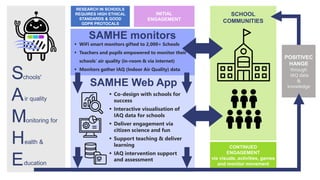
SAMHE Web App
POSITIVEC
HANGE
through
IAQ data
&
knowledge
SCHOOL
COMMUNITIES
CONTINUED
ENGAGEMENT
via visuals, activities, games
and monitor movement
 WiFi smart monitors gifted to 2,000+ Schools
 Teachers and pupils empowered to monitor their
schools’ air quality (in-room & via internet)
 Monitors gather IAQ (Indoor Air Quality) data
 Co-design with schools for
success
 Interactive visualisation of
IAQ data for schools
 Deliver engagement via
citizen science and fun
 Support teaching & deliver
learning
 IAQ intervention support
and assessment
S
A
M
H
E
chools'
ir quality
ealth &
onitoring for
ducation
RESEARCH IN SCHOOLS
REQUIRES HIGH ETHICAL
STANDARDS & GOOD
GDPR PROTOCALS
INITIAL
ENGAGEMENT
SAMHE monitors
SAMHE: Schools’ Air quality Monitoring
for Health and Education
• Project funded from 01/Aug/2022- 01/Aug/2024 by the EPSRC (Engineering and Physical Sciences Research
Council), with additional funds provided by the DfE to kick-start the project prior to Aug/22.
• Seeking to create a national scale resource of school air quality data with a focus on classrooms.
• Generate pupil and teacher engagement with their school’s air quality will support the project.
• Engagement via gifting monitors to schools, and via a bespoke online platform – the SAMHE Web App.
• Co-design and citizen science methods will be used to create and maintain engagement.
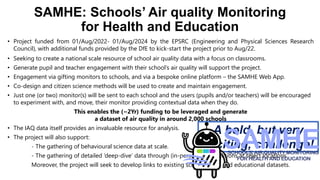
• Just one (or two) monitor(s) will be sent to each school and the users (pupils and/or teachers) will be encouraged
to experiment with, and move, their monitor providing contextual data when they do.
This enables the (~2Yr) funding to be leveraged and generate
a dataset of air quality in around 2,000 schools
• The IAQ data itself provides an invaluable resource for analysis.
• The project will also support:
- The gathering of behavioural science data at scale.
- The gathering of detailed ‘deep-dive’ data through (in-person) investigations at select locations.
Moreover, the project will seek to develop links to existing school health and educational datasets.
A bold, but very
exciting, challenge!
Institutions involved in SAMHE
SAMHE progress
Project delivery team:
• 26 academics, researchers, project co-ordinators, & developers
Steering Committee and Engagement Panel:
• 31 esteemed researchers, and experienced educationalists
Robust monitor procurement and evaluation against reference sensors
Co-design ongoing, with 20 schools
Timeseries database developed => scalable link sensor data API to SAMHE Web App
SAMHE Web App: beta version prepared for testing with 100+ schools during Nov & Dec 2022
Primary launch to schools early in 2023
Intended outcomes…
• Evidencing the viability of Web App based citizen science methods to gather national
scale school air quality data,
• Creation, hosting (for a period of at least 10 years), and maintenance of a national
scale school air quality,
• Behavioural science data gathered at scale via the SAMHE Web App,
• Data on the effectiveness of air quality interventions in schools,
• Smaller, supporting, high-fidelity data gathered at select locations via targeted
campaigns (including assessment of air quality interventions),
• Large-scale outreach and engagement activities concerning school air quality and
scientific methods in schools,
• Publications and reports on the state of air quality in UK schools,
• Development of, and linkages to, new projects and air quality observatories
concerning schools,
• Develop awareness and understanding of air quality in schools within their
communities.

Henry Burridge.pdf

  • 1.
    A tale of3(+) projects… Efforts to help deliver change to school air quality in the UK Reported by Dr Henry Burridge; e: h.Burridge@imperial.co.uk, tw: @HenryBurridge Work carried out be a group of 30+ individuals from 10+ institutions
  • 2.
    A tale of3(+) projects… How bad was air quality and ventilation in classrooms during the pandemic? • CIVOS – investigating ‘Changes In the Ventilation of Schools’ during 2021 and beyond… What can researchers do to help change school air quality in the here and now? • CIVOS – Phase 2 evidencing the effectiveness of remote ventilation behaviour training to leverage the DfE provision of CO2 monitors to schools • (+) – examining the potential for in-classroom observations and training to deliver improvements in classroom ventilation behaviours • Class-ACT – ‘Classroom Air Cleaning Technologies’ evidencing the impact of HEPA or UVC filter provision within classrooms What should researchers do to help change school air quality in the longer term? • SAMHE – ‘Schools’ Air quality Monitoring for Health and Education’
  • 3.
    Air quality &ventilation during the pandemic? • CIVOS – investigating ‘Changes In the Ventilation of Schools’ when monitoring CO2 during 2021 and beyond… Collaboration between the Department for Education, Department for Health & Social Care, UK Health Security Agency, University of Leeds and Imperial College London • Can display monitors help with ventilation provision in UK classrooms? • Can changes be sustained over time? 40 naturally ventilated classrooms in 4 schools (2 primary & 2 secondary) Phase 1: Unintrusive monitoring (temperature, RH, CO2) from the start of 2021
  • 4.
  • 5.
    Four schools and36 classrooms…
  • 6.
    Classroom temperatures inthe 4 schools during each study month
  • 7.
    Outdoor temperatures forthe 4 schools during each study month
  • 8.
    Temperature differences, betweenclassrooms and outdoors, for the 4 schools shown by month Indoor-outdoor temperature difference: • Potential to increase ventilation due to increased driving buoyancy force • Potential to if occupants shut windows due to thermal comfort challenge
  • 9.
  • 10.
    Why should wecare about CO2 levels? • Human breath is the dominant source of CO2 in classrooms • Ventilation is the dominant mean of diluting CO2 in classrooms CO2 levels during occupied hours indicates classroom per-person ventilation supply – excess CO2 (approximately) inversely proportional • CO2 levels good general indicator of air quality • High CO2 linked to decreases in cogitative function
  • 11.
    Classroom CO2 levelsin the 4 schools during each study month
  • 12.
  • 13.
  • 14.
    Classroom CO2 levelsin the 4 schools during each study month
  • 15.
    How much dothermal challenges influence ventilation?
  • 16.
    How much dothermal challenges influence ventilation?
  • 17.
    How much dothermal challenges influence ventilation?
  • 18.
    Untangling these trends… •During cold weather the driving potential (temperature difference) for natural ventilation is greatest • So too are the challenges of thermal comfort… • During `Cold 1’ the challenges were at their greatest • During `Cold 1’ COVID-19 resulted in the attention paid to ventilation also being at its greatest Take data from `Cold 1’ as a baseline of what ventilation levels can be achieved during cold weather…
  • 19.
    How did ventilationvary from `Cold 1’ levels?
  • 20.
    Air quality &ventilation during the pandemic? • Unique data set from within 36 classrooms throughout 2021— a year in which UK schools were in the grips of the COVID-19 pandemic. • Seasonal variations identified, investigation illustrates the thermal comfort needs, and possibly the desire to reduce energy costs, are the most likely causes. • Significant variations between notionally similar classrooms are consistent highlights further investigation required into: a) school classroom and building variation, and b) the role of the ventilation behaviours of classroom occupants. • Data highlights that in these classrooms (per-person) ventilation rates were significantly lower at the end of 2021 than at the beginning — possible reasons include: a) protocols for UK schools, b) the UK Government’s messaging, and c) the populations attitude towards the disease, throughout 2021 are likely contributors to this finding.
  • 21.
    What can researchersdo to help change school air quality in the here and now? CIVOS – Phase 2: evidencing the effectiveness of remote ventilation behaviour training to leverage the DfE provision of CO2 monitors to schools • Working during 2022 with the same 4 schools • CO2 monitors with in-room displays provided to all ‘intervention’ classrooms and compared to ‘control’ classrooms • Deliver ventilation behaviour training to classroom staff in a manner replicable at large-scale • Assess the impacts via monitored data, surveys of attitudes and focus groups to identify barriers • Challenged by engagement of classroom staff • Confounded by the DfE deployment CO2 monitors with in-room displays
  • 22.
    What can researchersdo to help change school air quality in the here and now? (+) – examining the potential for in-classroom observations and training to deliver improvements in classroom ventilation behaviours • Working in 10 classrooms within one London school • Gathering environmental quality data via monitors • Gathering contextual, behavioural, and architectural data via careful observational records during six weeks spent in classrooms • Deliver personalised CO2 monitor and ventilation training to classroom staff • Co-design bespoke classroom air quality plans with teachers
  • 23.
    What can researchersdo to help change school air quality in the here and now? Class-ACT – ‘Classroom Air Cleaning Technologies’ evidencing the impact of HEPA or UVC filter provision within classrooms • Environmental monitoring (temperature, RH, CO2, PMs, VOC) in 330+ classrooms in 30 schools within the Bradford area • Divided into: ‘Control’ (no interventions), ‘HEPA’, and ‘UV’ schools • Environmental data analysed • School attendance data gathered from across the Bradford area Does this data show meaningful impact on attendance (=> infection) within the HEPA and/or UV schools? • Challenged by logistics (from plug sockets, to noise and heat) • Quality assurance on data at this scale is an enormous undertaking
  • 24.
    What should researchersdo to help change school air quality in the longer term? SAMHE – ‘Schools’ Air quality Monitoring for Health and Education’
  • 25.
    SAMHE: Schools’ Airquality Monitoring for Health and Education • Project funded from 01/Aug/2022- 01/Aug/2024 by the EPSRC (Engineering and Physical Sciences Research Council), with additional funds provided by the DfE to kick-start the project prior to Aug/22. • Seeking to create a national scale resource of school air quality data with a focus on classrooms. • Generate pupil and teacher engagement with their school’s air quality will support the project. • Engagement via gifting monitors to schools, and via a bespoke online platform – the SAMHE Web App. • Co-design and citizen science methods will be used to create and maintain engagement.
  • 26.
    SAMHE Web App POSITIVEC HANGE through IAQdata & knowledge SCHOOL COMMUNITIES CONTINUED ENGAGEMENT via visuals, activities, games and monitor movement  WiFi smart monitors gifted to 2,000+ Schools  Teachers and pupils empowered to monitor their schools’ air quality (in-room & via internet)  Monitors gather IAQ (Indoor Air Quality) data  Co-design with schools for success  Interactive visualisation of IAQ data for schools  Deliver engagement via citizen science and fun  Support teaching & deliver learning  IAQ intervention support and assessment S A M H E chools' ir quality ealth & onitoring for ducation RESEARCH IN SCHOOLS REQUIRES HIGH ETHICAL STANDARDS & GOOD GDPR PROTOCALS INITIAL ENGAGEMENT SAMHE monitors
  • 27.
    SAMHE: Schools’ Airquality Monitoring for Health and Education • Project funded from 01/Aug/2022- 01/Aug/2024 by the EPSRC (Engineering and Physical Sciences Research Council), with additional funds provided by the DfE to kick-start the project prior to Aug/22. • Seeking to create a national scale resource of school air quality data with a focus on classrooms. • Generate pupil and teacher engagement with their school’s air quality will support the project. • Engagement via gifting monitors to schools, and via a bespoke online platform – the SAMHE Web App. • Co-design and citizen science methods will be used to create and maintain engagement. • Just one (or two) monitor(s) will be sent to each school and the users (pupils and/or teachers) will be encouraged to experiment with, and move, their monitor providing contextual data when they do. This enables the (~2Yr) funding to be leveraged and generate a dataset of air quality in around 2,000 schools • The IAQ data itself provides an invaluable resource for analysis. • The project will also support: - The gathering of behavioural science data at scale. - The gathering of detailed ‘deep-dive’ data through (in-person) investigations at select locations. Moreover, the project will seek to develop links to existing school health and educational datasets. A bold, but very exciting, challenge!
  • 28.
  • 29.
    SAMHE progress Project deliveryteam: • 26 academics, researchers, project co-ordinators, & developers Steering Committee and Engagement Panel: • 31 esteemed researchers, and experienced educationalists Robust monitor procurement and evaluation against reference sensors Co-design ongoing, with 20 schools Timeseries database developed => scalable link sensor data API to SAMHE Web App SAMHE Web App: beta version prepared for testing with 100+ schools during Nov & Dec 2022 Primary launch to schools early in 2023
  • 30.
    Intended outcomes… • Evidencingthe viability of Web App based citizen science methods to gather national scale school air quality data, • Creation, hosting (for a period of at least 10 years), and maintenance of a national scale school air quality, • Behavioural science data gathered at scale via the SAMHE Web App, • Data on the effectiveness of air quality interventions in schools, • Smaller, supporting, high-fidelity data gathered at select locations via targeted campaigns (including assessment of air quality interventions), • Large-scale outreach and engagement activities concerning school air quality and scientific methods in schools, • Publications and reports on the state of air quality in UK schools, • Development of, and linkages to, new projects and air quality observatories concerning schools, • Develop awareness and understanding of air quality in schools within their communities.