The Dynamics of Knowledge Creation project team:
Presenter: Ibrar Bhatt (@ibrar_bhatt)
Sharon McCulloch, Karin Tusting, David Barton, Mary Hamilton.
Literacy Research Centre, Lancaster University
Departments of Linguistics and of Educational Research
Funded by the Economic and Social Research Council, UK
http://wp.lancs.ac.uk/acadswriting
The changing writing practices of
academics and how they influence
professional identity
Research aims
• Uncovering the writing practices academics engage
in to create and communicate knowledge
– Many different kinds of writing > Interested in all
types of writing, not just scholarly
– Carried out in particular working conditions > How
changing context and conditions of academic
workplace in the UK are shaping processes of
knowledge creation
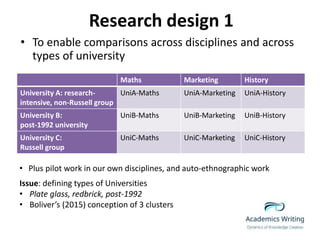
Research design 1
• To enable comparisons across disciplines and across
types of university
Maths Marketing History
University A: research-
intensive, non-Russell group
UniA-Maths UniA-Marketing UniA-History
University B:
post-1992 university
UniB-Maths UniB-Marketing UniB-History
University C:
Russell group
UniC-Maths UniC-Marketing UniC-History
• Plus pilot work in our own disciplines, and auto-ethnographic work
Issue: defining types of Universities
• Plate glass, redbrick, post-1992
• Boliver’s (2015) conception of 3 clusters
Research design 2
• Adopting a social practice approach to literacy and a
sociomaterial perspective
• To understand academics’ writing practices in detail,
we conceive them as literacy practices (Barton 2007)
– their contexts: institution, discipline
– their life histories
– experiences and perspectives
– analysing the materiality of tools and resources
The changing nature of academia
• Scholarly writing: Creativity, autonomy &
purpose, metrics
• Teaching related writing: (TEF, NSS)
• Managerialism (REF, ‘impact’) & audit culture
(Strathern 2000)
• Other transformations: Changing spaces of
work (Temple 2007); digitisation (Goodfellow
& Lea 2013)
= forcing newer writing in uncharted forums
Building on previous research
• Much work in the field of academic writing focuses on students’
learning (e.g. Lillis & Scott 2008)
• The linguistic aspects of academic genres (e.g. Myers 1990)
• Academics’ writing as a workplace practice (e.g. Lea & Stierer
2009, 2011)
• Writing and departmental culture (Swales 1998)
• Academic disciplinary practices (Becher & Trowler 2001)
• The work of knowledge production (Latour 1986)
• The morphing professional role of academics (Macfarlane 2011)
• The impact of impact (Knowles and Burrows 2014)
Our findings so far (1):
writing and autonomy
The disciplinary identity may demand and /or nurture a certain autonomy
What I most enjoy is a sense of freedom to do what I want, the autonomy that
comes from determining my own research interests, trying to bring that
research into my teaching. I suppose it's a combination of feeling that I can
determine my own research direction and also try and enthuse students about
the things that interest me. That's what I most enjoy about the job.
(Colin, History at Uni C)
I am senior lecturer in the Business School … but on my business cards I
actually have ‘senior lecturer and researcher in business’
(James, Marketing at Uni B)
Managerial directives may threaten this autonomy, with
competing demands on time, space and attention.
The most important seminar for a historian is the special subject,
and we used to have control of those in our offices ...I wouldn't
do any writing on campus. Any serious writing for research, I
would basically do at home in my study.
(Rebecca, History at Uni A)
[Regarding the REF] It’s changed what’s being researched, how
it’s being presented and where it goes, in a smaller and smaller
and narrower minded community.
(Diane, Marketing at Uni A)
Our findings so far (2):
writing, identity and engaging
The disciplinary identity may require engagement with wider publics
It’s an accountability thing, if you’re paid through public money than I think
part of the duty is then to try to engage with the public about what the
money is used for. (Robert, Maths at Uni C)
Until 10 or 15 years ago, it was seen as wasting your time. I think more and
more the university has become aware that they have a responsibility
beyond academia and to communicate and so on. It's not exactly something
that you would encourage a starting lecturer to do because there are just too
many things and you've got to establish yourself in various ways. Once
you've reached a certain age, it's not a bad thing to be thinking about
explaining maths. Also trying to get the next generation of mathematicians
engaged and interested.
(Robert, Maths Uni C)
This engagement may expand the disciplinary identity
I was quite excited because there was a conversation with Owen
Jones…he’s written a book about chavs. He said, “Aspiration is
the language of New Labour and social exclusion. Read Don
Robinson’s brilliant book on the underclass”. It was quite a
provocative, controversial point to make and was re-tweeted
quite extensively. It’s made me more visible among academics
and not so much historians but sociologists.
(Don, History at Uni A)
The disciplinary identity is constant
I always do have, essentially in my pocket or somewhere, something I
can scribble something down on… if I get an idea … I’ll try to start
working it out on the spot. It doesn’t leave my head, so when I get to
sit down at a desk or somewhere I’ll probably try to sketch it out if it’s
still surviving. It’s all very ad hoc. It’s just a piece of A4 paper folded up
into bits typically in my pocket.
(Will, Maths at Uni C)
I'm a marketer ... I had a career in marketing before I came into
academia. Yes, sometimes I forget that I'm supposed to be an
academic, and in my lectures I will start talking about what it’s like in
the real world. I have to be a bit careful of that.
(Emma, Marketing at Uni C)
Summary
• Digitally networked collaborations enable
disciplinary movements & newer identity
formations
• Pressures to publish in a narrow range of high-
ranking journals contrast with pressures to
publish beyond one’s own discipline (or new
forums e.g. The Conversation) = new genres
• ….
More information
• Phase 2, detailed observations of writing
practices recorded in real-time using screen
grab + LiveScribe recordings
• To follow the project’s progress:
– http://wp.lancs.ac.uk/acadswriting/

Acads writing srhe 2015

  • 1.
    The Dynamics ofKnowledge Creation project team: Presenter: Ibrar Bhatt (@ibrar_bhatt) Sharon McCulloch, Karin Tusting, David Barton, Mary Hamilton. Literacy Research Centre, Lancaster University Departments of Linguistics and of Educational Research Funded by the Economic and Social Research Council, UK http://wp.lancs.ac.uk/acadswriting The changing writing practices of academics and how they influence professional identity
  • 2.
    Research aims • Uncoveringthe writing practices academics engage in to create and communicate knowledge – Many different kinds of writing > Interested in all types of writing, not just scholarly – Carried out in particular working conditions > How changing context and conditions of academic workplace in the UK are shaping processes of knowledge creation
  • 3.
    Research design 1 •To enable comparisons across disciplines and across types of university Maths Marketing History University A: research- intensive, non-Russell group UniA-Maths UniA-Marketing UniA-History University B: post-1992 university UniB-Maths UniB-Marketing UniB-History University C: Russell group UniC-Maths UniC-Marketing UniC-History • Plus pilot work in our own disciplines, and auto-ethnographic work Issue: defining types of Universities • Plate glass, redbrick, post-1992 • Boliver’s (2015) conception of 3 clusters
  • 4.
    Research design 2 •Adopting a social practice approach to literacy and a sociomaterial perspective • To understand academics’ writing practices in detail, we conceive them as literacy practices (Barton 2007) – their contexts: institution, discipline – their life histories – experiences and perspectives – analysing the materiality of tools and resources
  • 5.
    The changing natureof academia • Scholarly writing: Creativity, autonomy & purpose, metrics • Teaching related writing: (TEF, NSS) • Managerialism (REF, ‘impact’) & audit culture (Strathern 2000) • Other transformations: Changing spaces of work (Temple 2007); digitisation (Goodfellow & Lea 2013) = forcing newer writing in uncharted forums
  • 6.
    Building on previousresearch • Much work in the field of academic writing focuses on students’ learning (e.g. Lillis & Scott 2008) • The linguistic aspects of academic genres (e.g. Myers 1990) • Academics’ writing as a workplace practice (e.g. Lea & Stierer 2009, 2011) • Writing and departmental culture (Swales 1998) • Academic disciplinary practices (Becher & Trowler 2001) • The work of knowledge production (Latour 1986) • The morphing professional role of academics (Macfarlane 2011) • The impact of impact (Knowles and Burrows 2014)
  • 7.
    Our findings sofar (1): writing and autonomy The disciplinary identity may demand and /or nurture a certain autonomy What I most enjoy is a sense of freedom to do what I want, the autonomy that comes from determining my own research interests, trying to bring that research into my teaching. I suppose it's a combination of feeling that I can determine my own research direction and also try and enthuse students about the things that interest me. That's what I most enjoy about the job. (Colin, History at Uni C) I am senior lecturer in the Business School … but on my business cards I actually have ‘senior lecturer and researcher in business’ (James, Marketing at Uni B)
  • 8.
    Managerial directives maythreaten this autonomy, with competing demands on time, space and attention. The most important seminar for a historian is the special subject, and we used to have control of those in our offices ...I wouldn't do any writing on campus. Any serious writing for research, I would basically do at home in my study. (Rebecca, History at Uni A) [Regarding the REF] It’s changed what’s being researched, how it’s being presented and where it goes, in a smaller and smaller and narrower minded community. (Diane, Marketing at Uni A)
  • 9.
    Our findings sofar (2): writing, identity and engaging The disciplinary identity may require engagement with wider publics It’s an accountability thing, if you’re paid through public money than I think part of the duty is then to try to engage with the public about what the money is used for. (Robert, Maths at Uni C) Until 10 or 15 years ago, it was seen as wasting your time. I think more and more the university has become aware that they have a responsibility beyond academia and to communicate and so on. It's not exactly something that you would encourage a starting lecturer to do because there are just too many things and you've got to establish yourself in various ways. Once you've reached a certain age, it's not a bad thing to be thinking about explaining maths. Also trying to get the next generation of mathematicians engaged and interested. (Robert, Maths Uni C)
  • 10.
    This engagement mayexpand the disciplinary identity I was quite excited because there was a conversation with Owen Jones…he’s written a book about chavs. He said, “Aspiration is the language of New Labour and social exclusion. Read Don Robinson’s brilliant book on the underclass”. It was quite a provocative, controversial point to make and was re-tweeted quite extensively. It’s made me more visible among academics and not so much historians but sociologists. (Don, History at Uni A)
  • 11.
    The disciplinary identityis constant I always do have, essentially in my pocket or somewhere, something I can scribble something down on… if I get an idea … I’ll try to start working it out on the spot. It doesn’t leave my head, so when I get to sit down at a desk or somewhere I’ll probably try to sketch it out if it’s still surviving. It’s all very ad hoc. It’s just a piece of A4 paper folded up into bits typically in my pocket. (Will, Maths at Uni C) I'm a marketer ... I had a career in marketing before I came into academia. Yes, sometimes I forget that I'm supposed to be an academic, and in my lectures I will start talking about what it’s like in the real world. I have to be a bit careful of that. (Emma, Marketing at Uni C)
  • 12.
    Summary • Digitally networkedcollaborations enable disciplinary movements & newer identity formations • Pressures to publish in a narrow range of high- ranking journals contrast with pressures to publish beyond one’s own discipline (or new forums e.g. The Conversation) = new genres • ….
  • 13.
    More information • Phase2, detailed observations of writing practices recorded in real-time using screen grab + LiveScribe recordings • To follow the project’s progress: – http://wp.lancs.ac.uk/acadswriting/

Editor's Notes

  • #8 roblematize the notion of autonomy a bit – where this comes from, what counts as autonomy in different disciplines, and what else might shape it besides managerialism which sorts of managerial directives threaten their sense of autonomy (slide 7) writing and autonomy, I noticed some interesting use of ‘my own stuff’ to contrast with ‘work stuff’ when looking at the data this morning – not for now maybe but when we pursue the ‘what counts as work’ idea, there’s stuff in there about autonomy and ownership.  Findings so far (2) slide looks like at least 2 different points, and the third point on it links to the last point on findings so far (1).  Agree would benefit from more data extracts too. UCLAN participant was also one of a slightly more cautious approach, or an awareness that they are acting as representatives of the institution and not as independent scholars, which was very much the impression that I got from Manchester people, for example. That might be partly to do with age and experience, as well as or rather than the institution.   
  • #14 Powerpoint slides will go up on blog