Learn About Rigging & Lifting Hooks
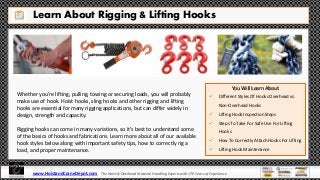
Whether you’re lifting, pulling, towing or securing loads, you will probably
make use of hook. Hoist hooks, sling hooks and other rigging and lifting
hooks are essential for many rigging applications, but can differ widely in
design, strength and capacity.
Rigging hooks can come in many variations, so it’s best to understand some
of the basics of hooks and fabrications. Learn more about all of our available
hook styles below along with important safety tips, how to correctly rig a
load, and proper maintenance.
www.HoistandCraneDepot.com The Hoist & Overhead Material Handling Experts with 170 Years of Experience
You Will Learn About
 Different Styles Of Hooks Overhead vs.
Non-Overhead Hooks
 Lifting Hook Inspection Steps
 Steps To Take For Safe Use For Lifting
Hook s
 How To Correctly Attach Hooks For Lifting
 Lifting Hook Maintenance
Types Of Rigging Hooks: Overhead vs. Non-Overhead
Overhead OVERHEAD HOOK TYPES
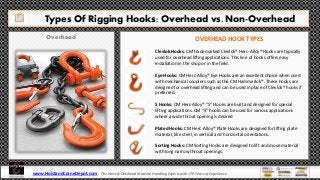
Clevlok Hooks: CM trademarked Clevlok® Herc-Alloy® Hooks are typically
used for overhead lifting applications. This line of hooks offers easy
installation in the shop or in the field.
Eye Hooks: CM Herc-Alloy® Eye Hooks are an excellent choice when used
with mechanical couplers such as the CM Hammerlok®. These hooks are
designed for overhead lifting and can be used in place of Clevlok® hooks if
preferred.
S Hooks: CM Herc-Alloy® “S” Hooks are built and designed for special
lifting applications. CM “S” hooks can be used for various applications
where a wide throat opening is desired
Plated Hooks: CM Herc-Alloy® Plate Hooks are designed for lifting plate
material, like steel, in vertical and horizontal orientations.
Sorting Hooks: CM Sorting Hooks are designed to lift and move material
with long narrow throat openings.
www.HoistandCraneDepot.com The Hoist & Overhead Material Handling Experts with 170 Years of Experience
Types Of Rigging Hooks: Overhead vs. Non-Overhead
Non-Overhead NON-OVERHEAD HOOK TYPES
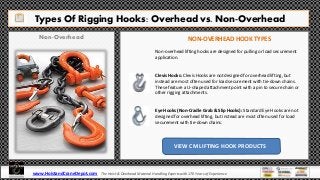
Non-overhead lifting hooks are designed for pulling or load securement
application.
Clevis Hooks: Clevis Hooks are not designed for overhead lifting, but
instead are most often used for load securement with tie-down chains.
These feature a U-shaped attachment point with a pin to secure chain or
other rigging attachments.
Eye Hooks (Non-Cradle Grab & Slip Hooks): Standard Eye Hooks are not
designed for overhead lifting, but instead are most often used for load
securement with tie-down chains.
www.HoistandCraneDepot.com The Hoist & Overhead Material Handling Experts with 170 Years of Experience
VIEW CM LIFTING HOOK PRODUCTS
Inspection Steps Before Using Rigging Hooks
Inspection RIGGING & LIFTING HOOK INSPECTION
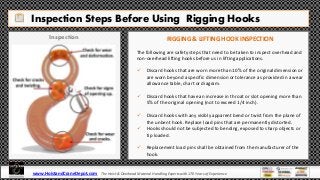
The following are safety steps that need to be taken to inspect overhead and
non-overhead lifting hooks before us in lifting applications.
 Discard hooks that are worn more than 10% of the original dimension or
are worn beyond a specific dimension or tolerance as provided in a wear
allowance table, chart or diagram.
 Discard hooks that have an increase in throat or slot opening more than
5% of the original opening (not to exceed 1/4 inch).
 Discard hooks with any visibly apparent bend or twist from the plane of
the unbent hook. Replace load pins that are permanently distorted.
 Hooks should not be subjected to bending, exposed to sharp objects or
tip loaded.
 Replacement load pins shall be obtained from the manufacturer of the
hook.
www.HoistandCraneDepot.com The Hoist & Overhead Material Handling Experts with 170 Years of Experience
Safety Steps Before Using Rigging Hooks
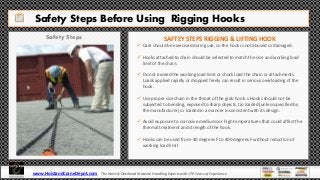
Safety Steps SAFTEY STEPS RIGGING & LIFTING HOOK
 Care should be exercised during use, so the hook is not abused or damaged.
 Hooks attached to chain should be selected to match the size and working load
limit of the chain.
 Do not exceed the working load limit or shock load the chain or attachments.
Loads applied rapidly or dropped freely can result in serious overloading of the
hook.
 Use proper size chain in the throat of the grab hook. s Hooks should not be
subjected to bending, exposed to sharp objects, tip loaded (unless specified by
the manufacturer) or loaded in a manner inconsistent with its design.
 Avoid exposure to corrosive mediums or high temperatures that could affect the
thermal treatment and strength of the hook.
 Hooks can be used from -40 degrees F to 400 degrees F without reduction of
working load limit
www.HoistandCraneDepot.com The Hoist & Overhead Material Handling Experts with 170 Years of Experience
Correct Lifting Operation With Hooks
Incorrect Attachments
www.HoistandCraneDepot.com The Hoist & Overhead Material Handling Experts with 170 Years of Experience
Correct Lifting Operation With Hooks
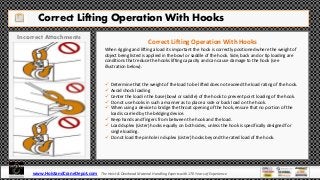
When rigging and lifting a load its important the hook is correctly positioned where the weight of
object being listed is applied in the bowl or saddle of the hook. Side, back and or tip loading are
conditions that reduce the hooks lifting capacity and can cause damage to the hook (see
illustration below).
 Determine that the weight of the load to be lifted does not exceed the load rating of the hook.
 Avoid shock loading
 Center the load in the base (bowl or saddle) of the hook to prevent point loading of the hook.
 Do not use hooks in such a manner as to place a side or back load on the hook.
 When using a device to bridge the throat opening of the hook, ensure that no portion of the
load is carried by the bridging device.
 Keep hands and fingers from between the hook and the load.
 Load duplex (sister) hooks equally on both sides, unless the hook is specifically designed for
single loading.
 Do not load the pinhole in duplex (sister) hooks beyond the rated load of the hook.
Proper Rigging Hooks Care & Maintenance
MAINTENANCE STEPS FOR PROPER HOOK MAINTENANCE
 A hook latch that is inoperative or missing shall be repaired or replaced.
 A hook with a latch that does not bridge the throat opening shall be
removed from service until the latch is replaced or repaired and the hook is
examined for deformation with special attention to the throat opening.
 A designated person shall repair cracks, nicks, and gouges by grinding
longitudinally, following the contour of the hook, provided no dimension is
reduced more than 10 percent (or as recommended by the manufacturer) of
its original value.
 All other repairs shall be performed by the manufacturer or a qualified
person.
 Replacement parts, such as load pins for clevis hooks, shall be at least equal
to the original manufacturer’s specifications.
www.HoistandCraneDepot.com The Hoist & Overhead Material Handling Experts with 170 Years of Experience
Rigging & Lifting Products
View our rigging and lifting products by clicking on a category below. If you need help or do not see rigging hardware needed for
your application we are confident we can get what you need. Give our experts a call at 1.866.464.7823
Rigging & Lifting Hooks
We Also Offer
Rigging & Lifting Slings
Rigging & Lifting Shackles
Controlled Descent Systems
Shop All Lifting Equipment
• Hoists
• Cranes
• Pendants Stations
• Festoon Cable
• Hoist Trolleys
• Lifting Slings
www.HoistandCraneDepot.com The Hoist & Overhead Material Handling Experts with 170 Years of Experience
• Festoon Systems
• Hoist Trolley’s
• Lift Tables

Rigging & Lifting Hooks Types, Safety, Inspection

  • 1.
    Learn About Rigging& Lifting Hooks Whether you’re lifting, pulling, towing or securing loads, you will probably make use of hook. Hoist hooks, sling hooks and other rigging and lifting hooks are essential for many rigging applications, but can differ widely in design, strength and capacity. Rigging hooks can come in many variations, so it’s best to understand some of the basics of hooks and fabrications. Learn more about all of our available hook styles below along with important safety tips, how to correctly rig a load, and proper maintenance. www.HoistandCraneDepot.com The Hoist & Overhead Material Handling Experts with 170 Years of Experience You Will Learn About  Different Styles Of Hooks Overhead vs. Non-Overhead Hooks  Lifting Hook Inspection Steps  Steps To Take For Safe Use For Lifting Hook s  How To Correctly Attach Hooks For Lifting  Lifting Hook Maintenance
  • 2.
    Types Of RiggingHooks: Overhead vs. Non-Overhead Overhead OVERHEAD HOOK TYPES Clevlok Hooks: CM trademarked Clevlok® Herc-Alloy® Hooks are typically used for overhead lifting applications. This line of hooks offers easy installation in the shop or in the field. Eye Hooks: CM Herc-Alloy® Eye Hooks are an excellent choice when used with mechanical couplers such as the CM Hammerlok®. These hooks are designed for overhead lifting and can be used in place of Clevlok® hooks if preferred. S Hooks: CM Herc-Alloy® “S” Hooks are built and designed for special lifting applications. CM “S” hooks can be used for various applications where a wide throat opening is desired Plated Hooks: CM Herc-Alloy® Plate Hooks are designed for lifting plate material, like steel, in vertical and horizontal orientations. Sorting Hooks: CM Sorting Hooks are designed to lift and move material with long narrow throat openings. www.HoistandCraneDepot.com The Hoist & Overhead Material Handling Experts with 170 Years of Experience
  • 3.
    Types Of RiggingHooks: Overhead vs. Non-Overhead Non-Overhead NON-OVERHEAD HOOK TYPES Non-overhead lifting hooks are designed for pulling or load securement application. Clevis Hooks: Clevis Hooks are not designed for overhead lifting, but instead are most often used for load securement with tie-down chains. These feature a U-shaped attachment point with a pin to secure chain or other rigging attachments. Eye Hooks (Non-Cradle Grab & Slip Hooks): Standard Eye Hooks are not designed for overhead lifting, but instead are most often used for load securement with tie-down chains. www.HoistandCraneDepot.com The Hoist & Overhead Material Handling Experts with 170 Years of Experience VIEW CM LIFTING HOOK PRODUCTS
  • 4.
    Inspection Steps BeforeUsing Rigging Hooks Inspection RIGGING & LIFTING HOOK INSPECTION The following are safety steps that need to be taken to inspect overhead and non-overhead lifting hooks before us in lifting applications.  Discard hooks that are worn more than 10% of the original dimension or are worn beyond a specific dimension or tolerance as provided in a wear allowance table, chart or diagram.  Discard hooks that have an increase in throat or slot opening more than 5% of the original opening (not to exceed 1/4 inch).  Discard hooks with any visibly apparent bend or twist from the plane of the unbent hook. Replace load pins that are permanently distorted.  Hooks should not be subjected to bending, exposed to sharp objects or tip loaded.  Replacement load pins shall be obtained from the manufacturer of the hook. www.HoistandCraneDepot.com The Hoist & Overhead Material Handling Experts with 170 Years of Experience
  • 5.
    Safety Steps BeforeUsing Rigging Hooks Safety Steps SAFTEY STEPS RIGGING & LIFTING HOOK  Care should be exercised during use, so the hook is not abused or damaged.  Hooks attached to chain should be selected to match the size and working load limit of the chain.  Do not exceed the working load limit or shock load the chain or attachments. Loads applied rapidly or dropped freely can result in serious overloading of the hook.  Use proper size chain in the throat of the grab hook. s Hooks should not be subjected to bending, exposed to sharp objects, tip loaded (unless specified by the manufacturer) or loaded in a manner inconsistent with its design.  Avoid exposure to corrosive mediums or high temperatures that could affect the thermal treatment and strength of the hook.  Hooks can be used from -40 degrees F to 400 degrees F without reduction of working load limit www.HoistandCraneDepot.com The Hoist & Overhead Material Handling Experts with 170 Years of Experience
  • 6.
    Correct Lifting OperationWith Hooks Incorrect Attachments www.HoistandCraneDepot.com The Hoist & Overhead Material Handling Experts with 170 Years of Experience Correct Lifting Operation With Hooks When rigging and lifting a load its important the hook is correctly positioned where the weight of object being listed is applied in the bowl or saddle of the hook. Side, back and or tip loading are conditions that reduce the hooks lifting capacity and can cause damage to the hook (see illustration below).  Determine that the weight of the load to be lifted does not exceed the load rating of the hook.  Avoid shock loading  Center the load in the base (bowl or saddle) of the hook to prevent point loading of the hook.  Do not use hooks in such a manner as to place a side or back load on the hook.  When using a device to bridge the throat opening of the hook, ensure that no portion of the load is carried by the bridging device.  Keep hands and fingers from between the hook and the load.  Load duplex (sister) hooks equally on both sides, unless the hook is specifically designed for single loading.  Do not load the pinhole in duplex (sister) hooks beyond the rated load of the hook.
  • 7.
    Proper Rigging HooksCare & Maintenance MAINTENANCE STEPS FOR PROPER HOOK MAINTENANCE  A hook latch that is inoperative or missing shall be repaired or replaced.  A hook with a latch that does not bridge the throat opening shall be removed from service until the latch is replaced or repaired and the hook is examined for deformation with special attention to the throat opening.  A designated person shall repair cracks, nicks, and gouges by grinding longitudinally, following the contour of the hook, provided no dimension is reduced more than 10 percent (or as recommended by the manufacturer) of its original value.  All other repairs shall be performed by the manufacturer or a qualified person.  Replacement parts, such as load pins for clevis hooks, shall be at least equal to the original manufacturer’s specifications. www.HoistandCraneDepot.com The Hoist & Overhead Material Handling Experts with 170 Years of Experience
  • 8.
    Rigging & LiftingProducts View our rigging and lifting products by clicking on a category below. If you need help or do not see rigging hardware needed for your application we are confident we can get what you need. Give our experts a call at 1.866.464.7823 Rigging & Lifting Hooks We Also Offer Rigging & Lifting Slings Rigging & Lifting Shackles Controlled Descent Systems Shop All Lifting Equipment • Hoists • Cranes • Pendants Stations • Festoon Cable • Hoist Trolleys • Lifting Slings www.HoistandCraneDepot.com The Hoist & Overhead Material Handling Experts with 170 Years of Experience • Festoon Systems • Hoist Trolley’s • Lift Tables