TLS INTERCEPTION
CONSIDERED HARMFUL
ABOUT ME
Hanno Böck, https://hboeck.de/
Freelance journalist (often Golem.de)
Fuzzing free software (Core Infrastructure
Initiative)
TLS VULNERABILITIES
BEAST, CRIME, Lucky13, FREAK, SKIP, POODLE,
Heartbleed, Logjam, MACE, ...
BEAST
Exploits known issue in CBC mode of TLS 1.0 /
SSL 3.0.
Fix: Use TLS 1.1/1.2.
Workaround: 1/n-1 record splitting.
CRIME
Compression leaks information about
encrypted data.
Solution: Disable compression.
LUCKY THIRTEEN
TLS does MAC-then-Pad-then-Encrypt.
Timing sidechannel: separating MAC errors
from padding errors.
Workaround: Timing safe implementation
(difficult).
Solution: TLS 1.2 with Authenticated Encryption
(only AES-GCM).
POODLE
SSLv3 allows arbitrary content in padding.
Solution for SSLv3: Don't use it.
Solution for TLS: Check padding (must be
zeros).
FORWARD SECRECY
Create a temporary key for each connection.
Protects from later key leakage.
Hardly any reason not to use FS.
LESSONS LEARNED
Security bugs in the protocol.
Only TLS 1.2 using AES-GCM with Forward
Secrecy considered safe.
TLS 1.0 with mitigations required for legacy
support, complicated.
CERTIFICATE AUTHORITIES
Hundreds of CAs and sub-CAs.
Each can issue certs for all domains.
System is only as secure as the worst CA.
CERTIFICATE AUTHORITIES
Misissuance of certificate happens often:
Comodo, Türktrust, CNNIC, IndiaCCA, Diginotar,
ANSSI, ...
SOLUTIONS
Many proposals (Sovereign keys, TACK,
Convergence, DANE, ...).
Most of them never got deployed widely.
HTTP PUBLIC KEY PINNING
(HPKP)
First widely deployed mitigation for CA failures
(Chrome and Firefox).
Browsers also contain list of pre-pinned hosts.
CERTIFICATE
TRANSPARENCY
Public log of all certificates.
Promising, but only partly deployed yet.
Chrome has preliminary support.
CONCLUSION
Mitigations for Certificate Authority problems
are finally coming.
Proper certificate verification requires
knowledge about current developments.
HTTPS USE IS GROWING
... and that's a good thing.
Certificates no longer expensive (StartSSL,
Wosign, Let's encrypt).
HTTPS guarantees secrecy and integrity (often
forgotten).
WEB TRAFFIC INTERCEPTION
Products want to manipulate web traffic.
"Enterprise" security products, Antiviruses,
Parental control, Adblockers, Ad injection, ...
HTTPS MAN-IN-THE-MIDDLE
PROXIES
HTTPS guarantees secrecy and integrity(!).
"Solution": Let's install a certificate in the
user's browser and do a Man-in-the-Middle-
attack.
SUPERFISH
Analyzes images on webpages and provides
matching ads.
Preinstalled on many Lenovo Laptops.
SHARED CERTIFICATE
All installations of Superfish used the same root
certificate.
Problem: Private key can be extracted.
KOMODIA SAN BUG
Komodia products had another bug with
Subject Alternative Name.
Allows generic TLS interception for all products
using Komodia.
LAVASOFT / AD-ADWARE
"Lavasoft’s most recent release of Ad-Aware
Web Companion (released on February 18th
2015) does not include this capability, but we
are not yet able to confirm with certainty that
the compromised component of the Komodia
SSL Digestor has been removed." (Lavasoft
Facebook page)
LAVASOFT / AD-ADWARE
Or in other words: We have a severe security
vulnerability and we're not really sure if we
fixed it.
PRIVDOG
Privdog is a startup founded by Melih
Abdulhayoğlu (CEO of Comodo).
It replaces "dangerous" ads with its own ads.
NO VERIFICATION OF
CERTIFICATES
Privdog does not use a shared cert (we'll get
back to that later).
But it did not verify certificates at all.
By the way: It also sent home all URLs visited in
clear text.
ANTIVIRUS APPLICATIONS
INTERCEPTING TLS
Analysis of Avira, Kaspersky, ESET.
None as bad as Superfish/Privdog, but all of
them lowered TLS security in one way or
another.
KASPERSKY / FREAK
FREAK vulnerability: OpenSSL bug allowed
downgrade to export ciphers with 512 bit.
Shortly after FREAK Kaspersky user warned
about it in support forum.
1.5 months later it was still not fixed.
BREAKING HPKP
Shouldn't Key Pinning prevent TLS interception
from happening?
Browsers compromised: Didn't want to break
all TLS interception products.
Manually installed certs override key pinning.
No TLS interception software I tested checked
key pinning header.
RESPONSIBILITY SHIFT
If products intercept TLS they are responsible
for certificate validation and TLS
implementation quality.
Are they qualified?
ADGUARD
Regenerates cert, but always with same key.
Chooses one out of 10 keys depending on CPU.
NETFILTER SDK
Adguard relied on Netfilter SDK (file
ProtocolFilters.dll).
Shared key can be trivially extracted.
MEET PRIVDOG AGAIN
PrivDog also uses shared key.
It was completely broken in two different ways.
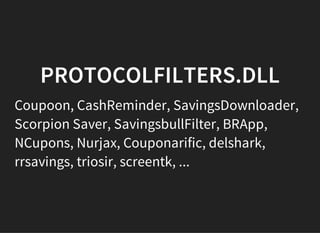
PROTOCOLFILTERS.DLL
Coupoon, CashReminder, SavingsDownloader,
Scorpion Saver, SavingsbullFilter, BRApp,
NCupons, Nurjax, Couponarific, delshark,
rrsavings, triosir, screentk, ...
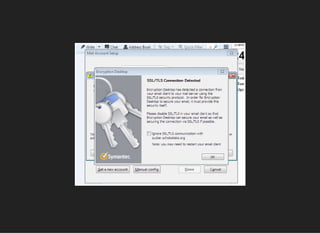
SYMANTEC DESKTOP EMAIL
ENCRYPTION
The software formerly known as PGP.
Only does TLS 1.0 without Forward Secrecy.
ENTERPRISE APPLIANCES
Open question: How bad are they?
Contact me if you have access.
"ENTERPRISE" TLS
F5 "we don't accept handshakes between 256
and 512 bytes" bug
POODLE TLS (F5, A10, Cisco, Check Point,
Juniper, IBM)
MACE: Missing MAC and Finished message
check (Cisco, Fortinet, F5, Juniper)
ALTERNATIVES
For many of the products that use TLS
interception the question is whether they
should exist at all.
If you want to modify traffic with user's consent
do it after the encryption (e. g. browser
extension).
TAKEAWAYS
"Potentially unwanted applications" are a
severe securiy threat.
It should be considered malpractice.
TAKEAWAYS
TLS interception is dangerous.
Nobody gets it right.
Even security products fail.
Don't mess with our TLS connections.
https://github.com/hannob/superfishy
Questions? Discussion?

TLS Interception considered harmful (Chaos Communication Camp 2015)