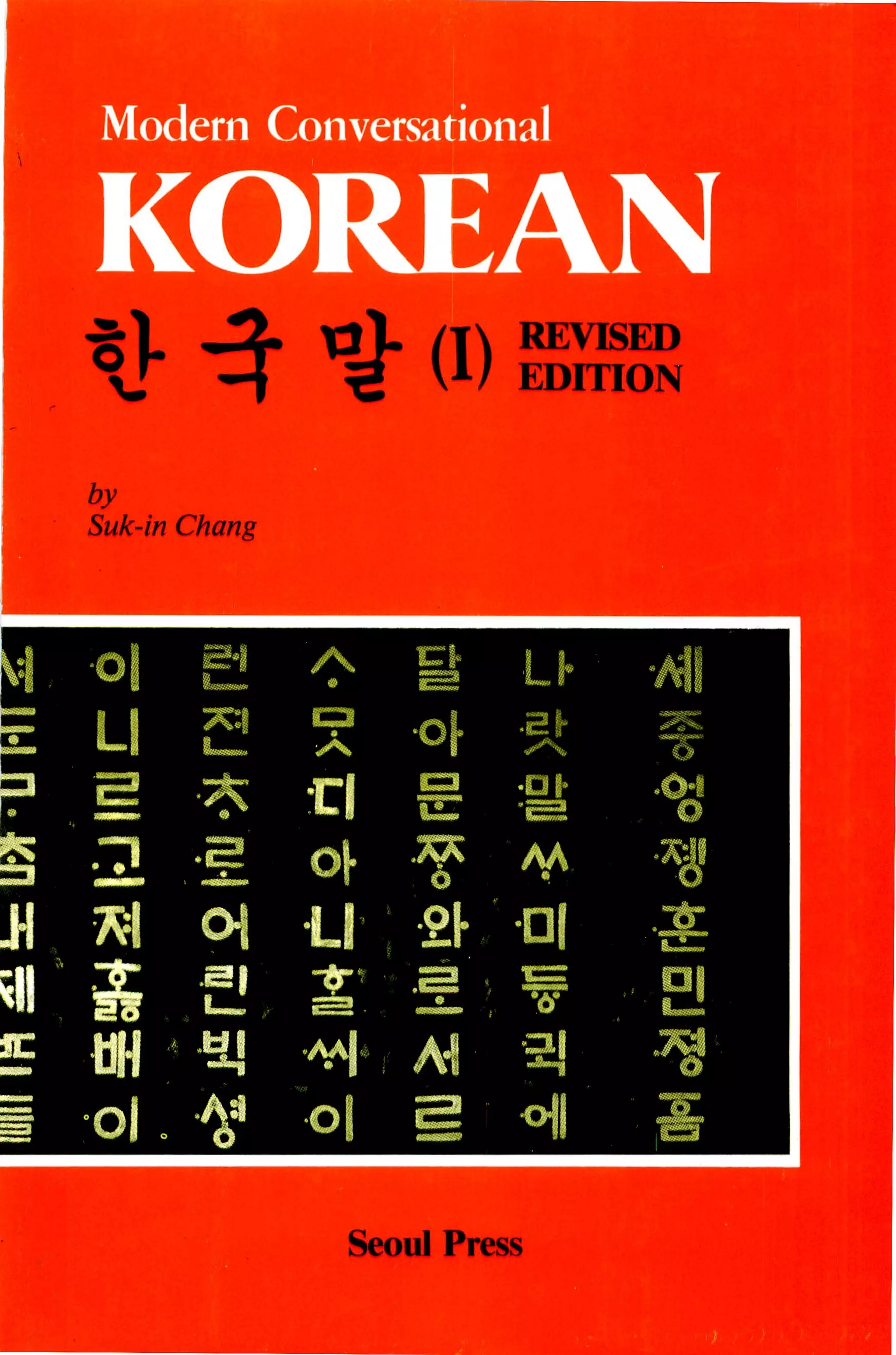
Modern Conversational


       KOREAN
                                                             REVISED
                                                             EDITION


       by
       Suk-in Chang


vi .   *O i             t          A.
                                    #
                                              ■         .


                                                  ■ ■■■ ■'
* 1                 i   mmmm                        ■


aawa   .            |

                                    •


g^MM    "■■inn $|       fesseesw   ys,                                   w
=>
•
       a,1.1.1,1 ....
                        -a  «      n                         •or-   .<
                                                                         ©     1
§      2                .a                                   AA     '          1


                                                                         %,#


m      n                o         LI        21-             a|     •:
-11    "**              si                                               "ii

w      ft
       ■55 %Jr          u!
                                            .csss
                                                  •
                                                             ¥      hi         i
E      «H               a!                  A^
■      ol. ^                       ol       s                oil    i9

                                         >eoul Fress
Modern
Conversational
Korean
REVISED EDITION
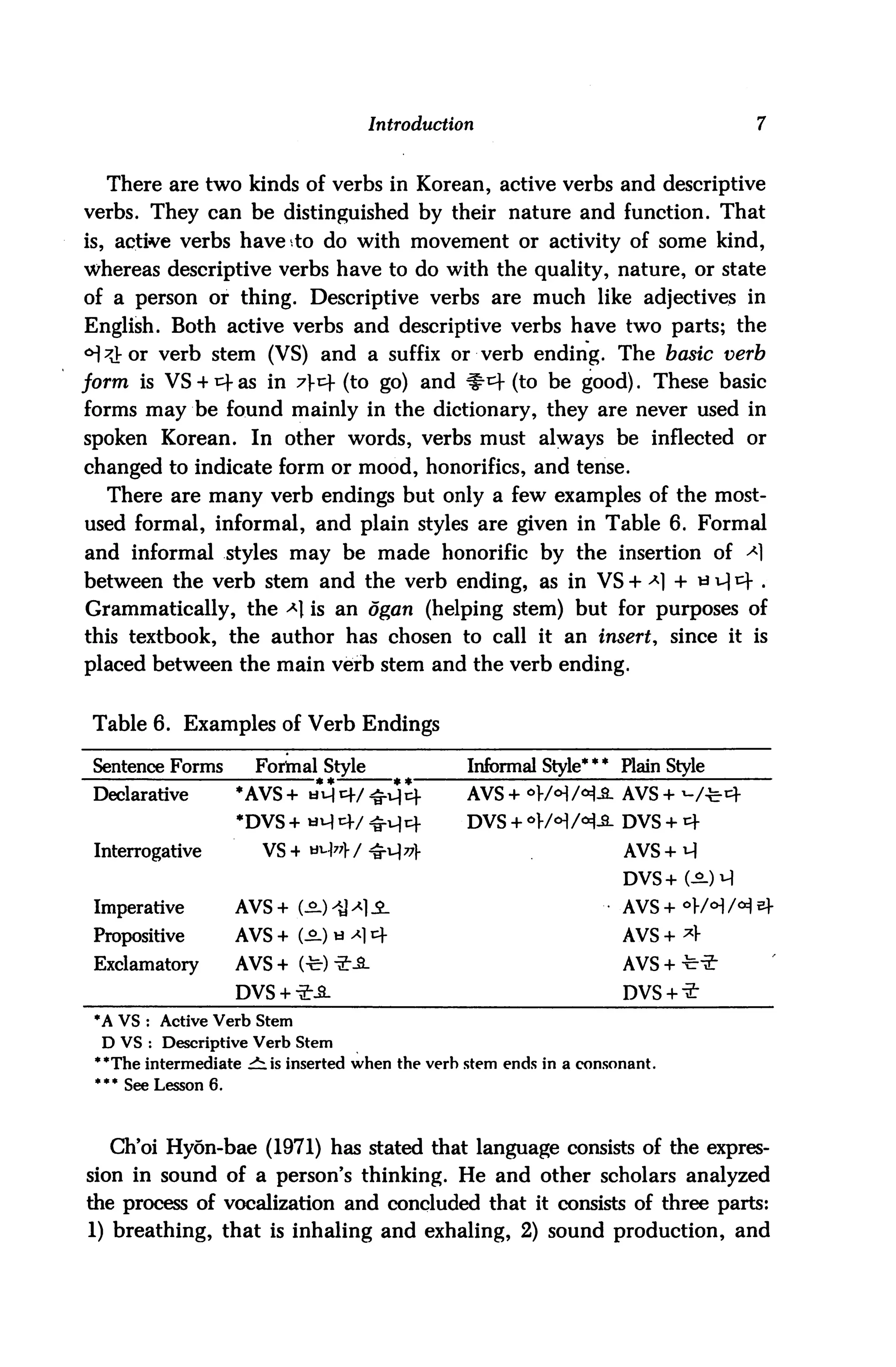
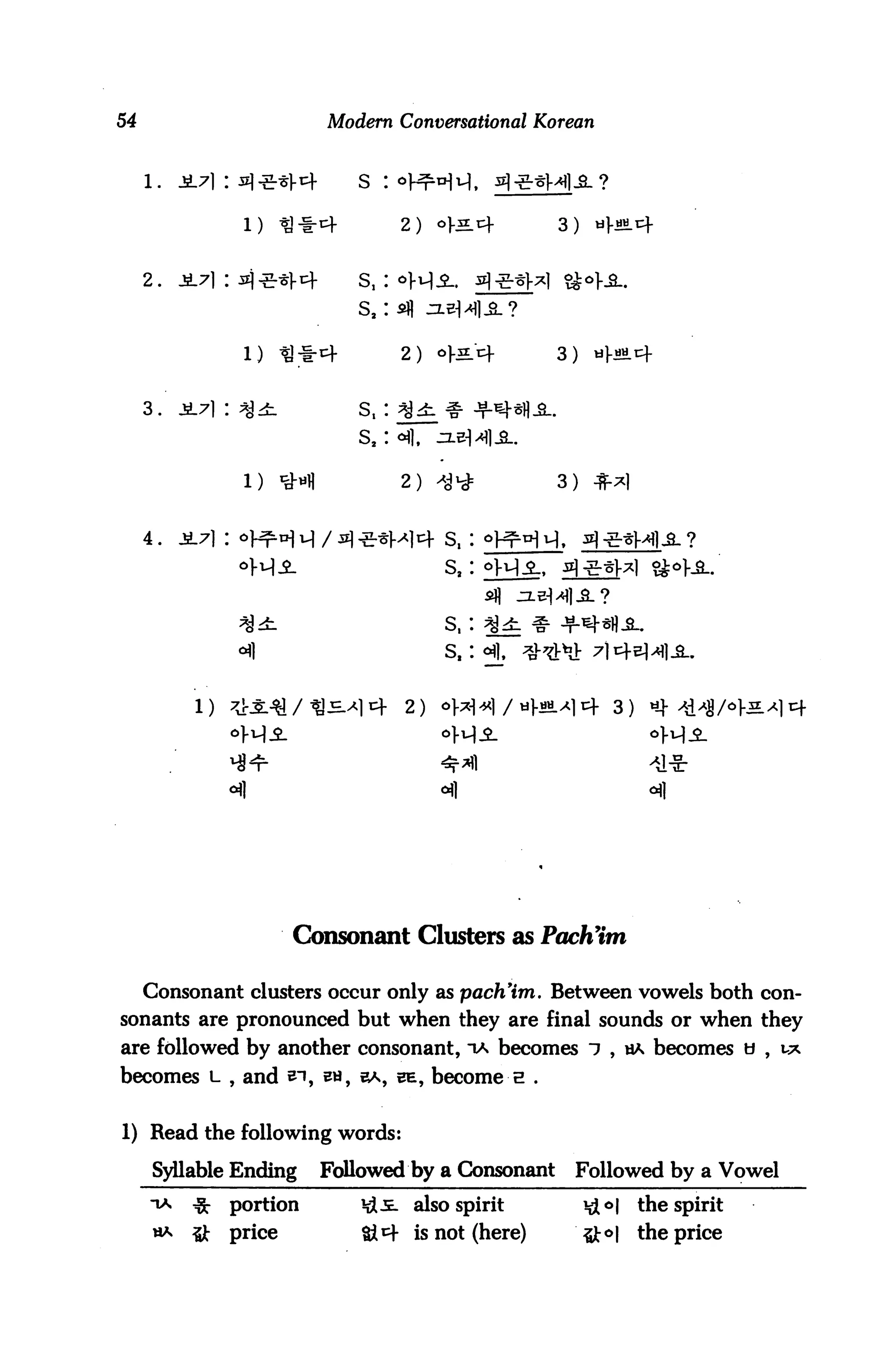
The Korean Alphabet


N.     v
                 V      >     1   =1   a. ol T IT          -   1

     ~f         4 4= 4 4 ji a                         t}
                                  v^   :s: ii         TT   ^ 4
                4
                                                 c
     n                            xA   ^    ^    -r

     e          4                                4
     u          4      «> ^       ^ JSL JSL      T

     id         4                 ^ J£ A         -r        i 4
     A                            ^ ^i it 4
                4      o]:   o^   ^    iL S.
                                                 o    o
     o                                           -r   TT

                4                 ^    3* & 4
                4                 ^ & & 4
     =1         4                 H    3. 3. 4
     H          4                                4    4

                4
                                                 XX
     3£                           3^   JL 5.          TT

                4                                4
                                  ©i   j.   JL
                                                      *
     V = Vowels: C = Consonants
Modern Conversational

 KOREAN
  REVISED EDITION


             by
      Suk-in Chang
      (Yonsei University)


             Seoul Press
Revised Edition
            Copyright © 1995 by Suk-in Chang
               Fifth printing: April 1, 1995
                            by
                        Seoul Press


All rights reserved. No part of this book may be reproduced
   in any form, except for brief quotations for a review,
         without written permission of the author.


        Printed in Korea by Seoul Computer Press.


               ISBN 89-7225-000-7 33710
For my husband, Yi Kwang Hwa, and my
  children, Chong Yim, Ung Min, and Ung Bae
  who were unfailing understanding, encourag
  ing and helpful.
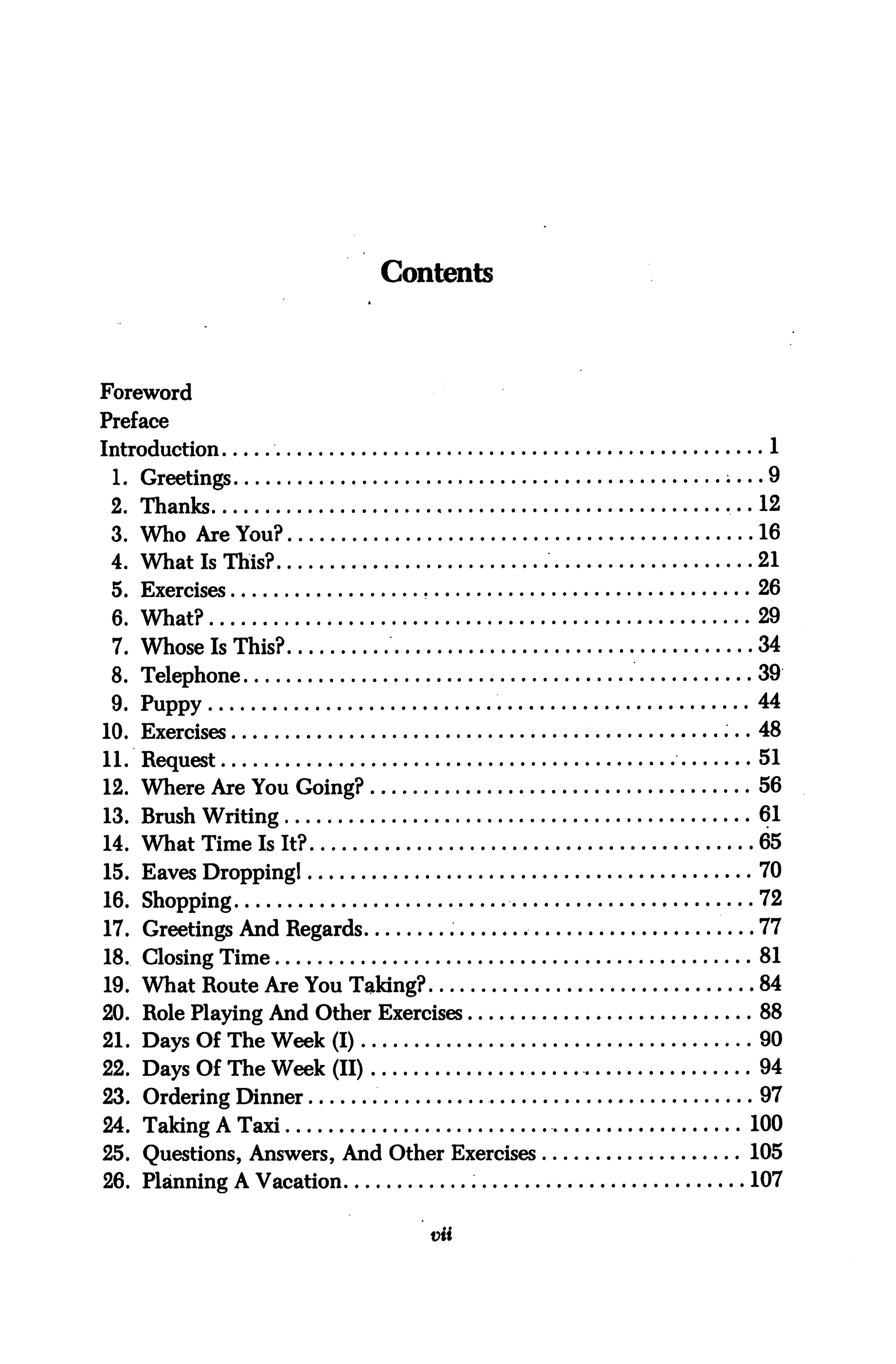
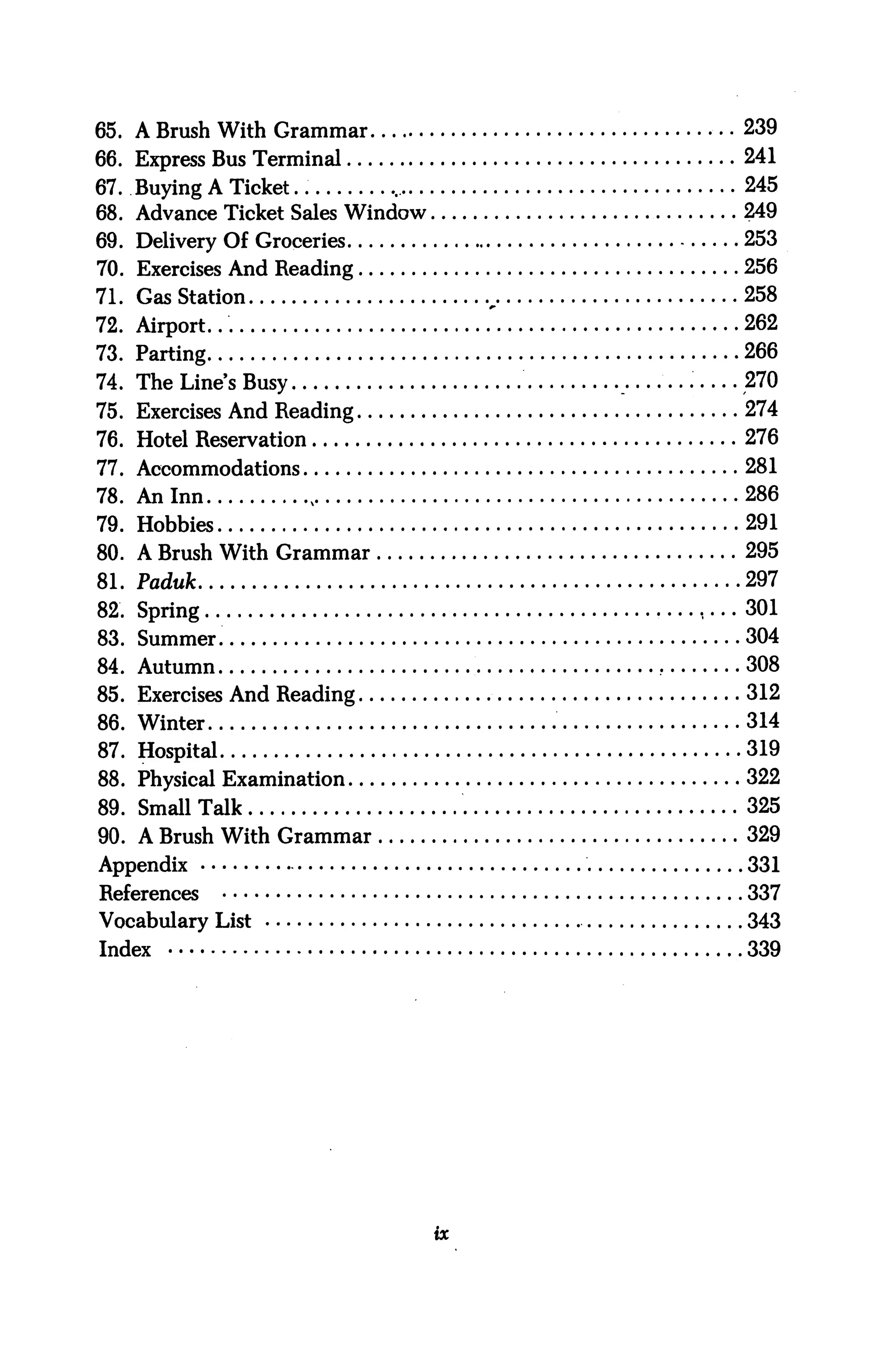
Contents


Foreword
Preface
Introduction                                   1
 1. Greetings                                  9
 2. Thanks                                    12
 3. Who Are You?                              16
 4. What Is This?                             21
 5. Exercises                                 26
 6. What?                                     29
 7.   Whose Is This?                          34
 8.   Telephone                               39
 9.   Puppy                                   44
10.   Exercises                               48
11.   Request                                 51
12.   Where Are You Going?                    56
13. Brush Writing                             61
14. What Time Is It?                          65
15. Eaves Dropping!                           70
16. Shopping                                  72
17. Greetings And Regards                     77
18. Closing Time                              81
19. What Route Are You Taking?                84
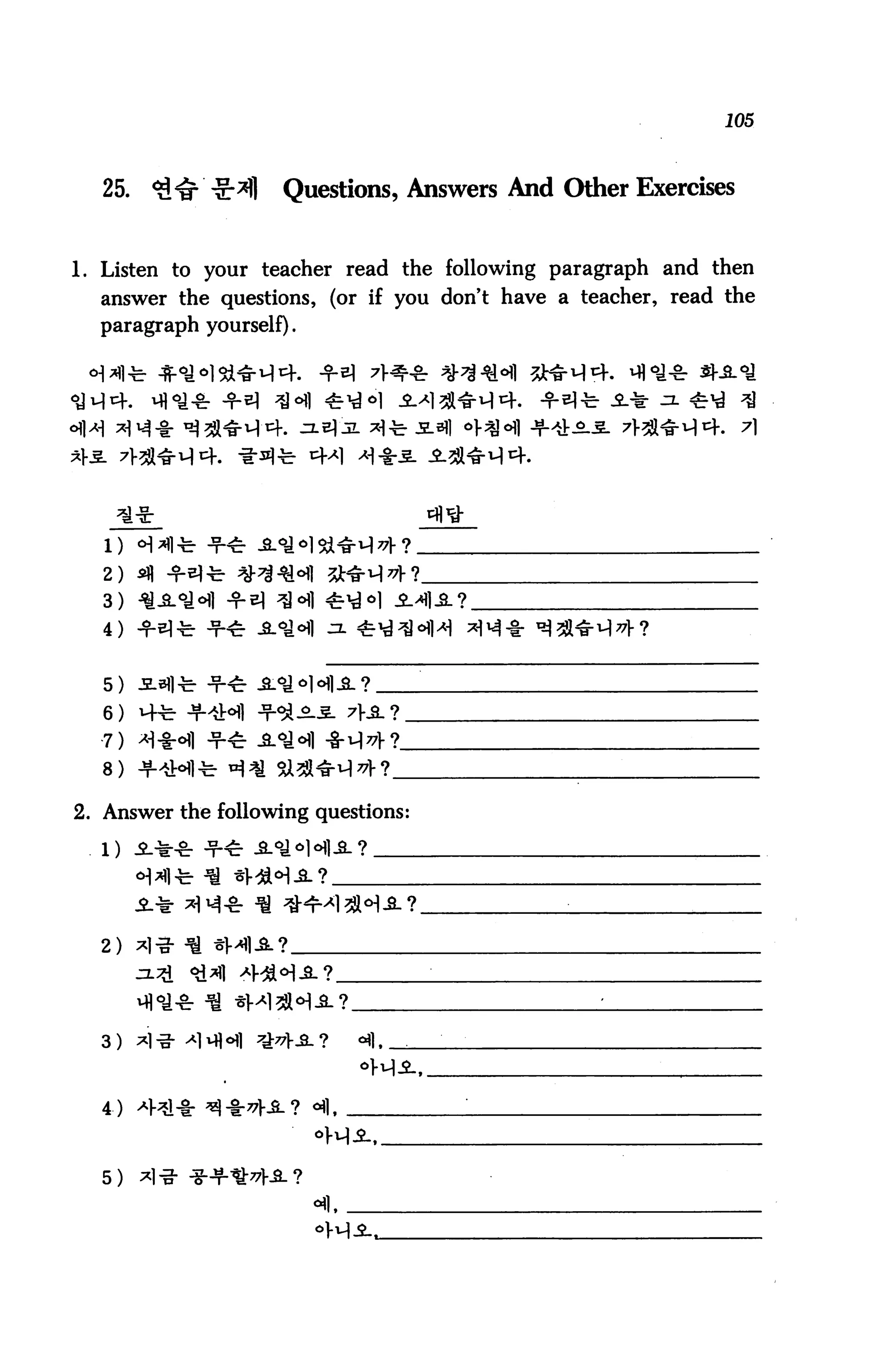
20. Role Playing And Other Exercises          88
21. Days Of The Week (I)                      90
22. Days Of The Week (II)                     94
23. Ordering Dinner                           97
24. Taking A Taxi                             100
25. Questions, Answers, And Other Exercises   105
26. Planning A Vacation                       107

                                 vii
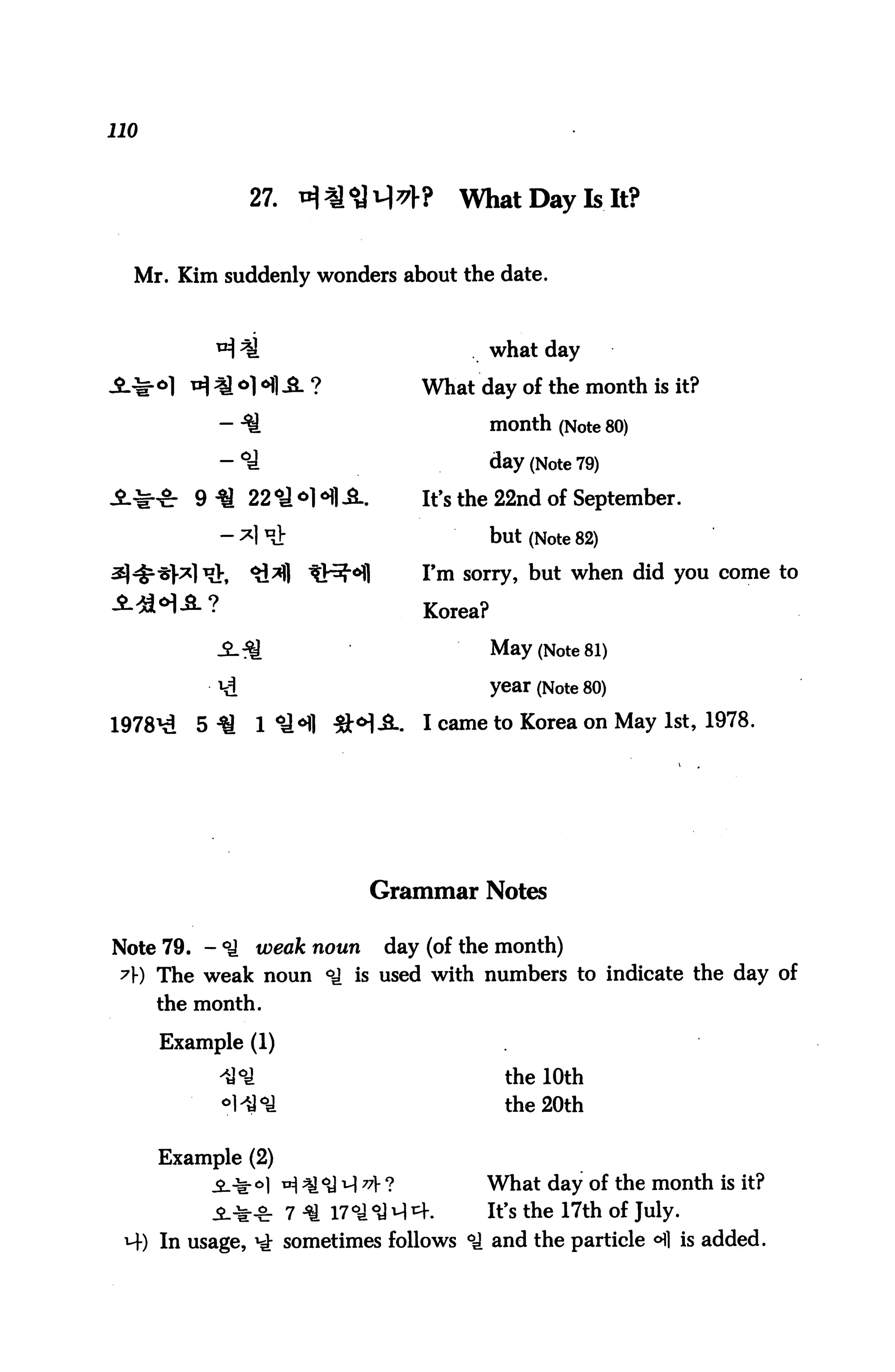
27. What Day Is It?                                110
28. Excuse Me                                      114
29. Introducing Oneself                            118
30. Role Playing And Other Exercises               121
31. Do You Know Korean?                            123
32. Getting Up In The Morning       *.             127
33. How Much Is It?                                131
34. Korean Friends                                 134
35. A Brush With Grammar                           138
36. Strange Customs                                140
37. Location                                       144
38. Are You Tired?                                 148
39. Interview                                      152
40. Role Playing And Other Exercises               156
41. Living In Korea                               .158
42. Dinner                                         162
43. On The Street                        ,         165
44. Meat Market                                    168
45. A Brush With Grammer                           172
46. Buying Medicine                                174
47. A Fruit Stand                                  177
48. Vegetable Market                               181
49. Receiving A Phone Call                         186
50. Exercises                                      190
51. Wrong Number                                   192
52. Another Phone Call                             195
53. Dinner Invitation                         *    199
54. Farewell                                       203
55. Role Playing and Other Exercises              .207
56. Asking Directions                              209
57. Riding The Bus                                 212
58. Age                                            215
59. Food Preference                                219
60. Questions, Answers, And Other Exercises        222
61. The Flavor Of Pulgogi                          224
62. Tearoom                                        228
63. Hometown                                       232
64. To Have "One Glass"                            236


                                 viii
65. A Brush With Grammar               .. 239
66. Express Bus Terminal                  241
67. Buying A Ticket                       245
68. Advance Ticket Sales Window          249
69. Delivery Of Groceries                253
70. Exercises And Reading                256
71. Gas Station                   „      258
72. Airport...                    .'     262
73. Parting                              266
74. The Line's Busy                      270
75. Exercises And Reading                274
76. Hotel Reservation                    276
77. Accommodations                       281
78. An Inn                               286
79. Hobbies                              291
80. A Brush With Grammar                 295
81.   Paduk                              297
82.   Spring                             301
83.   Summer.                            304
84.   Autumn                             308
85. Exercises And Reading                312
86. Winter                               314
87. Hospital                             319
88. Physical Examination                 322
89. Small Talk                           325
90. A Brush With Grammar                 329
Appendix                                 331
References                               337
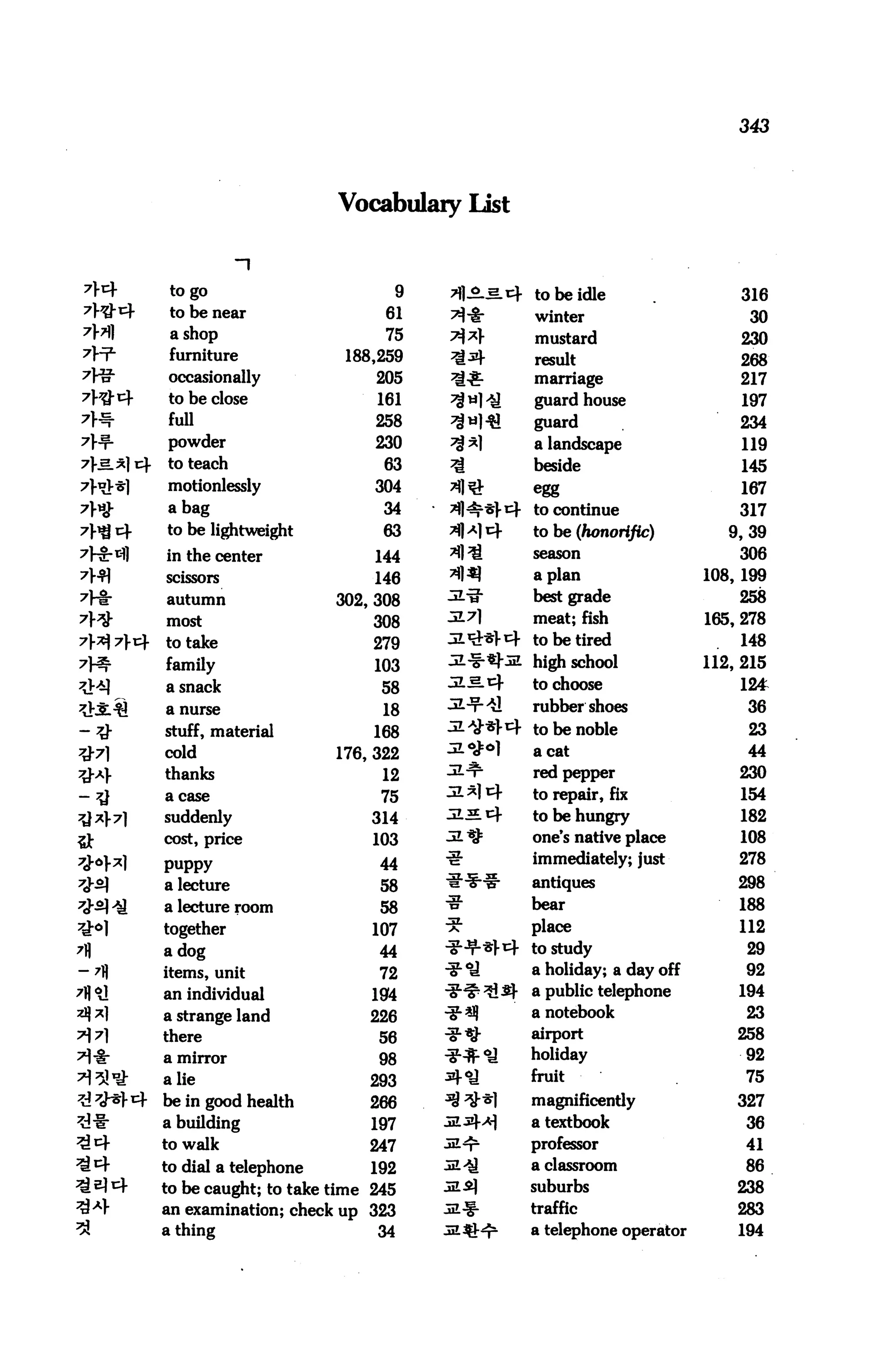
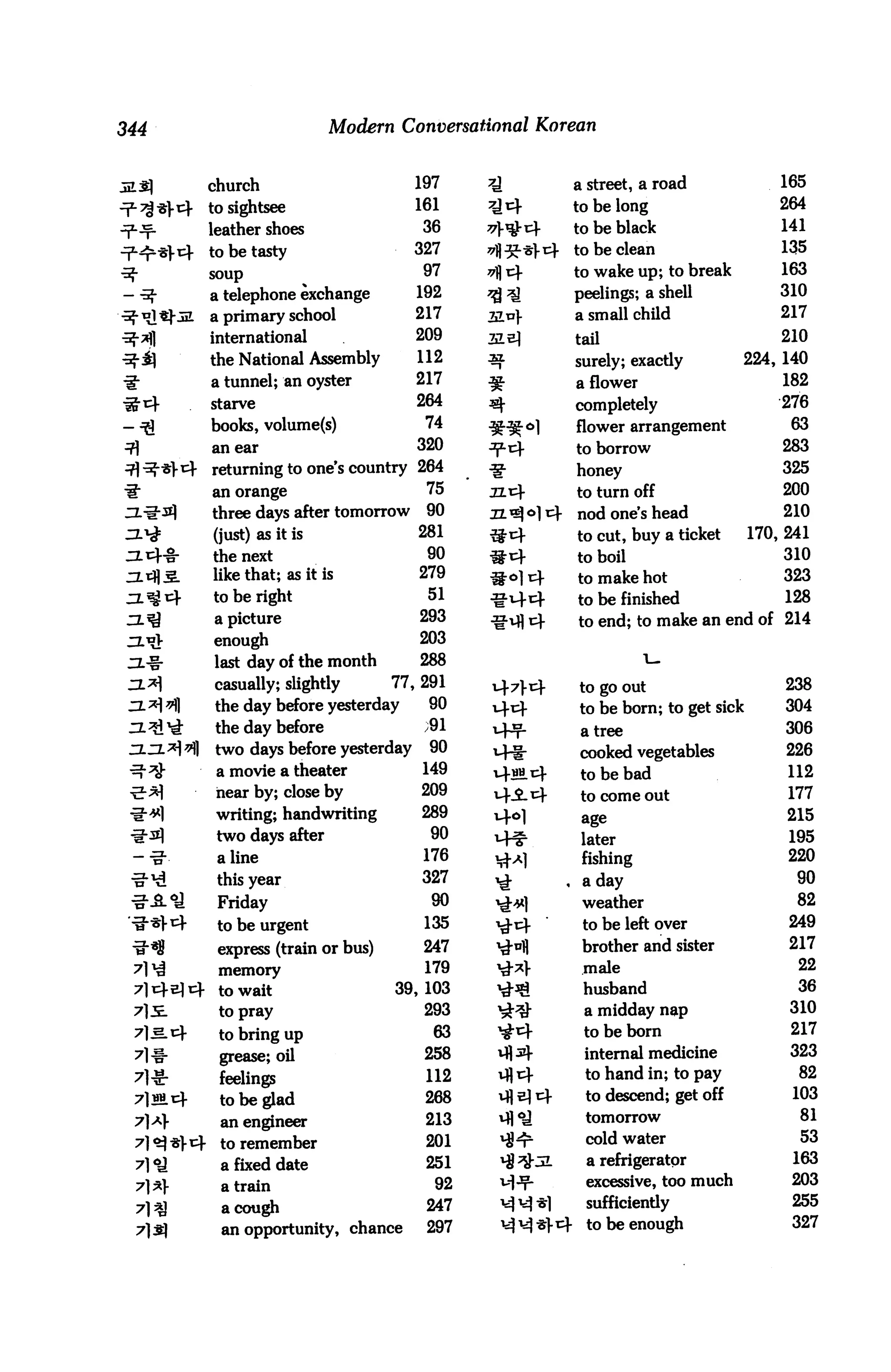
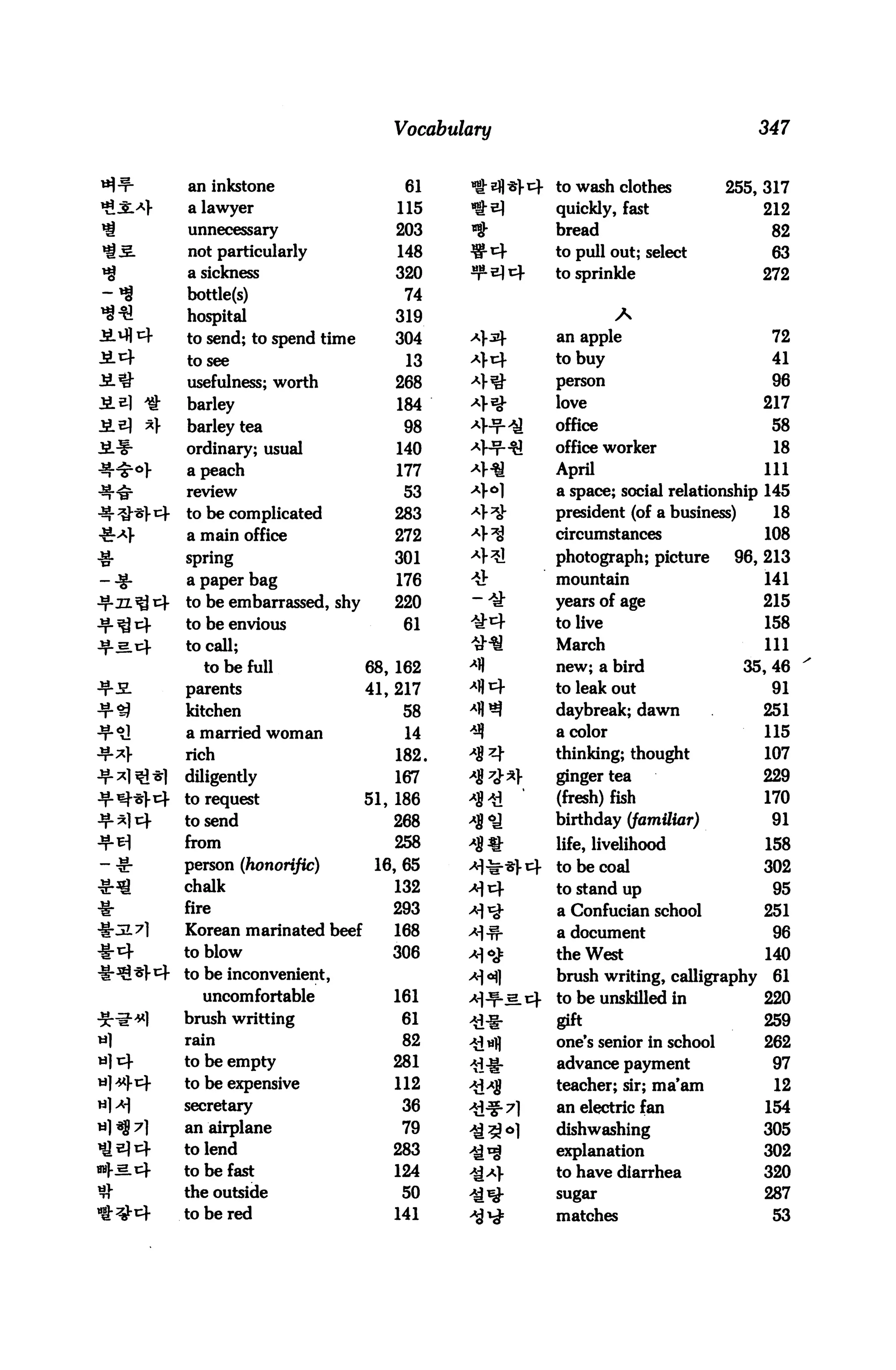
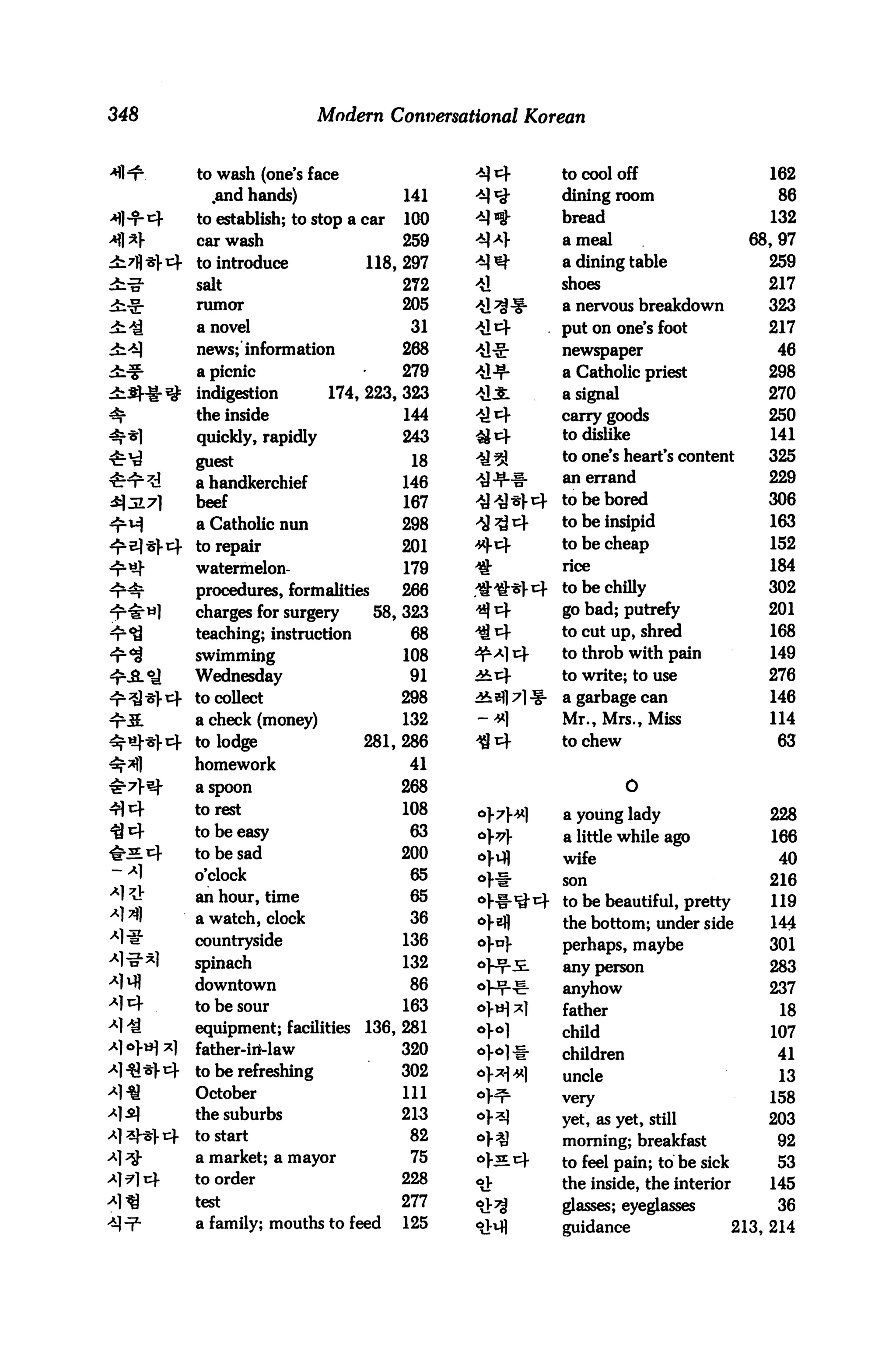
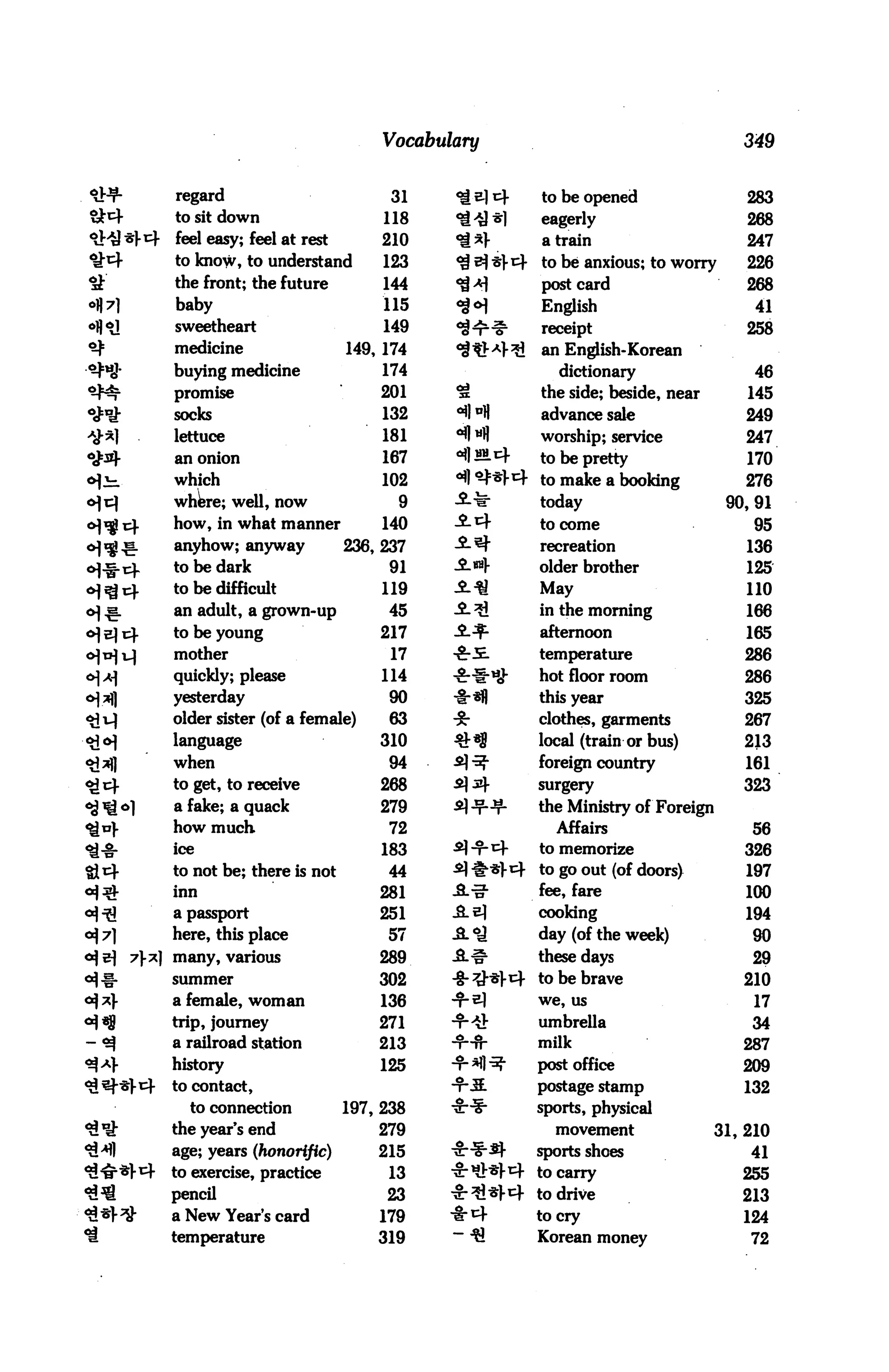
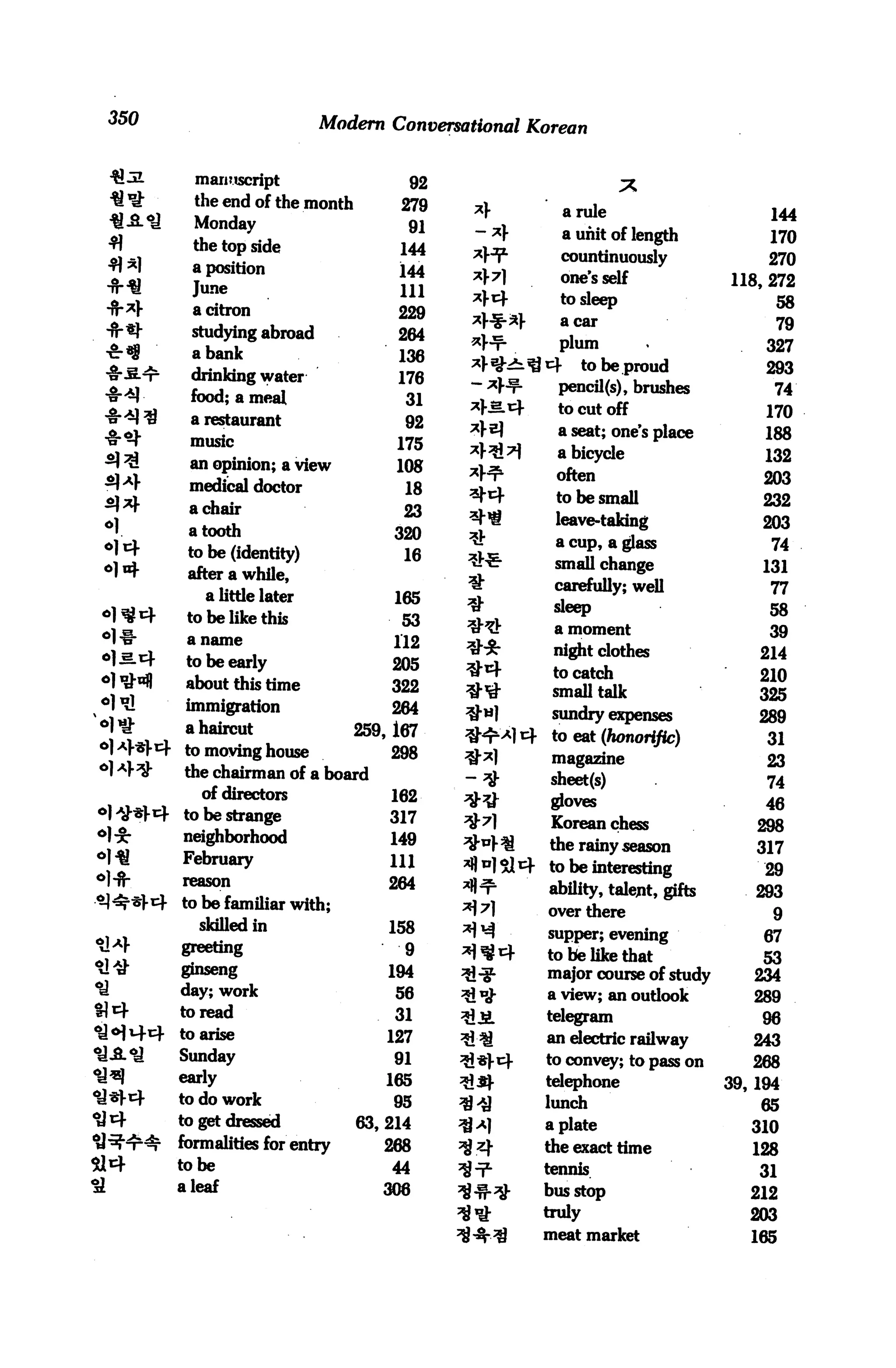
Vocabulary List                          343
Index                                    339
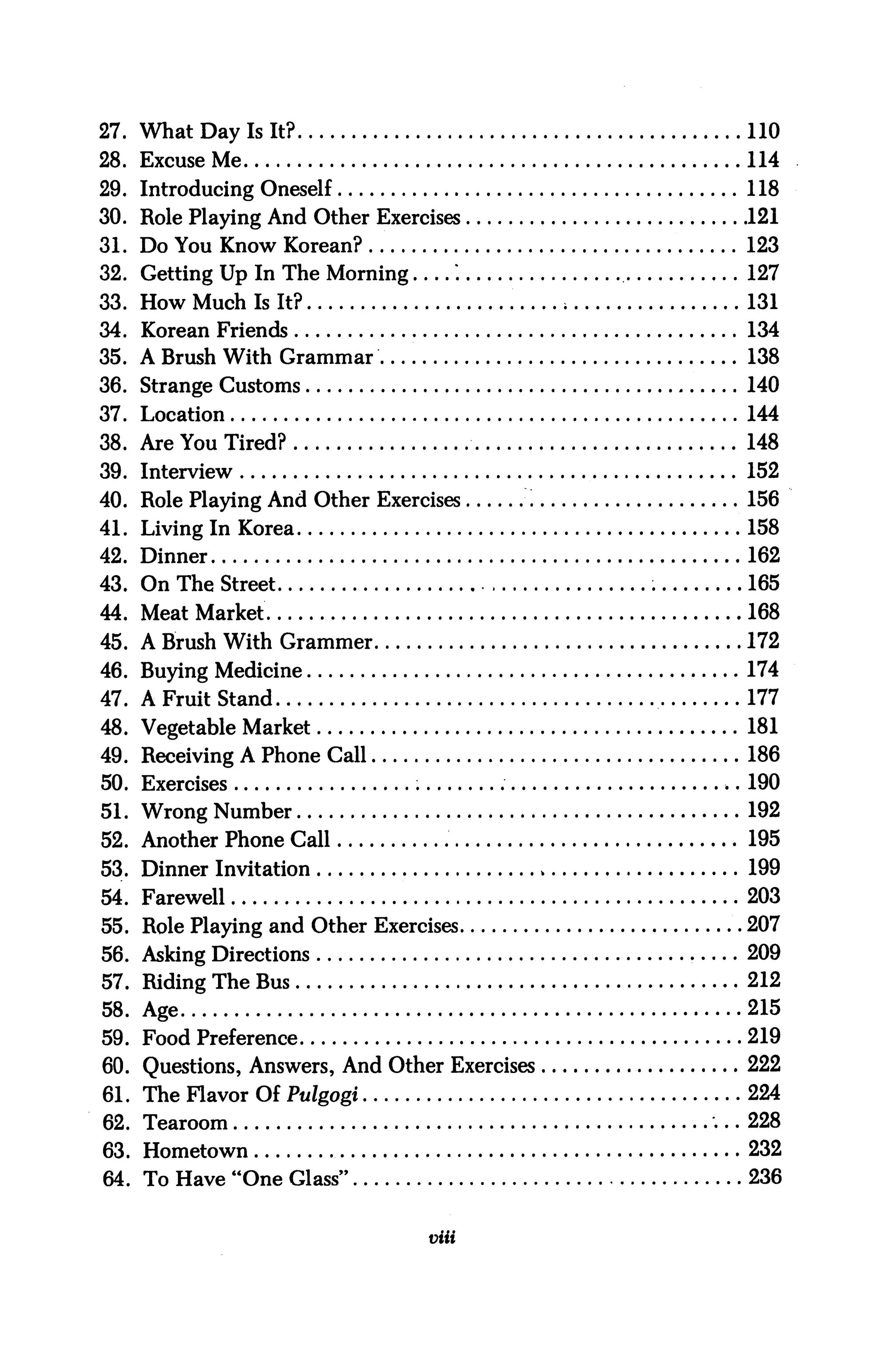
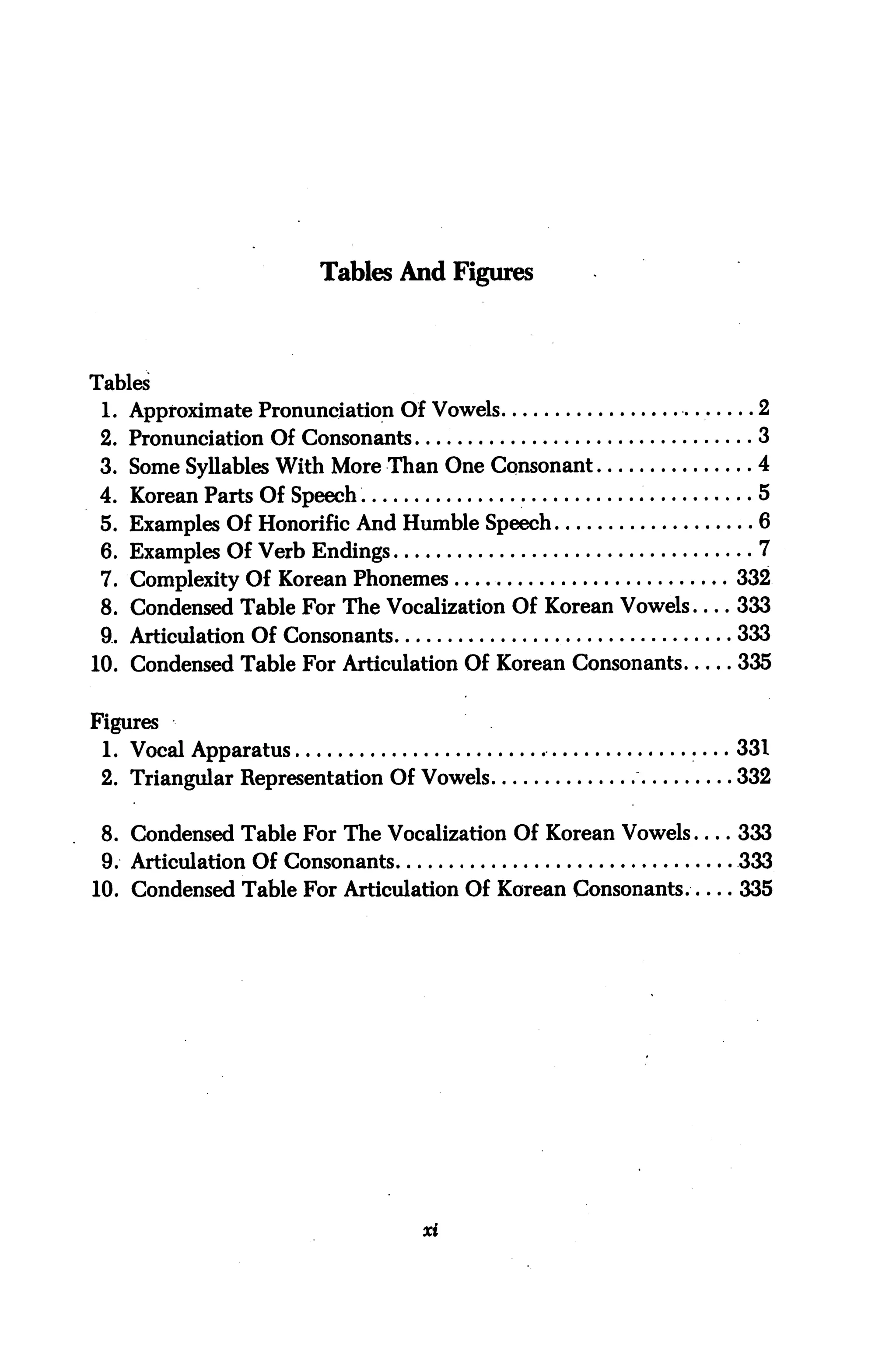
Tables And Figures


Tables
 1. Approximate Pronunciation Of Vowels                        2
 2. Pronunciation Of Consonants.                               3
 3. Some Syllables With More Than One Consonant                4
 4. Korean Parts Of Speech.                                    5
 5. Examples Of Honorific And Humble Speech                    6
 6. Examples Of Verb Endings                                   7
 7. Complexity Of Korean Phonemes                            332
 8. Condensed Table For The Vocalization Of Korean Vowels    333
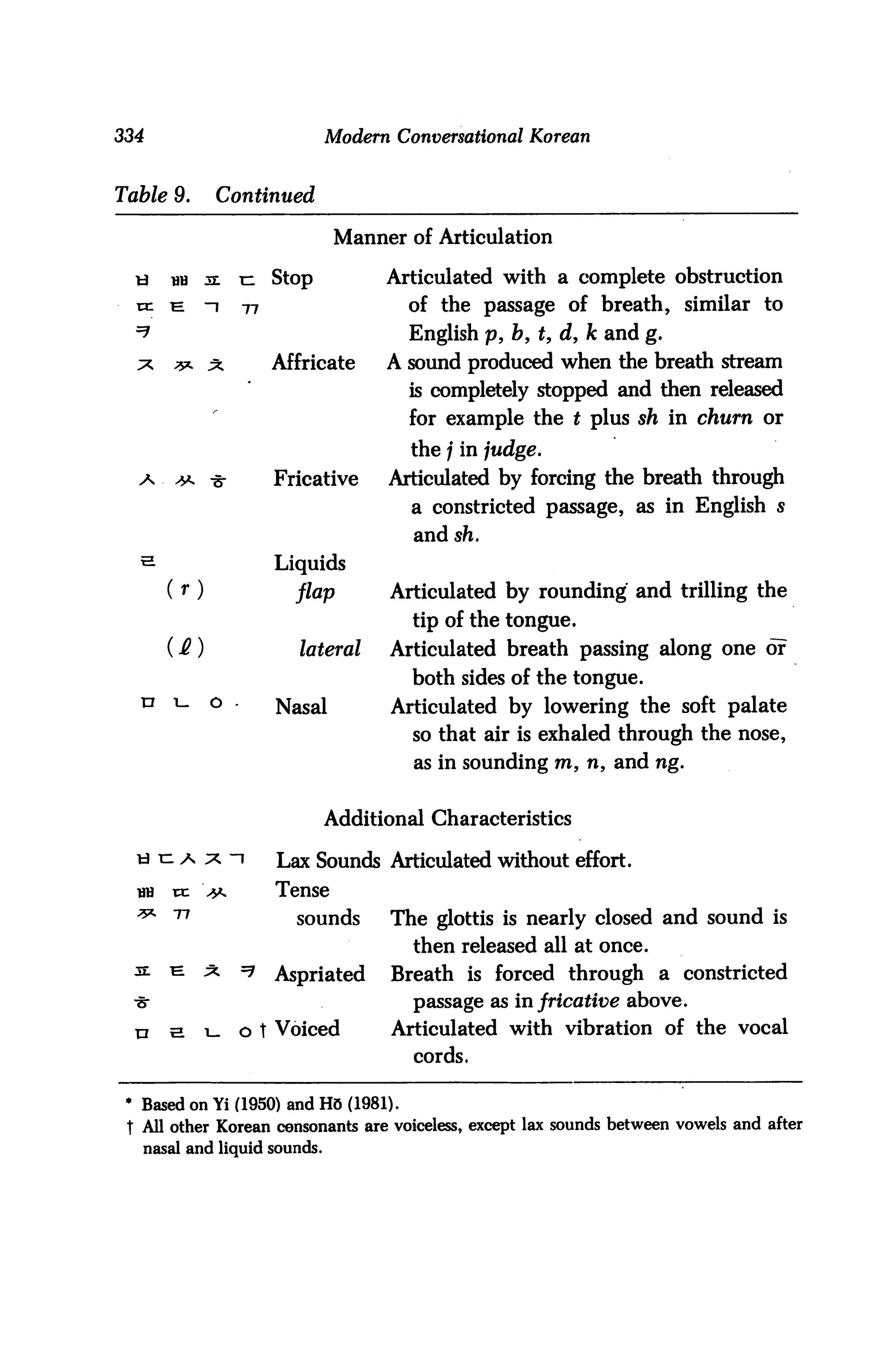
 ft. Articulation Of Consonants                              333
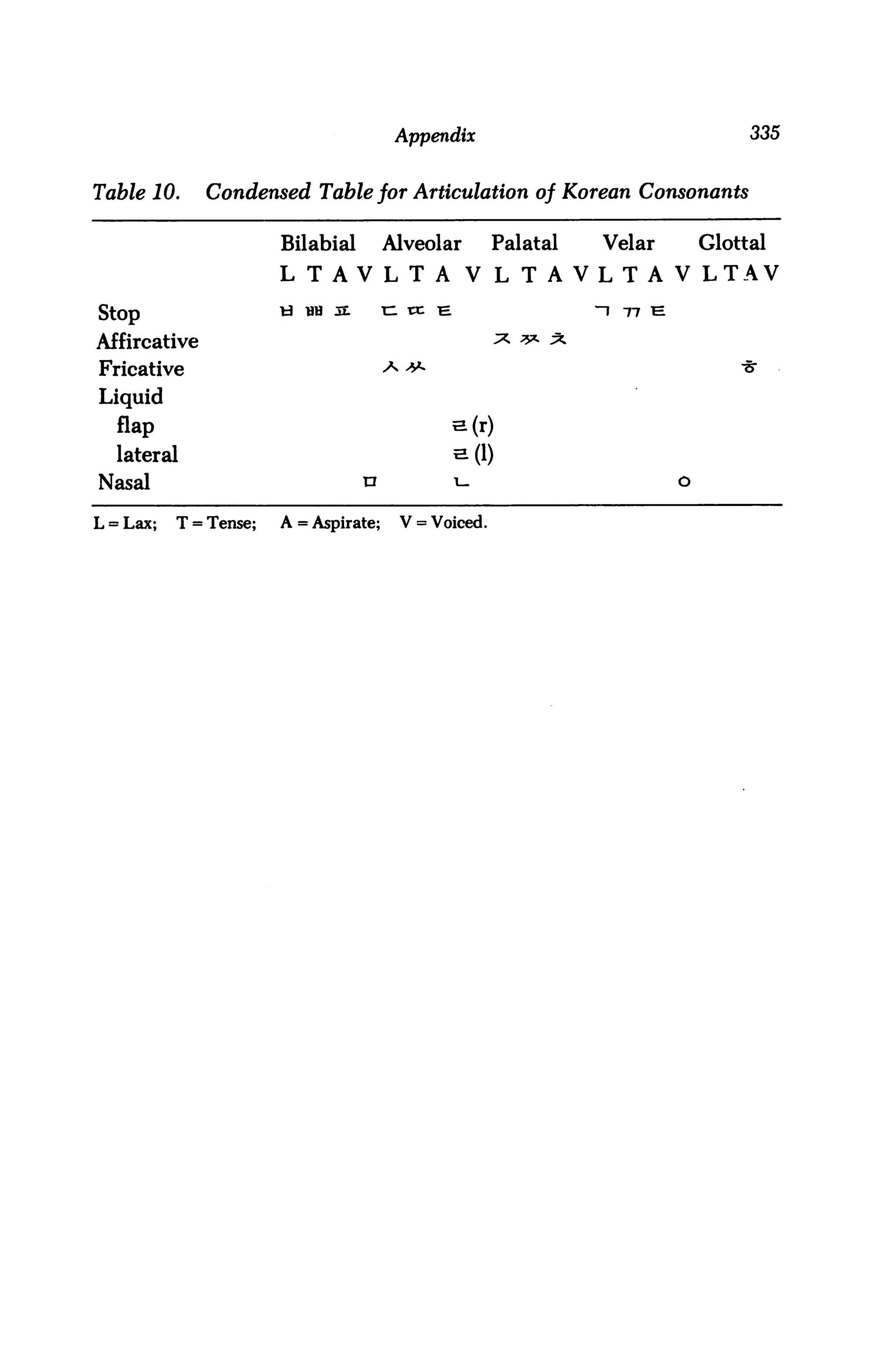
10. Condensed Table For Articulation Of Korean Consonants    335


Figures
 1. Vocal Apparatus                                          331
 2. Triangular Representation Of Vowels                      332


 8. Condensed Table For The Vocalization Of Korean Vowels    333
 9. Articulation Of Consonants                               333
10. Condensed Table For Articulation Of Korean Consonants.   335


                                   xi
Guide To Pronunciation


Pronunciation of the Basic Vowels                                 10
Pronunciation of the Basic Consonants

    . -i   i-    n    a                                           14

    .U     &     A     O     X                                    19
    .x     =7    ^     s:    -3T                                  24

Pronunciation of Complex Vowels                                   27

      fl   fl A -H -rl -4                             •           28
      fl   H -H Jl ^                                              32
Pronunciation of Double Consonants                                37
Pachi'm (Prop Consonants)                                         42

     -i - o                                                       43
     *-*                                          ,               47

Pronunciation of Double Consonants with Pach'im                   50
Consonants Clusters as Pach'im                                ,

      TA HA V* 21                W E* BE                  I       54
      ?i    ^    9i    st                                         59

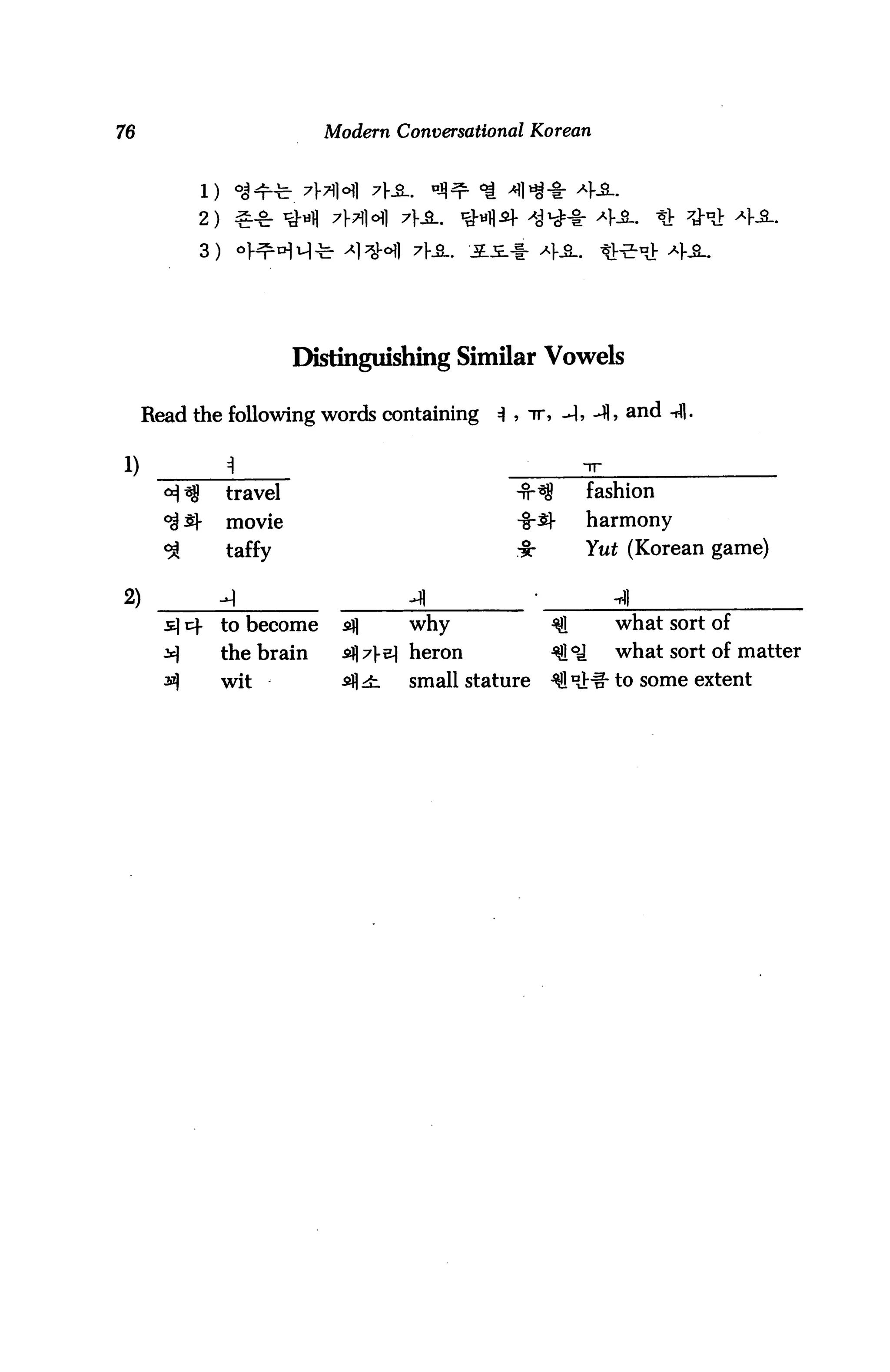
Distinguishing Similar Vowels

      fl   11                                                     64
      >    i     and        -u                                    69

      1    -r    and        -                                     71

      =1   -ir   --1 4 and -A]                                    76

      _)                                                          80

      -H                                                          83


                                           xiii
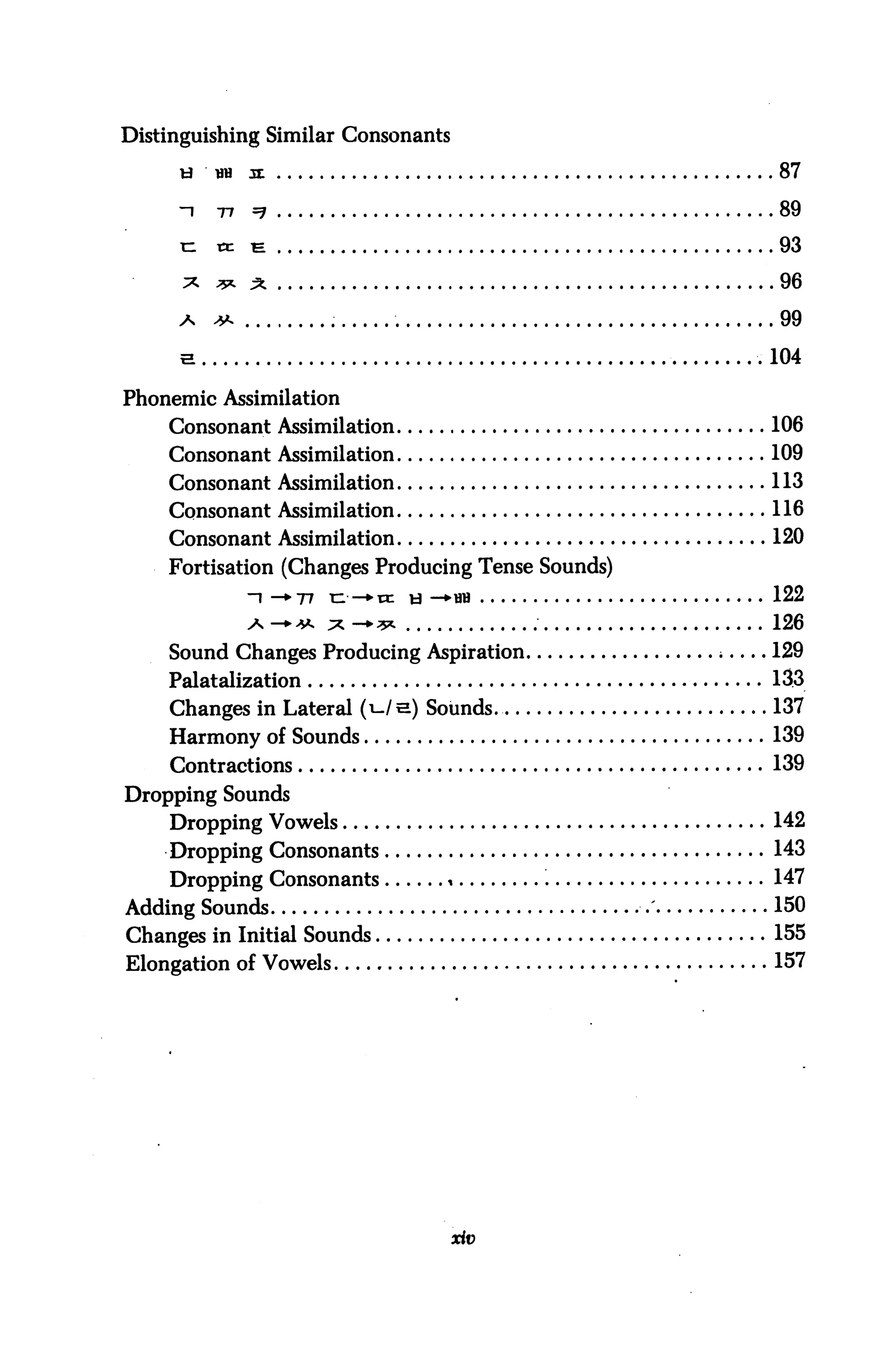
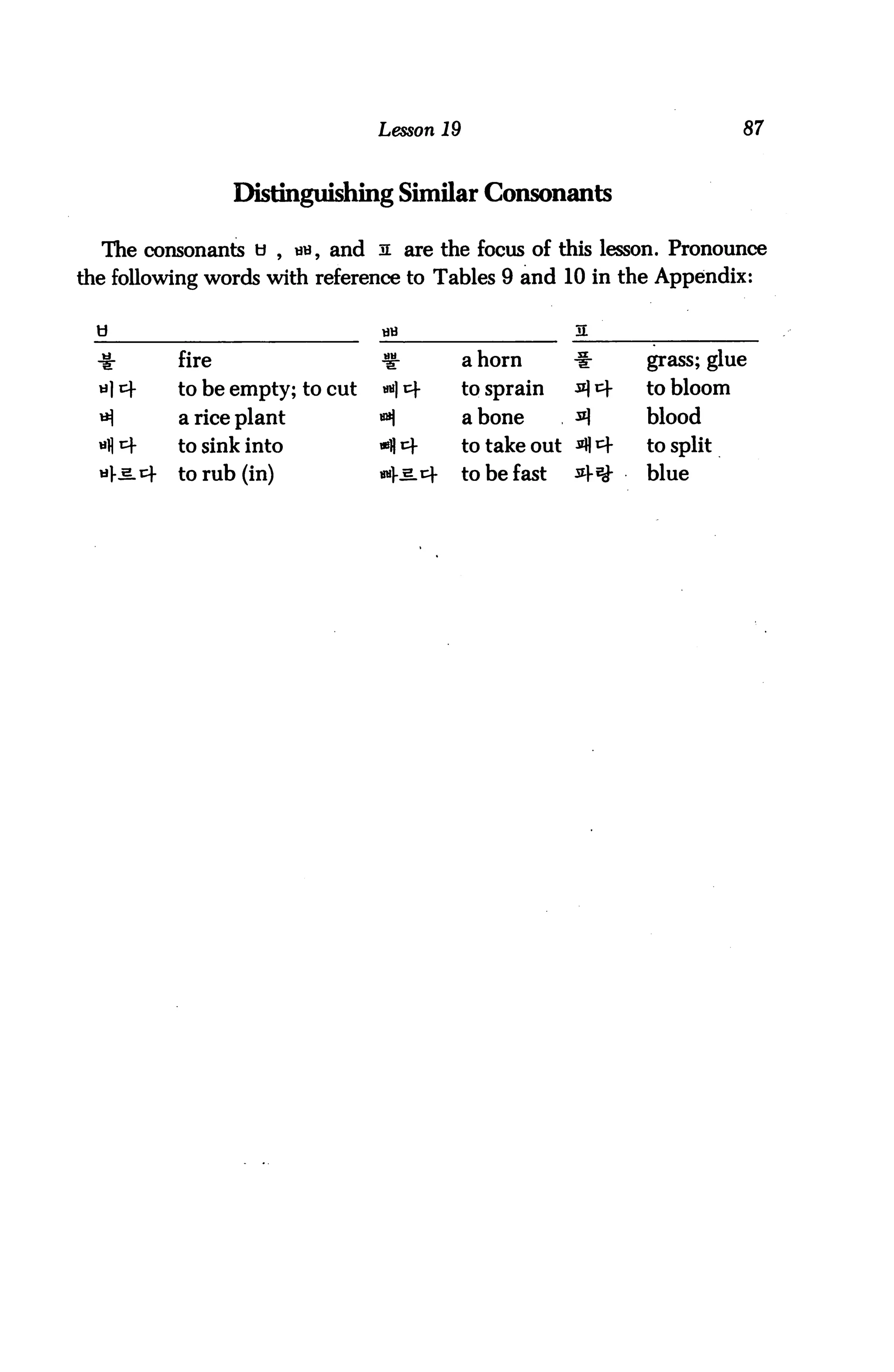
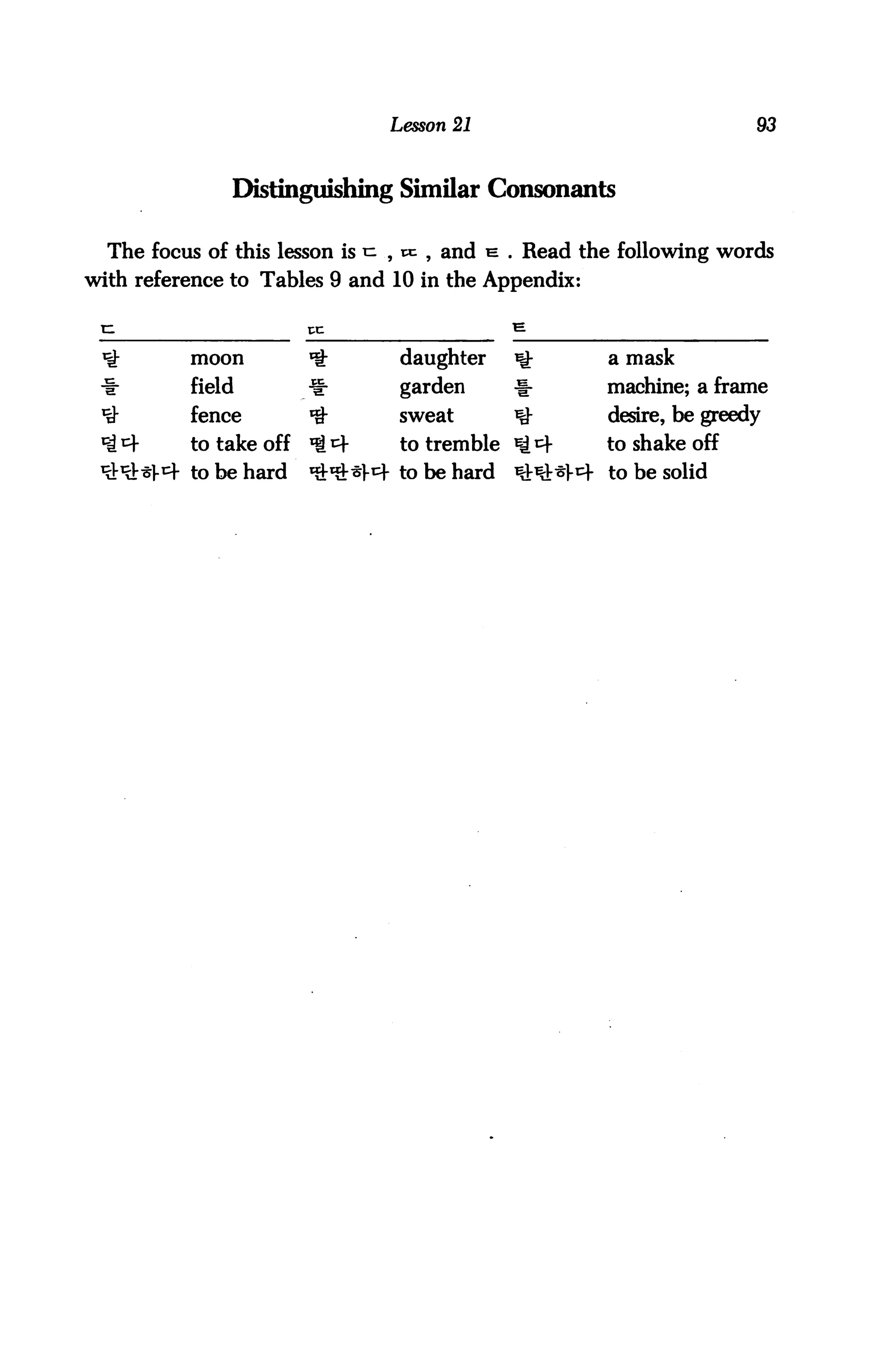
Distinguishing Similar Consonants

     tJ ■ hh    m                                       87

     -i    77   =7                                      89

     n     ix   h                                       93

      ;*   ^ *                                           96

     a     ^                    .                        99

     a                                                 .104

Phonemic Assimilation
    Consonant Assimilation                              106
    Consonant Assimilation                              109
    Consonant Assimilation                              113
    Consonant Assimilation                              116
    Consonant Assimilation                              120
    Fortisation (Changes Producing Tense Sounds)
                -i —►tt n—+tx. & -*mj                   122
                a —►>* ;* -*^                           126
    Sound Changes Producing Aspiration             *    129
    Palatalization                                      133
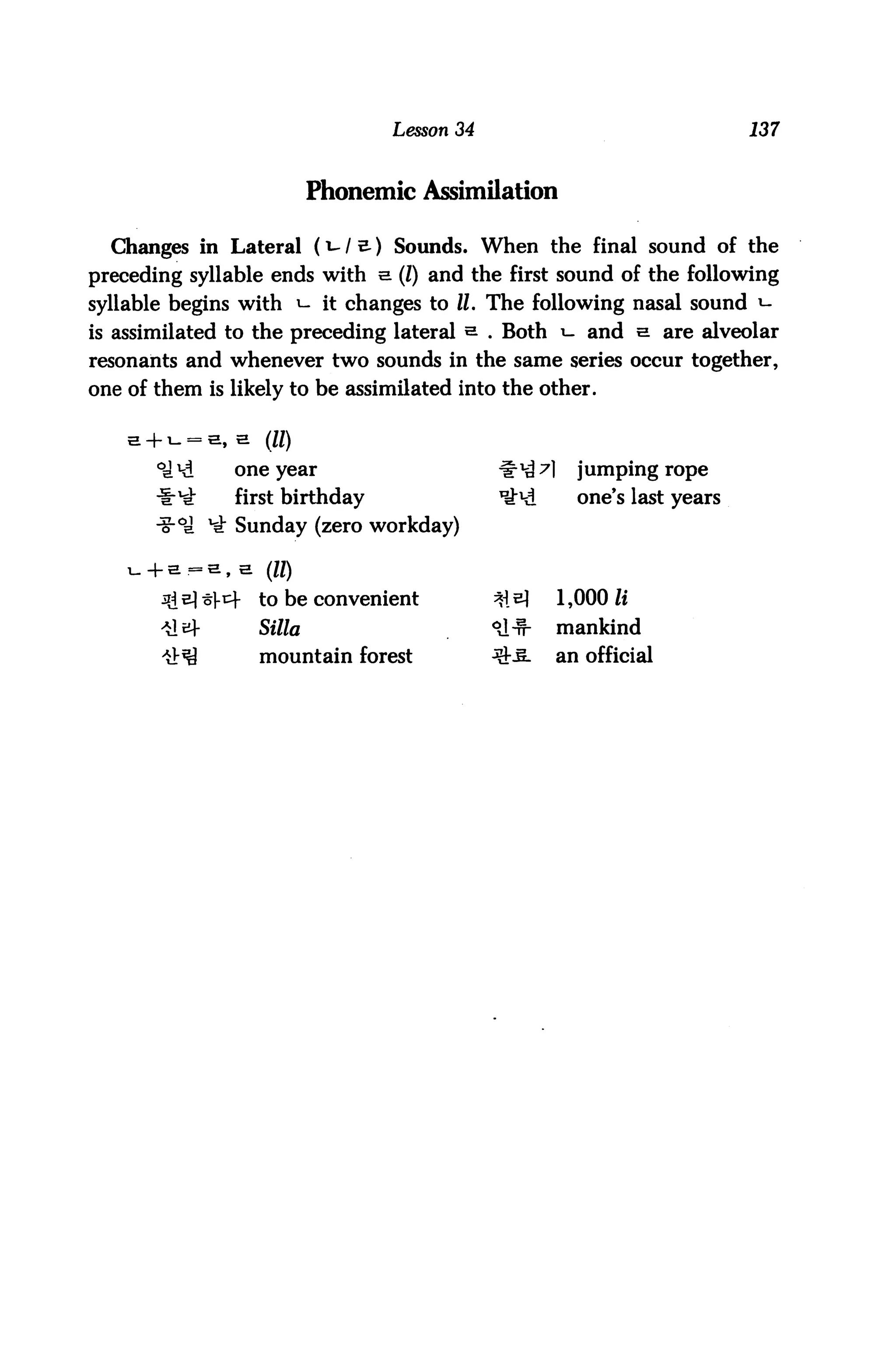
    Changes in Lateral (W e) Sounds.                    137
    Harmony of Sounds                                   139
    Contractions                                        139
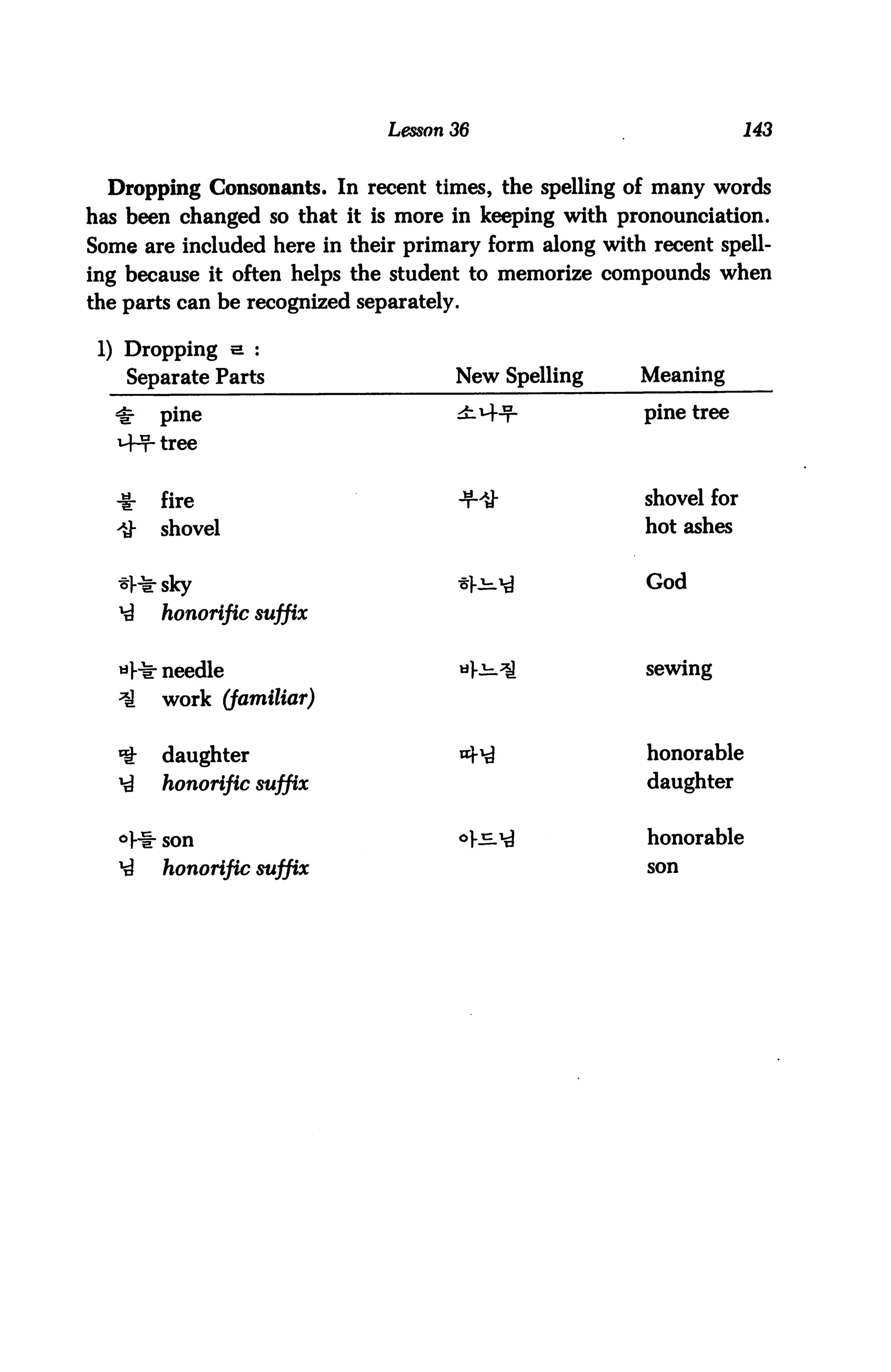
Dropping Sounds
    Dropping Vowels                                     142
    Dropping Consonants                                 143
    Dropping Consonants             ^                   147
Adding Sounds                                           150
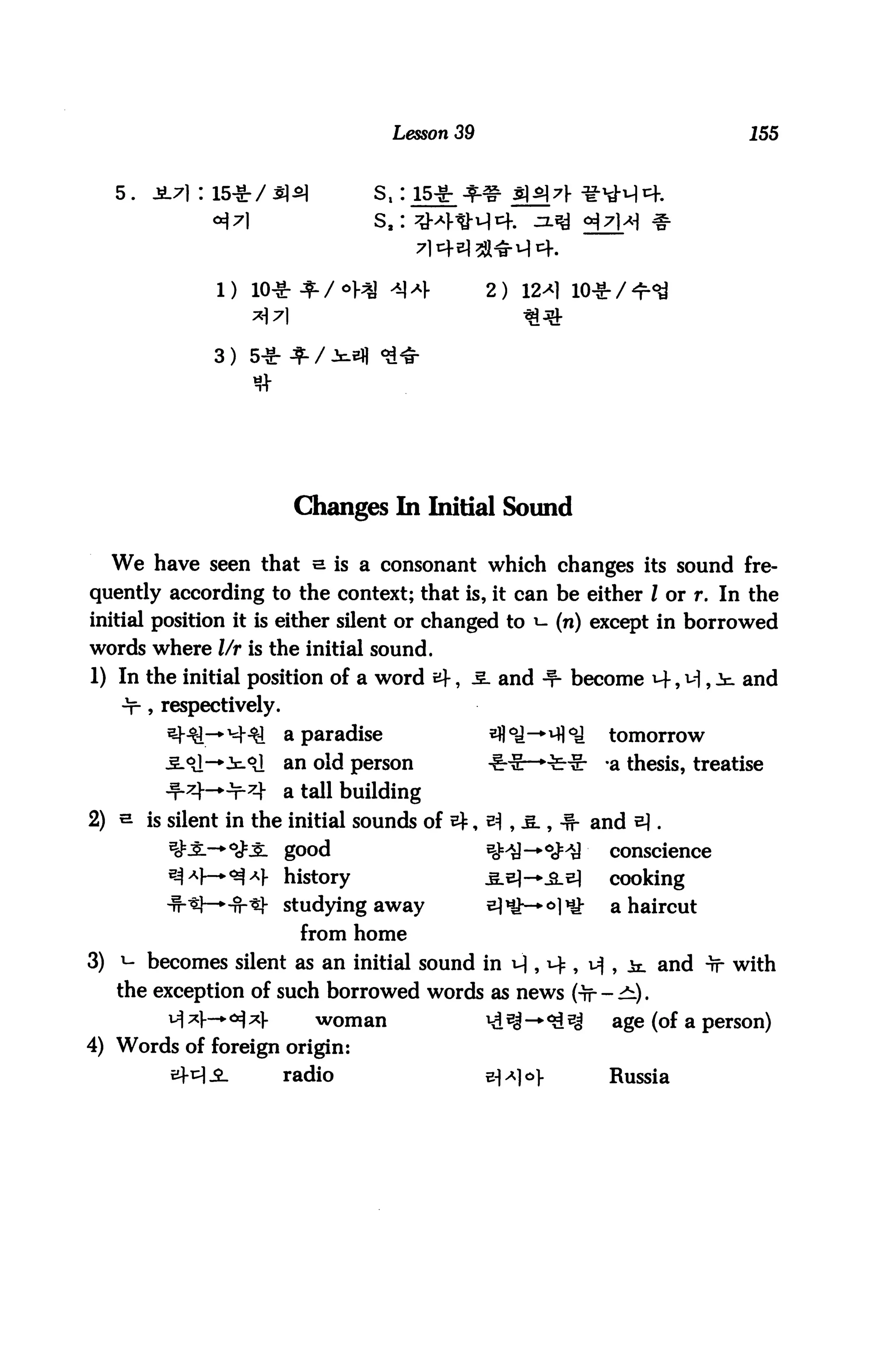
Changes in Initial Sounds                               155
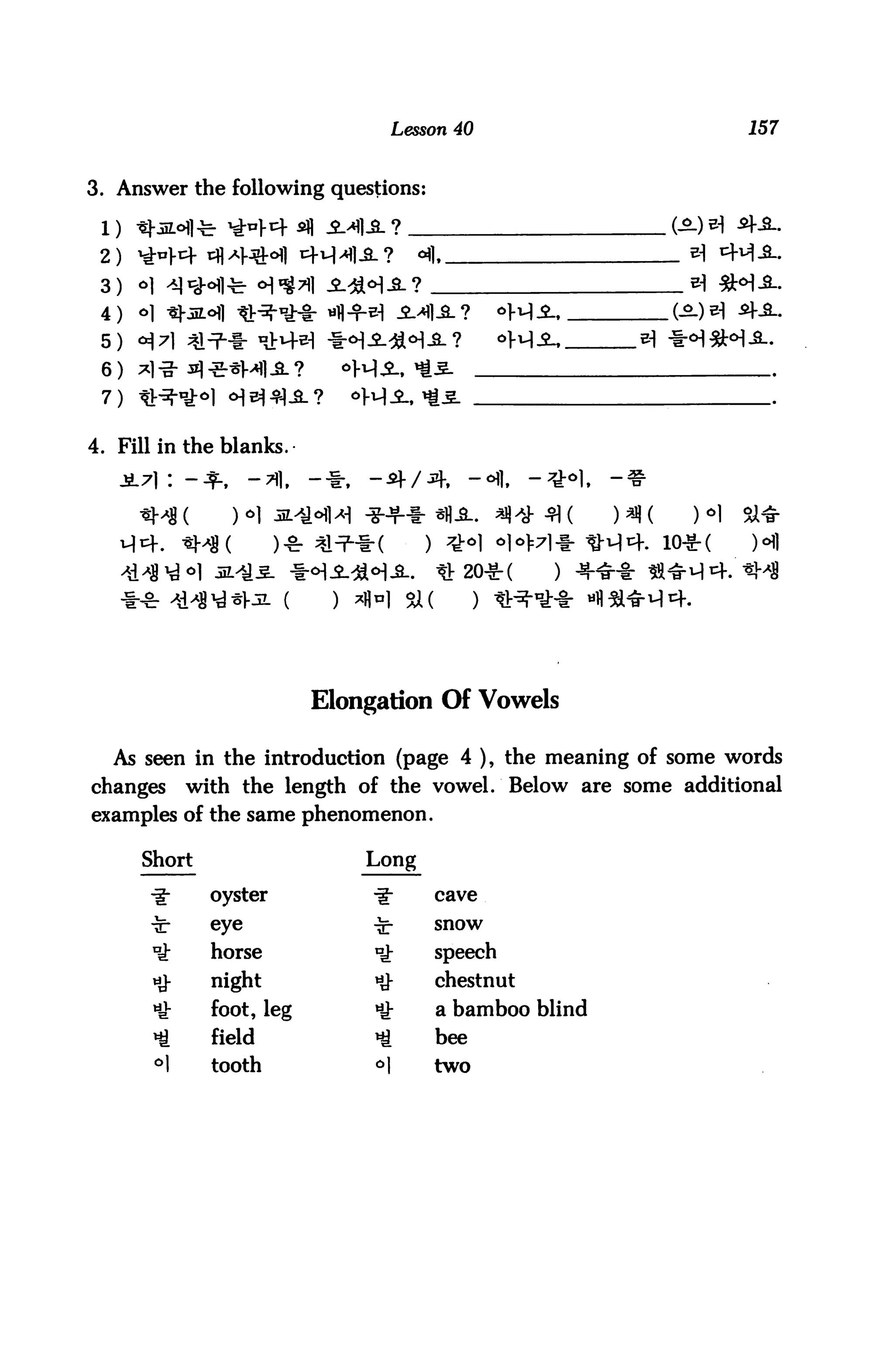
Elongation of Vowels                                    157


                                    xiv
Foreword


  This is a book which is addressed to a very important task, that of
aiding foreign residents of Korea in the acquisition of the language of
this country. Many persons who come to live here don't want to spend all
their time with fellow expatriates or the well-beaten paths of urban
centers. Many would like to say a few words in the market or on the tele
phone. Others would like to strike out on their own to visit places of
cultural and historical interest. Curiosity about one's surroundings also
leads foreign residents to an acute need for communication skills. There
has been a need for an introductory textbook for persons who are in
terested in Korean conversation but are unable to enroll full time in a
language institute. This excellent language text by Prof. Chang fills this
requirement admirably.
  It is also expected that second and third generation Koreans living
overseas will find this work of inestimable value. The approach to pro
nunciation and sentence structure will be useful to young people and
adults in their attempt to maintain an affinity with the thought patterns
and communication styles of their fatherland.
  The educational approach and comprehensive nature of this work is
impressive. Not only the dialogues, but also the grammar notes, pronun
ciation practice, and the excercises provide a framework for progress
towards the goal of a working ability in Korean in everyday life!
  Learning a new language shows you that nouns and verbs and adjec
tives can be put together in many different ways. One way in English,
another way in Korean. This makes language study interesting and
strenuous. Be sure to practice speaking whenever you can; even if you
can't find someone to speak Korean with, talk to yourself in a mirror 1
  If you begin to study one more language, you will come to have a

                                    xv
wider vision for your life. With this in mind, I sincerely hope that you
will practice Korean every day, every week, every year. If you keep on
doing this, you will do it better and better. Be sure to practice speaking
whenever you can. Even if the words don't sound exactly right, please
don't stop. Remember it takes a long time to learn a new language, but if
you work hard, Korean will really become your "second language."


Yonsei University                              Sungkyu Cho
Seoul, Korea                                   Director
                                               Korean Language Institute


                                   xvi
Preface


  In her twenty years of teaching Korean to foreign residents of The
Land of the Morning Calm, the author has seen them develop close
relationships with Koreans as their ability to communicate improved
with the ability to talk with Koreans in all walks of life. Instead of
reliance on an interpreter, the ability to communicate directly in
Korean gives one a feeling of self-confidence and helps one get along
directly in everyday life as well as in professional relations. As one
foreign resident of Korea has put it, "Every word you know is useful."
Furthermore, the response of Koreans is generally quite positive. After
conducting his first staff meeting, the new director of a foreign agency
in Korea overheard two of his secretaries saying, "My that was a good
meeting; and the best thing of all was that at the end, the director said
'komap-sumnida' (thank you) in Korean!"
  This book is written at the request of the Korean Language Institute
(K.L.I.) of Yonsei University. It is written for foreigners who have
only a short time in which to study the Korean language. With this in
mind, the author of this text has concentrated on practical, useful con
versation found in modern Korea. Each lesson is designed for one clock
hour of study. Specifically, the organization of the text consists of
groups of 5 lessons: four lessons of mostly new material followed by
one lesson of review. Thus, if the student spent one hour a day for five
days a week, it would take 18 weeks (the equivalent of one semester)
to finish the 90 lessons which comprise the body of this book.
  Each lesson consists of a dialogue, grammar notes, pattern practice,
and (for the first 40 lessons) pronunciation. The dialogue, which comes
first in each lesson, is designed to include conversation appropriate to
various circumstances in which the foreign resident of Korea might
find him/herself. The author has specifically attempted to include
brief, interesting, and useful material in the dialogue; material which


                                   xvii
can be heard and used in the student's day by day life in Korea. Such
practical matters as using the telephone, shopping in the market, and
greeting one's friends and acquaintances are treated more than once,
with the simple, more basic matters treated earlier, and more complex
and difficult material occuring later in the text.
  The earlier lessons also include Romanization of the Korean. However,
dependence on Romanization can easily become a handicap later, and the
author emphasizes the importance of learning Korean from hangul (the
Korean alphabet), which is not very difficult to learn. The Romanization
should be used only as a rough guide to pronunciation, while attention
is focussed mainly on the hangul and on verbal communication.
  Each new dialogue contains some new vocabulary and grammar.
These are discussed in the section on grammar notes. However, not
every student of Korean is a grammarian. The sections on grammar
labelled "Words and Phrases" may simply be studied as a review of
words and sentence patterns with the more technical grammatical
aspects left to the instructor. The first lessons do not treat specific
grammar to any large extent; rather, phrases are presented. An
attempt has also been made to limit the amount of professional
linguistic jargon in relation to grammar. Most explanations are given
in everyday language with which the student is likely to be familiar.
In order to put the language into cultural context to the greatest possible
extent, some of the vocabulary is also discussed in the section on grammar.
Because some of the students may be studying alone without the benefit
of a native speaker, the author has given extensive discussion to many of
the grammatical forms encountered in the dialogues. The value of the
grammar notes is that the student is enabled to find connections and to
see how different parts of the language fit together.
  The third section of the lessons in this text consists of pattern prac
tice. Here, the student is given new vocabulary and 4-6 exercises
designed to consolidate learnings from the the dialogue through substi
tution practice, questions and answers, matching, etc. After this, the
student needs to use the material in a meaningful way to produce his/
her own social intercourse. Opportunity for this is provided by role
playing exercises, pictures, etc. as a stimulus to conversation.
  A fourth section on pronunciation is included in lessons one through
forty. It is the author's experience that pronunciation needs to be
emphasized from the very beginning. A combination of hearing from a


                                   xviii
native speaker and of learning from the explanations given in this text
is the most beneficial means to the acquisition of Korean pronuncia
tion. It was not possible to do without professional linguistic vocabulary
in this section. Reference to the diagrams in the Appendix should help
students to understand the mechanics of pronunciation. In addition to
practice of the individual sounds of the Korean language, practice
of these sounds as they occur in Korean words is given. While the
English translation of these words is given, the student need not
remember all the vocabulary in this section; just practicing the pro
nunciation of the words is sufficient.
  The first lessons also include a section on writing. The general
principle is to make the strokes from top to bottom and from left to
right. This applies not only to the letters of the alphabet but also to the
syllabic clusters of Korean words. The review lessons are very much
like the exercises in the pattern practice except that some practice in
reading is included from Lesson 55.
  A further word on the linguistic terminology used in this text: While
all professional jargon could not be replaced, a definite attempt was made
in this direction. In the attempt to simplify explanations, the author has
even devised new terminology in a few cases. A case in point is the word
insert which is found from time to time in the grammar notes.
  I am obliged to many friends and former students for their en
couragement and counsel. Particularly, I want to thank Helen R.
Tieszen of Yonsei University for helping with the translation into
English; without her continued assistance, this book could not have
been completed. I am also grateful to Edward Klein, Basil M. Price,
Sean Goldrick, and Ruth and James Grayson who read the manuscript
and made many useful suggestions.
  I wish to cite Cho, Song-kyo, Director of the JCorean Language In
stitute as well as the K.L.I..staff as a whole, particularly Kim Un-suk,
Yi Kyu-hui, Yim Myong-ja, Hong Kyong-p'yo, Paik Bong-ja, Son Yon-
ja and Yi Hui-kyong. Appreciation is also extended to Sue Bae of the
Royal Asiatic Society, Korea Branch for her encouragement and to
Kim Jin-wang and the staff of the Seoul Computer Press who under
took the publication of this book.


Seoul, Korea                                                Suk-in Chang
July 1982


                                     xix
Introduction to the Korean Language

  One of the principal characteristics of human beings is their ability
to use language. Human beings not only express their inner ideas,
thoughts, and feelings, they also understand other people's ideas,
thoughts, and feelings through language. In this way communication
is established. Communication usually takes place either verbally or
through writing. Koreans have their own writing system, called tril"
(hangul).
    Hangul is an alphabetic writing system; that is, thinking is ex
pressed verbally, and what is heard is in turn expressed in phonemic
letters. The advantage of alphabetic letters is that they are easy to
learn and easy to write. Furthermore, the sounds may be expressed
precisely. The Koreans' great pride in hangul is based on its scientific,
philosophical, and rational nature. In fact, Choi Hyon-bai (1971) has
noted that hangul has special connotations for Koreans, such as "great
written language, outstanding letters, and the language of the people
of Korea." The hangul system of writing was the culmination of
research by a group of scholars and was first introduced in 1445 by
^^(King Sejong). At that time it was called the                ^^-fr
(hunmin-jongum). Before this time, Chinese ideographs were used
almost exclusively   although some earlier attempts had been made at
phonetic writing (Buzo 1980). The scholar who first used the word
*# was ^ ^ (Chu Si-gyong, 1876-1914). Even after the invention of
the alphabet, the literati continued to use Chinese ideographs and the
phonetic writing was relegated to the use of women, children, and the
lower classes. In modern times, however, hangul has come to be used
more and more and now forms the basis of Korean education and
much of the written language.
  Articulated sounds are given visual shape in phonemic symbols which
can be read, and although the focus of this book is on verbal language,
it is the author's opinion that Korean is better learned through Korean
symbols than through Roman letters. The alphabet is often called the
ka-na-da (7} 14 c+) after the first three syllables. That is, the vowel
} (ah) is combined with the consonants ~i (k), 1- (n) and ^ (t) and so
forth through    all the consonants,   and then the next vowel > is
combined with all the consonants until the table is completed (see
Modern Conversational Korean


Frontispiece). A guide to the pronunciation of the Korean letters is
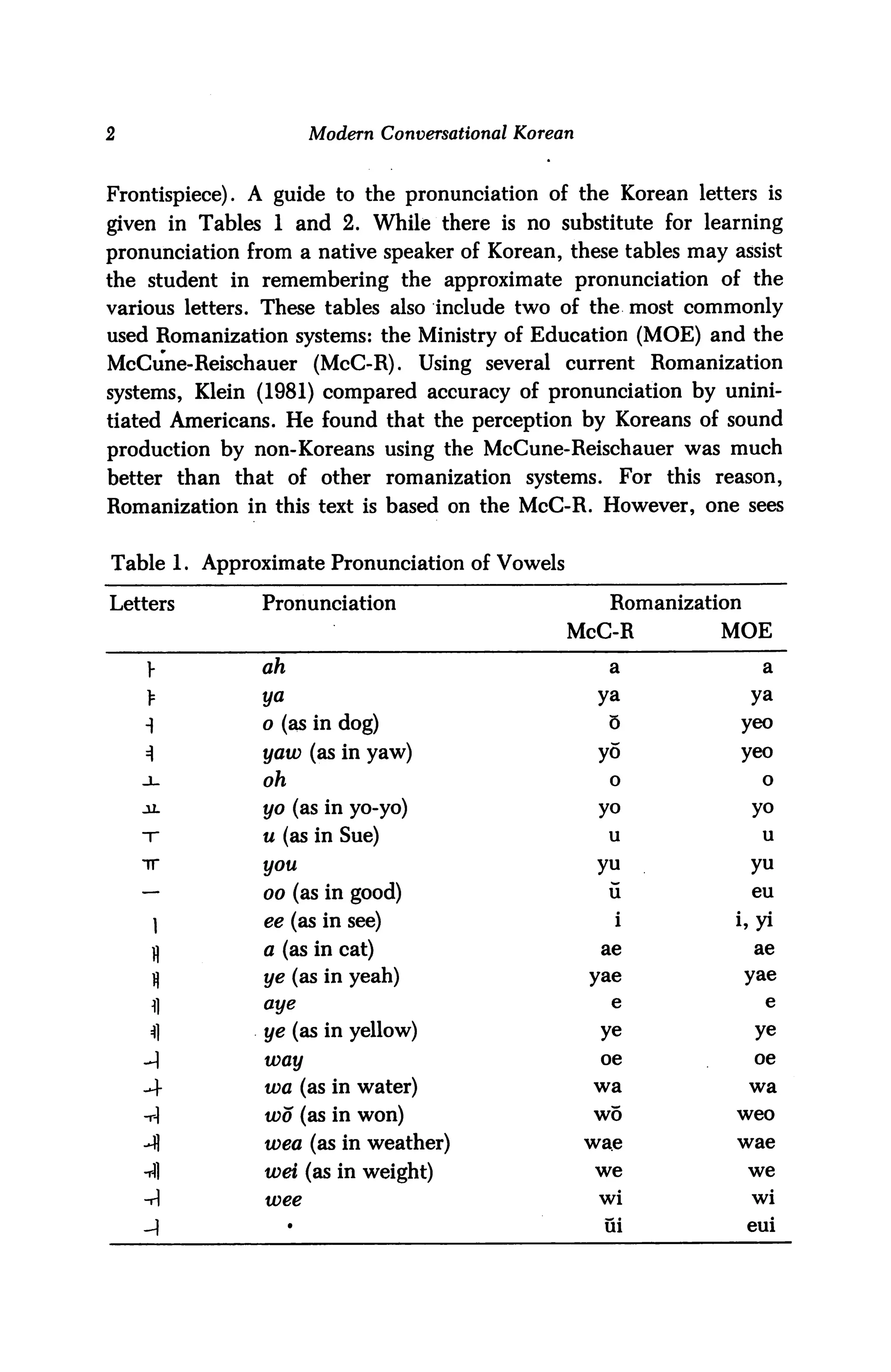
given in Tables 1 and 2. While there is no substitute for learning
pronunciation from a native speaker of Korean, these tables may assist
the student in remembering the approximate pronunciation of the
various letters. These tables also include two of the most commonly
used Romanization systems: the Ministry of Education (MOE) and the
McCune-Reischauer (McC-R).          Using several current Romanization
systems, Klein (1981) compared accuracy of pronunciation by unini
tiated Americans. He found that the perception by Koreans of sound
production by non-Koreans using the McCune-Reischauer was much
better than that of other romanization systems.           For this reason,
Romanization in this text is based on the McC-R. However, one sees


Table 1. Approximate Pronunciation of Vowels

Letters         Pronunciation                             Romanization
                                                    McC-R           MOE

    y           ah                                        a                a

    >                                                    ya              ya

                o (as in dog)                             5              yeo

                yaw (as in yaw)                          yo              yeo

   JL           oh                                        0                o

   _LL          yo (as in yo-yo)                         yo               yo

   T            u (as in Sue)                             u                u

   TT           you                                      yu              yu

   —            oo (as in good)                           u               eu


    1           ee (as in see)                            i          i.yi
    11          a (as in cat)                            ae               ae


    H           ye (as in yeah)                         yae              yae

                aye                                       e                e

                ye (as in yellow)                        ye               ye


   A            way                                      oe               oe

   A            wa (as in water)                        wa               wa

                wo (as in won)                          wo           weo

                wea (as in weather)                     wae          wae

                wei (as in weight)                      we               we

   -A           wee                                      wi              wi
                     •
                                                         ui              eui
Introduction                                          3


signboards throughout Korea using the MOE system. The student is
referred to the Transactions of the Korea Branch of the Royal Asiatic
Society, Vol. 38, 1961 for a complete description of the McC-R. A
reprint of these tables is also available from the Society.
  Korean is normally written in syllables. Basic syllables are composed
of a single consonant followed by a single vowel. Even the alphabet is
written with each consonant in combination with each vowel as shown
in the Frontispiece. In actual use, syllables may be composed of one to
three parts: the beginning, the middle, and the final sounds. The main
part of the syllable is the vowel which forms the middle sound. The
importance of the vowel is illustrated by the eighth consonant in the
alphabet. Because o is silent in the initial position, only the vowel is
pronounced.


 Table iJ. Pronunciation of Consonants

                                             Pronunciation                   Romanization

Letter     Name of           Initial            Between        Final     McC-R        MOE
            Letter*                              Vowels

  -i         7)    <*    unaspirated k             g            k        k/g/k2        g
  u.         •u]   -g-   n                         n            n        n             n

  b.         ^     -5"   unaspirated t             d            t        t/d3/t        d
  a
                         I                          r           I        1/r/l         r

  n
             °1    *     m                          m           m        m             m

  ti                     unaspirated p              b           V        p/b/p         b
  A
             Al    *     s as in spring            s            t        s/s/t          s

  O
             «]    *     silent                     ng          ng        ng            ng
             ^1    *     unaspirated ch             1           t         ch/j/t       j
  X
             *)    *     aspirated ch               ch          t         ch/j/t        ch
  =7                     aspirated k                k           k         kVk'/k        k
  H          B^    -g-   aspirated t                t           t-d       t7t'4/t       t
  JE
                         aspirated p                V           p-b       pVpVp         P
  -ar
             *1    4-    h                          h            t        h/h/t         h

 1. The names of letters in current use date back to the 1933 Conference for the Establish
    ment of Unified Hangul.
 2. The letters between diagonals indicate initial, between vowels, and final transcriptions.
 3. ti is pronounced :* (j) between certain vowels.
 4. h is pronounced X (ch') between certain .vowels.
4                            Modern Conversational Korean


    In addition to the basic vowels and consonants of the alphabet as
given in the ka-na-da, vowels may be combined with each other
(Table 1). Consonants may also be combined with each other to form
double consonants 11 xx.            an   ^ ** and consonant clusters ta y* v$ ei
sd Ba 3E e£ w ha . The pronunciation of such combinations may be
found in Lessons          10-12 .
    In addition to the above, a consonant may be added after the vowel
at the bottom of the syllable, and more complex syllables may have
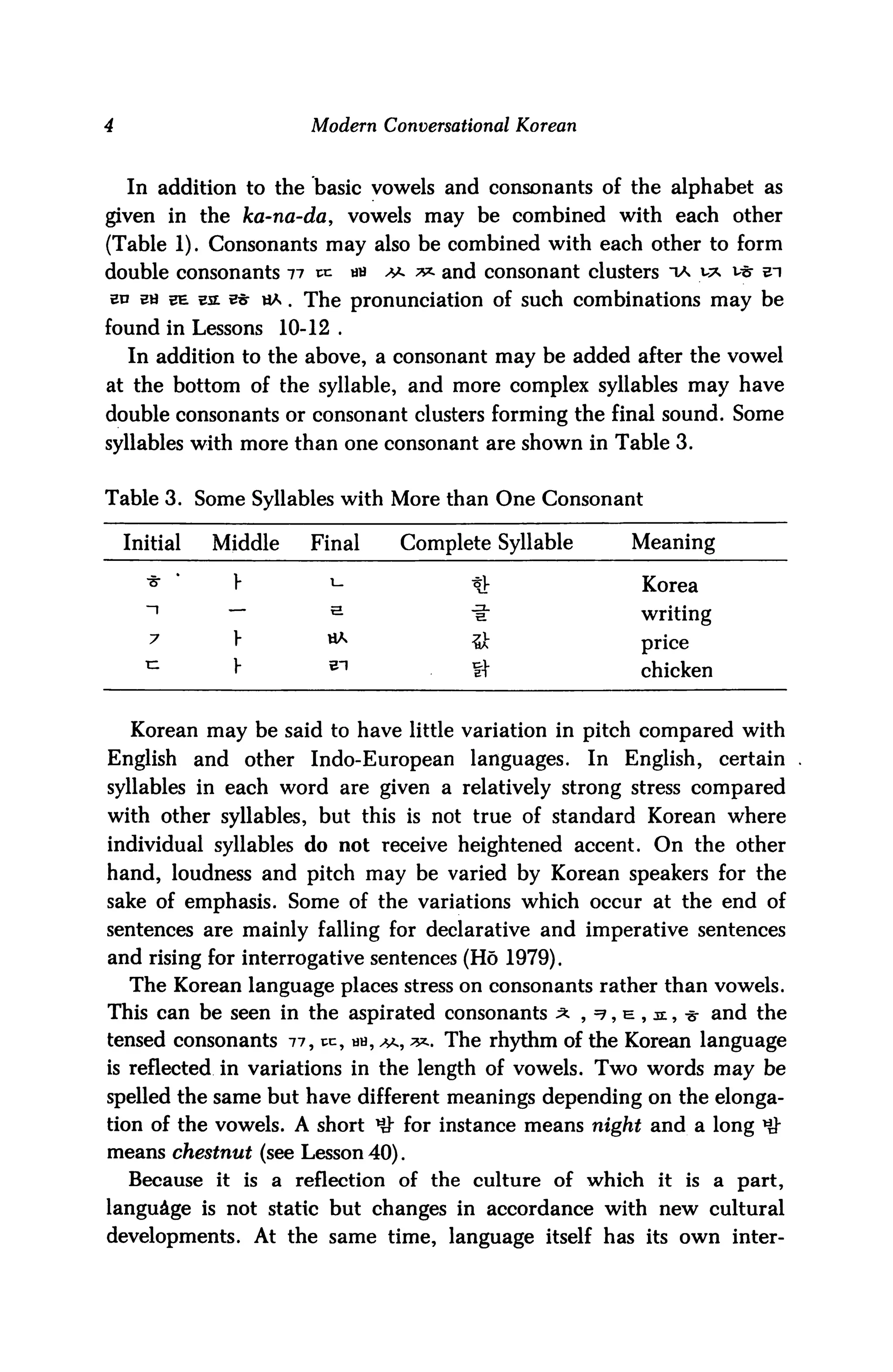
double consonants or consonant clusters forming the final sound. Some
syllables with more than one consonant are shown in Table 3.


Table 3. Some Syllables with More than One Consonant

    Initial      Middle      Final        Complete Syllable        Meaning

      ■8-   '      V                                                Korea
      ~i           —           e
                                                                    writing
       7           y           HA                                   price
      n
                   y                                                chicken


    Korean may be said to have little variation in pitch compared with
English         and other Indo-European languages.            In   English,   certain
syllables in each word are given a relatively strong stress compared
with other syllables, but this is not true of standard Korean where
individual syllables do not receive heightened accent. On the other
hand, loudness and pitch may be varied by Korean speakers for the
sake of emphasis. Some of the variations which occur at the end of
sentences are mainly falling for declarative and imperative sentences
and rising for interrogative sentences (Ho 1979).
    The Korean language places stress on consonants rather than vowels.
This can be seen in the aspirated consonants ^ , =?, e , je , -s- and the
tensed consonants 77, pc, hh, ^, **. The rhythm of the Korean language
is reflected in variations in the length of vowels. Two words may be
spelled the same but have different meanings depending on the elonga
tion of the vowels. A short HJ" for instance means night and a long *#
means chestnut (see Lesson 40).
    Because it is a reflection of the culture of which it is a part,
language is not static but changes in accordance with new cultural
developments. At the same time, language itself has its own inter-
Introduction                                    5


related rules, systems, and structures which are implicit in the term
grammar. Grammar generally is concerned with parts of speech and
sentence structure.

  The parts of speech have to do with the function of individual words
within the sentence. Korean scholars hold various opinions about the
parts of speech. The parts of speech which a group of scholars agreed
upon in 1963 for use in Korean textbooks and modified for use in the
present text are given in Table 4.


Table 4. Korean Parts of Speech*

    1.   *%*}                           Nouns
    2.   ^fl ^ *]■                      Pronouns
    3 . ^r A                           Numerals
    4 . ^~Al                            Active Verbs1
    5. ^ -§-*}; ^ -JHs-A               Adjectives; Descriptive Verbs1
    6. x]^*}                            Copula2
    7. -Sr^^V                           Prenouns
    8. W                                Adverbs
    9. ^ -=T-Ah                         Connectives3
   10- ^                                Particles
   11. ^y-^^r                           Exclamations

 * Except where otherwise indicated this table is based on work of the Hakkyo Munbup
  Simui Uiwonhoe.
 1. Pak Ch'ang-hae(1965)
 2. Choi Hyon-bae (1971)
 3. Yi Hui-sung (1955)


  Korean sentence structure has some overlap with English and other
languages, but it also has some unique elements that may not be found
in the student's native tongue. These may seem strange to the student
at first glance, but after a bit of practice, they begin to take their place
in his/her system of logic.
  The structure of Korean sentences is composed of the subject and the
predicate which may contain adjectives, adverbs, and exclamations, in
addition to nouns and verbs. There are three types of sentence organi
zation: 1) simple sentences, 2) compound sentences with two complete
subjects and predicates, and 3) complex sentences with dependent
phrases in the subject and/or predicate. The five forms or moods of
6                     Modern Conversational Korean


Korean sentences are 1) declarative, 2) interrogative, 3) imperative,
4) propositive, and 5) exclamatory. Generally, the sentence form is
determined by the verb ending. The student will find examples of
these in the main body of the text.
    One of the characteristics of Korean is the use of honorifics. In
addressing someone older than oneself or someone whose social posi
tion is higher than one's own, courtesy and habit require that person
to be honored in one's speech. Also, by humbling oneself the other
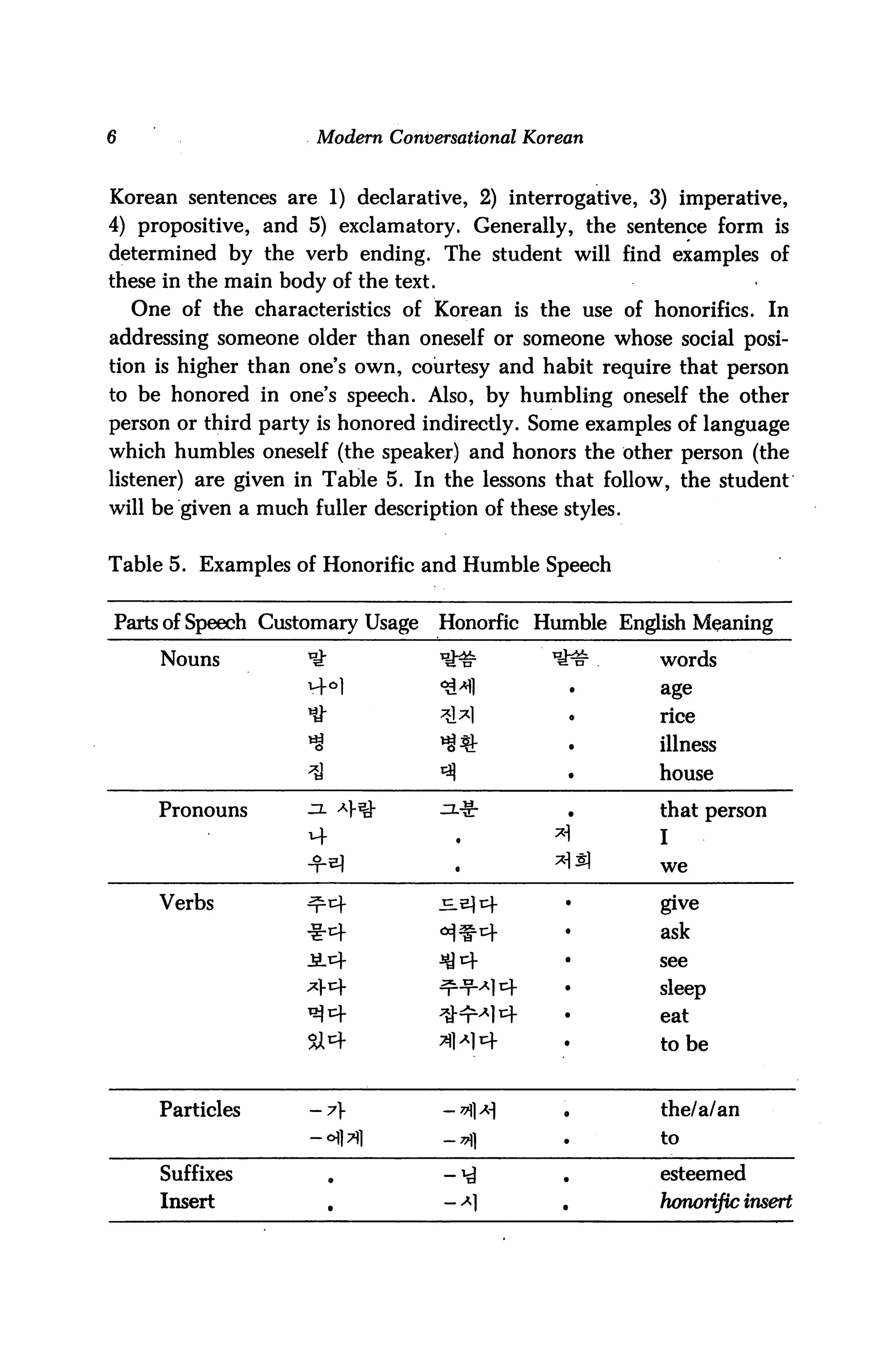
person or third party is honored indirectly. Some examples of language
which humbles oneself (the speaker) and honors the other person (the
listener) are given in Table 5. In the lessons that follow, the student
will be given a much fuller description of these styles.


Table 5. Examples of Honorific and Humble Speech


Parts of Speech Customary Usage       Honorfic Humble English Meaning

      Nouns          *£               ^i^r      ^s1        words
                     M-Cl             <*H1           •     age
                                                           rice
                                                           illness
                                                     •     house

      Pronouns       ^ a)-^           jx-g-          ,     that person


                                                           we


      Verbs          n^^f             — £}cf      •        give
                                                  •        ask
                                                           see

                                                           sleep
                                                           eat

                                                           to be


      Particles      -7              -v§*      •         the/a/an
                                                           to

      Suffixes            0           -^         .         esteemed
      Insert              .           --*!       .         honorific insert
Introduction                                 7


  There are two kinds of verbs in Korean, active verbs and descriptive
verbs. They can be distinguished by their nature and function. That
is, active verbs have to do with movement or activity of some kind,
whereas descriptive verbs have to do with the quality, nature, or state
of a person or thing. Descriptive verbs are much like adjectives in
English. Both active verbs and descriptive verbs have two parts; the
^^Vor verb stem (VS) and a suffix or verb ending. The basic verb
form is VS + t+as in it (to go) and ip-*+ (to be good). These basic
forms may be found mainly in the dictionary, they are never used in
spoken Korean. In other words, verbs must always be inflected or
changed to indicate form or mood, honorifics, and tense.
  There are many verb endings but only a few examples of the most-
used formal, informal, and plain styles are given in Table 6. Formal
and informal styles may be made honorific by the insertion of <*1
between the verb stem and the verb ending, as in VS + *1 + w ^ ^ .
Grammatically, the * is an ogan (helping stem) but for purposes of
this textbook, the author has chosen to call it an insert, since it is
placed between the main verb stem and the verb ending.


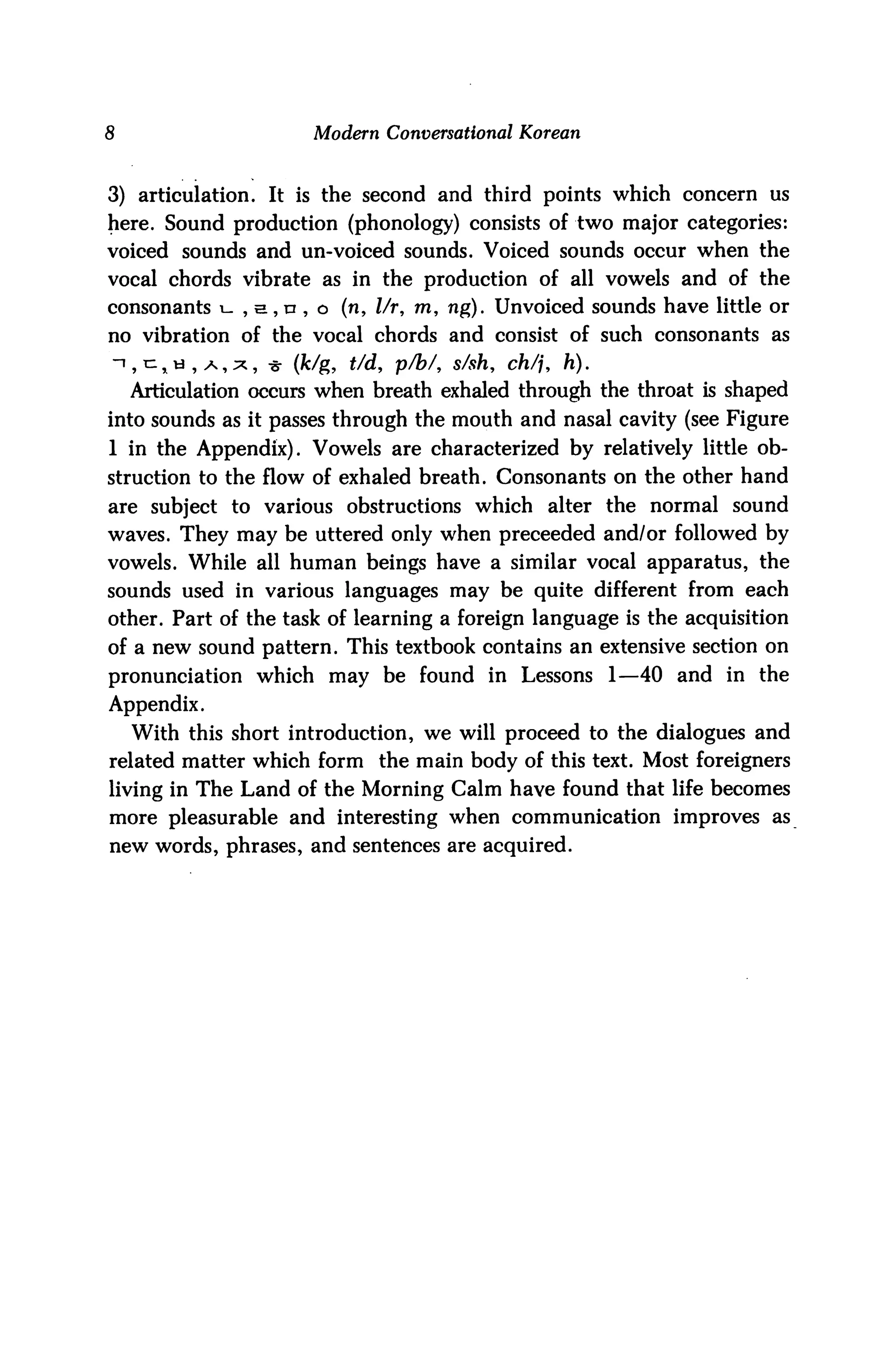
 Table 6. Examples of Verb Endings

 Sentence Forms        Formal Style              Informal Style*** Plain Style
 Declarative         *AVS + au|cf/^u|r+          AVS+°V/<H/^-a. AVS + ^-/^
                     *DVS+ aM^f/^vm-             DVS + ^/^H/^-S- DVS + ^f

 Interrogative          VS4 t»-W/ tK)^V                              AVS+M

                                                                     DVS+(^-)M
 Imperative          AVS+ (JL)^1.£_                                  AVS+°1-/<H/<H^

 Prepositive         AVS + (3.) « ^1 cf                              AVS + *1-
 Exclamatory         AVS+ (-b)-^iL                                   AVS + -fe-*
                     DVS + ^r-a.                                     DVS + ^r
 ♦AVS: Active Verb Stem
  D VS : Descriptive Verb Stem
 **The intermediate :±:is inserted when the verb stem ends in a consonant.
 *** See Lesson 6.


   Ch'oi Hyon-bae (1971) has stated that language consists of the expres
sion in sound of a person's thinking. He and other scholars analyzed
the process of vocalization and concluded that it consists of three parts:
1) breathing, that is inhaling and exhaling, 2) sound production, and
8                     Modern Conversational Korean


3) articulation. It is the second and third points which concern us
here. Sound production (phonology) consists of two major categories:
voiced sounds and un-voiced sounds. Voiced sounds occur when the
vocal chords vibrate as in the production of all vowels and of the
consonants i- , s, n , o (n, l/r, m, ng). Unvoiced sounds have little or
no vibration of the vocal chords and consist of such consonants as
ijC^ti^A,^, -8- (fc/g, t/d, p/b/, s/sh, ch/j, h).
    Articulation occurs when breath exhaled through the throat is shaped
into sounds as it passes through the mouth and nasal cavity (see Figure
1 in the Appendix). Vowels are characterized by relatively little ob
struction to the flow of exhaled breath. Consonants on the other hand
are subject to various obstructions which alter the normal sound
waves. They may be uttered only when preceeded and/or followed by
vowels. While all human beings have a similar vocal apparatus, the
sounds used in various languages may be quite different from each
other. Part of the task of learning a foreign language is the acquisition
of a new sound pattern. This textbook contains an extensive section on
pronunciation which may be found in Lessons 1—40 and in the
Appendix.
    With this short introduction, we will proceed to the dialogues and
related matter which form the main body of this text. Most foreigners
living in The Land of the Morning Calm have found that life becomes
more pleasurable and interesting when communication improves as
new words, phrases, and sentences are acquired.
1.    <>!             Greetings


  One day Mr. John Doe meets Mr. Kim in front of his office building.


                                                  peace


                                                  to do (honorific, interrogative)

                                        How are you? (Note 1)
/ annyong ha-seyo /

                                                  yes (Note 2)

                                                  where

                                                  please go

                                         Yes, (I am). Are you going someplace?
/ nve, odi ka-sevo /                                                           (Note 3)

                                                  that place over there

                                                  peacefully

                                                  please stay

                                         Uh-huh, over there. Goodbye. (Note 4)
/ nye, chogi-yo. annyong-i kye-seyo /

                                         Goodbye. (Note4)
/ annyong-i ka-seyo /


                                  Grammar Notes


Note 1. °J^^M].3_           / annyong-haseyo /   phrase How are you? (Literally:
                                                          Are you in peace?)
   y) Greetings form such an important part of Korean language and
       culture that the first two lessons have been devoted to this subject,
       and other lessons on greetings are interspersed throughout the
       text.
   M-) °xKJ^Ml.a-       is an informal greeting which may be used at any
       time of day and in any situation.
  cr) This is used with children only in formal situations. Informally,
10                      Modern Conversational Korean


      its familiar equivalent,    ^ <&5X^       /chal isson ni / is used with
      children.
 *+) This is similar to such English expressions as How are you, Good
      morning, Good afternoon, and Good evening.


Note 2. <^) / nye / exclamation    yes
 A) Though written <A] (ye) it is often pronounced vfl, vfl (nye or ne).
 M-) Although ^] means yes, intonation may also indicate such responses
      as surprise or disbelief.

Note 3. °]t] 7M1-3-      / odi ka-seyo/ phrase Are you going someplace?
                                               (Lit: Where are you going?)
 A) This phrase is used frequently as a greeting and in this case the
      intonation includes a stress on ^ as well as a rising pitch at the
      end of the phrase       <H ^ Axfl-3-. An indefinite answer, such as
      AA&- (over there) is the reply.
 4) This phrase may also be used in its literal sense. In this case, the
      stress is on the <H with the rising pitch at the end of the phrase,
      <*M 7Ml-£-. A more definite reply is required such as, 4«<M1 A&-
      (Fm going to the tearoom).

Note 4. oJ-i-J •$) 7ja)£_ i annyong-i kycseyo / phrase Goodbye
          ^ *] 7M1-2- / annyong-i ka-seyo / phrase Goodbye
 A) °xM*l 3HiL Goodbye or farewell. [(Lit: Please be (or stay)
      in peace].
              7M1-&. Goodbye or farewell. (Lit: Please go in peace),
             you leave someone at the house or office, the person who
      stays behind says <lN *] ^MI-S- The person who leaves says      °J^ *]
      ^M|.£L to the person who stays behind.
 €) To children, younger people, or very good friends it is usual to say
      ^ 9X°] I chal isss / when you are leaving and ^ 7} / chal ka / when
      the other person is leaving. One should avoid using these plain
      forms with older people and others who should be respected.


             Pronunciation and Writing of the Vowels

1) Practice in pronouncing vowels will be the focus of this reading
     lesson. The vowels combined with the initially silent / o / of the
Lesson 1                                11


   alphabet provides a number of syllables which can be combined to
   form Korean words. See Figures 1                          and 2 in the Appendix for
   further guidelines to the pronunciation of these vowels:


2) Reading Words*: The following are commonly used words formed
   with the above syllables.
    ° <=>1   child                 3- °]    cucumber            <H + fox; actress
   -t" -fr milk                     °) -fr reason

3) The writing order is given in the chart below:


              o>      o>
                           °) H
                                                o       o
                                                                           o. o]

                                                o       o       o     o    o    o
       1      O       O       o         o


       2                      o-        o-      9       ■?
                                                                o     o
       3                      o^        o:      O        Q


                                                         Q            o
       4

4) Practice writing vowels by tracing over the dotted lines:

                                                        o       °
                                                                                °)
                                                                     o     O
                                                                     TT

              4 <>>                                                             *1
                                                                      o
      1                                                              IT
                                                                           o


      2                                                 o      _9     o    o
                                                                     TT

      3                       oJ|      o:j      o^      q       o     o    o    o]
                                                                     TT


   *The student is not expected to memorize all the words in this section but only to
     practice reading them.
12


                            2.                Thanks


     Mr. Kim meets Mr. Pak in the bus. When he gets off, Mr. Kim pays

Mr. Pak's bus fare.


                                               the surname Kim

                                               teacher

                                               thank you.

                                       Thank you, Mr. Kim. (Note 5, 6)
/ Kim sonsaeng-nim, komap-sumnida /

                                               ten million

                                       You're welcome. Don't mention it. (Note 7)
/ chonman-eyo /

                                               well then

                                               again

                                               will see

                                       I'll see you again. (Note 8, 9)
/ kurom tto poepkessoyo /


                                       Goodbye.
/ nye, annyongi kaseyo /


                                 Grammar Notes


Note 5. 7tJ ^dA8^ / Kim sonsaengnim / noun             Mr. Kim
 71") 7i is a family name. The most common surnames in Korea are
      <>]'(Yi), 7j (Kim), and *4 (Pak).
 ^ -*&*$ (son saeng) is a noun meaning teacher. It is also a title of
       respect and therefore is never used in relation to oneself. It is
       approximately equivalent to the English Mr., Mrs., Miss, Ms.
 I4) ^ / nim / is a honorific noun suffix. It is usually attached to a
       person's title or occupation.
Lesson 2                                   13


    Koreans rarely call anyone by name without using an appropriate
    title. More titles will be given in future lessons. Titles may be used
    with or without mention of the person's name.


Note 6. JL*t^ cf       / komap-sumnida /    phrase      Thank you.
?}) This is interchangeable with           ^M-tM1^      / kamsa-hamnida /   (lam
    grateful)
4) Between good friends and or younger people                  jL^fl-fi. is often
    used but the form given above is most general.


Note 7. ^xHl-S- / ch'snmaneyo / phrase          You're welcome; don't men
                                                tion it. [Lit. 10 million honor
                                                able (words)].
 7) In more formal situations        ^i^>^ lfr#<a^^-         / ch*5nman-e malssum
    imnida / is commonly used. (Lit: ^"J; ten million; ^               possessive;
                   are words)


Note 8. .=L«y   / kurom / adverb    well then; if that is so. . .
 A) This is a shortened version of


Note 9. hl ^^l^^_ /ttopoepkesoyo/ phrase             farewell; "see you again"
                                                     to see (honorific)
 ?) ^^ (to see) is honorific for £-*)■ (to see). It is used to show
     respect for someone to whom or of whom one is speaking.

     Examples:
          Honorific        ^
                           2L

          Familiar         ^
                           SB.


                                 Pattern Practice

Additional Vocabulary
  jL7l    example                           ^°]-H^l      grandfather
          conversation; dialogue            £.t)-        to see
          (someone else's) wife; Mrs.       tlr^*        Korea
          uncle                             -tt*$ *&& pattern practice
14                               Modern Conversational Korean


1. Practice          the     example       (*L7])          below     and   then    substitute   the
     underlined portions with the key words in 1), 2), and 3) and other
     suitable words.
                                                      S :


                                                 2) °| 414N                3) ^

2. Study the short dialogue (*$$-) below and then substitute with the
     key. words as given and/or other suitable vocabulary.


                                                          s2:

                1)     ti-l 4141 i              2)       o] ^^g^           3)

3. Practice the example (jb_7|) and then substitute the underlined
     portions with new vocabulary.
                                                          s : 7


                1)                               2)                         3)


                 Pronunciation and Writing of Consonants

1) Practice reading the first 4 consonants of the alphabet with each
     of the vowels:


                  Vowels
                                  y        -1        A                            1
             Consonants      


                        ~"       7} A 7                   ^a                     71


                        xz


                        H


2) Practice reading words formed with the above syllables and those
     learned in Lesson I:
     7 e)     street                  -S-^f              to come            °}7]      baby
     3.7}      meat                    <>M                where              ^l^m- to win
     •?■-¥•    shoes                   o^                 baseball           ^1^-      roof tile
     7V4 to go                         ef^^-              radio
Lesson 2                                 15


3) Practice writing the following consonants:

   Consonants       -i           i-            n        a

             l         -i        l-            —        -*


             2                                 n        =»

             3                                          s


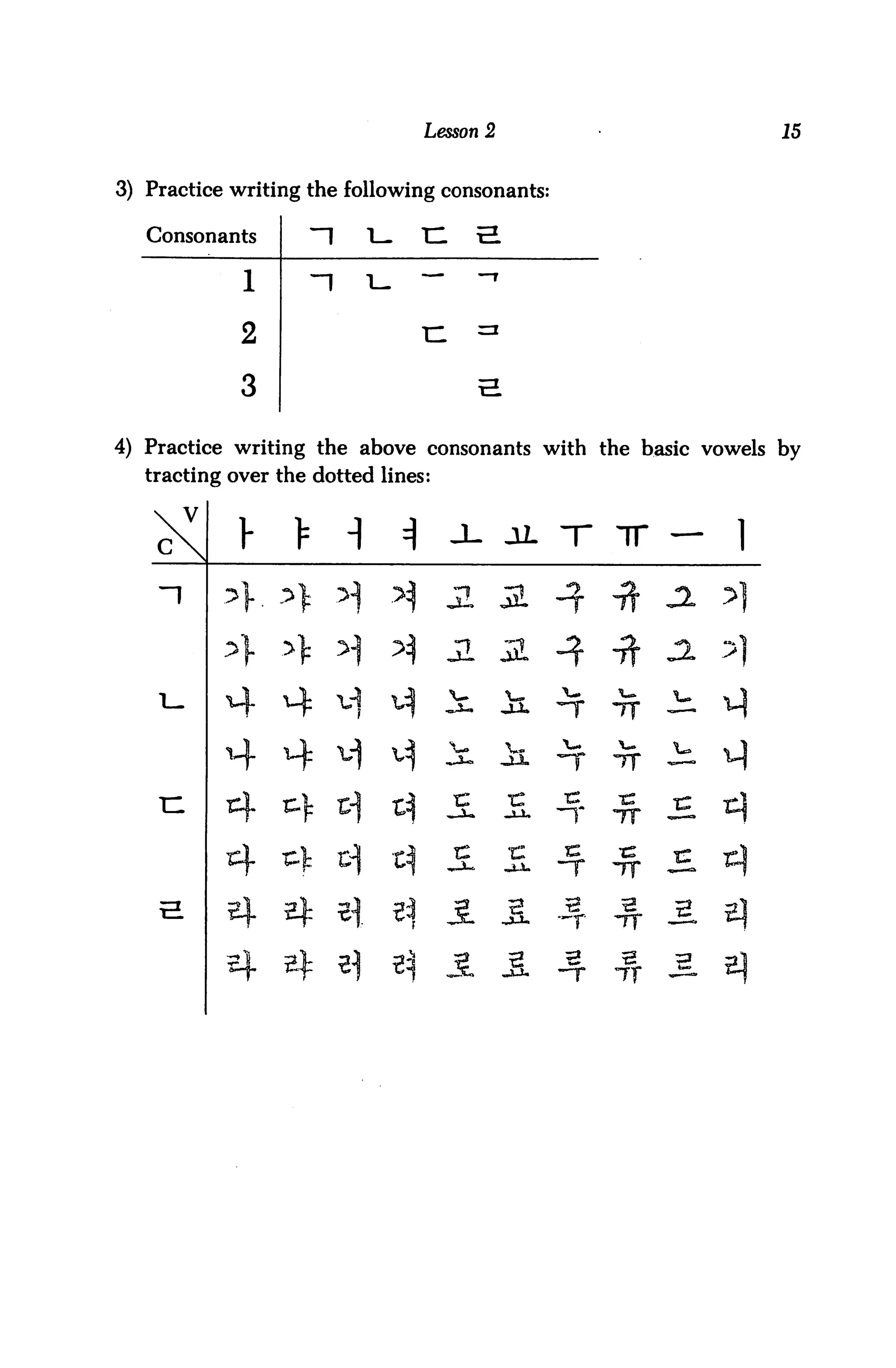
4) Practice writing the above consonants with the basic vowels by
   tracting over the dotted lines:


   v        V     >                       3 -1-             JL          -ir -      1
    c 1
    1      4.               >)        ■> ^         Jl a 4

           4                                                        4 •ff a ^
    1-     4 4              v)        x.                                 ^   Jr.   vj

           4 4                                                      ^T   ^ j=.     q

           4
           4                c^        t                      •c
                                                             a-t.
                                                                    -f -S- -E. ^
    a      4                                                             4 3, el
           4                               ^       3.                2
                                                                    -T   •ft ■£ ai
16


                     3.     >^JM1,S.?           WhoAreYou?


     After Pak Min-su mistakenly takes John Doe for the English teacher:


                '}T=fm                           who (Note 10)
nri^l-S.?                                 Who are you?
/ nugu-seyo /

                *                               I (Note 11)
                —-fe-/ -c-                      subject particle (Note 12)

                *Mj                              student

                ^^                               to be (Note 13)
*te «M*HU.                                Fm a student.
/ ch5-nun haksaeng-ieyo /

                                                 who (Note 10)
                                      ?   Then, who is the teacher?
/ kurom, nuga sonsaengnim-iseyo /

                x ^                             that person over there (Note 11)

                — o ] / y                      subject particle (Note 12)

x^6] *&A$ ^ 6H| A.                        That person is the teacher.
/ chobun-i sonsaengnimi-seyo /


                                      Grammar Notes

Note 10. <±r-=f- / nugu /       pronoun    who; whom
 A) When it is the subject of a sentence -t^ is frequently used without
       a particle.
 MO When the particle 7 follows -t*np-, the form is shortened to ^7} .

       Examples:
          -T-^f sf_a_ ?                     Who is coming?
          -T-7f «l * H <H -a. ?             Who is reading a book?
                         ^l-sfl-SL?         Whom do you like?
                          ^-8- ^5dH A ?     Whom did you give the money?
Lesson 3                                    17


Note 11. Personal Pronouns

    Person    Level      Singular             Meaning            Plural

      1st     Familiar   *4 / M]              I/I, myself
              Humble     *1 / *fl
      2nd     Familiar   H / M|               you/yourself
      3rd     Honorific °1 / ^- / * -8-      this/that person
              Familiar   °1 / ^- / ^ >M-^- this/that person

 7]-) 1st and 2nd person singular pronouns used as the subject of a sen
     tence require specific particles. That is M-, * , and H always taket,
     and ^ , ^1, and vfl always take 77 becoming uf-^-, aft » H -fc-, and


 *4) Of the 1st and 2nd person pronouns, M-fe-, *J t, uj-fc- are used most
     frequently but m 7, *fl 7|-, ifl 7f are used to differentiate between
     oneself ( ^fl7f/^] 7) compared with others, or yourself (j7) com
     pared with others.


Note 12. o) / 7 i i/ka / and ■£•/ •£•/ un/nun / subject particles    a, an, the
7f) These particles are attached to any subject.
 HO — 6land —grare attached to words ending with a consonant.
    —7 and — -fe- are usedf with words ending in a vowel.
 14) —61/—7 are subject marker, as are -£-/-c-. The latter are
     used to contrast, compare, or emphasize the subjects(s).
     Examples:
                                                       Who is this person?
                                                       That person is our mother.
                                                       Seoul is larger than Pusan.
                                            6i*Hl Ju   This is salt, That is sugar,
                      be attached to objects and other parts of speech.


Note 13. oli4 / ida / copula to be; to be equal in meaning; to have the
                                    identity or characteristics of
7) °t is a verb that identifies the predicate of a sentence with the
     subject, i.e., it functions as the connecting link between the subject
     and other material in the sentence describing the subject.
H-) The stem of this verb is °| and the ending is ^. Verb stem (VSjH-^f
     is the most simple of verb forms and is used mainly in dictionaries
     and textbooks on grammar. The conversational form is more likely
18                         Modern Conversational Korean


     to be o]<H.3_ (= °fl-3_) when speaking of oneself and things, and
     °H| JL when speaking of someone older or with higher status.
     The pattern for sentences ending in a] 14 is noun + particle + noun +
     VS °] + verb ending. In case the noun preceding °] *4 ends in a
     vowel, the VS °1 often forms a contraction with the verb ending °fl.&,
     but when the noun ends in a consonant, o] is pronounced separately,
     a] cH| JL as in the examples below.

     Examples:
                                                 She's (my) mother.
                                                 I'm Mr. Kim.
                                                 Who is that person?

                         43M <*]£-               We are Koreans.
                        °] °I|iL                 This is Korea. (Lit: Here is Korea).
                        =H1 -S-.                 That (thing) is a book.
        ol aq -fr Jc^ *H ofl .a..                This is a yellow book.


                                     Pattern Practice

Additional Vocabulary
               office staff                      *q          a book
               a Korean                          <H H H      mother
               father                            Af^u        president (of a business)
               the owner; the master             3t-£.•$!    nurse
               guest                             ^ AV        medical doctor

1. Study the dialogue (cfl £-) and then practice with the key words.


                                   S2 :

          1)    Jp^-                 2) -¥•-?■          3)


2. Study the dialogue (cfl S)-) and then practice with the key words.
                                   s.:


                                     2) ol-H'd          3)
Lesson 3                      19


3. Study the dialogue (cfl £)-) and then practice with the key words.


                                     s,
                                     s,
                                     s.

        1)                      2)                    3) ■¥-?•


                                      *14
                                                            »1*


              Pronunciation and Writing of Consonants

1) Practice reading the following 5 consonants with the vowels:

                                                   nr     -rr -      1

   0         „].    U>    B^     H        i J3L           ■B- s- °1
   0                                               -f -n- -^- ul
   A         Af X>        ^                        4-

    0                      1     <H       -SL i           -fr .2- «1

                           •j    ^        ^: £l           ft ^ ^1


2) Read the following words for practice in pronunciation:

               ram                            &-*}          teacher
               fool, idiot                    ^r^-          address
               perhaps                        ^•n^l- sweet potatoes
               hat                            ^^     ocean, sea
               father                         ^H H M mother
               trousers                       HA            head: hair: brain
               rich man                           Ji.cf     to see
               Korean gin                         ^•^       leg; bridge
                   lion                           A 5L b]   Korean jacket
                   freedom                        ^}^r      to buy
                   fertilizer                     ^m-       to sleep
20                      Modern Conversational Korean


3) Practice writing the following consonants:


             n           a     ;*


        1    l      i


       2     n      n    A     X


       3     n


                   y
       4


4) Practice writing the above consonants with the vowels by tracing
     over the dotted lines.

                                                                  1
             1-    >     -1   U^T                      ir

       u     4                                         -S 2. «]
                                                       cr
             4                                         IT


             4                                               .^   ti)

             4     tf I^     *| j£ ji -t              -rr


       A     4
                   4 -^       ^ i i 4 Tf £. A)

             4 4 -H . ^ X & . 4                        TT    £.   X)
             4            M   ^1    -J*   ^xt»   t


             .4
                   4 :^ ■ A         i£ ii 4
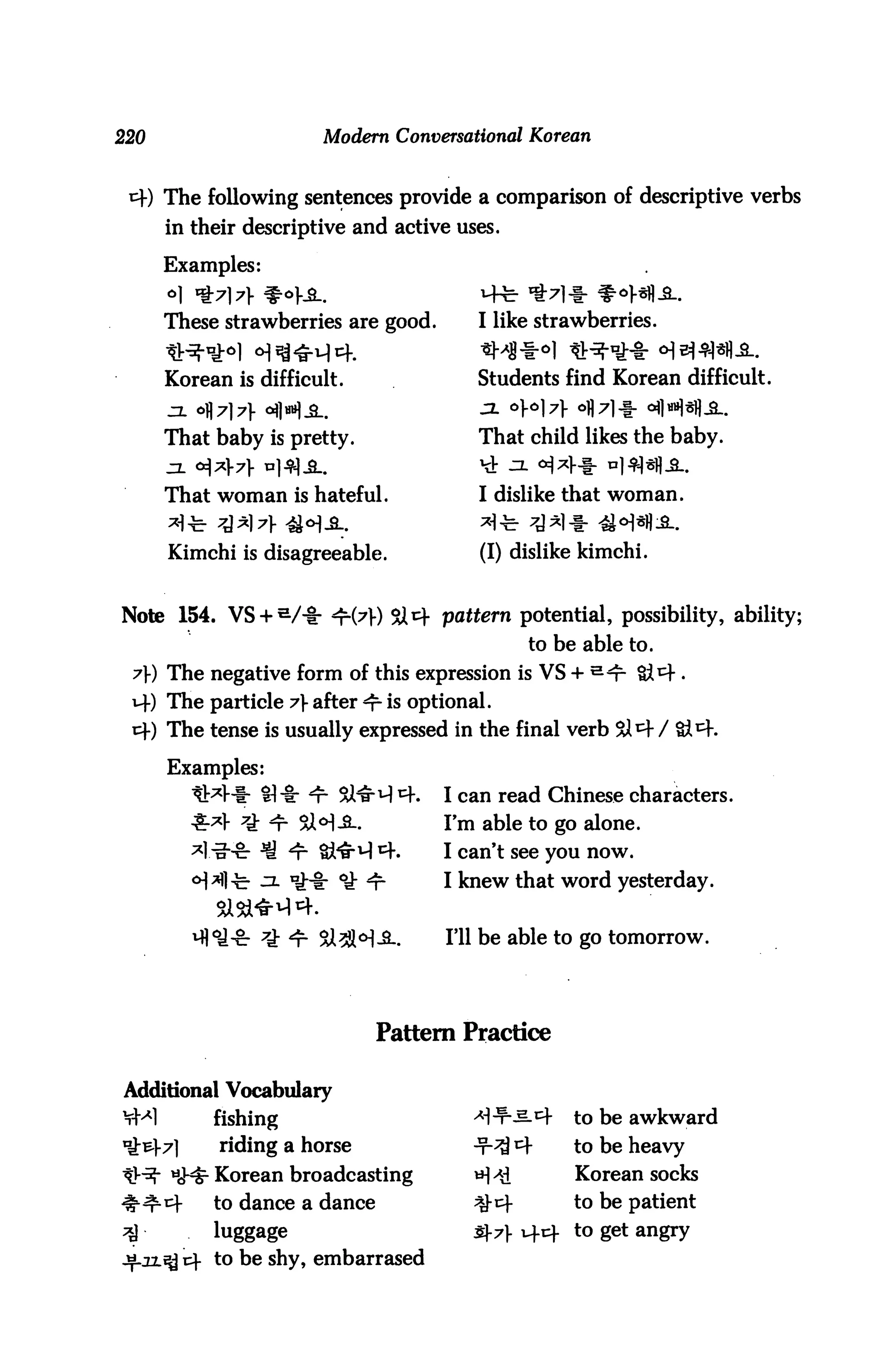
21


                    4.   *]7)] fliA?          WhatlsThis?


   Mary Doe is asking about Korean food.


              °)7)]                            this thing (Note 14)
              -91                              what (contraction of-r-^)
°l>fl ^?H-SL?                           What is this?
/ ige muo-eyo /

                                               that thing

                                               kimch'i

                                        That is kimch'i.
I kugon kimch'i-eyo /

              * 7A                            that thing over there
              ~~ -5.                           —also, tOO (Note 15)
*J ^Ji ^} ^1 <H1 A ?                    Is that kimch'i too?
/ chogot-do kimch'i-eyo /

                                               no


                            ^H1^               —is not (Note 16)
                                               bean sprouts
                            o>i^oj]j^No, That's not kimch'i. It's bean
/ aniyo, kug5n kimch'i-ga ani-eyo /    sprouts.


/ k'ong namul-ieyo /


                                 Grammar Notes

Note 14. o] n] i ige / a.?]} i kuge / ^ 7)1 / choge / pronouns      this thing, that
                                                                    thing, that thing
                                                                    over there
7V) These indicators are contractions of:
          this thing                  °I3M—°l*1                °1
22                        Modern Conversational Korean


     that thing                    ji^o)-^]

     that thing over there         * >A o| — x n]          x
14) The pronouns °] 7A/^-7A / *i 7A are composed of °l /-=*■/ ^ + ^(thing)
   + °1/ ?|-, •£• / -fc- (subject particles).
4) ^l indicates something close to the speaker; ^l indicates something
     quite close to the speaker or the listener, or to something mentioned
     previously; and *| implies something far from both the speaker and
     the listener.                                                 

              near

                                        middle J-7A
                                                                   far


     o] /olI and *) can be prefixed to nouns other than 7A . In such
     cases they function as prenouns.


     Pronouns:

                                           That is a notebook.
                  *iM°fliL.                This is a book.
                                           He says that.
     Prenouns:
                                           That teacher is Mr. Kim.
                                           This person is a man.


Note 15. — S.I —do / particle too, also
 7) As with all particles, — -^ is dependent and cannot be used alone.
 M-) The particle — s. may be added to a noun which functions as the
     subject of a sentence in the illustrations given below.

     Examples:
                          A&--        Mr. Lee is going, too.
                          7f-3-.      Mrs. Pak is also going.
     The particle —i. also has other uses which will be discussed
     in future lessons.


Note 16. <4H E-f / anida / copula (is) not, not to be; denial
 7) There are several ways of making negative statements in Korean,
               is the negative form only for the verb °lcr. It must always
Lesson 4                                    23


      be preceded by a noun and its particle. Thus, the sentence pattern
      becomes noun + °]/7

      Examples:
             Q:jzti|    *j)o)ofl.s_?                 Is that a book?

             As °M-$-, *J)°I °M°fl-SL                No>It>s not a book-
             Q: ^-Sr-g: *i *S °]°] &. ?             Is that person a teacher?
             A: °fHi,       xdAS°] °f^ll             No, he/she is not a teacher.
      This negative construction is often used as a strong positive state
      ment.

      Examples:
             o| 3 o. *jj O| o).u)ofl ^_ ?            This is a book, isn't it?
              7u' ii^ *d *l °H ^1 -8- ?              You are Mr. Kim, aren't you?


                                  Pattern Practice

Additional Vocabulary

            bean curd                  <£ ^      pencil             -£■        a door
            magazine                   ^d^fl fountain pen           ^-^        a window
          *l an edible root            ^^        desk              -%■*$       notebook
 £] *)-     chair

1. Study the examples (ji7|) and then practice making similar state
    ments using the key phrases.

                                                  s : *1>i

                                                         2>

2. Study the dialogue (tfls)-) and then practice the sentence patterns,
   using the key words.


              1) ^L*]                         2) *JX|                  3)   <>l>fl
                    ■f-¥-                        *^                         ^1

3. Study the dialogue (*$$)■) and then construct your own dialogue
   using the key words.
24                      Modern Conversational Korean


                              S, :


                                      2)                        3)


4. Use the key words to make a dialogue similar to that in the example


                              s,
                              s2
                              s,
         ♦4*


                                      •2)                       3)


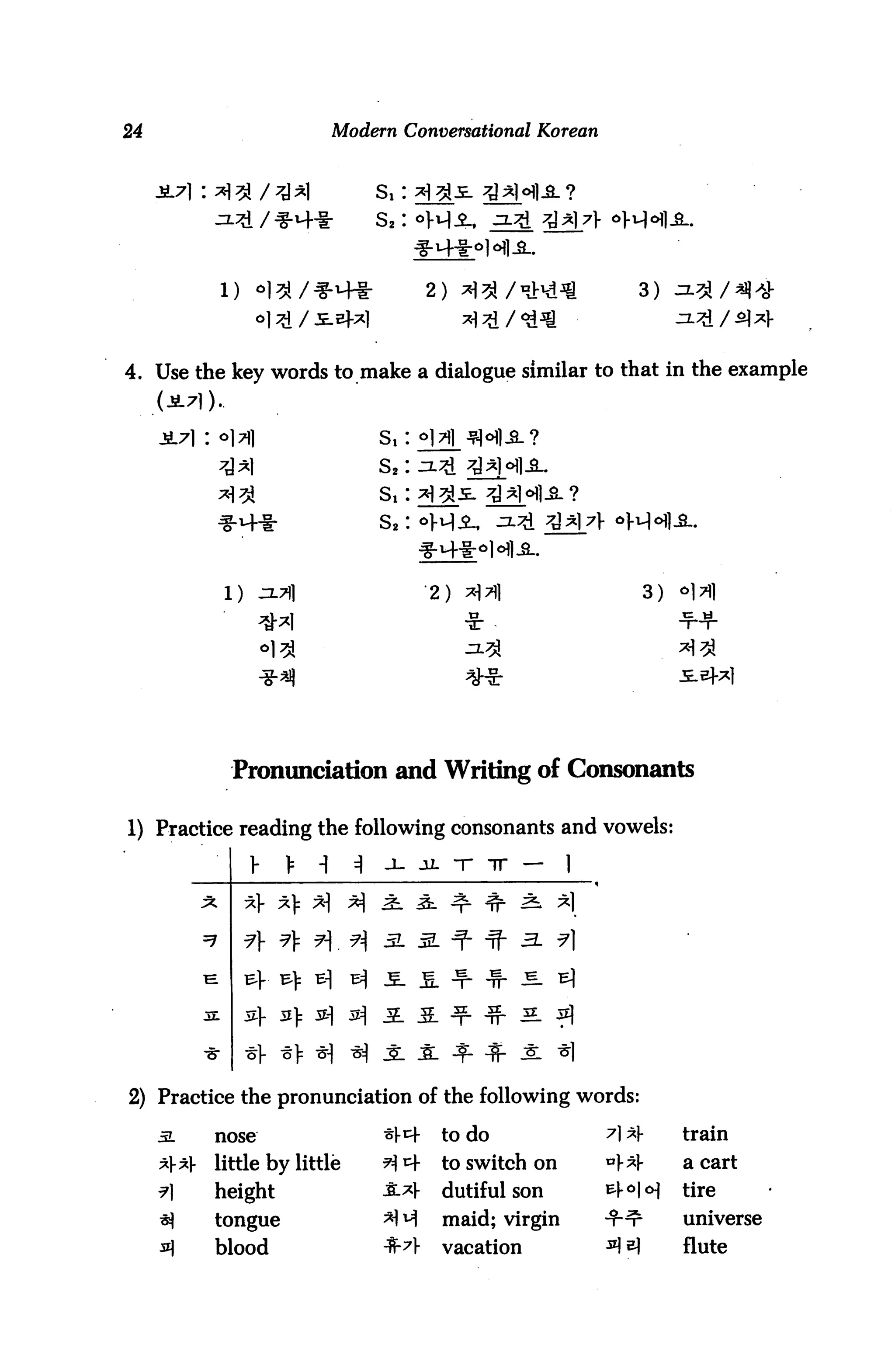
             Pronunciation and Writing of Consonants

1) Practice reading the following consonants and vowels:

              r   >                         T   tr -     1


                  *>   ^;7   -2-
                                     ^
                                                ^r 3. ¥

        E         ^>        'A 5-               * S. El

        5L
                  3>        A 2. 3.

              *r *>         N i      S.


2) Practice the pronunciation of the following words:

         nose                 *!•*+       to do              A^      train
         little by little     H^          to switch on       °)-4    a cart
         height                           dutiful son                tire
         tongue                           maid; virgin               universe
         blood                            vacation                   flute
Lesson 4                           25


         coffee               *1 *     skirt          *l ^      waist
         to be big; to grow^^r harvest                 il£.b]    acorn

3) Writing order of the above consonants:

         X        =7     H    3L        -ST

          -              —    —    -    -

    1             "7

    2    X               "—   T~        ~="


    3    X

    4                         31

4) Practice writing the following syllables:


          V       >                    j_         T    IT     —
                                                                     1
         4        *>                   2.         4    Ir.
         4        ^>                   .2,        4                  *l

   =7                                  3.                       3.   ^1
         4        4                     a.                      a    ^1
   H     4 ^>                           J. J.          Tt

          4       «■{:                  3.        4    44
          4       4                     JL
                                                  IX
                                                  ~r
                                                       31
                                                       ■TT           s|

          4 4                           JL        n
                                                  "T
                                                        at
                                                       TT            31
          t>      %                    J: J:     4             J£   *1
          4 *>                          J.
26


                5. <£Nr r*fl   A Tilt With Grammar


1. Substitute the underlined words in the following sentences with
   other vocabulary you have learned.

     i)
     2)
     3) *}A

     4)
     5)


2. Fill in the blanks.


     2) ^51 (      )

     3) J.Jt(      )

     4) «1^(       )


     5)


3. Use the key words in the blanks to reply to the questions given
     below:


     1) -
                       s,:

                       s,:
     2) -t-7]- >i^«

                       s,:

                       s2:
Lesson 5                           27


  3) «l^-8: nHMlJ
                     s.:

                     s,:


  4)   o]?]   ^

                     S.

                     S.

                     S.


4. Compose the statements and questions for which the replies are
  given below.
  1)                                  ?       <
  2)           '                          ? «flf
  3)                                          <4,
  4)                                          *
  5)                                      .
  6)                                      ?   ^-
  7)                                      ?   oil.
  8)                                      ?


                   Pronunciation of Complex Vowels

Complex Vowels (1).

  In hangul the phonetic value of some vowels and consonants change;
that is, they are composed of more than one sound or phoneme. Those
which change are complex consonants and vowels (diphthongs), and
those which do not change are simple vowels and consonants; that is,
they are composed of a single sound or phoneme. It should be noted
that complexity of pronunciation is not related to complexity of
writing.

  In lessons one through four we studied the ten basic vowels and
fourteen consonants. Additional vowels and consonants may be found in
28                           Modern Conversational Korean


Table 1. The vocal apparatus used in the pronunciation of complex
vowels is given in Figures 1 and 2 in the Appendix.

1) Practice reading the following syllables:


2) Read the following words:

     7fl       dog                 2*1        brain        -^■-fl   coldness
     ^ $      New Year            as)        sin           r|      Up
     °H 7]     baby                s *      to become    J91      what
     7$±- vegetable                O*       commercial   ;^1^-    roof tile
                                                company    :
     M]^- world                                             4-3-    subject
     *17)] a frame                 ^          ear          ,
                                                            ^1 ^    conversation
                                              scissors

3) Writing order of the above voewls:


                 1|     1)   -                        -4
           l     1     -

           2      F     p    •


           3                     ■I -^ »
           4                                          4

4) Writing practice:


                4 °( ^ fl
                ft^   rvSi   Ol          ol
           l    Qr{   °1|    JLj     y]


           2    o1|   o)]    £j      ^

           3    oi|   o||    ^       ^
29


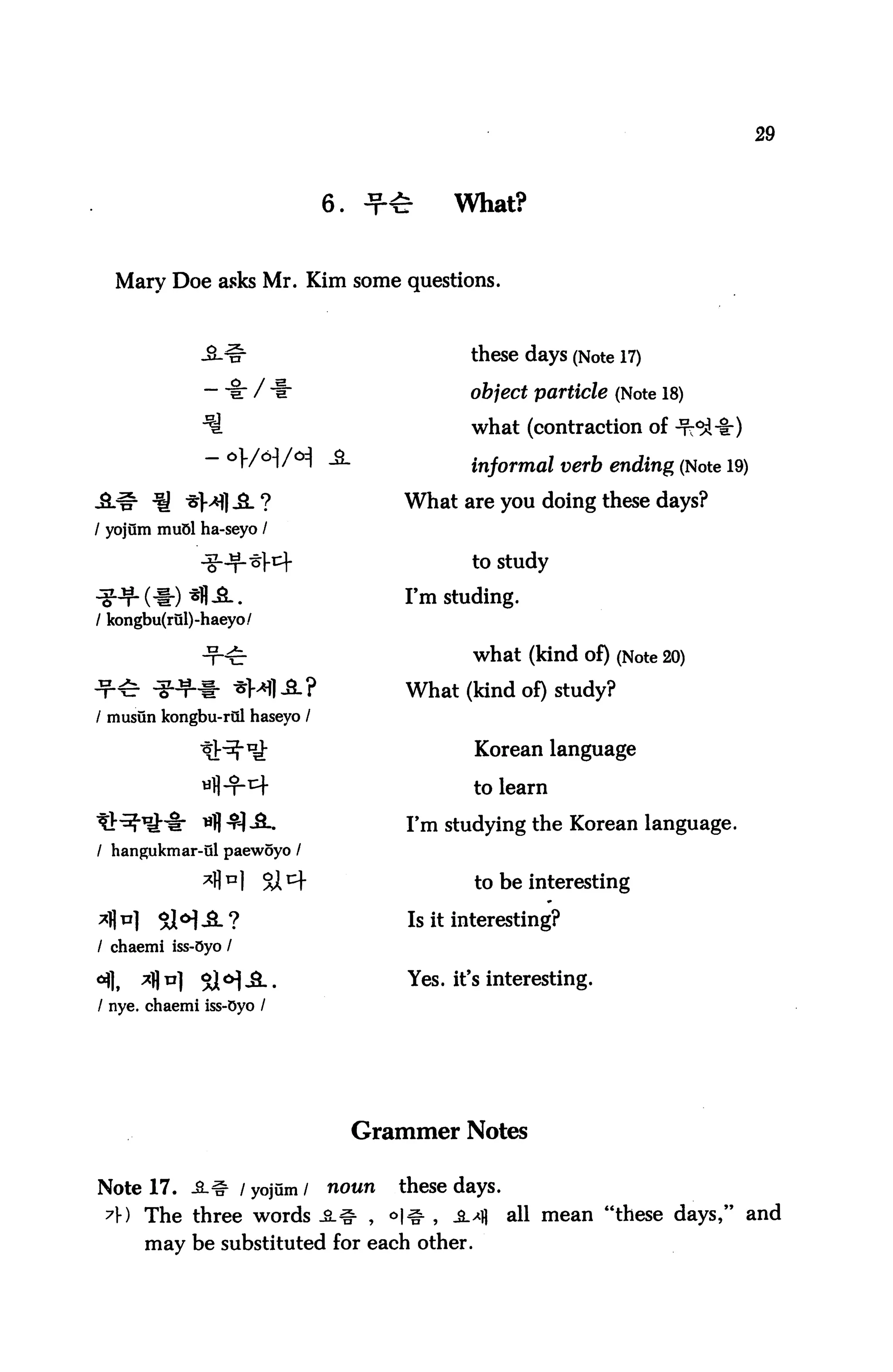
                              6.            What?


  Mary Doe asks Mr. Kim some questions.


                                              these days (Note 17)

              -■§:/                           object particle (Note 18)
                                              what (contraction of -rcc

                                              informal verb ending (Note 19)

                                      What are you doing these days?
/ yojum muol ha-seyo /

                                              to study

                                      I'm studing.
/ kongbu(rul)-haeyo/

                                              what (kind of) (Note 20)

                                       What (kind of) study?
/ musun kongbu-rQl haseyo /

                                              Korean language

                                              to learn

                                       I'm studying the Korean language.
/ hangukmar-ul paewoyo /

                                              to be interesting

                                       Is it interesting?
/ chaemi iss-Oyo /

                                       Yes. it's interesting.
/ nye. chaemi iss-Oyo /


                                   Grammer Notes

Note 17. -S_# / yojum /
                      noun these days.
 7f) The three words _£l^ , <>|# , -B.^ all mean "these days," and
      may be substituted for each other.
30                          Modern Conversational Korean


Note 18. — -I-/— -f-/ _ui / — rul / object particle
?) The particle —%tl— -1- indicates that the noun preceding it is the
     direct object of a transitive verb.
M-) The particle -8: follows nouns ending in consonants and -1- follows
     nouns ending in vowels.

     Examples:
          *H-"tM: *+«U-fiL.                   (I) study Korean.
          ^M -i- 41 <H A.                     (I) am reading a magazine.

Note 19. VS + *> / <H / <H -2-. informal verb ending
 7) The--S.ending is often used when the speaker is acquainted with
     the listener to some extent. The more formal endings are presented
     in Lesson 16.
 H-) This ending is used to make a statement, ask a question, or to
     convey a command or proposal. Intonation and stress indicate
     which sentence form is intended. The arrows in the examples
     below give an approximation of the intonation at the end of the
     sentences.

                                  question     ^     How are you? (How is
                                                       he/she?)
                                  statement   -^     Yes, he/she is fine,
                                  statement   -^     Yes, I'm fine.
                  7M1-2-.         command ^.         Please go quickly.
     In the informal style of speech, regular descriptive and active
     verbs take the verb ending °V / H / °i -& .
      1) If the final vowel in the verb stem is an          V or .l, the verb
         ending is <=>V -S_.
      2) If the final vowel is i , t , — , or 1 the ending is <H-&_.
      3) If the verb is ^1-^ , the ending is <H .2- (the contraction of *M £-
         is *))-£-).
     Regardless of the verb stem, when the honorific insert ^1 is used,
     the informal verb ending is — <H-3- (i.e. ^H-£- ). However, this is
     often shortened to — ^1 -2..
     Contractions are often formed with verb stems ending in a vowel.
     The table below includes examples of a variety of verb stems + °}l
     o] /<H jl and their contractions if any.
Lesson 6                                       31


Examples:
Basic Verb VS+4/HH-a-Contraction Honorific            Contraction Meaning

                                                                       to go

JLcf        JiLo|-JL      J^iL           JL^|o)-B-     jL>H|-3-        to see
                          <>]SL         o|^]<H^-      °M]-SL          to be
                                                                       to eat
                                                                       to eat (honorific)
                                                                       to learn
                                                                       to write
                                                                       to play (an
                                                                        instrument)
                                                                       to do


Note 20. -t-^c- / musun / pre-houn       what (land of)
 7}) ^-^r is always followed by a noun.

       Examples:
            °l 3 °l -t-^ ^ °l<Hl.a. ?          What book is this?
                           ?                   What kind of work is this?


                                   Pattern Practice


Additional Vocabulary
*£^-     tennis           f}cf         to read       -§-^         food; a meal
^d       a novel          ^h^r^l ^ to eat            -Sr-f-       exercise, sports
 ^^1     letter           ^-^1-         a male       ^HD] ui1^ uninteresting
                                        person       °i-r-        news* regards

1. Study and practice the question and answer patterns below:


            1) -2-^                    2)   <>1#-                 3)


2. Study and practice the sentence pattern below:


            3)
32                       Modern Conversational Korean


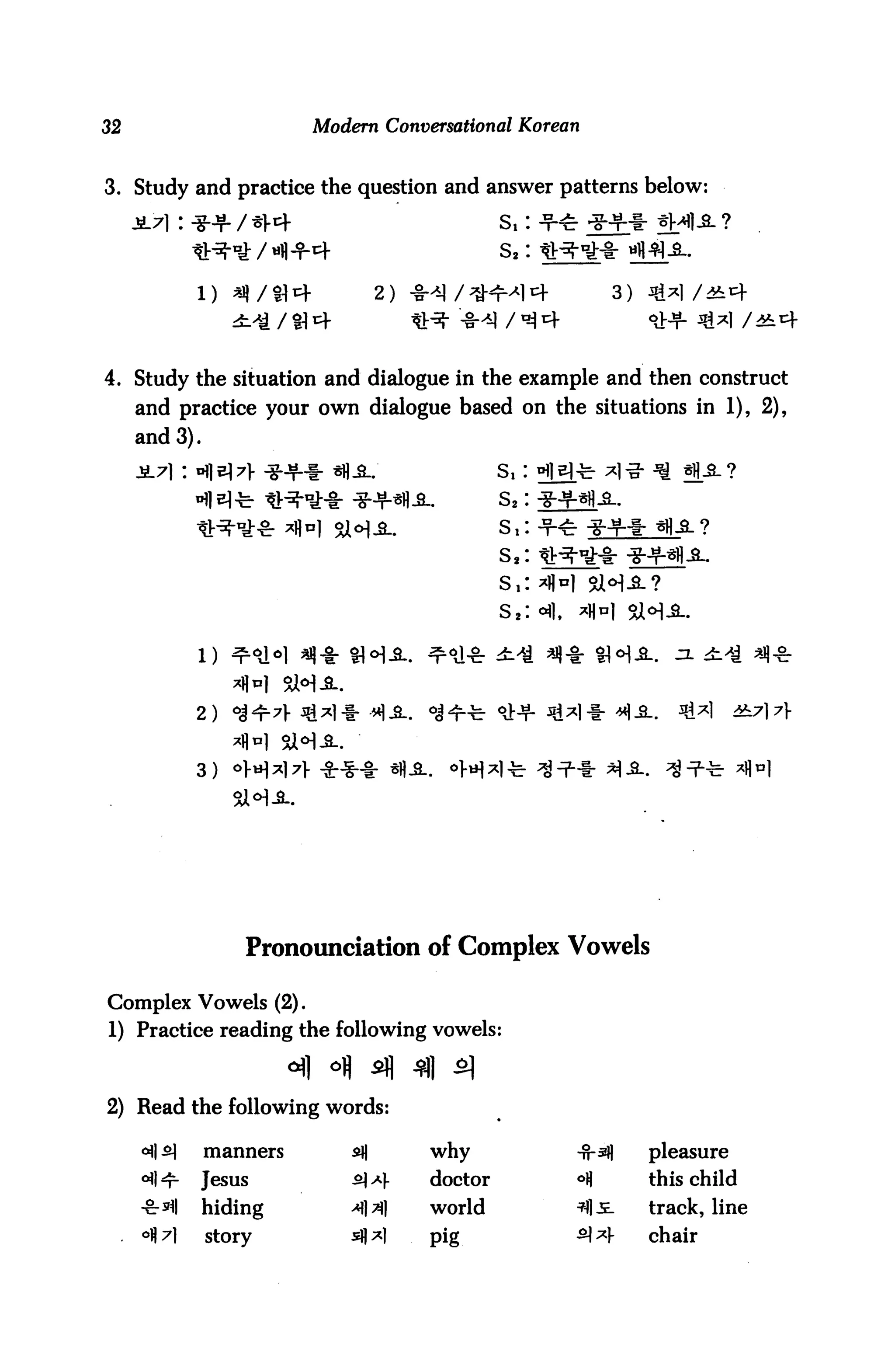
3. Study and practice the question and answer patterns below
                                                     s,:
                         4                           s2:

           1)                      2)                                   3)


4. Study the situation and dialogue in the example and then construct
     and practice your own dialogue based on the situations in 1), 2),
     and 3).

                                                     Si
                                                     s2:


                                                     S,
                                                     S2    •fl.

                                                                                     i^ «(■&


           2)                      "1-2..


           3)


                   Pronounciation of Complex Vowels

Complex Vowels (2).
1) Practice reading the following vowels:


2) Read the following words:

               manners       s*H            why                   -n-3j)     pleasure
               Jesus         iA *          doctor                °fl        this child
               hiding        >M             world                 ^S-        track, line
               story         s*l*)          pig                   ^ *       chair
Lesson 6                                                33


3) Writing order of the syllables:


         1

         2       =            >         *        *       ~)
         3

         4


       *The pronunciation of £ will be discussed in further detail in Lesson 17.


4) Writing practice:


         n     i-    r:           s         n    ti      A       o    ;*                     E


                                                                                 ^! ^
                      ') ^1
                      il          e*l                                                        £3]   4    s^l

   1                  «           e^                                             ^     .1
                                                                                                        •I
                                                                                                   n
                                                                 ■A   <• V


                                                 ^ii     ^                                         n

                                                                             1   it]   2fl              iH

  <* ^ V)            s                           m       ^                                   «|         «)
                         fl       ^]        m    m       #

  -1                  ^           31        21   si      il      2-1 2]          *l    2]    si
         31    *T 54              31 21          21      il                      *)' 2] si         si   si
34


                              7.                                 Whose Is This?


     Min-su is looking for the owner of a hand bag and umbrella.


                                                                  possessive particle (Note 21)

                                                                  a bag

                                                           Whose is this handbag?
/ i gon nugu (Qi) kabang-ieyo /


                       A                                          I (Note 22)

                      -7A                                         thing (Note 23)
                                                           It's mine.
/ che goeyo /

                                                                  an umbrella

                                                          ? Then, whose is this umbrella?
/ kur5m yi usan (un) nugu gO-eyo /

                                                                  friend
■~tt ,X*i
      tJ     "ill   "5cl "^- / ^in )
                               ol       "xJ All p.
                                                O
   /.        ^||    >yl ' | ' 1         ^1 *"*|l     ,
                                                           It's my friend's.
/ kugon che ch'ingu (ui) go-eyo /


                                                   Grammar Notes

Note 21. — ^l / ui / possessive particle of; 's
 y) — ^1 attached to a noun or pronoun indicates that whatever
            follows is a possession of that noun or pronoun.
 14) i4^1 , *i o] , u|£| are frequently contracted to m , ^1 and M],

            Examples:
                              thin. -* m "tl-ia                    my school
                              u]^       — *fl      *}*             my secretary

                              q         — 14] ^J)                  your book
            When there is no ambiguity in the context,                              - ^ is sometimes
            omitted.
Lesson 7                                 35


    Examples:
                 j          our house               °j^<:>l ^     Yong CUVol's house
                ^ *Y*& my wife                      ^°| o}.^^) Suni's father


Note 22. ^] / che / pronoun I; self, myself (humble)
                       pre-noun         mine; my own
A) As a pronoun *fl is always followed by the particle A . It has the
    same meaning as M-b but is used to humble oneself in the pre
     sence of someone older.

     Examples:
            A]7 7}S..                         I (will) go.
            *]A 4 ^ofl-S-.                      I myself am Mr. Kim, Ch'ol-su.
 M-) As a pre-noun it has a possessive connotation, the same meaning
     as vfl .


     Examples:
            °1 ^-&■ A A6^-3..                   This is my stuff
                                                1*11 do my own work.


Note 23. — ?A I hot / weak noun            a thing; an object; an article
 A) Since 3} is a dependent noun, it must be used with a modifier or
     another noun.
 M-) When ^          is followed by °I4, speakers of Korean frequently
     simplify the statement to tHI-S. .

     Examples:
            *fl 5Mofl_a_.                      That's mine.
                                               It's this thing.
                     -°i <>1 *ti -3.?          What is this?

                                               It's a new thing.
                                               It's Mr. Kim's.
                                               What is this?
36                          Modern Conversational Korean


                                    Pattern Practice

Additional Vocabulary
     ^-^      shoes                 jl*M textbook            school
     <*] 3)   a clock; a watch jl-?-^1 rubber shoes          secretary

     ^        glasses               *l7t}-   a purse
     ^3i      husband               tH^ grandmother

 1. Study and practice the sentence pattern below


                                     2) ^H^d/^1^1      3)


2. Questions and answers (


                                     2)                3)


 3. Pattern practice (


                             s,
                             S3

               1)                    2)                3)


 4. Questions and answers (
              -f4            s,: *
              ^1 ^l^F-       s, :

               1 ) oLJj^J            2 )               3 )


 5. Conversation (3)3)-)
              ?w             s,


                             s.
Lesson 7                                      37


               1)                            2) 9}?$                      3) ^


                        Pronunciation of Double Consonants

1) Practice reading the following syllables:

                    ■    -1   i                        IT     -      1
      77     77> 771=    7A   ?7A   7i7 .   32. Jf-    If     77    77J

             of a >      H          JEE.                      PC_   ix]


             w}. «                  Jfi. 3L J^-
      titi
                                                       Jff-
             4 * t Ail              dt                        & *1

                                            3E. ^

2) Read the following words:
  77}*}?] crow                                3LZ]        tail               xz.r+    to turn off
  7}-Jjz-cf to cultivate                      s.          again              *$       time
  *) ^ «] belt                                H^-^f to be fast               ^e]      root
  ^           bone                            ^1*11} to be pretty            ^1       seed
              to write; to use               ^sfl 7]      garbage,           dfctf-   to shoot
             to be salty                                      sweepings
                                              3£7i] tf to split

  Double consonants are rendered by a slight tightening of the vocal
chords causing a sound which is higher in pitch and shorter than
regular consonants. In other words, double consonants in Korean
become tense sounds.
38                         Modern Conversational Korean


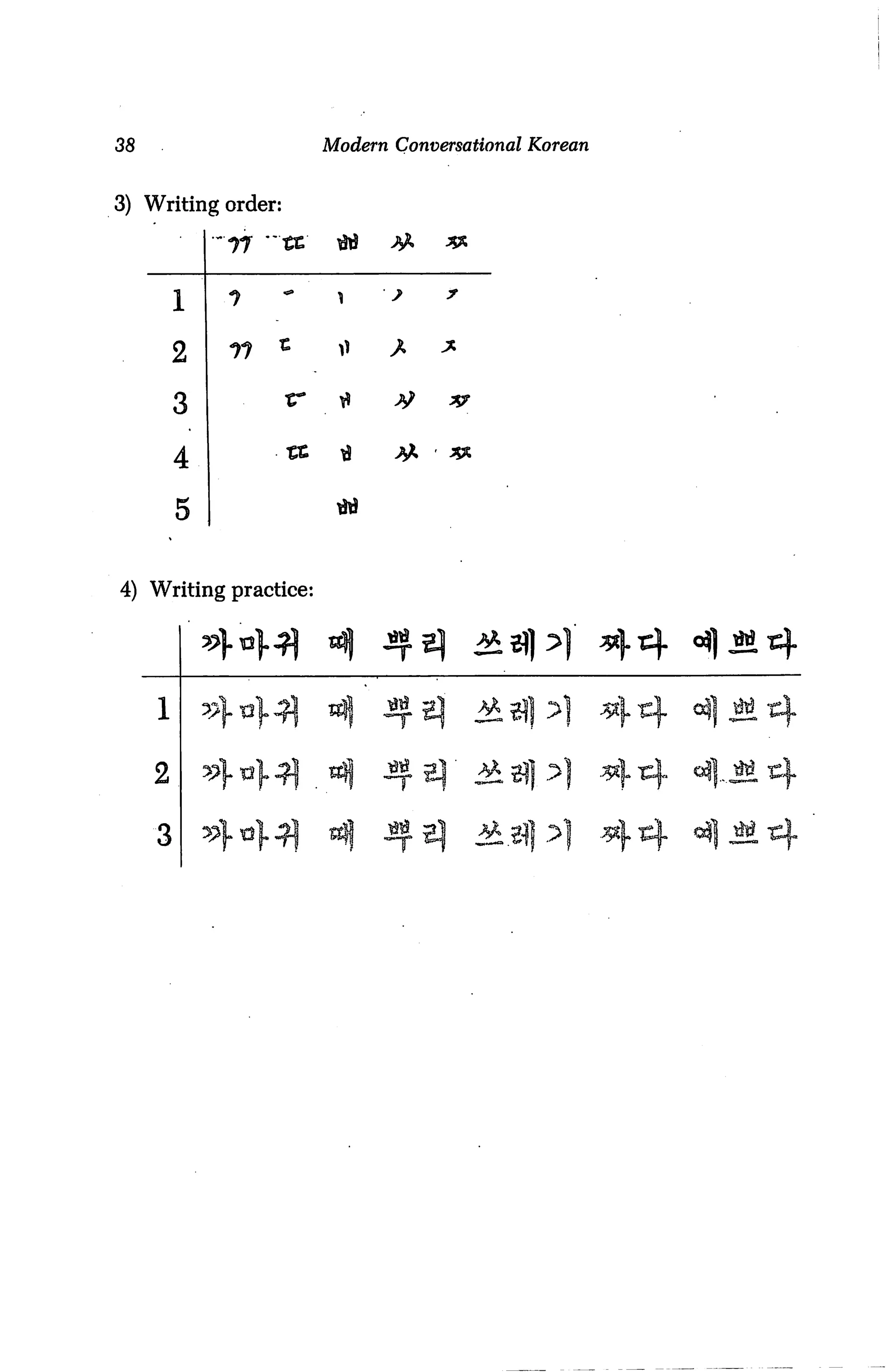
3) Writing order:

             -77    tfca       MM   J*}r*   J^Ps


         1    ■1


         2    n


         3

         4

         5


4) Writing practice:


             44^           «                       ^) >| 44 °*l — 4

     1                                             1 >)     44     (4| s 4

     2       44^1 _«                               )| .>)   .4 4   ojj).jw 4


     3
39


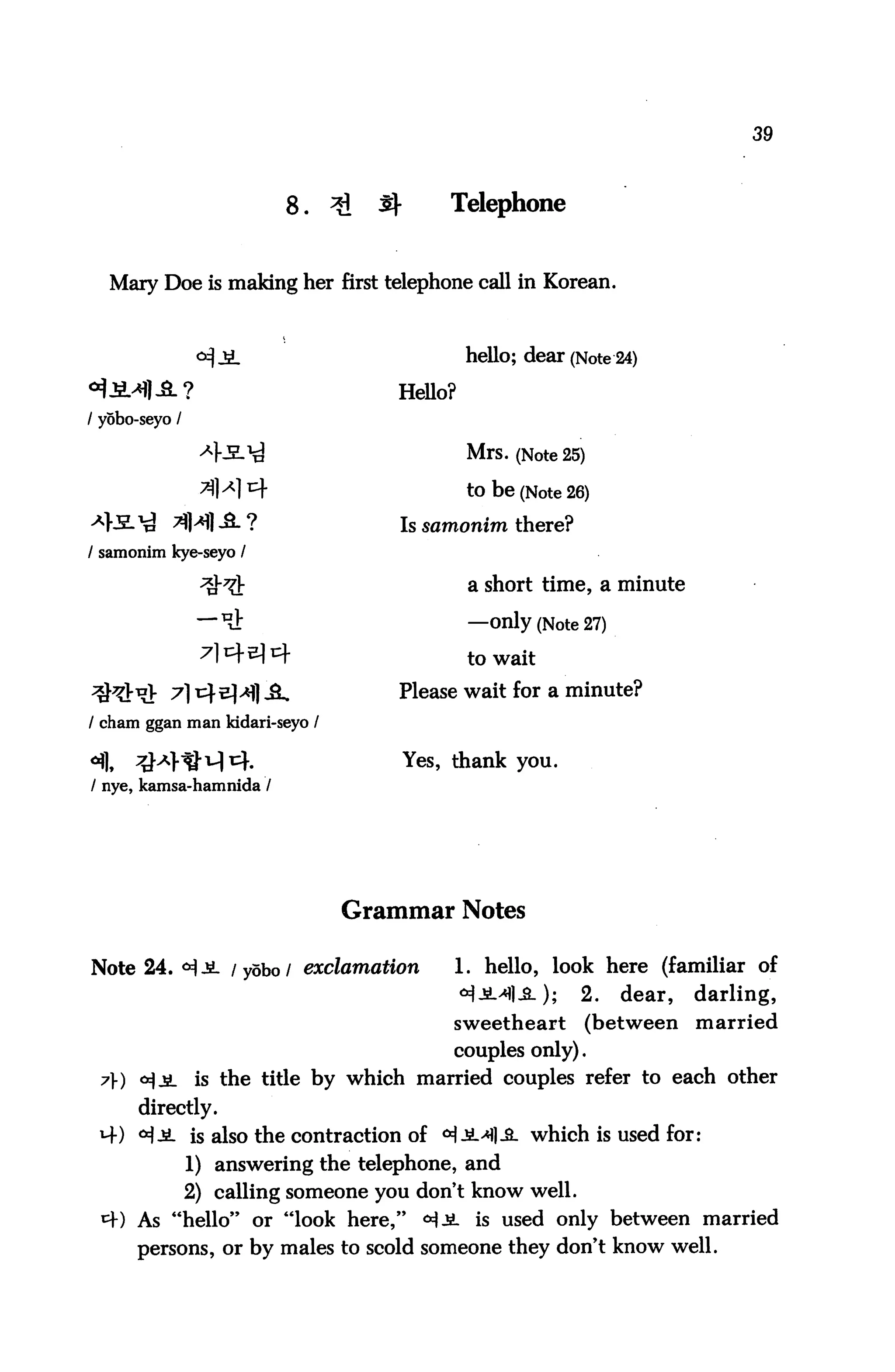
                          8.    *I   3^       Telephone


   Mary Doe is making her first telephone call in Korean.


                                                hello; dear (Note 24)

                                      Hello?
/ yobo-seyo /

                                                Mrs. (Note 25)

                                                to be (Note 26)
                                      Is samonim there?
/ samonim kye-seyo /

                                                a short time, a minute

                 —^                             —only (Note 27)
                                                to wait

                                      Please wait for a minute?
/ cham ggan man lddari-seyo /

                                          Yes, thank you.
/ nye, kamsa-hamnida /


                                 Grammar Notes

Note 24. <^JL /yobo/ exclamation               1. hello, look here (familiar of
                                                <*)jM-M; 2. dear, darling,
                                               sweetheart     (between   married
                                               couples only).
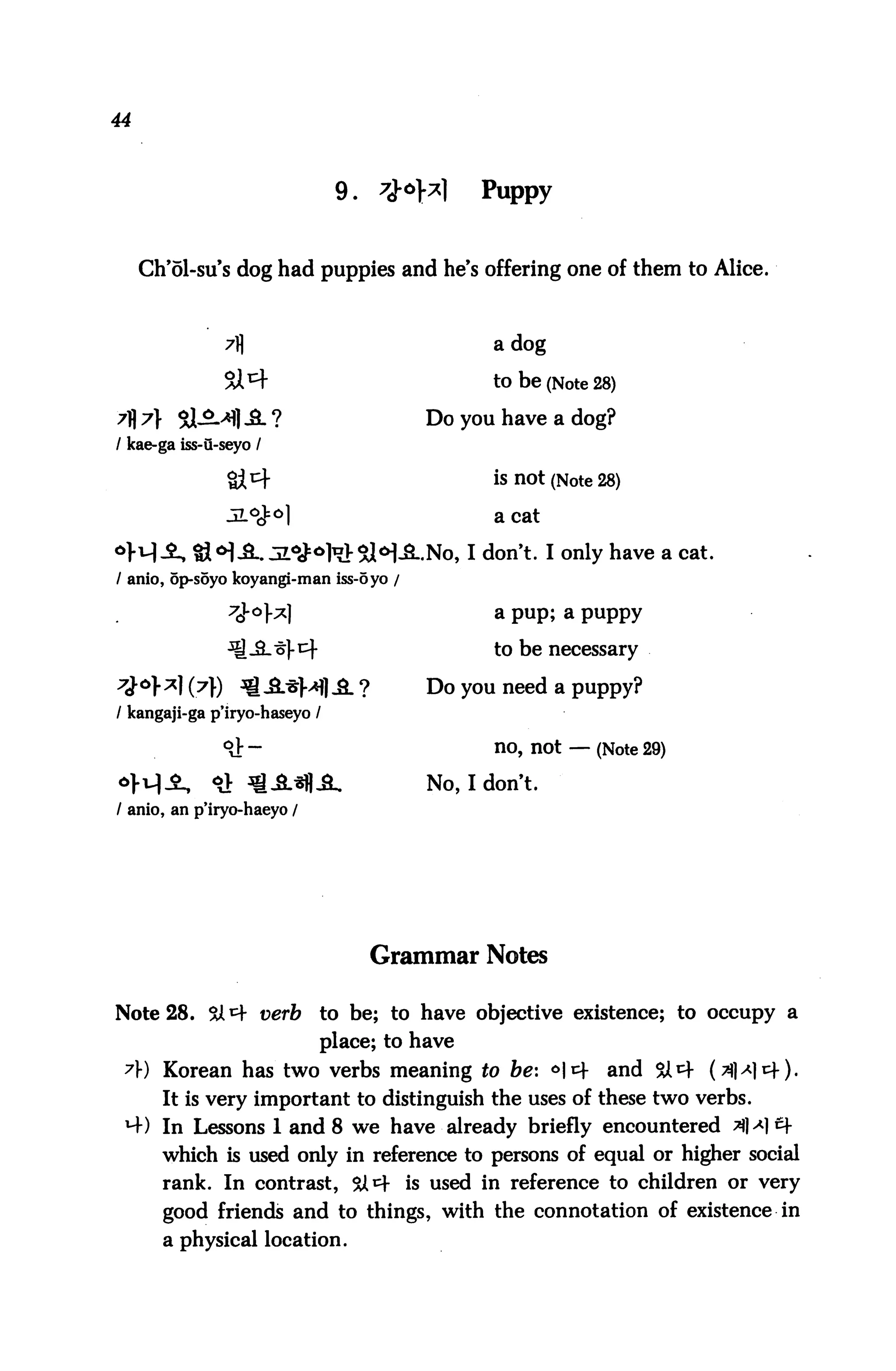
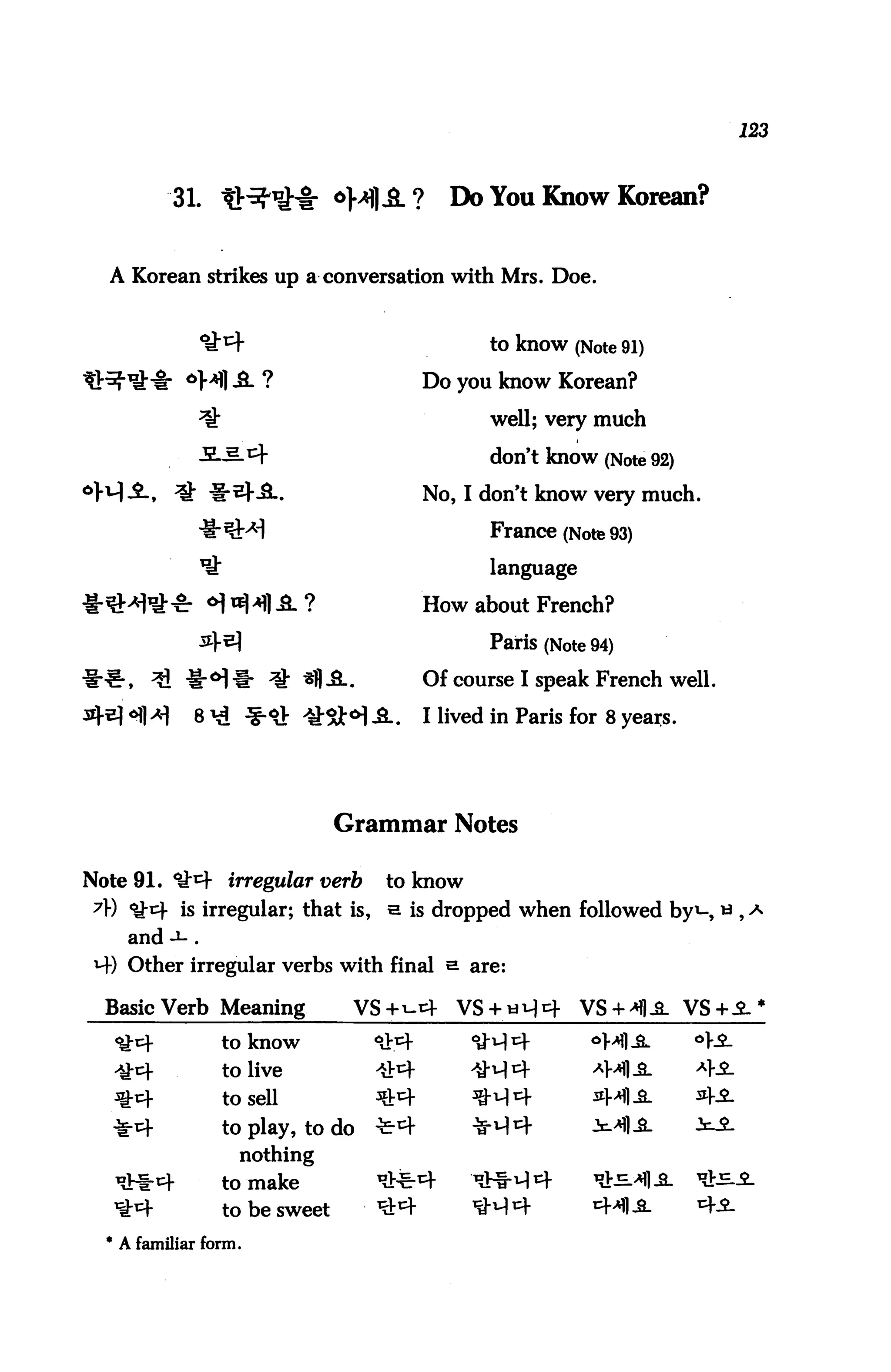
 7) <^jiL is the title by which married couples refer to each other
       directly.
 4) °l£- is also the contraction of ^JM-3. which is used for:
                1) answering the telephone, and
                2) calling someone you don't know well.
 *+) As "hello" or "look here," <H-SL is used only between married
      persons, or by males to scold someone they don't know well.
40                       Modern Conversational Korean


Note 25. <4.slM / samonim / noun       title for a married woman.
 7) ^Ks.^       generally refers to a married woman whose husband's
     social position is higher than the speaker's, and it is often used to
     show respect even when there is no social disparity.
 4) Another word similar to H*-^            is ■¥•<*! / pu-in / noun title for a
     married woman.
     1) -t-°J and *3.*£ are not used when one speaks of one's own
        wife, in which case one rather uses the familiar *ll *1 (Lit.,
        my wife),-t-bI ^ 4^ (Lit, our house person), *fl ^ifl (Lit.,
        my wife), or °J; 4*3* (Lit., the person inside).


Note 26. 3M4 verb           to be
 y) ?]a] * is the honorific form of the verb
 M-) You have already briefly encountered A* *+■ in Lesson 1 (
     3M1-S-). It is used only in reference to persons of equal or higher
     social rank.
 cf) Tflyim- means to be in the sense of the physical existence of a
     person with a location connotation.

     Examples:
                      ^ *1- ?                Is mother there?
                    °l M:^r^o #] ^] ^4.    Mr. Kim is in the faculty room.
                     M£..                    Be in peace.
 e)-) Sitf is discussed further in Lesson 9        where the distinction be
     tween 5A4 (^|^cf) and °|4 is detailed.


Note 27. — of       particle    only, alone; no more than.
 7V) When it follows the subject of a sentence, *H replaces the regular
     particle.
     Examples:
                                            Only I will go.
                                            Only she wears slacks.
     When the noun is the object of a sentence, «} sometimes replaces
     the regular particle but it may also follow the object particle or
     it may be inserted between the noun and the particle as shown
     below.

     Examples:
              ^-oV *}&..                (I) always sleep. [Lit: (I) only sleep]
Lesson 8                                                 41


                                                (She)          always wears slacks.        [Lit:
                                                     (She) only wears slacks]
                                                (They) only buy pork.
                                                (He) only wears tennis shoes.
                                                (I) only go to the department store.
                                                (We) speak Korean only in the
                                                     classroom.


                              Pattern Practice

Additional Vocabulary
  5L*r    professor              -4t+            to buy               -T--sl1^         parents
  af*l    trousers; pants        -gr-f-S}-       sports shoes          °}iH-i*         children
  6j <H   English                <r*fl           homework              °i^S-H ('y?)    Japanese
  ^^ o] Chinese                  ^l^r            preparation


1. Questions and answers         (*J-ir -8-*>
   3L7] : ^1-js.^         s,: ^5L^
                          s2: Q^A:

           i) ^ ***                             2> «m*i                         3 )   7^ JjLo]


2. Conversation ($] sf)
   jiL7i : <^jl             s,: <*)jM
                                                -all /Jl   0   O
          4s.M              s2: *Ke.M


          :#*l-«|.cf        S2 : ^],      rjr


           1)                                   2)                               3)


3. Conversation

                            s,


                            5,
42                                 Modern Conversational Korean


                                                                      3)


4. Conversation (s] S|-)

                                                 S,           4HMH.fi. ?
                                                 S,
                 •a**                            s,


                                                                      3)


                       -M-fl-


                                Pach'im (Prop Consonants)

Simple Pach'im (1)
     Consonants forming the final sounds of syllables are called pach'im
and are written underneath the initial consonants and vowels (refer
ence Table 3). As final sounds the consonants o ,c,i,x,a                          are
voiceless; that is they are stopped (unvoiced) consonants.
     When b , c , i, *              occur between vowels,          they become voiced
consonants, that is p/b, t/d, k/g, ch/j — b,d,g,j. (see Table 2).
     The consonants b , n , 7, * are voiced when they follow o , l , e , o
p/b, t/d, h/g, ch/j - b,d,g,j.
     In the final postion of a word:

     n,    a,    ;*,    ^,   t=,    -er,   ***   5.   are pronounced as u
     tj,   771   a: are pronounced               h
     "it   77,   =? are pronounced               1

     Initial s is very rate. Between vowels h is a flapped r, and final
     s is pronounced I.
1) Practice the pronunciation of the following words containing
     initial, medial, and final consonants (1 - o )
Lesson 8                                   43


   Initial                    Medial                               Final
   -g-       bear                 * 7] <y-     low pressure       •5J"        soup

                                                a cold
   ■fc-      ricefield            -*dA8         teacher                        money

                                                reason

   x£        moon                 °l-i"         son                #           soon

                                                East Gate
   sfl^t-^ wrestling              -4^           man, person                    holiday
                                                the first day
   *£        a horse              1£°1 M        grandmother                    name

                                                music
   ^         cooked rice          °l-i-          a quilt                       a house
                                                Japan
   >H -t-    Seoul                ^i>M           news                          clothes
                                                 a laugh
   •8-       yes                  «J"ir          a small bell                  match
                                  J7.Oto|
                                                 cat


2) Writing order:

            -S- M
             13 V        ^ 4
                         ^                             U- 4 "*
    1

    2       ja     v^    rt                            til-   ^     ot

    3       -8- v^       *                     *       ti)-
                                                         •a
                                                              £u
                                                              a
                                                                    o
                                                                          cr


3) Writing practice:


    1                    v    c           0


    2

    3
44


                               9.   $°}z      Puppy


     Ch'61-su's dog had puppies and he's offering one of them to Alice.


               7fl                              a dog

               Si^f                             to be (Note 28)
7^7} Sl-5L>*flJL?                        Do you have a dog?
/ kae-ga iss-u-seyo /

                                                is not (Note 28)

                                                a cat

                                        .-No, I don't. I only have a cat.
/ anio, op-soyo koyangi-man iss-oyo /

                7J-°>^1                         a pup; a puppy
                                                to be necessary

                                         Do you need a puppy?
/ kangaji-ga p'iryo-haseyo /

               9&-                              no, not — (Note 29)
                                         No, I don't.
/ anio, an p'iryo-haeyo /


                                    Grammar Notes

Note 28. &i=f verb          to be; to have objective existence; to occupy a
                            place; to have
 7) Korean has two verbs meaning to be: *|cf                 and &4 (^)a)t^).
       It is very important to distinguish the uses of these two verbs.
 *-+) In Lessons 1 and 8 we have already briefly encountered 3M1 Q
       which is used only in reference to persons of equal or higher social
       rank. In contrast, $X^ is used in reference to children or very
       good friends and to things, with the connotation of existence in
       a physical location.
Lesson 9                               45


    Examples:
                    ;*H                    Are the children at home?
                                           My friend is in Japan.
         7VHH1            SJM-S-?          What is in the bookbag?
                   also means to

    Examples:
                                           What do you have in your purse?
                        %l<>|_3_?          Do you have a Korean language
                                                book?

                                           Are your parents still living?
e}-) On the other hand, °| t+ means to be in the sense of connecting
    two words or phrases which describe each other or are identified
    with each other (Lesson 3).

    Examples:
         o#t>]   *|o|o1|A.                That (thing) is a book.
                                           This is yellow,
4) The negative form of SA^f is             (is not/ does not have).

    Examples:
                                           Yong-su is not at home.
                                           I don't have time.


Note 29. *i!: — adverb        not—
 7) Though °J: — is an adverb, it is used as a prefix of verbs.

    Examples:
         °^ -I: oj- xqo]^       I don't eat breakfast (Lit: morning).
                  °Jr *H^l.      I don't study,
                  r 9i ^l>m^.. Grandma's not here.
 M-) While 9} — is a contraction of o)-v] ? nowadays the contraction
     *it — is almost always used.


                               Pattern Practice

Additional Vocabulary
          side dishes                             chicken
           an adult; elder                        rabbit
46                            Modern Conversational Korean


                  bird                                  newspaper

                  gloves                                Korean-English Dictionary
                  coca cola                    ^ t!: -4^ English-Korean Dictionary
                  cold water

1. Pattern Practice (
     iL7] : 7fl                     s :

                    1)     Jiofo]         2) >(          3)


2. Questions and answers

                                    S,


                                          2)             3) f|

                                               a-

3. Questions and answers

                                    S,
                                    s,
                                    s,


                                          2) Hl-r        3)


4. Conversation (s] £}•)

                                    S,    7j}7> $i^
                                    S,
                                    S,
                                    S,

                                          2)                  3)
Lesson 9                                  47


                       PachHm (Prop Consonants)

Simple PachHm (2)
1. Read the following words containing initial, medial and final
  consonants * — tr :


 Initial                    Medial                          Final
 ^h       sleep                            home             Vt      daytime
                                           potato

 %k       very                             sense            ¥       flower
                                           a flower
 *        knife                            lightness        -t-^    kitchen
                                           kitchen work
 *£       a mask                           camel            *       kettle
                                           wonder
 ^        an arm                           a violent wind   *       front
                                           forehead
  ^       elder brother                    breath                   the letter u
                                           put in

2) Writing order of the syllables:

                          * ir * H
      1                         «.   • o       ^


      2                   si-   j

      3

      4
3) Writing practice:


                   v

      2

      3
48


                10.   <3^ ^*fl    A TQt With Grammar

1. Underline the correct particles from among those which appear in
     parentheses:


     2) ^ JrTL(7r/^)
     3)
     4)
     5)


2. Each of the following sentences contains a word or phrase which
     can be made into a contraction. Find these words and phrases
     and make the contractions:


     2)
     3) il:H1')7V Jr<3i'§" *M1-S-?
     4)
     5)
     6)
     7)
     8)
     9)

3. Compose questions for the answers.

      1)              :                 ?


      2)-


          3).
Lesson 10              49


    4)                             .               ?

              :            :                       ?

    5)                         .                   ?

    6)__                                           ?


4. Answer the questions.


   2) jlvw sh-s.?                  «fl.


   3)


   4)    ^^l7f    ^<H^_?           oflf


5. Make negative statements out of the following sentences.


   2)
   3)
   4)
   5)
50                                Modern Conversational Korean


               Pronunciation of Double Consonants with Pach'im

1) Read the following words:

               Initial                  Medial                         Final

     77        ^     pheasant           *4           to bind             m         out side
                                                     out; outside        •
     XX        *£    daughter                        to be distinct.     •
               *S-   bread              71 ♦         delight
               *&    rice                            speech              &4-       to exist
     7*~       ^     spare time         ^t^l-4       to be nice and      •
                                                      salty


2) Writing order of the syllables:


                             * 1
           l                        C   -Ml    XX.


           2

           3

           4

 3) Writing practice:


                                                          o]4          »J.^

                     rg-     5E^*]-4           >]^.       Of T" 1      V21* >^^>
           1
                                                          Ol Tli       T3J.M,
           2

           3
51


                      11.   Jf-   ^    Request


  Mrs. Kang's place is a mess.


                                         ajumoni (Note 30)

                                         to be tired

                                  Are you tired now, ajumoni?

                                         —not (Note 31)

                                         why

                                         to be so; (be) like that (Note 32)

                                  No, I'm not tired. Why do you ask

                                  (like that)?

                                         cleaning; sweeping

                                         a little (Note 33)

                                         request, favor (Note 34)

                                  Please clean (the room) for me.

                                  Yes, please wait a minute.


                            Grammar Notes

Note30. ^V^HM       aunt/ °>*M uncle
 A) These terms refer not only to a relative but to:
    1. any person older than yourself to whom you feel close, such as
        your parent's friend.
    2. someone whom you do not know but for whom other titles
        such as *&s$^ or *V-S-^ are inappropriate. A peddler in the
        market, one's cook, or one's driver are called         6V^HM          or


Note 31. VS + *1 &c+ negative ending       - *] (negative verb suffix) plus
                                             S^(not)
52                      Modern Conversational Korean


     As seen in Lessons 4 and 9 the verbs to be ( °* and SA^f) have
     the two negative forms,           °M4 and &*+. Most other negative
     declarative and interrogative statements may use VS+ *]


     Examples:
           o>n.^| &°K2_.                     I'm not sick.

           °l ^j^-c: ^*1 &°KS-.              These aren't good matches.
                           7* &*}£-.       He/She doesn't go to school today.
                           °K8-.             (I) don't read the newspaper.
 MO Honorifics for this pattern are formed as follows: VS4(-£.)4 +


     Examples:
           7x* &*Ka_.                     He/She doesn't go.
           tl-^1*) $&*}£-.                   He/She doesn't read.
                               &°K3-.        Mr. Kim doesn't come.
                           ?iol--2-.         He/She doesn't say any thing.
     The pattern — *| ?Jcf can also be reversed and expressed as <>}■
     VS (t) 4 or dJ VS 4 .S. / >a u| cf (see Lesson 9).

     Examples:


 sf) Negative forms are interspersed thoughout this book. We have
     already seen oH1}         (Lesson 4),    &4 and °i (Lesson 9). Two
     other frequently encountered negative forms are given below:
     1. The imperative form °J;t+ , is an auxiliary verb and the basic
          form becomes VS+ *1 ^4 as in °J:*W °M1 -2- (Please don't
          talk) and   *+*l "Ml-S- (Please don't ride).
     2.   * is an adverb with the meaning of cannot The basic sentence
          pattern here is VS+ *| ^h1}* as in          AA^-%r SM *«H-S-
          [(I) can't read the newspaper]. *^nJ-l: *«fl^- [(I) can't speak
          Korean].

Note 32. ^4 descriptive verb            to be so; (be) like that; (be) that way
 A) Descriptive verbs can be used in the present, future, and past
     tenses and in the declarative,          interrogative and exclamatory
     forms.
Lesson 11                                    53


*+) Descriptive verbs are used in imperative or propositive sentences
     mainly in the adverbial form.
^B   ^L^cf is the contraction of ji^^)-^.
     Basic Forms        Contractions        Meanings               Adverbials

                                            like this
                                            like that
                                            like that over there
                                            how is, somehow

     The expression     sfl .ilsHIJL    as given in the dialogue is actually
     a contraction of sfl .


Note 33. #• adverb      a little; please.
A) The context or situation determines which of the above meanings
     is applicable.
     Examples:
                      SM-3-.           (We) have some matches.
                                       Please have an apple.


Note 34. ^-^t    noun    request, favor
7>) This noun is often combined with -s}^ to form a verb. It may
     be used as a greeting as in today's lesson, in which case it has
     the very general meaning of "Please give me guidance."
*+) -t-^ is frequently used in ordinary conversation where a request
     is really being made.
     Examples:
                                       Please give me some cold water.
                                       Please teach me English.
                                       Please teach me Korean.


                               Pattern Practice

Additional Vocabulary
  tlir^-     to be laborious                ^«1]        tobacco
  oj-.H.cf   to be sick                     <<$*£       matches
  *l-*«Lcf   to be busy                     ^*1         wastepaper; toilet tissue
             review                         1**m-       to speak
54                           Modern Conversational Korean


                                s :

                                      2)    °>i£t+     3)


     2.   JL71 : nj^i-4         s,:


                1)     tl^            2)    oj-n/cf    3)   ttl-JGL


     3.   JL7l : ^4:            S, : ^^
                                S2 : ofl,

                1)     ^fl            2) W             3)


                                            s,
                                            S,


                                      2)    o^^/ti^^cf         3)


                        Consonant Clusters as PachHm

     Consonant clusters occur only as pach'im. Between vowels both con
sonants are pronounced but when they are final sounds or when they
are followed by another consonant, ta becomes 1 , ha becomes o , w*
becomes l , and ei, sti, a*, be, become e .


1) Read the following words:

      Syllable Ending        Followed by a Consonant    Followed by a Vowel
               portion           *d5L also spirit           ^o       the spirit
               price             &i+ is not (here)          #o|       the price
Lesson 11                                   55


                                   sit and            #p      sitting
                                   to scratch         %o     scratching
                                   to be short        ^J-o).   short
          1st birthday             1st birthday and   ^^|      the first birthday
                                   to lick and        $t°V licking


2) Writing order:


                         ■e    O
    1

    2                  JS.


     3                 JE.

     4
          i *
3) Writing practice:


          a 4 * °V If                                  #4
     1    a   4           o>       ft                  1+4
     2    a   4     #                                   1+4
     3    a   4           o>                            1+4
56


           12.    <H^ 7H1-3-?            Where Are You Going?


     Dr. Kim and Dr. Yi are both waiting at the taxi stand.


             - o))                             at, to, in (Note 35)

             o|                                the surname Yi

             «M-                               doctor (Ph.D.) (Note 36)

       (°fl) ?MI-3-. o] *$*}*£ ? Where are you going Dr. Yi?
             3] -T-T-                          Ministry of Foreign Affairs
             7}&.                       rm going to the Ministry of Foreign
                                        Affairs.

             -6]A]                            at, in (Note 37)

             <^                                work

                        -&>>Hl-SL?      Do you work there?
             7 7} a] [7] 7] °] a )              at, there (Note 38)

                                                   meeting

                                        No. I'm attending a meeting there.
                                        (Lit: No. There's a meeting there).


                                 Grammar Notes

Note 35. -°fl        particle   at, in, to
 ?})• While -ofl as a time particle will be studied in Lesson 32, in the
       present lesson - <>fl as a place or location particle is presented.

       Examples:
                      7>Jl.              I am going to the market.
                      Si^iL.             (It) is in the hand bag.
            <H ^ °fl 7f^L ?              Where are you going?
Lesson 12                               57


Note 36. *M- noun             Ph.D.
7) «M-^ is the title for a holder of the Ph.D. degree.
4) The title for a medical doctor is 4


Note 37. -°]*]       particle         at, in; from
7) The particle -<H]>H , depending on the context or situation, has
    several quite different uses:
    1) Indication of the location where an action is taking place. Here
        the particle          -<HH       is attached to the noun and is always
        followed by an active verb.

        Examples:
                           <H-S_.            I eat at home.
                           *+*fl-a-.         I study at school.
                              <&■§■ *H-S-. I'm working at the office.
    2) Indication of a starting point; from . . .
        Examples:
                                             I came from America.
                                    lxm--S-. I will leave (from) my house at three
                                               o'clock.

Note 38. >7] adverb; pronoun                 there
 7) °i7]t7l7l       and ^7] all have to do with place. <H^1 means here,
     7 7] means there, and *17] means over there.
 H-) 0^7]    is either an adverb or pronoun. When the subject particle
     is attached to <H 7] I t 7] I x 7]        it is a pronoun. In all other cases
     it is an adverb.
     Examples:
            <*) 7] 7} o] v 6] &. ?         What (place) is this?
            <H 71-fe- ^ *o)ofli.             This (place) is Seoul.
            <*M 8Jt-S->flA.                  Sit here, please.
            7] 7] 31 a] a.                  Please stay there.
 ^f) The final syllable of place pronouns may form a contraction with
     the particle which follows it:


     The syllable -<H]              may sometimes be omitted from         -°fl>H    as
     shown in the following examples:
58                            Modern Conversational Korean


                                                  (at, in, from) there
                                                  (at, in, from) here
                                                  (at, in, from) over there
                                                  (at, in, from) Taegu
                                                  (at, in, from) America


                                   Pattern Practice


Additional Vocabulary
      7<J-^lil   lecture room                             a company; a firm
      *r#iJ      operating room                           do office work
      in.*ril    faculty room                             refreshments; snacks
      4-f^S      office                                   a kitchen
      ^          sleep                                    to sleep


 l.     2-7) : o]     «|a>^        s,:                   ? *1 nM-id.
                                   s.:

                 1)                        2)               3)


 2.                                S   :


                 1)                        2)               3)


                                            s.:


                 3)


  4.
Lesson 12                              59


               2)


               3)


                    Consonant Clusters As Pach'im

  The following clusters take the pronunciation of the final consonant,
i.e. the clusters ct, ot, ea, and «i take the final sounds ~» , u, w , and
a, respectively.


1) Pronunciation of consonant clusters:


                   hen                 chicken house   ft"°   the chicken
                   life                (even) life     H*      the life
                                       to step         &K      steps

                                       to recite               recites
                                       (a poem)


2) Writing order of the syllables:


                          # 4
                          ^   o
     1

    2

    3                     I1- #■
    4
60                         Modern Conversational Korean


3) Writing practice:


         ^n* -^J"   *-•*• o 1
                                  ^^         o IT

     1   IK1 a°l #^
                                           o]..gjL
     2                            *^
     3   ^p   o     T*ii      I   #^
61


                  13. ^*1          Brush Writing


 Mrs. Pak notices an inkstone and brush when she visits Mrs. Doe.


                                       calligraphy; brush writing
                                                                    (Note 39)

                                Who's learning calligraphy?

                                        husband

                                        and (Note 40)
                                My husband and I (are learning).

                                        -from (a person: Note 41)
                                Who is your teacher? (Lit: From whom

                                 do you learn?)

                                        So-hye (a pen-name: Note 42)

                                 We study under So-hye.

                                        really; very

                                        to be envious (Note 43)

                                 Really1 I envy you.


                           Grammar Notes

Note 39. >H °*l noun   calligraphy; brush writing
7) Frequently called -*!.£., brush writing is one of the traditional dis
    ciplines of Korea. Its particular value as a discipline is to improve
    the mind and spirit. When its artistic qualities are emphasized
    the word >H °fl is used and when the discipline is emphasized the
    term *)&. is used.
M-) In addition to a teacher, four things are needed in order to study
    calligraphy: brush (■£), ink stick (^), ink stone H-r-)> and calli
    graphy paper (£H1*1 )•
62                     Modern Conversational Korean


Note 40. sf / 4 particle   and
 7) The particle sf / 4 is used to connect two' nouns.
 H-) - £f is used after nouns ending in a vowel and - 4 is used after
     nouns ending in a consonant.

     Examples:
                 ^-i: *}&.          I buy books and pencils.
                 -H-§:-!: IH-3-.    I read magazines and newspapers.
                 3^|--i- 4|<H-£-.   Schools and businesses are closed (Lit:
                                         are resting).
     The particle - sf / - -4 may be is used interchangeably with the
     particle - *|-jL , but - ^1-jl is a more colloquial expression.


Note 41. - -Q&l]*1   particle    from (a person); (= °fl t] a] )
 A) Korean particles are a little like English articles and prepositions
     except that they always follow a noun or pronoun.

     Examples:
                                            I'm learning tennis from Mr. Kim.
                                            I'm learning a song from my
                                              younger sibling.


Note 42. ^l«1| noun     Bright Grace (a pen name)
 7) A master calligrapher will always use a lor pen name. Nearly
     everyone in the arts and professions has a pen name most of
     which have a poetic meaning. Some other pen names are:
                       »q J:         White Tiger
                       ^4            Blue Mountain
                                      Lake Rock


Note 43. •¥-%! ^f irregular verb        to be envious
 71-) Some verb stems that end in           o are called   b irregular verbs.
     When a o irregular is followed by a vowel, it turns into an J- or
     t as given below.

      Basic Verb      Meaning            VS+°)-/<H/<H       A

                      to be envious
                      to be glad
                      to be difficult
Lesson 13                                     63


                   to be easy
                   to be light
                   to be delighted
                   to be hot
                   to be cold                ^-^oj-S-
                   to be heavy
                   to be thankful
                   to help
 The verbs above may be used as given in the first person only; see Lesson 59 for
 second and third persons.


 -) However, there are - o regular verbs which do not change their
     stems. Such regular verbs include:
        <y t+      to put on (clothes)           ^-^f    to pull out; select
        ^cf        to pick up                    ^cf     to chew
                   to be narrow                  ^ *4    to fold


                                 Pattern Practice


Additional Vocabulary
                   flower arranging               ^         elder brother (of a boy)
     f o)=-ii-     kayagum (a musical            -§->$      younger sibling
                     instrument)                 7] ^. cf   to raise a child or a pet
                   flute                         <£H        elder sister (of a girl)
                   to teach


        l) iHM                     2)

2.   jiL^i : ^-ig/^7)-            s :

        1)       ^M /^n            2) *4/*^ *■?-             3)


3.   JL7] : >*H1                  s, :
                        ^l7V      s2:

        l)       ^$°]              2) 7V9):-g-               3)
64                                Modern Conversational Korean


     4.                                                        s,:
                                                               s,:


                                                  2)


     5.         JL7): >$■                                      s,
                              afl 4| A.                        s,
                                                               S,
                                                               S.


                        2)                                                                  4-S-.


                        3)


                                 Distinguishing Similar Vowels

 This section centers on the oft-confused sounds of fl , and H


                 Position of the     Height of the Openness of the Roundness of
                     tongue               tongue               mouth             the lips
                    F    C   B            H   M    L     0 Ho HC C                R    S
                    V                         V                       V                V
     fl             V                                          V                       V
 F: Front; C: Central; B: Back; H: High; M: Mid.; L: Low; O: Open; Ho: Half Open;
 HC: Half Closed; C: Nearly Closed; R: Rounded; S: Spread-out.

1) Referring to the table above and Figures 1 and 2 in the Appendix
      pronounce the following words:
           ]]       English Meaning:                    H           English Meaning:
          7]       crab                               7fl          dog
          iH]       hemp                               wfl          boat; pear; stomach
          Ml        your, you                          M)           my, I
                    to cut                             »H cf        to get pregnant
                    carry on one's shoulder            ^ *         to tie
65


              14. £ >*1otM?}?                 What Time Is It?


  Mr. Pak's watch has stopped, so he asks Mr. Kim the time of day.


          ^r                                      number (Note 44)
          ^                                       what (Note 45)
             ~~ *1                                time (Note 46)
          v ?                             What time is it now, Mr Kim?
             12*1                                  12 o'clock
             ~^                                   —minutes (Note 47)
                                           It's 12:10.

                                                  lunch (Note 48)
                                                  time, hour (Note 49)
                                         ? How long is the lunch hour?

                                                  half (Note 50)
                      ] °fl-£L.            It's one and a half hours long.


                                  Grammar Notes

Note 44. ^- noun numbers
t) The two major systems of numbers in Korean are pure Korean
    numbers and Chinese numbers. The cardinal numbers are given
    below.
              Korean Numbers                       Chinese Numbers
                 1.
                 2.               *                oi
                 3.               41               $
                 4.               vjj              a).

                 5.
                 6.
                 7.
66                           Modern Conversational Korean


                        8.       <*jid             *
                        9.       °}&               n*
                       io.       <*                >a
                       20.       ^i-fr             °li]
                       30.       ^-g-              ^
                       40.       «r*               4i3
                       50.        €                ^
                       60.
                       70.
                       80.        <*!-&            *iJ
                       90.        °r*              t^
                    100.                              tiJi
                  1,000.                              *
                 10,000.                              ^
                100,000.                           ^nJ:
              1,000,000.                           'fl1*
            10,000,000.                            ^°-v
 4) Korean numbers only go up to 99. From 100, only Chinese num
        bers are used.


Note 45. ^ - noun modifier how many; what
 7) ^ occurs only as a modifier of the noun which follows it.

        Examples:
             ^ *] ^1                     how many hours (what hour)
                                         how many months (what month)
                                         how many years (what year)
                                         how many weeks (what week)
                                         how many people
                                         how many people (honorific)
                                         how many years (age)
                                         how many years old? (honorific)
                                         how many days (what day)
         *Note that in the case of <y, the final consonant ^ is moved from ^to ^ to form


 Note 46.-^] weak noun             o'clock.
     7f) The classifier - -*]   is used with Korean numbers and noun modi
         fiers.
Lesson 14                                   67


    Examples:
                               one o'clock                               eight o'clock
                               two o'clock                               nine o'clock
            A] A]             three o'clock                             ten o'clock
            ifl    A]          four o'clock                              eleven o'clock
            44 A]              five o'clock                              twelve o'clock
                        A)    six o'clock                                what time
                        A)    seven o'clock


Note 47. -^ weaknoim minute
A) The classifier --g-                 is used with Chinese numbers to indicate
    minutes.
14) Another word with the same sound, when used with Korean
    numbers, means person.

    Examples:
                  one minute                              ^ -g-       one person
      $r          two minutes                             -t- -S-     two persons
                  five minutes                            ^1 -&•      three persons
    ^ -S:         ten minutes                             ^1 -&■      four persons


Note 48.     ^ ^]            no«n lunch or noon
             °r^             noun breakfast or morning
             ^^              noun supper or evening


Note 49. *] ^V nown               time; hour
 7) A] ^ 5 as an independent noun, means time. When it is used with
     other nouns or Korean numbers, it becomes a classifier.

    Examples:

   4 41 *} ^                 lunch time                   tr ^17J:      one hour
   °M a] 7j-                 breakfast time               -t- ^17J:     two hours
                             supper time                  ^1 ^17J:      three hours
                                                                        half hour


Note 50. *£ nown                half
                                         1:30 (half past one)
                                         1V4 hours
                                         half an hour
68                         Modern Conversational Korean


                               Pattern Practice

Additional Vocabulary

     a lesson                              **L$   interview
     leaving the office (after work)       n]-^-   the United States of America
     a meal                                t^lt Korean language
     a song                                -t-^-4 to sing; to call

     1.

                      10*

           i) *i-g-                  2) *)-g-                  3:
                M 25*                      8*1 40*                  7*1    5*


     2.
                1^7j- tiV           Sa :


                                     2 ) *N ^1^                3) ^]r^]
                30*                        1^71 50*                 15*


                io^I *              sa:


                4 ^1 7J;            S2 I

           1) *]-3-                  2)
                1^1 30*                    3^1 20*                   9^1   5*


                1^] 10*                    2>
Lesson 14


                         Distinguishing Similar Vowels

     This lesson concentrates on the oft-confused vowels Y, i and


         Position of the     Height of the        Openness of the        Roundness of
               Tongue               Tongue            Mouth                   the Lips
          F.     C.     B.     H.    M.      L.   0. HO. HC. C.               R.     S.
     V           V                           V    V                                  V
     ]                  V                    V        V                              V
 J-                     V             V                         V              V


1)
                4 father                                  o] i^ u|   mother
                  baby                                    <H^        where
                + to break                                eI *1 cf   to burst
                  to receive                              ^ i=f      to take off '

           V
2)
                  to go                                   ^.^-       to come
                  child                                   £-°]       cucumber
         *       car                                     3l         a candle; vinegar
                  night                                   -§-        spring
70


                    15. #7] <£<§•   Eavesdropping!

1. Mrs. Doe went to a tearoom where she heard Koreans talking with
     each other. However, she missed part of the conversation. Please
     fill in the blanks for her.


                                                     7} nfl4q.fi.


2. Underline the correct particles from among those which appear in
     parentheses.

     l)
     2)

     3)

     4)

     5) ^-^(^1-/5+)       °V^ -I:

     6)

     7)


3. Change the underlined parts of the following sentence into honorific
     form.
Lesson 15                                           71


     1.     o]v]x
                                                                                             )
     2.     Ml°^                                                                             )
     ^ •     ^r ^y•M^.                                 (                                     )
     4 .     v$°                                                                            )
     5.     H-^ ^V-^-^-§- u)]-§-u)c}-.                 (                                     )

4. Give each of the following sentences in 2 negative forms.
     1) ^-TT ^i]-3- :s]-?-sH_a-.              A:
                                              B:

     2) ^^f B
                                              B:

     3) t!:^"1^1
                                              B:


                              Distinguishing Similar Vowels

This lesson concentrates on -1, t, and —.

               Position of the       Height of the         Openness of the     Roundness of
                    Tongue                 Tongue              Mouth             the Lips
                    F    C    B        H     M     L       O HO HC O             R       S

                              V                    V           V                         V
                                       V                                   V     V
                         V             V                                   V             V


1)
                        ice                                                crying, weeping

                        words and deeds                                    motion
                        dried fish                                 +♦      a well
2)
           <H -g-       older person                                       a bank
           ^ol the hips                                            -S-8-   application
           <H ^1        yesterday                                          a favor; grace
           <£*}         how much                                           food and drink
72


                            16. 1-^ 4^1       Shopping


     Peter had no snacks in his room so he went shopping at the nearest

market.


                                              an apple

                                              how much

                                     How much are these apples?

                - 41                          —won; W (Note 51)
                - b ^] ^f                   formal speech declarative ending
                                                                          (Note 52)

400 ^^t}.                            (They) are 400 won.
                "" 7fl                        items; a unit of things (Note 53)
                -^                            to give (Note 54)
                                     Please give me five.

                                             formal speech imperative ending
                                                                           (Note 52)

                                     Thank you. Please come again.


                                     Goodbye.


                                 Grammar Notes

Note 51. —Q weak noun            Korean money.
A) As a classifier, won is used with Chinese numbers.

       oj %              1 won             uj. <£   10,000 won
       o) Q              2 won        ^ n> 4)       100,000 won
       _$_ 41            5 won        wj] n> jy     1 million won (100 ^)
       iJ 4[         10 won           3i «V -^      10 million won (l,000^t)
       ^ JQ        100 won            *j      ^     100 million won (10,000nJ:)
       ^i ^     1,000 won
Lesson 16                                73


Note 52. — « ^ cf      formal verb ending
A) Korean verbs consist of many parts: the verb stem and the verb
    ending, plus a number of inserts, all of which have their particular
    functions. We have already sqen (Introduction P         7   and Lesson 3)
    that the basic form of the verb is VS + *4 and that in conversa
    tion ^f is replaced with other verb endings.
M-) The formal verb ending in its various forms is used in addressing
    someone older or with a higher social status than oneself.
*+) The verb.stem may be either descriptive or active. In this lesson
    only active verbs in the present tense will be discussed.
*) Declarative sentences in the formal style end in(^L) u ^ cf I(£l)w u| i=f.
    u i-l cf is used when the verb stem ends in a vowel and -8-v} «+ or
    itA *4 is used when the verb stem ends in a consonant.
nV) Interrogative sentences in the formal style end in - w i-| v /- <&^v
*V) Imperative and propositive sentences can be used only with active
    verbs and end in — (£) -U *] -£- and — (^.)w^14 respectively.
    Propositive sentences are discussed in further detail in Lesson 24.

                       Are you going?
                        (He/She) goes.
         7MMI.2..      Please go.
         ^M1*,          Let's go.


          A -H A ^V?    Are you staying?
                        (He/She) stays.
                        Please stay. (Lit: Please be)
                        Please, let's stay. (Lit: Please, let's be)


                        Are (you) reading?
                        He/She is reading.
          tl.MM.SL. p^ase read.
                        Let's read.


Note 53. Number Classifiers:
  Number classifiers are weak nouns used with numbers for counting.
 7) — A is a weak noun used with numbers for counting things;
    that is, it is a number classifier.
74                              Modern Conversational Korean


 MO Korean numbers are most commonly used with counters, but
       Chinese numbers may also be used.

       Examples: Counters used with Korean Numbers
        -7fl         thing(s)                             -*fl.      year(s)
        -•8-         person(s)                            -^         book(s)
        -Af^         person(s)                            -*1+       pencil(s), brush(s)
        -nfsl        animal(s), fish                      -^         sheet(s)
        - >*1        o'clock                              - 3t       cup(s), glass(es)
        -^14 hour(s)                                      -^         bottle(s)
        -^r°£* week(s)                                    -€^1       pair(s)
        -^     month(s)                                   -^         car(s), machines
       *May be used with either Korean or Chinese numbers.

     4) When used with classifiers and other nouns the first four Korean
        numbers *M-, 1-, <%, ^! are changed to ^V, ■¥■, 4], Ml.

        Examples:
           t!: 7fl    1 thing                              U: ^-      1 sheet
          -f- 7i)     2 things                             -T- ^r     2 sheets
          ^1 7fl      3 things                             ^1 ^-      3 sheets
        Ml 7])       4 things                             Ml ^       4 sheets
     ef) Tfce numbers ^ and vjl are also frequently changed to M and ^
        when used in the following compound forms.

        Examples:
         4j ^[ 3 cups                   ^ cfl    3 cars              ^ ^°J 3 week(s)
          ^ ^ 4 cups                    ^ rfl    4 cars              ^ ^t10^ 4 weeks

          ^ ^ 3 months                  ^ ^>-f- 3 pencils            ^ ^        3 sheets
          ^ *£ 4 months                 ^ ^f-f- 4 pencils            ^ ^        4 sheets
     B» The following are used only with Chinese numbers:
            - °i        day(s) of the month          - -S:          minutes
            - -^        month of the year            - 41           won (Korean money)
            - 7fl Q months                           - ^-8*         portion of food.
           '-Vi         year(s)                      - ^            volumes(s)
     «» In general Chinese numbers are used with words of Chinese deri
        vation.
        Korean and Chinese equivalents:
                     tt ^ / °i 7]) ^.           1 month
                     tV «H / °J ^d              1 year
Lesson 16                              75


Note 54. ^cf        verb   to give (familiar)
           s^^ verb       to give (honorific)
?}) The familiar word ^*+ is used when you ask someone to give
       something to you or when you give something to someone younger
       or the same age as yourself. An object particle is attached to the
       noun preceding ^^ ,ss)4.
vf) JE-em- is used in reference to someone older than yourself, or
       someone similar in age in a formal setting or with whom you are
       not acquainted.


                              Pattern Practice

Additional Vocabulary

 wl)      a pear; a boat                  a shop        a kun (600 gm. of meat
 if       an orange                       beer            375 gm. of vegetables
          grapes                          a pack          & fruit)
          fruit                           a market


                               s,:
                40031           s,:

           1)                        2)                 3)
                50031                      30031             70031


  2.                            S,
                                S,


           1)                        2)                 3)


  3.                                         S.    o]

                                             s2
76                          Modern Conversational Korean


           2)
           3)


                         Distinguishing Similar Vowels

     Read the following words containing 3 , ir, -I, -41, and -rfl.

1)
                travel                                   fashion
                movie                           -§-5}-   harmony
                taffy                           ii:      Yut (Korean game)

2)              -I
                to become           why                     what sort of
                the brain           heron                   what sort of matter
                wit                 small stature          - to some extent
77


              17.                       Greetings And Regards


 Dr. Yi meets John Doe for the first time in a long while.


                                              it's been a long time (Note 55)

                                  -.   It's been a long time (since I've seen

                                       you), Mr. Doe.

                                              how

                                              honorific insert (Note 56)

                                              get along

    -$. efl                            Yes, I'm fine and it has been a long
                                       time. How have you been getting
                                       along? (Note 57)

                                              SO-SO


                                              subject particle (honorific)
                                                                       (See Table 5)

                                *]£- Not bad. How is Mrs. Doe?


                                               well

           Si*H i=K ,                  Yes, she's well. (Note 58)


                                Grammar Notes

Note 55.       -S-Bfl^^^i-I^-    phrase     It's been a long time.
71-) This popular greeting is composed of four parts:£-${            long (time),
     3t interval, ^ as much as, and *y M ^ is.


Note 56. —A]        honorific insert
 7) The insert ^1 is an ogan (helping stem) which is inserted between
     the verb stem and verb ending to express courtesy. Koreans feel it is
     very important to be courteous in their expression. In keeping with
78                     Modern Conversational Korean


     most Asian countries, politeness in speech is emphasized in Korean.
     This means that one must always use honorific language in speaking
     to someone whom one does not know well or to someone who is
     older or has a higher position than oneself. Learning a foreign
     language is partly learning the culture of that country, and honorifics
     are an important part of Korean culture.
 MO There are several ways to honor the other person. One way is to
     use honorific language in relation to that person and another way is
     to be humble oneself. (See Table 5)
 MO Courtesy is expressed both towards the person one is addressing as
     well as about an older or more important person. The insert ^1,
     placed between the verb stem and the verb ending, expresses such
     courtesy. Study the examples below to differentiate this usage. (All
     the sentences in this lesson are in the formal style).
     Examples:


                                      (Talking to an elder about oneself or
                                      about a younger person.)
                                      (Talking to an elder about himself
                                      or another elder.)


Note 57. cHl^Ml ^l^fliJM^]-?        phrase     How are you getting along?
 ?) This often-heard greeting is composed of two parts:
     and the honorific ^HiJM^V (do you) get along.
 M) There are two replies:
                                 (I'm) well,
                                 so-so.


Note 58.   *£ &TT^tK       phrase    to be well
 7) In response to the question <lN t}^ M v concerning a 3rd person,
     when the speaker himself is older than the person of whom he is
     speaking, he would use the familiar *k Si^M^K However, when
     the 3rd person is older than the speaker, he would use the honorific


     When speaking of her husband, a wife would always use the honorific
     *&% ^^ A 4, but when the husband speaks about his wife, he
     uses the familiar
Lesson 17                                        79


                               Pattern Practice

Additional Vocabulary
              section (department) head            -g-cf            to ask (familiar)
              president (of a university)          2^ °a} farewell greetings
         A] cj- to sleep (honorific)               *]■-§-*]■        a car, an automobile
  iH^i          bus                                «1^7l            airplane

 l.   j!71::e^H                s : je. ^H'j

               1) 4-5-^              2) sr=*                   3)


 2.   JL71 : +Sl               S :

               1) ^°J                2) -fi^d                  3)


3.    i7| : JE. ^| Jl- o|


             4.                          S.


              2)


              3)


 4.   Jt7i: ^.cf                        s,

                                        s,

                                     2) °^#(*) ^V4 3)
80                          Modern Conversational Korean


                         Distinguishing Similar Vowels

     This lesson centers on the vocalization of -1. In 5} the tongue is high
back and the lips are spread. This syllable is pronounced in three
different ways.

      1. £]—ofl     : When 5] is used as a particle for nouns, it is usually
                     pronounced ofl:
           v-f.2]   mine        5]*|-5} the doctor's        ^-.515] the school's
           H^)      yours         -*d^5} the teacher's
      2.   5}-»-.o_ / 51 : 5] is sometimes pronounced £- and/or £:
           5}^- discussion        s)&i   medical college   5]^^. (acity's name)
           51^]- chair            £*-   doctor            £)7£   opinion
      3. £)-*o] / ^ : 5| is sometimes pronounced °1 •
                    conference seat            ^ jif ^   surgeon
                    righteousness, justice     5) ^      meaning
81


                     18.    *}# *]?}       Closing Time

  Mr. Kim leaves work early.


                                               ahead, first

            - 31                               future tense (Note 59)
            u 19}^y^                           to be sorry, to be regret (Note 60)
n] o}^-^ r+.     t^ ^      7^ ^M i^..i'm sony to leave first.

                                               to be all right

                                        It's all right. Please go ahead.


                                        Well, good-bye then.

                                               tomorrow

                                        Yes, I'll see you again tomorrow.


                                Grammar Notes

Note 59. — 38 — future tense insert:         verb stem + 38 + verb ending.
7) — 3il indicates future tense. (Some Korean linguistic scholars call
    this the presumptive tense).
 i+) In formal linguistics, — 38 — is considered one in a series of suffixes;
     however, for purposes of this textbook, the author has chosen to use
     the term insert in order to emphasize the fact that it is inserted
     between the verb stem and the verb ending.
 *+) When the honorific insert — -*1 — is indicated it precedes 38, and
     honors the person of whom one is speaking. This is often, but not
     always, the person to whom one is speaking.

     Examples:

       7^°&_          (I) will go        7x7&°]$_         He/She will go.
       H 38 <H -S-      (I) will read      % jM 3fl <H -3-   He/She will read.

 sj-) Scholars of the Korean language point out that the insert —3S has
     uses other than the indication of the future in general; that is, — 3H
     indicates conjecture and volition.
82                                Modern Conversational Korean


                            *)7} _2_2}<H_a_.            It's going to rain tomorrow.
                       7                               It's going to get colder.
                                                        I'm going to school tomorrow
                                                        I'll do my assignments.
                               ^1-H-fe- ^ 21<H -3-.     I, too, will eat an apple.
                                                        I'll also do that.


Note60. al°J:«l)-2- ( ^l^tW1^)                       phrase (I'm)     sorry,   excuse    (me),
                                                               pardon (me).
 ?) These words express apology and a feeling of regret.
 M-) In ordinary conversation *|<SHIJL                       is used more frequently than


                                           Pattern Practice

Additional Vocabulary
          ^ M-1^       to leave; to start             ^^}          a Chinese ideograph
          •8-          bread                          -*1 ^-*]-4   to start
          sf ^         packaged noodles               ^1 ^^l       Cheju-do
          *1«M         geography                      -^-^l"^!-1^ to arrive, to reach
          *1           rain        '                  ^^1          weather
     1.        JL71 : 7)-i+            .     S, : n] ov^j-u) cf.


                  1)                                                     3)
                                                                                    14


     2.        i7l :


                                             s,:

                  1)                                                     3) «I44


     3.                                        s,:
                       *± H4                   S,:
                                               s,:
                                               s,:
Lesson 18                                  83


                                      2.


                   3)


                          Distinguishing Similar Vowels

  This lesson concentrates on the pronunciation of -r|.
  In -A the tongue is high front and the lips are rounded. This letter
may be pronounced in two different ways:
1. The i" and 1 may be pronounced consecutively and the result is the
   sound wee,
2. The -r and ] combined into a single sound, i.e. the lips are formed as
   for ~r but ] is pronounced.

   Examples:
               ,    pronounced                            j    combined into a
                    consecutively                              single sound
     ^^             danger                        *$         son-in-law
     ?5           scissors                      ^] **l ■?]   diaper
     ^              ear                           ^            mouse
     3J             stomach                       44           to rest
     *1 ^)          social status                 €            fifty
     -fl ^S         hygiene                       ^ ^ 4 to turn inside out
     •fl "5-        a consolatory inquiry         ■^ oj? gastric j uices
84


       19.    o}t^ *j) a] 7}&<?                      What Route Are You Taking?


     Mr. Pak wonders where John is going now.

               *l"o"                                    now (Note 61)
               -(-£-) JL                                to (towards) (Note 62)
                                              Where are you going now?

                                                        house/home (Note 63)
                                              (I) am going home.

                                                        through, via, by way of (Note 64)
                                              What route are you taking?

                                                        Nam-san

                                              I'm going by way of Nam-san.


                                      Grammar Notes

Note 61.      *1 ^r noun       now, the present at, this time
7) *IteI" may be used both with present and past tense verbs. When it
       is used in the present tense, it indicates the immediate future, but
       when it is used in the past tense, it indicates the immediate past.
       Past tense is presented in Lesson 22.
       Examples:
                        a] ofl A ?                   What time is it now?
                        *H-£L ?                      What are you doing now?
                       SM-S-                         Fllgonow.
M-) Korean adverbs modify verbs, noun modifiers, other adverbs, pre-
       nouns, phrases, or whole sentences. Among these the following are
       frequently used adverbs:
         &      well                 <>W     still          *3-        rightly; right away
         tf     all                  »g-g-   just now       i-g-(#)     a little
         #      really            -^         always         7^         occasionally
         «l     quite                ^       without fail **r          often
         °V^ extremely               <H>H    quickly        S-          again
         ^f^i again                  Scl     many           ^^          quickly
Lesson 19                            85


Note 62. -(£-)3. particle         to, towards; with; by (means of); as; into;
                                   function as.
 7) The helping sound -£■ is used after nouns ending in a consonant except
    when the final consonant is e .

     Examples:
             ys.3- 7&..                       I'm going to the dining room.
                                               I'm going to Chong-no.
                                               I'm going to Seoul.
 M-) The particle - (£-)3. preceded by a noun indicates the direction in
     which one is going, the way in which someone does something,
     or the way in which something is used.

     Examples:
          cfl Af jbJ-^.5. 7}£_,                I'm going to the embassy.
          7]*Y3- 7}3l.                         (I'm) going by train.
          ^ >*] 3- £fJl.                       (I'm) coming by taxi.
          <£ sQ.3- #i-} c+.                    (I) write with a pencil.
          -If-JL7]#_£..§- ^r^l-S..             Please give me meat suitable for
                                                  Korean roast beef.
 c+) —(Sj)3. in other contexts indicates one's work or profession or the
     language in which one speaks.

     Examples:
                              I "^|--£-.       (I) come as a missionary.
                                               That person is a professor at Yonsei
                      3MI-S-.                    University.
                                               (I) attend here as a student.
                                               Please speak in Korean.


Note 63. ^    noun      house; home.
 7}) The honorific form of ^J is ^ .


Note 64. — (-2.).5- *fl^H pattern           through, via, by way of
 7) The name of a place or location must always precede - (-20-3
     and such action verbs as 7)-cf, or i4 must always follow.

     Examples:
     Q: <>M-£- *H^i ^-JiL<Hi £f_3_.                By what route do you come to
                                                       school?
     A: ^-3-3. *fl^| ^+^-.                         I come via Chong-no.
86                             Modern Conversational Korean


          Used alone, —(^l)5. indicates a simple destination or direction, but
          — (3.)3- «M indicates an intermediate destination, e.g. going via
          or through some place enroute to the final destination.

          Examples:
          Q: *]-£• o^-S- 7V_Sl?               Where are you going now?
          A:   °] -^--£-5- ?}£-.              I'm going to America.

          Q: <H ^ 3. *$ >H 7]-^. ?            Where are you going along the way?
          A:   $-%-£-£. *$* ?}£-.             I'm going by way of Hong Kong.


                                     Pattern Practice

Additional Vocabulary
      *] ^         downtown         °1^1^     It'ae-won
      32.41        classroom        7&7i Q    Ch'ang-gydng-won (the zoo in Seoul)
      ^^           billiards hall nj-jL       Map'o (an area in Seoul)
      ^ *3"        restaurant       cf*8-     tearoom

     1.    iL7l:oi^                S, : ^1 -g- <H t^ ^_ 7H]_2_ ?


                    l)                   2) °t          3)


                                   sx:


                                         2)               3)


                                   s.                  7H1-S.?
                                   S,
                                   S,
                                   s,

                                         2)               3)
Lesson 19                                    87


                   Distinguishing Similar Consonants

  The consonants b , m*, and ji are the focus of this lesson. Pronounce
the following words with reference to Tables 9 and 10 in the Appendix:


  -g-       fire                  ^           a horn       #        grass; glue
            to be empty; to cut   H *+        to sprain    31) cf   to bloom
            a rice plant          «H          a bone       ^)       blood
            to sink into          *H ^f       to take out *HC1-     to split
        +   to rub (in)           H-slt^      to be fast   *Ht      blue
88


           20.                    Role Playing And Other Exercises


     1. In role playing, pretend you are buying the items pictured below.


2. Change the verb endings in the following sentences to formal style
      and practice the formal conversations between persons A and B.
      A: <lh| ^Ml-S. ? 5. 41*3^.        B: <*fl,


      A: ht^I^M'IJe- ^V1^ "&M1-SL ?     .B: °fl
      A: 7*1-g- o^ r^l c^| 7f/^l^_?     B: °§.

      A: -^-5- 7H1JL?                   B: ^1-


      A: ^-^, SL *Q5Jlo]£-.             B: *lt


3. Fill in the blanks.
      1)


      2)


      3)
                          )   7]-JL?
Lesson 20                                      89


4. Change' the following sentences to formal speech.


   2)
   3)
   4)
   5)
   6)

5. Make the correct connections by drawing lines between words in
   the left column and in the right column:
   1. 7ij                           animals(s), fishes
   2. *g                            bottle(s)
   3. ^                             sheet(s)
   4. ■&■                           pencil (s)
   5. n}-^                          money
   6.    *}                         cup(s), glass(es)
   7. ^^1                           person(s)
   8. H                             pair(s)
   9. *>+                           thing(s)
  10. 3L                            book(s)


                Distinguishing Similar Consonants

  This lesson concentrates on 7 , 77 , and 3 . Read the following
words with reference to Tables 9 and 10 in the Appendix:
        1                    77                              3

        7]     a flag        v               a meal         ¥         stature

        -5-    375 gm.       ■S-              a string       €:         big
               to clear up   ^ *             to wake up     "A ^       to dig up
               to be long    7&7&-sx^        to be dark     *^-*} 4-   to be dark
                 in coming
               gold          32.4              to turn off   3-^        to be big,
                                                                         large
90


               21. A      <y I.       Days Of The Week I


      John is trying the learn the days of the week in Korean.


                                             the day after tomorrow (Note 65)

                                             day (of the week)(Note 66)
                                      What day is the day after tomorrow?

                                             Friday

                                      It's Friday.

                                             the next (Note 67)

                                             day (Note 68)
                             H A? What is the day after that?
                                             Saturday

                                              a holiday

                                      It's Saturday. That day is a holiday.


                              Grammar Notes

 Note 65. JLaJl    nown   the day after tomorrow
     7» Most subject and object particles such as - <=>!/ - ^>, --gr/--^ or
        -I:/I- may be used with i^ , v||<a , and jlb]] ; but ofl is never
        used here. The same rules apply to other nouns denoting time
        such as those given below:
                          today
                          tomorrow

                          the day after tomorrow
                          two days after tomorrow
                          three days after tomorrow
                          yesterday
                          the day before yesterday
             jxzlx v)   two days before yesterday
Lesson 21                              91


Note 66. -3-°i noun day (of the week)
 7) ,a_<*J is a weak noun, requiring a prefix.

    Examples (1): (The days of the week)
            Sunday                   ^-^-°i           Thursday
            Monday                   -g--S-°i         Friday
                 Tuesday                    5-S.°J     Saturday
                 Wednesday


     Examples (2): (Sentences)

                                         What day of the week is it today?
                                         It's Sunday.
                                         What day of the week is it today?
                                         It's Monday.
                                         It's my birthday today.


Note 67.   jl i4*-^           compound noun          the day after
                              compound noun          the day before
 7(-) JX ^-f-^         the day after
     ZL Zi^g           the day before
     ZL Cf-g- ^<^      the week after
                       the week before


Note 68. *i noun       day
 ?1-) ^ often takes a prefix or suffix.

     Examples: ^ °^ ^         birthday
                  41-fe- 4-   day off (Lit: resting day)
                  .fc.^^      these days
                  ^J-tf       everyday
                  o] / jl *£ this day/that day
              -t-^c- ^:  what day
 M-) ^- m«y be used independently as the subject of a sentence.

     Examples:
                                       It's a bright day.
                                       Day is dawning.
                                       It's a dark day.
92                            Modern Conversational Korean


                                  Pattern Practice

Additional Vocabulary
                   a holiday; Sunday                   W*8*S   (my) birthday
                   Sunday                             7l^      train
                   a public holiday                            morning; breakfast
                  a restaurant                                 manuscript


     l.   Ji7i : -S-sfl            s :

                   1) JMr                     2) Mj°^               3) -i-^

     2.   Ji.7] : -SL3}]           s,:


                   D a*                       2) m«a                3)


  3.                               S,: j. 4-S- "£■&


                                         2)
                                                                              / 4) -


 4.                               S,
                                  s,
                       4-8-       s,          4-1-
                                  s.

                  1)                            -s|            3)


                                                     cfg-
Lesson 21                               93


               Distinguishing Similar Consonants

  The focus of this lesson is ^ , xx. , and e . Read the following words
with reference to Tables 9 and 10 in the Appendix:


          moon          *£       daughter      ^        a mask
          field         ^        garden        1-       machine; a frame
          fence         *$       sweat         ^        desire, be greedy
          to take off   ^        to tremble ^4          to shake off
          to be hard    ^b^:^!-^- to be hard   ^Sr^l-^- to be solid
94


                    22. A O2 H        Days Of The Week II


     John is absent-minded this morning.


                     -8. <U oHl & ?    What day is it today?

             *t-                              water (Note 69)

            ) <Hl ,8-.                 It's Wednesday. (Lit: Waterday)
                                                 when

                                                 to receive

                                                 pas* tense insert (Note 70)

          °1 ^^1# ^^H-SL?               When did we receive this letter?
             ^]"S"                               just now

                                        We have received it just now.


                                    Grammar Notes

Note 69. *r noun            water
 A) The days of the week are all derived from Chinese ideographs.
         The individual syllables are almost always used with other Chinese
        derived words or syllables.
     H) The meaning of the names of the days of the week are:
                0    (°4)    sun                     °j-3-°ii    Sunday
               E     (^)     moon                    -^-3-°^     Monday
               !k W)         fire                    $-£-ol      Tuesday
                             water                   ^-£-°d      Wednesday
                             wood                    -%r£-°£     Thursday
                              metal; gold            ^--B_°J     Friday
                             earth                   5.iL°J      Saturday


 Note 70.      -5*/-5til/-5A past tense insert
     A) The past tense insert indicates an action which took place in the
     .   past or a quality or condition which existed in the past.
Lesson 22                                   95


  — 5tJt is used when the preceding vowel is V or a-. When there is
  no intermediate consonant, a contraction may be formed between
   y or -l and &.
    Verb Stem        Past tense     Contraction* Meaning
       o| -          ^lSdl'S'M^-      SHr1--!1^     was
       A-            ^VsHri^i^-       ^Kr^^f        (I) went
                                                    (I) came
                                                    (I) received
       JL—           JL^J:^^^         ^trrH^"       (I) saw
       #-            ^sk^w^A^             •         (It) was good
       v£-           iSXHr1-!1^           •         (There) were many

  * y + V : contraction &; -i- + j- : contraction ^t.
   The insert Si is used when the preceding vowel is 1, t, —,              1
   as given below. Contractions formed in the absence of interme
   diate consonants are also shown in the examples:
    Verb Stem        Past Tense       Contraction        Meaning
                                                        (I) ate
                                                        (I) stood up
                                                        (I) learned
                                                        (I) put, placed
                                                        (I) wrote
                                                        (I) believed
                                                        (I) drank
                                                        (He/She) saw
                                                        (He) was there
                                                        (He) slept
                                                        (I) read

4) -Si is always preceded by the verb ^m- .             Usually *)- + $J-
   becomes $!.

    Verb Stem        Past tense       Contraction       Meaning
                                                        (I) did
                                                        (I) studied
                                                        (I) worked
96                               Modern Conversational Korean


                                      Pattern Practice

Additional Vocabulary
>H -S-           a document        4^       a picture                          Seoul
3lJiL            telegram          ^i+      to print; to              4^-      a person

-£-*flcf to send .                             photograph                      dean
Sgi4             to be many        ^4       to believe

                                      s,:


                     1)                       2)                 3)


     2.                               s,:

                                              2)                 3)


 3.


                     1)                       2)                 3)


 4.


                     2)

                     3)


                             Distinguishing Similar Consonants

     This lesson concentrates on the articulation of ^ , ** , and                     . Read
the following words:


          -*}-     - sleep               ^*        spare time          ^       truth
          ^4        to sleep             *>- i+   to be salty         *)-i4   to be cold
          ^fl cf    to measure           *§ tf     to cut open         ^ t+    to sense
          ^1^.^- to holler, shout        **] ^.t to pierce            ^l^.cf to pay
97


                 23. *]4 ^             Ordering Dinner


  Prof. Kim and Mr Peters are in a restaurant. The waiter brings
barley tea and takes their order.


           -1-cf                          to eat, to drink, to have (Note 71)

                                    What will you have?

                                          stuffed dumplings

                                           soup


                                    Please give us two bowls of mandu soup.

                                           advance payment

2,40041^1-1 ^.    4M-^J ^1 ^K      It's 2,400 toon, payable in advance.
           -£-                             money

           zl e) 3L                        and; and then (Note 72)
           -^                              water

                            Z. "I" Here is the money, and please
                                    bring us more water.


                             Grammar Notes

 Note 71. *4 verb       to drink, to eat, to have (see Lesson 30)
  ?) Other words for eating and drinking are:
                 to eat, to drink (familiar; also honorific as in
                   to eat (familiar)
            A] x to eat (honorific)
        v/c     to drink (familiar)
      Examples using -^i^-:
                                            Please, help yourself.

                                            Yes^» ! ^U (eat) •
                                             Let's eat.
Modern Conversational Korean


Note 72. ^lz]jl conjunction          and; and then
7)   zl€ jl is used to join two or more complete sentences.
H-) A shortened form of ^-^]jl is VS + ^l, which is used to connect
    grammatically coordinated phrases or independent clauses.
*+) The subjects of the sentences or clauses joined by ^-^ JL and by
      VS + jl can be either the same or different.

      Examples:
                                                  I eat breakfast and then I go
                                                    to school.


                                                  I'm   a   Korean   and   he's    an
                                                    American.


          A(.jzf7|-                           . This apple is cheap and good.


      When the pattern -jlis used with negative construction, such
        as -*1 <£jL,or -*] *£jl, it indicates either a comparison or a
        rejection of one action in favor of another.

        Examples:
                                              Study, don't work.
                                              Let's go without eating.
                      Qjl °J;tMth             He/She speaks without using notes.
                                              I came without eating breakfast.


                                 Pattern Practice

Additional Vocabulary
 w] «J HJ- mixed rice with        -|r^);*|   mul-kimch'i                   abed
             vegetables           JL£]*]-    barley tea                    a mirror

 ^ *£      cold noodles           °^ *V      green tea                 I a bill,
 7d:ti]Bov short rib soup         ^■S-*)-1^ to order                       a check

                      s : ^ s^

            1)              2)               3)
Lesson 23


  2.    ji7i : -i-t+              s,'. ■* =2!


                                      2 ) ^^HM *+              3 )


  3.    J171 : 2,40041            S : 2,

                1) 1,200^             2) 27,000^1            3) 340^


  4. JL71 : -i:                  S :°i7l *

               1) i^^l-              2)    ^^j-              3)


  5. Connect each of the pairs of sentences below:


              s     :


               2)
               3)


                        Distinguishing Similar Consonants

The focus of this lesson is a and ^ . Read the following words:


  <*]      poetry                            x]       seed
  ^m-      to buy                            **     to wrap
  ^h       table                             *        pair
  'ti *+   to be raw                         ;^       to cut
  ^1 -1-   worry                             *1 -1-   wresrting
  ^-       years of age (familiar)           4        rice
100


                  24. *M *7          Taking A Taxi


  Min-Su was late, so he took a taxi and gave directions to the driver.

            — e 7?SL ?          shall [interrogative verb ending
                                           (Note 73)]
                                 Where shall we go?

                                        Kwanghwa-mun

                                        Let's—(Note 74)
                                 Please go to Kwanghwa-mun.

                                        right (direction)

                                           a side, a way, a direction (Note 75)

                                        to give. . . (Note 76)

                                 Please turn to the right (side).

                                        to stop (moving)

                                 Please stop in front of that build
                                 ing


                                           fare

                                           trouble; pains
                                 Here's the fare. Good luck! (Note 77)
                                 [Lit: Please work hard.]


                             Grammar Notes

Note 73. VS + -I: /S77f_2.   verb ending     shall we..., shall I..., do you
                                             think...,   do you suppose...
 A) The pattern - s 77^ has two major uses:
      1) to propose an action.

        Examples:
         7-k° 7d:^V-3- ?        Shall we go together?
                                 Shall I go with you?
Lesson 24                                101


                 ^8* 7}^*&v}JL ? Shall we/I wait for Mr. Kim?
                   M4A ?                 Shall we/I have tea? (*f includes such
                                         beverages as black tea, coffee, ginger
                                         tea, and ginseng tea.)
    2) to ask someone's view or opinion about something.

         Examples:
         ^H-iy-oi o] *j ^sl ?            Do you think Korean will be difficult?
         ©| «!-£. *H*i 5X-i:77}£- ? Do you think this book will be interesting?
         vll <y y] 7). -§-77V_a. ?       Do you think it will rain tomorrow?

    The sentence patterns used for replying to this second type of
    - s 77}£- question may be found in Lesson 76.
     - a 77}£_ is used after verb stems ending in a vowel.
    - -Ir^KS- is used after verb stems ending in a consonant.
     -e/-^77].a_ may be used with any verb, but when -a/^^jg.
    is used to propose an action, only active verbs are appropriate.
    However, when someone's opinion is asked, any verb may be used.


Note 74. A VS + w l&x v propositive verb ending                   Let's . . .
A) This verb ending is used with active verbs and with the verb


     - u ^1 r+ is used after stems ending in a vowel.
    - -iM^f is used after stems ending in a consonant.
    The honorific - *] may be inserted is follows;

    Regular                    Honorific                   English Meaning

                                                           Let's go quickly.
    ^ ^y -j- T>j -§-^] t^-.                          c+.   Let's eat lunch.
                                                           Let's stay here.
                                                           Let's stop.

    This form is the most usual response to - a v£.                type questions.
    Q: 7}r^^77s.?                               Shall we wait?
    A:    oil,    7lr+^^l^. (=jx^^cf)            Yes, let's wait.
          W,          7lcHM*l ^1^-.              No, let's not wait.
    Q: *+«^A?                                    Shall we study?
    A:    ^1. *+«^m-. ( = ^^^l^f)                Yes, let's study.
                                     J-^l^.      No, let's not study.
102                       Modern Conversational Korean


Note 75. -# weak noun          a direction, a side, a way
 7Y) -^ is a weak noun, which must always be preceded by a modi
      fier. - ^ can be replaced by     Jg .
      Examples:
       i* * (iL-i- jg)              the right side
       «}■•€• ^ («K& Jg)            the right side
       o] /3./^ ^ (6)/jl/ *j jg) this/that/that side over there
                                    the left side
                      .Jfl)         which side

Note 76. AVS + °1- / <H / *| ^4(j=.b1 cf) compound verb; (principal verb
                                              stem + gerundive suffix + auxi
                                              liary verb) to give.
7) This construction implies that the action expressed by the principal
      verb is done for someone else. It is also more polite than the
      unembellished imperative. In fact, sometimes the meaning "to
      give" disappears and it becomes simply another imperative form.
H-) The construction of compound verbs (of which the above is one
      example) is the same for most Korean verbs; that is the gerundive
      suffix of the principal verb is determined by its final vowel.
      1) *} / S- becomes VS <=>

         Examples:


                                   auxiliary verb
                                   gerundive suffix
                                   principal verb


      2) <H, +, £-,     °1 becomes VS +<H ^r^(honorific: -^
         Examples:


      3) *m- becomes VS + H ^ (honorific £.
         Examples:
Lesson 24                                103


     Sentences:
                      7 ^4].£L.                   Please go to school.
                                                   Please come here.
                        A2-                      ? Will you teach me Korean?
                                                   Yes, HI teach you (Korean).
         °1 ** ♦ « <H ^M 2M -2- ?                  Would you read this book to me?
                                                   yes, 111 read it to you.


Note 77. n^^- noun            labor; trouble; service; exertion
 71-) This word is frequently used as a greeting; i.e. when you meet
     someone, you might say ^JL7 ?£^ cf (You are working hard)
     and when you part company, you might say "t-jl


                                    Pattern Practice

Additional Vocabulary
     7J -s-^g-           Kyongbok Palace                             to get off; to go down
     4]* -Sr^l- ^^Sejong Cultural                        7M*M4      to wait
                            Center                                   to go aroflnd.
     ^r *}3.             straight                         ^Jt(-A-g-) fare
     7^-                family


 1. jeL7] : ol^-S. 7t-            s, '. H1^^- ^
                                                      l ^14.

                                            2)                 3)


2.                                  s : .SLjM^LjL 7]-


                 l)                         2) -i- «K§l        3)


 3. Ji7i :                          S   :

                 1)                         2)                 3)
104                      Modern Conversational Korean


 4. jL7i : EJMl i-g-           s    :        ^.-g- U^-

                                        2)               3.)


5.    jM :                              s,
                                        s,
                                        s,
                                        s,
                                        s,

        1)    o-MJL 7)-cf                                          3)


                            7|-cf


                   Distinguishing Similar Consonants

  This lesson is on a (1/r): In Table 2 s is shown to have two sounds,
/ nd r. The lateral sound e (1) occurs only as a final sound of a syllable
which is not followed by a vowel, a as r is a flapped voiced alveolar
sound and occurs between two vowels, except in words of foreign
origin, where it can occur as the initial vowel.


      -4^       man                               *        foot
      -r-e]     group                             ^r^      surgical operation
      _S-^.t+   do not know                       ^            a bow
      £L&      barley                            ^        thread
      *}*&      wind                              DJ:      horse
      bM-2-     radio                             *S       star
      S"M] °f   Russia                            ■^■^     to play
105


  25.   <£<§■ -ar*fl    Questions, Answers And Other Exercises


1. Listen to your teacher read the following paragraph and then
  answer the questions, (or if you don't have a teacher, read the
  paragraph yourself).


                                     5-Sfl o^°ll -f 4^-5. 7>3JI*H4. 71


   2)
   3) -t^.°a«Hl -f a|
   4)


   5)
   6)
   7)
  8)

2. Answer the following questions:


  2)


  3)


  4)


  5)
106                     Modern Conversational Korean


3. Using 5L make one sentence out of each pair given below:


     2)


     4)


      5)


                         Phonemic Assimilation

     Consonant assimilation: When two consonants occur in juxtaposition
one of them may change its pronunciation to resemble the other, or
one or both of them may change completely. The spelling, however
remains the same.

1)    n + i- becomes    o, i_
           meditation; contemplation ^^^V^f to be enough *J)*d 100 years
           last year                       ^          domestic       % ^f ^ lady
2) n + e becomes o, o in rapid speech; o, i- in regular speech
      ^5^ encouragement      -^-e} welfare            «^ ^    a hundred Zt s
      ■^-^ national          -^-^ independent                 (101i = 4km)
                                                        ^     a purple magnolia

3) i + n becomes o,          n


      ^ nJb million               >i]i. maid                 -^•oj   citizen

      "3"ir broth                 ^|-Sr   composition        ^-i-^1- museum

4)    77+i- becomes     o^   i_


      ^-c-^-   to cut             Vi-b^f    to fish          ^-bcf   to stir-fry
107


                 26. °i    7}       Planning A Vacation


  Mary Brown is asking Alice Smith what she's planning to do for her

vacation.

            S1                              vacation
                                            during

                                            to want to (1st person) (Note 78)

     !§-<>}; <H^H) 71-31             Where do you want to go for your
             ?                       vacation?
                                            Sorak-san

                                     I want to go to Sdrak-san.

                                            thinking

                                     What is your friend's thinking?

                                            of course

            si. oj-o] (^l ofl)              that child (young person)

            -J2. 4i<H     -Sl-t}-           to want (2nd & 3rd person)
                                                                        (Note 78)

                                    . Of course she wants to go, too.

                                            together

                                     Is that right? Then I'll go along.


                              Grammar Notes

Note 78. AVS+ Ji ^^H^f pattern             to want to ...
A) This form indicates the wants of           the subject of the sentence.
    -3L >&tf is most often used with the first person in declarative
    statements and with the second person in interrogative statements.
*4) In this pattern, the action one wants to do is expressed first,
    followed by the suffix jl and the descriptive verb
108                             Modern Conversational Korean


       Examples:
             M-fe- jl^H                 -a<n sl.       I want to go to my home town.
                                      - 41H-2-.        (I) want to drink a cup of coffee
                                                         now.

             -T-oi-fr ^J-jl                            What do you want to do?
             o]v]6]   7JL    4l-^->                  Where do you want to go?
 r+) Tense and negation are expressed in the final verb,

       Examples:


           7JL


       For the third person               - jl 41 <H        is used. Here the descriptive
       verb has become an active verb.

       Examples:
                                      41 <H            Mr. Kim wants to say something.
                              41 °]                    He wants to sleep.
                                                       My    parents    want   to    come   to

              4M                                         Korea.


                                        Pattern Practice

Additional Vocabulary
 HJ-^        school vacation                       weekend              ^1^1 opinion
 41 cf       to rest                               mt. climbing         31 £) plan
 wV^!:7f seaside                                   swimming pool *+*$ circumstances
             a foreign country ^^                  to swim              jl*j= hometown

                                          S l

                  1)                          2)                       3)


      2.                                  S    I            Aj


                  1)                          2)                       3)
Lesson 26                                 109


  3.    -SL71:                    s,: ^
                                  s,:-i:-i-

            l)                         2)                    3)


  4.   -5L71:                     s,:*7]-


                                     s,
                     Ofl             s,
                                     s,

            l)                         2)                       3 )    *7l- -§-0].


                 4


                            Phonemic Assimilation

Consonant Assimilation:
1) - + -1 —» o t    -i

   tH" Korea                        research                          election
   ni^- all nations                 to be delighted to                to-be embraced
2) T_-h=7-*O,        =9

   uJ:i|-   as much as     <*V            not to be big               small knife
  ■E- ^ big nose           7<d:           shelled beans
3) n +-i-^o ,        -i

   ^^- king                            to starve          ^ 7l cf to turn over
   ^•^V attendance                        money box       #71         a cold
4) n + ti —► o f     -n
             together                       sesame                      till spring
             till night                     to be dark                   a sleepyhead
110


                27. ^*$vW                What Day Is It?


  Mr. Kim suddenly wonders about the date.


                                               what day

                                      What day of the month is it?

                                               month (Note 80)

                                               day (Note 79)
                                      It's the 22nd of September.

                                               but (Note 82)
                                      I'm sorry, but when did you come to

                                      Korea?

                                               May (Note 81)

           v£                                  year (Note 80)

1978^    5 ^      1 ^l 3JM-S-.        I came to Korea on May 1st, 1978.


                               Grammar Notes

Note 79. - °^ weak noun day (of the month)
 7J-) The weak noun °^ is used with numbers to indicate the day of
      the month.

      Example (1)

            ^°l                                 the 10th
            °lU°a                               the 20th

      Example (2)
                    ^ *j <y q 7? ?         What day of the month is it?
                    7 ^ 17°J °d ^ ^.        It's the 17th of July.
 M-) In usage, ^ sometimes follows <ti and the particle °fl is added.
Lesson 27                              HI


    Examples:
                                              I'm going on the 5th.
           _£_o_j xgo] ^j-u) c|#             I'm going on the 5th.
                                              (I) studied on Monday.
                                              (I) studied on Monday.


Note 80. - *d 5 - ■*&> - °i nouns year, month, day
 7) In giving the date in Korean, the order is year, month, day,
    (— id —* —<a).
H-) The words ^8^ H. °£ (birth date) are frequently found on official
    forms in Korea.
*+) The year is read in full in Korean-

    Examples:
                                              the year 1978
                                              the year 1981


Note 81. -Ml noun          May
 7J-) The classifier - ^ is used to name the calendar months. It is
    always preceded by a Chinese number.
 *4) For the 6th month the final consonant the "» of (-3-) is dropped and
    for the 10th month the tf of (iJ) is dropped.


    Examples:
     1. ^£       January                          7. ^.^        July
     2. «H1       February                        8. *H1        August
     3. 4H£       March                           9. ^^[        September
     4. *H^       April                        10. ^1*![        October
     5. -2--$i    May                          11. ^°1 ■^       November
     6. -fHa      June                         12. -tJ <=»!1^   December


Note 82. - *] "t connecting verb suffix although, but, however.
 7J-) The connecting verb suffix -*]*?V is used with any verb stem
     and connects two clauses which are in contrast with each other.
 M-) In spoken Korean         - ;*] ^ ends with a pause before proceeding to
     the next phrase, as when a comma is used.

     Examples:
                             :,   *1M SH-2-. Korean is difficult but interesting.
Modern Conversational Korean


                                                   Please honor us by eating this
                                                   humble food (which we offer
                                                   you). (Lit.: This doesn't taste
                                                   good, but please eat it).
                                                   HI buy it even though it's ex
                                                   pensive.
         «1 A                                      It rained, but we went (anyway).
                                                   I studied it, but I don't under-
                                                   stand it.
                "V (that's so, but. . .)and - *1 »> can be replaced with zl^ uf.
       Examples:


                                   Pattern Practice

Additional Vocabulary
°1^-     this place             -3-5] National Assembly M-«m.i4           to be bad
         a museum               ^-^ to be patient              jl^        high school
         a broadcasting         7|-S- feelings                 °l-l-      name

           station


                 9 -               S, :

                 1)
                                           2)                    3)
                       104* 9 °J                12^ 25°^               2 ^ 14°J


  2.                               S   :

                                                                 3 )


  3.    JL71 : tl:^-               Sf I
                 1978.   1.1.      S, :
Lesson 27                                            113


                  1) «-*♦*                    2) H**^             •         3)
                           1980.   2.   14.       1881.     3.        30.        1979.   4.   8.


     4.
                  s :


                  2) -fi^^l jljl
                  3)


                                   Phonemic Assimilation

Consonant Assimilation:


1)    V +~I     —» O t       Tl

     ^^ sternness, severity                               ^^S          respiration
     IJ-h: reading at night                               °4^]-        sale price
2) o -f- ~~i —*■ ^»    i—
           deliberation                               -1-^.            a fellow worker
           Chong-no                                   'S^lir old name for South Gate
     °^BA the solar calendar                          ^i ^             management
3)   i-4-ti-n,         h

     ^U-      last night                              -£•«]            snow and rain
     KV      heating                                     >Sl*         shoes
              stationery shop                             ni*y-        barefoot
114


                    28. *HtM4           Excuse Me


  Yi Su-il went to meet Pak Min-su at his office.


                                        to be rude (Note 83)

                                         [Lit: (I'm) being rude]

                                 Excuse me.

            ° *                        please (Note 84)
                                         to find, to look for

                         £3-     Welcome. Whom are you looking for?


                                         Pak Min-su

                                         Mr. (Note 85)
                                  Is Mr. Pak Min-su here?

                                         the very (person; Note 86)

                                         the person in question.

      *fl A *^- ^ ^^^ ^ ^.       Yes, I'm (the very) Pak Min-su.


                           Grammar Notes

Note 83.   il^liM4      phrase "excuse me"; to be rude
 A) il^ltM^f        is used when you trouble someone or when you in
      terrupt what he/she is doing or when you excuse yourself from
      someone's presence for a short time.
 4) The future tense -€31*1-21^ 4.           has about the same meaning
      as the present tense, that is, it can be used only for the present
      or the immediate future. The past tense, ^eflS&irH^. , is used
      to excuse oneself immediately after the event.
Lesson 28                             115


Note 84. <H>H adverb               please; quickly, fast.
y) Depending on the context and tone of voice, <H/JI means please
     or quickly. When spoken with urgency quickly is the meaning.

     Examples:
            <H A] -S-'tJ *] -2-.    Do come in please (welcome).
            o]a i^li.              Come quickly.
            o]a Q^^Sl. Please read quickly.
4) The greeting             o]a i>Q>*]A is frequently heard in public places
     such as restaurants and hotels.


Note 85. —*1 weak noun                    Mr., Mrs., Miss; a clan, a family
>]■) Less formal than *!/J!^ , *1 is a frequently used title.
 4) When used with a surname only, it may refer to                      the clan name.
     When used with the given name only, it shows respect for an aide.

      Examples:


Note 86. *k£. adverb               the very . . .; just . . . ; the thing itself.
 7}) Some of the other meanings of ti)-^. (as an adverb) such as just,
      exactly, directly, immediately, and straight will be encountered
     in future lessons.


                                      Pattern Practice

Additional Vocabulary
4)        color                                              minister (Protestant)
          baby                                               tooth paste
          bureau chief                                       a rest room
          department head                                    lawyer


                     l)                   2)                     3)   cH^


     2.

                                     s,
116                       Modern Conversational Korean


           1)               2)             3)


      3.

                                 s.:


                            2)            3)


      4.                         S,


                                 S,


                                 S,
                                 S,

                            2)             3)


                                  oil


                                  oil


                          Phonemic Assimilation

Consonant Assimilation:
1) ti-|-i--*n,       i-

           to catch (such as a bird or thief)   ^ ^ v] 77} ? How are you?
           be afraid of                         ?HN77}-?     Are you going?
                be                              *MM4         he/she does


           pressure                                wages

           tuition                                 welfare
           a law, statute                          providence
Lesson 28                                     117


3)    t* + n -»   n, n
          appetite                  *tl tt       Ministry of Justice
          rice water                it'T"        urgent business
     ^nJ: 100,000                   ^-r          routine duties

4)    jl + n -*   u, u

     ^"S: front door                -f-^:13!-^   knee cap
     s^ veins of a leaf             ^-5:         straw gate
                                    "s^          only forest

5) ^- + a -♦      n, jl
           raisins                                     7A^     long sleeves
           one p'un (smallest monetary unit)           nA^" bare arms
           the inside and outside                      44 midwife
118


             29. *}7] i7fl       Introducing Oneself


  Pak Min-su and Yi Su-il meet for the first time and introduce them

selves to each other.


                                         for the first time

                                 How do you do? My name is Pak Min-su

                                 [Lit: I see you for the first time . . . ].
                                                                     (Note 87)


                                         a word, a statement (Note 88)

           v&°)                          a lot, many
           -ir^f                         to hear
°1 ^r^U1^1^.       it# ^°1       I'm Yi Su-il. I've heard (a lot) about
                                 you. (Note 89)

                                         to be glad (Note 90)

                                         to Sit down (Note 90)

                                 I am glad. [Please] sit down.


                                 I want to ask your favor.


                            Grammar Notes

Note 87.   *1-§-^21ttMi4.     phrase   How do you do? [Lit.: I see you
                                       for the first time]
 A) M-§- adverb for the first time
 M-) ^cf    (jL^f) uer&   to see, meet; to be presented to; to have an
                          audience with; have the honor of seeing
      1. The use of ^ ^ honors the person to whom or about whom
         one is speaking, and at the same time humbles oneself.
      2. When meeting someone for the first time the syllable 21 is in-
Lesson 29                                     119


             serted between the verb stem ^J and the ending ^-u|^- to
             make^2l^M<=f
      3. In other contexts, the verb Ji^- is generally used for to ste.


Note 88. *£# (*£) noun            a word, a statement.
A) u£& is honorific but is sometimes used in relation to one's own
      statements.

      Examples:
       1. uJ:##i]A) 3-.                              Please say something (honorific).
      2. A A *£# _E.e|2Hru|E}-                       I will say something.
      3. A it^-Zr ^-^°] oj-'tM^f.                    That is not what I am saying.


Note 89. *£<£ s£o| ^-cg^Tjt)-                   phrase      Fve heard a lot about you.
A) This phrase is frequently used to express one's interest in the per
      son one is meeting for the first time.


Note 90. Ht^^f irregular descriptive verb                     to be glad (to meet you);
                                                              happy (to see you)
A) The expression            Ht^^M *+           is used not only when you are first
      introduced to someone, but anytime you meet someone.
M-) The student should review Note 43 (Lesson 13) for a reminder of
      the conjugation for this type of irregular verb.


                                  Pattern Practice

Additional Vocabulary
-|-<H.2_tf to enter               * -&         entryway            c►1^4      to be difficult
4 ^r °)       foreign language ^ ^1             scenery             1r4        to be cold.
cfl tJ-jjL    a university       <>]- -l-1^^- to be beautiful 1!roi3 ^V^ to graduate


               °1 ^^         s2 : ©I

                    l) ti «^              2 )   o|    ^J:     3 )   i

                                                                     -11 °J*

 2.   ^.71 : &i+             S! :h!
120                                Modern Conversational Korean


                        1)                  2)              3)


      3.                             S, :


                        1)                  2)              3)


      4.                                         s :

                  1)                                   2)

                  3)


                                    Phonemic Assimilation

Consonant Assimilation:
1) C (E,A ,X,X)+ L — L,
                  I/he/she receives                              I/he/she take(s) charge of
                  a flowering plant                              several days
                  joined                                         I/he/she am (is) better

2) C       ( E,    A,        *,   X) + O— L,0
  ^DJh            only grain                           H—    first daughter-in-law
  ^:°1:           only a unit                                only face
  ^d).i4 everyplace                                          only taste

3) D + E — O,                 0
                  the lunar calendar                             the third class
                  the Methodist Church                           anxiety; concerns
  ^ ^1 in.        the Baptist Church                             an undercurrent
Lesson 30                          121


        30.   *&.*w -g-^1   Role Playing and Other Exercises


1. Role play the greetings suggested by the following paragraph.


2. Answer the following questions: (- ^& - Q - °i)


   2)
   3)
   4)
   5)


3. Answer the following questions:

   1)


   3)


   4)


   5)   7l*o]


4. Answer the following questions:


                                            ■f-fl-fr


   4)
122                        Modern Conversational Korean


                             Phonemic Assimilation

  Fortisation (Changes Producing Tense Sounds). When the simple
consonants -i, m, u, a, and * come together with other voiceless
consonants, they become the tense sounds -n, vc, uu, >^, and 3*..
Follow your teacher's pronunciation:

      becomes -n
          school              ^-g-    white gold          R.O.K. army
          ophthalmology ^l-           per unit cost       Korean Literat
          spoon               -1-7]   listening            ure Dept.
          sale price                  salty               toes
          late                it?}"} charcoal bag         cloth
                                                             entrust
      becomes rc
  l1^-      restaurant                staff               pickled radish
            to be simple              back of the hand    to put on (shoes)
            water jar                 reed                to be starving
            5 months                  to comb             to forget
            flowering hill            to chase            to wash (hair)


   becomes *n
          Korean style                a constitution      how many persons
          beef soup with        ■ JL^] a magnifying       candlelight
            rice                       glass              an evening
          cooked white rice           temple food          breeze
          grammar                     moonlit night       a flower vase
          eye disease                 ten minutes         the front legs
          a forest fire               a lamp              the hind legs
123


          31. tHf'iM- <>HliL?                Do You Know Korean?


  A Korean strikes up a conversation with Mrs. Doe.


                                                to know (Note 91)
                                        Do you know Korean?

                                                well; very much

                                                don't know (Note 92)

                                        No, I don't know very much.

                                                France (Note 93)
                                                language

                                        How about French?

                                                Paris (Note 94)

*!"•§-, ^i ^i-^ill- ^ ^B-Su.            Of course I speak French well.
             8 *d ^"^ ^St'H ^-.         I lived in Paris for 8 years.


                               Grammar Notes

Note 91. 1M- irregular verb        to know
 7) *y-cf is irregular; that is, s is dropped when followed bys * ,
    and -1-.
 *4) Other irregular verbs with final a are:

  Basic Verb Meaning            VS + t-cJ-   VS + ti^^-    VS-f^^. VS+-$.'
                 to know
                 to live
                 to sell
                 to play, to do
                   nothing
                 to make
                 to be sweet
  * A familiar form.
124                         Modern Conversational Korean


                to turn
                to cry                tt           -§-44
                to eat, to drink      "&4          -f-44      JMJL      £-2.


Note 92. S-3.t± irregular verb              to not know
 ?) v 54 is also an irregular verb. When followed by °W<H, the
       consonant s is moved to the bottom of the previous syllable and
       °W <H is changed to e|- / &.
 1+) * gcf      (to not know) is the negative form of ^^ (to know).
 cf) Other similarly irregular verbs are:

      Basic Verb         Meaning

                         to not know
                         to be different
        wKs.4            to be fast
                         to choose                            •W-.fi.
                         to carry

                         to call someone; to sing;
                           to be full (stomach)
                         to bring up
                         to press (down or in)
                         to flow


Note 93. *^:^ noun              France
 A) The name of some other countries are:
        ^fl^       Taiwan                    f^if-     Mainland China
        ^          Germany                   ^fl^-     Thailand
        °Ji        India                     ^^^       Phillipines
        °1^^       Italy                     i^-       Australia

Note 94.   34s! noun Paris
 7]-) Another noun with the very same spelling refers to the insect fly.
 14) The names of some other capital cities are:
                Tokyo                         £■       Bonn
                Taipei                        *H       Beijing
                London                        ^W-t!-   Washington
Lesson 31                            125


                               Pattern Practice

Additional Vocabulary
          song                                       elder sister
          history                                    a missionary
          custom                                     a department store
 AH-      elder brother                   -a]-?-     family members

  l.   3.7]:                   S,:
                               S,:

                          2)                    3)


  2.


         1)               2)                   3)


  3.                           s,:
                               s2:
                               s,:
                               s2:


                               2)                         3)


  4.                             ?       S :


                2)
                3)


  5.   JL7l :                        .      S

                1)
                2)
                3)
126                         Modern Conversational Korean


                             Phonemic Assimilation

Fortisation (Changes Producing Tense Sounds).


      becomes *>** :
           noodles                     multiplication          what time
           a carpenter                 tooth brush             how many
           a peach                     over shoes                  persons

           loose bowels                one's seniors           (be) like
           a wet towel                                         like that
           a dining table              (be) right            ? how is it?
                                                               like this

      becomes 3*. ;
           homework                 international          scholar
           purpose                  a letter               manual dexterity
            a bedstead,              (of the alphabet)     magazine
             a pallet               gesture                a cross

           situation, view          a reply to a           a nap

             point                    letter
           to be tasty              the house next
                                       door
127


     32.      *HH ^M^l                Getting Up In The Morning


 Energetic Miss Chung asks Mr. Kim what time he gets up in the
morning.

                                            usual

                                            at (Note 95)

                                            to get up

                                     What time do you usually get up?

                                            every day (Note 96)
                                     I get up at ten minutes after seven

                                     every day.

           0}%}     *g                      breakfast

                                     What time do you eat breakfast then?


              - 3l °fl                      before (Note 97)
     10§- ^°fl ^ <H iL.              I eat at ten to eight.


                             Grammar Notes

Note 95. — ofl particle    The particle - °fl expresses a point of time or
                           duration, as in at, in, on.
 y) Previously seen in Lesson 12 as a place particle, - ofl as a time
    particle may be compared with the English use of at with hours
     of the day, on with days of the week, and in with months and
     years.


     Examples:
        ^ A]ofl ^-51^] t&x^v}! At what time are you going home?
                  *MM AS-            He will go in April.
                  -f-Si-fr *HI A ?   What are you doing on the weekend?
                                      (We) did it in 1981.
128                       Modern Conversational Korean


 14) On the other hand, as seen in Lessons 21 and 22,—°fl is not added
      to such words as *l-g-(now), S.^ (today), <H*fl (yesterday), and
      M]°J (tomorrow).

      Examples:
         *l-g- 7Ks_.                  (I) will go now.
               7>3J( <^ jl ?          Are you going tomorrow?
                                      I did it yesterday.


Note 96. - *]-tf particle       every, each, all.
 7) The particle - *t may be attached to any temporal noun.

      Examples:
      ^W ^ AH <a<H1d-^l^l-? What time do you get up every day?
      °}^"W a5!"i: ^H-SL              I eat bread every morning.
                                      The bus comes every ten minutes.


Note 97. -3i H) weak noun            before, since, ago
 A) — ^ is usually followed by a particle such as - <^] .

      Examples:
       D: x7^ ^1 ^a-M i=K       (I) came an hour ago.
       ^ ^l^V ^<Hl ^Sd^iL        (I) ate half an hour ago.
 M-) The opposite of ^ is 3-, which means after, later (on), afterwards.

      Examples:

      afc a]?} $.6]] 7>^^q cf.         I'll go after an hour.
                                       ill eat half an hour from now.


                               Pattern Practice


Additional Vocabulary
             to go to (or come from) one's office         ^M-^-   to end
             (Lit.: noon rice) lunch                      ^ 7+    the exact time
             go home from work                            *$t     cooked rice
        *&   (Lit.: evening rice) supper

                                s

             l) ^-¥^14              2) ^-E-^l-4          3)
Lesson 32                                      129


  2.       JL71:
                     7 ^ io*           s,: *>V4 7*1

                                            2) ♦**l-4                    3)
                              40*                8 *1 15*                     6 *1 50*


     3.                               s,:
                     8 ^l io*         s2: 8 ^1 10*

                     1) 34                    2)                               3)
                           1^1 20*                  7^1 20*                              10*


     4.
                     io*ofl                                     io»d|
                                                   S.
                                                                 10*


                                                                          5*


              2) -f ^                7^1 10*


              3)


                                Phonemic Assimilation

     Sound Changes producing Aspiration. When followed by                                 * the
consonants « , n , a , * and "» become the aspirated sounds «, e_ ,
^ , and =?, respectively.
1)    ti   + -g- =    3E

      <y t)- entrance into school                                      to be caught; arrested
      -g-sJ! an express (train or bus)
2) A       + "gr = H

                     to be inferior                                      to be alike
                     to be habitual                     njjg.-sj.cj.     to be warm
3)    ^ + -gr = ^

                to make a guess                                    to well up with tears
130                       Modern Conversational Korean


4)    "I +isr = =7

             to oppress     ^Mt         parachute    ^^t}^ to congratulate
             to be full     *^*]-4 to be glorious    ^1-4         to belong
             North Korea    tMr*l-4 to lodge together
5)    -§- + -i = ^

%jl       good and         ^-jl   many and               ^l-#^l   blue and
^1&5L gentle and
6) ^ + -s- = e

         a few /i«;an      -^-^]-t4   to play yut   ^^ ^ i=f skin is white
131


            33. Q*}^^}?              How Much Is It?


  Mary Doe has to go to the book store but she's not acquainted with
Korean money, so she's learning about it from her ajumoni.


                                        a unit, value (Note 98)

                                 What denomination bill is this?

            - ^-                       connective suffix (Note 72: Lesson 23)

                                 This is Wl,000 and that's W10,000.


                                        coins

                                 Do you have some coins?

                                        and (Note 40: Lesson 13)
                                 Yes, I have W100 and W50 coins.


                                        small change

                                        convert; exchange.

                                 Then, please exchange this for small

                                 money.


                          Grammar Notes

Note 98. - *M    suffix a unit (of worth or value)
 7) The suffix -*^e) preceded by a number plus a classifier indicates
     a unit of worth or value.

     Examples:
                                 W1000
                                 a W100 notebook
132                           Modern Conversational Korean


                                    a] ^-         clothes for 5-year-olc children
                 30-^ ^2} -r-M.                   a W30 stamp
                 30^Jl^| *|-e) *}                 a 30 cm. ruler
                 1,500^ *]-e} U"                  a 1500 gr. chicken


                                      Pattern Practice

Additional Vocabulary
      ^^           socks              *l"3i^          bicycle      ^^*      cash
      <t-M-        check              ^l-^f           to get on    ^-^      chalk
      -*liJ"*l     spinach            *]*$            bread
      ^-^          carrot             ^ ^1            underwear


  l.     i7i : -&
                    1,000^                    sa: °]3l 1,000-^ ^^^

                 l) ^"J:                          2) *r3.                3) -Sr^g
                     1,250^                                                  500^


  2.     JL7] I Pl^i ;*l^ ^ ^H]1-!1^-.                s : °l^i ^i^ *[?


                    2)
                    3)


  3.
                   50^ / ioo^               s8:

              1)   41*                 2)     vflsl                3) a).^

                   8041 / 1,20041             2,80041 / 5,00041        °$ tt -431 /


  4 .    JL7l : ^V^                         S :


                                              2) ^ri                   3)
Lesson 33                              133


                      Phonemic Assimilation

  Palatalization. When the consonants n or h occur before 1 , the
pronunciation changes to *1 or *1, respectively as shown below.


                              stubbornly
                              sunrise
           -*^ «H             undershirt, sweat clothes


                 together               1i°l-*t3i^l   sunshine
                 afield                 ^o]-+xl*     the end           ,
                 the bottom             <£°]-+ 4i*l   an iron pot, kettle


                       to be buried; to smear
                       to be cleared away
                       to be closed
                       to harden
134


                  34. ^^ ^                Korean Friends


  Pak Yong-su is surprised that John Doe has so many Korean friends.


                                            also (Lit: at also (Note 99)

                                            Korean friend

-*!"§■ °fl2E. ^^r %&^'7'          Do you also have Korean, friends in
51*1 A?                            Seoul?
             *£ol                           many (Note 100)
                                   Yes,    I have lots of Korean friends


                                   Well then, do you also have Korean

                                   friends in America?

                                            for; to; in (Note 101)

                            :Stl7> No, I don't have any Korean friends in

                                   America.


                             Grammar Notes

Note 99.   -<H]i. compound particle         at + too; also
 y) The particle i. may be attached not only to subjects (Note 6) but
      also to objects, adverbs, and other particles. In addition to the
      above definitions it may express contrast or emphasis.

      Examples:
      1) .£_ with objects
                                      I'm also reading a novel.
                                      He plays tennis, too.
      2) 5. with adverbs
        °fl 7] 7> ^s. ^-u| cf.        The baby sleeps well.
                                      He/She is still studying (now).
Lesson 34                                    135


   3) 5. with particles
                                                 (I) also have books at home.
      jz/3°fl>*l-E- ^-i: ^M^K                    (You) also sleep in the classroom.

Note 100. ^°] adverb             many
7) Many Korean adverbs such as ^<^] are altered verbs. They are
    formed by adding °1 or ^1 to the verb stem.

    Examples:
                  to be numerous                     ^1         many
                  to be tall                         ■£°1       high
                  to be clean                        7^J^°]     cleanly
                   to be enormous                    cfl^V"&]   very

                   to be urgent                      ■^•^1      hastily
                  to be quiet                        ^-S"*]     quietly


Note 101.       - ofl-fe- compound particle           at; to; for + -&- / -c-
7) °- / ^. attached to other particles such as - ofl and - <H|*| provides
    contrast, comparison, or emphasis.

    Examples:
                       'y °fl-fe- °il t&tA cf:     I'm not going to the office today.
                       ^ t%°] Si^H ^f.             We have no restaurant on campus.
                      c- ^1 -g-*l # *}SL.          (We) buy spinach at the market.
                       oa -I: *H ^_.               (He/She) works at home.
    -<>fl-E-,     -ofl^-fe- an(i -°flfe          -^l^-fe-in conversation follow the
    pattern given in the dialogue below. Particularly note how the
    particles differ in positive and negative answers.

    Examples:
    Q: ^j-iiLofl:^ 7}£. ?                          Do you go to school too?
    A: c*fl,     ^)5Lo1].£- ?}£-.                 Yes, I go to school too.
    A: oVM-2-, tj-iiLofl-c- °J: 7>_a_.             No, I do not go to school.

    Q: ^3 ofl ^ i. ^g-^H .a. ?                     Do you study at home too?
    A:   <       ^Jofl^s. jg-w.^^.                 Yes, I study at home too.

    A: oM-2-,         ^J ^]>H-fe- ^ M 4.           No, I rest at home.
136                        Modern Conversational Korean


                                 Pattern Practice

Additional Vocabulary
                  girlfriend         -f-jn.71          fresh water fish     M-?-   tree
                  boyfriend          *] «j-            an outlying region   -f-    grass
                  countryside        -g^S              a bank               5.^]   city
                  The Han River 2.*$- >M/ti recreation facilities -f               field

 .    s.7]:                      s :

        l)         «•=?■        2)                             3)

2.                               s,:

                                 s2:

                                     2)                             3)
                                            77


3.                               s,:

              "Wi               -S,:

                                                                    3)


4 . Practice - <H] ^and               shown in the example.

                                                     -g--fe-
                                       s,     «fl,
                                       s,
                                       s.
                                       s,
                                       s,


        2) 4^_-f-ofl-fe-             #0)      ^

        3)    o
Lesson 34                                137


                              Phonemic Assimilation

  Changes in Lateral (*-1 s-) Sounds. When the final sound of the
preceding syllable ends with e. (I) and the first sound of the following
syllable begins with ^- it changes to II. The following nasal sound *-
is assimilated to the preceding lateral s. . Both i- and e. are alveolar
resonants and whenever two sounds in the same series occur together,
one of them is likely to be assimilated into the other.


       °cl *d   one year                         #^ A      jumping rope
                first birthday                   ^^A       one's last years
                 Sunday (zero workday)

                , a   (II)

                ^     to be convenient           *i^     1,000 li
                      Silla                      °J-n-   mankind
                      mountain forest            QM-     an official
138


                 35.   <?!           A Brush With Grammar


1. Underline the correct particles:


      2.                               1,20041
      3.                     . -fc
      4.

      5.
      6.


      7.


      8.

      9.
      10.


2. Fill in the blanks with the following adverbs:


      2)
      3)
      4)
      5)


3. Give the following verbs in formal style and then use them to make
      your own sentences:


            1)
            2) *4(
            3) *4(
            4) *4(
            5)


4. Give the following verbs in informal style and then use them to
      make your own sentences:
Lesson 35                                  139


        1)    7ls.cf(
        2) +s.4(
        3) H-S-^+C
        4) cf^M
        5) JL^-4(


                        Phonemic Assimilation

  Harmony of Sounds. In Korean, the vowel of the second syllable
often reflects the vowel of the first syllable. Particularly, the bright
sounds -i- and 1* are followed by V , and such darker vowels as -1 ,
t, —, 1      are followed by H as shown in the examples below.

  Brighter Vowels                             Darker Vowels

              to be white                         M ^ t to be nearly white
              yellow                              -t-^1       darker yellow
              to be blue                          ^^ to be dark blue


  Contractions. Koreans often use contractions in their speech. Some
of the more frequently used contractions are formed by combining
two simple vowels as in the example below.

                            learned          «fl-f<H—^fl^-l         learned
                            send             ^}-7]<H-*;y-^          shampoo
                            is then          *1 *H *l -* ^ *       having hit
                            a space          -t-^     -^            what
                            a cucumber       °l-ol    -*6fl         a child
140


                   36.    <>1 ^ft!: ^4     Strange Customs


  Mr. Doe, unfamiliar with Korean customs, was about to walk onto

an ondol floor with his shoes on.

                 M°<t                         The West

                  - -f-                       plural suffix (Note 102)
                 ^1                           shoes

                 -^l^                         put on one's shoes

                                     Do Westerners wear shoes even inside
                                     aroom?


                                              common, usual

                                              how; in what way (Note 103)

                l °11-9-. tH^W-fc- Yes, we usually do. How is it in Korea?


                 "n"                              just; always

                                                  to take off

                                     In Korea we always take off our shoes.


                                     Really? Excuse my rudeness.


                                Grammar Notes

Note 102. -1- plural suffix
 7) The singular and plural are often not distinguished in Korean.
      That is, if the general meaning is clear, most Korean nouns do
      not distinguish between singular and plural.
 4) However, -ir may be suffixed to nouns, particles, or adverbs to
      indicate the plural.

  Examples:
       ^         book                    *J}-i-        books
       *-^it    person                  ^^-f-         people
Lesson 36                                141


                                      Where are you going?
     +^** ^^-^ ^^K                    We are going home.
                                      We/They are going to the office.
                                      We/They have come from Pusan.
                                      We/They are writing with pencils.
                                      Please sleep.


Note 103. H^^f irregular descriptive verb           how: in what way
 A) Some but not all descriptive verbs ending in -s- are irregular in
    that the final * is dropped in certain contexts. That is, when the
    verb stem is followed by i-, n, e, o and A, the -& is dropped
    and/or replaced by the second consonant.

    Examples:

    BV      Meaning          -u      -p            -e           -o   - A
            how
            (is) like that
            (is) like that
            (is) like this
            (is) red
            (is) yellow
            (is) white
            (is) black
            (is) blue

 H-) There are, however, regular verbs ending in * which never change
     their stems, such as:
                  good                ^S^-          all right
                  much                4& ^          disagreeable
                  put in: take in     ^^f           put: lay down


                             Pattern Practice

Additional Vocabulary
   -S-°j=   the Orient                        ^H-^       Canada
            Europe                            ^jA) sl    Mexico
            the Middle East                   ^l^r^t     to wash one's face
            England; the British Isles        4          mountain
142                           Modern Conversational Korean


                                       s :

             1)                       2)                          3)          4*

      2.                               s,:


                                 2)                         3)


      3.   JL7]:                       s :

                                      2)                     3)


      4. Add the plural suffix.
                                             .       s :


             2)
             3)


                                      Dropping Sounds

  Dropping Vowek. In the following examples repetitious °,
and dl phonemes are dropped.

                   went                            7}°}a]—>7}a-] go and then...

                   stood                           A] °] *]-+ A]A 1 stand and then...
                   wrote                           *±o]a]—>^a-)        write and then...
                   poured                          ^-°]     -*^        pouring (gerund)
                   to be broken                    *fl <H * —*^fl A] break and then
                   to be pierced                   «fl <H   —^1        take apart
            UJ-    mind; heart                      41-     -^         next


                   ►c^| ty u| 77} ?   where is it
                   ^^^^f              it is there
                   ►aa^jiJi+          it is here
Lesson 36                             143


  Dropping Consonants. In recent times, the spelling of many words
has been changed so that it is more in keeping with pronounciation.
Some are included here in their primary form along with recent spell
ing because it often helps the student to memorize compounds when
the parts can be recognized separately.

 1) Dropping s :
    Separate Parts                    New Spelling     Meaning

         pine                                          pine tree


   ♦     fire                                           shovel for
   i}-   shovel                                         hot ashes


   *Hrsky                                               God
   ^     honorific suffix


   «}-* needle                                          sewing
   ll    work (familiar)


   *%;   daughter                                       honorable
   ^     honorific suffix                               daughter


   °Hr son                                              honorable
   M     honorific suffix                               son
144


                        37. 4]      *1       Location


  Mary Jones can't find the paste,       and her ruler has also been mis

placed.


                                             paste; starch

                                    Where is the paste?

                                             above, on (Note 104)

                                             paper


                                    It's on the desk and (some) paper and

                                    a dictionary are also on the desk.

                                             inside

                                             ruler

                                    Is there a ruler inside the desk?

                                             no (Note 105)

                                             eraser


                                             paper


                                    No, there isn't any ruler, but there is

                                    an eraser and some stationery.


                             Grammar Notes


 Note 104. £|   noun    above, on
  7) This is one of .the nouns indicating location or position. Other
      nouns denoting location are given below:
       °-^H    below, under, underneath, beneath
       ^        the very bottom, under
       °sk      before, front, in front of
       ^        behind, back
       7l"9:t11 center, between
Lesson 37                               145


      A}°]     between
     *S        beside, side, next to
     7A        beside (a person)
     *&        the inside (of something spacious), the interior
     ^         inside (of something small), the interior, the depths,
                 the heart
      tJ"      outside
    Location nouns are frequently used with such particles as o] ,


    Examples:
                      ->H]_3-.          Please come forward.
                       &M-B-.           It's in the center.
            *J) Afo|^i^ ^c^^l.          (I) saw it between the books.
cf) odj and *ti are very similar and often used interchangeably, but
    *ti refers to the very bottom and *>}${ simply means under or
    underneath.
     °}&H noun        1. the lower part; the bottom; the foot; the base.
                      2. lower, following, below, under
     ^       noun     1. the lower part; the foot; the base; the bottom

     Examples:
                                 lower part of a mountain
                                 bottom of the sea
                                 under the desk


Note 105.    °>i-l-2- exclamation        no
7) For positive questions, the useage of the words ^] and 6W^- are
    the same as the English Yes and No (Lessons 1 & 4), but when the
    question is stated in negative form, the response pattern is com
    pletely different from the English where yes and no affirm or
    deny the facts themselves. In Korean however, ofl                means that
    one agrees with the negative portion of the question and
    means one disagrees.
    Examples:

    Positive Questions:
    Q: *]-t-4H1 7j-q 7? ?                    Are you going to the office?
    A: <      ^l-^^i^] 7j.qcf.                Yes, I'm going to the office.
                    *}jt-/£.°] °J: 7J-M^f.   No, I'm not going to the office.
146                      Modern Conversational Korean


      Negative Questions:
      Q: ^I-^^chI 7}x) S^M 77} ?                Aren't you going to the office?
      A: <     4-¥-^oii 77] ^^q^f.             No, I'm not going to the office.
        dWA, 4+iN #M4.            Yes, I'm going to the office.
 M-) The English yes and no are as difficult for a Korean learning
      English as the Korean <*fl and                 °W^- are for Americans and
      Europeans. Therefore, it is always wise to reconfirm the response
      with a full statement.


                                Pattern Practice

Additional Vocabulary
      Q   a blackboard                      ^r^i          a handkerchief
          scissors                          4M-S- ■       a waste basket
          a purse; a pocket                 dL^7}%-       a garbage can
          health                            ^-5-(*l-4)    to bathe
          sea; ocean


          1) ^/^^/-f^                 2)

2.


          1) ^^J:                 2) +41                       3)
             *l / ■?■■¥■ / +4

3.    Jt7|: sq*j-^/;4           s,:


                                              ] 7}

                                  2) ^^^^/*^l                 3)


4.    Jt7i : *HMM 7]-i+               s,:

                                      S.iffl, 4+iflZbl
Lesson 37                               147


      1) 4|*r*W           2) &}<>] #4             3)


                           Dropping Sounds
Dropping Consonants.

1. In the following only the pronunciation changes; the spelling
   remains the same.
   1) The a sound is dropped in the following:
 -g- «£cj-—je. Hfc^ can't wash          ^} "g;^-^ *$t*)- to wash (clothes)
 ^- #±r—*2. 2i* can't write                                   in vain
 tJ- ^cf—7]- ^cf to wear a hat          ^ ^ cf-*^l ^ ^ to chew thorou^ily
                                        ^- %lcf—s. ^lcf can't hammer
   2) The * sound is nearly silent in the following:
                    very                ^^I—^Jr^l              simply
                    to be sorry         ^ ^ ^1 -* ^ ^ °1       very
                    peacefully          -gr^-gr*3              bank
2. In the following the spelling changes in accordance with the dropped
   sound.
   1) In the following -i or « is dropped:
      (Note: the spelling also reflects the dropped sound).
     3-^J-**^i     June             ^ *H Al ^       October
   2) * is dropped in the following:
            >71^e+ to make ready           ^-r11^— M-r^ to lower
            j=.^cf to loosen               ^^^f—"V^^f to fit
3. In the following the dropped syllables may or may not be reflected in
   the spelling. Both spellings are correct.
                             ^4*1                  not thinking
                               °]e)3L              like this
                                        ^.^ -c-    intending to eat
                                                   if (it's) like that
148


                   38. JL^Ml-3-?           Are You Tired?


  Upon returning home from work Mark visits with the boarding house

ajumoni.


                                             to be tired

*| x _$_>*fl A.   JL^M) -3. ?        Please come in. Are you tired?

                                             (not) much; (not) particularly
                                                                         (Note 106)

                                      No, Fm not particularly tired.


                                             together with (Note 107)
                                      With whom did you have lunch today?


                                             the faculty; the staff

                                      I ate with the office staff.


                              Grammar Notes

Note 106. ^5. adu^rfc        (in negative statements) particularly, especially
 y) ^5. may be used only in negative statements.

      Examples:
                                             The price of the medicine is not
                                               very expensive.
                                             The   Korean    language      is   not
                                               particularly difficult.
                    %] ^1 ^J^-M C+.          I don't particularly read books.
  M-) A synonym for *i5- is ^.^1 , also used in negative sentences.


Note 107. -^1-jl ^^1       idiomatic expression      together with
Lesson 38                                   149


 A) The connecting particle ^5L has been previously studied in Lesson
       13, and ;ti:ol is an adverb meaning "together, with."
*4) —sf ^-o| has the same meaning, but — t}ji Q0] is used more in
       everyday speech.

       Examples:
                                                 With whom do you go?
                                            ?    Do you work with Mr. Kim?
       7^°]   is often used without the prefix t]-jL.

       Examples:
          ^-o) 7t                              to go with (someone)
                                                 to eat with (someone)
                                                 to do with (someone)

                   *ko 7^xx=-                 Let's go to the movie theater to
                                                   gether.
                                                 I go with my friend.


                                   Pattern Practice

Additional Vocabulary
*£        a foot                                           ^ &      price of medicine
t         an eye                                           -^-^     a theater
-§-       one's body                                       ofl o]   a lover
nM 4 feel prickly, to throb with pain                      °)-g- -4^ a neighbor

  l.    3L7) : jL^frt                  Si:
                                       sa:

                1)    iy.o|   of^cf         2)   -fe-o]   v+«Lcf    3)


  2.    A7i : i* ^ >y / ^-4-^14                    s :


                 l) tt^*/«1l+4 2) **/*}-i+                          3)


  3.    JL71 : i* ^J /                s,:
150                             Modern Conversational Korean


                                              2)   ^i/44           3)


                                           Adding Sounds

1. Adding i- : When syllables starting with o follow syllables ending
      with the voiced consonants n , il, e, or o , the helping sound *-
      is added. Note that no change occurs in the spelling.

      Examples:
      Spelling         Pronunciation                       Meaning
                                                           a blanket
                                                           quilt made of cotton batting
                                                           Seoul Station
                                                           night job
       •i-^        —       ^M=                             liquid medicine
2. Adding « : Syllables which precede ^, *], or nfl and end in vowels
      take u as the helping sound. In the following examples the spelling
      also includes the added sound.

      Examples:
      Separate Parts            Spelling                    Meaning
           ^ ^             -*     ^r^                       hulled rice
           °fl it          -»     ^^                        nonglutinous rice
                                                            Mutinous rice
                                                            new rice
           o|   rxj)       _♦     ojtc|)                    this time

           ^ «fl           -»     ^ «H                      that time
3. Adding a :
      1) Syllables which precede -i, n, a , a and ^ and end in vowels
         take a as the helping sound. The effect is to make a tense sound
         out of -i, e, b , a or * . In the following words the spelling also
         includes the added sound.

         Examples:
         Separate parts              Spelling              Meaning
                 vfl 7(-        -*    vg 7                a riverside
Lesson 38                                 151


             sl -§-         —     ^-§-                    the ridge of the nose
             -71 ^r         -*    ^^                      the inner ear
             ^ -I:          -     *-!:                    candlelight
             *]- ^V         —*    ^^                      a cup
  2) Syllables which precede the voiced sounds t- , e, u, o , and end
     in vowels also take the helping sound a . The effect on pronunci
     ation however, is to change the a to i- .

     Examples:
     Separate Parts              Spelling      Pronunciation          Meaning
         M~t- °A           -*    *+5- Si      -♦   M~S- ^             leaves of a tree
         3L ^              -*    -5* ^        -^^-^                   ridge of the nose
         :2. Jnefl         -►    ^- j^efl     -♦   -3- ^^             a nasal sound

         *HSI              -►    38 Si        -♦   tf ^               a sesame leaf
4. Adding * : Aspiration is added under certain circumstances, es
  pecially when the voiced t- , a, n, or o precede the unvoiced
  -i , n, or « . The pronunciation is reflected in the spelling of the
  compound word.

  Examples:
  Separate Parts            Spelling                        Meaning

                                                          a hair (of the head)
    °xJ- A            —     °J- ^fl                       a female dog
    °J: *             -*    °J: *                         the inside and outside.
152


                       39. ^          3}     Interview


  Cho Ch'5l-su went to the university to see the dean.


                                                how (Note 108)
                                       May I help you? (Lit: How did you

                                       come?)

                                                a dean

                                                in order to (Note 109)
                                       I came here to meet the dean.

                                                after, later (Note 96: Lesson 32)

                                                about (Note 110)
                                       He's in a meeting. It will finish in

                                       about fifteen minutes.


                                       Thank you. Well then, I'll wait here a

                                       while.


                                   Grammar Notes

Note 108. °]%A adverbial             how
 A) The descriptive verb <H^^                has been previously studied in
      Lesson llyand 17.
 H-) Other adverbs can also be formed out of descriptive verbs by adding
     -71] to the verb stem. That is, an adverbial is formed when the
      suffix - A is attached to the descriptive verb stem.
      Examples:
      Basic Verb    VS + A             Meaning
                                       how
                     <*!]««_ 711       beautifully
                     7]*±7]]           happily, cheerfully
                                       inexpensively
                                       expensively
Lesson 39                                 153


                                     How do you spend the day?
    <H "4 *1 * * H 77V ?             How do you say (this) ?
            7} s_*l *fl -SL.         Please teach it that way.
         5U*1 -3-^RM^-.              I enjoy my studies. (Lit: I study in
                                        terestingly)
                                     I found a bargain. (Lit: I buy cheaply).
                                     It's a bargain.
                                     (It's) so pretty.
                                     (I) had a good time.


Note 109. AVS +(.£.) ^ verb suffix           for the purpose of: in order to
7) The verb suffix -(^.) ^ indicates purpose and is always followed
    by 7v (to go), $jo (to come), or            ^H^- (go to and from) or
    their compounds.
 *+) AVS + (^_) v expresses the purpose of the coming or going.

    Examples:
                                       I come here to work everyday.
                                       I came to meet a friend.
                                       I'm going to school to study.
                                       What did you come to do in Korea?
                                       He goes back and forth to work.
                                       He goes to (school) to learn Korean.
                         -^-^ HM       He came into the room to eat lunch.


Note 110. - ^r    suffix       about: some
 7) - ^ is added to nouns to denote an approximation of time or
    quantity.

    Examples:
         vfl o_)s, *&^a] cf.           Let's meet tomorrow.

         1 Al 7JHlr 7lt^-^<H^..        I waited about an hour.
         "JJ^r -T- ^^ °>^^-.           I drink about two bottles of beer.
 4) Two words similar to 3r are the prefixes IV - and *-} -.

    Examples:
         tr 10^: ^^-2..                It takes about ten minutes.
         ^ 30^^ 7lx+^<H^-.              I waited about 30 minutes.
154                              Modern Conversational Korean


        - ^may be used with the prefix -<$, -th for emphasis.

        Examples:
                                 ^-S..               It takes about ten minutes.
                                 7lcf5i<H.SL. I waited about thirty minutes.
                                       nWi           I drink about two bottles of beer.


                                         Pattern Practice

Additional Vocabulary
            *fl^^V^-        to solve                             a person in charge
            ■iroj Af        a vice-consul                        to repair
                            to get a job                         iron (for ironing clothes)
                            an electric fan

      l.      jL7]:                         s    :

                                                     2)                      3)


      2.


                       1)                   2)                                    3)


      3.


                       1)                             2 )


                       3)


      4 .                                   S    I                      15-S-

                                                            2)
                       3)
Lesson 39                                   155


     5.                             st:i5*
                                    sa: ^


                                                   2)


                 3)


                           Changes In Initial Sound

     We have seen that e is a consonant which changes its sound fre
quently according to the context; that is, it can be either I or r. In the
initial position it is either silent or changed to *- (n) except in borrowed
words where l/r is the initial sound.
1) In the initial position of a word af             and -f- become                and
     •T-» respectively.
                          a paradise                               tomorrow
                          an old person            4HE—•••fc*      a thesis, treatise
                          a tall building
2)        is silent in the initial sounds of                      and &.
                          good                                     conscience
                          history                                  cooking
                          studying away                             a haircut
                           from home
3) i- becomes silent as an initial sound in              , 14 ,         and tt with
     the exception of such borrowed words as news Of -^1).
       ^ ^V-* ^ ^1-    woman                       ^ Bi -* ^ 5^     age (of a person)
4) Words of foreign origin:
                          radio                    «^1°>           Russia
156


                     40.                A Brush with Grammar


1. Translate the suggested English word for each of the sentences
      below and fill in the blanks;

      1)    ^^t(           HI ^^^f £*:l-7f Si^H^. (front)
      2)    32.^ (         ) <>) ^ *£o] 3J^rM1^. (center)

      3)                                      HI Sl^1-!^. (beside)
      4)                                    <Hi *_}- ^i^g^o| 7?]^ji^i4. (between)
      5)                                    U4r^l^? (behind)
      6)                                    >| 5i^q cf. (the very bottom)
      7)
            Si^M 4. (inside)
      8)    ^H^-^ ^J (           ) ch] ^]>Mjl,   oM^l-fe- (      HI 3p*M^.
            (interior; outside)

      9)    nr-S-^-cr *fl (       )°11 ^1'U ^ cf. (beside)
      10)   ^1 (       )<5fl £J*V7]- il^1
            (right side; left side)


2. Tell about the various locations you see in the picture below.
Lesson 40                      157


3. Answer the following questions:


 2)
 3)


 5)
 6)
 7)


4. Fill in the blanks.


                                                      . 10*(


                          Elongation Of Vowels

  As seen in the introduction (page 4 ), the meaning of some words
changes     with the length of the vowel. Below are some additional
examples of the same phenomenon.

      Short                   Long

      ■i-     oyster                 cave

              eye                    snow

              horse                  speech
              night                  chestnut
              foot, leg        *     a bamboo blind
              field                  bee
       »1     tooth                  two
158


                   41. U^ *8 %         Living In Korea


  It's now six months since John Doe came to Korea.


                                   How are you spending your time these

                                   days?

                                             grace; assistance (Note 111)

                                             very


                                   I'm getting along fine. (Lit: Due to

                                   your gracious assistance...)

                                             to live

                                             verbal suffix (Note 112)

                                   How is life in Korea?
                                             very


                                             to become skilled; become fa
                                               miliar with

                                             compound verb to become
                                                                   (Note 113)

                                             SO (Note 114)

°fl,   6l^l ^      ^^-^il^BM-S..   I've become accustomed to it, so it's
HEJ|>v|   jafln]   5$^JL#          very interesting.


                             Grammar Notes

Note 111. ^^ noun indebtedness; favor; grace
 A) The noun ^ literally means grace or favor, but it is frequently
       used in conversation to express gratitude. Its use is much more
       limited than    ji^^H *4 , but it has a definite place in Korean
       conversation, especially greetings.
 M-) Either -(.£-) 3. or - ofl are the particles generally used with
Lesson 41                               159


    Examples:
                                          K Thanks to my teacher, I did
                                                 well in my studies.
                                            Thanks to my parents, I did
                                                 some sightseeing.


Note 112. A VS + 7l a verbal suffix        to (do), to (be)
7) One way of making a noun out of a verb is to attach the suffix
    -7l to the verb stem. The verbal noun made in this way cor
    responds to the English -ing or the infinitive to (do) or to (be).
 *■+) Verbal nouns made with the suffix - 7l are used in many ways:
    as a subject or object and in adverbial phrases and idiomatic
    expressions.

    Examples:
    Basic Verb      Meaning             Verbal noun           Meaning
    A^              to go               77]                  going
     Q*}^           to work             °^l-7l                working
                    to read             H 7]                  reading
                    to study            iHMW                  studying
                    to be               517]                  being

    Verbals formed in this way conform to grammatical rules for
    nouns.

     1. When used as a subject - 7l takes the particles - °]l- ?}9 - -8r/- -b.

        Examples:
           71"^.*) 7l7 ^^r^l tf.    I like to teach. (Teaching is good.)
           %] 7l7> 4i<H-£L.          I hate to read. (Reading is distasteful.)
     2. When used as an object, it takes the particle --§-/--!-
        Examples:

                 1711- ^g- *fl^      He teaches well.
                        ^sfl-S-.     I like to work.
                31711- #^>sfl_S_ I like to be at home.


Note 113. DVS + ^/oi/^^l^f             compound verb        to become (passive);
                                                            tend toward.
 7J-) VS +<=>)-/<H/ *H + auxiliary verb has been studied in Lesson 24. The
     auxiliary verb *14 is used most often in a descriptive mode.
160                          Modern Conversational Korean


      It indicates a process of change or becoming in a passive sense.
 4) This is an intransitive verb and it takes no object; therefore,
      the noun preceding the verb must take the subject particle of


      Examples:
                     4| cq ;*) q cf#          Korean is getting easier,
                <>l #4^ 4 4.                  I'm feeling better.
         -£-°l &M ^J 4 4.                     My money is disappearing.
 4) The tense and/or negation is expressed in the regular style:
      VS + o>/<H/<*) x| + *|           &+ tense + «H4 .

      Examples:
                  4 4.                        It becomes easier.
                  3JHr 4 4.                   It will become easier.
                                             It is not becoming easier.
                                 4.          It will not become easier.

                                             It is getting better.
               1- ^l^14 4.                   It got better.
                                             It is not getting better.
                                             It did not get better.


Note 114.      ^ls|]>H conjunction          so, therefore, for that reason.
 7) Though used at the beginning of a sentence, ^xefl*!                  is an inde
      pendent conjunction connecting what comes after with the situa
      tion given before.

      Examples:
                                  ^-*fl ^      Tomorrow is Monday, so
                                                  Fm going to the office.


            ■fr7V<y44. ^-^fl^ ^44. Fm on vacation these days so I
                                                  have free time.
                     ^-^M ^"4 4.               Fm tired so Fm going to sleep.
 4) ^2-3] *1    can not be used with imperative verb endings nor with
      propositive verb endings.
Lesson 41                               161


                               Pattern Practice

Additional Vocabulary
             things                 3i2}3]-4     convenient
             rented room            -S-^S*^      inconvenient; uncomfortable
             foreign country        A7$*        to be close: to be near
             to live                7-H 44 to sightsee, look at
             pronunciation          ^°1 SX 4 to be elegant, attractive

                                     s :


2.   ji7|: «^^*Vcf                   s :

              l) #4                   2) 44                  3)


3. i7i: «i^*l-4/^«15a4               s : °l^l ^


              1) *4/7l*«l #4                2)
             3)


4.
       S :


              2)
              3)


5. -jl71:a#                          s, :
                                     s,:
                                     S,:


                                   2) A.*               3)


                                                     5U4
162


                         42.   *H **            Dinner


  The boss urges Mr. Paek to have dinner.


                                            to get cold, cool (food, etc.)

        - 7] ^Hl                            before (doing) (Note 115)
                / £      l                  after (Note 116)
                                     Please begin eating before your food

                                     gets cold.

        °1 -4 (^)                           the chief director
                                     Thank you, I'll enjoy my dinner. (Lit:

                                     I'll eat well) Please help yourself.

                                            taste (Note 117)

                                 .   It doesn't taste good, but please have

                                     some more.


        tifl                                the stomach
        Hr—^f                                to be full (stomach only)
               t&o] ^tl^^..          No thank you, I've had enough.
  ?} ^-^I^L           ^^-«H1 ^       Thank you for the dinner. (Lit: Thanks
                                     to y°ur kindness, I've eaten well).


                               Grammar Notes

Note 115. AVS+ 7] ?°} . . . pattern (to do) before
 7) VS+ 7] *6] is a phrase consisting of the verbal noun AVS+ 7]
      and the noun ^ (before) + particle <H].
 14) As in Lesson 41, VS+ ^1 forms a verbal noun which then may
      be used as either the subject or the object of a sentence.
 *+) Since VS + 7] ^ofl is an idomatic expression, this construction will
      be learned as a pattern.
Lesson 42                                 163


    Examples:
                                         Go before it gets late.
                                         Eat before it cools off.
                                         (I) studied Korean before (I) came
                                            to Korea.
                                         Go before it starts raining.


Note 116. AVS + i- /-& ^Ml. . . pattern         after
 7}) Whenever 4- is used with a verb, the verb must end in i- / -£-
    before ^°fl is added.
M-) Only active verbs may be used with i- / -£• ^<H| .
 cf) When the verb stem ends in a vowel i- is used; when it ends in
    a consonant -£■ is used.

    Examples:
                                         Let's go after eating lunch.
                                                   after learning Korean.


Note 117. *#: noun    flavor
 y) Descriptive verbs frequently used to describe flavors are given
    below.
    Examples:
                to be hot (spicy)      *]t}-     to be sour
                to be salty            ^t+       to be bitter
                to be insipid          gH 4      to be puckery
                to be sweet            ^~^t[K to be tasty


                              Pattern Practice

Additional Vocabulary
                 to be lost; to disappear                       side dishes
                 to ask a question                              a refrigerator

   ^K-i-) M] 4 to become angry                                  to season

                 to wake up                                     to taste


                              2)                        3)
164             Modern Conversational Korean


           o]X-£           Sa I °?1,


                             2)


      3)


                             s,:


      1) aj;^^ §Jcf           2) -fMH f1 DS4   3) -S-^^l


      2)
      3)
165


                  43.    *HH         On the Street


 Mrs. Kim meets Mrs. Pak on the way to the meat market.


                                         early

                        7}*}£- ? Where are you going so early (like this)?
      5L7]                               meat, beef, pork; fish

      - (3.) ^ JL                        intend (Note 118).

      ^ -^-^                             meat market

JL7] # *}&3L /^^l                (I) am going to the meat market to
                                  buy some beef.

                                         East Gate Market

                        7H1-8-? When are you going to East Gate

                                  Market?

      °1 ^                                after a while; a little later (Note 119)
      -£--?-                              afternoon (Note 120)
      - (—) ^ 3- ^^                       want to do (Note 118)
                         t^3I     I intend to go there this afternoon.


                            Grammar Notes

Note 118. AVS +(£.) ^Jiverb suffix       intend; in order to, plan to
 7}) The suffix — (-£-) ^ JL is attached to the stem of active verbs and
    expresses the purpose of the action described in the final verb.
 H-) In Lesson 39 we studied the suffix - (-2-) ^ indicating the purpose
    of coming or going. The verb suffix - (^.)e^ jl is interchangeable
    with - (-2.) &] except that while - (^_) e-| is always followed by either
                              their compounds), the suffix - (-£-)e^jl can
166                          Modern Conversational Korean


       be followed by any active verb.
 *+) Because - (£.) tf JL already has a future connotation it may be
       followed by the past or present tense in the final verb, but it is
       rarely used with the future tense.
       Examples:
                 3L tlr^Ml &^M 4.             I came to Korea to work.
                  1 jliH jl #^u) cK           I bought this book to read.
                                              I'm going to the office to meet a friend.


      ) - (3.)             (intend to do) is a form used a great deal in Korean.

        Examples:
         o] v] 6] 7y& jl ^-u) 77} ?         Where do you plan to go?
                      g_^ jl ^-^77]- ?        What do you intend to eat?
                                              (I) plan to write a letter.
                                              I want to sleep now.
                                              rm not going to buy an apple.


Note 119. 6| «=K^V) adu^rfe             after a short while/later on
 7f) c>|tt}.7|-     refers to the future, to a relatively short time later.
 *4) The opposite of ol«|-7}- is °V^]-, i.e. a little while ago, some time
       ago


        Examples:

        Q; <#2fl ^.^<H^- ?                        When did you come?
       A: s-g- °}t7} ^J:<H_a..                    I came a little while ago.


        Q: tJ s £_x ^lo) jl ?                   Will you have some coffee?
       A: 4^-2-. ^-o" ^I^+C^f)                    No, I'll have some a little later.


Note 120.         ^-^- noun     p.m; afternoon.
                  -Sl^I noun    a.m; the morning
 7) JLJf. and ^.^1 are followed by the particle — °fl indicating the
        time when something happens.

        Examples:
                                   }-jl i.^.      I go to school in the morning and
                               niM--S-.              meet my friend in the afternoon.
Lesson 43                                              167


            ^ofl 9 si -i- ^Hd^M cf.             Since I had coffee in the morning,
                             - <$■ DM1                 I'm not having any in the after-
                                                       noon.


                              Pattern Practice

Additional Vocabulary
            diligently      <#3-               an onion          °ik£-         a barber shop
            late            31 :£               egg               Dl^l           a beauty shop
            beef            1tMi-g-*l;# South Gate -^^r^                         a bath house
     jL7l pork                                         Market     *&             night

                                      s :                    ^

                                      2) +^lsl*|                            3) -5

2.   i7i : o^                         s,:
                                      s2:

            l) -tsi                   2) **|                                3)


3.   jL7i : -g-tflJt >»i^             s :


                                      rt    -ol -*1   ttJ
            l)                                                              3)   °M£-


4.


             1)                       2) H^Hi                      3) ^In2-^) ^
                                                                            ^M ^Af^cHl 7V


5.                                                                o^c (6])    7a]JL ?

                                      S2 : 3L7] ^ >^]-£

                                                                 -§r 4^1 7H1.SL?


            1) *el                  2) +*1S1*|                         3)
                                       h^^- *|.4/
168


                           44. ^^r^          Meat Market


      Mrs. Kim goes to the meat market and buys some meat.


            -1-3-7]                              Korean broiled beef

            -#                                   stuff; material (Note 121)
                              3                  (Note 122)
                                                 with, by; as (see Lesson 19; Note 62)

                             3}          Do you have any beef suitable for
$H-SL?                                   pulgogi?

            ^ BH"                                how much (Note 123)
            " C°l) M"                            about (Note 123)
4|,     Sl^M^. ^"W                       Yes, we do. How much shall I give
^*K8.?                                   you?

            -■5-                                 a kun (about IVi lbs; 600 gm)

            ^ cf                                 to cut up; to slice

(i|jL7| ^}-5lS.) 2 -E-1?}- #            Please slice two kun (of meat for Korean

                                          broiled beef).

                                                 to know (see Lesson 31 Note 91)

                                         O.K. (Lit: Yes, yes I understand).


                                   Grammar Notes


 Note 121. -# weak noun                1) material; stuff     2) a suitable person

 Examples:
 1) -i:JL7|#          material for pulgogi
       ^m-Q           material for Korean clothes
       :&#            material for clothes
       *1 °)-7t}-     skirt material
Lesson 44                               169


             material for trousers
             ingredients for chap-ch'ai         (a mixed dish of vegetables
                and beef)
2) ^8#       potential for being a teacher
             potential for being a president


Note 122. D VS + *- / -£- noun modifiers
 y) In Korean, nouns can be modified in two ways:
     1) by adding t- / -£ to the stem of a descriptive verb, or
    2) by adding i- / -c7 s. to the stem of an active verb (see Lesson 63).
    3) Examples of ways in which descriptive verbs are changed to
        noun modifiers are given below.
    Basic Verb              Noun Modifiers            Meaning
                                                      how; what kind
                                                      like this
                                                      like that
                                                      busy
                                                      many

                                                      difficult
                                                      easy

                                                      beautiful

    A noun always follows a noun modifier.

    Examples:
     °l *q* ** *q °J 4 4.                This (book) is a good book.
                   ^ -i: SHr 4 4.        I bought a pretty doll.
                    ■§■*! °J 4 4.        Broiled beef is expensive food.
Note 123. ^al-4 (number noun + — (°1)M-) particle            1. about; approx
                                                                  imately
                                                             2. exclamation
 7F) —(°I)4 used with number nouns indicates an approximation.
    Examples:
                                About how much (money) do you have?
                                About how many people do you think
                                    will come?
     ^ *tM 4- i -2-3i<H JL ?   About how many times did you read it?
 4) noun+ (°l)4 is also used to express surprise when something is
    more than one expects, as in the following dialogue:
170                           Modern Conversational Korean


      Examples:
                                >)3l?         How much money do you have?
      A,: 2,000^1 Si^rHt+.                    I have 2,000 won.
      A2: 2,000^14 5U*■1 -2.!                 You have 2,000 won!

      Q: ^K4 * ^J-c>IM-                       About how many hours do you work
                                                  every day?
      Ai: 10>*l^ °J*H-S..                     I work ten hours a day.
      A2: KH^IM- °J*].£- !                  You work 10 hours!


                                   Pattern Practice

Additional Vocabulary
 -ir-i-^l-^f to be sturdy,        - ^V            a ruler a cfto     ^^t     to weigh
                   strong                           (60 cm; .33 m)   ^f^.^- to cut
 <^I «M.c+    to be pretty        - ^ti.          a suit; a set      *&*£    a fish
 - *} .       a yard             S4            to cut, to break,     5] ^    material for
                   (91.44 cm)                  buy a ticket                    raw fish
 - <il *J     an inch


1.    JL7| : -§-JL7l.^J-/^-cf                                        ^ 81

              1)    iiW^-/**^                     2) *HW/Wh             3)   ^l^W/^P


2.    jL7i:»jL7i*/»4                       s,: *jL7i^ii **


              1) «H^/**^4                         2) «+*/9«|«L4         3)


3.    JL7] : 2 -2- / -tl cf                Si :
                                           sa : «fl,   «fl.

                                                                        3)
Lesson 44   171


4.   -5L71 : ^ JjLoJ-g- f^-g-          S.


                                       s,
                                       s,


             2)


             3)
172


                45.     <3^ ^jr*)]       A Brush with Grammar


1. Answer the following questions using as many patterns as you know.


      2.   *}


      3. «J


      4.


      5.


      6.


      7.


      8.


      9.


  10.


2. Join the following sentences by choosing the correct connective
      suffixes from those given in the examples below. (You may also use
      other suffixes which you know).

      -S.71     -7],      ^LElJL,      -B|JL,      -t-^ofl,   -7


      2.   3.2.7I      2 e^- >y-i+4.    31 s& 107fl-i-


      3.
Lesson 45                               173


  4.


  5.


  6.


  7.


  8.


  9.


  10.


  11.


  12.


3. Fill in the blanks using the — °1-/H/<H *1«+ pattern.

   1.
   2.
   3.
   4.

   5.


4. Fill in the blanks using the DVS L / -£■ (noun modifier) pattern.
174


                  46.   <$   »}        Buying Medicine


  After going to the meat market, Mrs. Kim goes to the pharmacy.


                                     Welcome; please come in. What can I

                                     do for you?

                                             an antacid; a peptic

                                             liquid medicine

                                             medicine

                                             or (Note 124)

                                             medicine in tablet form

                                     Please give me an antacid in either

                                     liquid or tablet form,

                                              after meals

                                              each (unit) (Note 125)

                   30^-ti}t4         Take two of these tablets 30 minutes

2<1H*| ^^4^..                         after meals.
                                              price of medicine

                                      I see. How much is the medicine?


                               Grammar Notes


Note 124. - (°l) M- particle      or; either. . . or
 71-) Previously seen in Lesson 44, in connection with number nouns,
      -(°l)M-also indicates two alternatives. The sentence pattern is
      noun +M) *4+ noun + particle.
      Examples:
                                      Please give me coffee or tea.
Lesson 46                                175


                                 Please read a newspaper or magazine.
       H^H- 7]*K5- ^1 4%          Let's go by train or bus.
    1) The particle - MW attached to other particles constitutes a
       compound particle indicating two alternatives.

       Examples:
       ^l^HlM- ^SHM 7f^^-^cf. I wiH go to the market or the
                                             department store.
       A -*HH>||i4 ^ 4HM>il              Please give it to Mr. Kim or to
          ^HJL.                              Mr. Pak.
       <*l^-& ^^-M- "M *Jfi-2-S- When one takes an examination,
          ^ °]= UM14.                        one must write with a pencil
                                             or a black ball point pen.

i4)'Noun+(o|)i4 without a second noun is similar to the above but
    indicates a choice among many alternatives.

    Examples:
       4:317] uf ^3J<>),£_.         I'll have pulgogi.
            °1M- ti-fM^h            Let's read a newspaper.
            oi 14 -1-8-^] cf.       Let's listen to music.
                                    Let's go to the theater.


Note 125. number noun + ^ suffix        a piece, each; a group; a unit
                                        (distribution)
 A) The sentence pattern is number noun + ^|, or number noun +
    counter (classifier) + ^|.

    Examples:
               ^HMI-3..                 Please eat them one by one.
                       M^I ^Ml-SL       Give one to each child.
       t!: 7]*1 ^| ^-x] cf.             Let's look at them one at a time.
    An adverb + ^ indicates amount.
    Examples:
                  ^1 4.           Let's do it little by little.
                       ^14.       Let's eat a lot at a time.
176                     Modern Conversational Korean


                                 Pattern Practice

Additional Vocabulary
-§S-<t- drinking water               ^J-f-oj: powdered medicine
4°14 "cider"                          -■§■     line (classifier)
         a cold                       --g-     a paperbag; an envelope (classifier)
         vitamins                     ^        before meals
         an anodyne; a pain-killer.

                                         s :


                                   Ht+         2)
            3)


2. Ji7|: oH/<H«g7)i                      S,:
                                         s,:


            1) H^/«H^^I                2) <H^/<H^7il                  3)


3.    Ji7| : -M^/ 2 °,H                  S : *1^ ^^

                          -3-^        2)-M^/«-g-«|               3)

4.    i7i: »i^/<H^7i|                    s,:

                                         s,:


                                         S- : «|
                                         s.:«(


                                                    2)


                                                         ^ ^i 30-S- /


            3)
177


                   47. A°l 7>t||            A Fruit Stand


  Mrs. Kim and Mrs. Pak'go to the Tongdaemun Market together.


                                               already (Note 126)

                                               to come out

                                               exclamatory ending (Note 127)

                                               a peach

                                        Peaches are out alreadyl


o] ^^^V ^^].«H]^L ?                     How much are these peaches?

      - <H]                                    per; for (Note 128)

                                        Four for 1,000 won.

                                                (money's) worth (Note 129)
                                        Well then, give me W3,000 worth,

                                                more


                                                to sell

                                                to buy from (Note 130)

     tf ^^o] J-L.         t^~H-°fl       Fm giving you an extra one. Please buy

                                         from me again (next time).


                                  Grammar Notes

Note 126. *£*)     adverb         already; long ago; since
 7) The adverb *ti*1 expresses time; that is, something has happened
    previously or has happened before one thought it would.

    Examples:
              vc] ^j J{ v ?            Are you leaving already?
              ^^ A] ^^ ^ v ?              Is it already time for lunch?
              °fl 7] 7} -Ihoj u) cf.       (They) already have two children.
178                        Modern Conversational Korean


                        ]-^-^l^_ y}"j&      That person has already left for
                                             the United States.
 M-) The opposite of ^^ is 6H (not yet) which is used with negative
      verbs. The particle — -£. may be used with — °W for emphasis.

      Examples:
      Q:^*fl -§- cf 53 o^ ?                 Did you do all your home work?
      A: °H-°-, °H °J: 53<H-£-.             No, I haven't done it yet.
      A: °H-°-,    oWi °J: ^ft^-S-.         No, I haven't done it yet.
      A: 41,   *H 4 3M-&-.                  Yes, I've already done it.


Note 127. — ^-JL exclamatory ending
 7}) This ending —(-b) -2-_£_ may be used with any verb and indicates
      delight, wonder, astonishment or surprise.
 *4) — -fe- -2:-&- is attached to active verb stems and — -2-_°- is attached
      to descriptive verb stems.

      Examples:
         7A /d./%^° -£-^-3:-£-!            Mr. Kim is coming!
                           !                (You) eat kimch'il
                           ?                It is a Korean book!
                               t            That's beautiful!


Note 128. — ©fl particle           per; for; by
 7) We have already studied the particle — <H) in relation to location
      and time.
 H-) Depending on the context or situation, the particle - ©1] (per, for,
      by) also indicates the proportion of something in relation to some
      thing else, such as, fruit in relation to money, or width in relation
      to length.

      Examples:
      1) ^V-f-©fl ^ <*1 ?i *}&. ?         How many hours do you sleep per day?
         ^j-^Qjo^i ^ oj ©js||,£_?         JHow many days do you work per week?
      2) * 7||<Hi ©J*H-£-?                How much (money) for one (thing)?
         100^1 ©fl SW-SL                  I bought it for 100 won.
         500^©fl ztoyjL.                  We sell it for 500 won.
      3) ^ ^*& 60cm©]) 80cm               The table is 60 cm by 80 cm.
Lesson 47                                          179


Note 129. — <H*1 suffix            (money's) worth; (monetary) value
 ?) <H*1     nearly always follows monetary expressions to indicate the
        amount one is buying or selling.

        Examples:
                2004UH*l ^Ml-S..                  Please give me 200 won's worth of
                                                          bean sprouts.
                <go).(o|)*ii4 s£77£J> How much shall we spend to buy
                                                          apples?


Note 130. %° nM] JL           idiomatic expression                      to buy from;
                                                                         purchase (provisions)
 7) %o ^.cf is a compound verb ( ^-cf and ^^f), of which there are
        very many in the Korean language.
 M-) Most of the time ^t^ means to sell, but in the idiomatic expres
        sion described above it means to buy.
 *+) With ^ (rice) or ^-^ (grain), as object, theabove expression also
        means to buy provisions.


                                   Pattern Practice

Additional Vocabulary
*&7]      strawberries                                     °ii^^J-      a New Year's Card
"r-^r     a watermelon                                     A V4         commemoration; memory
^-^       a melon                                          A *4 -T-JL commemorative postage
 - ^1     (classifier) a unit of   measure                                stamp


  1.
         ±A : 4f^


                                            2) ^ «4-                    3)   %^


  2.     ji7) : 1,00041/ 4 7)1                              S   :i,0004lcHl    4 7fl^oiofl^.


                1) 2,00041/        Q 71]
                                   o -^ n
                                                      O
                                                      £   ) tv -e-/5,00041
                3) tt 3/2, 50041


  3.     ji7i : 3,00041                           S       : n.^t     3,00041<:>:l^l ^fl-S..

                 1) 3,200,41                 2)   2       ,05041        3) 99041
180                          Modern Conversational Korean


  4.   .s.7): zyi+                       s :


              1) «       X          2)                   3)   * *1-


                                         ?,:


             1,000/ 4 7fl                s3: 1,000^.              M1-3-.
             3,000^.                     s.: ^«a. i ,000^^1 ^1


              1)     «t7l_               2)    ^*                     3)   7] i^ -fA
                     1-5-/1 ,200-^1            1,000/ 5 ^S-                900^/30^-
                     50041                     2,000^1                     1,800-^
181


              48.           7}7]     Vegetable Market


  Mrs. Pak wants to make a salad so she looks for lettuce in the

market.


                                           head lettuce (Lit: Western species

                                           of lettuce)

          (—) *£                           if, when (Note 131)
                                           leaf lettuce (Lit: Korean lettuce)

                                    If you don't have Western style lettuce,

                                    please give me Korean.


                                    How much shall I give you?

      .-•e-                                —kun (360 grams of vegetables)

                                           green peppers (western species)

                                           become; be enough (Note 132)

                       2.           A half kun will do, and please give me

                                    a half kun of green peppers, too.

                                           all together

                       850-31       Here it is. That makes-W850 altogether.


                            Grammar Notes

Note 131. VS + (-2-) ^ conjunction in the subjective mood         if; when
 A) The conjunction —(-£-)*£ corresponds to the English if; that is, it
    has such meanings as:
          1) in the event that ...
          2) granting that ...
          3) on condition that ...
182                       Modern Conversational Korean


      Examples:
        o| a]7$7} #_°.*i -42M-S-.         ril buy it, if its a good watch.
        m]#}t£ ,4*1 ^^o^.                  if it's expensive, I won't buy it.
        -g:^] Si^.^ *Ml-&~                 Buy it if you have money.
        a) 7]- _2_t£ 77f &2M-2-.         If it rains, I won't go.
 4) This conjunction may indicate the time when . . ., in which case
      it is often used with — s (see Note 132) as in     s)^ .

      Examples:
       ^rcl suA ^°1 ^44.                  Flowers bloom when spring comes.
        I a] 7} s] nj Hi] 7}. jl-§-v] 4.   I get hungry by one o'clock.
       ^17J:OI ZX-^A 7H1-S..               Go, if (when) you have time.
       ^z.-gr<>] _$-*£ ^14.                Let's go, if (when) he comes.
 4) — (.£-)*£ may be used with both active and descriptive verbs, and
      while it can be used with any tense, it is usually preceded by
      the present or the past tense.
 sf) When — (-2.) *d is used in a subjunctive clause in the past tense,
      it emphasizes the meaning of that clause.

      Examples:
                                           I would be happy if I were rich.
                                           If I were a bird I'd fly.
 *]-) In Korean a dependent clause such as VS + (£.) ^i precedes the
      main clause.
 «)-) Often (-£-) ^i precedes s tf (to become), #^+ , or tr^ as follows:
      1) VS+ (.£-) Dd s)t+ is a pattern which indicates that the first
         clause is a reasonable action or acceptable state.

         Examples:
           30-S- 7} 4El *! jg q cf.        You have only to wait 30 minutes.
                                   ?       What is a good way of doing this?
                                           One will be enough.
                                           I need just one thousand won.
      2) VS + (j9l) ig #^4 (^-u)4) This pattern expresses:
         (It) would he nice if . . . ,        or (Vd) be glad if . . .
         The insertion of the future tense ^l emphasizes the action or
         description of the preceding verb.

         Examples:
           o|.fLo|   s]n£ ^^0]^.,          ni be happy when I'm grown up.

           7i°] A^A #3M-2-                 I'd be happy if you would go with me.
Lesson 48                                  183


                       SS-^ *          Fd be glad if I could speak Korean
           2M-B-.                        well.
                    ^l0,! *fl-£-.      It would be nice if today were the
                                         weekend.


Note 132. A *4 verb     to become, to be completed
7) s]cf has many uses. The New World Comprehensive Korean-
    English Dictionary lists 22 meanings for s] tf . Of these, we have
    chosen several important variations to study in this lesson.

    1) to become; get; make

       Examples:
         9*)7}sT%m                              It's already 9:00.    (Lit:   It's
                                                   become 9:00.)
         jx o].o] y <H.^o] s)&^u| cf.           The child has become a man.

    2) come to; amount to; run (mount) up to

       Examples:
        *ofi >#-&• pI*^ i=HJ°l ^4. Two plus 3 makes 5.
        _s_j=l iHfl ^16| jy q cf.                That comes to W500

                                                   altogether.
    3) to be done; to be completed

       Examples:
           -*17^°] ^ 5$l°]£-.                   It's time (time is up).
           <£ o] cf s <&o)_g_.                  The work is all finished.
           AA *}■ & dl A -SL-¥- s] 5bM -S- ?     Is dinner ready?
    4) be good, excellent; be decent; be mature
            ^ ^l-^-oi cf#                        (He) is a mature person.
            ^1*1 *tr ^Jg-°lt:f.                  That is immature behavior.
    5) turn into; change into
            c^-%-°] ^r°] ^5i^H 4.                The ice has turned to water.
            -g-oi o$*}7} 5]^M4.                  The bear became a woman.
     6) succeed; be accomplished; be attained.
            °J °1 ^ -£] %MiL                     The work was successful.
            ^- °Jb slStl^-a..                    It didn't turn out well.
     7) be enough, sufficient
                ^t Si-^-^ 5fl-&-                 One hundred won is sufficient.
                 °]AA ^l^^t x}^ &H&.             Six hours of sleep is enough
                                                   for me.
184                         Modern Conversational Korean


       8) be related to; be a relative
              *] *l_o. ^] <>| a] i^ 7} s >y H *+.   She's my mother.

       9) come; set in
                                                     In May . . .
                                                     Summer has set in.


                                  Pattern Practice

Additional Vocabulary
      -^           (classifier) a bundle; a bunch ^             uncooked rice
      - jl         (classifier) a piece (cake) of    jle]>£     uncooked barley
                    jelly or bean curd               nj^jr      a grain of wheat
                   green pea gelatine                HHf-4-     unpressed bean curd

                                        s :


             l) <*4/4             2) <y-^/7i^-q|:         3) 50041 *M/1,


2.    JL7l : HV ^/^^J:                  S : Hi ^<=>l^


             1) « St/^1-S-*1             2) -f- si/JiL^^-           3)


-3.   jL7i: <jj:>y.*i / ^ >y-^)         s,:

             ^^1-                       sa:


             850^1                      s2:

                                                                    3)


                     550^                     2,500^1                    450^


4.    ^.71 : it^-^* je.5.4/^5. ^1-^                       s :


               )                                     2)
             3)                                 *
Lesson 48                  185


5.   Jt7) : -g-ol st±/^e ^ulef.              S :


                                           .         2)
             3)


6.   JL7:

                                           -         2)
             3)                       '
186


            49.     3i J^ «>7l      Receiving A Phone Call


  Yong-su telephoned Mr. Stans at the consular section of the American

Embassy.


       °i *}3)r                                the Consular Section
                            .   ^fil" Hello, this is the Consular Section.

                                        To whom would you like to speak?


                                        Fd like to talk to Mr. Stans please.

        - ">- / -fe-^l                         and; but (Note 133)
       ^t tiJ-                                 adjoining room

                                        He's in the adjoining room; would you

                                        wait for a minute?

                                               to change; alter

                                        Hello, this Mr. Stans. [Lit: The tele-

                                        phone's changed (hands) ].


                                Grammar Notes

Note 133. AVS+ -te-*fl              connective suffix      and; but
            DVS + i- / **1
            Noun+ <d^S
 7) tH] is connected to the preceding clause by inserting -fe- :
      1) between an active verb stem and 3],
      2) i- / -fr between a descriptive verb stem and ^1, and
      3) 91 between a noun and 31.
        Examples:
                  81-fe-^l ^-°| ^f^..         I'm reading a book but getting
                                                 sleepy.
Lesson 49                                    187


       A A uiMr3S-c-3l,     tfl^oi          I     told   (him),     but   he   didn't
         &M-3-.                                  answer.
       3l °A -S-^^°fl St-fc^l,             I went to the zoo yesterday,
         ^ *flnl SiSH-3-.                        and it was very interesting.
                                            I'll tell him, but will he listen?


                           «l*Ka-.          This dress is pretty but expensive.
                                             It was hot yesterday, but it's
                                                 nice today.
                                             It will be good if it's nice weather
                                                 tomorrow, but what shall we
                                                 do if it rains?
                                             It's, a Korean language book, but
                                                  it's difficult.
                                f o|<H* He/She's American and teaches
                                                  English.

H-) ^1 is widely used to connect:
    1) two contrasting independent clauses (as in but)

      Examples:
              ■ H *l * "Ml -fe-^1,       I drink coffee, but he/she drinks tea.


             *Jj o| ^tn], *}*]           it's a good book, but I didn't buy it.


   2) an independent clause to another independent clause for the
       purpose of providing additional information (as in and)

       Examples:
                                                 rni) studying Korean, and it's
                                                 difficult (hard).
                        *h5L°fl ^Ha-fe-isfl, Prof. Kim went to school and a
                       rM^k                      guest came.
    3) two loosely related statements, which might be separated by a
       period or a semi-colon in English. In some (but not all) cases,
       the   first clause is an explanation of something in the next
       clause.

       Examples:
                                            . This person is my friend; he's a
                                                  teacher.
188                      '   Modern Conversational Korean


                     Xtel«i|. «Hfl j=ja*hSL? He's in the kitchen;               shall I call
                                                     him?
                   <>H!-tfl, ±_g-$]7} &M-3-? I have indigestion; do you have
                                                     a peptic?
                               SSl-fe-^. ^      There's a book on the desk;
                                                     please give it to me.


                                    Pattern Practice

Additional Vocabulary
                    a secretariat                           %-*}■        black (red) tea
                    Political Section                       7^           furniture
                    the Public Information Section          ^">&         made in Korea
                    a seat                                  -g-          bear


                 1) «1^^             2) ^*li+               3)


2.    J4.71 -r


                                     2) ^ ^d^-1- tix>^f             3)


3.    JL71 : <8^V4                      s,:
                                        sa:

                               M4       s,:


                 1) «H^                 2) ^AlJfl-                3)


4. jL7i: i+fe H^-l- "WM^f/^.** s :
Lesson 49         189


           2)
           3)


5. aL7| : tt^-y-* *+*l-<+/ «H^          S :


           1)

           2)
           3)   H^


6.   M.7] : JL-g-i: °J-cf              S, :
                            =+         s,:

           1) <=>M1 -f-fr ^^m-                2)


           3)   <>l7l
190


  50.       "g-g1 -§-*!]   Questions And Answers, and Other Exercises


1. Fill in the blanks.


           2)
           3)
           4)
           5)


2. Answer the questions, using the (^l) M- particle.

      1) -2-* 7^-8:^ *«l 1M-.fi-?                   (
      2)
      3)
      4)
      5)


3. Complete the sentences.

      l)                       4

      2)


      3)    H^


4. Complete the sentences.


      2)
      3)
      4)
      5) 1H

5. Answer the questions by completing the sentences.


      2)
      3)
Lesson 50   191


   4)
   5)


6. Answer the questions.


  2)    o]   ^o


  4)
  5) ^ ajr^l <H^ Si<H-SL?
192


              51. ^-^r ^^1 ^^j-             Wrong Number


  John Doe makes a phone call.


        -§:
        ^r                                        Yun (a surname)

        ^                                         residence (honorific)
                                                  isn't (that) SO? (Note 134)
                                           Hello, is this Prof. Yun's residence?

                                                  number

                                                  to call, to dial

                                           What number did you dial?

                                                  323—

                                                  4405

                                                . isn't this. . .?

323^ 44057]- o}^xJ77}c?                   Isn't this 323-4405?

                                                  an error, fault (Note 135)

                                                  telephone exchange

                                       No, it isn't. You've dialed the wrong

                                       number (Lit: you dialed incorrectly).

                                       This is exchange number 322.


                              Grammar Notes

Note 134. VS+     *1 (-SL)   verb ending     Isn't that so?
 A) The major use of *l(J*-)is to confirm what the speaker already sup
      poses to be true, as in the English "Isn't that so" and the German
      "Nicht wahr". In writing, *] _a_ may be abbreviated to ^.
 M-) On the other hand,*] (i.)may also be used as an interrogative, de-.
     clarative, or imperative, in which case intonation determines the
      meaning.
Lesson 51                                   193


     1) As an interrogative, *1 (-£-) has a rising pitch at the end of the
        sentence.

        Examples:
           ol3!ol -t^^I *]-£.?                What do you suppose this is?
           o] sjjo] *j)n] 2J*|_sl?            Do      you   suppose this   book    is
                                                   interesting?
                       o] ^ *] &_ ?           Korean is difficult, isn't it?
                      |>i^. -£-^1*1-3- ?      You came to school by bus, didn't
                                                   you?
                   *1 ^ °fl 41 t1-!- ^M-^l    You will meet your friend tonight,
                                                   won't you?
     2) As a declarative, *]_£_ has a falling tone and has the function of
        of emphasizing the statement.

        Examples:
           ^*-cr -*d^8 ^ °]A] ^1 -Sl.        That person is a teacher.
           M-.E- *&*1-S-.                    I also heard about it.
                                             He will return tomorrow.
                                             Yes, that's true, isn't it?
     3) *] -£L has a quick fall on the last syllable when it is a simple com
        mand, and when the final syllable is elongated a note of in
        sistence is added.

        Examples:
                                             Please go now.
                                             Say it in Korean, please.
                                             Let's sit down here.


Note 135. ll:-5r    noun      a fault, an error, a mistake; improper conduct
                    adverb    mistakenly; poorly
 ?) Composed of 2 separate words, ^ (well, good, rightly) and -5-(riot),
     ^H5- is used in many negative contexts as a noun or as an adverb to
     indicate a fault, an error, a mistake, wrongdoing, etc.
     1) Examples of use as a noun:
                         °> sfl-3..               One needs to mend one's ways.
                                                  It's my fault.
                                                  It's not my fault.
     2) Examples of use as an adverb:
                                                  (!) didn't understand.
194                        Modern Conversational Korean


                                                (My) cooking didn't turn out well.
                                                I had the wrong idea.


                                Pattern Practice

Additional Vocabulary
       *1J: telephone number                     <&$■              insam (ginseng)
            a telephone exchange                 ^g-^ ^^- public telephone
            Mugyo-dong                           7floJ ^s- private telephone
       ^i s- an international telephone call    .si^Hr            a telephone operator
            the first; number one

                                    S : <*lJiLyHl-S-.   -g-

                                      2) :                    3)    oJsl^l


  2.   J17| 1323-4405               St :^3
                                    S2:


                1) 567-7254           2) 782-2424             2) 323-0131


  3.   J171 :


                323-4405            St 1323-440571- c

                <>H-2-/322


                                      2) 3i:£H-               3)


                   567-7254                782-2424                 323-0131


  4.   JL7l 1323-4405               S, : 323-44057f

                                    S2     fl, 323-4405°JM4.
                                     s3             323-440571-


                                      2)                      3)
195


             52.    3^ ^7l       Another Phone Call


 In-ch'6l was bored so he telephoned Yong-su.


                                Hello!

      °J n^l                             Yong-su's house (Note 136)

   - VH ^M *1 -3- ?             This is Yong-su's house, isn't it?


                                Pardon me, but who is calling please?

      °J^                                In-ch'ol
     —( o])EfJL ^M cf                    (ifs) called. . . (Note 137)
                                This is In-ch'ol calling. Is Y6ng-su there?

                                (Lit: Please change to Y6ng-su).

                                         verb ending (Note 138)

                                Yong-su's not at home now.

                                         later

                                Well>rn cal1 a§ain later-
                                 Good-bye.


                          Grammar Notes

Note 136. — Ml p/t/raZ possessive particle all of (persons)
 ^l-) This plural possessive particle is frequently used in making phone
    calls to someone's house. The pattern calls for a person's name + Ml.
 H-) The particle Ml always includes both the person mentioned and
    others associated with him/her.

    Examples:
      ^■o]vfl ^                     Sun-yi and her family
                   Ml ^             Mr. Kim and his family
                                    Kathy and her family
196                        Modern Conversational Korean


                «J:                       Peter and his classmates
                                          Mr. Chi and his office staff


Note 137. noun+(o])sfjL t^              indirect quotation      1. it's called . . .
                                                                 2. (someone) said
                                                                     itis

 ?) Noun + (<>]) efji ^1-tf is the quotation form of noun +
 M-) When this form is used in the first of the above definitions the
      verb ^1-^- can be replaced with the verb -*M-i4 (to call).

      Examples:
        °13-8: -t-^ °1 sfjL ^-H 77} ?     What do you call this?
                                        f. It is called an eraser.
                                         . (She) says the line is busy.
               °1 ^Kz- ^-^1 ^             (He) says they are in class.
      In the second of the above definitons the syllable ^ may be inserted
      before ^1-^- (^W = to say).

      Examples:
        ^^l-ir ^^-^l ^H^.?                What do they say this is?
      Past tense -*       - (°D sfji ^^^4.

      Examples:
        <^ ^ ^ v±ji ^ 5^^, q ^ ?          What did you call this place is?
        a) 7j ^.ofoi sfjl $^ r.           (I) said this (place) is Hanyang.

Note 138. AVS + ^-fl_s_ ; DVS + i- /-&■ ^1^. t;^r& ending
 7)-)^-/i-/-&-iHl-£- expresses surprise, exclamation and/or interest.
      1) surprise and exclamation:
            17 % ^-grxHl-S-!             The weather's really nice!
                -*&°] H -T- S^&^fl-fi-! There are too many people on the road!

         Q: #ofl^ -§-ft!^l-S_ ?           Shall we study outdoors?
                               !          (How can we), it's raining!

         Q: ^^1 -i- ^l-^l o] ^. ?         Did you do your assignment?
         A: o]M]^ ^t$7 Si^i-b            You didn't give us an assignment
               fcfl.3-!                      yesterday!

      2) interest:
         °1 ^ °1 tl^-'ti: ^ °J ^11^..     This is a Korean language book.
                                          He/She is a teacher.
Lesson 52                            197


                                  Pattern Practice

Additional Vocabulary
                link together; call to                   elephant
                    the telephone                        a building
                guardhouse                               a tumbling doll
                contact                                  church
                a little later                           tears come to one's eyes
                to go out


1.   JL7] :


2.


3.   JL7):


4.   ja.7i :                          S :


               1)                2)                 3)


5.                                    s,:
                                      sa:


                                      sa:
                                      s.:
198                     Modern Conversational Korean


                              s,:


            1)                 2)                       3)


                   >l/*/«'+                             14


6. Study the example and then practice a similar conversation centered
      on each of the pictures below.

                                       s,
                                       s,
                                       s,        S.7V
                                       s,
                                       s,

                                       s.   elephant
199


                      53.                  Dinner Invitation


  Mr. and Mrs. Yu want to make friends with Mr. and Mrs. John Doe.


           j-SM. cf                              to be busy (Note 139)

                      tfV^*fl -&■ ?       Are y°u busy ^is weekend?
                                                 (not) very; (not) particularly

                                                 apian

                                                 what (Note 140)

>>v|-                                   . No, I don't have any particular plan.

         ^cr ^ °1                         Do you have something special in mind?


                                          Well then, would you come to our

7iko] *H&*ML ?                            house for dinner? (Lit: Shall we have

                                          supper together at our house?)

                                                 contraction of zl*$?) *Wi

                                                 to invite

          -°]-/o-|/oi                            so, because (Note 141)
                                          Yes, that'll be fine (Lit: Let's do that).

                                          Thank you.


                                      Grammar Notes

Note 139.      *]-««.cf irregular verb      to be busy
 7) Irregularity exists in both descriptive and active verbs. In this lesson
        only irregular verbs with the final vowel -2- are presented.
        1. When -2- is the vowel of a single syllable verb stem, the final -2-
           is replaced by <H .
        2. When £- is the final vowel of a multiple syllable verb stem,
           the final °- is dropped and takes the °W<H appropriate to the
           preceding syllable.
200                       Modern Conversational Korean


         Examples:

                Basic verb Meaning               VS + °W <H / -3-     Contraction
                ^4           to write             ^ 'H -&-             ^] 9
                H.4          to rise              — °] -2-             a-) ??
                2*4          to turn off          xz. <H ^l            ?? ^l


          ••5   4*L4         to be busy           «]-—*H-2-            u|-b«1-^.
                             to be sick-    .     °]-^-<H-&-           <^]-34-S-
                JliL4        to be hungry         ^--H-°-| ^-          jl^)-^
                7l«l4        to be glad           7]«i<H^l             71H-B.
           o    ^-5.4        to be sad            ^-=.<H^.             ^^1^.
                a.4          to be big            -SLo^iL              ?]SL


Note 140. ^ not/n; interjection          what; something
7)-) Seen in Lesson 4, -?-) is a contraction of -^. It is also an exclamatory
      expression which softens the meaning of what is being said.


Note 141. VS + °]-/<H/oi -*! connective suffix          so, therefore, because
 79 The verb stem + connective suffix o}/**]/^ M ( ^efl^i) indicates a
      reason for what is being said.

      Examples:
      VS+ ol-AH/0} >H        Contraction             Meaning
         7+ox              yx                   because he/she went
         J2-+°M               16Mi ^^                because he/she saw
                                                     because he/she ate
                                                     because he/she taught
                                                     because he/she learned
                                                     because he/she was busy
                                                     because he/she wrote
                                                     because he/she studied

 4) This suffix       ^i-BJl'H is not used with the imperative verb ending
      C^-)^ ><]_£_    nor with the propositive verb ending (^.)^}^]4 • In
      other words, it is used mainly in declarative and interrogatory
      sentences.

      Examples:
                                           I'm busy, so I can't go.
Lesson 53                                  201


                        -g- ^J-i-l cf.         I'm sick, so I can't go to school.
                   -4*1 SMw-M^f. It's expensive, so I won't buy it.
                   H *1MH ^J-M^. I have an appointment, so (for that
                                                 reason) I'm going downtown.
            &<H > H **1 * * 3»<H-S-. I had no time, so Icouldn't send a letter.
                   £.$-7} o]:^^-? Do you have indigestion because
                                                 you ate so much?
                                               it's cold because it snowed.
*=!■) Tense and negation are expressed in the main or final clause, not
     in the first (dependent) clause with o}/°)/^ Ai.

     Examples:
            o5la] ^6] ^j-^qcf.              I had a headache so I went home.
                                               The ondol floor paper is bad so we
                                                  will repair it.
                                               Since I don't have money I'm not
                                                  going.


                                  Pattern Practice

Additional Vocabulary
                tea and cookies                                     overeating
                story                                               promise
                to remember                                         talkative
                snow                                                headache


           1)                             2)                           3)


2.                                       s :


           l)                             2)                           3)
[ofr    (g
   •b-k U°-fc-t/-brS kfrk (Z        -b^ MW-H**!* (T
                          ••bh
                  b-l*
b-k H°Hv (£     -bt^ To H^H5^F (Z     b-k* llo'ze't* •^•"5" (I
               Tlrt kH«_lo^-: «s
                                  ?: ls                     -b^: k"S" ' f
                      Po/TTbio
          (e             hk loth (z            pai -§-b (i
                                 •b
                                 >: 's
                                     ■s                     hk
                                   : 'S            Pa^f I« lo
                                                                      JOS
203


                  54. ^ <*]*}           Farewell


 It's late, and Mr. and Mrs. Doe want to go home.


                                        enough (Note 142)

                                        to try to ... (Note 143)

 ^}, A JL^l^H *rK             We have to go now.
                                        still, yet

                              Why are you getting up so soon?

     9*] ^M^.                 It's only 9:30.
                                        much, too,

                                        truly (Note 144)
                                        to play; to have a good time

                                        (irregular verb, see Lesson 31)

                               It's much too late, but we really have

                               had a nice time.

                                        unnecessary; extra-ordinary

                                        frequently, often

                               Don't mention it (Note 145). Please come

                               often.


                         Grammar Notes

Note 142. ^t adverb     enough; that much and no more
7) The adverb ^^ is always used with negative active verbs.
uf) ujjy implies a negative command and is used in two seemingly
   opposite ways which must be differentiated by context.
   1) The action of the verb following :x°J: is to be halted.

      Examples:
                                  Stop doing (it). (That's enough).
204                          Modern Conversational Korean


                                            Stop eating.
                -sa{]£-.                   Stop doing (it).
      2) The ongoing action is to be stopped and another action as
      stated in the final verb is to follow.

         Examples:
         J3.o> ^ jl 7}7$o]3l. (I've had enough) I'm going to stop eating
                                        and go now.
         zl^V -5]-jl 4M1-3-.     (You've done enough) Stop and take a rest.
         jzl^V *3L °J<HM-^1-SL. (You've slept enough) Stop sleeping and
                                        get up.
      3) Frequently the above form (2) is shortened as follows:

         Examples:
                                   That's enough, I'm going to stop (what I'm
                                     doing) and go now.
                4|>«flJL.          You've done enough; please (stop and) rest now.
                              _.   You've slept enough; please (stop and) get up now.


Note 143. AVS +<>> / <H/ ^ 2L^ compound verb                   to try to . . . ,
                                                               to attempt to ...

 7}) The word Jl4 may be used as an independent verb, where it
      means to see or to look at.
 M-) The pattern <=>>/<H/°i -SL^is used for the expression "(someone)
     does something and finds out," or "(someone) does something to
      see how it will turn out."

      Examples:
       °1 -g-^-i: ^<H JliH-2-.             Please try this food.
                      °i°} -SL'iH-SL Please look up the telephone number.
                                           Please try to speak Korean.
                                       ?   Shall I ask Mr. Kim?
          *l sfl -S-^l cf.                 Let's give it a try.


 Note 144. ^1fl: 1. adverb            truly, really, quite indeed
                    2. noun         the truth, reality, a fact
                    3. exclamation         indeed
  7) As an adverb ^ ^ is used with nearly all verbs.

      Examples:
                   ^ Ik <H ^ ^ 4-.         The Korean language is really difficult.
Lesson 54                                  205


                                         Thank you very much.
      o] *j] o] $ nj- f-^ t+.            This book is really good.
     As a noun ^ *g: is nearly always followed by <*) 4 .

     Examples:
                                         Is it true?
      °1   >fc*ol ;j) n          ?       Is the rumor true?
     As an exclamation,              is the first word of a sentence.

     Examples:
                          !              It>s really snowingl
                                         It's really difficult!
                                         It really is! (That's right!)
     The opposite of                         : a ^ie» an untruth, a fib, falsehood
     Q: :x *£<>) ^ ^                     Is it really true?
     A: °M-Sl.                           No, it's a fib.


Note 145.                               idiomatic expression        you're welcome;
                                                                    not at all
 A) The components of this expression are: *i (special); ^^ +-§r
     [words (honorific)]; cf (all); ^MJ ^ cf (do). Thou^i the literal mean
     ing is "All the words you say are extraordinary," the sense is
     "You're very kind to say that."


                               Pattern Practice

Additional Vocabulary
     -f-oM-4       to return                                    sometimes
     ^*M           early evening                                neighborhood
     °] ^.cf       to be early                     ^.■^         a summary

     ^4            a green onion

1 . £-7] '. 7^                       s :                 4.

             1) tgr^>V4                2)                   3) 1:4


2.   ±7):7*                          s,:                 ^1*^4.
                                       s2:
206                       Modern Conversational Korean


         1 )   4|-o|-7|-t}-         2 )   7t


        3)


3. £-7}: 7V4                       s,:
        °!M44/9.*1 «V              s2:


                                   s,:


                                   S2:


        l) *47f4                   2)


        3)


                                   2) -fl^i'd^ 1-4       3) * * 1-4
                                                 -i-4      « 'd -i-4
207


    55.     *l^ ^ £M          Role Playing And Other Exercises


1. Try role playing the telephone calls suggested in 1) and 2) below.


                                                          323-2925&


   2)
        -fl^Mli ^d^-1- ^54*^14. °J^t 389-8277+ ^l&^d:, 389-
          82797V


2. Change the following sentences to indirect quotations using —


   1)

   2)
   3)
   4)
   5)


3. Answer the following questions using the —-fe-^lJL pattern.


   2)
   3)
   4)
   5)

4. Answer the follow questions using the °>/cH/<^ A] pattern.


   2) sfl
   3) *fl
   4) *fl
   5) *fl


5. Read the following paragraphs and answer the questions. (Try to
   read the paragraphs several times until your pronunciation and
   speed improves.)
208                  Modern Conversational Korean


      71-7)1 el] ^


            2)


            3)


            4)


            5)
209


               56.   7A te-71       Asking Directions


 John Doe asks the way to the International Post Office.


                                            international

                                            post office

                                    Exeuse me, but where is the Interna

                                    tional Post Office?

                                            YU (Yonsei University)

                                            near


                                    It's near Yonsei University.

                                            must, ought (Note 146)
       ^ «i *H^i-l- ^r6^            Then, what (number) bus do I have to

                                    take?

       8 *i                                 number 8

      205*1                                 number 205

                                    Take number 8 or 205.


                           Grammar Notes

Note 146. VS + ° I <H H *>... connective suffix          (gerund suffix)   must,
                                                          ought, should, have to
7) VS + °W °]M °> followed by          t}^- is one of the most common
    patterns used to express must or has to do (something).
     1) This pattern may be used with any verb stem.

      Examples:
                     l °> SM^l- ?      Do you have to learn Korean?
              °flH °)f tM^l- ?         Does a woman have to be pretty?
                        o> ^}-q cf.    I have to do homework every day.
                       *H ^^H 41 had to write a letter to (my) parents.
210                        Modern Conversational Korean


         vfl o_j ^_ j=L^_o__g_ id) uf o
                                            have to go to Pusan tomorrow.


 H-) VS + o]-/<H/<^ o): followed by verbs other than tfcf emphasizes
      the material preceding a):.

      Examples:
                            ^> ^-o].^. ?   Do we have to go to the mountains
                                             to catch a tiger?
       «l-i=H]                             (I) have to go to the ocean to go
                                             swimming.
                 7}o):             «fl $!-&-. (I) have to go to school in order to
                                             learn Korean.
                                           (I) have to eat before I work.
                                           Provided it is good stuff, I'll buy it.
            «2.*1                          Provided it doesn't rain, I'll go.
                                  ?}£-.    Provided Mr. Kim goes, I'll go toe


                                  Pattern Practice

Additional Vocabulary
             library                                  tiger
             gymnasium                                to be brave
             Kyongbok Palace                          to catch
             Seow/ Stadium                            tail
             a shared ride                            the back of the neck
             a ticket; a label                        nod one's head
             to have peace of mind

                                     s :


              1)                     2)


 2.                                  s,:
                                     S2:

             1)                      2)                      3)
Lesson 56                                    211


3 .   JiL7) :   8 *!/205*1             S : 8*H4 205Hi-8:

                1) 70>tl/35»i          2) 542*i/543»i               3) 87«i/205tl


4.    JL71:                            S,
                                       S2
                                       S,                                      «fl-s.?
                8 *£ / 205»i           S2     8 »1 «14

                                       2)    »^#                    3)


                       11 H^
                               142»1


5.
                                             s2:

                                             s,:         ■^-|-   Ml) $ SL ?

                                             s2:


                                                         2)


                                                                 &*


                3)        71-cf
212


                  57. »]+ ^7]           Riding The Bus


  John Doe confirms the route once more with the bus conductress.


o] *)£l7} <^rfl *H1 7KSL ? Does this bus go to Yonsei University?

                                             quickly, fast (Note 147)

                                     Yes, hurry and get on.

                                            to be far

                                             if one intends to ... (Note 148)

                                     Are we still far from Yonsei? (Lit: If

                                     one wants to go to Yonsei, is it still far

                                     away?).

                                             bus Stop (Note 149)

                                     No, please get off at the next stop.


                               Grammar Notes

Note 147.    *$t?) ^^     adverb + adverb      fast, quickly
 y) In Korean, as in other languages, adverbs may modify adverbs.
      Adverbs which modify other adverbs are called attributive adverbs.
 M-) When the attributive adverb is the same as or similar to the adverb
      it modifies, the latter is emphasized.

      Examples:
             «g-e] -2-^1-Sl.        Come quickly.
             ^ -T- °fl H -2-        She is really pretty!
                                    (You) speak Korean very well.
                                    Please eat a lot.
                                    (He/She) did a lot of work.


Note 148. VS +(.£-) tf *£ pattern    If one intends to . . . ; if one plans to ...
Lesson 57                                       213


7}) VS+ (.<>-) 5^ is the combination of - (Sl)vjl *y& (intention; see
    Lesson 43) and               -^ (conjunction in the subjective mood; see
    Lesson 48). In other words, -(-£.) ^ *£ fc a contraction of-^ JL *f^.
    Examples;
    Q: tH-*lHr wfl-T-^^ ^^l If one wants to study Korean, what
            *fl_a_ ?                                should one do?
    A: tJr^lHt yfl-T-^^ t|-jL<Hl If you want to study Korean, you
            7|-c>|= sj] jl.                         have to go to school.
    Q-.^isH-^l^ <H^.S.7l-aL? Where should one go if one wants
                                                    to make a phone call?
    A: ^^--f- ^-^^ °-}*£2-3-                  If you want to make a phone call,
                                                    go to the pharmacy.


Note 149.      ^-^-^          noun       bus stop
?r) Useful vocabulary that has to do with buses and trains:
    l)^liflt^)^                 city bus                        .£.-!?-     token
       ^]^1 t^j^1               inter-city bus                  *]-^        bus girl; bus
                                expressway bus                                conductress
                              ^ express bus terminal 9i^H°^                 expressway bus
                                express bus                                   conductress
                                local (bus or train)            -8:31 ^1A1- chauffeur; driver
       JL-g-                    fare                             (op*!*!) (Lit: driving me-
       M.                       ticket                                        chanic uncle)
    2) In the case of trains, two words are used: ^ literally means
        a terminal station. However, it is often also used for inter
       mediary stations. It is generally used with ia prefix as


    3) ^7)^            means train stop; however, in rural areas the same
        word is also used for a bus stop.


                                     Pattern Practice

Additional Vocabulary
            Chosun Hotel                            ^r*}^-           a parking lot
       <£l sightseeing bus                          ^ -§->*].       Chondung Temple
            Folk Village                            4^131            a photo studio
214                     Modern Conversational Korean


            Kanghwa Island                #:£•         night clothes
            to wear                       4^^          an optician's shop
            to finish; to complete


             1)

             3)


2.    ji7i : <2^ *H1 71-4      s :

                                           2)

             3)   o


3.    ji.7i : H^/ °d^ ^        s,: <=>1 H^
                               s2: c^l,


             l) ^•-SL/^^^* 2)


4. Study the conversation based on the situation described in the
      example and then construct similar conversations based on the
      situations given in 1), 2), and 3) below.
                                                s,:


                                                S2:
                                                S, :
                                                s2:


             2)


             3)
215


                        58.    4 o]          Age


 John Doe is interested in Mr. Kim's family.


                                             age (honorific of 4°1 , Note 150)
                                   How old are your parents?


                                             number suffix (counter for telling

                                             age)

                              1,   Father is 55 and mother is 49 years old.


                                             the youngest (Note 151)

                        t4°1-c- Excuse me, but how old is your youngest
                                   sister?

                                             high school

                                             to attend; come and go

                                             (someone) is doing. . . (Note 152)

                       g- JL^i- She's sixteen years old. She goes to high

                                   school now.


                          Grammar Notes

Note 150. *4°1 (honorific 9&*])     noun      age; years of age
7) Because <&A] is honorific, the verb endings must likewise be
    honorific, irnr is also honorific and may be substituted for ^1.
 M-) ^°]   on the other hand, may be used with both familiar and
    honorific verb endings.
 ^W When speaking of one's own age, - ^1 or - ^ is used after the
    number. The counter ->fl is Chinese and -4t is Korean; there-
216                      Modern Conversational Korean


      fore Chinese numbers must be used with - *] and Korean numbers


      Examples:
                                               I am eighteen years old (Lit.:
                                                 my age is 18 years).
                                               That person is sixty-two.
                                               He/She     entered    college    at
                                                 twenty.

                                               That elderly person is about
           ^ u) cf.                              sixty years old.


Note 151.     ^       noun   the last-born; the youngest of the family.
 7» Confucian ethics determine many relationships in Korea and there
      fore it is important to differentiate relationships on the basis of
      age. ^vfl and 'rt0] have to do with sons and daughters, e.g. the
      first-born son or daughter is called the ^ °]-i- or ^ ^ and the
      last born is called the D-H °Vi- or D-M ^. When sex is not differ
      entiated, the word u^°] indicates the eldest son.
 v+) Sons and daughters may also be indicated by number:
             (son)     31*11 on- (first son); ^ o^, ^ of*,           ^j-^
                             °Hr (second son); *]-^
                             °V* (third son); D-H <=>l-i- (youngest son)
      2) ^(daughter) %^ ^           (first daughter); <£ *, ^ *. ^-^
                       ■t^ *£       (second daughter); xv]
                       4W *         (third daughter); °}-m 'f-   (youngest
                                                                    daughter)
      Brothers and sisters (^ ^|)
      1) Male sibling relationships are expressed by the words:
       ^                     elder brother (of a male)
       ^- -g-^g              younger brother (of a male or female)
                             elder sister (of a male)
                             younger sister (of a male or female)
      2) Female sibling relationships aTe:
                             elder brother (of a female)
                             younger brother (of a female or male)
                             elder sister (of a female)
                             younger sister (of a female or male)
Lesson 58                                 217


Note 152. AVS + jl <&*)■ progressive tense suffix            (someone) is doing. . .
7) While the simple present tense in Korean expresses both pro
        gressive and habitual action, the suffix -jl $Jtf may be used to
      state the progressive aspect of an action more clearly.
*4) Progressive action in the present tense has no relationship to the
        immediate future, but future and past tense can be indicated with
        the addition of the appropriate insert, as in -jl&^^K - JLSiSd1^.
cf) 51 cf may be replaced by the honorific ^l^m* .

        Examples:
        1) AVS+ 3. 9X&iA 4.
           Q: *1 i?- -t-^-I: *V-2- ^l^H^V? What are you doing now?
           A: ^n2-!- ^l^-^JL SiNrM^.            I'm waiting for my friend.

                                                What have you been doing here
                                                   for the past ten years?
           A:                                . I've been teaching here for the
                                                   past ten years.

        2) AVS+
                                                I was reading a book at home at
                                                   12:00 noon yesterday.
                                                I was studying Korean this morning.


                                Pattern Practice

                Vocabulary
3Lu|-           a small child              ^             to be born
                husband and wife          *&             shoes
                brothers and sisters      >^y           to put on (shoes, socks etc)
                elementary school         ssI-t-4        to smoke
                to be young                £■           tunnel; oysters
                marriage                   t-<H7]-cf     to enter
                love

 l.     JL71 : T-^'d / ^1           s : -¥-.H.^^1 ^i>*fl-fer cH^^l 5]^1-SL?

                l) ^/°d^fl           2) -i
218                     Modern Conversational Korean


2.    JL7) :

                                            s,


                2)


                3)


3.    JL7l : JL-g-

                                           2)          3)


4. JL71 :
                55/49               S2:          55
                                    S,:


                16 /                Sa :


                         2)
      29 / 24                 70 / 72                  12 / 10

      tf-g-^                                           n-M -g-
      19 / aL-g-              55/^14                   12 / ^-°


5. Talk about the pictures below, using the pattern AVS +

                              S,:
219


         59.   ^H rfl^ 71J:                Food Preference


 Mr. Kim doesn't know what foods Steve likes.


        °}-scf                           to like (Note 153)
                            *°>   Do you like Korean food?


                                          occasionally

                                  Yes, I sometimes have Korean food at

                                  home.

                                          possibility (Note 154)

                                  Is that so? Can you even eat kimchi?


                                           to be hot (peppery)

                                  Of course! It's a little hot, but I enjoy

                                  it. (Lit: I eat it well.)


                              Grammar Notes

Note 153. #<^>^1-^ active verb to like
 7}) Descriptive verbs become active verbs by adding o}!*)!^ ^^ to
    the descriptive verb stem.

    Examples:
      ^°}SL       is good               f^Hfl-S. likes
      4i°]3L    is disliked             4W*fU- hates; dislikes
 i4) As with any other active verb, the object of the sentence must
    take the particle -I:/*.

    Examples:
            ] 7} ^*]-i- f °HB-S-.         John Doe likes kimchi.
                                          He dislikes cigarettes.
220                     Modern Conversational Korean


 *4) The following sentences provide a comparison of descriptive verbs
      in their descriptive and active uses.

      Examples:


      These strawberries are good.      I like strawberries.


      Korean is difficult.              Students find Korean difficult.


      That baby is pretty.              That child likes the baby.


      That woman is hateful.            I dislike that woman.


      Kimchi is disagreeable.           (I) dislike kimchi.


Note 154. VS + s/-=r ^4?) &t+ pattern potential, possibility, ability;
                                              to be able to.
 7) The negative form of this expression is VS + sn=-
 14) The particle 7 after ^ is optional.
 *}-) The tense is usually expressed in the final verb !

      Examples:
                  H-ib *r- SHrM ^K   I can read Chinese characters.
               1: ^p SW-SL.          I'm able to go alone.
                                     I can't see you now.
                                     I knew that word yesterday.


                                     I'll be able to go tomorrow.


                              Pattern Practice

Additional Vocabulary
VM         fishing                      >HJr--S.cf   to be awkward
            riding a horse              -t-^3 ^      to be heavy
           Korean broadcasting          H^J          Korean socks
           to dance a dance             #cf          to be patient
           luggage                      s-7} 1414 to get angry
           to be shy, embarrased
Lesson 59                              221


                         s :

               l)   2)                    3)


2.                       s :

                             2)
               3)


3.                       s :


                         2)                         3)   o|


4.   .a.71 :             s    :

                                     2)    ^Jp-a-

               3)


5.                            s,
                              s,
                              s,                              sa<H-a.?
                              s :


                             2)
60.     <&<& ^ £M <£<&            Questions And Answers, And Other
                                  Exercises

1. Answer the following questions:

      1) ^-l- **** 43 <€ ^ ifl H^* 4-S-?

      2)


      3)


      4)


      5)    ^H"0;}-!- °]k]M «I|4|J-?


      6)


      7)


                          = 4 Si4aJ:


      10)


2. Fill in the blanks with appropriate words from among those given
      in the pogi.


            2)
            3)


                     )♦
Lesson 60                         223


3. Read the following paragraphs and answer the questions. (Try to
  read the paragraphs several times until your pronunciation and
  speed improves).


  l)

  2)   HA


  3) uror

  4) ^4

  5)   "1   o
224


            61. ^5L7] ^         The Flavor of Pulgogi


  Mrs. Kim wonders whether the guests will like the Korean dishes she

has prepared.


                                 How is (the taste of) the pulgogi?

                                          saltiness; seasoning

                                          just

                                          to be right, agreeable

                                 It's very good. The seasoning is just

                                 right!

                                          to have an experience of.       .   .
                                          (Note 155)

                       *y °1     Have you had this in America, too?


        * -§-                            first time (Note 156)
                                 No, I first had it in Korea.


                           Grammar Notes

Note 155. AVS +(_9-)1-oJ^l Si^f pattern          (someone) had the experience
                                                 of. . .
 7}) The sentence pattern (-2.) *- °iH Sl^f(¥ Si^f) is used only with
      active verbs and means that one has had (or hasn't had) the ex
      perience of having done whatever was expressed in the verb stem.
 4) Since there is no difference between — °W<HM *■ °^°1 SX 4 and
      — (-£-)i- ^l 9X4 the two are interchangeable. The complex verb
      - °W <H/°i -SL4 has previously been discussed in Lesson 54.
 4) The past tense of Si4 in this pattern has the function of em-
Lesson 61                              225


    phasizing the experience and/or the remoteness in time of the
    experience.

    Examples:
                    <*H si^-u]cf.        I've been to Pusan.
                   "Jr^t °i°] &<H-&-?Have you ever met Mr. Kim?

                           >^ °i°]       I've also had the experience of meet-
                                           ing that person.
     Q- Sl^V-i- ™}M -fr °J°1             Have you ever tried ginseng tea?
           SWS?

     A: *flr It H^l ^ Hi aM -8- Yes, I tried it once about a month
           oaol SiSA^-S.                    ago.
     Q: ^S^-cr ^^^It WM -g- Have you ever tried makkoli?
           <£*} SUM-a-?
     A: o^i,      o].«j nf^ ^ <^o] No, I've not tried it yet.


 4) While the past tense pattern (AVS + i- ^^1 $14) is most common, the
    future tense (AVS + a <*H 814) is often heard with *V4, 7J-4, and
    ^-4 . Here the meaning changes from experience to reason.

    Examples:
       * °*M SH-3-.                   (I) have work to do.
        AA 7k °J°1 Sl°1-SL-           (He) has some reason to go there.
       -*1-ir ■&■ °J°1 Si0!-^-        (She) has some reason to come to Seoul.
Note 156. *!"§■ noun; adverb          the beginning; the start; the first time
A) Without the particle <H], *!-§• refers to the first (experience) as in
    It's the first time.
4) Here "the first time" is contrasted with other times or contrast
    is implied.

    Examples:
             No contrast                               Implied Contrast
       (First Experience Only)              (First Experience Contrasted)


    This is the first time I've             I came by ship the first time
       been to Korea.                            I came to Korea.


    I had kimchi for the first              At first, kimchi was too hot for
      time yesterday.                            me to eat.
226                         Modern Conversational Korean


       I am studying Korean for                 At first, I didn't know Korean.
          the first time.


                                Pattern Practice

Additional Vocabulary

M-ir         seasoned vegetables            7j];*| *%$!-    living in a strange land
-iMi-S-      a brass chafing dish           <^ s^ st)-     to worry

il^r^l-^f to make a mistake                 ^-i: -SL^-      to taste

4Hi: ^M^-to make (earn) money               ^tj-in          middle school


1.    1L7) : 4:517]                                        ■HJL?

              1) -5S"                  2) MHi-                     3)   -il^is.


                                       2) li^-^-i- -1-^


                                      Si:*JL7l *ol <


             S1) <=>)            2)
                                      s,: hi-^i^je. ^

                                      s2: oi-vii,    ^-5|-<^]^ ;*]-§- ^O^| ^J-o]^_.

                                                           3) ^d


4.                                    s,
                                      S2   |,    2
                                      s,

              l)                                     2) -£■-§■
                                                                 5 Hi ^
Lesson 61                                  227


           3)

                     I'd Ml:


5. Talk about the situations described below, using the pattern ^-g-
  or *1-§-°11tz- and -3- ^-B-^l-fe-.


           tt Hi rjj-fr -g- ^M-^l-b        s,
                                                   1J77]- ?

                                           S2
                                           s,
                                           s2      cf^-cHl -c- ^ ^-^r til* M CK

          1)    &4r -?-ft 1978^ofl «^


          2) <>Ji


          3) <r*
                                                                                  SI
228


                       62.   4   *}     Tearoom


  After dinner, Mrs. Kim and her guests went to a tearoom.


                                         to order, to request (Note 157)

*} ^ A] ^A] *4.      l! ^-*] ^    Let's order something to drink. What
6] & ?                            will you have?

         ^                               I (contraction of ^ -fe-)
                                         coffee

                                  Til have coffee.

                                          a young lady (Note 158)

                                         tea (Note 159)

                                          ginseng tea

                ?]3 tb^ *}5L Waitress, please give us one cup of
                                  coffee and one of ginseng tea.

                                          to put in

                                          don't do ... (Note 160)

                                          separately

                               31 Excuse me; please <Jon't put sugar in

                                  (the coffee) but bring it separately.


                             Grammar Notes

Note 157. ^1^1 ^ causative verb       to order (something from a person);
                                      to bid, to ask, to cause (someone
                                      to do something)
 7) The indirect object of the sentence is usually a 3rd party, but it
      can be a 2nd party (illustrations below).

      Examples:
                                 h (I) ordered noodles for lunch.
Lesson 62                                     229


                       °H °J: ^teL (We) ordered lunch, but it's not been
                                        served yet.
                                KS-? Shall we ask the youngster to run this
                                        errand?
      34 e] ^ti]-f- oHrHMtMl         I intend to      ask ajumoni      to make
        a) ?1 b^ jl tM t^-.             preparations for the party.
           >H* n2"^* <*1H            I'll show (you/her/him) around Seoul.


                                     He asks his daughter to sing.


Note 158. o]-7]^<l   noim     1. a young lady; (equivalent to "madamoiseUe"
                                 in French or "senorita" in Spanish).
                              2. a general title for a young waitress or bus
                                 girl, especially someone whom one does
                                 not know well.

     Examples:
                                     What is your name, Miss?
                                     Young lady, please give me a glass of
                                        water.

                                     Conductress, I'm getting off at the
                                        next stop.
                                     I'd like to ask you a question, young
                                        lady.


Note 159. *V noun       tea; beverage
 7) The word for tea in Korean is also used generically for all non
     alcoholic beverages; without a prefix it has the generic meaning
     beverage.

     Examples:
        4-*}-     black tea (Lit: red tea)            °A^        ginseng tea
        ^V        green tea                           -fr*|-*V    citron tea
                  barley tea                          *%7±*      ginger tea


Note 160. AVS + *1 ^^f negative form             don't do . . .
 7) — *] i^-r^ is the negative form of the imperative or propositive
     ending — **$L , and — ua]v)-.
230                          Modern Conversational Korean


 H-) This form -*1 ^^f is preceded by an active verb stem and indi
      cates prohibition or dissuasion.
 *+) iM* follows the pattern for irregular verb stems ending in s as
      explained in Lesson 31.

      Examples:
                   n}^A)s..                Please don't speak.
                   *HH-2-.                 Please don't tease mel
                   m°] 7>^| *H cf.        Let's not go to school today.
          H *? * "Ml *1 n*M 4.             Let's not drink coffee.


                                 Pattern Practice

Additional Vocabulary
 *KVt3       noodles with a bean              jl^ 7}^p-    ground red pepper
                  paste sauce                 7$*}         mustard
 -g-%v       a thick broth                    *14          to sprinkle
 ±^-         Korean gin                       4! Dd        cold noodles
 ^ Hi:       white rice                       -¥~S;        hot noodles in soy sauce
  -^-Sr      (classifier) persons;            H^dH}"       rice with assorted
                  servings                                   mixtures
  - ^l-S-    container; vessel


1.    JL71 : ^V                      s, i^f^ ^l^J^
                                                       t-5l«H-2-'.
             l) ^Ml-              2) ^-y               3) *


2    -S-7] : ^)jz] ^v ^v/^^y-^f     s : °]-7i-^]t    °^71*W ********


                                                                         *
             3)


3.                                S :

             1)                          2)                  3)
Lesson 62     231


4.   -SL7]: *v                  s,:
                                s,:
                           *t   S,:


                                s,:


            1 )   ^ A).           2 )


            3)    ^wj
232


                      63.               Hometown


  Small talk in the tearoom.


                                          home town

                                  Pardon me, sir. May I ask where your

                                  home town is?

                                          a state (in the U.S.)

        AVS                               noun modifiers (Note 161)

                                          to be small
                                        hometown is a small place in the

            51^1 HIA.             state of Ohio.


                                  I see. Do you have any relatives living

                                  there now?

                                          relatives

                                  My relatives and my parents are living


                              Grammar Notes

Note 161. AVS + -b / *- / s. noun modifier
 7) The noun modifier AVS +.-t / *- /a must be followed by a noun,
      of course. While composed of verbs, noun modifiers function very
      much like adjectives.
 M-) The -b suffix refers to the present tense, i- / -£. to the past tense,
      and s / -|-to the future tense.
Lesson 63                               233


Examples :

AV           Meaning           Present Tense    Past Tense   Future Tense

          to go                ?Hr 4*           7J: 4*       * 4*
             to see            it 4*            *4*          ♦ 4*
             to work           *a*rfe 4*        •a* 4*       «ti« 4*
             to eat            ^•fe 4*          ^-€r 4*      D-|-i- 4*
             to sell (tr-      sU=- 4*          *4«a-        %4«a-
                regular)
             to ride                            « 7l*V        * 7l^>

These noun modifiers also may function as the connecting link
between a dependent clause and the main clause of a sentence.
Examples:
                       jf.o)         Who is the person teaching Korean?


                                      I like snowy days.
                                      That person is someone I do not know.
                                      I bought this magazine yesterday.
                                      Has anyone ever seen this picture?
                                      These are the cookies I made.
                                      (I) have some things to do downtown.
                                      (I) have lots to do at home,
  41-i: ^1 *H ^i^H 4.                 (She) has no time to read books.
While 51^ is mainly a descriptive verb it may be used with^-
(present tense) or -§• (future tense), but not with -& (past tense).
Examples:

             Stl-te- ^J^r *^*        There is a Korean language book on
                                         the desk.
                                      How many people are here altogether?


     Si-i: si^l^r ^ ^1 ^b]           What time is tomorrow's meeting?


                                     Who will be in the office tomorrow
        pg                               morning?
Following is a review of present, past and future tenses for active
verbs used as noun modifiers
1. — -c- expresses the present tense           (action taking place "here
   and now").
234                       Modern Conversational Korean


         Examples:
          7A 4H1-8: tt^iHr 7>e.A]t             Mr.    Kim is the person who
            -g- °d H 4.                            teaches Korean.
                      SU-fe- 3M Jflofl-SL ?    What is that on the desk?
                     te- ^1-^fr *fl ^l-T^^Hl-B.. The person who is buying apples
                                                   is my friend.
      2. — i- / -^expresses the past tense (action completed in the past).

         Examples:
         o] ^] ^ £. j^a ^. -^5171 <y i^ 4.1 had pulgogi yesterday.
         °1 -S-^-S: ^^l- ^ ^iSH1^. I>m ^e one who wrote this sen
                                               tence.
                                     °1       Who was Peter's teacher?

      3. —s /-^expresses the future tense (something that is likely to
         take place in the future).

         Examples:
                                          I have lots to do today.
                                          I have no time to write letters.
                 7K§.<          7j        Mr./Mrs. Kim wiU be our teacher.


                               Pattern Practice

Additional Vocabulary
                one's major (in college)                    guard
                one's occupation                            city of Kimchdn
                one's place of work                         city of Onyang
                to protect; to keep                         Kyong-sang North
                                                              Province
                                                            Folk Museum


                                              2)
           3)
Lesson 63                         235


         S, :


          l)    o]   ^-Wl-fr

         2)     o|
         3) ^|


                                         S :

                                                                       3)


                                        s,:

                     / 41               s,:

           1)                                 2)                  3)

                        ,   «■ S) aJ.


5. Ask and answer questions using the noun modifiers (AVS + i-/•£■/&).

                                              S,
                                              s.
                                              s,
                        -3-44.                s.       4-gr

                                              s,   J

                                              s,


         2)
                *}-!■


          3)                                                  .   4-1-
236


             64. Q # tM 4            To Have "One Glass"


  The falling leaves of autumn put Mr. Kim and Mr. Pak in the mood
to go drinking.


                                          to drink (liquor) (Note 162)

                                    How about going for            a drink this

                                    evening?


           *}7} tb ^ ^>S.          Good idea! Fll buy the drinks.
                                           anyhow (Note 163)

                             ^      Anyway, let's meet after work.


                                           as Soon as (Note 164)


                                           the entrance hall; lobby

      ,   <£*} ^-M-fe- ^5-          Well then, I'll wait in the entrance.


                             Grammar Notes

Note 162. tt ^ compound noun          one cup, one glass
 7» tt ^ is an idiomatic expression for drinking liquor.

      Examples:
            It ^ tM cf               Let's have a drink.
                                     to treat (a person) to a drink
                                     to buy a drink (for someone)
                                     to have a cup of tea


Note 163. °]^^r     adverb       anyhow, anyway, in any case
 A) When two or more possibilities are open but you don't want to
      make a decision or choice at the moment, <H^^- introduces an
      other matter, which takes precedence over the other possibilities.
Lesson 64                                   237


                                            are other words similar to <H28

    Examples:

    Q:                                      Shall we take a taxi or shall we
                                               take a bus?
    A: <H $                  *=K            In any case, let's leave now.


    Q:                                      Shall we go to T&ksu Palace or to
                                               Ch'ang-gy&ng-wdnP
    A:                                      Anyhow, let's meet downtown.


Note 164. -ifl-S. particle    as soon as; as; like; as is
 7» While there are a number of uses of ^5. only two of the most
    common usages are described here. AVS + -fe- i=fl^. is used when one
    intends to do something immediately after something else occurs.
    The first and second events are somehow related. In this sense,
                 acts very much like a connective.

    Examples.
                                      .    Ill go as soon as the class is over
                                              (intentional).
                                          . Please call me as soon as he comes
                                              back.
      °i°]                                 Let's meet as soon as you finish
                                              your work.
                                           Please send me a letter as soon as
                                              you arrive home.
     noun+


     Examples:
                                           Please do as I say.
                                           Please do it this way.
                                           .(I) slept with my clothes on (Lit.: (I)
                                              didn't take off my clothes, but
                                              slept as I was).
                        *MI-8-.            Do it as you think best.
                                          ? Did everything turn out as you
                                             wished?
238                          Modem Conversational Korean


                                  Pattern Practice

Additional Vocabulary

3S.-2]    the suburbs                             3.4     to receive a communication
444 to leave; to go out                           «l-4    to get in touch; to contact
          answer                                          a cannon; a drinking glass
         the last; the end                                give a treat


                             t ^ *l-4 S :
              1) ^1-3- *)- tr ^ "Ml4                2)
              3)     o|»i   ^n^


2.                                          S :

                     *H*          2)                     3)


3.
               S,:

              1)
              2)
              3)


4.                                     S. :
                                       S,:

              l)


              3)


5.    Jt7|:                            s,                tl-
              tt ^ ^1-4                Si            A)7 tfr

                                       S,
                                       s.                                          7)4
239


        65.   <£«£ ^ H7l <£<£       A Brush With Grammar


1. Combine each pair of sentences by making a dependent clause out
  of the first sentence, i.e. by turning verbs into noun modifiers.


  2)
  3)    i+f- ^fri^er.                  JX -g-o

  4)
  5)
  6)

  7)


2. Complete the following sentences.

   1)
   2)
   3)
   4)
   5)


3. Answer the following questions using the correct pattern or words
   given in the examples.

                                                 -a


   2)


   3)


   4)


   5)


   6)
240                    Modern Conversational Korean


      7)


      8)


      9)
      10)

4. Fill in the blanks with appropriate words from among those given
      in the pogi.


1)


2) cfticMl^-fe-(        )*fl-v}i=f. S-8:4**OI(          )♦


3) ^n^


5. Read the following sentences and answer the questions.


             1) -g-A^^- ^-SL^^l -f ^-

             2)


             3)


             4)


             5)
241


       66. JL4f*H^tf*)*4              Express Bus Terminal


  John Doe is at the express bus terminal on his first trip out of Seoul

since he arrived in Korea.


                                          Kwangju

               *] ^ ^ a] <H1      What time is the bus for Kwangju?


       — vfl -3-                          exclamatory ending (Note 165)
       3.                                 ticket

       vs^f                               to buy
20^41} $H-S-.          ^7l 10^- There are buses every 20 minutes. The
     tt)^ i*^ 7> SH1-SL.           bus leaving in ten minutes is over

     5.1- ^^-^] ^-.                there. Hurry and buy your ticket.

       — *<8                              destined for (Note 166)
       — Hi                               number (Note 167,168)
                      ^ «i^fl>H    At which window (Lit: number) do they

                                   sell tickets for Kwangju?

                                          a window

                       7}*) A.    Hurry to window number 5.


                               Grammar Notes

Note 165. — vfljL exclamatory ending
 7) — vfl^. is similar to •£-.&. (see Lesson 47) in that it is also an
     exclamatory ending. It is used by the speaker to express delight,
     surprise, or astonishment.
 M-) The ending — ^Sl may be used with any verb. The final particle
     — .3- is dropped in the familiar style.
 t+) In usage the following forms appear:
242                       Modern Conversational Korean


          AVS+M1JL

          DVS + C2-H.S-
          VS +tense + ifllL

      Examples:
                                       He eats kimchi well!
                                       All the students are here!
         ^7] t+^-^7]- %NliL!           There is a chipmunk!
         -2-* 71-Sr^l $(o.)Ml^_!       He's/She's feeling good today!


Note 166. — 38 (ff) weak noun         to be bound for; be destined
 7}) The basic meaning of the Chinese-derived ^ is a line or row,
      but it is used idiomatically in many words pertaining to travel
      and/or movement.

      1) °i*S     atrip                   2)   *|-t-*8   bound for Seoul
                  behavior                     -t-4*S    destined for Pusan
                  a passer-by
                  administration
                  a parade


Note 167. —^.weak noun            a number; a time (counter)
 7}) Bus, telephone, student and street numbers are all designated by
      Chinese number + Hi •

      Examples:
                     what number, which number
                     Lotte First Street

        205 Hi *H^ bus no. 205
        °JHl          no. 1
         °lHi         no. 2

        ^Hi           no. 3
        4^
                      no. 4


Note 168. —*& weak noun           a time (counter)
 71-) — Hi used with Korean numerals indicates number of times (one
      has done something)
                     tt Hi           one time
                     -T- Hi          two times
Lesson 66                                       243


                          Hi               three times
                          Hi               four times
                               Hi          five times
                               Hi          six times
                               Hi          seven times
                       °i id Hi            eight times
                       °M£- Hi             nine times
                       °| Hi               ten times
                       ^ Hi                how many times; several times
M-) Which time one has done something may be emphasized by — i
             Hi^ 2M _s_.                      (I) came for the fifth time.
                                           .. It's the first time that I've eaten
                                                Korean food.


                                    Pattern Practice

Additional Vocabulary
                      an electric railway              ^ 3i         Taej&n
                      Suwon                            ^3-          Mokpo
                      rapidly                          rf3L        boat ticket
                     slowly                            °i7j^d       a passenger line

     ***1- t         to be splendid                   ^-^i        mimicry; imitation


l.   2L7]:


              i)                      2)    ^-y/^i^                  3) +4/7W


2.   -£71: 20-S-    /10-g-/«^^       S I 20-§ral-t+     %t<H-9L.   >H 7l 10-§-^-°fl ^1 ^


              1) 30^-/15^-/                                     ' ^"o" / >*1 ^1 *H ^
              3) UJ: -^1^/20 -§r / ^^H ^


3.   JL71:                            s : ^^ 5.-1-1^-^-^


              1)                      2) <*r*l                       3)   ^1^1*1


4.   JL71:    ^-^                                               % Hi^l^ *o]-i.
              5»rt                    S2: 5 Hi ^7~3- «fr
244                     Modern Conversational Korean


                                   2)             )
                  2^                      6*1          3*1


5.         */H                 s^


           5 »d                S,: 5»d

           1) tfl^/jL^-HA         2)


                  6«€                   I'd
           3)


 6.   JL71: ^7l H^^v sJit+          s,:


           1) ^•^-°i°l 'H^cf           2) H^
            3) *•! S«
245


                       67. & ^7]           Buying A Ticket


       John Doe goes to find window No. 5.


                                                   to leave, depart (from)

lOlr ^°fl           iriHrJ-fc- ^^33       Do you have a ticket for the bus leaving

3.7} $H -&- ?                             for Kwangju in ten minutes?


ofl,     Sl°l-3-.    ^ ^"°114             Yes, I do. How many tickets would you

                                          like?

                                                   but (Note 169)
                                                   from (Note 170)

                                                   to (Note 171)

                                                   take (Note 172)
                           >H-§-(<Hl)>H   One ticket please. How long does it
                                          take from Seoul to Kwangju by bus?


                       .                            express bus

            >^.5.) 5^1 && ^^ A. It takes about five hours by bus.


                                  Grammar Notes

 Note 169. ^.^1 conjunction                but, however,           and, and yet,   such
                                           being the case
  7) jxt£3] is a contraction of zLeitHI . In actual use the contracted
         ^2.^1^1 is more frequently used.

         Examples:
                                             (I've) called several times, but it's
                                                  always busy.
246                        Modern Conversational Korean


                                    _£.*)   (He) waited, but (she) didn't come.


                                            (I've) met that person, but I don't
            l-i-i: -SL-f-i^tf.               remember his/her name.


Note 170. — c>]a] particle        from
 7) — °fl>H is added to nouns denoting place. It indicates the starting
     point of movement. Sometimes ^] is omitted and only * is used.

      Examples:
        14^- n]^-ofl*| 3t<HJL               I came from America.
        ^ 6]a] jg*| 7} 3W-3-.              A letter came from home.
        Jf>iM 3W-&-.                        I came from Pusan.
 ) — if-& also indicates movement away from a certain place or
  time. It means the same as <Hl^ . Sometimes -^ is added to <*|
  (as in— >H-f^)
      Examples:
                      "                     from school . . .
                       •                    from SincKon . . .
        ^ 7] >HJM ^1 ^1^°^ -S-.             We will begin from here.
                     7] cf5i <H -S_.        IVe waited since morning.


Note 171. —vx particle           until, to, by
 7}) The particle —v? preceded by an expression of time or place
      indicates a specified time or place to which an action continues.

      Examples:
      ^■c-^H-i-^W ^M1^.                      I'm going to S^omZ.
      o] H^t ° ^771-*1 7&- ?               How far does this bus go?
      ^ ^17'V*1 ^1-iiLoll 7^v}?              At/by what time do you go to school?
      <£H]77}?] o^ 7]6] jf[A) 7$&^771 How long will you be staying here?
      9 x JfiH   1 ^177}x] -?-^H£_.         We study from 9:00 to 1:00.
                           H^S- 6^1^V        From Seoul to Pw5an takes six hours
                                               by bus.


Note 172. ^^4 uerft              1. to take (time)
                                 2. to catch (an illness); be caught on ...
 A) This verb has many meanings, two of which are illustrated here.
      1) In the sense of time required or time it takes (to do something),
Lesson 67                                       247


         the sentence pattern is noun + °] / 7                        . The particle is
         frequently omitted.

          Examples:
          Q: % A]^                              How long does it take?
          A: -f- A]                             It takes about two hours.

                            -Sr°l                How long does it take to (walk)
          A:                         10-Sr°l         home?
                                                 It takes ten minutes to (go) home
                                                     from school.
      2) Used in the sense of catching an illness or getting caught on
          something, the sentence pattern is noun + <Hl ^t^^.

          Examples:
          Q: *fl 71^1-8: ^Ml-S- ?                Why are you coughing?
          A: 7^71^1 ^[sa<H-S-.                   I caught a cold.

          Q: sfl tij.^17V ^o]3l°]3- ?            Why are your pants torn?
          A: ^-°fl *i!3M-3-.                     I got caught on a nail.


                                    Pattern Practice

Additional Vocabulary
                       Hawaii                             747i°o17l        a Boeing 747
                    city bus                                               to walk
                       local train                                         a commuter bus
                       express train                                       to worship
                       a public cemetery                                   to be quiet


                                                        2)
               3)


2.                                             s :

                                                2)                    71    3)


3 .   JL71 : 10-S: /                       S1 :
248                      Modern Conversational Korean


                                    s,:


                                    s2:

             1)                               2)


             3)


4.
            s :                              .31 nil


             2) H^
             3)


5. Use the verb ^S^^f and the particles — <HH, — -T-tH, and —
      in conversing about the following persons:

                                     S,
                                      S2
                                      s,
                                      s2
                                      s,


           1)

                                      ^^- It 10-g-


           2)


                  ■1-5- H^
           3)
249


    68.   7}*}M. ^H*}                Advance Ticket Sales Window


  Mr. Min is planning to attend a meeting in Pusan and goes to Seoul

Station to buy a ticket.


                                                to ask (Note 173)
                                                Seoul-Pusan Line (Note 174)

                                                to purchase sell in advance
                                      Excuse me (Lit: I'm going to ask a

                *}J3L-j[-   <^]u|)    question). Do you sell tickets in advance

                                      for tomorrow afternoon on the Seoul-

                                      Pusan Line?

                    ^                           that's right, but (Note 175)
                                                to be sold out; run out of

                                      Yes, that's right, but tomorrow after-

      JEL-t- ^fl^l^^'&^l^-.           noon's tickets are all sold out.
       3! ^f                                    first train
                                      Well then, how about the first train in

                                      the morning?

                                                nothing but (Note 176)
                                                to remain; be left

                                       Only a few tickets are left for the first

                                       train.


                               Grammar Notes

Note 173. -1-1=1-   irregular verb     to ask
 7)-) In this irregular verb stem the final ^ is changed to              s when it
     is followed by a vowel.
250                         Modern Conversational Korean


14) Other similarly irregular verbs are:

      BV     Meaning        VS +(^)*q t+ VS +(5tfc)^M 4 VS +21^-q <+ VS+(o)-)jL

               to ask
      -1-4     to hear         -1:^44
               to walk
               to load         'tItT^ 4
               to pump         tj^u) tr


      A few verb stems ending in ^ are regular verbs;

      BV      Meaning        VS+<§-u)4 VS +(S(Jt,Sft>8-H4 VS+5l-8-v)cf VS +o>jl
      H>4      to receive
               to close
               to believe
      ^-cf     to bury         tt'S-M 4


Note 174.     ^-'f^i      noun Seoul—Pusan Line; contraction of ^XJ (capital)
                                and-f^r.

7}) Other train lines from Seoul are:
                 Honam Line (serving the Cholla Provinces)
                 SeowZ—Inchon Line
                 SeottZ—Wonju Line
                 SeowZ—Uijongbu Line
                 SeowZ—Ch'unchon Line


Note 175.      ^L^^rw| ^-^ verb + particle       that's right but; however
7)-) The particle *& has already been studied in Lesson 8. In the present
      context the meaning is somewhat different. That is, when xd
      follows a verb stem + declarative, imperative, or propositive verb
      ending its meaning changes to but, however, and/or even though.
M-) Even though VS + « q cf^V is a little more polite than -*]«>,
      the latter is used more frequently in conversation.

      Examples:
      Q:^7}^ ^ 4HN ^°Jv|*>? Is this Mr. Kim's house?
      A:°fl, ^l^^H^-^ ^r^"                 Yes, that's right, but who are you
             3U.4liL?                       looking for?
      Q:^°1 4 ^y-i: ^-fr^l ^f.             Let us have lunch together.
Lesson 68                             251


      A:                  L                     I'm sorry, but what time is it now?


      Q:                                        Shall we go to the theater?
      A:                                        Thank you, but I'll stay at home.


Note 176. noun *?|°fl + negative verb form;             pattern   nothing but; with
                                                                  the exception of
 7}) The literal meaning of # is outside; outside of; apart from; only.
      It is always followed by a negative verb, such as               -*1 ££^        or


       Q: -Q^] -£-2fl ^:^^^ 7A ?                Have you lived in Korea a longtime?
       A: ^ ^ «H £]*] ^%t^M 4.                  It has been only three months.

       Q: H ^1 * S°l °H4°1 -S- ?                Did you drink a lot of coffee?
       A: <>Wi, tV ^ Si-^l-fe- UM^1 No, I only had one cup.

      2) noun
           100^ HH1                             I have only W100.
                                                I know only a little Korean.
                                              . No one is here but Mr. Kim.


                                    Pattern Practice

Additional Vocabulary


       dawn                                                an express train or bus
       passport                                            Saemaul-ho
       a time limit; a fixed date                          a reservation
       last train (bus)                                    to be correct
       a Confucian school                                  Mencius


l.   jL7i :                   s :


              1)                      2)                     3)
252                        Modern Conversational Korean


2.    jL7i:                             s :                      a-fe-


               1)                 2)                      3)


3.                                     s,:
                                       s2:


               1)                                  3)


4.    .s.71:                           s,:


                                       s2: <4],


                                       s,:
                                       S2:


                                              2)


               3)
                    iafl


5.                                      S,


                                        S,


               1)                            2)           ] cf


               3)
253


                69.    ^3& "fl^         Food Delivery


  Mrs. Hong made many purchases at the supermarket.


                                          delivery

                                   Would you like us to deliver this?

                                          Hanyang Apartment

       — "■§-                             a dong; sl street (Note 177)
       - .S.                              a house; a door (Note 178)
                            o-     Yes, please deliver this to Hanyang Apt.

                                   Building 12, Apt #172.

                                          to be behind, in arrears

                                          to be late

                            §■     (But) we're behind in our deliveries,

                                   so it might be a little late.

                                          insofar as possible (Note 179)

          5lfe ^JxL ^2] i^fl       Please deliver it as soon as possible.

                                   I ask your favor.


                           Grammar Notes

Note 177. — ■§•   weak noun      an administrative unit such as a ward,
                                 a block, or a village.
7) The rather small administrative unit called a -§^ is preceded by a
    name or number of Chinese derivation. Hospitals also use such
    units. The Chinese number indicates which unit one is referring
    to.

    Examples:
            unit one     ^1-i- unit two        4H|- unit three . . .
254                        Modern Conversational Korean


 M-) When a Korean number precedes -■§■ , it becomes a counter
      denoting how many units.

      Examples:
      ^ -g-                             10 units (wards, blocks)
      ^-f- -g-                          12 units (wards, blocks)
      o}&Tz_7} ^ j|- %l^q 77} ?        How many apartment blocks are there?
      °l ^^°fl ^ -§-°l XJHr^^How many wards are there in this
                                           hospital?


Note 178. -3L weak noun             a (door) number; an issue; a title (desig
                                    nation)
 t) -JL is used to designate the smallest administrative unit, such
      as an apartment, hotel room, or classroom etc.

      Examples:
       1 Jl (°A Jl)      Room 1
       2iM±)             Room 2
       3 Jl (>£3:)       Room 3
 M-) An issue of a magazine and names of ships and trains also use - J:.

      Examples:
       ^1Q J:        The October edition
                     The Fairy Ho (the hydrofoil to Cheju-do)
                     The Saemaul-ho (The Blue Train)


Note 179. ^ 4- SSJl-fe- ^fl-S. idiomatic pattern       insofar as; as much as,
                                                         as soon as (possible)
 7) This idiomatic pattern is composed of three parts which have
      been studied previously:
       s] r^-                to become (Lesson 48)
       -e ^ ojt}             to be able to (Lesson 59)
       -•c- tfl-S.           as (soon as); (Lesson 64)
      The above three parts together mean insofar as, as much as, or
      as soon as (possible).

      Examples:
      ^ i1 9X^r ^^-^i°i -t-^^MI Insofar as possible, please come to
        .2->M]-9l.                          our house tomorrow.
      °1 ^^l-i- ^€ <r- SX^r ^5.         Insofar as possible, please memorize
                                            this dialogue.
Lesson 69                                  255


              Sft-                    °J:     (I) try not to smoke cigarettes.

       In the above examples, Q ^ Si-b ^fl-S- may be substituted by
       *r SZ-c- It. The meaning remains exactly the same.


                                  Pattern Practice

Additional Vocabulary
-£-«Hr]-cf to carry (by truck etc.)                HMI             room   rent

^-Sr^l-1} to order                                                 to be short of
^Lx£ -t-1^ to stop                                                 to be sufficient
^Bfl         the wash; the laundry                                 sufficiently
o}o]jl       Qh) ahj    (Jear
                                me!

1.   1L7] I ufl^Sl-cf                             Si: wfl^fl
                                                  s2: °f|,   «fl
                                                  s3: dH^-

              1) ***!■«+                    2)                            3) +«*•*
                                                                               of|


2.   JL7l:                                       SI

                                                        2)
             3)


3.                                               S :

              1)                                        2)
             3)

4.                                               s,:
             172J:


                                                 S !

                                                 Sa :
                                            2)                            3)

                     702X                         1201J:                       305J:
256


            70.    <3^ ^ tM ^^           Exercises And Reading


1. Make a single sentence out of each pair below using - 3
      or


      2)
      3)
      4)
      5)


2. Complete the answers to the questions.


      2)    «l:


      3)


      4)


      5) ^"1 *f It


3. Use the following words to fill in the blanks in the sentences below.


      2)

      3)
      4)     9 (    ) 903(   ) 5. wfl^
      5) tfl*d(      ) H^5.-fe- 3 Hi (
      6)

      7)

      8)     4]*
      9)    5.5.
      10)
Lesson 70                           257


4. Change the verb endings but keep the same meaning.


   2)
   3)
   4)


5. Read the following paragraph and then answer the questions.


                                                  7l*


        1) o) ^W-gr "14* * tl


        2) ^} ti^l


        3)


        4)


        5)


        6)


        7)
258


                        71. ^HMi         Gas Station


  Mr. Kim's friend is leaving for France, so he is taking him to the

airport.

            ^                               airport
                                            along the way (Note 180)

                                            oil; gasoline; fuel

                                            tire

                                            air

                                    On the way to the airport, we have to

                                    get gasoline and put air into the tires.


                                            gas station

                                            from (Note 181)
                                    Shall we first get gasoline at that gas

                                    station?

                                            best grade, best quality

                                            full

                                    Please give me a full tank of high test

                                    (gasoline).

                                            all finished

                                    It's all finished.

                                            receipt

                                   Excuse me, but please give me a re-

                                   ceiPt?


                             Grammar Notes

Note 180.       -^- Q6) pattern   on the way to
Lesson 71                                259


7) While the grammatical form of - -b ^1 is AVS + verbal suffix +
    noun + particle, this expression is used mainly with the verbs 7t
    and ^-^, and so it is well for students to simply remember the
    entire form as 7}-b ^°fl and ^.-b *H].
14) Other complex forms peculiar to 7t± and                  .S-^f are: M-7J-E+ ,
    i-SLk (go out; come out); and -fr0^)-^ , -§-0).£_i+ (go in; come
    in).

    Examples:
                                           On my way home, I met a friend
                                             of mine.
                                           On my way to Korea I stopped
                                             over in Japan.
                                           On my way back home I bought a
                                             book.
Note 181.   -+b]      particle     first
 7) We've already studied ^M in the sense of from (Lesson 67); this
    lesson introduces the same word in the sense of first.

    Examples:
                                           You read first please.
                                           Please eat this first.
      .g-^jjjjLsi 7>jL, ^l'SHl ^^-^ Isn't it all right to go to the bank
                                             first and then drop in at the
                                             market?


                                 Pattern Practice

Additional Vocabulary
            diesel fuel                     fl HHr          gasoline
            a bookstore                     ^1 * (^l-^f)   car wash
            a furniture shop                ^dii:           a present
            relatives                       °1 *£           a haircut
            a liter                         ^] ^            a dinner table
                                                     cf     to be strong
260                         Modern Conversational Korean


                                                  S : W°


             2)
             3)


2.


             3)


3.                                              s :


                                           2)
             3)


4.    Ji.7l : jBL-i-/7]^-                       S I^SJ

                                  2)        ft*       3)


5.                                           s,: -g-^-g-


                            7|** >#4


                            ^4               S,
                                             s,
                                             s,
Lesson 71   261


     2) 4^iL 4^4/^l* 44/-
        **3/-&* #4
           10,000^ *> El/


     3 )


6.

                 M* H 44
      2)   i-i- I*- ol^-lr *1-J2.

      3)
262


                           72. ^     ^   Airport


  Mr. Kim meets Mr. Moore at the airport waiting room.


                                           to come out

                    *}i-M|J8-?      Aren't you Mr. Moore? Why have you

                                   ? come to the airport?


                                           meeting

        — 7] wfl it- ofl                   because (Note 182)
                                    Yes, I've come to meet a friend arriving

                                    from America.
                                           What?; what's the matter?
                                           (Note 183)

                                    But Mr. Kim, what's with you?


                                           one's senior in school

                                           sending off; seeing off

                                    I've come to see off my (older) school

                                    friend who is leaving for France.


                             Grammar Notes

Note 182. VS+ 7] nfl-g-ofl    pattern     because; therefore; as a result of
 7r) The verbal VS + ^1 (Lesson 41) precedes the noun «fl^-, and the
      expression is concluded with the particle °fl .
 i~f) - 7] ttfl-§:*>fl concludes a dependent clause and expresses the reason
      or cause for the matter which follows in the main clause.
 ^W It may be used with any verb stem. The tense insert may be used
      in the dependent clause and/or in the main clause.
Lesson 72                                263


    Examples:
    Q: sfl              ^ 1^77} ?            Why are you going home early?
    A: v]      7]- °}^                       I'm going home early because I have
                                                a headache.

     Q: sfl   V««4^?                         Why are you busy?
    A: ^          <fi°l Bt^l =«fl-Sr*HH      I'm busy because I have lots of work
                                                everyday.

    Q: sfl        -I-                        Why did you take a taxi?
    A:                                       1 took a taxi because I was short of
                                                time,

 sf) -                  cannot be used with the imperative verb ending
     - ^ >*]-£- , nor with the propositive verb ending -
    The form noun+                        also has the meaning of because of or
    on account of.
    Examples:
                                             Why did you come here?
                                            . The students laughed because of me.
                                             I could not sleep because I had
                                                homework to do.
    Sometimes             is used with o] t- to form the ending of a sentence.

    Examples:
    Q: sfl                                   Why have you stopped studying?
    A: <H ^ t "fl -Sr^J H ^                 IVe stopped because it's hard.

     Q:       ^ ofl«>- Si<H-2- ?              Why are you always at home?
     A:                                       Because I have a cold.


Note 183. ^ffl°J °1 ^ M^> ?         idiomatic expression      What's the matter?
 7]-) The individual parts of the noun ^ °J are composed of ^1 (
     or ^^ :some or what) and °J (a matter; work); together they
     mean what matter.

     Examples:
     Situation:     sfl ^l^-^} ^S-b*l i*«fl :               (When we wonder why
                   the traffic is blocked, we say: ^ °J°J v3. ?)
     Situation: ^        9*l°fl ^1^4- ^1^ ^.Pi a^oI^-tII ^t*nfl: (When
                   a person who always arrives at a specific time turns
                   up very late, we say:^! °J °l
264                      Modern Conversational Korean


                               Pattern Practice

Additional Vocabulary
 j -%~s]c-    to return to one's country      a] e) 7}   (one's) hair is long
                studying abroad                 #cf        to be hungry
                immigration                     ^-^ .
                a round the world trip          °l-5f-     a reason

 *# (-§-) -*fl 4 spend the night

1.    Jt7i:                              s :


                                         2)

               3)


2.


                                         2)
               3)


3.                                       s,


                                              2)


               3)


4.                                       s,:

                                         s8 :
Lesson 72                           265


                                                      3)


5.


                                      2)

                   4
            3) ^


6. The following examples are situations in which one would use the
     expression ^lojol4].a. . After studying them think of similar situa
     tions and practice them with your teacher and/or friends.
     .SL7): >|zi*M $-& -3WH         s
           •Vte-


           2)
           3)
73.             Parting


  While Mr. Kim and Mr. Moore are chatting, Mr. Chi returns from

the check-in counter.


                                         departure from a country

                                         process; formalities

                                         you    completed the departure

                                 formalities?
                                         while, as, during, with (Note 184)

                                         boarding; riding

                                 All that's left is boarding the plane

                                 after a while.

       -g.                               body

                                         De m good health
                                         to hope . . . (Note 185)

                                  I wish you good health and an enjoy-

                                  able trip.

                                         to arrive; to reach

                                  Thank you. Fll write as soon as I arrive.


                              Grammar Notes

Note 184. AVS+ 4*r      verb suffix
 A) This suffix, added to active verb stems in the present tense indi
     cates an interruption of incompleted action and implies that
     another action follows in the second clause.
Lesson 73                              267


   Examples:
                                     Come after a little while. [Lit: Be/
                                       Stay (where you are) for a while
                                       and then come.]
          9X^7}                      please go to bed after a little while.
                                        [Lit: Be/Stay (where you are)
                                        and then go to bed].
                                     I bumped into a friend on the way
                                       to school.
          81-2-^1471-                He fell asleep while reading a book.
                                     He/She gave up in the middle of
                                        the speech.
                                     I will read the newspaper until I
                                        fall asleep,
                                     ni stOp at a tearoom on the way
                                        to school.
                                     I was walking along and then fell
                                        down.
                                     While two were eating one died
                                        and the other didn't notice.
                                        (Korean saying meaning that
                                        the food is so good one notices
                                        nothing but the food one is
                                        eating).

M-) As seen above the honorific insert comes between AVS and
4) Future tense is never used with this verb suffix, but in the past
   tense it is used to indicate a completed action followed by an
   opposite action.

   Examples:
     ^ o] 3-<&i=)-7} ^7}>£o]£_.     He/She came home and then left.
                  7V ^ 3M-S-.        After I got dressed I got undressed.
                                     I wrote the letter and then tore it up.

           and fk&A are exceptions to the rule stated above in that
   they may be used to indicate a sequence of actions.

   Examples:
                                   . I stopped in at the bank and then
                                        went to school.
268                        Modern Conversational Korean


                                  SH-&-. I came to the library and then I
                                               went home.


Note 185. AVS + ^1-i- »?-*        verb ending         I hope that . . .
 A) The verbal suffix — A has been studied in Lesson 41.
 *+) This sentence pattern is frequently used for a greeting on formal
        occasions and for the conclusion of a letter.

        Examples:
                *M17lir                    I wish for your long life.
                                           I    hope     his   business   venture     is
                                               successful.
                                          +.Ladies and gentleman, please give
                                               me your attention.
        Other verbs with similar meaning and usage are:
            AVS + 7}% *bftx                (I) want . . .
            AVS+ 71-1- 7s^r               (I) pray . . .
            AVS+ 71-1- ^4                   (I) wish . . .


                                 Pattern Practice

Additional Vocabulary
 <y ^- 4^        immigration              3l JL^- ^1 cf        to send a telegram
                    procedures            ^>i]-§. ^i^l-14 transmit news
 ^ *&            responsibility           (jx^ ) <^ x         a (picture) postcard
 -r-*l ^r        to send                  ^jzf^- <^cf          obtain results
 7l «M.r^        to be happy              ^^-                  departure from a
 £-*Q-°] 9X^ to be worthwhile                                    port

 ^>y ^1          eagerly                  tffl^l               seasickness
                                          ^7ty                a spoon


1.    Ji7l : #^- 4=-^                 S


              1>«***                 2)

2. £-7) : ^-^J: *V4

                                     2)                        3)
Lesson 73                  269


3.   JL7]:                            s,:
                                      s,: -g- j
                                               7M-41H4.
                                         2)


             3)


4.                                 S :

                             2)

5.                                       s,:
                                         s,: i-

                                         s,: -g-


                                         2)


                              <4


                                              Stl-
                        It

6. Study the example and then practice conversations using
     and —JL 3X^based on the events in 1), 2), and 3).


                       sa*M4.            s2:
                                         s,
                                         sa:


             2)


             3)
270


                       74. f-3^     The Line's Busy


   The boss asks his secretary to place a phone call.

                                           Kyongju

                                           sightseeing

                                           hotel

       ] a),   7%^- ^^-Jl^^l       Secretary Pak, please call the Kyongju

                                   Tourist Hotel.

                                           constantly (Note 186)

                                           a telephone conversation

                                           the line's busy (Note 187)

«flf    Zl^^] ^H1" ^i-^r^          Yes, (I'm trying) but I keep getting a
^                                  busy signal. (Lit: in the midst of a
                                   phone call.)

                                           It's hopeless (Note 188)

                                   It's hopeless; try again after a bit.

                ^ A.

                1=                         indeed (Note 189)

                                           signal

                                   Let me try once more. President, it's

           ,   ol*fl°> ^31^} 7>fe finally ringing now!


                              Grammar Notes

Note 186. ^H1- adverb        1. constantly, incessantly, always, continuously
                             2. hard, eagerly, intently.

        Examples:
                                      Practice speaking often.
Lesson 74                              271


                                           That person is always looking for me.
           %ko] A^ A3^ -i-e+7l-_a.. The price of goods goes up con
                                             tinuously.
        A A^ -S+-3-.                       It keeps on raining.


Note 187. -f-s^ °1 A    phrase          the line is busy
A) The first three syllables derive from Chinese: f- means through,
    s}- means talking and          ^     is middle. Therefore,     Jf-j-HgH-o] tf
    literally means to be in the middle of talking.
*4) Other nouns may precede ^+°1^- to indicate in the middle of
    or in the midst of activity.

    Examples:
                                           The students are in class now.
                                           She can't accept a phone call during
                                             dinner.
                                           He's on vacation now.
                                           The meeting is in session now.
    AVS +-c- ^°1 *: An active verb stem + -fe- may precede ^°] A as
    seen in the following.

    Examples:
                            oJ ^ 4.        He's in the middle of a trip.
                            <y q tf.       He's praying now.
      ^."c- 3i*l -t- 4t-fe- ^°J M 4. He's in the middle of writing a letter,
    noun + ^ofl /AVS + -fe ^<Hl
    When verbs other than 6]4 conclude the sentence, the pattern
    changes somewhat. That is, — ^ is followed by the particle <^1
    and then other .phrases follow.

    Examples:
    jit ^V^ofl^. *£-s)-x) S^H^f.            He/She doesn't talk during meals.
    iHr-*l"te- ^°fl *l-i-*W nHl-S.. Don't yawn while studying.


Note 188. * ^r Q^S-         phrase       can't; hopeless
7r). While the literal meaning of this phrase is can't, it is also often
    used   to   designate     hopelessness.        —s^ 3tl—s ^- Qc were
    previously studied in Lesson 59.
M-) For this pattern to indicate hopelessness some stated or understood
    situation must precede a^
272                        Modern Conversational Korean


      Situation 1. I tried hard to get in touch with my friend to no
                        avail.
                     H: 4- &*-£-. 3H 71-2M-SL. It can't be helped; I'll just
                                                    just have to go home.
      Situation 2. I want to study, but I'm very sleepy.
                     ^t *r- §}-2"JL *}-3MJL.        It can't be helped; I'm
                                                    going to sleep.


Note 189. noun + — (*]) °} particle       indeed; of course; only
 7) — (°1) °> emphasizes the noun it follows.
 *+) — ° follows nouns ending in a vowel and — <=>] ° follows nouns
      ending in a consonant; it replaces the particles       — o]f — 7f, —^,


      Examples:
      Q: 7A 'SMMXI ^#3m°]£- ? Did you tell Mr. Kim?
      A: n^&olo> 581^1 *••              Of course, I told him but ....

      Q: ^l^l SZ<H-^-?                  Do you have time?
      A: ^l^Jr^ol:^!^^ o)         §}<H JLOf course, I have plenty of time but
                                           I don't have any money.

       Q: °}^ <& -^-^- ?                Haven't they come yet?
       A: °1^1°> ^.-c-2--SL.            They're just coming now.


                                 Pattern Practice

Additional Vocabulary
 ^1 ^ -€r*8 The Foreign Exchange Bank                 4iiI      salt
 ^-^1-       a main office                            Ts*     sprinkle; sow
 *|>M-       branch                                   *?1      self; oneself
 ^-^i        entanglement (of telephone wires)        ^r        farmer
 -SL^        telephone operator                       i^Hm^r to treat

l.    jL7i: 7^^ ^t^-s-^i                 s : *-M*l,   ^n


                                   2)                  3)
Lesson 74                               273


2.                                      s :


                                   2)                            3)


3.                                      s :

                                   2)    yy Jt4              3) -i-H Ji.4


4.                            t-        s :


           l)                                           2)
           3)


5.                                      s. :
                                        s, :
                                        s,:                     a-g- SZ47V 4^1
                  7V4                   s,:


           1)                             2)   ni-5}-                 3)


                                                        514
                        7V4


6. The following lessons are designed for practice in —jl Si 4, — ^"l 4
     — f^ofl — a + §i4 and - (7])

     -5L71 : ^«a^i^ «y w|4.        °§5i-b s,:


                                         *     S,: si)


           2)


           3)
274


           75.   *U£ ^ H7l <3<£ Exercises And Reading


1. Complete the following sentences.

      1) tJr^M JL
      2)
      3)
      4)
      5)


2. Complete the answers to the questions below.


      2)


      3)


      4)
           -'MM 7}-fe- *H      jl,        °W°]M
      5) 'M^l ^H


      6)


      7)


      8)


      9)


3. Fill in the blanks with appropriate words from among those given
      in the pogi.
      Ji.7l :    uL-i-
Lesson 75                      275


   2)


   3)


   4)


   5)


4. Join the pairs of sentences below using   —7)


   2)

   3)


   4)   41-iiLofl


   5) i-S-Pl

5. Read the paragraphs below and then answer the questions.


        2)


        3)


        4) *+*■ "r* #-5-5

        5)
276


              76. JlW 4]^            Hotel Reservation


  Mr. Pak's secretary telephones Kyongju to make a hotel reservation.


                                        isn't it (Note 190)

                                        to make a reservation

                                 Hello. Isn't this the Kyongju Tourist

<il;7}-JL? ijj- ^|-t4 ^l^fJ- ^r Hotel? Could I reserve a room?


                                        to use

                                 When would you like the room?


                                 This coming Saturday.

                                        that's too bad

                                        completely

                                        filled up

                                 Tm sorry, we're all filled up through

         39. ^^u|i4.             this weekend. (Lit.: Reservations are

                                 finished through this weekend).


                           Grammar Notes

Note 190. VS +!-/-&-/ y:7£-      interrogative sentence ending      isn't (he/
                                                     she); aren't you (they)
 A) This pattern is used to ask a question or to express uncertainty
      in an informal situation. While it is polite, it is softer and more
      friendly than -«^f.
 *4) It is most often used with descriptive verbs and with °] * .
 ^ With descriptive verbs in the present tense, — 1- 7}£_ is used
      when the stem ends with a vowel, and — -cr^Ka. when the stem
      ends with a consonant.
Lesson 76                                277


  Examples:
                                            Aren't you busy now?
  2. tV^ °] <H ^ &7}& ?                     Isn't Korean difficult?
  3.*1 el*H ^-g^Hs. ?                       Isn't Mt. Chin lovely?
  4. >$H ^-8r iM 7> <££^7ka_ ?              Don't you dislike cigarettes?
  5. .n.-g-S- Jr"2r7J-_2_ ?                 Who is that person?
  6. °l 3}-8r -*i^8 ^ *J) °] ol-^Ha. ?      Isn't this your book?

  With descriptive verbs in the past or future tense, the form is


  Examples:
  1. *1-§-*fi^ ^^}7 ufl^7}-iL?        At first, kimchi was hot, wasn't
                                           it?
  2. Ji-gr^l <H*fl-b «W^-7|-^. ?       Wasn't he busy yesterday?
  3. *J|°] ^ 3H SXSX^JL ?              The book was on the desk, wasn't
                                           it?
  4. Ji-g-oi *1 *±m ^d^^^l^l^          Wasn't he/she a teacher at this
                                           school?

UY) With active verbs, the form is — ^-7)-iL. However, when an
   active verb is being used, the ending — M-.S. is used much more
   frequently than — -b7fJL. The form in this case is always :— M-A.

   Examples:
   1. °fl A 7 ^ UA H--SL ?        Does the baby eat well?
                                   (Lit:   I wonder/doubt whether the
                                     baby eats well.)
   2. ^}^r -&tM°] 7fi4_a_ ?       Do you go to school every day?
                                   (Lit: I have some doubt whether you
                                     go to school every day.)
   3. ^l-f-ofl ^ <*] 7^ f-f^tfi. ? How many hours do you study each
                                     day? (Lit: Just how many hours do
                                     you study in a day?)
   4. -*1 ^-i: ^ ^.^14^. ?         Did you do well in the test?
                                   (Lit: I have some concern whether
                                     you did well in the test.)
   5. * ^-t- ^ ^^r-^M-^L ?        Did you have a good supper?
                                   (Lit: I'm afraid the supper was not
                                     tasty.)
278                          Modern Conversational Korean


      6. ±r7} JL71-I- *£ ^&M-SL ? Who ate all of the meat?
                                             (Lit: I wonder which person ate all
                                                of the meat.)


Note 191. VS + (^.)e^o|i4               verb ending       seems; be likely (to do);
                                                          will probably (do)
 A) This sentence ending, which is used a great deal in conversation
      is composed of the VS + (s.) e+ ^ + °] r+ .
 *4) In the first person, this ending is a positive declaration or state
      ment, but in the second and third persons it is a rather indefinite,
      tentative statement. It is used frequently to confirm, surmise,
      suppose, or guess.


      Examples:

                     H) 7Hl_gL?                      Are you going to the meeting?
      A: <A],   *]-? 7J: 7-H.Sl.                     Yes, I'm going now.


                        A]°3i] ^Hr-iJ tHI-3-? What time will you have lunch?
      A: *l-g- «sj-i- 7H-8-.                         Fm going to eat now.


                                       ?$ i-| v ?   Are you going to go to Pusan even
                                                       though it's snowing?
      A:<^1. ^-     z}- ^v|cf.                       Yes, without fail.


                                                     Do you think the students will
                                                       come?

      A:«M|-i                                        I guess the students will come.


      Q: iy) ^] 7J- -g- -§-?7|-_S- ?                 Do you think a taxi will come soon?
      A: ^^l^l- ^- -§- ^<H]^..                       A taxi will probably come soon.


                                                     Do you think this exam will be
                                                       easy?
      A:°l«ti -*lfl* 4=1-1- TfoflJ                   I think this exam will be easy.


                                                     Do you think it will snow
                                                       tomorrow?
      A: m°J-8: T°l -I" 7-H-S-.                      It will probably snow tomorrow.
Lesson 76                                279


                                   Pattern Practice

Additional Vocabulary
      Af     a travel agency                                 to carry and go
             the end of the month                 <^ b] e)   a fake; a quack
             the end of the year                             to grow

      LI£ the coming weekend                                 reading
             a box lunch                                     an excursion; a picnic
             like that; as it is

                                                s :


             l)                            2)                     3)


2.


                                                       2)
             3)


3.   jt7|:                    / hJ-             s, :


                                                S,:
                                                s,:
                                                s,:


              l)                      2)                        3)


                                                S,:
                                                s2:

              1)                           si 4         2)
              3)


                                                s,:
                                                s2:
280                        Modern Conversational Korean


             i) °wa ^ *>44                      2)
             3)   ^.ofl^


6.    i^l : vfloj tj-aoi) .2.14          s, : m°j t}-iiZ.<H) .2.i37Hl.S.?
                                         s2: oil


                                         Sl:
                                         S, :

                                                2)


            3)
281


                  77. ^      ^        Accommodations


  The boss overhears his secretary's phone call.


                                           to be empty

                                           indirect quotation (Note 192)
                                 They say they don't have any vacancies,

                                 what shall we do?

                                           (just) as one is (Note 193)

                                           and then (Note 194)
                                           inn (Korean style)

                                           to settle; put up

                                 It can't be helped. I'll just put up at

                                 an inn.

                                           uncomfortable

                                 A ydgwan might be uncomfortable.

                                           facilities

                                 That's all right. These days many inns

                                 have good facilities.


                           Grammar Notes

Note 192. VS+ ^^ ^^ indirect quotation             I (you/he/she, etc.) said...
7) In Lesson 52 we studied noun 4(°])sf-3i -5t- which is the indirect
    quotation of a declarative sentence. Only <>|^ takes ?5L t^. All
    other verbs take ^ jl t^ where the quotation is a declarative
    statement.
M-) Present tense quotations use the following forms:
    • Active verb stems + i- / -fc-
    • Descriptive verb stems + cf
282                         Modern Conversational Korean


      Past tense quotations:
      • Active and Descriptive verb stems + &/ 5ft / 5ft ^j
      Future tense quotations:
      • Active and Descriptive verb stems + 31^-31 -5t.

      Examples:
                                 -iH]-§r n-i-b He says he eats Korean food every
                                                  day.
                                               Mr. Kim said he goes to school
                                                  everyday.
                                               He says he doesn't have time now.
                                               They say the weather will be fine
                                                  tomorrow.

                                               In the afternoon the weather will
          ^ *=h                                  clear up, they say.
            entire quotation of course may be made in any tense: past,
      present, or future.

      Examples:
        5i]-- b] 7 ^oj-cfjL tM ^f.            She says it was a good party.
        &- b] 7 ^cfjl ^^-H ^-.               He said it's a good party.
        54- e] 7}- ^St^-JL SS^M tf.            She said it was a good party.
        ^> - h} 7f ^^4-31 *l-^l-§- A 4.        I will say it was a good party.


Note 193.      ^^       adverb     as (one) is; as (it) is; just as it is.
 A) This adverb expresses the unchanged nature of things; that is,
      leaving things just as they are.

      Examples:
      Q: c^] 0^= ^V^[ <H -B_ ?                 Did you make a reservation?
      A: <>H-2-. ^.^ 7V2H-SL.                  No, I'll just go as is.

      Q: ^cH]7fl iK^V-S.?                       Shall we tell him?
      A: °^S-, J2J^= -T-^l-S..                No, leave it as is.


Note 194. VS + - °V/o:l/o=J * connective verb suffix               and then; (some
                                                                    one) does. . . and
                                                                    then does. . .
  7) -oj./<>|/<*] ^has two emphases, one which has been discussed in
       Lesson 53 has to do with reason or because. The other emphasis
Lesson 77                             283


   as given here is the temporal ordering of closely related events,
   as in and then.

M-) Once again, this connective verb suffix is used when the first action
   and second action are very closely related. The action which takes
   place in the second clause is strongly dependent on what happened
   in the first clause and the temporal order of action is also implied.
*+) This suffix can be used with all verb stems.
sf) - °W°] /°^ * is used to describe one action and then a second one
   by the same subject related to what happened in the first clause.
u) The tense is expressed only in the final verb and not in the first
   verb with °* .
tiB Thus far, we have translated all the examples for the student,
   however-^f/oyo^Al has no real equivalent in English and so we
   hesitate to translate the following examples. The student is urged
   to study each of the following sentences and to note the relation
   ship and order of the clauses.

   Examples:


             7X


                             Pattern Practice

  Additional Vocabulary
           to close the door (gate)           J:e] t^-   to be cloudy
           no one; a certain person           ^cf        to dream; to borrow
           to closed to be shut               *J ^ r    to lend; advance
•S-°l ^^^ to open; to start                   sL%-      traffic
Hi ^ ^1   an unoccupied taxi                  ^-^^l-1^- to be complicated;
                                                           complex
284                          Modern Conversational Korean


                                    s : Hi nH

                                                     2)
             3)


2. JL7l : «^^ir«Hl *4              S : * <t


3.    -5L71 : nl «J-^1 §it+         S, : Hi


             1) *|-g- xe)o) <& ^1^14               2)
                  714^14
             3)


4. jt7l: <*j3M -i-^«l-4             S,: »^^-
                                    S,:


             1) JL^I-^I -1-^44                       2)
                  tl «|>»1
             3)


5. Use the pattern           -4^V4        to carry on ^^conversation based on
      the events in 1) 2) and 3) below.

                                              s,:
                              Hi ^^l Si       S,: .£jff]_j£4:n
                                              S,: j-^dl afl Hi
                                              S,:
                                              S, :


                                              S,


       1)


       2)
Lesson 77                            285


     3) JL^M-fe: Ml SM^I- &^M4.              a^4 f-s]^- ^l^ofl-fe- Hi "^H^V


6.   3L7] : <H t   7x^-         s,:


            ^ tr}-               s,:

            tt-%: W               s2:


                                  s»: -


       l) <H^ 7f4           2)   <H^ 7|-cf        3)
286


                          78.    <^     $       An Inn


   The company president opens the door of the inn. He is greeted by

the proprietress.

                                               to be warm

                                               hot stone floor (Note 195)

                                       Do you have a warm ondol room?

SH-3-?
                                               to be quiet

                                               besides (Note 196)
 fl,   °1 Hfr°l ^^^M^f?                Yes; how's this room? It's warm and
                                      " it's quiet, too.


                                               one day (note 197)
        ^^til                                  lodging charges
°fl, ^ #^^ 14- ^Z-Sl^l                 That's fine. How much as it per night?


                                               comfortable

                    15, 000-^^vl Lodging is W15,000 per day. I hope

                    4i>a^l-2-.         you will be comfortable. (Lit: Rest
                                       comfortably).


                                Grammar Notes

Note 195.    -gri-HJ-   noun     hot stone floor
  7) Traditional Korean heating consists of a system of flat stones calked
       and covered with adobe, or cement which is then finished in
       several layers of tough paper. Troughs connecting with the fire
       place in the kitchen run under this flooring and the smoke goes
Lesson 78                            287


    out the chimney at the end of the room.
M-) The °}^^r is the part of the floor nearest the kitchen. Since it is
    warmest, politeness demands that the elder person be seated here.
    Although the elder may refuse it, a younger person will never
    accept the honor of the °M^. Rather, he must choose the
    which is less warm.
 ^t) Each of the syllables in -£-•!■*£ derives from Chinese; ^ and
    especially are used in many combinations, such as:
            hot water                         ^^^      guestroom
            hot spring                        <&«<}•   sitting room,
            temperature                       ^tiJ-    tearoom


Note 196. DVS + W^*]t±7} pattern moreover, beside, in addition to
 A) This pattern is composed of two parts: the verb stem + connective
    suffix -i- Agr ti|, and the particle cf 7.
*4) This sentence pattern requires that both main clauses agree in
    positive/negative connotations.

    Examples:


    Active verbs may be used with this pattern, changing i- /-& to -b.
    While the basic meaning is the same, the connotation is that-sf
    habitual behavior in the past contrasted with the present.
    Examples:


    The particle ^7 may also have other uses:
    1) In ^lc+7|- it becomes a connective between two complete
       sentences.

    Examples


    2) In oi] cf 7J- it becomes a noun particle. In conversation this is
       frequently shortened to - <^| cf or simple - ofl .
288                    Modern Conversational Korean


      Examples:


Note 197.    *1"t-   noun    one day
 7) The noun *Hr is the first in a system of counting units of con
      secutive days. Aside from *Hr all the numbers given below refer
      to consecutive days.


      3 °i   >M~&-           13°eI   ^ -4*               23°J   ^-t- -4*


                             20°^    ^-t-1^:             30°^

      Other frequently used terminology referring to consecutive days:
                     the first day
                     approximately 2 weeks or fifteen days. (Lit. The
                     period between the 1st day of any lunar month and
                     the full moon which always falls on the 15th of the
                     month),
                     the 30th day (Lit.: the end of a lunar month).

      Examples:
        5 °i -§•<& ^r^'iHl &2W-S-. Ill be at Song-ni San for 5 days.

                (6 ^) ^ ^+5i<H^.. Yesterday was the first day of June.


                                         Tomorrow is the 30th (of the lunar
                                               month).
                       °M-£L             There are seven days in a week.
Lesson 78                                        289


                             Pattern Practice

Additional Vocabulary
^"cM #4 to have good prospects               ^^l            a hotel bill
Jf-<8 4      thick                           ^^4 to be kind,
^ *1         food expenses                   ^1 ^1*4        to add; to increase
             transportation expenses         "&"*!          writing; a letter (of
             miscellaneous expenses                           the alphabet)
                                             <*} e) 7t] various (kinds)

                                       s :

                                2)   ^*« *             3)     ^d


2.   Ji7i : o] tij^. 45.*].t+/^-§.     s : ^


                                                       2)

           4)   *1 -


3.   jL7i: ^^l                         s :

           1)   4]nl      2)   3L*«1     3)


4. jL7i : of*« -&**                      s,
                                         s,


                                         S2:


            1) ^-8-* ^iflH)-                     2)


                10. 000^1 /<fr£ff ^-r-^14             12, 000^1/
            3) *d^°


                               414
290                        Modern Conversational Korean


5.    JL71 : oj aj-o]   v^iz/^-%-    S :

             44

             2)
             3)


                                         S,


             1) °1 «1| 4 Di(<=-1) 5a.4/5Jti 44
             2)
             3)


7.    i7i: ?|^ /-a^-i- ^4                s :

                                       3M4     2)
             3)
291


                      79. #1     *1    Hobbies


 Mr. Kim and Mr. John Doe are discussing hobbies.


                                        an interest; a hobby

                                        to be varied

      — t3L "f-^i^                     (I) heard that. . . (Note 198)
                               . I've heard you have a variety of hobbies.


                                        not at all

                                        to be embarrased; be ashamed

                                Not at all, I'm embarrassed.

                                        all

                                But, when did you acquire (learn) so

                                many hobbies?

                                        just, slight

      — e aH^f^f                        every time (Note 199)
      ^-S"*l                            by degrees
                                I just worked at them little by little,

                                whenever I had time.


                         Grammar Notes

Note 198.   -cfJL l-sdl^M^f.     indirect quotation     I heard that. . .
 A) This pattern is similar to the indirect quotation        -t+jL tM^f
    studied in Lesson 77, except that the final verb %^c (to hear) has
    replaced syh .
    replaced

 *4) Since it is something you have heard, the past tense must always
    be used in — ^jl ^-t^-
292                        Modern Conversational Korean


      Examples:

      jz.-g-o| £-& mI-jw ^1 cfJL *&<H-3-. I heard he/she is busy these days.
                                            I heard that Mt. Sorak is beautiful.
                                            I heard he/she speaks Korean well.


                                            I heard that Peters wife is a good
                       tHM-8-.                cook of Korean food.


Note 199.     —«H      noun       an hour; a moment; a season
             VS + s ofl       pattern   when, while
 A) When A is preceded by some nouns, it means at or during a period
      of time.

      Examples:
         ^ 4] ocfl            at or during lunch hour
                 a})          during the evening
                 "fl          at or during meal time
                 "fl          during vacation
                 °fl          during the hearvest season.
                 A            during wartime
      -ewi) can be used with any verb. It indicates the time when
      something takes place.

      Examples:
                       xl^I-S-.          When you go to bed, please turn off
                                           the light.
                        wfl jx^-o)       He Came when we were eating.


               9X-ir A QA] ^f.           Let's do that when we have time.
                       $:•%: ^-c- °Hr    It was very cold when I came to Korea.


              nJ:!d:-t- «H, ^-SJ *££: (He) didn't say that when I met him.


      The particle 44 (see Lesson 32) may be added to this pattern:
       - e wi] n].!^- means everytime.

      Examples:
                                               I see him everytime I come to
                                                  Korea.
Lesson 79                                  293


                                                   He laughed everytime he saw
                                                      me.

           In addition to *4c                 can be followed by other particles:
           -°l/?h -♦/♦. -
           Examples:
                                                It's time to sleep.
                                                If I think of the time when I was
                                                a child. . .
                      ^ «fl HI)                 Let's meet when we go to Ptisan,
                      7i «fli                   Let's go to Kyong-ju together, too.
                                  «fl -t-^1     I've had a headache since I got up
                                                   this morning.
                  «fl 77V                      . I'll live in Korea till I die.


                                     Pattern Practice

 Additional Vocabulary
                talent, gifts                                  to draw; sketch
                lie; untruth                                   to be high; lofty
                turn the light off                             to go on a business trip
     . (        leisure time                                   to be simple; plain
                to gather; collect                             to pray
                picture; drawing                      *ytf to be proud (of)


                                              2)


                3)


2.


                                                      2)
294                Modern Conversational Korean


3.    JL71:                     s,:


                                s, :
                                s,:               4
                                s.:


                                   2)


              3)


4.                              S, :                  afl.2. ?
                                s,:                          -sd


              1)   o^p]                 2)


              3)


5.    Jt7i : s            s,:
                          s3:


              1)           2)
295


        80.   <£<§• ^ %7) <3<£   A Brush With Grammar


1. Change the active'and descriptive verbs into appropriate endings as
  illustrated in the example.


   2)
   3)
   4)
   5)
   6)


2. Fill in the blanks.

   1) *M°£ ±.%~%r 7*± Tl^lA?
   2)

   3)

   4)

   5)


   6)


   7)


   8)


   9) ^^-cr ^ ^^r^^-S-? °fl

   10)


   11)


   12)
296                          Modern Conversational Korean


3. Change the following sentences into indirect quotations.

      -5L71 :


      2)
      3) 2i-%-Z3L 4^-tl -SrlH}-0
      4)
      5)
      6)


4. Read the paragraphs below and then answer the questions.


                     30-g-


           2)


           3)


           4)   ^


           5)   o]
297


                       81. «f     ^    Paduk


  The discussion about hobbies continues in a bit more detail.


                                        paduk

                                        to put; move

                                        Since (Note 200)

                                Excuse me, but how long have you

                                played paduk?

                                        a month or two (Note 201)

                                Not more than a month or two.

                                        chance, opportunity

                                I also want to learn, but I've not had

                                 an opportunity.


                                        is that so

                                        to introduce

                                 Is that so? Well, I'll get you (introduce

                                . you to) a good teacher.


                          Grammar Notes

Note 200. AVS + *- /-£• *1 pattern    since; from that time on ...
7) A definite period of time, particularly from a point in the past to
     the present, is expressed by AVS +t- /-&■ *|.
 H-) This form is always followed by an expression of time.
 4) The weak noun — *| is always modified by AVS + *- A&. The
    particle — A is sometimes used after — *|.
Lesson 81                                 299


                                    s,:

                                    S,:


                                           2) *f-f-*-f-^*V4              3)


2.   JL7l : «]^-|; sfl-fcf/         S :


                                                        2)
            3)


3.


4.   .SL71 : al^-i- -f-cf           S, : -UiNl*l»J:.   "1-^-8:
                                    S, :
                                    S, : ^

                                            *
                                                             ,   A7


            .1)   7Vo>^g.^.rf             2) -S-dri- 4M4                3) ^-71* ■¥■ 4


                            ?1 si


5. After studying 1), 2) and 3) below construct a conversation using
     — ^7.) — and — 4H-C--
                                    s,:


                                    S2:


                                    s,:
300        Modern Conversational Korean


      2)


      3)
301


                          82. ^r        Spring


 The subject of conversation is Korea's weather.


                                          weather

                              .    The weather has turned quite warm,

                                          perhaps, maybe

                                          to bloom

                                   Perhaps the flowers will bloom in a

                                   few days,

     -fr                                  spring

           ♦* #*>*M|-fi.? Do you like spring?
                                          winter

              - r>                       more than (Note 202)

                                   Yes, I like spring more than winter.


                              Grammar Notes

Note 202. J14 particle        (more) than/(less) than
7) — jiitf is a particle which is used for comparison.
 ^4) The sentence pattern for this particle is noun ° / y
    verb. In this pattern noun *>1 / y is what is more or is less than
    noun $jc ; noun 61 / A is directly connected with the verb.

    Examples:
                      ?]&_.         Seoul is bigger than Pusan.
                                    Seoul is bigger than Pusan.

                                    The department store is more expensive
                                      than the market.
302                       Modern Conversational Korean


                                     .        The market is less expensive than the
                                                department store.

                                         _. Koje-do is smaller than Chejudo.
       The adverb *H means more and may be used with Jitf to em
       phasized the main verb.

       Examples:
                               . H-S--          SeowZ is bigger than Pusan.
                               i>| ti]*)-_a_. The department store is more expen
                                                      sive than the market.


                                 Pattern Practice

Additional Vocabulary
                  to be cool, refreshing                        ^^f^f           to be chilly
          -f-cf to turn color (autumn leaves)                   <*}-!-          summer
                  autumn, fall                                                  explanation
                  to be sultry                                                  orchard
                  to be cool


                                                s:

             1)                      2)                                  3)


 2 .                                            s,:
                                                s2:

             1)                      2)                                  3)
                                                                              ^-o]


                                                s :            ♦*■
                                         2)    7V*                       3)


 4.                                             S I

                                         2)                              3)
Lesson 82             303


                    S,
                    s2

*                   s,
                    s2


1)           2)                    3)


                   *

                              s,


2)   ^- «8<H-te- H^ ^-=-1
3)
304


                     83.   <*}   -§•     Summer


The discussion turns to hot weather and vacation.


                                           motionlessly

                                           even though (Note 203)
                                           sweat

                                           to flow; gush

                                   I'm sweating even though I'm just

                                   sitting quietly!

                                           wind, breeze

                                   It's worse because there is no breeze.

                                           spend (time)

                                   How will you spend your vacation in

                                   such a hot summer?

                                           escaping the hot summer

                                           (I'm) thinking of doing . . .
                                                                      (Note 204)

                                  . (We're) thinking of escaping the summer

                                   (heat) with about a week at Aft. Sorak.


                            Grammar Notes

Note 203. VS °}/°]/tf je. connective verb suffix        even if,
                                                        even though
 A) VS+O>/<H/CH ^- is used with any verb except the copula <^]cf
      which is discussed below (see sf).

      Examples:
                                   I wiU study tt even if it:'s difficult.
                                   I don't understand even though I listen.
                                   I bought it even though it was expensive.
Lesson 83                              305


   With such sentence endings as f-4 (be good), ^&*+ (be all right),
   and * i=f (be possible) this pattern is used for asking and giving
  'permission.

   Examples:
                                            May I go in?


            q -f- n) 4| s. $- °sl ?        May I smoke?


                                            May I watch?


   An affirmative reply to a request for permission uses the same
   pattern,6!-/ <H /<*} i.but a negative reply uses —(-£-)*£ °J: s]^
   [It's not good to do ... or — *1 ^4 (Don't do ...)].

   Examples:
     -f-<H 7f5_ ^^ri-l ^f ?                 May I go in?
     <*fl, -iM7!--^ #°K&-.                  Yes, please go in.
                              CJ: $£l.     No, you mustn't go in.
                                            No, don't go in .

                                             May I buy it, even if it is expensive?
     <^|,   a] ttySL. 4-&-.                 Please buy it, even if it is expensive.
                           °J: <4JL.        No, it wouldn't be good to buy it if
                                               it's expensive.
                           4*1 *M]-3-.'No, if it is expensive please don't
                                               buy it.
»-) Even if, even though can also be expressed by noun (6))efi..
   This pattern often has the nuance of the last possible choice; at
   other times it expresses a humble request.

   Examples:
        I o] e}-_E_ ^3JM-SL.           I'll eat it even if it is ramyon.
        | efi. t} .2.^1.3..            (If you are bored) read this even though
                                          it is a magazine.
                   : °l 1- ^:^V-2-?Is it all right if (even) I wash the dishes?
                                       Even if it's water, please give it to me.
306                         Modern Conversational Korean


Note 204. AVS + & v *l£-verb ending                  I'm thinking of (doing) . . .
?) This pattern is the contracted form of — s^V *VjL ^§^1-^-. Only
       the first person is used with this pattern, and it is always a de
       clarative sentence.
 M-) This pattern is always used with active verbs.
       Examples:
       Q: ^ffrofl jg ^l 3H_s_ ?             What are you doing this weekend?
       A: 4°fl Qw} *H-SL.                   I'm thinking of going mountain climbing.

                                            What are you doing for dinner this
                                              evening?
       A: -*H -8: tM- *$£_.                 rm thinking of eating oat.

       Q: m <y dL-§--!: ^Ml ^JIH^-? Are you going on a picnic tomorrow?
       A: ^ai *^ «HA.                       No, I don't think I will.


                                  Pattern Practice

Additional Vocabulary
     -e-o] tr]..H_cf   to be thirsty            sfl;?!- ^cf   the daytime is long
                       to be sleepy             H-t-          tree; a plant
                       to doze                  °A            a leaf
                       to be tedious            ^44           to pick
                       to blow                  ^^l-i^        to have time to spare
                       to be bored


              2)
              3)


2.


                                       2)   *l-f-* ^1^          3)


              «f*dl ail4                             s2:
Lesson 83              307


                                    S, :


                              4     s2:


                                           2)


4.


          2)
          3)


5. Answer the following questions with <^1 or
                            afl-f S, : <4t.
                                   S2:


          l)
          2)
          3)


                                     s, :
                                     s2:

          1) ^^-1: ^ ^4-^14                     2)


          3)
308


                        84.   7} -§•     Autumn


  John Doe wonders about Korean autumns.


                                           autumn, fall

                      °H -S- ?     How's the weather in Korea in the fall?
                                           sky

                                           to be clear

                                           to be cool

                                   It's cool and the sky is clear.


                                           to be similar (Note 205)
                                   It's similar to the weather back home.


                                           season


                                           season


                                           it seems to be ... (Note 206)

                                           most (Note 207)

                                   Autumn is the best of the four seasons.


                              Grammar Notes

Note 205. noun + $■ I ^- ^]^}^ pattern           resemble closely,
                                                 be similar (to)
 A) The descriptive verb al^]-1^         is always preceded by a noun +
      particle -^/^h as if one were saying be similar with.

      Examples:
      °1 ^^-c: ^1 ^^fl^f a]^fl-2-. This pencil is similar to my pencil.
      °1 ^1-S-^V-te- ^1 *s «l^«fl-S-. This car is similar to mine.
Lesson 84                                    309


                                   That person's thinking is similar to
                                      my mother's.


Note 206. DVS +* / i_ % t^x         verb ending       it looks like
          AVS +i- / -feV &3i ^4                        it seems to be ...
 7Y) ^4 is an independent verb meaning to be identical; to be like.
    It has already been seen in Lesson 38, in the adverbial form ^°]
    (together; like).
W-) ^ is a noun meaning the fact that; or the strong probability that. . .
4) Thus, DVS +-gr / i-and AVS + ^/i-/e                can be seen as noun
    modifiers; the entire pattern means it seems to be . . .

    Examples:
    Q:   -i:^ $k°] <H**]-£-?          How are the prices?
    A:   H ^t 3J 7Tto}£-.             They seem expensive.


    Q:   -a-1^ ^^-£- H^^f-S.?         How will the weather be this
                                           winter?
    A:   ^"%r 3l ^V-SL                It Seems cold.


    Q:   °1 ^r-8: A A ^-^-^           How would it be if I wore these
           ^^KSl?                          clothes?
    A:   ofl^g- ^ ^°}-B..             It would look pretty.


    Q:   ^t^"1^0! ^H^-SL?             How is Korean?
    A:   <HsJ-8r ^ ^V-S..             It seems difficult.


                                      It looks as if it rained.
                                      It looks as if it is raining.
                                      It looks like it will rain.


                t!: ^ ^^H 4.          He/She seems to have done the
                                           homework.
                 ^1-b 3i ^M^f.        He/She seems to be doing his/her
                                           homework.
                 It ^ ^r^1-! 4.       He/She will probably do his/her
                                           homework.
310                                 Modern Conversational Korean


 Note 207. 7?fr adverb                most, —est; to the utmost; to the greatest degree
s 7) The superlative 7}*$- modifies descriptive verbs, noun modifiers,
           and adverbs.
  M-) 77$r has nearly the same meaning as*fl °i.
  t+) In Korean there is no suffix such as the English —est to express
           superlative or comparative degree. 7}^- or A °£ is used to express
           the superlative.

           Examples:
             -S-jL7]7V 7}& ^°}£-.                      Pulgogi is the very best.
             °j °] A 7*& o] & ^)^_.                  English is the most difficult.
                                                       Today seems to be the coldest
                                                            day.


                                        Pattern Practice

 Additional Vocabulary

 •f-aL4to be blue; to be green                         7$ ^ (31 *£) the shell (of an egg)
             language                                  ^^^1-       a teakettle
             earth                                     S^          to boil
   J^f       to be wet                                 ^^          a nap
      -4     a plate


 l.    2.7} : ^^-o] n-cf/^i^«i-cf                    s :

                 l)    *oi i4/*4                2)    ^

                 3)    »]7


 2 . . JL7l I 3L^=2l         *i*|                    S :

                 1)    Jfi^d^ ^              2) *^5] ^^               3)


 3.    jL7i : 4^/7He/** 31*M4                              s :


                 1)    ^^/*7l/^o] ^4                        2)

                 3) *MI/-g-/«*
Lesson 84                      311


4.                                     S,
                                       S2
                                       Si
                                       S2


           1)   t}-§-                   2) -S-
                        .2.4/#4                  »l 4/4**1-4


           3)


5. Study the example and 1), 2), and 3), then carry on a conversation
     using W-fe7 s      3J ^^f .
                                            S,


                                            S2

                                            S,
                                            S2

                                            S,
                                            S2


           2)


           3)
312


            85.   <&& ^ H^] *l^    Exercises And Reading


1. Join the pairs of sentences below using -t-^1 or   *}£..


      2)
      3)
      4)
      5)
      6)


2. Complete the answers to the questions below.


      2)


      3)


      4)


      5)


      6)


      7)


      8)


      9)


             yjMi^          ()      ti ^.
      11)                    1
      12)


      13)   ^°A *]?}
      14)
      15)
Lesson 85                        313


3. Read the paragraphs below and then answer the questions.


                                            SU-


        2)


        3)


        4)


        5)


        6)


        7) 'S
314


                        86.    ^    -I-    Winter


  The conversation turns to Korea's three days of cold and four days

of warm weather.


                                          suddenly

                                          to be cold.

                                   ! The weather's suddenly turned coldl


                                           below zero, sub-zero

                                           degree (temperature)

                                           contraction of b-jl sfl_a. (Note 208)

                                    They say it's to be minus 18°C to

                                    morrow.


                                           but even so (Note 209)

                                           to compare (Note 210)

                                           less

                                           to be on the side of (Note 211)
                                    Even so, compared with last year, it

                                    doesn't seem cold.

                                           cold weather turns warm

                                    From the day after tomorrow it's sup

                                    posed to warm up a bit.


                               Grammar Notes

 Note 208. noun + (6])efl-2_   indirect quotation    is called. . .
  A) The indirect quotation was studied in Lessons 52 and 77, where
      noun + (°D b}-5L-5k and AVS + i- /^^-JL^l-tf        were studied. The
Lesson 86                                 315


    present lesson presents the contractions of these two forms: noun +
    (<^1)5^jl «Vcf       becomes        n+(<>l)ej|.a-     and    AVS + ^/t^jL^cf
    becomes AVS + *-/^r *%&..
 M-) This contraction is usually used when one quotes a third person.
    It is not used with the first or second persons.

    Examples:
    Q: jz-g-g- ^o).cf o^ v] ^Vtfl.a.? Where do they say he goes every day?
    A: ^ ^8 °1 -3--S-&- ^A^                    Mr. Kim says that he goes to school
                                                 every day.

    Q: °j ^-A fl AS- ?                         What did Yong-su say?
    A: *J-JiZ.cHl ^V^fl-S-.                    He said he's going to school.

                                               What did he say?
    A: A *A 1 ^1 °ti tt1 Ht^fl-S-.            He said the train leaves at one o'clock.

    Q: j?] Efl^. ?                             What do people call that (or, what is
                                                 that called)?
    A: *q °1 eH-B..                            It is called a book (or, they call it a
                                                 book).

    When one quotes himself the past tense insert is always added.

    Examples:
    Q: 7A AAA$^, -T-^t^l -t-71"                ^r# Km1? whom did you say is going
            ^Viq]^.?                             to Pusan?
    A: *fl A ^i-^o^ JL.                        I said I'm going.


Note 209.    ^2-eflJE-    conjunction          but even so, even though, even if. . .
 A) VS + °}/°]/ol 5- has been studied in Lesson 83. 3L&ft5- is a con
    traction of -IL^Til^H^-.
 *+) This contraction is used between sentences.

    Examples:
       ^V^-ty-o]      o-]^^|_a_.     jxsfli.    Korean is difficult. But even so, I'm

          wti-T-2M-2-.                             going to learn it.
       3-7] 3JM til^-M^-.            ^.efl^- The price of meat is high. But even
          -43Jl<H-3L.                              so, I'm going to buy some.


Note 210. noun °]         til^x-)     pattern      compared with
7) a] siH sometimes has the additional syllable &-, that is «
316                            Modern Conversational Korean


      The meaning is the same as *] sM .
 uf) *]-s}t£ is sometimes substituted for a]*}W . Occasionally the -*) is
      dropped and only *] sfl is used.

      Examples:
        ^j.^- -%-*)£. a<# -§-^]ofl          Compared     with    western     food,
           u] s]]^ og jl ^iL.                   Korean food is hot and salty.
        o] ^o jl *$6] *]tfA]              This book is interesting compared
          *fl n] °j o-] _a..                    with that book.


Note 211. DVS + i-/-8r 3i°l4 pattern               on the side of, takes ones side,
             AVS + -fe- 3£°] e+                    stands by (one)


      VS+ ^<=>]^ may be used with descriptive verbs, active verbs,
      and nouns. The noun ^ is a word in its own right. It means a
      side, a party. It may be part of a compound noun such as -t-^^
      (our side), JL-^d (right side), *| 3i (this side), *1 3i (the other side).
      When — 3go] 14 is preceded by the modifier form of a description
      verb, the tense of ^l i=f may be past or present but almost never
      future.

      Examples
                                           Korean food tends to be salty.
                                           Korean is on the difficult side.
                                           My house is rather large.
                                           He was rather lazy.
      Habitual behavior is indicated by AVS +-fc- + Jg<>| cf.

      Examples:
      Q: OJ^! ^-t-4-S- ?                       Do you go to bed early?
      A: °fl,   ^^! ^V^ ^^HI-Sl.               Yes, I go to bed rather early.

      Q: *^- ^-^-1: ^ u-i<H-S- ?               Do you enjoy Korean food?
      A: «fl, ^ ^-fe- ^^Hl-^-.                 Yes, I enjoy Korean food.
      A single or repeated action in the past which is not habitual may
      be expressed by AVS + W* * ° I *+.

      Examples:
      Q: oJl^-i- «fl iHHb ^ SW-3-? Did you get good grades when
                                                 you were young?
      A: <^|, ^g- ^t ^I^M-SL                   Yes, I did quite well.
Lesson 86                                317


     Q:                                        Did you attend church regularly?
     A: <A],         i+l 3ijo|cHl^..          Yes, I attended regularly,
                     is frequently used with *1*N>M as given in the examples
     below.

     Examples:
     Q:                                         How are department store prices
                                                     compared with the market?
     A:                                         The market is inexpensive com
                                                     pared with department stores.

                                                Do you like hot food?


      A:                                        Compared to other Americans,
                                                     I like spicy food very much.


                                   Pattern Practice

Additional Vocabulary
               the director                                the last year
               to cut; shave                   o|          to be strange
               to continue                                  cold; coldness
               the rainy season                             the heat
                    wash                                    to praise


1.   JL71 :                                  S, :
                                             s2:
                                             s,:
                                             s,:

               1)                                   2)


               3)
318                   Modern Conversational Korean


2. Use the short form of indirect quotations.


                                    .         s2
                                              s,


          1)
               "fl,


          2) SHI


          3)


                                          s,:
                                          s2:


                                              2)
          3)


                                        s :


          2) 4*                    -fr-M-t-
          3)


                            S,


                            s,

                                                   (#)
                                              2)
                                                         10S.


          3)
319


                      87.   ^    ^    Hospital


  Min-su was exhausted from studying for exams, so he went to the

internal medicine department of Severance Hospital.


                                       to be sick (honorific)

                                What is the matter?


                                        whole

                                My whole body is throbbing with pain.

                                        well now

                                        t0 examine, consult (medically)

                                Well now, let's give you an examina-

                                tion. When did you first start feeling

                                like this?

                                        2 or 3 days

                                        fever

                                        as I recall (Note 212)

                                , I recall that about two or three days

                                 ago I felt sick, and last night I began

                                 to feel feverish.


                            Grammar Notes

Note 212. VS + tf    retrospective insert    recall
 7) The insert-1-^, is used when the speaker looks back on past
     events. In the present lesson it is inserted between the verb stem
     and the final ending of an exclamatory sentence, ■ —-£JL.
320                      Modern Conversational Korean


 *+) Although it is understood that the speaker is in the 1st person, the
      insert - ^ takes the 3rd person as the subject of the sentence. This
      is different from the English. Study the examples below.
 *) Other inserts, such as -^1,             -& or -^ precede -v in the
      final ending, 7M1 *1 *fl-f 3**1-ik. ?l-SM*i
 *) It must be mentioned that the retrospective insert may be used
      in the very recent past as well as the distant past.

      Examples:
           l7 #^*5-.                        (I) recall that the weather was good.
            °l "i^y^l ^l-e.^]^^-^.. (I)          remember that he/she taught
                                               enthusiastically.
             i5Jt°l *]*M"2:-£-.              (I) remember that prices were high.
                 HHM *U* *W*-S-. (I) recall that he worked in his room.
                                             (I) recall that he was studying at
                                               that time.
                                             (I) recall that at that time he studied.
        (zjl «H) jl-S-oI -g-Jf-f- ^          (I) recall that at that time I had the
                                               impression that he was going to
                                               study.


                                 Pattern Practice

Additional Vocabulary
«f <H*) cf to fall; to drop                        °|          a tooth
^-         a neck                                  *A         a leg
^          an ear                                  ^           a disease; a sickness
^-i: A * to take one's temperature                ^1 °fH A    father-in-law
           loose bowels                            ui^^        daughter-in-law


                            *L*      2) $7 sg&.iiW         3)


2.    i7i: ■£ -g-oi ^]4                s :

            1)   «t|7}- o>5.cf        2)
Lesson 87        321


3.   2.7) : *!*J:*l-4             S:<H^ ^J:# 1M


                                              3)


4.   3.7]: •


                            t.   2)
            3)   °


5.   Jt7l: <Hci7i- 3S&4           s,:


                                         2)


                 44
                 *14*1-4
            3)   ^V]7 of

                 *«1 *4
                 44


6.   471: -f^J^r ^-^7V <H^4 Sl:
                                  s,:

                                         2)
                 ^V^-°l # ?*4
            3)   ^
322


                    88.   ^    %      Examination


  Dr. Ch'oi is giving Pak Min-su a medical examination.


                                          a cold

                                          general fatigue

                                          soundly, deeply

                                          while; at the same (Note 213)

                                   It looks like the flu. Take this medicine

                                   every 6 hours and get plenty of rest.


                                          doctor's fee

                                   Thank you. What are the charges?


                                          one more time

       10, 000^ s] $^M i}.         That will be W10,000 all together.

                                   Please come back (once more) tomorrow.


                                          (around) this time

                                   Yes, I understand. I'll see you again

                                   tomorrow at about the same time.


                              Grammar Notes


 Note 213. VS + (-2.) «M connective suffix      while; as; at the same time
                                                as; between, during
  A) This suffix indicates that two or more actions performed by a
      single person are taking place at the same time.
  M-) The tense or negation is expressed in the final (main) clause.
Lesson 88                                   323


      Examples:
                                            (I'm)       listening to   music   while
                                                 drinking coffee.
                        ^1-Sr-t- SH-S-.    While eating (I) read the news
                                                 paper.

                                           I thought while I was walking.
                                           I learn while I'm teaching.


Note 214. Some of the more important departments of a general
           hospital are given below.
                   Internal Medicine
                   Surgery
                   Pediatrics
                   Obstetrics and Gynecology
                   Ophthalmology
                   Dentistry
                   Ear, Nose, and Throat
                   Orthopedic Surgery


                              Pattern Practice

Additional Vocabulary

          tonsillitis                                      charges for a physical
          indigestion                                        examination
          (rice) gruel                                     outside the window
          to be stable                                        look out
          aches and pains                                  to accompany; escort

          charges for an operation                         boil; heat; make it hot
                                                           to lie down

.1.


                                                   2)
          3)


2.
                                2)                         3)
324                    Modern Conversational Korean


3.


                                s2:
          10,000^               s,: -=■■¥■ 10,000^ s]^-§-u|


                                s8:                                  4
                                      A)   J(


          l)                    Mi              2)   4l3e|. -fr^/^
               ^^■«1
               15,000^                               12,000^ /©H


          3) ^^^-/


               20,000-^


4.    i7i: ^v* »M4/^^i7M) «V4 s,:


          3)
325


                       89. #    #     SmaUTalk


 Mary Doe went to the market and came back with some fruit.


                                         retrospective verb ending (Note 215)

    ;*}•£] 7} ^1^^]     t4#      Melons are already in the market 1


                                         this year

              } ^ ^ ^1 ^         The melons are very good this year.
        °] Q*] ^ ^ i.>Hl -2.! Have a taste of this one!


                                         honey

                                         hmm

                        -§-, ^^ Well, let's try some. Hmm! (The taste)
            v|l A.               of these melons has the flavor of honey.
                                         to your heart's content

      — (.£.) i-| v                     because; because of (Note 216)

                                 We have plenty, so have as much as

                                 you like.


                           Grammar Notes

Note 215. VS + *>M]-S-     exclamatory ending     I found that . . .; you see
                                                     ...; I tell you. . .
 A) The verb ending expressing surprise or interest was studied in
    Lesson 52, and the retrospective insert          x> (H-£--fi-) was studied
    in Lesson 87. Putting these two together, it can be seen that VS +
             may be substituted for the restrospective p|■£•.&. .
326                        Modern Conversational Korean


 M-) In other words in using the ending VS + Ri^l-S., one is expressing
       interest or surprise about a past event.

       Examples:
                 ^ oj-f-^Rifcll-S-.   I found Kyongju was very beautiful.
                 -3.JL ^^tfl^..       You see, America is big and wide.
                 <>v x?>th}£_.    I found the baby was sleeping a little
                                           while ago.
                                      I tell you a little while ago the students
                                           were drinking coffee and resting.
                                      I tell you Mr. Kim had already gone to
                                           work.


Note 216. VS+ (—)yA7* connective suffix                so, since, because
 A) In Lessons 53, 72 and 77 we studied - °M and - A ^fl^r^l indi
       cating reason or cause. The connective suffix-(-£-) Av has a similar
       meaning, but the usage is somewhat different. This pattern may
       be used with any verb.
 M-) The pattern-(-^-JM^Hs best used with imperative or propositive
       endings in the final clause.

       Examples:
                                _2_>H]JL    I'm busy now, so come tomorrow.
                                            Because it's windy, it's cold.
                                            The baby is sleeping, so don't make
                                               noise.
                                            Let's go by taxi since we don't have
                                               much time.
                                            Since this is a difficult sentence
                                               please memorize it as is.
      )— (s_) 1J77} can also be used as a final verb ending.

       Examples:
         Q : *fl °J: ^K^l-S- ?         Why aren't you eating?
         A : *3M %l3-i~)77}£-.         Because it doesn't taste good.

         Q ). 5fl °J: ^Ml-S.?          Why aren't you going to buy it?
         A : -£0] &3-^77}£-.           Because I don't have any money.
Lesson 89                                 327


                             Pattern Practice

Additional Vocabulary

            peanuts                      v-3 ^ *V4 to be enough, sufficient
     (3J)   a new crop                            to get ready
            savory                                magnificently
            plum                                  with one's whole heart
            this year                             to nurse a sick person


                                      Sl :
                                      s2:


            3)


2.                               s,:
                                 s2:


             l)                  2)                       3)


3.    JL71 :#<>]

             l)
            2)
            3 )           34/

4.                                    s,:      ^£[7)-

                                      s2:


                                      s,:


                                      s2:

                         4-S.4   2)          4^-4
                         =* 34
                         t4
328        Modern Conversational Korean


      3)   4^-4


                            S.
                            s2   sfl-SL?
                            s,

                                            3)


                     S, :
                    s,:

                   2)                      3)
329


  90. <3^ ^ i7] <£tt           Grammar and Reading Practice


1. Use the short form for the indirect quotations below:


   2)
   3)
   4)
   5)
   6)
   7)
   8)


2. Make single sentences out of the pairs below.

   1)
   2)
   3)
   4)
   5)
   6)


3. Answer the following questions:


    2)


    3)   OL °o)7


    4)


    5)


    6)   ^L O].O|-^O|   Sfl


    7)
330                          Modern Conversational Korean


      8)    o]


      9) <%


      10)


4. Read the paragraphs below and then answer the questions.


                 2)   ^


                 3) ^i.


                 4) H^.


                 5)   ^oH'dsi -^-fr sfl
331


                                  Appendix
                  Pronunciation And Articulation


Figure 1. Vocal Apparatus*


                                              1. nasal cavity
                                              2. lips
                                              3. teeth
                                              4. alveolar ridge
                                              5. hard palate
                                              6. soft palate (velum)
                                              7. uvula
                                              8. blade (tip) of the tongue
                                              9. front (top) of the tongue
                                              10. back of the tongue
                                              11. root of the tongue
                                              12. epiglottis
                                              13. vocal chords
                                              14. wind pipe
                                              15. esophogus
                                              16. pharynx wall


                                       15


 1 Based on Ho (1981) and Ladefoged (1978).
332                         Modern Conversational Korean


                            Vocalization Of Vowels


    In hangul the phonetic value of some vowels and consonants
change; that is, they are composed of more than one sound or phoneme.
Those which change are complex consonants and vowels (diphthongs),
and those which do not change are simple vowels and consonants; that
is, they are composed of a single sound or phoneme. It should be noted
that complexity of pronunciation is not related to complexity of writing.


Table 7. Complexity of Korean Phonemes


Vowek         SingleSounds      VH
              Diphthong?        >    =1         1]   fl -4 4 -rl -J|
Consonants Single Sounds        -ii-
              Complex Sounds A^                                 ea   eb              ha


   * In modern spoken Korean l-rl is sometimes enunciated as a single vowel (e.g. ^, ^),
4}), and in other cases as a dipthong (e.g. -?1,4|).


    The pronunciation of the ten simple vowels is based on the
front/back position of the tongue, the height of the tongue, the
openness of the mouth, and the shape of the lips as shown in Figure 2
and Table 8.

                              Roundness of the Lips
              unrounded <                                  >   rounded
■5 closed                                                                     high    ffi
o
2
                                                                                      O
5
                                                                            mid
O


I     open


                    front
                                          central
                                                                 -> back
                                                                               low g


                                    Position of the Tongue

              Figure 2. Triangular Representation of Vowels
Appendix                                                 333


Table 8.      Condensed Table for the Vocalization of Korean Vowels


             Classification                               Letters

Position of the Tongue
      F           (Front Vowels)                          1        fl       fl ~4 -r
      C           (Central Vowels)                        }       —
      B           (Back Vowels)                           t -L-         i

Height of the Tongue
      H           (High Vowels)                               1   — T -ri
      M           (Mid Vowels)                             fl     -1    J-
      L           (Low Vowels)                             fl     y     -)

Openness of the Mouth
      O           (Open Vowels)                            V
      HO          (Half-Open Vowels)                       fl     H
      HC          (Half-Closed Vowels)                     fl     -I    J-
      C           (Nearly Closed Vowels)                      1   — t -r|

Roundness of the Lips
      R           (Rounded Vowels)                        -p -•} a. -rl
      S           (Spread-Out Vowels)                         y    1    —       1      fl   fl


Table 9.      Articulation of Korean Consonants*


                                  Place of Articulation

  b   uh     sl     u Bilabial       Articulated by closing or partly closing
                                        the lips, as the English m, and b.
  n   xx.    i=    a Alveolar        Uttered with the tip of the tongue touching
  <** &      t-                         or near the upper alveola                   similar to
                                        English t, d, n, and s.
  X 7**      X          Palatal      Articulated with the tongue pressing against
                                        the palate (roof of the mouth).
  i       77 =7     o   Velar        Formed with the back of the tongue on
                                        or near the soft palate; g in good, k in
                                        cup.

  ^                     Glottal      Articulated in the epiglottis.
334                           Modern Conversational Korean


Table 9.     Continued

                               Manner of Articulation

      uu    2L   n    Stop          Articulated with a complete obstruction
      h     -i   77                    of the passage of breath, similar to
                                       English p, fc, t, d, k and g.
                      Affricate     A sound produced when the breath stream
                                       is completely stopped and then released
                                       for example the t plus sh in churn or
                                       the / in judge.
  A                   Fricative     Articulated by forcing the breath through
                                       a constricted passage, as in English s
                                       and sh.
                      Liquids
      (O                flap        Articulated by rounding and trilling the
                                       tip of the tongue.
                         lateral    Articulated breath passing along one or
                                       both sides of the tongue.
  U    1-   O
                      Nasal          Articulated by lowering the soft palate
                                       so that air is exhaled through the nose,
                                       as in sounding m, n, and ng.


                              Additional Characteristics

                 i    Lax Sounds Articulated without effort.
      xx.             Tense
       77
                        sounds      The glottis is nearly closed and sound is
                                       then released all at once.
                 ^    Aspriated      Breath is forced through a constricted
                                       passage as in fricative above.
                 o t Voiced          Articulated with vibration of the vocal
                                       cords.

 * Based on Yi (1950) and Ho (1981).
 t All other Korean consonants are voiceless, except lax sounds between vowels and after
   nasal and liquid sounds.
Appendix                                     335


Table 10.     Condensed Table for Articulation of Korean Consonants

                        Bilabial        Alveolar       Palatal     Velar         Glottal
                        LTAVLTA VLTAVLTAVLTAV

Stop                    tiBB Ji         Utt E                     "1   T/E

Affircative                                             *> ** *
Fricative                               A^                                           -er
Liquid
  flap                                          a(r)
  lateral                                       s (1)
Nasal                              n            i—                           o

L = Lax;   T = Tense;   A = Aspirate;    V = Voiced.
337


                               References


Buzo, Adrian      Early Korean Writing Systems, Transactions of the
       Royal Asiatic Society, Korea Branch, 1980, 55, 35-60.
Ch'oe, Hy5n-bae[a)3M].-fiM ■£■&. Seoul: ^-§-*h 1971.
Ho, Ung [ *]-§-]. mm Hmm. Seoul:          3**1- 1979.
Ho, Ung [*)-§-]. <i!<H*J- (zl tfl^M- HMO- Seoul: ^ -Sr^M-, 1981.
Kim, Mun-su [ ^^r ]. mm Sfc^ffe . Seoul: jle=| tH^M **+, 1973.
Kim, Sang-gi [ ^^7] ]. Communication^ ,*fiJ*Hr %S ifc^i*, W±
       *&lfe^:, Sdl:±»K ifeW**^, 1976.
Klein, Edward F., Romanization of Korean: Problems, Experiments,
       Suggestions. In McCann, D.R., Meddleton, J., & Shuetz, E.R.,
       Studies on Korea in Transition, Honolulu: Center for Korean
       Studies, University of Hawaii, 1979.
Ladefoged, Peter. A Course in Phonetics, NY: Harcourt Brace JovanovicH
       1975.
New World Comprehensive Korean-English Dictionary, The. Seoul,
       Korea: Si-Sa-Yong-O-Sa, 1979.
Park   Ch'ang-hai, and Pak, Ki-dok [ «+**«. *W3 ]. Korean I: An
       Intensive Course, Seoul: *^ °A^±.9 1973.
Park Ch'ang-hai [ ^^*fl ] An Intensive Course In Korean Book I, Seoul;
       Yonsei University Press, 1965.
Park Yong-tuk [ *HJ--^]. Speaking Korean I. Seoul: nfle)*^ «ov^j M$ ,
       1979.
Sae Hangul Dictionary. Hangul Hak Hoe *]•£-, Seoul: ^ °^1-.
Sanford, A. Schane         Generative Phonology, Englewood-Cliffs, NJ:
       Prentice-Hall, 1973.
Yi Hui-sung [ m&M ]       mmmmm,, Seoul: K*«gg , 1950.
Yi Kye-sun [ $^ll@]. Electidsm ^s. H^V
               fl 1 ^,   11." ^-i- tfl«l-jL, 1976.
339


                                       Index

Active Verbs (AV), 7                       Days of the Week 91
  Distinguished from Descriptive           Copula 17,22,44.
     Verbs 31, 63, 73, 75, 78 , 81,        Counting Money 72
       95, 97, 102, 123, 159, 200,         Declarative Sentence Ending
        219, 233, 250                          - H }Jv      7
Adverbs    13, 45, 53, 57, 84, 115,        Descriptive Verbs (DV) 7, 141
        135, 148, 166, 177, 193, 203,       Distinguished from Active Verbs
        204, 212, 225, 236, 270, 282,            52, 53, 62, 63, 124, 135, 141,
        310                                      163, 169/200,201
Adverbials                                Exclamations 10, 39, 145, 200, 204
  °]%n]       152                         Exclamatory Endings
Causative Verbs                                --J-J&.        7,178,241
  -*M4        228                              - M] A         241
Compound Nouns 91, 236                         -TH-fiL        325
Compound Particles                             -RMJ.S.        325
  - a]^r 135                             Formal Verb Ending 73
  -oils. 134                              Future Tense Insert 81
  -°iMt            135                    Honorific Insert 77
  -<HM.5L          135                    Idiomatic Expressions
Compound Verbs                                 $J] °J°1^J4^1-                   263
  AVS °/°] /° J2_4 204                       ^•°r ^Ml-S-     179
  AVSor/<HH ^4 102                             ^ DiMHr 4 ^1]44 205
  DVSor/°1/^ *14 159                           -4 7hH                           148
Conjunctions                                   -*l-aL 7J-0]                     H8
  711471-     287                              ■S ^r Siti4|5.                   254
  JiefljE.    315                         Imperative Sentence Ending
  ^JH         160,200                        - (A) ^^S-1
  =^A 245                                 Indirect Quotations
  ^8*1 ni          112                         -4jl %x 281
  zl^jl      98                               -4jl f-^4   291
Connective Verb Suffixes                       -cflA     315
  AVS-Ml           186                         -.(o|)E)-JL §1-4           196
  DVS W-S-tfl            186                   -M)bI1A              314
  -(.S.H4 326                             Informal Verb Endings 7, 30
  - (A) «l 181                            Interrogative Sentence Endings
  -(o.)njs]4              182                  - y i] 7?     7

  - W)^ #5J4 182                               -^/-gr 7f_&.         276
  - (A) ^      322                             - 4iL      277
  -of/o-l/o^ *] 200,282                   Irregular Verbs
  -°/°M 5-             304. 315              je.h.4       124
  — o)-/<^|/c^     o):    ••'-' .••;
                                               •i-4   249
  -^1DJ:      111                              til-tiH^     199
340                           Modern Conversational Korean


  MBh4            119                            - £1-^1 x-|        62
  4^4             62                          Past Tense Insert
  <y-4            123                            -&/-5
  <H^4            141                         Patterns
Korean Money 72                                                ^M4                     107
Korean Parts of Speech 5                         -JL &H         t)"M4                  108
Korean Sentence. Structure 5                     -7] c4JJ                              262
Names of Months 111                              - 7l '^cHI                            162
Negative Forms                                   - (^-) u °J°1 Si 4                    224
  *-         52                                  " (—) u ^1                            297
  -o]/7 o>u|4            22,52                  - ^-/-c-y'■c- 3i°14                   316
  °Jt- 52                                        - !-/-£■ 4°il                         163
  Si 4 52                                                 Hi                           258
  -t] <£4 51                                                                           287
  -*1 u^4 52, 229                                                                      271
Noun Modifiers                                                                         292
  AVS -b/We 232                                  - en=-(:A) 514                        220
  DVS W-fr 169                                                                         212
  *£ 66                                          - (^-)5                               85
Numbers                                          - ^Ml - ^1 ?Jf4                       251
  ^■4. *1 '$••• 65                                            51] ^                   315 -
  U °1, 4-       65                              -4/4 al**r4                           308
  U:", 4", 41-- 67,74                                                                  271
  *r4. °l-f. 4*-              288              Phrases
   tV-r--, -f-^l-,*M- •••           298                                                 13
Number Classifiers 73                            3E. %&                                 13
Particles                                                                          14. 119
      - vt        246                                                                 82
      -(°1)4        169,174                                                             119
      -JE.          22,134                                                         44.205
      -ifl5-        237                                                                 114
      - (*.) 5.     85                                                                  9, 18
      -44           128                          oJrvJ *1 7H1-S-.                       10,78
      -»Jh          40                                         ^Hl^..                   10
      -JL4          301                                                                 10
                                                               ^1 vfl >y 1^| 77}   ?    78
      -4^           246,259
      -(•IK         272                                        v<y u)4.                 77
      -°1M          17                           * Si*                                  78
      --Sr/t        17                                         L                        82
      -<H]          56,127,178                                 3j^u|4.                   118
      - °f| ^1 ^    62                                         L.                        13
      -°?147r       287                                                                 271
      "°*H          57,246                                                              271
      -4/4          62                         Possessive Particle
      -*/*          30                            - 2                 34
Index                                       341


Plural Possessive Particle             Time 67
   -ifl            195                 Verbs
Prefixes                                   7i s] 4     246
  <>-}-      153                           3M4         40,44
  tV-        153                           #4          97
Pre-Noun 31                                ^4     183
Pronouns (see vocabularv list)   16,       -^-^4  75
          21, 135                          514    40,44
Propositive Verb Ending                    ^°>*r4 219
   - axjcf         101                     ^4          75
Progressive Tense Suffix               Verb Endings
   -3.514           217                    - 7l-j. a]-^-u|cf             268
Retrospective Insert                                           4         309
  * 319                                   - W^/ssJ ^■M4                 309
Singular Personal Pronounsl7                                             196
  (also see vocabulary list)                                             278
Structure of Korean Sentences                                            100
Suffixes                                   - H77J- sfl^_                 306
                                           -^li                          192
   "3               12                Verb + Particle
   " 471-            266                                           250
   ->V^cf7}-         267               Verbal Suffix
   -*                140                   -71                     159
   - (■*-) *        153, 165          Weak Nouns 35, 66, 67, 102, 115,
   -(iL)5=|jL        165                         128, 168, 242 , 253, 254
   -*]               175
   - <H *1           179
   -*M               131
   -*                153
343


                            Vocabulaiy list


       to go                       9   7)1^5 14       to be idle                 316
       to be near                 61   7^-§-          winter                      30
       a shop                     75   7)*}           mustard                    230
       furniture             188,259                  result                     268
      occasionally               205   2f4L           marriage                   217
      to be close                161   3*14}          guard house                197
      full                       258                  guard                      234
      powder                     230   7j*l           a landscape                119
      to teach                    63                  beside                     145
      motionlessly               304   ^1^            egg                        167
      a bag                       34              4 to continue                  317
      to be lightweight           63   **M4           to be (honorific)         9,39
      in the center              144   31 ^           season                     306
      scissors                   146   ^l^l           apian                  108,199
      autumn                302, 308                  best grade                 258
                                       3171           meat; fish             165, 278
      most                       308
      to take                    279              4 to be tired                  148
      family                     103   31 -§•*}-.S high school               112, 215
      a snack                     58   31^.4       to choose                     124
      a nurse                     18                  rubber shoes                36
      stuff, material            168              4 to be noble                   23
      cold                  176, 322   31 <&<>}       a cat                       44
      thanks                      12   31-^           red pepper                 230
      a case                      75   31*14          to repair, fix             154
      suddenly                  314    315.4          to be hungry               182

&     cost, price                103                  one's native place         108
      puppy                      44                   immediately; just          278

      a lecture                   58                  antiques                   298
      a lecture room              58                  bear                       188
      together                   107                  place                      112
'fl   a dog                      44               4 to study                      29
      items, unit                72                   a holiday; a day off        92
      an individual             194               ^   a public telephone         194
      a strange land            226    ^^             a notebook                  23
      there                      56    -§-^-          airport                    258
      a mirror                   98                   holiday                     92
      a lie                     293                   fruit                       75
      be in good health         266    ^^J-*l         magnificently              327
      a building                197                   a textbook                  36
      to walk                   247                   professor                   41
      to dial a telephone       192                   a classroom                 86
      to be caught; to take time 245                  suburbs                    238
      an examination; check up 323                    traffic                    283
      a thing                   34                    a telephone operator       194
344                       Modern Conversational Korean


        church                      197                    a street, a road               165
        tosightsee                  161                    to be long                     264
        leather shoes                36                    to be black                    141
        to be tasty                 327                    to be clean                    135

        soup                         97                    to wake up; to break           163
        a telephone exchange        192                    peelings; a shell              310
                                            ^^
        a primary school            217     Tin}            a small child                 217
        international               209                     tail                          210
        the National Assembly       112                     surely; exactly        224, 140
        a tunnel; an oyster         217                     a flower                      182
        starve                      264                     completely                    276
        books, volume(s)             74                     flower arrangement             63
        an ear                      320                     to borrow                     283
        returning to one's country 264                      honey                         325
■I-     an orange                     75    Jit}            to turn off                   200
        three days after tomorrow     90               -    nod one's head                210
        (just) as it is              281                    to cut, buy a ticket      170, 241
        the next                      90                    to boil                       310
        like that; as it is          279                    to make hot                   323
        to be right                   51                    to be finished                128
        a picture                    293                    to end; to make an end of 214
        enough                       203
        last day of the month      288
        casually; slightly     77, 291                      to go out                      238
        the day before yesterday    90                      to be born; to get sick        304
        the day before            ;91                       a tree                         306
        two days before yesterday 90        M*              cooked vegetables              226
         a movie a theater           149                    to be bad                      112
        hear by; close by            209                    to come out                    177
        writing; handwriting         289                                                   215
                                            i~r©l            age
         two days after               90                    later                          195
         aline                       176                    fishing                        220
                                            tM
         this year                   327                   , a day                          90
         Friday                       90    i£*l             weather                        82
         to be urgent                135                     to be left over               249
                                                             brother and sister            217
         express (train or bus)      247    MI
                                     179                     male                           22
         memory                             ^*r
         to wait                  39 ,103                    husband                        36
         to pray                     293                     a midday nap                  310

         to bring up                  63                     to be born                    217

 711-    grease; oil                 258                     internal medicine             323

         feelings                    112                     to hand in; to pay             82

         to be glad                  268     vflel^-         to descend; get off           103

         an engineer                 213                     tomorrow                       81

         to remember                 201                     cold water                     53
                                     251                     a refrigerator                163
         a fixed date
         a train                       92                    excessive, too much           203

         a cough                      247    ^^*1            sufficiently                  255
  71^
         an opportunity, chance       297              4     to be enough                  327
Vocabulary                               345


      to be wide                   326           to be hot                    63
      to put in                    228           a library                   210
      year                         110    5.*]   a city                      136
      (is) yellow                  141           a lunch basket              279
      a song                       125           to arrive                   128
      green-pea gelatin            184           reading                     279
      to play                      203           money                        97
      a farmer                     272           to turn                     103
      to be tall                   135           to return                   205
      who                            16    -*    an administrative unit      253
                                   125           a village                   205
      eye; snow                149, 201          younger sibling              63
      a tear                       197           coins                       131
      to lie down                  323           become                      181
      always                        84           pork                        167
      to be late                   253           a unit of volume            179
                                                 to put into put             297
                                                 bean card                    23
      all; everything              291     3     later; the back             144
      tea and cookies              201           to hear                     118
      to attend                    215           field                       136
      a chipmunk                   242     1-4   to eat or drink;
4^4   to be different               124             to carry              97, 281
4*1   a bridge                     320           to drop in                  259
      an iron                       154          go in.                      217
      tearoom                        86          mountain climbing           108
4*1   again                          84          to be warm                  286
#4    to polish; to wipe clean      296    45.   separately                  228
      a bundle; a bunch             184          daughter                    216
      a maple (tree)                302          strawberries                179
      to close                      283          sweat                       304
      get closed; to be shut        283    *     earth                       310
      moon; month (s)            66,74,          a peanut                    327
      to weigh; be sweet            170          to leave                     82
      a chicken                      45          make a noise                 326
      tobacco, cigarettes            53          to fall down                 320
      a carrot                      132          to be puckery                163
      car(s) (classifier)            74          again                         12
      to touch; to provide          197          to rise                      200
      to be enormous                135          pull out; pick               298
      very                          135
      an answer; a reply            238
      embassy                        85           a yard (91.44 cm)           170
      to treat; to entertain        272           to dry; cut out             306
      conversation, dialogue         13           animal(s), fish              74
       more                         177           the last; the end           238
       to add                       289           to drink                     95
       grace, favor                 158           meeting reception           262
       less                         314           the youngest                215
346                      Modern Conversational Korean


       the last train or bus       251    -1-         water                         97
       to meet                      95    -fr^        goods, things                161
       a fountain pen               23    •WJL 7]     fresh-water fish             136
       stuffed dumplings            97    -§r-^r      of course                    107
       to make                     123    nl ^}-fl    a beauty shop                167
       to be many                   96    «Ji4        to believe                    96
       the firstborn (son)         216    *£          wheat                        184
       a horse; language           123    ig €{ -c   to be behind                 253
       to be clean, clear          308    ^ cf        to be hateful                220
       to speak, say                53    «J          the very bottom, under       144
       taste                       162
       to be correct;
          to be agreeable      224, 251               to change, exchange          131
       sold out                    249                sea; ocean                   146
       to be hot, pungent      163, 219               the seashore                 108
       head                        264                wind, breeze             258, 304
       Chinese ink                  61                directly; the very        84, 114
       to eat                       31                the right-hand side          100
       head, first                  81                to be busy                53, 199
       to be far, distant          212                trousers                      41
       motion sickness             268                a museum                     112
       attractive                  161                doctor (Ph. D.)               56
       daughter-in-law             320                half                          65
       a few days;                                    to be glad                   118
         day of the month       66, 110               side dishes                   45
       an interview                 65                to receive                    94
       how many                     65                a food                       149
       a cake                      184                pronunciation                161
s.^-   everybody, everything        181               chestnut; night              167
       the day after tomorrow       90                boiled rice                  128
       to not know,                       *           a room                        146
         not understand             123               just now                       84
       to collect                  293                rent for a room              255
       to be insufficient          255                a broadcasting station        112
       a neck                      320                school vacation               108
       minister (protestant)        115               a pear; a ship, a boat        162
       Thursday                      91               delivery (of goods)          253
       a bathhouse;                                   to learn                      29
         a public bath         146, 167               see (a person) off           262
       body                         149               boat ticket                  243
       general fatigue             322                white (cooked) rice          230
       a nail                      247                a department store            125
       to be heavy                 220                Korean socks                 220
       hot and humid               320                number                       192
       what                      21,29                to earn; to make
       to stay at                  284                   (a profit)                 226
&      a gate; a door                23               a suit; a set                 241
       a composition               234                already                       177
       to ask                   79, 249               to take off (clothes)         140
Vocabulary                                        347


         an inkstone                   61             h to wash clothes            255, 317
         a lawyer                     115                 quickly, fast                 212
         unnecessary                  203                 bread                          82
         not particularly             148                 to pull out; select            63
         a sickness                  320                  to sprinkle                   272
         bottle(s)                     74
         hospital                    319                            A
         to send; to spend time      304                  an apple                       72
         to see                        13                 to buy                         41
         usefulness; worth           268                  person                         96
S.el t   barley                       184                 love                          217
         barley tea                    98   ArJr4l        office                         58
         ordinary; usual              140   A1~T"$1       office worker                  18
         a peach                      177   Ar"S          April                         111
         review                       53    A>°1          a space; social relationship 145
         to be complicated           283                  president (of a business)      18
-&*>     a main office               272    Ar^I          circumstances                 108
         spring                      301    A}3!          photograph; picture       96, 213
         a paper bag                  176   *±            mountain                      141
         to be embarrassed, shy      220                  years of age                  215
         to be envious                61                  to live                       158
         to call;                                         March                         111
           to be full             68, 162                 new; a bird                 35 ,46
-fs.     parents                  41, 217                 to leak out                    91
         kitchen                      58                  daybreak; dawn                251
         a married woman               14                 a color                       115
         rich                        182.                 thinking; thought             107
         diligently                  167                  ginger tea                    229
         to request               51, 186                 (fresh) fish                  170
         to send                     268                  birthday (familiar)            91
         from                        258                  life, livelihood              158
         person (honorific)        16,65              *   to be coal                    302
         chalk                       132                  to stand up                    95
         fire                        293                  a Confucian school            251
♦3.^1    Korean marinated beef       168                  a document                     96
         to blow                     306                  the West                      140
         to be inconvenient,                              brush writing, calligraphy     61
           uncomfortable             161              -   to be unskilled in            220
         brush writting               61                  gift                          259
         rain                         82                  one's senior in school        262
         to be empty                 281                  advance payment                97
         to be expensive             112                  teacher; sir; ma'am            12
         secretary                    36    -a* 71        an electric fan               154
         an airplane                  79    -a soi        dishwashing                   305
         to lend                     283                  explanation                   302
         to be fast                  124                  to have diarrhea              320
         the outside                  50                  sugar                         287
         to be red                   141    ^^            matches                        53
348                      Modern Conversational Korean


      to wash (one's face                         to cool off                    162
        .and hands)                 141           dining room                     86
      to establish; to stop a car   100           bread                          132
      car wash                      259           a meal                       68,97
      to introduce            118, 297            a dining table                 259
      salt                          272           shoes                          217
      rumor                         205           a nervous breakdown            323
      a novel                        31           put on one's foot              217
      news; information             268   -a*     newspaper                       46
      a picnic                      279           a Catholic priest              298
      indigestion         174, 223, 323           a signal                       270
      the inside                    144           carry goods                    250
      quickly, rapidly              243           to dislike                     141

      guest                          18           to one's heart's content       325

      a handkerchief                146           an errand                      229
      beef                          167           to be bored                    306
      a Catholic nun                298           to be insipid                  163
      to repair                     201           to be cheap                    152
      watermelon-                   179           rice                           184
      procedures, formalities    266              to be chilly                   302
      charges for surgery     58,323              go bad; putrefy                201
      teaching; instruction       68              to cut up, shred               168
      swimming                      108           to throb with pain             149
      Wednesday                      91           to write; to use               276
      to collect                    298           a garbage can                  146
      a check (money)               132           Mr., Mrs., Miss                114
      to lodge                281,286             to chew                         63
      homework                      41
      a spoon                       268                      O
      to rest                       108           a young lady                   228
      to be easy                     63           a little while ago              166
      to be sad                     200
                                          •HI     wife                            40
      o'clock                        65           son                            216
      an hour, time                  65           to be beautiful, pretty        119
      a watch, clock                 36           the bottom; under side         144
      countryside                   136           perhaps, maybe                 301
      spinach                       132           any person                     283
      downtown                       86           anyhow                         237
      to be sour                    163           father                           18
      equipment; facilities   136, 281            child                          107
      father-iri-law                320           children                        41
      to be refreshing              302           uncle                            13
      October                       111           very                           158
      the suburbs                   213           yet, as yet, still             203
      to start                       82           morning; breakfast              92
      a market; a mayor              75    s. 4   to feel pain; to be sick        53
      to order                      228           the inside, the interior       145
      test                          277           glasses; eyeglasses             36
      a family; mouths to feed      125           guidance                   213, 214
Vocabulary                                     349


       regard                          31               to be opened                 283
       to sit down                    118               eagerly                      268
       feel easy; feel at rest        210    <£*}       a train                      247
       to know, to understand         123               to be anxious; to worry      226
       the front; the future          144               post card                    268
       baby                           115               English                       41
       sweetheart                     149               receipt                      258
       medicine                  149, 174               an English-Korean
       buying medicine                174                  dictionary                 46
       promise                       201                the side; beside, near       145
       socks                          132               advance sale                 249
       lettuce                        181               worship; service             247
       an onion                       167               to be pretty                 170
       which                          102               to make a booking            276
       where; well, now                 9               today                      90,91
       how, in what manner            140               to come                       95
       anyhow; anyway            236, 237               recreation                   136
       to be dark                      91               older brother                125
       to be difficult                119               May                          110
       an adult, a grown-up           45                in the morning               166
       to be young                   217                afternoon                    165
       mother                          17               temperature                  286

•l-M   quickly; please                114               hot floor room               286
       yesterday                       90               this year                    325
       older sister (of a female)      63               clothes, garments            267
       language                      310                local (train or bus)         213
       when                           94                foreign country              161
       to get, to receive            268                surgery                      323
       a fake; a quack               279     *)■¥■■¥■   the Ministry of Foreign
<£u}   how much                       72                  Affairs                     56
       ice                           183                to memorize                  326
       to not be; there is not        44                to go out (of doors)         197
       inn                           281                fee, fare                    100
       a passport                    251                cooking                      194
       here, this place               57                day (of the week)             90
       many, various                 289                these days                    29
       summer                        302                to be brave                  210
       a female, woman               136                we, us                        17
       trip, journey                 271                umbrella                      34
       a railroad station            213                milk                         287
       history                       125                post office                  209
       to contact,                           +3.        postage stamp                132
         to connection           197, 238               sports, physical
       the year's end                279                  movement                31,210
       age; years (honorific)        215                sports shoes                  41
       to exercise, practice          13                to carry                     255
       pencil                         23                to drive                     213
       a New Year's card             179                to cry                       124
       temperature                   319                Korean money                  72
350                        Modern Conversational Korean

        manuscript                   92
        the end of the month        279                     a rule                  144
        Monday                       91
                                                            a unit of length        170
fl      the top side                144
                                                        countinuously               270
        a position                  144                 one's self             118, 272
        June                        111
                                                        to sleep                    58
        a citron                    229
                                                        a car                       79
        studying abroad             264
                                                        plum                       327
        a bank                      136
                                                      cj-     to be proud          293
       drinking water               176
                                                        pencil(s), brushes          74
       food; a meal                  31
       a restaurant
                                           *K§.i=r.     to cut off                 170
                                     92
                                                        a seat; one's place        188
       music                        175
                                                        a bicycle                  132
       an opinion; a view           108
                                                        often                      203
       medical doctor                18
                                                        to be small                232
       a chair                       23
♦1                                                     leave-taking                203
       a tooth                     320
                                                       a cup, a glass               74
       to be (identity)              16
                                                       small change                131
       after a while,
                                                       carefully; well              77
          a little later           165
                                           *           sleep                        58
       to be like this              53
                                                       a moment                     39
       a name                      112
                                                       night clothes              214
       to be early                 205
                                                       to catch                   210
•KM    about this time             322                 small talk                 325
       immigration                 264                 sundry expenses            289
       a haircut            2519,167
                                                       to eat (honorific)          31
       to moving house           298                   magazine                    23
       the chairman of a board                         sheet(s)                    74
         of directors            162                   gloves                      46
      to be strange                317                 Korean chess               298
      neighborhood                 149                the rainy season            317
      February                     111                to be interesting            29
      reason                       264                ability, talent, gifts      293
      to be familiar with;                            over there                    9
         skilled in                158                supper; evening              67
      greeting                       9                to be like that              53
      ginseng                      194                major course of study       234
      day; work                     56    3i *£       a view; an outlook          289
      to read                      31                 telegram                     96
      to arise                    127                 an electric railway         243
      Sunday                       91     ^1 *J-14    to convey; to pass on       268
      early                       165          j      telephone                39,194
      to do work                   95                 lunch                        65
      to get dressed           63, 214                a plate                     310
      formalities for entry       268                 the exact time              128
      to be                        44                 tennis                      31
      a leaf                      306                 bus stop                   212
                                                      truly                      203
                                                      meat market                165
Vocabulary                                    351


to get wet                  310
a little                  51,84     *>      tea; car                        228
to be quiet                 286             filled up                       276
to doze, drowse             306             bus conductor                   213
to grow sleepy              306             to endure; be patient           112
to graduate                  119            a melon                         179
paper                        144            a (ticket) window               241
to be good                    95            window                           23
to like                      219            to look for; to find            114
to give                       72            vegetables                       181
weekend                      108            book                              16
a purse; a pocket            146            a bookstore                      259
to sleep (honorific)          79            desk                              23
to order                  97,255            responsibility                   268
the owner; the master         18            the first time              118, 224
Sunday; week(s)               92            slowly                           243
a gas station                258            a season                         308
a kettle                     310            first train                     249
a car park                   213            to clean                         51
gruel                         323           a gymnasium                     210
prepare                       327           invite                          199
to be delighted                63           early evening                   205
a purse                        36           the first day
now; just now              84, 94              (of the month)               288
the last year                317            president (of a university)      39
spend one's time              77            harvesting                      292
geography                     82            departure from a country        266
to be bored                  306            to go to work                   128
a locality; a district       136            to depart, leave                245
a branch office              272            an official trip                293
eraser                       144            a dance                         220
to watch                     234            to be cold                       119
one's occupation             234            a hobby, interest                291
the staff                    148            to get a job                     154
one's place of work          233            to hit; to play                  230
 express (bus)               213     *1IL   a medical treatment              322
 have a medical                              toothpaste                      115
   examination               319             friends                         134
 to question                  163            to be kind                      289
 a load; baggage              220            relative(s)                     232
 house, home                   84            July                   '        HI
 to pick up; to take up        63            blackboard                      146
 to be salty                  163            abed                             98
 a side; a piece          100                a toothbrush                    126
 stamp; take a photograph 96                 to praise                       317
 to tear                  247
 approximately            152
352                        Modern Conversational Korean


         pair(s)                     74             sky                           308
         to be big                  200             to do                           9
         an elephant                197             a rented room                 161
         bean sprouts                21             to be white                   141
                                                    yawn                          271
                                                    school                         36
                                                    a student                      16
         to ride                    132             to have spare time            306
         to ride; to get into       266             Korean-English dictionary      46
         a taxi                      85             a Chinese character            82
         a rabbit                    45             give a treat                  238
£.&.*£   Saturday                    90             grandfather                    13
         taken                      213             grandmother                    36
         a commuter bus             274             riding together               210
         a phone call               270             to solve                      158
         leaving one's office        68             destined for, headed for      241
         express (train)            251             to part                       266
         to be strong               170             entrance hall; lobby 119,     236
         spare time; space          293             cash; ready money             132
                                                    older brother (of a male)      63
                                                    brothers and sister           216
                                            -3:      a house number
         a green onion              205
                                                        (classifier)              253
         to be blue                 141
                                                     a tiger                      210
         a fly; Paris               123
                                                     entanglement of telephone
         to sell                    177
                                                        wires                      272
         August                     111
                                                     alone                         220
         very, quite                158              black tea                188, 220
         to be on the side of       314              to get angry                  163
         a letter                   201              Oriental calligraphy paper 61
         to be unwell (honorific)   319              Tuesday                       91
                                            &&.<£
         to be convenient           161              a restroom                   115
         to be comfortable          286              material for raw fish        170
JLE.     grapes                      25              a business company            58
5.       ticket                     210              a meeting                     56
         deeply                     322              after, later                 152
                                            -*
         paste; starch          136, 144             to be splendid               243
         warm up; relax             314              volatile oil; gasoline       259
         customs                    140              vacation, furlough           107
         to be tired                 51              holiday                       90
         to bloom                   301              toilet paper                  53
         a flute                     63              wastebasket                   146
         escaping the summer        304              mimicry; imitation           243
         to smoke                   217              to be cloudy                 283
         to be necessary             44              to be strenuous               53
ABOUT THE AUTHOR

  Modern Conversational Korean is the first
Korean language book written by an educator
for the foreign community. After graduating
with a degree in education from the prestigious
Teacher's College of Ewha Women's University
in 1960, Ms. Chang went on to complete her
M.A. in Education Counseling at the same insti
tution. She has also conducted independent re
search into linguistics related to the Korean
language.
   Mr. Chang spent some 25 years teaching
Korean language and culture to foreign students
at the Korean Language Institute at Yonsei Uni
versity in Seoul until 1985 when she moved to
the University of Chicago where she is now
teaching Korean language at the University's
Department of East Asian Languages and Civil
ization.
  Ms. Chang's degree in education has provided
her with an excellent understanding of the learn
ing process, and her work in counseling has en
hanced her natural ability to understand her
students and to help them in turn to better ap
preciate Korea and the Korean language. Her
many years of experience in teaching together
with her work in education, counseling and
linguistics have been combined here to produce
a book of outstanding value for beginning stu
dents of the Korean language.
Modern Conversational Korean (Revised Edition)

Fifth Printing   : April 1, 1995
Publishing Date : April 7, 1995


Author: Suk-In Chang
Publisher: Jin Wang Kim
           Seoul Press                    —
           Registration No. 2-291
          C.P.O. Box 8850, Seoul Korea
           Tel. 272-3142, 275-6566 Fax. 278-2551
Printer: Seoul Computer Press

                          Price: Book W9,500 ($14.50)
                          ISBN 89-7225-000-7 33710
                            6 Tapes W39,5Q0 ($60.00)

                   Book with Tape W49,000 ($74.50)
                          ISBN 89-7225-000-7 38710
ABOUT THE BOOK

       No matter where one lives, the ability to com
     municate helps immeasurably to make life com
     fortable and meaningful. Korea is no exception
     to this rule.
       Modern Conversational Korean is an excellent
     language text by Ms. Suk-in Chang. It is com
     posed of short dialogues followed by grammar
     notes designed to help the student grasp the struc
     ture of Korean. There are also drills and exercises
     to help the student solidify learnings and use new
     vocabularly to generate his or her own conversa
     tions.   An     extensive section    on   pronunciation
     assists the serious student in the formation of the
     vowels and consonants of the Korean language.
     This comprehensive text is a must for beginning
     students of the Korean language.


01   &                21           L

      6               •"ln|        fEa

     •i m di-
                      ^            :o|                         AH
                     -a-il        H
                                                                    33710


                                         9 788972     250005

                                           ISBN      89-7225-000-7

Modern Conversational Korean.pdf

  • 1.
    Modern Conversational KOREAN REVISED EDITION by Suk-in Chang vi . *O i t A. # ■ . ■ ■■■ ■' * 1 i mmmm ■ aawa . | • g^MM "■■inn $| fesseesw ys, w => • a,1.1.1,1 .... -a « n •or- .< © 1 § 2 .a AA ' 1 %,# m n o LI 21- a| •: -11 "** si "ii w ft ■55 %Jr u! .csss • ¥ hi i E «H a! A^ ■ ol. ^ ol s oil i9 >eoul Fress
  • 2.
  • 3.
    The Korean Alphabet N. v V > 1 =1 a. ol T IT - 1 ~f 4 4= 4 4 ji a t} v^ :s: ii TT ^ 4 4 c n xA ^ ^ -r e 4 4 u 4 «> ^ ^ JSL JSL T id 4 ^ J£ A -r i 4 A ^ ^i it 4 4 o]: o^ ^ iL S. o o o -r TT 4 ^ 3* & 4 4 ^ & & 4 =1 4 H 3. 3. 4 H 4 4 4 4 XX 3£ 3^ JL 5. TT 4 4 ©i j. JL * V = Vowels: C = Consonants
  • 4.
    Modern Conversational KOREAN REVISED EDITION by Suk-in Chang (Yonsei University) Seoul Press
  • 5.
    Revised Edition Copyright © 1995 by Suk-in Chang Fifth printing: April 1, 1995 by Seoul Press All rights reserved. No part of this book may be reproduced in any form, except for brief quotations for a review, without written permission of the author. Printed in Korea by Seoul Computer Press. ISBN 89-7225-000-7 33710
  • 6.
    For my husband,Yi Kwang Hwa, and my children, Chong Yim, Ung Min, and Ung Bae who were unfailing understanding, encourag ing and helpful.
  • 8.
    Contents Foreword Preface Introduction 1 1. Greetings 9 2. Thanks 12 3. Who Are You? 16 4. What Is This? 21 5. Exercises 26 6. What? 29 7. Whose Is This? 34 8. Telephone 39 9. Puppy 44 10. Exercises 48 11. Request 51 12. Where Are You Going? 56 13. Brush Writing 61 14. What Time Is It? 65 15. Eaves Dropping! 70 16. Shopping 72 17. Greetings And Regards 77 18. Closing Time 81 19. What Route Are You Taking? 84 20. Role Playing And Other Exercises 88 21. Days Of The Week (I) 90 22. Days Of The Week (II) 94 23. Ordering Dinner 97 24. Taking A Taxi 100 25. Questions, Answers, And Other Exercises 105 26. Planning A Vacation 107 vii
  • 9.
    27. What DayIs It? 110 28. Excuse Me 114 29. Introducing Oneself 118 30. Role Playing And Other Exercises 121 31. Do You Know Korean? 123 32. Getting Up In The Morning *. 127 33. How Much Is It? 131 34. Korean Friends 134 35. A Brush With Grammar 138 36. Strange Customs 140 37. Location 144 38. Are You Tired? 148 39. Interview 152 40. Role Playing And Other Exercises 156 41. Living In Korea .158 42. Dinner 162 43. On The Street , 165 44. Meat Market 168 45. A Brush With Grammer 172 46. Buying Medicine 174 47. A Fruit Stand 177 48. Vegetable Market 181 49. Receiving A Phone Call 186 50. Exercises 190 51. Wrong Number 192 52. Another Phone Call 195 53. Dinner Invitation * 199 54. Farewell 203 55. Role Playing and Other Exercises .207 56. Asking Directions 209 57. Riding The Bus 212 58. Age 215 59. Food Preference 219 60. Questions, Answers, And Other Exercises 222 61. The Flavor Of Pulgogi 224 62. Tearoom 228 63. Hometown 232 64. To Have "One Glass" 236 viii
  • 10.
    65. A BrushWith Grammar .. 239 66. Express Bus Terminal 241 67. Buying A Ticket 245 68. Advance Ticket Sales Window 249 69. Delivery Of Groceries 253 70. Exercises And Reading 256 71. Gas Station „ 258 72. Airport... .' 262 73. Parting 266 74. The Line's Busy 270 75. Exercises And Reading 274 76. Hotel Reservation 276 77. Accommodations 281 78. An Inn 286 79. Hobbies 291 80. A Brush With Grammar 295 81. Paduk 297 82. Spring 301 83. Summer. 304 84. Autumn 308 85. Exercises And Reading 312 86. Winter 314 87. Hospital 319 88. Physical Examination 322 89. Small Talk 325 90. A Brush With Grammar 329 Appendix 331 References 337 Vocabulary List 343 Index 339
  • 12.
    Tables And Figures Tables 1. Approximate Pronunciation Of Vowels 2 2. Pronunciation Of Consonants. 3 3. Some Syllables With More Than One Consonant 4 4. Korean Parts Of Speech. 5 5. Examples Of Honorific And Humble Speech 6 6. Examples Of Verb Endings 7 7. Complexity Of Korean Phonemes 332 8. Condensed Table For The Vocalization Of Korean Vowels 333 ft. Articulation Of Consonants 333 10. Condensed Table For Articulation Of Korean Consonants 335 Figures 1. Vocal Apparatus 331 2. Triangular Representation Of Vowels 332 8. Condensed Table For The Vocalization Of Korean Vowels 333 9. Articulation Of Consonants 333 10. Condensed Table For Articulation Of Korean Consonants. 335 xi
  • 14.
    Guide To Pronunciation Pronunciationof the Basic Vowels 10 Pronunciation of the Basic Consonants . -i i- n a 14 .U & A O X 19 .x =7 ^ s: -3T 24 Pronunciation of Complex Vowels 27 fl fl A -H -rl -4 • 28 fl H -H Jl ^ 32 Pronunciation of Double Consonants 37 Pachi'm (Prop Consonants) 42 -i - o 43 *-* , 47 Pronunciation of Double Consonants with Pach'im 50 Consonants Clusters as Pach'im , TA HA V* 21 W E* BE I 54 ?i ^ 9i st 59 Distinguishing Similar Vowels fl 11 64 > i and -u 69 1 -r and - 71 =1 -ir --1 4 and -A] 76 _) 80 -H 83 xiii
  • 15.
    Distinguishing Similar Consonants tJ ■ hh m 87 -i 77 =7 89 n ix h 93 ;* ^ * 96 a ^ . 99 a .104 Phonemic Assimilation Consonant Assimilation 106 Consonant Assimilation 109 Consonant Assimilation 113 Consonant Assimilation 116 Consonant Assimilation 120 Fortisation (Changes Producing Tense Sounds) -i —►tt n—+tx. & -*mj 122 a —►>* ;* -*^ 126 Sound Changes Producing Aspiration * 129 Palatalization 133 Changes in Lateral (W e) Sounds. 137 Harmony of Sounds 139 Contractions 139 Dropping Sounds Dropping Vowels 142 Dropping Consonants 143 Dropping Consonants ^ 147 Adding Sounds 150 Changes in Initial Sounds 155 Elongation of Vowels 157 xiv
  • 16.
    Foreword Thisis a book which is addressed to a very important task, that of aiding foreign residents of Korea in the acquisition of the language of this country. Many persons who come to live here don't want to spend all their time with fellow expatriates or the well-beaten paths of urban centers. Many would like to say a few words in the market or on the tele phone. Others would like to strike out on their own to visit places of cultural and historical interest. Curiosity about one's surroundings also leads foreign residents to an acute need for communication skills. There has been a need for an introductory textbook for persons who are in terested in Korean conversation but are unable to enroll full time in a language institute. This excellent language text by Prof. Chang fills this requirement admirably. It is also expected that second and third generation Koreans living overseas will find this work of inestimable value. The approach to pro nunciation and sentence structure will be useful to young people and adults in their attempt to maintain an affinity with the thought patterns and communication styles of their fatherland. The educational approach and comprehensive nature of this work is impressive. Not only the dialogues, but also the grammar notes, pronun ciation practice, and the excercises provide a framework for progress towards the goal of a working ability in Korean in everyday life! Learning a new language shows you that nouns and verbs and adjec tives can be put together in many different ways. One way in English, another way in Korean. This makes language study interesting and strenuous. Be sure to practice speaking whenever you can; even if you can't find someone to speak Korean with, talk to yourself in a mirror 1 If you begin to study one more language, you will come to have a xv
  • 17.
    wider vision foryour life. With this in mind, I sincerely hope that you will practice Korean every day, every week, every year. If you keep on doing this, you will do it better and better. Be sure to practice speaking whenever you can. Even if the words don't sound exactly right, please don't stop. Remember it takes a long time to learn a new language, but if you work hard, Korean will really become your "second language." Yonsei University Sungkyu Cho Seoul, Korea Director Korean Language Institute xvi
  • 18.
    Preface Inher twenty years of teaching Korean to foreign residents of The Land of the Morning Calm, the author has seen them develop close relationships with Koreans as their ability to communicate improved with the ability to talk with Koreans in all walks of life. Instead of reliance on an interpreter, the ability to communicate directly in Korean gives one a feeling of self-confidence and helps one get along directly in everyday life as well as in professional relations. As one foreign resident of Korea has put it, "Every word you know is useful." Furthermore, the response of Koreans is generally quite positive. After conducting his first staff meeting, the new director of a foreign agency in Korea overheard two of his secretaries saying, "My that was a good meeting; and the best thing of all was that at the end, the director said 'komap-sumnida' (thank you) in Korean!" This book is written at the request of the Korean Language Institute (K.L.I.) of Yonsei University. It is written for foreigners who have only a short time in which to study the Korean language. With this in mind, the author of this text has concentrated on practical, useful con versation found in modern Korea. Each lesson is designed for one clock hour of study. Specifically, the organization of the text consists of groups of 5 lessons: four lessons of mostly new material followed by one lesson of review. Thus, if the student spent one hour a day for five days a week, it would take 18 weeks (the equivalent of one semester) to finish the 90 lessons which comprise the body of this book. Each lesson consists of a dialogue, grammar notes, pattern practice, and (for the first 40 lessons) pronunciation. The dialogue, which comes first in each lesson, is designed to include conversation appropriate to various circumstances in which the foreign resident of Korea might find him/herself. The author has specifically attempted to include brief, interesting, and useful material in the dialogue; material which xvii
  • 19.
    can be heardand used in the student's day by day life in Korea. Such practical matters as using the telephone, shopping in the market, and greeting one's friends and acquaintances are treated more than once, with the simple, more basic matters treated earlier, and more complex and difficult material occuring later in the text. The earlier lessons also include Romanization of the Korean. However, dependence on Romanization can easily become a handicap later, and the author emphasizes the importance of learning Korean from hangul (the Korean alphabet), which is not very difficult to learn. The Romanization should be used only as a rough guide to pronunciation, while attention is focussed mainly on the hangul and on verbal communication. Each new dialogue contains some new vocabulary and grammar. These are discussed in the section on grammar notes. However, not every student of Korean is a grammarian. The sections on grammar labelled "Words and Phrases" may simply be studied as a review of words and sentence patterns with the more technical grammatical aspects left to the instructor. The first lessons do not treat specific grammar to any large extent; rather, phrases are presented. An attempt has also been made to limit the amount of professional linguistic jargon in relation to grammar. Most explanations are given in everyday language with which the student is likely to be familiar. In order to put the language into cultural context to the greatest possible extent, some of the vocabulary is also discussed in the section on grammar. Because some of the students may be studying alone without the benefit of a native speaker, the author has given extensive discussion to many of the grammatical forms encountered in the dialogues. The value of the grammar notes is that the student is enabled to find connections and to see how different parts of the language fit together. The third section of the lessons in this text consists of pattern prac tice. Here, the student is given new vocabulary and 4-6 exercises designed to consolidate learnings from the the dialogue through substi tution practice, questions and answers, matching, etc. After this, the student needs to use the material in a meaningful way to produce his/ her own social intercourse. Opportunity for this is provided by role playing exercises, pictures, etc. as a stimulus to conversation. A fourth section on pronunciation is included in lessons one through forty. It is the author's experience that pronunciation needs to be emphasized from the very beginning. A combination of hearing from a xviii
  • 20.
    native speaker andof learning from the explanations given in this text is the most beneficial means to the acquisition of Korean pronuncia tion. It was not possible to do without professional linguistic vocabulary in this section. Reference to the diagrams in the Appendix should help students to understand the mechanics of pronunciation. In addition to practice of the individual sounds of the Korean language, practice of these sounds as they occur in Korean words is given. While the English translation of these words is given, the student need not remember all the vocabulary in this section; just practicing the pro nunciation of the words is sufficient. The first lessons also include a section on writing. The general principle is to make the strokes from top to bottom and from left to right. This applies not only to the letters of the alphabet but also to the syllabic clusters of Korean words. The review lessons are very much like the exercises in the pattern practice except that some practice in reading is included from Lesson 55. A further word on the linguistic terminology used in this text: While all professional jargon could not be replaced, a definite attempt was made in this direction. In the attempt to simplify explanations, the author has even devised new terminology in a few cases. A case in point is the word insert which is found from time to time in the grammar notes. I am obliged to many friends and former students for their en couragement and counsel. Particularly, I want to thank Helen R. Tieszen of Yonsei University for helping with the translation into English; without her continued assistance, this book could not have been completed. I am also grateful to Edward Klein, Basil M. Price, Sean Goldrick, and Ruth and James Grayson who read the manuscript and made many useful suggestions. I wish to cite Cho, Song-kyo, Director of the JCorean Language In stitute as well as the K.L.I..staff as a whole, particularly Kim Un-suk, Yi Kyu-hui, Yim Myong-ja, Hong Kyong-p'yo, Paik Bong-ja, Son Yon- ja and Yi Hui-kyong. Appreciation is also extended to Sue Bae of the Royal Asiatic Society, Korea Branch for her encouragement and to Kim Jin-wang and the staff of the Seoul Computer Press who under took the publication of this book. Seoul, Korea Suk-in Chang July 1982 xix
  • 22.
    Introduction to theKorean Language One of the principal characteristics of human beings is their ability to use language. Human beings not only express their inner ideas, thoughts, and feelings, they also understand other people's ideas, thoughts, and feelings through language. In this way communication is established. Communication usually takes place either verbally or through writing. Koreans have their own writing system, called tril" (hangul). Hangul is an alphabetic writing system; that is, thinking is ex pressed verbally, and what is heard is in turn expressed in phonemic letters. The advantage of alphabetic letters is that they are easy to learn and easy to write. Furthermore, the sounds may be expressed precisely. The Koreans' great pride in hangul is based on its scientific, philosophical, and rational nature. In fact, Choi Hyon-bai (1971) has noted that hangul has special connotations for Koreans, such as "great written language, outstanding letters, and the language of the people of Korea." The hangul system of writing was the culmination of research by a group of scholars and was first introduced in 1445 by ^^(King Sejong). At that time it was called the ^^-fr (hunmin-jongum). Before this time, Chinese ideographs were used almost exclusively although some earlier attempts had been made at phonetic writing (Buzo 1980). The scholar who first used the word *# was ^ ^ (Chu Si-gyong, 1876-1914). Even after the invention of the alphabet, the literati continued to use Chinese ideographs and the phonetic writing was relegated to the use of women, children, and the lower classes. In modern times, however, hangul has come to be used more and more and now forms the basis of Korean education and much of the written language. Articulated sounds are given visual shape in phonemic symbols which can be read, and although the focus of this book is on verbal language, it is the author's opinion that Korean is better learned through Korean symbols than through Roman letters. The alphabet is often called the ka-na-da (7} 14 c+) after the first three syllables. That is, the vowel } (ah) is combined with the consonants ~i (k), 1- (n) and ^ (t) and so forth through all the consonants, and then the next vowel > is combined with all the consonants until the table is completed (see
  • 23.
    Modern Conversational Korean Frontispiece).A guide to the pronunciation of the Korean letters is given in Tables 1 and 2. While there is no substitute for learning pronunciation from a native speaker of Korean, these tables may assist the student in remembering the approximate pronunciation of the various letters. These tables also include two of the most commonly used Romanization systems: the Ministry of Education (MOE) and the McCune-Reischauer (McC-R). Using several current Romanization systems, Klein (1981) compared accuracy of pronunciation by unini tiated Americans. He found that the perception by Koreans of sound production by non-Koreans using the McCune-Reischauer was much better than that of other romanization systems. For this reason, Romanization in this text is based on the McC-R. However, one sees Table 1. Approximate Pronunciation of Vowels Letters Pronunciation Romanization McC-R MOE y ah a a > ya ya o (as in dog) 5 yeo yaw (as in yaw) yo yeo JL oh 0 o _LL yo (as in yo-yo) yo yo T u (as in Sue) u u TT you yu yu — oo (as in good) u eu 1 ee (as in see) i i.yi 11 a (as in cat) ae ae H ye (as in yeah) yae yae aye e e ye (as in yellow) ye ye A way oe oe A wa (as in water) wa wa wo (as in won) wo weo wea (as in weather) wae wae wei (as in weight) we we -A wee wi wi • ui eui
  • 24.
    Introduction 3 signboards throughout Korea using the MOE system. The student is referred to the Transactions of the Korea Branch of the Royal Asiatic Society, Vol. 38, 1961 for a complete description of the McC-R. A reprint of these tables is also available from the Society. Korean is normally written in syllables. Basic syllables are composed of a single consonant followed by a single vowel. Even the alphabet is written with each consonant in combination with each vowel as shown in the Frontispiece. In actual use, syllables may be composed of one to three parts: the beginning, the middle, and the final sounds. The main part of the syllable is the vowel which forms the middle sound. The importance of the vowel is illustrated by the eighth consonant in the alphabet. Because o is silent in the initial position, only the vowel is pronounced. Table iJ. Pronunciation of Consonants Pronunciation Romanization Letter Name of Initial Between Final McC-R MOE Letter* Vowels -i 7) <* unaspirated k g k k/g/k2 g u. •u] -g- n n n n n b. ^ -5" unaspirated t d t t/d3/t d a I r I 1/r/l r n °1 * m m m m m ti unaspirated p b V p/b/p b A Al * s as in spring s t s/s/t s O «] * silent ng ng ng ng ^1 * unaspirated ch 1 t ch/j/t j X *) * aspirated ch ch t ch/j/t ch =7 aspirated k k k kVk'/k k H B^ -g- aspirated t t t-d t7t'4/t t JE aspirated p V p-b pVpVp P -ar *1 4- h h t h/h/t h 1. The names of letters in current use date back to the 1933 Conference for the Establish ment of Unified Hangul. 2. The letters between diagonals indicate initial, between vowels, and final transcriptions. 3. ti is pronounced :* (j) between certain vowels. 4. h is pronounced X (ch') between certain .vowels.
  • 25.
    4 Modern Conversational Korean In addition to the basic vowels and consonants of the alphabet as given in the ka-na-da, vowels may be combined with each other (Table 1). Consonants may also be combined with each other to form double consonants 11 xx. an ^ ** and consonant clusters ta y* v$ ei sd Ba 3E e£ w ha . The pronunciation of such combinations may be found in Lessons 10-12 . In addition to the above, a consonant may be added after the vowel at the bottom of the syllable, and more complex syllables may have double consonants or consonant clusters forming the final sound. Some syllables with more than one consonant are shown in Table 3. Table 3. Some Syllables with More than One Consonant Initial Middle Final Complete Syllable Meaning ■8- ' V Korea ~i — e writing 7 y HA price n y chicken Korean may be said to have little variation in pitch compared with English and other Indo-European languages. In English, certain syllables in each word are given a relatively strong stress compared with other syllables, but this is not true of standard Korean where individual syllables do not receive heightened accent. On the other hand, loudness and pitch may be varied by Korean speakers for the sake of emphasis. Some of the variations which occur at the end of sentences are mainly falling for declarative and imperative sentences and rising for interrogative sentences (Ho 1979). The Korean language places stress on consonants rather than vowels. This can be seen in the aspirated consonants ^ , =?, e , je , -s- and the tensed consonants 77, pc, hh, ^, **. The rhythm of the Korean language is reflected in variations in the length of vowels. Two words may be spelled the same but have different meanings depending on the elonga tion of the vowels. A short HJ" for instance means night and a long *# means chestnut (see Lesson 40). Because it is a reflection of the culture of which it is a part, language is not static but changes in accordance with new cultural developments. At the same time, language itself has its own inter-
  • 26.
    Introduction 5 related rules, systems, and structures which are implicit in the term grammar. Grammar generally is concerned with parts of speech and sentence structure. The parts of speech have to do with the function of individual words within the sentence. Korean scholars hold various opinions about the parts of speech. The parts of speech which a group of scholars agreed upon in 1963 for use in Korean textbooks and modified for use in the present text are given in Table 4. Table 4. Korean Parts of Speech* 1. *%*} Nouns 2. ^fl ^ *]■ Pronouns 3 . ^r A Numerals 4 . ^~Al Active Verbs1 5. ^ -§-*}; ^ -JHs-A Adjectives; Descriptive Verbs1 6. x]^*} Copula2 7. -Sr^^V Prenouns 8. W Adverbs 9. ^ -=T-Ah Connectives3 10- ^ Particles 11. ^y-^^r Exclamations * Except where otherwise indicated this table is based on work of the Hakkyo Munbup Simui Uiwonhoe. 1. Pak Ch'ang-hae(1965) 2. Choi Hyon-bae (1971) 3. Yi Hui-sung (1955) Korean sentence structure has some overlap with English and other languages, but it also has some unique elements that may not be found in the student's native tongue. These may seem strange to the student at first glance, but after a bit of practice, they begin to take their place in his/her system of logic. The structure of Korean sentences is composed of the subject and the predicate which may contain adjectives, adverbs, and exclamations, in addition to nouns and verbs. There are three types of sentence organi zation: 1) simple sentences, 2) compound sentences with two complete subjects and predicates, and 3) complex sentences with dependent phrases in the subject and/or predicate. The five forms or moods of
  • 27.
    6 Modern Conversational Korean Korean sentences are 1) declarative, 2) interrogative, 3) imperative, 4) propositive, and 5) exclamatory. Generally, the sentence form is determined by the verb ending. The student will find examples of these in the main body of the text. One of the characteristics of Korean is the use of honorifics. In addressing someone older than oneself or someone whose social posi tion is higher than one's own, courtesy and habit require that person to be honored in one's speech. Also, by humbling oneself the other person or third party is honored indirectly. Some examples of language which humbles oneself (the speaker) and honors the other person (the listener) are given in Table 5. In the lessons that follow, the student will be given a much fuller description of these styles. Table 5. Examples of Honorific and Humble Speech Parts of Speech Customary Usage Honorfic Humble English Meaning Nouns *£ ^i^r ^s1 words M-Cl <*H1 • age rice illness • house Pronouns ^ a)-^ jx-g- , that person we Verbs n^^f — £}cf • give • ask see sleep eat to be Particles -7 -v§* • the/a/an to Suffixes 0 -^ . esteemed Insert . --*! . honorific insert
  • 28.
    Introduction 7 There are two kinds of verbs in Korean, active verbs and descriptive verbs. They can be distinguished by their nature and function. That is, active verbs have to do with movement or activity of some kind, whereas descriptive verbs have to do with the quality, nature, or state of a person or thing. Descriptive verbs are much like adjectives in English. Both active verbs and descriptive verbs have two parts; the ^^Vor verb stem (VS) and a suffix or verb ending. The basic verb form is VS + t+as in it (to go) and ip-*+ (to be good). These basic forms may be found mainly in the dictionary, they are never used in spoken Korean. In other words, verbs must always be inflected or changed to indicate form or mood, honorifics, and tense. There are many verb endings but only a few examples of the most- used formal, informal, and plain styles are given in Table 6. Formal and informal styles may be made honorific by the insertion of <*1 between the verb stem and the verb ending, as in VS + *1 + w ^ ^ . Grammatically, the * is an ogan (helping stem) but for purposes of this textbook, the author has chosen to call it an insert, since it is placed between the main verb stem and the verb ending. Table 6. Examples of Verb Endings Sentence Forms Formal Style Informal Style*** Plain Style Declarative *AVS + au|cf/^u|r+ AVS+°V/<H/^-a. AVS + ^-/^ *DVS+ aM^f/^vm- DVS + ^/^H/^-S- DVS + ^f Interrogative VS4 t»-W/ tK)^V AVS+M DVS+(^-)M Imperative AVS+ (JL)^1.£_ AVS+°1-/<H/<H^ Prepositive AVS + (3.) « ^1 cf AVS + *1- Exclamatory AVS+ (-b)-^iL AVS + -fe-* DVS + ^r-a. DVS + ^r ♦AVS: Active Verb Stem D VS : Descriptive Verb Stem **The intermediate :±:is inserted when the verb stem ends in a consonant. *** See Lesson 6. Ch'oi Hyon-bae (1971) has stated that language consists of the expres sion in sound of a person's thinking. He and other scholars analyzed the process of vocalization and concluded that it consists of three parts: 1) breathing, that is inhaling and exhaling, 2) sound production, and
  • 29.
    8 Modern Conversational Korean 3) articulation. It is the second and third points which concern us here. Sound production (phonology) consists of two major categories: voiced sounds and un-voiced sounds. Voiced sounds occur when the vocal chords vibrate as in the production of all vowels and of the consonants i- , s, n , o (n, l/r, m, ng). Unvoiced sounds have little or no vibration of the vocal chords and consist of such consonants as ijC^ti^A,^, -8- (fc/g, t/d, p/b/, s/sh, ch/j, h). Articulation occurs when breath exhaled through the throat is shaped into sounds as it passes through the mouth and nasal cavity (see Figure 1 in the Appendix). Vowels are characterized by relatively little ob struction to the flow of exhaled breath. Consonants on the other hand are subject to various obstructions which alter the normal sound waves. They may be uttered only when preceeded and/or followed by vowels. While all human beings have a similar vocal apparatus, the sounds used in various languages may be quite different from each other. Part of the task of learning a foreign language is the acquisition of a new sound pattern. This textbook contains an extensive section on pronunciation which may be found in Lessons 1—40 and in the Appendix. With this short introduction, we will proceed to the dialogues and related matter which form the main body of this text. Most foreigners living in The Land of the Morning Calm have found that life becomes more pleasurable and interesting when communication improves as new words, phrases, and sentences are acquired.
  • 30.
    1. <>! Greetings One day Mr. John Doe meets Mr. Kim in front of his office building. peace to do (honorific, interrogative) How are you? (Note 1) / annyong ha-seyo / yes (Note 2) where please go Yes, (I am). Are you going someplace? / nve, odi ka-sevo / (Note 3) that place over there peacefully please stay Uh-huh, over there. Goodbye. (Note 4) / nye, chogi-yo. annyong-i kye-seyo / Goodbye. (Note4) / annyong-i ka-seyo / Grammar Notes Note 1. °J^^M].3_ / annyong-haseyo / phrase How are you? (Literally: Are you in peace?) y) Greetings form such an important part of Korean language and culture that the first two lessons have been devoted to this subject, and other lessons on greetings are interspersed throughout the text. M-) °xKJ^Ml.a- is an informal greeting which may be used at any time of day and in any situation. cr) This is used with children only in formal situations. Informally,
  • 31.
    10 Modern Conversational Korean its familiar equivalent, ^ <&5X^ /chal isson ni / is used with children. *+) This is similar to such English expressions as How are you, Good morning, Good afternoon, and Good evening. Note 2. <^) / nye / exclamation yes A) Though written <A] (ye) it is often pronounced vfl, vfl (nye or ne). M-) Although ^] means yes, intonation may also indicate such responses as surprise or disbelief. Note 3. °]t] 7M1-3- / odi ka-seyo/ phrase Are you going someplace? (Lit: Where are you going?) A) This phrase is used frequently as a greeting and in this case the intonation includes a stress on ^ as well as a rising pitch at the end of the phrase <H ^ Axfl-3-. An indefinite answer, such as AA&- (over there) is the reply. 4) This phrase may also be used in its literal sense. In this case, the stress is on the <H with the rising pitch at the end of the phrase, <*M 7Ml-£-. A more definite reply is required such as, 4«<M1 A&- (Fm going to the tearoom). Note 4. oJ-i-J •$) 7ja)£_ i annyong-i kycseyo / phrase Goodbye ^ *] 7M1-2- / annyong-i ka-seyo / phrase Goodbye A) °xM*l 3HiL Goodbye or farewell. [(Lit: Please be (or stay) in peace]. 7M1-&. Goodbye or farewell. (Lit: Please go in peace), you leave someone at the house or office, the person who stays behind says <lN *] ^MI-S- The person who leaves says °J^ *] ^M|.£L to the person who stays behind. €) To children, younger people, or very good friends it is usual to say ^ 9X°] I chal isss / when you are leaving and ^ 7} / chal ka / when the other person is leaving. One should avoid using these plain forms with older people and others who should be respected. Pronunciation and Writing of the Vowels 1) Practice in pronouncing vowels will be the focus of this reading lesson. The vowels combined with the initially silent / o / of the
  • 32.
    Lesson 1 11 alphabet provides a number of syllables which can be combined to form Korean words. See Figures 1 and 2 in the Appendix for further guidelines to the pronunciation of these vowels: 2) Reading Words*: The following are commonly used words formed with the above syllables. ° <=>1 child 3- °] cucumber <H + fox; actress -t" -fr milk °) -fr reason 3) The writing order is given in the chart below: o> o> °) H o o o. o] o o o o o o 1 O O o o 2 o- o- 9 ■? o o 3 o^ o: O Q Q o 4 4) Practice writing vowels by tracing over the dotted lines: o ° °) o O TT 4 <>> *1 o 1 IT o 2 o _9 o o TT 3 oJ| o:j o^ q o o o o] TT *The student is not expected to memorize all the words in this section but only to practice reading them.
  • 33.
    12 2. Thanks Mr. Kim meets Mr. Pak in the bus. When he gets off, Mr. Kim pays Mr. Pak's bus fare. the surname Kim teacher thank you. Thank you, Mr. Kim. (Note 5, 6) / Kim sonsaeng-nim, komap-sumnida / ten million You're welcome. Don't mention it. (Note 7) / chonman-eyo / well then again will see I'll see you again. (Note 8, 9) / kurom tto poepkessoyo / Goodbye. / nye, annyongi kaseyo / Grammar Notes Note 5. 7tJ ^dA8^ / Kim sonsaengnim / noun Mr. Kim 71") 7i is a family name. The most common surnames in Korea are <>]'(Yi), 7j (Kim), and *4 (Pak). ^ -*&*$ (son saeng) is a noun meaning teacher. It is also a title of respect and therefore is never used in relation to oneself. It is approximately equivalent to the English Mr., Mrs., Miss, Ms. I4) ^ / nim / is a honorific noun suffix. It is usually attached to a person's title or occupation.
  • 34.
    Lesson 2 13 Koreans rarely call anyone by name without using an appropriate title. More titles will be given in future lessons. Titles may be used with or without mention of the person's name. Note 6. JL*t^ cf / komap-sumnida / phrase Thank you. ?}) This is interchangeable with ^M-tM1^ / kamsa-hamnida / (lam grateful) 4) Between good friends and or younger people jL^fl-fi. is often used but the form given above is most general. Note 7. ^xHl-S- / ch'snmaneyo / phrase You're welcome; don't men tion it. [Lit. 10 million honor able (words)]. 7) In more formal situations ^i^>^ lfr#<a^^- / ch*5nman-e malssum imnida / is commonly used. (Lit: ^"J; ten million; ^ possessive; are words) Note 8. .=L«y / kurom / adverb well then; if that is so. . . A) This is a shortened version of Note 9. hl ^^l^^_ /ttopoepkesoyo/ phrase farewell; "see you again" to see (honorific) ?) ^^ (to see) is honorific for £-*)■ (to see). It is used to show respect for someone to whom or of whom one is speaking. Examples: Honorific ^ 2L Familiar ^ SB. Pattern Practice Additional Vocabulary jL7l example ^°]-H^l grandfather conversation; dialogue £.t)- to see (someone else's) wife; Mrs. tlr^* Korea uncle -tt*$ *&& pattern practice
  • 35.
    14 Modern Conversational Korean 1. Practice the example (*L7]) below and then substitute the underlined portions with the key words in 1), 2), and 3) and other suitable words. S : 2) °| 414N 3) ^ 2. Study the short dialogue (*$$-) below and then substitute with the key. words as given and/or other suitable vocabulary. s2: 1) ti-l 4141 i 2) o] ^^g^ 3) 3. Practice the example (jb_7|) and then substitute the underlined portions with new vocabulary. s : 7 1) 2) 3) Pronunciation and Writing of Consonants 1) Practice reading the first 4 consonants of the alphabet with each of the vowels: Vowels y -1 A 1 Consonants ~" 7} A 7 ^a 71 xz H 2) Practice reading words formed with the above syllables and those learned in Lesson I: 7 e) street -S-^f to come °}7] baby 3.7} meat <>M where ^l^m- to win •?■-¥• shoes o^ baseball ^1^- roof tile 7V4 to go ef^^- radio
  • 36.
    Lesson 2 15 3) Practice writing the following consonants: Consonants -i i- n a l -i l- — -* 2 n =» 3 s 4) Practice writing the above consonants with the basic vowels by tracting over the dotted lines: v V > 3 -1- JL -ir - 1 c 1 1 4. >) ■> ^ Jl a 4 4 4 •ff a ^ 1- 4 4 v) x. ^ Jr. vj 4 4 ^T ^ j=. q 4 4 c^ t •c a-t. -f -S- -E. ^ a 4 4 3, el 4 ^ 3. 2 -T •ft ■£ ai
  • 37.
    16 3. >^JM1,S.? WhoAreYou? After Pak Min-su mistakenly takes John Doe for the English teacher: '}T=fm who (Note 10) nri^l-S.? Who are you? / nugu-seyo / * I (Note 11) —-fe-/ -c- subject particle (Note 12) *Mj student ^^ to be (Note 13) *te «M*HU. Fm a student. / ch5-nun haksaeng-ieyo / who (Note 10) ? Then, who is the teacher? / kurom, nuga sonsaengnim-iseyo / x ^ that person over there (Note 11) — o ] / y subject particle (Note 12) x^6] *&A$ ^ 6H| A. That person is the teacher. / chobun-i sonsaengnimi-seyo / Grammar Notes Note 10. <±r-=f- / nugu / pronoun who; whom A) When it is the subject of a sentence -t^ is frequently used without a particle. MO When the particle 7 follows -t*np-, the form is shortened to ^7} . Examples: -T-^f sf_a_ ? Who is coming? -T-7f «l * H <H -a. ? Who is reading a book? ^l-sfl-SL? Whom do you like? ^-8- ^5dH A ? Whom did you give the money?
  • 38.
    Lesson 3 17 Note 11. Personal Pronouns Person Level Singular Meaning Plural 1st Familiar *4 / M] I/I, myself Humble *1 / *fl 2nd Familiar H / M| you/yourself 3rd Honorific °1 / ^- / * -8- this/that person Familiar °1 / ^- / ^ >M-^- this/that person 7]-) 1st and 2nd person singular pronouns used as the subject of a sen tence require specific particles. That is M-, * , and H always taket, and ^ , ^1, and vfl always take 77 becoming uf-^-, aft » H -fc-, and *4) Of the 1st and 2nd person pronouns, M-fe-, *J t, uj-fc- are used most frequently but m 7, *fl 7|-, ifl 7f are used to differentiate between oneself ( ^fl7f/^] 7) compared with others, or yourself (j7) com pared with others. Note 12. o) / 7 i i/ka / and ■£•/ •£•/ un/nun / subject particles a, an, the 7f) These particles are attached to any subject. HO — 6land —grare attached to words ending with a consonant. —7 and — -fe- are usedf with words ending in a vowel. 14) —61/—7 are subject marker, as are -£-/-c-. The latter are used to contrast, compare, or emphasize the subjects(s). Examples: Who is this person? That person is our mother. Seoul is larger than Pusan. 6i*Hl Ju This is salt, That is sugar, be attached to objects and other parts of speech. Note 13. oli4 / ida / copula to be; to be equal in meaning; to have the identity or characteristics of 7) °t is a verb that identifies the predicate of a sentence with the subject, i.e., it functions as the connecting link between the subject and other material in the sentence describing the subject. H-) The stem of this verb is °| and the ending is ^. Verb stem (VSjH-^f is the most simple of verb forms and is used mainly in dictionaries and textbooks on grammar. The conversational form is more likely
  • 39.
    18 Modern Conversational Korean to be o]<H.3_ (= °fl-3_) when speaking of oneself and things, and °H| JL when speaking of someone older or with higher status. The pattern for sentences ending in a] 14 is noun + particle + noun + VS °] + verb ending. In case the noun preceding °] *4 ends in a vowel, the VS °1 often forms a contraction with the verb ending °fl.&, but when the noun ends in a consonant, o] is pronounced separately, a] cH| JL as in the examples below. Examples: She's (my) mother. I'm Mr. Kim. Who is that person? 43M <*]£- We are Koreans. °] °I|iL This is Korea. (Lit: Here is Korea). =H1 -S-. That (thing) is a book. ol aq -fr Jc^ *H ofl .a.. This is a yellow book. Pattern Practice Additional Vocabulary office staff *q a book a Korean <H H H mother father Af^u president (of a business) the owner; the master 3t-£.•$! nurse guest ^ AV medical doctor 1. Study the dialogue (cfl £-) and then practice with the key words. S2 : 1) Jp^- 2) -¥•-?■ 3) 2. Study the dialogue (cfl S)-) and then practice with the key words. s.: 2) ol-H'd 3)
  • 40.
    Lesson 3 19 3. Study the dialogue (cfl £)-) and then practice with the key words. s, s, s. 1) 2) 3) ■¥-?• *14 »1* Pronunciation and Writing of Consonants 1) Practice reading the following 5 consonants with the vowels: nr -rr - 1 0 „]. U> B^ H i J3L ■B- s- °1 0 -f -n- -^- ul A Af X> ^ 4- 0 1 <H -SL i -fr .2- «1 •j ^ ^: £l ft ^ ^1 2) Read the following words for practice in pronunciation: ram &-*} teacher fool, idiot ^r^- address perhaps ^•n^l- sweet potatoes hat ^^ ocean, sea father ^H H M mother trousers HA head: hair: brain rich man Ji.cf to see Korean gin ^•^ leg; bridge lion A 5L b] Korean jacket freedom ^}^r to buy fertilizer ^m- to sleep
  • 41.
    20 Modern Conversational Korean 3) Practice writing the following consonants: n a ;* 1 l i 2 n n A X 3 n y 4 4) Practice writing the above consonants with the vowels by tracing over the dotted lines. 1 1- > -1 U^T ir u 4 -S 2. «] cr 4 IT 4 .^ ti) 4 tf I^ *| j£ ji -t -rr A 4 4 -^ ^ i i 4 Tf £. A) 4 4 -H . ^ X & . 4 TT £. X) 4 M ^1 -J* ^xt» t .4 4 :^ ■ A i£ ii 4
  • 42.
    21 4. *]7)] fliA? WhatlsThis? Mary Doe is asking about Korean food. °)7)] this thing (Note 14) -91 what (contraction of-r-^) °l>fl ^?H-SL? What is this? / ige muo-eyo / that thing kimch'i That is kimch'i. I kugon kimch'i-eyo / * 7A that thing over there ~~ -5. —also, tOO (Note 15) *J ^Ji ^} ^1 <H1 A ? Is that kimch'i too? / chogot-do kimch'i-eyo / no ^H1^ —is not (Note 16) bean sprouts o>i^oj]j^No, That's not kimch'i. It's bean / aniyo, kug5n kimch'i-ga ani-eyo / sprouts. / k'ong namul-ieyo / Grammar Notes Note 14. o] n] i ige / a.?]} i kuge / ^ 7)1 / choge / pronouns this thing, that thing, that thing over there 7V) These indicators are contractions of: this thing °I3M—°l*1 °1
  • 43.
    22 Modern Conversational Korean that thing ji^o)-^] that thing over there * >A o| — x n] x 14) The pronouns °] 7A/^-7A / *i 7A are composed of °l /-=*■/ ^ + ^(thing) + °1/ ?|-, •£• / -fc- (subject particles). 4) ^l indicates something close to the speaker; ^l indicates something quite close to the speaker or the listener, or to something mentioned previously; and *| implies something far from both the speaker and the listener. near middle J-7A far o] /olI and *) can be prefixed to nouns other than 7A . In such cases they function as prenouns. Pronouns: That is a notebook. *iM°fliL. This is a book. He says that. Prenouns: That teacher is Mr. Kim. This person is a man. Note 15. — S.I —do / particle too, also 7) As with all particles, — -^ is dependent and cannot be used alone. M-) The particle — s. may be added to a noun which functions as the subject of a sentence in the illustrations given below. Examples: A&-- Mr. Lee is going, too. 7f-3-. Mrs. Pak is also going. The particle —i. also has other uses which will be discussed in future lessons. Note 16. <4H E-f / anida / copula (is) not, not to be; denial 7) There are several ways of making negative statements in Korean, is the negative form only for the verb °lcr. It must always
  • 44.
    Lesson 4 23 be preceded by a noun and its particle. Thus, the sentence pattern becomes noun + °]/7 Examples: Q:jzti| *j)o)ofl.s_? Is that a book? As °M-$-, *J)°I °M°fl-SL No>It>s not a book- Q: ^-Sr-g: *i *S °]°] &. ? Is that person a teacher? A: °fHi, xdAS°] °f^ll No, he/she is not a teacher. This negative construction is often used as a strong positive state ment. Examples: o| 3 o. *jj O| o).u)ofl ^_ ? This is a book, isn't it? 7u' ii^ *d *l °H ^1 -8- ? You are Mr. Kim, aren't you? Pattern Practice Additional Vocabulary bean curd <£ ^ pencil -£■ a door magazine ^d^fl fountain pen ^-^ a window *l an edible root ^^ desk -%■*$ notebook £] *)- chair 1. Study the examples (ji7|) and then practice making similar state ments using the key phrases. s : *1>i 2> 2. Study the dialogue (tfls)-) and then practice the sentence patterns, using the key words. 1) ^L*] 2) *JX| 3) <>l>fl ■f-¥- *^ ^1 3. Study the dialogue (*$$)■) and then construct your own dialogue using the key words.
  • 45.
    24 Modern Conversational Korean S, : 2) 3) 4. Use the key words to make a dialogue similar to that in the example s, s2 s, ♦4* •2) 3) Pronunciation and Writing of Consonants 1) Practice reading the following consonants and vowels: r > T tr - 1 *> ^;7 -2- ^ ^r 3. ¥ E ^> 'A 5- * S. El 5L 3> A 2. 3. *r *> N i S. 2) Practice the pronunciation of the following words: nose *!•*+ to do A^ train little by little H^ to switch on °)-4 a cart height dutiful son tire tongue maid; virgin universe blood vacation flute
  • 46.
    Lesson 4 25 coffee *1 * skirt *l ^ waist to be big; to grow^^r harvest il£.b] acorn 3) Writing order of the above consonants: X =7 H 3L -ST - — — - - 1 "7 2 X "— T~ ~=" 3 X 4 31 4) Practice writing the following syllables: V > j_ T IT — 1 4 *> 2. 4 Ir. 4 ^> .2, 4 *l =7 3. 3. ^1 4 4 a. a ^1 H 4 ^> J. J. Tt 4 «■{: 3. 4 44 4 4 JL IX ~r 31 ■TT s| 4 4 JL n "T at TT 31 t> % J: J: 4 J£ *1 4 *> J.
  • 47.
    26 5. <£Nr r*fl A Tilt With Grammar 1. Substitute the underlined words in the following sentences with other vocabulary you have learned. i) 2) 3) *}A 4) 5) 2. Fill in the blanks. 2) ^51 ( ) 3) J.Jt( ) 4) «1^( ) 5) 3. Use the key words in the blanks to reply to the questions given below: 1) - s,: s,: 2) -t-7]- >i^« s,: s2:
  • 48.
    Lesson 5 27 3) «l^-8: nHMlJ s.: s,: 4) o]?] ^ S. S. S. 4. Compose the statements and questions for which the replies are given below. 1) ? < 2) ' ? «flf 3) <4, 4) * 5) . 6) ? ^- 7) ? oil. 8) ? Pronunciation of Complex Vowels Complex Vowels (1). In hangul the phonetic value of some vowels and consonants change; that is, they are composed of more than one sound or phoneme. Those which change are complex consonants and vowels (diphthongs), and those which do not change are simple vowels and consonants; that is, they are composed of a single sound or phoneme. It should be noted that complexity of pronunciation is not related to complexity of writing. In lessons one through four we studied the ten basic vowels and fourteen consonants. Additional vowels and consonants may be found in
  • 49.
    28 Modern Conversational Korean Table 1. The vocal apparatus used in the pronunciation of complex vowels is given in Figures 1 and 2 in the Appendix. 1) Practice reading the following syllables: 2) Read the following words: 7fl dog 2*1 brain -^■-fl coldness ^ $ New Year as) sin r| Up °H 7] baby s * to become J91 what 7$±- vegetable O* commercial ;^1^- roof tile company : M]^- world 4-3- subject *17)] a frame ^ ear , ^1 ^ conversation scissors 3) Writing order of the above voewls: 1| 1) - -4 l 1 - 2 F p • 3 ■I -^ » 4 4 4) Writing practice: 4 °( ^ fl ft^ rvSi Ol ol l Qr{ °1| JLj y] 2 o1| o)] £j ^ 3 oi| o|| ^ ^
  • 50.
    29 6. What? Mary Doe asks Mr. Kim some questions. these days (Note 17) -■§:/ object particle (Note 18) what (contraction of -rcc informal verb ending (Note 19) What are you doing these days? / yojum muol ha-seyo / to study I'm studing. / kongbu(rul)-haeyo/ what (kind of) (Note 20) What (kind of) study? / musun kongbu-rQl haseyo / Korean language to learn I'm studying the Korean language. / hangukmar-ul paewoyo / to be interesting Is it interesting? / chaemi iss-Oyo / Yes. it's interesting. / nye. chaemi iss-Oyo / Grammer Notes Note 17. -S_# / yojum / noun these days. 7f) The three words _£l^ , <>|# , -B.^ all mean "these days," and may be substituted for each other.
  • 51.
    30 Modern Conversational Korean Note 18. — -I-/— -f-/ _ui / — rul / object particle ?) The particle —%tl— -1- indicates that the noun preceding it is the direct object of a transitive verb. M-) The particle -8: follows nouns ending in consonants and -1- follows nouns ending in vowels. Examples: *H-"tM: *+«U-fiL. (I) study Korean. ^M -i- 41 <H A. (I) am reading a magazine. Note 19. VS + *> / <H / <H -2-. informal verb ending 7) The--S.ending is often used when the speaker is acquainted with the listener to some extent. The more formal endings are presented in Lesson 16. H-) This ending is used to make a statement, ask a question, or to convey a command or proposal. Intonation and stress indicate which sentence form is intended. The arrows in the examples below give an approximation of the intonation at the end of the sentences. question ^ How are you? (How is he/she?) statement -^ Yes, he/she is fine, statement -^ Yes, I'm fine. 7M1-2-. command ^. Please go quickly. In the informal style of speech, regular descriptive and active verbs take the verb ending °V / H / °i -& . 1) If the final vowel in the verb stem is an V or .l, the verb ending is <=>V -S_. 2) If the final vowel is i , t , — , or 1 the ending is <H-&_. 3) If the verb is ^1-^ , the ending is <H .2- (the contraction of *M £- is *))-£-). Regardless of the verb stem, when the honorific insert ^1 is used, the informal verb ending is — <H-3- (i.e. ^H-£- ). However, this is often shortened to — ^1 -2.. Contractions are often formed with verb stems ending in a vowel. The table below includes examples of a variety of verb stems + °}l o] /<H jl and their contractions if any.
  • 52.
    Lesson 6 31 Examples: Basic Verb VS+4/HH-a-Contraction Honorific Contraction Meaning to go JLcf JiLo|-JL J^iL JL^|o)-B- jL>H|-3- to see <>]SL o|^]<H^- °M]-SL to be to eat to eat (honorific) to learn to write to play (an instrument) to do Note 20. -t-^c- / musun / pre-houn what (land of) 7}) ^-^r is always followed by a noun. Examples: °l 3 °l -t-^ ^ °l<Hl.a. ? What book is this? ? What kind of work is this? Pattern Practice Additional Vocabulary *£^- tennis f}cf to read -§-^ food; a meal ^d a novel ^h^r^l ^ to eat -Sr-f- exercise, sports ^^1 letter ^-^1- a male ^HD] ui1^ uninteresting person °i-r- news* regards 1. Study and practice the question and answer patterns below: 1) -2-^ 2) <>1#- 3) 2. Study and practice the sentence pattern below: 3)
  • 53.
    32 Modern Conversational Korean 3. Study and practice the question and answer patterns below s,: 4 s2: 1) 2) 3) 4. Study the situation and dialogue in the example and then construct and practice your own dialogue based on the situations in 1), 2), and 3). Si s2: S, S2 •fl. i^ «(■& 2) "1-2.. 3) Pronounciation of Complex Vowels Complex Vowels (2). 1) Practice reading the following vowels: 2) Read the following words: manners s*H why -n-3j) pleasure Jesus iA * doctor °fl this child hiding >M world ^S- track, line story s*l*) pig ^ * chair
  • 54.
    Lesson 6 33 3) Writing order of the syllables: 1 2 = > * * ~) 3 4 *The pronunciation of £ will be discussed in further detail in Lesson 17. 4) Writing practice: n i- r: s n ti A o ;* E ^! ^ ') ^1 il e*l £3] 4 s^l 1 « e^ ^ .1 •I n ■A <• V ^ii ^ n 1 it] 2fl iH <* ^ V) s m ^ «| «) fl ^] m m # -1 ^ 31 21 si il 2-1 2] *l 2] si 31 *T 54 31 21 21 il *)' 2] si si si
  • 55.
    34 7. Whose Is This? Min-su is looking for the owner of a hand bag and umbrella. possessive particle (Note 21) a bag Whose is this handbag? / i gon nugu (Qi) kabang-ieyo / A I (Note 22) -7A thing (Note 23) It's mine. / che goeyo / an umbrella ? Then, whose is this umbrella? / kur5m yi usan (un) nugu gO-eyo / friend ■~tt ,X*i tJ "ill "5cl "^- / ^in ) ol "xJ All p. O /. ^|| >yl ' | ' 1 ^1 *"*|l , It's my friend's. / kugon che ch'ingu (ui) go-eyo / Grammar Notes Note 21. — ^l / ui / possessive particle of; 's y) — ^1 attached to a noun or pronoun indicates that whatever follows is a possession of that noun or pronoun. 14) i4^1 , *i o] , u|£| are frequently contracted to m , ^1 and M], Examples: thin. -* m "tl-ia my school u]^ — *fl *}* my secretary q — 14] ^J) your book When there is no ambiguity in the context, - ^ is sometimes omitted.
  • 56.
    Lesson 7 35 Examples: j our house °j^<:>l ^ Yong CUVol's house ^ *Y*& my wife ^°| o}.^^) Suni's father Note 22. ^] / che / pronoun I; self, myself (humble) pre-noun mine; my own A) As a pronoun *fl is always followed by the particle A . It has the same meaning as M-b but is used to humble oneself in the pre sence of someone older. Examples: A]7 7}S.. I (will) go. *]A 4 ^ofl-S-. I myself am Mr. Kim, Ch'ol-su. M-) As a pre-noun it has a possessive connotation, the same meaning as vfl . Examples: °1 ^-&■ A A6^-3.. This is my stuff 1*11 do my own work. Note 23. — ?A I hot / weak noun a thing; an object; an article A) Since 3} is a dependent noun, it must be used with a modifier or another noun. M-) When ^ is followed by °I4, speakers of Korean frequently simplify the statement to tHI-S. . Examples: *fl 5Mofl_a_. That's mine. It's this thing. -°i <>1 *ti -3.? What is this? It's a new thing. It's Mr. Kim's. What is this?
  • 57.
    36 Modern Conversational Korean Pattern Practice Additional Vocabulary ^-^ shoes jl*M textbook school <*] 3) a clock; a watch jl-?-^1 rubber shoes secretary ^ glasses *l7t}- a purse ^3i husband tH^ grandmother 1. Study and practice the sentence pattern below 2) ^H^d/^1^1 3) 2. Questions and answers ( 2) 3) 3. Pattern practice ( s, S3 1) 2) 3) 4. Questions and answers ( -f4 s,: * ^1 ^l^F- s, : 1 ) oLJj^J 2 ) 3 ) 5. Conversation (3)3)-) ?w s, s.
  • 58.
    Lesson 7 37 1) 2) 9}?$ 3) ^ Pronunciation of Double Consonants 1) Practice reading the following syllables: ■ -1 i IT - 1 77 77> 771= 7A ?7A 7i7 . 32. Jf- If 77 77J of a > H JEE. PC_ ix] w}. « Jfi. 3L J^- titi Jff- 4 * t Ail dt & *1 3E. ^ 2) Read the following words: 77}*}?] crow 3LZ] tail xz.r+ to turn off 7}-Jjz-cf to cultivate s. again *$ time *) ^ «] belt H^-^f to be fast ^e] root ^ bone ^1*11} to be pretty ^1 seed to write; to use ^sfl 7] garbage, dfctf- to shoot to be salty sweepings 3£7i] tf to split Double consonants are rendered by a slight tightening of the vocal chords causing a sound which is higher in pitch and shorter than regular consonants. In other words, double consonants in Korean become tense sounds.
  • 59.
    38 Modern Conversational Korean 3) Writing order: -77 tfca MM J*}r* J^Ps 1 ■1 2 n 3 4 5 4) Writing practice: 44^ « ^) >| 44 °*l — 4 1 1 >) 44 (4| s 4 2 44^1 _« )| .>) .4 4 ojj).jw 4 3
  • 60.
    39 8. *I 3^ Telephone Mary Doe is making her first telephone call in Korean. hello; dear (Note 24) Hello? / yobo-seyo / Mrs. (Note 25) to be (Note 26) Is samonim there? / samonim kye-seyo / a short time, a minute —^ —only (Note 27) to wait Please wait for a minute? / cham ggan man lddari-seyo / Yes, thank you. / nye, kamsa-hamnida / Grammar Notes Note 24. <^JL /yobo/ exclamation 1. hello, look here (familiar of <*)jM-M; 2. dear, darling, sweetheart (between married couples only). 7) <^jiL is the title by which married couples refer to each other directly. 4) °l£- is also the contraction of ^JM-3. which is used for: 1) answering the telephone, and 2) calling someone you don't know well. *+) As "hello" or "look here," <H-SL is used only between married persons, or by males to scold someone they don't know well.
  • 61.
    40 Modern Conversational Korean Note 25. <4.slM / samonim / noun title for a married woman. 7) ^Ks.^ generally refers to a married woman whose husband's social position is higher than the speaker's, and it is often used to show respect even when there is no social disparity. 4) Another word similar to H*-^ is ■¥•<*! / pu-in / noun title for a married woman. 1) -t-°J and *3.*£ are not used when one speaks of one's own wife, in which case one rather uses the familiar *ll *1 (Lit., my wife),-t-bI ^ 4^ (Lit, our house person), *fl ^ifl (Lit., my wife), or °J; 4*3* (Lit., the person inside). Note 26. 3M4 verb to be y) ?]a] * is the honorific form of the verb M-) You have already briefly encountered A* *+■ in Lesson 1 ( 3M1-S-). It is used only in reference to persons of equal or higher social rank. cf) Tflyim- means to be in the sense of the physical existence of a person with a location connotation. Examples: ^ *1- ? Is mother there? °l M:^r^o #] ^] ^4. Mr. Kim is in the faculty room. M£.. Be in peace. e)-) Sitf is discussed further in Lesson 9 where the distinction be tween 5A4 (^|^cf) and °|4 is detailed. Note 27. — of particle only, alone; no more than. 7V) When it follows the subject of a sentence, *H replaces the regular particle. Examples: Only I will go. Only she wears slacks. When the noun is the object of a sentence, «} sometimes replaces the regular particle but it may also follow the object particle or it may be inserted between the noun and the particle as shown below. Examples: ^-oV *}&.. (I) always sleep. [Lit: (I) only sleep]
  • 62.
    Lesson 8 41 (She) always wears slacks. [Lit: (She) only wears slacks] (They) only buy pork. (He) only wears tennis shoes. (I) only go to the department store. (We) speak Korean only in the classroom. Pattern Practice Additional Vocabulary 5L*r professor -4t+ to buy -T--sl1^ parents af*l trousers; pants -gr-f-S}- sports shoes °}iH-i* children 6j <H English <r*fl homework °i^S-H ('y?) Japanese ^^ o] Chinese ^l^r preparation 1. Questions and answers (*J-ir -8-*> 3L7] : ^1-js.^ s,: ^5L^ s2: Q^A: i) ^ *** 2> «m*i 3 ) 7^ JjLo] 2. Conversation ($] sf) jiL7i : <^jl s,: <*)jM -all /Jl 0 O 4s.M s2: *Ke.M :#*l-«|.cf S2 : ^], rjr 1) 2) 3) 3. Conversation s, 5,
  • 63.
    42 Modern Conversational Korean 3) 4. Conversation (s] S|-) S, 4HMH.fi. ? S, •a** s, 3) -M-fl- Pach'im (Prop Consonants) Simple Pach'im (1) Consonants forming the final sounds of syllables are called pach'im and are written underneath the initial consonants and vowels (refer ence Table 3). As final sounds the consonants o ,c,i,x,a are voiceless; that is they are stopped (unvoiced) consonants. When b , c , i, * occur between vowels, they become voiced consonants, that is p/b, t/d, k/g, ch/j — b,d,g,j. (see Table 2). The consonants b , n , 7, * are voiced when they follow o , l , e , o p/b, t/d, h/g, ch/j - b,d,g,j. In the final postion of a word: n, a, ;*, ^, t=, -er, *** 5. are pronounced as u tj, 771 a: are pronounced h "it 77, =? are pronounced 1 Initial s is very rate. Between vowels h is a flapped r, and final s is pronounced I. 1) Practice the pronunciation of the following words containing initial, medial, and final consonants (1 - o )
  • 64.
    Lesson 8 43 Initial Medial Final -g- bear * 7] <y- low pressure •5J" soup a cold ■fc- ricefield -*dA8 teacher money reason x£ moon °l-i" son # soon East Gate sfl^t-^ wrestling -4^ man, person holiday the first day *£ a horse 1£°1 M grandmother name music ^ cooked rice °l-i- a quilt a house Japan >H -t- Seoul ^i>M news clothes a laugh •8- yes «J"ir a small bell match J7.Oto| cat 2) Writing order: -S- M 13 V ^ 4 ^ U- 4 "* 1 2 ja v^ rt til- ^ ot 3 -8- v^ * * ti)- •a £u a o cr 3) Writing practice: 1 v c 0 2 3
  • 65.
    44 9. $°}z Puppy Ch'61-su's dog had puppies and he's offering one of them to Alice. 7fl a dog Si^f to be (Note 28) 7^7} Sl-5L>*flJL? Do you have a dog? / kae-ga iss-u-seyo / is not (Note 28) a cat .-No, I don't. I only have a cat. / anio, op-soyo koyangi-man iss-oyo / 7J-°>^1 a pup; a puppy to be necessary Do you need a puppy? / kangaji-ga p'iryo-haseyo / 9&- no, not — (Note 29) No, I don't. / anio, an p'iryo-haeyo / Grammar Notes Note 28. &i=f verb to be; to have objective existence; to occupy a place; to have 7) Korean has two verbs meaning to be: *|cf and &4 (^)a)t^). It is very important to distinguish the uses of these two verbs. *-+) In Lessons 1 and 8 we have already briefly encountered 3M1 Q which is used only in reference to persons of equal or higher social rank. In contrast, $X^ is used in reference to children or very good friends and to things, with the connotation of existence in a physical location.
  • 66.
    Lesson 9 45 Examples: ;*H Are the children at home? My friend is in Japan. 7VHH1 SJM-S-? What is in the bookbag? also means to Examples: What do you have in your purse? %l<>|_3_? Do you have a Korean language book? Are your parents still living? e}-) On the other hand, °| t+ means to be in the sense of connecting two words or phrases which describe each other or are identified with each other (Lesson 3). Examples: o#t>] *|o|o1|A. That (thing) is a book. This is yellow, 4) The negative form of SA^f is (is not/ does not have). Examples: Yong-su is not at home. I don't have time. Note 29. *i!: — adverb not— 7) Though °J: — is an adverb, it is used as a prefix of verbs. Examples: °^ -I: oj- xqo]^ I don't eat breakfast (Lit: morning). °Jr *H^l. I don't study, r 9i ^l>m^.. Grandma's not here. M-) While 9} — is a contraction of o)-v] ? nowadays the contraction *it — is almost always used. Pattern Practice Additional Vocabulary side dishes chicken an adult; elder rabbit
  • 67.
    46 Modern Conversational Korean bird newspaper gloves Korean-English Dictionary coca cola ^ t!: -4^ English-Korean Dictionary cold water 1. Pattern Practice ( iL7] : 7fl s : 1) Jiofo] 2) >( 3) 2. Questions and answers S, 2) 3) f| a- 3. Questions and answers S, s, s, 2) Hl-r 3) 4. Conversation (s] £}•) S, 7j}7> $i^ S, S, S, 2) 3)
  • 68.
    Lesson 9 47 PachHm (Prop Consonants) Simple PachHm (2) 1. Read the following words containing initial, medial and final consonants * — tr : Initial Medial Final ^h sleep home Vt daytime potato %k very sense ¥ flower a flower * knife lightness -t-^ kitchen kitchen work *£ a mask camel * kettle wonder ^ an arm a violent wind * front forehead ^ elder brother breath the letter u put in 2) Writing order of the syllables: * ir * H 1 «. • o ^ 2 si- j 3 4 3) Writing practice: v 2 3
  • 69.
    48 10. <3^ ^*fl A TQt With Grammar 1. Underline the correct particles from among those which appear in parentheses: 2) ^ JrTL(7r/^) 3) 4) 5) 2. Each of the following sentences contains a word or phrase which can be made into a contraction. Find these words and phrases and make the contractions: 2) 3) il:H1')7V Jr<3i'§" *M1-S-? 4) 5) 6) 7) 8) 9) 3. Compose questions for the answers. 1) : ? 2)- 3).
  • 70.
    Lesson 10 49 4) . ? : : ? 5) . ? 6)__ ? 4. Answer the questions. 2) jlvw sh-s.? «fl. 3) 4) ^^l7f ^<H^_? oflf 5. Make negative statements out of the following sentences. 2) 3) 4) 5)
  • 71.
    50 Modern Conversational Korean Pronunciation of Double Consonants with Pach'im 1) Read the following words: Initial Medial Final 77 ^ pheasant *4 to bind m out side out; outside • XX *£ daughter to be distinct. • *S- bread 71 ♦ delight *& rice speech &4- to exist 7*~ ^ spare time ^t^l-4 to be nice and • salty 2) Writing order of the syllables: * 1 l C -Ml XX. 2 3 4 3) Writing practice: o]4 »J.^ rg- 5E^*]-4 >]^. Of T" 1 V21* >^^> 1 Ol Tli T3J.M, 2 3
  • 72.
    51 11. Jf- ^ Request Mrs. Kang's place is a mess. ajumoni (Note 30) to be tired Are you tired now, ajumoni? —not (Note 31) why to be so; (be) like that (Note 32) No, I'm not tired. Why do you ask (like that)? cleaning; sweeping a little (Note 33) request, favor (Note 34) Please clean (the room) for me. Yes, please wait a minute. Grammar Notes Note30. ^V^HM aunt/ °>*M uncle A) These terms refer not only to a relative but to: 1. any person older than yourself to whom you feel close, such as your parent's friend. 2. someone whom you do not know but for whom other titles such as *&s$^ or *V-S-^ are inappropriate. A peddler in the market, one's cook, or one's driver are called 6V^HM or Note 31. VS + *1 &c+ negative ending - *] (negative verb suffix) plus S^(not)
  • 73.
    52 Modern Conversational Korean As seen in Lessons 4 and 9 the verbs to be ( °* and SA^f) have the two negative forms, °M4 and &*+. Most other negative declarative and interrogative statements may use VS+ *] Examples: o>n.^| &°K2_. I'm not sick. °l ^j^-c: ^*1 &°KS-. These aren't good matches. 7* &*}£-. He/She doesn't go to school today. °K8-. (I) don't read the newspaper. MO Honorifics for this pattern are formed as follows: VS4(-£.)4 + Examples: 7x* &*Ka_. He/She doesn't go. tl-^1*) $&*}£-. He/She doesn't read. &°K3-. Mr. Kim doesn't come. ?iol--2-. He/She doesn't say any thing. The pattern — *| ?Jcf can also be reversed and expressed as <>}■ VS (t) 4 or dJ VS 4 .S. / >a u| cf (see Lesson 9). Examples: sf) Negative forms are interspersed thoughout this book. We have already seen oH1} (Lesson 4), &4 and °i (Lesson 9). Two other frequently encountered negative forms are given below: 1. The imperative form °J;t+ , is an auxiliary verb and the basic form becomes VS+ *1 ^4 as in °J:*W °M1 -2- (Please don't talk) and *+*l "Ml-S- (Please don't ride). 2. * is an adverb with the meaning of cannot The basic sentence pattern here is VS+ *| ^h1}* as in AA^-%r SM *«H-S- [(I) can't read the newspaper]. *^nJ-l: *«fl^- [(I) can't speak Korean]. Note 32. ^4 descriptive verb to be so; (be) like that; (be) that way A) Descriptive verbs can be used in the present, future, and past tenses and in the declarative, interrogative and exclamatory forms.
  • 74.
    Lesson 11 53 *+) Descriptive verbs are used in imperative or propositive sentences mainly in the adverbial form. ^B ^L^cf is the contraction of ji^^)-^. Basic Forms Contractions Meanings Adverbials like this like that like that over there how is, somehow The expression sfl .ilsHIJL as given in the dialogue is actually a contraction of sfl . Note 33. #• adverb a little; please. A) The context or situation determines which of the above meanings is applicable. Examples: SM-3-. (We) have some matches. Please have an apple. Note 34. ^-^t noun request, favor 7>) This noun is often combined with -s}^ to form a verb. It may be used as a greeting as in today's lesson, in which case it has the very general meaning of "Please give me guidance." *+) -t-^ is frequently used in ordinary conversation where a request is really being made. Examples: Please give me some cold water. Please teach me English. Please teach me Korean. Pattern Practice Additional Vocabulary tlir^- to be laborious ^«1] tobacco oj-.H.cf to be sick <<$*£ matches *l-*«Lcf to be busy ^*1 wastepaper; toilet tissue review 1**m- to speak
  • 75.
    54 Modern Conversational Korean s : 2) °>i£t+ 3) 2. JL71 : nj^i-4 s,: 1) tl^ 2) oj-n/cf 3) ttl-JGL 3. JL7l : ^4: S, : ^^ S2 : ofl, 1) ^fl 2) W 3) s, S, 2) o^^/ti^^cf 3) Consonant Clusters as PachHm Consonant clusters occur only as pach'im. Between vowels both con sonants are pronounced but when they are final sounds or when they are followed by another consonant, ta becomes 1 , ha becomes o , w* becomes l , and ei, sti, a*, be, become e . 1) Read the following words: Syllable Ending Followed by a Consonant Followed by a Vowel portion *d5L also spirit ^o the spirit price &i+ is not (here) #o| the price
  • 76.
    Lesson 11 55 sit and #p sitting to scratch %o scratching to be short ^J-o). short 1st birthday 1st birthday and ^^| the first birthday to lick and $t°V licking 2) Writing order: ■e O 1 2 JS. 3 JE. 4 i * 3) Writing practice: a 4 * °V If #4 1 a 4 o> ft 1+4 2 a 4 # 1+4 3 a 4 o> 1+4
  • 77.
    56 12. <H^ 7H1-3-? Where Are You Going? Dr. Kim and Dr. Yi are both waiting at the taxi stand. - o)) at, to, in (Note 35) o| the surname Yi «M- doctor (Ph.D.) (Note 36) (°fl) ?MI-3-. o] *$*}*£ ? Where are you going Dr. Yi? 3] -T-T- Ministry of Foreign Affairs 7}&. rm going to the Ministry of Foreign Affairs. -6]A] at, in (Note 37) <^ work -&>>Hl-SL? Do you work there? 7 7} a] [7] 7] °] a ) at, there (Note 38) meeting No. I'm attending a meeting there. (Lit: No. There's a meeting there). Grammar Notes Note 35. -°fl particle at, in, to ?})• While -ofl as a time particle will be studied in Lesson 32, in the present lesson - <>fl as a place or location particle is presented. Examples: 7>Jl. I am going to the market. Si^iL. (It) is in the hand bag. <H ^ °fl 7f^L ? Where are you going?
  • 78.
    Lesson 12 57 Note 36. *M- noun Ph.D. 7) «M-^ is the title for a holder of the Ph.D. degree. 4) The title for a medical doctor is 4 Note 37. -°]*] particle at, in; from 7) The particle -<H]>H , depending on the context or situation, has several quite different uses: 1) Indication of the location where an action is taking place. Here the particle -<HH is attached to the noun and is always followed by an active verb. Examples: <H-S_. I eat at home. *+*fl-a-. I study at school. <&■§■ *H-S-. I'm working at the office. 2) Indication of a starting point; from . . . Examples: I came from America. lxm--S-. I will leave (from) my house at three o'clock. Note 38. >7] adverb; pronoun there 7) °i7]t7l7l and ^7] all have to do with place. <H^1 means here, 7 7] means there, and *17] means over there. H-) 0^7] is either an adverb or pronoun. When the subject particle is attached to <H 7] I t 7] I x 7] it is a pronoun. In all other cases it is an adverb. Examples: <*) 7] 7} o] v 6] &. ? What (place) is this? <H 71-fe- ^ *o)ofli. This (place) is Seoul. <*M 8Jt-S->flA. Sit here, please. 7] 7] 31 a] a. Please stay there. ^f) The final syllable of place pronouns may form a contraction with the particle which follows it: The syllable -<H] may sometimes be omitted from -°fl>H as shown in the following examples:
  • 79.
    58 Modern Conversational Korean (at, in, from) there (at, in, from) here (at, in, from) over there (at, in, from) Taegu (at, in, from) America Pattern Practice Additional Vocabulary 7<J-^lil lecture room a company; a firm *r#iJ operating room do office work in.*ril faculty room refreshments; snacks 4-f^S office a kitchen ^ sleep to sleep l. 2-7) : o] «|a>^ s,: ? *1 nM-id. s.: 1) 2) 3) 2. S : 1) 2) 3) s.: 3) 4.
  • 80.
    Lesson 12 59 2) 3) Consonant Clusters As Pach'im The following clusters take the pronunciation of the final consonant, i.e. the clusters ct, ot, ea, and «i take the final sounds ~» , u, w , and a, respectively. 1) Pronunciation of consonant clusters: hen chicken house ft"° the chicken life (even) life H* the life to step &K steps to recite recites (a poem) 2) Writing order of the syllables: # 4 ^ o 1 2 3 I1- #■ 4
  • 81.
    60 Modern Conversational Korean 3) Writing practice: ^n* -^J" *-•*• o 1 ^^ o IT 1 IK1 a°l #^ o]..gjL 2 *^ 3 ^p o T*ii I #^
  • 82.
    61 13. ^*1 Brush Writing Mrs. Pak notices an inkstone and brush when she visits Mrs. Doe. calligraphy; brush writing (Note 39) Who's learning calligraphy? husband and (Note 40) My husband and I (are learning). -from (a person: Note 41) Who is your teacher? (Lit: From whom do you learn?) So-hye (a pen-name: Note 42) We study under So-hye. really; very to be envious (Note 43) Really1 I envy you. Grammar Notes Note 39. >H °*l noun calligraphy; brush writing 7) Frequently called -*!.£., brush writing is one of the traditional dis ciplines of Korea. Its particular value as a discipline is to improve the mind and spirit. When its artistic qualities are emphasized the word >H °fl is used and when the discipline is emphasized the term *)&. is used. M-) In addition to a teacher, four things are needed in order to study calligraphy: brush (■£), ink stick (^), ink stone H-r-)> and calli graphy paper (£H1*1 )•
  • 83.
    62 Modern Conversational Korean Note 40. sf / 4 particle and 7) The particle sf / 4 is used to connect two' nouns. H-) - £f is used after nouns ending in a vowel and - 4 is used after nouns ending in a consonant. Examples: ^-i: *}&. I buy books and pencils. -H-§:-!: IH-3-. I read magazines and newspapers. 3^|--i- 4|<H-£-. Schools and businesses are closed (Lit: are resting). The particle - sf / - -4 may be is used interchangeably with the particle - *|-jL , but - ^1-jl is a more colloquial expression. Note 41. - -Q&l]*1 particle from (a person); (= °fl t] a] ) A) Korean particles are a little like English articles and prepositions except that they always follow a noun or pronoun. Examples: I'm learning tennis from Mr. Kim. I'm learning a song from my younger sibling. Note 42. ^l«1| noun Bright Grace (a pen name) 7) A master calligrapher will always use a lor pen name. Nearly everyone in the arts and professions has a pen name most of which have a poetic meaning. Some other pen names are: »q J: White Tiger ^4 Blue Mountain Lake Rock Note 43. •¥-%! ^f irregular verb to be envious 71-) Some verb stems that end in o are called b irregular verbs. When a o irregular is followed by a vowel, it turns into an J- or t as given below. Basic Verb Meaning VS+°)-/<H/<H A to be envious to be glad to be difficult
  • 84.
    Lesson 13 63 to be easy to be light to be delighted to be hot to be cold ^-^oj-S- to be heavy to be thankful to help The verbs above may be used as given in the first person only; see Lesson 59 for second and third persons. -) However, there are - o regular verbs which do not change their stems. Such regular verbs include: <y t+ to put on (clothes) ^-^f to pull out; select ^cf to pick up ^cf to chew to be narrow ^ *4 to fold Pattern Practice Additional Vocabulary flower arranging ^ elder brother (of a boy) f o)=-ii- kayagum (a musical -§->$ younger sibling instrument) 7] ^. cf to raise a child or a pet flute <£H elder sister (of a girl) to teach l) iHM 2) 2. jiL^i : ^-ig/^7)- s : 1) ^M /^n 2) *4/*^ *■?- 3) 3. JL7] : >*H1 s, : ^l7V s2: l) ^$°] 2) 7V9):-g- 3)
  • 85.
    64 Modern Conversational Korean 4. s,: s,: 2) 5. JL7): >$■ s, afl 4| A. s, S, S. 2) 4-S-. 3) Distinguishing Similar Vowels This section centers on the oft-confused sounds of fl , and H Position of the Height of the Openness of the Roundness of tongue tongue mouth the lips F C B H M L 0 Ho HC C R S V V V V fl V V V F: Front; C: Central; B: Back; H: High; M: Mid.; L: Low; O: Open; Ho: Half Open; HC: Half Closed; C: Nearly Closed; R: Rounded; S: Spread-out. 1) Referring to the table above and Figures 1 and 2 in the Appendix pronounce the following words: ]] English Meaning: H English Meaning: 7] crab 7fl dog iH] hemp wfl boat; pear; stomach Ml your, you M) my, I to cut »H cf to get pregnant carry on one's shoulder ^ * to tie
  • 86.
    65 14. £ >*1otM?}? What Time Is It? Mr. Pak's watch has stopped, so he asks Mr. Kim the time of day. ^r number (Note 44) ^ what (Note 45) ~~ *1 time (Note 46) v ? What time is it now, Mr Kim? 12*1 12 o'clock ~^ —minutes (Note 47) It's 12:10. lunch (Note 48) time, hour (Note 49) ? How long is the lunch hour? half (Note 50) ] °fl-£L. It's one and a half hours long. Grammar Notes Note 44. ^- noun numbers t) The two major systems of numbers in Korean are pure Korean numbers and Chinese numbers. The cardinal numbers are given below. Korean Numbers Chinese Numbers 1. 2. * oi 3. 41 $ 4. vjj a). 5. 6. 7.
  • 87.
    66 Modern Conversational Korean 8. <*jid * 9. °}& n* io. <* >a 20. ^i-fr °li] 30. ^-g- ^ 40. «r* 4i3 50. € ^ 60. 70. 80. <*!-& *iJ 90. °r* t^ 100. tiJi 1,000. * 10,000. ^ 100,000. ^nJ: 1,000,000. 'fl1* 10,000,000. ^°-v 4) Korean numbers only go up to 99. From 100, only Chinese num bers are used. Note 45. ^ - noun modifier how many; what 7) ^ occurs only as a modifier of the noun which follows it. Examples: ^ *] ^1 how many hours (what hour) how many months (what month) how many years (what year) how many weeks (what week) how many people how many people (honorific) how many years (age) how many years old? (honorific) how many days (what day) *Note that in the case of <y, the final consonant ^ is moved from ^to ^ to form Note 46.-^] weak noun o'clock. 7f) The classifier - -*] is used with Korean numbers and noun modi fiers.
  • 88.
    Lesson 14 67 Examples: one o'clock eight o'clock two o'clock nine o'clock A] A] three o'clock ten o'clock ifl A] four o'clock eleven o'clock 44 A] five o'clock twelve o'clock A) six o'clock what time A) seven o'clock Note 47. -^ weaknoim minute A) The classifier --g- is used with Chinese numbers to indicate minutes. 14) Another word with the same sound, when used with Korean numbers, means person. Examples: one minute ^ -g- one person $r two minutes -t- -S- two persons five minutes ^1 -&• three persons ^ -S: ten minutes ^1 -&■ four persons Note 48. ^ ^] no«n lunch or noon °r^ noun breakfast or morning ^^ noun supper or evening Note 49. *] ^V nown time; hour 7) A] ^ 5 as an independent noun, means time. When it is used with other nouns or Korean numbers, it becomes a classifier. Examples: 4 41 *} ^ lunch time tr ^17J: one hour °M a] 7j- breakfast time -t- ^17J: two hours supper time ^1 ^17J: three hours half hour Note 50. *£ nown half 1:30 (half past one) 1V4 hours half an hour
  • 89.
    68 Modern Conversational Korean Pattern Practice Additional Vocabulary a lesson **L$ interview leaving the office (after work) n]-^- the United States of America a meal t^lt Korean language a song -t-^-4 to sing; to call 1. 10* i) *i-g- 2) *)-g- 3: M 25* 8*1 40* 7*1 5* 2. 1^7j- tiV Sa : 2 ) *N ^1^ 3) ^]r^] 30* 1^71 50* 15* io^I * sa: 4 ^1 7J; S2 I 1) *]-3- 2) 1^1 30* 3^1 20* 9^1 5* 1^] 10* 2>
  • 90.
    Lesson 14 Distinguishing Similar Vowels This lesson concentrates on the oft-confused vowels Y, i and Position of the Height of the Openness of the Roundness of Tongue Tongue Mouth the Lips F. C. B. H. M. L. 0. HO. HC. C. R. S. V V V V V ] V V V V J- V V V V 1) 4 father o] i^ u| mother baby <H^ where + to break eI *1 cf to burst to receive ^ i=f to take off ' V 2) to go ^.^- to come child £-°] cucumber * car 3l a candle; vinegar night -§- spring
  • 91.
    70 15. #7] <£<§• Eavesdropping! 1. Mrs. Doe went to a tearoom where she heard Koreans talking with each other. However, she missed part of the conversation. Please fill in the blanks for her. 7} nfl4q.fi. 2. Underline the correct particles from among those which appear in parentheses. l) 2) 3) 4) 5) ^-^(^1-/5+) °V^ -I: 6) 7) 3. Change the underlined parts of the following sentence into honorific form.
  • 92.
    Lesson 15 71 1. o]v]x ) 2. Ml°^ ) ^ • ^r ^y•M^. ( ) 4 . v$° ) 5. H-^ ^V-^-^-§- u)]-§-u)c}-. ( ) 4. Give each of the following sentences in 2 negative forms. 1) ^-TT ^i]-3- :s]-?-sH_a-. A: B: 2) ^^f B B: 3) t!:^"1^1 B: Distinguishing Similar Vowels This lesson concentrates on -1, t, and —. Position of the Height of the Openness of the Roundness of Tongue Tongue Mouth the Lips F C B H M L O HO HC O R S V V V V V V V V V V V 1) ice crying, weeping words and deeds motion dried fish +♦ a well 2) <H -g- older person a bank ^ol the hips -S-8- application <H ^1 yesterday a favor; grace <£*} how much food and drink
  • 93.
    72 16. 1-^ 4^1 Shopping Peter had no snacks in his room so he went shopping at the nearest market. an apple how much How much are these apples? - 41 —won; W (Note 51) - b ^] ^f formal speech declarative ending (Note 52) 400 ^^t}. (They) are 400 won. "" 7fl items; a unit of things (Note 53) -^ to give (Note 54) Please give me five. formal speech imperative ending (Note 52) Thank you. Please come again. Goodbye. Grammar Notes Note 51. —Q weak noun Korean money. A) As a classifier, won is used with Chinese numbers. oj % 1 won uj. <£ 10,000 won o) Q 2 won ^ n> 4) 100,000 won _$_ 41 5 won wj] n> jy 1 million won (100 ^) iJ 4[ 10 won 3i «V -^ 10 million won (l,000^t) ^ JQ 100 won *j ^ 100 million won (10,000nJ:) ^i ^ 1,000 won
  • 94.
    Lesson 16 73 Note 52. — « ^ cf formal verb ending A) Korean verbs consist of many parts: the verb stem and the verb ending, plus a number of inserts, all of which have their particular functions. We have already sqen (Introduction P 7 and Lesson 3) that the basic form of the verb is VS + *4 and that in conversa tion ^f is replaced with other verb endings. M-) The formal verb ending in its various forms is used in addressing someone older or with a higher social status than oneself. *+) The verb.stem may be either descriptive or active. In this lesson only active verbs in the present tense will be discussed. *) Declarative sentences in the formal style end in(^L) u ^ cf I(£l)w u| i=f. u i-l cf is used when the verb stem ends in a vowel and -8-v} «+ or itA *4 is used when the verb stem ends in a consonant. nV) Interrogative sentences in the formal style end in - w i-| v /- <&^v *V) Imperative and propositive sentences can be used only with active verbs and end in — (£) -U *] -£- and — (^.)w^14 respectively. Propositive sentences are discussed in further detail in Lesson 24. Are you going? (He/She) goes. 7MMI.2.. Please go. ^M1*, Let's go. A -H A ^V? Are you staying? (He/She) stays. Please stay. (Lit: Please be) Please, let's stay. (Lit: Please, let's be) Are (you) reading? He/She is reading. tl.MM.SL. p^ase read. Let's read. Note 53. Number Classifiers: Number classifiers are weak nouns used with numbers for counting. 7) — A is a weak noun used with numbers for counting things; that is, it is a number classifier.
  • 95.
    74 Modern Conversational Korean MO Korean numbers are most commonly used with counters, but Chinese numbers may also be used. Examples: Counters used with Korean Numbers -7fl thing(s) -*fl. year(s) -•8- person(s) -^ book(s) -Af^ person(s) -*1+ pencil(s), brush(s) -nfsl animal(s), fish -^ sheet(s) - >*1 o'clock - 3t cup(s), glass(es) -^14 hour(s) -^ bottle(s) -^r°£* week(s) -€^1 pair(s) -^ month(s) -^ car(s), machines *May be used with either Korean or Chinese numbers. 4) When used with classifiers and other nouns the first four Korean numbers *M-, 1-, <%, ^! are changed to ^V, ■¥■, 4], Ml. Examples: t!: 7fl 1 thing U: ^- 1 sheet -f- 7i) 2 things -T- ^r 2 sheets ^1 7fl 3 things ^1 ^- 3 sheets Ml 7]) 4 things Ml ^ 4 sheets ef) Tfce numbers ^ and vjl are also frequently changed to M and ^ when used in the following compound forms. Examples: 4j ^[ 3 cups ^ cfl 3 cars ^ ^°J 3 week(s) ^ ^ 4 cups ^ rfl 4 cars ^ ^t10^ 4 weeks ^ ^ 3 months ^ ^>-f- 3 pencils ^ ^ 3 sheets ^ *£ 4 months ^ ^f-f- 4 pencils ^ ^ 4 sheets B» The following are used only with Chinese numbers: - °i day(s) of the month - -S: minutes - -^ month of the year - 41 won (Korean money) - 7fl Q months - ^-8* portion of food. '-Vi year(s) - ^ volumes(s) «» In general Chinese numbers are used with words of Chinese deri vation. Korean and Chinese equivalents: tt ^ / °i 7]) ^. 1 month tV «H / °J ^d 1 year
  • 96.
    Lesson 16 75 Note 54. ^cf verb to give (familiar) s^^ verb to give (honorific) ?}) The familiar word ^*+ is used when you ask someone to give something to you or when you give something to someone younger or the same age as yourself. An object particle is attached to the noun preceding ^^ ,ss)4. vf) JE-em- is used in reference to someone older than yourself, or someone similar in age in a formal setting or with whom you are not acquainted. Pattern Practice Additional Vocabulary wl) a pear; a boat a shop a kun (600 gm. of meat if an orange beer 375 gm. of vegetables grapes a pack & fruit) fruit a market s,: 40031 s,: 1) 2) 3) 50031 30031 70031 2. S, S, 1) 2) 3) 3. S. o] s2
  • 97.
    76 Modern Conversational Korean 2) 3) Distinguishing Similar Vowels Read the following words containing 3 , ir, -I, -41, and -rfl. 1) travel fashion movie -§-5}- harmony taffy ii: Yut (Korean game) 2) -I to become why what sort of the brain heron what sort of matter wit small stature - to some extent
  • 98.
    77 17. Greetings And Regards Dr. Yi meets John Doe for the first time in a long while. it's been a long time (Note 55) -. It's been a long time (since I've seen you), Mr. Doe. how honorific insert (Note 56) get along -$. efl Yes, I'm fine and it has been a long time. How have you been getting along? (Note 57) SO-SO subject particle (honorific) (See Table 5) *]£- Not bad. How is Mrs. Doe? well Si*H i=K , Yes, she's well. (Note 58) Grammar Notes Note 55. -S-Bfl^^^i-I^- phrase It's been a long time. 71-) This popular greeting is composed of four parts:£-${ long (time), 3t interval, ^ as much as, and *y M ^ is. Note 56. —A] honorific insert 7) The insert ^1 is an ogan (helping stem) which is inserted between the verb stem and verb ending to express courtesy. Koreans feel it is very important to be courteous in their expression. In keeping with
  • 99.
    78 Modern Conversational Korean most Asian countries, politeness in speech is emphasized in Korean. This means that one must always use honorific language in speaking to someone whom one does not know well or to someone who is older or has a higher position than oneself. Learning a foreign language is partly learning the culture of that country, and honorifics are an important part of Korean culture. MO There are several ways to honor the other person. One way is to use honorific language in relation to that person and another way is to be humble oneself. (See Table 5) MO Courtesy is expressed both towards the person one is addressing as well as about an older or more important person. The insert ^1, placed between the verb stem and the verb ending, expresses such courtesy. Study the examples below to differentiate this usage. (All the sentences in this lesson are in the formal style). Examples: (Talking to an elder about oneself or about a younger person.) (Talking to an elder about himself or another elder.) Note 57. cHl^Ml ^l^fliJM^]-? phrase How are you getting along? ?) This often-heard greeting is composed of two parts: and the honorific ^HiJM^V (do you) get along. M) There are two replies: (I'm) well, so-so. Note 58. *£ &TT^tK phrase to be well 7) In response to the question <lN t}^ M v concerning a 3rd person, when the speaker himself is older than the person of whom he is speaking, he would use the familiar *k Si^M^K However, when the 3rd person is older than the speaker, he would use the honorific When speaking of her husband, a wife would always use the honorific *&% ^^ A 4, but when the husband speaks about his wife, he uses the familiar
  • 100.
    Lesson 17 79 Pattern Practice Additional Vocabulary section (department) head -g-cf to ask (familiar) president (of a university) 2^ °a} farewell greetings A] cj- to sleep (honorific) *]■-§-*]■ a car, an automobile iH^i bus «1^7l airplane l. j!71::e^H s : je. ^H'j 1) 4-5-^ 2) sr=* 3) 2. JL71 : +Sl S : 1) ^°J 2) -fi^d 3) 3. i7| : JE. ^| Jl- o| 4. S. 2) 3) 4. Jt7i: ^.cf s, s, 2) °^#(*) ^V4 3)
  • 101.
    80 Modern Conversational Korean Distinguishing Similar Vowels This lesson centers on the vocalization of -1. In 5} the tongue is high back and the lips are spread. This syllable is pronounced in three different ways. 1. £]—ofl : When 5] is used as a particle for nouns, it is usually pronounced ofl: v-f.2] mine 5]*|-5} the doctor's ^-.515] the school's H^) yours -*d^5} the teacher's 2. 5}-»-.o_ / 51 : 5] is sometimes pronounced £- and/or £: 5}^- discussion s)&i medical college 5]^^. (acity's name) 51^]- chair £*- doctor £)7£ opinion 3. £)-*o] / ^ : 5| is sometimes pronounced °1 • conference seat ^ jif ^ surgeon righteousness, justice 5) ^ meaning
  • 102.
    81 18. *}# *]?} Closing Time Mr. Kim leaves work early. ahead, first - 31 future tense (Note 59) u 19}^y^ to be sorry, to be regret (Note 60) n] o}^-^ r+. t^ ^ 7^ ^M i^..i'm sony to leave first. to be all right It's all right. Please go ahead. Well, good-bye then. tomorrow Yes, I'll see you again tomorrow. Grammar Notes Note 59. — 38 — future tense insert: verb stem + 38 + verb ending. 7) — 3il indicates future tense. (Some Korean linguistic scholars call this the presumptive tense). i+) In formal linguistics, — 38 — is considered one in a series of suffixes; however, for purposes of this textbook, the author has chosen to use the term insert in order to emphasize the fact that it is inserted between the verb stem and the verb ending. *+) When the honorific insert — -*1 — is indicated it precedes 38, and honors the person of whom one is speaking. This is often, but not always, the person to whom one is speaking. Examples: 7^°&_ (I) will go 7x7&°]$_ He/She will go. H 38 <H -S- (I) will read % jM 3fl <H -3- He/She will read. sj-) Scholars of the Korean language point out that the insert —3S has uses other than the indication of the future in general; that is, — 3H indicates conjecture and volition.
  • 103.
    82 Modern Conversational Korean *)7} _2_2}<H_a_. It's going to rain tomorrow. 7 It's going to get colder. I'm going to school tomorrow I'll do my assignments. ^1-H-fe- ^ 21<H -3-. I, too, will eat an apple. I'll also do that. Note60. al°J:«l)-2- ( ^l^tW1^) phrase (I'm) sorry, excuse (me), pardon (me). ?) These words express apology and a feeling of regret. M-) In ordinary conversation *|<SHIJL is used more frequently than Pattern Practice Additional Vocabulary ^ M-1^ to leave; to start ^^} a Chinese ideograph •8- bread -*1 ^-*]-4 to start sf ^ packaged noodles ^1 ^^l Cheju-do *1«M geography -^-^l"^!-1^ to arrive, to reach *1 rain ' ^^1 weather 1. JL71 : 7)-i+ . S, : n] ov^j-u) cf. 1) 3) 14 2. i7l : s,: 1) 3) «I44 3. s,: *± H4 S,: s,: s,:
  • 104.
    Lesson 18 83 2. 3) Distinguishing Similar Vowels This lesson concentrates on the pronunciation of -r|. In -A the tongue is high front and the lips are rounded. This letter may be pronounced in two different ways: 1. The i" and 1 may be pronounced consecutively and the result is the sound wee, 2. The -r and ] combined into a single sound, i.e. the lips are formed as for ~r but ] is pronounced. Examples: , pronounced j combined into a consecutively single sound ^^ danger *$ son-in-law ?5 scissors ^] **l ■?] diaper ^ ear ^ mouse 3J stomach 44 to rest *1 ^) social status € fifty -fl ^S hygiene ^ ^ 4 to turn inside out •fl "5- a consolatory inquiry ■^ oj? gastric j uices
  • 105.
    84 19. o}t^ *j) a] 7}&<? What Route Are You Taking? Mr. Pak wonders where John is going now. *l"o" now (Note 61) -(-£-) JL to (towards) (Note 62) Where are you going now? house/home (Note 63) (I) am going home. through, via, by way of (Note 64) What route are you taking? Nam-san I'm going by way of Nam-san. Grammar Notes Note 61. *1 ^r noun now, the present at, this time 7) *IteI" may be used both with present and past tense verbs. When it is used in the present tense, it indicates the immediate future, but when it is used in the past tense, it indicates the immediate past. Past tense is presented in Lesson 22. Examples: a] ofl A ? What time is it now? *H-£L ? What are you doing now? SM-S- Fllgonow. M-) Korean adverbs modify verbs, noun modifiers, other adverbs, pre- nouns, phrases, or whole sentences. Among these the following are frequently used adverbs: & well <>W still *3- rightly; right away tf all »g-g- just now i-g-(#) a little # really -^ always 7^ occasionally «l quite ^ without fail **r often °V^ extremely <H>H quickly S- again ^f^i again Scl many ^^ quickly
  • 106.
    Lesson 19 85 Note 62. -(£-)3. particle to, towards; with; by (means of); as; into; function as. 7) The helping sound -£■ is used after nouns ending in a consonant except when the final consonant is e . Examples: ys.3- 7&.. I'm going to the dining room. I'm going to Chong-no. I'm going to Seoul. M-) The particle - (£-)3. preceded by a noun indicates the direction in which one is going, the way in which someone does something, or the way in which something is used. Examples: cfl Af jbJ-^.5. 7}£_, I'm going to the embassy. 7]*Y3- 7}3l. (I'm) going by train. ^ >*] 3- £fJl. (I'm) coming by taxi. <£ sQ.3- #i-} c+. (I) write with a pencil. -If-JL7]#_£..§- ^r^l-S.. Please give me meat suitable for Korean roast beef. c+) —(Sj)3. in other contexts indicates one's work or profession or the language in which one speaks. Examples: I "^|--£-. (I) come as a missionary. That person is a professor at Yonsei 3MI-S-. University. (I) attend here as a student. Please speak in Korean. Note 63. ^ noun house; home. 7}) The honorific form of ^J is ^ . Note 64. — (-2.).5- *fl^H pattern through, via, by way of 7) The name of a place or location must always precede - (-20-3 and such action verbs as 7)-cf, or i4 must always follow. Examples: Q: <>M-£- *H^i ^-JiL<Hi £f_3_. By what route do you come to school? A: ^-3-3. *fl^| ^+^-. I come via Chong-no.
  • 107.
    86 Modern Conversational Korean Used alone, —(^l)5. indicates a simple destination or direction, but — (3.)3- «M indicates an intermediate destination, e.g. going via or through some place enroute to the final destination. Examples: Q: *]-£• o^-S- 7V_Sl? Where are you going now? A: °] -^--£-5- ?}£-. I'm going to America. Q: <H ^ 3. *$ >H 7]-^. ? Where are you going along the way? A: $-%-£-£. *$* ?}£-. I'm going by way of Hong Kong. Pattern Practice Additional Vocabulary *] ^ downtown °1^1^ It'ae-won 32.41 classroom 7&7i Q Ch'ang-gydng-won (the zoo in Seoul) ^^ billiards hall nj-jL Map'o (an area in Seoul) ^ *3" restaurant cf*8- tearoom 1. iL7l:oi^ S, : ^1 -g- <H t^ ^_ 7H]_2_ ? l) 2) °t 3) sx: 2) 3) s. 7H1-S.? S, S, s, 2) 3)
  • 108.
    Lesson 19 87 Distinguishing Similar Consonants The consonants b , m*, and ji are the focus of this lesson. Pronounce the following words with reference to Tables 9 and 10 in the Appendix: -g- fire ^ a horn # grass; glue to be empty; to cut H *+ to sprain 31) cf to bloom a rice plant «H a bone ^) blood to sink into *H ^f to take out *HC1- to split + to rub (in) H-slt^ to be fast *Ht blue
  • 109.
    88 20. Role Playing And Other Exercises 1. In role playing, pretend you are buying the items pictured below. 2. Change the verb endings in the following sentences to formal style and practice the formal conversations between persons A and B. A: <lh| ^Ml-S. ? 5. 41*3^. B: <*fl, A: ht^I^M'IJe- ^V1^ "&M1-SL ? .B: °fl A: 7*1-g- o^ r^l c^| 7f/^l^_? B: °§. A: -^-5- 7H1JL? B: ^1- A: ^-^, SL *Q5Jlo]£-. B: *lt 3. Fill in the blanks. 1) 2) 3) ) 7]-JL?
  • 110.
    Lesson 20 89 4. Change' the following sentences to formal speech. 2) 3) 4) 5) 6) 5. Make the correct connections by drawing lines between words in the left column and in the right column: 1. 7ij animals(s), fishes 2. *g bottle(s) 3. ^ sheet(s) 4. ■&■ pencil (s) 5. n}-^ money 6. *} cup(s), glass(es) 7. ^^1 person(s) 8. H pair(s) 9. *>+ thing(s) 10. 3L book(s) Distinguishing Similar Consonants This lesson concentrates on 7 , 77 , and 3 . Read the following words with reference to Tables 9 and 10 in the Appendix: 1 77 3 7] a flag v a meal ¥ stature -5- 375 gm. ■S- a string €: big to clear up ^ * to wake up "A ^ to dig up to be long 7&7&-sx^ to be dark *^-*} 4- to be dark in coming gold 32.4 to turn off 3-^ to be big, large
  • 111.
    90 21. A <y I. Days Of The Week I John is trying the learn the days of the week in Korean. the day after tomorrow (Note 65) day (of the week)(Note 66) What day is the day after tomorrow? Friday It's Friday. the next (Note 67) day (Note 68) H A? What is the day after that? Saturday a holiday It's Saturday. That day is a holiday. Grammar Notes Note 65. JLaJl nown the day after tomorrow 7» Most subject and object particles such as - <=>!/ - ^>, --gr/--^ or -I:/I- may be used with i^ , v||<a , and jlb]] ; but ofl is never used here. The same rules apply to other nouns denoting time such as those given below: today tomorrow the day after tomorrow two days after tomorrow three days after tomorrow yesterday the day before yesterday jxzlx v) two days before yesterday
  • 112.
    Lesson 21 91 Note 66. -3-°i noun day (of the week) 7) ,a_<*J is a weak noun, requiring a prefix. Examples (1): (The days of the week) Sunday ^-^-°i Thursday Monday -g--S-°i Friday Tuesday 5-S.°J Saturday Wednesday Examples (2): (Sentences) What day of the week is it today? It's Sunday. What day of the week is it today? It's Monday. It's my birthday today. Note 67. jl i4*-^ compound noun the day after compound noun the day before 7(-) JX ^-f-^ the day after ZL Zi^g the day before ZL Cf-g- ^<^ the week after the week before Note 68. *i noun day ?1-) ^ often takes a prefix or suffix. Examples: ^ °^ ^ birthday 41-fe- 4- day off (Lit: resting day) .fc.^^ these days ^J-tf everyday o] / jl *£ this day/that day -t-^c- ^: what day M-) ^- m«y be used independently as the subject of a sentence. Examples: It's a bright day. Day is dawning. It's a dark day.
  • 113.
    92 Modern Conversational Korean Pattern Practice Additional Vocabulary a holiday; Sunday W*8*S (my) birthday Sunday 7l^ train a public holiday morning; breakfast a restaurant manuscript l. Ji7i : -S-sfl s : 1) JMr 2) Mj°^ 3) -i-^ 2. Ji.7] : -SL3}] s,: D a* 2) m«a 3) 3. S,: j. 4-S- "£■& 2) / 4) - 4. S, s, 4-8- s, 4-1- s. 1) -s| 3) cfg-
  • 114.
    Lesson 21 93 Distinguishing Similar Consonants The focus of this lesson is ^ , xx. , and e . Read the following words with reference to Tables 9 and 10 in the Appendix: moon *£ daughter ^ a mask field ^ garden 1- machine; a frame fence *$ sweat ^ desire, be greedy to take off ^ to tremble ^4 to shake off to be hard ^b^:^!-^- to be hard ^Sr^l-^- to be solid
  • 115.
    94 22. A O2 H Days Of The Week II John is absent-minded this morning. -8. <U oHl & ? What day is it today? *t- water (Note 69) ) <Hl ,8-. It's Wednesday. (Lit: Waterday) when to receive pas* tense insert (Note 70) °1 ^^1# ^^H-SL? When did we receive this letter? ^]"S" just now We have received it just now. Grammar Notes Note 69. *r noun water A) The days of the week are all derived from Chinese ideographs. The individual syllables are almost always used with other Chinese derived words or syllables. H) The meaning of the names of the days of the week are: 0 (°4) sun °j-3-°ii Sunday E (^) moon -^-3-°^ Monday !k W) fire $-£-ol Tuesday water ^-£-°d Wednesday wood -%r£-°£ Thursday metal; gold ^--B_°J Friday earth 5.iL°J Saturday Note 70. -5*/-5til/-5A past tense insert A) The past tense insert indicates an action which took place in the . past or a quality or condition which existed in the past.
  • 116.
    Lesson 22 95 — 5tJt is used when the preceding vowel is V or a-. When there is no intermediate consonant, a contraction may be formed between y or -l and &. Verb Stem Past tense Contraction* Meaning o| - ^lSdl'S'M^- SHr1--!1^ was A- ^VsHri^i^- ^Kr^^f (I) went (I) came (I) received JL— JL^J:^^^ ^trrH^" (I) saw #- ^sk^w^A^ • (It) was good v£- iSXHr1-!1^ • (There) were many * y + V : contraction &; -i- + j- : contraction ^t. The insert Si is used when the preceding vowel is 1, t, —, 1 as given below. Contractions formed in the absence of interme diate consonants are also shown in the examples: Verb Stem Past Tense Contraction Meaning (I) ate (I) stood up (I) learned (I) put, placed (I) wrote (I) believed (I) drank (He/She) saw (He) was there (He) slept (I) read 4) -Si is always preceded by the verb ^m- . Usually *)- + $J- becomes $!. Verb Stem Past tense Contraction Meaning (I) did (I) studied (I) worked
  • 117.
    96 Modern Conversational Korean Pattern Practice Additional Vocabulary >H -S- a document 4^ a picture Seoul 3lJiL telegram ^i+ to print; to 4^- a person -£-*flcf to send . photograph dean Sgi4 to be many ^4 to believe s,: 1) 2) 3) 2. s,: 2) 3) 3. 1) 2) 3) 4. 2) 3) Distinguishing Similar Consonants This lesson concentrates on the articulation of ^ , ** , and . Read the following words: -*}- - sleep ^* spare time ^ truth ^4 to sleep *>- i+ to be salty *)-i4 to be cold ^fl cf to measure *§ tf to cut open ^ t+ to sense ^1^.^- to holler, shout **] ^.t to pierce ^l^.cf to pay
  • 118.
    97 23. *]4 ^ Ordering Dinner Prof. Kim and Mr Peters are in a restaurant. The waiter brings barley tea and takes their order. -1-cf to eat, to drink, to have (Note 71) What will you have? stuffed dumplings soup Please give us two bowls of mandu soup. advance payment 2,40041^1-1 ^. 4M-^J ^1 ^K It's 2,400 toon, payable in advance. -£- money zl e) 3L and; and then (Note 72) -^ water Z. "I" Here is the money, and please bring us more water. Grammar Notes Note 71. *4 verb to drink, to eat, to have (see Lesson 30) ?) Other words for eating and drinking are: to eat, to drink (familiar; also honorific as in to eat (familiar) A] x to eat (honorific) v/c to drink (familiar) Examples using -^i^-: Please, help yourself. Yes^» ! ^U (eat) • Let's eat.
  • 119.
    Modern Conversational Korean Note72. ^lz]jl conjunction and; and then 7) zl€ jl is used to join two or more complete sentences. H-) A shortened form of ^-^]jl is VS + ^l, which is used to connect grammatically coordinated phrases or independent clauses. *+) The subjects of the sentences or clauses joined by ^-^ JL and by VS + jl can be either the same or different. Examples: I eat breakfast and then I go to school. I'm a Korean and he's an American. A(.jzf7|- . This apple is cheap and good. When the pattern -jlis used with negative construction, such as -*1 <£jL,or -*] *£jl, it indicates either a comparison or a rejection of one action in favor of another. Examples: Study, don't work. Let's go without eating. Qjl °J;tMth He/She speaks without using notes. I came without eating breakfast. Pattern Practice Additional Vocabulary w] «J HJ- mixed rice with -|r^);*| mul-kimch'i abed vegetables JL£]*]- barley tea a mirror ^ *£ cold noodles °^ *V green tea I a bill, 7d:ti]Bov short rib soup ^■S-*)-1^ to order a check s : ^ s^ 1) 2) 3)
  • 120.
    Lesson 23 2. ji7i : -i-t+ s,'. ■* =2! 2 ) ^^HM *+ 3 ) 3. J171 : 2,40041 S : 2, 1) 1,200^ 2) 27,000^1 3) 340^ 4. JL71 : -i: S :°i7l * 1) i^^l- 2) ^^j- 3) 5. Connect each of the pairs of sentences below: s : 2) 3) Distinguishing Similar Consonants The focus of this lesson is a and ^ . Read the following words: <*] poetry x] seed ^m- to buy ** to wrap ^h table * pair 'ti *+ to be raw ;^ to cut ^1 -1- worry *1 -1- wresrting ^- years of age (familiar) 4 rice
  • 121.
    100 24. *M *7 Taking A Taxi Min-Su was late, so he took a taxi and gave directions to the driver. — e 7?SL ? shall [interrogative verb ending (Note 73)] Where shall we go? Kwanghwa-mun Let's—(Note 74) Please go to Kwanghwa-mun. right (direction) a side, a way, a direction (Note 75) to give. . . (Note 76) Please turn to the right (side). to stop (moving) Please stop in front of that build ing fare trouble; pains Here's the fare. Good luck! (Note 77) [Lit: Please work hard.] Grammar Notes Note 73. VS + -I: /S77f_2. verb ending shall we..., shall I..., do you think..., do you suppose... A) The pattern - s 77^ has two major uses: 1) to propose an action. Examples: 7-k° 7d:^V-3- ? Shall we go together? Shall I go with you?
  • 122.
    Lesson 24 101 ^8* 7}^*&v}JL ? Shall we/I wait for Mr. Kim? M4A ? Shall we/I have tea? (*f includes such beverages as black tea, coffee, ginger tea, and ginseng tea.) 2) to ask someone's view or opinion about something. Examples: ^H-iy-oi o] *j ^sl ? Do you think Korean will be difficult? ©| «!-£. *H*i 5X-i:77}£- ? Do you think this book will be interesting? vll <y y] 7). -§-77V_a. ? Do you think it will rain tomorrow? The sentence patterns used for replying to this second type of - s 77}£- question may be found in Lesson 76. - a 77}£_ is used after verb stems ending in a vowel. - -Ir^KS- is used after verb stems ending in a consonant. -e/-^77].a_ may be used with any verb, but when -a/^^jg. is used to propose an action, only active verbs are appropriate. However, when someone's opinion is asked, any verb may be used. Note 74. A VS + w l&x v propositive verb ending Let's . . . A) This verb ending is used with active verbs and with the verb - u ^1 r+ is used after stems ending in a vowel. - -iM^f is used after stems ending in a consonant. The honorific - *] may be inserted is follows; Regular Honorific English Meaning Let's go quickly. ^ ^y -j- T>j -§-^] t^-. c+. Let's eat lunch. Let's stay here. Let's stop. This form is the most usual response to - a v£. type questions. Q: 7}r^^77s.? Shall we wait? A: oil, 7lr+^^l^. (=jx^^cf) Yes, let's wait. W, 7lcHM*l ^1^-. No, let's not wait. Q: *+«^A? Shall we study? A: ^1. *+«^m-. ( = ^^^l^f) Yes, let's study. J-^l^. No, let's not study.
  • 123.
    102 Modern Conversational Korean Note 75. -# weak noun a direction, a side, a way 7Y) -^ is a weak noun, which must always be preceded by a modi fier. - ^ can be replaced by Jg . Examples: i* * (iL-i- jg) the right side «}■•€• ^ («K& Jg) the right side o] /3./^ ^ (6)/jl/ *j jg) this/that/that side over there the left side .Jfl) which side Note 76. AVS + °1- / <H / *| ^4(j=.b1 cf) compound verb; (principal verb stem + gerundive suffix + auxi liary verb) to give. 7) This construction implies that the action expressed by the principal verb is done for someone else. It is also more polite than the unembellished imperative. In fact, sometimes the meaning "to give" disappears and it becomes simply another imperative form. H-) The construction of compound verbs (of which the above is one example) is the same for most Korean verbs; that is the gerundive suffix of the principal verb is determined by its final vowel. 1) *} / S- becomes VS <=> Examples: auxiliary verb gerundive suffix principal verb 2) <H, +, £-, °1 becomes VS +<H ^r^(honorific: -^ Examples: 3) *m- becomes VS + H ^ (honorific £. Examples:
  • 124.
    Lesson 24 103 Sentences: 7 ^4].£L. Please go to school. Please come here. A2- ? Will you teach me Korean? Yes, HI teach you (Korean). °1 ** ♦ « <H ^M 2M -2- ? Would you read this book to me? yes, 111 read it to you. Note 77. n^^- noun labor; trouble; service; exertion 71-) This word is frequently used as a greeting; i.e. when you meet someone, you might say ^JL7 ?£^ cf (You are working hard) and when you part company, you might say "t-jl Pattern Practice Additional Vocabulary 7J -s-^g- Kyongbok Palace to get off; to go down 4]* -Sr^l- ^^Sejong Cultural 7M*M4 to wait Center to go aroflnd. ^r *}3. straight ^Jt(-A-g-) fare 7^- family 1. jeL7] : ol^-S. 7t- s, '. H1^^- ^ l ^14. 2) 3) 2. s : .SLjM^LjL 7]- l) 2) -i- «K§l 3) 3. Ji7i : S : 1) 2) 3)
  • 125.
    104 Modern Conversational Korean 4. jL7i : EJMl i-g- s : ^.-g- U^- 2) 3.) 5. jM : s, s, s, s, s, 1) o-MJL 7)-cf 3) 7|-cf Distinguishing Similar Consonants This lesson is on a (1/r): In Table 2 s is shown to have two sounds, / nd r. The lateral sound e (1) occurs only as a final sound of a syllable which is not followed by a vowel, a as r is a flapped voiced alveolar sound and occurs between two vowels, except in words of foreign origin, where it can occur as the initial vowel. -4^ man * foot -r-e] group ^r^ surgical operation _S-^.t+ do not know ^ a bow £L& barley ^ thread *}*& wind DJ: horse bM-2- radio *S star S"M] °f Russia ■^■^ to play
  • 126.
    105 25. <£<§■ -ar*fl Questions, Answers And Other Exercises 1. Listen to your teacher read the following paragraph and then answer the questions, (or if you don't have a teacher, read the paragraph yourself). 5-Sfl o^°ll -f 4^-5. 7>3JI*H4. 71 2) 3) -t^.°a«Hl -f a| 4) 5) 6) 7) 8) 2. Answer the following questions: 2) 3) 4) 5)
  • 127.
    106 Modern Conversational Korean 3. Using 5L make one sentence out of each pair given below: 2) 4) 5) Phonemic Assimilation Consonant assimilation: When two consonants occur in juxtaposition one of them may change its pronunciation to resemble the other, or one or both of them may change completely. The spelling, however remains the same. 1) n + i- becomes o, i_ meditation; contemplation ^^^V^f to be enough *J)*d 100 years last year ^ domestic % ^f ^ lady 2) n + e becomes o, o in rapid speech; o, i- in regular speech ^5^ encouragement -^-e} welfare «^ ^ a hundred Zt s ■^-^ national -^-^ independent (101i = 4km) ^ a purple magnolia 3) i + n becomes o, n ^ nJb million >i]i. maid -^•oj citizen "3"ir broth ^|-Sr composition ^-i-^1- museum 4) 77+i- becomes o^ i_ ^-c-^- to cut Vi-b^f to fish ^-bcf to stir-fry
  • 128.
    107 26. °i 7} Planning A Vacation Mary Brown is asking Alice Smith what she's planning to do for her vacation. S1 vacation during to want to (1st person) (Note 78) !§-<>}; <H^H) 71-31 Where do you want to go for your ? vacation? Sorak-san I want to go to Sdrak-san. thinking What is your friend's thinking? of course si. oj-o] (^l ofl) that child (young person) -J2. 4i<H -Sl-t}- to want (2nd & 3rd person) (Note 78) . Of course she wants to go, too. together Is that right? Then I'll go along. Grammar Notes Note 78. AVS+ Ji ^^H^f pattern to want to ... A) This form indicates the wants of the subject of the sentence. -3L >&tf is most often used with the first person in declarative statements and with the second person in interrogative statements. *4) In this pattern, the action one wants to do is expressed first, followed by the suffix jl and the descriptive verb
  • 129.
    108 Modern Conversational Korean Examples: M-fe- jl^H -a<n sl. I want to go to my home town. - 41H-2-. (I) want to drink a cup of coffee now. -T-oi-fr ^J-jl What do you want to do? o]v]6] 7JL 4l-^-> Where do you want to go? r+) Tense and negation are expressed in the final verb, Examples: 7JL For the third person - jl 41 <H is used. Here the descriptive verb has become an active verb. Examples: 41 <H Mr. Kim wants to say something. 41 °] He wants to sleep. My parents want to come to 4M Korea. Pattern Practice Additional Vocabulary HJ-^ school vacation weekend ^1^1 opinion 41 cf to rest mt. climbing 31 £) plan wV^!:7f seaside swimming pool *+*$ circumstances a foreign country ^^ to swim jl*j= hometown S l 1) 2) 3) 2. S I Aj 1) 2) 3)
  • 130.
    Lesson 26 109 3. -SL71: s,: ^ s,:-i:-i- l) 2) 3) 4. -5L71: s,:*7]- s, Ofl s, s, l) 2) 3 ) *7l- -§-0]. 4 Phonemic Assimilation Consonant Assimilation: 1) - + -1 —» o t -i tH" Korea research election ni^- all nations to be delighted to to-be embraced 2) T_-h=7-*O, =9 uJ:i|- as much as <*V not to be big small knife ■E- ^ big nose 7<d: shelled beans 3) n +-i-^o , -i ^^- king to starve ^ 7l cf to turn over ^•^V attendance money box #71 a cold 4) n + ti —► o f -n together sesame till spring till night to be dark a sleepyhead
  • 131.
    110 27. ^*$vW What Day Is It? Mr. Kim suddenly wonders about the date. what day What day of the month is it? month (Note 80) day (Note 79) It's the 22nd of September. but (Note 82) I'm sorry, but when did you come to Korea? May (Note 81) v£ year (Note 80) 1978^ 5 ^ 1 ^l 3JM-S-. I came to Korea on May 1st, 1978. Grammar Notes Note 79. - °^ weak noun day (of the month) 7J-) The weak noun °^ is used with numbers to indicate the day of the month. Example (1) ^°l the 10th °lU°a the 20th Example (2) ^ *j <y q 7? ? What day of the month is it? 7 ^ 17°J °d ^ ^. It's the 17th of July. M-) In usage, ^ sometimes follows <ti and the particle °fl is added.
  • 132.
    Lesson 27 HI Examples: I'm going on the 5th. _£_o_j xgo] ^j-u) c|# I'm going on the 5th. (I) studied on Monday. (I) studied on Monday. Note 80. - *d 5 - ■*&> - °i nouns year, month, day 7) In giving the date in Korean, the order is year, month, day, (— id —* —<a). H-) The words ^8^ H. °£ (birth date) are frequently found on official forms in Korea. *+) The year is read in full in Korean- Examples: the year 1978 the year 1981 Note 81. -Ml noun May 7J-) The classifier - ^ is used to name the calendar months. It is always preceded by a Chinese number. *4) For the 6th month the final consonant the "» of (-3-) is dropped and for the 10th month the tf of (iJ) is dropped. Examples: 1. ^£ January 7. ^.^ July 2. «H1 February 8. *H1 August 3. 4H£ March 9. ^^[ September 4. *H^ April 10. ^1*![ October 5. -2--$i May 11. ^°1 ■^ November 6. -fHa June 12. -tJ <=»!1^ December Note 82. - *] "t connecting verb suffix although, but, however. 7J-) The connecting verb suffix -*]*?V is used with any verb stem and connects two clauses which are in contrast with each other. M-) In spoken Korean - ;*] ^ ends with a pause before proceeding to the next phrase, as when a comma is used. Examples: :, *1M SH-2-. Korean is difficult but interesting.
  • 133.
    Modern Conversational Korean Please honor us by eating this humble food (which we offer you). (Lit.: This doesn't taste good, but please eat it). HI buy it even though it's ex pensive. «1 A It rained, but we went (anyway). I studied it, but I don't under- stand it. "V (that's so, but. . .)and - *1 »> can be replaced with zl^ uf. Examples: Pattern Practice Additional Vocabulary °1^- this place -3-5] National Assembly M-«m.i4 to be bad a museum ^-^ to be patient jl^ high school a broadcasting 7|-S- feelings °l-l- name station 9 - S, : 1) 2) 3) 104* 9 °J 12^ 25°^ 2 ^ 14°J 2. S : 3 ) 3. JL71 : tl:^- Sf I 1978. 1.1. S, :
  • 134.
    Lesson 27 113 1) «-*♦* 2) H**^ • 3) 1980. 2. 14. 1881. 3. 30. 1979. 4. 8. 4. s : 2) -fi^^l jljl 3) Phonemic Assimilation Consonant Assimilation: 1) V +~I —» O t Tl ^^ sternness, severity ^^S respiration IJ-h: reading at night °4^]- sale price 2) o -f- ~~i —*■ ^» i— deliberation -1-^. a fellow worker Chong-no 'S^lir old name for South Gate °^BA the solar calendar ^i ^ management 3) i-4-ti-n, h ^U- last night -£•«] snow and rain KV heating >Sl* shoes stationery shop ni*y- barefoot
  • 135.
    114 28. *HtM4 Excuse Me Yi Su-il went to meet Pak Min-su at his office. to be rude (Note 83) [Lit: (I'm) being rude] Excuse me. ° * please (Note 84) to find, to look for £3- Welcome. Whom are you looking for? Pak Min-su Mr. (Note 85) Is Mr. Pak Min-su here? the very (person; Note 86) the person in question. *fl A *^- ^ ^^^ ^ ^. Yes, I'm (the very) Pak Min-su. Grammar Notes Note 83. il^liM4 phrase "excuse me"; to be rude A) il^ltM^f is used when you trouble someone or when you in terrupt what he/she is doing or when you excuse yourself from someone's presence for a short time. 4) The future tense -€31*1-21^ 4. has about the same meaning as the present tense, that is, it can be used only for the present or the immediate future. The past tense, ^eflS&irH^. , is used to excuse oneself immediately after the event.
  • 136.
    Lesson 28 115 Note 84. <H>H adverb please; quickly, fast. y) Depending on the context and tone of voice, <H/JI means please or quickly. When spoken with urgency quickly is the meaning. Examples: <H A] -S-'tJ *] -2-. Do come in please (welcome). o]a i^li. Come quickly. o]a Q^^Sl. Please read quickly. 4) The greeting o]a i>Q>*]A is frequently heard in public places such as restaurants and hotels. Note 85. —*1 weak noun Mr., Mrs., Miss; a clan, a family >]■) Less formal than *!/J!^ , *1 is a frequently used title. 4) When used with a surname only, it may refer to the clan name. When used with the given name only, it shows respect for an aide. Examples: Note 86. *k£. adverb the very . . .; just . . . ; the thing itself. 7}) Some of the other meanings of ti)-^. (as an adverb) such as just, exactly, directly, immediately, and straight will be encountered in future lessons. Pattern Practice Additional Vocabulary 4) color minister (Protestant) baby tooth paste bureau chief a rest room department head lawyer l) 2) 3) cH^ 2. s,
  • 137.
    116 Modern Conversational Korean 1) 2) 3) 3. s.: 2) 3) 4. S, S, S, S, 2) 3) oil oil Phonemic Assimilation Consonant Assimilation: 1) ti-|-i--*n, i- to catch (such as a bird or thief) ^ ^ v] 77} ? How are you? be afraid of ?HN77}-? Are you going? be *MM4 he/she does pressure wages tuition welfare a law, statute providence
  • 138.
    Lesson 28 117 3) t* + n -» n, n appetite *tl tt Ministry of Justice rice water it'T" urgent business ^nJ: 100,000 ^-r routine duties 4) jl + n -* u, u ^"S: front door -f-^:13!-^ knee cap s^ veins of a leaf ^-5: straw gate "s^ only forest 5) ^- + a -♦ n, jl raisins 7A^ long sleeves one p'un (smallest monetary unit) nA^" bare arms the inside and outside 44 midwife
  • 139.
    118 29. *}7] i7fl Introducing Oneself Pak Min-su and Yi Su-il meet for the first time and introduce them selves to each other. for the first time How do you do? My name is Pak Min-su [Lit: I see you for the first time . . . ]. (Note 87) a word, a statement (Note 88) v&°) a lot, many -ir^f to hear °1 ^r^U1^1^. it# ^°1 I'm Yi Su-il. I've heard (a lot) about you. (Note 89) to be glad (Note 90) to Sit down (Note 90) I am glad. [Please] sit down. I want to ask your favor. Grammar Notes Note 87. *1-§-^21ttMi4. phrase How do you do? [Lit.: I see you for the first time] A) M-§- adverb for the first time M-) ^cf (jL^f) uer& to see, meet; to be presented to; to have an audience with; have the honor of seeing 1. The use of ^ ^ honors the person to whom or about whom one is speaking, and at the same time humbles oneself. 2. When meeting someone for the first time the syllable 21 is in-
  • 140.
    Lesson 29 119 serted between the verb stem ^J and the ending ^-u|^- to make^2l^M<=f 3. In other contexts, the verb Ji^- is generally used for to ste. Note 88. *£# (*£) noun a word, a statement. A) u£& is honorific but is sometimes used in relation to one's own statements. Examples: 1. uJ:##i]A) 3-. Please say something (honorific). 2. A A *£# _E.e|2Hru|E}- I will say something. 3. A it^-Zr ^-^°] oj-'tM^f. That is not what I am saying. Note 89. *£<£ s£o| ^-cg^Tjt)- phrase Fve heard a lot about you. A) This phrase is frequently used to express one's interest in the per son one is meeting for the first time. Note 90. Ht^^f irregular descriptive verb to be glad (to meet you); happy (to see you) A) The expression Ht^^M *+ is used not only when you are first introduced to someone, but anytime you meet someone. M-) The student should review Note 43 (Lesson 13) for a reminder of the conjugation for this type of irregular verb. Pattern Practice Additional Vocabulary -|-<H.2_tf to enter * -& entryway c►1^4 to be difficult 4 ^r °) foreign language ^ ^1 scenery 1r4 to be cold. cfl tJ-jjL a university <>]- -l-1^^- to be beautiful 1!roi3 ^V^ to graduate °1 ^^ s2 : ©I l) ti «^ 2 ) o| ^J: 3 ) i -11 °J* 2. ^.71 : &i+ S! :h!
  • 141.
    120 Modern Conversational Korean 1) 2) 3) 3. S, : 1) 2) 3) 4. s : 1) 2) 3) Phonemic Assimilation Consonant Assimilation: 1) C (E,A ,X,X)+ L — L, I/he/she receives I/he/she take(s) charge of a flowering plant several days joined I/he/she am (is) better 2) C ( E, A, *, X) + O— L,0 ^DJh only grain H— first daughter-in-law ^:°1: only a unit only face ^d).i4 everyplace only taste 3) D + E — O, 0 the lunar calendar the third class the Methodist Church anxiety; concerns ^ ^1 in. the Baptist Church an undercurrent
  • 142.
    Lesson 30 121 30. *&.*w -g-^1 Role Playing and Other Exercises 1. Role play the greetings suggested by the following paragraph. 2. Answer the following questions: (- ^& - Q - °i) 2) 3) 4) 5) 3. Answer the following questions: 1) 3) 4) 5) 7l*o] 4. Answer the following questions: ■f-fl-fr 4)
  • 143.
    122 Modern Conversational Korean Phonemic Assimilation Fortisation (Changes Producing Tense Sounds). When the simple consonants -i, m, u, a, and * come together with other voiceless consonants, they become the tense sounds -n, vc, uu, >^, and 3*.. Follow your teacher's pronunciation: becomes -n school ^-g- white gold R.O.K. army ophthalmology ^l- per unit cost Korean Literat spoon -1-7] listening ure Dept. sale price salty toes late it?}"} charcoal bag cloth entrust becomes rc l1^- restaurant staff pickled radish to be simple back of the hand to put on (shoes) water jar reed to be starving 5 months to comb to forget flowering hill to chase to wash (hair) becomes *n Korean style a constitution how many persons beef soup with ■ JL^] a magnifying candlelight rice glass an evening cooked white rice temple food breeze grammar moonlit night a flower vase eye disease ten minutes the front legs a forest fire a lamp the hind legs
  • 144.
    123 31. tHf'iM- <>HliL? Do You Know Korean? A Korean strikes up a conversation with Mrs. Doe. to know (Note 91) Do you know Korean? well; very much don't know (Note 92) No, I don't know very much. France (Note 93) language How about French? Paris (Note 94) *!"•§-, ^i ^i-^ill- ^ ^B-Su. Of course I speak French well. 8 *d ^"^ ^St'H ^-. I lived in Paris for 8 years. Grammar Notes Note 91. 1M- irregular verb to know 7) *y-cf is irregular; that is, s is dropped when followed bys * , and -1-. *4) Other irregular verbs with final a are: Basic Verb Meaning VS + t-cJ- VS + ti^^- VS-f^^. VS+-$.' to know to live to sell to play, to do nothing to make to be sweet * A familiar form.
  • 145.
    124 Modern Conversational Korean to turn to cry tt -§-44 to eat, to drink "&4 -f-44 JMJL £-2. Note 92. S-3.t± irregular verb to not know ?) v 54 is also an irregular verb. When followed by °W<H, the consonant s is moved to the bottom of the previous syllable and °W <H is changed to e|- / &. 1+) * gcf (to not know) is the negative form of ^^ (to know). cf) Other similarly irregular verbs are: Basic Verb Meaning to not know to be different wKs.4 to be fast to choose •W-.fi. to carry to call someone; to sing; to be full (stomach) to bring up to press (down or in) to flow Note 93. *^:^ noun France A) The name of some other countries are: ^fl^ Taiwan f^if- Mainland China ^ Germany ^fl^- Thailand °Ji India ^^^ Phillipines °1^^ Italy i^- Australia Note 94. 34s! noun Paris 7]-) Another noun with the very same spelling refers to the insect fly. 14) The names of some other capital cities are: Tokyo £■ Bonn Taipei *H Beijing London ^W-t!- Washington
  • 146.
    Lesson 31 125 Pattern Practice Additional Vocabulary song elder sister history a missionary custom a department store AH- elder brother -a]-?- family members l. 3.7]: S,: S,: 2) 3) 2. 1) 2) 3) 3. s,: s2: s,: s2: 2) 3) 4. ? S : 2) 3) 5. JL7l : . S 1) 2) 3)
  • 147.
    126 Modern Conversational Korean Phonemic Assimilation Fortisation (Changes Producing Tense Sounds). becomes *>** : noodles multiplication what time a carpenter tooth brush how many a peach over shoes persons loose bowels one's seniors (be) like a wet towel like that a dining table (be) right ? how is it? like this becomes 3*. ; homework international scholar purpose a letter manual dexterity a bedstead, (of the alphabet) magazine a pallet gesture a cross situation, view a reply to a a nap point letter to be tasty the house next door
  • 148.
    127 32. *HH ^M^l Getting Up In The Morning Energetic Miss Chung asks Mr. Kim what time he gets up in the morning. usual at (Note 95) to get up What time do you usually get up? every day (Note 96) I get up at ten minutes after seven every day. 0}%} *g breakfast What time do you eat breakfast then? - 3l °fl before (Note 97) 10§- ^°fl ^ <H iL. I eat at ten to eight. Grammar Notes Note 95. — ofl particle The particle - °fl expresses a point of time or duration, as in at, in, on. y) Previously seen in Lesson 12 as a place particle, - ofl as a time particle may be compared with the English use of at with hours of the day, on with days of the week, and in with months and years. Examples: ^ A]ofl ^-51^] t&x^v}! At what time are you going home? *MM AS- He will go in April. -f-Si-fr *HI A ? What are you doing on the weekend? (We) did it in 1981.
  • 149.
    128 Modern Conversational Korean 14) On the other hand, as seen in Lessons 21 and 22,—°fl is not added to such words as *l-g-(now), S.^ (today), <H*fl (yesterday), and M]°J (tomorrow). Examples: *l-g- 7Ks_. (I) will go now. 7>3J( <^ jl ? Are you going tomorrow? I did it yesterday. Note 96. - *]-tf particle every, each, all. 7) The particle - *t may be attached to any temporal noun. Examples: ^W ^ AH <a<H1d-^l^l-? What time do you get up every day? °}^"W a5!"i: ^H-SL I eat bread every morning. The bus comes every ten minutes. Note 97. -3i H) weak noun before, since, ago A) — ^ is usually followed by a particle such as - <^] . Examples: D: x7^ ^1 ^a-M i=K (I) came an hour ago. ^ ^l^V ^<Hl ^Sd^iL (I) ate half an hour ago. M-) The opposite of ^ is 3-, which means after, later (on), afterwards. Examples: afc a]?} $.6]] 7>^^q cf. I'll go after an hour. ill eat half an hour from now. Pattern Practice Additional Vocabulary to go to (or come from) one's office ^M-^- to end (Lit.: noon rice) lunch ^ 7+ the exact time go home from work *$t cooked rice *& (Lit.: evening rice) supper s l) ^-¥^14 2) ^-E-^l-4 3)
  • 150.
    Lesson 32 129 2. JL71: 7 ^ io* s,: *>V4 7*1 2) ♦**l-4 3) 40* 8 *1 15* 6 *1 50* 3. s,: 8 ^l io* s2: 8 ^1 10* 1) 34 2) 3) 1^1 20* 7^1 20* 10* 4. io*ofl io»d| S. 10* 5* 2) -f ^ 7^1 10* 3) Phonemic Assimilation Sound Changes producing Aspiration. When followed by * the consonants « , n , a , * and "» become the aspirated sounds «, e_ , ^ , and =?, respectively. 1) ti + -g- = 3E <y t)- entrance into school to be caught; arrested -g-sJ! an express (train or bus) 2) A + "gr = H to be inferior to be alike to be habitual njjg.-sj.cj. to be warm 3) ^ + -gr = ^ to make a guess to well up with tears
  • 151.
    130 Modern Conversational Korean 4) "I +isr = =7 to oppress ^Mt parachute ^^t}^ to congratulate to be full *^*]-4 to be glorious ^1-4 to belong North Korea tMr*l-4 to lodge together 5) -§- + -i = ^ %jl good and ^-jl many and ^l-#^l blue and ^1&5L gentle and 6) ^ + -s- = e a few /i«;an -^-^]-t4 to play yut ^^ ^ i=f skin is white
  • 152.
    131 33. Q*}^^}? How Much Is It? Mary Doe has to go to the book store but she's not acquainted with Korean money, so she's learning about it from her ajumoni. a unit, value (Note 98) What denomination bill is this? - ^- connective suffix (Note 72: Lesson 23) This is Wl,000 and that's W10,000. coins Do you have some coins? and (Note 40: Lesson 13) Yes, I have W100 and W50 coins. small change convert; exchange. Then, please exchange this for small money. Grammar Notes Note 98. - *M suffix a unit (of worth or value) 7) The suffix -*^e) preceded by a number plus a classifier indicates a unit of worth or value. Examples: W1000 a W100 notebook
  • 153.
    132 Modern Conversational Korean a] ^- clothes for 5-year-olc children 30-^ ^2} -r-M. a W30 stamp 30^Jl^| *|-e) *} a 30 cm. ruler 1,500^ *]-e} U" a 1500 gr. chicken Pattern Practice Additional Vocabulary ^^ socks *l"3i^ bicycle ^^* cash <t-M- check ^l-^f to get on ^-^ chalk -*liJ"*l spinach *]*$ bread ^-^ carrot ^ ^1 underwear l. i7i : -& 1,000^ sa: °]3l 1,000-^ ^^^ l) ^"J: 2) *r3. 3) -Sr^g 1,250^ 500^ 2. JL7] I Pl^i ;*l^ ^ ^H]1-!1^-. s : °l^i ^i^ *[? 2) 3) 3. 50^ / ioo^ s8: 1) 41* 2) vflsl 3) a).^ 8041 / 1,20041 2,80041 / 5,00041 °$ tt -431 / 4 . JL7l : ^V^ S : 2) ^ri 3)
  • 154.
    Lesson 33 133 Phonemic Assimilation Palatalization. When the consonants n or h occur before 1 , the pronunciation changes to *1 or *1, respectively as shown below. stubbornly sunrise -*^ «H undershirt, sweat clothes together 1i°l-*t3i^l sunshine afield ^o]-+xl* the end , the bottom <£°]-+ 4i*l an iron pot, kettle to be buried; to smear to be cleared away to be closed to harden
  • 155.
    134 34. ^^ ^ Korean Friends Pak Yong-su is surprised that John Doe has so many Korean friends. also (Lit: at also (Note 99) Korean friend -*!"§■ °fl2E. ^^r %&^'7' Do you also have Korean, friends in 51*1 A? Seoul? *£ol many (Note 100) Yes, I have lots of Korean friends Well then, do you also have Korean friends in America? for; to; in (Note 101) :Stl7> No, I don't have any Korean friends in America. Grammar Notes Note 99. -<H]i. compound particle at + too; also y) The particle i. may be attached not only to subjects (Note 6) but also to objects, adverbs, and other particles. In addition to the above definitions it may express contrast or emphasis. Examples: 1) .£_ with objects I'm also reading a novel. He plays tennis, too. 2) 5. with adverbs °fl 7] 7> ^s. ^-u| cf. The baby sleeps well. He/She is still studying (now).
  • 156.
    Lesson 34 135 3) 5. with particles (I) also have books at home. jz/3°fl>*l-E- ^-i: ^M^K (You) also sleep in the classroom. Note 100. ^°] adverb many 7) Many Korean adverbs such as ^<^] are altered verbs. They are formed by adding °1 or ^1 to the verb stem. Examples: to be numerous ^1 many to be tall ■£°1 high to be clean 7^J^°] cleanly to be enormous cfl^V"&] very to be urgent ■^•^1 hastily to be quiet ^-S"*] quietly Note 101. - ofl-fe- compound particle at; to; for + -&- / -c- 7) °- / ^. attached to other particles such as - ofl and - <H|*| provides contrast, comparison, or emphasis. Examples: 'y °fl-fe- °il t&tA cf: I'm not going to the office today. ^ t%°] Si^H ^f. We have no restaurant on campus. c- ^1 -g-*l # *}SL. (We) buy spinach at the market. oa -I: *H ^_. (He/She) works at home. -<>fl-E-, -ofl^-fe- an(i -°flfe -^l^-fe-in conversation follow the pattern given in the dialogue below. Particularly note how the particles differ in positive and negative answers. Examples: Q: ^j-iiLofl:^ 7}£. ? Do you go to school too? A: c*fl, ^)5Lo1].£- ?}£-. Yes, I go to school too. A: oVM-2-, tj-iiLofl-c- °J: 7>_a_. No, I do not go to school. Q: ^3 ofl ^ i. ^g-^H .a. ? Do you study at home too? A: < ^Jofl^s. jg-w.^^. Yes, I study at home too. A: oM-2-, ^J ^]>H-fe- ^ M 4. No, I rest at home.
  • 157.
    136 Modern Conversational Korean Pattern Practice Additional Vocabulary girlfriend -f-jn.71 fresh water fish M-?- tree boyfriend *] «j- an outlying region -f- grass countryside -g^S a bank 5.^] city The Han River 2.*$- >M/ti recreation facilities -f field . s.7]: s : l) «•=?■ 2) 3) 2. s,: s2: 2) 3) 77 3. s,: "Wi -S,: 3) 4 . Practice - <H] ^and shown in the example. -g--fe- s, «fl, s, s. s, s, 2) 4^_-f-ofl-fe- #0) ^ 3) o
  • 158.
    Lesson 34 137 Phonemic Assimilation Changes in Lateral (*-1 s-) Sounds. When the final sound of the preceding syllable ends with e. (I) and the first sound of the following syllable begins with ^- it changes to II. The following nasal sound *- is assimilated to the preceding lateral s. . Both i- and e. are alveolar resonants and whenever two sounds in the same series occur together, one of them is likely to be assimilated into the other. °cl *d one year #^ A jumping rope first birthday ^^A one's last years Sunday (zero workday) , a (II) ^ to be convenient *i^ 1,000 li Silla °J-n- mankind mountain forest QM- an official
  • 159.
    138 35. <?! A Brush With Grammar 1. Underline the correct particles: 2. 1,20041 3. . -fc 4. 5. 6. 7. 8. 9. 10. 2. Fill in the blanks with the following adverbs: 2) 3) 4) 5) 3. Give the following verbs in formal style and then use them to make your own sentences: 1) 2) *4( 3) *4( 4) *4( 5) 4. Give the following verbs in informal style and then use them to make your own sentences:
  • 160.
    Lesson 35 139 1) 7ls.cf( 2) +s.4( 3) H-S-^+C 4) cf^M 5) JL^-4( Phonemic Assimilation Harmony of Sounds. In Korean, the vowel of the second syllable often reflects the vowel of the first syllable. Particularly, the bright sounds -i- and 1* are followed by V , and such darker vowels as -1 , t, —, 1 are followed by H as shown in the examples below. Brighter Vowels Darker Vowels to be white M ^ t to be nearly white yellow -t-^1 darker yellow to be blue ^^ to be dark blue Contractions. Koreans often use contractions in their speech. Some of the more frequently used contractions are formed by combining two simple vowels as in the example below. learned «fl-f<H—^fl^-l learned send ^}-7]<H-*;y-^ shampoo is then *1 *H *l -* ^ * having hit a space -t-^ -^ what a cucumber °l-ol -*6fl a child
  • 161.
    140 36. <>1 ^ft!: ^4 Strange Customs Mr. Doe, unfamiliar with Korean customs, was about to walk onto an ondol floor with his shoes on. M°<t The West - -f- plural suffix (Note 102) ^1 shoes -^l^ put on one's shoes Do Westerners wear shoes even inside aroom? common, usual how; in what way (Note 103) l °11-9-. tH^W-fc- Yes, we usually do. How is it in Korea? "n" just; always to take off In Korea we always take off our shoes. Really? Excuse my rudeness. Grammar Notes Note 102. -1- plural suffix 7) The singular and plural are often not distinguished in Korean. That is, if the general meaning is clear, most Korean nouns do not distinguish between singular and plural. 4) However, -ir may be suffixed to nouns, particles, or adverbs to indicate the plural. Examples: ^ book *J}-i- books *-^it person ^^-f- people
  • 162.
    Lesson 36 141 Where are you going? +^** ^^-^ ^^K We are going home. We/They are going to the office. We/They have come from Pusan. We/They are writing with pencils. Please sleep. Note 103. H^^f irregular descriptive verb how: in what way A) Some but not all descriptive verbs ending in -s- are irregular in that the final * is dropped in certain contexts. That is, when the verb stem is followed by i-, n, e, o and A, the -& is dropped and/or replaced by the second consonant. Examples: BV Meaning -u -p -e -o - A how (is) like that (is) like that (is) like this (is) red (is) yellow (is) white (is) black (is) blue H-) There are, however, regular verbs ending in * which never change their stems, such as: good ^S^- all right much 4& ^ disagreeable put in: take in ^^f put: lay down Pattern Practice Additional Vocabulary -S-°j= the Orient ^H-^ Canada Europe ^jA) sl Mexico the Middle East ^l^r^t to wash one's face England; the British Isles 4 mountain
  • 163.
    142 Modern Conversational Korean s : 1) 2) 3) 4* 2. s,: 2) 3) 3. JL7]: s : 2) 3) 4. Add the plural suffix. . s : 2) 3) Dropping Sounds Dropping Vowek. In the following examples repetitious °, and dl phonemes are dropped. went 7}°}a]—>7}a-] go and then... stood A] °] *]-+ A]A 1 stand and then... wrote *±o]a]—>^a-) write and then... poured ^-°] -*^ pouring (gerund) to be broken *fl <H * —*^fl A] break and then to be pierced «fl <H —^1 take apart UJ- mind; heart 41- -^ next ►c^| ty u| 77} ? where is it ^^^^f it is there ►aa^jiJi+ it is here
  • 164.
    Lesson 36 143 Dropping Consonants. In recent times, the spelling of many words has been changed so that it is more in keeping with pronounciation. Some are included here in their primary form along with recent spell ing because it often helps the student to memorize compounds when the parts can be recognized separately. 1) Dropping s : Separate Parts New Spelling Meaning pine pine tree ♦ fire shovel for i}- shovel hot ashes *Hrsky God ^ honorific suffix «}-* needle sewing ll work (familiar) *%; daughter honorable ^ honorific suffix daughter °Hr son honorable M honorific suffix son
  • 165.
    144 37. 4] *1 Location Mary Jones can't find the paste, and her ruler has also been mis placed. paste; starch Where is the paste? above, on (Note 104) paper It's on the desk and (some) paper and a dictionary are also on the desk. inside ruler Is there a ruler inside the desk? no (Note 105) eraser paper No, there isn't any ruler, but there is an eraser and some stationery. Grammar Notes Note 104. £| noun above, on 7) This is one of .the nouns indicating location or position. Other nouns denoting location are given below: °-^H below, under, underneath, beneath ^ the very bottom, under °sk before, front, in front of ^ behind, back 7l"9:t11 center, between
  • 166.
    Lesson 37 145 A}°] between *S beside, side, next to 7A beside (a person) *& the inside (of something spacious), the interior ^ inside (of something small), the interior, the depths, the heart tJ" outside Location nouns are frequently used with such particles as o] , Examples: ->H]_3-. Please come forward. &M-B-. It's in the center. *J) Afo|^i^ ^c^^l. (I) saw it between the books. cf) odj and *ti are very similar and often used interchangeably, but *ti refers to the very bottom and *>}${ simply means under or underneath. °}&H noun 1. the lower part; the bottom; the foot; the base. 2. lower, following, below, under ^ noun 1. the lower part; the foot; the base; the bottom Examples: lower part of a mountain bottom of the sea under the desk Note 105. °>i-l-2- exclamation no 7) For positive questions, the useage of the words ^] and 6W^- are the same as the English Yes and No (Lessons 1 & 4), but when the question is stated in negative form, the response pattern is com pletely different from the English where yes and no affirm or deny the facts themselves. In Korean however, ofl means that one agrees with the negative portion of the question and means one disagrees. Examples: Positive Questions: Q: *]-t-4H1 7j-q 7? ? Are you going to the office? A: < ^l-^^i^] 7j.qcf. Yes, I'm going to the office. *}jt-/£.°] °J: 7J-M^f. No, I'm not going to the office.
  • 167.
    146 Modern Conversational Korean Negative Questions: Q: ^I-^^chI 7}x) S^M 77} ? Aren't you going to the office? A: < 4-¥-^oii 77] ^^q^f. No, I'm not going to the office. dWA, 4+iN #M4. Yes, I'm going to the office. M-) The English yes and no are as difficult for a Korean learning English as the Korean <*fl and °W^- are for Americans and Europeans. Therefore, it is always wise to reconfirm the response with a full statement. Pattern Practice Additional Vocabulary Q a blackboard ^r^i a handkerchief scissors 4M-S- ■ a waste basket a purse; a pocket dL^7}%- a garbage can health ^-5-(*l-4) to bathe sea; ocean 1) ^/^^/-f^ 2) 2. 1) ^^J: 2) +41 3) *l / ■?■■¥■ / +4 3. Jt7|: sq*j-^/;4 s,: ] 7} 2) ^^^^/*^l 3) 4. Jt7i : *HMM 7]-i+ s,: S.iffl, 4+iflZbl
  • 168.
    Lesson 37 147 1) 4|*r*W 2) &}<>] #4 3) Dropping Sounds Dropping Consonants. 1. In the following only the pronunciation changes; the spelling remains the same. 1) The a sound is dropped in the following: -g- «£cj-—je. Hfc^ can't wash ^} "g;^-^ *$t*)- to wash (clothes) ^- #±r—*2. 2i* can't write in vain tJ- ^cf—7]- ^cf to wear a hat ^ ^ cf-*^l ^ ^ to chew thorou^ily ^- %lcf—s. ^lcf can't hammer 2) The * sound is nearly silent in the following: very ^^I—^Jr^l simply to be sorry ^ ^ ^1 -* ^ ^ °1 very peacefully -gr^-gr*3 bank 2. In the following the spelling changes in accordance with the dropped sound. 1) In the following -i or « is dropped: (Note: the spelling also reflects the dropped sound). 3-^J-**^i June ^ *H Al ^ October 2) * is dropped in the following: >71^e+ to make ready ^-r11^— M-r^ to lower j=.^cf to loosen ^^^f—"V^^f to fit 3. In the following the dropped syllables may or may not be reflected in the spelling. Both spellings are correct. ^4*1 not thinking °]e)3L like this ^.^ -c- intending to eat if (it's) like that
  • 169.
    148 38. JL^Ml-3-? Are You Tired? Upon returning home from work Mark visits with the boarding house ajumoni. to be tired *| x _$_>*fl A. JL^M) -3. ? Please come in. Are you tired? (not) much; (not) particularly (Note 106) No, Fm not particularly tired. together with (Note 107) With whom did you have lunch today? the faculty; the staff I ate with the office staff. Grammar Notes Note 106. ^5. adu^rfc (in negative statements) particularly, especially y) ^5. may be used only in negative statements. Examples: The price of the medicine is not very expensive. The Korean language is not particularly difficult. %] ^1 ^J^-M C+. I don't particularly read books. M-) A synonym for *i5- is ^.^1 , also used in negative sentences. Note 107. -^1-jl ^^1 idiomatic expression together with
  • 170.
    Lesson 38 149 A) The connecting particle ^5L has been previously studied in Lesson 13, and ;ti:ol is an adverb meaning "together, with." *4) —sf ^-o| has the same meaning, but — t}ji Q0] is used more in everyday speech. Examples: With whom do you go? ? Do you work with Mr. Kim? 7^°] is often used without the prefix t]-jL. Examples: ^-o) 7t to go with (someone) to eat with (someone) to do with (someone) *ko 7^xx=- Let's go to the movie theater to gether. I go with my friend. Pattern Practice Additional Vocabulary *£ a foot ^ & price of medicine t an eye -^-^ a theater -§- one's body ofl o] a lover nM 4 feel prickly, to throb with pain °)-g- -4^ a neighbor l. 3L7) : jL^frt Si: sa: 1) iy.o| of^cf 2) -fe-o] v+«Lcf 3) 2. A7i : i* ^ >y / ^-4-^14 s : l) tt^*/«1l+4 2) **/*}-i+ 3) 3. JL71 : i* ^J / s,:
  • 171.
    150 Modern Conversational Korean 2) ^i/44 3) Adding Sounds 1. Adding i- : When syllables starting with o follow syllables ending with the voiced consonants n , il, e, or o , the helping sound *- is added. Note that no change occurs in the spelling. Examples: Spelling Pronunciation Meaning a blanket quilt made of cotton batting Seoul Station night job •i-^ — ^M= liquid medicine 2. Adding « : Syllables which precede ^, *], or nfl and end in vowels take u as the helping sound. In the following examples the spelling also includes the added sound. Examples: Separate Parts Spelling Meaning ^ ^ -* ^r^ hulled rice °fl it -» ^^ nonglutinous rice Mutinous rice new rice o| rxj) _♦ ojtc|) this time ^ «fl -» ^ «H that time 3. Adding a : 1) Syllables which precede -i, n, a , a and ^ and end in vowels take a as the helping sound. The effect is to make a tense sound out of -i, e, b , a or * . In the following words the spelling also includes the added sound. Examples: Separate parts Spelling Meaning vfl 7(- -* vg 7 a riverside
  • 172.
    Lesson 38 151 sl -§- — ^-§- the ridge of the nose -71 ^r -* ^^ the inner ear ^ -I: - *-!: candlelight *]- ^V —* ^^ a cup 2) Syllables which precede the voiced sounds t- , e, u, o , and end in vowels also take the helping sound a . The effect on pronunci ation however, is to change the a to i- . Examples: Separate Parts Spelling Pronunciation Meaning M~t- °A -* *+5- Si -♦ M~S- ^ leaves of a tree 3L ^ -* -5* ^ -^^-^ ridge of the nose :2. Jnefl -► ^- j^efl -♦ -3- ^^ a nasal sound *HSI -► 38 Si -♦ tf ^ a sesame leaf 4. Adding * : Aspiration is added under certain circumstances, es pecially when the voiced t- , a, n, or o precede the unvoiced -i , n, or « . The pronunciation is reflected in the spelling of the compound word. Examples: Separate Parts Spelling Meaning a hair (of the head) °xJ- A — °J- ^fl a female dog °J: * -* °J: * the inside and outside.
  • 173.
    152 39. ^ 3} Interview Cho Ch'5l-su went to the university to see the dean. how (Note 108) May I help you? (Lit: How did you come?) a dean in order to (Note 109) I came here to meet the dean. after, later (Note 96: Lesson 32) about (Note 110) He's in a meeting. It will finish in about fifteen minutes. Thank you. Well then, I'll wait here a while. Grammar Notes Note 108. °]%A adverbial how A) The descriptive verb <H^^ has been previously studied in Lesson llyand 17. H-) Other adverbs can also be formed out of descriptive verbs by adding -71] to the verb stem. That is, an adverbial is formed when the suffix - A is attached to the descriptive verb stem. Examples: Basic Verb VS + A Meaning how <*!]««_ 711 beautifully 7]*±7]] happily, cheerfully inexpensively expensively
  • 174.
    Lesson 39 153 How do you spend the day? <H "4 *1 * * H 77V ? How do you say (this) ? 7} s_*l *fl -SL. Please teach it that way. 5U*1 -3-^RM^-. I enjoy my studies. (Lit: I study in terestingly) I found a bargain. (Lit: I buy cheaply). It's a bargain. (It's) so pretty. (I) had a good time. Note 109. AVS +(.£.) ^ verb suffix for the purpose of: in order to 7) The verb suffix -(^.) ^ indicates purpose and is always followed by 7v (to go), $jo (to come), or ^H^- (go to and from) or their compounds. *+) AVS + (^_) v expresses the purpose of the coming or going. Examples: I come here to work everyday. I came to meet a friend. I'm going to school to study. What did you come to do in Korea? He goes back and forth to work. He goes to (school) to learn Korean. -^-^ HM He came into the room to eat lunch. Note 110. - ^r suffix about: some 7) - ^ is added to nouns to denote an approximation of time or quantity. Examples: vfl o_)s, *&^a] cf. Let's meet tomorrow. 1 Al 7JHlr 7lt^-^<H^.. I waited about an hour. "JJ^r -T- ^^ °>^^-. I drink about two bottles of beer. 4) Two words similar to 3r are the prefixes IV - and *-} -. Examples: tr 10^: ^^-2.. It takes about ten minutes. ^ 30^^ 7lx+^<H^-. I waited about 30 minutes.
  • 175.
    154 Modern Conversational Korean - ^may be used with the prefix -<$, -th for emphasis. Examples: ^-S.. It takes about ten minutes. 7lcf5i<H.SL. I waited about thirty minutes. nWi I drink about two bottles of beer. Pattern Practice Additional Vocabulary *fl^^V^- to solve a person in charge ■iroj Af a vice-consul to repair to get a job iron (for ironing clothes) an electric fan l. jL7]: s : 2) 3) 2. 1) 2) 3) 3. 1) 2 ) 3) 4 . S I 15-S- 2) 3)
  • 176.
    Lesson 39 155 5. st:i5* sa: ^ 2) 3) Changes In Initial Sound We have seen that e is a consonant which changes its sound fre quently according to the context; that is, it can be either I or r. In the initial position it is either silent or changed to *- (n) except in borrowed words where l/r is the initial sound. 1) In the initial position of a word af and -f- become and •T-» respectively. a paradise tomorrow an old person 4HE—•••fc* a thesis, treatise a tall building 2) is silent in the initial sounds of and &. good conscience history cooking studying away a haircut from home 3) i- becomes silent as an initial sound in , 14 , and tt with the exception of such borrowed words as news Of -^1). ^ ^V-* ^ ^1- woman ^ Bi -* ^ 5^ age (of a person) 4) Words of foreign origin: radio «^1°> Russia
  • 177.
    156 40. A Brush with Grammar 1. Translate the suggested English word for each of the sentences below and fill in the blanks; 1) ^^t( HI ^^^f £*:l-7f Si^H^. (front) 2) 32.^ ( ) <>) ^ *£o] 3J^rM1^. (center) 3) HI Sl^1-!^. (beside) 4) <Hi *_}- ^i^g^o| 7?]^ji^i4. (between) 5) U4r^l^? (behind) 6) >| 5i^q cf. (the very bottom) 7) Si^M 4. (inside) 8) ^H^-^ ^J ( ) ch] ^]>Mjl, oM^l-fe- ( HI 3p*M^. (interior; outside) 9) nr-S-^-cr *fl ( )°11 ^1'U ^ cf. (beside) 10) ^1 ( )<5fl £J*V7]- il^1 (right side; left side) 2. Tell about the various locations you see in the picture below.
  • 178.
    Lesson 40 157 3. Answer the following questions: 2) 3) 5) 6) 7) 4. Fill in the blanks. . 10*( Elongation Of Vowels As seen in the introduction (page 4 ), the meaning of some words changes with the length of the vowel. Below are some additional examples of the same phenomenon. Short Long ■i- oyster cave eye snow horse speech night chestnut foot, leg * a bamboo blind field bee »1 tooth two
  • 179.
    158 41. U^ *8 % Living In Korea It's now six months since John Doe came to Korea. How are you spending your time these days? grace; assistance (Note 111) very I'm getting along fine. (Lit: Due to your gracious assistance...) to live verbal suffix (Note 112) How is life in Korea? very to become skilled; become fa miliar with compound verb to become (Note 113) SO (Note 114) °fl, 6l^l ^ ^^-^il^BM-S.. I've become accustomed to it, so it's HEJ|>v| jafln] 5$^JL# very interesting. Grammar Notes Note 111. ^^ noun indebtedness; favor; grace A) The noun ^ literally means grace or favor, but it is frequently used in conversation to express gratitude. Its use is much more limited than ji^^H *4 , but it has a definite place in Korean conversation, especially greetings. M-) Either -(.£-) 3. or - ofl are the particles generally used with
  • 180.
    Lesson 41 159 Examples: K Thanks to my teacher, I did well in my studies. Thanks to my parents, I did some sightseeing. Note 112. A VS + 7l a verbal suffix to (do), to (be) 7) One way of making a noun out of a verb is to attach the suffix -7l to the verb stem. The verbal noun made in this way cor responds to the English -ing or the infinitive to (do) or to (be). *■+) Verbal nouns made with the suffix - 7l are used in many ways: as a subject or object and in adverbial phrases and idiomatic expressions. Examples: Basic Verb Meaning Verbal noun Meaning A^ to go 77] going Q*}^ to work °^l-7l working to read H 7] reading to study iHMW studying to be 517] being Verbals formed in this way conform to grammatical rules for nouns. 1. When used as a subject - 7l takes the particles - °]l- ?}9 - -8r/- -b. Examples: 71"^.*) 7l7 ^^r^l tf. I like to teach. (Teaching is good.) %] 7l7> 4i<H-£L. I hate to read. (Reading is distasteful.) 2. When used as an object, it takes the particle --§-/--!- Examples: 1711- ^g- *fl^ He teaches well. ^sfl-S-. I like to work. 31711- #^>sfl_S_ I like to be at home. Note 113. DVS + ^/oi/^^l^f compound verb to become (passive); tend toward. 7J-) VS +<=>)-/<H/ *H + auxiliary verb has been studied in Lesson 24. The auxiliary verb *14 is used most often in a descriptive mode.
  • 181.
    160 Modern Conversational Korean It indicates a process of change or becoming in a passive sense. 4) This is an intransitive verb and it takes no object; therefore, the noun preceding the verb must take the subject particle of Examples: 4| cq ;*) q cf# Korean is getting easier, <>l #4^ 4 4. I'm feeling better. -£-°l &M ^J 4 4. My money is disappearing. 4) The tense and/or negation is expressed in the regular style: VS + o>/<H/<*) x| + *| &+ tense + «H4 . Examples: 4 4. It becomes easier. 3JHr 4 4. It will become easier. It is not becoming easier. 4. It will not become easier. It is getting better. 1- ^l^14 4. It got better. It is not getting better. It did not get better. Note 114. ^ls|]>H conjunction so, therefore, for that reason. 7) Though used at the beginning of a sentence, ^xefl*! is an inde pendent conjunction connecting what comes after with the situa tion given before. Examples: ^-*fl ^ Tomorrow is Monday, so Fm going to the office. ■fr7V<y44. ^-^fl^ ^44. Fm on vacation these days so I have free time. ^-^M ^"4 4. Fm tired so Fm going to sleep. 4) ^2-3] *1 can not be used with imperative verb endings nor with propositive verb endings.
  • 182.
    Lesson 41 161 Pattern Practice Additional Vocabulary things 3i2}3]-4 convenient rented room -S-^S*^ inconvenient; uncomfortable foreign country A7$* to be close: to be near to live 7-H 44 to sightsee, look at pronunciation ^°1 SX 4 to be elegant, attractive s : 2. ji7|: «^^*Vcf s : l) #4 2) 44 3) 3. i7i: «i^*l-4/^«15a4 s : °l^l ^ 1) *4/7l*«l #4 2) 3) 4. S : 2) 3) 5. -jl71:a# s, : s,: S,: 2) A.* 3) 5U4
  • 183.
    162 42. *H ** Dinner The boss urges Mr. Paek to have dinner. to get cold, cool (food, etc.) - 7] ^Hl before (doing) (Note 115) / £ l after (Note 116) Please begin eating before your food gets cold. °1 -4 (^) the chief director Thank you, I'll enjoy my dinner. (Lit: I'll eat well) Please help yourself. taste (Note 117) . It doesn't taste good, but please have some more. tifl the stomach Hr—^f to be full (stomach only) t&o] ^tl^^.. No thank you, I've had enough. ?} ^-^I^L ^^-«H1 ^ Thank you for the dinner. (Lit: Thanks to y°ur kindness, I've eaten well). Grammar Notes Note 115. AVS+ 7] ?°} . . . pattern (to do) before 7) VS+ 7] *6] is a phrase consisting of the verbal noun AVS+ 7] and the noun ^ (before) + particle <H]. 14) As in Lesson 41, VS+ ^1 forms a verbal noun which then may be used as either the subject or the object of a sentence. *+) Since VS + 7] ^ofl is an idomatic expression, this construction will be learned as a pattern.
  • 184.
    Lesson 42 163 Examples: Go before it gets late. Eat before it cools off. (I) studied Korean before (I) came to Korea. Go before it starts raining. Note 116. AVS + i- /-& ^Ml. . . pattern after 7}) Whenever 4- is used with a verb, the verb must end in i- / -£- before ^°fl is added. M-) Only active verbs may be used with i- / -£• ^<H| . cf) When the verb stem ends in a vowel i- is used; when it ends in a consonant -£■ is used. Examples: Let's go after eating lunch. after learning Korean. Note 117. *#: noun flavor y) Descriptive verbs frequently used to describe flavors are given below. Examples: to be hot (spicy) *]t}- to be sour to be salty ^t+ to be bitter to be insipid gH 4 to be puckery to be sweet ^~^t[K to be tasty Pattern Practice Additional Vocabulary to be lost; to disappear side dishes to ask a question a refrigerator ^K-i-) M] 4 to become angry to season to wake up to taste 2) 3)
  • 185.
    164 Modern Conversational Korean o]X-£ Sa I °?1, 2) 3) s,: 1) aj;^^ §Jcf 2) -fMH f1 DS4 3) -S-^^l 2) 3)
  • 186.
    165 43. *HH On the Street Mrs. Kim meets Mrs. Pak on the way to the meat market. early 7}*}£- ? Where are you going so early (like this)? 5L7] meat, beef, pork; fish - (3.) ^ JL intend (Note 118). ^ -^-^ meat market JL7] # *}&3L /^^l (I) am going to the meat market to buy some beef. East Gate Market 7H1-8-? When are you going to East Gate Market? °1 ^ after a while; a little later (Note 119) -£--?- afternoon (Note 120) - (—) ^ 3- ^^ want to do (Note 118) t^3I I intend to go there this afternoon. Grammar Notes Note 118. AVS +(£.) ^Jiverb suffix intend; in order to, plan to 7}) The suffix — (-£-) ^ JL is attached to the stem of active verbs and expresses the purpose of the action described in the final verb. H-) In Lesson 39 we studied the suffix - (-2-) ^ indicating the purpose of coming or going. The verb suffix - (^.)e^ jl is interchangeable with - (-2.) &] except that while - (^_) e-| is always followed by either their compounds), the suffix - (-£-)e^jl can
  • 187.
    166 Modern Conversational Korean be followed by any active verb. *+) Because - (£.) tf JL already has a future connotation it may be followed by the past or present tense in the final verb, but it is rarely used with the future tense. Examples: 3L tlr^Ml &^M 4. I came to Korea to work. 1 jliH jl #^u) cK I bought this book to read. I'm going to the office to meet a friend. ) - (3.) (intend to do) is a form used a great deal in Korean. Examples: o] v] 6] 7y& jl ^-u) 77} ? Where do you plan to go? g_^ jl ^-^77]- ? What do you intend to eat? (I) plan to write a letter. I want to sleep now. rm not going to buy an apple. Note 119. 6| «=K^V) adu^rfe after a short while/later on 7f) c>|tt}.7|- refers to the future, to a relatively short time later. *4) The opposite of ol«|-7}- is °V^]-, i.e. a little while ago, some time ago Examples: Q; <#2fl ^.^<H^- ? When did you come? A: s-g- °}t7} ^J:<H_a.. I came a little while ago. Q: tJ s £_x ^lo) jl ? Will you have some coffee? A: 4^-2-. ^-o" ^I^+C^f) No, I'll have some a little later. Note 120. ^-^- noun p.m; afternoon. -Sl^I noun a.m; the morning 7) JLJf. and ^.^1 are followed by the particle — °fl indicating the time when something happens. Examples: }-jl i.^. I go to school in the morning and niM--S-. meet my friend in the afternoon.
  • 188.
    Lesson 43 167 ^ofl 9 si -i- ^Hd^M cf. Since I had coffee in the morning, - <$■ DM1 I'm not having any in the after- noon. Pattern Practice Additional Vocabulary diligently <#3- an onion °ik£- a barber shop late 31 :£ egg Dl^l a beauty shop beef 1tMi-g-*l;# South Gate -^^r^ a bath house jL7l pork Market *& night s : ^ 2) +^lsl*| 3) -5 2. i7i : o^ s,: s2: l) -tsi 2) **| 3) 3. jL7i : -g-tflJt >»i^ s : rt -ol -*1 ttJ l) 3) °M£- 4. 1) 2) H^Hi 3) ^In2-^) ^ ^M ^Af^cHl 7V 5. o^c (6]) 7a]JL ? S2 : 3L7] ^ >^]-£ -§r 4^1 7H1.SL? 1) *el 2) +*1S1*| 3) h^^- *|.4/
  • 189.
    168 44. ^^r^ Meat Market Mrs. Kim goes to the meat market and buys some meat. -1-3-7] Korean broiled beef -# stuff; material (Note 121) 3 (Note 122) with, by; as (see Lesson 19; Note 62) 3} Do you have any beef suitable for $H-SL? pulgogi? ^ BH" how much (Note 123) " C°l) M" about (Note 123) 4|, Sl^M^. ^"W Yes, we do. How much shall I give ^*K8.? you? -■5- a kun (about IVi lbs; 600 gm) ^ cf to cut up; to slice (i|jL7| ^}-5lS.) 2 -E-1?}- # Please slice two kun (of meat for Korean broiled beef). to know (see Lesson 31 Note 91) O.K. (Lit: Yes, yes I understand). Grammar Notes Note 121. -# weak noun 1) material; stuff 2) a suitable person Examples: 1) -i:JL7|# material for pulgogi ^m-Q material for Korean clothes :&# material for clothes *1 °)-7t}- skirt material
  • 190.
    Lesson 44 169 material for trousers ingredients for chap-ch'ai (a mixed dish of vegetables and beef) 2) ^8# potential for being a teacher potential for being a president Note 122. D VS + *- / -£- noun modifiers y) In Korean, nouns can be modified in two ways: 1) by adding t- / -£ to the stem of a descriptive verb, or 2) by adding i- / -c7 s. to the stem of an active verb (see Lesson 63). 3) Examples of ways in which descriptive verbs are changed to noun modifiers are given below. Basic Verb Noun Modifiers Meaning how; what kind like this like that busy many difficult easy beautiful A noun always follows a noun modifier. Examples: °l *q* ** *q °J 4 4. This (book) is a good book. ^ -i: SHr 4 4. I bought a pretty doll. ■§■*! °J 4 4. Broiled beef is expensive food. Note 123. ^al-4 (number noun + — (°1)M-) particle 1. about; approx imately 2. exclamation 7F) —(°I)4 used with number nouns indicates an approximation. Examples: About how much (money) do you have? About how many people do you think will come? ^ *tM 4- i -2-3i<H JL ? About how many times did you read it? 4) noun+ (°l)4 is also used to express surprise when something is more than one expects, as in the following dialogue:
  • 191.
    170 Modern Conversational Korean Examples: >)3l? How much money do you have? A,: 2,000^1 Si^rHt+. I have 2,000 won. A2: 2,000^14 5U*■1 -2.! You have 2,000 won! Q: ^K4 * ^J-c>IM- About how many hours do you work every day? Ai: 10>*l^ °J*H-S.. I work ten hours a day. A2: KH^IM- °J*].£- ! You work 10 hours! Pattern Practice Additional Vocabulary -ir-i-^l-^f to be sturdy, - ^V a ruler a cfto ^^t to weigh strong (60 cm; .33 m) ^f^.^- to cut <^I «M.c+ to be pretty - ^ti. a suit; a set *&*£ a fish - *} . a yard S4 to cut, to break, 5] ^ material for (91.44 cm) buy a ticket raw fish - <il *J an inch 1. JL7| : -§-JL7l.^J-/^-cf ^ 81 1) iiW^-/**^ 2) *HW/Wh 3) ^l^W/^P 2. jL7i:»jL7i*/»4 s,: *jL7i^ii ** 1) «H^/**^4 2) «+*/9«|«L4 3) 3. JL7] : 2 -2- / -tl cf Si : sa : «fl, «fl. 3)
  • 192.
    Lesson 44 171 4. -5L71 : ^ JjLoJ-g- f^-g- S. s, s, 2) 3)
  • 193.
    172 45. <3^ ^jr*)] A Brush with Grammar 1. Answer the following questions using as many patterns as you know. 2. *} 3. «J 4. 5. 6. 7. 8. 9. 10. 2. Join the following sentences by choosing the correct connective suffixes from those given in the examples below. (You may also use other suffixes which you know). -S.71 -7], ^LElJL, -B|JL, -t-^ofl, -7 2. 3.2.7I 2 e^- >y-i+4. 31 s& 107fl-i- 3.
  • 194.
    Lesson 45 173 4. 5. 6. 7. 8. 9. 10. 11. 12. 3. Fill in the blanks using the — °1-/H/<H *1«+ pattern. 1. 2. 3. 4. 5. 4. Fill in the blanks using the DVS L / -£■ (noun modifier) pattern.
  • 195.
    174 46. <$ »} Buying Medicine After going to the meat market, Mrs. Kim goes to the pharmacy. Welcome; please come in. What can I do for you? an antacid; a peptic liquid medicine medicine or (Note 124) medicine in tablet form Please give me an antacid in either liquid or tablet form, after meals each (unit) (Note 125) 30^-ti}t4 Take two of these tablets 30 minutes 2<1H*| ^^4^.. after meals. price of medicine I see. How much is the medicine? Grammar Notes Note 124. - (°l) M- particle or; either. . . or 71-) Previously seen in Lesson 44, in connection with number nouns, -(°l)M-also indicates two alternatives. The sentence pattern is noun +M) *4+ noun + particle. Examples: Please give me coffee or tea.
  • 196.
    Lesson 46 175 Please read a newspaper or magazine. H^H- 7]*K5- ^1 4% Let's go by train or bus. 1) The particle - MW attached to other particles constitutes a compound particle indicating two alternatives. Examples: ^l^HlM- ^SHM 7f^^-^cf. I wiH go to the market or the department store. A -*HH>||i4 ^ 4HM>il Please give it to Mr. Kim or to ^HJL. Mr. Pak. <*l^-& ^^-M- "M *Jfi-2-S- When one takes an examination, ^ °]= UM14. one must write with a pencil or a black ball point pen. i4)'Noun+(o|)i4 without a second noun is similar to the above but indicates a choice among many alternatives. Examples: 4:317] uf ^3J<>),£_. I'll have pulgogi. °1M- ti-fM^h Let's read a newspaper. oi 14 -1-8-^] cf. Let's listen to music. Let's go to the theater. Note 125. number noun + ^ suffix a piece, each; a group; a unit (distribution) A) The sentence pattern is number noun + ^|, or number noun + counter (classifier) + ^|. Examples: ^HMI-3.. Please eat them one by one. M^I ^Ml-SL Give one to each child. t!: 7]*1 ^| ^-x] cf. Let's look at them one at a time. An adverb + ^ indicates amount. Examples: ^1 4. Let's do it little by little. ^14. Let's eat a lot at a time.
  • 197.
    176 Modern Conversational Korean Pattern Practice Additional Vocabulary -§S-<t- drinking water ^J-f-oj: powdered medicine 4°14 "cider" -■§■ line (classifier) a cold --g- a paperbag; an envelope (classifier) vitamins ^ before meals an anodyne; a pain-killer. s : Ht+ 2) 3) 2. Ji7|: oH/<H«g7)i S,: s,: 1) H^/«H^^I 2) <H^/<H^7il 3) 3. Ji7| : -M^/ 2 °,H S : *1^ ^^ -3-^ 2)-M^/«-g-«| 3) 4. i7i: »i^/<H^7i| s,: s,: S- : «| s.:«( 2) ^ ^i 30-S- / 3)
  • 198.
    177 47. A°l 7>t|| A Fruit Stand Mrs. Kim and Mrs. Pak'go to the Tongdaemun Market together. already (Note 126) to come out exclamatory ending (Note 127) a peach Peaches are out alreadyl o] ^^^V ^^].«H]^L ? How much are these peaches? - <H] per; for (Note 128) Four for 1,000 won. (money's) worth (Note 129) Well then, give me W3,000 worth, more to sell to buy from (Note 130) tf ^^o] J-L. t^~H-°fl Fm giving you an extra one. Please buy from me again (next time). Grammar Notes Note 126. *£*) adverb already; long ago; since 7) The adverb *ti*1 expresses time; that is, something has happened previously or has happened before one thought it would. Examples: vc] ^j J{ v ? Are you leaving already? ^^ A] ^^ ^ v ? Is it already time for lunch? °fl 7] 7} -Ihoj u) cf. (They) already have two children.
  • 199.
    178 Modern Conversational Korean ]-^-^l^_ y}"j& That person has already left for the United States. M-) The opposite of ^^ is 6H (not yet) which is used with negative verbs. The particle — -£. may be used with — °W for emphasis. Examples: Q:^*fl -§- cf 53 o^ ? Did you do all your home work? A: °H-°-, °H °J: 53<H-£-. No, I haven't done it yet. A: °H-°-, oWi °J: ^ft^-S-. No, I haven't done it yet. A: 41, *H 4 3M-&-. Yes, I've already done it. Note 127. — ^-JL exclamatory ending 7}) This ending —(-b) -2-_£_ may be used with any verb and indicates delight, wonder, astonishment or surprise. *4) — -fe- -2:-&- is attached to active verb stems and — -2-_°- is attached to descriptive verb stems. Examples: 7A /d./%^° -£-^-3:-£-! Mr. Kim is coming! ! (You) eat kimch'il ? It is a Korean book! t That's beautiful! Note 128. — ©fl particle per; for; by 7) We have already studied the particle — <H) in relation to location and time. H-) Depending on the context or situation, the particle - ©1] (per, for, by) also indicates the proportion of something in relation to some thing else, such as, fruit in relation to money, or width in relation to length. Examples: 1) ^V-f-©fl ^ <*1 ?i *}&. ? How many hours do you sleep per day? ^j-^Qjo^i ^ oj ©js||,£_? JHow many days do you work per week? 2) * 7||<Hi ©J*H-£-? How much (money) for one (thing)? 100^1 ©fl SW-SL I bought it for 100 won. 500^©fl ztoyjL. We sell it for 500 won. 3) ^ ^*& 60cm©]) 80cm The table is 60 cm by 80 cm.
  • 200.
    Lesson 47 179 Note 129. — <H*1 suffix (money's) worth; (monetary) value ?) <H*1 nearly always follows monetary expressions to indicate the amount one is buying or selling. Examples: 2004UH*l ^Ml-S.. Please give me 200 won's worth of bean sprouts. <go).(o|)*ii4 s£77£J> How much shall we spend to buy apples? Note 130. %° nM] JL idiomatic expression to buy from; purchase (provisions) 7) %o ^.cf is a compound verb ( ^-cf and ^^f), of which there are very many in the Korean language. M-) Most of the time ^t^ means to sell, but in the idiomatic expres sion described above it means to buy. *+) With ^ (rice) or ^-^ (grain), as object, theabove expression also means to buy provisions. Pattern Practice Additional Vocabulary *&7] strawberries °ii^^J- a New Year's Card "r-^r a watermelon A V4 commemoration; memory ^-^ a melon A *4 -T-JL commemorative postage - ^1 (classifier) a unit of measure stamp 1. ±A : 4f^ 2) ^ «4- 3) %^ 2. ji7) : 1,00041/ 4 7)1 S :i,0004lcHl 4 7fl^oiofl^. 1) 2,00041/ Q 71] o -^ n O £ ) tv -e-/5,00041 3) tt 3/2, 50041 3. ji7i : 3,00041 S : n.^t 3,00041<:>:l^l ^fl-S.. 1) 3,200,41 2) 2 ,05041 3) 99041
  • 201.
    180 Modern Conversational Korean 4. .s.7): zyi+ s : 1) « X 2) 3) * *1- ?,: 1,000/ 4 7fl s3: 1,000^. M1-3-. 3,000^. s.: ^«a. i ,000^^1 ^1 1) «t7l_ 2) ^* 3) 7] i^ -fA 1-5-/1 ,200-^1 1,000/ 5 ^S- 900^/30^- 50041 2,000^1 1,800-^
  • 202.
    181 48. 7}7] Vegetable Market Mrs. Pak wants to make a salad so she looks for lettuce in the market. head lettuce (Lit: Western species of lettuce) (—) *£ if, when (Note 131) leaf lettuce (Lit: Korean lettuce) If you don't have Western style lettuce, please give me Korean. How much shall I give you? .-•e- —kun (360 grams of vegetables) green peppers (western species) become; be enough (Note 132) 2. A half kun will do, and please give me a half kun of green peppers, too. all together 850-31 Here it is. That makes-W850 altogether. Grammar Notes Note 131. VS + (-2-) ^ conjunction in the subjective mood if; when A) The conjunction —(-£-)*£ corresponds to the English if; that is, it has such meanings as: 1) in the event that ... 2) granting that ... 3) on condition that ...
  • 203.
    182 Modern Conversational Korean Examples: o| a]7$7} #_°.*i -42M-S-. ril buy it, if its a good watch. m]#}t£ ,4*1 ^^o^. if it's expensive, I won't buy it. -g:^] Si^.^ *Ml-&~ Buy it if you have money. a) 7]- _2_t£ 77f &2M-2-. If it rains, I won't go. 4) This conjunction may indicate the time when . . ., in which case it is often used with — s (see Note 132) as in s)^ . Examples: ^rcl suA ^°1 ^44. Flowers bloom when spring comes. I a] 7} s] nj Hi] 7}. jl-§-v] 4. I get hungry by one o'clock. ^17J:OI ZX-^A 7H1-S.. Go, if (when) you have time. ^z.-gr<>] _$-*£ ^14. Let's go, if (when) he comes. 4) — (.£-)*£ may be used with both active and descriptive verbs, and while it can be used with any tense, it is usually preceded by the present or the past tense. sf) When — (-2.) *d is used in a subjunctive clause in the past tense, it emphasizes the meaning of that clause. Examples: I would be happy if I were rich. If I were a bird I'd fly. *]-) In Korean a dependent clause such as VS + (£.) ^i precedes the main clause. «)-) Often (-£-) ^i precedes s tf (to become), #^+ , or tr^ as follows: 1) VS+ (.£-) Dd s)t+ is a pattern which indicates that the first clause is a reasonable action or acceptable state. Examples: 30-S- 7} 4El *! jg q cf. You have only to wait 30 minutes. ? What is a good way of doing this? One will be enough. I need just one thousand won. 2) VS + (j9l) ig #^4 (^-u)4) This pattern expresses: (It) would he nice if . . . , or (Vd) be glad if . . . The insertion of the future tense ^l emphasizes the action or description of the preceding verb. Examples: o|.fLo| s]n£ ^^0]^., ni be happy when I'm grown up. 7i°] A^A #3M-2- I'd be happy if you would go with me.
  • 204.
    Lesson 48 183 SS-^ * Fd be glad if I could speak Korean 2M-B-. well. ^l0,! *fl-£-. It would be nice if today were the weekend. Note 132. A *4 verb to become, to be completed 7) s]cf has many uses. The New World Comprehensive Korean- English Dictionary lists 22 meanings for s] tf . Of these, we have chosen several important variations to study in this lesson. 1) to become; get; make Examples: 9*)7}sT%m It's already 9:00. (Lit: It's become 9:00.) jx o].o] y <H.^o] s)&^u| cf. The child has become a man. 2) come to; amount to; run (mount) up to Examples: *ofi >#-&• pI*^ i=HJ°l ^4. Two plus 3 makes 5. _s_j=l iHfl ^16| jy q cf. That comes to W500 altogether. 3) to be done; to be completed Examples: -*17^°] ^ 5$l°]£-. It's time (time is up). <£ o] cf s <&o)_g_. The work is all finished. AA *}■ & dl A -SL-¥- s] 5bM -S- ? Is dinner ready? 4) be good, excellent; be decent; be mature ^ ^l-^-oi cf# (He) is a mature person. ^1*1 *tr ^Jg-°lt:f. That is immature behavior. 5) turn into; change into c^-%-°] ^r°] ^5i^H 4. The ice has turned to water. -g-oi o$*}7} 5]^M4. The bear became a woman. 6) succeed; be accomplished; be attained. °J °1 ^ -£] %MiL The work was successful. ^- °Jb slStl^-a.. It didn't turn out well. 7) be enough, sufficient ^t Si-^-^ 5fl-&- One hundred won is sufficient. °]AA ^l^^t x}^ &H&. Six hours of sleep is enough for me.
  • 205.
    184 Modern Conversational Korean 8) be related to; be a relative *] *l_o. ^] <>| a] i^ 7} s >y H *+. She's my mother. 9) come; set in In May . . . Summer has set in. Pattern Practice Additional Vocabulary -^ (classifier) a bundle; a bunch ^ uncooked rice - jl (classifier) a piece (cake) of jle]>£ uncooked barley jelly or bean curd nj^jr a grain of wheat green pea gelatine HHf-4- unpressed bean curd s : l) <*4/4 2) <y-^/7i^-q|: 3) 50041 *M/1, 2. JL7l : HV ^/^^J: S : Hi ^<=>l^ 1) « St/^1-S-*1 2) -f- si/JiL^^- 3) -3. jL7i: <jj:>y.*i / ^ >y-^) s,: ^^1- sa: 850^1 s2: 3) 550^ 2,500^1 450^ 4. ^.71 : it^-^* je.5.4/^5. ^1-^ s : ) 2) 3) *
  • 206.
    Lesson 48 185 5. Jt7) : -g-ol st±/^e ^ulef. S : . 2) 3) 6. JL7: - 2) 3) '
  • 207.
    186 49. 3i J^ «>7l Receiving A Phone Call Yong-su telephoned Mr. Stans at the consular section of the American Embassy. °i *}3)r the Consular Section . ^fil" Hello, this is the Consular Section. To whom would you like to speak? Fd like to talk to Mr. Stans please. - ">- / -fe-^l and; but (Note 133) ^t tiJ- adjoining room He's in the adjoining room; would you wait for a minute? to change; alter Hello, this Mr. Stans. [Lit: The tele- phone's changed (hands) ]. Grammar Notes Note 133. AVS+ -te-*fl connective suffix and; but DVS + i- / **1 Noun+ <d^S 7) tH] is connected to the preceding clause by inserting -fe- : 1) between an active verb stem and 3], 2) i- / -fr between a descriptive verb stem and ^1, and 3) 91 between a noun and 31. Examples: 81-fe-^l ^-°| ^f^.. I'm reading a book but getting sleepy.
  • 208.
    Lesson 49 187 A A uiMr3S-c-3l, tfl^oi I told (him), but he didn't &M-3-. answer. 3l °A -S-^^°fl St-fc^l, I went to the zoo yesterday, ^ *flnl SiSH-3-. and it was very interesting. I'll tell him, but will he listen? «l*Ka-. This dress is pretty but expensive. It was hot yesterday, but it's nice today. It will be good if it's nice weather tomorrow, but what shall we do if it rains? It's, a Korean language book, but it's difficult. f o|<H* He/She's American and teaches English. H-) ^1 is widely used to connect: 1) two contrasting independent clauses (as in but) Examples: ■ H *l * "Ml -fe-^1, I drink coffee, but he/she drinks tea. *Jj o| ^tn], *}*] it's a good book, but I didn't buy it. 2) an independent clause to another independent clause for the purpose of providing additional information (as in and) Examples: rni) studying Korean, and it's difficult (hard). *h5L°fl ^Ha-fe-isfl, Prof. Kim went to school and a rM^k guest came. 3) two loosely related statements, which might be separated by a period or a semi-colon in English. In some (but not all) cases, the first clause is an explanation of something in the next clause. Examples: . This person is my friend; he's a teacher.
  • 209.
    188 ' Modern Conversational Korean Xtel«i|. «Hfl j=ja*hSL? He's in the kitchen; shall I call him? <>H!-tfl, ±_g-$]7} &M-3-? I have indigestion; do you have a peptic? SSl-fe-^. ^ There's a book on the desk; please give it to me. Pattern Practice Additional Vocabulary a secretariat %-*}■ black (red) tea Political Section 7^ furniture the Public Information Section ^">& made in Korea a seat -g- bear 1) «1^^ 2) ^*li+ 3) 2. J4.71 -r 2) ^ ^d^-1- tix>^f 3) 3. JL71 : <8^V4 s,: sa: M4 s,: 1) «H^ 2) ^AlJfl- 3) 4. jL7i: i+fe H^-l- "WM^f/^.** s :
  • 210.
    Lesson 49 189 2) 3) 5. aL7| : tt^-y-* *+*l-<+/ «H^ S : 1) 2) 3) H^ 6. M.7] : JL-g-i: °J-cf S, : =+ s,: 1) <=>M1 -f-fr ^^m- 2) 3) <>l7l
  • 211.
    190 50. "g-g1 -§-*!] Questions And Answers, and Other Exercises 1. Fill in the blanks. 2) 3) 4) 5) 2. Answer the questions, using the (^l) M- particle. 1) -2-* 7^-8:^ *«l 1M-.fi-? ( 2) 3) 4) 5) 3. Complete the sentences. l) 4 2) 3) H^ 4. Complete the sentences. 2) 3) 4) 5) 1H 5. Answer the questions by completing the sentences. 2) 3)
  • 212.
    Lesson 50 191 4) 5) 6. Answer the questions. 2) o] ^o 4) 5) ^ ajr^l <H^ Si<H-SL?
  • 213.
    192 51. ^-^r ^^1 ^^j- Wrong Number John Doe makes a phone call. -§: ^r Yun (a surname) ^ residence (honorific) isn't (that) SO? (Note 134) Hello, is this Prof. Yun's residence? number to call, to dial What number did you dial? 323— 4405 . isn't this. . .? 323^ 44057]- o}^xJ77}c? Isn't this 323-4405? an error, fault (Note 135) telephone exchange No, it isn't. You've dialed the wrong number (Lit: you dialed incorrectly). This is exchange number 322. Grammar Notes Note 134. VS+ *1 (-SL) verb ending Isn't that so? A) The major use of *l(J*-)is to confirm what the speaker already sup poses to be true, as in the English "Isn't that so" and the German "Nicht wahr". In writing, *] _a_ may be abbreviated to ^. M-) On the other hand,*] (i.)may also be used as an interrogative, de-. clarative, or imperative, in which case intonation determines the meaning.
  • 214.
    Lesson 51 193 1) As an interrogative, *1 (-£-) has a rising pitch at the end of the sentence. Examples: ol3!ol -t^^I *]-£.? What do you suppose this is? o] sjjo] *j)n] 2J*|_sl? Do you suppose this book is interesting? o] ^ *] &_ ? Korean is difficult, isn't it? |>i^. -£-^1*1-3- ? You came to school by bus, didn't you? *1 ^ °fl 41 t1-!- ^M-^l You will meet your friend tonight, won't you? 2) As a declarative, *]_£_ has a falling tone and has the function of of emphasizing the statement. Examples: ^*-cr -*d^8 ^ °]A] ^1 -Sl. That person is a teacher. M-.E- *&*1-S-. I also heard about it. He will return tomorrow. Yes, that's true, isn't it? 3) *] -£L has a quick fall on the last syllable when it is a simple com mand, and when the final syllable is elongated a note of in sistence is added. Examples: Please go now. Say it in Korean, please. Let's sit down here. Note 135. ll:-5r noun a fault, an error, a mistake; improper conduct adverb mistakenly; poorly ?) Composed of 2 separate words, ^ (well, good, rightly) and -5-(riot), ^H5- is used in many negative contexts as a noun or as an adverb to indicate a fault, an error, a mistake, wrongdoing, etc. 1) Examples of use as a noun: °> sfl-3.. One needs to mend one's ways. It's my fault. It's not my fault. 2) Examples of use as an adverb: (!) didn't understand.
  • 215.
    194 Modern Conversational Korean (My) cooking didn't turn out well. I had the wrong idea. Pattern Practice Additional Vocabulary *1J: telephone number <&$■ insam (ginseng) a telephone exchange ^g-^ ^^- public telephone Mugyo-dong 7floJ ^s- private telephone ^i s- an international telephone call .si^Hr a telephone operator the first; number one S : <*lJiLyHl-S-. -g- 2) : 3) oJsl^l 2. J17| 1323-4405 St :^3 S2: 1) 567-7254 2) 782-2424 2) 323-0131 3. J171 : 323-4405 St 1323-440571- c <>H-2-/322 2) 3i:£H- 3) 567-7254 782-2424 323-0131 4. JL7l 1323-4405 S, : 323-44057f S2 fl, 323-4405°JM4. s3 323-440571- 2) 3)
  • 216.
    195 52. 3^ ^7l Another Phone Call In-ch'6l was bored so he telephoned Yong-su. Hello! °J n^l Yong-su's house (Note 136) - VH ^M *1 -3- ? This is Yong-su's house, isn't it? Pardon me, but who is calling please? °J^ In-ch'ol —( o])EfJL ^M cf (ifs) called. . . (Note 137) This is In-ch'ol calling. Is Y6ng-su there? (Lit: Please change to Y6ng-su). verb ending (Note 138) Yong-su's not at home now. later Well>rn cal1 a§ain later- Good-bye. Grammar Notes Note 136. — Ml p/t/raZ possessive particle all of (persons) ^l-) This plural possessive particle is frequently used in making phone calls to someone's house. The pattern calls for a person's name + Ml. H-) The particle Ml always includes both the person mentioned and others associated with him/her. Examples: ^■o]vfl ^ Sun-yi and her family Ml ^ Mr. Kim and his family Kathy and her family
  • 217.
    196 Modern Conversational Korean «J: Peter and his classmates Mr. Chi and his office staff Note 137. noun+(o])sfjL t^ indirect quotation 1. it's called . . . 2. (someone) said itis ?) Noun + (<>]) efji ^1-tf is the quotation form of noun + M-) When this form is used in the first of the above definitions the verb ^1-^- can be replaced with the verb -*M-i4 (to call). Examples: °13-8: -t-^ °1 sfjL ^-H 77} ? What do you call this? f. It is called an eraser. . (She) says the line is busy. °1 ^Kz- ^-^1 ^ (He) says they are in class. In the second of the above definitons the syllable ^ may be inserted before ^1-^- (^W = to say). Examples: ^^l-ir ^^-^l ^H^.? What do they say this is? Past tense -* - (°D sfji ^^^4. Examples: <^ ^ ^ v±ji ^ 5^^, q ^ ? What did you call this place is? a) 7j ^.ofoi sfjl $^ r. (I) said this (place) is Hanyang. Note 138. AVS + ^-fl_s_ ; DVS + i- /-&■ ^1^. t;^r& ending 7)-)^-/i-/-&-iHl-£- expresses surprise, exclamation and/or interest. 1) surprise and exclamation: 17 % ^-grxHl-S-! The weather's really nice! -*&°] H -T- S^&^fl-fi-! There are too many people on the road! Q: #ofl^ -§-ft!^l-S_ ? Shall we study outdoors? ! (How can we), it's raining! Q: ^^1 -i- ^l-^l o] ^. ? Did you do your assignment? A: o]M]^ ^t$7 Si^i-b You didn't give us an assignment fcfl.3-! yesterday! 2) interest: °1 ^ °1 tl^-'ti: ^ °J ^11^.. This is a Korean language book. He/She is a teacher.
  • 218.
    Lesson 52 197 Pattern Practice Additional Vocabulary link together; call to elephant the telephone a building guardhouse a tumbling doll contact church a little later tears come to one's eyes to go out 1. JL7] : 2. 3. JL7): 4. ja.7i : S : 1) 2) 3) 5. s,: sa: sa: s.:
  • 219.
    198 Modern Conversational Korean s,: 1) 2) 3) >l/*/«'+ 14 6. Study the example and then practice a similar conversation centered on each of the pictures below. s, s, s, S.7V s, s, s. elephant
  • 220.
    199 53. Dinner Invitation Mr. and Mrs. Yu want to make friends with Mr. and Mrs. John Doe. j-SM. cf to be busy (Note 139) tfV^*fl -&■ ? Are y°u busy ^is weekend? (not) very; (not) particularly apian what (Note 140) >>v|- . No, I don't have any particular plan. ^cr ^ °1 Do you have something special in mind? Well then, would you come to our 7iko] *H&*ML ? house for dinner? (Lit: Shall we have supper together at our house?) contraction of zl*$?) *Wi to invite -°]-/o-|/oi so, because (Note 141) Yes, that'll be fine (Lit: Let's do that). Thank you. Grammar Notes Note 139. *]-««.cf irregular verb to be busy 7) Irregularity exists in both descriptive and active verbs. In this lesson only irregular verbs with the final vowel -2- are presented. 1. When -2- is the vowel of a single syllable verb stem, the final -2- is replaced by <H . 2. When £- is the final vowel of a multiple syllable verb stem, the final °- is dropped and takes the °W<H appropriate to the preceding syllable.
  • 221.
    200 Modern Conversational Korean Examples: Basic verb Meaning VS + °W <H / -3- Contraction ^4 to write ^ 'H -&- ^] 9 H.4 to rise — °] -2- a-) ?? 2*4 to turn off xz. <H ^l ?? ^l ••5 4*L4 to be busy «]-—*H-2- u|-b«1-^. to be sick- . °]-^-<H-&- <^]-34-S- JliL4 to be hungry ^--H-°-| ^- jl^)-^ 7l«l4 to be glad 7]«i<H^l 71H-B. o ^-5.4 to be sad ^-=.<H^. ^^1^. a.4 to be big -SLo^iL ?]SL Note 140. ^ not/n; interjection what; something 7)-) Seen in Lesson 4, -?-) is a contraction of -^. It is also an exclamatory expression which softens the meaning of what is being said. Note 141. VS + °]-/<H/oi -*! connective suffix so, therefore, because 79 The verb stem + connective suffix o}/**]/^ M ( ^efl^i) indicates a reason for what is being said. Examples: VS+ ol-AH/0} >H Contraction Meaning 7+ox yx because he/she went J2-+°M 16Mi ^^ because he/she saw because he/she ate because he/she taught because he/she learned because he/she was busy because he/she wrote because he/she studied 4) This suffix ^i-BJl'H is not used with the imperative verb ending C^-)^ ><]_£_ nor with the propositive verb ending (^.)^}^]4 • In other words, it is used mainly in declarative and interrogatory sentences. Examples: I'm busy, so I can't go.
  • 222.
    Lesson 53 201 -g- ^J-i-l cf. I'm sick, so I can't go to school. -4*1 SMw-M^f. It's expensive, so I won't buy it. H *1MH ^J-M^. I have an appointment, so (for that reason) I'm going downtown. &<H > H **1 * * 3»<H-S-. I had no time, so Icouldn't send a letter. £.$-7} o]:^^-? Do you have indigestion because you ate so much? it's cold because it snowed. *=!■) Tense and negation are expressed in the main or final clause, not in the first (dependent) clause with o}/°)/^ Ai. Examples: o5la] ^6] ^j-^qcf. I had a headache so I went home. The ondol floor paper is bad so we will repair it. Since I don't have money I'm not going. Pattern Practice Additional Vocabulary tea and cookies overeating story promise to remember talkative snow headache 1) 2) 3) 2. s : l) 2) 3)
  • 223.
    [ofr (g •b-k U°-fc-t/-brS kfrk (Z -b^ MW-H**!* (T ••bh b-l* b-k H°Hv (£ -bt^ To H^H5^F (Z b-k* llo'ze't* •^•"5" (I Tlrt kH«_lo^-: «s ?: ls -b^: k"S" ' f Po/TTbio (e hk loth (z pai -§-b (i •b >: 's ■s hk : 'S Pa^f I« lo JOS
  • 224.
    203 54. ^ <*]*} Farewell It's late, and Mr. and Mrs. Doe want to go home. enough (Note 142) to try to ... (Note 143) ^}, A JL^l^H *rK We have to go now. still, yet Why are you getting up so soon? 9*] ^M^. It's only 9:30. much, too, truly (Note 144) to play; to have a good time (irregular verb, see Lesson 31) It's much too late, but we really have had a nice time. unnecessary; extra-ordinary frequently, often Don't mention it (Note 145). Please come often. Grammar Notes Note 142. ^t adverb enough; that much and no more 7) The adverb ^^ is always used with negative active verbs. uf) ujjy implies a negative command and is used in two seemingly opposite ways which must be differentiated by context. 1) The action of the verb following :x°J: is to be halted. Examples: Stop doing (it). (That's enough).
  • 225.
    204 Modern Conversational Korean Stop eating. -sa{]£-. Stop doing (it). 2) The ongoing action is to be stopped and another action as stated in the final verb is to follow. Examples: J3.o> ^ jl 7}7$o]3l. (I've had enough) I'm going to stop eating and go now. zl^V -5]-jl 4M1-3-. (You've done enough) Stop and take a rest. jzl^V *3L °J<HM-^1-SL. (You've slept enough) Stop sleeping and get up. 3) Frequently the above form (2) is shortened as follows: Examples: That's enough, I'm going to stop (what I'm doing) and go now. 4|>«flJL. You've done enough; please (stop and) rest now. _. You've slept enough; please (stop and) get up now. Note 143. AVS +<>> / <H/ ^ 2L^ compound verb to try to . . . , to attempt to ... 7}) The word Jl4 may be used as an independent verb, where it means to see or to look at. M-) The pattern <=>>/<H/°i -SL^is used for the expression "(someone) does something and finds out," or "(someone) does something to see how it will turn out." Examples: °1 -g-^-i: ^<H JliH-2-. Please try this food. °i°} -SL'iH-SL Please look up the telephone number. Please try to speak Korean. ? Shall I ask Mr. Kim? *l sfl -S-^l cf. Let's give it a try. Note 144. ^1fl: 1. adverb truly, really, quite indeed 2. noun the truth, reality, a fact 3. exclamation indeed 7) As an adverb ^ ^ is used with nearly all verbs. Examples: ^ Ik <H ^ ^ 4-. The Korean language is really difficult.
  • 226.
    Lesson 54 205 Thank you very much. o] *j] o] $ nj- f-^ t+. This book is really good. As a noun ^ *g: is nearly always followed by <*) 4 . Examples: Is it true? °1 >fc*ol ;j) n ? Is the rumor true? As an exclamation, is the first word of a sentence. Examples: ! It>s really snowingl It's really difficult! It really is! (That's right!) The opposite of : a ^ie» an untruth, a fib, falsehood Q: :x *£<>) ^ ^ Is it really true? A: °M-Sl. No, it's a fib. Note 145. idiomatic expression you're welcome; not at all A) The components of this expression are: *i (special); ^^ +-§r [words (honorific)]; cf (all); ^MJ ^ cf (do). Thou^i the literal mean ing is "All the words you say are extraordinary," the sense is "You're very kind to say that." Pattern Practice Additional Vocabulary -f-oM-4 to return sometimes ^*M early evening neighborhood °] ^.cf to be early ^.■^ a summary ^4 a green onion 1 . £-7] '. 7^ s : 4. 1) tgr^>V4 2) 3) 1:4 2. ±7):7* s,: ^1*^4. s2:
  • 227.
    206 Modern Conversational Korean 1 ) 4|-o|-7|-t}- 2 ) 7t 3) 3. £-7}: 7V4 s,: °!M44/9.*1 «V s2: s,: S2: l) *47f4 2) 3) 2) -fl^i'd^ 1-4 3) * * 1-4 -i-4 « 'd -i-4
  • 228.
    207 55. *l^ ^ £M Role Playing And Other Exercises 1. Try role playing the telephone calls suggested in 1) and 2) below. 323-2925& 2) -fl^Mli ^d^-1- ^54*^14. °J^t 389-8277+ ^l&^d:, 389- 82797V 2. Change the following sentences to indirect quotations using — 1) 2) 3) 4) 5) 3. Answer the following questions using the —-fe-^lJL pattern. 2) 3) 4) 5) 4. Answer the follow questions using the °>/cH/<^ A] pattern. 2) sfl 3) *fl 4) *fl 5) *fl 5. Read the following paragraphs and answer the questions. (Try to read the paragraphs several times until your pronunciation and speed improves.)
  • 229.
    208 Modern Conversational Korean 71-7)1 el] ^ 2) 3) 4) 5)
  • 230.
    209 56. 7A te-71 Asking Directions John Doe asks the way to the International Post Office. international post office Exeuse me, but where is the Interna tional Post Office? YU (Yonsei University) near It's near Yonsei University. must, ought (Note 146) ^ «i *H^i-l- ^r6^ Then, what (number) bus do I have to take? 8 *i number 8 205*1 number 205 Take number 8 or 205. Grammar Notes Note 146. VS + ° I <H H *>... connective suffix (gerund suffix) must, ought, should, have to 7) VS + °W °]M °> followed by t}^- is one of the most common patterns used to express must or has to do (something). 1) This pattern may be used with any verb stem. Examples: l °> SM^l- ? Do you have to learn Korean? °flH °)f tM^l- ? Does a woman have to be pretty? o> ^}-q cf. I have to do homework every day. *H ^^H 41 had to write a letter to (my) parents.
  • 231.
    210 Modern Conversational Korean vfl o_j ^_ j=L^_o__g_ id) uf o have to go to Pusan tomorrow. H-) VS + o]-/<H/<^ o): followed by verbs other than tfcf emphasizes the material preceding a):. Examples: ^> ^-o].^. ? Do we have to go to the mountains to catch a tiger? «l-i=H] (I) have to go to the ocean to go swimming. 7}o): «fl $!-&-. (I) have to go to school in order to learn Korean. (I) have to eat before I work. Provided it is good stuff, I'll buy it. «2.*1 Provided it doesn't rain, I'll go. ?}£-. Provided Mr. Kim goes, I'll go toe Pattern Practice Additional Vocabulary library tiger gymnasium to be brave Kyongbok Palace to catch Seow/ Stadium tail a shared ride the back of the neck a ticket; a label nod one's head to have peace of mind s : 1) 2) 2. s,: S2: 1) 2) 3)
  • 232.
    Lesson 56 211 3 . JiL7) : 8 *!/205*1 S : 8*H4 205Hi-8: 1) 70>tl/35»i 2) 542*i/543»i 3) 87«i/205tl 4. JL71: S, S2 S, «fl-s.? 8 *£ / 205»i S2 8 »1 «14 2) »^# 3) 11 H^ 142»1 5. s2: s,: ■^-|- Ml) $ SL ? s2: 2) &* 3) 71-cf
  • 233.
    212 57. »]+ ^7] Riding The Bus John Doe confirms the route once more with the bus conductress. o] *)£l7} <^rfl *H1 7KSL ? Does this bus go to Yonsei University? quickly, fast (Note 147) Yes, hurry and get on. to be far if one intends to ... (Note 148) Are we still far from Yonsei? (Lit: If one wants to go to Yonsei, is it still far away?). bus Stop (Note 149) No, please get off at the next stop. Grammar Notes Note 147. *$t?) ^^ adverb + adverb fast, quickly y) In Korean, as in other languages, adverbs may modify adverbs. Adverbs which modify other adverbs are called attributive adverbs. M-) When the attributive adverb is the same as or similar to the adverb it modifies, the latter is emphasized. Examples: «g-e] -2-^1-Sl. Come quickly. ^ -T- °fl H -2- She is really pretty! (You) speak Korean very well. Please eat a lot. (He/She) did a lot of work. Note 148. VS +(.£-) tf *£ pattern If one intends to . . . ; if one plans to ...
  • 234.
    Lesson 57 213 7}) VS+ (.<>-) 5^ is the combination of - (Sl)vjl *y& (intention; see Lesson 43) and -^ (conjunction in the subjective mood; see Lesson 48). In other words, -(-£.) ^ *£ fc a contraction of-^ JL *f^. Examples; Q: tH-*lHr wfl-T-^^ ^^l If one wants to study Korean, what *fl_a_ ? should one do? A: tJr^lHt yfl-T-^^ t|-jL<Hl If you want to study Korean, you 7|-c>|= sj] jl. have to go to school. Q-.^isH-^l^ <H^.S.7l-aL? Where should one go if one wants to make a phone call? A: ^^--f- ^-^^ °-}*£2-3- If you want to make a phone call, go to the pharmacy. Note 149. ^-^-^ noun bus stop ?r) Useful vocabulary that has to do with buses and trains: l)^liflt^)^ city bus .£.-!?- token ^]^1 t^j^1 inter-city bus *]-^ bus girl; bus expressway bus conductress ^ express bus terminal 9i^H°^ expressway bus express bus conductress local (bus or train) -8:31 ^1A1- chauffeur; driver JL-g- fare (op*!*!) (Lit: driving me- M. ticket chanic uncle) 2) In the case of trains, two words are used: ^ literally means a terminal station. However, it is often also used for inter mediary stations. It is generally used with ia prefix as 3) ^7)^ means train stop; however, in rural areas the same word is also used for a bus stop. Pattern Practice Additional Vocabulary Chosun Hotel ^r*}^- a parking lot <£l sightseeing bus ^ -§->*]. Chondung Temple Folk Village 4^131 a photo studio
  • 235.
    214 Modern Conversational Korean Kanghwa Island #:£• night clothes to wear 4^^ an optician's shop to finish; to complete 1) 3) 2. ji7i : <2^ *H1 71-4 s : 2) 3) o 3. ji.7i : H^/ °d^ ^ s,: <=>1 H^ s2: c^l, l) ^•-SL/^^^* 2) 4. Study the conversation based on the situation described in the example and then construct similar conversations based on the situations given in 1), 2), and 3) below. s,: S2: S, : s2: 2) 3)
  • 236.
    215 58. 4 o] Age John Doe is interested in Mr. Kim's family. age (honorific of 4°1 , Note 150) How old are your parents? number suffix (counter for telling age) 1, Father is 55 and mother is 49 years old. the youngest (Note 151) t4°1-c- Excuse me, but how old is your youngest sister? high school to attend; come and go (someone) is doing. . . (Note 152) g- JL^i- She's sixteen years old. She goes to high school now. Grammar Notes Note 150. *4°1 (honorific 9&*]) noun age; years of age 7) Because <&A] is honorific, the verb endings must likewise be honorific, irnr is also honorific and may be substituted for ^1. M-) ^°] on the other hand, may be used with both familiar and honorific verb endings. ^W When speaking of one's own age, - ^1 or - ^ is used after the number. The counter ->fl is Chinese and -4t is Korean; there-
  • 237.
    216 Modern Conversational Korean fore Chinese numbers must be used with - *] and Korean numbers Examples: I am eighteen years old (Lit.: my age is 18 years). That person is sixty-two. He/She entered college at twenty. That elderly person is about ^ u) cf. sixty years old. Note 151. ^ noun the last-born; the youngest of the family. 7» Confucian ethics determine many relationships in Korea and there fore it is important to differentiate relationships on the basis of age. ^vfl and 'rt0] have to do with sons and daughters, e.g. the first-born son or daughter is called the ^ °]-i- or ^ ^ and the last born is called the D-H °Vi- or D-M ^. When sex is not differ entiated, the word u^°] indicates the eldest son. v+) Sons and daughters may also be indicated by number: (son) 31*11 on- (first son); ^ o^, ^ of*, ^j-^ °Hr (second son); *]-^ °V* (third son); D-H <=>l-i- (youngest son) 2) ^(daughter) %^ ^ (first daughter); <£ *, ^ *. ^-^ ■t^ *£ (second daughter); xv] 4W * (third daughter); °}-m 'f- (youngest daughter) Brothers and sisters (^ ^|) 1) Male sibling relationships are expressed by the words: ^ elder brother (of a male) ^- -g-^g younger brother (of a male or female) elder sister (of a male) younger sister (of a male or female) 2) Female sibling relationships aTe: elder brother (of a female) younger brother (of a female or male) elder sister (of a female) younger sister (of a female or male)
  • 238.
    Lesson 58 217 Note 152. AVS + jl <&*)■ progressive tense suffix (someone) is doing. . . 7) While the simple present tense in Korean expresses both pro gressive and habitual action, the suffix -jl $Jtf may be used to state the progressive aspect of an action more clearly. *4) Progressive action in the present tense has no relationship to the immediate future, but future and past tense can be indicated with the addition of the appropriate insert, as in -jl&^^K - JLSiSd1^. cf) 51 cf may be replaced by the honorific ^l^m* . Examples: 1) AVS+ 3. 9X&iA 4. Q: *1 i?- -t-^-I: *V-2- ^l^H^V? What are you doing now? A: ^n2-!- ^l^-^JL SiNrM^. I'm waiting for my friend. What have you been doing here for the past ten years? A: . I've been teaching here for the past ten years. 2) AVS+ I was reading a book at home at 12:00 noon yesterday. I was studying Korean this morning. Pattern Practice Vocabulary 3Lu|- a small child ^ to be born husband and wife *& shoes brothers and sisters >^y to put on (shoes, socks etc) elementary school ssI-t-4 to smoke to be young £■ tunnel; oysters marriage t-<H7]-cf to enter love l. JL71 : T-^'d / ^1 s : -¥-.H.^^1 ^i>*fl-fer cH^^l 5]^1-SL? l) ^/°d^fl 2) -i
  • 239.
    218 Modern Conversational Korean 2. JL7) : s, 2) 3) 3. JL7l : JL-g- 2) 3) 4. JL71 : 55/49 S2: 55 S,: 16 / Sa : 2) 29 / 24 70 / 72 12 / 10 tf-g-^ n-M -g- 19 / aL-g- 55/^14 12 / ^-° 5. Talk about the pictures below, using the pattern AVS + S,:
  • 240.
    219 59. ^H rfl^ 71J: Food Preference Mr. Kim doesn't know what foods Steve likes. °}-scf to like (Note 153) *°> Do you like Korean food? occasionally Yes, I sometimes have Korean food at home. possibility (Note 154) Is that so? Can you even eat kimchi? to be hot (peppery) Of course! It's a little hot, but I enjoy it. (Lit: I eat it well.) Grammar Notes Note 153. #<^>^1-^ active verb to like 7}) Descriptive verbs become active verbs by adding o}!*)!^ ^^ to the descriptive verb stem. Examples: ^°}SL is good f^Hfl-S. likes 4i°]3L is disliked 4W*fU- hates; dislikes i4) As with any other active verb, the object of the sentence must take the particle -I:/*. Examples: ] 7} ^*]-i- f °HB-S-. John Doe likes kimchi. He dislikes cigarettes.
  • 241.
    220 Modern Conversational Korean *4) The following sentences provide a comparison of descriptive verbs in their descriptive and active uses. Examples: These strawberries are good. I like strawberries. Korean is difficult. Students find Korean difficult. That baby is pretty. That child likes the baby. That woman is hateful. I dislike that woman. Kimchi is disagreeable. (I) dislike kimchi. Note 154. VS + s/-=r ^4?) &t+ pattern potential, possibility, ability; to be able to. 7) The negative form of this expression is VS + sn=- 14) The particle 7 after ^ is optional. *}-) The tense is usually expressed in the final verb ! Examples: H-ib *r- SHrM ^K I can read Chinese characters. 1: ^p SW-SL. I'm able to go alone. I can't see you now. I knew that word yesterday. I'll be able to go tomorrow. Pattern Practice Additional Vocabulary VM fishing >HJr--S.cf to be awkward riding a horse -t-^3 ^ to be heavy Korean broadcasting H^J Korean socks to dance a dance #cf to be patient luggage s-7} 1414 to get angry to be shy, embarrased
  • 242.
    Lesson 59 221 s : l) 2) 3) 2. s : 2) 3) 3. s : 2) 3) o| 4. .a.71 : s : 2) ^Jp-a- 3) 5. s, s, s, sa<H-a.? s : 2)
  • 243.
    60. <&<& ^ £M <£<& Questions And Answers, And Other Exercises 1. Answer the following questions: 1) ^-l- **** 43 <€ ^ ifl H^* 4-S-? 2) 3) 4) 5) ^H"0;}-!- °]k]M «I|4|J-? 6) 7) = 4 Si4aJ: 10) 2. Fill in the blanks with appropriate words from among those given in the pogi. 2) 3) )♦
  • 244.
    Lesson 60 223 3. Read the following paragraphs and answer the questions. (Try to read the paragraphs several times until your pronunciation and speed improves). l) 2) HA 3) uror 4) ^4 5) "1 o
  • 245.
    224 61. ^5L7] ^ The Flavor of Pulgogi Mrs. Kim wonders whether the guests will like the Korean dishes she has prepared. How is (the taste of) the pulgogi? saltiness; seasoning just to be right, agreeable It's very good. The seasoning is just right! to have an experience of. . . (Note 155) *y °1 Have you had this in America, too? * -§- first time (Note 156) No, I first had it in Korea. Grammar Notes Note 155. AVS +(_9-)1-oJ^l Si^f pattern (someone) had the experience of. . . 7}) The sentence pattern (-2.) *- °iH Sl^f(¥ Si^f) is used only with active verbs and means that one has had (or hasn't had) the ex perience of having done whatever was expressed in the verb stem. 4) Since there is no difference between — °W<HM *■ °^°1 SX 4 and — (-£-)i- ^l 9X4 the two are interchangeable. The complex verb - °W <H/°i -SL4 has previously been discussed in Lesson 54. 4) The past tense of Si4 in this pattern has the function of em-
  • 246.
    Lesson 61 225 phasizing the experience and/or the remoteness in time of the experience. Examples: <*H si^-u]cf. I've been to Pusan. "Jr^t °i°] &<H-&-?Have you ever met Mr. Kim? >^ °i°] I've also had the experience of meet- ing that person. Q- Sl^V-i- ™}M -fr °J°1 Have you ever tried ginseng tea? SWS? A: *flr It H^l ^ Hi aM -8- Yes, I tried it once about a month oaol SiSA^-S. ago. Q: ^S^-cr ^^^It WM -g- Have you ever tried makkoli? <£*} SUM-a-? A: o^i, o].«j nf^ ^ <^o] No, I've not tried it yet. 4) While the past tense pattern (AVS + i- ^^1 $14) is most common, the future tense (AVS + a <*H 814) is often heard with *V4, 7J-4, and ^-4 . Here the meaning changes from experience to reason. Examples: * °*M SH-3-. (I) have work to do. AA 7k °J°1 Sl°1-SL- (He) has some reason to go there. -*1-ir ■&■ °J°1 Si0!-^- (She) has some reason to come to Seoul. Note 156. *!"§■ noun; adverb the beginning; the start; the first time A) Without the particle <H], *!-§• refers to the first (experience) as in It's the first time. 4) Here "the first time" is contrasted with other times or contrast is implied. Examples: No contrast Implied Contrast (First Experience Only) (First Experience Contrasted) This is the first time I've I came by ship the first time been to Korea. I came to Korea. I had kimchi for the first At first, kimchi was too hot for time yesterday. me to eat.
  • 247.
    226 Modern Conversational Korean I am studying Korean for At first, I didn't know Korean. the first time. Pattern Practice Additional Vocabulary M-ir seasoned vegetables 7j];*| *%$!- living in a strange land -iMi-S- a brass chafing dish <^ s^ st)- to worry il^r^l-^f to make a mistake ^-i: -SL^- to taste 4Hi: ^M^-to make (earn) money ^tj-in middle school 1. 1L7) : 4:517] ■HJL? 1) -5S" 2) MHi- 3) -il^is. 2) li^-^-i- -1-^ Si:*JL7l *ol < S1) <=>) 2) s,: hi-^i^je. ^ s2: oi-vii, ^-5|-<^]^ ;*]-§- ^O^| ^J-o]^_. 3) ^d 4. s, S2 |, 2 s, l) 2) -£■-§■ 5 Hi ^
  • 248.
    Lesson 61 227 3) I'd Ml: 5. Talk about the situations described below, using the pattern ^-g- or *1-§-°11tz- and -3- ^-B-^l-fe-. tt Hi rjj-fr -g- ^M-^l-b s, 1J77]- ? S2 s, s2 cf^-cHl -c- ^ ^-^r til* M CK 1) &4r -?-ft 1978^ofl «^ 2) <>Ji 3) <r* SI
  • 249.
    228 62. 4 *} Tearoom After dinner, Mrs. Kim and her guests went to a tearoom. to order, to request (Note 157) *} ^ A] ^A] *4. l! ^-*] ^ Let's order something to drink. What 6] & ? will you have? ^ I (contraction of ^ -fe-) coffee Til have coffee. a young lady (Note 158) tea (Note 159) ginseng tea ?]3 tb^ *}5L Waitress, please give us one cup of coffee and one of ginseng tea. to put in don't do ... (Note 160) separately 31 Excuse me; please <Jon't put sugar in (the coffee) but bring it separately. Grammar Notes Note 157. ^1^1 ^ causative verb to order (something from a person); to bid, to ask, to cause (someone to do something) 7) The indirect object of the sentence is usually a 3rd party, but it can be a 2nd party (illustrations below). Examples: h (I) ordered noodles for lunch.
  • 250.
    Lesson 62 229 °H °J: ^teL (We) ordered lunch, but it's not been served yet. KS-? Shall we ask the youngster to run this errand? 34 e] ^ti]-f- oHrHMtMl I intend to ask ajumoni to make a) ?1 b^ jl tM t^-. preparations for the party. >H* n2"^* <*1H I'll show (you/her/him) around Seoul. He asks his daughter to sing. Note 158. o]-7]^<l noim 1. a young lady; (equivalent to "madamoiseUe" in French or "senorita" in Spanish). 2. a general title for a young waitress or bus girl, especially someone whom one does not know well. Examples: What is your name, Miss? Young lady, please give me a glass of water. Conductress, I'm getting off at the next stop. I'd like to ask you a question, young lady. Note 159. *V noun tea; beverage 7) The word for tea in Korean is also used generically for all non alcoholic beverages; without a prefix it has the generic meaning beverage. Examples: 4-*}- black tea (Lit: red tea) °A^ ginseng tea ^V green tea -fr*|-*V citron tea barley tea *%7±* ginger tea Note 160. AVS + *1 ^^f negative form don't do . . . 7) — *] i^-r^ is the negative form of the imperative or propositive ending — **$L , and — ua]v)-.
  • 251.
    230 Modern Conversational Korean H-) This form -*1 ^^f is preceded by an active verb stem and indi cates prohibition or dissuasion. *+) iM* follows the pattern for irregular verb stems ending in s as explained in Lesson 31. Examples: n}^A)s.. Please don't speak. *HH-2-. Please don't tease mel m°] 7>^| *H cf. Let's not go to school today. H *? * "Ml *1 n*M 4. Let's not drink coffee. Pattern Practice Additional Vocabulary *KVt3 noodles with a bean jl^ 7}^p- ground red pepper paste sauce 7$*} mustard -g-%v a thick broth *14 to sprinkle ±^- Korean gin 4! Dd cold noodles ^ Hi: white rice -¥~S; hot noodles in soy sauce -^-Sr (classifier) persons; H^dH}" rice with assorted servings mixtures - ^l-S- container; vessel 1. JL71 : ^V s, i^f^ ^l^J^ t-5l«H-2-'. l) ^Ml- 2) ^-y 3) * 2 -S-7] : ^)jz] ^v ^v/^^y-^f s : °]-7i-^]t °^71*W ******** * 3) 3. S : 1) 2) 3)
  • 252.
    Lesson 62 231 4. -SL7]: *v s,: s,: *t S,: s,: 1 ) ^ A). 2 ) 3) ^wj
  • 253.
    232 63. Hometown Small talk in the tearoom. home town Pardon me, sir. May I ask where your home town is? a state (in the U.S.) AVS noun modifiers (Note 161) to be small hometown is a small place in the 51^1 HIA. state of Ohio. I see. Do you have any relatives living there now? relatives My relatives and my parents are living Grammar Notes Note 161. AVS + -b / *- / s. noun modifier 7) The noun modifier AVS +.-t / *- /a must be followed by a noun, of course. While composed of verbs, noun modifiers function very much like adjectives. M-) The -b suffix refers to the present tense, i- / -£. to the past tense, and s / -|-to the future tense.
  • 254.
    Lesson 63 233 Examples : AV Meaning Present Tense Past Tense Future Tense to go ?Hr 4* 7J: 4* * 4* to see it 4* *4* ♦ 4* to work *a*rfe 4* •a* 4* «ti« 4* to eat ^•fe 4* ^-€r 4* D-|-i- 4* to sell (tr- sU=- 4* *4«a- %4«a- regular) to ride « 7l*V * 7l^> These noun modifiers also may function as the connecting link between a dependent clause and the main clause of a sentence. Examples: jf.o) Who is the person teaching Korean? I like snowy days. That person is someone I do not know. I bought this magazine yesterday. Has anyone ever seen this picture? These are the cookies I made. (I) have some things to do downtown. (I) have lots to do at home, 41-i: ^1 *H ^i^H 4. (She) has no time to read books. While 51^ is mainly a descriptive verb it may be used with^- (present tense) or -§• (future tense), but not with -& (past tense). Examples: Stl-te- ^J^r *^* There is a Korean language book on the desk. How many people are here altogether? Si-i: si^l^r ^ ^1 ^b] What time is tomorrow's meeting? Who will be in the office tomorrow pg morning? Following is a review of present, past and future tenses for active verbs used as noun modifiers 1. — -c- expresses the present tense (action taking place "here and now").
  • 255.
    234 Modern Conversational Korean Examples: 7A 4H1-8: tt^iHr 7>e.A]t Mr. Kim is the person who -g- °d H 4. teaches Korean. SU-fe- 3M Jflofl-SL ? What is that on the desk? te- ^1-^fr *fl ^l-T^^Hl-B.. The person who is buying apples is my friend. 2. — i- / -^expresses the past tense (action completed in the past). Examples: o] ^] ^ £. j^a ^. -^5171 <y i^ 4.1 had pulgogi yesterday. °1 -S-^-S: ^^l- ^ ^iSH1^. I>m ^e one who wrote this sen tence. °1 Who was Peter's teacher? 3. —s /-^expresses the future tense (something that is likely to take place in the future). Examples: I have lots to do today. I have no time to write letters. 7K§.< 7j Mr./Mrs. Kim wiU be our teacher. Pattern Practice Additional Vocabulary one's major (in college) guard one's occupation city of Kimchdn one's place of work city of Onyang to protect; to keep Kyong-sang North Province Folk Museum 2) 3)
  • 256.
    Lesson 63 235 S, : l) o] ^-Wl-fr 2) o| 3) ^| S : 3) s,: / 41 s,: 1) 2) 3) , «■ S) aJ. 5. Ask and answer questions using the noun modifiers (AVS + i-/•£■/&). S, s. s, -3-44. s. 4-gr s, J s, 2) *}-!■ 3) . 4-1-
  • 257.
    236 64. Q # tM 4 To Have "One Glass" The falling leaves of autumn put Mr. Kim and Mr. Pak in the mood to go drinking. to drink (liquor) (Note 162) How about going for a drink this evening? *}7} tb ^ ^>S. Good idea! Fll buy the drinks. anyhow (Note 163) ^ Anyway, let's meet after work. as Soon as (Note 164) the entrance hall; lobby , <£*} ^-M-fe- ^5- Well then, I'll wait in the entrance. Grammar Notes Note 162. tt ^ compound noun one cup, one glass 7» tt ^ is an idiomatic expression for drinking liquor. Examples: It ^ tM cf Let's have a drink. to treat (a person) to a drink to buy a drink (for someone) to have a cup of tea Note 163. °]^^r adverb anyhow, anyway, in any case A) When two or more possibilities are open but you don't want to make a decision or choice at the moment, <H^^- introduces an other matter, which takes precedence over the other possibilities.
  • 258.
    Lesson 64 237 are other words similar to <H28 Examples: Q: Shall we take a taxi or shall we take a bus? A: <H $ *=K In any case, let's leave now. Q: Shall we go to T&ksu Palace or to Ch'ang-gy&ng-wdnP A: Anyhow, let's meet downtown. Note 164. -ifl-S. particle as soon as; as; like; as is 7» While there are a number of uses of ^5. only two of the most common usages are described here. AVS + -fe- i=fl^. is used when one intends to do something immediately after something else occurs. The first and second events are somehow related. In this sense, acts very much like a connective. Examples. . Ill go as soon as the class is over (intentional). . Please call me as soon as he comes back. °i°] Let's meet as soon as you finish your work. Please send me a letter as soon as you arrive home. noun+ Examples: Please do as I say. Please do it this way. .(I) slept with my clothes on (Lit.: (I) didn't take off my clothes, but slept as I was). *MI-8-. Do it as you think best. ? Did everything turn out as you wished?
  • 259.
    238 Modem Conversational Korean Pattern Practice Additional Vocabulary 3S.-2] the suburbs 3.4 to receive a communication 444 to leave; to go out «l-4 to get in touch; to contact answer a cannon; a drinking glass the last; the end give a treat t ^ *l-4 S : 1) ^1-3- *)- tr ^ "Ml4 2) 3) o|»i ^n^ 2. S : *H* 2) 3) 3. S,: 1) 2) 3) 4. S. : S,: l) 3) 5. Jt7|: s, tl- tt ^ ^1-4 Si A)7 tfr S, s. 7)4
  • 260.
    239 65. <£«£ ^ H7l <£<£ A Brush With Grammar 1. Combine each pair of sentences by making a dependent clause out of the first sentence, i.e. by turning verbs into noun modifiers. 2) 3) i+f- ^fri^er. JX -g-o 4) 5) 6) 7) 2. Complete the following sentences. 1) 2) 3) 4) 5) 3. Answer the following questions using the correct pattern or words given in the examples. -a 2) 3) 4) 5) 6)
  • 261.
    240 Modern Conversational Korean 7) 8) 9) 10) 4. Fill in the blanks with appropriate words from among those given in the pogi. 1) 2) cfticMl^-fe-( )*fl-v}i=f. S-8:4**OI( )♦ 3) ^n^ 5. Read the following sentences and answer the questions. 1) -g-A^^- ^-SL^^l -f ^- 2) 3) 4) 5)
  • 262.
    241 66. JL4f*H^tf*)*4 Express Bus Terminal John Doe is at the express bus terminal on his first trip out of Seoul since he arrived in Korea. Kwangju *] ^ ^ a] <H1 What time is the bus for Kwangju? — vfl -3- exclamatory ending (Note 165) 3. ticket vs^f to buy 20^41} $H-S-. ^7l 10^- There are buses every 20 minutes. The tt)^ i*^ 7> SH1-SL. bus leaving in ten minutes is over 5.1- ^^-^] ^-. there. Hurry and buy your ticket. — *<8 destined for (Note 166) — Hi number (Note 167,168) ^ «i^fl>H At which window (Lit: number) do they sell tickets for Kwangju? a window 7}*) A. Hurry to window number 5. Grammar Notes Note 165. — vfljL exclamatory ending 7) — vfl^. is similar to •£-.&. (see Lesson 47) in that it is also an exclamatory ending. It is used by the speaker to express delight, surprise, or astonishment. M-) The ending — ^Sl may be used with any verb. The final particle — .3- is dropped in the familiar style. t+) In usage the following forms appear:
  • 263.
    242 Modern Conversational Korean AVS+M1JL DVS + C2-H.S- VS +tense + ifllL Examples: He eats kimchi well! All the students are here! ^7] t+^-^7]- %NliL! There is a chipmunk! -2-* 71-Sr^l $(o.)Ml^_! He's/She's feeling good today! Note 166. — 38 (ff) weak noun to be bound for; be destined 7}) The basic meaning of the Chinese-derived ^ is a line or row, but it is used idiomatically in many words pertaining to travel and/or movement. 1) °i*S atrip 2) *|-t-*8 bound for Seoul behavior -t-4*S destined for Pusan a passer-by administration a parade Note 167. —^.weak noun a number; a time (counter) 7}) Bus, telephone, student and street numbers are all designated by Chinese number + Hi • Examples: what number, which number Lotte First Street 205 Hi *H^ bus no. 205 °JHl no. 1 °lHi no. 2 ^Hi no. 3 4^ no. 4 Note 168. —*& weak noun a time (counter) 71-) — Hi used with Korean numerals indicates number of times (one has done something) tt Hi one time -T- Hi two times
  • 264.
    Lesson 66 243 Hi three times Hi four times Hi five times Hi six times Hi seven times °i id Hi eight times °M£- Hi nine times °| Hi ten times ^ Hi how many times; several times M-) Which time one has done something may be emphasized by — i Hi^ 2M _s_. (I) came for the fifth time. .. It's the first time that I've eaten Korean food. Pattern Practice Additional Vocabulary an electric railway ^ 3i Taej&n Suwon ^3- Mokpo rapidly rf3L boat ticket slowly °i7j^d a passenger line ***1- t to be splendid ^-^i mimicry; imitation l. 2L7]: i) 2) ^-y/^i^ 3) +4/7W 2. -£71: 20-S- /10-g-/«^^ S I 20-§ral-t+ %t<H-9L. >H 7l 10-§-^-°fl ^1 ^ 1) 30^-/15^-/ ' ^"o" / >*1 ^1 *H ^ 3) UJ: -^1^/20 -§r / ^^H ^ 3. JL71: s : ^^ 5.-1-1^-^-^ 1) 2) <*r*l 3) ^1^1*1 4. JL71: ^-^ % Hi^l^ *o]-i. 5»rt S2: 5 Hi ^7~3- «fr
  • 265.
    244 Modern Conversational Korean 2) ) 2^ 6*1 3*1 5. */H s^ 5 »d S,: 5»d 1) tfl^/jL^-HA 2) 6«€ I'd 3) 6. JL71: ^7l H^^v sJit+ s,: 1) ^•^-°i°l 'H^cf 2) H^ 3) *•! S«
  • 266.
    245 67. & ^7] Buying A Ticket John Doe goes to find window No. 5. to leave, depart (from) lOlr ^°fl iriHrJ-fc- ^^33 Do you have a ticket for the bus leaving 3.7} $H -&- ? for Kwangju in ten minutes? ofl, Sl°l-3-. ^ ^"°114 Yes, I do. How many tickets would you like? but (Note 169) from (Note 170) to (Note 171) take (Note 172) >H-§-(<Hl)>H One ticket please. How long does it take from Seoul to Kwangju by bus? . express bus >^.5.) 5^1 && ^^ A. It takes about five hours by bus. Grammar Notes Note 169. ^.^1 conjunction but, however, and, and yet, such being the case 7) jxt£3] is a contraction of zLeitHI . In actual use the contracted ^2.^1^1 is more frequently used. Examples: (I've) called several times, but it's always busy.
  • 267.
    246 Modern Conversational Korean _£.*) (He) waited, but (she) didn't come. (I've) met that person, but I don't l-i-i: -SL-f-i^tf. remember his/her name. Note 170. — c>]a] particle from 7) — °fl>H is added to nouns denoting place. It indicates the starting point of movement. Sometimes ^] is omitted and only * is used. Examples: 14^- n]^-ofl*| 3t<HJL I came from America. ^ 6]a] jg*| 7} 3W-3-. A letter came from home. Jf>iM 3W-&-. I came from Pusan. ) — if-& also indicates movement away from a certain place or time. It means the same as <Hl^ . Sometimes -^ is added to <*| (as in— >H-f^) Examples: " from school . . . • from SincKon . . . ^ 7] >HJM ^1 ^1^°^ -S-. We will begin from here. 7] cf5i <H -S_. IVe waited since morning. Note 171. —vx particle until, to, by 7}) The particle —v? preceded by an expression of time or place indicates a specified time or place to which an action continues. Examples: ^■c-^H-i-^W ^M1^. I'm going to S^omZ. o] H^t ° ^771-*1 7&- ? How far does this bus go? ^ ^17'V*1 ^1-iiLoll 7^v}? At/by what time do you go to school? <£H]77}?] o^ 7]6] jf[A) 7$&^771 How long will you be staying here? 9 x JfiH 1 ^177}x] -?-^H£_. We study from 9:00 to 1:00. H^S- 6^1^V From Seoul to Pw5an takes six hours by bus. Note 172. ^^4 uerft 1. to take (time) 2. to catch (an illness); be caught on ... A) This verb has many meanings, two of which are illustrated here. 1) In the sense of time required or time it takes (to do something),
  • 268.
    Lesson 67 247 the sentence pattern is noun + °] / 7 . The particle is frequently omitted. Examples: Q: % A]^ How long does it take? A: -f- A] It takes about two hours. -Sr°l How long does it take to (walk) A: 10-Sr°l home? It takes ten minutes to (go) home from school. 2) Used in the sense of catching an illness or getting caught on something, the sentence pattern is noun + <Hl ^t^^. Examples: Q: *fl 71^1-8: ^Ml-S- ? Why are you coughing? A: 7^71^1 ^[sa<H-S-. I caught a cold. Q: sfl tij.^17V ^o]3l°]3- ? Why are your pants torn? A: ^-°fl *i!3M-3-. I got caught on a nail. Pattern Practice Additional Vocabulary Hawaii 747i°o17l a Boeing 747 city bus to walk local train a commuter bus express train to worship a public cemetery to be quiet 2) 3) 2. s : 2) 71 3) 3 . JL71 : 10-S: / S1 :
  • 269.
    248 Modern Conversational Korean s,: s2: 1) 2) 3) 4. s : .31 nil 2) H^ 3) 5. Use the verb ^S^^f and the particles — <HH, — -T-tH, and — in conversing about the following persons: S, S2 s, s2 s, 1) ^^- It 10-g- 2) ■1-5- H^ 3)
  • 270.
    249 68. 7}*}M. ^H*} Advance Ticket Sales Window Mr. Min is planning to attend a meeting in Pusan and goes to Seoul Station to buy a ticket. to ask (Note 173) Seoul-Pusan Line (Note 174) to purchase sell in advance Excuse me (Lit: I'm going to ask a *}J3L-j[- <^]u|) question). Do you sell tickets in advance for tomorrow afternoon on the Seoul- Pusan Line? ^ that's right, but (Note 175) to be sold out; run out of Yes, that's right, but tomorrow after- JEL-t- ^fl^l^^'&^l^-. noon's tickets are all sold out. 3! ^f first train Well then, how about the first train in the morning? nothing but (Note 176) to remain; be left Only a few tickets are left for the first train. Grammar Notes Note 173. -1-1=1- irregular verb to ask 7)-) In this irregular verb stem the final ^ is changed to s when it is followed by a vowel.
  • 271.
    250 Modern Conversational Korean 14) Other similarly irregular verbs are: BV Meaning VS +(^)*q t+ VS +(5tfc)^M 4 VS +21^-q <+ VS+(o)-)jL to ask -1-4 to hear -1:^44 to walk to load 'tItT^ 4 to pump tj^u) tr A few verb stems ending in ^ are regular verbs; BV Meaning VS+<§-u)4 VS +(S(Jt,Sft>8-H4 VS+5l-8-v)cf VS +o>jl H>4 to receive to close to believe ^-cf to bury tt'S-M 4 Note 174. ^-'f^i noun Seoul—Pusan Line; contraction of ^XJ (capital) and-f^r. 7}) Other train lines from Seoul are: Honam Line (serving the Cholla Provinces) SeowZ—Inchon Line SeottZ—Wonju Line SeowZ—Uijongbu Line SeowZ—Ch'unchon Line Note 175. ^L^^rw| ^-^ verb + particle that's right but; however 7)-) The particle *& has already been studied in Lesson 8. In the present context the meaning is somewhat different. That is, when xd follows a verb stem + declarative, imperative, or propositive verb ending its meaning changes to but, however, and/or even though. M-) Even though VS + « q cf^V is a little more polite than -*]«>, the latter is used more frequently in conversation. Examples: Q:^7}^ ^ 4HN ^°Jv|*>? Is this Mr. Kim's house? A:°fl, ^l^^H^-^ ^r^" Yes, that's right, but who are you 3U.4liL? looking for? Q:^°1 4 ^y-i: ^-fr^l ^f. Let us have lunch together.
  • 272.
    Lesson 68 251 A: L I'm sorry, but what time is it now? Q: Shall we go to the theater? A: Thank you, but I'll stay at home. Note 176. noun *?|°fl + negative verb form; pattern nothing but; with the exception of 7}) The literal meaning of # is outside; outside of; apart from; only. It is always followed by a negative verb, such as -*1 ££^ or Q: -Q^] -£-2fl ^:^^^ 7A ? Have you lived in Korea a longtime? A: ^ ^ «H £]*] ^%t^M 4. It has been only three months. Q: H ^1 * S°l °H4°1 -S- ? Did you drink a lot of coffee? A: <>Wi, tV ^ Si-^l-fe- UM^1 No, I only had one cup. 2) noun 100^ HH1 I have only W100. I know only a little Korean. . No one is here but Mr. Kim. Pattern Practice Additional Vocabulary dawn an express train or bus passport Saemaul-ho a time limit; a fixed date a reservation last train (bus) to be correct a Confucian school Mencius l. jL7i : s : 1) 2) 3)
  • 273.
    252 Modern Conversational Korean 2. jL7i: s : a-fe- 1) 2) 3) 3. s,: s2: 1) 3) 4. .s.71: s,: s2: <4], s,: S2: 2) 3) iafl 5. S, S, 1) 2) ] cf 3)
  • 274.
    253 69. ^3& "fl^ Food Delivery Mrs. Hong made many purchases at the supermarket. delivery Would you like us to deliver this? Hanyang Apartment — "■§- a dong; sl street (Note 177) - .S. a house; a door (Note 178) o- Yes, please deliver this to Hanyang Apt. Building 12, Apt #172. to be behind, in arrears to be late §■ (But) we're behind in our deliveries, so it might be a little late. insofar as possible (Note 179) 5lfe ^JxL ^2] i^fl Please deliver it as soon as possible. I ask your favor. Grammar Notes Note 177. — ■§• weak noun an administrative unit such as a ward, a block, or a village. 7) The rather small administrative unit called a -§^ is preceded by a name or number of Chinese derivation. Hospitals also use such units. The Chinese number indicates which unit one is referring to. Examples: unit one ^1-i- unit two 4H|- unit three . . .
  • 275.
    254 Modern Conversational Korean M-) When a Korean number precedes -■§■ , it becomes a counter denoting how many units. Examples: ^ -g- 10 units (wards, blocks) ^-f- -g- 12 units (wards, blocks) o}&Tz_7} ^ j|- %l^q 77} ? How many apartment blocks are there? °l ^^°fl ^ -§-°l XJHr^^How many wards are there in this hospital? Note 178. -3L weak noun a (door) number; an issue; a title (desig nation) t) -JL is used to designate the smallest administrative unit, such as an apartment, hotel room, or classroom etc. Examples: 1 Jl (°A Jl) Room 1 2iM±) Room 2 3 Jl (>£3:) Room 3 M-) An issue of a magazine and names of ships and trains also use - J:. Examples: ^1Q J: The October edition The Fairy Ho (the hydrofoil to Cheju-do) The Saemaul-ho (The Blue Train) Note 179. ^ 4- SSJl-fe- ^fl-S. idiomatic pattern insofar as; as much as, as soon as (possible) 7) This idiomatic pattern is composed of three parts which have been studied previously: s] r^- to become (Lesson 48) -e ^ ojt} to be able to (Lesson 59) -•c- tfl-S. as (soon as); (Lesson 64) The above three parts together mean insofar as, as much as, or as soon as (possible). Examples: ^ i1 9X^r ^^-^i°i -t-^^MI Insofar as possible, please come to .2->M]-9l. our house tomorrow. °1 ^^l-i- ^€ <r- SX^r ^5. Insofar as possible, please memorize this dialogue.
  • 276.
    Lesson 69 255 Sft- °J: (I) try not to smoke cigarettes. In the above examples, Q ^ Si-b ^fl-S- may be substituted by *r SZ-c- It. The meaning remains exactly the same. Pattern Practice Additional Vocabulary -£-«Hr]-cf to carry (by truck etc.) HMI room rent ^-Sr^l-1} to order to be short of ^Lx£ -t-1^ to stop to be sufficient ^Bfl the wash; the laundry sufficiently o}o]jl Qh) ahj (Jear me! 1. 1L7] I ufl^Sl-cf Si: wfl^fl s2: °f|, «fl s3: dH^- 1) ***!■«+ 2) 3) +«*•* of| 2. JL7l: SI 2) 3) 3. S : 1) 2) 3) 4. s,: 172J: S ! Sa : 2) 3) 702X 1201J: 305J:
  • 277.
    256 70. <3^ ^ tM ^^ Exercises And Reading 1. Make a single sentence out of each pair below using - 3 or 2) 3) 4) 5) 2. Complete the answers to the questions. 2) «l: 3) 4) 5) ^"1 *f It 3. Use the following words to fill in the blanks in the sentences below. 2) 3) 4) 9 ( ) 903( ) 5. wfl^ 5) tfl*d( ) H^5.-fe- 3 Hi ( 6) 7) 8) 4]* 9) 5.5. 10)
  • 278.
    Lesson 70 257 4. Change the verb endings but keep the same meaning. 2) 3) 4) 5. Read the following paragraph and then answer the questions. 7l* 1) o) ^W-gr "14* * tl 2) ^} ti^l 3) 4) 5) 6) 7)
  • 279.
    258 71. ^HMi Gas Station Mr. Kim's friend is leaving for France, so he is taking him to the airport. ^ airport along the way (Note 180) oil; gasoline; fuel tire air On the way to the airport, we have to get gasoline and put air into the tires. gas station from (Note 181) Shall we first get gasoline at that gas station? best grade, best quality full Please give me a full tank of high test (gasoline). all finished It's all finished. receipt Excuse me, but please give me a re- ceiPt? Grammar Notes Note 180. -^- Q6) pattern on the way to
  • 280.
    Lesson 71 259 7) While the grammatical form of - -b ^1 is AVS + verbal suffix + noun + particle, this expression is used mainly with the verbs 7t and ^-^, and so it is well for students to simply remember the entire form as 7}-b ^°fl and ^.-b *H]. 14) Other complex forms peculiar to 7t± and .S-^f are: M-7J-E+ , i-SLk (go out; come out); and -fr0^)-^ , -§-0).£_i+ (go in; come in). Examples: On my way home, I met a friend of mine. On my way to Korea I stopped over in Japan. On my way back home I bought a book. Note 181. -+b] particle first 7) We've already studied ^M in the sense of from (Lesson 67); this lesson introduces the same word in the sense of first. Examples: You read first please. Please eat this first. .g-^jjjjLsi 7>jL, ^l'SHl ^^-^ Isn't it all right to go to the bank first and then drop in at the market? Pattern Practice Additional Vocabulary diesel fuel fl HHr gasoline a bookstore ^1 * (^l-^f) car wash a furniture shop ^dii: a present relatives °1 *£ a haircut a liter ^] ^ a dinner table cf to be strong
  • 281.
    260 Modern Conversational Korean S : W° 2) 3) 2. 3) 3. s : 2) 3) 4. Ji.7l : jBL-i-/7]^- S I^SJ 2) ft* 3) 5. s,: -g-^-g- 7|** >#4 ^4 S, s, s,
  • 282.
    Lesson 71 261 2) 4^iL 4^4/^l* 44/- **3/-&* #4 10,000^ *> El/ 3 ) 6. M* H 44 2) i-i- I*- ol^-lr *1-J2. 3)
  • 283.
    262 72. ^ ^ Airport Mr. Kim meets Mr. Moore at the airport waiting room. to come out *}i-M|J8-? Aren't you Mr. Moore? Why have you ? come to the airport? meeting — 7] wfl it- ofl because (Note 182) Yes, I've come to meet a friend arriving from America. What?; what's the matter? (Note 183) But Mr. Kim, what's with you? one's senior in school sending off; seeing off I've come to see off my (older) school friend who is leaving for France. Grammar Notes Note 182. VS+ 7] nfl-g-ofl pattern because; therefore; as a result of 7r) The verbal VS + ^1 (Lesson 41) precedes the noun «fl^-, and the expression is concluded with the particle °fl . i~f) - 7] ttfl-§:*>fl concludes a dependent clause and expresses the reason or cause for the matter which follows in the main clause. ^W It may be used with any verb stem. The tense insert may be used in the dependent clause and/or in the main clause.
  • 284.
    Lesson 72 263 Examples: Q: sfl ^ 1^77} ? Why are you going home early? A: v] 7]- °}^ I'm going home early because I have a headache. Q: sfl V««4^? Why are you busy? A: ^ <fi°l Bt^l =«fl-Sr*HH I'm busy because I have lots of work everyday. Q: sfl -I- Why did you take a taxi? A: 1 took a taxi because I was short of time, sf) - cannot be used with the imperative verb ending - ^ >*]-£- , nor with the propositive verb ending - The form noun+ also has the meaning of because of or on account of. Examples: Why did you come here? . The students laughed because of me. I could not sleep because I had homework to do. Sometimes is used with o] t- to form the ending of a sentence. Examples: Q: sfl Why have you stopped studying? A: <H ^ t "fl -Sr^J H ^ IVe stopped because it's hard. Q: ^ ofl«>- Si<H-2- ? Why are you always at home? A: Because I have a cold. Note 183. ^ffl°J °1 ^ M^> ? idiomatic expression What's the matter? 7]-) The individual parts of the noun ^ °J are composed of ^1 ( or ^^ :some or what) and °J (a matter; work); together they mean what matter. Examples: Situation: sfl ^l^-^} ^S-b*l i*«fl : (When we wonder why the traffic is blocked, we say: ^ °J°J v3. ?) Situation: ^ 9*l°fl ^1^4- ^1^ ^.Pi a^oI^-tII ^t*nfl: (When a person who always arrives at a specific time turns up very late, we say:^! °J °l
  • 285.
    264 Modern Conversational Korean Pattern Practice Additional Vocabulary j -%~s]c- to return to one's country a] e) 7} (one's) hair is long studying abroad #cf to be hungry immigration ^-^ . a round the world trip °l-5f- a reason *# (-§-) -*fl 4 spend the night 1. Jt7i: s : 2) 3) 2. 2) 3) 3. s, 2) 3) 4. s,: s8 :
  • 286.
    Lesson 72 265 3) 5. 2) 4 3) ^ 6. The following examples are situations in which one would use the expression ^lojol4].a. . After studying them think of similar situa tions and practice them with your teacher and/or friends. .SL7): >|zi*M $-& -3WH s •Vte- 2) 3)
  • 287.
    73. Parting While Mr. Kim and Mr. Moore are chatting, Mr. Chi returns from the check-in counter. departure from a country process; formalities you completed the departure formalities? while, as, during, with (Note 184) boarding; riding All that's left is boarding the plane after a while. -g. body De m good health to hope . . . (Note 185) I wish you good health and an enjoy- able trip. to arrive; to reach Thank you. Fll write as soon as I arrive. Grammar Notes Note 184. AVS+ 4*r verb suffix A) This suffix, added to active verb stems in the present tense indi cates an interruption of incompleted action and implies that another action follows in the second clause.
  • 288.
    Lesson 73 267 Examples: Come after a little while. [Lit: Be/ Stay (where you are) for a while and then come.] 9X^7} please go to bed after a little while. [Lit: Be/Stay (where you are) and then go to bed]. I bumped into a friend on the way to school. 81-2-^1471- He fell asleep while reading a book. He/She gave up in the middle of the speech. I will read the newspaper until I fall asleep, ni stOp at a tearoom on the way to school. I was walking along and then fell down. While two were eating one died and the other didn't notice. (Korean saying meaning that the food is so good one notices nothing but the food one is eating). M-) As seen above the honorific insert comes between AVS and 4) Future tense is never used with this verb suffix, but in the past tense it is used to indicate a completed action followed by an opposite action. Examples: ^ o] 3-<&i=)-7} ^7}>£o]£_. He/She came home and then left. 7V ^ 3M-S-. After I got dressed I got undressed. I wrote the letter and then tore it up. and fk&A are exceptions to the rule stated above in that they may be used to indicate a sequence of actions. Examples: . I stopped in at the bank and then went to school.
  • 289.
    268 Modern Conversational Korean SH-&-. I came to the library and then I went home. Note 185. AVS + ^1-i- »?-* verb ending I hope that . . . A) The verbal suffix — A has been studied in Lesson 41. *+) This sentence pattern is frequently used for a greeting on formal occasions and for the conclusion of a letter. Examples: *M17lir I wish for your long life. I hope his business venture is successful. +.Ladies and gentleman, please give me your attention. Other verbs with similar meaning and usage are: AVS + 7}% *bftx (I) want . . . AVS+ 71-1- 7s^r (I) pray . . . AVS+ 71-1- ^4 (I) wish . . . Pattern Practice Additional Vocabulary <y ^- 4^ immigration 3l JL^- ^1 cf to send a telegram procedures ^>i]-§. ^i^l-14 transmit news ^ *& responsibility (jx^ ) <^ x a (picture) postcard -r-*l ^r to send ^jzf^- <^cf obtain results 7l «M.r^ to be happy ^^- departure from a £-*Q-°] 9X^ to be worthwhile port ^>y ^1 eagerly tffl^l seasickness ^7ty a spoon 1. Ji7l : #^- 4=-^ S 1>«*** 2) 2. £-7) : ^-^J: *V4 2) 3)
  • 290.
    Lesson 73 269 3. JL7]: s,: s,: -g- j 7M-41H4. 2) 3) 4. S : 2) 5. s,: s,: i- s,: -g- 2) <4 Stl- It 6. Study the example and then practice conversations using and —JL 3X^based on the events in 1), 2), and 3). sa*M4. s2: s, sa: 2) 3)
  • 291.
    270 74. f-3^ The Line's Busy The boss asks his secretary to place a phone call. Kyongju sightseeing hotel ] a), 7%^- ^^-Jl^^l Secretary Pak, please call the Kyongju Tourist Hotel. constantly (Note 186) a telephone conversation the line's busy (Note 187) «flf Zl^^] ^H1" ^i-^r^ Yes, (I'm trying) but I keep getting a ^ busy signal. (Lit: in the midst of a phone call.) It's hopeless (Note 188) It's hopeless; try again after a bit. ^ A. 1= indeed (Note 189) signal Let me try once more. President, it's , ol*fl°> ^31^} 7>fe finally ringing now! Grammar Notes Note 186. ^H1- adverb 1. constantly, incessantly, always, continuously 2. hard, eagerly, intently. Examples: Practice speaking often.
  • 292.
    Lesson 74 271 That person is always looking for me. %ko] A^ A3^ -i-e+7l-_a.. The price of goods goes up con tinuously. A A^ -S+-3-. It keeps on raining. Note 187. -f-s^ °1 A phrase the line is busy A) The first three syllables derive from Chinese: f- means through, s}- means talking and ^ is middle. Therefore, Jf-j-HgH-o] tf literally means to be in the middle of talking. *4) Other nouns may precede ^+°1^- to indicate in the middle of or in the midst of activity. Examples: The students are in class now. She can't accept a phone call during dinner. He's on vacation now. The meeting is in session now. AVS +-c- ^°1 *: An active verb stem + -fe- may precede ^°] A as seen in the following. Examples: oJ ^ 4. He's in the middle of a trip. <y q tf. He's praying now. ^."c- 3i*l -t- 4t-fe- ^°J M 4. He's in the middle of writing a letter, noun + ^ofl /AVS + -fe ^<Hl When verbs other than 6]4 conclude the sentence, the pattern changes somewhat. That is, — ^ is followed by the particle <^1 and then other .phrases follow. Examples: jit ^V^ofl^. *£-s)-x) S^H^f. He/She doesn't talk during meals. iHr-*l"te- ^°fl *l-i-*W nHl-S.. Don't yawn while studying. Note 188. * ^r Q^S- phrase can't; hopeless 7r). While the literal meaning of this phrase is can't, it is also often used to designate hopelessness. —s^ 3tl—s ^- Qc were previously studied in Lesson 59. M-) For this pattern to indicate hopelessness some stated or understood situation must precede a^
  • 293.
    272 Modern Conversational Korean Situation 1. I tried hard to get in touch with my friend to no avail. H: 4- &*-£-. 3H 71-2M-SL. It can't be helped; I'll just just have to go home. Situation 2. I want to study, but I'm very sleepy. ^t *r- §}-2"JL *}-3MJL. It can't be helped; I'm going to sleep. Note 189. noun + — (*]) °} particle indeed; of course; only 7) — (°1) °> emphasizes the noun it follows. *+) — ° follows nouns ending in a vowel and — <=>] ° follows nouns ending in a consonant; it replaces the particles — o]f — 7f, —^, Examples: Q: 7A 'SMMXI ^#3m°]£- ? Did you tell Mr. Kim? A: n^&olo> 581^1 *•• Of course, I told him but .... Q: ^l^l SZ<H-^-? Do you have time? A: ^l^Jr^ol:^!^^ o) §}<H JLOf course, I have plenty of time but I don't have any money. Q: °}^ <& -^-^- ? Haven't they come yet? A: °1^1°> ^.-c-2--SL. They're just coming now. Pattern Practice Additional Vocabulary ^1 ^ -€r*8 The Foreign Exchange Bank 4iiI salt ^-^1- a main office Ts* sprinkle; sow *|>M- branch *?1 self; oneself ^-^i entanglement (of telephone wires) ^r farmer -SL^ telephone operator i^Hm^r to treat l. jL7i: 7^^ ^t^-s-^i s : *-M*l, ^n 2) 3)
  • 294.
    Lesson 74 273 2. s : 2) 3) 3. s : 2) yy Jt4 3) -i-H Ji.4 4. t- s : l) 2) 3) 5. s. : s, : s,: a-g- SZ47V 4^1 7V4 s,: 1) 2) ni-5}- 3) 514 7V4 6. The following lessons are designed for practice in —jl Si 4, — ^"l 4 — f^ofl — a + §i4 and - (7]) -5L71 : ^«a^i^ «y w|4. °§5i-b s,: * S,: si) 2) 3)
  • 295.
    274 75. *U£ ^ H7l <3<£ Exercises And Reading 1. Complete the following sentences. 1) tJr^M JL 2) 3) 4) 5) 2. Complete the answers to the questions below. 2) 3) 4) -'MM 7}-fe- *H jl, °W°]M 5) 'M^l ^H 6) 7) 8) 9) 3. Fill in the blanks with appropriate words from among those given in the pogi. Ji.7l : uL-i-
  • 296.
    Lesson 75 275 2) 3) 4) 5) 4. Join the pairs of sentences below using —7) 2) 3) 4) 41-iiLofl 5) i-S-Pl 5. Read the paragraphs below and then answer the questions. 2) 3) 4) *+*■ "r* #-5-5 5)
  • 297.
    276 76. JlW 4]^ Hotel Reservation Mr. Pak's secretary telephones Kyongju to make a hotel reservation. isn't it (Note 190) to make a reservation Hello. Isn't this the Kyongju Tourist <il;7}-JL? ijj- ^|-t4 ^l^fJ- ^r Hotel? Could I reserve a room? to use When would you like the room? This coming Saturday. that's too bad completely filled up Tm sorry, we're all filled up through 39. ^^u|i4. this weekend. (Lit.: Reservations are finished through this weekend). Grammar Notes Note 190. VS +!-/-&-/ y:7£- interrogative sentence ending isn't (he/ she); aren't you (they) A) This pattern is used to ask a question or to express uncertainty in an informal situation. While it is polite, it is softer and more friendly than -«^f. *4) It is most often used with descriptive verbs and with °] * . ^ With descriptive verbs in the present tense, — 1- 7}£_ is used when the stem ends with a vowel, and — -cr^Ka. when the stem ends with a consonant.
  • 298.
    Lesson 76 277 Examples: Aren't you busy now? 2. tV^ °] <H ^ &7}& ? Isn't Korean difficult? 3.*1 el*H ^-g^Hs. ? Isn't Mt. Chin lovely? 4. >$H ^-8r iM 7> <££^7ka_ ? Don't you dislike cigarettes? 5. .n.-g-S- Jr"2r7J-_2_ ? Who is that person? 6. °l 3}-8r -*i^8 ^ *J) °] ol-^Ha. ? Isn't this your book? With descriptive verbs in the past or future tense, the form is Examples: 1. *1-§-*fi^ ^^}7 ufl^7}-iL? At first, kimchi was hot, wasn't it? 2. Ji-gr^l <H*fl-b «W^-7|-^. ? Wasn't he busy yesterday? 3. *J|°] ^ 3H SXSX^JL ? The book was on the desk, wasn't it? 4. Ji-g-oi *1 *±m ^d^^^l^l^ Wasn't he/she a teacher at this school? UY) With active verbs, the form is — ^-7)-iL. However, when an active verb is being used, the ending — M-.S. is used much more frequently than — -b7fJL. The form in this case is always :— M-A. Examples: 1. °fl A 7 ^ UA H--SL ? Does the baby eat well? (Lit: I wonder/doubt whether the baby eats well.) 2. ^}^r -&tM°] 7fi4_a_ ? Do you go to school every day? (Lit: I have some doubt whether you go to school every day.) 3. ^l-f-ofl ^ <*] 7^ f-f^tfi. ? How many hours do you study each day? (Lit: Just how many hours do you study in a day?) 4. -*1 ^-i: ^ ^.^14^. ? Did you do well in the test? (Lit: I have some concern whether you did well in the test.) 5. * ^-t- ^ ^^r-^M-^L ? Did you have a good supper? (Lit: I'm afraid the supper was not tasty.)
  • 299.
    278 Modern Conversational Korean 6. ±r7} JL71-I- *£ ^&M-SL ? Who ate all of the meat? (Lit: I wonder which person ate all of the meat.) Note 191. VS + (^.)e^o|i4 verb ending seems; be likely (to do); will probably (do) A) This sentence ending, which is used a great deal in conversation is composed of the VS + (s.) e+ ^ + °] r+ . *4) In the first person, this ending is a positive declaration or state ment, but in the second and third persons it is a rather indefinite, tentative statement. It is used frequently to confirm, surmise, suppose, or guess. Examples: H) 7Hl_gL? Are you going to the meeting? A: <A], *]-? 7J: 7-H.Sl. Yes, I'm going now. A]°3i] ^Hr-iJ tHI-3-? What time will you have lunch? A: *l-g- «sj-i- 7H-8-. Fm going to eat now. ?$ i-| v ? Are you going to go to Pusan even though it's snowing? A:<^1. ^- z}- ^v|cf. Yes, without fail. Do you think the students will come? A:«M|-i I guess the students will come. Q: iy) ^] 7J- -g- -§-?7|-_S- ? Do you think a taxi will come soon? A: ^^l^l- ^- -§- ^<H]^.. A taxi will probably come soon. Do you think this exam will be easy? A:°l«ti -*lfl* 4=1-1- TfoflJ I think this exam will be easy. Do you think it will snow tomorrow? A: m°J-8: T°l -I" 7-H-S-. It will probably snow tomorrow.
  • 300.
    Lesson 76 279 Pattern Practice Additional Vocabulary Af a travel agency to carry and go the end of the month <^ b] e) a fake; a quack the end of the year to grow LI£ the coming weekend reading a box lunch an excursion; a picnic like that; as it is s : l) 2) 3) 2. 2) 3) 3. jt7|: / hJ- s, : S,: s,: s,: l) 2) 3) S,: s2: 1) si 4 2) 3) s,: s2:
  • 301.
    280 Modern Conversational Korean i) °wa ^ *>44 2) 3) ^.ofl^ 6. i^l : vfloj tj-aoi) .2.14 s, : m°j t}-iiZ.<H) .2.i37Hl.S.? s2: oil Sl: S, : 2) 3)
  • 302.
    281 77. ^ ^ Accommodations The boss overhears his secretary's phone call. to be empty indirect quotation (Note 192) They say they don't have any vacancies, what shall we do? (just) as one is (Note 193) and then (Note 194) inn (Korean style) to settle; put up It can't be helped. I'll just put up at an inn. uncomfortable A ydgwan might be uncomfortable. facilities That's all right. These days many inns have good facilities. Grammar Notes Note 192. VS+ ^^ ^^ indirect quotation I (you/he/she, etc.) said... 7) In Lesson 52 we studied noun 4(°])sf-3i -5t- which is the indirect quotation of a declarative sentence. Only <>|^ takes ?5L t^. All other verbs take ^ jl t^ where the quotation is a declarative statement. M-) Present tense quotations use the following forms: • Active verb stems + i- / -fc- • Descriptive verb stems + cf
  • 303.
    282 Modern Conversational Korean Past tense quotations: • Active and Descriptive verb stems + &/ 5ft / 5ft ^j Future tense quotations: • Active and Descriptive verb stems + 31^-31 -5t. Examples: -iH]-§r n-i-b He says he eats Korean food every day. Mr. Kim said he goes to school everyday. He says he doesn't have time now. They say the weather will be fine tomorrow. In the afternoon the weather will ^ *=h clear up, they say. entire quotation of course may be made in any tense: past, present, or future. Examples: 5i]-- b] 7 ^oj-cfjL tM ^f. She says it was a good party. &- b] 7 ^cfjl ^^-H ^-. He said it's a good party. 54- e] 7}- ^St^-JL SS^M tf. She said it was a good party. ^> - h} 7f ^^4-31 *l-^l-§- A 4. I will say it was a good party. Note 193. ^^ adverb as (one) is; as (it) is; just as it is. A) This adverb expresses the unchanged nature of things; that is, leaving things just as they are. Examples: Q: c^] 0^= ^V^[ <H -B_ ? Did you make a reservation? A: <>H-2-. ^.^ 7V2H-SL. No, I'll just go as is. Q: ^cH]7fl iK^V-S.? Shall we tell him? A: °^S-, J2J^= -T-^l-S.. No, leave it as is. Note 194. VS + - °V/o:l/o=J * connective verb suffix and then; (some one) does. . . and then does. . . 7) -oj./<>|/<*] ^has two emphases, one which has been discussed in Lesson 53 has to do with reason or because. The other emphasis
  • 304.
    Lesson 77 283 as given here is the temporal ordering of closely related events, as in and then. M-) Once again, this connective verb suffix is used when the first action and second action are very closely related. The action which takes place in the second clause is strongly dependent on what happened in the first clause and the temporal order of action is also implied. *+) This suffix can be used with all verb stems. sf) - °W°] /°^ * is used to describe one action and then a second one by the same subject related to what happened in the first clause. u) The tense is expressed only in the final verb and not in the first verb with °* . tiB Thus far, we have translated all the examples for the student, however-^f/oyo^Al has no real equivalent in English and so we hesitate to translate the following examples. The student is urged to study each of the following sentences and to note the relation ship and order of the clauses. Examples: 7X Pattern Practice Additional Vocabulary to close the door (gate) J:e] t^- to be cloudy no one; a certain person ^cf to dream; to borrow to closed to be shut *J ^ r to lend; advance •S-°l ^^^ to open; to start sL%- traffic Hi ^ ^1 an unoccupied taxi ^-^^l-1^- to be complicated; complex
  • 305.
    284 Modern Conversational Korean s : Hi nH 2) 3) 2. JL7l : «^^ir«Hl *4 S : * <t 3. -5L71 : nl «J-^1 §it+ S, : Hi 1) *|-g- xe)o) <& ^1^14 2) 714^14 3) 4. jt7l: <*j3M -i-^«l-4 S,: »^^- S,: 1) JL^I-^I -1-^44 2) tl «|>»1 3) 5. Use the pattern -4^V4 to carry on ^^conversation based on the events in 1) 2) and 3) below. s,: Hi ^^l Si S,: .£jff]_j£4:n S,: j-^dl afl Hi S,: S, : S, 1) 2)
  • 306.
    Lesson 77 285 3) JL^M-fe: Ml SM^I- &^M4. a^4 f-s]^- ^l^ofl-fe- Hi "^H^V 6. 3L7] : <H t 7x^- s,: ^ tr}- s,: tt-%: W s2: s»: - l) <H^ 7f4 2) <H^ 7|-cf 3)
  • 307.
    286 78. <^ $ An Inn The company president opens the door of the inn. He is greeted by the proprietress. to be warm hot stone floor (Note 195) Do you have a warm ondol room? SH-3-? to be quiet besides (Note 196) fl, °1 Hfr°l ^^^M^f? Yes; how's this room? It's warm and " it's quiet, too. one day (note 197) ^^til lodging charges °fl, ^ #^^ 14- ^Z-Sl^l That's fine. How much as it per night? comfortable 15, 000-^^vl Lodging is W15,000 per day. I hope 4i>a^l-2-. you will be comfortable. (Lit: Rest comfortably). Grammar Notes Note 195. -gri-HJ- noun hot stone floor 7) Traditional Korean heating consists of a system of flat stones calked and covered with adobe, or cement which is then finished in several layers of tough paper. Troughs connecting with the fire place in the kitchen run under this flooring and the smoke goes
  • 308.
    Lesson 78 287 out the chimney at the end of the room. M-) The °}^^r is the part of the floor nearest the kitchen. Since it is warmest, politeness demands that the elder person be seated here. Although the elder may refuse it, a younger person will never accept the honor of the °M^. Rather, he must choose the which is less warm. ^t) Each of the syllables in -£-•!■*£ derives from Chinese; ^ and especially are used in many combinations, such as: hot water ^^^ guestroom hot spring <&«<}• sitting room, temperature ^tiJ- tearoom Note 196. DVS + W^*]t±7} pattern moreover, beside, in addition to A) This pattern is composed of two parts: the verb stem + connective suffix -i- Agr ti|, and the particle cf 7. *4) This sentence pattern requires that both main clauses agree in positive/negative connotations. Examples: Active verbs may be used with this pattern, changing i- /-& to -b. While the basic meaning is the same, the connotation is that-sf habitual behavior in the past contrasted with the present. Examples: The particle ^7 may also have other uses: 1) In ^lc+7|- it becomes a connective between two complete sentences. Examples 2) In oi] cf 7J- it becomes a noun particle. In conversation this is frequently shortened to - <^| cf or simple - ofl .
  • 309.
    288 Modern Conversational Korean Examples: Note 197. *1"t- noun one day 7) The noun *Hr is the first in a system of counting units of con secutive days. Aside from *Hr all the numbers given below refer to consecutive days. 3 °i >M~&- 13°eI ^ -4* 23°J ^-t- -4* 20°^ ^-t-1^: 30°^ Other frequently used terminology referring to consecutive days: the first day approximately 2 weeks or fifteen days. (Lit. The period between the 1st day of any lunar month and the full moon which always falls on the 15th of the month), the 30th day (Lit.: the end of a lunar month). Examples: 5 °i -§•<& ^r^'iHl &2W-S-. Ill be at Song-ni San for 5 days. (6 ^) ^ ^+5i<H^.. Yesterday was the first day of June. Tomorrow is the 30th (of the lunar month). °M-£L There are seven days in a week.
  • 310.
    Lesson 78 289 Pattern Practice Additional Vocabulary ^"cM #4 to have good prospects ^^l a hotel bill Jf-<8 4 thick ^^4 to be kind, ^ *1 food expenses ^1 ^1*4 to add; to increase transportation expenses "&"*! writing; a letter (of miscellaneous expenses the alphabet) <*} e) 7t] various (kinds) s : 2) ^*« * 3) ^d 2. Ji7i : o] tij^. 45.*].t+/^-§. s : ^ 2) 4) *1 - 3. jL7i: ^^l s : 1) 4]nl 2) 3L*«1 3) 4. jL7i : of*« -&** s, s, S2: 1) ^-8-* ^iflH)- 2) 10. 000^1 /<fr£ff ^-r-^14 12, 000^1/ 3) *d^° 414
  • 311.
    290 Modern Conversational Korean 5. JL71 : oj aj-o] v^iz/^-%- S : 44 2) 3) S, 1) °1 «1| 4 Di(<=-1) 5a.4/5Jti 44 2) 3) 7. i7i: ?|^ /-a^-i- ^4 s : 3M4 2) 3)
  • 312.
    291 79. #1 *1 Hobbies Mr. Kim and Mr. John Doe are discussing hobbies. an interest; a hobby to be varied — t3L "f-^i^ (I) heard that. . . (Note 198) . I've heard you have a variety of hobbies. not at all to be embarrased; be ashamed Not at all, I'm embarrassed. all But, when did you acquire (learn) so many hobbies? just, slight — e aH^f^f every time (Note 199) ^-S"*l by degrees I just worked at them little by little, whenever I had time. Grammar Notes Note 198. -cfJL l-sdl^M^f. indirect quotation I heard that. . . A) This pattern is similar to the indirect quotation -t+jL tM^f studied in Lesson 77, except that the final verb %^c (to hear) has replaced syh . replaced *4) Since it is something you have heard, the past tense must always be used in — ^jl ^-t^-
  • 313.
    292 Modern Conversational Korean Examples: jz.-g-o| £-& mI-jw ^1 cfJL *&<H-3-. I heard he/she is busy these days. I heard that Mt. Sorak is beautiful. I heard he/she speaks Korean well. I heard that Peters wife is a good tHM-8-. cook of Korean food. Note 199. —«H noun an hour; a moment; a season VS + s ofl pattern when, while A) When A is preceded by some nouns, it means at or during a period of time. Examples: ^ 4] ocfl at or during lunch hour a}) during the evening "fl at or during meal time "fl during vacation °fl during the hearvest season. A during wartime -ewi) can be used with any verb. It indicates the time when something takes place. Examples: xl^I-S-. When you go to bed, please turn off the light. wfl jx^-o) He Came when we were eating. 9X-ir A QA] ^f. Let's do that when we have time. $:•%: ^-c- °Hr It was very cold when I came to Korea. nJ:!d:-t- «H, ^-SJ *££: (He) didn't say that when I met him. The particle 44 (see Lesson 32) may be added to this pattern: - e wi] n].!^- means everytime. Examples: I see him everytime I come to Korea.
  • 314.
    Lesson 79 293 He laughed everytime he saw me. In addition to *4c can be followed by other particles: -°l/?h -♦/♦. - Examples: It's time to sleep. If I think of the time when I was a child. . . ^ «fl HI) Let's meet when we go to Ptisan, 7i «fli Let's go to Kyong-ju together, too. «fl -t-^1 I've had a headache since I got up this morning. «fl 77V . I'll live in Korea till I die. Pattern Practice Additional Vocabulary talent, gifts to draw; sketch lie; untruth to be high; lofty turn the light off to go on a business trip . ( leisure time to be simple; plain to gather; collect to pray picture; drawing *ytf to be proud (of) 2) 3) 2. 2)
  • 315.
    294 Modern Conversational Korean 3. JL71: s,: s, : s,: 4 s.: 2) 3) 4. S, : afl.2. ? s,: -sd 1) o^p] 2) 3) 5. Jt7i : s s,: s3: 1) 2)
  • 316.
    295 80. <£<§• ^ %7) <3<£ A Brush With Grammar 1. Change the active'and descriptive verbs into appropriate endings as illustrated in the example. 2) 3) 4) 5) 6) 2. Fill in the blanks. 1) *M°£ ±.%~%r 7*± Tl^lA? 2) 3) 4) 5) 6) 7) 8) 9) ^^-cr ^ ^^r^^-S-? °fl 10) 11) 12)
  • 317.
    296 Modern Conversational Korean 3. Change the following sentences into indirect quotations. -5L71 : 2) 3) 2i-%-Z3L 4^-tl -SrlH}-0 4) 5) 6) 4. Read the paragraphs below and then answer the questions. 30-g- 2) 3) 4) ^ 5) o]
  • 318.
    297 81. «f ^ Paduk The discussion about hobbies continues in a bit more detail. paduk to put; move Since (Note 200) Excuse me, but how long have you played paduk? a month or two (Note 201) Not more than a month or two. chance, opportunity I also want to learn, but I've not had an opportunity. is that so to introduce Is that so? Well, I'll get you (introduce . you to) a good teacher. Grammar Notes Note 200. AVS + *- /-£• *1 pattern since; from that time on ... 7) A definite period of time, particularly from a point in the past to the present, is expressed by AVS +t- /-&■ *|. H-) This form is always followed by an expression of time. 4) The weak noun — *| is always modified by AVS + *- A&. The particle — A is sometimes used after — *|.
  • 320.
    Lesson 81 299 s,: S,: 2) *f-f-*-f-^*V4 3) 2. JL7l : «]^-|; sfl-fcf/ S : 2) 3) 3. 4. .SL71 : al^-i- -f-cf S, : -UiNl*l»J:. "1-^-8: S, : S, : ^ * , A7 .1) 7Vo>^g.^.rf 2) -S-dri- 4M4 3) ^-71* ■¥■ 4 ?1 si 5. After studying 1), 2) and 3) below construct a conversation using — ^7.) — and — 4H-C-- s,: S2: s,:
  • 321.
    300 Modern Conversational Korean 2) 3)
  • 322.
    301 82. ^r Spring The subject of conversation is Korea's weather. weather . The weather has turned quite warm, perhaps, maybe to bloom Perhaps the flowers will bloom in a few days, -fr spring ♦* #*>*M|-fi.? Do you like spring? winter - r> more than (Note 202) Yes, I like spring more than winter. Grammar Notes Note 202. J14 particle (more) than/(less) than 7) — jiitf is a particle which is used for comparison. ^4) The sentence pattern for this particle is noun ° / y verb. In this pattern noun *>1 / y is what is more or is less than noun $jc ; noun 61 / A is directly connected with the verb. Examples: ?]&_. Seoul is bigger than Pusan. Seoul is bigger than Pusan. The department store is more expensive than the market.
  • 323.
    302 Modern Conversational Korean . The market is less expensive than the department store. _. Koje-do is smaller than Chejudo. The adverb *H means more and may be used with Jitf to em phasized the main verb. Examples: . H-S-- SeowZ is bigger than Pusan. i>| ti]*)-_a_. The department store is more expen sive than the market. Pattern Practice Additional Vocabulary to be cool, refreshing ^^f^f to be chilly -f-cf to turn color (autumn leaves) <*}-!- summer autumn, fall explanation to be sultry orchard to be cool s: 1) 2) 3) 2 . s,: s2: 1) 2) 3) ^-o] s : ♦*■ 2) 7V* 3) 4. S I 2) 3)
  • 324.
    Lesson 82 303 S, s2 * s, s2 1) 2) 3) * s, 2) ^- «8<H-te- H^ ^-=-1 3)
  • 325.
    304 83. <*} -§• Summer The discussion turns to hot weather and vacation. motionlessly even though (Note 203) sweat to flow; gush I'm sweating even though I'm just sitting quietly! wind, breeze It's worse because there is no breeze. spend (time) How will you spend your vacation in such a hot summer? escaping the hot summer (I'm) thinking of doing . . . (Note 204) . (We're) thinking of escaping the summer (heat) with about a week at Aft. Sorak. Grammar Notes Note 203. VS °}/°]/tf je. connective verb suffix even if, even though A) VS+O>/<H/CH ^- is used with any verb except the copula <^]cf which is discussed below (see sf). Examples: I wiU study tt even if it:'s difficult. I don't understand even though I listen. I bought it even though it was expensive.
  • 326.
    Lesson 83 305 With such sentence endings as f-4 (be good), ^&*+ (be all right), and * i=f (be possible) this pattern is used for asking and giving 'permission. Examples: May I go in? q -f- n) 4| s. $- °sl ? May I smoke? May I watch? An affirmative reply to a request for permission uses the same pattern,6!-/ <H /<*} i.but a negative reply uses —(-£-)*£ °J: s]^ [It's not good to do ... or — *1 ^4 (Don't do ...)]. Examples: -f-<H 7f5_ ^^ri-l ^f ? May I go in? <*fl, -iM7!--^ #°K&-. Yes, please go in. CJ: $£l. No, you mustn't go in. No, don't go in . May I buy it, even if it is expensive? <^|, a] ttySL. 4-&-. Please buy it, even if it is expensive. °J: <4JL. No, it wouldn't be good to buy it if it's expensive. 4*1 *M]-3-.'No, if it is expensive please don't buy it. »-) Even if, even though can also be expressed by noun (6))efi.. This pattern often has the nuance of the last possible choice; at other times it expresses a humble request. Examples: I o] e}-_E_ ^3JM-SL. I'll eat it even if it is ramyon. | efi. t} .2.^1.3.. (If you are bored) read this even though it is a magazine. : °l 1- ^:^V-2-?Is it all right if (even) I wash the dishes? Even if it's water, please give it to me.
  • 327.
    306 Modern Conversational Korean Note 204. AVS + & v *l£-verb ending I'm thinking of (doing) . . . ?) This pattern is the contracted form of — s^V *VjL ^§^1-^-. Only the first person is used with this pattern, and it is always a de clarative sentence. M-) This pattern is always used with active verbs. Examples: Q: ^ffrofl jg ^l 3H_s_ ? What are you doing this weekend? A: 4°fl Qw} *H-SL. I'm thinking of going mountain climbing. What are you doing for dinner this evening? A: -*H -8: tM- *$£_. rm thinking of eating oat. Q: m <y dL-§--!: ^Ml ^JIH^-? Are you going on a picnic tomorrow? A: ^ai *^ «HA. No, I don't think I will. Pattern Practice Additional Vocabulary -e-o] tr]..H_cf to be thirsty sfl;?!- ^cf the daytime is long to be sleepy H-t- tree; a plant to doze °A a leaf to be tedious ^44 to pick to blow ^^l-i^ to have time to spare to be bored 2) 3) 2. 2) *l-f-* ^1^ 3) «f*dl ail4 s2:
  • 328.
    Lesson 83 307 S, : 4 s2: 2) 4. 2) 3) 5. Answer the following questions with <^1 or afl-f S, : <4t. S2: l) 2) 3) s, : s2: 1) ^^-1: ^ ^4-^14 2) 3)
  • 329.
    308 84. 7} -§• Autumn John Doe wonders about Korean autumns. autumn, fall °H -S- ? How's the weather in Korea in the fall? sky to be clear to be cool It's cool and the sky is clear. to be similar (Note 205) It's similar to the weather back home. season season it seems to be ... (Note 206) most (Note 207) Autumn is the best of the four seasons. Grammar Notes Note 205. noun + $■ I ^- ^]^}^ pattern resemble closely, be similar (to) A) The descriptive verb al^]-1^ is always preceded by a noun + particle -^/^h as if one were saying be similar with. Examples: °1 ^^-c: ^1 ^^fl^f a]^fl-2-. This pencil is similar to my pencil. °1 ^1-S-^V-te- ^1 *s «l^«fl-S-. This car is similar to mine.
  • 330.
    Lesson 84 309 That person's thinking is similar to my mother's. Note 206. DVS +* / i_ % t^x verb ending it looks like AVS +i- / -feV &3i ^4 it seems to be ... 7Y) ^4 is an independent verb meaning to be identical; to be like. It has already been seen in Lesson 38, in the adverbial form ^°] (together; like). W-) ^ is a noun meaning the fact that; or the strong probability that. . . 4) Thus, DVS +-gr / i-and AVS + ^/i-/e can be seen as noun modifiers; the entire pattern means it seems to be . . . Examples: Q: -i:^ $k°] <H**]-£-? How are the prices? A: H ^t 3J 7Tto}£-. They seem expensive. Q: -a-1^ ^^-£- H^^f-S.? How will the weather be this winter? A: ^"%r 3l ^V-SL It Seems cold. Q: °1 ^r-8: A A ^-^-^ How would it be if I wore these ^^KSl? clothes? A: ofl^g- ^ ^°}-B.. It would look pretty. Q: ^t^"1^0! ^H^-SL? How is Korean? A: <HsJ-8r ^ ^V-S.. It seems difficult. It looks as if it rained. It looks as if it is raining. It looks like it will rain. t!: ^ ^^H 4. He/She seems to have done the homework. ^1-b 3i ^M^f. He/She seems to be doing his/her homework. It ^ ^r^1-! 4. He/She will probably do his/her homework.
  • 331.
    310 Modern Conversational Korean Note 207. 7?fr adverb most, —est; to the utmost; to the greatest degree s 7) The superlative 7}*$- modifies descriptive verbs, noun modifiers, and adverbs. M-) 77$r has nearly the same meaning as*fl °i. t+) In Korean there is no suffix such as the English —est to express superlative or comparative degree. 7}^- or A °£ is used to express the superlative. Examples: -S-jL7]7V 7}& ^°}£-. Pulgogi is the very best. °j °] A 7*& o] & ^)^_. English is the most difficult. Today seems to be the coldest day. Pattern Practice Additional Vocabulary •f-aL4to be blue; to be green 7$ ^ (31 *£) the shell (of an egg) language ^^^1- a teakettle earth S^ to boil J^f to be wet ^^ a nap -4 a plate l. 2.7} : ^^-o] n-cf/^i^«i-cf s : l) *oi i4/*4 2) ^ 3) »]7 2 . . JL7l I 3L^=2l *i*| S : 1) Jfi^d^ ^ 2) *^5] ^^ 3) 3. jL7i : 4^/7He/** 31*M4 s : 1) ^^/*7l/^o] ^4 2) 3) *MI/-g-/«*
  • 332.
    Lesson 84 311 4. S, S2 Si S2 1) t}-§- 2) -S- .2.4/#4 »l 4/4**1-4 3) 5. Study the example and 1), 2), and 3), then carry on a conversation using W-fe7 s 3J ^^f . S, S2 S, S2 S, S2 2) 3)
  • 333.
    312 85. <&& ^ H^] *l^ Exercises And Reading 1. Join the pairs of sentences below using -t-^1 or *}£.. 2) 3) 4) 5) 6) 2. Complete the answers to the questions below. 2) 3) 4) 5) 6) 7) 8) 9) yjMi^ () ti ^. 11) 1 12) 13) ^°A *]?} 14) 15)
  • 334.
    Lesson 85 313 3. Read the paragraphs below and then answer the questions. SU- 2) 3) 4) 5) 6) 7) 'S
  • 335.
    314 86. ^ -I- Winter The conversation turns to Korea's three days of cold and four days of warm weather. suddenly to be cold. ! The weather's suddenly turned coldl below zero, sub-zero degree (temperature) contraction of b-jl sfl_a. (Note 208) They say it's to be minus 18°C to morrow. but even so (Note 209) to compare (Note 210) less to be on the side of (Note 211) Even so, compared with last year, it doesn't seem cold. cold weather turns warm From the day after tomorrow it's sup posed to warm up a bit. Grammar Notes Note 208. noun + (6])efl-2_ indirect quotation is called. . . A) The indirect quotation was studied in Lessons 52 and 77, where noun + (°D b}-5L-5k and AVS + i- /^^-JL^l-tf were studied. The
  • 336.
    Lesson 86 315 present lesson presents the contractions of these two forms: noun + (<^1)5^jl «Vcf becomes n+(<>l)ej|.a- and AVS + ^/t^jL^cf becomes AVS + *-/^r *%&.. M-) This contraction is usually used when one quotes a third person. It is not used with the first or second persons. Examples: Q: jz-g-g- ^o).cf o^ v] ^Vtfl.a.? Where do they say he goes every day? A: ^ ^8 °1 -3--S-&- ^A^ Mr. Kim says that he goes to school every day. Q: °j ^-A fl AS- ? What did Yong-su say? A: *J-JiZ.cHl ^V^fl-S-. He said he's going to school. What did he say? A: A *A 1 ^1 °ti tt1 Ht^fl-S-. He said the train leaves at one o'clock. Q: j?] Efl^. ? What do people call that (or, what is that called)? A: *q °1 eH-B.. It is called a book (or, they call it a book). When one quotes himself the past tense insert is always added. Examples: Q: 7A AAA$^, -T-^t^l -t-71" ^r# Km1? whom did you say is going ^Viq]^.? to Pusan? A: *fl A ^i-^o^ JL. I said I'm going. Note 209. ^2-eflJE- conjunction but even so, even though, even if. . . A) VS + °}/°]/ol 5- has been studied in Lesson 83. 3L&ft5- is a con traction of -IL^Til^H^-. *+) This contraction is used between sentences. Examples: ^V^-ty-o] o-]^^|_a_. jxsfli. Korean is difficult. But even so, I'm wti-T-2M-2-. going to learn it. 3-7] 3JM til^-M^-. ^.efl^- The price of meat is high. But even -43Jl<H-3L. so, I'm going to buy some. Note 210. noun °] til^x-) pattern compared with 7) a] siH sometimes has the additional syllable &-, that is «
  • 337.
    316 Modern Conversational Korean The meaning is the same as *] sM . uf) *]-s}t£ is sometimes substituted for a]*}W . Occasionally the -*) is dropped and only *] sfl is used. Examples: ^j.^- -%-*)£. a<# -§-^]ofl Compared with western food, u] s]]^ og jl ^iL. Korean food is hot and salty. o] ^o jl *$6] *]tfA] This book is interesting compared *fl n] °j o-] _a.. with that book. Note 211. DVS + i-/-8r 3i°l4 pattern on the side of, takes ones side, AVS + -fe- 3£°] e+ stands by (one) VS+ ^<=>]^ may be used with descriptive verbs, active verbs, and nouns. The noun ^ is a word in its own right. It means a side, a party. It may be part of a compound noun such as -t-^^ (our side), JL-^d (right side), *| 3i (this side), *1 3i (the other side). When — 3go] 14 is preceded by the modifier form of a description verb, the tense of ^l i=f may be past or present but almost never future. Examples Korean food tends to be salty. Korean is on the difficult side. My house is rather large. He was rather lazy. Habitual behavior is indicated by AVS +-fc- + Jg<>| cf. Examples: Q: OJ^! ^-t-4-S- ? Do you go to bed early? A: °fl, ^^! ^V^ ^^HI-Sl. Yes, I go to bed rather early. Q: *^- ^-^-1: ^ u-i<H-S- ? Do you enjoy Korean food? A: «fl, ^ ^-fe- ^^Hl-^-. Yes, I enjoy Korean food. A single or repeated action in the past which is not habitual may be expressed by AVS + W* * ° I *+. Examples: Q: oJl^-i- «fl iHHb ^ SW-3-? Did you get good grades when you were young? A: <^|, ^g- ^t ^I^M-SL Yes, I did quite well.
  • 338.
    Lesson 86 317 Q: Did you attend church regularly? A: <A], i+l 3ijo|cHl^.. Yes, I attended regularly, is frequently used with *1*N>M as given in the examples below. Examples: Q: How are department store prices compared with the market? A: The market is inexpensive com pared with department stores. Do you like hot food? A: Compared to other Americans, I like spicy food very much. Pattern Practice Additional Vocabulary the director the last year to cut; shave o| to be strange to continue cold; coldness the rainy season the heat wash to praise 1. JL71 : S, : s2: s,: s,: 1) 2) 3)
  • 339.
    318 Modern Conversational Korean 2. Use the short form of indirect quotations. . s2 s, 1) "fl, 2) SHI 3) s,: s2: 2) 3) s : 2) 4* -fr-M-t- 3) S, s, (#) 2) 10S. 3)
  • 340.
    319 87. ^ ^ Hospital Min-su was exhausted from studying for exams, so he went to the internal medicine department of Severance Hospital. to be sick (honorific) What is the matter? whole My whole body is throbbing with pain. well now t0 examine, consult (medically) Well now, let's give you an examina- tion. When did you first start feeling like this? 2 or 3 days fever as I recall (Note 212) , I recall that about two or three days ago I felt sick, and last night I began to feel feverish. Grammar Notes Note 212. VS + tf retrospective insert recall 7) The insert-1-^, is used when the speaker looks back on past events. In the present lesson it is inserted between the verb stem and the final ending of an exclamatory sentence, ■ —-£JL.
  • 341.
    320 Modern Conversational Korean *+) Although it is understood that the speaker is in the 1st person, the insert - ^ takes the 3rd person as the subject of the sentence. This is different from the English. Study the examples below. *) Other inserts, such as -^1, -& or -^ precede -v in the final ending, 7M1 *1 *fl-f 3**1-ik. ?l-SM*i *) It must be mentioned that the retrospective insert may be used in the very recent past as well as the distant past. Examples: l7 #^*5-. (I) recall that the weather was good. °l "i^y^l ^l-e.^]^^-^.. (I) remember that he/she taught enthusiastically. i5Jt°l *]*M"2:-£-. (I) remember that prices were high. HHM *U* *W*-S-. (I) recall that he worked in his room. (I) recall that he was studying at that time. (I) recall that at that time he studied. (zjl «H) jl-S-oI -g-Jf-f- ^ (I) recall that at that time I had the impression that he was going to study. Pattern Practice Additional Vocabulary «f <H*) cf to fall; to drop °| a tooth ^- a neck *A a leg ^ an ear ^ a disease; a sickness ^-i: A * to take one's temperature ^1 °fH A father-in-law loose bowels ui^^ daughter-in-law *L* 2) $7 sg&.iiW 3) 2. i7i: ■£ -g-oi ^]4 s : 1) «t|7}- o>5.cf 2)
  • 342.
    Lesson 87 321 3. 2.7) : *!*J:*l-4 S:<H^ ^J:# 1M 3) 4. 3.7]: • t. 2) 3) ° 5. Jt7l: <Hci7i- 3S&4 s,: 2) 44 *14*1-4 3) ^V]7 of *«1 *4 44 6. 471: -f^J^r ^-^7V <H^4 Sl: s,: 2) ^V^-°l # ?*4 3) ^
  • 343.
    322 88. ^ % Examination Dr. Ch'oi is giving Pak Min-su a medical examination. a cold general fatigue soundly, deeply while; at the same (Note 213) It looks like the flu. Take this medicine every 6 hours and get plenty of rest. doctor's fee Thank you. What are the charges? one more time 10, 000^ s] $^M i}. That will be W10,000 all together. Please come back (once more) tomorrow. (around) this time Yes, I understand. I'll see you again tomorrow at about the same time. Grammar Notes Note 213. VS + (-2.) «M connective suffix while; as; at the same time as; between, during A) This suffix indicates that two or more actions performed by a single person are taking place at the same time. M-) The tense or negation is expressed in the final (main) clause.
  • 344.
    Lesson 88 323 Examples: (I'm) listening to music while drinking coffee. ^1-Sr-t- SH-S-. While eating (I) read the news paper. I thought while I was walking. I learn while I'm teaching. Note 214. Some of the more important departments of a general hospital are given below. Internal Medicine Surgery Pediatrics Obstetrics and Gynecology Ophthalmology Dentistry Ear, Nose, and Throat Orthopedic Surgery Pattern Practice Additional Vocabulary tonsillitis charges for a physical indigestion examination (rice) gruel outside the window to be stable look out aches and pains to accompany; escort charges for an operation boil; heat; make it hot to lie down .1. 2) 3) 2. 2) 3)
  • 345.
    324 Modern Conversational Korean 3. s2: 10,000^ s,: -=■■¥■ 10,000^ s]^-§-u| s8: 4 A) J( l) Mi 2) 4l3e|. -fr^/^ ^^■«1 15,000^ 12,000^ /©H 3) ^^^-/ 20,000-^ 4. i7i: ^v* »M4/^^i7M) «V4 s,: 3)
  • 346.
    325 89. # # SmaUTalk Mary Doe went to the market and came back with some fruit. retrospective verb ending (Note 215) ;*}•£] 7} ^1^^] t4# Melons are already in the market 1 this year } ^ ^ ^1 ^ The melons are very good this year. °] Q*] ^ ^ i.>Hl -2.! Have a taste of this one! honey hmm -§-, ^^ Well, let's try some. Hmm! (The taste) v|l A. of these melons has the flavor of honey. to your heart's content — (.£.) i-| v because; because of (Note 216) We have plenty, so have as much as you like. Grammar Notes Note 215. VS + *>M]-S- exclamatory ending I found that . . .; you see ...; I tell you. . . A) The verb ending expressing surprise or interest was studied in Lesson 52, and the retrospective insert x> (H-£--fi-) was studied in Lesson 87. Putting these two together, it can be seen that VS + may be substituted for the restrospective p|■£•.&. .
  • 347.
    326 Modern Conversational Korean M-) In other words in using the ending VS + Ri^l-S., one is expressing interest or surprise about a past event. Examples: ^ oj-f-^Rifcll-S-. I found Kyongju was very beautiful. -3.JL ^^tfl^.. You see, America is big and wide. <>v x?>th}£_. I found the baby was sleeping a little while ago. I tell you a little while ago the students were drinking coffee and resting. I tell you Mr. Kim had already gone to work. Note 216. VS+ (—)yA7* connective suffix so, since, because A) In Lessons 53, 72 and 77 we studied - °M and - A ^fl^r^l indi cating reason or cause. The connective suffix-(-£-) Av has a similar meaning, but the usage is somewhat different. This pattern may be used with any verb. M-) The pattern-(-^-JM^Hs best used with imperative or propositive endings in the final clause. Examples: _2_>H]JL I'm busy now, so come tomorrow. Because it's windy, it's cold. The baby is sleeping, so don't make noise. Let's go by taxi since we don't have much time. Since this is a difficult sentence please memorize it as is. )— (s_) 1J77} can also be used as a final verb ending. Examples: Q : *fl °J: ^K^l-S- ? Why aren't you eating? A : *3M %l3-i~)77}£-. Because it doesn't taste good. Q ). 5fl °J: ^Ml-S.? Why aren't you going to buy it? A : -£0] &3-^77}£-. Because I don't have any money.
  • 348.
    Lesson 89 327 Pattern Practice Additional Vocabulary peanuts v-3 ^ *V4 to be enough, sufficient (3J) a new crop to get ready savory magnificently plum with one's whole heart this year to nurse a sick person Sl : s2: 3) 2. s,: s2: l) 2) 3) 3. JL71 :#<>] l) 2) 3 ) 34/ 4. s,: ^£[7)- s2: s,: s2: 4-S.4 2) 4^-4 =* 34 t4
  • 349.
    328 Modern Conversational Korean 3) 4^-4 S. s2 sfl-SL? s, 3) S, : s,: 2) 3)
  • 350.
    329 90.<3^ ^ i7] <£tt Grammar and Reading Practice 1. Use the short form for the indirect quotations below: 2) 3) 4) 5) 6) 7) 8) 2. Make single sentences out of the pairs below. 1) 2) 3) 4) 5) 6) 3. Answer the following questions: 2) 3) OL °o)7 4) 5) 6) ^L O].O|-^O| Sfl 7)
  • 351.
    330 Modern Conversational Korean 8) o] 9) <% 10) 4. Read the paragraphs below and then answer the questions. 2) ^ 3) ^i. 4) H^. 5) ^oH'dsi -^-fr sfl
  • 352.
    331 Appendix Pronunciation And Articulation Figure 1. Vocal Apparatus* 1. nasal cavity 2. lips 3. teeth 4. alveolar ridge 5. hard palate 6. soft palate (velum) 7. uvula 8. blade (tip) of the tongue 9. front (top) of the tongue 10. back of the tongue 11. root of the tongue 12. epiglottis 13. vocal chords 14. wind pipe 15. esophogus 16. pharynx wall 15 1 Based on Ho (1981) and Ladefoged (1978).
  • 353.
    332 Modern Conversational Korean Vocalization Of Vowels In hangul the phonetic value of some vowels and consonants change; that is, they are composed of more than one sound or phoneme. Those which change are complex consonants and vowels (diphthongs), and those which do not change are simple vowels and consonants; that is, they are composed of a single sound or phoneme. It should be noted that complexity of pronunciation is not related to complexity of writing. Table 7. Complexity of Korean Phonemes Vowek SingleSounds VH Diphthong? > =1 1] fl -4 4 -rl -J| Consonants Single Sounds -ii- Complex Sounds A^ ea eb ha * In modern spoken Korean l-rl is sometimes enunciated as a single vowel (e.g. ^, ^), 4}), and in other cases as a dipthong (e.g. -?1,4|). The pronunciation of the ten simple vowels is based on the front/back position of the tongue, the height of the tongue, the openness of the mouth, and the shape of the lips as shown in Figure 2 and Table 8. Roundness of the Lips unrounded < > rounded ■5 closed high ffi o 2 O 5 mid O I open front central -> back low g Position of the Tongue Figure 2. Triangular Representation of Vowels
  • 354.
    Appendix 333 Table 8. Condensed Table for the Vocalization of Korean Vowels Classification Letters Position of the Tongue F (Front Vowels) 1 fl fl ~4 -r C (Central Vowels) } — B (Back Vowels) t -L- i Height of the Tongue H (High Vowels) 1 — T -ri M (Mid Vowels) fl -1 J- L (Low Vowels) fl y -) Openness of the Mouth O (Open Vowels) V HO (Half-Open Vowels) fl H HC (Half-Closed Vowels) fl -I J- C (Nearly Closed Vowels) 1 — t -r| Roundness of the Lips R (Rounded Vowels) -p -•} a. -rl S (Spread-Out Vowels) y 1 — 1 fl fl Table 9. Articulation of Korean Consonants* Place of Articulation b uh sl u Bilabial Articulated by closing or partly closing the lips, as the English m, and b. n xx. i= a Alveolar Uttered with the tip of the tongue touching <** & t- or near the upper alveola similar to English t, d, n, and s. X 7** X Palatal Articulated with the tongue pressing against the palate (roof of the mouth). i 77 =7 o Velar Formed with the back of the tongue on or near the soft palate; g in good, k in cup. ^ Glottal Articulated in the epiglottis.
  • 355.
    334 Modern Conversational Korean Table 9. Continued Manner of Articulation uu 2L n Stop Articulated with a complete obstruction h -i 77 of the passage of breath, similar to English p, fc, t, d, k and g. Affricate A sound produced when the breath stream is completely stopped and then released for example the t plus sh in churn or the / in judge. A Fricative Articulated by forcing the breath through a constricted passage, as in English s and sh. Liquids (O flap Articulated by rounding and trilling the tip of the tongue. lateral Articulated breath passing along one or both sides of the tongue. U 1- O Nasal Articulated by lowering the soft palate so that air is exhaled through the nose, as in sounding m, n, and ng. Additional Characteristics i Lax Sounds Articulated without effort. xx. Tense 77 sounds The glottis is nearly closed and sound is then released all at once. ^ Aspriated Breath is forced through a constricted passage as in fricative above. o t Voiced Articulated with vibration of the vocal cords. * Based on Yi (1950) and Ho (1981). t All other Korean consonants are voiceless, except lax sounds between vowels and after nasal and liquid sounds.
  • 356.
    Appendix 335 Table 10. Condensed Table for Articulation of Korean Consonants Bilabial Alveolar Palatal Velar Glottal LTAVLTA VLTAVLTAVLTAV Stop tiBB Ji Utt E "1 T/E Affircative *> ** * Fricative A^ -er Liquid flap a(r) lateral s (1) Nasal n i— o L = Lax; T = Tense; A = Aspirate; V = Voiced.
  • 358.
    337 References Buzo, Adrian Early Korean Writing Systems, Transactions of the Royal Asiatic Society, Korea Branch, 1980, 55, 35-60. Ch'oe, Hy5n-bae[a)3M].-fiM ■£■&. Seoul: ^-§-*h 1971. Ho, Ung [ *]-§-]. mm Hmm. Seoul: 3**1- 1979. Ho, Ung [*)-§-]. <i!<H*J- (zl tfl^M- HMO- Seoul: ^ -Sr^M-, 1981. Kim, Mun-su [ ^^r ]. mm Sfc^ffe . Seoul: jle=| tH^M **+, 1973. Kim, Sang-gi [ ^^7] ]. Communication^ ,*fiJ*Hr %S ifc^i*, W± *&lfe^:, Sdl:±»K ifeW**^, 1976. Klein, Edward F., Romanization of Korean: Problems, Experiments, Suggestions. In McCann, D.R., Meddleton, J., & Shuetz, E.R., Studies on Korea in Transition, Honolulu: Center for Korean Studies, University of Hawaii, 1979. Ladefoged, Peter. A Course in Phonetics, NY: Harcourt Brace JovanovicH 1975. New World Comprehensive Korean-English Dictionary, The. Seoul, Korea: Si-Sa-Yong-O-Sa, 1979. Park Ch'ang-hai, and Pak, Ki-dok [ «+**«. *W3 ]. Korean I: An Intensive Course, Seoul: *^ °A^±.9 1973. Park Ch'ang-hai [ ^^*fl ] An Intensive Course In Korean Book I, Seoul; Yonsei University Press, 1965. Park Yong-tuk [ *HJ--^]. Speaking Korean I. Seoul: nfle)*^ «ov^j M$ , 1979. Sae Hangul Dictionary. Hangul Hak Hoe *]•£-, Seoul: ^ °^1-. Sanford, A. Schane Generative Phonology, Englewood-Cliffs, NJ: Prentice-Hall, 1973. Yi Hui-sung [ m&M ] mmmmm,, Seoul: K*«gg , 1950. Yi Kye-sun [ $^ll@]. Electidsm ^s. H^V fl 1 ^, 11." ^-i- tfl«l-jL, 1976.
  • 360.
    339 Index Active Verbs (AV), 7 Days of the Week 91 Distinguished from Descriptive Copula 17,22,44. Verbs 31, 63, 73, 75, 78 , 81, Counting Money 72 95, 97, 102, 123, 159, 200, Declarative Sentence Ending 219, 233, 250 - H }Jv 7 Adverbs 13, 45, 53, 57, 84, 115, Descriptive Verbs (DV) 7, 141 135, 148, 166, 177, 193, 203, Distinguished from Active Verbs 204, 212, 225, 236, 270, 282, 52, 53, 62, 63, 124, 135, 141, 310 163, 169/200,201 Adverbials Exclamations 10, 39, 145, 200, 204 °]%n] 152 Exclamatory Endings Causative Verbs --J-J&. 7,178,241 -*M4 228 - M] A 241 Compound Nouns 91, 236 -TH-fiL 325 Compound Particles -RMJ.S. 325 - a]^r 135 Formal Verb Ending 73 -oils. 134 Future Tense Insert 81 -°iMt 135 Honorific Insert 77 -<HM.5L 135 Idiomatic Expressions Compound Verbs $J] °J°1^J4^1- 263 AVS °/°] /° J2_4 204 ^•°r ^Ml-S- 179 AVSor/<HH ^4 102 ^ DiMHr 4 ^1]44 205 DVSor/°1/^ *14 159 -4 7hH 148 Conjunctions -*l-aL 7J-0] H8 711471- 287 ■S ^r Siti4|5. 254 JiefljE. 315 Imperative Sentence Ending ^JH 160,200 - (A) ^^S-1 =^A 245 Indirect Quotations ^8*1 ni 112 -4jl %x 281 zl^jl 98 -4jl f-^4 291 Connective Verb Suffixes -cflA 315 AVS-Ml 186 -.(o|)E)-JL §1-4 196 DVS W-S-tfl 186 -M)bI1A 314 -(.S.H4 326 Informal Verb Endings 7, 30 - (A) «l 181 Interrogative Sentence Endings -(o.)njs]4 182 - y i] 7? 7 - W)^ #5J4 182 -^/-gr 7f_&. 276 - (A) ^ 322 - 4iL 277 -of/o-l/o^ *] 200,282 Irregular Verbs -°/°M 5- 304. 315 je.h.4 124 — o)-/<^|/c^ o): ••'-' .••; •i-4 249 -^1DJ: 111 til-tiH^ 199
  • 361.
    340 Modern Conversational Korean MBh4 119 - £1-^1 x-| 62 4^4 62 Past Tense Insert <y-4 123 -&/-5 <H^4 141 Patterns Korean Money 72 ^M4 107 Korean Parts of Speech 5 -JL &H t)"M4 108 Korean Sentence. Structure 5 -7] c4JJ 262 Names of Months 111 - 7l '^cHI 162 Negative Forms - (^-) u °J°1 Si 4 224 *- 52 " (—) u ^1 297 -o]/7 o>u|4 22,52 - ^-/-c-y'■c- 3i°14 316 °Jt- 52 - !-/-£■ 4°il 163 Si 4 52 Hi 258 -t] <£4 51 287 -*1 u^4 52, 229 271 Noun Modifiers 292 AVS -b/We 232 - en=-(:A) 514 220 DVS W-fr 169 212 *£ 66 - (^-)5 85 Numbers - ^Ml - ^1 ?Jf4 251 ^■4. *1 '$••• 65 51] ^ 315 - U °1, 4- 65 -4/4 al**r4 308 U:", 4", 41-- 67,74 271 *r4. °l-f. 4*- 288 Phrases tV-r--, -f-^l-,*M- ••• 298 13 Number Classifiers 73 3E. %& 13 Particles 14. 119 - vt 246 82 -(°1)4 169,174 119 -JE. 22,134 44.205 -ifl5- 237 114 - (*.) 5. 85 9, 18 -44 128 oJrvJ *1 7H1-S-. 10,78 -»Jh 40 ^Hl^.. 10 -JL4 301 10 ^1 vfl >y 1^| 77} ? 78 -4^ 246,259 -(•IK 272 v<y u)4. 77 -°1M 17 * Si* 78 --Sr/t 17 L 82 -<H] 56,127,178 3j^u|4. 118 - °f| ^1 ^ 62 L. 13 -°?147r 287 271 "°*H 57,246 271 -4/4 62 Possessive Particle -*/* 30 - 2 34
  • 362.
    Index 341 Plural Possessive Particle Time 67 -ifl 195 Verbs Prefixes 7i s] 4 246 <>-}- 153 3M4 40,44 tV- 153 #4 97 Pre-Noun 31 ^4 183 Pronouns (see vocabularv list) 16, -^-^4 75 21, 135 514 40,44 Propositive Verb Ending ^°>*r4 219 - axjcf 101 ^4 75 Progressive Tense Suffix Verb Endings -3.514 217 - 7l-j. a]-^-u|cf 268 Retrospective Insert 4 309 * 319 - W^/ssJ ^■M4 309 Singular Personal Pronounsl7 196 (also see vocabulary list) 278 Structure of Korean Sentences 100 Suffixes - H77J- sfl^_ 306 -^li 192 "3 12 Verb + Particle " 471- 266 250 ->V^cf7}- 267 Verbal Suffix -* 140 -71 159 - (■*-) * 153, 165 Weak Nouns 35, 66, 67, 102, 115, -(iL)5=|jL 165 128, 168, 242 , 253, 254 -*] 175 - <H *1 179 -*M 131 -* 153
  • 364.
    343 Vocabulaiy list to go 9 7)1^5 14 to be idle 316 to be near 61 7^-§- winter 30 a shop 75 7)*} mustard 230 furniture 188,259 result 268 occasionally 205 2f4L marriage 217 to be close 161 3*14} guard house 197 full 258 guard 234 powder 230 7j*l a landscape 119 to teach 63 beside 145 motionlessly 304 ^1^ egg 167 a bag 34 4 to continue 317 to be lightweight 63 **M4 to be (honorific) 9,39 in the center 144 31 ^ season 306 scissors 146 ^l^l apian 108,199 autumn 302, 308 best grade 258 3171 meat; fish 165, 278 most 308 to take 279 4 to be tired 148 family 103 31 -§•*}-.S high school 112, 215 a snack 58 31^.4 to choose 124 a nurse 18 rubber shoes 36 stuff, material 168 4 to be noble 23 cold 176, 322 31 <&<>} a cat 44 thanks 12 31-^ red pepper 230 a case 75 31*14 to repair, fix 154 suddenly 314 315.4 to be hungry 182 & cost, price 103 one's native place 108 puppy 44 immediately; just 278 a lecture 58 antiques 298 a lecture room 58 bear 188 together 107 place 112 'fl a dog 44 4 to study 29 items, unit 72 a holiday; a day off 92 an individual 194 ^ a public telephone 194 a strange land 226 ^^ a notebook 23 there 56 -§-^- airport 258 a mirror 98 holiday 92 a lie 293 fruit 75 be in good health 266 ^^J-*l magnificently 327 a building 197 a textbook 36 to walk 247 professor 41 to dial a telephone 192 a classroom 86 to be caught; to take time 245 suburbs 238 an examination; check up 323 traffic 283 a thing 34 a telephone operator 194
  • 365.
    344 Modern Conversational Korean church 197 a street, a road 165 tosightsee 161 to be long 264 leather shoes 36 to be black 141 to be tasty 327 to be clean 135 soup 97 to wake up; to break 163 a telephone exchange 192 peelings; a shell 310 ^^ a primary school 217 Tin} a small child 217 international 209 tail 210 the National Assembly 112 surely; exactly 224, 140 a tunnel; an oyster 217 a flower 182 starve 264 completely 276 books, volume(s) 74 flower arrangement 63 an ear 320 to borrow 283 returning to one's country 264 honey 325 ■I- an orange 75 Jit} to turn off 200 three days after tomorrow 90 - nod one's head 210 (just) as it is 281 to cut, buy a ticket 170, 241 the next 90 to boil 310 like that; as it is 279 to make hot 323 to be right 51 to be finished 128 a picture 293 to end; to make an end of 214 enough 203 last day of the month 288 casually; slightly 77, 291 to go out 238 the day before yesterday 90 to be born; to get sick 304 the day before ;91 a tree 306 two days before yesterday 90 M* cooked vegetables 226 a movie a theater 149 to be bad 112 hear by; close by 209 to come out 177 writing; handwriting 289 215 i~r©l age two days after 90 later 195 aline 176 fishing 220 tM this year 327 , a day 90 Friday 90 i£*l weather 82 to be urgent 135 to be left over 249 brother and sister 217 express (train or bus) 247 MI 179 male 22 memory ^*r to wait 39 ,103 husband 36 to pray 293 a midday nap 310 to bring up 63 to be born 217 711- grease; oil 258 internal medicine 323 feelings 112 to hand in; to pay 82 to be glad 268 vflel^- to descend; get off 103 an engineer 213 tomorrow 81 to remember 201 cold water 53 251 a refrigerator 163 a fixed date a train 92 excessive, too much 203 a cough 247 ^^*1 sufficiently 255 71^ an opportunity, chance 297 4 to be enough 327
  • 366.
    Vocabulary 345 to be wide 326 to be hot 63 to put in 228 a library 210 year 110 5.*] a city 136 (is) yellow 141 a lunch basket 279 a song 125 to arrive 128 green-pea gelatin 184 reading 279 to play 203 money 97 a farmer 272 to turn 103 to be tall 135 to return 205 who 16 -* an administrative unit 253 125 a village 205 eye; snow 149, 201 younger sibling 63 a tear 197 coins 131 to lie down 323 become 181 always 84 pork 167 to be late 253 a unit of volume 179 to put into put 297 bean card 23 all; everything 291 3 later; the back 144 tea and cookies 201 to hear 118 to attend 215 field 136 a chipmunk 242 1-4 to eat or drink; 4^4 to be different 124 to carry 97, 281 4*1 a bridge 320 to drop in 259 an iron 154 go in. 217 tearoom 86 mountain climbing 108 4*1 again 84 to be warm 286 #4 to polish; to wipe clean 296 45. separately 228 a bundle; a bunch 184 daughter 216 a maple (tree) 302 strawberries 179 to close 283 sweat 304 get closed; to be shut 283 * earth 310 moon; month (s) 66,74, a peanut 327 to weigh; be sweet 170 to leave 82 a chicken 45 make a noise 326 tobacco, cigarettes 53 to fall down 320 a carrot 132 to be puckery 163 car(s) (classifier) 74 again 12 to touch; to provide 197 to rise 200 to be enormous 135 pull out; pick 298 very 135 an answer; a reply 238 embassy 85 a yard (91.44 cm) 170 to treat; to entertain 272 to dry; cut out 306 conversation, dialogue 13 animal(s), fish 74 more 177 the last; the end 238 to add 289 to drink 95 grace, favor 158 meeting reception 262 less 314 the youngest 215
  • 367.
    346 Modern Conversational Korean the last train or bus 251 -1- water 97 to meet 95 -fr^ goods, things 161 a fountain pen 23 •WJL 7] fresh-water fish 136 stuffed dumplings 97 -§r-^r of course 107 to make 123 nl ^}-fl a beauty shop 167 to be many 96 «Ji4 to believe 96 the firstborn (son) 216 *£ wheat 184 a horse; language 123 ig €{ -c to be behind 253 to be clean, clear 308 ^ cf to be hateful 220 to speak, say 53 «J the very bottom, under 144 taste 162 to be correct; to be agreeable 224, 251 to change, exchange 131 sold out 249 sea; ocean 146 to be hot, pungent 163, 219 the seashore 108 head 264 wind, breeze 258, 304 Chinese ink 61 directly; the very 84, 114 to eat 31 the right-hand side 100 head, first 81 to be busy 53, 199 to be far, distant 212 trousers 41 motion sickness 268 a museum 112 attractive 161 doctor (Ph. D.) 56 daughter-in-law 320 half 65 a few days; to be glad 118 day of the month 66, 110 side dishes 45 an interview 65 to receive 94 how many 65 a food 149 a cake 184 pronunciation 161 s.^- everybody, everything 181 chestnut; night 167 the day after tomorrow 90 boiled rice 128 to not know, * a room 146 not understand 123 just now 84 to collect 293 rent for a room 255 to be insufficient 255 a broadcasting station 112 a neck 320 school vacation 108 minister (protestant) 115 a pear; a ship, a boat 162 Thursday 91 delivery (of goods) 253 a bathhouse; to learn 29 a public bath 146, 167 see (a person) off 262 body 149 boat ticket 243 general fatigue 322 white (cooked) rice 230 a nail 247 a department store 125 to be heavy 220 Korean socks 220 hot and humid 320 number 192 what 21,29 to earn; to make to stay at 284 (a profit) 226 & a gate; a door 23 a suit; a set 241 a composition 234 already 177 to ask 79, 249 to take off (clothes) 140
  • 368.
    Vocabulary 347 an inkstone 61 h to wash clothes 255, 317 a lawyer 115 quickly, fast 212 unnecessary 203 bread 82 not particularly 148 to pull out; select 63 a sickness 320 to sprinkle 272 bottle(s) 74 hospital 319 A to send; to spend time 304 an apple 72 to see 13 to buy 41 usefulness; worth 268 person 96 S.el t barley 184 love 217 barley tea 98 ArJr4l office 58 ordinary; usual 140 A1~T"$1 office worker 18 a peach 177 Ar"S April 111 review 53 A>°1 a space; social relationship 145 to be complicated 283 president (of a business) 18 -&*> a main office 272 Ar^I circumstances 108 spring 301 A}3! photograph; picture 96, 213 a paper bag 176 *± mountain 141 to be embarrassed, shy 220 years of age 215 to be envious 61 to live 158 to call; March 111 to be full 68, 162 new; a bird 35 ,46 -fs. parents 41, 217 to leak out 91 kitchen 58 daybreak; dawn 251 a married woman 14 a color 115 rich 182. thinking; thought 107 diligently 167 ginger tea 229 to request 51, 186 (fresh) fish 170 to send 268 birthday (familiar) 91 from 258 life, livelihood 158 person (honorific) 16,65 * to be coal 302 chalk 132 to stand up 95 fire 293 a Confucian school 251 ♦3.^1 Korean marinated beef 168 a document 96 to blow 306 the West 140 to be inconvenient, brush writing, calligraphy 61 uncomfortable 161 - to be unskilled in 220 brush writting 61 gift 259 rain 82 one's senior in school 262 to be empty 281 advance payment 97 to be expensive 112 teacher; sir; ma'am 12 secretary 36 -a* 71 an electric fan 154 an airplane 79 -a soi dishwashing 305 to lend 283 explanation 302 to be fast 124 to have diarrhea 320 the outside 50 sugar 287 to be red 141 ^^ matches 53
  • 369.
    348 Modern Conversational Korean to wash (one's face to cool off 162 .and hands) 141 dining room 86 to establish; to stop a car 100 bread 132 car wash 259 a meal 68,97 to introduce 118, 297 a dining table 259 salt 272 shoes 217 rumor 205 a nervous breakdown 323 a novel 31 put on one's foot 217 news; information 268 -a* newspaper 46 a picnic 279 a Catholic priest 298 indigestion 174, 223, 323 a signal 270 the inside 144 carry goods 250 quickly, rapidly 243 to dislike 141 guest 18 to one's heart's content 325 a handkerchief 146 an errand 229 beef 167 to be bored 306 a Catholic nun 298 to be insipid 163 to repair 201 to be cheap 152 watermelon- 179 rice 184 procedures, formalities 266 to be chilly 302 charges for surgery 58,323 go bad; putrefy 201 teaching; instruction 68 to cut up, shred 168 swimming 108 to throb with pain 149 Wednesday 91 to write; to use 276 to collect 298 a garbage can 146 a check (money) 132 Mr., Mrs., Miss 114 to lodge 281,286 to chew 63 homework 41 a spoon 268 O to rest 108 a young lady 228 to be easy 63 a little while ago 166 to be sad 200 •HI wife 40 o'clock 65 son 216 an hour, time 65 to be beautiful, pretty 119 a watch, clock 36 the bottom; under side 144 countryside 136 perhaps, maybe 301 spinach 132 any person 283 downtown 86 anyhow 237 to be sour 163 father 18 equipment; facilities 136, 281 child 107 father-iri-law 320 children 41 to be refreshing 302 uncle 13 October 111 very 158 the suburbs 213 yet, as yet, still 203 to start 82 morning; breakfast 92 a market; a mayor 75 s. 4 to feel pain; to be sick 53 to order 228 the inside, the interior 145 test 277 glasses; eyeglasses 36 a family; mouths to feed 125 guidance 213, 214
  • 370.
    Vocabulary 349 regard 31 to be opened 283 to sit down 118 eagerly 268 feel easy; feel at rest 210 <£*} a train 247 to know, to understand 123 to be anxious; to worry 226 the front; the future 144 post card 268 baby 115 English 41 sweetheart 149 receipt 258 medicine 149, 174 an English-Korean buying medicine 174 dictionary 46 promise 201 the side; beside, near 145 socks 132 advance sale 249 lettuce 181 worship; service 247 an onion 167 to be pretty 170 which 102 to make a booking 276 where; well, now 9 today 90,91 how, in what manner 140 to come 95 anyhow; anyway 236, 237 recreation 136 to be dark 91 older brother 125 to be difficult 119 May 110 an adult, a grown-up 45 in the morning 166 to be young 217 afternoon 165 mother 17 temperature 286 •l-M quickly; please 114 hot floor room 286 yesterday 90 this year 325 older sister (of a female) 63 clothes, garments 267 language 310 local (train or bus) 213 when 94 foreign country 161 to get, to receive 268 surgery 323 a fake; a quack 279 *)■¥■■¥■ the Ministry of Foreign <£u} how much 72 Affairs 56 ice 183 to memorize 326 to not be; there is not 44 to go out (of doors) 197 inn 281 fee, fare 100 a passport 251 cooking 194 here, this place 57 day (of the week) 90 many, various 289 these days 29 summer 302 to be brave 210 a female, woman 136 we, us 17 trip, journey 271 umbrella 34 a railroad station 213 milk 287 history 125 post office 209 to contact, +3. postage stamp 132 to connection 197, 238 sports, physical the year's end 279 movement 31,210 age; years (honorific) 215 sports shoes 41 to exercise, practice 13 to carry 255 pencil 23 to drive 213 a New Year's card 179 to cry 124 temperature 319 Korean money 72
  • 371.
    350 Modern Conversational Korean manuscript 92 the end of the month 279 a rule 144 Monday 91 a unit of length 170 fl the top side 144 countinuously 270 a position 144 one's self 118, 272 June 111 to sleep 58 a citron 229 a car 79 studying abroad 264 plum 327 a bank 136 cj- to be proud 293 drinking water 176 pencil(s), brushes 74 food; a meal 31 a restaurant *K§.i=r. to cut off 170 92 a seat; one's place 188 music 175 a bicycle 132 an opinion; a view 108 often 203 medical doctor 18 to be small 232 a chair 23 ♦1 leave-taking 203 a tooth 320 a cup, a glass 74 to be (identity) 16 small change 131 after a while, carefully; well 77 a little later 165 * sleep 58 to be like this 53 a moment 39 a name 112 night clothes 214 to be early 205 to catch 210 •KM about this time 322 small talk 325 immigration 264 sundry expenses 289 a haircut 2519,167 to eat (honorific) 31 to moving house 298 magazine 23 the chairman of a board sheet(s) 74 of directors 162 gloves 46 to be strange 317 Korean chess 298 neighborhood 149 the rainy season 317 February 111 to be interesting 29 reason 264 ability, talent, gifts 293 to be familiar with; over there 9 skilled in 158 supper; evening 67 greeting 9 to be like that 53 ginseng 194 major course of study 234 day; work 56 3i *£ a view; an outlook 289 to read 31 telegram 96 to arise 127 an electric railway 243 Sunday 91 ^1 *J-14 to convey; to pass on 268 early 165 j telephone 39,194 to do work 95 lunch 65 to get dressed 63, 214 a plate 310 formalities for entry 268 the exact time 128 to be 44 tennis 31 a leaf 306 bus stop 212 truly 203 meat market 165
  • 372.
    Vocabulary 351 to get wet 310 a little 51,84 *> tea; car 228 to be quiet 286 filled up 276 to doze, drowse 306 bus conductor 213 to grow sleepy 306 to endure; be patient 112 to graduate 119 a melon 179 paper 144 a (ticket) window 241 to be good 95 window 23 to like 219 to look for; to find 114 to give 72 vegetables 181 weekend 108 book 16 a purse; a pocket 146 a bookstore 259 to sleep (honorific) 79 desk 23 to order 97,255 responsibility 268 the owner; the master 18 the first time 118, 224 Sunday; week(s) 92 slowly 243 a gas station 258 a season 308 a kettle 310 first train 249 a car park 213 to clean 51 gruel 323 a gymnasium 210 prepare 327 invite 199 to be delighted 63 early evening 205 a purse 36 the first day now; just now 84, 94 (of the month) 288 the last year 317 president (of a university) 39 spend one's time 77 harvesting 292 geography 82 departure from a country 266 to be bored 306 to go to work 128 a locality; a district 136 to depart, leave 245 a branch office 272 an official trip 293 eraser 144 a dance 220 to watch 234 to be cold 119 one's occupation 234 a hobby, interest 291 the staff 148 to get a job 154 one's place of work 233 to hit; to play 230 express (bus) 213 *1IL a medical treatment 322 have a medical toothpaste 115 examination 319 friends 134 to question 163 to be kind 289 a load; baggage 220 relative(s) 232 house, home 84 July ' HI to pick up; to take up 63 blackboard 146 to be salty 163 abed 98 a side; a piece 100 a toothbrush 126 stamp; take a photograph 96 to praise 317 to tear 247 approximately 152
  • 373.
    352 Modern Conversational Korean pair(s) 74 sky 308 to be big 200 to do 9 an elephant 197 a rented room 161 bean sprouts 21 to be white 141 yawn 271 school 36 a student 16 to ride 132 to have spare time 306 to ride; to get into 266 Korean-English dictionary 46 a taxi 85 a Chinese character 82 a rabbit 45 give a treat 238 £.&.*£ Saturday 90 grandfather 13 taken 213 grandmother 36 a commuter bus 274 riding together 210 a phone call 270 to solve 158 leaving one's office 68 destined for, headed for 241 express (train) 251 to part 266 to be strong 170 entrance hall; lobby 119, 236 spare time; space 293 cash; ready money 132 older brother (of a male) 63 brothers and sister 216 -3: a house number a green onion 205 (classifier) 253 to be blue 141 a tiger 210 a fly; Paris 123 entanglement of telephone to sell 177 wires 272 August 111 alone 220 very, quite 158 black tea 188, 220 to be on the side of 314 to get angry 163 a letter 201 Oriental calligraphy paper 61 to be unwell (honorific) 319 Tuesday 91 &&.<£ to be convenient 161 a restroom 115 to be comfortable 286 material for raw fish 170 JLE. grapes 25 a business company 58 5. ticket 210 a meeting 56 deeply 322 after, later 152 -* paste; starch 136, 144 to be splendid 243 warm up; relax 314 volatile oil; gasoline 259 customs 140 vacation, furlough 107 to be tired 51 holiday 90 to bloom 301 toilet paper 53 a flute 63 wastebasket 146 escaping the summer 304 mimicry; imitation 243 to smoke 217 to be cloudy 283 to be necessary 44 to be strenuous 53
  • 374.
    ABOUT THE AUTHOR Modern Conversational Korean is the first Korean language book written by an educator for the foreign community. After graduating with a degree in education from the prestigious Teacher's College of Ewha Women's University in 1960, Ms. Chang went on to complete her M.A. in Education Counseling at the same insti tution. She has also conducted independent re search into linguistics related to the Korean language. Mr. Chang spent some 25 years teaching Korean language and culture to foreign students at the Korean Language Institute at Yonsei Uni versity in Seoul until 1985 when she moved to the University of Chicago where she is now teaching Korean language at the University's Department of East Asian Languages and Civil ization. Ms. Chang's degree in education has provided her with an excellent understanding of the learn ing process, and her work in counseling has en hanced her natural ability to understand her students and to help them in turn to better ap preciate Korea and the Korean language. Her many years of experience in teaching together with her work in education, counseling and linguistics have been combined here to produce a book of outstanding value for beginning stu dents of the Korean language.
  • 376.
    Modern Conversational Korean(Revised Edition) Fifth Printing : April 1, 1995 Publishing Date : April 7, 1995 Author: Suk-In Chang Publisher: Jin Wang Kim Seoul Press — Registration No. 2-291 C.P.O. Box 8850, Seoul Korea Tel. 272-3142, 275-6566 Fax. 278-2551 Printer: Seoul Computer Press Price: Book W9,500 ($14.50) ISBN 89-7225-000-7 33710 6 Tapes W39,5Q0 ($60.00) Book with Tape W49,000 ($74.50) ISBN 89-7225-000-7 38710
  • 378.
    ABOUT THE BOOK No matter where one lives, the ability to com municate helps immeasurably to make life com fortable and meaningful. Korea is no exception to this rule. Modern Conversational Korean is an excellent language text by Ms. Suk-in Chang. It is com posed of short dialogues followed by grammar notes designed to help the student grasp the struc ture of Korean. There are also drills and exercises to help the student solidify learnings and use new vocabularly to generate his or her own conversa tions. An extensive section on pronunciation assists the serious student in the formation of the vowels and consonants of the Korean language. This comprehensive text is a must for beginning students of the Korean language. 01 & 21 L 6 •"ln| fEa •i m di- ^ :o| AH -a-il H 33710 9 788972 250005 ISBN 89-7225-000-7