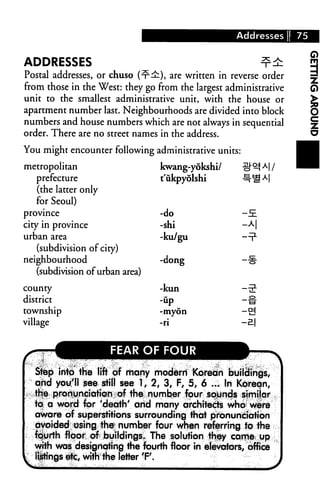
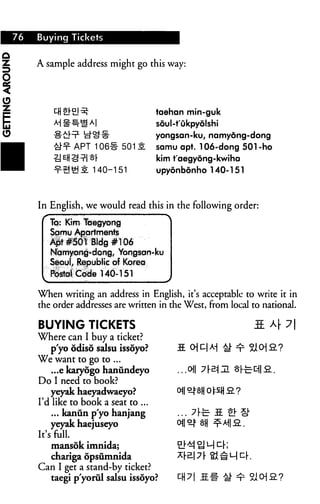
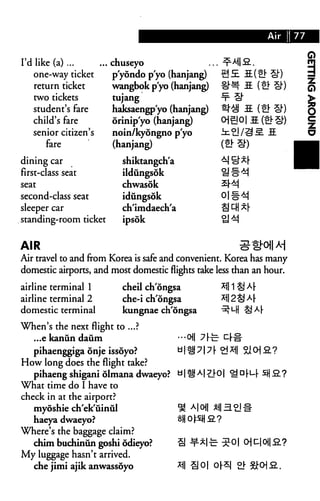
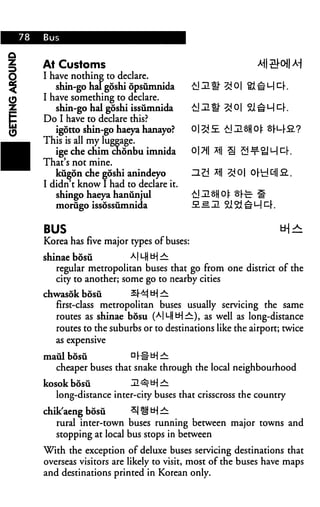
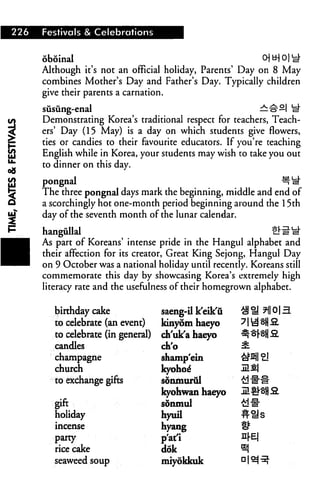
lonely planet


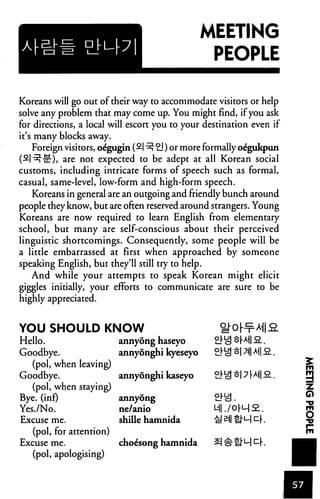
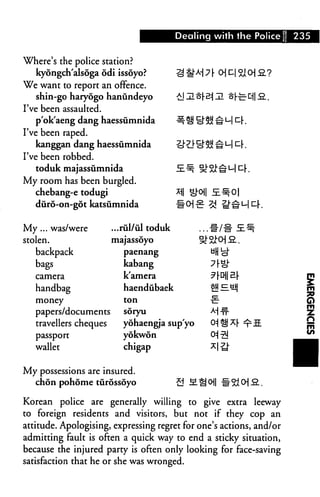
 PHRASEBOOK


kNGUAGE IN THE LAND OF MORNING CALM
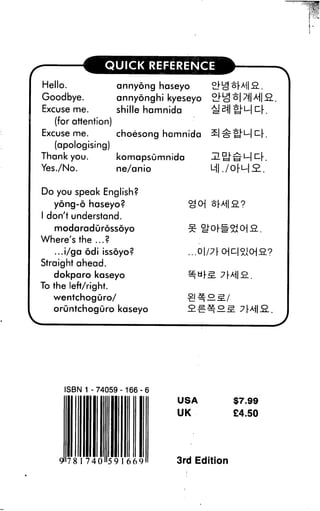
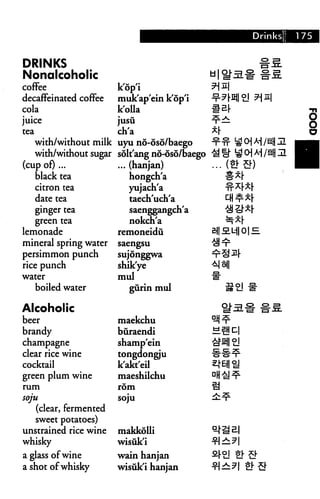
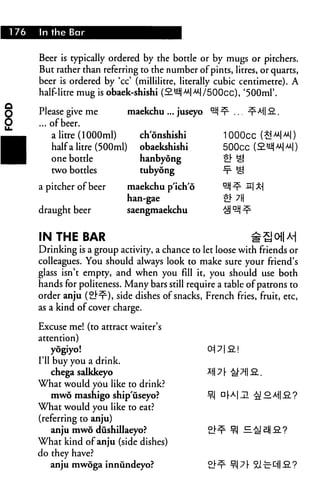
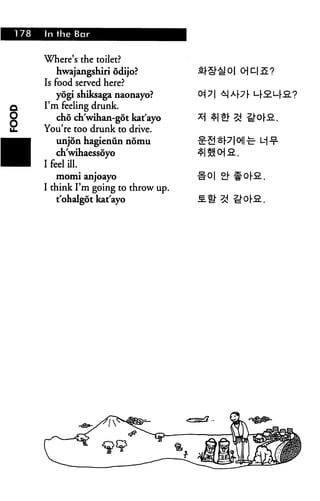
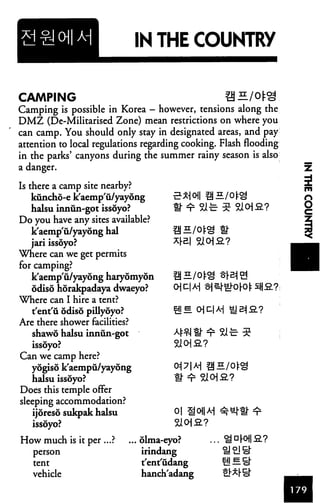
QUICK REFERENCE

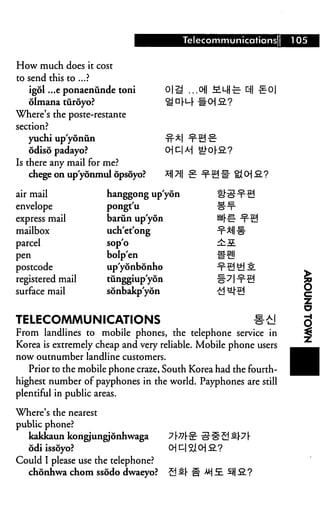
Hello.               annyong haseyo
Goodbye.             annyonghi kyeseyo
Excuse me.           shille hamnida      s2il
   (for attention)
Excuse me.           choesong hamnida
   (apologising)
Thank you.           komapsumnida
Yes./No.             ne/anio

Do you speak English?
    yong-6 haseyo?
I don't understand.
    modaradurossoyo
Where's the ...?
   ...i/ga odi issoyo?
Straight ahead.
   dokparo kaseyo
To the left/right.
   wentchoguro/
   oruntchoguro kaseyo


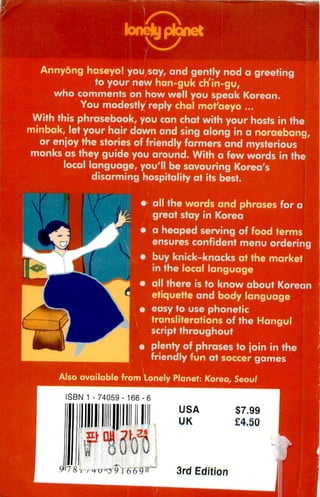
     ISBN 1 -74059-166-6
                                 USA            $7.99
                                 UK             £4.50


      781740"59l669              3rd Edition
KOREAN
    PHRASEBOOK


    xx. Hm.                                                   & *


                 J.D. Hilts,
             e   tc   a    a   «    w   a,   v.


V   fl   >   ^   -1   fl   ^   fl   a- A      A   A   *- -r T-1 rfl -rl
Korean phrasebook
3rd edition - March 2002

Published by
Lonely Planet Publications Pty Ltd ABN 36 005 607 983
90 Maribyrnong St, Footscray, Victoria 3011, Australia

Lonely Planet Offices
Australia Locked Bag 1, Footscray, Victoria 3011
USA 150 Linden St, Oakland CA 94607
UK 10a Spring Place, London NW5 3BH
France 1 rue du Dahomey, 75011 Paris

Cover illustration
jenny chonsa doing a bit ofdung san by Patrick Marris

ISBN 1 74059 166 6

text © Lonely Planet Publications Pty Ltd 2002
cover illustration © Lonely Planet Publications Pry Ltd 2002

10   987654                   21


Printed by The Bookmaker International Ltd
Printed in China

All rights reserved. No part of this publication may be reproduced, stored in a
retrieval system or transmitted in any form by any means, electronic, mechanical,
photocopying, recording or otherwise, except brief extracts for the purpose of
review, without the written permission of the publisher.

Lonely Planet, the Lonely Planet logo, Lonely Planet Images, CitySync
and ekno are trade marks of Lonely Planet Publications Pty Ltd. Other trade
marks are the property of their respective owners.


  Although the authors and Lonely Planet try to make the information
  as accurate as possible, we accept no responsibility for any loss,
  injury or inconvenience sustained by anyone using this book.
Acknowledgments         3


About the Authors
Minkyoung Kim is a Seoul native who studies at Korea
University,   focusing on   the field of English education.
Jonathan Hilts-Park is a California native who has lived in
Seoul since graduating from the University of California at
Irvine in the 1990s, and is pursuing graduate studies at Yonsei
University focusing on public health issues in Korea. Since
working together at Korea's EBS radio and television network,
where Minkyoung was a production assistant and Jonathan
works as a news commentator and developer of English
educational programs, they have collaborated on a number
of publishing projects. They welcome comments on their
work, which can be forwarded to Lonely Planet Publications.

From the Authors
Minkyoung and Jonathan wish to thank their friend Elizabeth
Harriman for sacrificing her time proofreading so much of
this book, and hope she'll be satisfied with a free copy and
a nice meal at the restaurant of her choosing. They would
also like to thank their family and friends who acted as
sounding boards for their ideas, as well as Minkyoung's
roommate Alexia for not getting angry about the many
late night calls when deadlines were approaching. Finally,
they would like to thank the Lonely Planet staff for their
understanding and patience when Jonathan had an emergency
appendectomy right before deadline.

From the Publisher
The Korean phrasebook was like wandering up one of Korea's
majestic forested mountains. Annelies Mertens worked devotedly
from the temple of editing and was attended by Senior
Editors Karina Coates and Karin Vidstrup Monk. Adrienne
Costanzo ran a careful eye over these pages. Emma Koch and
David Burnett stood guard against destroyers of fonts, and
Andrew Tudor rendered valuable technical assistance. Designers
Acknowledgments


Yukiyoshi Kamimura and Belinda Campbell calmly crafted
and laid out the manuscript, taking over from Patrick Marris.
Patrick's world-renowned illustrations supplemented the text,
and he also detailed the colourful view from the summit on
the front cover. Senior Designer Fabrice Rocher guided these
deft brush strokes and Natasha Velleley brought the map to the
working party. Publishing Manager Jim Jenkin oversaw all this
and proclaimed it 'the little book of calm'.
   Thanks also to Kim Young Ok and Robert Joseph Dowling
who wrote the previous edition of the Lonely Planet Korean
phrasebook, from which this edition developed.
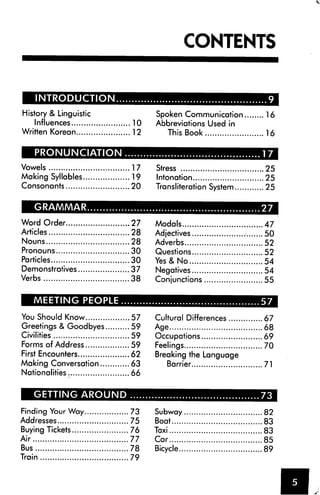
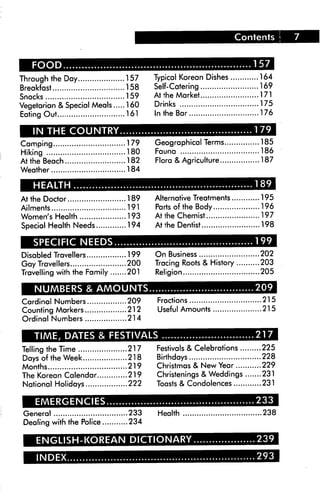
CONTENTS


    INTRODUCTION.
History & Linguistic        Spoken Communication     16
    Influences         10   Abbreviations Used in
Written Korean         12      This Book             16

WJrMglllJtiiyAJLiJJ—I         B
Vowels                 17   Stress                   25
Making Syllables       19   Intonation               25
Consonants             20   Transliteration System   25


Word Order             27   Modals                   47
Articles               28   Adjectives               50
Nouns                  28   Adverbs                  52
Pronouns               30   Questions                52
Particles              30   Yes& No                  54
Demonstratives         37   Negatives                54
Verbs                  38   Conjunctions             55


You Should Know        57   Cultural Differences     67
Greetings & Goodbyes   59   Age                      68
Civilities             59   Occupations              69
Forms of Address       59   Feelings                 70
First Encounters       62   Breaking the Language
Making Conversation    63      Barrier               71
Nationalities          66


■emJIJkWrUHIJU—
Finding Your Way       73   Subway                   82
Addresses              75   Boat                     83
Buying Tickets         76   Taxi                     83
Air                    77   Car                      85
Bus                    78   Bicycle                  89
Train                  79
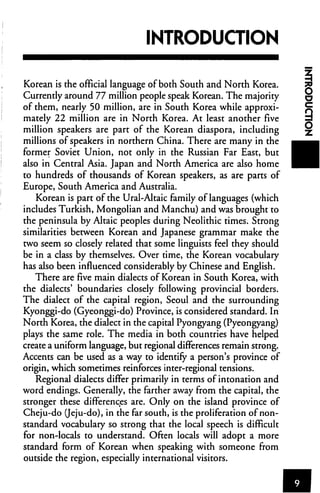
ACCOMMODATION
Finding Accommodation   91    Complaints                   96
Booking Ahead           92    Checking Out                 97
Checking In             93    Renting                      98
Requests & Queries      95    Paperwork                    99


Looking For             101   Telecommunications          105
At the Bank             102   Sightseeing                 108
At the Post Office      104


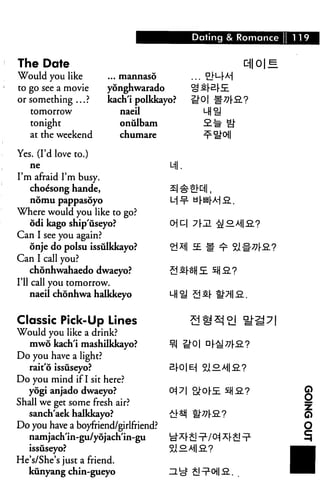
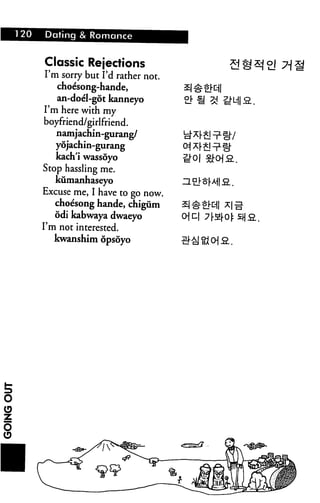
Where to Go             113   Arranging to Meet....       .118
Invitations             115   Dating & Romance...         .118
Nightclubs & Bars       116


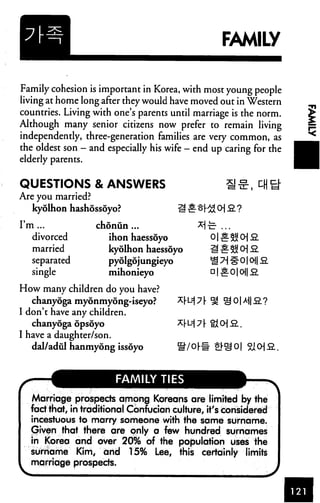
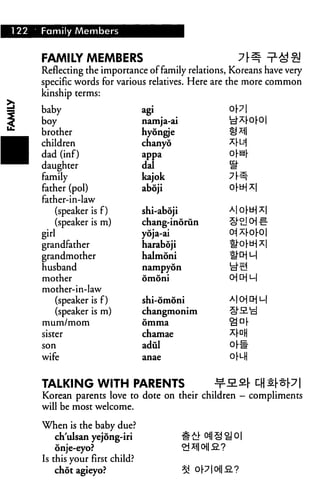
Questions & Answers     121   Talking with Parents        122
Family Members          122   Talking with Children       124

    INTERESTS & ACTIVITIES
Common Interests &            Skiing                      132
    Hobbies             125   Golf                        133
Types of Sport          126   Games                       134
Talking about Sport     127   Art                         134
Going to the Match      128   Music                       135
Soccer                  129   Cinema & Theatre            136
Keeping Fit             131   Staying in Touch            139
Tennis & Table Tennis   132   Writing Letters             139


Politics                141   Environment                  143
Social Issues           142   Drugs                        144

MH!MJJI7TcWW—i
Looking For             145   Toiletries                  151
Making a Purchase       146   For the Baby                152
Bargaining              147   Stationery & Publications   152
Souvenirs               148   Music                       153
Clothing                149   Photography                 154
Materials               150   Smoking                     155
Colours                 150   Sizes & Comparisons         156
Contents i   7


Through the Day              157   Typical Korean Dishes          164
Breakfast                    158   Self-Catering                  169
Snacks                       159   At the Market                  171
Vegetarian & Special Meals   160   Drinks                         175
Eating Out                   161   In the Bar                     176

MSldUihlllJHAM
Camping                      179   Geographical Terms             185
Hiking                       180   Fauna                          186
At the Beach                 182   Flora & Agriculture            187
Weather                      184

■!IJJh!—Wl
At the Doctor                189   Alternative Treatments         195
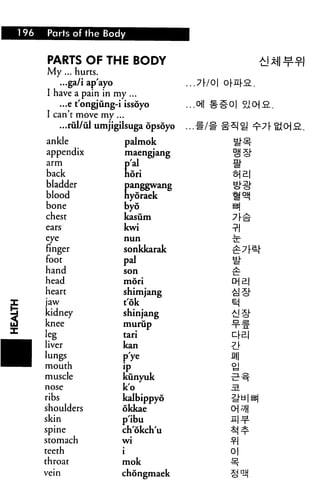
Ailments                     191   Parts of the Body              196
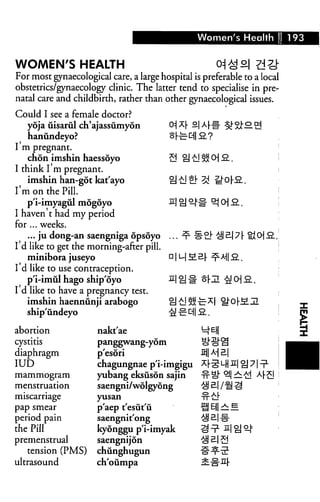
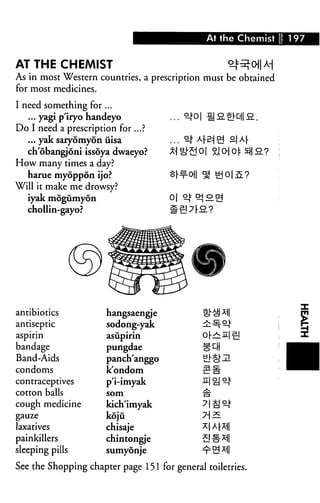
Women's Health               193   At the Chemist                 197
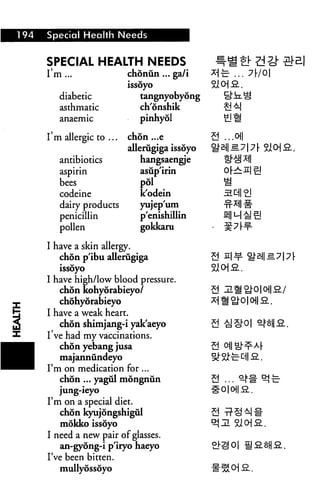
Special Health Needs         194   At the Dentist                 198


Disabled Travellers          199   On Business                    202
Gay Travellers               200   Tracing Roots & History        203
Travelling with the Family   201   Religion                       205


Cardinal Numbers             209    Fractions                      215
Counting Markers             212    Useful Amounts                 215
Ordinal Numbers              214


Telling the Time             217   Festivals & Celebrations        225
Days of the Week             218   Birthdays                       228
Months                       219   Christmas & New Year            229
The Korean Calendar          219   Christenings & Weddings         231
National Holidays            222   Toasts & Condolences            231


 General                     233    Health                         238
 Dealing with the Police     234

    ENGLISH-KOREAN DICTIONARY.
iiiii
iilHililll
             IllisiiillliSIs


                                liilii


                               Ilifiillili
W$mm9^^^B^§wMM$mSm


;^|i||ag
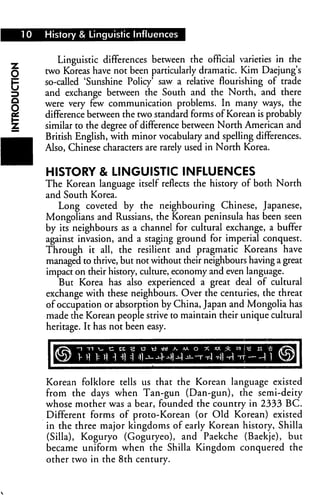
INTRODUCTION

Korean is the official language of both South and North Korea.
Currently around 77 million people speak Korean. The majority
of them, nearly 50 million, are in South Korea while approxi
mately 22 million are in North Korea. At least another five
million speakers are part of the Korean diaspora, including
millions of speakers in northern China. There are many in the
former Soviet Union, not only in the Russian Far East, but
also in Central Asia. Japan and North America are also home
to hundreds of thousands of Korean speakers, as are parts of
Europe, South America and Australia.
    Korean is part of the Ural-Altaic family of languages (which
includes Turkish, Mongolian and Manchu) and was brought to
the peninsula by Altaic peoples during Neolithic times. Strong
similarities between Korean and Japanese grammar make the
two seem so closely related that some linguists feel they should
be in a class by themselves. Over time, the Korean vocabulary
has also been influenced considerably by Chinese and English.
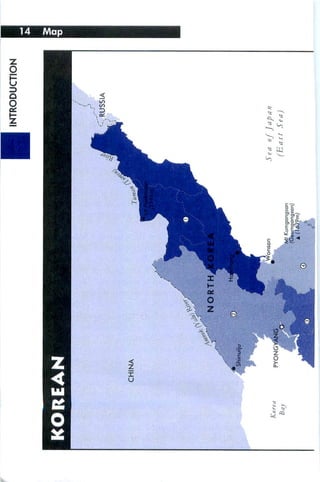
   There are five main dialects of Korean in South Korea, with
the dialects' boundaries closely following provincial borders.
The dialect of the capital region, Seoul and the surrounding
Kyonggi-do (Gyeonggi-do) Province, is considered standard. In
North Korea, the dialect in the capital Pyongyang (Pyeongyang)
plays the same role. The media in both countries have helped
create a uniform language, but regional differences remain strong.
Accents can be used as a way to identify a person's province of
origin, which sometimes reinforces inter-regional tensions.
   Regional dialects differ primarily in terms of intonation and
word endings. Generally, the farther away from the capital, the
stronger these differences are. Only on the island province of
Cheju-do (Jeju-do), in the far south, is the proliferation of non-
standard vocabulary so strong that the local speech is difficult
for non-locals to understand. Often locals will adopt a more
standard form of Korean when speaking with someone from
outside the region, especially international visitors.
10   History & Linguistic Influences


            Linguistic differences between the official varieties in the
O
         two Koreas have not been particularly dramatic. Kim Daejung's
         so-called 'Sunshine Policy' saw a relative flourishing of trade
         and exchange between the South and the North, and there
         were very few communication problems. In many ways, the
O
         difference between the two standard forms of Korean is probably
         similar to the degree of difference between North American and
         British English, with minor vocabulary and spelling differences.
         Also, Chinese characters are rarely used in North Korea.


         HISTORY & LINGUISTIC INFLUENCES
         The Korean language itself reflects the history of both North
         and South Korea.
            Long coveted by the neighbouring Chinese, Japanese,
         Mongolians and Russians, the Korean peninsula has been seen
         by its neighbours as a channel for cultural exchange, a buffer
         against invasion, and a staging ground for imperial conquest.
         Through it all, the resilient and pragmatic Koreans have
         managed to thrive, but not without their neighbours having a great
         impact on their history, culture, economy and even language.
            But Korea has also experienced a great deal of cultural
         exchange with these neighbours. Over the centuries, the threat
         of occupation or absorption by China, Japan and Mongolia has
         made the Korean people strive to maintain their unique cultural
         heritage. It has not been easy.


         Korean folklore tells us that the Korean language existed
         from the days when Tan-gun (Dan-gun), the semi-deity
         whose mother was a bear, founded the country in 2333 BC.
         Different forms of proto-Korean (or Old Korean) existed
         in the three major kingdoms of early Korean history, Shilla
         (Silla), Koguryo (Goguryeo), and Paekche (Baekje), but
         became uniform when the Shilla Kingdom conquered the
         other two in the 8th century.
History & Linguistic Influences


Chinese Influence
Imperial China saw Korea as a loyal 'little brother', its right-hand
man, and the two enjoyed a great deal of positive interchange.
Korea flourished as a conduit between China and Japan for the
flow - especially from China to Korea to Japan - of culture,
religion, technology, and social and political institutions.
   Chinese cultural and political influence can be seen in the
number of Korean words of Chinese origin, approximately
70% of all Korean vocabulary, although the two languages
are linguistically distinct. In many ways, the use of Chinese in
Korean and Japanese is similar to the use of Latin by Europeans
in the post-Roman era. Korea's elite class, called yangban
(o^lL!")* were trained in Chinese classics, and civil service
exams were conducted using Chinese characters. Even nowadays,
technical words are typically formed by stringing together
relevant Chinese characters.


Japanese Influence
The strong similarity between Korean and Japanese grammar
appears to many linguists to reflect both voluntary and forced
migrations from Korea to Japan over a millennium ago. Japan's
nearly half-century occupation of Korea led to a small number
of borrowed words, including those from other countries that
were filtered through Japan, such as arubait'ii (O|-.s ti|-0|^.),
'part-time job', from the German word Arbeit, 'work'.
    In the first half of the 20th century, Japanese military occupi
ers sought to wipe out any vestiges of a unique Korean culture,
including replacing the Korean language with the Japanese
language. Korean language instruction was eventually banned,
and virtually all Koreans were required to change their Korean
names to Japanese ones. Koreans reverted back to using
Korean language and Korean names immediately after liberation
from Japanese military rule in 1945, but many elderly people
today still maintain some Japanese language ability.
12   Written Korean


     American Influence
     America's media and economic domination since WWII, not to
     mention its strong military presence in Korea since the Korean
     War (1950-53), have led to hundreds of words of purported
     English origin in everyday use in Korean. Words like haendupon
     (!!!£?), 'mobile phone' (lit: hand phone), bippi (HH| UU|),
     'beeper/pager' and baengmiro (^i Dl S-j), 'rear-view mirror'
     (lit: back mirror) have made their way into everyday Korean.

     'Pure' Korean
     Since liberation from the Japanese at the end of WWII, both
     North and South Korea have engaged in manipulation of the
     Korean language for nationalistic purposes. 'Foreign' words
     in Korean were at one time discouraged by the South Korean
     regime of Park Chunghee, and the teaching of all but the
     most basic Chinese characters was once stopped for a period of
     time. In North Korea, virtually nothing is written in Chinese
     characters, and the North Korean rulers have succeeded in
     systematically replacing most 'foreign' words — even Korean
     words of Chinese origin — with new words composed of'pure'
     Korean components.
         A good example can be found in the Korean words for
     'ice cream'. Koreans originally referred to it as aisuk'urim'
     (0|-0 |^l3§), the 'Hangulised' (see below) form of the English
     word. The North Koreans, on the other hand, coined a new
     'pure' Korean term for the dessert, 6rumposung-i (^ "H-M^O |),
     literally 'ice-flufty-thing'. However, many North Koreans still
     use the original term, as do all South Koreans.


     WRITTEN KOREAN
     Korean was originally written using Chinese characters made up
     of complex pictographs, meaning that only the educated elite
     were literate. King Sejong the Great, considered Korea's finest
     and wisest ruler, headed the creation of a simple script that the
     masses could easily learn and use. Hangul (lit: Korean letters)
     was officially adopted in 1446.
Written Korean


    The decision to create a simple writing system for the masses
was born from incredible foresight and democratic vision.
The creation of the alphabet followed scientific principles that
closely match linguistic thought today. With the original 28
characters, it was said that any conceivable sound could be
written. Hangul is one of the principle reasons the two Koreas
are among the most literate countries in the world, both with
literacy rates approaching 100%. Both North and South Koreans
take enormous pride in their unique alphabet.
    Hangul has since been simplified to include ten vowels and 14
consonants. Whereas Chinese characters represent morphemes
- elements having a meaning or grammatical function that
cannot be subdivided into further elements - and Japanese
characters represent independent syllables, each character in
Korean represents a sound by itself, making Hangul the only
true alphabet native to East Asia.
    Korean was traditionally written the same as Chinese: top
to bottom in columns running from right to left. It can
still be written this way although, due to Western influence,
it's now generally written from left to right, in rows going
from top to bottom. Most Korean is written in Hangul only,
although South Korean newspapers and some textbooks mix in
Chinese characters. Many syllables, from everyday words such
as san (uJ")> 'mountain' or kang (S"), 'river', as well as most
personal and place names, can be represented by Chinese
characters called hantcha (1_^F). North Korea's 'Juche' (self-
reliance) philosophy has led them to eschew Chinese characters
almost completely.
   South Koreans are currently taught a minimum of 1000
'everyday' Chinese characters. Even if one is not adept at reading
and writing them, knowing their pronunciation as roots is
important. Virtually every Chinese character is written only one
way in Hangul (unlike Japanese, in which one Chinese character
can have multiple spellings). Chinese characters represent only
'Sino-Korean' words - Korean words of Chinese origin - not
'pure' Korean words, which can be written only in Hangul.
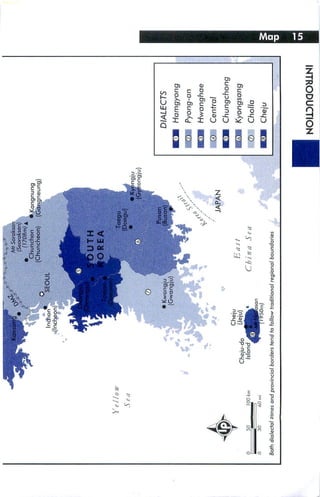
INTRODUCTION


KOREAN


    CHINA


            NORTH


                    Sea of Japan
                     (East Sea)
->n   • Kongnung


                Yellow


                                                                                                             -ngju)


                                                                                                                      DIALECTS

                                                                                                                       Hamgyong

                                                                                                                       Pyong-an

                                                                                                                       Hwanghae
                                                                                                                       Central
                                                                                                 JAPAN
                                                                                                                       Chungchong
                                                    Cheju
                                                                               East                                    Kyongsang
                                    Cheju-d
0        5^^m_l00 km                 Island                               Chin a      S <-' a                          Cholla
0        30        60 mi
                                                                                                                       Cheju
Both dialectal zones and provincial borders lend fo follow traditional regional boundai
16   Spoken Communication


     SPOKEN COMMUNICATION
     Korean speech ranges from a formal/polite form, used especially
     with people who are older or of higher rank than oneself, to a
     casual/polite form used primarily with people of the same age or
     of similar status, down to a form of speech used only for children.
     The degree of formal or casual speech is largely indicated by
     verb endings. For the Korean language beginner, the casual/
     polite form of speech avoids the awkwardness of being overly
     formal without showing disrespect and, except where otherwise
     noted, that's what we have used throughout this book.
         Most travellers who visit South Korea, and even those who go
     to North Korea, would be likely to visit through the few tourist
     portals opened up by South Korean business ventures, or would
     travel with mandatory English-speaking tour guides. It's for
     that reason that we'll use standard South Korean vocabulary
     when there's a difference between North and South Korean.
         South Koreans are now taught English from early elementary
     school, and the number of people who possess at least basic
     English communication skills is quite large, so a traveller with
     no Korean communication skills can generally get by with the
     use of English, although this may limit his or her opportunities
     to see parts of the country.
         Most Koreans are delighted when overseas visitors try to
     use their language, and they will happily help even the worst
     butchers of the language muddle through until they finally
     make themselves understood. Armed with this book and the
     right attitude, you are all set to make your cross-cultural
     journey into the Land of Morning Calm a memorable one.


     ABBREVIATIONS USED IN THIS BOOK
     adj      adjective              n          noun

     f        feminine               neut       neuter

     fam      familiar               pi         plural
     inf      informal               pol        polite
     lit      literal translation    sg         singular
     m        masculine              V          verb
PRONUNCIATION

Each of the letters of the Korean alphabet, Hangul, represents a
distinct sound. Ten of the letters are vowels and 14 are consonants.
There are 11 combination vowels formed from the original ten
vowels, and there are five double consonants formed from five
of the basic consonants. The result is an alphabet of 40 characters
which was designed to be simple to learn. There are a further 11
consonant combinations, but they follow the simple rules of the I
basic 14 consonants.
    If this all sounds confusing, don't worry. Just follow along
with the Romanisation we provide, and you'll be able to produce
the correct sounds, or at least come very close.
    In this chapter, we'll present the various letters of the Hangul
alphabet linking them to their corresponding sounds.
    So, shijak halkkayo? (A| *j" 1W&?), 'Shall we begin?'.


VOWELS
Korean has six basic vowels of essentially the same length, and
all are found in English.

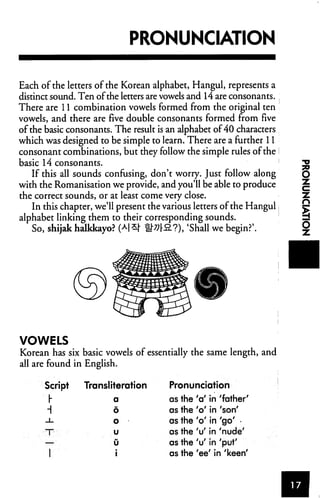
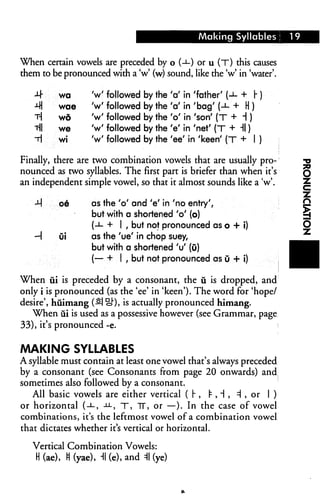
      Script     Transliteration       Pronunciation
       h                a              as the   'a' in 'father7
       H                6              as the   V in 'son'
      JL                o              as the   V in 'go' •
      T                 V              as the   'u' in 'nude'
      —
                        u              as the   'u' in 'put'
       1                 j
                                       as the   'ee' in 'keen'
18   Vowels


         'Y' Vowels
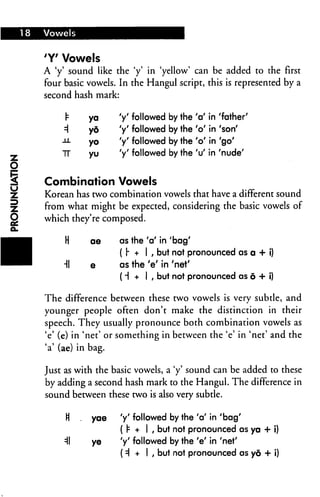
         A 'y' sound like the 'y' in 'yellow' can be added to the first
         four basic vowels. In the Hangul script, this is represented by a
         second hash mark:

              k         ya    V followed by the 'a' in 'father'
              =1        yd    y followed by the 'o' in 'son'
             ■^         yo    'y' followed by the 'o' in 'go'
z            TT         yu    y followed by the V in 'nude'

8
^        Combination Vowels
Z        Korean has two combination vowels that have a different sound
^        from what might be expected, considering the basic vowels of
Q        which they're composed.

              H         ae    as the 'a' in 'bag'
                              ( h + I , but not pronounced as a + i)
              -II       e     as the V in 'net'
                              ( H + I , but not pronounced as 6 + i)

         The difference between these two vowels is very subtle, and
         younger people often don't make the distinction in their
         speech. They usually pronounce both combination vowels as
         V (e) in 'net' or something in between the V in 'net' and the
         'a' (ae) in bag.

         Just as with the basic vowels, a 'y' sound can be added to these
         by adding a second hash mark to the Hangul. The difference in
         sound between these two is also very subtle.

               H    .   yae   'y' followed by the 'a' in 'bag'
                              ( f= + I , but not pronounced as ya + i)
              =11       ye    y followed by the 'e' in 'net'
                              (=1 + I , but not pronounced as yd + i)
Making Syllables |   19


When certain vowels are preceded by o (-1-) or u (t) this causes
them to be pronounced with a 'w' (w) sound, like the 'w' in 'water'.

   •M"    wa       'w'   followed   by the   'a' in 'father' (4? + h )
   41     wae      V     followed   by the   'a' in 'bag' (-1- + H )
   T-j    w6       W     followed   by the   'o' in 'son' (T + H )
   "HI    we       'w'   followed   by the   'e' in 'net' (T + HI)
   t|     wi       'w'   followed   by the   'ee' in 'keen' (T + I )

Finally, there are two combination vowels that are usually pro
nounced as two syllables. The first part is briefer than when it's
an independent simple vowel, so that it almost sounds like a V.

   A      oe       as the 'o' and 'e' in 'no entry',
                   but with a shortened 'o' (o)
                   (-«- + I , but not pronounced as o + i)
   -I     ui       as the 'ue' in chop suey,
                   but with a shortened V (0)
                   (—■■+ I , but not pronounced as u + i)

When ui is preceded by a consonant, the u is dropped, and
only i is pronounced (as the 'ee' in 'keen'). The word for 'hope/
desire', huimang (^1 ctt, is actually pronounced himang.
    When ui is used as a possessive however (see Grammar, page
33), it's pronounced -e.


MAKING SYLLABLES
A syllable must contain at least one vowel that's always preceded
by a consonant (see Consonants from page 20 onwards) andj
sometimes also followed by a consonant.
   All basic vowels are either vertical (  , t=, H , =1 , or I )
or horizontal (-•-, -"-, T, TT, or —). In the case of vowel
combinations, it's the leftmost vowel of a combination vowel
that dictates whether it's vertical or horizontal.

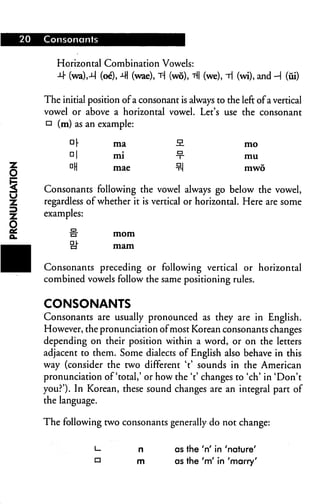
   Vertical Combination Vowels:
    H (ae), H (yae), M (e), and 4 (ye)
20   Consonants


        Horizontal Combination Vowels:
        -M- (wa),-M (oe), 41 (wae), T-j (wo), t|| (we), i (wi), and -H (fii)

     The initial position of a consonant is always to the left of a vertical
     vowel or above a horizontal vowel. Let's use the consonant
     n (m) as an example:

            nr          ma               -2-                 mo
            Dl          mi               ■?■                 mu
            DH          mae               °-J                mwo

     Consonants following the vowel always go below the vowel,
     regardless of whether it is vertical or horizontal. Here are some
     examples:

            fr          mom
            cJ"         mam

     Consonants preceding or following vertical or horizontal
     combined vowels follow the same positioning rules.


     CONSONANTS
     Consonants are usually pronounced as they are in English.
     However, the pronunciation of most Korean consonants changes
     depending on their position within a word, or on the letters
     adjacent to them. Some dialects of English also behave in this
     way (consider the two different Y sounds in the American
     pronunciation of'total,' or how the Y changes to 'ch' in 'Don't
     you?'). In Korean, these sound changes are an integral part of
     the language.

     The following two consonants generally do not change:


                  L-           n         as the 'n' in 'nature'
                  o           m          as the 'm' in 'marry'
Consonants     21


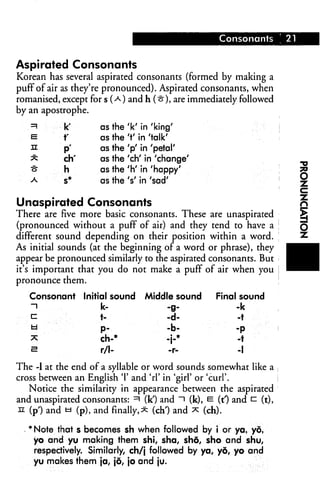
Aspirated Consonants
Korean has several aspirated consonants (formed by making a
puff of air as they're pronounced). Aspirated consonants, when
romanised, except for s (a) and h (3), are immediately followed
by an apostrophe.

            k'        as   the   V in 'king'
            f         as   the   't' in 'talk'
            p'        as   the   'p' in 'petal'
            ch'       as   the   'chi' in 'change'
            h         as   the   'h' in 'happy'
            s*        as   the   's' in 'sad'

Unaspirated Consonants
There are five more basic consonants. These are unaspirated
(pronounced without a puff of air) and they tend to have a
different sound depending on their position within a word.
As initial sounds (at the beginning of a word or phrase), they
appear be pronounced similarly to the aspirated consonants. But
it's important that you do not make a puff of air when you
pronounce them.

   Consonant      Initial sound      Middle sound    Final sound
   -1                  k-                   -9-           -k
   c                  t-                    -d-          -t
   td
                      P-                    -b-          -P
                      ch-*                 +•            -t
   5                  r/l-                  -r-          -1

The -1 at the end of a syllable or word sounds somewhat like a
cross between an English '1' and 'rl' in 'girl' or 'curl'.
   Notice the similarity in appearance between the aspirated
and unaspirated consonants: ^ (k') and ~i (k), ^ (t') and ci (t),
h (p') and td (p), and finally,^ (ch') and *■ (ch).

   * Note that s becomes sh when followed by i or ya, yo,
     yo and yu making them shi, sha, sho, sho and shu,
     respectively. Similarly, ch/j followed by ya, yd, yo and
     yu makes them ja, jo, jo and ju.
"Consonants


It should also be pointed out that an unaspirated consonant,
when preceded by h (3) as the final consonant of the previous
syllable, becomes aspirated. For example, 2l^[ is pronounced
anda, 'to hug/embrace', but t^Er is pronounced ant'a, 'to not
do something'. (See below for the vowel consonant (o) at the
beginning of these words.)

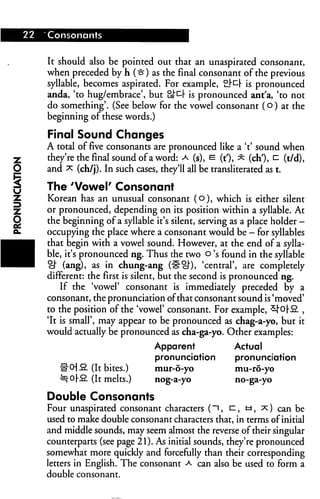
Final Sound Changes
A total of five consonants are pronounced like a Y sound when
they're the final sound of a word: a (s), e (t'), * (ch'), ^ (t/d),
and ^ (ch/j). In such cases, they'll all be transliterated as t.

The 'Vowel' Consonant
Korean has an unusual consonant (o), which is either silent
or pronounced, depending on its position within a syllable. At
the beginning of a syllable it's silent, serving as a place holder -
occupying the place where a consonant would be — for syllables
that begin with a vowel sound. However, at the end of a sylla
ble, it's pronounced ng. Thus the two o 's found in the syllable
 c)" (ang), as in chung-ang (^cl"), 'central', are completely
different: the first is silent, but the second is pronounced ng.
     If the 'vowel' consonant is immediately preceded by a
consonant, the pronunciation ofthat consonant sound is 'moved'
to the position of the 'vowel' consonant. For example, £|"0|2. ,
'It is small', may appear to be pronounced as chag-a-yo, but it
would actually be pronounced as cha-ga-yo. Other examples:
                             Apparent              Actual
                             pronunciation         pronunciation
          . (It bites.)      mur-6-yo              mu-ro-yo
          . (It melts.)      nog-a-yo              no-ga-yo

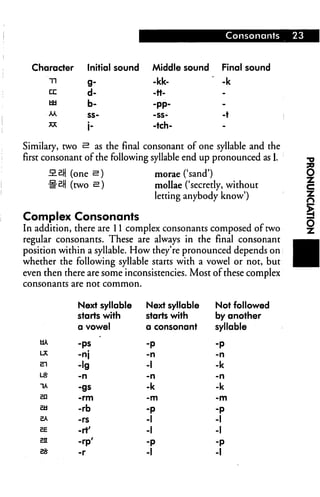
Double Consonants
Four unaspirated consonant characters (~i, tz, td, x) can be
used to make double consonant characters that, in terms of initial
and middle sounds, may seem almost the reverse of their singular
counterparts (see page 21). As initial sounds, they're pronounced
somewhat more quickly and forcefully than their corresponding
letters in English. The consonant a can also be used to form a
double consonant.
Consonants   23


  Character           Initial sound        Middle sound        Final sound

                      g-                   -kk-                -k
                      d-                   -tt-
                      b-                   -pp-

          AA          ss-                  -ss-                -t
                      i-                   -tch-

Similary, two ^ as the final consonant of one syllable and the
first consonant of the following syllable end up pronounced as 1.

          -2-&H (one s)                    morae ('sand')
          s-^H (two s)                     mollae ('secretly, without
                                           letting anybody know')

Complex Consonants
In addition, there are 11 complex consonants composed of two
regular consonants. These are always in the final consonant
position within a syllable. How they're pronounced depends on
whether the following syllable starts with a vowel or not, but
even then there are some inconsistencies. Most of these complex
consonants are not common.


                Next syllable         Next syllable       Not followed
                starts with           starts with         by another
                a vowel               a consonant         syllable
    UA          -ps                   -P                  -P
    LX
                 -nj                  -n                  -n
    El
                 -ig                  -1                  -k
    Ls           -n                   -n                  -n

    TA
                 -gs                  -k                  -k
    en           -rm                  -m                  -m
    ea           -rb                  -P                  -P
    SA           -rs                  -1                  -1
    EE           -rt'                 -1                  -1
    £11          -rp'                 -P                  -P
    25           -r                   -1                  -1
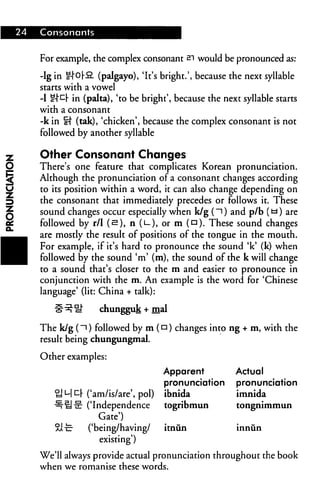
24   Consonants


     For example, the complex consonant hi would be pronounced as:

     -lg in aiOrS. (palgayo), 'It's bright.', because the next syllable
     starts with a vowel
     -1 b-W in (palta), 'to be bright', because the next syllable starts
     with a consonant
     -k in at (tak), 'chicken', because the complex consonant is not
     followed by another syllable

     Other Consonant Changes
     There's one feature that complicates Korean pronunciation.
     Although the pronunciation of a consonant changes according
     to its position within a word, it can also change depending on
     the consonant that immediately precedes or follows it. These
     sound changes occur especially when k/g (~i) and p/b (td) are
     followed by r/1 (e), n (i-), or m (n). These sound changes
     are mostly the result of positions of the tongue in the mouth.
     For example, if it's hard to pronounce the sound 'k' (k) when
     followed by the sound 'm' (m), the sound of the kwill change
     to a sound that's closer to the m and easier to pronounce in
     conjunction with the m. An example is the word for 'Chinese
     language' (lit: China + talk):

                    chungguk + mal

     The k/g (~i) followed by m         changes into ng + m, with the
     result being chungungmal.

     Other examples:
                                     Apparent           Actual
                                     pronunciation      pronunciation
        £J M £r ('am/is/are', pol)   ibnida             imnida
        ■^•U-ir ('Independence       togribmun          tongnimmun
                    Gate')
         aa-c-   ('being/having/     itnun              innun
                    existing')

     We'll always provide actual pronunciation throughout the book
     when we romanise these words.
Stress    25


STRESS
Unlike some other East Asian languages, stress in Korean is the
same for all syllables. The meaning of words does not change
depending on stress or pitch.


INTONATION
Rising intonation at the end of a sentence can indicate a question,
as is the case in English.

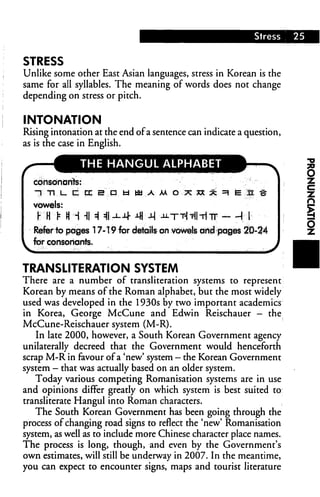
              THE HANGUL ALPHABET

  consonants:
   nTIUCtXBDfcltiUAMOXXX^^EIE^

  vowels:
   y W t h h hh =11-M- 4 -M -utt-MI-Hit - -H I
  Refer to pages 17-19 for details on vowels and pages 20-24
  for consonants.


TRANSLITERATION SYSTEM
There are a number of transliteration systems to represent
Korean by means of the Roman alphabet, but the most widely
used was developed in the 1930s by two important academics
in Korea, George McCune and Edwin Reischauer — the
McCune-Reischauer system (M-R).
   In late 2000, however, a South Korean Government agency
unilaterally decreed that the Government would henceforth
scrap M-R in favour of a 'new' system — the Korean Government
system - that was actually based on an older system.
   Today various competing Romanisation systems are in use
and opinions differ greatly on which system is best suited to
transliterate Hangul into Roman characters.
   The South Korean Government has been going through the
process of changing road signs to reflect the 'new' Romanisation
system, as well as to include more Chinese character place names.
The process is long, though, and even by the Government's
own estimates, will still be underway in 2007. In the meantime,
you can expect to encounter signs, maps and tourist literature
26   Transliteration System


     with at least two different Romanisation systems. North Korea
     however, officially tends to use a form of M-R.
         In this book we have used a Romanisation system closely
     modelled on the Government's pre-2000 version of M-R. It has
     been our experience that this system is easy to use by Korean lan
     guage newbies to pronounce Korean words. We'll provide place
     names in both the McCune-Reischauer and Government systems
     (also see the list of place names in Getting Around, page 81).


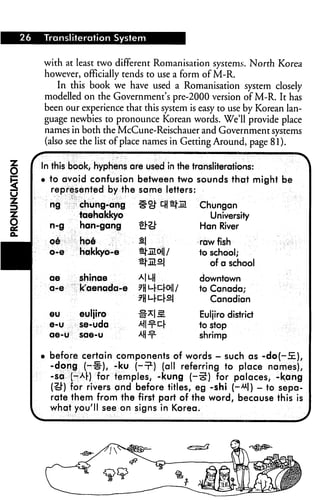
     In this book, hyphens are used in the transliterations:
     • to avoid confusion between two sounds that might be
       represented by the same letters:
       ng     chung-ang       ^°J" r^tj-jn    Chungan
              taehakkyo                         University
       n-g    han-gang        ej-ij-          Han River

       oe     hoe             S|              raw fish


■
       o-e    hakkyo-e        ^.Ml /         to school;
                                                 of a school
       ae     shinae          Al Mi          downtown
       a-e    k'aenada-e      ^HM-c-rOll/    to Canada;
                              7H L-l-cl-sj      Canadian
       eu     euljiro         #^1^            Euljiro district
       e-u    se-uda          ^Hnrkr         to stop
       ae-u   sae-u           Af|-f-         shrimp

     • before certain components of words - such as -doj-S.),
       -dong (-■§•), -ku j-1?) (all referring to place names),
       -sa (-Ar) for temples, -kung (—5) for palaces, -kang
       (£!") for rivers and before titles, eg -shi (—**!) - to sepa
       rate them from the first part of the word, because this is
       what you'll see on signs in Korea.
GRAMMAR

Despite a strong Chinese influence on Korean vocabulary,
Korean grammar is completely different from that of Chinese.
There are, however, very strong similarities between Korean
grammar and Japanese grammar, which makes learning one
much easier if you've already been exposed to the other. Korean
grammar ranges from respectful forms of speech, chondaemal
(Sell §0, to 'low' forms of speech, panmal (Hr^).
   This book presents a practical middle ground - the familiar-
high form — between the high form, characterised by the verb
endings -mnida and -mnikka, and lower forms of speech
characterised by reduced verb endings or no verb endings at all.
The high form is appropriate when first meeting, but would
sound awkward if over-used in everyday situations; conversely,
using the low form to people with whom you're not familiar
will definitely offend the listener.


                                                                       CD


WORD ORDER
To a large extent, Korean word order (typically subject-object-verb)
differs from that of English (typically subject-verb-object). The
subject is not always necessary, but when used, it usually comes
first, as in English, but direct objects usually precede verbs, eg:

   I came from Australia,     (chonun) hojueso wassoyo
                              (lit: [I-nun] Australia-from came)

   I like spicy food.         (chonun) maeunumshigul choahaeyo
                              (lit: [I-nun] spicy food-ul like)

(See page 32 for the particles -un/-niin and -ul/-rul.)
When the subject is clear — and sometimes even when it's nor
— it may be dropped altogether. Rather than saying 'I came
from Australia', it's perfectly acceptable to omit the subject if
it's clear that you're speaking about yourself and say 'came from
Australia'. In fact, it may even sound awkward if you repeatedly
say T at the beginning of each sentence. Still, what's clear to the
speaker might not be so clear to the listener, so don't be afraid
to interject nugayo?, the subject form of'who'.


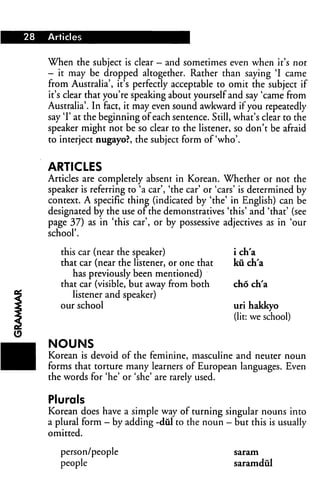
ARTICLES
Articles are completely absent in Korean. Whether or not the
speaker is referring to 'a car', 'the car' or 'cars' is determined by
context. A specific thine (indicated by 'the' in English) can be
designated by the use or the demonstratives 'this' and 'that' (see
page 37) as in 'this car', or by possessive adjectives as in 'our
school'.

   this car (near the speaker)                   i ch'a
   that car (near the listener, or one that      kiich'a
      has previously been mentioned)
   that car (visible, but away from both         cho ch'a
      listener and speaker)
   our school                                    uri hakkyo
                                                 (lit: we school)


NOUNS
Korean is devoid of the feminine, masculine and neuter noun
forms that torture many learners of European languages. Even
the words for 'he' or 'she' are rarely used.

Plurals
Korean does have a simple way of turning singular nouns into
a plural form — by adding -diil to the noun - but this is usually
omitted.

   person/people                                 saram

   people                                        saramdul
Articles l 29


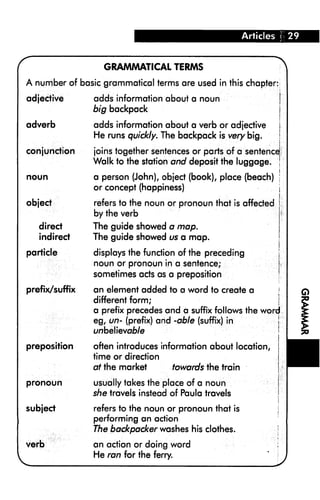
                  GRAMMATICAL TERMS

A number of basic grammatical terms are used in this chapter:
adjective       adds information about a noun                        |
                big backpack                                         j

adverb          adds information about a verb or adjective           I
                He runs quickly. The backpack is very big.           !
conjunction     joins together sentences or parts of a sentence-
                Walk to the station and deposit the luggage. ;
noun            a person (John), object (book), place (beach)
                or concept (happiness)

object          refers to the noun or pronoun that is affected
                by the verb
   direct       The guide showed a map.
   indirect     The guide showed us a map.

particle        displays the function of the preceding           j
                noun or pronoun in a sentence;                   !
                sometimes acts as a preposition                  ■
prefix/suffix   an element added to a word to create a         ;
                different form;                                j
                a prefix precedes and a suffix follows the word
                ©9/ un- (prefix) and -able (suffix) in         !
                i/nbelieva/>/e

preposition     often introduces information about location,
                time or direction
                at the market       towards the train

pronoun         usually takes the place of a noun
                she travels instead of Paula travels
subject         refers to the noun or pronoun that is
                performing an action
                The backpacker washes his clothes.
verb            an action or doing word
                He ran for the ferry.
30   Pronouns


     PRONOUNS
     Pronouns are generally not used in Korean, especially in the
     third person ('he/him', 'she/her' and 'they/them'). Instead, the
     person about whom you're speaking is referred to by their
     name, their title, or especially their relationship to the speaker or
     listener, expressed in the form of speech (see page 27).
         One thing that makes Korean very different from English is
     that even the pronoun 'you' is often replaced by a third-person
     reference, especially when speaking to someone in a higher position
     (see Forms ofAddress in Meeting People, page 59). As for the third
     person, there are no real pronouns in Korean. Instead they're
     usually expressed by combining the words for 'this' and 'that'
     (see page 37) with the noun.
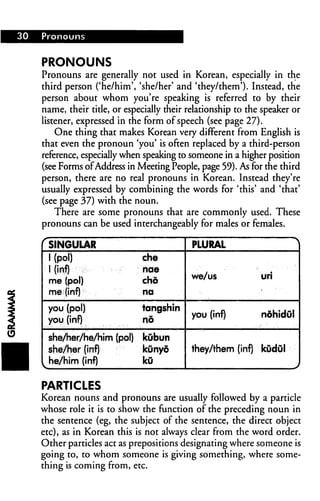
         There are some pronouns that are commonly used. These
     pronouns can be used interchangeably for males or females.

     f SINGULAR                              PLURAL                      ^|
      1 (pol)                  che
      1 (inf)                   nae
                                             we/us             uri
      me (pol)                 chd
      me (inf)                 na
      you (pol)                tangshin
                                             you (inf)         ndhidul
      you (inf)                no

       she/her/he/him (pol)    kubun
       she/her (inf)           tcOnyd        they/them (inf) kOdOl
     t he/him (inf)            kO


     PARTICLES
     Korean nouns and pronouns are usually followed by a particle
     whose role it is to show the function of the preceding noun in
     the sentence (eg, the subject of the sentence, the direct object
     etc), as in Korean this is not always clear from the word order.
     Other particles act as prepositions designating where someone is
     going to, to whom someone is giving something, where some
     thing is coming from, etc.
Note that in conversational speech, subject and direct object
particles are frequently omitted, especially when the subject or
object is clear (for the omission of the subject and object also see
page 28).
   Because particles are attached to the noun, they essentially
become part of the pronunciation of the noun itself. Which
form of the particle to use often depends on whether the noun
ends in a vowel or a consonant. In the following, for particles
which have different forms, we show the form to be used if the
noun ends in a consonant first, then the form to be used if the
noun ends in a vowel.
   Also keep in mind that the particles may alter the pro
nunciation of the consonant that precedes it (which changes
from being a final consonant to a middle consonant. See
Pronunciation, page 21).

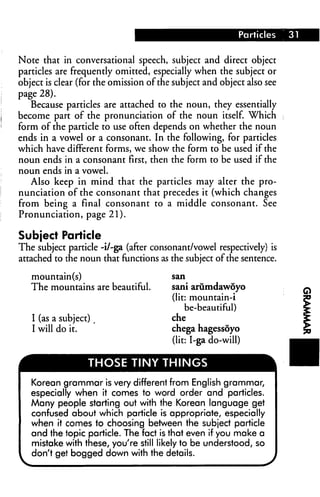
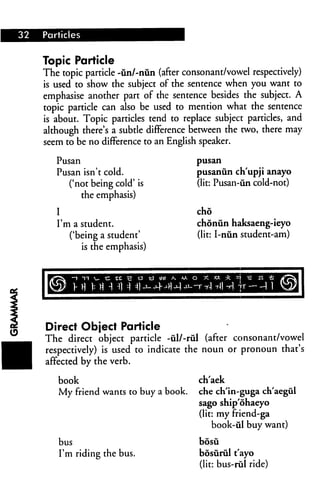
Subject Particle
The subject particle -i/-ga (after consonant/vowel respectively) is
attached to the noun that functions as the subject of the sentence.

   mountain(s)                          san

   The mountains are beautiful.         sani arumdawoyo
                                        (lit: mountain-i
                                             be-beautiful)
   I (as a subject)                     che
   I will do it.                        chega hagessoyo
                                        (lit: I-ga do-will)

                  THOSE TINY THINGS

   Korean grammar is very different from English grammar,
   especially when it comes to word order and particles.
   Many people starting out with the Korean language get
   confused about which particle is appropriate, especially
   when it comes to choosing between the subject particle
   and the topic particle. The fact is that even if you make a
   mistake with these, you're still likely to be understood, so
   don't get bogged down with the details.
32   Particles


     Topic Particle
     The topic particle -un/-nun (after consonant/vowel respectively)
     is used to show the subject of the sentence when you want to
     emphasise another part of the sentence besides the subject. A
     topic particle can also be used to mention what the sentence
     is about. Topic particles tend to replace subject particles, and
     although there's a subtle difference between the two, there may
     seem to be no difference to an English speaker.

        Pusan                             pusan

        Pusan isn't cold,                  pusanun ch'upji anayo
           ('not being cold' is            (lit: Pusan-un cold-not)
              the emphasis)

        I                                  cho
        I'm a student.                     chonun haksaeng-ieyo
           ('being a student'              (lit: I-nun student-am)
              is the emphasis)


     Direct Object Particle
     The direct object particle -ul/-rul (after consonant/vowel
     respectively) is used to indicate the noun or pronoun that's
     affected by the verb.

        book                               ch'aek
        My friend wants to buy a book.     che ch'in-guga ch'aegiil
                                           sago ship'dhaeyo
                                           (lit: my friend-ga
                                                book-iil buy want)

        bus                                bosu
        I'm riding the bus.                bosurul t'ayo
                                           (lit: bus-rul ride)
Particles    i 33


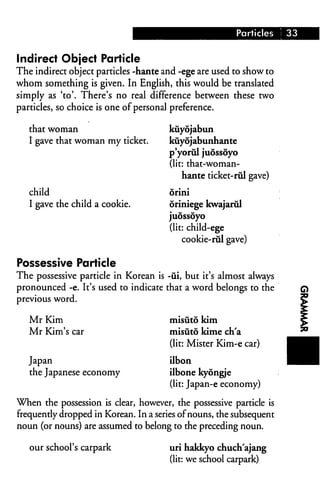
Indirect Object Particle
The indirect object particles -hante and -ege are used to show to
whom something is given. In English, this would be translated
simply as 'to'. There's no real difference between these two
particles, so choice is one of personal preference.

   that woman                          kuyojabun
   I gave that woman my ticket.        kuyojabunhante
                                       p'yorul judssoyo
                                       (lit: that-woman-
                                          hante ticket-rul gave)

   child                               orini
   I gave the child a cookie.          oriniege kwajariil
                                      judssoyo
                                       (lit: child-ege
                                           cookie-rul gave)


Possessive Particle
The possessive particle in Korean is -ui, but it's almost always
pronounced -e. It's used to indicate that a word belongs to the
previous word.

   Mr Kim                              misuto kirn
   Mr Kim's car                        misuto kime ch'a
                                       (lit: Mister Kim-e car)

   Japan                               ilbon
   the Japanese economy                ilbone kyongje
                                       (lit: Japan-e economy)

When the possession is clear, however, the possessive particle is
frequently dropped in Korean. In a series of nouns, the subsequent
noun (or nouns) are assumed to belong to the preceding noun.

   our school's carpark                uri hakkyo chuch'ajang
                                       (lit: we school carpark)
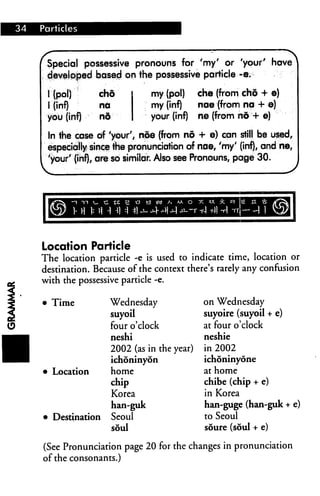
Special possessive pronouns for 'my' or 'your' have
 developed based on the possessive particle -e.

 I (pol)       cho             my (pol)     che (from cho + e)
 I (inf)       net             my (inf)     nae (from na + e)
 you (inf)     nd              your (inf)   ne (from nd -4- e)

 In the case of 'your'/ noe (from no + e) cqn still be used,
 especially since the pronunciation of nae, 'my' (inf), and tie,
 'your' (inf), are so similar Also see Pronouns, page 30.


Location Particle
The location particle -e is used to indicate time, location or
destination. Because of the context there's rarely any confusion
with the possessive particle -e.

  Time           Wednesday                   on Wednesday
                 suyoil                      suyoire (suyoil + e)
                 four o'clock                at four o'clock
                 neshi                       neshie
                 2002 (as in the year)       in 2002
                     ichoninyon              ichoninyone
  Location           home                    at home
                     chip                    chibe (chip + e)
                     Korea                   in Korea
                     han-guk                 han-guge (han-guk + e)
  Destination        Seoul                   to Seoul
                     soul                    soure (soul + e)

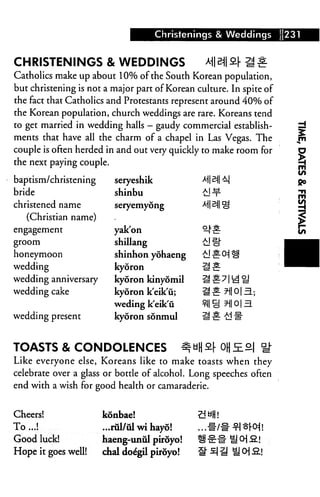
(See Pronunciation page 20 for the changes in pronunciation
of the consonants.)
Particles   ; 35


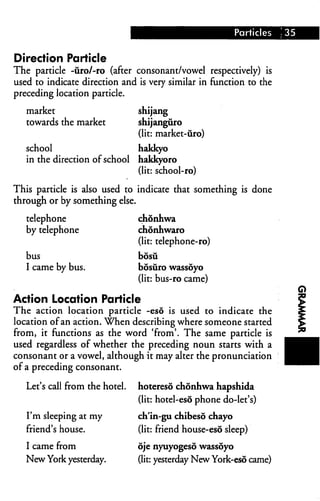
Direction Particle
The particle -uro/-ro (after consonant/vowel respectively) is
used to indicate direction and is very similar in function to the
preceding location particle.

   market                       shijang
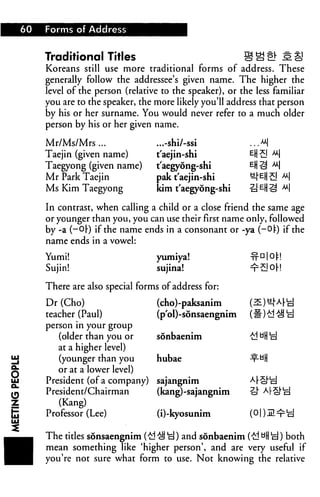
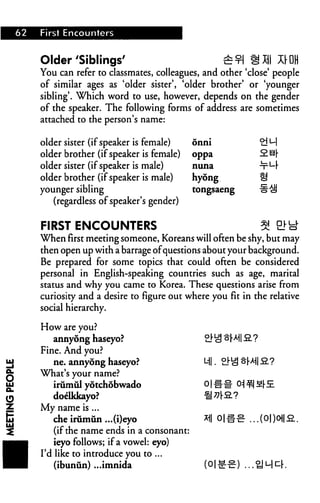
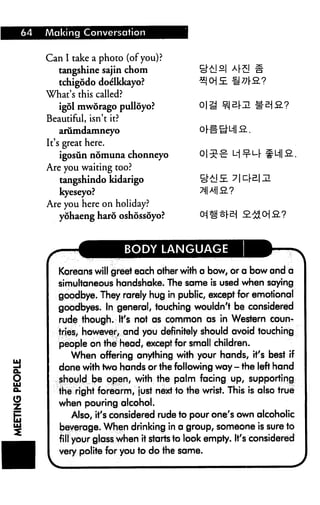
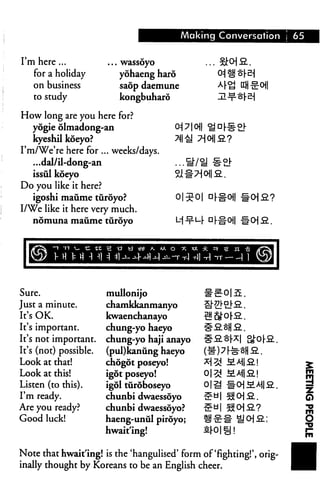
   towards the market           shijanguro
                                (lit: market-uro)
   school                       hakkyo
   in the direction of school   hakkyoro
                                (lit: school-ro)

This particle is also used to indicate that something is done
through or by something else.

   telephone                    chonhwa
   by telephone                 chonhwaro
                                (lit: telephone-ro)
   bus                          bosu
   I came by bus.               bosuro wassoyo
                                (lit: bus-ro came)

Action Location Particle
The action location particle -eso is used to indicate the
location of an action. When describing where someone started
from, it functions as the word 'from'. The same particle is
used regardless of whether the preceding noun starts with a
consonant or a vowel, although it may alter the pronunciation
of a preceding consonant.

   Let's call from the hotel.   hotereso chonhwa hapshida
                                (lit: hotel-esd phone do-let's)

   I'm sleeping at my           ch'in-gu chibeso chayo
   friend's house.              (lit: friend house-eso sleep)

   I came from                  oje nyuyogesd wassoyo
   New York yesterday.          (lit: yesterday New York-eso came)
36   Particles


     Together Particles
     Both -gwa/-wa (after consonant/vowel respectively) and -hago
     are used to string nouns together, functioning as 'and' or 'with'.
     Whether to use -hago or -gwa/-wa is a matter of preference.

        my cousin and my friend        uri sachonhago che ch'in-gu
                                       (lit: we cousin-hago my friend)
                                       uri sachongwa che ch'in-gu
                                       (lit: we cousin-gwa my friend)
        my friend and my cousin        che ch'in-guwa uri sachon
                                       (lit: my friend-wa we cousin)


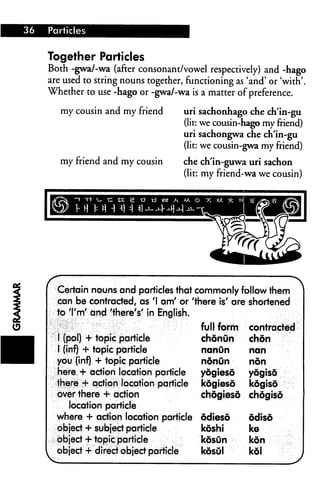
       Certain nouns and particles that commonly follow them
       can be contracted, as 'I am' or 'there is' are shortened
       to 'I'm' and 'there's' in English,
                                            full form   contracted
       I (pol) + topic particle             chonun      chon
       I (inf) + topic particle             nanOn    nan
       you (inf) + topic particle           nonun    non
       here + action location particle      yogieso  yogiso
       there + action location particle     kogieso  kdgiso
       over there + action                  chogieso chogiso
           location particle
       where + action location particle     odieso      odisd
       object + subject particle            koshi       ke
       object + topic particle              kosun       kon
       object + direct object particle      kdsul       kdl
Demonstratives    37


DEMONSTRATIVES
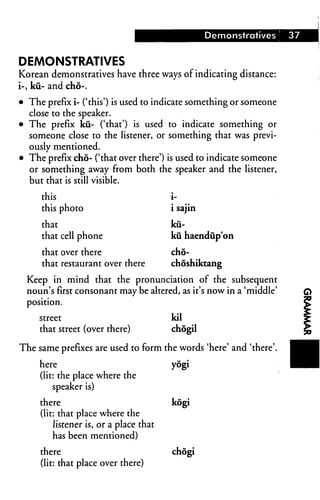
Korean demonstratives have three ways of indicating distance:
i-, ku- and cho-.
• The prefix i- ('this') is used to indicate something or someone
  close to the speaker.
• The prefix ku- ('that') is used to indicate something or
  someone close to the listener, or something that was previ
  ously mentioned.
• The prefix cho- ('that over there') is used to indicate someone
  or something away from both the speaker and the listener,
  but that is still visible.

     this                                i-
     this photo                          i sajin

     that                                ku-
     that cell phone                     kii haendupon

     that over there                     cho-
     that restaurant over there          choshiktang

  Keep in mind that the pronunciation of the subsequent
  noun's first consonant may be altered, as it's now in a 'middle'
  position.

     street                              kil
     that street (over there)            chogil

The same prefixes are used to form the words 'here' and 'there'.

     here                                yogi
     (lit: the place where the
        speaker is)

     there                               kogi
     (lit: that place where the
          Jisrener is, or a place that
          has been mentioned)

     there                               chogi
     (lit: that place over there)
38   Verbs


     VERBS
     In Korean, verbs go at the end of the sentence and don't change
     according to the subject. The word kayo can mean 'I go' or 'she
     goes'. There are three basic tenses: past, present and future, all
     of which are easily conjugated.
        Verb endings are not used only to refer to past, present or
     future, but also express the relationship between the speaker
     and the listener, or the speaker and the subject (see forms of
     speech page 27). This can get very complex, however, so we
     will stick to the multi-purpose 'familiar polite' form, which is
     useful in almost all situations.
         In a Korean dictionary, verbs are always listed in their basic
     form, which is made up of the verb stem plus the ending -da. In
     order to use a verb in its past, present or future tense, you need
     to know the verb stem.
         Finally, you also need to keep in mind that the pronuncia
     tion of consonants may change when endings are added (see
     Pronunciation page 20).

     In the following, the asterisk (*) indicates that the personal
     pronoun T can be replaced by 'you', 'she', 'he*, 'it', 'we' or 'they'.


     Present
     The present tense is usually formed by adding a or o to the verb
     stem. To make the sentence polite -yo is added as a final ending.
     • Verb stems ending in a consonant
     To form the present tense, you need to look at the last vowel
     of the verb stem, even if the final letter of the verb stem is a
     consonant. If the last vowel is a or o, and the verb stem ends in a
     consonant, the verb ending for the present tense is -ayo.

        look for, search     ch'aj-           I* look for ch'ajayo
                             (last vowel a)               (ch'aj + ayo)

        melt                 nok-             It melts.    nogayo
                             (last vowel o)                (nok + ayo)
Verbs      39


• Verb stems ending in a (with no consonant following)
If a verb stem ends with a but without a consonant following it
(as in ka-da, 'to go', or cha-da, 'to sleep'), -yo is added instead
of-ayo, to avoid an awkward-sounding double a.

   go            ka-       I* go            kayo (not kaayo)
   sleep         cha-      I* sleep         chayo (not chaayo)

• Verb stems ending in o (with no consonant following)
If a verb stem ends with o but without a consonant following it
(as in po-da, 'to see/watch'), -oayo at the end (the verb stem's o
+ -ayo) can be changed to -wayo. In the case of o-da, 'to come',
it must change to wayo.

   see/watch     po-       I* see/watch     pwayo (or poayo)
   come          o-        I* come          wayo (can't be oayo)


• Verb stems ending with u
If the last vowel of the verb stem is u, then the present tense verb
is conjugated by replacing the u with -oyo.

   use           ssii-     I* use           ssoyo (ssu - ii + oyo)

• Verb stems ending with other vowels
If the last vowel of the verb stem is other than a, o or u (ie 6, u, i,
or one of the combination vowels), then the present tense verb
is conjugated by adding -oyo. Keep in mind consonant sound
changes when suffixes are added.

   eat (inf)     mok-      I* eat           mogoyo (mok + oyo)
   laugh         us-       I* laugh         usoyo (us + oyo)
• Irregular Verbs
Fortunately, Korean has very few irregular verbs, but they're
also among the most common.
ha-da, 'to do'
This verb is one of the most commonly used in Korea, as it's
often used to turn nouns into verbs (eg, 'make a reservation' is
literally 'reservation do'). Although it ends in a, it's not conju
gated by adding -ayo or -yo. Instead the vowel a changes into ae.

   do           ha-
   I* do        haeyo

toe-da, 'to become'
This verb can be conjugated like any other verb, toeoyo (tod +
oyo), but it's usually conjugated as twaeyo.


-ru verbs
The last major set of irregular verbs are the ones whose verb
stem ends with -ru. There aren't many of these verbs, but there
are a few that are commonly used.
    How to conjugate -ru verbs depends on the vowel in the
syllable preceding -ru: if the preceding syllable contains an a or
o, you replace -ru with -Uayo; if the preceding syllable contains
any other vowel, you replace -ru with -lloyo.
   not know                  moru-

   I* do not know            mollayo
                             (morii - ru + llayo)

   cut                       charu-
   I* cut                    challayo
                             (charu - ru + llayo)
   call (someone)            puru-

   I* call (someone)         pulloyo
                             (purii - ru + lloyo)
Verbs     41


Past
Once you know how to conjugate verbs in the present tense, the
past tense is easy. The same rules apply, depending on the last
vowel of the stem.

• Verb stems whose final vowel is a or o
If the last vowel is a or o, add -assoyo or -ssoyo.

   I*   looked for             ch'ajassoyo (ch'aj + assoyo)
   It   melted.                nogassoyo (nok + assoyo)
   I*   went                   kassoyo (ka + ssoyo)
   I*   slept                  chassdyo (cha + ssoyo)
   I* came                     wassoyo (o + assoyo)
   I* saw/watched              pwassoyo (po + assoyo)

The asterisk (*) indicates that the personal pronoun T can be
replaced by 'you', 'she', 'he', 'it', 'we' or 'they'.

• Verb stems ending with u.
If the last vowel of the verb stem is ii, drop u and add -ossoyo
to make the past tense.
   I* used                     ssossoyo (ssu - u + ossoyo)

• Verb stems ending with other vowels
If the last vowel is other than a, o or ii (eg, 6, u, i or one of the
combination vowels), then the verb ending for the past tense
will be -ossoyo.

   I* ate                      mogossoyo (mok + ossoyo)
   I* laughed                  usossoyo (us + ossoyo)

• Irregular verbs
In similar fashion, the irregular verbs ha-da, 'to do', and toe'-da,
'to become', as well as the -rii verbs, like eg moru, 'not know',
are conjugated in the past tense by adding -ssoyo.
   I* did                      haessoyo
   I* became                   twaessoyo
   I* did not know             mollassoyo

See previous page for the present tense of these irregular verbs.
42   Verbs


     Future
     The future tense isn't complicated. If the verb stem ends with a
     consonant, you simply add -ul koeyo. If the verb stem ends with
     a vowel, you add -1 koeyo. These can also appear as -ul kkeyo and
     -1 kkeyo, respectively. An alternative form of the future tense is to
     add -gessoyo to the verb stem, but it's less common.

        look for, search             ch'aj-
        I* will look for             ch'ajul koeyo
                                     (ch'aj + ul koeyo)
        cat                          mok-
        I* will eat                  mogul koeyo
                                     (mok + ill koeyo)

        g°                           ka-
        I* will go                   kal koeyo
                                     (ka +1 koeyo)

     Even the irregular verbs ha-da, 'to do' and toe*-da, 'to become'
     follow this pattern:

        do                           ha-
        I* will do                   hal koeyo
                                     (ha + 1 koeyo)

        become                       toe--
        I* will become               toel koeyo
                                     (toe* + 1 koeyo)

                      BETTER SAFE THAN SORRY

        In Korean you must always include linguistic elements to
        keep your speech polite, except when talking with close
        friends, younger family members, or people who are
        much younger. If you omit these, it can easily be taken
        as an insult. Non-Koreans can avoid such offense by
        adding -yo to their sentences, even if only replying with
        a one-word answer.
There Is/Are
There are two words used for saying whether something exists:
issoyo for positive situations (ie, 'there is/are') and opsoyo for
negative situations (ie, 'there isn't/aren't').They're frequently
used with the location particle -e (see page 34).

   Taegyong is at the university.     t'aegyong-shiga
                                      taehakkyo-e issoyo
                                      (lit: Taegyong-Miss-
                                          ga university-e exist)

   Hyonu is not at his company.        hyonu-shiga hoe'sa-e
                                       opsoyo

                                       (lit: Hyonu-Mister-ga
                                            company-e not-exist)

   There's a book.                     ch'aegi issoyo
                                       (lit: book-i exist)

   There's no book.                    ch'aegi opsoyo
                                       (lit: book-i not exist)


The same words are used to express possession. In this case, thb
object that's possessed is the subject of the sentence, and the
possessor is the topic of the sentence (see Subject Particle and
Topic Particle, page 31-32).

   I have a car.                       chonun ch'aga issoyo
                                       (lit: I-nun car-ga exist)

   I have no house.                    chonun chibi opsoyo
                                       (lit: I-nun house-i
                                            not-exist)

In such cases, the subject particle is sometimes dropped for
convenience.
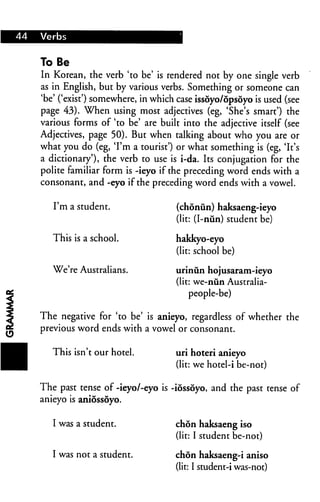
To Be
In Korean, the verb 'to be' is rendered not by one single verb
as in English, but by various verbs. Something or someone can
'be' ('exist') somewhere, in which case issoyo/opsoyo is used (see
page 43). When using most adjectives (eg, 'She's smart') the
various forms of 'to be' are built into the adjective itself (see
Adjectives, page 50). But when talking about who you are or
what you do (eg, 'I'm a tourist') or what something is (eg, 'It's
a dictionary'), the verb to use is i-da. Its conjugation for the
polite familiar form is -ieyo if the preceding word ends with a
consonant, and -eyo if the preceding word ends with a vowel.

   I'm a student.                 (chonun) haksaeng-ieyo
                                  (lit: (I-nun) student be)

   This is a school.              hakkyo-eyo
                                  (lit: school be)

   We're Australians.             urinun hojusar&m-ieyo
                                  (lit: we-nun Australia-
                                       people-be)

The negative for 'to be' is anieyo, regardless of whether the
previous word ends with a vowel or consonant.

   This isn't our hotel.          uri hoteri anieyo
                                  (lit: we hotel-i be-not)

The past tense of -ieyo/-eyo is -iossoyo, and the past tense of
anieyo is aniossoyo.


   I was a student.               chon haksaeng iso
                                  (lit: I student be-not)

   I was not a student.           chon haksaeng-i aniso
                                  (lit: I student-i was-not)
Verbs J 45


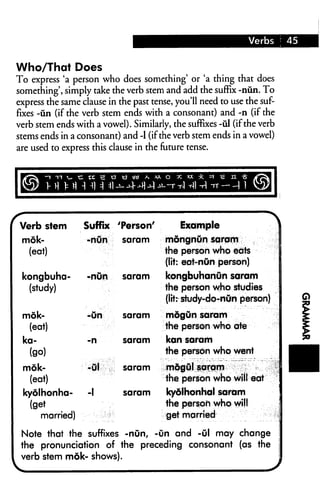
Who/That Does
To express 'a person who does something' or 'a thing that does
something', simply take the verb stem and add the suffix -nun. To
express the same clause in the past tense, you'll need to use the suf
fixes -tin (if the verb stem ends with a consonant) and -n (if the
verb stem ends with a vowel). Similarly, the suffixes -ul (if the verb
stems ends in a consonant) and -1 (if the verb stem ends in a vowel)
are used to express this clause in the future tense.


l/r^, "I n ^ c a a c
IkS) v u i= h ^i =hi


Verb stem         Suffix 'Person'           Example
 mok-              -nQn     saram       mongnun saram

  (eat)                                 the person who edts
                                        (lit: eat-nOn person)
 kongbuha-         -nun     saram       kongbuhanun saram
  (study)                               the person who studies
                                        (lit: study-do-nOn person)

 mok-              -On      saram       mdgun soram
  (eat)                                 the person who ate
 ka-               -n       saram       kan saram
   (go)                                 the person who went

 mok-              -01      saram       m&gul saram                      ;
  (eat)                                 the person who will eat
 kyolhonha-        -1       saram       kydlhonhal saram
   (get                                 the person who will
       married)                         get married

 Note that the suffixes -nun, -On and -ul may change
 the pronunciation of the preceding consonant (as the
 verb stem mok- shows).
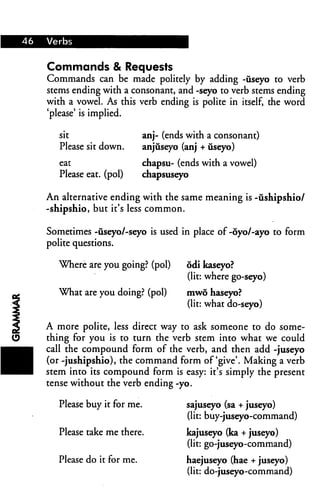
Commands & Requests
Commands can be made politely by adding -useyo to verb
stems ending with a consonant, and -seyo to verb stems ending
with a vowel. As this verb ending is polite in itself, the word
'please' is implied.

   sit                     anj- (ends with a consonant)
   Please sit down.        anjuseyo (anj + iiseyo)

                           chapsu- (ends with a vowel)
   Please eat. (pol)       chapsuseyo

An alternative ending with the same meaning is -ushipshio/
-shipshio, but it's less common.

Sometimes -iiseyo/-seyo is used in place of -6yo/-ayo to form
polite questions.

   Where are you going? (pol)        odi kaseyo?
                                     (lit: where go-seyo)
  What are you doing? (pol)          mwo haseyo?
                                     (lit: what do-seyo)

A more polite, less direct way to ask someone to do some
thing for you is to turn the verb stem into what we could
call the compound form of the verb, and then add -juseyo
(or -jushipshio), the command form of'give'. Making a verb
stem into its compound form is easy: it's simply the present
tense without the verb ending -yo.

   Please buy it for me.             sajuseyo (sa + juseyo)
                                     (lit: buy-juseyo-command)
   Please take me there.             kajuseyo (ka + juseyo)
                                     (lit: go-juseyo-command)
   Please do it for me.              haejuseyo (hae + juseyo)
                                     (lit: do-juseyo-command)
Modals*      47


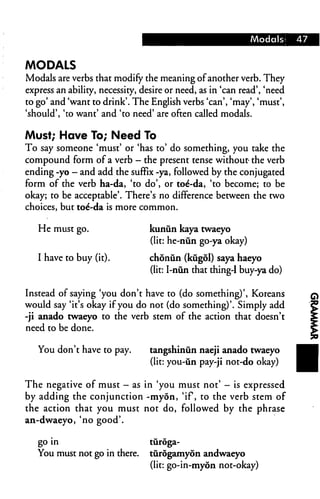
MODALS
Modals are verbs that modify the meaning of another verb. They
express an ability, necessity, desire or need, as in 'can read', 'need
to go' and 'want to drink'. The English verbs 'can', 'may', 'must',
'should', 'to want' and 'to need' are often called modals.

Must; Have To; Need To
To say someone 'must' or 'has to' do something, you take the
compound form of a verb — the present tense without- the verb
ending -yo - and add the suffix -ya, followed by the conjugated
form of the verb ha-da, 'to do', or toe*-da, 'to become; to be
okay; to be acceptable'. There's no difference between the two
choices, but toe'-da is more common.

   He must go.                   kunun kaya twaeyo
                                 (lit: he-nun go-ya okay)

   I have to buy (it).           chonun (kugol) saya haeyo
                                 (lit: I-niin that thing-1 buy-ya do)

Instead of saying 'you don't have to (do something)', Koreans
would say 'it's okay if you do not (do something)'. Simply add
-ji anado twaeyo to the verb stem of the action that doesn't
need to be done.

   You don't have to pay.        tangshinun naeji anado twaeyo
                                 (lit: you-un pay-ji not-do okay)

The negative of must - as in 'you must not' - is expressed
by adding the conjunction -myon, 'if, to the verb stem of
the action that you must not do, followed by the phrase
an-dwaeyo, 'no good'.

   go in                         turoga-
   You must not go in there,     turogamyon andwaeyo
                                 (lit: go-in-myon not-okay)
48   Modals


     Can; To Be Able
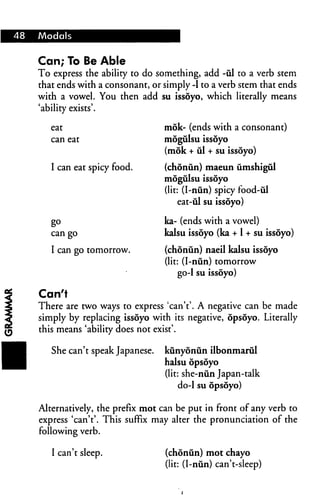
     To express the ability to do something, add -ul to a verb stem
     that ends with a consonant, or simply -1 to a verb stem that ends
     with a vowel. You then add su issoyo, which literally means
     'ability exists'.

        eat                         mok- (ends with a consonant)
        can eat                     mogulsu issoyo
                                    (mok + ul + su issoyo)

        I can eat spicy food.       (chonun) maeun umshigul
                                    mogulsu issoyo
                                    (lit: (I-nun) spicy food-ul
                                        eat-ul su issoyo)

        g°                          ka- (ends with a vowel)
        can go                      kalsu issoyo (ka + 1 + su issoyo)

        I can go tomorrow.          (chonun) naeil kalsu issoyo
                                    (lit: (I-niin) tomorrow
                                         go-1 su issoyo)

     Can't
     There are two ways to express 'can't'. A negative can be made
     simply by replacing issoyo with its negative, opsoyo. Literally
     this means 'ability does not exist'.

        She can't speak Japanese.   kunyoniin ilbonmarul
                                    halsu opsoyo
                                    (lit: she-nun Japan-talk
                                         do-1 su opsoyo)

     Alternatively, the prefix mot can be put in front of any verb to
     express 'can't'. This suffix may alter the pronunciation of the
     following verb.

        I can't sleep.               (chonun) mot chayo
                                     (lit: (I-nun) can't-sleep)
Modals ; 49


May
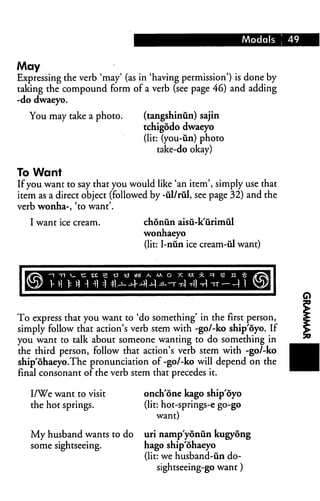
Expressing the verb 'may' (as in 'having permission') is done by
taking the compound form of a verb (see page 46) and adding
-do dwaeyo.

   You may take a photo.        (tangshinun) sajin
                                tchigodo dwaeyo
                                (lit: (you-iin) photo
                                     take-do okay)

To Want
If you want to say that you would like 'an item', simply use that
item as a direct object (followed by -ul/rul, see page 32) and the
verb wonha-, 'to want'.

   I want ice cream.            chonun aisu-k'urimul
                                wonhaeyo
                                (lit: I-niin ice cream-ul want)


To express that you want to 'do something' in the first person,
simply follow that action's verb stem with -go/-ko ship'oyo. If
you want to talk about someone wanting to do something in
the third person, follow that action's verb stem with -go/-ko
ship'ohaeyo.The pronunciation of -go/-ko will depend on the
final consonant of the verb stem that precedes it.

   I/We want to visit           onch'one kago ship'dyo
   the hot springs.             (lit: hot-springs-e go-go
                                    want)

   My husband wants to do       uri namp'yonun kugyong
   some sightseeing.            hago ship'ohaeyo
                                (lit: we husband-un do-
                                     sightseeing-go want)
50   Adjectives


     ADJECTIVES
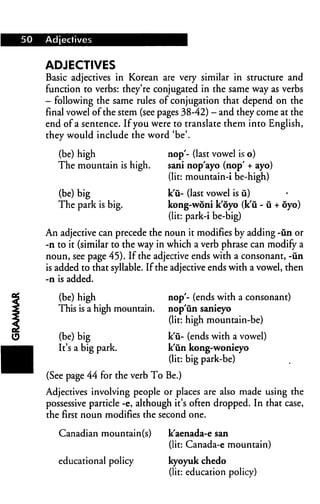
     Basic adjectives in Korean are very similar in structure and
     function to verbs: they're conjugated in the same way as verbs
     - following the same rules of conjugation that depend on the
     final vowel of the stem (see pages 38-42) - and they come at the
     end of a sentence. If you were to translate them into English,
     they would include the word 'be'.

        (be) high                   nop'- (last vowel is o)
        The mountain is high.       sani nop'ayo (nop' + ayo)
                                    (lit: mountain-i be-high)

        (be) big                    k'u- (last vowel is u)
        The park is big.            kong-woni k'oyo (k'u - u + oyo)
                                    (lit: park-i be-big)

     An adjective can precede the noun it modifies by adding -un or
     -n to it (similar to the way in which a verb phrase can modify a
     noun, see page 45). If the adjective ends with a consonant, -un
     is added to that syllable. If the adjective ends with a vowel, then
     -n is added.

        (be) high                   nop'- (ends with a consonant)
        This is a high mountain.    nop'un sanieyo
                                     (lit: high mountain-be)

        (be) big                    k'ii- (ends with a vowel)
        It's a big park.            k'iin kong-wonieyo
                                    (lit: big park-be)

     (See page 44 for the verb To Be.)

     Adjectives involving people or places are also made using the
     possessive particle -e, although it's often dropped. In that case,
     the first noun modifies the second one.

        Canadian mountain(s)        k'aenada-e san
                                    (lit: Canada-e mountain)

        educational policy          kyoyuk chedo
                                     (lit: education policy)
Adjectives !   51


Irregular Adjectives
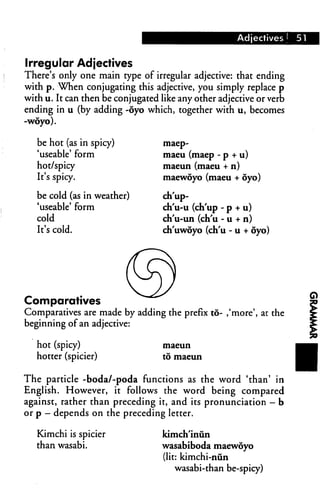
There's only one main type of irregular adjective: that ending
with p. When conjugating this adjective, you simply replace p
with u. It can then be conjugated like any other adjective or verb
ending in u (by adding -oyo which, together with u, becomes
-woyo).

   be hot (as in spicy)            maep-

   'useable' form                  maeu (maep - p + u)
   hot/spicy                       maeun (maeu + n)
   It's spicy.                     maewoyo (maeu + oyo)

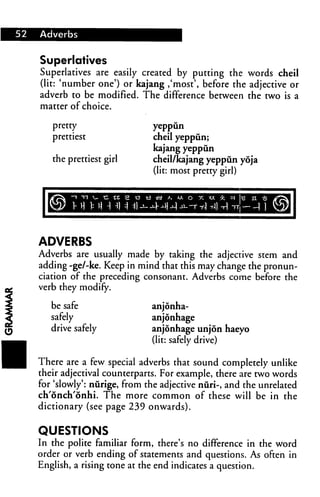
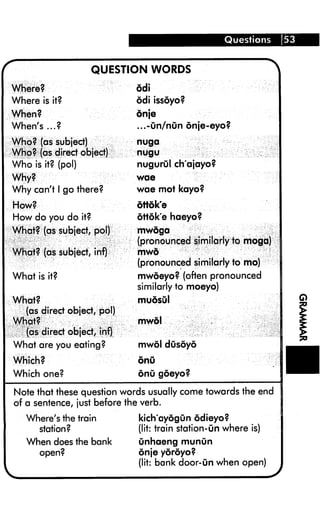
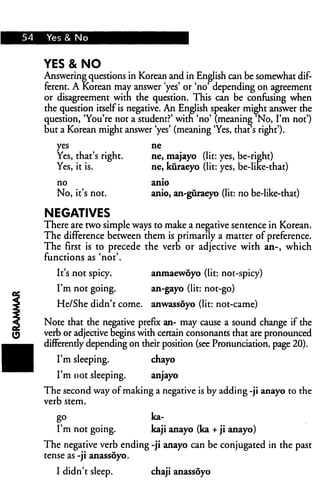
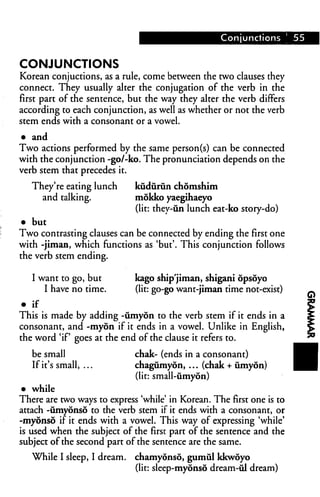
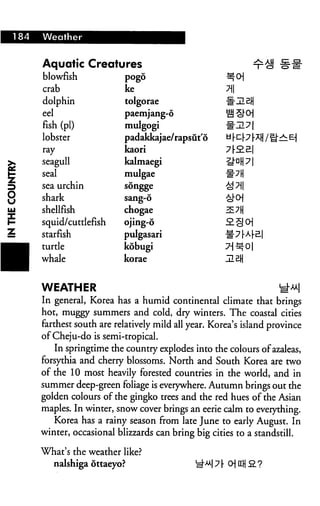
   be cold (as in weather)         ch'up-
   'useable' form                  ch'u-u (ch'up - p + u)
   cold                            ch'u-un (ch'u - u + n)
   It's cold.                      ch'uwoyo (ch'u - u + oyo)


Comparatives
Comparatives are made by adding the prefix to- ,'more', at the
beginning of an adjective:

   hot (spicy)                     maeun

   hotter (spicier)                to maeun


The particle -boda/-poda functions as the word 'than' in
English. However, it follows the word being compared
against, rather than preceding it, and its pronunciation - b
or p — depends on the preceding letter.

   Kimchi is spicier              kimch'inun
   than wasabi.                   wasabiboda maewoyo
                                  (lit: kimchi-nun
                                      wasabi-than be-spicy)
52   Adverbs


     Superlatives
     Superlatives are easily created by putting the words cheil
     (lit: 'number one') or kajang ,'most', before the adjective or
     adverb to be modified. The difference between the two is a
     matter of choice.

        pretty                   yeppun

        prettiest                cheil yeppun;
                                 kajang yeppun
        the prettiest girl       cheil/kajang yeppun ydja
                                 (lit: most pretty girl)


     ADVERBS
     Adverbs are usually made by taking the adjective stem and
     adding -ge/-ke. Keep in mind that this may change the pronun
     ciation of the preceding consonant. Adverbs come before the
     verb they modify.

        be safe                  anjonha-
        safely                   anjonhage
        drive safely             anjonhage unjon haeyo
                                 (lit: safely drive)

     There are a few special adverbs that sound completely unlike
     their adjectival counterparts. For example, there are two words
     for 'slowly': nurige, from the adjective nuri-, and the unrelated
     ch'onch'onhi. The more common of these will be in the
     dictionary (see page 239 onwards).


     QUESTIONS
     In the polite familiar form, there's no difference in the Word
     order or verb ending of statements and questions. As often in
     English, a rising tone at the end indicates a question.
Questions        53


r                       QUESTION WORDS                              ^

    Where?                       6di
    Where is it?                 6di issoyo?
    When?                        dnje
    When's...?                   ...-un/nun onje-eyo?

    Who? (as subject)            nuga

    Who? (as direct object)      nugu

    Who is it? (pol)             nugurul ch'ajayo?
    Why?                         wae

    Why can't 1 go there?        wae mot kayo?

    How?                         ottok'e
    How do you do it?            ottok'e haeyo?
    What? (as subject, pol)      mwoga
                                 (pronounced similarly to mogd)
    What? (as subject, inf)      mwd
                                 (pronounced similarly to mo)
    What is it?                  mwdeyo? (often pronounced
                                 similarly to moeyo)
    What?                        mudsul
      (as direct object, pol)
    What?                        mwol
       (as direct object, infj
    What are you eating?         mwol dusoyo

    Which?                       onu

    Which one?                   onu goeyo?

    Note that these question words usually come towards the end
    of a sentence, just before the verb.
       Where's the train         kich'aydgun odieyo?
          station?               (lit: train station-On where is)
       When does the bank        unhaeng munun
                                 onje yoroyo?
                                 (lit: bank door-un when open)
54   Yes & No


     YES & NO
     Answering questions in Korean and in English can be somewhat dif
     ferent. A Korean may answer 'yes' or 'no' depending on agreement
     or disagreement witn the question. This can be confusing when
     the question itself is negative. An English speaker might answer the
     question, 'You're not a student?' with 'no' (meaning No, I'm not')
     but a Korean might answer 'yes' (meaning 'Yes, diat's right').
        yes                     ne

        Yes, that's right.      ne, majayo (lit: yes, be-rieht)
        Yes, it is.             ne, kuraeyo (lit: yes, be-like-that)
        no                      anio
        No, it's not.           anio, an-guraeyo (lit: no be-like-that)

     NEGATIVES
     There are two simple ways to make a negative sentence in Korean.
     The difference between them is primarily a matter of preference.
     The first is to precede the verb or adjective with an-, which
     functions as 'not'.
        It's not spicy.         anmaewoyo (lit: not-spicy)
        I'm not going.          an-gayo (lit: not-go)

        He/She didn't come,     anwassoyo (lit: not-came)

     Note that the negative prefix an- may cause a sound change if the
     verb or adjective begins with certain consonants that are pronounced
     differently depending on their position (see Pronunciation, page 20).
        I'm sleeping.           chayo
        I'm not sleeping.       anjayo
     The second way of making a negative is by adding -ji anayo to the
     verb stem.
        go                      ka-
        I'm not going.          kaji anayo (ka + ji anayo)
     The negative verb ending -ji anayo can be conjugated in the past
     tense as -ji anassoyo.

        I didn't sleep.         chaji anassoyo
Conjunctions [ 55


CONJUNCTIONS
Korean conjuctions, as a rule, come between the two clauses they
connect. They usually alter the conjugation of the verb in the
first part of the sentence, but the way they alter the verb differs
according to each conjunction, as well as whether or not the verb
stem ends with a consonant or a vowel.
• and
Two actions performed by the same person(s) can be connected
with the conjunction -go/-ko. The pronunciation depends on the
verb stem that precedes it.

   They're eating lunch      kudurun chomshim
     and talking.            mokko yaegihaeyo
                             (lit: they-un lunch eat-ko story-do)
• but
Two contrasting clauses can be connected by ending the first one
with -jiman, which functions as 'but'. This conjunction follows
the verb stem ending.

   I want to go, but         kago ship'jiman, shigani opsoyo
      I have no time.        (lit: go-go want-jiman time not-exist)
• if
This is made by adding -iimyon to the verb stem if it ends in a
consonant, and -myon if it ends in a vowel. Unlike in English,
the word 'if goes at the end of the clause it refers to.

   be small                  chak- (ends in a consonant)
   If it's small, ...        chagumyon, ... (chak + iimyon)
                             (lit: small-umyon)
 • while
There are two ways to express 'while' in Korean. The first one is to
attach -umyonso to the verb stem if it ends with a consonant, or
-myonso if it ends with a vowel. This way of expressing 'while'
is used when the subject of the first part of the sentence and the
subject of the second part of the sentence are the same.
   While I sleep, I dream,   chamyonso, gumul kkwoyo
                             (lit: sleep-myonso dream-til dream)
56   Conjunctions


     The second way of expressing 'while' or 'during' is by using the
     suffix dong-an. The preceding word can be a noun or a verb
     (in the form of the verb stem + -un/-nun). The pronunciation
     depends on the preceding letter.
        study                       kongbuha-
        while studying              kongbuhanun dong-an
                                    (lit: study do-nun during)
      • because
     There are two ways to form the conjunction 'because'. The first
     is expressed by taking the compound form of a verb (see page
     46) and adding the suffix -so to it.

        ticket(s)                   p'yo
        Because there were no       p'yoga opsoso chibe kassoyo
           tickets, we went home,   (lit: ticket-ga not-exist-so
                                         home-e went)
     The second way is to put a noun or an adjective/verb stem + gi
     in front of-ttaemune

        be expensive                pissa-

        because it is expensive     pissagittaemune
                                    (lit: be-expensive-gi because)
MEETING
                                                  PEOPLE

Koreans will go out of their way to accommodate visitors or help
solve any problem that may come up. You might find, if you ask
for directions, a local will escort you to your destination even if
it's many blocks away.
    Foreign visitors, oegugin (£| ^ 21) or more formally oe'gukpun
(^■^■•nr), are not expected to be adept at all Korean social
customs, including intricate forms of speech such as formal,
casual, same-level, low-form and high-form speech.
     Koreans in general are an outgoing and friendly bunch around
people they know, but are often reserved around strangers. Young
Koreans are now required to learn English from elementary
school, but many are self-conscious about their perceived
linguistic shortcomings. Consequently, some people will be
a little embarrassed at first when approached by someone
speaking English, but they'll still try to help.
    And while your attempts to speak Korean might elicit
giggles initially, your efforts to communicate are sure to be
highly appreciated.


YOU SHOULD KNOW
Hello.                 annyong haseyo
Goodbye.               annyonghi kyeseyo
   (pol, when leaving)
Goodbye.               annyonghi kaseyo
   (pol, when staying)
Bye. (inf)                annyong                 2.M3.
Yes./No.                  ne/anio
Excuse me.                shille hamnida
   (pol, for attention)
Excuse me.                choe'song hamnida
   (pol, apologising)
58   You Should Know


     In Korean, there are two common ways to say 'thank you'. The
     two words are different only in their origin, the first being 'pure'
     Korean, the second 'Sino-Korean'.

     Thank you. (pol)         komapsumnida
     Thank you. (pol)         kamsa hamnida
     Many thanks.             chongmal
                              komapsumnida

     There's no 'please' in the sense of'Please do this ...'. Instead, in
     Korean you would combine the verb ha- (compound form hae-),
     'do', with the verb juseyo (^-Ai|2.), 'give'. Otherwise, any com
     mand spoken in high form already has 'please' built into it.
         When asking someone to 'please take this' (as in the case
     of food, drinks or a gift), you simply use the high form of
     'receive', paduseyo (^"fi Al|fi) or, when talking about food or
     drinks, tuseyo (HAllfi), literally 'eat (this)', or mani duseyo
     (B0| = A||fi), literally 'eat a lot'.
         The word chebal (*1| Q), 'please', by itself, to reinforce a
     request, is rarely used in Korean.

     Please ... (when asking someone to do something for you)
        Please do this.          haejuseyo
        Please do ... for me.    ... haejuseyo
        Please buy this for me. sajuseyo
        Please go to ...         ...e kajuseyo ...cH|
        (to a taxi driver)

     Please, (to reinforce a request; used only in extreme situations)
                                   chebalyo       M^S


                   PARDON THE EXPRESSION

        English speakers may feel inclined to use the expression
        choesong hamnida (2|#£M£r) whenever they're bumped
        into on the street. Koreans generally reserve choesong
        hamnida (£|#U'ullIl-) for something more serious.
Greetings & Goodbyes           59


GREETINGS & GOODBYES                               £!A[£f Sfg
Korean doesn't have a separate greeting for morning, noon,
afternoon and evening. At all times of the day annyong haseyo
(£!-y SMI A), 'hello', is appropriate.

Hello; Hi; Good morning/day/afternoon/evening,
   (pol)        annyong haseyo            £H3°M4|£.
   (inf)        annyong                   2} c!.
However, it's not uncommon for Koreans to greet someone
they know by asking shlksa hashossoyo? (^^r^H&CH-S-?),
'Did you eat?'. A simple ne (Ml), 'yes', is all that's expected, for
if you go into detail about what you ate, you may be met with
bewildered looks.


CIVILITIES                                            S£& St
Korean society is based on a rigid social hierarchy in which a
person who's older or has seniority is accorded more respect -
and this is reflected in the language and word choice. Even when
speaking to someone younger or with less seniority than yourself,
it's considered good manners to use the following expressions in
the polite form. With the less formal younger generation, though,
informal expressions are perfectly acceptable.

Thank you (very much), kamsa hamnida            lMrf|-L-| ^h
You're welcome, (pol)  ch'onmaneyo              Ei E}°il -2..
You're welcome, (inf)  anieyo/mworyo            Oj-M oil 3./Q S..


FORMS OF ADDRESS                                              IS            £
Although there are traditional forms of address, many Koreans               m
tend to favor the Western forms of Mister or Miss. These have               ^
been 'hangulised' into misuto (°|^:E|) and misu (Dl—). The                  Q
term misu (Dl—) is used even for married women, although                    j$j
misesu (<=> I >M| r±r) for 'Mrs' is also becoming common. These             O
forms precede the surname of the person to whom you are                     rj
referring. When addressing Westerners, though, many Koreans
will use misuto or misii before the addressee's given name, such
as 'Mister David' or 'Miss Eleanor'. Korean women do not take
the surname of their husband.
60   Forms of Address


         Traditional Titles
         Koreans still use more traditional forms of address. These
         generally follow the addressee's given name. The higher the
         level of the person (relative to the speaker), or the less familiar
         you are to the speaker, the more likely you'll address that person
         by his or her surname. You would never refer to a much older
         person by his or her given name.

         Mr/Ms/Mrs ...               ...-shi/-ssi             ..M
         Taejin (given name)         t'aejin-shi             eH£I u
         Taegyong (given name)       t'aegyong-shi
         Mr Park Taejin              pak t'aejin-shi
         Ms Kim Taegyong             kirn t'aegyong-shi      ^eHS

         In contrast, when calling a child or a close friend the same age
         or younger than you, you can use their first name only, followed
         by -a (-Or) if the name ends in a consonant or -ya (-OlO if the
         name ends in a vowel:

         Yumi!                       yumiya!
         Sujin!                      sujina!

         There are also special forms of address for:

         Dr (Cho)                    (cho)-paksanim
         teacher (Paul)              (p'ol) -sonsaengnim
         person in your group
            (older than you or       sonbaenim
            at a higher level)
            (younger than you        hubae
            or at a lower level)

I        President (of a company)
         President/Chairman
                                     sajangnim
                                     (kang)-sajangnim

         Professor (Lee)             (i)-kyosunim

         The titles sonsaengnim (£1 ^ cj) and sonbaenim (£! aH "d) both
         mean something like 'higher person', and are very useful if
         you're not sure what form to use. Not knowing the relative
Forms of Address i 61


position of an overseas 'guest', many Koreans will refer to him
or her simply as sonsaengnim (£l c!J □ ). If a traveller looks suf
ficiently young or not business-like, he or she may be referred
to simply as haksaeng (^!"c!l), which literally means 'student'.
   It's also important to note that Koreans frequently refer to
each other directly in the third person, rather than using the
informal and polite forms of'you', no (M) and tangshin (s£]).

'Relative' Titles
Koreans consider themselves one big family, and there are
several titles to refer to a person that reflect this. An older man
or woman might be called 'uncle' or 'aunt' and an elderly man
or woman would be called 'grandfather' or 'grandmother'.

older woman (pol)         ajumoni (lit: aunt)
older woman (less pol)    ajumma (lit: auntie)
older man                 ajoshi (lit: uncle)
elderly woman (pol)       halmoni (lit: grandmother) tl"CH M
elderly man (less pol)    haraboji (lit: grandpa)    &[

In modern Korean culture, there's some uncertainty as to how to
refer to a young man or woman who's unknown to the speaker.
Calling a young man ajoshi (Ol-^^l), 'uncle' seems odd, but
there's no other appropriate 'relative' expression. On the other
hand, the word agashi (0|-7rMl), literally 'husband's younger
sister' for a young woman is now out of favour. In restaurants
young people are tending to call someone over by simply saying
yogiyo! (0=|7|.2.!). This is 'over here' with a polite ending and
although it may sound rude to English speakers, it's considered
acceptable in Korean.

              A LEE BY ANOTHER NAME
  If you meet the parents of your Korean friends, chances
  are you'll never learn their names. To show respect, you'd
  refer to them in the third person, using your friend's name
  followed bydmdni [OU] M), 'mother', and aboji (oN|x|),
 ^'father', as the case may be.
62   First Encounters


     Older'Siblings'                                £?l Sfll »0H
     You can refer to classmates, colleagues, and other 'close' people
     of similar ages as 'older sister', 'older brother' or 'younger
     sibling'. Which word to use, however, depends on the gender
     of the speaker. The following forms of address are sometimes
     attached to the person's name:

     older sister (if speaker is female)     onni            EiM
     older brother (if speaker is female)    oppa            2.^
     older sister (if speaker is male)       nuna            nr^r
     older brother (if speaker is male)      hyong           ty
     younger sibling                         tongsaeng       -jt^
        (regardless of speaker's gender)


     FIRST ENCOUNTERS                                        5! B
     When first meeting someone, Koreans will often be shy, but may
     then open up with a barrage ofquestions about your background.
     Be prepared for some topics that could often be considered
     personal in English-speaking countries such as age, marital
     status and why you came to Korea. These questions arise from
     curiosity and a desire to figure out where you fit in the relative
     social hierarchy.

     How are you?
        annydng haseyo?                        ef B «WI £?
     Fine. And you?
        ne. annydng haseyo?                    Ml. &lgo
     What's your name?
        irumiil yotchobwado                    01
        dodkkayo?                              H
     My name is ...
         che irumun ...(i)eyo
         (if the name ends in a consonant:
         ieyo follows; if a vowel: eyo)
     I'd like to introduce you to ...
         (ibuniin) ...imnida
Making Conversation              63


Note that ibunun (O|-g-c-) may be omitted, but the expression
should then be accompanied with an open palm gesturing
towards the person being introduced.

This is my...      (ibunun)...             (O|-e-i
   business           che                     *ll
      partner         hoe'sa-tongnyo-eyo
   boyfriend          che namja ch'in-gueyo *i|
   girlfriend         che yoja ch'in-gueyo    *1I
   husband            uri namp'yonieyo        -x"c
   wife               uri annae-eyo           -x^

Although there's a direct word for someone you're roman
tically involved with, ae-in (OH^i), literally meaning 'love
person', Koreans prefer the more euphemistic yoja ch'in-gu
(°i*|- ^It1), 'female friend' or namja ch'in-gu I
'male friend', respectively.

I'm pleased to meet you. (pol)
   mannaso pan-gapsumnida                      S_|"t—j-A-J


MAKING CONVERSATION
Many Koreans, especially young people, love to practise English,
so if you're looking for conversationalists, you'll have no prob
lem finding them. Some people, though, keenly aware of their
shortcomings in speaking English, will simply giggle if you talk
to them. Still, the same phrases you would use back home are
generally good icebreakers in Korea as well. This is especially true                ^
when talking about the weather, as Korea's extremes in weather                      ^
patterns — icy Manchurian winters and humid subtropical                             2
summers — are generally on people's minds. The expressions                          q
nomu ch'uwdyo! (M ■¥• -r t-I -2!), 'It's so cold!' or nomu towoyo!                  j«
(L-j ^- D x-j -2.!), 'It's so hot!', are great conversation starters.              O

Do you live here?             yogiso saseyo?           O1! 71 A] A|-A-|| 2.?
Where are you going?          odi kaseyo?             0 D| 7 [M .2.?
What are you doing?           mwo haseyo?             °-| ^hMI-2?
64   Making Conversation


     Can I take a photo (of you)?
        tangshine sajin chom                £!"£!—I AF£J
        tchigodo doelkkayo?
     What's this called?
        igol mworago pulloyo?
     Beautiful, isn't it?
        arumdamneyo
     It's great here.
        igosun nomuna chonneyo
     Are you waiting too?
        tangshindo kidarigo
        kyeseyo?                            ?l|A||fi?
     Are you here on holiday?
        yohaeng haro oshossoyo?             Oi ^ t[B


                            BODY LANGUAGE

        Koreans will greet each other with a bow, or a bow and a
        simultaneous handshake. The same is used when saying
        goodbye. They rarely hug in public, except for emotional
        goodbyes. In general, touching wouldn't be considered
        rude though. It's not as common as in Western coun
        tries, however, and you definitely should avoid touching
        people on the head, except for small children.
            When offering anything with your hands, it's best if
        done with two hands or the following way - the left hand
        should be open, with the palm facing up, supporting
        the right forearm, just next to the wrist. This is also true
        when pouring alcohol.
            Also, it's considered rude to pour one's own alcoholic
        beverage. When drinking in a group, someone is sure to
        fill your glass when it starts to look empty. It's considered
        very polite for you to'do'the same.
Making Conversation j 65


I'm here ...           ... wassoyo

   for a holiday          yohaeng hard
   on business            saop daemune
   to study               kongbuharo

How long are you here for?
   yogie olmadong-an                     0^ 710j|
   kyeshil koeyo?                        >N11
I'm/We're here for ... weeks/days.
   ...dal/il-dong-an                     ...S/i
   issul koeyo                           Si #7^1
Do you like it here?
  igoshi maume turoyo?                   0|^0| □
I/We like it here very much.
  nomuna maume turoyo                    M ■^■L-|- D


Sure.                  mullonijo
Just a minute.         chamkkanmanyo
It's OK.               kwaenchanayo
It's important.        chung-yo haeyo
It's not important.    chung-yo haji anayo
It's (not) possible.   (pul)kaniing haeyo
Look at that!          chogot poseyo!
Look at this!          igot poseyo!
Listen (to this).      igol turoboseyo
I'm ready.             chunbi dwaessoyo
Are you ready?         chunbi dwaessoyo?
Good luck!             haeng-unul piroyo;
                       hwait'ing!

Note that hwait'ing! is the 'hangulised' form of'fighting!', orig
inally thought by Koreans to be an English cheer.
Nationalities


NATIONALITIES                                              ^3
Koreans have two different ways of naming countries: a
'hangulised' form of the original name, as in k'aenada (?H L-rcr)
for 'Canada', or the Korean pronunciation of the Chinese char
acters for that name, as in miguk (DI ^) or 'beautiful country'
for 'America' and ilbon (!!■£■!■) or 'sun's origin' for 'Japan'.
   If your country isn't listed here, try pointing on a map.

Where are you from? (pol)
  odiso oshossoyo?

I'm/We're from ...      ...-eso wassoyo

   Australia              hoju
   Canada                 k'aenada
   England                yongguk
    Europe                yurop

    Germany                togil
    India                  indo                 £!£E
    Ireland                aillaendu
    Japan                  ilbon
    New Zealand            nyujillaendu
    the Philippines       p'illip'in
    Russia                rdshia
    Scotland              sukot'ullaendu
    the USA               miguk
    Wales                 weilsii


                      YO! ... BE POLITE!

    Politeness is an important part of speaking Korean.
    Speaking in an overly casual way, especially to
    someone older, can be extremely offensive. A simple
    way to ensure a minimal level of politeness is to
    add yo (2.) - for example, when asked where you're
    from, answer hojuyo (JL^S.) for Australia, rather
    than hoju (2t).
v                                                             y
Cultural Differences   67


I live in/at the/a ...        ...-eso sarayo          .oil AH
   city                          toshi
   countryside                   shigol
   mountains                     san

   seaside                       haebyon
   suburbs of...                 ...-e kyo-oe'         ...S| M9

local                         chibang-e
national                      kukka-e


CULTURAL DIFFERENCES
How do you do this
in your country?
    han-gugesonun igol
    ottok'e haeyo?
Is this a local or national
custom?
   han-guge kwansubin-gayo,
    ijibang-mane                          0|
    kwansubin-gayo?
I don't want to offend you.
   ohae hajinun maseyo
I'm sorry, it's not the custom
in my country.
   choe'song hamnida
   urinara-esonun kiirok'e
   haji ank'odunyo
68   Aqe


     I'm not accustomed to this.
         igose iksukaji anayo
     I don't mind watching, but
     I'd prefer not to participate.
        hajinun ank'o,
        pogiman halkkeyo                   M7


     I'm sorry,             choe'song hajiman,
     it's against my ...    kugosiin cho-e       H^d
                            ...-e wibae dwaeyo   ...o
        culture                 munhwa              tE
        religion                chonggyo

     (But) I'll give it a go.
        (hajiman) hanbon
        haebolkkeyo


     AGE                                                  U0|
     How old are you?
       (to a child)
        myossarini?
        (to an adult who is younger
        or about the same age as the
        speaker)
        naiga ottok'e twaeyo?
        (to someone older)
       yonse-ga ottok'e toeseyo?

     How old is your daughter/son?
        dare/adure naiga
        ottok'e dwaeyo?
     I'm ... years old.
        choniin ... sarieyo

     (See Numbers & Amounts, page 209, for your age.)
Occupations  69


OCCUPATIONS                                                 XI OH
                                                            —i t=i

What (work) do you do ?
   musun iriil haseyo?                   ii# t[MS.?

I'm a/an ...         choniin ...(i)eyo     x£ ...{O)o2..
   businessperson       saopka
   chef                  yorisa               O£|Af-
   doctor                uisa                 o|A|-
   engineer              enjinio              Oj|X|u|(>|

   farmer                nongbu
   homemaker             kajongjubu
   journalist            kija                 7X[
   labourer              nodongja             ■t-i-^r
   lawyer                pyonhosa
   mechanic              kigyegong
   nurse                 kanhosa
   office worker         hoe'sa jigwon        s|a|- iQ
   professor             kyosu
   scientist             kwahakcha            al|-2|X|-
   soldier               kunin
   student               haksaeng
   teacher               sonsaengnim
   waiter                weito                t-II 01 E-j
   writer                chakka


I'm retired.
   choniin t'oejik haessoyo
I'm unemployed.
   chonun hyonjae
   chigobi opsoyo
What are you studying?
  musun kongburul haseyo?                       o[MS.?
70


1    I'm studying...       chonun ...riil/ul
                           kongbu haeyo
        art                  misul
        arts/humanities      inmunhak
        business             kyong-yonghak
        engineering              konghak
        English                  yong-6
        Korean                   han-gugo
        languages                ono

        law                      pophak
        medicine                 iiihak
        science                  kwahak
        teaching                 kyoyuk


     FEELINGS
     When describing yourself or another person, the subject, eg,
     chonun (*!■£•), T, is omitted if it's understood between the
     speaker and the listener.

     Are you ...?          tangshinun ...?
     I'm ...               chonun ...
        afraid                   musowoyo

        angry                    hwanassdyo
        cold                     ch'uwoyo
        happy                    haengbok haeyo
        hot                      towoyo

        hungry                   paegop'ayo
        in a hurry               kiip'aeyo
        sad                      sulp'oyo
        sleepy                   chollyoyo
        sorry (regret)           huho^ haeyo
        thirsty                  mongmallayo
        tired                    p'igon haeyo
        well                     kon-gang haeyo
        worried                  kokchong dwaeyo
Breaking the Language Barrier   71


BREAKING THE                              2JCH §S| §H
LANGUAGE BARRIER
Do you speak English? (pol)
   ydng-6 haseyo?
Yes. (I do.)
   ne                               M|.
No. (I don't.)
   anio                             0[l)2.
Does anyone speak English? (pol)
   yong-6 hashinunbun               ?3 O ^[-
   kyeseyo?
I speak a little, (pol)
   chega chogum haeyo
Do you understand? (pol)
   ara durushossoyo?


Yes. (I understand.)
   ne                              M|.
I don't understand.
   anio/modaradurossoyo
Please speak more slowly, (pol)
   chom ch'onch'onhi               H £i ?H o|                      ^
   malhaejuseyo                     s^H ^-^1.2..                   m
Please repeat that, (pol)                                          3
   tashi hanbon malhaejuseyo       c:|-A| nj-uj
Could you please write it down?
   chogo jushillaeyo?
How do you say ...?
   ...rul/ul mworago haeyo?
What does ... mean?
   ...ga/i musiin dushieyo?
72   Breaking the Language Barrier


     You speak Korean/English
     very well.
        han-gungmal/yong-6
        chongmal chal hashineyo                a §W Ml a.
     I don't do it well.
        chon chal mot'aeyo
     You're very good at it.
        chongmal chal hashineyo


                             KONGLISH

      The English language is put to great use in Korea. It's
      often possible - with the help of gestures - to make
      simple thoughts or requests understood through common
      English words.
          Koreans also borrow words from English, Many of these
       Korean-style English terms (called Konglish) are created by
      truncating English words. An 'apartment' is called apatu
      (of-EMi.), for example. Some Kanglish phrases are coined
      by combining English words in a way that makes sense to
      Korean ears: a 'mobile phone' is a haendu-p'on feHH£r),
      'hand-phone'.
          Beware though I The meaning of the original English
      words and that of the Konglish terms don't always add
      up. A hattogu (SfJEIl) from 'hot dog', for example, is
      actually a 'corn dog' and a k'ondo (t^5i), 'condo', refers
      to a time-share.
GETTING AROUND

South Korea has an extensive public transport network that is
clean, safe, comfortable (except during rush hour), efficient,
and affordable. Most bus and subway passengers use a pre-paid
electronic transit pass, kyot'ong k'adu (jE#?|-.E.).


FINDING YOUR WAY
Where's the...?        ...i/gaodi issoyo?
   bus to ...             ...e kanun bosu
   road to ...            ...e kanun gil
   train to ...           ...e kanun kich'a
   bus station            bosu t'ominol
   bus stop               bosu chongnyujang

What time does         ...i/ga onje               .. 01 /71- 9i *
the... leave/arrive?   donayo/tochak-haeyo?
    aeroplane              pihaenggi                u 11^ 71
    boat                 pae

    ferry                hanggu
    bus                  bosu
                         kich'a                     71

What... is this?       yogiga musun
                       ...(i)eyo?
   street                kil
   city                  toshi
   village;              maul
       small town

What number bus goes to ...?
    myoppon bosuga ...e kayo?
How do we get to ...?
    ...e dttok'e kayo?                     .Oil
Is it close by?
    kakkawoyo?
Where is it on this map?
    ijidosang-esd odieyo?             0|                   OC]0{SL?
74   Finding Your Way


     Directions
     Turn at the ...         ...esotoseyo          ...oHAi £E>M|.2..
        next comer              taum mot'ung-i        '-r'o' SL"5"O|
        traffic light           shinhodiing           uiJS;§"
        pedestrian crossing     konnolmok             Zd1^
        pedestrian underpass    chihado               ^1 ^r5E
        pedestrian overpass     yukkyo                 ^jLL


       DID YOU KNOW ...
                                In Korea, many businesses will
                                    print a useful yakto (^fi), or
                                    'local neighbourhood map',
                                    on the back of their business
                                    card so that patrons can find
                                    them easily.


     Straight ahead.
        dokparo kaseyo                   ^y|-^. y[M 2..
     To the left/right.
       wentchoguro/oriintchoguro         £m*lg./SL^=:^£.j=.
       kaseyo                            7[M3..
     Thank you (for showing
     me/us the way).
        komapsiimnida

     behind ...             ... dwi-e              ... -r|oj|
     far                    moUi                   ga|
     here                   yogie                  0i7|0||
     in front of...         ... ape                ... S!-o||
     near                    iakkai                7|-77|-O|
     opposite               Dandaep'yone           S} ^H S ° 1
     over there             chdgie                 ^1 ? 1 oi|

     north                  puktchok               ^^
     south                  namtchok               id^
     east                   tongtchok              ^^
     west                   sotchok                M#
Addresses   75


ADDRESSES
Postal addresses, or chuso (-r^), are written in reverse order
from those in the West: they go from the largest administrative
unit to the smallest administrative unit, with the house or
apartment number last. Neighbourhoods are divided into block
numbers and house numbers which are not always in sequential
order. There are no street names in the address.
You might encounter following administrative units:

metropolitan                           kwang-yokshi/
   prefecture                          t'iikpyolshi


                                                        m|r
   (the latter only
   for Seoul)
province                               -do              -E
city in province                       -shi             -A|
urban area                             -ku/gu
   (subdivision of city)
neighbourhood                          -dong            —§■
   (subdivision of urban area

county                                 -kun
district                               -up

township                               -myon           -&
village                                -ri             -El

IK=                    FEAR OF FOUR                    A-
   Step into the lift of many modern Korean buildings,
   and you'll see still see 1,2,3, F, 5, 6 ... In Korean,
   the pronunciation of the number four sounds simiiar
   to a word for 'death' and many architects who were
   aware of superstitions surrounding that pronunciation
   avoided osing the1 number four when referring to the
   fcjurth floor of buildings* The solution they came up
   with was designating the fourth floor in elevators, office
   listings etc, with the letter 'F.
76   Buying Tickets


     A sample address might go this way:


                                   taehan min-guk
                                    soul-t'ukpyolshi
                                   yongsan-ku, namyong-dong
              APT 106#5012          samu apt. 106-dong 501-ho
                                    kim t'aegyong-kwiha
                   140-151          upydnbdnho 140-151


     In English, we would read this in the following order:

        To: Kim Taegyong
        Samu Apartments
        Apt #501 Btdg #106
        Namyong-dong, Yongsan-ku
        Seoul, Republic of Korea
        Postal Code 140-151

     When writing an address in English, it's acceptable to write it in
     the order addresses are written in the West, from local to national.

     BUYING TICKETS
     Where can I buy a ticket?
       pyo odiso salsu issoyo?
     We want to go to ...
       ...e karyogo hanundeyo
     Do I need to book?
       yeyak haeyadwaeyo?
     I'd like to book a seat to ...
         ... kanun pyo hanjang
         yeyak haejuseyo
     It's Rill.
         mansok imnida;
         chariga opsumnida
     Can I get a stand-by ticket?
         taegi p'yorul salsu issoyo?
I'd like (a) ...    ... chuseyo
    one-way ticket      p'yondo p'yo (hanjang)
    return ticket       wangbok p'yo (hanjang)
    two tickets         tujang
    student's fare      haksaengp'yo (hanjang)
    child's fare        orinip'yo (hanjang)
   senior citizen's     noin/kyongno p'yo
       fare             (hanjang)

dining car                shiktangch'a
first-class seat          ildungsok
seat                      chwasok
second-class seat         idungsok
sleeper car               ch'imdaech'a
standing-room ticket      ipsok


AIR
Air travel to and from Korea is safe and convenient. Korea has many
domestic airports, and most domestic flights take less than an hour.

airline terminal 1        cheil ch'dngsa           *1| 1 § >*4
airline terminal 2        che-i ch'dngsa
domestic terminal         kungnae ch'dngsa

When's the next flight to ...?
   ...e kanun daum                         CHI
   pihaenggiga onje issoyo?
How long does the flight take?
   pihaeng shigani olmana dwaeyo? u|t!JA|^O|
What time do I have to
check in at the airport?
   myoshie ch'ek'iiinul              a|o||
   haeya dwaeyo?
Where's the baggage claim?
   chim buchinun goshi odieyo?                            OCC3L?
My luggage hasn't arrived.
   che jimi ajik anwassoyo
At Customs
I have nothing to declare.

I have something to declare.
   shin-go hal goshi issumnida
Do I have to declare this?
   igotto shin-go haeya hanayo?
This is all my luggage.
   ige che chim cnonbu imnida          0|7|| x||
That's not mine.
   kugon che goshi anindeyo            HZJ *i|
I didn t know I had to declare it.
   shingo haeya hanunjul
   morugo issossumnida


BUS                                                          tH^
Korea has five major types of buses:
shinae bosu           AILH tH —
   regular metropolitan buses that go from one district of the
   city to another; some go to nearby cities
chwasdk bosii         QM H-| ^
   first-class metropolitan buses usually servicing the same
   routes as shinae bosu (AlL|tH^), as well as long-distance
   routes to the suburbs or to destinations like the airport; twice
   as expensive

maul bosu           D|-#tHr^:
  cheaper buses that snake through the local neighbourhood
kosok bosii           ZL^U-j^:
   long-distance inter-city buses that crisscross the country

chik aeng bosii       ^1H! ^H —
   rural inter-town buses running between major towns and
   stopping at local bus stops in between

With the exception of deluxe buses servicing destinations that
overseas visitors are likely to visit, most of the buses have maps
and destinations printed in Korean only.
Where's the bus stop?
   bosu chong-yujang-i odieyo?       tH:
Which bus goes to ...?
   myoppon bosuga ...e kayo?         % £i tH±7[ ...o
Does this bus go to ...?
   ibosu ...e kayo?                  0| tH^
How often do buses come?
  bosuga myoppunmada                 *H — ? I-
   wayo?                             SJ-S.?
Please let me off here!
   naeryojuseyo!                     LH 21

What time's        ...e kanun bosu
the ... bus?       myoshi-e issoyo?
   next                taiim
   first               ch'ot
   last                majimak
Could you let me know
when we get to ...?
  .. .e tochak halttae chege         ...0
   chom allyojushillaeyo?            a %
Where do I get the bus for ...?
  ...e kanun bosu odiso t'ayo?       ..M 7he- tHr^


TRAIN                                                  7x[
Korea has an extensive network of affordable and comfortable
trains. They're fast and extremely punctual. There are various
types of trains:

saemaul-ho         4|d|.#£
   the more expensive, but comfortable, express trains that hit
   only a few cities on their cross-country journey
mugunghwa-ho       -x-^Srli
   cheaper but not quite as fast; stop at more stations
t'one-il-ho         #^S
   cheaper still, but stop at most stations, so they take longer to
   make their journey
What station is this?
   yogiga musun yogieyo?
What's the next station?
   taum yogi odieyo?                       O|D|0||fi?
How many stops until...?
   ...kkaji myot chonggojang
   namassoyo?
Does this train stop at...?
  igicha ...eso soyo?           0|
The train is delayed.
  kich'aga yonch'ak
  toe'lgoshimnida
The train is cancelled.
  kich'aga ch'wiso
  doe'-ossumnida


How long will it be delayed?
   olmana yonch'ak dwaeyo?
How long does the trip take?
    olmana orae kanayo?                 £211
Is it a direct route?
    ige chikhaeng nosonieyo?    0|7||
Is that seat taken?
   ijari imja issoyo?           0| ^r
I want to get off at...
   ...eso naeriryogo
    haniindeyo
I'd like to store my luggage.
    chim pogwanhami
   issossumyon hanundeyo
Place Names


            TO KYONGJU OR GYEONGJU?

South Korea is blessed with an excellent public transport
system and an extensive road and highway network, all
well-marked in Korean, English and even Chinese characters.
                                                                   i
But one thing that any English-speaking traveller will quickly
notice is that the English isn't always consistent. The official   o
Romanisation system has changed many times, so you might
see variations in the spelling of place names. Here are some
of the more popular destinations:

1984 system         2000 system      Variations        Hangul
Ch'ungch'ong-       Chungcheong-     Choongcheong-
   namdo            namdo            namdo
Cheju-do            Jeju-do          Chejoo-do,
                                     Jejoo-do
Chinju              Jinju            Chinjoo, Jinjoo
Cholla              Jeolla           Junra, Jeonra     34
Inch'dn             Incheon          Inchon
Kangnam             Gangnam          Gahngnahm
Kangnung            Gangneung        Gangreung
Kangwon-do          Gangwon-do       Gangweon-do
Kimp'o              Gimpo            Kimpo, Geempo
Kwangju             Gwangju          Kwangjoo,


Kyongbokkung        Gyeongbok-       Gyeongbok-
                    gung             goong

Kydnggi-do          Gyeonggi-do      Kyungki-do
Kyongju             Gyeongju         Kyongjoo,
                                     Gyeongjoo
Kyongsang-bukdo     Gyeongsang-      Gyeongsang-
                    bukto            bookdo
P'ydngyang          Pyeongyang       Pyongyang
Pusan               Busan            Boosan
Puyo                Buyeo            Booyeo
Seoul               Seoul            Soul
Shinch'on           Sinchon          Shinchon
Soraksan            Seoragsan        Seolagsan
82   Subway


                TO KYONGJU OR GYEONGJU?
       1984 system 2000 system            Variations         Hanguf
       Taegu           Daegu              Taegoo, Daegoo,    CM?
                                          Daigoo
       Taejdn          Daejeon            Taejun, Daejun,
                                          Daijun
       Tdksugung       Deoksugung         Deogsoogoong
       Tongdaemun      Dongdaemun         Dongdaemoon
       Tongnimmun      Dongnimmun         Dogribmoon,
                                          Doglipmoon
       Ulsan           Ulsan              Woolsan


     SUBWAY                                                          S
     Korea's major metropolitan areas all have clean and modern subway
     systems. Seoul's network is one of the longest in the world. All
     of the subway systems are bilingual (Korean and English) or even
     trilingual (with Chinese characters) and are colour coordinated, so
     that they're extremely convenient and easy for getting around.
     entrance number 1            ilbon ch'ulgu
     subway                       chihachol
     subway entrance              chihachoripku
     subway line                  chihachol noson
     subway station               chihacholyok
     ticket counter               p'yo p'aniin-got
     ticket vending machine       p'yo chapan-gi
     transfer point               karatanun-got

                         SEOUL'S SUBWAY
        line 1 (dark blue line)    ilhoson
        line 2 (green line)        ihosdn
        line 3 (orange line)       samhoson
        line 4 (blue line)         sahosdn
        line 5 (purple line)       ohos6n
        line 6                     yuk'oson
        Iine7                      ch'ilhosdn
        line 8                     p'alhoson
        National Rail line         kukch'ol
Boat     83


BOAT                                                  uH                    3
Boats are no longer a common form of transport in Korea,                    ^
although you'll need to take one if you travel to some of the               Q
beautiful islands along the west and south coasts. International            >
ferries between Korea, Japan and China are economical - but                 q
much slower — ways to travel.                                               ^

Where does the boat leave from?
    paega odiso ch'ulbal haeyo?
Is this a sightseeing boat?
    ige yuramsonieyo?                   017J|
How many islands does
this boat go to?
    ibaega somul                        0|
   myokkaena koch'ogayo?                #[
Can I take my car on the boat?
  ch'arul pae-e shilkko                 *■[
  kalsu issoyo?                         -s


TAXI
There are two kinds of taxis: regular t'aekshi (^jAl) and more
expensive deluxe taxis, mobom t'aekshi (S.^ ^j A|).
   As regular taxis legally can take only four passengers (not inclu
ding the driver), a third type of taxi has popped up, the so-called
chombo t'aekshi (S-2-^J Al), 'jumbo taxi', a kind of minivan.
   Taxi drivers who don't speak English have a number to call
to hook you up with someone who will translate.

Is this taxi free?
    it'aekshi muryo-eyo?                0|
Please take me to ...
    ...e kajuseyo
How long will it take to get there?
    olmana kollyoyo?
How much is it to go to ...?
    ...kkaji kanunde olma-eyo?
How much do I owe you?
    olma-eyo?
Please don't pick up
another passenger.
    hapsung haji maseyo
It's OK to pick up
another passenger.
    hapsung hashodo dwaeyo

Instructions
Please continue.
   kyesok kajuseyo
The next street to the left/right.
   ibone chwahoe'jon/uhoe'jdn
   haejuseyo
Please slow down.
   ch'onch'onhi kajuseyo             £! £! ^1
Please wait here.
   yogiso kidaryo jushillaeyo?
Stop here.
   yogiso sewojuseyo
Stop at the corner.
   mot'ung-ieso sewojuseyo


                        TAXI TACTICS
   As Korean taxis are very cheap, taxi drivers try to find ways
   to boost their earnings. Driving as fast as possible seems
   to be the preferred method, but picking up multiple fares
   is another. Even with passengers already in the car, taxi
   drivers might slow down for would-be passengers on the
   side of the road, who shout their destination to the driver.
   The taxi driver will pick up that fare if he or she is going in
   the same direction as the person(s) already in the car.
      This practice is called hapsung (U^), and although
   technically illegal, it's quite common. It offers no sav
   ings benefit for the passengers, but can dramatically
   increase the likelihood of getting a taxi at busy times. Be
   prepared to shout out your destination or you may be
   standing around for a long time.
Q
CAR                                                         x[^x[
Driving in Korea is not for the fainthearted, especially in big cities
where beginner drivers abound and buses and taxis often ignore
traffic laws. Driving in the countryside is relatively more pleasant.

Where can I rent a car?
   odiso ch'a rentu                    O| D| A-J x[ sy e
                                                                         §
  halsu issoyo?                        th ^ 210] 2. ?
How much is it daily/weekly?
   harue/iljuire                       *^o /H ^^ o
   olmaeyo?
Does that include
insurance/mileage?
   pohom/mailliji
   p'oham haesoyo?                     £ tl^H M 2.7


Where's the next
petrol station?
   taiim juyusoga
    odi issoyo?                        0]C
What kind of fuel does this take?
    musun yollyorul ssoyo?
Please fill the tank.
    kaduk ch'aewojuseyo
I'd like ... litres.
    ... rito no-6juseyo

diesel                  dijel
LPG                     elp'iji
(unleaded) petrol       (muyon) hwibalyu
Please check the ...     ... chom ch'ek'ii             M3.
                         haejuseyo
   oil                       o-il
   tyre pressure             t'aio amnyok           e|-o|cH i
   water                    naenggaksu

Can I park here?
  yogi chuch'a haedo
   dwaeyo?
How long can we park here?
   yogi dlma-dong-an
   chuch'a halsu issoyo?
How much does it cost
to park here?
   chuch'a hanunde
   olmaeyo?
Does this road lead to ...?
   igil daragamyon                   0|
   ...e kal-su issoyo?               ...o
Where's the express way?
   kosoktoroga odieyo?                             ocos.?
What major street is it near?
   chuwie k'un-giri issoyo?


                   PARKING PROBLEMS

   :|iecdu^e of ike dsirorioroical1 price 6f real estcite^ liirge
   buildings are designed With massive above-ground
   |jarkirii sfruehjtres, or with giant parkihg llftis that e6ver
   fijly 2® or ^ square meteri of land, but rise up TCJ
   flbors 6r more.
air                e-o                       CHIOH
battery            baet'ori
brakes             bureik'u
clutch             k'ulloch'i
drivers licence    unjonmyonhojung
engine             enjin
fuel (all types)   kirum
garage             ch'ago
headlight          hedurait'u
indicator          panghyang jishigi;
                   gambagi
international      kukche myonhojung
    drivers licence
lights (interior)   pul/shillaedung
main road           chuyodoro
oil                 o-il
puncture            p'ongk'ii
radiator            rajiet'a/
                    radieit'o
roadmap             torojido
seatbelt            anjonbelt'u
self-service        selp'u sobisu
speed limit         chehan-sokto
tollbooth           yogum naenun-got

tyres              t'ai-6
unleaded petrol    muydn hwibalyu
windscreen         amnyuri

Car Problems
We need a mechanic.
  chongbi-gong-i p'ilyo haeyo
What make is it?
  onu hoesa ch'a-eyo?           O in s| A|- *|-0i| fi?
What model is it?
  musun model ch'a-eyo?         ^-^ S.% *|<>l| fi.?
What year is this car?
  myonnyonhyong chVeyo?         ^ * S *|-0||a?
The car broke down at...
  ...eso ch'aga kojang nassoyo   ... o A-j x7 j- m *J- ^ oj 2..
The battery's flat.
  baet'origa nagassoyo           "H E| £| 71- M
The radiator's leaking.
     ji'
   rajiet'aga saeyo
I have a flat tyre.
    t'aio-e p'ongku nassoyo      E|-o|cHoi| ^h bd;CH2.
It's overheating.
    kwayol/obohit'ii dwaessoyo   ^rii /-2. u-| 3| J= fji O| 3..
It's not working.
    chaktong-i andwaeyo
I've lost my car keys.
    ch'a yolsoe'rul
    iroboryossoyo
I've run out of fuel.
    kirumi dorojossoyo           7|#o| aotaoifl.


H^^^HT                ROAD SIGNS                ^^^HB
                           BEWARE OF CHILDREN
                           BUS-ONLY LANE
                           DANGER
                           FALLING ROCKS
    o}7HX|Q^               FOG ZONE
                           FREE PARKING
                           NO PARKING
                           ONE-WAY
    £r£l S Al              ON LEFT TURN ARROW ONLY
    5jAj^A|                ON RED LIGHT ONLY
                           PAID PARKING
                           PEDESTRIANS PROHIBITED
                           SLOW
                           STOP
                           TOW-AWAY ZONE
                           TURN WHEN SAFE
Bicycle I 89


BICYCLE                                                         
Between crowded pavements and busy streets, there isn't much
room for bicycles in the city, and in many neighbourhoods
it's dangerous to ride. However, Korean parks have lately been
designed with cycling in mind. It's also not a bad way to move
around in rural areas. Bike rentals can be hard to find, but good
multi-speed bikes can easily be purchased.


Is it within cycling distance?
    chajdn-goro kalsu
    innun korieyo?
Is there a bike path?
    chajon-go doroga issoyo?
Where can I hire a bicycle?
    chajon-go odiso rent'u
    halsu issoyo?
Where can I find second-hand
bikes for sale?
    chunggo chajon-go odiso
    kuhalsu issoyo?
I have a flat tyre.
    t'aio-e p'ongku nassoyo

How much is it for .     ...e dlma-eyo?      .oil
  the afternoon              ohudong-an
  the day                    haru
  an hour                    han shigan
  the morning               ojondong-an
90   Bicycle


                     chajon-go
     bicycle path    chajon-go doro
     brakes          bureik'u
     gear stick      kid sut'ik
     go cycling      chajon-go t'ayo
     handlebars      haendul
     helmet          helmet
■    inner tube      t'yubu
H    lights          rait'u
^    mountain bike   sanak chajon-go
     padlock         chamulsoe'
     pump            p'omp'u
     puncture        p'ongk'u
     racing bike     kyongjuyong chajon-go
     saddle          anjang
     tandem          i-inyong chajon-go
     wheel           pak'wi
ACCOMMODATION


'Western-style' hotels can be found just about anywhere in Korea.
They range from cheap (but clean) small rooms that are also
used for late-night rendezvous or by businessmen too drunk to
go home on their own, to expensive deluxe hotels where you can
expect every employee to speak English.
   Camping has only recently started to gain popularity, and
most people travelling to national parks or beaches still tend to
stay in motels or minbak (EJ ^J"), small family-run facilities that
cater for people on holiday.


FINDING ACCOMMODATION                                 -
I'm looking for a         rul/ul ch'akko     ... #/#
                        issoyo
   camping ground          k'aempujang
   guesthouse              minbakchip
   hotel                   hotel                 II
   motel                   motel/yogwan/
                           yoinstik              0=j £l ^
   youth hostel            yusu hosutel          ^ 2^:1

See In the Country, page 179, for specific words and phrases
on Camping.

Where can I find        ... hoteri odi       ... SH 0| 0] D|
a ... hotel?            issoyo?
    good                   choun
     nearby                kakkaun
   clean                   gaekkut'an

Where's the cheapest hotel?
   kajang ssan hoteri
   odi issoyo?                               Oj C-l
92   Booking Ahead


     What's the address?
        chusoga ottdk'e dwaeyo?                     7 r O) S ?il
     Please write down
     the location.
        wich'i chom chogojuseyo                 1 M 3 0]


       DID YOU KNOW                 When giving an address or
                                      telephone number to someone,
                                      Koreans will write in any colour
                                      but red. Red ink conveys a
                                      message of unfriendliness.


     BOOKING AHEAD
     I'd like to book a room, please.
        pang yeyak haryogo
        hanundeyo
     Do you have any rooms/beds
     available?
        pang issoyo?

     double                 dobul
     single                 shinggul

     How much for ...?      ...e olma-eyo?               ...0
       one night                haruppam                     of--
       (three) nights           (sam)bak
        a week                  ilchuil
        two people              tu saram

     I'll/We'll be arriving at...
        ...e tochakhal                     ...0||
        yejong-ieyo                        oi| £ o | oj| S..
     My name's ...
        che irumun ...(i)eyo               * 0|#-B ..
Checking In      93


Can I pay by credit card?
   k'iiredit'u k'aduro
  kyesan dwaeyo?
Do you accept travellers
cheques?
   yohaengja sup'yo padayo?


           YES OR NO OR YES OR NO?

   Keep in mind that answering questions in Korean
   and in English can be somewhat different. A Korean
   may answer 'yes' or 'no' depending on agreement or
   disagreement with the question. This can be confusing
   when the question itself is negative. An English speaker
   might answer the question, 'You're not a student?'
   with 'no' (meaning 'No, I'm not.'), but a Korean might
   answer 'yes' (meaning 'Yes, that's right.').


CHECKING IN                                            *I|5L °]
Larger motels and hotels will provide beds in every room
(Western-style rooms), but smaller places may have rooms with
no bed (Korean-style rooms), instead offering yo (-2.), 'sleeping
mats' to sleep on. In winter, when the ondol (-^-il), 'heated
floors' are turned on, the floor is extremely comfortable.

Do you have a room
with two beds?
   ch'imdae dugae innun
   bang issoyo?
Do you have a room with
a double bed?
  dobul ch'imdae innun
   bang issoyo?
94   Checking In


     Do you have a
     Western-style room?
        yangshik bang issoyo?
     Do you have a room with
     sleeping mats?
        yo kkalgo chanun
        bang issoyo?
     Sorry, we're full.
        choe'song hajiman namniin
        bang-i opsoyo                         oh


     I'd like ...        ...ro/iiro halkkeyo       /o^. mn^..
         to share a room    kachi ssunun
                            bang
        a single room       shinggul rum

     I/We want a          ... bang-uro
     room with a .,       halkkeyo
       bathroom             yokshiri innun             21-c-
       shower               shawoshiri innun
        TV                  t'ellebijon innun
        view                chonmang-i choun
        cable TV            k'eibul t'ibiga
                            naonun


     Can I see it?
        pang chom polsu issoyo?
     Are there any others?
        tarun bang-un opsoyo?
     Where's the bathroom?
         yokshiri odie issoyo?
     Is there hot water all day?
       onsu harujong-il nawayo?
     When is the hot water on?
        onsuga onje nawayo?
Requests & Queries   95


Is there a discount for
(children; students; senior citizens)?
    (orini/haksaeng/kyongno)
    harin issoyo?
It's fine. I'll take it.
    chonneyo. ibang-uro             #MI-2.. 0| Q£l
    halkkeyo                        1N&.


REQUESTS & QUERIES                      &=?•
Where's the bathroom?
    yokshiri odi issoyo?
Is breakfast served?
    ach'im shiksaga nawayo?
Does it come with a
Western breakfast?
    soyangshik ach'im shiksaga
    nawayo?                      L-r^rS?
Is there somewhere to
wash clothes?
    set'ak'-hal goshi issoyo?    ^l^tti" :
Can we use the telephone?
    chonhwa ssodo dwaeyo?
Do you have a safe where
I can leave my valuables?
    kwijungpumdurul noul
  pogwanham issoyo?
Do you change money here?
   yogiso hwanjon halsu          01 7 IM £FS

Is there a message for me?
   chege on meshiji opsoyo?      *M •£ D1IAI*I
Can you call a taxi for me?
   t'aekshi chom                 *%M £
   pullojushillaeyo?
Please wake us at (seven).
   (ilgopshie) gaewojuseyo
96   Complaints


     Could we have ...?           ... jushilsu
                                  issoyo?
         an extra blanket            tamnyo

                                     hanjang to
         a mosquito net              mogijang
         our key                     pang yolsoe

     I've locked myself out
     of my room.
         yolsoe' opshi pangmunul
         chamgiigo nawaboryossoyo


     COMPLAINTS                                                 n?
     I can't open/
     close the window.
         changmuni an
         yollyoyo/dach'oyo
     I don't like this room.
         pang-i mame anduroyo                      £]• #CH2..
     The toilet won't flush.
         hwajangshil muri
        annaeryogayo

     Can I change to another?
        tarun bang-tiro
        omgilsu issoyo?

     It's too ...              nomu ...

        cold                     ch'uwoyo
        dark                     oduwoyo
        expensive                pissayo
        light/bright             palgayo
        noisy                    shikkurowoyo
        small                    chagayo
Checking Out   97


    is ... is not clean.   i ...nun/un      o| ...•&/€■
                           gaekkiit'ajiga
                           anneyo           SMI a.
    blanket                   tamnyo

    pillowcase                pegaennitt      HI 2131
    pillow                    pegae           uiPH
    sheet                     shit'u          MB


 CHECKING OUT
 What time do we have to check out?
    onje pang-til piwoyadwaeyo?
 I'm/We're leaving now.
    chigum donayo
 We had a great stay, thank you.
    yorogajiro komapsumnida
 I'd like to pay the bill.
    kyesan halkkeyo
 Can I pay with a
 travellers cheque?
    yohaengja sup'yo padiiseyo?
 There's a mistake in the bill.
H1F kyesanso-e chalmot
    to&i goshi innun-got kat'ayo
 Can I leave my backpack/
 bag/suitcase here until tonight?
    onul bamkkaji paenang-ul/
    kabang-ul/chim-ul yogi
    nwadwodo do^lkkayo?
 We'll be back in (three) days.
    (sam)irane tora-olkkeyo
98   Renting


          RENTING                                              S
          In Korea, renting apartments or homes for short-term stays
          is virtually unheard of. Renting individual rooms in boarding
          houses, however, is quite common, and can be arranged
          through pudongsan (-t"§-£!-), 'real estate offices', for a small
          fee. Boarding houses, or hasukchip (^r^1 tl), are easy to find,
          especially around universities, and they are a great place to
          meet local Koreans. Some motels will also rent out rooms for
          extended periods of time, at a discount.

          Do you have any rooms to rent?
             pang pillilsu issoyo?
          Could I see it?
             chom polsu issiilkkayo?
■a        How much is it per ...?     ...e olma-eyo?   .. .0|| S Dr°ll £?
            week                          ilchuil           U^U
            month                         handal            tit i!"

          I'd like to rent it for (one) month.
              (han)daldong-an pillilkkeyo


                              A SMILE WILL DO

             Cultural differences will pop up right and left when
             you eome to Korea, and one that is particularly
             bewildering to Westerners is the tendency for Koreans
             (especially middle-aged or older) to smile when they've
             mqde a mistake. Many Westerners misinterpret the
             smile to mean the person is not taking the mistake or its
             consequences seriously. But smiling is actually a show
             of embarrassment, and is generally meant to defuse
             anger in a difficult situation.
Paperwork   99


apartment              apat'u
boarding house         hasukchip
condo                  pilla                  ^ 2-1-
dormitory              kisuksa                7|^A|-
furnished              kagu wanbidoen         7ft £fu|£!
house                  chip


                                              I*
partly furnished       kaguga                 7ft7f-
                       pubunchogiiro
                       put'un                 M^
real estate office     pudongsan
room                   pang                    o1"
studio apartment       wonrum

                       (lit: one-room)
time-share             k'ondo                 BE.
unfurnished            kaguga omnun           7ft7(- ftl^-


PAPERWORK                                       >H
As a foreign visitor, virtually any document you'll have to
fill out will be in English or bilingual. There may be some
odd occasions, though, where you'll have to provide personal
information on a form that's in Korean only.

name                   irum/songmyong
address                chuso
date of birth          saengnyonworil/
                       saeng-il
place of birth         ch'ulsaengji
age                    nai/yollyong
sex                    songbyol
nationality            kukchok
religion               chonggyo
profession/work        chigop
marital status         kyolhon yumu
   single                 mihon
   married                kihon
   divorced               ihon
identification card    shinbunjung                   -fci-nr-s"
      passport number           yokwonbonho                   0=j ^ Si 5.
      visa                      bija                          u|Xr
      drivers licence           unjonmyonhojung               te-S 2! ^ #
      customs                   segwan                        M ^r
      immigration               ipkuk kwalli;                 ?J^ ^B.|;
                                ipkuk shimsa                  tJ^ -fejA|-
      purpose of visit          pangmun mokchok               ^•^ ^-^
Z     reason for travel         yohaeng mokchok               0^|[j s.x^
JZ         visiting relatives       ch'inch'ok pangmun;           £j ^ ^"-^;
                                    ch'inji pangmun               £j ^| ^>^
5          visiting the             kohyang pangmun               mi)1 Qtt
5              homeland
U          holiday                  yohaeng                       0^ |ij
^          business                 saop                          A(-<g


■ 1       DID YOU KNOW                 UNESCO (United Nations
                                           Educational, Scientific and
                                           Cultural Organisation) gives
                                           out a prize every year to
                                           a person who contributed a
                                           great deal to the promotion
                                           of literacy. The prize is called
                                           the King Sejong Prize, in
                                           honour of King Sejong, for his
                                H          development of Hangul which

     1
                                           promoted literacy in Korea.
AROUND
                                                 TOWN

Korea boasts 5000 years of history, as its many palaces, temples,
gates and other cultural sites attest. It seems there's an historical
marker on every street corner. At the same time, Korea is a
technological leader with excellent public transport and highly
efficient banking and postal systems.


LOOKING FOR .
Where's                  ...i/ga odi                .op[o]z.
a/an/the ...?            issoyo?
   art gallery              misulgwan
   bank                     unhaeng
   cinema                   yonghwagwan
   city centre              shinae
      (downtown)            jungshimga
   consulate                yongsagwan

   embassy                  taesagwan
   hotel                    hotel
   market                   shijang
   museum                   pangmulgwan
   police station           kyongchalso
   post office              uch'eguk
   public telephone         kongjung jonhwa
   public toilet            hwajangshil
   telephone centre         chonhwaguk
   tourist information      kwan-gwang
      office                annaeso
1 02   At the Bank


                                       AUTHORISED
                                       PERSONNEL ONLY
                                       CLOSED


                                        ENTRANCE
                                        EXIT
                                        NO ENTRY


                                        NO PHOTOGRAPHY
                                        NO SMOKING
                                        OPEN
                                        ... PROHIBITED
                                        SMOKING AREA
                                        TOILET
                                           MEN
                                           WOMEN
                                        WATCH YOUR HEAD

Q


       AT THE BANK                                       %
       Banking in Korea tends to be done electronically, with the
       help of automatic teller machines that are found almost
       everywhere. Most banks will have at least someone who can
       help you in English.
          The local currency is called won (§!). You'll have to
       get used to carrying around lots of bills as even the largest
       denominations still represent modest amounts of money.
       Koreans bypass the need to carry lots of bills by using
       sup'yo (^S), a kind of 'cheque' that can come in fixed
       denominations (especially 100,000 won) or can be created in
       specific amounts.
At the Bank   103


I want to change       ...rul/ul pakkuryogo   ..Ml
(a) ...                hanundeyo              <°l~c-l-
    cash/money              hyon-gum/ton          ti ^/£
    cheque;                sup'yo               ^r a
      money order
   travellers cheque       yohaengja sup'yo     Oi

Can I use my credit card
to withdraw money?
   k'uredit'ii k'aduro hyon-gum
   inch'ul halsu issoyo?
Can I exchange money here?
   hwanjon halsu issoyo?
What's the exchange rate?
   hwanyuri ottok'e dwaeyo?
What's your commission?
   k'dmishdnun olmana haeyo?
How many won per dollar?
   dallodang wonhwaga
   olmana haeyo?
What time does the bank open?n?
   unhaeng munul
  onje yoroyo?
Where can I cash a
travellers cheque?
  yohaengja sup'yorul
  odiso hyon-gumiiro
  pakkulsu issoyo?
Can I transfer money here
from my bank?
   che unhaeng-eso
  iunhaeng-uro                         0| -B|ljo.
  song-giimi dwaeyo?
Has my money arrived yet?
  che toni tochak haessoyo?
I 04   At the Post Office


       Can I transfer money overseas?
               oeguguro songgum

         halsu issoyo?
       The automatic teller machine
       (ATM) swallowed my card.
         hyon-gumjigupkiga che
         toniil mogoboryossoyo


       AT THE POST OFFICE                                  ^*|| ^o A-
       Postal services in Korea are cheap and efficient. Large post offices
       also offer some banking services. Most forms are available in
       English as well as Korean. Sending and receiving faxes is usually
       done at hotels or munbanggu (-or cH1), 'stationery stores'.
       I want to buy ...   ...riil/iil saryo-go
                           hanundeyo
           postcards          yopso

           stamps             up'yo

       I want to send      ...rul/ul puchiryo-go ... #/#
       a ...               hanundeyo
           letter             p'ydnji
           parcel             sop'o
           postcard           yopso


       I'd like to send a fax.
          p'aeksurul ponaeryogo
          hanundeyo
       Please send it by air mail.
           hanggong p'yoniiro
           ponaejuseyo
       Please send it by surface mail.
          sonbak p'yonuro
          ponaejuseyo
Telecommunications         105


How much does it cost
to send this to ...?
   igol ...e ponaenunde toni               ...oil MlH^-
   olmana turoyo?
Where's the poste-restante
section?
   yuchi up'yoniin
   odiso padayo?
Is there any mail for me?
    chege on up'yonmul opsoyo?

air mail              hanggong up'yon
envelope              pongt'u
express mail          barun up'yon
mailbox               uch'et'ong
parcel                sop'o
pen                   bolp'en
postcode              up'yonbonho
registered mail       tiinggiup'yon
surface mail          sonbakp'yon


TELECOMMUNICATIONS                                            #£!
From landlines to mobile phones, the telephone service in
Korea is extremely cheap and very reliable. Mobile phone users
now outnumber landline customers.
   Prior to the mobile phone craze, South Korea had the fourth-
highest number of payphones in the world. Payphones are still
plentiful in public areas.

Where's the nearest
public phone?
   kakkaun kongjungjonhwaga
   odiissoyo?
Could I please use the telephone?
  chonhwa chom ssodo dwaeyo?          S s.[ ^ Jt E. 3 3.?
106   Telecommunications


      I want to call ...
         ...hante chonhwahago
         ship'oyo
      I want to make a long-distance
      call to (Australia).
          (hoju)e changgori
          chonhwarul haryogo
          hanundeyo
      I want to make a collect call.
         sushinjabudam chonhwarul
         haryogo hanundeyo
      It's engaged.
          t'onghwajung-ieyo
      I've been cut off.
          t'onghwaga
          giink'yoboryossoyo                  £

      mobile/                hyudaep'on/
         cell phone          haendup'on
      operator               kyohwanwon
      phone book             chdnhwabonhobu
      phone box              chonhwa baksu
      phonecard              chonhwa k'adu
      telephone              kunae yon-gyol
         extension           bonho

      Making a Call
      Hello, is ... there?
         yoboseyo, ... issoyo?
      Hello, is ... there?
      (when an older person answers)
        yoboseyo, ... chom
         pakkwo jushigessoyo?             u^PI
      Hello, (answering a call)
         yoboseyo
Telecommunications;     107


Who's calling?
   choesong hajiman,
    nugushindeyo?
It's ... (referring to the caller)
    ...indeyo
Yes, he's/she's here.
   ne, issoyo                          Ml, ?lo]9_.
One moment, (please).
  chamkkanmanyo
I'm sorry, he's/she's not here.
   chigum omnundeyo
What time will he/she be back?
  onje toraonundeyo?
Can I leave a message?
   meshiji namgilsu
   issoyo?
Please tell ... I called.
    ...hante chega
   chonhwa haettago
   chonhaejuseyo
I'll call back later.
    chega tashi
    chonhwa halkkeyo


                 HELLO-YO? IT'S ME-YO!

    Remember that in Korean you must always include
    linguistic elements to keep your speech polite, except when
    talking with close friends, younger family members, or
    people who are much younger. If you omit these, it can
    easily be taken as an insult. You can avoid such offense by
    adding -yo (-B-) at the end of your sentences, even if only
    replying with a one-word answer.
108   Sightseeing


      The Internet
      You can take advantage of cheap, high-speed connections at the
      ubiquitous 24-hour p'ishibang (PC £i"), literally 'PC room', a
      kind of simple 'Internet cafe'.

      Is there a local Internet cafe?
          chubyone int'onet
          k'ap'ega issoyo?
      I'd like to get Internet access.
          int'onesul haryogo
          hanundeyo
      I'd like to check my email.
          imeil hwagin haryogo
          hanundeyo
      I'd like to send an email.
          imeirul ponaeryogo                  0|
          hanundeyo

      computer            k'omp'yut'o
      fax                 p'aeksii
      Internet cafe       p'ishibang;         PC SJ-;
                          intonet k'ap'e
      modem               modem


      SIGHTSEEING                                        t^^K7!
      Although its cities are modern and high-tech, Korea is a
      wondrous place of mountain peaks and isolated islands, with
      historic temples and palaces thrown in for good measure.
      Kyongju (Gyeongju) is called 'a museum without walls'.
          History has not always been kind to Korea: many historical
      sites were burned down during invasions of centuries past, only
      to be rebuilt again. Unfortunately, though, many were lost
      during the Korean War.
Sightseeing   109
110   Sightseeing


      Where's the tourist office?
           kwan-gwang annaesoga
           odi issoyo?                        OC
      Do you have a local map?
           shinae jido issoyo?
      I'd like to see ...
           ...rul/ul pogo ship'oyo
      Can we take photographs?
           sajin tchigodo dwaeyo?
      I'll send you the photograph.
           chega sajin
           ponaedurilkkeyo
      Could you take a photograph of me?
           che sajin chom
           tchigojushillaeyo?

      Getting In
      What time does it open/dose?
          mun onje tadayo/yoroyo?             •s- ?
      Is there an admission charge?
          ipjangnyo issoyo?


      Is there a discount for ...?   . harin issoyo?   ..
          children                    orini
          students                    haksaeng
         Korean War veterans          han-gukchon
                                      ch'amjon yongsa
         senior citizens              kyongno

      The Sights
      What's that building?
          cho konmuri moeyo?
      What's this monument?
          i kinyombiga moeyo?                 0|
      It's crowded.
          pumbyoyo
Sightseeing


amusement park            yuwonji
castle                    song

church/cathedral          kyohoe/songdang
hot springs               onch'on
Independence Memorial tongnip
   Hall               kinyomgwan
Itaewon                   it'aewon
Kyongbok-kung Palace      kyongbok-kung
Namsan Tower              namsan t'awo
national park             kungnip kong-won
Panrhunjom/DMZ            p'anmunjom;
                          pimujang jidae
palace                    kung
park                      kong-won
Pulguk-sa Temple          pulguk-sa
Secret Garden             piwon
Seoul Arts Center         yesure chondang           fi|
statue                    tongsang

temple                    chol
Toksu-gung Palace         toksu-gung
Tongdaemun                tongdaemun
   (East Gate)


Tours
Are there regular tours
we can join?
  uriga ch'amyo halmanhan
  chonggijoguro chegongdoe'nun
  yohaeng sangpum omnayo?
Can we hire a guide?
  gaidu kuhalsu issoyo?
How much is the tour?
  yohaenghanunde olma-eyo?           OjHJ §fec    ^D|-Oi|S?
How much is a guide?
  gaidu kuhanunde
  olma-eyo?
I I 2   Sightseeing


        How long is the tour?
          yohaeng hanunde
            olmana kollyoyo?
        Is there a tour in English?
           yong-oro sdlmyong haejunun
           yohaeng issoyo?
        Have you seen a group
        of (Australians)?
           (hoju) yohaenggaek kurup
           poshinjok issoyo?
GOING OUT

For better or worse, drinking is a national pastime in Korea.
Until recently, a man or woman who didn't go drinking with
his or her buddies after work or school was seen as antisocial and
could even be ostracised.
   If getting drunk isn't your idea of fun, another of Korea's
favourite pastimes may be right up your alley: singing. The
noraebang (JuSJi o1"), literally 'song rooms', are businesses
divided into small rooms with karaoke machines, perfect for
up to a dozen people to get together and wail out the latest
single by Cho Sungmo or an oldie from the Beatles.


WHERE TO GO                                     Ojc|o||
Besides drinking, Koreans like to socialise over coffee at one
of the millions of cafes found in every nook and cranny of
the country. Film is also popular, as is the theatre, where even
Shakespeare is performed in Korean.
   Some of Korea's traditional markets have become all-night
centres of activity with a party-like atmosphere, as locals and
foreigners alike throng to get their hands on the latest shipments
from elsewhere in Korea and beyond.

What's there to do in the evenings?
   chdnyoge halsu innun
   chaeminniinil issoyo?
What's on tonight?
   onul bame mwo chaemi
  innunil issoyo?                       *H 5i^ U 9H> £.?
Where can I find out what's on?
  musunhalkoriduri innunji            ^-£ U"
  odiso arabolsu issoyo?              O D| A-j ^or# ^ 510]2_-?

I feel like            ship oyo                ... & pi fi.
    a stroll           sanch'aek hago              ^^i ^[!
    dancing            ch'um-ch'ugo
    going for a        kop'i/sul
        coffee/drink   mashiro kago               DrAl^ 7r
114   Where to Go


      I feel like going      kago ship'oyo
      to a/the ...
          bar/pub            sul mashiro
          cafe               k'op'i-shobe
         cinema              yonghwagwane
         concert             kong-yonjang-e
         karaoke bar         karaok'e ba
         nightclub           nait'ii-e
         opera               opera-e

         restaurant          shiktang-e
         theatre             kukjang-e
         traditional         chont'ong ch'atchibe
             teahouse
         traditional music   kugak kong-yone
            performance
Invitations


INVITATIONS
What are you doing
this evening?
    onulbame mwo haseyo?
What are you doing
this weekend?
   ibonjumare mwo haseyo?
Do you know a good
restaurant (that's cheap)?
   odi (ssago) choun
   umshikchom opsoyo?
Would you like to go for a drink?
   sul mashiro kalkkayo?
Would you like to go for a meal?
  papmoguro kalkkayo?
My shout. (I'll buy.)
   chega salkkeyo
Do you want to come to the
{music style; name of artist}
concert with me?
   {...} kong-yone kach'i
   kashillaeyo?
We're having a party.
   uri p'at'i-rul halkkoeyo
Come along.
   kachi kayo

                                                            G)
                                                            O
              ANNYONG ANY OL' TIME

  Korean doesn't have a separate greeting for morning,
  noon, afternoon and evening. At all times of the day
  annydng haseyo (ef^oHia), 'hello', is appropriate.
116   Nightclubs & Bar


      Responding to Invitations
      Sure!
         mullonijo!                      i
      Yes, I'd love to.
         ne, tang-yonhi kayajo           Ml,
      Yes. Where shall we go?
         ne. odi kalkknyo?               Ml.
      No, I'm afraid I can't.
         choe'song hande
         mot kalgot kat'ayo
      What about tomorrow?
         naeirun ottaeyo?


      NIGHTCLUBS & BARS                              M-0| ^&[ #S
      Districts of big cities that cater to foreign residents usually
      have some Western-style dance clubs. Lately, Latin dancing has
      gained quite a few followers. Drinks are generally expensive,
      and if you decide to sit down at a table, be prepared to order
      some fruit or French fries (called anju (2.^), or 'side dishes') at
      astronomical prices.


      Are there any good nightclubs?
         choun nait'ii issoyo?                 #■£ urol -
      How do you get to this club?
        i nait'u-e ottok'e                     0| i^Ol^o
        kayo?
      Do you want to dance?
        ch'um ch'ushillaeyo?
Nightclubs & Bars   117


I'm sorry, I'm a terrible dancer.
   choe'song hande, cho chum        £|^-iEKII, X
   jal mot ch'woyo                  H" zfz ^-J S..
Come on!
   dsoyo!
What type of music do
you prefer?
   otton umagul
   choa haseyo?
I really like (reggae).
  chdn (rege) umagul
  choahaeyo
Where can we dance
some (salsa)?
   (salsa) chum ch'ulsu
   innun-got issoyo?
Do you want to go to a
norae-bang? (see page 113)
  noraebang kashillaeyo?
Do you have to pay to enter?
  ipchangnyo issoyo?
No, it's free.
   anio, muryo-eyo
Yes, it's ...
   ne, ...wonieyo                   Ml, ...
This place is great.
   yogi nomu choundeyo              0^ 71 L
I'm having a great time.
   nomu chaemi issoyo
I don't like the music here.
   yogi umagi maume
   anduneyo
Shall we go somewhere else?
   tarun gosuro kalkkayo?
118   Arranging to Meet


      ARRANGING TO MEET
      In Korea, it's rare to pick someone up at their home. Instead,
      the two parties will arrange to meet at a well-known location
      near the place they plan to visit. Because of long subway or bus
      commutes to get back home, it's customary not to stay out too
      late (eg, past 10 pm).

      What time shall we meet?
         myoshie mannalkkayo?
      Where will we meet?
         odiso mannalkkayo?
      Let's meet at (eight o'clock)
      at {name of place}.
         (yodolshi)e {...}eso            (_(*| id a| )o {... }o A-
         mannayo

      Agreed/OK.
           kurok'e haeyo
      I'll pick you up at (nine).
           (ahopshi)e teriro
           olkkeyo
      See you later/tomorrow.
           ittaga/naeil poeyo
      Sorry I'm late.
           nujoso choesong haeyo


      DATING & ROMANCE                              t||O| ea|-
      Korea is a conservative country where different standards for the
      men's and women's behaviour still apply. A woman's reputation
      is often closely guarded whereas men have considerably more
      freedom.
          Casual sex is not common in Korea, and excessive talk about
      sex is considered offensive by many people.
Dating & Romance   119


The Date
Would you like         ... mannaso

to go see a movie      ydnghwarado
or something ...?      kach'i polkkayo?          f|77r.2.?
   tomorrow               naeil
   tonight                onulbam
   at the weekend         chumare

Yes. (I'd love to.)
   ne                                 Ml.
I'm afraid I'm busy.
   choe'song hande,
   nomu pappasoyo

Where would you like to go?
     odi kago shipuseyo?
Can I see you again?
     onje do polsu issulkkayo?        <dx EE
Can I call you?
     chonhwahaedo dwaeyo?
I'll call you tomorrow.
     naeil chonhwa halkkeyo


Classic Pick-Up Lines
Would you like a drink?
   mwo kach'i mashilkkayo?
Do you have a light?
   rait'6 issuseyo?                   a|-o|E) ?l£.
Do you mind if I sit here?
   yogi anjado dwaeyo?                op|
Shall we get some fresh air?                                     Q
   sanch'aek halkkayo?                &q ?£*?[£.?
Do you have a boyfriend/girlfriend?
   namjach'in-gu/yojach'in-gu
   issuseyo?
He's/She's just a friend.
   kunyang chin-gueyo
120   Dating & Romance


      Classic Rejections
      I'm sorry but I'd rather not.
         choe'song-hande,
         an-doel-got kanneyo
      I'm here with my
      boyfriend/girlfriend.
         namjachin-gurang/
         yojachin-gurang
         kach'i wassoyo
      Stop hassling me.
         kumanhaseyo
      Excuse me, I have to go now.
         choesong hande, chigiim
         odi kabwaya dwaeyo
      I'm not interested.
         kwanshim opsoyo
FAMILY


Family cohesion is important in Korea, with most young people
living at home long after they would have moved out in Western
countries. Living with one's parents until marriage is the norm.
Although many senior citizens now prefer to remain living
independently, three-generation families are very common, as
the oldest son — and especially his wife — end up caring for the
elderly parents.


QUESTIONS & ANSWERS
Are you married?
   kyolhon hashossoyo?

I'm ...            chonun ...
   divorced          ihon haessoyo              o|s.5jjcHS.
   married           kyolhon haessoyo
   separated         pyolgojungieyo             ■g7H#0|0||S
   single             mihonieyo                 □ |^0|0||S

How many children do you have?
   chanyoga mydnmydng-iseyo?
I don't have any children.
   chanyoga opsoyo
I have a daughter/son.
   dal/adul hanmyong issoyo


                        FAMILY TIES

   Marriage prospects among Koreans are limited by the
   fact that, in traditional Confucian culture, it's considered
   incestuous to marry someone with the same surname.
   Given that there are only a few hundred surnames
   in Korea and over 20% of the population uses the
   surname Kim, and 15% Lee, this certainly limits
   marriage prospects.
122   Family Members


      FAMILY MEMBERS                                  7m
      Reflecting the importance of family relations, Koreans have very
      specific words for various relatives. Here are the more common
      kinship terms:

      baby                        agi
      boy                         namja-ai
      brother                     hyongje
      children                    chanyo
      dad (inf)                   appa

      daughter                    dal
      family                      kajok
      father (pol)                abdji
      father-in-law
           (speaker is f)         shi-aboji
           (speaker is m)         chang-inorun
      girl                        yoja-ai
      grandfather                 haraboji
      grandmother                 halmoni
      husband                     nampyon

      mother                      omoni
      mother-in-law
           (speaker is f)         shi-omoni         A|CH^U|

           (speaker is m)         changmonim
      mum/mom                     omma

      sister                      chamae
      son                         adul
      wife                        anae


      TALKING WITH PARENTS
      Korean parents love to dote on their children — compliments
      will be most welcome.

      When is the baby due?
        ch'ulsan yejdng-iri
         onje-eyo?
      Is this your first child?
          chot agieyo?
Talking with Parents   123


How old are your children?
   chanyodure naiga                        o|

   ottok'e dwaeyo?
Does he/she attend school?
   hakkyo tanyoyo?
Do you have grandchildren?
   sonju issuseyo?
What's the baby's name?
    agi irumi mwo-eyo?                o|#o|
Is it a girl or a boy?
    darieyo, adurieyo?
He's/She's very big for
his/her age.
    naie pihae k'uneyo          L-rO|O||
What a cute child.
  nomu kwiyoundeyo
He/She looks like you.
  taJmannundeyo


             IF IT LOOKS LIKE A DUCK

  Although many Koreans will give themselves an English
  moniker when learning the language, their use doesn't
  usually extend to formal settings. Nevertheless many
  Koreans try to make Korean names easier for foreigners
  to read or pronounce, sometimes by manipulating the
  spelling. When a syllable in someone's name sounds like
  a word in English, he or she may be tempted to use that
  word's spelling in his or her name. So a person named
  songddk (^ej) might be tempted to spell his name
  Sung-Duck, and yongju (^^) might be tempted to write
  her name as Young-Jew. It's possible to see members of
  the won (£!), yu (#) and pak or park (both are ^1) clans
  writing their surname as One, You and Bach.
124   Talking with Children


      TALKING WITH CHILDREN                  o|-o|#4
      Small children who are just beginning to learn English are often
      delighted to show off their command of 'Hello!' and 'How are
      you?'. You should expect that some children will be very shy
      about talking with a non-Korean.
         Note that the form of speech used in the phrases below is
      specifically for talking to children; using these verb endings
      when talking to an adult may cause offence.

      What's your name?
         irumi mwoya?                         01 # 01
      How old are you?

      How many siblings do you have?
          hydngjega myonmyong-iya?
      How old are they?
          myossarinde?
      Do you go to school or kindergarten?
          hakkyo tanyo,
          yuch'iwon tanyo?
      Is your teacher nice?
          sonsaengnim choa?                              or?
      Do you like school?
          hakkyo taninun-got chonni?
      Do you learn English?
         ydng-6 paeuni?
      We speak a different language
      in my country so I don't
      understand you very well.
         urinara-esonun yong-6
         ssugittaemune, nan                   £±71 mi sou t[
         hangungmal dial mot'ae
INTERESTS
                                      & ACTIVITIES

INTERESTS & ACTIVITIES                            ^
One of the questions you'll almost certainly be asked by Koreans
you first meet is 'What are your hobbies?'. Koreans are keen on
joining hobby-oriented clubs, especially at school. Clubs may range
from hiking and sports to language study. Going to your Korean
friends' English study group is a great way to meet other Koreans.


COMMON INTERESTS
& HOBBIES
WTiat are your hobbies?
   ch'wimiga mwd-eyo?               ^|D17 [

Do you like ...?   ...rul/ul choahaseyo?      ,
I like ...         ...rul/ul choahaeyo
I don't like...    ...rul/ul shirohaeyo
   art                misul
   cooking            yori hanun-got
   dancing            ch'um ch'unun-got
   films              yonghwa
   gardening          chong-wonil
   hiking             tungsan

   music              umak
   photography        sajin
   playing sport      undong hanun-got                fe 3d
   reading            tokso
   shopping           shopping
   talking            iyagi hanun-got
   the theatre        yon-guk
   travelling         yohaeng
   watching TV        t'ellebijdn ponun-got
   writing            kul ssugi
I 26   Types of Sport


       TYPES OF SPORT                                         ^i* S#
       Korea is a place where both indigenous and Western sports
       enjoy immense popularity. Koreans have embraced 'Western'
       sports such as soccer, skiing, swimming, basketball, baseball
       and golf. Accordingly, when it comes to sports vocabulary,
       Korea tends to 'hangulise' English terms: a strike is a siituraiku
       (B|             ), and a goal is a gol (#).

       What sport do you [play?
         musun undong haseyo?                       -t-£ -irl1 shi a?


       I play/practise/do .. .   chonun ...rul/ul        *
                                 haeyo                   ^H
          aerobics                  eorobik
          archery                    yanggung

          athletics                  yuksang
          baseball                   yagu                     off
          basketball                 nonggu

          cycling                    ssaik'ul
          football (soccer)          ch'ukku                  ^^L

          (ice) hockey               (aisu) hak'i
          karate                     karade
          kendo                      komdo                    ^£

             (Japanese fencing)
          kung fu                    k'unghu                  ^^
          martial arts               musui                    ■?■#
          meditation                 myongsang

          skiing                     suk'i                    ±.3
          swimming                   suyong

          taebo                      t'aebo                   E(jM
          taekwondo                  t'aekwondo
          Tai Chi                    t'aegukkwon              El)^5!
          tennis                     t'enisii                 E-)|L-|^

          volleyball                 paegu                    "Hni1
          yoga                       yoga                     2.7(-
Talking about Sport [   127


TALKING
ABOUT SPORT                                           oopt[y
Do you like sport?
    undong choahaseyo?
I like watching it.
    poniin-gosun choahaeyo
What sports do you follow?
    otton undong-e kwanshimi
   issiiseyo?
I follow...
    ...e kwanshimi issoyo                  ...oil
What's your favourite team?
   onii t'irnul cheil
   choahaseyo?

Who's your              cheil choahanun
favourite ...?          ...ga/i nugueyo?
   player                  sdnsu
   sportsperson            undong sdnsu


                         T'AEKWONDO

   Together with ssirum HH), a traditional form of wrestling,
   faekwondo (EH ^S.) is one of the two representative sports
   of Korea. Taekwondo is a version of unarmed combat
   designed for the purpose of self-defense that has been
   taught for hundreds of years in Korean military academies.
      Nowadays it's studied by men and women all over the
   world for exercise, mental well-being, and personal safety,
   and it has become an Olympic sport. It makes scientific use
   of the body to promote mental and physical conditioning,
   and like other martial arts, it's a discipline that promotes
   character as much as physical capabilities.
I 28   Going to the Match


       GOING TO THE MATCH
       Korea's national and municipal stadiums are generally easily
       accessed by public transport, especially the subway system.
       Some sporting events also take place on college campuses.
          Koreans go to matches to have fun, and they get caught up
       in the chants and songs as much as the game itself. Even when
       two teams are long-time rivals, there's hardly ever any violence.

       Would you like to go to a match?
          kyonggi boro kalkkayo?             £=l 71 £-&
       Where's it being held?
          odiso hanundeyo?                   CH *-! M §1
       How much are the tickets?
         p'yoga olma-eyo?
       What time does it start?
         onje shijak haeyo?
       Who's playing?
         nuga kyonggi haeyo?
       Who do you think will win?
          nuga igilgot kat'ayo?
       Who are you supporting?
          nugu p'yoniseyo?
       I'm supporting ...
          chon ... p'yonieyo
       Who's winning?
          nuga igigo issoyo?
       What's the score?
          chomsuga ottok'e dwaeyo?
       How much time is left?
          shigani olmana namassoyo?

       referee            shimp'an
       seat               chwasok/chari
       ticket             p'yo/t'ik'et
       ticket office      maep'yoso
Soccer    129


                         THEY MAY SAY     •••


         cho sonsu shillyogi choayo
            He's/She's good.
         cho sonsu shillyogi pyolloneyo
            He's/She's no good.
         taedan-han ... (i)neyo!          What a ...!
           gol                              goal
           hit'u                            hit
            p'aesu                              pass
            shut                                shot
         chongmal chal hanundeyo!
           What a great performance!
         chongmal koengjanghan kyonggi yossdyo!
           That was a really good game!
         nomu chiru haeyo!
           What a boring game!


SOCCER
The 2002 Korea-Japan World Cup has spurred a tremendous
amount of interest in soccer. Korea has long had one of the best
national teams in Asia, and matches against other countries —
particularly against rival Japan - are major television events.
Do you follow soccer?
  ch'ukkue kwanshim issuseyo?
Who's at the top of the league?
   onii t'imi songjdgi
  cheil choayo?
Who plays for (the Tigers)?
  (t'aigoju)e otton
   sonsuga issoyo?
My favourite player is ...
  chonun... sonsurul
   cheil choahaeyo
He played brilliantly in the
match against (Japan).
   (ilbon) daehang kyonggieso
   chongmal chal haessoyo                 IT S»cha.

coach               k'och'i
corner              k'ono
cup                 k'op
fan(s)              p'aen(dul)
free kick           p'uri k'ik
foul                p'aul
goal                gol/gorin
goalkeeper          golkipo
kick off            k'igopu
league              rigu;
                    kyonggi-yonmaeng
manager             maenijo
offside             opusaidu
penalty             polchom/p'enolt'i
player              sonsu

to score            chomsu naeyo
to shoot            goriil ch'ayo


                i       <;pi i<;h <;pii

   Bathing in Korea borders on being a social ritual.
   Most neighbourhoods have several public baths called
   mogyokt'ang (•^■^H'). Some include on-site barber
   shops, and ritzier ones pamper you with food and mas
   sages. A standard neighbourhood mogyokt'ang will
      have a 'women's side'# yofang (CHiH and a 'man's
      side', namfang (cl'll'). Inside you'll find a large room
      with showers, a sauna, an onsu (•£:sr), 'hot pool', and
      a naengsu (cS^), 'cold pool'.
Keeping Fit   131


KEEPING FIT                       £#*M*I
Korea's post-war re-building and rapid urbanisation didn't leave
much room for tennis courts, fields and parks. Recent efforts
have been made to rectify that problem, however. Parks along
major rivers are popular places for jogging, in-line skating or
cycling. Municipal swimming pools are usually crowded, but
private swimming pools are enjoyable.


Where's the best place to
jog/run around here?
   ijubyoneso choging hagie
   ijb          hi                  0| ^-£j<$M s^j3p|cH|7f-
   odiga cheil choayo?              oiq*irU #o|-S.?

Where's the          cheil kakka-un
nearest...?          ...ga/i odieyo?          ...7^/0| OJD|0l|a?
   gym (gymnasium)       ch'eyukkwan
   gym (health club)     helsujang
   ice rink              aisu ringku;            oro|>^ tia.;
                         sukeit'ujang
   swimming pool         suyongjang
   tennis court          t'enisujang

What's the             ...e olma-eyo?         •••Oil <^D[-Oj|£.?
charge per ... ?
   day                    haru
   game                   han-geim               ol- 7|| oj
   hour                   han-shigan

Can I hire (a) ...?    ... pillilsu issoyo?   ... US ^ SlojS?
  bicycle                   chajon-go
   racquet                  rak'et
   shoes                    shinbal
132   Tennis & Table Tennis


      TENNIS & TABLE TENNIS                                E|| M^
      Although standard tennis courts are hard to come by, table
      tennis facilities can be found quite easily.

      Do you like (tennis; table tennis)?
        (t'enisu/t'akku) choahaseyo?        (E||l-|^/
      Would you like to play tennis?
          t'enisu ch'ishillaeyo?            E|| u| ± *| ^ b|| a?
      Is there a tennis court near here?
          ijubyone t'enisujang issoyo?      0| ^0 31 M^g- &101 iBL?
      How much is it to hire a court?
          k'ot'fi pillinunde olma-eyo?                             n^o|| S.?
      Is there racquet and ball hire?
          rak'eshirang kong pillyojwoyo?    £r^! 01 g-

      tennis court         t'enisu kyonggijang
      ace                  eisu                         CH|O|r±i
      fault                p'olt'u; sobu shilp'ae
                                                        a|.oj
      line                 rain
      match                maech'i
      match-point          maech'i p'oint'u;
                           kyolsiing-e ilchom
      net                  net'ii                       MIH
      pingpong ball        t'akkugong
      point                p'oint'u
      racquet              rak'et
      set                  set'u
      table tennis         t'akku
      table tennis table   t'akkudae


      SKIING
      Korea's cold winters and mountainous terrain have made it a
      haven for skiers from all over East Asia, with many ski resorts
      located just a few hours' drive from Seoul and other major cities.

      What are the skiing conditions
      like at... ?
          ...eso suk'i t'agiga dttaeyo?     ..MM ±? Ep|7h OU.Q_?
Golf    133


Is it possible to jgo   cross-country

skiing at...?
   ...eso k'urosii k'onturi                   ...oM B.£.± ?jH£
   siik'i t'alsu issoyo?                     r^lih^SJCHS.?

cross-country           k'iirosu k'ont'uri      EL £. ±: t — £|
downhill                hwalgang                tt"?D
instructor              kangsa                  -cMF
safety binding          (seip'ut'i) bainding    (A||O|HE|) ti[o§
skis                    siik'i                  ±.?
ski-boots               puchu                   -x-^
ski-lift                rip'ut'ii               2-1 — ^.
ski slope               sullop'u                #^.H
ski-suit                suk'ibok                ^: ^ | ^
stock                   p'ol/sut'ok             ^/^
sunblock                son k'urim              {d 3. §


GOLF                                                           ^E.
Golf reached the status of national obsession in the 1990s. The
1997 economic downturn and the public's impression of golf
courses as venues for shady business deals, however, took some
of the gloss of its popularity. Multi-level driving ranges where you
can knock around a bucket of balls are a popular alternative.

bunker                  pongk'6
driving range           kolp'ii yonsup-jang     ^H ^^
flagstick               hoi gittae; p'in        ft yA DH; 
follow-through          polio ssuru             #s —¥
golf course             kolp'ii k'osu
golfball                kolp'iigong
hole                    hoi                     m
iron                    aion k'ullop; aion      0r0|oj a.     0|-0|oj
miniature golf          mini golp'ti            D|M #H
teeing ground           t'i guraundu            E| ^l£r^
wood                    udun k'ullop; udu       ■t-E #^
134   Games


      GAMES                                                       7|| gj
      Western card games such as poker or blackjack are not as pop
      ular as home-grown forms of recreational gambling, such as
      Go-stop, a popular card game in Korea, especially among the
      older generations. Until the recent opening of a rural casino
      complex in Kangwon-do (Gangwon-do) Province designed to
      spur the local economy, Korea's lone Western-style casino had
      been open only to foreign passport holders.

      Do you play ...?       .. haljul aseyo?
        billiards                tanggu

         cards                  kadunori
         chess                  ch'esu
         Chinese chess          changgi
         computer games         k'omp'yut'6 geim
         dominoes               tomino geim
         draughts               ch'ek'6
         Go (board game)        paduk
         pinball                p'inbol
         pool                   p'okeppol
         roulette               rullet


      ART                                                         □!£
      Korea has an artistic tradition that goes back thousands of years,
      as well as a strong interest in modern art.


      Seeing Art
      When's the gallery open?
         misulgwan mun
         onje yoroyo?
      What kind of art are you
      interested in?
         otton chongnyue misurul          CH ^j
         choahaseyo?
Music    135


I m interested in ...   ...rul/ul choahaeyo
   animation                aenimeishon
   calligraphy            soye

   cyber art              saibo at'u          A|-O|U-| o[E.
   design                 dijain
   graphic art            kuraep'ik at'u
   oriental painting      tong-yanghwa
   painting               hoeliwa             S|Sr
   performance art        p'op'omonsii
   modern art             hyondae misul
   sculpture              chogak
   traditional art        chont'ong misul

artwork                 misul chakp'um
exhibition              chonshihoe
exhibition              kaejang
   opening
painter                 hwaga
photographer            sajin chakka
sculptor                chogakka
statue                  sang


MUSIC                                                    #°t
You can find music to suit all tastes in Korea. Music education
is also emphasised, as many Koreans are brought up learning to
play an instrument or two.

Do you like ...?     ... choahaseyo?
  listening to music      umak tiinnun-got
  dancing                 ch'um ch'unun-got

Do you play an instrument?
  akki tarulchul aniin-got
  issuseyo?
Do you sing?
   norae puriiseyo?
What music/bands do you like?
  otton umagul/gurubul
  choahaseyo?
136   Cinema & Theatre


      I like (the) ...
          ...rul/iil choahaeyo
      Where can you hear traditional
      music around here?
          ijubyone chontong umak               0|
          turiil manhan got issoyo?

      band                     kurup                      nf
      bar with music           myujik ba
      concert                  k'onsot'u
      concert hall             kong-yonjanj
                               k'onsot'uhol
      karaoke bar              karaoke ba
      musician                 umakka
      opera                    op'era
      opera house              op'era hausu
      orchestra                ok'esut'ura
      pansori                  p'ansori
         (traditional Korean
         dramatic solo)
      rock group             rokkiirup
      song                     norae

      show                     sho
      singer                   kasu


      CINEMA & THEATRE
      Hollywood dominates the Korean movie scene, although Korea
      produces its share of local blockbusters. Hong Kong movies
      involving flying martial artists are also popular. Foreign-language
      movies are virtually always in their original language, with subtitles.
      Korea has some traditional plays, but many of its offerings are
      Korean translations ofAmerican or European works.

      I feel like going        ...rul/ul poro                  l/#MBj
      to a ...                 kago ship'oyo
         ballet                    balle
         comedy                    k'omedi
         film                      yonghwa
         play                      yon-guk
Cinema & Theatre | 137


What's on at the cinema tonight?
   oniil bam yonghwagwaneso
   mwol sang-yong haeyo?
Are there any tickets for ...?
   ... p'yo issoyo?                S.
What language is the movie in?
  onu nara mallo nawayo?
Does it have English subtitles?
  yong-6 chamang-nawayo?
Have you seen ...?
  ... poshinjok issoyo?
138       The Year of the What?


                   THE YEAR OF THE WHAT?,

      Koreans tend to think in terms of the Chinese zodiac. Instead
      of monthly divisions, the Chinese zodiac is made up of 12
      animals, called di [K) or -tti (£j), each representing one
      year of a 12-year cycle. Traditionally, five cycles (60 years)
      represented a full life.
      What Chinese zodiac symbol were you born under?
        musOnttiseyo?               ■¥•£ nM9.?
      Year of the Cow/Ox            sotti         ±&
         (1925, 1937, 1949,    1961, 1973, 1985, 1997)
      Year of the Tiger             horang-itti   JL§f"O|n|
         (1926, 1938, 1950,    1962, 1974, 1986, 1998)
      Year of the Rabbit            t'okkitti     5. v E|
         (1927, 1939, 1951,    1963, 1975, 1987, 1999)
      Year of the Dragon            yongtti       #H|


■
         (1928, 1940, 1952,    1964, 1976, 1988, 2000)
      Year of the Snake             paemtti     . @l H|
         (1929, 1941, 1953, 1965, 1977, 1989,2001)
      Year of the Horse          maltti       ^tt|
         (1930, 1942, 1954, 1966, 1978, 1990, 2002)
      Year of the Sheep/Goat/Ram yangtti      ^E|
         (1931, 1943, 1955, 1967, 1979, 1991, 2003)
      Year of the Monkey         wonsung-itti §1 ^0| Hj
         (1932, 1944, 1956, 1968, 1980, 1992, 2004)
      Year of the Chicken/Rooster taktti      £fn|
         (1933, 1945, 1957, 1969, 1981, 1993, 2005)
      Year of the Dog             kaetti      ?H E|
         (1934, 1946, 1958, 1970, 1982, 1994, 2006)
      Year of the Pig/Boar          twaejitti       31 *l i|
           (1935, 1947, 1959, 1971, 1983, 1995, 2007)
      Year of the Mouse/Rat      chwitti      £| E|
         (1936, 1948, 1960, 1972, 1984, 1996, 2008)

      Bear in mind that if you were born before Lunar New Year,
      your di is the one of the previous year.
      V                                                            y
Staying in Touch %   1 39


STAYING IN TOUCH
Tomorrow is my last day here.
     naeiri yogiso
     majimang-narineyo
Let's swap addresses.
     chuso kyohwan haeyo
What's your (email) address?
     (imeil) chusoga
     ottoke dwaeyo?
Here's my address.
     ige che chuso-eyo
If you ever visit (Scotland),
you must come and visit us.
     (sukotullaendu)e oshige
     doemyon gok chol ch'ajajuseyo
I plan to come back to Korea
(next year; in two years).
     (naenyone/inyonane) tashi
     han-guge ol yejong-ieyo
I'll send you copies of the photos.
     sajin ponae diirilkkeyo
Don't forget to write.
     p'yonji gok ssojuseyo
Keep in touch!
     yollak hago chinaeyo!


WRITING LETTERS
Although email and chatting on the Internet reign supreme in
Korea, everyone likes to receive a hand-written letter, especially
from someone overseas. After you get back home, here are a few
phrases to help you drop a line to the people you met.
Dear ... (pol/inf)
   ...kke/ege                          ... *HI/<H| 7||
I'm sorry it's taken me so
long to write.
   pyonjiga nomu nujoso                ^*| 7 [ L-j ^ ±-0] M
   choesong haeyo
140   Writing Letters


      It was great to meet you.
          mannaso chongmal
         pan-gawossoyo

      Thank you so much for
      your hospitality.
         hwandae haejushoso nomu
         komawossoyo
      I miss you. (sg, pi)
         pogo shimneyo
      I had a fantastic time in ...
         ...eso chongmal choun
         shiganul kajossoyo
      My favourite place was ...
         ...i/ga kajang maume
         diirossoyo
      I hope to visit... again.
         onje ...e tashi hanbon
         kago shimneyo
      Say 'hi' to ... and ... for me.
         ...wa/gwa ...hant'e anbu
         chon haejuseyo
      I'd love to see you again.
         gok tashi pogo ship'oyo
      Write soon.
        tapchang ssojuseyo
      With love; Regards,
        ... ollim
SOCIAL
                                                  ISSUES

In 1990, the Cold War ended everywhere but in Korea and the
Taiwan Strait. Korea's status as a divided peninsula is something
that has dominated the country's political, economic and social
issues for the past half century. Recently, relations have thawed
to some extent but, still, politics - in particular communism -
is a sensitive issue.
   The 40-year Japanese occupation of Korea prior to WWII
and the fate of the chongshindae (S't!^), literally 'comfort
women corps', the hundreds of thousands of women — mostly
Korean — who were forced into sexual slavery in frontline
brothels during the Pacific War, are also sensitive issues. The
same goes for the presence of US military bases.
   Environmental and women's issues are generally safe topics
in Korea, where both movements have strong followings.


POLITICS
Did you hear about...?
   ... iyagi durushossoyo?          .. O|Op| #o
What do you think of
(the current government)?
   (hyon chongbu)e daehae
   ottok'e saenggak haseyo?

democracy               minjui
demonstration           shiwi
elections               son-go

   regional             chibang-e
   general/national     kukka-e
legalisation            pomnyulhwa
legislation             pomnyul chejong
party politics          chongdang chongch'i
parliament              uihoe
142    Social Issues


       policy                chongch'aek                § *!}
       president             taet'ongnyong              ^#^
       prime minister        susang                     ^cJ"
       trade union           nodongjohap                in-§- ifj-


      SOCIAL ISSUES                                        A|-£| -£*||
      Is there an (unemployment)
      problem here?
          yogi (shirop) munje issoyo?   0]7 (^"^) -g-X-j| 5-1CH-2.?
      How is the social weilfare
      program here?
         yogi pokchi jongch'aegi        0^7| ^X Q^o
            ottaeyo?


,     abortion               nakt'ae                    ^E(j
!     animal protection      tongmul poho              §f Sg
I     citizenship            shimin-gwon               Al^i:5!
1     demonstration          demo/shiwi                 c.i|2./A|^-|
      equality               p'yongdung                §^
      equal opportunity      kihoe p'yongdung          715| ^ ■§•
^^    euthanasia             allaksa                    2}^A(-
^M    exploitation           kaebal                    7H ^
^J    human rights           in-gwon                   £| 5!
      inequality             pulp'yongdung             M-§^
      racism                 injong ch'abyol           21^ *[*£
      sexism                 sdngch'abyol              ^ x^
      sexual harassment      songhirong                ^ I|§
      social security       sahoe pojang               ^[s. MS"
      strike                p'aop                      ^r^
      tax                   segum                      A-|| -g-
      unemployment          shirop                     41«
      welfare               pokchi                     ^X|
Environment!   143


ENVIRONMENT
Does Korea have a
pollution problem?
   han-gugun hwan-gyong
   oyom munjega issoyo?
Does Seoul have a
recycling program?
   souresonun

    chaehwalyong-ul haeyo?
Is it safe to drink this water?
    imul mashodo dwaeyo?            o| f-
Is this recyclable?
    igot chaehwalyong dwaeyo?
Are there any protected ... here?
    poho doenun ...i/ga issoyo?
Is this a protected area?
    igot chayon poho                        r^ MI
    kuyogieyo?

biodegradable         saengbunhaesdng
conservation          pojon
deforestation         samnim polch'ae
disposable            ilhoe'yong
ecosystem             saengt'aegye           ^ EH 7i|
endangered species    myolchong wigie
                      tongshingmui
hydroelectricity      suryokchon-gi
irrigation            kwan-gae
nuclear energy        haegenoji
nuclear testing       haek shilhom
ozone layer           ojonch'iing
pesticides            salch'ungje
pollution             oyom

recycling             chaehwaryong
toxic waste           yudoksong
                      p'yegimul
water supply          kupsu/sangsudo
144   Drugs


      DRUGS
      Relative to Western countries, Korea is fairly drug-free, with the
      exception of caffeine, nicotine and alcohol. Use of hiroppong
      (olsL-g), a form of methamphetamine, is a small but persistent
      problem, and inhalant use appears to be rising. The vast
      majority of Koreans have never taken illegal drugs.
         It's inadvisable for foreign visitors to consume or carry any
      kind of illegal substance within Korea, including marijuana.
      The legal consequences for even one joint can be extreme.
      That's not to say, however, that an open discussion of drug use
      in another country is inappropriate, as many South Koreans
      might be curious about such a lifestyle.

      Do you want a cigarette?
         tambae p'iushillaeyo?               NH       ^ H
      I'm trying to quit.
         gunuryogo                         us — ^i i
         noryokchung-ieyo                  in ^ # 01 o 2..
      I don't take drugs.
         chon mayak anhamnida
      I smoke marijuana occasionally.
         chon taemach'orul
         kakkumshikp'iwoyo

      acid                  hwan-gakche
      cocaine               kok'ain
      drug addiction        mayak chungdok
      drug dealer           mayangmilmaeja
      heroin                heroin
      overdose              kwada t'uyo;
                            kwada pogyong
SHOPPING

Korea once billed itself as a 'shopper's paradise', and although
it's not as dirt cheap as it was in the past, there are still lots of
bargains to be had.
    Korea's big cities have one or more traditional markets,
which sell just about anything you could imagine, and then
some - from glasses to live sea urchins.
    Shops selling specific items are often clustered into certain
areas of the city. Seoul, for example, has a street famous for its
Oriental medicine (Chongno, fr-S?.), another street famous for its
traditional antiques (Insa-dong, £]^rfl), a couple of electronics
areas (Yongsan, S"^j"O|) and several furniture districts.
   Stationery stores double as gift shops, with an emphasis on
the cute.

LOOKING FOR
Where can I buy ...?
   odiso ...rul/ul                             ozM ...m/i
   salsu issulkkayo?

Where's the            cheil kakkaun
nearest...?            ...ga/i odi issoyo?     ...7r/0| OC
   antique shop           koldongp'um kage
   bank                   unhaeng
   barber shop            ibalso
   bookshop               sojom
   camera shop            k'amera kage
   chemist                yakkuk
   clothing store         okkage
   convenience store      p yonijom
   craft shop             kong-yep'um kage
   department store       paek'wajom
   hairdressing salon     miyongshil
   laundry                set'akso
   market                 shijang
146   Making a Purchase


         newspaper               shinmun
            magazine stand       kap'andae
         optician                an-gyongjom
         Oriental medicine       hanyakpang
            shop
         pharmacy                yakkuk
         music shop              umban kage
         shoe shop               shinbal kage
         souvenir shop           kinyomp'um
                                 kage
         stationery store        munbanggu/             SIHV
                                 mun-kujom
         supermarket             shup'6 maket
         travel agency           yohaengsa


      AAAKING A PURCHASE                                  ^W t[7
      Koreans don't mind if you just browse, but be advised that if
      you're the first customer of the morning in a small shop, they'll
      press you to buy something, as superstition dictates you'll set
      the pace for the rest of the day.

      I'm just looking.
         kunyang kugyong hanun-goeyo
      Excuse me.
        yogiyo
      How much is this?
        igo olma-eyo?
      Can you write down the price?
         kagyogul chdgojushillaeyo?
      I'd like to buy ...
         ... issoyo?
      Do you have any others?
         tarun-gon opsoyo?
      Can I look at it?
         poyojushillaeyo?
Bargaining       147


I don't like it.
   pyollo mame andiineyo
Do you accept credit cards?
  k'uredit'ii k'aduro dwaeyo?
Do you accept dollars/yen?
  dallo/en padayo?
Could I have a receipt please?
  yongsujung chushigessoyo?
Does it have a guarantee?
   pojungso inniin-gon-gayo?
I'd like to get a refund
for this, please.
    igot hwanbul paduryogo
   hanundeyo


BARGAINING
Bargaining is still done in small shops and with open-air
vendors, but it's gradually falling out of favour. If something has
a price tag on it, the price should be considered non-negotiable.

The price is too high.
   nomu pissayo                        I
Can you lower the price?
  chom gakka juseyo?                   i
Do you have something cheaper?
   tossan-gotto issoyo?                [
I'll give you ...
     ... diirilkkeyo
No more than ...
     ... isang-un andwaeyo
148   Souvenirs


      SOUVENIRS
      Korean souvenirs typically tend to be mass-produced wood and
      stone reproductions of traditional figures, such as Cheju-do
      (Jeju-do) Island's stone 'grandfathers' called harubang (o|-¥- eft.
      Antique markets such as Insa-dong offer a wide variety of
      tradional items.

      baskets                     paguni
      brassware                   nossoe jepum;
                                  yugi
      Buddha statues              pulsang
      calligraphy                 soye chakp'um
      ceramic ware; china         tojagi
      folding fan                 puch'ae
      folding screens             pyongp'ung
      furniture                   kagu
      ginseng tea                 insamch'a
      ginseng wine                insamju
      hanbok                      hanbok
         (traditional clothing)
      handicraft                  sugong yep'um
      hanji handicrafts           hanji kong-yep'um
         (of traditional paper)
      harubang                    harubang
         (grandfather
         stone carvings)
      incense                     hyang
      jade                        ok                      ^
      keychains                   yolsoegori
      lacquerware products        najon ch'ilgi
      traditional                 chasup'um
         embroidery
      traditional masks           t'al
      woodcarved figure           mokkong yep'um
Clothing!   149


CLOTHING                                                              2J#
City markets have a variety of clothing at affordable prices,
unless they are name-brand. Larger size clothing, from shoes to
bras to pants, is sometimes difficult to come by.

boots                      puchu                       -t"2.
business suit              yangbok                     <c^^
clothing                   ot                          %
coat                       kotu                        31
dress                      tiiresu                     HB||r^:
gloves                     changgap                    o"^
hat                        moja                        SL^[
jacket                     chaek'it                    2J-^0|
jeans                      chongbaji                   ^ar^l
jumper (sweater)           suwet'6                     ^:t-I| E|
miniskirt                  minisiik'ot'u               a 1M ^ ?
pants                      paji                        ur^l
raincoat                   ubi                         ^u|
shirt                      shoch'u                     M 5.
shoes                      shinbal                     £1 s1"
ski clothes                suk'ibok                    r^?|^-
skirt                      ch'ima                      *|D r
socks                      yangmal                     o^
sweater (jumper)           siiwet'6                    — t-1|b-|
swimsuit                   suyongbok                   ^o^
T-shirt                    t'ishoch'ii                 B| A=| *
underwear                  sogot                       ^^
stockings                  sut'ak'ing                  ^Er|J


Can I try it on?
      ibobwado dwaeyo?                   ti 0] £(-.£ ^H 2.?
My size is ...
      che saijunun ...(i)eyo             *1| ^0|2E£- ...(0|)0i|
It doesn't fit.
      anmajayo
150   Materials


      It's too ...      nomu ...

          big                k'oyo           9)9.
          long               kiroyo
          loose              hollong haeyo
          short              tchalbayo
          small              chagayo
          tight              gwak kkyoyo


      MATERIALS
      brass             nossoe

      ceramic           tojagi
      cotton            myon

      handmade          sujep'um
      glass             yuri
      gold              kum
      leather           kajuk
      lycra             raikura
      metal             kumsok
      plastic           p'ullasut'ik
      silk              pidan/kyon
      silver            un

      stainless steel   sut'einrisu
      synthetic         hapsong somyn
      wood              namu

      wool              mojingmul/mo


      COLOURS
      dark              odu-un
I     light             palgun

!     black             komun
i     blue              p'aran
|     brown             kalsaege
_     green             ch'oroksaege
                        ho^saege
^|    orange            chuhwangsaege
Toiletries!   151

pink                 punhongsaege
purple               porasaege

red                  balgan
white                hin                1!
yellow


TOILETRIES
aftershave           aep'ut'osheibu
bath/shower gel      padi shawo
comb                 P/t
conditioner          rinsu
condoms              k'ondom
dental floss         ch'ishil
deodorant            tiodorant'u/
                     ch'ech'wijegoje
hairbrush            puroshi
mirror               koul
moisturiser          moisuch'oraijo
moisturising         roshon
   lotion
mosquito coil        mogihyang
pregnancy test kit   imshin jindanyak
                     set'u              ME.
razor                myondogi
razor blades         myondok'al
sanitary napkins/    saengnidae
   pads
shampoo              shamp'u
shaving cream        myondo k'urim
soap                 pinu
sunblock             son k'urim
                                                               O
tampons              t'amp'on
tissues              t'ishyu                                   |
toilet paper         turumari hyuji
toothbrush           ch'isol
toothpaste           ch'iyak
tweezers             tchokchipke
152   For the Baby


      FOR THE BABY
      baby powder               peibi p'audo         tHI o| td|
      bib                       t'okpaji
      disposable nappies        ilhodyong kijogwi
      dummy/pacifier            komu jokkokchi
      feeding bottle            uyubyong
      nappies                   kijogwi
      powdered formula      yuayong yudongshik
      powdered milk             punyu

      tinned baby food          agiyong
                            pyong-iimshik


      STATIONERY & PUBLICATIONS                          S^fil- M ^
      Most Korean bookstores are lacking in English-language mate
      rials, but every city usually has a very large bookstore that will
      have a separate section dedicated to just foreign books, including
      books for English teaching.

      Do you sell (a/an) ...?       ... issoyo?      ... 5JCH2.?
         magazines                      chapchi
         newspapers                     shinmun          •fcl-ZE-
         postcards                      yopso

         dictionary                     sajon            AH*J
         envelope                       pongt'u
         ... map                        ... chido        ... xE.
            city                           toshi
            regional                       chiyoge
            road                           toro

         newspaper                      yongtcha
            in English                  shinmun          AJ JEjL

         paper                          chong-i          #o|
         pen (ballpoint)                polp'en
         stamp                          up'yo            ■t-5.
Is there an English-language

    yong-6 k'onoga issoyo?
Is there an English-language
bookshop nearby?
    kakkaunde yong-oro doe'n
    ch'aek p'anun sojom issoyo?
Do you have any books
in English by...?
   ...e ch'aek yong-oro              .a|
   naon-got issoyo?


MUSIC
Although small music shops can be found along major streets,
the largest selection is usually found in the mega-bookstores.

I'm looking for a ... CD.
   ... shidi ch'anniindeyo
What singer/group is popular
in Korea?
  han-guge inkki choun
  kasuga/kurubi nugueyo?
Where is the foreign music?
  oegugumagun odie
   issoyo?
Can I listen to this CD here?
  ishidi turobolsu issoyo?         0|
Is there a blank tape?
    kongt'eip'u issoyo?                 E||O|H
154   Photography


      PHOTOGRAPHY                                               A (-^1
      How much is it to
      process this film?
          ip'illum hyonsang hanunde        01
         olma-eyo?
      When will it be ready?
         onjekkaji dwaeyo?
      I'd like a film for this camera.
         ik'amera-e p'illum                01
         noiiryogo hanilndeyo              ^ £. 2^ JL


      battery               baet'ori
      B&W film              hukpaek p'illum
      camera                k'amera
      colour film           kolio pillum                 mm
      film                  p'illum
      flash; flash bulb     pullaeshi;
                            p'ullaeshi chon-gu
      lens                  renju
      light meter           nochulgye
      slides                sullaidu
      videotape             bidio teipu                    moE.


                            NAME GAMES

        Translating English names into Korean is sometimes
        tricky, as there are fewer double consonants available
        in Korean than in English, and no triple consonants.
        'Sprite', for example, contains three consonarrts in a row.
        Korean syllables require a vowel in between consonants,
        so 'Sprite' becomes - sO-pO-rb-i-fO (£HHro1 B.).
            Koreans also typically replace f with p" or hw - thus
        the beverage 'Fanta' is known as hwanta (
Smoking     155


SMOKING
Smoking is a common habit, especially among Korean men, but
the anti-smoking movement has started to take hold. In some
buildings smokers are now banished to designated smoking areas.
Large restaurants usually offer a choice of smoking or non
smoking seating.

A packet of... cigarettes, please.
   ... tambae han-gap chuseyo        ... o^H £!" tJ" ^*HS..
Do you have a light?
   purissuseyo?
Please don't smoke.
   choe'song hajiman
   an-p'iwo jushossumyon
   hanundeyo
Do you mind if I smoke?
  tambae p'iwodo doelkkayo?
I'm trying to give up.
   gunuryogo

   noryokj ung-ieyo

cigarettes               tambae
   Korean cigarettes       hanguksan tambae              iM
   foreign cigarettes      yang tambae
cigars                   siga
lighter                  rait'6
matches                  songnyang

pipe                     p'aip'ii             nr0|H
156   Sizes & Comparisons


      SIZES & COMPARISONS
      a little bit           chogum
      also                   dohan
      little (amount)        chogum
      many                   mani
      more                   to

      too much/many          nomu mani


      The following adjectives are in 'modifying' form, which means
      they'll have to be followed by a noun:

      big                    k'un
      enough                 ch'ungbunhan
      heavy                  mugoun

      light                  kabyoun
      small                  chagun
FOOD


THROUGH THE DAY                           §M
Finding establishments that serve breakfast is somewhat difficult,

                                                                     3
as even Western fast-food chains forego the morning fare they
offer in other countries.
    For lunch, most Koreans eat out at one of the ubiquitous
small eateries that specialise in one type of food or another.
Korean meals are light on meat and heavy on vegetables, with
lots of panch'an (£]"£}), or side dishes, offered with the main
meal. Virtually every Korean meal comes with kimch'i (i=J *|),
plus rice or noodles.
    For dinner, if they can't make it home, Koreans will eat
at one of these places again, although Western chains are
also becoming popular. Korea's version of Chinese food and
Japanese sushi and noodles are also popular.
    Fast-food is mostly considered a snack, and many Koreans
will supplement fast-food fare with some rice and kimch'i when
they get home.

breakfast               ach'im
lunch                   chomshim
dinner                  chonyok


                 CHOPSTICKS DOWN!

    Avoid leaving your chopsticks and spoons sticking up in
    your rice bowl. This is done only in food 'presented' to
    one's deceased ancestors at ceremonies honouring them.
    Thus, such placement of eating utensils is associated with
    death, making it a definite no-no. When you're not
    using them, place your chopsticks horizontally over your
    bowl or on a napkin.
V                                                                J
158   Breakfast


      BREAKFAST                                                  oj-g
      Breakfast traditionally consists of a simple selection of light
      soup, rice and kimch'i (-a*l), Korea's spicy national dish
      of pickled vegetables. Cold breakfast cereals are becoming
      popular, however, as part of a 'Western' breakfast that also
      consists of milk, juice and toast.

      cereal                     siriol
      coffee                     k'op'i
      creamer (for coffee)       p'urim/k'urim
                                 kyeran
      juice                      jusu
      milk                       uyu

      rice                       pap

      scrambled eggs             pokkun dalgyaJ
      seaweed soup               miyokkuk
      side dishes                panch'an
      tea                        ch'a
      black tea (lit: red tea)   hongch'a
      ginseng tea                insamch'a
      green tea                  nokch'a


      P3EHT                       KIMCH 1

            This spicy national dish is well-known throughout the
            world> but many people don't realise that there are
            hundreds of varieties besides the usual pickled cabbage
            fuelled with ground red pepper. You can also find
            kimchi made from cucumbers, radishes and just about
            any other vegetable imaginable. For the less adventurous,
            there are also non-spicy types.
               Traditionally, kimch'l-making was a way to preserve
            vegetables to ensure proper nutrition during harsh
            winters, but it's now eaten year-round to add zest to any
            meal. Many Koreans - and foreigners living in Korea -
            find themselves addicted to the stuff!
Snacks      159


SNACKS
In large cities, you'll find outdoor stands selling cheap, freshly
made snacks. Many pavement stands offer light meals as well,
with enclosed seating (heated in winter) to stay out of the elements
— a great place to run to when you're caught in the rain.


   brown-sugar-filled pancake
   pung-oppang        p
   fish-shaped cake with sweet red bean filling
   kyeranppang
   small cake with egg inside
   t'wigim              ¥l£i
   tempura (deep-fried vegetables, seafood, etc)

   dokpokki
   rice cakes cooked in red pepper paste

   sundae               £&H
   Korean-style stuffed sausage
160   Vegetarian & Special Meals


      VEGETARIAN &                           *H ±| ^a| 2.[ Sr>£ #aj
      SPECIAL MEALS
      Despite its Buddhist influence, Korea is not an easy place for
      vegetarians or vegans. While it's easy to find food that doesn't
q     contain beef, pork, poultry, eggs or even dairy products, it's
O     harder to track down meals with absolutely no seafood. The
2     concept of 'kosher' is not familiar.
      I'm vegetarian.
          chon ch'aeshikchu-iiija-eyo
      I don't eat meat.
          chon kogirul anmogoyo
      I don't eat chicken, fish or ham.
          chon takkogi, saengson,
          haemul anmogoyo
      I can't eat dairy products.
          chon yujep'umul
         anmogoyo

      Do you have any vegetarian dishes?
        kogi andurogan umshik

      Does this dish have meat?
         i umshige kogiga                     01
         durogayo?                            ~~
      Can I get this without meat?
         kogi baego haejushilsu
         issoyo?
      Does it contain eggs?
         kyerani durogayo?
      I'm allergic to (peanuts).
         chon (dangk'ong)e                    S
          alleriigiga issoyo                  9^
      Is there a kosher restaurant here?
          chuwie yut'aeinshik
          shiktang issoyo?
      Is this organic?
          igot yugi nongbobiiro
          chaebae doeossoyo?
Eating Out      161


EATING OUT                                                ^1^1^I
Eating out in Korea can be done on any budget. Small family-run
restaurants offer full meals, including side dishes, called panch'an
(£}£]•), for just a few dollars. Fast-food restaurants are also afford
able. Formal dining in foreign restaurant chains has become very
popular, with many such establishments offering 'set menus'.
    Foreign chains usually offer English-language menus and at
least one server will speak English. Korean chains often have
menus with photographs, or freakishly realistic models of the
food they serve, located in the window.

                    DINING DECORUM
      Korean restaurants often have seats available on the
   floor or at a table. The floor seating will be on a slightly
   elevated section of the restaurant, and you must take
   your shoes off to go in there.
      Lower-priced restaurants are often light on service,
   especially when it gets busy. Customers often pour their
   own water and get out their own cutlery. If you end up in
   the seat closest to the container with the spoons and the
   chopsticks, you should make sure to hand a set to every
   person at your table.
      When passing food or drinks around the table, offer
   food with both hands for politeness. This is especially
   true When pouring someone alcohol.
      When drinking, mtike sure to fill up the glasses of the
   people next 1a you - with two hands, of course - when
   ihey get empty.                                                  j

A table for (five), please.
   (tasonmyong) chari juseyo
Could you recommend something?
   mwo ch'uch'on haejushillaeyo?
We'd like non-smoking/
smoking, please.
   kumydnsoguro/hubyonsoguro
   juseyo
162   Eating Out


      May we see the menu?
           menyu chom
           katta jushillaeyo?
      I'll have what they're having.
           chobundiirirang kat'un
         menyuro juseyo
      What's in this dish?
          i umshige mwoga
          diirdssoyo?
      Is this dish spicy?
          i finishing maewoyo?
      Can you make it less spicy?
        tol maepke haejushilsu
         issoyo?
      I'd like some more of this side dish.
          ibanch'an chom to jushilsu          o|
         issoyo?
      Do you have an English menu?
        yong-oro doe'n menyu
         issoyo?
      No ice in my drink, please.
        orum opshi juseyo


                             DUTCH TREAT

         ^fi6h p^ing opt lor q meal or drjhks; traditibna%
        ih^ ^Icjer or highef-placed friencj or colleague vyjayla
         typically pay, although the others v^oOtcl go through
         the. motions of 'fighting' for the chance to pay the
         tab. Generally, the person planning to pqy would also
         choose the restaurant
            Nowadays, Agoing Dutch' has: .become the norm
         among the younger generation/ although a small
         group of friends that meets regularly may take turns
         paying for meals.                               "<'
^^^B                                    Eating Out [[ 163

Please bring
a/an/some ...        katta jushillaeyo?              iW ^4! &H 2.?
   ashtray              chaettori                     *HSO|
   bill                    kyesanso                    7i£}A|
   chopsticks              chokkarak                   ^J 7 [^                  i
   cup                     kop                         g                        I
   fork                    pok'u                       13                  j    ^
   glass of water          mul                         M                       ■
       (with/                 (drum opshi;                  (^-s- ftlOll       ^H
      without ice)            6rumn6-6s6)                   ^^ ^OjA-))         ^
   knife                   naip'ii                     ur0|H
   plate                   chopshi                     ^ A|
   spoon                   sukkarak                    ^^r^"
   toothpicks              issushigae                  01 ^ A17 H


fresh                shinsonhan                       £!£!£!•
salty                tchan                            ^
spicy                mae-un                           °H -g-
stale/spoiled        shingshinghaji mot'an            cJ-c!or7:| -g-sj-
sweet                tan                              El-


                                 Food is ordered in servings,
                                 especially with dishes consisting
                                 mostly of meat.
                                 serving for one
                                    irinbun
                                 servings for two
                                    i-inbun
                                 servings for three
                                    saminbun
                                 servings for four
                                    sa-inbun
                                 servings for five
                                    o-inbun
164    Typical Korean Dishes


      TYPICAL KOREAN DISHES                          cfl&* °] %M#
      Korean food is heavy on rice and vegetables and light on meat.
      A lot of foods are very spicy, but plenty of them are mild as well.
      If you're open-minded, you'll find plenty of Korean cuisine you
      can't do without.

      Meat Dishes
      kalbi                                   IN I
        pork or beef ribs; the classic 'Korean barbecue'. It's prepared in
        front of you and comes with rice and vegetables. It's often eaten
        by wrapping rice and a piece of rib meat in lettuce.
      kalbitchim                              U*IS
        steamed ribs; a little on the expensive side, but tasty
      pulgogi                           %eJL7
        marinated barbecued beef; cooked on a burner in front of
        you. A favourite food when people go out to drink.
      samgyopsal                              £^ #
        fried pork slices; thinly cut and fried in front of you, it comes
        with rice and vegetables. A good meal when drinking soju, but
        not for fighting heart disease.
      sanjdk                                  #3
        Korean-style shish kebab; marinated meat on a skewer
      sogalbi                                 ±&*
        beef ribs (see kalbi)
      twaeji-galbi                            SWIM
        pork ribs (see kalbi)

      Soups & Stews
      k'ongnamulguk                        H
        bean sprout soup; a very light soup with yellow Korean bean
        sprouts
      kalbit'ang
        beef rib soup (see kalbi)
      kimch'i tchigae                           [
        kimch'i stew; Korea's version of bachelor food, this easy-to-
        make dish is basically a mixture of kimch'i and whatever else
        you have lying around
      mae-unt'ang                             dHtt^
        spicy fish soup; its name literally means 'spicy soup'
Typical Korean Dishes I 165


 manduguk
   stuffed dumpling soup (see mandu in Light Meals, page 166)
 miyokkuk                                n|«R
   seaweed soup; a favourite morning starter in many Korean
   homes. You also eat this on your birthday.                        I
 samgyet'ang
   boiled chicken stuffed with ginseng; Koreans eat this as a way
   to boost energy. It often comes with a shot of ginseng wine oni
   the side.                                                         ;
 sollongfang
   beef and noodles in hot beef-bone broth; a favourite lunch,
   that's filling but not heavy
 sundubu                                 tSt-t-t-
   spicy tofu stew; brought to your table still boiling in the pot it;
   was cooked in, it contains a hearty mix of soft tofu, egg, and
   small shellfish, with a side dish of rice
 t'angsuyuk                              U't1^
   sweet and sour pork; if you've never heard of this, we can't


 toenjang tchigae
   miso stew; to6njangk (£! £h) is similar to Japan's miso sauce,
^^gxcept a little more pjmgent. This stew is a meal in itself, con
   taining large amounts of tofu, vegetables, some meat, and
   tiny shellfish.                                                 j

 Noodles                                                       S#j
 chapch'ae                                tl"*H
   Chinese noodles with slices of vegetables; you'll be hungry later;
 k'alguksu                               IRt
   thick noodles in anchovy broth; a nice, warm meal on a cold day
 makkuksu                                 ^Rt1
   vegetable noodles; a wholesome mixture of vegetables, light;
   noodles and meat, in chicken broth
 naengmyon                               ^3
   spicy cold noodles in broth; a favourite   noodle dish during the
   hot summer months, it includes a slice     of meat, a boilec^ega,,
   strips of pear, radish and red pepper      paste or kydja_'
   a type of mustard. It's also called mul    naengmyon (1
   literally 'water cold noodles'.
166          Typical Korean Dishes


            •.'-cbld y&getable c|nd noodle nritx; a hearty meal sMllqK to
      1 :: :#^%SR (fi'I^IN Me Liiht Meals below), but with nooses
      -■'    iftstSdq: of nee •                                                              !>
                              - ...   -;   ,'_..     -;     b|@                -        .-   ."',       ..
                             ^ forties in a variety of flavours, but the Korean
                             il^spicy , ;-f -       -,,«     ,.       ..       ;   ,' . ■ . 3" - v.


                 ^l^rrit^dapfeiducS; orfginalty frbrh China, thisjs a febpuldr


                                                        origin/ wHh eyeryfhirtg thfownjn


                         ^ ^^^;, can be .stuffed- with: carroty
                       be^f, crab, etc                                                   '


                  ^^^B^I «>yldibe. described as Koreatosjyie *#m
               ^?*f 00 M fried./ stfqrned/tbrowft into soup, etc., Ifs; Stuped
               #Mi^r;e^50t^eaf|ind;%^                          - .' '/:• ' v ';


              ij;-Jne;d baby elctojjus,; it sounds cruel,
                                             1^       ,
            $&M§          ^^ niix; a favourite meal far people, who
       k"^#t s^fcrrethingifuiclcian^ healthy, it contains rice ahd cobi
        J^WP^nfe of vegetables. It's seasoned with, a heavy dose of
                   pipiSr?basteJ      --   ''"*-    C      ^      '        "        ;        ^      *
                                                            l
                              ^                    pa' and sorfie

                          hwn; into a batter and fried up. It's a                                   dish
                              out^hfci«^
Typical Korean Dishes             f 167


 pokkQmbap                               ^fg&
   fried rice; by itself it usually contains an egg and small amounts] J
   of vegetable, but it can also come with beef, pork, cbiigken; I
   or shrimp. '                                             '   ' *-   1
 saehgsdrihd*             ,              <S^&I                * *  
   sliced rdw fish; very similar to the variety found in Jjdpaj6u fi% ]
   generally, safe;when -eaten ai larger restaurants. t   v ^i'&Hi jl
,saeriasonfon , "-"''*V '■"'         ' #£3          ,        ^^"Mi
 " Wfly seasoned fried'fish thq* has been pipped1 tri.-bq%i?^^H
 sqehgio'nkur^ •*''":."' ;' ' '          ttti^or '           ,' ^^M
   broiled and salted:ffsh '                                      ?/ ^

 prawn tempura; prawn pieces dipped jn batter and then deepfhed.^t
 Often sold by street vendors or in Japanese restaurants.
 tchfnmandu
   steamed stuffed dumplings'
 wangmandu                               #£}^                     /.. 1
   literally %ifig dumplings', v^ry large steamed stuffed dumplings]K
  dlddi"                                  ^| 1^
   Chinese-style fried dumplings,

 Rice & Side Dishes


' gaktugi ,'''*? v'-" "' :i '*"
   cubed racllsh kimjchiL      -''.

   fried squash slices ~ •                                        *-    ' /f
 kirn,                 .                41               "    .     -      ~;
   thin strips of dried seaweed; a great -source of nutrients. 'It's.
   used to wrap things^ (especially rice) and to add flbvourio stews'
   and soups,
 mydlchl bokkum
   anchovy "side dish/

   stuffed cociiniber ftihnch'i
Typical Korean Dishes


paechukimch'i                               Hf£ll
  cabbage kimch't; the spicy classic version of Korea's national
  dish of pickled vegetables
paekkimch'i                               BI|iJ*|.
  white cabbage kimch'i; less spicy than 'regular' kimch'i, with
  a sour taste
paekpan                               1
  cooked rice; completely unavoidable
shigOmch'i namul                                al   rl
  whole spinach; cut into pieces and seasoned with soy sauce,
  sesame oii and a touch of sugar
tubujorim                                 -x"^3E§
  steamed fried tofu in soy sauce                                      *

After Dinner                                                    ^M
d6k                                       <*
  rice cakes; these come in a variety of textures depending on
  the type of rice flour. They often contain sweet bean paste, p'at
  (^"), or a sugary mixture.
shik'ye                                4|8||
  rice punch; this sweet mixture contains grains of rice that have
  been soaking in the punch
sujdnggwa                           ^S^r
  persimmon punch; a light beverage made from one of Korea's
  favourite fruits
For some typical Korean dishes eaten on specific holidays or
during festivals, see Time, Dates & Festivals, page 227.

                 HERE'S THE TIP-NO TIP!
  Regardless of how good the service was, tipping is generally not
  done in Korea. You may express your thanks for good service by
  mentioning a kind word or dropping a note to the manager.
  That was delicious!
      chongmal mashissdssdyo!             § ^ 5£2I 51 O 2. 
  Our compliments to the chef.
     taedanhan yori somshieyo              Q&& S£ £"o2..
  Although they don't expect it, taxi drivers appreciate a passenger
  offering to let them keep the change.
Self-Catering i 169


SELF-CATERING                            iiS            |p|
Korean food is not easy to make on your own, but if you really
want to give it a go, the ingredients can be found in virtually
any food store.


In the Delicatessen                              M §9 o|| M
Department stores and deluxe hotels usually carry items you
would find in a Western deli, although the less common items
are significantly more expensive.

How much is (a kilogram of cheese)?
  (ch'iju ilkillo)e
  dlma-eyo?
Do you have anything cheaper?
   tossan-got issoyo?
What's the local speciality?
   chibang t'uksanp'umi
   mwoga issoyo?
Give me (one kilogram; 500 grams)
please.
   (ilk'illo; obaek kuraem)                    ; 500ZLi§)
   juseyo
Can I taste it?
  mappolsu issoyo?


                   TASTY WALLPAPER

  Step into a typical Korean restaurant or cafe and yoi/ll
  notice the lack of menus. Most restaurants offer a small
  selection of specialty items, and often a group of people
  orders the same thing, so typically one table gets one
  menu. Some places forego menus altogether, instead
  prominently displaying menu items on the wail.
170   Self-Catering


      Making Your Own Meals
      Where can I find the ...?
        ... odiso kuhalsu
         issoyo?


      I'd like some...      ... saryogo

                           hanundeyo
         bread               bang
         butter              bot'6
         cereal                   siriol
         cheese                   ch'ijii
         chocolate                ch'ok'ollit
                                  kyeran
         flour                    milkkaru
         fruit                 kwail
         ham                   haem
         honey                 gul               s
         ... juice             ... jusu
             apple                   sagwa

            grape                    p'odo
            orange                   orenji
        margarine             magarin
        marmalade             mamolleidu
        milk                  uyu

        olive oil             ollibu oil
        pepper (black)        huch'u
        red pepper paste      koch'ujang
        red pepper (ground)   koch'ukkaru
        salt                  sogum

        soy sauce             kanjang
        sugar                 solt'ang
        tea bags (black)      hongch'a t'ibaek
        tea bags (green)      nokch'a t'ibaek
        vegetables            yach'ae
        yogurt                yogurutii/yogotu
At the Market      171


AT THE MARKET                                       a| g-o|| A-
Korea's selection of meats is fairly basic, and they tend to be
expensive. If you want to find more exotic meats such as salami,
fancy luncheon meats or turkey, you may have to go to a hotel
deli. Fruit and vegetables are easy to come by.

Meat & Poultry
beef                    soegogi               ±JL7
chicken                 takkogi
mutton                  yanggogi
ham                     haem
meatballs               mit'ubol
pork                    twaejigogi
ribs (beef)             sogalbi
ribs (pork)             twaejigalbi
sausage                 soshiji               ±AX
spam                    sup'aem
steak                   sut'eik'u
turkey                  ch'ilmyonjogogi


Seafood
anchovies               myolch'i
clams                   taehapchogae
cod                     taegu

lobster                 padakkajae
mussels                 honghap
octopus                 muno

oysters                 kul
pufferfish/blowfish    pogo

shark                   sang-o

shrimp/prawn           sae-u

squid/cuttlefish       ojing-6
tuna                   ch'amch'i
172   At the Market


      Vegetables
      beans (green)          gakchik'ong
      bean sprouts           k'ongnamul
      cabbage                yangbaechu
      carrot                 tanggun

      cauliflower            got yangbaechu
      celery                 saellori
      chilli (red) pepper    koch'u
      cucumber               oi                 2.o
      eggplant               kaji
      garlic                 man til
      lettuce                (yang) sangch'i
      mushrooms              posot

      onion                  yangp'a
      peas                   wanduk'ong
      potato                 kamja
      pumpkin                hobak
      spinach                shigumch'i
      spring onion           p'a
      squash                 aehobak
      sweet potato           koguma
      tomato                 t'omat'o
      vegetables             yach'ae
      zucchini (courgette)   aehobak


      Pulses
      broad beans            chamdu
      cereal                 kongmul shikp'um
      chickpeas              pyong-arik'ong
      kidney beans           kangnangk'ong
      lentils                renjuk'ong
      rice (uncooked)        ssal
At the Market i 173


Fruit & Nuts
almonds            amondu
apple              sagwa

apricot            salgu
avocado            abok'ado
banana             panana

Chinese quince     mokwa
coconut            k'ok'onot
fig                muhwagwa
grape (red)        p'odo                  S.S.
grape (white)      ch'ongp'odo
kiwifruit          k'iwi
Korean honeydew    ch'amoe*
   melon
lemon              remon

mango              manggo

orange             orenji
peach              poksung-a
pear               pae

persimmon          kam
pineapple          painaepul
plum               chadu
raisin             konp'odo
raspberry          raej uberi/santtalgi
roasted ...        pokkun ...
      hazelnut        haejullot
      peanut          dangk'ong
      gingko nut      unhaeng
   pistachio          p'isut'ach'io
strawberry         dalgi
tangerine;         kyul
      mandarin
tomato             t'omat'o
watermelon         subak
1 74   At the Market


       Spices & Condiments
       black pepper                huchu'kkaru
       garlic                      manul
       ginger                      saenggang

)      ketchup                     k'echop
)      mayonnaise                  mayonejii
1      miso paste                  toe'njang
^■j    mustard                     kyoja
■      pepper                      huch'u
H      red chillies                koch'u
       red pepper (ground)         koch'ukkaru
       red pepper paste            koch'ujang
       salsa                       salsa
       salt                        sogum

       soy sauce                   kanjang
       tabasco sauce               t'abasuk'o sosii


                      SOMETHING SMELLS (3OOD
          Perhaps Korea's most famous culinary quirk is the con
          sumption of 'man's best friend'. But walking down the
          street or into some seafood restaurants may reveal
          some other foods you may find peculiar,
          pdndegi       ,               ye||7|
          silkworm larvae; street vendors near schools still keep a
          pof of this boiling, because kids love the stuff
          sachdlt'ang/poshinfang          4« &/M£! »
          Korea's notorious dog soup; this food 'tradition' stems
          from a belief that dog flesh is extremely healthy for people,
          providing them with stamina - especially in the bedroom
          sanhakcht                          &4*l
          live baby octopus cut up into small bits; the poor creature
          squirms around on your plate and between your chop
          sticks. The suction cups still work, arid if you're not careful,
          the octopus's revenge could be cutting off your windpipe
          - people actually have choked, especially while drunk.
DRINKS
Nonalcoholic
coffee                 k'op'i
decaffeinated coffee   muk'ap'ein k'op'i
cola                   k'olla
juice                  jusu
tea                    ch'a
   with/without milk uyu no-oso/baego
   with/without sugar solt'ang no-oso/baego
(cup of) ...          ... (hanjan)            (» S)
   black tea              hongch'a
   citron tea             yujach'a
   date tea               taech'uch'a
   ginger tea             saenggangch'a
   green tea              nokch'a
lemonade              remoneidu
mineral spring water saengsu
persimmon punch       sujonggwa
rice punch            shik'ye
water                 mul
    boiled water          gurinmul

Alcoholic
beer                   maekchu
brandy                 buraendi
champagne              shamp'ein
clear rice wine        tongdongju
cocktail               k'akt'eil
green plum wine        maeshilchu
rum                    rom

soju                   soju
   (clear, fermented
   sweet potatoes)
unstrained rice wine   makkolli
whisky                 wisuk'i
a glass of wine        wain hanjan
a shot of whisky       wisuk'i hanjan
176   In the Bar


      Beer is typically ordered by the bottle or by mugs or pitchers.
      But rather than referring to the number of pints, litres, or quarts,
      beer is ordered by 'cc' (millilitre, literally cubic centimetre). A
      half-litre mug is obaek-shishi (2mMM|/500cc), '500ml

      Please give me           maekchu ... juseyo
      ... of beer.
          a litre (1000ml)       ch'onshishi              1000CC (E
          half a litre (500ml)   obaekshishi
          one bottle             hanbyong
          two bottles            tubyong

      a pitcher of beer       maekchu p'ich'o
                              han-gae
      draught beer            saengmaekchu


      IN THE BAR
      Drinking is a group activity, a chance to let loose with friends or
      colleagues. You should always look to make sure your friend's
      glass isn't empty, and when you fill it, you should use both
      hands for politeness. Many bars still require a table of patrons to
      order anju (21"^), side dishes of snacks, French fries, fruit, etc,
      as a kind of cover charge.

      Excuse me! (to attract waiter's
      attention)
          yogiyo!
      I'll buy you a drink.
           chega salkkeyo
      What would you like to drink?
         mwo mashigo ship'useyo?                    ¥-1
      What would you like to eat?
      (referring to anju)
         anju mwo dushillaeyo?
      What kind of anju (side dishes)
      do they have?
         anju mwoga innundeyo?
In the Bar   177


I'll have ...
     chon ...(u)ro halkkeyo
No ice please.
  oriim noch'i maseyo
It's my round.
   ibonenun che ch'arye-eyo

One Too Many?                                           #
Korea has its share of binge drinkers, so getting your group to
stop drinking can be difficult. A person who bows out early is
often considered a wet blanket, but if you have a good excuse
you may be in luck.

Thanks, but I don't feel like it.
   komapjiman onurun
   pyollo naek'ijiga anneyo
I don't drink alcohol.
   chon surul anmashoyo
I don't usually drink much.
   pot'ong chon surul
   mani anmashoyo
This is hitting the spot.
   chongmal dagindeyo
I'm tired. I'd better get home.
   chibe kayagessoyo.
   nomu p'igon haeyo


 DID YOU KNOW .               Spill a little food in a restaurant
                                  and you might ask for a
                                    naepk'in (tl^]), 'napkin'.
                                    But in a Korean restaurant,
                                    you may be handed a role of
                                    hyuji (tt1*!), 'toilet paper'.
178   In the Bar


      Where's the toilet?
          hwajangshiri odijo?
      Is food served here?
          yogi shiksaga naonayo?
      I'm feeling drunk.
          cho ch'wihan-got kat'ayo
      You're too drunk to drive.
          unjon hagienun nomu
          ch'wihaessoyo
      I feel ill.
         momi anjoayo
      I think I'm going to throw up.
         t'ohalgot kat'ayo
IN THE COUNTRY


CAMPING
Camping is possible in Korea - however, tensions along the
DMZ (De-Militarised Zone) mean restrictions on where you
can camp. You should only stay in designated areas, and pay
attention to local regulations regarding cooking. Flash flooding
in the parks' canyons during the summer rainy season is also
a danger.

Is there a camp site nearby?
    kuncho-e k'aemp'u/yayong          5*1 oil ®E.
    halsu innun-got issoyo?
Do you have any sites available?
    k'aemp'u/yayong hal
  jari issoyo?
Where can we get permits
for camping?
   k'aemp'u/yayong haryomyon
   odiso horakpadaya dwaeyo?
Where can I hire a tent?
   t'ent'u odiso pillyoyo?
Are there shower facilities?
   shawd halsu innun-got
   issoyo?
Can we camp here?
   yogiso k'aempu/yayong
   halsu issoyo?
Does this temple offer
sleeping accommodation?
   ijoreso sukpak halsu               oi son*!
   issoyo?

How much is it per ...?    ... olma-eyo?         . ^ D [° -2.?
   person                      irindang
   tent                        t'ent'fidang       H! B. S"
   vehicle                     hanch'adang
180   Hiking


      backpack                 paenang

      batteries                baet'ori
      gas cyclinder            putan-gasu

         (for burner stove)
      camping                  k'aemp'u/yayong
      camp site                k'aemp'ujang/
                               yayongjang
      portable burner stove    pond
      rope                     rop'ii
      tent                     t'ent'u
r
      torch (flashlight)       sonjondung


      HIKING                                                  #£!■
      Hiking is a national pastime in Korea and often a family
      activity, which means that mountain regions can become very
      crowded during holiday periods. All of Korea's nearly two
      dozen national parks, as well as the many provincial parks,
      are accessible year-round and include hiking trails varying
      from easy to challenging. Many mountains provide excellent
      opportunities for rock climbing.

      Getting Information                            §M
      Most national and provincial parks offer detailed maps of the
      local area. Trails are also well marked in English and Korean,
      and often include giant 'you-are-here' maps.

      Where can I see a map with
      hiking trails of the region?
          tungsanno jido polsu
          innun-got issoyo?
      Where's the nearest village/temple?
          kajang kakkaun mauri/
          chori odi issoyo?
      Is it safe to climb this mountain?
          isan ollagagi anjon haeyo?        o| a|.

      Is it possible to rock climb here?
          yogiso anbyok tungban halsu
          issoyo?
Do we need a guide?
   kaiduga p'iryohaeyo?
Are there guided treks?
   daragalsu inniin
   girina issoyo?
How long is the trail?
    tungsannoga olmana
    kiroyo?
Is the track marked?
    kiri arabogi shipke         lj 0|
    p'yoshi doeo issoyo?
Which is the shortest route?
    kajang tchalbun kiri
   6tton-go-eyo?                Oi
Is the path open?
    igil kaebang doeo issoyo?   01


On the Path
Where have you come from?
  odiso oshossoyo?
How long did it take you?
  yogikkaji onunde
  olmana kollishossoyo?
Does this path go to ...?
  igiri ...ekanun               0|
  girieyo?
I'm lost.
    kirul irossoyo
Where can we spend the night?
    pame odiso chayo?           ^
Is the water OK to drink?
    imul mashodo dwaeyo?        01
182   At the Beach


       altitude                  kodo                       HE.
       backpack                  paenang

       binoculars                ssang-an-gyong/
                                 mang-won-gyong

       candles                   ch'o
       to climb                  ollayo
       compass                   nach'imban
       first-aid kit             kugup sangia
       gloves                    changgap
 j     guide                     kaidu
 ;     guided trek               daragalsu
 >                               innun-gil

8j     hiking                    tungsan
 i     hiking boots              tungsanhwa
 :     lookout                   chonmangdae
 j     map                       chido
 ^_    matches                   songnyang

 ^m    mountain climbing         tungsan
 m     provisions                shingnyang
       rock climbing             ambyok tungban
       rope                      rop'ii
       signpost                  p'yonmal
       water bottle              mult'ong


       AT THE BEACH
       The peninsula's beaches throng with holidaymakers during July
       and August. Water activities such as windsurfing, water skiing,
       boogie-boarding and scuba diving have developed a following.

       Can we swim here?
         yogiso suyong haedo dwaeyo?         Oi 71 A-j ^ ^ §H j£ £}| S. ?
       Is it safe to swim here?
           yogi suyong hagi                  <*l 71
           anjonhaeyo?
       What time is high/low tide?
           milmuri/ssolmuri                     #01 /{g #01
          onje-eyo?
At the Beach       183


Are there good diving sites here?
   yogi daibing halmanhan-got              <*|7| ^0|^j fh °}°; z
    opsoyo?
Can we get diving lessons here?
  yogiso daibing pae-ulsu                  0^ !71 A-| cl-Ol^j ti(j^" ^
    issoyo?                                      ~
                                           5a oi a?

We'd like to hire diving equipment.
    daibing changbi pilliryogo             ^lO 1 cl o*"u 1 ^ B.| H^ HI
    hanundeyo

coast                  hae-an                      oH °l-
coral                     sanho                    £!"S
fishing                   nakshi                   M"A|
lagoon                    sokho                    ^S
ocean                     haeyang                  ^H o^
reef                      amch'o                   cl"^-
rock                      pawi                     d°
sand                      morae                    S-Bfj
scuba diving              sukubo daibing           ^i^tH cl"ol Q
sea                       pada                     dr^-*r
snorkelling               sunok'ulling             ^^#H
sunblock                  sonk'urim                -id Hi
sunglasses                songullasu               -id i= ar—
surfing                   soplng                   M c!
surfboard                 sopingbodu               A-j^jME
swimming                  suyong                   ^cl
towel                     sugon/t'awol             t1 ^d / El"^
waterskiing               susangsuk'i              ^ "cJ"—^ 1
waves                     p'ado                     ^r-E.
windsurfing               windusdp'ing             zl — Ai 9


f              *J
                                 signs       J^^HIB
                      I                  NO FISHING
                      I                  NO SWIMMING
184   Weather


      Aquatic Creatures
      blowfish             pogo

      crab                 ke                           n
      dolphin              tolgorae
      eel                  paemjang-6
      fish (pi)            mulgogi
      lobster              padakkajae/rapsut'6
      ray                  kaori
.     seagull              kalmaegi
■     seal                 mulgae                       mn
i     sea urchin           songge

[     shark                sang-6
!     shellfish            chogae
:     squid/cuttlefish     ojing-6
:     starfish             pulgasari
WM    turtle               kobugi
^H    whale                korae


      WEATHER
      In general, Korea has a humid continental climate that brings
      hot, muggy summers and cold, dry winters. The coastal cities
      farthest south are relatively mild all year. Korea's island province
      of Cheju-do is semi-tropical.
         In springtime the country explodes into the colours of azaleas,
      forsythia and cherry blossoms. North and South Korea are two
      of the 10 most heavily forested countries in the world, and in
      summer deep-green foliage is everywhere. Autumn brings out the
      golden colours of the gingko trees and the red hues of the Asian
      maples. In winter, snow cover brings an eerie calm to everything.
         Korea has a rainy season from late June to early August. In
      winter, occasional blizzards can bring big cities to a standstill.

      What's the weather like?
         nalshiga ottaeyo?                    i£u y [• o UL Q. ?
Geographical Terms I     185


Today it's...    onul...
  cloudy            kurumi manayo
  cold              ch'uwoyo
  hot              towoyo
      muggy        mudowoyo
      warm         dattiit'aeyo                c^H -2.
      windy        parami mani puroyo                    101 £.
It's raining heavily, piga mani oneyo      ° 171-
It's raining lightly, piga chogum wayo
It's dry.             konjo haeyo
ice
monsoon
                 drum
                 changma
                                                                    
snowstorm        nunbora
snow             nun

storm            p'okp'ung
sun              nae

typhoon          t'aep'ung


GEOGRAPHICAL TERMS
beach            haesu yokchang; haebyon
bridge           tari
cave             tonggul
cliff            cholbyok
earthquake       chijin
farm             nongjang
footpath         podo
forest           sup

harbour
hill
hot spring
island
lake

mountain path    san-gil/tungsanno
peak             pone-uri
peninsula        pando
river            kang
riverside        kangbyon
sea

valley
waterfall

East Sea (Sea ofJapan)    tonghae
Yellow Sea                hwanghae/sohae
East China Sea            namhae

FAUNA
What animal is this?
      ige musun tongmurieyo?           0|?1|


Domestic Creatures
buffalo                   pop'allo/tulso
calf                      song-aji
cat                       koyang-i
chicken                   tak
cow                       chotso
dog                       kae
donkey                    tangnagwi
duck                      ori
pat                       yomso

hen                       amt'ak
horse                     mal
ox                        hwangso
                          twaeji
                          sut'ak
                          yang


                          In Korea, a pig appearing in
                                a dream, called twaejikkum
                                pMS), literally 'pig dream',
                                is a sign of good luck to come.
                                If you tell a Seoulite about a
                                porcine presence appearing to
                                you the previous night, he or
                                she may advise you to go out
                                and buy a lottery ticket.
Flora & Agriculture     187


Wildlife
ant                kaemi
bee                pol
bird               sae

butterfly          nabi
cockroach          pak'wibolle
crocodile          ago                       j-01
dragonfly          cnamjari
fish               mulgogi
fly                p'ari
frog               kaeguri
leech              komori
lion               saja
monkey             wonsung-i
mosquito           mogi
mouse/rat          chwi                     fl
snail              talp'aeng-i
snake
spider
squirrel           taramjwi
tiger              horang-i


FLORA & AGRICULTURE
Much of Korea is covered by farmland, especially rice fields.
Corn and tobacco are also major crops.

What (tree/plant/flower) is that?
  choge musun (namu/
   shingmuri/gochi)eyo?
What's it used for?
   kugol odie ssoyo?                     cHD|oi|
Can you eat that fruit?
   cho kwail mogulsu issoyo?

acacia             ak'ashia namu
apple tree         sagwa namu

oak                dokkallamu
palm tree          chongnyo namu
date               taech'uyaja
1 88   Flora & Agriculture


        gingko                tinhaeng namu
        magnolia              mongnyon namu

        maple                 tanp'ung namu
        persimmon tree        kamnamu
        pine                  sonamu

        bush                  kwanmok

        Herbs, Flowers & Crops
        agriculture           nong-6p/nongsa
        azalea                chindallae
        (Chinese) cabbage     paech'u
        cherry blossom        pdkkot
        corn                  oksusu
u
UJ      crops                 kokshik
        flower                got

Z       forsythia             kaenari
        greenhouse            onshil
        grapevine             p'odo namu
        harvest               ch'usu
        irrigation            kwan-gae
        jasmine               chaesumin namu
        leaf                  ipsagwi/ip
        orchard               kwasuwon
        planting/sowing       shimkki/shippurigi
        rice field/paddy      non

        sunflower             haebaragi
        rose                  changmi
        baby's breath         an-gaekkot
        thyme                 paengnihyang namu
        tobacco               tambae
        tree                  namu

        vineyard              p'odowon
        wheat                 mil
HEALTH


South Korea has a modern health network that also includes
traditional forms of treatment such as acupuncture.
   Many of Korea's major hospitals have 'international clinics'
geared towards patients who don't speak Korean. Almost every
neighbourhood has a small local hospital, and iiiwon (—I £!), pri
vate specialisation clinics, are found almost everywhere. Doctors
usually have studied with English-language textbooks, so although
they may not be able to carry on a conversation with you, they can
write out 'appendicitis' or 'contusion of patella' for you.


AT THE DOCTOR
I'm sick.
    momi anjoayo                          -ir 0| °}
My friend is sick.
    che ch'in-guga ap'ayo
It hurts here.
   yogiga apayo
I need a doctor who speaks English.
   ydng-6 hanun uisaga
   p'iryo haeyo

Where's the        kajang kakkaun
nearest... ?       .. .ga/i odi issoyo?   ... 7 (•/ 01
   chemist/             yakkuk
      pharmacist
   dentist            ch'ikkwa
   doctor             iiisa
   hospital           pyong-won
190   At the Doctor


      This is my usual medicine.
          ige chega p'yongso-e
         pogyong hanun yagieyo
      I don't want a blood transfusion.
          ch5n suhyorun wonhaji
          annundeyo
      Can I have a receipt for my insurance?
          pohom yongsujung chom
         jushilsu issoyo?


                       THE DOCTOR AAAY ASK
           odiga apuseyo?
             Where does it hurt?
           saengnijung ishin-gayo?
              Are you menstruating?
           yori issuseyo?
              Do you have a temperature?
           olmana orae iron
           jungsang-i issossoyo?
              How long have you
              been like this?
           chonedo ironjogi
           issuseyo?
               Have you had this before?
            yak pogyongjung iseyo?
               Are you on medication?
            tambae p'iuseyo?
               Do you smoke?
            sul dushimnikka?
               Do you drink?
            mayak hashimnikka?
               Do you take drugs?
            allerugi issuseyo?
               Are you allergic to anything?
            imshinjung ishin-gayo?;
            olmana dwaessoyo?
              Are you pregnant?
Ailments     ] 191


AILMENTS
I'm ill.
   chon ap'ayo
I've been vomiting.
   kyesok t'orul haessoyo
I feel nauseous.
    mesukkoryoyo
I can't sleep.
   chamiil mot chagessoyo


Explaining symptoms in Korean is a little more grammatically
complex than in English. Some ailments you 'have' while others
'occur'. The symptom itself comes first, followed by the verb
(which is often in the past tense). When describing symptoms
below, take note of the verb that follows.

I feel...           chon ...                 a
    dizzy              ojirowdyo
   shivery             ch'uwoso bolbol
                       dollyoyo
   weak                himi hanado
                       opsoyo


I have (a/an) ...   chon ...                 9
   allergy             allerugiga
                       issoyo
   anaemia             pinhyori issoyo
   bronchitis          kigwanjiyomi
                       issoyo
   burn                hwasang-ul ibossoyo
   cancer              ami issoyo
   chicken pox         sudue kollyossoyo
   cold                kamgie kollyossoyo
   constipation        pyonbiga issoyo
192   Ailments


      cough             kich'imul haeyo
      diarrhoea         solsarul haeyo
      fever             yori nayo
      food poisoning    shikchungdoge
                        kollyossoyo
      gastroenteritis   wijang-yomi issoyo
      glandular fever   sonyori issoyo
      hayfever          konch'oyori issoyo
      headache          tut'ong-i issoyo
      heart condition   shimjang-e
                        munjega issoyo
      hepatitis         kanyomi issoyo
      indigestion       sohwaga chal             a-
                        andwaeyo
      inflammation      yomjung-i issoyo
      influenza         tokkam'e kollyossoyo
      lump              hogi nassoyo
      migraine          p'yon dutong-i issoyo
      pain              t'ongjung-i issoyo
      parasite          kisaengch'ung-i issoyo
      rash              palchini issoyo
:     sexually          songbyong-e
1        transmitted    kollyossoyo
!        disease
^_    sore throat       mogi ap'ayo
^M    sprain (ankle)    (palmogul)
                        biossoyo
      stomachache       pokt'ong-i issoyo        °ios.
      sunburn           haeppich'e t'assdyo
      sunstroke         ilsabyong-i nassoyo
      thrush            aguch'ang-e
                        kollyossoyo
      toothache         ch'it'ong-i issoyo
      travel sickness   molmiga nayo
      urinary           yoro kamyome
         infection      kollyossoyo
Women's Health           193


WOMEN'S HEALTH                                        oi £ °|
For most gynaecological care, a large hospital is preferable to a local
obstetrics/gynaecology clinic. The latter tend to specialise in pre
natal care and childbirth, rather than other gynaecological issues.
Could I see a female doctor?
   ydja uisarul ch'ajassumyon
   hanundeyo?
I'm pregnant.
   chon imshin haessoyo
I think I'm pregnant.
   imshin han-got kat'ayo
I m on the Pill.
   p'i-imyagul mdgdyo
I haven t had my period
for ... weeks.
   ... ju dong-an saengniga opsoyo
I'd like to get the morning-after pill.
   minibora juseyo
Id like to use contraception.
   p'i-imul hago ship'oyo
I d like to have a pregnancy test.
   imshin haennunji arabogo
   ship'undeyo

abortion
cystitis
                      nakt'ae
                      panggwang-yom
                                                                            I
diaphragm             p'esori
IUD                   chagungnae p'i-imgigu
mammogram            yubang eksuson sajin
menstruation         saengni/wolgyong
miscarriage          yusan

pap smear            p'aep t'esiit'u
period pain          saengnit'ong
the Pill              kyonggu p'i-imyak
premenstrual          saengnijon
   tension (PMS)      chunghugun
ultrasound           ch'oumpa
194   Special Health Needs


      SPECIAL HEALTH NEEDS
      I'm ...               chonun ... ea/i
                            issoyo
         diabetic              tangnyobyong
         asthmatic             ch'onshik
                               pinhyol

      I'm allergic to ...   chon ...e           .oil
                            allerugiga issoyo
         antibiotics           hangsaengje
         aspirin               asup'irin
         bees                  pol
         codeine               k'odein
         dairy products        yujep'um
         penicillin            p'enishillin
         pollen                gokkaru

      I have a skin allergy.
         chon p'ibu allerugiga
         issoyo
      I have high/low blood pressure.
         chon kohyorabieyo/
         chohyorabieyo


I
      I have a weak heart.
         chon shimjang-i yak'aeyo
      I've had my vaccinations.
         chon yebang jusa
         majannundeyo
      I'm on medication for ...
         chon ... yagiil mongnun
         jung-ieyo
      I'm on a special diet.
         chon kyujongshigul
         mokko issoyo
      I need a new pair of glasses.
         an-gyong-i p'iryo haeyo
      I've been bitten.
         mullyossoyo
Alternative Treatments          195


addiction              chungdok                 ff-^-
blood test             hyoraek komsa       Hi^ -QM
contraceptive          p'i-imyak           2| £] ^
inhaler (for asthma)   chonshik hwanjayong £! ^ #*rll
                       hubipki                  #^]7|
injection              chusa                    nrA(-
injury                 pusang                   -x-fej-
pacemaker              p'eisiimeik'6            X£|| 01 ^ Dj| 01 ?-
vitamins               pitamin                  d|E|-°j
wound                  sangch'6                 ^x]


 IWaKUJKBE


ALTERNATIVE TREATMENTS                               ^ M 9 #
Having employed its use for thousands of years, Koreans have
no qualms about going to practitioners of Oriental medicine
when Western medicine doesn't seem to be doing the trick.
Often Oriental medicines can be found in pharmacies, side-by-
side with Western medications.

acupuncture            en lm

aromatherapy           aroma t'erap'i;
                       hyanggi yoppop
chiropractor           ch'okch'u chiapsa
doctor of Oriental     hanisa
   medicine
homeopathy             dongjong yoppop
massage                anma/masaji
meditation             myongsang

moxibustion            dum
naturopath              chayon yoppopka
Oriental medical clinic haniwon
Oriental medicine       hanyak
reflexology             pansahak
yoga                   yoga
196   Parts of the Body


      PARTS OF THE BODY
      My ... hurts.
          ...ga/i ap'ayo
      I have a pain in my ...
          ...e t'ongjiing-i issoyo         .CHI
      I can't move my ...
            ...rul/ul umjigilsuga opsoyo
      ankle                palmok
      appendix             maengjang
      arm                  p'al
      back                 nori
      bladder              panggwang

      blood                nyoraek
      bone                 byo
      chest                kasum
      ears                 kwi
      eye                  nun

      finger               sonkkarak
      foot                 pal
      hand                 son

      head                 mori                   CHEL|
      heart                shimjang
      jaw                  t'ok
      kidney               shinjang
      knee                 murup

      leg                  tari
      liver                kan                    7}
      lungs                p'ye
      mouth
      muscle               kiinyuk
      nose                 ko
      ribs                 kalbippyo
      shoulders            okkae
      skin                 p'ibu
      spine                ch'okch'u
      stomach              wi
      teeth                                       o|
      throat               mok
                           chongmaek
At the Chemist   1 97


AT THE CHEMIST
As in most Western countries, a prescription must be obtained
for most medicines.

I need something for ...
   ... yagi p'iryo handeyo
Do I need a prescription for ...?
   ... yak saryomyon uisa                  of A|-Ei°j o|A|.

   ch'obangjoni issoya dwaeyo?
How many times a day?
   harue myoppon ijo?
Will it make me drowsy?
   iyak mogumyon                      0|
   chollin-gayo?


antibiotics           hangsaengje
antiseptic            sodong-yak
aspirin               asiipirin
bandage               pungdae
Band-Aids             panch'anggo
condoms               k'ondom
contraceptives        p'i-imyak
cotton balls          som

cough medicine        kich'imyak
gauze                 koju
laxatives             chisaje
painkillers           chintongje
sleeping pills        sumyonie

See the Shopping chapter page 151 for general toiletries.
1 98   At the Dentist


       AT THE DENTIST
       I have a toothache.
          iga apayo;                    o7[ ol-nl-
          ch'itong-i issoyo
       I've lost a filling.
          pong-i bajossoyo;
          daeun goshi dorojossoyo
       I've broken my tooth.
         iga purdjossoyo
       My gums hurt.
         inmomi ap'ayo
       I don't want it extracted.
          bopji anassumyon
          haniindeyo
       Please give me an anaesthetic.
          mach'wi haejuseyo


                                                 °H
SPECIFIC
                                                 NEEDS


DISABLED TRAVELLERS
Korea as a whole is not an easy place for the disabled to
get around, especially for those in wheelchairs, but things are
improving rapidly. Newly built facilities, including the more
recently built subway lines, offer wheelchair ramps and lift
access exclusively for the physically disabled.


I'm disabled.
    chon chang-aein indeyo
I need assistance.
    toumi p'iryo haeyo
What services do you have
for disabled people?
    chang-aeinul wihan
    sobisu issoyo?
Is there wheelchair access?
    hwilch'e-6 churipkuga            1*11 Oi
   issoyo?
I'm hard of hearing.
   chon kwiga chal andullyoyo
I have a hearing aid.
   chon pochonggirul
   sayong haeyo
Speak more loudly, please.
   chom to kuge
   mal haejushillaeyo?
Are guide dogs permitted?
  maeng-in annaegyon
  ch'urip kaniing haeyo?
200   Gay Travellers


      Braille library    chomja tosogwan
      disabled person    chang-ae in
      sign language      suhwa
      guide dog          maeng-in annae gyon
      wheelchair         hwil ch'e-6


      GAY TRAVELLERS                             §£ OH x[ o 1 x|-
      When it comes to attitudes towards homosexuality, Korea
      practically invented 'don't ask, don't tell'. Although most
      Koreans know that homosexuality exists in their country, they
      simply don't want to know about it. Especially for men, it
      generally doesn't matter what you do as long as you're discreet
      about it and you fulfil all your family obligations (such as get
      ting married and giving your parents grandchildren).
         For travellers, this means that Korea's gay scene is hard to
      find on your own. It's probably best to search the Internet for
      the location of gay and lesbian bars or clubs in the city where
      you're staying, and then go to that area and ask about the bar or
      club by name. For more information on gay and lesbian venues
      and organisations in Korea, see the various resources listed in
      the Korea and Seoul guides.

      Where is (Club Nouveau)?
        (k'ullop nubo)ga/i
         odi issoyo?
      Are homosexuals likely to be
      harassed here?
         tongsongaejarul anjoun
         shigaguro ponayo?
Travelling with the Family 1201


TRAVELLING WITH                                         7M
THE FAMILY
Travelling within Korea is a mixed bag for people with children.
On the one hand, Korea's large population of families with
children has led to an explosion in the number of family-
oriented restaurants and recreational facilities. On the other
hand, Western-style daycare facilities are virtually unknown,
and even babysitters are hard to come by.

Are there facilities for babies?
   agirul wihan shisori
   issoyo?
Do you have a
child-minding service?
   agi pwajunun sobisu             Op| fi|-nr-£- M bI —
   issoyo?                         Si O|.2.?
Where can I find a/an
(English-speaking) babysitter?
    (yong-6 hanun) agi             (^ 0] ^ri=-) 0 p |
   pwajuniinbun odiso              Hl x "" " ^ ■"'1J
   ch'ajulsu issoyo?
Can you put an (extra) bed
in the room?
   pang-e ch'imdae (hana to)
   no-6jushilsu issoyo?
Can you put an (extra) cot/crib
in the room?
   pang-e agich'imdae (hana to)
   no-6jushilsu issoyo?
I need a car with a child seat.                                    Sfi
   agi chwasogi inniin ch'aga      0p| Sr^jO| Si-c- *Pr            p|
   issumyon hanundeyo              ^i^.1^ Sh-c-cj|a..              5
Is it suitable for children to do it?                              n
    agiduri hagie                     0p|-^-0| op|0)|              ^
    chokchol haeyo?                   :^ ^ SH 2. ?                 5
Is there a family discount?                                        ***
   kajok harin issoyo?
Are children allowed to go in?
   orini ipchang halsu issoyo?
202   On Business


      Do you have a children's menu?
         orini menyu issdyo?                    O| sj 0| CH| f %l CH 2. ?
      Are there any activities for children?
          aiduri chulgilsu innun             0r0|#0|
          hwaldong issulkkayo?               #■§■
      Is there a playground nearby?
          chuwie norit'6 issoyo?


      ON BUSINESS
      We are here      chohinun ...e                       ~ ...Oil
      for a ...     ch'amga haro wassoyo
         conference    k'onp'oronsu/hoe'-ui
         meeting           hoe'-i                        SI SI
         trade fair        muyok pangnamhoe'

      I have an appointment with ...
         ...wa/gwa yaksogi                      ... 2
         innundeyo                              Si £
      Here's my business card.
         che myongham imnida
      I need an interpreter.
         tongyoksagap'iryo handeyo
      I'd like to use a computer.
          k'omp'yutdrul ssugo
         ship'undeyo


                               THANK YOU

         In Korean, there are two common ways to say 'thank
        you': komapsumnida (lil^J-^MCr) and kamsa hamnida
         (?J"ArH"ul ^r). They're only different in their origin, the first
        one being 'pure' Korean, the second one 'Sino-Korean'.
Tracing Roots & History 1 203


Where can I plug in my laptop?
    che not'ubugul yon-gyolhalsu
    innun goshi issoyo?
I'd like to send (a fax; an email).
    (p'aeksurul/imeirul)
    ponaego ship'sumnida

mobile phone        hyudaep'on/haendup'on     *^H$/lH
client              kogaek
email               imeil
exhibition          pangnamhoe*
manager             maenijo/kyong-yongja


TRACING ROOTS
& HISTORY
Millions of ethnic Koreans live outside Korea, and many of
them choose to come to Korea to visit relatives and see where
their parents grew up. A large number of ethnic Koreans living
overseas are adoptees, and many of them also come to trace
their roots, if possible.
   The 50th anniversary of the Korean War has led to renewed
interest among veterans in visiting Korea.

(I think) my ancestors came
from this area.
   (che saenggagenun) chohi           (* ^2|0||t=-) *i^l
   chosang-i ijiyoge                  2x£j-0| 0| X|Q^oj|          ^
   issotton-got kat'ayo               Si Si 2 3d Qo[SL.           3
I'm looking for my relatives.                                     O
   che ch'inch'ogfll                  *i| £! ^| #                 ^
   ch'akko issoyo                     5^10. SiO|2l.               Z
I have/had a relative who                                         BJ
lives around here.                                                5>
   chonijubyone                       3 0| ^Oj|
   sanun ch'inch'ogi                  ^r^ Sl^jOl
   issoyo/issossoyo                   Si O| S/Si Si O| 2.
204   Tracing Roots & History


      Is there anyone here by
      the name of...?
         yogi ...ranun/iranun
         bun kyeseyo?
      I'd like to go to the cemetery/
      burial ground.
         myojie kago ship'oyo             S*| 0
      I'm looking for my birth parents.
         saengbumorul ch'akko issoyo
      (I) was adopted from this agency.
         (chon) i ibyangdanch'erul        (£1) 0|
         t'onghaeso ibyang dwaessoyo      #^H A-|
      My Korean name is ...
         che han-gugirumun
          ...(i)eyo
      My (father) fought/died (here)
      in the Korean War.
         che (abojikkesoniin)
         han-gukchonttae (yogiso)
         (ssaushossoyo;
         chonsa hashossoyo)
      My (grandmother) served
      as a nurse (in Pusan) in the
      Korean War.
         chohi (halmonikkesoniin)
         han-gukchonttae (pusaneso)       e_^£! ffH (-r-£}
         kanho irul hashossoyo
      (My father) fought (here) in the
      (Australian) armed forces.
         (chohi abojikkesoniin)
         (hoju) mujangbudaero
         (yogiso) ssaushossoyo
Religion 1205


RELIGION                                                 #m
South Korea is a country of great religious diversity and a
high degree of religious tolerance. Most Koreans are Buddhist,
Protestant or Catholic, though many practise no religion at all.
The country's Buddhist temples are treasure troves of cultural
value, and its early Christian cathedrals and churches are of
historical importance. Seoul has a large mosque and an Eastern
Orthodox church, but their members are mostly from the
foreign community.


                                                                   1
                                                                   ■n

                                                                   n
206   Religion


      What's your religion?
         chonggyoga mwo-eyo?

      I'm (a/an) ...      chon ... shinja-eyo      £j
         Anglican            yongguk songgonghoe
         Baptist             ch'imnyegyo                ij 31 H
         Buddhist            pulgyo
         Catholic            ch'onjugyo
         Christian           kidokkyo
         Episcopalian        kamdokkyo
         Hindu               hindugyo
         Jewish              yut'aegyo
         Lutheran            rut'ogyo
         Methodist           kamnigyo
         Mormon              morumon-gyo                -SL.sS.jn.

         Muslim              isullamgyo
         Presbyterian        changnogyo
         Protestant          kaeshin-gyo
         Unification         t'ong-ilgyo
            Church member
         Zen Buddhist        sonbulgyo
         Won Buddhist        wonbulgyo

      I don't have any religion.
         chon chonggyoga opsoyo
      I'm (Catholic), but not practising.
         chon (ch'onjugyo) indeyo,
         kyohoe'nun chal annagayo
      I'm an atheist.
         chon mushinnonja-eyo
      I'm agnostic.
        chon pulgajironja-eyo
      Can I attend this service/mass?
        chodo yebae-e/misa-e
        kado dwaeyo?
Religion   207


Can I pray here?
  yogiso kido haedo dwaeyo?
Where can I pray/worship?
  ddiso kidohal/yebaehal           ocM
   su issoyo?                      t 5io| a?
Where can I make confession
(in English)?
    ddiso (yong-oro)
   kohaesongsa polsu
    issoyo?
Can I receive communion here?
   yogiso yongsongch'e             0^ 71 A-j

    halsu innayo?

baptism/christening     seryeshik
church                  kyohoe'
communion               yongsongch'e
confession              kohae-songsa
funeral                 changnyeshik
God                     hananim
                                               A]
god                     shin
hermitage               amja
minister (Protestant)   moksa
monk (Buddhist)         sunim/sungnyo
monk (Catholic)         susa

nun (Buddhist)          yosung

nun (Catholic)          sunyo

prayer                  kido
priest (Catholic)       shinbu
relic                   songgol                                  Q
                                               OJ-AjOj
sabbath                 anshigil
saint                   song-in
shaman                  mudang
                                                                 m
shaman ic exorcism      kut
shamanism               musokshinang
shrine                  sadang                 Ar&
temple                  chol
208   Fortune-Telling


                     CRYSTAL BALL GAZING

        Although it's now done primarily for amusement,
        fortune-telling was at one time a big deal in Korea.
           Fortune-tellers frequently set themselves up like street
        vendors in places where couples tend to congregate.
        For a proper reading, you need to know your di (E|), the
        animal symbol of the Chinese zodiac under which you
        were born and the hour of your birth (see page 138).

        to get a reading for...            ... pwayo      ... fir2.

           lines of the palm                 sonkkum         £-0
           interpretation of a               kunghap         ^D*
              couple's compatibility
           personality interpretation        kwansang        Q&
              through facial features
           interpretation of one's           saju            <*h¥-
              fortune through 'four
              pillars' said to influence
              one's fate (the year,
              month, date and hour
              of one's birth)
           connection between two            inydn           21&
              people destined to meet


i
NUMBERS &
                                       AMOUNTS


Two types of numbering systems are employed in Korea: the
first consists of pure Korean words for numbers, and the second
is made up of Sino-Korean numbers of Chinese origin, but
whose pronunciation has been 'Koreanised'.


CARDINAL NUMBERS                                       ?I ^
Pure Korean Numbers                                &ii $*[•
Pure Korean numbers are used for expressing the hour when
telling time, for counting objects and for expressing your age.
They can only be written in Hangul or as digits, but not in
Chinese characters.

1     hana                       6     yosot          °i >i
2     tul         m              7     ilgop
3     set                        8     yodol
4     net                        9     ahop
5     tasot                      10    yol


Numbers from 11 to 19 are made by combining yol (ii) for ten
and the single digit numbers. Keep in mind that the pronun
ciation of some consonants may change when combining these
words (see Pronunciation, pages 20-24).

11     yolhana                   16     yolyosot
12     yoldul         ^#         17     yorilgop
13     yolset         OJA^J
                                 18     yoryodol
14     yollet                    19     yorahop
15     yoldasot
210   Cardinal Numbers


      Numbers from 21 to 99 are made by combining the multiples
      often and a single digit number:

      20     sumul              :^ir      40       mahun
      21     sumulhana          r^# §m     50      shwin
      22     sumuldul           £.M: m    6o       yesun

      30     sorun              M ^r      70       irun
      31     sorunhana          M # sm    so       yodiin
      32     sorundul           M #s      90       ahun

      From 100 onwards, Sino-Korean numbers take over.

      Sino-Korean
      Numbers
      Sino-Korean numbers are used to express minutes when telling
      the time, as well as dates and months of the year. They're also
      used to express amounts of money or floors of a building, and
      to represent numbers larger than 100. They may be written in
      Hangul, in digits or in Chinese characters. It's unlikely, how
      ever, that foreign visitors will need to know any Chinese char
      acters beyond the first ten numbers, as - eg, in restaurants - the
      numbers beyond ten are almost never used.

      Numeral         Pronunciation
      1                    il
      2                    i               o|
      3                    sam

      4                    sa                                m
      5                    o               2.
      6                    yuk
      7                    ch'il                            -b
      8                    p'al                             A
      9                    ku                               A
      10                   ship                             H-

      0                    yong/kong
      the 9th floor        ku-ch'iing
      $10                  shiptallo
Cardinal Numbers 1211


Numbers from 11 to 19 are made by combining ship (tl),
'ten', and the single digit numbers. Keep in mind that the pro
nunciation of the p changes to b when followed by a vowel
(see Pronunciation, page 21).

11                shibil
12                shibi
13                shipsam
14                shipsa
15                shibo
16                shimnyuk
17                shipch'il
18                shipp'al
19                shipku


Multiples often are created by putting ship (tj), 'ten' after
the single digit numbers. Numbers from 21 to 99 are made by
combining the multiples of ten (listed below) and the single
digit numbers:

20                 iship
21                 ishibil
22                 ishibi                    o|tjo|
30                 samship
31                 samshibil
32                 samshibi
40                 saship
50                 oship
60                 yukship
70                 ch'ilship
80                 p'alship
90                 kuship
100                paek
212   Counting Markers


      Multiples of 100 are created by putting paek/baek (^j), '100',
      after the single digit numbers. More complex numbers are made
      by adding smaller numbers after them:

      200              ibaek
      300              sambaek
      400              sabaek
      250              ibaegoship
      257              ibaegoshipchil
      999              kubaek kushipku
      1000             ch'on
      10,000           man


      COUNTING MARKERS                   tMH
      When describing how many of a certain item, you not only
      use the pure Korean number, but you add a specific marker
      used to count that item, to the number. For example, flat pieces
      of paper are counted using the counting marker -jang (-£)"):

      •   one piece of paper, etc
          hanjang                               gi- §"
      •   two pieces of paper, etc
          tujang                                -x- cf
      •   three pieces of paper, etc
          sejang                                M cl"

      The number and the counting marker come after the noun
      being counted (noun + number + counting marker):

      Two tickets, please.
        p'yo tujang juseyo                S. ^ Q ^M] 9..

      Note that the pure Korean words for one to four (see page 209),
      are shortened when they're followed by another word:

      one               han-                    ej—
      two               tu-                     -x--

      three             se-                     M-
      four              ne-                     Ml -
Counting Markers 1.213


              COMMON COUNTING MARKERS                       ^
Examples of counting markers:

for most inanimate objects   -gae/kqe         tjj
   one (object)              han-gae           ti" 7H
   two (objects)             tugae             -x- 7H
for people (very pol)        -bun              It
   one (person)              hanbun            £!• -iir
   two (people)              tubun             ^ £

for people (pol, inf)        -rnydng           ^
   one (person)              hanmydng          tj- ?!
   two (people)              tumydng           -^ cl

Examples of counting markers with nouns:                         1
for animals                  -man              a|-s.|
   two dogs                  kae tumari       A ^ n£.

for flat, pieces of paper    -|ang             §
   two tickets               p'yo tujang       S. -^ o1"
for cups or glasses          -jan             &
   two glasses of beer       maekchu tujan     ^x- •¥■ 5h
for books or notebooks       -gwdn            ^
   two notebooks             kongchaek        ^^ ^ 5!
                             tugwon

for bottles                  -bydng           g             "
   two bottles of cola       k'olla tubyong   US} ¥■ ^1
for cars                     -dae             cj)
   two minivans              ponggoch'a       #m^r ■¥• ^H
                             tugae

 When in doubt, it's acceptable for a non-native Korean
 speaker to simply use the counting marker for inanimate
 objects, -kae/gae (?H), except when counting people.
214   Ordinal Numbers


      ORDINAL NUMBERS                                              M 4s
      Just as with cardinal numbers (see page 209), there are two systems
      in use for indicating rank.

8!    Pure Korean Numbers                                   &
      The pure Korean method is to add -pontchae/bontchae (£j **H), to
      pure Korean numbers. Note, however, that' 1 st' is an exception:

      1st                 choppontchae
                          (not han-bontchae)
      2nd                 tubontchae
      3rd                 sebontchae
      4th                 nebontchae
      5th                 tasoppontchae


      Sino-Korean
      Numbers
      The Sino-Korean method is to precede a Sino-Korean number
      with the prefix che- (*il):

      1st                cheil
      2nd                chei
      3rd                chesam
      4th                chesa                       nM
      5th                cheo
Fractions 1215


FRACTIONS                                                    f^r
For fractions, you use Sino-Korean characters, but they're in
reverse order from those in English. Three-fourths would be
sabune sam (Af-^-S| £]•), meaning 'four-divide-e three'.

1/4                  sabune il               A«-S| oj
1/3                  sambuneil               #£:2 H
3/4                  sabune sam              A^2| aj.

Note that there are two ways of expressing 'half:
a half               ibune il; ban            01 £-S| H; #

When counting objects,        'half   comes after the counting
marker:

two-and-a-half       tugae ban                •¥• ?H er
   (objects)                                  (lit: two-gae-half)

                                              oto|     5Q§|..
USEFUL
AMOUNTS
How much?            olmankumi nayo?
How many?            myokkae nayo?

(just) a little      chogum
double               tubae                    ■¥• UH
enough ...           ch'ungbunhan ...         #-c-t!-...
a few                myokkae
less ...             tol...                   ■s...
many; much; a lot    mani                     5^01
more ...              to...                   ^i ...
once                 hanbon                   tj- yd
some                 yakkan
ten times as much    yolbae mank'um           ^ UH Sin-
too many              nomu manun              M^- ate
too much              nomu mani
triple                sebae                   M u||
twice                 tubon
216   Weights & Measures


                     WEIGHTS & MEASURES

        a bottle of...           ...hanbyong
I;      a jar                    hanbyong          as
        a kilogram               ilkillo
        half a kilogram of ...   ... obaekkuraem   ... sauna
        100 grams                paekkuraem        «ma
        akun                     han kun           a- e (/f)
        a litre               illito               «a|E|
        half a litre (500cc)  obaekshishi
        a packet              han mukkum;          a ^#;
                              handabal             aci-w
       a pair                 hanssang             a»
       a tin/can              hank'aen             aa
       (5000 won) worth of... ochdnwon ochi        5000^! (H*l

       A kOn ("B/Zf) is a traditional measure for food, equal
       to 600g. When shopping in the market, particularly at
       the butcher's shop, this term is still quite common.
TIME, DATES
                                       & FESTIVALS

The Western (Gregorian) calendar, yanenyok (o^) is the
standard used, but traditional holidays such as ch'usok (nr^),
Buddha's Birthday, and of course Lunar New Year, are all               ^
calculated according to the lunar calendar, umnyok (H^N).              jri
Korean calendars often have lunar dates printed in small num-          "^
bers at the bottom of each day. Like the Gregorian calendar,           >
the lunar calendar has 12 months. The lunar year starts in late        jj{
January or in early February. Most Koreans know their birth            go
date according to both calendars.                                      -n


TELLING THE TIME                                   a|t} nj^7|          3
To tell the time in Korean you'll need to use both the pure            £■
Korean and the Sino-Korean numbering systems (see Numbers
& Amounts, page 209).
  The hour is expressed with pure Korean numbers, followed
by -shi (A|), 'hour', and the minutes are expressed with Sino-
Korean numbers, followed by -pun/bun (-or), 'minutes'. The
suffix -ban (-ul), 'half, is used to indicate half past the hour. So
seshi (MM or 3AI) is 'three o'clock' and seshiban (>M|A| uj- Or
3AI ul) is'half past three'.

It's...
    three o'clock     seshiyo
    3:10              seshi shippuniyo
    9:40              ahopshi
                      sashippuniyo
   half past one    hansni                    2lM
                    samshippuniyo;            I^tj
                    hanshi ban-iyo            £J"A|
   quarter past one hanshi shibobuniyo        ah*I
   half past three  seshi samshippuniyo;      MM
                      seshi baniyo            *1|A|

(See Numbers & Amounts, page 215, for more information
on the use of ban.)
218   Days of the Week


                           ONE O'CLOCK YO
        Remember to keep your speech polite and avoid offence
        by simply adding -yo (fi) to your sentences - even when
        replying with only one word, for example, when telling
        the time.

I       What time is it?    chigum myoshieyo?
        It's (one) o'clock, (han)shiyo
                                                           *|o|| fi.?

        It's (10) o'clock, (yol)shiyo


i
      To describe a time before the hour, as in '20 minutes to four',
      you add -jon (-2), 'before', to the number of minutes (in
      Sino-Korean numbers) before the hour:

      It's...
          10 to three      seshi shippunjoniyo   *i|A|
          quarter to one   hanshi                ^A|
                           shibobunjoniyo
         20 to one         yoldushi
                           ishippunjoniyo


      DAYS OF THE WEEK
      Korean and Japanese both use the same Chinese characters to
      represent the days of the week. Like their English counterparts,
      the days of the week have a special meaning. Starting with
      Sunday, they represent the sun, the moon, fire, water, trees,
      gold and land.

      day              U             U               B
      Sunday           iryoa                         BB
      Monday           woryoil                       sma
      Tuesday          hwayoa
      Wednesday        suyoil
      Thursday         mogyoil
      Friday           kumyoil
      Saturday         t'oyoa        -S.&SJ         ±BIB
Months     1219


MONTHS                                                         S"
The word for each month is its corresponding Sino-Korean
number, followed by -wol ("^ or ^), the Sino-Korean word for
'moon/month'. The only exceptions are that k in yuk (^), 'six',
and p in ship (£J), '10', are dropped.
   Lunar calendar dates use the same terminology, so Koreans
may differentiate between the two by adding yangnyoguro
 ok^ — .sL), 'according to the Western calendar' or umnyoguro
    i— ill), 'according to the lunar calendar'.

January    irwol      i!i!      July         ch'irwol    gfl
February   iwdl.      Oil       August       p'arwol     «1!
March      samwol     cl"^      September    kuwol
April      sawol      A|-^      October      shiwol
May        owol       2.^.      November     shibirwdl
June       yuwol      -tt^      December     shibiwol


THE KOREAN CALENDAR                                        *e|
The Korean calendar is divided into four seasons which are
calculated according to solstices and equinoxes. Each season
starts a few weeks earlier than its Western counterpart. Korean
seasons are further subdivided into four phases, corresponding
roughly to that season starting, rising, falling and then ending.

Seasons
spring                          pom

summer                          yoriim
autumn                          kaul
winter                          kyoul

summer solstice                 haji
winter solstice                 tongji
the arrival of spring           ipch'un
the arrival of summer           ip'a
the arrival of autumn           ipch'u
the arrival of winter           iptong
rainy season                    changma
220   The Korean Calendar


      Dates
      Dates use Sino-Korean numbers followed by -nyon (-"d), -wol
      (^), and -il (U) to express the year, month and date, respec
      tively. Dates are expressed from larger to smaller (ie, year,
      month, date).

      What date is it today?
         onuri myochirieyo?                 £^0| °i S 0|0|| 2.?
      It's 13 October.
         shiwol shipsamiriyo
      It's 18 September 2003.
         ichonsamnyon,
         kuwol shipp'aririyo
      I was born in 1972.
         chonun
         ch'on-gubaek ch'ilshibinyone
         t'ae-onassoyo


                         COUNTING DAYS
         Korean uses both a Sino-Korean and a pure Korean
         system of counting days. The first one is easy: you just
         combine Sino-Korean numbers with the Sino-Korean
         word for day, il (U).
         one day               iril
         two days              i-il              oi a
         three days            samil
         four days             sail
         five days             oil
         six days              yugil

         Pure Korean, however, has a special word for one day,
         two days, three days, etc. Chances are, though, that you
         won't encounter anything beyond three days.

         one day               haru              °r^
         two days              iful              °i#
         three days            sahul
The Korean Calendar   221


Present
now                         chigum
today                       onul
this day                    tang-il              ifri!
    (used when buying
    tickets, for example)
this week                   ibonju
this month                  ibondal
this year                   ibonnyondo/
                            ibonhae              o|uh ^H


Past
yesterday                   oje
day before yesterday        ktijokke
last week                   chinanju
last month                  chinandal/
                            chobondal
last year                   chinanhae/
                            changnyon
a while ago                 chogumjone


Future
tomorrow                    naeil
day after tomorrow          more

next week                   taumju
next month                  taumdaJ
next year                   taumhae/naenyon
later                       najung-e/taume
until (June)                (yuwol)kkaji
222   National Holidays


      During the Day                                              roll
      It's early.        illoyo
      It's late.         nujossoyo

      afternoon          ohu
      day                nat

      early morning      saebyok
      evening            chonyok/pam
      lunchtime          chomshim shigan
      midday             chong-o/hannat
      midnight           chajong
      morning            ach'im
      night              pam/chonyok
      noon               chong-o
      sunrise            haedoji/ilch'ul
      sunset             ilmol
      wee hours          irun saebyok


      NATIONAL HOLIDAYS                                       ^Sfl
      The holidays celebrated in Korea are a reflection of both its
      history and its religious diversity. Korea's Christians and non-
      Christians alike celebrate Jesus's birthday at Christmas, just as
      Buddhists and non-Buddhists enjoy the festivities of Buddha's
      Birthday in April or May. Korea's traditional religious practices
      are recognised in the celebration of sollal (^y*), Lunar New
      Year, and ch'usok (^^i), the autumn harvest commemoration,
      which are usually observed according to the traditional lunar
      calendar. Patriotic holidays honouring Korea's independence
      movement and its liberation from Japan are also important.

      shinjong                                                  £1 §
      New Year's Day (1 January) is a day of making resolutions that
      you won't keep. Ringing in the new year at midnight is not tra
      ditional, but it has become popular lately. The ringing of the
      old bell at Chonggak Pavilion in downtown Seoul at midnight
      is Korea's traditional answer to the ball dropping in New York's
      Times Square. Fireworks follow.
National Holidays        1223


kujong/sollal
The Lunar New Year is celebrated on the first day of the first
lunar month, which falls between late January and early Febru
ary. Lunar New Year is one of the two most important holidays
in Korean culture, during which half of the country ventures to
their ancestral hometown to pay respects to deceased forebears
with a big feast.

samil-chol                                                ^U^
Independence Day or March 1st Movement Day on 1 March
commemorates Korea's heroic struggle for independence against
imperial Japanese rule.

shingmogU                                                                }
Arbour Day on 5 April originated during Korea's post-war rede-          5
velopment, when the government sought to mobilise Koreans               r-
to reforest their country, which had been denuded of much of
its trees during intense fuel shortages at the end of WWII and
during the Korean War.

sokkat'anshinil
Buddha's Birthday on the eighth day of the fourth lunar month
(in April or May) is a great time to go and visit a local Buddhist
temple, where prayer lanterns with lit candles inside offer hope
to the faithful. Larger temples have twilight parades that wind
through the neighbourhood.

orininal                                           j
Children's Day (5 May) is a holiday designed to remind par
ents that it's important to take time out for their kids. Any
place where children would want to go, like amusement parks
or zoos, is best avoided on this day.

hyonch'ung-il
The Memorial Day holiday on 6 June is intended to pay
respects to the millions of Koreans who died during fighting to
preserve Korea, especially during the Korean War and the Japa
nese occupation of Korea.
224   National Holidays


      chehonjol                                                 *I|£!S
      The meaning of Constitution Day (17 July) is largely ignored
      by many citizens, who use it as a chance to head out to the
      beach or the mountains.

      kwangbokchol                                              £H*li
      Korea's liberation from Japan on 15 August 1945, marked the end
      of four decades of brutal oppression. Liberation Day (15 August)
      is a holiday that evokes patriotism among many Koreans.


      ch'usok                                                   ¥*!
      The other of Korea's two most important holidays, ch'usok
      (■r^), which is celebrated on the 15th day of the eighth lunar
      month (in September or October) is a day set aside to honour
      deceased ancestors in a ceremony called a ch'arye (^F^ll), and to
      thank them for a good harvest. Like Lunar New Year, it involves
      tens of millions of people travelling to their hometowns to tend
      graves and offer a feast.


      kaechonjol                                               ?H £! "^
      Korea marks its legendary foundation in 2333 BC with
      National Foundation Day (3 October). Korea's mythical first
      king, Tan-gun, a semi-deity whose mother was a bear, came to
      earth on this day and founded the Old Choson dynasty.

      k'urisiimasu                                        HB|^n|.^
      Christmas (25 December) is celebrated in Korea as a religious
      observance by Christians, and as a secular day of gift-giving
      by non-Christians. Beautiful displays of Christmas lights are
      strung up downtown and near major buildings, and are kept up
      until after Lunar New Year almost two months later.
Festivals & Celebrations 1 225


FESTIVALS & CELEBRATIONS                             ^*)l ^ ^ o|-
pallent'ain dei; hwaitu dei           ^2! £(• £! 31 01 /£[-01 e d|| o |
As in the West, Valentine's Day (14 February) is celebrated
with chocolate, candies and other gifts, but with a twist: women
give presents to men on this day. Men, on the other hand, give
gifts to the object of their affection one month later on White
Day (14 March) celebrated only in Korea and Japan.

taeborum                                                ^HMH
This holiday marks the 15th day of the first month of the lunar
calendar, the first full moon of the year. 'Moon viewing' or
talmaji (3"5c"0|) is a big activity, as many citizens head up to
the hills to see the first full moon of the year.

pokkot ch'ukche                                            ££^*ll
Numerous cherry blossom festivals are held in April when the
blooming pokkot (^^), 'cherry blossoms', start appearing
along the peninsula, starting in Cheju-do (Jeju-do) and work
ing up towards Seoul. Many cities have festivals marking this
period, with the most famous being at the port city of Chin-
hae, near Pusan (Busan). In Seoul, Yoido Island's Yunjung-no
Avenue is a popular place to witness the splendour of these
ephemeral whitish-pink blossoms.

puhwalchol                                                     ^#U
Korea's large Christian population observes the religious holiday
of Easter (March or April) much the same as they do in the West.

mose-ekijok                                             2.M2 7|*j
The unusual event of Moses' Miracle (timing varies) takes place
on Chindo Island. Legend has it that a fisherman who was
stranded on an offshore island prayed for a way off, and a super-
low tide opened up a 2.8km-long land bridge about 40 metres
wide between the mainland and the island. Thousands of vis
itors come to cross the bridge and collect seashells. Festivals
include rites such as paying homage to the Dragon King, the
god of the underwater world.
226   Festivals & Celebrations


      oboinal
      Although it's not an official holiday, Parents' Day on 8 May
      combines Mother's Day and Father's Day. Typically children
      give their parents a carnation.

      susiing-enal                                              ^££| ^
      Demonstrating Korea's traditional respect for teachers, Teach
      ers' Day (15 May) is a day on which students give flowers,
      ties or candies to their favourite educators. If you're teaching
      English while in Korea, your students may wish to take you out
      to dinner on this day.

      pongnal                                                      ^ si"
      The three pongnal days mark the beginning, middle and end of
      a scorchingly hot one-month period beginning around the 15th
      day of the seventh month of the lunar calendar.

      hangiillal                                                 tl^iit
      As part of Koreans' intense pride in the Hangul alphabet and
      their affection for its creator, Great King Sejong, Hangul Day
      on 9 October was a national holiday until recently. Koreans still
      commemorate this day by showcasing Korea's extremely high
      literacy rate and the usefulness of their homegrown alphabet.


         birthday cake               saeng-il k'eik'u
         to celebrate (an event)     kinyom haeyo
         to celebrate (in general)   ch'uk'a haeyo
         candles                     ch'o
         champagne                   shamp'ein
         church                      kyohoe*
         to exchange gifts           sdnmurul
                                     kyohwan haeyo
         gift                        sortmul
         holiday                     hyuil
         incense                     hyang
         party                       p'atl              n|-E|
         rice cake                   dok
         seaweed soup                miyokkuk
Festivals & Celebrations   227


              CALENDAR COOKING

In traditional Korea, certain foods were to be eaten on
certain days of the lunar calendar, especially on the
15th day of a lunar calendar month, which is always a
full moon. A few of these are still observed:

ddkkuk
soup containing doughy rice cakes, eaten on sdllai (^ y*)
to ensure you grow a year older

bgokpap
boiled rice mixed with four other grains (literally: five-
grain rice), eaten on the night before taeborum (

kwibalgisul
alcoholic drink supposed to improve hearing; should be
drunk on taeborum (^ fill)

samgyefang
boiled whole chicken stuffed with ginseng, eaten on
pongnal (^el") in order to stay healthy and survive the
hot weather

poshint'ang                                       M£]g-
dog soup; also eaten on pongnal ^*d) to maintain
strenght and stamina during the hot days of late
summer


songp'yon
a half-moon-shaped rice cake stuffed with red bean
paste and sesame seeds; eaten on ch'usdk (^M)

.miydlckuk
seaweed soup eaten on your birthday (according to the
Western or lunar calendar)
Birthdays


    BIRTHDAYS                                                 ^^'
    Koreans have a peculiar way of calculating age. When you're
    born, you're already one year old, and then you get another
    year older when New Year's Day rolls around. The result is
    that your hangungnai (tl^ L|-0|), 'Korean age', is usually one
    to two years older than your man-nai (£} M-Ol), 'actual age'.
    Under-age kids sometimes try to take some advantage of this,
    but eligibility for drinking, obtaining a driving licence etc is
    determined by your actual age.


1
    When's your birthday?
      saeng-iri onje-eyo?
    My birthday is on (13 October).
      che saeng-iriin
      (shiwdl) (shipsam)irieyo            (10)21
    My Korean age is (30) years.
      che han-gungnainun
                                          (30)#01 Oi| o
       (sorun)sarieyo
    My actual age is (28) years.
      che mannainun
      (sumury6d6l)sarieyo

       Congratulations!
         ch'uk'a haeyo!
       Happy Birthday!
         saeng-il ch'uk'a haeyo!
       Many happy returns!
         nul haengbok haseyo!
       Blow out the candles!
         ch'oppuriil guseyo!
Christmas & New Year       229


CHRISTMAS & NEW YEAR                     HS|^al-ifif a()SH
Christmas traditions of gift-giving are starting to take hold in
Korea. However, Koreans don't sit down to a special feast as
they do in Western countries.
   New Year's Day traditions are observed on both Western
and Lunar New Years (see also pages 222-223). Traditionally,
young people bow to their elders to show respect, and in return
they receive money and accolades. So special is this tradition
that there are specific words for the bowing, sebae (^IHH) and
the blessing and advice that come in response, toktam (^ "□).
Many Korean Christians go to church on New Year's Eve to
pray in the new year.

Christmas Day           k'urisumasu
Christmas Eve           k'urisumasu
                        ibu
New Year's Eve          shibiwol samshibiril/    1211
                        saehaejonnal
New Year's Day          sollal/kujong
  (lunar calendar)
New Year's Day          shinjong
  (Western calendar)


   Happy Christmas!
     meri k'urisumasu!
   Happy New Year!
      (to someone older)
      saehaebong mani                       ^
      paduseyo!
      (to someone of the same age
      or younger)
      saehaebong mani pada!
230   Christmas & New Year
Christenings & Weddings         231


CHRISTENINGS & WEDDINGS                         M 3|| £|- 2 g
Catholics make up about 10% of the South Korean population,
but christening is not a major part of Korean culture. In spite of
the fact that Catholics and Protestants represent around 40% of
the Korean population, church weddings are rare. Koreans tend
to get married in wedding halls — gaudy commercial establish
ments that have all the charm of a chapel in Las Vegas. The
couple is often herded in and out very quickly to make room for
the next paying couple.

baptism/christening      seryeshik             413|| ±|
                                                                       I
bride                    shinbu
christened name          seryemyong

   (Christian name)
engagement               yak'on
groom                    shillang
honeymoon                shinhon yohaeng
wedding                  kyoron
wedding anniversary      kyoron kinyomil
wedding cake             kyoron k'eik'u;
                         weding k'eik'u
wedding present          kyoron sonmul


TOASTS & CONDOLENCES
Like everyone else, Koreans like to make toasts when they
celebrate over a glass or bottle of alcohol. Long speeches often
end with a wish for good health or camaraderie.


Cheers!               konbae!
To...!                ...rul/ulwihayo!         .Mm
Good luck!            haeng-unul piroyo!
Hope it goes well!    dial doe'gil piroyo!
232   Toasts & Condolences


      Sickness                                                   S
      Saying 'bless you' to someone who has sneezed is simply not
      done in Korea. In fact, Koreans might even laugh at the person
      who sneezed, if it looks or sounds sufficiendy amusing. But if
      someone is sick, Koreans will show their concern with words
      and favours, while pleading for you to get better quickly.

      Get well soon.
        balli naushoya dwaeyo                     °Mot s$la..

      Death                                                   ^#

I
      Korean wakes are often held in the hospital where a person
      passes away. As in the West, a kind word at a time of loss is
      greatly appreciated.

      I'm very sorry.
        chongmal yugam imnida
      My thoughts are with you.
        myongbogiil pimnida
EMERGENCIES


Korea doesn't have any particular dangers such as poisonous
snakes or plants. Shark attacks are extremely rare, and beaches
are generally safe. Erratic traffic — including deliverymen
driving their scooters on the pavements - is probably the biggest
hazard you'll encounter. North Korean soldiers occasionally
sneak into the south through the rugged mountain regions
of northern Kangwon-do (Gangwon-do) and Kyonggi-do
(Gyeonggi-do) provinces. The South Korean Government has
set up many small military installations in these provinces,
especially in areas close to the DMZ, as well as on mountain
tops and other strategic locations throughout the country.
You should steer clear of these areas and heed any warnings of
military personnel.


GENERAL
Fire!              puriya!
Go away!           chori kaseyo!         *|EL|
Stop!              kuman haseyo!
Thief!             todugiya!
Watch out!         choshim haeyo!

Help! (in life-threatening situations)
   towa juseyo!
Help! (in other situations)
    chom towa jushillaeyo?
It's an emergency.
    aju kup'an irieyo
    pisang sat'ae-eyo
Could you help us please?
    chebal towa jushillaeyo?
234   Dealing with the Police


      Could I please use the telephone?
         chonhwa chom ssurkkeyo
      I'm lost.
         kiriil irossoyo
      Where are the toilets?
         hwajangshiri odie
         issoyo?


         Is this area off limits?
             yogi ch'urip-kumji
             kuyogi-eyo?
         We're sorry, but we didn't know
         this area was off limits.
            ch'urip kumji
            kuyoginji mollassoyo.
            choesong hamnida
         Are North Korean infiltrators
         possibly in this area?
            ijiyoge puk'an kanch'dbi       0|
            issulsudo issdyo?

      military installation   minbang-wi hullyon


      DEALING WITH                               Sif
      THE POLICE
      The Korean Government has been making an effort to improve
      English skills among public servants, including the police force.
      Nevertheless, most police have only rudimentary English. In a
      bind, you could call the taxi interpreting service - the number
      can be found in any urban taxi - and get help.

      police substation       pachulso              S|-#^
      police box              pangbom-ch'oso        cf^ 3E.:£:

      Call the police!
         kyongch'al pullojuseyo!            H^ lie1
Dealing with the Police    235


Where's the police station?
   kyongch'alsoga odi issoyo?
We want to report an offence.
  shin-go haryogo hanundeyo
I've been assaulted.
   p'ok'aeng dang haessumnida
I've been raped.
   kanggan dang haessumnida
I've been robbed.
   toduk majassumnida
My room has been burgled.
  chebang-e todugi
  duro-on-got katsumnida


My ... was/were         ...rul/ul toduk
stolen.                 majassoyo
   backpack                paenang

   bags                    kabang
   camera                  k'amera
   handbag                 haendubaek
   money                   ton

   papers/documents        soryu

   travellers cheques      yohaengja sup'yo
   passport                yokwon
   wallet                  chigap


My possessions are insured.
   chon pohome tiirossoyo                 

Korean police are generally willing to give extra leeway
to foreign residents and visitors, but not if they cop an
attitude. Apologising, expressing regret for one's actions, and/or
admitting fault is often a quick way to end a sticky situation,
because the injured party is often only looking for face-saving
satisfaction that he or she was wronged.
236   Dealing with the Police


      I'm sorry; I apologise.
         choesong hamnida;
          sagwa durimnida
      I didn't realise I was doing
      anything illegal.
         chon kuge pulbobinji           2
         mollassumnida                  H
      I didn't do it.
         chon kuroke                    3
         anhaessumnida                  21
      We're innocent.
         chohinun amu                   *
         chalmoshi opsumnida
      We're foreigners.
         urin oe'gugin imnida
      Is there a fine we can pay
      to clear this?
          polgumul naemyon
          doemnikka?
      Is there someone here who
      speaks English?
          yong-6 hashinunbun kyeseyo?
      I want to contact my
      embassy/consulate.
         che taesagwane/yongsagwane     *
         yollak hago shipsumnida
      Can I call someone?
         chonhwa chom ssodo
         doegessumnikka?
      Can I have a lawyer who
      speaks English?
         yong-6 hanun pyonhosa
         kuhalsu issumnikka?
      I understand.
         ihae hamnida
Dealing with the Police 1 237

I don't understand.
    ihaega an-gamnida
What am I accused of?
  chega rnusun iyuro
  kobal tanghaniin gdmnikka?


                        THEY MAY SAY             ...


     tangshin-un/kunun/kunydnun              iJ-^J^/Zl-^/ZLL=|^-
     ...ro/uro
      koso-doel-gomnida                      j
        You'll/He'll/She'll be
        charged with ...

     panjongbu             EiS-ir                anti-government
        haeng-wi           1^-t-I                activity
     p'ok'aeng             ^^                    assault
     shiwi                 Al^l                  demonstrating
     umju unjon            Ht tt-S               drink driving
      polgum minap         i^ia Dlld"            failure to pay
                                                 fine
                                                                       i
      mugi sojijoe         -x-7|:£X|2E|          possession of         n!
                                                 weapon                J2-
      pulbop ch'imip       I^j Ht!               illegal entry
                                                                       &
      sarin                #^J                   murder
      pulbop ch'eryu       #« *!!■#              overstaying your
                                                 visa
      chuch'a wiban        ^*[     ^1 SI         parking violation
      kukka poanbop        ^"^r    M2j-^         violation of
         wiban             £1 ^                  national security
      kanggan              iJ"?i                 rape

      choltto              &E.                   theft/shoplifting
      kyot'ong wiban       jH#     tI Si         traffic violation
      pulbomnodong         MS      i#            working without
                                                 a permit
arrest                  ch'epo
consulate               yongsagwan

embassy                 taesagwan

fine (payment)          polgum
guilty                  yujoe
lawyer                  pyonhosa
military police         honbyong
not guilty              mujoe
police officer          kyongch'algwan
police station          kyongch'also
prison                  kyodoso
trial                   chaep'an


HEALTH
Call a doctor!
   uisa pullojuseyo!
Call an ambulance!
   aembyullonsu pullojuseyo!
I'm ill.
   chon ap'ayo
My friend is ill.
   che ch'in-guga ap'ayo                 of4£.
This is a life-threatening situation.
   ch'imyongjogilsudo innun
   sanghwang-ieyo
I have foreign medical insurance.
   oeguk uiryo bohomi
   inniindeyo
I have Korean national
medical insurance.
   han-guk uiryo bohomi
   innundeyo
KOREAN - ENGLISH DICTIONARY
In this dictionary, the following notation applies in regard to parts of speech:

Nouns are not indicated unless they can be mistaken for adjectives, in which case
they're followed by (n). Likewise, adjectives are only followed by (adj) when their use
can be mistaken for a noun. Verbs are preceded by 'to'. This serves to distinguish
a verb from its noun counterpart, eg, 'to answer' versus 'answer'. The verbs are
displayed in their polite form (ending in -yo). The verb stem (see Grammar page 38)
is in parentheses after the verb in Hangul (Korean) only, not in the transliterations.
• bullet points
are used in the dictionary only (in transliteration and Hangul) to separate different
alternatives (synonyms) in the foreign language:
    baggage claim            chim channun-got •           S 5^ 5 •
                             suhamul channun-got          =rsrs" 5;-c- 5
If it's necessary to clarify the difference between alternatives, this is indicated in
parentheses after each.
/   forward slash
indicates when single words on either side of the slash are interchangeable:

    Can we camp here?
    yogiso k'aemp'O/yaydng haedo dwaeyo?
     1N gHMg fjs sna?
denotes:
    Can we camp here?
    yogiso k'aemp'u haedo dwaeyo?


    Can we camp here?
    yogiso yayong haedo dwaeyo?
     *M       tg    |j££ll£?


A
to be able                   halsu issdyo

    I can't do it.
    chon kugot mot'aeyo
    3       # %n
    We can do it.
    urin halsu issdyo


abortion                     nakt'ae
above                        wie                           SI ofl
abroad                       oeguge

to accept                     padadurydyo
accident                     sago

accommodation                sukpak
across                   majunp'yone
  acupuncture             ch'im
 adaptor                  odaept'6
 addiction                chungdok
 address                  chuso
 admission (to enter)     ipchangnyo
 to admit                 horak haeyo
 adopted parent           yangbumo               #¥9.
 adoptee                  yangja
 adult                    song-in
 advice                   cho-6n • ch'unggo
 aerobics                 eorobik
 aeroplane                pihaenggi
 to be afraid             musdwdyo
 to be afraid of          musdwdhaeyo
 after                   twie
 afternoon               ohu
 again                   tashi hanbon            C(-A|   oj-bj
 to be against...        ...e pandae haeyo       ...oil eKJ|sH&
 age (inf)               nai                    4o|
 age (pol)               yonse                  °JM
 to agree                tong-i haeyo

    I don't agree,
    chdnk'Qrdke         jak anhaeyo


agriculture              nong-dp •     nongsa
ahead                    ape
aid (help)               toum                   £§
AIDS                     eiju
air (for car tyre)       e-6
air-conditioned          naengbangjung-in
air mail                 hanggong up'ydn
airport                  konghang
airport tax              konghangse
alarm clock              allam shigye
all                      modu
allergy                  allerugi
to allow                 horak haeyo
almost                   koi
alone                   hollo
already                 polsso • imi                     • 0|D|
also                    dohan
altitude                kodo
always                  onjena
amateur                 amach'uo                OrD^*f>|
ambassador              taesa
American (person)       migugin • miguksaram
among ...               ... chung-eso
KOREAN - ENGLISH DICTIONARY
amusement park             yuwonji
anaemia                    pinhydl              SJS
ancient                    kodae-ui
and                        kurigo
angry                      hwanan
to be angry                hwanassdyo
animals                    tongmul
animation                  aenimeishon          OH Mail old
annual                     haemada-e
to answer                  taedap haeyo
antenna                    ant'ena
antibiotics                hangsaengje
antiques                   koldongp'um
antiseptic                 sodong-yak
any                        onu goshina
apartment                  apat'G
appendicitis               maengjang-yom
appointment                yaksok
archery                    yanggung

architect                  konch'ukka
architecture               konch'uk
to argue                   nonjaeng haeyo
arrest                     ch'epo
arrivals                   toch'ak
to arrive                  toch'ak haeyo
art                        misul
art gallery (museum)       misulgwan
artwork                    misul chakp'um
to ask (a question)        murdbwayo
to ask (for something)     put'ak haeyo
aspirin                    asup'irin
assault                    p'okaeng
asthma                     chonshik
athletics                  yuksang
atmosphere                 taegi
aunt                       ajumoni
Australia                  hoju
Australian (person)        hojuin • hojusaram
automatic teller machine   hyon-gum chigupki
      (ATM)
autumn                     kaul
awful                      hyongp'yon dmnun


B
baby                       agi

baby food                  yuashik
baby powder                peibi p'audo         u||o|u| n^c
babysitter                 ai tolponun saram    oro| fflfe .
backpack                     paenang

bad                          nappun

bag                          kabang
baggage                      chim • suhamul
baggage claim                chim channun-got •
                             suhamul channun-got
bakery                       bangjip • beik'dri
balcony                      balk'oni
ball                         kong
ballet                       bade
band (music)                 kurup
bandage                      pungdae
Band-Aid(s)                  panch'anggo
bank                         unhaeng

    Where is the bank?
    unhaertg-i 6di issdyo?


banknotes                    sup'yo
baptism                      seryeshik
bar                          sulchip ■ ba
bar with music               myujik ba
barber shop                  ibalso
baseball                     yagu

basket                       paguni
basketball                   nonggu

bath                         mogyok
bathing suit                 suydngbok
bathroom                     yokshil
batteries                    baetori
to be                        (i)eyo
beach                        haesuyokchang •
                             haebyon
beautiful                    arumdaun
because                      waenya hamydn
bed                          ch'imdae
bedroom                      ch'imsul
beef                         soegogi
beer                         maekchu               ojj-

before                       chdne
beggar                       koji
to begin                     shijak haeyo
behind ...                   ... dwie
below ...                    ... arae              ... orBl|
beside ...                   ... yop'e
best                         ch'oego-e
bet                          ton-golgi
to bet                       naegihaeyo •
                         ton-goroyo
KOREAN - ENGLISH DICTIONARY
better                    td naun
between                   saie                    Ar0|0||
bib                       tokpaji
Bible                     songgyong

bicycle                   chajdn-gd
bicycle path              chajon-g6 doro
big                       k'un
bill (account]            kyesansd
binoculars                ssang-an-gyong

biodegradable             saengbunhaes6ng-e
bird                      sae

birth certificate         ch'ulsaengjungmyongso
birthday                  saeng-il
birthday cake             saeng-il k'eik'u
bite (insect, mammal)     mullim
black                     kdmun
B&W film                  hukpaek p'illum
blanket                   tamnyo
to bleed                  p'iga nayo
to bless                  ch'ukpok haeyo
blind                     nunmon • changnime
blister                   mulchip
blood                     hyoraek
blood pressure            hydrap
blood test                hyoraek komsa
blood type                hyoraek hyong
blue                      pa ran                  ill-BJ-
to board (ship, etc)      t'ayo
boarding house            hasukchip
boarding pass             t'apsunggwon
boat                      pae

body                      mom

boiled water              gurin mul

    Bon voyagel
    chOlg&un ydhaeng doesayo!
    174S" 04« £|A||2I
bone                      byo
to book                   yeyak haeyo
book                      ch'aek
bookshop                  sdjom
boots                     puch'u
border                    kukkydng
bored                     shimshimhan
boring                    chiruhan •
                          chaemi omnun
to borrow                 pillyoyo
both                      tulda
bottle                    pyong
bottle opener           pydngttagae
at the bottom           padage
box                     sangja
boxing                  kwdnt'u
boy                     namja ai
boyfriend               namja ch'in-gu
braces                  kyojdnggi •
                        ch'iydl kyojdnggi
Braille library         chdmja tosdgwan
brakes                  bureik'u
branch                  kaji
brave                   yonggamhan
bread                   bang
to break                puswdyo
breakfast               ach'im
to breathe              sumshidyo
bribe                   noemul
to bribe                no6mul jwdyo
bride                   shinbu
bridge                  tari
to bring                kajigowayo          > £~)
broken (in pieces)      pusdjin
broken (out of order)   kojangnan
bronchitis              kigwanjiydm
brother                 hydngje
brown                   kalsaege
bruise                  mdng
bucket                  yangdong-i
Buddha statues          pulsang
Buddhist (adj)          pulgyo-e
Buddhist (n)            pulgyo shinja
bug                     pdlle
to build                chidyo
building                bilding
bunker                  pdngk'd
bus                     bdsu
bus-only lane           bdsu chdnyongson
bus station             bdsu t'dmindl
bus stop                bdsu chdngnyujang
business                sadp • bijinisu
businessperson          sadpka
busker                  kdri kong-ydn-ga
busy (person)           pappun

busy (phone)            t'onghwajung
                        hajiman
butane (for stove)      put'an gasu
butter                  bdt'd
to buy                  sayo
KOREAN - ENGLISH DICTIONARY!
      I'd like to buy...
      ... rul/ul sarydgo hanundeyo


C
cable TV                   k'eibul t'ibi             nom
cafe                       k'dp'i shop
calendar                   tallyok
camera                     k'amera
camera shop                k'amera kage
to camp                    k'aemp'u haeyo •
                           yayong haeyo

      Can we camp here?
      yogisd k'aamp'u/yaydng haedo dwaeyo?


camping                    k'aemp'u • yayong
camp site                  k'aemp'ujang •
                           yaydngjang
can (cannister)            k'aen
can opener                 k'aenttagae
Canada                     k'aenada
Canadian (n)               k'aenada-in •
                           k'aenadasaram
to cancel                  ch'wiso haeyo
cancer                     am

candle                     ch'o
car                        ch'a
car registration           chadongch'a
                           dungnokchung
card                       k'adu
card games                 k'adunori
to care (about)            shin-gyong ssdyo
to care (for some one)     akkyoyo
to carry                   nalloyo
cartoons                   manhwa
cash (money)               hydn-gum • ton
cashier                    hoegyewon
cash register              kumjdn dungnokki
cassette                   k'aset'u
castle                     song
cat                        koyang-i
cathedral                  sdngdang
Catholic (n)               ch onjugyo shinja
cave                       tonggul
cell phone                 hyudaep'on * haendup'on
centimetre                 sent'imit'6
ceramic ware               tojagi
cereal (breakfast)        siriol
certificate               chungmyongso
chair                     Oija                     S.X[
champagne                 shamp'ein
championships             sonsugwondaehoe
chance                    kihoe
change (coins)            chandon • kosurum ton
to change                 pakkwdyo
changing rooms            t'arishil
channel                   ch'aenol
cheap                     ssan

to cheat                  sogyoyo

to check                  chomgom haeyo
check-in (hotel)          ch'ek'0-in
check-out (hotel)         ch'ek'u-aut

    Cheersl
    konbael


cheese                    ch'iju
chef                      yorisa
chemist (pharmacist)      yaksa
chemist (pharmacy)        yakkuk
cheque (money order)      sup'yo
cherry blossom            pokkot
cherry blossom festival   pokkot ch'ukche
chess                     ch'esu
chicken                   tak                      a
chicken meat              takkogi
child (children)          orini
child minding             aidolbogi                oro|
children                  chanyo
child's fare              orinip'yo
chiropractor              ch'dkch'u chiapsa
chocolate                 ch'ok'ollit
to choose                 sont'aek haeyo
christening (baptism)     seryeshik
Christmas Day             k'urisumasu              EL
Christmas Eve             k'urisumasu ibu          3.
church                    kyohoe                   B.
cigarettes                tambae                   Q
cigars                    siga                     a|
cinema                    kukchang • yonghwagwan   ^
circus                    sokosu                   M
citizenship               shiminkkwon              a|
city                      toshi                    S.
city centre (downtown)    shinae                   a|
city walls                songgwak                 ah
class (school)            suop                     =r
KOREAN - ENGLISH DICTIONARY
class (social)            kyegup
class system              kyegup chedo
clean                     gaekkut'an
cleaning                  chongso
client                    kogaek
cliff                     cholbyok
to climb                  ollayo •
                          tungsan haeyo
cloakroom                 oet'u bogwanso
clock                     shigye
close                     kakkaun
to close                  tadayo
closed (business)         yong-dp anhamnida
clothing                  ot
clothing store            okkage
cloud                     kurum
cloudy                    kurumi manOn
clutch                    k'ulloch'i
coast                     haean
coat                      k'ot'O              3.B
cockroach                 pak'wibolle
cocktail                  k'akt'eil
codeine                   k'odein
coffee                    kop'i
coins                     tongjon
cold (flu)                kamgi

    I've caught a cold.
    kamgi kdllyossdyo


cold (temperature)        ch'agaun
cold (weather)            ch'u-un
to be cold                ch'uwoyo

    It's cold.
    ch'uwoyo


cold water                naengsu

colleague                 tongnyo
college                   taehak
colour                    saekkal
colour film               k olio p ilium
comb                      pit
fo come                   toch'ak haeyo •
                          wayo

comedy                    k'omedi
comfortable               p'yonanhan
comics                    manhwa
communion                 yongsongch'e
communism                kongsanjui
communist (n)            kongsanjuija
company                  hoesa
compass                  nach'imban
computer                 k'dmp'yut'6
computer games           k'dmp'yut'd geim
concert                  k'onsofu
concert hall             kong-ydnjang •
                         konsdt'uhol
conditioner              rinsO
condoms                  k'ondom
confession (religious)   kohaesongsa
to confirm (a booking)   hwagin haeyo

    Congratulations!
    ch'uk'a hoeyol


conservative (adj)       posudang-e
constipation             pyonbi               ^dl
consulate                ydngsagwan
contact lenses           k'ont'aekt'O renju
contact number           ydllakch'd
contraceptive            p'i-imyak
contract                 kyeyaksd
convenience store        p'ydnijdm
convent                  sudowdn
to cook                  yori haeyo
cooking                  yori
cool (col)               mdtchin
corner                   mot'ung-i
corrupt                  pup'aehan
cost (n)                 kap

    It costs o lot.
    kugot pissayo


cough                    kich'im
to cough                 kich'im haeyo              ! or~)
cough medicine           kich'imyak
to count                 seyo

country                  nara

countryside              shigol
court (legal)            pdpchdng             as
crazy                    mich'in
credit card              k'uredit'O k'adu •
                         shinyong k'adu
cross (adj)              shimuruk'an
cross (crucifix)         shipchaga
KOREAN - ENGLISH DICTIONARY
crowded                    pumbinun
culture                    munhwa
cup                        k'dp
cupboard                   ch'anjang
customs                    segwan

to cut                     challayo


D
dad (inf)                  appa
daily                      maeil
dairy products             yujep'um
to dance                   ch'um ch'wdyo
dangerous                  wihdmhan
dark                       6du-un
to date (someone)          ...(i)rang deit'u haeyo

date (romantic)            deit'u
date (time)                naltcha
date of birth              saengnyon woril • saeng-il
daughter                   dal
dawn                       saebyok
day                        haru
    day after tomorrow     morae                        Hell
    day before yesterday   kujokke
daytime                    nat
dead                       chugun
deaf                       kwigamon
death                      chugum
decaffeinated coffee       muk'ap'ein kop'i
to decide                  kyolchong haeyo
deep                       kip'un                       2£
deforestation              samnim pdlch'ae
degree (temperature)       do
delicatessen               shikp'umjom
delirious                  chongshini nagan
democracy                  minjujui

    Democratic People's Republic of Korea
    chosdn inmin konghwaguk


demonstration              demo • shiwi
dental floss               ch'ishil
dentist                    ch'ikwa
to deny                    pujong haeyo
deodorant                  tiodorant'u •
                           ch'ech'wijegoje
to depart (leave)          donayo
department store           paek'wajom
departure                     chulbal
deposit                       pojunggum
desert                        samak
destination                   mokchokchi
to destroy                    p'agoe haeyo
detail                        chasehan naeyong
diabetes                      tangnyobyong
diamonds                      daiamondu
diaper (nappy)                kijdgwi
diarrhoea                     sdlsa
diary                         ilgi
dictionary                    sajdn
to die                        chugdyo
different                     tarun
difficult                     oryoun

dinner                        chonydk
direct                        chikchdpchogin
dirty                         tordun
disabled person               chang-aein
discount                      harin
to discover                   palgyon haeyo
discrimination                ch'abyol
disease                       pyong

disposable                    ilhoeyong
to dive                       daibing haeyo
diving                        daibing
divorced                      ihonhan
dizzy                         ojiroun
DMZ (De-Militarised Zone)     pimujang jidae
to do                         haeyo              8H2. (

    1 didn't do it.
    chega anhaess&yo


doctor                        uisa
doctor of Oriental medicine   hanisa
documentary                   takyumentori
dog                           kae
doll                          inhyong
domestic terminal             kungnae chongsa
dominoes                      tomino geim
door                          mun

dormitory                     kisuksa
double bed                    ddbul bedu
double room                   ddbullum
downhill (skiing)             hwalgang
downtown (city centre)        shinae
drama                         durama
KOREAN - ENGLISI
dramatic                    kukchogin
draught beer                saengmaekchu
to dream                    gumkkwdyo
dress                       turesu
drink                       Omnyosu
to drink                    mashoyo
to drive                    unjon haeyo
drivers licence             unjon myonhojung
driving range               kolp'u yonsupchang
drought                     kamum
drug (medication)           yak
drug addiction              mayak chungdok
drug dealer                 mayangmilmaeja
drugs                       mayak
drum                        turdm • buk          Hg • ^
to be drunk                 sul ch'wi haeyo

       I'm drunk.
       sul ch'wi haessdyo


to dry (clothes)            (osGl) mallyoyo
dry cleaners                set'akso
dummy (pacifier)            komu jdkkokchi
dumplings                   mandu


E
each                        kakkage
early (time)                irun
to be early (time)          illdyo

       It's early.
    illdyo


early morning               irun ach'im
to earn                     poroyo
earrings                    kwigori
earth (land)                dang
Earth                       chigu
earthquake                  chijin
east                        tongtchok
East China Sea              namhae
East Sea (Sea of Japan)     tonghae
Easter                      puhwalchol
easy                        shiun
to eat                      mogoyo
eating out                  oeshik hagi
economy                     kydngje
education               kyoyuk
eggs                    kyeran
elderly man             haraboji (lit: grandpa)
elderly woman           halmoni (lit: grandma)
elections               son-go

electorate              son-go indan              -y 7 °J £!■
electricity             chdn-gi
elevator (lift)         ellibeito
embarrassed             ch'angp'ihan
embarrassment           ch'angp'i • nanch'6          A • &
embassy                 taesagwan
emergency               Onggup sanghwang
emergency exit          pisanggu
emotional               kamjongjogin
employee                chigwdn • p'igoyong-in
employer                koyongju
empty                   pin
end                     gut
to end                  gunnaeyo
endangered species      myolchong wigie
                        tongshingmul
engagement              yak'on
engagement ceremony     yakonshik
engine                  enjin
engineer                enjinio
engineering             konghak
England                 yongguk
English (language)      ydng-6
English (person)        yonggugin • yonguksaram
to enjoy (oneself)      chulgydyo
enough                  ch'ungbunhan
to enter                turogayo
entertaining            chaemi innun
entrance                ipku
envelope                pongt'u
environment             hwan-gyong
epileptic (adj)         kanjire kollin
equality                p'yongdung
equipment               changbi
ethnic Chinese Korean   hwagyo
    residents
Europe                  yurdp
European (adj)          yurobe
European (n)            yurobin • yuropsaram
euthanasia              allaksa
evening                 chdnyok • pam
everybody               modu
every day               maeil
example                 ye
KOREAN - ENGLISH DICTIONARY
       For example,...
       yerul dulmydn ...


excellent                  dwionan
exchange rate              hwanyul
to exchange                kyohwan haeyo
to exchange gifts          sonmurOl kyohwan haeyo

       Excuse me. (apologising)
       choesong hamnida


       Excuse me. (attracting attention)
       shtlle hamnida


exhibition                 chonshihoe
exit                       ch'ulgu
expensive                  pissan
exploitation               kaebal
express (adj)              kosoge
express mail               barOn up'yon


F
factory                    kongjang
fall (autumn)              kaul
family                     kajok
family name                song

famous                     yumydnghan
fan (hand-held)            puch'ae
fan (machine)              sonp'unggi
far                         mon (adj) • molli (adv)
to be far                   mdrdyo
farm                        nongjang
farmer                      nongbu
fast                        barun
fat                         dungttunghan
father                      aboji                     O[ti]X

father-in-law               shiabdji • chang-inorun
fault (mistake)             chalmot
faulty                      pullyang-in
fauna                       tongmul
fax                         p'aeksu
fear                        turyoum
feeding bottle              uyubydng
to feel                     nukkydyo
feelings                    kamjong
fence                       tamjang
fencing                        p'enshing
ferry port                     hanggu
festival                       ch'ukche
fever                          yol
few                            myokkae
fiance(e)                      yak'onja (m) •
                               yak'onnyo (f)
fiction                        sosol
field                          tulp'an
fight                          ssaum
to fight                       ssawoyo
figures (numbers)              sutcha
Filipino/Filipina              p'illip'in-in *
                               p'illip'insaram
to fill                        ch'aewoyo
film (for camera)              p'illum                   US
film (movies)                  yonghwa
film (negatives)               (negot'ibu) p'illum
film speed                     p'illum sup'idu • kamdo
filtered                       p'ilt'6 innun
to find                        ch'ajayo
fine (n)                       polgum
finger                         son-garak
fins                           oribal
fire                           pul • hwajae
firewood                       changjak
first (adv)                    monjd
first (in order)               ch'ot
first (pure Korean numeral)    ch'oppontchae
first (Sino-Korean numeral)    cheil
first-aid kit                  kugup sangja
first-class metropolitan bus   chwasok bosu
first-class seat               ildungsok
fish (alive)                   mulgogi
fish (as food)                 saengsdn
fishing                        nakkshi
fish shop                      saengs6n kage              m n
flag (national emblem)         kukki
flash (bulb)                   p'ullaeshi •
                               p'ullaeshi chon-gu
flashlight (torch)             sonjdndung
flat (land, etc)               p'yongp'yonghan
flat tyre                      p'ongk'O
flea                           pyoruk
flight                         pihaeng
floor                          padak • maru
floor (storey)                 ch'ung
flora                          shingmul
flour                          milkkaru
KOREAN - ENGLISH DICTIONARY
flower                        got
flower shop                   gotchip
fly                           p'ari
to fly                        narayo

folding screens               pyongp'ung
to follow                     daragayo
food                          Omshik
food poisoning                shikchungdok

foot                          pal
football (American)           p'uppol
football (soccer)             ch'ukku
footpath                      podo                S.E.
foreign                       oeguge

foreigner                     oegugin
forest                        sup

forever                       yong-wdnhi
to forget                      ijoboryoyo

       Forget about it; Don't worry.
       shin-gy5ng ssuji maseyo; kdkchdng maseyo


       I forgot,
       ijo-boryoss&yo


 to forgive                    yongso haeyo
 fork                          p'ok'u
 fortnight                     ijuil
 fortune teller                chdmjaeng-i
 fortune telling               chom • unse
 foyer                         hyugeshil
 fraud                         sagi
 free (not bound)              chayuroun
 free (of charge)              muryo

 free kick                     p'urikik
 free parking                  muryo chuch'a
 to freeze                     oroyo

  fresh                         shinsonhan
  fried rice                    pokkumbap
  friend                        ch'in-gu
  fruit                         kwail
  fuel (all types)              kirum
  full                          kadukch'an
  fun (adj)                     chaemi innun
  funeral                       changnyeshik
  furnished                     kagu wanbidoen
  furniture                     kagu
  future                        mirae
game (games)                     geim
  game (sport)                     kyonggi
  garage                           ch'ago
 gardening                         chdng-wonil
 gardens                           chong-won        as
 garlic                            manul
 gas cyclinder                     but'an-gasu
 gate                              mun
 gay (n)                          tongsdng-aeja
 gear stick                       kid sut'ik        7O ±*
 general (usual)                  ilbanjdgin
        Getlostl
        chdrikaseyo!


        Get well soon,
        balli naushoya dwoeyo

 ghosts                           yurydng
 gift                             sonmul
 g>g                              kong-yon
 ginger                           saenggang
gingko nut                        unhaeng
gingko tree                       Onhaeng namu
ginseng tea                       insamch'a
ginseng wine                      insamju
girl                              ydja ai
girlfriend                        ydja ch'in-gu     01 ^rj
to give                           chwdyo
        Could you give me . ..?
        ... chom jushillaeyo?


given name                        irum
glass                             yuri
gloves                            changgap
to go                             kayo

       Let's go.
       kapshida


    We'd like to go to ...
    ... e karydgo hanundeyo


to go out with ...            ...(i)rang sagwidyo
ENGLISH DICTIONARY
  KOREAN --ENG
golf course              kolp'u k'osu
goal (sports)            gol • gorin             3 -sei
goalkeeper               golkipo
goat                     yomso

God                      hananim
god                      shin
gold                     kum
gold (adj)               kume
golf ball                kolp'ugong
good                     choun

    Good luck!
    haeng-unul pirdyoi


   Goodbye, (pol, when the speaker is leaving)
   annydnghi kyeseyo


   Goodbye, (pol, when the speaker is staying)
   annydnghi kaseyo
    ehs*i7Wi&
to be good               choayo
government               chongbu
gram                     gGraem
grandchild               sonju
grandfather              haraboji
grandmother              halmoni
grape (red)              p'odo                   S.E.
grape (white)            chongp'odo                S.
grass                    chandi                    t|
grave                    muddm
great                    choun

    Greatl
   choundeyol


green                    ch'oroksaege
greengrocer              ch'onggwasang
grey                     hoesaege
groom                    shillang
to guess                 ch'uch'uk haeyo
guesthouse               minbakchip
guide (person)           kaidu
guidebook                kaidubuk
guide dog                maeng-in annaegydn
guided trek              daragalsu innun-gil              Sit
guilty                   yujoe
guitar                   git'a
gums (of mouth)            immom
gym (gymnasium)            ch'eyukkwan
gym (health club)          helsujang
gymnastics                 ch'ejo


H
hair                       mori
hairbrush                  buroshi
haircut (for both sexes)   he-dk'dt'u
haircut (for men only)     ibal
hairdressing salon         miyongshil
half                       ban
ham                        haem
hammer                     mangch'i
hammock                    kumul ch'imdoe
hand                       son

handbag                    haendubaek
handball                   haendubol
handicrafts                sugong yep'um
handlebars                 haendul
handsome                   chal saenggin
happy                      haengbokhan

    Happy Birthday!
    saeng-il ch'uk'a haeyo!


to be happy                haengbok haeyo
harbour                    hanggu
hard (difficult)           drydun
hard (not soft)            tandanhan
harassment                 koerop'im • hirong
harvest                    ch'usu
hat                        moja
to have                    issdyo

    Do you have...?
    ... issuseyo?


    1 have...
    chdn... ga/i issoyo
    3 ... ?r/0| 9lQSL.
to have fun                chulgydyo
he                         ku
head                       mori
headache                   tut'ong
headlight                  hedurait'u
health                     kon-gang
KOREAN - ENGLIS
to hear                      turoyo
hearing aid                  pochonggi
heart                        shimjang
heat                         yol
heater                       hit'6
heavy                        mugoun

to be heavy                  mugowoyo


       Hello.
       annyong haseyo


       Hellol (answering telephone)
       ydboseyo


helmet                       helmet
to help                      towajwoyo

       Helpl
       towajuseyol


herbs                        yakch'o
hermitage                    amja
heroin                       heroin
high                         nop'un
to hike                      tungsan haeyo
hiking                       tungsan
hiking boots                 tungsanhwa
hiking routes                tungsanno
hill                         ondok
Hindu (person)               hindugyo shinja
to hire                      koyong haeyo
to hitchhike                 hich'ihaik'O haeyo

HIV positive                 eiju yangsong
hobbies                      ch'wimi
hockey (field)               hak'i
hockey (ice)                 aisu hak'i
holiday (vacation)           hyuil
homeless                     nosukcha
homosexual (adj)             tongsong-ae-e
honey                        gul
honeymoon                    shinhon yohaeng
horoscope                    pyolchom
horrible                     gumtchikhan
horse                        mal
horse racing                 kydngma
horse riding                 sungma
hospital                    pyong-won

private hospital            kaein pyong-won
hot (to the touch)          dugoun
hot (weather)               toun
to be hot (weather)         towoyo

     It's hot.
     tdwdyo


hotel                       hotel             21!
hot springs                 onchon
hour                        shigan            Ml}
house                       chip              9
housework                   chibanil
how                         ottok'e

     How do 1 get to...?
     ...e dttfik'e kayo?
     ...pjfa^Tll 7S9Ll

     How many?
     my6kkae«eyo?


     How much? (cost)
     dlma-eyo?


     How much does it cost to go to ...?
     ...e kanunde dimana dDrdyo?
     ...0|| 7rfc Gj| ^QW #<Ha?

hundred (100)               paek
hungry                      paegopun

husband                     namp'yon


                            chd

     I'm sorry.
     cho6song haeyo
     n&ms

                            drum
ice rink                    aisu ringk'u •
                            suk'eit'ujang
ice cream                   aisuk'urim
identification card         shinbujung
if                          manyak
KOREAN - ENGLISH DICTIONARY
immigration               ipkuk kwalli
important                 chung-yohan                   Sfifi
    It's important.
    chung-yo haeyo


    It's not important.
    chung-yo haji anayo


incense                   hyang
included                  p'ohamdoen
indicator (car)           gambagi
industry                  sandp
inequality                pulp'yongdung
infection                 kamydm
inflammation              yomjung
influenza                 tokkam
in front of...            ... ape

inhaler (for asthma)      chonshik hwanjayong
                          hubipki
injection                 chusa
injury                    pusang

in-line skating           rollo bulleiding •
                          innain suk'eit'ing
inner tube                t'yubu
inside (something)        ...ane

insurance                 pohom
intense                   kanghan
interesting               chaemi innun •
                          hungmiroun
to be interesting         chaemi issoyo *
                          hungmirowoyo

    It's interesting.
    chaemi issoyo
    TjjalSlojfi..

international             kukchejogin
Internet cafe             p'ishibang • infdnet k'ap'e
interview                 intobyu • myonjop
Ireland                   aillaendu
Irish (person)            aillaenduin •                         E.oj
                          aillaendusaram
irrigation                kwan-gae
island                    som

itinerary                 yohaeng suk'ejul
J
jacket                        chaek'it
jail                          kyodoso
Japan                         ilbon
Japanese (person)             ilbonin ■ ilbonsara
jeans                         chongbaji
jeep                          chip'uch'a
jewellery                     changshin-gu
Jewish (person)               yut'aegyo shinja             tin
job                           chigdp
job advertisement             kuin kwanggo
jogging                       choging
joke                          nongdam
to joke                       nongdam haeyo
journalist                    kija                  7X[
journey                       yohaeng
judge                         p'ansa
judo                          yudo
juice                         jusu
to jump                       dwio ollayo
jumper (sweater)              suwet'd
justice                       chdng-i


K
karaoke                       noraebang
karaoke bar                   karaoke ba
karate                        karade
kendo (Japanese fencing)      komdo
key                           yolsoe
keyboard                      k'ibodO
to kick                       ch'ayo                x2.
to kill                       chugyoyo
kilogram                      k'illoguraem
kilometre                     k'illomit'd
kind (adj)                    ch'injolhan
kindergarten                  yuch'iwon
king                          wang

kiss                          k'isu
to kiss                       k'isu haeyo
kitchen                       chubang
kitten                        saekki koyang-i
knapsack                      paenang

knife                         naip'u
to know                       arayo

     (someone or something)
Korean (language)             han-gugd
KOREAN - ENGLISH DICTIONARY
    How do you say ... in Korean?
     ...rul/ul han-gungmallo mwdrago haeyo?
    ....«/# «R.«*fi 91 Blairs?

Korean (person)           han-gugin • han-guksaram
Korean (adj)              han-guge

    Korean War veterans
    han-gukchdn ch'amjdn yongsa


    Korean-Japanese relations
    hanil kwan-gye


kung fu                   k'unghu


L
labourer                  nodongja
labour unions             nodong chohap
lace                      gun

lacquerware products      najonch'ilgi
lagoon                    soko                       MS.
lake                      hosu
land                      dang
languages                 ono

large                     kodaehan
last                      majimak
     last month           chinandal • chdbdndal
     last night           ojeppam
    last week             chinanju
    last year             chinanhae • changnyon
late                      nujun
to be late                nujoyo
later                     najung-e • taume
to laugh                  usoyo

laundry                   ballae
law                       pop

law (study)               pop'ak
lawyer                    pyonhosa
laxatives                 chisaje
lazy                      keurun
leader                    chidoja
leaf                      ipsagwi • ip
to learn                  paewdyo
leather                   kajuk
leathergoods              kajuk chep'um
to leave                  donayo
left (not right)          oentchoge
legalisation              pomnyulhwa                 as*
legislation               pdmnyul chejdng
lemon                     remon

lemonade                  remoneidu         all am o| =
lens                      renju
lesbian                   rejubidn
less                      tdl
letter                    p'ydnji
liar                      kdjimmalchaeng-
library                   tosdgwan
to lie (not tell truth)   kojimmal haeyo
to lie down               nuwdyo
life                      insaeng
lift (elevator)           ellibeit'd
light (bright)            palgun
light (electric)          pul
light (not heavy)         kabydun
light bulb                chdn-gu
lighter                   rait'd
light meter               noch'ulgye
to like                   choahaeyo
lips                      ipsul
lipstick                  ripsutik
to listen                 turdyo
literature                munhak
litre                     lit'd
little (amount)           chogum
little (small)            chagun
to live                   sarayo

local (adj)               chibang-e
local bus                 maul bosu
lock                      chamulsoe
to lock                   chamgwdyo
long (adj)                kin
to be long                kirdyo

    Long live ...1
    manse ...1
    EMU ...!
long-distance bus         changgdri bosu
to look                   pwayo

to look after             tolbwayo
to look for               ch'ajayo
lookout                   chonmangdae
to lose                   irdyo
loser                     p'aebaeja
loss                      sonhae
a lot                     mani
loud                      soriga k'un
love (emotion)            sarang
KOREAN - ENGLISH DICTIONARY
to love                   sarang haeyo
lover                     aein
low tide                  ssdlmul                 am
low                       najun
loyal                     sdngshilhan
luck                      un • haeng-un
lucky                     uni choun
luggage                   chim
luggage lockers           chim pogwanso
lump                      hok
lunch                     chdmshim
lunchtime                 chdmshim shigan
luxury                    sach'i
lycra                     raik'ura


M
machine                   kigye
mad                       hwanan
made (of)                 ...ro/uro mandurojin           /2.S.
magazine                  chapchi
mail                      p'ydnji
mailbox                   uch'et'ong
majority                  tasu
to make                   mandurdyo
make-up                   hwajang
man                       namja
manager                   maenijd
many                      mani

    Many thanks.
    chdngmal komapsumnida


map                       chido

   Can you show me on the map?
   chidosang-os6 6di-inji karuch'6 jushillaeyo?
      iS^iii       il^l
map of neighbourhood      yakto
margarine                 magarin
marijuana                 taemach'o
marital status            kydron yumu
market                    shijang
marriage                  kydron
married                   kydron han
to marry                  kydron haeyo
martial arts              musul
mask                      t'al
mass (Catholic)           misa                    a|A|
massage                  anma • masap
mat (sleeping)           yo • tamnyo               3. •
matches                  songnyang
materials                chaeryo
mattress                 maet'urisu
maybe                    amado
meat                     kogi
mechanic                 kigyegong
medal                    medal
medical insurance        uiryobohom
medicine (pills, etc)    yak
medicine (study)         uihak
meditation               myongsang
to meet                  mannayo
member                   membd
menstrual pain           saengnit'ong
menstruation             saengni • wolgyong
menthol                  ment'ol                   Dj!#
menu                     menyu

message                  meshiji
metal                    kumsok
metre                    mit'6
midday                   chong-o • hannat
midnight                 chajong
migraine                 p'yon dut'ong
military police          honbydng
military service         kunbongmu
milk                     uyu

millimetre               millimito
million                  paengman

mind                     maum
mineral water            saengsu
mirror                   koul
miso paste               toenjang
to miss (feel absence)   kuriwohaeyo
mistake                  shilsu
to mix                   sokkoyo
mobile phone             hyudaep'on • haendup'on
modem                    modem
moisturiser              moisOch oraijd
moisturising lotion      roshon
money                    ton
money order              up'yonhwan
monk (Buddhist)          sunim • sungnyo
monk (Catholic)          susa

monsoon                  changma
month                    tal
monument                 kinyombi
moon                     tal
KOREAN - ENGLISH DICTIONARY
more                     to
morning                  ach'im
mosque                   mosuk'u • isullamsawon
mosquito                 mogi
mosquito coil            mogihyang
mosquito net             mogijang
motel                    motel • yogwan • yoinsuk
mother                   dmdni
mother-in-law            shiomoni • changmonim
motor                    mot'6                      SLB-i
motorboat                mot'dbot'u
motorcycle               ot'obai * motosaik'ul
motorway (tollway)       kosoktoro
mountain bike            sanak chajon-go
mountain climbing        tungsan
mountain path            san-gil • tungsanno
mountain range           sanmaek
mountain(s)              san
mouse                    chwi
mouth                    •P
movie                    yonghwa
moxibustion              dum
much                     mani
mud                      chinhuk
mum (mom)                omma

murals                   pyok'wa
murder                   sarin
muscle                   kunyuk
museum (art)             misulgwan
museum                   pangmulgwan

    When is the museum closed?
    pangmulgwan mun 6nje tadayo?
                  0*2.7
music                    umak
musician                 umakka
music shop               umban kage
Muslim (n)               isullamgyo shinja
mute (adj)               mudne


N
name                     irum • sdngmyong
nappies (diapers)        kijogwi
national (adj)           kukka-e
national championships   kungnae sdnsugwon

national holiday         kukkydng-il
national park            kungnip kong-won
nationality (citizenship)   kukchdk
nature                      chaydn
nausea                      mesukkdum
to feel nauseous            mesOkkdrydyo
near                        kakkai
nearby                      kakkaun
necessary                   p'iryohan
necklace                    mokkdri
to need                     p'iryo haeyo
needle (sewing)             panul
needle (syringe)            chusabanul
net                         net'O
never                       chdldaero
New Year's Day
      (lunar calendar)      solid • kujong
      (Western calendar)    shinjong
New Year's Eve              shibiwdl samshibiril
                            sdttal kOmOmnal
New Zealand                 nyujillaendu
New Zealander               nyujillaendOin •
                            nyujiilaendOsaram
news                        aeroun

news                        nyusu

newsagency                  t'ongshinsa
newspaper                   shinmun
next                        taum
      next month            taumdal
      next week             taumju
      next year             taumhae • noenyon
next to ...                 ... daOme
nice                        choun
night                       pam ° chonyok
nightclub                   nait'u

      No.
      onto


      N.o*ntryl
      turdgaji mashio • churip kumji


      No parking!.
      chuch'a kumji


      No smoking!
      kumydn
KOREAN - ENGLISH DICTIONARY!
     no smoking area
     kumydn guydk


noise                          soum

noisy                          shikkuroun
nonalcoholic                   pialk'o-ol
non-direct                     chikchdpchdgiji anun
none                           amugdtto
non-recyclable trash           ilban ssuregi
noon                           chdng-o
north                          puktchok
North Korea                    puk'an
    (as said in South Korea)
notebook                       kongch'aek
nothing                        amugdtto
novels                         sosdl
Novocaine                      kukso mach'wije
now                            chigum
nuclear energy                 haegendji
nun (Buddhist)                 ydsung
nun (Catholic)                 sunyd
nurse                          kanhosa                 Z1S.M

O
obvious                        bdnhan • tang-ydnhan
ocean                          haeyang
offence                        wiban
office                         samushil
office worker                  hoesa jigwdn
often                          kakkum • chaju
oil (for cooking)              kirum
oil (for engine)               oil
OK                             kwaench'anun
old (not new)                  oraedoen
old (not young)                nulgun
old city                       kodo • oraedoen doshi   HE.     E.M
Olympic Games                  ollimpik
once, one time                 hanbdn
one (pure Korean)              hana
one (Sino-Korean)              il
one day (pure Korean)          haru
one day (Sino-Korean)          iril
one-way (road)                 ilbang t'onghaeng
one-way ticket                 p'ydndop'yo
only                           man

on strike                      padpjung-in
on time                        chdnggage
open (for business)            ydng-dpchung
to open                      ydrdyo
opening (of an exhibition)   kaejang
opera                        opera

opera house                  opera hausu
operation (medical)          susul
operator                     kyohwanwdn
opinion                      Gigydn                     s| 3
opposite (side)              pandaep'yone
opposition party             yadang
optician                     an-gyongjdm • an-gyongsa
or                           animyon
oral                         kudue
orange (colour)              chuhwangsaege
orange (fruit)               orenji
orchard                      kwasuwon
orchestra                    ok'esut'ura
order                        chumun * myongnydng
to order                     chumun haeyo
ordinary                     potong-e
to organise                  chdngni haeyo
orgasm                       orugajGm
Oriental medical clinic      haniwon
Oriental medicine            hanyak                     0[0k


original                     wdllae-e • chintcha-e      SE||S|   S»rS|
other                        tarun
outside                      pakke
over...                      ... wie
overcoat                     oefu
overdose                     kwada t'uyo •
                             kwada pogyong
overseas Korean              kyop'o                     MS.
    from China               chaejung kyop'o
    from Japan               chaeil kyop'o
    from the US              chaemi kyop o
over there                   chdgi
to owe                       pitchoyo
owner                        chuin
oxygen                       sanso

ozone layer                  ojonch'ung


pacemaker                    p'eisumeik'6
pacifier (dummy)             komu chdkkokchi
package                      sop'o
packet (general)             guromi
a packet of cigarettes       tambae han-gap
padlock                      chamulsoe
page                         peiji
I KOREAN-ENGLISH DICTIONARY
painful                koeroun • kot'ongsuroun
painkillers            chint'ongje
                                                         (ziBj
to paint               kurim kuryoyo
painter                hwaga
painting (general)     kurim kurigi
painting (the art)     hoehwa
pair (a couple)        hanssang
palace                 kung
pan                    p'urai p'aen
pants                  paji                      ti[X

paper                  chong-i
papers (documents)     soryu

pap smear              p'aep t'esut'u
parcel                 sop'o
parents                pumonim
park                   kong-won
to park                chuch'a haeyo
parking (paid)         yuryo chuch'a
parking structure      chuch'ajang bilding
parking violation      chuch'a wiban
parliament             uihoe                     SI SI
party                  p'at'i
party (politics)       chongdang
party politics         chongdang chongch'i
passenger              sunggaek
passive                sudongjogin
passport               yokwon
passport number        yokwonb6nho
past                   kwago
path                   kil
patient (adj)          ch'amul song innun
to pay                 ton naeyo
payment                chibul
peace                  p'yonghwa
peak                   pong-uri
pedestrian (n)         pohaengja
pedestrian overpass    yukkyo
pedestrian underpass   chihado
pen (ballpoint)        bolp'en
pencil                 yonp'il
penicillin             p'enishillin              mNt!a
peninsula              pando
pensioner              yon-gum surydngja
people                 saramdul
per cent               posent'u
performance            kong-yon
permanent              yonggujogin
permission             hoga
person                 saram
personality              sdnggydk
pesticides               salch'ungje
petition                 t'anwdn
petrol                   hwibalyu
pharmacist              yaksa
pharmacy                yakkuk
Philippines, the         p'illip'in
phone book               chdnhwa bdnhobu
phone box                chdnhwa baksu
phonecard                chdnhwa k'adu
photograph               sajin

    Can/May I fake a photo?
    ydgisd sajin tchigddo dwaeyo?


    Can/May I take your photo?
    ftshino) sailn chom tchigddo do6llkoyo?


photographer            sajin chakka
pick(axe)               kokkwaeng-i
pie                     p'ai                  JL[O
piece                   chogak
pill                    allyak
Pill, the               kydnggu p'i-imyak
pillow                  pegae                 mm
pillowcase              pegaennit
pingpong ball           t'akkugong
pink                    punhongsaege
pipe                    p'aip'u               n(-o| ^
pitcher of beer         maekchu p'ich'd
place                   changso
place of birth          ch'ulsaengji
plain (adj)             p'ydngbdmhan •
                        kandanhan
plane                   pihaenggi
planet                  haengsdng
plant                   shingmul
to plant                shimdyo
plastic                 p'ullasut'ik
plate                   chdpshi
plateau                 kowdn
platform                sunggangjang •
                        p'ullaepp'om
play (theatre)          ydn-guk
to play (music)         ydnju haeyo
to play cards           k'adugeim haeyo

plug (bath)
KOREAN - ENGLISH DICTIONARY
plug (electricity)           p'ullogu
pocket                       chumoni
poetry                       shi
point (in a game or test)    chomsu
to point                     karik'yoyo
police officer               kydngch'algwan
police station               kyongch'alsd
policy                       chdngch'aek
politicians                  chdngch'i-in
politics                     chongch'i
pollen                       gokkaru
polls                        t'up'yo
pollution                    oyom

pool (game)                  pokeppol
pool (swimming)              suyongjang
poor                         kananhan
popular                      in-gi choun
pork                         twaejigogi
port                         hanggu                   &=?■
possible                     kanunghan
postage stamp                up'yo
postcard                     ydpsd
post code                    up'yon bdnho
poster                       posut'6
post office                  uch'eguk
pottery                      tojagi
poverty                      kanan
power                        him
prayer                       kido
prayer book                  kidoso
to prefer                    tdjoahaeyo
                                                      (D
pregnancy test kit           imshin jindanyak set'u
pregnant                     imshinhan
premenstrual tension (PMS)   saengnijon chunghugun
prepaid electronic           kyot'ong k'adu
    transit pass
to prepare                   chunbi haeyo
present (gift)               sonmul
present (time)               hydnjae
presentation                 palp'yo
presenter (TV, etc)          nyusu k'aesut'6
president (of a company)     sajang
president (of a country)     taet'ongnyong
pressure                     amnyok
pretty                       yeppun

to prevent                   magayo •

                             panghae haeyo
price                        kagyok
pride               chajonshim • kungji
priest (Catholic)   shinbu
prime minister      susang

prison              kyodoso                 MS.±
prisoner            choesu
private             satchogin
private hospital    kaein pyong-won
privatisation       konggiop minyonghwa
to produce          saengsan haeyo
profession          chigop
profit              iyun
program             p'uroguraem
promise             yaksok
proposal            che-i
to protect          poho haeyo
protected forest    poho samnim
protected species   ch'dnyon-ginydmmul
protest             hang-ui
to protest          tanon haeyo
Protestant (n)      kaeshin-gyo shinja
proud               charangsurowo hanun •
                    chashin innun
provisions          shingnyang
pub                 sulchip • ba
public telephone    kongjungjonhwa
public toilet       kongjung hwajangshil
to pull             tanggyoyo
pulses              k'ong
pump                p'omp'u
puncture            pongk'u
to punish           polchwoyo
puppy               kang-aji
pure                sunsuhan
purple              porasaege

to push             miroyo
to put              noayo


Q
qualifications      chagyok
quality             chil
quarantine          kyongni
quarrel             malssaum
quarter (1/4)       sabune-il
queen               yowang

question            chilmun
to question         chilmun haeyo
KOREAN - ENGLISH DICTIONARY
queue                    chul
quick                    barun
quiet (adj)              choyonghan              §»
to quit                  kOman dwoyo


R
race (breed)             injong
race (sport)             kyongju
racism                   injong ch'abydl
racquet                  rak'et
radiator                 rajiet'a • radieit'6
railroad                 choldo
railway station          kich'ayok
rain                     P'
raincoat                 ubi
rainy season (monsoon)   changma
rally                    chip'oe • demo               t|| a.
rape                     kanggan
rare                     tumun * higwihan
rash (medical)           palchin
rat                      chwi
raw                      saeng-e • nalgose
raw fish                 saengsonhoe
razor                    myondogi
to read                  ilgdyo
reading books            tokso
ready                    chunbidoen
to realise               gaedarayo
realism                  sashilchui
realistic                hyonshikhogin
reason                   iyu
receipt                  yongsujung
to receive               padayo
recent                   choegune
recently                 yojume
to recognise             arabwayo
to recommend             chuchon haeyo
recyclable               chaehwaryong
red                      balgan
reef                     amch'o
referee                  shimp'an
reference                ch'amjo
refill                   rip'il                 BIS
refrigerator             naengjanggo
refugee                  p'inanmin
refund                   hwanbul
to refund                  hwanbul haeyo
to refuse                  kojol haeyo
regional                   chibang-e
regionalism                chiyokchui
registered mail            tunggi up'yon
to regret                  huhoe haeyo
regular metropolitan bus   shinae bosu
relationship               kwan-gye
to relax                   kinjang p'Oroyo
religion                   chonggyo
religious                  chonggyojogin •
                           chonggyo-e
to remember                kiok haeyo
remote                     mon

remote control             rimok'dn
rent                       chipse
to rent                    pillydyo
to repair                  suri haeyo
to repeat                  panbok haeyo
republic                   konghwaguk

       Republic of Korea
    taehan min-guk


reservation                yeyak
to reserve                 yeyak haeyo
reservoir                  chdsuji
resignation                shijik
to respect                 chon-gyong haeyo
rest (relaxation)          hushik
rest (what's left)         namoji
to rest                    shidyo              4s!oa (
restaurant                 shiktang
resume                     iryokso
retired                    t'oejikhan
to return (something)      tollyojwdyo
return ticket              wangbokp'yo
review                     pip'yong • chaego
rice (cooked)              pap
rice (grains)              ssal                nr
rice paddy                 non

rice punch                 shik'ye
rich (food)                yongyangga innun
rich (wealthy)             puyuhan
to ride                    t'ayo               Erfi (Ef~)
right (correct)            majun • orun
right (not left)           oruntchoge
to be right                majayo
KOREAN - ENGLISH DICTIONARY
      You're right.
      kurdnneyo •     manneyo

                      4I&.

ring (of phone)              chonhwabel

      I'll give you ai ring.
      chego chdnhwa halidceyo
      xi7 SSr#7il"a.

ring (on finger)             panji
rip-off                      pagaji
risk                         wihdm
river                        kang
riverside                    kangbyon
road (main)                  toro                      5EM
road map                     torojido
roasted                      pokkun
to rob                       humchoyo
robbery                      choldo
rock                         pawi
rock climbing                ambyok tungban
rock group                   rokkurup
roller bidding               rolld bulleiding •
                             innain suk'eit'ing
romance                      romaensO
romantic                     romaent'ikhan
room                         pang

room number                  pangbonho
rope                         rop'u • chul
round (adj)                  wonhyong-e • tunggun
roundtrip ticket             wangbokp'yo
route (trail)                kil • rut'O
rubbish                      ssuregi
rug                          galgae
rugby                        rokpi
ruins                        p'yehd • yett'6
rules                        kyuch'ik
ruling party                 yodang
to run                       dwidyo
Russia                       roshia
Russian (person)             roshia-in • roshiasaram


S
sad                          sulp'un
to be sad                    sulpoyo
saddle                       anjang
safe (adj)                   anjonhan
safety binding               bainding •
                             seip'ut'i bainding
saint                          sdng-in
salary                         ponggOp
on sale                        seiljung
sales department               p'anmaebu
salt                           sogOm
salty                          tchan
sand                           morae                  HSU
sanitary napkins               saengnidae
satellite dish                 wisongjopshi ant'ena           l ei-Eiiu|.
sauna                          sauna

sausage                        soshiji
to save (rescue)               kuhaeyo
to say                         malhaeyo

      What's he saying?
      chdbuni mwdrago hashinun-go eyo?
      ^   g               ..


scarf                          sOk'ap'O
school                         hakkyo
science                        kwahak
scientific                     kwahakchogin
scientist                      kwahakcha
sci-fi movies                  kongsang kwahak
                               yonghwa
scissors                       kawi
to score                       chomsunaeyo
Scoreboard                     chomsup'an
Scotland                       sOk'ot'OllaendO
Scottish person)               suk'ot'OllaendOin •
                               suk'ot'OllaendOsaram   £..
scrambled eggs                 pokkundalgyal
screen                         hwamyon
scuba diving                   suk'ubo daibing
sculptor                       chogakka
sculpture                      chogak
sea                            pada
Sea of Japan                   tonghae
seafood                        haemul
seasick                        paemolmihanun
seaside                        haebyon
seasons                        kyejdl
seat                           chwasok • chari
seatbelt                       anjon belt'O
seaweed soup                   miydkkuk
second (time)                  ch'o
second-class seat              idOngsok
secretary                      piso                   tiA
to see                         pwayo
KOREAN - ENGLISH DICTIONARY
       I see. (understand)
       algessdyo
       ttSOlfi

      See you later.
      taume do poelkkeyo (pol) • taume do pwayo (inf)
      C^OJl SE INS     C^Oj| SE &SL

      See you tomorrow.
      naeil poeyo • naeil pwayo
       MIS H|a • MIS fl
self-employed                chayong-obul hanun
selfish                      igijogin                   oj

self-service                 selp'u sobisu
to sell                      p'arayo
to send                      ponaeyo                     (5m ~)
sensible                     hyonmyonghan
sentence (prison)            son-go

sentence (words)             munjang
to separate                  kallanoayo
separated                    pyolgdjung-in
serious                      shimgakhan
service (assistance)         sobisu
service (religious)          yebae
set                          set'u
several                      yorogae-e
to sew                       panujil haeyo
sex (gender)                 songbyol
sex (the act of)             seksu
sexism                       songch'abyol
sexual harassment            songhirong
sexy                         sekshihan
shade (shadow)               kurimja
shaman                       mudang
shamanism                    musokshinang
shamanistic exorcism         kut
shampoo                      shamp'u
shape                        moyang

to share (with)              nanwoyo

to share a room              pang kach'i ssoyo

to shave                     myondo haeyo
shaving cream                myondo k'urim              3a
she                          kunyo
sheet (bed)                  shit'u
sheet (of paper)             chang
shell                        chogaekkopchil
shelves                      sonban
ship                         pae
shirt                   shdch'u                Aj*
shoe shop               shinbal kage
shoes                   shinbal
to shoot                sswayo
shop (place)            kage
shoplifting             kage mulgon humch'im   7mi
shopping                shop'ing
to go shopping          shaping haeyo
to go window shopping   windo shop'ing haeyo

short (height)          (k'iga) chagun
short (length)          tchalbun
short films             tanp'ydn yonghwa
short stories           tanp'yon sosol
shortage                pujok
shorts                  panbaji
shoulders               okkae                  om
to shout                sorijilloyo
show                    sho
to show                 poydjwdyo
shower                  shawd
to shower               shawd haeyo
shower gel              shawdjel
shrine                  sadang
to shut                 tadayo
shuttle bus             shdt'ul bdsu
shy                     sujubOn
sick                    ap'On
sickness                pydng
side                    yommyon

side dishes             panch'an
sightseeing             kwan-gwang
sign                    kanp'an
to sign                 somyong haeyo
sign language           suhwa
signature               somyong

signpost                pyommal
silk                    pidan • kyon
silver (n)              On
silver (adj)            One
similar                 pisOt'an
simple                  kandanhan
sin                     choe-ak
since ...               ... buto
to sing                 norae pulloyo
singer                  kasu
single (person)         shinggOl * shinggOre
single (unique)         tan hana-e
single room             shinggul rum
KOREAN - ENGLIS
sister                  chamae
to sit                  anjayo
size (clothes, shoes)   saiju
size (of anything)      k'ugi
ski clothes             suk'ibok
ski resort              suk'i rijot'u
ski slope               sullop'u
to ski                  suk'it'ayo         ±9E2. (±?E[~)
ski-boots               puch'u
skiing                  suk'i
ski-lift                rip'Ot'u
skin                    p'ibu
skirt                   ch'ima
skis                    suk'i
sky                     hanul
to sleep                chayo
sleeper car             ch'imdaech'a
sleeping bag            ch'imnang
sleeping pills          sumyonje
sleepy                  chollin            se
to be sleepy            chollyoyo
slide (film)            sullaidu
slow                    nurin
slowly                  nurige
small                   chagun
smell                   naemsae
to smell                naemsae mat'ayo                   iH
to smile                usoyo

to smoke                tambae p'iwoyo
smoking area            hubydn kuydk
snake                   paem

snorkelling             sunok'ulling
snow                    nun

snowboard               sunobodu
snowstorm               nunbora
soap                    pinu
soap opera              yonsokkuk • dura
soccer                  ch'ukku
socialist               sahoejuija
social security         sahoe pojang
social welfare          sahoe pokchi
socks                   yangmal
soil                    dang
solid                   koche-e
some                    chogume
somebody (someone)      otton saram
sometimes               kakkum
son                     adul
song                    norae
kot

    Sorry.
    cho6song hamnida • mian hamnida
    35|^1j-u|C.r • algj1!

sound                  sori
south                  namtchok
South Korea            namhan
souvenir               kinydmp'um
souvenir shop          kinydmp'um kage
soy sauce              kanjang
space                  uju
to speak               malhaeyo
special                t'ukpydlhan
specialist             chonmun-ga
speed                  sokto
speed limit            chehan soldo
spicy (hot)            maeun

spoiled (food)         shingshing haji mot'an
sport                  sup'och'u • undong
sportsperson           undong sonsu
spring (season)        pom

square (in town)       kwangjang
stadium                kyonggijang
stage                  mudae
stainless steel        sut'einrisu
stairway               kyedan
stale                  shingshing haji mot'an
stamps                 up'yo
standard (usual)       p'yojune
standing-room ticket   ipsok
stars                  pyol
to start               shijak haeyo
station (rail)         yok
stationery store       munbanggu * mun-gujdm
statue                 tongsang
to stay (somewhere)    momuroyo

steak                  sOt'eik'O
to steal               humch'dyo
steam                  chunggi
steamed rice           paekpan
steep                  kap'arun •
                       kyongsaga shimhan
step                   korum
stock (ski poles)      p'ol • sut'ok
stockings              sut'ak'ing
stomach                wi
stomachache            pokfong
stone                  tol
KOREAN - ENGLISH DICTIONARY
stop                       chungji
to stop                    kuman haeyo

      Stopl
      kuman haseyol


storm                      p'okp'ung
storey                     ch'ung
story (tale)               iyagi                 o|op|
stove                      nallo • sut'obu
straight ahead             dokparo

      Go straight ahead.
      dokparo kaseyo


strange                    isanghan
stranger                   nasson saram

stream                     shinae
street                     kil
strength                   him
strike (work stoppage)     p'aop
string                     gun

stroll                     sanch'aek
strong                     himsen                flti!
stubborn                   wan-gohan
student                    haksaeng
student's fare             haksaeng p'yo
studio                     sut'yudio
studio apartment           wonrum

stupid                     pabo kat'un
subtitles                  chamak
suburb                     kyo-oe
subway (underground)       chihachol
subway entrance            chihach oripku
subway line                chihachol noson
subway station             chihach olyok
success                    songgong

to suffer                  koerowdhaeyo
sugar                      solt'ang
suitcase                   yohaeng-yong kabang
summer                     yorum                 01S
sun                        hae
sunblock                   son k'urim
sunburn                    haeppich'e tarn
sunglasses                 son-gullasu
sunny                      haeppit balgun
sunrise                    haedoji * ilch'ul
sunset                 ilmol                   ^•§-
sunstroke              ilsabydng
supermarket            shup'd mak'et
superstitious          mishinul jal minnun     Dld# ^ ?J^
surface mail           sdnbak up'ydn           AjOj -^-^

surfboard              sop'ing bodu
surfing                sop'ing
surname                song

surprise               nollam
to survive             saengjon haeyo          •^^5||fi (^^o|-~)
sweater (jumper)       sOwet'd                 —?ll Ei
sweet (adj)            tan                     Eh
to swim                suydng haeyo
swimming               suydng
swimming pool          suydngjang
swimsuit               suyongbok
sword                  kal
sympathetic            tongjdngshim innun
synthetic              hapsdng-e
syringe                chusagi


T
table                  t'akcha
table tennis           t'akku
taebo                  taebo                   EHfi
Taekwondo              t'aekwdndo
Tai Chi                t'aegukkwdn
tail                   gori                    ]RS.
Taiwan                 taeman
to take (away)         kajdgayo                7r*i7r& (7^^?r~)
to take photographs    sajin tchigdyo
to talk                iyagi haeyo             0|0p|5(|S (O|Op|Sh
tall                   (k'iga) k'un            (?|7|-) ^~
tampons                t'amp'on                ^S.

tandem                 i-inyong ■ saminyong    22J§ • S'SJ^
                       chajdn-gd
tasty                  mashinnun
tax                    segum                   ^1 "a
taxi stand             t'aekshi sunggangjang   SjA| ^-^^
tea                    ch'a                    X^
teacher                sdnsaengnim             AjAgy


team                   tim                     n
teeth                  i                       o|
telegram               chdnbo
telephone              chdnhwa
    public telephone   kongjungjdnhwa
to telephone           chdnhwa haeyo           S^|-3[)2. OS|-or~)
telephone centre       chdnhwaguk
KOREAN - ENGLISH Dl
telephone extension                  kunae ydn-gydl bdnho
telescope                            mang-won-gydng
television                           fellebijdn
television set                       t'ellebijdn set'O
to tell                              iyagi haeyo
                                                                (0|0p| Sr~)
temperature (fever)                  ydl
temperature (weather)                kion
temple                               chdl
tennis                               t'enisu
tennis court                         t'enisu kyonggijang
tent                                 tent'O
terminal (domestic)                  kungnae ch'ongsa
terrible                             hydngp'ydn omnun
test                                 shihdm
to thank                             kamsa dOrydyo

       Thank you. (pol)
       kamsa hamnida • komapsumnida
       ^j"A|-^J"L-|C.(-,» jl^^l-jcf.

theatre (cinema)                     L-nlcrhnnn • uAnnhwnnwnn
                                     Kukcnang • yongnwagwan
theatre (playhouse)                  kukchang
theft                                chdldo
they                                 kudul
thick                                tukkdun
thief                                toduk
thin                                 yalbOn
to think                             saenggak haeyo
thirsty                              mongmarun

this (one)                     igdt
     this afternoon            onurohu
     this day
     (eg, when buying tickets) tang-il
     this month                ibdndal
     this morning              onurach'im
     this week                 ibdnju                           o|«J
     this year                 ibdnnydndo * ibdnhae
thought                        saenggak
thousand                       ch'dn
ticket                         p'yo • t'ik'et

       Where can 1 buy a ticket?
       p'yo ddisd salsu issdyo?
                                 ?

ticket counter                       p'yo p'anun-got
ticket office                        maep'yoso
ticket vending machine               p'yo chap'an-gi
tide                                 chosu
time                                 shigan
What time is H?
      chigum my&shloyo?
      -'I^Aiotia?

timetable                    shiganp'yo
tin (can)                    k'aen
tin opener                   k'aenttagae
tinned baby food             agiyong pyong-umshik
tip (gratuity)               tip
tired                        p'igonhan
tissues                      t'ishyu
toast (bread)                t'osut'O
to toast (when drinking)     konbae haeyo

      To ...! (as a toast)
      ...rul/Otwihaydl
,     ...#/!■ *t*K*|!

tobacco                      tambae
today                        onul
together                     kach'i
toilet                       hwajangshil
     public toilet           kongjung hwajangshil
toilet paper                 turumari hyuji         = = n

tollbooth                    yog urn naenun-got
tomorrow                     naeil
      tomorrow afternoon     naeirohu
      tomorrow evening       naeil bam •
                             naeil chdnyok          "-HI!
    tomorrow morning         naeirach'im
tonight                      onul bam
too (as well)                dohan                  ££*[
too                          nomu

    too many (adj)           nomu manun                     ate
    too much/many (adv)      nomu mani
tooth (teeth)                i
tooth cap (crown)            k'uraun
toothache                    ch'it'ong
toothbrush                   ch'isol
toothpaste                   ch'iyak
toothpick                    issushigae
torch (flashlight)           sonjdndung
to touch                     kondOrydyo
tourist                      ydhaenggaek
tourist information office   kwan-gwang-annaeso
tours                        yohaeng • tuo
towards ...                  ... tchoguro
towel                        sugon • t'awol
tower                        t'awd • tap
toxic waste                  yudoksong p'yegimul
KOREAN - ENGLISH DICTIONARY
trade union              nodongjohap
traditional art          chont'ong misul
traditional Korean       saguk                     AR
       soap opera

traditional music        kugak kong-yon
     performance
traditional teahouse     chont'ong ch'atchip
traffic lights           shinhodung
traffic violation        kyot'ong wiban
trail (route)            kil • rut'u
train                    kich'a
train station            kich'aydk
transfer point           karat'anun-got
transit lounge           kyong-yu sunggaeng-yong
                         taehapshil
to translate             ponyok haeyo
to travel                yohaeng haeyo
travel agency            yohaengsa
travel sickness          molmi
travellers cheque        yohaengja sup'yo
travelling               yohaeng                   oj ig
tree                     namu                      ur^-
trendy                   yuhaeng-ul jalttarunOn    ^t^
trial                    chaep'an                  *H £h
trip                     yohaeng                   01 gj
trousers                 paji                      "r^l
truck                    t'urok                    ^i^
trust                    midum • shinyong
to trust                 midoyo
truth                    chinshil
to try (to attempt)      shido haeyo
T-shirt                  t'ishoch'O

       Turn left.
       oentchoguro toseyo


       Turn right.
       oruntchoguro toseyo
        ^"TossAiia.

TV series                t'ibi siriju              E|b| A|£|S
twice                    tubon
twin beds                irinyong ch'imdae
twins                    ssangdung-i
to type                  t'aip'u choyo             E|-0|n.

typhoon                  t'aep'ung
typical                  chdnhydngjogin
tyre pressure            t'aio amnyok
tyres                    faio
u
ultrasound                  ch'oump'a
umbrella                    usan

underground (subway)        chihachol
underground walkway         chihado
to understand               ihae haeyo
underwear                   sogot
unemployed                  chigobi omnun
unemployment                shirdp
unfurnished                 kaguga dmnun
universe                    uju
university                  taehakkyo
unleaded                    muydn hwibalyu
unmarried                   mihone
unsafe                      anjon haji anun
until ...                   ...kkaji
unusual                     t'ugi han
up                          wiro
uphill                      orumak
urgent                      kup'an
USA, the                    miguk
US military bases           migunbudae
useful                      yuyonghan •
                            ssulmo innun


V
vacant                      pin
vacation (holiday)          hyuga
vaccination                 yebangjusa
valley                      kyegok
valuable                    kapchin
value (price)               kagydk • kap
van                         baen • ponggoch'a
vegetables                  yach'ae
vegetarianism               ch'aeshikchui

      I'm vegetarian.
      chfin ch'aeshikchuija eyo
       a jw^fifxi-ojis..
vegetation                  ch'omok
vein                        chongmaek
venereal disease            songbydng
very                        aju
videotape                   bidio t'eip'u
view                        chonmang
village                     maul
KOREAN - ENGLISH DICTIONARY
vineyard                     p'odowon            5L.E§!
virus                        bair&su             tJ|-0| E-j
visa                         bija                b|Xr
to visit                     pangmun haeyo
vitamins                     bit'amin            a|ErD|

voice                        moksori             ^±£|
volleyball                   paegu

volume                       pollyum             ME
vote                         t'up'yo             ■¥■5
to vote                      t'up'yo haeyo


w
to wait                      kidarydyo

      Waitl
      kidariseyo!


waiter                       weito
waiting room                 taegishil
Wales                        weilsu
to walk                      kordyo
wall                         pyok
wallet                       chigap
to want                      wonhaeyo
war                          chonjaeng
wardrobe                     otchang
warm                         dattuthan
to warn                      kyonggo haeyo
to wash (something)          shisdyo
washing machine              set'akki
washing powder               punmal seje
watch                        sonmok shigye
to watch                     pwayo

water                        mul
water bottle                 mulbyong
waterfall                    pokp'o
water-skiing                 susang suk'i
water-skis                   susangsuk'i
water supply                 kupsu • sangsudo
waves                        p'ado
way                          kil

       Please tell me the way to ...
       ... e kanun gil chom ail/6 jushillaeyo?


      Which way?
      dnOtchogOro kayo dwaeyo?
Way Out
      nagonOn-got
      i-Prxr %
we

weak                        yak'an
wealthy                     puyuhan
to wear                     ibdyo
weather                     nalshi
wedding                     kydron
wedding anniversary         kydron kinydmil
wedding cake                kydron k'eik'O •               ?flO|=L
                            weding k'eik'O
wedding hall                yeshikchang
wedding present             kydron sdnmul
week                        chu
weekend                     chumal
to weigh                    mugega nagayo


weightlifting               ydkto
weights                     ydkki
welcome                     hwanydng
welfare                     pokchi                   ^^1
well (adv)                  chal
well (adj)                  kdn-ganghan
Welsh (person)              weilsOin • weilsOsaram   °-!l H— 2J
west                        sdtchok                  M^
wet                         chdjOn                   SB
wets u it                   chamsubok
what                        mudt

      What are you doing?
      mwd haseyo?


      What's the matter?
      musun irtseyo?


wheel                       pak'wi
wheelchair                  hwilch'e-d
when                        dnje

      When does it leave?


where                       odi
white                       hin
who                         nugu
KOREAN - ENGLISH DICTIONARY
   Who are they?
   chobunduri nuguseyo?


   Who is it?
   nuguseyo?


whole                 chonbu
why                   wae

wide                  p'ogi nolbun
wife                  anae                oN
to win                igyoyo
wind                  pa ram

window                ch'angmun
windscreen            amnyuri
windsurfing           windusop'ing
windy                 parami mani punun
wine                  wain
wings                 nalgae
winner                usungja
winter                kyoul
wire                  ch'dlsa * waid
wise                  hydnmyonghan
to wish               himang haeyo
with ...              ... wa/gwa hamkke
within ...            ... anuro
    within an hour    hanshiganane                o|0)|
without               ... opshi
woman                 ydja
wonderful             hullyunghan
wood                  namu

woodcarved figure     mokkong-yep'um
wool                  mojingmul
word                  tano                E.KH
work (tasks)          il
work (profession)     chigdp
to work               ilhaeyo
work permit           ch'wiop hogajung
workout               undong
workshop              wdk'Gshop
world                 segye

World Cup             woldu k op
worms                 polle
to be worried         kokchong dwaeyo
worship               yebae
wound (injury)        sangch'6
to write              ssoyo                    '.{»-)
writer                chakka
writing                     kul ssugi
wrong                       t'ullin • chal mot toen

       I'mwrong.
       chega t'Ollin-got kanneyo


       I'm. Wrong, (my fault)
       chega jal mot haessOmnida


Y
year                        hae • nydndo
yellow                      noran
yellow dust storm           hwangsa
Yellow Sea                  hwanghae • sdhae

      Yes.
       Ne


yesterday                   oje
    yesterday afternoon     oje ohu
      yesterday evening     djejdnydk
      yesterday morning     oje ach'im                o]x
yet                         ajik
yoga                        yoga
yogurt                      yogurut'u • yogot'u
you (inf)                   no
you (pol)                   tangshin
young                       chdlmun • orin
young woman                 agashi
youth (person)              cholmuni
youth hostel                yusu hosut'el

Z
zero                        yong • kong
zodiac (Chinese)            di
zodiac (Western)            shibi kungdo
zoo                         tongmulwon
INDEX

Abbreviations                 16     Birthdays                    228
Accommodation                 91     Boat                           83
    Booking                   92     Body Language                  64
    Checking In               93     Body, Parts of                196
   Checking Out               97     Booking
    Complaints                96        Accommodation               92
    Finding                   91        Transport                   76
    Paperwork                 99     Breakfast                     158
                                     Bus.                            78
    Queries                   95
                                     Business, On                 ..202
    Renting                    98
    Requests                   95    Buying
Activities                125-140       General                    146
Address, Forms of              59       Groceries                  170
Addresses                      75       Tickets                    -76
Adjectives                     50    Calendar, Korean              219
    Comparatives               51    Camping                       179
    Irregular                  51    Car                            J85
Adverbs                        52       Problems                   .87
After Dinner (Dessert)        168    Cardinal Numbers              209
Age                            68       Pure Korean                209
Agriculture                   187       Sino-Korean                210
Ailments                      191    Celebrations                  ?25
Air                            77        Food                      227
    Customs                    78    Changing Money                102
Alcoholic Drinks              175    Checking In, Accommodation     .93
Alphabet, Hangul               25    Checking Out, Accommodation....97
 Alternative Treatments       195    Chemist, At the                197
 Amounts                      215    Children
 Answering Questions           93         Baby, For the             152
 Apologising, Smiling          98         Talking with              124
 Aquatic Creatures            184         Travelling with           201
 Art, Seeing                  134     Chinese Zodiac                138
 Articles (Grammar)            28     Chopsticks                    157
 Aspirated Consonants          21     Christenings                  231
 Baby                                 Christmas                     229
      Shopping for            152     Cinema                        136
      Travelling with         201     Civilities                     59
 Bank, At the                 102     Clothing                      149
 Bar, In the                  176     Colour, Red                   -92
 Bargaining                   147     Colours                       150
 Bars                          116    Combination Vowels            j. 18
 Baths, Public                 130    Commands (Grammar)            1.46
 Beach, At the                 182    Communication, Spoken          16
 Bicycle                        89    Comparisons                   156
Complaints, Accommodation             96     Drinks                              175
 Condiments                           1 74       Alcoholic                        175
 Condolences                                     In the Bar                       176
    Sickness                         232         Nonalcoholic                     175
    Death                            232      Drugs (Social Issues)               144
 Conjunctions (Grammar)               55
                                              Eating Out                see Restaurant
 Consonants                        20-24
                                              Emergencies                         233
     Aspirated                         21
                                                 General                          233
     Complex                           23
                                                  Health                          238
     Double                        ..'*22         Police                          234
     Final Sound Changes               22     Encounters, First                    62
     Other Changes                     24     English-Korean Dictionary       239
     Unaspirated                      21      Entertainment         see Going Out
     'Vowel' Consonant                22      Environment                         143
 Contraction, Particles               36      Etiquette
 Conversation, Making                 63         Compliments                      168
 Counting Days                       220         Chopsticks                       157
 Counting Markers                    212         Language                         107
 Crops                               188         Paying for Meals                 162
                                                 Red Ink                          92
 Cuisine, Korean          see Specialties
                                                 Restaurant                      161
 Cultural Differences             67, 98
Customs, At                         .'. 78       Smiling (Apology)                98
                                                 Smoking                         155
Dates (Time)                        220          Tipping                         168
Dating (Going Out)                  118      Family                              121
Days                                218
                                                Looking For                      203
   Names                            218         Members                          122
   Counting                         220         Travelling with                  201
Death                               232      Fauna                               186
Delicatessen, In the                169         Aquatic Creatures                184
Demonstratives (Grammar)             37          Domestic Creatures              186
Dentist, At the                     198          Wildlife                      187
Dessert                             168      Feelings                           70
Dialects, Map                     14-15      Festivals                     217,225
Dictionary, English-Korean          239          Food                          227
Differences, Cultural                67      Finding Your Way                     73
Dining                  see Restaurant       F'tness                  see Keeping Fit
Direction Particle                 35        Flora                              187
                                             Flowers                            188
Directions                      73-74
                                             Food                               157
Disabled Travellers               199
                                                Drinks                          175
Dishes                      see Meals
                                                Eating Out                      161
Doctor, At the                    189
                                                Self-Catering                   169
Domestic Animals                   186          Shopping for                169-174
Double Consonants                   22          Typical Korean Dishes.... 164-168
Dreams, Pig                        186       :ootball (Soccer)                  129
Forms of Address          59      Terminology                       29
    Older'Siblings'       62      Verbs                             38
    'Relative' Titles     61      Word Order                        27
    Traditional Titles    60      Yes & No                          54
Forms, Filling Out        99   Grammatical Terms                    29
Fortune-Telling          208   Greetings                          1.59
Fruit                    173
                               Hangul Alphabet                    ;.25
Future (Time)            221
                               Hapsung                            ..84
Future Tense              42
                               Harubang (souvenirs)               148
Games                    134   Health                             189
Gay Travellers           200      Ailments                        191
Geographical Terms       185      Chemist                         197
Getting Around            73       Dentist                        198
   Addresses              75       Doctor                        .189
    Air                   77      Emergencies                     238
    Bicycle               89      Special Needs                  .194
    Boat                  83      Women's Health                  193
    Bus                   78   Herbs                          188
   Buying Tickets         76   Hiking                     180-182
   Car                    85   History, Language                10
   Subway                 82   Hobbies                    125-140
   Taxi                   83   Holidays, National             222
   Train                  79   Hotel            see Accommodation
Going Out                113   Hyphenation Rules             L..26
    Arranging to Meet    118
                               In the Country                    i. 1 79
    Dating & Romance     118
                               Ink, Red                            92
    Invitations          115
                               Instructions, Taxi                  84
   Nightclubs & Bars     116
                               Interests                      125-140
   Places                113
                               Internet                           108
Golf                     133
                               Intonation                        ...25
Goodbyes                  59
                               Introduction                         9
Grammar                   27
                               Invitations                        115
   Adjectives             50
                                   Responding                     116
   Adverbs                52
                               Irregular Verbs (Grammar)           40
   Articles               28
   Conjunctions           55   Keeping Fit                        131
   Demonstratives         37   Kimch'i                        157-158
   Modals                 47   King Sejong Prize (Literacy)       100
    Negatives             54   Konglish                          ..72
    Nouns                 28   Korea, Map                       14-15
    Particles             30   Korean
    Pronouns              30      Calendar                       219
    Question Words        53      Language             see Language
    Questions             52      Specialties (Food)        164, 174
Language                              Music
    History                     10       Buying                        153
    Influences                  10       Interest                      135
    Problems                    71
                                      Names
    Spoken                      16
                                          People                 61, 123
    Written                     12
                                          Places                   81-82
Letters, Writing               139
                                      National Holidays           222-24
Light Meals                    166
Linguistic Influences           10    Nationalities                   66
    American                    12    Negative Sentences (Grammar) ....54
                                      New Year
   Chinese                      11
    Japanese                    11        Lunar                      229
    'Pure' Korean               12        Western                    229
Literacy Prize                 100    Nightclubs                     116
Looking For                           Nightlife            See Going Out
    Accommodation               91    Nonalcoholic Drinks            175
    Family                     203    Noodle Dishes                  165
    Places                     101    Nouns                           28
    Shops                      145        Plural                      28
Lunar New Year                 229    Numbers                        209
                                          Cardinal                   209
Making Conversation             63        Counting Markers           212
Making Syllables                19        Fractions                  215
Map
                                          Ordinal                    214
   Korea                     14-15
                                      Nuts                           173
    Dialects                 14-15
    Local [yakto)               74    Occupations                       69
Market, At the                 171    Older'Siblings'                   62
Marriage                  121,231     Ordinal Numbers                  214
Match, Going to the            128       Pure Korean              209, 214
Materials                      150       Sino-Korean              210,214
Meals
    Breakfast                  158    Panch'an                157, 161, 167
    Korean Specialties    164, 174    Paperwork                          99
    Light                      166    Parents, Talking with             122
    Snacks                     159    Particles (Grammar)                30
    Special Meals              160       Action Location                35
    Through the Day            157       Direct Object                  32
    Vegetarian                 160       Direction                      35
Measures                       216        Indirect Object               33
Meat                                      Location                      34
   At the Market                171       Possessive                    33
   Dishes                       164       Subject                       31
Meeting People                   57       Together                      36
Metro                    see Subway       Topic                         32
Modal Verbs                      47   Parts of the Body                196
Money                           102   Past (Time)                      221
Months                          219   Past Tense                        41
Photography                   154    Soups                             164
Pick-Up Lines (Dating)        119    Souvenirs                         148
Pig Dreams                i   186    Special
                                         Health Needs                  194
Rejections (Dating)           120
                                         Meals                         160
'Relative'Titles               61
                                     Specialties, Korean (Food)       164,
Religion                      205
                                                                  174,227
Renting, Accommodation         98
                                     Specific Needs                   199
Requests
                                         Disabled Travellers          199
    Grammar                    46
                                         Gay Travellers               200
    Accommodation              95        On Business                  202
Restaurant                               Religion                     205
    Dishes               164-168         Tracing Roots & History      203
    Etiquette       157, 161,162,        Travelling with the Family   201
                         168, 177    Spices                           174
    Menus                     169    Spoken Communication              16
    Servings                  163    Sport
Rice Dishes                   167        Golf                          133
Road Signs                     88        Keeping Fit                   131
Romance                       118        Skiing                        132
                                         Soccer                        129
Seafood                        171
                                         Table Tennis                  132
Seasons                        219
                                         Taekwondo                     127
Self-Catering                  169
                                         Talking About                 127
Servings, Restaurant           163
                                         Tennis                        132
Shopping                       145       To the Match                  128
Shops                          145       Types                         126
Sickness                       232   Stationery                        152
Side Dishes          157, 161, 167   Staying in Touch                  139
Sightseeing                    108   Stews                             164
    Getting In                 110   Stress (Pronunciation)           >.25
    Sights                     110   Subway                           l. 82
    Tours                      Ill   Syllables, Making                „ 19
Signs                          102
    Beach                      183   Table Tennis                     132
                                     Taekwondo                        127
    General                    102
                                     Talking
    Place Names              81-82
                                         About Sport                  127
    Smoking                    155
                                         With Children                124
    Traffic                     88
                                         With Parents                 122
Sino-Korean Numbers       210, 214
                                     Taxi                              83
Sizes                          156      Hapsung                       ..84
Skiing                         132
                                        Instructions                   84
Smiling (Apology)               98   Telecommunications               105
Smoking                        155      Internet                      108
Snacks                         159       Telephone                     105
Soccer                         129   Telling the Time                 .217
Social Issues             141-142    Tennis                            132
Terminology                               Verbs                         38
     Geography                      185       Commands                  46
     Grammar                         29       Future Tense              42
Theatre                             136       Irregular Verbs           40
Tickets, Buying                      76       Modal Verbs               47
Time                                217       Past Tense                41
Tipping                             168       Present Tense             38
Titles             see Forms of Address       Requests                  46
Toasts                              231   'Vowel' Consonant             22
                                          Vowels                     17-19
Toiletries                          151
                                              Combination Vowels        18
Tours, Organised                    111
                                              'Y'Vowels                 18
Town, Around                        101
                                          Weather                      184
Traditional Titles                   60
                                          Weddings                 121,231
Train                                79
                                          Weights                      216
Transliteration System               25
                                          Western New Year             229
Transport                        73-90
                                          Wildlife                     187
Travelling with the Family         201    Women's Health               193
Treatments, Alternative            195    Word Order                    27
Typical Korean Dishes                     Writing Letters              139
                        see Specialties   Written Korean                12
Unaspirated Consonants              21    'Y'Vowels                     18
Vegetables                         172    Yakfo                         74
Vegetarian Meals                   160    Zodiac, Chinese              138
Phrasebooks
Bonely Planet phrasebooks are packed with essential words and phrases to
    help travellers communicate with the locals. With colour tabs for quick ref
erence, an extensive vocabulary and use of script, these handy pocket-sized
language guides cover day-to-day travel situations.

   handy pocket-sized books
   easy to understand Pronunciation chapter
   clear & comprehensive Grammar chapter
   romanisation alongside script to allow ease of pronunciation
   script throughout so users can point to phrases for every situation
   full of cultural information and tips for the traveller

'... vital for a real DIY spirit and attitude in language learning'
                                                              - Backpacker
'the phrasebooks have good cultural backgrounders and offer solid advice for
challenging situations in remote locations'
                                                       - San Francisco Examiner


Australian (Australian English, Aboriginal & Torres Strait languages) • Baltip
(Estonian, Latvian, Lithuanian) • Bengali • Brazilian • British (English, dialects,
Scottish Gaelic, Welsh) •    Burmese • Cantonese • Central Asia (Kazakh,
Kyrgyz, Pashto, Tajik, Tashkorghani, Turkmen, Uyghur, Uzbek & others) »
Central Europe (Czech, German, Hungarian, Polish, Slovak, Slovene) •
Costa Rica Spanish • Czech • Eastern Europe (Albanian, Bulgarian, Croat
ian, Czech, Hungarian, Macedonian, Polish, Romanian, Serbian, Slovak, Slovene)
• East Timor (Tetun, Portuguese) • Egyptian Arabic • Ethiopian (Amharic)
• Europe (Basque, Catalan, Dutch, French, German, Greek, Irish, Italian,
Maltese, Portuguese, Scottish Gaelic, Spanish, Turkish, Welsh) • Farsi
(Persian,) • Fijian • French • German • Greek • Hebrew • Hill Tribes (Lahu,
Akha, Lisu, Mong, Mien & others) • Hindi & Urdu • Indonesian • Italian ©
Japanese • Korean • Lao • Latin American Spanish • Malay • Mandarin
• Mongolian • Moroccan Arabic • Nepali • Pidgin •             Pilipino (Tagalog)
• Polish •    Portuguese •      Quechua • Russian • Scandinavian (Danish,
Faroese, Finnish, Icelandic, Norwegian, Swedish) • South-East Asia
(Burmese, Indonesian, Khmer, Lao, Malay, Pilipino (Tagalog), Thai,
Vietnamese) • South Pacific (Fijian, Hawaiian, Kanak languages, Maori,
Niuean, Rapanui, Rarotongan Maori, Samoan, Tahitian, Tongan & others) e
Spanish (Castilian, also includes Catalan, Galician & Basque) • Sinhala o
Swahili . Thai • Tibetan • Turkish • Ukrainian • USA (US English,
 vernacular, Native American, Hawaiian) • Vietnamese
AFRICA Africa on a shoestring • Cairo • Cape Town • East Africa • Egypt
• Ethiopia, Eritrea & Djibouti • The Gambia & Senegal • Healthy Travel
Africa • Kenya • Malawi • Morocco • Mozambique • Read This First: Africa
• South Africa, Lesotho & Swaziland • Southern Africa • Southern Africa
Road Atlas • Tanzania, Zanzibar & Pemba • Trekking in East Africa •
Tunisia • Watching Wildlife East Africa • Watching Wildlife Southern Africa
• West Africa • World Food Morocco • Zimbabwe, Botswana & Namibia

AUSTRALIA & THE PACIFIC Aboriginal Australia & the Torres Strait
Islands • Auckland • Australia • Australia Road Atlas • Bushwalking in
Australia • Cycling Australia • Cycling New Zealand • Fiji • Healthy Travel
Australia, NZ and the Pacific • Islands of Australia's Great Barrier Reef •
Melbourne • Micronesia • New Caledonia • New South Wales & the ACT
• New Zealand • Northern Territory • Outback Australia ° Out to Eat -
Melbourne • Out to Eat - Sydney • Papua New Guinea • Queensland •
Rarotonga & the Cook Islands • Samoa • Solomon Islands • South Australia
• South Pacific • Sydney • Sydney Condensed • Tahiti & French Polynesia
• Tasmania • Tonga • Tramping in New Zealand • Vanuatu • Victoria •
Walking in Australia • Watching Wildlife Australia • Western Australia

CENTRAL AAAERICA & THE CARIBBEAN Bahamas, Turks & Caicos
• Baja California • Bermuda • Central America on a shoestring • Costa Rica
• Cuba • Dominican Republic & Haiti • Eastern Caribbean •» Guatemala •
Guatemala, Belize & Yucatan: La Ruta Maya • Havana • Healthy Travel
Central & South America • Jamaica • Mexico • Mexico City • Panama •
Puerto Rico • Read This First: Central & South America • World Food
Mexico • Yucatan

EUROPE Amsterdam • Amsterdam Condensed • Andalucia • Austria •
Barcelona • Belgium & Luxembourg • Berlin • Britain • Brussels, Bruges &
Antwerp • Budapest • Canary Islands • Central Europe 'Copenhagen •
Corfu & the lonians • Corsica • Crete • Crete Condensed • Croatia •
Cycling Britain • Cycling France • Cyprus • Czech & Slovak Republics •
Denmark • Dublin • Eastern Europe • Edinburgh • England • Estonia, Latvia
& Lithuania • Europe on a shoestring • Finland • Florence • France •
Frankfurt Condensed • Georgia, Armenia & Azerbaijan • Germany •
Greece • Greek Islands • Hungary • Iceland, Greenland & the Faroe Islands
• Ireland • Istanbul • Italy • Krakow • Lisbon • The Loire • London •
London Condensed • Madrid • Malta • Mediterranean Europe • Milan,
Turin & Genoa • Moscow • Mozambique • Munich • The Netherlands •
Normandy • Norway • Out to Eat - London • Paris • Paris Condensed •
Poland • Portugal • Prague • Provence & the Cote d'Azur • Read This First:
Europe • Rhodes & the Dodecanese • Romania & Moldova • Rome • Rome
Condensed • Russia, Ukraine & Belarus • Scandinavian & Baltic Europe •
Scotland • Sicily • Slovenia • South-West France • Spain • St Petersburg •
Sweden • Switzerland • Trekking in Spain • Tuscany • Venice • Vienna •
Walking in Britain • Walking in France • Walking in Ireland • Walking in
Italy • Walking in Spain • Walking in Switzerland • Western Europe ° World
Food France • World Food Ireland • World Food Italy • World Food Spain
INDIAN SUBCONTINENT Bangladesh • Bhutan • Delhi • Goa •
Healthy Travel Asia & India • India • Indian Himalaya • Karakoram
Highway • Kerala • Mumbai (Bombay) • Nepal • Pakistan • Rajasthan •
Read This First: Asia & India • South India • Sri Lanka • Tibet • Trekking
in the Indian Himalaya • Trekking in the Karakoram & Hindukush •
Trekking in the Nepal Himalaya

ISLANDS OF THE INDIAN OCEAN Madagascar &Comoros •
Maldives • Mauritius, Reunion & Seychelles

MIDDLE EAST & CENTRAL ASIA Bahrain, Kuwait & Qatar • Central
Asia • Dubai • Iran • Israel & the Palestinian Territories • Istanbul • Istanbul
to Cairo on a Shoestring • Istanbul to Kathmandu • Jerusalem • Jordan •
Lebanon • Middle East • Oman & the United Arab Emirates • Syria •
Turkey • World Food Turkey • Yemen
NORTH AMERICA Alaska • Boston • Boston Condensed • British
Colombia • California & Nevada • California Condensed • Canada •
Chicago • Deep South • Florida • Great Lakes • Hawaii • Hiking in Alaska
• Hiking in the USA • Honolulu • Las Vegas • Los Angeles • Louisiana &
The Deep South • Miami • Montreal • New England • New Orleans •
New York City • New York City Condensed • New York, New Jersey &
Pennsylvania • Oahu • Out to Eat - San Francisco • Pacific Northwest •
Puerto Rico • Rocky Mountains • San Francisco • San Francisco Map •
Seattle • Southwest • Texas • Toronto • USA • Vancouver • Virginia & the
Capital Region • Washington DC • World Food Deep South, USA • World
Food New Orleans
NORTH-EAST ASIA Beijing • China • Hiking in Japan • Hong Kong •
Hong Kong Condensed • Hong Kong, Macau & Guangzhou • Japan •
Korea • Kyoto • Mongolia • Seoul • Shanghai • South-West China •
Taiwan • Tokyo • World Food - Hong Kong
SOUTH AMERICA Argentina, Uruguay & Paraguay • Bolivia • Brazil •
Buenos Aires • Chile & Easter Island • Colombia • Ecuador & the Galapagos
Islands • Healthy Travel Central & South America • Peru • Read This First:
Central & South America • Rio de Janeiro • Santiago • South America on
a shoestring • Santiago • Trekking in the Patagonian Andes • Venezuela
SOUTH-EAST ASIA Bali & Lombok • Bangkok • Cambodia • Hanoi •
Healthy Travel Asia & India • Ho Chi Minh City • Indonesia • Indonesia's
Eastern Islands • Jakarta • Java • Laos • Malaysia, Singapore & Brunei •
Myanmar (Burma) • Philippines • Read This First: Asia & India • Singapore
• South-East Asia on a shoestring • Thailand • Thailand's Islands &
Beaches • Thailand, Vietnam, Laos & Cambodia Road Atlas • Vietnam •
World Food Thailand • World Food Vietnam
Also available; Journeys travel literature, illustrated pictorials, calendars,
diaries, Lonely Planet maps and videos. For more information on these
series and for the complete range of Lonely Planet products and services,
visit our website at www.lonelyplanet.com.
Series Description
travel guidebooks            in depth coverage with background and
                             recommendations
                             download selected guidebook Upgrades at
                             www.lonelyplanet.com
shoestring guides            for travellers with more time than money
condensed guides             highlights the best a destination has to offer
citySync                     digital city guides for Palm TM OS
outdoor guides               walking, cycling, diving and watching wildlife
phrasebooks                  don't just stand there, say something!
city maps and road atlases essential navigation tools
world food                   for people who live to eat, drink and travel
out to eat                   a city's best places to eat and drink
read this first              invaluable pre-departure guides
healthy travel               practical advice for staying well on the road
journeys                     travel stories for armchair explorers
pictorials                   lavishly illustrated pictorial books
ekno                         low cost international phonecard with e-services
TV series and videos         on the road docos
web site                     for chat, Upgrades and destination facts
lonely planet images         on line photo library


 LONELY PLANET OFFICES

 Australia                              UK
 Locked Bag 1, Footscray,               10a Spring Place,
 Victoria 3011                          London NW5 3BH
 « 03-8379 8000                         » 020 7428 4800
 fax 03 8379 8111                       fax 020 7428 4828
 ejnail: talk2us@lonelyplanet.com. au   email: go@lonelyplanet.co.uk

 USA                                    France
 150 Linden St, Oakland,                1 rue du Dahomey,
 CA 94607                               75011 Paris
 W 510 893 8555                         e 01 55 25 33 00
 TOLL FREE: 800 275 8555                fax 01 55 25 33 01
 fax 510 893 8572                       email: bip@lonelyplanet.fr
 email: info@lonelyplanet.com           website: www.lonelyplanet.fr

       World Wide Web: www.lonelyplanet.com or AOL keyword: Ip
              Lonely Planet Images: lpi@lonelyplanet.com.au
NUMRFRS               1             ^


1      hana                      16     yolyosot       a0^
2      tul                       17     yorilgop       ^^^
3      set                       18     yoryodol       ^Oig
4      net            >!         19     ydrahop        sO|-^
5      tasot          c|-^       20     sumul          ^#
6      yosot                     21     sumulhana —#^m
7      ilgop                     22     sumuldul       ^##
8      yodol                     30     sorun          ^#
9      ahop           o|-^       40     mahun          Dl-^
10     yol                       50     shwin          ^!
11     yolhana                   60     yesun          °1I^
12     yoldul                    70     irun           U#
13     yolset                    80     yodun          Oi-E
14     yollet          s1^!      90     ahun           o|-^
15     yoldasot                  100 paek              ^
V


f
                      L       SIGNS          J

                     -1-              CLOSED
                                      ENTRANCE
     ^zp. L-|-7|"^- 9E-               EXIT
     ■§-CH7|-X| D|-A £                NO ENTRY
     A[* %£<£ 57 I                   NO PHOTOGRAPHY
                                      NO SMOKING
                     y-M^             open
     ... 5*1                          ... PROHIBITED
     sl-S-^                           TOILET
        AjA|-g-                         MEN
                                        WOMEN
     CHE-I^^J                         WATCH YOUR HEAD
V
bnejjptanet

  Annyong haseyo! you say, and gently nod a greeting
            to your new han-guk ch'in-gu,
    who comments on how well you speak Korean.
         You modestly reply chal mot'aeyo ...
 With this phrasebook, you can chat with your hosts in the
minbak, let your hair down and sing along in a noraebang,
  or enjoy the stories of friendly farmers and mysterious
 monks as they guide you around. With a few words in the
       local language, you'll be savouring Korea's
                        ir,r, hospitality at its best.


                               r all the words and phrases for a
                                 great stay in Korea
                               » a heaped serving of food terms
                                 ensures confident menu ordering
                               i buy knick-knacks at the market
                                 in the local language
                               » all there is to know about Korean
                                 etiquette and body language
                               j easy to use phonetic
                                transliterations of the Hangul
                                 script throughout
                               i plenty of phrases to join in the
                                 friendly fun at soccer games

      Also available from Lonely Planet: Korea, Seoul

        ISBN 1 - 74059-166-(
                                       USA           $7.99
                                       UK            £4.50


        7 8 , , h u 'o 9 i 6 6 9»~    3rd Edition

Korean phrase-book

  • 1.
    lonely planet PHRASEBOOK kNGUAGEIN THE LAND OF MORNING CALM
  • 2.
    QUICK REFERENCE Hello. annyong haseyo Goodbye. annyonghi kyeseyo Excuse me. shille hamnida s2il (for attention) Excuse me. choesong hamnida (apologising) Thank you. komapsumnida Yes./No. ne/anio Do you speak English? yong-6 haseyo? I don't understand. modaradurossoyo Where's the ...? ...i/ga odi issoyo? Straight ahead. dokparo kaseyo To the left/right. wentchoguro/ oruntchoguro kaseyo ISBN 1 -74059-166-6 USA $7.99 UK £4.50 781740"59l669 3rd Edition
  • 3.
    KOREAN PHRASEBOOK xx. Hm. & * J.D. Hilts, e tc a a « w a, v. V fl > ^ -1 fl ^ fl a- A A A *- -r T-1 rfl -rl
  • 4.
    Korean phrasebook 3rd edition- March 2002 Published by Lonely Planet Publications Pty Ltd ABN 36 005 607 983 90 Maribyrnong St, Footscray, Victoria 3011, Australia Lonely Planet Offices Australia Locked Bag 1, Footscray, Victoria 3011 USA 150 Linden St, Oakland CA 94607 UK 10a Spring Place, London NW5 3BH France 1 rue du Dahomey, 75011 Paris Cover illustration jenny chonsa doing a bit ofdung san by Patrick Marris ISBN 1 74059 166 6 text © Lonely Planet Publications Pty Ltd 2002 cover illustration © Lonely Planet Publications Pry Ltd 2002 10 987654 21 Printed by The Bookmaker International Ltd Printed in China All rights reserved. No part of this publication may be reproduced, stored in a retrieval system or transmitted in any form by any means, electronic, mechanical, photocopying, recording or otherwise, except brief extracts for the purpose of review, without the written permission of the publisher. Lonely Planet, the Lonely Planet logo, Lonely Planet Images, CitySync and ekno are trade marks of Lonely Planet Publications Pty Ltd. Other trade marks are the property of their respective owners. Although the authors and Lonely Planet try to make the information as accurate as possible, we accept no responsibility for any loss, injury or inconvenience sustained by anyone using this book.
  • 5.
    Acknowledgments 3 About the Authors Minkyoung Kim is a Seoul native who studies at Korea University, focusing on the field of English education. Jonathan Hilts-Park is a California native who has lived in Seoul since graduating from the University of California at Irvine in the 1990s, and is pursuing graduate studies at Yonsei University focusing on public health issues in Korea. Since working together at Korea's EBS radio and television network, where Minkyoung was a production assistant and Jonathan works as a news commentator and developer of English educational programs, they have collaborated on a number of publishing projects. They welcome comments on their work, which can be forwarded to Lonely Planet Publications. From the Authors Minkyoung and Jonathan wish to thank their friend Elizabeth Harriman for sacrificing her time proofreading so much of this book, and hope she'll be satisfied with a free copy and a nice meal at the restaurant of her choosing. They would also like to thank their family and friends who acted as sounding boards for their ideas, as well as Minkyoung's roommate Alexia for not getting angry about the many late night calls when deadlines were approaching. Finally, they would like to thank the Lonely Planet staff for their understanding and patience when Jonathan had an emergency appendectomy right before deadline. From the Publisher The Korean phrasebook was like wandering up one of Korea's majestic forested mountains. Annelies Mertens worked devotedly from the temple of editing and was attended by Senior Editors Karina Coates and Karin Vidstrup Monk. Adrienne Costanzo ran a careful eye over these pages. Emma Koch and David Burnett stood guard against destroyers of fonts, and Andrew Tudor rendered valuable technical assistance. Designers
  • 6.
    Acknowledgments Yukiyoshi Kamimura andBelinda Campbell calmly crafted and laid out the manuscript, taking over from Patrick Marris. Patrick's world-renowned illustrations supplemented the text, and he also detailed the colourful view from the summit on the front cover. Senior Designer Fabrice Rocher guided these deft brush strokes and Natasha Velleley brought the map to the working party. Publishing Manager Jim Jenkin oversaw all this and proclaimed it 'the little book of calm'. Thanks also to Kim Young Ok and Robert Joseph Dowling who wrote the previous edition of the Lonely Planet Korean phrasebook, from which this edition developed.
  • 7.
    CONTENTS INTRODUCTION. History & Linguistic Spoken Communication 16 Influences 10 Abbreviations Used in Written Korean 12 This Book 16 WJrMglllJtiiyAJLiJJ—I B Vowels 17 Stress 25 Making Syllables 19 Intonation 25 Consonants 20 Transliteration System 25 Word Order 27 Modals 47 Articles 28 Adjectives 50 Nouns 28 Adverbs 52 Pronouns 30 Questions 52 Particles 30 Yes& No 54 Demonstratives 37 Negatives 54 Verbs 38 Conjunctions 55 You Should Know 57 Cultural Differences 67 Greetings & Goodbyes 59 Age 68 Civilities 59 Occupations 69 Forms of Address 59 Feelings 70 First Encounters 62 Breaking the Language Making Conversation 63 Barrier 71 Nationalities 66 ■emJIJkWrUHIJU— Finding Your Way 73 Subway 82 Addresses 75 Boat 83 Buying Tickets 76 Taxi 83 Air 77 Car 85 Bus 78 Bicycle 89 Train 79
  • 8.
    ACCOMMODATION Finding Accommodation 91 Complaints 96 Booking Ahead 92 Checking Out 97 Checking In 93 Renting 98 Requests & Queries 95 Paperwork 99 Looking For 101 Telecommunications 105 At the Bank 102 Sightseeing 108 At the Post Office 104 Where to Go 113 Arranging to Meet.... .118 Invitations 115 Dating & Romance... .118 Nightclubs & Bars 116 Questions & Answers 121 Talking with Parents 122 Family Members 122 Talking with Children 124 INTERESTS & ACTIVITIES Common Interests & Skiing 132 Hobbies 125 Golf 133 Types of Sport 126 Games 134 Talking about Sport 127 Art 134 Going to the Match 128 Music 135 Soccer 129 Cinema & Theatre 136 Keeping Fit 131 Staying in Touch 139 Tennis & Table Tennis 132 Writing Letters 139 Politics 141 Environment 143 Social Issues 142 Drugs 144 MH!MJJI7TcWW—i Looking For 145 Toiletries 151 Making a Purchase 146 For the Baby 152 Bargaining 147 Stationery & Publications 152 Souvenirs 148 Music 153 Clothing 149 Photography 154 Materials 150 Smoking 155 Colours 150 Sizes & Comparisons 156
  • 9.
    Contents i 7 Through the Day 157 Typical Korean Dishes 164 Breakfast 158 Self-Catering 169 Snacks 159 At the Market 171 Vegetarian & Special Meals 160 Drinks 175 Eating Out 161 In the Bar 176 MSldUihlllJHAM Camping 179 Geographical Terms 185 Hiking 180 Fauna 186 At the Beach 182 Flora & Agriculture 187 Weather 184 ■!IJJh!—Wl At the Doctor 189 Alternative Treatments 195 Ailments 191 Parts of the Body 196 Women's Health 193 At the Chemist 197 Special Health Needs 194 At the Dentist 198 Disabled Travellers 199 On Business 202 Gay Travellers 200 Tracing Roots & History 203 Travelling with the Family 201 Religion 205 Cardinal Numbers 209 Fractions 215 Counting Markers 212 Useful Amounts 215 Ordinal Numbers 214 Telling the Time 217 Festivals & Celebrations 225 Days of the Week 218 Birthdays 228 Months 219 Christmas & New Year 229 The Korean Calendar 219 Christenings & Weddings 231 National Holidays 222 Toasts & Condolences 231 General 233 Health 238 Dealing with the Police 234 ENGLISH-KOREAN DICTIONARY.
  • 10.
    iiiii iilHililll IllisiiillliSIs liilii Ilifiillili W$mm9^^^B^§wMM$mSm ;^|i||ag
  • 11.
    INTRODUCTION Korean is theofficial language of both South and North Korea. Currently around 77 million people speak Korean. The majority of them, nearly 50 million, are in South Korea while approxi mately 22 million are in North Korea. At least another five million speakers are part of the Korean diaspora, including millions of speakers in northern China. There are many in the former Soviet Union, not only in the Russian Far East, but also in Central Asia. Japan and North America are also home to hundreds of thousands of Korean speakers, as are parts of Europe, South America and Australia. Korean is part of the Ural-Altaic family of languages (which includes Turkish, Mongolian and Manchu) and was brought to the peninsula by Altaic peoples during Neolithic times. Strong similarities between Korean and Japanese grammar make the two seem so closely related that some linguists feel they should be in a class by themselves. Over time, the Korean vocabulary has also been influenced considerably by Chinese and English. There are five main dialects of Korean in South Korea, with the dialects' boundaries closely following provincial borders. The dialect of the capital region, Seoul and the surrounding Kyonggi-do (Gyeonggi-do) Province, is considered standard. In North Korea, the dialect in the capital Pyongyang (Pyeongyang) plays the same role. The media in both countries have helped create a uniform language, but regional differences remain strong. Accents can be used as a way to identify a person's province of origin, which sometimes reinforces inter-regional tensions. Regional dialects differ primarily in terms of intonation and word endings. Generally, the farther away from the capital, the stronger these differences are. Only on the island province of Cheju-do (Jeju-do), in the far south, is the proliferation of non- standard vocabulary so strong that the local speech is difficult for non-locals to understand. Often locals will adopt a more standard form of Korean when speaking with someone from outside the region, especially international visitors.
  • 12.
    10 History & Linguistic Influences Linguistic differences between the official varieties in the O two Koreas have not been particularly dramatic. Kim Daejung's so-called 'Sunshine Policy' saw a relative flourishing of trade and exchange between the South and the North, and there were very few communication problems. In many ways, the O difference between the two standard forms of Korean is probably similar to the degree of difference between North American and British English, with minor vocabulary and spelling differences. Also, Chinese characters are rarely used in North Korea. HISTORY & LINGUISTIC INFLUENCES The Korean language itself reflects the history of both North and South Korea. Long coveted by the neighbouring Chinese, Japanese, Mongolians and Russians, the Korean peninsula has been seen by its neighbours as a channel for cultural exchange, a buffer against invasion, and a staging ground for imperial conquest. Through it all, the resilient and pragmatic Koreans have managed to thrive, but not without their neighbours having a great impact on their history, culture, economy and even language. But Korea has also experienced a great deal of cultural exchange with these neighbours. Over the centuries, the threat of occupation or absorption by China, Japan and Mongolia has made the Korean people strive to maintain their unique cultural heritage. It has not been easy. Korean folklore tells us that the Korean language existed from the days when Tan-gun (Dan-gun), the semi-deity whose mother was a bear, founded the country in 2333 BC. Different forms of proto-Korean (or Old Korean) existed in the three major kingdoms of early Korean history, Shilla (Silla), Koguryo (Goguryeo), and Paekche (Baekje), but became uniform when the Shilla Kingdom conquered the other two in the 8th century.
  • 13.
    History & LinguisticInfluences Chinese Influence Imperial China saw Korea as a loyal 'little brother', its right-hand man, and the two enjoyed a great deal of positive interchange. Korea flourished as a conduit between China and Japan for the flow - especially from China to Korea to Japan - of culture, religion, technology, and social and political institutions. Chinese cultural and political influence can be seen in the number of Korean words of Chinese origin, approximately 70% of all Korean vocabulary, although the two languages are linguistically distinct. In many ways, the use of Chinese in Korean and Japanese is similar to the use of Latin by Europeans in the post-Roman era. Korea's elite class, called yangban (o^lL!")* were trained in Chinese classics, and civil service exams were conducted using Chinese characters. Even nowadays, technical words are typically formed by stringing together relevant Chinese characters. Japanese Influence The strong similarity between Korean and Japanese grammar appears to many linguists to reflect both voluntary and forced migrations from Korea to Japan over a millennium ago. Japan's nearly half-century occupation of Korea led to a small number of borrowed words, including those from other countries that were filtered through Japan, such as arubait'ii (O|-.s ti|-0|^.), 'part-time job', from the German word Arbeit, 'work'. In the first half of the 20th century, Japanese military occupi ers sought to wipe out any vestiges of a unique Korean culture, including replacing the Korean language with the Japanese language. Korean language instruction was eventually banned, and virtually all Koreans were required to change their Korean names to Japanese ones. Koreans reverted back to using Korean language and Korean names immediately after liberation from Japanese military rule in 1945, but many elderly people today still maintain some Japanese language ability.
  • 14.
    12 Written Korean American Influence America's media and economic domination since WWII, not to mention its strong military presence in Korea since the Korean War (1950-53), have led to hundreds of words of purported English origin in everyday use in Korean. Words like haendupon (!!!£?), 'mobile phone' (lit: hand phone), bippi (HH| UU|), 'beeper/pager' and baengmiro (^i Dl S-j), 'rear-view mirror' (lit: back mirror) have made their way into everyday Korean. 'Pure' Korean Since liberation from the Japanese at the end of WWII, both North and South Korea have engaged in manipulation of the Korean language for nationalistic purposes. 'Foreign' words in Korean were at one time discouraged by the South Korean regime of Park Chunghee, and the teaching of all but the most basic Chinese characters was once stopped for a period of time. In North Korea, virtually nothing is written in Chinese characters, and the North Korean rulers have succeeded in systematically replacing most 'foreign' words — even Korean words of Chinese origin — with new words composed of'pure' Korean components. A good example can be found in the Korean words for 'ice cream'. Koreans originally referred to it as aisuk'urim' (0|-0 |^l3§), the 'Hangulised' (see below) form of the English word. The North Koreans, on the other hand, coined a new 'pure' Korean term for the dessert, 6rumposung-i (^ "H-M^O |), literally 'ice-flufty-thing'. However, many North Koreans still use the original term, as do all South Koreans. WRITTEN KOREAN Korean was originally written using Chinese characters made up of complex pictographs, meaning that only the educated elite were literate. King Sejong the Great, considered Korea's finest and wisest ruler, headed the creation of a simple script that the masses could easily learn and use. Hangul (lit: Korean letters) was officially adopted in 1446.
  • 15.
    Written Korean The decision to create a simple writing system for the masses was born from incredible foresight and democratic vision. The creation of the alphabet followed scientific principles that closely match linguistic thought today. With the original 28 characters, it was said that any conceivable sound could be written. Hangul is one of the principle reasons the two Koreas are among the most literate countries in the world, both with literacy rates approaching 100%. Both North and South Koreans take enormous pride in their unique alphabet. Hangul has since been simplified to include ten vowels and 14 consonants. Whereas Chinese characters represent morphemes - elements having a meaning or grammatical function that cannot be subdivided into further elements - and Japanese characters represent independent syllables, each character in Korean represents a sound by itself, making Hangul the only true alphabet native to East Asia. Korean was traditionally written the same as Chinese: top to bottom in columns running from right to left. It can still be written this way although, due to Western influence, it's now generally written from left to right, in rows going from top to bottom. Most Korean is written in Hangul only, although South Korean newspapers and some textbooks mix in Chinese characters. Many syllables, from everyday words such as san (uJ")> 'mountain' or kang (S"), 'river', as well as most personal and place names, can be represented by Chinese characters called hantcha (1_^F). North Korea's 'Juche' (self- reliance) philosophy has led them to eschew Chinese characters almost completely. South Koreans are currently taught a minimum of 1000 'everyday' Chinese characters. Even if one is not adept at reading and writing them, knowing their pronunciation as roots is important. Virtually every Chinese character is written only one way in Hangul (unlike Japanese, in which one Chinese character can have multiple spellings). Chinese characters represent only 'Sino-Korean' words - Korean words of Chinese origin - not 'pure' Korean words, which can be written only in Hangul.
  • 16.
    INTRODUCTION KOREAN CHINA NORTH Sea of Japan (East Sea)
  • 17.
    ->n • Kongnung Yellow -ngju) DIALECTS Hamgyong Pyong-an Hwanghae Central JAPAN Chungchong Cheju East Kyongsang Cheju-d 0 5^^m_l00 km Island Chin a S <-' a Cholla 0 30 60 mi Cheju Both dialectal zones and provincial borders lend fo follow traditional regional boundai
  • 18.
    16 Spoken Communication SPOKEN COMMUNICATION Korean speech ranges from a formal/polite form, used especially with people who are older or of higher rank than oneself, to a casual/polite form used primarily with people of the same age or of similar status, down to a form of speech used only for children. The degree of formal or casual speech is largely indicated by verb endings. For the Korean language beginner, the casual/ polite form of speech avoids the awkwardness of being overly formal without showing disrespect and, except where otherwise noted, that's what we have used throughout this book. Most travellers who visit South Korea, and even those who go to North Korea, would be likely to visit through the few tourist portals opened up by South Korean business ventures, or would travel with mandatory English-speaking tour guides. It's for that reason that we'll use standard South Korean vocabulary when there's a difference between North and South Korean. South Koreans are now taught English from early elementary school, and the number of people who possess at least basic English communication skills is quite large, so a traveller with no Korean communication skills can generally get by with the use of English, although this may limit his or her opportunities to see parts of the country. Most Koreans are delighted when overseas visitors try to use their language, and they will happily help even the worst butchers of the language muddle through until they finally make themselves understood. Armed with this book and the right attitude, you are all set to make your cross-cultural journey into the Land of Morning Calm a memorable one. ABBREVIATIONS USED IN THIS BOOK adj adjective n noun f feminine neut neuter fam familiar pi plural inf informal pol polite lit literal translation sg singular m masculine V verb
  • 19.
    PRONUNCIATION Each of theletters of the Korean alphabet, Hangul, represents a distinct sound. Ten of the letters are vowels and 14 are consonants. There are 11 combination vowels formed from the original ten vowels, and there are five double consonants formed from five of the basic consonants. The result is an alphabet of 40 characters which was designed to be simple to learn. There are a further 11 consonant combinations, but they follow the simple rules of the I basic 14 consonants. If this all sounds confusing, don't worry. Just follow along with the Romanisation we provide, and you'll be able to produce the correct sounds, or at least come very close. In this chapter, we'll present the various letters of the Hangul alphabet linking them to their corresponding sounds. So, shijak halkkayo? (A| *j" 1W&?), 'Shall we begin?'. VOWELS Korean has six basic vowels of essentially the same length, and all are found in English. Script Transliteration Pronunciation h a as the 'a' in 'father7 H 6 as the V in 'son' JL o as the V in 'go' • T V as the 'u' in 'nude' — u as the 'u' in 'put' 1 j as the 'ee' in 'keen'
  • 20.
    18 Vowels 'Y' Vowels A 'y' sound like the 'y' in 'yellow' can be added to the first four basic vowels. In the Hangul script, this is represented by a second hash mark: k ya V followed by the 'a' in 'father' =1 yd y followed by the 'o' in 'son' ■^ yo 'y' followed by the 'o' in 'go' z TT yu y followed by the V in 'nude' 8 ^ Combination Vowels Z Korean has two combination vowels that have a different sound ^ from what might be expected, considering the basic vowels of Q which they're composed. H ae as the 'a' in 'bag' ( h + I , but not pronounced as a + i) -II e as the V in 'net' ( H + I , but not pronounced as 6 + i) The difference between these two vowels is very subtle, and younger people often don't make the distinction in their speech. They usually pronounce both combination vowels as V (e) in 'net' or something in between the V in 'net' and the 'a' (ae) in bag. Just as with the basic vowels, a 'y' sound can be added to these by adding a second hash mark to the Hangul. The difference in sound between these two is also very subtle. H . yae 'y' followed by the 'a' in 'bag' ( f= + I , but not pronounced as ya + i) =11 ye y followed by the 'e' in 'net' (=1 + I , but not pronounced as yd + i)
  • 21.
    Making Syllables | 19 When certain vowels are preceded by o (-1-) or u (t) this causes them to be pronounced with a 'w' (w) sound, like the 'w' in 'water'. •M" wa 'w' followed by the 'a' in 'father' (4? + h ) 41 wae V followed by the 'a' in 'bag' (-1- + H ) T-j w6 W followed by the 'o' in 'son' (T + H ) "HI we 'w' followed by the 'e' in 'net' (T + HI) t| wi 'w' followed by the 'ee' in 'keen' (T + I ) Finally, there are two combination vowels that are usually pro nounced as two syllables. The first part is briefer than when it's an independent simple vowel, so that it almost sounds like a V. A oe as the 'o' and 'e' in 'no entry', but with a shortened 'o' (o) (-«- + I , but not pronounced as o + i) -I ui as the 'ue' in chop suey, but with a shortened V (0) (—■■+ I , but not pronounced as u + i) When ui is preceded by a consonant, the u is dropped, and only i is pronounced (as the 'ee' in 'keen'). The word for 'hope/ desire', huimang (^1 ctt, is actually pronounced himang. When ui is used as a possessive however (see Grammar, page 33), it's pronounced -e. MAKING SYLLABLES A syllable must contain at least one vowel that's always preceded by a consonant (see Consonants from page 20 onwards) andj sometimes also followed by a consonant. All basic vowels are either vertical ( , t=, H , =1 , or I ) or horizontal (-•-, -"-, T, TT, or —). In the case of vowel combinations, it's the leftmost vowel of a combination vowel that dictates whether it's vertical or horizontal. Vertical Combination Vowels: H (ae), H (yae), M (e), and 4 (ye)
  • 22.
    20 Consonants Horizontal Combination Vowels: -M- (wa),-M (oe), 41 (wae), T-j (wo), t|| (we), i (wi), and -H (fii) The initial position of a consonant is always to the left of a vertical vowel or above a horizontal vowel. Let's use the consonant n (m) as an example: nr ma -2- mo Dl mi ■?■ mu DH mae °-J mwo Consonants following the vowel always go below the vowel, regardless of whether it is vertical or horizontal. Here are some examples: fr mom cJ" mam Consonants preceding or following vertical or horizontal combined vowels follow the same positioning rules. CONSONANTS Consonants are usually pronounced as they are in English. However, the pronunciation of most Korean consonants changes depending on their position within a word, or on the letters adjacent to them. Some dialects of English also behave in this way (consider the two different Y sounds in the American pronunciation of'total,' or how the Y changes to 'ch' in 'Don't you?'). In Korean, these sound changes are an integral part of the language. The following two consonants generally do not change: L- n as the 'n' in 'nature' o m as the 'm' in 'marry'
  • 23.
    Consonants 21 Aspirated Consonants Korean has several aspirated consonants (formed by making a puff of air as they're pronounced). Aspirated consonants, when romanised, except for s (a) and h (3), are immediately followed by an apostrophe. k' as the V in 'king' f as the 't' in 'talk' p' as the 'p' in 'petal' ch' as the 'chi' in 'change' h as the 'h' in 'happy' s* as the 's' in 'sad' Unaspirated Consonants There are five more basic consonants. These are unaspirated (pronounced without a puff of air) and they tend to have a different sound depending on their position within a word. As initial sounds (at the beginning of a word or phrase), they appear be pronounced similarly to the aspirated consonants. But it's important that you do not make a puff of air when you pronounce them. Consonant Initial sound Middle sound Final sound -1 k- -9- -k c t- -d- -t td P- -b- -P ch-* +• -t 5 r/l- -r- -1 The -1 at the end of a syllable or word sounds somewhat like a cross between an English '1' and 'rl' in 'girl' or 'curl'. Notice the similarity in appearance between the aspirated and unaspirated consonants: ^ (k') and ~i (k), ^ (t') and ci (t), h (p') and td (p), and finally,^ (ch') and *■ (ch). * Note that s becomes sh when followed by i or ya, yo, yo and yu making them shi, sha, sho, sho and shu, respectively. Similarly, ch/j followed by ya, yd, yo and yu makes them ja, jo, jo and ju.
  • 24.
    "Consonants It should alsobe pointed out that an unaspirated consonant, when preceded by h (3) as the final consonant of the previous syllable, becomes aspirated. For example, 2l^[ is pronounced anda, 'to hug/embrace', but t^Er is pronounced ant'a, 'to not do something'. (See below for the vowel consonant (o) at the beginning of these words.) Final Sound Changes A total of five consonants are pronounced like a Y sound when they're the final sound of a word: a (s), e (t'), * (ch'), ^ (t/d), and ^ (ch/j). In such cases, they'll all be transliterated as t. The 'Vowel' Consonant Korean has an unusual consonant (o), which is either silent or pronounced, depending on its position within a syllable. At the beginning of a syllable it's silent, serving as a place holder - occupying the place where a consonant would be — for syllables that begin with a vowel sound. However, at the end of a sylla ble, it's pronounced ng. Thus the two o 's found in the syllable c)" (ang), as in chung-ang (^cl"), 'central', are completely different: the first is silent, but the second is pronounced ng. If the 'vowel' consonant is immediately preceded by a consonant, the pronunciation ofthat consonant sound is 'moved' to the position of the 'vowel' consonant. For example, £|"0|2. , 'It is small', may appear to be pronounced as chag-a-yo, but it would actually be pronounced as cha-ga-yo. Other examples: Apparent Actual pronunciation pronunciation . (It bites.) mur-6-yo mu-ro-yo . (It melts.) nog-a-yo no-ga-yo Double Consonants Four unaspirated consonant characters (~i, tz, td, x) can be used to make double consonant characters that, in terms of initial and middle sounds, may seem almost the reverse of their singular counterparts (see page 21). As initial sounds, they're pronounced somewhat more quickly and forcefully than their corresponding letters in English. The consonant a can also be used to form a double consonant.
  • 25.
    Consonants 23 Character Initial sound Middle sound Final sound g- -kk- -k d- -tt- b- -pp- AA ss- -ss- -t i- -tch- Similary, two ^ as the final consonant of one syllable and the first consonant of the following syllable end up pronounced as 1. -2-&H (one s) morae ('sand') s-^H (two s) mollae ('secretly, without letting anybody know') Complex Consonants In addition, there are 11 complex consonants composed of two regular consonants. These are always in the final consonant position within a syllable. How they're pronounced depends on whether the following syllable starts with a vowel or not, but even then there are some inconsistencies. Most of these complex consonants are not common. Next syllable Next syllable Not followed starts with starts with by another a vowel a consonant syllable UA -ps -P -P LX -nj -n -n El -ig -1 -k Ls -n -n -n TA -gs -k -k en -rm -m -m ea -rb -P -P SA -rs -1 -1 EE -rt' -1 -1 £11 -rp' -P -P 25 -r -1 -1
  • 26.
    24 Consonants For example, the complex consonant hi would be pronounced as: -lg in aiOrS. (palgayo), 'It's bright.', because the next syllable starts with a vowel -1 b-W in (palta), 'to be bright', because the next syllable starts with a consonant -k in at (tak), 'chicken', because the complex consonant is not followed by another syllable Other Consonant Changes There's one feature that complicates Korean pronunciation. Although the pronunciation of a consonant changes according to its position within a word, it can also change depending on the consonant that immediately precedes or follows it. These sound changes occur especially when k/g (~i) and p/b (td) are followed by r/1 (e), n (i-), or m (n). These sound changes are mostly the result of positions of the tongue in the mouth. For example, if it's hard to pronounce the sound 'k' (k) when followed by the sound 'm' (m), the sound of the kwill change to a sound that's closer to the m and easier to pronounce in conjunction with the m. An example is the word for 'Chinese language' (lit: China + talk): chungguk + mal The k/g (~i) followed by m changes into ng + m, with the result being chungungmal. Other examples: Apparent Actual pronunciation pronunciation £J M £r ('am/is/are', pol) ibnida imnida ■^•U-ir ('Independence togribmun tongnimmun Gate') aa-c- ('being/having/ itnun innun existing') We'll always provide actual pronunciation throughout the book when we romanise these words.
  • 27.
    Stress 25 STRESS Unlike some other East Asian languages, stress in Korean is the same for all syllables. The meaning of words does not change depending on stress or pitch. INTONATION Rising intonation at the end of a sentence can indicate a question, as is the case in English. THE HANGUL ALPHABET consonants: nTIUCtXBDfcltiUAMOXXX^^EIE^ vowels: y W t h h hh =11-M- 4 -M -utt-MI-Hit - -H I Refer to pages 17-19 for details on vowels and pages 20-24 for consonants. TRANSLITERATION SYSTEM There are a number of transliteration systems to represent Korean by means of the Roman alphabet, but the most widely used was developed in the 1930s by two important academics in Korea, George McCune and Edwin Reischauer — the McCune-Reischauer system (M-R). In late 2000, however, a South Korean Government agency unilaterally decreed that the Government would henceforth scrap M-R in favour of a 'new' system — the Korean Government system - that was actually based on an older system. Today various competing Romanisation systems are in use and opinions differ greatly on which system is best suited to transliterate Hangul into Roman characters. The South Korean Government has been going through the process of changing road signs to reflect the 'new' Romanisation system, as well as to include more Chinese character place names. The process is long, though, and even by the Government's own estimates, will still be underway in 2007. In the meantime, you can expect to encounter signs, maps and tourist literature
  • 28.
    26 Transliteration System with at least two different Romanisation systems. North Korea however, officially tends to use a form of M-R. In this book we have used a Romanisation system closely modelled on the Government's pre-2000 version of M-R. It has been our experience that this system is easy to use by Korean lan guage newbies to pronounce Korean words. We'll provide place names in both the McCune-Reischauer and Government systems (also see the list of place names in Getting Around, page 81). In this book, hyphens are used in the transliterations: • to avoid confusion between two sounds that might be represented by the same letters: ng chung-ang ^°J" r^tj-jn Chungan taehakkyo University n-g han-gang ej-ij- Han River oe hoe S| raw fish ■ o-e hakkyo-e ^.Ml / to school; of a school ae shinae Al Mi downtown a-e k'aenada-e ^HM-c-rOll/ to Canada; 7H L-l-cl-sj Canadian eu euljiro #^1^ Euljiro district e-u se-uda ^Hnrkr to stop ae-u sae-u Af|-f- shrimp • before certain components of words - such as -doj-S.), -dong (-■§•), -ku j-1?) (all referring to place names), -sa (-Ar) for temples, -kung (—5) for palaces, -kang (£!") for rivers and before titles, eg -shi (—**!) - to sepa rate them from the first part of the word, because this is what you'll see on signs in Korea.
  • 29.
    GRAMMAR Despite a strongChinese influence on Korean vocabulary, Korean grammar is completely different from that of Chinese. There are, however, very strong similarities between Korean grammar and Japanese grammar, which makes learning one much easier if you've already been exposed to the other. Korean grammar ranges from respectful forms of speech, chondaemal (Sell §0, to 'low' forms of speech, panmal (Hr^). This book presents a practical middle ground - the familiar- high form — between the high form, characterised by the verb endings -mnida and -mnikka, and lower forms of speech characterised by reduced verb endings or no verb endings at all. The high form is appropriate when first meeting, but would sound awkward if over-used in everyday situations; conversely, using the low form to people with whom you're not familiar will definitely offend the listener. CD WORD ORDER To a large extent, Korean word order (typically subject-object-verb) differs from that of English (typically subject-verb-object). The subject is not always necessary, but when used, it usually comes first, as in English, but direct objects usually precede verbs, eg: I came from Australia, (chonun) hojueso wassoyo (lit: [I-nun] Australia-from came) I like spicy food. (chonun) maeunumshigul choahaeyo (lit: [I-nun] spicy food-ul like) (See page 32 for the particles -un/-niin and -ul/-rul.)
  • 30.
    When the subjectis clear — and sometimes even when it's nor — it may be dropped altogether. Rather than saying 'I came from Australia', it's perfectly acceptable to omit the subject if it's clear that you're speaking about yourself and say 'came from Australia'. In fact, it may even sound awkward if you repeatedly say T at the beginning of each sentence. Still, what's clear to the speaker might not be so clear to the listener, so don't be afraid to interject nugayo?, the subject form of'who'. ARTICLES Articles are completely absent in Korean. Whether or not the speaker is referring to 'a car', 'the car' or 'cars' is determined by context. A specific thine (indicated by 'the' in English) can be designated by the use or the demonstratives 'this' and 'that' (see page 37) as in 'this car', or by possessive adjectives as in 'our school'. this car (near the speaker) i ch'a that car (near the listener, or one that kiich'a has previously been mentioned) that car (visible, but away from both cho ch'a listener and speaker) our school uri hakkyo (lit: we school) NOUNS Korean is devoid of the feminine, masculine and neuter noun forms that torture many learners of European languages. Even the words for 'he' or 'she' are rarely used. Plurals Korean does have a simple way of turning singular nouns into a plural form — by adding -diil to the noun - but this is usually omitted. person/people saram people saramdul
  • 31.
    Articles l 29 GRAMMATICAL TERMS A number of basic grammatical terms are used in this chapter: adjective adds information about a noun | big backpack j adverb adds information about a verb or adjective I He runs quickly. The backpack is very big. ! conjunction joins together sentences or parts of a sentence- Walk to the station and deposit the luggage. ; noun a person (John), object (book), place (beach) or concept (happiness) object refers to the noun or pronoun that is affected by the verb direct The guide showed a map. indirect The guide showed us a map. particle displays the function of the preceding j noun or pronoun in a sentence; ! sometimes acts as a preposition ■ prefix/suffix an element added to a word to create a ; different form; j a prefix precedes and a suffix follows the word ©9/ un- (prefix) and -able (suffix) in ! i/nbelieva/>/e preposition often introduces information about location, time or direction at the market towards the train pronoun usually takes the place of a noun she travels instead of Paula travels subject refers to the noun or pronoun that is performing an action The backpacker washes his clothes. verb an action or doing word He ran for the ferry.
  • 32.
    30 Pronouns PRONOUNS Pronouns are generally not used in Korean, especially in the third person ('he/him', 'she/her' and 'they/them'). Instead, the person about whom you're speaking is referred to by their name, their title, or especially their relationship to the speaker or listener, expressed in the form of speech (see page 27). One thing that makes Korean very different from English is that even the pronoun 'you' is often replaced by a third-person reference, especially when speaking to someone in a higher position (see Forms ofAddress in Meeting People, page 59). As for the third person, there are no real pronouns in Korean. Instead they're usually expressed by combining the words for 'this' and 'that' (see page 37) with the noun. There are some pronouns that are commonly used. These pronouns can be used interchangeably for males or females. f SINGULAR PLURAL ^| 1 (pol) che 1 (inf) nae we/us uri me (pol) chd me (inf) na you (pol) tangshin you (inf) ndhidul you (inf) no she/her/he/him (pol) kubun she/her (inf) tcOnyd they/them (inf) kOdOl t he/him (inf) kO PARTICLES Korean nouns and pronouns are usually followed by a particle whose role it is to show the function of the preceding noun in the sentence (eg, the subject of the sentence, the direct object etc), as in Korean this is not always clear from the word order. Other particles act as prepositions designating where someone is going to, to whom someone is giving something, where some thing is coming from, etc.
  • 33.
    Note that inconversational speech, subject and direct object particles are frequently omitted, especially when the subject or object is clear (for the omission of the subject and object also see page 28). Because particles are attached to the noun, they essentially become part of the pronunciation of the noun itself. Which form of the particle to use often depends on whether the noun ends in a vowel or a consonant. In the following, for particles which have different forms, we show the form to be used if the noun ends in a consonant first, then the form to be used if the noun ends in a vowel. Also keep in mind that the particles may alter the pro nunciation of the consonant that precedes it (which changes from being a final consonant to a middle consonant. See Pronunciation, page 21). Subject Particle The subject particle -i/-ga (after consonant/vowel respectively) is attached to the noun that functions as the subject of the sentence. mountain(s) san The mountains are beautiful. sani arumdawoyo (lit: mountain-i be-beautiful) I (as a subject) che I will do it. chega hagessoyo (lit: I-ga do-will) THOSE TINY THINGS Korean grammar is very different from English grammar, especially when it comes to word order and particles. Many people starting out with the Korean language get confused about which particle is appropriate, especially when it comes to choosing between the subject particle and the topic particle. The fact is that even if you make a mistake with these, you're still likely to be understood, so don't get bogged down with the details.
  • 34.
    32 Particles Topic Particle The topic particle -un/-nun (after consonant/vowel respectively) is used to show the subject of the sentence when you want to emphasise another part of the sentence besides the subject. A topic particle can also be used to mention what the sentence is about. Topic particles tend to replace subject particles, and although there's a subtle difference between the two, there may seem to be no difference to an English speaker. Pusan pusan Pusan isn't cold, pusanun ch'upji anayo ('not being cold' is (lit: Pusan-un cold-not) the emphasis) I cho I'm a student. chonun haksaeng-ieyo ('being a student' (lit: I-nun student-am) is the emphasis) Direct Object Particle The direct object particle -ul/-rul (after consonant/vowel respectively) is used to indicate the noun or pronoun that's affected by the verb. book ch'aek My friend wants to buy a book. che ch'in-guga ch'aegiil sago ship'dhaeyo (lit: my friend-ga book-iil buy want) bus bosu I'm riding the bus. bosurul t'ayo (lit: bus-rul ride)
  • 35.
    Particles i 33 Indirect Object Particle The indirect object particles -hante and -ege are used to show to whom something is given. In English, this would be translated simply as 'to'. There's no real difference between these two particles, so choice is one of personal preference. that woman kuyojabun I gave that woman my ticket. kuyojabunhante p'yorul judssoyo (lit: that-woman- hante ticket-rul gave) child orini I gave the child a cookie. oriniege kwajariil judssoyo (lit: child-ege cookie-rul gave) Possessive Particle The possessive particle in Korean is -ui, but it's almost always pronounced -e. It's used to indicate that a word belongs to the previous word. Mr Kim misuto kirn Mr Kim's car misuto kime ch'a (lit: Mister Kim-e car) Japan ilbon the Japanese economy ilbone kyongje (lit: Japan-e economy) When the possession is clear, however, the possessive particle is frequently dropped in Korean. In a series of nouns, the subsequent noun (or nouns) are assumed to belong to the preceding noun. our school's carpark uri hakkyo chuch'ajang (lit: we school carpark)
  • 36.
    Special possessive pronounsfor 'my' or 'your' have developed based on the possessive particle -e. I (pol) cho my (pol) che (from cho + e) I (inf) net my (inf) nae (from na + e) you (inf) nd your (inf) ne (from nd -4- e) In the case of 'your'/ noe (from no + e) cqn still be used, especially since the pronunciation of nae, 'my' (inf), and tie, 'your' (inf), are so similar Also see Pronouns, page 30. Location Particle The location particle -e is used to indicate time, location or destination. Because of the context there's rarely any confusion with the possessive particle -e. Time Wednesday on Wednesday suyoil suyoire (suyoil + e) four o'clock at four o'clock neshi neshie 2002 (as in the year) in 2002 ichoninyon ichoninyone Location home at home chip chibe (chip + e) Korea in Korea han-guk han-guge (han-guk + e) Destination Seoul to Seoul soul soure (soul + e) (See Pronunciation page 20 for the changes in pronunciation of the consonants.)
  • 37.
    Particles ; 35 Direction Particle The particle -uro/-ro (after consonant/vowel respectively) is used to indicate direction and is very similar in function to the preceding location particle. market shijang towards the market shijanguro (lit: market-uro) school hakkyo in the direction of school hakkyoro (lit: school-ro) This particle is also used to indicate that something is done through or by something else. telephone chonhwa by telephone chonhwaro (lit: telephone-ro) bus bosu I came by bus. bosuro wassoyo (lit: bus-ro came) Action Location Particle The action location particle -eso is used to indicate the location of an action. When describing where someone started from, it functions as the word 'from'. The same particle is used regardless of whether the preceding noun starts with a consonant or a vowel, although it may alter the pronunciation of a preceding consonant. Let's call from the hotel. hotereso chonhwa hapshida (lit: hotel-esd phone do-let's) I'm sleeping at my ch'in-gu chibeso chayo friend's house. (lit: friend house-eso sleep) I came from oje nyuyogesd wassoyo New York yesterday. (lit: yesterday New York-eso came)
  • 38.
    36 Particles Together Particles Both -gwa/-wa (after consonant/vowel respectively) and -hago are used to string nouns together, functioning as 'and' or 'with'. Whether to use -hago or -gwa/-wa is a matter of preference. my cousin and my friend uri sachonhago che ch'in-gu (lit: we cousin-hago my friend) uri sachongwa che ch'in-gu (lit: we cousin-gwa my friend) my friend and my cousin che ch'in-guwa uri sachon (lit: my friend-wa we cousin) Certain nouns and particles that commonly follow them can be contracted, as 'I am' or 'there is' are shortened to 'I'm' and 'there's' in English, full form contracted I (pol) + topic particle chonun chon I (inf) + topic particle nanOn nan you (inf) + topic particle nonun non here + action location particle yogieso yogiso there + action location particle kogieso kdgiso over there + action chogieso chogiso location particle where + action location particle odieso odisd object + subject particle koshi ke object + topic particle kosun kon object + direct object particle kdsul kdl
  • 39.
    Demonstratives 37 DEMONSTRATIVES Korean demonstratives have three ways of indicating distance: i-, ku- and cho-. • The prefix i- ('this') is used to indicate something or someone close to the speaker. • The prefix ku- ('that') is used to indicate something or someone close to the listener, or something that was previ ously mentioned. • The prefix cho- ('that over there') is used to indicate someone or something away from both the speaker and the listener, but that is still visible. this i- this photo i sajin that ku- that cell phone kii haendupon that over there cho- that restaurant over there choshiktang Keep in mind that the pronunciation of the subsequent noun's first consonant may be altered, as it's now in a 'middle' position. street kil that street (over there) chogil The same prefixes are used to form the words 'here' and 'there'. here yogi (lit: the place where the speaker is) there kogi (lit: that place where the Jisrener is, or a place that has been mentioned) there chogi (lit: that place over there)
  • 40.
    38 Verbs VERBS In Korean, verbs go at the end of the sentence and don't change according to the subject. The word kayo can mean 'I go' or 'she goes'. There are three basic tenses: past, present and future, all of which are easily conjugated. Verb endings are not used only to refer to past, present or future, but also express the relationship between the speaker and the listener, or the speaker and the subject (see forms of speech page 27). This can get very complex, however, so we will stick to the multi-purpose 'familiar polite' form, which is useful in almost all situations. In a Korean dictionary, verbs are always listed in their basic form, which is made up of the verb stem plus the ending -da. In order to use a verb in its past, present or future tense, you need to know the verb stem. Finally, you also need to keep in mind that the pronuncia tion of consonants may change when endings are added (see Pronunciation page 20). In the following, the asterisk (*) indicates that the personal pronoun T can be replaced by 'you', 'she', 'he*, 'it', 'we' or 'they'. Present The present tense is usually formed by adding a or o to the verb stem. To make the sentence polite -yo is added as a final ending. • Verb stems ending in a consonant To form the present tense, you need to look at the last vowel of the verb stem, even if the final letter of the verb stem is a consonant. If the last vowel is a or o, and the verb stem ends in a consonant, the verb ending for the present tense is -ayo. look for, search ch'aj- I* look for ch'ajayo (last vowel a) (ch'aj + ayo) melt nok- It melts. nogayo (last vowel o) (nok + ayo)
  • 41.
    Verbs 39 • Verb stems ending in a (with no consonant following) If a verb stem ends with a but without a consonant following it (as in ka-da, 'to go', or cha-da, 'to sleep'), -yo is added instead of-ayo, to avoid an awkward-sounding double a. go ka- I* go kayo (not kaayo) sleep cha- I* sleep chayo (not chaayo) • Verb stems ending in o (with no consonant following) If a verb stem ends with o but without a consonant following it (as in po-da, 'to see/watch'), -oayo at the end (the verb stem's o + -ayo) can be changed to -wayo. In the case of o-da, 'to come', it must change to wayo. see/watch po- I* see/watch pwayo (or poayo) come o- I* come wayo (can't be oayo) • Verb stems ending with u If the last vowel of the verb stem is u, then the present tense verb is conjugated by replacing the u with -oyo. use ssii- I* use ssoyo (ssu - ii + oyo) • Verb stems ending with other vowels If the last vowel of the verb stem is other than a, o or u (ie 6, u, i, or one of the combination vowels), then the present tense verb is conjugated by adding -oyo. Keep in mind consonant sound changes when suffixes are added. eat (inf) mok- I* eat mogoyo (mok + oyo) laugh us- I* laugh usoyo (us + oyo)
  • 42.
    • Irregular Verbs Fortunately,Korean has very few irregular verbs, but they're also among the most common. ha-da, 'to do' This verb is one of the most commonly used in Korea, as it's often used to turn nouns into verbs (eg, 'make a reservation' is literally 'reservation do'). Although it ends in a, it's not conju gated by adding -ayo or -yo. Instead the vowel a changes into ae. do ha- I* do haeyo toe-da, 'to become' This verb can be conjugated like any other verb, toeoyo (tod + oyo), but it's usually conjugated as twaeyo. -ru verbs The last major set of irregular verbs are the ones whose verb stem ends with -ru. There aren't many of these verbs, but there are a few that are commonly used. How to conjugate -ru verbs depends on the vowel in the syllable preceding -ru: if the preceding syllable contains an a or o, you replace -ru with -Uayo; if the preceding syllable contains any other vowel, you replace -ru with -lloyo. not know moru- I* do not know mollayo (morii - ru + llayo) cut charu- I* cut challayo (charu - ru + llayo) call (someone) puru- I* call (someone) pulloyo (purii - ru + lloyo)
  • 43.
    Verbs 41 Past Once you know how to conjugate verbs in the present tense, the past tense is easy. The same rules apply, depending on the last vowel of the stem. • Verb stems whose final vowel is a or o If the last vowel is a or o, add -assoyo or -ssoyo. I* looked for ch'ajassoyo (ch'aj + assoyo) It melted. nogassoyo (nok + assoyo) I* went kassoyo (ka + ssoyo) I* slept chassdyo (cha + ssoyo) I* came wassoyo (o + assoyo) I* saw/watched pwassoyo (po + assoyo) The asterisk (*) indicates that the personal pronoun T can be replaced by 'you', 'she', 'he', 'it', 'we' or 'they'. • Verb stems ending with u. If the last vowel of the verb stem is ii, drop u and add -ossoyo to make the past tense. I* used ssossoyo (ssu - u + ossoyo) • Verb stems ending with other vowels If the last vowel is other than a, o or ii (eg, 6, u, i or one of the combination vowels), then the verb ending for the past tense will be -ossoyo. I* ate mogossoyo (mok + ossoyo) I* laughed usossoyo (us + ossoyo) • Irregular verbs In similar fashion, the irregular verbs ha-da, 'to do', and toe'-da, 'to become', as well as the -rii verbs, like eg moru, 'not know', are conjugated in the past tense by adding -ssoyo. I* did haessoyo I* became twaessoyo I* did not know mollassoyo See previous page for the present tense of these irregular verbs.
  • 44.
    42 Verbs Future The future tense isn't complicated. If the verb stem ends with a consonant, you simply add -ul koeyo. If the verb stem ends with a vowel, you add -1 koeyo. These can also appear as -ul kkeyo and -1 kkeyo, respectively. An alternative form of the future tense is to add -gessoyo to the verb stem, but it's less common. look for, search ch'aj- I* will look for ch'ajul koeyo (ch'aj + ul koeyo) cat mok- I* will eat mogul koeyo (mok + ill koeyo) g° ka- I* will go kal koeyo (ka +1 koeyo) Even the irregular verbs ha-da, 'to do' and toe*-da, 'to become' follow this pattern: do ha- I* will do hal koeyo (ha + 1 koeyo) become toe-- I* will become toel koeyo (toe* + 1 koeyo) BETTER SAFE THAN SORRY In Korean you must always include linguistic elements to keep your speech polite, except when talking with close friends, younger family members, or people who are much younger. If you omit these, it can easily be taken as an insult. Non-Koreans can avoid such offense by adding -yo to their sentences, even if only replying with a one-word answer.
  • 45.
    There Is/Are There aretwo words used for saying whether something exists: issoyo for positive situations (ie, 'there is/are') and opsoyo for negative situations (ie, 'there isn't/aren't').They're frequently used with the location particle -e (see page 34). Taegyong is at the university. t'aegyong-shiga taehakkyo-e issoyo (lit: Taegyong-Miss- ga university-e exist) Hyonu is not at his company. hyonu-shiga hoe'sa-e opsoyo (lit: Hyonu-Mister-ga company-e not-exist) There's a book. ch'aegi issoyo (lit: book-i exist) There's no book. ch'aegi opsoyo (lit: book-i not exist) The same words are used to express possession. In this case, thb object that's possessed is the subject of the sentence, and the possessor is the topic of the sentence (see Subject Particle and Topic Particle, page 31-32). I have a car. chonun ch'aga issoyo (lit: I-nun car-ga exist) I have no house. chonun chibi opsoyo (lit: I-nun house-i not-exist) In such cases, the subject particle is sometimes dropped for convenience.
  • 46.
    To Be In Korean,the verb 'to be' is rendered not by one single verb as in English, but by various verbs. Something or someone can 'be' ('exist') somewhere, in which case issoyo/opsoyo is used (see page 43). When using most adjectives (eg, 'She's smart') the various forms of 'to be' are built into the adjective itself (see Adjectives, page 50). But when talking about who you are or what you do (eg, 'I'm a tourist') or what something is (eg, 'It's a dictionary'), the verb to use is i-da. Its conjugation for the polite familiar form is -ieyo if the preceding word ends with a consonant, and -eyo if the preceding word ends with a vowel. I'm a student. (chonun) haksaeng-ieyo (lit: (I-nun) student be) This is a school. hakkyo-eyo (lit: school be) We're Australians. urinun hojusar&m-ieyo (lit: we-nun Australia- people-be) The negative for 'to be' is anieyo, regardless of whether the previous word ends with a vowel or consonant. This isn't our hotel. uri hoteri anieyo (lit: we hotel-i be-not) The past tense of -ieyo/-eyo is -iossoyo, and the past tense of anieyo is aniossoyo. I was a student. chon haksaeng iso (lit: I student be-not) I was not a student. chon haksaeng-i aniso (lit: I student-i was-not)
  • 47.
    Verbs J 45 Who/ThatDoes To express 'a person who does something' or 'a thing that does something', simply take the verb stem and add the suffix -nun. To express the same clause in the past tense, you'll need to use the suf fixes -tin (if the verb stem ends with a consonant) and -n (if the verb stem ends with a vowel). Similarly, the suffixes -ul (if the verb stems ends in a consonant) and -1 (if the verb stem ends in a vowel) are used to express this clause in the future tense. l/r^, "I n ^ c a a c IkS) v u i= h ^i =hi Verb stem Suffix 'Person' Example mok- -nQn saram mongnun saram (eat) the person who edts (lit: eat-nOn person) kongbuha- -nun saram kongbuhanun saram (study) the person who studies (lit: study-do-nOn person) mok- -On saram mdgun soram (eat) the person who ate ka- -n saram kan saram (go) the person who went mok- -01 saram m&gul saram ; (eat) the person who will eat kyolhonha- -1 saram kydlhonhal saram (get the person who will married) get married Note that the suffixes -nun, -On and -ul may change the pronunciation of the preceding consonant (as the verb stem mok- shows).
  • 48.
    Commands & Requests Commandscan be made politely by adding -useyo to verb stems ending with a consonant, and -seyo to verb stems ending with a vowel. As this verb ending is polite in itself, the word 'please' is implied. sit anj- (ends with a consonant) Please sit down. anjuseyo (anj + iiseyo) chapsu- (ends with a vowel) Please eat. (pol) chapsuseyo An alternative ending with the same meaning is -ushipshio/ -shipshio, but it's less common. Sometimes -iiseyo/-seyo is used in place of -6yo/-ayo to form polite questions. Where are you going? (pol) odi kaseyo? (lit: where go-seyo) What are you doing? (pol) mwo haseyo? (lit: what do-seyo) A more polite, less direct way to ask someone to do some thing for you is to turn the verb stem into what we could call the compound form of the verb, and then add -juseyo (or -jushipshio), the command form of'give'. Making a verb stem into its compound form is easy: it's simply the present tense without the verb ending -yo. Please buy it for me. sajuseyo (sa + juseyo) (lit: buy-juseyo-command) Please take me there. kajuseyo (ka + juseyo) (lit: go-juseyo-command) Please do it for me. haejuseyo (hae + juseyo) (lit: do-juseyo-command)
  • 49.
    Modals* 47 MODALS Modals are verbs that modify the meaning of another verb. They express an ability, necessity, desire or need, as in 'can read', 'need to go' and 'want to drink'. The English verbs 'can', 'may', 'must', 'should', 'to want' and 'to need' are often called modals. Must; Have To; Need To To say someone 'must' or 'has to' do something, you take the compound form of a verb — the present tense without- the verb ending -yo - and add the suffix -ya, followed by the conjugated form of the verb ha-da, 'to do', or toe*-da, 'to become; to be okay; to be acceptable'. There's no difference between the two choices, but toe'-da is more common. He must go. kunun kaya twaeyo (lit: he-nun go-ya okay) I have to buy (it). chonun (kugol) saya haeyo (lit: I-niin that thing-1 buy-ya do) Instead of saying 'you don't have to (do something)', Koreans would say 'it's okay if you do not (do something)'. Simply add -ji anado twaeyo to the verb stem of the action that doesn't need to be done. You don't have to pay. tangshinun naeji anado twaeyo (lit: you-un pay-ji not-do okay) The negative of must - as in 'you must not' - is expressed by adding the conjunction -myon, 'if, to the verb stem of the action that you must not do, followed by the phrase an-dwaeyo, 'no good'. go in turoga- You must not go in there, turogamyon andwaeyo (lit: go-in-myon not-okay)
  • 50.
    48 Modals Can; To Be Able To express the ability to do something, add -ul to a verb stem that ends with a consonant, or simply -1 to a verb stem that ends with a vowel. You then add su issoyo, which literally means 'ability exists'. eat mok- (ends with a consonant) can eat mogulsu issoyo (mok + ul + su issoyo) I can eat spicy food. (chonun) maeun umshigul mogulsu issoyo (lit: (I-nun) spicy food-ul eat-ul su issoyo) g° ka- (ends with a vowel) can go kalsu issoyo (ka + 1 + su issoyo) I can go tomorrow. (chonun) naeil kalsu issoyo (lit: (I-niin) tomorrow go-1 su issoyo) Can't There are two ways to express 'can't'. A negative can be made simply by replacing issoyo with its negative, opsoyo. Literally this means 'ability does not exist'. She can't speak Japanese. kunyoniin ilbonmarul halsu opsoyo (lit: she-nun Japan-talk do-1 su opsoyo) Alternatively, the prefix mot can be put in front of any verb to express 'can't'. This suffix may alter the pronunciation of the following verb. I can't sleep. (chonun) mot chayo (lit: (I-nun) can't-sleep)
  • 51.
    Modals ; 49 May Expressingthe verb 'may' (as in 'having permission') is done by taking the compound form of a verb (see page 46) and adding -do dwaeyo. You may take a photo. (tangshinun) sajin tchigodo dwaeyo (lit: (you-iin) photo take-do okay) To Want If you want to say that you would like 'an item', simply use that item as a direct object (followed by -ul/rul, see page 32) and the verb wonha-, 'to want'. I want ice cream. chonun aisu-k'urimul wonhaeyo (lit: I-niin ice cream-ul want) To express that you want to 'do something' in the first person, simply follow that action's verb stem with -go/-ko ship'oyo. If you want to talk about someone wanting to do something in the third person, follow that action's verb stem with -go/-ko ship'ohaeyo.The pronunciation of -go/-ko will depend on the final consonant of the verb stem that precedes it. I/We want to visit onch'one kago ship'dyo the hot springs. (lit: hot-springs-e go-go want) My husband wants to do uri namp'yonun kugyong some sightseeing. hago ship'ohaeyo (lit: we husband-un do- sightseeing-go want)
  • 52.
    50 Adjectives ADJECTIVES Basic adjectives in Korean are very similar in structure and function to verbs: they're conjugated in the same way as verbs - following the same rules of conjugation that depend on the final vowel of the stem (see pages 38-42) - and they come at the end of a sentence. If you were to translate them into English, they would include the word 'be'. (be) high nop'- (last vowel is o) The mountain is high. sani nop'ayo (nop' + ayo) (lit: mountain-i be-high) (be) big k'u- (last vowel is u) The park is big. kong-woni k'oyo (k'u - u + oyo) (lit: park-i be-big) An adjective can precede the noun it modifies by adding -un or -n to it (similar to the way in which a verb phrase can modify a noun, see page 45). If the adjective ends with a consonant, -un is added to that syllable. If the adjective ends with a vowel, then -n is added. (be) high nop'- (ends with a consonant) This is a high mountain. nop'un sanieyo (lit: high mountain-be) (be) big k'ii- (ends with a vowel) It's a big park. k'iin kong-wonieyo (lit: big park-be) (See page 44 for the verb To Be.) Adjectives involving people or places are also made using the possessive particle -e, although it's often dropped. In that case, the first noun modifies the second one. Canadian mountain(s) k'aenada-e san (lit: Canada-e mountain) educational policy kyoyuk chedo (lit: education policy)
  • 53.
    Adjectives ! 51 Irregular Adjectives There's only one main type of irregular adjective: that ending with p. When conjugating this adjective, you simply replace p with u. It can then be conjugated like any other adjective or verb ending in u (by adding -oyo which, together with u, becomes -woyo). be hot (as in spicy) maep- 'useable' form maeu (maep - p + u) hot/spicy maeun (maeu + n) It's spicy. maewoyo (maeu + oyo) be cold (as in weather) ch'up- 'useable' form ch'u-u (ch'up - p + u) cold ch'u-un (ch'u - u + n) It's cold. ch'uwoyo (ch'u - u + oyo) Comparatives Comparatives are made by adding the prefix to- ,'more', at the beginning of an adjective: hot (spicy) maeun hotter (spicier) to maeun The particle -boda/-poda functions as the word 'than' in English. However, it follows the word being compared against, rather than preceding it, and its pronunciation - b or p — depends on the preceding letter. Kimchi is spicier kimch'inun than wasabi. wasabiboda maewoyo (lit: kimchi-nun wasabi-than be-spicy)
  • 54.
    52 Adverbs Superlatives Superlatives are easily created by putting the words cheil (lit: 'number one') or kajang ,'most', before the adjective or adverb to be modified. The difference between the two is a matter of choice. pretty yeppun prettiest cheil yeppun; kajang yeppun the prettiest girl cheil/kajang yeppun ydja (lit: most pretty girl) ADVERBS Adverbs are usually made by taking the adjective stem and adding -ge/-ke. Keep in mind that this may change the pronun ciation of the preceding consonant. Adverbs come before the verb they modify. be safe anjonha- safely anjonhage drive safely anjonhage unjon haeyo (lit: safely drive) There are a few special adverbs that sound completely unlike their adjectival counterparts. For example, there are two words for 'slowly': nurige, from the adjective nuri-, and the unrelated ch'onch'onhi. The more common of these will be in the dictionary (see page 239 onwards). QUESTIONS In the polite familiar form, there's no difference in the Word order or verb ending of statements and questions. As often in English, a rising tone at the end indicates a question.
  • 55.
    Questions 53 r QUESTION WORDS ^ Where? 6di Where is it? 6di issoyo? When? dnje When's...? ...-un/nun onje-eyo? Who? (as subject) nuga Who? (as direct object) nugu Who is it? (pol) nugurul ch'ajayo? Why? wae Why can't 1 go there? wae mot kayo? How? ottok'e How do you do it? ottok'e haeyo? What? (as subject, pol) mwoga (pronounced similarly to mogd) What? (as subject, inf) mwd (pronounced similarly to mo) What is it? mwdeyo? (often pronounced similarly to moeyo) What? mudsul (as direct object, pol) What? mwol (as direct object, infj What are you eating? mwol dusoyo Which? onu Which one? onu goeyo? Note that these question words usually come towards the end of a sentence, just before the verb. Where's the train kich'aydgun odieyo? station? (lit: train station-On where is) When does the bank unhaeng munun onje yoroyo? (lit: bank door-un when open)
  • 56.
    54 Yes & No YES & NO Answering questions in Korean and in English can be somewhat dif ferent. A Korean may answer 'yes' or 'no' depending on agreement or disagreement witn the question. This can be confusing when the question itself is negative. An English speaker might answer the question, 'You're not a student?' with 'no' (meaning No, I'm not') but a Korean might answer 'yes' (meaning 'Yes, diat's right'). yes ne Yes, that's right. ne, majayo (lit: yes, be-rieht) Yes, it is. ne, kuraeyo (lit: yes, be-like-that) no anio No, it's not. anio, an-guraeyo (lit: no be-like-that) NEGATIVES There are two simple ways to make a negative sentence in Korean. The difference between them is primarily a matter of preference. The first is to precede the verb or adjective with an-, which functions as 'not'. It's not spicy. anmaewoyo (lit: not-spicy) I'm not going. an-gayo (lit: not-go) He/She didn't come, anwassoyo (lit: not-came) Note that the negative prefix an- may cause a sound change if the verb or adjective begins with certain consonants that are pronounced differently depending on their position (see Pronunciation, page 20). I'm sleeping. chayo I'm not sleeping. anjayo The second way of making a negative is by adding -ji anayo to the verb stem. go ka- I'm not going. kaji anayo (ka + ji anayo) The negative verb ending -ji anayo can be conjugated in the past tense as -ji anassoyo. I didn't sleep. chaji anassoyo
  • 57.
    Conjunctions [ 55 CONJUNCTIONS Koreanconjuctions, as a rule, come between the two clauses they connect. They usually alter the conjugation of the verb in the first part of the sentence, but the way they alter the verb differs according to each conjunction, as well as whether or not the verb stem ends with a consonant or a vowel. • and Two actions performed by the same person(s) can be connected with the conjunction -go/-ko. The pronunciation depends on the verb stem that precedes it. They're eating lunch kudurun chomshim and talking. mokko yaegihaeyo (lit: they-un lunch eat-ko story-do) • but Two contrasting clauses can be connected by ending the first one with -jiman, which functions as 'but'. This conjunction follows the verb stem ending. I want to go, but kago ship'jiman, shigani opsoyo I have no time. (lit: go-go want-jiman time not-exist) • if This is made by adding -iimyon to the verb stem if it ends in a consonant, and -myon if it ends in a vowel. Unlike in English, the word 'if goes at the end of the clause it refers to. be small chak- (ends in a consonant) If it's small, ... chagumyon, ... (chak + iimyon) (lit: small-umyon) • while There are two ways to express 'while' in Korean. The first one is to attach -umyonso to the verb stem if it ends with a consonant, or -myonso if it ends with a vowel. This way of expressing 'while' is used when the subject of the first part of the sentence and the subject of the second part of the sentence are the same. While I sleep, I dream, chamyonso, gumul kkwoyo (lit: sleep-myonso dream-til dream)
  • 58.
    56 Conjunctions The second way of expressing 'while' or 'during' is by using the suffix dong-an. The preceding word can be a noun or a verb (in the form of the verb stem + -un/-nun). The pronunciation depends on the preceding letter. study kongbuha- while studying kongbuhanun dong-an (lit: study do-nun during) • because There are two ways to form the conjunction 'because'. The first is expressed by taking the compound form of a verb (see page 46) and adding the suffix -so to it. ticket(s) p'yo Because there were no p'yoga opsoso chibe kassoyo tickets, we went home, (lit: ticket-ga not-exist-so home-e went) The second way is to put a noun or an adjective/verb stem + gi in front of-ttaemune be expensive pissa- because it is expensive pissagittaemune (lit: be-expensive-gi because)
  • 59.
    MEETING PEOPLE Koreans will go out of their way to accommodate visitors or help solve any problem that may come up. You might find, if you ask for directions, a local will escort you to your destination even if it's many blocks away. Foreign visitors, oegugin (£| ^ 21) or more formally oe'gukpun (^■^■•nr), are not expected to be adept at all Korean social customs, including intricate forms of speech such as formal, casual, same-level, low-form and high-form speech. Koreans in general are an outgoing and friendly bunch around people they know, but are often reserved around strangers. Young Koreans are now required to learn English from elementary school, but many are self-conscious about their perceived linguistic shortcomings. Consequently, some people will be a little embarrassed at first when approached by someone speaking English, but they'll still try to help. And while your attempts to speak Korean might elicit giggles initially, your efforts to communicate are sure to be highly appreciated. YOU SHOULD KNOW Hello. annyong haseyo Goodbye. annyonghi kyeseyo (pol, when leaving) Goodbye. annyonghi kaseyo (pol, when staying) Bye. (inf) annyong 2.M3. Yes./No. ne/anio Excuse me. shille hamnida (pol, for attention) Excuse me. choe'song hamnida (pol, apologising)
  • 60.
    58 You Should Know In Korean, there are two common ways to say 'thank you'. The two words are different only in their origin, the first being 'pure' Korean, the second 'Sino-Korean'. Thank you. (pol) komapsumnida Thank you. (pol) kamsa hamnida Many thanks. chongmal komapsumnida There's no 'please' in the sense of'Please do this ...'. Instead, in Korean you would combine the verb ha- (compound form hae-), 'do', with the verb juseyo (^-Ai|2.), 'give'. Otherwise, any com mand spoken in high form already has 'please' built into it. When asking someone to 'please take this' (as in the case of food, drinks or a gift), you simply use the high form of 'receive', paduseyo (^"fi Al|fi) or, when talking about food or drinks, tuseyo (HAllfi), literally 'eat (this)', or mani duseyo (B0| = A||fi), literally 'eat a lot'. The word chebal (*1| Q), 'please', by itself, to reinforce a request, is rarely used in Korean. Please ... (when asking someone to do something for you) Please do this. haejuseyo Please do ... for me. ... haejuseyo Please buy this for me. sajuseyo Please go to ... ...e kajuseyo ...cH| (to a taxi driver) Please, (to reinforce a request; used only in extreme situations) chebalyo M^S PARDON THE EXPRESSION English speakers may feel inclined to use the expression choesong hamnida (2|#£M£r) whenever they're bumped into on the street. Koreans generally reserve choesong hamnida (£|#U'ullIl-) for something more serious.
  • 61.
    Greetings & Goodbyes 59 GREETINGS & GOODBYES £!A[£f Sfg Korean doesn't have a separate greeting for morning, noon, afternoon and evening. At all times of the day annyong haseyo (£!-y SMI A), 'hello', is appropriate. Hello; Hi; Good morning/day/afternoon/evening, (pol) annyong haseyo £H3°M4|£. (inf) annyong 2} c!. However, it's not uncommon for Koreans to greet someone they know by asking shlksa hashossoyo? (^^r^H&CH-S-?), 'Did you eat?'. A simple ne (Ml), 'yes', is all that's expected, for if you go into detail about what you ate, you may be met with bewildered looks. CIVILITIES S£& St Korean society is based on a rigid social hierarchy in which a person who's older or has seniority is accorded more respect - and this is reflected in the language and word choice. Even when speaking to someone younger or with less seniority than yourself, it's considered good manners to use the following expressions in the polite form. With the less formal younger generation, though, informal expressions are perfectly acceptable. Thank you (very much), kamsa hamnida lMrf|-L-| ^h You're welcome, (pol) ch'onmaneyo Ei E}°il -2.. You're welcome, (inf) anieyo/mworyo Oj-M oil 3./Q S.. FORMS OF ADDRESS IS £ Although there are traditional forms of address, many Koreans m tend to favor the Western forms of Mister or Miss. These have ^ been 'hangulised' into misuto (°|^:E|) and misu (Dl—). The Q term misu (Dl—) is used even for married women, although j$j misesu (<=> I >M| r±r) for 'Mrs' is also becoming common. These O forms precede the surname of the person to whom you are rj referring. When addressing Westerners, though, many Koreans will use misuto or misii before the addressee's given name, such as 'Mister David' or 'Miss Eleanor'. Korean women do not take the surname of their husband.
  • 62.
    60 Forms of Address Traditional Titles Koreans still use more traditional forms of address. These generally follow the addressee's given name. The higher the level of the person (relative to the speaker), or the less familiar you are to the speaker, the more likely you'll address that person by his or her surname. You would never refer to a much older person by his or her given name. Mr/Ms/Mrs ... ...-shi/-ssi ..M Taejin (given name) t'aejin-shi eH£I u Taegyong (given name) t'aegyong-shi Mr Park Taejin pak t'aejin-shi Ms Kim Taegyong kirn t'aegyong-shi ^eHS In contrast, when calling a child or a close friend the same age or younger than you, you can use their first name only, followed by -a (-Or) if the name ends in a consonant or -ya (-OlO if the name ends in a vowel: Yumi! yumiya! Sujin! sujina! There are also special forms of address for: Dr (Cho) (cho)-paksanim teacher (Paul) (p'ol) -sonsaengnim person in your group (older than you or sonbaenim at a higher level) (younger than you hubae or at a lower level) I President (of a company) President/Chairman sajangnim (kang)-sajangnim Professor (Lee) (i)-kyosunim The titles sonsaengnim (£1 ^ cj) and sonbaenim (£! aH "d) both mean something like 'higher person', and are very useful if you're not sure what form to use. Not knowing the relative
  • 63.
    Forms of Addressi 61 position of an overseas 'guest', many Koreans will refer to him or her simply as sonsaengnim (£l c!J □ ). If a traveller looks suf ficiently young or not business-like, he or she may be referred to simply as haksaeng (^!"c!l), which literally means 'student'. It's also important to note that Koreans frequently refer to each other directly in the third person, rather than using the informal and polite forms of'you', no (M) and tangshin (s£]). 'Relative' Titles Koreans consider themselves one big family, and there are several titles to refer to a person that reflect this. An older man or woman might be called 'uncle' or 'aunt' and an elderly man or woman would be called 'grandfather' or 'grandmother'. older woman (pol) ajumoni (lit: aunt) older woman (less pol) ajumma (lit: auntie) older man ajoshi (lit: uncle) elderly woman (pol) halmoni (lit: grandmother) tl"CH M elderly man (less pol) haraboji (lit: grandpa) &[ In modern Korean culture, there's some uncertainty as to how to refer to a young man or woman who's unknown to the speaker. Calling a young man ajoshi (Ol-^^l), 'uncle' seems odd, but there's no other appropriate 'relative' expression. On the other hand, the word agashi (0|-7rMl), literally 'husband's younger sister' for a young woman is now out of favour. In restaurants young people are tending to call someone over by simply saying yogiyo! (0=|7|.2.!). This is 'over here' with a polite ending and although it may sound rude to English speakers, it's considered acceptable in Korean. A LEE BY ANOTHER NAME If you meet the parents of your Korean friends, chances are you'll never learn their names. To show respect, you'd refer to them in the third person, using your friend's name followed bydmdni [OU] M), 'mother', and aboji (oN|x|), ^'father', as the case may be.
  • 64.
    62 First Encounters Older'Siblings' £?l Sfll »0H You can refer to classmates, colleagues, and other 'close' people of similar ages as 'older sister', 'older brother' or 'younger sibling'. Which word to use, however, depends on the gender of the speaker. The following forms of address are sometimes attached to the person's name: older sister (if speaker is female) onni EiM older brother (if speaker is female) oppa 2.^ older sister (if speaker is male) nuna nr^r older brother (if speaker is male) hyong ty younger sibling tongsaeng -jt^ (regardless of speaker's gender) FIRST ENCOUNTERS 5! B When first meeting someone, Koreans will often be shy, but may then open up with a barrage ofquestions about your background. Be prepared for some topics that could often be considered personal in English-speaking countries such as age, marital status and why you came to Korea. These questions arise from curiosity and a desire to figure out where you fit in the relative social hierarchy. How are you? annydng haseyo? ef B «WI £? Fine. And you? ne. annydng haseyo? Ml. &lgo What's your name? irumiil yotchobwado 01 dodkkayo? H My name is ... che irumun ...(i)eyo (if the name ends in a consonant: ieyo follows; if a vowel: eyo) I'd like to introduce you to ... (ibuniin) ...imnida
  • 65.
    Making Conversation 63 Note that ibunun (O|-g-c-) may be omitted, but the expression should then be accompanied with an open palm gesturing towards the person being introduced. This is my... (ibunun)... (O|-e-i business che *ll partner hoe'sa-tongnyo-eyo boyfriend che namja ch'in-gueyo *i| girlfriend che yoja ch'in-gueyo *1I husband uri namp'yonieyo -x"c wife uri annae-eyo -x^ Although there's a direct word for someone you're roman tically involved with, ae-in (OH^i), literally meaning 'love person', Koreans prefer the more euphemistic yoja ch'in-gu (°i*|- ^It1), 'female friend' or namja ch'in-gu I 'male friend', respectively. I'm pleased to meet you. (pol) mannaso pan-gapsumnida S_|"t—j-A-J MAKING CONVERSATION Many Koreans, especially young people, love to practise English, so if you're looking for conversationalists, you'll have no prob lem finding them. Some people, though, keenly aware of their shortcomings in speaking English, will simply giggle if you talk to them. Still, the same phrases you would use back home are generally good icebreakers in Korea as well. This is especially true ^ when talking about the weather, as Korea's extremes in weather ^ patterns — icy Manchurian winters and humid subtropical 2 summers — are generally on people's minds. The expressions q nomu ch'uwdyo! (M ■¥• -r t-I -2!), 'It's so cold!' or nomu towoyo! j« (L-j ^- D x-j -2.!), 'It's so hot!', are great conversation starters. O Do you live here? yogiso saseyo? O1! 71 A] A|-A-|| 2.? Where are you going? odi kaseyo? 0 D| 7 [M .2.? What are you doing? mwo haseyo? °-| ^hMI-2?
  • 66.
    64 Making Conversation Can I take a photo (of you)? tangshine sajin chom £!"£!—I AF£J tchigodo doelkkayo? What's this called? igol mworago pulloyo? Beautiful, isn't it? arumdamneyo It's great here. igosun nomuna chonneyo Are you waiting too? tangshindo kidarigo kyeseyo? ?l|A||fi? Are you here on holiday? yohaeng haro oshossoyo? Oi ^ t[B BODY LANGUAGE Koreans will greet each other with a bow, or a bow and a simultaneous handshake. The same is used when saying goodbye. They rarely hug in public, except for emotional goodbyes. In general, touching wouldn't be considered rude though. It's not as common as in Western coun tries, however, and you definitely should avoid touching people on the head, except for small children. When offering anything with your hands, it's best if done with two hands or the following way - the left hand should be open, with the palm facing up, supporting the right forearm, just next to the wrist. This is also true when pouring alcohol. Also, it's considered rude to pour one's own alcoholic beverage. When drinking in a group, someone is sure to fill your glass when it starts to look empty. It's considered very polite for you to'do'the same.
  • 67.
    Making Conversation j65 I'm here ... ... wassoyo for a holiday yohaeng hard on business saop daemune to study kongbuharo How long are you here for? yogie olmadong-an 0^ 710j| kyeshil koeyo? >N11 I'm/We're here for ... weeks/days. ...dal/il-dong-an ...S/i issul koeyo Si #7^1 Do you like it here? igoshi maume turoyo? 0|^0| □ I/We like it here very much. nomuna maume turoyo M ■^■L-|- D Sure. mullonijo Just a minute. chamkkanmanyo It's OK. kwaenchanayo It's important. chung-yo haeyo It's not important. chung-yo haji anayo It's (not) possible. (pul)kaniing haeyo Look at that! chogot poseyo! Look at this! igot poseyo! Listen (to this). igol turoboseyo I'm ready. chunbi dwaessoyo Are you ready? chunbi dwaessoyo? Good luck! haeng-unul piroyo; hwait'ing! Note that hwait'ing! is the 'hangulised' form of'fighting!', orig inally thought by Koreans to be an English cheer.
  • 68.
    Nationalities NATIONALITIES ^3 Koreans have two different ways of naming countries: a 'hangulised' form of the original name, as in k'aenada (?H L-rcr) for 'Canada', or the Korean pronunciation of the Chinese char acters for that name, as in miguk (DI ^) or 'beautiful country' for 'America' and ilbon (!!■£■!■) or 'sun's origin' for 'Japan'. If your country isn't listed here, try pointing on a map. Where are you from? (pol) odiso oshossoyo? I'm/We're from ... ...-eso wassoyo Australia hoju Canada k'aenada England yongguk Europe yurop Germany togil India indo £!£E Ireland aillaendu Japan ilbon New Zealand nyujillaendu the Philippines p'illip'in Russia rdshia Scotland sukot'ullaendu the USA miguk Wales weilsii YO! ... BE POLITE! Politeness is an important part of speaking Korean. Speaking in an overly casual way, especially to someone older, can be extremely offensive. A simple way to ensure a minimal level of politeness is to add yo (2.) - for example, when asked where you're from, answer hojuyo (JL^S.) for Australia, rather than hoju (2t). v y
  • 69.
    Cultural Differences 67 I live in/at the/a ... ...-eso sarayo .oil AH city toshi countryside shigol mountains san seaside haebyon suburbs of... ...-e kyo-oe' ...S| M9 local chibang-e national kukka-e CULTURAL DIFFERENCES How do you do this in your country? han-gugesonun igol ottok'e haeyo? Is this a local or national custom? han-guge kwansubin-gayo, ijibang-mane 0| kwansubin-gayo? I don't want to offend you. ohae hajinun maseyo I'm sorry, it's not the custom in my country. choe'song hamnida urinara-esonun kiirok'e haji ank'odunyo
  • 70.
    68 Aqe I'm not accustomed to this. igose iksukaji anayo I don't mind watching, but I'd prefer not to participate. hajinun ank'o, pogiman halkkeyo M7 I'm sorry, choe'song hajiman, it's against my ... kugosiin cho-e H^d ...-e wibae dwaeyo ...o culture munhwa tE religion chonggyo (But) I'll give it a go. (hajiman) hanbon haebolkkeyo AGE U0| How old are you? (to a child) myossarini? (to an adult who is younger or about the same age as the speaker) naiga ottok'e twaeyo? (to someone older) yonse-ga ottok'e toeseyo? How old is your daughter/son? dare/adure naiga ottok'e dwaeyo? I'm ... years old. choniin ... sarieyo (See Numbers & Amounts, page 209, for your age.)
  • 71.
    Occupations 69 OCCUPATIONS XI OH —i t=i What (work) do you do ? musun iriil haseyo? ii# t[MS.? I'm a/an ... choniin ...(i)eyo x£ ...{O)o2.. businessperson saopka chef yorisa O£|Af- doctor uisa o|A|- engineer enjinio Oj|X|u|(>| farmer nongbu homemaker kajongjubu journalist kija 7X[ labourer nodongja ■t-i-^r lawyer pyonhosa mechanic kigyegong nurse kanhosa office worker hoe'sa jigwon s|a|- iQ professor kyosu scientist kwahakcha al|-2|X|- soldier kunin student haksaeng teacher sonsaengnim waiter weito t-II 01 E-j writer chakka I'm retired. choniin t'oejik haessoyo I'm unemployed. chonun hyonjae chigobi opsoyo What are you studying? musun kongburul haseyo? o[MS.?
  • 72.
    70 1 I'm studying... chonun ...riil/ul kongbu haeyo art misul arts/humanities inmunhak business kyong-yonghak engineering konghak English yong-6 Korean han-gugo languages ono law pophak medicine iiihak science kwahak teaching kyoyuk FEELINGS When describing yourself or another person, the subject, eg, chonun (*!■£•), T, is omitted if it's understood between the speaker and the listener. Are you ...? tangshinun ...? I'm ... chonun ... afraid musowoyo angry hwanassdyo cold ch'uwoyo happy haengbok haeyo hot towoyo hungry paegop'ayo in a hurry kiip'aeyo sad sulp'oyo sleepy chollyoyo sorry (regret) huho^ haeyo thirsty mongmallayo tired p'igon haeyo well kon-gang haeyo worried kokchong dwaeyo
  • 73.
    Breaking the LanguageBarrier 71 BREAKING THE 2JCH §S| §H LANGUAGE BARRIER Do you speak English? (pol) ydng-6 haseyo? Yes. (I do.) ne M|. No. (I don't.) anio 0[l)2. Does anyone speak English? (pol) yong-6 hashinunbun ?3 O ^[- kyeseyo? I speak a little, (pol) chega chogum haeyo Do you understand? (pol) ara durushossoyo? Yes. (I understand.) ne M|. I don't understand. anio/modaradurossoyo Please speak more slowly, (pol) chom ch'onch'onhi H £i ?H o| ^ malhaejuseyo s^H ^-^1.2.. m Please repeat that, (pol) 3 tashi hanbon malhaejuseyo c:|-A| nj-uj Could you please write it down? chogo jushillaeyo? How do you say ...? ...rul/ul mworago haeyo? What does ... mean? ...ga/i musiin dushieyo?
  • 74.
    72 Breaking the Language Barrier You speak Korean/English very well. han-gungmal/yong-6 chongmal chal hashineyo a §W Ml a. I don't do it well. chon chal mot'aeyo You're very good at it. chongmal chal hashineyo KONGLISH The English language is put to great use in Korea. It's often possible - with the help of gestures - to make simple thoughts or requests understood through common English words. Koreans also borrow words from English, Many of these Korean-style English terms (called Konglish) are created by truncating English words. An 'apartment' is called apatu (of-EMi.), for example. Some Kanglish phrases are coined by combining English words in a way that makes sense to Korean ears: a 'mobile phone' is a haendu-p'on feHH£r), 'hand-phone'. Beware though I The meaning of the original English words and that of the Konglish terms don't always add up. A hattogu (SfJEIl) from 'hot dog', for example, is actually a 'corn dog' and a k'ondo (t^5i), 'condo', refers to a time-share.
  • 75.
    GETTING AROUND South Koreahas an extensive public transport network that is clean, safe, comfortable (except during rush hour), efficient, and affordable. Most bus and subway passengers use a pre-paid electronic transit pass, kyot'ong k'adu (jE#?|-.E.). FINDING YOUR WAY Where's the...? ...i/gaodi issoyo? bus to ... ...e kanun bosu road to ... ...e kanun gil train to ... ...e kanun kich'a bus station bosu t'ominol bus stop bosu chongnyujang What time does ...i/ga onje .. 01 /71- 9i * the... leave/arrive? donayo/tochak-haeyo? aeroplane pihaenggi u 11^ 71 boat pae ferry hanggu bus bosu kich'a 71 What... is this? yogiga musun ...(i)eyo? street kil city toshi village; maul small town What number bus goes to ...? myoppon bosuga ...e kayo? How do we get to ...? ...e dttok'e kayo? .Oil Is it close by? kakkawoyo? Where is it on this map? ijidosang-esd odieyo? 0| OC]0{SL?
  • 76.
    74 Finding Your Way Directions Turn at the ... ...esotoseyo ...oHAi £E>M|.2.. next comer taum mot'ung-i '-r'o' SL"5"O| traffic light shinhodiing uiJS;§" pedestrian crossing konnolmok Zd1^ pedestrian underpass chihado ^1 ^r5E pedestrian overpass yukkyo ^jLL DID YOU KNOW ... In Korea, many businesses will print a useful yakto (^fi), or 'local neighbourhood map', on the back of their business card so that patrons can find them easily. Straight ahead. dokparo kaseyo ^y|-^. y[M 2.. To the left/right. wentchoguro/oriintchoguro £m*lg./SL^=:^£.j=. kaseyo 7[M3.. Thank you (for showing me/us the way). komapsiimnida behind ... ... dwi-e ... -r|oj| far moUi ga| here yogie 0i7|0|| in front of... ... ape ... S!-o|| near iakkai 7|-77|-O| opposite Dandaep'yone S} ^H S ° 1 over there chdgie ^1 ? 1 oi| north puktchok ^^ south namtchok id^ east tongtchok ^^ west sotchok M#
  • 77.
    Addresses 75 ADDRESSES Postal addresses, or chuso (-r^), are written in reverse order from those in the West: they go from the largest administrative unit to the smallest administrative unit, with the house or apartment number last. Neighbourhoods are divided into block numbers and house numbers which are not always in sequential order. There are no street names in the address. You might encounter following administrative units: metropolitan kwang-yokshi/ prefecture t'iikpyolshi m|r (the latter only for Seoul) province -do -E city in province -shi -A| urban area -ku/gu (subdivision of city) neighbourhood -dong —§■ (subdivision of urban area county -kun district -up township -myon -& village -ri -El IK= FEAR OF FOUR A- Step into the lift of many modern Korean buildings, and you'll see still see 1,2,3, F, 5, 6 ... In Korean, the pronunciation of the number four sounds simiiar to a word for 'death' and many architects who were aware of superstitions surrounding that pronunciation avoided osing the1 number four when referring to the fcjurth floor of buildings* The solution they came up with was designating the fourth floor in elevators, office listings etc, with the letter 'F.
  • 78.
    76 Buying Tickets A sample address might go this way: taehan min-guk soul-t'ukpyolshi yongsan-ku, namyong-dong APT 106#5012 samu apt. 106-dong 501-ho kim t'aegyong-kwiha 140-151 upydnbdnho 140-151 In English, we would read this in the following order: To: Kim Taegyong Samu Apartments Apt #501 Btdg #106 Namyong-dong, Yongsan-ku Seoul, Republic of Korea Postal Code 140-151 When writing an address in English, it's acceptable to write it in the order addresses are written in the West, from local to national. BUYING TICKETS Where can I buy a ticket? pyo odiso salsu issoyo? We want to go to ... ...e karyogo hanundeyo Do I need to book? yeyak haeyadwaeyo? I'd like to book a seat to ... ... kanun pyo hanjang yeyak haejuseyo It's Rill. mansok imnida; chariga opsumnida Can I get a stand-by ticket? taegi p'yorul salsu issoyo?
  • 79.
    I'd like (a)... ... chuseyo one-way ticket p'yondo p'yo (hanjang) return ticket wangbok p'yo (hanjang) two tickets tujang student's fare haksaengp'yo (hanjang) child's fare orinip'yo (hanjang) senior citizen's noin/kyongno p'yo fare (hanjang) dining car shiktangch'a first-class seat ildungsok seat chwasok second-class seat idungsok sleeper car ch'imdaech'a standing-room ticket ipsok AIR Air travel to and from Korea is safe and convenient. Korea has many domestic airports, and most domestic flights take less than an hour. airline terminal 1 cheil ch'dngsa *1| 1 § >*4 airline terminal 2 che-i ch'dngsa domestic terminal kungnae ch'dngsa When's the next flight to ...? ...e kanun daum CHI pihaenggiga onje issoyo? How long does the flight take? pihaeng shigani olmana dwaeyo? u|t!JA|^O| What time do I have to check in at the airport? myoshie ch'ek'iiinul a|o|| haeya dwaeyo? Where's the baggage claim? chim buchinun goshi odieyo? OCC3L? My luggage hasn't arrived. che jimi ajik anwassoyo
  • 80.
    At Customs I havenothing to declare. I have something to declare. shin-go hal goshi issumnida Do I have to declare this? igotto shin-go haeya hanayo? This is all my luggage. ige che chim cnonbu imnida 0|7|| x|| That's not mine. kugon che goshi anindeyo HZJ *i| I didn t know I had to declare it. shingo haeya hanunjul morugo issossumnida BUS tH^ Korea has five major types of buses: shinae bosu AILH tH — regular metropolitan buses that go from one district of the city to another; some go to nearby cities chwasdk bosii QM H-| ^ first-class metropolitan buses usually servicing the same routes as shinae bosu (AlL|tH^), as well as long-distance routes to the suburbs or to destinations like the airport; twice as expensive maul bosu D|-#tHr^: cheaper buses that snake through the local neighbourhood kosok bosii ZL^U-j^: long-distance inter-city buses that crisscross the country chik aeng bosii ^1H! ^H — rural inter-town buses running between major towns and stopping at local bus stops in between With the exception of deluxe buses servicing destinations that overseas visitors are likely to visit, most of the buses have maps and destinations printed in Korean only.
  • 81.
    Where's the busstop? bosu chong-yujang-i odieyo? tH: Which bus goes to ...? myoppon bosuga ...e kayo? % £i tH±7[ ...o Does this bus go to ...? ibosu ...e kayo? 0| tH^ How often do buses come? bosuga myoppunmada *H — ? I- wayo? SJ-S.? Please let me off here! naeryojuseyo! LH 21 What time's ...e kanun bosu the ... bus? myoshi-e issoyo? next taiim first ch'ot last majimak Could you let me know when we get to ...? .. .e tochak halttae chege ...0 chom allyojushillaeyo? a % Where do I get the bus for ...? ...e kanun bosu odiso t'ayo? ..M 7he- tHr^ TRAIN 7x[ Korea has an extensive network of affordable and comfortable trains. They're fast and extremely punctual. There are various types of trains: saemaul-ho 4|d|.#£ the more expensive, but comfortable, express trains that hit only a few cities on their cross-country journey mugunghwa-ho -x-^Srli cheaper but not quite as fast; stop at more stations t'one-il-ho #^S cheaper still, but stop at most stations, so they take longer to make their journey
  • 82.
    What station isthis? yogiga musun yogieyo? What's the next station? taum yogi odieyo? O|D|0||fi? How many stops until...? ...kkaji myot chonggojang namassoyo? Does this train stop at...? igicha ...eso soyo? 0| The train is delayed. kich'aga yonch'ak toe'lgoshimnida The train is cancelled. kich'aga ch'wiso doe'-ossumnida How long will it be delayed? olmana yonch'ak dwaeyo? How long does the trip take? olmana orae kanayo? £211 Is it a direct route? ige chikhaeng nosonieyo? 0|7|| Is that seat taken? ijari imja issoyo? 0| ^r I want to get off at... ...eso naeriryogo haniindeyo I'd like to store my luggage. chim pogwanhami issossumyon hanundeyo
  • 83.
    Place Names TO KYONGJU OR GYEONGJU? South Korea is blessed with an excellent public transport system and an extensive road and highway network, all well-marked in Korean, English and even Chinese characters. i But one thing that any English-speaking traveller will quickly notice is that the English isn't always consistent. The official o Romanisation system has changed many times, so you might see variations in the spelling of place names. Here are some of the more popular destinations: 1984 system 2000 system Variations Hangul Ch'ungch'ong- Chungcheong- Choongcheong- namdo namdo namdo Cheju-do Jeju-do Chejoo-do, Jejoo-do Chinju Jinju Chinjoo, Jinjoo Cholla Jeolla Junra, Jeonra 34 Inch'dn Incheon Inchon Kangnam Gangnam Gahngnahm Kangnung Gangneung Gangreung Kangwon-do Gangwon-do Gangweon-do Kimp'o Gimpo Kimpo, Geempo Kwangju Gwangju Kwangjoo, Kyongbokkung Gyeongbok- Gyeongbok- gung goong Kydnggi-do Gyeonggi-do Kyungki-do Kyongju Gyeongju Kyongjoo, Gyeongjoo Kyongsang-bukdo Gyeongsang- Gyeongsang- bukto bookdo P'ydngyang Pyeongyang Pyongyang Pusan Busan Boosan Puyo Buyeo Booyeo Seoul Seoul Soul Shinch'on Sinchon Shinchon Soraksan Seoragsan Seolagsan
  • 84.
    82 Subway TO KYONGJU OR GYEONGJU? 1984 system 2000 system Variations Hanguf Taegu Daegu Taegoo, Daegoo, CM? Daigoo Taejdn Daejeon Taejun, Daejun, Daijun Tdksugung Deoksugung Deogsoogoong Tongdaemun Dongdaemun Dongdaemoon Tongnimmun Dongnimmun Dogribmoon, Doglipmoon Ulsan Ulsan Woolsan SUBWAY S Korea's major metropolitan areas all have clean and modern subway systems. Seoul's network is one of the longest in the world. All of the subway systems are bilingual (Korean and English) or even trilingual (with Chinese characters) and are colour coordinated, so that they're extremely convenient and easy for getting around. entrance number 1 ilbon ch'ulgu subway chihachol subway entrance chihachoripku subway line chihachol noson subway station chihacholyok ticket counter p'yo p'aniin-got ticket vending machine p'yo chapan-gi transfer point karatanun-got SEOUL'S SUBWAY line 1 (dark blue line) ilhoson line 2 (green line) ihosdn line 3 (orange line) samhoson line 4 (blue line) sahosdn line 5 (purple line) ohos6n line 6 yuk'oson Iine7 ch'ilhosdn line 8 p'alhoson National Rail line kukch'ol
  • 85.
    Boat 83 BOAT uH 3 Boats are no longer a common form of transport in Korea, ^ although you'll need to take one if you travel to some of the Q beautiful islands along the west and south coasts. International > ferries between Korea, Japan and China are economical - but q much slower — ways to travel. ^ Where does the boat leave from? paega odiso ch'ulbal haeyo? Is this a sightseeing boat? ige yuramsonieyo? 017J| How many islands does this boat go to? ibaega somul 0| myokkaena koch'ogayo? #[ Can I take my car on the boat? ch'arul pae-e shilkko *■[ kalsu issoyo? -s TAXI There are two kinds of taxis: regular t'aekshi (^jAl) and more expensive deluxe taxis, mobom t'aekshi (S.^ ^j A|). As regular taxis legally can take only four passengers (not inclu ding the driver), a third type of taxi has popped up, the so-called chombo t'aekshi (S-2-^J Al), 'jumbo taxi', a kind of minivan. Taxi drivers who don't speak English have a number to call to hook you up with someone who will translate. Is this taxi free? it'aekshi muryo-eyo? 0| Please take me to ... ...e kajuseyo How long will it take to get there? olmana kollyoyo? How much is it to go to ...? ...kkaji kanunde olma-eyo? How much do I owe you? olma-eyo?
  • 86.
    Please don't pickup another passenger. hapsung haji maseyo It's OK to pick up another passenger. hapsung hashodo dwaeyo Instructions Please continue. kyesok kajuseyo The next street to the left/right. ibone chwahoe'jon/uhoe'jdn haejuseyo Please slow down. ch'onch'onhi kajuseyo £! £! ^1 Please wait here. yogiso kidaryo jushillaeyo? Stop here. yogiso sewojuseyo Stop at the corner. mot'ung-ieso sewojuseyo TAXI TACTICS As Korean taxis are very cheap, taxi drivers try to find ways to boost their earnings. Driving as fast as possible seems to be the preferred method, but picking up multiple fares is another. Even with passengers already in the car, taxi drivers might slow down for would-be passengers on the side of the road, who shout their destination to the driver. The taxi driver will pick up that fare if he or she is going in the same direction as the person(s) already in the car. This practice is called hapsung (U^), and although technically illegal, it's quite common. It offers no sav ings benefit for the passengers, but can dramatically increase the likelihood of getting a taxi at busy times. Be prepared to shout out your destination or you may be standing around for a long time.
  • 87.
    Q CAR x[^x[ Driving in Korea is not for the fainthearted, especially in big cities where beginner drivers abound and buses and taxis often ignore traffic laws. Driving in the countryside is relatively more pleasant. Where can I rent a car? odiso ch'a rentu O| D| A-J x[ sy e § halsu issoyo? th ^ 210] 2. ? How much is it daily/weekly? harue/iljuire *^o /H ^^ o olmaeyo? Does that include insurance/mileage? pohom/mailliji p'oham haesoyo? £ tl^H M 2.7 Where's the next petrol station? taiim juyusoga odi issoyo? 0]C What kind of fuel does this take? musun yollyorul ssoyo? Please fill the tank. kaduk ch'aewojuseyo I'd like ... litres. ... rito no-6juseyo diesel dijel LPG elp'iji (unleaded) petrol (muyon) hwibalyu
  • 88.
    Please check the... ... chom ch'ek'ii M3. haejuseyo oil o-il tyre pressure t'aio amnyok e|-o|cH i water naenggaksu Can I park here? yogi chuch'a haedo dwaeyo? How long can we park here? yogi dlma-dong-an chuch'a halsu issoyo? How much does it cost to park here? chuch'a hanunde olmaeyo? Does this road lead to ...? igil daragamyon 0| ...e kal-su issoyo? ...o Where's the express way? kosoktoroga odieyo? ocos.? What major street is it near? chuwie k'un-giri issoyo? PARKING PROBLEMS :|iecdu^e of ike dsirorioroical1 price 6f real estcite^ liirge buildings are designed With massive above-ground |jarkirii sfruehjtres, or with giant parkihg llftis that e6ver fijly 2® or ^ square meteri of land, but rise up TCJ flbors 6r more.
  • 89.
    air e-o CHIOH battery baet'ori brakes bureik'u clutch k'ulloch'i drivers licence unjonmyonhojung engine enjin fuel (all types) kirum garage ch'ago headlight hedurait'u indicator panghyang jishigi; gambagi international kukche myonhojung drivers licence lights (interior) pul/shillaedung main road chuyodoro oil o-il puncture p'ongk'ii radiator rajiet'a/ radieit'o roadmap torojido seatbelt anjonbelt'u self-service selp'u sobisu speed limit chehan-sokto tollbooth yogum naenun-got tyres t'ai-6 unleaded petrol muydn hwibalyu windscreen amnyuri Car Problems We need a mechanic. chongbi-gong-i p'ilyo haeyo What make is it? onu hoesa ch'a-eyo? O in s| A|- *|-0i| fi? What model is it? musun model ch'a-eyo? ^-^ S.% *|<>l| fi.? What year is this car? myonnyonhyong chVeyo? ^ * S *|-0||a?
  • 90.
    The car brokedown at... ...eso ch'aga kojang nassoyo ... o A-j x7 j- m *J- ^ oj 2.. The battery's flat. baet'origa nagassoyo "H E| £| 71- M The radiator's leaking. ji' rajiet'aga saeyo I have a flat tyre. t'aio-e p'ongku nassoyo E|-o|cHoi| ^h bd;CH2. It's overheating. kwayol/obohit'ii dwaessoyo ^rii /-2. u-| 3| J= fji O| 3.. It's not working. chaktong-i andwaeyo I've lost my car keys. ch'a yolsoe'rul iroboryossoyo I've run out of fuel. kirumi dorojossoyo 7|#o| aotaoifl. H^^^HT ROAD SIGNS ^^^HB BEWARE OF CHILDREN BUS-ONLY LANE DANGER FALLING ROCKS o}7HX|Q^ FOG ZONE FREE PARKING NO PARKING ONE-WAY £r£l S Al ON LEFT TURN ARROW ONLY 5jAj^A| ON RED LIGHT ONLY PAID PARKING PEDESTRIANS PROHIBITED SLOW STOP TOW-AWAY ZONE TURN WHEN SAFE
  • 91.
    Bicycle I 89 BICYCLE Between crowded pavements and busy streets, there isn't much room for bicycles in the city, and in many neighbourhoods it's dangerous to ride. However, Korean parks have lately been designed with cycling in mind. It's also not a bad way to move around in rural areas. Bike rentals can be hard to find, but good multi-speed bikes can easily be purchased. Is it within cycling distance? chajdn-goro kalsu innun korieyo? Is there a bike path? chajon-go doroga issoyo? Where can I hire a bicycle? chajon-go odiso rent'u halsu issoyo? Where can I find second-hand bikes for sale? chunggo chajon-go odiso kuhalsu issoyo? I have a flat tyre. t'aio-e p'ongku nassoyo How much is it for . ...e dlma-eyo? .oil the afternoon ohudong-an the day haru an hour han shigan the morning ojondong-an
  • 92.
    90 Bicycle chajon-go bicycle path chajon-go doro brakes bureik'u gear stick kid sut'ik go cycling chajon-go t'ayo handlebars haendul helmet helmet ■ inner tube t'yubu H lights rait'u ^ mountain bike sanak chajon-go padlock chamulsoe' pump p'omp'u puncture p'ongk'u racing bike kyongjuyong chajon-go saddle anjang tandem i-inyong chajon-go wheel pak'wi
  • 93.
    ACCOMMODATION 'Western-style' hotels canbe found just about anywhere in Korea. They range from cheap (but clean) small rooms that are also used for late-night rendezvous or by businessmen too drunk to go home on their own, to expensive deluxe hotels where you can expect every employee to speak English. Camping has only recently started to gain popularity, and most people travelling to national parks or beaches still tend to stay in motels or minbak (EJ ^J"), small family-run facilities that cater for people on holiday. FINDING ACCOMMODATION - I'm looking for a rul/ul ch'akko ... #/# issoyo camping ground k'aempujang guesthouse minbakchip hotel hotel II motel motel/yogwan/ yoinstik 0=j £l ^ youth hostel yusu hosutel ^ 2^:1 See In the Country, page 179, for specific words and phrases on Camping. Where can I find ... hoteri odi ... SH 0| 0] D| a ... hotel? issoyo? good choun nearby kakkaun clean gaekkut'an Where's the cheapest hotel? kajang ssan hoteri odi issoyo? Oj C-l
  • 94.
    92 Booking Ahead What's the address? chusoga ottdk'e dwaeyo? 7 r O) S ?il Please write down the location. wich'i chom chogojuseyo 1 M 3 0] DID YOU KNOW When giving an address or telephone number to someone, Koreans will write in any colour but red. Red ink conveys a message of unfriendliness. BOOKING AHEAD I'd like to book a room, please. pang yeyak haryogo hanundeyo Do you have any rooms/beds available? pang issoyo? double dobul single shinggul How much for ...? ...e olma-eyo? ...0 one night haruppam of-- (three) nights (sam)bak a week ilchuil two people tu saram I'll/We'll be arriving at... ...e tochakhal ...0|| yejong-ieyo oi| £ o | oj| S.. My name's ... che irumun ...(i)eyo * 0|#-B ..
  • 95.
    Checking In 93 Can I pay by credit card? k'iiredit'u k'aduro kyesan dwaeyo? Do you accept travellers cheques? yohaengja sup'yo padayo? YES OR NO OR YES OR NO? Keep in mind that answering questions in Korean and in English can be somewhat different. A Korean may answer 'yes' or 'no' depending on agreement or disagreement with the question. This can be confusing when the question itself is negative. An English speaker might answer the question, 'You're not a student?' with 'no' (meaning 'No, I'm not.'), but a Korean might answer 'yes' (meaning 'Yes, that's right.'). CHECKING IN *I|5L °] Larger motels and hotels will provide beds in every room (Western-style rooms), but smaller places may have rooms with no bed (Korean-style rooms), instead offering yo (-2.), 'sleeping mats' to sleep on. In winter, when the ondol (-^-il), 'heated floors' are turned on, the floor is extremely comfortable. Do you have a room with two beds? ch'imdae dugae innun bang issoyo? Do you have a room with a double bed? dobul ch'imdae innun bang issoyo?
  • 96.
    94 Checking In Do you have a Western-style room? yangshik bang issoyo? Do you have a room with sleeping mats? yo kkalgo chanun bang issoyo? Sorry, we're full. choe'song hajiman namniin bang-i opsoyo oh I'd like ... ...ro/iiro halkkeyo /o^. mn^.. to share a room kachi ssunun bang a single room shinggul rum I/We want a ... bang-uro room with a ., halkkeyo bathroom yokshiri innun 21-c- shower shawoshiri innun TV t'ellebijon innun view chonmang-i choun cable TV k'eibul t'ibiga naonun Can I see it? pang chom polsu issoyo? Are there any others? tarun bang-un opsoyo? Where's the bathroom? yokshiri odie issoyo? Is there hot water all day? onsu harujong-il nawayo? When is the hot water on? onsuga onje nawayo?
  • 97.
    Requests & Queries 95 Is there a discount for (children; students; senior citizens)? (orini/haksaeng/kyongno) harin issoyo? It's fine. I'll take it. chonneyo. ibang-uro #MI-2.. 0| Q£l halkkeyo 1N&. REQUESTS & QUERIES &=?• Where's the bathroom? yokshiri odi issoyo? Is breakfast served? ach'im shiksaga nawayo? Does it come with a Western breakfast? soyangshik ach'im shiksaga nawayo? L-r^rS? Is there somewhere to wash clothes? set'ak'-hal goshi issoyo? ^l^tti" : Can we use the telephone? chonhwa ssodo dwaeyo? Do you have a safe where I can leave my valuables? kwijungpumdurul noul pogwanham issoyo? Do you change money here? yogiso hwanjon halsu 01 7 IM £FS Is there a message for me? chege on meshiji opsoyo? *M •£ D1IAI*I Can you call a taxi for me? t'aekshi chom *%M £ pullojushillaeyo? Please wake us at (seven). (ilgopshie) gaewojuseyo
  • 98.
    96 Complaints Could we have ...? ... jushilsu issoyo? an extra blanket tamnyo hanjang to a mosquito net mogijang our key pang yolsoe I've locked myself out of my room. yolsoe' opshi pangmunul chamgiigo nawaboryossoyo COMPLAINTS n? I can't open/ close the window. changmuni an yollyoyo/dach'oyo I don't like this room. pang-i mame anduroyo £]• #CH2.. The toilet won't flush. hwajangshil muri annaeryogayo Can I change to another? tarun bang-tiro omgilsu issoyo? It's too ... nomu ... cold ch'uwoyo dark oduwoyo expensive pissayo light/bright palgayo noisy shikkurowoyo small chagayo
  • 99.
    Checking Out 97 is ... is not clean. i ...nun/un o| ...•&/€■ gaekkiit'ajiga anneyo SMI a. blanket tamnyo pillowcase pegaennitt HI 2131 pillow pegae uiPH sheet shit'u MB CHECKING OUT What time do we have to check out? onje pang-til piwoyadwaeyo? I'm/We're leaving now. chigum donayo We had a great stay, thank you. yorogajiro komapsumnida I'd like to pay the bill. kyesan halkkeyo Can I pay with a travellers cheque? yohaengja sup'yo padiiseyo? There's a mistake in the bill. H1F kyesanso-e chalmot to&i goshi innun-got kat'ayo Can I leave my backpack/ bag/suitcase here until tonight? onul bamkkaji paenang-ul/ kabang-ul/chim-ul yogi nwadwodo do^lkkayo? We'll be back in (three) days. (sam)irane tora-olkkeyo
  • 100.
    98 Renting RENTING S In Korea, renting apartments or homes for short-term stays is virtually unheard of. Renting individual rooms in boarding houses, however, is quite common, and can be arranged through pudongsan (-t"§-£!-), 'real estate offices', for a small fee. Boarding houses, or hasukchip (^r^1 tl), are easy to find, especially around universities, and they are a great place to meet local Koreans. Some motels will also rent out rooms for extended periods of time, at a discount. Do you have any rooms to rent? pang pillilsu issoyo? Could I see it? chom polsu issiilkkayo? ■a How much is it per ...? ...e olma-eyo? .. .0|| S Dr°ll £? week ilchuil U^U month handal tit i!" I'd like to rent it for (one) month. (han)daldong-an pillilkkeyo A SMILE WILL DO Cultural differences will pop up right and left when you eome to Korea, and one that is particularly bewildering to Westerners is the tendency for Koreans (especially middle-aged or older) to smile when they've mqde a mistake. Many Westerners misinterpret the smile to mean the person is not taking the mistake or its consequences seriously. But smiling is actually a show of embarrassment, and is generally meant to defuse anger in a difficult situation.
  • 101.
    Paperwork 99 apartment apat'u boarding house hasukchip condo pilla ^ 2-1- dormitory kisuksa 7|^A|- furnished kagu wanbidoen 7ft £fu|£! house chip I* partly furnished kaguga 7ft7f- pubunchogiiro put'un M^ real estate office pudongsan room pang o1" studio apartment wonrum (lit: one-room) time-share k'ondo BE. unfurnished kaguga omnun 7ft7(- ftl^- PAPERWORK >H As a foreign visitor, virtually any document you'll have to fill out will be in English or bilingual. There may be some odd occasions, though, where you'll have to provide personal information on a form that's in Korean only. name irum/songmyong address chuso date of birth saengnyonworil/ saeng-il place of birth ch'ulsaengji age nai/yollyong sex songbyol nationality kukchok religion chonggyo profession/work chigop marital status kyolhon yumu single mihon married kihon divorced ihon
  • 102.
    identification card shinbunjung -fci-nr-s" passport number yokwonbonho 0=j ^ Si 5. visa bija u|Xr drivers licence unjonmyonhojung te-S 2! ^ # customs segwan M ^r immigration ipkuk kwalli; ?J^ ^B.|; ipkuk shimsa tJ^ -fejA|- purpose of visit pangmun mokchok ^•^ ^-^ Z reason for travel yohaeng mokchok 0^|[j s.x^ JZ visiting relatives ch'inch'ok pangmun; £j ^ ^"-^; ch'inji pangmun £j ^| ^>^ 5 visiting the kohyang pangmun mi)1 Qtt 5 homeland U holiday yohaeng 0^ |ij ^ business saop A(-<g ■ 1 DID YOU KNOW UNESCO (United Nations Educational, Scientific and Cultural Organisation) gives out a prize every year to a person who contributed a great deal to the promotion of literacy. The prize is called the King Sejong Prize, in honour of King Sejong, for his H development of Hangul which 1 promoted literacy in Korea.
  • 103.
    AROUND TOWN Korea boasts 5000 years of history, as its many palaces, temples, gates and other cultural sites attest. It seems there's an historical marker on every street corner. At the same time, Korea is a technological leader with excellent public transport and highly efficient banking and postal systems. LOOKING FOR . Where's ...i/ga odi .op[o]z. a/an/the ...? issoyo? art gallery misulgwan bank unhaeng cinema yonghwagwan city centre shinae (downtown) jungshimga consulate yongsagwan embassy taesagwan hotel hotel market shijang museum pangmulgwan police station kyongchalso post office uch'eguk public telephone kongjung jonhwa public toilet hwajangshil telephone centre chonhwaguk tourist information kwan-gwang office annaeso
  • 104.
    1 02 At the Bank AUTHORISED PERSONNEL ONLY CLOSED ENTRANCE EXIT NO ENTRY NO PHOTOGRAPHY NO SMOKING OPEN ... PROHIBITED SMOKING AREA TOILET MEN WOMEN WATCH YOUR HEAD Q AT THE BANK % Banking in Korea tends to be done electronically, with the help of automatic teller machines that are found almost everywhere. Most banks will have at least someone who can help you in English. The local currency is called won (§!). You'll have to get used to carrying around lots of bills as even the largest denominations still represent modest amounts of money. Koreans bypass the need to carry lots of bills by using sup'yo (^S), a kind of 'cheque' that can come in fixed denominations (especially 100,000 won) or can be created in specific amounts.
  • 105.
    At the Bank 103 I want to change ...rul/ul pakkuryogo ..Ml (a) ... hanundeyo <°l~c-l- cash/money hyon-gum/ton ti ^/£ cheque; sup'yo ^r a money order travellers cheque yohaengja sup'yo Oi Can I use my credit card to withdraw money? k'uredit'ii k'aduro hyon-gum inch'ul halsu issoyo? Can I exchange money here? hwanjon halsu issoyo? What's the exchange rate? hwanyuri ottok'e dwaeyo? What's your commission? k'dmishdnun olmana haeyo? How many won per dollar? dallodang wonhwaga olmana haeyo? What time does the bank open?n? unhaeng munul onje yoroyo? Where can I cash a travellers cheque? yohaengja sup'yorul odiso hyon-gumiiro pakkulsu issoyo? Can I transfer money here from my bank? che unhaeng-eso iunhaeng-uro 0| -B|ljo. song-giimi dwaeyo? Has my money arrived yet? che toni tochak haessoyo?
  • 106.
    I 04 At the Post Office Can I transfer money overseas? oeguguro songgum halsu issoyo? The automatic teller machine (ATM) swallowed my card. hyon-gumjigupkiga che toniil mogoboryossoyo AT THE POST OFFICE ^*|| ^o A- Postal services in Korea are cheap and efficient. Large post offices also offer some banking services. Most forms are available in English as well as Korean. Sending and receiving faxes is usually done at hotels or munbanggu (-or cH1), 'stationery stores'. I want to buy ... ...riil/iil saryo-go hanundeyo postcards yopso stamps up'yo I want to send ...rul/ul puchiryo-go ... #/# a ... hanundeyo letter p'ydnji parcel sop'o postcard yopso I'd like to send a fax. p'aeksurul ponaeryogo hanundeyo Please send it by air mail. hanggong p'yoniiro ponaejuseyo Please send it by surface mail. sonbak p'yonuro ponaejuseyo
  • 107.
    Telecommunications 105 How much does it cost to send this to ...? igol ...e ponaenunde toni ...oil MlH^- olmana turoyo? Where's the poste-restante section? yuchi up'yoniin odiso padayo? Is there any mail for me? chege on up'yonmul opsoyo? air mail hanggong up'yon envelope pongt'u express mail barun up'yon mailbox uch'et'ong parcel sop'o pen bolp'en postcode up'yonbonho registered mail tiinggiup'yon surface mail sonbakp'yon TELECOMMUNICATIONS #£! From landlines to mobile phones, the telephone service in Korea is extremely cheap and very reliable. Mobile phone users now outnumber landline customers. Prior to the mobile phone craze, South Korea had the fourth- highest number of payphones in the world. Payphones are still plentiful in public areas. Where's the nearest public phone? kakkaun kongjungjonhwaga odiissoyo? Could I please use the telephone? chonhwa chom ssodo dwaeyo? S s.[ ^ Jt E. 3 3.?
  • 108.
    106 Telecommunications I want to call ... ...hante chonhwahago ship'oyo I want to make a long-distance call to (Australia). (hoju)e changgori chonhwarul haryogo hanundeyo I want to make a collect call. sushinjabudam chonhwarul haryogo hanundeyo It's engaged. t'onghwajung-ieyo I've been cut off. t'onghwaga giink'yoboryossoyo £ mobile/ hyudaep'on/ cell phone haendup'on operator kyohwanwon phone book chdnhwabonhobu phone box chonhwa baksu phonecard chonhwa k'adu telephone kunae yon-gyol extension bonho Making a Call Hello, is ... there? yoboseyo, ... issoyo? Hello, is ... there? (when an older person answers) yoboseyo, ... chom pakkwo jushigessoyo? u^PI Hello, (answering a call) yoboseyo
  • 109.
    Telecommunications; 107 Who's calling? choesong hajiman, nugushindeyo? It's ... (referring to the caller) ...indeyo Yes, he's/she's here. ne, issoyo Ml, ?lo]9_. One moment, (please). chamkkanmanyo I'm sorry, he's/she's not here. chigum omnundeyo What time will he/she be back? onje toraonundeyo? Can I leave a message? meshiji namgilsu issoyo? Please tell ... I called. ...hante chega chonhwa haettago chonhaejuseyo I'll call back later. chega tashi chonhwa halkkeyo HELLO-YO? IT'S ME-YO! Remember that in Korean you must always include linguistic elements to keep your speech polite, except when talking with close friends, younger family members, or people who are much younger. If you omit these, it can easily be taken as an insult. You can avoid such offense by adding -yo (-B-) at the end of your sentences, even if only replying with a one-word answer.
  • 110.
    108 Sightseeing The Internet You can take advantage of cheap, high-speed connections at the ubiquitous 24-hour p'ishibang (PC £i"), literally 'PC room', a kind of simple 'Internet cafe'. Is there a local Internet cafe? chubyone int'onet k'ap'ega issoyo? I'd like to get Internet access. int'onesul haryogo hanundeyo I'd like to check my email. imeil hwagin haryogo hanundeyo I'd like to send an email. imeirul ponaeryogo 0| hanundeyo computer k'omp'yut'o fax p'aeksii Internet cafe p'ishibang; PC SJ-; intonet k'ap'e modem modem SIGHTSEEING t^^K7! Although its cities are modern and high-tech, Korea is a wondrous place of mountain peaks and isolated islands, with historic temples and palaces thrown in for good measure. Kyongju (Gyeongju) is called 'a museum without walls'. History has not always been kind to Korea: many historical sites were burned down during invasions of centuries past, only to be rebuilt again. Unfortunately, though, many were lost during the Korean War.
  • 111.
  • 112.
    110 Sightseeing Where's the tourist office? kwan-gwang annaesoga odi issoyo? OC Do you have a local map? shinae jido issoyo? I'd like to see ... ...rul/ul pogo ship'oyo Can we take photographs? sajin tchigodo dwaeyo? I'll send you the photograph. chega sajin ponaedurilkkeyo Could you take a photograph of me? che sajin chom tchigojushillaeyo? Getting In What time does it open/dose? mun onje tadayo/yoroyo? •s- ? Is there an admission charge? ipjangnyo issoyo? Is there a discount for ...? . harin issoyo? .. children orini students haksaeng Korean War veterans han-gukchon ch'amjon yongsa senior citizens kyongno The Sights What's that building? cho konmuri moeyo? What's this monument? i kinyombiga moeyo? 0| It's crowded. pumbyoyo
  • 113.
    Sightseeing amusement park yuwonji castle song church/cathedral kyohoe/songdang hot springs onch'on Independence Memorial tongnip Hall kinyomgwan Itaewon it'aewon Kyongbok-kung Palace kyongbok-kung Namsan Tower namsan t'awo national park kungnip kong-won Panrhunjom/DMZ p'anmunjom; pimujang jidae palace kung park kong-won Pulguk-sa Temple pulguk-sa Secret Garden piwon Seoul Arts Center yesure chondang fi| statue tongsang temple chol Toksu-gung Palace toksu-gung Tongdaemun tongdaemun (East Gate) Tours Are there regular tours we can join? uriga ch'amyo halmanhan chonggijoguro chegongdoe'nun yohaeng sangpum omnayo? Can we hire a guide? gaidu kuhalsu issoyo? How much is the tour? yohaenghanunde olma-eyo? OjHJ §fec ^D|-Oi|S? How much is a guide? gaidu kuhanunde olma-eyo?
  • 114.
    I I 2 Sightseeing How long is the tour? yohaeng hanunde olmana kollyoyo? Is there a tour in English? yong-oro sdlmyong haejunun yohaeng issoyo? Have you seen a group of (Australians)? (hoju) yohaenggaek kurup poshinjok issoyo?
  • 115.
    GOING OUT For betteror worse, drinking is a national pastime in Korea. Until recently, a man or woman who didn't go drinking with his or her buddies after work or school was seen as antisocial and could even be ostracised. If getting drunk isn't your idea of fun, another of Korea's favourite pastimes may be right up your alley: singing. The noraebang (JuSJi o1"), literally 'song rooms', are businesses divided into small rooms with karaoke machines, perfect for up to a dozen people to get together and wail out the latest single by Cho Sungmo or an oldie from the Beatles. WHERE TO GO Ojc|o|| Besides drinking, Koreans like to socialise over coffee at one of the millions of cafes found in every nook and cranny of the country. Film is also popular, as is the theatre, where even Shakespeare is performed in Korean. Some of Korea's traditional markets have become all-night centres of activity with a party-like atmosphere, as locals and foreigners alike throng to get their hands on the latest shipments from elsewhere in Korea and beyond. What's there to do in the evenings? chdnyoge halsu innun chaeminniinil issoyo? What's on tonight? onul bame mwo chaemi innunil issoyo? *H 5i^ U 9H> £.? Where can I find out what's on? musunhalkoriduri innunji ^-£ U" odiso arabolsu issoyo? O D| A-j ^or# ^ 510]2_-? I feel like ship oyo ... & pi fi. a stroll sanch'aek hago ^^i ^[! dancing ch'um-ch'ugo going for a kop'i/sul coffee/drink mashiro kago DrAl^ 7r
  • 116.
    114 Where to Go I feel like going kago ship'oyo to a/the ... bar/pub sul mashiro cafe k'op'i-shobe cinema yonghwagwane concert kong-yonjang-e karaoke bar karaok'e ba nightclub nait'ii-e opera opera-e restaurant shiktang-e theatre kukjang-e traditional chont'ong ch'atchibe teahouse traditional music kugak kong-yone performance
  • 117.
    Invitations INVITATIONS What are youdoing this evening? onulbame mwo haseyo? What are you doing this weekend? ibonjumare mwo haseyo? Do you know a good restaurant (that's cheap)? odi (ssago) choun umshikchom opsoyo? Would you like to go for a drink? sul mashiro kalkkayo? Would you like to go for a meal? papmoguro kalkkayo? My shout. (I'll buy.) chega salkkeyo Do you want to come to the {music style; name of artist} concert with me? {...} kong-yone kach'i kashillaeyo? We're having a party. uri p'at'i-rul halkkoeyo Come along. kachi kayo G) O ANNYONG ANY OL' TIME Korean doesn't have a separate greeting for morning, noon, afternoon and evening. At all times of the day annydng haseyo (ef^oHia), 'hello', is appropriate.
  • 118.
    116 Nightclubs & Bar Responding to Invitations Sure! mullonijo! i Yes, I'd love to. ne, tang-yonhi kayajo Ml, Yes. Where shall we go? ne. odi kalkknyo? Ml. No, I'm afraid I can't. choe'song hande mot kalgot kat'ayo What about tomorrow? naeirun ottaeyo? NIGHTCLUBS & BARS M-0| ^&[ #S Districts of big cities that cater to foreign residents usually have some Western-style dance clubs. Lately, Latin dancing has gained quite a few followers. Drinks are generally expensive, and if you decide to sit down at a table, be prepared to order some fruit or French fries (called anju (2.^), or 'side dishes') at astronomical prices. Are there any good nightclubs? choun nait'ii issoyo? #■£ urol - How do you get to this club? i nait'u-e ottok'e 0| i^Ol^o kayo? Do you want to dance? ch'um ch'ushillaeyo?
  • 119.
    Nightclubs & Bars 117 I'm sorry, I'm a terrible dancer. choe'song hande, cho chum £|^-iEKII, X jal mot ch'woyo H" zfz ^-J S.. Come on! dsoyo! What type of music do you prefer? otton umagul choa haseyo? I really like (reggae). chdn (rege) umagul choahaeyo Where can we dance some (salsa)? (salsa) chum ch'ulsu innun-got issoyo? Do you want to go to a norae-bang? (see page 113) noraebang kashillaeyo? Do you have to pay to enter? ipchangnyo issoyo? No, it's free. anio, muryo-eyo Yes, it's ... ne, ...wonieyo Ml, ... This place is great. yogi nomu choundeyo 0^ 71 L I'm having a great time. nomu chaemi issoyo I don't like the music here. yogi umagi maume anduneyo Shall we go somewhere else? tarun gosuro kalkkayo?
  • 120.
    118 Arranging to Meet ARRANGING TO MEET In Korea, it's rare to pick someone up at their home. Instead, the two parties will arrange to meet at a well-known location near the place they plan to visit. Because of long subway or bus commutes to get back home, it's customary not to stay out too late (eg, past 10 pm). What time shall we meet? myoshie mannalkkayo? Where will we meet? odiso mannalkkayo? Let's meet at (eight o'clock) at {name of place}. (yodolshi)e {...}eso (_(*| id a| )o {... }o A- mannayo Agreed/OK. kurok'e haeyo I'll pick you up at (nine). (ahopshi)e teriro olkkeyo See you later/tomorrow. ittaga/naeil poeyo Sorry I'm late. nujoso choesong haeyo DATING & ROMANCE t||O| ea|- Korea is a conservative country where different standards for the men's and women's behaviour still apply. A woman's reputation is often closely guarded whereas men have considerably more freedom. Casual sex is not common in Korea, and excessive talk about sex is considered offensive by many people.
  • 121.
    Dating & Romance 119 The Date Would you like ... mannaso to go see a movie ydnghwarado or something ...? kach'i polkkayo? f|77r.2.? tomorrow naeil tonight onulbam at the weekend chumare Yes. (I'd love to.) ne Ml. I'm afraid I'm busy. choe'song hande, nomu pappasoyo Where would you like to go? odi kago shipuseyo? Can I see you again? onje do polsu issulkkayo? <dx EE Can I call you? chonhwahaedo dwaeyo? I'll call you tomorrow. naeil chonhwa halkkeyo Classic Pick-Up Lines Would you like a drink? mwo kach'i mashilkkayo? Do you have a light? rait'6 issuseyo? a|-o|E) ?l£. Do you mind if I sit here? yogi anjado dwaeyo? op| Shall we get some fresh air? Q sanch'aek halkkayo? &q ?£*?[£.? Do you have a boyfriend/girlfriend? namjach'in-gu/yojach'in-gu issuseyo? He's/She's just a friend. kunyang chin-gueyo
  • 122.
    120 Dating & Romance Classic Rejections I'm sorry but I'd rather not. choe'song-hande, an-doel-got kanneyo I'm here with my boyfriend/girlfriend. namjachin-gurang/ yojachin-gurang kach'i wassoyo Stop hassling me. kumanhaseyo Excuse me, I have to go now. choesong hande, chigiim odi kabwaya dwaeyo I'm not interested. kwanshim opsoyo
  • 123.
    FAMILY Family cohesion isimportant in Korea, with most young people living at home long after they would have moved out in Western countries. Living with one's parents until marriage is the norm. Although many senior citizens now prefer to remain living independently, three-generation families are very common, as the oldest son — and especially his wife — end up caring for the elderly parents. QUESTIONS & ANSWERS Are you married? kyolhon hashossoyo? I'm ... chonun ... divorced ihon haessoyo o|s.5jjcHS. married kyolhon haessoyo separated pyolgojungieyo ■g7H#0|0||S single mihonieyo □ |^0|0||S How many children do you have? chanyoga mydnmydng-iseyo? I don't have any children. chanyoga opsoyo I have a daughter/son. dal/adul hanmyong issoyo FAMILY TIES Marriage prospects among Koreans are limited by the fact that, in traditional Confucian culture, it's considered incestuous to marry someone with the same surname. Given that there are only a few hundred surnames in Korea and over 20% of the population uses the surname Kim, and 15% Lee, this certainly limits marriage prospects.
  • 124.
    122 Family Members FAMILY MEMBERS 7m Reflecting the importance of family relations, Koreans have very specific words for various relatives. Here are the more common kinship terms: baby agi boy namja-ai brother hyongje children chanyo dad (inf) appa daughter dal family kajok father (pol) abdji father-in-law (speaker is f) shi-aboji (speaker is m) chang-inorun girl yoja-ai grandfather haraboji grandmother halmoni husband nampyon mother omoni mother-in-law (speaker is f) shi-omoni A|CH^U| (speaker is m) changmonim mum/mom omma sister chamae son adul wife anae TALKING WITH PARENTS Korean parents love to dote on their children — compliments will be most welcome. When is the baby due? ch'ulsan yejdng-iri onje-eyo? Is this your first child? chot agieyo?
  • 125.
    Talking with Parents 123 How old are your children? chanyodure naiga o| ottok'e dwaeyo? Does he/she attend school? hakkyo tanyoyo? Do you have grandchildren? sonju issuseyo? What's the baby's name? agi irumi mwo-eyo? o|#o| Is it a girl or a boy? darieyo, adurieyo? He's/She's very big for his/her age. naie pihae k'uneyo L-rO|O|| What a cute child. nomu kwiyoundeyo He/She looks like you. taJmannundeyo IF IT LOOKS LIKE A DUCK Although many Koreans will give themselves an English moniker when learning the language, their use doesn't usually extend to formal settings. Nevertheless many Koreans try to make Korean names easier for foreigners to read or pronounce, sometimes by manipulating the spelling. When a syllable in someone's name sounds like a word in English, he or she may be tempted to use that word's spelling in his or her name. So a person named songddk (^ej) might be tempted to spell his name Sung-Duck, and yongju (^^) might be tempted to write her name as Young-Jew. It's possible to see members of the won (£!), yu (#) and pak or park (both are ^1) clans writing their surname as One, You and Bach.
  • 126.
    124 Talking with Children TALKING WITH CHILDREN o|-o|#4 Small children who are just beginning to learn English are often delighted to show off their command of 'Hello!' and 'How are you?'. You should expect that some children will be very shy about talking with a non-Korean. Note that the form of speech used in the phrases below is specifically for talking to children; using these verb endings when talking to an adult may cause offence. What's your name? irumi mwoya? 01 # 01 How old are you? How many siblings do you have? hydngjega myonmyong-iya? How old are they? myossarinde? Do you go to school or kindergarten? hakkyo tanyo, yuch'iwon tanyo? Is your teacher nice? sonsaengnim choa? or? Do you like school? hakkyo taninun-got chonni? Do you learn English? ydng-6 paeuni? We speak a different language in my country so I don't understand you very well. urinara-esonun yong-6 ssugittaemune, nan £±71 mi sou t[ hangungmal dial mot'ae
  • 127.
    INTERESTS & ACTIVITIES INTERESTS & ACTIVITIES ^ One of the questions you'll almost certainly be asked by Koreans you first meet is 'What are your hobbies?'. Koreans are keen on joining hobby-oriented clubs, especially at school. Clubs may range from hiking and sports to language study. Going to your Korean friends' English study group is a great way to meet other Koreans. COMMON INTERESTS & HOBBIES WTiat are your hobbies? ch'wimiga mwd-eyo? ^|D17 [ Do you like ...? ...rul/ul choahaseyo? , I like ... ...rul/ul choahaeyo I don't like... ...rul/ul shirohaeyo art misul cooking yori hanun-got dancing ch'um ch'unun-got films yonghwa gardening chong-wonil hiking tungsan music umak photography sajin playing sport undong hanun-got fe 3d reading tokso shopping shopping talking iyagi hanun-got the theatre yon-guk travelling yohaeng watching TV t'ellebijdn ponun-got writing kul ssugi
  • 128.
    I 26 Types of Sport TYPES OF SPORT ^i* S# Korea is a place where both indigenous and Western sports enjoy immense popularity. Koreans have embraced 'Western' sports such as soccer, skiing, swimming, basketball, baseball and golf. Accordingly, when it comes to sports vocabulary, Korea tends to 'hangulise' English terms: a strike is a siituraiku (B| ), and a goal is a gol (#). What sport do you [play? musun undong haseyo? -t-£ -irl1 shi a? I play/practise/do .. . chonun ...rul/ul * haeyo ^H aerobics eorobik archery yanggung athletics yuksang baseball yagu off basketball nonggu cycling ssaik'ul football (soccer) ch'ukku ^^L (ice) hockey (aisu) hak'i karate karade kendo komdo ^£ (Japanese fencing) kung fu k'unghu ^^ martial arts musui ■?■# meditation myongsang skiing suk'i ±.3 swimming suyong taebo t'aebo E(jM taekwondo t'aekwondo Tai Chi t'aegukkwon El)^5! tennis t'enisii E-)|L-|^ volleyball paegu "Hni1 yoga yoga 2.7(-
  • 129.
    Talking about Sport[ 127 TALKING ABOUT SPORT oopt[y Do you like sport? undong choahaseyo? I like watching it. poniin-gosun choahaeyo What sports do you follow? otton undong-e kwanshimi issiiseyo? I follow... ...e kwanshimi issoyo ...oil What's your favourite team? onii t'irnul cheil choahaseyo? Who's your cheil choahanun favourite ...? ...ga/i nugueyo? player sdnsu sportsperson undong sdnsu T'AEKWONDO Together with ssirum HH), a traditional form of wrestling, faekwondo (EH ^S.) is one of the two representative sports of Korea. Taekwondo is a version of unarmed combat designed for the purpose of self-defense that has been taught for hundreds of years in Korean military academies. Nowadays it's studied by men and women all over the world for exercise, mental well-being, and personal safety, and it has become an Olympic sport. It makes scientific use of the body to promote mental and physical conditioning, and like other martial arts, it's a discipline that promotes character as much as physical capabilities.
  • 130.
    I 28 Going to the Match GOING TO THE MATCH Korea's national and municipal stadiums are generally easily accessed by public transport, especially the subway system. Some sporting events also take place on college campuses. Koreans go to matches to have fun, and they get caught up in the chants and songs as much as the game itself. Even when two teams are long-time rivals, there's hardly ever any violence. Would you like to go to a match? kyonggi boro kalkkayo? £=l 71 £-& Where's it being held? odiso hanundeyo? CH *-! M §1 How much are the tickets? p'yoga olma-eyo? What time does it start? onje shijak haeyo? Who's playing? nuga kyonggi haeyo? Who do you think will win? nuga igilgot kat'ayo? Who are you supporting? nugu p'yoniseyo? I'm supporting ... chon ... p'yonieyo Who's winning? nuga igigo issoyo? What's the score? chomsuga ottok'e dwaeyo? How much time is left? shigani olmana namassoyo? referee shimp'an seat chwasok/chari ticket p'yo/t'ik'et ticket office maep'yoso
  • 131.
    Soccer 129 THEY MAY SAY ••• cho sonsu shillyogi choayo He's/She's good. cho sonsu shillyogi pyolloneyo He's/She's no good. taedan-han ... (i)neyo! What a ...! gol goal hit'u hit p'aesu pass shut shot chongmal chal hanundeyo! What a great performance! chongmal koengjanghan kyonggi yossdyo! That was a really good game! nomu chiru haeyo! What a boring game! SOCCER The 2002 Korea-Japan World Cup has spurred a tremendous amount of interest in soccer. Korea has long had one of the best national teams in Asia, and matches against other countries — particularly against rival Japan - are major television events. Do you follow soccer? ch'ukkue kwanshim issuseyo? Who's at the top of the league? onii t'imi songjdgi cheil choayo? Who plays for (the Tigers)? (t'aigoju)e otton sonsuga issoyo? My favourite player is ... chonun... sonsurul cheil choahaeyo
  • 132.
    He played brilliantlyin the match against (Japan). (ilbon) daehang kyonggieso chongmal chal haessoyo IT S»cha. coach k'och'i corner k'ono cup k'op fan(s) p'aen(dul) free kick p'uri k'ik foul p'aul goal gol/gorin goalkeeper golkipo kick off k'igopu league rigu; kyonggi-yonmaeng manager maenijo offside opusaidu penalty polchom/p'enolt'i player sonsu to score chomsu naeyo to shoot goriil ch'ayo i <;pi i<;h <;pii Bathing in Korea borders on being a social ritual. Most neighbourhoods have several public baths called mogyokt'ang (•^■^H'). Some include on-site barber shops, and ritzier ones pamper you with food and mas sages. A standard neighbourhood mogyokt'ang will have a 'women's side'# yofang (CHiH and a 'man's side', namfang (cl'll'). Inside you'll find a large room with showers, a sauna, an onsu (•£:sr), 'hot pool', and a naengsu (cS^), 'cold pool'.
  • 133.
    Keeping Fit 131 KEEPING FIT £#*M*I Korea's post-war re-building and rapid urbanisation didn't leave much room for tennis courts, fields and parks. Recent efforts have been made to rectify that problem, however. Parks along major rivers are popular places for jogging, in-line skating or cycling. Municipal swimming pools are usually crowded, but private swimming pools are enjoyable. Where's the best place to jog/run around here? ijubyoneso choging hagie ijb hi 0| ^-£j<$M s^j3p|cH|7f- odiga cheil choayo? oiq*irU #o|-S.? Where's the cheil kakka-un nearest...? ...ga/i odieyo? ...7^/0| OJD|0l|a? gym (gymnasium) ch'eyukkwan gym (health club) helsujang ice rink aisu ringku; oro|>^ tia.; sukeit'ujang swimming pool suyongjang tennis court t'enisujang What's the ...e olma-eyo? •••Oil <^D[-Oj|£.? charge per ... ? day haru game han-geim ol- 7|| oj hour han-shigan Can I hire (a) ...? ... pillilsu issoyo? ... US ^ SlojS? bicycle chajon-go racquet rak'et shoes shinbal
  • 134.
    132 Tennis & Table Tennis TENNIS & TABLE TENNIS E|| M^ Although standard tennis courts are hard to come by, table tennis facilities can be found quite easily. Do you like (tennis; table tennis)? (t'enisu/t'akku) choahaseyo? (E||l-|^/ Would you like to play tennis? t'enisu ch'ishillaeyo? E|| u| ± *| ^ b|| a? Is there a tennis court near here? ijubyone t'enisujang issoyo? 0| ^0 31 M^g- &101 iBL? How much is it to hire a court? k'ot'fi pillinunde olma-eyo? n^o|| S.? Is there racquet and ball hire? rak'eshirang kong pillyojwoyo? £r^! 01 g- tennis court t'enisu kyonggijang ace eisu CH|O|r±i fault p'olt'u; sobu shilp'ae a|.oj line rain match maech'i match-point maech'i p'oint'u; kyolsiing-e ilchom net net'ii MIH pingpong ball t'akkugong point p'oint'u racquet rak'et set set'u table tennis t'akku table tennis table t'akkudae SKIING Korea's cold winters and mountainous terrain have made it a haven for skiers from all over East Asia, with many ski resorts located just a few hours' drive from Seoul and other major cities. What are the skiing conditions like at... ? ...eso suk'i t'agiga dttaeyo? ..MM ±? Ep|7h OU.Q_?
  • 135.
    Golf 133 Is it possible to jgo cross-country skiing at...? ...eso k'urosii k'onturi ...oM B.£.± ?jH£ siik'i t'alsu issoyo? r^lih^SJCHS.? cross-country k'iirosu k'ont'uri EL £. ±: t — £| downhill hwalgang tt"?D instructor kangsa -cMF safety binding (seip'ut'i) bainding (A||O|HE|) ti[o§ skis siik'i ±.? ski-boots puchu -x-^ ski-lift rip'ut'ii 2-1 — ^. ski slope sullop'u #^.H ski-suit suk'ibok ^: ^ | ^ stock p'ol/sut'ok ^/^ sunblock son k'urim {d 3. § GOLF ^E. Golf reached the status of national obsession in the 1990s. The 1997 economic downturn and the public's impression of golf courses as venues for shady business deals, however, took some of the gloss of its popularity. Multi-level driving ranges where you can knock around a bucket of balls are a popular alternative. bunker pongk'6 driving range kolp'ii yonsup-jang ^H ^^ flagstick hoi gittae; p'in ft yA DH; follow-through polio ssuru #s —¥ golf course kolp'ii k'osu golfball kolp'iigong hole hoi m iron aion k'ullop; aion 0r0|oj a. 0|-0|oj miniature golf mini golp'ti D|M #H teeing ground t'i guraundu E| ^l£r^ wood udun k'ullop; udu ■t-E #^
  • 136.
    134 Games GAMES 7|| gj Western card games such as poker or blackjack are not as pop ular as home-grown forms of recreational gambling, such as Go-stop, a popular card game in Korea, especially among the older generations. Until the recent opening of a rural casino complex in Kangwon-do (Gangwon-do) Province designed to spur the local economy, Korea's lone Western-style casino had been open only to foreign passport holders. Do you play ...? .. haljul aseyo? billiards tanggu cards kadunori chess ch'esu Chinese chess changgi computer games k'omp'yut'6 geim dominoes tomino geim draughts ch'ek'6 Go (board game) paduk pinball p'inbol pool p'okeppol roulette rullet ART □!£ Korea has an artistic tradition that goes back thousands of years, as well as a strong interest in modern art. Seeing Art When's the gallery open? misulgwan mun onje yoroyo? What kind of art are you interested in? otton chongnyue misurul CH ^j choahaseyo?
  • 137.
    Music 135 I m interested in ... ...rul/ul choahaeyo animation aenimeishon calligraphy soye cyber art saibo at'u A|-O|U-| o[E. design dijain graphic art kuraep'ik at'u oriental painting tong-yanghwa painting hoeliwa S|Sr performance art p'op'omonsii modern art hyondae misul sculpture chogak traditional art chont'ong misul artwork misul chakp'um exhibition chonshihoe exhibition kaejang opening painter hwaga photographer sajin chakka sculptor chogakka statue sang MUSIC #°t You can find music to suit all tastes in Korea. Music education is also emphasised, as many Koreans are brought up learning to play an instrument or two. Do you like ...? ... choahaseyo? listening to music umak tiinnun-got dancing ch'um ch'unun-got Do you play an instrument? akki tarulchul aniin-got issuseyo? Do you sing? norae puriiseyo? What music/bands do you like? otton umagul/gurubul choahaseyo?
  • 138.
    136 Cinema & Theatre I like (the) ... ...rul/iil choahaeyo Where can you hear traditional music around here? ijubyone chontong umak 0| turiil manhan got issoyo? band kurup nf bar with music myujik ba concert k'onsot'u concert hall kong-yonjanj k'onsot'uhol karaoke bar karaoke ba musician umakka opera op'era opera house op'era hausu orchestra ok'esut'ura pansori p'ansori (traditional Korean dramatic solo) rock group rokkiirup song norae show sho singer kasu CINEMA & THEATRE Hollywood dominates the Korean movie scene, although Korea produces its share of local blockbusters. Hong Kong movies involving flying martial artists are also popular. Foreign-language movies are virtually always in their original language, with subtitles. Korea has some traditional plays, but many of its offerings are Korean translations ofAmerican or European works. I feel like going ...rul/ul poro l/#MBj to a ... kago ship'oyo ballet balle comedy k'omedi film yonghwa play yon-guk
  • 139.
    Cinema & Theatre| 137 What's on at the cinema tonight? oniil bam yonghwagwaneso mwol sang-yong haeyo? Are there any tickets for ...? ... p'yo issoyo? S. What language is the movie in? onu nara mallo nawayo? Does it have English subtitles? yong-6 chamang-nawayo? Have you seen ...? ... poshinjok issoyo?
  • 140.
    138 The Year of the What? THE YEAR OF THE WHAT?, Koreans tend to think in terms of the Chinese zodiac. Instead of monthly divisions, the Chinese zodiac is made up of 12 animals, called di [K) or -tti (£j), each representing one year of a 12-year cycle. Traditionally, five cycles (60 years) represented a full life. What Chinese zodiac symbol were you born under? musOnttiseyo? ■¥•£ nM9.? Year of the Cow/Ox sotti ±& (1925, 1937, 1949, 1961, 1973, 1985, 1997) Year of the Tiger horang-itti JL§f"O|n| (1926, 1938, 1950, 1962, 1974, 1986, 1998) Year of the Rabbit t'okkitti 5. v E| (1927, 1939, 1951, 1963, 1975, 1987, 1999) Year of the Dragon yongtti #H| ■ (1928, 1940, 1952, 1964, 1976, 1988, 2000) Year of the Snake paemtti . @l H| (1929, 1941, 1953, 1965, 1977, 1989,2001) Year of the Horse maltti ^tt| (1930, 1942, 1954, 1966, 1978, 1990, 2002) Year of the Sheep/Goat/Ram yangtti ^E| (1931, 1943, 1955, 1967, 1979, 1991, 2003) Year of the Monkey wonsung-itti §1 ^0| Hj (1932, 1944, 1956, 1968, 1980, 1992, 2004) Year of the Chicken/Rooster taktti £fn| (1933, 1945, 1957, 1969, 1981, 1993, 2005) Year of the Dog kaetti ?H E| (1934, 1946, 1958, 1970, 1982, 1994, 2006) Year of the Pig/Boar twaejitti 31 *l i| (1935, 1947, 1959, 1971, 1983, 1995, 2007) Year of the Mouse/Rat chwitti £| E| (1936, 1948, 1960, 1972, 1984, 1996, 2008) Bear in mind that if you were born before Lunar New Year, your di is the one of the previous year. V y
  • 141.
    Staying in Touch% 1 39 STAYING IN TOUCH Tomorrow is my last day here. naeiri yogiso majimang-narineyo Let's swap addresses. chuso kyohwan haeyo What's your (email) address? (imeil) chusoga ottoke dwaeyo? Here's my address. ige che chuso-eyo If you ever visit (Scotland), you must come and visit us. (sukotullaendu)e oshige doemyon gok chol ch'ajajuseyo I plan to come back to Korea (next year; in two years). (naenyone/inyonane) tashi han-guge ol yejong-ieyo I'll send you copies of the photos. sajin ponae diirilkkeyo Don't forget to write. p'yonji gok ssojuseyo Keep in touch! yollak hago chinaeyo! WRITING LETTERS Although email and chatting on the Internet reign supreme in Korea, everyone likes to receive a hand-written letter, especially from someone overseas. After you get back home, here are a few phrases to help you drop a line to the people you met. Dear ... (pol/inf) ...kke/ege ... *HI/<H| 7|| I'm sorry it's taken me so long to write. pyonjiga nomu nujoso ^*| 7 [ L-j ^ ±-0] M choesong haeyo
  • 142.
    140 Writing Letters It was great to meet you. mannaso chongmal pan-gawossoyo Thank you so much for your hospitality. hwandae haejushoso nomu komawossoyo I miss you. (sg, pi) pogo shimneyo I had a fantastic time in ... ...eso chongmal choun shiganul kajossoyo My favourite place was ... ...i/ga kajang maume diirossoyo I hope to visit... again. onje ...e tashi hanbon kago shimneyo Say 'hi' to ... and ... for me. ...wa/gwa ...hant'e anbu chon haejuseyo I'd love to see you again. gok tashi pogo ship'oyo Write soon. tapchang ssojuseyo With love; Regards, ... ollim
  • 143.
    SOCIAL ISSUES In 1990, the Cold War ended everywhere but in Korea and the Taiwan Strait. Korea's status as a divided peninsula is something that has dominated the country's political, economic and social issues for the past half century. Recently, relations have thawed to some extent but, still, politics - in particular communism - is a sensitive issue. The 40-year Japanese occupation of Korea prior to WWII and the fate of the chongshindae (S't!^), literally 'comfort women corps', the hundreds of thousands of women — mostly Korean — who were forced into sexual slavery in frontline brothels during the Pacific War, are also sensitive issues. The same goes for the presence of US military bases. Environmental and women's issues are generally safe topics in Korea, where both movements have strong followings. POLITICS Did you hear about...? ... iyagi durushossoyo? .. O|Op| #o What do you think of (the current government)? (hyon chongbu)e daehae ottok'e saenggak haseyo? democracy minjui demonstration shiwi elections son-go regional chibang-e general/national kukka-e legalisation pomnyulhwa legislation pomnyul chejong party politics chongdang chongch'i parliament uihoe
  • 144.
    142 Social Issues policy chongch'aek § *!} president taet'ongnyong ^#^ prime minister susang ^cJ" trade union nodongjohap in-§- ifj- SOCIAL ISSUES A|-£| -£*|| Is there an (unemployment) problem here? yogi (shirop) munje issoyo? 0]7 (^"^) -g-X-j| 5-1CH-2.? How is the social weilfare program here? yogi pokchi jongch'aegi 0^7| ^X Q^o ottaeyo? , abortion nakt'ae ^E(j ! animal protection tongmul poho §f Sg I citizenship shimin-gwon Al^i:5! 1 demonstration demo/shiwi c.i|2./A|^-| equality p'yongdung §^ equal opportunity kihoe p'yongdung 715| ^ ■§• ^^ euthanasia allaksa 2}^A(- ^M exploitation kaebal 7H ^ ^J human rights in-gwon £| 5! inequality pulp'yongdung M-§^ racism injong ch'abyol 21^ *[*£ sexism sdngch'abyol ^ x^ sexual harassment songhirong ^ I|§ social security sahoe pojang ^[s. MS" strike p'aop ^r^ tax segum A-|| -g- unemployment shirop 41« welfare pokchi ^X|
  • 145.
    Environment! 143 ENVIRONMENT Does Korea have a pollution problem? han-gugun hwan-gyong oyom munjega issoyo? Does Seoul have a recycling program? souresonun chaehwalyong-ul haeyo? Is it safe to drink this water? imul mashodo dwaeyo? o| f- Is this recyclable? igot chaehwalyong dwaeyo? Are there any protected ... here? poho doenun ...i/ga issoyo? Is this a protected area? igot chayon poho r^ MI kuyogieyo? biodegradable saengbunhaesdng conservation pojon deforestation samnim polch'ae disposable ilhoe'yong ecosystem saengt'aegye ^ EH 7i| endangered species myolchong wigie tongshingmui hydroelectricity suryokchon-gi irrigation kwan-gae nuclear energy haegenoji nuclear testing haek shilhom ozone layer ojonch'iing pesticides salch'ungje pollution oyom recycling chaehwaryong toxic waste yudoksong p'yegimul water supply kupsu/sangsudo
  • 146.
    144 Drugs DRUGS Relative to Western countries, Korea is fairly drug-free, with the exception of caffeine, nicotine and alcohol. Use of hiroppong (olsL-g), a form of methamphetamine, is a small but persistent problem, and inhalant use appears to be rising. The vast majority of Koreans have never taken illegal drugs. It's inadvisable for foreign visitors to consume or carry any kind of illegal substance within Korea, including marijuana. The legal consequences for even one joint can be extreme. That's not to say, however, that an open discussion of drug use in another country is inappropriate, as many South Koreans might be curious about such a lifestyle. Do you want a cigarette? tambae p'iushillaeyo? NH ^ H I'm trying to quit. gunuryogo us — ^i i noryokchung-ieyo in ^ # 01 o 2.. I don't take drugs. chon mayak anhamnida I smoke marijuana occasionally. chon taemach'orul kakkumshikp'iwoyo acid hwan-gakche cocaine kok'ain drug addiction mayak chungdok drug dealer mayangmilmaeja heroin heroin overdose kwada t'uyo; kwada pogyong
  • 147.
    SHOPPING Korea once billeditself as a 'shopper's paradise', and although it's not as dirt cheap as it was in the past, there are still lots of bargains to be had. Korea's big cities have one or more traditional markets, which sell just about anything you could imagine, and then some - from glasses to live sea urchins. Shops selling specific items are often clustered into certain areas of the city. Seoul, for example, has a street famous for its Oriental medicine (Chongno, fr-S?.), another street famous for its traditional antiques (Insa-dong, £]^rfl), a couple of electronics areas (Yongsan, S"^j"O|) and several furniture districts. Stationery stores double as gift shops, with an emphasis on the cute. LOOKING FOR Where can I buy ...? odiso ...rul/ul ozM ...m/i salsu issulkkayo? Where's the cheil kakkaun nearest...? ...ga/i odi issoyo? ...7r/0| OC antique shop koldongp'um kage bank unhaeng barber shop ibalso bookshop sojom camera shop k'amera kage chemist yakkuk clothing store okkage convenience store p yonijom craft shop kong-yep'um kage department store paek'wajom hairdressing salon miyongshil laundry set'akso market shijang
  • 148.
    146 Making a Purchase newspaper shinmun magazine stand kap'andae optician an-gyongjom Oriental medicine hanyakpang shop pharmacy yakkuk music shop umban kage shoe shop shinbal kage souvenir shop kinyomp'um kage stationery store munbanggu/ SIHV mun-kujom supermarket shup'6 maket travel agency yohaengsa AAAKING A PURCHASE ^W t[7 Koreans don't mind if you just browse, but be advised that if you're the first customer of the morning in a small shop, they'll press you to buy something, as superstition dictates you'll set the pace for the rest of the day. I'm just looking. kunyang kugyong hanun-goeyo Excuse me. yogiyo How much is this? igo olma-eyo? Can you write down the price? kagyogul chdgojushillaeyo? I'd like to buy ... ... issoyo? Do you have any others? tarun-gon opsoyo? Can I look at it? poyojushillaeyo?
  • 149.
    Bargaining 147 I don't like it. pyollo mame andiineyo Do you accept credit cards? k'uredit'ii k'aduro dwaeyo? Do you accept dollars/yen? dallo/en padayo? Could I have a receipt please? yongsujung chushigessoyo? Does it have a guarantee? pojungso inniin-gon-gayo? I'd like to get a refund for this, please. igot hwanbul paduryogo hanundeyo BARGAINING Bargaining is still done in small shops and with open-air vendors, but it's gradually falling out of favour. If something has a price tag on it, the price should be considered non-negotiable. The price is too high. nomu pissayo I Can you lower the price? chom gakka juseyo? i Do you have something cheaper? tossan-gotto issoyo? [ I'll give you ... ... diirilkkeyo No more than ... ... isang-un andwaeyo
  • 150.
    148 Souvenirs SOUVENIRS Korean souvenirs typically tend to be mass-produced wood and stone reproductions of traditional figures, such as Cheju-do (Jeju-do) Island's stone 'grandfathers' called harubang (o|-¥- eft. Antique markets such as Insa-dong offer a wide variety of tradional items. baskets paguni brassware nossoe jepum; yugi Buddha statues pulsang calligraphy soye chakp'um ceramic ware; china tojagi folding fan puch'ae folding screens pyongp'ung furniture kagu ginseng tea insamch'a ginseng wine insamju hanbok hanbok (traditional clothing) handicraft sugong yep'um hanji handicrafts hanji kong-yep'um (of traditional paper) harubang harubang (grandfather stone carvings) incense hyang jade ok ^ keychains yolsoegori lacquerware products najon ch'ilgi traditional chasup'um embroidery traditional masks t'al woodcarved figure mokkong yep'um
  • 151.
    Clothing! 149 CLOTHING 2J# City markets have a variety of clothing at affordable prices, unless they are name-brand. Larger size clothing, from shoes to bras to pants, is sometimes difficult to come by. boots puchu -t"2. business suit yangbok <c^^ clothing ot % coat kotu 31 dress tiiresu HB||r^: gloves changgap o"^ hat moja SL^[ jacket chaek'it 2J-^0| jeans chongbaji ^ar^l jumper (sweater) suwet'6 ^:t-I| E| miniskirt minisiik'ot'u a 1M ^ ? pants paji ur^l raincoat ubi ^u| shirt shoch'u M 5. shoes shinbal £1 s1" ski clothes suk'ibok r^?|^- skirt ch'ima *|D r socks yangmal o^ sweater (jumper) siiwet'6 — t-1|b-| swimsuit suyongbok ^o^ T-shirt t'ishoch'ii B| A=| * underwear sogot ^^ stockings sut'ak'ing ^Er|J Can I try it on? ibobwado dwaeyo? ti 0] £(-.£ ^H 2.? My size is ... che saijunun ...(i)eyo *1| ^0|2E£- ...(0|)0i| It doesn't fit. anmajayo
  • 152.
    150 Materials It's too ... nomu ... big k'oyo 9)9. long kiroyo loose hollong haeyo short tchalbayo small chagayo tight gwak kkyoyo MATERIALS brass nossoe ceramic tojagi cotton myon handmade sujep'um glass yuri gold kum leather kajuk lycra raikura metal kumsok plastic p'ullasut'ik silk pidan/kyon silver un stainless steel sut'einrisu synthetic hapsong somyn wood namu wool mojingmul/mo COLOURS dark odu-un I light palgun ! black komun i blue p'aran | brown kalsaege _ green ch'oroksaege ho^saege ^| orange chuhwangsaege
  • 153.
    Toiletries! 151 pink punhongsaege purple porasaege red balgan white hin 1! yellow TOILETRIES aftershave aep'ut'osheibu bath/shower gel padi shawo comb P/t conditioner rinsu condoms k'ondom dental floss ch'ishil deodorant tiodorant'u/ ch'ech'wijegoje hairbrush puroshi mirror koul moisturiser moisuch'oraijo moisturising roshon lotion mosquito coil mogihyang pregnancy test kit imshin jindanyak set'u ME. razor myondogi razor blades myondok'al sanitary napkins/ saengnidae pads shampoo shamp'u shaving cream myondo k'urim soap pinu sunblock son k'urim O tampons t'amp'on tissues t'ishyu | toilet paper turumari hyuji toothbrush ch'isol toothpaste ch'iyak tweezers tchokchipke
  • 154.
    152 For the Baby FOR THE BABY baby powder peibi p'audo tHI o| td| bib t'okpaji disposable nappies ilhodyong kijogwi dummy/pacifier komu jokkokchi feeding bottle uyubyong nappies kijogwi powdered formula yuayong yudongshik powdered milk punyu tinned baby food agiyong pyong-iimshik STATIONERY & PUBLICATIONS S^fil- M ^ Most Korean bookstores are lacking in English-language mate rials, but every city usually has a very large bookstore that will have a separate section dedicated to just foreign books, including books for English teaching. Do you sell (a/an) ...? ... issoyo? ... 5JCH2.? magazines chapchi newspapers shinmun •fcl-ZE- postcards yopso dictionary sajon AH*J envelope pongt'u ... map ... chido ... xE. city toshi regional chiyoge road toro newspaper yongtcha in English shinmun AJ JEjL paper chong-i #o| pen (ballpoint) polp'en stamp up'yo ■t-5.
  • 155.
    Is there anEnglish-language yong-6 k'onoga issoyo? Is there an English-language bookshop nearby? kakkaunde yong-oro doe'n ch'aek p'anun sojom issoyo? Do you have any books in English by...? ...e ch'aek yong-oro .a| naon-got issoyo? MUSIC Although small music shops can be found along major streets, the largest selection is usually found in the mega-bookstores. I'm looking for a ... CD. ... shidi ch'anniindeyo What singer/group is popular in Korea? han-guge inkki choun kasuga/kurubi nugueyo? Where is the foreign music? oegugumagun odie issoyo? Can I listen to this CD here? ishidi turobolsu issoyo? 0| Is there a blank tape? kongt'eip'u issoyo? E||O|H
  • 156.
    154 Photography PHOTOGRAPHY A (-^1 How much is it to process this film? ip'illum hyonsang hanunde 01 olma-eyo? When will it be ready? onjekkaji dwaeyo? I'd like a film for this camera. ik'amera-e p'illum 01 noiiryogo hanilndeyo ^ £. 2^ JL battery baet'ori B&W film hukpaek p'illum camera k'amera colour film kolio pillum mm film p'illum flash; flash bulb pullaeshi; p'ullaeshi chon-gu lens renju light meter nochulgye slides sullaidu videotape bidio teipu moE. NAME GAMES Translating English names into Korean is sometimes tricky, as there are fewer double consonants available in Korean than in English, and no triple consonants. 'Sprite', for example, contains three consonarrts in a row. Korean syllables require a vowel in between consonants, so 'Sprite' becomes - sO-pO-rb-i-fO (£HHro1 B.). Koreans also typically replace f with p" or hw - thus the beverage 'Fanta' is known as hwanta (
  • 157.
    Smoking 155 SMOKING Smoking is a common habit, especially among Korean men, but the anti-smoking movement has started to take hold. In some buildings smokers are now banished to designated smoking areas. Large restaurants usually offer a choice of smoking or non smoking seating. A packet of... cigarettes, please. ... tambae han-gap chuseyo ... o^H £!" tJ" ^*HS.. Do you have a light? purissuseyo? Please don't smoke. choe'song hajiman an-p'iwo jushossumyon hanundeyo Do you mind if I smoke? tambae p'iwodo doelkkayo? I'm trying to give up. gunuryogo noryokj ung-ieyo cigarettes tambae Korean cigarettes hanguksan tambae iM foreign cigarettes yang tambae cigars siga lighter rait'6 matches songnyang pipe p'aip'ii nr0|H
  • 158.
    156 Sizes & Comparisons SIZES & COMPARISONS a little bit chogum also dohan little (amount) chogum many mani more to too much/many nomu mani The following adjectives are in 'modifying' form, which means they'll have to be followed by a noun: big k'un enough ch'ungbunhan heavy mugoun light kabyoun small chagun
  • 159.
    FOOD THROUGH THE DAY §M Finding establishments that serve breakfast is somewhat difficult, 3 as even Western fast-food chains forego the morning fare they offer in other countries. For lunch, most Koreans eat out at one of the ubiquitous small eateries that specialise in one type of food or another. Korean meals are light on meat and heavy on vegetables, with lots of panch'an (£]"£}), or side dishes, offered with the main meal. Virtually every Korean meal comes with kimch'i (i=J *|), plus rice or noodles. For dinner, if they can't make it home, Koreans will eat at one of these places again, although Western chains are also becoming popular. Korea's version of Chinese food and Japanese sushi and noodles are also popular. Fast-food is mostly considered a snack, and many Koreans will supplement fast-food fare with some rice and kimch'i when they get home. breakfast ach'im lunch chomshim dinner chonyok CHOPSTICKS DOWN! Avoid leaving your chopsticks and spoons sticking up in your rice bowl. This is done only in food 'presented' to one's deceased ancestors at ceremonies honouring them. Thus, such placement of eating utensils is associated with death, making it a definite no-no. When you're not using them, place your chopsticks horizontally over your bowl or on a napkin. V J
  • 160.
    158 Breakfast BREAKFAST oj-g Breakfast traditionally consists of a simple selection of light soup, rice and kimch'i (-a*l), Korea's spicy national dish of pickled vegetables. Cold breakfast cereals are becoming popular, however, as part of a 'Western' breakfast that also consists of milk, juice and toast. cereal siriol coffee k'op'i creamer (for coffee) p'urim/k'urim kyeran juice jusu milk uyu rice pap scrambled eggs pokkun dalgyaJ seaweed soup miyokkuk side dishes panch'an tea ch'a black tea (lit: red tea) hongch'a ginseng tea insamch'a green tea nokch'a P3EHT KIMCH 1 This spicy national dish is well-known throughout the world> but many people don't realise that there are hundreds of varieties besides the usual pickled cabbage fuelled with ground red pepper. You can also find kimchi made from cucumbers, radishes and just about any other vegetable imaginable. For the less adventurous, there are also non-spicy types. Traditionally, kimch'l-making was a way to preserve vegetables to ensure proper nutrition during harsh winters, but it's now eaten year-round to add zest to any meal. Many Koreans - and foreigners living in Korea - find themselves addicted to the stuff!
  • 161.
    Snacks 159 SNACKS In large cities, you'll find outdoor stands selling cheap, freshly made snacks. Many pavement stands offer light meals as well, with enclosed seating (heated in winter) to stay out of the elements — a great place to run to when you're caught in the rain. brown-sugar-filled pancake pung-oppang p fish-shaped cake with sweet red bean filling kyeranppang small cake with egg inside t'wigim ¥l£i tempura (deep-fried vegetables, seafood, etc) dokpokki rice cakes cooked in red pepper paste sundae £&H Korean-style stuffed sausage
  • 162.
    160 Vegetarian & Special Meals VEGETARIAN & *H ±| ^a| 2.[ Sr>£ #aj SPECIAL MEALS Despite its Buddhist influence, Korea is not an easy place for vegetarians or vegans. While it's easy to find food that doesn't q contain beef, pork, poultry, eggs or even dairy products, it's O harder to track down meals with absolutely no seafood. The 2 concept of 'kosher' is not familiar. I'm vegetarian. chon ch'aeshikchu-iiija-eyo I don't eat meat. chon kogirul anmogoyo I don't eat chicken, fish or ham. chon takkogi, saengson, haemul anmogoyo I can't eat dairy products. chon yujep'umul anmogoyo Do you have any vegetarian dishes? kogi andurogan umshik Does this dish have meat? i umshige kogiga 01 durogayo? ~~ Can I get this without meat? kogi baego haejushilsu issoyo? Does it contain eggs? kyerani durogayo? I'm allergic to (peanuts). chon (dangk'ong)e S alleriigiga issoyo 9^ Is there a kosher restaurant here? chuwie yut'aeinshik shiktang issoyo? Is this organic? igot yugi nongbobiiro chaebae doeossoyo?
  • 163.
    Eating Out 161 EATING OUT ^1^1^I Eating out in Korea can be done on any budget. Small family-run restaurants offer full meals, including side dishes, called panch'an (£}£]•), for just a few dollars. Fast-food restaurants are also afford able. Formal dining in foreign restaurant chains has become very popular, with many such establishments offering 'set menus'. Foreign chains usually offer English-language menus and at least one server will speak English. Korean chains often have menus with photographs, or freakishly realistic models of the food they serve, located in the window. DINING DECORUM Korean restaurants often have seats available on the floor or at a table. The floor seating will be on a slightly elevated section of the restaurant, and you must take your shoes off to go in there. Lower-priced restaurants are often light on service, especially when it gets busy. Customers often pour their own water and get out their own cutlery. If you end up in the seat closest to the container with the spoons and the chopsticks, you should make sure to hand a set to every person at your table. When passing food or drinks around the table, offer food with both hands for politeness. This is especially true When pouring someone alcohol. When drinking, mtike sure to fill up the glasses of the people next 1a you - with two hands, of course - when ihey get empty. j A table for (five), please. (tasonmyong) chari juseyo Could you recommend something? mwo ch'uch'on haejushillaeyo? We'd like non-smoking/ smoking, please. kumydnsoguro/hubyonsoguro juseyo
  • 164.
    162 Eating Out May we see the menu? menyu chom katta jushillaeyo? I'll have what they're having. chobundiirirang kat'un menyuro juseyo What's in this dish? i umshige mwoga diirdssoyo? Is this dish spicy? i finishing maewoyo? Can you make it less spicy? tol maepke haejushilsu issoyo? I'd like some more of this side dish. ibanch'an chom to jushilsu o| issoyo? Do you have an English menu? yong-oro doe'n menyu issoyo? No ice in my drink, please. orum opshi juseyo DUTCH TREAT ^fi6h p^ing opt lor q meal or drjhks; traditibna% ih^ ^Icjer or highef-placed friencj or colleague vyjayla typically pay, although the others v^oOtcl go through the. motions of 'fighting' for the chance to pay the tab. Generally, the person planning to pqy would also choose the restaurant Nowadays, Agoing Dutch' has: .become the norm among the younger generation/ although a small group of friends that meets regularly may take turns paying for meals. "<'
  • 165.
    ^^^B Eating Out [[ 163 Please bring a/an/some ... katta jushillaeyo? iW ^4! &H 2.? ashtray chaettori *HSO| bill kyesanso 7i£}A| chopsticks chokkarak ^J 7 [^ i cup kop g I fork pok'u 13 j ^ glass of water mul M ■ (with/ (drum opshi; (^-s- ftlOll ^H without ice) 6rumn6-6s6) ^^ ^OjA-)) ^ knife naip'ii ur0|H plate chopshi ^ A| spoon sukkarak ^^r^" toothpicks issushigae 01 ^ A17 H fresh shinsonhan £!£!£!• salty tchan ^ spicy mae-un °H -g- stale/spoiled shingshinghaji mot'an cJ-c!or7:| -g-sj- sweet tan El- Food is ordered in servings, especially with dishes consisting mostly of meat. serving for one irinbun servings for two i-inbun servings for three saminbun servings for four sa-inbun servings for five o-inbun
  • 166.
    164 Typical Korean Dishes TYPICAL KOREAN DISHES cfl&* °] %M# Korean food is heavy on rice and vegetables and light on meat. A lot of foods are very spicy, but plenty of them are mild as well. If you're open-minded, you'll find plenty of Korean cuisine you can't do without. Meat Dishes kalbi IN I pork or beef ribs; the classic 'Korean barbecue'. It's prepared in front of you and comes with rice and vegetables. It's often eaten by wrapping rice and a piece of rib meat in lettuce. kalbitchim U*IS steamed ribs; a little on the expensive side, but tasty pulgogi %eJL7 marinated barbecued beef; cooked on a burner in front of you. A favourite food when people go out to drink. samgyopsal £^ # fried pork slices; thinly cut and fried in front of you, it comes with rice and vegetables. A good meal when drinking soju, but not for fighting heart disease. sanjdk #3 Korean-style shish kebab; marinated meat on a skewer sogalbi ±&* beef ribs (see kalbi) twaeji-galbi SWIM pork ribs (see kalbi) Soups & Stews k'ongnamulguk H bean sprout soup; a very light soup with yellow Korean bean sprouts kalbit'ang beef rib soup (see kalbi) kimch'i tchigae [ kimch'i stew; Korea's version of bachelor food, this easy-to- make dish is basically a mixture of kimch'i and whatever else you have lying around mae-unt'ang dHtt^ spicy fish soup; its name literally means 'spicy soup'
  • 167.
    Typical Korean DishesI 165 manduguk stuffed dumpling soup (see mandu in Light Meals, page 166) miyokkuk n|«R seaweed soup; a favourite morning starter in many Korean homes. You also eat this on your birthday. I samgyet'ang boiled chicken stuffed with ginseng; Koreans eat this as a way to boost energy. It often comes with a shot of ginseng wine oni the side. ; sollongfang beef and noodles in hot beef-bone broth; a favourite lunch, that's filling but not heavy sundubu tSt-t-t- spicy tofu stew; brought to your table still boiling in the pot it; was cooked in, it contains a hearty mix of soft tofu, egg, and small shellfish, with a side dish of rice t'angsuyuk U't1^ sweet and sour pork; if you've never heard of this, we can't toenjang tchigae miso stew; to6njangk (£! £h) is similar to Japan's miso sauce, ^^gxcept a little more pjmgent. This stew is a meal in itself, con taining large amounts of tofu, vegetables, some meat, and tiny shellfish. j Noodles S#j chapch'ae tl"*H Chinese noodles with slices of vegetables; you'll be hungry later; k'alguksu IRt thick noodles in anchovy broth; a nice, warm meal on a cold day makkuksu ^Rt1 vegetable noodles; a wholesome mixture of vegetables, light; noodles and meat, in chicken broth naengmyon ^3 spicy cold noodles in broth; a favourite noodle dish during the hot summer months, it includes a slice of meat, a boilec^ega,, strips of pear, radish and red pepper paste or kydja_' a type of mustard. It's also called mul naengmyon (1 literally 'water cold noodles'.
  • 168.
    166 Typical Korean Dishes •.'-cbld y&getable c|nd noodle nritx; a hearty meal sMllqK to 1 :: :#^%SR (fi'I^IN Me Liiht Meals below), but with nooses -■' iftstSdq: of nee • !> - ... -; ,'_.. -; b|@ - .- ."', .. ^ forties in a variety of flavours, but the Korean il^spicy , ;-f - -,,« ,. .. ; ,' . ■ . 3" - v. ^l^rrit^dapfeiducS; orfginalty frbrh China, thisjs a febpuldr origin/ wHh eyeryfhirtg thfownjn ^ ^^^;, can be .stuffed- with: carroty be^f, crab, etc ' ^^^B^I «>yldibe. described as Koreatosjyie *#m ^?*f 00 M fried./ stfqrned/tbrowft into soup, etc., Ifs; Stuped #Mi^r;e^50t^eaf|ind;%^ - .' '/:• ' v '; ij;-Jne;d baby elctojjus,; it sounds cruel, 1^ , $&M§ ^^ niix; a favourite meal far people, who k"^#t s^fcrrethingifuiclcian^ healthy, it contains rice ahd cobi J^WP^nfe of vegetables. It's seasoned with, a heavy dose of pipiSr?basteJ -- ''"*- C ^ ' " ; ^ * l ^ pa' and sorfie hwn; into a batter and fried up. It's a dish out^hfci«^
  • 169.
    Typical Korean Dishes f 167 pokkQmbap ^fg& fried rice; by itself it usually contains an egg and small amounts] J of vegetable, but it can also come with beef, pork, cbiigken; I or shrimp. ' ' ' *- 1 saehgsdrihd* , <S^&I * * sliced rdw fish; very similar to the variety found in Jjdpaj6u fi% ] generally, safe;when -eaten ai larger restaurants. t v ^i'&Hi jl ,saeriasonfon , "-"''*V '■"' ' #£3 , ^^"Mi " Wfly seasoned fried'fish thq* has been pipped1 tri.-bq%i?^^H sqehgio'nkur^ •*''":."' ;' ' ' ttti^or ' ,' ^^M broiled and salted:ffsh ' ?/ ^ prawn tempura; prawn pieces dipped jn batter and then deepfhed.^t Often sold by street vendors or in Japanese restaurants. tchfnmandu steamed stuffed dumplings' wangmandu #£}^ /.. 1 literally %ifig dumplings', v^ry large steamed stuffed dumplings]K dlddi" ^| 1^ Chinese-style fried dumplings, Rice & Side Dishes ' gaktugi ,'''*? v'-" "' :i '*" cubed racllsh kimjchiL -''. fried squash slices ~ • *- ' /f kirn, . 41 " . - ~; thin strips of dried seaweed; a great -source of nutrients. 'It's. used to wrap things^ (especially rice) and to add flbvourio stews' and soups, mydlchl bokkum anchovy "side dish/ stuffed cociiniber ftihnch'i
  • 170.
    Typical Korean Dishes paechukimch'i Hf£ll cabbage kimch't; the spicy classic version of Korea's national dish of pickled vegetables paekkimch'i BI|iJ*|. white cabbage kimch'i; less spicy than 'regular' kimch'i, with a sour taste paekpan 1 cooked rice; completely unavoidable shigOmch'i namul al rl whole spinach; cut into pieces and seasoned with soy sauce, sesame oii and a touch of sugar tubujorim -x"^3E§ steamed fried tofu in soy sauce * After Dinner ^M d6k <* rice cakes; these come in a variety of textures depending on the type of rice flour. They often contain sweet bean paste, p'at (^"), or a sugary mixture. shik'ye 4|8|| rice punch; this sweet mixture contains grains of rice that have been soaking in the punch sujdnggwa ^S^r persimmon punch; a light beverage made from one of Korea's favourite fruits For some typical Korean dishes eaten on specific holidays or during festivals, see Time, Dates & Festivals, page 227. HERE'S THE TIP-NO TIP! Regardless of how good the service was, tipping is generally not done in Korea. You may express your thanks for good service by mentioning a kind word or dropping a note to the manager. That was delicious! chongmal mashissdssdyo! § ^ 5£2I 51 O 2. Our compliments to the chef. taedanhan yori somshieyo Q&& S£ £"o2.. Although they don't expect it, taxi drivers appreciate a passenger offering to let them keep the change.
  • 171.
    Self-Catering i 169 SELF-CATERING iiS |p| Korean food is not easy to make on your own, but if you really want to give it a go, the ingredients can be found in virtually any food store. In the Delicatessen M §9 o|| M Department stores and deluxe hotels usually carry items you would find in a Western deli, although the less common items are significantly more expensive. How much is (a kilogram of cheese)? (ch'iju ilkillo)e dlma-eyo? Do you have anything cheaper? tossan-got issoyo? What's the local speciality? chibang t'uksanp'umi mwoga issoyo? Give me (one kilogram; 500 grams) please. (ilk'illo; obaek kuraem) ; 500ZLi§) juseyo Can I taste it? mappolsu issoyo? TASTY WALLPAPER Step into a typical Korean restaurant or cafe and yoi/ll notice the lack of menus. Most restaurants offer a small selection of specialty items, and often a group of people orders the same thing, so typically one table gets one menu. Some places forego menus altogether, instead prominently displaying menu items on the wail.
  • 172.
    170 Self-Catering Making Your Own Meals Where can I find the ...? ... odiso kuhalsu issoyo? I'd like some... ... saryogo hanundeyo bread bang butter bot'6 cereal siriol cheese ch'ijii chocolate ch'ok'ollit kyeran flour milkkaru fruit kwail ham haem honey gul s ... juice ... jusu apple sagwa grape p'odo orange orenji margarine magarin marmalade mamolleidu milk uyu olive oil ollibu oil pepper (black) huch'u red pepper paste koch'ujang red pepper (ground) koch'ukkaru salt sogum soy sauce kanjang sugar solt'ang tea bags (black) hongch'a t'ibaek tea bags (green) nokch'a t'ibaek vegetables yach'ae yogurt yogurutii/yogotu
  • 173.
    At the Market 171 AT THE MARKET a| g-o|| A- Korea's selection of meats is fairly basic, and they tend to be expensive. If you want to find more exotic meats such as salami, fancy luncheon meats or turkey, you may have to go to a hotel deli. Fruit and vegetables are easy to come by. Meat & Poultry beef soegogi ±JL7 chicken takkogi mutton yanggogi ham haem meatballs mit'ubol pork twaejigogi ribs (beef) sogalbi ribs (pork) twaejigalbi sausage soshiji ±AX spam sup'aem steak sut'eik'u turkey ch'ilmyonjogogi Seafood anchovies myolch'i clams taehapchogae cod taegu lobster padakkajae mussels honghap octopus muno oysters kul pufferfish/blowfish pogo shark sang-o shrimp/prawn sae-u squid/cuttlefish ojing-6 tuna ch'amch'i
  • 174.
    172 At the Market Vegetables beans (green) gakchik'ong bean sprouts k'ongnamul cabbage yangbaechu carrot tanggun cauliflower got yangbaechu celery saellori chilli (red) pepper koch'u cucumber oi 2.o eggplant kaji garlic man til lettuce (yang) sangch'i mushrooms posot onion yangp'a peas wanduk'ong potato kamja pumpkin hobak spinach shigumch'i spring onion p'a squash aehobak sweet potato koguma tomato t'omat'o vegetables yach'ae zucchini (courgette) aehobak Pulses broad beans chamdu cereal kongmul shikp'um chickpeas pyong-arik'ong kidney beans kangnangk'ong lentils renjuk'ong rice (uncooked) ssal
  • 175.
    At the Marketi 173 Fruit & Nuts almonds amondu apple sagwa apricot salgu avocado abok'ado banana panana Chinese quince mokwa coconut k'ok'onot fig muhwagwa grape (red) p'odo S.S. grape (white) ch'ongp'odo kiwifruit k'iwi Korean honeydew ch'amoe* melon lemon remon mango manggo orange orenji peach poksung-a pear pae persimmon kam pineapple painaepul plum chadu raisin konp'odo raspberry raej uberi/santtalgi roasted ... pokkun ... hazelnut haejullot peanut dangk'ong gingko nut unhaeng pistachio p'isut'ach'io strawberry dalgi tangerine; kyul mandarin tomato t'omat'o watermelon subak
  • 176.
    1 74 At the Market Spices & Condiments black pepper huchu'kkaru garlic manul ginger saenggang ) ketchup k'echop ) mayonnaise mayonejii 1 miso paste toe'njang ^■j mustard kyoja ■ pepper huch'u H red chillies koch'u red pepper (ground) koch'ukkaru red pepper paste koch'ujang salsa salsa salt sogum soy sauce kanjang tabasco sauce t'abasuk'o sosii SOMETHING SMELLS (3OOD Perhaps Korea's most famous culinary quirk is the con sumption of 'man's best friend'. But walking down the street or into some seafood restaurants may reveal some other foods you may find peculiar, pdndegi , ye||7| silkworm larvae; street vendors near schools still keep a pof of this boiling, because kids love the stuff sachdlt'ang/poshinfang 4« &/M£! » Korea's notorious dog soup; this food 'tradition' stems from a belief that dog flesh is extremely healthy for people, providing them with stamina - especially in the bedroom sanhakcht &4*l live baby octopus cut up into small bits; the poor creature squirms around on your plate and between your chop sticks. The suction cups still work, arid if you're not careful, the octopus's revenge could be cutting off your windpipe - people actually have choked, especially while drunk.
  • 177.
    DRINKS Nonalcoholic coffee k'op'i decaffeinated coffee muk'ap'ein k'op'i cola k'olla juice jusu tea ch'a with/without milk uyu no-oso/baego with/without sugar solt'ang no-oso/baego (cup of) ... ... (hanjan) (» S) black tea hongch'a citron tea yujach'a date tea taech'uch'a ginger tea saenggangch'a green tea nokch'a lemonade remoneidu mineral spring water saengsu persimmon punch sujonggwa rice punch shik'ye water mul boiled water gurinmul Alcoholic beer maekchu brandy buraendi champagne shamp'ein clear rice wine tongdongju cocktail k'akt'eil green plum wine maeshilchu rum rom soju soju (clear, fermented sweet potatoes) unstrained rice wine makkolli whisky wisuk'i a glass of wine wain hanjan a shot of whisky wisuk'i hanjan
  • 178.
    176 In the Bar Beer is typically ordered by the bottle or by mugs or pitchers. But rather than referring to the number of pints, litres, or quarts, beer is ordered by 'cc' (millilitre, literally cubic centimetre). A half-litre mug is obaek-shishi (2mMM|/500cc), '500ml Please give me maekchu ... juseyo ... of beer. a litre (1000ml) ch'onshishi 1000CC (E half a litre (500ml) obaekshishi one bottle hanbyong two bottles tubyong a pitcher of beer maekchu p'ich'o han-gae draught beer saengmaekchu IN THE BAR Drinking is a group activity, a chance to let loose with friends or colleagues. You should always look to make sure your friend's glass isn't empty, and when you fill it, you should use both hands for politeness. Many bars still require a table of patrons to order anju (21"^), side dishes of snacks, French fries, fruit, etc, as a kind of cover charge. Excuse me! (to attract waiter's attention) yogiyo! I'll buy you a drink. chega salkkeyo What would you like to drink? mwo mashigo ship'useyo? ¥-1 What would you like to eat? (referring to anju) anju mwo dushillaeyo? What kind of anju (side dishes) do they have? anju mwoga innundeyo?
  • 179.
    In the Bar 177 I'll have ... chon ...(u)ro halkkeyo No ice please. oriim noch'i maseyo It's my round. ibonenun che ch'arye-eyo One Too Many? # Korea has its share of binge drinkers, so getting your group to stop drinking can be difficult. A person who bows out early is often considered a wet blanket, but if you have a good excuse you may be in luck. Thanks, but I don't feel like it. komapjiman onurun pyollo naek'ijiga anneyo I don't drink alcohol. chon surul anmashoyo I don't usually drink much. pot'ong chon surul mani anmashoyo This is hitting the spot. chongmal dagindeyo I'm tired. I'd better get home. chibe kayagessoyo. nomu p'igon haeyo DID YOU KNOW . Spill a little food in a restaurant and you might ask for a naepk'in (tl^]), 'napkin'. But in a Korean restaurant, you may be handed a role of hyuji (tt1*!), 'toilet paper'.
  • 180.
    178 In the Bar Where's the toilet? hwajangshiri odijo? Is food served here? yogi shiksaga naonayo? I'm feeling drunk. cho ch'wihan-got kat'ayo You're too drunk to drive. unjon hagienun nomu ch'wihaessoyo I feel ill. momi anjoayo I think I'm going to throw up. t'ohalgot kat'ayo
  • 181.
    IN THE COUNTRY CAMPING Campingis possible in Korea - however, tensions along the DMZ (De-Militarised Zone) mean restrictions on where you can camp. You should only stay in designated areas, and pay attention to local regulations regarding cooking. Flash flooding in the parks' canyons during the summer rainy season is also a danger. Is there a camp site nearby? kuncho-e k'aemp'u/yayong 5*1 oil ®E. halsu innun-got issoyo? Do you have any sites available? k'aemp'u/yayong hal jari issoyo? Where can we get permits for camping? k'aemp'u/yayong haryomyon odiso horakpadaya dwaeyo? Where can I hire a tent? t'ent'u odiso pillyoyo? Are there shower facilities? shawd halsu innun-got issoyo? Can we camp here? yogiso k'aempu/yayong halsu issoyo? Does this temple offer sleeping accommodation? ijoreso sukpak halsu oi son*! issoyo? How much is it per ...? ... olma-eyo? . ^ D [° -2.? person irindang tent t'ent'fidang H! B. S" vehicle hanch'adang
  • 182.
    180 Hiking backpack paenang batteries baet'ori gas cyclinder putan-gasu (for burner stove) camping k'aemp'u/yayong camp site k'aemp'ujang/ yayongjang portable burner stove pond rope rop'ii tent t'ent'u r torch (flashlight) sonjondung HIKING #£!■ Hiking is a national pastime in Korea and often a family activity, which means that mountain regions can become very crowded during holiday periods. All of Korea's nearly two dozen national parks, as well as the many provincial parks, are accessible year-round and include hiking trails varying from easy to challenging. Many mountains provide excellent opportunities for rock climbing. Getting Information §M Most national and provincial parks offer detailed maps of the local area. Trails are also well marked in English and Korean, and often include giant 'you-are-here' maps. Where can I see a map with hiking trails of the region? tungsanno jido polsu innun-got issoyo? Where's the nearest village/temple? kajang kakkaun mauri/ chori odi issoyo? Is it safe to climb this mountain? isan ollagagi anjon haeyo? o| a|. Is it possible to rock climb here? yogiso anbyok tungban halsu issoyo?
  • 183.
    Do we needa guide? kaiduga p'iryohaeyo? Are there guided treks? daragalsu inniin girina issoyo? How long is the trail? tungsannoga olmana kiroyo? Is the track marked? kiri arabogi shipke lj 0| p'yoshi doeo issoyo? Which is the shortest route? kajang tchalbun kiri 6tton-go-eyo? Oi Is the path open? igil kaebang doeo issoyo? 01 On the Path Where have you come from? odiso oshossoyo? How long did it take you? yogikkaji onunde olmana kollishossoyo? Does this path go to ...? igiri ...ekanun 0| girieyo? I'm lost. kirul irossoyo Where can we spend the night? pame odiso chayo? ^ Is the water OK to drink? imul mashodo dwaeyo? 01
  • 184.
    182 At the Beach altitude kodo HE. backpack paenang binoculars ssang-an-gyong/ mang-won-gyong candles ch'o to climb ollayo compass nach'imban first-aid kit kugup sangia gloves changgap j guide kaidu ; guided trek daragalsu > innun-gil 8j hiking tungsan i hiking boots tungsanhwa : lookout chonmangdae j map chido ^_ matches songnyang ^m mountain climbing tungsan m provisions shingnyang rock climbing ambyok tungban rope rop'ii signpost p'yonmal water bottle mult'ong AT THE BEACH The peninsula's beaches throng with holidaymakers during July and August. Water activities such as windsurfing, water skiing, boogie-boarding and scuba diving have developed a following. Can we swim here? yogiso suyong haedo dwaeyo? Oi 71 A-j ^ ^ §H j£ £}| S. ? Is it safe to swim here? yogi suyong hagi <*l 71 anjonhaeyo? What time is high/low tide? milmuri/ssolmuri #01 /{g #01 onje-eyo?
  • 185.
    At the Beach 183 Are there good diving sites here? yogi daibing halmanhan-got <*|7| ^0|^j fh °}°; z opsoyo? Can we get diving lessons here? yogiso daibing pae-ulsu 0^ !71 A-| cl-Ol^j ti(j^" ^ issoyo? ~ 5a oi a? We'd like to hire diving equipment. daibing changbi pilliryogo ^lO 1 cl o*"u 1 ^ B.| H^ HI hanundeyo coast hae-an oH °l- coral sanho £!"S fishing nakshi M"A| lagoon sokho ^S ocean haeyang ^H o^ reef amch'o cl"^- rock pawi d° sand morae S-Bfj scuba diving sukubo daibing ^i^tH cl"ol Q sea pada dr^-*r snorkelling sunok'ulling ^^#H sunblock sonk'urim -id Hi sunglasses songullasu -id i= ar— surfing soplng M c! surfboard sopingbodu A-j^jME swimming suyong ^cl towel sugon/t'awol t1 ^d / El"^ waterskiing susangsuk'i ^ "cJ"—^ 1 waves p'ado ^r-E. windsurfing windusdp'ing zl — Ai 9 f *J signs J^^HIB I NO FISHING I NO SWIMMING
  • 186.
    184 Weather Aquatic Creatures blowfish pogo crab ke n dolphin tolgorae eel paemjang-6 fish (pi) mulgogi lobster padakkajae/rapsut'6 ray kaori . seagull kalmaegi ■ seal mulgae mn i sea urchin songge [ shark sang-6 ! shellfish chogae : squid/cuttlefish ojing-6 : starfish pulgasari WM turtle kobugi ^H whale korae WEATHER In general, Korea has a humid continental climate that brings hot, muggy summers and cold, dry winters. The coastal cities farthest south are relatively mild all year. Korea's island province of Cheju-do is semi-tropical. In springtime the country explodes into the colours of azaleas, forsythia and cherry blossoms. North and South Korea are two of the 10 most heavily forested countries in the world, and in summer deep-green foliage is everywhere. Autumn brings out the golden colours of the gingko trees and the red hues of the Asian maples. In winter, snow cover brings an eerie calm to everything. Korea has a rainy season from late June to early August. In winter, occasional blizzards can bring big cities to a standstill. What's the weather like? nalshiga ottaeyo? i£u y [• o UL Q. ?
  • 187.
    Geographical Terms I 185 Today it's... onul... cloudy kurumi manayo cold ch'uwoyo hot towoyo muggy mudowoyo warm dattiit'aeyo c^H -2. windy parami mani puroyo 101 £. It's raining heavily, piga mani oneyo ° 171- It's raining lightly, piga chogum wayo It's dry. konjo haeyo ice monsoon drum changma snowstorm nunbora snow nun storm p'okp'ung sun nae typhoon t'aep'ung GEOGRAPHICAL TERMS beach haesu yokchang; haebyon bridge tari cave tonggul cliff cholbyok earthquake chijin farm nongjang footpath podo forest sup harbour hill hot spring island lake mountain path san-gil/tungsanno peak pone-uri peninsula pando river kang riverside kangbyon
  • 188.
    sea valley waterfall East Sea (SeaofJapan) tonghae Yellow Sea hwanghae/sohae East China Sea namhae FAUNA What animal is this? ige musun tongmurieyo? 0|?1| Domestic Creatures buffalo pop'allo/tulso calf song-aji cat koyang-i chicken tak cow chotso dog kae donkey tangnagwi duck ori pat yomso hen amt'ak horse mal ox hwangso twaeji sut'ak yang In Korea, a pig appearing in a dream, called twaejikkum pMS), literally 'pig dream', is a sign of good luck to come. If you tell a Seoulite about a porcine presence appearing to you the previous night, he or she may advise you to go out and buy a lottery ticket.
  • 189.
    Flora & Agriculture 187 Wildlife ant kaemi bee pol bird sae butterfly nabi cockroach pak'wibolle crocodile ago j-01 dragonfly cnamjari fish mulgogi fly p'ari frog kaeguri leech komori lion saja monkey wonsung-i mosquito mogi mouse/rat chwi fl snail talp'aeng-i snake spider squirrel taramjwi tiger horang-i FLORA & AGRICULTURE Much of Korea is covered by farmland, especially rice fields. Corn and tobacco are also major crops. What (tree/plant/flower) is that? choge musun (namu/ shingmuri/gochi)eyo? What's it used for? kugol odie ssoyo? cHD|oi| Can you eat that fruit? cho kwail mogulsu issoyo? acacia ak'ashia namu apple tree sagwa namu oak dokkallamu palm tree chongnyo namu date taech'uyaja
  • 190.
    1 88 Flora & Agriculture gingko tinhaeng namu magnolia mongnyon namu maple tanp'ung namu persimmon tree kamnamu pine sonamu bush kwanmok Herbs, Flowers & Crops agriculture nong-6p/nongsa azalea chindallae (Chinese) cabbage paech'u cherry blossom pdkkot corn oksusu u UJ crops kokshik flower got Z forsythia kaenari greenhouse onshil grapevine p'odo namu harvest ch'usu irrigation kwan-gae jasmine chaesumin namu leaf ipsagwi/ip orchard kwasuwon planting/sowing shimkki/shippurigi rice field/paddy non sunflower haebaragi rose changmi baby's breath an-gaekkot thyme paengnihyang namu tobacco tambae tree namu vineyard p'odowon wheat mil
  • 191.
    HEALTH South Korea hasa modern health network that also includes traditional forms of treatment such as acupuncture. Many of Korea's major hospitals have 'international clinics' geared towards patients who don't speak Korean. Almost every neighbourhood has a small local hospital, and iiiwon (—I £!), pri vate specialisation clinics, are found almost everywhere. Doctors usually have studied with English-language textbooks, so although they may not be able to carry on a conversation with you, they can write out 'appendicitis' or 'contusion of patella' for you. AT THE DOCTOR I'm sick. momi anjoayo -ir 0| °} My friend is sick. che ch'in-guga ap'ayo It hurts here. yogiga apayo I need a doctor who speaks English. ydng-6 hanun uisaga p'iryo haeyo Where's the kajang kakkaun nearest... ? .. .ga/i odi issoyo? ... 7 (•/ 01 chemist/ yakkuk pharmacist dentist ch'ikkwa doctor iiisa hospital pyong-won
  • 192.
    190 At the Doctor This is my usual medicine. ige chega p'yongso-e pogyong hanun yagieyo I don't want a blood transfusion. ch5n suhyorun wonhaji annundeyo Can I have a receipt for my insurance? pohom yongsujung chom jushilsu issoyo? THE DOCTOR AAAY ASK odiga apuseyo? Where does it hurt? saengnijung ishin-gayo? Are you menstruating? yori issuseyo? Do you have a temperature? olmana orae iron jungsang-i issossoyo? How long have you been like this? chonedo ironjogi issuseyo? Have you had this before? yak pogyongjung iseyo? Are you on medication? tambae p'iuseyo? Do you smoke? sul dushimnikka? Do you drink? mayak hashimnikka? Do you take drugs? allerugi issuseyo? Are you allergic to anything? imshinjung ishin-gayo?; olmana dwaessoyo? Are you pregnant?
  • 193.
    Ailments ] 191 AILMENTS I'm ill. chon ap'ayo I've been vomiting. kyesok t'orul haessoyo I feel nauseous. mesukkoryoyo I can't sleep. chamiil mot chagessoyo Explaining symptoms in Korean is a little more grammatically complex than in English. Some ailments you 'have' while others 'occur'. The symptom itself comes first, followed by the verb (which is often in the past tense). When describing symptoms below, take note of the verb that follows. I feel... chon ... a dizzy ojirowdyo shivery ch'uwoso bolbol dollyoyo weak himi hanado opsoyo I have (a/an) ... chon ... 9 allergy allerugiga issoyo anaemia pinhyori issoyo bronchitis kigwanjiyomi issoyo burn hwasang-ul ibossoyo cancer ami issoyo chicken pox sudue kollyossoyo cold kamgie kollyossoyo constipation pyonbiga issoyo
  • 194.
    192 Ailments cough kich'imul haeyo diarrhoea solsarul haeyo fever yori nayo food poisoning shikchungdoge kollyossoyo gastroenteritis wijang-yomi issoyo glandular fever sonyori issoyo hayfever konch'oyori issoyo headache tut'ong-i issoyo heart condition shimjang-e munjega issoyo hepatitis kanyomi issoyo indigestion sohwaga chal a- andwaeyo inflammation yomjung-i issoyo influenza tokkam'e kollyossoyo lump hogi nassoyo migraine p'yon dutong-i issoyo pain t'ongjung-i issoyo parasite kisaengch'ung-i issoyo rash palchini issoyo : sexually songbyong-e 1 transmitted kollyossoyo ! disease ^_ sore throat mogi ap'ayo ^M sprain (ankle) (palmogul) biossoyo stomachache pokt'ong-i issoyo °ios. sunburn haeppich'e t'assdyo sunstroke ilsabyong-i nassoyo thrush aguch'ang-e kollyossoyo toothache ch'it'ong-i issoyo travel sickness molmiga nayo urinary yoro kamyome infection kollyossoyo
  • 195.
    Women's Health 193 WOMEN'S HEALTH oi £ °| For most gynaecological care, a large hospital is preferable to a local obstetrics/gynaecology clinic. The latter tend to specialise in pre natal care and childbirth, rather than other gynaecological issues. Could I see a female doctor? ydja uisarul ch'ajassumyon hanundeyo? I'm pregnant. chon imshin haessoyo I think I'm pregnant. imshin han-got kat'ayo I m on the Pill. p'i-imyagul mdgdyo I haven t had my period for ... weeks. ... ju dong-an saengniga opsoyo I'd like to get the morning-after pill. minibora juseyo Id like to use contraception. p'i-imul hago ship'oyo I d like to have a pregnancy test. imshin haennunji arabogo ship'undeyo abortion cystitis nakt'ae panggwang-yom I diaphragm p'esori IUD chagungnae p'i-imgigu mammogram yubang eksuson sajin menstruation saengni/wolgyong miscarriage yusan pap smear p'aep t'esiit'u period pain saengnit'ong the Pill kyonggu p'i-imyak premenstrual saengnijon tension (PMS) chunghugun ultrasound ch'oumpa
  • 196.
    194 Special Health Needs SPECIAL HEALTH NEEDS I'm ... chonun ... ea/i issoyo diabetic tangnyobyong asthmatic ch'onshik pinhyol I'm allergic to ... chon ...e .oil allerugiga issoyo antibiotics hangsaengje aspirin asup'irin bees pol codeine k'odein dairy products yujep'um penicillin p'enishillin pollen gokkaru I have a skin allergy. chon p'ibu allerugiga issoyo I have high/low blood pressure. chon kohyorabieyo/ chohyorabieyo I I have a weak heart. chon shimjang-i yak'aeyo I've had my vaccinations. chon yebang jusa majannundeyo I'm on medication for ... chon ... yagiil mongnun jung-ieyo I'm on a special diet. chon kyujongshigul mokko issoyo I need a new pair of glasses. an-gyong-i p'iryo haeyo I've been bitten. mullyossoyo
  • 197.
    Alternative Treatments 195 addiction chungdok ff-^- blood test hyoraek komsa Hi^ -QM contraceptive p'i-imyak 2| £] ^ inhaler (for asthma) chonshik hwanjayong £! ^ #*rll hubipki #^]7| injection chusa nrA(- injury pusang -x-fej- pacemaker p'eisiimeik'6 X£|| 01 ^ Dj| 01 ?- vitamins pitamin d|E|-°j wound sangch'6 ^x] IWaKUJKBE ALTERNATIVE TREATMENTS ^ M 9 # Having employed its use for thousands of years, Koreans have no qualms about going to practitioners of Oriental medicine when Western medicine doesn't seem to be doing the trick. Often Oriental medicines can be found in pharmacies, side-by- side with Western medications. acupuncture en lm aromatherapy aroma t'erap'i; hyanggi yoppop chiropractor ch'okch'u chiapsa doctor of Oriental hanisa medicine homeopathy dongjong yoppop massage anma/masaji meditation myongsang moxibustion dum naturopath chayon yoppopka Oriental medical clinic haniwon Oriental medicine hanyak reflexology pansahak yoga yoga
  • 198.
    196 Parts of the Body PARTS OF THE BODY My ... hurts. ...ga/i ap'ayo I have a pain in my ... ...e t'ongjiing-i issoyo .CHI I can't move my ... ...rul/ul umjigilsuga opsoyo ankle palmok appendix maengjang arm p'al back nori bladder panggwang blood nyoraek bone byo chest kasum ears kwi eye nun finger sonkkarak foot pal hand son head mori CHEL| heart shimjang jaw t'ok kidney shinjang knee murup leg tari liver kan 7} lungs p'ye mouth muscle kiinyuk nose ko ribs kalbippyo shoulders okkae skin p'ibu spine ch'okch'u stomach wi teeth o| throat mok chongmaek
  • 199.
    At the Chemist 1 97 AT THE CHEMIST As in most Western countries, a prescription must be obtained for most medicines. I need something for ... ... yagi p'iryo handeyo Do I need a prescription for ...? ... yak saryomyon uisa of A|-Ei°j o|A|. ch'obangjoni issoya dwaeyo? How many times a day? harue myoppon ijo? Will it make me drowsy? iyak mogumyon 0| chollin-gayo? antibiotics hangsaengje antiseptic sodong-yak aspirin asiipirin bandage pungdae Band-Aids panch'anggo condoms k'ondom contraceptives p'i-imyak cotton balls som cough medicine kich'imyak gauze koju laxatives chisaje painkillers chintongje sleeping pills sumyonie See the Shopping chapter page 151 for general toiletries.
  • 200.
    1 98 At the Dentist AT THE DENTIST I have a toothache. iga apayo; o7[ ol-nl- ch'itong-i issoyo I've lost a filling. pong-i bajossoyo; daeun goshi dorojossoyo I've broken my tooth. iga purdjossoyo My gums hurt. inmomi ap'ayo I don't want it extracted. bopji anassumyon haniindeyo Please give me an anaesthetic. mach'wi haejuseyo °H
  • 201.
    SPECIFIC NEEDS DISABLED TRAVELLERS Korea as a whole is not an easy place for the disabled to get around, especially for those in wheelchairs, but things are improving rapidly. Newly built facilities, including the more recently built subway lines, offer wheelchair ramps and lift access exclusively for the physically disabled. I'm disabled. chon chang-aein indeyo I need assistance. toumi p'iryo haeyo What services do you have for disabled people? chang-aeinul wihan sobisu issoyo? Is there wheelchair access? hwilch'e-6 churipkuga 1*11 Oi issoyo? I'm hard of hearing. chon kwiga chal andullyoyo I have a hearing aid. chon pochonggirul sayong haeyo Speak more loudly, please. chom to kuge mal haejushillaeyo? Are guide dogs permitted? maeng-in annaegyon ch'urip kaniing haeyo?
  • 202.
    200 Gay Travellers Braille library chomja tosogwan disabled person chang-ae in sign language suhwa guide dog maeng-in annae gyon wheelchair hwil ch'e-6 GAY TRAVELLERS §£ OH x[ o 1 x|- When it comes to attitudes towards homosexuality, Korea practically invented 'don't ask, don't tell'. Although most Koreans know that homosexuality exists in their country, they simply don't want to know about it. Especially for men, it generally doesn't matter what you do as long as you're discreet about it and you fulfil all your family obligations (such as get ting married and giving your parents grandchildren). For travellers, this means that Korea's gay scene is hard to find on your own. It's probably best to search the Internet for the location of gay and lesbian bars or clubs in the city where you're staying, and then go to that area and ask about the bar or club by name. For more information on gay and lesbian venues and organisations in Korea, see the various resources listed in the Korea and Seoul guides. Where is (Club Nouveau)? (k'ullop nubo)ga/i odi issoyo? Are homosexuals likely to be harassed here? tongsongaejarul anjoun shigaguro ponayo?
  • 203.
    Travelling with theFamily 1201 TRAVELLING WITH 7M THE FAMILY Travelling within Korea is a mixed bag for people with children. On the one hand, Korea's large population of families with children has led to an explosion in the number of family- oriented restaurants and recreational facilities. On the other hand, Western-style daycare facilities are virtually unknown, and even babysitters are hard to come by. Are there facilities for babies? agirul wihan shisori issoyo? Do you have a child-minding service? agi pwajunun sobisu Op| fi|-nr-£- M bI — issoyo? Si O|.2.? Where can I find a/an (English-speaking) babysitter? (yong-6 hanun) agi (^ 0] ^ri=-) 0 p | pwajuniinbun odiso Hl x "" " ^ ■"'1J ch'ajulsu issoyo? Can you put an (extra) bed in the room? pang-e ch'imdae (hana to) no-6jushilsu issoyo? Can you put an (extra) cot/crib in the room? pang-e agich'imdae (hana to) no-6jushilsu issoyo? I need a car with a child seat. Sfi agi chwasogi inniin ch'aga 0p| Sr^jO| Si-c- *Pr p| issumyon hanundeyo ^i^.1^ Sh-c-cj|a.. 5 Is it suitable for children to do it? n agiduri hagie 0p|-^-0| op|0)| ^ chokchol haeyo? :^ ^ SH 2. ? 5 Is there a family discount? *** kajok harin issoyo? Are children allowed to go in? orini ipchang halsu issoyo?
  • 204.
    202 On Business Do you have a children's menu? orini menyu issdyo? O| sj 0| CH| f %l CH 2. ? Are there any activities for children? aiduri chulgilsu innun 0r0|#0| hwaldong issulkkayo? #■§■ Is there a playground nearby? chuwie norit'6 issoyo? ON BUSINESS We are here chohinun ...e ~ ...Oil for a ... ch'amga haro wassoyo conference k'onp'oronsu/hoe'-ui meeting hoe'-i SI SI trade fair muyok pangnamhoe' I have an appointment with ... ...wa/gwa yaksogi ... 2 innundeyo Si £ Here's my business card. che myongham imnida I need an interpreter. tongyoksagap'iryo handeyo I'd like to use a computer. k'omp'yutdrul ssugo ship'undeyo THANK YOU In Korean, there are two common ways to say 'thank you': komapsumnida (lil^J-^MCr) and kamsa hamnida (?J"ArH"ul ^r). They're only different in their origin, the first one being 'pure' Korean, the second one 'Sino-Korean'.
  • 205.
    Tracing Roots &History 1 203 Where can I plug in my laptop? che not'ubugul yon-gyolhalsu innun goshi issoyo? I'd like to send (a fax; an email). (p'aeksurul/imeirul) ponaego ship'sumnida mobile phone hyudaep'on/haendup'on *^H$/lH client kogaek email imeil exhibition pangnamhoe* manager maenijo/kyong-yongja TRACING ROOTS & HISTORY Millions of ethnic Koreans live outside Korea, and many of them choose to come to Korea to visit relatives and see where their parents grew up. A large number of ethnic Koreans living overseas are adoptees, and many of them also come to trace their roots, if possible. The 50th anniversary of the Korean War has led to renewed interest among veterans in visiting Korea. (I think) my ancestors came from this area. (che saenggagenun) chohi (* ^2|0||t=-) *i^l chosang-i ijiyoge 2x£j-0| 0| X|Q^oj| ^ issotton-got kat'ayo Si Si 2 3d Qo[SL. 3 I'm looking for my relatives. O che ch'inch'ogfll *i| £! ^| # ^ ch'akko issoyo 5^10. SiO|2l. Z I have/had a relative who BJ lives around here. 5> chonijubyone 3 0| ^Oj| sanun ch'inch'ogi ^r^ Sl^jOl issoyo/issossoyo Si O| S/Si Si O| 2.
  • 206.
    204 Tracing Roots & History Is there anyone here by the name of...? yogi ...ranun/iranun bun kyeseyo? I'd like to go to the cemetery/ burial ground. myojie kago ship'oyo S*| 0 I'm looking for my birth parents. saengbumorul ch'akko issoyo (I) was adopted from this agency. (chon) i ibyangdanch'erul (£1) 0| t'onghaeso ibyang dwaessoyo #^H A-| My Korean name is ... che han-gugirumun ...(i)eyo My (father) fought/died (here) in the Korean War. che (abojikkesoniin) han-gukchonttae (yogiso) (ssaushossoyo; chonsa hashossoyo) My (grandmother) served as a nurse (in Pusan) in the Korean War. chohi (halmonikkesoniin) han-gukchonttae (pusaneso) e_^£! ffH (-r-£} kanho irul hashossoyo (My father) fought (here) in the (Australian) armed forces. (chohi abojikkesoniin) (hoju) mujangbudaero (yogiso) ssaushossoyo
  • 207.
    Religion 1205 RELIGION #m South Korea is a country of great religious diversity and a high degree of religious tolerance. Most Koreans are Buddhist, Protestant or Catholic, though many practise no religion at all. The country's Buddhist temples are treasure troves of cultural value, and its early Christian cathedrals and churches are of historical importance. Seoul has a large mosque and an Eastern Orthodox church, but their members are mostly from the foreign community. 1 ■n n
  • 208.
    206 Religion What's your religion? chonggyoga mwo-eyo? I'm (a/an) ... chon ... shinja-eyo £j Anglican yongguk songgonghoe Baptist ch'imnyegyo ij 31 H Buddhist pulgyo Catholic ch'onjugyo Christian kidokkyo Episcopalian kamdokkyo Hindu hindugyo Jewish yut'aegyo Lutheran rut'ogyo Methodist kamnigyo Mormon morumon-gyo -SL.sS.jn. Muslim isullamgyo Presbyterian changnogyo Protestant kaeshin-gyo Unification t'ong-ilgyo Church member Zen Buddhist sonbulgyo Won Buddhist wonbulgyo I don't have any religion. chon chonggyoga opsoyo I'm (Catholic), but not practising. chon (ch'onjugyo) indeyo, kyohoe'nun chal annagayo I'm an atheist. chon mushinnonja-eyo I'm agnostic. chon pulgajironja-eyo Can I attend this service/mass? chodo yebae-e/misa-e kado dwaeyo?
  • 209.
    Religion 207 Can I pray here? yogiso kido haedo dwaeyo? Where can I pray/worship? ddiso kidohal/yebaehal ocM su issoyo? t 5io| a? Where can I make confession (in English)? ddiso (yong-oro) kohaesongsa polsu issoyo? Can I receive communion here? yogiso yongsongch'e 0^ 71 A-j halsu innayo? baptism/christening seryeshik church kyohoe' communion yongsongch'e confession kohae-songsa funeral changnyeshik God hananim A] god shin hermitage amja minister (Protestant) moksa monk (Buddhist) sunim/sungnyo monk (Catholic) susa nun (Buddhist) yosung nun (Catholic) sunyo prayer kido priest (Catholic) shinbu relic songgol Q OJ-AjOj sabbath anshigil saint song-in shaman mudang m shaman ic exorcism kut shamanism musokshinang shrine sadang Ar& temple chol
  • 210.
    208 Fortune-Telling CRYSTAL BALL GAZING Although it's now done primarily for amusement, fortune-telling was at one time a big deal in Korea. Fortune-tellers frequently set themselves up like street vendors in places where couples tend to congregate. For a proper reading, you need to know your di (E|), the animal symbol of the Chinese zodiac under which you were born and the hour of your birth (see page 138). to get a reading for... ... pwayo ... fir2. lines of the palm sonkkum £-0 interpretation of a kunghap ^D* couple's compatibility personality interpretation kwansang Q& through facial features interpretation of one's saju <*h¥- fortune through 'four pillars' said to influence one's fate (the year, month, date and hour of one's birth) connection between two inydn 21& people destined to meet i
  • 211.
    NUMBERS & AMOUNTS Two types of numbering systems are employed in Korea: the first consists of pure Korean words for numbers, and the second is made up of Sino-Korean numbers of Chinese origin, but whose pronunciation has been 'Koreanised'. CARDINAL NUMBERS ?I ^ Pure Korean Numbers &ii $*[• Pure Korean numbers are used for expressing the hour when telling time, for counting objects and for expressing your age. They can only be written in Hangul or as digits, but not in Chinese characters. 1 hana 6 yosot °i >i 2 tul m 7 ilgop 3 set 8 yodol 4 net 9 ahop 5 tasot 10 yol Numbers from 11 to 19 are made by combining yol (ii) for ten and the single digit numbers. Keep in mind that the pronun ciation of some consonants may change when combining these words (see Pronunciation, pages 20-24). 11 yolhana 16 yolyosot 12 yoldul ^# 17 yorilgop 13 yolset OJA^J 18 yoryodol 14 yollet 19 yorahop 15 yoldasot
  • 212.
    210 Cardinal Numbers Numbers from 21 to 99 are made by combining the multiples often and a single digit number: 20 sumul :^ir 40 mahun 21 sumulhana r^# §m 50 shwin 22 sumuldul £.M: m 6o yesun 30 sorun M ^r 70 irun 31 sorunhana M # sm so yodiin 32 sorundul M #s 90 ahun From 100 onwards, Sino-Korean numbers take over. Sino-Korean Numbers Sino-Korean numbers are used to express minutes when telling the time, as well as dates and months of the year. They're also used to express amounts of money or floors of a building, and to represent numbers larger than 100. They may be written in Hangul, in digits or in Chinese characters. It's unlikely, how ever, that foreign visitors will need to know any Chinese char acters beyond the first ten numbers, as - eg, in restaurants - the numbers beyond ten are almost never used. Numeral Pronunciation 1 il 2 i o| 3 sam 4 sa m 5 o 2. 6 yuk 7 ch'il -b 8 p'al A 9 ku A 10 ship H- 0 yong/kong the 9th floor ku-ch'iing $10 shiptallo
  • 213.
    Cardinal Numbers 1211 Numbersfrom 11 to 19 are made by combining ship (tl), 'ten', and the single digit numbers. Keep in mind that the pro nunciation of the p changes to b when followed by a vowel (see Pronunciation, page 21). 11 shibil 12 shibi 13 shipsam 14 shipsa 15 shibo 16 shimnyuk 17 shipch'il 18 shipp'al 19 shipku Multiples often are created by putting ship (tj), 'ten' after the single digit numbers. Numbers from 21 to 99 are made by combining the multiples of ten (listed below) and the single digit numbers: 20 iship 21 ishibil 22 ishibi o|tjo| 30 samship 31 samshibil 32 samshibi 40 saship 50 oship 60 yukship 70 ch'ilship 80 p'alship 90 kuship 100 paek
  • 214.
    212 Counting Markers Multiples of 100 are created by putting paek/baek (^j), '100', after the single digit numbers. More complex numbers are made by adding smaller numbers after them: 200 ibaek 300 sambaek 400 sabaek 250 ibaegoship 257 ibaegoshipchil 999 kubaek kushipku 1000 ch'on 10,000 man COUNTING MARKERS tMH When describing how many of a certain item, you not only use the pure Korean number, but you add a specific marker used to count that item, to the number. For example, flat pieces of paper are counted using the counting marker -jang (-£)"): • one piece of paper, etc hanjang gi- §" • two pieces of paper, etc tujang -x- cf • three pieces of paper, etc sejang M cl" The number and the counting marker come after the noun being counted (noun + number + counting marker): Two tickets, please. p'yo tujang juseyo S. ^ Q ^M] 9.. Note that the pure Korean words for one to four (see page 209), are shortened when they're followed by another word: one han- ej— two tu- -x-- three se- M- four ne- Ml -
  • 215.
    Counting Markers 1.213 COMMON COUNTING MARKERS ^ Examples of counting markers: for most inanimate objects -gae/kqe tjj one (object) han-gae ti" 7H two (objects) tugae -x- 7H for people (very pol) -bun It one (person) hanbun £!• -iir two (people) tubun ^ £ for people (pol, inf) -rnydng ^ one (person) hanmydng tj- ?! two (people) tumydng -^ cl Examples of counting markers with nouns: 1 for animals -man a|-s.| two dogs kae tumari A ^ n£. for flat, pieces of paper -|ang § two tickets p'yo tujang S. -^ o1" for cups or glasses -jan & two glasses of beer maekchu tujan ^x- •¥■ 5h for books or notebooks -gwdn ^ two notebooks kongchaek ^^ ^ 5! tugwon for bottles -bydng g " two bottles of cola k'olla tubyong US} ¥■ ^1 for cars -dae cj) two minivans ponggoch'a #m^r ■¥• ^H tugae When in doubt, it's acceptable for a non-native Korean speaker to simply use the counting marker for inanimate objects, -kae/gae (?H), except when counting people.
  • 216.
    214 Ordinal Numbers ORDINAL NUMBERS M 4s Just as with cardinal numbers (see page 209), there are two systems in use for indicating rank. 8! Pure Korean Numbers & The pure Korean method is to add -pontchae/bontchae (£j **H), to pure Korean numbers. Note, however, that' 1 st' is an exception: 1st choppontchae (not han-bontchae) 2nd tubontchae 3rd sebontchae 4th nebontchae 5th tasoppontchae Sino-Korean Numbers The Sino-Korean method is to precede a Sino-Korean number with the prefix che- (*il): 1st cheil 2nd chei 3rd chesam 4th chesa nM 5th cheo
  • 217.
    Fractions 1215 FRACTIONS f^r For fractions, you use Sino-Korean characters, but they're in reverse order from those in English. Three-fourths would be sabune sam (Af-^-S| £]•), meaning 'four-divide-e three'. 1/4 sabune il A«-S| oj 1/3 sambuneil #£:2 H 3/4 sabune sam A^2| aj. Note that there are two ways of expressing 'half: a half ibune il; ban 01 £-S| H; # When counting objects, 'half comes after the counting marker: two-and-a-half tugae ban •¥• ?H er (objects) (lit: two-gae-half) oto| 5Q§|.. USEFUL AMOUNTS How much? olmankumi nayo? How many? myokkae nayo? (just) a little chogum double tubae ■¥• UH enough ... ch'ungbunhan ... #-c-t!-... a few myokkae less ... tol... ■s... many; much; a lot mani 5^01 more ... to... ^i ... once hanbon tj- yd some yakkan ten times as much yolbae mank'um ^ UH Sin- too many nomu manun M^- ate too much nomu mani triple sebae M u|| twice tubon
  • 218.
    216 Weights & Measures WEIGHTS & MEASURES a bottle of... ...hanbyong I; a jar hanbyong as a kilogram ilkillo half a kilogram of ... ... obaekkuraem ... sauna 100 grams paekkuraem «ma akun han kun a- e (/f) a litre illito «a|E| half a litre (500cc) obaekshishi a packet han mukkum; a ^#; handabal aci-w a pair hanssang a» a tin/can hank'aen aa (5000 won) worth of... ochdnwon ochi 5000^! (H*l A kOn ("B/Zf) is a traditional measure for food, equal to 600g. When shopping in the market, particularly at the butcher's shop, this term is still quite common.
  • 219.
    TIME, DATES & FESTIVALS The Western (Gregorian) calendar, yanenyok (o^) is the standard used, but traditional holidays such as ch'usok (nr^), Buddha's Birthday, and of course Lunar New Year, are all ^ calculated according to the lunar calendar, umnyok (H^N). jri Korean calendars often have lunar dates printed in small num- "^ bers at the bottom of each day. Like the Gregorian calendar, > the lunar calendar has 12 months. The lunar year starts in late jj{ January or in early February. Most Koreans know their birth go date according to both calendars. -n TELLING THE TIME a|t} nj^7| 3 To tell the time in Korean you'll need to use both the pure £■ Korean and the Sino-Korean numbering systems (see Numbers & Amounts, page 209). The hour is expressed with pure Korean numbers, followed by -shi (A|), 'hour', and the minutes are expressed with Sino- Korean numbers, followed by -pun/bun (-or), 'minutes'. The suffix -ban (-ul), 'half, is used to indicate half past the hour. So seshi (MM or 3AI) is 'three o'clock' and seshiban (>M|A| uj- Or 3AI ul) is'half past three'. It's... three o'clock seshiyo 3:10 seshi shippuniyo 9:40 ahopshi sashippuniyo half past one hansni 2lM samshippuniyo; I^tj hanshi ban-iyo £J"A| quarter past one hanshi shibobuniyo ah*I half past three seshi samshippuniyo; MM seshi baniyo *1|A| (See Numbers & Amounts, page 215, for more information on the use of ban.)
  • 220.
    218 Days of the Week ONE O'CLOCK YO Remember to keep your speech polite and avoid offence by simply adding -yo (fi) to your sentences - even when replying with only one word, for example, when telling the time. I What time is it? chigum myoshieyo? It's (one) o'clock, (han)shiyo *|o|| fi.? It's (10) o'clock, (yol)shiyo i To describe a time before the hour, as in '20 minutes to four', you add -jon (-2), 'before', to the number of minutes (in Sino-Korean numbers) before the hour: It's... 10 to three seshi shippunjoniyo *i|A| quarter to one hanshi ^A| shibobunjoniyo 20 to one yoldushi ishippunjoniyo DAYS OF THE WEEK Korean and Japanese both use the same Chinese characters to represent the days of the week. Like their English counterparts, the days of the week have a special meaning. Starting with Sunday, they represent the sun, the moon, fire, water, trees, gold and land. day U U B Sunday iryoa BB Monday woryoil sma Tuesday hwayoa Wednesday suyoil Thursday mogyoil Friday kumyoil Saturday t'oyoa -S.&SJ ±BIB
  • 221.
    Months 1219 MONTHS S" The word for each month is its corresponding Sino-Korean number, followed by -wol ("^ or ^), the Sino-Korean word for 'moon/month'. The only exceptions are that k in yuk (^), 'six', and p in ship (£J), '10', are dropped. Lunar calendar dates use the same terminology, so Koreans may differentiate between the two by adding yangnyoguro ok^ — .sL), 'according to the Western calendar' or umnyoguro i— ill), 'according to the lunar calendar'. January irwol i!i! July ch'irwol gfl February iwdl. Oil August p'arwol «1! March samwol cl"^ September kuwol April sawol A|-^ October shiwol May owol 2.^. November shibirwdl June yuwol -tt^ December shibiwol THE KOREAN CALENDAR *e| The Korean calendar is divided into four seasons which are calculated according to solstices and equinoxes. Each season starts a few weeks earlier than its Western counterpart. Korean seasons are further subdivided into four phases, corresponding roughly to that season starting, rising, falling and then ending. Seasons spring pom summer yoriim autumn kaul winter kyoul summer solstice haji winter solstice tongji the arrival of spring ipch'un the arrival of summer ip'a the arrival of autumn ipch'u the arrival of winter iptong rainy season changma
  • 222.
    220 The Korean Calendar Dates Dates use Sino-Korean numbers followed by -nyon (-"d), -wol (^), and -il (U) to express the year, month and date, respec tively. Dates are expressed from larger to smaller (ie, year, month, date). What date is it today? onuri myochirieyo? £^0| °i S 0|0|| 2.? It's 13 October. shiwol shipsamiriyo It's 18 September 2003. ichonsamnyon, kuwol shipp'aririyo I was born in 1972. chonun ch'on-gubaek ch'ilshibinyone t'ae-onassoyo COUNTING DAYS Korean uses both a Sino-Korean and a pure Korean system of counting days. The first one is easy: you just combine Sino-Korean numbers with the Sino-Korean word for day, il (U). one day iril two days i-il oi a three days samil four days sail five days oil six days yugil Pure Korean, however, has a special word for one day, two days, three days, etc. Chances are, though, that you won't encounter anything beyond three days. one day haru °r^ two days iful °i# three days sahul
  • 223.
    The Korean Calendar 221 Present now chigum today onul this day tang-il ifri! (used when buying tickets, for example) this week ibonju this month ibondal this year ibonnyondo/ ibonhae o|uh ^H Past yesterday oje day before yesterday ktijokke last week chinanju last month chinandal/ chobondal last year chinanhae/ changnyon a while ago chogumjone Future tomorrow naeil day after tomorrow more next week taumju next month taumdaJ next year taumhae/naenyon later najung-e/taume until (June) (yuwol)kkaji
  • 224.
    222 National Holidays During the Day roll It's early. illoyo It's late. nujossoyo afternoon ohu day nat early morning saebyok evening chonyok/pam lunchtime chomshim shigan midday chong-o/hannat midnight chajong morning ach'im night pam/chonyok noon chong-o sunrise haedoji/ilch'ul sunset ilmol wee hours irun saebyok NATIONAL HOLIDAYS ^Sfl The holidays celebrated in Korea are a reflection of both its history and its religious diversity. Korea's Christians and non- Christians alike celebrate Jesus's birthday at Christmas, just as Buddhists and non-Buddhists enjoy the festivities of Buddha's Birthday in April or May. Korea's traditional religious practices are recognised in the celebration of sollal (^y*), Lunar New Year, and ch'usok (^^i), the autumn harvest commemoration, which are usually observed according to the traditional lunar calendar. Patriotic holidays honouring Korea's independence movement and its liberation from Japan are also important. shinjong £1 § New Year's Day (1 January) is a day of making resolutions that you won't keep. Ringing in the new year at midnight is not tra ditional, but it has become popular lately. The ringing of the old bell at Chonggak Pavilion in downtown Seoul at midnight is Korea's traditional answer to the ball dropping in New York's Times Square. Fireworks follow.
  • 225.
    National Holidays 1223 kujong/sollal The Lunar New Year is celebrated on the first day of the first lunar month, which falls between late January and early Febru ary. Lunar New Year is one of the two most important holidays in Korean culture, during which half of the country ventures to their ancestral hometown to pay respects to deceased forebears with a big feast. samil-chol ^U^ Independence Day or March 1st Movement Day on 1 March commemorates Korea's heroic struggle for independence against imperial Japanese rule. shingmogU } Arbour Day on 5 April originated during Korea's post-war rede- 5 velopment, when the government sought to mobilise Koreans r- to reforest their country, which had been denuded of much of its trees during intense fuel shortages at the end of WWII and during the Korean War. sokkat'anshinil Buddha's Birthday on the eighth day of the fourth lunar month (in April or May) is a great time to go and visit a local Buddhist temple, where prayer lanterns with lit candles inside offer hope to the faithful. Larger temples have twilight parades that wind through the neighbourhood. orininal j Children's Day (5 May) is a holiday designed to remind par ents that it's important to take time out for their kids. Any place where children would want to go, like amusement parks or zoos, is best avoided on this day. hyonch'ung-il The Memorial Day holiday on 6 June is intended to pay respects to the millions of Koreans who died during fighting to preserve Korea, especially during the Korean War and the Japa nese occupation of Korea.
  • 226.
    224 National Holidays chehonjol *I|£!S The meaning of Constitution Day (17 July) is largely ignored by many citizens, who use it as a chance to head out to the beach or the mountains. kwangbokchol £H*li Korea's liberation from Japan on 15 August 1945, marked the end of four decades of brutal oppression. Liberation Day (15 August) is a holiday that evokes patriotism among many Koreans. ch'usok ¥*! The other of Korea's two most important holidays, ch'usok (■r^), which is celebrated on the 15th day of the eighth lunar month (in September or October) is a day set aside to honour deceased ancestors in a ceremony called a ch'arye (^F^ll), and to thank them for a good harvest. Like Lunar New Year, it involves tens of millions of people travelling to their hometowns to tend graves and offer a feast. kaechonjol ?H £! "^ Korea marks its legendary foundation in 2333 BC with National Foundation Day (3 October). Korea's mythical first king, Tan-gun, a semi-deity whose mother was a bear, came to earth on this day and founded the Old Choson dynasty. k'urisiimasu HB|^n|.^ Christmas (25 December) is celebrated in Korea as a religious observance by Christians, and as a secular day of gift-giving by non-Christians. Beautiful displays of Christmas lights are strung up downtown and near major buildings, and are kept up until after Lunar New Year almost two months later.
  • 227.
    Festivals & Celebrations1 225 FESTIVALS & CELEBRATIONS ^*)l ^ ^ o|- pallent'ain dei; hwaitu dei ^2! £(• £! 31 01 /£[-01 e d|| o | As in the West, Valentine's Day (14 February) is celebrated with chocolate, candies and other gifts, but with a twist: women give presents to men on this day. Men, on the other hand, give gifts to the object of their affection one month later on White Day (14 March) celebrated only in Korea and Japan. taeborum ^HMH This holiday marks the 15th day of the first month of the lunar calendar, the first full moon of the year. 'Moon viewing' or talmaji (3"5c"0|) is a big activity, as many citizens head up to the hills to see the first full moon of the year. pokkot ch'ukche ££^*ll Numerous cherry blossom festivals are held in April when the blooming pokkot (^^), 'cherry blossoms', start appearing along the peninsula, starting in Cheju-do (Jeju-do) and work ing up towards Seoul. Many cities have festivals marking this period, with the most famous being at the port city of Chin- hae, near Pusan (Busan). In Seoul, Yoido Island's Yunjung-no Avenue is a popular place to witness the splendour of these ephemeral whitish-pink blossoms. puhwalchol ^#U Korea's large Christian population observes the religious holiday of Easter (March or April) much the same as they do in the West. mose-ekijok 2.M2 7|*j The unusual event of Moses' Miracle (timing varies) takes place on Chindo Island. Legend has it that a fisherman who was stranded on an offshore island prayed for a way off, and a super- low tide opened up a 2.8km-long land bridge about 40 metres wide between the mainland and the island. Thousands of vis itors come to cross the bridge and collect seashells. Festivals include rites such as paying homage to the Dragon King, the god of the underwater world.
  • 228.
    226 Festivals & Celebrations oboinal Although it's not an official holiday, Parents' Day on 8 May combines Mother's Day and Father's Day. Typically children give their parents a carnation. susiing-enal ^££| ^ Demonstrating Korea's traditional respect for teachers, Teach ers' Day (15 May) is a day on which students give flowers, ties or candies to their favourite educators. If you're teaching English while in Korea, your students may wish to take you out to dinner on this day. pongnal ^ si" The three pongnal days mark the beginning, middle and end of a scorchingly hot one-month period beginning around the 15th day of the seventh month of the lunar calendar. hangiillal tl^iit As part of Koreans' intense pride in the Hangul alphabet and their affection for its creator, Great King Sejong, Hangul Day on 9 October was a national holiday until recently. Koreans still commemorate this day by showcasing Korea's extremely high literacy rate and the usefulness of their homegrown alphabet. birthday cake saeng-il k'eik'u to celebrate (an event) kinyom haeyo to celebrate (in general) ch'uk'a haeyo candles ch'o champagne shamp'ein church kyohoe* to exchange gifts sdnmurul kyohwan haeyo gift sortmul holiday hyuil incense hyang party p'atl n|-E| rice cake dok seaweed soup miyokkuk
  • 229.
    Festivals & Celebrations 227 CALENDAR COOKING In traditional Korea, certain foods were to be eaten on certain days of the lunar calendar, especially on the 15th day of a lunar calendar month, which is always a full moon. A few of these are still observed: ddkkuk soup containing doughy rice cakes, eaten on sdllai (^ y*) to ensure you grow a year older bgokpap boiled rice mixed with four other grains (literally: five- grain rice), eaten on the night before taeborum ( kwibalgisul alcoholic drink supposed to improve hearing; should be drunk on taeborum (^ fill) samgyefang boiled whole chicken stuffed with ginseng, eaten on pongnal (^el") in order to stay healthy and survive the hot weather poshint'ang M£]g- dog soup; also eaten on pongnal ^*d) to maintain strenght and stamina during the hot days of late summer songp'yon a half-moon-shaped rice cake stuffed with red bean paste and sesame seeds; eaten on ch'usdk (^M) .miydlckuk seaweed soup eaten on your birthday (according to the Western or lunar calendar)
  • 230.
    Birthdays BIRTHDAYS ^^' Koreans have a peculiar way of calculating age. When you're born, you're already one year old, and then you get another year older when New Year's Day rolls around. The result is that your hangungnai (tl^ L|-0|), 'Korean age', is usually one to two years older than your man-nai (£} M-Ol), 'actual age'. Under-age kids sometimes try to take some advantage of this, but eligibility for drinking, obtaining a driving licence etc is determined by your actual age. 1 When's your birthday? saeng-iri onje-eyo? My birthday is on (13 October). che saeng-iriin (shiwdl) (shipsam)irieyo (10)21 My Korean age is (30) years. che han-gungnainun (30)#01 Oi| o (sorun)sarieyo My actual age is (28) years. che mannainun (sumury6d6l)sarieyo Congratulations! ch'uk'a haeyo! Happy Birthday! saeng-il ch'uk'a haeyo! Many happy returns! nul haengbok haseyo! Blow out the candles! ch'oppuriil guseyo!
  • 231.
    Christmas & NewYear 229 CHRISTMAS & NEW YEAR HS|^al-ifif a()SH Christmas traditions of gift-giving are starting to take hold in Korea. However, Koreans don't sit down to a special feast as they do in Western countries. New Year's Day traditions are observed on both Western and Lunar New Years (see also pages 222-223). Traditionally, young people bow to their elders to show respect, and in return they receive money and accolades. So special is this tradition that there are specific words for the bowing, sebae (^IHH) and the blessing and advice that come in response, toktam (^ "□). Many Korean Christians go to church on New Year's Eve to pray in the new year. Christmas Day k'urisumasu Christmas Eve k'urisumasu ibu New Year's Eve shibiwol samshibiril/ 1211 saehaejonnal New Year's Day sollal/kujong (lunar calendar) New Year's Day shinjong (Western calendar) Happy Christmas! meri k'urisumasu! Happy New Year! (to someone older) saehaebong mani ^ paduseyo! (to someone of the same age or younger) saehaebong mani pada!
  • 232.
    230 Christmas & New Year
  • 233.
    Christenings & Weddings 231 CHRISTENINGS & WEDDINGS M 3|| £|- 2 g Catholics make up about 10% of the South Korean population, but christening is not a major part of Korean culture. In spite of the fact that Catholics and Protestants represent around 40% of the Korean population, church weddings are rare. Koreans tend to get married in wedding halls — gaudy commercial establish ments that have all the charm of a chapel in Las Vegas. The couple is often herded in and out very quickly to make room for the next paying couple. baptism/christening seryeshik 413|| ±| I bride shinbu christened name seryemyong (Christian name) engagement yak'on groom shillang honeymoon shinhon yohaeng wedding kyoron wedding anniversary kyoron kinyomil wedding cake kyoron k'eik'u; weding k'eik'u wedding present kyoron sonmul TOASTS & CONDOLENCES Like everyone else, Koreans like to make toasts when they celebrate over a glass or bottle of alcohol. Long speeches often end with a wish for good health or camaraderie. Cheers! konbae! To...! ...rul/ulwihayo! .Mm Good luck! haeng-unul piroyo! Hope it goes well! dial doe'gil piroyo!
  • 234.
    232 Toasts & Condolences Sickness S Saying 'bless you' to someone who has sneezed is simply not done in Korea. In fact, Koreans might even laugh at the person who sneezed, if it looks or sounds sufficiendy amusing. But if someone is sick, Koreans will show their concern with words and favours, while pleading for you to get better quickly. Get well soon. balli naushoya dwaeyo °Mot s$la.. Death ^# I Korean wakes are often held in the hospital where a person passes away. As in the West, a kind word at a time of loss is greatly appreciated. I'm very sorry. chongmal yugam imnida My thoughts are with you. myongbogiil pimnida
  • 235.
    EMERGENCIES Korea doesn't haveany particular dangers such as poisonous snakes or plants. Shark attacks are extremely rare, and beaches are generally safe. Erratic traffic — including deliverymen driving their scooters on the pavements - is probably the biggest hazard you'll encounter. North Korean soldiers occasionally sneak into the south through the rugged mountain regions of northern Kangwon-do (Gangwon-do) and Kyonggi-do (Gyeonggi-do) provinces. The South Korean Government has set up many small military installations in these provinces, especially in areas close to the DMZ, as well as on mountain tops and other strategic locations throughout the country. You should steer clear of these areas and heed any warnings of military personnel. GENERAL Fire! puriya! Go away! chori kaseyo! *|EL| Stop! kuman haseyo! Thief! todugiya! Watch out! choshim haeyo! Help! (in life-threatening situations) towa juseyo! Help! (in other situations) chom towa jushillaeyo? It's an emergency. aju kup'an irieyo pisang sat'ae-eyo Could you help us please? chebal towa jushillaeyo?
  • 236.
    234 Dealing with the Police Could I please use the telephone? chonhwa chom ssurkkeyo I'm lost. kiriil irossoyo Where are the toilets? hwajangshiri odie issoyo? Is this area off limits? yogi ch'urip-kumji kuyogi-eyo? We're sorry, but we didn't know this area was off limits. ch'urip kumji kuyoginji mollassoyo. choesong hamnida Are North Korean infiltrators possibly in this area? ijiyoge puk'an kanch'dbi 0| issulsudo issdyo? military installation minbang-wi hullyon DEALING WITH Sif THE POLICE The Korean Government has been making an effort to improve English skills among public servants, including the police force. Nevertheless, most police have only rudimentary English. In a bind, you could call the taxi interpreting service - the number can be found in any urban taxi - and get help. police substation pachulso S|-#^ police box pangbom-ch'oso cf^ 3E.:£: Call the police! kyongch'al pullojuseyo! H^ lie1
  • 237.
    Dealing with thePolice 235 Where's the police station? kyongch'alsoga odi issoyo? We want to report an offence. shin-go haryogo hanundeyo I've been assaulted. p'ok'aeng dang haessumnida I've been raped. kanggan dang haessumnida I've been robbed. toduk majassumnida My room has been burgled. chebang-e todugi duro-on-got katsumnida My ... was/were ...rul/ul toduk stolen. majassoyo backpack paenang bags kabang camera k'amera handbag haendubaek money ton papers/documents soryu travellers cheques yohaengja sup'yo passport yokwon wallet chigap My possessions are insured. chon pohome tiirossoyo Korean police are generally willing to give extra leeway to foreign residents and visitors, but not if they cop an attitude. Apologising, expressing regret for one's actions, and/or admitting fault is often a quick way to end a sticky situation, because the injured party is often only looking for face-saving satisfaction that he or she was wronged.
  • 238.
    236 Dealing with the Police I'm sorry; I apologise. choesong hamnida; sagwa durimnida I didn't realise I was doing anything illegal. chon kuge pulbobinji 2 mollassumnida H I didn't do it. chon kuroke 3 anhaessumnida 21 We're innocent. chohinun amu * chalmoshi opsumnida We're foreigners. urin oe'gugin imnida Is there a fine we can pay to clear this? polgumul naemyon doemnikka? Is there someone here who speaks English? yong-6 hashinunbun kyeseyo? I want to contact my embassy/consulate. che taesagwane/yongsagwane * yollak hago shipsumnida Can I call someone? chonhwa chom ssodo doegessumnikka? Can I have a lawyer who speaks English? yong-6 hanun pyonhosa kuhalsu issumnikka? I understand. ihae hamnida
  • 239.
    Dealing with thePolice 1 237 I don't understand. ihaega an-gamnida What am I accused of? chega rnusun iyuro kobal tanghaniin gdmnikka? THEY MAY SAY ... tangshin-un/kunun/kunydnun iJ-^J^/Zl-^/ZLL=|^- ...ro/uro koso-doel-gomnida j You'll/He'll/She'll be charged with ... panjongbu EiS-ir anti-government haeng-wi 1^-t-I activity p'ok'aeng ^^ assault shiwi Al^l demonstrating umju unjon Ht tt-S drink driving polgum minap i^ia Dlld" failure to pay fine i mugi sojijoe -x-7|:£X|2E| possession of n! weapon J2- pulbop ch'imip I^j Ht! illegal entry & sarin #^J murder pulbop ch'eryu #« *!!■# overstaying your visa chuch'a wiban ^*[ ^1 SI parking violation kukka poanbop ^"^r M2j-^ violation of wiban £1 ^ national security kanggan iJ"?i rape choltto &E. theft/shoplifting kyot'ong wiban jH# tI Si traffic violation pulbomnodong MS i# working without a permit
  • 240.
    arrest ch'epo consulate yongsagwan embassy taesagwan fine (payment) polgum guilty yujoe lawyer pyonhosa military police honbyong not guilty mujoe police officer kyongch'algwan police station kyongch'also prison kyodoso trial chaep'an HEALTH Call a doctor! uisa pullojuseyo! Call an ambulance! aembyullonsu pullojuseyo! I'm ill. chon ap'ayo My friend is ill. che ch'in-guga ap'ayo of4£. This is a life-threatening situation. ch'imyongjogilsudo innun sanghwang-ieyo I have foreign medical insurance. oeguk uiryo bohomi inniindeyo I have Korean national medical insurance. han-guk uiryo bohomi innundeyo
  • 241.
    KOREAN - ENGLISHDICTIONARY In this dictionary, the following notation applies in regard to parts of speech: Nouns are not indicated unless they can be mistaken for adjectives, in which case they're followed by (n). Likewise, adjectives are only followed by (adj) when their use can be mistaken for a noun. Verbs are preceded by 'to'. This serves to distinguish a verb from its noun counterpart, eg, 'to answer' versus 'answer'. The verbs are displayed in their polite form (ending in -yo). The verb stem (see Grammar page 38) is in parentheses after the verb in Hangul (Korean) only, not in the transliterations. • bullet points are used in the dictionary only (in transliteration and Hangul) to separate different alternatives (synonyms) in the foreign language: baggage claim chim channun-got • S 5^ 5 • suhamul channun-got =rsrs" 5;-c- 5 If it's necessary to clarify the difference between alternatives, this is indicated in parentheses after each. / forward slash indicates when single words on either side of the slash are interchangeable: Can we camp here? yogiso k'aemp'O/yaydng haedo dwaeyo? 1N gHMg fjs sna? denotes: Can we camp here? yogiso k'aemp'u haedo dwaeyo? Can we camp here? yogiso yayong haedo dwaeyo? *M tg |j££ll£? A to be able halsu issdyo I can't do it. chon kugot mot'aeyo 3 # %n We can do it. urin halsu issdyo abortion nakt'ae above wie SI ofl abroad oeguge to accept padadurydyo accident sago accommodation sukpak
  • 242.
    across majunp'yone acupuncture ch'im adaptor odaept'6 addiction chungdok address chuso admission (to enter) ipchangnyo to admit horak haeyo adopted parent yangbumo #¥9. adoptee yangja adult song-in advice cho-6n • ch'unggo aerobics eorobik aeroplane pihaenggi to be afraid musdwdyo to be afraid of musdwdhaeyo after twie afternoon ohu again tashi hanbon C(-A| oj-bj to be against... ...e pandae haeyo ...oil eKJ|sH& age (inf) nai 4o| age (pol) yonse °JM to agree tong-i haeyo I don't agree, chdnk'Qrdke jak anhaeyo agriculture nong-dp • nongsa ahead ape aid (help) toum £§ AIDS eiju air (for car tyre) e-6 air-conditioned naengbangjung-in air mail hanggong up'ydn airport konghang airport tax konghangse alarm clock allam shigye all modu allergy allerugi to allow horak haeyo almost koi alone hollo already polsso • imi • 0|D| also dohan altitude kodo always onjena amateur amach'uo OrD^*f>| ambassador taesa American (person) migugin • miguksaram among ... ... chung-eso
  • 243.
    KOREAN - ENGLISHDICTIONARY amusement park yuwonji anaemia pinhydl SJS ancient kodae-ui and kurigo angry hwanan to be angry hwanassdyo animals tongmul animation aenimeishon OH Mail old annual haemada-e to answer taedap haeyo antenna ant'ena antibiotics hangsaengje antiques koldongp'um antiseptic sodong-yak any onu goshina apartment apat'G appendicitis maengjang-yom appointment yaksok archery yanggung architect konch'ukka architecture konch'uk to argue nonjaeng haeyo arrest ch'epo arrivals toch'ak to arrive toch'ak haeyo art misul art gallery (museum) misulgwan artwork misul chakp'um to ask (a question) murdbwayo to ask (for something) put'ak haeyo aspirin asup'irin assault p'okaeng asthma chonshik athletics yuksang atmosphere taegi aunt ajumoni Australia hoju Australian (person) hojuin • hojusaram automatic teller machine hyon-gum chigupki (ATM) autumn kaul awful hyongp'yon dmnun B baby agi baby food yuashik baby powder peibi p'audo u||o|u| n^c babysitter ai tolponun saram oro| fflfe .
  • 244.
    backpack paenang bad nappun bag kabang baggage chim • suhamul baggage claim chim channun-got • suhamul channun-got bakery bangjip • beik'dri balcony balk'oni ball kong ballet bade band (music) kurup bandage pungdae Band-Aid(s) panch'anggo bank unhaeng Where is the bank? unhaertg-i 6di issdyo? banknotes sup'yo baptism seryeshik bar sulchip ■ ba bar with music myujik ba barber shop ibalso baseball yagu basket paguni basketball nonggu bath mogyok bathing suit suydngbok bathroom yokshil batteries baetori to be (i)eyo beach haesuyokchang • haebyon beautiful arumdaun because waenya hamydn bed ch'imdae bedroom ch'imsul beef soegogi beer maekchu ojj- before chdne beggar koji to begin shijak haeyo behind ... ... dwie below ... ... arae ... orBl| beside ... ... yop'e best ch'oego-e bet ton-golgi to bet naegihaeyo • ton-goroyo
  • 245.
    KOREAN - ENGLISHDICTIONARY better td naun between saie Ar0|0|| bib tokpaji Bible songgyong bicycle chajdn-gd bicycle path chajon-g6 doro big k'un bill (account] kyesansd binoculars ssang-an-gyong biodegradable saengbunhaes6ng-e bird sae birth certificate ch'ulsaengjungmyongso birthday saeng-il birthday cake saeng-il k'eik'u bite (insect, mammal) mullim black kdmun B&W film hukpaek p'illum blanket tamnyo to bleed p'iga nayo to bless ch'ukpok haeyo blind nunmon • changnime blister mulchip blood hyoraek blood pressure hydrap blood test hyoraek komsa blood type hyoraek hyong blue pa ran ill-BJ- to board (ship, etc) t'ayo boarding house hasukchip boarding pass t'apsunggwon boat pae body mom boiled water gurin mul Bon voyagel chOlg&un ydhaeng doesayo! 174S" 04« £|A||2I bone byo to book yeyak haeyo book ch'aek bookshop sdjom boots puch'u border kukkydng bored shimshimhan boring chiruhan • chaemi omnun to borrow pillyoyo both tulda bottle pyong
  • 246.
    bottle opener pydngttagae at the bottom padage box sangja boxing kwdnt'u boy namja ai boyfriend namja ch'in-gu braces kyojdnggi • ch'iydl kyojdnggi Braille library chdmja tosdgwan brakes bureik'u branch kaji brave yonggamhan bread bang to break puswdyo breakfast ach'im to breathe sumshidyo bribe noemul to bribe no6mul jwdyo bride shinbu bridge tari to bring kajigowayo > £~) broken (in pieces) pusdjin broken (out of order) kojangnan bronchitis kigwanjiydm brother hydngje brown kalsaege bruise mdng bucket yangdong-i Buddha statues pulsang Buddhist (adj) pulgyo-e Buddhist (n) pulgyo shinja bug pdlle to build chidyo building bilding bunker pdngk'd bus bdsu bus-only lane bdsu chdnyongson bus station bdsu t'dmindl bus stop bdsu chdngnyujang business sadp • bijinisu businessperson sadpka busker kdri kong-ydn-ga busy (person) pappun busy (phone) t'onghwajung hajiman butane (for stove) put'an gasu butter bdt'd to buy sayo
  • 247.
    KOREAN - ENGLISHDICTIONARY! I'd like to buy... ... rul/ul sarydgo hanundeyo C cable TV k'eibul t'ibi nom cafe k'dp'i shop calendar tallyok camera k'amera camera shop k'amera kage to camp k'aemp'u haeyo • yayong haeyo Can we camp here? yogisd k'aamp'u/yaydng haedo dwaeyo? camping k'aemp'u • yayong camp site k'aemp'ujang • yaydngjang can (cannister) k'aen can opener k'aenttagae Canada k'aenada Canadian (n) k'aenada-in • k'aenadasaram to cancel ch'wiso haeyo cancer am candle ch'o car ch'a car registration chadongch'a dungnokchung card k'adu card games k'adunori to care (about) shin-gyong ssdyo to care (for some one) akkyoyo to carry nalloyo cartoons manhwa cash (money) hydn-gum • ton cashier hoegyewon cash register kumjdn dungnokki cassette k'aset'u castle song cat koyang-i cathedral sdngdang Catholic (n) ch onjugyo shinja cave tonggul cell phone hyudaep'on * haendup'on centimetre sent'imit'6 ceramic ware tojagi
  • 248.
    cereal (breakfast) siriol certificate chungmyongso chair Oija S.X[ champagne shamp'ein championships sonsugwondaehoe chance kihoe change (coins) chandon • kosurum ton to change pakkwdyo changing rooms t'arishil channel ch'aenol cheap ssan to cheat sogyoyo to check chomgom haeyo check-in (hotel) ch'ek'0-in check-out (hotel) ch'ek'u-aut Cheersl konbael cheese ch'iju chef yorisa chemist (pharmacist) yaksa chemist (pharmacy) yakkuk cheque (money order) sup'yo cherry blossom pokkot cherry blossom festival pokkot ch'ukche chess ch'esu chicken tak a chicken meat takkogi child (children) orini child minding aidolbogi oro| children chanyo child's fare orinip'yo chiropractor ch'dkch'u chiapsa chocolate ch'ok'ollit to choose sont'aek haeyo christening (baptism) seryeshik Christmas Day k'urisumasu EL Christmas Eve k'urisumasu ibu 3. church kyohoe B. cigarettes tambae Q cigars siga a| cinema kukchang • yonghwagwan ^ circus sokosu M citizenship shiminkkwon a| city toshi S. city centre (downtown) shinae a| city walls songgwak ah class (school) suop =r
  • 249.
    KOREAN - ENGLISHDICTIONARY class (social) kyegup class system kyegup chedo clean gaekkut'an cleaning chongso client kogaek cliff cholbyok to climb ollayo • tungsan haeyo cloakroom oet'u bogwanso clock shigye close kakkaun to close tadayo closed (business) yong-dp anhamnida clothing ot clothing store okkage cloud kurum cloudy kurumi manOn clutch k'ulloch'i coast haean coat k'ot'O 3.B cockroach pak'wibolle cocktail k'akt'eil codeine k'odein coffee kop'i coins tongjon cold (flu) kamgi I've caught a cold. kamgi kdllyossdyo cold (temperature) ch'agaun cold (weather) ch'u-un to be cold ch'uwoyo It's cold. ch'uwoyo cold water naengsu colleague tongnyo college taehak colour saekkal colour film k olio p ilium comb pit fo come toch'ak haeyo • wayo comedy k'omedi comfortable p'yonanhan comics manhwa communion yongsongch'e
  • 250.
    communism kongsanjui communist (n) kongsanjuija company hoesa compass nach'imban computer k'dmp'yut'6 computer games k'dmp'yut'd geim concert k'onsofu concert hall kong-ydnjang • konsdt'uhol conditioner rinsO condoms k'ondom confession (religious) kohaesongsa to confirm (a booking) hwagin haeyo Congratulations! ch'uk'a hoeyol conservative (adj) posudang-e constipation pyonbi ^dl consulate ydngsagwan contact lenses k'ont'aekt'O renju contact number ydllakch'd contraceptive p'i-imyak contract kyeyaksd convenience store p'ydnijdm convent sudowdn to cook yori haeyo cooking yori cool (col) mdtchin corner mot'ung-i corrupt pup'aehan cost (n) kap It costs o lot. kugot pissayo cough kich'im to cough kich'im haeyo ! or~) cough medicine kich'imyak to count seyo country nara countryside shigol court (legal) pdpchdng as crazy mich'in credit card k'uredit'O k'adu • shinyong k'adu cross (adj) shimuruk'an cross (crucifix) shipchaga
  • 251.
    KOREAN - ENGLISHDICTIONARY crowded pumbinun culture munhwa cup k'dp cupboard ch'anjang customs segwan to cut challayo D dad (inf) appa daily maeil dairy products yujep'um to dance ch'um ch'wdyo dangerous wihdmhan dark 6du-un to date (someone) ...(i)rang deit'u haeyo date (romantic) deit'u date (time) naltcha date of birth saengnyon woril • saeng-il daughter dal dawn saebyok day haru day after tomorrow morae Hell day before yesterday kujokke daytime nat dead chugun deaf kwigamon death chugum decaffeinated coffee muk'ap'ein kop'i to decide kyolchong haeyo deep kip'un 2£ deforestation samnim pdlch'ae degree (temperature) do delicatessen shikp'umjom delirious chongshini nagan democracy minjujui Democratic People's Republic of Korea chosdn inmin konghwaguk demonstration demo • shiwi dental floss ch'ishil dentist ch'ikwa to deny pujong haeyo deodorant tiodorant'u • ch'ech'wijegoje to depart (leave) donayo department store paek'wajom
  • 252.
    departure chulbal deposit pojunggum desert samak destination mokchokchi to destroy p'agoe haeyo detail chasehan naeyong diabetes tangnyobyong diamonds daiamondu diaper (nappy) kijdgwi diarrhoea sdlsa diary ilgi dictionary sajdn to die chugdyo different tarun difficult oryoun dinner chonydk direct chikchdpchogin dirty tordun disabled person chang-aein discount harin to discover palgyon haeyo discrimination ch'abyol disease pyong disposable ilhoeyong to dive daibing haeyo diving daibing divorced ihonhan dizzy ojiroun DMZ (De-Militarised Zone) pimujang jidae to do haeyo 8H2. ( 1 didn't do it. chega anhaess&yo doctor uisa doctor of Oriental medicine hanisa documentary takyumentori dog kae doll inhyong domestic terminal kungnae chongsa dominoes tomino geim door mun dormitory kisuksa double bed ddbul bedu double room ddbullum downhill (skiing) hwalgang downtown (city centre) shinae drama durama
  • 253.
    KOREAN - ENGLISI dramatic kukchogin draught beer saengmaekchu to dream gumkkwdyo dress turesu drink Omnyosu to drink mashoyo to drive unjon haeyo drivers licence unjon myonhojung driving range kolp'u yonsupchang drought kamum drug (medication) yak drug addiction mayak chungdok drug dealer mayangmilmaeja drugs mayak drum turdm • buk Hg • ^ to be drunk sul ch'wi haeyo I'm drunk. sul ch'wi haessdyo to dry (clothes) (osGl) mallyoyo dry cleaners set'akso dummy (pacifier) komu jdkkokchi dumplings mandu E each kakkage early (time) irun to be early (time) illdyo It's early. illdyo early morning irun ach'im to earn poroyo earrings kwigori earth (land) dang Earth chigu earthquake chijin east tongtchok East China Sea namhae East Sea (Sea of Japan) tonghae Easter puhwalchol easy shiun to eat mogoyo eating out oeshik hagi economy kydngje
  • 254.
    education kyoyuk eggs kyeran elderly man haraboji (lit: grandpa) elderly woman halmoni (lit: grandma) elections son-go electorate son-go indan -y 7 °J £!■ electricity chdn-gi elevator (lift) ellibeito embarrassed ch'angp'ihan embarrassment ch'angp'i • nanch'6 A • & embassy taesagwan emergency Onggup sanghwang emergency exit pisanggu emotional kamjongjogin employee chigwdn • p'igoyong-in employer koyongju empty pin end gut to end gunnaeyo endangered species myolchong wigie tongshingmul engagement yak'on engagement ceremony yakonshik engine enjin engineer enjinio engineering konghak England yongguk English (language) ydng-6 English (person) yonggugin • yonguksaram to enjoy (oneself) chulgydyo enough ch'ungbunhan to enter turogayo entertaining chaemi innun entrance ipku envelope pongt'u environment hwan-gyong epileptic (adj) kanjire kollin equality p'yongdung equipment changbi ethnic Chinese Korean hwagyo residents Europe yurdp European (adj) yurobe European (n) yurobin • yuropsaram euthanasia allaksa evening chdnyok • pam everybody modu every day maeil example ye
  • 255.
    KOREAN - ENGLISHDICTIONARY For example,... yerul dulmydn ... excellent dwionan exchange rate hwanyul to exchange kyohwan haeyo to exchange gifts sonmurOl kyohwan haeyo Excuse me. (apologising) choesong hamnida Excuse me. (attracting attention) shtlle hamnida exhibition chonshihoe exit ch'ulgu expensive pissan exploitation kaebal express (adj) kosoge express mail barOn up'yon F factory kongjang fall (autumn) kaul family kajok family name song famous yumydnghan fan (hand-held) puch'ae fan (machine) sonp'unggi far mon (adj) • molli (adv) to be far mdrdyo farm nongjang farmer nongbu fast barun fat dungttunghan father aboji O[ti]X father-in-law shiabdji • chang-inorun fault (mistake) chalmot faulty pullyang-in fauna tongmul fax p'aeksu fear turyoum feeding bottle uyubydng to feel nukkydyo feelings kamjong fence tamjang
  • 256.
    fencing p'enshing ferry port hanggu festival ch'ukche fever yol few myokkae fiance(e) yak'onja (m) • yak'onnyo (f) fiction sosol field tulp'an fight ssaum to fight ssawoyo figures (numbers) sutcha Filipino/Filipina p'illip'in-in * p'illip'insaram to fill ch'aewoyo film (for camera) p'illum US film (movies) yonghwa film (negatives) (negot'ibu) p'illum film speed p'illum sup'idu • kamdo filtered p'ilt'6 innun to find ch'ajayo fine (n) polgum finger son-garak fins oribal fire pul • hwajae firewood changjak first (adv) monjd first (in order) ch'ot first (pure Korean numeral) ch'oppontchae first (Sino-Korean numeral) cheil first-aid kit kugup sangja first-class metropolitan bus chwasok bosu first-class seat ildungsok fish (alive) mulgogi fish (as food) saengsdn fishing nakkshi fish shop saengs6n kage m n flag (national emblem) kukki flash (bulb) p'ullaeshi • p'ullaeshi chon-gu flashlight (torch) sonjdndung flat (land, etc) p'yongp'yonghan flat tyre p'ongk'O flea pyoruk flight pihaeng floor padak • maru floor (storey) ch'ung flora shingmul flour milkkaru
  • 257.
    KOREAN - ENGLISHDICTIONARY flower got flower shop gotchip fly p'ari to fly narayo folding screens pyongp'ung to follow daragayo food Omshik food poisoning shikchungdok foot pal football (American) p'uppol football (soccer) ch'ukku footpath podo S.E. foreign oeguge foreigner oegugin forest sup forever yong-wdnhi to forget ijoboryoyo Forget about it; Don't worry. shin-gy5ng ssuji maseyo; kdkchdng maseyo I forgot, ijo-boryoss&yo to forgive yongso haeyo fork p'ok'u fortnight ijuil fortune teller chdmjaeng-i fortune telling chom • unse foyer hyugeshil fraud sagi free (not bound) chayuroun free (of charge) muryo free kick p'urikik free parking muryo chuch'a to freeze oroyo fresh shinsonhan fried rice pokkumbap friend ch'in-gu fruit kwail fuel (all types) kirum full kadukch'an fun (adj) chaemi innun funeral changnyeshik furnished kagu wanbidoen furniture kagu future mirae
  • 258.
    game (games) geim game (sport) kyonggi garage ch'ago gardening chdng-wonil gardens chong-won as garlic manul gas cyclinder but'an-gasu gate mun gay (n) tongsdng-aeja gear stick kid sut'ik 7O ±* general (usual) ilbanjdgin Getlostl chdrikaseyo! Get well soon, balli naushoya dwoeyo ghosts yurydng gift sonmul g>g kong-yon ginger saenggang gingko nut unhaeng gingko tree Onhaeng namu ginseng tea insamch'a ginseng wine insamju girl ydja ai girlfriend ydja ch'in-gu 01 ^rj to give chwdyo Could you give me . ..? ... chom jushillaeyo? given name irum glass yuri gloves changgap to go kayo Let's go. kapshida We'd like to go to ... ... e karydgo hanundeyo to go out with ... ...(i)rang sagwidyo
  • 259.
    ENGLISH DICTIONARY KOREAN --ENG golf course kolp'u k'osu goal (sports) gol • gorin 3 -sei goalkeeper golkipo goat yomso God hananim god shin gold kum gold (adj) kume golf ball kolp'ugong good choun Good luck! haeng-unul pirdyoi Goodbye, (pol, when the speaker is leaving) annydnghi kyeseyo Goodbye, (pol, when the speaker is staying) annydnghi kaseyo ehs*i7Wi& to be good choayo government chongbu gram gGraem grandchild sonju grandfather haraboji grandmother halmoni grape (red) p'odo S.E. grape (white) chongp'odo S. grass chandi t| grave muddm great choun Greatl choundeyol green ch'oroksaege greengrocer ch'onggwasang grey hoesaege groom shillang to guess ch'uch'uk haeyo guesthouse minbakchip guide (person) kaidu guidebook kaidubuk guide dog maeng-in annaegydn guided trek daragalsu innun-gil Sit guilty yujoe guitar git'a
  • 260.
    gums (of mouth) immom gym (gymnasium) ch'eyukkwan gym (health club) helsujang gymnastics ch'ejo H hair mori hairbrush buroshi haircut (for both sexes) he-dk'dt'u haircut (for men only) ibal hairdressing salon miyongshil half ban ham haem hammer mangch'i hammock kumul ch'imdoe hand son handbag haendubaek handball haendubol handicrafts sugong yep'um handlebars haendul handsome chal saenggin happy haengbokhan Happy Birthday! saeng-il ch'uk'a haeyo! to be happy haengbok haeyo harbour hanggu hard (difficult) drydun hard (not soft) tandanhan harassment koerop'im • hirong harvest ch'usu hat moja to have issdyo Do you have...? ... issuseyo? 1 have... chdn... ga/i issoyo 3 ... ?r/0| 9lQSL. to have fun chulgydyo he ku head mori headache tut'ong headlight hedurait'u health kon-gang
  • 261.
    KOREAN - ENGLIS tohear turoyo hearing aid pochonggi heart shimjang heat yol heater hit'6 heavy mugoun to be heavy mugowoyo Hello. annyong haseyo Hellol (answering telephone) ydboseyo helmet helmet to help towajwoyo Helpl towajuseyol herbs yakch'o hermitage amja heroin heroin high nop'un to hike tungsan haeyo hiking tungsan hiking boots tungsanhwa hiking routes tungsanno hill ondok Hindu (person) hindugyo shinja to hire koyong haeyo to hitchhike hich'ihaik'O haeyo HIV positive eiju yangsong hobbies ch'wimi hockey (field) hak'i hockey (ice) aisu hak'i holiday (vacation) hyuil homeless nosukcha homosexual (adj) tongsong-ae-e honey gul honeymoon shinhon yohaeng horoscope pyolchom horrible gumtchikhan horse mal horse racing kydngma horse riding sungma
  • 262.
    hospital pyong-won private hospital kaein pyong-won hot (to the touch) dugoun hot (weather) toun to be hot (weather) towoyo It's hot. tdwdyo hotel hotel 21! hot springs onchon hour shigan Ml} house chip 9 housework chibanil how ottok'e How do 1 get to...? ...e dttfik'e kayo? ...pjfa^Tll 7S9Ll How many? my6kkae«eyo? How much? (cost) dlma-eyo? How much does it cost to go to ...? ...e kanunde dimana dDrdyo? ...0|| 7rfc Gj| ^QW #<Ha? hundred (100) paek hungry paegopun husband namp'yon chd I'm sorry. cho6song haeyo n&ms drum ice rink aisu ringk'u • suk'eit'ujang ice cream aisuk'urim identification card shinbujung if manyak
  • 263.
    KOREAN - ENGLISHDICTIONARY immigration ipkuk kwalli important chung-yohan Sfifi It's important. chung-yo haeyo It's not important. chung-yo haji anayo incense hyang included p'ohamdoen indicator (car) gambagi industry sandp inequality pulp'yongdung infection kamydm inflammation yomjung influenza tokkam in front of... ... ape inhaler (for asthma) chonshik hwanjayong hubipki injection chusa injury pusang in-line skating rollo bulleiding • innain suk'eit'ing inner tube t'yubu inside (something) ...ane insurance pohom intense kanghan interesting chaemi innun • hungmiroun to be interesting chaemi issoyo * hungmirowoyo It's interesting. chaemi issoyo TjjalSlojfi.. international kukchejogin Internet cafe p'ishibang • infdnet k'ap'e interview intobyu • myonjop Ireland aillaendu Irish (person) aillaenduin • E.oj aillaendusaram irrigation kwan-gae island som itinerary yohaeng suk'ejul
  • 264.
    J jacket chaek'it jail kyodoso Japan ilbon Japanese (person) ilbonin ■ ilbonsara jeans chongbaji jeep chip'uch'a jewellery changshin-gu Jewish (person) yut'aegyo shinja tin job chigdp job advertisement kuin kwanggo jogging choging joke nongdam to joke nongdam haeyo journalist kija 7X[ journey yohaeng judge p'ansa judo yudo juice jusu to jump dwio ollayo jumper (sweater) suwet'd justice chdng-i K karaoke noraebang karaoke bar karaoke ba karate karade kendo (Japanese fencing) komdo key yolsoe keyboard k'ibodO to kick ch'ayo x2. to kill chugyoyo kilogram k'illoguraem kilometre k'illomit'd kind (adj) ch'injolhan kindergarten yuch'iwon king wang kiss k'isu to kiss k'isu haeyo kitchen chubang kitten saekki koyang-i knapsack paenang knife naip'u to know arayo (someone or something) Korean (language) han-gugd
  • 265.
    KOREAN - ENGLISHDICTIONARY How do you say ... in Korean? ...rul/ul han-gungmallo mwdrago haeyo? ....«/# «R.«*fi 91 Blairs? Korean (person) han-gugin • han-guksaram Korean (adj) han-guge Korean War veterans han-gukchdn ch'amjdn yongsa Korean-Japanese relations hanil kwan-gye kung fu k'unghu L labourer nodongja labour unions nodong chohap lace gun lacquerware products najonch'ilgi lagoon soko MS. lake hosu land dang languages ono large kodaehan last majimak last month chinandal • chdbdndal last night ojeppam last week chinanju last year chinanhae • changnyon late nujun to be late nujoyo later najung-e • taume to laugh usoyo laundry ballae law pop law (study) pop'ak lawyer pyonhosa laxatives chisaje lazy keurun leader chidoja leaf ipsagwi • ip to learn paewdyo leather kajuk leathergoods kajuk chep'um to leave donayo left (not right) oentchoge legalisation pomnyulhwa as*
  • 266.
    legislation pdmnyul chejdng lemon remon lemonade remoneidu all am o| = lens renju lesbian rejubidn less tdl letter p'ydnji liar kdjimmalchaeng- library tosdgwan to lie (not tell truth) kojimmal haeyo to lie down nuwdyo life insaeng lift (elevator) ellibeit'd light (bright) palgun light (electric) pul light (not heavy) kabydun light bulb chdn-gu lighter rait'd light meter noch'ulgye to like choahaeyo lips ipsul lipstick ripsutik to listen turdyo literature munhak litre lit'd little (amount) chogum little (small) chagun to live sarayo local (adj) chibang-e local bus maul bosu lock chamulsoe to lock chamgwdyo long (adj) kin to be long kirdyo Long live ...1 manse ...1 EMU ...! long-distance bus changgdri bosu to look pwayo to look after tolbwayo to look for ch'ajayo lookout chonmangdae to lose irdyo loser p'aebaeja loss sonhae a lot mani loud soriga k'un love (emotion) sarang
  • 267.
    KOREAN - ENGLISHDICTIONARY to love sarang haeyo lover aein low tide ssdlmul am low najun loyal sdngshilhan luck un • haeng-un lucky uni choun luggage chim luggage lockers chim pogwanso lump hok lunch chdmshim lunchtime chdmshim shigan luxury sach'i lycra raik'ura M machine kigye mad hwanan made (of) ...ro/uro mandurojin /2.S. magazine chapchi mail p'ydnji mailbox uch'et'ong majority tasu to make mandurdyo make-up hwajang man namja manager maenijd many mani Many thanks. chdngmal komapsumnida map chido Can you show me on the map? chidosang-os6 6di-inji karuch'6 jushillaeyo? iS^iii il^l map of neighbourhood yakto margarine magarin marijuana taemach'o marital status kydron yumu market shijang marriage kydron married kydron han to marry kydron haeyo martial arts musul mask t'al mass (Catholic) misa a|A|
  • 268.
    massage anma • masap mat (sleeping) yo • tamnyo 3. • matches songnyang materials chaeryo mattress maet'urisu maybe amado meat kogi mechanic kigyegong medal medal medical insurance uiryobohom medicine (pills, etc) yak medicine (study) uihak meditation myongsang to meet mannayo member membd menstrual pain saengnit'ong menstruation saengni • wolgyong menthol ment'ol Dj!# menu menyu message meshiji metal kumsok metre mit'6 midday chong-o • hannat midnight chajong migraine p'yon dut'ong military police honbydng military service kunbongmu milk uyu millimetre millimito million paengman mind maum mineral water saengsu mirror koul miso paste toenjang to miss (feel absence) kuriwohaeyo mistake shilsu to mix sokkoyo mobile phone hyudaep'on • haendup'on modem modem moisturiser moisOch oraijd moisturising lotion roshon money ton money order up'yonhwan monk (Buddhist) sunim • sungnyo monk (Catholic) susa monsoon changma month tal monument kinyombi moon tal
  • 269.
    KOREAN - ENGLISHDICTIONARY more to morning ach'im mosque mosuk'u • isullamsawon mosquito mogi mosquito coil mogihyang mosquito net mogijang motel motel • yogwan • yoinsuk mother dmdni mother-in-law shiomoni • changmonim motor mot'6 SLB-i motorboat mot'dbot'u motorcycle ot'obai * motosaik'ul motorway (tollway) kosoktoro mountain bike sanak chajon-go mountain climbing tungsan mountain path san-gil • tungsanno mountain range sanmaek mountain(s) san mouse chwi mouth •P movie yonghwa moxibustion dum much mani mud chinhuk mum (mom) omma murals pyok'wa murder sarin muscle kunyuk museum (art) misulgwan museum pangmulgwan When is the museum closed? pangmulgwan mun 6nje tadayo? 0*2.7 music umak musician umakka music shop umban kage Muslim (n) isullamgyo shinja mute (adj) mudne N name irum • sdngmyong nappies (diapers) kijogwi national (adj) kukka-e national championships kungnae sdnsugwon national holiday kukkydng-il national park kungnip kong-won
  • 270.
    nationality (citizenship) kukchdk nature chaydn nausea mesukkdum to feel nauseous mesOkkdrydyo near kakkai nearby kakkaun necessary p'iryohan necklace mokkdri to need p'iryo haeyo needle (sewing) panul needle (syringe) chusabanul net net'O never chdldaero New Year's Day (lunar calendar) solid • kujong (Western calendar) shinjong New Year's Eve shibiwdl samshibiril sdttal kOmOmnal New Zealand nyujillaendu New Zealander nyujillaendOin • nyujiilaendOsaram news aeroun news nyusu newsagency t'ongshinsa newspaper shinmun next taum next month taumdal next week taumju next year taumhae • noenyon next to ... ... daOme nice choun night pam ° chonyok nightclub nait'u No. onto N.o*ntryl turdgaji mashio • churip kumji No parking!. chuch'a kumji No smoking! kumydn
  • 271.
    KOREAN - ENGLISHDICTIONARY! no smoking area kumydn guydk noise soum noisy shikkuroun nonalcoholic pialk'o-ol non-direct chikchdpchdgiji anun none amugdtto non-recyclable trash ilban ssuregi noon chdng-o north puktchok North Korea puk'an (as said in South Korea) notebook kongch'aek nothing amugdtto novels sosdl Novocaine kukso mach'wije now chigum nuclear energy haegendji nun (Buddhist) ydsung nun (Catholic) sunyd nurse kanhosa Z1S.M O obvious bdnhan • tang-ydnhan ocean haeyang offence wiban office samushil office worker hoesa jigwdn often kakkum • chaju oil (for cooking) kirum oil (for engine) oil OK kwaench'anun old (not new) oraedoen old (not young) nulgun old city kodo • oraedoen doshi HE. E.M Olympic Games ollimpik once, one time hanbdn one (pure Korean) hana one (Sino-Korean) il one day (pure Korean) haru one day (Sino-Korean) iril one-way (road) ilbang t'onghaeng one-way ticket p'ydndop'yo only man on strike padpjung-in on time chdnggage open (for business) ydng-dpchung
  • 272.
    to open ydrdyo opening (of an exhibition) kaejang opera opera opera house opera hausu operation (medical) susul operator kyohwanwdn opinion Gigydn s| 3 opposite (side) pandaep'yone opposition party yadang optician an-gyongjdm • an-gyongsa or animyon oral kudue orange (colour) chuhwangsaege orange (fruit) orenji orchard kwasuwon orchestra ok'esut'ura order chumun * myongnydng to order chumun haeyo ordinary potong-e to organise chdngni haeyo orgasm orugajGm Oriental medical clinic haniwon Oriental medicine hanyak 0[0k original wdllae-e • chintcha-e SE||S| S»rS| other tarun outside pakke over... ... wie overcoat oefu overdose kwada t'uyo • kwada pogyong overseas Korean kyop'o MS. from China chaejung kyop'o from Japan chaeil kyop'o from the US chaemi kyop o over there chdgi to owe pitchoyo owner chuin oxygen sanso ozone layer ojonch'ung pacemaker p'eisumeik'6 pacifier (dummy) komu chdkkokchi package sop'o packet (general) guromi a packet of cigarettes tambae han-gap padlock chamulsoe page peiji
  • 273.
    I KOREAN-ENGLISH DICTIONARY painful koeroun • kot'ongsuroun painkillers chint'ongje (ziBj to paint kurim kuryoyo painter hwaga painting (general) kurim kurigi painting (the art) hoehwa pair (a couple) hanssang palace kung pan p'urai p'aen pants paji ti[X paper chong-i papers (documents) soryu pap smear p'aep t'esut'u parcel sop'o parents pumonim park kong-won to park chuch'a haeyo parking (paid) yuryo chuch'a parking structure chuch'ajang bilding parking violation chuch'a wiban parliament uihoe SI SI party p'at'i party (politics) chongdang party politics chongdang chongch'i passenger sunggaek passive sudongjogin passport yokwon passport number yokwonb6nho past kwago path kil patient (adj) ch'amul song innun to pay ton naeyo payment chibul peace p'yonghwa peak pong-uri pedestrian (n) pohaengja pedestrian overpass yukkyo pedestrian underpass chihado pen (ballpoint) bolp'en pencil yonp'il penicillin p'enishillin mNt!a peninsula pando pensioner yon-gum surydngja people saramdul per cent posent'u performance kong-yon permanent yonggujogin permission hoga person saram
  • 274.
    personality sdnggydk pesticides salch'ungje petition t'anwdn petrol hwibalyu pharmacist yaksa pharmacy yakkuk Philippines, the p'illip'in phone book chdnhwa bdnhobu phone box chdnhwa baksu phonecard chdnhwa k'adu photograph sajin Can/May I fake a photo? ydgisd sajin tchigddo dwaeyo? Can/May I take your photo? ftshino) sailn chom tchigddo do6llkoyo? photographer sajin chakka pick(axe) kokkwaeng-i pie p'ai JL[O piece chogak pill allyak Pill, the kydnggu p'i-imyak pillow pegae mm pillowcase pegaennit pingpong ball t'akkugong pink punhongsaege pipe p'aip'u n(-o| ^ pitcher of beer maekchu p'ich'd place changso place of birth ch'ulsaengji plain (adj) p'ydngbdmhan • kandanhan plane pihaenggi planet haengsdng plant shingmul to plant shimdyo plastic p'ullasut'ik plate chdpshi plateau kowdn platform sunggangjang • p'ullaepp'om play (theatre) ydn-guk to play (music) ydnju haeyo to play cards k'adugeim haeyo plug (bath)
  • 275.
    KOREAN - ENGLISHDICTIONARY plug (electricity) p'ullogu pocket chumoni poetry shi point (in a game or test) chomsu to point karik'yoyo police officer kydngch'algwan police station kyongch'alsd policy chdngch'aek politicians chdngch'i-in politics chongch'i pollen gokkaru polls t'up'yo pollution oyom pool (game) pokeppol pool (swimming) suyongjang poor kananhan popular in-gi choun pork twaejigogi port hanggu &=?■ possible kanunghan postage stamp up'yo postcard ydpsd post code up'yon bdnho poster posut'6 post office uch'eguk pottery tojagi poverty kanan power him prayer kido prayer book kidoso to prefer tdjoahaeyo (D pregnancy test kit imshin jindanyak set'u pregnant imshinhan premenstrual tension (PMS) saengnijon chunghugun prepaid electronic kyot'ong k'adu transit pass to prepare chunbi haeyo present (gift) sonmul present (time) hydnjae presentation palp'yo presenter (TV, etc) nyusu k'aesut'6 president (of a company) sajang president (of a country) taet'ongnyong pressure amnyok pretty yeppun to prevent magayo • panghae haeyo price kagyok
  • 276.
    pride chajonshim • kungji priest (Catholic) shinbu prime minister susang prison kyodoso MS.± prisoner choesu private satchogin private hospital kaein pyong-won privatisation konggiop minyonghwa to produce saengsan haeyo profession chigop profit iyun program p'uroguraem promise yaksok proposal che-i to protect poho haeyo protected forest poho samnim protected species ch'dnyon-ginydmmul protest hang-ui to protest tanon haeyo Protestant (n) kaeshin-gyo shinja proud charangsurowo hanun • chashin innun provisions shingnyang pub sulchip • ba public telephone kongjungjonhwa public toilet kongjung hwajangshil to pull tanggyoyo pulses k'ong pump p'omp'u puncture pongk'u to punish polchwoyo puppy kang-aji pure sunsuhan purple porasaege to push miroyo to put noayo Q qualifications chagyok quality chil quarantine kyongni quarrel malssaum quarter (1/4) sabune-il queen yowang question chilmun to question chilmun haeyo
  • 277.
    KOREAN - ENGLISHDICTIONARY queue chul quick barun quiet (adj) choyonghan §» to quit kOman dwoyo R race (breed) injong race (sport) kyongju racism injong ch'abydl racquet rak'et radiator rajiet'a • radieit'6 railroad choldo railway station kich'ayok rain P' raincoat ubi rainy season (monsoon) changma rally chip'oe • demo t|| a. rape kanggan rare tumun * higwihan rash (medical) palchin rat chwi raw saeng-e • nalgose raw fish saengsonhoe razor myondogi to read ilgdyo reading books tokso ready chunbidoen to realise gaedarayo realism sashilchui realistic hyonshikhogin reason iyu receipt yongsujung to receive padayo recent choegune recently yojume to recognise arabwayo to recommend chuchon haeyo recyclable chaehwaryong red balgan reef amch'o referee shimp'an reference ch'amjo refill rip'il BIS refrigerator naengjanggo refugee p'inanmin refund hwanbul
  • 278.
    to refund hwanbul haeyo to refuse kojol haeyo regional chibang-e regionalism chiyokchui registered mail tunggi up'yon to regret huhoe haeyo regular metropolitan bus shinae bosu relationship kwan-gye to relax kinjang p'Oroyo religion chonggyo religious chonggyojogin • chonggyo-e to remember kiok haeyo remote mon remote control rimok'dn rent chipse to rent pillydyo to repair suri haeyo to repeat panbok haeyo republic konghwaguk Republic of Korea taehan min-guk reservation yeyak to reserve yeyak haeyo reservoir chdsuji resignation shijik to respect chon-gyong haeyo rest (relaxation) hushik rest (what's left) namoji to rest shidyo 4s!oa ( restaurant shiktang resume iryokso retired t'oejikhan to return (something) tollyojwdyo return ticket wangbokp'yo review pip'yong • chaego rice (cooked) pap rice (grains) ssal nr rice paddy non rice punch shik'ye rich (food) yongyangga innun rich (wealthy) puyuhan to ride t'ayo Erfi (Ef~) right (correct) majun • orun right (not left) oruntchoge to be right majayo
  • 279.
    KOREAN - ENGLISHDICTIONARY You're right. kurdnneyo • manneyo 4I&. ring (of phone) chonhwabel I'll give you ai ring. chego chdnhwa halidceyo xi7 SSr#7il"a. ring (on finger) panji rip-off pagaji risk wihdm river kang riverside kangbyon road (main) toro 5EM road map torojido roasted pokkun to rob humchoyo robbery choldo rock pawi rock climbing ambyok tungban rock group rokkurup roller bidding rolld bulleiding • innain suk'eit'ing romance romaensO romantic romaent'ikhan room pang room number pangbonho rope rop'u • chul round (adj) wonhyong-e • tunggun roundtrip ticket wangbokp'yo route (trail) kil • rut'O rubbish ssuregi rug galgae rugby rokpi ruins p'yehd • yett'6 rules kyuch'ik ruling party yodang to run dwidyo Russia roshia Russian (person) roshia-in • roshiasaram S sad sulp'un to be sad sulpoyo saddle anjang safe (adj) anjonhan safety binding bainding • seip'ut'i bainding
  • 280.
    saint sdng-in salary ponggOp on sale seiljung sales department p'anmaebu salt sogOm salty tchan sand morae HSU sanitary napkins saengnidae satellite dish wisongjopshi ant'ena l ei-Eiiu|. sauna sauna sausage soshiji to save (rescue) kuhaeyo to say malhaeyo What's he saying? chdbuni mwdrago hashinun-go eyo? ^ g .. scarf sOk'ap'O school hakkyo science kwahak scientific kwahakchogin scientist kwahakcha sci-fi movies kongsang kwahak yonghwa scissors kawi to score chomsunaeyo Scoreboard chomsup'an Scotland sOk'ot'OllaendO Scottish person) suk'ot'OllaendOin • suk'ot'OllaendOsaram £.. scrambled eggs pokkundalgyal screen hwamyon scuba diving suk'ubo daibing sculptor chogakka sculpture chogak sea pada Sea of Japan tonghae seafood haemul seasick paemolmihanun seaside haebyon seasons kyejdl seat chwasok • chari seatbelt anjon belt'O seaweed soup miydkkuk second (time) ch'o second-class seat idOngsok secretary piso tiA to see pwayo
  • 281.
    KOREAN - ENGLISHDICTIONARY I see. (understand) algessdyo ttSOlfi See you later. taume do poelkkeyo (pol) • taume do pwayo (inf) C^OJl SE INS C^Oj| SE &SL See you tomorrow. naeil poeyo • naeil pwayo MIS H|a • MIS fl self-employed chayong-obul hanun selfish igijogin oj self-service selp'u sobisu to sell p'arayo to send ponaeyo (5m ~) sensible hyonmyonghan sentence (prison) son-go sentence (words) munjang to separate kallanoayo separated pyolgdjung-in serious shimgakhan service (assistance) sobisu service (religious) yebae set set'u several yorogae-e to sew panujil haeyo sex (gender) songbyol sex (the act of) seksu sexism songch'abyol sexual harassment songhirong sexy sekshihan shade (shadow) kurimja shaman mudang shamanism musokshinang shamanistic exorcism kut shampoo shamp'u shape moyang to share (with) nanwoyo to share a room pang kach'i ssoyo to shave myondo haeyo shaving cream myondo k'urim 3a she kunyo sheet (bed) shit'u sheet (of paper) chang shell chogaekkopchil shelves sonban ship pae
  • 282.
    shirt shdch'u Aj* shoe shop shinbal kage shoes shinbal to shoot sswayo shop (place) kage shoplifting kage mulgon humch'im 7mi shopping shop'ing to go shopping shaping haeyo to go window shopping windo shop'ing haeyo short (height) (k'iga) chagun short (length) tchalbun short films tanp'ydn yonghwa short stories tanp'yon sosol shortage pujok shorts panbaji shoulders okkae om to shout sorijilloyo show sho to show poydjwdyo shower shawd to shower shawd haeyo shower gel shawdjel shrine sadang to shut tadayo shuttle bus shdt'ul bdsu shy sujubOn sick ap'On sickness pydng side yommyon side dishes panch'an sightseeing kwan-gwang sign kanp'an to sign somyong haeyo sign language suhwa signature somyong signpost pyommal silk pidan • kyon silver (n) On silver (adj) One similar pisOt'an simple kandanhan sin choe-ak since ... ... buto to sing norae pulloyo singer kasu single (person) shinggOl * shinggOre single (unique) tan hana-e single room shinggul rum
  • 283.
    KOREAN - ENGLIS sister chamae to sit anjayo size (clothes, shoes) saiju size (of anything) k'ugi ski clothes suk'ibok ski resort suk'i rijot'u ski slope sullop'u to ski suk'it'ayo ±9E2. (±?E[~) ski-boots puch'u skiing suk'i ski-lift rip'Ot'u skin p'ibu skirt ch'ima skis suk'i sky hanul to sleep chayo sleeper car ch'imdaech'a sleeping bag ch'imnang sleeping pills sumyonje sleepy chollin se to be sleepy chollyoyo slide (film) sullaidu slow nurin slowly nurige small chagun smell naemsae to smell naemsae mat'ayo iH to smile usoyo to smoke tambae p'iwoyo smoking area hubydn kuydk snake paem snorkelling sunok'ulling snow nun snowboard sunobodu snowstorm nunbora soap pinu soap opera yonsokkuk • dura soccer ch'ukku socialist sahoejuija social security sahoe pojang social welfare sahoe pokchi socks yangmal soil dang solid koche-e some chogume somebody (someone) otton saram sometimes kakkum son adul song norae
  • 284.
    kot Sorry. cho6song hamnida • mian hamnida 35|^1j-u|C.r • algj1! sound sori south namtchok South Korea namhan souvenir kinydmp'um souvenir shop kinydmp'um kage soy sauce kanjang space uju to speak malhaeyo special t'ukpydlhan specialist chonmun-ga speed sokto speed limit chehan soldo spicy (hot) maeun spoiled (food) shingshing haji mot'an sport sup'och'u • undong sportsperson undong sonsu spring (season) pom square (in town) kwangjang stadium kyonggijang stage mudae stainless steel sut'einrisu stairway kyedan stale shingshing haji mot'an stamps up'yo standard (usual) p'yojune standing-room ticket ipsok stars pyol to start shijak haeyo station (rail) yok stationery store munbanggu * mun-gujdm statue tongsang to stay (somewhere) momuroyo steak sOt'eik'O to steal humch'dyo steam chunggi steamed rice paekpan steep kap'arun • kyongsaga shimhan step korum stock (ski poles) p'ol • sut'ok stockings sut'ak'ing stomach wi stomachache pokfong stone tol
  • 285.
    KOREAN - ENGLISHDICTIONARY stop chungji to stop kuman haeyo Stopl kuman haseyol storm p'okp'ung storey ch'ung story (tale) iyagi o|op| stove nallo • sut'obu straight ahead dokparo Go straight ahead. dokparo kaseyo strange isanghan stranger nasson saram stream shinae street kil strength him strike (work stoppage) p'aop string gun stroll sanch'aek strong himsen flti! stubborn wan-gohan student haksaeng student's fare haksaeng p'yo studio sut'yudio studio apartment wonrum stupid pabo kat'un subtitles chamak suburb kyo-oe subway (underground) chihachol subway entrance chihach oripku subway line chihachol noson subway station chihach olyok success songgong to suffer koerowdhaeyo sugar solt'ang suitcase yohaeng-yong kabang summer yorum 01S sun hae sunblock son k'urim sunburn haeppich'e tarn sunglasses son-gullasu sunny haeppit balgun sunrise haedoji * ilch'ul
  • 286.
    sunset ilmol ^•§- sunstroke ilsabydng supermarket shup'd mak'et superstitious mishinul jal minnun Dld# ^ ?J^ surface mail sdnbak up'ydn AjOj -^-^ surfboard sop'ing bodu surfing sop'ing surname song surprise nollam to survive saengjon haeyo •^^5||fi (^^o|-~) sweater (jumper) sOwet'd —?ll Ei sweet (adj) tan Eh to swim suydng haeyo swimming suydng swimming pool suydngjang swimsuit suyongbok sword kal sympathetic tongjdngshim innun synthetic hapsdng-e syringe chusagi T table t'akcha table tennis t'akku taebo taebo EHfi Taekwondo t'aekwdndo Tai Chi t'aegukkwdn tail gori ]RS. Taiwan taeman to take (away) kajdgayo 7r*i7r& (7^^?r~) to take photographs sajin tchigdyo to talk iyagi haeyo 0|0p|5(|S (O|Op|Sh tall (k'iga) k'un (?|7|-) ^~ tampons t'amp'on ^S. tandem i-inyong ■ saminyong 22J§ • S'SJ^ chajdn-gd tasty mashinnun tax segum ^1 "a taxi stand t'aekshi sunggangjang SjA| ^-^^ tea ch'a X^ teacher sdnsaengnim AjAgy team tim n teeth i o| telegram chdnbo telephone chdnhwa public telephone kongjungjdnhwa to telephone chdnhwa haeyo S^|-3[)2. OS|-or~) telephone centre chdnhwaguk
  • 287.
    KOREAN - ENGLISHDl telephone extension kunae ydn-gydl bdnho telescope mang-won-gydng television fellebijdn television set t'ellebijdn set'O to tell iyagi haeyo (0|0p| Sr~) temperature (fever) ydl temperature (weather) kion temple chdl tennis t'enisu tennis court t'enisu kyonggijang tent tent'O terminal (domestic) kungnae ch'ongsa terrible hydngp'ydn omnun test shihdm to thank kamsa dOrydyo Thank you. (pol) kamsa hamnida • komapsumnida ^j"A|-^J"L-|C.(-,» jl^^l-jcf. theatre (cinema) L-nlcrhnnn • uAnnhwnnwnn Kukcnang • yongnwagwan theatre (playhouse) kukchang theft chdldo they kudul thick tukkdun thief toduk thin yalbOn to think saenggak haeyo thirsty mongmarun this (one) igdt this afternoon onurohu this day (eg, when buying tickets) tang-il this month ibdndal this morning onurach'im this week ibdnju o|«J this year ibdnnydndo * ibdnhae thought saenggak thousand ch'dn ticket p'yo • t'ik'et Where can 1 buy a ticket? p'yo ddisd salsu issdyo? ? ticket counter p'yo p'anun-got ticket office maep'yoso ticket vending machine p'yo chap'an-gi tide chosu time shigan
  • 288.
    What time isH? chigum my&shloyo? -'I^Aiotia? timetable shiganp'yo tin (can) k'aen tin opener k'aenttagae tinned baby food agiyong pyong-umshik tip (gratuity) tip tired p'igonhan tissues t'ishyu toast (bread) t'osut'O to toast (when drinking) konbae haeyo To ...! (as a toast) ...rul/Otwihaydl , ...#/!■ *t*K*|! tobacco tambae today onul together kach'i toilet hwajangshil public toilet kongjung hwajangshil toilet paper turumari hyuji = = n tollbooth yog urn naenun-got tomorrow naeil tomorrow afternoon naeirohu tomorrow evening naeil bam • naeil chdnyok "-HI! tomorrow morning naeirach'im tonight onul bam too (as well) dohan ££*[ too nomu too many (adj) nomu manun ate too much/many (adv) nomu mani tooth (teeth) i tooth cap (crown) k'uraun toothache ch'it'ong toothbrush ch'isol toothpaste ch'iyak toothpick issushigae torch (flashlight) sonjdndung to touch kondOrydyo tourist ydhaenggaek tourist information office kwan-gwang-annaeso tours yohaeng • tuo towards ... ... tchoguro towel sugon • t'awol tower t'awd • tap toxic waste yudoksong p'yegimul
  • 289.
    KOREAN - ENGLISHDICTIONARY trade union nodongjohap traditional art chont'ong misul traditional Korean saguk AR soap opera traditional music kugak kong-yon performance traditional teahouse chont'ong ch'atchip traffic lights shinhodung traffic violation kyot'ong wiban trail (route) kil • rut'u train kich'a train station kich'aydk transfer point karat'anun-got transit lounge kyong-yu sunggaeng-yong taehapshil to translate ponyok haeyo to travel yohaeng haeyo travel agency yohaengsa travel sickness molmi travellers cheque yohaengja sup'yo travelling yohaeng oj ig tree namu ur^- trendy yuhaeng-ul jalttarunOn ^t^ trial chaep'an *H £h trip yohaeng 01 gj trousers paji "r^l truck t'urok ^i^ trust midum • shinyong to trust midoyo truth chinshil to try (to attempt) shido haeyo T-shirt t'ishoch'O Turn left. oentchoguro toseyo Turn right. oruntchoguro toseyo ^"TossAiia. TV series t'ibi siriju E|b| A|£|S twice tubon twin beds irinyong ch'imdae twins ssangdung-i to type t'aip'u choyo E|-0|n. typhoon t'aep'ung typical chdnhydngjogin tyre pressure t'aio amnyok tyres faio
  • 290.
    u ultrasound ch'oump'a umbrella usan underground (subway) chihachol underground walkway chihado to understand ihae haeyo underwear sogot unemployed chigobi omnun unemployment shirdp unfurnished kaguga dmnun universe uju university taehakkyo unleaded muydn hwibalyu unmarried mihone unsafe anjon haji anun until ... ...kkaji unusual t'ugi han up wiro uphill orumak urgent kup'an USA, the miguk US military bases migunbudae useful yuyonghan • ssulmo innun V vacant pin vacation (holiday) hyuga vaccination yebangjusa valley kyegok valuable kapchin value (price) kagydk • kap van baen • ponggoch'a vegetables yach'ae vegetarianism ch'aeshikchui I'm vegetarian. chfin ch'aeshikchuija eyo a jw^fifxi-ojis.. vegetation ch'omok vein chongmaek venereal disease songbydng very aju videotape bidio t'eip'u view chonmang village maul
  • 291.
    KOREAN - ENGLISHDICTIONARY vineyard p'odowon 5L.E§! virus bair&su tJ|-0| E-j visa bija b|Xr to visit pangmun haeyo vitamins bit'amin a|ErD| voice moksori ^±£| volleyball paegu volume pollyum ME vote t'up'yo ■¥■5 to vote t'up'yo haeyo w to wait kidarydyo Waitl kidariseyo! waiter weito waiting room taegishil Wales weilsu to walk kordyo wall pyok wallet chigap to want wonhaeyo war chonjaeng wardrobe otchang warm dattuthan to warn kyonggo haeyo to wash (something) shisdyo washing machine set'akki washing powder punmal seje watch sonmok shigye to watch pwayo water mul water bottle mulbyong waterfall pokp'o water-skiing susang suk'i water-skis susangsuk'i water supply kupsu • sangsudo waves p'ado way kil Please tell me the way to ... ... e kanun gil chom ail/6 jushillaeyo? Which way? dnOtchogOro kayo dwaeyo?
  • 292.
    Way Out nagonOn-got i-Prxr % we weak yak'an wealthy puyuhan to wear ibdyo weather nalshi wedding kydron wedding anniversary kydron kinydmil wedding cake kydron k'eik'O • ?flO|=L weding k'eik'O wedding hall yeshikchang wedding present kydron sdnmul week chu weekend chumal to weigh mugega nagayo weightlifting ydkto weights ydkki welcome hwanydng welfare pokchi ^^1 well (adv) chal well (adj) kdn-ganghan Welsh (person) weilsOin • weilsOsaram °-!l H— 2J west sdtchok M^ wet chdjOn SB wets u it chamsubok what mudt What are you doing? mwd haseyo? What's the matter? musun irtseyo? wheel pak'wi wheelchair hwilch'e-d when dnje When does it leave? where odi white hin who nugu
  • 293.
    KOREAN - ENGLISHDICTIONARY Who are they? chobunduri nuguseyo? Who is it? nuguseyo? whole chonbu why wae wide p'ogi nolbun wife anae oN to win igyoyo wind pa ram window ch'angmun windscreen amnyuri windsurfing windusop'ing windy parami mani punun wine wain wings nalgae winner usungja winter kyoul wire ch'dlsa * waid wise hydnmyonghan to wish himang haeyo with ... ... wa/gwa hamkke within ... ... anuro within an hour hanshiganane o|0)| without ... opshi woman ydja wonderful hullyunghan wood namu woodcarved figure mokkong-yep'um wool mojingmul word tano E.KH work (tasks) il work (profession) chigdp to work ilhaeyo work permit ch'wiop hogajung workout undong workshop wdk'Gshop world segye World Cup woldu k op worms polle to be worried kokchong dwaeyo worship yebae wound (injury) sangch'6 to write ssoyo '.{»-) writer chakka
  • 294.
    writing kul ssugi wrong t'ullin • chal mot toen I'mwrong. chega t'Ollin-got kanneyo I'm. Wrong, (my fault) chega jal mot haessOmnida Y year hae • nydndo yellow noran yellow dust storm hwangsa Yellow Sea hwanghae • sdhae Yes. Ne yesterday oje yesterday afternoon oje ohu yesterday evening djejdnydk yesterday morning oje ach'im o]x yet ajik yoga yoga yogurt yogurut'u • yogot'u you (inf) no you (pol) tangshin young chdlmun • orin young woman agashi youth (person) cholmuni youth hostel yusu hosut'el Z zero yong • kong zodiac (Chinese) di zodiac (Western) shibi kungdo zoo tongmulwon
  • 295.
    INDEX Abbreviations 16 Birthdays 228 Accommodation 91 Boat 83 Booking 92 Body Language 64 Checking In 93 Body, Parts of 196 Checking Out 97 Booking Complaints 96 Accommodation 92 Finding 91 Transport 76 Paperwork 99 Breakfast 158 Bus. 78 Queries 95 Business, On ..202 Renting 98 Requests 95 Buying Activities 125-140 General 146 Address, Forms of 59 Groceries 170 Addresses 75 Tickets -76 Adjectives 50 Calendar, Korean 219 Comparatives 51 Camping 179 Irregular 51 Car J85 Adverbs 52 Problems .87 After Dinner (Dessert) 168 Cardinal Numbers 209 Age 68 Pure Korean 209 Agriculture 187 Sino-Korean 210 Ailments 191 Celebrations ?25 Air 77 Food 227 Customs 78 Changing Money 102 Alcoholic Drinks 175 Checking In, Accommodation .93 Alphabet, Hangul 25 Checking Out, Accommodation....97 Alternative Treatments 195 Chemist, At the 197 Amounts 215 Children Answering Questions 93 Baby, For the 152 Apologising, Smiling 98 Talking with 124 Aquatic Creatures 184 Travelling with 201 Art, Seeing 134 Chinese Zodiac 138 Articles (Grammar) 28 Chopsticks 157 Aspirated Consonants 21 Christenings 231 Baby Christmas 229 Shopping for 152 Cinema 136 Travelling with 201 Civilities 59 Bank, At the 102 Clothing 149 Bar, In the 176 Colour, Red -92 Bargaining 147 Colours 150 Bars 116 Combination Vowels j. 18 Baths, Public 130 Commands (Grammar) 1.46 Beach, At the 182 Communication, Spoken 16 Bicycle 89 Comparisons 156
  • 296.
    Complaints, Accommodation 96 Drinks 175 Condiments 1 74 Alcoholic 175 Condolences In the Bar 176 Sickness 232 Nonalcoholic 175 Death 232 Drugs (Social Issues) 144 Conjunctions (Grammar) 55 Eating Out see Restaurant Consonants 20-24 Emergencies 233 Aspirated 21 General 233 Complex 23 Health 238 Double ..'*22 Police 234 Final Sound Changes 22 Encounters, First 62 Other Changes 24 English-Korean Dictionary 239 Unaspirated 21 Entertainment see Going Out 'Vowel' Consonant 22 Environment 143 Contraction, Particles 36 Etiquette Conversation, Making 63 Compliments 168 Counting Days 220 Chopsticks 157 Counting Markers 212 Language 107 Crops 188 Paying for Meals 162 Red Ink 92 Cuisine, Korean see Specialties Restaurant 161 Cultural Differences 67, 98 Customs, At .'. 78 Smiling (Apology) 98 Smoking 155 Dates (Time) 220 Tipping 168 Dating (Going Out) 118 Family 121 Days 218 Looking For 203 Names 218 Members 122 Counting 220 Travelling with 201 Death 232 Fauna 186 Delicatessen, In the 169 Aquatic Creatures 184 Demonstratives (Grammar) 37 Domestic Creatures 186 Dentist, At the 198 Wildlife 187 Dessert 168 Feelings 70 Dialects, Map 14-15 Festivals 217,225 Dictionary, English-Korean 239 Food 227 Differences, Cultural 67 Finding Your Way 73 Dining see Restaurant F'tness see Keeping Fit Direction Particle 35 Flora 187 Flowers 188 Directions 73-74 Food 157 Disabled Travellers 199 Drinks 175 Dishes see Meals Eating Out 161 Doctor, At the 189 Self-Catering 169 Domestic Animals 186 Shopping for 169-174 Double Consonants 22 Typical Korean Dishes.... 164-168 Dreams, Pig 186 :ootball (Soccer) 129
  • 297.
    Forms of Address 59 Terminology 29 Older'Siblings' 62 Verbs 38 'Relative' Titles 61 Word Order 27 Traditional Titles 60 Yes & No 54 Forms, Filling Out 99 Grammatical Terms 29 Fortune-Telling 208 Greetings 1.59 Fruit 173 Hangul Alphabet ;.25 Future (Time) 221 Hapsung ..84 Future Tense 42 Harubang (souvenirs) 148 Games 134 Health 189 Gay Travellers 200 Ailments 191 Geographical Terms 185 Chemist 197 Getting Around 73 Dentist 198 Addresses 75 Doctor .189 Air 77 Emergencies 238 Bicycle 89 Special Needs .194 Boat 83 Women's Health 193 Bus 78 Herbs 188 Buying Tickets 76 Hiking 180-182 Car 85 History, Language 10 Subway 82 Hobbies 125-140 Taxi 83 Holidays, National 222 Train 79 Hotel see Accommodation Going Out 113 Hyphenation Rules L..26 Arranging to Meet 118 In the Country i. 1 79 Dating & Romance 118 Ink, Red 92 Invitations 115 Instructions, Taxi 84 Nightclubs & Bars 116 Interests 125-140 Places 113 Internet 108 Golf 133 Intonation ...25 Goodbyes 59 Introduction 9 Grammar 27 Invitations 115 Adjectives 50 Responding 116 Adverbs 52 Irregular Verbs (Grammar) 40 Articles 28 Conjunctions 55 Keeping Fit 131 Demonstratives 37 Kimch'i 157-158 Modals 47 King Sejong Prize (Literacy) 100 Negatives 54 Konglish ..72 Nouns 28 Korea, Map 14-15 Particles 30 Korean Pronouns 30 Calendar 219 Question Words 53 Language see Language Questions 52 Specialties (Food) 164, 174
  • 298.
    Language Music History 10 Buying 153 Influences 10 Interest 135 Problems 71 Names Spoken 16 People 61, 123 Written 12 Places 81-82 Letters, Writing 139 National Holidays 222-24 Light Meals 166 Linguistic Influences 10 Nationalities 66 American 12 Negative Sentences (Grammar) ....54 New Year Chinese 11 Japanese 11 Lunar 229 'Pure' Korean 12 Western 229 Literacy Prize 100 Nightclubs 116 Looking For Nightlife See Going Out Accommodation 91 Nonalcoholic Drinks 175 Family 203 Noodle Dishes 165 Places 101 Nouns 28 Shops 145 Plural 28 Lunar New Year 229 Numbers 209 Cardinal 209 Making Conversation 63 Counting Markers 212 Making Syllables 19 Fractions 215 Map Ordinal 214 Korea 14-15 Nuts 173 Dialects 14-15 Local [yakto) 74 Occupations 69 Market, At the 171 Older'Siblings' 62 Marriage 121,231 Ordinal Numbers 214 Match, Going to the 128 Pure Korean 209, 214 Materials 150 Sino-Korean 210,214 Meals Breakfast 158 Panch'an 157, 161, 167 Korean Specialties 164, 174 Paperwork 99 Light 166 Parents, Talking with 122 Snacks 159 Particles (Grammar) 30 Special Meals 160 Action Location 35 Through the Day 157 Direct Object 32 Vegetarian 160 Direction 35 Measures 216 Indirect Object 33 Meat Location 34 At the Market 171 Possessive 33 Dishes 164 Subject 31 Meeting People 57 Together 36 Metro see Subway Topic 32 Modal Verbs 47 Parts of the Body 196 Money 102 Past (Time) 221 Months 219 Past Tense 41
  • 299.
    Photography 154 Soups 164 Pick-Up Lines (Dating) 119 Souvenirs 148 Pig Dreams i 186 Special Health Needs 194 Rejections (Dating) 120 Meals 160 'Relative'Titles 61 Specialties, Korean (Food) 164, Religion 205 174,227 Renting, Accommodation 98 Specific Needs 199 Requests Disabled Travellers 199 Grammar 46 Gay Travellers 200 Accommodation 95 On Business 202 Restaurant Religion 205 Dishes 164-168 Tracing Roots & History 203 Etiquette 157, 161,162, Travelling with the Family 201 168, 177 Spices 174 Menus 169 Spoken Communication 16 Servings 163 Sport Rice Dishes 167 Golf 133 Road Signs 88 Keeping Fit 131 Romance 118 Skiing 132 Soccer 129 Seafood 171 Table Tennis 132 Seasons 219 Taekwondo 127 Self-Catering 169 Talking About 127 Servings, Restaurant 163 Tennis 132 Shopping 145 To the Match 128 Shops 145 Types 126 Sickness 232 Stationery 152 Side Dishes 157, 161, 167 Staying in Touch 139 Sightseeing 108 Stews 164 Getting In 110 Stress (Pronunciation) >.25 Sights 110 Subway l. 82 Tours Ill Syllables, Making „ 19 Signs 102 Beach 183 Table Tennis 132 Taekwondo 127 General 102 Talking Place Names 81-82 About Sport 127 Smoking 155 With Children 124 Traffic 88 With Parents 122 Sino-Korean Numbers 210, 214 Taxi 83 Sizes 156 Hapsung ..84 Skiing 132 Instructions 84 Smiling (Apology) 98 Telecommunications 105 Smoking 155 Internet 108 Snacks 159 Telephone 105 Soccer 129 Telling the Time .217 Social Issues 141-142 Tennis 132
  • 300.
    Terminology Verbs 38 Geography 185 Commands 46 Grammar 29 Future Tense 42 Theatre 136 Irregular Verbs 40 Tickets, Buying 76 Modal Verbs 47 Time 217 Past Tense 41 Tipping 168 Present Tense 38 Titles see Forms of Address Requests 46 Toasts 231 'Vowel' Consonant 22 Vowels 17-19 Toiletries 151 Combination Vowels 18 Tours, Organised 111 'Y'Vowels 18 Town, Around 101 Weather 184 Traditional Titles 60 Weddings 121,231 Train 79 Weights 216 Transliteration System 25 Western New Year 229 Transport 73-90 Wildlife 187 Travelling with the Family 201 Women's Health 193 Treatments, Alternative 195 Word Order 27 Typical Korean Dishes Writing Letters 139 see Specialties Written Korean 12 Unaspirated Consonants 21 'Y'Vowels 18 Vegetables 172 Yakfo 74 Vegetarian Meals 160 Zodiac, Chinese 138
  • 303.
    Phrasebooks Bonely Planet phrasebooksare packed with essential words and phrases to help travellers communicate with the locals. With colour tabs for quick ref erence, an extensive vocabulary and use of script, these handy pocket-sized language guides cover day-to-day travel situations. handy pocket-sized books easy to understand Pronunciation chapter clear & comprehensive Grammar chapter romanisation alongside script to allow ease of pronunciation script throughout so users can point to phrases for every situation full of cultural information and tips for the traveller '... vital for a real DIY spirit and attitude in language learning' - Backpacker 'the phrasebooks have good cultural backgrounders and offer solid advice for challenging situations in remote locations' - San Francisco Examiner Australian (Australian English, Aboriginal & Torres Strait languages) • Baltip (Estonian, Latvian, Lithuanian) • Bengali • Brazilian • British (English, dialects, Scottish Gaelic, Welsh) • Burmese • Cantonese • Central Asia (Kazakh, Kyrgyz, Pashto, Tajik, Tashkorghani, Turkmen, Uyghur, Uzbek & others) » Central Europe (Czech, German, Hungarian, Polish, Slovak, Slovene) • Costa Rica Spanish • Czech • Eastern Europe (Albanian, Bulgarian, Croat ian, Czech, Hungarian, Macedonian, Polish, Romanian, Serbian, Slovak, Slovene) • East Timor (Tetun, Portuguese) • Egyptian Arabic • Ethiopian (Amharic) • Europe (Basque, Catalan, Dutch, French, German, Greek, Irish, Italian, Maltese, Portuguese, Scottish Gaelic, Spanish, Turkish, Welsh) • Farsi (Persian,) • Fijian • French • German • Greek • Hebrew • Hill Tribes (Lahu, Akha, Lisu, Mong, Mien & others) • Hindi & Urdu • Indonesian • Italian © Japanese • Korean • Lao • Latin American Spanish • Malay • Mandarin • Mongolian • Moroccan Arabic • Nepali • Pidgin • Pilipino (Tagalog) • Polish • Portuguese • Quechua • Russian • Scandinavian (Danish, Faroese, Finnish, Icelandic, Norwegian, Swedish) • South-East Asia (Burmese, Indonesian, Khmer, Lao, Malay, Pilipino (Tagalog), Thai, Vietnamese) • South Pacific (Fijian, Hawaiian, Kanak languages, Maori, Niuean, Rapanui, Rarotongan Maori, Samoan, Tahitian, Tongan & others) e Spanish (Castilian, also includes Catalan, Galician & Basque) • Sinhala o Swahili . Thai • Tibetan • Turkish • Ukrainian • USA (US English, vernacular, Native American, Hawaiian) • Vietnamese
  • 304.
    AFRICA Africa ona shoestring • Cairo • Cape Town • East Africa • Egypt • Ethiopia, Eritrea & Djibouti • The Gambia & Senegal • Healthy Travel Africa • Kenya • Malawi • Morocco • Mozambique • Read This First: Africa • South Africa, Lesotho & Swaziland • Southern Africa • Southern Africa Road Atlas • Tanzania, Zanzibar & Pemba • Trekking in East Africa • Tunisia • Watching Wildlife East Africa • Watching Wildlife Southern Africa • West Africa • World Food Morocco • Zimbabwe, Botswana & Namibia AUSTRALIA & THE PACIFIC Aboriginal Australia & the Torres Strait Islands • Auckland • Australia • Australia Road Atlas • Bushwalking in Australia • Cycling Australia • Cycling New Zealand • Fiji • Healthy Travel Australia, NZ and the Pacific • Islands of Australia's Great Barrier Reef • Melbourne • Micronesia • New Caledonia • New South Wales & the ACT • New Zealand • Northern Territory • Outback Australia ° Out to Eat - Melbourne • Out to Eat - Sydney • Papua New Guinea • Queensland • Rarotonga & the Cook Islands • Samoa • Solomon Islands • South Australia • South Pacific • Sydney • Sydney Condensed • Tahiti & French Polynesia • Tasmania • Tonga • Tramping in New Zealand • Vanuatu • Victoria • Walking in Australia • Watching Wildlife Australia • Western Australia CENTRAL AAAERICA & THE CARIBBEAN Bahamas, Turks & Caicos • Baja California • Bermuda • Central America on a shoestring • Costa Rica • Cuba • Dominican Republic & Haiti • Eastern Caribbean •» Guatemala • Guatemala, Belize & Yucatan: La Ruta Maya • Havana • Healthy Travel Central & South America • Jamaica • Mexico • Mexico City • Panama • Puerto Rico • Read This First: Central & South America • World Food Mexico • Yucatan EUROPE Amsterdam • Amsterdam Condensed • Andalucia • Austria • Barcelona • Belgium & Luxembourg • Berlin • Britain • Brussels, Bruges & Antwerp • Budapest • Canary Islands • Central Europe 'Copenhagen • Corfu & the lonians • Corsica • Crete • Crete Condensed • Croatia • Cycling Britain • Cycling France • Cyprus • Czech & Slovak Republics • Denmark • Dublin • Eastern Europe • Edinburgh • England • Estonia, Latvia & Lithuania • Europe on a shoestring • Finland • Florence • France • Frankfurt Condensed • Georgia, Armenia & Azerbaijan • Germany • Greece • Greek Islands • Hungary • Iceland, Greenland & the Faroe Islands • Ireland • Istanbul • Italy • Krakow • Lisbon • The Loire • London • London Condensed • Madrid • Malta • Mediterranean Europe • Milan, Turin & Genoa • Moscow • Mozambique • Munich • The Netherlands • Normandy • Norway • Out to Eat - London • Paris • Paris Condensed • Poland • Portugal • Prague • Provence & the Cote d'Azur • Read This First: Europe • Rhodes & the Dodecanese • Romania & Moldova • Rome • Rome Condensed • Russia, Ukraine & Belarus • Scandinavian & Baltic Europe • Scotland • Sicily • Slovenia • South-West France • Spain • St Petersburg • Sweden • Switzerland • Trekking in Spain • Tuscany • Venice • Vienna • Walking in Britain • Walking in France • Walking in Ireland • Walking in Italy • Walking in Spain • Walking in Switzerland • Western Europe ° World Food France • World Food Ireland • World Food Italy • World Food Spain
  • 305.
    INDIAN SUBCONTINENT Bangladesh• Bhutan • Delhi • Goa • Healthy Travel Asia & India • India • Indian Himalaya • Karakoram Highway • Kerala • Mumbai (Bombay) • Nepal • Pakistan • Rajasthan • Read This First: Asia & India • South India • Sri Lanka • Tibet • Trekking in the Indian Himalaya • Trekking in the Karakoram & Hindukush • Trekking in the Nepal Himalaya ISLANDS OF THE INDIAN OCEAN Madagascar &Comoros • Maldives • Mauritius, Reunion & Seychelles MIDDLE EAST & CENTRAL ASIA Bahrain, Kuwait & Qatar • Central Asia • Dubai • Iran • Israel & the Palestinian Territories • Istanbul • Istanbul to Cairo on a Shoestring • Istanbul to Kathmandu • Jerusalem • Jordan • Lebanon • Middle East • Oman & the United Arab Emirates • Syria • Turkey • World Food Turkey • Yemen NORTH AMERICA Alaska • Boston • Boston Condensed • British Colombia • California & Nevada • California Condensed • Canada • Chicago • Deep South • Florida • Great Lakes • Hawaii • Hiking in Alaska • Hiking in the USA • Honolulu • Las Vegas • Los Angeles • Louisiana & The Deep South • Miami • Montreal • New England • New Orleans • New York City • New York City Condensed • New York, New Jersey & Pennsylvania • Oahu • Out to Eat - San Francisco • Pacific Northwest • Puerto Rico • Rocky Mountains • San Francisco • San Francisco Map • Seattle • Southwest • Texas • Toronto • USA • Vancouver • Virginia & the Capital Region • Washington DC • World Food Deep South, USA • World Food New Orleans NORTH-EAST ASIA Beijing • China • Hiking in Japan • Hong Kong • Hong Kong Condensed • Hong Kong, Macau & Guangzhou • Japan • Korea • Kyoto • Mongolia • Seoul • Shanghai • South-West China • Taiwan • Tokyo • World Food - Hong Kong SOUTH AMERICA Argentina, Uruguay & Paraguay • Bolivia • Brazil • Buenos Aires • Chile & Easter Island • Colombia • Ecuador & the Galapagos Islands • Healthy Travel Central & South America • Peru • Read This First: Central & South America • Rio de Janeiro • Santiago • South America on a shoestring • Santiago • Trekking in the Patagonian Andes • Venezuela SOUTH-EAST ASIA Bali & Lombok • Bangkok • Cambodia • Hanoi • Healthy Travel Asia & India • Ho Chi Minh City • Indonesia • Indonesia's Eastern Islands • Jakarta • Java • Laos • Malaysia, Singapore & Brunei • Myanmar (Burma) • Philippines • Read This First: Asia & India • Singapore • South-East Asia on a shoestring • Thailand • Thailand's Islands & Beaches • Thailand, Vietnam, Laos & Cambodia Road Atlas • Vietnam • World Food Thailand • World Food Vietnam Also available; Journeys travel literature, illustrated pictorials, calendars, diaries, Lonely Planet maps and videos. For more information on these series and for the complete range of Lonely Planet products and services, visit our website at www.lonelyplanet.com.
  • 306.
    Series Description travel guidebooks in depth coverage with background and recommendations download selected guidebook Upgrades at www.lonelyplanet.com shoestring guides for travellers with more time than money condensed guides highlights the best a destination has to offer citySync digital city guides for Palm TM OS outdoor guides walking, cycling, diving and watching wildlife phrasebooks don't just stand there, say something! city maps and road atlases essential navigation tools world food for people who live to eat, drink and travel out to eat a city's best places to eat and drink read this first invaluable pre-departure guides healthy travel practical advice for staying well on the road journeys travel stories for armchair explorers pictorials lavishly illustrated pictorial books ekno low cost international phonecard with e-services TV series and videos on the road docos web site for chat, Upgrades and destination facts lonely planet images on line photo library LONELY PLANET OFFICES Australia UK Locked Bag 1, Footscray, 10a Spring Place, Victoria 3011 London NW5 3BH « 03-8379 8000 » 020 7428 4800 fax 03 8379 8111 fax 020 7428 4828 ejnail: talk2us@lonelyplanet.com. au email: go@lonelyplanet.co.uk USA France 150 Linden St, Oakland, 1 rue du Dahomey, CA 94607 75011 Paris W 510 893 8555 e 01 55 25 33 00 TOLL FREE: 800 275 8555 fax 01 55 25 33 01 fax 510 893 8572 email: bip@lonelyplanet.fr email: info@lonelyplanet.com website: www.lonelyplanet.fr World Wide Web: www.lonelyplanet.com or AOL keyword: Ip Lonely Planet Images: lpi@lonelyplanet.com.au
  • 307.
    NUMRFRS 1 ^ 1 hana 16 yolyosot a0^ 2 tul 17 yorilgop ^^^ 3 set 18 yoryodol ^Oig 4 net >! 19 ydrahop sO|-^ 5 tasot c|-^ 20 sumul ^# 6 yosot 21 sumulhana —#^m 7 ilgop 22 sumuldul ^## 8 yodol 30 sorun ^# 9 ahop o|-^ 40 mahun Dl-^ 10 yol 50 shwin ^! 11 yolhana 60 yesun °1I^ 12 yoldul 70 irun U# 13 yolset 80 yodun Oi-E 14 yollet s1^! 90 ahun o|-^ 15 yoldasot 100 paek ^ V f L SIGNS J -1- CLOSED ENTRANCE ^zp. L-|-7|"^- 9E- EXIT ■§-CH7|-X| D|-A £ NO ENTRY A[* %£<£ 57 I NO PHOTOGRAPHY NO SMOKING y-M^ open ... 5*1 ... PROHIBITED sl-S-^ TOILET AjA|-g- MEN WOMEN CHE-I^^J WATCH YOUR HEAD V
  • 308.
    bnejjptanet Annyonghaseyo! you say, and gently nod a greeting to your new han-guk ch'in-gu, who comments on how well you speak Korean. You modestly reply chal mot'aeyo ... With this phrasebook, you can chat with your hosts in the minbak, let your hair down and sing along in a noraebang, or enjoy the stories of friendly farmers and mysterious monks as they guide you around. With a few words in the local language, you'll be savouring Korea's ir,r, hospitality at its best. r all the words and phrases for a great stay in Korea » a heaped serving of food terms ensures confident menu ordering i buy knick-knacks at the market in the local language » all there is to know about Korean etiquette and body language j easy to use phonetic transliterations of the Hangul script throughout i plenty of phrases to join in the friendly fun at soccer games Also available from Lonely Planet: Korea, Seoul ISBN 1 - 74059-166-( USA $7.99 UK £4.50 7 8 , , h u 'o 9 i 6 6 9»~ 3rd Edition