Royal Mail Privatisation
A2 Business Economics
Spring 2015
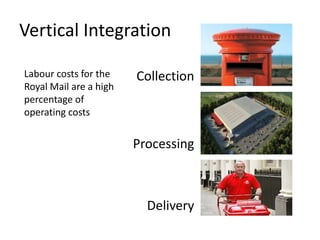
Vertical Integration
Collection
Processing
Delivery
Labour costs for the
Royal Mail are a high
percentage of
operating costs
Increasing competition
• Access competition is where the operator collects mail
from the customer, sorts it and then transports it to
Royal Mail's Inward Mail Centers, where it is handed
over to Royal Mail, who are paid to deliver it. Nearly
40% of mail is now covered by access competition
• End-to-end competition – this is where an operator
other than Royal Mail undertakes the entire process of
collecting, sorting and delivering mail to the intended
recipients. TNT Post (Whistl) began trailing end-to-end
delivery operations in West London in 2012 but
suspended this in April 2015
Vertical integration
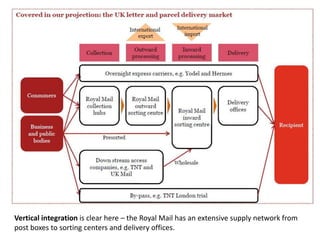
Vertical integration is clear here – the Royal Mail has an extensive supply network from
post boxes to sorting centers and delivery offices.
Privatisation of the Royal Mail
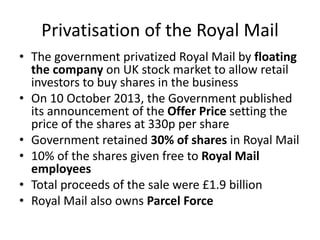
• The government privatized Royal Mail by floating
the company on UK stock market to allow retail
investors to buy shares in the business
• On 10 October 2013, the Government published
its announcement of the Offer Price setting the
price of the shares at 330p per share
• Government retained 30% of shares in Royal Mail
• 10% of the shares given free to Royal Mail
employees
• Total proceeds of the sale were £1.9 billion
• Royal Mail also owns Parcel Force
Final allocation of Royal Mail shares
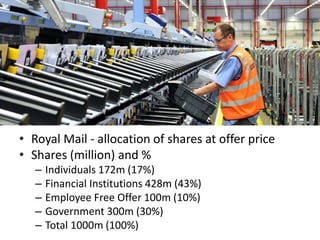
• Royal Mail - allocation of shares at offer price
• Shares (million) and %
– Individuals 172m (17%)
– Financial Institutions 428m (43%)
– Employee Free Offer 100m (10%)
– Government 300m (30%)
– Total 1000m (100%)
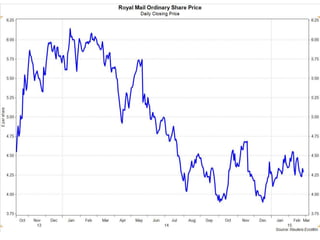
Royal Mail Share Price
Building the Case for Privatisation
1. Floatation raises income for the government (£2bn)
2. Listing the Royal Mail allows the business to access
equity markets to finance capital investment
3. Employee-share ownership will improve productivity
and reduce the risk of costly strikes
4. Operating in the private sector will lead to
improvements in efficiency over time – e.g. stock
market pressure to control costs
5. Royal Mail is in an increasingly contestable industry
and needs to be free to make commercial decisions
6. A more efficient and profitable Royal Mail will pay
increased corporation tax in the long run
Critics of Mail Privatisation
1. Privatisation was strongly opposed by the Trade Unions
2. Surge in price post floatation led some to argue that the
Royal Mail was sold off too cheaply
3. Transferring the Royal Mail into the private sector will cost
thousands of jobs as they look to cut their costs
4. The government took over the pension debt of the Royal
Mail at the time of privatization
5. Universal service obligation is best provided by a
government-owned business (i.e. social ownership)
6. The Royal Mail can improve their performance and
profitability inside the public sector – e.g. from better
management – it does not need to be privatized
7. Government can also provide the funding for the
investment needed to make Royal Mail more productive
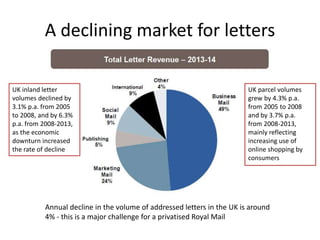
A declining market for letters
Annual decline in the volume of addressed letters in the UK is around
4% - this is a major challenge for a privatised Royal Mail
UK inland letter
volumes declined by
3.1% p.a. from 2005
to 2008, and by 6.3%
p.a. from 2008-2013,
as the economic
downturn increased
the rate of decline
UK parcel volumes
grew by 4.3% p.a.
from 2005 to 2008
and by 3.7% p.a.
from 2008-2013,
mainly reflecting
increasing use of
online shopping by
consumers
Universal Service Obligation (USG)
• Royal Mail has a legal obligation to deliver
letters everywhere in the country with a
delivery to each postal address once per day
• Increasing competition in direct mail deliveries
from rivals such as TNT (operating in London)
are eating into Royal Mail’s market share in
more profitable urban areas
• Royal Mail must still deliver to rural areas
where the service runs at a substantial loss
Quality of Service Obligation
• Royal Mail’s latest Quality of Service report reveals that
the company beat its Second Class target for the first
three quarters, delivering 98.9 per cent within three
working days against a target of 98.5 per cent.
• For the same period, Royal Mail delivered 92.9 per cent
of First Class mail the next working day. Adjusted for
exceptional events outside Royal Mail’s control, the
company achieved the 93.0 per cent First Class mail
target.
• Royal Mail has the highest universal service
specification of any major European country
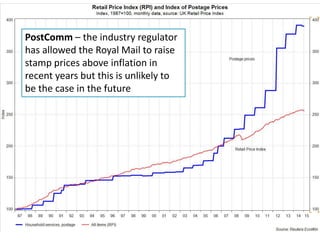
Stamp Prices in the UKPostComm – the industry regulator
has allowed the Royal Mail to raise
stamp prices above inflation in
recent years but this is unlikely to
be the case in the future
Economic efficiency in mail industry
• Allocative efficiency
– Pricing close to marginal cost of supply
– Competition helps to keep real prices down
• Productive efficiency
– Achieving lowest unit operating costs in SR and LR
– Minimising waste and inefficiency in supply
• Dynamic efficiency
– Meeting fast-changing needs and wants of customers
– Business users and millions of households
• E.g. Tracked delivery for all letters and parcels
• Secure postage services given fears over internet security
Competitive challenges for Royal Mail
• Retailers and e-retailers
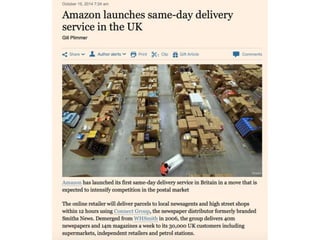
– Amazon own-delivery network adds capacity equivalent to a
new operator
– Same day delivery services bought by eBay
– Retailers e.g. Tesco developing in-house Click & Collect /
returns services
– Third party Click & Collect continues to grow
• Contestable parcels industry – rival parcel/mail firms
– DPD and Hermes announced Sunday deliveries
– Yodel launches courier collection for online traders
– TNT has started direct delivery of mail in some UK cities
Competitive challenges for Royal Mail
• Other challenges to Royal Mail volumes and revenues
– E-mail and secure cloud storage – substitutes for
handling mail – long term decline in the volume of
addressed letters sent in the UK
– 3D printing at home / business may reduce parcel
volumes
– Shift of marketing to social media reduces volumes
of direct mail
– Advanced screen technology and increased e-cards /
biometrics recues need for banks to send out new
cards
Private Finance Initiative (PFI)
• Privatisation is a transfer of ownership
• The PFI is not traditional privatization
• PFIs are a type of Public Private Partnership
(PPP) in which the government and the
private sector both contribute to the creation
or renewal of infrastructure.
• PFI schemes have existed since the early
1990s e.g. used to build and run hospitals,
schools and prisons among other things
Analysis Diagrams in the Exam
• Draw a diagram to explain why the letters
delivery business for Royal Mail makes losses
• Draw a diagram to show internal economies of
scale for a business such as Royal Mail
• Draw a diagram to show how increasing
contestability might lead to a reduction in X-
inefficiency
• Draw a diagram to show a satisficing price and
output equilibrium for Royal Mail (contrasted
with profit maximization)
Royal Mail Privatisation
A2 Business Economics
Spring 2015

Revision on Royal Mail Privatisation

  • 1.
    Royal Mail Privatisation A2Business Economics Spring 2015
  • 2.
    Vertical Integration Collection Processing Delivery Labour costsfor the Royal Mail are a high percentage of operating costs
  • 3.
    Increasing competition • Accesscompetition is where the operator collects mail from the customer, sorts it and then transports it to Royal Mail's Inward Mail Centers, where it is handed over to Royal Mail, who are paid to deliver it. Nearly 40% of mail is now covered by access competition • End-to-end competition – this is where an operator other than Royal Mail undertakes the entire process of collecting, sorting and delivering mail to the intended recipients. TNT Post (Whistl) began trailing end-to-end delivery operations in West London in 2012 but suspended this in April 2015
  • 4.
    Vertical integration Vertical integrationis clear here – the Royal Mail has an extensive supply network from post boxes to sorting centers and delivery offices.
  • 5.
    Privatisation of theRoyal Mail • The government privatized Royal Mail by floating the company on UK stock market to allow retail investors to buy shares in the business • On 10 October 2013, the Government published its announcement of the Offer Price setting the price of the shares at 330p per share • Government retained 30% of shares in Royal Mail • 10% of the shares given free to Royal Mail employees • Total proceeds of the sale were £1.9 billion • Royal Mail also owns Parcel Force
  • 8.
    Final allocation ofRoyal Mail shares • Royal Mail - allocation of shares at offer price • Shares (million) and % – Individuals 172m (17%) – Financial Institutions 428m (43%) – Employee Free Offer 100m (10%) – Government 300m (30%) – Total 1000m (100%)
  • 9.
  • 10.
    Building the Casefor Privatisation 1. Floatation raises income for the government (£2bn) 2. Listing the Royal Mail allows the business to access equity markets to finance capital investment 3. Employee-share ownership will improve productivity and reduce the risk of costly strikes 4. Operating in the private sector will lead to improvements in efficiency over time – e.g. stock market pressure to control costs 5. Royal Mail is in an increasingly contestable industry and needs to be free to make commercial decisions 6. A more efficient and profitable Royal Mail will pay increased corporation tax in the long run
  • 11.
    Critics of MailPrivatisation 1. Privatisation was strongly opposed by the Trade Unions 2. Surge in price post floatation led some to argue that the Royal Mail was sold off too cheaply 3. Transferring the Royal Mail into the private sector will cost thousands of jobs as they look to cut their costs 4. The government took over the pension debt of the Royal Mail at the time of privatization 5. Universal service obligation is best provided by a government-owned business (i.e. social ownership) 6. The Royal Mail can improve their performance and profitability inside the public sector – e.g. from better management – it does not need to be privatized 7. Government can also provide the funding for the investment needed to make Royal Mail more productive
  • 12.
    A declining marketfor letters Annual decline in the volume of addressed letters in the UK is around 4% - this is a major challenge for a privatised Royal Mail UK inland letter volumes declined by 3.1% p.a. from 2005 to 2008, and by 6.3% p.a. from 2008-2013, as the economic downturn increased the rate of decline UK parcel volumes grew by 4.3% p.a. from 2005 to 2008 and by 3.7% p.a. from 2008-2013, mainly reflecting increasing use of online shopping by consumers
  • 13.
    Universal Service Obligation(USG) • Royal Mail has a legal obligation to deliver letters everywhere in the country with a delivery to each postal address once per day • Increasing competition in direct mail deliveries from rivals such as TNT (operating in London) are eating into Royal Mail’s market share in more profitable urban areas • Royal Mail must still deliver to rural areas where the service runs at a substantial loss
  • 14.
    Quality of ServiceObligation • Royal Mail’s latest Quality of Service report reveals that the company beat its Second Class target for the first three quarters, delivering 98.9 per cent within three working days against a target of 98.5 per cent. • For the same period, Royal Mail delivered 92.9 per cent of First Class mail the next working day. Adjusted for exceptional events outside Royal Mail’s control, the company achieved the 93.0 per cent First Class mail target. • Royal Mail has the highest universal service specification of any major European country
  • 15.
    Stamp Prices inthe UKPostComm – the industry regulator has allowed the Royal Mail to raise stamp prices above inflation in recent years but this is unlikely to be the case in the future
  • 16.
    Economic efficiency inmail industry • Allocative efficiency – Pricing close to marginal cost of supply – Competition helps to keep real prices down • Productive efficiency – Achieving lowest unit operating costs in SR and LR – Minimising waste and inefficiency in supply • Dynamic efficiency – Meeting fast-changing needs and wants of customers – Business users and millions of households • E.g. Tracked delivery for all letters and parcels • Secure postage services given fears over internet security
  • 17.
    Competitive challenges forRoyal Mail • Retailers and e-retailers – Amazon own-delivery network adds capacity equivalent to a new operator – Same day delivery services bought by eBay – Retailers e.g. Tesco developing in-house Click & Collect / returns services – Third party Click & Collect continues to grow • Contestable parcels industry – rival parcel/mail firms – DPD and Hermes announced Sunday deliveries – Yodel launches courier collection for online traders – TNT has started direct delivery of mail in some UK cities
  • 18.
    Competitive challenges forRoyal Mail • Other challenges to Royal Mail volumes and revenues – E-mail and secure cloud storage – substitutes for handling mail – long term decline in the volume of addressed letters sent in the UK – 3D printing at home / business may reduce parcel volumes – Shift of marketing to social media reduces volumes of direct mail – Advanced screen technology and increased e-cards / biometrics recues need for banks to send out new cards
  • 19.
    Private Finance Initiative(PFI) • Privatisation is a transfer of ownership • The PFI is not traditional privatization • PFIs are a type of Public Private Partnership (PPP) in which the government and the private sector both contribute to the creation or renewal of infrastructure. • PFI schemes have existed since the early 1990s e.g. used to build and run hospitals, schools and prisons among other things
  • 20.
    Analysis Diagrams inthe Exam • Draw a diagram to explain why the letters delivery business for Royal Mail makes losses • Draw a diagram to show internal economies of scale for a business such as Royal Mail • Draw a diagram to show how increasing contestability might lead to a reduction in X- inefficiency • Draw a diagram to show a satisficing price and output equilibrium for Royal Mail (contrasted with profit maximization)
  • 21.
    Royal Mail Privatisation A2Business Economics Spring 2015