Safety and health at work is everyone’s concern. It’s good for you. It’s good for business.
The value of OSH: Estimating the societal
costs of work-related injuries and diseases
In Finland, Germany, the Netherlands, Italy and Poland
Objective of the study
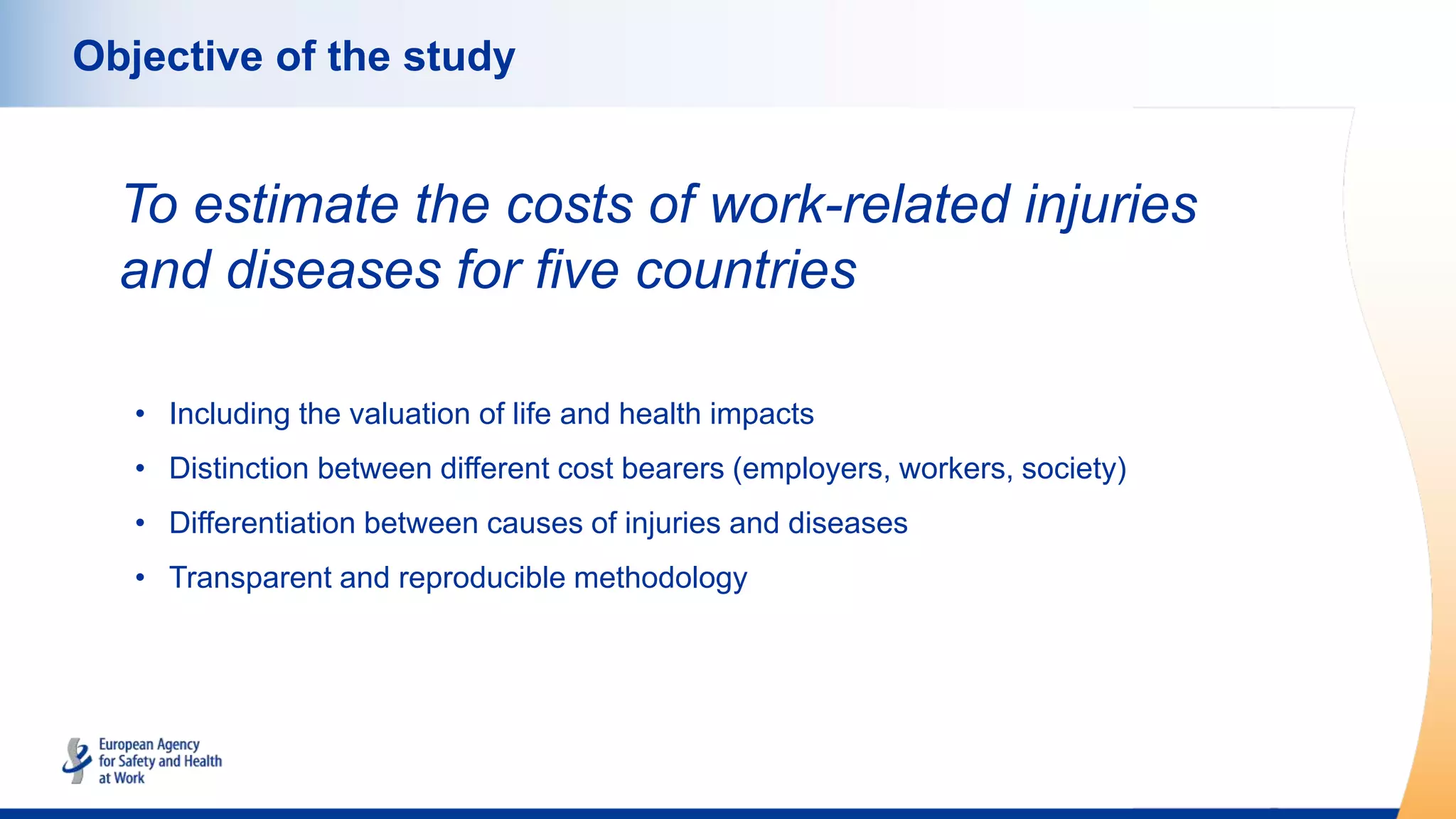
To estimate the costs of work-related injuries
and diseases for five countries
• Including the valuation of life and health impacts
• Distinction between different cost bearers (employers, workers, society)
• Differentiation between causes of injuries and diseases
• Transparent and reproducible methodology
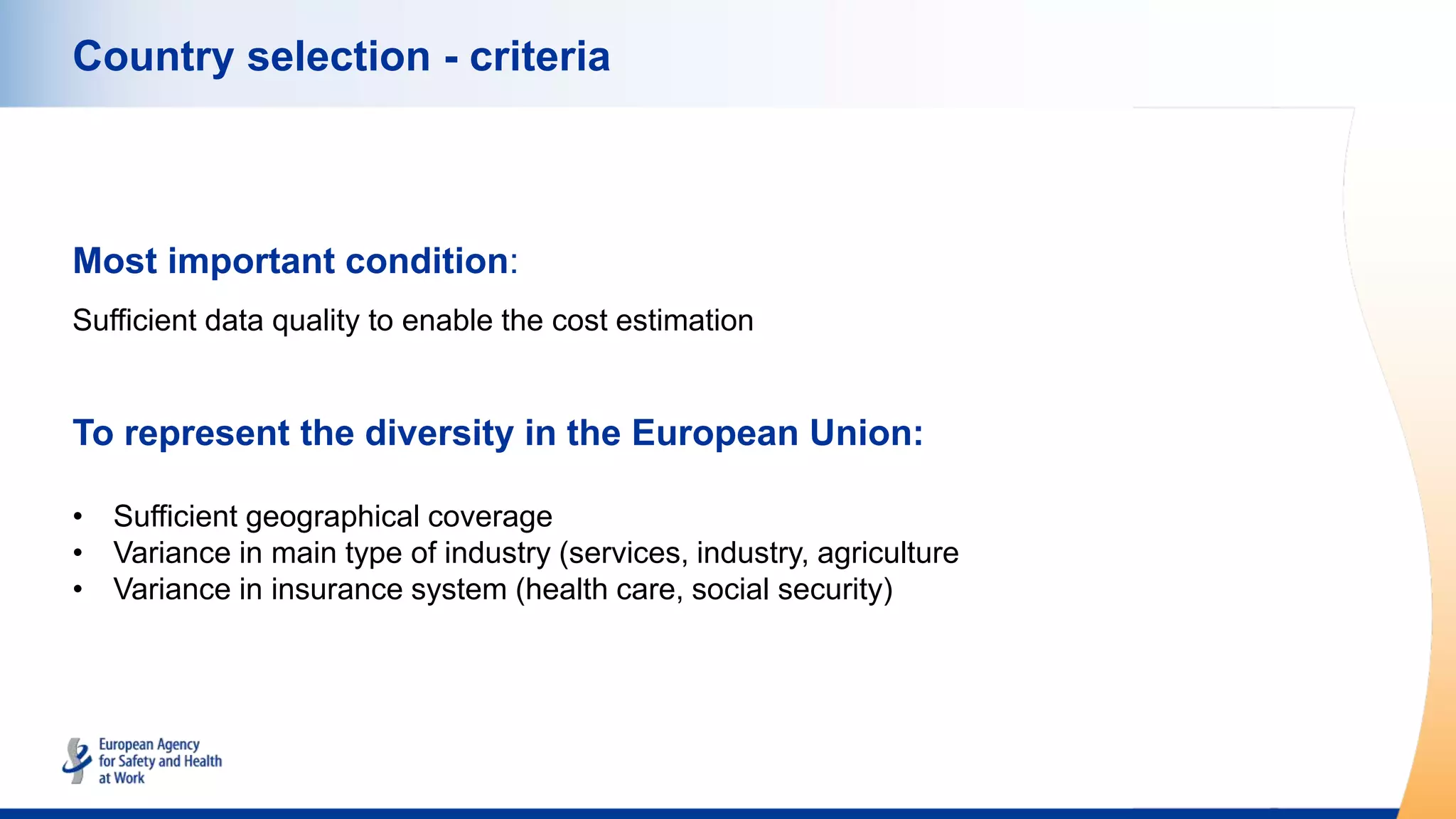
Country selection - criteria
Most important condition:
Sufficient data quality to enable the cost estimation
To represent the diversity in the European Union:
• Sufficient geographical coverage
• Variance in main type of industry (services, industry, agriculture
• Variance in insurance system (health care, social security)
Selected countries
Sources:
[1] EU-OSHA, 2017b
[2] Labour Force Survey 2015 (Eurostat)
Countries
Geographical
location
Insurance system[1]
% employed in services[2]
(EU average = 73.1%)
Finland North Mixed 73.1%
Germany West Bismarckian 73.9%
The Netherlands West Bismarckian 82.9%
Italy South Beveridgean 72.4%
Poland Central Bismarckian 58.3%
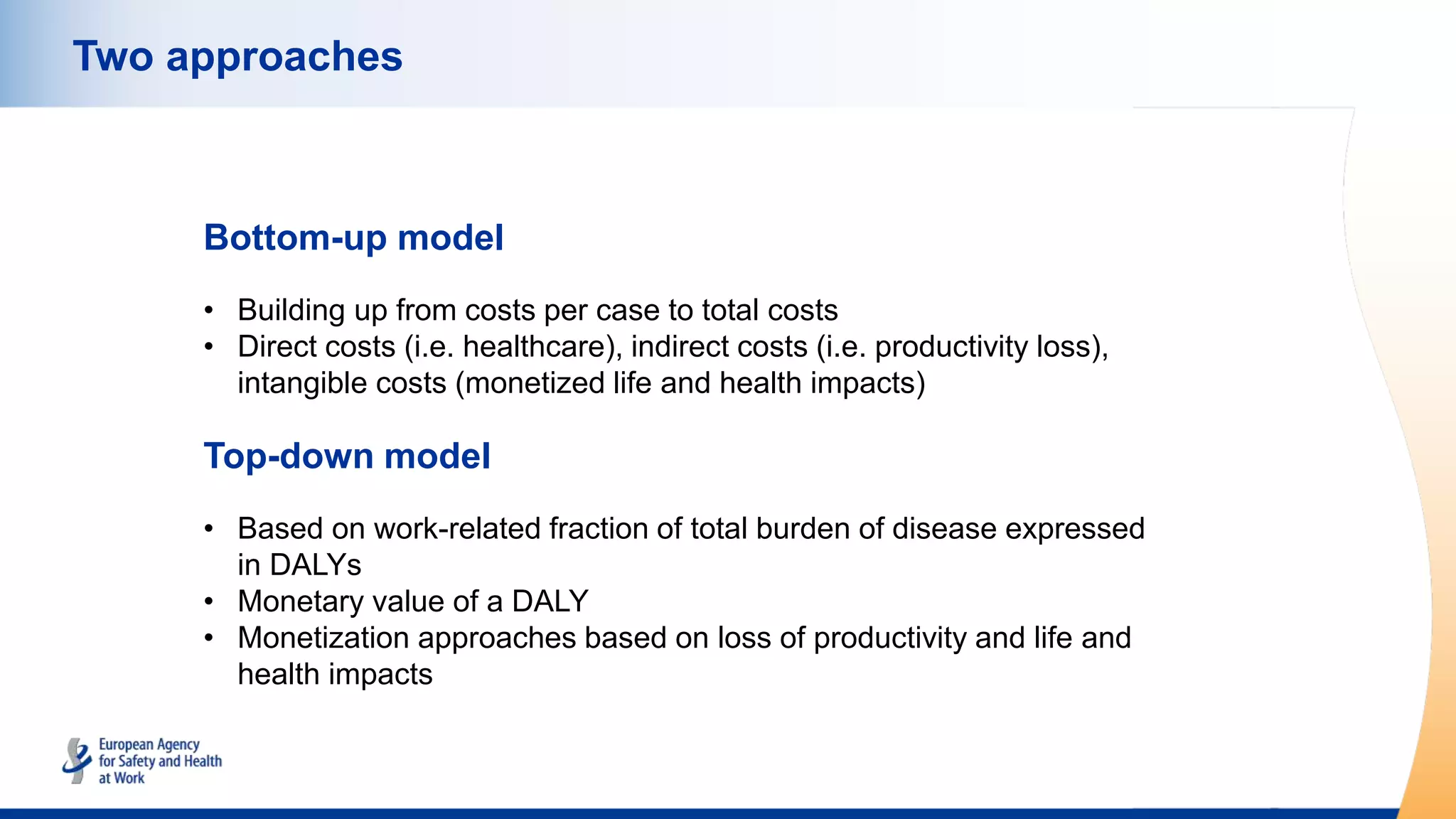
Two approaches
Bottom-up model
• Building up from costs per case to total costs
• Direct costs (i.e. healthcare), indirect costs (i.e. productivity loss),
intangible costs (monetized life and health impacts)
Top-down model
• Based on work-related fraction of total burden of disease expressed
in DALYs
• Monetary value of a DALY
• Monetization approaches based on loss of productivity and life and
health impacts
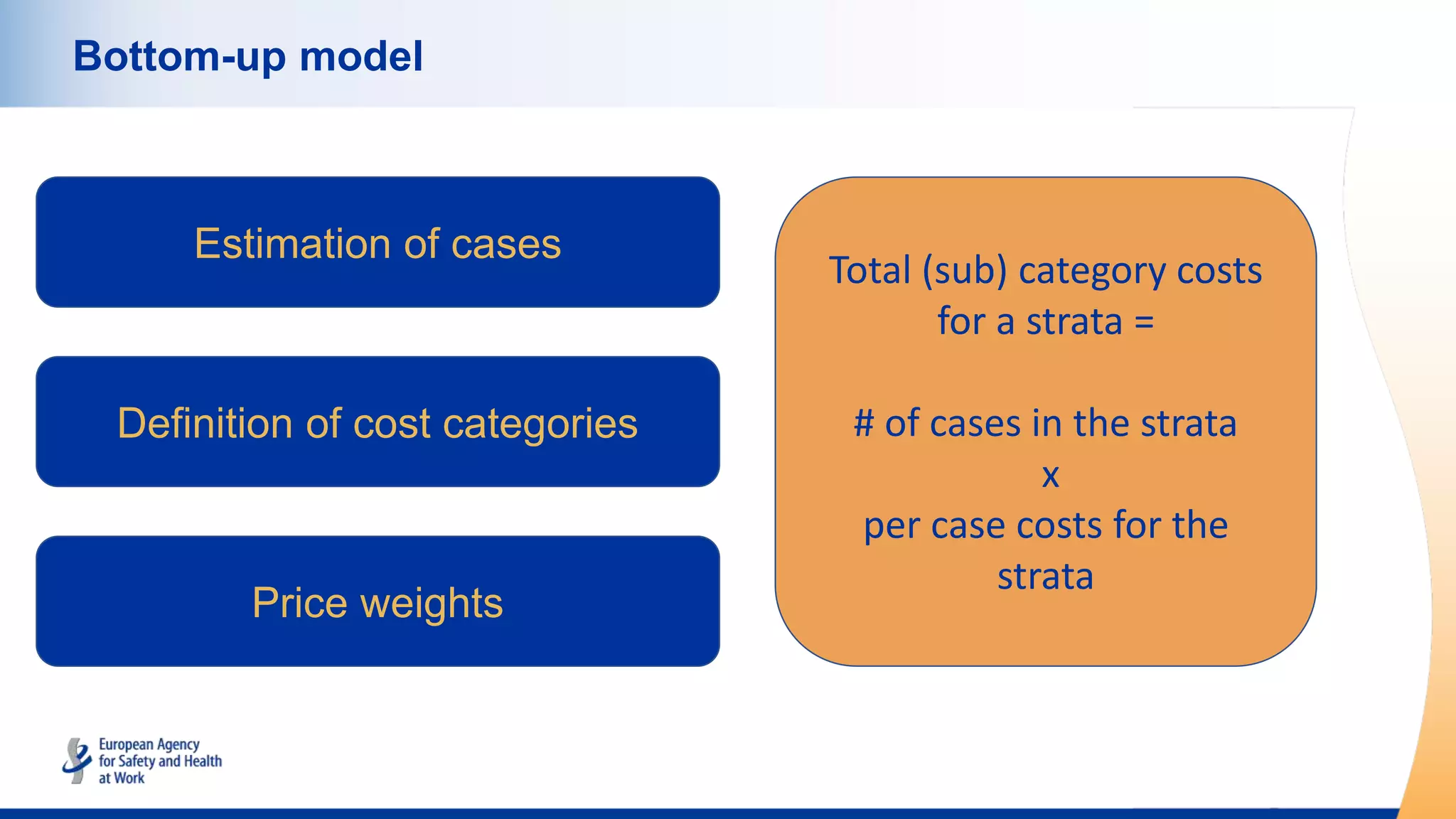
Bottom-up model
Bottom-up model
Estimation of cases
Definition of cost categories
Price weights
Total (sub) category costs
for a strata =
# of cases in the strata
x
per case costs for the
strata
Bottom-up model – estimation of cases
 Non-fatal work-related injuries1
 Fatal work-related injuries1
 Non-fatal work-related diseases2,3
Different data sources, different scenarios of the case count. Baseline scenario:
o Count of compensated (accepted, recognized) and non-compensated non-
fatal cases for most types of diseases2; with the following exceptions:
o for cancers, circulatory diseases, respiratory diseases, and
musculoskeletal diseases we estimated case counts and used attributable
fractions to estimate the work-related cases3
 Fatal work-related diseases3
Sources:
[1] ESAW 2015 (non-fatal cases of Poland and Italy are adjusted based on the fatal to non-fatal ratio). To estimate the number of non-
fatal cases with 1-3 workdays lost, the severity distribution in the LFS 2013 was applied
[2] National sources: Finland - Finnish Institute of Occupational Health (2012); Germany - DGUV Statistics (2013); The Netherlands -
NCvB statistiek, Nationale Registratie Beroepsziekten (2015); Italy - Banche dati static, occupational injury and disease (2015);
Poland: Choroby Zawodowe W Polsce W (2014)
[3] IHME 2015
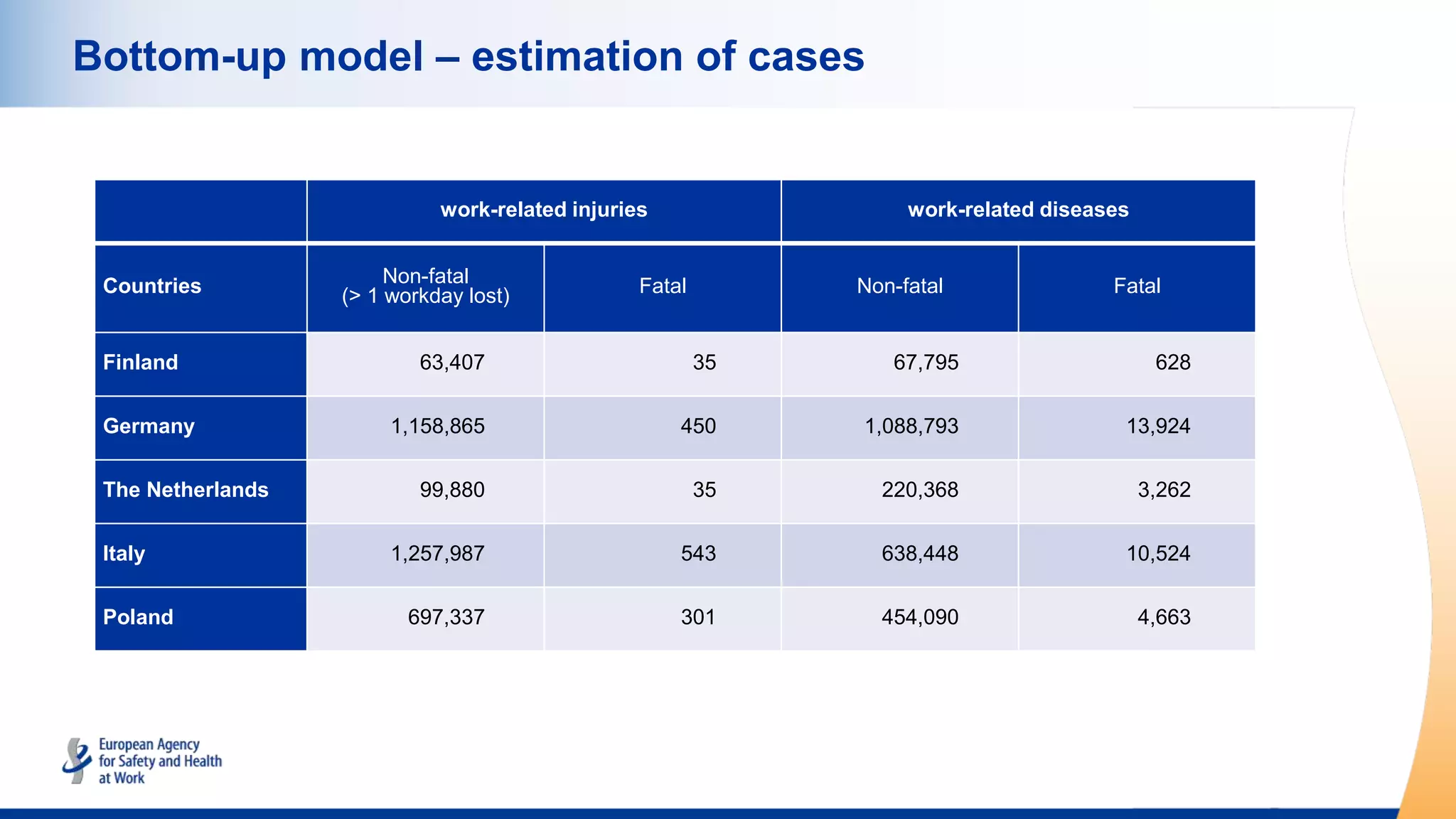
Bottom-up model – estimation of cases
work-related injuries work-related diseases
Countries Non-fatal
(> 1 workday lost) Fatal Non-fatal Fatal
Finland 63,407 35 67,795 628
Germany 1,158,865 450 1,088,793 13,924
The Netherlands 99,880 35 220,368 3,262
Italy 1,257,987 543 638,448 10,524
Poland 697,337 301 454,090 4,663
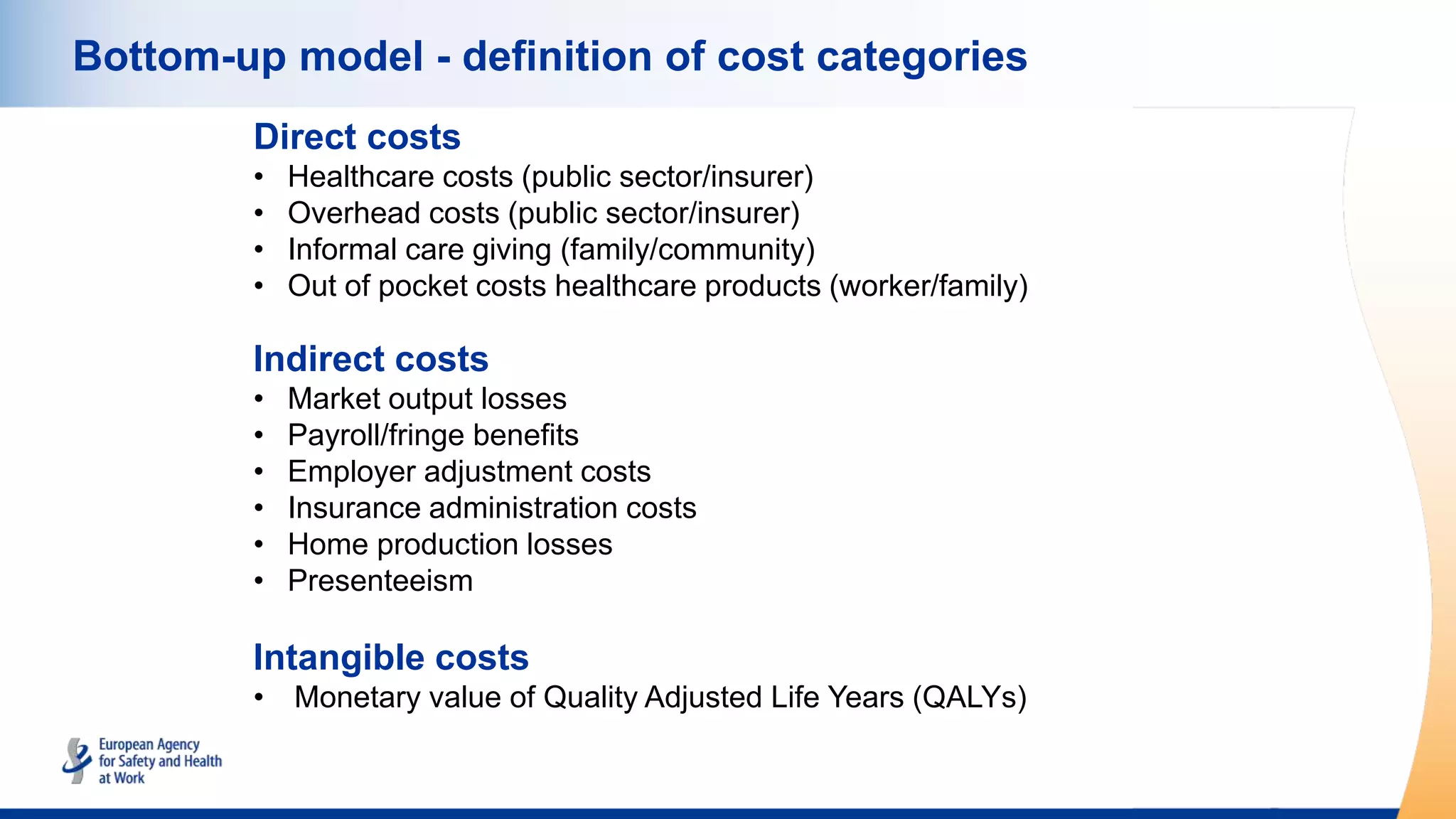
Bottom-up model - definition of cost categories
Direct costs
• Healthcare costs (public sector/insurer)
• Overhead costs (public sector/insurer)
• Informal care giving (family/community)
• Out of pocket costs healthcare products (worker/family)
Indirect costs
• Market output losses
• Payroll/fringe benefits
• Employer adjustment costs
• Insurance administration costs
• Home production losses
• Presenteeism
Intangible costs
• Monetary value of Quality Adjusted Life Years (QALYs)
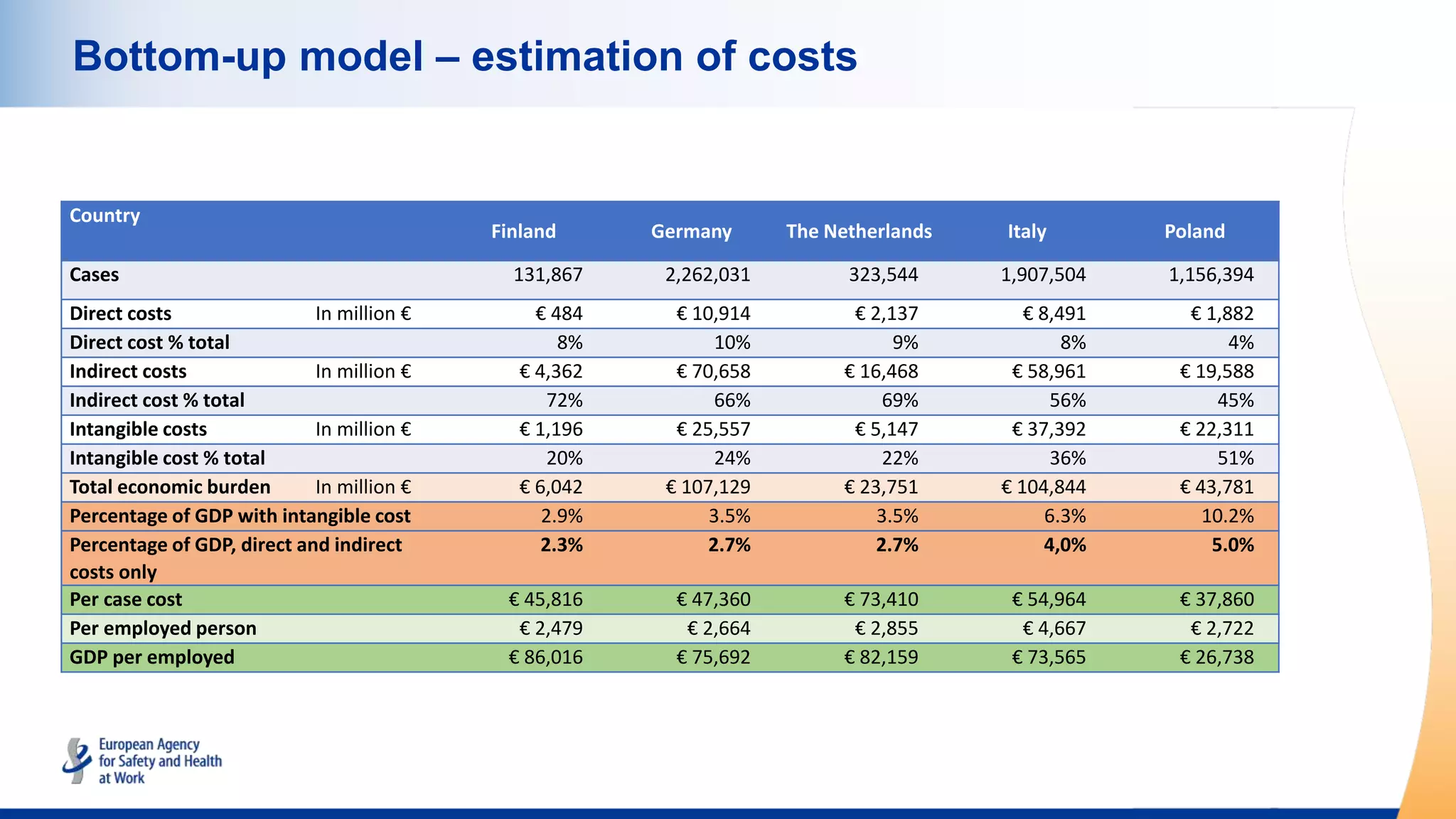
Bottom-up model – estimation of costs
Country
Finland Germany The Netherlands Italy Poland
Cases 131,867 2,262,031 323,544 1,907,504 1,156,394
Direct costs In million € € 484 € 10,914 € 2,137 € 8,491 € 1,882
Direct cost % total 8% 10% 9% 8% 4%
Indirect costs In million € € 4,362 € 70,658 € 16,468 € 58,961 € 19,588
Indirect cost % total 72% 66% 69% 56% 45%
Intangible costs In million € € 1,196 € 25,557 € 5,147 € 37,392 € 22,311
Intangible cost % total 20% 24% 22% 36% 51%
Total economic burden In million € € 6,042 € 107,129 € 23,751 € 104,844 € 43,781
Percentage of GDP with intangible cost 2.9% 3.5% 3.5% 6.3% 10.2%
Percentage of GDP, direct and indirect
costs only
2.3% 2.7% 2.7% 4,0% 5.0%
Per case cost € 45,816 € 47,360 € 73,410 € 54,964 € 37,860
Per employed person € 2,479 € 2,664 € 2,855 € 4,667 € 2,722
GDP per employed € 86,016 € 75,692 € 82,159 € 73,565 € 26,738
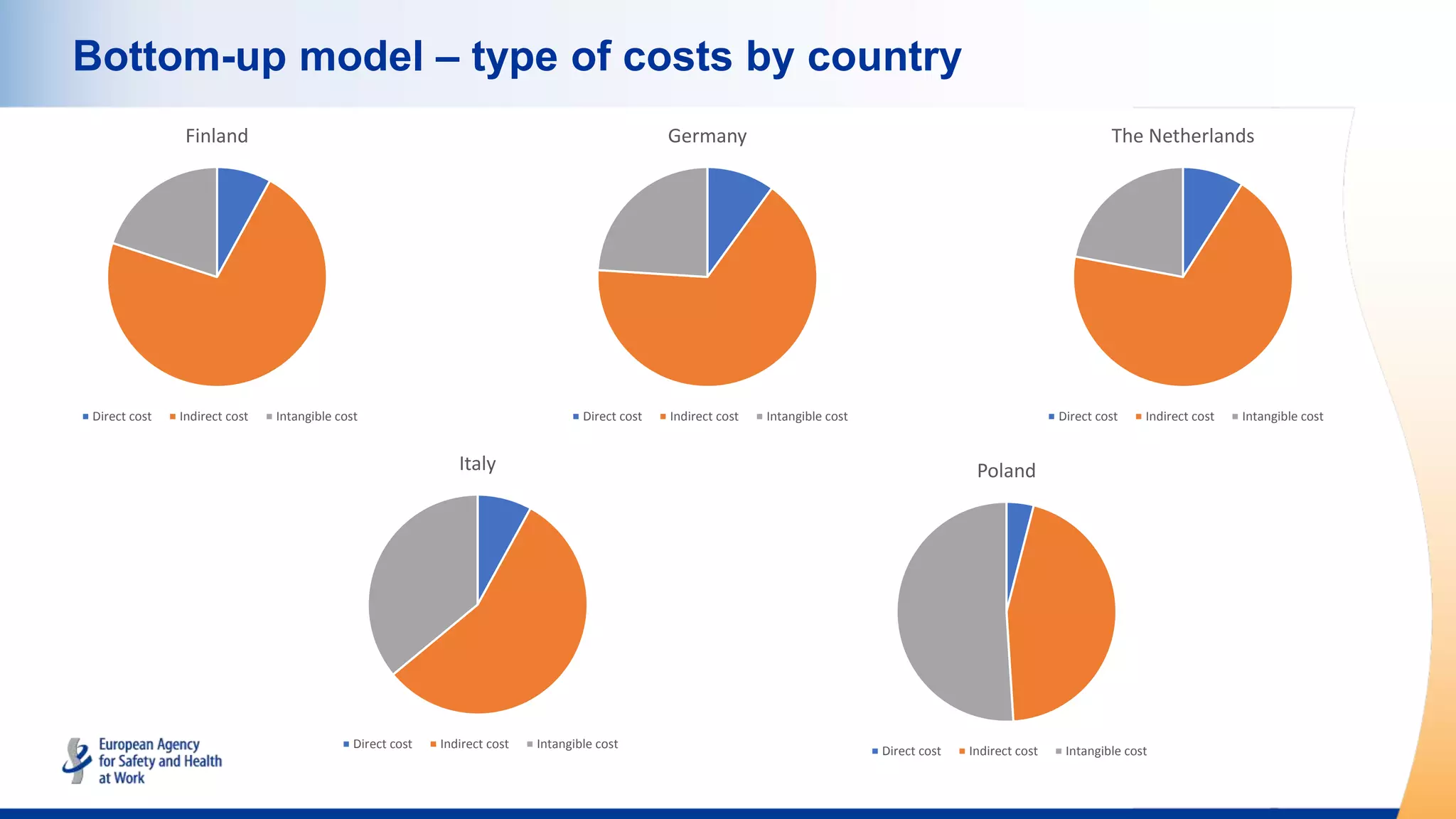
Bottom-up model – type of costs by country
Finland
Direct cost Indirect cost Intangible cost
Germany
Direct cost Indirect cost Intangible cost
The Netherlands
Direct cost Indirect cost Intangible cost
Italy
Direct cost Indirect cost Intangible cost
Poland
Direct cost Indirect cost Intangible cost
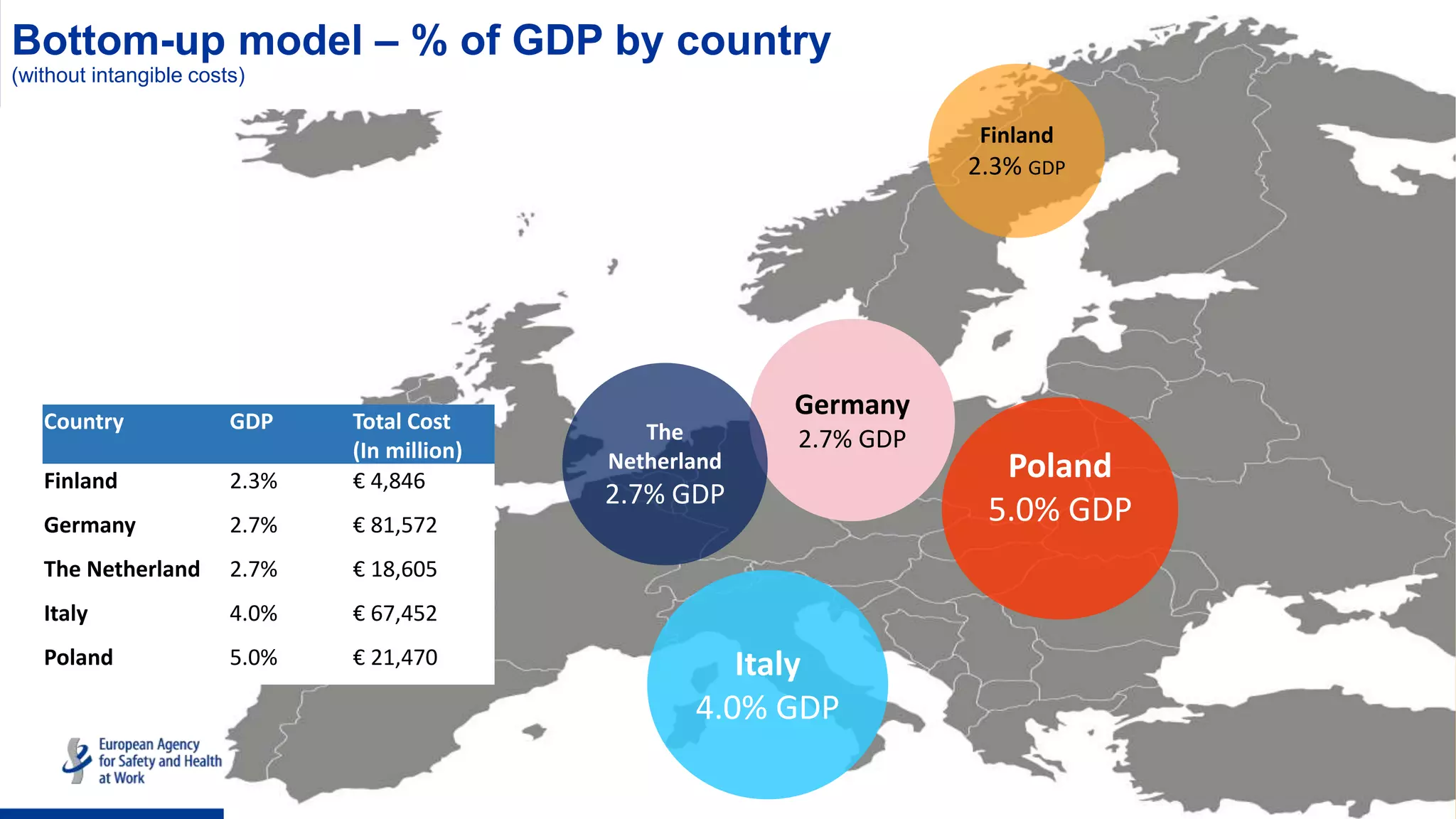
Bottom-up model – % of GDP by country
(without intangible costs)
Poland
5.0% GDP
Germany
2.7% GDP
Finland
2.3% GDP
The
Netherland
2.7% GDP
Italy
4.0% GDP
Country GDP Total Cost
(In million)
Finland 2.3% € 4,846
Germany 2.7% € 81,572
The Netherland 2.7% € 18,605
Italy 4.0% € 67,452
Poland 5.0% € 21,470
Bottom-up model – per case and per employed person
€2,479.00
€2,664.00
€2,855.00
€4,667.00
€2,722.00
€0
€500
€1,000
€1,500
€2,000
€2,500
€3,000
€3,500
€4,000
€4,500
€5,000
Finland Germany The
Netherlands
Italy Poland
Per employed person
45816 47360
73410
54964
37860
0
10000
20000
30000
40000
50000
60000
70000
80000
Per case cost in Euro
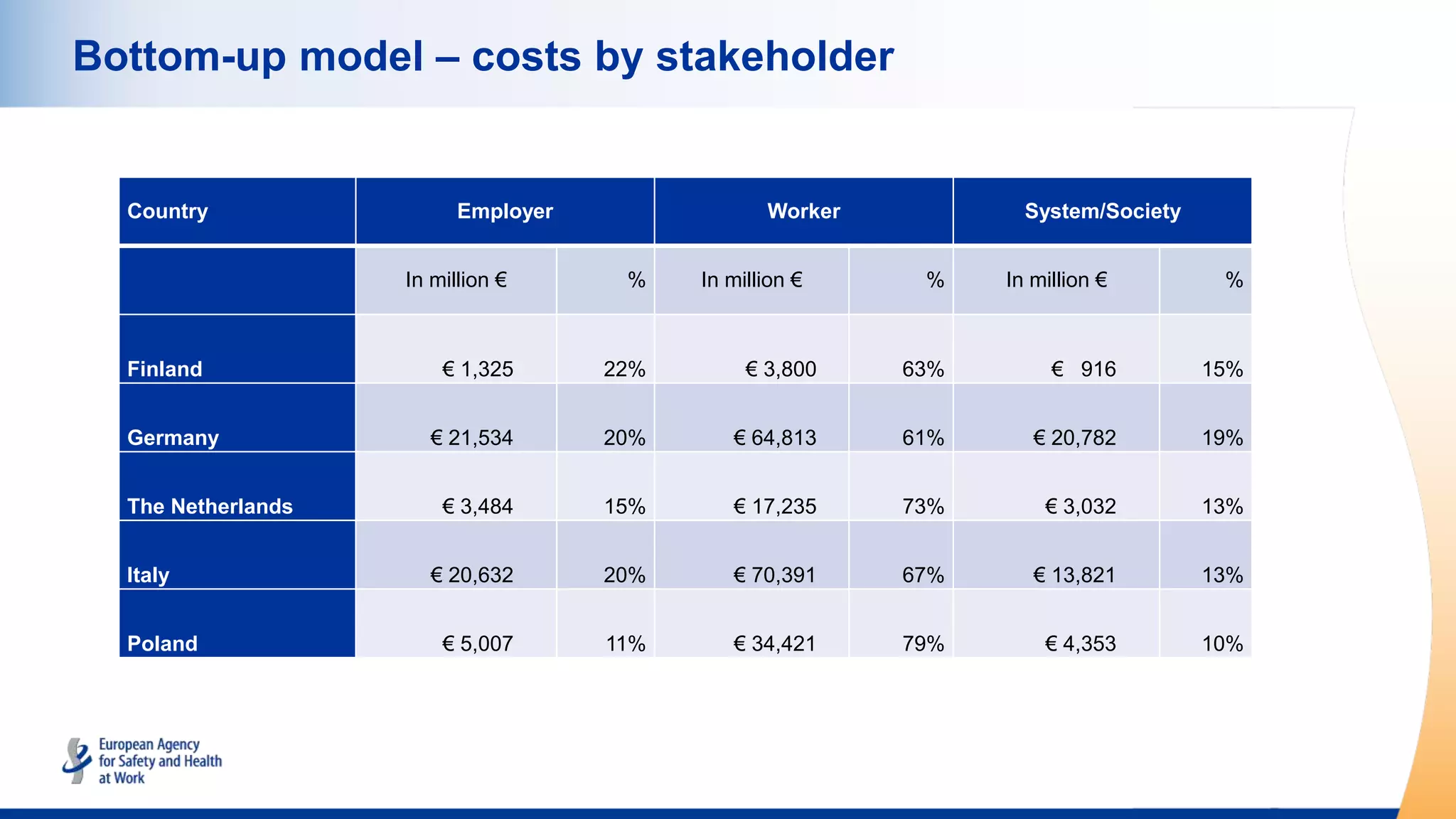
Bottom-up model – costs by stakeholder
Country Employer Worker System/Society
In million € % In million € % In million € %
Finland € 1,325 22% € 3,800 63% € 916 15%
Germany € 21,534 20% € 64,813 61% € 20,782 19%
The Netherlands € 3,484 15% € 17,235 73% € 3,032 13%
Italy € 20,632 20% € 70,391 67% € 13,821 13%
Poland € 5,007 11% € 34,421 79% € 4,353 10%
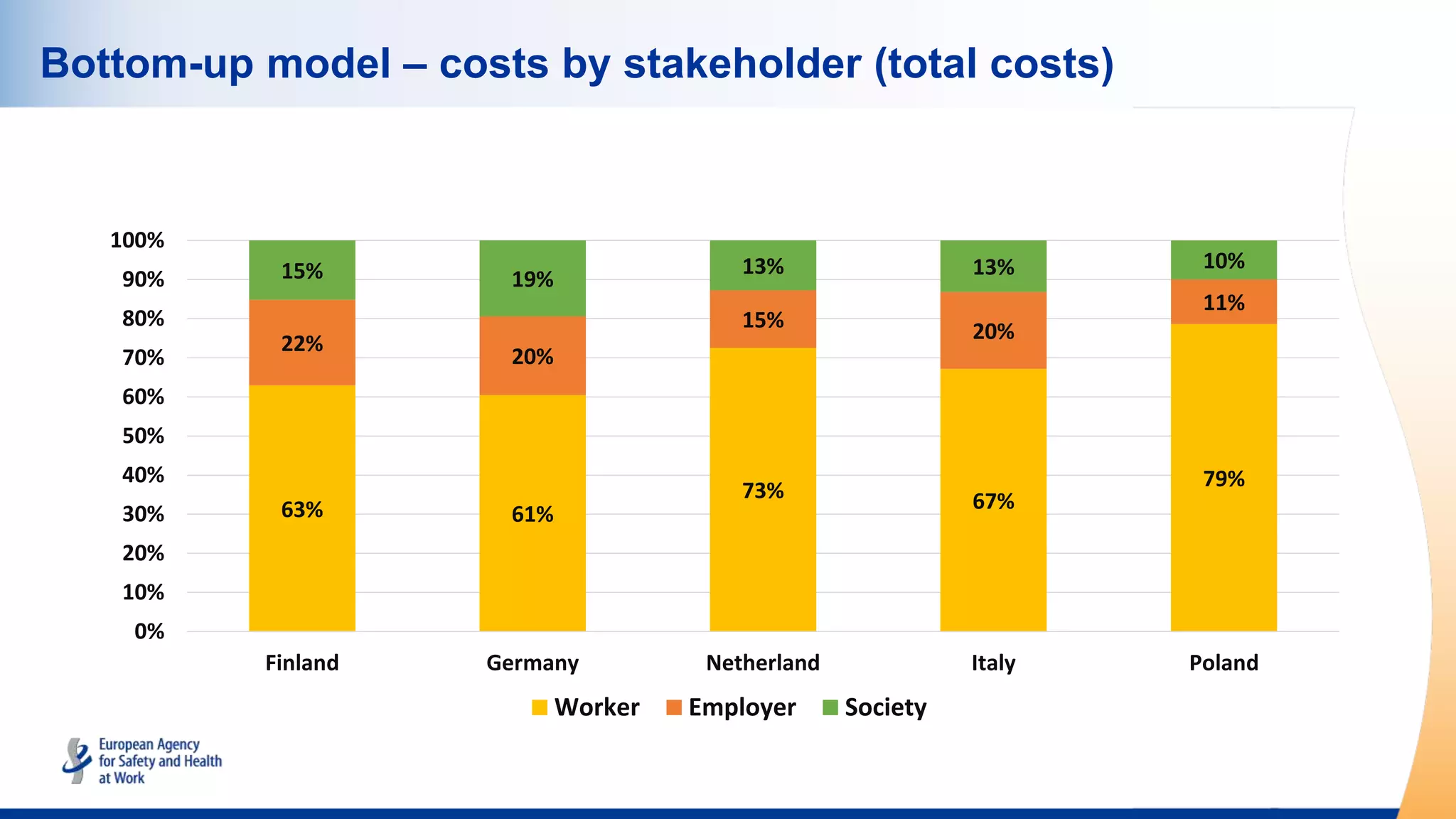
Bottom-up model – costs by stakeholder (total costs)
63% 61%
73% 67%
79%
22%
20%
15% 20%
11%
15% 19%
13% 13% 10%
0%
10%
20%
30%
40%
50%
60%
70%
80%
90%
100%
Finland Germany Netherland Italy Poland
Worker Employer Society
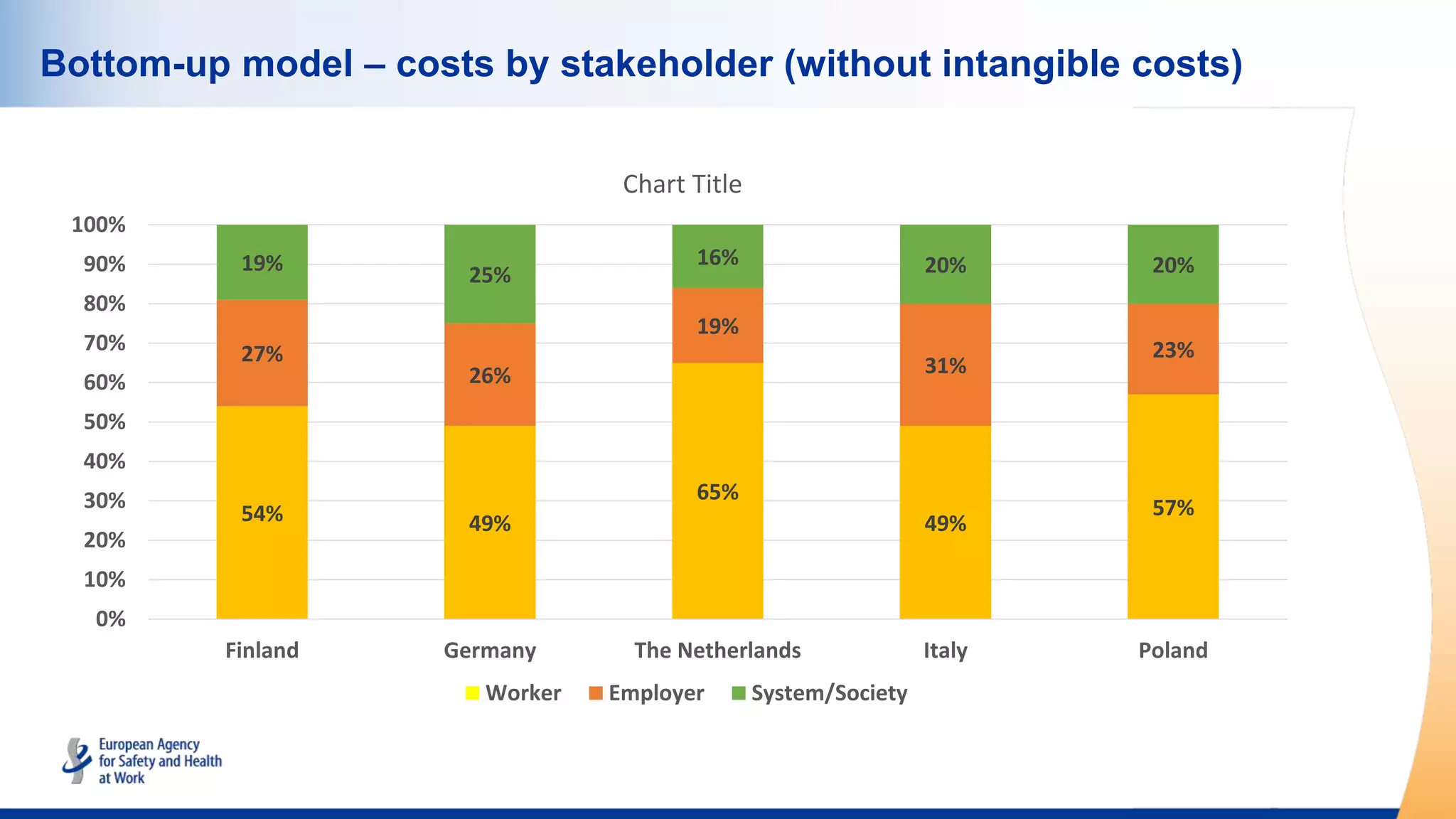
Bottom-up model – costs by stakeholder (without intangible costs)
54% 49%
65%
49%
57%
27%
26%
19%
31%
23%
19% 25%
16% 20% 20%
0%
10%
20%
30%
40%
50%
60%
70%
80%
90%
100%
Finland Germany The Netherlands Italy Poland
Chart Title
Worker Employer System/Society
Top-down model
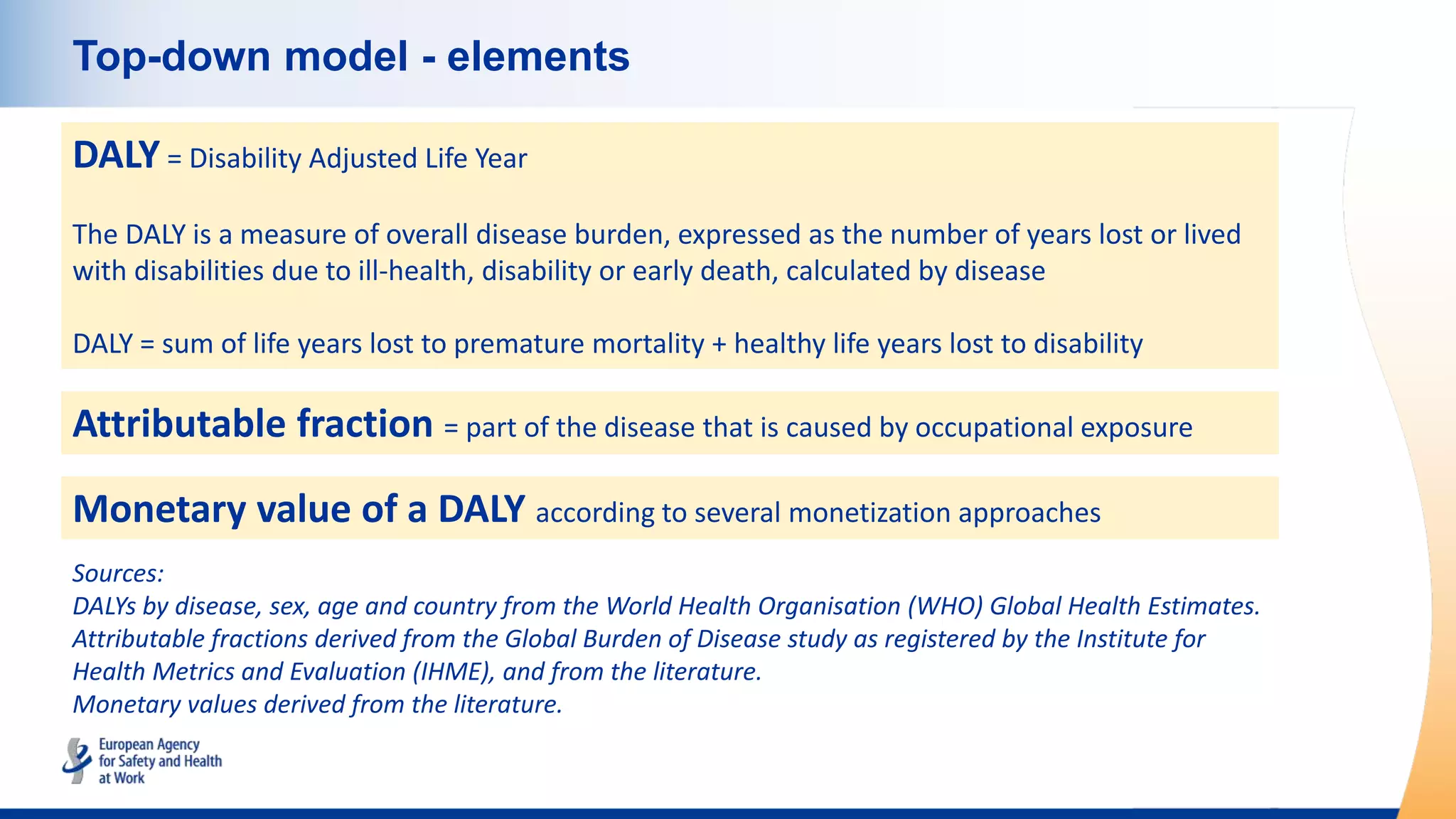
Top-down model - elements
DALY = Disability Adjusted Life Year
The DALY is a measure of overall disease burden, expressed as the number of years lost or lived
with disabilities due to ill-health, disability or early death, calculated by disease
DALY = sum of life years lost to premature mortality + healthy life years lost to disability
Attributable fraction = part of the disease that is caused by occupational exposure
Sources:
DALYs by disease, sex, age and country from the World Health Organisation (WHO) Global Health Estimates.
Attributable fractions derived from the Global Burden of Disease study as registered by the Institute for
Health Metrics and Evaluation (IHME), and from the literature.
Monetary values derived from the literature.
Monetary value of a DALY according to several monetization approaches
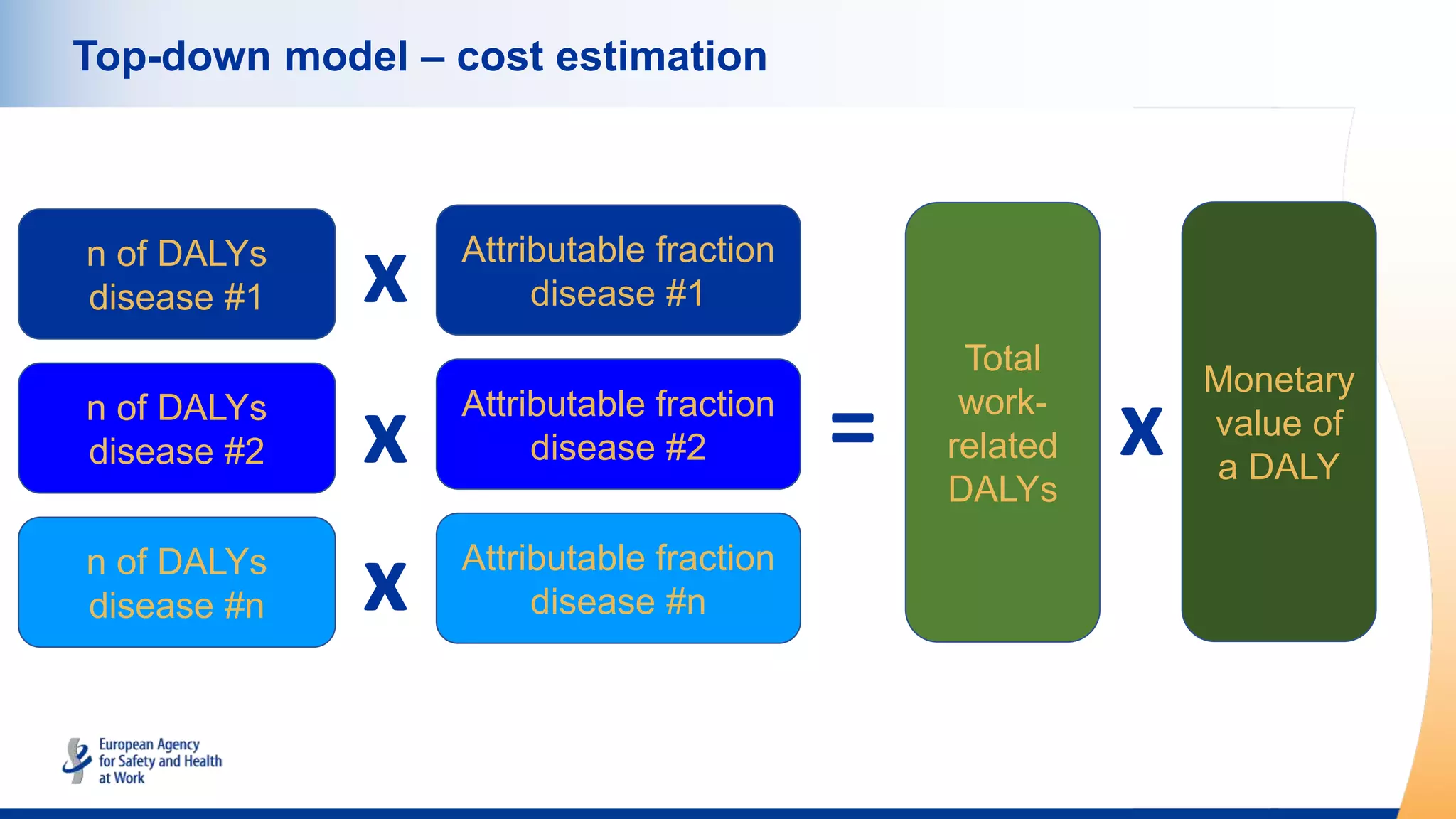
Top-down model – cost estimation
n of DALYs
disease #1
n of DALYs
disease #2
n of DALYs
disease #n
Attributable fraction
disease #1
Attributable fraction
disease #2
Attributable fraction
disease #n
x
x
x
Total
work-
related
DALYs
=
Monetary
value of
a DALY
x
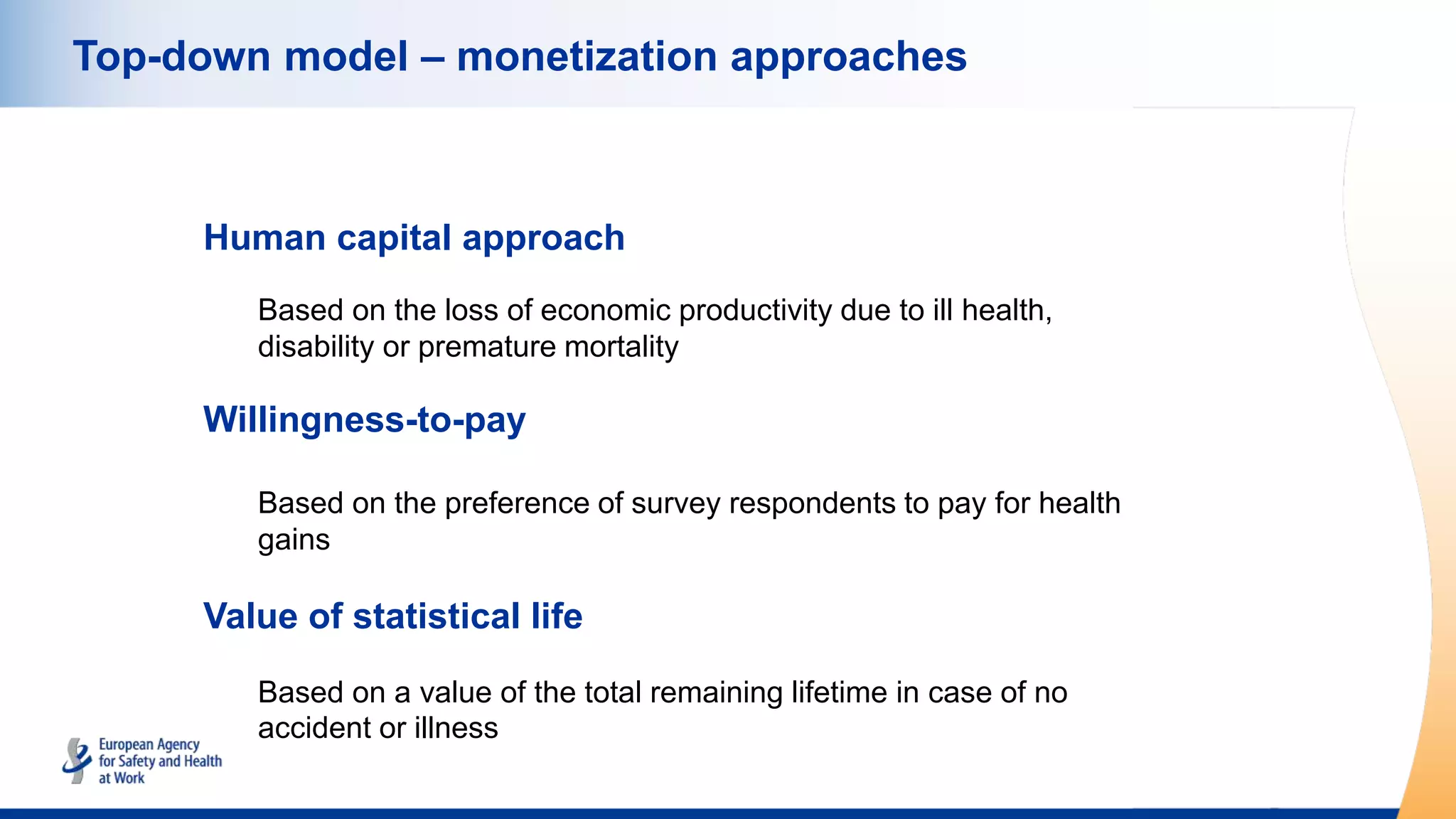
Top-down model – monetization approaches
Human capital approach
Based on the loss of economic productivity due to ill health,
disability or premature mortality
Willingness-to-pay
Based on the preference of survey respondents to pay for health
gains
Value of statistical life
Based on a value of the total remaining lifetime in case of no
accident or illness
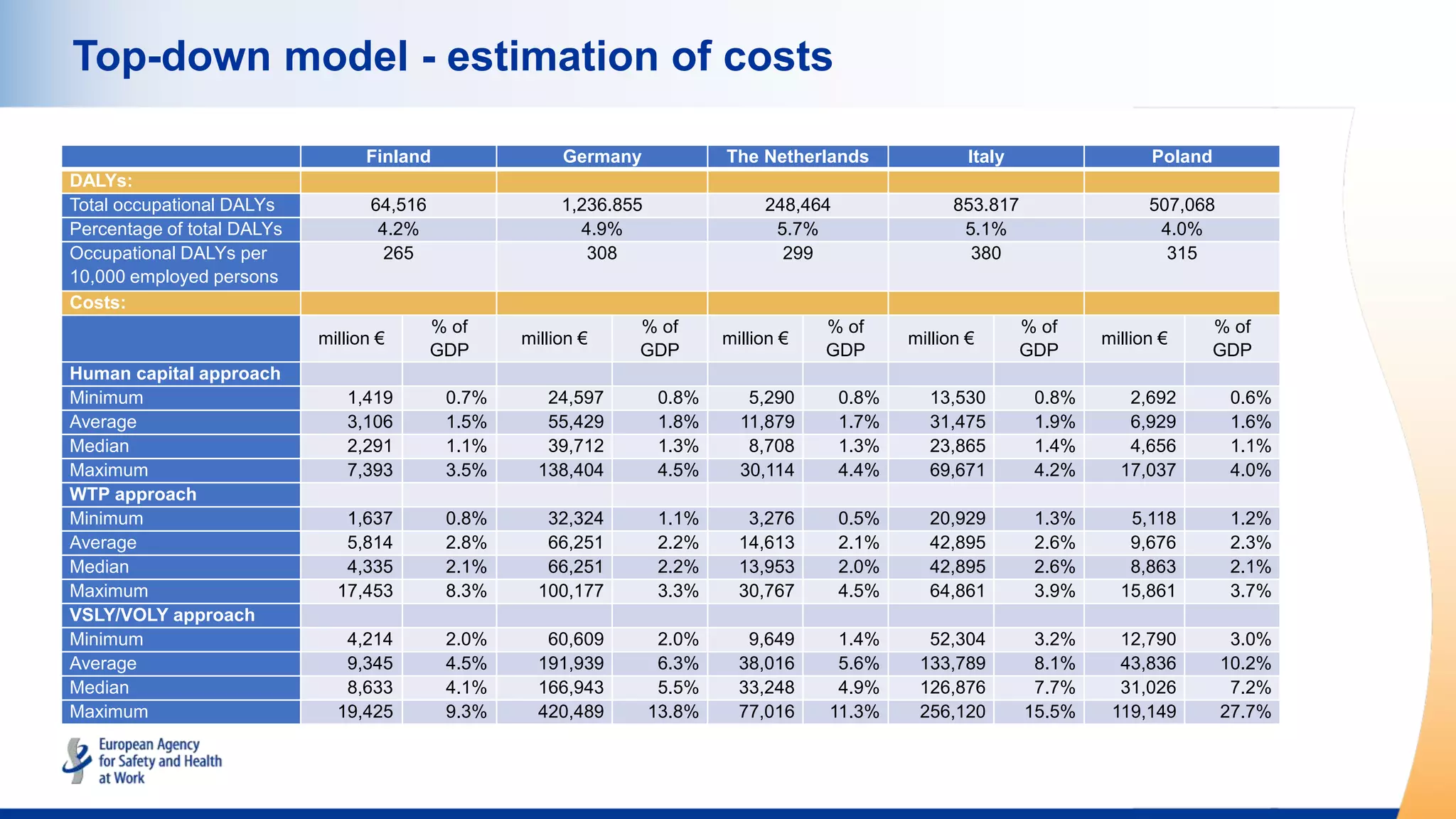
Top-down model - estimation of costs
Finland Germany The Netherlands Italy Poland
DALYs:
Total occupational DALYs 64,516 1,236.855 248,464 853.817 507,068
Percentage of total DALYs 4.2% 4.9% 5.7% 5.1% 4.0%
Occupational DALYs per
10,000 employed persons
265 308 299 380 315
Costs:
million €
% of
GDP
million €
% of
GDP
million €
% of
GDP
million €
% of
GDP
million €
% of
GDP
Human capital approach
Minimum 1,419 0.7% 24,597 0.8% 5,290 0.8% 13,530 0.8% 2,692 0.6%
Average 3,106 1.5% 55,429 1.8% 11,879 1.7% 31,475 1.9% 6,929 1.6%
Median 2,291 1.1% 39,712 1.3% 8,708 1.3% 23,865 1.4% 4,656 1.1%
Maximum 7,393 3.5% 138,404 4.5% 30,114 4.4% 69,671 4.2% 17,037 4.0%
WTP approach
Minimum 1,637 0.8% 32,324 1.1% 3,276 0.5% 20,929 1.3% 5,118 1.2%
Average 5,814 2.8% 66,251 2.2% 14,613 2.1% 42,895 2.6% 9,676 2.3%
Median 4,335 2.1% 66,251 2.2% 13,953 2.0% 42,895 2.6% 8,863 2.1%
Maximum 17,453 8.3% 100,177 3.3% 30,767 4.5% 64,861 3.9% 15,861 3.7%
VSLY/VOLY approach
Minimum 4,214 2.0% 60,609 2.0% 9,649 1.4% 52,304 3.2% 12,790 3.0%
Average 9,345 4.5% 191,939 6.3% 38,016 5.6% 133,789 8.1% 43,836 10.2%
Median 8,633 4.1% 166,943 5.5% 33,248 4.9% 126,876 7.7% 31,026 7.2%
Maximum 19,425 9.3% 420,489 13.8% 77,016 11.3% 256,120 15.5% 119,149 27.7%
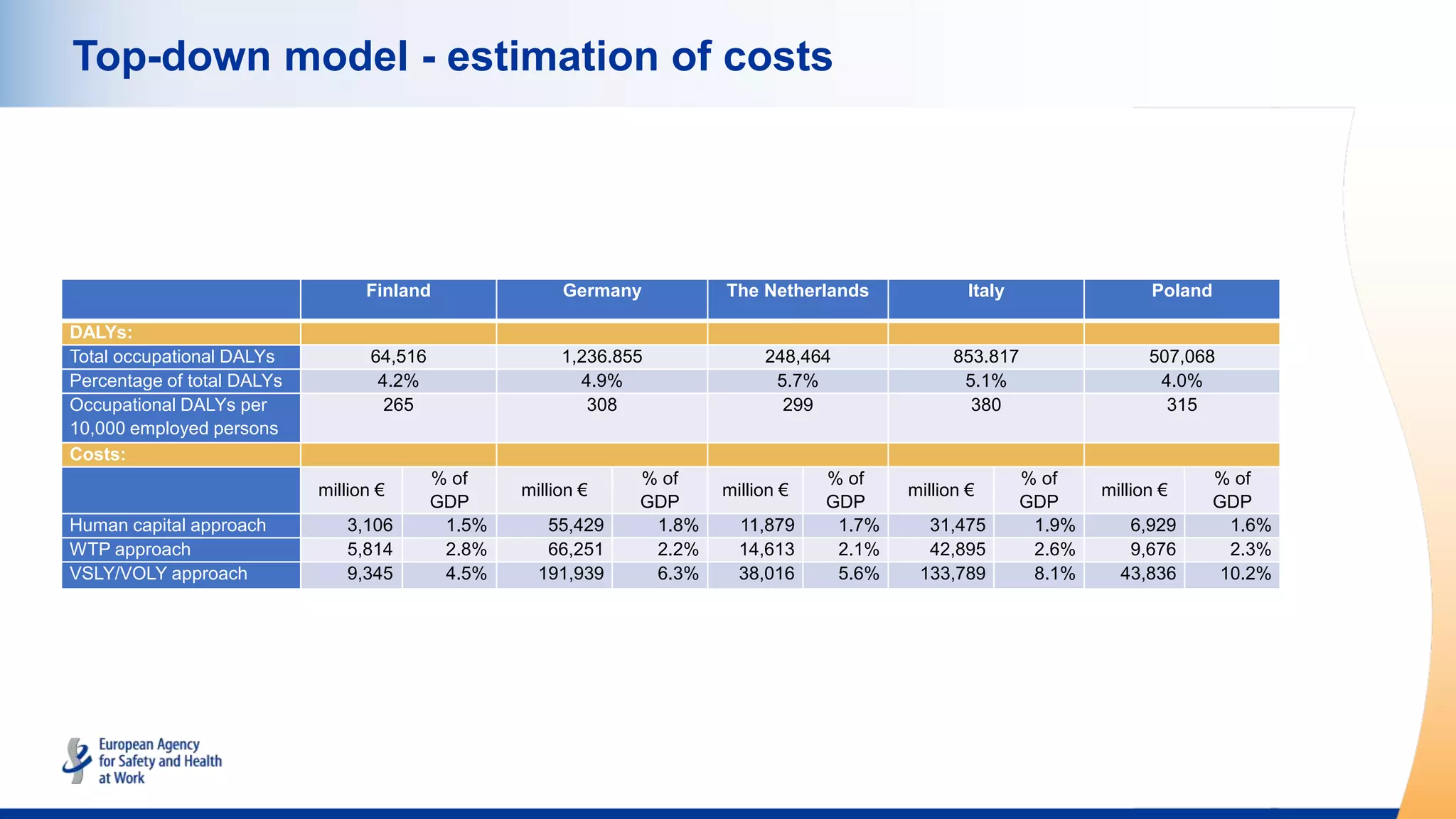
Top-down model - estimation of costs
Finland Germany The Netherlands Italy Poland
DALYs:
Total occupational DALYs 64,516 1,236.855 248,464 853.817 507,068
Percentage of total DALYs 4.2% 4.9% 5.7% 5.1% 4.0%
Occupational DALYs per
10,000 employed persons
265 308 299 380 315
Costs:
million €
% of
GDP
million €
% of
GDP
million €
% of
GDP
million €
% of
GDP
million €
% of
GDP
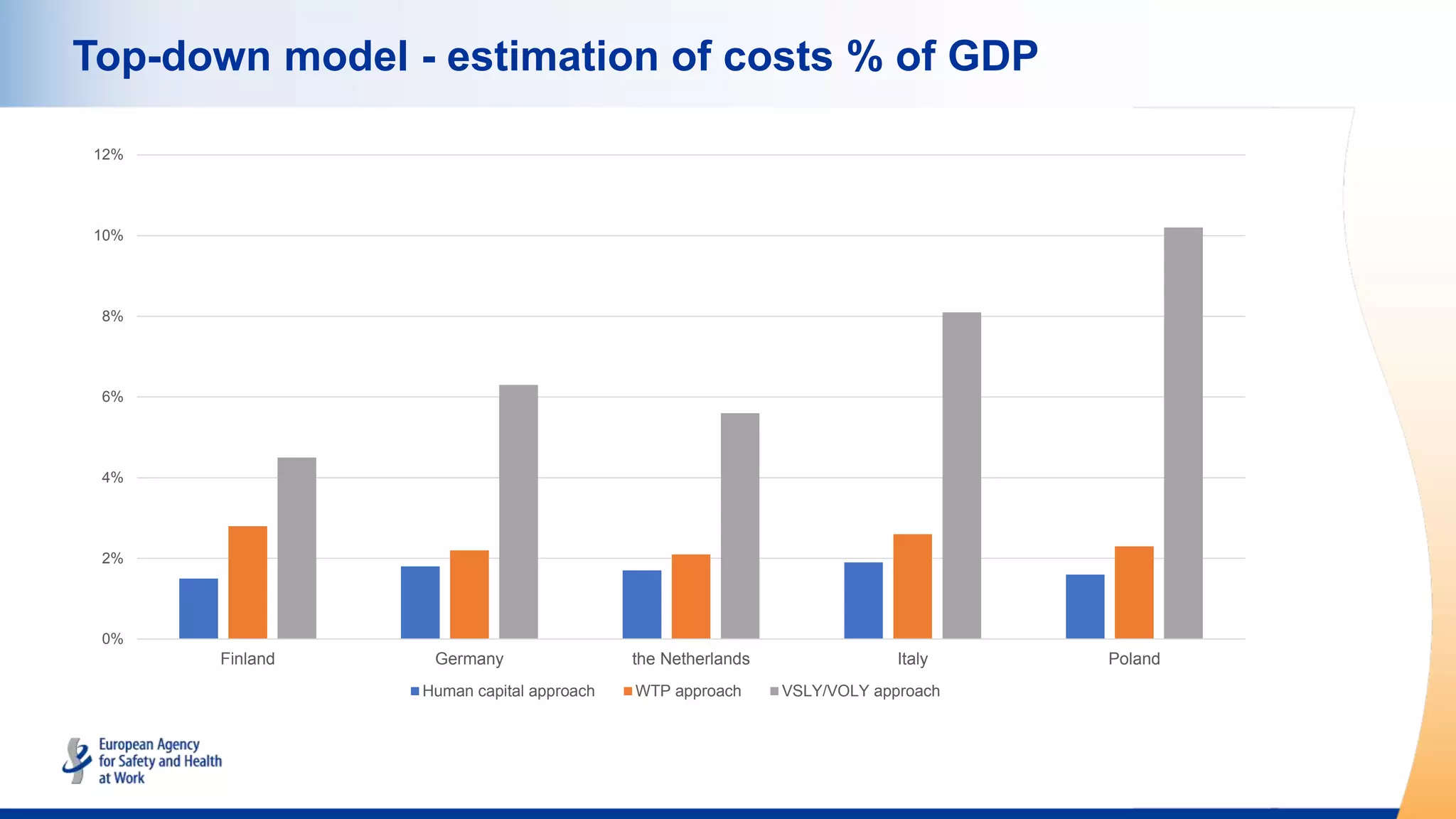
Human capital approach 3,106 1.5% 55,429 1.8% 11,879 1.7% 31,475 1.9% 6,929 1.6%
WTP approach 5,814 2.8% 66,251 2.2% 14,613 2.1% 42,895 2.6% 9,676 2.3%
VSLY/VOLY approach 9,345 4.5% 191,939 6.3% 38,016 5.6% 133,789 8.1% 43,836 10.2%
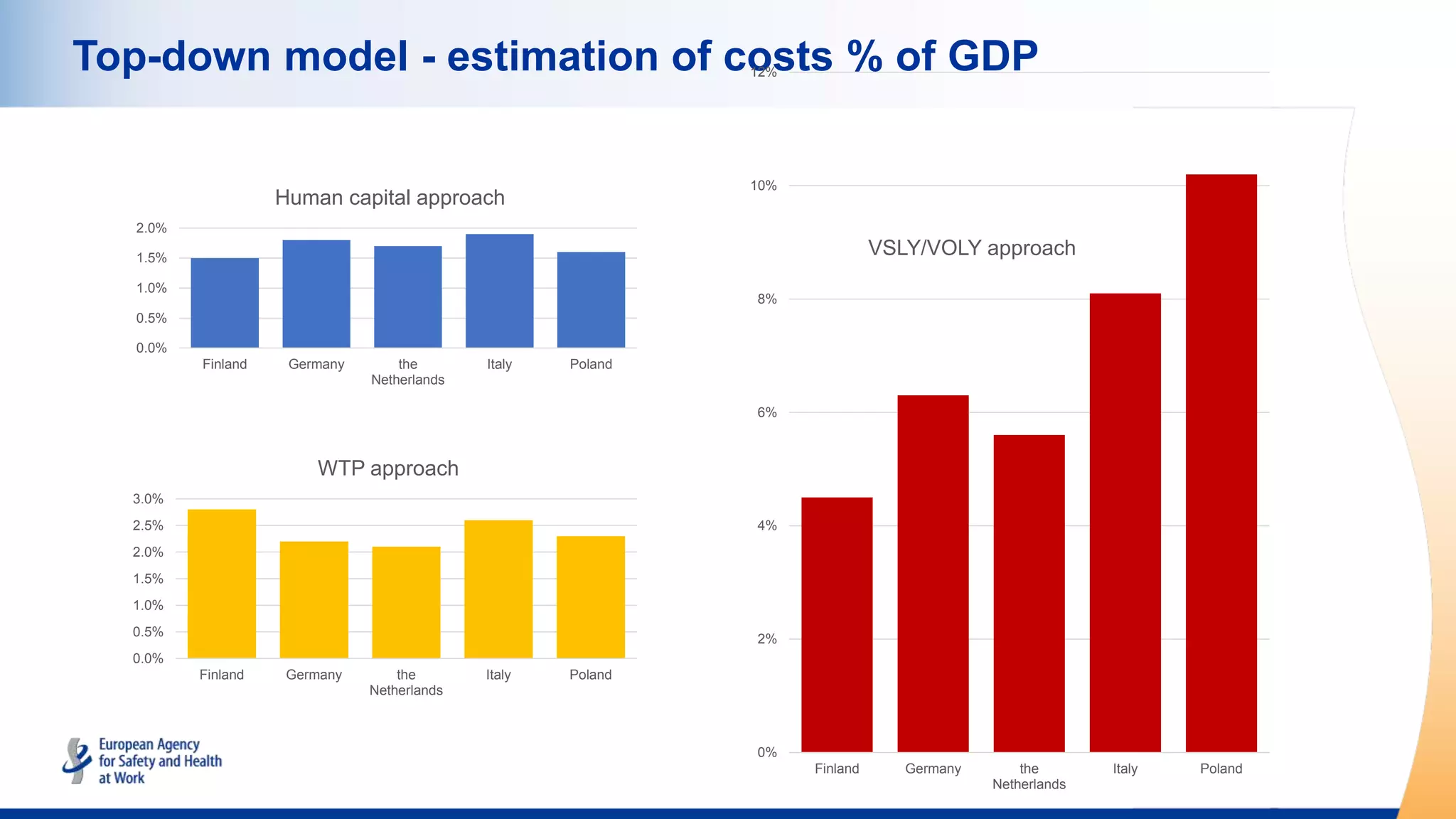
Top-down model - estimation of costs % of GDP
0%
2%
4%
6%
8%
10%
12%
Finland Germany the
Netherlands
Italy Poland
VSLY/VOLY approach
0.0%
0.5%
1.0%
1.5%
2.0%
2.5%
3.0%
Finland Germany the
Netherlands
Italy Poland
WTP approach
0.0%
0.5%
1.0%
1.5%
2.0%
Finland Germany the
Netherlands
Italy Poland
Human capital approach
Top-down model - estimation of costs % of GDP
0%
2%
4%
6%
8%
10%
12%
Finland Germany the Netherlands Italy Poland
Human capital approach WTP approach VSLY/VOLY approach
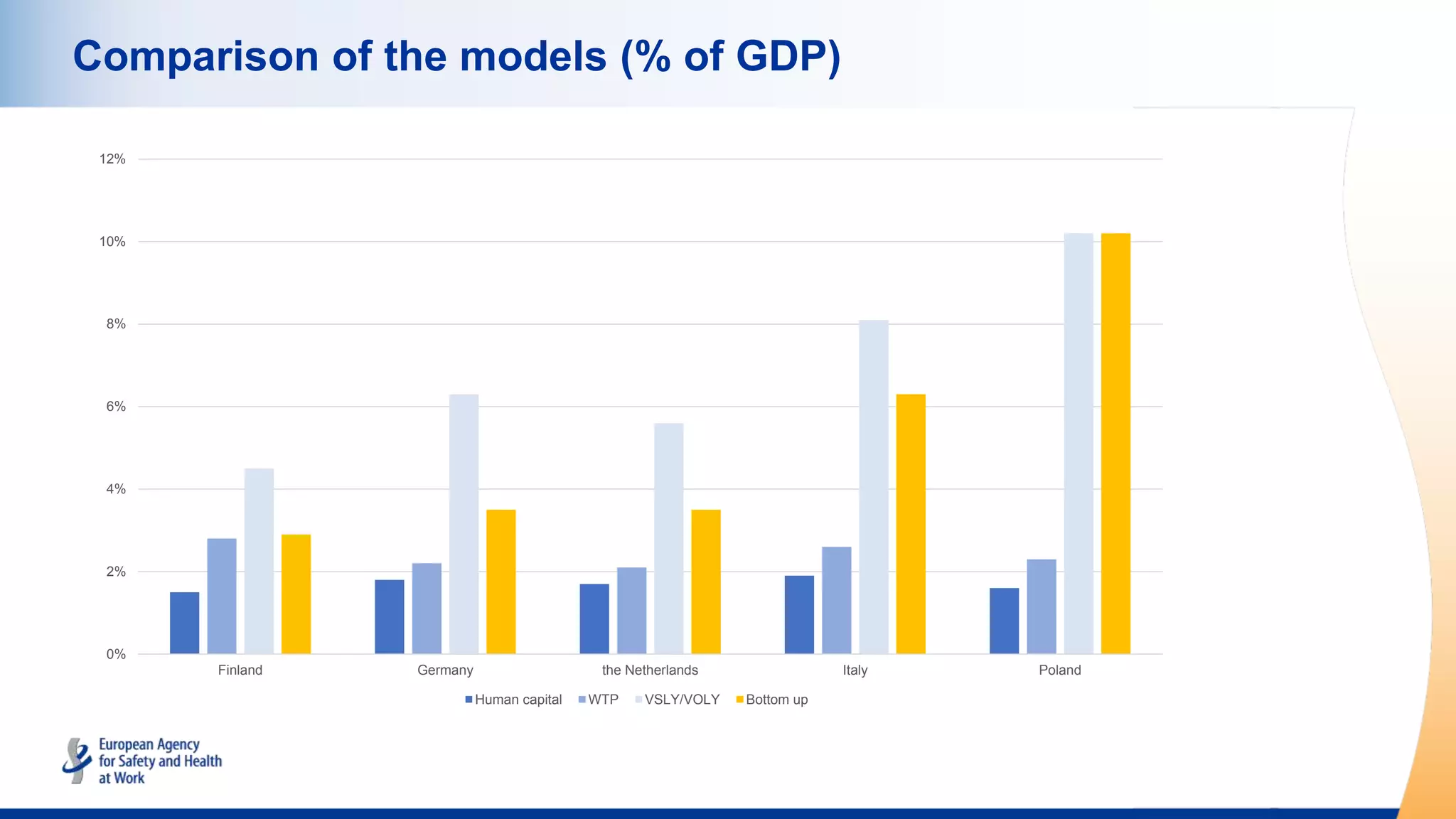
Comparison of the models (% of GDP)
0%
2%
4%
6%
8%
10%
12%
Finland Germany the Netherlands Italy Poland
Human capital WTP VSLY/VOLY Bottom up
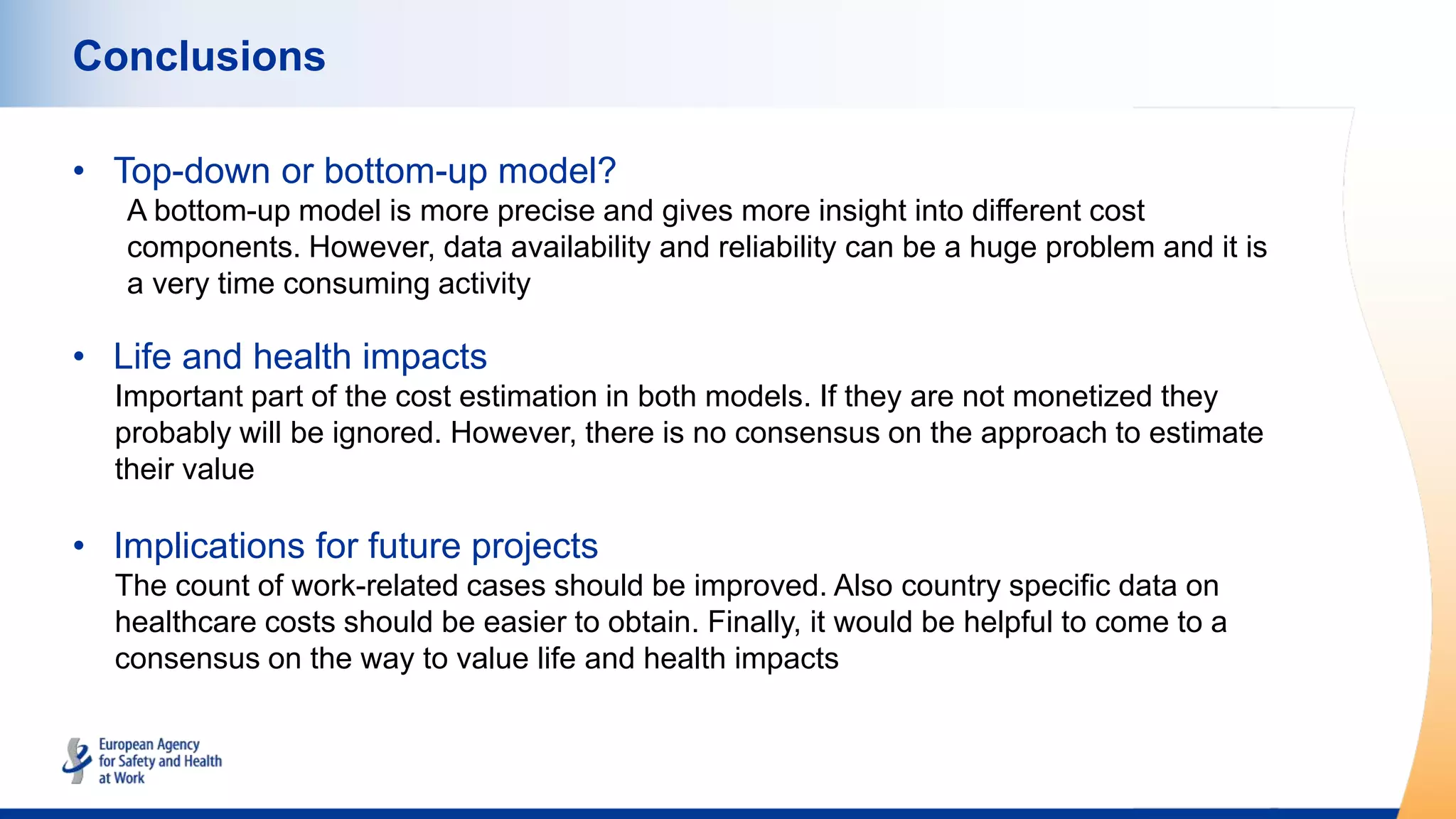
Conclusions
• Top-down or bottom-up model?
A bottom-up model is more precise and gives more insight into different cost
components. However, data availability and reliability can be a huge problem and it is
a very time consuming activity
• Life and health impacts
Important part of the cost estimation in both models. If they are not monetized they
probably will be ignored. However, there is no consensus on the approach to estimate
their value
• Implications for future projects
The count of work-related cases should be improved. Also country specific data on
healthcare costs should be easier to obtain. Finally, it would be helpful to come to a
consensus on the way to value life and health impacts

The value of OSH - Estimating the societal costs of work-related injuries and diseases

  • 1.
    Safety and healthat work is everyone’s concern. It’s good for you. It’s good for business. The value of OSH: Estimating the societal costs of work-related injuries and diseases In Finland, Germany, the Netherlands, Italy and Poland
  • 2.
    Objective of thestudy To estimate the costs of work-related injuries and diseases for five countries • Including the valuation of life and health impacts • Distinction between different cost bearers (employers, workers, society) • Differentiation between causes of injuries and diseases • Transparent and reproducible methodology
  • 3.
    Country selection -criteria Most important condition: Sufficient data quality to enable the cost estimation To represent the diversity in the European Union: • Sufficient geographical coverage • Variance in main type of industry (services, industry, agriculture • Variance in insurance system (health care, social security)
  • 4.
    Selected countries Sources: [1] EU-OSHA,2017b [2] Labour Force Survey 2015 (Eurostat) Countries Geographical location Insurance system[1] % employed in services[2] (EU average = 73.1%) Finland North Mixed 73.1% Germany West Bismarckian 73.9% The Netherlands West Bismarckian 82.9% Italy South Beveridgean 72.4% Poland Central Bismarckian 58.3%
  • 5.
    Two approaches Bottom-up model •Building up from costs per case to total costs • Direct costs (i.e. healthcare), indirect costs (i.e. productivity loss), intangible costs (monetized life and health impacts) Top-down model • Based on work-related fraction of total burden of disease expressed in DALYs • Monetary value of a DALY • Monetization approaches based on loss of productivity and life and health impacts
  • 6.
  • 7.
    Bottom-up model Estimation ofcases Definition of cost categories Price weights Total (sub) category costs for a strata = # of cases in the strata x per case costs for the strata
  • 8.
    Bottom-up model –estimation of cases  Non-fatal work-related injuries1  Fatal work-related injuries1  Non-fatal work-related diseases2,3 Different data sources, different scenarios of the case count. Baseline scenario: o Count of compensated (accepted, recognized) and non-compensated non- fatal cases for most types of diseases2; with the following exceptions: o for cancers, circulatory diseases, respiratory diseases, and musculoskeletal diseases we estimated case counts and used attributable fractions to estimate the work-related cases3  Fatal work-related diseases3 Sources: [1] ESAW 2015 (non-fatal cases of Poland and Italy are adjusted based on the fatal to non-fatal ratio). To estimate the number of non- fatal cases with 1-3 workdays lost, the severity distribution in the LFS 2013 was applied [2] National sources: Finland - Finnish Institute of Occupational Health (2012); Germany - DGUV Statistics (2013); The Netherlands - NCvB statistiek, Nationale Registratie Beroepsziekten (2015); Italy - Banche dati static, occupational injury and disease (2015); Poland: Choroby Zawodowe W Polsce W (2014) [3] IHME 2015
  • 9.
    Bottom-up model –estimation of cases work-related injuries work-related diseases Countries Non-fatal (> 1 workday lost) Fatal Non-fatal Fatal Finland 63,407 35 67,795 628 Germany 1,158,865 450 1,088,793 13,924 The Netherlands 99,880 35 220,368 3,262 Italy 1,257,987 543 638,448 10,524 Poland 697,337 301 454,090 4,663
  • 10.
    Bottom-up model -definition of cost categories Direct costs • Healthcare costs (public sector/insurer) • Overhead costs (public sector/insurer) • Informal care giving (family/community) • Out of pocket costs healthcare products (worker/family) Indirect costs • Market output losses • Payroll/fringe benefits • Employer adjustment costs • Insurance administration costs • Home production losses • Presenteeism Intangible costs • Monetary value of Quality Adjusted Life Years (QALYs)
  • 11.
    Bottom-up model –estimation of costs Country Finland Germany The Netherlands Italy Poland Cases 131,867 2,262,031 323,544 1,907,504 1,156,394 Direct costs In million € € 484 € 10,914 € 2,137 € 8,491 € 1,882 Direct cost % total 8% 10% 9% 8% 4% Indirect costs In million € € 4,362 € 70,658 € 16,468 € 58,961 € 19,588 Indirect cost % total 72% 66% 69% 56% 45% Intangible costs In million € € 1,196 € 25,557 € 5,147 € 37,392 € 22,311 Intangible cost % total 20% 24% 22% 36% 51% Total economic burden In million € € 6,042 € 107,129 € 23,751 € 104,844 € 43,781 Percentage of GDP with intangible cost 2.9% 3.5% 3.5% 6.3% 10.2% Percentage of GDP, direct and indirect costs only 2.3% 2.7% 2.7% 4,0% 5.0% Per case cost € 45,816 € 47,360 € 73,410 € 54,964 € 37,860 Per employed person € 2,479 € 2,664 € 2,855 € 4,667 € 2,722 GDP per employed € 86,016 € 75,692 € 82,159 € 73,565 € 26,738
  • 12.
    Bottom-up model –type of costs by country Finland Direct cost Indirect cost Intangible cost Germany Direct cost Indirect cost Intangible cost The Netherlands Direct cost Indirect cost Intangible cost Italy Direct cost Indirect cost Intangible cost Poland Direct cost Indirect cost Intangible cost
  • 13.
    Bottom-up model –% of GDP by country (without intangible costs) Poland 5.0% GDP Germany 2.7% GDP Finland 2.3% GDP The Netherland 2.7% GDP Italy 4.0% GDP Country GDP Total Cost (In million) Finland 2.3% € 4,846 Germany 2.7% € 81,572 The Netherland 2.7% € 18,605 Italy 4.0% € 67,452 Poland 5.0% € 21,470
  • 14.
    Bottom-up model –per case and per employed person €2,479.00 €2,664.00 €2,855.00 €4,667.00 €2,722.00 €0 €500 €1,000 €1,500 €2,000 €2,500 €3,000 €3,500 €4,000 €4,500 €5,000 Finland Germany The Netherlands Italy Poland Per employed person 45816 47360 73410 54964 37860 0 10000 20000 30000 40000 50000 60000 70000 80000 Per case cost in Euro
  • 15.
    Bottom-up model –costs by stakeholder Country Employer Worker System/Society In million € % In million € % In million € % Finland € 1,325 22% € 3,800 63% € 916 15% Germany € 21,534 20% € 64,813 61% € 20,782 19% The Netherlands € 3,484 15% € 17,235 73% € 3,032 13% Italy € 20,632 20% € 70,391 67% € 13,821 13% Poland € 5,007 11% € 34,421 79% € 4,353 10%
  • 16.
    Bottom-up model –costs by stakeholder (total costs) 63% 61% 73% 67% 79% 22% 20% 15% 20% 11% 15% 19% 13% 13% 10% 0% 10% 20% 30% 40% 50% 60% 70% 80% 90% 100% Finland Germany Netherland Italy Poland Worker Employer Society
  • 17.
    Bottom-up model –costs by stakeholder (without intangible costs) 54% 49% 65% 49% 57% 27% 26% 19% 31% 23% 19% 25% 16% 20% 20% 0% 10% 20% 30% 40% 50% 60% 70% 80% 90% 100% Finland Germany The Netherlands Italy Poland Chart Title Worker Employer System/Society
  • 18.
  • 19.
    Top-down model -elements DALY = Disability Adjusted Life Year The DALY is a measure of overall disease burden, expressed as the number of years lost or lived with disabilities due to ill-health, disability or early death, calculated by disease DALY = sum of life years lost to premature mortality + healthy life years lost to disability Attributable fraction = part of the disease that is caused by occupational exposure Sources: DALYs by disease, sex, age and country from the World Health Organisation (WHO) Global Health Estimates. Attributable fractions derived from the Global Burden of Disease study as registered by the Institute for Health Metrics and Evaluation (IHME), and from the literature. Monetary values derived from the literature. Monetary value of a DALY according to several monetization approaches
  • 20.
    Top-down model –cost estimation n of DALYs disease #1 n of DALYs disease #2 n of DALYs disease #n Attributable fraction disease #1 Attributable fraction disease #2 Attributable fraction disease #n x x x Total work- related DALYs = Monetary value of a DALY x
  • 21.
    Top-down model –monetization approaches Human capital approach Based on the loss of economic productivity due to ill health, disability or premature mortality Willingness-to-pay Based on the preference of survey respondents to pay for health gains Value of statistical life Based on a value of the total remaining lifetime in case of no accident or illness
  • 22.
    Top-down model -estimation of costs Finland Germany The Netherlands Italy Poland DALYs: Total occupational DALYs 64,516 1,236.855 248,464 853.817 507,068 Percentage of total DALYs 4.2% 4.9% 5.7% 5.1% 4.0% Occupational DALYs per 10,000 employed persons 265 308 299 380 315 Costs: million € % of GDP million € % of GDP million € % of GDP million € % of GDP million € % of GDP Human capital approach Minimum 1,419 0.7% 24,597 0.8% 5,290 0.8% 13,530 0.8% 2,692 0.6% Average 3,106 1.5% 55,429 1.8% 11,879 1.7% 31,475 1.9% 6,929 1.6% Median 2,291 1.1% 39,712 1.3% 8,708 1.3% 23,865 1.4% 4,656 1.1% Maximum 7,393 3.5% 138,404 4.5% 30,114 4.4% 69,671 4.2% 17,037 4.0% WTP approach Minimum 1,637 0.8% 32,324 1.1% 3,276 0.5% 20,929 1.3% 5,118 1.2% Average 5,814 2.8% 66,251 2.2% 14,613 2.1% 42,895 2.6% 9,676 2.3% Median 4,335 2.1% 66,251 2.2% 13,953 2.0% 42,895 2.6% 8,863 2.1% Maximum 17,453 8.3% 100,177 3.3% 30,767 4.5% 64,861 3.9% 15,861 3.7% VSLY/VOLY approach Minimum 4,214 2.0% 60,609 2.0% 9,649 1.4% 52,304 3.2% 12,790 3.0% Average 9,345 4.5% 191,939 6.3% 38,016 5.6% 133,789 8.1% 43,836 10.2% Median 8,633 4.1% 166,943 5.5% 33,248 4.9% 126,876 7.7% 31,026 7.2% Maximum 19,425 9.3% 420,489 13.8% 77,016 11.3% 256,120 15.5% 119,149 27.7%
  • 23.
    Top-down model -estimation of costs Finland Germany The Netherlands Italy Poland DALYs: Total occupational DALYs 64,516 1,236.855 248,464 853.817 507,068 Percentage of total DALYs 4.2% 4.9% 5.7% 5.1% 4.0% Occupational DALYs per 10,000 employed persons 265 308 299 380 315 Costs: million € % of GDP million € % of GDP million € % of GDP million € % of GDP million € % of GDP Human capital approach 3,106 1.5% 55,429 1.8% 11,879 1.7% 31,475 1.9% 6,929 1.6% WTP approach 5,814 2.8% 66,251 2.2% 14,613 2.1% 42,895 2.6% 9,676 2.3% VSLY/VOLY approach 9,345 4.5% 191,939 6.3% 38,016 5.6% 133,789 8.1% 43,836 10.2%
  • 24.
    Top-down model -estimation of costs % of GDP 0% 2% 4% 6% 8% 10% 12% Finland Germany the Netherlands Italy Poland VSLY/VOLY approach 0.0% 0.5% 1.0% 1.5% 2.0% 2.5% 3.0% Finland Germany the Netherlands Italy Poland WTP approach 0.0% 0.5% 1.0% 1.5% 2.0% Finland Germany the Netherlands Italy Poland Human capital approach
  • 25.
    Top-down model -estimation of costs % of GDP 0% 2% 4% 6% 8% 10% 12% Finland Germany the Netherlands Italy Poland Human capital approach WTP approach VSLY/VOLY approach
  • 26.
    Comparison of themodels (% of GDP) 0% 2% 4% 6% 8% 10% 12% Finland Germany the Netherlands Italy Poland Human capital WTP VSLY/VOLY Bottom up
  • 27.
    Conclusions • Top-down orbottom-up model? A bottom-up model is more precise and gives more insight into different cost components. However, data availability and reliability can be a huge problem and it is a very time consuming activity • Life and health impacts Important part of the cost estimation in both models. If they are not monetized they probably will be ignored. However, there is no consensus on the approach to estimate their value • Implications for future projects The count of work-related cases should be improved. Also country specific data on healthcare costs should be easier to obtain. Finally, it would be helpful to come to a consensus on the way to value life and health impacts